
A English
Mix Examples-Work, Energy, Power and Collision Questions in English
Class 11 Physics · Work, Energy, Power and Collision · Mix Examples-Work, Energy, Power and Collision
402+
Questions
English
Language
100%
With Solutions
Showing 49 of 402 questions in English
301
DifficultMCQ
Three objects $A$,$B$,and $C$ are kept in a straight line on a frictionless horizontal surface. These have masses $m$,$2m$,and $m$,respectively. The object $A$ moves towards $B$ with a speed of $9 \ m/s$ and makes an elastic collision with it. Thereafter,$B$ makes a completely inelastic collision with $C$. All motions occur on the same straight line. Find the final speed (in $m/s$) of the object $C$.
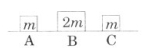
A
$9$
B
$5$
C
$4$
D
$6$
Solution
(C) Step $1$: Elastic collision between $A$ and $B$.
Let $v_A = 9 \ m/s$ and $v_B = 0$. After the collision,let the velocities be $v_A'$ and $v_B'$.
By conservation of momentum: $m(9) + 2m(0) = m v_A' + 2m v_B' \Rightarrow 9 = v_A' + 2v_B'$.
By the coefficient of restitution for an elastic collision $(e=1)$: $v_B' - v_A' = e(v_A - v_B) = 1(9 - 0) = 9 \Rightarrow v_B' - v_A' = 9$.
Adding the two equations: $(v_A' + 2v_B') + (v_B' - v_A') = 9 + 9 \Rightarrow 3v_B' = 18 \Rightarrow v_B' = 6 \ m/s$.
Step $2$: Completely inelastic collision between $B$ and $C$.
Let $v_B' = 6 \ m/s$ and $v_C = 0$. After the collision,$B$ and $C$ move together with velocity $v_f$.
By conservation of momentum: $2m(v_B') + m(0) = (2m + m)v_f \Rightarrow 2m(6) = 3m v_f \Rightarrow 12 = 3v_f \Rightarrow v_f = 4 \ m/s$.
Thus,the final speed of object $C$ is $4 \ m/s$.
Let $v_A = 9 \ m/s$ and $v_B = 0$. After the collision,let the velocities be $v_A'$ and $v_B'$.
By conservation of momentum: $m(9) + 2m(0) = m v_A' + 2m v_B' \Rightarrow 9 = v_A' + 2v_B'$.
By the coefficient of restitution for an elastic collision $(e=1)$: $v_B' - v_A' = e(v_A - v_B) = 1(9 - 0) = 9 \Rightarrow v_B' - v_A' = 9$.
Adding the two equations: $(v_A' + 2v_B') + (v_B' - v_A') = 9 + 9 \Rightarrow 3v_B' = 18 \Rightarrow v_B' = 6 \ m/s$.
Step $2$: Completely inelastic collision between $B$ and $C$.
Let $v_B' = 6 \ m/s$ and $v_C = 0$. After the collision,$B$ and $C$ move together with velocity $v_f$.
By conservation of momentum: $2m(v_B') + m(0) = (2m + m)v_f \Rightarrow 2m(6) = 3m v_f \Rightarrow 12 = 3v_f \Rightarrow v_f = 4 \ m/s$.
Thus,the final speed of object $C$ is $4 \ m/s$.
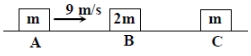
0 likes
View Solution302
DifficultMCQ
$A$ light inextensible string that goes over a smooth fixed pulley as shown in the figure connects two blocks of masses $m_1 = 0.36 \text{ kg}$ and $m_2 = 0.72 \text{ kg}$. Taking $g = 10 \text{ m/s}^2$,find the work done (in joules) by the string on the block of mass $0.36 \text{ kg}$ during the first second after the system is released from rest.

A
$5$
B
$6$
C
$8$
D
$9$
Solution
(C) Let $m_1 = 0.36 \text{ kg}$ and $m_2 = 0.72 \text{ kg}$.
For the block of mass $m_2$,the equation of motion is: $m_2 g - T = m_2 a$.
For the block of mass $m_1$,the equation of motion is: $T - m_1 g = m_1 a$.
Adding these two equations: $(m_2 - m_1) g = (m_1 + m_2) a$.
$a = \frac{(m_2 - m_1) g}{m_1 + m_2} = \frac{(0.72 - 0.36) \times 10}{0.72 + 0.36} = \frac{0.36 \times 10}{1.08} = \frac{3.6}{1.08} = \frac{10}{3} \text{ m/s}^2$.
The tension $T$ is given by: $T = m_1(g + a) = 0.36 \times (10 + \frac{10}{3}) = 0.36 \times \frac{40}{3} = 0.12 \times 40 = 4.8 \text{ N}$.
The displacement $s$ in $t = 1 \text{ s}$ starting from rest is: $s = \frac{1}{2} a t^2 = \frac{1}{2} \times \frac{10}{3} \times (1)^2 = \frac{5}{3} \text{ m}$.
The work done by the string on the block of mass $m_1$ is: $W = T \times s = 4.8 \times \frac{5}{3} = 1.6 \times 5 = 8 \text{ J}$.
For the block of mass $m_2$,the equation of motion is: $m_2 g - T = m_2 a$.
For the block of mass $m_1$,the equation of motion is: $T - m_1 g = m_1 a$.
Adding these two equations: $(m_2 - m_1) g = (m_1 + m_2) a$.
$a = \frac{(m_2 - m_1) g}{m_1 + m_2} = \frac{(0.72 - 0.36) \times 10}{0.72 + 0.36} = \frac{0.36 \times 10}{1.08} = \frac{3.6}{1.08} = \frac{10}{3} \text{ m/s}^2$.
The tension $T$ is given by: $T = m_1(g + a) = 0.36 \times (10 + \frac{10}{3}) = 0.36 \times \frac{40}{3} = 0.12 \times 40 = 4.8 \text{ N}$.
The displacement $s$ in $t = 1 \text{ s}$ starting from rest is: $s = \frac{1}{2} a t^2 = \frac{1}{2} \times \frac{10}{3} \times (1)^2 = \frac{5}{3} \text{ m}$.
The work done by the string on the block of mass $m_1$ is: $W = T \times s = 4.8 \times \frac{5}{3} = 1.6 \times 5 = 8 \text{ J}$.
0 likes
View Solution303
DifficultMCQ
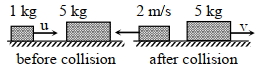
$A$ point mass of $1 \, kg$ collides elastically with a stationary point mass of $5 \, kg$. After their collision, the $1 \, kg$ mass reverses its direction and moves with a speed of $2 \, m/s$. Which of the following statement(s) is (are) correct for the system of these two masses?
$(A)$ Total momentum of the system is $3 \, kg \cdot m/s$
$(B)$ Momentum of $5 \, kg$ mass after collision is $4 \, kg \cdot m/s$
$(C)$ Kinetic energy of the centre of mass is $0.75 \, J$
$(D)$ Total kinetic energy of the system is $4 \, J$
$(A)$ Total momentum of the system is $3 \, kg \cdot m/s$
$(B)$ Momentum of $5 \, kg$ mass after collision is $4 \, kg \cdot m/s$
$(C)$ Kinetic energy of the centre of mass is $0.75 \, J$
$(D)$ Total kinetic energy of the system is $4 \, J$
A
$(A, C)$
B
$(B, D)$
C
$(C, D)$
D
$(A, D)$
Solution
(A) Let $u$ be the initial velocity of the $1 \, kg$ mass and $v$ be the final velocity of the $5 \, kg$ mass.
By conservation of linear momentum: $1 \cdot u + 5 \cdot 0 = 1 \cdot (-2) + 5 \cdot v \implies u = 5v - 2$ ... $(i)$
By Newton's experimental law of collision (for elastic collision, coefficient of restitution $e = 1$): $v - (-2) = 1 \cdot (u - 0) \implies u = v + 2$ ... $(ii)$
Solving $(i)$ and $(ii)$: $5v - 2 = v + 2 \implies 4v = 4 \implies v = 1 \, m/s$. Then $u = 3 \, m/s$.
$(A)$ Total momentum $P = 1 \cdot u = 1 \cdot 3 = 3 \, kg \cdot m/s$. (Correct)
$(B)$ Momentum of $5 \, kg$ mass $= 5 \cdot v = 5 \cdot 1 = 5 \, kg \cdot m/s$. (Incorrect)
$(C)$ Velocity of centre of mass $v_{cm} = \frac{m_1 u_1 + m_2 u_2}{m_1 + m_2} = \frac{1 \cdot 3 + 5 \cdot 0}{1 + 5} = 0.5 \, m/s$. Kinetic energy of $CM$ $= \frac{1}{2} (m_1 + m_2) v_{cm}^2 = \frac{1}{2} \cdot 6 \cdot (0.5)^2 = 3 \cdot 0.25 = 0.75 \, J$. (Correct)
$(D)$ Total kinetic energy $= \frac{1}{2} \cdot 1 \cdot (-2)^2 + \frac{1}{2} \cdot 5 \cdot (1)^2 = 2 + 2.5 = 4.5 \, J$. (Incorrect)
Thus, statements $(A)$ and $(C)$ are correct.
By conservation of linear momentum: $1 \cdot u + 5 \cdot 0 = 1 \cdot (-2) + 5 \cdot v \implies u = 5v - 2$ ... $(i)$
By Newton's experimental law of collision (for elastic collision, coefficient of restitution $e = 1$): $v - (-2) = 1 \cdot (u - 0) \implies u = v + 2$ ... $(ii)$
Solving $(i)$ and $(ii)$: $5v - 2 = v + 2 \implies 4v = 4 \implies v = 1 \, m/s$. Then $u = 3 \, m/s$.
$(A)$ Total momentum $P = 1 \cdot u = 1 \cdot 3 = 3 \, kg \cdot m/s$. (Correct)
$(B)$ Momentum of $5 \, kg$ mass $= 5 \cdot v = 5 \cdot 1 = 5 \, kg \cdot m/s$. (Incorrect)
$(C)$ Velocity of centre of mass $v_{cm} = \frac{m_1 u_1 + m_2 u_2}{m_1 + m_2} = \frac{1 \cdot 3 + 5 \cdot 0}{1 + 5} = 0.5 \, m/s$. Kinetic energy of $CM$ $= \frac{1}{2} (m_1 + m_2) v_{cm}^2 = \frac{1}{2} \cdot 6 \cdot (0.5)^2 = 3 \cdot 0.25 = 0.75 \, J$. (Correct)
$(D)$ Total kinetic energy $= \frac{1}{2} \cdot 1 \cdot (-2)^2 + \frac{1}{2} \cdot 5 \cdot (1)^2 = 2 + 2.5 = 4.5 \, J$. (Incorrect)
Thus, statements $(A)$ and $(C)$ are correct.
0 likes
View Solution304
DifficultMCQ
$A$ ball of mass $0.2 \ kg$ rests on a vertical post of height $5 \ m$. $A$ bullet of mass $0.01 \ kg$,traveling with a velocity $V \ m/s$ in a horizontal direction,hits the centre of the ball. After the collision,the ball and bullet travel independently. The ball hits the ground at a distance of $20 \ m$ and the bullet at a distance of $100 \ m$ from the foot of the post. The initial velocity $V$ of the bullet is
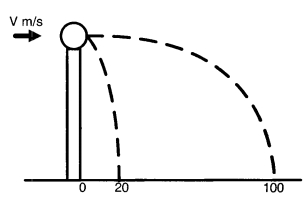
A
$250 \ m/s$
B
$250 \sqrt{2} \ m/s$
C
$400 \ m/s$
D
$500 \ m/s$
Solution
(D) Let the mass of the bullet be $m = 0.01 \ kg$ and the mass of the ball be $M = 0.2 \ kg$. The ball is initially at rest at a height $h = 5 \ m$.
Since the motion is horizontal projectile motion,the time $t$ taken to reach the ground is given by $h = \frac{1}{2} g t^2$.
Taking $g = 10 \ m/s^2$,we have $5 = \frac{1}{2} \times 10 \times t^2$,which gives $t = 1 \ s$.
After the collision,the horizontal velocity of the ball is $v_b = \frac{\text{distance}}{\text{time}} = \frac{20 \ m}{1 \ s} = 20 \ m/s$.
The horizontal velocity of the bullet is $v_u = \frac{100 \ m}{1 \ s} = 100 \ m/s$.
By the principle of conservation of linear momentum in the horizontal direction:
$m V = m v_u + M v_b$
$0.01 \times V = (0.01 \times 100) + (0.2 \times 20)$
$0.01 \times V = 1 + 4 = 5$
$V = \frac{5}{0.01} = 500 \ m/s$.
Since the motion is horizontal projectile motion,the time $t$ taken to reach the ground is given by $h = \frac{1}{2} g t^2$.
Taking $g = 10 \ m/s^2$,we have $5 = \frac{1}{2} \times 10 \times t^2$,which gives $t = 1 \ s$.
After the collision,the horizontal velocity of the ball is $v_b = \frac{\text{distance}}{\text{time}} = \frac{20 \ m}{1 \ s} = 20 \ m/s$.
The horizontal velocity of the bullet is $v_u = \frac{100 \ m}{1 \ s} = 100 \ m/s$.
By the principle of conservation of linear momentum in the horizontal direction:
$m V = m v_u + M v_b$
$0.01 \times V = (0.01 \times 100) + (0.2 \times 20)$
$0.01 \times V = 1 + 4 = 5$
$V = \frac{5}{0.01} = 500 \ m/s$.
0 likes
View Solution305
AdvancedMCQ
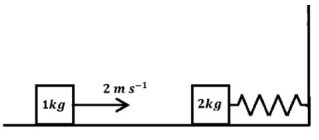
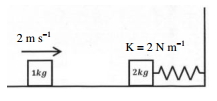
$A$ spring-block system is resting on a frictionless floor as shown in the figure. The spring constant is $2.0 \ N \ m^{-1}$ and the mass of the block is $2.0 \ kg$. Ignore the mass of the spring. Initially,the spring is in an unstretched condition. Another block of mass $1.0 \ kg$ moving with a speed of $2.0 \ m \ s^{-1}$ collides elastically with the first block. The collision is such that the $2.0 \ kg$ block does not hit the wall. The distance,in metres,between the two blocks when the spring returns to its unstretched position for the first time after the collision is . . . . .
A
$2.01$
B
$2.08$
C
$2.09$
D
$2.07$
Solution
(C) Let $m_1 = 1.0 \ kg$ and $m_2 = 2.0 \ kg$. Initial velocity of $m_1$ is $u_1 = 2.0 \ m \ s^{-1}$ and $m_2$ is $u_2 = 0$. Let $v_1$ and $v_2$ be their velocities after the elastic collision.
Using conservation of linear momentum: $m_1 u_1 = m_1 v_1 + m_2 v_2 \implies 1(2) = 1(v_1) + 2(v_2) \implies v_1 + 2v_2 = 2$ . . . . . $(1)$
Using the coefficient of restitution for an elastic collision $(e=1)$: $v_2 - v_1 = e(u_1 - u_2) = 1(2 - 0) = 2$ . . . . . $(2)$
Solving equations $(1)$ and $(2)$,we get $v_2 = 4/3 \ m \ s^{-1}$ and $v_1 = -2/3 \ m \ s^{-1}$.
The $2.0 \ kg$ block attached to the spring undergoes simple harmonic motion. The time period is $T = 2\pi \sqrt{m_2/k} = 2\pi \sqrt{2/2} = 2\pi \ s$.
The spring returns to its unstretched position after half the time period,i.e.,$\Delta t = T/2 = \pi \ s$.
During this time,the $1.0 \ kg$ block moves with constant velocity $v_1 = -2/3 \ m \ s^{-1}$ (away from the spring). Its displacement is $\Delta x_1 = v_1 \Delta t = (-2/3) \times \pi = -2\pi/3 \ m$.
The $2.0 \ kg$ block moves from $x=0$ to $x_{max}$ and back to $x=0$. Its displacement is $\Delta x_2 = 0$.
The distance between the blocks is $|\Delta x_1 - \Delta x_2| = |-2\pi/3 - 0| = 2\pi/3 \approx 2(3.14)/3 = 6.28/3 \approx 2.09 \ m$.
Using conservation of linear momentum: $m_1 u_1 = m_1 v_1 + m_2 v_2 \implies 1(2) = 1(v_1) + 2(v_2) \implies v_1 + 2v_2 = 2$ . . . . . $(1)$
Using the coefficient of restitution for an elastic collision $(e=1)$: $v_2 - v_1 = e(u_1 - u_2) = 1(2 - 0) = 2$ . . . . . $(2)$
Solving equations $(1)$ and $(2)$,we get $v_2 = 4/3 \ m \ s^{-1}$ and $v_1 = -2/3 \ m \ s^{-1}$.
The $2.0 \ kg$ block attached to the spring undergoes simple harmonic motion. The time period is $T = 2\pi \sqrt{m_2/k} = 2\pi \sqrt{2/2} = 2\pi \ s$.
The spring returns to its unstretched position after half the time period,i.e.,$\Delta t = T/2 = \pi \ s$.
During this time,the $1.0 \ kg$ block moves with constant velocity $v_1 = -2/3 \ m \ s^{-1}$ (away from the spring). Its displacement is $\Delta x_1 = v_1 \Delta t = (-2/3) \times \pi = -2\pi/3 \ m$.
The $2.0 \ kg$ block moves from $x=0$ to $x_{max}$ and back to $x=0$. Its displacement is $\Delta x_2 = 0$.
The distance between the blocks is $|\Delta x_1 - \Delta x_2| = |-2\pi/3 - 0| = 2\pi/3 \approx 2(3.14)/3 = 6.28/3 \approx 2.09 \ m$.
0 likes
View Solution306
MediumMCQ
$A$ particle of mass $m$ is initially at rest at the origin. It is subjected to a force and starts moving along the $x$-axis. Its kinetic energy $K$ changes with time as $dK/dt = \gamma t$,where $\gamma$ is a positive constant of appropriate dimensions. Which of the following statements is (are) true?
$(A)$ The force applied on the particle is constant
$(B)$ The speed of the particle is proportional to time
$(C)$ The distance of the particle from the origin increases linearly with time
$(D)$ The force is conservative
$(A)$ The force applied on the particle is constant
$(B)$ The speed of the particle is proportional to time
$(C)$ The distance of the particle from the origin increases linearly with time
$(D)$ The force is conservative
A
$(A), (B)$
B
$(A), (B), (D)$
C
$(B), (C)$
D
$(A), (C)$
Solution
(B) Given $\frac{dK}{dt} = \gamma t$. Since $K = \frac{1}{2}mv^2$,we have $\frac{dK}{dt} = mv \frac{dv}{dt} = \gamma t$.
Thus,$v \frac{dv}{dt} = \frac{\gamma t}{m}$.
Integrating both sides,$\int v dv = \int \frac{\gamma}{m} t dt$,which gives $\frac{v^2}{2} = \frac{\gamma t^2}{2m}$.
Therefore,$v = \sqrt{\frac{\gamma}{m}} t$. This shows that speed is proportional to time,so $(B)$ is true.
The acceleration $a = \frac{dv}{dt} = \sqrt{\frac{\gamma}{m}}$,which is a constant. Since $F = ma$,the force $F = \sqrt{\gamma m}$ is also constant,so $(A)$ is true.
Since $v = \frac{dx}{dt} = \sqrt{\frac{\gamma}{m}} t$,integrating gives $x = \int \sqrt{\frac{\gamma}{m}} t dt = \frac{1}{2} \sqrt{\frac{\gamma}{m}} t^2$. The distance increases quadratically with time,not linearly,so $(C)$ is false.
Since the force is constant,it is a conservative force,so $(D)$ is true.
Thus,statements $(A), (B),$ and $(D)$ are true.
Thus,$v \frac{dv}{dt} = \frac{\gamma t}{m}$.
Integrating both sides,$\int v dv = \int \frac{\gamma}{m} t dt$,which gives $\frac{v^2}{2} = \frac{\gamma t^2}{2m}$.
Therefore,$v = \sqrt{\frac{\gamma}{m}} t$. This shows that speed is proportional to time,so $(B)$ is true.
The acceleration $a = \frac{dv}{dt} = \sqrt{\frac{\gamma}{m}}$,which is a constant. Since $F = ma$,the force $F = \sqrt{\gamma m}$ is also constant,so $(A)$ is true.
Since $v = \frac{dx}{dt} = \sqrt{\frac{\gamma}{m}} t$,integrating gives $x = \int \sqrt{\frac{\gamma}{m}} t dt = \frac{1}{2} \sqrt{\frac{\gamma}{m}} t^2$. The distance increases quadratically with time,not linearly,so $(C)$ is false.
Since the force is constant,it is a conservative force,so $(D)$ is true.
Thus,statements $(A), (B),$ and $(D)$ are true.
0 likes
View Solution307
AdvancedMCQ
In the List-$I$ below, four different paths of a particle are given as functions of time. In these functions, $\alpha$ and $\beta$ are positive constants of appropriate dimensions and $\alpha \neq \beta$. In each case, the force acting on the particle is either zero or conservative. In List-$II$, five physical quantities of the particle are mentioned: $\overrightarrow{p}$ is the linear momentum, $\overrightarrow{L}$ is the angular momentum about the origin, $K$ is the kinetic energy, $U$ is the potential energy and $E$ is the total energy. Match each path in List-$I$ with those quantities in List-$II$, which are conserved for that path.
| List-$I$ | List-$II$ |
| $P$. $\vec{r}(t) = \alpha t \hat{i} + \beta t \hat{j}$ | $1$. $\overrightarrow{p}$ |
| $Q$. $\vec{r}(t) = \alpha \cos \omega t \hat{i} + \beta \sin \omega t \hat{j}$ | $2$. $\overrightarrow{L}$ |
| $R$. $\vec{r}(t) = \alpha(\cos \omega t \hat{i} + \sin \omega t \hat{j})$ | $3$. $K$ |
| $S$. $\vec{r}(t) = \alpha t \hat{i} + \frac{\beta}{2} t^2 \hat{j}$ | $4$. $U$ |
| $5$. $E$ |
A
$P \rightarrow 1, 2, 3, 4, 5; \quad Q \rightarrow 2, 5; \quad R \rightarrow 2, 3, 4, 5; \quad S \rightarrow 5$
B
$P \rightarrow 1, 2, 3, 4, 5; \quad Q \rightarrow 3, 5; \quad R \rightarrow 2, 3, 4, 5; \quad S \rightarrow 2, 5$
C
$P \rightarrow 2, 3, 4; \quad Q \rightarrow 5; \quad R \rightarrow 1, 2, 4; \quad S \rightarrow 2, 5$
D
$P \rightarrow 1, 2, 3, 5; \quad Q \rightarrow 2, 5; \quad R \rightarrow 2, 3, 4, 5; \quad S \rightarrow 2, 5$
Solution
(A) For path $P$: $\vec{r} = \alpha t \hat{i} + \beta t \hat{j}$. Velocity $\vec{v} = \alpha \hat{i} + \beta \hat{j}$ (constant), so acceleration $\vec{a} = 0$ and force $\vec{F} = 0$. Linear momentum $\vec{p} = m\vec{v}$ is constant. Angular momentum $\vec{L} = \vec{r} \times \vec{p} = m(\alpha t \hat{i} + \beta t \hat{j}) \times (\alpha \hat{i} + \beta \hat{j}) = m(\alpha\beta t - \beta\alpha t)\hat{k} = 0$ (constant). Since $\vec{F}=0$, $K$, $U$, and $E$ are constant. Thus, $P \rightarrow 1, 2, 3, 4, 5$.
For path $Q$: $\vec{r} = \alpha \cos \omega t \hat{i} + \beta \sin \omega t \hat{j}$. This is an elliptical path. The force is central, so angular momentum $\vec{L}$ is conserved. Since the force is conservative, total energy $E$ is conserved. Thus, $Q \rightarrow 2, 5$.
For path $R$: $\vec{r} = \alpha(\cos \omega t \hat{i} + \sin \omega t \hat{j})$. This is a circular path with constant speed $v = \alpha\omega$. Thus, $K$ is constant. Since the force is central, $\vec{L}$ is conserved. For a circular path in a central potential, $U$ and $E$ are also constant. Thus, $R \rightarrow 2, 3, 4, 5$.
For path $S$: $\vec{r} = \alpha t \hat{i} + \frac{\beta}{2} t^2 \hat{j}$. Velocity $\vec{v} = \alpha \hat{i} + \beta t \hat{j}$ (time-dependent), so $\vec{p}$ is not constant. Acceleration $\vec{a} = \beta \hat{j}$ (constant force). $\vec{L} = m(\alpha t \hat{i} + \frac{\beta}{2} t^2 \hat{j}) \times (\alpha \hat{i} + \beta t \hat{j}) = m(\alpha\beta t^2 - \frac{\alpha\beta}{2} t^2)\hat{k} = \frac{m\alpha\beta t^2}{2}\hat{k}$ (time-dependent). Only total energy $E$ is conserved. Thus, $S \rightarrow 5$.
For path $Q$: $\vec{r} = \alpha \cos \omega t \hat{i} + \beta \sin \omega t \hat{j}$. This is an elliptical path. The force is central, so angular momentum $\vec{L}$ is conserved. Since the force is conservative, total energy $E$ is conserved. Thus, $Q \rightarrow 2, 5$.
For path $R$: $\vec{r} = \alpha(\cos \omega t \hat{i} + \sin \omega t \hat{j})$. This is a circular path with constant speed $v = \alpha\omega$. Thus, $K$ is constant. Since the force is central, $\vec{L}$ is conserved. For a circular path in a central potential, $U$ and $E$ are also constant. Thus, $R \rightarrow 2, 3, 4, 5$.
For path $S$: $\vec{r} = \alpha t \hat{i} + \frac{\beta}{2} t^2 \hat{j}$. Velocity $\vec{v} = \alpha \hat{i} + \beta t \hat{j}$ (time-dependent), so $\vec{p}$ is not constant. Acceleration $\vec{a} = \beta \hat{j}$ (constant force). $\vec{L} = m(\alpha t \hat{i} + \frac{\beta}{2} t^2 \hat{j}) \times (\alpha \hat{i} + \beta t \hat{j}) = m(\alpha\beta t^2 - \frac{\alpha\beta}{2} t^2)\hat{k} = \frac{m\alpha\beta t^2}{2}\hat{k}$ (time-dependent). Only total energy $E$ is conserved. Thus, $S \rightarrow 5$.
0 likes
View Solution308
AdvancedMCQ
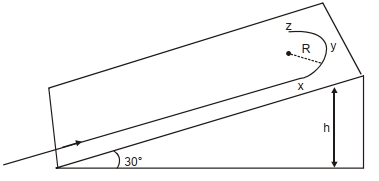
$A$ student skates up a ramp that makes an angle $30^{\circ}$ with the horizontal. He/she starts (as shown in the figure) at the bottom of the ramp with speed $v_0$ and wants to turn around over a semicircular path $xyz$ of radius $R$ during which he/she reaches a maximum height $h$ (at point $y$) from the ground as shown in the figure. Assume that the energy loss is negligible and the force required for this turn at the highest point is provided by his/her weight only. Then ($g$ is the acceleration due to gravity):
$(A)$ $v_0^2 - 2gh = \frac{1}{2} gR$
$(B)$ $v_0^2 - 2gh = \frac{\sqrt{3}}{2} gR$
$(C)$ The centripetal force required at points $x$ and $z$ is zero.
$(D)$ The centripetal force required is maximum at points $x$ and $z$.
$(A)$ $v_0^2 - 2gh = \frac{1}{2} gR$
$(B)$ $v_0^2 - 2gh = \frac{\sqrt{3}}{2} gR$
$(C)$ The centripetal force required at points $x$ and $z$ is zero.
$(D)$ The centripetal force required is maximum at points $x$ and $z$.
A
$A, B$
B
$A, D$
C
$A, C$
D
$A, B, C$
Solution
(B) By the principle of conservation of mechanical energy between the bottom point and point $y$:
$\frac{1}{2} mv_0^2 = mgh + \frac{1}{2} mv_1^2$
$\therefore v_1^2 = v_0^2 - 2gh \quad \dots (i)$
At point $y$,the semicircular path lies on the inclined plane. The component of gravity acting towards the center of the circular path is $mg \sin 30^{\circ}$. This component provides the necessary centripetal force:
$mg \sin 30^{\circ} = \frac{mv_1^2}{R}$
$\frac{1}{2} mg = \frac{mv_1^2}{R} \implies v_1^2 = \frac{gR}{2}$
Substituting this into equation $(i)$:
$v_0^2 - 2gh = \frac{gR}{2}$. Thus,statement $(A)$ is correct.
At points $x$ and $z$,the skater is at a lower height than at point $y$. By energy conservation,the velocity $v$ at $x$ and $z$ is greater than $v_1$ at $y$. Since the centripetal force required is $F_c = \frac{mv^2}{R}$,and $v > v_1$,the required centripetal force at $x$ and $z$ is greater than that at $y$. Thus,statement $(D)$ is correct.
$\frac{1}{2} mv_0^2 = mgh + \frac{1}{2} mv_1^2$
$\therefore v_1^2 = v_0^2 - 2gh \quad \dots (i)$
At point $y$,the semicircular path lies on the inclined plane. The component of gravity acting towards the center of the circular path is $mg \sin 30^{\circ}$. This component provides the necessary centripetal force:
$mg \sin 30^{\circ} = \frac{mv_1^2}{R}$
$\frac{1}{2} mg = \frac{mv_1^2}{R} \implies v_1^2 = \frac{gR}{2}$
Substituting this into equation $(i)$:
$v_0^2 - 2gh = \frac{gR}{2}$. Thus,statement $(A)$ is correct.
At points $x$ and $z$,the skater is at a lower height than at point $y$. By energy conservation,the velocity $v$ at $x$ and $z$ is greater than $v_1$ at $y$. Since the centripetal force required is $F_c = \frac{mv^2}{R}$,and $v > v_1$,the required centripetal force at $x$ and $z$ is greater than that at $y$. Thus,statement $(D)$ is correct.
0 likes
View Solution309
DifficultMCQ
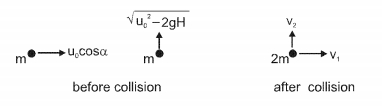
$A$ particle of mass $m$ is projected from the ground with an initial speed $u_0$ at an angle $\alpha$ with the horizontal. At the highest point of its trajectory,it makes a completely inelastic collision with another identical particle,which was thrown vertically upward from the ground with the same initial speed $u_0$. The angle that the composite system makes with the horizontal immediately after the collision is :
A
$\frac{\pi}{4}$
B
$\frac{\pi}{4}+\alpha$
C
$\frac{\pi}{4}-\alpha$
D
$\frac{\pi}{2}$
Solution
(A) Let the first particle be $P_1$ and the second be $P_2$. At the highest point,the velocity of $P_1$ is $v_{x1} = u_0 \cos \alpha$ and $v_{y1} = 0$.
The second particle $P_2$ is thrown vertically upward with speed $u_0$. At the highest point of $P_1$ (height $H = \frac{u_0^2 \sin^2 \alpha}{2g}$),the velocity of $P_2$ is $v_{y2} = \sqrt{u_0^2 - 2gH} = \sqrt{u_0^2 - u_0^2 \sin^2 \alpha} = u_0 \cos \alpha$.
Applying conservation of linear momentum in the horizontal direction:
$m(u_0 \cos \alpha) + m(0) = (2m)v_x \implies v_x = \frac{u_0 \cos \alpha}{2}$.
Applying conservation of linear momentum in the vertical direction:
$m(0) + m(u_0 \cos \alpha) = (2m)v_y \implies v_y = \frac{u_0 \cos \alpha}{2}$.
The angle $\theta$ with the horizontal is given by $\tan \theta = \frac{v_y}{v_x} = \frac{u_0 \cos \alpha / 2}{u_0 \cos \alpha / 2} = 1$.
Therefore,$\theta = 45^{\circ} = \frac{\pi}{4}$.
The second particle $P_2$ is thrown vertically upward with speed $u_0$. At the highest point of $P_1$ (height $H = \frac{u_0^2 \sin^2 \alpha}{2g}$),the velocity of $P_2$ is $v_{y2} = \sqrt{u_0^2 - 2gH} = \sqrt{u_0^2 - u_0^2 \sin^2 \alpha} = u_0 \cos \alpha$.
Applying conservation of linear momentum in the horizontal direction:
$m(u_0 \cos \alpha) + m(0) = (2m)v_x \implies v_x = \frac{u_0 \cos \alpha}{2}$.
Applying conservation of linear momentum in the vertical direction:
$m(0) + m(u_0 \cos \alpha) = (2m)v_y \implies v_y = \frac{u_0 \cos \alpha}{2}$.
The angle $\theta$ with the horizontal is given by $\tan \theta = \frac{v_y}{v_x} = \frac{u_0 \cos \alpha / 2}{u_0 \cos \alpha / 2} = 1$.
Therefore,$\theta = 45^{\circ} = \frac{\pi}{4}$.
0 likes
View Solution310
AdvancedMCQ
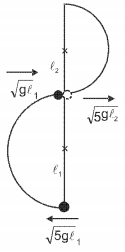
$A$ bob of mass $m$,suspended by a string of length $l_1$,is given a minimum velocity required to complete a full circle in the vertical plane. At the highest point,it collides elastically with another bob of mass $m$ suspended by a string of length $l_2$,which is initially at rest. Both the strings are massless and inextensible. If the second bob,after collision,acquires the minimum speed required to complete a full circle in the vertical plane,the ratio $\frac{l_1}{l_2}$ is
A
$4$
B
$5$
C
$6$
D
$7$
Solution
(B) For a bob to complete a vertical circle,the minimum velocity at the highest point is $v_{top} = \sqrt{g \ell}$.
Let the first bob have mass $m$ and string length $l_1$. Its velocity at the highest point before collision is $u_1 = \sqrt{g l_1}$.
The second bob has mass $m$ and string length $l_2$,and is initially at rest $(u_2 = 0)$.
Since the collision is elastic and the masses are equal,the two bobs exchange their velocities.
Therefore,the velocity of the second bob after collision is $v_2 = u_1 = \sqrt{g l_1}$.
For the second bob to complete a vertical circle,its minimum velocity at the lowest point must be $\sqrt{5 g l_2}$.
However,the collision occurs at the highest point of the second bob's path (which is the lowest point of its potential circular motion). Thus,the velocity acquired by the second bob after collision must be equal to the minimum velocity required at the lowest point to complete the circle.
So,$v_2 = \sqrt{5 g l_2}$.
Equating the two expressions for $v_2$: $\sqrt{g l_1} = \sqrt{5 g l_2}$.
Squaring both sides: $g l_1 = 5 g l_2$.
Therefore,$\frac{l_1}{l_2} = 5$.
Let the first bob have mass $m$ and string length $l_1$. Its velocity at the highest point before collision is $u_1 = \sqrt{g l_1}$.
The second bob has mass $m$ and string length $l_2$,and is initially at rest $(u_2 = 0)$.
Since the collision is elastic and the masses are equal,the two bobs exchange their velocities.
Therefore,the velocity of the second bob after collision is $v_2 = u_1 = \sqrt{g l_1}$.
For the second bob to complete a vertical circle,its minimum velocity at the lowest point must be $\sqrt{5 g l_2}$.
However,the collision occurs at the highest point of the second bob's path (which is the lowest point of its potential circular motion). Thus,the velocity acquired by the second bob after collision must be equal to the minimum velocity required at the lowest point to complete the circle.
So,$v_2 = \sqrt{5 g l_2}$.
Equating the two expressions for $v_2$: $\sqrt{g l_1} = \sqrt{5 g l_2}$.
Squaring both sides: $g l_1 = 5 g l_2$.
Therefore,$\frac{l_1}{l_2} = 5$.
0 likes
View Solution311
DifficultMCQ
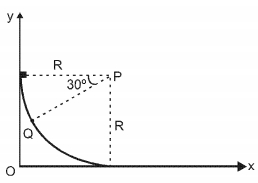
$A$ block of mass $M = 1 \ kg$ is released from rest at the top of a smooth track of radius $R = 40 \ m$. The block slides along the track without toppling,and a frictional force acts on it in the direction opposite to the instantaneous velocity. The work done in overcoming the friction up to the point $Q$ (where the radius makes an angle of $30^{\circ}$ with the horizontal),as shown in the figure,is $150 \ J$. (Take the acceleration due to gravity,$g = 10 \ m s^{-2}$)
$1.$ The speed of the block when it reaches the point $Q$ is:
$(A) 5 \ m s^{-1}$ $(B) 10 \ m s^{-1}$ $(C) 10\sqrt{3} \ m s^{-1}$ $(D) 20 \ m s^{-1}$
$2.$ The magnitude of the normal reaction that acts on the block at the point $Q$ is:
$(A) 7.5 \ N$ $(B) 8.6 \ N$ $(C) 11.5 \ N$ $(D) 22.5 \ N$
Give the answers for question $1$ and $2$.
$1.$ The speed of the block when it reaches the point $Q$ is:
$(A) 5 \ m s^{-1}$ $(B) 10 \ m s^{-1}$ $(C) 10\sqrt{3} \ m s^{-1}$ $(D) 20 \ m s^{-1}$
$2.$ The magnitude of the normal reaction that acts on the block at the point $Q$ is:
$(A) 7.5 \ N$ $(B) 8.6 \ N$ $(C) 11.5 \ N$ $(D) 22.5 \ N$
Give the answers for question $1$ and $2$.
A
$(B, A)$
B
$(B, D)$
C
$(B, C)$
D
$(A, C)$
Solution
(A) $1.$ Let the block be released from height $h = R = 40 \ m$. The vertical height of point $Q$ from the bottom is $h_Q = R - R \sin(30^{\circ}) = R - R/2 = R/2 = 20 \ m$.
Applying the work-energy theorem between the starting point and point $Q$:
$W_{gravity} + W_{friction} = \Delta K$
$Mg(R - h_Q) - 150 = \frac{1}{2} M v^2$
$1 \times 10 \times (40 - 20) - 150 = \frac{1}{2} \times 1 \times v^2$
$200 - 150 = 0.5 v^2 \Rightarrow 50 = 0.5 v^2 \Rightarrow v^2 = 100 \Rightarrow v = 10 \ m s^{-1}$.
Thus,the speed at $Q$ is $10 \ m s^{-1}$. (Option $B$)
$2.$ At point $Q$,the forces acting on the block are gravity $(Mg)$ and normal reaction $(N)$. The component of gravity perpendicular to the track is $Mg \cos(60^{\circ}) = Mg/2$.
The net centripetal force is $N - Mg \cos(60^{\circ}) = \frac{M v^2}{R}$.
$N - 1 \times 10 \times 0.5 = \frac{1 \times 100}{40}$
$N - 5 = 2.5 \Rightarrow N = 7.5 \ N$. (Option $A$)
Therefore,the correct pair is $(B, A)$.
Applying the work-energy theorem between the starting point and point $Q$:
$W_{gravity} + W_{friction} = \Delta K$
$Mg(R - h_Q) - 150 = \frac{1}{2} M v^2$
$1 \times 10 \times (40 - 20) - 150 = \frac{1}{2} \times 1 \times v^2$
$200 - 150 = 0.5 v^2 \Rightarrow 50 = 0.5 v^2 \Rightarrow v^2 = 100 \Rightarrow v = 10 \ m s^{-1}$.
Thus,the speed at $Q$ is $10 \ m s^{-1}$. (Option $B$)
$2.$ At point $Q$,the forces acting on the block are gravity $(Mg)$ and normal reaction $(N)$. The component of gravity perpendicular to the track is $Mg \cos(60^{\circ}) = Mg/2$.
The net centripetal force is $N - Mg \cos(60^{\circ}) = \frac{M v^2}{R}$.
$N - 1 \times 10 \times 0.5 = \frac{1 \times 100}{40}$
$N - 5 = 2.5 \Rightarrow N = 7.5 \ N$. (Option $A$)
Therefore,the correct pair is $(B, A)$.
0 likes
View Solution312
AdvancedMCQ
$A$ tennis ball is dropped on a horizontal smooth surface. It bounces back to its original position after hitting the surface. The force on the ball during the collision is proportional to the length of compression of the ball. Which one of the following sketches describes the variation of its kinetic energy $K$ with time $t$ most appropriately? The figures are only illustrative and not to the scale.
A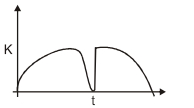
B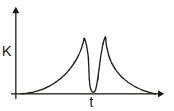
C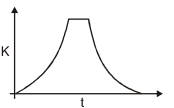
D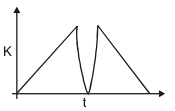
Solution
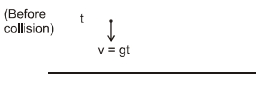
(B) Before the collision,the ball falls under gravity. Its velocity $v$ at time $t$ is given by $v = gt$. The kinetic energy $K$ is given by $K = \frac{1}{2} mv^2 = \frac{1}{2} m(gt)^2 = \frac{1}{2} mg^2 t^2$. Since $K \propto t^2$,the graph of $K$ versus $t$ is parabolic,opening upwards.
During the collision,the ball is compressed. As the compression increases,the kinetic energy is converted into elastic potential energy. At the maximum compression,the velocity of the ball becomes zero,so the kinetic energy becomes zero. After reaching maximum compression,the ball starts to expand,and the elastic potential energy is converted back into kinetic energy until the ball leaves the surface.
Thus,the kinetic energy decreases to zero during the compression phase and increases back to its original value during the expansion phase. This behavior is represented by a parabolic increase followed by a sharp dip to zero and a subsequent parabolic increase. Among the given options,graph $B$ represents this variation most appropriately.
During the collision,the ball is compressed. As the compression increases,the kinetic energy is converted into elastic potential energy. At the maximum compression,the velocity of the ball becomes zero,so the kinetic energy becomes zero. After reaching maximum compression,the ball starts to expand,and the elastic potential energy is converted back into kinetic energy until the ball leaves the surface.
Thus,the kinetic energy decreases to zero during the compression phase and increases back to its original value during the expansion phase. This behavior is represented by a parabolic increase followed by a sharp dip to zero and a subsequent parabolic increase. Among the given options,graph $B$ represents this variation most appropriately.
0 likes
View Solution313
DifficultMCQ
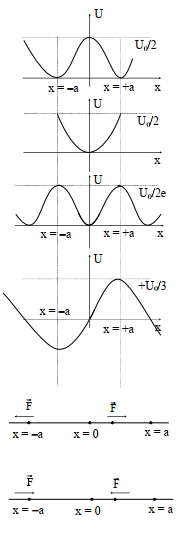
$A$ particle of unit mass is moving along the $x$-axis under the influence of a force and its total energy is conserved. Four possible forms of the potential energy of the particle are given in column $I$ ($a$ and $U_0$ are constants). Match the potential energies in column $I$ to the corresponding statement$(s)$ in column $II$.
| Column $I$ | Column $II$ |
| $(A) U_1(x) = \frac{U_0}{2} \left[1 - \left(\frac{x}{a}\right)^2\right]^2$ | $(P)$ The force acting on the particle is zero at $x = a$. |
| $(B) U_2(x) = \frac{U_0}{2} \left(\frac{x}{a}\right)^2$ | $(Q)$ The force acting on the particle is zero at $x = 0$. |
| $(C) U_3(x) = \frac{U_0}{2} \left(\frac{x}{a}\right)^2 \exp \left[-\left(\frac{x}{a}\right)^2\right]$ | $(R)$ The force acting on the particle is zero at $x = -a$. |
| $(D) U_4(x) = \frac{U_0}{2} \left[\frac{x}{a} - \frac{1}{3}\left(\frac{x}{a}\right)^3\right]$ | $(S)$ The particle experiences an attractive force towards $x = 0$ in the region $|x| < a$. |
| $(T)$ The particle with total energy $\frac{U_0}{4}$ can oscillate about the point $x = -a$. |
A
$(A) \rightarrow (P, Q, R, S); (B) \rightarrow (Q, T); (C) \rightarrow (P, Q, R, T); (D) \rightarrow (P, R, S)$
B
$(A) \rightarrow (P, Q, R, T); (B) \rightarrow (Q, S); (C) \rightarrow (P, Q, R, S); (D) \rightarrow (P, R, T)$
C
$(A) \rightarrow (P, R, S, T); (B) \rightarrow (Q, R); (C) \rightarrow (P, R, S, T); (D) \rightarrow (P, Q, T)$
D
$(A) \rightarrow (Q, R, S, T); (B) \rightarrow (S, T); (C) \rightarrow (Q, R, S, T); (D) \rightarrow (Q, R, T)$
Solution
(A) The force is given by $F = -\frac{dU}{dx}$. Equilibrium points occur where $F = 0$, i.e., $\frac{dU}{dx} = 0$.
For $(A): U_1(x) = \frac{U_0}{2} \left[1 - (x/a)^2\right]^2$.
$\frac{dU_1}{dx} = \frac{U_0}{2} \cdot 2 \left[1 - (x/a)^2\right] \cdot (-2x/a^2) = -\frac{2U_0 x}{a^2} \left[1 - (x/a)^2\right]$.
$F=0$ at $x=0, a, -a$. For $|x| < a$, $F$ is attractive towards $x=0$.
Thus $(A) \rightarrow (P, Q, R, S)$.
For $(B): U_2(x) = \frac{U_0}{2} (x/a)^2$.
$\frac{dU_2}{dx} = \frac{U_0 x}{a^2}$.
$F=0$ at $x=0$. For energy $U_0/4$, $U_2(x) = U_0/4 \Rightarrow (x/a)^2 = 1/2 \Rightarrow x = \pm a/\sqrt{2}$.
It oscillates about $x=0$.
Thus $(B) \rightarrow (Q, T)$.
For $(C): U_3(x) = \frac{U_0}{2} (x/a)^2 e^{-(x/a)^2}$.
$\frac{dU_3}{dx} = \frac{U_0}{2} \left[\frac{2x}{a^2} e^{-(x/a)^2} + (x/a)^2 e^{-(x/a)^2} (-2x/a^2)\right] = \frac{U_0 x}{a^2} e^{-(x/a)^2} \left[1 - (x/a)^2\right]$.
$F=0$ at $x=0, a, -a$. For energy $U_0/4$, it can oscillate about $x=a$ or $x=-a$ if $U_{min} < U_0/4 < U_{max}$.
Thus $(C) \rightarrow (P, Q, R, T)$.
For $(D): U_4(x) = \frac{U_0}{2} \left[x/a - 1/3(x/a)^3\right]$.
$\frac{dU_4}{dx} = \frac{U_0}{2a} \left[1 - (x/a)^2\right]$.
$F=0$ at $x=a, -a$. For $|x| < a$, $F$ is negative for $x>0$ and positive for $x<0$, so it is attractive towards $x=0$.
Thus $(D) \rightarrow (P, R, S)$.
For $(A): U_1(x) = \frac{U_0}{2} \left[1 - (x/a)^2\right]^2$.
$\frac{dU_1}{dx} = \frac{U_0}{2} \cdot 2 \left[1 - (x/a)^2\right] \cdot (-2x/a^2) = -\frac{2U_0 x}{a^2} \left[1 - (x/a)^2\right]$.
$F=0$ at $x=0, a, -a$. For $|x| < a$, $F$ is attractive towards $x=0$.
Thus $(A) \rightarrow (P, Q, R, S)$.
For $(B): U_2(x) = \frac{U_0}{2} (x/a)^2$.
$\frac{dU_2}{dx} = \frac{U_0 x}{a^2}$.
$F=0$ at $x=0$. For energy $U_0/4$, $U_2(x) = U_0/4 \Rightarrow (x/a)^2 = 1/2 \Rightarrow x = \pm a/\sqrt{2}$.
It oscillates about $x=0$.
Thus $(B) \rightarrow (Q, T)$.
For $(C): U_3(x) = \frac{U_0}{2} (x/a)^2 e^{-(x/a)^2}$.
$\frac{dU_3}{dx} = \frac{U_0}{2} \left[\frac{2x}{a^2} e^{-(x/a)^2} + (x/a)^2 e^{-(x/a)^2} (-2x/a^2)\right] = \frac{U_0 x}{a^2} e^{-(x/a)^2} \left[1 - (x/a)^2\right]$.
$F=0$ at $x=0, a, -a$. For energy $U_0/4$, it can oscillate about $x=a$ or $x=-a$ if $U_{min} < U_0/4 < U_{max}$.
Thus $(C) \rightarrow (P, Q, R, T)$.
For $(D): U_4(x) = \frac{U_0}{2} \left[x/a - 1/3(x/a)^3\right]$.
$\frac{dU_4}{dx} = \frac{U_0}{2a} \left[1 - (x/a)^2\right]$.
$F=0$ at $x=a, -a$. For $|x| < a$, $F$ is negative for $x>0$ and positive for $x<0$, so it is attractive towards $x=0$.
Thus $(D) \rightarrow (P, R, S)$.
0 likes
View Solution314
DifficultMCQ
$A$ bead of mass $m$ slides without friction on the wall of a vertical circular hoop of radius $R$ as shown in the figure. The bead moves under the combined action of gravity and a massless spring of constant $k$ attached to the bottom of the hoop. The natural (equilibrium) length of the spring is $R$. If the bead is released from the top of the hoop with negligible initial speed,what is the velocity of the bead when the length of the spring becomes $R$? ($g$ is the acceleration due to gravity)
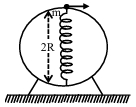
A
$2 \sqrt{gR+\frac{kR^2}{m}}$
B
$\sqrt{2 Rg+\frac{4 kR^2}{m}}$
C
$\sqrt{2 R g+\frac{k R^2}{m}}$
D
$\sqrt{3 R g+\frac{k R^2}{m}}$
Solution
(D) Let the top of the hoop be the reference level for gravitational potential energy $(U_g = 0)$.
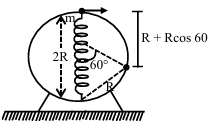
At the top,the spring is stretched by $x_i = 2R - R = R$. The initial energy is $E_i = U_{g,i} + U_{s,i} + K_i = 0 + \frac{1}{2}kR^2 + 0 = \frac{1}{2}kR^2$.
When the spring length is $R$,the bead is at an angle $\theta = 60^\circ$ from the vertical,as the distance from the bottom is $R$ and the radius is $R$,forming an equilateral triangle.
The height of the bead from the top is $h = R + R \cos 60^\circ = R + \frac{R}{2} = \frac{3R}{2}$.
The gravitational potential energy at this point is $U_{g,f} = -mg(\frac{3R}{2})$.
The spring is at its natural length,so $U_{s,f} = 0$.
The final kinetic energy is $K_f = \frac{1}{2}mv^2$.
By the conservation of mechanical energy: $E_i = E_f \implies \frac{1}{2}kR^2 = -\frac{3mgR}{2} + \frac{1}{2}mv^2$.
Multiplying by $2/m$: $\frac{kR^2}{m} = -3gR + v^2$.
Thus,$v = \sqrt{3gR + \frac{kR^2}{m}}$.
At the top,the spring is stretched by $x_i = 2R - R = R$. The initial energy is $E_i = U_{g,i} + U_{s,i} + K_i = 0 + \frac{1}{2}kR^2 + 0 = \frac{1}{2}kR^2$.
When the spring length is $R$,the bead is at an angle $\theta = 60^\circ$ from the vertical,as the distance from the bottom is $R$ and the radius is $R$,forming an equilateral triangle.
The height of the bead from the top is $h = R + R \cos 60^\circ = R + \frac{R}{2} = \frac{3R}{2}$.
The gravitational potential energy at this point is $U_{g,f} = -mg(\frac{3R}{2})$.
The spring is at its natural length,so $U_{s,f} = 0$.
The final kinetic energy is $K_f = \frac{1}{2}mv^2$.
By the conservation of mechanical energy: $E_i = E_f \implies \frac{1}{2}kR^2 = -\frac{3mgR}{2} + \frac{1}{2}mv^2$.
Multiplying by $2/m$: $\frac{kR^2}{m} = -3gR + v^2$.
Thus,$v = \sqrt{3gR + \frac{kR^2}{m}}$.
0 likes
View Solution315
DifficultMCQ
As shown below, bob $A$ of a pendulum having a massless string of length $R$ is released from $60^{\circ}$ to the vertical. It hits another bob $B$ of half the mass that is at rest on a frictionless table in the center. Assuming an elastic collision, the magnitude of the velocity of bob $A$ after the collision will be (take $g$ as acceleration due to gravity):
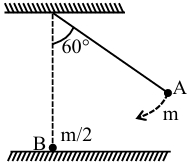
A
$\frac{1}{3} \sqrt{Rg}$
B
$\sqrt{Rg}$
C
$\frac{4}{3} \sqrt{Rg}$
D
$\frac{2}{3} \sqrt{Rg}$
Solution
(A) $1$. Velocity of bob $A$ just before hitting bob $B$:
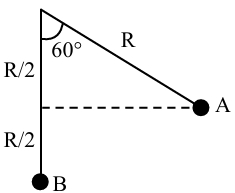
Using the principle of conservation of mechanical energy, the change in height $h$ is $R - R \cos(60^{\circ}) = R - R/2 = R/2$.
$v = \sqrt{2gh} = \sqrt{2g(R/2)} = \sqrt{gR}$.
$2$. Let $u = \sqrt{gR}$ be the velocity of $A$ just before the collision.
Let $v_1$ and $v_2$ be the velocities of $A$ and $B$ respectively just after the elastic collision.
$3$. By the Law of Conservation of Momentum $(COM)$:
$mu = mv_1 + (m/2)v_2$
$u = v_1 + v_2/2$
$2u = 2v_1 + v_2$ --- $(i)$
$4$. For an elastic collision, the coefficient of restitution $e = 1$:
$e = (v_2 - v_1) / u = 1$
$v_2 - v_1 = u$ --- (ii)
$5$. Solving equations $(i)$ and (ii):
From (ii), $v_2 = u + v_1$.
Substitute into $(i)$: $2u = 2v_1 + (u + v_1)$
$2u = 3v_1 + u$
$u = 3v_1$
$v_1 = u/3 = \frac{1}{3} \sqrt{gR}$.
Using the principle of conservation of mechanical energy, the change in height $h$ is $R - R \cos(60^{\circ}) = R - R/2 = R/2$.
$v = \sqrt{2gh} = \sqrt{2g(R/2)} = \sqrt{gR}$.
$2$. Let $u = \sqrt{gR}$ be the velocity of $A$ just before the collision.
Let $v_1$ and $v_2$ be the velocities of $A$ and $B$ respectively just after the elastic collision.
$3$. By the Law of Conservation of Momentum $(COM)$:
$mu = mv_1 + (m/2)v_2$
$u = v_1 + v_2/2$
$2u = 2v_1 + v_2$ --- $(i)$
$4$. For an elastic collision, the coefficient of restitution $e = 1$:
$e = (v_2 - v_1) / u = 1$
$v_2 - v_1 = u$ --- (ii)
$5$. Solving equations $(i)$ and (ii):
From (ii), $v_2 = u + v_1$.
Substitute into $(i)$: $2u = 2v_1 + (u + v_1)$
$2u = 3v_1 + u$
$u = 3v_1$
$v_1 = u/3 = \frac{1}{3} \sqrt{gR}$.
0 likes
View Solution316
DifficultMCQ
Consider two blocks $A$ and $B$ of masses $m_1 = 10 \ kg$ and $m_2 = 5 \ kg$ that are placed on a frictionless table. The block $A$ moves with a constant speed $v = 3 \ m/s$ towards the block $B$ kept at rest. $A$ spring with spring constant $k = 3000 \ N/m$ is attached to the block $B$ as shown in the figure. After the collision,suppose that the blocks $A$ and $B$,along with the spring in a constant compression state,move together. Then the compression in the spring is (neglect the mass of the spring). (in $m$)
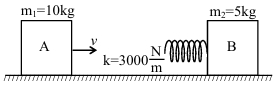
A
$0.2$
B
$0.4$
C
$0.1$
D
$0.3$
Solution
(C) By the law of conservation of linear momentum,the velocity of the center of mass $(v_{cm})$ when the blocks move together is given by:
$m_1 v_1 + m_2 v_2 = (m_1 + m_2) v_{cm}$
$10 \times 3 + 5 \times 0 = (10 + 5) v_{cm}$
$30 = 15 v_{cm} \Rightarrow v_{cm} = 2 \ m/s$
The energy stored in the spring is equal to the loss in kinetic energy during the collision:
$\frac{1}{2} kx^2 = K_i - K_f$
$\frac{1}{2} kx^2 = \frac{1}{2} m_1 v_1^2 - \frac{1}{2} (m_1 + m_2) v_{cm}^2$
$\frac{1}{2} (3000) x^2 = \frac{1}{2} (10) (3)^2 - \frac{1}{2} (15) (2)^2$
$1500 x^2 = 45 - 30$
$1500 x^2 = 15$
$x^2 = \frac{15}{1500} = \frac{1}{100}$
$x = 0.1 \ m$
$m_1 v_1 + m_2 v_2 = (m_1 + m_2) v_{cm}$
$10 \times 3 + 5 \times 0 = (10 + 5) v_{cm}$
$30 = 15 v_{cm} \Rightarrow v_{cm} = 2 \ m/s$
The energy stored in the spring is equal to the loss in kinetic energy during the collision:
$\frac{1}{2} kx^2 = K_i - K_f$
$\frac{1}{2} kx^2 = \frac{1}{2} m_1 v_1^2 - \frac{1}{2} (m_1 + m_2) v_{cm}^2$
$\frac{1}{2} (3000) x^2 = \frac{1}{2} (10) (3)^2 - \frac{1}{2} (15) (2)^2$
$1500 x^2 = 45 - 30$
$1500 x^2 = 15$
$x^2 = \frac{15}{1500} = \frac{1}{100}$
$x = 0.1 \ m$
0 likes
View Solution317
MediumMCQ
$A$ block of mass $5 \ kg$ is suspended by a light thread from an elevator. The elevator is accelerating upward with uniform acceleration $2 \ m/s^2$. The work done by tension on the block during the first $3 \ s$ is $(u = 0)$. (in $J$)
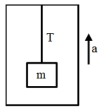
A
$450$
B
$540$
C
$600$
D
$400$
Solution
(B) Given:
Mass $m = 5 \ kg$
Acceleration $a = 2 \ m/s^2$
Time $t = 3 \ s$
Initial velocity $u = 0$
Acceleration due to gravity $g = 10 \ m/s^2$
Step $1$: Calculate the tension $T$ in the thread.
Since the elevator is accelerating upward,the tension $T$ is given by:
$T = m(g + a)$
$T = 5(10 + 2) = 5(12) = 60 \ N$
Step $2$: Calculate the displacement $S$ of the block in $3 \ s$.
Using the equation of motion $S = ut + \frac{1}{2}at^2$:
$S = 0(3) + \frac{1}{2}(2)(3)^2$
$S = 0 + 1(9) = 9 \ m$
Step $3$: Calculate the work done by tension.
Work $W = T \cdot S \cdot \cos(\theta)$
Since the tension acts in the direction of displacement,$\theta = 0^{\circ}$,so $\cos(0^{\circ}) = 1$.
$W = (60 \ N)(9 \ m)(1) = 540 \ J$
Mass $m = 5 \ kg$
Acceleration $a = 2 \ m/s^2$
Time $t = 3 \ s$
Initial velocity $u = 0$
Acceleration due to gravity $g = 10 \ m/s^2$
Step $1$: Calculate the tension $T$ in the thread.
Since the elevator is accelerating upward,the tension $T$ is given by:
$T = m(g + a)$
$T = 5(10 + 2) = 5(12) = 60 \ N$
Step $2$: Calculate the displacement $S$ of the block in $3 \ s$.
Using the equation of motion $S = ut + \frac{1}{2}at^2$:
$S = 0(3) + \frac{1}{2}(2)(3)^2$
$S = 0 + 1(9) = 9 \ m$
Step $3$: Calculate the work done by tension.
Work $W = T \cdot S \cdot \cos(\theta)$
Since the tension acts in the direction of displacement,$\theta = 0^{\circ}$,so $\cos(0^{\circ}) = 1$.
$W = (60 \ N)(9 \ m)(1) = 540 \ J$
0 likes
View Solution318
DifficultMCQ
$A$ rigid body of mass $4 \ kg$ initially at rest moves under the action of an applied horizontal force of $18 \ N$ on a table with a coefficient of kinetic friction of $0.2$. The work done by the applied force on the body in $10 \ s$ will be $.... \ J$.
A
$1250$
B
$2250$
C
$2500$
D
$1000$
Solution
(B) Given: Mass $m = 4 \ kg$,Applied force $F = 18 \ N$,Coefficient of kinetic friction $\mu_k = 0.2$,Time $t = 10 \ s$,Initial velocity $u = 0 \ m/s$.
$1$. Calculate the kinetic frictional force $f$:
$f = \mu_k \cdot N = \mu_k \cdot mg = 0.2 \times 4 \times 10 = 8 \ N$.
$2$. Calculate the net acceleration $a$ of the body:
$F_{net} = F - f = 18 - 8 = 10 \ N$.
$a = \frac{F_{net}}{m} = \frac{10}{4} = 2.5 \ m/s^2$.
$3$. Calculate the displacement $S$ in $10 \ s$:
$S = ut + \frac{1}{2}at^2 = 0 + \frac{1}{2} \times 2.5 \times (10)^2 = 0.5 \times 2.5 \times 100 = 125 \ m$.
$4$. Calculate the work done by the applied force $W$:
$W = F \cdot S \cdot \cos(0^\circ) = 18 \times 125 \times 1 = 2250 \ J$.
$1$. Calculate the kinetic frictional force $f$:
$f = \mu_k \cdot N = \mu_k \cdot mg = 0.2 \times 4 \times 10 = 8 \ N$.
$2$. Calculate the net acceleration $a$ of the body:
$F_{net} = F - f = 18 - 8 = 10 \ N$.
$a = \frac{F_{net}}{m} = \frac{10}{4} = 2.5 \ m/s^2$.
$3$. Calculate the displacement $S$ in $10 \ s$:
$S = ut + \frac{1}{2}at^2 = 0 + \frac{1}{2} \times 2.5 \times (10)^2 = 0.5 \times 2.5 \times 100 = 125 \ m$.
$4$. Calculate the work done by the applied force $W$:
$W = F \cdot S \cdot \cos(0^\circ) = 18 \times 125 \times 1 = 2250 \ J$.
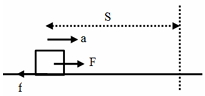
0 likes
View Solution319
DifficultMCQ
$A$ locomotive of mass $m$ starts moving so that its velocity varies according to the law $v = k \sqrt{S}$,where $k$ is a constant and $S$ is the distance covered. Find the total work performed by all the forces acting on the locomotive during the first $t$ seconds after the beginning of motion.
A
$W = \frac{1}{8} mk^4 t^2$
B
$W = \frac{1}{4} m^2 k^4 t^2$
C
$W = \frac{1}{4} mk^4 t^4$
D
$W = \frac{1}{8} mk^4 t^2$
Solution
(A) Given the velocity law $v = k\sqrt{S}$.
We know that acceleration $a = v \frac{dv}{dS}$.
Differentiating $v$ with respect to $S$: $\frac{dv}{dS} = k \cdot \frac{1}{2\sqrt{S}} = \frac{k^2}{2v}$.
Thus,$a = v \cdot \frac{k^2}{2v} = \frac{k^2}{2}$.
Since the acceleration is constant,we can use the equation of motion $v = u + at$. Starting from rest $(u=0)$,$v = \frac{k^2 t}{2}$.
According to the Work-Energy Theorem,the total work done by all forces is equal to the change in kinetic energy: $W = \Delta K.E. = \frac{1}{2}mv^2 - 0$.
Substituting the value of $v$: $W = \frac{1}{2}m \left(\frac{k^2 t}{2}\right)^2 = \frac{1}{2}m \left(\frac{k^4 t^2}{4}\right) = \frac{1}{8}mk^4 t^2$.
We know that acceleration $a = v \frac{dv}{dS}$.
Differentiating $v$ with respect to $S$: $\frac{dv}{dS} = k \cdot \frac{1}{2\sqrt{S}} = \frac{k^2}{2v}$.
Thus,$a = v \cdot \frac{k^2}{2v} = \frac{k^2}{2}$.
Since the acceleration is constant,we can use the equation of motion $v = u + at$. Starting from rest $(u=0)$,$v = \frac{k^2 t}{2}$.
According to the Work-Energy Theorem,the total work done by all forces is equal to the change in kinetic energy: $W = \Delta K.E. = \frac{1}{2}mv^2 - 0$.
Substituting the value of $v$: $W = \frac{1}{2}m \left(\frac{k^2 t}{2}\right)^2 = \frac{1}{2}m \left(\frac{k^4 t^2}{4}\right) = \frac{1}{8}mk^4 t^2$.
0 likes
View Solution320
MediumMCQ
In the case of circular motion of a body,if a tangential force also acts on the body in addition to a centripetal force,then the work done:
A
by the tangential force is zero and by the centripetal force is not zero.
B
by the centripetal force is zero and by the tangential force is not zero.
C
by both the forces is positive.
D
by both the forces is zero.
Solution
(B) In circular motion,the centripetal force acts towards the center of the circle,which is always perpendicular to the instantaneous velocity (displacement vector) of the body. Since the work done $W = \vec{F} \cdot \vec{d} = F d cos( \theta)$ and $ \theta = 90^{\circ}$,the work done by the centripetal force is $W_c = 0$.
The tangential force acts along the tangent to the circular path,which is in the direction of the instantaneous velocity (or displacement). Therefore,the angle between the tangential force and the displacement is $0^{\circ}$. Since $cos(0^{\circ}) = 1$,the work done by the tangential force is $W_t = F_t \cdot d $.
The tangential force acts along the tangent to the circular path,which is in the direction of the instantaneous velocity (or displacement). Therefore,the angle between the tangential force and the displacement is $0^{\circ}$. Since $cos(0^{\circ}) = 1$,the work done by the tangential force is $W_t = F_t \cdot d $.
0 likes
View Solution321
EasyMCQ
Consider the following statements $A$ and $B$. Identify the correct choice in the given answers.
$A$. In an inelastic collision,there is no loss in kinetic energy during collision.
$B$. During a collision,the linear momentum of the entire system of particles is conserved if there is no external force acting on the system.
$A$. In an inelastic collision,there is no loss in kinetic energy during collision.
$B$. During a collision,the linear momentum of the entire system of particles is conserved if there is no external force acting on the system.
A
Both $A$ and $B$ are wrong.
B
Both $A$ and $B$ are correct.
C
$A$ is wrong and $B$ is correct.
D
$A$ is correct and $B$ is wrong.
Solution
(C) Statement $A$ is incorrect because,by definition,an inelastic collision involves a loss of kinetic energy.
Statement $B$ is correct because,according to the law of conservation of linear momentum,the total linear momentum of a system remains constant if the net external force acting on the system is zero.
Therefore,$A$ is wrong and $B$ is correct.
Statement $B$ is correct because,according to the law of conservation of linear momentum,the total linear momentum of a system remains constant if the net external force acting on the system is zero.
Therefore,$A$ is wrong and $B$ is correct.
0 likes
View Solution322
MediumMCQ
$A$ particle of mass $m$ moving eastward with a speed $v$ collides with another particle of same mass moving northward with same speed $v$. The two particles coalesce after collision. The new particle of mass $2m$ will move in north-east direction with a speed (in $m/s$) of:
A
$v$
B
$2v$
C
$\frac{v}{2}$
D
$\frac{v}{\sqrt{2}}$
Solution
(D) The momentum of the particle moving towards the east is $\vec{p_1} = mv \hat{i}$.
The momentum of the particle moving towards the north is $\vec{p_2} = mv \hat{j}$.
Let the velocity of the combined mass $2m$ after collision be $\vec{V'} = v_x \hat{i} + v_y \hat{j}$.
According to the law of conservation of linear momentum,$\vec{p_1} + \vec{p_2} = \vec{p_{final}}$.
$mv \hat{i} + mv \hat{j} = (2m) \vec{V'}$.
Dividing by $2m$,we get $\vec{V'} = \frac{v}{2} \hat{i} + \frac{v}{2} \hat{j}$.
The magnitude of the resultant velocity is $V' = \sqrt{(\frac{v}{2})^2 + (\frac{v}{2})^2} = \sqrt{\frac{v^2}{4} + \frac{v^2}{4}} = \sqrt{\frac{v^2}{2}} = \frac{v}{\sqrt{2}}$.
The momentum of the particle moving towards the north is $\vec{p_2} = mv \hat{j}$.
Let the velocity of the combined mass $2m$ after collision be $\vec{V'} = v_x \hat{i} + v_y \hat{j}$.
According to the law of conservation of linear momentum,$\vec{p_1} + \vec{p_2} = \vec{p_{final}}$.
$mv \hat{i} + mv \hat{j} = (2m) \vec{V'}$.
Dividing by $2m$,we get $\vec{V'} = \frac{v}{2} \hat{i} + \frac{v}{2} \hat{j}$.
The magnitude of the resultant velocity is $V' = \sqrt{(\frac{v}{2})^2 + (\frac{v}{2})^2} = \sqrt{\frac{v^2}{4} + \frac{v^2}{4}} = \sqrt{\frac{v^2}{2}} = \frac{v}{\sqrt{2}}$.
0 likes
View Solution323
EasyMCQ
$A$ rubber ball is dropped from a height of $5 \ m$ on a planet,where the acceleration due to gravity is not known. On bouncing,it rises to $1.8 \ m$. The ball loses its velocity on bouncing by a factor of
A
$\frac{16}{25}$
B
$\frac{2}{5}$
C
$\frac{3}{5}$
D
$\frac{9}{25}$
Solution
(B) The velocity of the ball just before hitting the ground is $v_1 = \sqrt{2gh_1}$.
The velocity of the ball just after bouncing is $v_2 = \sqrt{2gh_2}$.
The loss in velocity is $\Delta v = v_1 - v_2$.
The factor by which the velocity is lost is given by $\frac{\Delta v}{v_1} = \frac{v_1 - v_2}{v_1} = 1 - \frac{v_2}{v_1}$.
Substituting the expressions for $v_1$ and $v_2$,we get $\frac{\Delta v}{v_1} = 1 - \sqrt{\frac{h_2}{h_1}}$.
Given $h_1 = 5 \ m$ and $h_2 = 1.8 \ m$,we have $\frac{\Delta v}{v_1} = 1 - \sqrt{\frac{1.8}{5}} = 1 - \sqrt{0.36} = 1 - 0.6 = 0.4$.
Converting $0.4$ to a fraction,we get $\frac{4}{10} = \frac{2}{5}$.
The velocity of the ball just after bouncing is $v_2 = \sqrt{2gh_2}$.
The loss in velocity is $\Delta v = v_1 - v_2$.
The factor by which the velocity is lost is given by $\frac{\Delta v}{v_1} = \frac{v_1 - v_2}{v_1} = 1 - \frac{v_2}{v_1}$.
Substituting the expressions for $v_1$ and $v_2$,we get $\frac{\Delta v}{v_1} = 1 - \sqrt{\frac{h_2}{h_1}}$.
Given $h_1 = 5 \ m$ and $h_2 = 1.8 \ m$,we have $\frac{\Delta v}{v_1} = 1 - \sqrt{\frac{1.8}{5}} = 1 - \sqrt{0.36} = 1 - 0.6 = 0.4$.
Converting $0.4$ to a fraction,we get $\frac{4}{10} = \frac{2}{5}$.
0 likes
View Solution324
MediumMCQ
$A$ ball of mass $m$ is dropped from a height $s$ on a horizontal platform fixed at the top of a vertical spring. The platform is depressed by a distance $h$. The spring constant is ($g=$ acceleration due to gravity):
A
$\frac{2 mg(s-h)}{h^2}$
B
$\frac{2 mg(s+h)}{h^2}$
C
$\frac{mg(s-h)}{h}$
D
$\frac{mg(s+h)}{h}$
Solution
(B) The total vertical distance fallen by the ball is $(s+h)$.
Since the ball starts from rest,the loss in gravitational potential energy is $mg(s+h)$.
This energy is stored as elastic potential energy in the spring when it is compressed by a distance $h$.
The elastic potential energy stored in the spring is given by $\frac{1}{2} kh^2$.
According to the law of conservation of energy,the loss in potential energy of the ball equals the gain in potential energy of the spring:
$mg(s+h) = \frac{1}{2} kh^2$
Solving for the spring constant $k$:
$k = \frac{2mg(s+h)}{h^2}$
Since the ball starts from rest,the loss in gravitational potential energy is $mg(s+h)$.
This energy is stored as elastic potential energy in the spring when it is compressed by a distance $h$.
The elastic potential energy stored in the spring is given by $\frac{1}{2} kh^2$.
According to the law of conservation of energy,the loss in potential energy of the ball equals the gain in potential energy of the spring:
$mg(s+h) = \frac{1}{2} kh^2$
Solving for the spring constant $k$:
$k = \frac{2mg(s+h)}{h^2}$
0 likes
View Solution325
EasyMCQ
The kinetic energy of a light body and a heavy body is the same. Which one of the following statements is $CORRECT$?
A
The light body has greater momentum.
B
$A$ body having high velocity has greater momentum.
C
Both bodies have same momentum.
D
The heavy body has greater momentum.
Solution
(D) The kinetic energy $K$ of a body of mass $m$ and momentum $p$ is given by the relation:
$K = \frac{p^2}{2m}$
Rearranging this for momentum,we get:
$p = \sqrt{2mK}$
Since the kinetic energy $K$ is the same for both bodies,the momentum $p$ is directly proportional to the square root of the mass:
$p \propto \sqrt{m}$
Because the heavy body has a larger mass $m$ compared to the light body,it will have a greater momentum $p$.
$K = \frac{p^2}{2m}$
Rearranging this for momentum,we get:
$p = \sqrt{2mK}$
Since the kinetic energy $K$ is the same for both bodies,the momentum $p$ is directly proportional to the square root of the mass:
$p \propto \sqrt{m}$
Because the heavy body has a larger mass $m$ compared to the light body,it will have a greater momentum $p$.
0 likes
View Solution326
EasyMCQ
$A$ constant force $\vec{F} = 3\hat{i} - 2\hat{j} - \hat{k} \text{ N}$ causes a displacement $\vec{r} = 2\hat{i} - 3\hat{j} - 3\hat{k} \text{ m}$ in $2 \text{ s}$. The work done and the power are respectively:
A
$20 \text{ J}, 10 \text{ W}$
B
$15 \text{ J}, 7.5 \text{ W}$
C
$13 \text{ J}, 6.5 \text{ W}$
D
$10 \text{ J}, 5 \text{ W}$
Solution
(B) The work done $W$ by a constant force $\vec{F}$ is given by the dot product of force and displacement: $W = \vec{F} \cdot \vec{r}$.
Substituting the given values: $W = (3\hat{i} - 2\hat{j} - \hat{k}) \cdot (2\hat{i} - 3\hat{j} - 3\hat{k})$.
$W = (3 \times 2) + (-2 \times -3) + (-1 \times -3) = 6 + 6 + 3 = 15 \text{ J}$.
Power $P$ is defined as the rate of work done: $P = \frac{W}{t}$.
Given $t = 2 \text{ s}$,$P = \frac{15}{2} = 7.5 \text{ W}$.
Thus,the work done is $15 \text{ J}$ and the power is $7.5 \text{ W}$.
Substituting the given values: $W = (3\hat{i} - 2\hat{j} - \hat{k}) \cdot (2\hat{i} - 3\hat{j} - 3\hat{k})$.
$W = (3 \times 2) + (-2 \times -3) + (-1 \times -3) = 6 + 6 + 3 = 15 \text{ J}$.
Power $P$ is defined as the rate of work done: $P = \frac{W}{t}$.
Given $t = 2 \text{ s}$,$P = \frac{15}{2} = 7.5 \text{ W}$.
Thus,the work done is $15 \text{ J}$ and the power is $7.5 \text{ W}$.
0 likes
View Solution327
MediumMCQ
Two bodies of masses $m_{1}$ and $m_{2}$ are acted upon by a constant force $F$ for a time $t$. They start from rest and acquire kinetic energies,$E_{1}$ and $E_{2}$ respectively. Then $\frac{E_{1}}{E_{2}}$ is
A
$\frac{\sqrt{m_{1} m_{2}}}{m_{1}+m_{2}}$
B
$\frac{m_{1}}{m_{2}}$
C
$\frac{m_{2}}{m_{1}}$
D
$1$
Solution
(C) The impulse applied to both bodies is given by $J = F \cdot t$. Since both bodies start from rest,the impulse is equal to the change in momentum for each body.
Thus,$p_{1} = p_{2} = F \cdot t$.
The kinetic energy $E$ of a body with mass $m$ and momentum $p$ is given by $E = \frac{p^{2}}{2m}$.
Therefore,$E_{1} = \frac{p_{1}^{2}}{2m_{1}}$ and $E_{2} = \frac{p_{2}^{2}}{2m_{2}}$.
Taking the ratio,we get $\frac{E_{1}}{E_{2}} = \frac{p_{1}^{2} / 2m_{1}}{p_{2}^{2} / 2m_{2}}$.
Since $p_{1} = p_{2}$,the ratio simplifies to $\frac{E_{1}}{E_{2}} = \frac{m_{2}}{m_{1}}$.
Thus,$p_{1} = p_{2} = F \cdot t$.
The kinetic energy $E$ of a body with mass $m$ and momentum $p$ is given by $E = \frac{p^{2}}{2m}$.
Therefore,$E_{1} = \frac{p_{1}^{2}}{2m_{1}}$ and $E_{2} = \frac{p_{2}^{2}}{2m_{2}}$.
Taking the ratio,we get $\frac{E_{1}}{E_{2}} = \frac{p_{1}^{2} / 2m_{1}}{p_{2}^{2} / 2m_{2}}$.
Since $p_{1} = p_{2}$,the ratio simplifies to $\frac{E_{1}}{E_{2}} = \frac{m_{2}}{m_{1}}$.
0 likes
View Solution328
DifficultMCQ
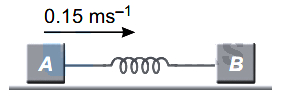
Two rectangular blocks $A$ and $B$ of masses $2 \,kg$ and $3 \,kg$ respectively are connected by a spring of spring constant $10.8 \,Nm^{-1}$ and are placed on a frictionless horizontal surface. The block $A$ is given an initial velocity of $0.15 \,ms^{-1}$ in the direction shown in the figure. The maximum compression of the spring during the motion is (in $\,m$)
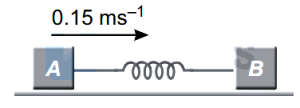
A
$0.01$
B
$0.02$
C
$0.05$
D
$0.03$
Solution
(C) As the block $A$ moves with velocity $u = 0.15 \,ms^{-1}$, it compresses the spring, which pushes block $B$ towards the right. The spring continues to compress until the velocity of both blocks becomes equal. Let this common velocity be $v$.
According to the law of conservation of linear momentum:
$m_A u = (m_A + m_B) v$
$v = \frac{m_A u}{m_A + m_B} = \frac{2 \times 0.15}{2 + 3} = \frac{0.3}{5} = 0.06 \,ms^{-1}$
According to the law of conservation of energy, the initial kinetic energy of block $A$ is converted into the final kinetic energy of the system and the potential energy stored in the spring at maximum compression $x$:
$\frac{1}{2} m_A u^2 = \frac{1}{2} (m_A + m_B) v^2 + \frac{1}{2} k x^2$
$\frac{1}{2} \times 2 \times (0.15)^2 = \frac{1}{2} \times (2 + 3) \times (0.06)^2 + \frac{1}{2} \times 10.8 \times x^2$
$0.0225 = 5 \times 0.0018 + 5.4 x^2$
$0.0225 = 0.009 + 5.4 x^2$
$5.4 x^2 = 0.0135$
$x^2 = \frac{0.0135}{5.4} = 0.0025$
$x = \sqrt{0.0025} = 0.05 \,m$
According to the law of conservation of linear momentum:
$m_A u = (m_A + m_B) v$
$v = \frac{m_A u}{m_A + m_B} = \frac{2 \times 0.15}{2 + 3} = \frac{0.3}{5} = 0.06 \,ms^{-1}$
According to the law of conservation of energy, the initial kinetic energy of block $A$ is converted into the final kinetic energy of the system and the potential energy stored in the spring at maximum compression $x$:
$\frac{1}{2} m_A u^2 = \frac{1}{2} (m_A + m_B) v^2 + \frac{1}{2} k x^2$
$\frac{1}{2} \times 2 \times (0.15)^2 = \frac{1}{2} \times (2 + 3) \times (0.06)^2 + \frac{1}{2} \times 10.8 \times x^2$
$0.0225 = 5 \times 0.0018 + 5.4 x^2$
$0.0225 = 0.009 + 5.4 x^2$
$5.4 x^2 = 0.0135$
$x^2 = \frac{0.0135}{5.4} = 0.0025$
$x = \sqrt{0.0025} = 0.05 \,m$
0 likes
View Solution329
MediumMCQ
$A$ ball of mass $0.2 \,kg$ is thrown vertically down from a height of $10 \,m$. It collides with the floor and loses $50 \%$ of its energy and then rises back to the same height. The value of its initial velocity is
A
Zero
B
$14 \,ms^{-1}$
C
$196 \,ms^{-1}$
D
$20 \,ms^{-1}$
Solution
(B) Given: Mass of the ball $m = 0.2 \,kg$, height $h = 10 \,m$, acceleration due to gravity $g = 10 \,ms^{-2}$.
Total energy just before collision at the floor is $E_i = \frac{1}{2}mu^2 + mgh$.
After collision, the ball loses $50 \%$ of its energy, so the remaining energy is $E_f = \frac{E_i}{2}$.
The ball rises back to the same height $h$, meaning its potential energy at the peak is $mgh$.
Equating the remaining energy to the potential energy at the peak: $\frac{1}{2}(\frac{1}{2}mu^2 + mgh) = mgh$.
$\frac{1}{2}mu^2 + mgh = 2mgh$.
$\frac{1}{2}mu^2 = mgh$.
$u^2 = 2gh$.
$u = \sqrt{2 \times 10 \times 10} = \sqrt{200} \approx 14.14 \,ms^{-1}$.
Rounding to the nearest provided option, the initial velocity is $14 \,ms^{-1}$.
Total energy just before collision at the floor is $E_i = \frac{1}{2}mu^2 + mgh$.
After collision, the ball loses $50 \%$ of its energy, so the remaining energy is $E_f = \frac{E_i}{2}$.
The ball rises back to the same height $h$, meaning its potential energy at the peak is $mgh$.
Equating the remaining energy to the potential energy at the peak: $\frac{1}{2}(\frac{1}{2}mu^2 + mgh) = mgh$.
$\frac{1}{2}mu^2 + mgh = 2mgh$.
$\frac{1}{2}mu^2 = mgh$.
$u^2 = 2gh$.
$u = \sqrt{2 \times 10 \times 10} = \sqrt{200} \approx 14.14 \,ms^{-1}$.
Rounding to the nearest provided option, the initial velocity is $14 \,ms^{-1}$.
0 likes
View Solution330
DifficultMCQ
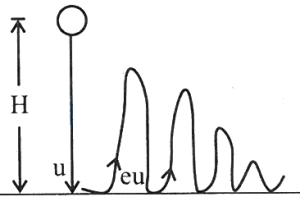
$A$ ball falls freely from rest on to a hard horizontal floor and repeatedly bounces. If the velocity of the ball just before the first bounce is $7 \text{ m/s}$ and the coefficient of restitution is $0.75$. The total distance travelled by the ball before it comes to rest is (acceleration due to gravity $= 10 \text{ m/s}^2$) (in $\text{ m}$)
A
$10.75$
B
$9.75$
C
$8.75$
D
$11.75$
Solution
(C) Given: Initial velocity $u = 7 \text{ m/s}$, coefficient of restitution $e = 0.75$, acceleration due to gravity $g = 10 \text{ m/s}^2$.
Initial height $H = \frac{u^2}{2g} = \frac{7^2}{2 \times 10} = \frac{49}{20} = 2.45 \text{ m}$.
The ball bounces back with velocity $v_1 = eu = 0.75 \times 7 = 5.25 \text{ m/s}$.
The height reached after the first bounce is $H_1 = \frac{v_1^2}{2g} = e^2 H = (0.75)^2 \times 2.45 = 0.5625 \times 2.45 = 1.378125 \text{ m}$.
The total distance $S$ traveled by the ball is $S = H + 2H_1 + 2H_2 + \dots = H + 2(e^2H + e^4H + \dots) = H(1 + 2e^2(1 + e^2 + e^4 + \dots))$.
Using the sum of an infinite geometric series $S_{\infty} = \frac{a}{1-r}$, we get $S = H(1 + 2e^2(\frac{1}{1-e^2})) = H(\frac{1-e^2+2e^2}{1-e^2}) = H(\frac{1+e^2}{1-e^2})$.
Substituting the values: $S = 2.45 \times \frac{1 + (0.75)^2}{1 - (0.75)^2} = 2.45 \times \frac{1 + 0.5625}{1 - 0.5625} = 2.45 \times \frac{1.5625}{0.4375} = 2.45 \times 3.5714 = 8.75 \text{ m}$.
Initial height $H = \frac{u^2}{2g} = \frac{7^2}{2 \times 10} = \frac{49}{20} = 2.45 \text{ m}$.
The ball bounces back with velocity $v_1 = eu = 0.75 \times 7 = 5.25 \text{ m/s}$.
The height reached after the first bounce is $H_1 = \frac{v_1^2}{2g} = e^2 H = (0.75)^2 \times 2.45 = 0.5625 \times 2.45 = 1.378125 \text{ m}$.
The total distance $S$ traveled by the ball is $S = H + 2H_1 + 2H_2 + \dots = H + 2(e^2H + e^4H + \dots) = H(1 + 2e^2(1 + e^2 + e^4 + \dots))$.
Using the sum of an infinite geometric series $S_{\infty} = \frac{a}{1-r}$, we get $S = H(1 + 2e^2(\frac{1}{1-e^2})) = H(\frac{1-e^2+2e^2}{1-e^2}) = H(\frac{1+e^2}{1-e^2})$.
Substituting the values: $S = 2.45 \times \frac{1 + (0.75)^2}{1 - (0.75)^2} = 2.45 \times \frac{1 + 0.5625}{1 - 0.5625} = 2.45 \times \frac{1.5625}{0.4375} = 2.45 \times 3.5714 = 8.75 \text{ m}$.
0 likes
View Solution331
DifficultMCQ
$A$ bullet of mass $30 \,g$ moving with $700 \,ms^{-1}$ collides with a block of mass $4 \,kg$ hanging by a string of length $0.4 \,m$. After the collision, the block rises to a height of $0.2 \,m$. Find the velocity of the bullet when it emerges from the block. (in $\,ms^{-1}$)
A
$200$
B
$433$
C
$400$
D
$332$
Solution
(B) Given: Mass of bullet $m_b = 0.03 \,kg$, initial velocity $v_b = 700 \,ms^{-1}$. Mass of block $m_B = 4 \,kg$, height $h = 0.2 \,m$.
Initial momentum of the system $= m_b v_b = 0.03 \times 700 = 21 \,kg \cdot ms^{-1}$.
Let $v_1$ be the velocity of the bullet and $v_2$ be the velocity of the block after the collision.
By conservation of linear momentum: $21 = 0.03 v_1 + 4 v_2$ ... $(i)$
For the block, by conservation of energy: $\frac{1}{2} m_B v_2^2 = m_B g h$.
$v_2 = \sqrt{2gh} = \sqrt{2 \times 9.8 \times 0.2} = \sqrt{3.92} \approx 1.98 \,ms^{-1}$.
Substituting $v_2$ into $(i)$: $21 = 0.03 v_1 + 4(1.98)$.
$21 = 0.03 v_1 + 7.92$.
$0.03 v_1 = 13.08$.
$v_1 = \frac{13.08}{0.03} = 436 \,ms^{-1}$.
Rounding to the nearest provided option, the velocity is approximately $433 \,ms^{-1}$.
Initial momentum of the system $= m_b v_b = 0.03 \times 700 = 21 \,kg \cdot ms^{-1}$.
Let $v_1$ be the velocity of the bullet and $v_2$ be the velocity of the block after the collision.
By conservation of linear momentum: $21 = 0.03 v_1 + 4 v_2$ ... $(i)$
For the block, by conservation of energy: $\frac{1}{2} m_B v_2^2 = m_B g h$.
$v_2 = \sqrt{2gh} = \sqrt{2 \times 9.8 \times 0.2} = \sqrt{3.92} \approx 1.98 \,ms^{-1}$.
Substituting $v_2$ into $(i)$: $21 = 0.03 v_1 + 4(1.98)$.
$21 = 0.03 v_1 + 7.92$.
$0.03 v_1 = 13.08$.
$v_1 = \frac{13.08}{0.03} = 436 \,ms^{-1}$.
Rounding to the nearest provided option, the velocity is approximately $433 \,ms^{-1}$.
0 likes
View Solution332
MediumMCQ
Assertion $(A)$: In an elastic collision of two billiard balls,the total kinetic energy $(KE)$ is conserved during the short time of collision of the balls (i.e.,when they are in contact).
Reason $(R)$: Energy spent against friction does not follow the law of conservation of energy.
Reason $(R)$: Energy spent against friction does not follow the law of conservation of energy.
A
Both $A$ and $R$ are true and $R$ is a correct explanation for $A$.
B
Both $A$ and $R$ are true but $R$ is not a correct explanation for $A$.
C
$A$ is true but $R$ is false.
D
Both $A$ and $R$ are false.
Solution
(D) In an elastic collision,the total kinetic energy is conserved only before and after the collision. During the short interval of collision,the balls undergo deformation,and a part of the kinetic energy is converted into elastic potential energy. Thus,the kinetic energy is not conserved during the contact time.
Therefore,the Assertion $(A)$ is false.
The law of conservation of energy is a universal law that applies to all physical processes,including work done against friction (where energy is converted into heat). Therefore,the Reason $(R)$ is also false.
Since both statements are incorrect,the correct option is $(D)$.
Therefore,the Assertion $(A)$ is false.
The law of conservation of energy is a universal law that applies to all physical processes,including work done against friction (where energy is converted into heat). Therefore,the Reason $(R)$ is also false.
Since both statements are incorrect,the correct option is $(D)$.
0 likes
View Solution333
DifficultMCQ
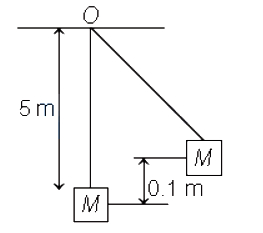
$A$ bullet of mass $0.01 \,kg$ travelling at a speed of $500 \,ms^{-1}$ strikes a block of mass $2 \,kg$ which is suspended by a string of length $5 \,m$. The centre of gravity of the block is found to rise a vertical distance of $0.1 \,m$. What is the speed of the bullet after it emerges from the block (in $\,ms^{-1}$)?
A
$200$
B
$220$
C
$204$
D
$284$
Solution
(B) Given:
Mass of bullet,$m = 0.01 \,kg$
Initial speed of bullet,$u = 500 \,ms^{-1}$
Mass of block,$M = 2 \,kg$
Vertical rise of block,$h = 0.1 \,m$
Let $v_b$ be the speed of the bullet after emerging from the block and $V$ be the velocity of the block immediately after the collision.
Applying the law of conservation of energy to the block after the collision:
$\frac{1}{2} M V^2 = Mgh$
$V = \sqrt{2gh} = \sqrt{2 \times 9.8 \times 0.1} = \sqrt{1.96} = 1.4 \,ms^{-1}$
Applying the law of conservation of linear momentum during the collision:
$m u = m v_b + M V$
$0.01 \times 500 = (0.01 \times v_b) + (2 \times 1.4)$
$5 = 0.01 v_b + 2.8$
$0.01 v_b = 5 - 2.8 = 2.2$
$v_b = \frac{2.2}{0.01} = 220 \,ms^{-1}$
Thus,the speed of the bullet after it emerges from the block is $220 \,ms^{-1}$.
Mass of bullet,$m = 0.01 \,kg$
Initial speed of bullet,$u = 500 \,ms^{-1}$
Mass of block,$M = 2 \,kg$
Vertical rise of block,$h = 0.1 \,m$
Let $v_b$ be the speed of the bullet after emerging from the block and $V$ be the velocity of the block immediately after the collision.
Applying the law of conservation of energy to the block after the collision:
$\frac{1}{2} M V^2 = Mgh$
$V = \sqrt{2gh} = \sqrt{2 \times 9.8 \times 0.1} = \sqrt{1.96} = 1.4 \,ms^{-1}$
Applying the law of conservation of linear momentum during the collision:
$m u = m v_b + M V$
$0.01 \times 500 = (0.01 \times v_b) + (2 \times 1.4)$
$5 = 0.01 v_b + 2.8$
$0.01 v_b = 5 - 2.8 = 2.2$
$v_b = \frac{2.2}{0.01} = 220 \,ms^{-1}$
Thus,the speed of the bullet after it emerges from the block is $220 \,ms^{-1}$.
0 likes
View Solution334
MediumMCQ
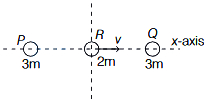
Two particles $P$ and $Q$ each of mass $3m$ lie at rest on the $X$-axis at points $(-a, 0)$ and $(+a, 0)$,respectively. $A$ third particle $R$ of mass $2m$ initially at the origin moves towards the particle $Q$ with velocity $v$. If all the collisions of the system of $3$ particles are elastic and head-on,the total number of collisions in the system is
A
$2$
B
$3$
C
$4$
D
$5$
Solution
(B) Let the masses be $m_P = 3m$,$m_R = 2m$,and $m_Q = 3m$. Particle $R$ moves with velocity $v$ towards $Q$.
$1$. First collision between $R$ and $Q$:
Using the elastic collision formula for velocities after collision: $v_1' = \frac{(m_1-m_2)v_1 + 2m_2v_2}{m_1+m_2}$ and $v_2' = \frac{(m_2-m_1)v_2 + 2m_1v_1}{m_1+m_2}$.
For $R$ and $Q$ $(m_R=2m, m_Q=3m)$: $v_R' = \frac{(2m-3m)v + 0}{2m+3m} = -v/5$ and $v_Q' = \frac{(3m-2m)0 + 2(2m)v}{2m+3m} = 4v/5$.
$2$. Now $R$ moves with velocity $-v/5$ towards $P$ $(m_P=3m)$:
For $R$ and $P$ $(m_R=2m, m_P=3m)$: $v_R'' = \frac{(2m-3m)(-v/5) + 0}{2m+3m} = v/25$ and $v_P'' = \frac{(3m-2m)0 + 2(2m)(-v/5)}{2m+3m} = -4v/25$.
Since $v_R''$ is positive and $v_Q'$ is positive $(4v/5 > v/25)$,$R$ will never catch $Q$ again. Also,$P$ moves in the negative direction,so no further collisions occur.
Total collisions = $3$.
$1$. First collision between $R$ and $Q$:
Using the elastic collision formula for velocities after collision: $v_1' = \frac{(m_1-m_2)v_1 + 2m_2v_2}{m_1+m_2}$ and $v_2' = \frac{(m_2-m_1)v_2 + 2m_1v_1}{m_1+m_2}$.
For $R$ and $Q$ $(m_R=2m, m_Q=3m)$: $v_R' = \frac{(2m-3m)v + 0}{2m+3m} = -v/5$ and $v_Q' = \frac{(3m-2m)0 + 2(2m)v}{2m+3m} = 4v/5$.
$2$. Now $R$ moves with velocity $-v/5$ towards $P$ $(m_P=3m)$:
For $R$ and $P$ $(m_R=2m, m_P=3m)$: $v_R'' = \frac{(2m-3m)(-v/5) + 0}{2m+3m} = v/25$ and $v_P'' = \frac{(3m-2m)0 + 2(2m)(-v/5)}{2m+3m} = -4v/25$.
Since $v_R''$ is positive and $v_Q'$ is positive $(4v/5 > v/25)$,$R$ will never catch $Q$ again. Also,$P$ moves in the negative direction,so no further collisions occur.
Total collisions = $3$.
0 likes
View Solution335
DifficultMCQ
$A$ body $A$ moving with momentum $P$ collides one-dimensionally with another stationary body $B$ of same mass. During impact,$A$ gives impulse $J$ to $B$. Then which of the following is/are correct?
$(a)$ The total momentum of $A$ and $B$ is $P$ before and after impact and $(P-J)$ during the impact.
$(b)$ During the impact,$B$ gives impulse of magnitude $J$ to $A$.
$(c)$ The coefficient of restitution is $\left[\frac{2 J}{P}-1\right]$.
$(d)$ The coefficient of restitution is $\left[\frac{2 J}{P}+1\right]$.
$(a)$ The total momentum of $A$ and $B$ is $P$ before and after impact and $(P-J)$ during the impact.
$(b)$ During the impact,$B$ gives impulse of magnitude $J$ to $A$.
$(c)$ The coefficient of restitution is $\left[\frac{2 J}{P}-1\right]$.
$(d)$ The coefficient of restitution is $\left[\frac{2 J}{P}+1\right]$.
A
Only $(a)$ is correct.
B
$(a)$ and $(c)$ are correct.
C
$(b)$ and $(c)$ are correct.
D
Only $(c)$ is correct.
Solution
(C) Let the mass of both bodies be $m$. Initially,body $A$ has momentum $P$,so its velocity is $v_A = P/m$. Body $B$ is stationary,so $v_B = 0$.
During the impact,body $A$ exerts an impulse $J$ on body $B$. By Newton's third law,body $B$ exerts an equal and opposite impulse $J$ on body $A$.
Statement $(b)$ is correct because the impulse exerted by $B$ on $A$ is equal in magnitude to the impulse exerted by $A$ on $B$.
After the impact,the momentum of $B$ is $P_B = J$,so its velocity is $v_B' = J/m$.
The momentum of $A$ becomes $P_A' = P - J$,so its velocity is $v_A' = (P - J)/m$.
The coefficient of restitution $e$ is defined as the ratio of the relative velocity of separation to the relative velocity of approach:
$e = \frac{v_B' - v_A'}{v_A - v_B} = \frac{\frac{J}{m} - \frac{P-J}{m}}{\frac{P}{m} - 0} = \frac{2J - P}{P} = \frac{2J}{P} - 1$.
Thus,statement $(c)$ is also correct.
Therefore,statements $(b)$ and $(c)$ are correct.
During the impact,body $A$ exerts an impulse $J$ on body $B$. By Newton's third law,body $B$ exerts an equal and opposite impulse $J$ on body $A$.
Statement $(b)$ is correct because the impulse exerted by $B$ on $A$ is equal in magnitude to the impulse exerted by $A$ on $B$.
After the impact,the momentum of $B$ is $P_B = J$,so its velocity is $v_B' = J/m$.
The momentum of $A$ becomes $P_A' = P - J$,so its velocity is $v_A' = (P - J)/m$.
The coefficient of restitution $e$ is defined as the ratio of the relative velocity of separation to the relative velocity of approach:
$e = \frac{v_B' - v_A'}{v_A - v_B} = \frac{\frac{J}{m} - \frac{P-J}{m}}{\frac{P}{m} - 0} = \frac{2J - P}{P} = \frac{2J}{P} - 1$.
Thus,statement $(c)$ is also correct.
Therefore,statements $(b)$ and $(c)$ are correct.
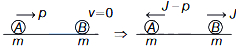
0 likes
View Solution336
DifficultMCQ
$A$ ball falls freely from a height of $180 \,m$ onto a hard horizontal floor and repeatedly bounces. If the coefficient of restitution is $0.5$, the average speed and average velocity of the ball before it ceases to rebound are respectively (acceleration due to gravity $= 10 \,ms^{-2}$)
A
$10 \,ms^{-1}, 10 \,ms^{-1}$
B
$50 \,ms^{-1}, \frac{50}{3} \,ms^{-1}$
C
$\frac{50}{3} \,ms^{-1}, 10 \,ms^{-1}$
D
$\frac{20}{3} \,ms^{-1}, \frac{50}{3} \,ms^{-1}$
Solution
(C) When a ball is dropped from height $h$, the time taken to reach the ground is $t_0 = \sqrt{\frac{2h}{g}}$ and the speed just before impact is $v_0 = \sqrt{2gh}$.
After the first collision, its speed becomes $v_1 = ev_0 = e\sqrt{2gh}$, where $e$ is the coefficient of restitution.
The ball rises and stops at time $t_1 = \frac{v_1}{g}$. It then falls back to the ground, taking the same time $t_1$. Thus, the time between the first and second collision is $2t_1 = \frac{2v_1}{g}$.
The total time $T$ before it ceases to rebound is:
$T = t_0 + 2t_1 + 2t_2 + \dots = t_0 + \frac{2v_1}{g} + \frac{2v_2}{g} + \dots = \sqrt{\frac{2h}{g}} + \frac{2e\sqrt{2gh}}{g} + \frac{2e^2\sqrt{2gh}}{g} + \dots$
$T = \sqrt{\frac{2h}{g}} [1 + 2e(1 + e + e^2 + \dots)] = \sqrt{\frac{2h}{g}} \left( \frac{1+e}{1-e} \right)$.
Given $h = 180 \,m$, $g = 10 \,ms^{-2}$, and $e = 0.5$:
$T = \sqrt{\frac{2 \times 180}{10}} \left( \frac{1+0.5}{1-0.5} \right) = 6 \times 3 = 18 \,s$.
The total distance $H$ covered is:
$H = h + 2h_1 + 2h_2 + \dots = h + 2(e^2h) + 2(e^4h) + \dots = h \left( \frac{1+e^2}{1-e^2} \right)$.
$H = 180 \left( \frac{1 + 0.25}{1 - 0.25} \right) = 180 \times \frac{1.25}{0.75} = 180 \times \frac{5}{3} = 300 \,m$.
Average speed $= \frac{\text{Total distance}}{\text{Total time}} = \frac{300}{18} = \frac{50}{3} \,ms^{-1}$.
Average velocity $= \frac{\text{Total displacement}}{\text{Total time}} = \frac{180}{18} = 10 \,ms^{-1}$.
After the first collision, its speed becomes $v_1 = ev_0 = e\sqrt{2gh}$, where $e$ is the coefficient of restitution.
The ball rises and stops at time $t_1 = \frac{v_1}{g}$. It then falls back to the ground, taking the same time $t_1$. Thus, the time between the first and second collision is $2t_1 = \frac{2v_1}{g}$.
The total time $T$ before it ceases to rebound is:
$T = t_0 + 2t_1 + 2t_2 + \dots = t_0 + \frac{2v_1}{g} + \frac{2v_2}{g} + \dots = \sqrt{\frac{2h}{g}} + \frac{2e\sqrt{2gh}}{g} + \frac{2e^2\sqrt{2gh}}{g} + \dots$
$T = \sqrt{\frac{2h}{g}} [1 + 2e(1 + e + e^2 + \dots)] = \sqrt{\frac{2h}{g}} \left( \frac{1+e}{1-e} \right)$.
Given $h = 180 \,m$, $g = 10 \,ms^{-2}$, and $e = 0.5$:
$T = \sqrt{\frac{2 \times 180}{10}} \left( \frac{1+0.5}{1-0.5} \right) = 6 \times 3 = 18 \,s$.
The total distance $H$ covered is:
$H = h + 2h_1 + 2h_2 + \dots = h + 2(e^2h) + 2(e^4h) + \dots = h \left( \frac{1+e^2}{1-e^2} \right)$.
$H = 180 \left( \frac{1 + 0.25}{1 - 0.25} \right) = 180 \times \frac{1.25}{0.75} = 180 \times \frac{5}{3} = 300 \,m$.
Average speed $= \frac{\text{Total distance}}{\text{Total time}} = \frac{300}{18} = \frac{50}{3} \,ms^{-1}$.
Average velocity $= \frac{\text{Total displacement}}{\text{Total time}} = \frac{180}{18} = 10 \,ms^{-1}$.
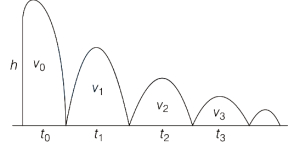
0 likes
View Solution337
DifficultMCQ
$A$ bullet of mass $10 \ g$ pierces through a plate $A$ of mass $500 \ g$ and then gets embedded into a second plate $B$ of mass $1.49 \ kg$ as shown in the figure. Initially,the two plates $A$ and $B$ are at rest and move with the same velocity after the collision. The percentage loss in the initial kinetic energy of the bullet when it is between the plates $A$ and $B$ is . . . . . . (Neglect any loss of material of the plates during the collision).
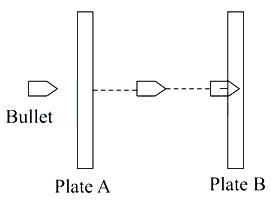
A
$25$
B
$56.25$
C
$43.75$
D
$75$
Solution
(C) Let the mass of the bullet be $m = 10 \ g = 0.01 \ kg$,mass of plate $A$ be $M_A = 500 \ g = 0.5 \ kg$,and mass of plate $B$ be $M_B = 1.49 \ kg$.
Let the initial velocity of the bullet be $u$ and its velocity after passing through plate $A$ be $v_1$.
Let the velocity of plate $A$ after the bullet passes through it be $v_A$ and the velocity of plate $B$ after the bullet gets embedded in it be $v_B$.
According to the problem,$v_A = v_B = v$.
For plate $A$,by conservation of linear momentum:
$m u = m v_1 + M_A v \Rightarrow m(u - v_1) = M_A v \quad ... (1)$
For plate $B$,by conservation of linear momentum:
$m v_1 = (m + M_B) v \Rightarrow v = \frac{m v_1}{m + M_B} \quad ... (2)$
Substituting $v$ from $(2)$ into $(1)$:
$m(u - v_1) = M_A \left( \frac{m v_1}{m + M_B} \right)$
$u - v_1 = v_1 \left( \frac{M_A}{m + M_B} \right)$
$u = v_1 \left( 1 + \frac{M_A}{m + M_B} \right) = v_1 \left( \frac{m + M_B + M_A}{m + M_B} \right)$
$v_1 = u \left( \frac{m + M_B}{m + M_B + M_A} \right) = u \left( \frac{0.01 + 1.49}{0.01 + 1.49 + 0.5} \right) = u \left( \frac{1.5}{2.0} \right) = 0.75 u = \frac{3}{4} u$.
The initial kinetic energy of the bullet is $K_i = \frac{1}{2} m u^2$.
The kinetic energy of the bullet after passing through plate $A$ is $K_f = \frac{1}{2} m v_1^2 = \frac{1}{2} m \left( \frac{3}{4} u \right)^2 = \frac{9}{16} K_i$.
The percentage loss in kinetic energy is:
$\text{Percentage Loss} = \frac{K_i - K_f}{K_i} \times 100 = \left( 1 - \frac{9}{16} \right) \times 100 = \frac{7}{16} \times 100 = 43.75 \%$.
Let the initial velocity of the bullet be $u$ and its velocity after passing through plate $A$ be $v_1$.
Let the velocity of plate $A$ after the bullet passes through it be $v_A$ and the velocity of plate $B$ after the bullet gets embedded in it be $v_B$.
According to the problem,$v_A = v_B = v$.
For plate $A$,by conservation of linear momentum:
$m u = m v_1 + M_A v \Rightarrow m(u - v_1) = M_A v \quad ... (1)$
For plate $B$,by conservation of linear momentum:
$m v_1 = (m + M_B) v \Rightarrow v = \frac{m v_1}{m + M_B} \quad ... (2)$
Substituting $v$ from $(2)$ into $(1)$:
$m(u - v_1) = M_A \left( \frac{m v_1}{m + M_B} \right)$
$u - v_1 = v_1 \left( \frac{M_A}{m + M_B} \right)$
$u = v_1 \left( 1 + \frac{M_A}{m + M_B} \right) = v_1 \left( \frac{m + M_B + M_A}{m + M_B} \right)$
$v_1 = u \left( \frac{m + M_B}{m + M_B + M_A} \right) = u \left( \frac{0.01 + 1.49}{0.01 + 1.49 + 0.5} \right) = u \left( \frac{1.5}{2.0} \right) = 0.75 u = \frac{3}{4} u$.
The initial kinetic energy of the bullet is $K_i = \frac{1}{2} m u^2$.
The kinetic energy of the bullet after passing through plate $A$ is $K_f = \frac{1}{2} m v_1^2 = \frac{1}{2} m \left( \frac{3}{4} u \right)^2 = \frac{9}{16} K_i$.
The percentage loss in kinetic energy is:
$\text{Percentage Loss} = \frac{K_i - K_f}{K_i} \times 100 = \left( 1 - \frac{9}{16} \right) \times 100 = \frac{7}{16} \times 100 = 43.75 \%$.
0 likes
View Solution338
MediumMCQ
$A$ ball is thrown vertically down from a height of $40 \,m$ from the ground with an initial velocity $v$. The ball hits the ground, loses $\frac{1}{3}$ of its total mechanical energy, and rebounds back to the same height. If the acceleration due to gravity is $10 \,m/s^2$, then the value of $v$ is (in $\,m/s$)
A
$5$
B
$10$
C
$15$
D
$20$
Solution
(D) Let $m$ be the mass of the ball, $h = 40 \,m$ be the height, and $g = 10 \,m/s^2$ be the acceleration due to gravity.
Total mechanical energy just before hitting the ground is $E_i = \frac{1}{2}mv^2 + mgh$.
After losing $\frac{1}{3}$ of its energy, the remaining energy is $E_f = \frac{2}{3}E_i$.
This remaining energy is used to rebound to the same height $h$, so the potential energy at the peak of the rebound is $mgh$.
Equating the energy: $\frac{2}{3}(\frac{1}{2}mv^2 + mgh) = mgh$.
Dividing by $m$: $\frac{2}{3}(\frac{1}{2}v^2 + gh) = gh$.
$\frac{1}{3}v^2 + \frac{2}{3}gh = gh$.
$\frac{1}{3}v^2 = gh - \frac{2}{3}gh = \frac{1}{3}gh$.
$v^2 = gh$.
$v = \sqrt{10 \times 40} = \sqrt{400} = 20 \,m/s$.
Total mechanical energy just before hitting the ground is $E_i = \frac{1}{2}mv^2 + mgh$.
After losing $\frac{1}{3}$ of its energy, the remaining energy is $E_f = \frac{2}{3}E_i$.
This remaining energy is used to rebound to the same height $h$, so the potential energy at the peak of the rebound is $mgh$.
Equating the energy: $\frac{2}{3}(\frac{1}{2}mv^2 + mgh) = mgh$.
Dividing by $m$: $\frac{2}{3}(\frac{1}{2}v^2 + gh) = gh$.
$\frac{1}{3}v^2 + \frac{2}{3}gh = gh$.
$\frac{1}{3}v^2 = gh - \frac{2}{3}gh = \frac{1}{3}gh$.
$v^2 = gh$.
$v = \sqrt{10 \times 40} = \sqrt{400} = 20 \,m/s$.
0 likes
View Solution339
EasyMCQ
In two separate collisions,the coefficients of restitution $e_1$ and $e_2$ are in the ratio $3: 1$. In the first collision,the relative velocity of approach is twice the relative velocity of separation. Then,the ratio between the relative velocity of approach and the relative velocity of separation in the second collision is:
A
$1: 6$
B
$2: 3$
C
$3: 2$
D
$6: 1$
Solution
(D) The coefficient of restitution $e$ is defined as the ratio of the relative velocity of separation to the relative velocity of approach:
$e = \frac{v_{\text{sep}}}{v_{\text{app}}}$
For the first collision,we are given that the relative velocity of approach is twice the relative velocity of separation:
$v_{\text{app}, 1} = 2 v_{\text{sep}, 1} \implies e_1 = \frac{v_{\text{sep}, 1}}{v_{\text{app}, 1}} = \frac{1}{2}$
We are given the ratio of the coefficients of restitution as $e_1 : e_2 = 3 : 1$,which means:
$e_2 = \frac{e_1}{3} = \frac{1/2}{3} = \frac{1}{6}$
Since $e_2 = \frac{v_{\text{sep}, 2}}{v_{\text{app}, 2}} = \frac{1}{6}$,the ratio of the relative velocity of approach to the relative velocity of separation in the second collision is:
$\frac{v_{\text{app}, 2}}{v_{\text{sep}, 2}} = \frac{1}{e_2} = 6 = 6: 1$
$e = \frac{v_{\text{sep}}}{v_{\text{app}}}$
For the first collision,we are given that the relative velocity of approach is twice the relative velocity of separation:
$v_{\text{app}, 1} = 2 v_{\text{sep}, 1} \implies e_1 = \frac{v_{\text{sep}, 1}}{v_{\text{app}, 1}} = \frac{1}{2}$
We are given the ratio of the coefficients of restitution as $e_1 : e_2 = 3 : 1$,which means:
$e_2 = \frac{e_1}{3} = \frac{1/2}{3} = \frac{1}{6}$
Since $e_2 = \frac{v_{\text{sep}, 2}}{v_{\text{app}, 2}} = \frac{1}{6}$,the ratio of the relative velocity of approach to the relative velocity of separation in the second collision is:
$\frac{v_{\text{app}, 2}}{v_{\text{sep}, 2}} = \frac{1}{e_2} = 6 = 6: 1$
0 likes
View Solution340
MediumMCQ
The linear momentum of a body of mass $8 \ kg$ is $24 \ kg \ m \ s^{-1}$. If a constant force of $24 \ N$ acts on the body in the direction of motion of the body for a time of $3 \ s$,then the increase in the kinetic energy of the body is (in $J$)
A
$480$
B
$540$
C
$270$
D
$240$
Solution
(B) Initial momentum $p_i = 24 \ kg \ m \ s^{-1}$.
Mass $m = 8 \ kg$.
Initial velocity $v_i = \frac{p_i}{m} = \frac{24}{8} = 3 \ m \ s^{-1}$.
Initial kinetic energy $K_i = \frac{1}{2} m v_i^2 = \frac{1}{2} \times 8 \times (3)^2 = 4 \times 9 = 36 \ J$.
Impulse $J = F \times \Delta t = 24 \times 3 = 72 \ N \ s$.
Change in momentum $\Delta p = J = p_f - p_i$.
Final momentum $p_f = p_i + J = 24 + 72 = 96 \ kg \ m \ s^{-1}$.
Final velocity $v_f = \frac{p_f}{m} = \frac{96}{8} = 12 \ m \ s^{-1}$.
Final kinetic energy $K_f = \frac{1}{2} m v_f^2 = \frac{1}{2} \times 8 \times (12)^2 = 4 \times 144 = 576 \ J$.
Increase in kinetic energy $\Delta K = K_f - K_i = 576 - 36 = 540 \ J$.
Mass $m = 8 \ kg$.
Initial velocity $v_i = \frac{p_i}{m} = \frac{24}{8} = 3 \ m \ s^{-1}$.
Initial kinetic energy $K_i = \frac{1}{2} m v_i^2 = \frac{1}{2} \times 8 \times (3)^2 = 4 \times 9 = 36 \ J$.
Impulse $J = F \times \Delta t = 24 \times 3 = 72 \ N \ s$.
Change in momentum $\Delta p = J = p_f - p_i$.
Final momentum $p_f = p_i + J = 24 + 72 = 96 \ kg \ m \ s^{-1}$.
Final velocity $v_f = \frac{p_f}{m} = \frac{96}{8} = 12 \ m \ s^{-1}$.
Final kinetic energy $K_f = \frac{1}{2} m v_f^2 = \frac{1}{2} \times 8 \times (12)^2 = 4 \times 144 = 576 \ J$.
Increase in kinetic energy $\Delta K = K_f - K_i = 576 - 36 = 540 \ J$.
0 likes
View Solution341
EasyMCQ
Two wooden blocks of mass $M_1$ and $M_2$ rest on a frictionless table. $A$ bullet of mass $m$ is fired at $M_1$ with speed $v$,which gets embedded in it,and the two together finally collide with $M_2$. Find the velocity of $M_2$ after the collision. (Assume the collision between the $(M_1+m)$ system and $M_2$ is elastic and treat the problem as one-dimensional.)
A
$\frac{2 m v}{M_1+M_2+m}$
B
$\frac{m v}{M_1+M_2+m}$
C
$\frac{(M_1+M_2+m) v}{M_1+M_2+m}$
D
$\frac{M_1+M_2}{M_1+M_2+m} v$
Solution
(A) Step $1$: The bullet of mass $m$ strikes $M_1$ and gets embedded in it. This is a perfectly inelastic collision. By the law of conservation of linear momentum:
$m v = (m + M_1) v_1$
where $v_1$ is the velocity of the $(m + M_1)$ system after the first collision.
$v_1 = \frac{m v}{m + M_1}$
Step $2$: The system $(m + M_1)$ now moves with velocity $v_1$ and collides elastically with $M_2$,which is initially at rest $(u_2 = 0)$.
For an elastic collision between two masses $m_A$ and $m_B$ where $m_B$ is initially at rest,the final velocity $v_B$ of mass $m_B$ is given by:
$v_B = \frac{2 m_A}{m_A + m_B} u_A$
Here,$m_A = (m + M_1)$,$m_B = M_2$,and $u_A = v_1$.
Substituting these values:
$v_2 = \frac{2(m + M_1)}{(m + M_1) + M_2} v_1$
$v_2 = \frac{2(m + M_1)}{m + M_1 + M_2} \cdot \frac{m v}{m + M_1}$
$v_2 = \frac{2 m v}{m + M_1 + M_2}$
Thus,the velocity of $M_2$ after the collision is $\frac{2 m v}{M_1 + M_2 + m}$.
$m v = (m + M_1) v_1$
where $v_1$ is the velocity of the $(m + M_1)$ system after the first collision.
$v_1 = \frac{m v}{m + M_1}$
Step $2$: The system $(m + M_1)$ now moves with velocity $v_1$ and collides elastically with $M_2$,which is initially at rest $(u_2 = 0)$.
For an elastic collision between two masses $m_A$ and $m_B$ where $m_B$ is initially at rest,the final velocity $v_B$ of mass $m_B$ is given by:
$v_B = \frac{2 m_A}{m_A + m_B} u_A$
Here,$m_A = (m + M_1)$,$m_B = M_2$,and $u_A = v_1$.
Substituting these values:
$v_2 = \frac{2(m + M_1)}{(m + M_1) + M_2} v_1$
$v_2 = \frac{2(m + M_1)}{m + M_1 + M_2} \cdot \frac{m v}{m + M_1}$
$v_2 = \frac{2 m v}{m + M_1 + M_2}$
Thus,the velocity of $M_2$ after the collision is $\frac{2 m v}{M_1 + M_2 + m}$.
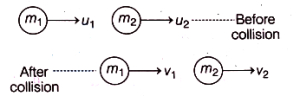
0 likes
View Solution342
MediumMCQ
$A$ free body of mass $8 \ kg$ is moving at $2 \ m \cdot s^{-1}$ along a straight line. It splits into two equal parts due to an internal explosion releasing $16 \ J$ of energy,and neither part deviates from the original line of motion. What happens to the two parts?
A
Both parts continue to move in the same direction as that of the original body.
B
One part comes to rest and the other moves in the same direction as that of the original body.
C
One part comes to rest and the other moves in the direction opposite to that of the original body.
D
One part moves in the same direction and the other in the direction opposite to that of the original body.
Solution
(B) Initial mass $M = 8 \ kg$,initial velocity $u = 2 \ m/s$. Initial momentum $P_i = M \cdot u = 8 \times 2 = 16 \ kg \cdot m/s$. Initial kinetic energy $K_i = \frac{1}{2} M u^2 = \frac{1}{2} \times 8 \times 2^2 = 16 \ J$. After the explosion,the body splits into two equal parts of mass $m = 4 \ kg$ each. Let their velocities be $v_1$ and $v_2$. By conservation of momentum: $m v_1 + m v_2 = P_i \implies 4(v_1 + v_2) = 16 \implies v_1 + v_2 = 4$. The final kinetic energy $K_f = K_i + \Delta E = 16 + 16 = 32 \ J$. Also,$K_f = \frac{1}{2} m v_1^2 + \frac{1}{2} m v_2^2 = \frac{1}{2} \times 4 \times (v_1^2 + v_2^2) = 2(v_1^2 + v_2^2) = 32 \implies v_1^2 + v_2^2 = 16$. Solving $v_1 + v_2 = 4$ and $v_1^2 + v_2^2 = 16$: $(v_1 + v_2)^2 = v_1^2 + v_2^2 + 2 v_1 v_2 \implies 16 = 16 + 2 v_1 v_2 \implies v_1 v_2 = 0$. This means either $v_1 = 0$ or $v_2 = 0$. If $v_1 = 0$,then $v_2 = 4 \ m/s$. Thus,one part comes to rest and the other moves in the same direction as the original body.
0 likes
View Solution343
MediumMCQ
Two objects having masses in the ratio $1:4$ are at rest. When both of them are subjected to the same force separately,they achieve the same kinetic energy during times $t_1$ and $t_2$ respectively. Then the ratio of $t_1$ to $t_2$ is
A
$4$
B
$2$
C
$2.5$
D
$1$
Solution
(D) Let the masses be $m_1 = m$ and $m_2 = 4m$. Both are subjected to the same force $F$.
Acceleration of the first object: $a_1 = F/m$.
Acceleration of the second object: $a_2 = F/(4m) = a_1/4$.
Since they start from rest,their velocities after time $t$ are $v = at$.
Kinetic energy $K = \frac{1}{2}mv^2 = \frac{1}{2}m(at)^2 = \frac{1}{2}ma^2t^2$.
For the first object: $K_1 = \frac{1}{2}m(a_1)^2t_1^2$.
For the second object: $K_2 = \frac{1}{2}(4m)(a_2)^2t_2^2 = \frac{1}{2}(4m)(a_1/4)^2t_2^2 = \frac{1}{2}(4m)(a_1^2/16)t_2^2 = \frac{1}{2}m(a_1^2/4)t_2^2$.
Given $K_1 = K_2$,we have $\frac{1}{2}m a_1^2 t_1^2 = \frac{1}{2}m (a_1^2/4) t_2^2$.
Simplifying,$t_1^2 = t_2^2/4$,which implies $t_1^2/t_2^2 = 1/4$.
Therefore,$t_1/t_2 = 1/2$.
Acceleration of the first object: $a_1 = F/m$.
Acceleration of the second object: $a_2 = F/(4m) = a_1/4$.
Since they start from rest,their velocities after time $t$ are $v = at$.
Kinetic energy $K = \frac{1}{2}mv^2 = \frac{1}{2}m(at)^2 = \frac{1}{2}ma^2t^2$.
For the first object: $K_1 = \frac{1}{2}m(a_1)^2t_1^2$.
For the second object: $K_2 = \frac{1}{2}(4m)(a_2)^2t_2^2 = \frac{1}{2}(4m)(a_1/4)^2t_2^2 = \frac{1}{2}(4m)(a_1^2/16)t_2^2 = \frac{1}{2}m(a_1^2/4)t_2^2$.
Given $K_1 = K_2$,we have $\frac{1}{2}m a_1^2 t_1^2 = \frac{1}{2}m (a_1^2/4) t_2^2$.
Simplifying,$t_1^2 = t_2^2/4$,which implies $t_1^2/t_2^2 = 1/4$.
Therefore,$t_1/t_2 = 1/2$.
0 likes
View Solution344
MediumMCQ
Two bodies $A$ and $B$ of masses $2m$ and $m$ are projected vertically upwards from the ground with velocities $u$ and $2u$ respectively. The ratio of the kinetic energy of body $A$ and the potential energy of body $B$ at a height equal to half of the maximum height reached by body $A$ is (in $ : 1$)
A
$8$
B
$1$
C
$4$
D
$2$
Solution
(D) For body $A$:
Maximum height $H_{\max} = \frac{u^2}{2g}$.
Given $m_A = 2m$, $u_A = u$.
The height of interest is $h = \frac{H_{\max}}{2} = \frac{u^2}{4g}$.
Using the work-energy theorem or conservation of energy for body $A$ at height $h$:
$(KE)_A = \text{Total Energy} - (PE)_A = \frac{1}{2} m_A u_A^2 - m_A gh = \frac{1}{2}(2m)u^2 - (2m)g\left(\frac{u^2}{4g}\right) = mu^2 - \frac{1}{2}mu^2 = \frac{1}{2}mu^2$.
For body $B$:
Given $m_B = m$, $u_B = 2u$.
The potential energy of body $B$ at height $h = \frac{u^2}{4g}$ is:
$(PE)_B = m_B gh = m g \left(\frac{u^2}{4g}\right) = \frac{1}{4}mu^2$.
The ratio of $(KE)_A$ to $(PE)_B$ is:
$\frac{(KE)_A}{(PE)_B} = \frac{\frac{1}{2}mu^2}{\frac{1}{4}mu^2} = 2:1$.
Maximum height $H_{\max} = \frac{u^2}{2g}$.
Given $m_A = 2m$, $u_A = u$.
The height of interest is $h = \frac{H_{\max}}{2} = \frac{u^2}{4g}$.
Using the work-energy theorem or conservation of energy for body $A$ at height $h$:
$(KE)_A = \text{Total Energy} - (PE)_A = \frac{1}{2} m_A u_A^2 - m_A gh = \frac{1}{2}(2m)u^2 - (2m)g\left(\frac{u^2}{4g}\right) = mu^2 - \frac{1}{2}mu^2 = \frac{1}{2}mu^2$.
For body $B$:
Given $m_B = m$, $u_B = 2u$.
The potential energy of body $B$ at height $h = \frac{u^2}{4g}$ is:
$(PE)_B = m_B gh = m g \left(\frac{u^2}{4g}\right) = \frac{1}{4}mu^2$.
The ratio of $(KE)_A$ to $(PE)_B$ is:
$\frac{(KE)_A}{(PE)_B} = \frac{\frac{1}{2}mu^2}{\frac{1}{4}mu^2} = 2:1$.
0 likes
View Solution345
EasyMCQ
$A$ truck of mass $M$ and a car of mass $\frac{M}{10}$ moving with the same momentum are brought to a halt by the application of the same braking force. The ratio of the distances travelled by the truck and the car before they come to a stop is
A
$1: 10$
B
$1: \sqrt{10}$
C
$100: 1$
D
$5: 1$
Solution
(A) Let the momentum of both vehicles be $p$. The braking force $F$ is the same for both.
Using the work-energy theorem,the work done by the braking force is equal to the change in kinetic energy:
$|W| = |\Delta K|$
$F \cdot S = \frac{p^2}{2m}$
Thus,the stopping distance $S$ is given by $S = \frac{p^2}{2mF}$.
Since $p$ and $F$ are constant for both vehicles,$S \propto \frac{1}{m}$.
Therefore,the ratio of the distance travelled by the truck $(S_T)$ to the distance travelled by the car $(S_C)$ is:
$\frac{S_T}{S_C} = \frac{m_C}{m_T} = \frac{M/10}{M} = \frac{1}{10}$.
Hence,the ratio is $1: 10$.
Using the work-energy theorem,the work done by the braking force is equal to the change in kinetic energy:
$|W| = |\Delta K|$
$F \cdot S = \frac{p^2}{2m}$
Thus,the stopping distance $S$ is given by $S = \frac{p^2}{2mF}$.
Since $p$ and $F$ are constant for both vehicles,$S \propto \frac{1}{m}$.
Therefore,the ratio of the distance travelled by the truck $(S_T)$ to the distance travelled by the car $(S_C)$ is:
$\frac{S_T}{S_C} = \frac{m_C}{m_T} = \frac{M/10}{M} = \frac{1}{10}$.
Hence,the ratio is $1: 10$.
0 likes
View Solution346
MediumMCQ
An athlete throws a shotput of mass $25 \,kg$ with an initial speed of $4 \,ms^{-1}$ at an angle of $45^{\circ}$ with the horizontal from a height of $2 \,m$ above the ground. Assuming air resistance to be negligible,the kinetic energy of the shotput when it just touches the ground is . . . . . . $\left(g=10 \,ms^{-2}\right)$ (in $\,J$)
A
$600$
B
$100$
C
$700$
D
$800$
Solution
(C) According to the law of conservation of mechanical energy,the total mechanical energy at the point of projection is equal to the total mechanical energy at the ground level.
$E_{initial} = E_{final}$
$K_i + U_i = K_f + U_f$
Here,$K_i = \frac{1}{2}mv^2 = \frac{1}{2} \times 25 \times (4)^2 = \frac{1}{2} \times 25 \times 16 = 200 \,J$.
$U_i = mgh = 25 \times 10 \times 2 = 500 \,J$.
At the ground,$U_f = 0$.
So,$200 + 500 = K_f + 0$.
$K_f = 700 \,J$.
$E_{initial} = E_{final}$
$K_i + U_i = K_f + U_f$
Here,$K_i = \frac{1}{2}mv^2 = \frac{1}{2} \times 25 \times (4)^2 = \frac{1}{2} \times 25 \times 16 = 200 \,J$.
$U_i = mgh = 25 \times 10 \times 2 = 500 \,J$.
At the ground,$U_f = 0$.
So,$200 + 500 = K_f + 0$.
$K_f = 700 \,J$.
0 likes
View Solution347
MediumMCQ
Two bodies $A$ and $B$ of masses $20 \ kg$ and $5 \ kg$ respectively are at rest. Due to the action of a force of $40 \ N$ separately,if the two bodies acquire equal kinetic energies in times $t_A$ and $t_B$ respectively,then $t_A: t_B=$
A
$1: 2$
B
$2: 1$
C
$2: 5$
D
$5: 6$
Solution
(B) Given: Mass of body $A$ $(m_A = 20 \ kg)$,mass of body $B$ $(m_B = 5 \ kg)$,force $(F = 40 \ N)$.
Since both bodies start from rest,their kinetic energies are $K_A = K_B = K$.
Kinetic energy is given by $K = \frac{p^2}{2m}$,where $p$ is momentum.
Since $K_A = K_B$,we have $\frac{p_A^2}{2m_A} = \frac{p_B^2}{2m_B} \implies \frac{p_A}{p_B} = \sqrt{\frac{m_A}{m_B}} = \sqrt{\frac{20}{5}} = \sqrt{4} = 2$.
From the impulse-momentum theorem,$F \cdot t = \Delta p$. Since initial momentum is zero,$p = F \cdot t$.
Thus,$\frac{p_A}{p_B} = \frac{F \cdot t_A}{F \cdot t_B} = \frac{t_A}{t_B}$.
Therefore,$\frac{t_A}{t_B} = 2$,which means $t_A: t_B = 2: 1$.
Since both bodies start from rest,their kinetic energies are $K_A = K_B = K$.
Kinetic energy is given by $K = \frac{p^2}{2m}$,where $p$ is momentum.
Since $K_A = K_B$,we have $\frac{p_A^2}{2m_A} = \frac{p_B^2}{2m_B} \implies \frac{p_A}{p_B} = \sqrt{\frac{m_A}{m_B}} = \sqrt{\frac{20}{5}} = \sqrt{4} = 2$.
From the impulse-momentum theorem,$F \cdot t = \Delta p$. Since initial momentum is zero,$p = F \cdot t$.
Thus,$\frac{p_A}{p_B} = \frac{F \cdot t_A}{F \cdot t_B} = \frac{t_A}{t_B}$.
Therefore,$\frac{t_A}{t_B} = 2$,which means $t_A: t_B = 2: 1$.
0 likes
View Solution348
MediumMCQ
$A$ circular well of diameter $2 \ m$ has water up to the ground level. If the bottom of the well is at a depth of $14 \ m$,the time taken in seconds to empty the well using a $1.4 \ kW$ motor is (Acceleration due to gravity $= 10 \ m \ s^{-2}$)
A
$1860$
B
$2200$
C
$2660$
D
$3300$
Solution
(B) The radius of the well $r = 1 \ m$ and depth $h = 14 \ m$.
The volume of water $V = \pi r^2 h = \pi \times (1)^2 \times 14 = 14\pi \ m^3$.
The mass of water $m = \text{density} \times \text{volume} = 1000 \ kg/m^3 \times 14\pi \ m^3 = 14000\pi \ kg$.
The work done to empty the well is equal to the potential energy of the water,where the center of mass is at $h/2 = 7 \ m$.
$W = mgh_{cm} = (14000\pi) \times 10 \times 7 = 980000\pi \ J$.
Power $P = 1.4 \ kW = 1400 \ W$.
Time $t = W / P = (980000\pi) / 1400 = 700\pi \ s$.
Using $\pi \approx 3.14$,$t = 700 \times 3.14 = 2198 \ s \approx 2200 \ s$.
The volume of water $V = \pi r^2 h = \pi \times (1)^2 \times 14 = 14\pi \ m^3$.
The mass of water $m = \text{density} \times \text{volume} = 1000 \ kg/m^3 \times 14\pi \ m^3 = 14000\pi \ kg$.
The work done to empty the well is equal to the potential energy of the water,where the center of mass is at $h/2 = 7 \ m$.
$W = mgh_{cm} = (14000\pi) \times 10 \times 7 = 980000\pi \ J$.
Power $P = 1.4 \ kW = 1400 \ W$.
Time $t = W / P = (980000\pi) / 1400 = 700\pi \ s$.
Using $\pi \approx 3.14$,$t = 700 \times 3.14 = 2198 \ s \approx 2200 \ s$.
0 likes
View Solution349
MediumMCQ
Two bodies $A$ and $B$ of masses $1.5 \ kg$ and $3 \ kg$ are moving with velocities $20 \ m \ s^{-1}$ and $15 \ m \ s^{-1}$ respectively. If the same retarding force is applied on the two bodies,then the ratio of the distances travelled by the bodies $A$ and $B$ before they come to rest is
A
$1: 1$
B
$8: 9$
C
$2: 3$
D
$3: 8$
Solution
(B) According to the work-energy theorem,the work done by the retarding force is equal to the change in kinetic energy of the body.
$W = \Delta K$
$F \cdot d = \frac{1}{2} m v^2$
Since the retarding force $F$ is the same for both bodies,the distance $d$ travelled before coming to rest is given by:
$d = \frac{m v^2}{2F}$
For body $A$:
$d_A = \frac{m_A v_A^2}{2F} = \frac{1.5 \times (20)^2}{2F} = \frac{1.5 \times 400}{2F} = \frac{600}{2F}$
For body $B$:
$d_B = \frac{m_B v_B^2}{2F} = \frac{3 \times (15)^2}{2F} = \frac{3 \times 225}{2F} = \frac{675}{2F}$
The ratio of the distances is:
$\frac{d_A}{d_B} = \frac{600}{675} = \frac{24}{27} = \frac{8}{9}$
Thus,the ratio is $8: 9$.
$W = \Delta K$
$F \cdot d = \frac{1}{2} m v^2$
Since the retarding force $F$ is the same for both bodies,the distance $d$ travelled before coming to rest is given by:
$d = \frac{m v^2}{2F}$
For body $A$:
$d_A = \frac{m_A v_A^2}{2F} = \frac{1.5 \times (20)^2}{2F} = \frac{1.5 \times 400}{2F} = \frac{600}{2F}$
For body $B$:
$d_B = \frac{m_B v_B^2}{2F} = \frac{3 \times (15)^2}{2F} = \frac{3 \times 225}{2F} = \frac{675}{2F}$
The ratio of the distances is:
$\frac{d_A}{d_B} = \frac{600}{675} = \frac{24}{27} = \frac{8}{9}$
Thus,the ratio is $8: 9$.
0 likes
View SolutionWork, Energy, Power and Collision — Mix Examples-Work, Energy, Power and Collision · Frequently Asked Questions
1Are these Work, Energy, Power and Collision questions useful for JEE and NEET?
Yes. All questions in this section are mapped to JEE Main and NEET exam patterns. Previous year questions from JEE Main, NEET, GUJCET and state-level exams are included with full solutions.
2Can I switch to Hindi or Gujarati for these questions?
Yes. Use the language tabs in the hero section or the sidebar to view the same questions and solutions in English, Hindi or Gujarati.
3How do I generate a question paper from this subtopic?
Use the Vedclass Exam Paper Generator — select the chapter and subtopic, set difficulty, and generate Sets A, B, C, D automatically. First 3 chapters of every subject are free.
Vedclass Products
For Students
Vedclass Test Series
Mock tests in real JEE/NEET style with performance analysis. 5-day free trial.
Start Free TrialFor Teachers
Exam Paper Generator
Generate Set A/B/C/D papers from this chapter in 2 minutes. 3 chapters free.
Try FreeFor Institutes
Online Exam Module
Live online exams with unlimited students, 360° analytics & white-label branding.
See DemoFor Teachers & Institutes
Generate a Work, Energy, Power and Collision Exam Paper in 2 Minutes
Select subtopic & difficulty — Sets A, B, C, D auto-generated with No Repeat logic.
First 3 chapters of every subject are free — no payment required.