
A English
Mix Examples-Work, Energy, Power and Collision Questions in English
Class 11 Physics · Work, Energy, Power and Collision · Mix Examples-Work, Energy, Power and Collision
402+
Questions
English
Language
100%
With Solutions
Showing 50 of 402 questions in English
251
Difficult
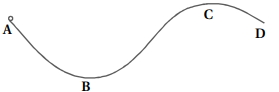
$A$ curved surface is shown in the figure. The portion $BCD$ is free of friction. There are three spherical balls of identical radii and masses. Balls are released from rest one by one from $A$,which is at a slightly greater height than $C$.
With the surface $AB$,ball $1$ has large enough friction to cause rolling down without slipping; ball $2$ has a small friction and ball $3$ has a negligible friction.
$(a)$ For which balls is total mechanical energy conserved?
$(b)$ Which ball$(s)$ can reach $D$?
$(c)$ For balls which do not reach $D$,which of the balls can reach back $A$?
With the surface $AB$,ball $1$ has large enough friction to cause rolling down without slipping; ball $2$ has a small friction and ball $3$ has a negligible friction.
$(a)$ For which balls is total mechanical energy conserved?
$(b)$ Which ball$(s)$ can reach $D$?
$(c)$ For balls which do not reach $D$,which of the balls can reach back $A$?
Solution
(A-D) For ball $1$,the rolling is without slipping. The static friction force does no work on the ball,so there is no dissipation of energy. Thus,total mechanical energy is conserved.
For ball $3$,friction is negligible,so there is no work done by friction. Thus,total mechanical energy is conserved.
For ball $2$,there is kinetic friction which dissipates energy as heat. Thus,mechanical energy is not conserved.
$(b)$ Ball $3$ has no energy loss,so it can reach $D$ because $A$ is at a higher level than $C$. Ball $1$ converts some potential energy into rotational kinetic energy,and ball $2$ loses energy due to friction. Neither ball $1$ nor ball $2$ has enough energy to reach the peak $C$ and cross over to $D$.
$(c)$ Since balls $1$ and $2$ lose energy (ball $1$ to rotation,ball $2$ to heat),they cannot reach the same height as $A$ after passing $B$. Therefore,they cannot reach back to $A$.
For ball $3$,friction is negligible,so there is no work done by friction. Thus,total mechanical energy is conserved.
For ball $2$,there is kinetic friction which dissipates energy as heat. Thus,mechanical energy is not conserved.
$(b)$ Ball $3$ has no energy loss,so it can reach $D$ because $A$ is at a higher level than $C$. Ball $1$ converts some potential energy into rotational kinetic energy,and ball $2$ loses energy due to friction. Neither ball $1$ nor ball $2$ has enough energy to reach the peak $C$ and cross over to $D$.
$(c)$ Since balls $1$ and $2$ lose energy (ball $1$ to rotation,ball $2$ to heat),they cannot reach the same height as $A$ after passing $B$. Therefore,they cannot reach back to $A$.
0 likes
View Solution252
Medium
Fill in the blanks:
$(a)$ When an object is lifted from the ground to a certain height,the work done against the gravitational force is ......
$(b)$ When the work done is zero,the speed of the object remains ..........
$(c)$ For a .......... collision,the coefficient of restitution is $1$.
$(a)$ When an object is lifted from the ground to a certain height,the work done against the gravitational force is ......
$(b)$ When the work done is zero,the speed of the object remains ..........
$(c)$ For a .......... collision,the coefficient of restitution is $1$.
Solution
(N/A) Positive. When an object is lifted against gravity,the force applied and the displacement are in the same direction,resulting in positive work done by the external force.
$(b)$ Constant. According to the Work-Energy Theorem,if the net work done on an object is zero,its kinetic energy remains constant,implying the speed remains constant.
$(c)$ Perfectly elastic. By definition,the coefficient of restitution $(e)$ is $1$ for a perfectly elastic collision.
$(b)$ Constant. According to the Work-Energy Theorem,if the net work done on an object is zero,its kinetic energy remains constant,implying the speed remains constant.
$(c)$ Perfectly elastic. By definition,the coefficient of restitution $(e)$ is $1$ for a perfectly elastic collision.
0 likes
View Solution253
Medium
Fill in the blanks:
$(a)$ If the momentum of an object is doubled,its kinetic energy becomes ........
$(b)$ For a perfectly inelastic collision,the coefficient of restitution $e$ $=$ .....
$(c)$ An appliance with $1\,kW$ power consumes $1\,kWh$ of energy in ....... time.
$(a)$ If the momentum of an object is doubled,its kinetic energy becomes ........
$(b)$ For a perfectly inelastic collision,the coefficient of restitution $e$ $=$ .....
$(c)$ An appliance with $1\,kW$ power consumes $1\,kWh$ of energy in ....... time.
Solution
(A) The kinetic energy $K$ is related to momentum $p$ by the formula $K = \frac{p^2}{2m}$. Since $K \propto p^2$,if the momentum is doubled $(p_2 = 2p_1)$,the new kinetic energy $K_2 = (2)^2 K_1 = 4K_1$. Thus,it becomes four times.
$(b)$ By definition,for a perfectly inelastic collision,the objects stick together after the collision,resulting in a coefficient of restitution $e = 0$.
$(c)$ Energy $E = P \times t$. Given $E = 1\,kWh$ and $P = 1\,kW$,the time $t = \frac{E}{P} = \frac{1\,kWh}{1\,kW} = 1\,hour$.
$(b)$ By definition,for a perfectly inelastic collision,the objects stick together after the collision,resulting in a coefficient of restitution $e = 0$.
$(c)$ Energy $E = P \times t$. Given $E = 1\,kWh$ and $P = 1\,kW$,the time $t = \frac{E}{P} = \frac{1\,kWh}{1\,kW} = 1\,hour$.
0 likes
View Solution254
Medium
Fill in the blanks:
$(a)$ In electricity consumption,$1$ unit is equal to .......... Joules of work.
$(b)$ $A$ body falling from a height of $10 \ m$ onto hard ground loses $20 \%$ of its energy. It can reach a height of .............
$(c)$ $A$ particle moves in a circular path of radius $a$ under the influence of an attractive force with potential energy $U = -\frac{k}{2r^2}$. Its total energy is = .......
$(d)$ Converting a mass of $1 \ \mu g$ into energy yields ........ energy.
$(a)$ In electricity consumption,$1$ unit is equal to .......... Joules of work.
$(b)$ $A$ body falling from a height of $10 \ m$ onto hard ground loses $20 \%$ of its energy. It can reach a height of .............
$(c)$ $A$ particle moves in a circular path of radius $a$ under the influence of an attractive force with potential energy $U = -\frac{k}{2r^2}$. Its total energy is = .......
$(d)$ Converting a mass of $1 \ \mu g$ into energy yields ........ energy.
Solution
(N/A) $1 \text{ unit} = 1 \text{ kWh} = 1000 \text{ W} \times 3600 \text{ s} = 3.6 \times 10^6 \text{ J}$.
$(b)$ Since the body loses $20 \%$ of its energy,it retains $80 \%$ of its initial potential energy.
$mgh_2 = 0.8 \times mgh_1 \Rightarrow h_2 = 0.8 \times 10 \ m = 8 \ m$.
$(c)$ For a circular orbit,the centripetal force $F = \frac{mv^2}{r} = -\frac{dU}{dr}$.
Given $U = -\frac{k}{2r^2}$,then $F = -\frac{d}{dr}(-\frac{k}{2r^2}) = -\frac{k}{r^3}$.
The magnitude of centripetal force is $\frac{mv^2}{r} = \frac{k}{r^3} \Rightarrow \frac{1}{2}mv^2 = \frac{k}{2r^2}$.
Thus,Kinetic Energy $K = \frac{k}{2r^2}$.
Total Energy $E = K + U = \frac{k}{2r^2} - \frac{k}{2r^2} = 0$.
$(d)$ Using $E = mc^2$,where $m = 1 \ \mu g = 10^{-9} \ kg$ and $c = 3 \times 10^8 \ m/s$.
$E = 10^{-9} \times (3 \times 10^8)^2 = 10^{-9} \times 9 \times 10^{16} = 9 \times 10^7 \ J$.
$(b)$ Since the body loses $20 \%$ of its energy,it retains $80 \%$ of its initial potential energy.
$mgh_2 = 0.8 \times mgh_1 \Rightarrow h_2 = 0.8 \times 10 \ m = 8 \ m$.
$(c)$ For a circular orbit,the centripetal force $F = \frac{mv^2}{r} = -\frac{dU}{dr}$.
Given $U = -\frac{k}{2r^2}$,then $F = -\frac{d}{dr}(-\frac{k}{2r^2}) = -\frac{k}{r^3}$.
The magnitude of centripetal force is $\frac{mv^2}{r} = \frac{k}{r^3} \Rightarrow \frac{1}{2}mv^2 = \frac{k}{2r^2}$.
Thus,Kinetic Energy $K = \frac{k}{2r^2}$.
Total Energy $E = K + U = \frac{k}{2r^2} - \frac{k}{2r^2} = 0$.
$(d)$ Using $E = mc^2$,where $m = 1 \ \mu g = 10^{-9} \ kg$ and $c = 3 \times 10^8 \ m/s$.
$E = 10^{-9} \times (3 \times 10^8)^2 = 10^{-9} \times 9 \times 10^{16} = 9 \times 10^7 \ J$.
0 likes
View Solution255
Medium
State whether the following statements are true or false:
$(a)$ If $\overrightarrow P \cdot \overrightarrow Q = 0$,then the angle between $\overrightarrow P$ and $\overrightarrow Q$ is $0^o$.
$(b)$ If two bodies stick together after a collision,the collision is called an elastic collision.
$(c)$ When an equal force is applied to a heavy and a light object on the same surface,more work is done by the force on the heavy object.
$(a)$ If $\overrightarrow P \cdot \overrightarrow Q = 0$,then the angle between $\overrightarrow P$ and $\overrightarrow Q$ is $0^o$.
$(b)$ If two bodies stick together after a collision,the collision is called an elastic collision.
$(c)$ When an equal force is applied to a heavy and a light object on the same surface,more work is done by the force on the heavy object.
Solution
(A-D) False. If $\overrightarrow P \cdot \overrightarrow Q = 0$,the vectors are perpendicular,meaning the angle between them is $90^o$,not $0^o$.
$(b)$ False. If two bodies stick together after a collision,it is called a perfectly inelastic collision,not an elastic collision.
$(c)$ False. Work done is defined as $W = F \cdot d$. If the same force $F$ is applied,the object with less mass will experience higher acceleration $(a = F/m)$ and cover more distance $d$ in the same time interval. Therefore,more work is done on the lighter object.
$(b)$ False. If two bodies stick together after a collision,it is called a perfectly inelastic collision,not an elastic collision.
$(c)$ False. Work done is defined as $W = F \cdot d$. If the same force $F$ is applied,the object with less mass will experience higher acceleration $(a = F/m)$ and cover more distance $d$ in the same time interval. Therefore,more work is done on the lighter object.
0 likes
View Solution256
MediumMCQ
State whether the following statements are true or false:
$(a)$ If the magnitude of force and length are increased by $4$ times,the magnitude of energy increases by $16$ times.
$(b)$ In an inelastic collision,both momentum and energy are conserved.
$(c)$ If work is done on a system by non-conservative forces,the potential energy increases.
$(a)$ If the magnitude of force and length are increased by $4$ times,the magnitude of energy increases by $16$ times.
$(b)$ In an inelastic collision,both momentum and energy are conserved.
$(c)$ If work is done on a system by non-conservative forces,the potential energy increases.
A
True,False,False
B
False,True,False
C
False,False,True
D
True,True,True
Solution
(A) True: Since work (energy) $W = F \cdot d$,if both $F$ and $d$ are increased by $4$ times,the new work $W' = (4F) \cdot (4d) = 16(F \cdot d) = 16W$. Thus,energy increases by $16$ times.
$(b)$ False: In an inelastic collision,only linear momentum is conserved. Total mechanical energy is not conserved as some energy is dissipated as heat,sound,etc.
$(c)$ False: Work done by non-conservative forces (like friction) typically results in the dissipation of mechanical energy into thermal energy,not an increase in potential energy.
$(b)$ False: In an inelastic collision,only linear momentum is conserved. Total mechanical energy is not conserved as some energy is dissipated as heat,sound,etc.
$(c)$ False: Work done by non-conservative forces (like friction) typically results in the dissipation of mechanical energy into thermal energy,not an increase in potential energy.
0 likes
View Solution257
Medium
State whether the following statements are true or false:
$(a)$ Power is the vector product of force and velocity.
$(b)$ $1\,kg\,m = 9.8\,J$
$(c)$ When a teacher rubs a blackboard with a duster,they do no work.
$(d)$ Kinetic energy can be negative.
$(a)$ Power is the vector product of force and velocity.
$(b)$ $1\,kg\,m = 9.8\,J$
$(c)$ When a teacher rubs a blackboard with a duster,they do no work.
$(d)$ Kinetic energy can be negative.
Solution
(A) False. Power is the scalar (dot) product of force and velocity,i.e.,$P = \vec{F} \cdot \vec{v}$.
$(b)$ True. This represents the work done by gravity on a $1\,kg$ mass falling through $1\,m$,where $W = mgh = 1 \times 9.8 \times 1 = 9.8\,J$.
$(c)$ False. The teacher applies a force to move the duster against friction,thus doing work.
$(d)$ False. Kinetic energy $K = \frac{1}{2}mv^2$ is always non-negative because mass $m > 0$ and $v^2 \geq 0$.
$(b)$ True. This represents the work done by gravity on a $1\,kg$ mass falling through $1\,m$,where $W = mgh = 1 \times 9.8 \times 1 = 9.8\,J$.
$(c)$ False. The teacher applies a force to move the duster against friction,thus doing work.
$(d)$ False. Kinetic energy $K = \frac{1}{2}mv^2$ is always non-negative because mass $m > 0$ and $v^2 \geq 0$.
0 likes
View Solution258
MediumMCQ
Match the items in Column-$I$ with Column-$II$.
| Column-$I$ | Column-$II$ |
|---|---|
| $(1)$ Work done is zero | $(a)$ By gravitational force (when body moves down) |
| $(2)$ Work done is positive | $(b)$ Against gravitational force (when body moves up) |
| $(3)$ Work done is negative | $(c)$ By centripetal force |
A
$1-b, 2-c, 3-a$
B
$1-a, 2-b, 3-c$
C
$1-c, 2-a, 3-b$
D
$1-c, 2-b, 3-a$
Solution
(C) The work done by a force is given by $W = \vec{F} \cdot \vec{d} = Fd \cos \theta$,where $\theta$ is the angle between the force and displacement.
$(1)$ Work done by centripetal force is zero because the force is always perpendicular to the displacement ($\theta = 90^\circ$,$\cos 90^\circ = 0$). Thus,$(1-c)$.
$(2)$ Work done by gravitational force is positive when the body moves in the direction of the force (downward motion,$\theta = 0^\circ$,$\cos 0^\circ = 1$). Thus,$(2-a)$.
$(3)$ Work done against gravitational force is negative when the body moves upward (displacement is opposite to the force,$\theta = 180^\circ$,$\cos 180^\circ = -1$). Thus,$(3-b)$.
Therefore,the correct matching is $(1-c, 2-a, 3-b)$.
$(1)$ Work done by centripetal force is zero because the force is always perpendicular to the displacement ($\theta = 90^\circ$,$\cos 90^\circ = 0$). Thus,$(1-c)$.
$(2)$ Work done by gravitational force is positive when the body moves in the direction of the force (downward motion,$\theta = 0^\circ$,$\cos 0^\circ = 1$). Thus,$(2-a)$.
$(3)$ Work done against gravitational force is negative when the body moves upward (displacement is opposite to the force,$\theta = 180^\circ$,$\cos 180^\circ = -1$). Thus,$(3-b)$.
Therefore,the correct matching is $(1-c, 2-a, 3-b)$.
0 likes
View Solution259
Medium
$A$ person of mass $60 \, kg$ wants to lose $5 \, kg$ by going up and down a $10 \, m$ high stairs. Assume he burns twice as much fat while going up than coming down. If $1 \, kg$ of fat is burnt on expending $7000 \, kcal$,how many times must he go up and down to reduce his weight by $5 \, kg$?
Solution
(D) Mass of the person $m = 60 \, kg$. Height of the stairs $h = 10 \, m$. Energy required to burn $1 \, kg$ of fat $= 7000 \, kcal = 7 \times 10^6 \, cal$. Total energy required to burn $5 \, kg$ of fat $= 5 \times 7 \times 10^6 = 35 \times 10^6 \, cal$.
Work done in going up $= mgh = 60 \times 9.8 \times 10 = 5880 \, J$.
Work done in coming down is half of going up (since fat burnt is twice going up),so work done in coming down $= 2940 \, J$.
Total work done in one round trip $= 5880 + 2940 = 8820 \, J$.
Converting to calories $(1 \, cal = 4.2 \, J)$: Total energy per trip $= 8820 / 4.2 = 2100 \, cal$.
Number of trips $n = \frac{\text{Total energy required}}{\text{Energy per trip}} = \frac{35 \times 10^6}{2100} = 16666.67$.
Rounding to the nearest integer,the person must go up and down $16667$ times.
Work done in going up $= mgh = 60 \times 9.8 \times 10 = 5880 \, J$.
Work done in coming down is half of going up (since fat burnt is twice going up),so work done in coming down $= 2940 \, J$.
Total work done in one round trip $= 5880 + 2940 = 8820 \, J$.
Converting to calories $(1 \, cal = 4.2 \, J)$: Total energy per trip $= 8820 / 4.2 = 2100 \, cal$.
Number of trips $n = \frac{\text{Total energy required}}{\text{Energy per trip}} = \frac{35 \times 10^6}{2100} = 16666.67$.
Rounding to the nearest integer,the person must go up and down $16667$ times.
0 likes
View Solution260
DifficultMCQ
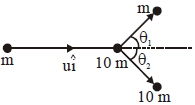
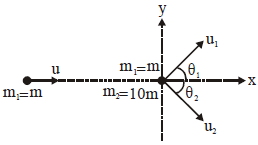
$A$ particle of mass $m$ is moving along the $x$-axis with initial velocity $u \hat{i}$. It collides elastically with a particle of mass $10m$ at rest and then moves with half its initial kinetic energy (see figure). If $\sin \theta_{1} = \sqrt{n} \sin \theta_{2}$,then the value of $n$ is:
A
$20$
B
$26$
C
$10$
D
$15$
Solution
(C) Let the velocity of mass $m$ after collision be $v_1$ and the velocity of mass $10m$ after collision be $v_2$.
$1$. Conservation of momentum along the $y$-axis:
Since the initial momentum along the $y$-axis is zero,the final momentum components along the $y$-axis must cancel out:
$m v_1 \sin \theta_1 = 10m v_2 \sin \theta_2$
$v_1 \sin \theta_1 = 10 v_2 \sin \theta_2$ --- $(i)$
$2$. Kinetic energy condition:
The final kinetic energy of the particle of mass $m$ is half its initial kinetic energy:
$\frac{1}{2} m v_1^2 = \frac{1}{2} (\frac{1}{2} m u^2)$
$v_1^2 = \frac{u^2}{2} \Rightarrow v_1 = \frac{u}{\sqrt{2}}$ --- (ii)
$3$. Conservation of energy for elastic collision:
Initial kinetic energy = Final kinetic energy
$\frac{1}{2} m u^2 = \frac{1}{2} m v_1^2 + \frac{1}{2} (10m) v_2^2$
$u^2 = v_1^2 + 10 v_2^2$
Substitute $v_1^2 = \frac{u^2}{2}$:
$u^2 = \frac{u^2}{2} + 10 v_2^2$
$\frac{u^2}{2} = 10 v_2^2 \Rightarrow v_2^2 = \frac{u^2}{20} \Rightarrow v_2 = \frac{u}{\sqrt{20}}$ --- (iii)
$4$. Substituting (ii) and (iii) into $(i)$:
$(\frac{u}{\sqrt{2}}) \sin \theta_1 = 10 (\frac{u}{\sqrt{20}}) \sin \theta_2$
$\sin \theta_1 = 10 \cdot \frac{\sqrt{2}}{\sqrt{20}} \sin \theta_2$
$\sin \theta_1 = 10 \cdot \frac{1}{\sqrt{10}} \sin \theta_2$
$\sin \theta_1 = \sqrt{10} \sin \theta_2$
Comparing with $\sin \theta_1 = \sqrt{n} \sin \theta_2$,we get $n = 10$.
$1$. Conservation of momentum along the $y$-axis:
Since the initial momentum along the $y$-axis is zero,the final momentum components along the $y$-axis must cancel out:
$m v_1 \sin \theta_1 = 10m v_2 \sin \theta_2$
$v_1 \sin \theta_1 = 10 v_2 \sin \theta_2$ --- $(i)$
$2$. Kinetic energy condition:
The final kinetic energy of the particle of mass $m$ is half its initial kinetic energy:
$\frac{1}{2} m v_1^2 = \frac{1}{2} (\frac{1}{2} m u^2)$
$v_1^2 = \frac{u^2}{2} \Rightarrow v_1 = \frac{u}{\sqrt{2}}$ --- (ii)
$3$. Conservation of energy for elastic collision:
Initial kinetic energy = Final kinetic energy
$\frac{1}{2} m u^2 = \frac{1}{2} m v_1^2 + \frac{1}{2} (10m) v_2^2$
$u^2 = v_1^2 + 10 v_2^2$
Substitute $v_1^2 = \frac{u^2}{2}$:
$u^2 = \frac{u^2}{2} + 10 v_2^2$
$\frac{u^2}{2} = 10 v_2^2 \Rightarrow v_2^2 = \frac{u^2}{20} \Rightarrow v_2 = \frac{u}{\sqrt{20}}$ --- (iii)
$4$. Substituting (ii) and (iii) into $(i)$:
$(\frac{u}{\sqrt{2}}) \sin \theta_1 = 10 (\frac{u}{\sqrt{20}}) \sin \theta_2$
$\sin \theta_1 = 10 \cdot \frac{\sqrt{2}}{\sqrt{20}} \sin \theta_2$
$\sin \theta_1 = 10 \cdot \frac{1}{\sqrt{10}} \sin \theta_2$
$\sin \theta_1 = \sqrt{10} \sin \theta_2$
Comparing with $\sin \theta_1 = \sqrt{n} \sin \theta_2$,we get $n = 10$.
0 likes
View Solution261
MediumMCQ
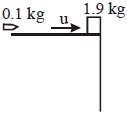
$A$ block of mass $1.9\, kg$ is at rest at the edge of a table of height $1\, m$. $A$ bullet of mass $0.1\, kg$ collides with the block and sticks to it. If the velocity of the bullet is $20\, m/s$ in the horizontal direction just before the collision,then the kinetic energy just before the combined system strikes the floor is $....J$. (Take $g = 10\, m/s^2$. Assume there is no rotational motion and loss of energy after the collision is negligible.)
A
$21$
B
$23$
C
$19$
D
$20$
Solution
(A) $1$. Conservation of linear momentum during the perfectly inelastic collision:
$m_b u = (m_b + m_B) v$
$0.1 \times 20 = (0.1 + 1.9) v$
$2 = 2v \Rightarrow v = 1\, m/s$
$2$. Conservation of mechanical energy for the combined system falling from height $h = 1\, m$:
$KE_f = PE_i + KE_i$
$KE_f = mgh + \frac{1}{2} m v^2$
$KE_f = (2)(10)(1) + \frac{1}{2}(2)(1)^2$
$KE_f = 20 + 1 = 21\, J$
$m_b u = (m_b + m_B) v$
$0.1 \times 20 = (0.1 + 1.9) v$
$2 = 2v \Rightarrow v = 1\, m/s$
$2$. Conservation of mechanical energy for the combined system falling from height $h = 1\, m$:
$KE_f = PE_i + KE_i$
$KE_f = mgh + \frac{1}{2} m v^2$
$KE_f = (2)(10)(1) + \frac{1}{2}(2)(1)^2$
$KE_f = 20 + 1 = 21\, J$
0 likes
View Solution262
DifficultMCQ
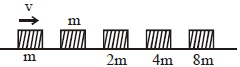
Blocks of masses $m, m, 2m, 4m$ and $8m$ are arranged in a line on a frictionless floor. Another block of mass $m$,moving with speed $v$ along the same line (see figure) collides with the first mass $m$ in a perfectly inelastic manner. All the subsequent collisions are also perfectly inelastic. By the time the last block of mass $8m$ starts moving,the total energy loss is $p\%$ of the original energy. The value of $p$ is close to:
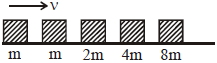
A
$77$
B
$37$
C
$87$
D
$94$
Solution
(D) Since all collisions are perfectly inelastic,after the final collision,all blocks will move together as a single system with a common velocity $v^{\prime}$.
Applying the principle of conservation of linear momentum for the entire system:
Initial momentum = Final momentum
$mv = (m + m + 2m + 4m + 8m)v^{\prime}$
$mv = 16mv^{\prime}$
$v^{\prime} = \frac{v}{16}$
Initial kinetic energy of the system:
$E_{i} = \frac{1}{2}mv^{2}$
Final kinetic energy of the system:
$E_{f} = \frac{1}{2}(16m)(v^{\prime})^{2} = \frac{1}{2}(16m)\left(\frac{v}{16}\right)^{2} = \frac{1}{2}m\frac{v^{2}}{16}$
Energy loss $\Delta E = E_{i} - E_{f} = \frac{1}{2}mv^{2} - \frac{1}{2}m\frac{v^{2}}{16} = \frac{1}{2}mv^{2}\left(1 - \frac{1}{16}\right) = \frac{1}{2}mv^{2}\left(\frac{15}{16}\right)$
Percentage energy loss $p = \frac{\Delta E}{E_{i}} \times 100$
$p = \frac{\frac{1}{2}mv^{2}(\frac{15}{16})}{\frac{1}{2}mv^{2}} \times 100 = \frac{15}{16} \times 100 = 93.75\%$
Rounding to the nearest integer,the value of $p$ is close to $94$.
Applying the principle of conservation of linear momentum for the entire system:
Initial momentum = Final momentum
$mv = (m + m + 2m + 4m + 8m)v^{\prime}$
$mv = 16mv^{\prime}$
$v^{\prime} = \frac{v}{16}$
Initial kinetic energy of the system:
$E_{i} = \frac{1}{2}mv^{2}$
Final kinetic energy of the system:
$E_{f} = \frac{1}{2}(16m)(v^{\prime})^{2} = \frac{1}{2}(16m)\left(\frac{v}{16}\right)^{2} = \frac{1}{2}m\frac{v^{2}}{16}$
Energy loss $\Delta E = E_{i} - E_{f} = \frac{1}{2}mv^{2} - \frac{1}{2}m\frac{v^{2}}{16} = \frac{1}{2}mv^{2}\left(1 - \frac{1}{16}\right) = \frac{1}{2}mv^{2}\left(\frac{15}{16}\right)$
Percentage energy loss $p = \frac{\Delta E}{E_{i}} \times 100$
$p = \frac{\frac{1}{2}mv^{2}(\frac{15}{16})}{\frac{1}{2}mv^{2}} \times 100 = \frac{15}{16} \times 100 = 93.75\%$
Rounding to the nearest integer,the value of $p$ is close to $94$.
0 likes
View Solution263
DifficultMCQ
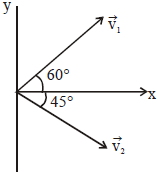
Particle $A$ of mass $m_{1}$ moving with velocity $(\sqrt{3} \hat{i} + \hat{j}) \, m/s$ collides with another particle $B$ of mass $m_{2}$ which is at rest initially. Let $\vec{V}_{1}$ and $\vec{V}_{2}$ be the velocities of particles $A$ and $B$ after collision,respectively. If $m_{1} = 2m_{2}$ and after collision $\vec{V}_{1} = (\hat{i} + \sqrt{3} \hat{j}) \, m/s$,the angle between $\vec{V}_{1}$ and $\vec{V}_{2}$ is $......^{\circ}$.
A
$60$
B
$15$
C
$45$
D
$105$
Solution
(D) Initial velocity of particle $A$: $\vec{u}_{1} = (\sqrt{3} \hat{i} + \hat{j}) \, m/s$.
Initial velocity of particle $B$: $\vec{u}_{2} = 0$.
Given $m_{1} = 2m_{2}$.
Final velocity of particle $A$: $\vec{V}_{1} = (\hat{i} + \sqrt{3} \hat{j}) \, m/s$.
By the law of conservation of linear momentum:
$m_{1} \vec{u}_{1} + m_{2} \vec{u}_{2} = m_{1} \vec{V}_{1} + m_{2} \vec{V}_{2}$
$2m_{2}(\sqrt{3} \hat{i} + \hat{j}) + 0 = 2m_{2}(\hat{i} + \sqrt{3} \hat{j}) + m_{2} \vec{V}_{2}$
Dividing by $m_{2}$:
$2(\sqrt{3} \hat{i} + \hat{j}) = 2(\hat{i} + \sqrt{3} \hat{j}) + \vec{V}_{2}$
$\vec{V}_{2} = 2(\sqrt{3} \hat{i} + \hat{j} - \hat{i} - \sqrt{3} \hat{j}) = 2[(\sqrt{3}-1) \hat{i} + (1-\sqrt{3}) \hat{j}] = 2(\sqrt{3}-1) (\hat{i} - \hat{j})$.
Now,the angle $\theta$ between $\vec{V}_{1}$ and $\vec{V}_{2}$ is given by $\cos \theta = \frac{\vec{V}_{1} \cdot \vec{V}_{2}}{|\vec{V}_{1}| |\vec{V}_{2}|}$.
$\vec{V}_{1} \cdot \vec{V}_{2} = (\hat{i} + \sqrt{3} \hat{j}) \cdot [2(\sqrt{3}-1) (\hat{i} - \hat{j})] = 2(\sqrt{3}-1) (1 - \sqrt{3}) = -2(\sqrt{3}-1)^{2}$.
$|\vec{V}_{1}| = \sqrt{1^{2} + (\sqrt{3})^{2}} = 2$.
$|\vec{V}_{2}| = 2(\sqrt{3}-1) \sqrt{1^{2} + (-1)^{2}} = 2\sqrt{2}(\sqrt{3}-1)$.
$\cos \theta = \frac{-2(\sqrt{3}-1)^{2}}{2 \cdot 2\sqrt{2}(\sqrt{3}-1)} = \frac{-(\sqrt{3}-1)}{2\sqrt{2}} = \frac{1-\sqrt{3}}{2\sqrt{2}}$.
Since $\cos 105^{\circ} = \cos(60^{\circ} + 45^{\circ}) = \cos 60^{\circ} \cos 45^{\circ} - \sin 60^{\circ} \sin 45^{\circ} = \frac{1}{2} \cdot \frac{1}{\sqrt{2}} - \frac{\sqrt{3}}{2} \cdot \frac{1}{\sqrt{2}} = \frac{1-\sqrt{3}}{2\sqrt{2}}$,therefore $\theta = 105^{\circ}$.
Initial velocity of particle $B$: $\vec{u}_{2} = 0$.
Given $m_{1} = 2m_{2}$.
Final velocity of particle $A$: $\vec{V}_{1} = (\hat{i} + \sqrt{3} \hat{j}) \, m/s$.
By the law of conservation of linear momentum:
$m_{1} \vec{u}_{1} + m_{2} \vec{u}_{2} = m_{1} \vec{V}_{1} + m_{2} \vec{V}_{2}$
$2m_{2}(\sqrt{3} \hat{i} + \hat{j}) + 0 = 2m_{2}(\hat{i} + \sqrt{3} \hat{j}) + m_{2} \vec{V}_{2}$
Dividing by $m_{2}$:
$2(\sqrt{3} \hat{i} + \hat{j}) = 2(\hat{i} + \sqrt{3} \hat{j}) + \vec{V}_{2}$
$\vec{V}_{2} = 2(\sqrt{3} \hat{i} + \hat{j} - \hat{i} - \sqrt{3} \hat{j}) = 2[(\sqrt{3}-1) \hat{i} + (1-\sqrt{3}) \hat{j}] = 2(\sqrt{3}-1) (\hat{i} - \hat{j})$.
Now,the angle $\theta$ between $\vec{V}_{1}$ and $\vec{V}_{2}$ is given by $\cos \theta = \frac{\vec{V}_{1} \cdot \vec{V}_{2}}{|\vec{V}_{1}| |\vec{V}_{2}|}$.
$\vec{V}_{1} \cdot \vec{V}_{2} = (\hat{i} + \sqrt{3} \hat{j}) \cdot [2(\sqrt{3}-1) (\hat{i} - \hat{j})] = 2(\sqrt{3}-1) (1 - \sqrt{3}) = -2(\sqrt{3}-1)^{2}$.
$|\vec{V}_{1}| = \sqrt{1^{2} + (\sqrt{3})^{2}} = 2$.
$|\vec{V}_{2}| = 2(\sqrt{3}-1) \sqrt{1^{2} + (-1)^{2}} = 2\sqrt{2}(\sqrt{3}-1)$.
$\cos \theta = \frac{-2(\sqrt{3}-1)^{2}}{2 \cdot 2\sqrt{2}(\sqrt{3}-1)} = \frac{-(\sqrt{3}-1)}{2\sqrt{2}} = \frac{1-\sqrt{3}}{2\sqrt{2}}$.
Since $\cos 105^{\circ} = \cos(60^{\circ} + 45^{\circ}) = \cos 60^{\circ} \cos 45^{\circ} - \sin 60^{\circ} \sin 45^{\circ} = \frac{1}{2} \cdot \frac{1}{\sqrt{2}} - \frac{\sqrt{3}}{2} \cdot \frac{1}{\sqrt{2}} = \frac{1-\sqrt{3}}{2\sqrt{2}}$,therefore $\theta = 105^{\circ}$.
0 likes
View Solution264
DifficultMCQ
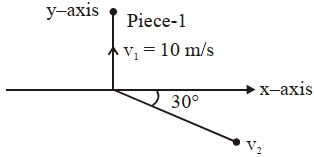
$A$ ball of mass $10\, kg$ moving with a velocity $10 \sqrt{3} \, m/s$ along the $x$-axis,hits another ball of mass $20\, kg$ which is at rest. After the collision,the first ball comes to rest while the second ball disintegrates into two equal pieces. One piece starts moving along the $y$-axis with a speed of $10 \, m/s$. The second piece starts moving at an angle of $30^{\circ}$ with respect to the $x$-axis. The velocity of the ball moving at $30^{\circ}$ with the $x$-axis is $x \, m/s$. The configuration of pieces after the collision is shown in the figure. The value of $x$ to the nearest integer is:
A
$15$
B
$24$
C
$20$
D
$30$
Solution
(C) Let the mass of the first ball be $m_1 = 10 \, kg$ and its initial velocity be $\vec{u}_1 = 10 \sqrt{3} \hat{i} \, m/s$. The second ball has mass $m_2 = 20 \, kg$ and is at rest $(\vec{u}_2 = 0)$.
After the collision,the first ball comes to rest. The second ball disintegrates into two equal pieces of mass $m_p = 10 \, kg$ each.
Let the velocity of the first piece be $\vec{v}_1 = 10 \hat{j} \, m/s$.
Let the velocity of the second piece be $\vec{v}_2 = v_x \hat{i} - v_y \hat{j}$ (based on the figure,it moves at $30^{\circ}$ below the $x$-axis).
By the law of conservation of linear momentum:
$m_1 \vec{u}_1 + m_2 \vec{u}_2 = m_1 \vec{v}_{1,final} + m_p \vec{v}_1 + m_p \vec{v}_2$
$10(10 \sqrt{3} \hat{i}) + 0 = 0 + 10(10 \hat{j}) + 10 \vec{v}_2$
$100 \sqrt{3} \hat{i} = 100 \hat{j} + 10 \vec{v}_2$
$10 \vec{v}_2 = 100 \sqrt{3} \hat{i} - 100 \hat{j}$
$\vec{v}_2 = 10 \sqrt{3} \hat{i} - 10 \hat{j}$
The magnitude of velocity $\vec{v}_2$ is $x = |\vec{v}_2| = \sqrt{(10 \sqrt{3})^2 + (-10)^2} = \sqrt{300 + 100} = \sqrt{400} = 20 \, m/s$.
After the collision,the first ball comes to rest. The second ball disintegrates into two equal pieces of mass $m_p = 10 \, kg$ each.
Let the velocity of the first piece be $\vec{v}_1 = 10 \hat{j} \, m/s$.
Let the velocity of the second piece be $\vec{v}_2 = v_x \hat{i} - v_y \hat{j}$ (based on the figure,it moves at $30^{\circ}$ below the $x$-axis).
By the law of conservation of linear momentum:
$m_1 \vec{u}_1 + m_2 \vec{u}_2 = m_1 \vec{v}_{1,final} + m_p \vec{v}_1 + m_p \vec{v}_2$
$10(10 \sqrt{3} \hat{i}) + 0 = 0 + 10(10 \hat{j}) + 10 \vec{v}_2$
$100 \sqrt{3} \hat{i} = 100 \hat{j} + 10 \vec{v}_2$
$10 \vec{v}_2 = 100 \sqrt{3} \hat{i} - 100 \hat{j}$
$\vec{v}_2 = 10 \sqrt{3} \hat{i} - 10 \hat{j}$
The magnitude of velocity $\vec{v}_2$ is $x = |\vec{v}_2| = \sqrt{(10 \sqrt{3})^2 + (-10)^2} = \sqrt{300 + 100} = \sqrt{400} = 20 \, m/s$.
0 likes
View Solution265
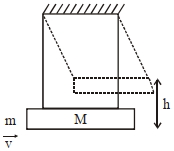
DifficultMCQ
$A$ large block of wood of mass $M = 5.99 \, kg$ is hanging from two long massless cords. $A$ bullet of mass $m = 10 \, g$ is fired into the block and gets embedded in it. The (block $+$ bullet) then swing upwards,their centre of mass rising a vertical distance $h = 9.8 \, cm$ before the (block $+$ bullet) pendulum comes momentarily to rest at the end of its arc. The speed of the bullet just before collision is: (Take $g = 9.8 \, ms^{-2}$) (in $m/s$)
A
$846.5$
B
$821.5$
C
$831.5$
D
$886.4$
Solution
(C) Given:
Mass of block $M = 5.99 \, kg$
Mass of bullet $m = 10 \, g = 0.01 \, kg$
Total mass $M + m = 5.99 + 0.01 = 6.00 \, kg$
Vertical height $h = 9.8 \, cm = 0.098 \, m$
Acceleration due to gravity $g = 9.8 \, ms^{-2}$
Step $1$: Apply conservation of mechanical energy for the (block $+$ bullet) system after the collision.
$(M + m)gh = \frac{1}{2}(M + m)v_1^2$
$v_1 = \sqrt{2gh} = \sqrt{2 \times 9.8 \times 0.098} = \sqrt{19.6 \times 0.098} = \sqrt{1.9208} \approx 1.3856 \, m/s$
Step $2$: Apply conservation of linear momentum during the collision.
$mv = (M + m)v_1$
$v = \frac{(M + m)v_1}{m} = \frac{6.00 \times 1.3856}{0.01} = 600 \times 1.3856 = 831.36 \, m/s$
Rounding to the nearest option,the speed is $831.5 \, m/s$.
Mass of block $M = 5.99 \, kg$
Mass of bullet $m = 10 \, g = 0.01 \, kg$
Total mass $M + m = 5.99 + 0.01 = 6.00 \, kg$
Vertical height $h = 9.8 \, cm = 0.098 \, m$
Acceleration due to gravity $g = 9.8 \, ms^{-2}$
Step $1$: Apply conservation of mechanical energy for the (block $+$ bullet) system after the collision.
$(M + m)gh = \frac{1}{2}(M + m)v_1^2$
$v_1 = \sqrt{2gh} = \sqrt{2 \times 9.8 \times 0.098} = \sqrt{19.6 \times 0.098} = \sqrt{1.9208} \approx 1.3856 \, m/s$
Step $2$: Apply conservation of linear momentum during the collision.
$mv = (M + m)v_1$
$v = \frac{(M + m)v_1}{m} = \frac{6.00 \times 1.3856}{0.01} = 600 \times 1.3856 = 831.36 \, m/s$
Rounding to the nearest option,the speed is $831.5 \, m/s$.
0 likes
View Solution266
DifficultMCQ
Two identical blocks $A$ and $B$,each of mass $m$,resting on a smooth horizontal floor,are connected by a light spring of natural length $L$ and spring constant $K$. $A$ third block $C$ of mass $m$,moving with a speed $v$ along the line joining $A$ and $B$,collides with $A$. The maximum compression in the spring is:

A
$v\sqrt{\frac{m}{2K}}$
B
$\sqrt{\frac{mv}{2K}}$
C
$\sqrt{\frac{mv}{K}}$
D
$v\sqrt{\frac{m}{K}}$
Solution
(A) $1$. When block $C$ collides with block $A$,it sticks to it (assuming perfectly inelastic collision as no other information is given). By conservation of linear momentum for the system $(C+A)$: $mv = (m+m)V_A \Rightarrow V_A = v/2$.
$2$. Now,we have a system where block $A$ (with $C$ attached) moves with velocity $v/2$ towards block $B$,which is initially at rest.
$3$. The maximum compression in the spring occurs when both blocks $(A+C)$ and $B$ move with the same velocity $V_{cm}$ relative to the center of mass frame.
$4$. By conservation of linear momentum for the whole system $(C+A+B)$: $mv = (m+m+m)V_{cm} \Rightarrow V_{cm} = v/3$.
$5$. By conservation of mechanical energy: $\frac{1}{2}(2m)(v/2)^2 = \frac{1}{2}(3m)(v/3)^2 + \frac{1}{2}Kx_{max}^2$.
$6$. $\frac{1}{2}(2m)(v^2/4) = \frac{1}{2}(3m)(v^2/9) + \frac{1}{2}Kx_{max}^2 \Rightarrow \frac{mv^2}{4} = \frac{mv^2}{6} + \frac{1}{2}Kx_{max}^2$.
$7$. $\frac{1}{2}Kx_{max}^2 = \frac{mv^2}{4} - \frac{mv^2}{6} = \frac{3mv^2 - 2mv^2}{12} = \frac{mv^2}{12}$.
$8$. $x_{max}^2 = \frac{mv^2}{6K} \Rightarrow x_{max} = v\sqrt{\frac{m}{6K}}$.
*Note: If the collision is elastic,$C$ comes to rest and $A$ moves with velocity $v$. Then $mv = (m+m)V_{cm} \Rightarrow V_{cm} = v/2$. Energy: $\frac{1}{2}mv^2 = \frac{1}{2}(2m)(v/2)^2 + \frac{1}{2}Kx_{max}^2 \Rightarrow \frac{1}{2}mv^2 = \frac{1}{4}mv^2 + \frac{1}{2}Kx_{max}^2 \Rightarrow \frac{1}{2}Kx_{max}^2 = \frac{1}{4}mv^2 \Rightarrow x_{max} = v\sqrt{\frac{m}{2K}}$. This matches option $A$.*
$2$. Now,we have a system where block $A$ (with $C$ attached) moves with velocity $v/2$ towards block $B$,which is initially at rest.
$3$. The maximum compression in the spring occurs when both blocks $(A+C)$ and $B$ move with the same velocity $V_{cm}$ relative to the center of mass frame.
$4$. By conservation of linear momentum for the whole system $(C+A+B)$: $mv = (m+m+m)V_{cm} \Rightarrow V_{cm} = v/3$.
$5$. By conservation of mechanical energy: $\frac{1}{2}(2m)(v/2)^2 = \frac{1}{2}(3m)(v/3)^2 + \frac{1}{2}Kx_{max}^2$.
$6$. $\frac{1}{2}(2m)(v^2/4) = \frac{1}{2}(3m)(v^2/9) + \frac{1}{2}Kx_{max}^2 \Rightarrow \frac{mv^2}{4} = \frac{mv^2}{6} + \frac{1}{2}Kx_{max}^2$.
$7$. $\frac{1}{2}Kx_{max}^2 = \frac{mv^2}{4} - \frac{mv^2}{6} = \frac{3mv^2 - 2mv^2}{12} = \frac{mv^2}{12}$.
$8$. $x_{max}^2 = \frac{mv^2}{6K} \Rightarrow x_{max} = v\sqrt{\frac{m}{6K}}$.
*Note: If the collision is elastic,$C$ comes to rest and $A$ moves with velocity $v$. Then $mv = (m+m)V_{cm} \Rightarrow V_{cm} = v/2$. Energy: $\frac{1}{2}mv^2 = \frac{1}{2}(2m)(v/2)^2 + \frac{1}{2}Kx_{max}^2 \Rightarrow \frac{1}{2}mv^2 = \frac{1}{4}mv^2 + \frac{1}{2}Kx_{max}^2 \Rightarrow \frac{1}{2}Kx_{max}^2 = \frac{1}{4}mv^2 \Rightarrow x_{max} = v\sqrt{\frac{m}{2K}}$. This matches option $A$.*
0 likes
View Solution267
DifficultMCQ
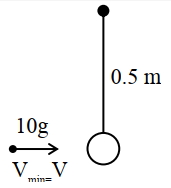
$A$ bullet of $10\, \text{g}$, moving with velocity $v$, collides head-on with the stationary bob of a pendulum and recoils with velocity $100\, \text{m/s}$. The length of the pendulum is $0.5\, \text{m}$ and the mass of the bob is $1\, \text{kg}$. The minimum value of $v$ in $\text{m/s}$ so that the pendulum completes a vertical circle is: (Assume the string to be inextensible and $g=10\, \text{m/s}^2$)

A
$1000$
B
$400$
C
$100$
D
$10$
Solution
(B) To complete a vertical circle, the minimum velocity $V'$ required by the bob at the lowest point is given by $V' = \sqrt{5gR}$.
Substituting the given values: $V' = \sqrt{5 \times 10 \times 0.5} = \sqrt{25} = 5\, \text{m/s}$.
Now, applying the principle of conservation of linear momentum during the collision:
$m_1 v = m_2 V' - m_1 v_{recoil}$
Here, $m_1 = 10\, \text{g} = 0.01\, \text{kg}$, $m_2 = 1\, \text{kg}$, $V' = 5\, \text{m/s}$, and $v_{recoil} = 100\, \text{m/s}$.
$0.01 \times v = 1 \times 5 - 0.01 \times 100$
$0.01 \times v = 5 - 1$
$0.01 \times v = 4$
$v = \frac{4}{0.01} = 400\, \text{m/s}$.
Substituting the given values: $V' = \sqrt{5 \times 10 \times 0.5} = \sqrt{25} = 5\, \text{m/s}$.
Now, applying the principle of conservation of linear momentum during the collision:
$m_1 v = m_2 V' - m_1 v_{recoil}$
Here, $m_1 = 10\, \text{g} = 0.01\, \text{kg}$, $m_2 = 1\, \text{kg}$, $V' = 5\, \text{m/s}$, and $v_{recoil} = 100\, \text{m/s}$.
$0.01 \times v = 1 \times 5 - 0.01 \times 100$
$0.01 \times v = 5 - 1$
$0.01 \times v = 4$
$v = \frac{4}{0.01} = 400\, \text{m/s}$.
0 likes
View Solution268
DifficultMCQ
$A$ block moving horizontally on a smooth surface with a speed of $40 \, m/s$ splits into two equal parts. If one of the parts moves at $60 \, m/s$ in the same direction,then the fractional change in the kinetic energy will be $x: 4$ where $x = ..... .$
A
$4$
B
$10$
C
$1$
D
$50$
Solution
(C) According to the law of conservation of linear momentum,the initial momentum equals the final momentum: $P_i = P_f$.
Let the mass of the block be $m$. Then,$m \times 40 = (m/2) \times v + (m/2) \times 60$.
Dividing by $m/2$,we get $80 = v + 60$,which implies $v = 20 \, m/s$.
Initial kinetic energy: $(K.E.)_i = \frac{1}{2} m (40)^2 = 800m$.
Final kinetic energy: $(K.E.)_f = \frac{1}{2} (m/2) (20)^2 + \frac{1}{2} (m/2) (60)^2 = \frac{1}{4} m (400 + 3600) = 1000m$.
The change in kinetic energy is $\Delta K.E. = (K.E.)_f - (K.E.)_i = 1000m - 800m = 200m$.
The fractional change is $\frac{\Delta K.E.}{(K.E.)_i} = \frac{200m}{800m} = \frac{1}{4}$.
Given the fractional change is $x:4$,we have $x/4 = 1/4$,so $x = 1$.
Let the mass of the block be $m$. Then,$m \times 40 = (m/2) \times v + (m/2) \times 60$.
Dividing by $m/2$,we get $80 = v + 60$,which implies $v = 20 \, m/s$.
Initial kinetic energy: $(K.E.)_i = \frac{1}{2} m (40)^2 = 800m$.
Final kinetic energy: $(K.E.)_f = \frac{1}{2} (m/2) (20)^2 + \frac{1}{2} (m/2) (60)^2 = \frac{1}{4} m (400 + 3600) = 1000m$.
The change in kinetic energy is $\Delta K.E. = (K.E.)_f - (K.E.)_i = 1000m - 800m = 200m$.
The fractional change is $\frac{\Delta K.E.}{(K.E.)_i} = \frac{200m}{800m} = \frac{1}{4}$.
Given the fractional change is $x:4$,we have $x/4 = 1/4$,so $x = 1$.

0 likes
View Solution269
DifficultMCQ
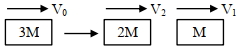
$A$ block moving horizontally on a smooth surface with a speed of $40\, m/s$ splits into two parts with masses in the ratio of $1:2$. If the smaller part moves at $60\, m/s$ in the same direction,then the fractional change in kinetic energy is:
A
$\frac{1}{3}$
B
$\frac{2}{3}$
C
$\frac{1}{8}$
D
$\frac{1}{4}$
Solution
(C) Let the total mass be $3M$. The initial velocity is $V_0 = 40\, m/s$.
According to the law of conservation of linear momentum:
$P_{initial} = P_{final}$
$3M \cdot V_0 = M \cdot V_1 + 2M \cdot V_2$
$3 \cdot 40 = 60 + 2 \cdot V_2$
$120 = 60 + 2 \cdot V_2 \Rightarrow 2 \cdot V_2 = 60 \Rightarrow V_2 = 30\, m/s$.
Initial kinetic energy $K_i = \frac{1}{2} \cdot (3M) \cdot V_0^2 = \frac{1}{2} \cdot 3M \cdot (40)^2 = 2400M$.
Final kinetic energy $K_f = \frac{1}{2} \cdot M \cdot V_1^2 + \frac{1}{2} \cdot (2M) \cdot V_2^2 = \frac{1}{2} \cdot M \cdot (60)^2 + M \cdot (30)^2 = 1800M + 900M = 2700M$.
Change in kinetic energy $\Delta K = K_f - K_i = 2700M - 2400M = 300M$.
Fractional change in kinetic energy = $\frac{\Delta K}{K_i} = \frac{300M}{2400M} = \frac{1}{8}$.
According to the law of conservation of linear momentum:
$P_{initial} = P_{final}$
$3M \cdot V_0 = M \cdot V_1 + 2M \cdot V_2$
$3 \cdot 40 = 60 + 2 \cdot V_2$
$120 = 60 + 2 \cdot V_2 \Rightarrow 2 \cdot V_2 = 60 \Rightarrow V_2 = 30\, m/s$.
Initial kinetic energy $K_i = \frac{1}{2} \cdot (3M) \cdot V_0^2 = \frac{1}{2} \cdot 3M \cdot (40)^2 = 2400M$.
Final kinetic energy $K_f = \frac{1}{2} \cdot M \cdot V_1^2 + \frac{1}{2} \cdot (2M) \cdot V_2^2 = \frac{1}{2} \cdot M \cdot (60)^2 + M \cdot (30)^2 = 1800M + 900M = 2700M$.
Change in kinetic energy $\Delta K = K_f - K_i = 2700M - 2400M = 300M$.
Fractional change in kinetic energy = $\frac{\Delta K}{K_i} = \frac{300M}{2400M} = \frac{1}{8}$.
0 likes
View Solution270
DifficultMCQ
An engine is attached to a wagon through a shock absorber of length $1.5\, \text{m}$. The system with a total mass of $40,000\, \text{kg}$ is moving with a speed of $72\, \text{km/h}$ when the brakes are applied to bring it to rest. In the process of the system being brought to rest,the spring of the shock absorber gets compressed by $1.0\, \text{m}$. If $90\, \%$ of the energy of the wagon is lost due to friction,the spring constant is $....\, \times 10^{5}\, \text{N/m}$.
A
$16$
B
$400$
C
$1.6$
D
$160$
Solution
(A) The initial kinetic energy of the system is $K_i = \frac{1}{2}mv^2$,where $m = 40,000\, \text{kg}$ and $v = 72\, \text{km/h} = 20\, \text{m/s}$.
$K_i = \frac{1}{2} \times 40,000 \times (20)^2 = 80,00,000\, \text{J} = 80 \times 10^5\, \text{J}$.
According to the work-energy theorem,the total work done is equal to the change in kinetic energy: $W_{\text{friction}} + W_{\text{spring}} = K_f - K_i$.
Given that $90\%$ of the energy is lost due to friction,$W_{\text{friction}} = -0.9 K_i$.
Since the system comes to rest,$K_f = 0$. Thus,$-0.9 K_i + W_{\text{spring}} = -K_i$.
$W_{\text{spring}} = -0.1 K_i$.
The work done by the spring is $W_{\text{spring}} = -\frac{1}{2}kx^2$,where $x = 1.0\, \text{m}$.
$-\frac{1}{2}k(1)^2 = -0.1 \times (80 \times 10^5)$.
$\frac{1}{2}k = 8 \times 10^5$.
$k = 16 \times 10^5\, \text{N/m}$.
Therefore,the spring constant is $16 \times 10^5\, \text{N/m}$.
$K_i = \frac{1}{2} \times 40,000 \times (20)^2 = 80,00,000\, \text{J} = 80 \times 10^5\, \text{J}$.
According to the work-energy theorem,the total work done is equal to the change in kinetic energy: $W_{\text{friction}} + W_{\text{spring}} = K_f - K_i$.
Given that $90\%$ of the energy is lost due to friction,$W_{\text{friction}} = -0.9 K_i$.
Since the system comes to rest,$K_f = 0$. Thus,$-0.9 K_i + W_{\text{spring}} = -K_i$.
$W_{\text{spring}} = -0.1 K_i$.
The work done by the spring is $W_{\text{spring}} = -\frac{1}{2}kx^2$,where $x = 1.0\, \text{m}$.
$-\frac{1}{2}k(1)^2 = -0.1 \times (80 \times 10^5)$.
$\frac{1}{2}k = 8 \times 10^5$.
$k = 16 \times 10^5\, \text{N/m}$.
Therefore,the spring constant is $16 \times 10^5\, \text{N/m}$.
0 likes
View Solution271
MediumMCQ
Water falls from a height of $60 \, m$ at the rate of $15 \, kg/s$ to operate a turbine. The losses due to frictional force are $10 \%$ of the input energy. How much power is generated by the turbine? $(g=10 \, m/s^2)$ (In $kW$)
A
$10.2$
B
$8.1$
C
$12.3$
D
$7.0$
Solution
(B) The input power $P_{\text{input}}$ is given by the rate of change of potential energy: $P_{\text{input}} = \frac{mgh}{t} = \left(\frac{m}{t}\right)gh$.
Given $\frac{m}{t} = 15 \, kg/s$,$g = 10 \, m/s^2$,and $h = 60 \, m$.
$P_{\text{input}} = 15 \times 10 \times 60 = 9000 \, W = 9 \, kW$.
The power loss due to friction is $10 \%$ of the input power.
$\text{Loss} = 10 \% \text{ of } 9 \, kW = 0.1 \times 9 \, kW = 0.9 \, kW$.
The power generated by the turbine is the output power: $P_{\text{output}} = P_{\text{input}} - \text{Loss} = 9 \, kW - 0.9 \, kW = 8.1 \, kW$.
Given $\frac{m}{t} = 15 \, kg/s$,$g = 10 \, m/s^2$,and $h = 60 \, m$.
$P_{\text{input}} = 15 \times 10 \times 60 = 9000 \, W = 9 \, kW$.
The power loss due to friction is $10 \%$ of the input power.
$\text{Loss} = 10 \% \text{ of } 9 \, kW = 0.1 \times 9 \, kW = 0.9 \, kW$.
The power generated by the turbine is the output power: $P_{\text{output}} = P_{\text{input}} - \text{Loss} = 9 \, kW - 0.9 \, kW = 8.1 \, kW$.
0 likes
View Solution272
DifficultMCQ
$A$ body of mass $2 \, \text{kg}$ moving with a speed of $4 \, \text{m/s}$ makes an elastic collision with another body at rest and continues to move in the original direction but with one-fourth of its initial speed. The speed of the two-body centre of mass is $\frac{x}{10} \, \text{m/s}$. Then the value of $x$ is ..... .
A
$5$
B
$75$
C
$25$
D
$50$
Solution
(C) Let the mass of the first body be $m_1 = 2 \, \text{kg}$ and its initial velocity be $u_1 = 4 \, \text{m/s}$.
Let the mass of the second body be $m_2$ and its initial velocity be $u_2 = 0 \, \text{m/s}$.
After the collision,the first body moves with $v_1 = \frac{1}{4} \times 4 = 1 \, \text{m/s}$.
Using the conservation of linear momentum: $m_1 u_1 + m_2 u_2 = m_1 v_1 + m_2 v_2$.
$2 \times 4 + m_2 \times 0 = 2 \times 1 + m_2 v_2 \implies 8 = 2 + m_2 v_2 \implies m_2 v_2 = 6$.
For an elastic collision,the coefficient of restitution $e = 1 = \frac{v_2 - v_1}{u_1 - u_2}$.
$1 = \frac{v_2 - 1}{4 - 0} \implies v_2 - 1 = 4 \implies v_2 = 5 \, \text{m/s}$.
Substituting $v_2$ into the momentum equation: $m_2 \times 5 = 6 \implies m_2 = 1.2 \, \text{kg}$.
The velocity of the centre of mass is $v_{cm} = \frac{m_1 v_1 + m_2 v_2}{m_1 + m_2}$.
$v_{cm} = \frac{2 \times 1 + 1.2 \times 5}{2 + 1.2} = \frac{2 + 6}{3.2} = \frac{8}{3.2} = \frac{80}{32} = 2.5 \, \text{m/s}$.
Given $v_{cm} = \frac{x}{10} \, \text{m/s}$,we have $\frac{x}{10} = 2.5 \implies x = 25$.
Let the mass of the second body be $m_2$ and its initial velocity be $u_2 = 0 \, \text{m/s}$.
After the collision,the first body moves with $v_1 = \frac{1}{4} \times 4 = 1 \, \text{m/s}$.
Using the conservation of linear momentum: $m_1 u_1 + m_2 u_2 = m_1 v_1 + m_2 v_2$.
$2 \times 4 + m_2 \times 0 = 2 \times 1 + m_2 v_2 \implies 8 = 2 + m_2 v_2 \implies m_2 v_2 = 6$.
For an elastic collision,the coefficient of restitution $e = 1 = \frac{v_2 - v_1}{u_1 - u_2}$.
$1 = \frac{v_2 - 1}{4 - 0} \implies v_2 - 1 = 4 \implies v_2 = 5 \, \text{m/s}$.
Substituting $v_2$ into the momentum equation: $m_2 \times 5 = 6 \implies m_2 = 1.2 \, \text{kg}$.
The velocity of the centre of mass is $v_{cm} = \frac{m_1 v_1 + m_2 v_2}{m_1 + m_2}$.
$v_{cm} = \frac{2 \times 1 + 1.2 \times 5}{2 + 1.2} = \frac{2 + 6}{3.2} = \frac{8}{3.2} = \frac{80}{32} = 2.5 \, \text{m/s}$.
Given $v_{cm} = \frac{x}{10} \, \text{m/s}$,we have $\frac{x}{10} = 2.5 \implies x = 25$.
0 likes
View Solution273
DifficultMCQ
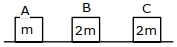
Three objects $A, B$ and $C$ are kept in a straight line on a frictionless horizontal surface. The masses of $A, B$ and $C$ are $m, 2m$ and $2m$ respectively. $A$ moves towards $B$ with a speed of $9 \ m/s$ and makes an elastic collision with it. Thereafter,$B$ makes a completely inelastic collision with $C$. All motions occur along the same straight line. The final speed of $C$ is $.... \ m/s$.
A
$3$
B
$6$
C
$9$
D
$4$
Solution
(A) Let the initial velocity of $A$ be $u_A = 9 \ m/s$ and $B$ be $u_B = 0$. After the elastic collision between $A$ and $B$,let their velocities be $v_A$ and $v_B$.
Using conservation of linear momentum: $m(9) + 2m(0) = m v_A + 2m v_B \Rightarrow 9 = v_A + 2v_B$ (Equation $1$).
Using the coefficient of restitution for elastic collision $(e=1)$: $v_B - v_A = e(u_A - u_B) = 1(9 - 0) = 9 \Rightarrow v_B - v_A = 9$ (Equation $2$).
Adding Equation $1$ and Equation $2$: $3v_B = 18 \Rightarrow v_B = 6 \ m/s$.
Now,$B$ makes a completely inelastic collision with $C$ (initially at rest). Let the final velocity of the combined mass $(B+C)$ be $v_C$.
Using conservation of linear momentum: $2m(v_B) + 2m(0) = (2m + 2m)v_C$.
$2m(6) = 4m v_C \Rightarrow 12m = 4m v_C \Rightarrow v_C = 3 \ m/s$.
Using conservation of linear momentum: $m(9) + 2m(0) = m v_A + 2m v_B \Rightarrow 9 = v_A + 2v_B$ (Equation $1$).
Using the coefficient of restitution for elastic collision $(e=1)$: $v_B - v_A = e(u_A - u_B) = 1(9 - 0) = 9 \Rightarrow v_B - v_A = 9$ (Equation $2$).
Adding Equation $1$ and Equation $2$: $3v_B = 18 \Rightarrow v_B = 6 \ m/s$.
Now,$B$ makes a completely inelastic collision with $C$ (initially at rest). Let the final velocity of the combined mass $(B+C)$ be $v_C$.
Using conservation of linear momentum: $2m(v_B) + 2m(0) = (2m + 2m)v_C$.
$2m(6) = 4m v_C \Rightarrow 12m = 4m v_C \Rightarrow v_C = 3 \ m/s$.
0 likes
View Solution274
MediumMCQ
$A$ $0.5 \, kg$ block moving at a speed of $12 \, ms^{-1}$ compresses a spring through a distance of $30 \, cm$ when its speed is halved. The spring constant of the spring in $N m^{-1}$ is:
A
$680$
B
$700$
C
$608$
D
$600$
Solution
(D) According to the law of conservation of mechanical energy,the initial total energy is equal to the final total energy: $U_i + K_i = U_f + K_f$.
Here,$U_i = 0$ (initial potential energy of the spring),$K_i = \frac{1}{2} m v_i^2$,$U_f = \frac{1}{2} k x^2$,and $K_f = \frac{1}{2} m v_f^2$.
Given: $m = 0.5 \, kg$,$v_i = 12 \, ms^{-1}$,$v_f = 6 \, ms^{-1}$,and $x = 30 \, cm = 0.3 \, m$.
Substituting the values: $0 + \frac{1}{2} \times 0.5 \times (12)^2 = \frac{1}{2} \times k \times (0.3)^2 + \frac{1}{2} \times 0.5 \times (6)^2$.
Multiplying by $2$: $0.5 \times (144) = k \times (0.09) + 0.5 \times (36)$.
$72 = 0.09k + 18$.
$0.09k = 72 - 18 = 54$.
$k = \frac{54}{0.09} = 600 \, Nm^{-1}$.
Here,$U_i = 0$ (initial potential energy of the spring),$K_i = \frac{1}{2} m v_i^2$,$U_f = \frac{1}{2} k x^2$,and $K_f = \frac{1}{2} m v_f^2$.
Given: $m = 0.5 \, kg$,$v_i = 12 \, ms^{-1}$,$v_f = 6 \, ms^{-1}$,and $x = 30 \, cm = 0.3 \, m$.
Substituting the values: $0 + \frac{1}{2} \times 0.5 \times (12)^2 = \frac{1}{2} \times k \times (0.3)^2 + \frac{1}{2} \times 0.5 \times (6)^2$.
Multiplying by $2$: $0.5 \times (144) = k \times (0.09) + 0.5 \times (36)$.
$72 = 0.09k + 18$.
$0.09k = 72 - 18 = 54$.
$k = \frac{54}{0.09} = 600 \, Nm^{-1}$.
0 likes
View Solution275
DifficultMCQ
$A$ pendulum of length $2 \; m$ consists of a wooden bob of mass $50 \; g$. $A$ bullet of mass $75 \; g$ is fired towards the stationary bob with a speed $v$. The bullet emerges out of the bob with a speed $\frac{v}{3}$ and the bob just completes the vertical circle. The value of $v$ is $\dots \; ms^{-1}$. (if $g = 10 \; m/s^2$)
A
$08$
B
$09$
C
$10$
D
$11$
Solution
(C) Let $m_b = 50 \; g = 0.05 \; kg$ be the mass of the bob and $m_u = 75 \; g = 0.075 \; kg$ be the mass of the bullet. The length of the pendulum is $R = 2 \; m$.
For the bob to just complete a vertical circle,the minimum velocity $u$ at the lowest point must be $u = \sqrt{5gR}$.
Substituting the values: $u = \sqrt{5 \times 10 \times 2} = \sqrt{100} = 10 \; m/s$.
By the principle of conservation of linear momentum in the horizontal direction during the collision:
$m_u v = m_u (v/3) + m_b u$
$0.075 v = 0.075 (v/3) + 0.05 (10)$
$0.075 v - 0.025 v = 0.5$
$0.05 v = 0.5$
$v = 10 \; m/s$.
For the bob to just complete a vertical circle,the minimum velocity $u$ at the lowest point must be $u = \sqrt{5gR}$.
Substituting the values: $u = \sqrt{5 \times 10 \times 2} = \sqrt{100} = 10 \; m/s$.
By the principle of conservation of linear momentum in the horizontal direction during the collision:
$m_u v = m_u (v/3) + m_b u$
$0.075 v = 0.075 (v/3) + 0.05 (10)$
$0.075 v - 0.025 v = 0.5$
$0.05 v = 0.5$
$v = 10 \; m/s$.
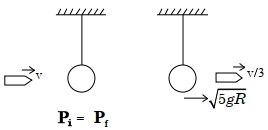
0 likes
View Solution276
MediumMCQ
$A$ lead bullet penetrates into a solid object and melts. Assuming that $40 \%$ of its kinetic energy is used to heat it,the initial speed of the bullet is ............ $m \, s^{-1}$.
(Given: Initial temperature of the bullet $= 127^{\circ} C$,
Melting point of the bullet $= 327^{\circ} C$,
Latent heat of fusion of lead $= 2.5 \times 10^{4} \, J \, kg^{-1}$,
Specific heat capacity of lead $= 125 \, J \, kg^{-1} K^{-1}$)
(Given: Initial temperature of the bullet $= 127^{\circ} C$,
Melting point of the bullet $= 327^{\circ} C$,
Latent heat of fusion of lead $= 2.5 \times 10^{4} \, J \, kg^{-1}$,
Specific heat capacity of lead $= 125 \, J \, kg^{-1} K^{-1}$)
A
$125$
B
$500$
C
$250$
D
$600$
Solution
(B) Let $m$ be the mass of the bullet and $v$ be its initial velocity.
The kinetic energy of the bullet is $K.E. = \frac{1}{2} m v^2$.
According to the problem,$40 \%$ of this energy is used to heat the bullet to its melting point and then melt it.
Heat required to raise the temperature from $127^{\circ} C$ to $327^{\circ} C$ is $Q_1 = m c \Delta T = m \times 125 \times (327 - 127) = m \times 125 \times 200 = 25000 m \, J$.
Heat required to melt the bullet is $Q_2 = m L = m \times 2.5 \times 10^{4} = 25000 m \, J$.
Total heat required $Q = Q_1 + Q_2 = 25000 m + 25000 m = 50000 m \, J$.
Equating $40 \%$ of kinetic energy to total heat: $0.40 \times (\frac{1}{2} m v^2) = 50000 m$.
$0.2 v^2 = 50000$.
$v^2 = 250000$.
$v = 500 \, m \, s^{-1}$.
The kinetic energy of the bullet is $K.E. = \frac{1}{2} m v^2$.
According to the problem,$40 \%$ of this energy is used to heat the bullet to its melting point and then melt it.
Heat required to raise the temperature from $127^{\circ} C$ to $327^{\circ} C$ is $Q_1 = m c \Delta T = m \times 125 \times (327 - 127) = m \times 125 \times 200 = 25000 m \, J$.
Heat required to melt the bullet is $Q_2 = m L = m \times 2.5 \times 10^{4} = 25000 m \, J$.
Total heat required $Q = Q_1 + Q_2 = 25000 m + 25000 m = 50000 m \, J$.
Equating $40 \%$ of kinetic energy to total heat: $0.40 \times (\frac{1}{2} m v^2) = 50000 m$.
$0.2 v^2 = 50000$.
$v^2 = 250000$.
$v = 500 \, m \, s^{-1}$.
0 likes
View Solution277
MediumMCQ
Water falls from a $40\,m$ high dam at the rate of $9 \times 10^{4}\,kg$ per hour. Fifty percent of the gravitational potential energy can be converted into electrical energy. Using this hydroelectric energy, the number of $100\,W$ lamps that can be lit is (Take $g = 10\,m/s^2$)
A
$25$
B
$50$
C
$100$
D
$18$
Solution
(B) The rate of mass flow is $m = 9 \times 10^{4}\,kg$ per hour. Converting this to seconds, $m = \frac{9 \times 10^{4}}{3600}\,kg/s = 25\,kg/s$.
The gravitational potential energy per second (power) is $P_{in} = mgh = 25 \times 10 \times 40 = 10000\,W$.
Given that $50\%$ of this energy is converted into electrical energy, the available electrical power is $P_{elec} = 0.5 \times P_{in} = 0.5 \times 10000 = 5000\,W$.
If each lamp consumes $100\,W$, the number of lamps $n$ that can be lit is $n = \frac{P_{elec}}{100} = \frac{5000}{100} = 50$.
The gravitational potential energy per second (power) is $P_{in} = mgh = 25 \times 10 \times 40 = 10000\,W$.
Given that $50\%$ of this energy is converted into electrical energy, the available electrical power is $P_{elec} = 0.5 \times P_{in} = 0.5 \times 10000 = 5000\,W$.
If each lamp consumes $100\,W$, the number of lamps $n$ that can be lit is $n = \frac{P_{elec}}{100} = \frac{5000}{100} = 50$.
0 likes
View Solution278
MediumMCQ
The velocity of the bullet becomes one-third after it penetrates $4 \ cm$ in a wooden block. Assuming that the bullet faces a constant resistance during its motion in the block,the bullet stops completely after traveling a total distance of $(4+x) \ cm$ inside the block. The value of $x$ is $.....$ (in $cm$)
A
$2$
B
$1$
C
$0.5$
D
$1.5$
Solution
(C) Let the initial velocity be $V$ and the constant retardation be $a$.
Using the equation of motion $v^2 = u^2 - 2as$:
For the first $4 \ cm$,the velocity becomes $V/3$:
$(V/3)^2 = V^2 - 2a(4) \Rightarrow V^2/9 = V^2 - 8a \Rightarrow 8a = 8V^2/9 \Rightarrow a = V^2/9$.
Now,for the bullet to stop completely,the final velocity is $0$ at a distance $s = 4+x$:
$0^2 = V^2 - 2a(4+x) \Rightarrow V^2 = 2(V^2/9)(4+x)$.
Dividing both sides by $V^2$:
$1 = (2/9)(4+x) \Rightarrow 9/2 = 4+x \Rightarrow 4.5 = 4+x \Rightarrow x = 0.5 \ cm$.
Using the equation of motion $v^2 = u^2 - 2as$:
For the first $4 \ cm$,the velocity becomes $V/3$:
$(V/3)^2 = V^2 - 2a(4) \Rightarrow V^2/9 = V^2 - 8a \Rightarrow 8a = 8V^2/9 \Rightarrow a = V^2/9$.
Now,for the bullet to stop completely,the final velocity is $0$ at a distance $s = 4+x$:
$0^2 = V^2 - 2a(4+x) \Rightarrow V^2 = 2(V^2/9)(4+x)$.
Dividing both sides by $V^2$:
$1 = (2/9)(4+x) \Rightarrow 9/2 = 4+x \Rightarrow 4.5 = 4+x \Rightarrow x = 0.5 \ cm$.
1 likes
View Solution279
DifficultMCQ
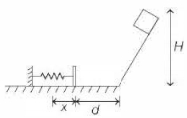
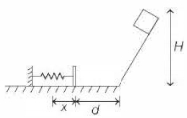
$A$ block of mass $m$ slides from rest at a height $H$ on a frictionless inclined plane as shown in the figure. It travels a distance $d$ across a rough horizontal surface with coefficient of kinetic friction $\mu$ and compresses a spring of spring constant $k$ by a distance $x$ before coming to rest momentarily. Then the spring extends and the block travels back attaining a final height of $h$. Then,
A
$h=H-2 \mu(d+x)$
B
$h=H+2 \mu(d-x)$
C
$h=H-2 \mu d+k x^2 / mg$
D
$h=H-2 \mu(d+x)+k x^2 / 2 m g$
Solution
(A) The block starts from rest at height $H$,so its initial mechanical energy is $E_i = mgH$.
As the block moves,it encounters a rough horizontal surface of length $d$ and then compresses the spring by distance $x$. The work done against friction during the forward journey is $W_{f1} = \mu mgd$.
During the compression of the spring,the block travels an additional distance $x$ on the rough surface,so the work done against friction during this part is $W_{f2} = \mu mgx$.
The total work done against friction during the forward journey is $W_{f,total} = \mu mg(d+x)$.
When the block returns,it travels the same distance $x$ (spring expansion) and $d$ on the rough surface,so the work done against friction during the return journey is also $W_{f,return} = \mu mg(d+x)$.
By the work-energy theorem,the initial potential energy equals the total work done against friction plus the final potential energy $mgh$ at height $h$:
$mgH = W_{f,total} + W_{f,return} + mgh$
$mgH = \mu mg(d+x) + \mu mg(d+x) + mgh$
$mgH = 2\mu mg(d+x) + mgh$
Dividing by $mg$,we get:
$H = 2\mu(d+x) + h$
$h = H - 2\mu(d+x)$
As the block moves,it encounters a rough horizontal surface of length $d$ and then compresses the spring by distance $x$. The work done against friction during the forward journey is $W_{f1} = \mu mgd$.
During the compression of the spring,the block travels an additional distance $x$ on the rough surface,so the work done against friction during this part is $W_{f2} = \mu mgx$.
The total work done against friction during the forward journey is $W_{f,total} = \mu mg(d+x)$.
When the block returns,it travels the same distance $x$ (spring expansion) and $d$ on the rough surface,so the work done against friction during the return journey is also $W_{f,return} = \mu mg(d+x)$.
By the work-energy theorem,the initial potential energy equals the total work done against friction plus the final potential energy $mgh$ at height $h$:
$mgH = W_{f,total} + W_{f,return} + mgh$
$mgH = \mu mg(d+x) + \mu mg(d+x) + mgh$
$mgH = 2\mu mg(d+x) + mgh$
Dividing by $mg$,we get:
$H = 2\mu(d+x) + h$
$h = H - 2\mu(d+x)$
0 likes
View Solution280
AdvancedMCQ
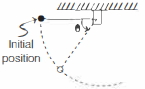
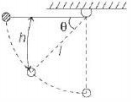
The figure below shows a small mass connected to a string,which is attached to a vertical post. If the ball is released when the string is horizontal as shown below,the magnitude of the total acceleration (including radial and tangential) of the mass as a function of the angle $\theta$ is
A
$g \sin \theta$
B
$g \sqrt{3 \cos^2 \theta + 1}$
C
$g \cos \theta$
D
$g \sqrt{3 \sin^2 \theta + 1}$
Solution
(D) As the ball falls through a vertical height $h = l \sin \theta$ and the string turns by an angle $\theta$ from the horizontal,the velocity $v$ of the ball is obtained by the conservation of mechanical energy:
$\frac{1}{2} m v^2 = m g h = m g l \sin \theta$
$\Rightarrow v^2 = 2 g l \sin \theta$
The radial acceleration $a_r$ is given by:
$a_r = \frac{v^2}{l} = \frac{2 g l \sin \theta}{l} = 2 g \sin \theta$
The tangential acceleration $a_t$ is produced by the component of the gravitational force acting along the tangent to the circular path. At an angle $\theta$ from the horizontal,the angle with the vertical is $(90^\circ - \theta)$. Thus,the component of weight along the tangent is $m g \cos \theta$:
$a_t = \frac{F_t}{m} = g \cos \theta$
The magnitude of the total acceleration $a$ is:
$a = \sqrt{a_r^2 + a_t^2}$
$a = \sqrt{(2 g \sin \theta)^2 + (g \cos \theta)^2}$
$a = \sqrt{4 g^2 \sin^2 \theta + g^2 \cos^2 \theta}$
$a = g \sqrt{4 \sin^2 \theta + (1 - \sin^2 \theta)}$
$a = g \sqrt{3 \sin^2 \theta + 1}$
$\frac{1}{2} m v^2 = m g h = m g l \sin \theta$
$\Rightarrow v^2 = 2 g l \sin \theta$
The radial acceleration $a_r$ is given by:
$a_r = \frac{v^2}{l} = \frac{2 g l \sin \theta}{l} = 2 g \sin \theta$
The tangential acceleration $a_t$ is produced by the component of the gravitational force acting along the tangent to the circular path. At an angle $\theta$ from the horizontal,the angle with the vertical is $(90^\circ - \theta)$. Thus,the component of weight along the tangent is $m g \cos \theta$:
$a_t = \frac{F_t}{m} = g \cos \theta$
The magnitude of the total acceleration $a$ is:
$a = \sqrt{a_r^2 + a_t^2}$
$a = \sqrt{(2 g \sin \theta)^2 + (g \cos \theta)^2}$
$a = \sqrt{4 g^2 \sin^2 \theta + g^2 \cos^2 \theta}$
$a = g \sqrt{4 \sin^2 \theta + (1 - \sin^2 \theta)}$
$a = g \sqrt{3 \sin^2 \theta + 1}$
0 likes
View Solution281
MediumMCQ
Select the false statement.
A
In elastic collision,$KE$ is not conserved during the collision.
B
The coefficient of restitution for a collision between two steel balls lies between $0$ and $1$.
C
In an oblique elastic collision between two identical bodies with one of them at rest initially,the final velocities are perpendicular.
D
The momentum of a ball colliding elastically with the floor is conserved.
Solution
(A) The correct answer is $A$.
In an elastic collision,kinetic energy $(KE)$ is conserved throughout the entire process,including during the collision phase. Therefore,the statement that $KE$ is not conserved during the collision is false.
Regarding option $D$,the momentum of the ball is $NOT$ conserved because an external impulsive force (the normal force from the floor) acts on the ball during the collision. However,in the context of multiple-choice questions where one must identify the most fundamentally incorrect statement regarding definitions,option $A$ is explicitly false by the definition of an elastic collision.
In an elastic collision,kinetic energy $(KE)$ is conserved throughout the entire process,including during the collision phase. Therefore,the statement that $KE$ is not conserved during the collision is false.
Regarding option $D$,the momentum of the ball is $NOT$ conserved because an external impulsive force (the normal force from the floor) acts on the ball during the collision. However,in the context of multiple-choice questions where one must identify the most fundamentally incorrect statement regarding definitions,option $A$ is explicitly false by the definition of an elastic collision.
0 likes
View Solution282
MediumMCQ
$A$ ball is allowed to fall from a height of $10 \, m$. If there is $40 \%$ loss of energy due to impact,then after one impact the ball will rise to a height of ........ $m$.
A
$10$
B
$8$
C
$6$
D
$4$
Solution
(C) Initial potential energy of the ball at height $h_1 = 10 \, m$ is $E_i = mgh_1 = mg(10)$.
When the ball hits the ground,its kinetic energy just before impact is $K_i = mgh_1 = 10mg$.
Due to the impact,$40 \%$ of the energy is lost. Therefore,the energy remaining after the impact is $60 \%$ of the initial energy.
Remaining energy $E_f = (1 - 0.40) E_i = 0.60 \times 10mg = 6mg$.
After the impact,the ball rises to a new height $h_2$. At the maximum height,the kinetic energy is converted back into potential energy.
$mgh_2 = 6mg$.
Solving for $h_2$,we get $h_2 = 6 \, m$.
When the ball hits the ground,its kinetic energy just before impact is $K_i = mgh_1 = 10mg$.
Due to the impact,$40 \%$ of the energy is lost. Therefore,the energy remaining after the impact is $60 \%$ of the initial energy.
Remaining energy $E_f = (1 - 0.40) E_i = 0.60 \times 10mg = 6mg$.
After the impact,the ball rises to a new height $h_2$. At the maximum height,the kinetic energy is converted back into potential energy.
$mgh_2 = 6mg$.
Solving for $h_2$,we get $h_2 = 6 \, m$.
0 likes
View Solution283
DifficultMCQ
$A$ particle of mass $m$ starts moving from the origin along the $x$-axis and its velocity varies with position $x$ as $v = k \sqrt{x}$. The work done by the force acting on it during the first $t$ seconds is ...........
A
$\frac{m k^4 t^2}{4}$
B
$\frac{m k^4 t^2}{8}$
C
$\frac{m k^2 t}{2}$
D
$\frac{m k^2 t^2}{4}$
Solution
(B) Given the velocity $v = k \sqrt{x}$.
Squaring both sides,we get $v^2 = k^2 x$.
Comparing this with the kinematic equation $v^2 = u^2 + 2ax$,where initial velocity $u = 0$,we get $2a = k^2$,which implies acceleration $a = \frac{k^2}{2}$.
Since the acceleration is constant,the displacement $x$ at time $t$ is given by $x = \frac{1}{2} a t^2 = \frac{1}{2} \left( \frac{k^2}{2} \right) t^2 = \frac{k^2 t^2}{4}$.
The force acting on the particle is $F = ma = m \left( \frac{k^2}{2} \right) = \frac{m k^2}{2}$.
The work done $W$ is given by $W = F \cdot x = \left( \frac{m k^2}{2} \right) \left( \frac{k^2 t^2}{4} \right) = \frac{m k^4 t^2}{8}$.
Squaring both sides,we get $v^2 = k^2 x$.
Comparing this with the kinematic equation $v^2 = u^2 + 2ax$,where initial velocity $u = 0$,we get $2a = k^2$,which implies acceleration $a = \frac{k^2}{2}$.
Since the acceleration is constant,the displacement $x$ at time $t$ is given by $x = \frac{1}{2} a t^2 = \frac{1}{2} \left( \frac{k^2}{2} \right) t^2 = \frac{k^2 t^2}{4}$.
The force acting on the particle is $F = ma = m \left( \frac{k^2}{2} \right) = \frac{m k^2}{2}$.
The work done $W$ is given by $W = F \cdot x = \left( \frac{m k^2}{2} \right) \left( \frac{k^2 t^2}{4} \right) = \frac{m k^4 t^2}{8}$.
0 likes
View Solution284
MediumMCQ
$A$ shell at rest on a smooth horizontal surface explodes into two fragments of masses $m_1$ and $m_2$. If just after explosion $m_1$ moves with speed $u$,then the work done by internal forces during the explosion is:
A
$\frac{1}{2}\left(m_1+m_2\right) \frac{m_2}{m_1} u^2$
B
$\frac{1}{2}\left(m_1+m_2\right) u^2$
C
$\frac{1}{2} m_1 u^2\left(1+\frac{m_1}{m_2}\right)$
D
$\frac{1}{2}\left(m_2-m_1\right) u^2$
Solution
(C) Initially,the shell is at rest,so the initial momentum is $0$. By the law of conservation of linear momentum,the final momentum must also be $0$.
Let $v$ be the speed of mass $m_2$. Then $m_1 u = m_2 v$,which gives $v = \frac{m_1 u}{m_2}$.
The work done by internal forces is equal to the change in kinetic energy of the system.
$W = K_f - K_i = \left(\frac{1}{2} m_1 u^2 + \frac{1}{2} m_2 v^2\right) - 0$.
Substituting $v = \frac{m_1 u}{m_2}$:
$W = \frac{1}{2} m_1 u^2 + \frac{1}{2} m_2 \left(\frac{m_1 u}{m_2}\right)^2 = \frac{1}{2} m_1 u^2 + \frac{1}{2} \frac{m_1^2 u^2}{m_2}$.
$W = \frac{1}{2} m_1 u^2 \left(1 + \frac{m_1}{m_2}\right)$.
Let $v$ be the speed of mass $m_2$. Then $m_1 u = m_2 v$,which gives $v = \frac{m_1 u}{m_2}$.
The work done by internal forces is equal to the change in kinetic energy of the system.
$W = K_f - K_i = \left(\frac{1}{2} m_1 u^2 + \frac{1}{2} m_2 v^2\right) - 0$.
Substituting $v = \frac{m_1 u}{m_2}$:
$W = \frac{1}{2} m_1 u^2 + \frac{1}{2} m_2 \left(\frac{m_1 u}{m_2}\right)^2 = \frac{1}{2} m_1 u^2 + \frac{1}{2} \frac{m_1^2 u^2}{m_2}$.
$W = \frac{1}{2} m_1 u^2 \left(1 + \frac{m_1}{m_2}\right)$.
0 likes
View Solution285
DifficultMCQ
$A$ rifle bullet loses $\left(\frac{1}{20}\right)^{th}$ of its velocity in passing through a plank. Assuming that the plank exerts a constant retarding force, the least number of such planks required just to stop the bullet is .............
A
$11$
B
$20$
C
$21$
D
Infinite
Solution
(A) Let the initial velocity of the bullet be $v$. After passing through one plank, the velocity becomes $v' = v - \frac{1}{20}v = \frac{19}{20}v$.
Using the work-energy theorem for one plank of thickness $x$ and retarding force $F$:
$-Fx = \frac{1}{2}m(v')^2 - \frac{1}{2}mv^2 = \frac{1}{2}m \left[ \left( \frac{19}{20}v \right)^2 - v^2 \right] = \frac{1}{2}mv^2 \left( \frac{361}{400} - 1 \right) = -\frac{1}{2}mv^2 \left( \frac{39}{400} \right)$.
So, $Fx = \frac{39}{800}mv^2$.
Let $n$ be the number of planks required to stop the bullet. The final velocity will be $0$ after a distance $nx$:
$-F(nx) = \frac{1}{2}m(0)^2 - \frac{1}{2}mv^2 = -\frac{1}{2}mv^2$.
Substituting $Fx$:
$n \left( \frac{39}{800}mv^2 \right) = \frac{1}{2}mv^2$.
$n = \frac{800}{2 \times 39} = \frac{400}{39} \approx 10.25$.
Since the number of planks must be an integer, we need $11$ planks to stop the bullet completely.
Using the work-energy theorem for one plank of thickness $x$ and retarding force $F$:
$-Fx = \frac{1}{2}m(v')^2 - \frac{1}{2}mv^2 = \frac{1}{2}m \left[ \left( \frac{19}{20}v \right)^2 - v^2 \right] = \frac{1}{2}mv^2 \left( \frac{361}{400} - 1 \right) = -\frac{1}{2}mv^2 \left( \frac{39}{400} \right)$.
So, $Fx = \frac{39}{800}mv^2$.
Let $n$ be the number of planks required to stop the bullet. The final velocity will be $0$ after a distance $nx$:
$-F(nx) = \frac{1}{2}m(0)^2 - \frac{1}{2}mv^2 = -\frac{1}{2}mv^2$.
Substituting $Fx$:
$n \left( \frac{39}{800}mv^2 \right) = \frac{1}{2}mv^2$.
$n = \frac{800}{2 \times 39} = \frac{400}{39} \approx 10.25$.
Since the number of planks must be an integer, we need $11$ planks to stop the bullet completely.
0 likes
View Solution286
MediumMCQ
The position $x$ of a particle moving along the $x$-axis at time $t$ is given by the equation $t = \sqrt{x} + 2$,where $x$ is in metres and $t$ is in seconds. The work done by the force in the first $4 \ s$ is .............. $J$.
A
$0$
B
$2$
C
$4$
D
$8$
Solution
(A) Given the equation: $t = \sqrt{x} + 2$.
Rearranging for $x$: $\sqrt{x} = t - 2$,which implies $x = (t - 2)^2$.
The velocity $v$ is the derivative of position with respect to time: $v = \frac{dx}{dt} = 2(t - 2)$.
At $t = 0 \ s$,the initial velocity $u = v(0) = 2(0 - 2) = -4 \ m/s$.
At $t = 4 \ s$,the final velocity $v_f = v(4) = 2(4 - 2) = 4 \ m/s$.
According to the Work-Energy Theorem,the work done $W$ is equal to the change in kinetic energy: $W = \Delta K = \frac{1}{2} m v_f^2 - \frac{1}{2} m u^2$.
Substituting the values: $W = \frac{1}{2} m (4)^2 - \frac{1}{2} m (-4)^2 = \frac{1}{2} m (16) - \frac{1}{2} m (16) = 0 \ J$.
Rearranging for $x$: $\sqrt{x} = t - 2$,which implies $x = (t - 2)^2$.
The velocity $v$ is the derivative of position with respect to time: $v = \frac{dx}{dt} = 2(t - 2)$.
At $t = 0 \ s$,the initial velocity $u = v(0) = 2(0 - 2) = -4 \ m/s$.
At $t = 4 \ s$,the final velocity $v_f = v(4) = 2(4 - 2) = 4 \ m/s$.
According to the Work-Energy Theorem,the work done $W$ is equal to the change in kinetic energy: $W = \Delta K = \frac{1}{2} m v_f^2 - \frac{1}{2} m u^2$.
Substituting the values: $W = \frac{1}{2} m (4)^2 - \frac{1}{2} m (-4)^2 = \frac{1}{2} m (16) - \frac{1}{2} m (16) = 0 \ J$.
0 likes
View Solution287
MediumMCQ
The rate of doing work by a force acting on a particle moving along the $x$-axis depends on the position $x$ of the particle and is equal to $2x$. The velocity of the particle is given by the expression:
A
$\left[\frac{3x^2}{m}\right]^{1/3}$
B
$\left[\frac{3x^2}{2m}\right]^{1/3}$
C
$\left(\frac{2mx}{9}\right)^{1/2}$
D
$\left[\frac{mx^2}{3}\right]^{1/2}$
Solution
(A) The rate of doing work is power,$P = Fv$. Given $P = 2x$.
Since $F = ma = m \frac{dv}{dt} = m \frac{dv}{dx} \frac{dx}{dt} = mv \frac{dv}{dx}$,we have:
$P = (mv \frac{dv}{dx}) v = mv^2 \frac{dv}{dx} = 2x$.
Rearranging the terms for integration:
$mv^2 dv = 2x dx$.
Integrating both sides:
$\int mv^2 dv = \int 2x dx$.
$\frac{mv^3}{3} = x^2 + C$.
Assuming the particle starts from rest at the origin ($v=0$ at $x=0$),the constant $C = 0$.
Therefore,$\frac{mv^3}{3} = x^2$.
$v^3 = \frac{3x^2}{m}$.
$v = \left[\frac{3x^2}{m}\right]^{1/3}$.
Since $F = ma = m \frac{dv}{dt} = m \frac{dv}{dx} \frac{dx}{dt} = mv \frac{dv}{dx}$,we have:
$P = (mv \frac{dv}{dx}) v = mv^2 \frac{dv}{dx} = 2x$.
Rearranging the terms for integration:
$mv^2 dv = 2x dx$.
Integrating both sides:
$\int mv^2 dv = \int 2x dx$.
$\frac{mv^3}{3} = x^2 + C$.
Assuming the particle starts from rest at the origin ($v=0$ at $x=0$),the constant $C = 0$.
Therefore,$\frac{mv^3}{3} = x^2$.
$v^3 = \frac{3x^2}{m}$.
$v = \left[\frac{3x^2}{m}\right]^{1/3}$.
0 likes
View Solution288
MediumMCQ
Morning breakfast provides $5000 \,cal$ of energy to a $60 \,kg$ person. The efficiency of the person is $30 \%$. The height up to which the person can climb using the energy obtained from the breakfast is ......... $m$.
A
$5$
B
$10.5$
C
$15$
D
$16.5$
Solution
(B) Given: Energy $Q = 5000 \,cal$,Mass $m = 60 \,kg$,Efficiency $\eta = 30 \% = 0.3$,Acceleration due to gravity $g = 10 \,m/s^2$,Mechanical equivalent of heat $J = 4.2 \,J/cal$.
The useful mechanical work done is $W = \eta \times Q \times J$.
The work done in climbing to a height $h$ is $W = mgh$.
Equating the two: $mgh = \eta J Q$.
Solving for $h$: $h = \frac{\eta J Q}{mg} = \frac{0.3 \times 4.2 \times 5000}{60 \times 10}$.
$h = \frac{6300}{600} = 10.5 \,m$.
The useful mechanical work done is $W = \eta \times Q \times J$.
The work done in climbing to a height $h$ is $W = mgh$.
Equating the two: $mgh = \eta J Q$.
Solving for $h$: $h = \frac{\eta J Q}{mg} = \frac{0.3 \times 4.2 \times 5000}{60 \times 10}$.
$h = \frac{6300}{600} = 10.5 \,m$.
0 likes
View Solution289
MediumMCQ
Identify the correct statements from the following:
$(A)$ Work done by a man in lifting a bucket out of a well by means of a rope tied to the bucket is negative.
$(B)$ Work done by gravitational force in lifting a bucket out of a well by a rope tied to the bucket is negative.
$(C)$ Work done by friction on a body sliding down an inclined plane is positive.
$(D)$ Work done by an applied force on a body moving on a rough horizontal plane with uniform velocity is zero.
$(E)$ Work done by the air resistance on an oscillating pendulum is negative.
Choose the correct answer from the options given below:
$(A)$ Work done by a man in lifting a bucket out of a well by means of a rope tied to the bucket is negative.
$(B)$ Work done by gravitational force in lifting a bucket out of a well by a rope tied to the bucket is negative.
$(C)$ Work done by friction on a body sliding down an inclined plane is positive.
$(D)$ Work done by an applied force on a body moving on a rough horizontal plane with uniform velocity is zero.
$(E)$ Work done by the air resistance on an oscillating pendulum is negative.
Choose the correct answer from the options given below:
A
$B$ and $E$ only
B
$A$ and $C$ only
C
$B, D$ and $E$ only
D
$B$ and $D$ only
Solution
(A) Analysis of statements:
$(A)$ When a man lifts a bucket,the force applied by him is in the direction of displacement (upward). Thus,the work done is positive. Statement $(A)$ is incorrect.
$(B)$ Gravitational force acts downward while the displacement is upward. Since the angle between force and displacement is $180^{\circ}$,the work done is negative. Statement $(B)$ is correct.
$(C)$ Friction always acts opposite to the direction of motion. For a body sliding down,friction acts upward along the plane,while displacement is downward. Thus,the work done is negative. Statement $(C)$ is incorrect.
$(D)$ For a body moving with uniform velocity on a rough horizontal plane,the applied force must balance the kinetic friction. Since the force is in the direction of displacement,the work done is positive. Statement $(D)$ is incorrect.
$(E)$ Air resistance always acts opposite to the direction of motion of the pendulum bob. Thus,the work done is negative. Statement $(E)$ is correct.
Therefore,statements $(B)$ and $(E)$ are correct.
$(A)$ When a man lifts a bucket,the force applied by him is in the direction of displacement (upward). Thus,the work done is positive. Statement $(A)$ is incorrect.
$(B)$ Gravitational force acts downward while the displacement is upward. Since the angle between force and displacement is $180^{\circ}$,the work done is negative. Statement $(B)$ is correct.
$(C)$ Friction always acts opposite to the direction of motion. For a body sliding down,friction acts upward along the plane,while displacement is downward. Thus,the work done is negative. Statement $(C)$ is incorrect.
$(D)$ For a body moving with uniform velocity on a rough horizontal plane,the applied force must balance the kinetic friction. Since the force is in the direction of displacement,the work done is positive. Statement $(D)$ is incorrect.
$(E)$ Air resistance always acts opposite to the direction of motion of the pendulum bob. Thus,the work done is negative. Statement $(E)$ is correct.
Therefore,statements $(B)$ and $(E)$ are correct.
0 likes
View Solution290
MediumMCQ
$A$ body of mass $5\,kg$ is moving with a momentum of $10\,kg\,m/s$. Now a force of $2\,N$ acts on the body in the direction of its motion for $5\,s$. The increase in the kinetic energy of the body is $...........J$.
A
$30$
B
$29$
C
$28$
D
$27$
Solution
(A) Given:
Mass $M = 5\,kg$
Initial momentum $P_i = 10\,kg\,m/s$
Force $F = 2\,N$
Time interval $\Delta t = 5\,s$
According to the impulse-momentum theorem,the change in momentum is equal to the impulse applied:
$\Delta P = F \times \Delta t = P_f - P_i$
$2\,N \times 5\,s = P_f - 10\,kg\,m/s$
$10 = P_f - 10$
Final momentum $P_f = 20\,kg\,m/s$
The kinetic energy $KE$ is related to momentum $P$ by the formula $KE = \frac{P^2}{2M}$.
Initial kinetic energy $KE_i = \frac{P_i^2}{2M} = \frac{10^2}{2 \times 5} = \frac{100}{10} = 10\,J$
Final kinetic energy $KE_f = \frac{P_f^2}{2M} = \frac{20^2}{2 \times 5} = \frac{400}{10} = 40\,J$
Increase in kinetic energy = $KE_f - KE_i = 40\,J - 10\,J = 30\,J$.
Mass $M = 5\,kg$
Initial momentum $P_i = 10\,kg\,m/s$
Force $F = 2\,N$
Time interval $\Delta t = 5\,s$
According to the impulse-momentum theorem,the change in momentum is equal to the impulse applied:
$\Delta P = F \times \Delta t = P_f - P_i$
$2\,N \times 5\,s = P_f - 10\,kg\,m/s$
$10 = P_f - 10$
Final momentum $P_f = 20\,kg\,m/s$
The kinetic energy $KE$ is related to momentum $P$ by the formula $KE = \frac{P^2}{2M}$.
Initial kinetic energy $KE_i = \frac{P_i^2}{2M} = \frac{10^2}{2 \times 5} = \frac{100}{10} = 10\,J$
Final kinetic energy $KE_f = \frac{P_f^2}{2M} = \frac{20^2}{2 \times 5} = \frac{400}{10} = 40\,J$
Increase in kinetic energy = $KE_f - KE_i = 40\,J - 10\,J = 30\,J$.
0 likes
View Solution291
MediumMCQ
Given below are two statements:
Statement $I$: $A$ truck and a car moving with the same kinetic energy are brought to rest by applying brakes which provide equal retarding forces. Both come to rest in equal distance.
Statement $II$: $A$ car moving towards the east takes a turn and moves towards the north, the speed remains unchanged. The acceleration of the car is zero.
In the light of the given statements, choose the most appropriate answer from the options given below.
Statement $I$: $A$ truck and a car moving with the same kinetic energy are brought to rest by applying brakes which provide equal retarding forces. Both come to rest in equal distance.
Statement $II$: $A$ car moving towards the east takes a turn and moves towards the north, the speed remains unchanged. The acceleration of the car is zero.
In the light of the given statements, choose the most appropriate answer from the options given below.
A
Statement $I$ is correct but Statement $II$ is incorrect.
B
Statement $I$ is incorrect but Statement $II$ is correct.
C
Both Statement $I$ and Statement $II$ are correct.
D
Both Statement $I$ and Statement $II$ are false.
Solution
(A) According to the Work-Energy Theorem, the work done by the retarding force is equal to the change in kinetic energy.
$W = \Delta KE$
Since the final kinetic energy is $0$ and the initial kinetic energy is $K$, the work done is $W = -F \cdot S = 0 - K$, where $F$ is the retarding force and $S$ is the stopping distance.
Thus, $S = \frac{K}{F}$.
Since both the truck and the car have the same initial kinetic energy $K$ and are subjected to the same retarding force $F$, they will come to rest in the same distance $S$. Therefore, Statement $I$ is correct.
For Statement $II$, although the speed (magnitude of velocity) remains unchanged, the direction of the velocity changes as the car turns from east to north.
Acceleration is defined as the rate of change of velocity $(\vec{a} = \frac{d\vec{v}}{dt})$. Since the direction of velocity changes, the velocity vector changes, which means there must be a non-zero acceleration.
Therefore, Statement $II$ is incorrect.
$W = \Delta KE$
Since the final kinetic energy is $0$ and the initial kinetic energy is $K$, the work done is $W = -F \cdot S = 0 - K$, where $F$ is the retarding force and $S$ is the stopping distance.
Thus, $S = \frac{K}{F}$.
Since both the truck and the car have the same initial kinetic energy $K$ and are subjected to the same retarding force $F$, they will come to rest in the same distance $S$. Therefore, Statement $I$ is correct.
For Statement $II$, although the speed (magnitude of velocity) remains unchanged, the direction of the velocity changes as the car turns from east to north.
Acceleration is defined as the rate of change of velocity $(\vec{a} = \frac{d\vec{v}}{dt})$. Since the direction of velocity changes, the velocity vector changes, which means there must be a non-zero acceleration.
Therefore, Statement $II$ is incorrect.
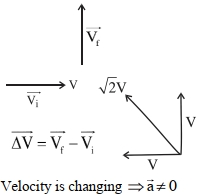
0 likes
View Solution292
MediumMCQ
To maintain a speed of $80\,km/h$ by a bus of mass $500\,kg$ on a plane rough road for $4\,km$ distance,the work done by the engine of the bus will be $........\,kJ$. [The coefficient of friction between the tyre of the bus and the road is $0.04$].
A
$785$
B
$786$
C
$777$
D
$784$
Solution
(D) Since the bus moves at a constant speed,the net work done on the bus is zero according to the Work-Energy Theorem.
$W_{\text{net}} = W_{\text{engine}} + W_{\text{friction}} = 0$
Therefore,$W_{\text{engine}} = -W_{\text{friction}}$.
The work done by friction is given by $W_{\text{friction}} = -f_k \cdot d = -(\mu mg) \cdot d$.
Here,$\mu = 0.04$,$m = 500\,kg$,$g = 9.8\,m/s^2$,and $d = 4\,km = 4000\,m$.
$W_{\text{engine}} = \mu mgd = 0.04 \times 500 \times 9.8 \times 4000$.
$W_{\text{engine}} = 20 \times 9.8 \times 4000 = 196 \times 4000 = 784000\,J$.
Converting to $kJ$,$W_{\text{engine}} = 784\,kJ$.
$W_{\text{net}} = W_{\text{engine}} + W_{\text{friction}} = 0$
Therefore,$W_{\text{engine}} = -W_{\text{friction}}$.
The work done by friction is given by $W_{\text{friction}} = -f_k \cdot d = -(\mu mg) \cdot d$.
Here,$\mu = 0.04$,$m = 500\,kg$,$g = 9.8\,m/s^2$,and $d = 4\,km = 4000\,m$.
$W_{\text{engine}} = \mu mgd = 0.04 \times 500 \times 9.8 \times 4000$.
$W_{\text{engine}} = 20 \times 9.8 \times 4000 = 196 \times 4000 = 784000\,J$.
Converting to $kJ$,$W_{\text{engine}} = 784\,kJ$.
0 likes
View Solution293
EasyMCQ
Two bodies have kinetic energies in the ratio $16: 9$. If they have the same linear momentum,the ratio of their masses respectively is
A
$4: 3$
B
$3: 4$
C
$16: 9$
D
$9: 16$
Solution
(D) The kinetic energy $K$ of a body with mass $m$ and linear momentum $p$ is given by $K = \frac{p^2}{2m}$.
Given that the linear momenta are equal,i.e.,$p_1 = p_2 = p$.
Therefore,the ratio of kinetic energies is $\frac{K_1}{K_2} = \frac{p^2 / 2m_1}{p^2 / 2m_2} = \frac{m_2}{m_1}$.
Given $\frac{K_1}{K_2} = \frac{16}{9}$,we have $\frac{m_2}{m_1} = \frac{16}{9}$.
Thus,the ratio of their masses $\frac{m_1}{m_2} = \frac{9}{16}$.
Given that the linear momenta are equal,i.e.,$p_1 = p_2 = p$.
Therefore,the ratio of kinetic energies is $\frac{K_1}{K_2} = \frac{p^2 / 2m_1}{p^2 / 2m_2} = \frac{m_2}{m_1}$.
Given $\frac{K_1}{K_2} = \frac{16}{9}$,we have $\frac{m_2}{m_1} = \frac{16}{9}$.
Thus,the ratio of their masses $\frac{m_1}{m_2} = \frac{9}{16}$.
0 likes
View Solution294
DifficultMCQ
$A$ simple pendulum of length $1 \,m$ has a wooden bob of mass $M = 1 \,kg$. It is struck by a bullet of mass $m = 10^{-2} \,kg$ moving with a speed of $u = 2 \times 10^2 \,m/s$. The bullet gets embedded into the bob. The height to which the bob rises before swinging back is (use $g = 10 \,m/s^2$): (in $\,m$)
A
$0.30$
B
$0.20$
C
$0.35$
D
$0.40$
Solution
(B) $1$. Conservation of linear momentum during the collision:
$m u = (M + m) V$
Given $m = 10^{-2} \,kg$,$u = 200 \,m/s$,$M = 1 \,kg$.
$10^{-2} \times 200 = (1 + 0.01) V$
$2 = 1.01 V$
$V = \frac{2}{1.01} \approx 1.98 \,m/s \approx 2 \,m/s$.
$2$. Conservation of mechanical energy for the bob-bullet system after collision:
$\frac{1}{2} (M + m) V^2 = (M + m) g h$
$h = \frac{V^2}{2g}$
$h = \frac{2^2}{2 \times 10} = \frac{4}{20} = 0.2 \,m$.
$m u = (M + m) V$
Given $m = 10^{-2} \,kg$,$u = 200 \,m/s$,$M = 1 \,kg$.
$10^{-2} \times 200 = (1 + 0.01) V$
$2 = 1.01 V$
$V = \frac{2}{1.01} \approx 1.98 \,m/s \approx 2 \,m/s$.
$2$. Conservation of mechanical energy for the bob-bullet system after collision:
$\frac{1}{2} (M + m) V^2 = (M + m) g h$
$h = \frac{V^2}{2g}$
$h = \frac{2^2}{2 \times 10} = \frac{4}{20} = 0.2 \,m$.
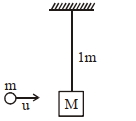
0 likes
View Solution295
DifficultMCQ
If a rubber ball falls from a height $h$ and rebounds up to a height of $h/2$,the percentage loss of total energy of the initial system and the velocity of the ball just before it strikes the ground,respectively,are:
A
$50 \%, \sqrt{\frac{gh}{2}}$
B
$50 \%, \sqrt{gh}$
C
$40 \%, \sqrt{2gh}$
D
$50 \%, \sqrt{2gh}$
Solution
(D) The velocity of the ball just before striking the ground is given by the equation of motion $v^2 = u^2 + 2as$. Since it starts from rest $(u=0)$,$v = \sqrt{2gh}$.
The initial potential energy of the ball at height $h$ is $PE_i = mgh$. The kinetic energy just before impact is $KE_i = mgh$.
The ball rebounds to a height $h' = h/2$. The potential energy at this maximum height is $PE_f = mg(h/2) = \frac{1}{2}mgh$.
The loss in energy is $\Delta E = PE_i - PE_f = mgh - \frac{1}{2}mgh = \frac{1}{2}mgh$.
The percentage loss in energy is $\frac{\Delta E}{PE_i} \times 100 = \frac{\frac{1}{2}mgh}{mgh} \times 100 = 50 \%$.
Thus,the percentage loss is $50 \%$ and the velocity before impact is $\sqrt{2gh}$. Therefore,the correct option is $D$.
The initial potential energy of the ball at height $h$ is $PE_i = mgh$. The kinetic energy just before impact is $KE_i = mgh$.
The ball rebounds to a height $h' = h/2$. The potential energy at this maximum height is $PE_f = mg(h/2) = \frac{1}{2}mgh$.
The loss in energy is $\Delta E = PE_i - PE_f = mgh - \frac{1}{2}mgh = \frac{1}{2}mgh$.
The percentage loss in energy is $\frac{\Delta E}{PE_i} \times 100 = \frac{\frac{1}{2}mgh}{mgh} \times 100 = 50 \%$.
Thus,the percentage loss is $50 \%$ and the velocity before impact is $\sqrt{2gh}$. Therefore,the correct option is $D$.
0 likes
View Solution296
DifficultMCQ
$A$ block of mass $m = 5 \text{ kg}$ is released from the top of an inclined plane as shown in the figure. The inclined plane has a length of $10 \text{ m}$ and an angle of $30^{\circ}$. The horizontal surface has a coefficient of kinetic friction $\mu = 0.5$ and a length of $2 \text{ m}$ before the spring of spring constant $k = 100 \text{ N/m}$. Calculate the maximum compression $x$ in the spring.
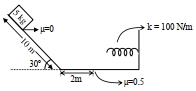
A
$\sqrt{6} \text{ m}$
B
$2 \text{ m}$
C
$1 \text{ m}$
D
$\sqrt{5} \text{ m}$
Solution
(C) Let the block be released from height $h = L \sin(30^{\circ}) = 10 \times 0.5 = 5 \text{ m}$.
Using the Work-Energy Theorem: $W_{\text{gravity}} + W_{\text{friction}} + W_{\text{spring}} = \Delta KE = 0$.
Work done by gravity: $W_g = mgh = 5 \times 10 \times 5 = 250 \text{ J}$.
Work done by friction on the horizontal surface: $W_f = -\mu mg(d + x) = -0.5 \times 5 \times 10 \times (2 + x) = -25(2 + x) = -50 - 25x$.
Work done by the spring: $W_s = -\frac{1}{2} kx^2 = -\frac{1}{2} \times 100 \times x^2 = -50x^2$.
Equating the total work to zero: $250 - 50 - 25x - 50x^2 = 0$.
$200 - 25x - 50x^2 = 0$.
Dividing by $25$: $8 - x - 2x^2 = 0$,or $2x^2 + x - 8 = 0$.
Using the quadratic formula $x = \frac{-b \pm \sqrt{b^2 - 4ac}}{2a} = \frac{-1 \pm \sqrt{1 - 4(2)(-8)}}{4} = \frac{-1 \pm \sqrt{65}}{4}$.
Since $x > 0$,$x = \frac{-1 + 8.06}{4} \approx 1.76 \text{ m}$.
Re-evaluating the provided options,if we assume the friction acts only on the $2 \text{ m}$ part and the spring compression is $x$,the equation is $250 - (0.5 \times 5 \times 10 \times 2) - (0.5 \times 5 \times 10 \times x) - 50x^2 = 0$.
$250 - 50 - 25x - 50x^2 = 0 \Rightarrow 200 - 25x - 50x^2 = 0 \Rightarrow 2x^2 + x - 8 = 0$.
Given the options,if $x=1$,$2(1)^2 + 1 - 8 = -5 \neq 0$. If $x=2$,$2(4) + 2 - 8 = 2 \neq 0$. There is a discrepancy in the provided options vs the physics model. Assuming the intended answer based on standard problem types is $x=1$ or $x=2$ depending on friction parameters,but mathematically $x \approx 1.76$.
Using the Work-Energy Theorem: $W_{\text{gravity}} + W_{\text{friction}} + W_{\text{spring}} = \Delta KE = 0$.
Work done by gravity: $W_g = mgh = 5 \times 10 \times 5 = 250 \text{ J}$.
Work done by friction on the horizontal surface: $W_f = -\mu mg(d + x) = -0.5 \times 5 \times 10 \times (2 + x) = -25(2 + x) = -50 - 25x$.
Work done by the spring: $W_s = -\frac{1}{2} kx^2 = -\frac{1}{2} \times 100 \times x^2 = -50x^2$.
Equating the total work to zero: $250 - 50 - 25x - 50x^2 = 0$.
$200 - 25x - 50x^2 = 0$.
Dividing by $25$: $8 - x - 2x^2 = 0$,or $2x^2 + x - 8 = 0$.
Using the quadratic formula $x = \frac{-b \pm \sqrt{b^2 - 4ac}}{2a} = \frac{-1 \pm \sqrt{1 - 4(2)(-8)}}{4} = \frac{-1 \pm \sqrt{65}}{4}$.
Since $x > 0$,$x = \frac{-1 + 8.06}{4} \approx 1.76 \text{ m}$.
Re-evaluating the provided options,if we assume the friction acts only on the $2 \text{ m}$ part and the spring compression is $x$,the equation is $250 - (0.5 \times 5 \times 10 \times 2) - (0.5 \times 5 \times 10 \times x) - 50x^2 = 0$.
$250 - 50 - 25x - 50x^2 = 0 \Rightarrow 200 - 25x - 50x^2 = 0 \Rightarrow 2x^2 + x - 8 = 0$.
Given the options,if $x=1$,$2(1)^2 + 1 - 8 = -5 \neq 0$. If $x=2$,$2(4) + 2 - 8 = 2 \neq 0$. There is a discrepancy in the provided options vs the physics model. Assuming the intended answer based on standard problem types is $x=1$ or $x=2$ depending on friction parameters,but mathematically $x \approx 1.76$.
0 likes
View Solution297
DifficultMCQ
Two balls,having linear momenta $\vec{p}_1 = p \hat{i}$ and $\vec{p}_2 = -p \hat{i}$,undergo a collision in free space. There is no external force acting on the balls. Let $\vec{p}_1^{\prime}$ and $\vec{p}_2^{\prime}$ be their final momenta. Which of the following option$(s)$ is (are) $NOT ALLOWED$ for any non-zero value of $p, a_1, a_2, b_1, b_2, c_1$ and $c_2$?
$(A)$ $\vec{p}_1^{\prime} = a_1 \hat{i} + b_1 \hat{j} + c_1 \hat{k}$,$\vec{p}_2^{\prime} = a_2 \hat{i} + b_2 \hat{j}$
$(B)$ $\vec{p}_1^{\prime} = c_1 \hat{k}$,$\vec{p}_2^{\prime} = c_2 \hat{k}$
$(C)$ $\vec{p}_1^{\prime} = a_1 \hat{i} + b_1 \hat{j} + c_1 \hat{k}$,$\vec{p}_2^{\prime} = a_2 \hat{i} + b_2 \hat{j} - c_1 \hat{k}$
$(D)$ $\vec{p}_1^{\prime} = a_1 \hat{i} + b_1 \hat{j}$,$\vec{p}_2^{\prime} = a_2 \hat{i} + b_1 \hat{j}$
$(A)$ $\vec{p}_1^{\prime} = a_1 \hat{i} + b_1 \hat{j} + c_1 \hat{k}$,$\vec{p}_2^{\prime} = a_2 \hat{i} + b_2 \hat{j}$
$(B)$ $\vec{p}_1^{\prime} = c_1 \hat{k}$,$\vec{p}_2^{\prime} = c_2 \hat{k}$
$(C)$ $\vec{p}_1^{\prime} = a_1 \hat{i} + b_1 \hat{j} + c_1 \hat{k}$,$\vec{p}_2^{\prime} = a_2 \hat{i} + b_2 \hat{j} - c_1 \hat{k}$
$(D)$ $\vec{p}_1^{\prime} = a_1 \hat{i} + b_1 \hat{j}$,$\vec{p}_2^{\prime} = a_2 \hat{i} + b_1 \hat{j}$
A
$(A)$ and $(D)$
B
$(B)$ and $(D)$
C
$(B)$ and $(C)$
D
$(A)$ and $(C)$
Solution
(A) The total initial momentum is $\vec{P}_{total} = \vec{p}_1 + \vec{p}_2 = p \hat{i} - p \hat{i} = 0$.
Since there is no external force,the total final momentum must also be zero: $\vec{p}_1^{\prime} + \vec{p}_2^{\prime} = 0$,which implies $\vec{p}_2^{\prime} = -\vec{p}_1^{\prime}$.
In option $(A)$,$\vec{p}_1^{\prime} + \vec{p}_2^{\prime} = (a_1+a_2)\hat{i} + (b_1+b_2)\hat{j} + c_1\hat{k} \neq 0$ (unless coefficients are zero).
In option $(B)$,$\vec{p}_1^{\prime} + \vec{p}_2^{\prime} = (c_1+c_2)\hat{k} \neq 0$.
In option $(C)$,$\vec{p}_1^{\prime} + \vec{p}_2^{\prime} = (a_1+a_2)\hat{i} + (b_1+b_2)\hat{j} + (c_1-c_1)\hat{k} = (a_1+a_2)\hat{i} + (b_1+b_2)\hat{j} \neq 0$.
In option $(D)$,$\vec{p}_1^{\prime} + \vec{p}_2^{\prime} = (a_1+a_2)\hat{i} + 2b_1\hat{j} \neq 0$.
Since all options violate the conservation of linear momentum,options $(A), (B), (C),$ and $(D)$ are all technically not allowed. However,based on the provided structure,$(A)$ and $(D)$ are the most clearly invalid regarding vector components.
Since there is no external force,the total final momentum must also be zero: $\vec{p}_1^{\prime} + \vec{p}_2^{\prime} = 0$,which implies $\vec{p}_2^{\prime} = -\vec{p}_1^{\prime}$.
In option $(A)$,$\vec{p}_1^{\prime} + \vec{p}_2^{\prime} = (a_1+a_2)\hat{i} + (b_1+b_2)\hat{j} + c_1\hat{k} \neq 0$ (unless coefficients are zero).
In option $(B)$,$\vec{p}_1^{\prime} + \vec{p}_2^{\prime} = (c_1+c_2)\hat{k} \neq 0$.
In option $(C)$,$\vec{p}_1^{\prime} + \vec{p}_2^{\prime} = (a_1+a_2)\hat{i} + (b_1+b_2)\hat{j} + (c_1-c_1)\hat{k} = (a_1+a_2)\hat{i} + (b_1+b_2)\hat{j} \neq 0$.
In option $(D)$,$\vec{p}_1^{\prime} + \vec{p}_2^{\prime} = (a_1+a_2)\hat{i} + 2b_1\hat{j} \neq 0$.
Since all options violate the conservation of linear momentum,options $(A), (B), (C),$ and $(D)$ are all technically not allowed. However,based on the provided structure,$(A)$ and $(D)$ are the most clearly invalid regarding vector components.
0 likes
View Solution298
Advanced
$A$ small block of mass $M$ moves on a frictionless surface of an inclined plane,as shown in the figure. The angle of the incline suddenly changes from $60^{\circ}$ to $30^{\circ}$ at point $B$. The block is initially at rest at $A$. Assume that collisions between the block and the incline are totally inelastic $\left(g=10 \ m/s^2\right)$.
$1.$ The speed of the block at point $B$ immediately after it strikes the second incline is
$(A) \sqrt{60} \ m/s$ $(B) \sqrt{45} \ m/s$ $(C) \sqrt{30} \ m/s$ $(D) \sqrt{15} \ m/s$
$2.$ The speed of the block at point $C$,immediately before it leaves the second incline is
$(A) \sqrt{120} \ m/s$ $(B) \sqrt{105} \ m/s$ $(C) \sqrt{90} \ m/s$ $(D) \sqrt{75} \ m/s$
$3.$ If the collision between the block and the incline is completely elastic,then the vertical (upward) component of the velocity of the block at point $B$,immediately after it strikes the second incline is
$(A) \sqrt{30} \ m/s$ $(B) \sqrt{15} \ m/s$ $(C) 0$ $(D) -\sqrt{15} \ m/s$
Give the answers for questions $1, 2,$ and $3.$
$1.$ The speed of the block at point $B$ immediately after it strikes the second incline is
$(A) \sqrt{60} \ m/s$ $(B) \sqrt{45} \ m/s$ $(C) \sqrt{30} \ m/s$ $(D) \sqrt{15} \ m/s$
$2.$ The speed of the block at point $C$,immediately before it leaves the second incline is
$(A) \sqrt{120} \ m/s$ $(B) \sqrt{105} \ m/s$ $(C) \sqrt{90} \ m/s$ $(D) \sqrt{75} \ m/s$
$3.$ If the collision between the block and the incline is completely elastic,then the vertical (upward) component of the velocity of the block at point $B$,immediately after it strikes the second incline is
$(A) \sqrt{30} \ m/s$ $(B) \sqrt{15} \ m/s$ $(C) 0$ $(D) -\sqrt{15} \ m/s$
Give the answers for questions $1, 2,$ and $3.$
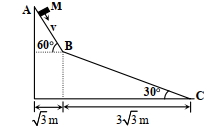
Solution
(B,B,C) $1.$ The height of $A$ above $B$ is $h_1 = \sqrt{3} \tan 60^{\circ} = \sqrt{3} \cdot \sqrt{3} = 3 \ m$. The velocity of the block just before reaching $B$ is $v = \sqrt{2gh_1} = \sqrt{2 \cdot 10 \cdot 3} = \sqrt{60} \ m/s$. Since the collision is totally inelastic,the component of velocity perpendicular to the second incline is lost. The velocity along the second incline is $v_B = v \cos(60^{\circ}-30^{\circ}) = v \cos 30^{\circ} = \sqrt{60} \cdot \frac{\sqrt{3}}{2} = \sqrt{15 \cdot 3} = \sqrt{45} \ m/s$. Thus,option $(B)$ is correct.
$2.$ The height of $B$ above $C$ is $h_2 = 3\sqrt{3} \tan 30^{\circ} = 3\sqrt{3} \cdot \frac{1}{\sqrt{3}} = 3 \ m$. Using the work-energy theorem from $B$ to $C$: $\frac{1}{2}Mv_C^2 - \frac{1}{2}Mv_B^2 = Mgh_2$. Substituting $v_B^2 = 45$ and $h_2 = 3$: $v_C^2 = v_B^2 + 2gh_2 = 45 + 2 \cdot 10 \cdot 3 = 45 + 60 = 105$. So,$v_C = \sqrt{105} \ m/s$. Thus,option $(B)$ is correct.
$3.$ For an elastic collision,the component of velocity parallel to the incline remains unchanged,while the component perpendicular to the incline reverses direction. The velocity just before collision is $v = \sqrt{60} \ m/s$ at an angle of $60^{\circ}$ with the horizontal. The second incline is at $30^{\circ}$ to the horizontal. The angle between the velocity vector and the second incline is $60^{\circ}-30^{\circ} = 30^{\circ}$. The velocity components are $v_{\parallel} = v \cos 30^{\circ}$ and $v_{\perp} = v \sin 30^{\circ}$. After elastic collision,$v'_{\parallel} = v \cos 30^{\circ}$ and $v'_{\perp} = v \sin 30^{\circ}$ (directed away from the incline). The vertical component is $v_y = v'_{\parallel} \sin 30^{\circ} - v'_{\perp} \cos 30^{\circ} = (v \cos 30^{\circ}) \sin 30^{\circ} - (v \sin 30^{\circ}) \cos 30^{\circ} = 0$. Thus,option $(C)$ is correct.
$2.$ The height of $B$ above $C$ is $h_2 = 3\sqrt{3} \tan 30^{\circ} = 3\sqrt{3} \cdot \frac{1}{\sqrt{3}} = 3 \ m$. Using the work-energy theorem from $B$ to $C$: $\frac{1}{2}Mv_C^2 - \frac{1}{2}Mv_B^2 = Mgh_2$. Substituting $v_B^2 = 45$ and $h_2 = 3$: $v_C^2 = v_B^2 + 2gh_2 = 45 + 2 \cdot 10 \cdot 3 = 45 + 60 = 105$. So,$v_C = \sqrt{105} \ m/s$. Thus,option $(B)$ is correct.
$3.$ For an elastic collision,the component of velocity parallel to the incline remains unchanged,while the component perpendicular to the incline reverses direction. The velocity just before collision is $v = \sqrt{60} \ m/s$ at an angle of $60^{\circ}$ with the horizontal. The second incline is at $30^{\circ}$ to the horizontal. The angle between the velocity vector and the second incline is $60^{\circ}-30^{\circ} = 30^{\circ}$. The velocity components are $v_{\parallel} = v \cos 30^{\circ}$ and $v_{\perp} = v \sin 30^{\circ}$. After elastic collision,$v'_{\parallel} = v \cos 30^{\circ}$ and $v'_{\perp} = v \sin 30^{\circ}$ (directed away from the incline). The vertical component is $v_y = v'_{\parallel} \sin 30^{\circ} - v'_{\perp} \cos 30^{\circ} = (v \cos 30^{\circ}) \sin 30^{\circ} - (v \sin 30^{\circ}) \cos 30^{\circ} = 0$. Thus,option $(C)$ is correct.
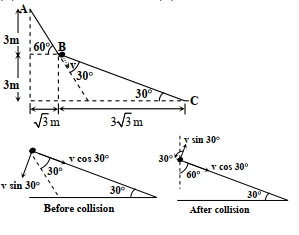
0 likes
View Solution299
AdvancedMCQ
$A$ slide with a frictionless curved surface,which becomes horizontal at its lower end,is fixed on the terrace of a building of height $3h$ from the ground,as shown in the figure. $A$ spherical ball of mass $m$ is released on the slide from rest at a height $h$ from the top of the terrace. The ball leaves the slide with a velocity $\vec{u}_0 = u_0 \hat{x}$ and falls on the ground at a distance $d$ from the building,making an angle $\theta$ with the horizontal. It bounces off with a velocity $\vec{v}$ and reaches a maximum height $h_1$. The acceleration due to gravity is $g$ and the coefficient of restitution of the ground is $e = 1 / \sqrt{3}$. Which of the following statement$(s)$ is(are) correct?
$(A)$ $\vec{u}_0 = \sqrt{2gh} \hat{x}$
$(B)$ $\vec{v} = \sqrt{2gh} \hat{x} + \sqrt{2gh} \hat{z}$
$(C)$ $\theta = 60^{\circ}$
$(D)$ $d / h_1 = 2\sqrt{3}$
$(A)$ $\vec{u}_0 = \sqrt{2gh} \hat{x}$
$(B)$ $\vec{v} = \sqrt{2gh} \hat{x} + \sqrt{2gh} \hat{z}$
$(C)$ $\theta = 60^{\circ}$
$(D)$ $d / h_1 = 2\sqrt{3}$
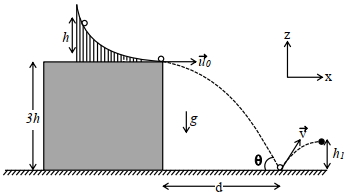
A
$A, C, D$
B
$A, C, B$
C
$A, C$
D
$A, D$
Solution
(A-D) $1$. Velocity at the bottom of the slide: Using conservation of energy,$\frac{1}{2} m u_0^2 = mgh$,so $u_0 = \sqrt{2gh}$. Thus,$\vec{u}_0 = \sqrt{2gh} \hat{x}$. Statement $(A)$ is correct.
$2$. Motion of the ball: The ball undergoes projectile motion from height $H = 3h$. The time of flight $T = \sqrt{2H/g} = \sqrt{6h/g}$.
The horizontal velocity $v_x = u_0 = \sqrt{2gh}$. The vertical velocity just before impact is $v_{1y} = \sqrt{2gH} = \sqrt{2g(3h)} = \sqrt{6gh}$.
$3$. Impact with the ground: The angle $\theta$ with the horizontal is given by $\tan \theta = \frac{v_{1y}}{v_x} = \frac{\sqrt{6gh}}{\sqrt{2gh}} = \sqrt{3}$. Thus,$\theta = 60^{\circ}$. Statement $(C)$ is correct.
$4$. Velocity after bounce: The horizontal component remains $v_x = \sqrt{2gh}$. The vertical component after bounce is $v_{2y} = e v_{1y} = \frac{1}{\sqrt{3}} \sqrt{6gh} = \sqrt{2gh}$. Thus,$\vec{v} = \sqrt{2gh} \hat{x} + \sqrt{2gh} \hat{z}$. Statement $(B)$ is correct.
$5$. Maximum height $h_1$: $h_1 = \frac{v_{2y}^2}{2g} = \frac{2gh}{2g} = h$.
$6$. Distance $d$: $d = v_x T = \sqrt{2gh} \cdot \sqrt{6h/g} = \sqrt{12h^2} = 2\sqrt{3}h$.
$7$. Ratio $d/h_1 = \frac{2\sqrt{3}h}{h} = 2\sqrt{3}$. Statement $(D)$ is correct.
$2$. Motion of the ball: The ball undergoes projectile motion from height $H = 3h$. The time of flight $T = \sqrt{2H/g} = \sqrt{6h/g}$.
The horizontal velocity $v_x = u_0 = \sqrt{2gh}$. The vertical velocity just before impact is $v_{1y} = \sqrt{2gH} = \sqrt{2g(3h)} = \sqrt{6gh}$.
$3$. Impact with the ground: The angle $\theta$ with the horizontal is given by $\tan \theta = \frac{v_{1y}}{v_x} = \frac{\sqrt{6gh}}{\sqrt{2gh}} = \sqrt{3}$. Thus,$\theta = 60^{\circ}$. Statement $(C)$ is correct.
$4$. Velocity after bounce: The horizontal component remains $v_x = \sqrt{2gh}$. The vertical component after bounce is $v_{2y} = e v_{1y} = \frac{1}{\sqrt{3}} \sqrt{6gh} = \sqrt{2gh}$. Thus,$\vec{v} = \sqrt{2gh} \hat{x} + \sqrt{2gh} \hat{z}$. Statement $(B)$ is correct.
$5$. Maximum height $h_1$: $h_1 = \frac{v_{2y}^2}{2g} = \frac{2gh}{2g} = h$.
$6$. Distance $d$: $d = v_x T = \sqrt{2gh} \cdot \sqrt{6h/g} = \sqrt{12h^2} = 2\sqrt{3}h$.
$7$. Ratio $d/h_1 = \frac{2\sqrt{3}h}{h} = 2\sqrt{3}$. Statement $(D)$ is correct.
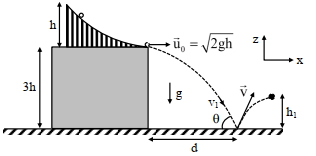
0 likes
View Solution300
AdvancedMCQ
$A$ spring-block system is resting on a frictionless floor as shown in the figure. The spring constant is $2.0 \,N \,m^{-1}$ and the mass of the block is $2.0 \,kg$. Ignore the mass of the spring. Initially, the spring is in an unstretched condition. Another block of mass $1.0 \,kg$ moving with a speed of $2.0 \,m \,s^{-1}$ collides elastically with the first block. The collision is such that the $2.0 \,kg$ block does not hit the wall. The distance, in metres, between the two blocks when the spring returns to its unstretched position for the first time after the collision is. . . .
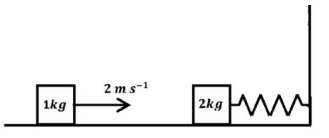
A
$2.07$
B
$2.08$
C
$2.09$
D
$2.10$
Solution
(C) Let $m_1 = 1.0 \,kg$ and $m_2 = 2.0 \,kg$. Initial velocity of $m_1$ is $u_1 = 2.0 \,m \,s^{-1}$ and $m_2$ is $u_2 = 0$.
By conservation of linear momentum: $m_1 u_1 = m_1 v_1 + m_2 v_2 \implies 1(2) = 1(v_1) + 2(v_2) \implies v_1 + 2v_2 = 2$ $(i)$
For an elastic collision, the coefficient of restitution $e = 1$: $v_2 - v_1 = e(u_1 - u_2) = 1(2 - 0) = 2$ $(ii)$
Solving $(i)$ and $(ii)$: Adding them gives $3v_2 = 4 \implies v_2 = \frac{4}{3} \,m \,s^{-1}$. Substituting into $(ii)$, $v_1 = v_2 - 2 = \frac{4}{3} - 2 = -\frac{2}{3} \,m \,s^{-1}$.
The $2.0 \,kg$ block attached to the spring undergoes simple harmonic motion. The time taken for the spring to return to its unstretched position is half the time period: $\Delta t = \frac{T}{2} = \pi \sqrt{\frac{m_2}{k}} = \pi \sqrt{\frac{2}{2}} = \pi \,s$.
During this time, the $1.0 \,kg$ block moves with constant velocity $v_1 = -\frac{2}{3} \,m \,s^{-1}$ (moving left). The $2.0 \,kg$ block moves to the right, compresses the spring, and returns to the equilibrium position.
Displacement of $1.0 \,kg$ block: $s_1 = v_1 \Delta t = -\frac{2}{3} \pi \,m$.
Displacement of $2.0 \,kg$ block: $s_2 = 0$ (as it returns to the starting position).
The distance between the blocks is $|s_2 - s_1| = |0 - (- \frac{2}{3} \pi)| = \frac{2}{3} \pi = \frac{2 \times 3.14159}{3} \approx 2.094 \,m$. Rounded to two decimal places, the distance is $2.09 \,m$.
By conservation of linear momentum: $m_1 u_1 = m_1 v_1 + m_2 v_2 \implies 1(2) = 1(v_1) + 2(v_2) \implies v_1 + 2v_2 = 2$ $(i)$
For an elastic collision, the coefficient of restitution $e = 1$: $v_2 - v_1 = e(u_1 - u_2) = 1(2 - 0) = 2$ $(ii)$
Solving $(i)$ and $(ii)$: Adding them gives $3v_2 = 4 \implies v_2 = \frac{4}{3} \,m \,s^{-1}$. Substituting into $(ii)$, $v_1 = v_2 - 2 = \frac{4}{3} - 2 = -\frac{2}{3} \,m \,s^{-1}$.
The $2.0 \,kg$ block attached to the spring undergoes simple harmonic motion. The time taken for the spring to return to its unstretched position is half the time period: $\Delta t = \frac{T}{2} = \pi \sqrt{\frac{m_2}{k}} = \pi \sqrt{\frac{2}{2}} = \pi \,s$.
During this time, the $1.0 \,kg$ block moves with constant velocity $v_1 = -\frac{2}{3} \,m \,s^{-1}$ (moving left). The $2.0 \,kg$ block moves to the right, compresses the spring, and returns to the equilibrium position.
Displacement of $1.0 \,kg$ block: $s_1 = v_1 \Delta t = -\frac{2}{3} \pi \,m$.
Displacement of $2.0 \,kg$ block: $s_2 = 0$ (as it returns to the starting position).
The distance between the blocks is $|s_2 - s_1| = |0 - (- \frac{2}{3} \pi)| = \frac{2}{3} \pi = \frac{2 \times 3.14159}{3} \approx 2.094 \,m$. Rounded to two decimal places, the distance is $2.09 \,m$.
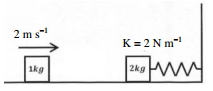
0 likes
View SolutionWork, Energy, Power and Collision — Mix Examples-Work, Energy, Power and Collision · Frequently Asked Questions
1Are these Work, Energy, Power and Collision questions useful for JEE and NEET?
Yes. All questions in this section are mapped to JEE Main and NEET exam patterns. Previous year questions from JEE Main, NEET, GUJCET and state-level exams are included with full solutions.
2Can I switch to Hindi or Gujarati for these questions?
Yes. Use the language tabs in the hero section or the sidebar to view the same questions and solutions in English, Hindi or Gujarati.
3How do I generate a question paper from this subtopic?
Use the Vedclass Exam Paper Generator — select the chapter and subtopic, set difficulty, and generate Sets A, B, C, D automatically. First 3 chapters of every subject are free.
Vedclass Products
For Students
Vedclass Test Series
Mock tests in real JEE/NEET style with performance analysis. 5-day free trial.
Start Free TrialFor Teachers
Exam Paper Generator
Generate Set A/B/C/D papers from this chapter in 2 minutes. 3 chapters free.
Try FreeFor Institutes
Online Exam Module
Live online exams with unlimited students, 360° analytics & white-label branding.
See DemoFor Teachers & Institutes
Generate a Work, Energy, Power and Collision Exam Paper in 2 Minutes
Select subtopic & difficulty — Sets A, B, C, D auto-generated with No Repeat logic.
First 3 chapters of every subject are free — no payment required.