
A English
Basic of Thermodynamics and Zeroth Law Questions in English
Class 11 Physics · Thermodynamics · Basic of Thermodynamics and Zeroth Law
56+
Questions
English
Language
100%
With Solutions
Showing 49 of 56 questions in English
1
EasyMCQ
Work done on or by a gas,in general,depends upon the
A
Initial state only
B
Final state only
C
Both initial and final states only
D
Initial state,final state and the path
Solution
(D) The work done in a thermodynamic process is given by the integral $W = \int_{V_1}^{V_2} P \, dV$.
In thermodynamics,work is a path function,not a state function.
This means that the value of work done depends not only on the initial state $(P_1, V_1, T_1)$ and the final state $(P_2, V_2, T_2)$ but also on the specific path or process taken to transition between these two states.
Therefore,the correct answer is the initial state,final state,and the path.
In thermodynamics,work is a path function,not a state function.
This means that the value of work done depends not only on the initial state $(P_1, V_1, T_1)$ and the final state $(P_2, V_2, T_2)$ but also on the specific path or process taken to transition between these two states.
Therefore,the correct answer is the initial state,final state,and the path.
0 likes
View Solution2
EasyMCQ
Which of the following cannot determine the state of a thermodynamic system?
A
Pressure and volume
B
Volume and temperature
C
Temperature and pressure
D
Any one of pressure,volume,or temperature
Solution
(D) The state of a thermodynamic system is defined by its state variables. For a simple system like an ideal gas,the equation of state is given by $PV = nRT$.
According to the state postulate,we need at least two independent intensive properties to define the state of a simple compressible system.
Therefore,a single variable ($P$,$V$,or $T$) is insufficient to uniquely determine the state of the system.
Thus,option $(D)$ is the correct answer.
According to the state postulate,we need at least two independent intensive properties to define the state of a simple compressible system.
Therefore,a single variable ($P$,$V$,or $T$) is insufficient to uniquely determine the state of the system.
Thus,option $(D)$ is the correct answer.
0 likes
View Solution3
EasyMCQ
Which of the following is not a thermodynamic coordinate?
A
$P$
B
$T$
C
$V$
D
$R$
Solution
(D) Thermodynamic coordinates are variables that define the state of a thermodynamic system,such as pressure $(P)$,volume $(V)$,and temperature $(T)$.
$R$ is the universal gas constant,which is a fundamental physical constant and not a variable coordinate of a system's state.
Therefore,the correct option is $(d)$.
$R$ is the universal gas constant,which is a fundamental physical constant and not a variable coordinate of a system's state.
Therefore,the correct option is $(d)$.
1 likes
View Solution4
EasyMCQ
Which of the following parameters does not characterize the thermodynamic state of matter?
A
Volume
B
Temperature
C
Pressure
D
Work
Solution
(D) The thermodynamic state of a system is defined by state functions such as Pressure $(P)$,Volume $(V)$,Temperature $(T)$,and Internal Energy $(U)$. These depend only on the current state of the system,not on the path taken to reach that state.
Work $(W)$ is a path function,not a state function. It represents the energy transferred between the system and its surroundings due to a process,and its value depends on the specific path taken during the thermodynamic process. Therefore,work does not characterize the thermodynamic state of matter.
Work $(W)$ is a path function,not a state function. It represents the energy transferred between the system and its surroundings due to a process,and its value depends on the specific path taken during the thermodynamic process. Therefore,work does not characterize the thermodynamic state of matter.
0 likes
View Solution5
EasyMCQ
Out of the following,which quantity does not depend on the path?
A
Temperature
B
Energy
C
Work
D
None of these
Solution
(A) In thermodynamics,quantities that depend only on the state of the system and not on the path taken to reach that state are called state functions.
Temperature $(T)$ and internal energy $(U)$ are state functions.
Work $(W)$ and heat $(Q)$ are path functions,meaning they depend on the process or path taken.
Since both Temperature and Energy are state functions,they do not depend on the path.
However,in the context of standard multiple-choice questions where one answer is expected,if the question implies a single choice,both $A$ and $B$ are technically correct. Given the options,$A$ and $B$ are state functions.
Temperature $(T)$ and internal energy $(U)$ are state functions.
Work $(W)$ and heat $(Q)$ are path functions,meaning they depend on the process or path taken.
Since both Temperature and Energy are state functions,they do not depend on the path.
However,in the context of standard multiple-choice questions where one answer is expected,if the question implies a single choice,both $A$ and $B$ are technically correct. Given the options,$A$ and $B$ are state functions.
0 likes
View Solution6
EasyMCQ
Temperature is a measurement of the coldness or hotness of an object. This definition is based on:
A
Zeroth law of thermodynamics
B
First law of thermodynamics
C
Second law of thermodynamics
D
Newton's law of cooling
Solution
(A) The $Zeroth$ law of thermodynamics states that if two systems are each in thermal equilibrium with a third system,they are in thermal equilibrium with each other.
This law provides the basis for the concept of temperature.
When a thermometer is in thermal equilibrium with an object,it indicates the temperature of that object.
Therefore,the measurement of temperature as a degree of hotness or coldness is fundamentally based on the $Zeroth$ law of thermodynamics.
This law provides the basis for the concept of temperature.
When a thermometer is in thermal equilibrium with an object,it indicates the temperature of that object.
Therefore,the measurement of temperature as a degree of hotness or coldness is fundamentally based on the $Zeroth$ law of thermodynamics.
0 likes
View Solution7
EasyMCQ
The state of a thermodynamic system is represented by
A
Pressure only
B
Volume only
C
Pressure,volume and temperature
D
Number of moles
Solution
(C) The state of a thermodynamic system is defined by assigning values to a sufficient number of state variables.
In thermodynamics,the internal state of a system is described by measurable quantities such as pressure $p$,volume $V$,and temperature $T$.
These variables are related by an equation of state.
Therefore,the state of a system in equilibrium is fully represented by specifying its pressure,volume,and temperature.
In thermodynamics,the internal state of a system is described by measurable quantities such as pressure $p$,volume $V$,and temperature $T$.
These variables are related by an equation of state.
Therefore,the state of a system in equilibrium is fully represented by specifying its pressure,volume,and temperature.
0 likes
View Solution8
EasyMCQ
In a cyclic process, the internal energy of the gas
A
Increases
B
Decreases
C
Remains constant
D
Becomes zero
Solution
(C) In a cyclic process, the system returns to its initial state after completing a series of operations.
Since internal energy $(U)$ is a state function, it depends only on the state of the system and not on the path taken.
Because the initial state and the final state are identical in a cyclic process, the change in internal energy $(\Delta U)$ is equal to $0$.
Therefore, the internal energy of the gas remains constant throughout the cycle.
Since internal energy $(U)$ is a state function, it depends only on the state of the system and not on the path taken.
Because the initial state and the final state are identical in a cyclic process, the change in internal energy $(\Delta U)$ is equal to $0$.
Therefore, the internal energy of the gas remains constant throughout the cycle.
0 likes
View Solution9
EasyMCQ
The energy supply being cut off,an electric heater element cools down to the temperature of its surroundings,but it will not cool further because:
A
Supply is cut off
B
It is made of metal
C
Surroundings are radiating
D
Element and surroundings have the same temperature
Solution
(D) According to the $Zeroth$ Law of Thermodynamics and the principles of heat transfer,heat flows from a body at a higher temperature to a body at a lower temperature.
When the electric heater element cools down to the temperature of its surroundings,the temperature difference between the element and the surroundings becomes zero.
Since the rate of heat transfer is proportional to the temperature difference,when the temperatures are equal,there is no net flow of heat.
Therefore,the element stops cooling further and remains at the same temperature as its surroundings.
When the electric heater element cools down to the temperature of its surroundings,the temperature difference between the element and the surroundings becomes zero.
Since the rate of heat transfer is proportional to the temperature difference,when the temperatures are equal,there is no net flow of heat.
Therefore,the element stops cooling further and remains at the same temperature as its surroundings.
0 likes
View Solution10
MediumMCQ
Which form of heat was believed in before modern times?
A
Caloric fluid
B
Kinetic energy
C
Electromagnetic radiation
D
Potential energy
Solution
(A) Before the modern understanding of thermodynamics,heat was regarded as a fine,invisible,and weightless fluid called $caloric$.
This $caloric$ fluid was believed to fill the pores of a substance.
According to this theory,when a hot body and a cold body were brought into contact,the $caloric$ fluid flowed from the hotter body to the colder body until their $caloric$ levels (which we now call temperature) equalized.
This $caloric$ fluid was believed to fill the pores of a substance.
According to this theory,when a hot body and a cold body were brought into contact,the $caloric$ fluid flowed from the hotter body to the colder body until their $caloric$ levels (which we now call temperature) equalized.
0 likes
View Solution11
Medium
Describe an experiment that illustrates the modern concept of heat as a form of energy and how work can be converted into heat.
Solution
(N/A) In the modern concept,the caloric theory (the idea of heat as a fluid) was discarded.
An important experiment in this connection was performed by Benjamin Thomson (Count Rumford) in $1798$.
He observed that the boring of a brass cannon generated a significant amount of heat.
More significantly,he noted that the amount of heat produced depended on the mechanical work done,rather than the sharpness of the drill.
In the caloric theory,a sharper drill would have been expected to scoop out more 'caloric' fluid from the pores of the metal,but this was not observed.
The explanation for these observations is that heat is a form of energy,and the experiment demonstrated the conversion of energy from one form to another,specifically from mechanical work to heat.
An important experiment in this connection was performed by Benjamin Thomson (Count Rumford) in $1798$.
He observed that the boring of a brass cannon generated a significant amount of heat.
More significantly,he noted that the amount of heat produced depended on the mechanical work done,rather than the sharpness of the drill.
In the caloric theory,a sharper drill would have been expected to scoop out more 'caloric' fluid from the pores of the metal,but this was not observed.
The explanation for these observations is that heat is a form of energy,and the experiment demonstrated the conversion of energy from one form to another,specifically from mechanical work to heat.
0 likes
View Solution12
Easy
What is thermodynamics?
Solution
(N/A) Thermodynamics is the branch of physics that deals with the concepts of heat,temperature,and the interconversion of heat and other forms of energy.
Thermodynamics is a macroscopic science that deals with bulk systems and does not concern itself with the molecular constitution of matter.
Thermodynamic description involves relatively few macroscopic variables of the system,which can usually be measured directly. For example,a microscopic description of a gas would involve specifying the coordinates and velocities of all the molecules of the gas.
Through thermodynamics,macroscopic quantities of a gas such as pressure $(P)$,volume $(V)$,temperature $(T)$,mass $(m)$,and composition can be measured.
Thermodynamics is a macroscopic science that deals with bulk systems and does not concern itself with the molecular constitution of matter.
Thermodynamic description involves relatively few macroscopic variables of the system,which can usually be measured directly. For example,a microscopic description of a gas would involve specifying the coordinates and velocities of all the molecules of the gas.
Through thermodynamics,macroscopic quantities of a gas such as pressure $(P)$,volume $(V)$,temperature $(T)$,mass $(m)$,and composition can be measured.
0 likes
View Solution13
MediumMCQ
What conclusion can be drawn from the boring of a brass cannon?
A
Heat is a form of energy.
B
Mechanical work can be converted into heat.
C
Heat is a fluid called caloric.
D
Both $(A)$ and $(B)$.
Solution
(D) The experiment of boring a brass cannon was conducted by Benjamin Thompson (Count Rumford).
He observed that as long as the mechanical work was performed by the horses to turn the boring tool,heat was continuously generated in the brass cannon.
This experiment disproved the 'caloric theory' (which suggested heat was a fluid) and demonstrated that mechanical work can be converted into heat.
Thus,it leads to the conclusion that heat is a form of energy and mechanical work is equivalent to heat.
He observed that as long as the mechanical work was performed by the horses to turn the boring tool,heat was continuously generated in the brass cannon.
This experiment disproved the 'caloric theory' (which suggested heat was a fluid) and demonstrated that mechanical work can be converted into heat.
Thus,it leads to the conclusion that heat is a form of energy and mechanical work is equivalent to heat.
0 likes
View Solution14
Medium
What is the meaning of equilibrium in mechanics and equilibrium in thermodynamics?
Solution
(N/A) Equilibrium in mechanics means that the net external force and the net external torque acting on a system are zero.
Equilibrium in thermodynamics means that the macroscopic variables (such as pressure,volume,temperature,and composition) that characterize the system do not change with time.
Whether or not a system is in a state of equilibrium depends on the surroundings and the nature of the wall that separates the system from the surroundings.
For example,a gas inside a closed rigid container,completely insulated from its surroundings,with fixed values of pressure,volume,temperature,mass,and composition that do not change with time,is in a state of thermodynamic equilibrium.
Equilibrium in thermodynamics means that the macroscopic variables (such as pressure,volume,temperature,and composition) that characterize the system do not change with time.
Whether or not a system is in a state of equilibrium depends on the surroundings and the nature of the wall that separates the system from the surroundings.
For example,a gas inside a closed rigid container,completely insulated from its surroundings,with fixed values of pressure,volume,temperature,mass,and composition that do not change with time,is in a state of thermodynamic equilibrium.
0 likes
View Solution15
Medium
How is thermal equilibrium achieved in a system?
Solution
(N/A) Consider two gases $A$ and $B$ occupying two different containers. The pressure and volume of a given mass of gas can be chosen as its two independent variables.
Suppose the pressure and volume of gases $A$ and $B$ are $(P_{A}, V_{A})$ and $(P_{B}, V_{B})$ respectively.
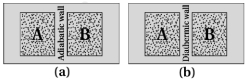
First,the two systems are placed in proximity but are separated by an adiabatic wall,which does not allow the flow of heat energy from one to another. This is shown in figure $(a)$.
Now,suppose the adiabatic wall separating the gases $A$ and $B$ is replaced by a diathermic wall (conducting wall),which allows heat energy to flow from one gas to another. This is shown in figure $(b)$.
It is observed that the macroscopic variables of systems $A$ and $B$ change spontaneously until both systems attain equilibrium states. After this,there is no further change in their states.
The pressure and volume variables of the two gases change to $(P_{A}^{\prime}, V_{A}^{\prime})$ and $(P_{B}^{\prime}, V_{B}^{\prime})$ such that the new states of $A$ and $B$ are in equilibrium with each other. There is no more net energy flow from one to another. This state is called thermal equilibrium.
In thermal equilibrium,the temperatures of the two systems are equal.
Suppose the pressure and volume of gases $A$ and $B$ are $(P_{A}, V_{A})$ and $(P_{B}, V_{B})$ respectively.
First,the two systems are placed in proximity but are separated by an adiabatic wall,which does not allow the flow of heat energy from one to another. This is shown in figure $(a)$.
Now,suppose the adiabatic wall separating the gases $A$ and $B$ is replaced by a diathermic wall (conducting wall),which allows heat energy to flow from one gas to another. This is shown in figure $(b)$.
It is observed that the macroscopic variables of systems $A$ and $B$ change spontaneously until both systems attain equilibrium states. After this,there is no further change in their states.
The pressure and volume variables of the two gases change to $(P_{A}^{\prime}, V_{A}^{\prime})$ and $(P_{B}^{\prime}, V_{B}^{\prime})$ such that the new states of $A$ and $B$ are in equilibrium with each other. There is no more net energy flow from one to another. This state is called thermal equilibrium.
In thermal equilibrium,the temperatures of the two systems are equal.
0 likes
View Solution16
MediumMCQ
Whether the system is in an equilibrium state depends on what?
A
The state variables of the system.
B
The external environment only.
C
The path taken to reach the state.
D
The total energy of the universe.
Solution
(A) system is said to be in an equilibrium state if its macroscopic properties (such as pressure $P$,volume $V$,and temperature $T$) do not change with time.
These properties are known as state variables or state functions.
Therefore,whether a system is in an equilibrium state depends on its state variables.
These properties are known as state variables or state functions.
Therefore,whether a system is in an equilibrium state depends on its state variables.
0 likes
View Solution17
EasyMCQ
What are the characteristics of thermal equilibrium between two systems?
A
The systems have the same pressure.
B
The systems have the same temperature.
C
The systems have the same volume.
D
The systems have the same internal energy.
Solution
(B) Two systems are said to be in thermal equilibrium if their temperatures are equal and do not change with time.
$1$. There is no net flow of heat between the two systems when they are in thermal contact.
$2$. The macroscopic properties of the systems,such as pressure and volume,remain constant over time.
$3$. Thermal equilibrium is a transitive property,which forms the basis of the Zeroth Law of Thermodynamics.
$1$. There is no net flow of heat between the two systems when they are in thermal contact.
$2$. The macroscopic properties of the systems,such as pressure and volume,remain constant over time.
$3$. Thermal equilibrium is a transitive property,which forms the basis of the Zeroth Law of Thermodynamics.
0 likes
View Solution18
MediumMCQ
Is it necessary to change the volume and pressure to bring the equilibrium of a system? Why?
A
Yes,because equilibrium requires constant state variables.
B
No,equilibrium is a state where macroscopic properties like pressure and volume remain constant over time.
C
Yes,because pressure and volume must be zero for equilibrium.
D
No,because pressure and volume are independent of the system's state.
Solution
(B) No,it is not necessary to change the volume and pressure to bring a system to equilibrium.
In fact,the definition of thermodynamic equilibrium is that the macroscopic state variables of the system,such as pressure $(P)$,volume $(V)$,and temperature $(T)$,do not change with time.
If a system is already in equilibrium,its pressure and volume are constant.
If a system is not in equilibrium,it will naturally evolve over time until its properties (like $P$ and $V$) become constant,at which point it reaches equilibrium.
Therefore,equilibrium is characterized by the constancy of these variables,not by the act of changing them.
In fact,the definition of thermodynamic equilibrium is that the macroscopic state variables of the system,such as pressure $(P)$,volume $(V)$,and temperature $(T)$,do not change with time.
If a system is already in equilibrium,its pressure and volume are constant.
If a system is not in equilibrium,it will naturally evolve over time until its properties (like $P$ and $V$) become constant,at which point it reaches equilibrium.
Therefore,equilibrium is characterized by the constancy of these variables,not by the act of changing them.
0 likes
View Solution19
Difficult
Explain and write the Zeroth Law of Thermodynamics.
Solution
(N/A) To determine whether a system is in thermal equilibrium with its surroundings, a third system (body) can be used.
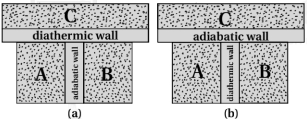
In figure $(a)$, systems $A$ and $B$ are separated by an adiabatic wall, and both are in contact with a third system $C$ separated by a conducting (diathermic) wall. This entire assembly is enclosed by an insulating wall.
The states of the systems (macroscopic variables) do not change until systems $A$ and $B$ attain thermal equilibrium with $C$.
After this, suppose the adiabatic wall between $A$ and $B$ is replaced by a conducting wall, while $C$ is insulated from $A$ and $B$ by an adiabatic wall, as shown in figure $(b)$. It is observed that the states of systems $A$ and $B$ do not change.
This implies that they are in thermal equilibrium with each other. This is the basis of the Zeroth Law of Thermodynamics. Hence, this law is stated as follows:
"Systems that are each in thermal equilibrium with a third system are in thermal equilibrium with each other." This is the Zeroth Law of Thermodynamics.
$R. H. Fowler$ formulated the Zeroth Law of Thermodynamics in $1931$, long after the first and second laws of thermodynamics were stated and numbered.
The Zeroth Law clearly suggests that when two systems $A$ and $B$ are in thermal equilibrium, there must be a physical quantity that has the same value for both.
This variable, whose value is equal for two systems in thermal equilibrium, is called temperature $(T)$.
Thus, if $A$ and $B$ are separately in equilibrium with $C$, then $T_{A} = T_{C}$ and $T_{B} = T_{C}$. This implies that $T_{A} = T_{B}$. This means that systems $A$ and $B$ are also in thermal equilibrium.
Thus, the following conclusion can be drawn from this law: "there exists an important physical quantity called temperature."
In figure $(a)$, systems $A$ and $B$ are separated by an adiabatic wall, and both are in contact with a third system $C$ separated by a conducting (diathermic) wall. This entire assembly is enclosed by an insulating wall.
The states of the systems (macroscopic variables) do not change until systems $A$ and $B$ attain thermal equilibrium with $C$.
After this, suppose the adiabatic wall between $A$ and $B$ is replaced by a conducting wall, while $C$ is insulated from $A$ and $B$ by an adiabatic wall, as shown in figure $(b)$. It is observed that the states of systems $A$ and $B$ do not change.
This implies that they are in thermal equilibrium with each other. This is the basis of the Zeroth Law of Thermodynamics. Hence, this law is stated as follows:
"Systems that are each in thermal equilibrium with a third system are in thermal equilibrium with each other." This is the Zeroth Law of Thermodynamics.
$R. H. Fowler$ formulated the Zeroth Law of Thermodynamics in $1931$, long after the first and second laws of thermodynamics were stated and numbered.
The Zeroth Law clearly suggests that when two systems $A$ and $B$ are in thermal equilibrium, there must be a physical quantity that has the same value for both.
This variable, whose value is equal for two systems in thermal equilibrium, is called temperature $(T)$.
Thus, if $A$ and $B$ are separately in equilibrium with $C$, then $T_{A} = T_{C}$ and $T_{B} = T_{C}$. This implies that $T_{A} = T_{B}$. This means that systems $A$ and $B$ are also in thermal equilibrium.
Thus, the following conclusion can be drawn from this law: "there exists an important physical quantity called temperature."
0 likes
View Solution20
MediumMCQ
Who formulated the zeroth law of thermodynamics?
A
Ralph $H$. Fowler
B
Rudolf Clausius
C
Lord Kelvin
D
Ludwig Boltzmann
Solution
(A) The zeroth law of thermodynamics was formulated by the British physicist Ralph $H$. Fowler in the $1930$s. It states that if two systems are each in thermal equilibrium with a third system,then they are in thermal equilibrium with each other. This law provides the basis for the definition of temperature.
0 likes
View Solution21
MediumMCQ
When do systems at different temperatures attain thermal equilibrium as time passes?
A
When they are isolated from each other.
B
When they reach the same temperature.
C
When the pressure becomes equal.
D
When the volume becomes equal.
Solution
(B) Thermal equilibrium is a state in which two or more systems in thermal contact do not exchange net heat energy.
According to the Zeroth Law of Thermodynamics,when two systems are in thermal contact,heat flows from the system at a higher temperature to the system at a lower temperature.
This process continues until both systems reach the same temperature.
Once the temperatures are equal,the net heat exchange becomes zero,and the systems are said to be in thermal equilibrium.
According to the Zeroth Law of Thermodynamics,when two systems are in thermal contact,heat flows from the system at a higher temperature to the system at a lower temperature.
This process continues until both systems reach the same temperature.
Once the temperatures are equal,the net heat exchange becomes zero,and the systems are said to be in thermal equilibrium.
0 likes
View Solution22
Easy
State the Zeroth Law of Thermodynamics.
Solution
(N/A) The Zeroth Law of Thermodynamics states that if two systems,$A$ and $B$,are each in thermal equilibrium with a third system,$C$,then systems $A$ and $B$ are also in thermal equilibrium with each other.
Thermal equilibrium means that there is no net flow of heat between the systems when they are in contact,which implies that they must be at the same temperature.
Thermal equilibrium means that there is no net flow of heat between the systems when they are in contact,which implies that they must be at the same temperature.
0 likes
View Solution23
MediumMCQ
If $A$ and $B$ are in thermal equilibrium independently with a third system $C$,then what can be said about the systems $A$ and $B$?
A
They are not in thermal equilibrium with each other.
B
They are in thermal equilibrium with each other.
C
They are at different temperatures.
D
They have different internal energies.
Solution
(B) According to the Zeroth Law of Thermodynamics,if two systems $A$ and $B$ are each in thermal equilibrium with a third system $C$,then $A$ and $B$ are also in thermal equilibrium with each other.
This implies that all three systems are at the same temperature.
Therefore,the correct statement is that $A$ and $B$ are in thermal equilibrium with each other.
This implies that all three systems are at the same temperature.
Therefore,the correct statement is that $A$ and $B$ are in thermal equilibrium with each other.
0 likes
View Solution24
Easy
Explain the concept of temperature based on the Zeroth Law of Thermodynamics.
Solution
(N/A) The Zeroth Law of Thermodynamics provides the fundamental basis for the concept of temperature.
Temperature is defined as a physical property that acts as a marker of the 'hotness' or 'coldness' of a body.
It determines the direction of the flow of heat when two bodies are placed in thermal contact.
Heat naturally flows from a body at a higher temperature to a body at a lower temperature.
This flow of heat continues until the temperatures of both bodies equalize,at which point the two bodies are said to be in thermal equilibrium.
Temperature is defined as a physical property that acts as a marker of the 'hotness' or 'coldness' of a body.
It determines the direction of the flow of heat when two bodies are placed in thermal contact.
Heat naturally flows from a body at a higher temperature to a body at a lower temperature.
This flow of heat continues until the temperatures of both bodies equalize,at which point the two bodies are said to be in thermal equilibrium.
0 likes
View Solution25
Easy
Explain the internal energy of a system.
Solution
(N/A) Every bulk system consists of a large number of molecules.
Internal energy is the sum of the kinetic energies and potential energies of these molecules.
In thermodynamics,the kinetic energy of the system as a whole is not relevant.
Thus,the internal energy is the sum of molecular kinetic and potential energies in the frame of reference relative to which the centre of mass of the system is at rest.
Therefore,internal energy is associated with the random motion of the molecules of the system.
Internal energy $U$ is a macroscopic variable of the system.
It depends only on the state of the system,not on how that state was achieved.
Internal energy $U$ of a system is an example of a thermodynamic state variable; its value depends only on the given state of the system,not on the path taken to arrive at that state.
Thus,the internal energy of a given mass of gas depends on its state described by specific values of pressure,volume,and temperature,but it does not depend on how this state of the gas came about.
If we neglect the small intermolecular forces in a gas,the internal energy of a gas is just the sum of kinetic energies associated with various random motions of its molecules.
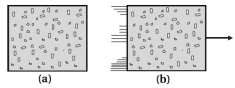
In figure $(a)$,when the box is at rest,the internal energy $U$ of the gas is the sum of the kinetic and potential energies of its molecules. Kinetic energy due to various types of motion like translational,rotational,and vibrational is to be included in $U$.
In figure $(b)$,if the box is moving with some velocity,the kinetic energy of the box as a whole is not to be included in $U$.
Internal energy is the sum of the kinetic energies and potential energies of these molecules.
In thermodynamics,the kinetic energy of the system as a whole is not relevant.
Thus,the internal energy is the sum of molecular kinetic and potential energies in the frame of reference relative to which the centre of mass of the system is at rest.
Therefore,internal energy is associated with the random motion of the molecules of the system.
Internal energy $U$ is a macroscopic variable of the system.
It depends only on the state of the system,not on how that state was achieved.
Internal energy $U$ of a system is an example of a thermodynamic state variable; its value depends only on the given state of the system,not on the path taken to arrive at that state.
Thus,the internal energy of a given mass of gas depends on its state described by specific values of pressure,volume,and temperature,but it does not depend on how this state of the gas came about.
If we neglect the small intermolecular forces in a gas,the internal energy of a gas is just the sum of kinetic energies associated with various random motions of its molecules.
In figure $(a)$,when the box is at rest,the internal energy $U$ of the gas is the sum of the kinetic and potential energies of its molecules. Kinetic energy due to various types of motion like translational,rotational,and vibrational is to be included in $U$.
In figure $(b)$,if the box is moving with some velocity,the kinetic energy of the box as a whole is not to be included in $U$.
0 likes
View Solution26
Medium
Discuss the modes (or methods) for changing the internal energy of any system.
Solution
(N/A) Heat and work are two distinct modes of energy transfer to a system that result in a change in its internal energy.
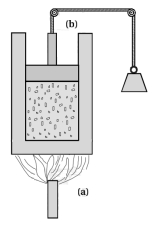
$(a)$ Heat is energy transfer due to a temperature difference between the system and the surroundings.
$(b)$ Work is energy transfer brought about by means (e.g.,moving the piston by raising or lowering some weight connected to it) that do not involve such a temperature difference.
According to the figure,suppose a definite mass of a gas system is in a cylinder.
The state of the gas (mean internal energy) $U$ can change through two modes of changing the state of the system and hence changing the internal energy of the system:
$(i)$ By heating the cylinder containing the gas or keeping the cylinder in contact with a body at a higher temperature,some heat flows from the hotter body to the gas on account of the temperature difference. Therefore,the internal energy of the gas increases.
$(ii)$ By pushing the piston of the cylinder. If work is done on the system (e.g.,compressing the gas),the internal energy of the gas increases.
$(a)$ Heat is energy transfer due to a temperature difference between the system and the surroundings.
$(b)$ Work is energy transfer brought about by means (e.g.,moving the piston by raising or lowering some weight connected to it) that do not involve such a temperature difference.
According to the figure,suppose a definite mass of a gas system is in a cylinder.
The state of the gas (mean internal energy) $U$ can change through two modes of changing the state of the system and hence changing the internal energy of the system:
$(i)$ By heating the cylinder containing the gas or keeping the cylinder in contact with a body at a higher temperature,some heat flows from the hotter body to the gas on account of the temperature difference. Therefore,the internal energy of the gas increases.
$(ii)$ By pushing the piston of the cylinder. If work is done on the system (e.g.,compressing the gas),the internal energy of the gas increases.
0 likes
View Solution27
Difficult
Write the basic difference between heat and internal energy.
Solution
(N/A) The state of a thermodynamic system is characterized by its internal energy,but not by heat. For example,a statement like 'a gas in a given state has a certain amount of heat' is as meaningless as the statement that 'a gas in a given state has a certain amount of work'. In contrast,'a gas in a given state has a certain amount of internal energy' is a valid statement.
Similarly,the statements 'a certain amount of heat is supplied to the system' or 'a certain amount of work was done by the system' are perfectly meaningful.
In short,heat and work in thermodynamics are not state variables. They are modes of energy transfer to a system resulting in a change in its internal energy. Heat is the mode of energy transfer,whereas internal energy is a state function.
Similarly,the statements 'a certain amount of heat is supplied to the system' or 'a certain amount of work was done by the system' are perfectly meaningful.
In short,heat and work in thermodynamics are not state variables. They are modes of energy transfer to a system resulting in a change in its internal energy. Heat is the mode of energy transfer,whereas internal energy is a state function.
0 likes
View Solution28
Medium
What is the internal energy of a system?
Solution
(N/A) The internal energy of a system is the sum of all microscopic forms of energy present within the system.
It includes the kinetic energy of the molecules due to their random motion (translational,rotational,and vibrational) and the potential energy associated with the intermolecular forces and the structure of the molecules.
Internal energy is a state function,meaning it depends only on the current state of the system (defined by variables like pressure,volume,and temperature) and not on the path taken to reach that state.
It is denoted by the symbol $U$.
It includes the kinetic energy of the molecules due to their random motion (translational,rotational,and vibrational) and the potential energy associated with the intermolecular forces and the structure of the molecules.
Internal energy is a state function,meaning it depends only on the current state of the system (defined by variables like pressure,volume,and temperature) and not on the path taken to reach that state.
It is denoted by the symbol $U$.
0 likes
View Solution29
EasyMCQ
The internal energy of a system depends on what?
A
The state of the system
B
The path taken to reach the state
C
The surroundings of the system
D
The external work done on the system
Solution
(A) Internal energy $(U)$ is a state function in thermodynamics.
This means that the internal energy of a system depends only on its current state (defined by variables like pressure $P$,volume $V$,and temperature $T$) and is independent of the path taken to reach that state.
Therefore,the correct option is $A$.
This means that the internal energy of a system depends only on its current state (defined by variables like pressure $P$,volume $V$,and temperature $T$) and is independent of the path taken to reach that state.
Therefore,the correct option is $A$.
0 likes
View Solution30
MediumMCQ
What is heat?
A
$A$ form of energy transferred between systems due to a temperature difference.
B
The total internal energy of a system.
C
The measure of the average kinetic energy of molecules.
D
The work done by a system.
Solution
(A) Heat is defined as the energy in transit between a system and its surroundings or between two systems,occurring solely due to a temperature difference between them.
It is a path function,meaning its value depends on the process taken to reach a state,not just the state itself.
In thermodynamics,heat $(Q)$ is positive when it is added to the system and negative when it is released by the system.
It is a path function,meaning its value depends on the process taken to reach a state,not just the state itself.
In thermodynamics,heat $(Q)$ is positive when it is added to the system and negative when it is released by the system.
0 likes
View Solution31
MediumMCQ
Does any system possess heat or heat energy?
A
Yes,a system possesses heat.
B
Yes,a system possesses heat energy.
C
No,a system does not possess heat or heat energy.
D
Yes,a system possesses both heat and heat energy.
Solution
(C) In thermodynamics,heat is defined as the energy in transit between a system and its surroundings due to a temperature difference.
It is a path function,not a state function.
Therefore,a system does not 'possess' heat.
Instead,a system possesses 'internal energy',which is a state function.
When energy is transferred across the boundary of a system due to a temperature difference,it is referred to as heat.
Thus,the correct answer is that a system does not possess heat or heat energy.
It is a path function,not a state function.
Therefore,a system does not 'possess' heat.
Instead,a system possesses 'internal energy',which is a state function.
When energy is transferred across the boundary of a system due to a temperature difference,it is referred to as heat.
Thus,the correct answer is that a system does not possess heat or heat energy.
0 likes
View Solution32
Easy
Heat is not an object. True or False? Explain.
Solution
(TRUE) The statement is $True$.
Heat is not a physical object or a substance that can be stored within a body.
Instead,heat is a form of energy in transit.
It is the energy transferred between a system and its surroundings due to a temperature difference.
Once the energy is transferred,it is stored in the system as internal energy,not as heat.
Heat is not a physical object or a substance that can be stored within a body.
Instead,heat is a form of energy in transit.
It is the energy transferred between a system and its surroundings due to a temperature difference.
Once the energy is transferred,it is stored in the system as internal energy,not as heat.
0 likes
View Solution33
EasyMCQ
The statement is: "$A$ system cannot possess mechanical energy but possesses work." Correct this statement to make it $\text{TRUE}$.
A
$A$ system possesses internal energy, not work or heat.
B
$A$ system possesses work, not internal energy.
C
$A$ system possesses heat, not internal energy.
D
$A$ system possesses both work and heat.
Solution
(A) In thermodynamics, a system is defined by its state variables, such as internal energy $(U)$, pressure $(P)$, volume $(V)$, and temperature $(T)$.
Work $(W)$ and heat $(Q)$ are path functions, not state functions.
This means that work and heat are energy in transit; they do not exist as properties stored within a system.
$A$ system possesses internal energy, which is a state function.
Therefore, the correct statement is: "$A$ system possesses internal energy, but it does not possess work or heat."
Work $(W)$ and heat $(Q)$ are path functions, not state functions.
This means that work and heat are energy in transit; they do not exist as properties stored within a system.
$A$ system possesses internal energy, which is a state function.
Therefore, the correct statement is: "$A$ system possesses internal energy, but it does not possess work or heat."
0 likes
View Solution34
Medium
State the sign convention for heat and work in thermodynamics.
Solution
(N/A) In thermodynamics,the sign conventions are defined based on the system's perspective:
$1$. Heat $(Q)$:
- If heat is added to the system,$Q$ is positive $(Q > 0)$.
- If heat is removed from the system,$Q$ is negative $(Q < 0)$.
$2$. Work $(W)$:
- If work is done by the system (expansion),$W$ is positive $(W > 0)$.
- If work is done on the system (compression),$W$ is negative $(W < 0)$.
$1$. Heat $(Q)$:
- If heat is added to the system,$Q$ is positive $(Q > 0)$.
- If heat is removed from the system,$Q$ is negative $(Q < 0)$.
$2$. Work $(W)$:
- If work is done by the system (expansion),$W$ is positive $(W > 0)$.
- If work is done on the system (compression),$W$ is negative $(W < 0)$.
0 likes
View Solution35
Medium
What is an isolated system?
Solution
(N/A) An isolated system is a physical system that does not exchange any matter or energy (heat or work) with its surroundings.
In such a system,the total energy and the total mass remain constant over time.
Mathematically,for an isolated system,the change in internal energy $\Delta U = 0$ and the change in mass $\Delta m = 0$.
In such a system,the total energy and the total mass remain constant over time.
Mathematically,for an isolated system,the change in internal energy $\Delta U = 0$ and the change in mass $\Delta m = 0$.
0 likes
View Solution36
Easy
What are state variables?
Solution
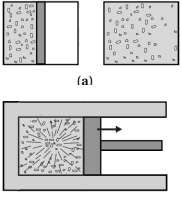
(N/A) Every equilibrium state of a thermodynamic system is described by specific values of some macroscopic variables called state variables.
An equilibrium state of a gas is specified by the values of pressure,volume,temperature,and mass (and composition if there is a mixture of gases).
$A$ thermodynamic system is not always in equilibrium. $A$ gas allowed to expand freely against a vacuum is not in an equilibrium state.
In a box partition shown in figure $(a)$,a gas is filled in one side and there is no gas on the other side. If the partition is suddenly removed,it leads to the free expansion of the gas,and the pressure of the gas may not be uniform.
In a cylinder as shown in figure $(b)$,a mixture of gases undergoing an explosive chemical reaction is not in an equilibrium state,and here its temperature and pressure are not uniform.
Finally,the gas attains a uniform temperature and pressure and reaches thermal and mechanical equilibrium with its surroundings.
An equilibrium state of a gas is specified by the values of pressure,volume,temperature,and mass (and composition if there is a mixture of gases).
$A$ thermodynamic system is not always in equilibrium. $A$ gas allowed to expand freely against a vacuum is not in an equilibrium state.
In a box partition shown in figure $(a)$,a gas is filled in one side and there is no gas on the other side. If the partition is suddenly removed,it leads to the free expansion of the gas,and the pressure of the gas may not be uniform.
In a cylinder as shown in figure $(b)$,a mixture of gases undergoing an explosive chemical reaction is not in an equilibrium state,and here its temperature and pressure are not uniform.
Finally,the gas attains a uniform temperature and pressure and reaches thermal and mechanical equilibrium with its surroundings.
0 likes
View Solution37
Medium
What is a thermodynamic equation of state?
Solution
(N/A) thermodynamic equation of state is a mathematical relationship between the state variables that describe the equilibrium state of a thermodynamic system.
For a simple fluid system,the state variables are typically pressure $(P)$,volume $(V)$,and temperature $(T)$.
The equation of state is expressed as $f(P, V, T) = 0$.
For an ideal gas,the equation of state is given by the ideal gas law: $PV = nRT$,where $n$ is the number of moles and $R$ is the universal gas constant.
For a simple fluid system,the state variables are typically pressure $(P)$,volume $(V)$,and temperature $(T)$.
The equation of state is expressed as $f(P, V, T) = 0$.
For an ideal gas,the equation of state is given by the ideal gas law: $PV = nRT$,where $n$ is the number of moles and $R$ is the universal gas constant.
0 likes
View Solution38
Medium
Write the two kinds of thermodynamic state variables and explain them.
Solution
(N/A) There are two types of thermodynamic state variables:
$(1)$ Extensive variables and $(2)$ Intensive variables.
Extensive variables depend on the size or the amount of matter present in the system. Examples include internal energy $U$,volume $V$,total mass $M$,and entropy $S$.
Intensive variables are independent of the size or the amount of matter present in the system. Examples include pressure $P$,temperature $T$,and density $\rho$.
To distinguish between them,consider a system in equilibrium and imagine dividing it into two equal parts. The variables that remain unchanged for each part are intensive,while those whose values are halved are extensive.
It is useful to check the consistency of thermodynamic equations using this classification. For example,in the equation $\Delta Q = \Delta U + P \Delta V$,all terms are extensive. While pressure $P$ is intensive and $\Delta V$ is extensive,their product $P \Delta V$ is an extensive variable.
$(1)$ Extensive variables and $(2)$ Intensive variables.
Extensive variables depend on the size or the amount of matter present in the system. Examples include internal energy $U$,volume $V$,total mass $M$,and entropy $S$.
Intensive variables are independent of the size or the amount of matter present in the system. Examples include pressure $P$,temperature $T$,and density $\rho$.
To distinguish between them,consider a system in equilibrium and imagine dividing it into two equal parts. The variables that remain unchanged for each part are intensive,while those whose values are halved are extensive.
It is useful to check the consistency of thermodynamic equations using this classification. For example,in the equation $\Delta Q = \Delta U + P \Delta V$,all terms are extensive. While pressure $P$ is intensive and $\Delta V$ is extensive,their product $P \Delta V$ is an extensive variable.
0 likes
View Solution39
MediumMCQ
The equilibrium state of a thermodynamic system is described by what?
A
State variables
B
Path functions
C
Process variables
D
External work
Solution
(A) The equilibrium state of a thermodynamic system is defined by its macroscopic properties,such as pressure $(P)$,volume $(V)$,and temperature $(T)$. These properties are known as state variables or state functions. Unlike path functions (like work and heat),state variables depend only on the current state of the system and not on the path taken to reach that state.
0 likes
View Solution40
EasyMCQ
Which of the following statements correctly describes the relationship between thermodynamic state variables?
A
State variables are independent of each other.
B
State variables depend on the path taken to reach the state.
C
State variables are interdependent and linked by an equation of state.
D
State variables remain constant regardless of the system's condition.
Solution
(C) In thermodynamics,the state of a system is defined by its state variables such as pressure $(P)$,volume $(V)$,temperature $(T)$,and internal energy $(U)$.
These variables are not independent; they are connected by an equation of state,such as the ideal gas law ($PV = nRT$ for an ideal gas).
Therefore,if the values of a sufficient number of state variables are known,the others are automatically determined.
Thus,state variables are interdependent and linked by an equation of state.
These variables are not independent; they are connected by an equation of state,such as the ideal gas law ($PV = nRT$ for an ideal gas).
Therefore,if the values of a sufficient number of state variables are known,the others are automatically determined.
Thus,state variables are interdependent and linked by an equation of state.
0 likes
View Solution41
DifficultMCQ
What are extensive variables and what are intensive variables? What are these variables?
A
Extensive variables depend on the size of the system,while intensive variables do not.
B
Extensive variables are independent of the system size,while intensive variables depend on it.
C
Both depend on the amount of matter in the system.
D
Neither depends on the amount of matter in the system.
Solution
(A) In thermodynamics,variables used to describe the state of a system are called state variables or thermodynamic variables.
$1$. Extensive variables: These are properties whose values depend on the size or the extent of the system (i.e.,the amount of matter present). Examples include mass,volume,internal energy,and entropy.
$2$. Intensive variables: These are properties whose values are independent of the size or the extent of the system. Examples include temperature,pressure,and density.
These variables are fundamental in defining the macroscopic state of a thermodynamic system.
$1$. Extensive variables: These are properties whose values depend on the size or the extent of the system (i.e.,the amount of matter present). Examples include mass,volume,internal energy,and entropy.
$2$. Intensive variables: These are properties whose values are independent of the size or the extent of the system. Examples include temperature,pressure,and density.
These variables are fundamental in defining the macroscopic state of a thermodynamic system.
0 likes
View Solution42
Easy
State the basic principle of thermodynamics.
Solution
(N/A) The basic principle of thermodynamics is the $0^{th}$ Law of Thermodynamics,which states that if two systems are each in thermal equilibrium with a third system,then they are in thermal equilibrium with each other. This law provides the basis for the definition of temperature.
0 likes
View Solution43
DifficultMCQ
What conclusion can be drawn from the zeroth law of thermodynamics?
A
It defines internal energy.
B
It defines temperature.
C
It defines entropy.
D
It defines enthalpy.
Solution
(B) The zeroth law of thermodynamics states that if two systems are each in thermal equilibrium with a third system,they are in thermal equilibrium with each other.
This law provides the fundamental basis for the concept of temperature.
It implies that temperature is a property that determines whether or not a system is in thermal equilibrium with another system.
This law provides the fundamental basis for the concept of temperature.
It implies that temperature is a property that determines whether or not a system is in thermal equilibrium with another system.
0 likes
View Solution44
Medium
Why is work an extensive quantity?
Solution
(N/A) An extensive quantity is a physical quantity whose value is proportional to the size or amount of matter in the system. Work done in a thermodynamic process is given by the integral of pressure $P$ with respect to volume $V$,expressed as $W = \int P \, dV$. Since pressure $P$ is an intensive quantity (independent of the amount of matter) and volume $V$ is an extensive quantity (proportional to the amount of matter),their product (or the integral of their product) results in an extensive quantity. Therefore,work is an extensive quantity.
0 likes
View Solution45
DifficultMCQ
Can any system possess heat?
A
Yes,it is a state function.
B
No,heat is a process.
C
Yes,it is an internal property.
D
Only at absolute zero.
Solution
(B) No,a system cannot possess heat. Heat is defined as the energy in transit between a system and its surroundings due to a temperature difference. It is a path function,not a state function. Therefore,it is a process,not a property that a system can 'have' or 'possess'.
0 likes
View Solution46
Medium
Can any system possess thermal energy?
Solution
(N/A) Yes,every system possesses thermal energy. Thermal energy is the internal energy of a system due to the random motion of its constituent particles (atoms or molecules). As long as a system has a temperature above absolute zero $(0 \ K)$,its particles possess kinetic energy,which manifests as thermal energy.
0 likes
View Solution47
EasyMCQ
Heat is not an object in a body. True or False?
A
True
B
False
Solution
(A) Heat is a form of energy in transit between a system and its surroundings due to a temperature difference. It is not a property or an object contained within a body. $A$ body contains internal energy,not heat. Therefore,the statement is True.
0 likes
View Solution48
MediumMCQ
The following three objects $(1)$ a metal tray,$(2)$ a block of wood,and $(3)$ a woolen cap are left in a closed room overnight. Next day,the temperature of each is recorded as $T_1, T_2$,and $T_3$,respectively. The likely situation is:
A
$T_1 = T_2 = T_3$
B
$T_3 > T_2 > T_1$
C
$T_3 = T_2 > T_1$
D
$T_3 > T_2 = T_1$
Solution
(A) When objects are left in a closed room for a long duration (overnight),they exchange heat with the surrounding air until they reach thermal equilibrium.
According to the Zeroth Law of Thermodynamics,if two systems are in thermal equilibrium with a third system,they are in thermal equilibrium with each other.
Since all three objects are in the same room,they will eventually reach the same temperature as the room's ambient temperature.
Therefore,$T_1 = T_2 = T_3$.
According to the Zeroth Law of Thermodynamics,if two systems are in thermal equilibrium with a third system,they are in thermal equilibrium with each other.
Since all three objects are in the same room,they will eventually reach the same temperature as the room's ambient temperature.
Therefore,$T_1 = T_2 = T_3$.
0 likes
View Solution49
EasyMCQ
Select the correct statement related to heat.
A
Heat is possessed by a body.
B
Hot water contains more heat as compared to cold water.
C
Heat is an energy which flows due to temperature difference.
D
All of these.
Solution
(C) The correct statement is $(C)$.
Heat is defined as the form of energy that is transferred between systems or bodies due to a temperature difference. It is a transient phenomenon,meaning it exists only while it is in transit. $A$ body does not 'possess' heat; instead,it possesses internal energy. Therefore,options $(A)$ and $(B)$ are conceptually incorrect because they treat heat as a state function or a property of a body.
Heat is defined as the form of energy that is transferred between systems or bodies due to a temperature difference. It is a transient phenomenon,meaning it exists only while it is in transit. $A$ body does not 'possess' heat; instead,it possesses internal energy. Therefore,options $(A)$ and $(B)$ are conceptually incorrect because they treat heat as a state function or a property of a body.
0 likes
View SolutionThermodynamics — Basic of Thermodynamics and Zeroth Law · Frequently Asked Questions
1Are these Thermodynamics questions useful for JEE and NEET?
Yes. All questions in this section are mapped to JEE Main and NEET exam patterns. Previous year questions from JEE Main, NEET, GUJCET and state-level exams are included with full solutions.
2Can I switch to Hindi or Gujarati for these questions?
Yes. Use the language tabs in the hero section or the sidebar to view the same questions and solutions in English, Hindi or Gujarati.
3How do I generate a question paper from this subtopic?
Use the Vedclass Exam Paper Generator — select the chapter and subtopic, set difficulty, and generate Sets A, B, C, D automatically. First 3 chapters of every subject are free.
Vedclass Products
For Students
Vedclass Test Series
Mock tests in real JEE/NEET style with performance analysis. 5-day free trial.
Start Free TrialFor Teachers
Exam Paper Generator
Generate Set A/B/C/D papers from this chapter in 2 minutes. 3 chapters free.
Try FreeFor Institutes
Online Exam Module
Live online exams with unlimited students, 360° analytics & white-label branding.
See DemoFor Teachers & Institutes
Generate a Thermodynamics Exam Paper in 2 Minutes
Select subtopic & difficulty — Sets A, B, C, D auto-generated with No Repeat logic.
First 3 chapters of every subject are free — no payment required.