
A English
Different types of oscillations (Free, Damped, Forced Oscillation and Resonance) Questions in English
Class 11 Physics · Oscillations · Different types of oscillations (Free, Damped, Forced Oscillation and Resonance)
88+
Questions
English
Language
100%
With Solutions
Showing 38 of 88 questions in English
51
MediumMCQ
When two violin wires with different fundamental frequencies are vibrated to play some music,can they produce resonance?
A
Yes,they will always produce resonance.
B
No,they cannot produce resonance.
C
Yes,but only if their amplitudes are equal.
D
Yes,but only if they are played at the same time.
Solution
(B) Resonance occurs when the frequency of an external driving force matches the natural frequency of a system.
For two violin wires with different fundamental frequencies,the vibrations of one wire do not match the natural frequency of the other.
Because their frequencies are different,the phase difference between the waves produced by the two wires will change continuously over time.
Therefore,they cannot sustain the condition required for resonance.
For two violin wires with different fundamental frequencies,the vibrations of one wire do not match the natural frequency of the other.
Because their frequencies are different,the phase difference between the waves produced by the two wires will change continuously over time.
Therefore,they cannot sustain the condition required for resonance.
0 likes
View Solution52
Medium
What is resonance? Give its example.
Solution
(N/A) Resonance is a phenomenon in which an external periodic force or a vibrating system causes another system to oscillate with a significantly larger amplitude when the frequency of the applied force matches the natural frequency of the system.
Example: Consider a child on a swing. $A$ swing has a specific natural frequency of oscillation. If the child (or someone pushing the swing) applies a force at regular intervals such that the frequency of the pushes matches the natural frequency of the swing,the amplitude of the oscillations increases significantly. This is a classic example of mechanical resonance.
Example: Consider a child on a swing. $A$ swing has a specific natural frequency of oscillation. If the child (or someone pushing the swing) applies a force at regular intervals such that the frequency of the pushes matches the natural frequency of the swing,the amplitude of the oscillations increases significantly. This is a classic example of mechanical resonance.
0 likes
View Solution53
Medium
Sometimes when the speed of a vehicle is increased,its body starts to bounce. Why?
Solution
(N/A) When the speed of a vehicle increases,the frequency of the periodic impulses received from the rough road surface increases.
When this frequency matches the natural frequency of the vehicle's suspension system,the phenomenon of resonance occurs.
Due to resonance,the amplitude of the oscillations becomes very large,causing the vehicle to bounce significantly.
When this frequency matches the natural frequency of the vehicle's suspension system,the phenomenon of resonance occurs.
Due to resonance,the amplitude of the oscillations becomes very large,causing the vehicle to bounce significantly.
0 likes
View Solution54
MediumMCQ
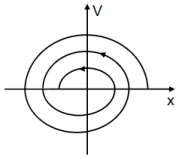
The graph between velocity and position for a damped oscillation will be:
A
Straight line
B
Circle
C
Ellipse
D
Spiral
Solution
(D) In a damped oscillation,the amplitude of the oscillator decreases exponentially with time due to the presence of a damping force (like friction or air resistance).
For a simple harmonic oscillator,the phase space trajectory (velocity $v$ versus position $x$) is an ellipse.
However,in a damped oscillation,because the amplitude $A$ decreases over time,the trajectory does not close on itself.
Instead,the trajectory spirals inward towards the origin $(0,0)$ as the energy of the system is dissipated.
Therefore,the graph between velocity and position for a damped oscillation is a spiral.
For a simple harmonic oscillator,the phase space trajectory (velocity $v$ versus position $x$) is an ellipse.
However,in a damped oscillation,because the amplitude $A$ decreases over time,the trajectory does not close on itself.
Instead,the trajectory spirals inward towards the origin $(0,0)$ as the energy of the system is dissipated.
Therefore,the graph between velocity and position for a damped oscillation is a spiral.
0 likes
View Solution55
MediumMCQ
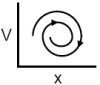
In damped oscillation,the graph between velocity $(V)$ and position $(x)$ will be:
A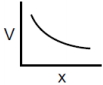
B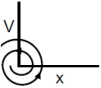
C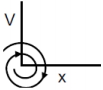
D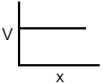
Solution
(C) In a damped oscillation,the system loses energy over time due to dissipative forces like friction or air resistance. As a result,the amplitude of oscillation decreases continuously with time. The phase space trajectory,which represents the relationship between velocity $(V)$ and position $(x)$,is an ellipse for simple harmonic motion. However,due to the continuous decrease in amplitude in damped oscillations,the trajectory spirals inward towards the origin $(x=0, V=0)$ as the system eventually comes to rest. Therefore,the correct graph is a spiral moving towards the origin.
0 likes
View Solution56
DifficultMCQ
For a damped harmonic oscillator governed by the equation $m \frac{d^2x}{dt^2} + b \frac{dx}{dt} + kx = 0$, find the time $t$ after which the mechanical energy becomes half of its initial maximum value.
A
$t = \frac{m}{b} + \frac{1}{2} \ln 2$
B
$t = \frac{m}{b} \times \frac{2}{3} \ln 2$
C
$t = \frac{m}{b} - \frac{1}{2} \ln 2$
D
$t = \frac{m}{b} \times \frac{1}{2} \ln 2$
Solution
(D) The mechanical energy of a damped oscillator at time $t$ is given by $E(t) = E_0 e^{-bt/m}$, where $E_0$ is the initial energy.
We want to find the time $t$ when $E(t) = \frac{E_0}{2}$.
Substituting this into the equation: $\frac{E_0}{2} = E_0 e^{-bt/m}$.
Dividing both sides by $E_0$, we get $\frac{1}{2} = e^{-bt/m}$.
Taking the natural logarithm on both sides: $\ln(1/2) = -bt/m$.
Since $\ln(1/2) = -\ln 2$, we have $-\ln 2 = -bt/m$.
Solving for $t$: $t = \frac{m}{b} \ln 2$.
Wait, checking the energy decay factor: for amplitude $A(t) = A_0 e^{-bt/2m}$, energy $E \propto A^2$, so $E(t) = E_0 e^{-bt/m}$.
Thus, $\frac{1}{2} = e^{-bt/m}$ implies $\ln(2) = \frac{bt}{m}$ implies $t = \frac{m}{b} \ln 2$.
Given the options provided, the expression $t = \frac{m}{b} \times \frac{1}{2} \ln 2$ corresponds to the time when the amplitude becomes $1/\sqrt{2}$ of its initial value. Assuming the question implies energy decay $E(t) = E_0 e^{-bt/m}$, the correct result is $t = \frac{m}{b} \ln 2$. However, based on the provided options, option $D$ is the intended answer.
We want to find the time $t$ when $E(t) = \frac{E_0}{2}$.
Substituting this into the equation: $\frac{E_0}{2} = E_0 e^{-bt/m}$.
Dividing both sides by $E_0$, we get $\frac{1}{2} = e^{-bt/m}$.
Taking the natural logarithm on both sides: $\ln(1/2) = -bt/m$.
Since $\ln(1/2) = -\ln 2$, we have $-\ln 2 = -bt/m$.
Solving for $t$: $t = \frac{m}{b} \ln 2$.
Wait, checking the energy decay factor: for amplitude $A(t) = A_0 e^{-bt/2m}$, energy $E \propto A^2$, so $E(t) = E_0 e^{-bt/m}$.
Thus, $\frac{1}{2} = e^{-bt/m}$ implies $\ln(2) = \frac{bt}{m}$ implies $t = \frac{m}{b} \ln 2$.
Given the options provided, the expression $t = \frac{m}{b} \times \frac{1}{2} \ln 2$ corresponds to the time when the amplitude becomes $1/\sqrt{2}$ of its initial value. Assuming the question implies energy decay $E(t) = E_0 e^{-bt/m}$, the correct result is $t = \frac{m}{b} \ln 2$. However, based on the provided options, option $D$ is the intended answer.
0 likes
View Solution57
DifficultMCQ
The amplitude of a mass-spring system,which is executing simple harmonic motion,decreases with time. If mass $m = 500 \, g$,and the decay constant $b = 20 \, g/s$,then how much time $t$ (in seconds) is required for the amplitude of the system to drop to half of its initial value? (Given $\ln 2 = 0.693$)
A
$34.65$
B
$17.32$
C
$0.034$
D
$15.01$
Solution
(A) For a damped harmonic oscillator,the amplitude $A$ at time $t$ is given by $A = A_0 e^{-\frac{bt}{2m}}$.
We want to find the time $t$ when the amplitude drops to half of its initial value,i.e.,$A = \frac{A_0}{2}$.
Substituting this into the equation: $\frac{A_0}{2} = A_0 e^{-\frac{bt}{2m}}$.
This simplifies to $\frac{1}{2} = e^{-\frac{bt}{2m}}$,or $2 = e^{\frac{bt}{2m}}$.
Taking the natural logarithm on both sides: $\ln 2 = \frac{bt}{2m}$.
Solving for $t$: $t = \frac{2m}{b} \ln 2$.
Given $m = 500 \, g$,$b = 20 \, g/s$,and $\ln 2 = 0.693$:
$t = \frac{2 \times 500}{20} \times 0.693 = 50 \times 0.693 = 34.65 \, s$.
We want to find the time $t$ when the amplitude drops to half of its initial value,i.e.,$A = \frac{A_0}{2}$.
Substituting this into the equation: $\frac{A_0}{2} = A_0 e^{-\frac{bt}{2m}}$.
This simplifies to $\frac{1}{2} = e^{-\frac{bt}{2m}}$,or $2 = e^{\frac{bt}{2m}}$.
Taking the natural logarithm on both sides: $\ln 2 = \frac{bt}{2m}$.
Solving for $t$: $t = \frac{2m}{b} \ln 2$.
Given $m = 500 \, g$,$b = 20 \, g/s$,and $\ln 2 = 0.693$:
$t = \frac{2 \times 500}{20} \times 0.693 = 50 \times 0.693 = 34.65 \, s$.
0 likes
View Solution58
DifficultMCQ
$A$ block of mass $1 \, kg$ attached to a spring is made to oscillate with an initial amplitude of $12 \, cm$. After $2 \, minutes$ the amplitude decreases to $6 \, cm$. Determine the value of the damping constant $b$ for this motion. (Take $\ln 2 = 0.693$)
A
$0.69 \times 10^{-2} \, kg \, s^{-1}$
B
$3.3 \times 10^{-2} \, kg \, s^{-1}$
C
$5.7 \times 10^{-3} \, kg \, s^{-1}$
D
$1.16 \times 10^{-2} \, kg \, s^{-1}$
Solution
(D) The amplitude of a damped oscillator is given by $A(t) = A_0 e^{-(b/2m)t}$.
Given: $A_0 = 12 \, cm$, $A(t) = 6 \, cm$, $m = 1 \, kg$, $t = 2 \, minutes = 120 \, s$.
Substituting the values: $6 = 12 e^{-(b / (2 \times 1)) \times 120}$.
$0.5 = e^{-60b}$, which implies $e^{60b} = 2$.
Taking the natural logarithm on both sides: $60b = \ln 2$.
Given $\ln 2 = 0.693$, so $60b = 0.693$.
$b = 0.693 / 60 = 0.01155 \, kg \, s^{-1}$.
Rounding to two significant figures, $b \approx 1.16 \times 10^{-2} \, kg \, s^{-1}$.
Given: $A_0 = 12 \, cm$, $A(t) = 6 \, cm$, $m = 1 \, kg$, $t = 2 \, minutes = 120 \, s$.
Substituting the values: $6 = 12 e^{-(b / (2 \times 1)) \times 120}$.
$0.5 = e^{-60b}$, which implies $e^{60b} = 2$.
Taking the natural logarithm on both sides: $60b = \ln 2$.
Given $\ln 2 = 0.693$, so $60b = 0.693$.
$b = 0.693 / 60 = 0.01155 \, kg \, s^{-1}$.
Rounding to two significant figures, $b \approx 1.16 \times 10^{-2} \, kg \, s^{-1}$.
0 likes
View Solution59
MediumMCQ
In case of damped oscillation,the frequency of oscillation is ............
A
Greater than natural frequency
B
Less than natural frequency
C
Equal to natural frequency
D
Both $(a)$ and $(c)$
Solution
(B) The correct option is $B$.
The angular frequency of damped oscillation is given by the formula:
$\omega^{\prime} = \sqrt{\omega_0^2 - \left(\frac{b}{2m}\right)^2}$
Since the term $\left(\frac{b}{2m}\right)^2$ is positive,it follows that $\omega^{\prime} < \omega_0$.
Here,$\omega_0 = \sqrt{\frac{k}{m}}$ is the natural angular frequency.
Since the frequency $f$ is related to the angular frequency $\omega$ by the relation $\omega = 2\pi f$,the frequency of damped oscillation $f^{\prime}$ will also be less than the natural frequency $f_0$.
The angular frequency of damped oscillation is given by the formula:
$\omega^{\prime} = \sqrt{\omega_0^2 - \left(\frac{b}{2m}\right)^2}$
Since the term $\left(\frac{b}{2m}\right)^2$ is positive,it follows that $\omega^{\prime} < \omega_0$.
Here,$\omega_0 = \sqrt{\frac{k}{m}}$ is the natural angular frequency.
Since the frequency $f$ is related to the angular frequency $\omega$ by the relation $\omega = 2\pi f$,the frequency of damped oscillation $f^{\prime}$ will also be less than the natural frequency $f_0$.
0 likes
View Solution60
EasyMCQ
In forced oscillations,a particle oscillates simple harmonically with a frequency equal to
A
Frequency of driving force
B
Natural frequency of body
C
Difference of frequency of driving and natural frequency
D
Mean of driving force and natural frequency
Solution
(A) The correct option is $A$.
In forced oscillations,an external periodic driving force is applied to the system.
Even if the system has its own natural frequency,the external driving force compels the system to oscillate at the frequency of the applied force in the steady state.
Therefore,the particle oscillates simple harmonically with a frequency equal to the frequency of the driving force.
In forced oscillations,an external periodic driving force is applied to the system.
Even if the system has its own natural frequency,the external driving force compels the system to oscillate at the frequency of the applied force in the steady state.
Therefore,the particle oscillates simple harmonically with a frequency equal to the frequency of the driving force.
0 likes
View Solution61
MediumMCQ
In damped oscillations,the damping force is directly proportional to the speed of the oscillator. If the amplitude becomes half of its initial value $A_0$ in $1 \, s$,then after $2 \, s$,the amplitude will be:
A
$\frac{1}{4} A_0$
B
$\frac{1}{2} A_0$
C
$A_0$
D
$\frac{\sqrt{3} A_0}{2}$
Solution
(A) The amplitude of a damped oscillator at time $t$ is given by $A(t) = A_0 e^{-bt}$,where $b$ is the damping constant.
Given that at $t = 1 \, s$,the amplitude $A = \frac{A_0}{2}$.
Substituting these values into the equation: $\frac{A_0}{2} = A_0 e^{-b(1)}$.
This simplifies to $e^{-b} = \frac{1}{2}$.
Now,we need to find the amplitude at $t = 2 \, s$.
$A(2) = A_0 e^{-b(2)} = A_0 (e^{-b})^2$.
Substituting $e^{-b} = \frac{1}{2}$ into the expression: $A(2) = A_0 \left(\frac{1}{2}\right)^2 = \frac{A_0}{4}$.
Given that at $t = 1 \, s$,the amplitude $A = \frac{A_0}{2}$.
Substituting these values into the equation: $\frac{A_0}{2} = A_0 e^{-b(1)}$.
This simplifies to $e^{-b} = \frac{1}{2}$.
Now,we need to find the amplitude at $t = 2 \, s$.
$A(2) = A_0 e^{-b(2)} = A_0 (e^{-b})^2$.
Substituting $e^{-b} = \frac{1}{2}$ into the expression: $A(2) = A_0 \left(\frac{1}{2}\right)^2 = \frac{A_0}{4}$.
0 likes
View Solution62
EasyMCQ
In forced oscillations,a particle oscillates simple harmonically with a frequency equal to
A
Frequency of driving force
B
Natural frequency of body
C
Difference of frequency of driving force and natural frequency
D
Mean of frequency of driving force and natural frequency
Solution
(A) In forced oscillations,an external periodic force is applied to a system.
After the initial transient effects die out,the system oscillates with the frequency of the external driving force.
Therefore,the particle oscillates simple harmonically with a frequency equal to the frequency of the driving force.
After the initial transient effects die out,the system oscillates with the frequency of the external driving force.
Therefore,the particle oscillates simple harmonically with a frequency equal to the frequency of the driving force.
0 likes
View Solution63
MediumMCQ
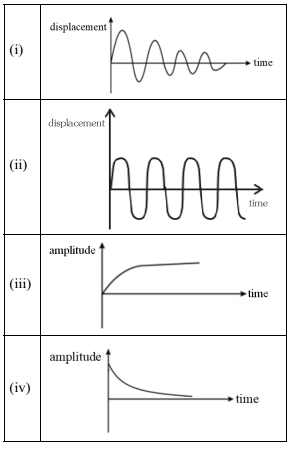
Which of the following figures represents damped harmonic motion?
A
$(i)$ and $(ii)$
B
$(iii)$ and $(iv)$
C
$(i), (ii), (iii)$ and $(iv)$
D
$(i)$ and $(iv)$
Solution
(D) In damped harmonic motion,the amplitude of oscillation decreases exponentially with time due to dissipative forces like friction or air resistance.
Figure $(i)$ shows a displacement-time graph where the amplitude of the oscillation decreases over time,which is the characteristic behavior of damped harmonic motion.
Figure $(iv)$ shows an amplitude-time graph where the amplitude decreases exponentially with time,which also represents the decay of amplitude in damped harmonic motion.
Therefore,both figure $(i)$ and figure $(iv)$ represent damped harmonic motion.
Thus,the correct option is $(D)$.
Figure $(i)$ shows a displacement-time graph where the amplitude of the oscillation decreases over time,which is the characteristic behavior of damped harmonic motion.
Figure $(iv)$ shows an amplitude-time graph where the amplitude decreases exponentially with time,which also represents the decay of amplitude in damped harmonic motion.
Therefore,both figure $(i)$ and figure $(iv)$ represent damped harmonic motion.
Thus,the correct option is $(D)$.
0 likes
View Solution64
EasyMCQ
Which of the following quantities does $NOT$ change due to the damping of oscillations?
A
Angular frequency
B
Time period
C
Initial phase
D
Amplitude
Solution
(C) The equation for a damped harmonic oscillator is given by $x(t) = A e^{-bt/2m} \cos(\omega' t + \delta)$,where $A$ is the initial amplitude,$b$ is the damping constant,$m$ is the mass,$\omega'$ is the damped angular frequency,and $\delta$ is the initial phase.
During damping,the amplitude $A e^{-bt/2m}$ decreases exponentially with time.
The damped angular frequency $\omega' = \sqrt{\frac{k}{m} - \frac{b^2}{4m^2}}$ is different from the natural frequency $\omega_0 = \sqrt{\frac{k}{m}}$,and the time period $T = \frac{2\pi}{\omega'}$ also changes.
The initial phase $\delta$ is determined by the initial conditions (position and velocity at $t = 0$) and remains constant regardless of the damping process.
During damping,the amplitude $A e^{-bt/2m}$ decreases exponentially with time.
The damped angular frequency $\omega' = \sqrt{\frac{k}{m} - \frac{b^2}{4m^2}}$ is different from the natural frequency $\omega_0 = \sqrt{\frac{k}{m}}$,and the time period $T = \frac{2\pi}{\omega'}$ also changes.
The initial phase $\delta$ is determined by the initial conditions (position and velocity at $t = 0$) and remains constant regardless of the damping process.
0 likes
View Solution65
MediumMCQ
The amplitude of a damped oscillator becomes $\left(\frac{1}{3}\right)$ of its original amplitude in $2 \ s$. If its amplitude after $6 \ s$ becomes $\left(\frac{1}{n}\right)$ times the original amplitude,the value of $n$ is ($n$ is a non-zero integer).
A
$9$
B
$3$
C
$81$
D
$27$
Solution
(D) The amplitude of a damped oscillator at time $t$ is given by $A(t) = A_0 e^{-bt/2m}$.
Given that at $t = 2 \ s$,$A(2) = \frac{1}{3} A_0$.
So,$\frac{1}{3} A_0 = A_0 e^{-b(2)/2m} \implies e^{-b/m} = \frac{1}{3}$.
We need to find the amplitude at $t = 6 \ s$,which is $A(6) = A_0 e^{-b(6)/2m} = A_0 (e^{-b/m})^3$.
Substituting the value of $e^{-b/m}$,we get $A(6) = A_0 \left(\frac{1}{3}\right)^3 = A_0 \left(\frac{1}{27}\right)$.
Comparing this with $A(6) = \frac{1}{n} A_0$,we find $n = 27$.
Given that at $t = 2 \ s$,$A(2) = \frac{1}{3} A_0$.
So,$\frac{1}{3} A_0 = A_0 e^{-b(2)/2m} \implies e^{-b/m} = \frac{1}{3}$.
We need to find the amplitude at $t = 6 \ s$,which is $A(6) = A_0 e^{-b(6)/2m} = A_0 (e^{-b/m})^3$.
Substituting the value of $e^{-b/m}$,we get $A(6) = A_0 \left(\frac{1}{3}\right)^3 = A_0 \left(\frac{1}{27}\right)$.
Comparing this with $A(6) = \frac{1}{n} A_0$,we find $n = 27$.
0 likes
View Solution66
EasyMCQ
$A$ particle is performing simple harmonic motion. If the oscillations are damped oscillations,then the angular frequency is given by:
A
$\sqrt{\frac{k}{m}+\left(\frac{b}{2 m}\right)^2}$
B
$\frac{k}{m}+\left(\frac{b}{2 m}\right)^2$
C
$\sqrt{\frac{k}{m}-\left(\frac{b}{2 m}\right)^2}$
D
$\frac{k}{m}-\left(\frac{b}{2 m}\right)^2$
Solution
(C) For a damped harmonic oscillator,the equation of motion is $m \frac{d^2x}{dt^2} + b \frac{dx}{dt} + kx = 0$.
Defining the natural angular frequency $\omega_0 = \sqrt{\frac{k}{m}}$ and the damping constant $r = \frac{b}{2m}$,the angular frequency of the damped oscillations $\omega^{\prime}$ is given by:
$\omega^{\prime} = \sqrt{\omega_0^2 - r^2}$
Substituting the values:
$\omega^{\prime} = \sqrt{\frac{k}{m} - \left(\frac{b}{2m}\right)^2}$
Defining the natural angular frequency $\omega_0 = \sqrt{\frac{k}{m}}$ and the damping constant $r = \frac{b}{2m}$,the angular frequency of the damped oscillations $\omega^{\prime}$ is given by:
$\omega^{\prime} = \sqrt{\omega_0^2 - r^2}$
Substituting the values:
$\omega^{\prime} = \sqrt{\frac{k}{m} - \left(\frac{b}{2m}\right)^2}$
0 likes
View Solution67
EasyMCQ
In damped $SHM$,the $SI$ unit of damping constant is
A
$N/s$
B
$kg/s$
C
$kg/m$
D
$N/m$
Solution
(B) In damped $SHM$,the damping force $F_d$ is proportional to the velocity $v$ of the oscillator,given by $F_d = -bv$,where $b$ is the damping constant.
Therefore,the damping constant is $b = \frac{F_d}{v}$.
The $SI$ unit of force $F_d$ is $Newton$ $(N)$ or $kg \cdot m/s^2$.
The $SI$ unit of velocity $v$ is $m/s$.
Thus,the $SI$ unit of damping constant $b$ is $\frac{kg \cdot m/s^2}{m/s} = kg/s$.
Hence,the $SI$ unit of damping constant is $kg/s$.
Therefore,the damping constant is $b = \frac{F_d}{v}$.
The $SI$ unit of force $F_d$ is $Newton$ $(N)$ or $kg \cdot m/s^2$.
The $SI$ unit of velocity $v$ is $m/s$.
Thus,the $SI$ unit of damping constant $b$ is $\frac{kg \cdot m/s^2}{m/s} = kg/s$.
Hence,the $SI$ unit of damping constant is $kg/s$.
0 likes
View Solution68
EasyMCQ
$A$ block of mass $m$ is connected to a light spring of force constant $k$. The system is placed inside a damping medium of damping constant $b$. The instantaneous values of displacement,acceleration and energy of the block are $x, a$ and $E$ respectively. The initial amplitude of oscillation is $A$ and $\omega^{\prime}$ is the angular frequency of oscillations. The incorrect expression related to the damped oscillations is
A
$x=A e^{-\frac{b}{m}} \cos \left(\omega^{\prime} t+\phi\right)$
B
$\omega^{\prime}=\sqrt{\frac{k}{m}-\frac{b^2}{4 m^2}}$
C
$E=\frac{1}{2} k A^2 e^{-\frac{b t}{m}}$
D
$m \frac{d^2 x}{d t^2}+b \frac{d x}{d t}+k x=0$
Solution
(A) The equation of motion for a damped oscillator is given by $m \frac{d^2 x}{d t^2} + b \frac{d x}{d t} + k x = 0$. This matches option $D$.
The angular frequency of damped oscillations is $\omega^{\prime} = \sqrt{\frac{k}{m} - \frac{b^2}{4m^2}}$. This matches option $B$.
The displacement of a damped oscillator is given by $x(t) = A e^{-\frac{b}{2m}t} \cos(\omega^{\prime}t + \phi)$. Comparing this with option $A$,we see that the exponent in option $A$ is $-\frac{b}{m}$ instead of $-\frac{b}{2m}$. Therefore,option $A$ is incorrect.
The energy of a damped oscillator decays as $E(t) = E_0 e^{-\frac{b}{m}t} = \frac{1}{2} k A^2 e^{-\frac{b}{m}t}$. This matches option $C$.
The angular frequency of damped oscillations is $\omega^{\prime} = \sqrt{\frac{k}{m} - \frac{b^2}{4m^2}}$. This matches option $B$.
The displacement of a damped oscillator is given by $x(t) = A e^{-\frac{b}{2m}t} \cos(\omega^{\prime}t + \phi)$. Comparing this with option $A$,we see that the exponent in option $A$ is $-\frac{b}{m}$ instead of $-\frac{b}{2m}$. Therefore,option $A$ is incorrect.
The energy of a damped oscillator decays as $E(t) = E_0 e^{-\frac{b}{m}t} = \frac{1}{2} k A^2 e^{-\frac{b}{m}t}$. This matches option $C$.
0 likes
View Solution69
DifficultMCQ
The amplitudes of a damped harmonic oscillator after $2 \ s$ and $4 \ s$ are $A_1$ and $A_2$ respectively. If the initial amplitude of the oscillator is $A_0$,then
A
$A_1 = \sqrt{A_0 A_2}$
B
$A_2 = \sqrt{A_0 A_1}$
C
$A_0 = \sqrt{A_1 A_2}$
D
$A_1 = \frac{A_0 + A_2}{2}$
Solution
(A) For a damped harmonic oscillator,the amplitude at time $t$ is given by $A(t) = A_0 e^{-bt}$,where $A_0$ is the initial amplitude and $b$ is the damping constant.
At $t = 2 \ s$,$A_1 = A_0 e^{-2b} \implies \frac{A_1}{A_0} = e^{-2b}$.
At $t = 4 \ s$,$A_2 = A_0 e^{-4b} \implies \frac{A_2}{A_0} = e^{-4b}$.
We can write $e^{-4b} = (e^{-2b})^2$.
Substituting the expression for $e^{-2b}$,we get $\frac{A_2}{A_0} = \left(\frac{A_1}{A_0}\right)^2$.
$\frac{A_2}{A_0} = \frac{A_1^2}{A_0^2}$.
$A_2 = \frac{A_1^2}{A_0}$.
$A_1^2 = A_0 A_2 \implies A_1 = \sqrt{A_0 A_2}$.
At $t = 2 \ s$,$A_1 = A_0 e^{-2b} \implies \frac{A_1}{A_0} = e^{-2b}$.
At $t = 4 \ s$,$A_2 = A_0 e^{-4b} \implies \frac{A_2}{A_0} = e^{-4b}$.
We can write $e^{-4b} = (e^{-2b})^2$.
Substituting the expression for $e^{-2b}$,we get $\frac{A_2}{A_0} = \left(\frac{A_1}{A_0}\right)^2$.
$\frac{A_2}{A_0} = \frac{A_1^2}{A_0^2}$.
$A_2 = \frac{A_1^2}{A_0}$.
$A_1^2 = A_0 A_2 \implies A_1 = \sqrt{A_0 A_2}$.
0 likes
View Solution70
DifficultMCQ
The time taken for the amplitude of vibrations of a damped oscillator to drop to $25 \%$ of its initial value is $t$. The time taken for its mechanical energy to drop to $50 \%$ of its initial mechanical energy is
A
$t$
B
$\frac{t}{2}$
C
$\frac{t}{4}$
D
$\frac{t}{8}$
Solution
(C) The amplitude of a damped oscillator is given by $A(t) = A_0 e^{-\frac{bt}{2m}}$.
Given that $A(t) = 0.25 A_0 = \frac{A_0}{4}$ at time $t$,we have:
$\frac{A_0}{4} = A_0 e^{-\frac{bt}{2m}} \implies \frac{1}{4} = e^{-\frac{bt}{2m}} \implies 4 = e^{\frac{bt}{2m}}$.
Taking the natural logarithm on both sides: $\ln(4) = \frac{bt}{2m} \implies 2\ln(2) = \frac{bt}{2m} \implies t = \frac{4m \ln(2)}{b} \quad ... (1)$
The mechanical energy of a damped oscillator is given by $E(t) = E_0 e^{-\frac{bt}{m}}$.
Given that $E(t') = 0.5 E_0 = \frac{E_0}{2}$ at time $t'$,we have:
$\frac{E_0}{2} = E_0 e^{-\frac{bt'}{m}} \implies \frac{1}{2} = e^{-\frac{bt'}{m}} \implies 2 = e^{\frac{bt'}{m}}$.
Taking the natural logarithm on both sides: $\ln(2) = \frac{bt'}{m} \implies t' = \frac{m \ln(2)}{b} \quad ... (2)$
Dividing equation $(2)$ by $(1)$:
$\frac{t'}{t} = \frac{m \ln(2) / b}{4m \ln(2) / b} = \frac{1}{4} \implies t' = \frac{t}{4}$.
Given that $A(t) = 0.25 A_0 = \frac{A_0}{4}$ at time $t$,we have:
$\frac{A_0}{4} = A_0 e^{-\frac{bt}{2m}} \implies \frac{1}{4} = e^{-\frac{bt}{2m}} \implies 4 = e^{\frac{bt}{2m}}$.
Taking the natural logarithm on both sides: $\ln(4) = \frac{bt}{2m} \implies 2\ln(2) = \frac{bt}{2m} \implies t = \frac{4m \ln(2)}{b} \quad ... (1)$
The mechanical energy of a damped oscillator is given by $E(t) = E_0 e^{-\frac{bt}{m}}$.
Given that $E(t') = 0.5 E_0 = \frac{E_0}{2}$ at time $t'$,we have:
$\frac{E_0}{2} = E_0 e^{-\frac{bt'}{m}} \implies \frac{1}{2} = e^{-\frac{bt'}{m}} \implies 2 = e^{\frac{bt'}{m}}$.
Taking the natural logarithm on both sides: $\ln(2) = \frac{bt'}{m} \implies t' = \frac{m \ln(2)}{b} \quad ... (2)$
Dividing equation $(2)$ by $(1)$:
$\frac{t'}{t} = \frac{m \ln(2) / b}{4m \ln(2) / b} = \frac{1}{4} \implies t' = \frac{t}{4}$.
0 likes
View Solution71
DifficultMCQ
The mechanical energy of a damped oscillator becomes half of its initial energy in $4 \ s$. In another $t \ s$,its mechanical energy becomes $12.5 \%$ of its initial mechanical energy. Then $t=$ (in $s$)
A
$4$
B
$8$
C
$12$
D
$16$
Solution
(B) The mechanical energy of a damped oscillator is given by $E(t) = E_0 e^{-bt/m}$.
At $t = 4 \ s$,$E = E_0/2$.
So,$E_0/2 = E_0 e^{-4b/m} \Rightarrow e^{-4b/m} = 1/2 \Rightarrow e^{4b/m} = 2$.
Taking the natural logarithm on both sides,$4b/m = \ln 2$,so $b/m = (\ln 2)/4$.
At time $T = 4 + t$,the energy is $12.5 \% E_0 = (1/8) E_0$.
So,$E_0/8 = E_0 e^{-b(4+t)/m} \Rightarrow e^{-b(4+t)/m} = 1/8 \Rightarrow e^{b(4+t)/m} = 8 = 2^3$.
Taking the natural logarithm,$b(4+t)/m = 3 \ln 2$.
Substituting $b/m = (\ln 2)/4$,we get $[(\ln 2)/4] \times (4+t) = 3 \ln 2$.
Dividing by $\ln 2$,we get $(4+t)/4 = 3 \Rightarrow 4+t = 12 \Rightarrow t = 8 \ s$.
At $t = 4 \ s$,$E = E_0/2$.
So,$E_0/2 = E_0 e^{-4b/m} \Rightarrow e^{-4b/m} = 1/2 \Rightarrow e^{4b/m} = 2$.
Taking the natural logarithm on both sides,$4b/m = \ln 2$,so $b/m = (\ln 2)/4$.
At time $T = 4 + t$,the energy is $12.5 \% E_0 = (1/8) E_0$.
So,$E_0/8 = E_0 e^{-b(4+t)/m} \Rightarrow e^{-b(4+t)/m} = 1/8 \Rightarrow e^{b(4+t)/m} = 8 = 2^3$.
Taking the natural logarithm,$b(4+t)/m = 3 \ln 2$.
Substituting $b/m = (\ln 2)/4$,we get $[(\ln 2)/4] \times (4+t) = 3 \ln 2$.
Dividing by $\ln 2$,we get $(4+t)/4 = 3 \Rightarrow 4+t = 12 \Rightarrow t = 8 \ s$.
0 likes
View Solution72
EasyMCQ
Which of the following statements regarding the damping force of a damped oscillator is $NOT$ correct?
A
Damping force depends on the nature of the surrounding medium.
B
Damping force is generally proportional to the velocity of the body making oscillations.
C
Damping force acts in the direction of the velocity of the body.
D
The ratio of the damping force to the velocity of the body depends on the size and shape of the body.
Solution
(C) The damping force $F_d$ is given by the relation $F_d = -bv$,where $b$ is the damping constant and $v$ is the velocity of the oscillator.
Because of the negative sign,the damping force always acts in the direction opposite to the velocity of the body.
Therefore,the statement that the damping force acts in the direction of the velocity is incorrect.
Because of the negative sign,the damping force always acts in the direction opposite to the velocity of the body.
Therefore,the statement that the damping force acts in the direction of the velocity is incorrect.
0 likes
View Solution73
MediumMCQ
The displacement of a damped harmonic oscillator is given by $x(t) = e^{-0.1 t} \cos(10 \pi t + \varphi)$. Here $t$ is in seconds. The time taken for its amplitude of vibration to drop to half of its initial value is close to: (in $s$)
A
$27$
B
$4$
C
$13$
D
$7$
Solution
(D) The displacement of a damped harmonic oscillator is given by $x(t) = A(t) \cos(\omega t + \varphi)$,where $A(t) = A_0 e^{-bt/2m}$.
Comparing this with the given equation $x(t) = e^{-0.1 t} \cos(10 \pi t + \varphi)$,the amplitude is $A(t) = A_0 e^{-0.1 t}$,where $A_0 = 1$.
We need to find the time $t$ when the amplitude becomes half of its initial value,i.e.,$A(t) = \frac{A_0}{2}$.
Substituting this into the amplitude equation: $\frac{A_0}{2} = A_0 e^{-0.1 t}$.
Dividing both sides by $A_0$,we get: $\frac{1}{2} = e^{-0.1 t}$.
Taking the natural logarithm on both sides: $\ln(0.5) = -0.1 t$.
Since $\ln(0.5) = -\ln(2) \approx -0.693$,we have: $-0.693 = -0.1 t$.
Solving for $t$: $t = \frac{0.693}{0.1} = 6.93 \ s$.
Rounding to the nearest integer,we get $t \approx 7 \ s$.
Comparing this with the given equation $x(t) = e^{-0.1 t} \cos(10 \pi t + \varphi)$,the amplitude is $A(t) = A_0 e^{-0.1 t}$,where $A_0 = 1$.
We need to find the time $t$ when the amplitude becomes half of its initial value,i.e.,$A(t) = \frac{A_0}{2}$.
Substituting this into the amplitude equation: $\frac{A_0}{2} = A_0 e^{-0.1 t}$.
Dividing both sides by $A_0$,we get: $\frac{1}{2} = e^{-0.1 t}$.
Taking the natural logarithm on both sides: $\ln(0.5) = -0.1 t$.
Since $\ln(0.5) = -\ln(2) \approx -0.693$,we have: $-0.693 = -0.1 t$.
Solving for $t$: $t = \frac{0.693}{0.1} = 6.93 \ s$.
Rounding to the nearest integer,we get $t \approx 7 \ s$.
0 likes
View Solution74
MediumMCQ
If the amplitude of a lightly damped oscillator decreases by $1.5 \%$,then the mechanical energy of the oscillator lost in each cycle is: (in $\%$)
A
$1.5$
B
$0.75$
C
$6$
D
$3$
Solution
(D) The mechanical energy $E$ of a harmonic oscillator is proportional to the square of its amplitude $A$,given by $E = \frac{1}{2} k A^2$.
For a small change in amplitude,the fractional change in energy is given by the differential:
$\frac{dE}{E} = \frac{d(A^2)}{A^2} = \frac{2A dA}{A^2} = 2 \frac{dA}{A}$.
Given that the amplitude decreases by $1.5 \%$,we have $\frac{dA}{A} = 1.5 \%$.
Substituting this value into the expression for fractional change in energy:
$\frac{dE}{E} = 2 \times 1.5 \% = 3 \%$.
Thus,the mechanical energy lost in each cycle is $3 \%$.
For a small change in amplitude,the fractional change in energy is given by the differential:
$\frac{dE}{E} = \frac{d(A^2)}{A^2} = \frac{2A dA}{A^2} = 2 \frac{dA}{A}$.
Given that the amplitude decreases by $1.5 \%$,we have $\frac{dA}{A} = 1.5 \%$.
Substituting this value into the expression for fractional change in energy:
$\frac{dE}{E} = 2 \times 1.5 \% = 3 \%$.
Thus,the mechanical energy lost in each cycle is $3 \%$.
0 likes
View Solution75
MediumMCQ
The amplitude of a damped oscillator is known to decrease to $0.9$ times its original amplitude in $5 \,s$. Approximately, by how many times its original amplitude will it decrease after another $20 \,s$?
A
$0.73$
B
$0.9$
C
$0.59$
D
$0.26$
Solution
(C) The amplitude of a damped oscillator at time $t$ is given by $A(t) = A_0 e^{-\alpha t}$.
Given that at $t_1 = 5 \,s$, $A(5) = 0.9 A_0$.
Substituting this into the equation: $0.9 A_0 = A_0 e^{-5\alpha}$, which implies $e^{-5\alpha} = 0.9$.
We need to find the amplitude after another $20 \,s$, which means at total time $t_2 = 5 \,s + 20 \,s = 25 \,s$.
Let $A'$ be the amplitude at $t_2 = 25 \,s$.
$A' = A_0 e^{-25\alpha} = A_0 (e^{-5\alpha})^5$.
Substituting $e^{-5\alpha} = 0.9$:
$A' = A_0 (0.9)^5 = A_0 \times 0.59049$.
Thus, the amplitude decreases to approximately $0.59$ times its original amplitude.
Given that at $t_1 = 5 \,s$, $A(5) = 0.9 A_0$.
Substituting this into the equation: $0.9 A_0 = A_0 e^{-5\alpha}$, which implies $e^{-5\alpha} = 0.9$.
We need to find the amplitude after another $20 \,s$, which means at total time $t_2 = 5 \,s + 20 \,s = 25 \,s$.
Let $A'$ be the amplitude at $t_2 = 25 \,s$.
$A' = A_0 e^{-25\alpha} = A_0 (e^{-5\alpha})^5$.
Substituting $e^{-5\alpha} = 0.9$:
$A' = A_0 (0.9)^5 = A_0 \times 0.59049$.
Thus, the amplitude decreases to approximately $0.59$ times its original amplitude.
0 likes
View Solution76
EasyMCQ
The amplitude of a damped oscillator becomes half in $1$ minute. The amplitude after $3$ minutes will be $\frac{1}{x}$ times the original. Then $x$ is
A
$4$
B
$8$
C
$6$
D
$12$
Solution
(B) In damped oscillation,the amplitude $a$ at time $t$ is given by the formula:
$a = a_0 e^{-bt}$
where $a_0$ is the initial amplitude and $b$ is the damping constant.
Given that the amplitude becomes half in $1$ minute ($t = 1$ min):
$\frac{a_0}{2} = a_0 e^{-b(1)}$
$e^{-b} = \frac{1}{2}$
We need to find the amplitude after $3$ minutes ($t = 3$ min),which is given as $\frac{a_0}{x}$:
$\frac{a_0}{x} = a_0 e^{-b(3)}$
$\frac{1}{x} = (e^{-b})^3$
Substituting the value of $e^{-b} = \frac{1}{2}$:
$\frac{1}{x} = (\frac{1}{2})^3 = \frac{1}{8}$
Therefore,$x = 8$.
$a = a_0 e^{-bt}$
where $a_0$ is the initial amplitude and $b$ is the damping constant.
Given that the amplitude becomes half in $1$ minute ($t = 1$ min):
$\frac{a_0}{2} = a_0 e^{-b(1)}$
$e^{-b} = \frac{1}{2}$
We need to find the amplitude after $3$ minutes ($t = 3$ min),which is given as $\frac{a_0}{x}$:
$\frac{a_0}{x} = a_0 e^{-b(3)}$
$\frac{1}{x} = (e^{-b})^3$
Substituting the value of $e^{-b} = \frac{1}{2}$:
$\frac{1}{x} = (\frac{1}{2})^3 = \frac{1}{8}$
Therefore,$x = 8$.
0 likes
View Solution77
EasyMCQ
$A$ block of mass $100 \,g$ is connected to an elastic spring of spring constant $450 \,N m^{-1}$ and oscillates vertically. The block-spring system is in a viscous surrounding medium with a damping constant $b = 69.3 \,g \,s^{-1}$. Calculate the time in which the amplitude of oscillations drops to half of its initial value. (Take $\ln 2 = 0.693$) (in $\,s$)
A
$6.93$
B
$2$
C
$20$
D
$69.3$
Solution
(B) The amplitude of a damped oscillator varies with time as $A(t) = A_0 e^{-\alpha t}$, where $\alpha = \frac{b}{2m}$.
Given that the amplitude drops to half its initial value, $A(t) = \frac{A_0}{2}$.
Substituting this into the equation: $\frac{A_0}{2} = A_0 e^{-\alpha t} \Rightarrow \frac{1}{2} = e^{-\alpha t}$.
Taking the natural logarithm on both sides: $\ln(0.5) = -\alpha t \Rightarrow -\ln 2 = -\alpha t \Rightarrow \ln 2 = \alpha t$.
Given $b = 69.3 \,g \,s^{-1} = 0.0693 \,kg \,s^{-1}$ and $m = 100 \,g = 0.1 \,kg$.
Calculate $\alpha = \frac{b}{2m} = \frac{69.3 \,g \,s^{-1}}{2 \times 100 \,g} = \frac{69.3}{200} \,s^{-1} = 0.3465 \,s^{-1}$.
Using $\ln 2 = 0.693$, we have $0.693 = \alpha t = 0.3465 \times t$.
Solving for $t$: $t = \frac{0.693}{0.3465} = 2 \,s$.
Given that the amplitude drops to half its initial value, $A(t) = \frac{A_0}{2}$.
Substituting this into the equation: $\frac{A_0}{2} = A_0 e^{-\alpha t} \Rightarrow \frac{1}{2} = e^{-\alpha t}$.
Taking the natural logarithm on both sides: $\ln(0.5) = -\alpha t \Rightarrow -\ln 2 = -\alpha t \Rightarrow \ln 2 = \alpha t$.
Given $b = 69.3 \,g \,s^{-1} = 0.0693 \,kg \,s^{-1}$ and $m = 100 \,g = 0.1 \,kg$.
Calculate $\alpha = \frac{b}{2m} = \frac{69.3 \,g \,s^{-1}}{2 \times 100 \,g} = \frac{69.3}{200} \,s^{-1} = 0.3465 \,s^{-1}$.
Using $\ln 2 = 0.693$, we have $0.693 = \alpha t = 0.3465 \times t$.
Solving for $t$: $t = \frac{0.693}{0.3465} = 2 \,s$.
0 likes
View Solution78
EasyMCQ
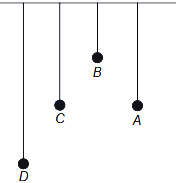
Four pendulums $A, B, C$ and $D$ are hung from the same elastic support as shown in the figure. $A$ and $C$ are of the same length,while $B$ is shorter than $A$ and $C$,and $D$ is longer than $A$. If $A$ is given a displacement,then at steady state:
A
$D$ will vibrate with max amplitude
B
$C$ will vibrate with max amplitude
C
$B$ will vibrate with max amplitude
D
All four will oscillate with equal amplitude
Solution
(B) According to the given diagram,the lengths of pendulums $A$ and $C$ are the same.
Since the time period of a simple pendulum is given by $T = 2 \pi \sqrt{\frac{l}{g}}$,the time period $T$ depends only on the length $l$ (assuming $g$ is constant).
Therefore,pendulums $A$ and $C$ have the same natural frequency of oscillation.
When pendulum $A$ is set into motion,it acts as a driver for the elastic support,which in turn drives the other pendulums.
Due to the principle of resonance,the pendulum whose natural frequency matches the driving frequency will vibrate with the maximum amplitude.
Since $A$ and $C$ have the same natural frequency,pendulum $C$ will vibrate with the maximum amplitude.
Since the time period of a simple pendulum is given by $T = 2 \pi \sqrt{\frac{l}{g}}$,the time period $T$ depends only on the length $l$ (assuming $g$ is constant).
Therefore,pendulums $A$ and $C$ have the same natural frequency of oscillation.
When pendulum $A$ is set into motion,it acts as a driver for the elastic support,which in turn drives the other pendulums.
Due to the principle of resonance,the pendulum whose natural frequency matches the driving frequency will vibrate with the maximum amplitude.
Since $A$ and $C$ have the same natural frequency,pendulum $C$ will vibrate with the maximum amplitude.
0 likes
View Solution79
MediumMCQ
The amplitude of a damped harmonic oscillator becomes $50 \%$ of its initial value in a time of $12 \ s$. If the amplitude of the oscillator at a time of $36 \ s$ is $x \%$ of its initial amplitude,then the value of $x$ is
A
$25$
B
$12.5$
C
$37.5$
D
$8$
Solution
(B) The amplitude of a damped harmonic oscillator at time $t$ is given by $A(t) = A_0 e^{-bt/2m}$,where $A_0$ is the initial amplitude.
Given that at $t_1 = 12 \ s$,$A(t_1) = 0.5 A_0$.
So,$0.5 A_0 = A_0 e^{-b(12)/2m}$,which implies $e^{-6b/m} = 0.5$.
We need to find the amplitude at $t_2 = 36 \ s$ as a percentage of $A_0$.
$A(36) = A_0 e^{-b(36)/2m} = A_0 (e^{-6b/m})^3$.
Substituting the value $e^{-6b/m} = 0.5$,we get $A(36) = A_0 (0.5)^3 = A_0 (0.125) = 12.5 \% A_0$.
Thus,$x = 12.5$.
Given that at $t_1 = 12 \ s$,$A(t_1) = 0.5 A_0$.
So,$0.5 A_0 = A_0 e^{-b(12)/2m}$,which implies $e^{-6b/m} = 0.5$.
We need to find the amplitude at $t_2 = 36 \ s$ as a percentage of $A_0$.
$A(36) = A_0 e^{-b(36)/2m} = A_0 (e^{-6b/m})^3$.
Substituting the value $e^{-6b/m} = 0.5$,we get $A(36) = A_0 (0.5)^3 = A_0 (0.125) = 12.5 \% A_0$.
Thus,$x = 12.5$.
0 likes
View Solution80
MediumMCQ
The displacement of a damped oscillator is $x(t) = \exp(-0.2 t) \cos(3.2 t + \Phi)$,where $t$ is time in seconds. The time required for the amplitude of the oscillator to become $\frac{1}{e^{1.2}}$ times its initial amplitude is (in $s$)
A
$3$
B
$6$
C
$2$
D
$8$
Solution
(B) The displacement of a damped oscillator is given by $x(t) = A_0 e^{-bt} \cos(\omega' t + \Phi)$,where $A(t) = A_0 e^{-bt}$ is the amplitude at time $t$.
Given the equation $x(t) = \exp(-0.2 t) \cos(3.2 t + \Phi)$,the initial amplitude $A_0$ at $t = 0$ is $1$.
The amplitude at time $t$ is $A(t) = e^{-0.2 t}$.
We need to find the time $t$ when the amplitude becomes $\frac{1}{e^{1.2}}$ times its initial amplitude.
So,$A(t) = \frac{1}{e^{1.2}} \times A_0 = e^{-1.2} \times 1 = e^{-1.2}$.
Equating the two expressions for amplitude: $e^{-0.2 t} = e^{-1.2}$.
Comparing the exponents: $-0.2 t = -1.2$.
Solving for $t$: $t = \frac{1.2}{0.2} = 6 \ s$.
Given the equation $x(t) = \exp(-0.2 t) \cos(3.2 t + \Phi)$,the initial amplitude $A_0$ at $t = 0$ is $1$.
The amplitude at time $t$ is $A(t) = e^{-0.2 t}$.
We need to find the time $t$ when the amplitude becomes $\frac{1}{e^{1.2}}$ times its initial amplitude.
So,$A(t) = \frac{1}{e^{1.2}} \times A_0 = e^{-1.2} \times 1 = e^{-1.2}$.
Equating the two expressions for amplitude: $e^{-0.2 t} = e^{-1.2}$.
Comparing the exponents: $-0.2 t = -1.2$.
Solving for $t$: $t = \frac{1.2}{0.2} = 6 \ s$.
0 likes
View Solution81
DifficultMCQ
In a time of $2 \ s$,the amplitude of a damped oscillator becomes $\frac{1}{e}$ times its initial amplitude $A$. In the next two seconds,the amplitude of the oscillator is
A
$\frac{1}{2 e}$
B
$\frac{2}{e}$
C
$\frac{A}{e^2}$
D
$\frac{2}{e^2}$
Solution
(C) The amplitude of a damped oscillator at time $t$ is given by $A(t) = A_0 e^{-kt}$,where $k = \frac{b}{2m}$.
Given that at $t = 2 \ s$,$A(2) = \frac{A_0}{e}$.
Substituting these values: $\frac{A_0}{e} = A_0 e^{-k(2)} \Rightarrow e^{-1} = e^{-2k} \Rightarrow 2k = 1 \Rightarrow k = 0.5 \ s^{-1}$.
We need to find the amplitude after the next two seconds,i.e.,at $t = 4 \ s$.
$A(4) = A_0 e^{-k(4)} = A_0 e^{-0.5 \times 4} = A_0 e^{-2} = \frac{A_0}{e^2}$.
Given that at $t = 2 \ s$,$A(2) = \frac{A_0}{e}$.
Substituting these values: $\frac{A_0}{e} = A_0 e^{-k(2)} \Rightarrow e^{-1} = e^{-2k} \Rightarrow 2k = 1 \Rightarrow k = 0.5 \ s^{-1}$.
We need to find the amplitude after the next two seconds,i.e.,at $t = 4 \ s$.
$A(4) = A_0 e^{-k(4)} = A_0 e^{-0.5 \times 4} = A_0 e^{-2} = \frac{A_0}{e^2}$.
0 likes
View Solution82
EasyMCQ
When an external force with angular frequency $\omega_d$ acts on a system of natural angular frequency $\omega$,the system oscillates with angular frequency $\omega_d$. The condition for the amplitude of oscillations to be maximum is
A
$\omega_d = 2\omega$
B
$\omega_d = \omega$
C
$\omega_d = \frac{\omega}{2}$
D
$\omega_d = 3\omega$
Solution
(B) When a system is subjected to an external periodic force,it undergoes forced oscillations.
The amplitude of these forced oscillations depends on the driving frequency $\omega_d$ and the natural frequency $\omega$ of the system.
As the driving frequency $\omega_d$ approaches the natural frequency $\omega$,the amplitude of the oscillations increases.
When $\omega_d = \omega$,the system reaches a state known as resonance,where the amplitude of oscillations becomes maximum.
Therefore,the condition for maximum amplitude is $\omega_d = \omega$.
The amplitude of these forced oscillations depends on the driving frequency $\omega_d$ and the natural frequency $\omega$ of the system.
As the driving frequency $\omega_d$ approaches the natural frequency $\omega$,the amplitude of the oscillations increases.
When $\omega_d = \omega$,the system reaches a state known as resonance,where the amplitude of oscillations becomes maximum.
Therefore,the condition for maximum amplitude is $\omega_d = \omega$.
0 likes
View Solution83
EasyMCQ
In case of a forced vibration,the resonance wave becomes very sharp when the:
A
quality factor is small
B
dampening force is small
C
restoring force is small
D
applied periodic force is small
Solution
(B) Resonance is a phenomenon where the amplitude of oscillations increases significantly when the frequency of an externally applied periodic force matches the natural frequency of the system.
In a forced oscillation system,the sharpness of the resonance curve is determined by the damping present in the system.
The sharpness of the resonance is inversely proportional to the damping coefficient.
Therefore,when the dampening force is small,the energy loss per cycle is minimal,leading to a very sharp and high-amplitude resonance peak.
Thus,the correct option is $B$.
In a forced oscillation system,the sharpness of the resonance curve is determined by the damping present in the system.
The sharpness of the resonance is inversely proportional to the damping coefficient.
Therefore,when the dampening force is small,the energy loss per cycle is minimal,leading to a very sharp and high-amplitude resonance peak.
Thus,the correct option is $B$.
0 likes
View Solution84
MediumMCQ
The amplitude of a damped oscillator varies with time as $A(t) = A_0 \exp(-bt / 2m)$,where $b = 70 \text{ g/s}$ and $m = 200 \text{ g}$. How long does it take for the mechanical energy to drop to one-fourth of its initial value (in $s$)? (Take $\ln 2 = 0.7$)
A
$2.0$
B
$4.0$
C
$2.5$
D
$3.5$
Solution
(B) The amplitude of a damped oscillator is given by $A(t) = A_0 e^{-bt / 2m}$.
Mechanical energy $E$ is proportional to the square of the amplitude,$E \propto A^2$.
Therefore,$E(t) = E_0 e^{-bt / m}$.
We want to find the time $t$ when $E(t) = E_0 / 4$.
Substituting this into the equation: $E_0 / 4 = E_0 e^{-bt / m}$.
This simplifies to $1/4 = e^{-bt / m}$,or $2^{-2} = e^{-bt / m}$.
Taking the natural logarithm on both sides: $-2 \ln 2 = -bt / m$.
Solving for $t$: $t = (2m \ln 2) / b$.
Given $m = 200 \text{ g} = 0.2 \text{ kg}$,$b = 70 \text{ g/s} = 0.07 \text{ kg/s}$,and $\ln 2 = 0.7$.
$t = (2 \times 0.2 \times 0.7) / 0.07 = 0.28 / 0.07 = 4 \text{ s}$.
Mechanical energy $E$ is proportional to the square of the amplitude,$E \propto A^2$.
Therefore,$E(t) = E_0 e^{-bt / m}$.
We want to find the time $t$ when $E(t) = E_0 / 4$.
Substituting this into the equation: $E_0 / 4 = E_0 e^{-bt / m}$.
This simplifies to $1/4 = e^{-bt / m}$,or $2^{-2} = e^{-bt / m}$.
Taking the natural logarithm on both sides: $-2 \ln 2 = -bt / m$.
Solving for $t$: $t = (2m \ln 2) / b$.
Given $m = 200 \text{ g} = 0.2 \text{ kg}$,$b = 70 \text{ g/s} = 0.07 \text{ kg/s}$,and $\ln 2 = 0.7$.
$t = (2 \times 0.2 \times 0.7) / 0.07 = 0.28 / 0.07 = 4 \text{ s}$.
0 likes
View Solution85
DifficultMCQ
$A$ body of mass $0.3 \ kg$ hangs by a spring with a force constant of $50 \ N/m$. The amplitude of oscillations is damped and reaches $1/e$ of its original value in about $100$ oscillations. If $\omega$ and $\omega^{\prime}$ are the angular frequencies of undamped and damped oscillations respectively,then the percentage value of $\left(\frac{\omega-\omega^{\prime}}{\omega}\right) \times 100$ is:
A
$\frac{1}{800 \pi^2} \%$
B
$\frac{1}{800 \pi} \%$
C
$\frac{\pi^2}{600} \%$
D
$\frac{\pi}{400} \%$
Solution
(C) The amplitude of a damped oscillator is given by $A(t) = A_0 e^{-(b/2m)t}$.
Given that after $n = 100$ oscillations,the amplitude becomes $A_0/e$,so $e^{-(b/2m)T \cdot n} = e^{-1}$,where $T$ is the time period.
Thus,$\frac{b}{2m} T \cdot n = 1$. Since $T = \frac{2\pi}{\omega}$,we have $\frac{b}{2m} \cdot \frac{2\pi}{\omega} \cdot 100 = 1$,which implies $\frac{b}{2m\omega} = \frac{1}{200\pi}$.
The damped frequency is $\omega^{\prime} = \omega \sqrt{1 - \frac{b^2}{4m^2\omega^2}}$.
Using the binomial approximation $(1-x)^{1/2} \approx 1 - x/2$ for small $x$,we get $\omega^{\prime} \approx \omega \left(1 - \frac{b^2}{8m^2\omega^2}\right)$.
Therefore,$\frac{\omega - \omega^{\prime}}{\omega} = \frac{b^2}{8m^2\omega^2} = \frac{1}{2} \left(\frac{b}{2m\omega}\right)^2$.
Substituting the value,$\frac{\omega - \omega^{\prime}}{\omega} = \frac{1}{2} \left(\frac{1}{200\pi}\right)^2 = \frac{1}{2} \cdot \frac{1}{40000\pi^2} = \frac{1}{80000\pi^2}$.
Converting to percentage: $\frac{1}{80000\pi^2} \times 100 = \frac{1}{800\pi^2} \%$.
Given that after $n = 100$ oscillations,the amplitude becomes $A_0/e$,so $e^{-(b/2m)T \cdot n} = e^{-1}$,where $T$ is the time period.
Thus,$\frac{b}{2m} T \cdot n = 1$. Since $T = \frac{2\pi}{\omega}$,we have $\frac{b}{2m} \cdot \frac{2\pi}{\omega} \cdot 100 = 1$,which implies $\frac{b}{2m\omega} = \frac{1}{200\pi}$.
The damped frequency is $\omega^{\prime} = \omega \sqrt{1 - \frac{b^2}{4m^2\omega^2}}$.
Using the binomial approximation $(1-x)^{1/2} \approx 1 - x/2$ for small $x$,we get $\omega^{\prime} \approx \omega \left(1 - \frac{b^2}{8m^2\omega^2}\right)$.
Therefore,$\frac{\omega - \omega^{\prime}}{\omega} = \frac{b^2}{8m^2\omega^2} = \frac{1}{2} \left(\frac{b}{2m\omega}\right)^2$.
Substituting the value,$\frac{\omega - \omega^{\prime}}{\omega} = \frac{1}{2} \left(\frac{1}{200\pi}\right)^2 = \frac{1}{2} \cdot \frac{1}{40000\pi^2} = \frac{1}{80000\pi^2}$.
Converting to percentage: $\frac{1}{80000\pi^2} \times 100 = \frac{1}{800\pi^2} \%$.
0 likes
View Solution86
MediumMCQ
If the amplitude of a damped harmonic oscillator becomes half of its initial amplitude in a time of $10 \ s$,then the time taken for the mechanical energy of the oscillator to become half of its initial mechanical energy is (in $s$)
A
$2.5$
B
$20$
C
$10$
D
$5$
Solution
(D) The amplitude of a damped harmonic oscillator at time $t$ is given by $A(t) = A_0 e^{-bt/2m}$.
Given that at $t = 10 \ s$,$A(t) = A_0/2$.
So,$A_0/2 = A_0 e^{-b(10)/2m} \implies 1/2 = e^{-5b/m} \implies \ln(2) = 5b/m$.
The mechanical energy of the oscillator is $E(t) = \frac{1}{2} k A(t)^2 = \frac{1}{2} k A_0^2 e^{-bt/m} = E_0 e^{-bt/m}$.
We want to find the time $t'$ such that $E(t') = E_0/2$.
So,$E_0/2 = E_0 e^{-bt'/m} \implies 1/2 = e^{-bt'/m} \implies \ln(2) = bt'/m$.
Equating the two expressions for $\ln(2)$: $5b/m = bt'/m \implies t' = 5 \ s$.
Given that at $t = 10 \ s$,$A(t) = A_0/2$.
So,$A_0/2 = A_0 e^{-b(10)/2m} \implies 1/2 = e^{-5b/m} \implies \ln(2) = 5b/m$.
The mechanical energy of the oscillator is $E(t) = \frac{1}{2} k A(t)^2 = \frac{1}{2} k A_0^2 e^{-bt/m} = E_0 e^{-bt/m}$.
We want to find the time $t'$ such that $E(t') = E_0/2$.
So,$E_0/2 = E_0 e^{-bt'/m} \implies 1/2 = e^{-bt'/m} \implies \ln(2) = bt'/m$.
Equating the two expressions for $\ln(2)$: $5b/m = bt'/m \implies t' = 5 \ s$.
0 likes
View Solution87
MediumMCQ
If the amplitudes of a damped harmonic oscillator at times $t=0, t_1$ and $t_2$ are $A_0, A_1$ and $A_2$ respectively,then the amplitude of the oscillator at a time of $(t_1+t_2)$ is
A
$\frac{A_0+A_1+A_2}{3}$
B
$\frac{A_2 A_0}{A_1}$
C
$\frac{A_1 A_0}{A_2}$
D
$\frac{A_1 A_2}{A_0}$
Solution
(D) The amplitude of a damped harmonic oscillator at any time $t$ is given by the equation $A(t) = A_0 e^{-bt/2m}$,where $A_0$ is the initial amplitude at $t=0$ and $b$ is the damping constant.
At time $t_1$,the amplitude is $A_1 = A_0 e^{-bt_1/2m}$. Thus,$e^{-bt_1/2m} = \frac{A_1}{A_0}$.
At time $t_2$,the amplitude is $A_2 = A_0 e^{-bt_2/2m}$. Thus,$e^{-bt_2/2m} = \frac{A_2}{A_0}$.
We want to find the amplitude $A$ at time $t = t_1 + t_2$,which is $A(t_1+t_2) = A_0 e^{-b(t_1+t_2)/2m}$.
This can be written as $A(t_1+t_2) = A_0 (e^{-bt_1/2m}) (e^{-bt_2/2m})$.
Substituting the expressions for the exponential terms,we get $A(t_1+t_2) = A_0 \left(\frac{A_1}{A_0}\right) \left(\frac{A_2}{A_0}\right)$.
Simplifying this,we obtain $A(t_1+t_2) = \frac{A_1 A_2}{A_0}$.
At time $t_1$,the amplitude is $A_1 = A_0 e^{-bt_1/2m}$. Thus,$e^{-bt_1/2m} = \frac{A_1}{A_0}$.
At time $t_2$,the amplitude is $A_2 = A_0 e^{-bt_2/2m}$. Thus,$e^{-bt_2/2m} = \frac{A_2}{A_0}$.
We want to find the amplitude $A$ at time $t = t_1 + t_2$,which is $A(t_1+t_2) = A_0 e^{-b(t_1+t_2)/2m}$.
This can be written as $A(t_1+t_2) = A_0 (e^{-bt_1/2m}) (e^{-bt_2/2m})$.
Substituting the expressions for the exponential terms,we get $A(t_1+t_2) = A_0 \left(\frac{A_1}{A_0}\right) \left(\frac{A_2}{A_0}\right)$.
Simplifying this,we obtain $A(t_1+t_2) = \frac{A_1 A_2}{A_0}$.
0 likes
View Solution88
EasyMCQ
In a time '$t$',the amplitude of vibrations of a damped oscillator becomes half of its initial value. Then,the mechanical energy of the oscillator decreases by: (in $\%$)
A
$40$
B
$20$
C
$75$
D
$50$
Solution
(C) The amplitude of a damped harmonic oscillator at time $t$ is given by $A(t) = A_0 e^{-bt}$.
Given that at time $t$,$A(t) = \frac{A_0}{2}$.
Substituting this into the equation: $\frac{A_0}{2} = A_0 e^{-bt}$,which implies $e^{-bt} = \frac{1}{2}$.
The mechanical energy $E$ of a damped oscillator is proportional to the square of its amplitude: $E \propto A^2$.
Therefore,the energy at time $t$ is $E(t) = E_0 e^{-2bt}$,where $E_0$ is the initial energy.
Substituting $e^{-bt} = \frac{1}{2}$,we get $E(t) = E_0 (e^{-bt})^2 = E_0 (\frac{1}{2})^2 = \frac{E_0}{4}$.
The decrease in mechanical energy is $\Delta E = E_0 - E(t) = E_0 - \frac{E_0}{4} = \frac{3E_0}{4}$.
Percentage decrease = $\frac{\Delta E}{E_0} \times 100\% = \frac{3}{4} \times 100\% = 75\%$.
Given that at time $t$,$A(t) = \frac{A_0}{2}$.
Substituting this into the equation: $\frac{A_0}{2} = A_0 e^{-bt}$,which implies $e^{-bt} = \frac{1}{2}$.
The mechanical energy $E$ of a damped oscillator is proportional to the square of its amplitude: $E \propto A^2$.
Therefore,the energy at time $t$ is $E(t) = E_0 e^{-2bt}$,where $E_0$ is the initial energy.
Substituting $e^{-bt} = \frac{1}{2}$,we get $E(t) = E_0 (e^{-bt})^2 = E_0 (\frac{1}{2})^2 = \frac{E_0}{4}$.
The decrease in mechanical energy is $\Delta E = E_0 - E(t) = E_0 - \frac{E_0}{4} = \frac{3E_0}{4}$.
Percentage decrease = $\frac{\Delta E}{E_0} \times 100\% = \frac{3}{4} \times 100\% = 75\%$.
0 likes
View SolutionOscillations — Different types of oscillations (Free, Damped, Forced Oscillation and Resonance) · Frequently Asked Questions
1Are these Oscillations questions useful for JEE and NEET?
Yes. All questions in this section are mapped to JEE Main and NEET exam patterns. Previous year questions from JEE Main, NEET, GUJCET and state-level exams are included with full solutions.
2Can I switch to Hindi or Gujarati for these questions?
Yes. Use the language tabs in the hero section or the sidebar to view the same questions and solutions in English, Hindi or Gujarati.
3How do I generate a question paper from this subtopic?
Use the Vedclass Exam Paper Generator — select the chapter and subtopic, set difficulty, and generate Sets A, B, C, D automatically. First 3 chapters of every subject are free.
Vedclass Products
For Students
Vedclass Test Series
Mock tests in real JEE/NEET style with performance analysis. 5-day free trial.
Start Free TrialFor Teachers
Exam Paper Generator
Generate Set A/B/C/D papers from this chapter in 2 minutes. 3 chapters free.
Try FreeFor Institutes
Online Exam Module
Live online exams with unlimited students, 360° analytics & white-label branding.
See DemoFor Teachers & Institutes
Generate a Oscillations Exam Paper in 2 Minutes
Select subtopic & difficulty — Sets A, B, C, D auto-generated with No Repeat logic.
First 3 chapters of every subject are free — no payment required.