
A English
Speed (velocity) of Gas (rms, mean and Most probable speed) Questions in English
Class 11 Physics · Kinetic Theory of Gases · Speed (velocity) of Gas (rms, mean and Most probable speed)
291+
Questions
English
Language
100%
With Solutions
Showing 49 of 291 questions in English
51
MediumMCQ
The velocity of the molecules of a gas at temperature $120\,K$ is $v$. At what temperature in $K$ will the velocity be $2v$?
A
$120$
B
$240$
C
$480$
D
$1120$
Solution
(C) The root mean square velocity of gas molecules is given by the relation $v_{rms} \propto \sqrt{T}$.
Given that the initial velocity is $v_1 = v$ at temperature $T_1 = 120\,K$,and the final velocity is $v_2 = 2v$ at temperature $T_2$.
Using the proportionality,we have $\frac{v_2}{v_1} = \sqrt{\frac{T_2}{T_1}}$.
Substituting the values: $\frac{2v}{v} = \sqrt{\frac{T_2}{120}}$.
$2 = \sqrt{\frac{T_2}{120}}$.
Squaring both sides: $4 = \frac{T_2}{120}$.
Therefore,$T_2 = 4 \times 120 = 480\,K$.
Given that the initial velocity is $v_1 = v$ at temperature $T_1 = 120\,K$,and the final velocity is $v_2 = 2v$ at temperature $T_2$.
Using the proportionality,we have $\frac{v_2}{v_1} = \sqrt{\frac{T_2}{T_1}}$.
Substituting the values: $\frac{2v}{v} = \sqrt{\frac{T_2}{120}}$.
$2 = \sqrt{\frac{T_2}{120}}$.
Squaring both sides: $4 = \frac{T_2}{120}$.
Therefore,$T_2 = 4 \times 120 = 480\,K$.
0 likes
View Solution52
MediumMCQ
The $r.m.s.$ speed of the molecules of a gas at a pressure $10^5 \ Pa$ and temperature $0^\circ C$ is $0.5 \ km \ sec^{-1}.$ If the pressure is kept constant but temperature is raised to $819^\circ C,$ the velocity will become ........ $km \ sec^{-1}.$
A
$1.5$
B
$2$
C
$5$
D
$1$
Solution
(D) The $r.m.s.$ speed of gas molecules is given by the formula $v_{rms} = \sqrt{\frac{3RT}{M}}.$
Since $R$ and $M$ are constant,$v_{rms} \propto \sqrt{T}.$
Given initial temperature $T_1 = 0^\circ C = 273 \ K$ and initial velocity $(v_{rms})_1 = 0.5 \ km \ sec^{-1}.$
Final temperature $T_2 = 819^\circ C = 819 + 273 = 1092 \ K.$
Using the ratio formula: $\frac{(v_{rms})_1}{(v_{rms})_2} = \sqrt{\frac{T_1}{T_2}}.$
Substituting the values: $\frac{0.5}{(v_{rms})_2} = \sqrt{\frac{273}{1092}}.$
Since $\frac{1092}{273} = 4,$ we have $\frac{0.5}{(v_{rms})_2} = \sqrt{\frac{1}{4}} = \frac{1}{2}.$
Therefore,$(v_{rms})_2 = 0.5 \times 2 = 1 \ km \ sec^{-1}.$
Since $R$ and $M$ are constant,$v_{rms} \propto \sqrt{T}.$
Given initial temperature $T_1 = 0^\circ C = 273 \ K$ and initial velocity $(v_{rms})_1 = 0.5 \ km \ sec^{-1}.$
Final temperature $T_2 = 819^\circ C = 819 + 273 = 1092 \ K.$
Using the ratio formula: $\frac{(v_{rms})_1}{(v_{rms})_2} = \sqrt{\frac{T_1}{T_2}}.$
Substituting the values: $\frac{0.5}{(v_{rms})_2} = \sqrt{\frac{273}{1092}}.$
Since $\frac{1092}{273} = 4,$ we have $\frac{0.5}{(v_{rms})_2} = \sqrt{\frac{1}{4}} = \frac{1}{2}.$
Therefore,$(v_{rms})_2 = 0.5 \times 2 = 1 \ km \ sec^{-1}.$
0 likes
View Solution53
MediumMCQ
At what temperature does the $r.m.s.$ speed of air molecules become double that at $N.T.P.$?
A
$819$
B
$719$
C
$909$
D
None of these
Solution
(A) The $r.m.s.$ speed of gas molecules is given by the formula $v_{rms} = \sqrt{\frac{3RT}{M}}$.
Since $v_{rms} \propto \sqrt{T}$, we have $\frac{v_1}{v_2} = \sqrt{\frac{T_1}{T_2}}$.
At $N.T.P.$, the temperature $T_1 = 273 \, K$.
We want the speed to double, so $v_2 = 2v_1$.
Substituting the values: $\frac{v_1}{2v_1} = \sqrt{\frac{273}{T_2}}$.
Squaring both sides: $\frac{1}{4} = \frac{273}{T_2}$.
$T_2 = 4 \times 273 = 1092 \, K$.
To convert to Celsius: $T(^{\circ} C) = 1092 - 273 = 819 \, ^{\circ} C$.
Since $v_{rms} \propto \sqrt{T}$, we have $\frac{v_1}{v_2} = \sqrt{\frac{T_1}{T_2}}$.
At $N.T.P.$, the temperature $T_1 = 273 \, K$.
We want the speed to double, so $v_2 = 2v_1$.
Substituting the values: $\frac{v_1}{2v_1} = \sqrt{\frac{273}{T_2}}$.
Squaring both sides: $\frac{1}{4} = \frac{273}{T_2}$.
$T_2 = 4 \times 273 = 1092 \, K$.
To convert to Celsius: $T(^{\circ} C) = 1092 - 273 = 819 \, ^{\circ} C$.
0 likes
View Solution54
MediumMCQ
The $r.m.s.$ speed of a certain gas is $v$ at $400\,K.$ The temperature at which the $r.m.s.$ speed becomes two times,will be ...... $K$.
A
$800$
B
$1600$
C
$1200$
D
None of these
Solution
(B) The $r.m.s.$ speed of a gas is given by the formula $v_{rms} = \sqrt{\frac{3RT}{M}}$.
From this relation,we can see that $v_{rms} \propto \sqrt{T}$.
Given,at $T_1 = 400\,K$,the speed is $v_1 = v$.
We want to find the temperature $T_2$ at which the speed becomes $v_2 = 2v$.
Using the proportionality $v_{rms} \propto \sqrt{T}$,we have $\frac{v_2}{v_1} = \sqrt{\frac{T_2}{T_1}}$.
Substituting the given values: $\frac{2v}{v} = \sqrt{\frac{T_2}{400}}$.
Squaring both sides: $2^2 = \frac{T_2}{400}$.
$4 = \frac{T_2}{400}$.
Therefore,$T_2 = 4 \times 400 = 1600\,K$.
From this relation,we can see that $v_{rms} \propto \sqrt{T}$.
Given,at $T_1 = 400\,K$,the speed is $v_1 = v$.
We want to find the temperature $T_2$ at which the speed becomes $v_2 = 2v$.
Using the proportionality $v_{rms} \propto \sqrt{T}$,we have $\frac{v_2}{v_1} = \sqrt{\frac{T_2}{T_1}}$.
Substituting the given values: $\frac{2v}{v} = \sqrt{\frac{T_2}{400}}$.
Squaring both sides: $2^2 = \frac{T_2}{400}$.
$4 = \frac{T_2}{400}$.
Therefore,$T_2 = 4 \times 400 = 1600\,K$.
0 likes
View Solution55
MediumMCQ
$A$ cubical box with porous walls containing an equal number of ${O_2}$ and ${H_2}$ molecules is placed in a large evacuated chamber. The entire system is maintained at constant temperature $T$. The ratio of the ${v_{rms}}$ of ${O_2}$ molecules to that of the ${v_{rms}}$ of ${H_2}$ molecules,found in the chamber outside the box after a short interval,is:
A
$\frac{1}{2\sqrt{2}}$
B
$\frac{1}{4}$
C
$\frac{1}{\sqrt{2}}$
D
$\sqrt{2}$
Solution
(B) The root mean square speed $({v_{rms}})$ of gas molecules is given by the formula: ${v_{rms}} = \sqrt{\frac{3RT}{M}}$,where $R$ is the universal gas constant,$T$ is the absolute temperature,and $M$ is the molar mass of the gas.
Since the temperature $T$ is constant,we have ${v_{rms}} \propto \frac{1}{\sqrt{M}}$.
Therefore,the ratio of the ${v_{rms}}$ of ${O_2}$ molecules to that of ${H_2}$ molecules is:
$\frac{{v_{rms, O_2}}}{{v_{rms, H_2}}} = \sqrt{\frac{M_{H_2}}{M_{O_2}}}$
Given that the molar mass of ${H_2}$ is $M_{H_2} = 2 \text{ g/mol}$ and the molar mass of ${O_2}$ is $M_{O_2} = 32 \text{ g/mol}$.
Substituting these values:
$\frac{{v_{rms, O_2}}}{{v_{rms, H_2}}} = \sqrt{\frac{2}{32}} = \sqrt{\frac{1}{16}} = \frac{1}{4}$.
Since the temperature $T$ is constant,we have ${v_{rms}} \propto \frac{1}{\sqrt{M}}$.
Therefore,the ratio of the ${v_{rms}}$ of ${O_2}$ molecules to that of ${H_2}$ molecules is:
$\frac{{v_{rms, O_2}}}{{v_{rms, H_2}}} = \sqrt{\frac{M_{H_2}}{M_{O_2}}}$
Given that the molar mass of ${H_2}$ is $M_{H_2} = 2 \text{ g/mol}$ and the molar mass of ${O_2}$ is $M_{O_2} = 32 \text{ g/mol}$.
Substituting these values:
$\frac{{v_{rms, O_2}}}{{v_{rms, H_2}}} = \sqrt{\frac{2}{32}} = \sqrt{\frac{1}{16}} = \frac{1}{4}$.
0 likes
View Solution56
MediumMCQ
The gas having an average speed four times that of $SO_2$ (molecular mass $64$) is
A
$He$ (molecular mass $4$)
B
$O_2$ (molecular mass $32$)
C
$H_2$ (molecular mass $2$)
D
$CH_4$ (molecular mass $16$)
Solution
(A) The average speed of a gas molecule is given by the formula $v_{av} = \sqrt{\frac{8RT}{\pi M}}$.
Since $R$ and $T$ are constant for both gases,we have $v_{av} \propto \frac{1}{\sqrt{M}}$.
Therefore,the ratio of the average speeds is $\frac{v_{Gas}}{v_{SO_2}} = \sqrt{\frac{M_{SO_2}}{M_{Gas}}}$.
Given that the average speed of the gas is $4$ times that of $SO_2$,we have $\frac{v_{Gas}}{v_{SO_2}} = 4$.
Substituting the values: $4 = \sqrt{\frac{64}{M_{Gas}}}$.
Squaring both sides: $16 = \frac{64}{M_{Gas}}$.
Solving for $M_{Gas}$: $M_{Gas} = \frac{64}{16} = 4$.
$A$ gas with a molecular mass of $4$ is Helium $(He)$.
Since $R$ and $T$ are constant for both gases,we have $v_{av} \propto \frac{1}{\sqrt{M}}$.
Therefore,the ratio of the average speeds is $\frac{v_{Gas}}{v_{SO_2}} = \sqrt{\frac{M_{SO_2}}{M_{Gas}}}$.
Given that the average speed of the gas is $4$ times that of $SO_2$,we have $\frac{v_{Gas}}{v_{SO_2}} = 4$.
Substituting the values: $4 = \sqrt{\frac{64}{M_{Gas}}}$.
Squaring both sides: $16 = \frac{64}{M_{Gas}}$.
Solving for $M_{Gas}$: $M_{Gas} = \frac{64}{16} = 4$.
$A$ gas with a molecular mass of $4$ is Helium $(He)$.
0 likes
View Solution57
MediumMCQ
The root mean square speed of hydrogen molecules of an ideal hydrogen gas kept in a gas chamber at $0^{\circ}C$ is $3180 \ m/s$. The pressure on the hydrogen gas is ..... $atm$ (Density of hydrogen gas is $8.99 \times 10^{-2} \ kg/m^3$,$1 \ atm = 1.01 \times 10^5 \ N/m^2$).
A
$1$
B
$1.5$
C
$2$
D
$3$
Solution
(D) The formula for the root mean square speed $(v_{rms})$ of an ideal gas is given by $v_{rms} = \sqrt{\frac{3P}{\rho}}$,where $P$ is the pressure and $\rho$ is the density.
Rearranging the formula to solve for pressure $P$,we get $P = \frac{v_{rms}^2 \rho}{3}$.
Given $v_{rms} = 3180 \ m/s$ and $\rho = 8.99 \times 10^{-2} \ kg/m^3$.
Substituting the values: $P = \frac{(3180)^2 \times 8.99 \times 10^{-2}}{3}$.
$P = \frac{10112400 \times 0.0899}{3} \approx \frac{909104.76}{3} \approx 303034.9 \ N/m^2$.
Since $1 \ atm = 1.01 \times 10^5 \ N/m^2$,then $P \approx \frac{303034.9}{101000} \approx 3 \ atm$.
Rearranging the formula to solve for pressure $P$,we get $P = \frac{v_{rms}^2 \rho}{3}$.
Given $v_{rms} = 3180 \ m/s$ and $\rho = 8.99 \times 10^{-2} \ kg/m^3$.
Substituting the values: $P = \frac{(3180)^2 \times 8.99 \times 10^{-2}}{3}$.
$P = \frac{10112400 \times 0.0899}{3} \approx \frac{909104.76}{3} \approx 303034.9 \ N/m^2$.
Since $1 \ atm = 1.01 \times 10^5 \ N/m^2$,then $P \approx \frac{303034.9}{101000} \approx 3 \ atm$.
0 likes
View Solution58
MediumMCQ
Let $\bar{v}$,${v_{rms}}$ and ${v_p}$ respectively denote the mean speed,root mean square speed,and most probable speed of the molecules in an ideal monoatomic gas at absolute temperature $T$. The mass of a molecule is $m$. Then
A
No molecule can have speed less than ${v_p}/\sqrt{2}$
B
The average kinetic energy of a molecule is $\frac{3}{4}mv_p^2$
C
${v_p} < \bar{v} < {v_{rms}}$
D
Both $(b)$ and $(c)$
Solution
(D) For an ideal gas,the speeds are defined as:
${v_{rms}} = \sqrt{\frac{3kT}{m}}$,${v_p} = \sqrt{\frac{2kT}{m}}$,and $\bar{v} = \sqrt{\frac{8kT}{\pi m}}$.
Comparing these values:
${v_p} = \sqrt{2} \sqrt{\frac{kT}{m}} \approx 1.414 \sqrt{\frac{kT}{m}}$
$\bar{v} = \sqrt{\frac{8}{3.14}} \sqrt{\frac{kT}{m}} \approx 1.596 \sqrt{\frac{kT}{m}}$
${v_{rms}} = \sqrt{3} \sqrt{\frac{kT}{m}} \approx 1.732 \sqrt{\frac{kT}{m}}$
Thus,${v_p} < \bar{v} < {v_{rms}}$,which confirms option $(c)$ is correct.
For the average kinetic energy:
${E_{av}} = \frac{1}{2} m v_{rms}^2 = \frac{1}{2} m \left( \frac{3kT}{m} \right) = \frac{3}{2} kT$.
Since ${v_p}^2 = \frac{2kT}{m}$,we have $kT = \frac{1}{2} m v_p^2$.
Substituting this into the energy equation:
${E_{av}} = \frac{3}{2} \left( \frac{1}{2} m v_p^2 \right) = \frac{3}{4} m v_p^2$,which confirms option $(b)$ is correct.
Therefore,both $(b)$ and $(c)$ are correct.
${v_{rms}} = \sqrt{\frac{3kT}{m}}$,${v_p} = \sqrt{\frac{2kT}{m}}$,and $\bar{v} = \sqrt{\frac{8kT}{\pi m}}$.
Comparing these values:
${v_p} = \sqrt{2} \sqrt{\frac{kT}{m}} \approx 1.414 \sqrt{\frac{kT}{m}}$
$\bar{v} = \sqrt{\frac{8}{3.14}} \sqrt{\frac{kT}{m}} \approx 1.596 \sqrt{\frac{kT}{m}}$
${v_{rms}} = \sqrt{3} \sqrt{\frac{kT}{m}} \approx 1.732 \sqrt{\frac{kT}{m}}$
Thus,${v_p} < \bar{v} < {v_{rms}}$,which confirms option $(c)$ is correct.
For the average kinetic energy:
${E_{av}} = \frac{1}{2} m v_{rms}^2 = \frac{1}{2} m \left( \frac{3kT}{m} \right) = \frac{3}{2} kT$.
Since ${v_p}^2 = \frac{2kT}{m}$,we have $kT = \frac{1}{2} m v_p^2$.
Substituting this into the energy equation:
${E_{av}} = \frac{3}{2} \left( \frac{1}{2} m v_p^2 \right) = \frac{3}{4} m v_p^2$,which confirms option $(b)$ is correct.
Therefore,both $(b)$ and $(c)$ are correct.
0 likes
View Solution59
MediumMCQ
The root mean square speed of the molecules of a diatomic gas is $v$. When the temperature is doubled,the molecules dissociate into two atoms. The new root mean square speed of the atom is
A
$\sqrt{2} v$
B
$v$
C
$2v$
D
$4v$
Solution
(C) The root mean square speed $(V_{rms})$ of a gas is given by the formula $V_{rms} = \sqrt{\frac{3RT}{M}}$,where $R$ is the universal gas constant,$T$ is the absolute temperature,and $M$ is the molar mass of the gas.
Initially,for the diatomic gas,the speed is $v = \sqrt{\frac{3RT}{M}}$.
When the temperature is doubled,the new temperature becomes $T' = 2T$.
When the diatomic molecules dissociate into two atoms,the molar mass of the new species (atoms) becomes half of the original molar mass,so $M' = \frac{M}{2}$.
The new root mean square speed $V'_{rms}$ is given by:
$V'_{rms} = \sqrt{\frac{3RT'}{M'}} = \sqrt{\frac{3R(2T)}{M/2}} = \sqrt{4 \cdot \frac{3RT}{M}} = 2 \sqrt{\frac{3RT}{M}}$.
Substituting the initial speed $v$,we get $V'_{rms} = 2v$.
Initially,for the diatomic gas,the speed is $v = \sqrt{\frac{3RT}{M}}$.
When the temperature is doubled,the new temperature becomes $T' = 2T$.
When the diatomic molecules dissociate into two atoms,the molar mass of the new species (atoms) becomes half of the original molar mass,so $M' = \frac{M}{2}$.
The new root mean square speed $V'_{rms}$ is given by:
$V'_{rms} = \sqrt{\frac{3RT'}{M'}} = \sqrt{\frac{3R(2T)}{M/2}} = \sqrt{4 \cdot \frac{3RT}{M}} = 2 \sqrt{\frac{3RT}{M}}$.
Substituting the initial speed $v$,we get $V'_{rms} = 2v$.
0 likes
View Solution60
MediumMCQ
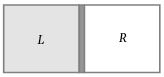
$A$ vessel is partitioned into two equal halves by a fixed diathermic separator. Two different ideal gases are filled in the left $(L)$ and right $(R)$ halves. The rms speed of the molecules in the $L$ part is equal to the mean speed of the molecules in the $R$ part. Then the ratio of the mass of a molecule in the $L$ part to that of a molecule in the $R$ part is
A
$\sqrt{3/2}$
B
$\sqrt{\pi/4}$
C
$\sqrt{2/3}$
D
$3\pi/8$
Solution
(D) Let the mass of a molecule in the $L$ part be $m_1$ and in the $R$ part be $m_2$. Since the separator is diathermic,the temperature $T$ of both gases is the same.
The rms speed of molecules in the $L$ part is $v_{rms} = \sqrt{\frac{3 k_B T}{m_1}}$.
The mean speed of molecules in the $R$ part is $v_{mean} = \sqrt{\frac{8 k_B T}{\pi m_2}}$.
Given that $v_{rms} = v_{mean}$,we have:
$\sqrt{\frac{3 k_B T}{m_1}} = \sqrt{\frac{8 k_B T}{\pi m_2}}$
Squaring both sides:
$\frac{3 k_B T}{m_1} = \frac{8 k_B T}{\pi m_2}$
$\frac{3}{m_1} = \frac{8}{\pi m_2}$
Rearranging to find the ratio $\frac{m_1}{m_2}$:
$\frac{m_1}{m_2} = \frac{3\pi}{8}$
The rms speed of molecules in the $L$ part is $v_{rms} = \sqrt{\frac{3 k_B T}{m_1}}$.
The mean speed of molecules in the $R$ part is $v_{mean} = \sqrt{\frac{8 k_B T}{\pi m_2}}$.
Given that $v_{rms} = v_{mean}$,we have:
$\sqrt{\frac{3 k_B T}{m_1}} = \sqrt{\frac{8 k_B T}{\pi m_2}}$
Squaring both sides:
$\frac{3 k_B T}{m_1} = \frac{8 k_B T}{\pi m_2}$
$\frac{3}{m_1} = \frac{8}{\pi m_2}$
Rearranging to find the ratio $\frac{m_1}{m_2}$:
$\frac{m_1}{m_2} = \frac{3\pi}{8}$
0 likes
View Solution61
MediumMCQ
The temperature at which the $r.m.s.$ speed of hydrogen molecules is equal to the escape velocity on the Earth's surface will be ...... $K$.
A
$1060$
B
$5030$
C
$8270$
D
$10063$
Solution
(D) The escape velocity from the Earth's surface is $v_{e} = 11.2 \, km/s = 11.2 \times 10^3 \, m/s$.
The $r.m.s.$ speed of gas molecules is given by $v_{rms} = \sqrt{\frac{3RT}{M}}$.
Equating the two,we have $\sqrt{\frac{3RT}{M}} = v_{e}$.
Squaring both sides,$\frac{3RT}{M} = v_{e}^2$,which implies $T = \frac{M v_{e}^2}{3R}$.
For hydrogen gas $(H_2)$,the molar mass $M = 2 \times 10^{-3} \, kg/mol$ and the universal gas constant $R = 8.31 \, J/(mol \cdot K)$.
Substituting the values: $T = \frac{(2 \times 10^{-3}) \times (11.2 \times 10^3)^2}{3 \times 8.31}$.
$T = \frac{2 \times 10^{-3} \times 125.44 \times 10^6}{24.93} = \frac{250880}{24.93} \approx 10063 \, K$.
The $r.m.s.$ speed of gas molecules is given by $v_{rms} = \sqrt{\frac{3RT}{M}}$.
Equating the two,we have $\sqrt{\frac{3RT}{M}} = v_{e}$.
Squaring both sides,$\frac{3RT}{M} = v_{e}^2$,which implies $T = \frac{M v_{e}^2}{3R}$.
For hydrogen gas $(H_2)$,the molar mass $M = 2 \times 10^{-3} \, kg/mol$ and the universal gas constant $R = 8.31 \, J/(mol \cdot K)$.
Substituting the values: $T = \frac{(2 \times 10^{-3}) \times (11.2 \times 10^3)^2}{3 \times 8.31}$.
$T = \frac{2 \times 10^{-3} \times 125.44 \times 10^6}{24.93} = \frac{250880}{24.93} \approx 10063 \, K$.
0 likes
View Solution62
EasyMCQ
The curve between absolute temperature $T$ and ${v^2}_{rms}$ is
A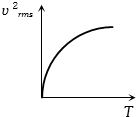
B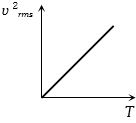
C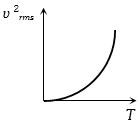
D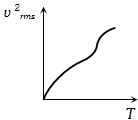
Solution
(B) The root mean square speed of gas molecules is given by the formula:
$v_{rms} = \sqrt{\frac{3RT}{M}}$
Squaring both sides,we get:
$v_{rms}^2 = \frac{3RT}{M}$
Since $R$ (universal gas constant) and $M$ (molar mass of the gas) are constants,we can write:
$v_{rms}^2 \propto T$
This equation represents a linear relationship of the form $y = mx$,where $y = v_{rms}^2$,$x = T$,and the slope $m = \frac{3R}{M}$.
Therefore,the graph between $v_{rms}^2$ and $T$ is a straight line passing through the origin.
This corresponds to graph $B$.
$v_{rms} = \sqrt{\frac{3RT}{M}}$
Squaring both sides,we get:
$v_{rms}^2 = \frac{3RT}{M}$
Since $R$ (universal gas constant) and $M$ (molar mass of the gas) are constants,we can write:
$v_{rms}^2 \propto T$
This equation represents a linear relationship of the form $y = mx$,where $y = v_{rms}^2$,$x = T$,and the slope $m = \frac{3R}{M}$.
Therefore,the graph between $v_{rms}^2$ and $T$ is a straight line passing through the origin.
This corresponds to graph $B$.
0 likes
View Solution63
EasyMCQ
How does the $rms$ velocity of an ideal gas vary with density at constant pressure?
A
$2d$
B
$1/d$
C
$\sqrt{d}$
D
$\frac{1}{\sqrt{d}}$
Solution
(D) The root mean square $(rms)$ velocity $(u)$ of an ideal gas is given by the formula:
$u = \sqrt{\frac{3P}{d}}$
where $P$ is the pressure and $d$ is the density of the gas.
Since the pressure $(P)$ is kept constant,the relationship between the $rms$ velocity $(u)$ and the density $(d)$ is:
$u \propto \frac{1}{\sqrt{d}}$
Therefore,the $rms$ velocity varies inversely with the square root of the density.
$u = \sqrt{\frac{3P}{d}}$
where $P$ is the pressure and $d$ is the density of the gas.
Since the pressure $(P)$ is kept constant,the relationship between the $rms$ velocity $(u)$ and the density $(d)$ is:
$u \propto \frac{1}{\sqrt{d}}$
Therefore,the $rms$ velocity varies inversely with the square root of the density.
0 likes
View Solution64
MediumMCQ
For molecules of an ideal gas,which of the following average velocities will not be zero?
A
$< v >$
B
$< v^4 >$
C
$< v^3 >$
D
$< v^5 >$
Solution
(B) In an ideal gas,the velocity vectors of molecules are distributed randomly in all directions.
Due to this symmetry,the average velocity vector $\vec{v}$ is zero,i.e.,$\langle \vec{v} \rangle = 0$.
Similarly,for any odd power of velocity,such as $\langle v^3 \rangle$ or $\langle v^5 \rangle$,the average value is zero because the positive and negative components cancel each other out.
However,for even powers of velocity,such as $\langle v^2 \rangle$ or $\langle v^4 \rangle$,the values are always positive because the square or fourth power of any velocity component is non-negative.
Therefore,$\langle v^4 \rangle$ will not be zero.
Due to this symmetry,the average velocity vector $\vec{v}$ is zero,i.e.,$\langle \vec{v} \rangle = 0$.
Similarly,for any odd power of velocity,such as $\langle v^3 \rangle$ or $\langle v^5 \rangle$,the average value is zero because the positive and negative components cancel each other out.
However,for even powers of velocity,such as $\langle v^2 \rangle$ or $\langle v^4 \rangle$,the values are always positive because the square or fourth power of any velocity component is non-negative.
Therefore,$\langle v^4 \rangle$ will not be zero.
0 likes
View Solution65
EasyMCQ
At a given temperature,the $rms$ velocity of a gas molecule of mass $m$ is proportional to:
A
$m^0$
B
$m$
C
$\sqrt{m}$
D
$\frac{1}{\sqrt{m}}$
Solution
(D) The $rms$ velocity $(v_{rms})$ of a gas is given by the formula: $v_{rms} = \sqrt{\frac{3RT}{M}}$,where $M$ is the molar mass.
Since the number of moles $n = \frac{m}{M}$,where $m$ is the total mass of the gas,we can write $M = \frac{m}{n}$.
Substituting this into the $rms$ velocity formula: $v_{rms} = \sqrt{\frac{3RT}{(m/n)}} = \sqrt{\frac{3RTn}{m}}$.
For a fixed amount of gas at a constant temperature,$T$,$R$,and $n$ are constants.
Therefore,$v_{rms} \propto \frac{1}{\sqrt{m}}$.
Since the number of moles $n = \frac{m}{M}$,where $m$ is the total mass of the gas,we can write $M = \frac{m}{n}$.
Substituting this into the $rms$ velocity formula: $v_{rms} = \sqrt{\frac{3RT}{(m/n)}} = \sqrt{\frac{3RTn}{m}}$.
For a fixed amount of gas at a constant temperature,$T$,$R$,and $n$ are constants.
Therefore,$v_{rms} \propto \frac{1}{\sqrt{m}}$.
0 likes
View Solution66
MediumMCQ
For a given gas at temperature $T$,the root mean square velocity is $\nu_{rms}$,the average velocity is $\nu_{av}$,and the most probable velocity is $\nu_{mp}$. Which of the following relations is correct?
A
$\nu_{av} > \nu_{rms} > \nu_{mp}$
B
$\nu_{rms} > \nu_{av} > \nu_{mp}$
C
$\nu_{mp} > \nu_{av} > \nu_{rms}$
D
$\nu_{mp} > \nu_{rms} > \nu_{av}$
Solution
(B) The expressions for the different velocities of gas molecules are given by:
$V_{rms} = \sqrt{\frac{3RT}{M}} = \sqrt{3} \cdot \sqrt{\frac{RT}{M}} \approx 1.732 \sqrt{\frac{RT}{M}}$
$V_{av} = \sqrt{\frac{8RT}{\pi M}} = \sqrt{\frac{8}{\pi}} \cdot \sqrt{\frac{RT}{M}} \approx 1.596 \sqrt{\frac{RT}{M}}$
$V_{mp} = \sqrt{\frac{2RT}{M}} = \sqrt{2} \cdot \sqrt{\frac{RT}{M}} \approx 1.414 \sqrt{\frac{RT}{M}}$
Comparing the coefficients,we find that $1.732 > 1.596 > 1.414$.
Therefore,the correct relation is $\nu_{rms} > \nu_{av} > \nu_{mp}$.
$V_{rms} = \sqrt{\frac{3RT}{M}} = \sqrt{3} \cdot \sqrt{\frac{RT}{M}} \approx 1.732 \sqrt{\frac{RT}{M}}$
$V_{av} = \sqrt{\frac{8RT}{\pi M}} = \sqrt{\frac{8}{\pi}} \cdot \sqrt{\frac{RT}{M}} \approx 1.596 \sqrt{\frac{RT}{M}}$
$V_{mp} = \sqrt{\frac{2RT}{M}} = \sqrt{2} \cdot \sqrt{\frac{RT}{M}} \approx 1.414 \sqrt{\frac{RT}{M}}$
Comparing the coefficients,we find that $1.732 > 1.596 > 1.414$.
Therefore,the correct relation is $\nu_{rms} > \nu_{av} > \nu_{mp}$.
0 likes
View Solution67
EasyMCQ
If $V_H, V_N$,and $V_O$ represent the $rms$ speeds of hydrogen,nitrogen,and oxygen molecules at a given temperature,respectively,then which of the following is correct?
A
$V_H > V_N > V_O$
B
$V_O = V_N = V_H$
C
$V_O > V_H > V_N$
D
$V_N > V_O > V_H$
Solution
(A) The $rms$ speed of gas molecules is given by the formula $v_{rms} = \sqrt{\frac{3RT}{M}}$,where $R$ is the universal gas constant,$T$ is the absolute temperature,and $M$ is the molar mass of the gas.
Since $R$ and $T$ are constant for all gases at a given temperature,we have $v_{rms} \propto \frac{1}{\sqrt{M}}$.
The molar masses are: $M_H = 2 \ g/mol$,$M_N = 28 \ g/mol$,and $M_O = 32 \ g/mol$.
Since $M_H < M_N < M_O$,it follows that $\frac{1}{\sqrt{M_H}} > \frac{1}{\sqrt{M_N}} > \frac{1}{\sqrt{M_O}}$.
Therefore,$V_H > V_N > V_O$.
Since $R$ and $T$ are constant for all gases at a given temperature,we have $v_{rms} \propto \frac{1}{\sqrt{M}}$.
The molar masses are: $M_H = 2 \ g/mol$,$M_N = 28 \ g/mol$,and $M_O = 32 \ g/mol$.
Since $M_H < M_N < M_O$,it follows that $\frac{1}{\sqrt{M_H}} > \frac{1}{\sqrt{M_N}} > \frac{1}{\sqrt{M_O}}$.
Therefore,$V_H > V_N > V_O$.
0 likes
View Solution68
MediumMCQ
If the pressure of a gas is doubled while keeping the temperature constant,what will happen to the root mean square $(RMS)$ speed of the gas molecules?
A
It will not change
B
It will double
C
It will become four times
D
None of these
Solution
(A) The root mean square $(RMS)$ speed of gas molecules is given by the formula $v_{rms} = \sqrt{\frac{3RT}{M}}$,where $R$ is the universal gas constant,$T$ is the absolute temperature,and $M$ is the molar mass of the gas.
From this formula,it is clear that $v_{rms}$ depends only on the temperature $T$ and the molar mass $M$ of the gas.
Since the temperature $T$ is kept constant and the molar mass $M$ is a property of the gas,the $RMS$ speed remains unchanged even if the pressure is doubled.
Therefore,the correct option is $A$.
From this formula,it is clear that $v_{rms}$ depends only on the temperature $T$ and the molar mass $M$ of the gas.
Since the temperature $T$ is kept constant and the molar mass $M$ is a property of the gas,the $RMS$ speed remains unchanged even if the pressure is doubled.
Therefore,the correct option is $A$.
0 likes
View Solution69
DifficultMCQ
$A$ gas is at a temperature of $0^{\circ}C$. To what temperature in $^{\circ}C$ must the gas be heated so that the $rms$ speed of its molecules becomes double?
A
$273$
B
$1092$
C
$819$
D
$100$
Solution
(C) The $rms$ speed of gas molecules is given by $v_{rms} = \sqrt{\frac{3RT}{M}}$.
Since $v_{rms} \propto \sqrt{T}$,we have $\frac{v_2}{v_1} = \sqrt{\frac{T_2}{T_1}}$.
Given $v_2 = 2v_1$,so $\frac{2v_1}{v_1} = \sqrt{\frac{T_2}{T_1}}$,which implies $2 = \sqrt{\frac{T_2}{T_1}}$.
Squaring both sides,$4 = \frac{T_2}{T_1}$,so $T_2 = 4T_1$.
The initial temperature $T_1 = 0^{\circ}C = 273 \ K$.
Therefore,$T_2 = 4 \times 273 \ K = 1092 \ K$.
To convert back to Celsius: $t_2 = 1092 - 273 = 819^{\circ}C$.
Since $v_{rms} \propto \sqrt{T}$,we have $\frac{v_2}{v_1} = \sqrt{\frac{T_2}{T_1}}$.
Given $v_2 = 2v_1$,so $\frac{2v_1}{v_1} = \sqrt{\frac{T_2}{T_1}}$,which implies $2 = \sqrt{\frac{T_2}{T_1}}$.
Squaring both sides,$4 = \frac{T_2}{T_1}$,so $T_2 = 4T_1$.
The initial temperature $T_1 = 0^{\circ}C = 273 \ K$.
Therefore,$T_2 = 4 \times 273 \ K = 1092 \ K$.
To convert back to Celsius: $t_2 = 1092 - 273 = 819^{\circ}C$.
0 likes
View Solution70
MediumMCQ
For an ideal gas with constant pressure,the root mean square velocity $v_{rms}$ is proportional to . . . . . . .
A
$d^2$
B
$d$
C
$\sqrt{d}$
D
$\frac{1}{\sqrt{d}}$
Solution
(D) The root mean square velocity of an ideal gas is given by the formula $v_{rms} = \sqrt{\frac{3P}{d}}$,where $P$ is the pressure and $d$ is the density of the gas.
Given that the pressure $P$ is constant,we can see that $v_{rms} \propto \frac{1}{\sqrt{d}}$.
Therefore,the correct option is $D$.
Given that the pressure $P$ is constant,we can see that $v_{rms} \propto \frac{1}{\sqrt{d}}$.
Therefore,the correct option is $D$.
0 likes
View Solution71
EasyMCQ
If a container is filled with a mixture of $H_2$ and $O_2$ gases at the same temperature,then:
A
$H_2$ has a higher $rms$ velocity.
B
$O_2$ has a higher $rms$ velocity.
C
$O_2$ has a higher average kinetic energy.
D
$H_2$ has a higher average kinetic energy.
Solution
(A) The root mean square $(rms)$ velocity of a gas molecule is given by the formula $v_{rms} = \sqrt{\frac{3RT}{M}}$,where $R$ is the universal gas constant,$T$ is the absolute temperature,and $M$ is the molar mass of the gas.
Since the temperature $T$ is the same for both gases,$v_{rms} \propto \frac{1}{\sqrt{M}}$.
The molar mass of $H_2$ $(M_{H_2} = 2 \ g/mol)$ is much smaller than the molar mass of $O_2$ $(M_{O_2} = 32 \ g/mol)$.
Therefore,$v_{rms}$ of $H_2$ is greater than $v_{rms}$ of $O_2$.
Regarding average kinetic energy,the formula is $K_{avg} = \frac{3}{2}kT$,which depends only on temperature. Since both gases are at the same temperature,their average kinetic energies are equal.
Since the temperature $T$ is the same for both gases,$v_{rms} \propto \frac{1}{\sqrt{M}}$.
The molar mass of $H_2$ $(M_{H_2} = 2 \ g/mol)$ is much smaller than the molar mass of $O_2$ $(M_{O_2} = 32 \ g/mol)$.
Therefore,$v_{rms}$ of $H_2$ is greater than $v_{rms}$ of $O_2$.
Regarding average kinetic energy,the formula is $K_{avg} = \frac{3}{2}kT$,which depends only on temperature. Since both gases are at the same temperature,their average kinetic energies are equal.
0 likes
View Solution72
MediumMCQ
At what temperature $K$ will the $r.m.s.$ speed of hydrogen gas be equal to the $r.m.s.$ speed of oxygen molecules at $47^{\circ}C$?
A
$20$
B
$80$
C
$-73$
D
$3$
Solution
(A) The formula for $r.m.s.$ speed is given by $\upsilon_{rms} = \sqrt{\frac{3RT}{M}}$.
Since $\upsilon_{rms} \propto \sqrt{\frac{T}{M}}$,we can equate the speeds for hydrogen and oxygen:
$\sqrt{\frac{T_{H_2}}{M_{H_2}}} = \sqrt{\frac{T_{O_2}}{M_{O_2}}}$
Given $T_{O_2} = 47^{\circ}C = 273 + 47 = 320 \ K$,$M_{H_2} = 2 \ g/mol$,and $M_{O_2} = 32 \ g/mol$.
Substituting the values:
$\frac{T_{H_2}}{2} = \frac{320}{32}$
$\frac{T_{H_2}}{2} = 10$
$T_{H_2} = 20 \ K$.
Since $\upsilon_{rms} \propto \sqrt{\frac{T}{M}}$,we can equate the speeds for hydrogen and oxygen:
$\sqrt{\frac{T_{H_2}}{M_{H_2}}} = \sqrt{\frac{T_{O_2}}{M_{O_2}}}$
Given $T_{O_2} = 47^{\circ}C = 273 + 47 = 320 \ K$,$M_{H_2} = 2 \ g/mol$,and $M_{O_2} = 32 \ g/mol$.
Substituting the values:
$\frac{T_{H_2}}{2} = \frac{320}{32}$
$\frac{T_{H_2}}{2} = 10$
$T_{H_2} = 20 \ K$.
0 likes
View Solution73
MediumMCQ
If the $r.m.s.$ velocity values for hydrogen,nitrogen,and oxygen are $V_H, V_N$,and $V_O$ respectively at a given temperature,then:
A
$V_N > V_O > V_H$
B
$V_H > V_N > V_O$
C
$V_O = V_N = V_H$
D
$V_O > V_H > V_N$
Solution
(B) The $r.m.s.$ velocity of a gas is given by the formula: $\upsilon_{rms} = \sqrt{\frac{3RT}{M}}$.
Since the temperature $T$ is constant,$\upsilon_{rms} \propto \frac{1}{\sqrt{M}}$,where $M$ is the molar mass of the gas.
The molar masses are: $M_H = 2 \ g/mol$,$M_N = 28 \ g/mol$,and $M_O = 32 \ g/mol$.
Since $M_H < M_N < M_O$,it follows that $\frac{1}{\sqrt{M_H}} > \frac{1}{\sqrt{M_N}} > \frac{1}{\sqrt{M_O}}$.
Therefore,$V_H > V_N > V_O$.
Since the temperature $T$ is constant,$\upsilon_{rms} \propto \frac{1}{\sqrt{M}}$,where $M$ is the molar mass of the gas.
The molar masses are: $M_H = 2 \ g/mol$,$M_N = 28 \ g/mol$,and $M_O = 32 \ g/mol$.
Since $M_H < M_N < M_O$,it follows that $\frac{1}{\sqrt{M_H}} > \frac{1}{\sqrt{M_N}} > \frac{1}{\sqrt{M_O}}$.
Therefore,$V_H > V_N > V_O$.
0 likes
View Solution74
MediumMCQ
The $rms$ speed of an ideal diatomic gas at temperature $T$ is $v$. When the gas dissociates into atoms,its new $rms$ speed becomes double. At what temperature does the dissociation of the gas occur?
A
$T$
B
$\sqrt{2} \, T$
C
$\frac{T}{2}$
D
$2T$
Solution
(D) The $rms$ speed of a gas is given by the formula $v = \sqrt{\frac{3RT}{M}}$,where $M$ is the molar mass of the gas.
For the diatomic gas at temperature $T$,the speed is $v = \sqrt{\frac{3RT}{M}}$.
When the gas dissociates into atoms,the molar mass becomes $M' = \frac{M}{2}$.
Let the new temperature be $T'$. The new $rms$ speed is $2v = \sqrt{\frac{3RT'}{M/2}}$.
Squaring both sides of the equation for the new speed: $(2v)^2 = \frac{3RT'}{M/2} \Rightarrow 4v^2 = \frac{6RT'}{M}$.
Since $v^2 = \frac{3RT}{M}$,we substitute this into the equation: $4 \left( \frac{3RT}{M} \right) = \frac{6RT'}{M}$.
Canceling common terms $\frac{3R}{M}$ from both sides,we get $4T = 2T'$,which simplifies to $T' = 2T$.
For the diatomic gas at temperature $T$,the speed is $v = \sqrt{\frac{3RT}{M}}$.
When the gas dissociates into atoms,the molar mass becomes $M' = \frac{M}{2}$.
Let the new temperature be $T'$. The new $rms$ speed is $2v = \sqrt{\frac{3RT'}{M/2}}$.
Squaring both sides of the equation for the new speed: $(2v)^2 = \frac{3RT'}{M/2} \Rightarrow 4v^2 = \frac{6RT'}{M}$.
Since $v^2 = \frac{3RT}{M}$,we substitute this into the equation: $4 \left( \frac{3RT}{M} \right) = \frac{6RT'}{M}$.
Canceling common terms $\frac{3R}{M}$ from both sides,we get $4T = 2T'$,which simplifies to $T' = 2T$.
0 likes
View Solution75
MediumMCQ
The temperature of a gas is $-73^{\circ}C$. To what temperature should the gas be heated so that the $rms$ speed of the molecules is doubled (in $^{\circ}C$)?
A
$107$
B
$127$
C
$378$
D
$527$
Solution
(D) The initial temperature $T_1 = -73^{\circ}C = (-73 + 273) \, K = 200 \, K$.
The $rms$ speed of gas molecules is given by $v_{rms} = \sqrt{\frac{3RT}{M}}$,which implies $v_{rms} \propto \sqrt{T}$.
Let the initial $rms$ speed be $v$ and the final $rms$ speed be $2v$.
Using the ratio: $\frac{v_{rms,2}}{v_{rms,1}} = \sqrt{\frac{T_2}{T_1}}$.
Substituting the values: $\frac{2v}{v} = \sqrt{\frac{T_2}{200}}$.
Squaring both sides: $4 = \frac{T_2}{200}$.
Therefore,$T_2 = 800 \, K$.
Converting back to Celsius: $T_2(^{\circ}C) = 800 - 273 = 527^{\circ}C$.
The $rms$ speed of gas molecules is given by $v_{rms} = \sqrt{\frac{3RT}{M}}$,which implies $v_{rms} \propto \sqrt{T}$.
Let the initial $rms$ speed be $v$ and the final $rms$ speed be $2v$.
Using the ratio: $\frac{v_{rms,2}}{v_{rms,1}} = \sqrt{\frac{T_2}{T_1}}$.
Substituting the values: $\frac{2v}{v} = \sqrt{\frac{T_2}{200}}$.
Squaring both sides: $4 = \frac{T_2}{200}$.
Therefore,$T_2 = 800 \, K$.
Converting back to Celsius: $T_2(^{\circ}C) = 800 - 273 = 527^{\circ}C$.
0 likes
View Solution76
DifficultMCQ
At what temperature $(^oC)$ will the $rms$ speed of hydrogen be double its value at $S.T.P.$? The pressure remains constant.
A
$750$
B
$819$
C
$890$
D
$930$
Solution
(B) The $rms$ speed of a gas is given by $v_{rms} = \sqrt{\frac{3RT}{M}}$.
Since $R$ and $M$ are constant,$v_{rms} \propto \sqrt{T}$.
Let $v_1$ be the $rms$ speed at $S.T.P.$ $(T_1 = 273 \ K)$ and $v_2$ be the $rms$ speed at temperature $T_2$.
Given $v_2 = 2v_1$.
Therefore,$\frac{v_2}{v_1} = \sqrt{\frac{T_2}{T_1}}$.
Squaring both sides,we get $\left(\frac{v_2}{v_1}\right)^2 = \frac{T_2}{T_1}$.
Substituting the values: $(2)^2 = \frac{T_2}{273}$.
$4 = \frac{T_2}{273} \implies T_2 = 4 \times 273 = 1092 \ K$.
To convert to Celsius: $T(^oC) = 1092 - 273 = 819 \ ^oC$.
Since $R$ and $M$ are constant,$v_{rms} \propto \sqrt{T}$.
Let $v_1$ be the $rms$ speed at $S.T.P.$ $(T_1 = 273 \ K)$ and $v_2$ be the $rms$ speed at temperature $T_2$.
Given $v_2 = 2v_1$.
Therefore,$\frac{v_2}{v_1} = \sqrt{\frac{T_2}{T_1}}$.
Squaring both sides,we get $\left(\frac{v_2}{v_1}\right)^2 = \frac{T_2}{T_1}$.
Substituting the values: $(2)^2 = \frac{T_2}{273}$.
$4 = \frac{T_2}{273} \implies T_2 = 4 \times 273 = 1092 \ K$.
To convert to Celsius: $T(^oC) = 1092 - 273 = 819 \ ^oC$.
0 likes
View Solution77
EasyMCQ
If the temperature of an ideal gas is increased from $27^{\circ}C$ to $927^{\circ}C$,what happens to its $r.m.s.$ velocity?
A
Doubles
B
Halves
C
Becomes four times
D
Becomes one-fourth
Solution
(A) The $r.m.s.$ velocity of an ideal gas is given by the formula $\upsilon_{rms} = \sqrt{\frac{3RT}{M}}$,which implies $\upsilon_{rms} \propto \sqrt{T}$.
Given initial temperature $T_1 = 27^{\circ}C = 27 + 273 = 300 \ K$.
Given final temperature $T_2 = 927^{\circ}C = 927 + 273 = 1200 \ K$.
Using the ratio $\frac{\upsilon_2}{\upsilon_1} = \sqrt{\frac{T_2}{T_1}}$,we get $\frac{\upsilon_2}{\upsilon_1} = \sqrt{\frac{1200}{300}} = \sqrt{4} = 2$.
Therefore,$\upsilon_2 = 2\upsilon_1$,meaning the $r.m.s.$ velocity doubles.
Given initial temperature $T_1 = 27^{\circ}C = 27 + 273 = 300 \ K$.
Given final temperature $T_2 = 927^{\circ}C = 927 + 273 = 1200 \ K$.
Using the ratio $\frac{\upsilon_2}{\upsilon_1} = \sqrt{\frac{T_2}{T_1}}$,we get $\frac{\upsilon_2}{\upsilon_1} = \sqrt{\frac{1200}{300}} = \sqrt{4} = 2$.
Therefore,$\upsilon_2 = 2\upsilon_1$,meaning the $r.m.s.$ velocity doubles.
0 likes
View Solution78
DifficultMCQ
If the speeds of $5$ molecules of a gas are $2, 3, 4, 5,$ and $6$ units,what is the value of their $rms$ speed?
A
$2.91$
B
$4$
C
$3.52$
D
$4.24$
Solution
(D) The root mean square $(rms)$ speed is defined as $\upsilon_{rms} = \sqrt{\langle \upsilon^2 \rangle}$.
This is calculated as $\upsilon_{rms} = \sqrt{\frac{\upsilon_1^2 + \upsilon_2^2 + \upsilon_3^2 + \upsilon_4^2 + \upsilon_5^2}{n}}$.
Substituting the given values: $\upsilon_{rms} = \sqrt{\frac{2^2 + 3^2 + 4^2 + 5^2 + 6^2}{5}}$.
$\upsilon_{rms} = \sqrt{\frac{4 + 9 + 16 + 25 + 36}{5}}$.
$\upsilon_{rms} = \sqrt{\frac{90}{5}} = \sqrt{18}$.
$\upsilon_{rms} \approx 4.24$ units.
This is calculated as $\upsilon_{rms} = \sqrt{\frac{\upsilon_1^2 + \upsilon_2^2 + \upsilon_3^2 + \upsilon_4^2 + \upsilon_5^2}{n}}$.
Substituting the given values: $\upsilon_{rms} = \sqrt{\frac{2^2 + 3^2 + 4^2 + 5^2 + 6^2}{5}}$.
$\upsilon_{rms} = \sqrt{\frac{4 + 9 + 16 + 25 + 36}{5}}$.
$\upsilon_{rms} = \sqrt{\frac{90}{5}} = \sqrt{18}$.
$\upsilon_{rms} \approx 4.24$ units.
0 likes
View Solution79
DifficultMCQ
$A$ container is divided into two equal halves by a diathermic partition. Two different ideal gases are filled in the left $(L)$ and right $(R)$ parts. The $rms$ speed of the molecules in the $L$ part is equal to the average speed of the molecules in the $R$ part. Find the ratio of the mass of a molecule in the $L$ part to the mass of a molecule in the $R$ part.
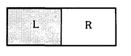
A
$\sqrt{3/2}$
B
$\sqrt{\pi/4}$
C
$\sqrt{2/3}$
D
$3\pi/8$
Solution
(D) Since the partition is diathermic,the temperature $T$ of both gases is the same.
Given that the $rms$ speed of molecules in the $L$ part equals the average speed of molecules in the $R$ part:
$V_{rms, L} = V_{avg, R}$
$\sqrt{\frac{3kT}{m_L}} = \sqrt{\frac{8kT}{\pi m_R}}$
Squaring both sides:
$\frac{3kT}{m_L} = \frac{8kT}{\pi m_R}$
$\frac{3}{m_L} = \frac{8}{\pi m_R}$
Rearranging to find the ratio $\frac{m_L}{m_R}$:
$\frac{m_L}{m_R} = \frac{3\pi}{8}$
Given that the $rms$ speed of molecules in the $L$ part equals the average speed of molecules in the $R$ part:
$V_{rms, L} = V_{avg, R}$
$\sqrt{\frac{3kT}{m_L}} = \sqrt{\frac{8kT}{\pi m_R}}$
Squaring both sides:
$\frac{3kT}{m_L} = \frac{8kT}{\pi m_R}$
$\frac{3}{m_L} = \frac{8}{\pi m_R}$
Rearranging to find the ratio $\frac{m_L}{m_R}$:
$\frac{m_L}{m_R} = \frac{3\pi}{8}$
0 likes
View Solution80
MediumMCQ
The $v_{rms}$ of gas molecules in a container is $400 \ ms^{-1}$. If half of the gas leaks out of the container at a constant temperature,the $v_{rms}$ of the remaining gas molecules will be . . . . . . $ms^{-1}$.
A
$800$
B
$400\sqrt{2}$
C
$400$
D
$200$
Solution
(C) The root mean square velocity $(v_{rms})$ of gas molecules is given by the formula $v_{rms} = \sqrt{\frac{3RT}{M}}$.
Here,$R$ is the universal gas constant,$T$ is the absolute temperature,and $M$ is the molar mass of the gas.
Since the temperature $(T)$ remains constant and the nature of the gas $(M)$ does not change,the $v_{rms}$ depends only on the temperature.
Even if the amount of gas in the container decreases due to leakage,the temperature remains constant.
Therefore,the $v_{rms}$ of the remaining gas molecules remains unchanged at $400 \ ms^{-1}$.
Here,$R$ is the universal gas constant,$T$ is the absolute temperature,and $M$ is the molar mass of the gas.
Since the temperature $(T)$ remains constant and the nature of the gas $(M)$ does not change,the $v_{rms}$ depends only on the temperature.
Even if the amount of gas in the container decreases due to leakage,the temperature remains constant.
Therefore,the $v_{rms}$ of the remaining gas molecules remains unchanged at $400 \ ms^{-1}$.
0 likes
View Solution81
MediumMCQ
For a gas at room temperature of $27^{\circ}C$,the value of $\nu_{rms}$ is $1930 \, m/s$. The gas is.......... $(R = 8.3 \, J/mol \cdot K)$.
A
$H_2$
B
$O_2$
C
$I_2$
D
$Cl_2$
Solution
(A) Given: Temperature $T = 27^{\circ}C = 27 + 273 = 300 \, K$.
Root mean square speed $\nu_{rms} = 1930 \, m/s$.
Gas constant $R = 8.3 \, J/mol \cdot K$.
The formula for $\nu_{rms}$ is $\nu_{rms} = \sqrt{\frac{3RT}{M}}$.
Squaring both sides,we get $\nu_{rms}^2 = \frac{3RT}{M}$.
Rearranging for molar mass $M$,we get $M = \frac{3RT}{\nu_{rms}^2}$.
Substituting the values: $M = \frac{3 \times 8.3 \times 300}{(1930)^2}$.
$M = \frac{7470}{3724900} \approx 0.002 \, kg/mol = 2 \, g/mol$.
The molar mass of $H_2$ is $2 \, g/mol$.
Therefore,the gas is $H_2$.
Root mean square speed $\nu_{rms} = 1930 \, m/s$.
Gas constant $R = 8.3 \, J/mol \cdot K$.
The formula for $\nu_{rms}$ is $\nu_{rms} = \sqrt{\frac{3RT}{M}}$.
Squaring both sides,we get $\nu_{rms}^2 = \frac{3RT}{M}$.
Rearranging for molar mass $M$,we get $M = \frac{3RT}{\nu_{rms}^2}$.
Substituting the values: $M = \frac{3 \times 8.3 \times 300}{(1930)^2}$.
$M = \frac{7470}{3724900} \approx 0.002 \, kg/mol = 2 \, g/mol$.
The molar mass of $H_2$ is $2 \, g/mol$.
Therefore,the gas is $H_2$.
0 likes
View Solution82
EasyMCQ
The ratio of $r.m.s.$ velocities of oxygen and hydrogen at a given temperature is:
A
$16 : 1$
B
$1 : 16$
C
$4 : 1$
D
$1 : 4$
Solution
(D) The $r.m.s.$ velocity of a gas is given by the formula $\upsilon_{rms} = \sqrt{\frac{3RT}{M}}$,where $R$ is the universal gas constant,$T$ is the absolute temperature,and $M$ is the molar mass of the gas.
Since the temperature $T$ is the same for both gases,we have $\upsilon_{rms} \propto \frac{1}{\sqrt{M}}$.
Therefore,the ratio of the $r.m.s.$ velocities of oxygen $(O_2)$ and hydrogen $(H_2)$ is given by:
$\frac{(\upsilon_{rms})_{O_2}}{(\upsilon_{rms})_{H_2}} = \sqrt{\frac{M_{H_2}}{M_{O_2}}}$.
The molar mass of hydrogen $(H_2)$ is $M_{H_2} = 2 \ g/mol$ and the molar mass of oxygen $(O_2)$ is $M_{O_2} = 32 \ g/mol$.
Substituting these values,we get:
$\frac{(\upsilon_{rms})_{O_2}}{(\upsilon_{rms})_{H_2}} = \sqrt{\frac{2}{32}} = \sqrt{\frac{1}{16}} = \frac{1}{4}$.
Thus,the ratio is $1:4$.
Since the temperature $T$ is the same for both gases,we have $\upsilon_{rms} \propto \frac{1}{\sqrt{M}}$.
Therefore,the ratio of the $r.m.s.$ velocities of oxygen $(O_2)$ and hydrogen $(H_2)$ is given by:
$\frac{(\upsilon_{rms})_{O_2}}{(\upsilon_{rms})_{H_2}} = \sqrt{\frac{M_{H_2}}{M_{O_2}}}$.
The molar mass of hydrogen $(H_2)$ is $M_{H_2} = 2 \ g/mol$ and the molar mass of oxygen $(O_2)$ is $M_{O_2} = 32 \ g/mol$.
Substituting these values,we get:
$\frac{(\upsilon_{rms})_{O_2}}{(\upsilon_{rms})_{H_2}} = \sqrt{\frac{2}{32}} = \sqrt{\frac{1}{16}} = \frac{1}{4}$.
Thus,the ratio is $1:4$.
0 likes
View Solution83
DifficultMCQ
The speeds of $5$ gas molecules are $2, 3, 4, 5,$ and $6$ units respectively. What is the $rms$ speed of these molecules?
A
$2.91$
B
$3.52$
C
$4$
D
$4.24$
Solution
(D) The root mean square $(rms)$ speed is defined as the square root of the mean of the squares of the individual speeds.
Formula: $v_{rms} = \sqrt{\frac{\sum v_i^2}{N}}$
Given speeds: $v_1 = 2, v_2 = 3, v_3 = 4, v_4 = 5, v_5 = 6$ and $N = 5$.
Calculation: $v_{rms} = \sqrt{\frac{2^2 + 3^2 + 4^2 + 5^2 + 6^2}{5}}$
$v_{rms} = \sqrt{\frac{4 + 9 + 16 + 25 + 36}{5}}$
$v_{rms} = \sqrt{\frac{90}{5}}$
$v_{rms} = \sqrt{18} \approx 4.24$ units.
Formula: $v_{rms} = \sqrt{\frac{\sum v_i^2}{N}}$
Given speeds: $v_1 = 2, v_2 = 3, v_3 = 4, v_4 = 5, v_5 = 6$ and $N = 5$.
Calculation: $v_{rms} = \sqrt{\frac{2^2 + 3^2 + 4^2 + 5^2 + 6^2}{5}}$
$v_{rms} = \sqrt{\frac{4 + 9 + 16 + 25 + 36}{5}}$
$v_{rms} = \sqrt{\frac{90}{5}}$
$v_{rms} = \sqrt{18} \approx 4.24$ units.
0 likes
View Solution84
MediumMCQ
The $rms$ speed of a gas at room temperature of $27^{\circ}C$ is found to be $412 \ m/s$. The gas is:
A
$CO_2$
B
$CO$
C
$O_2$
D
$O_3$
Solution
(A) The formula for $rms$ speed is given by $v_{rms} = \sqrt{\frac{3RT}{M_w}}$,where $R = 8.31 \ J/(mol \cdot K)$,$T = 27 + 273 = 300 \ K$,and $v_{rms} = 412 \ m/s$.
Squaring both sides,we get $v_{rms}^2 = \frac{3RT}{M_w}$.
Rearranging for molar mass $M_w$: $M_w = \frac{3RT}{v_{rms}^2}$.
Substituting the values: $M_w = \frac{3 \times 8.31 \times 300}{412^2} \approx \frac{7479}{169744} \approx 0.044 \ kg/mol = 44 \ g/mol$.
The molar mass of $CO_2$ is $12 + (2 \times 16) = 44 \ g/mol$. Therefore,the gas is $CO_2$.
Squaring both sides,we get $v_{rms}^2 = \frac{3RT}{M_w}$.
Rearranging for molar mass $M_w$: $M_w = \frac{3RT}{v_{rms}^2}$.
Substituting the values: $M_w = \frac{3 \times 8.31 \times 300}{412^2} \approx \frac{7479}{169744} \approx 0.044 \ kg/mol = 44 \ g/mol$.
The molar mass of $CO_2$ is $12 + (2 \times 16) = 44 \ g/mol$. Therefore,the gas is $CO_2$.
0 likes
View Solution85
EasyMCQ
The $N_2$ molecule is $14$ times heavier than the $H_2$ molecule. At what temperature will the $rms$ speed of $H_2$ molecules be equal to the $rms$ speed of $N_2$ molecules at $27^{\circ}C$?
A
$50^{\circ}C$
B
$40^{\circ}C$
C
$87^{\circ}C$
D
$21.4 \ K$
Solution
(D) The formula for $rms$ speed is $v_{rms} = \sqrt{\frac{3RT}{M}}$.
Given that the $rms$ speed of $H_2$ at temperature $T$ is equal to the $rms$ speed of $N_2$ at $T_2 = 27^{\circ}C = 300 \ K$.
So,$\sqrt{\frac{3RT}{M_{H_2}}} = \sqrt{\frac{3RT_2}{M_{N_2}}}$.
Squaring both sides: $\frac{T}{M_{H_2}} = \frac{T_2}{M_{N_2}}$.
Given $M_{N_2} = 14 \times M_{H_2}$.
Substituting the values: $\frac{T}{M_{H_2}} = \frac{300}{14 \times M_{H_2}}$.
$T = \frac{300}{14} \approx 21.4 \ K$.
Given that the $rms$ speed of $H_2$ at temperature $T$ is equal to the $rms$ speed of $N_2$ at $T_2 = 27^{\circ}C = 300 \ K$.
So,$\sqrt{\frac{3RT}{M_{H_2}}} = \sqrt{\frac{3RT_2}{M_{N_2}}}$.
Squaring both sides: $\frac{T}{M_{H_2}} = \frac{T_2}{M_{N_2}}$.
Given $M_{N_2} = 14 \times M_{H_2}$.
Substituting the values: $\frac{T}{M_{H_2}} = \frac{300}{14 \times M_{H_2}}$.
$T = \frac{300}{14} \approx 21.4 \ K$.
0 likes
View Solution86
EasyMCQ
At what temperature is the $rms$ speed of hydrogen molecules equal to the $rms$ speed of oxygen molecules at $47^{\circ}C$ (in $K$)?
A
$80$
B
$20$
C
$3$
D
$40$
Solution
(B) The formula for $rms$ speed is $v_{rms} = \sqrt{\frac{3RT}{M}}$.
Given that the $rms$ speed of hydrogen $(H_2)$ equals the $rms$ speed of oxygen $(O_2)$:
$\sqrt{\frac{3RT_{H_2}}{M_{H_2}}} = \sqrt{\frac{3RT_{O_2}}{M_{O_2}}}$
Squaring both sides and cancelling common terms $(3R)$:
$\frac{T_{H_2}}{M_{H_2}} = \frac{T_{O_2}}{M_{O_2}}$
Here,$M_{H_2} = 2 \ g/mol$,$M_{O_2} = 32 \ g/mol$,and $T_{O_2} = 47 + 273 = 320 \ K$.
Substituting the values:
$\frac{T_{H_2}}{2} = \frac{320}{32}$
$\frac{T_{H_2}}{2} = 10$
$T_{H_2} = 20 \ K$.
Given that the $rms$ speed of hydrogen $(H_2)$ equals the $rms$ speed of oxygen $(O_2)$:
$\sqrt{\frac{3RT_{H_2}}{M_{H_2}}} = \sqrt{\frac{3RT_{O_2}}{M_{O_2}}}$
Squaring both sides and cancelling common terms $(3R)$:
$\frac{T_{H_2}}{M_{H_2}} = \frac{T_{O_2}}{M_{O_2}}$
Here,$M_{H_2} = 2 \ g/mol$,$M_{O_2} = 32 \ g/mol$,and $T_{O_2} = 47 + 273 = 320 \ K$.
Substituting the values:
$\frac{T_{H_2}}{2} = \frac{320}{32}$
$\frac{T_{H_2}}{2} = 10$
$T_{H_2} = 20 \ K$.
0 likes
View Solution87
MediumMCQ
The $v_{rms}$ value for a hydrogen molecule at $300 \ K$ is $1930 \ m/s$. Then the $v_{rms}$ for an oxygen molecule at $900 \ K$ is . . . . . . $m/s$.
A
$1930\sqrt{3}$
B
$836$
C
$643$
D
$\frac{1930}{\sqrt{3}}$
Solution
(B) The formula for root mean square speed is $v_{rms} = \sqrt{\frac{3RT}{M}}$.
For hydrogen at $T_1 = 300 \ K$ and $M_1 = 2 \ g/mol$:
$(v_{rms})_H = \sqrt{\frac{3RT_1}{M_1}} = 1930 \ m/s \implies 1930 = \sqrt{\frac{3R(300)}{2}} \quad \dots(1)$
For oxygen at $T_2 = 900 \ K$ and $M_2 = 32 \ g/mol$:
$(v_{rms})_O = \sqrt{\frac{3RT_2}{M_2}} = \sqrt{\frac{3R(900)}{32}}$
$(v_{rms})_O = \sqrt{\frac{3R(300) \times 3}{16 \times 2}} = \sqrt{3} \times \frac{1}{4} \times \sqrt{\frac{3R(300)}{2}}$
Substituting equation $(1)$:
$(v_{rms})_O = \frac{\sqrt{3}}{4} \times 1930 = \frac{1.732}{4} \times 1930 \approx 836 \ m/s$.
For hydrogen at $T_1 = 300 \ K$ and $M_1 = 2 \ g/mol$:
$(v_{rms})_H = \sqrt{\frac{3RT_1}{M_1}} = 1930 \ m/s \implies 1930 = \sqrt{\frac{3R(300)}{2}} \quad \dots(1)$
For oxygen at $T_2 = 900 \ K$ and $M_2 = 32 \ g/mol$:
$(v_{rms})_O = \sqrt{\frac{3RT_2}{M_2}} = \sqrt{\frac{3R(900)}{32}}$
$(v_{rms})_O = \sqrt{\frac{3R(300) \times 3}{16 \times 2}} = \sqrt{3} \times \frac{1}{4} \times \sqrt{\frac{3R(300)}{2}}$
Substituting equation $(1)$:
$(v_{rms})_O = \frac{\sqrt{3}}{4} \times 1930 = \frac{1.732}{4} \times 1930 \approx 836 \ m/s$.
0 likes
View Solution88
DifficultMCQ
$A$ gas $A$ has $N$ molecules at temperature $T$ with mass $m$. Another gas $B$ has $2N$ molecules at the same temperature $T$ with mass $2m$. Both are contained in a vessel. If the $rms$ velocity of molecules of gas $B$ is $v$,and the $x$-component of the mean square velocity of molecules of gas $A$ is $w^2$,find the ratio $w^2/v^2$.
A
$1$
B
$2$
C
$0.33$
D
$0.67$
Solution
(D) The $rms$ velocity of a gas is given by $v_{rms} = \sqrt{\frac{3kT}{M}}$,where $M$ is the mass of a single molecule.
For gas $A$,the mass of a molecule is $m$. Thus,$v_{rms, A}^2 = \frac{3kT}{m}$.
The mean square velocity is $\langle v^2 \rangle = v_{rms}^2$. The $x$-component of the mean square velocity is $\langle v_x^2 \rangle = \frac{1}{3} \langle v^2 \rangle = \frac{1}{3} \frac{3kT}{m} = \frac{kT}{m}$. So,$w^2 = \frac{kT}{m}$.
For gas $B$,the mass of a molecule is $2m$. Thus,$v^2 = v_{rms, B}^2 = \frac{3kT}{2m}$.
Now,the ratio $\frac{w^2}{v^2} = \frac{kT/m}{3kT/2m} = \frac{1}{3/2} = \frac{2}{3} \approx 0.67$.
For gas $A$,the mass of a molecule is $m$. Thus,$v_{rms, A}^2 = \frac{3kT}{m}$.
The mean square velocity is $\langle v^2 \rangle = v_{rms}^2$. The $x$-component of the mean square velocity is $\langle v_x^2 \rangle = \frac{1}{3} \langle v^2 \rangle = \frac{1}{3} \frac{3kT}{m} = \frac{kT}{m}$. So,$w^2 = \frac{kT}{m}$.
For gas $B$,the mass of a molecule is $2m$. Thus,$v^2 = v_{rms, B}^2 = \frac{3kT}{2m}$.
Now,the ratio $\frac{w^2}{v^2} = \frac{kT/m}{3kT/2m} = \frac{1}{3/2} = \frac{2}{3} \approx 0.67$.
0 likes
View Solution89
MediumMCQ
The $rms$ velocity of molecules of a given mass of gas at $27^{\circ}C$ and $1.0 \times 10^5 \, Nm^{-2}$ pressure is $200 \, m \, s^{-1}$. What will be the $rms$ velocity if the temperature and pressure are $127^{\circ}C$ and $0.5 \times 10^5 \, Nm^{-2}$ respectively?
A
$\frac{400}{\sqrt{3}} \, m \, s^{-1}$
B
$100\sqrt{2} \, m \, s^{-1}$
C
$100 \frac{\sqrt{2}}{3} \, m \, s^{-1}$
D
$50 \frac{\sqrt{2}}{3} \, m \, s^{-1}$
Solution
(A) The $rms$ velocity of a gas is given by the formula $v_{rms} = \sqrt{\frac{3RT}{M}}$.
From this formula,it is clear that $v_{rms} \propto \sqrt{T}$.
The $rms$ velocity is independent of the pressure of the gas.
Given: $T_1 = 27^{\circ}C = 300 \, K$,$v_1 = 200 \, m \, s^{-1}$.
New temperature: $T_2 = 127^{\circ}C = 400 \, K$.
Using the proportionality $v_2 = v_1 \sqrt{\frac{T_2}{T_1}}$:
$v_2 = 200 \sqrt{\frac{400}{300}} = 200 \sqrt{\frac{4}{3}} = 200 \times \frac{2}{\sqrt{3}} = \frac{400}{\sqrt{3}} \, m \, s^{-1}$.
From this formula,it is clear that $v_{rms} \propto \sqrt{T}$.
The $rms$ velocity is independent of the pressure of the gas.
Given: $T_1 = 27^{\circ}C = 300 \, K$,$v_1 = 200 \, m \, s^{-1}$.
New temperature: $T_2 = 127^{\circ}C = 400 \, K$.
Using the proportionality $v_2 = v_1 \sqrt{\frac{T_2}{T_1}}$:
$v_2 = 200 \sqrt{\frac{400}{300}} = 200 \sqrt{\frac{4}{3}} = 200 \times \frac{2}{\sqrt{3}} = \frac{400}{\sqrt{3}} \, m \, s^{-1}$.
0 likes
View Solution90
EasyMCQ
The $rms$ speed of $n$ molecules in a gas having speeds $\upsilon_1, \upsilon_2, \upsilon_3, \dots, \upsilon_n$ is equal to:
A
$\frac{1}{n} [\upsilon_1 + \upsilon_2 + \upsilon_3 + \dots + \upsilon_n]^{1/2}$
B
$[\frac{\upsilon_1^2 + \upsilon_2^2 + \upsilon_3^2 + \dots + \upsilon_n^2}{n}]^{1/2}$
C
$\frac{1}{n} [\upsilon_1^2 + \upsilon_2^2 + \upsilon_3^2 + \dots + \upsilon_n^2]^{1/2}$
D
$[\frac{(\upsilon_1 + \upsilon_2 + \upsilon_3 + \dots + \upsilon_n)^2}{n}]^{1/2}$
Solution
(B) According to the definition of $rms$ (root-mean-square) speed:
$\upsilon_{rms} = \sqrt{\langle \upsilon^2 \rangle}$
Here,the mean square speed $\langle \upsilon^2 \rangle$ is given by:
$\langle \upsilon^2 \rangle = \frac{\upsilon_1^2 + \upsilon_2^2 + \upsilon_3^2 + \dots + \upsilon_n^2}{n}$
Therefore,the $rms$ speed is:
$\upsilon_{rms} = [\frac{\upsilon_1^2 + \upsilon_2^2 + \upsilon_3^2 + \dots + \upsilon_n^2}{n}]^{1/2}$
$\upsilon_{rms} = \sqrt{\langle \upsilon^2 \rangle}$
Here,the mean square speed $\langle \upsilon^2 \rangle$ is given by:
$\langle \upsilon^2 \rangle = \frac{\upsilon_1^2 + \upsilon_2^2 + \upsilon_3^2 + \dots + \upsilon_n^2}{n}$
Therefore,the $rms$ speed is:
$\upsilon_{rms} = [\frac{\upsilon_1^2 + \upsilon_2^2 + \upsilon_3^2 + \dots + \upsilon_n^2}{n}]^{1/2}$
0 likes
View Solution91
MediumMCQ
The $rms$ speed of hydrogen molecules at room temperature $(300 \ K)$ will be:
A
$0.40 \times 10^2 \ m/s$
B
$1.50 \times 10^4 \ m/s$
C
$0.70 \times 10^4 \ m/s$
D
$1.93 \times 10^3 \ m/s$
Solution
(D) The formula for the $rms$ speed of gas molecules is given by: $v_{rms} = \sqrt{\frac{3RT}{M_w}}$
Given:
Temperature $T = 300 \ K$
Universal gas constant $R = 8.31 \ J/(mol \cdot K)$
Molar mass of hydrogen gas $(H_2)$ $M_w = 2 \ g/mol = 2 \times 10^{-3} \ kg/mol$
Substituting the values into the formula:
$v_{rms} = \sqrt{\frac{3 \times 8.31 \times 300}{2 \times 10^{-3}}}$
$v_{rms} = \sqrt{\frac{7479}{2 \times 10^{-3}}}$
$v_{rms} = \sqrt{3739500}$
$v_{rms} \approx 1933.7 \ m/s$
Rounding to the appropriate significant figures,we get:
$v_{rms} \approx 1.93 \times 10^3 \ m/s$
Given:
Temperature $T = 300 \ K$
Universal gas constant $R = 8.31 \ J/(mol \cdot K)$
Molar mass of hydrogen gas $(H_2)$ $M_w = 2 \ g/mol = 2 \times 10^{-3} \ kg/mol$
Substituting the values into the formula:
$v_{rms} = \sqrt{\frac{3 \times 8.31 \times 300}{2 \times 10^{-3}}}$
$v_{rms} = \sqrt{\frac{7479}{2 \times 10^{-3}}}$
$v_{rms} = \sqrt{3739500}$
$v_{rms} \approx 1933.7 \ m/s$
Rounding to the appropriate significant figures,we get:
$v_{rms} \approx 1.93 \times 10^3 \ m/s$
0 likes
View Solution92
DifficultMCQ
For a given gas,the velocities of $5$ molecules are $2, 3, 4, 5,$ and $6$. What is the $rms$ velocity?
A
$2.91$
B
$3.52$
C
$4$
D
$4.24$
Solution
(D) The root mean square $(rms)$ velocity is defined as the square root of the mean of the squares of the individual velocities.
Formula: $\upsilon_{rms} = \sqrt{\frac{\upsilon_1^2 + \upsilon_2^2 + \upsilon_3^2 + \upsilon_4^2 + \upsilon_5^2}{N}}$
Given velocities: $\upsilon_1 = 2, \upsilon_2 = 3, \upsilon_3 = 4, \upsilon_4 = 5, \upsilon_5 = 6$ and $N = 5$.
Calculation: $\upsilon_{rms} = \sqrt{\frac{2^2 + 3^2 + 4^2 + 5^2 + 6^2}{5}}$
$\upsilon_{rms} = \sqrt{\frac{4 + 9 + 16 + 25 + 36}{5}}$
$\upsilon_{rms} = \sqrt{\frac{90}{5}}$
$\upsilon_{rms} = \sqrt{18}$
$\upsilon_{rms} \approx 4.24$
Formula: $\upsilon_{rms} = \sqrt{\frac{\upsilon_1^2 + \upsilon_2^2 + \upsilon_3^2 + \upsilon_4^2 + \upsilon_5^2}{N}}$
Given velocities: $\upsilon_1 = 2, \upsilon_2 = 3, \upsilon_3 = 4, \upsilon_4 = 5, \upsilon_5 = 6$ and $N = 5$.
Calculation: $\upsilon_{rms} = \sqrt{\frac{2^2 + 3^2 + 4^2 + 5^2 + 6^2}{5}}$
$\upsilon_{rms} = \sqrt{\frac{4 + 9 + 16 + 25 + 36}{5}}$
$\upsilon_{rms} = \sqrt{\frac{90}{5}}$
$\upsilon_{rms} = \sqrt{18}$
$\upsilon_{rms} \approx 4.24$
0 likes
View Solution93
MediumMCQ
At what temperature in $K$ will the $r.m.s.$ speed of a hydrogen molecule be equal to the escape velocity from the Earth?
A
$1060$
B
$5030$
C
$8270$
D
$10063$
Solution
(D) The escape velocity from the Earth is $v_{e} = 11.2 \, km/s = 11.2 \times 10^{3} \, m/s$.
The $r.m.s.$ speed of a gas molecule is given by $v_{rms} = \sqrt{\frac{3RT}{M}}$.
Equating $v_{rms}$ to the escape velocity $v_{e}$:
$v_{e} = \sqrt{\frac{3RT}{M}}$
Squaring both sides:
$v_{e}^{2} = \frac{3RT}{M}$
Solving for $T$:
$T = \frac{M v_{e}^{2}}{3R}$
Given for hydrogen $(H_{2})$,the molar mass $M = 2 \times 10^{-3} \, kg/mol$ and the universal gas constant $R = 8.31 \, J/(mol \cdot K)$.
Substituting the values:
$T = \frac{(2 \times 10^{-3}) \times (11.2 \times 10^{3})^{2}}{3 \times 8.31}$
$T = \frac{2 \times 10^{-3} \times 125.44 \times 10^{6}}{24.93}$
$T = \frac{250.88 \times 10^{3}}{24.93} \approx 10063 \, K$.
The $r.m.s.$ speed of a gas molecule is given by $v_{rms} = \sqrt{\frac{3RT}{M}}$.
Equating $v_{rms}$ to the escape velocity $v_{e}$:
$v_{e} = \sqrt{\frac{3RT}{M}}$
Squaring both sides:
$v_{e}^{2} = \frac{3RT}{M}$
Solving for $T$:
$T = \frac{M v_{e}^{2}}{3R}$
Given for hydrogen $(H_{2})$,the molar mass $M = 2 \times 10^{-3} \, kg/mol$ and the universal gas constant $R = 8.31 \, J/(mol \cdot K)$.
Substituting the values:
$T = \frac{(2 \times 10^{-3}) \times (11.2 \times 10^{3})^{2}}{3 \times 8.31}$
$T = \frac{2 \times 10^{-3} \times 125.44 \times 10^{6}}{24.93}$
$T = \frac{250.88 \times 10^{3}}{24.93} \approx 10063 \, K$.
0 likes
View Solution94
MediumMCQ
At what temperature $(^oC)$ is the average speed of hydrogen molecules equal to the average speed of oxygen molecules at $31^oC$?
A
$-216$
B
$-235$
C
$-254$
D
$-264$
Solution
(C) The average speed of gas molecules is given by the formula $v_{avg} = \sqrt{\frac{8RT}{\pi M}}$.
For hydrogen $(H_2)$,the molar mass $M_{H_2} = 2 \times 10^{-3} \ kg/mol$.
For oxygen $(O_2)$,the molar mass $M_{O_2} = 32 \times 10^{-3} \ kg/mol$.
Given the temperature of oxygen $T_{O_2} = 31 + 273 = 304 \ K$.
Equating the average speeds: $\sqrt{\frac{8RT_{H_2}}{\pi M_{H_2}}} = \sqrt{\frac{8RT_{O_2}}{\pi M_{O_2}}}$.
Squaring both sides and simplifying: $\frac{T_{H_2}}{M_{H_2}} = \frac{T_{O_2}}{M_{O_2}}$.
Substituting the values: $\frac{T_{H_2}}{2} = \frac{304}{32}$.
$T_{H_2} = \frac{304 \times 2}{32} = \frac{304}{16} = 19 \ K$.
Converting to Celsius: $T(^oC) = 19 - 273 = -254^oC$.
For hydrogen $(H_2)$,the molar mass $M_{H_2} = 2 \times 10^{-3} \ kg/mol$.
For oxygen $(O_2)$,the molar mass $M_{O_2} = 32 \times 10^{-3} \ kg/mol$.
Given the temperature of oxygen $T_{O_2} = 31 + 273 = 304 \ K$.
Equating the average speeds: $\sqrt{\frac{8RT_{H_2}}{\pi M_{H_2}}} = \sqrt{\frac{8RT_{O_2}}{\pi M_{O_2}}}$.
Squaring both sides and simplifying: $\frac{T_{H_2}}{M_{H_2}} = \frac{T_{O_2}}{M_{O_2}}$.
Substituting the values: $\frac{T_{H_2}}{2} = \frac{304}{32}$.
$T_{H_2} = \frac{304 \times 2}{32} = \frac{304}{16} = 19 \ K$.
Converting to Celsius: $T(^oC) = 19 - 273 = -254^oC$.
0 likes
View Solution95
DifficultMCQ
If the $rms$ speed of hydrogen gas is equal to the $rms$ speed of oxygen gas at $47^{\circ}C$,find the temperature of the hydrogen gas in $K$.
A
$20$
B
$47$
C
$50$
D
$94$
Solution
(A) The formula for $rms$ speed is $v_{rms} = \sqrt{\frac{3RT}{M}}$.
Given that the $rms$ speed of hydrogen $(H_2)$ is equal to the $rms$ speed of oxygen $(O_2)$:
$\sqrt{\frac{3RT_{H_2}}{M_{H_2}}} = \sqrt{\frac{3RT_{O_2}}{M_{O_2}}}$
Squaring both sides and canceling common terms $(3R)$:
$\frac{T_{H_2}}{M_{H_2}} = \frac{T_{O_2}}{M_{O_2}}$
Given $T_{O_2} = 47^{\circ}C = 47 + 273 = 320 \ K$.
Molar mass of $H_2$ $(M_{H_2})$ = $2 \ g/mol$.
Molar mass of $O_2$ $(M_{O_2})$ = $32 \ g/mol$.
Substituting the values:
$\frac{T_{H_2}}{2} = \frac{320}{32}$
$\frac{T_{H_2}}{2} = 10$
$T_{H_2} = 20 \ K$.
Given that the $rms$ speed of hydrogen $(H_2)$ is equal to the $rms$ speed of oxygen $(O_2)$:
$\sqrt{\frac{3RT_{H_2}}{M_{H_2}}} = \sqrt{\frac{3RT_{O_2}}{M_{O_2}}}$
Squaring both sides and canceling common terms $(3R)$:
$\frac{T_{H_2}}{M_{H_2}} = \frac{T_{O_2}}{M_{O_2}}$
Given $T_{O_2} = 47^{\circ}C = 47 + 273 = 320 \ K$.
Molar mass of $H_2$ $(M_{H_2})$ = $2 \ g/mol$.
Molar mass of $O_2$ $(M_{O_2})$ = $32 \ g/mol$.
Substituting the values:
$\frac{T_{H_2}}{2} = \frac{320}{32}$
$\frac{T_{H_2}}{2} = 10$
$T_{H_2} = 20 \ K$.
0 likes
View Solution96
DifficultMCQ
At what temperature $(K)$ will the $r.m.s.$ velocity of hydrogen gas be equal to the escape velocity from the Earth?
A
$1060$
B
$5030$
C
$8270$
D
$10075$
Solution
(D) The $r.m.s.$ velocity of a gas is given by $v_{rms} = \sqrt{\frac{3RT}{M_w}}$.
Given,$v_{rms} = v_e = 11.2 \times 10^3 \ m/s$.
The molar mass of hydrogen $(H_2)$ is $M_w = 2 \times 10^{-3} \ kg/mol$.
Equating the two: $\sqrt{\frac{3RT}{M_w}} = 11.2 \times 10^3$.
Squaring both sides: $\frac{3RT}{M_w} = (11.2 \times 10^3)^2$.
$T = \frac{(11.2 \times 10^3)^2 \times M_w}{3R}$.
Substituting $R = 8.314 \ J/(mol \cdot K)$ and $M_w = 2 \times 10^{-3} \ kg/mol$:
$T = \frac{125.44 \times 10^6 \times 2 \times 10^{-3}}{3 \times 8.314} \approx \frac{250.88 \times 10^3}{24.942} \approx 10058 \ K$.
Rounding to the nearest provided option,$T \approx 10075 \ K$.
Given,$v_{rms} = v_e = 11.2 \times 10^3 \ m/s$.
The molar mass of hydrogen $(H_2)$ is $M_w = 2 \times 10^{-3} \ kg/mol$.
Equating the two: $\sqrt{\frac{3RT}{M_w}} = 11.2 \times 10^3$.
Squaring both sides: $\frac{3RT}{M_w} = (11.2 \times 10^3)^2$.
$T = \frac{(11.2 \times 10^3)^2 \times M_w}{3R}$.
Substituting $R = 8.314 \ J/(mol \cdot K)$ and $M_w = 2 \times 10^{-3} \ kg/mol$:
$T = \frac{125.44 \times 10^6 \times 2 \times 10^{-3}}{3 \times 8.314} \approx \frac{250.88 \times 10^3}{24.942} \approx 10058 \ K$.
Rounding to the nearest provided option,$T \approx 10075 \ K$.
0 likes
View Solution97
DifficultMCQ
$A$ tube is divided into two parts,containing two different ideal gases,$L$ and $R$. If the $rms$ velocity of the gas on the left side is equal to the average velocity of the gas on the right side,what is the ratio of the masses of the molecules in $L$ and $R$?
A
$\sqrt{3/2}$
B
$\sqrt{\pi/4}$
C
$\sqrt{2/3}$
D
$3\pi/8$
Solution
(D) The $rms$ velocity of the gas on the left side is given by: $\upsilon_{rms} = \sqrt{\frac{3KT}{m_L}}$.
The average velocity of the gas on the right side is given by: $\upsilon_{avg} = \sqrt{\frac{8KT}{\pi m_R}}$.
According to the problem,the $rms$ velocity of the left gas equals the average velocity of the right gas:
$\sqrt{\frac{3KT}{m_L}} = \sqrt{\frac{8KT}{\pi m_R}}$.
Squaring both sides:
$\frac{3KT}{m_L} = \frac{8KT}{\pi m_R}$.
Canceling $KT$ from both sides:
$\frac{3}{m_L} = \frac{8}{\pi m_R}$.
Rearranging for the ratio of masses $\frac{m_L}{m_R}$:
$\frac{m_L}{m_R} = \frac{3\pi}{8}$.
The average velocity of the gas on the right side is given by: $\upsilon_{avg} = \sqrt{\frac{8KT}{\pi m_R}}$.
According to the problem,the $rms$ velocity of the left gas equals the average velocity of the right gas:
$\sqrt{\frac{3KT}{m_L}} = \sqrt{\frac{8KT}{\pi m_R}}$.
Squaring both sides:
$\frac{3KT}{m_L} = \frac{8KT}{\pi m_R}$.
Canceling $KT$ from both sides:
$\frac{3}{m_L} = \frac{8}{\pi m_R}$.
Rearranging for the ratio of masses $\frac{m_L}{m_R}$:
$\frac{m_L}{m_R} = \frac{3\pi}{8}$.
0 likes
View Solution98
MediumMCQ
Two containers $A$ and $B$ contain an ideal gas at the same temperature. If the masses of the molecules are $m_A$ and $m_B$ respectively,what is the relationship between their momenta $p_A$ and $p_B$?
A
$p_A = p_B$
B
$p_A = \left( \frac{m_A}{m_B} \right)^{1/2} p_B$
C
$p_A = \left( \frac{m_B}{m_A} \right)^{1/2} p_B$
D
$p_A = \left( \frac{m_A}{m_B} \right) p_B$
Solution
(B) The root mean square velocity of an ideal gas molecule is given by $v_{rms} = \sqrt{\frac{3RT}{M}}$ or $v_{rms} = \sqrt{\frac{3kT}{m}}$,where $m$ is the mass of the molecule.
The momentum of a molecule is $p = mv$.
For container $A$,$p_A = m_A v_A = m_A \sqrt{\frac{3kT}{m_A}} = \sqrt{3kT m_A}$.
For container $B$,$p_B = m_B v_B = m_B \sqrt{\frac{3kT}{m_B}} = \sqrt{3kT m_B}$.
Taking the ratio of the two momenta:
$\frac{p_A}{p_B} = \frac{\sqrt{3kT m_A}}{\sqrt{3kT m_B}} = \sqrt{\frac{m_A}{m_B}} = \left( \frac{m_A}{m_B} \right)^{1/2}$.
Therefore,$p_A = \left( \frac{m_A}{m_B} \right)^{1/2} p_B$.
The momentum of a molecule is $p = mv$.
For container $A$,$p_A = m_A v_A = m_A \sqrt{\frac{3kT}{m_A}} = \sqrt{3kT m_A}$.
For container $B$,$p_B = m_B v_B = m_B \sqrt{\frac{3kT}{m_B}} = \sqrt{3kT m_B}$.
Taking the ratio of the two momenta:
$\frac{p_A}{p_B} = \frac{\sqrt{3kT m_A}}{\sqrt{3kT m_B}} = \sqrt{\frac{m_A}{m_B}} = \left( \frac{m_A}{m_B} \right)^{1/2}$.
Therefore,$p_A = \left( \frac{m_A}{m_B} \right)^{1/2} p_B$.
0 likes
View Solution99
MediumMCQ
The speeds of ten particles in $ms^{-1}$ are $0, 2, 3, 4, 4, 4, 5, 5, 6, 9$. The values of average speed,$rms$ speed,and most probable speed are respectively:
A
$4.1 \ m/s, 4.1 \ m/s, 4.1 \ m/s$
B
$4.5 \ m/s, 4.5 \ m/s, 5.0 \ m/s$
C
$4.2 \ m/s, 4.77 \ m/s, 4.0 \ m/s$
D
$4.2 \ m/s, 5.1 \ m/s, 4.0 \ m/s$
Solution
(C) Average speed $v_{av} = \frac{0 + 2 + 3 + 4 + 4 + 4 + 5 + 5 + 6 + 9}{10} = \frac{42}{10} = 4.2 \ m/s$.
$rms$ speed $v_{rms} = \sqrt{\frac{0^2 + 2^2 + 3^2 + 4^2 + 4^2 + 4^2 + 5^2 + 5^2 + 6^2 + 9^2}{10}} = \sqrt{\frac{0 + 4 + 9 + 16 + 16 + 16 + 25 + 25 + 36 + 81}{10}} = \sqrt{\frac{228}{10}} = \sqrt{22.8} \approx 4.77 \ m/s$.
Most probable speed $v_{mp}$ is the speed that occurs most frequently. Here,$4$ appears three times,which is more than any other value. Thus,$v_{mp} = 4 \ m/s$.
$rms$ speed $v_{rms} = \sqrt{\frac{0^2 + 2^2 + 3^2 + 4^2 + 4^2 + 4^2 + 5^2 + 5^2 + 6^2 + 9^2}{10}} = \sqrt{\frac{0 + 4 + 9 + 16 + 16 + 16 + 25 + 25 + 36 + 81}{10}} = \sqrt{\frac{228}{10}} = \sqrt{22.8} \approx 4.77 \ m/s$.
Most probable speed $v_{mp}$ is the speed that occurs most frequently. Here,$4$ appears three times,which is more than any other value. Thus,$v_{mp} = 4 \ m/s$.
0 likes
View SolutionKinetic Theory of Gases — Speed (velocity) of Gas (rms, mean and Most probable speed) · Frequently Asked Questions
1Are these Kinetic Theory of Gases questions useful for JEE and NEET?
Yes. All questions in this section are mapped to JEE Main and NEET exam patterns. Previous year questions from JEE Main, NEET, GUJCET and state-level exams are included with full solutions.
2Can I switch to Hindi or Gujarati for these questions?
Yes. Use the language tabs in the hero section or the sidebar to view the same questions and solutions in English, Hindi or Gujarati.
3How do I generate a question paper from this subtopic?
Use the Vedclass Exam Paper Generator — select the chapter and subtopic, set difficulty, and generate Sets A, B, C, D automatically. First 3 chapters of every subject are free.
Vedclass Products
For Students
Vedclass Test Series
Mock tests in real JEE/NEET style with performance analysis. 5-day free trial.
Start Free TrialFor Teachers
Exam Paper Generator
Generate Set A/B/C/D papers from this chapter in 2 minutes. 3 chapters free.
Try FreeFor Institutes
Online Exam Module
Live online exams with unlimited students, 360° analytics & white-label branding.
See DemoFor Teachers & Institutes
Generate a Kinetic Theory of Gases Exam Paper in 2 Minutes
Select subtopic & difficulty — Sets A, B, C, D auto-generated with No Repeat logic.
First 3 chapters of every subject are free — no payment required.