
A English
Speed (velocity) of Gas (rms, mean and Most probable speed) Questions in English
Class 11 Physics · Kinetic Theory of Gases · Speed (velocity) of Gas (rms, mean and Most probable speed)
291+
Questions
English
Language
100%
With Solutions
Showing 50 of 291 questions in English
101
MediumMCQ
At what temperature will the root mean square speed $(\nu_{rms})$ of oxygen gas molecules be equal to the $\nu_{rms}$ of hydrogen gas molecules at $27 \, ^\circ C$? $(M_{O_2} = 32 \, g \, mol^{-1}, M_{H_2} = 2 \, g \, mol^{-1})$
A
$4800 \, ^\circ C$
B
$480 \, ^\circ C$
C
$4800 \, K$
D
$480 \, K$
Solution
(C) The root mean square speed of gas molecules is given by the formula $\nu_{rms} = \sqrt{\frac{3RT}{M}}$.
Given: Temperature of hydrogen $T_H = 27 \, ^\circ C = 27 + 273 = 300 \, K$.
Molar mass of oxygen $M_{O_2} = 32 \, g \, mol^{-1}$.
Molar mass of hydrogen $M_{H_2} = 2 \, g \, mol^{-1}$.
Since $\nu_{rms(O_2)} = \nu_{rms(H_2)}$,we have $\sqrt{\frac{3RT_O}{M_{O_2}}} = \sqrt{\frac{3RT_H}{M_{H_2}}}$.
Squaring both sides and simplifying,we get $\frac{T_O}{M_{O_2}} = \frac{T_H}{M_{H_2}}$.
Therefore,$T_O = T_H \times \frac{M_{O_2}}{M_{H_2}} = 300 \times \frac{32}{2} = 300 \times 16 = 4800 \, K$.
Given: Temperature of hydrogen $T_H = 27 \, ^\circ C = 27 + 273 = 300 \, K$.
Molar mass of oxygen $M_{O_2} = 32 \, g \, mol^{-1}$.
Molar mass of hydrogen $M_{H_2} = 2 \, g \, mol^{-1}$.
Since $\nu_{rms(O_2)} = \nu_{rms(H_2)}$,we have $\sqrt{\frac{3RT_O}{M_{O_2}}} = \sqrt{\frac{3RT_H}{M_{H_2}}}$.
Squaring both sides and simplifying,we get $\frac{T_O}{M_{O_2}} = \frac{T_H}{M_{H_2}}$.
Therefore,$T_O = T_H \times \frac{M_{O_2}}{M_{H_2}} = 300 \times \frac{32}{2} = 300 \times 16 = 4800 \, K$.
0 likes
View Solution102
DifficultMCQ
In a sample of chlorine gas at $300 \ K$,the average kinetic energy per molecule is $6.21 \times 10^{-21} \ J$ and the root mean square speed $\nu_{rms}$ is $325 \ m/s$. What will be the values of these quantities at $600 \ K$?
A
$12.42 \times 10^{-21} \ J, \ 650 \ m/s$
B
$6.21 \times 10^{-21} \ J, \ 650 \ m/s$
C
$12.42 \times 10^{-21} \ J, \ 325 \ m/s$
D
$12.42 \times 10^{-21} \ J, \ 459.6 \ m/s$
Solution
(D) The average kinetic energy $(E)$ of a gas molecule is directly proportional to the absolute temperature $(T)$: $E \propto T$.
Given $E_1 = 6.21 \times 10^{-21} \ J$ at $T_1 = 300 \ K$. At $T_2 = 600 \ K$,the new kinetic energy $E_2$ is:
$E_2 = E_1 \times (T_2 / T_1) = 6.21 \times 10^{-21} \times (600 / 300) = 12.42 \times 10^{-21} \ J$.
The root mean square speed $(\nu_{rms})$ is directly proportional to the square root of the absolute temperature: $\nu_{rms} \propto \sqrt{T}$.
Given $(\nu_{rms})_1 = 325 \ m/s$ at $T_1 = 300 \ K$. At $T_2 = 600 \ K$,the new speed $(\nu_{rms})_2$ is:
$(\nu_{rms})_2 = (\nu_{rms})_1 \times \sqrt{T_2 / T_1} = 325 \times \sqrt{600 / 300} = 325 \times \sqrt{2} \approx 325 \times 1.414 = 459.6 \ m/s$.
Given $E_1 = 6.21 \times 10^{-21} \ J$ at $T_1 = 300 \ K$. At $T_2 = 600 \ K$,the new kinetic energy $E_2$ is:
$E_2 = E_1 \times (T_2 / T_1) = 6.21 \times 10^{-21} \times (600 / 300) = 12.42 \times 10^{-21} \ J$.
The root mean square speed $(\nu_{rms})$ is directly proportional to the square root of the absolute temperature: $\nu_{rms} \propto \sqrt{T}$.
Given $(\nu_{rms})_1 = 325 \ m/s$ at $T_1 = 300 \ K$. At $T_2 = 600 \ K$,the new speed $(\nu_{rms})_2$ is:
$(\nu_{rms})_2 = (\nu_{rms})_1 \times \sqrt{T_2 / T_1} = 325 \times \sqrt{600 / 300} = 325 \times \sqrt{2} \approx 325 \times 1.414 = 459.6 \ m/s$.
0 likes
View Solution103
MediumMCQ
The $rms$ speed of oxygen at $27^{\circ}C$ will be .... $ms^{-1}$.
A
$483.5$
B
$325.1$
C
$360.0$
D
$430.2$
Solution
(A) Given temperature,$T = 27^{\circ}C = 273 + 27 = 300 \, K$.
The molar mass of oxygen $(O_2)$ is $M_w = 32 \times 10^{-3} \, kg/mol$ and the universal gas constant is $R = 8.31 \, J \, mol^{-1} K^{-1}$.
The formula for $rms$ speed is $v_{rms} = \sqrt{\frac{3RT}{M_w}}$.
Substituting the values: $v_{rms} = \sqrt{\frac{3 \times 8.31 \times 300}{32 \times 10^{-3}}}$.
$v_{rms} = \sqrt{\frac{7479}{0.032}} = \sqrt{233718.75} \approx 483.44 \, ms^{-1}$.
Thus,the $rms$ speed is approximately $483.5 \, ms^{-1}$.
The molar mass of oxygen $(O_2)$ is $M_w = 32 \times 10^{-3} \, kg/mol$ and the universal gas constant is $R = 8.31 \, J \, mol^{-1} K^{-1}$.
The formula for $rms$ speed is $v_{rms} = \sqrt{\frac{3RT}{M_w}}$.
Substituting the values: $v_{rms} = \sqrt{\frac{3 \times 8.31 \times 300}{32 \times 10^{-3}}}$.
$v_{rms} = \sqrt{\frac{7479}{0.032}} = \sqrt{233718.75} \approx 483.44 \, ms^{-1}$.
Thus,the $rms$ speed is approximately $483.5 \, ms^{-1}$.
0 likes
View Solution104
MediumMCQ
At a temperature of $27^{\circ}C$ and a pressure of $1 \, atm$,the ratio of the root mean square velocities $(\nu_{rms})_{H_2} / (\nu_{rms})_{O_2}$ for hydrogen and oxygen molecules is:
A
$1/4$
B
$16$
C
$1/16$
D
$4$
Solution
(D) The root mean square velocity is given by the formula $\nu_{rms} = \sqrt{\frac{3RT}{M}}$,where $R$ is the universal gas constant,$T$ is the absolute temperature,and $M$ is the molar mass.
Since the temperature $T$ is the same for both gases,$\nu_{rms} \propto \frac{1}{\sqrt{M}}$.
Therefore,the ratio is given by $\frac{(\nu_{rms})_{H_2}}{(\nu_{rms})_{O_2}} = \sqrt{\frac{M_{O_2}}{M_{H_2}}}$.
Given the molar masses $M_{O_2} = 32 \, g/mol$ and $M_{H_2} = 2 \, g/mol$.
Substituting these values,we get $\frac{(\nu_{rms})_{H_2}}{(\nu_{rms})_{O_2}} = \sqrt{\frac{32}{2}} = \sqrt{16} = 4$.
Since the temperature $T$ is the same for both gases,$\nu_{rms} \propto \frac{1}{\sqrt{M}}$.
Therefore,the ratio is given by $\frac{(\nu_{rms})_{H_2}}{(\nu_{rms})_{O_2}} = \sqrt{\frac{M_{O_2}}{M_{H_2}}}$.
Given the molar masses $M_{O_2} = 32 \, g/mol$ and $M_{H_2} = 2 \, g/mol$.
Substituting these values,we get $\frac{(\nu_{rms})_{H_2}}{(\nu_{rms})_{O_2}} = \sqrt{\frac{32}{2}} = \sqrt{16} = 4$.
0 likes
View Solution105
DifficultMCQ
At a temperature of $27 \, ^\circ C$,the $rms$ speed of a gas is $1930 \, m/s$. The gas is:
A
$H_2$
B
$F_2$
C
$O_2$
D
$Cl_2$
Solution
(A) The formula for the root mean square $(rms)$ speed of a gas is given by $v_{rms} = \sqrt{\frac{3RT}{M}}$.
Given: $v_{rms} = 1930 \, m/s$,$T = 27 \, ^\circ C = 300 \, K$,and $R = 8.31 \, J/(mol \cdot K)$.
Rearranging the formula to solve for the molar mass $M$: $M = \frac{3RT}{v_{rms}^2}$.
Substituting the values: $M = \frac{3 \times 8.31 \times 300}{(1930)^2} \approx \frac{7479}{3724900} \approx 0.002 \, kg/mol = 2 \, g/mol$.
The gas with a molar mass of $2 \, g/mol$ is Hydrogen $(H_2)$.
Given: $v_{rms} = 1930 \, m/s$,$T = 27 \, ^\circ C = 300 \, K$,and $R = 8.31 \, J/(mol \cdot K)$.
Rearranging the formula to solve for the molar mass $M$: $M = \frac{3RT}{v_{rms}^2}$.
Substituting the values: $M = \frac{3 \times 8.31 \times 300}{(1930)^2} \approx \frac{7479}{3724900} \approx 0.002 \, kg/mol = 2 \, g/mol$.
The gas with a molar mass of $2 \, g/mol$ is Hydrogen $(H_2)$.
0 likes
View Solution106
MediumMCQ
The $rms$ speed of gas molecules in a container is $400 \, ms^{-1}$. If half of the gas is removed at a constant temperature,the new $rms$ speed will be .... $ms^{-1}$.
A
$800$
B
$400\sqrt{2}$
C
$400$
D
$200$
Solution
(C) The $rms$ speed of gas molecules is given by the formula $v_{rms} = \sqrt{\frac{3RT}{M}}$,where $R$ is the universal gas constant,$T$ is the absolute temperature,and $M$ is the molar mass of the gas.
From this formula,it is clear that $v_{rms}$ depends only on the temperature $T$ and the nature of the gas (molar mass $M$).
It does not depend on the pressure,volume,or the number of molecules (density) of the gas.
Since the temperature remains constant and the gas remains the same,the $rms$ speed will remain unchanged.
Therefore,the new $rms$ speed is $400 \, ms^{-1}$.
From this formula,it is clear that $v_{rms}$ depends only on the temperature $T$ and the nature of the gas (molar mass $M$).
It does not depend on the pressure,volume,or the number of molecules (density) of the gas.
Since the temperature remains constant and the gas remains the same,the $rms$ speed will remain unchanged.
Therefore,the new $rms$ speed is $400 \, ms^{-1}$.
0 likes
View Solution107
DifficultMCQ
At what temperature $T$ (in $K$) will the $rms$ speed of $H_2$ be equal to the $rms$ speed of $O_2$ at $47^{\circ}C$?
A
$20$
B
$80$
C
$-73$
D
$3$
Solution
(A) The $rms$ speed of a gas is given by the formula $v_{rms} = \sqrt{\frac{3RT}{M}}$,where $R$ is the universal gas constant,$T$ is the absolute temperature in Kelvin,and $M$ is the molar mass.
Given that the $rms$ speed of $H_2$ equals the $rms$ speed of $O_2$:
$v_{rms(H_2)} = v_{rms(O_2)}$
$\sqrt{\frac{3RT_{H_2}}{M_{H_2}}} = \sqrt{\frac{3RT_{O_2}}{M_{O_2}}}$
Squaring both sides and canceling common terms $(3R)$:
$\frac{T_{H_2}}{M_{H_2}} = \frac{T_{O_2}}{M_{O_2}}$
Given values:
$T_{O_2} = 47^{\circ}C = 47 + 273 = 320 \ K$
$M_{O_2} = 32 \ g/mol$
$M_{H_2} = 2 \ g/mol$
Substituting the values:
$\frac{T_{H_2}}{2} = \frac{320}{32}$
$T_{H_2} = \frac{320}{32} \times 2$
$T_{H_2} = 10 \times 2 = 20 \ K$.
Given that the $rms$ speed of $H_2$ equals the $rms$ speed of $O_2$:
$v_{rms(H_2)} = v_{rms(O_2)}$
$\sqrt{\frac{3RT_{H_2}}{M_{H_2}}} = \sqrt{\frac{3RT_{O_2}}{M_{O_2}}}$
Squaring both sides and canceling common terms $(3R)$:
$\frac{T_{H_2}}{M_{H_2}} = \frac{T_{O_2}}{M_{O_2}}$
Given values:
$T_{O_2} = 47^{\circ}C = 47 + 273 = 320 \ K$
$M_{O_2} = 32 \ g/mol$
$M_{H_2} = 2 \ g/mol$
Substituting the values:
$\frac{T_{H_2}}{2} = \frac{320}{32}$
$T_{H_2} = \frac{320}{32} \times 2$
$T_{H_2} = 10 \times 2 = 20 \ K$.
0 likes
View Solution108
DifficultMCQ
The speeds of gas molecules are $2, 3, 4, 5, 6 \ km/s$. The $rms$ speed is ............. $km/s$.
A
$2.91$
B
$3.52$
C
$4.00$
D
$4.24$
Solution
(D) The root mean square $(rms)$ speed is given by the formula:
$v_{rms} = \sqrt{\frac{v_1^2 + v_2^2 + v_3^2 + v_4^2 + v_5^2}{N}}$
Given speeds are $v_1 = 2, v_2 = 3, v_3 = 4, v_4 = 5, v_5 = 6 \ km/s$ and $N = 5$.
$v_{rms} = \sqrt{\frac{2^2 + 3^2 + 4^2 + 5^2 + 6^2}{5}}$
$v_{rms} = \sqrt{\frac{4 + 9 + 16 + 25 + 36}{5}}$
$v_{rms} = \sqrt{\frac{90}{5}}$
$v_{rms} = \sqrt{18} \approx 4.24 \ km/s$.
$v_{rms} = \sqrt{\frac{v_1^2 + v_2^2 + v_3^2 + v_4^2 + v_5^2}{N}}$
Given speeds are $v_1 = 2, v_2 = 3, v_3 = 4, v_4 = 5, v_5 = 6 \ km/s$ and $N = 5$.
$v_{rms} = \sqrt{\frac{2^2 + 3^2 + 4^2 + 5^2 + 6^2}{5}}$
$v_{rms} = \sqrt{\frac{4 + 9 + 16 + 25 + 36}{5}}$
$v_{rms} = \sqrt{\frac{90}{5}}$
$v_{rms} = \sqrt{18} \approx 4.24 \ km/s$.
0 likes
View Solution109
DifficultMCQ
The $rms$ speed of a molecule of a diatomic gas is $v$. When the temperature is doubled,the molecule dissociates into two atoms. The new $rms$ speed of the atom is:
A
$v$
B
$\sqrt{2}v$
C
$2v$
D
$4v$
Solution
(C) The $rms$ speed of a gas molecule is given by the formula: $v_{rms} = \sqrt{\frac{3RT}{M}}$,where $R$ is the universal gas constant,$T$ is the absolute temperature,and $M$ is the molar mass.
Initially,for the diatomic molecule: $v = \sqrt{\frac{3RT}{M}}$.
When the temperature is doubled,the new temperature $T' = 2T$.
When the diatomic molecule dissociates into two atoms,the molar mass of the atom becomes $M' = \frac{M}{2}$.
The new $rms$ speed $v'$ is given by: $v' = \sqrt{\frac{3RT'}{M'}} = \sqrt{\frac{3R(2T)}{M/2}} = \sqrt{\frac{12RT}{M}} = 2 \sqrt{\frac{3RT}{M}}$.
Substituting the initial speed $v$: $v' = 2v$.
Initially,for the diatomic molecule: $v = \sqrt{\frac{3RT}{M}}$.
When the temperature is doubled,the new temperature $T' = 2T$.
When the diatomic molecule dissociates into two atoms,the molar mass of the atom becomes $M' = \frac{M}{2}$.
The new $rms$ speed $v'$ is given by: $v' = \sqrt{\frac{3RT'}{M'}} = \sqrt{\frac{3R(2T)}{M/2}} = \sqrt{\frac{12RT}{M}} = 2 \sqrt{\frac{3RT}{M}}$.
Substituting the initial speed $v$: $v' = 2v$.
0 likes
View Solution110
MediumMCQ
At a temperature of $27^{\circ}C$ and a pressure of $1.0 \times 10^5 \, N/m^2$,the $rms$ speed of a gas is $200 \, m/s$. What is the $rms$ speed at a temperature of $127^{\circ}C$ and a pressure of $0.5 \times 10^5 \, N/m^2$?
A
$\frac{100\sqrt{2}}{3} \, m/s$
B
$100\sqrt{2} \, m/s$
C
$\frac{400}{\sqrt{3}} \, m/s$
D
None of these
Solution
(C) The $rms$ speed of a gas is given by the formula $v_{rms} = \sqrt{\frac{3RT}{M}}$.
From this,we can see that $v_{rms} \propto \sqrt{T}$.
Note that the $rms$ speed is independent of the pressure of the gas.
Given: $T_1 = 27^{\circ}C = 27 + 273 = 300 \, K$ and $v_1 = 200 \, m/s$.
Given: $T_2 = 127^{\circ}C = 127 + 273 = 400 \, K$.
Using the proportionality $v_1 / v_2 = \sqrt{T_1 / T_2}$:
$\frac{200}{v_2} = \sqrt{\frac{300}{400}} = \sqrt{\frac{3}{4}} = \frac{\sqrt{3}}{2}$.
Therefore,$v_2 = \frac{200 \times 2}{\sqrt{3}} = \frac{400}{\sqrt{3}} \, m/s$.
From this,we can see that $v_{rms} \propto \sqrt{T}$.
Note that the $rms$ speed is independent of the pressure of the gas.
Given: $T_1 = 27^{\circ}C = 27 + 273 = 300 \, K$ and $v_1 = 200 \, m/s$.
Given: $T_2 = 127^{\circ}C = 127 + 273 = 400 \, K$.
Using the proportionality $v_1 / v_2 = \sqrt{T_1 / T_2}$:
$\frac{200}{v_2} = \sqrt{\frac{300}{400}} = \sqrt{\frac{3}{4}} = \frac{\sqrt{3}}{2}$.
Therefore,$v_2 = \frac{200 \times 2}{\sqrt{3}} = \frac{400}{\sqrt{3}} \, m/s$.
0 likes
View Solution111
DifficultMCQ
$A$ container is divided into two equal parts $L$ and $R$. If the root mean square (rms) speed of the molecules in part $L$ is equal to the average speed of the molecules in part $R$,find the ratio of the mass of a molecule in part $L$ to the mass of a molecule in part $R$.
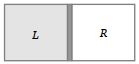
A
$\sqrt{3/2}$
B
$\sqrt{\pi/4}$
C
$\sqrt{2/3}$
D
$3\pi/8$
Solution
(D) The root mean square speed of molecules in part $L$ is given by: $v_{rms, L} = \sqrt{\frac{3KT}{m_L}}$
The average speed of molecules in part $R$ is given by: $v_{av, R} = \sqrt{\frac{8KT}{\pi m_R}}$
Given that $v_{rms, L} = v_{av, R}$,we equate the two expressions:
$\sqrt{\frac{3KT}{m_L}} = \sqrt{\frac{8KT}{\pi m_R}}$
Squaring both sides:
$\frac{3KT}{m_L} = \frac{8KT}{\pi m_R}$
Canceling $KT$ from both sides:
$\frac{3}{m_L} = \frac{8}{\pi m_R}$
Rearranging to find the ratio $\frac{m_L}{m_R}$:
$\frac{m_L}{m_R} = \frac{3\pi}{8}$
The average speed of molecules in part $R$ is given by: $v_{av, R} = \sqrt{\frac{8KT}{\pi m_R}}$
Given that $v_{rms, L} = v_{av, R}$,we equate the two expressions:
$\sqrt{\frac{3KT}{m_L}} = \sqrt{\frac{8KT}{\pi m_R}}$
Squaring both sides:
$\frac{3KT}{m_L} = \frac{8KT}{\pi m_R}$
Canceling $KT$ from both sides:
$\frac{3}{m_L} = \frac{8}{\pi m_R}$
Rearranging to find the ratio $\frac{m_L}{m_R}$:
$\frac{m_L}{m_R} = \frac{3\pi}{8}$
0 likes
View Solution112
EasyMCQ
For a mixture of three different gases with molecular masses $m_1 > m_2 > m_3$ at the same temperature,what is the relationship between their root mean square speeds $(v_{rms})$ and average kinetic energies $(\bar{K})$?
A
$(v_{rms})_1 < (v_{rms})_2 < (v_{rms})_3$ and $(\bar{K})_1 = (\bar{K})_2 = (\bar{K})_3$
B
$(v_{rms})_1 = (v_{rms})_2 = (v_{rms})_3$ and $(\bar{K})_1 = (\bar{K})_2 > (\bar{K})_3$
C
$(v_{rms})_1 > (v_{rms})_2 > (v_{rms})_3$ and $(\bar{K})_1 < (\bar{K})_2 > (\bar{K})_3$
D
$(v_{rms})_1 > (v_{rms})_2 > (v_{rms})_3$ and $(\bar{K})_1 < (\bar{K})_2 < (\bar{K})_3$
Solution
(A) The root mean square speed of a gas molecule is given by $v_{rms} = \sqrt{\frac{3RT}{M}}$. Since $T$ is constant,$v_{rms} \propto \frac{1}{\sqrt{M}}$.
Given $m_1 > m_2 > m_3$,it follows that $(v_{rms})_1 < (v_{rms})_2 < (v_{rms})_3$.
The average kinetic energy of a gas molecule is given by $\bar{K} = \frac{3}{2}kT$. Since the temperature $T$ is the same for all gases in the mixture,the average kinetic energy depends only on the temperature and is independent of the molecular mass.
Therefore,$(\bar{K})_1 = (\bar{K})_2 = (\bar{K})_3$.
Given $m_1 > m_2 > m_3$,it follows that $(v_{rms})_1 < (v_{rms})_2 < (v_{rms})_3$.
The average kinetic energy of a gas molecule is given by $\bar{K} = \frac{3}{2}kT$. Since the temperature $T$ is the same for all gases in the mixture,the average kinetic energy depends only on the temperature and is independent of the molecular mass.
Therefore,$(\bar{K})_1 = (\bar{K})_2 = (\bar{K})_3$.
0 likes
View Solution113
DifficultMCQ
At a temperature of $300 \ K$,the kinetic energy of $O_2$ is $6.21 \times 10^{-21} \ J$ and its $rms$ speed is $484 \ m/s$. What will be the kinetic energy and $rms$ speed at $600 \ K$?
A
$12.42 \times 10^{-21} \ J, \ 968 \ m/s$
B
$8.78 \times 10^{-21} \ J, \ 684 \ m/s$
C
$6.21 \times 10^{-21} \ J, \ 968 \ m/s$
D
$12.42 \times 10^{-21} \ J, \ 684 \ m/s$
Solution
(D) The average kinetic energy of a gas molecule is given by $E = \frac{3}{2} k_B T$,which implies $E \propto T$.
Given $T_1 = 300 \ K$ and $T_2 = 600 \ K$,the new kinetic energy $E_2 = E_1 \times (T_2 / T_1) = 6.21 \times 10^{-21} \times (600 / 300) = 12.42 \times 10^{-21} \ J$.
The $rms$ speed is given by $v_{rms} = \sqrt{\frac{3RT}{M}}$,which implies $v_{rms} \propto \sqrt{T}$.
Given $v_{rms,1} = 484 \ m/s$,the new $rms$ speed $v_{rms,2} = v_{rms,1} \times \sqrt{T_2 / T_1} = 484 \times \sqrt{600 / 300} = 484 \times \sqrt{2} \approx 484 \times 1.414 = 684.37 \ m/s \approx 684 \ m/s$.
Thus,the correct option is $D$.
Given $T_1 = 300 \ K$ and $T_2 = 600 \ K$,the new kinetic energy $E_2 = E_1 \times (T_2 / T_1) = 6.21 \times 10^{-21} \times (600 / 300) = 12.42 \times 10^{-21} \ J$.
The $rms$ speed is given by $v_{rms} = \sqrt{\frac{3RT}{M}}$,which implies $v_{rms} \propto \sqrt{T}$.
Given $v_{rms,1} = 484 \ m/s$,the new $rms$ speed $v_{rms,2} = v_{rms,1} \times \sqrt{T_2 / T_1} = 484 \times \sqrt{600 / 300} = 484 \times \sqrt{2} \approx 484 \times 1.414 = 684.37 \ m/s \approx 684 \ m/s$.
Thus,the correct option is $D$.
0 likes
View Solution114
MediumMCQ
Three vessels $A$,$B$,and $C$ contain gases at the same temperature. Vessel $A$ contains $O_2$ gas,vessel $B$ contains $N_2$ gas,and vessel $C$ contains a mixture of $O_2$ and $N_2$ gases. If the average velocity of $O_2$ in vessel $A$ is $V_1$ and the average velocity of $N_2$ in vessel $B$ is $V_2$,what is the average velocity of $O_2$ in vessel $C$?
A
$(V_1 + V_2)/2$
B
$V_1$
C
$(V_1 V_2)^{1/2}$
D
$\sqrt{3kT/M}$
Solution
(B) The average velocity of a gas molecule is given by the formula $v_{av} = \sqrt{\frac{8kT}{\pi m}}$,where $k$ is the Boltzmann constant,$T$ is the absolute temperature,and $m$ is the mass of one molecule of the gas.
Since the temperature $T$ is the same for all vessels,the average velocity of a specific gas depends only on its molecular mass $m$.
In vessel $A$,the average velocity of $O_2$ is $V_1 = \sqrt{\frac{8kT}{\pi m_{O_2}}}$.
In vessel $C$,the $O_2$ molecules are at the same temperature $T$ and have the same molecular mass $m_{O_2}$ as in vessel $A$.
The presence of $N_2$ in the mixture in vessel $C$ does not affect the individual average velocity of the $O_2$ molecules.
Therefore,the average velocity of $O_2$ in vessel $C$ remains $V_1$.
Since the temperature $T$ is the same for all vessels,the average velocity of a specific gas depends only on its molecular mass $m$.
In vessel $A$,the average velocity of $O_2$ is $V_1 = \sqrt{\frac{8kT}{\pi m_{O_2}}}$.
In vessel $C$,the $O_2$ molecules are at the same temperature $T$ and have the same molecular mass $m_{O_2}$ as in vessel $A$.
The presence of $N_2$ in the mixture in vessel $C$ does not affect the individual average velocity of the $O_2$ molecules.
Therefore,the average velocity of $O_2$ in vessel $C$ remains $V_1$.
0 likes
View Solution115
MediumMCQ
The molecules of a given mass of a gas have $r.m.s.$ velocity of $200 \,m s^{-1}$ at $27^o C$ and $1.0 \times 10^5 \,N m^{-2}$ pressure. When the temperature and pressure of the gas are respectively $127^o C$ and $0.05 \times 10^5 \,N m^{-2},$ the $r.m.s.$ velocity of its molecules in $m s^{-1}$ is
A
$\frac{400}{\sqrt{3}}$
B
$\frac{100\sqrt{2}}{3}$
C
$\frac{100}{3}$
D
$100\sqrt{2}$
Solution
(A) The $r.m.s.$ velocity of gas molecules is given by the formula $v_{rms} = \sqrt{\frac{3RT}{M}}$.
This shows that $v_{rms} \propto \sqrt{T}$.
The pressure does not affect the $r.m.s.$ velocity of an ideal gas.
Given $T_1 = 27^o C = 300 \,K$ and $v_1 = 200 \,m s^{-1}$.
Given $T_2 = 127^o C = 400 \,K$.
Using the ratio: $\frac{v_2}{v_1} = \sqrt{\frac{T_2}{T_1}}$.
$\frac{v_2}{200} = \sqrt{\frac{400}{300}} = \sqrt{\frac{4}{3}} = \frac{2}{\sqrt{3}}$.
Therefore,$v_2 = 200 \times \frac{2}{\sqrt{3}} = \frac{400}{\sqrt{3}} \,m s^{-1}$.
This shows that $v_{rms} \propto \sqrt{T}$.
The pressure does not affect the $r.m.s.$ velocity of an ideal gas.
Given $T_1 = 27^o C = 300 \,K$ and $v_1 = 200 \,m s^{-1}$.
Given $T_2 = 127^o C = 400 \,K$.
Using the ratio: $\frac{v_2}{v_1} = \sqrt{\frac{T_2}{T_1}}$.
$\frac{v_2}{200} = \sqrt{\frac{400}{300}} = \sqrt{\frac{4}{3}} = \frac{2}{\sqrt{3}}$.
Therefore,$v_2 = 200 \times \frac{2}{\sqrt{3}} = \frac{400}{\sqrt{3}} \,m s^{-1}$.
0 likes
View Solution116
MediumMCQ
At what temperature will the $rms$ speed of oxygen molecules become just sufficient for escaping from the Earth's atmosphere $?$ (Given: Mass of oxygen molecule $(m) = 2.76 \times 10^{-26} \, kg$,Boltzmann's constant $k_B = 1.38 \times 10^{-23} \, JK^{-1}$)
A
$2.508 \times 10^4 \, K$
B
$8.360 \times 10^4 \, K$
C
$1.254 \times 10^4 \, K$
D
$5.016 \times 10^4 \, K$
Solution
(B) The escape velocity from the Earth's surface is $v_{\text{escape}} = 11200 \, m/s$.
For the oxygen molecules to escape,their $rms$ speed must be equal to the escape velocity:
$v_{\text{rms}} = \sqrt{\frac{3 k_B T}{m}} = v_{\text{escape}}$
Substituting the given values:
$11200 = \sqrt{\frac{3 \times 1.38 \times 10^{-23} \times T}{2.76 \times 10^{-26}}}$
Squaring both sides:
$(11200)^2 = \frac{3 \times 1.38 \times 10^{-23} \times T}{2.76 \times 10^{-26}}$
$1.2544 \times 10^8 = \frac{4.14 \times 10^{-23} \times T}{2.76 \times 10^{-26}}$
$1.2544 \times 10^8 = 1.5 \times 10^3 \times T$
Solving for $T$:
$T = \frac{1.2544 \times 10^8}{1.5 \times 10^3} \approx 8.360 \times 10^4 \, K$.
For the oxygen molecules to escape,their $rms$ speed must be equal to the escape velocity:
$v_{\text{rms}} = \sqrt{\frac{3 k_B T}{m}} = v_{\text{escape}}$
Substituting the given values:
$11200 = \sqrt{\frac{3 \times 1.38 \times 10^{-23} \times T}{2.76 \times 10^{-26}}}$
Squaring both sides:
$(11200)^2 = \frac{3 \times 1.38 \times 10^{-23} \times T}{2.76 \times 10^{-26}}$
$1.2544 \times 10^8 = \frac{4.14 \times 10^{-23} \times T}{2.76 \times 10^{-26}}$
$1.2544 \times 10^8 = 1.5 \times 10^3 \times T$
Solving for $T$:
$T = \frac{1.2544 \times 10^8}{1.5 \times 10^3} \approx 8.360 \times 10^4 \, K$.
0 likes
View Solution117
DifficultMCQ
At what temperature will the root mean square $(rms)$ speed of oxygen molecules be sufficient to escape from the Earth's atmosphere? (Mass of an oxygen molecule $m = 2.76 \times 10^{-26} \, kg$,Boltzmann constant $k_B = 1.38 \times 10^{-23} \, JK^{-1}$,Escape velocity of Earth $v_e = 11.2 \, km/s$)
A
$2.508 \times 10^4 \, K$
B
$8.360 \times 10^4 \, K$
C
$1.254 \times 10^4 \, K$
D
$5.016 \times 10^4 \, K$
Solution
(B) The root mean square $(rms)$ speed of a gas molecule is given by $v_{rms} = \sqrt{\frac{3k_B T}{m}}$.
For the molecules to escape the Earth's atmosphere,their $v_{rms}$ must be equal to the escape velocity of the Earth,$v_e = 11.2 \, km/s = 1.12 \times 10^4 \, m/s$.
Equating $v_{rms} = v_e$,we get $\sqrt{\frac{3k_B T}{m}} = v_e$.
Squaring both sides: $\frac{3k_B T}{m} = v_e^2$.
Solving for $T$: $T = \frac{m v_e^2}{3k_B}$.
Substituting the given values: $T = \frac{(2.76 \times 10^{-26} \, kg) \times (1.12 \times 10^4 \, m/s)^2}{3 \times 1.38 \times 10^{-23} \, JK^{-1}}$.
$T = \frac{2.76 \times 10^{-26} \times 1.2544 \times 10^8}{4.14 \times 10^{-23}}$.
$T = \frac{3.462144 \times 10^{-18}}{4.14 \times 10^{-23}} \approx 0.83626 \times 10^5 \, K = 8.3626 \times 10^4 \, K$.
Rounding to the nearest option,we get $8.360 \times 10^4 \, K$.
For the molecules to escape the Earth's atmosphere,their $v_{rms}$ must be equal to the escape velocity of the Earth,$v_e = 11.2 \, km/s = 1.12 \times 10^4 \, m/s$.
Equating $v_{rms} = v_e$,we get $\sqrt{\frac{3k_B T}{m}} = v_e$.
Squaring both sides: $\frac{3k_B T}{m} = v_e^2$.
Solving for $T$: $T = \frac{m v_e^2}{3k_B}$.
Substituting the given values: $T = \frac{(2.76 \times 10^{-26} \, kg) \times (1.12 \times 10^4 \, m/s)^2}{3 \times 1.38 \times 10^{-23} \, JK^{-1}}$.
$T = \frac{2.76 \times 10^{-26} \times 1.2544 \times 10^8}{4.14 \times 10^{-23}}$.
$T = \frac{3.462144 \times 10^{-18}}{4.14 \times 10^{-23}} \approx 0.83626 \times 10^5 \, K = 8.3626 \times 10^4 \, K$.
Rounding to the nearest option,we get $8.360 \times 10^4 \, K$.
0 likes
View Solution118
MediumMCQ
When the temperature of a gas is raised from $27^o C$ to $90^o C$,the percentage increase in the $r.m.s.$ velocity of the molecules will be ..... $\%$
A
$10$
B
$15$
C
$20$
D
$17.5$
Solution
(A) The $r.m.s.$ velocity of gas molecules is given by the formula $v_{rms} = \sqrt{\frac{3RT}{M}}$.
Since $R$ and $M$ are constant,$v_{rms} \propto \sqrt{T}$.
Initial temperature $T_1 = 27^o C = 27 + 273 = 300 \ K$.
Final temperature $T_2 = 90^o C = 90 + 273 = 363 \ K$.
The ratio of velocities is $\frac{v_2}{v_1} = \sqrt{\frac{T_2}{T_1}} = \sqrt{\frac{363}{300}} = \sqrt{1.21} = 1.1$.
The percentage increase is given by $\left( \frac{v_2}{v_1} - 1 \right) \times 100$.
Percentage increase $= (1.1 - 1) \times 100 = 0.1 \times 100 = 10\%$.
Since $R$ and $M$ are constant,$v_{rms} \propto \sqrt{T}$.
Initial temperature $T_1 = 27^o C = 27 + 273 = 300 \ K$.
Final temperature $T_2 = 90^o C = 90 + 273 = 363 \ K$.
The ratio of velocities is $\frac{v_2}{v_1} = \sqrt{\frac{T_2}{T_1}} = \sqrt{\frac{363}{300}} = \sqrt{1.21} = 1.1$.
The percentage increase is given by $\left( \frac{v_2}{v_1} - 1 \right) \times 100$.
Percentage increase $= (1.1 - 1) \times 100 = 0.1 \times 100 = 10\%$.
0 likes
View Solution119
MediumMCQ
The r.m.s. velocity of a gas at a certain temperature is $\sqrt{2}$ times that of the oxygen molecules at the same temperature. The gas can be:
A
$H_2$
B
$He$
C
$CH_4$
D
$SO_2$
Solution
(C) The root mean square (r.m.s.) velocity of a gas is given by the formula $v_{rms} = \sqrt{\frac{3RT}{M}}$,where $M$ is the molar mass of the gas.
Since $v_{rms} \propto \frac{1}{\sqrt{M}}$,we can write the ratio for two gases as $\frac{v_1}{v_2} = \sqrt{\frac{M_2}{M_1}}$.
Given that the r.m.s. velocity of the gas $(v_1)$ is $\sqrt{2}$ times the r.m.s. velocity of oxygen $(v_2)$,we have $\frac{v_1}{v_2} = \sqrt{2}$.
The molar mass of oxygen $(O_2)$ is $M_2 = 32 \text{ g/mol}$.
Substituting these values into the ratio: $\sqrt{2} = \sqrt{\frac{32}{M_1}}$.
Squaring both sides: $2 = \frac{32}{M_1}$.
Solving for $M_1$: $M_1 = \frac{32}{2} = 16 \text{ g/mol}$.
The gas with a molar mass of $16 \text{ g/mol}$ is methane $(CH_4)$.
Therefore,the correct option is $C$.
Since $v_{rms} \propto \frac{1}{\sqrt{M}}$,we can write the ratio for two gases as $\frac{v_1}{v_2} = \sqrt{\frac{M_2}{M_1}}$.
Given that the r.m.s. velocity of the gas $(v_1)$ is $\sqrt{2}$ times the r.m.s. velocity of oxygen $(v_2)$,we have $\frac{v_1}{v_2} = \sqrt{2}$.
The molar mass of oxygen $(O_2)$ is $M_2 = 32 \text{ g/mol}$.
Substituting these values into the ratio: $\sqrt{2} = \sqrt{\frac{32}{M_1}}$.
Squaring both sides: $2 = \frac{32}{M_1}$.
Solving for $M_1$: $M_1 = \frac{32}{2} = 16 \text{ g/mol}$.
The gas with a molar mass of $16 \text{ g/mol}$ is methane $(CH_4)$.
Therefore,the correct option is $C$.
0 likes
View Solution120
MediumMCQ
If the $r.m.s.$ velocity of a gas at a given temperature (Kelvin scale) is $300 \ m/s$,what will be the $r.m.s.$ velocity of a gas having twice the molecular weight and half the temperature on the Kelvin scale?
A
$300$
B
$600$
C
$75$
D
$150$
Solution
(D) The formula for $r.m.s.$ velocity is given by $v_{rms} = \sqrt{\frac{3RT}{M}}$.
From this,we can see that $v_{rms} \propto \sqrt{\frac{T}{M}}$.
Let the initial state be $v_1, T_1, M_1$ and the final state be $v_2, T_2, M_2$.
Given: $v_1 = 300 \ m/s$,$M_2 = 2M_1$,and $T_2 = \frac{T_1}{2}$.
Using the ratio: $\frac{v_2}{v_1} = \sqrt{\frac{M_1}{M_2} \times \frac{T_2}{T_1}}$.
Substituting the values: $\frac{v_2}{300} = \sqrt{\frac{M_1}{2M_1} \times \frac{T_1/2}{T_1}} = \sqrt{\frac{1}{2} \times \frac{1}{2}} = \sqrt{\frac{1}{4}} = \frac{1}{2}$.
Therefore,$v_2 = \frac{300}{2} = 150 \ m/s$.
From this,we can see that $v_{rms} \propto \sqrt{\frac{T}{M}}$.
Let the initial state be $v_1, T_1, M_1$ and the final state be $v_2, T_2, M_2$.
Given: $v_1 = 300 \ m/s$,$M_2 = 2M_1$,and $T_2 = \frac{T_1}{2}$.
Using the ratio: $\frac{v_2}{v_1} = \sqrt{\frac{M_1}{M_2} \times \frac{T_2}{T_1}}$.
Substituting the values: $\frac{v_2}{300} = \sqrt{\frac{M_1}{2M_1} \times \frac{T_1/2}{T_1}} = \sqrt{\frac{1}{2} \times \frac{1}{2}} = \sqrt{\frac{1}{4}} = \frac{1}{2}$.
Therefore,$v_2 = \frac{300}{2} = 150 \ m/s$.
0 likes
View Solution121
MediumMCQ
The temperature of a gas is doubled $(i)$ on the absolute scale and $(ii)$ on the centigrade scale. The increase in the root mean square velocity of the gas will be:
A
More in case $(i)$
B
More in case $(ii)$
C
Same in both cases
D
Information not sufficient
Solution
(A) The root mean square velocity of a gas is given by $v_{rms} = \sqrt{\frac{3RT}{M}}$,where $T$ is the absolute temperature.
Case $(i)$: The absolute temperature $T$ is doubled,so $T' = 2T$. The new velocity is $v'_{rms} = \sqrt{\frac{3R(2T)}{M}} = \sqrt{2} v_{rms} \approx 1.414 v_{rms}$.
Case $(ii)$: The centigrade temperature $t$ is doubled,so $t' = 2t$. The absolute temperature becomes $T' = (2t + 273) = 2(T - 273) + 273 = 2T - 273$. Since $2T - 273 < 2T$,the final absolute temperature in case $(ii)$ is lower than in case $(i)$.
Since $v_{rms} \propto \sqrt{T}$,the increase in velocity is greater when the absolute temperature is doubled compared to when the centigrade temperature is doubled. Therefore,the increase is more in case $(i)$.
Case $(i)$: The absolute temperature $T$ is doubled,so $T' = 2T$. The new velocity is $v'_{rms} = \sqrt{\frac{3R(2T)}{M}} = \sqrt{2} v_{rms} \approx 1.414 v_{rms}$.
Case $(ii)$: The centigrade temperature $t$ is doubled,so $t' = 2t$. The absolute temperature becomes $T' = (2t + 273) = 2(T - 273) + 273 = 2T - 273$. Since $2T - 273 < 2T$,the final absolute temperature in case $(ii)$ is lower than in case $(i)$.
Since $v_{rms} \propto \sqrt{T}$,the increase in velocity is greater when the absolute temperature is doubled compared to when the centigrade temperature is doubled. Therefore,the increase is more in case $(i)$.
0 likes
View Solution122
DifficultMCQ
One mole of an ideal gas at $STP$ is heated in an insulated closed container until the average speed of its molecules is doubled. Its pressure would therefore increase by what factor?
A
$1.5$
B
$\sqrt{2}$
C
$2$
D
$4$
Solution
(D) The average speed of gas molecules is given by $v_{avg} = \sqrt{\frac{8RT}{\pi M}}$.
Since $v_{avg} \propto \sqrt{T}$,if the average speed is doubled,the temperature $T$ must increase by a factor of $2^2 = 4$.
For an ideal gas,the pressure $P$ is related to temperature $T$ by the ideal gas law $PV = nRT$.
In a closed container,the volume $V$ and the number of moles $n$ remain constant.
Therefore,$P \propto T$.
Since the temperature $T$ increases by a factor of $4$,the pressure $P$ will also increase by a factor of $4$.
Since $v_{avg} \propto \sqrt{T}$,if the average speed is doubled,the temperature $T$ must increase by a factor of $2^2 = 4$.
For an ideal gas,the pressure $P$ is related to temperature $T$ by the ideal gas law $PV = nRT$.
In a closed container,the volume $V$ and the number of moles $n$ remain constant.
Therefore,$P \propto T$.
Since the temperature $T$ increases by a factor of $4$,the pressure $P$ will also increase by a factor of $4$.
0 likes
View Solution123
DifficultMCQ
Three particles have speeds of $2u$,$10u$,and $11u$. Which of the following statements is correct?
A
The r.m.s. speed exceeds the mean speed by about $u$.
B
The mean speed exceeds the r.m.s. speed by about $u$.
C
The r.m.s. speed equals the mean speed.
D
The r.m.s. speed exceeds the mean speed by more than $2u$.
Solution
(A) The root mean square (r.m.s.) speed is given by $V_{rms} = \sqrt{\frac{(2u)^2 + (10u)^2 + (11u)^2}{3}} = \sqrt{\frac{4u^2 + 100u^2 + 121u^2}{3}} = \sqrt{\frac{225u^2}{3}} = \sqrt{75}u = 5\sqrt{3}u \approx 8.66u$.
The mean (average) speed is given by $V_{avg} = \frac{2u + 10u + 11u}{3} = \frac{23u}{3} \approx 7.66u$.
Comparing the two values,$V_{rms} - V_{avg} \approx 8.66u - 7.66u = 1u$.
Therefore,the r.m.s. speed exceeds the mean speed by about $u$.
The mean (average) speed is given by $V_{avg} = \frac{2u + 10u + 11u}{3} = \frac{23u}{3} \approx 7.66u$.
Comparing the two values,$V_{rms} - V_{avg} \approx 8.66u - 7.66u = 1u$.
Therefore,the r.m.s. speed exceeds the mean speed by about $u$.
0 likes
View Solution124
AdvancedMCQ
$N$ $(N < 100)$ molecules of a gas have velocities $1, 2, 3, ..., N \text{ km/s}$ respectively. Then:
A
rms speed and average speed of molecules are same.
B
ratio of rms speed to average speed is $\sqrt{(2N + 1)(N + 1)} / 6N$.
C
ratio of rms speed to average speed is $\sqrt{(2N + 1)(N + 1)} / 6$.
D
ratio of rms speed to average speed of a molecule is $\sqrt{\frac{2(2N+1)}{3(N+1)}}$.
Solution
(D) The average speed $u_{avg}$ is given by the sum of velocities divided by the number of molecules $N$: $u_{avg} = \frac{1+2+3+...+N}{N} = \frac{N(N+1)}{2N} = \frac{N+1}{2}$.
The root mean square speed $u_{rms}$ is given by the square root of the sum of squares of velocities divided by $N$: $u_{rms} = \sqrt{\frac{1^2+2^2+3^2+...+N^2}{N}} = \sqrt{\frac{N(N+1)(2N+1)}{6N}} = \sqrt{\frac{(N+1)(2N+1)}{6}}$.
The ratio of rms speed to average speed is $\frac{u_{rms}}{u_{avg}} = \frac{\sqrt{\frac{(N+1)(2N+1)}{6}}}{\frac{N+1}{2}} = \sqrt{\frac{(N+1)(2N+1)}{6}} \times \frac{2}{N+1} = \sqrt{\frac{2^2(N+1)(2N+1)}{6(N+1)^2}} = \sqrt{\frac{4(2N+1)}{6(N+1)}} = \sqrt{\frac{2(2N+1)}{3(N+1)}}$.
The root mean square speed $u_{rms}$ is given by the square root of the sum of squares of velocities divided by $N$: $u_{rms} = \sqrt{\frac{1^2+2^2+3^2+...+N^2}{N}} = \sqrt{\frac{N(N+1)(2N+1)}{6N}} = \sqrt{\frac{(N+1)(2N+1)}{6}}$.
The ratio of rms speed to average speed is $\frac{u_{rms}}{u_{avg}} = \frac{\sqrt{\frac{(N+1)(2N+1)}{6}}}{\frac{N+1}{2}} = \sqrt{\frac{(N+1)(2N+1)}{6}} \times \frac{2}{N+1} = \sqrt{\frac{2^2(N+1)(2N+1)}{6(N+1)^2}} = \sqrt{\frac{4(2N+1)}{6(N+1)}} = \sqrt{\frac{2(2N+1)}{3(N+1)}}$.
0 likes
View Solution125
DifficultMCQ
At temperature $T$,$N$ molecules of gas $A$ each having mass $m$ and at the same temperature $2N$ molecules of gas $B$ each having mass $2m$ are filled in a container. The mean square velocity of molecules of gas $B$ is $v^2$ and the mean square of the $x$-component of velocity of molecules of gas $A$ is $w^2$. The ratio of $w^2/v^2$ is:
A
$1$
B
$2$
C
$1/3$
D
$2/3$
Solution
(D) For an ideal gas at temperature $T$,the average kinetic energy per molecule is given by $\frac{1}{2} m v_{rms}^2 = \frac{3}{2} k_B T$.
For gas $A$ with mass $m$ at temperature $T$:
The mean square velocity is $\langle v_A^2 \rangle = \frac{3 k_B T}{m}$.
Since the motion is isotropic,the mean square of the $x$-component is $\langle v_{Ax}^2 \rangle = w^2 = \frac{1}{3} \langle v_A^2 \rangle = \frac{k_B T}{m}$.
For gas $B$ with mass $2m$ at temperature $T$:
The mean square velocity is $v^2 = \langle v_B^2 \rangle = \frac{3 k_B T}{2m}$.
Now,calculating the ratio $w^2 / v^2$:
$\frac{w^2}{v^2} = \frac{k_B T / m}{3 k_B T / 2m} = \frac{1}{m} \times \frac{2m}{3} = \frac{2}{3}$.
Thus,the ratio is $2/3$.
For gas $A$ with mass $m$ at temperature $T$:
The mean square velocity is $\langle v_A^2 \rangle = \frac{3 k_B T}{m}$.
Since the motion is isotropic,the mean square of the $x$-component is $\langle v_{Ax}^2 \rangle = w^2 = \frac{1}{3} \langle v_A^2 \rangle = \frac{k_B T}{m}$.
For gas $B$ with mass $2m$ at temperature $T$:
The mean square velocity is $v^2 = \langle v_B^2 \rangle = \frac{3 k_B T}{2m}$.
Now,calculating the ratio $w^2 / v^2$:
$\frac{w^2}{v^2} = \frac{k_B T / m}{3 k_B T / 2m} = \frac{1}{m} \times \frac{2m}{3} = \frac{2}{3}$.
Thus,the ratio is $2/3$.
0 likes
View Solution126
DifficultMCQ
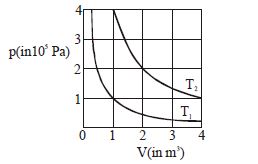
The given diagram shows isotherms for a fixed mass of an ideal gas at temperatures $T_1$ and $T_2$. What is the value of the ratio $\frac{\text{r.m.s. speed of the molecules at temperature } T_2}{\text{r.m.s. speed of the molecules at temperature } T_1}$?
A
$\sqrt{2}$
B
$2$
C
$2\sqrt{2}$
D
$4$
Solution
(B) The root mean square (r.m.s.) speed of gas molecules is given by $V_{rms} = \sqrt{\frac{3RT}{M}}$.
Since $V_{rms} \propto \sqrt{T}$,the ratio is $\frac{V_{rms,2}}{V_{rms,1}} = \sqrt{\frac{T_2}{T_1}}$.
From the ideal gas equation $PV = nRT$,we have $T = \frac{PV}{nR}$.
For the isotherm at $T_2$,choosing a point $(V=2 \text{ m}^3, P=2 \times 10^5 \text{ Pa})$,we get $T_2 \propto P_2V_2 = (2 \times 10^5) \times 2 = 4 \times 10^5$.
For the isotherm at $T_1$,choosing a point $(V=1 \text{ m}^3, P=1 \times 10^5 \text{ Pa})$,we get $T_1 \propto P_1V_1 = (1 \times 10^5) \times 1 = 1 \times 10^5$.
Therefore,$\frac{T_2}{T_1} = \frac{4 \times 10^5}{1 \times 10^5} = 4$.
The ratio of the r.m.s. speeds is $\sqrt{\frac{T_2}{T_1}} = \sqrt{4} = 2$.
Since $V_{rms} \propto \sqrt{T}$,the ratio is $\frac{V_{rms,2}}{V_{rms,1}} = \sqrt{\frac{T_2}{T_1}}$.
From the ideal gas equation $PV = nRT$,we have $T = \frac{PV}{nR}$.
For the isotherm at $T_2$,choosing a point $(V=2 \text{ m}^3, P=2 \times 10^5 \text{ Pa})$,we get $T_2 \propto P_2V_2 = (2 \times 10^5) \times 2 = 4 \times 10^5$.
For the isotherm at $T_1$,choosing a point $(V=1 \text{ m}^3, P=1 \times 10^5 \text{ Pa})$,we get $T_1 \propto P_1V_1 = (1 \times 10^5) \times 1 = 1 \times 10^5$.
Therefore,$\frac{T_2}{T_1} = \frac{4 \times 10^5}{1 \times 10^5} = 4$.
The ratio of the r.m.s. speeds is $\sqrt{\frac{T_2}{T_1}} = \sqrt{4} = 2$.
0 likes
View Solution127
DifficultMCQ
At what temperature (in $K$) is the $rms$ velocity of a hydrogen molecule equal to that of an oxygen molecule at $47^o \ C$?
A
$80$
B
$20$
C
$3$
D
$47$
Solution
(B) The $rms$ velocity of a gas molecule is given by $v_{rms} = \sqrt{\frac{3RT}{M}}$.
Given that the $rms$ velocity of hydrogen $(H_2)$ is equal to that of oxygen $(O_2)$:
$\sqrt{\frac{3RT_{H_2}}{M_{H_2}}} = \sqrt{\frac{3RT_{O_2}}{M_{O_2}}}$
Squaring both sides and canceling common terms $(3R)$:
$\frac{T_{H_2}}{M_{H_2}} = \frac{T_{O_2}}{M_{O_2}}$
Here,$M_{H_2} = 2 \ g/mol$,$M_{O_2} = 32 \ g/mol$,and $T_{O_2} = 47 + 273 = 320 \ K$.
Substituting the values:
$\frac{T_{H_2}}{2} = \frac{320}{32}$
$\frac{T_{H_2}}{2} = 10$
$T_{H_2} = 20 \ K$.
Given that the $rms$ velocity of hydrogen $(H_2)$ is equal to that of oxygen $(O_2)$:
$\sqrt{\frac{3RT_{H_2}}{M_{H_2}}} = \sqrt{\frac{3RT_{O_2}}{M_{O_2}}}$
Squaring both sides and canceling common terms $(3R)$:
$\frac{T_{H_2}}{M_{H_2}} = \frac{T_{O_2}}{M_{O_2}}$
Here,$M_{H_2} = 2 \ g/mol$,$M_{O_2} = 32 \ g/mol$,and $T_{O_2} = 47 + 273 = 320 \ K$.
Substituting the values:
$\frac{T_{H_2}}{2} = \frac{320}{32}$
$\frac{T_{H_2}}{2} = 10$
$T_{H_2} = 20 \ K$.
0 likes
View Solution128
MediumMCQ
For which gas is the $rms$ velocity maximum?
A
$H_2$
B
$He$
C
$N_2$
D
$O_2$
Solution
(A) According to the kinetic molecular theory of gases,the root mean square $(rms)$ velocity is given by the formula:
$u_{rms} = \sqrt{\frac{3RT}{M}}$
where $R$ is the universal gas constant,$T$ is the absolute temperature,and $M$ is the molar mass of the gas.
At a given temperature,$u_{rms} \propto \frac{1}{\sqrt{M}}$.
This implies that the $rms$ velocity is inversely proportional to the square root of the molar mass of the gas.
Comparing the molar masses: $M(H_2) = 2 \ g/mol$,$M(He) = 4 \ g/mol$,$M(N_2) = 28 \ g/mol$,and $M(O_2) = 32 \ g/mol$.
Since $H_2$ has the lowest molar mass,it will have the maximum $rms$ velocity.
$u_{rms} = \sqrt{\frac{3RT}{M}}$
where $R$ is the universal gas constant,$T$ is the absolute temperature,and $M$ is the molar mass of the gas.
At a given temperature,$u_{rms} \propto \frac{1}{\sqrt{M}}$.
This implies that the $rms$ velocity is inversely proportional to the square root of the molar mass of the gas.
Comparing the molar masses: $M(H_2) = 2 \ g/mol$,$M(He) = 4 \ g/mol$,$M(N_2) = 28 \ g/mol$,and $M(O_2) = 32 \ g/mol$.
Since $H_2$ has the lowest molar mass,it will have the maximum $rms$ velocity.
0 likes
View Solution129
MediumMCQ
The $rms$ speed of air molecules in a vessel is $90 \times 10^2 \ m/s$. If half of the gas leaks out at constant temperature,the $rms$ speed of the remaining air molecules will be
A
$3 \times 10^2 \ m/s$
B
$30 \ m/s$
C
$90 \times 10^2 \ m/s$
D
$90 \ m/s$
Solution
(C) The root mean square $(rms)$ speed of gas molecules is given by the formula $V_{rms} = \sqrt{\frac{3RT}{M}}$,where $R$ is the universal gas constant,$T$ is the absolute temperature,and $M$ is the molar mass of the gas.
From this formula,it is clear that $V_{rms}$ depends only on the temperature $T$ and the nature of the gas (molar mass $M$).
It does not depend on the pressure,volume,or the amount (mass or number of moles) of the gas present in the vessel.
Since the temperature remains constant and the gas composition does not change,the $rms$ speed of the remaining molecules will remain the same as the initial $rms$ speed.
Therefore,the $rms$ speed remains $90 \times 10^2 \ m/s$.
From this formula,it is clear that $V_{rms}$ depends only on the temperature $T$ and the nature of the gas (molar mass $M$).
It does not depend on the pressure,volume,or the amount (mass or number of moles) of the gas present in the vessel.
Since the temperature remains constant and the gas composition does not change,the $rms$ speed of the remaining molecules will remain the same as the initial $rms$ speed.
Therefore,the $rms$ speed remains $90 \times 10^2 \ m/s$.
0 likes
View Solution130
MediumMCQ
$V_{rms}$ denotes the root mean square speed,$\bar{V}$ the average speed,and $V_m$ the most probable speed of gas molecules. Which of the following is the correct relationship?
A
$V_{rms} > \bar{V} > V_m$
B
$V_{rms} < \bar{V} < V_m$
C
$V_{rms} > \bar{V} < V_m$
D
$V_{rms} < \bar{V} > V_m$
Solution
(A) The expressions for the speeds of gas molecules are given by:
$V_{rms} = \sqrt{\frac{3kT}{m}} \approx 1.732 \sqrt{\frac{kT}{m}}$
$\bar{V} = \sqrt{\frac{8kT}{\pi m}} \approx 1.596 \sqrt{\frac{kT}{m}}$
$V_m = \sqrt{\frac{2kT}{m}} \approx 1.414 \sqrt{\frac{kT}{m}}$
Comparing the numerical coefficients,we find that $1.732 > 1.596 > 1.414$.
Therefore,the correct relationship is $V_{rms} > \bar{V} > V_m$.
$V_{rms} = \sqrt{\frac{3kT}{m}} \approx 1.732 \sqrt{\frac{kT}{m}}$
$\bar{V} = \sqrt{\frac{8kT}{\pi m}} \approx 1.596 \sqrt{\frac{kT}{m}}$
$V_m = \sqrt{\frac{2kT}{m}} \approx 1.414 \sqrt{\frac{kT}{m}}$
Comparing the numerical coefficients,we find that $1.732 > 1.596 > 1.414$.
Therefore,the correct relationship is $V_{rms} > \bar{V} > V_m$.
0 likes
View Solution131
MediumMCQ
At room temperature,the $rms$ speed of a gas is $V_1$. If the pressure of the gas is doubled at the same room temperature,the $rms$ speed becomes $V_2$. Then:
A
$V_1 > V_2$
B
$V_1 < V_2$
C
$V_1 = V_2$
D
None of these
Solution
(C) The root mean square $(rms)$ speed of a gas molecule is given by the formula $V_{rms} = \sqrt{\frac{3RT}{M}}$,where $R$ is the universal gas constant,$T$ is the absolute temperature,and $M$ is the molar mass of the gas.
From this formula,it is clear that $V_{rms} \propto \sqrt{T}$.
Since the temperature $T$ remains constant (room temperature),the $rms$ speed depends only on the temperature and the nature of the gas.
Changing the pressure of the gas at a constant temperature does not affect the $rms$ speed of the gas molecules.
Therefore,$V_1 = V_2$.
From this formula,it is clear that $V_{rms} \propto \sqrt{T}$.
Since the temperature $T$ remains constant (room temperature),the $rms$ speed depends only on the temperature and the nature of the gas.
Changing the pressure of the gas at a constant temperature does not affect the $rms$ speed of the gas molecules.
Therefore,$V_1 = V_2$.
0 likes
View Solution132
EasyMCQ
In which of the following gases will the root mean square velocity be minimum (at constant temperature)?
A
Oxygen
B
Carbon dioxide
C
Hydrogen
D
Same for all
Solution
(B) The root mean square velocity $(V_{rms})$ of a gas is given by the formula: $V_{rms} = \sqrt{\frac{3RT}{M_W}}$.
From this relation,it is clear that $V_{rms} \propto \frac{1}{\sqrt{M_W}}$,where $M_W$ is the molar mass of the gas.
To have the minimum $V_{rms}$,the gas must have the maximum molar mass $(M_W)$.
The molar masses are: $H_2 = 2 \ g/mol$,$O_2 = 32 \ g/mol$,and $CO_2 = 44 \ g/mol$.
Since $CO_2$ has the highest molar mass among the given options,its root mean square velocity will be the minimum.
From this relation,it is clear that $V_{rms} \propto \frac{1}{\sqrt{M_W}}$,where $M_W$ is the molar mass of the gas.
To have the minimum $V_{rms}$,the gas must have the maximum molar mass $(M_W)$.
The molar masses are: $H_2 = 2 \ g/mol$,$O_2 = 32 \ g/mol$,and $CO_2 = 44 \ g/mol$.
Since $CO_2$ has the highest molar mass among the given options,its root mean square velocity will be the minimum.
0 likes
View Solution133
MediumMCQ
The $rms$ speed of helium gas at $27\,^{\circ}C$ and $1\,atm$ pressure is $900\,ms^{-1}$. Then the $rms$ speed of helium molecules at temperature $27\,^{\circ}C$ and $2\,atm$ pressure is ...... $m/s$.
A
$450$
B
$900$
C
$1800$
D
$750$
Solution
(B) The root mean square $(rms)$ speed of a gas molecule is given by the formula $v_{rms} = \sqrt{\frac{3RT}{M}}$,where $R$ is the universal gas constant,$T$ is the absolute temperature,and $M$ is the molar mass of the gas.
From this formula,it is evident that $v_{rms}$ depends only on the temperature $T$ and the molar mass $M$ of the gas.
It is independent of the pressure $P$ of the gas.
Since the temperature remains constant at $27\,^{\circ}C$ $(300\,K)$ and the gas remains helium,the $rms$ speed will remain unchanged regardless of the change in pressure from $1\,atm$ to $2\,atm$.
Therefore,the $rms$ speed is $900\,ms^{-1}$.
From this formula,it is evident that $v_{rms}$ depends only on the temperature $T$ and the molar mass $M$ of the gas.
It is independent of the pressure $P$ of the gas.
Since the temperature remains constant at $27\,^{\circ}C$ $(300\,K)$ and the gas remains helium,the $rms$ speed will remain unchanged regardless of the change in pressure from $1\,atm$ to $2\,atm$.
Therefore,the $rms$ speed is $900\,ms^{-1}$.
0 likes
View Solution134
MediumMCQ
The curve between absolute temperature $T$ and $v_{rms}^2$ is
A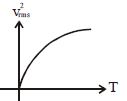
B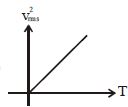
C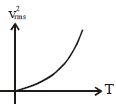
D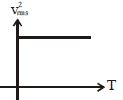
Solution
(B) The root mean square velocity $v_{rms}$ of a gas molecule is given by the formula:
$v_{rms} = \sqrt{\frac{3RT}{M_w}}$
Squaring both sides,we get:
$v_{rms}^2 = \frac{3RT}{M_w}$
Since $R$ (universal gas constant) and $M_w$ (molar mass of the gas) are constants for a given gas,we can write:
$v_{rms}^2 \propto T$
This equation is of the form $y = mx$,where $y = v_{rms}^2$,$x = T$,and the slope $m = \frac{3R}{M_w}$.
Therefore,the graph between $v_{rms}^2$ and $T$ is a straight line passing through the origin.
$v_{rms} = \sqrt{\frac{3RT}{M_w}}$
Squaring both sides,we get:
$v_{rms}^2 = \frac{3RT}{M_w}$
Since $R$ (universal gas constant) and $M_w$ (molar mass of the gas) are constants for a given gas,we can write:
$v_{rms}^2 \propto T$
This equation is of the form $y = mx$,where $y = v_{rms}^2$,$x = T$,and the slope $m = \frac{3R}{M_w}$.
Therefore,the graph between $v_{rms}^2$ and $T$ is a straight line passing through the origin.
0 likes
View Solution135
MediumMCQ
The value closest to the thermal velocity of a Helium atom at room temperature $(300\,K)$ in $m/s$ is $[k_B = 1.4 \times 10^{-23}\,J/K; m_{He} = 7 \times 10^{-27}\,kg]$.
A
$1.3 \times 10^4$
B
$1.3 \times 10^5$
C
$1.3 \times 10^2$
D
$1.3 \times 10^3$
Solution
(D) The root mean square velocity (thermal velocity) of a gas molecule is given by the formula: $v_{rms} = \sqrt{\frac{3k_B T}{m}}$.
Given values are:
$k_B = 1.4 \times 10^{-23}\,J/K$
$T = 300\,K$
$m_{He} = 7 \times 10^{-27}\,kg$
Substituting these values into the formula:
$v = \sqrt{\frac{3 \times 1.4 \times 10^{-23} \times 300}{7 \times 10^{-27}}}$
$v = \sqrt{\frac{1260 \times 10^{-23}}{7 \times 10^{-27}}}$
$v = \sqrt{180 \times 10^4}$
$v = \sqrt{1.8 \times 10^6}$
$v \approx 1.34 \times 10^3\,m/s$.
Thus,the value closest to the thermal velocity is $1.3 \times 10^3\,m/s$.
Given values are:
$k_B = 1.4 \times 10^{-23}\,J/K$
$T = 300\,K$
$m_{He} = 7 \times 10^{-27}\,kg$
Substituting these values into the formula:
$v = \sqrt{\frac{3 \times 1.4 \times 10^{-23} \times 300}{7 \times 10^{-27}}}$
$v = \sqrt{\frac{1260 \times 10^{-23}}{7 \times 10^{-27}}}$
$v = \sqrt{180 \times 10^4}$
$v = \sqrt{1.8 \times 10^6}$
$v \approx 1.34 \times 10^3\,m/s$.
Thus,the value closest to the thermal velocity is $1.3 \times 10^3\,m/s$.
0 likes
View Solution136
MediumMCQ
At room temperature,a diatomic gas is found to have an $r.m.s.$ speed of $1930 \, m/s$. The gas is
A
$H_2$
B
$Cl_2$
C
$O_2$
D
$F_2$
Solution
(A) The formula for the $r.m.s.$ speed of a gas molecule is given by $v_{rms} = \sqrt{\frac{3RT}{M}}$,where $R$ is the universal gas constant,$T$ is the absolute temperature,and $M$ is the molar mass of the gas.
Given $v_{rms} = 1930 \, m/s$,$T = 300 \, K$ (room temperature),and $R = 8.314 \, J/(mol \cdot K)$.
Squaring both sides: $v_{rms}^2 = \frac{3RT}{M}$.
Rearranging for $M$: $M = \frac{3RT}{v_{rms}^2}$.
Substituting the values: $M = \frac{3 \times 8.314 \times 300}{1930^2} \approx \frac{7482.6}{3724900} \approx 0.002008 \, kg/mol$.
This is approximately $2 \times 10^{-3} \, kg/mol$,which corresponds to $2 \, g/mol$.
The molar mass of $H_2$ is $2 \, g/mol$. Therefore,the gas is $H_2$.
Given $v_{rms} = 1930 \, m/s$,$T = 300 \, K$ (room temperature),and $R = 8.314 \, J/(mol \cdot K)$.
Squaring both sides: $v_{rms}^2 = \frac{3RT}{M}$.
Rearranging for $M$: $M = \frac{3RT}{v_{rms}^2}$.
Substituting the values: $M = \frac{3 \times 8.314 \times 300}{1930^2} \approx \frac{7482.6}{3724900} \approx 0.002008 \, kg/mol$.
This is approximately $2 \times 10^{-3} \, kg/mol$,which corresponds to $2 \, g/mol$.
The molar mass of $H_2$ is $2 \, g/mol$. Therefore,the gas is $H_2$.
0 likes
View Solution137
MediumMCQ
$A$ mixture of $2\, moles$ of helium gas (atomic mass $= 4\, u$) and $1\, mole$ of argon gas (atomic mass $= 40\, u$) is kept at $300\, K$ in a container. The ratio of their rms speeds $\left[ \frac{V_{rms}(\text{helium})}{V_{rms}(\text{argon})} \right]$ is close to:
A
$3.16$
B
$0.32$
C
$0.45$
D
$2.24$
Solution
(A) The root mean square (rms) speed of a gas molecule is given by the formula: $V_{rms} = \sqrt{\frac{3RT}{M}}$, where $R$ is the universal gas constant, $T$ is the absolute temperature, and $M$ is the molar mass of the gas.
Since both gases are in the same container at the same temperature $T = 300\, K$, the ratio of their rms speeds is:
$\frac{V_{rms}(\text{helium})}{V_{rms}(\text{argon})} = \frac{\sqrt{\frac{3RT}{M_{He}}}}{\sqrt{\frac{3RT}{M_{Ar}}}} = \sqrt{\frac{M_{Ar}}{M_{He}}}$
Given $M_{He} = 4\, u$ and $M_{Ar} = 40\, u$, we substitute these values:
$\frac{V_{rms}(\text{helium})}{V_{rms}(\text{argon})} = \sqrt{\frac{40}{4}} = \sqrt{10} \approx 3.16$.
Since both gases are in the same container at the same temperature $T = 300\, K$, the ratio of their rms speeds is:
$\frac{V_{rms}(\text{helium})}{V_{rms}(\text{argon})} = \frac{\sqrt{\frac{3RT}{M_{He}}}}{\sqrt{\frac{3RT}{M_{Ar}}}} = \sqrt{\frac{M_{Ar}}{M_{He}}}$
Given $M_{He} = 4\, u$ and $M_{Ar} = 40\, u$, we substitute these values:
$\frac{V_{rms}(\text{helium})}{V_{rms}(\text{argon})} = \sqrt{\frac{40}{4}} = \sqrt{10} \approx 3.16$.
0 likes
View Solution138
MediumMCQ
The temperature at which the root mean square velocity of hydrogen molecules equals their escape velocity from the Earth is closest to: [Boltzmann constant $k_B = 1.38 \times 10^{-23} \, J/K$,Avogadro number $N_A = 6.02 \times 10^{23} \, mol^{-1}$,Molar mass of $H_2 = 2 \times 10^{-3} \, kg/mol$,Radius of Earth $R_e = 6.4 \times 10^6 \, m$,Gravitational acceleration $g = 10 \, m/s^2$]
A
$800 \, K$
B
$10^4 \, K$
C
$3 \times 10^5 \, K$
D
$650 \, K$
Solution
(A) The root mean square velocity of gas molecules is given by $v_{rms} = \sqrt{\frac{3RT}{M}}$,where $R = k_B N_A$ is the universal gas constant,$T$ is the temperature,and $M$ is the molar mass of hydrogen $(2 \times 10^{-3} \, kg/mol)$.
The escape velocity from the Earth is given by $v_e = \sqrt{2gR_e}$.
Equating the two: $\sqrt{\frac{3RT}{M}} = \sqrt{2gR_e}$.
Squaring both sides: $\frac{3RT}{M} = 2gR_e$.
Solving for $T$: $T = \frac{2gR_e M}{3R}$.
Given $R = k_B N_A \approx 8.314 \, J/(mol \cdot K)$.
Substituting the values: $T = \frac{2 \times 10 \times 6.4 \times 10^6 \times 2 \times 10^{-3}}{3 \times 8.314} = \frac{25600}{24.942} \approx 1026 \, K$.
Among the given options,the value closest to $1026 \, K$ is $800 \, K$ (Option $A$).
The escape velocity from the Earth is given by $v_e = \sqrt{2gR_e}$.
Equating the two: $\sqrt{\frac{3RT}{M}} = \sqrt{2gR_e}$.
Squaring both sides: $\frac{3RT}{M} = 2gR_e$.
Solving for $T$: $T = \frac{2gR_e M}{3R}$.
Given $R = k_B N_A \approx 8.314 \, J/(mol \cdot K)$.
Substituting the values: $T = \frac{2 \times 10 \times 6.4 \times 10^6 \times 2 \times 10^{-3}}{3 \times 8.314} = \frac{25600}{24.942} \approx 1026 \, K$.
Among the given options,the value closest to $1026 \, K$ is $800 \, K$ (Option $A$).
0 likes
View Solution139
MediumMCQ
An $HCl$ molecule has rotational,translational,and vibrational motions. If the $rms$ velocity of $HCl$ molecules in its gaseous phase is $\bar{v}$,$m$ is its mass,and $k_B$ is the Boltzmann constant,then its temperature will be:
A
$\frac{m\bar{v}^2}{3k_B}$
B
$\frac{m\bar{v}^2}{7k_B}$
C
$\frac{m\bar{v}^2}{5k_B}$
D
$\frac{m\bar{v}^2}{6k_B}$
Solution
(A) The root mean square $(rms)$ velocity of a gas molecule is related to its temperature by the kinetic theory of gases.
For any gas molecule,the average translational kinetic energy is given by the relation:
$\frac{1}{2}m\bar{v}^2 = \frac{3}{2}k_B T$
Here,$\bar{v}$ represents the $rms$ velocity of the molecule.
By simplifying the equation:
$m\bar{v}^2 = 3k_B T$
Solving for temperature $T$:
$T = \frac{m\bar{v}^2}{3k_B}$
Thus,the correct option is $A$.
For any gas molecule,the average translational kinetic energy is given by the relation:
$\frac{1}{2}m\bar{v}^2 = \frac{3}{2}k_B T$
Here,$\bar{v}$ represents the $rms$ velocity of the molecule.
By simplifying the equation:
$m\bar{v}^2 = 3k_B T$
Solving for temperature $T$:
$T = \frac{m\bar{v}^2}{3k_B}$
Thus,the correct option is $A$.
0 likes
View Solution140
MediumMCQ
For a given gas at $1\,atm$ pressure,the $rms$ speed of the molecules is $200\,m/s$ at $127\,^oC$. At $2\,atm$ pressure and at $227\,^oC$,the $rms$ speed of the molecules will be:
A
$80\,m/s$
B
$100\sqrt{5}\,m/s$
C
$100\,m/s$
D
$80\sqrt{5}\,m/s$
Solution
(B) The root mean square $(rms)$ speed of gas molecules is given by the formula: $V_{rms} = \sqrt{\frac{3RT}{M_w}}$.
From this relation,it is clear that $V_{rms} \propto \sqrt{T}$.
Note that the $rms$ speed is independent of pressure.
Given: $T_1 = 127\,^oC = 127 + 273 = 400\,K$ and $V_1 = 200\,m/s$.
Given: $T_2 = 227\,^oC = 227 + 273 = 500\,K$.
Using the proportionality: $\frac{V_2}{V_1} = \sqrt{\frac{T_2}{T_1}}$.
$\frac{V_2}{200} = \sqrt{\frac{500}{400}} = \sqrt{\frac{5}{4}} = \frac{\sqrt{5}}{2}$.
$V_2 = 200 \times \frac{\sqrt{5}}{2} = 100\sqrt{5}\,m/s$.
From this relation,it is clear that $V_{rms} \propto \sqrt{T}$.
Note that the $rms$ speed is independent of pressure.
Given: $T_1 = 127\,^oC = 127 + 273 = 400\,K$ and $V_1 = 200\,m/s$.
Given: $T_2 = 227\,^oC = 227 + 273 = 500\,K$.
Using the proportionality: $\frac{V_2}{V_1} = \sqrt{\frac{T_2}{T_1}}$.
$\frac{V_2}{200} = \sqrt{\frac{500}{400}} = \sqrt{\frac{5}{4}} = \frac{\sqrt{5}}{2}$.
$V_2 = 200 \times \frac{\sqrt{5}}{2} = 100\sqrt{5}\,m/s$.
0 likes
View Solution141
MediumMCQ
When the temperature of a gas is raised from $30^o C$ to $90^o C$,the percentage increase in the $r.m.s.$ velocity of the molecules will be (in $\%$)
A
$30$
B
$60$
C
$15$
D
$10$
Solution
(D) The $r.m.s.$ velocity of gas molecules is given by $V_{rms} = \sqrt{\frac{3RT}{M}}$,which implies $V_{rms} \propto \sqrt{T}$.
Initial temperature $T_1 = 30 + 273 = 303 \ K$.
Final temperature $T_2 = 90 + 273 = 363 \ K$.
The ratio of velocities is $\frac{V_2}{V_1} = \sqrt{\frac{T_2}{T_1}} = \sqrt{\frac{363}{303}} \approx \sqrt{1.198} \approx 1.0945$.
The percentage increase is given by $\left( \frac{V_2 - V_1}{V_1} \right) \times 100 = (1.0945 - 1) \times 100 \approx 9.45 \%$.
Rounding to the nearest provided option,the percentage increase is approximately $10 \%$.
Initial temperature $T_1 = 30 + 273 = 303 \ K$.
Final temperature $T_2 = 90 + 273 = 363 \ K$.
The ratio of velocities is $\frac{V_2}{V_1} = \sqrt{\frac{T_2}{T_1}} = \sqrt{\frac{363}{303}} \approx \sqrt{1.198} \approx 1.0945$.
The percentage increase is given by $\left( \frac{V_2 - V_1}{V_1} \right) \times 100 = (1.0945 - 1) \times 100 \approx 9.45 \%$.
Rounding to the nearest provided option,the percentage increase is approximately $10 \%$.
0 likes
View Solution142
MediumMCQ
Five molecules of a gas have speeds $1, 2, 4, 8$ and $16 \, m/s$ at some instant. The root mean square velocity of the gas molecules is ..... $m/s$.
A
$6.2$
B
$8.2$
C
$9.2$
D
$68$
Solution
(B) The root mean square $(V_{RMS})$ velocity is defined as the square root of the mean of the squares of the individual speeds.
Given speeds are $V_1 = 1 \, m/s$,$V_2 = 2 \, m/s$,$V_3 = 4 \, m/s$,$V_4 = 8 \, m/s$,and $V_5 = 16 \, m/s$.
The formula for $V_{RMS}$ is:
$V_{RMS} = \sqrt{\frac{V_1^2 + V_2^2 + V_3^2 + V_4^2 + V_5^2}{N}}$
Substituting the values:
$V_{RMS} = \sqrt{\frac{1^2 + 2^2 + 4^2 + 8^2 + 16^2}{5}}$
$V_{RMS} = \sqrt{\frac{1 + 4 + 16 + 64 + 256}{5}}$
$V_{RMS} = \sqrt{\frac{341}{5}}$
$V_{RMS} = \sqrt{68.2} \approx 8.258 \, m/s$.
Rounding to the nearest provided option,we get $8.2 \, m/s$.
Given speeds are $V_1 = 1 \, m/s$,$V_2 = 2 \, m/s$,$V_3 = 4 \, m/s$,$V_4 = 8 \, m/s$,and $V_5 = 16 \, m/s$.
The formula for $V_{RMS}$ is:
$V_{RMS} = \sqrt{\frac{V_1^2 + V_2^2 + V_3^2 + V_4^2 + V_5^2}{N}}$
Substituting the values:
$V_{RMS} = \sqrt{\frac{1^2 + 2^2 + 4^2 + 8^2 + 16^2}{5}}$
$V_{RMS} = \sqrt{\frac{1 + 4 + 16 + 64 + 256}{5}}$
$V_{RMS} = \sqrt{\frac{341}{5}}$
$V_{RMS} = \sqrt{68.2} \approx 8.258 \, m/s$.
Rounding to the nearest provided option,we get $8.2 \, m/s$.
0 likes
View Solution143
DifficultMCQ
If $V_{rms}$ for $O_2$ molecules is $V$ at temperature $T \ K$. Then $V_{rms}$ for oxygen atoms at temperature $2T$ will be
A
$V/2$
B
$2V$
C
$\sqrt{2}V$
D
$V/\sqrt{2}$
Solution
(B) The root mean square velocity is given by the formula $V_{rms} = \sqrt{\frac{3RT}{M_w}}$,where $R$ is the universal gas constant,$T$ is the temperature,and $M_w$ is the molar mass.
From this,we can see that $V_{rms} \propto \sqrt{\frac{T}{M_w}}$.
For $O_2$ molecules,the molar mass is $M_w = 32 \ g/mol$. Given $V_{rms} = V$ at temperature $T$.
For oxygen atoms $(O)$,the molar mass is $M_w' = 16 \ g/mol$. The new temperature is $T' = 2T$.
Now,calculating the new $V_{rms}'$:
$V_{rms}' = V \times \sqrt{\frac{T'}{T} \times \frac{M_w}{M_w'}}$
$V_{rms}' = V \times \sqrt{\frac{2T}{T} \times \frac{32}{16}}$
$V_{rms}' = V \times \sqrt{2 \times 2} = V \times \sqrt{4} = 2V$.
From this,we can see that $V_{rms} \propto \sqrt{\frac{T}{M_w}}$.
For $O_2$ molecules,the molar mass is $M_w = 32 \ g/mol$. Given $V_{rms} = V$ at temperature $T$.
For oxygen atoms $(O)$,the molar mass is $M_w' = 16 \ g/mol$. The new temperature is $T' = 2T$.
Now,calculating the new $V_{rms}'$:
$V_{rms}' = V \times \sqrt{\frac{T'}{T} \times \frac{M_w}{M_w'}}$
$V_{rms}' = V \times \sqrt{\frac{2T}{T} \times \frac{32}{16}}$
$V_{rms}' = V \times \sqrt{2 \times 2} = V \times \sqrt{4} = 2V$.
0 likes
View Solution144
DifficultMCQ
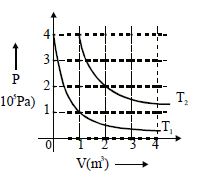
The following graph shows two isotherms for a fixed mass of an ideal gas. The ratio of $r.m.s.$ speed of the molecules at temperatures $T_2$ and $T_1$ is
A
$2\sqrt{2}$
B
$\sqrt{2}$
C
$2$
D
$4$
Solution
(C) For an ideal gas,the equation of state is $PV = \mu RT$. Since the mass is fixed,$\mu$ is constant. Thus,$T \propto PV$.
From the graph,we can choose points on the isotherms to find the product $PV$ for each temperature.
For isotherm $T_1$,at $V = 1 \text{ m}^3$,$P = 1 \times 10^5 \text{ Pa}$. So,$T_1 \propto (1 \times 1) = 1$.
For isotherm $T_2$,at $V = 2 \text{ m}^3$,$P = 2 \times 10^5 \text{ Pa}$. So,$T_2 \propto (2 \times 2) = 4$.
Therefore,the ratio of temperatures is $\frac{T_2}{T_1} = \frac{4}{1} = 4$.
The $r.m.s.$ speed of gas molecules is given by $v_{rms} = \sqrt{\frac{3RT}{M}}$,which implies $v_{rms} \propto \sqrt{T}$.
Thus,the ratio of $r.m.s.$ speeds is $\frac{v_{rms,2}}{v_{rms,1}} = \sqrt{\frac{T_2}{T_1}} = \sqrt{4} = 2$.
From the graph,we can choose points on the isotherms to find the product $PV$ for each temperature.
For isotherm $T_1$,at $V = 1 \text{ m}^3$,$P = 1 \times 10^5 \text{ Pa}$. So,$T_1 \propto (1 \times 1) = 1$.
For isotherm $T_2$,at $V = 2 \text{ m}^3$,$P = 2 \times 10^5 \text{ Pa}$. So,$T_2 \propto (2 \times 2) = 4$.
Therefore,the ratio of temperatures is $\frac{T_2}{T_1} = \frac{4}{1} = 4$.
The $r.m.s.$ speed of gas molecules is given by $v_{rms} = \sqrt{\frac{3RT}{M}}$,which implies $v_{rms} \propto \sqrt{T}$.
Thus,the ratio of $r.m.s.$ speeds is $\frac{v_{rms,2}}{v_{rms,1}} = \sqrt{\frac{T_2}{T_1}} = \sqrt{4} = 2$.
0 likes
View Solution145
MediumMCQ
Four molecules of a gas have speeds $1, 2, 3$ and $4 \ km/s$. The value of root mean square speed of the gas molecules is
A
$\sqrt{\frac{15}{2}} \ km/s$
B
$\sqrt{15} \ km/s$
C
$\sqrt{\frac{15}{4}} \ km/s$
D
$\sqrt{\frac{30}{2}} \ km/s$
Solution
(A) The root mean square speed $(V_{rms})$ is defined as the square root of the mean of the squares of the individual speeds of the molecules.
The formula is given by $V_{rms} = \sqrt{\frac{v_{1}^{2} + v_{2}^{2} + v_{3}^{2} + v_{4}^{2}}{4}}$.
Given speeds are $v_{1} = 1 \ km/s$,$v_{2} = 2 \ km/s$,$v_{3} = 3 \ km/s$,and $v_{4} = 4 \ km/s$.
Substituting the values into the formula:
$V_{rms} = \sqrt{\frac{1^{2} + 2^{2} + 3^{2} + 4^{2}}{4}}$
$V_{rms} = \sqrt{\frac{1 + 4 + 9 + 16}{4}}$
$V_{rms} = \sqrt{\frac{30}{4}}$
$V_{rms} = \sqrt{\frac{15}{2}} \ km/s$.
The formula is given by $V_{rms} = \sqrt{\frac{v_{1}^{2} + v_{2}^{2} + v_{3}^{2} + v_{4}^{2}}{4}}$.
Given speeds are $v_{1} = 1 \ km/s$,$v_{2} = 2 \ km/s$,$v_{3} = 3 \ km/s$,and $v_{4} = 4 \ km/s$.
Substituting the values into the formula:
$V_{rms} = \sqrt{\frac{1^{2} + 2^{2} + 3^{2} + 4^{2}}{4}}$
$V_{rms} = \sqrt{\frac{1 + 4 + 9 + 16}{4}}$
$V_{rms} = \sqrt{\frac{30}{4}}$
$V_{rms} = \sqrt{\frac{15}{2}} \ km/s$.
0 likes
View Solution146
MediumMCQ
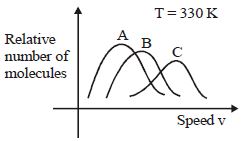
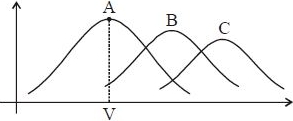
The Maxwell distribution function for different gases is shown in the figure. Which of the following is the correct matching?
A
$A \to Ne, B \to O_2, C \to He$
B
$A \to Ne, B \to He, C \to O_2$
C
$A \to O_2, B \to He, C \to Ne$
D
$A \to O_2, B \to Ne, C \to He$
Solution
(D) The most probable speed $v_p$ of gas molecules is given by the formula $v_p = \sqrt{\frac{2RT}{M}}$,where $R$ is the universal gas constant,$T$ is the absolute temperature,and $M$ is the molar mass of the gas.
From the formula,it is clear that $v_p \propto \frac{1}{\sqrt{M}}$.
This means that the gas with the smaller molar mass will have a higher most probable speed.
The molar masses of the given gases are: $M(O_2) = 32 \text{ g/mol}$,$M(Ne) = 20 \text{ g/mol}$,and $M(He) = 4 \text{ g/mol}$.
Comparing these,we have $M(O_2) > M(Ne) > M(He)$.
Therefore,the order of their most probable speeds will be $v_p(O_2) < v_p(Ne) < v_p(He)$.
Looking at the graph,the peak of the distribution shifts to the right as speed increases. Thus,the order of speeds corresponding to the peaks is $A < B < C$.
Matching these,we get $A \to O_2$,$B \to Ne$,and $C \to He$.
From the formula,it is clear that $v_p \propto \frac{1}{\sqrt{M}}$.
This means that the gas with the smaller molar mass will have a higher most probable speed.
The molar masses of the given gases are: $M(O_2) = 32 \text{ g/mol}$,$M(Ne) = 20 \text{ g/mol}$,and $M(He) = 4 \text{ g/mol}$.
Comparing these,we have $M(O_2) > M(Ne) > M(He)$.
Therefore,the order of their most probable speeds will be $v_p(O_2) < v_p(Ne) < v_p(He)$.
Looking at the graph,the peak of the distribution shifts to the right as speed increases. Thus,the order of speeds corresponding to the peaks is $A < B < C$.
Matching these,we get $A \to O_2$,$B \to Ne$,and $C \to He$.
0 likes
View Solution147
DifficultMCQ
The root mean-square $(rms)$ speed of oxygen molecules $(O_2)$ at a certain absolute temperature is $\upsilon$. If the temperature is doubled and the oxygen gas dissociates into atomic oxygen,the $rms$ speed would be
A
$\upsilon$
B
$\sqrt{2}\upsilon$
C
$2\upsilon$
D
$2\sqrt{2}\upsilon$
Solution
(C) The $rms$ speed of a gas is given by the formula: $v_{rms} = \sqrt{\frac{3RT}{M}}$,where $R$ is the universal gas constant,$T$ is the absolute temperature,and $M$ is the molar mass.
For oxygen molecules $(O_2)$ at temperature $T$,the molar mass is $M$. Thus,$v_{rms} = \sqrt{\frac{3RT}{M}} = \upsilon$.
When the temperature is doubled $(T' = 2T)$ and the oxygen dissociates into atomic oxygen $(O)$,the molar mass becomes $M' = M/2$.
The new $rms$ speed is: $v'_{rms} = \sqrt{\frac{3R(2T)}{M/2}} = \sqrt{4 \cdot \frac{3RT}{M}} = 2 \sqrt{\frac{3RT}{M}} = 2\upsilon$.
For oxygen molecules $(O_2)$ at temperature $T$,the molar mass is $M$. Thus,$v_{rms} = \sqrt{\frac{3RT}{M}} = \upsilon$.
When the temperature is doubled $(T' = 2T)$ and the oxygen dissociates into atomic oxygen $(O)$,the molar mass becomes $M' = M/2$.
The new $rms$ speed is: $v'_{rms} = \sqrt{\frac{3R(2T)}{M/2}} = \sqrt{4 \cdot \frac{3RT}{M}} = 2 \sqrt{\frac{3RT}{M}} = 2\upsilon$.
0 likes
View Solution148
MediumMCQ
The temperature at which the root mean square speed of a gas will be half of its value at $0\,^{\circ}C$ is ....... $^{\circ}C$.
A
$-\,86.4$
B
$-\,204.75$
C
$-\,104.75$
D
$-\,68.25$
Solution
(B) The root mean square speed $(v_{rms})$ of a gas is given by the formula $v_{rms} = \sqrt{\frac{3RT}{M}}$.
Since $v_{rms} \propto \sqrt{T}$,we have $\frac{v_2}{v_1} = \sqrt{\frac{T_2}{T_1}}$.
Given that $v_2 = \frac{1}{2}v_1$ and $T_1 = 0^{\circ}C = 273 \, K$.
Substituting these values: $\frac{1}{2} = \sqrt{\frac{T_2}{273}}$.
Squaring both sides: $\frac{1}{4} = \frac{T_2}{273}$.
$T_2 = \frac{273}{4} = 68.25 \, K$.
To convert this temperature to Celsius: $T(^{\circ}C) = T(K) - 273 = 68.25 - 273 = -204.75^{\circ}C$.
Since $v_{rms} \propto \sqrt{T}$,we have $\frac{v_2}{v_1} = \sqrt{\frac{T_2}{T_1}}$.
Given that $v_2 = \frac{1}{2}v_1$ and $T_1 = 0^{\circ}C = 273 \, K$.
Substituting these values: $\frac{1}{2} = \sqrt{\frac{T_2}{273}}$.
Squaring both sides: $\frac{1}{4} = \frac{T_2}{273}$.
$T_2 = \frac{273}{4} = 68.25 \, K$.
To convert this temperature to Celsius: $T(^{\circ}C) = T(K) - 273 = 68.25 - 273 = -204.75^{\circ}C$.
0 likes
View Solution149
DifficultMCQ
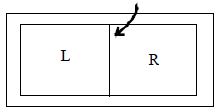
$A$ vessel is partitioned into two equal halves by a fixed diathermic separator. Two different ideal gases are filled in the left $(L)$ and right $(R)$ halves. The $rms$ speed of the molecules in the $L$ part is equal to the mean speed of the molecules in the $R$ part. Then the ratio of the mass of a molecule in the $L$ part to that of a molecule in the $R$ part is
A
$\frac{3}{2}$
B
$\frac{\pi}{4}$
C
$\frac{2}{3}$
D
$\frac{3\pi}{8}$
Solution
(D) Since the separator is diathermic,the system is in thermal equilibrium,so the temperature $T$ is the same for both gases.
The $rms$ speed of molecules in the $L$ part is given by $v_{rms, L} = \sqrt{\frac{3kT}{m_L}}$,where $m_L$ is the mass of a molecule in the $L$ part.
The mean speed of molecules in the $R$ part is given by $v_{mean, R} = \sqrt{\frac{8kT}{\pi m_R}}$,where $m_R$ is the mass of a molecule in the $R$ part.
Given that $v_{rms, L} = v_{mean, R}$,we have:
$\sqrt{\frac{3kT}{m_L}} = \sqrt{\frac{8kT}{\pi m_R}}$
Squaring both sides:
$\frac{3kT}{m_L} = \frac{8kT}{\pi m_R}$
$\frac{3}{m_L} = \frac{8}{\pi m_R}$
Rearranging to find the ratio $\frac{m_L}{m_R}$:
$\frac{m_L}{m_R} = \frac{3\pi}{8}$
The $rms$ speed of molecules in the $L$ part is given by $v_{rms, L} = \sqrt{\frac{3kT}{m_L}}$,where $m_L$ is the mass of a molecule in the $L$ part.
The mean speed of molecules in the $R$ part is given by $v_{mean, R} = \sqrt{\frac{8kT}{\pi m_R}}$,where $m_R$ is the mass of a molecule in the $R$ part.
Given that $v_{rms, L} = v_{mean, R}$,we have:
$\sqrt{\frac{3kT}{m_L}} = \sqrt{\frac{8kT}{\pi m_R}}$
Squaring both sides:
$\frac{3kT}{m_L} = \frac{8kT}{\pi m_R}$
$\frac{3}{m_L} = \frac{8}{\pi m_R}$
Rearranging to find the ratio $\frac{m_L}{m_R}$:
$\frac{m_L}{m_R} = \frac{3\pi}{8}$
0 likes
View Solution150
MediumMCQ
At $T$ $K$ temperature,the average speed of $O_2$ will be $\left( \frac{7}{4} \right)$ of the $rms$ speed of $N_2$ at $47\,^oC$. Find the value of $T$.
A
$1320$
B
$1500$
C
$273$
D
$1000$
Solution
(A) The average speed of $O_2$ is given by $V_{av} = \sqrt{\frac{8RT}{\pi M_{O_2}}}$,where $M_{O_2} = 32 \times 10^{-3} \, kg/mol$.
The $rms$ speed of $N_2$ is given by $V_{rms} = \sqrt{\frac{3RT'}{M_{N_2}}}$,where $T' = 47 + 273 = 320 \, K$ and $M_{N_2} = 28 \times 10^{-3} \, kg/mol$.
According to the problem: $\sqrt{\frac{8RT}{\pi \times 32}} = \frac{7}{4} \sqrt{\frac{3R \times 320}{28}}$.
Squaring both sides: $\frac{8RT}{32\pi} = \frac{49}{16} \times \frac{3R \times 320}{28}$.
Simplifying the equation: $\frac{RT}{4\pi} = \frac{49 \times 3R \times 320}{16 \times 28}$.
Solving for $T$: $T = \frac{49 \times 3 \times 320 \times 4\pi}{16 \times 28} \approx 1320 \, K$ (taking $\pi \approx \frac{22}{7}$ for calculation).
The $rms$ speed of $N_2$ is given by $V_{rms} = \sqrt{\frac{3RT'}{M_{N_2}}}$,where $T' = 47 + 273 = 320 \, K$ and $M_{N_2} = 28 \times 10^{-3} \, kg/mol$.
According to the problem: $\sqrt{\frac{8RT}{\pi \times 32}} = \frac{7}{4} \sqrt{\frac{3R \times 320}{28}}$.
Squaring both sides: $\frac{8RT}{32\pi} = \frac{49}{16} \times \frac{3R \times 320}{28}$.
Simplifying the equation: $\frac{RT}{4\pi} = \frac{49 \times 3R \times 320}{16 \times 28}$.
Solving for $T$: $T = \frac{49 \times 3 \times 320 \times 4\pi}{16 \times 28} \approx 1320 \, K$ (taking $\pi \approx \frac{22}{7}$ for calculation).
0 likes
View SolutionKinetic Theory of Gases — Speed (velocity) of Gas (rms, mean and Most probable speed) · Frequently Asked Questions
1Are these Kinetic Theory of Gases questions useful for JEE and NEET?
Yes. All questions in this section are mapped to JEE Main and NEET exam patterns. Previous year questions from JEE Main, NEET, GUJCET and state-level exams are included with full solutions.
2Can I switch to Hindi or Gujarati for these questions?
Yes. Use the language tabs in the hero section or the sidebar to view the same questions and solutions in English, Hindi or Gujarati.
3How do I generate a question paper from this subtopic?
Use the Vedclass Exam Paper Generator — select the chapter and subtopic, set difficulty, and generate Sets A, B, C, D automatically. First 3 chapters of every subject are free.
Vedclass Products
For Students
Vedclass Test Series
Mock tests in real JEE/NEET style with performance analysis. 5-day free trial.
Start Free TrialFor Teachers
Exam Paper Generator
Generate Set A/B/C/D papers from this chapter in 2 minutes. 3 chapters free.
Try FreeFor Institutes
Online Exam Module
Live online exams with unlimited students, 360° analytics & white-label branding.
See DemoFor Teachers & Institutes
Generate a Kinetic Theory of Gases Exam Paper in 2 Minutes
Select subtopic & difficulty — Sets A, B, C, D auto-generated with No Repeat logic.
First 3 chapters of every subject are free — no payment required.