
A English
Molar Specific Heat of gas and relation between them (Mayer's formula) Questions in English
Class 11 Physics · Kinetic Theory of Gases · Molar Specific Heat of gas and relation between them (Mayer's formula)
215+
Questions
English
Language
100%
With Solutions
Showing 50 of 215 questions in English
101
MediumMCQ
When an ideal triatomic non-linear gas is heated at constant pressure,the fraction of the heat energy supplied which increases the internal energy of the gas is
A
$1.33$
B
$0.75$
C
$0.71$
D
$1.67$
Solution
(B) The heat supplied at constant pressure is given by $Q_p = n C_p \Delta T$.
The change in internal energy is given by $\Delta U = n C_v \Delta T$.
The fraction of heat energy used to increase the internal energy is $f = \frac{\Delta U}{Q_p} = \frac{n C_v \Delta T}{n C_p \Delta T} = \frac{C_v}{C_p} = \frac{1}{\gamma}$.
For an ideal non-linear triatomic gas,the degrees of freedom $f_{deg} = 6$.
The adiabatic index $\gamma = 1 + \frac{2}{f_{deg}} = 1 + \frac{2}{6} = 1 + \frac{1}{3} = \frac{4}{3}$.
Therefore,the fraction $f = \frac{1}{4/3} = \frac{3}{4} = 0.75$.
The change in internal energy is given by $\Delta U = n C_v \Delta T$.
The fraction of heat energy used to increase the internal energy is $f = \frac{\Delta U}{Q_p} = \frac{n C_v \Delta T}{n C_p \Delta T} = \frac{C_v}{C_p} = \frac{1}{\gamma}$.
For an ideal non-linear triatomic gas,the degrees of freedom $f_{deg} = 6$.
The adiabatic index $\gamma = 1 + \frac{2}{f_{deg}} = 1 + \frac{2}{6} = 1 + \frac{1}{3} = \frac{4}{3}$.
Therefore,the fraction $f = \frac{1}{4/3} = \frac{3}{4} = 0.75$.
0 likes
View Solution102
DifficultMCQ
Using the law of equipartition of energy, the specific heat (in $J\, kg^{-1}\, K^{-1}$) of aluminium at room temperature can be estimated to be (atomic weight of aluminium $= 27$).
A
$410$
B
$25$
C
$1850$
D
$925$
Solution
(D) According to the law of equipartition of energy, each degree of freedom contributes $\frac{1}{2} k_B T$ to the average energy of a molecule.
For a solid, each atom acts as a 3D harmonic oscillator, having $3$ degrees of freedom for kinetic energy and $3$ degrees of freedom for potential energy, totaling $6$ degrees of freedom.
The average energy per atom is $U = 6 \times \frac{1}{2} k_B T = 3 k_B T$.
For $1 \, \text{mole}$ of substance, the internal energy is $U_m = 3 R T$.
The molar specific heat capacity is $C_v = \frac{dU_m}{dT} = 3 R$.
Given $R = 8.314 \, J \, mol^{-1} \, K^{-1}$ and atomic weight $M = 27 \times 10^{-3} \, kg/mol$, the specific heat capacity $c$ is given by $c = \frac{C_v}{M} = \frac{3 R}{M}$.
Substituting the values: $c = \frac{3 \times 8.314}{27 \times 10^{-3}} \approx \frac{24.942}{0.027} \approx 923.77 \, J \, kg^{-1} \, K^{-1}$.
Rounding to the nearest provided option, we get $925 \, J \, kg^{-1} \, K^{-1}$.
For a solid, each atom acts as a 3D harmonic oscillator, having $3$ degrees of freedom for kinetic energy and $3$ degrees of freedom for potential energy, totaling $6$ degrees of freedom.
The average energy per atom is $U = 6 \times \frac{1}{2} k_B T = 3 k_B T$.
For $1 \, \text{mole}$ of substance, the internal energy is $U_m = 3 R T$.
The molar specific heat capacity is $C_v = \frac{dU_m}{dT} = 3 R$.
Given $R = 8.314 \, J \, mol^{-1} \, K^{-1}$ and atomic weight $M = 27 \times 10^{-3} \, kg/mol$, the specific heat capacity $c$ is given by $c = \frac{C_v}{M} = \frac{3 R}{M}$.
Substituting the values: $c = \frac{3 \times 8.314}{27 \times 10^{-3}} \approx \frac{24.942}{0.027} \approx 923.77 \, J \, kg^{-1} \, K^{-1}$.
Rounding to the nearest provided option, we get $925 \, J \, kg^{-1} \, K^{-1}$.
0 likes
View Solution103
MediumMCQ
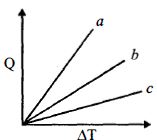
The figure shows the variation in heat supplied $(Q)$ with the change in temperature $(\Delta T)$ in an isobaric process for a monoatomic $(M)$,diatomic $(D)$,and a polyatomic $(P)$ gas. The initial state of all the gases is the same,and the scales for the two axes coincide. Ignoring vibrational degrees of freedom,the lines $a, b,$ and $c$ respectively correspond to
A
$P, D$ and $M$
B
$M, D$ and $P$
C
$P, M$ and $D$
D
$D, M$ and $P$
Solution
(A) For an isobaric process,the heat supplied is given by $Q = n C_p \Delta T$,where $n$ is the number of moles and $C_p$ is the molar heat capacity at constant pressure.
From the graph,the slope of the line is $\frac{Q}{\Delta T} = n C_p$.
Since the number of moles $n$ is the same for all gases,the slope is directly proportional to $C_p$.
The molar heat capacity at constant pressure is $C_p = C_v + R = \left( \frac{f}{2} + 1 \right) R$,where $f$ is the degree of freedom.
For monoatomic gas $(M)$,$f = 3$,so $C_p = (1.5 + 1) R = 2.5 R$.
For diatomic gas $(D)$,$f = 5$,so $C_p = (2.5 + 1) R = 3.5 R$.
For polyatomic gas $(P)$,$f = 6$,so $C_p = (3 + 1) R = 4 R$.
Thus,$C_p(P) > C_p(D) > C_p(M)$.
Since the slope is proportional to $C_p$,the slopes follow the order: $\text{slope}(a) > \text{slope}(b) > \text{slope}(c)$.
Therefore,line $a$ corresponds to $P$,line $b$ corresponds to $D$,and line $c$ corresponds to $M$.
From the graph,the slope of the line is $\frac{Q}{\Delta T} = n C_p$.
Since the number of moles $n$ is the same for all gases,the slope is directly proportional to $C_p$.
The molar heat capacity at constant pressure is $C_p = C_v + R = \left( \frac{f}{2} + 1 \right) R$,where $f$ is the degree of freedom.
For monoatomic gas $(M)$,$f = 3$,so $C_p = (1.5 + 1) R = 2.5 R$.
For diatomic gas $(D)$,$f = 5$,so $C_p = (2.5 + 1) R = 3.5 R$.
For polyatomic gas $(P)$,$f = 6$,so $C_p = (3 + 1) R = 4 R$.
Thus,$C_p(P) > C_p(D) > C_p(M)$.
Since the slope is proportional to $C_p$,the slopes follow the order: $\text{slope}(a) > \text{slope}(b) > \text{slope}(c)$.
Therefore,line $a$ corresponds to $P$,line $b$ corresponds to $D$,and line $c$ corresponds to $M$.
0 likes
View Solution104
MediumMCQ
$A$ cylinder with fixed capacity of $67.2 \, L$ contains helium gas at $STP$. The amount of heat needed to raise the temperature of the gas by $20 \, ^oC$ is ..... $J$ [Given that $R = 8.31 \, J \, mol^{-1} \, K^{-1}$]
A
$350$
B
$700$
C
$748$
D
$374$
Solution
(C) At $STP$,the molar volume of an ideal gas is $22.4 \, L/mol$.
The number of moles $n$ of helium gas is $n = \frac{67.2 \, L}{22.4 \, L/mol} = 3 \, mol$.
Helium is a monoatomic gas,so its molar heat capacity at constant volume is $C_v = \frac{3}{2}R$.
The heat required is given by $\Delta Q = n C_v \Delta T$.
Substituting the values: $\Delta Q = 3 \times \left(\frac{3}{2} \times 8.31 \right) \times 20$.
$\Delta Q = 3 \times 1.5 \times 8.31 \times 20 = 4.5 \times 166.2 = 747.9 \, J$.
Rounding to the nearest integer,we get $\Delta Q \approx 748 \, J$.
The number of moles $n$ of helium gas is $n = \frac{67.2 \, L}{22.4 \, L/mol} = 3 \, mol$.
Helium is a monoatomic gas,so its molar heat capacity at constant volume is $C_v = \frac{3}{2}R$.
The heat required is given by $\Delta Q = n C_v \Delta T$.
Substituting the values: $\Delta Q = 3 \times \left(\frac{3}{2} \times 8.31 \right) \times 20$.
$\Delta Q = 3 \times 1.5 \times 8.31 \times 20 = 4.5 \times 166.2 = 747.9 \, J$.
Rounding to the nearest integer,we get $\Delta Q \approx 748 \, J$.
0 likes
View Solution105
MediumMCQ
When heat $Q$ is supplied to a diatomic gas of rigid molecules at constant volume,its temperature increases by $\Delta T$. The heat required to produce the same change in temperature at constant pressure is:
A
$\frac{3}{2} Q$
B
$\frac{5}{3} Q$
C
$\frac{7}{5} Q$
D
$\frac{2}{3} Q$
Solution
(C) For a diatomic gas of rigid molecules,the molar heat capacity at constant volume is $C_V = \frac{5}{2} R$.
Given that heat $Q$ is supplied at constant volume,we have $Q = n C_V \Delta T = n (\frac{5}{2} R) \Delta T$.
For the same change in temperature $\Delta T$ at constant pressure,the heat required is $Q' = n C_P \Delta T$,where $C_P = \frac{7}{2} R$.
Taking the ratio,we get $\frac{Q'}{Q} = \frac{n C_P \Delta T}{n C_V \Delta T} = \frac{C_P}{C_V} = \frac{7/2 R}{5/2 R} = \frac{7}{5}$.
Therefore,$Q' = \frac{7}{5} Q$.
Given that heat $Q$ is supplied at constant volume,we have $Q = n C_V \Delta T = n (\frac{5}{2} R) \Delta T$.
For the same change in temperature $\Delta T$ at constant pressure,the heat required is $Q' = n C_P \Delta T$,where $C_P = \frac{7}{2} R$.
Taking the ratio,we get $\frac{Q'}{Q} = \frac{n C_P \Delta T}{n C_V \Delta T} = \frac{C_P}{C_V} = \frac{7/2 R}{5/2 R} = \frac{7}{5}$.
Therefore,$Q' = \frac{7}{5} Q$.
0 likes
View Solution106
EasyMCQ
Select the incorrect relation. (Where symbols have their usual meanings)
A
$C_P = \frac{\gamma R}{\gamma - 1}$
B
$C_P - C_V = R$
C
$\Delta U = \frac{P_f V_f - P_i V_i}{1 - \gamma}$
D
$C_V = \frac{R}{\gamma - 1}$
Solution
(C) For an ideal gas,the change in internal energy is given by $\Delta U = n C_V \Delta T$.
Using $C_V = \frac{R}{\gamma - 1}$,we get $\Delta U = n \left( \frac{R}{\gamma - 1} \right) (T_f - T_i)$.
Since $PV = nRT$,we have $nRT_f = P_f V_f$ and $nRT_i = P_i V_i$.
Substituting these,$\Delta U = \frac{P_f V_f - P_i V_i}{\gamma - 1}$.
Comparing this with option $C$,we see that $\frac{P_f V_f - P_i V_i}{1 - \gamma} = - \left( \frac{P_f V_f - P_i V_i}{\gamma - 1} \right)$,which is incorrect. Thus,option $C$ is the incorrect relation.
Using $C_V = \frac{R}{\gamma - 1}$,we get $\Delta U = n \left( \frac{R}{\gamma - 1} \right) (T_f - T_i)$.
Since $PV = nRT$,we have $nRT_f = P_f V_f$ and $nRT_i = P_i V_i$.
Substituting these,$\Delta U = \frac{P_f V_f - P_i V_i}{\gamma - 1}$.
Comparing this with option $C$,we see that $\frac{P_f V_f - P_i V_i}{1 - \gamma} = - \left( \frac{P_f V_f - P_i V_i}{\gamma - 1} \right)$,which is incorrect. Thus,option $C$ is the incorrect relation.
0 likes
View Solution107
MediumMCQ
An ideal mono-atomic gas is taken through a process such that $dQ = 3dU$. The molar heat capacity for this process is: (in $R$)
A
$3$
B
$4.5$
C
$4$
D
$2$
Solution
(B) For an ideal mono-atomic gas,the change in internal energy is given by $dU = nC_v dT$,where $C_v = \frac{3}{2}R$.
Given the process condition $dQ = 3dU$.
We know that the molar heat capacity $C$ is defined as $C = \frac{dQ}{n dT}$.
Substituting the given condition: $C = \frac{3dU}{n dT} = \frac{3(nC_v dT)}{n dT} = 3C_v$.
Substituting the value of $C_v$ for a mono-atomic gas: $C = 3 \times \left(\frac{3}{2}R\right) = \frac{9}{2}R = 4.5R$.
Given the process condition $dQ = 3dU$.
We know that the molar heat capacity $C$ is defined as $C = \frac{dQ}{n dT}$.
Substituting the given condition: $C = \frac{3dU}{n dT} = \frac{3(nC_v dT)}{n dT} = 3C_v$.
Substituting the value of $C_v$ for a mono-atomic gas: $C = 3 \times \left(\frac{3}{2}R\right) = \frac{9}{2}R = 4.5R$.
0 likes
View Solution108
MediumMCQ
The equation of a certain gas can be written as: $\left( \frac{T^7}{P^2} \right)^{1/5} = \text{constant}$. The specific heat at constant volume of this gas is (in $\text{J/mol K}$): (in $R$)
A
$0.5$
B
$1.5$
C
$2$
D
$2.5$
Solution
(D) The given equation is $\left( \frac{T^7}{P^2} \right)^{1/5} = \text{constant}$.
This can be rewritten as $T^{7/5} P^{-2/5} = \text{constant}$.
For an adiabatic process,the equation relating temperature $T$ and pressure $P$ is $T^{\gamma} P^{1-\gamma} = \text{constant}$.
Comparing the exponents of $T$ and $P$,we have $\gamma = 7/5$ and $1 - \gamma = -2/5$.
Solving for $\gamma$,we get $\gamma = 1 + 2/5 = 7/5 = 1.4$.
The molar specific heat at constant volume $C_v$ is given by the formula $C_v = \frac{R}{\gamma - 1}$.
Substituting $\gamma = 7/5$,we get $C_v = \frac{R}{7/5 - 1} = \frac{R}{2/5} = 2.5 R$.
This can be rewritten as $T^{7/5} P^{-2/5} = \text{constant}$.
For an adiabatic process,the equation relating temperature $T$ and pressure $P$ is $T^{\gamma} P^{1-\gamma} = \text{constant}$.
Comparing the exponents of $T$ and $P$,we have $\gamma = 7/5$ and $1 - \gamma = -2/5$.
Solving for $\gamma$,we get $\gamma = 1 + 2/5 = 7/5 = 1.4$.
The molar specific heat at constant volume $C_v$ is given by the formula $C_v = \frac{R}{\gamma - 1}$.
Substituting $\gamma = 7/5$,we get $C_v = \frac{R}{7/5 - 1} = \frac{R}{2/5} = 2.5 R$.
0 likes
View Solution109
MediumMCQ
If $C_p$ and $C_v$ denote the specific heat of nitrogen at constant pressure and constant volume respectively,then
A
$C_p - C_v = 28/R$
B
$C_p - C_v = R/28$
C
$C_p - C_v = R/14$
D
$C_p - C_v = R$
Solution
(B) According to Mayer's relation for specific heat capacities,the difference between the specific heat at constant pressure $(c_p)$ and the specific heat at constant volume $(c_v)$ is given by $c_p - c_v = R/M$,where $R$ is the universal gas constant and $M$ is the molar mass of the gas.
For nitrogen gas $(N_2)$,the molar mass $M = 28 \ g/mol$.
Substituting this value into the relation,we get $c_p - c_v = R/28$.
For nitrogen gas $(N_2)$,the molar mass $M = 28 \ g/mol$.
Substituting this value into the relation,we get $c_p - c_v = R/28$.
0 likes
View Solution110
MediumMCQ
The ratio of specific heats $(\gamma)$ of an ideal gas is given by
A
$\frac{1}{1 - \frac{R}{C_P}}$
B
$1 + \frac{R}{C_V}$
C
$\frac{C_P}{C_P - R}$
D
All of these
Solution
(D) The ratio of specific heats is defined as $\gamma = \frac{C_P}{C_V}$.
From Mayer's relation,we know that $C_P - C_V = R$,which implies $C_V = C_P - R$.
Substituting this into the ratio,we get $\gamma = \frac{C_P}{C_P - R}$.
Also,from $C_P - C_V = R$,we can write $C_P = C_V + R$,so $\gamma = \frac{C_V + R}{C_V} = 1 + \frac{R}{C_V}$.
Furthermore,$\gamma = \frac{C_P}{C_P - R} = \frac{1}{\frac{C_P - R}{C_P}} = \frac{1}{1 - \frac{R}{C_P}}$.
Since all three expressions are equivalent,the correct option is $D$.
From Mayer's relation,we know that $C_P - C_V = R$,which implies $C_V = C_P - R$.
Substituting this into the ratio,we get $\gamma = \frac{C_P}{C_P - R}$.
Also,from $C_P - C_V = R$,we can write $C_P = C_V + R$,so $\gamma = \frac{C_V + R}{C_V} = 1 + \frac{R}{C_V}$.
Furthermore,$\gamma = \frac{C_P}{C_P - R} = \frac{1}{\frac{C_P - R}{C_P}} = \frac{1}{1 - \frac{R}{C_P}}$.
Since all three expressions are equivalent,the correct option is $D$.
0 likes
View Solution111
DifficultMCQ
The amount of heat energy required to raise the temperature of $1\,g$ of helium from $T_1\,K$ to $T_2\,K$ is
A
$\frac{3}{2}\,{N_a}{k_B}\,\left( {{T_2} - {T_1}} \right)$
B
$\frac{3}{4}\,{N_a}{k_B}\,\left( {{T_2} - {T_1}} \right)$
C
$\frac{3}{4}\,{N_a}{k_B}\,\left( {\frac{{{T_2}}}{{{T_1}}}} \right)$
D
$\frac{3}{8}\,{N_a}{k_B}\,\left( {{T_2} - {T_1}} \right)$
Solution
(D) Since the volume of the gas remains constant,the heat energy required is given by $\Delta Q = n C_v \Delta T$.
Here,the number of moles $n$ for $1\,g$ of Helium (molar mass $M = 4\,g/mol$) is $n = \frac{1}{4}$.
For a monoatomic gas like Helium,the molar heat capacity at constant volume is $C_v = \frac{3}{2} R$.
The change in temperature is $\Delta T = T_2 - T_1$.
Substituting these values,we get $\Delta Q = \frac{1}{4} \times \left( \frac{3}{2} R \right) \times (T_2 - T_1) = \frac{3}{8} R (T_2 - T_1)$.
Using the relation $R = N_a k_B$,where $N_a$ is Avogadro's number and $k_B$ is the Boltzmann constant,we get $\Delta Q = \frac{3}{8} N_a k_B (T_2 - T_1)$.
Thus,the correct option is $D$.
Here,the number of moles $n$ for $1\,g$ of Helium (molar mass $M = 4\,g/mol$) is $n = \frac{1}{4}$.
For a monoatomic gas like Helium,the molar heat capacity at constant volume is $C_v = \frac{3}{2} R$.
The change in temperature is $\Delta T = T_2 - T_1$.
Substituting these values,we get $\Delta Q = \frac{1}{4} \times \left( \frac{3}{2} R \right) \times (T_2 - T_1) = \frac{3}{8} R (T_2 - T_1)$.
Using the relation $R = N_a k_B$,where $N_a$ is Avogadro's number and $k_B$ is the Boltzmann constant,we get $\Delta Q = \frac{3}{8} N_a k_B (T_2 - T_1)$.
Thus,the correct option is $D$.
0 likes
View Solution112
MediumMCQ
Which of the following statements is correct?
A
$A$ gas has two specific heats only
B
$A$ gas has infinite number of specific heats
C
$A$ material will have only one specific heat always
D
None of the above
Solution
(B) The specific heat of a gas is defined as the amount of heat required to increase the temperature of $1 \text{ mole}$ of the gas by $1 \text{ K}$ (or $1^{\circ}C$).
During different thermodynamic processes,the work done by the gas and the change in internal energy vary.
Since the specific heat $C$ is given by $C = \frac{dQ}{dT} = \frac{dU}{dT} + \frac{dW}{dT}$,and the work done $dW$ depends on the path (process) taken,the value of $C$ is not fixed.
Because there are an infinite number of possible thermodynamic processes,a gas can have an infinite number of specific heats.
Therefore,option $B$ is correct.
During different thermodynamic processes,the work done by the gas and the change in internal energy vary.
Since the specific heat $C$ is given by $C = \frac{dQ}{dT} = \frac{dU}{dT} + \frac{dW}{dT}$,and the work done $dW$ depends on the path (process) taken,the value of $C$ is not fixed.
Because there are an infinite number of possible thermodynamic processes,a gas can have an infinite number of specific heats.
Therefore,option $B$ is correct.
0 likes
View Solution113
MediumMCQ
$Assertion :$ The ratio of $\frac{C_p}{C_v}$ for an ideal diatomic gas is less than that for an ideal monoatomic gas (where $C_p$ and $C_v$ have usual meaning).
$Reason :$ The atoms of a monoatomic gas have less degrees of freedom as compared to molecules of the diatomic gas.
$Reason :$ The atoms of a monoatomic gas have less degrees of freedom as compared to molecules of the diatomic gas.
A
If both Assertion and Reason are correct and the Reason is a correct explanation of the Assertion.
B
If both Assertion and Reason are correct but Reason is not a correct explanation of the Assertion.
C
If the Assertion is correct but Reason is incorrect.
D
If both the Assertion and Reason are incorrect.
Solution
(A) If $f$ is the degree of freedom,then the ratio $\gamma = \frac{C_p}{C_v}$ is given by $\gamma = 1 + \frac{2}{f}$.
For a monoatomic gas,$f = 3$.
Therefore,$\gamma_{\text{mono}} = 1 + \frac{2}{3} = \frac{5}{3} \approx 1.67$.
For a diatomic gas,$f = 5$.
Therefore,$\gamma_{\text{dia}} = 1 + \frac{2}{5} = \frac{7}{5} = 1.4$.
Since $1.4 < 1.67$,the ratio for a diatomic gas is indeed less than that for a monoatomic gas.
The reason is correct because the degree of freedom $f$ is higher for diatomic molecules $(f=5)$ than for monoatomic atoms $(f=3)$,which leads to a smaller value of $\gamma$.
For a monoatomic gas,$f = 3$.
Therefore,$\gamma_{\text{mono}} = 1 + \frac{2}{3} = \frac{5}{3} \approx 1.67$.
For a diatomic gas,$f = 5$.
Therefore,$\gamma_{\text{dia}} = 1 + \frac{2}{5} = \frac{7}{5} = 1.4$.
Since $1.4 < 1.67$,the ratio for a diatomic gas is indeed less than that for a monoatomic gas.
The reason is correct because the degree of freedom $f$ is higher for diatomic molecules $(f=5)$ than for monoatomic atoms $(f=3)$,which leads to a smaller value of $\gamma$.
0 likes
View Solution114
EasyMCQ
$Assertion:$ At a given temperature,the specific heat of a gas at constant pressure $(C_p)$ is always greater than its specific heat at constant volume $(C_v)$.
$Reason:$ When a gas is heated at constant volume,some extra heat is needed compared to that at constant pressure for doing work in expansion.
$Reason:$ When a gas is heated at constant volume,some extra heat is needed compared to that at constant pressure for doing work in expansion.
A
If both Assertion and Reason are correct and the Reason is a correct explanation of the Assertion.
B
If both Assertion and Reason are correct but Reason is not a correct explanation of the Assertion.
C
If the Assertion is correct but Reason is incorrect.
D
If both the Assertion and Reason are incorrect.
Solution
(C) According to Mayer's relation,$C_p - C_v = R$. Since $R > 0$,it follows that $C_p > C_v$. This is because when a gas is heated at constant pressure,it expands and does work against external pressure. Therefore,extra heat is required to perform this work in addition to the heat required to increase the internal energy. Conversely,at constant volume,no work is done by the gas,so all supplied heat is used only to increase the internal energy. Thus,the Assertion is correct,but the Reason states the opposite (that extra heat is needed at constant volume),making the Reason incorrect.
0 likes
View Solution115
Medium
Given below are observations on molar specific heats at room temperature of some common gases.
The measured molar specific heats of these gases are markedly different from those for monatomic gases. Typically,molar specific heat of a monatomic gas is $2.92 \; cal/mol\; K$. Explain this difference. What can you infer from the somewhat larger (than the rest) value for chlorine?
| Gas | Molar specific heat $(C_v)$ $(cal\, mol^{-1}\, K^{-1})$ |
|---|---|
| Hydrogen | $4.87$ |
| Nitrogen | $4.97$ |
| Oxygen | $5.02$ |
| Nitric oxide | $4.99$ |
| Carbon monoxide | $5.01$ |
| Chlorine | $6.17$ |
The measured molar specific heats of these gases are markedly different from those for monatomic gases. Typically,molar specific heat of a monatomic gas is $2.92 \; cal/mol\; K$. Explain this difference. What can you infer from the somewhat larger (than the rest) value for chlorine?
Solution
(N/A) The gases listed in the table are diatomic. Besides the translational degrees of freedom,they possess rotational degrees of freedom.
Heat supplied to the gas increases the average energy of all these modes of motion. Consequently,the molar specific heat of diatomic gases is higher than that of monatomic gases.
If only translational and rotational modes are considered,the theoretical molar specific heat of a diatomic gas is given by $C_v = \frac{5}{2} R$.
Using $R \approx 1.98 \; cal\, mol^{-1}\, K^{-1}$,we get $C_v = 2.5 \times 1.98 = 4.95 \; cal\, mol^{-1}\, K^{-1}$.
Most gases in the table show values close to $4.95 \; cal\, mol^{-1}\, K^{-1}$. However,chlorine has a significantly higher value $(6.17 \; cal\, mol^{-1}\, K^{-1})$. This indicates that at room temperature,chlorine molecules also possess vibrational degrees of freedom in addition to translational and rotational modes,which contribute to the total internal energy and thus increase the molar specific heat.
Heat supplied to the gas increases the average energy of all these modes of motion. Consequently,the molar specific heat of diatomic gases is higher than that of monatomic gases.
If only translational and rotational modes are considered,the theoretical molar specific heat of a diatomic gas is given by $C_v = \frac{5}{2} R$.
Using $R \approx 1.98 \; cal\, mol^{-1}\, K^{-1}$,we get $C_v = 2.5 \times 1.98 = 4.95 \; cal\, mol^{-1}\, K^{-1}$.
Most gases in the table show values close to $4.95 \; cal\, mol^{-1}\, K^{-1}$. However,chlorine has a significantly higher value $(6.17 \; cal\, mol^{-1}\, K^{-1})$. This indicates that at room temperature,chlorine molecules also possess vibrational degrees of freedom in addition to translational and rotational modes,which contribute to the total internal energy and thus increase the molar specific heat.
0 likes
View Solution116
MediumMCQ
What amount of heat (in $J$) must be supplied to $2.0 \times 10^{-2} \; kg$ of nitrogen (at room temperature) to raise its temperature by $45 \; ^{\circ}C$ at constant pressure? (Molecular mass of $N_{2} = 28; R = 8.3 \; J \; mol^{-1} K^{-1}$.)
A
$845$
B
$933$
C
$1026$
D
$756$
Solution
(B) Mass of nitrogen,$m = 2.0 \times 10^{-2} \; kg = 20 \; g$.
Rise in temperature,$\Delta T = 45 \; ^{\circ}C$.
Molecular mass of $N_{2}$,$M = 28 \; g/mol$.
Universal gas constant,$R = 8.3 \; J \; mol^{-1} K^{-1}$.
Number of moles,$n = \frac{m}{M} = \frac{20}{28} = \frac{5}{7} \; mol$.
For a diatomic gas like nitrogen,the molar specific heat at constant pressure is $C_{p} = \frac{7}{2} R$.
$C_{p} = \frac{7}{2} \times 8.3 = 29.05 \; J \; mol^{-1} K^{-1}$.
The total amount of heat supplied at constant pressure is given by $\Delta Q = n C_{p} \Delta T$.
$\Delta Q = \left( \frac{5}{7} \right) \times 29.05 \times 45$.
$\Delta Q = \frac{5}{7} \times \left( \frac{7}{2} \times 8.3 \right) \times 45 = \frac{5}{2} \times 8.3 \times 45$.
$\Delta Q = 2.5 \times 373.5 = 933.75 \; J$.
Rounding to the nearest integer,the heat supplied is $933 \; J$.
Rise in temperature,$\Delta T = 45 \; ^{\circ}C$.
Molecular mass of $N_{2}$,$M = 28 \; g/mol$.
Universal gas constant,$R = 8.3 \; J \; mol^{-1} K^{-1}$.
Number of moles,$n = \frac{m}{M} = \frac{20}{28} = \frac{5}{7} \; mol$.
For a diatomic gas like nitrogen,the molar specific heat at constant pressure is $C_{p} = \frac{7}{2} R$.
$C_{p} = \frac{7}{2} \times 8.3 = 29.05 \; J \; mol^{-1} K^{-1}$.
The total amount of heat supplied at constant pressure is given by $\Delta Q = n C_{p} \Delta T$.
$\Delta Q = \left( \frac{5}{7} \right) \times 29.05 \times 45$.
$\Delta Q = \frac{5}{7} \times \left( \frac{7}{2} \times 8.3 \right) \times 45 = \frac{5}{2} \times 8.3 \times 45$.
$\Delta Q = 2.5 \times 373.5 = 933.75 \; J$.
Rounding to the nearest integer,the heat supplied is $933 \; J$.
0 likes
View Solution117
Medium
What is molar specific heat? Write its unit and also definitions of molar specific heat at constant pressure and constant volume.
Solution
(N/A) If the amount of substance is specified in terms of moles $\mu$,instead of mass $m$ in $kg$,we can define heat capacity per mole of the substance by:
$C = \frac{1}{\mu} \frac{\Delta Q}{\Delta T}$
where $C$ is known as the molar specific heat capacity of the substance. $C$ depends on the nature of the substance and its temperature.
The $SI$ unit of molar specific heat capacity is $J \cdot mol^{-1} \cdot K^{-1}$.
We can define molar specific heat for gases in two ways:
$(i)$ Molar specific heat at constant pressure $(C_P)$: If the gas is held under constant pressure during the heat transfer,the molar specific heat capacity is called the molar specific heat capacity at constant pressure,denoted by $C_P$.
$(ii)$ Molar specific heat at constant volume $(C_V)$: If the volume of the gas is maintained constant during the heat transfer,the corresponding molar specific heat capacity is called the molar specific heat capacity at constant volume,denoted by $C_V$.
$C = \frac{1}{\mu} \frac{\Delta Q}{\Delta T}$
where $C$ is known as the molar specific heat capacity of the substance. $C$ depends on the nature of the substance and its temperature.
The $SI$ unit of molar specific heat capacity is $J \cdot mol^{-1} \cdot K^{-1}$.
We can define molar specific heat for gases in two ways:
$(i)$ Molar specific heat at constant pressure $(C_P)$: If the gas is held under constant pressure during the heat transfer,the molar specific heat capacity is called the molar specific heat capacity at constant pressure,denoted by $C_P$.
$(ii)$ Molar specific heat at constant volume $(C_V)$: If the volume of the gas is maintained constant during the heat transfer,the corresponding molar specific heat capacity is called the molar specific heat capacity at constant volume,denoted by $C_V$.
0 likes
View Solution118
Easy
Write definitions of molar specific heat at constant pressure and constant volume.
Solution
(N/A) $1$. Molar specific heat at constant volume $(C_V)$: It is defined as the amount of heat required to raise the temperature of $1 \text{ mole}$ of a gas by $1 \text{ K}$ (or $1^{\circ}\text{C}$) while keeping its volume constant.
$2$. Molar specific heat at constant pressure $(C_P)$: It is defined as the amount of heat required to raise the temperature of $1 \text{ mole}$ of a gas by $1 \text{ K}$ (or $1^{\circ}\text{C}$) while keeping its pressure constant.
$2$. Molar specific heat at constant pressure $(C_P)$: It is defined as the amount of heat required to raise the temperature of $1 \text{ mole}$ of a gas by $1 \text{ K}$ (or $1^{\circ}\text{C}$) while keeping its pressure constant.
0 likes
View Solution119
Medium
Obtain the molar specific heat of a solid by using the law of equipartition of energy.
Solution
(C) The law of equipartition of energy can be used to predict the molar specific heat capacities of solids. Consider a solid consisting of $N$ atoms,each vibrating about its mean position.
An oscillator in one dimension has an average energy $= 2 \times \frac{1}{2} k_{B} T = k_{B} T$,where $k_{B}$ is the Boltzmann constant.
In three dimensions,the average energy $= 3 k_{B} T$.
Therefore,for one mole of a solid,the total internal energy $U$ is the average energy multiplied by the number of atoms in one mole $(N_{A})$:
$U = 3 k_{B} T \times N_{A}$
Since $k_{B} N_{A} = R$ (the universal gas constant),we have:
$U = 3 RT$
To find the molar specific heat capacity $C$,we differentiate $U$ with respect to temperature $T$:
$C = \frac{dU}{dT} = \frac{d}{dT}(3 RT) = 3R$
According to the first law of thermodynamics,$\Delta Q = \Delta U + \Delta W$. For a solid,the change in volume $\Delta V$ is negligible,so the work done $\Delta W = P \Delta V \approx 0$. Thus,$\Delta Q = \Delta U$. Therefore,the molar specific heat capacity of a solid is $C = 3R$.
An oscillator in one dimension has an average energy $= 2 \times \frac{1}{2} k_{B} T = k_{B} T$,where $k_{B}$ is the Boltzmann constant.
In three dimensions,the average energy $= 3 k_{B} T$.
Therefore,for one mole of a solid,the total internal energy $U$ is the average energy multiplied by the number of atoms in one mole $(N_{A})$:
$U = 3 k_{B} T \times N_{A}$
Since $k_{B} N_{A} = R$ (the universal gas constant),we have:
$U = 3 RT$
To find the molar specific heat capacity $C$,we differentiate $U$ with respect to temperature $T$:
$C = \frac{dU}{dT} = \frac{d}{dT}(3 RT) = 3R$
According to the first law of thermodynamics,$\Delta Q = \Delta U + \Delta W$. For a solid,the change in volume $\Delta V$ is negligible,so the work done $\Delta W = P \Delta V \approx 0$. Thus,$\Delta Q = \Delta U$. Therefore,the molar specific heat capacity of a solid is $C = 3R$.
0 likes
View Solution120
Medium
Define two specific heats of a gas. Write the relation between them.
Solution
(N/A) For gases,the specific heat capacity is defined as the molar specific heat capacity.
$1$. Molar specific heat capacity at constant volume $(C_{V})$: It is the amount of heat required to raise the temperature of $1$ mole of a gas by $1 \ K$ (or $1^{\circ}C$) while keeping the volume constant.
$2$. Molar specific heat capacity at constant pressure $(C_{P})$: It is the amount of heat required to raise the temperature of $1$ mole of a gas by $1 \ K$ (or $1^{\circ}C$) while keeping the pressure constant.
The relation between these two molar specific heat capacities is given by Mayer's relation: $C_{P} - C_{V} = R$,where $R$ is the universal gas constant.
$1$. Molar specific heat capacity at constant volume $(C_{V})$: It is the amount of heat required to raise the temperature of $1$ mole of a gas by $1 \ K$ (or $1^{\circ}C$) while keeping the volume constant.
$2$. Molar specific heat capacity at constant pressure $(C_{P})$: It is the amount of heat required to raise the temperature of $1$ mole of a gas by $1 \ K$ (or $1^{\circ}C$) while keeping the pressure constant.
The relation between these two molar specific heat capacities is given by Mayer's relation: $C_{P} - C_{V} = R$,where $R$ is the universal gas constant.
0 likes
View Solution121
Medium
Obtain the relation between specific heat capacity at constant pressure $(C_P)$ and specific heat capacity at constant volume $(C_V)$ for an ideal gas.
Solution
(N/A) For $1$ mole of an ideal gas,the first law of thermodynamics is $\Delta Q = \Delta U + \Delta W$.
At constant volume,$\Delta W = 0$,so $\Delta Q = \Delta U$. Since $\Delta U = C_V \Delta T$,we have $C_V = \frac{\Delta U}{\Delta T}$.
For an ideal gas,the internal energy $U$ depends only on temperature,so $\Delta U = C_V \Delta T$ holds for any process.
At constant pressure,$\Delta Q = \Delta U + P \Delta V$. Dividing by $\Delta T$,we get $\frac{\Delta Q}{\Delta T} = \frac{\Delta U}{\Delta T} + P \frac{\Delta V}{\Delta T}$.
This gives $C_P = C_V + P \frac{\Delta V}{\Delta T}$.
From the ideal gas equation for $1$ mole,$PV = RT$. Differentiating at constant pressure,$P \Delta V = R \Delta T$,which implies $P \frac{\Delta V}{\Delta T} = R$.
Substituting this into the expression for $C_P$,we get $C_P = C_V + R$.
Therefore,the relation is $C_P - C_V = R$.
At constant volume,$\Delta W = 0$,so $\Delta Q = \Delta U$. Since $\Delta U = C_V \Delta T$,we have $C_V = \frac{\Delta U}{\Delta T}$.
For an ideal gas,the internal energy $U$ depends only on temperature,so $\Delta U = C_V \Delta T$ holds for any process.
At constant pressure,$\Delta Q = \Delta U + P \Delta V$. Dividing by $\Delta T$,we get $\frac{\Delta Q}{\Delta T} = \frac{\Delta U}{\Delta T} + P \frac{\Delta V}{\Delta T}$.
This gives $C_P = C_V + P \frac{\Delta V}{\Delta T}$.
From the ideal gas equation for $1$ mole,$PV = RT$. Differentiating at constant pressure,$P \Delta V = R \Delta T$,which implies $P \frac{\Delta V}{\Delta T} = R$.
Substituting this into the expression for $C_P$,we get $C_P = C_V + R$.
Therefore,the relation is $C_P - C_V = R$.
0 likes
View Solution122
EasyMCQ
For all gases,$C_P - C_V$ is a constant. Does this imply that for all gases,$\frac{C_P}{C_V}$ is also a constant?
A
Yes
B
No
C
Only for monoatomic gases
D
Only for diatomic gases
Solution
(B) The relation $C_P - C_V = R$ holds true for all ideal gases,where $R$ is the universal gas constant.
However,the ratio $\gamma = \frac{C_P}{C_V}$ depends on the atomicity of the gas.
For monoatomic gases,$\gamma = 1.67$.
For diatomic gases,$\gamma = 1.40$.
For polyatomic gases,$\gamma$ takes different values.
Since $\gamma$ varies based on the degrees of freedom of the gas molecules,it is not a constant for all gases.
However,the ratio $\gamma = \frac{C_P}{C_V}$ depends on the atomicity of the gas.
For monoatomic gases,$\gamma = 1.67$.
For diatomic gases,$\gamma = 1.40$.
For polyatomic gases,$\gamma$ takes different values.
Since $\gamma$ varies based on the degrees of freedom of the gas molecules,it is not a constant for all gases.
0 likes
View Solution123
Medium
Can we use the degree of freedom to obtain the specific heat capacity of a gas? Explain.
Solution
(A) Yes,we can use the degree of freedom $(f)$ to determine the molar specific heat capacity of a gas.
According to the law of equipartition of energy,the energy associated with each degree of freedom per molecule is $\frac{1}{2} k_{B} T$.
For a gas with $f$ degrees of freedom,the total internal energy $(U)$ for $1$ mole of gas is given by:
$U = f \times \left( \frac{1}{2} k_{B} T \right) \times N_{A} = \frac{f}{2} RT$ (since $k_{B} N_{A} = R$)
The molar specific heat at constant volume $(C_{V})$ is defined as the rate of change of internal energy with respect to temperature:
$C_{V} = \frac{dU}{dT} = \frac{d}{dT} \left( \frac{f}{2} RT \right) = \frac{f}{2} R$
Using Mayer's relation,the molar specific heat at constant pressure $(C_{P})$ is:
$C_{P} = C_{V} + R = \frac{f}{2} R + R = \left( \frac{f}{2} + 1 \right) R$
The ratio of specific heats $(\gamma)$ is:
$\gamma = \frac{C_{P}}{C_{V}} = \frac{(\frac{f}{2} + 1)R}{\frac{f}{2}R} = 1 + \frac{2}{f}$
According to the law of equipartition of energy,the energy associated with each degree of freedom per molecule is $\frac{1}{2} k_{B} T$.
For a gas with $f$ degrees of freedom,the total internal energy $(U)$ for $1$ mole of gas is given by:
$U = f \times \left( \frac{1}{2} k_{B} T \right) \times N_{A} = \frac{f}{2} RT$ (since $k_{B} N_{A} = R$)
The molar specific heat at constant volume $(C_{V})$ is defined as the rate of change of internal energy with respect to temperature:
$C_{V} = \frac{dU}{dT} = \frac{d}{dT} \left( \frac{f}{2} RT \right) = \frac{f}{2} R$
Using Mayer's relation,the molar specific heat at constant pressure $(C_{P})$ is:
$C_{P} = C_{V} + R = \frac{f}{2} R + R = \left( \frac{f}{2} + 1 \right) R$
The ratio of specific heats $(\gamma)$ is:
$\gamma = \frac{C_{P}}{C_{V}} = \frac{(\frac{f}{2} + 1)R}{\frac{f}{2}R} = 1 + \frac{2}{f}$
0 likes
View Solution124
Medium
Derive the ratio of $\frac{C_{P}}{C_{V}}$ for a diatomic gas.
Solution
(D) For a diatomic rigid rotator gas,the degree of freedom $(f)$ is $5$,and the energy associated with each degree of freedom is $\frac{1}{2} k_{B} T$.
From the law of equipartition of energy,the total internal energy $(U)$ of $1 \text{ mole}$ of gas is:
$U = 5 \times \frac{1}{2} k_{B} T \times N_{A}$
$U = \frac{5}{2} (k_{B} N_{A}) T$
Since $k_{B} N_{A} = R$,we have:
$U = \frac{5}{2} RT \quad \dots(1)$
The molar specific heat at constant volume $(C_{V})$ is given by:
$C_{V} = \frac{dU}{dT} \quad \dots(2)$
Substituting equation $(1)$ into $(2)$:
$C_{V} = \frac{d}{dT} \left[ \frac{5}{2} RT \right] = \frac{5}{2} R$
Using Mayer's relation for molar specific heat at constant pressure $(C_{P})$:
$C_{P} - C_{V} = R$
$C_{P} = C_{V} + R = \frac{5}{2} R + R = \frac{7}{2} R$
Therefore,the ratio $\gamma = \frac{C_{P}}{C_{V}}$ is:
$\frac{C_{P}}{C_{V}} = \frac{\frac{7}{2} R}{\frac{5}{2} R} = \frac{7}{5} = 1.4$
From the law of equipartition of energy,the total internal energy $(U)$ of $1 \text{ mole}$ of gas is:
$U = 5 \times \frac{1}{2} k_{B} T \times N_{A}$
$U = \frac{5}{2} (k_{B} N_{A}) T$
Since $k_{B} N_{A} = R$,we have:
$U = \frac{5}{2} RT \quad \dots(1)$
The molar specific heat at constant volume $(C_{V})$ is given by:
$C_{V} = \frac{dU}{dT} \quad \dots(2)$
Substituting equation $(1)$ into $(2)$:
$C_{V} = \frac{d}{dT} \left[ \frac{5}{2} RT \right] = \frac{5}{2} R$
Using Mayer's relation for molar specific heat at constant pressure $(C_{P})$:
$C_{P} - C_{V} = R$
$C_{P} = C_{V} + R = \frac{5}{2} R + R = \frac{7}{2} R$
Therefore,the ratio $\gamma = \frac{C_{P}}{C_{V}}$ is:
$\frac{C_{P}}{C_{V}} = \frac{\frac{7}{2} R}{\frac{5}{2} R} = \frac{7}{5} = 1.4$
0 likes
View Solution125
DifficultMCQ
Obtain the value of $\frac{C_P}{C_V}$ for a non-linear triatomic gas.
A
$1.67$
B
$1.40$
C
$1.33$
D
$1.28$
Solution
(D) For a non-linear triatomic gas,the degrees of freedom $(f)$ is $6$ ($3$ translational + $3$ rotational). However,if the question implies a general triatomic gas at higher temperatures where vibrational modes are active,$f$ can be $7$. Assuming the standard case for a non-linear triatomic gas at room temperature,$f = 6$.
$C_V = \frac{f}{2} R = \frac{6}{2} R = 3R$
Using Mayer's relation,$C_P = C_V + R = 3R + R = 4R$
Therefore,$\gamma = \frac{C_P}{C_V} = \frac{4R}{3R} = 1.33$.
If the gas is treated as having $f=7$ (including vibrational modes),then $C_V = \frac{7}{2}R$ and $C_P = \frac{9}{2}R$,giving $\gamma = \frac{9}{7} \approx 1.28$.
$C_V = \frac{f}{2} R = \frac{6}{2} R = 3R$
Using Mayer's relation,$C_P = C_V + R = 3R + R = 4R$
Therefore,$\gamma = \frac{C_P}{C_V} = \frac{4R}{3R} = 1.33$.
If the gas is treated as having $f=7$ (including vibrational modes),then $C_V = \frac{7}{2}R$ and $C_P = \frac{9}{2}R$,giving $\gamma = \frac{9}{7} \approx 1.28$.
0 likes
View Solution126
Medium
Obtain the value of $\frac{C_{P}}{C_{V}}$ for a polyatomic gas.
Solution
(D) polyatomic gas has $3$ translational,$3$ rotational,and $f$ vibrational degrees of freedom. Thus,the total degree of freedom is $f_{total} = (3 + 3 + f) = (6 + f)$.
The internal energy $U$ is given by the law of equipartition of energy:
$U = \frac{f_{total}}{2} RT = \frac{6+f}{2} RT$.
The molar specific heat at constant volume is $C_{V} = \frac{dU}{dT} = \frac{6+f}{2} R$.
Using Mayer's relation,$C_{P} = C_{V} + R = \left(\frac{6+f}{2} + 1\right) R = \left(\frac{8+f}{2}\right) R$.
Therefore,the ratio $\gamma = \frac{C_{P}}{C_{V}} = \frac{\frac{8+f}{2} R}{\frac{6+f}{2} R} = \frac{8+f}{6+f}$.
The internal energy $U$ is given by the law of equipartition of energy:
$U = \frac{f_{total}}{2} RT = \frac{6+f}{2} RT$.
The molar specific heat at constant volume is $C_{V} = \frac{dU}{dT} = \frac{6+f}{2} R$.
Using Mayer's relation,$C_{P} = C_{V} + R = \left(\frac{6+f}{2} + 1\right) R = \left(\frac{8+f}{2}\right) R$.
Therefore,the ratio $\gamma = \frac{C_{P}}{C_{V}} = \frac{\frac{8+f}{2} R}{\frac{6+f}{2} R} = \frac{8+f}{6+f}$.
0 likes
View Solution127
Difficult
Obtain the equation for $\gamma = \frac{C_P}{C_V}$ in terms of the degree of freedom $f$.
Solution
(D) For a gas with $f$ degrees of freedom,the internal energy $U$ of $1 \text{ mole}$ of gas is given by:
$U = f \times \frac{1}{2} k_B T \times N_A = \frac{1}{2} f RT$ (since $k_B N_A = R$).
From the definition of molar specific heat at constant volume:
$C_V = \frac{dU}{dT} = \frac{d}{dT} \left( \frac{1}{2} f RT \right) = \frac{1}{2} f R$.
Using Mayer's relation for molar specific heat at constant pressure:
$C_P = C_V + R = \frac{1}{2} f R + R = \left( \frac{f}{2} + 1 \right) R$.
The adiabatic index $\gamma$ is defined as the ratio of specific heats:
$\gamma = \frac{C_P}{C_V} = \frac{(\frac{f}{2} + 1) R}{\frac{1}{2} f R}$.
Simplifying the expression:
$\gamma = \frac{f + 2}{f} = 1 + \frac{2}{f}$.
$U = f \times \frac{1}{2} k_B T \times N_A = \frac{1}{2} f RT$ (since $k_B N_A = R$).
From the definition of molar specific heat at constant volume:
$C_V = \frac{dU}{dT} = \frac{d}{dT} \left( \frac{1}{2} f RT \right) = \frac{1}{2} f R$.
Using Mayer's relation for molar specific heat at constant pressure:
$C_P = C_V + R = \frac{1}{2} f R + R = \left( \frac{f}{2} + 1 \right) R$.
The adiabatic index $\gamma$ is defined as the ratio of specific heats:
$\gamma = \frac{C_P}{C_V} = \frac{(\frac{f}{2} + 1) R}{\frac{1}{2} f R}$.
Simplifying the expression:
$\gamma = \frac{f + 2}{f} = 1 + \frac{2}{f}$.
0 likes
View Solution128
Easy
Explain the specific heat capacity of water based on the kinetic theory of matter.
Solution
(N/A) If we consider a water molecule as a solid,it consists of three atoms ($2$ hydrogen and $1$ oxygen) vibrating about their mean positions.
From the equipartition of energy,the energy associated with one molecule of water is:
$= 2 \times \frac{1}{2} k_{B} T = k_{B} T$ (for kinetic energy).
Considering the vibrational energy in three dimensions (each atom has $3$ degrees of freedom for vibration,contributing $k_{B} T$ per atom):
Total energy of one molecule of water $= 3 \times k_{B} T = 3 k_{B} T$ (for kinetic part) and $3 \times k_{B} T$ (for potential part).
Total energy of one molecule of water $= 3 \times (k_{B} T + k_{B} T) = 6 k_{B} T$ (simplified model for solid-like behavior).
Total energy of one mole of water:
$U = 6 k_{B} T \times N_{A} = 6 RT$.
Molar specific heat of water:
$C = \frac{dU}{dT} = \frac{d}{dT}(6 RT) = 6R$.
$C = 6 \times 8.31 = 49.86 \text{ J mol}^{-1} \text{ K}^{-1}$.
(Note: The actual specific heat of liquid water is much higher due to hydrogen bonding,which is not accounted for in simple kinetic theory models.)
From the equipartition of energy,the energy associated with one molecule of water is:
$= 2 \times \frac{1}{2} k_{B} T = k_{B} T$ (for kinetic energy).
Considering the vibrational energy in three dimensions (each atom has $3$ degrees of freedom for vibration,contributing $k_{B} T$ per atom):
Total energy of one molecule of water $= 3 \times k_{B} T = 3 k_{B} T$ (for kinetic part) and $3 \times k_{B} T$ (for potential part).
Total energy of one molecule of water $= 3 \times (k_{B} T + k_{B} T) = 6 k_{B} T$ (simplified model for solid-like behavior).
Total energy of one mole of water:
$U = 6 k_{B} T \times N_{A} = 6 RT$.
Molar specific heat of water:
$C = \frac{dU}{dT} = \frac{d}{dT}(6 RT) = 6R$.
$C = 6 \times 8.31 = 49.86 \text{ J mol}^{-1} \text{ K}^{-1}$.
(Note: The actual specific heat of liquid water is much higher due to hydrogen bonding,which is not accounted for in simple kinetic theory models.)
0 likes
View Solution129
Medium
How can specific heat be predicted from the law of equipartition of energy?
Solution
(N/A) According to the law of equipartition of energy,each degree of freedom contributes $\frac{1}{2} k_B T$ to the internal energy of a system.
For a gas with $f$ degrees of freedom,the internal energy $U$ is given by $U = f \cdot \frac{1}{2} n R T$.
The molar specific heat at constant volume is $C_V = \frac{dU}{dT} = \frac{f}{2} R$.
The molar specific heat at constant pressure is $C_P = C_V + R = (\frac{f}{2} + 1) R$.
This classical prediction assumes that all degrees of freedom are active at all temperatures.
However,experimental observations show that specific heat varies with temperature,approaching zero as $T \to 0 \ K$,which indicates that degrees of freedom become 'frozen' or ineffective at low temperatures.
This limitation of classical mechanics is explained by quantum mechanics,where a minimum energy threshold is required to excite a degree of freedom.
For a gas with $f$ degrees of freedom,the internal energy $U$ is given by $U = f \cdot \frac{1}{2} n R T$.
The molar specific heat at constant volume is $C_V = \frac{dU}{dT} = \frac{f}{2} R$.
The molar specific heat at constant pressure is $C_P = C_V + R = (\frac{f}{2} + 1) R$.
This classical prediction assumes that all degrees of freedom are active at all temperatures.
However,experimental observations show that specific heat varies with temperature,approaching zero as $T \to 0 \ K$,which indicates that degrees of freedom become 'frozen' or ineffective at low temperatures.
This limitation of classical mechanics is explained by quantum mechanics,where a minimum energy threshold is required to excite a degree of freedom.
0 likes
View Solution130
MediumMCQ
Write the value of $\frac{C_P}{C_V}$ for a monoatomic gas.
A
$1.67$
B
$1.40$
C
$1.33$
D
$1.29$
Solution
(A) For a monoatomic gas,the degrees of freedom $(f)$ is $3$.
The molar specific heat at constant volume is given by $C_V = \frac{f}{2}R = \frac{3}{2}R$.
The molar specific heat at constant pressure is given by $C_P = C_V + R = \frac{3}{2}R + R = \frac{5}{2}R$.
The ratio of specific heats $\gamma = \frac{C_P}{C_V}$ is calculated as:
$\gamma = \frac{\frac{5}{2}R}{\frac{3}{2}R} = \frac{5}{3} \approx 1.67$.
The molar specific heat at constant volume is given by $C_V = \frac{f}{2}R = \frac{3}{2}R$.
The molar specific heat at constant pressure is given by $C_P = C_V + R = \frac{3}{2}R + R = \frac{5}{2}R$.
The ratio of specific heats $\gamma = \frac{C_P}{C_V}$ is calculated as:
$\gamma = \frac{\frac{5}{2}R}{\frac{3}{2}R} = \frac{5}{3} \approx 1.67$.
0 likes
View Solution131
EasyMCQ
For a diatomic gas,write the value of the ratio of $C_P$ and $C_V$.
A
$1.67$
B
$1.40$
C
$1.33$
D
$1.29$
Solution
(B) The ratio of molar specific heat at constant pressure $(C_P)$ to molar specific heat at constant volume $(C_V)$ is known as the adiabatic index or the ratio of specific heats,denoted by $\gamma$.
For an ideal gas,$\gamma = \frac{C_P}{C_V} = 1 + \frac{2}{f}$,where $f$ is the number of degrees of freedom.
For a diatomic gas at room temperature,the number of degrees of freedom $f = 5$ ($3$ translational + $2$ rotational).
Substituting the value of $f$ into the formula: $\gamma = 1 + \frac{2}{5} = 1 + 0.4 = 1.40$.
Therefore,the ratio for a diatomic gas is $1.40$.
For an ideal gas,$\gamma = \frac{C_P}{C_V} = 1 + \frac{2}{f}$,where $f$ is the number of degrees of freedom.
For a diatomic gas at room temperature,the number of degrees of freedom $f = 5$ ($3$ translational + $2$ rotational).
Substituting the value of $f$ into the formula: $\gamma = 1 + \frac{2}{5} = 1 + 0.4 = 1.40$.
Therefore,the ratio for a diatomic gas is $1.40$.
1 likes
View Solution132
EasyMCQ
Write the value of $\gamma$ for a polyatomic gas.
A
$\gamma = 1.33$
B
$\gamma = 1.40$
C
$\gamma = 1.67$
D
$\gamma = 1.29$
Solution
(A) For a polyatomic gas,the degrees of freedom $(f)$ is typically $6$ (assuming non-linear molecules with rotational and vibrational modes ignored at moderate temperatures).
The adiabatic index $\gamma$ is given by the formula $\gamma = 1 + \frac{2}{f}$.
Substituting $f = 6$ into the formula:
$\gamma = 1 + \frac{2}{6} = 1 + \frac{1}{3} = 1.33$.
Therefore,the value of $\gamma$ for a polyatomic gas is approximately $1.33$.
The adiabatic index $\gamma$ is given by the formula $\gamma = 1 + \frac{2}{f}$.
Substituting $f = 6$ into the formula:
$\gamma = 1 + \frac{2}{6} = 1 + \frac{1}{3} = 1.33$.
Therefore,the value of $\gamma$ for a polyatomic gas is approximately $1.33$.
0 likes
View Solution133
Easy
Column-$I$ represents the type of gas and Column-$II$ represents the ${C_P}$ value for that type of gas. Match them correctly:
| Column-$I$ | Column-$II$ |
| $(a)$ Monoatomic gas | $(i)$ ${C_P} = \frac{3}{2}R$ |
| $(b)$ Diatomic gas with vibration | $(ii)$ ${C_P} = \frac{5}{2}R$ |
| $(iii)$ ${C_P} = \frac{7}{2}R$ | |
| $(iv)$ ${C_P} = \frac{9}{2}R$ |
Solution
(A) For a monoatomic gas, the degrees of freedom $f = 3$. The molar heat capacity at constant volume is ${C_V} = \frac{f}{2}R = \frac{3}{2}R$. Using Mayer's relation, ${C_P} = {C_V} + R = \frac{3}{2}R + R = \frac{5}{2}R$. Thus, $(a)$ matches with $(ii)$.
For a diatomic gas with vibration, the degrees of freedom $f = 7$ ($3$ translational + $2$ rotational + $2$ vibrational). The molar heat capacity at constant volume is ${C_V} = \frac{f}{2}R = \frac{7}{2}R$. Using Mayer's relation, ${C_P} = {C_V} + R = \frac{7}{2}R + R = \frac{9}{2}R$. Thus, $(b)$ matches with $(iv)$.
The correct matching is $(a-ii, b-iv)$.
For a diatomic gas with vibration, the degrees of freedom $f = 7$ ($3$ translational + $2$ rotational + $2$ vibrational). The molar heat capacity at constant volume is ${C_V} = \frac{f}{2}R = \frac{7}{2}R$. Using Mayer's relation, ${C_P} = {C_V} + R = \frac{7}{2}R + R = \frac{9}{2}R$. Thus, $(b)$ matches with $(iv)$.
The correct matching is $(a-ii, b-iv)$.
0 likes
View Solution134
DifficultMCQ
What is the significance of the heat capacity ratio $\gamma = \frac{C_{P}}{C_{V}}$ for a gas?
A
It determines the temperature of the gas.
B
It determines the atomicity and degrees of freedom of the gas molecules.
C
It determines the pressure of the gas.
D
It determines the volume of the gas.
Solution
(B) The heat capacity ratio $\gamma = \frac{C_{P}}{C_{V}}$ is a dimensionless quantity that provides information about the atomicity of the gas.
By knowing the value of $\gamma$,one can determine the degrees of freedom $(f)$ of the gas molecules using the relation $\gamma = 1 + \frac{2}{f}$.
This allows us to distinguish between monoatomic,diatomic,and polyatomic gases.
By knowing the value of $\gamma$,one can determine the degrees of freedom $(f)$ of the gas molecules using the relation $\gamma = 1 + \frac{2}{f}$.
This allows us to distinguish between monoatomic,diatomic,and polyatomic gases.
0 likes
View Solution135
Difficult
Explain the difference between the expressions $C_P - C_V = R$,$C_P - C_V = \frac{R}{J}$,and $C_P - C_V = \frac{r}{J}$.
Solution
(N/A) The expression $C_P - C_V = R$ is Mayer's relation where $C_P$ and $C_V$ are molar specific heats measured in units of energy (Joules per mole per Kelvin) and $R$ is the universal gas constant $(8.314 \ J \ mol^{-1} K^{-1})$.
The expression $C_P - C_V = \frac{R}{J}$ is used when $C_P$ and $C_V$ are expressed in thermal units (calories per mole per Kelvin). Here,$J$ is the mechanical equivalent of heat $(J \approx 4.18 \ J/cal)$,which converts the energy unit $R$ into calories.
The expression $C_P - C_V = \frac{r}{J}$ is used when $C_P$ and $C_V$ are specific heats per unit mass (specific heat capacity) rather than molar specific heats. Here,$r$ is the specific gas constant,defined as $r = \frac{R}{M}$,where $M$ is the molar mass of the gas. This equation gives the difference in units of calories per gram per Kelvin.
The expression $C_P - C_V = \frac{R}{J}$ is used when $C_P$ and $C_V$ are expressed in thermal units (calories per mole per Kelvin). Here,$J$ is the mechanical equivalent of heat $(J \approx 4.18 \ J/cal)$,which converts the energy unit $R$ into calories.
The expression $C_P - C_V = \frac{r}{J}$ is used when $C_P$ and $C_V$ are specific heats per unit mass (specific heat capacity) rather than molar specific heats. Here,$r$ is the specific gas constant,defined as $r = \frac{R}{M}$,where $M$ is the molar mass of the gas. This equation gives the difference in units of calories per gram per Kelvin.
0 likes
View Solution136
MediumMCQ
To raise the temperature of a certain mass of gas by $50^{\circ} C$ at a constant pressure,$160$ calories of heat is required. When the same mass of gas is cooled by $100^{\circ} C$ at constant volume,$240$ calories of heat is released. How many degrees of freedom does each molecule of this gas have (assume gas to be ideal)?
A
$5$
B
$3$
C
$6$
D
$7$
Solution
(C) Given:
Heat at constant pressure: $Q_P = n C_P \Delta T_1 = 160 \text{ cal}$,where $\Delta T_1 = 50^{\circ} C$.
Heat at constant volume: $Q_V = n C_V \Delta T_2 = 240 \text{ cal}$,where $\Delta T_2 = 100^{\circ} C$.
From the first equation: $n C_P = \frac{160}{50} = 3.2$.
From the second equation: $n C_V = \frac{240}{100} = 2.4$.
Taking the ratio: $\frac{C_P}{C_V} = \gamma = \frac{3.2}{2.4} = \frac{4}{3}$.
The relation between degrees of freedom $f$ and adiabatic index $\gamma$ is $\gamma = 1 + \frac{2}{f}$.
Substituting $\gamma = \frac{4}{3}$: $\frac{4}{3} = 1 + \frac{2}{f} \Rightarrow \frac{1}{3} = \frac{2}{f} \Rightarrow f = 6$.
Heat at constant pressure: $Q_P = n C_P \Delta T_1 = 160 \text{ cal}$,where $\Delta T_1 = 50^{\circ} C$.
Heat at constant volume: $Q_V = n C_V \Delta T_2 = 240 \text{ cal}$,where $\Delta T_2 = 100^{\circ} C$.
From the first equation: $n C_P = \frac{160}{50} = 3.2$.
From the second equation: $n C_V = \frac{240}{100} = 2.4$.
Taking the ratio: $\frac{C_P}{C_V} = \gamma = \frac{3.2}{2.4} = \frac{4}{3}$.
The relation between degrees of freedom $f$ and adiabatic index $\gamma$ is $\gamma = 1 + \frac{2}{f}$.
Substituting $\gamma = \frac{4}{3}$: $\frac{4}{3} = 1 + \frac{2}{f} \Rightarrow \frac{1}{3} = \frac{2}{f} \Rightarrow f = 6$.
1 likes
View Solution137
MediumMCQ
Match the $\frac{C_{P}}{C_{v}}$ ratio for ideal gases with different types of molecules:
| Molecule type | $\frac{C_{P}}{C_{v}}$ |
|---|---|
| $A$. Monoatomic | $I$. $\frac{7}{5}$ |
| $B$. Diatomic rigid molecules | $II$. $\frac{9}{7}$ |
| $C$. Diatomic non-rigid molecules | $III$. $\frac{4}{3}$ |
| $D$. Triatomic rigid molecules | $IV$. $\frac{5}{3}$ |
A
$A-IV, B-I, C-II, D-III$
B
$A-IV, B-II, C-I, D-III$
C
$A-III, B-IV, C-II, D-I$
D
$A-II, B-III, C-I, D-IV$
Solution
(A) The ratio of specific heats is given by $\gamma = \frac{C_{P}}{C_{v}} = 1 + \frac{2}{f}$,where $f$ is the degree of freedom.
$(A)$ Monoatomic: $f = 3$,so $\gamma = 1 + \frac{2}{3} = \frac{5}{3}$ $(IV)$.
$(B)$ Diatomic rigid molecules: $f = 5$,so $\gamma = 1 + \frac{2}{5} = \frac{7}{5}$ $(I)$.
$(C)$ Diatomic non-rigid molecules: $f = 7$,so $\gamma = 1 + \frac{2}{7} = \frac{9}{7}$ $(II)$.
$(D)$ Triatomic rigid molecules: $f = 6$,so $\gamma = 1 + \frac{2}{6} = 1 + \frac{1}{3} = \frac{4}{3}$ $(III)$.
Thus,the correct matching is $A-IV, B-I, C-II, D-III$.
$(A)$ Monoatomic: $f = 3$,so $\gamma = 1 + \frac{2}{3} = \frac{5}{3}$ $(IV)$.
$(B)$ Diatomic rigid molecules: $f = 5$,so $\gamma = 1 + \frac{2}{5} = \frac{7}{5}$ $(I)$.
$(C)$ Diatomic non-rigid molecules: $f = 7$,so $\gamma = 1 + \frac{2}{7} = \frac{9}{7}$ $(II)$.
$(D)$ Triatomic rigid molecules: $f = 6$,so $\gamma = 1 + \frac{2}{6} = 1 + \frac{1}{3} = \frac{4}{3}$ $(III)$.
Thus,the correct matching is $A-IV, B-I, C-II, D-III$.
0 likes
View Solution138
MediumMCQ
The amount of heat needed to raise the temperature of $4 \, \text{moles}$ of a rigid diatomic gas from $0^{\circ} \text{C}$ to $50^{\circ} \text{C}$ when no work is done is ......$R$ ($R$ is the universal gas constant).
A
$750$
B
$175$
C
$500$
D
$250$
Solution
(C) According to the first law of thermodynamics, $\Delta Q = \Delta U + \Delta W$.
Since no work is done, $\Delta W = 0$.
Therefore, the heat supplied is equal to the change in internal energy: $\Delta Q = \Delta U = n C_v \Delta T$.
For a rigid diatomic gas, the molar heat capacity at constant volume is $C_v = \frac{5}{2} R$.
Given $n = 4 \, \text{moles}$ and $\Delta T = 50^{\circ} \text{C} - 0^{\circ} \text{C} = 50 \, \text{K}$.
Substituting the values: $\Delta Q = 4 \times \frac{5}{2} R \times 50 = 10 \times 50 \, R = 500 \, R$.
Since no work is done, $\Delta W = 0$.
Therefore, the heat supplied is equal to the change in internal energy: $\Delta Q = \Delta U = n C_v \Delta T$.
For a rigid diatomic gas, the molar heat capacity at constant volume is $C_v = \frac{5}{2} R$.
Given $n = 4 \, \text{moles}$ and $\Delta T = 50^{\circ} \text{C} - 0^{\circ} \text{C} = 50 \, \text{K}$.
Substituting the values: $\Delta Q = 4 \times \frac{5}{2} R \times 50 = 10 \times 50 \, R = 500 \, R$.
0 likes
View Solution139
MediumMCQ
The ratio of specific heats $\left(\frac{C_{P}}{C_{V}}\right)$ in terms of degree of freedom $(f)$ is given by
A
$1+\frac{f}{3}$
B
$1+\frac{2}{f}$
C
$1+\frac{f}{2}$
D
$1+\frac{1}{f}$
Solution
(B) The molar heat capacity at constant volume is given by $C_{V} = \frac{fR}{2}$,where $f$ is the degree of freedom and $R$ is the universal gas constant.
The molar heat capacity at constant pressure is given by Mayer's relation: $C_{P} = C_{V} + R$.
Substituting the value of $C_{V}$,we get $C_{P} = \frac{fR}{2} + R = R\left(1 + \frac{f}{2}\right) = R\left(\frac{f+2}{2}\right)$.
The ratio of specific heats $\gamma = \frac{C_{P}}{C_{V}}$ is calculated as:
$\gamma = \frac{R\left(\frac{f+2}{2}\right)}{\frac{fR}{2}} = \frac{f+2}{f} = 1 + \frac{2}{f}$.
The molar heat capacity at constant pressure is given by Mayer's relation: $C_{P} = C_{V} + R$.
Substituting the value of $C_{V}$,we get $C_{P} = \frac{fR}{2} + R = R\left(1 + \frac{f}{2}\right) = R\left(\frac{f+2}{2}\right)$.
The ratio of specific heats $\gamma = \frac{C_{P}}{C_{V}}$ is calculated as:
$\gamma = \frac{R\left(\frac{f+2}{2}\right)}{\frac{fR}{2}} = \frac{f+2}{f} = 1 + \frac{2}{f}$.
0 likes
View Solution140
EasyMCQ
The total internal energy of $2$ mole monoatomic ideal gas at temperature $T=300\,K$ will be ...........$J$. (Given $R = 8.31\,J/mol\cdot K$)
A
$7567$
B
$7771$
C
$7479$
D
$8976$
Solution
(C) The internal energy $U$ of an ideal gas is given by the formula $U = n C_v T$.
For a monoatomic gas,the molar heat capacity at constant volume is $C_v = \frac{3}{2} R$.
Given: $n = 2\,mol$,$T = 300\,K$,and $R = 8.31\,J/mol\cdot K$.
Substituting these values into the formula:
$U = 2 \times \left( \frac{3}{2} R \right) \times 300$
$U = 3 \times R \times 300$
$U = 900 \times 8.31$
$U = 7479\,J$.
For a monoatomic gas,the molar heat capacity at constant volume is $C_v = \frac{3}{2} R$.
Given: $n = 2\,mol$,$T = 300\,K$,and $R = 8.31\,J/mol\cdot K$.
Substituting these values into the formula:
$U = 2 \times \left( \frac{3}{2} R \right) \times 300$
$U = 3 \times R \times 300$
$U = 900 \times 8.31$
$U = 7479\,J$.
0 likes
View Solution141
MediumMCQ
$A$ cylinder of fixed capacity of $44.8 \, L$ contains helium gas at standard temperature and pressure. The amount of heat needed to raise the temperature of the gas in the cylinder by $20.0^{\circ} C$ will be .............. $J$ (Given gas constant $R = 8.3 \, J \, K^{-1} \, mol^{-1}$).
A
$249$
B
$415$
C
$498$
D
$830$
Solution
(C) The number of moles $n$ of the gas at $STP$ is given by the volume divided by the molar volume at $STP$ $(22.4 \, L/mol)$:
$n = \frac{44.8 \, L}{22.4 \, L/mol} = 2 \, mol$.
Since helium is a monoatomic gas,its molar heat capacity at constant volume is $C_V = \frac{3}{2} R$.
The heat required to raise the temperature by $\Delta T = 20.0^{\circ} C$ (which is equivalent to $20.0 \, K$) is given by the formula:
$\Delta Q = n C_V \Delta T$.
Substituting the values:
$\Delta Q = 2 \times (\frac{3}{2} R) \times 20.0$
$\Delta Q = 3 \times R \times 20.0 = 60 R$.
Given $R = 8.3 \, J \, K^{-1} \, mol^{-1}$:
$\Delta Q = 60 \times 8.3 = 498 \, J$.
$n = \frac{44.8 \, L}{22.4 \, L/mol} = 2 \, mol$.
Since helium is a monoatomic gas,its molar heat capacity at constant volume is $C_V = \frac{3}{2} R$.
The heat required to raise the temperature by $\Delta T = 20.0^{\circ} C$ (which is equivalent to $20.0 \, K$) is given by the formula:
$\Delta Q = n C_V \Delta T$.
Substituting the values:
$\Delta Q = 2 \times (\frac{3}{2} R) \times 20.0$
$\Delta Q = 3 \times R \times 20.0 = 60 R$.
Given $R = 8.3 \, J \, K^{-1} \, mol^{-1}$:
$\Delta Q = 60 \times 8.3 = 498 \, J$.
0 likes
View Solution142
MediumMCQ
$A$ gas has $n$ degrees of freedom. The ratio of specific heat of gas at constant volume $(C_v)$ to the specific heat of gas at constant pressure $(C_p)$ will be.
A
$\frac{n}{n+2}$
B
$\frac{n+2}{n}$
C
$\frac{n}{2n+2}$
D
$\frac{n}{n-2}$
Solution
(A) The molar specific heat at constant volume is given by $C_v = \frac{nR}{2}$.
The molar specific heat at constant pressure is given by $C_p = C_v + R = \frac{nR}{2} + R = \frac{(n+2)R}{2}$.
The ratio of specific heat at constant volume to the specific heat at constant pressure is $\frac{C_v}{C_p} = \frac{\frac{nR}{2}}{\frac{(n+2)R}{2}} = \frac{n}{n+2}$.
The molar specific heat at constant pressure is given by $C_p = C_v + R = \frac{nR}{2} + R = \frac{(n+2)R}{2}$.
The ratio of specific heat at constant volume to the specific heat at constant pressure is $\frac{C_v}{C_p} = \frac{\frac{nR}{2}}{\frac{(n+2)R}{2}} = \frac{n}{n+2}$.
0 likes
View Solution143
MediumMCQ
The relation $C_p - C_V = R$ ($C_p$ and $C_V$ are the molar specific heats at constant pressure and volume) is exactly true for
A
an ideal monoatomic gas
B
any ideal gas,whether monoatomic,diatomic or polyatomic
C
any real gas above its critical temperature
D
all real gases
Solution
(B) The correct option is $(b)$.
Mayer's relation,$C_p - C_V = R$,is derived based on the equation of state for an ideal gas $(PV = nRT)$.
This relation holds true for any ideal gas,regardless of its atomicity (monoatomic,diatomic,or polyatomic).
For real gases,the relation is given by $C_p - C_V = TV \beta^2 / K_T$,where $K_T$ is the isothermal compressibility and $\beta$ is the isobaric thermal expansion coefficient. Since real gases do not follow the ideal gas law exactly,this specific relation $C_p - C_V = R$ is only strictly valid for ideal gases.
Mayer's relation,$C_p - C_V = R$,is derived based on the equation of state for an ideal gas $(PV = nRT)$.
This relation holds true for any ideal gas,regardless of its atomicity (monoatomic,diatomic,or polyatomic).
For real gases,the relation is given by $C_p - C_V = TV \beta^2 / K_T$,where $K_T$ is the isothermal compressibility and $\beta$ is the isobaric thermal expansion coefficient. Since real gases do not follow the ideal gas law exactly,this specific relation $C_p - C_V = R$ is only strictly valid for ideal gases.
0 likes
View Solution144
EasyMCQ
Select the incorrect statement about the specific heats of a gaseous system.
A
Specific heat at no exchange condition,$C_A=0$
B
Specific heat at constant temperature,$C_T=\infty$
C
Specific heat at constant pressure,$C_P=\frac{\gamma R}{\gamma-1}$
D
Specific heat at constant volume,$C_V=\frac{R}{\gamma}$
Solution
(D) The molar specific heat of a gas is defined as $C = \frac{dQ}{n dT}$.
For an adiabatic process (no heat exchange),$dQ = 0$,so $C_A = 0$.
For an isothermal process (constant temperature),$dT = 0$,so $C_T = \frac{dQ}{0} = \infty$.
For an isobaric process (constant pressure),$C_P = \frac{\gamma R}{\gamma - 1}$.
For an isochoric process (constant volume),$C_V = \frac{R}{\gamma - 1}$.
Comparing these with the given options,the statement $C_V = \frac{R}{\gamma}$ is incorrect because the correct formula is $C_V = \frac{R}{\gamma - 1}$.
Therefore,the correct option is $D$.
For an adiabatic process (no heat exchange),$dQ = 0$,so $C_A = 0$.
For an isothermal process (constant temperature),$dT = 0$,so $C_T = \frac{dQ}{0} = \infty$.
For an isobaric process (constant pressure),$C_P = \frac{\gamma R}{\gamma - 1}$.
For an isochoric process (constant volume),$C_V = \frac{R}{\gamma - 1}$.
Comparing these with the given options,the statement $C_V = \frac{R}{\gamma}$ is incorrect because the correct formula is $C_V = \frac{R}{\gamma - 1}$.
Therefore,the correct option is $D$.
0 likes
View Solution145
MediumMCQ
$A$ certain amount of an ideal monatomic gas needs $20 \, J$ of heat energy to raise its temperature by $10^{\circ} C$ at constant pressure. The heat needed for the same temperature rise at constant volume will be ........ $J$.
A
$30$
B
$12$
C
$200$
D
$215.3$
Solution
(B) For a monatomic gas,the adiabatic index is $\gamma = 5/3$.
At constant pressure,the heat supplied is given by $\Delta Q_P = n C_P \Delta T = 20 \, J$.
At constant volume,the heat supplied is given by $\Delta Q_V = n C_V \Delta T$.
We know that $C_P = \gamma C_V$,so $C_V = C_P / \gamma$.
Substituting this into the equation for constant volume:
$\Delta Q_V = n (C_P / \gamma) \Delta T = \frac{1}{\gamma} (n C_P \Delta T)$.
Substituting the given values:
$\Delta Q_V = \frac{1}{5/3} \times 20 = \frac{3}{5} \times 20 = 12 \, J$.
At constant pressure,the heat supplied is given by $\Delta Q_P = n C_P \Delta T = 20 \, J$.
At constant volume,the heat supplied is given by $\Delta Q_V = n C_V \Delta T$.
We know that $C_P = \gamma C_V$,so $C_V = C_P / \gamma$.
Substituting this into the equation for constant volume:
$\Delta Q_V = n (C_P / \gamma) \Delta T = \frac{1}{\gamma} (n C_P \Delta T)$.
Substituting the given values:
$\Delta Q_V = \frac{1}{5/3} \times 20 = \frac{3}{5} \times 20 = 12 \, J$.
0 likes
View Solution146
MediumMCQ
$A$ triatomic,diatomic,and monatomic gas are supplied the same amount of heat at constant pressure. Then:
A
Fractional energy used to change internal energy is maximum in monatomic gas.
B
Fractional energy used to change internal energy is maximum in diatomic gas.
C
Fractional energy used to change internal energy is maximum in triatomic gases.
D
Fractional energy used to change internal energy is same in all the three gases.
Solution
(C) The fraction of heat energy used to change the internal energy at constant pressure is given by the ratio $\frac{\Delta U}{\Delta Q}$.
Since $\Delta Q = n C_P \Delta T$ and $\Delta U = n C_V \Delta T$,we have:
$\frac{\Delta U}{\Delta Q} = \frac{n C_V \Delta T}{n C_P \Delta T} = \frac{C_V}{C_P} = \frac{1}{\gamma}$.
For a monatomic gas,$\gamma = \frac{5}{3}$,so $\frac{\Delta U}{\Delta Q} = \frac{1}{5/3} = \frac{3}{5} = 0.60$.
For a diatomic gas,$\gamma = \frac{7}{5}$,so $\frac{\Delta U}{\Delta Q} = \frac{1}{7/5} = \frac{5}{7} \approx 0.71$.
For a triatomic gas (non-linear),$\gamma = \frac{4}{3}$,so $\frac{\Delta U}{\Delta Q} = \frac{1}{4/3} = \frac{3}{4} = 0.75$.
Comparing the values,$0.75 > 0.71 > 0.60$. Thus,the fractional energy used to change internal energy is maximum in triatomic gases.
Since $\Delta Q = n C_P \Delta T$ and $\Delta U = n C_V \Delta T$,we have:
$\frac{\Delta U}{\Delta Q} = \frac{n C_V \Delta T}{n C_P \Delta T} = \frac{C_V}{C_P} = \frac{1}{\gamma}$.
For a monatomic gas,$\gamma = \frac{5}{3}$,so $\frac{\Delta U}{\Delta Q} = \frac{1}{5/3} = \frac{3}{5} = 0.60$.
For a diatomic gas,$\gamma = \frac{7}{5}$,so $\frac{\Delta U}{\Delta Q} = \frac{1}{7/5} = \frac{5}{7} \approx 0.71$.
For a triatomic gas (non-linear),$\gamma = \frac{4}{3}$,so $\frac{\Delta U}{\Delta Q} = \frac{1}{4/3} = \frac{3}{4} = 0.75$.
Comparing the values,$0.75 > 0.71 > 0.60$. Thus,the fractional energy used to change internal energy is maximum in triatomic gases.
0 likes
View Solution147
MediumMCQ
$105 \, cal$ of heat is required to raise the temperature of $3 \, moles$ of an ideal gas at constant pressure from $30^{\circ} C$ to $35^{\circ} C$. The amount of heat required in calories to raise the temperature of the gas through the range ($60^{\circ} C$ to $65^{\circ} C$) at constant volume is ........ $cal$ $(\gamma = \frac{C_p}{C_v} = 1.4)$.
A
$50$
B
$75$
C
$70$
D
$90$
Solution
(B) At constant pressure, the heat absorbed is given by $\Delta Q_P = n C_P \Delta T$.
Given $\Delta Q_P = 105 \, cal$, $n = 3 \, moles$, and $\Delta T = 35^{\circ} C - 30^{\circ} C = 5^{\circ} C$.
At constant volume, the heat absorbed is given by $\Delta Q_V = n C_V \Delta T$.
We know that $\gamma = \frac{C_P}{C_V}$, which implies $C_P = \gamma C_V$.
Therefore, $\frac{\Delta Q_P}{\Delta Q_V} = \frac{n C_P \Delta T}{n C_V \Delta T} = \frac{C_P}{C_V} = \gamma$.
Substituting the values: $\frac{105}{\Delta Q_V} = 1.4$.
$\Delta Q_V = \frac{105}{1.4} = 75 \, cal$.
Since the temperature change $\Delta T$ is the same $(5^{\circ} C)$ in both cases, the heat required at constant volume is $75 \, cal$.
Given $\Delta Q_P = 105 \, cal$, $n = 3 \, moles$, and $\Delta T = 35^{\circ} C - 30^{\circ} C = 5^{\circ} C$.
At constant volume, the heat absorbed is given by $\Delta Q_V = n C_V \Delta T$.
We know that $\gamma = \frac{C_P}{C_V}$, which implies $C_P = \gamma C_V$.
Therefore, $\frac{\Delta Q_P}{\Delta Q_V} = \frac{n C_P \Delta T}{n C_V \Delta T} = \frac{C_P}{C_V} = \gamma$.
Substituting the values: $\frac{105}{\Delta Q_V} = 1.4$.
$\Delta Q_V = \frac{105}{1.4} = 75 \, cal$.
Since the temperature change $\Delta T$ is the same $(5^{\circ} C)$ in both cases, the heat required at constant volume is $75 \, cal$.
0 likes
View Solution148
MediumMCQ
To an ideal triatomic gas $800 \,cal$ heat energy is given at constant pressure. If vibrational mode is neglected,then energy used by gas in work done against surroundings is ......... $cal$.
A
$200$
B
$300$
C
$400$
D
$60$
Solution
(A) For an ideal triatomic gas (non-linear),the degrees of freedom $f = 6$ (neglecting vibrational modes).
The molar heat capacity at constant pressure is given by $C_p = \frac{f+2}{2} R = \frac{6+2}{2} R = 4R$.
The heat supplied at constant pressure is $\Delta Q = n C_p \Delta T = n(4R) \Delta T = 800 \,cal$.
The work done by the gas at constant pressure is $\Delta W = n R \Delta T$.
From the heat equation,we have $n R \Delta T = \frac{800}{4} = 200 \,cal$.
Therefore,the energy used by the gas in work done against the surroundings is $\Delta W = 200 \,cal$.
The molar heat capacity at constant pressure is given by $C_p = \frac{f+2}{2} R = \frac{6+2}{2} R = 4R$.
The heat supplied at constant pressure is $\Delta Q = n C_p \Delta T = n(4R) \Delta T = 800 \,cal$.
The work done by the gas at constant pressure is $\Delta W = n R \Delta T$.
From the heat equation,we have $n R \Delta T = \frac{800}{4} = 200 \,cal$.
Therefore,the energy used by the gas in work done against the surroundings is $\Delta W = 200 \,cal$.
0 likes
View Solution149
EasyMCQ
Molar specific heat at constant volume,for a non-linear triatomic gas is (vibration mode neglected).
A
$3 R$
B
$4 R$
C
$2 R$
D
$R$
Solution
(A) For a non-linear triatomic gas molecule,the degrees of freedom $(f)$ are calculated as follows:
$1$. Translational degrees of freedom: $3$ (along $x, y, z$ axes).
$2$. Rotational degrees of freedom: $3$ (since it is non-linear,it can rotate about three mutually perpendicular axes).
$3$. Total degrees of freedom: $f = 3 + 3 = 6$.
The molar specific heat at constant volume $(C_v)$ is given by the formula:
$C_v = \frac{f}{2} R$
Substituting $f = 6$ into the formula:
$C_v = \frac{6}{2} R = 3 R$
Therefore,the correct option is $A$.
$1$. Translational degrees of freedom: $3$ (along $x, y, z$ axes).
$2$. Rotational degrees of freedom: $3$ (since it is non-linear,it can rotate about three mutually perpendicular axes).
$3$. Total degrees of freedom: $f = 3 + 3 = 6$.
The molar specific heat at constant volume $(C_v)$ is given by the formula:
$C_v = \frac{f}{2} R$
Substituting $f = 6$ into the formula:
$C_v = \frac{6}{2} R = 3 R$
Therefore,the correct option is $A$.
0 likes
View Solution150
EasyMCQ
$50 \, cal$ of heat is required to raise the temperature of $1 \, mol$ of an ideal gas from $20^{\circ} C$ to $25^{\circ} C$,while the pressure of the gas is kept constant. The amount of heat required to raise the temperature of the same gas through the same temperature range at constant volume is ........ $cal$ $(R = 2 \, cal / mol \cdot K)$.
A
$70$
B
$60$
C
$40$
D
$50$
Solution
(C) Given: Heat at constant pressure $Q_P = 50 \, cal$,number of moles $n = 1 \, mol$,change in temperature $\Delta T = 25^{\circ} C - 20^{\circ} C = 5 \, K$,and gas constant $R = 2 \, cal / mol \cdot K$.
First,we calculate the molar heat capacity at constant pressure $(C_P)$:
$Q_P = n C_P \Delta T$
$50 = 1 \times C_P \times 5$
$C_P = 10 \, cal / mol \cdot K$.
Using Mayer's relation,$C_P - C_V = R$,we find the molar heat capacity at constant volume $(C_V)$:
$C_V = C_P - R$
$C_V = 10 - 2 = 8 \, cal / mol \cdot K$.
Now,calculate the heat required at constant volume $(Q_V)$:
$Q_V = n C_V \Delta T$
$Q_V = 1 \times 8 \times 5 = 40 \, cal$.
Therefore,the correct option is $C$.
First,we calculate the molar heat capacity at constant pressure $(C_P)$:
$Q_P = n C_P \Delta T$
$50 = 1 \times C_P \times 5$
$C_P = 10 \, cal / mol \cdot K$.
Using Mayer's relation,$C_P - C_V = R$,we find the molar heat capacity at constant volume $(C_V)$:
$C_V = C_P - R$
$C_V = 10 - 2 = 8 \, cal / mol \cdot K$.
Now,calculate the heat required at constant volume $(Q_V)$:
$Q_V = n C_V \Delta T$
$Q_V = 1 \times 8 \times 5 = 40 \, cal$.
Therefore,the correct option is $C$.
0 likes
View SolutionKinetic Theory of Gases — Molar Specific Heat of gas and relation between them (Mayer's formula) · Frequently Asked Questions
1Are these Kinetic Theory of Gases questions useful for JEE and NEET?
Yes. All questions in this section are mapped to JEE Main and NEET exam patterns. Previous year questions from JEE Main, NEET, GUJCET and state-level exams are included with full solutions.
2Can I switch to Hindi or Gujarati for these questions?
Yes. Use the language tabs in the hero section or the sidebar to view the same questions and solutions in English, Hindi or Gujarati.
3How do I generate a question paper from this subtopic?
Use the Vedclass Exam Paper Generator — select the chapter and subtopic, set difficulty, and generate Sets A, B, C, D automatically. First 3 chapters of every subject are free.
Vedclass Products
For Students
Vedclass Test Series
Mock tests in real JEE/NEET style with performance analysis. 5-day free trial.
Start Free TrialFor Teachers
Exam Paper Generator
Generate Set A/B/C/D papers from this chapter in 2 minutes. 3 chapters free.
Try FreeFor Institutes
Online Exam Module
Live online exams with unlimited students, 360° analytics & white-label branding.
See DemoFor Teachers & Institutes
Generate a Kinetic Theory of Gases Exam Paper in 2 Minutes
Select subtopic & difficulty — Sets A, B, C, D auto-generated with No Repeat logic.
First 3 chapters of every subject are free — no payment required.