
A English
Molar Specific Heat of gas and relation between them (Mayer's formula) Questions in English
Class 11 Physics · Kinetic Theory of Gases · Molar Specific Heat of gas and relation between them (Mayer's formula)
215+
Questions
English
Language
100%
With Solutions
Showing 48 of 215 questions in English
1
EasyMCQ
The specific heat at constant pressure and at constant volume for an ideal gas are $C_p$ and $C_v$,and its adiabatic and isothermal elasticities are $E_{\phi}$ and $E_{\theta}$ respectively. The ratio of $E_{\phi}$ to $E_{\theta}$ is
A
$C_v/C_p$
B
$C_p/C_v$
C
$C_p C_v$
D
$1/(C_p C_v)$
Solution
(B) For an ideal gas,the adiabatic elasticity $E_{\phi}$ is given by $E_{\phi} = \gamma P$,where $\gamma$ is the adiabatic index and $P$ is the pressure.
The isothermal elasticity $E_{\theta}$ is given by $E_{\theta} = P$.
The ratio of adiabatic elasticity to isothermal elasticity is $\frac{E_{\phi}}{E_{\theta}} = \frac{\gamma P}{P} = \gamma$.
Since $\gamma = \frac{C_p}{C_v}$,the ratio is $\frac{C_p}{C_v}$.
The isothermal elasticity $E_{\theta}$ is given by $E_{\theta} = P$.
The ratio of adiabatic elasticity to isothermal elasticity is $\frac{E_{\phi}}{E_{\theta}} = \frac{\gamma P}{P} = \gamma$.
Since $\gamma = \frac{C_p}{C_v}$,the ratio is $\frac{C_p}{C_v}$.
0 likes
View Solution2
EasyMCQ
The ratio of the adiabatic to isothermal elasticities of a triatomic gas is
A
$3/4$
B
$4/3$
C
$1$
D
$5/3$
Solution
(B) The adiabatic elasticity of a gas is given by $E_{\text{adiabatic}} = \gamma P$,where $\gamma$ is the adiabatic index and $P$ is the pressure.
The isothermal elasticity of a gas is given by $E_{\text{isothermal}} = P$.
The ratio of adiabatic to isothermal elasticity is $\frac{E_{\text{adiabatic}}}{E_{\text{isothermal}}} = \frac{\gamma P}{P} = \gamma$.
For a triatomic gas (non-linear),the degrees of freedom $f = 6$. The adiabatic index $\gamma = 1 + \frac{2}{f} = 1 + \frac{2}{6} = 1 + \frac{1}{3} = \frac{4}{3}$.
Therefore,the ratio is $\frac{4}{3}$.
The isothermal elasticity of a gas is given by $E_{\text{isothermal}} = P$.
The ratio of adiabatic to isothermal elasticity is $\frac{E_{\text{adiabatic}}}{E_{\text{isothermal}}} = \frac{\gamma P}{P} = \gamma$.
For a triatomic gas (non-linear),the degrees of freedom $f = 6$. The adiabatic index $\gamma = 1 + \frac{2}{f} = 1 + \frac{2}{6} = 1 + \frac{1}{3} = \frac{4}{3}$.
Therefore,the ratio is $\frac{4}{3}$.
0 likes
View Solution3
EasyMCQ
If the degree of freedom of a gas is $f,$ then the ratio of two specific heats ${C_P}/{C_V}$ is given by
A
$1 + \frac{2}{f}$
B
$1 - \frac{2}{f}$
C
$1 + \frac{1}{f}$
D
$1 - \frac{1}{f}$
Solution
(A) The ratio of specific heats is defined as $\gamma = \frac{C_P}{C_V}$.
According to the kinetic theory of gases,the molar specific heat at constant volume is $C_V = \frac{f}{2}R$.
The molar specific heat at constant pressure is $C_P = C_V + R = \frac{f}{2}R + R = R(1 + \frac{f}{2})$.
Therefore,the ratio $\gamma = \frac{C_P}{C_V} = \frac{R(1 + f/2)}{(f/2)R} = \frac{1 + f/2}{f/2} = \frac{2}{f} + 1 = 1 + \frac{2}{f}$.
According to the kinetic theory of gases,the molar specific heat at constant volume is $C_V = \frac{f}{2}R$.
The molar specific heat at constant pressure is $C_P = C_V + R = \frac{f}{2}R + R = R(1 + \frac{f}{2})$.
Therefore,the ratio $\gamma = \frac{C_P}{C_V} = \frac{R(1 + f/2)}{(f/2)R} = \frac{1 + f/2}{f/2} = \frac{2}{f} + 1 = 1 + \frac{2}{f}$.
0 likes
View Solution4
EasyMCQ
$A$ diatomic gas molecule has translational,rotational,and vibrational degrees of freedom. The ratio ${C_P}/{C_V}$ is
A
$1.67$
B
$1.4$
C
$1.29$
D
$1.33$
Solution
(D) For a diatomic gas molecule considering translational,rotational,and vibrational degrees of freedom:
Translational degrees of freedom $(f_t)$ = $3$.
Rotational degrees of freedom $(f_r)$ = $2$.
Vibrational degrees of freedom $(f_v)$ = $1$ (which contributes $2$ to the total degrees of freedom as it includes both kinetic and potential energy).
Total degrees of freedom $(f)$ = $f_t + f_r + 2f_v = 3 + 2 + 2(1) = 7$.
However,if the question implies $1$ vibrational mode as a single degree of freedom contribution (often simplified in specific contexts),then $f = 3 + 2 + 1 = 6$.
Using the formula $\gamma = \frac{C_P}{C_V} = 1 + \frac{2}{f}$:
For $f = 6$,$\gamma = 1 + \frac{2}{6} = 1 + \frac{1}{3} = \frac{4}{3} \approx 1.33$.
Translational degrees of freedom $(f_t)$ = $3$.
Rotational degrees of freedom $(f_r)$ = $2$.
Vibrational degrees of freedom $(f_v)$ = $1$ (which contributes $2$ to the total degrees of freedom as it includes both kinetic and potential energy).
Total degrees of freedom $(f)$ = $f_t + f_r + 2f_v = 3 + 2 + 2(1) = 7$.
However,if the question implies $1$ vibrational mode as a single degree of freedom contribution (often simplified in specific contexts),then $f = 3 + 2 + 1 = 6$.
Using the formula $\gamma = \frac{C_P}{C_V} = 1 + \frac{2}{f}$:
For $f = 6$,$\gamma = 1 + \frac{2}{6} = 1 + \frac{1}{3} = \frac{4}{3} \approx 1.33$.
0 likes
View Solution5
EasyMCQ
The value of $C_V$ for one mole of neon gas is
A
$\frac{1}{2}R$
B
$\frac{3}{2}R$
C
$\frac{5}{2}R$
D
$\frac{7}{2}R$
Solution
(B) Neon $(Ne)$ is a monoatomic gas.
For a monoatomic gas,the degrees of freedom $(f)$ is $3$.
The molar specific heat at constant volume is given by the formula $C_V = \frac{f}{2}R$.
Substituting $f = 3$,we get $C_V = \frac{3}{2}R$.
For a monoatomic gas,the degrees of freedom $(f)$ is $3$.
The molar specific heat at constant volume is given by the formula $C_V = \frac{f}{2}R$.
Substituting $f = 3$,we get $C_V = \frac{3}{2}R$.
0 likes
View Solution6
EasyMCQ
For an ideal gas of diatomic molecules,which of the following relations is correct?
A
$C_p = \frac{5}{2}R$
B
$C_v = \frac{3}{2}R$
C
$C_p - C_v = 2R$
D
$C_p = \frac{7}{2}R$
Solution
(D) For a diatomic gas,the degrees of freedom $(f)$ is $5$ at moderate temperatures.
Using the formula for molar specific heat at constant pressure,$C_p = (\frac{f}{2} + 1)R$.
Substituting $f = 5$,we get $C_p = (\frac{5}{2} + 1)R = \frac{7}{2}R$.
Thus,option $D$ is correct.
Using the formula for molar specific heat at constant pressure,$C_p = (\frac{f}{2} + 1)R$.
Substituting $f = 5$,we get $C_p = (\frac{5}{2} + 1)R = \frac{7}{2}R$.
Thus,option $D$ is correct.
0 likes
View Solution7
EasyMCQ
At constant volume,for different diatomic gases the molar specific heat is
A
Same and $3 \, cal/mole/^{\circ}C$ approximately
B
Exactly equal and its value is $4 \, cal/mole/^{\circ}C$
C
Will be totally different
D
Approximately equal and its value is $5 \, cal/mole/^{\circ}C$
Solution
(D) For a diatomic gas,the molar specific heat at constant volume is given by the formula $C_V = \frac{f}{2}R$,where $f$ is the degrees of freedom.
For a diatomic gas at moderate temperatures,the degrees of freedom $f = 5$ ($3$ translational + $2$ rotational).
Thus,$C_V = \frac{5}{2}R$.
Using the value of the universal gas constant $R \approx 2 \, cal/mol \cdot K$,we get $C_V \approx \frac{5}{2} \times 2 = 5 \, cal/mol \cdot ^{\circ}C$.
Since all diatomic gases have the same degrees of freedom at these temperatures,their molar specific heat at constant volume is approximately equal to $5 \, cal/mol \cdot ^{\circ}C$.
For a diatomic gas at moderate temperatures,the degrees of freedom $f = 5$ ($3$ translational + $2$ rotational).
Thus,$C_V = \frac{5}{2}R$.
Using the value of the universal gas constant $R \approx 2 \, cal/mol \cdot K$,we get $C_V \approx \frac{5}{2} \times 2 = 5 \, cal/mol \cdot ^{\circ}C$.
Since all diatomic gases have the same degrees of freedom at these temperatures,their molar specific heat at constant volume is approximately equal to $5 \, cal/mol \cdot ^{\circ}C$.
0 likes
View Solution8
EasyMCQ
At constant volume,the specific heat of a gas is $\frac{3R}{2}$. Then the value of $\gamma$ will be ....
A
$1.5$
B
$2.5$
C
$1.67$
D
None of the above
Solution
(C) The molar specific heat at constant volume is given by the formula $C_V = \frac{R}{\gamma - 1}$.
Given that $C_V = \frac{3R}{2}$.
Equating the two,we get $\frac{R}{\gamma - 1} = \frac{3R}{2}$.
Dividing both sides by $R$,we have $\frac{1}{\gamma - 1} = \frac{3}{2}$.
Taking the reciprocal,$\gamma - 1 = \frac{2}{3}$.
Therefore,$\gamma = 1 + \frac{2}{3} = \frac{5}{3}$.
Calculating the value,$\gamma \approx 1.67$.
Given that $C_V = \frac{3R}{2}$.
Equating the two,we get $\frac{R}{\gamma - 1} = \frac{3R}{2}$.
Dividing both sides by $R$,we have $\frac{1}{\gamma - 1} = \frac{3}{2}$.
Taking the reciprocal,$\gamma - 1 = \frac{2}{3}$.
Therefore,$\gamma = 1 + \frac{2}{3} = \frac{5}{3}$.
Calculating the value,$\gamma \approx 1.67$.
0 likes
View Solution9
EasyMCQ
The relation between two specific heats of a gas is
A
$C_P - C_V = \frac{R}{J}$
B
$C_V - C_P = \frac{R}{J}$
C
$C_P - C_V = J$
D
$C_V - C_P = J$
Solution
(A) According to Mayer's relation,for an ideal gas,the difference between the molar heat capacity at constant pressure $(C_P)$ and the molar heat capacity at constant volume $(C_V)$ is equal to the universal gas constant $(R)$.
When $C_P$ and $C_V$ are expressed in calories per mole per Kelvin $(cal \cdot mol^{-1} \cdot K^{-1})$ and $R$ is in Joules per mole per Kelvin $(J \cdot mol^{-1} \cdot K^{-1})$,we must divide $R$ by the mechanical equivalent of heat $(J)$ to maintain unit consistency.
Therefore,the relation is $C_P - C_V = \frac{R}{J}$.
When $C_P$ and $C_V$ are expressed in calories per mole per Kelvin $(cal \cdot mol^{-1} \cdot K^{-1})$ and $R$ is in Joules per mole per Kelvin $(J \cdot mol^{-1} \cdot K^{-1})$,we must divide $R$ by the mechanical equivalent of heat $(J)$ to maintain unit consistency.
Therefore,the relation is $C_P - C_V = \frac{R}{J}$.
0 likes
View Solution10
MediumMCQ
The specific heat of a gas at constant volume is $21.2 \, J/mol/^{\circ}C$. If the temperature is increased by $1^{\circ}C$ keeping the volume constant,the change in its internal energy will be ...... $J$.
A
$0$
B
$21.2$
C
$42.2$
D
$10.6$
Solution
(B) The change in internal energy $\Delta U$ for an ideal gas is given by the formula: $\Delta U = n C_V \Delta T$.
Given:
Number of moles $n = 1 \, mol$.
Molar specific heat at constant volume $C_V = 21.2 \, J/mol/^{\circ}C$.
Change in temperature $\Delta T = 1^{\circ}C$.
Substituting these values into the formula:
$\Delta U = 1 \times 21.2 \times 1 = 21.2 \, J$.
Therefore,the change in internal energy is $21.2 \, J$.
Given:
Number of moles $n = 1 \, mol$.
Molar specific heat at constant volume $C_V = 21.2 \, J/mol/^{\circ}C$.
Change in temperature $\Delta T = 1^{\circ}C$.
Substituting these values into the formula:
$\Delta U = 1 \times 21.2 \times 1 = 21.2 \, J$.
Therefore,the change in internal energy is $21.2 \, J$.
0 likes
View Solution11
EasyMCQ
The specific heat of an ideal gas is
A
Proportional to $T$
B
Proportional to ${T^2}$
C
Proportional to ${T^3}$
D
Independent of $T$
Solution
(D) For an ideal gas,the internal energy $U$ is given by:
$U = \frac{f}{2} RT$
where $f$ is the degree of freedom and $R$ is the universal gas constant.
Specific heat at constant volume is defined as $C_V = \frac{dU}{dT}$.
$C_V = \frac{d}{dT} (\frac{f}{2} RT) = \frac{f}{2} R$.
Since $f$ and $R$ are constants for an ideal gas,$C_V$ is independent of temperature $T$.
Similarly,$C_P = C_V + R$ is also independent of temperature.
Therefore,the specific heat of an ideal gas is independent of $T$.
$U = \frac{f}{2} RT$
where $f$ is the degree of freedom and $R$ is the universal gas constant.
Specific heat at constant volume is defined as $C_V = \frac{dU}{dT}$.
$C_V = \frac{d}{dT} (\frac{f}{2} RT) = \frac{f}{2} R$.
Since $f$ and $R$ are constants for an ideal gas,$C_V$ is independent of temperature $T$.
Similarly,$C_P = C_V + R$ is also independent of temperature.
Therefore,the specific heat of an ideal gas is independent of $T$.
0 likes
View Solution12
MediumMCQ
The molar specific heat at constant volume,${C_V}$,for a monoatomic gas is:
A
$\frac{3}{2}R$
B
$\frac{5}{2}R$
C
$3R$
D
$2R$
Solution
(A) The formula for molar specific heat at constant volume is given by ${C_V} = \frac{f}{2}R$,where $f$ is the number of degrees of freedom.
For a monoatomic gas,the number of degrees of freedom is $f = 3$.
Substituting this value into the formula,we get ${C_V} = \frac{3}{2}R$.
For a monoatomic gas,the number of degrees of freedom is $f = 3$.
Substituting this value into the formula,we get ${C_V} = \frac{3}{2}R$.
0 likes
View Solution13
EasyMCQ
The following sets of values for ${C_V}$ and ${C_P}$ of a gas have been reported by different students. The units are $cal/gm-mole-K$. Which of these sets is most reliable?
A
${C_V} = 3, {C_P} = 5$
B
${C_V} = 4, {C_P} = 6$
C
${C_V} = 3, {C_P} = 2$
D
${C_V} = 3, {C_P} = 4.2$
Solution
(A) For an ideal gas,the relationship between molar specific heats is given by Mayer's relation: ${C_P} - {C_V} = R$.
Given the units are in $cal/gm-mole-K$,the universal gas constant $R \approx 2 \; cal/mol-K$.
For a monoatomic gas,${C_V} = \frac{3}{2}R = 3 \; cal/mol-K$ and ${C_P} = \frac{5}{2}R = 5 \; cal/mol-K$.
Checking the options:
Option $A$: ${C_P} - {C_V} = 5 - 3 = 2 = R$. This satisfies Mayer's relation.
Option $B$: ${C_P} - {C_V} = 6 - 4 = 2 = R$. While this satisfies Mayer's relation,${C_V} = 4$ is not a standard value for simple ideal gases.
Option $C$: ${C_P} < {C_V}$,which is physically impossible as ${C_P}$ must be greater than ${C_V}$.
Option $D$: ${C_P} - {C_V} = 4.2 - 3 = 1.2 \neq R$.
Thus,the set in option $A$ is the most reliable as it corresponds to the theoretical values for a monoatomic gas.
Given the units are in $cal/gm-mole-K$,the universal gas constant $R \approx 2 \; cal/mol-K$.
For a monoatomic gas,${C_V} = \frac{3}{2}R = 3 \; cal/mol-K$ and ${C_P} = \frac{5}{2}R = 5 \; cal/mol-K$.
Checking the options:
Option $A$: ${C_P} - {C_V} = 5 - 3 = 2 = R$. This satisfies Mayer's relation.
Option $B$: ${C_P} - {C_V} = 6 - 4 = 2 = R$. While this satisfies Mayer's relation,${C_V} = 4$ is not a standard value for simple ideal gases.
Option $C$: ${C_P} < {C_V}$,which is physically impossible as ${C_P}$ must be greater than ${C_V}$.
Option $D$: ${C_P} - {C_V} = 4.2 - 3 = 1.2 \neq R$.
Thus,the set in option $A$ is the most reliable as it corresponds to the theoretical values for a monoatomic gas.
0 likes
View Solution14
MediumMCQ
The specific heat at constant volume for the monoatomic argon is $0.075 \, kcal/kg-K$,whereas its gram molecular specific heat $C_V = 2.98 \, cal/mole/K$. The mass of the argon atom is (Avogadro's number $= 6.02 \times 10^{23} \, molecules/mole$)
A
$6.60 \times 10^{-23} \, g$
B
$3.30 \times 10^{-23} \, g$
C
$2.20 \times 10^{-23} \, g$
D
$13.20 \times 10^{-23} \, g$
Solution
(A) The relation between molar specific heat $C_V$ and specific heat $c_V$ is given by $C_V = M \cdot c_V$,where $M$ is the molar mass.
Given $c_V = 0.075 \, kcal/kg-K = 0.075 \, cal/g-K$ and $C_V = 2.98 \, cal/mole-K$.
Calculating the molar mass $M$:
$M = \frac{C_V}{c_V} = \frac{2.98}{0.075} \approx 39.73 \, g/mole$.
The mass of a single atom is the molar mass divided by Avogadro's number $N_A$:
$m = \frac{M}{N_A} = \frac{39.73}{6.02 \times 10^{23}} \approx 6.60 \times 10^{-23} \, g$.
Given $c_V = 0.075 \, kcal/kg-K = 0.075 \, cal/g-K$ and $C_V = 2.98 \, cal/mole-K$.
Calculating the molar mass $M$:
$M = \frac{C_V}{c_V} = \frac{2.98}{0.075} \approx 39.73 \, g/mole$.
The mass of a single atom is the molar mass divided by Avogadro's number $N_A$:
$m = \frac{M}{N_A} = \frac{39.73}{6.02 \times 10^{23}} \approx 6.60 \times 10^{-23} \, g$.
0 likes
View Solution15
MediumMCQ
For a certain gas,the ratio of specific heats is given to be $\gamma = 1.5$. For this gas,
A
${C_V} = \frac{3R}{J}$
B
${C_P} = \frac{3R}{J}$
C
${C_P} = \frac{5R}{J}$
D
${C_V} = \frac{5R}{J}$
Solution
(B) We know that the molar specific heat at constant volume is given by ${C_V} = \frac{R}{J(\gamma - 1)}$.
Substituting $\gamma = 1.5$,we get ${C_V} = \frac{R}{J(1.5 - 1)} = \frac{R}{J(0.5)} = \frac{2R}{J}$.
Using Mayer's relation,${C_P} - {C_V} = \frac{R}{J}$,we have ${C_P} = {C_V} + \frac{R}{J}$.
Substituting the value of ${C_V}$,we get ${C_P} = \frac{2R}{J} + \frac{R}{J} = \frac{3R}{J}$.
Thus,the correct option is ${C_P} = \frac{3R}{J}$.
Substituting $\gamma = 1.5$,we get ${C_V} = \frac{R}{J(1.5 - 1)} = \frac{R}{J(0.5)} = \frac{2R}{J}$.
Using Mayer's relation,${C_P} - {C_V} = \frac{R}{J}$,we have ${C_P} = {C_V} + \frac{R}{J}$.
Substituting the value of ${C_V}$,we get ${C_P} = \frac{2R}{J} + \frac{R}{J} = \frac{3R}{J}$.
Thus,the correct option is ${C_P} = \frac{3R}{J}$.
0 likes
View Solution16
EasyMCQ
The specific heat at constant pressure $(C_P)$ is greater than the specific heat at constant volume $(C_V)$ for the same gas because:
A
At constant pressure,work is done in expanding the gas.
B
At constant volume,work is done in expanding the gas.
C
The molecular attraction increases more at constant pressure.
D
The molecular vibration increases more at constant pressure.
Solution
(A) By definition,specific heat at constant volume $(C_V)$ is the heat required to raise the temperature of $1 \text{ mole}$ of a gas by $1 \text{ K}$ while keeping the volume constant. In this case,no external work is done $(W = 0)$,so all the heat supplied is used to increase the internal energy of the gas.
However,at constant pressure $(C_P)$,when heat is supplied to the gas,it not only increases the internal energy but also performs external work $(W = P \Delta V)$ to expand the gas against the constant external pressure.
According to the first law of thermodynamics,$\Delta Q = \Delta U + W$. Since $C_P$ requires additional energy to perform this expansion work,more heat must be supplied to achieve the same temperature rise compared to the constant volume process. Therefore,$C_P > C_V$.
However,at constant pressure $(C_P)$,when heat is supplied to the gas,it not only increases the internal energy but also performs external work $(W = P \Delta V)$ to expand the gas against the constant external pressure.
According to the first law of thermodynamics,$\Delta Q = \Delta U + W$. Since $C_P$ requires additional energy to perform this expansion work,more heat must be supplied to achieve the same temperature rise compared to the constant volume process. Therefore,$C_P > C_V$.
0 likes
View Solution17
EasyMCQ
The specific heat of a gas:
A
Has only two values $C_p$ and $C_v$
B
Has a unique value at a given temperature
C
Can have any value between $0$ and $\infty$
D
Depends upon the mass of the gas
Solution
(C) The specific heat capacity of a gas is defined as $C = \frac{dQ}{m \cdot dT}$.
Since the heat capacity depends on the process (the path taken),for a given temperature change $dT$,the heat supplied $dQ$ can vary depending on the process.
For an isothermal process,$dT = 0$,so $C = \frac{dQ}{0} = \infty$.
For an adiabatic process,$dQ = 0$,so $C = \frac{0}{m \cdot dT} = 0$.
Therefore,the specific heat of a gas can take any value between $0$ and $\infty$ depending on the thermodynamic process.
Since the heat capacity depends on the process (the path taken),for a given temperature change $dT$,the heat supplied $dQ$ can vary depending on the process.
For an isothermal process,$dT = 0$,so $C = \frac{dQ}{0} = \infty$.
For an adiabatic process,$dQ = 0$,so $C = \frac{0}{m \cdot dT} = 0$.
Therefore,the specific heat of a gas can take any value between $0$ and $\infty$ depending on the thermodynamic process.
0 likes
View Solution18
MediumMCQ
The molar specific heat at constant pressure for a monoatomic gas is
A
$\frac{3}{2}R$
B
$\frac{5}{2}R$
C
$\frac{7}{2}R$
D
$4R$
Solution
(B) For a monoatomic gas,the degrees of freedom $f = 3$.
The molar specific heat at constant volume is given by ${C_V} = \frac{f}{2}R = \frac{3}{2}R$.
Using Mayer's relation,${C_P} - {C_V} = R$,we can find the molar specific heat at constant pressure ${C_P}$.
${C_P} = R + {C_V} = R + \frac{3}{2}R = \frac{5}{2}R$.
The molar specific heat at constant volume is given by ${C_V} = \frac{f}{2}R = \frac{3}{2}R$.
Using Mayer's relation,${C_P} - {C_V} = R$,we can find the molar specific heat at constant pressure ${C_P}$.
${C_P} = R + {C_V} = R + \frac{3}{2}R = \frac{5}{2}R$.
0 likes
View Solution19
MediumMCQ
For a gas if $\gamma = 1.4$,then atomicity,${C_p}$ and ${C_v}$ of the gas are respectively
A
Monoatomic,$\frac{5}{2}R, \frac{3}{2}R$
B
Monoatomic,$\frac{7}{2}R, \frac{5}{2}R$
C
Diatomic,$\frac{7}{2}R, \frac{5}{2}R$
D
Triatomic,$\frac{7}{2}R, \frac{5}{2}R$
Solution
(C) The adiabatic index is given by $\gamma = 1 + \frac{2}{f}$,where $f$ is the degree of freedom.
Given $\gamma = 1.4$,we have $1.4 = 1 + \frac{2}{f}$.
This implies $\frac{2}{f} = 0.4$,so $f = \frac{2}{0.4} = 5$.
$A$ gas with $f = 5$ degrees of freedom is diatomic.
The molar specific heat at constant volume is ${C_v} = \frac{f}{2}R = \frac{5}{2}R$.
The molar specific heat at constant pressure is ${C_p} = {C_v} + R = \frac{5}{2}R + R = \frac{7}{2}R$.
Therefore,the gas is diatomic,${C_p} = \frac{7}{2}R$,and ${C_v} = \frac{5}{2}R$.
Given $\gamma = 1.4$,we have $1.4 = 1 + \frac{2}{f}$.
This implies $\frac{2}{f} = 0.4$,so $f = \frac{2}{0.4} = 5$.
$A$ gas with $f = 5$ degrees of freedom is diatomic.
The molar specific heat at constant volume is ${C_v} = \frac{f}{2}R = \frac{5}{2}R$.
The molar specific heat at constant pressure is ${C_p} = {C_v} + R = \frac{5}{2}R + R = \frac{7}{2}R$.
Therefore,the gas is diatomic,${C_p} = \frac{7}{2}R$,and ${C_v} = \frac{5}{2}R$.
0 likes
View Solution20
MediumMCQ
Which of the following formulae is wrong?
A
$C_V = \frac{R}{\gamma - 1}$
B
$C_P = \frac{\gamma R}{\gamma - 1}$
C
$C_P / C_V = \gamma$
D
$C_P - C_V = 2R$
Solution
(D) According to Mayer's relation for an ideal gas,the difference between the molar specific heat at constant pressure $(C_P)$ and the molar specific heat at constant volume $(C_V)$ is equal to the universal gas constant $(R)$.
Mathematically,this is expressed as $C_P - C_V = R$.
Therefore,the formula $C_P - C_V = 2R$ is incorrect.
Mathematically,this is expressed as $C_P - C_V = R$.
Therefore,the formula $C_P - C_V = 2R$ is incorrect.
0 likes
View Solution21
EasyMCQ
In gases of diatomic molecules,the ratio of the two specific heats of gases ${C_P}/{C_V}$ is
A
$1.66$
B
$1.4$
C
$1.33$
D
$1$
Solution
(B) For a diatomic gas,the number of degrees of freedom $f = 5$ ($3$ translational and $2$ rotational at room temperature).
The molar specific heat at constant volume is given by $C_V = \frac{f}{2}R = \frac{5}{2}R$.
The molar specific heat at constant pressure is given by $C_P = C_V + R = \frac{5}{2}R + R = \frac{7}{2}R$.
The ratio of specific heats $\gamma$ is defined as $\gamma = \frac{C_P}{C_V}$.
Substituting the values,$\gamma = \frac{7/2 R}{5/2 R} = \frac{7}{5} = 1.4$.
The molar specific heat at constant volume is given by $C_V = \frac{f}{2}R = \frac{5}{2}R$.
The molar specific heat at constant pressure is given by $C_P = C_V + R = \frac{5}{2}R + R = \frac{7}{2}R$.
The ratio of specific heats $\gamma$ is defined as $\gamma = \frac{C_P}{C_V}$.
Substituting the values,$\gamma = \frac{7/2 R}{5/2 R} = \frac{7}{5} = 1.4$.
0 likes
View Solution22
EasyMCQ
For hydrogen gas $C_p - C_v = a$ and for oxygen gas $C_p - C_v = b$. The relation between $a$ and $b$ is given by:
A
$a = 16b$
B
$b = 16a$
C
$a = 4b$
D
$a = b$
Solution
(D) According to Mayer's relation,for any ideal gas,the difference between the molar heat capacity at constant pressure $(C_p)$ and the molar heat capacity at constant volume $(C_v)$ is equal to the universal gas constant $(R)$.
Mathematically,$C_p - C_v = R$.
Since $R$ is a universal constant,it is the same for all ideal gases regardless of their molecular weight or composition.
For hydrogen gas,$C_p - C_v = a = R$.
For oxygen gas,$C_p - C_v = b = R$.
Therefore,$a = b$.
Mathematically,$C_p - C_v = R$.
Since $R$ is a universal constant,it is the same for all ideal gases regardless of their molecular weight or composition.
For hydrogen gas,$C_p - C_v = a = R$.
For oxygen gas,$C_p - C_v = b = R$.
Therefore,$a = b$.
0 likes
View Solution23
MediumMCQ
For a gas,the difference between the two specific heats is $4150 \ J/kg \ K$. What is the specific heat at constant volume of the gas if the ratio of specific heats is $1.4$ (in $J/kg \ K$)?
A
$8475$
B
$5186$
C
$1660$
D
$10375$
Solution
(D) Given,the difference between the two specific heats is $C_P - C_V = R = 4150 \ J/kg \ K$.
The ratio of specific heats is given by $\gamma = \frac{C_P}{C_V} = 1.4$.
We know that $C_P = \gamma C_V$.
Substituting this into the first equation: $\gamma C_V - C_V = R$.
$C_V(\gamma - 1) = R$.
$C_V = \frac{R}{\gamma - 1}$.
Substituting the values: $C_V = \frac{4150}{1.4 - 1} = \frac{4150}{0.4} = 10375 \ J/kg \ K$.
The ratio of specific heats is given by $\gamma = \frac{C_P}{C_V} = 1.4$.
We know that $C_P = \gamma C_V$.
Substituting this into the first equation: $\gamma C_V - C_V = R$.
$C_V(\gamma - 1) = R$.
$C_V = \frac{R}{\gamma - 1}$.
Substituting the values: $C_V = \frac{4150}{1.4 - 1} = \frac{4150}{0.4} = 10375 \ J/kg \ K$.
0 likes
View Solution24
MediumMCQ
The quantity of heat required to raise the temperature of one mole of a monoatomic gas by one degree Kelvin at constant volume is
A
$\frac{3}{2}R$
B
$\frac{5}{2}R$
C
$\frac{7}{2}R$
D
$4R$
Solution
(A) The heat required to raise the temperature of $n$ moles of a gas by $\Delta T$ at constant volume is given by $(\Delta Q)_V = n C_V \Delta T$.
Given $n = 1 \text{ mole}$,$\Delta T = 1 \text{ K}$,the heat required is $(\Delta Q)_V = 1 \times C_V \times 1 = C_V$.
For a monoatomic gas,the molar specific heat at constant volume is $C_V = \frac{3}{2}R$.
Therefore,the required heat is $(\Delta Q)_V = \frac{3}{2}R$.
Given $n = 1 \text{ mole}$,$\Delta T = 1 \text{ K}$,the heat required is $(\Delta Q)_V = 1 \times C_V \times 1 = C_V$.
For a monoatomic gas,the molar specific heat at constant volume is $C_V = \frac{3}{2}R$.
Therefore,the required heat is $(\Delta Q)_V = \frac{3}{2}R$.
0 likes
View Solution25
EasyMCQ
The specific heat relation for an ideal gas is:
A
$C_P + C_V = R$
B
$C_P - C_V = R$
C
$C_P / C_V = R$
D
$C_V / C_P = R$
Solution
(B) For an ideal gas,the relationship between the molar specific heat at constant pressure $(C_P)$ and the molar specific heat at constant volume $(C_V)$ is given by Mayer's relation.
This relation is expressed as $C_P - C_V = R$,where $R$ is the universal gas constant.
This relation is expressed as $C_P - C_V = R$,where $R$ is the universal gas constant.
0 likes
View Solution26
EasyMCQ
Which of the following statements is correct regarding the molar specific heat of $1$ mole of an ideal gas at constant pressure $(C_P)$ and constant volume $(C_V)$?
A
$C_P$ of hydrogen gas is $\frac{5}{2}R$
B
$C_V$ of hydrogen gas is $\frac{7}{2}R$
C
$H_2$ has very small values of $C_P$ and $C_V$
D
$C_P - C_V = 1.99 \, \text{cal/mol-K}$ for $H_2$
Solution
(D) According to Mayer's relation,for any ideal gas,the difference between the molar specific heat at constant pressure $(C_P)$ and the molar specific heat at constant volume $(C_V)$ is equal to the universal gas constant $(R)$.
$C_P - C_V = R$.
The value of the universal gas constant $R$ is approximately $1.987 \, \text{cal/mol-K}$,which is often rounded to $1.99 \, \text{cal/mol-K}$.
Therefore,for hydrogen gas $(H_2)$,which behaves as an ideal gas under standard conditions,$C_P - C_V = 1.99 \, \text{cal/mol-K}$ is the correct statement.
$C_P - C_V = R$.
The value of the universal gas constant $R$ is approximately $1.987 \, \text{cal/mol-K}$,which is often rounded to $1.99 \, \text{cal/mol-K}$.
Therefore,for hydrogen gas $(H_2)$,which behaves as an ideal gas under standard conditions,$C_P - C_V = 1.99 \, \text{cal/mol-K}$ is the correct statement.
0 likes
View Solution27
EasyMCQ
What is the ratio of specific heats at constant pressure and constant volume for $NH_3$?
A
$1.33$
B
$1.44$
C
$1.28$
D
$1.67$
Solution
(A) $NH_3$ is a non-linear polyatomic gas.
For a non-linear polyatomic molecule,the number of degrees of freedom is $f = 6$.
The ratio of specific heats $\gamma$ is given by the formula:
$\gamma = \frac{C_P}{C_V} = 1 + \frac{2}{f}$
Substituting $f = 6$ into the equation:
$\gamma = 1 + \frac{2}{6} = 1 + \frac{1}{3} = \frac{4}{3} \approx 1.33$.
Therefore,the ratio of specific heats for $NH_3$ is $1.33$.
For a non-linear polyatomic molecule,the number of degrees of freedom is $f = 6$.
The ratio of specific heats $\gamma$ is given by the formula:
$\gamma = \frac{C_P}{C_V} = 1 + \frac{2}{f}$
Substituting $f = 6$ into the equation:
$\gamma = 1 + \frac{2}{6} = 1 + \frac{1}{3} = \frac{4}{3} \approx 1.33$.
Therefore,the ratio of specific heats for $NH_3$ is $1.33$.
0 likes
View Solution28
EasyMCQ
On giving an equal amount of heat at constant volume to $1 \, mol$ of a monoatomic and a diatomic gas,the rise in temperature $(\Delta T)$ is more for:
A
Monoatomic
B
Diatomic
C
Same for both
D
Can not be predicted
Solution
(A) The heat supplied at constant volume is given by the formula: $(\Delta Q)_V = n C_V \Delta T$.
Since $n = 1 \, mol$,we have $(\Delta Q)_V = C_V \Delta T$.
We know that the molar heat capacity at constant volume is $C_V = \frac{f}{2} R$,where $f$ is the degree of freedom.
Thus,$\Delta T = \frac{(\Delta Q)_V}{C_V} = \frac{(\Delta Q)_V}{\frac{f}{2} R} = \frac{2(\Delta Q)_V}{f R}$.
Since $(\Delta Q)_V$ and $R$ are constant,$\Delta T \propto \frac{1}{f}$.
For a monoatomic gas,$f = 3$,and for a diatomic gas,$f = 5$.
Since $f_{\text{monoatomic}} < f_{\text{diatomic}}$,it follows that $\Delta T_{\text{monoatomic}} > \Delta T_{\text{diatomic}}$.
Therefore,the rise in temperature is more for the monoatomic gas.
Since $n = 1 \, mol$,we have $(\Delta Q)_V = C_V \Delta T$.
We know that the molar heat capacity at constant volume is $C_V = \frac{f}{2} R$,where $f$ is the degree of freedom.
Thus,$\Delta T = \frac{(\Delta Q)_V}{C_V} = \frac{(\Delta Q)_V}{\frac{f}{2} R} = \frac{2(\Delta Q)_V}{f R}$.
Since $(\Delta Q)_V$ and $R$ are constant,$\Delta T \propto \frac{1}{f}$.
For a monoatomic gas,$f = 3$,and for a diatomic gas,$f = 5$.
Since $f_{\text{monoatomic}} < f_{\text{diatomic}}$,it follows that $\Delta T_{\text{monoatomic}} > \Delta T_{\text{diatomic}}$.
Therefore,the rise in temperature is more for the monoatomic gas.
0 likes
View Solution29
MediumMCQ
The value of the gas constant $(R)$ calculated from the perfect gas equation is $8.32 \ J/mol \cdot K$,whereas its value calculated from the knowledge of $C_P$ and $C_V$ of the gas is $1.98 \ cal/mol \cdot K$. From this data,the value of $J$ is ......... $J/cal$.
A
$4.16$
B
$4.18$
C
$4.20$
D
$4.22$
Solution
(C) According to Mayer's relation,the relationship between the gas constant $R$ and the molar specific heats $C_P$ and $C_V$ is given by $C_P - C_V = \frac{R}{J}$.
Rearranging the formula to solve for $J$,we get $J = \frac{R}{C_P - C_V}$.
Given values are $R = 8.32 \ J/mol \cdot K$ and $C_P - C_V = 1.98 \ cal/mol \cdot K$.
Substituting these values into the equation:
$J = \frac{8.32}{1.98} \approx 4.20 \ J/cal$.
Rearranging the formula to solve for $J$,we get $J = \frac{R}{C_P - C_V}$.
Given values are $R = 8.32 \ J/mol \cdot K$ and $C_P - C_V = 1.98 \ cal/mol \cdot K$.
Substituting these values into the equation:
$J = \frac{8.32}{1.98} \approx 4.20 \ J/cal$.
0 likes
View Solution30
MediumMCQ
The correct relation between the degree of freedom $f$ and the ratio of specific heat $\gamma$ is
A
$f=\frac{1}{\gamma+1}$
B
$f=\frac{2}{\gamma-1}$
C
$f=\frac{\gamma+1}{2}$
D
$f=\frac{2}{\gamma+1}$
Solution
(B) The ratio of specific heats $\gamma$ is defined as the ratio of molar specific heat at constant pressure $C_p$ to molar specific heat at constant volume $C_v$,i.e.,$\gamma = \frac{C_p}{C_v}$.
According to the equipartition theorem,$C_v = \frac{f}{2}R$ and $C_p = C_v + R = (\frac{f}{2} + 1)R$.
Therefore,$\gamma = \frac{(\frac{f}{2} + 1)R}{\frac{f}{2}R} = \frac{\frac{f+2}{2}}{\frac{f}{2}} = 1 + \frac{2}{f}$.
Rearranging the equation: $\gamma - 1 = \frac{2}{f}$.
Solving for $f$,we get $f = \frac{2}{\gamma - 1}$.
According to the equipartition theorem,$C_v = \frac{f}{2}R$ and $C_p = C_v + R = (\frac{f}{2} + 1)R$.
Therefore,$\gamma = \frac{(\frac{f}{2} + 1)R}{\frac{f}{2}R} = \frac{\frac{f+2}{2}}{\frac{f}{2}} = 1 + \frac{2}{f}$.
Rearranging the equation: $\gamma - 1 = \frac{2}{f}$.
Solving for $f$,we get $f = \frac{2}{\gamma - 1}$.
0 likes
View Solution31
MediumMCQ
If a gas has $n$ degrees of freedom,the ratio of specific heats of the gas is:
A
$1 + \frac{n}{2}$
B
$1 + \frac{1}{n}$
C
$1 + \frac{2}{n}$
D
$\frac{1 + n}{2}$
Solution
(C) The ratio of specific heats $\gamma$ is defined as the ratio of molar specific heat at constant pressure $(C_P)$ to molar specific heat at constant volume $(C_V)$.
According to the law of equipartition of energy,the internal energy per mole is $U = \frac{n}{2}RT$.
Thus,$C_V = \frac{dU}{dT} = \frac{n}{2}R$.
Using Mayer's relation,$C_P = C_V + R = \frac{n}{2}R + R = R(1 + \frac{n}{2})$.
Therefore,$\gamma = \frac{C_P}{C_V} = \frac{R(1 + \frac{n}{2})}{\frac{n}{2}R} = \frac{1 + \frac{n}{2}}{\frac{n}{2}} = \frac{2}{n} + 1 = 1 + \frac{2}{n}$.
According to the law of equipartition of energy,the internal energy per mole is $U = \frac{n}{2}RT$.
Thus,$C_V = \frac{dU}{dT} = \frac{n}{2}R$.
Using Mayer's relation,$C_P = C_V + R = \frac{n}{2}R + R = R(1 + \frac{n}{2})$.
Therefore,$\gamma = \frac{C_P}{C_V} = \frac{R(1 + \frac{n}{2})}{\frac{n}{2}R} = \frac{1 + \frac{n}{2}}{\frac{n}{2}} = \frac{2}{n} + 1 = 1 + \frac{2}{n}$.
0 likes
View Solution32
MediumMCQ
$5$ moles of oxygen is heated at constant volume from $10^{\circ}C$ to $20^{\circ}C$. The change in the internal energy of the gas is (given $C_p = 8 \text{ cal/mole } ^{\circ}C$ and $R = 2 \text{ cal/mole } ^{\circ}C$ approximately).
A
$200 \text{ cal}$
B
$300 \text{ cal}$
C
$100 \text{ cal}$
D
None of these
Solution
(B) The change in internal energy $\Delta U$ for an ideal gas at constant volume is given by $\Delta U = n C_V \Delta T$.
Using Mayer's relation,$C_V = C_P - R$.
Given $n = 5 \text{ moles}$,$C_P = 8 \text{ cal/mole } ^{\circ}C$,$R = 2 \text{ cal/mole } ^{\circ}C$,and $\Delta T = 20^{\circ}C - 10^{\circ}C = 10^{\circ}C$.
Calculating $C_V = 8 - 2 = 6 \text{ cal/mole } ^{\circ}C$.
Substituting the values: $\Delta U = 5 \times 6 \times 10 = 300 \text{ cal}$.
Using Mayer's relation,$C_V = C_P - R$.
Given $n = 5 \text{ moles}$,$C_P = 8 \text{ cal/mole } ^{\circ}C$,$R = 2 \text{ cal/mole } ^{\circ}C$,and $\Delta T = 20^{\circ}C - 10^{\circ}C = 10^{\circ}C$.
Calculating $C_V = 8 - 2 = 6 \text{ cal/mole } ^{\circ}C$.
Substituting the values: $\Delta U = 5 \times 6 \times 10 = 300 \text{ cal}$.
0 likes
View Solution33
MediumMCQ
What is the value of $\frac{R}{C_P}$ for a diatomic gas?
A
$3/4$
B
$3/5$
C
$2/7$
D
$5/7$
Solution
(C) For a diatomic gas,the molar heat capacity at constant pressure is given by $C_P = \frac{7}{2}R$.
Substituting this value into the expression $\frac{R}{C_P}$:
$\frac{R}{C_P} = \frac{R}{\frac{7}{2}R} = \frac{1}{\frac{7}{2}} = \frac{2}{7}$.
Thus,the correct value is $\frac{2}{7}$.
Substituting this value into the expression $\frac{R}{C_P}$:
$\frac{R}{C_P} = \frac{R}{\frac{7}{2}R} = \frac{1}{\frac{7}{2}} = \frac{2}{7}$.
Thus,the correct value is $\frac{2}{7}$.
0 likes
View Solution34
DifficultMCQ
$70 \, cal$ of heat are required to raise the temperature of $2 \, moles$ of an ideal gas at constant pressure from $30^{\circ}C$ to $35^{\circ}C$. The amount of heat required to raise the temperature of the same gas through the same range ($30^{\circ}C$ to $35^{\circ}C$) at constant volume is ..... $cal$ $(R = 2 \, cal/mol \cdot K)$.
A
$30$
B
$50$
C
$70$
D
$90$
Solution
(B) Given: $\mu = 2 \, moles$,$(\Delta Q)_P = 70 \, cal$,$\Delta T = 35^{\circ}C - 30^{\circ}C = 5 \, K$,$R = 2 \, cal/mol \cdot K$.
At constant pressure,the heat supplied is given by $(\Delta Q)_P = \mu C_P \Delta T$.
Substituting the values: $70 = 2 \times C_P \times 5$.
$70 = 10 \times C_P$,which gives $C_P = 7 \, cal/mol \cdot K$.
Using the Mayer's relation: $C_P - C_V = R$.
$C_V = C_P - R = 7 - 2 = 5 \, cal/mol \cdot K$.
Now,at constant volume,the heat required is $(\Delta Q)_V = \mu C_V \Delta T$.
$(\Delta Q)_V = 2 \times 5 \times 5 = 50 \, cal$.
At constant pressure,the heat supplied is given by $(\Delta Q)_P = \mu C_P \Delta T$.
Substituting the values: $70 = 2 \times C_P \times 5$.
$70 = 10 \times C_P$,which gives $C_P = 7 \, cal/mol \cdot K$.
Using the Mayer's relation: $C_P - C_V = R$.
$C_V = C_P - R = 7 - 2 = 5 \, cal/mol \cdot K$.
Now,at constant volume,the heat required is $(\Delta Q)_V = \mu C_V \Delta T$.
$(\Delta Q)_V = 2 \times 5 \times 5 = 50 \, cal$.
0 likes
View Solution35
MediumMCQ
$40 \, \text{calories}$ of heat is needed to raise the temperature of $1 \, \text{mole}$ of an ideal monoatomic gas from $20^{\circ}C$ to $30^{\circ}C$ at a constant pressure. The amount of heat required to raise its temperature over the same interval at a constant volume $(R = 2 \, \text{cal} \, \text{mol}^{-1} \text{K}^{-1})$ is ..... $\text{calories}$.
A
$20$
B
$24$
C
$30$
D
$40$
Solution
(B) For an ideal monoatomic gas,the molar heat capacity at constant volume is $C_v = \frac{3}{2}R$ and at constant pressure is $C_p = \frac{5}{2}R$.
Given $R = 2 \, \text{cal} \, \text{mol}^{-1} \text{K}^{-1}$,we have $C_v = \frac{3}{2} \times 2 = 3 \, \text{cal} \, \text{mol}^{-1} \text{K}^{-1}$ and $C_p = \frac{5}{2} \times 2 = 5 \, \text{cal} \, \text{mol}^{-1} \text{K}^{-1}$.
For a constant pressure process,the heat supplied is $Q_p = n C_p \Delta T$.
Given $Q_p = 40 \, \text{cal}$,$n = 1 \, \text{mole}$,and $\Delta T = 30^{\circ}C - 20^{\circ}C = 10 \, \text{K}$.
Checking the consistency: $Q_p = 1 \times 5 \times 10 = 50 \, \text{cal}$.
However,the problem states $40 \, \text{cal}$ is required. This implies the gas might not be perfectly monoatomic or the provided $R$ is for calculation purposes. Using the ratio $C_v/C_p = 1/\gamma$ where $\gamma = 5/3$ for monoatomic gas:
$C_v = C_p / \gamma = (C_p \times 3) / 5$.
From $Q_p = n C_p \Delta T$,we have $40 = 1 \times C_p \times 10$,so $C_p = 4 \, \text{cal} \, \text{mol}^{-1} \text{K}^{-1}$.
Then $C_v = 4 \times (3/5) = 2.4 \, \text{cal} \, \text{mol}^{-1} \text{K}^{-1}$.
For constant volume,$Q_v = n C_v \Delta T = 1 \times 2.4 \times 10 = 24 \, \text{cal}$.
Given $R = 2 \, \text{cal} \, \text{mol}^{-1} \text{K}^{-1}$,we have $C_v = \frac{3}{2} \times 2 = 3 \, \text{cal} \, \text{mol}^{-1} \text{K}^{-1}$ and $C_p = \frac{5}{2} \times 2 = 5 \, \text{cal} \, \text{mol}^{-1} \text{K}^{-1}$.
For a constant pressure process,the heat supplied is $Q_p = n C_p \Delta T$.
Given $Q_p = 40 \, \text{cal}$,$n = 1 \, \text{mole}$,and $\Delta T = 30^{\circ}C - 20^{\circ}C = 10 \, \text{K}$.
Checking the consistency: $Q_p = 1 \times 5 \times 10 = 50 \, \text{cal}$.
However,the problem states $40 \, \text{cal}$ is required. This implies the gas might not be perfectly monoatomic or the provided $R$ is for calculation purposes. Using the ratio $C_v/C_p = 1/\gamma$ where $\gamma = 5/3$ for monoatomic gas:
$C_v = C_p / \gamma = (C_p \times 3) / 5$.
From $Q_p = n C_p \Delta T$,we have $40 = 1 \times C_p \times 10$,so $C_p = 4 \, \text{cal} \, \text{mol}^{-1} \text{K}^{-1}$.
Then $C_v = 4 \times (3/5) = 2.4 \, \text{cal} \, \text{mol}^{-1} \text{K}^{-1}$.
For constant volume,$Q_v = n C_v \Delta T = 1 \times 2.4 \times 10 = 24 \, \text{cal}$.
0 likes
View Solution36
MediumMCQ
Find the ratio of specific heat at constant pressure $(C_p)$ to the specific heat at constant volume $(C_v)$ for $NH_3$.
A
$1.33$
B
$1.44$
C
$1.28$
D
$1.67$
Solution
(C) The ratio of specific heat at constant pressure to specific heat at constant volume is given by the adiabatic index $\gamma = C_p / C_v$.
For a polyatomic gas like $NH_3$ (ammonia),which has non-linear molecules,the degrees of freedom $f = 6$.
The adiabatic index is calculated as $\gamma = 1 + (2/f)$.
Substituting $f = 6$,we get $\gamma = 1 + (2/6) = 1 + 0.33 = 1.33$.
However,for real polyatomic gases,the vibrational degrees of freedom contribute,making $\gamma$ typically lower than the ideal value of $1.33$.
Among the given options,$1.28$ is the most accurate value for $NH_3$ at room temperature.
For a polyatomic gas like $NH_3$ (ammonia),which has non-linear molecules,the degrees of freedom $f = 6$.
The adiabatic index is calculated as $\gamma = 1 + (2/f)$.
Substituting $f = 6$,we get $\gamma = 1 + (2/6) = 1 + 0.33 = 1.33$.
However,for real polyatomic gases,the vibrational degrees of freedom contribute,making $\gamma$ typically lower than the ideal value of $1.33$.
Among the given options,$1.28$ is the most accurate value for $NH_3$ at room temperature.
0 likes
View Solution37
MediumMCQ
Molar specific heat of oxygen at constant pressure $C_p = 7.2 \, cal/mol \cdot ^\circ C$ and $R = 8.3 \, J/mol \cdot K$. At constant volume,$5 \, mol$ of oxygen is heated from $10^\circ C$ to $20^\circ C$. The quantity of heat required is approximately ........ $cal$.
A
$25$
B
$50$
C
$250$
D
$500$
Solution
(C) Given: $C_p = 7.2 \, cal/mol \cdot K$,$R = 8.3 \, J/mol \cdot K$. Since $1 \, cal \approx 4.18 \, J$,we convert $R$ to $cal$: $R = 8.3 / 4.18 \approx 2 \, cal/mol \cdot K$.
Molar heat capacity at constant volume is given by $C_v = C_p - R$.
$C_v = 7.2 - 2 = 5.2 \, cal/mol \cdot K \approx 5 \, cal/mol \cdot K$.
Number of moles $n = 5 \, mol$.
Change in temperature $\Delta T = 20^\circ C - 10^\circ C = 10 \, K$.
The heat required at constant volume is $\Delta Q = n C_v \Delta T$.
$\Delta Q = 5 \times 5 \times 10 = 250 \, cal$.
Molar heat capacity at constant volume is given by $C_v = C_p - R$.
$C_v = 7.2 - 2 = 5.2 \, cal/mol \cdot K \approx 5 \, cal/mol \cdot K$.
Number of moles $n = 5 \, mol$.
Change in temperature $\Delta T = 20^\circ C - 10^\circ C = 10 \, K$.
The heat required at constant volume is $\Delta Q = n C_v \Delta T$.
$\Delta Q = 5 \times 5 \times 10 = 250 \, cal$.
0 likes
View Solution38
MediumMCQ
One mole of an ideal gas requires $207 \, J$ of heat to raise the temperature by $10 \, K$ when heated at constant pressure. If the same gas is heated at constant volume to raise the temperature by the same $10 \, K$,the heat required is ...... $J$ (Given the gas constant $R = 8.3 \, J/mol \cdot K$)
A
$198.7$
B
$29$
C
$215.3$
D
$124$
Solution
(D) The heat required at constant pressure is given by $(\Delta Q)_P = n C_P \Delta T$.
Given $n = 1 \, mol$,$(\Delta Q)_P = 207 \, J$,and $\Delta T = 10 \, K$.
$207 = 1 \times C_P \times 10 \implies C_P = 20.7 \, J/mol \cdot K$.
Using Mayer's relation,$C_P - C_V = R$,we find $C_V = C_P - R$.
$C_V = 20.7 - 8.3 = 12.4 \, J/mol \cdot K$.
The heat required at constant volume is $(\Delta Q)_V = n C_V \Delta T$.
$(\Delta Q)_V = 1 \times 12.4 \times 10 = 124 \, J$.
Given $n = 1 \, mol$,$(\Delta Q)_P = 207 \, J$,and $\Delta T = 10 \, K$.
$207 = 1 \times C_P \times 10 \implies C_P = 20.7 \, J/mol \cdot K$.
Using Mayer's relation,$C_P - C_V = R$,we find $C_V = C_P - R$.
$C_V = 20.7 - 8.3 = 12.4 \, J/mol \cdot K$.
The heat required at constant volume is $(\Delta Q)_V = n C_V \Delta T$.
$(\Delta Q)_V = 1 \times 12.4 \times 10 = 124 \, J$.
0 likes
View Solution39
EasyMCQ
The graph of specific heat at constant volume $(C_v)$ for a monoatomic gas with respect to temperature $(T)$ is:
A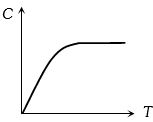
B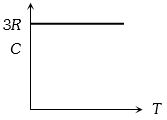
C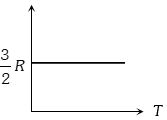
D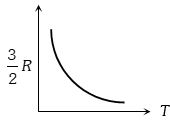
Solution
(C) For a monoatomic gas,the molar specific heat at constant volume $(C_v)$ is given by the formula $C_v = \frac{f}{2}R$,where $f$ is the degrees of freedom. For a monoatomic gas,$f = 3$. Therefore,$C_v = \frac{3}{2}R$. This value is a constant and does not depend on the temperature $(T)$. Thus,the graph of $C_v$ versus $T$ is a horizontal straight line at the value $\frac{3}{2}R$.
0 likes
View Solution40
MediumMCQ
If the ratio of specific heat of a gas at constant pressure to that at constant volume is $\gamma$,the change in internal energy of a mass of gas,when the volume changes from $V$ to $2V$ at constant pressure $p$,is
A
$R/(\gamma - 1)$
B
$pV$
C
$pV/(\gamma - 1)$
D
$\gamma pV/(\gamma - 1)$
Solution
(C) The change in internal energy $\Delta U$ for an ideal gas is given by the formula $\Delta U = n C_V \Delta T$.
Since $C_V = R/(\gamma - 1)$,we have $\Delta U = n (R/(\gamma - 1)) \Delta T$.
Using the ideal gas law $pV = nRT$,at constant pressure $p$,we have $p \Delta V = nR \Delta T$.
Substituting $n R \Delta T = p \Delta V$ into the equation,we get $\Delta U = p \Delta V / (\gamma - 1)$.
Given the volume changes from $V$ to $2V$,the change in volume is $\Delta V = 2V - V = V$.
Therefore,$\Delta U = pV / (\gamma - 1)$.
Since $C_V = R/(\gamma - 1)$,we have $\Delta U = n (R/(\gamma - 1)) \Delta T$.
Using the ideal gas law $pV = nRT$,at constant pressure $p$,we have $p \Delta V = nR \Delta T$.
Substituting $n R \Delta T = p \Delta V$ into the equation,we get $\Delta U = p \Delta V / (\gamma - 1)$.
Given the volume changes from $V$ to $2V$,the change in volume is $\Delta V = 2V - V = V$.
Therefore,$\Delta U = pV / (\gamma - 1)$.
0 likes
View Solution41
MediumMCQ
When an ideal diatomic gas is heated at constant pressure,the fraction of the heat energy supplied which increases the internal energy of the gas is:
A
$2/5$
B
$3/5$
C
$3/7$
D
$5/7$
Solution
(D) The fraction of supplied heat energy that increases the internal energy is given by the ratio of the change in internal energy to the heat supplied at constant pressure.
$f = \frac{\Delta U}{(\Delta Q)_P} = \frac{(\Delta Q)_V}{(\Delta Q)_P} = \frac{\mu C_V \Delta T}{\mu C_P \Delta T} = \frac{C_V}{C_P} = \frac{1}{\gamma}$.
For an ideal diatomic gas,the adiabatic index $\gamma = \frac{C_P}{C_V} = \frac{7}{5}$.
Therefore,the fraction $f = \frac{1}{7/5} = \frac{5}{7}$.
$f = \frac{\Delta U}{(\Delta Q)_P} = \frac{(\Delta Q)_V}{(\Delta Q)_P} = \frac{\mu C_V \Delta T}{\mu C_P \Delta T} = \frac{C_V}{C_P} = \frac{1}{\gamma}$.
For an ideal diatomic gas,the adiabatic index $\gamma = \frac{C_P}{C_V} = \frac{7}{5}$.
Therefore,the fraction $f = \frac{1}{7/5} = \frac{5}{7}$.
0 likes
View Solution42
MediumMCQ
When an ideal monoatomic gas is heated at constant pressure,the fraction of heat energy supplied that increases the internal energy of the gas is:
A
$0.4$
B
$0.6$
C
$0.43$
D
$0.75$
Solution
(B) For an ideal monoatomic gas,the molar heat capacity at constant pressure is $C_P = \frac{5}{2}R$ and at constant volume is $C_V = \frac{3}{2}R$.
The heat supplied at constant pressure is given by $\Delta Q = n C_P \Delta T$.
The change in internal energy is given by $\Delta U = n C_V \Delta T$.
The fraction of heat energy that increases the internal energy is $\frac{\Delta U}{\Delta Q} = \frac{n C_V \Delta T}{n C_P \Delta T} = \frac{C_V}{C_P}$.
Substituting the values,we get $\frac{\Delta U}{\Delta Q} = \frac{3/2 R}{5/2 R} = \frac{3}{5} = 0.6$.
The heat supplied at constant pressure is given by $\Delta Q = n C_P \Delta T$.
The change in internal energy is given by $\Delta U = n C_V \Delta T$.
The fraction of heat energy that increases the internal energy is $\frac{\Delta U}{\Delta Q} = \frac{n C_V \Delta T}{n C_P \Delta T} = \frac{C_V}{C_P}$.
Substituting the values,we get $\frac{\Delta U}{\Delta Q} = \frac{3/2 R}{5/2 R} = \frac{3}{5} = 0.6$.
0 likes
View Solution43
MediumMCQ
If for a gas $\frac{R}{C_V} = 0.67$,then the gas is .......
A
Diatomic
B
$A$ mixture of diatomic and polyatomic
C
Monoatomic
D
Polyatomic
Solution
(C) Given,$\frac{R}{C_V} = 0.67$.
We know that $R = C_P - C_V$.
Substituting this in the equation: $\frac{C_P - C_V}{C_V} = 0.67$.
This simplifies to $\frac{C_P}{C_V} - 1 = 0.67$.
Since $\gamma = \frac{C_P}{C_V}$,we have $\gamma - 1 = 0.67$,which gives $\gamma = 1.67$.
For a monoatomic gas,$\gamma = \frac{5}{3} \approx 1.67$.
Therefore,the gas is monoatomic.
We know that $R = C_P - C_V$.
Substituting this in the equation: $\frac{C_P - C_V}{C_V} = 0.67$.
This simplifies to $\frac{C_P}{C_V} - 1 = 0.67$.
Since $\gamma = \frac{C_P}{C_V}$,we have $\gamma - 1 = 0.67$,which gives $\gamma = 1.67$.
For a monoatomic gas,$\gamma = \frac{5}{3} \approx 1.67$.
Therefore,the gas is monoatomic.
0 likes
View Solution44
MediumMCQ
The molar specific heats of an ideal gas at constant pressure and constant volume are denoted by $C_P$ and $C_V$ respectively. If $\gamma = C_P/C_V$ and $R$ is the universal gas constant,then $C_V = $ ........
A
$\frac{R}{\gamma - 1}$
B
$\frac{\gamma - 1}{R}$
C
$\gamma R$
D
$\frac{1 + \gamma}{1 - \gamma}$
Solution
(A) We know that for an ideal gas,the relation between molar specific heats is given by Mayer's relation: $C_P - C_V = R$.
Given that $\gamma = \frac{C_P}{C_V}$,we can write $C_P = \gamma C_V$.
Substituting this into the relation: $\gamma C_V - C_V = R$.
Factoring out $C_V$: $C_V(\gamma - 1) = R$.
Therefore,$C_V = \frac{R}{\gamma - 1}$.
Given that $\gamma = \frac{C_P}{C_V}$,we can write $C_P = \gamma C_V$.
Substituting this into the relation: $\gamma C_V - C_V = R$.
Factoring out $C_V$: $C_V(\gamma - 1) = R$.
Therefore,$C_V = \frac{R}{\gamma - 1}$.
0 likes
View Solution45
DifficultMCQ
To increase the temperature of $1$ $mol$ of an ideal gas by $10$ $K$ at constant pressure,$207$ $J$ of heat is required. If the temperature of this gas is increased by $10$ $K$ at constant volume,the heat required is ....... $J$ $(R = 8.3$ $J/mol$ $K)$.
A
$198.7$
B
$29$
C
$215.3$
D
$124$
Solution
(D) Given: $n = 1$ $mol$,$\Delta T = 10$ $K$,$Q_P = 207$ $J$.
At constant pressure,$Q_P = n C_P \Delta T$.
$207 = 1 \times C_P \times 10 \implies C_P = 20.7$ $J/mol$ $K$.
We know that $C_P - C_V = R$.
$C_V = C_P - R = 20.7 - 8.3 = 12.4$ $J/mol$ $K$.
At constant volume,the heat required is $Q_V = n C_V \Delta T$.
$Q_V = 1 \times 12.4 \times 10 = 124$ $J$.
At constant pressure,$Q_P = n C_P \Delta T$.
$207 = 1 \times C_P \times 10 \implies C_P = 20.7$ $J/mol$ $K$.
We know that $C_P - C_V = R$.
$C_V = C_P - R = 20.7 - 8.3 = 12.4$ $J/mol$ $K$.
At constant volume,the heat required is $Q_V = n C_V \Delta T$.
$Q_V = 1 \times 12.4 \times 10 = 124$ $J$.
0 likes
View Solution46
MediumMCQ
For an ideal gas,the molar specific heat at constant pressure is $(7/2) R$. Find the ratio of the molar specific heat at constant pressure to the molar specific heat at constant volume.
A
$9/7$
B
$7/5$
C
$8/7$
D
$5/7$
Solution
(B) Given,the molar specific heat at constant pressure is $C_P = \frac{7}{2}R$.
We know the relation between molar specific heats for an ideal gas is $C_P - C_V = R$.
Substituting the value of $C_P$,we get $\frac{7}{2}R - C_V = R$.
Rearranging for $C_V$,we get $C_V = \frac{7}{2}R - R = \frac{5}{2}R$.
The ratio of molar specific heat at constant pressure to constant volume is $\gamma = \frac{C_P}{C_V}$.
Substituting the values,$\gamma = \frac{(7/2)R}{(5/2)R} = \frac{7}{5}$.
We know the relation between molar specific heats for an ideal gas is $C_P - C_V = R$.
Substituting the value of $C_P$,we get $\frac{7}{2}R - C_V = R$.
Rearranging for $C_V$,we get $C_V = \frac{7}{2}R - R = \frac{5}{2}R$.
The ratio of molar specific heat at constant pressure to constant volume is $\gamma = \frac{C_P}{C_V}$.
Substituting the values,$\gamma = \frac{(7/2)R}{(5/2)R} = \frac{7}{5}$.
0 likes
View Solution47
MediumMCQ
When a monoatomic gas is heated at constant pressure,what fraction of the heat energy supplied is used to increase the internal energy?
A
$2/5$
B
$3/5$
C
$3/7$
D
$3/4$
Solution
(B) For a monoatomic gas,the molar heat capacity at constant volume is $C_V = \frac{3}{2}R$ and at constant pressure is $C_P = \frac{5}{2}R$.
When heat $\Delta Q$ is supplied at constant pressure,the total heat energy is given by $\Delta Q = \mu C_P \Delta T$.
The change in internal energy is given by $\Delta U = \mu C_V \Delta T$.
The fraction of heat energy used to increase internal energy is $\frac{\Delta U}{\Delta Q} = \frac{\mu C_V \Delta T}{\mu C_P \Delta T} = \frac{C_V}{C_P}$.
Substituting the values,we get $\frac{\Delta U}{\Delta Q} = \frac{3/2 R}{5/2 R} = \frac{3}{5}$.
When heat $\Delta Q$ is supplied at constant pressure,the total heat energy is given by $\Delta Q = \mu C_P \Delta T$.
The change in internal energy is given by $\Delta U = \mu C_V \Delta T$.
The fraction of heat energy used to increase internal energy is $\frac{\Delta U}{\Delta Q} = \frac{\mu C_V \Delta T}{\mu C_P \Delta T} = \frac{C_V}{C_P}$.
Substituting the values,we get $\frac{\Delta U}{\Delta Q} = \frac{3/2 R}{5/2 R} = \frac{3}{5}$.
0 likes
View Solution48
DifficultMCQ
The amount of heat energy required to raise the temperature of $1 \ g$ of helium from $T_1 \ K$ to $T_2 \ K$ at $NTP$ is ........
A
$\frac{3}{2} N_A k_B (T_2 - T_1)$
B
$\frac{3}{4} N_A k_B (T_2 - T_1)$
C
$\frac{3}{4} N_A k_B \left( \frac{T_2}{T_1} \right)$
D
$\frac{3}{8} N_A k_B (T_2 - T_1)$
Solution
(D) For an ideal gas,the heat required to change the temperature at constant volume is given by $\Delta Q = \mu C_V \Delta T$.
Helium is a monoatomic gas,so its degrees of freedom $f = 3$.
The molar specific heat at constant volume is $C_V = \frac{fR}{2} = \frac{3R}{2}$.
The number of moles $\mu = \frac{\text{mass}}{\text{molar mass}} = \frac{1 \ g}{4 \ g/mol} = \frac{1}{4} \ mol$.
Substituting these values into the formula:
$\Delta Q = \left( \frac{1}{4} \right) \left( \frac{3R}{2} \right) (T_2 - T_1) = \frac{3R}{8} (T_2 - T_1)$.
Since the universal gas constant $R = N_A k_B$,we substitute $R$ to get:
$\Delta Q = \frac{3}{8} N_A k_B (T_2 - T_1)$.
Helium is a monoatomic gas,so its degrees of freedom $f = 3$.
The molar specific heat at constant volume is $C_V = \frac{fR}{2} = \frac{3R}{2}$.
The number of moles $\mu = \frac{\text{mass}}{\text{molar mass}} = \frac{1 \ g}{4 \ g/mol} = \frac{1}{4} \ mol$.
Substituting these values into the formula:
$\Delta Q = \left( \frac{1}{4} \right) \left( \frac{3R}{2} \right) (T_2 - T_1) = \frac{3R}{8} (T_2 - T_1)$.
Since the universal gas constant $R = N_A k_B$,we substitute $R$ to get:
$\Delta Q = \frac{3}{8} N_A k_B (T_2 - T_1)$.
0 likes
View SolutionKinetic Theory of Gases — Molar Specific Heat of gas and relation between them (Mayer's formula) · Frequently Asked Questions
1Are these Kinetic Theory of Gases questions useful for JEE and NEET?
Yes. All questions in this section are mapped to JEE Main and NEET exam patterns. Previous year questions from JEE Main, NEET, GUJCET and state-level exams are included with full solutions.
2Can I switch to Hindi or Gujarati for these questions?
Yes. Use the language tabs in the hero section or the sidebar to view the same questions and solutions in English, Hindi or Gujarati.
3How do I generate a question paper from this subtopic?
Use the Vedclass Exam Paper Generator — select the chapter and subtopic, set difficulty, and generate Sets A, B, C, D automatically. First 3 chapters of every subject are free.
Vedclass Products
For Students
Vedclass Test Series
Mock tests in real JEE/NEET style with performance analysis. 5-day free trial.
Start Free TrialFor Teachers
Exam Paper Generator
Generate Set A/B/C/D papers from this chapter in 2 minutes. 3 chapters free.
Try FreeFor Institutes
Online Exam Module
Live online exams with unlimited students, 360° analytics & white-label branding.
See DemoFor Teachers & Institutes
Generate a Kinetic Theory of Gases Exam Paper in 2 Minutes
Select subtopic & difficulty — Sets A, B, C, D auto-generated with No Repeat logic.
First 3 chapters of every subject are free — no payment required.