
A English
Mixture of Gases Questions in English
Class 11 Physics · Kinetic Theory of Gases · Mixture of Gases
157+
Questions
English
Language
100%
With Solutions
Showing 50 of 157 questions in English
51
MediumMCQ
$A$ rigid tank contains $35 \, kg$ of nitrogen at $6 \, atm$. $A$ sufficient quantity of oxygen is supplied to increase the pressure to $9 \, atm$,while the temperature remains constant. The amount of oxygen supplied to the tank is .... $kg$.
A
$5$
B
$10$
C
$20$
D
$40$
Solution
(C) According to the ideal gas law,$PV = nRT$. Since the volume $V$,temperature $T$,and gas constant $R$ are constant,we have $P \propto n$.
Initial moles of nitrogen $(n_{N_2})$: $n_{N_2} = \frac{\text{mass}}{\text{molar mass}} = \frac{35 \, kg}{28 \, g/mol} = \frac{35000 \, g}{28 \, g/mol} = 1250 \, mol$.
Using the proportionality $P_1/P_2 = n_1/n_2$:
$6/9 = 1250 / n_{total}$
$n_{total} = 1250 \times (9/6) = 1250 \times 1.5 = 1875 \, mol$.
The total moles $n_{total} = n_{N_2} + n_{O_2}$,so $n_{O_2} = 1875 - 1250 = 625 \, mol$.
Mass of oxygen supplied = $n_{O_2} \times \text{molar mass of } O_2 = 625 \, mol \times 32 \, g/mol = 20000 \, g = 20 \, kg$.
Initial moles of nitrogen $(n_{N_2})$: $n_{N_2} = \frac{\text{mass}}{\text{molar mass}} = \frac{35 \, kg}{28 \, g/mol} = \frac{35000 \, g}{28 \, g/mol} = 1250 \, mol$.
Using the proportionality $P_1/P_2 = n_1/n_2$:
$6/9 = 1250 / n_{total}$
$n_{total} = 1250 \times (9/6) = 1250 \times 1.5 = 1875 \, mol$.
The total moles $n_{total} = n_{N_2} + n_{O_2}$,so $n_{O_2} = 1875 - 1250 = 625 \, mol$.
Mass of oxygen supplied = $n_{O_2} \times \text{molar mass of } O_2 = 625 \, mol \times 32 \, g/mol = 20000 \, g = 20 \, kg$.
0 likes
View Solution52
DifficultMCQ
$A$ vessel of volume $0.02 \, m^3$ contains a mixture of hydrogen and helium at $20 \, ^oC$ and $2$ atmospheric pressure. The mass of the mixture is $5 \, g$. Find the ratio of the mass of hydrogen to that of helium in the mixture.
A
$1 : 2$
B
$1 : 3$
C
$2 : 3$
D
$3 : 2$
Solution
(A) Given: Volume $V = 0.02 \, m^3$,Temperature $T = 20 + 273 = 293 \, K$,Pressure $P = 2 \, atm = 2 \times 1.013 \times 10^5 \, Pa \approx 2.026 \times 10^5 \, Pa$. Total mass $M = 5 \, g$.
Let the mass of hydrogen be $m_H$ and the mass of helium be $m_{He}$. Then $m_H + m_{He} = 5 \, g$.
Using the ideal gas equation $PV = nRT$,where $n = \frac{m}{M_{mol}}$:
$PV = \left( \frac{m_H}{2} + \frac{m_{He}}{4} \right) RT$ (using molar masses $2 \, g/mol$ for $H_2$ and $4 \, g/mol$ for $He$ in $g/mol$ units).
$2.026 \times 10^5 \times 0.02 = \left( \frac{m_H}{2} + \frac{5 - m_H}{4} \right) \times 8.314 \times 293$.
$4052 = \left( \frac{2m_H + 5 - m_H}{4} \right) \times 2436$.
$4052 = \left( \frac{m_H + 5}{4} \right) \times 2436$.
$16208 = 2436m_H + 12180$.
$4028 = 2436m_H \implies m_H \approx 1.65 \, g$.
$m_{He} = 5 - 1.65 = 3.35 \, g$.
Ratio $m_H : m_{He} = 1.65 : 3.35 \approx 1 : 2$.
Let the mass of hydrogen be $m_H$ and the mass of helium be $m_{He}$. Then $m_H + m_{He} = 5 \, g$.
Using the ideal gas equation $PV = nRT$,where $n = \frac{m}{M_{mol}}$:
$PV = \left( \frac{m_H}{2} + \frac{m_{He}}{4} \right) RT$ (using molar masses $2 \, g/mol$ for $H_2$ and $4 \, g/mol$ for $He$ in $g/mol$ units).
$2.026 \times 10^5 \times 0.02 = \left( \frac{m_H}{2} + \frac{5 - m_H}{4} \right) \times 8.314 \times 293$.
$4052 = \left( \frac{2m_H + 5 - m_H}{4} \right) \times 2436$.
$4052 = \left( \frac{m_H + 5}{4} \right) \times 2436$.
$16208 = 2436m_H + 12180$.
$4028 = 2436m_H \implies m_H \approx 1.65 \, g$.
$m_{He} = 5 - 1.65 = 3.35 \, g$.
Ratio $m_H : m_{He} = 1.65 : 3.35 \approx 1 : 2$.
0 likes
View Solution53
DifficultMCQ
If a mixture of $28 \, g$ of Nitrogen $(N_2)$,$4 \, g$ of Hydrogen $(H_2)$,and $8 \, g$ of Helium $(He)$ is contained in a vessel at temperature $400 \, K$ and pressure $8.3 \times 10^5 \, Pa$,the density of the mixture will be:
A
$3 \, kg/m^3$
B
$0.2 \, kg/m^3$
C
$2 \, g/litre$
D
$1.5 \, g/litre$
Solution
(C) The ideal gas law for a mixture is given by $PV = n_{total}RT$,where $n_{total} = \sum \frac{m_i}{M_i}$.
First,calculate the number of moles for each gas:
$n_{N_2} = \frac{28 \, g}{28 \, g/mol} = 1 \, mol$
$n_{H_2} = \frac{4 \, g}{2 \, g/mol} = 2 \, mol$
$n_{He} = \frac{8 \, g}{4 \, g/mol} = 2 \, mol$
Total moles $n_{total} = 1 + 2 + 2 = 5 \, mol$.
Total mass $m_{total} = 28 + 4 + 8 = 40 \, g = 0.04 \, kg$.
Using the ideal gas equation $PV = n_{total}RT$,we find the volume $V = \frac{n_{total}RT}{P}$.
$V = \frac{5 \times 8.3 \times 400}{8.3 \times 10^5} = \frac{2000}{10^5} = 0.02 \, m^3$.
Density $\rho = \frac{m_{total}}{V} = \frac{0.04 \, kg}{0.02 \, m^3} = 2 \, kg/m^3$.
Since $1 \, kg/m^3 = 1 \, g/litre$,the density is $2 \, g/litre$.
First,calculate the number of moles for each gas:
$n_{N_2} = \frac{28 \, g}{28 \, g/mol} = 1 \, mol$
$n_{H_2} = \frac{4 \, g}{2 \, g/mol} = 2 \, mol$
$n_{He} = \frac{8 \, g}{4 \, g/mol} = 2 \, mol$
Total moles $n_{total} = 1 + 2 + 2 = 5 \, mol$.
Total mass $m_{total} = 28 + 4 + 8 = 40 \, g = 0.04 \, kg$.
Using the ideal gas equation $PV = n_{total}RT$,we find the volume $V = \frac{n_{total}RT}{P}$.
$V = \frac{5 \times 8.3 \times 400}{8.3 \times 10^5} = \frac{2000}{10^5} = 0.02 \, m^3$.
Density $\rho = \frac{m_{total}}{V} = \frac{0.04 \, kg}{0.02 \, m^3} = 2 \, kg/m^3$.
Since $1 \, kg/m^3 = 1 \, g/litre$,the density is $2 \, g/litre$.
0 likes
View Solution54
MediumMCQ
Five moles of helium are mixed with two moles of hydrogen to form a mixture. Take molar mass of helium $M_1 = 4 \ g/mol$ and that of hydrogen $M_2 = 2 \ g/mol$. The equivalent molar mass of the mixture is:
A
$6 \ g/mol$
B
$\frac{24}{7} \ g/mol$
C
$\frac{18}{7} \ g/mol$
D
None of these
Solution
(B) The equivalent molar mass $(M_{mix})$ of a mixture of gases is given by the formula:
$M_{mix} = \frac{n_1 M_1 + n_2 M_2}{n_1 + n_2}$
Given:
$n_1 = 5 \ mol$ (Helium),$M_1 = 4 \ g/mol$
$n_2 = 2 \ mol$ (Hydrogen),$M_2 = 2 \ g/mol$
Substituting the values:
$M_{mix} = \frac{(5 \times 4) + (2 \times 2)}{5 + 2}$
$M_{mix} = \frac{20 + 4}{7}$
$M_{mix} = \frac{24}{7} \ g/mol$
$M_{mix} = \frac{n_1 M_1 + n_2 M_2}{n_1 + n_2}$
Given:
$n_1 = 5 \ mol$ (Helium),$M_1 = 4 \ g/mol$
$n_2 = 2 \ mol$ (Hydrogen),$M_2 = 2 \ g/mol$
Substituting the values:
$M_{mix} = \frac{(5 \times 4) + (2 \times 2)}{5 + 2}$
$M_{mix} = \frac{20 + 4}{7}$
$M_{mix} = \frac{24}{7} \ g/mol$
0 likes
View Solution55
MediumMCQ
Five moles of helium are mixed with two moles of hydrogen to form a mixture. Take molar mass of helium $M_1=4 \ g$ and that of hydrogen $M_2=2 \ g$. The equivalent degree of freedom $f$ of the mixture is:
A
$3.57$
B
$1.14$
C
$4.4$
D
none
Solution
(A) Helium $(He)$ is a monoatomic gas,so its degree of freedom $f_1 = 3$. The number of moles $n_1 = 5$.
Hydrogen $(H_2)$ is a diatomic gas,so its degree of freedom $f_2 = 5$. The number of moles $n_2 = 2$.
The equivalent degree of freedom $f_{mix}$ for a mixture of gases is given by the formula:
$f_{mix} = \frac{n_1 f_1 + n_2 f_2}{n_1 + n_2}$
Substituting the values:
$f_{mix} = \frac{(5 \times 3) + (2 \times 5)}{5 + 2}$
$f_{mix} = \frac{15 + 10}{7}$
$f_{mix} = \frac{25}{7} \approx 3.57$
Thus,the correct option is $A$.
Hydrogen $(H_2)$ is a diatomic gas,so its degree of freedom $f_2 = 5$. The number of moles $n_2 = 2$.
The equivalent degree of freedom $f_{mix}$ for a mixture of gases is given by the formula:
$f_{mix} = \frac{n_1 f_1 + n_2 f_2}{n_1 + n_2}$
Substituting the values:
$f_{mix} = \frac{(5 \times 3) + (2 \times 5)}{5 + 2}$
$f_{mix} = \frac{15 + 10}{7}$
$f_{mix} = \frac{25}{7} \approx 3.57$
Thus,the correct option is $A$.
0 likes
View Solution56
MediumMCQ
Five moles of helium are mixed with two moles of hydrogen to form a mixture. Take the molar mass of helium $M_1 = 4 \ g/mol$ and that of hydrogen $M_2 = 2 \ g/mol$. The equivalent value of $\gamma$ for the mixture is:
A
$1.59$
B
$1.53$
C
$1.56$
D
none
Solution
(C) For a mixture of gases,the equivalent molar heat capacity at constant volume is given by $C_{V,mix} = \frac{n_1 C_{V1} + n_2 C_{V2}}{n_1 + n_2}$.
Helium is a monoatomic gas,so $C_{V1} = \frac{3}{2}R$. Hydrogen is a diatomic gas,so $C_{V2} = \frac{5}{2}R$.
Given $n_1 = 5 \ mol$ and $n_2 = 2 \ mol$,we have $C_{V,mix} = \frac{5(\frac{3}{2}R) + 2(\frac{5}{2}R)}{5 + 2} = \frac{7.5R + 5R}{7} = \frac{12.5R}{7}$.
The equivalent molar heat capacity at constant pressure is $C_{P,mix} = \frac{n_1 C_{P1} + n_2 C_{P2}}{n_1 + n_2}$.
For helium,$C_{P1} = \frac{5}{2}R$. For hydrogen,$C_{P2} = \frac{7}{2}R$.
$C_{P,mix} = \frac{5(\frac{5}{2}R) + 2(\frac{7}{2}R)}{5 + 2} = \frac{12.5R + 7R}{7} = \frac{19.5R}{7}$.
The adiabatic index $\gamma_{mix} = \frac{C_{P,mix}}{C_{V,mix}} = \frac{19.5R/7}{12.5R/7} = \frac{19.5}{12.5} = 1.56$.
Helium is a monoatomic gas,so $C_{V1} = \frac{3}{2}R$. Hydrogen is a diatomic gas,so $C_{V2} = \frac{5}{2}R$.
Given $n_1 = 5 \ mol$ and $n_2 = 2 \ mol$,we have $C_{V,mix} = \frac{5(\frac{3}{2}R) + 2(\frac{5}{2}R)}{5 + 2} = \frac{7.5R + 5R}{7} = \frac{12.5R}{7}$.
The equivalent molar heat capacity at constant pressure is $C_{P,mix} = \frac{n_1 C_{P1} + n_2 C_{P2}}{n_1 + n_2}$.
For helium,$C_{P1} = \frac{5}{2}R$. For hydrogen,$C_{P2} = \frac{7}{2}R$.
$C_{P,mix} = \frac{5(\frac{5}{2}R) + 2(\frac{7}{2}R)}{5 + 2} = \frac{12.5R + 7R}{7} = \frac{19.5R}{7}$.
The adiabatic index $\gamma_{mix} = \frac{C_{P,mix}}{C_{V,mix}} = \frac{19.5R/7}{12.5R/7} = \frac{19.5}{12.5} = 1.56$.
0 likes
View Solution57
MediumMCQ
Five moles of helium are mixed with two moles of hydrogen to form a mixture. Take molar mass of helium $M_1=4\ g$ and that of hydrogen $M_2=2\ g$. If the internal energy of the $He$ sample is $100\ J$ and that of the hydrogen sample is $200\ J$,then the internal energy of the mixture is ..... $J$.
A
$900$
B
$128.5$
C
$171.4$
D
$300$
Solution
(D) The internal energy of a gas is an extensive property,meaning it depends on the total amount of matter present.
When two non-reacting gases are mixed,the total internal energy of the resulting mixture is the sum of the internal energies of the individual components.
Given:
Internal energy of $He$ sample $(U_{He})$ = $100\ J$
Internal energy of $H_2$ sample $(U_{H_2})$ = $200\ J$
Since the gases do not interact chemically,the total internal energy of the mixture $(U_{mix})$ is:
$U_{mix} = U_{He} + U_{H_2}$
$U_{mix} = 100\ J + 200\ J = 300\ J$
When two non-reacting gases are mixed,the total internal energy of the resulting mixture is the sum of the internal energies of the individual components.
Given:
Internal energy of $He$ sample $(U_{He})$ = $100\ J$
Internal energy of $H_2$ sample $(U_{H_2})$ = $200\ J$
Since the gases do not interact chemically,the total internal energy of the mixture $(U_{mix})$ is:
$U_{mix} = U_{He} + U_{H_2}$
$U_{mix} = 100\ J + 200\ J = 300\ J$
0 likes
View Solution58
MediumMCQ
Two monoatomic ideal gases at temperatures $T_1$ and $T_2$ are mixed. There is no loss of energy. If the masses of molecules of the two gases are $m_1$ and $m_2$ and the number of their molecules are $n_1$ and $n_2$ respectively,the temperature of the mixture will be:
A
$\frac{T_1 + T_2}{n_1 + n_2}$
B
$\frac{T_1}{n_1} + \frac{T_2}{n_2}$
C
$\frac{n_2 T_1 + n_1 T_2}{n_1 + n_2}$
D
$\frac{n_1 T_1 + n_2 T_2}{n_1 + n_2}$
Solution
(D) Since there is no loss of energy and no external work is done,the total internal energy of the system is conserved.
The internal energy of a monoatomic gas is given by $U = \frac{3}{2} n R T$.
Let $T$ be the final temperature of the mixture.
The total initial internal energy is $U_i = \frac{3}{2} n_1 R T_1 + \frac{3}{2} n_2 R T_2$.
The total final internal energy is $U_f = \frac{3}{2} (n_1 + n_2) R T$.
By the law of conservation of energy,$U_i = U_f$.
$\frac{3}{2} n_1 R T_1 + \frac{3}{2} n_2 R T_2 = \frac{3}{2} (n_1 + n_2) R T$.
Dividing both sides by $\frac{3}{2} R$,we get $n_1 T_1 + n_2 T_2 = (n_1 + n_2) T$.
Therefore,the final temperature is $T = \frac{n_1 T_1 + n_2 T_2}{n_1 + n_2}$.
The internal energy of a monoatomic gas is given by $U = \frac{3}{2} n R T$.
Let $T$ be the final temperature of the mixture.
The total initial internal energy is $U_i = \frac{3}{2} n_1 R T_1 + \frac{3}{2} n_2 R T_2$.
The total final internal energy is $U_f = \frac{3}{2} (n_1 + n_2) R T$.
By the law of conservation of energy,$U_i = U_f$.
$\frac{3}{2} n_1 R T_1 + \frac{3}{2} n_2 R T_2 = \frac{3}{2} (n_1 + n_2) R T$.
Dividing both sides by $\frac{3}{2} R$,we get $n_1 T_1 + n_2 T_2 = (n_1 + n_2) T$.
Therefore,the final temperature is $T = \frac{n_1 T_1 + n_2 T_2}{n_1 + n_2}$.
0 likes
View Solution59
AdvancedMCQ
$A$ mixture of ideal gases consists of $7 \, kg$ of nitrogen and $11 \, kg$ of $CO_2$. Then (Take $\gamma$ for nitrogen and $CO_2$ as $1.4$ and $1.3$ respectively):
A
The equivalent molecular weight of the mixture is $36$.
B
$\gamma$ for the mixture is $47/35$.
C
$\gamma$ for the mixture is $5/2$.
D
Both $(A)$ and $(B)$.
Solution
(D) Number of moles of $N_2$: $n_{N_2} = \frac{7 \, kg}{28 \, kg/kmol} = 0.25 \, kmol$.
Degrees of freedom for $N_2$: $f_{N_2} = \frac{2}{\gamma_{N_2}-1} = \frac{2}{1.4-1} = 5$.
Number of moles of $CO_2$: $n_{CO_2} = \frac{11 \, kg}{44 \, kg/kmol} = 0.25 \, kmol$.
Degrees of freedom for $CO_2$: $f_{CO_2} = \frac{2}{\gamma_{CO_2}-1} = \frac{2}{1.3-1} = \frac{20}{3}$.
Equivalent molecular weight $M_{mix} = \frac{m_1 + m_2}{n_1 + n_2} = \frac{7 + 11}{0.25 + 0.25} = \frac{18}{0.5} = 36 \, kg/kmol$.
Equivalent degrees of freedom $f_{mix} = \frac{n_1 f_1 + n_2 f_2}{n_1 + n_2} = \frac{0.25(5) + 0.25(20/3)}{0.25 + 0.25} = \frac{5 + 20/3}{2} = \frac{35/3}{2} = \frac{35}{6}$.
Equivalent adiabatic index $\gamma_{mix} = 1 + \frac{2}{f_{mix}} = 1 + \frac{2}{35/6} = 1 + \frac{12}{35} = \frac{47}{35}$.
Thus,both $(A)$ and $(B)$ are correct.
Degrees of freedom for $N_2$: $f_{N_2} = \frac{2}{\gamma_{N_2}-1} = \frac{2}{1.4-1} = 5$.
Number of moles of $CO_2$: $n_{CO_2} = \frac{11 \, kg}{44 \, kg/kmol} = 0.25 \, kmol$.
Degrees of freedom for $CO_2$: $f_{CO_2} = \frac{2}{\gamma_{CO_2}-1} = \frac{2}{1.3-1} = \frac{20}{3}$.
Equivalent molecular weight $M_{mix} = \frac{m_1 + m_2}{n_1 + n_2} = \frac{7 + 11}{0.25 + 0.25} = \frac{18}{0.5} = 36 \, kg/kmol$.
Equivalent degrees of freedom $f_{mix} = \frac{n_1 f_1 + n_2 f_2}{n_1 + n_2} = \frac{0.25(5) + 0.25(20/3)}{0.25 + 0.25} = \frac{5 + 20/3}{2} = \frac{35/3}{2} = \frac{35}{6}$.
Equivalent adiabatic index $\gamma_{mix} = 1 + \frac{2}{f_{mix}} = 1 + \frac{2}{35/6} = 1 + \frac{12}{35} = \frac{47}{35}$.
Thus,both $(A)$ and $(B)$ are correct.
0 likes
View Solution60
MediumMCQ
An insulated container of gas has two chambers separated by an insulating partition. One of the chambers has volume $V_1$ and contains ideal gas at pressure $P_1$ and temperature $T_1$. The other chamber has volume $V_2$ and contains ideal gas at pressure $P_2$ and temperature $T_2$. If the partition is removed without doing any work on the gas,the final equilibrium temperature of the gas in the container will be
A
$\frac{{{T_1}{T_2}\left( {{P_1}{V_1} + {P_2}{V_2}} \right)}}{{{P_1}{V_1}{T_1} + {P_2}{V_2}{T_2}}}$
B
$\frac{{{T_1}{T_2}\left( {{P_1}{V_1} + {P_2}{V_2}} \right)}}{{{P_1}{V_1}{T_2} + {P_2}{V_2}{T_1}}}$
C
$\frac{{{P_1}{V_1}{T_1} + {P_2}{V_2}{T_2}}}{{{P_1}{V_1} + {P_2}{V_2}}}$
D
$\frac{{{P_1}{V_1}{T_2} + {P_2}{V_2}{T_1}}}{{{P_1}{V_1} + {P_2}{V_2}}}$
Solution
(B) Since the container is insulated,$Q = 0$. Since the partition is removed without doing any work,$W = 0$.
According to the first law of thermodynamics,$\Delta U = Q + W = 0$.
This implies that the total internal energy remains constant: $U_{initial} = U_{final}$.
For an ideal gas,the internal energy is $U = n C_v T$.
Thus,$n_1 C_v T_1 + n_2 C_v T_2 = (n_1 + n_2) C_v T$.
Canceling $C_v$ from both sides,we get $T = \frac{n_1 T_1 + n_2 T_2}{n_1 + n_2}$.
Using the ideal gas law $PV = nRT$,we have $n_1 = \frac{P_1 V_1}{R T_1}$ and $n_2 = \frac{P_2 V_2}{R T_2}$.
Substituting these into the expression for $T$:
$T = \frac{(\frac{P_1 V_1}{R T_1}) T_1 + (\frac{P_2 V_2}{R T_2}) T_2}{\frac{P_1 V_1}{R T_1} + \frac{P_2 V_2}{R T_2}} = \frac{P_1 V_1 + P_2 V_2}{\frac{P_1 V_1}{R T_1} + \frac{P_2 V_2}{R T_2}}$.
Simplifying the denominator:
$T = \frac{R(P_1 V_1 + P_2 V_2)}{\frac{P_1 V_1 T_2 + P_2 V_2 T_1}{T_1 T_2}} = \frac{T_1 T_2 (P_1 V_1 + P_2 V_2)}{P_1 V_1 T_2 + P_2 V_2 T_1}$.
According to the first law of thermodynamics,$\Delta U = Q + W = 0$.
This implies that the total internal energy remains constant: $U_{initial} = U_{final}$.
For an ideal gas,the internal energy is $U = n C_v T$.
Thus,$n_1 C_v T_1 + n_2 C_v T_2 = (n_1 + n_2) C_v T$.
Canceling $C_v$ from both sides,we get $T = \frac{n_1 T_1 + n_2 T_2}{n_1 + n_2}$.
Using the ideal gas law $PV = nRT$,we have $n_1 = \frac{P_1 V_1}{R T_1}$ and $n_2 = \frac{P_2 V_2}{R T_2}$.
Substituting these into the expression for $T$:
$T = \frac{(\frac{P_1 V_1}{R T_1}) T_1 + (\frac{P_2 V_2}{R T_2}) T_2}{\frac{P_1 V_1}{R T_1} + \frac{P_2 V_2}{R T_2}} = \frac{P_1 V_1 + P_2 V_2}{\frac{P_1 V_1}{R T_1} + \frac{P_2 V_2}{R T_2}}$.
Simplifying the denominator:
$T = \frac{R(P_1 V_1 + P_2 V_2)}{\frac{P_1 V_1 T_2 + P_2 V_2 T_1}{T_1 T_2}} = \frac{T_1 T_2 (P_1 V_1 + P_2 V_2)}{P_1 V_1 T_2 + P_2 V_2 T_1}$.
0 likes
View Solution61
MediumMCQ
Three perfect gases at absolute temperatures $T_1, T_2$ and $T_3$ are mixed. The masses of molecules are $m_1, m_2$ and $m_3$ and the number of molecules are $n_1, n_2$ and $n_3$ respectively. Assuming no loss of energy,the final temperature of the mixture is
A
$\frac{{n_1}^2{T_1}^2 + {n_2}^2{T_2}^2 + {n_3}^2{T_3}^2}{{n_1}{T_1} + {n_2}{T_2} + {n_3}{T_3}}$
B
$\frac{{T_1} + {T_2} + {T_3}}{3}$
C
$\frac{{n_1}{T_1} + {n_2}{T_2} + {n_3}{T_3}}{{n_1} + {n_2} + {n_3}}$
D
$\frac{{n_1}{T_1}^2 + {n_2}{T_2}^2 + {n_3}{T_3}^2}{{n_1}{T_1} + {n_2}{T_2} + {n_3}{T_3}}$
Solution
(C) The total internal energy of the mixture is conserved since there is no loss of energy.
The internal energy of a gas with $n$ molecules at temperature $T$ is given by $U = \frac{f}{2} n k_B T$,where $f$ is the degrees of freedom and $k_B$ is the Boltzmann constant.
For the mixture,the total energy is the sum of the energies of the individual gases:
$U_{total} = U_1 + U_2 + U_3$
$\frac{f}{2} (n_1 + n_2 + n_3) k_B T_{mix} = \frac{f}{2} n_1 k_B T_1 + \frac{f}{2} n_2 k_B T_2 + \frac{f}{2} n_3 k_B T_3$
Canceling the common terms $\frac{f}{2} k_B$ from both sides,we get:
$(n_1 + n_2 + n_3) T_{mix} = n_1 T_1 + n_2 T_2 + n_3 T_3$
Therefore,the final temperature of the mixture is:
$T_{mix} = \frac{n_1 T_1 + n_2 T_2 + n_3 T_3}{n_1 + n_2 + n_3}$
The internal energy of a gas with $n$ molecules at temperature $T$ is given by $U = \frac{f}{2} n k_B T$,where $f$ is the degrees of freedom and $k_B$ is the Boltzmann constant.
For the mixture,the total energy is the sum of the energies of the individual gases:
$U_{total} = U_1 + U_2 + U_3$
$\frac{f}{2} (n_1 + n_2 + n_3) k_B T_{mix} = \frac{f}{2} n_1 k_B T_1 + \frac{f}{2} n_2 k_B T_2 + \frac{f}{2} n_3 k_B T_3$
Canceling the common terms $\frac{f}{2} k_B$ from both sides,we get:
$(n_1 + n_2 + n_3) T_{mix} = n_1 T_1 + n_2 T_2 + n_3 T_3$
Therefore,the final temperature of the mixture is:
$T_{mix} = \frac{n_1 T_1 + n_2 T_2 + n_3 T_3}{n_1 + n_2 + n_3}$
0 likes
View Solution62
MediumMCQ
$A$ mixture of two moles of hydrogen and one mole of argon gas is taken in a closed container at room temperature. Consider the following two statements:
$(i)$ The average kinetic energy of each molecule of $H_2$ and $Ar$ are the same.
$(ii)$ The partial pressure due to argon gas is more than that due to hydrogen gas.
$(i)$ The average kinetic energy of each molecule of $H_2$ and $Ar$ are the same.
$(ii)$ The partial pressure due to argon gas is more than that due to hydrogen gas.
A
Both statement $(i)$ and $(ii)$ are correct.
B
Statement $(i)$ is correct while statement $(ii)$ is incorrect.
C
Both statement $(i)$ and $(ii)$ are incorrect.
D
Statement $(i)$ is incorrect while statement $(ii)$ is correct.
Solution
(B) According to the kinetic theory of gases,the average kinetic energy of a gas molecule depends only on the absolute temperature $T$ and is given by $K_{av} = \frac{3}{2} kT$. Since both gases are at the same room temperature,the average kinetic energy per molecule is the same for both $H_2$ and $Ar$. Thus,statement $(i)$ is correct.
For an ideal gas mixture in a closed container,the partial pressure $p_i$ of a component is given by $p_i = \frac{n_i}{n_{total}} P_{total}$. Since the number of moles of hydrogen $(n_{H_2} = 2)$ is greater than the number of moles of argon $(n_{Ar} = 1)$,the partial pressure of hydrogen will be greater than the partial pressure of argon. Thus,statement $(ii)$ is incorrect.
For an ideal gas mixture in a closed container,the partial pressure $p_i$ of a component is given by $p_i = \frac{n_i}{n_{total}} P_{total}$. Since the number of moles of hydrogen $(n_{H_2} = 2)$ is greater than the number of moles of argon $(n_{Ar} = 1)$,the partial pressure of hydrogen will be greater than the partial pressure of argon. Thus,statement $(ii)$ is incorrect.
0 likes
View Solution63
DifficultMCQ
$1 \, g$ of $H_2$ at $27 \, ^oC$ is mixed with $16 \, g$ of $O_2$ at $37 \, ^oC$. The temperature of the mixture is about ....... $^oC$.
A
$32$
B
$27$
C
$37$
D
$45$
Solution
(A) The number of moles of $H_2$ is $n_1 = \frac{1 \, g}{2 \, g/mol} = 0.5 \, mol$.
The number of moles of $O_2$ is $n_2 = \frac{16 \, g}{32 \, g/mol} = 0.5 \, mol$.
Both $H_2$ and $O_2$ are diatomic gases,so their molar heat capacities at constant volume are equal $(C_{v1} = C_{v2} = \frac{5}{2}R)$.
The final temperature $T$ of the mixture is given by the principle of conservation of energy:
$n_1 C_v (T - T_1) + n_2 C_v (T - T_2) = 0$
$T = \frac{n_1 T_1 + n_2 T_2}{n_1 + n_2}$
Convert temperatures to Kelvin: $T_1 = 27 + 273 = 300 \, K$ and $T_2 = 37 + 273 = 310 \, K$.
$T = \frac{0.5 \times 300 + 0.5 \times 310}{0.5 + 0.5} = \frac{150 + 155}{1} = 305 \, K$.
Converting back to Celsius: $T = 305 - 273 = 32 \, ^oC$.
The number of moles of $O_2$ is $n_2 = \frac{16 \, g}{32 \, g/mol} = 0.5 \, mol$.
Both $H_2$ and $O_2$ are diatomic gases,so their molar heat capacities at constant volume are equal $(C_{v1} = C_{v2} = \frac{5}{2}R)$.
The final temperature $T$ of the mixture is given by the principle of conservation of energy:
$n_1 C_v (T - T_1) + n_2 C_v (T - T_2) = 0$
$T = \frac{n_1 T_1 + n_2 T_2}{n_1 + n_2}$
Convert temperatures to Kelvin: $T_1 = 27 + 273 = 300 \, K$ and $T_2 = 37 + 273 = 310 \, K$.
$T = \frac{0.5 \times 300 + 0.5 \times 310}{0.5 + 0.5} = \frac{150 + 155}{1} = 305 \, K$.
Converting back to Celsius: $T = 305 - 273 = 32 \, ^oC$.
0 likes
View Solution64
DifficultMCQ
The ratio $C_P / C_V$ for a gas mixture consisting of $8 \ g$ of helium and $16 \ g$ of oxygen is
A
$23/15$
B
$15/23$
C
$27/17$
D
$17/27$
Solution
(C) For Helium $(He)$: Molar mass $M_1 = 4 \ g/mol$,degrees of freedom $f_1 = 3$,mass $m_1 = 8 \ g$. Number of moles $n_1 = 8/4 = 2 \ mol$.
For Oxygen $(O_2)$: Molar mass $M_2 = 32 \ g/mol$,degrees of freedom $f_2 = 5$,mass $m_2 = 16 \ g$. Number of moles $n_2 = 16/32 = 0.5 \ mol$.
The average degrees of freedom $f_{av}$ is given by:
$f_{av} = \frac{n_1 f_1 + n_2 f_2}{n_1 + n_2} = \frac{(2 \times 3) + (0.5 \times 5)}{2 + 0.5} = \frac{6 + 2.5}{2.5} = \frac{8.5}{2.5} = \frac{17}{5} = 3.4$.
The ratio of specific heats $\gamma_{av} = 1 + \frac{2}{f_{av}} = 1 + \frac{2}{3.4} = 1 + \frac{20}{34} = 1 + \frac{10}{17} = \frac{27}{17}$.
For Oxygen $(O_2)$: Molar mass $M_2 = 32 \ g/mol$,degrees of freedom $f_2 = 5$,mass $m_2 = 16 \ g$. Number of moles $n_2 = 16/32 = 0.5 \ mol$.
The average degrees of freedom $f_{av}$ is given by:
$f_{av} = \frac{n_1 f_1 + n_2 f_2}{n_1 + n_2} = \frac{(2 \times 3) + (0.5 \times 5)}{2 + 0.5} = \frac{6 + 2.5}{2.5} = \frac{8.5}{2.5} = \frac{17}{5} = 3.4$.
The ratio of specific heats $\gamma_{av} = 1 + \frac{2}{f_{av}} = 1 + \frac{2}{3.4} = 1 + \frac{20}{34} = 1 + \frac{10}{17} = \frac{27}{17}$.
0 likes
View Solution65
DifficultMCQ
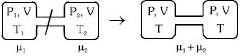
Two containers of equal volume contain identical gases at pressures $P_1$ and $P_2$ and absolute temperatures $T_1$ and $T_2$ respectively. The vessels are joined and the gas reaches a common pressure $P$ and a common temperature $T$. Then:
A
$P = \left( {\frac{{{P_1}}}{{{T_1}}} + \frac{{{P_2}}}{{{T_2}}}} \right)T$
B
$P = \frac{1}{2}\left( {\frac{{{P_1}}}{{{T_1}}} + \frac{{{P_2}}}{{{T_2}}}} \right)T$
C
$T = \frac{{P{T_1}{T_2}}}{{{P_1}{T_2} + {P_2}{T_1}}}$
D
$T = \frac{{2P{T_1}{T_2}}}{{{P_1}{T_1} + {P_2}{T_2}}}$
Solution
(B) The total number of moles of the gas remains conserved when the two containers are joined.
The number of moles in the first container is $n_1 = \frac{P_1 V}{R T_1}$.
The number of moles in the second container is $n_2 = \frac{P_2 V}{R T_2}$.
After joining,the total volume becomes $2V$,and the gas reaches a common pressure $P$ and temperature $T$. The total number of moles is $n = n_1 + n_2 = \frac{P(2V)}{RT}$.
Equating the total moles:
$\frac{P_1 V}{R T_1} + \frac{P_2 V}{R T_2} = \frac{P(2V)}{RT}$
Dividing both sides by $V/R$:
$\frac{P_1}{T_1} + \frac{P_2}{T_2} = \frac{2P}{T}$
Rearranging for $P$:
$P = \frac{1}{2} \left( \frac{P_1}{T_1} + \frac{P_2}{T_2} \right) T$
The number of moles in the first container is $n_1 = \frac{P_1 V}{R T_1}$.
The number of moles in the second container is $n_2 = \frac{P_2 V}{R T_2}$.
After joining,the total volume becomes $2V$,and the gas reaches a common pressure $P$ and temperature $T$. The total number of moles is $n = n_1 + n_2 = \frac{P(2V)}{RT}$.
Equating the total moles:
$\frac{P_1 V}{R T_1} + \frac{P_2 V}{R T_2} = \frac{P(2V)}{RT}$
Dividing both sides by $V/R$:
$\frac{P_1}{T_1} + \frac{P_2}{T_2} = \frac{2P}{T}$
Rearranging for $P$:
$P = \frac{1}{2} \left( \frac{P_1}{T_1} + \frac{P_2}{T_2} \right) T$
0 likes
View Solution66
DifficultMCQ
$1 \, \text{mole}$ of a gas having $\gamma = \frac{7}{5}$ is mixed with $1 \, \text{mole}$ of a gas having $\gamma = \frac{4}{3}$. What will be the $\gamma$ for the mixture?
A
$\frac{5}{11}$
B
$\frac{15}{13}$
C
$\frac{15}{11}$
D
$\frac{5}{13}$
Solution
(C) For a gas with $\gamma_1 = \frac{7}{5}$,the molar heat capacity at constant volume is $C_{v1} = \frac{R}{\gamma_1 - 1} = \frac{R}{\frac{7}{5} - 1} = \frac{5}{2} R$.
For a gas with $\gamma_2 = \frac{4}{3}$,the molar heat capacity at constant volume is $C_{v2} = \frac{R}{\gamma_2 - 1} = \frac{R}{\frac{4}{3} - 1} = 3R$.
For the mixture of $n_1 = 1 \, \text{mole}$ and $n_2 = 1 \, \text{mole}$,the equivalent molar heat capacity at constant volume is given by:
$C_{v, \text{mix}} = \frac{n_1 C_{v1} + n_2 C_{v2}}{n_1 + n_2} = \frac{1 \cdot \frac{5}{2} R + 1 \cdot 3R}{1 + 1} = \frac{\frac{11}{2} R}{2} = \frac{11}{4} R$.
The molar heat capacity at constant pressure for the mixture is $C_{p, \text{mix}} = C_{v, \text{mix}} + R = \frac{11}{4} R + R = \frac{15}{4} R$.
Therefore,the adiabatic index for the mixture is $\gamma_{\text{mix}} = \frac{C_{p, \text{mix}}}{C_{v, \text{mix}}} = \frac{\frac{15}{4} R}{\frac{11}{4} R} = \frac{15}{11}$.
For a gas with $\gamma_2 = \frac{4}{3}$,the molar heat capacity at constant volume is $C_{v2} = \frac{R}{\gamma_2 - 1} = \frac{R}{\frac{4}{3} - 1} = 3R$.
For the mixture of $n_1 = 1 \, \text{mole}$ and $n_2 = 1 \, \text{mole}$,the equivalent molar heat capacity at constant volume is given by:
$C_{v, \text{mix}} = \frac{n_1 C_{v1} + n_2 C_{v2}}{n_1 + n_2} = \frac{1 \cdot \frac{5}{2} R + 1 \cdot 3R}{1 + 1} = \frac{\frac{11}{2} R}{2} = \frac{11}{4} R$.
The molar heat capacity at constant pressure for the mixture is $C_{p, \text{mix}} = C_{v, \text{mix}} + R = \frac{11}{4} R + R = \frac{15}{4} R$.
Therefore,the adiabatic index for the mixture is $\gamma_{\text{mix}} = \frac{C_{p, \text{mix}}}{C_{v, \text{mix}}} = \frac{\frac{15}{4} R}{\frac{11}{4} R} = \frac{15}{11}$.
0 likes
View Solution67
DifficultMCQ
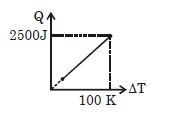
One mole of a gas mixture is heated under constant pressure,and the heat supplied $Q$ is plotted against the temperature difference $\Delta T$ acquired. Find the approximate value of $\gamma$ for the mixture.
A
$1.33$
B
$1.5$
C
$1.4$
D
$1.67$
Solution
(B) For a process at constant pressure,the heat supplied is given by $Q = n C_p \Delta T$.
From the graph,the slope of the line is $C_p = \frac{Q}{n \Delta T} = \frac{2500 \text{ J}}{1 \text{ mol} \times 100 \text{ K}} = 25 \text{ J/(mol K)}$.
We know that $C_p = \frac{f+2}{2} R$,where $f$ is the degree of freedom.
Taking $R \approx 8.314 \text{ J/(mol K)}$,we have $25 = \frac{f+2}{2} \times 8.314$.
$\frac{f+2}{2} \approx 3.007 \Rightarrow f+2 \approx 6.014 \Rightarrow f \approx 4.014 \approx 4$.
The adiabatic index $\gamma$ is given by $\gamma = 1 + \frac{2}{f}$.
Substituting $f = 4$,we get $\gamma = 1 + \frac{2}{4} = 1 + 0.5 = 1.5$.
From the graph,the slope of the line is $C_p = \frac{Q}{n \Delta T} = \frac{2500 \text{ J}}{1 \text{ mol} \times 100 \text{ K}} = 25 \text{ J/(mol K)}$.
We know that $C_p = \frac{f+2}{2} R$,where $f$ is the degree of freedom.
Taking $R \approx 8.314 \text{ J/(mol K)}$,we have $25 = \frac{f+2}{2} \times 8.314$.
$\frac{f+2}{2} \approx 3.007 \Rightarrow f+2 \approx 6.014 \Rightarrow f \approx 4.014 \approx 4$.
The adiabatic index $\gamma$ is given by $\gamma = 1 + \frac{2}{f}$.
Substituting $f = 4$,we get $\gamma = 1 + \frac{2}{4} = 1 + 0.5 = 1.5$.
0 likes
View Solution68
DifficultMCQ
The speed of sound in hydrogen at $NTP$ is $1270 \, m/s$. Then,the speed in a mixture of hydrogen and oxygen in the ratio $4 : 1$ by volume will be ..... $m/s$.
A
$317$
B
$635$
C
$830$
D
$950$
Solution
(B) The speed of sound in a gas is given by $v = \sqrt{\frac{\gamma P}{\rho}}$. Assuming $\gamma$ remains approximately constant for the mixture,$v \propto \frac{1}{\sqrt{\rho}}$.
Let the volume of oxygen be $V$. Then the volume of hydrogen is $4V$. The total volume is $5V$.
The molar mass of hydrogen $(H_2)$ is $2 \, g/mol$ and oxygen $(O_2)$ is $32 \, g/mol$.
The density $\rho$ is proportional to the molar mass $M$. The effective molar mass of the mixture $M_{mix}$ is given by:
$M_{mix} = \frac{n_1 M_1 + n_2 M_2}{n_1 + n_2} = \frac{4(2) + 1(32)}{4 + 1} = \frac{8 + 32}{5} = \frac{40}{5} = 8 \, g/mol$.
The density of hydrogen is proportional to its molar mass $M_{H_2} = 2 \, g/mol$.
Thus,the ratio of densities is $\frac{\rho_{mix}}{\rho_{H_2}} = \frac{8}{2} = 4$.
Using the relation $v_{mix} = v_{H_2} \times \sqrt{\frac{\rho_{H_2}}{\rho_{mix}}}$:
$v_{mix} = 1270 \times \sqrt{\frac{1}{4}} = 1270 \times \frac{1}{2} = 635 \, m/s$.
Let the volume of oxygen be $V$. Then the volume of hydrogen is $4V$. The total volume is $5V$.
The molar mass of hydrogen $(H_2)$ is $2 \, g/mol$ and oxygen $(O_2)$ is $32 \, g/mol$.
The density $\rho$ is proportional to the molar mass $M$. The effective molar mass of the mixture $M_{mix}$ is given by:
$M_{mix} = \frac{n_1 M_1 + n_2 M_2}{n_1 + n_2} = \frac{4(2) + 1(32)}{4 + 1} = \frac{8 + 32}{5} = \frac{40}{5} = 8 \, g/mol$.
The density of hydrogen is proportional to its molar mass $M_{H_2} = 2 \, g/mol$.
Thus,the ratio of densities is $\frac{\rho_{mix}}{\rho_{H_2}} = \frac{8}{2} = 4$.
Using the relation $v_{mix} = v_{H_2} \times \sqrt{\frac{\rho_{H_2}}{\rho_{mix}}}$:
$v_{mix} = 1270 \times \sqrt{\frac{1}{4}} = 1270 \times \frac{1}{2} = 635 \, m/s$.
0 likes
View Solution69
DifficultMCQ
Two moles of helium are mixed with $n$ moles of hydrogen. If $\frac{C_P}{C_V} = \frac{3}{2}$ for the mixture,then the value of $n$ is:
A
$1.5$
B
$2$
C
$1$
D
$3$
Solution
(B) For a mixture of gases,the adiabatic index $\gamma_{mix}$ is given by the formula:
$\gamma_{mix} = \frac{n_1 C_{P1} + n_2 C_{P2}}{n_1 C_{V1} + n_2 C_{V2}}$
Alternatively,using the degrees of freedom $f$:
$C_V = \frac{f}{2}R$ and $C_P = (\frac{f}{2} + 1)R$
For Helium (monoatomic),$f_1 = 3$,so $C_{V1} = \frac{3}{2}R$ and $C_{P1} = \frac{5}{2}R$.
For Hydrogen (diatomic),$f_2 = 5$,so $C_{V2} = \frac{5}{2}R$ and $C_{P2} = \frac{7}{2}R$.
Given $n_1 = 2$ and $n_2 = n$,the mixture ratio is $\frac{C_P}{C_V} = \frac{3}{2}$.
Using the relation $\frac{C_{P,mix}}{C_{V,mix}} = \frac{n_1 C_{P1} + n_2 C_{P2}}{n_1 C_{V1} + n_2 C_{V2}} = \frac{3}{2}$:
$\frac{2(\frac{5}{2}R) + n(\frac{7}{2}R)}{2(\frac{3}{2}R) + n(\frac{5}{2}R)} = \frac{3}{2}$
$\frac{5 + 3.5n}{3 + 2.5n} = \frac{3}{2}$
$10 + 7n = 9 + 7.5n$
$0.5n = 1$
$n = 2$.
$\gamma_{mix} = \frac{n_1 C_{P1} + n_2 C_{P2}}{n_1 C_{V1} + n_2 C_{V2}}$
Alternatively,using the degrees of freedom $f$:
$C_V = \frac{f}{2}R$ and $C_P = (\frac{f}{2} + 1)R$
For Helium (monoatomic),$f_1 = 3$,so $C_{V1} = \frac{3}{2}R$ and $C_{P1} = \frac{5}{2}R$.
For Hydrogen (diatomic),$f_2 = 5$,so $C_{V2} = \frac{5}{2}R$ and $C_{P2} = \frac{7}{2}R$.
Given $n_1 = 2$ and $n_2 = n$,the mixture ratio is $\frac{C_P}{C_V} = \frac{3}{2}$.
Using the relation $\frac{C_{P,mix}}{C_{V,mix}} = \frac{n_1 C_{P1} + n_2 C_{P2}}{n_1 C_{V1} + n_2 C_{V2}} = \frac{3}{2}$:
$\frac{2(\frac{5}{2}R) + n(\frac{7}{2}R)}{2(\frac{3}{2}R) + n(\frac{5}{2}R)} = \frac{3}{2}$
$\frac{5 + 3.5n}{3 + 2.5n} = \frac{3}{2}$
$10 + 7n = 9 + 7.5n$
$0.5n = 1$
$n = 2$.
0 likes
View Solution70
MediumMCQ
$A$ gas mixture consists of $3 \, moles$ of oxygen and $5 \, moles$ of argon at temperature $T$. Considering only translational and rotational modes,the total internal energy of the system is: (in $, RT$)
A
$15$
B
$12$
C
$4$
D
$20$
Solution
(A) The total internal energy $U_{\text{total}}$ of the system is the sum of the internal energies of the individual gases.
For oxygen $(O_2)$,which is a diatomic gas,the degrees of freedom $f_1 = 5$ ($3$ translational + $2$ rotational).
The internal energy of oxygen is $U_{O_2} = n_1 \frac{f_1}{2} RT = 3 \times \frac{5}{2} RT = 7.5 \, RT$.
For argon $(Ar)$,which is a monatomic gas,the degrees of freedom $f_2 = 3$ ($3$ translational).
The internal energy of argon is $U_{Ar} = n_2 \frac{f_2}{2} RT = 5 \times \frac{3}{2} RT = 7.5 \, RT$.
The total internal energy is $U_{\text{total}} = U_{O_2} + U_{Ar} = 7.5 \, RT + 7.5 \, RT = 15 \, RT$.
For oxygen $(O_2)$,which is a diatomic gas,the degrees of freedom $f_1 = 5$ ($3$ translational + $2$ rotational).
The internal energy of oxygen is $U_{O_2} = n_1 \frac{f_1}{2} RT = 3 \times \frac{5}{2} RT = 7.5 \, RT$.
For argon $(Ar)$,which is a monatomic gas,the degrees of freedom $f_2 = 3$ ($3$ translational).
The internal energy of argon is $U_{Ar} = n_2 \frac{f_2}{2} RT = 5 \times \frac{3}{2} RT = 7.5 \, RT$.
The total internal energy is $U_{\text{total}} = U_{O_2} + U_{Ar} = 7.5 \, RT + 7.5 \, RT = 15 \, RT$.
0 likes
View Solution71
DifficultMCQ
$2\, moles$ of helium gas is mixed with $3\, moles$ of hydrogen molecules (taken to be rigid). What is the molar specific heat of the mixture at constant volume in $J/mol\, K$? $(R = 8.3\, J/mol\, K)$
A
$17.4$
B
$15.7$
C
$19.7$
D
$21.6$
Solution
(A) For helium (monoatomic gas),the degrees of freedom $f_1 = 3$.
For hydrogen (rigid diatomic gas),the degrees of freedom $f_2 = 5$.
The number of moles are $n_1 = 2$ and $n_2 = 3$.
The effective degrees of freedom for the mixture is given by $f_{\text{mix}} = \frac{n_1 f_1 + n_2 f_2}{n_1 + n_2}$.
Substituting the values: $f_{\text{mix}} = \frac{2 \times 3 + 3 \times 5}{2 + 3} = \frac{6 + 15}{5} = \frac{21}{5} = 4.2$.
The molar specific heat at constant volume is $C_{v, \text{mix}} = \frac{f_{\text{mix}} R}{2}$.
Substituting the values: $C_{v, \text{mix}} = \frac{4.2 \times 8.3}{2} = 2.1 \times 8.3 = 17.43\, J/mol\, K$.
Rounding to the nearest option,the answer is $17.4\, J/mol\, K$.
For hydrogen (rigid diatomic gas),the degrees of freedom $f_2 = 5$.
The number of moles are $n_1 = 2$ and $n_2 = 3$.
The effective degrees of freedom for the mixture is given by $f_{\text{mix}} = \frac{n_1 f_1 + n_2 f_2}{n_1 + n_2}$.
Substituting the values: $f_{\text{mix}} = \frac{2 \times 3 + 3 \times 5}{2 + 3} = \frac{6 + 15}{5} = \frac{21}{5} = 4.2$.
The molar specific heat at constant volume is $C_{v, \text{mix}} = \frac{f_{\text{mix}} R}{2}$.
Substituting the values: $C_{v, \text{mix}} = \frac{4.2 \times 8.3}{2} = 2.1 \times 8.3 = 17.43\, J/mol\, K$.
Rounding to the nearest option,the answer is $17.4\, J/mol\, K$.
0 likes
View Solution72
DifficultMCQ
Three moles of oxygen are mixed with $2 \, moles$ of helium. What will be the ratio of specific heats at constant pressure and constant volume for the mixture?
A
$2.5$
B
$3.5$
C
$1.5$
D
$1$
Solution
(C) The number of moles of oxygen $(n_1 = 3)$ is diatomic,so its degrees of freedom $f_1 = 5$. The number of moles of helium $(n_2 = 2)$ is monatomic,so its degrees of freedom $f_2 = 3$.
The equivalent degrees of freedom for the mixture is given by $f_{mix} = \frac{n_1 f_1 + n_2 f_2}{n_1 + n_2}$.
Substituting the values: $f_{mix} = \frac{3 \times 5 + 2 \times 3}{3 + 2} = \frac{15 + 6}{5} = \frac{21}{5} = 4.2$.
The ratio of specific heats for the mixture is $\gamma_{mix} = 1 + \frac{2}{f_{mix}}$.
$\gamma_{mix} = 1 + \frac{2}{4.2} = 1 + \frac{20}{42} = 1 + \frac{10}{21} = \frac{31}{21} \approx 1.476$.
Rounding to the nearest provided option,the value is $1.5$.
The equivalent degrees of freedom for the mixture is given by $f_{mix} = \frac{n_1 f_1 + n_2 f_2}{n_1 + n_2}$.
Substituting the values: $f_{mix} = \frac{3 \times 5 + 2 \times 3}{3 + 2} = \frac{15 + 6}{5} = \frac{21}{5} = 4.2$.
The ratio of specific heats for the mixture is $\gamma_{mix} = 1 + \frac{2}{f_{mix}}$.
$\gamma_{mix} = 1 + \frac{2}{4.2} = 1 + \frac{20}{42} = 1 + \frac{10}{21} = \frac{31}{21} \approx 1.476$.
Rounding to the nearest provided option,the value is $1.5$.
0 likes
View Solution73
MediumMCQ
$2 \text{ mole}$ of $N_2$ gas at $27 \, ^oC$ is mixed with $1 \text{ mole}$ of $He$ gas at $-73 \, ^oC$. Find the final temperature $T_{\text{mix}}$ of the mixture.
A
$277 \, ^oC$
B
$277 \, K$
C
$5 \, K$
D
$50 \, ^oC$
Solution
(B) The final temperature of a mixture of non-reacting gases is given by the formula: $T_{\text{mix}} = \frac{n_1 C_{v1} T_1 + n_2 C_{v2} T_2}{n_1 C_{v1} + n_2 C_{v2}}$.
For $N_2$ (diatomic gas),$n_1 = 2 \text{ mole}$ and $C_{v1} = \frac{5}{2}R$. The temperature $T_1 = 27 + 273 = 300 \, K$.
For $He$ (monatomic gas),$n_2 = 1 \text{ mole}$ and $C_{v2} = \frac{3}{2}R$. The temperature $T_2 = -73 + 273 = 200 \, K$.
Substituting the values:
$T_{\text{mix}} = \frac{2 \times (\frac{5}{2}R) \times 300 + 1 \times (\frac{3}{2}R) \times 200}{2 \times (\frac{5}{2}R) + 1 \times (\frac{3}{2}R)}$
$T_{\text{mix}} = \frac{1500R + 300R}{5R + 1.5R} = \frac{1800R}{6.5R} = \frac{1800}{6.5} \approx 276.92 \, K \approx 277 \, K$.
For $N_2$ (diatomic gas),$n_1 = 2 \text{ mole}$ and $C_{v1} = \frac{5}{2}R$. The temperature $T_1 = 27 + 273 = 300 \, K$.
For $He$ (monatomic gas),$n_2 = 1 \text{ mole}$ and $C_{v2} = \frac{3}{2}R$. The temperature $T_2 = -73 + 273 = 200 \, K$.
Substituting the values:
$T_{\text{mix}} = \frac{2 \times (\frac{5}{2}R) \times 300 + 1 \times (\frac{3}{2}R) \times 200}{2 \times (\frac{5}{2}R) + 1 \times (\frac{3}{2}R)}$
$T_{\text{mix}} = \frac{1500R + 300R}{5R + 1.5R} = \frac{1800R}{6.5R} = \frac{1800}{6.5} \approx 276.92 \, K \approx 277 \, K$.
0 likes
View Solution74
DifficultMCQ
$1 \text{ mole}$ of ideal monoatomic gas $(\gamma_1 = 5/3)$ is mixed with $1 \text{ mole}$ of diatomic gas $(\gamma_2 = 7/5)$. What is $\gamma$ for the mixture? $\gamma$ denotes the ratio of specific heat at constant pressure to that at constant volume.
A
$3/2$
B
$23/15$
C
$35/23$
D
$4/3$
Solution
(A) For a monoatomic gas,$C_{v1} = \frac{R}{\gamma_1 - 1} = \frac{R}{5/3 - 1} = \frac{3R}{2}$ and $C_{p1} = \gamma_1 C_{v1} = \frac{5}{3} \times \frac{3R}{2} = \frac{5R}{2}$.
For a diatomic gas,$C_{v2} = \frac{R}{\gamma_2 - 1} = \frac{R}{7/5 - 1} = \frac{5R}{2}$ and $C_{p2} = \gamma_2 C_{v2} = \frac{7}{5} \times \frac{5R}{2} = \frac{7R}{2}$.
For the mixture,the total heat capacity at constant volume is $C_{v, \text{mix}} = \frac{n_1 C_{v1} + n_2 C_{v2}}{n_1 + n_2} = \frac{1 \times \frac{3R}{2} + 1 \times \frac{5R}{2}}{1 + 1} = \frac{4R}{2} = 2R$.
The total heat capacity at constant pressure is $C_{p, \text{mix}} = \frac{n_1 C_{p1} + n_2 C_{p2}}{n_1 + n_2} = \frac{1 \times \frac{5R}{2} + 1 \times \frac{7R}{2}}{1 + 1} = \frac{6R}{2} = 3R$.
Thus,$\gamma_{\text{mix}} = \frac{C_{p, \text{mix}}}{C_{v, \text{mix}}} = \frac{3R}{2R} = 3/2$.
For a diatomic gas,$C_{v2} = \frac{R}{\gamma_2 - 1} = \frac{R}{7/5 - 1} = \frac{5R}{2}$ and $C_{p2} = \gamma_2 C_{v2} = \frac{7}{5} \times \frac{5R}{2} = \frac{7R}{2}$.
For the mixture,the total heat capacity at constant volume is $C_{v, \text{mix}} = \frac{n_1 C_{v1} + n_2 C_{v2}}{n_1 + n_2} = \frac{1 \times \frac{3R}{2} + 1 \times \frac{5R}{2}}{1 + 1} = \frac{4R}{2} = 2R$.
The total heat capacity at constant pressure is $C_{p, \text{mix}} = \frac{n_1 C_{p1} + n_2 C_{p2}}{n_1 + n_2} = \frac{1 \times \frac{5R}{2} + 1 \times \frac{7R}{2}}{1 + 1} = \frac{6R}{2} = 3R$.
Thus,$\gamma_{\text{mix}} = \frac{C_{p, \text{mix}}}{C_{v, \text{mix}}} = \frac{3R}{2R} = 3/2$.
0 likes
View Solution75
MediumMCQ
The molar specific heat of a mixture at constant volume,if one mole of $He$ gas is mixed with three moles of $O_2$ gas,is: (in $R$)
A
$3.33$
B
$2.25$
C
$1.15$
D
$6.72$
Solution
(B) For a mixture of gases,the molar specific heat at constant volume $(C_V)_{mix}$ is given by the formula:
$(C_V)_{mix} = \frac{n_1 C_{V1} + n_2 C_{V2}}{n_1 + n_2}$
Here,$n_1 = 1$ mole of $He$ (monatomic gas),so $C_{V1} = \frac{3}{2} R$.
$n_2 = 3$ moles of $O_2$ (diatomic gas),so $C_{V2} = \frac{5}{2} R$.
Substituting the values:
$(C_V)_{mix} = \frac{1 \times (\frac{3}{2} R) + 3 \times (\frac{5}{2} R)}{1 + 3}$
$(C_V)_{mix} = \frac{1.5 R + 7.5 R}{4}$
$(C_V)_{mix} = \frac{9 R}{4} = 2.25 R$.
$(C_V)_{mix} = \frac{n_1 C_{V1} + n_2 C_{V2}}{n_1 + n_2}$
Here,$n_1 = 1$ mole of $He$ (monatomic gas),so $C_{V1} = \frac{3}{2} R$.
$n_2 = 3$ moles of $O_2$ (diatomic gas),so $C_{V2} = \frac{5}{2} R$.
Substituting the values:
$(C_V)_{mix} = \frac{1 \times (\frac{3}{2} R) + 3 \times (\frac{5}{2} R)}{1 + 3}$
$(C_V)_{mix} = \frac{1.5 R + 7.5 R}{4}$
$(C_V)_{mix} = \frac{9 R}{4} = 2.25 R$.
0 likes
View Solution76
MediumMCQ
The relation between internal energy $U$,pressure $P$,and volume $V$ for an ideal gas is given by $U = 2 + 2PV$. The gas is:
A
monoatomic
B
diatomic
C
polyatomic
D
a mixture of monoatomic and diatomic gases
Solution
(D) For an ideal gas,the internal energy is given by $U = U_0 + nC_vT$.
Given the relation $U = 2 + 2PV$.
Using the ideal gas equation $PV = nRT$,we substitute this into the given relation:
$U = 2 + 2nRT$.
Differentiating with respect to temperature $T$,we get:
$\frac{dU}{dT} = 2nR$.
Since $C_v = \frac{1}{n} \frac{dU}{dT}$,we have $C_v = 2R$.
For a monoatomic gas,$C_v = \frac{3}{2}R = 1.5R$.
For a diatomic gas,$C_v = \frac{5}{2}R = 2.5R$.
Since the calculated $C_v = 2R$ lies between $1.5R$ and $2.5R$,the gas must be a mixture of monoatomic and diatomic gases.
Given the relation $U = 2 + 2PV$.
Using the ideal gas equation $PV = nRT$,we substitute this into the given relation:
$U = 2 + 2nRT$.
Differentiating with respect to temperature $T$,we get:
$\frac{dU}{dT} = 2nR$.
Since $C_v = \frac{1}{n} \frac{dU}{dT}$,we have $C_v = 2R$.
For a monoatomic gas,$C_v = \frac{3}{2}R = 1.5R$.
For a diatomic gas,$C_v = \frac{5}{2}R = 2.5R$.
Since the calculated $C_v = 2R$ lies between $1.5R$ and $2.5R$,the gas must be a mixture of monoatomic and diatomic gases.
0 likes
View Solution77
DifficultMCQ
One mole of ideal monoatomic gas $(\gamma = 5/3)$ is mixed with one mole of diatomic gas $(\gamma = 7/5)$. What is $\gamma$ for the mixture? $\gamma$ denotes the ratio of specific heat at constant pressure to that at constant volume.
A
$3/2$
B
$23/15$
C
$35/23$
D
$4/3$
Solution
(A) For a monoatomic gas,$C_{v1} = \frac{3}{2}R$ and $C_{p1} = \frac{5}{2}R$. For a diatomic gas,$C_{v2} = \frac{5}{2}R$ and $C_{p2} = \frac{7}{2}R$.
Given $n_1 = 1$ mole and $n_2 = 1$ mole.
The equivalent molar heat capacity at constant volume for the mixture is $(C_v)_{\text{mix}} = \frac{n_1 C_{v1} + n_2 C_{v2}}{n_1 + n_2} = \frac{1(\frac{3}{2}R) + 1(\frac{5}{2}R)}{1 + 1} = \frac{4R}{2} = 2R$.
The equivalent molar heat capacity at constant pressure for the mixture is $(C_p)_{\text{mix}} = \frac{n_1 C_{p1} + n_2 C_{p2}}{n_1 + n_2} = \frac{1(\frac{5}{2}R) + 1(\frac{7}{2}R)}{1 + 1} = \frac{6R}{2} = 3R$.
The adiabatic index for the mixture is $\gamma_{\text{mix}} = \frac{(C_p)_{\text{mix}}}{(C_v)_{\text{mix}}} = \frac{3R}{2R} = 1.5 = 3/2$.
Given $n_1 = 1$ mole and $n_2 = 1$ mole.
The equivalent molar heat capacity at constant volume for the mixture is $(C_v)_{\text{mix}} = \frac{n_1 C_{v1} + n_2 C_{v2}}{n_1 + n_2} = \frac{1(\frac{3}{2}R) + 1(\frac{5}{2}R)}{1 + 1} = \frac{4R}{2} = 2R$.
The equivalent molar heat capacity at constant pressure for the mixture is $(C_p)_{\text{mix}} = \frac{n_1 C_{p1} + n_2 C_{p2}}{n_1 + n_2} = \frac{1(\frac{5}{2}R) + 1(\frac{7}{2}R)}{1 + 1} = \frac{6R}{2} = 3R$.
The adiabatic index for the mixture is $\gamma_{\text{mix}} = \frac{(C_p)_{\text{mix}}}{(C_v)_{\text{mix}}} = \frac{3R}{2R} = 1.5 = 3/2$.
0 likes
View Solution78
DifficultMCQ
The specific heat of the mixture of two gases at constant volume is $\frac{13}{6} R$. The ratio of the number of moles of the first gas to the second is $1:2$. The respective gases may be:
A
$O_2, N_2$
B
$He, Ne$
C
$He, N_2$
D
$N_2, He$
Solution
(C) The specific heat at constant volume for a mixture is given by $C_{V, \text{mix}} = \frac{n_1 C_{V1} + n_2 C_{V2}}{n_1 + n_2}$.
Given $n_1 : n_2 = 1 : 2$,let $n_1 = 1$ and $n_2 = 2$.
For a gas with $f$ degrees of freedom,$C_V = \frac{f}{2} R$.
Substituting the values: $\frac{13}{6} R = \frac{1 \cdot (\frac{f_1}{2} R) + 2 \cdot (\frac{f_2}{2} R)}{1 + 2}$.
$\frac{13}{6} R = \frac{\frac{f_1}{2} R + f_2 R}{3} = \frac{f_1 + 2f_2}{6} R$.
Thus,$f_1 + 2f_2 = 13$.
For $He$ (monatomic),$f = 3$. For $N_2$ (diatomic),$f = 5$.
If $f_1 = 3$ $(He)$ and $f_2 = 5$ $(N_2)$,then $3 + 2(5) = 13$,which satisfies the equation.
Therefore,the gases are $He$ and $N_2$.
Given $n_1 : n_2 = 1 : 2$,let $n_1 = 1$ and $n_2 = 2$.
For a gas with $f$ degrees of freedom,$C_V = \frac{f}{2} R$.
Substituting the values: $\frac{13}{6} R = \frac{1 \cdot (\frac{f_1}{2} R) + 2 \cdot (\frac{f_2}{2} R)}{1 + 2}$.
$\frac{13}{6} R = \frac{\frac{f_1}{2} R + f_2 R}{3} = \frac{f_1 + 2f_2}{6} R$.
Thus,$f_1 + 2f_2 = 13$.
For $He$ (monatomic),$f = 3$. For $N_2$ (diatomic),$f = 5$.
If $f_1 = 3$ $(He)$ and $f_2 = 5$ $(N_2)$,then $3 + 2(5) = 13$,which satisfies the equation.
Therefore,the gases are $He$ and $N_2$.
0 likes
View Solution79
MediumMCQ
One gram of $H_2$ at $27\,^{\circ}C$ is mixed with $16\,g$ of $O_2$ at $37\,^{\circ}C$. The temperature of the mixture is about ....... $^{\circ}C$.
A
$32$
B
$27$
C
$37$
D
$45$
Solution
(A) The number of moles of $H_2$ is $n_1 = \frac{1\,g}{2\,g/mol} = 0.5\,mol$.
The number of moles of $O_2$ is $n_2 = \frac{16\,g}{32\,g/mol} = 0.5\,mol$.
The temperatures in Kelvin are $T_1 = 27 + 273 = 300\,K$ and $T_2 = 37 + 273 = 310\,K$.
Assuming the gases are ideal and the system is adiabatic,the final temperature $T$ is given by the weighted average based on the degrees of freedom. Since both $H_2$ and $O_2$ are diatomic gases,their degrees of freedom $f = 5$ are the same.
$T = \frac{n_1 f_1 T_1 + n_2 f_2 T_2}{n_1 f_1 + n_2 f_2} = \frac{n_1 T_1 + n_2 T_2}{n_1 + n_2}$.
$T = \frac{0.5 \times 300 + 0.5 \times 310}{0.5 + 0.5} = \frac{150 + 155}{1} = 305\,K$.
Converting back to Celsius: $T = 305 - 273 = 32\,^{\circ}C$.
The number of moles of $O_2$ is $n_2 = \frac{16\,g}{32\,g/mol} = 0.5\,mol$.
The temperatures in Kelvin are $T_1 = 27 + 273 = 300\,K$ and $T_2 = 37 + 273 = 310\,K$.
Assuming the gases are ideal and the system is adiabatic,the final temperature $T$ is given by the weighted average based on the degrees of freedom. Since both $H_2$ and $O_2$ are diatomic gases,their degrees of freedom $f = 5$ are the same.
$T = \frac{n_1 f_1 T_1 + n_2 f_2 T_2}{n_1 f_1 + n_2 f_2} = \frac{n_1 T_1 + n_2 T_2}{n_1 + n_2}$.
$T = \frac{0.5 \times 300 + 0.5 \times 310}{0.5 + 0.5} = \frac{150 + 155}{1} = 305\,K$.
Converting back to Celsius: $T = 305 - 273 = 32\,^{\circ}C$.
0 likes
View Solution80
MediumMCQ
$N_1$ molecules of a gas at temperature $T_1$ are mixed with $N_2$ molecules at temperature $T_2$. The resulting temperature of the mixture gas is
A
$\frac{(T_1 - T_2)}{2}$
B
$\frac{(N_1 T_1 - N_2 T_2)}{(N_1 + N_2)}$
C
$\frac{(N_1 T_1 + N_2 T_2)}{(N_1 + N_2)}$
D
$\left\{ \frac{N_1 + N_2}{2} \right\} \left\{ \frac{T_1 + T_2}{2} \right\}$
Solution
(C) The total internal energy of the mixture is the sum of the internal energies of the individual gases.
For a gas,the internal energy is given by $U = \frac{3}{2} N k T$.
Total internal energy $U_{total} = U_1 + U_2 = \frac{3}{2} N_1 k T_1 + \frac{3}{2} N_2 k T_2$.
Let the final temperature of the mixture be $T$. The total internal energy of the mixture is $U_{final} = \frac{3}{2} (N_1 + N_2) k T$.
By the law of conservation of energy,$U_{total} = U_{final}$.
$\frac{3}{2} N_1 k T_1 + \frac{3}{2} N_2 k T_2 = \frac{3}{2} (N_1 + N_2) k T$.
Canceling the common factor $\frac{3}{2} k$ from both sides:
$N_1 T_1 + N_2 T_2 = (N_1 + N_2) T$.
Therefore,the resulting temperature is $T = \frac{N_1 T_1 + N_2 T_2}{N_1 + N_2}$.
For a gas,the internal energy is given by $U = \frac{3}{2} N k T$.
Total internal energy $U_{total} = U_1 + U_2 = \frac{3}{2} N_1 k T_1 + \frac{3}{2} N_2 k T_2$.
Let the final temperature of the mixture be $T$. The total internal energy of the mixture is $U_{final} = \frac{3}{2} (N_1 + N_2) k T$.
By the law of conservation of energy,$U_{total} = U_{final}$.
$\frac{3}{2} N_1 k T_1 + \frac{3}{2} N_2 k T_2 = \frac{3}{2} (N_1 + N_2) k T$.
Canceling the common factor $\frac{3}{2} k$ from both sides:
$N_1 T_1 + N_2 T_2 = (N_1 + N_2) T$.
Therefore,the resulting temperature is $T = \frac{N_1 T_1 + N_2 T_2}{N_1 + N_2}$.
0 likes
View Solution81
MediumMCQ
$A$ gas mixture consists of molecules of type $1, 2$ and $3$,with molar masses $m_1 > m_2 > m_3$. $v_{rms}$ and $\bar K$ are the $r.m.s.$ speed and average kinetic energy of the gases. Which of the following is true?
A
$(v_{rms})_1 < (v_{rms})_2 < (v_{rms})_3$ and $(\bar K)_1 = (\bar K)_2 = (\bar K)_3$
B
$(v_{rms})_1 = (v_{rms})_2 = (v_{rms})_3$ and $(\bar K)_1 = (\bar K)_2 > (\bar K)_3$
C
$(v_{rms})_1 > (v_{rms})_2 > (v_{rms})_3$ and $(\bar K)_1 < (\bar K)_2 > (\bar K)_3$
D
$(v_{rms})_1 > (v_{rms})_2 > (v_{rms})_3$ and $(\bar K)_1 < (\bar K)_2 < (\bar K)_3$
Solution
(A) The $r.m.s.$ speed of a gas molecule is given by the formula $v_{rms} = \sqrt{\frac{3RT}{M}}$.
Since the temperature $T$ is the same for all gases in the mixture,$v_{rms} \propto \frac{1}{\sqrt{M}}$.
Given $m_1 > m_2 > m_3$,it follows that $(v_{rms})_1 < (v_{rms})_2 < (v_{rms})_3$.
The average kinetic energy of a gas molecule is given by $\bar K = \frac{3}{2} k_B T$.
Since the temperature $T$ is the same for all gases in the mixture,the average kinetic energy $\bar K$ is the same for all types of molecules,i.e.,$(\bar K)_1 = (\bar K)_2 = (\bar K)_3$.
Since the temperature $T$ is the same for all gases in the mixture,$v_{rms} \propto \frac{1}{\sqrt{M}}$.
Given $m_1 > m_2 > m_3$,it follows that $(v_{rms})_1 < (v_{rms})_2 < (v_{rms})_3$.
The average kinetic energy of a gas molecule is given by $\bar K = \frac{3}{2} k_B T$.
Since the temperature $T$ is the same for all gases in the mixture,the average kinetic energy $\bar K$ is the same for all types of molecules,i.e.,$(\bar K)_1 = (\bar K)_2 = (\bar K)_3$.
0 likes
View Solution82
DifficultMCQ
Two moles of an ideal gas with $\frac{C_{P}}{C_{V}}=\frac{5}{3}$ are mixed with $3$ moles of another ideal gas with $\frac{C_{P}}{C_{V}}=\frac{4}{3}$. The value of $\frac{C_{P}}{C_{V}}$ for the mixture is
A
$1.50$
B
$1.42$
C
$1.45$
D
$1.47$
Solution
(B) For gas $1$: $n_1 = 2$,$\gamma_1 = \frac{5}{3}$. Since $\gamma = 1 + \frac{2}{f}$,$f_1 = 3$. Thus,$C_{V_1} = \frac{3}{2}R$ and $C_{P_1} = \frac{5}{2}R$.
For gas $2$: $n_2 = 3$,$\gamma_2 = \frac{4}{3}$. Since $\gamma = 1 + \frac{2}{f}$,$f_2 = 6$. Thus,$C_{V_2} = \frac{6}{2}R = 3R$ and $C_{P_2} = 4R$.
The molar heat capacity at constant volume for the mixture is $C_{V_{mix}} = \frac{n_1 C_{V_1} + n_2 C_{V_2}}{n_1 + n_2} = \frac{2(\frac{3}{2}R) + 3(3R)}{2+3} = \frac{3R + 9R}{5} = \frac{12R}{5} = 2.4R$.
The molar heat capacity at constant pressure for the mixture is $C_{P_{mix}} = \frac{n_1 C_{P_1} + n_2 C_{P_2}}{n_1 + n_2} = \frac{2(\frac{5}{2}R) + 3(4R)}{2+3} = \frac{5R + 12R}{5} = \frac{17R}{5} = 3.4R$.
The ratio $\gamma_{mix} = \frac{C_{P_{mix}}}{C_{V_{mix}}} = \frac{17R/5}{12R/5} = \frac{17}{12} \approx 1.4167 \approx 1.42$.
For gas $2$: $n_2 = 3$,$\gamma_2 = \frac{4}{3}$. Since $\gamma = 1 + \frac{2}{f}$,$f_2 = 6$. Thus,$C_{V_2} = \frac{6}{2}R = 3R$ and $C_{P_2} = 4R$.
The molar heat capacity at constant volume for the mixture is $C_{V_{mix}} = \frac{n_1 C_{V_1} + n_2 C_{V_2}}{n_1 + n_2} = \frac{2(\frac{3}{2}R) + 3(3R)}{2+3} = \frac{3R + 9R}{5} = \frac{12R}{5} = 2.4R$.
The molar heat capacity at constant pressure for the mixture is $C_{P_{mix}} = \frac{n_1 C_{P_1} + n_2 C_{P_2}}{n_1 + n_2} = \frac{2(\frac{5}{2}R) + 3(4R)}{2+3} = \frac{5R + 12R}{5} = \frac{17R}{5} = 3.4R$.
The ratio $\gamma_{mix} = \frac{C_{P_{mix}}}{C_{V_{mix}}} = \frac{17R/5}{12R/5} = \frac{17}{12} \approx 1.4167 \approx 1.42$.
0 likes
View Solution83
MediumMCQ
Consider a mixture of $n$ moles of helium gas and $2n$ moles of oxygen gas (molecules taken to be rigid) as an ideal gas. Its $\frac{C_{P}}{C_{V}}$ value will be
A
$\frac{67}{45}$
B
$\frac{19}{13}$
C
$\frac{23}{15}$
D
$\frac{40}{27}$
Solution
(B) For a mixture of gases,the ratio of specific heats is given by $\frac{C_{P, \text{mix}}}{C_{V, \text{mix}}} = \frac{n_1 C_{P1} + n_2 C_{P2}}{n_1 C_{V1} + n_2 C_{V2}}$.
Helium is a monoatomic gas,so $C_{V1} = \frac{3R}{2}$ and $C_{P1} = \frac{5R}{2}$.
Oxygen is a diatomic rigid gas,so $C_{V2} = \frac{5R}{2}$ and $C_{P2} = \frac{7R}{2}$.
Given $n_1 = n$ and $n_2 = 2n$.
Substituting these values:
$\frac{C_{P, \text{mix}}}{C_{V, \text{mix}}} = \frac{n(\frac{5R}{2}) + 2n(\frac{7R}{2})}{n(\frac{3R}{2}) + 2n(\frac{5R}{2})}$
$= \frac{\frac{5nR}{2} + \frac{14nR}{2}}{\frac{3nR}{2} + \frac{10nR}{2}} = \frac{19nR/2}{13nR/2} = \frac{19}{13}$.
Helium is a monoatomic gas,so $C_{V1} = \frac{3R}{2}$ and $C_{P1} = \frac{5R}{2}$.
Oxygen is a diatomic rigid gas,so $C_{V2} = \frac{5R}{2}$ and $C_{P2} = \frac{7R}{2}$.
Given $n_1 = n$ and $n_2 = 2n$.
Substituting these values:
$\frac{C_{P, \text{mix}}}{C_{V, \text{mix}}} = \frac{n(\frac{5R}{2}) + 2n(\frac{7R}{2})}{n(\frac{3R}{2}) + 2n(\frac{5R}{2})}$
$= \frac{\frac{5nR}{2} + \frac{14nR}{2}}{\frac{3nR}{2} + \frac{10nR}{2}} = \frac{19nR/2}{13nR/2} = \frac{19}{13}$.
0 likes
View Solution84
Medium
$A$ vessel contains two non-reactive gases: neon (monatomic) and oxygen (diatomic). The ratio of their partial pressures is $3:2$. Estimate the ratio of
$(i)$ number of molecules and
$(ii)$ mass density of neon and oxygen in the vessel.
Atomic mass of $Ne = 20.2 \; u$,molecular mass of $O_2 = 32.0 \; u$.
$(i)$ number of molecules and
$(ii)$ mass density of neon and oxygen in the vessel.
Atomic mass of $Ne = 20.2 \; u$,molecular mass of $O_2 = 32.0 \; u$.
Solution
(N/A) The partial pressure of a gas in a mixture is the pressure it would exert if it alone occupied the vessel at the same volume and temperature. Since both gases are assumed to be ideal and share the same volume $V$ and temperature $T$,we use the ideal gas law $PV = \mu RT$,where $\mu$ is the number of moles.
For neon $(1)$ and oxygen $(2)$:
$P_1 V = \mu_1 RT$ and $P_2 V = \mu_2 RT$
Thus,$\frac{P_1}{P_2} = \frac{\mu_1}{\mu_2}$. Given $\frac{P_1}{P_2} = \frac{3}{2}$,we have $\frac{\mu_1}{\mu_2} = \frac{3}{2}$.
$(i)$ Since $\mu = \frac{N}{N_A}$,where $N$ is the number of molecules and $N_A$ is Avogadro's number:
$\frac{N_1}{N_2} = \frac{\mu_1}{\mu_2} = \frac{3}{2} = 1.5$.
$(ii)$ Mass density $\rho = \frac{m}{V}$. Since $\mu = \frac{m}{M}$ (where $M$ is molar mass),we have $m = \mu M$.
$\frac{\rho_1}{\rho_2} = \frac{m_1/V}{m_2/V} = \frac{m_1}{m_2} = \frac{\mu_1 M_1}{\mu_2 M_2} = \left(\frac{\mu_1}{\mu_2}\right) \times \left(\frac{M_1}{M_2}\right)$.
Substituting the values: $\frac{\rho_1}{\rho_2} = \frac{3}{2} \times \frac{20.2}{32.0} = 1.5 \times 0.63125 = 0.947$.
For neon $(1)$ and oxygen $(2)$:
$P_1 V = \mu_1 RT$ and $P_2 V = \mu_2 RT$
Thus,$\frac{P_1}{P_2} = \frac{\mu_1}{\mu_2}$. Given $\frac{P_1}{P_2} = \frac{3}{2}$,we have $\frac{\mu_1}{\mu_2} = \frac{3}{2}$.
$(i)$ Since $\mu = \frac{N}{N_A}$,where $N$ is the number of molecules and $N_A$ is Avogadro's number:
$\frac{N_1}{N_2} = \frac{\mu_1}{\mu_2} = \frac{3}{2} = 1.5$.
$(ii)$ Mass density $\rho = \frac{m}{V}$. Since $\mu = \frac{m}{M}$ (where $M$ is molar mass),we have $m = \mu M$.
$\frac{\rho_1}{\rho_2} = \frac{m_1/V}{m_2/V} = \frac{m_1}{m_2} = \frac{\mu_1 M_1}{\mu_2 M_2} = \left(\frac{\mu_1}{\mu_2}\right) \times \left(\frac{M_1}{M_2}\right)$.
Substituting the values: $\frac{\rho_1}{\rho_2} = \frac{3}{2} \times \frac{20.2}{32.0} = 1.5 \times 0.63125 = 0.947$.
0 likes
View Solution85
Medium
For a mixture of non-reactive gases,derive the equation for total pressure.
Solution
The pressure of an ideal gas is given by $P = \frac{1}{3} n m \langle v^2 \rangle$.
Consider a unit volume containing a mixture of non-reactive gases. Let the number densities of molecules be $n_1, n_2, \ldots$,their masses be $m_1, m_2, \ldots$,and their mean square speeds be $\langle v_1^2 \rangle, \langle v_2^2 \rangle, \ldots$.
The total pressure $P$ of the mixture is the sum of the partial pressures of the individual gases:
$P = \frac{1}{3} n_1 m_1 \langle v_1^2 \rangle + \frac{1}{3} n_2 m_2 \langle v_2^2 \rangle + \ldots$ ....$(1)$
In thermal equilibrium,the average kinetic energy of the molecules of each gas is equal:
$\langle \frac{1}{2} m_1 v_1^2 \rangle = \langle \frac{1}{2} m_2 v_2^2 \rangle = \ldots = \frac{3}{2} k_B T$ ....$(2)$
From equation $(2)$,we have:
$m_1 \langle v_1^2 \rangle = m_2 \langle v_2^2 \rangle = \ldots = 3 k_B T$
Substituting this into equation $(1)$:
$P = \frac{1}{3} [n_1 (3 k_B T) + n_2 (3 k_B T) + \ldots]$
$P = (n_1 + n_2 + \ldots) k_B T$
This represents Dalton's law of partial pressure,where $n = n_1 + n_2 + \ldots$ is the total number density of molecules.
Consider a unit volume containing a mixture of non-reactive gases. Let the number densities of molecules be $n_1, n_2, \ldots$,their masses be $m_1, m_2, \ldots$,and their mean square speeds be $\langle v_1^2 \rangle, \langle v_2^2 \rangle, \ldots$.
The total pressure $P$ of the mixture is the sum of the partial pressures of the individual gases:
$P = \frac{1}{3} n_1 m_1 \langle v_1^2 \rangle + \frac{1}{3} n_2 m_2 \langle v_2^2 \rangle + \ldots$ ....$(1)$
In thermal equilibrium,the average kinetic energy of the molecules of each gas is equal:
$\langle \frac{1}{2} m_1 v_1^2 \rangle = \langle \frac{1}{2} m_2 v_2^2 \rangle = \ldots = \frac{3}{2} k_B T$ ....$(2)$
From equation $(2)$,we have:
$m_1 \langle v_1^2 \rangle = m_2 \langle v_2^2 \rangle = \ldots = 3 k_B T$
Substituting this into equation $(1)$:
$P = \frac{1}{3} [n_1 (3 k_B T) + n_2 (3 k_B T) + \ldots]$
$P = (n_1 + n_2 + \ldots) k_B T$
This represents Dalton's law of partial pressure,where $n = n_1 + n_2 + \ldots$ is the total number density of molecules.
0 likes
View Solution86
MediumMCQ
In a container,there is a mixture of two different gases. Will both gases have the same kinetic energy?
A
Yes,they will have the same average kinetic energy per molecule.
B
No,they will have different average kinetic energies.
C
Yes,they will have the same total kinetic energy.
D
No,the kinetic energy depends on the mass of the molecules.
Solution
(A) The average kinetic energy per molecule of an ideal gas is given by the formula $K_{avg} = \frac{3}{2} k_{B} T$,where $k_{B}$ is the Boltzmann constant and $T$ is the absolute temperature of the gas.
Since both gases are in the same container,they are in thermal equilibrium and must be at the same temperature $T$.
Because the average kinetic energy depends only on the temperature $T$ and not on the mass or nature of the gas molecules,both gases will have the same average kinetic energy per molecule.
Since both gases are in the same container,they are in thermal equilibrium and must be at the same temperature $T$.
Because the average kinetic energy depends only on the temperature $T$ and not on the mass or nature of the gas molecules,both gases will have the same average kinetic energy per molecule.
0 likes
View Solution87
DifficultMCQ
$A$ gas mixture consists of $2.0$ moles of oxygen and $4.0$ moles of neon at temperature $T$. Neglecting all vibrational modes, calculate the total internal energy of the system. (Oxygen has two rotational modes.) (in $RT$)
A
$11$
B
$13$
C
$15$
D
$17$
Solution
(A) Oxygen $(O_{2})$ is a diatomic gas. Neglecting vibrational modes, its degrees of freedom $(f_{O_2})$ are $3$ (translational) $+ 2$ (rotational) $= 5$.
The internal energy of $n$ moles of an ideal gas is given by $U = n \cdot \frac{f}{2} RT$.
For $2.0$ moles of $O_{2}$:
$U_{O_2} = 2.0 \times \frac{5}{2} RT = 5 RT$.
Neon $(Ne)$ is a monoatomic gas. Its degrees of freedom $(f_{Ne})$ are $3$ (translational).
For $4.0$ moles of $Ne$:
$U_{Ne} = 4.0 \times \frac{3}{2} RT = 6 RT$.
The total internal energy of the system is the sum of the internal energies of the individual components:
$U_{total} = U_{O_2} + U_{Ne} = 5 RT + 6 RT = 11 RT$.
The internal energy of $n$ moles of an ideal gas is given by $U = n \cdot \frac{f}{2} RT$.
For $2.0$ moles of $O_{2}$:
$U_{O_2} = 2.0 \times \frac{5}{2} RT = 5 RT$.
Neon $(Ne)$ is a monoatomic gas. Its degrees of freedom $(f_{Ne})$ are $3$ (translational).
For $4.0$ moles of $Ne$:
$U_{Ne} = 4.0 \times \frac{3}{2} RT = 6 RT$.
The total internal energy of the system is the sum of the internal energies of the individual components:
$U_{total} = U_{O_2} + U_{Ne} = 5 RT + 6 RT = 11 RT$.
0 likes
View Solution88
Medium
The container shown in the figure has two chambers,separated by a partition,with volumes $V_1 = 2.0 \, L$ and $V_2 = 3.0 \, L$. The chambers contain $\mu_1 = 4.0 \, mol$ and $\mu_2 = 5.0 \, mol$ of a gas at pressures $P_1 = 1.00 \, atm$ and $P_2 = 2.00 \, atm$. Calculate the pressure after the partition is removed and the mixture attains equilibrium.
Solution
(1.60 ATM) Given:
$V_1 = 2.0 \, L, V_2 = 3.0 \, L$
$\mu_1 = 4.0 \, mol, \mu_2 = 5.0 \, mol$
$P_1 = 1.00 \, atm, P_2 = 2.00 \, atm$
For an ideal gas,the internal energy $U$ is given by $U = \frac{f}{2} PV$,where $f$ is the degrees of freedom.
Since the gases mix and reach thermal equilibrium,the total internal energy is conserved.
$U_{total} = U_1 + U_2$
$\frac{f}{2} P(V_1 + V_2) = \frac{f}{2} P_1 V_1 + \frac{f}{2} P_2 V_2$
Canceling $\frac{f}{2}$ from both sides,we get:
$P(V_1 + V_2) = P_1 V_1 + P_2 V_2$
Solving for the final pressure $P$:
$P = \frac{P_1 V_1 + P_2 V_2}{V_1 + V_2}$
Substituting the values:
$P = \frac{(1.00 \times 2.0) + (2.00 \times 3.0)}{2.0 + 3.0} \, atm$
$P = \frac{2.0 + 6.0}{5.0} \, atm$
$P = \frac{8.0}{5.0} \, atm = 1.60 \, atm$
The final pressure of the mixture is $1.60 \, atm$.
$V_1 = 2.0 \, L, V_2 = 3.0 \, L$
$\mu_1 = 4.0 \, mol, \mu_2 = 5.0 \, mol$
$P_1 = 1.00 \, atm, P_2 = 2.00 \, atm$
For an ideal gas,the internal energy $U$ is given by $U = \frac{f}{2} PV$,where $f$ is the degrees of freedom.
Since the gases mix and reach thermal equilibrium,the total internal energy is conserved.
$U_{total} = U_1 + U_2$
$\frac{f}{2} P(V_1 + V_2) = \frac{f}{2} P_1 V_1 + \frac{f}{2} P_2 V_2$
Canceling $\frac{f}{2}$ from both sides,we get:
$P(V_1 + V_2) = P_1 V_1 + P_2 V_2$
Solving for the final pressure $P$:
$P = \frac{P_1 V_1 + P_2 V_2}{V_1 + V_2}$
Substituting the values:
$P = \frac{(1.00 \times 2.0) + (2.00 \times 3.0)}{2.0 + 3.0} \, atm$
$P = \frac{2.0 + 6.0}{5.0} \, atm$
$P = \frac{8.0}{5.0} \, atm = 1.60 \, atm$
The final pressure of the mixture is $1.60 \, atm$.
0 likes
View Solution89
Medium
$A$ gas mixture consists of molecules of $A, B$ and $C$ with masses $m_A > m_B > m_C$. Rank the three types of molecules in decreasing order of $(a)$ average $K.E.$,$(b)$ $rms$ speeds.
Solution
(N/A) In a gas mixture at thermal equilibrium,all molecules are at the same temperature. The average kinetic energy of a gas molecule is given by $K.E._{avg} = \frac{3}{2} k_B T$. Since $k_B$ is the Boltzmann constant and $T$ is the same for all molecules in the mixture,the average kinetic energy is the same for all: $(K.E.)_A = (K.E.)_B = (K.E.)_C$.
$(b)$ The $rms$ speed of a gas molecule is given by $v_{rms} = \sqrt{\frac{3 k_B T}{m}}$,where $m$ is the mass of the molecule. Since $v_{rms} \propto \frac{1}{\sqrt{m}}$,the molecule with the smallest mass will have the highest $rms$ speed. Given $m_A > m_B > m_C$,the decreasing order of $rms$ speeds is $(v_{rms})_C > (v_{rms})_B > (v_{rms})_A$.
$(b)$ The $rms$ speed of a gas molecule is given by $v_{rms} = \sqrt{\frac{3 k_B T}{m}}$,where $m$ is the mass of the molecule. Since $v_{rms} \propto \frac{1}{\sqrt{m}}$,the molecule with the smallest mass will have the highest $rms$ speed. Given $m_A > m_B > m_C$,the decreasing order of $rms$ speeds is $(v_{rms})_C > (v_{rms})_B > (v_{rms})_A$.
0 likes
View Solution90
MediumMCQ
$A$ gas mixture consists of $3$ moles of oxygen and $5$ moles of argon at temperature $T$. Assuming the gases to be ideal and the oxygen bond to be rigid,the total internal energy (in units of $RT$) of the mixture is
A
$11$
B
$15$
C
$20$
D
$13$
Solution
(B) The internal energy $U$ of a gas mixture is given by the sum of the internal energies of its components: $U = U_1 + U_2$.
For an ideal gas,the internal energy is $U = \frac{f}{2} nRT$,where $f$ is the degrees of freedom.
Oxygen $(O_2)$ is a diatomic gas. Since the bond is rigid,its degrees of freedom $f_1 = 5$ ($3$ translational + $2$ rotational).
Argon $(Ar)$ is a monatomic gas,so its degrees of freedom $f_2 = 3$.
Given $n_1 = 3$ moles of oxygen and $n_2 = 5$ moles of argon.
Total internal energy $U = \frac{f_1}{2} n_1 RT + \frac{f_2}{2} n_2 RT$.
$U = \left( \frac{5}{2} \times 3 \times RT \right) + \left( \frac{3}{2} \times 5 \times RT \right)$.
$U = \frac{15}{2} RT + \frac{15}{2} RT = \frac{30}{2} RT = 15 RT$.
Thus,the total internal energy in units of $RT$ is $15$.
For an ideal gas,the internal energy is $U = \frac{f}{2} nRT$,where $f$ is the degrees of freedom.
Oxygen $(O_2)$ is a diatomic gas. Since the bond is rigid,its degrees of freedom $f_1 = 5$ ($3$ translational + $2$ rotational).
Argon $(Ar)$ is a monatomic gas,so its degrees of freedom $f_2 = 3$.
Given $n_1 = 3$ moles of oxygen and $n_2 = 5$ moles of argon.
Total internal energy $U = \frac{f_1}{2} n_1 RT + \frac{f_2}{2} n_2 RT$.
$U = \left( \frac{5}{2} \times 3 \times RT \right) + \left( \frac{3}{2} \times 5 \times RT \right)$.
$U = \frac{15}{2} RT + \frac{15}{2} RT = \frac{30}{2} RT = 15 RT$.
Thus,the total internal energy in units of $RT$ is $15$.
0 likes
View Solution91
MediumMCQ
$A$ closed vessel contains $0.1$ mole of a monoatomic ideal gas at $200\, K$. If $0.05$ mole of the same gas at $400\, K$ is added to it,the final equilibrium temperature (in $K$) of the gas in the vessel will be closest to:
A
$269.5$
B
$260.6$
C
$250.5$
D
$266.67$
Solution
(D) Since the vessel is closed and insulated,no heat is exchanged with the surroundings and no work is done by or on the gas. Therefore,the total internal energy of the system remains conserved.
The internal energy of a monoatomic ideal gas is given by $U = n C_v T$,where $C_v = \frac{3}{2}R$.
Let $n_1 = 0.1$ mole at $T_1 = 200\, K$ and $n_2 = 0.05$ mole at $T_2 = 400\, K$.
By the principle of conservation of energy:
$n_1 C_v T_1 + n_2 C_v T_2 = (n_1 + n_2) C_v T_{final}$
Since $C_v$ is the same for both,it cancels out:
$n_1 T_1 + n_2 T_2 = (n_1 + n_2) T_{final}$
$(0.1 \times 200) + (0.05 \times 400) = (0.1 + 0.05) T_{final}$
$20 + 20 = 0.15 \times T_{final}$
$40 = 0.15 \times T_{final}$
$T_{final} = \frac{40}{0.15} = \frac{4000}{15} = \frac{800}{3} \approx 266.67\, K$.
The internal energy of a monoatomic ideal gas is given by $U = n C_v T$,where $C_v = \frac{3}{2}R$.
Let $n_1 = 0.1$ mole at $T_1 = 200\, K$ and $n_2 = 0.05$ mole at $T_2 = 400\, K$.
By the principle of conservation of energy:
$n_1 C_v T_1 + n_2 C_v T_2 = (n_1 + n_2) C_v T_{final}$
Since $C_v$ is the same for both,it cancels out:
$n_1 T_1 + n_2 T_2 = (n_1 + n_2) T_{final}$
$(0.1 \times 200) + (0.05 \times 400) = (0.1 + 0.05) T_{final}$
$20 + 20 = 0.15 \times T_{final}$
$40 = 0.15 \times T_{final}$
$T_{final} = \frac{40}{0.15} = \frac{4000}{15} = \frac{800}{3} \approx 266.67\, K$.
0 likes
View Solution92
DifficultMCQ
Find $\gamma$ for the mixture of $11 \, g$ of $CO_{2}$ and $14 \, g$ of $N_{2}$.
A
$\gamma_{\text{mix}} = \frac{11}{8}$
B
$\gamma_{\text{mix}} = \frac{10}{5}$
C
$\gamma_{\text{mix}} = \frac{7}{5}$
D
$\gamma_{\text{mix}} = \frac{4}{3}$
Solution
(A) $1$. Calculate the number of moles for each gas:
$n_{1} (CO_{2}) = \frac{11 \, g}{44 \, g/mol} = 0.25 \, mol$
$n_{2} (N_{2}) = \frac{14 \, g}{28 \, g/mol} = 0.50 \, mol$
$2$. Identify the degrees of freedom $(f)$ and adiabatic index $(\gamma)$ for each gas:
$CO_{2}$ is a polyatomic gas,$f_{1} = 6$,$\gamma_{1} = 1 + \frac{2}{f_{1}} = 1 + \frac{2}{6} = 1 + \frac{1}{3} = \frac{4}{3} \approx 1.33$
$N_{2}$ is a diatomic gas,$f_{2} = 5$,$\gamma_{2} = 1 + \frac{2}{f_{2}} = 1 + \frac{2}{5} = 1.4$
$3$. Use the formula for the adiabatic index of a mixture:
$\frac{n_{1} + n_{2}}{\gamma_{\text{mix}} - 1} = \frac{n_{1}}{\gamma_{1} - 1} + \frac{n_{2}}{\gamma_{2} - 1}$
$4$. Substitute the values:
$\frac{0.25 + 0.50}{\gamma_{\text{mix}} - 1} = \frac{0.25}{\frac{4}{3} - 1} + \frac{0.50}{1.4 - 1}$
$\frac{0.75}{\gamma_{\text{mix}} - 1} = \frac{0.25}{1/3} + \frac{0.50}{0.4}$
$\frac{0.75}{\gamma_{\text{mix}} - 1} = 0.75 + 1.25 = 2.0$
$5$. Solve for $\gamma_{\text{mix}}$:
$\gamma_{\text{mix}} - 1 = \frac{0.75}{2.0} = 0.375$
$\gamma_{\text{mix}} = 1.375 = \frac{11}{8}$
$n_{1} (CO_{2}) = \frac{11 \, g}{44 \, g/mol} = 0.25 \, mol$
$n_{2} (N_{2}) = \frac{14 \, g}{28 \, g/mol} = 0.50 \, mol$
$2$. Identify the degrees of freedom $(f)$ and adiabatic index $(\gamma)$ for each gas:
$CO_{2}$ is a polyatomic gas,$f_{1} = 6$,$\gamma_{1} = 1 + \frac{2}{f_{1}} = 1 + \frac{2}{6} = 1 + \frac{1}{3} = \frac{4}{3} \approx 1.33$
$N_{2}$ is a diatomic gas,$f_{2} = 5$,$\gamma_{2} = 1 + \frac{2}{f_{2}} = 1 + \frac{2}{5} = 1.4$
$3$. Use the formula for the adiabatic index of a mixture:
$\frac{n_{1} + n_{2}}{\gamma_{\text{mix}} - 1} = \frac{n_{1}}{\gamma_{1} - 1} + \frac{n_{2}}{\gamma_{2} - 1}$
$4$. Substitute the values:
$\frac{0.25 + 0.50}{\gamma_{\text{mix}} - 1} = \frac{0.25}{\frac{4}{3} - 1} + \frac{0.50}{1.4 - 1}$
$\frac{0.75}{\gamma_{\text{mix}} - 1} = \frac{0.25}{1/3} + \frac{0.50}{0.4}$
$\frac{0.75}{\gamma_{\text{mix}} - 1} = 0.75 + 1.25 = 2.0$
$5$. Solve for $\gamma_{\text{mix}}$:
$\gamma_{\text{mix}} - 1 = \frac{0.75}{2.0} = 0.375$
$\gamma_{\text{mix}} = 1.375 = \frac{11}{8}$
0 likes
View Solution93
DifficultMCQ
If $7 \, g$ of $N_{2}$ is mixed with $20 \, g$ of $Ar$,the $C_{p} / C_{v}$ ratio of the mixture will be:
A
$17/6$
B
$11/7$
C
$17/11$
D
$17/13$
Solution
(C) For $N_{2}$ (diatomic gas),the degree of freedom $f_{1} = 5$. Molar mass $M_{1} = 28 \, g/mol$. Number of moles $n_{1} = 7/28 = 1/4 \, mol$.
For $Ar$ (monatomic gas),the degree of freedom $f_{2} = 3$. Molar mass $M_{2} = 40 \, g/mol$. Number of moles $n_{2} = 20/40 = 1/2 \, mol$.
$C_{V,mix} = \frac{n_{1}C_{V,1} + n_{2}C_{V,2}}{n_{1} + n_{2}} = \frac{\frac{1}{4}(\frac{5}{2}R) + \frac{1}{2}(\frac{3}{2}R)}{\frac{1}{4} + \frac{1}{2}} = \frac{\frac{5}{8}R + \frac{3}{4}R}{\frac{3}{4}} = \frac{\frac{11}{8}R}{\frac{3}{4}} = \frac{11}{6}R$.
$C_{P,mix} = \frac{n_{1}C_{P,1} + n_{2}C_{P,2}}{n_{1} + n_{2}} = \frac{\frac{1}{4}(\frac{7}{2}R) + \frac{1}{2}(\frac{5}{2}R)}{\frac{1}{4} + \frac{1}{2}} = \frac{\frac{7}{8}R + \frac{5}{4}R}{\frac{3}{4}} = \frac{\frac{17}{8}R}{\frac{3}{4}} = \frac{17}{6}R$.
Ratio $\gamma_{mix} = \frac{C_{P,mix}}{C_{V,mix}} = \frac{17/6 R}{11/6 R} = \frac{17}{11}$.
For $Ar$ (monatomic gas),the degree of freedom $f_{2} = 3$. Molar mass $M_{2} = 40 \, g/mol$. Number of moles $n_{2} = 20/40 = 1/2 \, mol$.
$C_{V,mix} = \frac{n_{1}C_{V,1} + n_{2}C_{V,2}}{n_{1} + n_{2}} = \frac{\frac{1}{4}(\frac{5}{2}R) + \frac{1}{2}(\frac{3}{2}R)}{\frac{1}{4} + \frac{1}{2}} = \frac{\frac{5}{8}R + \frac{3}{4}R}{\frac{3}{4}} = \frac{\frac{11}{8}R}{\frac{3}{4}} = \frac{11}{6}R$.
$C_{P,mix} = \frac{n_{1}C_{P,1} + n_{2}C_{P,2}}{n_{1} + n_{2}} = \frac{\frac{1}{4}(\frac{7}{2}R) + \frac{1}{2}(\frac{5}{2}R)}{\frac{1}{4} + \frac{1}{2}} = \frac{\frac{7}{8}R + \frac{5}{4}R}{\frac{3}{4}} = \frac{\frac{17}{8}R}{\frac{3}{4}} = \frac{17}{6}R$.
Ratio $\gamma_{mix} = \frac{C_{P,mix}}{C_{V,mix}} = \frac{17/6 R}{11/6 R} = \frac{17}{11}$.
0 likes
View Solution94
MediumMCQ
The volume $V$ of an enclosure contains a mixture of three gases: $16 \, g$ of oxygen,$28 \, g$ of nitrogen,and $44 \, g$ of carbon dioxide at absolute temperature $T$. Consider $R$ as the universal gas constant. The pressure of the mixture of gases is:
A
$\frac{88 RT}{V}$
B
$\frac{3 RT}{V}$
C
$\frac{5}{2} \frac{RT}{V}$
D
$\frac{4 RT}{V}$
Solution
(C) The total pressure $P$ of a mixture of ideal gases is given by the ideal gas equation $PV = n_{total} RT$,where $n_{total} = n_1 + n_2 + n_3$.
First,calculate the number of moles for each gas:
$n_{O_2} = \frac{16 \, g}{32 \, g/mol} = 0.5 \, mol$
$n_{N_2} = \frac{28 \, g}{28 \, g/mol} = 1.0 \, mol$
$n_{CO_2} = \frac{44 \, g}{44 \, g/mol} = 1.0 \, mol$
Total moles $n_{total} = 0.5 + 1.0 + 1.0 = 2.5 \, mol = \frac{5}{2} \, mol$.
Substituting into the ideal gas equation:
$PV = (2.5) RT$
$P = \frac{5}{2} \frac{RT}{V}$.
First,calculate the number of moles for each gas:
$n_{O_2} = \frac{16 \, g}{32 \, g/mol} = 0.5 \, mol$
$n_{N_2} = \frac{28 \, g}{28 \, g/mol} = 1.0 \, mol$
$n_{CO_2} = \frac{44 \, g}{44 \, g/mol} = 1.0 \, mol$
Total moles $n_{total} = 0.5 + 1.0 + 1.0 = 2.5 \, mol = \frac{5}{2} \, mol$.
Substituting into the ideal gas equation:
$PV = (2.5) RT$
$P = \frac{5}{2} \frac{RT}{V}$.
0 likes
View Solution95
DifficultMCQ
Two ideal polyatomic gases at temperatures $T_{1}$ and $T_{2}$ are mixed such that there is no loss of energy. If $F_{1}$ and $F_{2}$,$m_{1}$ and $m_{2}$,$n_{1}$ and $n_{2}$ are the degrees of freedom,masses,and number of molecules of the first and second gas respectively,then the temperature of the mixture of these two gases is:
A
$\frac{n_{1}T_{1} + n_{2}T_{2}}{n_{1} + n_{2}}$
B
$\frac{n_{1}F_{1}T_{1} + n_{2}F_{2}T_{2}}{n_{1}F_{1} + n_{2}F_{2}}$
C
$\frac{n_{1}F_{1}T_{1} + n_{2}F_{2}T_{2}}{F_{1} + F_{2}}$
D
$\frac{n_{1}F_{1}T_{1} + n_{2}F_{2}T_{2}}{n_{1} + n_{2}}$
Solution
(B) Let the final temperature of the mixture be $T$. Since there is no loss of energy,the total internal energy of the system is conserved.
The internal energy of a gas is given by $U = \frac{F}{2} n R T$,where $n$ is the number of moles. Since $n$ is proportional to the number of molecules $N$,we can write $U = \frac{F}{2} N k_{B} T$.
For the mixture,the total energy before mixing equals the total energy after mixing:
$U_{1} + U_{2} = U_{mix}$
$\frac{F_{1}}{2} n_{1} k_{B} T_{1} + \frac{F_{2}}{2} n_{2} k_{B} T_{2} = \frac{F_{1}}{2} n_{1} k_{B} T + \frac{F_{2}}{2} n_{2} k_{B} T$
Canceling the common terms $\frac{1}{2} k_{B}$ from both sides:
$F_{1} n_{1} T_{1} + F_{2} n_{2} T_{2} = T (F_{1} n_{1} + F_{2} n_{2})$
Solving for $T$:
$T = \frac{F_{1} n_{1} T_{1} + F_{2} n_{2} T_{2}}{F_{1} n_{1} + F_{2} n_{2}}$
The internal energy of a gas is given by $U = \frac{F}{2} n R T$,where $n$ is the number of moles. Since $n$ is proportional to the number of molecules $N$,we can write $U = \frac{F}{2} N k_{B} T$.
For the mixture,the total energy before mixing equals the total energy after mixing:
$U_{1} + U_{2} = U_{mix}$
$\frac{F_{1}}{2} n_{1} k_{B} T_{1} + \frac{F_{2}}{2} n_{2} k_{B} T_{2} = \frac{F_{1}}{2} n_{1} k_{B} T + \frac{F_{2}}{2} n_{2} k_{B} T$
Canceling the common terms $\frac{1}{2} k_{B}$ from both sides:
$F_{1} n_{1} T_{1} + F_{2} n_{2} T_{2} = T (F_{1} n_{1} + F_{2} n_{2})$
Solving for $T$:
$T = \frac{F_{1} n_{1} T_{1} + F_{2} n_{2} T_{2}}{F_{1} n_{1} + F_{2} n_{2}}$
0 likes
View Solution96
DifficultMCQ
$A$ container is divided into two chambers by a partition. The volume of the first chamber is $4.5 \, L$ and the second chamber is $5.5 \, L$. The first chamber contains $3.0 \, \text{moles}$ of gas at a pressure of $2.0 \, \text{atm}$, and the second chamber contains $4.0 \, \text{moles}$ of gas at a pressure of $3.0 \, \text{atm}$. After the partition is removed and the mixture attains equilibrium, the common equilibrium pressure existing in the mixture is $x \times 10^{-1} \, \text{atm}$. The value of $x$ is......... (in $.5$)
A
$22$
B
$28$
C
$25$
D
$32$
Solution
(C) Using the ideal gas law, the total number of moles $n_{total} = n_1 + n_2 = 3.0 + 4.0 = 7.0 \, \text{moles}$.
The total volume $V_{total} = V_1 + V_2 = 4.5 + 5.5 = 10.0 \, L$.
Assuming the temperature $T$ remains constant (as the problem implies a simple mixing process), we use the relation $P_{final} V_{total} = (n_1 + n_2) RT$.
From the initial states:
$P_1 V_1 = n_1 RT \Rightarrow (2.0)(4.5) = 3.0 RT \Rightarrow 9.0 = 3.0 RT \Rightarrow RT = 3.0$.
$P_2 V_2 = n_2 RT \Rightarrow (3.0)(5.5) = 4.0 RT \Rightarrow 16.5 = 4.0 RT \Rightarrow RT = 4.125$.
Since the temperatures are different, we use the conservation of internal energy: $U_1 + U_2 = U_{mix}$.
$U = \frac{f}{2} nRT = \frac{f}{2} PV$.
$\frac{f}{2} P_1 V_1 + \frac{f}{2} P_2 V_2 = \frac{f}{2} P_{final} (V_1 + V_2)$.
$(2.0)(4.5) + (3.0)(5.5) = P_{final} (4.5 + 5.5)$.
$9.0 + 16.5 = P_{final} (10.0)$.
$25.5 = 10.0 P_{final} \Rightarrow P_{final} = 2.55 \, \text{atm}$.
Given $P_{final} = x \times 10^{-1} \, \text{atm}$, we have $2.55 = x \times 10^{-1} \Rightarrow x = 25.5$.
The total volume $V_{total} = V_1 + V_2 = 4.5 + 5.5 = 10.0 \, L$.
Assuming the temperature $T$ remains constant (as the problem implies a simple mixing process), we use the relation $P_{final} V_{total} = (n_1 + n_2) RT$.
From the initial states:
$P_1 V_1 = n_1 RT \Rightarrow (2.0)(4.5) = 3.0 RT \Rightarrow 9.0 = 3.0 RT \Rightarrow RT = 3.0$.
$P_2 V_2 = n_2 RT \Rightarrow (3.0)(5.5) = 4.0 RT \Rightarrow 16.5 = 4.0 RT \Rightarrow RT = 4.125$.
Since the temperatures are different, we use the conservation of internal energy: $U_1 + U_2 = U_{mix}$.
$U = \frac{f}{2} nRT = \frac{f}{2} PV$.
$\frac{f}{2} P_1 V_1 + \frac{f}{2} P_2 V_2 = \frac{f}{2} P_{final} (V_1 + V_2)$.
$(2.0)(4.5) + (3.0)(5.5) = P_{final} (4.5 + 5.5)$.
$9.0 + 16.5 = P_{final} (10.0)$.
$25.5 = 10.0 P_{final} \Rightarrow P_{final} = 2.55 \, \text{atm}$.
Given $P_{final} = x \times 10^{-1} \, \text{atm}$, we have $2.55 = x \times 10^{-1} \Rightarrow x = 25.5$.
0 likes
View Solution97
MediumMCQ
$A$ cylindrical container of volume $4.0 \times 10^{-3} \, m^3$ contains one mole of hydrogen and two moles of carbon dioxide. Assume the temperature of the mixture is $400 \, K$. The pressure of the mixture of gases is:
[Take gas constant as $R = 8.3 \, J \, mol^{-1} \, K^{-1}$]
[Take gas constant as $R = 8.3 \, J \, mol^{-1} \, K^{-1}$]
A
$249 \times 10^1 \, Pa$
B
$24.9 \times 10^3 \, Pa$
C
$24.9 \times 10^5 \, Pa$
D
$24.9 \, Pa$
Solution
(C) Given:
Volume $V = 4.0 \times 10^{-3} \, m^3$
Total number of moles $n = 1 \, mol \, (H_2) + 2 \, mol \, (CO_2) = 3 \, mol$
Temperature $T = 400 \, K$
Gas constant $R = 8.3 \, J \, mol^{-1} \, K^{-1}$
Using the ideal gas equation $PV = nRT$,we can find the pressure $P$:
$P = \frac{nRT}{V}$
Substituting the values:
$P = \frac{3 \times 8.3 \times 400}{4.0 \times 10^{-3}}$
$P = \frac{9960}{4.0 \times 10^{-3}}$
$P = 2490 \times 10^3 \, Pa = 24.9 \times 10^5 \, Pa$
Therefore,the correct option is $C$.
Volume $V = 4.0 \times 10^{-3} \, m^3$
Total number of moles $n = 1 \, mol \, (H_2) + 2 \, mol \, (CO_2) = 3 \, mol$
Temperature $T = 400 \, K$
Gas constant $R = 8.3 \, J \, mol^{-1} \, K^{-1}$
Using the ideal gas equation $PV = nRT$,we can find the pressure $P$:
$P = \frac{nRT}{V}$
Substituting the values:
$P = \frac{3 \times 8.3 \times 400}{4.0 \times 10^{-3}}$
$P = \frac{9960}{4.0 \times 10^{-3}}$
$P = 2490 \times 10^3 \, Pa = 24.9 \times 10^5 \, Pa$
Therefore,the correct option is $C$.
0 likes
View Solution98
DifficultMCQ
$A$ mixture of hydrogen and oxygen has volume $500 \, cm^3$,temperature $300 \, K$,pressure $400 \, kPa$,and mass $0.76 \, g$. The ratio of the mass of oxygen to the mass of hydrogen is:
A
$3:8$
B
$3:16$
C
$16:3$
D
$8:3$
Solution
(C) Using the ideal gas equation $PV = nRT$,where $n$ is the total number of moles.
Given: $P = 400 \times 10^3 \, Pa$,$V = 500 \times 10^{-6} \, m^3$,$T = 300 \, K$,$R = 8.314 \, J/(mol \cdot K) \approx 25/3 \, J/(mol \cdot K)$.
$400 \times 10^3 \times 500 \times 10^{-6} = n \times (25/3) \times 300$
$200 = n \times 2500$
$n = 200/2500 = 2/25 = 0.08 \, mol$.
Let $m_H$ be the mass of hydrogen and $m_O$ be the mass of oxygen.
$m_H + m_O = 0.76 \, g$.
The total number of moles $n = n_H + n_O = m_H/2 + m_O/32 = 0.08$.
Multiplying by $32$: $16m_H + m_O = 0.08 \times 32 = 2.56$.
We have the system:
$1) \, m_H + m_O = 0.76$
$2) \, 16m_H + m_O = 2.56$
Subtracting $(1)$ from $(2)$: $15m_H = 1.80 \implies m_H = 1.80/15 = 0.12 \, g$.
Then $m_O = 0.76 - 0.12 = 0.64 \, g$.
The ratio of mass of oxygen to hydrogen is $m_O/m_H = 0.64/0.12 = 64/12 = 16/3$.
Given: $P = 400 \times 10^3 \, Pa$,$V = 500 \times 10^{-6} \, m^3$,$T = 300 \, K$,$R = 8.314 \, J/(mol \cdot K) \approx 25/3 \, J/(mol \cdot K)$.
$400 \times 10^3 \times 500 \times 10^{-6} = n \times (25/3) \times 300$
$200 = n \times 2500$
$n = 200/2500 = 2/25 = 0.08 \, mol$.
Let $m_H$ be the mass of hydrogen and $m_O$ be the mass of oxygen.
$m_H + m_O = 0.76 \, g$.
The total number of moles $n = n_H + n_O = m_H/2 + m_O/32 = 0.08$.
Multiplying by $32$: $16m_H + m_O = 0.08 \times 32 = 2.56$.
We have the system:
$1) \, m_H + m_O = 0.76$
$2) \, 16m_H + m_O = 2.56$
Subtracting $(1)$ from $(2)$: $15m_H = 1.80 \implies m_H = 1.80/15 = 0.12 \, g$.
Then $m_O = 0.76 - 0.12 = 0.64 \, g$.
The ratio of mass of oxygen to hydrogen is $m_O/m_H = 0.64/0.12 = 64/12 = 16/3$.
0 likes
View Solution99
MediumMCQ
$A$ mixture of hydrogen and oxygen has a volume of $2000 \; cm^{3}$,a temperature of $300 \; K$,a pressure of $100 \; kPa$,and a mass of $0.76 \; g$. The ratio of the number of moles of hydrogen to the number of moles of oxygen in the mixture is:
A
$1/3$
B
$3/1$
C
$1/16$
D
$16/1$
Solution
(B) Using the ideal gas equation $PV = nRT$,where $n$ is the total number of moles.
Given: $P = 100 \; kPa = 10^{5} \; Pa$,$V = 2000 \; cm^{3} = 2 \times 10^{-3} \; m^{3}$,$T = 300 \; K$,$R = 8.314 \; J/(mol \cdot K) \approx 25/3 \; J/(mol \cdot K)$.
Total moles $n = \frac{PV}{RT} = \frac{10^{5} \times 2 \times 10^{-3}}{(25/3) \times 300} = \frac{200}{2500} = 0.08 \; mol$.
Let $n_{1}$ be the moles of $H_{2}$ and $n_{2}$ be the moles of $O_{2}$.
$n_{1} + n_{2} = 0.08$ (Equation $1$).
The total mass is $m = n_{1}M_{1} + n_{2}M_{2} = 0.76 \; g$.
$2n_{1} + 32n_{2} = 0.76$ (Equation $2$).
From Equation $1$,$n_{1} = 0.08 - n_{2}$.
Substitute into Equation $2$: $2(0.08 - n_{2}) + 32n_{2} = 0.76$.
$0.16 - 2n_{2} + 32n_{2} = 0.76 \implies 30n_{2} = 0.60 \implies n_{2} = 0.02 \; mol$.
Then $n_{1} = 0.08 - 0.02 = 0.06 \; mol$.
The ratio $n_{1}/n_{2} = 0.06/0.02 = 3/1$.
Given: $P = 100 \; kPa = 10^{5} \; Pa$,$V = 2000 \; cm^{3} = 2 \times 10^{-3} \; m^{3}$,$T = 300 \; K$,$R = 8.314 \; J/(mol \cdot K) \approx 25/3 \; J/(mol \cdot K)$.
Total moles $n = \frac{PV}{RT} = \frac{10^{5} \times 2 \times 10^{-3}}{(25/3) \times 300} = \frac{200}{2500} = 0.08 \; mol$.
Let $n_{1}$ be the moles of $H_{2}$ and $n_{2}$ be the moles of $O_{2}$.
$n_{1} + n_{2} = 0.08$ (Equation $1$).
The total mass is $m = n_{1}M_{1} + n_{2}M_{2} = 0.76 \; g$.
$2n_{1} + 32n_{2} = 0.76$ (Equation $2$).
From Equation $1$,$n_{1} = 0.08 - n_{2}$.
Substitute into Equation $2$: $2(0.08 - n_{2}) + 32n_{2} = 0.76$.
$0.16 - 2n_{2} + 32n_{2} = 0.76 \implies 30n_{2} = 0.60 \implies n_{2} = 0.02 \; mol$.
Then $n_{1} = 0.08 - 0.02 = 0.06 \; mol$.
The ratio $n_{1}/n_{2} = 0.06/0.02 = 3/1$.
0 likes
View Solution100
DifficultMCQ
Sound travels in a mixture of $2$ moles of helium and $n$ moles of hydrogen. If the root-mean-square (rms) speed of gas molecules in the mixture is $\sqrt{2}$ times the speed of sound,then the value of $n$ will be:
A
$1$
B
$2$
C
$3$
D
$4$
Solution
(B) The speed of sound in a gas is given by $v_s = \sqrt{\frac{\gamma RT}{M}}$.
The root-mean-square speed of gas molecules is $v_{rms} = \sqrt{\frac{3RT}{M}}$.
Given that $v_{rms} = \sqrt{2} v_s$,we have $\frac{v_s}{v_{rms}} = \frac{1}{\sqrt{2}}$.
Substituting the formulas: $\sqrt{\frac{\gamma}{3}} = \frac{1}{\sqrt{2}} \Rightarrow \frac{\gamma}{3} = \frac{1}{2} \Rightarrow \gamma = \frac{3}{2} = 1.5$.
For a mixture,the adiabatic index is $\gamma = 1 + \frac{2}{f_{mix}}$,where $f_{mix}$ is the effective degree of freedom.
For Helium (monoatomic),$f_1 = 3$. For Hydrogen (diatomic),$f_2 = 5$.
$f_{mix} = \frac{n_1 f_1 + n_2 f_2}{n_1 + n_2} = \frac{2 \times 3 + n \times 5}{n + 2} = \frac{6 + 5n}{n + 2}$.
Substituting $f_{mix}$ into the $\gamma$ formula: $\gamma = 1 + \frac{2(n + 2)}{6 + 5n} = \frac{6 + 5n + 2n + 4}{6 + 5n} = \frac{7n + 10}{5n + 6}$.
Equating to $1.5$: $\frac{7n + 10}{5n + 6} = \frac{3}{2} \Rightarrow 14n + 20 = 15n + 18$.
Solving for $n$: $n = 2$.
The root-mean-square speed of gas molecules is $v_{rms} = \sqrt{\frac{3RT}{M}}$.
Given that $v_{rms} = \sqrt{2} v_s$,we have $\frac{v_s}{v_{rms}} = \frac{1}{\sqrt{2}}$.
Substituting the formulas: $\sqrt{\frac{\gamma}{3}} = \frac{1}{\sqrt{2}} \Rightarrow \frac{\gamma}{3} = \frac{1}{2} \Rightarrow \gamma = \frac{3}{2} = 1.5$.
For a mixture,the adiabatic index is $\gamma = 1 + \frac{2}{f_{mix}}$,where $f_{mix}$ is the effective degree of freedom.
For Helium (monoatomic),$f_1 = 3$. For Hydrogen (diatomic),$f_2 = 5$.
$f_{mix} = \frac{n_1 f_1 + n_2 f_2}{n_1 + n_2} = \frac{2 \times 3 + n \times 5}{n + 2} = \frac{6 + 5n}{n + 2}$.
Substituting $f_{mix}$ into the $\gamma$ formula: $\gamma = 1 + \frac{2(n + 2)}{6 + 5n} = \frac{6 + 5n + 2n + 4}{6 + 5n} = \frac{7n + 10}{5n + 6}$.
Equating to $1.5$: $\frac{7n + 10}{5n + 6} = \frac{3}{2} \Rightarrow 14n + 20 = 15n + 18$.
Solving for $n$: $n = 2$.
0 likes
View SolutionKinetic Theory of Gases — Mixture of Gases · Frequently Asked Questions
1Are these Kinetic Theory of Gases questions useful for JEE and NEET?
Yes. All questions in this section are mapped to JEE Main and NEET exam patterns. Previous year questions from JEE Main, NEET, GUJCET and state-level exams are included with full solutions.
2Can I switch to Hindi or Gujarati for these questions?
Yes. Use the language tabs in the hero section or the sidebar to view the same questions and solutions in English, Hindi or Gujarati.
3How do I generate a question paper from this subtopic?
Use the Vedclass Exam Paper Generator — select the chapter and subtopic, set difficulty, and generate Sets A, B, C, D automatically. First 3 chapters of every subject are free.
Vedclass Products
For Students
Vedclass Test Series
Mock tests in real JEE/NEET style with performance analysis. 5-day free trial.
Start Free TrialFor Teachers
Exam Paper Generator
Generate Set A/B/C/D papers from this chapter in 2 minutes. 3 chapters free.
Try FreeFor Institutes
Online Exam Module
Live online exams with unlimited students, 360° analytics & white-label branding.
See DemoFor Teachers & Institutes
Generate a Kinetic Theory of Gases Exam Paper in 2 Minutes
Select subtopic & difficulty — Sets A, B, C, D auto-generated with No Repeat logic.
First 3 chapters of every subject are free — no payment required.