
A English
Mixture of Gases Questions in English
Class 11 Physics · Kinetic Theory of Gases · Mixture of Gases
157+
Questions
English
Language
100%
With Solutions
Showing 48 of 157 questions in English
101
MediumMCQ
One mole of a monoatomic gas is mixed with three moles of a diatomic gas. The molecular specific heat of the mixture at constant volume is $\frac{\alpha^{2}}{4} R \ J/mol \ K$; then the value of $\alpha$ will be $.......$ (Assume that the given diatomic gas has no vibrational mode.)
A
$2$
B
$5$
C
$8$
D
$3$
Solution
(D) The molar specific heat at constant volume for a mixture is given by the formula: $C_{V_{mix}} = \frac{n_1 C_{V_1} + n_2 C_{V_2}}{n_1 + n_2}$.
For a monoatomic gas,$C_{V_1} = \frac{3}{2} R$ and $n_1 = 1$.
For a diatomic gas without vibrational modes,$C_{V_2} = \frac{5}{2} R$ and $n_2 = 3$.
Substituting these values into the formula:
$C_{V_{mix}} = \frac{1 \cdot (\frac{3}{2} R) + 3 \cdot (\frac{5}{2} R)}{1 + 3} = \frac{\frac{3}{2} R + \frac{15}{2} R}{4} = \frac{\frac{18}{2} R}{4} = \frac{9 R}{4}$.
Given that $C_{V_{mix}} = \frac{\alpha^2}{4} R$,we equate the two expressions:
$\frac{9 R}{4} = \frac{\alpha^2}{4} R$.
This implies $\alpha^2 = 9$,so $\alpha = 3$ (taking the positive value).
For a monoatomic gas,$C_{V_1} = \frac{3}{2} R$ and $n_1 = 1$.
For a diatomic gas without vibrational modes,$C_{V_2} = \frac{5}{2} R$ and $n_2 = 3$.
Substituting these values into the formula:
$C_{V_{mix}} = \frac{1 \cdot (\frac{3}{2} R) + 3 \cdot (\frac{5}{2} R)}{1 + 3} = \frac{\frac{3}{2} R + \frac{15}{2} R}{4} = \frac{\frac{18}{2} R}{4} = \frac{9 R}{4}$.
Given that $C_{V_{mix}} = \frac{\alpha^2}{4} R$,we equate the two expressions:
$\frac{9 R}{4} = \frac{\alpha^2}{4} R$.
This implies $\alpha^2 = 9$,so $\alpha = 3$ (taking the positive value).
0 likes
View Solution102
DifficultMCQ
One gram mole of an ideal gas $A$ with the ratio of constant pressure and constant volume specific heats $\gamma_{A} = 5/3$ is mixed with $n$ gram moles of another ideal gas $B$ with $\gamma_{B} = 7/5$. If the $\gamma$ for the mixture is $19/13$,then what will be the value of $n$?
A
$0.75$
B
$2$
C
$1$
D
$3$
Solution
(B) For a mixture of gases,the adiabatic index $\gamma_{\text{mix}}$ is given by the formula:
$\gamma_{\text{mix}} = \frac{n_1 C_{p1} + n_2 C_{p2}}{n_1 C_{v1} + n_2 C_{v2}}$
Given $n_1 = 1$ mole,$\gamma_1 = 5/3$ and $n_2 = n$ moles,$\gamma_2 = 7/5$.
We know $C_v = \frac{R}{\gamma - 1}$ and $C_p = \frac{\gamma R}{\gamma - 1}$.
Substituting these into the formula:
$\gamma_{\text{mix}} = \frac{n_1 \frac{\gamma_1 R}{\gamma_1 - 1} + n_2 \frac{\gamma_2 R}{\gamma_2 - 1}}{n_1 \frac{R}{\gamma_1 - 1} + n_2 \frac{R}{\gamma_2 - 1}} = \frac{n_1 \frac{\gamma_1}{\gamma_1 - 1} + n_2 \frac{\gamma_2}{\gamma_2 - 1}}{n_1 \frac{1}{\gamma_1 - 1} + n_2 \frac{1}{\gamma_2 - 1}}$
For gas $A$: $\frac{\gamma_1}{\gamma_1 - 1} = \frac{5/3}{2/3} = 2.5$ and $\frac{1}{\gamma_1 - 1} = \frac{1}{2/3} = 1.5$.
For gas $B$: $\frac{\gamma_2}{\gamma_2 - 1} = \frac{7/5}{2/5} = 3.5$ and $\frac{1}{\gamma_2 - 1} = \frac{1}{2/5} = 2.5$.
Substituting values: $\frac{19}{13} = \frac{1(2.5) + n(3.5)}{1(1.5) + n(2.5)}$.
$19(1.5 + 2.5n) = 13(2.5 + 3.5n)$.
$28.5 + 47.5n = 32.5 + 45.5n$.
$2n = 4 \Rightarrow n = 2$.
$\gamma_{\text{mix}} = \frac{n_1 C_{p1} + n_2 C_{p2}}{n_1 C_{v1} + n_2 C_{v2}}$
Given $n_1 = 1$ mole,$\gamma_1 = 5/3$ and $n_2 = n$ moles,$\gamma_2 = 7/5$.
We know $C_v = \frac{R}{\gamma - 1}$ and $C_p = \frac{\gamma R}{\gamma - 1}$.
Substituting these into the formula:
$\gamma_{\text{mix}} = \frac{n_1 \frac{\gamma_1 R}{\gamma_1 - 1} + n_2 \frac{\gamma_2 R}{\gamma_2 - 1}}{n_1 \frac{R}{\gamma_1 - 1} + n_2 \frac{R}{\gamma_2 - 1}} = \frac{n_1 \frac{\gamma_1}{\gamma_1 - 1} + n_2 \frac{\gamma_2}{\gamma_2 - 1}}{n_1 \frac{1}{\gamma_1 - 1} + n_2 \frac{1}{\gamma_2 - 1}}$
For gas $A$: $\frac{\gamma_1}{\gamma_1 - 1} = \frac{5/3}{2/3} = 2.5$ and $\frac{1}{\gamma_1 - 1} = \frac{1}{2/3} = 1.5$.
For gas $B$: $\frac{\gamma_2}{\gamma_2 - 1} = \frac{7/5}{2/5} = 3.5$ and $\frac{1}{\gamma_2 - 1} = \frac{1}{2/5} = 2.5$.
Substituting values: $\frac{19}{13} = \frac{1(2.5) + n(3.5)}{1(1.5) + n(2.5)}$.
$19(1.5 + 2.5n) = 13(2.5 + 3.5n)$.
$28.5 + 47.5n = 32.5 + 45.5n$.
$2n = 4 \Rightarrow n = 2$.
0 likes
View Solution103
DifficultMCQ
In a thermally isolated system,two boxes filled with an ideal gas are connected by a valve. When the valve is in the closed position,the states of box $1$ and $2$ respectively are $(1 \, atm, V, T)$ and $(0.5 \, atm, 4V, T)$. When the valve is opened,the final pressure of the system is approximately ............... $atm$.
A
$0.5$
B
$0.6$
C
$0.75$
D
$1.0$
Solution
(B) For a thermally isolated system,the total internal energy remains constant because $\Delta Q = 0$ and $\Delta W = 0$.
Since the initial temperatures of both boxes are the same $(T)$,the final equilibrium temperature $T_f$ will also be $T$.
Using the ideal gas law $PV = nRT$,we can find the number of moles in each box:
$n_1 = \frac{P_1 V_1}{RT} = \frac{1 \times V}{RT} = \frac{V}{RT}$
$n_2 = \frac{P_2 V_2}{RT} = \frac{0.5 \times 4V}{RT} = \frac{2V}{RT}$
When the valve is opened,the total number of moles $n_{total} = n_1 + n_2$ occupies the total volume $V_{total} = V_1 + V_2 = V + 4V = 5V$ at temperature $T$.
$n_{total} = \frac{V}{RT} + \frac{2V}{RT} = \frac{3V}{RT}$
Using the ideal gas law for the final state:
$P_f V_{total} = n_{total} R T$
$P_f (5V) = \left(\frac{3V}{RT}\right) RT$
$P_f (5V) = 3V$
$P_f = \frac{3}{5} \, atm = 0.6 \, atm$.
Since the initial temperatures of both boxes are the same $(T)$,the final equilibrium temperature $T_f$ will also be $T$.
Using the ideal gas law $PV = nRT$,we can find the number of moles in each box:
$n_1 = \frac{P_1 V_1}{RT} = \frac{1 \times V}{RT} = \frac{V}{RT}$
$n_2 = \frac{P_2 V_2}{RT} = \frac{0.5 \times 4V}{RT} = \frac{2V}{RT}$
When the valve is opened,the total number of moles $n_{total} = n_1 + n_2$ occupies the total volume $V_{total} = V_1 + V_2 = V + 4V = 5V$ at temperature $T$.
$n_{total} = \frac{V}{RT} + \frac{2V}{RT} = \frac{3V}{RT}$
Using the ideal gas law for the final state:
$P_f V_{total} = n_{total} R T$
$P_f (5V) = \left(\frac{3V}{RT}\right) RT$
$P_f (5V) = 3V$
$P_f = \frac{3}{5} \, atm = 0.6 \, atm$.
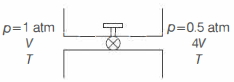
0 likes
View Solution104
MediumMCQ
$A$ mixture of ideal gases has $2$ moles of $He$,$4$ moles of oxygen $(O_2)$,and $1$ mole of ozone $(O_3)$ at absolute temperature $T$. The internal energy of the mixture is ............. $RT$.
A
$13$
B
$11$
C
$16$
D
$14$
Solution
(C) The internal energy $U$ of a gas is given by $U = \frac{f}{2} nRT$,where $f$ is the degrees of freedom,$n$ is the number of moles,$R$ is the universal gas constant,and $T$ is the absolute temperature.
For $He$ (monatomic gas),degrees of freedom $f_{He} = 3$.
For $O_2$ (diatomic gas),degrees of freedom $f_{O_2} = 5$.
For $O_3$ (non-linear polyatomic gas),degrees of freedom $f_{O_3} = 6$.
Given:
$n_{He} = 2$
$n_{O_2} = 4$
$n_{O_3} = 1$
The total internal energy of the mixture is the sum of the internal energies of individual components:
$U_{total} = U_{He} + U_{O_2} + U_{O_3}$
$U_{total} = \left( n_{He} \cdot \frac{f_{He}}{2} + n_{O_2} \cdot \frac{f_{O_2}}{2} + n_{O_3} \cdot \frac{f_{O_3}}{2} \right) RT$
$U_{total} = \left( 2 \cdot \frac{3}{2} + 4 \cdot \frac{5}{2} + 1 \cdot \frac{6}{2} \right) RT$
$U_{total} = (3 + 10 + 3) RT$
$U_{total} = 16 RT$.
Thus,the internal energy is $16 RT$.
For $He$ (monatomic gas),degrees of freedom $f_{He} = 3$.
For $O_2$ (diatomic gas),degrees of freedom $f_{O_2} = 5$.
For $O_3$ (non-linear polyatomic gas),degrees of freedom $f_{O_3} = 6$.
Given:
$n_{He} = 2$
$n_{O_2} = 4$
$n_{O_3} = 1$
The total internal energy of the mixture is the sum of the internal energies of individual components:
$U_{total} = U_{He} + U_{O_2} + U_{O_3}$
$U_{total} = \left( n_{He} \cdot \frac{f_{He}}{2} + n_{O_2} \cdot \frac{f_{O_2}}{2} + n_{O_3} \cdot \frac{f_{O_3}}{2} \right) RT$
$U_{total} = \left( 2 \cdot \frac{3}{2} + 4 \cdot \frac{5}{2} + 1 \cdot \frac{6}{2} \right) RT$
$U_{total} = (3 + 10 + 3) RT$
$U_{total} = 16 RT$.
Thus,the internal energy is $16 RT$.
0 likes
View Solution105
MediumMCQ
$14 \, g$ of $CO$ at $27^{\circ} C$ is mixed with $16 \, g$ of $O_2$ at $47^{\circ} C$. The temperature of the mixture is .......... $^{\circ} C$ (vibration mode neglected).
A
$-5$
B
$32$
C
$37$
D
$27$
Solution
(C) The molar mass of $CO$ is $28 \, g/mol$. Number of moles of $CO$ $(n_1)$ $= 14/28 = 0.5 \, mol$.
The molar mass of $O_2$ is $32 \, g/mol$. Number of moles of $O_2$ $(n_2)$ $= 16/32 = 0.5 \, mol$.
Both $CO$ and $O_2$ are diatomic gases. For diatomic gases,the degree of freedom $(f)$ is $5$ (vibration mode neglected).
The final temperature $T_f$ is given by the conservation of internal energy: $n_1 C_{v1} T_1 + n_2 C_{v2} T_2 = (n_1 C_{v1} + n_2 C_{v2}) T_f$.
Since $C_v = \frac{f}{2}R$ and $f$ is the same for both,the equation simplifies to: $n_1 T_1 + n_2 T_2 = (n_1 + n_2) T_f$.
Convert temperatures to Kelvin: $T_1 = 27 + 273 = 300 \, K$ and $T_2 = 47 + 273 = 320 \, K$.
Substituting the values: $(0.5 \times 300) + (0.5 \times 320) = (0.5 + 0.5) T_f$.
$150 + 160 = 1 \times T_f$.
$T_f = 310 \, K$.
Converting back to Celsius: $T_f = 310 - 273 = 37^{\circ} C$.
The molar mass of $O_2$ is $32 \, g/mol$. Number of moles of $O_2$ $(n_2)$ $= 16/32 = 0.5 \, mol$.
Both $CO$ and $O_2$ are diatomic gases. For diatomic gases,the degree of freedom $(f)$ is $5$ (vibration mode neglected).
The final temperature $T_f$ is given by the conservation of internal energy: $n_1 C_{v1} T_1 + n_2 C_{v2} T_2 = (n_1 C_{v1} + n_2 C_{v2}) T_f$.
Since $C_v = \frac{f}{2}R$ and $f$ is the same for both,the equation simplifies to: $n_1 T_1 + n_2 T_2 = (n_1 + n_2) T_f$.
Convert temperatures to Kelvin: $T_1 = 27 + 273 = 300 \, K$ and $T_2 = 47 + 273 = 320 \, K$.
Substituting the values: $(0.5 \times 300) + (0.5 \times 320) = (0.5 + 0.5) T_f$.
$150 + 160 = 1 \times T_f$.
$T_f = 310 \, K$.
Converting back to Celsius: $T_f = 310 - 273 = 37^{\circ} C$.
0 likes
View Solution106
MediumMCQ
When one mole of monatomic gas is mixed with one mole of a diatomic gas,then the equivalent value of $\gamma$ for the mixture will be (vibration mode neglected).
A
$1.33$
B
$1.40$
C
$1.50$
D
$1.60$
Solution
(C) For a monatomic gas,the adiabatic index $\gamma_1 = 5/3$. The number of moles $n_1 = 1$.
For a diatomic gas (neglecting vibration),the adiabatic index $\gamma_2 = 7/5$. The number of moles $n_2 = 1$.
The equivalent adiabatic index $\gamma$ for a mixture is given by the formula:
$\frac{n_{mix}}{\gamma - 1} = \frac{n_1}{\gamma_1 - 1} + \frac{n_2}{\gamma_2 - 1}$
Here,$n_{mix} = n_1 + n_2 = 1 + 1 = 2$.
Substituting the values:
$\frac{2}{\gamma - 1} = \frac{1}{5/3 - 1} + \frac{1}{7/5 - 1}$
$\frac{2}{\gamma - 1} = \frac{1}{2/3} + \frac{1}{2/5} = \frac{3}{2} + \frac{5}{2} = \frac{8}{2} = 4$
$\frac{2}{\gamma - 1} = 4 \implies \gamma - 1 = 0.5 \implies \gamma = 1.5$.
For a diatomic gas (neglecting vibration),the adiabatic index $\gamma_2 = 7/5$. The number of moles $n_2 = 1$.
The equivalent adiabatic index $\gamma$ for a mixture is given by the formula:
$\frac{n_{mix}}{\gamma - 1} = \frac{n_1}{\gamma_1 - 1} + \frac{n_2}{\gamma_2 - 1}$
Here,$n_{mix} = n_1 + n_2 = 1 + 1 = 2$.
Substituting the values:
$\frac{2}{\gamma - 1} = \frac{1}{5/3 - 1} + \frac{1}{7/5 - 1}$
$\frac{2}{\gamma - 1} = \frac{1}{2/3} + \frac{1}{2/5} = \frac{3}{2} + \frac{5}{2} = \frac{8}{2} = 4$
$\frac{2}{\gamma - 1} = 4 \implies \gamma - 1 = 0.5 \implies \gamma = 1.5$.
0 likes
View Solution107
MediumMCQ
One mole of monatomic gas and three moles of diatomic gas are put together in a container. The molar specific heat (in $J K^{-1} mol^{-1}$) at constant volume is (Let $R=8 \, J K^{-1} mol^{-1}$).
A
$18$
B
$19$
C
$20$
D
$21$
Solution
(A) For a monatomic gas,the degrees of freedom $f_1 = 3$. The molar specific heat at constant volume is $C_{v_1} = \frac{f_1}{2} R = \frac{3}{2} R$.
For a diatomic gas,the degrees of freedom $f_2 = 5$. The molar specific heat at constant volume is $C_{v_2} = \frac{f_2}{2} R = \frac{5}{2} R$.
Given $n_1 = 1$ mole and $n_2 = 3$ moles.
The molar specific heat of the mixture at constant volume $C_{v_{mix}}$ is given by the weighted average:
$C_{v_{mix}} = \frac{n_1 C_{v_1} + n_2 C_{v_2}}{n_1 + n_2}$
Substituting the values:
$C_{v_{mix}} = \frac{1 \times (\frac{3}{2} R) + 3 \times (\frac{5}{2} R)}{1 + 3}$
$C_{v_{mix}} = \frac{\frac{3}{2} R + \frac{15}{2} R}{4} = \frac{\frac{18}{2} R}{4} = \frac{9R}{4}$
Given $R = 8 \, J K^{-1} mol^{-1}$:
$C_{v_{mix}} = \frac{9 \times 8}{4} = 9 \times 2 = 18 \, J K^{-1} mol^{-1}$.
For a diatomic gas,the degrees of freedom $f_2 = 5$. The molar specific heat at constant volume is $C_{v_2} = \frac{f_2}{2} R = \frac{5}{2} R$.
Given $n_1 = 1$ mole and $n_2 = 3$ moles.
The molar specific heat of the mixture at constant volume $C_{v_{mix}}$ is given by the weighted average:
$C_{v_{mix}} = \frac{n_1 C_{v_1} + n_2 C_{v_2}}{n_1 + n_2}$
Substituting the values:
$C_{v_{mix}} = \frac{1 \times (\frac{3}{2} R) + 3 \times (\frac{5}{2} R)}{1 + 3}$
$C_{v_{mix}} = \frac{\frac{3}{2} R + \frac{15}{2} R}{4} = \frac{\frac{18}{2} R}{4} = \frac{9R}{4}$
Given $R = 8 \, J K^{-1} mol^{-1}$:
$C_{v_{mix}} = \frac{9 \times 8}{4} = 9 \times 2 = 18 \, J K^{-1} mol^{-1}$.
0 likes
View Solution108
MediumMCQ
If $\alpha$ moles of a monoatomic gas are mixed with $\beta$ moles of a polyatomic gas and the mixture behaves like a diatomic gas,then [neglect the vibrational mode of freedom]:
A
$2 \alpha = \beta$
B
$\alpha = 2 \beta$
C
$\alpha = -3 \beta$
D
$3 \alpha = -\beta$
Solution
(A) For a monoatomic gas,the degree of freedom $f_1 = 3$.
For a polyatomic gas,neglecting the vibrational mode of freedom,the degree of freedom $f_2 = 6$ ($3$ translational + $3$ rotational).
The mixture behaves like a diatomic gas,so the degree of freedom of the mixture $f_{\text{mix}} = 5$ ($3$ translational + $2$ rotational).
The formula for the degree of freedom of a mixture is given by:
$f_{\text{mix}} = \frac{f_1 n_1 + f_2 n_2}{n_1 + n_2}$
Substituting the given values:
$5 = \frac{3 \alpha + 6 \beta}{\alpha + \beta}$
$5(\alpha + \beta) = 3 \alpha + 6 \beta$
$5 \alpha + 5 \beta = 3 \alpha + 6 \beta$
$2 \alpha = \beta$
For a polyatomic gas,neglecting the vibrational mode of freedom,the degree of freedom $f_2 = 6$ ($3$ translational + $3$ rotational).
The mixture behaves like a diatomic gas,so the degree of freedom of the mixture $f_{\text{mix}} = 5$ ($3$ translational + $2$ rotational).
The formula for the degree of freedom of a mixture is given by:
$f_{\text{mix}} = \frac{f_1 n_1 + f_2 n_2}{n_1 + n_2}$
Substituting the given values:
$5 = \frac{3 \alpha + 6 \beta}{\alpha + \beta}$
$5(\alpha + \beta) = 3 \alpha + 6 \beta$
$5 \alpha + 5 \beta = 3 \alpha + 6 \beta$
$2 \alpha = \beta$
0 likes
View Solution109
MediumMCQ
$A$ vessel of volume $20 \ L$ contains a mixture of hydrogen and helium at a temperature of $27^{\circ} C$ and pressure $2 \ atm$. The mass of the mixture is $5 \ g$. Assuming the gases to be ideal,the ratio of the mass of hydrogen to that of helium in the given mixture will be:
A
$1: 2$
B
$2: 3$
C
$2: 1$
D
$2: 5$
Solution
(D) Let $n_1$ be the number of moles of hydrogen $(H_2)$ and $n_2$ be the number of moles of helium $(He)$.
Using the ideal gas equation $PV = nRT$,where $n = n_1 + n_2$ is the total number of moles.
Given: $P = 2 \ atm = 2 \times 1.013 \times 10^5 \ Pa$,$V = 20 \ L = 20 \times 10^{-3} \ m^3$,$T = 27^{\circ} C = 300 \ K$,$R = 8.314 \ J/mol \cdot K$.
Total moles $n = n_1 + n_2 = \frac{PV}{RT} = \frac{2 \times 1.013 \times 10^5 \times 20 \times 10^{-3}}{8.314 \times 300} \approx 1.62 \ mol$.
Mass of mixture: $m_{H_2} + m_{He} = 5 \ g$.
Since $m = n \times M$,where $M$ is molar mass: $n_1(2) + n_2(4) = 5 \implies n_1 + 2n_2 = 2.5$.
Subtracting the first equation $(n_1 + n_2 = 1.62)$ from the second $(n_1 + 2n_2 = 2.5)$: $n_2 = 0.88 \ mol$.
Then $n_1 = 1.62 - 0.88 = 0.74 \ mol$.
Mass ratio $\frac{m_{H_2}}{m_{He}} = \frac{n_1 \times 2}{n_2 \times 4} = \frac{0.74 \times 2}{0.88 \times 4} = \frac{1.48}{3.52} = \frac{2}{5}$.
Using the ideal gas equation $PV = nRT$,where $n = n_1 + n_2$ is the total number of moles.
Given: $P = 2 \ atm = 2 \times 1.013 \times 10^5 \ Pa$,$V = 20 \ L = 20 \times 10^{-3} \ m^3$,$T = 27^{\circ} C = 300 \ K$,$R = 8.314 \ J/mol \cdot K$.
Total moles $n = n_1 + n_2 = \frac{PV}{RT} = \frac{2 \times 1.013 \times 10^5 \times 20 \times 10^{-3}}{8.314 \times 300} \approx 1.62 \ mol$.
Mass of mixture: $m_{H_2} + m_{He} = 5 \ g$.
Since $m = n \times M$,where $M$ is molar mass: $n_1(2) + n_2(4) = 5 \implies n_1 + 2n_2 = 2.5$.
Subtracting the first equation $(n_1 + n_2 = 1.62)$ from the second $(n_1 + 2n_2 = 2.5)$: $n_2 = 0.88 \ mol$.
Then $n_1 = 1.62 - 0.88 = 0.74 \ mol$.
Mass ratio $\frac{m_{H_2}}{m_{He}} = \frac{n_1 \times 2}{n_2 \times 4} = \frac{0.74 \times 2}{0.88 \times 4} = \frac{1.48}{3.52} = \frac{2}{5}$.
0 likes
View Solution110
MediumMCQ
Two gases occupy two containers $A$ and $B$. The gas in $A$,of volume $0.10 \, m^3$,exerts a pressure of $1.40 \, MPa$,and the gas in $B$,of volume $0.15 \, m^3$,exerts a pressure of $0.7 \, MPa$. The two containers are connected by a tube of negligible volume,and the gases are allowed to intermingle. If the temperature remains constant,what will be the final pressure in the containers (in $MPa$)?
A
$0.70$
B
$0.98$
C
$1.40$
D
$2.10$
Solution
(B) According to the ideal gas law,$PV = nRT$. Since the temperature $T$ is constant,the total number of moles $n_{total} = n_A + n_B$ remains constant.
For container $A$: $n_A = \frac{P_A V_A}{RT}$
For container $B$: $n_B = \frac{P_B V_B}{RT}$
When the containers are connected,the final pressure $P_f$ is given by:
$P_f(V_A + V_B) = (n_A + n_B)RT$
$P_f(V_A + V_B) = P_A V_A + P_B V_B$
Substituting the given values:
$P_f = \frac{P_A V_A + P_B V_B}{V_A + V_B}$
$P_f = \frac{(1.40 \, MPa \times 0.10 \, m^3) + (0.7 \, MPa \times 0.15 \, m^3)}{0.10 \, m^3 + 0.15 \, m^3}$
$P_f = \frac{0.14 + 0.105}{0.25} \, MPa$
$P_f = \frac{0.245}{0.25} \, MPa = 0.98 \, MPa$.
For container $A$: $n_A = \frac{P_A V_A}{RT}$
For container $B$: $n_B = \frac{P_B V_B}{RT}$
When the containers are connected,the final pressure $P_f$ is given by:
$P_f(V_A + V_B) = (n_A + n_B)RT$
$P_f(V_A + V_B) = P_A V_A + P_B V_B$
Substituting the given values:
$P_f = \frac{P_A V_A + P_B V_B}{V_A + V_B}$
$P_f = \frac{(1.40 \, MPa \times 0.10 \, m^3) + (0.7 \, MPa \times 0.15 \, m^3)}{0.10 \, m^3 + 0.15 \, m^3}$
$P_f = \frac{0.14 + 0.105}{0.25} \, MPa$
$P_f = \frac{0.245}{0.25} \, MPa = 0.98 \, MPa$.
0 likes
View Solution111
MediumMCQ
$3\, \text{moles}$ of an ideal gas at a temperature of $27^{\circ}\, \text{C}$ are mixed with $2\, \text{moles}$ of an ideal gas at a temperature of $227^{\circ}\, \text{C}$. Determine the equilibrium temperature $(^{\circ}\, \text{C})$ of the mixture, assuming no loss of energy.
A
$327$
B
$107$
C
$318$
D
$410$
Solution
(B) The internal energy of an ideal gas is given by $U = n \left( \frac{f}{2} RT \right)$. Assuming both gases are monatomic $(f=3)$, the total energy is conserved.
Energy of the first gas at $T_1 = 27^{\circ}\, \text{C} = 300\, \text{K}$ is $E_1 = 3 \left( \frac{3}{2} R \times 300 \right) = 1350\, R$.
Energy of the second gas at $T_2 = 227^{\circ}\, \text{C} = 500\, \text{K}$ is $E_2 = 2 \left( \frac{3}{2} R \times 500 \right) = 1500\, R$.
Let $T$ be the equilibrium temperature in Kelvin. The total energy of the mixture is $E_m = (3+2) \left( \frac{3}{2} RT \right) = 7.5\, RT$.
By conservation of energy, $E_m = E_1 + E_2$.
$7.5\, RT = 1350\, R + 1500\, R$.
$7.5\, T = 2850$.
$T = \frac{2850}{7.5} = 380\, \text{K}$.
Converting to Celsius: $T(^{\circ}\, \text{C}) = 380 - 273 = 107^{\circ}\, \text{C}$.
Energy of the first gas at $T_1 = 27^{\circ}\, \text{C} = 300\, \text{K}$ is $E_1 = 3 \left( \frac{3}{2} R \times 300 \right) = 1350\, R$.
Energy of the second gas at $T_2 = 227^{\circ}\, \text{C} = 500\, \text{K}$ is $E_2 = 2 \left( \frac{3}{2} R \times 500 \right) = 1500\, R$.
Let $T$ be the equilibrium temperature in Kelvin. The total energy of the mixture is $E_m = (3+2) \left( \frac{3}{2} RT \right) = 7.5\, RT$.
By conservation of energy, $E_m = E_1 + E_2$.
$7.5\, RT = 1350\, R + 1500\, R$.
$7.5\, T = 2850$.
$T = \frac{2850}{7.5} = 380\, \text{K}$.
Converting to Celsius: $T(^{\circ}\, \text{C}) = 380 - 273 = 107^{\circ}\, \text{C}$.
0 likes
View Solution112
MediumMCQ
Four moles of hydrogen,two moles of helium,and one mole of water vapour form an ideal gas mixture. What is the molar specific heat at constant pressure of the mixture?
A
$\frac{16}{7} R$
B
$\frac{7}{16} R$
C
$R$
D
$\frac{23}{7} R$
Solution
(D) The number of moles for each gas are: $n_1 = 4$ (hydrogen,diatomic),$n_2 = 2$ (helium,monatomic),$n_3 = 1$ (water vapour,polyatomic).
The molar specific heat at constant volume $(C_v)$ for each gas is:
For hydrogen (diatomic): $(C_v)_1 = \frac{5}{2} R$
For helium (monatomic): $(C_v)_2 = \frac{3}{2} R$
For water vapour (polyatomic): $(C_v)_3 = 3 R$
The equivalent molar specific heat at constant volume for the mixture is given by:
$(C_v)_{\text{mix}} = \frac{n_1(C_v)_1 + n_2(C_v)_2 + n_3(C_v)_3}{n_1 + n_2 + n_3}$
$(C_v)_{\text{mix}} = \frac{4 \times \frac{5}{2} R + 2 \times \frac{3}{2} R + 1 \times 3 R}{4 + 2 + 1} = \frac{10 R + 3 R + 3 R}{7} = \frac{16}{7} R$
Using the relation $C_p = C_v + R$ for the mixture:
$(C_p)_{\text{mix}} = (C_v)_{\text{mix}} + R = \frac{16}{7} R + R = \frac{23}{7} R$.
The molar specific heat at constant volume $(C_v)$ for each gas is:
For hydrogen (diatomic): $(C_v)_1 = \frac{5}{2} R$
For helium (monatomic): $(C_v)_2 = \frac{3}{2} R$
For water vapour (polyatomic): $(C_v)_3 = 3 R$
The equivalent molar specific heat at constant volume for the mixture is given by:
$(C_v)_{\text{mix}} = \frac{n_1(C_v)_1 + n_2(C_v)_2 + n_3(C_v)_3}{n_1 + n_2 + n_3}$
$(C_v)_{\text{mix}} = \frac{4 \times \frac{5}{2} R + 2 \times \frac{3}{2} R + 1 \times 3 R}{4 + 2 + 1} = \frac{10 R + 3 R + 3 R}{7} = \frac{16}{7} R$
Using the relation $C_p = C_v + R$ for the mixture:
$(C_p)_{\text{mix}} = (C_v)_{\text{mix}} + R = \frac{16}{7} R + R = \frac{23}{7} R$.
0 likes
View Solution113
MediumMCQ
The molar heat capacity of a mixture of two gases at constant volume is $13R/6$. The ratio of the number of moles of the first gas to the second is $1:2$. The respective gases may be:
A
$O_2$ and $N_2$
B
$He$ and $Ne$
C
$He$ and $N_2$
D
$N_2$ and $He$
Solution
(C) The molar heat capacity at constant volume for a mixture is given by $C_{V, \text{mix}} = \frac{n_1 C_{V_1} + n_2 C_{V_2}}{n_1 + n_2} = \frac{13R}{6}$.
Given the ratio $n_1 : n_2 = 1 : 2$,let $n_1 = n$ and $n_2 = 2n$.
Substituting these values: $\frac{n C_{V_1} + 2n C_{V_2}}{n + 2n} = \frac{13R}{6}$.
$\frac{C_{V_1} + 2C_{V_2}}{3} = \frac{13R}{6} \implies C_{V_1} + 2C_{V_2} = \frac{13R}{2}$.
For monatomic gases,$C_V = 3R/2$. For diatomic gases,$C_V = 5R/2$.
If gas $1$ is monatomic $(C_{V_1} = 3R/2)$ and gas $2$ is diatomic $(C_{V_2} = 5R/2)$:
$3R/2 + 2(5R/2) = 3R/2 + 5R = 13R/2$.
This matches the condition. Thus,the first gas is monatomic $(He)$ and the second is diatomic $(N_2)$.
Given the ratio $n_1 : n_2 = 1 : 2$,let $n_1 = n$ and $n_2 = 2n$.
Substituting these values: $\frac{n C_{V_1} + 2n C_{V_2}}{n + 2n} = \frac{13R}{6}$.
$\frac{C_{V_1} + 2C_{V_2}}{3} = \frac{13R}{6} \implies C_{V_1} + 2C_{V_2} = \frac{13R}{2}$.
For monatomic gases,$C_V = 3R/2$. For diatomic gases,$C_V = 5R/2$.
If gas $1$ is monatomic $(C_{V_1} = 3R/2)$ and gas $2$ is diatomic $(C_{V_2} = 5R/2)$:
$3R/2 + 2(5R/2) = 3R/2 + 5R = 13R/2$.
This matches the condition. Thus,the first gas is monatomic $(He)$ and the second is diatomic $(N_2)$.
0 likes
View Solution114
MediumMCQ
$A$ gas mixture consists of $2$ moles of oxygen and $4$ moles of neon at temperature $T$. Neglecting all vibrational modes,the total internal energy of the system will be $...........\,RT$.
A
$8$
B
$16$
C
$4$
D
$11$
Solution
(D) The total internal energy $U$ of a system is the sum of the internal energies of its components.
For oxygen $(O_2)$,which is a diatomic gas,the degrees of freedom $f_1 = 5$ (neglecting vibrational modes).
For neon $(Ne)$,which is a monatomic gas,the degrees of freedom $f_2 = 3$.
The internal energy of $n_1$ moles of gas $1$ is $U_1 = n_1 \frac{f_1}{2} RT$.
The internal energy of $n_2$ moles of gas $2$ is $U_2 = n_2 \frac{f_2}{2} RT$.
Total internal energy $U = U_1 + U_2 = (n_1 \frac{f_1}{2} + n_2 \frac{f_2}{2}) RT$.
Given $n_1 = 2$ (oxygen) and $n_2 = 4$ (neon).
$U = (2 \times \frac{5}{2} + 4 \times \frac{3}{2}) RT$.
$U = (5 + 6) RT = 11 RT$.
Thus,the total internal energy is $11 RT$.
For oxygen $(O_2)$,which is a diatomic gas,the degrees of freedom $f_1 = 5$ (neglecting vibrational modes).
For neon $(Ne)$,which is a monatomic gas,the degrees of freedom $f_2 = 3$.
The internal energy of $n_1$ moles of gas $1$ is $U_1 = n_1 \frac{f_1}{2} RT$.
The internal energy of $n_2$ moles of gas $2$ is $U_2 = n_2 \frac{f_2}{2} RT$.
Total internal energy $U = U_1 + U_2 = (n_1 \frac{f_1}{2} + n_2 \frac{f_2}{2}) RT$.
Given $n_1 = 2$ (oxygen) and $n_2 = 4$ (neon).
$U = (2 \times \frac{5}{2} + 4 \times \frac{3}{2}) RT$.
$U = (5 + 6) RT = 11 RT$.
Thus,the total internal energy is $11 RT$.
0 likes
View Solution115
DifficultMCQ
$N$ moles of a polyatomic gas $(f=6)$ must be mixed with two moles of a monoatomic gas so that the mixture behaves as a diatomic gas. The value of $N$ is:
A
$6$
B
$3$
C
$4$
D
$2$
Solution
(C) The equivalent degree of freedom $f_{eq}$ for a mixture of gases is given by the formula:
$f_{eq} = \frac{n_1 f_1 + n_2 f_2}{n_1 + n_2}$
For a diatomic gas,the degree of freedom is $f_{eq} = 5$.
Given:
$n_1 = N$,$f_1 = 6$ (polyatomic gas)
$n_2 = 2$,$f_2 = 3$ (monoatomic gas)
Substituting these values into the formula:
$5 = \frac{(N)(6) + (2)(3)}{N + 2}$
Multiplying both sides by $(N + 2)$:
$5(N + 2) = 6N + 6$
$5N + 10 = 6N + 6$
Rearranging the terms to solve for $N$:
$10 - 6 = 6N - 5N$
$N = 4$
$f_{eq} = \frac{n_1 f_1 + n_2 f_2}{n_1 + n_2}$
For a diatomic gas,the degree of freedom is $f_{eq} = 5$.
Given:
$n_1 = N$,$f_1 = 6$ (polyatomic gas)
$n_2 = 2$,$f_2 = 3$ (monoatomic gas)
Substituting these values into the formula:
$5 = \frac{(N)(6) + (2)(3)}{N + 2}$
Multiplying both sides by $(N + 2)$:
$5(N + 2) = 6N + 6$
$5N + 10 = 6N + 6$
Rearranging the terms to solve for $N$:
$10 - 6 = 6N - 5N$
$N = 4$
1 likes
View Solution116
DifficultMCQ
If three moles of monoatomic gas $\left(\gamma=\frac{5}{3}\right)$ is mixed with two moles of a diatomic gas $\left(\gamma=\frac{7}{5}\right)$,the value of adiabatic exponent $\gamma$ for the mixture is:
A
$1.75$
B
$1.40$
C
$1.52$
D
$1.35$
Solution
(C) For a monoatomic gas,the degrees of freedom $f_1 = 3$. For a diatomic gas,the degrees of freedom $f_2 = 5$.
Given $n_1 = 3$ moles and $n_2 = 2$ moles.
The degrees of freedom for the mixture is given by $f_{\text{mix}} = \frac{n_1 f_1 + n_2 f_2}{n_1 + n_2}$.
Substituting the values: $f_{\text{mix}} = \frac{3(3) + 2(5)}{3 + 2} = \frac{9 + 10}{5} = \frac{19}{5} = 3.8$.
The adiabatic exponent $\gamma$ is related to the degrees of freedom $f$ by the formula $\gamma = 1 + \frac{2}{f}$.
Therefore,$\gamma_{\text{mix}} = 1 + \frac{2}{f_{\text{mix}}} = 1 + \frac{2}{3.8} = 1 + \frac{20}{38} = 1 + \frac{10}{19} = \frac{29}{19} \approx 1.526$.
Rounding to two decimal places,we get $\gamma_{\text{mix}} = 1.52$.
Given $n_1 = 3$ moles and $n_2 = 2$ moles.
The degrees of freedom for the mixture is given by $f_{\text{mix}} = \frac{n_1 f_1 + n_2 f_2}{n_1 + n_2}$.
Substituting the values: $f_{\text{mix}} = \frac{3(3) + 2(5)}{3 + 2} = \frac{9 + 10}{5} = \frac{19}{5} = 3.8$.
The adiabatic exponent $\gamma$ is related to the degrees of freedom $f$ by the formula $\gamma = 1 + \frac{2}{f}$.
Therefore,$\gamma_{\text{mix}} = 1 + \frac{2}{f_{\text{mix}}} = 1 + \frac{2}{3.8} = 1 + \frac{20}{38} = 1 + \frac{10}{19} = \frac{29}{19} \approx 1.526$.
Rounding to two decimal places,we get $\gamma_{\text{mix}} = 1.52$.
0 likes
View Solution117
DifficultMCQ
$A$ gas mixture consists of $8$ moles of argon and $6$ moles of oxygen at temperature $T$. Neglecting all vibrational modes,the total internal energy of the system is (in $RT$)
A
$29$
B
$20$
C
$27$
D
$21$
Solution
(C) The total internal energy $U$ of a gas mixture is the sum of the internal energies of its individual components.
For a gas with $n$ moles,the internal energy is given by $U = n C_V T$,where $C_V$ is the molar heat capacity at constant volume.
Argon is a monatomic gas,so its degrees of freedom $f_1 = 3$,and $C_{V1} = \frac{3}{2} R$.
Oxygen is a diatomic gas,so its degrees of freedom $f_2 = 5$ (neglecting vibrational modes),and $C_{V2} = \frac{5}{2} R$.
The total internal energy is $U = n_1 C_{V1} T + n_2 C_{V2} T$.
Substituting the given values: $U = (8 \times \frac{3}{2} R \times T) + (6 \times \frac{5}{2} R \times T)$.
$U = (12 RT) + (15 RT) = 27 RT$.
For a gas with $n$ moles,the internal energy is given by $U = n C_V T$,where $C_V$ is the molar heat capacity at constant volume.
Argon is a monatomic gas,so its degrees of freedom $f_1 = 3$,and $C_{V1} = \frac{3}{2} R$.
Oxygen is a diatomic gas,so its degrees of freedom $f_2 = 5$ (neglecting vibrational modes),and $C_{V2} = \frac{5}{2} R$.
The total internal energy is $U = n_1 C_{V1} T + n_2 C_{V2} T$.
Substituting the given values: $U = (8 \times \frac{3}{2} R \times T) + (6 \times \frac{5}{2} R \times T)$.
$U = (12 RT) + (15 RT) = 27 RT$.
0 likes
View Solution118
DifficultMCQ
Two moles of a monoatomic gas are mixed with six moles of a diatomic gas. The molar specific heat of the mixture at constant volume is:
A
$\frac{9}{4} R$
B
$\frac{7}{4} R$
C
$\frac{3}{2} R$
D
$\frac{5}{2} R$
Solution
(A) The molar specific heat at constant volume for a mixture is given by the formula: $C_{V,mix} = \frac{n_1 C_{V,1} + n_2 C_{V,2}}{n_1 + n_2}$.
For a monoatomic gas,$C_{V,1} = \frac{3}{2} R$ and $n_1 = 2$.
For a diatomic gas,$C_{V,2} = \frac{5}{2} R$ and $n_2 = 6$.
Substituting these values into the formula:
$C_{V,mix} = \frac{2 \times (\frac{3}{2} R) + 6 \times (\frac{5}{2} R)}{2 + 6}$
$C_{V,mix} = \frac{3R + 15R}{8}$
$C_{V,mix} = \frac{18R}{8} = \frac{9}{4} R$.
For a monoatomic gas,$C_{V,1} = \frac{3}{2} R$ and $n_1 = 2$.
For a diatomic gas,$C_{V,2} = \frac{5}{2} R$ and $n_2 = 6$.
Substituting these values into the formula:
$C_{V,mix} = \frac{2 \times (\frac{3}{2} R) + 6 \times (\frac{5}{2} R)}{2 + 6}$
$C_{V,mix} = \frac{3R + 15R}{8}$
$C_{V,mix} = \frac{18R}{8} = \frac{9}{4} R$.
0 likes
View Solution119
EasyMCQ
$A$ closed container contains a homogeneous mixture of two moles of an ideal monatomic gas $(\gamma=5/3)$ and one mole of an ideal diatomic gas $(\gamma=7/5)$. Here,$\gamma$ is the ratio of the specific heats at constant pressure and constant volume of an ideal gas. The gas mixture does a work of $66 \ J$ when heated at constant pressure. The change in its internal energy is . . . . . . $J$.
A
$119$
B
$118$
C
$120$
D
$121$
Solution
(D) For a mixture of gases at constant pressure,the work done is given by $W = n_{mix} R \Delta T = 66 \ J$.
The molar heat capacity at constant volume for the mixture is given by $(C_V)_{mix} = \frac{n_1 C_{V1} + n_2 C_{V2}}{n_1 + n_2}$.
For a monatomic gas,$C_{V1} = \frac{3}{2} R$. For a diatomic gas,$C_{V2} = \frac{5}{2} R$.
Substituting the values: $(C_V)_{mix} = \frac{2 \times (3/2)R + 1 \times (5/2)R}{2 + 1} = \frac{3R + 2.5R}{3} = \frac{5.5R}{3} = \frac{11}{6} R$.
The change in internal energy is $\Delta U = n_{total} (C_V)_{mix} \Delta T$.
Since $n_{total} = n_1 + n_2 = 3$,we have $\Delta U = 3 \times (\frac{11}{6} R) \Delta T = \frac{11}{2} R \Delta T$.
From the work equation,$n_{total} R \Delta T = 66$,so $3 R \Delta T = 66$,which means $R \Delta T = 22$.
Substituting this into the internal energy equation: $\Delta U = \frac{11}{2} \times 22 = 11 \times 11 = 121 \ J$.
The molar heat capacity at constant volume for the mixture is given by $(C_V)_{mix} = \frac{n_1 C_{V1} + n_2 C_{V2}}{n_1 + n_2}$.
For a monatomic gas,$C_{V1} = \frac{3}{2} R$. For a diatomic gas,$C_{V2} = \frac{5}{2} R$.
Substituting the values: $(C_V)_{mix} = \frac{2 \times (3/2)R + 1 \times (5/2)R}{2 + 1} = \frac{3R + 2.5R}{3} = \frac{5.5R}{3} = \frac{11}{6} R$.
The change in internal energy is $\Delta U = n_{total} (C_V)_{mix} \Delta T$.
Since $n_{total} = n_1 + n_2 = 3$,we have $\Delta U = 3 \times (\frac{11}{6} R) \Delta T = \frac{11}{2} R \Delta T$.
From the work equation,$n_{total} R \Delta T = 66$,so $3 R \Delta T = 66$,which means $R \Delta T = 22$.
Substituting this into the internal energy equation: $\Delta U = \frac{11}{2} \times 22 = 11 \times 11 = 121 \ J$.
0 likes
View Solution120
MediumMCQ
$A$ mixture of ideal gas containing $5$ moles of monatomic gas and $1$ mole of rigid diatomic gas is initially at pressure $P_0$,volume $V_0$ and temperature $T_0$. If the gas mixture is adiabatically compressed to a volume $V_0 / 4$,then the correct statement$(s)$ is/are:
(Given $2^{1.2}=2.3$; $2^{3.2}=9.2$; $R$ is gas constant)
$(1)$ The final pressure of the gas mixture after compression is in between $9 P_0$ and $10 P_0$.
$(2)$ The average kinetic energy of the gas mixture after compression is in between $18 RT_0$ and $19 RT_0$.
$(3)$ The work $|W|$ done during the process is $13 RT_0$.
$(4)$ Adiabatic constant of the gas mixture is $1.6$.
(Given $2^{1.2}=2.3$; $2^{3.2}=9.2$; $R$ is gas constant)
$(1)$ The final pressure of the gas mixture after compression is in between $9 P_0$ and $10 P_0$.
$(2)$ The average kinetic energy of the gas mixture after compression is in between $18 RT_0$ and $19 RT_0$.
$(3)$ The work $|W|$ done during the process is $13 RT_0$.
$(4)$ Adiabatic constant of the gas mixture is $1.6$.
A
$1, 2, 3$
B
$1, 2, 4$
C
$1, 3, 4$
D
$1, 4$
Solution
(D) For the mixture: $n_1 = 5$ (monatomic),$C_{v1} = 3R/2$; $n_2 = 1$ (diatomic),$C_{v2} = 5R/2$.
Total moles $n = 5 + 1 = 6$.
$(C_v)_m = \frac{n_1 C_{v1} + n_2 C_{v2}}{n_1 + n_2} = \frac{5(3R/2) + 1(5R/2)}{6} = \frac{10R}{6} = \frac{5R}{3}$.
$(C_p)_m = (C_v)_m + R = \frac{5R}{3} + R = \frac{8R}{3}$.
Adiabatic constant $\gamma_m = \frac{(C_p)_m}{(C_v)_m} = \frac{8/3}{5/3} = 1.6$. Thus,$(4)$ is correct.
For adiabatic compression: $P_0 V_0^{\gamma} = P_f (V_0/4)^{\gamma}$.
$P_f = P_0 (4)^{1.6} = P_0 (2^2)^{1.6} = P_0 (2^{3.2}) = 9.2 P_0$. Thus,$(1)$ is correct.
Using $T_f V_f^{\gamma-1} = T_0 V_0^{\gamma-1}$,$T_f = T_0 (V_0 / (V_0/4))^{0.6} = T_0 (4)^{0.6} = T_0 (2^{1.2}) = 2.3 T_0$.
Total internal energy $U = n_1 (3/2 RT) + n_2 (5/2 RT) = 5(1.5 RT) + 1(2.5 RT) = 10 RT$.
$U_f = 10 R (2.3 T_0) = 23 RT_0$. Thus,$(2)$ is incorrect.
Work done $|W| = |\Delta U| = |n_f C_{vm} T_f - n_i C_{vm} T_i| = |6 \times (5R/6) \times (2.3 T_0 - T_0)| = |5R \times 1.3 T_0| = 6.5 RT_0$. Thus,$(3)$ is incorrect.
Correct statements are $(1)$ and $(4)$.
Total moles $n = 5 + 1 = 6$.
$(C_v)_m = \frac{n_1 C_{v1} + n_2 C_{v2}}{n_1 + n_2} = \frac{5(3R/2) + 1(5R/2)}{6} = \frac{10R}{6} = \frac{5R}{3}$.
$(C_p)_m = (C_v)_m + R = \frac{5R}{3} + R = \frac{8R}{3}$.
Adiabatic constant $\gamma_m = \frac{(C_p)_m}{(C_v)_m} = \frac{8/3}{5/3} = 1.6$. Thus,$(4)$ is correct.
For adiabatic compression: $P_0 V_0^{\gamma} = P_f (V_0/4)^{\gamma}$.
$P_f = P_0 (4)^{1.6} = P_0 (2^2)^{1.6} = P_0 (2^{3.2}) = 9.2 P_0$. Thus,$(1)$ is correct.
Using $T_f V_f^{\gamma-1} = T_0 V_0^{\gamma-1}$,$T_f = T_0 (V_0 / (V_0/4))^{0.6} = T_0 (4)^{0.6} = T_0 (2^{1.2}) = 2.3 T_0$.
Total internal energy $U = n_1 (3/2 RT) + n_2 (5/2 RT) = 5(1.5 RT) + 1(2.5 RT) = 10 RT$.
$U_f = 10 R (2.3 T_0) = 23 RT_0$. Thus,$(2)$ is incorrect.
Work done $|W| = |\Delta U| = |n_f C_{vm} T_f - n_i C_{vm} T_i| = |6 \times (5R/6) \times (2.3 T_0 - T_0)| = |5R \times 1.3 T_0| = 6.5 RT_0$. Thus,$(3)$ is incorrect.
Correct statements are $(1)$ and $(4)$.
0 likes
View Solution121
MediumMCQ
Two non-reactive monoatomic ideal gases have their atomic masses in the ratio $2: 3$. The ratio of their partial pressures,when enclosed in a vessel kept at a constant temperature,is $4: 3$. The ratio of their densities is:
A
$1: 4$
B
$1: 2$
C
$6: 9$
D
$8: 9$
Solution
(D) The ideal gas equation is given by $PV = nRT$,where $n = \frac{m}{M}$.
Substituting $n$,we get $PV = \frac{m}{M}RT$,which can be rewritten as $P = \frac{m}{V} \cdot \frac{RT}{M} = \frac{\rho RT}{M}$,where $\rho$ is the density.
Thus,the density is $\rho = \frac{PM}{RT}$.
For two gases at the same temperature $T$,the ratio of their densities is $\frac{\rho_1}{\rho_2} = \frac{P_1 M_1}{P_2 M_2}$.
Given the ratio of atomic masses $\frac{M_1}{M_2} = \frac{2}{3}$ and the ratio of partial pressures $\frac{P_1}{P_2} = \frac{4}{3}$.
Substituting these values,we get $\frac{\rho_1}{\rho_2} = \left(\frac{4}{3}\right) \times \left(\frac{2}{3}\right) = \frac{8}{9}$.
Substituting $n$,we get $PV = \frac{m}{M}RT$,which can be rewritten as $P = \frac{m}{V} \cdot \frac{RT}{M} = \frac{\rho RT}{M}$,where $\rho$ is the density.
Thus,the density is $\rho = \frac{PM}{RT}$.
For two gases at the same temperature $T$,the ratio of their densities is $\frac{\rho_1}{\rho_2} = \frac{P_1 M_1}{P_2 M_2}$.
Given the ratio of atomic masses $\frac{M_1}{M_2} = \frac{2}{3}$ and the ratio of partial pressures $\frac{P_1}{P_2} = \frac{4}{3}$.
Substituting these values,we get $\frac{\rho_1}{\rho_2} = \left(\frac{4}{3}\right) \times \left(\frac{2}{3}\right) = \frac{8}{9}$.
0 likes
View Solution122
MediumMCQ
$A$ container of fixed volume has a mixture of one mole of hydrogen and one mole of helium in equilibrium at temperature $T$. Assuming the gases are ideal,the correct statement$(s)$ is(are):
$(A)$ The average energy per mole of the gas mixture is $2RT$.
$(B)$ The ratio of speed of sound in the gas mixture to that in helium gas is $\sqrt{6/5}$.
$(C)$ The ratio of the rms speed of helium atoms to that of hydrogen molecules is $1/2$.
$(D)$ The ratio of the rms speed of helium atoms to that of hydrogen molecules is $1/\sqrt{2}$.
$(A)$ The average energy per mole of the gas mixture is $2RT$.
$(B)$ The ratio of speed of sound in the gas mixture to that in helium gas is $\sqrt{6/5}$.
$(C)$ The ratio of the rms speed of helium atoms to that of hydrogen molecules is $1/2$.
$(D)$ The ratio of the rms speed of helium atoms to that of hydrogen molecules is $1/\sqrt{2}$.
A
$(B, C, D)$
B
$(A, C, D)$
C
$(A, B, D)$
D
$(A, B, C)$
Solution
(C) For a mixture of $1$ mole of $H_2$ (diatomic,$C_v = 5R/2$) and $1$ mole of $He$ (monatomic,$C_v = 3R/2$):
Total internal energy $U = n_1 C_{v1} T + n_2 C_{v2} T = 1(5R/2)T + 1(3R/2)T = 4RT$.
Average energy per mole $= U / (n_1 + n_2) = 4RT / 2 = 2RT$. Thus,$(A)$ is correct.
For the mixture,$C_{v,mix} = (n_1 C_{v1} + n_2 C_{v2}) / (n_1 + n_2) = (5R/2 + 3R/2) / 2 = 2R$.
$C_{p,mix} = C_{v,mix} + R = 3R$. $\gamma_{mix} = C_{p,mix} / C_{v,mix} = 3R / 2R = 1.5 = 3/2$.
Speed of sound $v = \sqrt{\gamma RT / M}$. For $He$,$\gamma = 5/3$ and $M = 4$. For mixture,$M_{mix} = (2+4)/2 = 3$.
Ratio $v_{mix} / v_{He} = \sqrt{(\gamma_{mix} / M_{mix}) / (\gamma_{He} / M_{He})} = \sqrt{(1.5 / 3) / ((5/3) / 4)} = \sqrt{0.5 / (5/12)} = \sqrt{6/5}$. Thus,$(B)$ is correct.
$RMS$ speed $v_{rms} = \sqrt{3RT/M}$. Ratio $v_{rms,He} / v_{rms,H2} = \sqrt{M_{H2} / M_{He}} = \sqrt{2/4} = 1/\sqrt{2}$. Thus,$(D)$ is correct.
Total internal energy $U = n_1 C_{v1} T + n_2 C_{v2} T = 1(5R/2)T + 1(3R/2)T = 4RT$.
Average energy per mole $= U / (n_1 + n_2) = 4RT / 2 = 2RT$. Thus,$(A)$ is correct.
For the mixture,$C_{v,mix} = (n_1 C_{v1} + n_2 C_{v2}) / (n_1 + n_2) = (5R/2 + 3R/2) / 2 = 2R$.
$C_{p,mix} = C_{v,mix} + R = 3R$. $\gamma_{mix} = C_{p,mix} / C_{v,mix} = 3R / 2R = 1.5 = 3/2$.
Speed of sound $v = \sqrt{\gamma RT / M}$. For $He$,$\gamma = 5/3$ and $M = 4$. For mixture,$M_{mix} = (2+4)/2 = 3$.
Ratio $v_{mix} / v_{He} = \sqrt{(\gamma_{mix} / M_{mix}) / (\gamma_{He} / M_{He})} = \sqrt{(1.5 / 3) / ((5/3) / 4)} = \sqrt{0.5 / (5/12)} = \sqrt{6/5}$. Thus,$(B)$ is correct.
$RMS$ speed $v_{rms} = \sqrt{3RT/M}$. Ratio $v_{rms,He} / v_{rms,H2} = \sqrt{M_{H2} / M_{He}} = \sqrt{2/4} = 1/\sqrt{2}$. Thus,$(D)$ is correct.
0 likes
View Solution123
DifficultMCQ
$A$ container has two chambers of volumes $V_1=2 \ L$ and $V_2=3 \ L$ separated by a partition made of a thermal insulator. The chambers contain $n_1=5$ and $n_2=4$ moles of an ideal gas at pressures $p_1=1 \ atm$ and $p_2=2 \ atm$,respectively. When the partition is removed,the mixture attains an equilibrium pressure of: (in $atm$)
A
$1.3$
B
$1.6$
C
$1.4$
D
$1.8$
Solution
(B) For an ideal gas,the internal energy is given by $U = \frac{f}{2} nRT = \frac{f}{2} PV$. Since the partition is a thermal insulator,the total internal energy of the system is conserved when the partition is removed.
$U_{\text{initial}} = U_{\text{final}}$
$\frac{f_1}{2} P_1 V_1 + \frac{f_2}{2} P_2 V_2 = \frac{f_{\text{mix}}}{2} P_{\text{mix}} (V_1 + V_2)$
Assuming the gas is the same in both chambers,$f_1 = f_2 = f_{\text{mix}} = f$.
$P_1 V_1 + P_2 V_2 = P_{\text{mix}} (V_1 + V_2)$
Substituting the given values:
$(1 \ atm \times 2 \ L) + (2 \ atm \times 3 \ L) = P_{\text{mix}} (2 \ L + 3 \ L)$
$2 + 6 = P_{\text{mix}} (5)$
$8 = 5 P_{\text{mix}}$
$P_{\text{mix}} = \frac{8}{5} \ atm = 1.6 \ atm$.
$U_{\text{initial}} = U_{\text{final}}$
$\frac{f_1}{2} P_1 V_1 + \frac{f_2}{2} P_2 V_2 = \frac{f_{\text{mix}}}{2} P_{\text{mix}} (V_1 + V_2)$
Assuming the gas is the same in both chambers,$f_1 = f_2 = f_{\text{mix}} = f$.
$P_1 V_1 + P_2 V_2 = P_{\text{mix}} (V_1 + V_2)$
Substituting the given values:
$(1 \ atm \times 2 \ L) + (2 \ atm \times 3 \ L) = P_{\text{mix}} (2 \ L + 3 \ L)$
$2 + 6 = P_{\text{mix}} (5)$
$8 = 5 P_{\text{mix}}$
$P_{\text{mix}} = \frac{8}{5} \ atm = 1.6 \ atm$.
0 likes
View Solution124
MediumMCQ
Four moles of hydrogen,two moles of helium and one mole of water vapour form an ideal gas mixture. $[C_v$ for hydrogen $= \frac{5}{2} R, C_v$ for helium $= \frac{3}{2} R, C_v$ for water vapour $= 3 R]$. What is the molar specific heat at constant pressure of the mixture?
A
$\frac{11}{3} R$
B
$\frac{23}{7} R$
C
$\frac{16}{7} R$
D
$\frac{23}{3} R$
Solution
(B) $C_p = C_v + R$
$\therefore C_p$ for hydrogen,$C_{p_1} = \frac{5}{2} R + R = \frac{7}{2} R$
$C_p$ for helium,$C_{p_2} = \frac{3}{2} R + R = \frac{5}{2} R$
$C_p$ for water vapour,$C_{p_3} = 3 R + R = 4 R$
Given: $n_1 = 4, n_2 = 2, n_3 = 1$
$C_p \text{ of mixture} = \frac{n_1 C_{p_1} + n_2 C_{p_2} + n_3 C_{p_3}}{n_1 + n_2 + n_3}$
$= \frac{4 \times \frac{7}{2} R + 2 \times \frac{5}{2} R + 1 \times 4 R}{4 + 2 + 1}$
$= \frac{14 R + 5 R + 4 R}{7} = \frac{23 R}{7}$
$\therefore C_p$ for hydrogen,$C_{p_1} = \frac{5}{2} R + R = \frac{7}{2} R$
$C_p$ for helium,$C_{p_2} = \frac{3}{2} R + R = \frac{5}{2} R$
$C_p$ for water vapour,$C_{p_3} = 3 R + R = 4 R$
Given: $n_1 = 4, n_2 = 2, n_3 = 1$
$C_p \text{ of mixture} = \frac{n_1 C_{p_1} + n_2 C_{p_2} + n_3 C_{p_3}}{n_1 + n_2 + n_3}$
$= \frac{4 \times \frac{7}{2} R + 2 \times \frac{5}{2} R + 1 \times 4 R}{4 + 2 + 1}$
$= \frac{14 R + 5 R + 4 R}{7} = \frac{23 R}{7}$
0 likes
View Solution125
MediumMCQ
If one mole of an ideal monoatomic gas $\left(\gamma = \frac{5}{3}\right)$ is mixed with one mole of a diatomic gas $\left(\gamma = \frac{7}{5}\right)$,the value of $\gamma$ for the mixture is:
A
$1.50$
B
$1.53$
C
$3.07$
D
$1.40$
Solution
(A) For a monoatomic gas,the molar heat capacity at constant volume is $C_{v1} = \frac{3}{2}R$.
For a diatomic gas,the molar heat capacity at constant volume is $C_{v2} = \frac{5}{2}R$.
For a mixture of $n_1$ moles of gas $1$ and $n_2$ moles of gas $2$,the equivalent $C_v$ is given by $C_{v,mix} = \frac{n_1 C_{v1} + n_2 C_{v2}}{n_1 + n_2}$.
Substituting the values: $C_{v,mix} = \frac{1 \cdot \frac{3}{2}R + 1 \cdot \frac{5}{2}R}{1 + 1} = \frac{4R}{2} = 2R$.
Similarly,the equivalent $C_p$ is $C_{p,mix} = \frac{n_1 C_{p1} + n_2 C_{p2}}{n_1 + n_2}$. Since $C_p = C_v + R$,we have $C_{p1} = \frac{5}{2}R$ and $C_{p2} = \frac{7}{2}R$.
$C_{p,mix} = \frac{1 \cdot \frac{5}{2}R + 1 \cdot \frac{7}{2}R}{2} = \frac{6R}{2} = 3R$.
The adiabatic index for the mixture is $\gamma_{mix} = \frac{C_{p,mix}}{C_{v,mix}} = \frac{3R}{2R} = 1.5$.
For a diatomic gas,the molar heat capacity at constant volume is $C_{v2} = \frac{5}{2}R$.
For a mixture of $n_1$ moles of gas $1$ and $n_2$ moles of gas $2$,the equivalent $C_v$ is given by $C_{v,mix} = \frac{n_1 C_{v1} + n_2 C_{v2}}{n_1 + n_2}$.
Substituting the values: $C_{v,mix} = \frac{1 \cdot \frac{3}{2}R + 1 \cdot \frac{5}{2}R}{1 + 1} = \frac{4R}{2} = 2R$.
Similarly,the equivalent $C_p$ is $C_{p,mix} = \frac{n_1 C_{p1} + n_2 C_{p2}}{n_1 + n_2}$. Since $C_p = C_v + R$,we have $C_{p1} = \frac{5}{2}R$ and $C_{p2} = \frac{7}{2}R$.
$C_{p,mix} = \frac{1 \cdot \frac{5}{2}R + 1 \cdot \frac{7}{2}R}{2} = \frac{6R}{2} = 3R$.
The adiabatic index for the mixture is $\gamma_{mix} = \frac{C_{p,mix}}{C_{v,mix}} = \frac{3R}{2R} = 1.5$.
0 likes
View Solution126
EasyMCQ
Two ideal gases $A$ and $B$ having the same temperature $T$,same pressure $P$,and same volume $V$,are mixed together. If the temperature of the mixture is kept constant and the volume occupied by the mixture is reduced to $\frac{V}{2}$,then the pressure of the mixture will become:
A
$\frac{P}{2}$
B
$P$
C
$4 P$
D
$2 P$
Solution
(C) Initially,each gas has pressure $P$ and volume $V$. When they are mixed,the total volume of the mixture is $V_{1} = V + V = 2V$.
Since the temperature is constant,we use Boyle's Law: $P_{1}V_{1} = P_{2}V_{2}$.
The initial pressure of the mixture $P_{1}$ is $P$ (as the pressure of each gas is $P$ and they are at the same temperature and volume).
Given the final volume $V_{2} = \frac{V}{2}$.
Substituting the values: $P \times (2V) = P_{2} \times (\frac{V}{2})$.
Solving for $P_{2}$: $P_{2} = \frac{P \times 2V}{V/2} = 4P$.
Since the temperature is constant,we use Boyle's Law: $P_{1}V_{1} = P_{2}V_{2}$.
The initial pressure of the mixture $P_{1}$ is $P$ (as the pressure of each gas is $P$ and they are at the same temperature and volume).
Given the final volume $V_{2} = \frac{V}{2}$.
Substituting the values: $P \times (2V) = P_{2} \times (\frac{V}{2})$.
Solving for $P_{2}$: $P_{2} = \frac{P \times 2V}{V/2} = 4P$.
0 likes
View Solution127
DifficultMCQ
$22 \ g$ of carbon dioxide at $27^{\circ} C$ is mixed in a closed container with $16 \ g$ of oxygen at $37^{\circ} C$. If both gases are considered as ideal gases,then the temperature of the mixture is nearly: (in $^{\circ} C$)
A
$22.2$
B
$33.5$
C
$31.5$
D
$28.5$
Solution
(C) Let $T^{\circ} C$ be the final equilibrium temperature of the mixture.
Since the container is closed and isolated,the heat lost by the hotter gas $(O_2)$ equals the heat gained by the cooler gas $(CO_2)$.
For $CO_2$ (a non-linear triatomic gas),the molar heat capacity at constant volume is $C_{V, CO_2} = 3R$.
For $O_2$ (a diatomic gas),the molar heat capacity at constant volume is $C_{V, O_2} = \frac{5}{2}R$.
The number of moles are: $\mu_{CO_2} = \frac{22}{44} = 0.5 \ mol$ and $\mu_{O_2} = \frac{16}{32} = 0.5 \ mol$.
Applying the principle of calorimetry: $\mu_{CO_2} C_{V, CO_2} (T - 27) = \mu_{O_2} C_{V, O_2} (37 - T)$.
$0.5 \times 3R \times (T - 27) = 0.5 \times \frac{5}{2}R \times (37 - T)$.
$3(T - 27) = 2.5(37 - T)$.
$3T - 81 = 92.5 - 2.5T$.
$5.5T = 173.5$.
$T = \frac{173.5}{5.5} \approx 31.5^{\circ} C$.
Since the container is closed and isolated,the heat lost by the hotter gas $(O_2)$ equals the heat gained by the cooler gas $(CO_2)$.
For $CO_2$ (a non-linear triatomic gas),the molar heat capacity at constant volume is $C_{V, CO_2} = 3R$.
For $O_2$ (a diatomic gas),the molar heat capacity at constant volume is $C_{V, O_2} = \frac{5}{2}R$.
The number of moles are: $\mu_{CO_2} = \frac{22}{44} = 0.5 \ mol$ and $\mu_{O_2} = \frac{16}{32} = 0.5 \ mol$.
Applying the principle of calorimetry: $\mu_{CO_2} C_{V, CO_2} (T - 27) = \mu_{O_2} C_{V, O_2} (37 - T)$.
$0.5 \times 3R \times (T - 27) = 0.5 \times \frac{5}{2}R \times (37 - T)$.
$3(T - 27) = 2.5(37 - T)$.
$3T - 81 = 92.5 - 2.5T$.
$5.5T = 173.5$.
$T = \frac{173.5}{5.5} \approx 31.5^{\circ} C$.
0 likes
View Solution128
EasyMCQ
$A$ gas mixture contains monoatomic and diatomic molecules of $2$ moles each. The mixture has a total internal energy of (symbols have usual meanings): (in $R T$)
A
$3$
B
$5$
C
$8$
D
$9$
Solution
(C) The total internal energy of a gas is given by the formula:
$U = \frac{n f R T}{2}$
where $n$ is the number of moles and $f$ is the degree of freedom.
Given,$n_{\text{diatomic}} = n_{\text{monoatomic}} = 2$.
For a monoatomic gas,the degree of freedom $f_{\text{monoatomic}} = 3$.
For a diatomic gas,the degree of freedom $f_{\text{diatomic}} = 5$.
Calculating internal energy for each:
$U_{\text{monoatomic}} = \frac{2 \times 3 \times R T}{2} = 3 R T$
$U_{\text{diatomic}} = \frac{2 \times 5 \times R T}{2} = 5 R T$
Therefore,the total internal energy of the mixture is:
$U_{\text{total}} = U_{\text{monoatomic}} + U_{\text{diatomic}} = 3 R T + 5 R T = 8 R T$.
$U = \frac{n f R T}{2}$
where $n$ is the number of moles and $f$ is the degree of freedom.
Given,$n_{\text{diatomic}} = n_{\text{monoatomic}} = 2$.
For a monoatomic gas,the degree of freedom $f_{\text{monoatomic}} = 3$.
For a diatomic gas,the degree of freedom $f_{\text{diatomic}} = 5$.
Calculating internal energy for each:
$U_{\text{monoatomic}} = \frac{2 \times 3 \times R T}{2} = 3 R T$
$U_{\text{diatomic}} = \frac{2 \times 5 \times R T}{2} = 5 R T$
Therefore,the total internal energy of the mixture is:
$U_{\text{total}} = U_{\text{monoatomic}} + U_{\text{diatomic}} = 3 R T + 5 R T = 8 R T$.
0 likes
View Solution129
MediumMCQ
One mole of a gas having $\gamma = \frac{7}{5}$ is mixed with one mole of a gas having $\gamma = \frac{4}{3}$. The value of $\gamma$ for the mixture is ($\gamma$ is the ratio of the specific heats of the gas).
A
$\frac{5}{11}$
B
$\frac{11}{15}$
C
$\frac{15}{11}$
D
$\frac{5}{13}$
Solution
(C) Given: $n_1 = 1 \text{ mole}$,$n_2 = 1 \text{ mole}$,$\gamma_1 = \frac{7}{5}$,$\gamma_2 = \frac{4}{3}$.
For a mixture of gases,the equivalent adiabatic index $\gamma_{\text{mix}}$ is given by the formula:
$\frac{n_1 + n_2}{\gamma_{\text{mix}} - 1} = \frac{n_1}{\gamma_1 - 1} + \frac{n_2}{\gamma_2 - 1}$
Substituting the values:
$\frac{1 + 1}{\gamma_{\text{mix}} - 1} = \frac{1}{\frac{7}{5} - 1} + \frac{1}{\frac{4}{3} - 1}$
$\frac{2}{\gamma_{\text{mix}} - 1} = \frac{1}{\frac{2}{5}} + \frac{1}{\frac{1}{3}}$
$\frac{2}{\gamma_{\text{mix}} - 1} = \frac{5}{2} + 3 = \frac{5 + 6}{2} = \frac{11}{2}$
$\gamma_{\text{mix}} - 1 = \frac{4}{11}$
$\gamma_{\text{mix}} = 1 + \frac{4}{11} = \frac{15}{11}$.
For a mixture of gases,the equivalent adiabatic index $\gamma_{\text{mix}}$ is given by the formula:
$\frac{n_1 + n_2}{\gamma_{\text{mix}} - 1} = \frac{n_1}{\gamma_1 - 1} + \frac{n_2}{\gamma_2 - 1}$
Substituting the values:
$\frac{1 + 1}{\gamma_{\text{mix}} - 1} = \frac{1}{\frac{7}{5} - 1} + \frac{1}{\frac{4}{3} - 1}$
$\frac{2}{\gamma_{\text{mix}} - 1} = \frac{1}{\frac{2}{5}} + \frac{1}{\frac{1}{3}}$
$\frac{2}{\gamma_{\text{mix}} - 1} = \frac{5}{2} + 3 = \frac{5 + 6}{2} = \frac{11}{2}$
$\gamma_{\text{mix}} - 1 = \frac{4}{11}$
$\gamma_{\text{mix}} = 1 + \frac{4}{11} = \frac{15}{11}$.
0 likes
View Solution130
DifficultMCQ
$A$ mixture of gases consists of $16 \ g$ of Helium and $16 \ g$ of Oxygen. The ratio of specific heats of the mixture is nearly
A
$1.33$
B
$1.4$
C
$1.56$
D
$1.62$
Solution
(D) Mass of Helium,$m_H = 16 \ g$. Molar mass of Helium,$M_H = 4 \ g/mol$. Number of moles of Helium,$n_H = 16/4 = 4 \ mol$. Helium is a monoatomic gas,so its molar heat capacity at constant volume is $C_{v,H} = \frac{3}{2}R$.
Mass of Oxygen,$m_O = 16 \ g$. Molar mass of Oxygen,$M_O = 32 \ g/mol$. Number of moles of Oxygen,$n_O = 16/32 = 0.5 \ mol$. Oxygen is a diatomic gas,so its molar heat capacity at constant volume is $C_{v,O} = \frac{5}{2}R$.
The molar heat capacity of the mixture at constant volume is $C_{v,mix} = \frac{n_H C_{v,H} + n_O C_{v,O}}{n_H + n_O} = \frac{4(\frac{3}{2}R) + 0.5(\frac{5}{2}R)}{4 + 0.5} = \frac{6R + 1.25R}{4.5} = \frac{7.25R}{4.5} = \frac{29R}{18}$.
The molar heat capacity of the mixture at constant pressure is $C_{p,mix} = C_{v,mix} + R = \frac{29R}{18} + R = \frac{47R}{18}$.
The ratio of specific heats is $\gamma = \frac{C_{p,mix}}{C_{v,mix}} = \frac{47R/18}{29R/18} = \frac{47}{29} \approx 1.62$.
Mass of Oxygen,$m_O = 16 \ g$. Molar mass of Oxygen,$M_O = 32 \ g/mol$. Number of moles of Oxygen,$n_O = 16/32 = 0.5 \ mol$. Oxygen is a diatomic gas,so its molar heat capacity at constant volume is $C_{v,O} = \frac{5}{2}R$.
The molar heat capacity of the mixture at constant volume is $C_{v,mix} = \frac{n_H C_{v,H} + n_O C_{v,O}}{n_H + n_O} = \frac{4(\frac{3}{2}R) + 0.5(\frac{5}{2}R)}{4 + 0.5} = \frac{6R + 1.25R}{4.5} = \frac{7.25R}{4.5} = \frac{29R}{18}$.
The molar heat capacity of the mixture at constant pressure is $C_{p,mix} = C_{v,mix} + R = \frac{29R}{18} + R = \frac{47R}{18}$.
The ratio of specific heats is $\gamma = \frac{C_{p,mix}}{C_{v,mix}} = \frac{47R/18}{29R/18} = \frac{47}{29} \approx 1.62$.
0 likes
View Solution131
EasyMCQ
If the speed of sound in a mixture of $2$ moles of Helium and $2$ moles of Hydrogen at temperature $\frac{972}{5} \,K$ is $n \times 100 \,ms^{-1}$, then the value of $n$ is (Take, $R=\frac{25}{3} \,J \,mol^{-1} \,K^{-1}$)
A
$9$
B
$10$
C
$100$
D
$90$
Solution
(A) Given: $n_{He} = 2$ moles, $n_{H_2} = 2$ moles, $T = \frac{972}{5} \,K$, $R = \frac{25}{3} \,J \,mol^{-1} \,K^{-1}$.
$1$. Calculate the molar mass of the mixture $(M_{mix})$:
$M_{mix} = \frac{n_1 M_1 + n_2 M_2}{n_1 + n_2} = \frac{2 \times 4 + 2 \times 2}{2 + 2} = \frac{8 + 4}{4} = 3 \,g/mol = 3 \times 10^{-3} \,kg/mol$.
$2$. Calculate the adiabatic index $(\gamma_{mix})$ of the mixture:
For Helium (monatomic), $f_1 = 3$. For Hydrogen (diatomic), $f_2 = 5$.
$f_{mix} = \frac{n_1 f_1 + n_2 f_2}{n_1 + n_2} = \frac{2 \times 3 + 2 \times 5}{2 + 2} = \frac{16}{4} = 4$.
$\gamma_{mix} = 1 + \frac{2}{f_{mix}} = 1 + \frac{2}{4} = 1.5$.
$3$. Calculate the speed of sound $(v)$:
$v = \sqrt{\frac{\gamma_{mix} R T}{M_{mix}}} = \sqrt{\frac{1.5 \times \frac{25}{3} \times \frac{972}{5}}{3 \times 10^{-3}}} = \sqrt{\frac{1.5 \times 5 \times 972}{3 \times 10^{-3}}} = \sqrt{\frac{7.5 \times 972}{3 \times 10^{-3}}} = \sqrt{2.5 \times 324000} = \sqrt{810000} = 900 \,m/s$.
Given $v = n \times 100 \,m/s$, therefore $n = 9$.
$1$. Calculate the molar mass of the mixture $(M_{mix})$:
$M_{mix} = \frac{n_1 M_1 + n_2 M_2}{n_1 + n_2} = \frac{2 \times 4 + 2 \times 2}{2 + 2} = \frac{8 + 4}{4} = 3 \,g/mol = 3 \times 10^{-3} \,kg/mol$.
$2$. Calculate the adiabatic index $(\gamma_{mix})$ of the mixture:
For Helium (monatomic), $f_1 = 3$. For Hydrogen (diatomic), $f_2 = 5$.
$f_{mix} = \frac{n_1 f_1 + n_2 f_2}{n_1 + n_2} = \frac{2 \times 3 + 2 \times 5}{2 + 2} = \frac{16}{4} = 4$.
$\gamma_{mix} = 1 + \frac{2}{f_{mix}} = 1 + \frac{2}{4} = 1.5$.
$3$. Calculate the speed of sound $(v)$:
$v = \sqrt{\frac{\gamma_{mix} R T}{M_{mix}}} = \sqrt{\frac{1.5 \times \frac{25}{3} \times \frac{972}{5}}{3 \times 10^{-3}}} = \sqrt{\frac{1.5 \times 5 \times 972}{3 \times 10^{-3}}} = \sqrt{\frac{7.5 \times 972}{3 \times 10^{-3}}} = \sqrt{2.5 \times 324000} = \sqrt{810000} = 900 \,m/s$.
Given $v = n \times 100 \,m/s$, therefore $n = 9$.
0 likes
View Solution132
EasyMCQ
$A$ mixture of two non-reactive ideal gases is enclosed in a vessel consisting of one mole of a monatomic gas '$A$' and 'n' moles of a diatomic gas '$B$' at a temperature '$T$'. If the adiabatic constant of the gaseous mixture is $\frac{13}{9}$,then the value of 'n' is:
A
$5$
B
$2$
C
$4$
D
$3$
Solution
(D) For a monatomic gas,the degrees of freedom $f_1 = 3$. For a diatomic gas,the degrees of freedom $f_2 = 5$.
The adiabatic constant $\gamma$ for a mixture is given by $\gamma_{mix} = \frac{C_{p,mix}}{C_{v,mix}} = \frac{n_1 C_{p1} + n_2 C_{p2}}{n_1 C_{v1} + n_2 C_{v2}}$.
Given $n_1 = 1$ (monatomic) and $n_2 = n$ (diatomic).
$C_{v1} = \frac{3}{2}R$,$C_{p1} = \frac{5}{2}R$.
$C_{v2} = \frac{5}{2}R$,$C_{p2} = \frac{7}{2}R$.
Substituting these into the formula:
$\gamma_{mix} = \frac{1(\frac{5}{2}R) + n(\frac{7}{2}R)}{1(\frac{3}{2}R) + n(\frac{5}{2}R)} = \frac{5 + 7n}{3 + 5n}$.
Given $\gamma_{mix} = \frac{13}{9}$,we have $\frac{5 + 7n}{3 + 5n} = \frac{13}{9}$.
Cross-multiplying: $9(5 + 7n) = 13(3 + 5n)$.
$45 + 63n = 39 + 65n$.
$45 - 39 = 65n - 63n$.
$6 = 2n$,which gives $n = 3$.
The adiabatic constant $\gamma$ for a mixture is given by $\gamma_{mix} = \frac{C_{p,mix}}{C_{v,mix}} = \frac{n_1 C_{p1} + n_2 C_{p2}}{n_1 C_{v1} + n_2 C_{v2}}$.
Given $n_1 = 1$ (monatomic) and $n_2 = n$ (diatomic).
$C_{v1} = \frac{3}{2}R$,$C_{p1} = \frac{5}{2}R$.
$C_{v2} = \frac{5}{2}R$,$C_{p2} = \frac{7}{2}R$.
Substituting these into the formula:
$\gamma_{mix} = \frac{1(\frac{5}{2}R) + n(\frac{7}{2}R)}{1(\frac{3}{2}R) + n(\frac{5}{2}R)} = \frac{5 + 7n}{3 + 5n}$.
Given $\gamma_{mix} = \frac{13}{9}$,we have $\frac{5 + 7n}{3 + 5n} = \frac{13}{9}$.
Cross-multiplying: $9(5 + 7n) = 13(3 + 5n)$.
$45 + 63n = 39 + 65n$.
$45 - 39 = 65n - 63n$.
$6 = 2n$,which gives $n = 3$.
0 likes
View Solution133
MediumMCQ
$A$ gaseous mixture consists of $2$ moles of oxygen and $4$ moles of argon at an absolute temperature $T$. Neglecting all vibrational modes,the total internal energy of the mixture of the gases is (in $RT$)
A
$4$
B
$15$
C
$9$
D
$11$
Solution
(D) The total internal energy $U$ of a gaseous mixture is the sum of the internal energies of its individual components.
For a gas with $n$ moles and degrees of freedom $f$,the internal energy is given by $U = n \cdot \frac{f}{2} RT$.
Oxygen $(O_2)$ is a diatomic gas. Neglecting vibrational modes,its degrees of freedom $f_1 = 5$.
Internal energy of oxygen: $U_1 = n_1 \cdot \frac{f_1}{2} RT = 2 \cdot \frac{5}{2} RT = 5 RT$.
Argon $(Ar)$ is a monatomic gas,so its degrees of freedom $f_2 = 3$.
Internal energy of argon: $U_2 = n_2 \cdot \frac{f_2}{2} RT = 4 \cdot \frac{3}{2} RT = 6 RT$.
Total internal energy $U = U_1 + U_2 = 5 RT + 6 RT = 11 RT$.
For a gas with $n$ moles and degrees of freedom $f$,the internal energy is given by $U = n \cdot \frac{f}{2} RT$.
Oxygen $(O_2)$ is a diatomic gas. Neglecting vibrational modes,its degrees of freedom $f_1 = 5$.
Internal energy of oxygen: $U_1 = n_1 \cdot \frac{f_1}{2} RT = 2 \cdot \frac{5}{2} RT = 5 RT$.
Argon $(Ar)$ is a monatomic gas,so its degrees of freedom $f_2 = 3$.
Internal energy of argon: $U_2 = n_2 \cdot \frac{f_2}{2} RT = 4 \cdot \frac{3}{2} RT = 6 RT$.
Total internal energy $U = U_1 + U_2 = 5 RT + 6 RT = 11 RT$.
0 likes
View Solution134
EasyMCQ
In a container of volume $16.62 \ m^3$ at $0 \ ^{\circ}C$ temperature,$2 \ moles$ of oxygen,$5 \ moles$ of nitrogen,and $3 \ moles$ of hydrogen are present. Then,the pressure in the container is (Universal gas constant $R = 8.31 \ J \ mol^{-1} \ K^{-1}$) (in $Pa$)
A
$1570$
B
$1270$
C
$1365$
D
$2270$
Solution
(C) The total number of moles $n$ in the container is the sum of the moles of each gas: $n = 2 + 5 + 3 = 10 \ moles$.
The temperature $T$ in Kelvin is $T = 0 \ ^{\circ}C + 273.15 = 273.15 \ K$. For simplicity,we use $T = 273 \ K$.
The volume $V$ is $16.62 \ m^3$.
Using the ideal gas equation $PV = nRT$,we can solve for pressure $P$:
$P = \frac{nRT}{V}$
$P = \frac{10 \times 8.31 \times 273}{16.62}$
$P = \frac{83.1 \times 273}{16.62}$
$P = 5 \times 273 = 1365 \ Pa$.
Thus,the pressure in the container is $1365 \ Pa$.
The temperature $T$ in Kelvin is $T = 0 \ ^{\circ}C + 273.15 = 273.15 \ K$. For simplicity,we use $T = 273 \ K$.
The volume $V$ is $16.62 \ m^3$.
Using the ideal gas equation $PV = nRT$,we can solve for pressure $P$:
$P = \frac{nRT}{V}$
$P = \frac{10 \times 8.31 \times 273}{16.62}$
$P = \frac{83.1 \times 273}{16.62}$
$P = 5 \times 273 = 1365 \ Pa$.
Thus,the pressure in the container is $1365 \ Pa$.
0 likes
View Solution135
MediumMCQ
If a gaseous mixture consists of $3$ moles of oxygen and $4$ moles of argon at an absolute temperature $T$,then the total internal energy of the mixture is (neglect vibrational modes and $R$ - Universal gas constant). (in $RT$)
A
$11$
B
$12.5$
C
$13.5$
D
$15.5$
Solution
(C) The internal energy $U$ of a gas is given by $U = \frac{f}{2}nRT$,where $f$ is the degrees of freedom,$n$ is the number of moles,$R$ is the universal gas constant,and $T$ is the absolute temperature.
For oxygen $(O_2)$,which is a diatomic gas,the degrees of freedom $f_1 = 5$ (neglecting vibrational modes).
For argon $(Ar)$,which is a monatomic gas,the degrees of freedom $f_2 = 3$.
The total internal energy $U_{total} = U_{O_2} + U_{Ar}$.
$U_{total} = \frac{f_1}{2}n_1RT + \frac{f_2}{2}n_2RT$.
Given $n_1 = 3$ moles and $n_2 = 4$ moles.
$U_{total} = \frac{5}{2}(3)RT + \frac{3}{2}(4)RT$.
$U_{total} = 7.5RT + 6RT = 13.5RT$.
For oxygen $(O_2)$,which is a diatomic gas,the degrees of freedom $f_1 = 5$ (neglecting vibrational modes).
For argon $(Ar)$,which is a monatomic gas,the degrees of freedom $f_2 = 3$.
The total internal energy $U_{total} = U_{O_2} + U_{Ar}$.
$U_{total} = \frac{f_1}{2}n_1RT + \frac{f_2}{2}n_2RT$.
Given $n_1 = 3$ moles and $n_2 = 4$ moles.
$U_{total} = \frac{5}{2}(3)RT + \frac{3}{2}(4)RT$.
$U_{total} = 7.5RT + 6RT = 13.5RT$.
0 likes
View Solution136
MediumMCQ
$A$ gaseous mixture consists of $4 \ g$ oxygen and $4 \ g$ of helium. The ratio $\frac{C_p}{C_V}$ of the mixture is ($C_p$ and $C_V$ are molar specific heats of the mixture at constant pressure and at constant volume respectively).
A
$\frac{29}{13}$
B
$\frac{47}{18}$
C
$\frac{47}{29}$
D
$\frac{18}{13}$
Solution
(C) For a gas mixture,the adiabatic index $\gamma_{\text{mix}}$ is given by $\gamma_{\text{mix}} = \frac{C_{p(\text{mix})}}{C_{V(\text{mix})}}$.
Using the formula for mixture properties: $\gamma_{\text{mix}} = \frac{n_1 C_{p1} + n_2 C_{p2}}{n_1 C_{V1} + n_2 C_{V2}}$.
For oxygen $(O_2)$,which is diatomic: $n_1 = \frac{4 \ g}{32 \ g/mol} = \frac{1}{8} \ mol$. $C_{p1} = \frac{7}{2}R$,$C_{V1} = \frac{5}{2}R$.
For helium (He),which is monatomic: $n_2 = \frac{4 \ g}{4 \ g/mol} = 1 \ mol$. $C_{p2} = \frac{5}{2}R$,$C_{V2} = \frac{3}{2}R$.
Substituting these values into the formula:
$\gamma_{\text{mix}} = \frac{(\frac{1}{8} \times \frac{7}{2}R) + (1 \times \frac{5}{2}R)}{(\frac{1}{8} \times \frac{5}{2}R) + (1 \times \frac{3}{2}R)}$
$\gamma_{\text{mix}} = \frac{\frac{7}{16} + \frac{5}{2}}{\frac{5}{16} + \frac{3}{2}} = \frac{\frac{7+40}{16}}{\frac{5+24}{16}} = \frac{47}{29}$.
Using the formula for mixture properties: $\gamma_{\text{mix}} = \frac{n_1 C_{p1} + n_2 C_{p2}}{n_1 C_{V1} + n_2 C_{V2}}$.
For oxygen $(O_2)$,which is diatomic: $n_1 = \frac{4 \ g}{32 \ g/mol} = \frac{1}{8} \ mol$. $C_{p1} = \frac{7}{2}R$,$C_{V1} = \frac{5}{2}R$.
For helium (He),which is monatomic: $n_2 = \frac{4 \ g}{4 \ g/mol} = 1 \ mol$. $C_{p2} = \frac{5}{2}R$,$C_{V2} = \frac{3}{2}R$.
Substituting these values into the formula:
$\gamma_{\text{mix}} = \frac{(\frac{1}{8} \times \frac{7}{2}R) + (1 \times \frac{5}{2}R)}{(\frac{1}{8} \times \frac{5}{2}R) + (1 \times \frac{3}{2}R)}$
$\gamma_{\text{mix}} = \frac{\frac{7}{16} + \frac{5}{2}}{\frac{5}{16} + \frac{3}{2}} = \frac{\frac{7+40}{16}}{\frac{5+24}{16}} = \frac{47}{29}$.
0 likes
View Solution137
EasyMCQ
Two gases $A$ and $B$ having same pressure $P$,volume $V$,and absolute temperature $T$ are mixed. If the mixture has the volume and temperature as $V$ and $T$ respectively,then the pressure of the mixture is
A
$2 P$
B
$P$
C
$\frac{P}{2}$
D
$4 P$
Solution
(A) According to Dalton's Law of Partial Pressures,the total pressure exerted by a mixture of non-reacting gases is the sum of the partial pressures of the individual gases.
For gas $A$,the pressure is $P$ when it occupies volume $V$ at temperature $T$.
For gas $B$,the pressure is $P$ when it occupies volume $V$ at temperature $T$.
When both gases are mixed into the same volume $V$ at the same temperature $T$,the total pressure $P_{mix}$ is the sum of the individual pressures.
$P_{mix} = P_A + P_B = P + P = 2 P$.
For gas $A$,the pressure is $P$ when it occupies volume $V$ at temperature $T$.
For gas $B$,the pressure is $P$ when it occupies volume $V$ at temperature $T$.
When both gases are mixed into the same volume $V$ at the same temperature $T$,the total pressure $P_{mix}$ is the sum of the individual pressures.
$P_{mix} = P_A + P_B = P + P = 2 P$.
0 likes
View Solution138
MediumMCQ
If $2 \text{ moles}$ of an ideal monoatomic gas at a temperature of $27^{\circ} C$ is mixed with $4 \text{ moles}$ of another ideal monoatomic gas at a temperature of $327^{\circ} C$,then the temperature of the mixture of the two gases is: (in $^{\circ} C$)
A
$300$
B
$227$
C
$233$
D
$327$
Solution
(B) For an ideal monoatomic gas,the internal energy is given by $U = n C_v T$,where $C_v = \frac{3}{2} R$.
Since the gases are mixed in an isolated system,the total internal energy is conserved: $U_{mix} = U_1 + U_2$.
$(n_1 + n_2) C_v T_{mix} = n_1 C_v T_1 + n_2 C_v T_2$.
Since $C_v$ is the same for both monoatomic gases,it cancels out:
$(n_1 + n_2) T_{mix} = n_1 T_1 + n_2 T_2$.
Given: $n_1 = 2 \text{ mol}$,$T_1 = 27 + 273 = 300 \text{ K}$,$n_2 = 4 \text{ mol}$,$T_2 = 327 + 273 = 600 \text{ K}$.
$(2 + 4) T_{mix} = (2 \times 300) + (4 \times 600)$.
$6 T_{mix} = 600 + 2400 = 3000$.
$T_{mix} = \frac{3000}{6} = 500 \text{ K}$.
Converting back to Celsius: $T_{mix} = 500 - 273 = 227^{\circ} C$.
Since the gases are mixed in an isolated system,the total internal energy is conserved: $U_{mix} = U_1 + U_2$.
$(n_1 + n_2) C_v T_{mix} = n_1 C_v T_1 + n_2 C_v T_2$.
Since $C_v$ is the same for both monoatomic gases,it cancels out:
$(n_1 + n_2) T_{mix} = n_1 T_1 + n_2 T_2$.
Given: $n_1 = 2 \text{ mol}$,$T_1 = 27 + 273 = 300 \text{ K}$,$n_2 = 4 \text{ mol}$,$T_2 = 327 + 273 = 600 \text{ K}$.
$(2 + 4) T_{mix} = (2 \times 300) + (4 \times 600)$.
$6 T_{mix} = 600 + 2400 = 3000$.
$T_{mix} = \frac{3000}{6} = 500 \text{ K}$.
Converting back to Celsius: $T_{mix} = 500 - 273 = 227^{\circ} C$.
0 likes
View Solution139
EasyMCQ
$A$ vessel contains $3$ moles of $He$,$1$ mole of $Ar$,$5$ moles of $N_2$,and $3$ moles of $H_2$. If the vibrational modes are ignored,the total internal energy of the system of gases is (in $RT$)
A
$20$
B
$26$
C
$25$
D
$30$
Solution
(B) The internal energy $U$ of $n$ moles of a gas is given by $U = n \frac{f}{2} RT$,where $f$ is the degree of freedom.
For monoatomic gases $(He, Ar)$,$f = 3$.
For diatomic gases $(N_2, H_2)$,$f = 5$ (ignoring vibrational modes).
Total internal energy $U_{total} = U_{He} + U_{Ar} + U_{N_2} + U_{H_2}$.
$U_{total} = (3 \times \frac{3}{2} RT) + (1 \times \frac{3}{2} RT) + (5 \times \frac{5}{2} RT) + (3 \times \frac{5}{2} RT)$.
$U_{total} = (4.5 + 1.5 + 12.5 + 7.5) RT = 26 RT$.
For monoatomic gases $(He, Ar)$,$f = 3$.
For diatomic gases $(N_2, H_2)$,$f = 5$ (ignoring vibrational modes).
Total internal energy $U_{total} = U_{He} + U_{Ar} + U_{N_2} + U_{H_2}$.
$U_{total} = (3 \times \frac{3}{2} RT) + (1 \times \frac{3}{2} RT) + (5 \times \frac{5}{2} RT) + (3 \times \frac{5}{2} RT)$.
$U_{total} = (4.5 + 1.5 + 12.5 + 7.5) RT = 26 RT$.
0 likes
View Solution140
EasyMCQ
$A$ gaseous mixture has $2$ moles of oxygen and $4$ moles of Argon at a temperature $T$. Neglecting all vibrational modes of the molecules,the total internal energy of the system is ($R$ = Universal gas constant). (in $RT$)
A
$4$
B
$15$
C
$9$
D
$11$
Solution
(D) The internal energy $U$ of a gas is given by the formula $U = \frac{f}{2} nRT$,where $f$ is the degrees of freedom,$n$ is the number of moles,$R$ is the universal gas constant,and $T$ is the temperature.
For oxygen $(O_2)$,which is a diatomic gas,the degrees of freedom $f_1 = 5$ (neglecting vibrational modes). The number of moles $n_1 = 2$.
Internal energy of oxygen $U_1 = \frac{5}{2} \times 2 \times RT = 5 RT$.
For Argon $(Ar)$,which is a monatomic gas,the degrees of freedom $f_2 = 3$. The number of moles $n_2 = 4$.
Internal energy of Argon $U_2 = \frac{3}{2} \times 4 \times RT = 6 RT$.
The total internal energy of the system is $U_{total} = U_1 + U_2 = 5 RT + 6 RT = 11 RT$.
For oxygen $(O_2)$,which is a diatomic gas,the degrees of freedom $f_1 = 5$ (neglecting vibrational modes). The number of moles $n_1 = 2$.
Internal energy of oxygen $U_1 = \frac{5}{2} \times 2 \times RT = 5 RT$.
For Argon $(Ar)$,which is a monatomic gas,the degrees of freedom $f_2 = 3$. The number of moles $n_2 = 4$.
Internal energy of Argon $U_2 = \frac{3}{2} \times 4 \times RT = 6 RT$.
The total internal energy of the system is $U_{total} = U_1 + U_2 = 5 RT + 6 RT = 11 RT$.
0 likes
View Solution141
EasyMCQ
$A$ cylinder consists of a gas mixture of helium and oxygen. If the mass of helium is $4 \,g$ and the mass of oxygen is $32 \,g$, then the ratio of specific heat of the mixture $\left(C_p / C_V\right)$ is:
A
$2 / 3$
B
$3 / 2$
C
$1 / 2$
D
$1 / 3$
Solution
(B) Mass of helium, $m_{He} = 4 \,g$. Molar mass of $He = 4 \,g/mol$. Number of moles $n_1 = 4/4 = 1 \,mol$.
Mass of oxygen, $m_{O_2} = 32 \,g$. Molar mass of $O_2 = 32 \,g/mol$. Number of moles $n_2 = 32/32 = 1 \,mol$.
Helium is a monoatomic gas, so degrees of freedom $f_1 = 3$.
Oxygen is a diatomic gas, so degrees of freedom $f_2 = 5$.
The specific heat ratio $\gamma_{mix}$ is given by $\frac{C_{p,mix}}{C_{V,mix}} = \frac{n_1 C_{p1} + n_2 C_{p2}}{n_1 C_{V1} + n_2 C_{V2}}$.
Using $C_V = \frac{f}{2}R$ and $C_p = (1 + \frac{f}{2})R$:
$C_{V,mix} = \frac{n_1(f_1/2)R + n_2(f_2/2)R}{n_1 + n_2} = \frac{1(3/2)R + 1(5/2)R}{1 + 1} = \frac{4R}{2} = 2R$.
$C_{p,mix} = C_{V,mix} + R = 2R + R = 3R$.
Therefore, $\gamma_{mix} = \frac{3R}{2R} = \frac{3}{2}$.
Mass of oxygen, $m_{O_2} = 32 \,g$. Molar mass of $O_2 = 32 \,g/mol$. Number of moles $n_2 = 32/32 = 1 \,mol$.
Helium is a monoatomic gas, so degrees of freedom $f_1 = 3$.
Oxygen is a diatomic gas, so degrees of freedom $f_2 = 5$.
The specific heat ratio $\gamma_{mix}$ is given by $\frac{C_{p,mix}}{C_{V,mix}} = \frac{n_1 C_{p1} + n_2 C_{p2}}{n_1 C_{V1} + n_2 C_{V2}}$.
Using $C_V = \frac{f}{2}R$ and $C_p = (1 + \frac{f}{2})R$:
$C_{V,mix} = \frac{n_1(f_1/2)R + n_2(f_2/2)R}{n_1 + n_2} = \frac{1(3/2)R + 1(5/2)R}{1 + 1} = \frac{4R}{2} = 2R$.
$C_{p,mix} = C_{V,mix} + R = 2R + R = 3R$.
Therefore, $\gamma_{mix} = \frac{3R}{2R} = \frac{3}{2}$.
0 likes
View Solution142
EasyMCQ
$A$ gas mixture contains $n_1$ moles of a monoatomic gas and $n_2$ moles of a gas of rigid diatomic molecules. Each molecule in the monoatomic and diatomic gas has $3$ and $5$ degrees of freedom respectively. If the adiabatic exponent $\left(\frac{C_p}{C_V}\right)$ for this gas mixture is $1.5$,then the ratio $\frac{n_1}{n_2}$ will be
A
$1$
B
$1.5$
C
$2$
D
$2.5$
Solution
(A) For a gas mixture,the molar heat capacities at constant volume and constant pressure are given by:
$C_V = \frac{n_1 C_{V_1} + n_2 C_{V_2}}{n_1 + n_2}$ and $C_p = \frac{n_1 C_{p_1} + n_2 C_{p_2}}{n_1 + n_2}$
For a monoatomic gas,the degrees of freedom $f_1 = 3$,so $C_{V_1} = \frac{3}{2}R$ and $C_{p_1} = \frac{5}{2}R$.
For a rigid diatomic gas,the degrees of freedom $f_2 = 5$,so $C_{V_2} = \frac{5}{2}R$ and $C_{p_2} = \frac{7}{2}R$.
The adiabatic exponent $\gamma = \frac{C_p}{C_V} = 1.5 = \frac{3}{2}$.
Substituting the values:
$\frac{C_p}{C_V} = \frac{n_1(\frac{5}{2}R) + n_2(\frac{7}{2}R)}{n_1(\frac{3}{2}R) + n_2(\frac{5}{2}R)} = \frac{5n_1 + 7n_2}{3n_1 + 5n_2} = \frac{3}{2}$
Cross-multiplying gives:
$2(5n_1 + 7n_2) = 3(3n_1 + 5n_2)$
$10n_1 + 14n_2 = 9n_1 + 15n_2$
$n_1 = n_2$
Therefore,the ratio $\frac{n_1}{n_2} = 1$.
$C_V = \frac{n_1 C_{V_1} + n_2 C_{V_2}}{n_1 + n_2}$ and $C_p = \frac{n_1 C_{p_1} + n_2 C_{p_2}}{n_1 + n_2}$
For a monoatomic gas,the degrees of freedom $f_1 = 3$,so $C_{V_1} = \frac{3}{2}R$ and $C_{p_1} = \frac{5}{2}R$.
For a rigid diatomic gas,the degrees of freedom $f_2 = 5$,so $C_{V_2} = \frac{5}{2}R$ and $C_{p_2} = \frac{7}{2}R$.
The adiabatic exponent $\gamma = \frac{C_p}{C_V} = 1.5 = \frac{3}{2}$.
Substituting the values:
$\frac{C_p}{C_V} = \frac{n_1(\frac{5}{2}R) + n_2(\frac{7}{2}R)}{n_1(\frac{3}{2}R) + n_2(\frac{5}{2}R)} = \frac{5n_1 + 7n_2}{3n_1 + 5n_2} = \frac{3}{2}$
Cross-multiplying gives:
$2(5n_1 + 7n_2) = 3(3n_1 + 5n_2)$
$10n_1 + 14n_2 = 9n_1 + 15n_2$
$n_1 = n_2$
Therefore,the ratio $\frac{n_1}{n_2} = 1$.
0 likes
View Solution143
EasyMCQ
In a cubic container of inner side length $10 \ cm$,nitrogen gas at $100 \ kPa$ pressure is maintained at $300 \ K$. If the pressure inside the container is increased to $300 \ kPa$ by adding oxygen gas,the ratio of the number of $N_2$ molecules to $O_2$ molecules in the container is:
A
$0.5$
B
$3$
C
$1.5$
D
$0.33$
Solution
(A) According to the ideal gas law,$PV = nRT$. Since the volume $V$ and temperature $T$ are constant for both gases in the container,the number of moles $n$ is directly proportional to the partial pressure $p$ of the gas $(n \propto p)$.
Initially,the pressure of nitrogen is $p_{N_2} = 100 \ kPa$.
After adding oxygen,the total pressure becomes $300 \ kPa$. Therefore,the partial pressure of oxygen is $p_{O_2} = P_{total} - p_{N_2} = 300 \ kPa - 100 \ kPa = 200 \ kPa$.
The ratio of the number of $N_2$ molecules to $O_2$ molecules is equal to the ratio of their moles,which is equal to the ratio of their partial pressures:
$\frac{n_{N_2}}{n_{O_2}} = \frac{p_{N_2}}{p_{O_2}} = \frac{100 \ kPa}{200 \ kPa} = 0.5$.
Initially,the pressure of nitrogen is $p_{N_2} = 100 \ kPa$.
After adding oxygen,the total pressure becomes $300 \ kPa$. Therefore,the partial pressure of oxygen is $p_{O_2} = P_{total} - p_{N_2} = 300 \ kPa - 100 \ kPa = 200 \ kPa$.
The ratio of the number of $N_2$ molecules to $O_2$ molecules is equal to the ratio of their moles,which is equal to the ratio of their partial pressures:
$\frac{n_{N_2}}{n_{O_2}} = \frac{p_{N_2}}{p_{O_2}} = \frac{100 \ kPa}{200 \ kPa} = 0.5$.
0 likes
View Solution144
MediumMCQ
The pressure of a mixture of $64 \ g$ of oxygen,$28 \ g$ of nitrogen,and $132 \ g$ of carbon dioxide gases in a closed vessel is $P$. Under isothermal conditions,if the entire oxygen is removed from the vessel,the pressure of the mixture of the remaining two gases is:
A
$P$
B
$\frac{3 P}{2}$
C
$\frac{P}{3}$
D
$\frac{2 P}{3}$
Solution
(D) $1$. Calculate the number of moles $(n)$ for each gas:
$n_{O_2} = \frac{64 \ g}{32 \ g/mol} = 2 \ mol$
$n_{N_2} = \frac{28 \ g}{28 \ g/mol} = 1 \ mol$
$n_{CO_2} = \frac{132 \ g}{44 \ g/mol} = 3 \ mol$
$2$. The total number of moles initially is $n_{total} = 2 + 1 + 3 = 6 \ mol$.
$3$. According to the ideal gas law,$PV = nRT$. Since $V, R, T$ are constant,$P \propto n$.
$4$. Therefore,$P = k \times 6$,where $k$ is a constant.
$5$. After removing oxygen,the remaining moles are $n_{remaining} = 1 (N_2) + 3 (CO_2) = 4 \ mol$.
$6$. The new pressure $P'$ is $P' = k \times 4$.
$7$. Taking the ratio: $\frac{P'}{P} = \frac{4}{6} = \frac{2}{3}$.
$8$. Thus,$P' = \frac{2 P}{3}$.
$n_{O_2} = \frac{64 \ g}{32 \ g/mol} = 2 \ mol$
$n_{N_2} = \frac{28 \ g}{28 \ g/mol} = 1 \ mol$
$n_{CO_2} = \frac{132 \ g}{44 \ g/mol} = 3 \ mol$
$2$. The total number of moles initially is $n_{total} = 2 + 1 + 3 = 6 \ mol$.
$3$. According to the ideal gas law,$PV = nRT$. Since $V, R, T$ are constant,$P \propto n$.
$4$. Therefore,$P = k \times 6$,where $k$ is a constant.
$5$. After removing oxygen,the remaining moles are $n_{remaining} = 1 (N_2) + 3 (CO_2) = 4 \ mol$.
$6$. The new pressure $P'$ is $P' = k \times 4$.
$7$. Taking the ratio: $\frac{P'}{P} = \frac{4}{6} = \frac{2}{3}$.
$8$. Thus,$P' = \frac{2 P}{3}$.
0 likes
View Solution145
EasyMCQ
$A$ vessel contains hydrogen and nitrogen gases in the ratio $2: 3$ by mass. If the temperature of the mixture of the gases is $30^{\circ} C$,then the ratio of the average kinetic energies per molecule of hydrogen and nitrogen gases is $($Molecular mass of hydrogen gas $= 2$ and molecular mass of nitrogen gas $= 28)$.
A
$3: 7$
B
$2: 3$
C
$1: 1$
D
$1: 14$
Solution
(C) The average kinetic energy per molecule of an ideal gas is given by the formula $\langle KE \rangle = \frac{f}{2} K_B T$,where $f$ is the degrees of freedom,$K_B$ is the Boltzmann constant,and $T$ is the absolute temperature.
Since both hydrogen and nitrogen gases are in the same vessel at thermal equilibrium,they are at the same temperature $T = 30^{\circ} C$.
For both diatomic gases (hydrogen and nitrogen),the number of degrees of freedom $f$ is $5$ (at moderate temperatures).
Therefore,the average kinetic energy per molecule for hydrogen is $\langle KE \rangle_{H_2} = \frac{5}{2} K_B T$.
Similarly,the average kinetic energy per molecule for nitrogen is $\langle KE \rangle_{N_2} = \frac{5}{2} K_B T$.
The ratio of the average kinetic energies per molecule is $\frac{\langle KE \rangle_{H_2}}{\langle KE \rangle_{N_2}} = \frac{\frac{5}{2} K_B T}{\frac{5}{2} K_B T} = 1: 1$.
The mass ratio is irrelevant because the average kinetic energy per molecule depends only on the temperature.
Since both hydrogen and nitrogen gases are in the same vessel at thermal equilibrium,they are at the same temperature $T = 30^{\circ} C$.
For both diatomic gases (hydrogen and nitrogen),the number of degrees of freedom $f$ is $5$ (at moderate temperatures).
Therefore,the average kinetic energy per molecule for hydrogen is $\langle KE \rangle_{H_2} = \frac{5}{2} K_B T$.
Similarly,the average kinetic energy per molecule for nitrogen is $\langle KE \rangle_{N_2} = \frac{5}{2} K_B T$.
The ratio of the average kinetic energies per molecule is $\frac{\langle KE \rangle_{H_2}}{\langle KE \rangle_{N_2}} = \frac{\frac{5}{2} K_B T}{\frac{5}{2} K_B T} = 1: 1$.
The mass ratio is irrelevant because the average kinetic energy per molecule depends only on the temperature.
0 likes
View Solution146
MediumMCQ
Two gases $A$ and $B$ having the same pressure $P$,volume $V$,and absolute temperature $T$ are mixed. If the mixture has the volume $V$ and temperature $T$,then the pressure of the mixture is:
A
$2 P$
B
$P$
C
$\frac{P}{2}$
D
$4 P$
Solution
(A) According to Dalton's Law of Partial Pressures,the total pressure exerted by a mixture of non-reacting gases is the sum of the partial pressures of the individual gases.
For gas $A$,the pressure is $P$ at volume $V$ and temperature $T$.
For gas $B$,the pressure is $P$ at volume $V$ and temperature $T$.
When mixed in a container of volume $V$ at temperature $T$,the total pressure $P_{mix}$ is given by the sum of the individual pressures:
$P_{mix} = P_A + P_B = P + P = 2 P$.
For gas $A$,the pressure is $P$ at volume $V$ and temperature $T$.
For gas $B$,the pressure is $P$ at volume $V$ and temperature $T$.
When mixed in a container of volume $V$ at temperature $T$,the total pressure $P_{mix}$ is given by the sum of the individual pressures:
$P_{mix} = P_A + P_B = P + P = 2 P$.
0 likes
View Solution147
EasyMCQ
$A$ vessel of volume $V$ contains a mixture of ideal gases at temperature $T$. The gas mixture contains $n_1, n_2$ and $n_3$ moles of three gases. Assuming an ideal gas system,the pressure of the mixture is
A
$\frac{(n_1+n_2+n_3) R T}{V}$
B
$\frac{(n_1 n_2 n_3) R T}{V}$
C
$\frac{R T}{(n_1+n_2+n_3) V}$
D
$\frac{R T}{V(n_1 n_2 n_3)}$
Solution
(A) According to Dalton's law of partial pressure,the total pressure $p$ of a mixture of gases is the sum of the partial pressures of the individual gases: $p = p_1 + p_2 + p_3$.
Using the ideal gas equation $pV = nRT$,the pressure of each gas is given by $p_i = \frac{n_i RT}{V}$.
Since the temperature $T$ and volume $V$ are the same for all gases in the mixture,the total pressure is:
$p = \frac{n_1 RT}{V} + \frac{n_2 RT}{V} + \frac{n_3 RT}{V}$
$p = \frac{(n_1 + n_2 + n_3) RT}{V}$.
Using the ideal gas equation $pV = nRT$,the pressure of each gas is given by $p_i = \frac{n_i RT}{V}$.
Since the temperature $T$ and volume $V$ are the same for all gases in the mixture,the total pressure is:
$p = \frac{n_1 RT}{V} + \frac{n_2 RT}{V} + \frac{n_3 RT}{V}$
$p = \frac{(n_1 + n_2 + n_3) RT}{V}$.
0 likes
View Solution148
DifficultMCQ
One litre of oxygen at a pressure of $1 \,atm$ and two litres of nitrogen at a pressure of $0.5 \,atm$ are introduced into a vessel of volume $1 \,L$. If there is no change in temperature,the final pressure of the mixture of gas (in $atm$) is
A
$1.5$
B
$2.5$
C
$2$
D
$4$
Solution
(C) The ideal gas equation is given by $pV = nRT$.
For oxygen: $p_1 = 1 \,atm$,$V_1 = 1 \,L$. The number of moles is $n_{O_2} = \frac{p_1 V_1}{RT} = \frac{1 \times 1}{RT} = \frac{1}{RT}$.
For nitrogen: $p_2 = 0.5 \,atm$,$V_2 = 2 \,L$. The number of moles is $n_{N_2} = \frac{p_2 V_2}{RT} = \frac{0.5 \times 2}{RT} = \frac{1}{RT}$.
When these gases are introduced into a vessel of volume $V_{mix} = 1 \,L$ at the same temperature $T$,the total number of moles is $n_{mix} = n_{O_2} + n_{N_2} = \frac{1}{RT} + \frac{1}{RT} = \frac{2}{RT}$.
The final pressure $p_{mix}$ is given by $p_{mix} = \frac{n_{mix} RT}{V_{mix}} = \frac{(2/RT) \times RT}{1} = 2 \,atm$.
For oxygen: $p_1 = 1 \,atm$,$V_1 = 1 \,L$. The number of moles is $n_{O_2} = \frac{p_1 V_1}{RT} = \frac{1 \times 1}{RT} = \frac{1}{RT}$.
For nitrogen: $p_2 = 0.5 \,atm$,$V_2 = 2 \,L$. The number of moles is $n_{N_2} = \frac{p_2 V_2}{RT} = \frac{0.5 \times 2}{RT} = \frac{1}{RT}$.
When these gases are introduced into a vessel of volume $V_{mix} = 1 \,L$ at the same temperature $T$,the total number of moles is $n_{mix} = n_{O_2} + n_{N_2} = \frac{1}{RT} + \frac{1}{RT} = \frac{2}{RT}$.
The final pressure $p_{mix}$ is given by $p_{mix} = \frac{n_{mix} RT}{V_{mix}} = \frac{(2/RT) \times RT}{1} = 2 \,atm$.
0 likes
View SolutionKinetic Theory of Gases — Mixture of Gases · Frequently Asked Questions
1Are these Kinetic Theory of Gases questions useful for JEE and NEET?
Yes. All questions in this section are mapped to JEE Main and NEET exam patterns. Previous year questions from JEE Main, NEET, GUJCET and state-level exams are included with full solutions.
2Can I switch to Hindi or Gujarati for these questions?
Yes. Use the language tabs in the hero section or the sidebar to view the same questions and solutions in English, Hindi or Gujarati.
3How do I generate a question paper from this subtopic?
Use the Vedclass Exam Paper Generator — select the chapter and subtopic, set difficulty, and generate Sets A, B, C, D automatically. First 3 chapters of every subject are free.
Vedclass Products
For Students
Vedclass Test Series
Mock tests in real JEE/NEET style with performance analysis. 5-day free trial.
Start Free TrialFor Teachers
Exam Paper Generator
Generate Set A/B/C/D papers from this chapter in 2 minutes. 3 chapters free.
Try FreeFor Institutes
Online Exam Module
Live online exams with unlimited students, 360° analytics & white-label branding.
See DemoFor Teachers & Institutes
Generate a Kinetic Theory of Gases Exam Paper in 2 Minutes
Select subtopic & difficulty — Sets A, B, C, D auto-generated with No Repeat logic.
First 3 chapters of every subject are free — no payment required.