
A English
Mix Examples-Kinetic Theory of Gases Questions in English
Class 11 Physics · Kinetic Theory of Gases · Mix Examples-Kinetic Theory of Gases
198+
Questions
English
Language
100%
With Solutions
Showing 45 of 198 questions in English
151
DifficultMCQ
An oxygen cylinder of volume $30 \ L$ has $18.20 \ \text{moles}$ of oxygen. After some oxygen is withdrawn from the cylinder, its gauge pressure drops to $11 \ \text{atm}$ at a temperature of $27^{\circ} \text{C}$. The mass of the oxygen withdrawn from the cylinder is nearly equal to (Given: $R = \frac{100}{12} \ \text{J mol}^{-1} \text{K}^{-1}$, molecular mass of $O_2 = 32 \ \text{g/mol}$, $1 \ \text{atm} = 1.01 \times 10^5 \ \text{Pa}$) (in $\text{kg}$)
A
$0.125$
B
$0.144$
C
$0.116$
D
$0.156$
Solution
(C) Initial moles $n_i = 18.20 \ \text{mol}$.
Volume $V = 30 \ \text{L} = 30 \times 10^{-3} \ \text{m}^3$.
Temperature $T = 27^{\circ} \text{C} = 300 \ \text{K}$.
Gauge pressure $P_g = 11 \ \text{atm}$.
Absolute pressure $P_{abs} = P_g + P_{atm} = 11 + 1 = 12 \ \text{atm}$.
Using the ideal gas law $PV = nRT$, the final number of moles $n_f$ is:
$n_f = \frac{P_{abs} V}{RT} = \frac{12 \times 1.01 \times 10^5 \times 30 \times 10^{-3}}{(100/12) \times 300} = \frac{36360}{2500} = 14.544 \ \text{mol}$.
Moles of oxygen withdrawn $\Delta n = n_i - n_f = 18.20 - 14.544 = 3.656 \ \text{mol}$.
Mass of oxygen withdrawn $m = \Delta n \times \text{Molar mass} = 3.656 \times 32 \ \text{g} = 116.992 \ \text{g} \approx 0.117 \ \text{kg}$.
Rounding to the nearest option, the mass is $0.116 \ \text{kg}$.
Volume $V = 30 \ \text{L} = 30 \times 10^{-3} \ \text{m}^3$.
Temperature $T = 27^{\circ} \text{C} = 300 \ \text{K}$.
Gauge pressure $P_g = 11 \ \text{atm}$.
Absolute pressure $P_{abs} = P_g + P_{atm} = 11 + 1 = 12 \ \text{atm}$.
Using the ideal gas law $PV = nRT$, the final number of moles $n_f$ is:
$n_f = \frac{P_{abs} V}{RT} = \frac{12 \times 1.01 \times 10^5 \times 30 \times 10^{-3}}{(100/12) \times 300} = \frac{36360}{2500} = 14.544 \ \text{mol}$.
Moles of oxygen withdrawn $\Delta n = n_i - n_f = 18.20 - 14.544 = 3.656 \ \text{mol}$.
Mass of oxygen withdrawn $m = \Delta n \times \text{Molar mass} = 3.656 \times 32 \ \text{g} = 116.992 \ \text{g} \approx 0.117 \ \text{kg}$.
Rounding to the nearest option, the mass is $0.116 \ \text{kg}$.
0 likes
View Solution152
DifficultMCQ
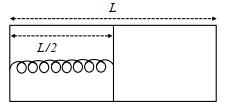
The left and right compartments of a thermally isolated container of length $L$ are separated by a thermally conducting,movable piston of area $A$. The left and right compartments are filled with $\frac{3}{2}$ and $1$ moles of an ideal gas,respectively. In the left compartment,the piston is attached by a spring with spring constant $k$ and natural length $\frac{2L}{5}$. In thermodynamic equilibrium,the piston is at a distance $\frac{L}{2}$ from the left and right edges of the container as shown in the figure. Under the above conditions,if the pressure in the right compartment is $P = \frac{kL}{A} \alpha$,then the value of $\alpha$ is:
A
$(0.20)$
B
$(1.20)$
C
$(2.20)$
D
$(3.20)$
Solution
(A) The extension in the spring is $x = \frac{L}{2} - \frac{2L}{5} = \frac{L}{10}$.
Considering the free body diagram of the piston,the forces acting on it are the pressure from the left gas $(P_1 A)$,the pressure from the right gas $(P_2 A)$,and the spring force $(kx)$.
Since the piston is in equilibrium,$P_1 A = P_2 A + kx$,which gives $P_1 = P_2 + \frac{kx}{A} = P_2 + \frac{k(L/10)}{A} = P_2 + \frac{kL}{10A}$.
Since the piston is thermally conducting,the temperature $T$ of the gas in both compartments is the same.
Using the ideal gas law $PV = nRT$,we have $P_1 V_1 = n_1 RT$ and $P_2 V_2 = n_2 RT$.
Given $V_1 = V_2 = A(L/2)$,we get $\frac{P_1}{P_2} = \frac{n_1}{n_2} = \frac{3/2}{1} = \frac{3}{2}$,so $P_1 = 1.5 P_2$.
Substituting $P_1$ into the equilibrium equation: $1.5 P_2 = P_2 + \frac{kL}{10A}$.
$0.5 P_2 = \frac{kL}{10A} \implies P_2 = \frac{kL}{5A} = \frac{kL}{A} \times 0.2$.
Thus,$\alpha = 0.2$.
Considering the free body diagram of the piston,the forces acting on it are the pressure from the left gas $(P_1 A)$,the pressure from the right gas $(P_2 A)$,and the spring force $(kx)$.
Since the piston is in equilibrium,$P_1 A = P_2 A + kx$,which gives $P_1 = P_2 + \frac{kx}{A} = P_2 + \frac{k(L/10)}{A} = P_2 + \frac{kL}{10A}$.
Since the piston is thermally conducting,the temperature $T$ of the gas in both compartments is the same.
Using the ideal gas law $PV = nRT$,we have $P_1 V_1 = n_1 RT$ and $P_2 V_2 = n_2 RT$.
Given $V_1 = V_2 = A(L/2)$,we get $\frac{P_1}{P_2} = \frac{n_1}{n_2} = \frac{3/2}{1} = \frac{3}{2}$,so $P_1 = 1.5 P_2$.
Substituting $P_1$ into the equilibrium equation: $1.5 P_2 = P_2 + \frac{kL}{10A}$.
$0.5 P_2 = \frac{kL}{10A} \implies P_2 = \frac{kL}{5A} = \frac{kL}{A} \times 0.2$.
Thus,$\alpha = 0.2$.
0 likes
View Solution153
MediumMCQ
An insulated container contains a diatomic gas of molar mass '$m$'. The container is moving with velocity '$V$'. If it is stopped suddenly,the change in temperature is ($R=$ gas constant).
A
$\frac{mV^2}{3R}$
B
$\frac{mV^2}{5R}$
C
$\frac{mV}{7R}$
D
$\frac{5mV}{3R}$
Solution
(B) The kinetic energy of the gas inside the container is given by $K.E. = n \left( \frac{1}{2} m V^2 \right)$,where $n$ is the number of moles and $m$ is the molar mass.
When the container is stopped suddenly,this kinetic energy is converted into the internal energy of the gas.
The change in internal energy is given by $\Delta U = n C_v \Delta T$.
For a diatomic gas,the molar heat capacity at constant volume is $C_v = \frac{5}{2} R$.
Since the energy is conserved,$\Delta U = K.E.$
Substituting the values: $n \left( \frac{5}{2} R \right) \Delta T = n \left( \frac{1}{2} m V^2 \right)$.
Simplifying the equation: $\frac{5}{2} R \Delta T = \frac{1}{2} m V^2$.
Therefore,the change in temperature is $\Delta T = \frac{mV^2}{5R}$.
When the container is stopped suddenly,this kinetic energy is converted into the internal energy of the gas.
The change in internal energy is given by $\Delta U = n C_v \Delta T$.
For a diatomic gas,the molar heat capacity at constant volume is $C_v = \frac{5}{2} R$.
Since the energy is conserved,$\Delta U = K.E.$
Substituting the values: $n \left( \frac{5}{2} R \right) \Delta T = n \left( \frac{1}{2} m V^2 \right)$.
Simplifying the equation: $\frac{5}{2} R \Delta T = \frac{1}{2} m V^2$.
Therefore,the change in temperature is $\Delta T = \frac{mV^2}{5R}$.
0 likes
View Solution154
EasyMCQ
According to the kinetic theory of gases,when two molecules of a gas collide with each other,then:
A
both kinetic energy and momentum are conserved.
B
neither kinetic energy nor momentum is conserved.
C
momentum is conserved but kinetic energy is not conserved.
D
kinetic energy is conserved but momentum is not conserved.
Solution
(A) According to the kinetic theory of gases,the collisions between gas molecules are assumed to be perfectly elastic.
In an elastic collision,both the total linear momentum and the total kinetic energy of the system are conserved.
Therefore,when two molecules of a gas collide,both kinetic energy and momentum are conserved.
In an elastic collision,both the total linear momentum and the total kinetic energy of the system are conserved.
Therefore,when two molecules of a gas collide,both kinetic energy and momentum are conserved.
0 likes
View Solution155
EasyMCQ
According to the kinetic theory of gases,which of the following statements is $WRONG$?
A
The pressure exerted by a gas is due to the collisions between the molecules of the gas
B
Collisions between the molecules of a gas and that of the molecules with the walls of the containers are perfectly elastic
C
All molecules of a gas are identical
D
The molecules do not exert appreciable force on one another except during collision
Solution
(A) According to the kinetic theory of gases,the pressure exerted by a gas is due to the collisions of gas molecules with the walls of the container,not due to collisions between the molecules themselves.
Therefore,statement $A$ is incorrect.
Statement $B$ is a fundamental postulate of the kinetic theory.
Statement $C$ is a standard assumption for an ideal gas.
Statement $D$ is also a fundamental postulate,assuming no intermolecular forces exist except during collisions.
Therefore,statement $A$ is incorrect.
Statement $B$ is a fundamental postulate of the kinetic theory.
Statement $C$ is a standard assumption for an ideal gas.
Statement $D$ is also a fundamental postulate,assuming no intermolecular forces exist except during collisions.
0 likes
View Solution156
MediumMCQ
An insulated container contains a monoatomic gas of molar mass '$m$'. The container is moving with velocity '$V$'. If it is stopped suddenly,the change in temperature is ($R=$ gas constant).
A
$\frac{mV^2}{5 R}$
B
$\frac{mV^2}{3 R}$
C
$\frac{mV^2}{7 R}$
D
$\frac{mV^2}{9 R}$
Solution
(B) Let $n$ be the number of moles of the gas. The total mass of the gas is $M = nm$.
The kinetic energy of the gas due to the motion of the container is $K = \frac{1}{2} M V^2 = \frac{1}{2} nm V^2$.
When the container is stopped suddenly,this kinetic energy is converted into the internal energy of the gas.
For a monoatomic gas,the change in internal energy is given by $\Delta U = \frac{3}{2} n R \Delta T$.
Equating the loss in kinetic energy to the change in internal energy:
$\frac{1}{2} nm V^2 = \frac{3}{2} n R \Delta T$.
Canceling $n$ and $\frac{1}{2}$ from both sides:
$m V^2 = 3 R \Delta T$.
Therefore,the change in temperature is $\Delta T = \frac{mV^2}{3 R}$.
The kinetic energy of the gas due to the motion of the container is $K = \frac{1}{2} M V^2 = \frac{1}{2} nm V^2$.
When the container is stopped suddenly,this kinetic energy is converted into the internal energy of the gas.
For a monoatomic gas,the change in internal energy is given by $\Delta U = \frac{3}{2} n R \Delta T$.
Equating the loss in kinetic energy to the change in internal energy:
$\frac{1}{2} nm V^2 = \frac{3}{2} n R \Delta T$.
Canceling $n$ and $\frac{1}{2}$ from both sides:
$m V^2 = 3 R \Delta T$.
Therefore,the change in temperature is $\Delta T = \frac{mV^2}{3 R}$.
0 likes
View Solution157
MediumMCQ
The average translational kinetic energy of $N$ molecules in a gas is $E_1$. The kinetic energy of the electron $(e)$ accelerated from rest through potential difference $V$ volt is $E_2$. The temperature at which $E_1=E_2$ is possible is ( $R=$ gas constant,$N=$ number of molecules).
A
$\frac{3 V N e}{2 R}$
B
$\frac{V N e}{2 R}$
C
$\frac{V N e}{3 R}$
D
$\frac{2 V N e}{3 R}$
Solution
(D) The average translational kinetic energy of a gas molecule is given by $\frac{3}{2} k_B T$,where $k_B = \frac{R}{N_A}$. For $N$ molecules,the total average translational kinetic energy is $E_1 = \frac{3}{2} \left( \frac{R}{N_A} \right) T$. However,given the context of $N$ molecules,we use $E_1 = \frac{3}{2} \left( \frac{R}{N} \right) T$.
The kinetic energy of an electron accelerated from rest through a potential difference $V$ is $E_2 = eV$.
Setting $E_1 = E_2$:
$\frac{3}{2} \left( \frac{R}{N} \right) T = eV$
Solving for $T$:
$T = \frac{2 N eV}{3 R}$.
The kinetic energy of an electron accelerated from rest through a potential difference $V$ is $E_2 = eV$.
Setting $E_1 = E_2$:
$\frac{3}{2} \left( \frac{R}{N} \right) T = eV$
Solving for $T$:
$T = \frac{2 N eV}{3 R}$.
0 likes
View Solution158
MediumMCQ
Select the correct statement.
A
The product of pressure and volume of an ideal gas is equal to the translational kinetic energy of the molecules.
B
The temperature of a gas is $-73^{\circ} C$. When the gas is heated to $527^{\circ} C$,the r.m.s. speed of the molecules is doubled.
C
The temperature of a gas is $-100^{\circ} C$. When the gas is heated to $+627^{\circ} C$,the r.m.s. speed of the molecules is four times.
D
The product of pressure and volume of an ideal gas is equal to half the translational kinetic energy.
Solution
(B) For an ideal gas,the translational kinetic energy $K$ is given by $K = \frac{3}{2} PV$. Thus,$PV = \frac{2}{3} K$. Options $A$ and $D$ are incorrect.
For r.m.s. speed,$v_{rms} \propto \sqrt{T}$.
In option $B$: $T_1 = -73 + 273 = 200 \ K$ and $T_2 = 527 + 273 = 800 \ K$. The ratio $\frac{v_2}{v_1} = \sqrt{\frac{T_2}{T_1}} = \sqrt{\frac{800}{200}} = \sqrt{4} = 2$. Thus,the r.m.s. speed doubles. Option $B$ is correct.
In option $C$: $T_1 = -100 + 273 = 173 \ K$ and $T_2 = 627 + 273 = 900 \ K$. The ratio $\frac{v_2}{v_1} = \sqrt{\frac{900}{173}} \neq 4$. Option $C$ is incorrect.
For r.m.s. speed,$v_{rms} \propto \sqrt{T}$.
In option $B$: $T_1 = -73 + 273 = 200 \ K$ and $T_2 = 527 + 273 = 800 \ K$. The ratio $\frac{v_2}{v_1} = \sqrt{\frac{T_2}{T_1}} = \sqrt{\frac{800}{200}} = \sqrt{4} = 2$. Thus,the r.m.s. speed doubles. Option $B$ is correct.
In option $C$: $T_1 = -100 + 273 = 173 \ K$ and $T_2 = 627 + 273 = 900 \ K$. The ratio $\frac{v_2}{v_1} = \sqrt{\frac{900}{173}} \neq 4$. Option $C$ is incorrect.
0 likes
View Solution159
EasyMCQ
$A$ fixed mass of gas at constant pressure occupies a volume $V$. The gas undergoes a rise in temperature so that the r.m.s. velocity of the molecules is doubled. The new volume will be
A
$V/2$
B
$V/\sqrt{2}$
C
$2V$
D
$4V$
Solution
(D) The root mean square velocity is given by $V_{rms} = \sqrt{\frac{3KT}{M}}$,which implies $V_{rms}^2 \propto T$.
When the r.m.s. velocity is doubled,the new velocity $V_{rms}' = 2V_{rms}$.
Therefore,$(2V_{rms})^2 \propto T_2 \Rightarrow 4(V_{rms}^2) \propto T_2$.
Since $V_{rms}^2 \propto T_1$,we get $T_2 = 4T_1$.
According to Charles's Law,for a fixed mass of gas at constant pressure,$V \propto T$.
Thus,$\frac{V_1}{V_2} = \frac{T_1}{T_2}$.
Substituting the values,$\frac{V}{V_2} = \frac{T_1}{4T_1} = \frac{1}{4}$.
Therefore,the new volume $V_2 = 4V$.
When the r.m.s. velocity is doubled,the new velocity $V_{rms}' = 2V_{rms}$.
Therefore,$(2V_{rms})^2 \propto T_2 \Rightarrow 4(V_{rms}^2) \propto T_2$.
Since $V_{rms}^2 \propto T_1$,we get $T_2 = 4T_1$.
According to Charles's Law,for a fixed mass of gas at constant pressure,$V \propto T$.
Thus,$\frac{V_1}{V_2} = \frac{T_1}{T_2}$.
Substituting the values,$\frac{V}{V_2} = \frac{T_1}{4T_1} = \frac{1}{4}$.
Therefore,the new volume $V_2 = 4V$.
0 likes
View Solution160
EasyMCQ
The r.m.s. velocity of hydrogen at $S.T.P.$ is $u \ m/s$. If the gas is heated at constant pressure until its volume becomes three times,then the final temperature of the gas and the r.m.s. speed are respectively:
A
$819 \ K, \sqrt{3} u \ m/s$
B
$1092 \ K, 3 u \ m/s$
C
$819 \ K, \frac{u}{\sqrt{3}} \ m/s$
D
$1092 \ K, \frac{u}{3} \ m/s$
Solution
(A) At $S.T.P.$,the initial temperature $T_1 = 273 \ K$.
Since the process occurs at constant pressure,according to Charles's Law,$V \propto T$,which implies $\frac{V_2}{V_1} = \frac{T_2}{T_1}$.
Given $V_2 = 3V_1$,we have $\frac{3V_1}{V_1} = \frac{T_2}{T_1} \Rightarrow T_2 = 3T_1$.
Therefore,$T_2 = 3 \times 273 = 819 \ K$.
The r.m.s. speed is given by $V_{rms} = \sqrt{\frac{3RT}{M_0}}$,which means $V_{rms} \propto \sqrt{T}$.
Thus,$\frac{V_{rms}'}{V_{rms}} = \sqrt{\frac{T_2}{T_1}} = \sqrt{\frac{3T_1}{T_1}} = \sqrt{3}$.
Given $V_{rms} = u$,the new r.m.s. speed is $V_{rms}' = \sqrt{3} u \ m/s$.
Since the process occurs at constant pressure,according to Charles's Law,$V \propto T$,which implies $\frac{V_2}{V_1} = \frac{T_2}{T_1}$.
Given $V_2 = 3V_1$,we have $\frac{3V_1}{V_1} = \frac{T_2}{T_1} \Rightarrow T_2 = 3T_1$.
Therefore,$T_2 = 3 \times 273 = 819 \ K$.
The r.m.s. speed is given by $V_{rms} = \sqrt{\frac{3RT}{M_0}}$,which means $V_{rms} \propto \sqrt{T}$.
Thus,$\frac{V_{rms}'}{V_{rms}} = \sqrt{\frac{T_2}{T_1}} = \sqrt{\frac{3T_1}{T_1}} = \sqrt{3}$.
Given $V_{rms} = u$,the new r.m.s. speed is $V_{rms}' = \sqrt{3} u \ m/s$.
0 likes
View Solution161
DifficultMCQ
An ideal gas $(\gamma = 1.5)$ is expanded adiabatically. To reduce the root mean square velocity of the molecules by a factor of $2$,the gas should be expanded by how many times?
A
$20$
B
$16$
C
$12$
D
$8$
Solution
(B) The root mean square (r.m.s.) velocity $v$ is given by $v = \sqrt{\frac{3RT}{M}}$,which implies $v \propto \sqrt{T}$.
Therefore,$\frac{v_2}{v_1} = \sqrt{\frac{T_2}{T_1}}$.
Given that the r.m.s. velocity is reduced by a factor of $2$,we have $v_2 = \frac{v_1}{2}$.
Substituting this into the ratio,$\frac{1}{2} = \sqrt{\frac{T_2}{T_1}}$,which gives $\frac{T_1}{T_2} = 4$.
For an adiabatic process,the relationship between temperature and volume is $T_1 V_1^{\gamma-1} = T_2 V_2^{\gamma-1}$.
Rearranging this,we get $\left(\frac{V_2}{V_1}\right)^{\gamma-1} = \frac{T_1}{T_2}$.
Substituting $\gamma = 1.5$ and $\frac{T_1}{T_2} = 4$,we get $\left(\frac{V_2}{V_1}\right)^{1.5-1} = 4$.
This simplifies to $\left(\frac{V_2}{V_1}\right)^{0.5} = 4$.
Squaring both sides,we get $\frac{V_2}{V_1} = 4^2 = 16$.
Thus,the gas should be expanded $16$ times.
Therefore,$\frac{v_2}{v_1} = \sqrt{\frac{T_2}{T_1}}$.
Given that the r.m.s. velocity is reduced by a factor of $2$,we have $v_2 = \frac{v_1}{2}$.
Substituting this into the ratio,$\frac{1}{2} = \sqrt{\frac{T_2}{T_1}}$,which gives $\frac{T_1}{T_2} = 4$.
For an adiabatic process,the relationship between temperature and volume is $T_1 V_1^{\gamma-1} = T_2 V_2^{\gamma-1}$.
Rearranging this,we get $\left(\frac{V_2}{V_1}\right)^{\gamma-1} = \frac{T_1}{T_2}$.
Substituting $\gamma = 1.5$ and $\frac{T_1}{T_2} = 4$,we get $\left(\frac{V_2}{V_1}\right)^{1.5-1} = 4$.
This simplifies to $\left(\frac{V_2}{V_1}\right)^{0.5} = 4$.
Squaring both sides,we get $\frac{V_2}{V_1} = 4^2 = 16$.
Thus,the gas should be expanded $16$ times.
0 likes
View Solution162
EasyMCQ
According to the kinetic theory of gases,which one of the following statements is wrong?
A
All the molecules of a gas are identical.
B
Collisions between the molecules of a gas and that of the molecules with the walls of the container are perfectly elastic.
C
The molecules do not exert appreciable force on one another except during collision.
D
The pressure exerted by a gas is due to the collision between the molecules of the gas.
Solution
(D) According to the kinetic theory of gases,the pressure exerted by a gas is due to the collision of gas molecules with the walls of the container,not due to collisions between the molecules themselves.
Collisions between molecules are considered to be negligible in terms of contributing to the macroscopic pressure.
Therefore,statement $D$ is incorrect.
Collisions between molecules are considered to be negligible in terms of contributing to the macroscopic pressure.
Therefore,statement $D$ is incorrect.
0 likes
View Solution163
MediumMCQ
An insulated container contains a monoatomic gas of molar mass '$M$'. The container is moving with velocity '$V$'. If it is stopped suddenly,the change in temperature of the gas is [$R$ is the gas constant].
A
$\frac{MV^2}{R}$
B
$\frac{MV^2}{2R}$
C
$\frac{MV^2}{3R}$
D
$\frac{3MV^2}{2R}$
Solution
(C) The kinetic energy of the gas is converted into internal energy when the container is stopped suddenly.
Let $n$ be the number of moles of the gas. The total mass of the gas is $m_{total} = nM$.
The kinetic energy of the gas is $K = \frac{1}{2} (nM) V^2$.
The change in internal energy of a monoatomic gas is $\Delta U = n C_V \Delta T$.
For a monoatomic gas,the molar heat capacity at constant volume is $C_V = \frac{3}{2} R$.
Equating the kinetic energy to the change in internal energy:
$\frac{1}{2} n M V^2 = n \left( \frac{3}{2} R \right) \Delta T$
Dividing both sides by $n$:
$\frac{1}{2} M V^2 = \frac{3}{2} R \Delta T$
Solving for $\Delta T$:
$\Delta T = \frac{MV^2}{3R}$
Let $n$ be the number of moles of the gas. The total mass of the gas is $m_{total} = nM$.
The kinetic energy of the gas is $K = \frac{1}{2} (nM) V^2$.
The change in internal energy of a monoatomic gas is $\Delta U = n C_V \Delta T$.
For a monoatomic gas,the molar heat capacity at constant volume is $C_V = \frac{3}{2} R$.
Equating the kinetic energy to the change in internal energy:
$\frac{1}{2} n M V^2 = n \left( \frac{3}{2} R \right) \Delta T$
Dividing both sides by $n$:
$\frac{1}{2} M V^2 = \frac{3}{2} R \Delta T$
Solving for $\Delta T$:
$\Delta T = \frac{MV^2}{3R}$
0 likes
View Solution164
MediumMCQ
An ideal gas expands adiabatically $(\gamma = 1.5)$. To reduce the root-mean-square (r.m.s.) velocity of the molecules $3$ times, the gas has to be expanded by a factor of: (in $times$)
A
$81$
B
$27$
C
$9$
D
$3$
Solution
(A) The root-mean-square velocity of an ideal gas is given by $V_{\text{rms}} = \sqrt{\frac{3RT}{M_0}}$.
Since $V_{\text{rms}} \propto \sqrt{T}$, we have $T \propto V_{\text{rms}}^2$.
If $V_{\text{rms}}$ is reduced by a factor of $3$, then $T_2 = \frac{T_1}{3^2} = \frac{T_1}{9}$, so $\frac{T_1}{T_2} = 9$.
For an adiabatic process, $TV^{\gamma-1} = \text{constant}$, which implies $T_1 V_1^{\gamma-1} = T_2 V_2^{\gamma-1}$.
Rearranging gives $\frac{V_2}{V_1} = \left(\frac{T_1}{T_2}\right)^{\frac{1}{\gamma-1}}$.
Given $\gamma = 1.5$, then $\gamma - 1 = 0.5 = \frac{1}{2}$.
Substituting the values: $\frac{V_2}{V_1} = (9)^{\frac{1}{1/2}} = (9)^2 = 81$.
Thus, the gas must be expanded $81$ times.
Since $V_{\text{rms}} \propto \sqrt{T}$, we have $T \propto V_{\text{rms}}^2$.
If $V_{\text{rms}}$ is reduced by a factor of $3$, then $T_2 = \frac{T_1}{3^2} = \frac{T_1}{9}$, so $\frac{T_1}{T_2} = 9$.
For an adiabatic process, $TV^{\gamma-1} = \text{constant}$, which implies $T_1 V_1^{\gamma-1} = T_2 V_2^{\gamma-1}$.
Rearranging gives $\frac{V_2}{V_1} = \left(\frac{T_1}{T_2}\right)^{\frac{1}{\gamma-1}}$.
Given $\gamma = 1.5$, then $\gamma - 1 = 0.5 = \frac{1}{2}$.
Substituting the values: $\frac{V_2}{V_1} = (9)^{\frac{1}{1/2}} = (9)^2 = 81$.
Thus, the gas must be expanded $81$ times.
0 likes
View Solution165
EasyMCQ
The speed of sound in an ideal gas at a given temperature $T$ is $v$. The rms speed of gas molecules at that temperature is $v_{\text{rms}}$. The ratio of the velocities $v$ and $v_{\text{rms}}$ for helium and oxygen gases are $X$ and $X^{\prime}$,respectively. Then,$\frac{X}{X^{\prime}}$ is equal to
A
$\frac{21}{\sqrt{5}}$
B
$\frac{5}{\sqrt{21}}$
C
$\sqrt{\frac{5}{21}}$
D
$\frac{21}{5}$
Solution
(B) The speed of sound in an ideal gas is given by $v = \sqrt{\frac{\gamma RT}{M}}$,and the rms speed of gas molecules is given by $v_{\text{rms}} = \sqrt{\frac{3RT}{M}}$.
Taking the ratio,we get $\frac{v}{v_{\text{rms}}} = \sqrt{\frac{\gamma}{3}}$.
For Helium (monatomic gas),$\gamma_{\text{He}} = \frac{5}{3}$. Thus,$X = \sqrt{\frac{5/3}{3}} = \sqrt{\frac{5}{9}}$.
For Oxygen (diatomic gas),$\gamma_{\text{O}_2} = \frac{7}{5}$. Thus,$X^{\prime} = \sqrt{\frac{7/5}{3}} = \sqrt{\frac{7}{15}}$.
Now,the ratio $\frac{X}{X^{\prime}} = \frac{\sqrt{5/9}}{\sqrt{7/15}} = \sqrt{\frac{5}{9} \times \frac{15}{7}} = \sqrt{\frac{5 \times 5}{3 \times 7}} = \sqrt{\frac{25}{21}} = \frac{5}{\sqrt{21}}$.
Taking the ratio,we get $\frac{v}{v_{\text{rms}}} = \sqrt{\frac{\gamma}{3}}$.
For Helium (monatomic gas),$\gamma_{\text{He}} = \frac{5}{3}$. Thus,$X = \sqrt{\frac{5/3}{3}} = \sqrt{\frac{5}{9}}$.
For Oxygen (diatomic gas),$\gamma_{\text{O}_2} = \frac{7}{5}$. Thus,$X^{\prime} = \sqrt{\frac{7/5}{3}} = \sqrt{\frac{7}{15}}$.
Now,the ratio $\frac{X}{X^{\prime}} = \frac{\sqrt{5/9}}{\sqrt{7/15}} = \sqrt{\frac{5}{9} \times \frac{15}{7}} = \sqrt{\frac{5 \times 5}{3 \times 7}} = \sqrt{\frac{25}{21}} = \frac{5}{\sqrt{21}}$.
0 likes
View Solution166
EasyMCQ
$A$ vessel containing nitrogen gas is supplied a heat of $498 \,J$, so as to raise the temperature of the gas by $40^{\circ} C$ at constant pressure. The mass of nitrogen gas in the vessel is (Molecular mass of nitrogen $= 28 \,g/mol$; Universal gas constant $= 8.3 \,J \,mol^{-1} \,K^{-1}$) (in $\,g$)
A
$18$
B
$12$
C
$20$
D
$15$
Solution
(B) The heat supplied at constant pressure is given by the formula: $\Delta Q = n C_P \Delta T$.
Since nitrogen $(N_2)$ is a diatomic gas, its degrees of freedom $f = 5$.
The molar heat capacity at constant pressure is $C_P = (\frac{f}{2} + 1) R = (\frac{5}{2} + 1) R = \frac{7}{2} R$.
The number of moles $n = \frac{M}{M_0}$, where $M$ is the mass of the gas and $M_0$ is the molar mass $(28 \,g/mol)$.
Substituting the values: $498 = (\frac{M}{28}) \times (\frac{7}{2}) \times 8.3 \times 40$.
Simplifying the equation: $498 = M \times (\frac{7}{56}) \times 8.3 \times 40$.
$498 = M \times 0.125 \times 332$.
$498 = M \times 41.5$.
$M = \frac{498}{41.5} = 12 \,g$.
Since nitrogen $(N_2)$ is a diatomic gas, its degrees of freedom $f = 5$.
The molar heat capacity at constant pressure is $C_P = (\frac{f}{2} + 1) R = (\frac{5}{2} + 1) R = \frac{7}{2} R$.
The number of moles $n = \frac{M}{M_0}$, where $M$ is the mass of the gas and $M_0$ is the molar mass $(28 \,g/mol)$.
Substituting the values: $498 = (\frac{M}{28}) \times (\frac{7}{2}) \times 8.3 \times 40$.
Simplifying the equation: $498 = M \times (\frac{7}{56}) \times 8.3 \times 40$.
$498 = M \times 0.125 \times 332$.
$498 = M \times 41.5$.
$M = \frac{498}{41.5} = 12 \,g$.
0 likes
View Solution167
MediumMCQ
$A$ light container having a diatomic gas enclosed within is moving with velocity $v$. The mass of the gas is $M$ and the number of moles is $n$. The kinetic energy of the gas with respect to the ground is:
A
$\frac{1}{2} M v^2 + \frac{3}{2} n R T$
B
$\frac{1}{2} M v^2$
C
$\frac{1}{2} M v^2 + \frac{5}{2} n R T$
D
$\frac{5}{2} n R T$
Solution
(C) The total kinetic energy of a gas in a moving container with respect to the ground is the sum of the kinetic energy of the center of mass and the internal kinetic energy of the gas molecules.
$1$. The kinetic energy of the center of mass of the gas with respect to the ground is given by $K_{cm} = \frac{1}{2} M v^2$,where $M$ is the total mass of the gas and $v$ is the velocity of the container.
$2$. The internal kinetic energy of a diatomic gas (which has $f = 5$ degrees of freedom) with respect to the center of mass is given by $U = n \frac{f}{2} R T$.
$3$. Substituting $f = 5$,we get $U = \frac{5}{2} n R T$.
$4$. Therefore,the total kinetic energy with respect to the ground is $K_{total} = K_{cm} + U = \frac{1}{2} M v^2 + \frac{5}{2} n R T$.
$1$. The kinetic energy of the center of mass of the gas with respect to the ground is given by $K_{cm} = \frac{1}{2} M v^2$,where $M$ is the total mass of the gas and $v$ is the velocity of the container.
$2$. The internal kinetic energy of a diatomic gas (which has $f = 5$ degrees of freedom) with respect to the center of mass is given by $U = n \frac{f}{2} R T$.
$3$. Substituting $f = 5$,we get $U = \frac{5}{2} n R T$.
$4$. Therefore,the total kinetic energy with respect to the ground is $K_{total} = K_{cm} + U = \frac{1}{2} M v^2 + \frac{5}{2} n R T$.
0 likes
View Solution168
MediumMCQ
$A$ thermally insulated vessel with nitrogen gas at $27^{\circ} C$ is moving with a velocity of $100 \ m/s$. If the vessel is stopped suddenly,then the percentage change in the pressure of the gas is nearly (assume entire loss in $KE$ of the gas is given as heat to gas and $R=8.3 \ J \ mol^{-1} \ K^{-1}$)
A
$1.1$
B
$0.93$
C
$0.5$
D
$2.25$
Solution
(D) Let $n$ be the number of moles of $N_2$ gas. The kinetic energy of the gas is $K.E. = n \left( \frac{1}{2} M v^2 \right)$,where $M$ is the molar mass of $N_2$ $(28 \times 10^{-3} \ kg/mol)$.
Since the vessel is insulated,the loss in kinetic energy is converted into internal energy (heat) of the gas: $n \left( \frac{1}{2} M v^2 \right) = n C_v \Delta T$.
For a diatomic gas like $N_2$,the degrees of freedom $f = 5$,so $C_v = \frac{f}{2} R = \frac{5}{2} R$.
Thus,$\frac{1}{2} M v^2 = \frac{5}{2} R \Delta T \Rightarrow \Delta T = \frac{M v^2}{5 R}$.
From the ideal gas law $PV = nRT$,the change in pressure $\Delta P$ for a constant volume process is $\Delta P = \frac{nR \Delta T}{V} = \frac{P \Delta T}{T}$.
The percentage change in pressure is $\frac{\Delta P}{P} \times 100 = \frac{\Delta T}{T} \times 100$.
Substituting $\Delta T = \frac{M v^2}{5 R}$ and $T = 300 \ K$:
$\frac{\Delta P}{P} \times 100 = \frac{M v^2}{5 R T} \times 100 = \frac{28 \times 10^{-3} \times 100^2}{5 \times 8.3 \times 300} \times 100 = \frac{280}{12450} \times 100 \approx 2.25 \%$.
Since the vessel is insulated,the loss in kinetic energy is converted into internal energy (heat) of the gas: $n \left( \frac{1}{2} M v^2 \right) = n C_v \Delta T$.
For a diatomic gas like $N_2$,the degrees of freedom $f = 5$,so $C_v = \frac{f}{2} R = \frac{5}{2} R$.
Thus,$\frac{1}{2} M v^2 = \frac{5}{2} R \Delta T \Rightarrow \Delta T = \frac{M v^2}{5 R}$.
From the ideal gas law $PV = nRT$,the change in pressure $\Delta P$ for a constant volume process is $\Delta P = \frac{nR \Delta T}{V} = \frac{P \Delta T}{T}$.
The percentage change in pressure is $\frac{\Delta P}{P} \times 100 = \frac{\Delta T}{T} \times 100$.
Substituting $\Delta T = \frac{M v^2}{5 R}$ and $T = 300 \ K$:
$\frac{\Delta P}{P} \times 100 = \frac{M v^2}{5 R T} \times 100 = \frac{28 \times 10^{-3} \times 100^2}{5 \times 8.3 \times 300} \times 100 = \frac{280}{12450} \times 100 \approx 2.25 \%$.
0 likes
View Solution169
EasyMCQ
The ratio of the speed of sound in a monatomic gas at $27^{\circ} C$ and the root-mean-square (rms) speed of the molecules of the same gas at a temperature of $127^{\circ} C$ is
A
$1 : 2$
B
$\sqrt{5}: \sqrt{12}$
C
$3 : 4$
D
$\sqrt{13}: \sqrt{17}$
Solution
(B) The speed of sound in a gas is given by $v = \sqrt{\frac{\gamma RT_1}{M}}$.
For a monatomic gas,the adiabatic index $\gamma = \frac{5}{3}$.
The rms speed of the molecules of the gas is given by $c = \sqrt{\frac{3RT_2}{M}}$.
Given temperatures are $T_1 = 27^{\circ} C = 300 \ K$ and $T_2 = 127^{\circ} C = 400 \ K$.
The ratio of the speed of sound to the rms speed is:
$\frac{v}{c} = \frac{\sqrt{\frac{\gamma RT_1}{M}}}{\sqrt{\frac{3RT_2}{M}}} = \sqrt{\frac{\gamma T_1}{3T_2}}$
Substituting the values:
$\frac{v}{c} = \sqrt{\frac{(5/3) \times 300}{3 \times 400}} = \sqrt{\frac{500}{1200}} = \sqrt{\frac{5}{12}} = \frac{\sqrt{5}}{\sqrt{12}}$.
For a monatomic gas,the adiabatic index $\gamma = \frac{5}{3}$.
The rms speed of the molecules of the gas is given by $c = \sqrt{\frac{3RT_2}{M}}$.
Given temperatures are $T_1 = 27^{\circ} C = 300 \ K$ and $T_2 = 127^{\circ} C = 400 \ K$.
The ratio of the speed of sound to the rms speed is:
$\frac{v}{c} = \frac{\sqrt{\frac{\gamma RT_1}{M}}}{\sqrt{\frac{3RT_2}{M}}} = \sqrt{\frac{\gamma T_1}{3T_2}}$
Substituting the values:
$\frac{v}{c} = \sqrt{\frac{(5/3) \times 300}{3 \times 400}} = \sqrt{\frac{500}{1200}} = \sqrt{\frac{5}{12}} = \frac{\sqrt{5}}{\sqrt{12}}$.
0 likes
View Solution170
EasyMCQ
$2.8 \ g$ of nitrogen gas $(N_2)$ is in a vessel at a temperature of $127^{\circ} C$. The amount of heat energy required to increase the rms speed of the nitrogen molecules by $41.4 \%$ is $(R = 8.31 \ J \ mol^{-1} \ K^{-1})$. (in $J$)
A
$376$
B
$415$
C
$1662$
D
$831$
Solution
(D) The molar mass of $N_2$ is $M = 28 \ g/mol$. The number of moles $n = \frac{2.8 \ g}{28 \ g/mol} = 0.1 \ mol$.
The initial temperature $T_1 = 127 + 273 = 400 \ K$.
The rms speed is given by $v_{rms} = \sqrt{\frac{3RT}{M}}$,which implies $v_{rms} \propto \sqrt{T}$.
If the speed increases by $41.4 \%$,the new speed $v_2 = v_1(1 + 0.414) = 1.414 \ v_1$.
Since $1.414 \approx \sqrt{2}$,we have $v_2 = \sqrt{2} \ v_1$.
Squaring both sides,$v_2^2 = 2 \ v_1^2$,which implies $T_2 = 2 \ T_1 = 2 \times 400 = 800 \ K$.
The heat energy required for a diatomic gas at constant volume is $Q = n C_v \Delta T$.
For $N_2$,$C_v = \frac{5}{2}R$.
Thus,$Q = 0.1 \times \frac{5}{2} \times 8.31 \times (800 - 400) = 0.1 \times 2.5 \times 8.31 \times 400 = 831 \ J$.
The initial temperature $T_1 = 127 + 273 = 400 \ K$.
The rms speed is given by $v_{rms} = \sqrt{\frac{3RT}{M}}$,which implies $v_{rms} \propto \sqrt{T}$.
If the speed increases by $41.4 \%$,the new speed $v_2 = v_1(1 + 0.414) = 1.414 \ v_1$.
Since $1.414 \approx \sqrt{2}$,we have $v_2 = \sqrt{2} \ v_1$.
Squaring both sides,$v_2^2 = 2 \ v_1^2$,which implies $T_2 = 2 \ T_1 = 2 \times 400 = 800 \ K$.
The heat energy required for a diatomic gas at constant volume is $Q = n C_v \Delta T$.
For $N_2$,$C_v = \frac{5}{2}R$.
Thus,$Q = 0.1 \times \frac{5}{2} \times 8.31 \times (800 - 400) = 0.1 \times 2.5 \times 8.31 \times 400 = 831 \ J$.
0 likes
View Solution171
EasyMCQ
If $v_1$ is the speed of sound in a diatomic gas at $273^{\circ}C$ and $v_2$ is the r.m.s. speed of its molecules at $273 \ K$,then $\frac{v_1}{v_2}=$
A
$\sqrt{\frac{15}{14}}$
B
$\sqrt{\frac{14}{15}}$
C
$\sqrt{\frac{7}{8}}$
D
$\sqrt{\frac{8}{7}}$
Solution
(B) The speed of sound in a gas is given by $v_1 = \sqrt{\frac{\gamma RT}{M}}$,where $\gamma$ is the adiabatic index,$R$ is the gas constant,$T$ is the temperature in Kelvin,and $M$ is the molar mass.
For a diatomic gas,$\gamma = 1.4 = \frac{7}{5}$.
At $273^{\circ}C$,$T_1 = 273 + 273 = 546 \ K$.
So,$v_1 = \sqrt{\frac{7RT_1}{5M}} = \sqrt{\frac{7R(546)}{5M}}$.
The r.m.s. speed of gas molecules is given by $v_2 = \sqrt{\frac{3RT_2}{M}}$.
At $273 \ K$,$T_2 = 273 \ K$.
So,$v_2 = \sqrt{\frac{3R(273)}{M}}$.
Now,the ratio $\frac{v_1}{v_2} = \sqrt{\frac{7R(546)}{5M} \cdot \frac{M}{3R(273)}} = \sqrt{\frac{7 \cdot 546}{5 \cdot 3 \cdot 273}}$.
Since $546 = 2 \cdot 273$,we have $\frac{v_1}{v_2} = \sqrt{\frac{7 \cdot 2}{5 \cdot 3}} = \sqrt{\frac{14}{15}}$.
For a diatomic gas,$\gamma = 1.4 = \frac{7}{5}$.
At $273^{\circ}C$,$T_1 = 273 + 273 = 546 \ K$.
So,$v_1 = \sqrt{\frac{7RT_1}{5M}} = \sqrt{\frac{7R(546)}{5M}}$.
The r.m.s. speed of gas molecules is given by $v_2 = \sqrt{\frac{3RT_2}{M}}$.
At $273 \ K$,$T_2 = 273 \ K$.
So,$v_2 = \sqrt{\frac{3R(273)}{M}}$.
Now,the ratio $\frac{v_1}{v_2} = \sqrt{\frac{7R(546)}{5M} \cdot \frac{M}{3R(273)}} = \sqrt{\frac{7 \cdot 546}{5 \cdot 3 \cdot 273}}$.
Since $546 = 2 \cdot 273$,we have $\frac{v_1}{v_2} = \sqrt{\frac{7 \cdot 2}{5 \cdot 3}} = \sqrt{\frac{14}{15}}$.
0 likes
View Solution172
EasyMCQ
The total internal energy of $2$ moles of a monatomic gas at a temperature $27^{\circ} C$ is $U$. The total internal energy of $3$ moles of a diatomic gas at a temperature $127^{\circ} C$ is:
A
$U$
B
$\frac{10 U}{3}$
C
$2 U$
D
$\frac{2 U}{3}$
Solution
(B) For a monatomic gas,the degrees of freedom $f_1 = 3$. Given $n_1 = 2$ moles and $T_1 = 27^{\circ} C = 300 \ K$. The internal energy $U$ is given by $U = \frac{n_1 f_1 R T_1}{2} = \frac{2 \times 3 \times R \times 300}{2} = 900 R$.
For a diatomic gas,the degrees of freedom $f_2 = 5$. Given $n_2 = 3$ moles and $T_2 = 127^{\circ} C = 400 \ K$. The internal energy $U'$ is given by $U' = \frac{n_2 f_2 R T_2}{2} = \frac{3 \times 5 \times R \times 400}{2} = 3000 R$.
Now,calculating the ratio: $\frac{U'}{U} = \frac{3000 R}{900 R} = \frac{30}{9} = \frac{10}{3}$.
Therefore,$U' = \frac{10 U}{3}$.
For a diatomic gas,the degrees of freedom $f_2 = 5$. Given $n_2 = 3$ moles and $T_2 = 127^{\circ} C = 400 \ K$. The internal energy $U'$ is given by $U' = \frac{n_2 f_2 R T_2}{2} = \frac{3 \times 5 \times R \times 400}{2} = 3000 R$.
Now,calculating the ratio: $\frac{U'}{U} = \frac{3000 R}{900 R} = \frac{30}{9} = \frac{10}{3}$.
Therefore,$U' = \frac{10 U}{3}$.
0 likes
View Solution173
DifficultMCQ
An insulated system contains $4$ moles of an ideal diatomic gas at temperature $T$. When a heat $Q$ is supplied to the gas,$2$ moles of the gas is dissociated into atoms and the temperature remains constant. Then the relation between $Q$ and $T$ is ($R=$ universal gas constant.)
A
$Q=R T$
B
$Q=2 R T$
C
$Q=3 R T$
D
$Q=4 R T$
Solution
(A) Initial state: $4$ moles of diatomic gas at temperature $T$. Internal energy $U_i = 4 \times \frac{5}{2} RT = 10 RT$.
Final state: After dissociation,$2$ moles of diatomic gas remain,and $2$ moles of diatomic gas dissociate into $4$ moles of monatomic gas (since $1$ mole of $X_2$ gives $2$ moles of $X$).
Final internal energy $U_f = (2 \times \frac{5}{2} RT) + (4 \times \frac{3}{2} RT) = 5 RT + 6 RT = 11 RT$.
Since the temperature remains constant,the heat supplied $Q$ is equal to the change in internal energy $\Delta U$.
$Q = U_f - U_i = 11 RT - 10 RT = RT$.
Final state: After dissociation,$2$ moles of diatomic gas remain,and $2$ moles of diatomic gas dissociate into $4$ moles of monatomic gas (since $1$ mole of $X_2$ gives $2$ moles of $X$).
Final internal energy $U_f = (2 \times \frac{5}{2} RT) + (4 \times \frac{3}{2} RT) = 5 RT + 6 RT = 11 RT$.
Since the temperature remains constant,the heat supplied $Q$ is equal to the change in internal energy $\Delta U$.
$Q = U_f - U_i = 11 RT - 10 RT = RT$.
0 likes
View Solution174
EasyMCQ
$2 \text{ moles}$ of a monatomic gas requires heat energy $Q$ to be heated from $30^{\circ} C$ to $40^{\circ} C$ at constant volume. The heat energy required to raise the temperature of $4 \text{ moles}$ of a diatomic gas from $28^{\circ} C$ to $33^{\circ} C$ at constant volume is
A
$2 Q$
B
$\frac{7 Q}{2}$
C
$\frac{4 Q}{3}$
D
$\frac{5 Q}{3}$
Solution
(D) The heat energy required at constant volume is given by the formula $Q = n C_v \Delta T$.
For a monatomic gas,the molar heat capacity at constant volume is $C_v = \frac{3}{2} R$.
Given $n_1 = 2 \text{ moles}$,$\Delta T_1 = 40^{\circ} C - 30^{\circ} C = 10 \text{ K}$.
So,$Q = 2 \times \frac{3}{2} R \times 10 = 30 R$.
For a diatomic gas,the molar heat capacity at constant volume is $C_v = \frac{5}{2} R$.
Given $n_2 = 4 \text{ moles}$,$\Delta T_2 = 33^{\circ} C - 28^{\circ} C = 5 \text{ K}$.
Let the required heat be $Q'$.
$Q' = n_2 C_v \Delta T_2 = 4 \times \frac{5}{2} R \times 5 = 50 R$.
Now,taking the ratio: $\frac{Q'}{Q} = \frac{50 R}{30 R} = \frac{5}{3}$.
Therefore,$Q' = \frac{5}{3} Q$.
For a monatomic gas,the molar heat capacity at constant volume is $C_v = \frac{3}{2} R$.
Given $n_1 = 2 \text{ moles}$,$\Delta T_1 = 40^{\circ} C - 30^{\circ} C = 10 \text{ K}$.
So,$Q = 2 \times \frac{3}{2} R \times 10 = 30 R$.
For a diatomic gas,the molar heat capacity at constant volume is $C_v = \frac{5}{2} R$.
Given $n_2 = 4 \text{ moles}$,$\Delta T_2 = 33^{\circ} C - 28^{\circ} C = 5 \text{ K}$.
Let the required heat be $Q'$.
$Q' = n_2 C_v \Delta T_2 = 4 \times \frac{5}{2} R \times 5 = 50 R$.
Now,taking the ratio: $\frac{Q'}{Q} = \frac{50 R}{30 R} = \frac{5}{3}$.
Therefore,$Q' = \frac{5}{3} Q$.
0 likes
View Solution175
MediumMCQ
Statement $(I)$: Gas thermometers are less sensitive than liquid thermometers.
Statement $(II)$: The ratio of the universal gas constant and Avogadro's number is called Boltzmann's constant.
Statement $(III)$: The density of a given mass of a gas at constant pressure is inversely proportional to its absolute temperature.
The correct option among the following is:
Statement $(II)$: The ratio of the universal gas constant and Avogadro's number is called Boltzmann's constant.
Statement $(III)$: The density of a given mass of a gas at constant pressure is inversely proportional to its absolute temperature.
The correct option among the following is:
A
Statements $I, II, III$ are true.
B
Statements $I, II$ are true,but statement $III$ is false.
C
Statements $II, III$ are true,but statement $I$ is false.
D
Statements $I, II, III$ are false.
Solution
(C) Statement $(I)$ is false because gas thermometers are more sensitive than liquid thermometers due to the higher coefficient of thermal expansion of gases.
Statement $(II)$ is true. Boltzmann's constant $k_B$ is defined as the ratio of the universal gas constant $R$ to Avogadro's number $N_A$,i.e.,$k_B = \frac{R}{N_A}$.
Statement $(III)$ is true. From the ideal gas equation $PV = nRT$,we have $PV = \frac{m}{M}RT$,where $m$ is mass and $M$ is molar mass. Since density $\rho = \frac{m}{V}$,we get $P = \frac{\rho RT}{M}$. At constant pressure $P$,$\rho \propto \frac{1}{T}$.
Therefore,statements $(II)$ and $(III)$ are true,but statement $(I)$ is false.
Statement $(II)$ is true. Boltzmann's constant $k_B$ is defined as the ratio of the universal gas constant $R$ to Avogadro's number $N_A$,i.e.,$k_B = \frac{R}{N_A}$.
Statement $(III)$ is true. From the ideal gas equation $PV = nRT$,we have $PV = \frac{m}{M}RT$,where $m$ is mass and $M$ is molar mass. Since density $\rho = \frac{m}{V}$,we get $P = \frac{\rho RT}{M}$. At constant pressure $P$,$\rho \propto \frac{1}{T}$.
Therefore,statements $(II)$ and $(III)$ are true,but statement $(I)$ is false.
0 likes
View Solution176
MediumMCQ
$A$ vessel of volume $V$ contains an ideal gas having mass density $\rho$ at temperature $T$ and pressure $p$. After a portion of the gas is let out,the pressure in the vessel is decreased by $\Delta p$. The mass of the released gas is
A
$\rho V \Delta p / p$
B
$\frac{\Delta p}{p}$
C
$\frac{\rho}{p}$
D
$(\rho V)^2 \Delta p / p$
Solution
(A) From the ideal gas equation,$pV = nRT = (m/M)RT$,where $m$ is the mass of the gas and $M$ is the molar mass. Since $\rho = m/V$,we have $p = (\rho/M)RT$,or $\rho = pM / (RT)$.
Initially,the mass of the gas in the vessel is $m_1 = \rho V$.
After some gas is released,the pressure becomes $p' = p - \Delta p$. Since the volume $V$ and temperature $T$ remain constant,the new density $\rho'$ is given by $\rho' = p'M / (RT) = (p - \Delta p)M / (RT)$.
The new mass of the gas in the vessel is $m_2 = \rho' V = \frac{(p - \Delta p)M}{RT} V = \frac{(p - \Delta p)}{p} \rho V$.
The mass of the released gas $\Delta m$ is $m_1 - m_2 = \rho V - \frac{(p - \Delta p)}{p} \rho V$.
$\Delta m = \rho V \left(1 - \frac{p - \Delta p}{p}\right) = \rho V \left(\frac{p - p + \Delta p}{p}\right) = \frac{\rho V \Delta p}{p}$.
Initially,the mass of the gas in the vessel is $m_1 = \rho V$.
After some gas is released,the pressure becomes $p' = p - \Delta p$. Since the volume $V$ and temperature $T$ remain constant,the new density $\rho'$ is given by $\rho' = p'M / (RT) = (p - \Delta p)M / (RT)$.
The new mass of the gas in the vessel is $m_2 = \rho' V = \frac{(p - \Delta p)M}{RT} V = \frac{(p - \Delta p)}{p} \rho V$.
The mass of the released gas $\Delta m$ is $m_1 - m_2 = \rho V - \frac{(p - \Delta p)}{p} \rho V$.
$\Delta m = \rho V \left(1 - \frac{p - \Delta p}{p}\right) = \rho V \left(\frac{p - p + \Delta p}{p}\right) = \frac{\rho V \Delta p}{p}$.
0 likes
View Solution177
MediumMCQ
If the heat required to increase the rms speed of $4$ moles of a diatomic gas from $v$ to $\sqrt{3} v$ is $83.1 \ kJ$,then the initial temperature of the gas is (Universal gas constant $R = 8.31 \ J \ mol^{-1} \ K^{-1}$) (in $^{\circ} C$)
A
$377$
B
$327$
C
$227$
D
$277$
Solution
(C) The rms speed of a gas is given by $v_{rms} = \sqrt{\frac{3RT}{M}}$.
Since $v_{rms} \propto \sqrt{T}$,if the speed increases from $v$ to $\sqrt{3}v$,the temperature increases from $T_1$ to $T_2$ such that $\frac{v_{rms2}}{v_{rms1}} = \sqrt{\frac{T_2}{T_1}} = \sqrt{3}$.
Thus,$\frac{T_2}{T_1} = 3$,which implies $T_2 = 3T_1$.
The heat required for a diatomic gas at constant volume is given by $Q = n C_v \Delta T$.
For a diatomic gas,the degrees of freedom $f = 5$,so $C_v = \frac{5}{2}R$.
Given $n = 4 \ mol$,$Q = 83.1 \ kJ = 83100 \ J$,and $R = 8.31 \ J \ mol^{-1} \ K^{-1}$.
Substituting the values: $83100 = 4 \times \frac{5}{2} \times 8.31 \times (3T_1 - T_1)$.
$83100 = 10 \times 8.31 \times 2T_1$.
$83100 = 166.2 \times T_1$.
$T_1 = \frac{83100}{166.2} = 500 \ K$.
Converting to Celsius: $T_1(^{\circ}C) = 500 - 273 = 227^{\circ}C$.
Since $v_{rms} \propto \sqrt{T}$,if the speed increases from $v$ to $\sqrt{3}v$,the temperature increases from $T_1$ to $T_2$ such that $\frac{v_{rms2}}{v_{rms1}} = \sqrt{\frac{T_2}{T_1}} = \sqrt{3}$.
Thus,$\frac{T_2}{T_1} = 3$,which implies $T_2 = 3T_1$.
The heat required for a diatomic gas at constant volume is given by $Q = n C_v \Delta T$.
For a diatomic gas,the degrees of freedom $f = 5$,so $C_v = \frac{5}{2}R$.
Given $n = 4 \ mol$,$Q = 83.1 \ kJ = 83100 \ J$,and $R = 8.31 \ J \ mol^{-1} \ K^{-1}$.
Substituting the values: $83100 = 4 \times \frac{5}{2} \times 8.31 \times (3T_1 - T_1)$.
$83100 = 10 \times 8.31 \times 2T_1$.
$83100 = 166.2 \times T_1$.
$T_1 = \frac{83100}{166.2} = 500 \ K$.
Converting to Celsius: $T_1(^{\circ}C) = 500 - 273 = 227^{\circ}C$.
0 likes
View Solution178
EasyMCQ
$A$ thermally insulated vessel containing monatomic gas is moving with a speed of $30 \, m/s$. If the vessel suddenly stops, the increase in gas temperature is (Molar mass of gas $= 83 \, g/mol$ and $R = 8.3 \, J/K \cdot mol$). (in $ \, K$)
A
$1$
B
$3$
C
$4$
D
$6$
Solution
(B) The kinetic energy of the gas molecules due to the bulk motion of the vessel is converted into internal energy of the gas when the vessel stops suddenly.
Let $m$ be the molar mass of the gas and $v$ be the velocity of the vessel.
The kinetic energy per mole of the gas is $K.E. = \frac{1}{2} M v^2$, where $M$ is the molar mass in $kg/mol$.
$M = 83 \, g/mol = 0.083 \, kg/mol$.
$K.E. = \frac{1}{2} \times 0.083 \times (30)^2 = \frac{1}{2} \times 0.083 \times 900 = 0.083 \times 450 = 37.35 \, J/mol$.
For a monatomic gas, the change in internal energy is $\Delta U = n C_v \Delta T$.
Since $n=1$ mole and $C_v = \frac{3}{2} R$ for a monatomic gas:
$\Delta U = 1 \times \frac{3}{2} \times 8.3 \times \Delta T = 12.45 \Delta T$.
Equating the kinetic energy to the change in internal energy:
$37.35 = 12.45 \Delta T$.
$\Delta T = \frac{37.35}{12.45} = 3 \, K$.
Let $m$ be the molar mass of the gas and $v$ be the velocity of the vessel.
The kinetic energy per mole of the gas is $K.E. = \frac{1}{2} M v^2$, where $M$ is the molar mass in $kg/mol$.
$M = 83 \, g/mol = 0.083 \, kg/mol$.
$K.E. = \frac{1}{2} \times 0.083 \times (30)^2 = \frac{1}{2} \times 0.083 \times 900 = 0.083 \times 450 = 37.35 \, J/mol$.
For a monatomic gas, the change in internal energy is $\Delta U = n C_v \Delta T$.
Since $n=1$ mole and $C_v = \frac{3}{2} R$ for a monatomic gas:
$\Delta U = 1 \times \frac{3}{2} \times 8.3 \times \Delta T = 12.45 \Delta T$.
Equating the kinetic energy to the change in internal energy:
$37.35 = 12.45 \Delta T$.
$\Delta T = \frac{37.35}{12.45} = 3 \, K$.
0 likes
View Solution179
MediumMCQ
An ideal gas is placed in a tank at $27^{\circ} C$. The pressure is initially $600 \ kPa$. One fourth of the gas is then released from the tank and thermal equilibrium is established. What will be the pressure if the temperature is $327^{\circ} C$ (in $kPa$)?
A
$900$
B
$1000$
C
$1050$
D
$1250$
Solution
(A) Given: Initial temperature $T_1 = 27^{\circ} C = 300 \ K$,Initial pressure $P_1 = 600 \ kPa$.
After releasing one-fourth of the gas,the remaining amount of gas is $n_2 = \frac{3}{4} n_1$.
The volume $V$ of the tank remains constant,so $V_1 = V_2 = V$.
The final temperature is $T_2 = 327^{\circ} C = 600 \ K$.
Using the ideal gas law $PV = nRT$,we have $\frac{P_1 V}{n_1 T_1} = \frac{P_2 V}{n_2 T_2}$.
Rearranging for $P_2$: $P_2 = P_1 \times \left( \frac{n_2}{n_1} \right) \times \left( \frac{T_2}{T_1} \right)$.
Substituting the values: $P_2 = 600 \times \left( \frac{3}{4} \right) \times \left( \frac{600}{300} \right)$.
$P_2 = 600 \times 0.75 \times 2 = 900 \ kPa$.
After releasing one-fourth of the gas,the remaining amount of gas is $n_2 = \frac{3}{4} n_1$.
The volume $V$ of the tank remains constant,so $V_1 = V_2 = V$.
The final temperature is $T_2 = 327^{\circ} C = 600 \ K$.
Using the ideal gas law $PV = nRT$,we have $\frac{P_1 V}{n_1 T_1} = \frac{P_2 V}{n_2 T_2}$.
Rearranging for $P_2$: $P_2 = P_1 \times \left( \frac{n_2}{n_1} \right) \times \left( \frac{T_2}{T_1} \right)$.
Substituting the values: $P_2 = 600 \times \left( \frac{3}{4} \right) \times \left( \frac{600}{300} \right)$.
$P_2 = 600 \times 0.75 \times 2 = 900 \ kPa$.
0 likes
View Solution180
MediumMCQ
As per the kinetic theory of gases,which of the following statements is/are true?
$(a)$ Temperature of a gas is a measure of the average kinetic energy of a molecule.
$(b)$ Temperature of a gas depends on the nature of the gas.
$(c)$ Heavier molecules have lower average speed.
$(d)$ Lighter molecules have lower average speed.
$(a)$ Temperature of a gas is a measure of the average kinetic energy of a molecule.
$(b)$ Temperature of a gas depends on the nature of the gas.
$(c)$ Heavier molecules have lower average speed.
$(d)$ Lighter molecules have lower average speed.
A
$a$ and $b$ are true
B
$b$ and $c$ are true
C
$a$ and $c$ are true
D
$b$ and $d$ are true
Solution
(C) According to the kinetic theory of gases,the average kinetic energy of a gas molecule is given by $K.E. = \frac{3}{2} k_B T$. This shows that the temperature $T$ is a direct measure of the average kinetic energy of the molecules. Thus,statement $(a)$ is true.
Temperature is a state function that depends only on the average kinetic energy of the particles and is independent of the nature of the gas. Thus,statement $(b)$ is false.
The average speed of gas molecules is given by $v_{avg} = \sqrt{\frac{8RT}{\pi M}}$,where $M$ is the molar mass. Since $v_{avg} \propto \frac{1}{\sqrt{M}}$,heavier molecules (larger $M$) have a lower average speed. Thus,statement $(c)$ is true and statement $(d)$ is false.
Therefore,statements $(a)$ and $(c)$ are true.
Temperature is a state function that depends only on the average kinetic energy of the particles and is independent of the nature of the gas. Thus,statement $(b)$ is false.
The average speed of gas molecules is given by $v_{avg} = \sqrt{\frac{8RT}{\pi M}}$,where $M$ is the molar mass. Since $v_{avg} \propto \frac{1}{\sqrt{M}}$,heavier molecules (larger $M$) have a lower average speed. Thus,statement $(c)$ is true and statement $(d)$ is false.
Therefore,statements $(a)$ and $(c)$ are true.
0 likes
View Solution181
EasyMCQ
For an ideal gas at a temperature of $27^{\circ} C$ and at constant pressure,the coefficient of volume expansion is nearly
A
$33 \times 10^{-5} \ K^{-1}$
B
$22 \times 10^{-4} \ K^{-1}$
C
$37 \times 10^{-5} \ K^{-1}$
D
$33 \times 10^{-4} \ K^{-1}$
Solution
(D) For an ideal gas,the equation of state is $PV = nRT$.
At constant pressure $P$,differentiating with respect to temperature $T$,we get $P \frac{dV}{dT} = nR$,which implies $\frac{dV}{dT} = \frac{nR}{P}$.
The coefficient of volume expansion $\gamma$ is defined as $\gamma = \frac{1}{V} \frac{dV}{dT}$.
Substituting $\frac{dV}{dT} = \frac{nR}{P}$,we get $\gamma = \frac{1}{V} \left( \frac{nR}{P} \right) = \frac{nR}{PV}$.
Since $PV = nRT$,we have $\gamma = \frac{nR}{nRT} = \frac{1}{T}$.
Given temperature $T = 27^{\circ} C = 27 + 273 = 300 \ K$.
Therefore,$\gamma = \frac{1}{300} \ K^{-1} \approx 0.00333 \ K^{-1} = 33 \times 10^{-4} \ K^{-1}$.
At constant pressure $P$,differentiating with respect to temperature $T$,we get $P \frac{dV}{dT} = nR$,which implies $\frac{dV}{dT} = \frac{nR}{P}$.
The coefficient of volume expansion $\gamma$ is defined as $\gamma = \frac{1}{V} \frac{dV}{dT}$.
Substituting $\frac{dV}{dT} = \frac{nR}{P}$,we get $\gamma = \frac{1}{V} \left( \frac{nR}{P} \right) = \frac{nR}{PV}$.
Since $PV = nRT$,we have $\gamma = \frac{nR}{nRT} = \frac{1}{T}$.
Given temperature $T = 27^{\circ} C = 27 + 273 = 300 \ K$.
Therefore,$\gamma = \frac{1}{300} \ K^{-1} \approx 0.00333 \ K^{-1} = 33 \times 10^{-4} \ K^{-1}$.
0 likes
View Solution182
MediumMCQ
The difference between volume and pressure coefficients of an ideal gas is
A
$\frac{1}{273}$
B
$273$
C
$\frac{2}{273}$
D
zero
Solution
(D) For an ideal gas,the volume expansion coefficient $(\gamma_V)$ and the pressure coefficient $(\gamma_P)$ are defined as follows:
$\gamma_V = \frac{1}{V} (\frac{\partial V}{\partial T})_P$
$\gamma_P = \frac{1}{P} (\frac{\partial P}{\partial T})_V$
For an ideal gas,the equation of state is $PV = nRT$.
At constant pressure,$V = (\frac{nR}{P})T$,so $(\frac{\partial V}{\partial T})_P = \frac{nR}{P}$. Thus,$\gamma_V = \frac{1}{V} \cdot \frac{nR}{P} = \frac{1}{T}$.
At constant volume,$P = (\frac{nR}{V})T$,so $(\frac{\partial P}{\partial T})_V = \frac{nR}{V}$. Thus,$\gamma_P = \frac{1}{P} \cdot \frac{nR}{V} = \frac{1}{T}$.
Since $\gamma_V = \gamma_P = \frac{1}{T}$,their difference is $\gamma_V - \gamma_P = 0$.
$\gamma_V = \frac{1}{V} (\frac{\partial V}{\partial T})_P$
$\gamma_P = \frac{1}{P} (\frac{\partial P}{\partial T})_V$
For an ideal gas,the equation of state is $PV = nRT$.
At constant pressure,$V = (\frac{nR}{P})T$,so $(\frac{\partial V}{\partial T})_P = \frac{nR}{P}$. Thus,$\gamma_V = \frac{1}{V} \cdot \frac{nR}{P} = \frac{1}{T}$.
At constant volume,$P = (\frac{nR}{V})T$,so $(\frac{\partial P}{\partial T})_V = \frac{nR}{V}$. Thus,$\gamma_P = \frac{1}{P} \cdot \frac{nR}{V} = \frac{1}{T}$.
Since $\gamma_V = \gamma_P = \frac{1}{T}$,their difference is $\gamma_V - \gamma_P = 0$.
0 likes
View Solution183
MediumMCQ
At constant pressure,equal amounts of heat are supplied to a monatomic gas and a diatomic gas separately. The ratio of the increases in internal energies of the two gases is
A
$1$:$1$
B
$9$:$49$
C
$3$:$7$
D
$21$:$25$
Solution
(D) The heat supplied at constant pressure is given by $Q = n C_p \Delta T$. Since $Q$ and $n$ are equal,$C_p \Delta T$ is constant for both gases.
For a monatomic gas,$C_{p,1} = \frac{5}{2}R$ and the change in internal energy is $\Delta U_1 = n C_{v,1} \Delta T_1 = n (\frac{3}{2}R) \Delta T_1$.
For a diatomic gas,$C_{p,2} = \frac{7}{2}R$ and the change in internal energy is $\Delta U_2 = n C_{v,2} \Delta T_2 = n (\frac{5}{2}R) \Delta T_2$.
Since $Q = n C_{p,1} \Delta T_1 = n C_{p,2} \Delta T_2$,we have $\frac{5}{2}R \Delta T_1 = \frac{7}{2}R \Delta T_2$,which implies $\Delta T_1 = \frac{7}{5} \Delta T_2$.
The ratio of internal energy changes is $\frac{\Delta U_1}{\Delta U_2} = \frac{n (\frac{3}{2}R) \Delta T_1}{n (\frac{5}{2}R) \Delta T_2} = \frac{3}{5} \times \frac{\Delta T_1}{\Delta T_2} = \frac{3}{5} \times \frac{7}{5} = \frac{21}{25}$.
For a monatomic gas,$C_{p,1} = \frac{5}{2}R$ and the change in internal energy is $\Delta U_1 = n C_{v,1} \Delta T_1 = n (\frac{3}{2}R) \Delta T_1$.
For a diatomic gas,$C_{p,2} = \frac{7}{2}R$ and the change in internal energy is $\Delta U_2 = n C_{v,2} \Delta T_2 = n (\frac{5}{2}R) \Delta T_2$.
Since $Q = n C_{p,1} \Delta T_1 = n C_{p,2} \Delta T_2$,we have $\frac{5}{2}R \Delta T_1 = \frac{7}{2}R \Delta T_2$,which implies $\Delta T_1 = \frac{7}{5} \Delta T_2$.
The ratio of internal energy changes is $\frac{\Delta U_1}{\Delta U_2} = \frac{n (\frac{3}{2}R) \Delta T_1}{n (\frac{5}{2}R) \Delta T_2} = \frac{3}{5} \times \frac{\Delta T_1}{\Delta T_2} = \frac{3}{5} \times \frac{7}{5} = \frac{21}{25}$.
0 likes
View Solution184
DifficultMCQ
One mole of the ideal gas goes through the process $p=p_0\left[1-\alpha\left(\frac{V}{V_0}\right)^3\right]$,where $p$ and $V$ are pressure and volume,$p_0, V_0$ and $\alpha$ are constants. If the maximum attainable temperature of the gas is $\left(\frac{3}{4}\right) \frac{p_0 V_0}{R}$,then the value of $\alpha$ is
A
$2$
B
$\frac{1}{2}$
C
$\frac{1}{4}$
D
$4$
Solution
(C) For $1 \text{ mole}$ of an ideal gas,$pV = RT \Rightarrow p = \frac{RT}{V}$.
Given the process equation: $p = p_0 \left(1 - \alpha \frac{V^3}{V_0^3}\right)$.
Equating the two expressions for $p$: $\frac{RT}{V} = p_0 - \frac{\alpha p_0 V^3}{V_0^3} \Rightarrow T = \frac{p_0 V}{R} - \frac{\alpha p_0 V^4}{R V_0^3}$.
For maximum temperature,$\frac{dT}{dV} = 0$: $\frac{dT}{dV} = \frac{p_0}{R} - \frac{4 \alpha p_0 V^3}{R V_0^3} = 0$.
This gives $V^3 = \frac{V_0^3}{4 \alpha}$.
Substituting $V^3$ back into the expression for $T$: $T_{\max} = \frac{p_0}{R} \left( \frac{V_0}{(4 \alpha)^{1/3}} \right) - \frac{\alpha p_0}{R V_0^3} \left( \frac{V_0^3}{4 \alpha} \right) \left( \frac{V_0}{(4 \alpha)^{1/3}} \right) = \frac{p_0 V_0}{R (4 \alpha)^{1/3}} \left( 1 - \frac{1}{4} \right) = \frac{3}{4} \frac{p_0 V_0}{R (4 \alpha)^{1/3}}$.
Given $T_{\max} = \frac{3}{4} \frac{p_0 V_0}{R}$,we have $\frac{3}{4} \frac{p_0 V_0}{R} = \frac{3}{4} \frac{p_0 V_0}{R (4 \alpha)^{1/3}}$.
Thus,$(4 \alpha)^{1/3} = 1 \Rightarrow 4 \alpha = 1 \Rightarrow \alpha = \frac{1}{4}$.
Given the process equation: $p = p_0 \left(1 - \alpha \frac{V^3}{V_0^3}\right)$.
Equating the two expressions for $p$: $\frac{RT}{V} = p_0 - \frac{\alpha p_0 V^3}{V_0^3} \Rightarrow T = \frac{p_0 V}{R} - \frac{\alpha p_0 V^4}{R V_0^3}$.
For maximum temperature,$\frac{dT}{dV} = 0$: $\frac{dT}{dV} = \frac{p_0}{R} - \frac{4 \alpha p_0 V^3}{R V_0^3} = 0$.
This gives $V^3 = \frac{V_0^3}{4 \alpha}$.
Substituting $V^3$ back into the expression for $T$: $T_{\max} = \frac{p_0}{R} \left( \frac{V_0}{(4 \alpha)^{1/3}} \right) - \frac{\alpha p_0}{R V_0^3} \left( \frac{V_0^3}{4 \alpha} \right) \left( \frac{V_0}{(4 \alpha)^{1/3}} \right) = \frac{p_0 V_0}{R (4 \alpha)^{1/3}} \left( 1 - \frac{1}{4} \right) = \frac{3}{4} \frac{p_0 V_0}{R (4 \alpha)^{1/3}}$.
Given $T_{\max} = \frac{3}{4} \frac{p_0 V_0}{R}$,we have $\frac{3}{4} \frac{p_0 V_0}{R} = \frac{3}{4} \frac{p_0 V_0}{R (4 \alpha)^{1/3}}$.
Thus,$(4 \alpha)^{1/3} = 1 \Rightarrow 4 \alpha = 1 \Rightarrow \alpha = \frac{1}{4}$.
0 likes
View Solution185
MediumMCQ
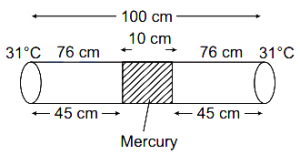
$A$ horizontal uniform glass tube of $100 \ cm$ length, sealed at both ends, contains a $10 \ cm$ mercury column in the middle. The temperature and pressure of air on either side of the mercury column are $31^{\circ} C$ and $76 \ cm$ of mercury, respectively. If the air column at one end is kept at $0^{\circ} C$ and the other end at $273^{\circ} C$, then the pressure of air which is at $0^{\circ} C$ is (in $cm$ of $Hg$):
A
$76$
B
$88.2$
C
$102.4$
D
$122$
Solution
(C) Initial state: The tube length is $100 \ cm$, with a $10 \ cm$ mercury column in the middle. The length of air on each side is $(100 - 10) / 2 = 45 \ cm$. Initial pressure $P_0 = 76 \ cm$ of $Hg$, initial temperature $T_0 = 31 + 273 = 304 \ K$.
Applying the ideal gas law $\frac{PV}{T} = \text{constant}$, for the initial state: $\frac{P_0 V_0}{T_0} = \frac{76 \times 45}{304}$.
Final state: Let the new length of the air column at $0^{\circ} C$ $(273 \ K)$ be $l$, and the length of the air column at $273^{\circ} C$ $(546 \ K)$ be $(90 - l)$. Let the new pressure be $P'$.
Since the mercury column is at rest, the pressure on both sides must be equal: $P_2 = P_3 = P'$.
Using the gas law for both sides:
$\frac{P' l}{273} = \frac{P' (90 - l)}{546} = \frac{76 \times 45}{304}$.
From $\frac{P' l}{273} = \frac{P' (90 - l)}{546}$, we get $2l = 90 - l$, which implies $3l = 90$, so $l = 30 \ cm$.
Now, substitute $l = 30 \ cm$ into the equation: $\frac{P' \times 30}{273} = \frac{76 \times 45}{304}$.
$P' = \frac{76 \times 45 \times 273}{304 \times 30} = \frac{76 \times 45 \times 273}{9120} = 102.375 \approx 102.4 \ cm$ of $Hg$.
Applying the ideal gas law $\frac{PV}{T} = \text{constant}$, for the initial state: $\frac{P_0 V_0}{T_0} = \frac{76 \times 45}{304}$.
Final state: Let the new length of the air column at $0^{\circ} C$ $(273 \ K)$ be $l$, and the length of the air column at $273^{\circ} C$ $(546 \ K)$ be $(90 - l)$. Let the new pressure be $P'$.
Since the mercury column is at rest, the pressure on both sides must be equal: $P_2 = P_3 = P'$.
Using the gas law for both sides:
$\frac{P' l}{273} = \frac{P' (90 - l)}{546} = \frac{76 \times 45}{304}$.
From $\frac{P' l}{273} = \frac{P' (90 - l)}{546}$, we get $2l = 90 - l$, which implies $3l = 90$, so $l = 30 \ cm$.
Now, substitute $l = 30 \ cm$ into the equation: $\frac{P' \times 30}{273} = \frac{76 \times 45}{304}$.
$P' = \frac{76 \times 45 \times 273}{304 \times 30} = \frac{76 \times 45 \times 273}{9120} = 102.375 \approx 102.4 \ cm$ of $Hg$.
0 likes
View Solution186
EasyMCQ
Two non-reactive monoatomic ideal gases have their atomic masses in the ratio $3:4$. The ratio of their partial pressures when enclosed in a vessel kept at a constant temperature is $2:3$. The ratio of their densities is
A
$1.1$
B
$2.0$
C
$0.9$
D
$0.5$
Solution
(D) From the ideal gas equation,we have $PV = nRT$.
Since the number of moles $n = \frac{m}{M}$,where $m$ is the mass and $M$ is the molar mass,we can write $PV = \frac{m}{M}RT$.
Dividing both sides by volume $V$,we get $P = \frac{m}{V} \cdot \frac{RT}{M} = \frac{\rho RT}{M}$,where $\rho = \frac{m}{V}$ is the density.
For two gases $A$ and $B$ at the same temperature $T$,the ratio of their partial pressures is given by:
$\frac{P_A}{P_B} = \frac{\rho_A R T / M_A}{\rho_B R T / M_B} = \frac{\rho_A}{\rho_B} \times \frac{M_B}{M_A}$.
Rearranging to find the ratio of densities:
$\frac{\rho_A}{\rho_B} = \frac{P_A}{P_B} \times \frac{M_A}{M_B}$.
Given $\frac{M_A}{M_B} = \frac{3}{4}$ and $\frac{P_A}{P_B} = \frac{2}{3}$.
Substituting these values:
$\frac{\rho_A}{\rho_B} = \frac{2}{3} \times \frac{3}{4} = \frac{6}{12} = 0.5$.
Since the number of moles $n = \frac{m}{M}$,where $m$ is the mass and $M$ is the molar mass,we can write $PV = \frac{m}{M}RT$.
Dividing both sides by volume $V$,we get $P = \frac{m}{V} \cdot \frac{RT}{M} = \frac{\rho RT}{M}$,where $\rho = \frac{m}{V}$ is the density.
For two gases $A$ and $B$ at the same temperature $T$,the ratio of their partial pressures is given by:
$\frac{P_A}{P_B} = \frac{\rho_A R T / M_A}{\rho_B R T / M_B} = \frac{\rho_A}{\rho_B} \times \frac{M_B}{M_A}$.
Rearranging to find the ratio of densities:
$\frac{\rho_A}{\rho_B} = \frac{P_A}{P_B} \times \frac{M_A}{M_B}$.
Given $\frac{M_A}{M_B} = \frac{3}{4}$ and $\frac{P_A}{P_B} = \frac{2}{3}$.
Substituting these values:
$\frac{\rho_A}{\rho_B} = \frac{2}{3} \times \frac{3}{4} = \frac{6}{12} = 0.5$.
0 likes
View Solution187
DifficultMCQ
An ideal gas of molar mass $M$ is contained in a very tall vertical cylindrical column in a uniform gravitational field. Assuming the gas temperature to be $T$,the height at which the centre of gravity of the gas is located is (where $R$ is the universal gas constant).
A
$\frac{RT}{g}$
B
$\frac{RT}{Mg}$
C
$MgR$
D
$RTg$
Solution
(B) In a uniform gravitational field,the center of mass $(COM)$ and the center of gravity $(COG)$ coincide.
The height of the center of mass $y_{\text{cen}}$ is given by the formula: $y_{\text{cen}} = \frac{\int_{0}^{\infty} y \, dm}{\int_{0}^{\infty} dm} = \frac{\int_{0}^{\infty} y \rho(y) \, dy}{\int_{0}^{\infty} \rho(y) \, dy}$.
According to the barometric formula,the density of the gas at height $y$ is given by: $\rho(y) = \rho_{0} e^{-Mgy / RT}$.
Substituting this into the integral:
$y_{\text{cen}} = \frac{\int_{0}^{\infty} y e^{-Mgy / RT} \, dy}{\int_{0}^{\infty} e^{-Mgy / RT} \, dy}$.
Using the standard integral $\int_{0}^{\infty} x e^{-ax} \, dx = \frac{1}{a^2}$ and $\int_{0}^{\infty} e^{-ax} \, dx = \frac{1}{a}$,where $a = \frac{Mg}{RT}$:
$y_{\text{cen}} = \frac{1/a^2}{1/a} = \frac{1}{a} = \frac{RT}{Mg}$.
The height of the center of mass $y_{\text{cen}}$ is given by the formula: $y_{\text{cen}} = \frac{\int_{0}^{\infty} y \, dm}{\int_{0}^{\infty} dm} = \frac{\int_{0}^{\infty} y \rho(y) \, dy}{\int_{0}^{\infty} \rho(y) \, dy}$.
According to the barometric formula,the density of the gas at height $y$ is given by: $\rho(y) = \rho_{0} e^{-Mgy / RT}$.
Substituting this into the integral:
$y_{\text{cen}} = \frac{\int_{0}^{\infty} y e^{-Mgy / RT} \, dy}{\int_{0}^{\infty} e^{-Mgy / RT} \, dy}$.
Using the standard integral $\int_{0}^{\infty} x e^{-ax} \, dx = \frac{1}{a^2}$ and $\int_{0}^{\infty} e^{-ax} \, dx = \frac{1}{a}$,where $a = \frac{Mg}{RT}$:
$y_{\text{cen}} = \frac{1/a^2}{1/a} = \frac{1}{a} = \frac{RT}{Mg}$.
0 likes
View Solution188
MediumMCQ
One mole of a monoatomic ideal gas undergoes a quasistatic process,which is depicted by a straight line joining points $(V_{0}, T_{0})$ and $(2 V_{0}, 3 T_{0})$ in a $V-T$ diagram. What is the value of the heat capacity of the gas at the point $(V_{0}, T_{0})$?
A
$R$
B
$\frac{3}{2} R$
C
$2 R$
D
$0$
Solution
(C) For a process,the molar heat capacity is given by $C = C_{V} + \frac{P}{n} \frac{dV}{dT}$.
For a monoatomic gas,$C_{V} = \frac{3}{2} R$.
The process is a straight line in the $V-T$ diagram passing through $(V_{0}, T_{0})$ and $(2V_{0}, 3T_{0})$.
The equation of the line is $V - V_{0} = \frac{2V_{0} - V_{0}}{3T_{0} - T_{0}} (T - T_{0}) = \frac{V_{0}}{2T_{0}} (T - T_{0})$.
Thus,$\frac{dV}{dT} = \frac{V_{0}}{2T_{0}}$.
Using the ideal gas law $PV = nRT$,we have $P = \frac{nRT}{V}$.
At the point $(V_{0}, T_{0})$,$P = \frac{nRT_{0}}{V_{0}}$.
Substituting these into the heat capacity formula:
$C = \frac{3}{2} R + \left( \frac{nRT_{0}}{V_{0}} \right) \frac{1}{n} \left( \frac{V_{0}}{2T_{0}} \right) = \frac{3}{2} R + \frac{R}{2} = 2R$.
For a monoatomic gas,$C_{V} = \frac{3}{2} R$.
The process is a straight line in the $V-T$ diagram passing through $(V_{0}, T_{0})$ and $(2V_{0}, 3T_{0})$.
The equation of the line is $V - V_{0} = \frac{2V_{0} - V_{0}}{3T_{0} - T_{0}} (T - T_{0}) = \frac{V_{0}}{2T_{0}} (T - T_{0})$.
Thus,$\frac{dV}{dT} = \frac{V_{0}}{2T_{0}}$.
Using the ideal gas law $PV = nRT$,we have $P = \frac{nRT}{V}$.
At the point $(V_{0}, T_{0})$,$P = \frac{nRT_{0}}{V_{0}}$.
Substituting these into the heat capacity formula:
$C = \frac{3}{2} R + \left( \frac{nRT_{0}}{V_{0}} \right) \frac{1}{n} \left( \frac{V_{0}}{2T_{0}} \right) = \frac{3}{2} R + \frac{R}{2} = 2R$.
0 likes
View Solution189
MediumMCQ
Air inside a closed container is saturated with water vapour. The air pressure is $p$ and the saturated vapour pressure of water is $\bar{p}$. If the mixture is compressed to one half of its volume by maintaining temperature constant,the pressure becomes
A
$2(p+\bar{p})$
B
$2p+\bar{p}$
C
$(p+\bar{p}) / 2$
D
$p+2\bar{p}$
Solution
(B) The total pressure inside the container is the sum of the partial pressure of dry air $(p)$ and the saturated vapour pressure of water $(\bar{p})$,so $P_{total} = p + \bar{p}$.
When the volume is compressed to half $(V' = V/2)$ at a constant temperature,the partial pressure of the dry air follows Boyle's Law $(P_1V_1 = P_2V_2)$.
Thus,the new pressure of dry air becomes $p' = p \times (V / (V/2)) = 2p$.
Since the temperature remains constant,the saturated vapour pressure of water $(\bar{p})$ remains unchanged because it depends only on temperature.
Therefore,the new total pressure is $P'_{total} = p' + \bar{p} = 2p + \bar{p}$.
When the volume is compressed to half $(V' = V/2)$ at a constant temperature,the partial pressure of the dry air follows Boyle's Law $(P_1V_1 = P_2V_2)$.
Thus,the new pressure of dry air becomes $p' = p \times (V / (V/2)) = 2p$.
Since the temperature remains constant,the saturated vapour pressure of water $(\bar{p})$ remains unchanged because it depends only on temperature.
Therefore,the new total pressure is $P'_{total} = p' + \bar{p} = 2p + \bar{p}$.
0 likes
View Solution190
DifficultMCQ
Consider two boxes containing ideal gases $A$ and $B$ such that their temperatures,pressures,and number densities are the same. The molecular size of $A$ is half of that of $B$ and the mass of molecule $A$ is four times that of $B$. If the collision frequency in gas $B$ is $32 \times 10^{18} /s$,then the collision frequency in gas $A$ is . . . . . . $/s$.
A
$32 \times 10^{18}$
B
$4 \times 10^{18}$
C
$2 \times 10^{18}$
D
$8 \times 10^{18}$
Solution
(B) The collision frequency $(Z)$ is given by the formula: $Z = \sqrt{2} \pi d^2 N \bar{v}$,where $\bar{v} = \sqrt{\frac{8RT}{\pi M}}$.
Since temperature $(T)$ and number density $(N)$ are the same for both gases,we have $Z \propto d^2 \sqrt{\frac{1}{M}}$.
Given: $d_A = \frac{d_B}{2}$ and $M_A = 4M_B$.
Therefore,the ratio of collision frequencies is:
$\frac{Z_A}{Z_B} = \left( \frac{d_A}{d_B} \right)^2 \sqrt{\frac{M_B}{M_A}}$
$\frac{Z_A}{Z_B} = \left( \frac{1}{2} \right)^2 \sqrt{\frac{M_B}{4M_B}} = \frac{1}{4} \times \frac{1}{2} = \frac{1}{8}$.
Given $Z_B = 32 \times 10^{18} /s$,we get:
$Z_A = \frac{32 \times 10^{18}}{8} = 4 \times 10^{18} /s$.
Since temperature $(T)$ and number density $(N)$ are the same for both gases,we have $Z \propto d^2 \sqrt{\frac{1}{M}}$.
Given: $d_A = \frac{d_B}{2}$ and $M_A = 4M_B$.
Therefore,the ratio of collision frequencies is:
$\frac{Z_A}{Z_B} = \left( \frac{d_A}{d_B} \right)^2 \sqrt{\frac{M_B}{M_A}}$
$\frac{Z_A}{Z_B} = \left( \frac{1}{2} \right)^2 \sqrt{\frac{M_B}{4M_B}} = \frac{1}{4} \times \frac{1}{2} = \frac{1}{8}$.
Given $Z_B = 32 \times 10^{18} /s$,we get:
$Z_A = \frac{32 \times 10^{18}}{8} = 4 \times 10^{18} /s$.
0 likes
View Solution191
DifficultMCQ
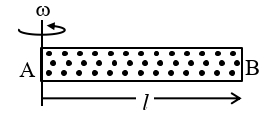
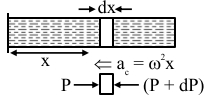
$A$ cylindrical tube $AB$ of length $l$,closed at both ends,contains an ideal gas of $1 \text{ mol}$ having molecular weight $M$. The tube is rotated in a horizontal plane with constant angular velocity $\omega$ about an axis perpendicular to $AB$ and passing through the edge at end $A$. If $P_{A}$ and $P_{B}$ are the pressures at $A$ and $B$ respectively,then (Consider the temperature is same at all points in the tube):
A
$P_{B}=P_{A} \exp(M\omega^{2}l^{2}/2RT)$
B
$P_{B}=P_{A}$
C
$P_{B}=P_{A} \exp(M\omega^{2}l^{2}/3RT)$
D
$P_{B}=P_{A} \exp(M\omega^{2}l^{2}/RT)$
Solution
(A) Consider a small element of gas of length $dx$ at a distance $x$ from the axis of rotation $A$. Let $A$ be the cross-sectional area of the tube.
The net force on this element providing the centripetal acceleration is $(P+dP)A - PA = (dm) \omega^2 x$.
$AdP = (dm) \omega^2 x$.
Since $dm = \rho A dx$,we have $dP = \rho \omega^2 x dx$.
Using the ideal gas law $PM = \rho RT$,we have $\rho = \frac{PM}{RT}$.
Substituting $\rho$,we get $dP = \left(\frac{PM}{RT}\right) \omega^2 x dx$.
Rearranging the terms,$\frac{dP}{P} = \frac{M \omega^2}{RT} x dx$.
Integrating from $x=0$ to $x=l$ and $P=P_A$ to $P=P_B$:
$\int_{P_A}^{P_B} \frac{dP}{P} = \frac{M \omega^2}{RT} \int_0^l x dx$.
$\ln\left(\frac{P_B}{P_A}\right) = \frac{M \omega^2}{RT} \left[\frac{x^2}{2}\right]_0^l = \frac{M \omega^2 l^2}{2RT}$.
Therefore,$P_B = P_A \exp\left(\frac{M \omega^2 l^2}{2RT}\right)$.
The net force on this element providing the centripetal acceleration is $(P+dP)A - PA = (dm) \omega^2 x$.
$AdP = (dm) \omega^2 x$.
Since $dm = \rho A dx$,we have $dP = \rho \omega^2 x dx$.
Using the ideal gas law $PM = \rho RT$,we have $\rho = \frac{PM}{RT}$.
Substituting $\rho$,we get $dP = \left(\frac{PM}{RT}\right) \omega^2 x dx$.
Rearranging the terms,$\frac{dP}{P} = \frac{M \omega^2}{RT} x dx$.
Integrating from $x=0$ to $x=l$ and $P=P_A$ to $P=P_B$:
$\int_{P_A}^{P_B} \frac{dP}{P} = \frac{M \omega^2}{RT} \int_0^l x dx$.
$\ln\left(\frac{P_B}{P_A}\right) = \frac{M \omega^2}{RT} \left[\frac{x^2}{2}\right]_0^l = \frac{M \omega^2 l^2}{2RT}$.
Therefore,$P_B = P_A \exp\left(\frac{M \omega^2 l^2}{2RT}\right)$.
0 likes
View Solution192
MediumMCQ
Given below are two statements: one is labelled as Assertion $A$ and the other is labelled as Reason $R$. Statement $I$: Change in internal energy of a system containing $n$ mole of ideal gas can be written as $\Delta U = nC_v(T_f - T_i) = \frac{nR}{\gamma - 1}(T_f - T_i)$,where $\gamma = C_p/C_v, T_i = $ initial temperature,$T_f = $ final temperature. Statement $II$: Relation between degree of freedom $f$ and $\gamma(= C_p/C_v)$ is $\gamma = 1 + \frac{2}{f}$. Choose the correct answer from the options given below.
A
Both $A$ and $R$ are true and $R$ is the correct explanation of $A$.
B
Both $A$ and $R$ are true but $R$ is $NOT$ the correct explanation of $A$.
C
$A$ is true but $R$ is false.
D
$A$ is false but $R$ is true.
Solution
(A) Statement $I$ is correct. The change in internal energy for an ideal gas is given by $\Delta U = nC_v \Delta T$. Since $C_v = \frac{R}{\gamma - 1}$,substituting this gives $\Delta U = \frac{nR}{\gamma - 1}(T_f - T_i)$.
Statement $II$ is also correct. The molar heat capacity at constant volume is $C_v = \frac{fR}{2}$ and at constant pressure is $C_p = C_v + R = (\frac{f}{2} + 1)R$. Therefore,$\gamma = \frac{C_p}{C_v} = \frac{(\frac{f}{2} + 1)R}{\frac{fR}{2}} = \frac{f+2}{f} = 1 + \frac{2}{f}$.
Since both statements are true and the definition of $\gamma$ in terms of $f$ is a fundamental property used to derive the expression in Statement $I$,$R$ is the correct explanation of $A$.
Statement $II$ is also correct. The molar heat capacity at constant volume is $C_v = \frac{fR}{2}$ and at constant pressure is $C_p = C_v + R = (\frac{f}{2} + 1)R$. Therefore,$\gamma = \frac{C_p}{C_v} = \frac{(\frac{f}{2} + 1)R}{\frac{fR}{2}} = \frac{f+2}{f} = 1 + \frac{2}{f}$.
Since both statements are true and the definition of $\gamma$ in terms of $f$ is a fundamental property used to derive the expression in Statement $I$,$R$ is the correct explanation of $A$.
0 likes
View Solution193
MediumMCQ
Given below are two statements: one is labelled as Assertion $A$ and the other is labelled as Reason $R$. Assertion $A$: If the average kinetic energy of $H_2$ and $O_2$ molecules,kept in two different sized containers are same,then their temperatures will be same. Reason $R$: The r.m.s. speed of $H_2$ and $O_2$ molecules are same at same temperature. Choose the correct answer from the options given below.
A
Both $A$ and $R$ are true and $R$ is the correct explanation of $A$
B
Both $A$ and $R$ are true but $R$ is $NOT$ the correct explanation of $A$
C
$A$ is true but $R$ is false
D
$A$ is false but $R$ is true
Solution
(C) The average kinetic energy of an ideal gas molecule is given by the formula $KE_{avg} = \frac{3}{2}kT$,where $k$ is the Boltzmann constant and $T$ is the absolute temperature.
Since $KE_{avg}$ depends only on the temperature $T$,if the average kinetic energy of $H_2$ and $O_2$ molecules is the same,their temperatures must be the same. Thus,Assertion $A$ is true.
The root mean square (r.m.s.) speed of gas molecules is given by $v_{rms} = \sqrt{\frac{3RT}{M}}$,where $R$ is the universal gas constant,$T$ is the temperature,and $M$ is the molar mass.
Since the molar mass $M$ of $H_2$ $(2 \ g/mol)$ and $O_2$ $(32 \ g/mol)$ are different,their $v_{rms}$ values will be different even at the same temperature. Thus,Reason $R$ is false.
Since $KE_{avg}$ depends only on the temperature $T$,if the average kinetic energy of $H_2$ and $O_2$ molecules is the same,their temperatures must be the same. Thus,Assertion $A$ is true.
The root mean square (r.m.s.) speed of gas molecules is given by $v_{rms} = \sqrt{\frac{3RT}{M}}$,where $R$ is the universal gas constant,$T$ is the temperature,and $M$ is the molar mass.
Since the molar mass $M$ of $H_2$ $(2 \ g/mol)$ and $O_2$ $(32 \ g/mol)$ are different,their $v_{rms}$ values will be different even at the same temperature. Thus,Reason $R$ is false.
0 likes
View Solution194
DifficultMCQ
Two closed vessels of same volume are joined through a narrow tube and both vessels are filled with air of pressure $90 \text{ kPa}$ and temperature $400 \text{ K}$. Keeping the temperature of one vessel constant at $400 \text{ K}$,the temperature of the second vessel is raised to $500 \text{ K}$. The final pressure in the vessels is . . . . . . $\text{ kPa}$.
A
$100$
B
$120$
C
$90$
D
$105$
Solution
(A) Let $V$ be the volume of each vessel.
Initially,the total number of moles $n = n_1 + n_2 = \frac{P_0 V}{RT_0} + \frac{P_0 V}{RT_0} = \frac{2P_0 V}{RT_0}$.
Given $P_0 = 90 \text{ kPa}$ and $T_0 = 400 \text{ K}$,so $n = \frac{2 \cdot 90 \cdot V}{R \cdot 400} = \frac{180V}{400R}$.
Finally,let the pressure in both vessels be $P'$ because they are connected.
The total number of moles $n'$ remains constant,so $n' = n$.
$n' = \frac{P' V}{RT_1} + \frac{P' V}{RT_2} = \frac{P' V}{R} (\frac{1}{400} + \frac{1}{500}) = \frac{P' V}{R} (\frac{5+4}{2000}) = \frac{9P' V}{2000R}$.
Equating $n = n'$:
$\frac{180V}{400R} = \frac{9P' V}{2000R}$.
$P' = \frac{180}{400} \cdot \frac{2000}{9} = \frac{180}{9} \cdot \frac{2000}{400} = 20 \cdot 5 = 100 \text{ kPa}$.
Initially,the total number of moles $n = n_1 + n_2 = \frac{P_0 V}{RT_0} + \frac{P_0 V}{RT_0} = \frac{2P_0 V}{RT_0}$.
Given $P_0 = 90 \text{ kPa}$ and $T_0 = 400 \text{ K}$,so $n = \frac{2 \cdot 90 \cdot V}{R \cdot 400} = \frac{180V}{400R}$.
Finally,let the pressure in both vessels be $P'$ because they are connected.
The total number of moles $n'$ remains constant,so $n' = n$.
$n' = \frac{P' V}{RT_1} + \frac{P' V}{RT_2} = \frac{P' V}{R} (\frac{1}{400} + \frac{1}{500}) = \frac{P' V}{R} (\frac{5+4}{2000}) = \frac{9P' V}{2000R}$.
Equating $n = n'$:
$\frac{180V}{400R} = \frac{9P' V}{2000R}$.
$P' = \frac{180}{400} \cdot \frac{2000}{9} = \frac{180}{9} \cdot \frac{2000}{400} = 20 \cdot 5 = 100 \text{ kPa}$.
0 likes
View Solution195
DifficultMCQ
An ideal gas at pressure $P$ and temperature $T$ is expanding such that $PT^3 = \text{constant}$. The coefficient of volume expansion of the gas is . . . . . . .
A
$\frac{2}{T}$
B
$\frac{1}{T}$
C
$\frac{4}{T}$
D
$\frac{3}{T}$
Solution
(C) We know the ideal gas equation is $PV = nRT$,which implies $P = \frac{nRT}{V}$.
Given the process equation is $PT^3 = C$,where $C$ is a constant.
Substituting the expression for $P$ into the process equation,we get $\left(\frac{nRT}{V}\right) T^3 = C$.
This simplifies to $\frac{T^4}{V} = \frac{C}{nR} = C'$,where $C'$ is another constant.
Therefore,$V = \frac{1}{C'} T^4$,which means $V \propto T^4$.
Taking the logarithmic derivative of $V = kT^4$,we get $\frac{dV}{V} = 4 \frac{dT}{T}$.
The coefficient of volume expansion $\beta$ is defined as $\beta = \frac{1}{V} \frac{dV}{dT}$.
Substituting the derivative,we get $\beta = \frac{1}{V} \left( \frac{4V}{T} \right) = \frac{4}{T}$.
Given the process equation is $PT^3 = C$,where $C$ is a constant.
Substituting the expression for $P$ into the process equation,we get $\left(\frac{nRT}{V}\right) T^3 = C$.
This simplifies to $\frac{T^4}{V} = \frac{C}{nR} = C'$,where $C'$ is another constant.
Therefore,$V = \frac{1}{C'} T^4$,which means $V \propto T^4$.
Taking the logarithmic derivative of $V = kT^4$,we get $\frac{dV}{V} = 4 \frac{dT}{T}$.
The coefficient of volume expansion $\beta$ is defined as $\beta = \frac{1}{V} \frac{dV}{dT}$.
Substituting the derivative,we get $\beta = \frac{1}{V} \left( \frac{4V}{T} \right) = \frac{4}{T}$.
0 likes
View SolutionKinetic Theory of Gases — Mix Examples-Kinetic Theory of Gases · Frequently Asked Questions
1Are these Kinetic Theory of Gases questions useful for JEE and NEET?
Yes. All questions in this section are mapped to JEE Main and NEET exam patterns. Previous year questions from JEE Main, NEET, GUJCET and state-level exams are included with full solutions.
2Can I switch to Hindi or Gujarati for these questions?
Yes. Use the language tabs in the hero section or the sidebar to view the same questions and solutions in English, Hindi or Gujarati.
3How do I generate a question paper from this subtopic?
Use the Vedclass Exam Paper Generator — select the chapter and subtopic, set difficulty, and generate Sets A, B, C, D automatically. First 3 chapters of every subject are free.
Vedclass Products
For Students
Vedclass Test Series
Mock tests in real JEE/NEET style with performance analysis. 5-day free trial.
Start Free TrialFor Teachers
Exam Paper Generator
Generate Set A/B/C/D papers from this chapter in 2 minutes. 3 chapters free.
Try FreeFor Institutes
Online Exam Module
Live online exams with unlimited students, 360° analytics & white-label branding.
See DemoFor Teachers & Institutes
Generate a Kinetic Theory of Gases Exam Paper in 2 Minutes
Select subtopic & difficulty — Sets A, B, C, D auto-generated with No Repeat logic.
First 3 chapters of every subject are free — no payment required.