
A English
Change in Gravitational Potential Energy, Energy Conservation Questions in English
Class 11 Physics · Gravitation · Change in Gravitational Potential Energy, Energy Conservation
60+
Questions
English
Language
100%
With Solutions
Showing 50 of 60 questions in English
1
MediumMCQ
The change in potential energy,when a body of mass $m$ is raised to a height $nR$ from the earth's surface is ($R =$ Radius of earth)
A
$mgR\frac{n}{n-1}$
B
$nmgR$
C
$mgR\frac{n^2}{n^2+1}$
D
$mgR\frac{n}{n+1}$
Solution
(D) The gravitational potential energy at the surface of the earth is $U_i = -\frac{GMm}{R}$.
At a height $h = nR$ from the surface,the distance from the center of the earth is $r = R + h = R + nR = R(1+n)$.
The potential energy at this height is $U_f = -\frac{GMm}{R(1+n)}$.
The change in potential energy is $\Delta U = U_f - U_i = -\frac{GMm}{R(1+n)} - (-\frac{GMm}{R})$.
$\Delta U = \frac{GMm}{R} (1 - \frac{1}{1+n}) = \frac{GMm}{R} (\frac{1+n-1}{1+n}) = \frac{GMm}{R} (\frac{n}{n+1})$.
Since $g = \frac{GM}{R^2}$,we have $GM = gR^2$.
Substituting this into the expression: $\Delta U = \frac{gR^2 m}{R} (\frac{n}{n+1}) = mgR \frac{n}{n+1}$.
At a height $h = nR$ from the surface,the distance from the center of the earth is $r = R + h = R + nR = R(1+n)$.
The potential energy at this height is $U_f = -\frac{GMm}{R(1+n)}$.
The change in potential energy is $\Delta U = U_f - U_i = -\frac{GMm}{R(1+n)} - (-\frac{GMm}{R})$.
$\Delta U = \frac{GMm}{R} (1 - \frac{1}{1+n}) = \frac{GMm}{R} (\frac{1+n-1}{1+n}) = \frac{GMm}{R} (\frac{n}{n+1})$.
Since $g = \frac{GM}{R^2}$,we have $GM = gR^2$.
Substituting this into the expression: $\Delta U = \frac{gR^2 m}{R} (\frac{n}{n+1}) = mgR \frac{n}{n+1}$.
0 likes
View Solution2
MediumMCQ
$A$ body of mass $m$ is placed on the earth's surface. It is taken from the earth's surface to a height $h = 3R$. The change in gravitational potential energy of the body is
A
$\frac{2}{3}mgR$
B
$\frac{3}{4}mgR$
C
$\frac{mgR}{2}$
D
$\frac{mgR}{4}$
Solution
(B) The gravitational potential energy $U$ at a distance $r$ from the center of the earth is given by $U = -\frac{GMm}{r}$.
At the earth's surface,$r_1 = R$,so $U_1 = -\frac{GMm}{R}$.
At a height $h = 3R$,the distance from the center is $r_2 = R + h = R + 3R = 4R$.
So,$U_2 = -\frac{GMm}{4R}$.
The change in gravitational potential energy is $\Delta U = U_2 - U_1 = -\frac{GMm}{4R} - (-\frac{GMm}{R}) = \frac{GMm}{R} - \frac{GMm}{4R} = \frac{3GMm}{4R}$.
Since the acceleration due to gravity at the surface is $g = \frac{GM}{R^2}$,we have $GM = gR^2$.
Substituting this into the expression,$\Delta U = \frac{3(gR^2)m}{4R} = \frac{3}{4}mgR$.
At the earth's surface,$r_1 = R$,so $U_1 = -\frac{GMm}{R}$.
At a height $h = 3R$,the distance from the center is $r_2 = R + h = R + 3R = 4R$.
So,$U_2 = -\frac{GMm}{4R}$.
The change in gravitational potential energy is $\Delta U = U_2 - U_1 = -\frac{GMm}{4R} - (-\frac{GMm}{R}) = \frac{GMm}{R} - \frac{GMm}{4R} = \frac{3GMm}{4R}$.
Since the acceleration due to gravity at the surface is $g = \frac{GM}{R^2}$,we have $GM = gR^2$.
Substituting this into the expression,$\Delta U = \frac{3(gR^2)m}{4R} = \frac{3}{4}mgR$.
0 likes
View Solution3
MediumMCQ
$A$ body of mass $m$ starts falling from a point $2R$ above the Earth's surface. What is its kinetic energy when it has fallen to a point $R$ above the Earth's surface? [$R$ = Radius of Earth,$M$ = Mass of Earth,$G$ = Gravitational Constant]
A
$\frac{1}{2} \frac{GMm}{R}$
B
$\frac{1}{6} \frac{GMm}{R}$
C
$\frac{2}{3} \frac{GMm}{R}$
D
$\frac{1}{3} \frac{GMm}{R}$
Solution
(B) The gravitational potential energy of a body of mass $m$ at a distance $r$ from the center of the Earth is given by $U = -\frac{GMm}{r}$.
The initial position is $2R$ above the Earth's surface,so the distance from the center is $r_i = R + 2R = 3R$.
Initial potential energy: $U_i = -\frac{GMm}{3R}$.
The final position is $R$ above the Earth's surface,so the distance from the center is $r_f = R + R = 2R$.
Final potential energy: $U_f = -\frac{GMm}{2R}$.
According to the law of conservation of energy,the loss in potential energy equals the gain in kinetic energy $(KE)$:
$KE = U_i - U_f = -\frac{GMm}{3R} - (-\frac{GMm}{2R})$
$KE = \frac{GMm}{2R} - \frac{GMm}{3R} = \frac{3GMm - 2GMm}{6R} = \frac{GMm}{6R}$.
The initial position is $2R$ above the Earth's surface,so the distance from the center is $r_i = R + 2R = 3R$.
Initial potential energy: $U_i = -\frac{GMm}{3R}$.
The final position is $R$ above the Earth's surface,so the distance from the center is $r_f = R + R = 2R$.
Final potential energy: $U_f = -\frac{GMm}{2R}$.
According to the law of conservation of energy,the loss in potential energy equals the gain in kinetic energy $(KE)$:
$KE = U_i - U_f = -\frac{GMm}{3R} - (-\frac{GMm}{2R})$
$KE = \frac{GMm}{2R} - \frac{GMm}{3R} = \frac{3GMm - 2GMm}{6R} = \frac{GMm}{6R}$.
0 likes
View Solution4
MediumMCQ
Energy required to move a body of mass $m$ from an orbit of radius $2R$ to $3R$ is
A
$\frac{G M m}{12 R^{2}}$
B
$\frac{G M m}{3 R^{2}}$
C
$\frac{ G M m }{8 R }$
D
$\frac{ G M m }{6 R }$
Solution
(D) The gravitational potential energy of a body of mass $m$ at a distance $r$ from the center of a planet of mass $M$ is given by $U = -\frac{GMm}{r}$.
To move the body from an initial radius $r_1 = 2R$ to a final radius $r_2 = 3R$,the energy required is equal to the change in potential energy,$\Delta U = U_f - U_i$.
$\Delta U = \left( -\frac{GMm}{3R} \right) - \left( -\frac{GMm}{2R} \right)$.
$\Delta U = GMm \left( \frac{1}{2R} - \frac{1}{3R} \right)$.
$\Delta U = GMm \left( \frac{3 - 2}{6R} \right) = \frac{GMm}{6R}$.
To move the body from an initial radius $r_1 = 2R$ to a final radius $r_2 = 3R$,the energy required is equal to the change in potential energy,$\Delta U = U_f - U_i$.
$\Delta U = \left( -\frac{GMm}{3R} \right) - \left( -\frac{GMm}{2R} \right)$.
$\Delta U = GMm \left( \frac{1}{2R} - \frac{1}{3R} \right)$.
$\Delta U = GMm \left( \frac{3 - 2}{6R} \right) = \frac{GMm}{6R}$.
0 likes
View Solution5
EasyMCQ
$A$ missile is launched with a velocity less than the escape velocity. The sum of its kinetic and potential energy is
A
Positive
B
Negative
C
Zero
D
May be positive or negative depending upon its initial velocity
Solution
(B) The total energy $E$ of a body in a gravitational field is the sum of its kinetic energy $K$ and potential energy $U$.
If a missile is launched with the escape velocity $v_e = \sqrt{2GM/R}$,its total energy is zero,allowing it to escape to infinity.
If the launch velocity $v$ is less than the escape velocity $(v < v_e)$,the body is gravitationally bound to the Earth.
For a bound system,the total energy $E = K + U$ is always negative.
This negative value indicates that the gravitational force is attractive and the object cannot escape the gravitational influence of the Earth.
If a missile is launched with the escape velocity $v_e = \sqrt{2GM/R}$,its total energy is zero,allowing it to escape to infinity.
If the launch velocity $v$ is less than the escape velocity $(v < v_e)$,the body is gravitationally bound to the Earth.
For a bound system,the total energy $E = K + U$ is always negative.
This negative value indicates that the gravitational force is attractive and the object cannot escape the gravitational influence of the Earth.
0 likes
View Solution6
EasyMCQ
In the solar system,which quantity is conserved?
A
Total Energy
B
Kinetic Energy
C
Angular Velocity
D
Linear Momentum
Solution
(A) In the solar system,the orbit of a planet is an ellipse with the Sun at one of the two foci.
Since the distance between the Sun and the planet changes as it moves along the elliptical orbit,the velocity of the planet at every point is not the same.
Because the velocity changes,both the linear momentum $(p = mv)$ and the kinetic energy $(K.E. = \frac{1}{2}mv^2)$ are not conserved.
The angular velocity also varies according to Kepler's second law.
However,since the gravitational force is a conservative force,the total mechanical energy $(K.E. + P.E.)$ of the planet-Sun system remains conserved.
Since the distance between the Sun and the planet changes as it moves along the elliptical orbit,the velocity of the planet at every point is not the same.
Because the velocity changes,both the linear momentum $(p = mv)$ and the kinetic energy $(K.E. = \frac{1}{2}mv^2)$ are not conserved.
The angular velocity also varies according to Kepler's second law.
However,since the gravitational force is a conservative force,the total mechanical energy $(K.E. + P.E.)$ of the planet-Sun system remains conserved.
0 likes
View Solution7
MediumMCQ
$A$ rocket of mass $M$ is launched vertically from the surface of the earth with an initial speed $V$. Assuming the radius of the earth to be $R$ and negligible air resistance,the maximum height attained by the rocket above the surface of the earth is
A
$R / \left( \frac{gR}{2V^2} - 1 \right)$
B
$R \left( \frac{gR}{2V^2} - 1 \right)$
C
$R / \left( \frac{2gR}{V^2} - 1 \right)$
D
$R \left( \frac{2gR}{V^2} - 1 \right)$
Solution
(C) By the law of conservation of energy,the total energy at the surface of the earth equals the total energy at the maximum height $h$.
At the surface: $E_i = K_i + U_i = \frac{1}{2}MV^2 - \frac{GM_eM}{R}$
At maximum height $h$: $E_f = K_f + U_f = 0 - \frac{GM_eM}{R+h}$
Equating $E_i = E_f$: $\frac{1}{2}MV^2 - \frac{GM_eM}{R} = - \frac{GM_eM}{R+h}$
$\frac{1}{2}V^2 = GM_e \left( \frac{1}{R} - \frac{1}{R+h} \right)$
Using $g = \frac{GM_e}{R^2}$,we have $GM_e = gR^2$.
$\frac{V^2}{2} = gR^2 \left( \frac{R+h-R}{R(R+h)} \right) = \frac{gR^2h}{R(R+h)} = \frac{gRh}{R+h}$
$\frac{V^2}{2gR} = \frac{h}{R+h}$
$V^2(R+h) = 2gRh$
$V^2R + V^2h = 2gRh$
$V^2R = h(2gR - V^2)$
$h = \frac{V^2R}{2gR - V^2}$
Dividing numerator and denominator by $V^2$: $h = \frac{R}{\frac{2gR}{V^2} - 1}$
At the surface: $E_i = K_i + U_i = \frac{1}{2}MV^2 - \frac{GM_eM}{R}$
At maximum height $h$: $E_f = K_f + U_f = 0 - \frac{GM_eM}{R+h}$
Equating $E_i = E_f$: $\frac{1}{2}MV^2 - \frac{GM_eM}{R} = - \frac{GM_eM}{R+h}$
$\frac{1}{2}V^2 = GM_e \left( \frac{1}{R} - \frac{1}{R+h} \right)$
Using $g = \frac{GM_e}{R^2}$,we have $GM_e = gR^2$.
$\frac{V^2}{2} = gR^2 \left( \frac{R+h-R}{R(R+h)} \right) = \frac{gR^2h}{R(R+h)} = \frac{gRh}{R+h}$
$\frac{V^2}{2gR} = \frac{h}{R+h}$
$V^2(R+h) = 2gRh$
$V^2R + V^2h = 2gRh$
$V^2R = h(2gR - V^2)$
$h = \frac{V^2R}{2gR - V^2}$
Dividing numerator and denominator by $V^2$: $h = \frac{R}{\frac{2gR}{V^2} - 1}$
0 likes
View Solution8
EasyMCQ
Under the influence of a central force,which of the following is conserved?
A
Only angular momentum
B
Only mechanical energy
C
Both angular momentum and mechanical energy
D
Either angular momentum or mechanical energy
Solution
(C) central force is a force that is directed along the line joining the particle to the origin (center of force).
Since the torque $\vec{\tau} = \vec{r} \times \vec{F} = 0$ for a central force (because $\vec{r}$ and $\vec{F}$ are collinear),the angular momentum $\vec{L}$ remains constant.
Additionally,central forces are conservative forces,which means the work done by them is path-independent and the total mechanical energy $E = K + U$ of the system is conserved.
Therefore,both angular momentum and mechanical energy are conserved under the influence of a central force.
Since the torque $\vec{\tau} = \vec{r} \times \vec{F} = 0$ for a central force (because $\vec{r}$ and $\vec{F}$ are collinear),the angular momentum $\vec{L}$ remains constant.
Additionally,central forces are conservative forces,which means the work done by them is path-independent and the total mechanical energy $E = K + U$ of the system is conserved.
Therefore,both angular momentum and mechanical energy are conserved under the influence of a central force.
0 likes
View Solution9
MediumMCQ
$A$ body of mass $m$ is released from a height of $2R$ above the Earth's surface. What will be its kinetic energy at a height of $R$ from the Earth's surface? (Where $R$ is the radius of the Earth)
A
$\frac{1}{2} \frac{GMm}{R}$
B
$\frac{1}{6} \frac{GMm}{R}$
C
$\frac{2}{3} \frac{GMm}{R}$
D
$\frac{1}{3} \frac{GMm}{R}$
Solution
(B) According to the law of conservation of energy,the loss in gravitational potential energy is equal to the gain in kinetic energy.
Initial height from the center of the Earth,$r_1 = R + 2R = 3R$.
Final height from the center of the Earth,$r_2 = R + R = 2R$.
Initial potential energy,$U_1 = -\frac{GMm}{r_1} = -\frac{GMm}{3R}$.
Final potential energy,$U_2 = -\frac{GMm}{r_2} = -\frac{GMm}{2R}$.
Change in potential energy,$\Delta U = U_1 - U_2 = -\frac{GMm}{3R} - (-\frac{GMm}{2R})$.
$\Delta U = \frac{GMm}{2R} - \frac{GMm}{3R} = \frac{3GMm - 2GMm}{6R} = \frac{GMm}{6R}$.
Since the body is released from rest,the gain in kinetic energy $K = \Delta U = \frac{1}{6} \frac{GMm}{R}$.
Initial height from the center of the Earth,$r_1 = R + 2R = 3R$.
Final height from the center of the Earth,$r_2 = R + R = 2R$.
Initial potential energy,$U_1 = -\frac{GMm}{r_1} = -\frac{GMm}{3R}$.
Final potential energy,$U_2 = -\frac{GMm}{r_2} = -\frac{GMm}{2R}$.
Change in potential energy,$\Delta U = U_1 - U_2 = -\frac{GMm}{3R} - (-\frac{GMm}{2R})$.
$\Delta U = \frac{GMm}{2R} - \frac{GMm}{3R} = \frac{3GMm - 2GMm}{6R} = \frac{GMm}{6R}$.
Since the body is released from rest,the gain in kinetic energy $K = \Delta U = \frac{1}{6} \frac{GMm}{R}$.
0 likes
View Solution10
DifficultMCQ
$A$ rocket is fired vertically upwards from the surface of the Earth with a velocity $V$. If $R$ is the radius of the Earth,what is the maximum height attained by the rocket?
A
$\frac{R}{(\frac{gR}{2V^2} - 1)}$
B
$R(\frac{gR}{2V^2} - 1)$
C
$\frac{R}{(\frac{2gR}{V^2} - 1)}$
D
$R(\frac{2gR}{V^2} - 1)$
Solution
(C) According to the law of conservation of energy,the total energy at the surface equals the total energy at the maximum height $h$.
At the surface: $E_i = \frac{1}{2}mV^2 - \frac{GMm}{R}$
At maximum height $h$: $E_f = 0 - \frac{GMm}{R+h}$
Equating $E_i = E_f$: $\frac{1}{2}mV^2 - \frac{GMm}{R} = - \frac{GMm}{R+h}$
Using $g = \frac{GM}{R^2}$,we have $GM = gR^2$. Substituting this:
$\frac{V^2}{2} = gR^2 (\frac{1}{R} - \frac{1}{R+h})$
$\frac{V^2}{2} = gR^2 (\frac{R+h-R}{R(R+h)}) = \frac{gRh}{R+h}$
$\frac{V^2}{2gR} = \frac{h}{R+h}$
Taking the reciprocal: $\frac{2gR}{V^2} = \frac{R+h}{h} = \frac{R}{h} + 1$
$\frac{R}{h} = \frac{2gR}{V^2} - 1$
$h = \frac{R}{(\frac{2gR}{V^2} - 1)}$
At the surface: $E_i = \frac{1}{2}mV^2 - \frac{GMm}{R}$
At maximum height $h$: $E_f = 0 - \frac{GMm}{R+h}$
Equating $E_i = E_f$: $\frac{1}{2}mV^2 - \frac{GMm}{R} = - \frac{GMm}{R+h}$
Using $g = \frac{GM}{R^2}$,we have $GM = gR^2$. Substituting this:
$\frac{V^2}{2} = gR^2 (\frac{1}{R} - \frac{1}{R+h})$
$\frac{V^2}{2} = gR^2 (\frac{R+h-R}{R(R+h)}) = \frac{gRh}{R+h}$
$\frac{V^2}{2gR} = \frac{h}{R+h}$
Taking the reciprocal: $\frac{2gR}{V^2} = \frac{R+h}{h} = \frac{R}{h} + 1$
$\frac{R}{h} = \frac{2gR}{V^2} - 1$
$h = \frac{R}{(\frac{2gR}{V^2} - 1)}$
0 likes
View Solution11
DifficultMCQ
$A$ body of mass $m$ is taken from the earth's surface to a height equal to twice the radius $(R)$ of the earth. The change in potential energy of the body will be
A
$\frac{2}{3}mgR$
B
$3mgR$
C
$\frac{1}{3}mgR$
D
$2mgR$
Solution
(A) The gravitational potential energy at a distance $r$ from the center of the earth is given by $U = -\frac{GMm}{r}$.
At the surface of the earth,the distance from the center is $r_i = R$.
Therefore,the initial potential energy is $U_i = -\frac{GMm}{R}$.
At a height $h = 2R$ from the surface,the distance from the center is $r_f = R + h = R + 2R = 3R$.
Therefore,the final potential energy is $U_f = -\frac{GMm}{3R}$.
The change in potential energy is $\Delta U = U_f - U_i$.
$\Delta U = -\frac{GMm}{3R} - (-\frac{GMm}{R}) = \frac{GMm}{R}(1 - \frac{1}{3}) = \frac{2}{3}\frac{GMm}{R}$.
Since the acceleration due to gravity at the surface is $g = \frac{GM}{R^2}$,we have $GM = gR^2$.
Substituting this,$\Delta U = \frac{2}{3} \frac{(gR^2)m}{R} = \frac{2}{3}mgR$.
At the surface of the earth,the distance from the center is $r_i = R$.
Therefore,the initial potential energy is $U_i = -\frac{GMm}{R}$.
At a height $h = 2R$ from the surface,the distance from the center is $r_f = R + h = R + 2R = 3R$.
Therefore,the final potential energy is $U_f = -\frac{GMm}{3R}$.
The change in potential energy is $\Delta U = U_f - U_i$.
$\Delta U = -\frac{GMm}{3R} - (-\frac{GMm}{R}) = \frac{GMm}{R}(1 - \frac{1}{3}) = \frac{2}{3}\frac{GMm}{R}$.
Since the acceleration due to gravity at the surface is $g = \frac{GM}{R^2}$,we have $GM = gR^2$.
Substituting this,$\Delta U = \frac{2}{3} \frac{(gR^2)m}{R} = \frac{2}{3}mgR$.
0 likes
View Solution12
DifficultMCQ
$A$ body of mass $m$ is lifted up from the surface of the earth to a height three times the radius of the earth. The change in potential energy of the body is (where $g$ is acceleration due to gravity at the surface of the earth).
A
$3mgR$
B
$\frac{3}{4} mgR$
C
$\frac{1}{3} mgR$
D
$\frac{2}{3} mgR$
Solution
(B) The change in gravitational potential energy $\Delta U$ when a body of mass $m$ is lifted to a height $h$ from the surface of the earth is given by the formula: $\Delta U = \frac{mgh}{1 + \frac{h}{R}}$.
Given that the height $h = 3R$,where $R$ is the radius of the earth.
Substituting the value of $h$ into the formula:
$\Delta U = \frac{mg(3R)}{1 + \frac{3R}{R}}$
$\Delta U = \frac{3mgR}{1 + 3}$
$\Delta U = \frac{3mgR}{4}$
Therefore,the change in potential energy is $\frac{3}{4} mgR$.
Given that the height $h = 3R$,where $R$ is the radius of the earth.
Substituting the value of $h$ into the formula:
$\Delta U = \frac{mg(3R)}{1 + \frac{3R}{R}}$
$\Delta U = \frac{3mgR}{1 + 3}$
$\Delta U = \frac{3mgR}{4}$
Therefore,the change in potential energy is $\frac{3}{4} mgR$.
0 likes
View Solution13
DifficultMCQ
Two masses $m_1$ and $m_2$ are at rest at infinity. Find their relative velocity of approach due to gravitational attraction when their separation is $d$.
A
$\sqrt{\frac{G(m_1 + m_2)}{2d}}$
B
$\sqrt{\frac{2G(m_1 + m_2)}{d}}$
C
$\sqrt{\frac{G(m_1 + m_2)}{8d}}$
D
$\sqrt{\frac{G(m_1 + m_2)}{d}}$
Solution
(B) According to the law of conservation of energy,the initial total energy at infinity is $0$.
At a separation $d$,the total energy is the sum of kinetic energy and potential energy: $K.E. + P.E. = 0$.
Using the reduced mass $\mu = \frac{m_1 m_2}{m_1 + m_2}$,the kinetic energy is $\frac{1}{2} \mu v_{rel}^2$.
The potential energy is $-\frac{G m_1 m_2}{d}$.
Thus,$\frac{1}{2} \left( \frac{m_1 m_2}{m_1 + m_2} \right) v_{rel}^2 - \frac{G m_1 m_2}{d} = 0$.
Solving for $v_{rel}$:
$\frac{1}{2} \left( \frac{m_1 m_2}{m_1 + m_2} \right) v_{rel}^2 = \frac{G m_1 m_2}{d}$.
$v_{rel}^2 = \frac{2G(m_1 + m_2)}{d}$.
$v_{rel} = \sqrt{\frac{2G(m_1 + m_2)}{d}}$.
At a separation $d$,the total energy is the sum of kinetic energy and potential energy: $K.E. + P.E. = 0$.
Using the reduced mass $\mu = \frac{m_1 m_2}{m_1 + m_2}$,the kinetic energy is $\frac{1}{2} \mu v_{rel}^2$.
The potential energy is $-\frac{G m_1 m_2}{d}$.
Thus,$\frac{1}{2} \left( \frac{m_1 m_2}{m_1 + m_2} \right) v_{rel}^2 - \frac{G m_1 m_2}{d} = 0$.
Solving for $v_{rel}$:
$\frac{1}{2} \left( \frac{m_1 m_2}{m_1 + m_2} \right) v_{rel}^2 = \frac{G m_1 m_2}{d}$.
$v_{rel}^2 = \frac{2G(m_1 + m_2)}{d}$.
$v_{rel} = \sqrt{\frac{2G(m_1 + m_2)}{d}}$.
0 likes
View Solution14
DifficultMCQ
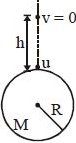
An object is projected vertically upward from the earth's surface with a velocity $u = \sqrt{Rg}$,where $R$ is the radius of the earth and $g$ is the acceleration due to gravity on the earth's surface. Find the maximum height reached by the object.
A
$\frac{R}{2}$
B
$R$
C
$2R$
D
$3R$
Solution
(B) Let an object of mass $m$ be projected with an initial velocity $u = \sqrt{Rg}$ from the surface of the earth. Let it reach a maximum height $h$ above the surface of the earth.
According to the law of conservation of mechanical energy,the total energy at the surface of the earth is equal to the total energy at the maximum height $h$:
$K_i + U_i = K_f + U_f$
$\frac{1}{2} m u^2 - \frac{GMm}{R} = 0 - \frac{GMm}{R+h}$
Given that $u^2 = Rg$ and $g = \frac{GM}{R^2}$,we have $GM = gR^2$. Substituting $u^2 = Rg$ and $GM = gR^2$ into the equation:
$\frac{1}{2} m (Rg) - \frac{(gR^2) m}{R} = - \frac{(gR^2) m}{R+h}$
$\frac{1}{2} mgR - mgR = - \frac{mgR^2}{R+h}$
$-\frac{1}{2} mgR = - \frac{mgR^2}{R+h}$
$\frac{1}{2} = \frac{R}{R+h}$
$R + h = 2R$
$h = R$
According to the law of conservation of mechanical energy,the total energy at the surface of the earth is equal to the total energy at the maximum height $h$:
$K_i + U_i = K_f + U_f$
$\frac{1}{2} m u^2 - \frac{GMm}{R} = 0 - \frac{GMm}{R+h}$
Given that $u^2 = Rg$ and $g = \frac{GM}{R^2}$,we have $GM = gR^2$. Substituting $u^2 = Rg$ and $GM = gR^2$ into the equation:
$\frac{1}{2} m (Rg) - \frac{(gR^2) m}{R} = - \frac{(gR^2) m}{R+h}$
$\frac{1}{2} mgR - mgR = - \frac{mgR^2}{R+h}$
$-\frac{1}{2} mgR = - \frac{mgR^2}{R+h}$
$\frac{1}{2} = \frac{R}{R+h}$
$R + h = 2R$
$h = R$
0 likes
View Solution15
DifficultMCQ
If the gravitational acceleration at the surface of the Earth is $g$,then the increase in potential energy in lifting an object of mass $m$ to a height equal to half of the radius of the Earth from the surface will be:
A
$\frac{mgR}{2}$
B
$\frac{2mgR}{3}$
C
$\frac{mgR}{4}$
D
$\frac{mgR}{3}$
Solution
(D) The gravitational potential energy at the surface of the Earth is $U_i = -\frac{GMm}{R}$.
At a height $h = \frac{R}{2}$,the distance from the center of the Earth is $r = R + \frac{R}{2} = \frac{3R}{2}$.
The potential energy at this height is $U_f = -\frac{GMm}{r} = -\frac{GMm}{3R/2} = -\frac{2GMm}{3R}$.
The increase in potential energy is $\Delta U = U_f - U_i$.
$\Delta U = -\frac{2GMm}{3R} - (-\frac{GMm}{R}) = -\frac{2GMm}{3R} + \frac{GMm}{R} = \frac{GMm}{3R}$.
Since the gravitational acceleration at the surface is $g = \frac{GM}{R^2}$,we have $GM = gR^2$.
Substituting this into the expression for $\Delta U$,we get $\Delta U = \frac{(gR^2)m}{3R} = \frac{mgR}{3}$.
At a height $h = \frac{R}{2}$,the distance from the center of the Earth is $r = R + \frac{R}{2} = \frac{3R}{2}$.
The potential energy at this height is $U_f = -\frac{GMm}{r} = -\frac{GMm}{3R/2} = -\frac{2GMm}{3R}$.
The increase in potential energy is $\Delta U = U_f - U_i$.
$\Delta U = -\frac{2GMm}{3R} - (-\frac{GMm}{R}) = -\frac{2GMm}{3R} + \frac{GMm}{R} = \frac{GMm}{3R}$.
Since the gravitational acceleration at the surface is $g = \frac{GM}{R^2}$,we have $GM = gR^2$.
Substituting this into the expression for $\Delta U$,we get $\Delta U = \frac{(gR^2)m}{3R} = \frac{mgR}{3}$.
0 likes
View Solution16
DifficultMCQ
The escape velocity from a planet is $V_e$. $A$ tunnel is dug along the diameter of the planet and a small body is dropped into it. The speed of the body at the centre of the planet will be
A
$\frac{V_e}{\sqrt{2}}$
B
$\frac{V_e}{2}$
C
$V_e$
D
$2V_e$
Solution
(A) The potential energy at the surface of the planet is $U_s = -\frac{GMm}{R}$.
The potential energy at the center of the planet is $U_c = -\frac{3GMm}{2R}$.
By the law of conservation of energy,the total energy at the surface equals the total energy at the center:
$-\frac{GMm}{R} + 0 = -\frac{3GMm}{2R} + \frac{1}{2}mv^2$.
Rearranging the terms,we get $\frac{1}{2}mv^2 = \frac{3GMm}{2R} - \frac{GMm}{R} = \frac{GMm}{2R}$.
Thus,$v^2 = \frac{GM}{R}$.
Since the escape velocity is $V_e = \sqrt{\frac{2GM}{R}}$,we have $V_e^2 = \frac{2GM}{R}$,which implies $\frac{GM}{R} = \frac{V_e^2}{2}$.
Substituting this into the expression for $v^2$,we get $v^2 = \frac{V_e^2}{2}$,so $v = \frac{V_e}{\sqrt{2}}$.
The potential energy at the center of the planet is $U_c = -\frac{3GMm}{2R}$.
By the law of conservation of energy,the total energy at the surface equals the total energy at the center:
$-\frac{GMm}{R} + 0 = -\frac{3GMm}{2R} + \frac{1}{2}mv^2$.
Rearranging the terms,we get $\frac{1}{2}mv^2 = \frac{3GMm}{2R} - \frac{GMm}{R} = \frac{GMm}{2R}$.
Thus,$v^2 = \frac{GM}{R}$.
Since the escape velocity is $V_e = \sqrt{\frac{2GM}{R}}$,we have $V_e^2 = \frac{2GM}{R}$,which implies $\frac{GM}{R} = \frac{V_e^2}{2}$.
Substituting this into the expression for $v^2$,we get $v^2 = \frac{V_e^2}{2}$,so $v = \frac{V_e}{\sqrt{2}}$.
0 likes
View Solution17
DifficultMCQ
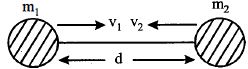
Two hypothetical planets of masses $m_1$ and $m_2$ are at rest when they are at an infinite distance apart. Because of the gravitational force,they move towards each other along the line joining their centres. What is their speed when their separation is $d$? (Speed of $m_1$ is $v_1$ and that of $m_2$ is $v_2$)
A
$v_1 = v_2$
B
$v_1 = m_2 \sqrt{\frac{2G}{d(m_1 + m_2)}}, v_2 = m_1 \sqrt{\frac{2G}{d(m_1 + m_2)}}$
C
$v_1 = m_1 \sqrt{\frac{2G}{d(m_1 + m_2)}}, v_2 = m_2 \sqrt{\frac{2G}{d(m_1 + m_2)}}$
D
$v_1 = m_2 \sqrt{\frac{2G}{m_1}}, v_2 = m_2 \sqrt{\frac{2G}{m_2}}$
Solution
(B) The initial total energy of the system at an infinite distance is $0$.
By the law of conservation of energy,the total energy at separation $d$ must also be $0$:
$\frac{1}{2}m_1 v_1^2 + \frac{1}{2}m_2 v_2^2 - \frac{G m_1 m_2}{d} = 0$
$\frac{1}{2}m_1 v_1^2 + \frac{1}{2}m_2 v_2^2 = \frac{G m_1 m_2}{d} \quad ... (i)$
By the law of conservation of linear momentum (as no external force acts on the system):
$m_1 v_1 - m_2 v_2 = 0 \implies v_2 = \frac{m_1}{m_2} v_1$
Substituting $v_2$ into equation $(i)$:
$\frac{1}{2}m_1 v_1^2 + \frac{1}{2}m_2 \left( \frac{m_1}{m_2} v_1 \right)^2 = \frac{G m_1 m_2}{d}$
$\frac{1}{2}m_1 v_1^2 \left( 1 + \frac{m_1}{m_2} \right) = \frac{G m_1 m_2}{d}$
$\frac{1}{2} v_1^2 \left( \frac{m_1 + m_2}{m_2} \right) = \frac{G m_2}{d}$
$v_1^2 = \frac{2 G m_2^2}{d(m_1 + m_2)} \implies v_1 = m_2 \sqrt{\frac{2G}{d(m_1 + m_2)}}$
Similarly,$v_2 = m_1 \sqrt{\frac{2G}{d(m_1 + m_2)}}$.
By the law of conservation of energy,the total energy at separation $d$ must also be $0$:
$\frac{1}{2}m_1 v_1^2 + \frac{1}{2}m_2 v_2^2 - \frac{G m_1 m_2}{d} = 0$
$\frac{1}{2}m_1 v_1^2 + \frac{1}{2}m_2 v_2^2 = \frac{G m_1 m_2}{d} \quad ... (i)$
By the law of conservation of linear momentum (as no external force acts on the system):
$m_1 v_1 - m_2 v_2 = 0 \implies v_2 = \frac{m_1}{m_2} v_1$
Substituting $v_2$ into equation $(i)$:
$\frac{1}{2}m_1 v_1^2 + \frac{1}{2}m_2 \left( \frac{m_1}{m_2} v_1 \right)^2 = \frac{G m_1 m_2}{d}$
$\frac{1}{2}m_1 v_1^2 \left( 1 + \frac{m_1}{m_2} \right) = \frac{G m_1 m_2}{d}$
$\frac{1}{2} v_1^2 \left( \frac{m_1 + m_2}{m_2} \right) = \frac{G m_2}{d}$
$v_1^2 = \frac{2 G m_2^2}{d(m_1 + m_2)} \implies v_1 = m_2 \sqrt{\frac{2G}{d(m_1 + m_2)}}$
Similarly,$v_2 = m_1 \sqrt{\frac{2G}{d(m_1 + m_2)}}$.
0 likes
View Solution18
MediumMCQ
With what velocity should a particle be projected so that its height becomes equal to the radius of the Earth?
A
$\left(\frac{G M}{R}\right)^{1/2}$
B
$\left(\frac{8 G M}{R}\right)^{1/2}$
C
$\left(\frac{2 G M}{R}\right)^{1/2}$
D
$\left(\frac{4 G M}{R}\right)^{1/2}$
Solution
(A) According to the law of conservation of energy,the total energy at the surface of the Earth is equal to the total energy at the maximum height $h$.
Initial energy at the surface: $E_i = K_i + U_i = \frac{1}{2}mv^2 - \frac{GMm}{R}$
At maximum height $h$,the velocity is zero,so the final energy is: $E_f = K_f + U_f = 0 - \frac{GMm}{R+h}$
Equating $E_i = E_f$:
$\frac{1}{2}mv^2 - \frac{GMm}{R} = - \frac{GMm}{R+h}$
$\frac{1}{2}v^2 = GM \left( \frac{1}{R} - \frac{1}{R+h} \right) = GM \left( \frac{R+h-R}{R(R+h)} \right) = \frac{GMh}{R(R+h)}$
Given $h = R$,substitute this into the equation:
$\frac{1}{2}v^2 = \frac{GMR}{R(R+R)} = \frac{GM}{2R}$
$v^2 = \frac{GM}{R}$
$v = \sqrt{\frac{GM}{R}} = \left( \frac{GM}{R} \right)^{1/2}$
Initial energy at the surface: $E_i = K_i + U_i = \frac{1}{2}mv^2 - \frac{GMm}{R}$
At maximum height $h$,the velocity is zero,so the final energy is: $E_f = K_f + U_f = 0 - \frac{GMm}{R+h}$
Equating $E_i = E_f$:
$\frac{1}{2}mv^2 - \frac{GMm}{R} = - \frac{GMm}{R+h}$
$\frac{1}{2}v^2 = GM \left( \frac{1}{R} - \frac{1}{R+h} \right) = GM \left( \frac{R+h-R}{R(R+h)} \right) = \frac{GMh}{R(R+h)}$
Given $h = R$,substitute this into the equation:
$\frac{1}{2}v^2 = \frac{GMR}{R(R+R)} = \frac{GM}{2R}$
$v^2 = \frac{GM}{R}$
$v = \sqrt{\frac{GM}{R}} = \left( \frac{GM}{R} \right)^{1/2}$
0 likes
View Solution19
DifficultMCQ
$A$ body of mass $m$ falls from a height $R$ above the surface of the earth,where $R$ is the radius of the earth. What is the velocity attained by the body on reaching the ground? (Acceleration due to gravity on the surface of the earth is $g$)
A
$gR$
B
$\sqrt{gR}$
C
$\sqrt{g/R}$
D
$g/R$
Solution
(B) According to the law of conservation of energy,the total mechanical energy at height $R$ above the surface (distance $2R$ from the center) must equal the total mechanical energy at the surface (distance $R$ from the center).
Initial energy at height $R$ (where $r = 2R$): $E_i = -\frac{GMm}{2R} + 0$
Final energy at the surface (where $r = R$): $E_f = -\frac{GMm}{R} + \frac{1}{2}mv^2$
Equating $E_i = E_f$:
$-\frac{GMm}{2R} = -\frac{GMm}{R} + \frac{1}{2}mv^2$
$\frac{1}{2}mv^2 = \frac{GMm}{R} - \frac{GMm}{2R} = \frac{GMm}{2R}$
$v^2 = \frac{GM}{R}$
Since the acceleration due to gravity on the surface is $g = \frac{GM}{R^2}$,we have $GM = gR^2$.
Substituting $GM = gR^2$ into the equation for $v^2$:
$v^2 = \frac{gR^2}{R} = gR$
Therefore,$v = \sqrt{gR}$.
Initial energy at height $R$ (where $r = 2R$): $E_i = -\frac{GMm}{2R} + 0$
Final energy at the surface (where $r = R$): $E_f = -\frac{GMm}{R} + \frac{1}{2}mv^2$
Equating $E_i = E_f$:
$-\frac{GMm}{2R} = -\frac{GMm}{R} + \frac{1}{2}mv^2$
$\frac{1}{2}mv^2 = \frac{GMm}{R} - \frac{GMm}{2R} = \frac{GMm}{2R}$
$v^2 = \frac{GM}{R}$
Since the acceleration due to gravity on the surface is $g = \frac{GM}{R^2}$,we have $GM = gR^2$.
Substituting $GM = gR^2$ into the equation for $v^2$:
$v^2 = \frac{gR^2}{R} = gR$
Therefore,$v = \sqrt{gR}$.
0 likes
View Solution20
DifficultMCQ
$A$ rocket of mass $M$ is launched vertically from the surface of the earth with an initial speed $V$. Assuming the radius of the earth to be $R$ and negligible air resistance,the maximum height attained by the rocket above the surface of the earth is
A
$\frac{R}{\left( \frac{gR}{2V^2} - 1 \right)}$
B
$R\left( \frac{gR}{2V^2} - 1 \right)$
C
$\frac{R}{\left( \frac{2gR}{V^2} - 1 \right)}$
D
$R\left( \frac{2gR}{V^2} - 1 \right)$
Solution
(C) By the principle of conservation of energy,the total mechanical energy at the surface of the earth must equal the total mechanical energy at the maximum height $h$.
At the surface: $E_i = K_i + U_i = \frac{1}{2}MV^2 - \frac{GM_eM}{R}$
At maximum height $h$: $E_f = K_f + U_f = 0 - \frac{GM_eM}{R+h}$
Equating $E_i = E_f$:
$\frac{1}{2}MV^2 - \frac{GM_eM}{R} = - \frac{GM_eM}{R+h}$
$\frac{1}{2}V^2 = GM_e \left( \frac{1}{R} - \frac{1}{R+h} \right)$
Using $g = \frac{GM_e}{R^2}$,we have $GM_e = gR^2$:
$\frac{V^2}{2} = gR^2 \left( \frac{R+h-R}{R(R+h)} \right) = \frac{gR^2h}{R(R+h)} = \frac{gRh}{R+h}$
$\frac{V^2}{2gR} = \frac{h}{R+h}$
$V^2(R+h) = 2gRh$
$V^2R + V^2h = 2gRh$
$V^2R = h(2gR - V^2)$
$h = \frac{V^2R}{2gR - V^2} = \frac{R}{\left( \frac{2gR}{V^2} - 1 \right)}$
At the surface: $E_i = K_i + U_i = \frac{1}{2}MV^2 - \frac{GM_eM}{R}$
At maximum height $h$: $E_f = K_f + U_f = 0 - \frac{GM_eM}{R+h}$
Equating $E_i = E_f$:
$\frac{1}{2}MV^2 - \frac{GM_eM}{R} = - \frac{GM_eM}{R+h}$
$\frac{1}{2}V^2 = GM_e \left( \frac{1}{R} - \frac{1}{R+h} \right)$
Using $g = \frac{GM_e}{R^2}$,we have $GM_e = gR^2$:
$\frac{V^2}{2} = gR^2 \left( \frac{R+h-R}{R(R+h)} \right) = \frac{gR^2h}{R(R+h)} = \frac{gRh}{R+h}$
$\frac{V^2}{2gR} = \frac{h}{R+h}$
$V^2(R+h) = 2gRh$
$V^2R + V^2h = 2gRh$
$V^2R = h(2gR - V^2)$
$h = \frac{V^2R}{2gR - V^2} = \frac{R}{\left( \frac{2gR}{V^2} - 1 \right)}$
0 likes
View Solution21
DifficultMCQ
The radius of the earth is $R$. If a body is taken to a height $3R$ from the surface of the earth,then the change in potential energy will be:
A
$3mgR$
B
$\frac{3}{2}mgR$
C
$mgR$
D
$\frac{3}{4}mgR$
Solution
(D) The gravitational potential energy of a body of mass $m$ at a distance $r$ from the center of the earth is given by $U = -\frac{GMm}{r}$.
Initial potential energy at the surface of the earth $(r = R)$: $U_i = -\frac{GMm}{R}$.
Final potential energy at a height $h = 3R$ from the surface,the distance from the center is $r = R + 3R = 4R$. Thus,$U_f = -\frac{GMm}{4R}$.
The change in potential energy is $\Delta U = U_f - U_i = -\frac{GMm}{4R} - (-\frac{GMm}{R})$.
$\Delta U = \frac{GMm}{R} - \frac{GMm}{4R} = \frac{3GMm}{4R}$.
Since the acceleration due to gravity at the surface is $g = \frac{GM}{R^2}$,we have $GM = gR^2$.
Substituting this into the expression: $\Delta U = \frac{3(gR^2)m}{4R} = \frac{3}{4}mgR$.
Initial potential energy at the surface of the earth $(r = R)$: $U_i = -\frac{GMm}{R}$.
Final potential energy at a height $h = 3R$ from the surface,the distance from the center is $r = R + 3R = 4R$. Thus,$U_f = -\frac{GMm}{4R}$.
The change in potential energy is $\Delta U = U_f - U_i = -\frac{GMm}{4R} - (-\frac{GMm}{R})$.
$\Delta U = \frac{GMm}{R} - \frac{GMm}{4R} = \frac{3GMm}{4R}$.
Since the acceleration due to gravity at the surface is $g = \frac{GM}{R^2}$,we have $GM = gR^2$.
Substituting this into the expression: $\Delta U = \frac{3(gR^2)m}{4R} = \frac{3}{4}mgR$.
0 likes
View Solution22
DifficultMCQ
Given that the mass of the Earth is $M$ and its radius is $R$. $A$ body is dropped from a height equal to the radius of the Earth above the surface of the Earth. When it reaches the ground,its velocity will be:
A
$\left[ \frac{GM}{R} \right]$
B
$\left[ \frac{GM}{R} \right]^{1/2}$
C
$\left[ \frac{2GM}{R} \right]^{1/2}$
D
$\left[ \frac{2GM}{R} \right]$
Solution
(B) According to the law of conservation of mechanical energy,the total energy at the initial height must equal the total energy at the surface of the Earth.
Initial height $h = R$. The distance from the center of the Earth is $r_i = R + h = 2R$.
Initial potential energy $U_i = -\frac{GMm}{2R}$ and initial kinetic energy $K_i = 0$.
Final potential energy at the surface $U_f = -\frac{GMm}{R}$ and final kinetic energy $K_f = \frac{1}{2}mv^2$.
Applying conservation of energy: $U_i + K_i = U_f + K_f$.
$-\frac{GMm}{2R} + 0 = -\frac{GMm}{R} + \frac{1}{2}mv^2$.
$\frac{1}{2}mv^2 = \frac{GMm}{R} - \frac{GMm}{2R} = \frac{GMm}{2R}$.
$v^2 = \frac{GM}{R}$.
$v = \sqrt{\frac{GM}{R}} = \left[ \frac{GM}{R} \right]^{1/2}$.
Initial height $h = R$. The distance from the center of the Earth is $r_i = R + h = 2R$.
Initial potential energy $U_i = -\frac{GMm}{2R}$ and initial kinetic energy $K_i = 0$.
Final potential energy at the surface $U_f = -\frac{GMm}{R}$ and final kinetic energy $K_f = \frac{1}{2}mv^2$.
Applying conservation of energy: $U_i + K_i = U_f + K_f$.
$-\frac{GMm}{2R} + 0 = -\frac{GMm}{R} + \frac{1}{2}mv^2$.
$\frac{1}{2}mv^2 = \frac{GMm}{R} - \frac{GMm}{2R} = \frac{GMm}{2R}$.
$v^2 = \frac{GM}{R}$.
$v = \sqrt{\frac{GM}{R}} = \left[ \frac{GM}{R} \right]^{1/2}$.
0 likes
View Solution23
MediumMCQ
$A$ body starts from rest from a point at a distance $R_0$ from the centre of the Earth. The velocity acquired by the body when it reaches the surface of the Earth will be ($R$ represents the radius of the Earth).
A
$2GM\left( \frac{1}{R} - \frac{1}{R_0} \right)$
B
$\sqrt{2GM\left( \frac{1}{R} - \frac{1}{R_0} \right)}$
C
$GM\left( \frac{1}{R} - \frac{1}{R_0} \right)$
D
$2GM\sqrt{\left( \frac{1}{R} - \frac{1}{R_0} \right)}$
Solution
(B) According to the law of conservation of energy,the total mechanical energy at the initial point $(r = R_0)$ is equal to the total mechanical energy at the surface of the Earth $(r = R)$.
Initial Energy $(E_i)$ = Initial Kinetic Energy + Initial Potential Energy = $0 + \left( -\frac{GMm}{R_0} \right) = -\frac{GMm}{R_0}$.
Final Energy $(E_f)$ = Final Kinetic Energy + Final Potential Energy = $\frac{1}{2}mv^2 + \left( -\frac{GMm}{R} \right)$.
Equating $E_i = E_f$:
$-\frac{GMm}{R_0} = \frac{1}{2}mv^2 - \frac{GMm}{R}$.
Rearranging for $v^2$:
$\frac{1}{2}mv^2 = GMm\left( \frac{1}{R} - \frac{1}{R_0} \right)$.
$v^2 = 2GM\left( \frac{1}{R} - \frac{1}{R_0} \right)$.
$v = \sqrt{2GM\left( \frac{1}{R} - \frac{1}{R_0} \right)}$.
Initial Energy $(E_i)$ = Initial Kinetic Energy + Initial Potential Energy = $0 + \left( -\frac{GMm}{R_0} \right) = -\frac{GMm}{R_0}$.
Final Energy $(E_f)$ = Final Kinetic Energy + Final Potential Energy = $\frac{1}{2}mv^2 + \left( -\frac{GMm}{R} \right)$.
Equating $E_i = E_f$:
$-\frac{GMm}{R_0} = \frac{1}{2}mv^2 - \frac{GMm}{R}$.
Rearranging for $v^2$:
$\frac{1}{2}mv^2 = GMm\left( \frac{1}{R} - \frac{1}{R_0} \right)$.
$v^2 = 2GM\left( \frac{1}{R} - \frac{1}{R_0} \right)$.
$v = \sqrt{2GM\left( \frac{1}{R} - \frac{1}{R_0} \right)}$.
0 likes
View Solution24
MediumMCQ
The work done to raise a mass $m$ from the surface of the earth to a height $h$,which is equal to the radius of the earth,is
A
$mgR$
B
$2mgR$
C
$\frac{1}{2}mgR$
D
$\frac{3}{2}mgR$
Solution
(C) The gravitational potential energy at the surface of the earth is $U_i = -\frac{GMm}{R}$.
The gravitational potential energy at height $h$ is $U_f = -\frac{GMm}{R+h}$.
The work done $W$ is the change in potential energy: $W = U_f - U_i = GMm \left( \frac{1}{R} - \frac{1}{R+h} \right)$.
Given $h = R$,we substitute this into the equation:
$W = GMm \left( \frac{1}{R} - \frac{1}{R+R} \right) = GMm \left( \frac{1}{R} - \frac{1}{2R} \right) = GMm \left( \frac{1}{2R} \right) = \frac{GMm}{2R}$.
Since $g = \frac{GM}{R^2}$,we have $GM = gR^2$.
Substituting $GM = gR^2$ into the expression for $W$:
$W = \frac{(gR^2)m}{2R} = \frac{1}{2}mgR$.
The gravitational potential energy at height $h$ is $U_f = -\frac{GMm}{R+h}$.
The work done $W$ is the change in potential energy: $W = U_f - U_i = GMm \left( \frac{1}{R} - \frac{1}{R+h} \right)$.
Given $h = R$,we substitute this into the equation:
$W = GMm \left( \frac{1}{R} - \frac{1}{R+R} \right) = GMm \left( \frac{1}{R} - \frac{1}{2R} \right) = GMm \left( \frac{1}{2R} \right) = \frac{GMm}{2R}$.
Since $g = \frac{GM}{R^2}$,we have $GM = gR^2$.
Substituting $GM = gR^2$ into the expression for $W$:
$W = \frac{(gR^2)m}{2R} = \frac{1}{2}mgR$.
0 likes
View Solution25
MediumMCQ
Assuming that the gravitational potential energy of an object at infinity is zero,the change in potential energy (final - initial) of an object of mass $m$,when moved to a height $h$ from the surface of the Earth (of radius $R$),is given by:
A
$-\frac{GMm}{R+h}$
B
$\frac{GMmh}{R(R+h)}$
C
$mgh$
D
$\frac{GMm}{R+h}$
Solution
(B) The gravitational potential energy $U$ at a distance $r$ from the center of the Earth is given by $U = -\frac{GMm}{r}$.
Initial distance from the center is $r_i = R$.
Final distance from the center is $r_f = R + h$.
The change in potential energy is $\Delta U = U_f - U_i$.
$\Delta U = \left( -\frac{GMm}{R+h} \right) - \left( -\frac{GMm}{R} \right)$.
$\Delta U = GMm \left( \frac{1}{R} - \frac{1}{R+h} \right)$.
$\Delta U = GMm \left( \frac{R+h-R}{R(R+h)} \right)$.
$\Delta U = \frac{GMmh}{R(R+h)}$.
Initial distance from the center is $r_i = R$.
Final distance from the center is $r_f = R + h$.
The change in potential energy is $\Delta U = U_f - U_i$.
$\Delta U = \left( -\frac{GMm}{R+h} \right) - \left( -\frac{GMm}{R} \right)$.
$\Delta U = GMm \left( \frac{1}{R} - \frac{1}{R+h} \right)$.
$\Delta U = GMm \left( \frac{R+h-R}{R(R+h)} \right)$.
$\Delta U = \frac{GMmh}{R(R+h)}$.
0 likes
View Solution26
DifficultMCQ
An asteroid is moving directly towards the centre of the Earth. When at a distance of $10 R$ ($R$ is the radius of the Earth) from the Earth's centre,it has a speed of $12 \; km/s$. Neglecting the effect of Earth's atmosphere,what will be the speed of the asteroid when it hits the surface of the Earth? (Escape velocity from the Earth is $11.2 \; km/s$). Give your answer to the nearest integer in $km/s$.
A
$20$
B
$24$
C
$14$
D
$16$
Solution
(D) Using the principle of conservation of mechanical energy: $U_1 + K_1 = U_2 + K_2$
Here,$U = -\frac{GM_e m}{r}$ and $K = \frac{1}{2}mv^2$. The escape velocity is given by $v_e = \sqrt{\frac{2GM_e}{R}}$,so $\frac{GM_e}{R} = \frac{v_e^2}{2}$.
At distance $r_1 = 10R$,speed $v_1 = 12 \; km/s$. At surface $r_2 = R$,speed is $v_2$.
$-\frac{GM_e m}{10R} + \frac{1}{2}mv_1^2 = -\frac{GM_e m}{R} + \frac{1}{2}mv_2^2$
$\frac{1}{2}v_2^2 = \frac{1}{2}v_1^2 + \frac{GM_e}{R} - \frac{GM_e}{10R} = \frac{1}{2}v_1^2 + \frac{9}{10} \left( \frac{GM_e}{R} \right)$
Substituting $\frac{GM_e}{R} = \frac{v_e^2}{2}$:
$v_2^2 = v_1^2 + \frac{9}{10} v_e^2$
$v_2^2 = (12)^2 + 0.9 \times (11.2)^2 = 144 + 0.9 \times 125.44 = 144 + 112.896 = 256.896$
$v_2 = \sqrt{256.896} \approx 16.028 \; km/s$.
The nearest integer is $16 \; km/s$.
Here,$U = -\frac{GM_e m}{r}$ and $K = \frac{1}{2}mv^2$. The escape velocity is given by $v_e = \sqrt{\frac{2GM_e}{R}}$,so $\frac{GM_e}{R} = \frac{v_e^2}{2}$.
At distance $r_1 = 10R$,speed $v_1 = 12 \; km/s$. At surface $r_2 = R$,speed is $v_2$.
$-\frac{GM_e m}{10R} + \frac{1}{2}mv_1^2 = -\frac{GM_e m}{R} + \frac{1}{2}mv_2^2$
$\frac{1}{2}v_2^2 = \frac{1}{2}v_1^2 + \frac{GM_e}{R} - \frac{GM_e}{10R} = \frac{1}{2}v_1^2 + \frac{9}{10} \left( \frac{GM_e}{R} \right)$
Substituting $\frac{GM_e}{R} = \frac{v_e^2}{2}$:
$v_2^2 = v_1^2 + \frac{9}{10} v_e^2$
$v_2^2 = (12)^2 + 0.9 \times (11.2)^2 = 144 + 0.9 \times 125.44 = 144 + 112.896 = 256.896$
$v_2 = \sqrt{256.896} \approx 16.028 \; km/s$.
The nearest integer is $16 \; km/s$.
0 likes
View Solution27
Difficult
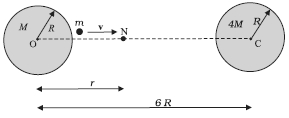
Two uniform solid spheres of equal radii $R$,but mass $M$ and $4M$ have a centre-to-centre separation $6R$,as shown in the figure. The two spheres are held fixed. $A$ projectile of mass $m$ is projected from the surface of the sphere of mass $M$ directly towards the centre of the second sphere. Obtain an expression for the minimum speed $v$ of the projectile so that it reaches the surface of the second sphere.
Solution
(N/A) The projectile is acted upon by two mutually opposing gravitational forces from the two spheres. The neutral point $N$ is defined as the position where the two forces cancel each other exactly. If $ON = r$,we have:
$\frac{GMm}{r^2} = \frac{4GMm}{(6R - r)^2}$
$(6R - r)^2 = 4r^2$
$6R - r = \pm 2r$
$r = 2R$ or $r = -6R$ (ignoring the negative value as it lies outside the region between the spheres).
Thus,the neutral point is at $r = 2R$ from the centre $O$.
It is sufficient to project the particle with a speed that enables it to reach $N$. Thereafter,the greater gravitational pull of the sphere of mass $4M$ will pull it towards the second sphere.
The mechanical energy at the surface of the sphere of mass $M$ is:
$E_i = \frac{1}{2}mv^2 - \frac{GMm}{R} - \frac{4GMm}{5R}$
At the neutral point $N$,the speed approaches zero. The mechanical energy at $N$ is purely potential:
$E_N = -\frac{GMm}{2R} - \frac{4GMm}{4R} = -\frac{GMm}{2R} - \frac{GMm}{R} = -\frac{3GMm}{2R}$
From the principle of conservation of mechanical energy $(E_i = E_N)$:
$\frac{1}{2}mv^2 - \frac{GMm}{R} - \frac{4GMm}{5R} = -\frac{3GMm}{2R}$
$\frac{1}{2}v^2 = \frac{GM}{R} + \frac{4GM}{5R} - \frac{3GM}{2R} = \frac{GM}{R} \left( 1 + 0.8 - 1.5 \right) = \frac{GM}{R} (0.3) = \frac{3GM}{10R}$
$v^2 = \frac{6GM}{10R} = \frac{3GM}{5R}$
$v = \sqrt{\frac{3GM}{5R}}$
$\frac{GMm}{r^2} = \frac{4GMm}{(6R - r)^2}$
$(6R - r)^2 = 4r^2$
$6R - r = \pm 2r$
$r = 2R$ or $r = -6R$ (ignoring the negative value as it lies outside the region between the spheres).
Thus,the neutral point is at $r = 2R$ from the centre $O$.
It is sufficient to project the particle with a speed that enables it to reach $N$. Thereafter,the greater gravitational pull of the sphere of mass $4M$ will pull it towards the second sphere.
The mechanical energy at the surface of the sphere of mass $M$ is:
$E_i = \frac{1}{2}mv^2 - \frac{GMm}{R} - \frac{4GMm}{5R}$
At the neutral point $N$,the speed approaches zero. The mechanical energy at $N$ is purely potential:
$E_N = -\frac{GMm}{2R} - \frac{4GMm}{4R} = -\frac{GMm}{2R} - \frac{GMm}{R} = -\frac{3GMm}{2R}$
From the principle of conservation of mechanical energy $(E_i = E_N)$:
$\frac{1}{2}mv^2 - \frac{GMm}{R} - \frac{4GMm}{5R} = -\frac{3GMm}{2R}$
$\frac{1}{2}v^2 = \frac{GM}{R} + \frac{4GM}{5R} - \frac{3GM}{2R} = \frac{GM}{R} \left( 1 + 0.8 - 1.5 \right) = \frac{GM}{R} (0.3) = \frac{3GM}{10R}$
$v^2 = \frac{6GM}{10R} = \frac{3GM}{5R}$
$v = \sqrt{\frac{3GM}{5R}}$
0 likes
View Solution28
Difficult
$A$ rocket is fired vertically with a speed of $5 \; km/s$ from the Earth's surface. How far from the Earth's surface does the rocket go before returning? (Mass of the Earth $M_e = 6.0 \times 10^{24} \; kg$,mean radius of the Earth $R_e = 6.4 \times 10^{6} \; m$,$G = 6.67 \times 10^{-11} \; N m^2 kg^{-2}$)
Solution
(A) Let the mass of the rocket be $m$ and the height reached be $h$.
At the Earth's surface,the total energy $E_i$ is the sum of kinetic and potential energy:
$E_i = \frac{1}{2} m v^2 - \frac{G M_e m}{R_e}$
At the highest point $h$,the velocity $v = 0$,so the total energy $E_f$ is purely potential:
$E_f = -\frac{G M_e m}{R_e + h}$
By the law of conservation of energy,$E_i = E_f$:
$\frac{1}{2} m v^2 - \frac{G M_e m}{R_e} = -\frac{G M_e m}{R_e + h}$
Dividing by $m$ and rearranging:
$\frac{v^2}{2} = G M_e \left( \frac{1}{R_e} - \frac{1}{R_e + h} \right) = G M_e \left( \frac{h}{R_e(R_e + h)} \right)$
Using $g = \frac{G M_e}{R_e^2}$,we have $G M_e = g R_e^2$:
$\frac{v^2}{2} = \frac{g R_e^2 h}{R_e(R_e + h)} = \frac{g R_e h}{R_e + h}$
Solving for $h$:
$v^2(R_e + h) = 2 g R_e h \implies v^2 R_e = h(2 g R_e - v^2)$
$h = \frac{R_e v^2}{2 g R_e - v^2}$
Substituting values $v = 5 \times 10^3 \; m/s$,$R_e = 6.4 \times 10^6 \; m$,$g = 9.8 \; m/s^2$:
$h = \frac{6.4 \times 10^6 \times (5 \times 10^3)^2}{2 \times 9.8 \times 6.4 \times 10^6 - (5 \times 10^3)^2}$
$h = \frac{6.4 \times 10^6 \times 25 \times 10^6}{125.44 \times 10^6 - 25 \times 10^6} = \frac{160 \times 10^{12}}{100.44 \times 10^6} \approx 1.593 \times 10^6 \; m \approx 1.6 \times 10^6 \; m$.
At the Earth's surface,the total energy $E_i$ is the sum of kinetic and potential energy:
$E_i = \frac{1}{2} m v^2 - \frac{G M_e m}{R_e}$
At the highest point $h$,the velocity $v = 0$,so the total energy $E_f$ is purely potential:
$E_f = -\frac{G M_e m}{R_e + h}$
By the law of conservation of energy,$E_i = E_f$:
$\frac{1}{2} m v^2 - \frac{G M_e m}{R_e} = -\frac{G M_e m}{R_e + h}$
Dividing by $m$ and rearranging:
$\frac{v^2}{2} = G M_e \left( \frac{1}{R_e} - \frac{1}{R_e + h} \right) = G M_e \left( \frac{h}{R_e(R_e + h)} \right)$
Using $g = \frac{G M_e}{R_e^2}$,we have $G M_e = g R_e^2$:
$\frac{v^2}{2} = \frac{g R_e^2 h}{R_e(R_e + h)} = \frac{g R_e h}{R_e + h}$
Solving for $h$:
$v^2(R_e + h) = 2 g R_e h \implies v^2 R_e = h(2 g R_e - v^2)$
$h = \frac{R_e v^2}{2 g R_e - v^2}$
Substituting values $v = 5 \times 10^3 \; m/s$,$R_e = 6.4 \times 10^6 \; m$,$g = 9.8 \; m/s^2$:
$h = \frac{6.4 \times 10^6 \times (5 \times 10^3)^2}{2 \times 9.8 \times 6.4 \times 10^6 - (5 \times 10^3)^2}$
$h = \frac{6.4 \times 10^6 \times 25 \times 10^6}{125.44 \times 10^6 - 25 \times 10^6} = \frac{160 \times 10^{12}}{100.44 \times 10^6} \approx 1.593 \times 10^6 \; m \approx 1.6 \times 10^6 \; m$.
0 likes
View Solution29
Medium
Two stars each of one solar mass $\left(=2 \times 10^{30} \; kg\right)$ are approaching each other for a head-on collision. When they are at a distance of $10^{9} \; km$,their speeds are negligible. What is the speed with which they collide? The radius of each star is $10^{4} \; km$. Assume the stars remain undistorted until they collide. (Use $G = 6.67 \times 10^{-11} \; N \cdot m^{2}/kg^{2}$)
Solution
(D) Mass of each star,$M = 2 \times 10^{30} \; kg$.
Radius of each star,$R = 10^{4} \; km = 10^{7} \; m$.
Initial distance between the centers of the stars,$r = 10^{9} \; km = 10^{12} \; m$.
Initial kinetic energy is $0$ as speeds are negligible.
Initial potential energy,$U_{i} = -\frac{GM^{2}}{r}$.
Total initial energy,$E_{i} = -\frac{GM^{2}}{r}$.
At the moment of collision,the distance between the centers is $2R$.
Let the speed of each star be $v$.
Total kinetic energy,$K_{f} = \frac{1}{2}Mv^{2} + \frac{1}{2}Mv^{2} = Mv^{2}$.
Total potential energy,$U_{f} = -\frac{GM^{2}}{2R}$.
Total final energy,$E_{f} = Mv^{2} - \frac{GM^{2}}{2R}$.
By the law of conservation of energy,$E_{i} = E_{f}$:
$-\frac{GM^{2}}{r} = Mv^{2} - \frac{GM^{2}}{2R}$.
$v^{2} = GM \left( \frac{1}{2R} - \frac{1}{r} \right)$.
Since $r \gg 2R$,$\frac{1}{r}$ is negligible compared to $\frac{1}{2R}$.
$v^{2} \approx \frac{GM}{2R} = \frac{6.67 \times 10^{-11} \times 2 \times 10^{30}}{2 \times 10^{7}} = 6.67 \times 10^{12} \; m^{2}/s^{2}$.
$v = \sqrt{6.67 \times 10^{12}} \approx 2.58 \times 10^{6} \; m/s$.
Radius of each star,$R = 10^{4} \; km = 10^{7} \; m$.
Initial distance between the centers of the stars,$r = 10^{9} \; km = 10^{12} \; m$.
Initial kinetic energy is $0$ as speeds are negligible.
Initial potential energy,$U_{i} = -\frac{GM^{2}}{r}$.
Total initial energy,$E_{i} = -\frac{GM^{2}}{r}$.
At the moment of collision,the distance between the centers is $2R$.
Let the speed of each star be $v$.
Total kinetic energy,$K_{f} = \frac{1}{2}Mv^{2} + \frac{1}{2}Mv^{2} = Mv^{2}$.
Total potential energy,$U_{f} = -\frac{GM^{2}}{2R}$.
Total final energy,$E_{f} = Mv^{2} - \frac{GM^{2}}{2R}$.
By the law of conservation of energy,$E_{i} = E_{f}$:
$-\frac{GM^{2}}{r} = Mv^{2} - \frac{GM^{2}}{2R}$.
$v^{2} = GM \left( \frac{1}{2R} - \frac{1}{r} \right)$.
Since $r \gg 2R$,$\frac{1}{r}$ is negligible compared to $\frac{1}{2R}$.
$v^{2} \approx \frac{GM}{2R} = \frac{6.67 \times 10^{-11} \times 2 \times 10^{30}}{2 \times 10^{7}} = 6.67 \times 10^{12} \; m^{2}/s^{2}$.
$v = \sqrt{6.67 \times 10^{12}} \approx 2.58 \times 10^{6} \; m/s$.
0 likes
View Solution30
MediumMCQ
What is the change in the gravitational potential energy of an object when it moves away from the Earth and when it comes closer to the Earth?
A
Increases when moving away,decreases when coming closer.
B
Decreases when moving away,increases when coming closer.
C
Remains constant in both cases.
D
Increases in both cases.
Solution
(A) The gravitational potential energy $U$ of an object of mass $m$ at a distance $r$ from the center of the Earth is given by $U = -\frac{GMm}{r}$,where $G$ is the gravitational constant,$M$ is the mass of the Earth,and $r$ is the distance from the center of the Earth.
$1$. When an object moves away from the Earth,the distance $r$ increases. Since $U$ is negative and inversely proportional to $r$,as $r$ increases,the value of $U$ becomes less negative,which means it increases.
$2$. When an object comes closer to the Earth,the distance $r$ decreases. As $r$ decreases,the value of $U$ becomes more negative,which means it decreases.
$1$. When an object moves away from the Earth,the distance $r$ increases. Since $U$ is negative and inversely proportional to $r$,as $r$ increases,the value of $U$ becomes less negative,which means it increases.
$2$. When an object comes closer to the Earth,the distance $r$ decreases. As $r$ decreases,the value of $U$ becomes more negative,which means it decreases.
0 likes
View Solution31
Difficult
Write the change in gravitational potential energy of a body lifted at height $h$ from the surface of Earth.
Solution
(N/A) The gravitational potential energy $U$ of a body of mass $m$ at a height $h$ above the surface of the Earth is given by the work done against the gravitational force.
Since the force of gravity near the Earth's surface is $F = mg$,the work done to lift the body to height $h$ is $W = F \times h = mgh$.
Therefore,the change in gravitational potential energy is $\Delta U = mgh$.
Since the force of gravity near the Earth's surface is $F = mg$,the work done to lift the body to height $h$ is $W = F \times h = mgh$.
Therefore,the change in gravitational potential energy is $\Delta U = mgh$.
0 likes
View Solution32
Medium
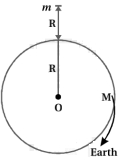
An object of mass $m$ is raised from the surface of the earth to a height equal to the radius of the earth,that is,taken from a distance $R$ to $2R$ from the centre of the earth. What is the gain in its potential energy?
Solution
(N/A) The gravitational potential energy of an object of mass $m$ at a distance $r$ from the centre of the earth of mass $M$ is given by $U = -\frac{GMm}{r}$.
Potential energy of the object at the surface of the earth $(r = R)$: $U_i = -\frac{GMm}{R}$.
Potential energy of the object at a height equal to the radius of the earth $(r = R + R = 2R)$: $U_f = -\frac{GMm}{2R}$.
Gain in potential energy $(\Delta U)$ = $U_f - U_i$.
$\Delta U = -\frac{GMm}{2R} - \left(-\frac{GMm}{R}\right) = \frac{GMm}{R} - \frac{GMm}{2R} = \frac{GMm}{2R}$.
Since $g = \frac{GM}{R^2}$,we have $GM = gR^2$.
Substituting this into the expression for gain in potential energy:
$\Delta U = \frac{(gR^2)m}{2R} = \frac{1}{2}mgR$.
Potential energy of the object at the surface of the earth $(r = R)$: $U_i = -\frac{GMm}{R}$.
Potential energy of the object at a height equal to the radius of the earth $(r = R + R = 2R)$: $U_f = -\frac{GMm}{2R}$.
Gain in potential energy $(\Delta U)$ = $U_f - U_i$.
$\Delta U = -\frac{GMm}{2R} - \left(-\frac{GMm}{R}\right) = \frac{GMm}{R} - \frac{GMm}{2R} = \frac{GMm}{2R}$.
Since $g = \frac{GM}{R^2}$,we have $GM = gR^2$.
Substituting this into the expression for gain in potential energy:
$\Delta U = \frac{(gR^2)m}{2R} = \frac{1}{2}mgR$.
0 likes
View Solution33
DifficultMCQ
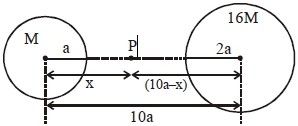
Two planets have masses $M$ and $16\, M$ and their radii are $a$ and $2\, a$ respectively. The separation between the centres of the planets is $10\, a.$ $A$ body of mass $m$ is fired from the surface of the larger planet towards the smaller planet along the line joining their centres. For the body to be able to reach the surface of the smaller planet,the minimum firing speed needed is
A
$\sqrt{\frac{GM}{a}}$
B
$\frac{3}{2} \sqrt{\frac{5GM}{a}}$
C
$4 \sqrt{\frac{GM}{a}}$
D
$2 \sqrt{\frac{GM}{a}}$
Solution
(B) To reach the smaller planet,the body must cross the point of zero gravitational field (neutral point) between the two planets.
Let the distance of the neutral point from the center of the smaller planet be $x$.
Equating the gravitational fields from both planets at this point:
$\frac{GM}{x^2} = \frac{G(16M)}{(10a - x)^2}$
Taking the square root on both sides:
$\frac{1}{x} = \frac{4}{10a - x} \implies 10a - x = 4x \implies x = 2a$.
Now,apply the Law of Conservation of Mechanical Energy between the surface of the larger planet and the neutral point.
The potential at the surface of the larger planet (radius $2a$,mass $16M$) is $V_L = -\frac{G(16M)}{2a} - \frac{GM}{8a} = -\frac{8GM}{a} - \frac{GM}{8a} = -\frac{65GM}{8a}$.
The potential at the neutral point (distance $8a$ from larger,$2a$ from smaller) is $V_P = -\frac{G(16M)}{8a} - \frac{GM}{2a} = -\frac{2GM}{a} - \frac{GM}{2a} = -\frac{5GM}{2a}$.
Using $KE_i + PE_i = KE_f + PE_f$,where $KE_f = 0$ at the neutral point:
$\frac{1}{2}mv^2 + m V_L = 0 + m V_P$
$\frac{1}{2}v^2 = V_P - V_L = -\frac{5GM}{2a} - (-\frac{65GM}{8a}) = \frac{-20GM + 65GM}{8a} = \frac{45GM}{8a}$.
$v^2 = \frac{45GM}{4a} \implies v = \sqrt{\frac{45GM}{4a}} = \frac{3}{2} \sqrt{\frac{5GM}{a}}$.
Let the distance of the neutral point from the center of the smaller planet be $x$.
Equating the gravitational fields from both planets at this point:
$\frac{GM}{x^2} = \frac{G(16M)}{(10a - x)^2}$
Taking the square root on both sides:
$\frac{1}{x} = \frac{4}{10a - x} \implies 10a - x = 4x \implies x = 2a$.
Now,apply the Law of Conservation of Mechanical Energy between the surface of the larger planet and the neutral point.
The potential at the surface of the larger planet (radius $2a$,mass $16M$) is $V_L = -\frac{G(16M)}{2a} - \frac{GM}{8a} = -\frac{8GM}{a} - \frac{GM}{8a} = -\frac{65GM}{8a}$.
The potential at the neutral point (distance $8a$ from larger,$2a$ from smaller) is $V_P = -\frac{G(16M)}{8a} - \frac{GM}{2a} = -\frac{2GM}{a} - \frac{GM}{2a} = -\frac{5GM}{2a}$.
Using $KE_i + PE_i = KE_f + PE_f$,where $KE_f = 0$ at the neutral point:
$\frac{1}{2}mv^2 + m V_L = 0 + m V_P$
$\frac{1}{2}v^2 = V_P - V_L = -\frac{5GM}{2a} - (-\frac{65GM}{8a}) = \frac{-20GM + 65GM}{8a} = \frac{45GM}{8a}$.
$v^2 = \frac{45GM}{4a} \implies v = \sqrt{\frac{45GM}{4a}} = \frac{3}{2} \sqrt{\frac{5GM}{a}}$.
0 likes
View Solution34
DifficultMCQ
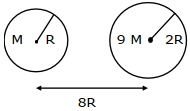
Suppose two planets (spherical in shape) of radii $R$ and $2R$,but mass $M$ and $9M$ respectively have a centre-to-centre separation $8R$ as shown in the figure. $A$ satellite of mass $m$ is projected from the surface of the planet of mass $M$ directly towards the centre of the second planet. The minimum speed $v$ required for the satellite to reach the surface of the second planet is $\sqrt{\frac{a}{7} \frac{GM}{R}}$,then the value of $a$ is $....$
[Given: The two planets are fixed in their position]
[Given: The two planets are fixed in their position]
A
$4$
B
$8$
C
$16$
D
$64$
Solution
(A) To reach the surface of the second planet,the satellite must cross the point where the net gravitational field is zero.
Let the distance of this point from the centre of the planet of mass $M$ be $x$.
$\frac{GM}{x^2} = \frac{G(9M)}{(8R-x)^2}$
$\frac{1}{x} = \frac{3}{8R-x}$
$8R-x = 3x \Rightarrow x = 2R$.
Now,apply the law of conservation of energy between the surface of the first planet and the point $x = 2R$ (where the velocity is minimum,i.e.,$v_{min} = 0$):
$E_{initial} = E_{final}$
$\frac{1}{2}mv^2 - \frac{GMm}{R} - \frac{G(9M)m}{7R} = 0 - \frac{GMm}{2R} - \frac{G(9M)m}{6R}$
$\frac{1}{2}v^2 = \frac{GM}{R} + \frac{9GM}{7R} - \frac{GM}{2R} - \frac{9GM}{6R}$
$\frac{1}{2}v^2 = \frac{GM}{R} [1 + \frac{9}{7} - \frac{1}{2} - \frac{3}{2}]$
$\frac{1}{2}v^2 = \frac{GM}{R} [1 + \frac{9}{7} - 2] = \frac{GM}{R} [\frac{9}{7} - 1] = \frac{GM}{R} [\frac{2}{7}]$
$v^2 = \frac{4}{7} \frac{GM}{R}$
$v = \sqrt{\frac{4}{7} \frac{GM}{R}}$
Comparing this with $\sqrt{\frac{a}{7} \frac{GM}{R}}$,we get $a = 4$.
Let the distance of this point from the centre of the planet of mass $M$ be $x$.
$\frac{GM}{x^2} = \frac{G(9M)}{(8R-x)^2}$
$\frac{1}{x} = \frac{3}{8R-x}$
$8R-x = 3x \Rightarrow x = 2R$.
Now,apply the law of conservation of energy between the surface of the first planet and the point $x = 2R$ (where the velocity is minimum,i.e.,$v_{min} = 0$):
$E_{initial} = E_{final}$
$\frac{1}{2}mv^2 - \frac{GMm}{R} - \frac{G(9M)m}{7R} = 0 - \frac{GMm}{2R} - \frac{G(9M)m}{6R}$
$\frac{1}{2}v^2 = \frac{GM}{R} + \frac{9GM}{7R} - \frac{GM}{2R} - \frac{9GM}{6R}$
$\frac{1}{2}v^2 = \frac{GM}{R} [1 + \frac{9}{7} - \frac{1}{2} - \frac{3}{2}]$
$\frac{1}{2}v^2 = \frac{GM}{R} [1 + \frac{9}{7} - 2] = \frac{GM}{R} [\frac{9}{7} - 1] = \frac{GM}{R} [\frac{2}{7}]$
$v^2 = \frac{4}{7} \frac{GM}{R}$
$v = \sqrt{\frac{4}{7} \frac{GM}{R}}$
Comparing this with $\sqrt{\frac{a}{7} \frac{GM}{R}}$,we get $a = 4$.
0 likes
View Solution35
MediumMCQ
An object of mass $1 \, kg$ is taken to a height from the surface of Earth which is equal to three times the radius of Earth. The gain in potential energy of the object will be $.... \, MJ$ [Given: $g = 10 \, m/s^2$ and radius of Earth $R = 6400 \, km$].
A
$48$
B
$24$
C
$36$
D
$12$
Solution
(A) The gravitational potential energy at the surface of the Earth is $U_i = -\frac{GMm}{R}$.
The object is taken to a height $h = 3R$. The final distance from the center of the Earth is $r = R + h = R + 3R = 4R$.
The gravitational potential energy at this height is $U_f = -\frac{GMm}{4R}$.
The gain in potential energy is $\Delta U = U_f - U_i = -\frac{GMm}{4R} - (-\frac{GMm}{R}) = \frac{GMm}{R} - \frac{GMm}{4R} = \frac{3GMm}{4R}$.
Since $g = \frac{GM}{R^2}$,we have $GM = gR^2$. Substituting this into the equation:
$\Delta U = \frac{3(gR^2)m}{4R} = \frac{3}{4} mgR$.
Given $m = 1 \, kg$,$g = 10 \, m/s^2$,and $R = 6400 \, km = 6.4 \times 10^6 \, m$:
$\Delta U = \frac{3}{4} \times 1 \times 10 \times 6.4 \times 10^6 = 3 \times 2.5 \times 6.4 \times 10^6 = 48 \times 10^6 \, J = 48 \, MJ$.
The object is taken to a height $h = 3R$. The final distance from the center of the Earth is $r = R + h = R + 3R = 4R$.
The gravitational potential energy at this height is $U_f = -\frac{GMm}{4R}$.
The gain in potential energy is $\Delta U = U_f - U_i = -\frac{GMm}{4R} - (-\frac{GMm}{R}) = \frac{GMm}{R} - \frac{GMm}{4R} = \frac{3GMm}{4R}$.
Since $g = \frac{GM}{R^2}$,we have $GM = gR^2$. Substituting this into the equation:
$\Delta U = \frac{3(gR^2)m}{4R} = \frac{3}{4} mgR$.
Given $m = 1 \, kg$,$g = 10 \, m/s^2$,and $R = 6400 \, km = 6.4 \times 10^6 \, m$:
$\Delta U = \frac{3}{4} \times 1 \times 10 \times 6.4 \times 10^6 = 3 \times 2.5 \times 6.4 \times 10^6 = 48 \times 10^6 \, J = 48 \, MJ$.
1 likes
View Solution36
DifficultMCQ
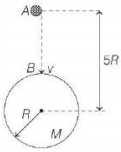
An object is propelled vertically to a maximum height of $4 R$ from the surface of a planet of radius $R$ and mass $M$. The speed of the object when it returns to the surface of the planet is
A
$2 \sqrt{\frac{2 G M}{5 R}}$
B
$\sqrt{\frac{G M}{2 R}}$
C
$\sqrt{\frac{3 G M}{2 R}}$
D
$\sqrt{\frac{G M}{5 R}}$
Solution
(A) Let $m$ be the mass of the object and $v$ be its speed when it returns to the surface of the planet.
At the maximum height,the distance from the center of the planet is $r_{max} = R + 4R = 5R$. At this point,the velocity of the object is $0$.
Using the principle of conservation of mechanical energy between the maximum height and the surface of the planet:
$E_{initial} = E_{final}$
$U_{max} + K_{max} = U_{surface} + K_{surface}$
$-\frac{G M m}{5R} + 0 = -\frac{G M m}{R} + \frac{1}{2} m v^2$
$\frac{1}{2} v^2 = \frac{G M}{R} - \frac{G M}{5R}$
$\frac{1}{2} v^2 = \frac{G M}{R} (1 - \frac{1}{5}) = \frac{G M}{R} (\frac{4}{5})$
$v^2 = \frac{8 G M}{5 R}$
$v = \sqrt{\frac{8 G M}{5 R}} = 2 \sqrt{\frac{2 G M}{5 R}}$
Thus,the speed of the object when it returns to the surface is $2 \sqrt{\frac{2 G M}{5 R}}$.
At the maximum height,the distance from the center of the planet is $r_{max} = R + 4R = 5R$. At this point,the velocity of the object is $0$.
Using the principle of conservation of mechanical energy between the maximum height and the surface of the planet:
$E_{initial} = E_{final}$
$U_{max} + K_{max} = U_{surface} + K_{surface}$
$-\frac{G M m}{5R} + 0 = -\frac{G M m}{R} + \frac{1}{2} m v^2$
$\frac{1}{2} v^2 = \frac{G M}{R} - \frac{G M}{5R}$
$\frac{1}{2} v^2 = \frac{G M}{R} (1 - \frac{1}{5}) = \frac{G M}{R} (\frac{4}{5})$
$v^2 = \frac{8 G M}{5 R}$
$v = \sqrt{\frac{8 G M}{5 R}} = 2 \sqrt{\frac{2 G M}{5 R}}$
Thus,the speed of the object when it returns to the surface is $2 \sqrt{\frac{2 G M}{5 R}}$.
0 likes
View Solution37
MediumMCQ
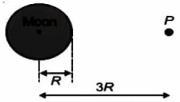
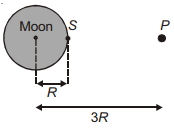
$A$ stationary object is released from a point $P$ at a distance $3R$ from the centre of the moon,which has radius $R$ and mass $M$. Which of the following gives the speed of the object on hitting the moon?
A
$\left(\frac{2 G M}{3 R}\right)^{1 / 2}$
B
$\left(\frac{4 G M}{3 R}\right)^{1 / 2}$
C
$\left(\frac{G M}{3 R}\right)^{1 / 2}$
D
$\left(\frac{G M}{R}\right)^{1 / 2}$
Solution
(B) By applying the principle of conservation of mechanical energy between the initial point $P$ (at distance $3R$ from the center) and the surface of the moon $S$ (at distance $R$ from the center):
Initial Mechanical Energy $(E_i)$ = Final Mechanical Energy $(E_f)$
$E_i = K_i + U_i = 0 + \left(-\frac{G M m}{3 R}\right) = -\frac{G M m}{3 R}$
$E_f = K_f + U_f = \frac{1}{2} m v^2 + \left(-\frac{G M m}{R}\right)$
Equating $E_i$ and $E_f$:
$-\frac{G M m}{3 R} = \frac{1}{2} m v^2 - \frac{G M m}{R}$
$\frac{1}{2} m v^2 = \frac{G M m}{R} - \frac{G M m}{3 R}$
$\frac{1}{2} m v^2 = \frac{G M m}{R} \left(1 - \frac{1}{3}\right) = \frac{G M m}{R} \left(\frac{2}{3}\right)$
$\frac{1}{2} v^2 = \frac{2 G M}{3 R}$
$v^2 = \frac{4 G M}{3 R}$
$v = \sqrt{\frac{4 G M}{3 R}}$
Thus,the correct option is $(B)$.
Initial Mechanical Energy $(E_i)$ = Final Mechanical Energy $(E_f)$
$E_i = K_i + U_i = 0 + \left(-\frac{G M m}{3 R}\right) = -\frac{G M m}{3 R}$
$E_f = K_f + U_f = \frac{1}{2} m v^2 + \left(-\frac{G M m}{R}\right)$
Equating $E_i$ and $E_f$:
$-\frac{G M m}{3 R} = \frac{1}{2} m v^2 - \frac{G M m}{R}$
$\frac{1}{2} m v^2 = \frac{G M m}{R} - \frac{G M m}{3 R}$
$\frac{1}{2} m v^2 = \frac{G M m}{R} \left(1 - \frac{1}{3}\right) = \frac{G M m}{R} \left(\frac{2}{3}\right)$
$\frac{1}{2} v^2 = \frac{2 G M}{3 R}$
$v^2 = \frac{4 G M}{3 R}$
$v = \sqrt{\frac{4 G M}{3 R}}$
Thus,the correct option is $(B)$.
0 likes
View Solution38
DifficultMCQ
$A$ body is projected vertically upwards with a speed of $\sqrt{\frac{G M}{R}}$ ($M$ is the mass and $R$ is the radius of the Earth). The body will attain a maximum height of .......
A
$\frac{R}{2}$
B
$R$
C
$\frac{5}{4} R$
D
$\frac{3 R}{2}$
Solution
(B) By applying the law of conservation of mechanical energy between the Earth's surface and the maximum height reached by the body:
Initial Mechanical Energy $(E_i)$ = Final Mechanical Energy $(E_f)$
$P.E._i + K.E._i = P.E._f + K.E._f$
$-\frac{G M m}{R} + \frac{1}{2} m \left(\sqrt{\frac{G M}{R}}\right)^2 = -\frac{G M m}{r} + 0$
$-\frac{G M m}{R} + \frac{G M m}{2 R} = -\frac{G M m}{r}$
$-\frac{G M m}{2 R} = -\frac{G M m}{r}$
$r = 2 R$
Since $r = R + h$,where $h$ is the height above the surface:
$R + h = 2 R$
$h = R$
Initial Mechanical Energy $(E_i)$ = Final Mechanical Energy $(E_f)$
$P.E._i + K.E._i = P.E._f + K.E._f$
$-\frac{G M m}{R} + \frac{1}{2} m \left(\sqrt{\frac{G M}{R}}\right)^2 = -\frac{G M m}{r} + 0$
$-\frac{G M m}{R} + \frac{G M m}{2 R} = -\frac{G M m}{r}$
$-\frac{G M m}{2 R} = -\frac{G M m}{r}$
$r = 2 R$
Since $r = R + h$,where $h$ is the height above the surface:
$R + h = 2 R$
$h = R$
0 likes
View Solution39
MediumMCQ
An object is allowed to fall from a height $R$ above the earth,where $R$ is the radius of the earth. Its velocity when it strikes the earth's surface,ignoring air resistance,will be:
A
$2 \sqrt{g R}$
B
$\sqrt{g R}$
C
$\sqrt{\frac{g R}{2}}$
D
$\sqrt{2 g R}$
Solution
(B) According to the law of conservation of mechanical energy,the loss in gravitational potential energy equals the gain in kinetic energy.
Initial potential energy at height $h = R$ is $U_i = -\frac{GMm}{R+R} = -\frac{GMm}{2R}$.
Final potential energy at the earth's surface $(r = R)$ is $U_f = -\frac{GMm}{R}$.
Loss in potential energy = $U_i - U_f = -\frac{GMm}{2R} - (-\frac{GMm}{R}) = \frac{GMm}{2R}$.
Gain in kinetic energy = $\frac{1}{2}mv^2$.
Equating the two: $\frac{1}{2}mv^2 = \frac{GMm}{2R}$.
Using $GM = gR^2$,we get $\frac{1}{2}v^2 = \frac{gR^2}{2R} = \frac{gR}{2}$.
Therefore,$v^2 = gR$,which gives $v = \sqrt{gR}$.
Initial potential energy at height $h = R$ is $U_i = -\frac{GMm}{R+R} = -\frac{GMm}{2R}$.
Final potential energy at the earth's surface $(r = R)$ is $U_f = -\frac{GMm}{R}$.
Loss in potential energy = $U_i - U_f = -\frac{GMm}{2R} - (-\frac{GMm}{R}) = \frac{GMm}{2R}$.
Gain in kinetic energy = $\frac{1}{2}mv^2$.
Equating the two: $\frac{1}{2}mv^2 = \frac{GMm}{2R}$.
Using $GM = gR^2$,we get $\frac{1}{2}v^2 = \frac{gR^2}{2R} = \frac{gR}{2}$.
Therefore,$v^2 = gR$,which gives $v = \sqrt{gR}$.
1 likes
View Solution40
DifficultMCQ
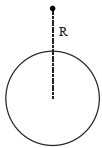
$A$ body is released from a height equal to the radius $(R)$ of the earth. The velocity of the body when it strikes the surface of the earth will be: (Given $g$ = acceleration due to gravity on the earth.)
A
$\sqrt{g R}$
B
$\sqrt{4 g R}$
C
$\sqrt{2 g R}$
D
$\sqrt{\frac{g R}{2}}$
Solution
(A) By the principle of conservation of mechanical energy,the total energy at the initial position (height $h = R$ from the surface,distance $r = 2R$ from the center) is equal to the total energy at the surface of the earth (distance $r = R$ from the center).
$U_i + K_i = U_f + K_f$
$-\frac{GMm}{2R} + 0 = -\frac{GMm}{R} + \frac{1}{2}mv^2$
$\frac{1}{2}mv^2 = \frac{GMm}{R} - \frac{GMm}{2R}$
$\frac{1}{2}mv^2 = \frac{GMm}{2R}$
$v^2 = \frac{GM}{R}$
Since $g = \frac{GM}{R^2}$,we have $GM = gR^2$.
Substituting this into the equation for $v^2$:
$v^2 = \frac{gR^2}{R} = gR$
$v = \sqrt{gR}$
$U_i + K_i = U_f + K_f$
$-\frac{GMm}{2R} + 0 = -\frac{GMm}{R} + \frac{1}{2}mv^2$
$\frac{1}{2}mv^2 = \frac{GMm}{R} - \frac{GMm}{2R}$
$\frac{1}{2}mv^2 = \frac{GMm}{2R}$
$v^2 = \frac{GM}{R}$
Since $g = \frac{GM}{R^2}$,we have $GM = gR^2$.
Substituting this into the equation for $v^2$:
$v^2 = \frac{gR^2}{R} = gR$
$v = \sqrt{gR}$
1 likes
View Solution41
DifficultMCQ
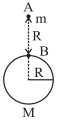
$A$ body which is initially at rest at a height $R$ above the surface of the earth of radius $R$,falls freely towards the earth. Its velocity on reaching the surface of the earth is:
A
$\sqrt{2 gR }$
B
$\sqrt{ gR }$
C
$\sqrt{\frac{3}{2} gR }$
D
$\sqrt{4 gR }$
Solution
(B) Let $M$ be the mass of the earth and $R$ be its radius. The body of mass $m$ is initially at a height $R$ above the surface,so its distance from the center of the earth is $r_A = R + R = 2R$.
Using the Law of Conservation of Mechanical Energy between point $A$ (at height $R$) and point $B$ (at the surface):
$E_A = E_B$
$K_A + U_A = K_B + U_B$
Since the body is initially at rest,$K_A = 0$.
$0 - \frac{G M m}{2R} = \frac{1}{2} m v^2 - \frac{G M m}{R}$
$\frac{1}{2} m v^2 = \frac{G M m}{R} - \frac{G M m}{2R}$
$\frac{1}{2} m v^2 = \frac{G M m}{2R}$
$v^2 = \frac{G M}{R}$
Since $g = \frac{G M}{R^2}$,we have $G M = g R^2$.
Substituting this into the equation for $v^2$:
$v^2 = \frac{g R^2}{R} = g R$
$v = \sqrt{g R}$
Using the Law of Conservation of Mechanical Energy between point $A$ (at height $R$) and point $B$ (at the surface):
$E_A = E_B$
$K_A + U_A = K_B + U_B$
Since the body is initially at rest,$K_A = 0$.
$0 - \frac{G M m}{2R} = \frac{1}{2} m v^2 - \frac{G M m}{R}$
$\frac{1}{2} m v^2 = \frac{G M m}{R} - \frac{G M m}{2R}$
$\frac{1}{2} m v^2 = \frac{G M m}{2R}$
$v^2 = \frac{G M}{R}$
Since $g = \frac{G M}{R^2}$,we have $G M = g R^2$.
Substituting this into the equation for $v^2$:
$v^2 = \frac{g R^2}{R} = g R$
$v = \sqrt{g R}$
0 likes
View Solution42
MediumMCQ
$A$ body starts from rest from a distance $R_0$ from the centre of the earth. The velocity acquired by the body when it reaches the surface of the earth will be ($R=$ radius of earth,$M=$ mass of earth).
A
$2 GM\left(\frac{1}{R}-\frac{1}{R_0}\right)$
B
$\sqrt{2 GM\left(\frac{1}{R}-\frac{1}{R_0}\right)}$
C
$GM\left(\frac{1}{R}-\frac{1}{R_0}\right)$
D
$2 GM \sqrt{\left(\frac{1}{R}-\frac{1}{R_0}\right)}$
Solution
(B) According to the law of conservation of energy,the total mechanical energy at the initial position is equal to the total mechanical energy at the surface of the earth.
Initial energy $E_i = K_i + U_i = 0 - \frac{GMm}{R_0}$.
Final energy $E_f = K_f + U_f = \frac{1}{2}mv^2 - \frac{GMm}{R}$.
Equating $E_i = E_f$:
$-\frac{GMm}{R_0} = \frac{1}{2}mv^2 - \frac{GMm}{R}$.
Rearranging the terms:
$\frac{1}{2}mv^2 = GMm\left(\frac{1}{R} - \frac{1}{R_0}\right)$.
$v^2 = 2GM\left(\frac{1}{R} - \frac{1}{R_0}\right)$.
Therefore,the velocity $v$ is:
$v = \sqrt{2GM\left(\frac{1}{R} - \frac{1}{R_0}\right)}$.
Initial energy $E_i = K_i + U_i = 0 - \frac{GMm}{R_0}$.
Final energy $E_f = K_f + U_f = \frac{1}{2}mv^2 - \frac{GMm}{R}$.
Equating $E_i = E_f$:
$-\frac{GMm}{R_0} = \frac{1}{2}mv^2 - \frac{GMm}{R}$.
Rearranging the terms:
$\frac{1}{2}mv^2 = GMm\left(\frac{1}{R} - \frac{1}{R_0}\right)$.
$v^2 = 2GM\left(\frac{1}{R} - \frac{1}{R_0}\right)$.
Therefore,the velocity $v$ is:
$v = \sqrt{2GM\left(\frac{1}{R} - \frac{1}{R_0}\right)}$.
0 likes
View Solution43
MediumMCQ
$A$ body of mass $m$ starts falling from a distance $3R$ above the Earth's surface. When it reaches a distance $R$ above the surface of the Earth (radius $R$,mass $M$),its kinetic energy is:
A
$\frac{2}{3} \frac{GMm}{R}$
B
$\frac{1}{3} \frac{GMm}{R}$
C
$\frac{1}{2} \frac{GMm}{R}$
D
$\frac{1}{4} \frac{GMm}{R}$
Solution
(D) The total mechanical energy is conserved. Let $r_1$ be the initial distance from the center of the Earth and $r_2$ be the final distance from the center of the Earth.
Initial distance from center: $r_1 = 3R + R = 4R$.
Final distance from center: $r_2 = R + R = 2R$.
Initial potential energy: $U_1 = -\frac{GMm}{r_1} = -\frac{GMm}{4R}$.
Final potential energy: $U_2 = -\frac{GMm}{r_2} = -\frac{GMm}{2R}$.
Since the body starts from rest,initial kinetic energy $K_1 = 0$.
By the law of conservation of energy: $K_1 + U_1 = K_2 + U_2$.
$0 + (-\frac{GMm}{4R}) = K_2 + (-\frac{GMm}{2R})$.
$K_2 = \frac{GMm}{2R} - \frac{GMm}{4R} = \frac{GMm}{4R}$.
Initial distance from center: $r_1 = 3R + R = 4R$.
Final distance from center: $r_2 = R + R = 2R$.
Initial potential energy: $U_1 = -\frac{GMm}{r_1} = -\frac{GMm}{4R}$.
Final potential energy: $U_2 = -\frac{GMm}{r_2} = -\frac{GMm}{2R}$.
Since the body starts from rest,initial kinetic energy $K_1 = 0$.
By the law of conservation of energy: $K_1 + U_1 = K_2 + U_2$.
$0 + (-\frac{GMm}{4R}) = K_2 + (-\frac{GMm}{2R})$.
$K_2 = \frac{GMm}{2R} - \frac{GMm}{4R} = \frac{GMm}{4R}$.
0 likes
View Solution44
MediumMCQ
$A$ body is projected vertically upwards from the Earth's surface of radius $R$ with a velocity equal to $\frac{1}{3}$ of the escape velocity. The maximum height reached by the body is
A
$\frac{R}{8}$
B
$\frac{R}{6}$
C
$\frac{R}{4}$
D
$\frac{R}{9}$
Solution
(A) Using the law of conservation of energy,the total energy at the surface equals the total energy at the maximum height $h$.
Total Energy at surface = Total Energy at height $h$
$\frac{1}{2}mv^2 - \frac{GMm}{R} = 0 - \frac{GMm}{R+h}$
Given $v = \frac{v_e}{3}$,where $v_e = \sqrt{\frac{2GM}{R}}$ is the escape velocity.
Substituting $v^2 = \frac{v_e^2}{9} = \frac{2GM}{9R}$:
$\frac{1}{2}m\left(\frac{2GM}{9R}\right) - \frac{GMm}{R} = - \frac{GMm}{R+h}$
$\frac{GMm}{9R} - \frac{GMm}{R} = - \frac{GMm}{R+h}$
Dividing by $GMm$:
$\frac{1}{9R} - \frac{1}{R} = - \frac{1}{R+h}$
$\frac{1-9}{9R} = - \frac{1}{R+h}$
$\frac{-8}{9R} = - \frac{1}{R+h}$
$\frac{8}{9R} = \frac{1}{R+h}$
$8(R+h) = 9R$
$8R + 8h = 9R$
$8h = R$
$h = \frac{R}{8}$
Total Energy at surface = Total Energy at height $h$
$\frac{1}{2}mv^2 - \frac{GMm}{R} = 0 - \frac{GMm}{R+h}$
Given $v = \frac{v_e}{3}$,where $v_e = \sqrt{\frac{2GM}{R}}$ is the escape velocity.
Substituting $v^2 = \frac{v_e^2}{9} = \frac{2GM}{9R}$:
$\frac{1}{2}m\left(\frac{2GM}{9R}\right) - \frac{GMm}{R} = - \frac{GMm}{R+h}$
$\frac{GMm}{9R} - \frac{GMm}{R} = - \frac{GMm}{R+h}$
Dividing by $GMm$:
$\frac{1}{9R} - \frac{1}{R} = - \frac{1}{R+h}$
$\frac{1-9}{9R} = - \frac{1}{R+h}$
$\frac{-8}{9R} = - \frac{1}{R+h}$
$\frac{8}{9R} = \frac{1}{R+h}$
$8(R+h) = 9R$
$8R + 8h = 9R$
$8h = R$
$h = \frac{R}{8}$
0 likes
View Solution45
MediumMCQ
$A$ body (mass $m$) starts its motion from rest from a point distant $R_0$ $(R_0 > R)$ from the centre of the Earth. The velocity acquired by the body when it reaches the surface of the Earth will be ($G =$ universal constant of gravitation,$M =$ mass of Earth,$R =$ radius of Earth).
A
$2 GM \left( \frac{1}{R} - \frac{1}{R_0} \right)$
B
$\left[ 2 GM \left( \frac{1}{R} - \frac{1}{R_0} \right) \right]^{\frac{1}{2}}$
C
$GM \left( \frac{1}{R} - \frac{1}{R_0} \right)$
D
$2 GM \left[ \left( \frac{1}{R} - \frac{1}{R_0} \right) \right]^{\frac{1}{2}}$
Solution
(B) According to the law of conservation of energy,the total mechanical energy at the initial point (at distance $R_0$) is equal to the total mechanical energy at the surface of the Earth (at distance $R$).
Initial energy $E_i = K_i + U_i = 0 + \left( -\frac{GMm}{R_0} \right) = -\frac{GMm}{R_0}$.
Final energy $E_f = K_f + U_f = \frac{1}{2} mv^2 + \left( -\frac{GMm}{R} \right)$.
By conservation of energy,$E_i = E_f$:
$-\frac{GMm}{R_0} = \frac{1}{2} mv^2 - \frac{GMm}{R}$.
Rearranging the terms:
$\frac{1}{2} mv^2 = \frac{GMm}{R} - \frac{GMm}{R_0} = GMm \left( \frac{1}{R} - \frac{1}{R_0} \right)$.
$v^2 = 2 GM \left( \frac{1}{R} - \frac{1}{R_0} \right)$.
Therefore,the velocity $v$ is:
$v = \left[ 2 GM \left( \frac{1}{R} - \frac{1}{R_0} \right) \right]^{\frac{1}{2}}$.
Initial energy $E_i = K_i + U_i = 0 + \left( -\frac{GMm}{R_0} \right) = -\frac{GMm}{R_0}$.
Final energy $E_f = K_f + U_f = \frac{1}{2} mv^2 + \left( -\frac{GMm}{R} \right)$.
By conservation of energy,$E_i = E_f$:
$-\frac{GMm}{R_0} = \frac{1}{2} mv^2 - \frac{GMm}{R}$.
Rearranging the terms:
$\frac{1}{2} mv^2 = \frac{GMm}{R} - \frac{GMm}{R_0} = GMm \left( \frac{1}{R} - \frac{1}{R_0} \right)$.
$v^2 = 2 GM \left( \frac{1}{R} - \frac{1}{R_0} \right)$.
Therefore,the velocity $v$ is:
$v = \left[ 2 GM \left( \frac{1}{R} - \frac{1}{R_0} \right) \right]^{\frac{1}{2}}$.
0 likes
View Solution46
MediumMCQ
$A$ body is thrown from the surface of the earth with velocity $V \ m/s$. The maximum height above the earth's surface up to which it will reach is ($R =$ radius of earth,$g =$ acceleration due to gravity).
A
$\frac{VR^{2}}{gR-V}$
B
$\frac{V^{2}R}{2gR-V^{2}}$
C
$\frac{2gR}{V^{2}(R-1)}$
D
$\frac{VR}{2gR-V}$
Solution
(B) Using the law of conservation of energy,the total energy at the surface equals the total energy at the maximum height $h$.
Initial energy at surface: $E_i = \frac{1}{2}mV^2 - \frac{GMm}{R}$
Final energy at height $h$: $E_f = 0 - \frac{GMm}{R+h}$
Equating $E_i = E_f$:
$\frac{1}{2}mV^2 - \frac{GMm}{R} = - \frac{GMm}{R+h}$
$\frac{1}{2}V^2 = GM \left( \frac{1}{R} - \frac{1}{R+h} \right)$
Since $GM = gR^2$:
$\frac{1}{2}V^2 = gR^2 \left( \frac{R+h-R}{R(R+h)} \right) = gR \left( \frac{h}{R+h} \right)$
$\frac{V^2}{2gR} = \frac{h}{R+h}$
$V^2(R+h) = 2gRh$
$V^2R + V^2h = 2gRh$
$V^2R = h(2gR - V^2)$
$h = \frac{V^2R}{2gR - V^2}$
Initial energy at surface: $E_i = \frac{1}{2}mV^2 - \frac{GMm}{R}$
Final energy at height $h$: $E_f = 0 - \frac{GMm}{R+h}$
Equating $E_i = E_f$:
$\frac{1}{2}mV^2 - \frac{GMm}{R} = - \frac{GMm}{R+h}$
$\frac{1}{2}V^2 = GM \left( \frac{1}{R} - \frac{1}{R+h} \right)$
Since $GM = gR^2$:
$\frac{1}{2}V^2 = gR^2 \left( \frac{R+h-R}{R(R+h)} \right) = gR \left( \frac{h}{R+h} \right)$
$\frac{V^2}{2gR} = \frac{h}{R+h}$
$V^2(R+h) = 2gRh$
$V^2R + V^2h = 2gRh$
$V^2R = h(2gR - V^2)$
$h = \frac{V^2R}{2gR - V^2}$
0 likes
View Solution47
MediumMCQ
What is the minimum energy required to launch a satellite of mass $m$ from the surface of the Earth of mass $M$ and radius $R$ to an altitude of $2R$?
A
$\frac{G M m}{2 R}$
B
$\frac{2 G M m}{3 R}$
C
$\frac{G M m}{3 R}$
D
$\frac{5 G M m}{6 R}$
Solution
(B) The minimum energy required to launch a satellite from the surface of the Earth is equal to the change in gravitational potential energy as it moves from the surface to the final altitude.
Initial potential energy at the surface $(r_1 = R)$: $U_i = -\frac{G M m}{R}$
Final potential energy at altitude $h = 2R$ $(r_2 = R + 2R = 3R)$: $U_f = -\frac{G M m}{3R}$
The energy required is $\Delta U = U_f - U_i$
$\Delta U = -\frac{G M m}{3R} - (-\frac{G M m}{R})$
$\Delta U = G M m (\frac{1}{R} - \frac{1}{3R})$
$\Delta U = G M m (\frac{3-1}{3R}) = \frac{2 G M m}{3 R}$
Initial potential energy at the surface $(r_1 = R)$: $U_i = -\frac{G M m}{R}$
Final potential energy at altitude $h = 2R$ $(r_2 = R + 2R = 3R)$: $U_f = -\frac{G M m}{3R}$
The energy required is $\Delta U = U_f - U_i$
$\Delta U = -\frac{G M m}{3R} - (-\frac{G M m}{R})$
$\Delta U = G M m (\frac{1}{R} - \frac{1}{3R})$
$\Delta U = G M m (\frac{3-1}{3R}) = \frac{2 G M m}{3 R}$
0 likes
View Solution48
EasyMCQ
$A$ body is thrown from the surface of the earth with velocity $u \ m \ s^{-1}$. The maximum height in meters above the surface of the earth up to which it will reach is ($R=$ radius of the earth,$g=$ acceleration due to gravity).
A
$\frac{u^2 R}{2 g R - u^2}$
B
$\frac{2 u^2 R}{g R - u^2}$
C
$\frac{u^2 R^2}{2 g R^2 - u^2}$
D
$\frac{u^2 R}{g R - u^2}$
Solution
(A) By the law of conservation of energy,the total energy at the surface of the earth is equal to the total energy at the maximum height $h$.
At the surface: $E_i = -\frac{GMm}{R} + \frac{1}{2}mu^2$
At maximum height $h$: $E_f = -\frac{GMm}{R+h} + 0$
Equating $E_i = E_f$: $-\frac{GMm}{R} + \frac{1}{2}mu^2 = -\frac{GMm}{R+h}$
Dividing by $m$ and rearranging: $\frac{GM}{R+h} = \frac{GM}{R} - \frac{u^2}{2}$
Using $GM = gR^2$: $\frac{gR^2}{R+h} = gR - \frac{u^2}{2} = \frac{2gR - u^2}{2}$
$\frac{R+h}{R^2} = \frac{2g}{2gR - u^2}$
$R+h = \frac{2gR^2}{2gR - u^2}$
$h = \frac{2gR^2}{2gR - u^2} - R = \frac{2gR^2 - 2gR^2 + u^2R}{2gR - u^2} = \frac{u^2R}{2gR - u^2}$
At the surface: $E_i = -\frac{GMm}{R} + \frac{1}{2}mu^2$
At maximum height $h$: $E_f = -\frac{GMm}{R+h} + 0$
Equating $E_i = E_f$: $-\frac{GMm}{R} + \frac{1}{2}mu^2 = -\frac{GMm}{R+h}$
Dividing by $m$ and rearranging: $\frac{GM}{R+h} = \frac{GM}{R} - \frac{u^2}{2}$
Using $GM = gR^2$: $\frac{gR^2}{R+h} = gR - \frac{u^2}{2} = \frac{2gR - u^2}{2}$
$\frac{R+h}{R^2} = \frac{2g}{2gR - u^2}$
$R+h = \frac{2gR^2}{2gR - u^2}$
$h = \frac{2gR^2}{2gR - u^2} - R = \frac{2gR^2 - 2gR^2 + u^2R}{2gR - u^2} = \frac{u^2R}{2gR - u^2}$
0 likes
View Solution49
MediumMCQ
$A$ body is projected vertically upwards from the earth's surface. If its kinetic energy of projection is equal to half of its minimum value required to escape from the gravitational influence,then the height up to which it rises is ($R =$ radius of the earth).
A
$4 R$
B
$R$
C
$2 R$
D
$3 R$
Solution
(B) The minimum kinetic energy required to escape from the gravitational influence of the earth is given by $K_e = \frac{GMm}{R}$.
Given that the kinetic energy of projection is $K = \frac{1}{2} K_e = \frac{GMm}{2R}$.
At the highest point,the velocity of the body becomes zero,so its kinetic energy is zero.
By the law of conservation of energy,the loss in kinetic energy equals the gain in potential energy:
$K = U_f - U_i$
$\frac{GMm}{2R} = \left( -\frac{GMm}{R+h} \right) - \left( -\frac{GMm}{R} \right)$
$\frac{GMm}{2R} = \frac{GMm}{R} - \frac{GMm}{R+h}$
Dividing both sides by $GMm$:
$\frac{1}{2R} = \frac{1}{R} - \frac{1}{R+h}$
$\frac{1}{R+h} = \frac{1}{R} - \frac{1}{2R} = \frac{1}{2R}$
$R+h = 2R$
$h = R$.
Given that the kinetic energy of projection is $K = \frac{1}{2} K_e = \frac{GMm}{2R}$.
At the highest point,the velocity of the body becomes zero,so its kinetic energy is zero.
By the law of conservation of energy,the loss in kinetic energy equals the gain in potential energy:
$K = U_f - U_i$
$\frac{GMm}{2R} = \left( -\frac{GMm}{R+h} \right) - \left( -\frac{GMm}{R} \right)$
$\frac{GMm}{2R} = \frac{GMm}{R} - \frac{GMm}{R+h}$
Dividing both sides by $GMm$:
$\frac{1}{2R} = \frac{1}{R} - \frac{1}{R+h}$
$\frac{1}{R+h} = \frac{1}{R} - \frac{1}{2R} = \frac{1}{2R}$
$R+h = 2R$
$h = R$.
0 likes
View Solution50
MediumMCQ
$A$ mass '$m$' on the surface of the Earth is shifted to a height equal to the radius of the Earth. If '$R$' is the radius and '$M$' is the mass of the Earth,then the work done in this process is:
A
$\frac{m g R}{2}$
B
$mgR$
C
$2 mgR$
D
$\frac{m g R}{4}$
Solution
(A) The gravitational potential energy on the surface of the Earth is $U_E = -\frac{G M m}{R}$,where $M$ is the mass of the Earth,$m$ is the mass of the object,$R$ is the radius of the Earth,and $G$ is the gravitational constant.
When the mass $m$ is shifted to a height equal to the radius of the Earth,the distance from the center becomes $r = R + R = 2R$.
The potential energy at this height is $U = -\frac{G M m}{2R}$.
The work done in the process is $W = U - U_E = -\frac{G M m}{2R} - (-\frac{G M m}{R}) = -\frac{G M m}{2R} + \frac{G M m}{R} = \frac{G M m}{2R}$.
Using the relation $g = \frac{G M}{R^2}$,we have $G M = g R^2$.
Substituting this into the work equation: $W = \frac{(g R^2) m}{2R} = \frac{m g R}{2}$.
When the mass $m$ is shifted to a height equal to the radius of the Earth,the distance from the center becomes $r = R + R = 2R$.
The potential energy at this height is $U = -\frac{G M m}{2R}$.
The work done in the process is $W = U - U_E = -\frac{G M m}{2R} - (-\frac{G M m}{R}) = -\frac{G M m}{2R} + \frac{G M m}{R} = \frac{G M m}{2R}$.
Using the relation $g = \frac{G M}{R^2}$,we have $G M = g R^2$.
Substituting this into the work equation: $W = \frac{(g R^2) m}{2R} = \frac{m g R}{2}$.
0 likes
View SolutionGravitation — Change in Gravitational Potential Energy, Energy Conservation · Frequently Asked Questions
1Are these Gravitation questions useful for JEE and NEET?
Yes. All questions in this section are mapped to JEE Main and NEET exam patterns. Previous year questions from JEE Main, NEET, GUJCET and state-level exams are included with full solutions.
2Can I switch to Hindi or Gujarati for these questions?
Yes. Use the language tabs in the hero section or the sidebar to view the same questions and solutions in English, Hindi or Gujarati.
3How do I generate a question paper from this subtopic?
Use the Vedclass Exam Paper Generator — select the chapter and subtopic, set difficulty, and generate Sets A, B, C, D automatically. First 3 chapters of every subject are free.
Vedclass Products
For Students
Vedclass Test Series
Mock tests in real JEE/NEET style with performance analysis. 5-day free trial.
Start Free TrialFor Teachers
Exam Paper Generator
Generate Set A/B/C/D papers from this chapter in 2 minutes. 3 chapters free.
Try FreeFor Institutes
Online Exam Module
Live online exams with unlimited students, 360° analytics & white-label branding.
See DemoFor Teachers & Institutes
Generate a Gravitation Exam Paper in 2 Minutes
Select subtopic & difficulty — Sets A, B, C, D auto-generated with No Repeat logic.
First 3 chapters of every subject are free — no payment required.