
A English
Non-uniform Circular Motion (Centrifugal/Centripetal and tangential Accelaration) Questions in English
Class 11 Physics · 3-2.Motion in Plane · Non-uniform Circular Motion (Centrifugal/Centripetal and tangential Accelaration)
82+
Questions
English
Language
100%
With Solutions
Showing 32 of 82 questions in English
51
Easy
Is the tangential acceleration of a particle moving in a circular path always zero? Under what condition is it zero?
Solution
(N/A) No,the tangential acceleration is not always zero. The tangential acceleration $a_t$ is defined as the rate of change of the magnitude of velocity,given by $a_t = \frac{dv}{dt} = r \alpha$,where $r$ is the radius and $\alpha$ is the angular acceleration.
If the particle moves with a constant speed (uniform circular motion),then $\frac{dv}{dt} = 0$,which implies $a_t = 0$.
If the particle moves with a variable speed (non-uniform circular motion),then $\alpha \neq 0$,and the tangential acceleration is non-zero.
If the particle moves with a constant speed (uniform circular motion),then $\frac{dv}{dt} = 0$,which implies $a_t = 0$.
If the particle moves with a variable speed (non-uniform circular motion),then $\alpha \neq 0$,and the tangential acceleration is non-zero.
0 likes
View Solution52
EasyMCQ
An electron is moving in a circle of radius $2 \, m$ with a speed of $4 \, m/s$. Find the acceleration of the electron in $m/s^2$.
A
$8$
B
$4$
C
$16$
D
$10$
Solution
(A) The acceleration of an object moving in a circular path is given by the centripetal acceleration formula:
$a = \frac{v^2}{r}$
Given:
Speed $v = 4 \, m/s$
Radius $r = 2 \, m$
Substituting the values into the formula:
$a = \frac{(4)^2}{2} = \frac{16}{2} = 8 \, m/s^2$
Thus,the acceleration of the electron is $8 \, m/s^2$.
$a = \frac{v^2}{r}$
Given:
Speed $v = 4 \, m/s$
Radius $r = 2 \, m$
Substituting the values into the formula:
$a = \frac{(4)^2}{2} = \frac{16}{2} = 8 \, m/s^2$
Thus,the acceleration of the electron is $8 \, m/s^2$.
0 likes
View Solution53
MediumMCQ
The velocity and acceleration vectors of a particle undergoing circular motion are $\overrightarrow{v} = 2 \hat{i} \text{ m/s}$ and $\overrightarrow{a} = 2 \hat{i} + 4 \hat{j} \text{ m/s}^2$ respectively at an instant of time. The radius of the circle is $........ \text{ m}$.
A
$1$
B
$2$
C
$3$
D
$4$
Solution
(A) In circular motion,the acceleration vector $\overrightarrow{a}$ can be resolved into two components: the centripetal acceleration $\overrightarrow{a}_c$ (perpendicular to velocity) and the tangential acceleration $\overrightarrow{a}_t$ (parallel to velocity).
Given $\overrightarrow{v} = 2 \hat{i} \text{ m/s}$ and $\overrightarrow{a} = 2 \hat{i} + 4 \hat{j} \text{ m/s}^2$.
The component of acceleration perpendicular to the velocity is the centripetal acceleration,$a_c$.
Since $\overrightarrow{v}$ is along the $\hat{i}$ direction,the component of $\overrightarrow{a}$ perpendicular to $\overrightarrow{v}$ is the $\hat{j}$ component,which is $a_c = 4 \text{ m/s}^2$.
The formula for centripetal acceleration is $a_c = \frac{v^2}{R}$,where $R$ is the radius of the circle.
Rearranging for $R$,we get $R = \frac{v^2}{a_c}$.
Substituting the values: $R = \frac{(2)^2}{4} = \frac{4}{4} = 1 \text{ m}$.
Given $\overrightarrow{v} = 2 \hat{i} \text{ m/s}$ and $\overrightarrow{a} = 2 \hat{i} + 4 \hat{j} \text{ m/s}^2$.
The component of acceleration perpendicular to the velocity is the centripetal acceleration,$a_c$.
Since $\overrightarrow{v}$ is along the $\hat{i}$ direction,the component of $\overrightarrow{a}$ perpendicular to $\overrightarrow{v}$ is the $\hat{j}$ component,which is $a_c = 4 \text{ m/s}^2$.
The formula for centripetal acceleration is $a_c = \frac{v^2}{R}$,where $R$ is the radius of the circle.
Rearranging for $R$,we get $R = \frac{v^2}{a_c}$.
Substituting the values: $R = \frac{(2)^2}{4} = \frac{4}{4} = 1 \text{ m}$.
0 likes
View Solution54
MediumMCQ
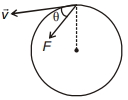
$A$ particle is moving in a circular path of radius $r$ under the action of a force $F$. If at an instant the velocity of the particle is $\vec{v}$,and the speed of the particle is increasing,then:
A
$\vec{F} \cdot \vec{v} > 0$
B
$\vec{F} \cdot \vec{v} = 0$
C
$\vec{F} \cdot \vec{v} < 0$
D
$\vec{F} \cdot \vec{v} \geq 0$
Solution
(A) The power delivered by a force is given by $P = \vec{F} \cdot \vec{v}$.
Since the speed of the particle is increasing,the work done by the net force on the particle must be positive.
In circular motion,the net force $\vec{F}$ can be resolved into two components: the centripetal force $\vec{F}_c$ (directed towards the center) and the tangential force $\vec{F}_t$ (directed along the tangent).
The centripetal force $\vec{F}_c$ is always perpendicular to the velocity $\vec{v}$,so $\vec{F}_c \cdot \vec{v} = 0$.
The tangential force $\vec{F}_t$ is responsible for the change in speed. Since the speed is increasing,$\vec{F}_t$ must be in the same direction as the velocity $\vec{v}$.
Therefore,$\vec{F} \cdot \vec{v} = (\vec{F}_c + \vec{F}_t) \cdot \vec{v} = \vec{F}_c \cdot \vec{v} + \vec{F}_t \cdot \vec{v} = 0 + F_t v = F_t v > 0$.
Thus,$\vec{F} \cdot \vec{v} > 0$.
Since the speed of the particle is increasing,the work done by the net force on the particle must be positive.
In circular motion,the net force $\vec{F}$ can be resolved into two components: the centripetal force $\vec{F}_c$ (directed towards the center) and the tangential force $\vec{F}_t$ (directed along the tangent).
The centripetal force $\vec{F}_c$ is always perpendicular to the velocity $\vec{v}$,so $\vec{F}_c \cdot \vec{v} = 0$.
The tangential force $\vec{F}_t$ is responsible for the change in speed. Since the speed is increasing,$\vec{F}_t$ must be in the same direction as the velocity $\vec{v}$.
Therefore,$\vec{F} \cdot \vec{v} = (\vec{F}_c + \vec{F}_t) \cdot \vec{v} = \vec{F}_c \cdot \vec{v} + \vec{F}_t \cdot \vec{v} = 0 + F_t v = F_t v > 0$.
Thus,$\vec{F} \cdot \vec{v} > 0$.
0 likes
View Solution55
DifficultMCQ
$A$ body is moving on a circle of radius $80 \, m$ with a speed $20 \, m/s$ which is decreasing at the rate of $5 \, m/s^2$ at an instant. The angle made by its acceleration with its velocity is .......... (in $^{\circ}$)
A
$45$
B
$90$
C
$135$
D
$0$
Solution
(C) The centripetal acceleration $a_c$ is given by $a_c = \frac{v^2}{r} = \frac{20^2}{80} = \frac{400}{80} = 5 \, m/s^2$.
Since the speed is decreasing,the tangential acceleration $a_t$ is directed opposite to the velocity vector,so $a_t = -5 \, m/s^2$.
The total acceleration vector $\vec{a}$ is the vector sum of centripetal acceleration $\vec{a}_c$ (directed towards the center) and tangential acceleration $\vec{a}_t$ (directed opposite to velocity).
The angle $\phi$ between the total acceleration $\vec{a}$ and the tangential acceleration $\vec{a}_t$ is given by $\tan \phi = \frac{a_c}{|a_t|} = \frac{5}{5} = 1$,which means $\phi = 45^{\circ}$.
Since the tangential acceleration $\vec{a}_t$ is directed opposite to the velocity $\vec{v}$,the angle between $\vec{a}_t$ and $\vec{v}$ is $180^{\circ}$.
The angle $\theta$ between the total acceleration $\vec{a}$ and the velocity $\vec{v}$ is $\theta = 180^{\circ} - 45^{\circ} = 135^{\circ}$.
Since the speed is decreasing,the tangential acceleration $a_t$ is directed opposite to the velocity vector,so $a_t = -5 \, m/s^2$.
The total acceleration vector $\vec{a}$ is the vector sum of centripetal acceleration $\vec{a}_c$ (directed towards the center) and tangential acceleration $\vec{a}_t$ (directed opposite to velocity).
The angle $\phi$ between the total acceleration $\vec{a}$ and the tangential acceleration $\vec{a}_t$ is given by $\tan \phi = \frac{a_c}{|a_t|} = \frac{5}{5} = 1$,which means $\phi = 45^{\circ}$.
Since the tangential acceleration $\vec{a}_t$ is directed opposite to the velocity $\vec{v}$,the angle between $\vec{a}_t$ and $\vec{v}$ is $180^{\circ}$.
The angle $\theta$ between the total acceleration $\vec{a}$ and the velocity $\vec{v}$ is $\theta = 180^{\circ} - 45^{\circ} = 135^{\circ}$.
0 likes
View Solution56
MediumMCQ
The distance of a particle moving on a circle of radius $12 \, m$ measured from a fixed point on the circle and measured along the circle is given by $s = 2t^3$ (in meters). The ratio of its tangential to centripetal acceleration at $t = 2 \, s$ is .........
A
$1: 1$
B
$1: 2$
C
$2: 1$
D
$3: 1$
Solution
(B) Given,$s = 2t^3$ and radius $R = 12 \, m$.
The velocity $v$ is the rate of change of distance along the path: $v = \frac{ds}{dt} = \frac{d}{dt}(2t^3) = 6t^2$.
At $t = 2 \, s$,the velocity $v = 6(2)^2 = 24 \, m/s$.
The centripetal acceleration $a_c$ is given by $a_c = \frac{v^2}{R} = \frac{24^2}{12} = \frac{576}{12} = 48 \, m/s^2$.
The tangential acceleration $a_t$ is the rate of change of speed: $a_t = \frac{dv}{dt} = \frac{d}{dt}(6t^2) = 12t$.
At $t = 2 \, s$,the tangential acceleration $a_t = 12(2) = 24 \, m/s^2$.
The ratio of tangential to centripetal acceleration is $\frac{a_t}{a_c} = \frac{24}{48} = \frac{1}{2}$,which is $1: 2$.
The velocity $v$ is the rate of change of distance along the path: $v = \frac{ds}{dt} = \frac{d}{dt}(2t^3) = 6t^2$.
At $t = 2 \, s$,the velocity $v = 6(2)^2 = 24 \, m/s$.
The centripetal acceleration $a_c$ is given by $a_c = \frac{v^2}{R} = \frac{24^2}{12} = \frac{576}{12} = 48 \, m/s^2$.
The tangential acceleration $a_t$ is the rate of change of speed: $a_t = \frac{dv}{dt} = \frac{d}{dt}(6t^2) = 12t$.
At $t = 2 \, s$,the tangential acceleration $a_t = 12(2) = 24 \, m/s^2$.
The ratio of tangential to centripetal acceleration is $\frac{a_t}{a_c} = \frac{24}{48} = \frac{1}{2}$,which is $1: 2$.
0 likes
View Solution57
EasyMCQ
If $\theta$ is the angle between the velocity vector $\vec{v}$ and the acceleration vector $\vec{a}$ of a particle moving on a circular path with decreasing speed,then .........
A
$\theta = 90^{\circ}$
B
$0^{\circ} < \theta < 90^{\circ}$
C
$90^{\circ} < \theta < 180^{\circ}$
D
$0^{\circ} \leq \theta \leq 180^{\circ}$
Solution
(C) In non-uniform circular motion,the total acceleration $\vec{a}$ is the vector sum of the centripetal acceleration $\vec{a}_c$ and the tangential acceleration $\vec{a}_T$,i.e.,$\vec{a} = \vec{a}_c + \vec{a}_T$.
$1$. The centripetal acceleration $\vec{a}_c$ is always directed towards the center of the circle,making an angle of $90^{\circ}$ with the velocity vector $\vec{v}$.
$2$. The tangential acceleration $\vec{a}_T$ acts along the tangent. Since the speed is decreasing,$\vec{a}_T$ is directed opposite to the velocity vector $\vec{v}$,making an angle of $180^{\circ}$ with it.
$3$. The resultant acceleration $\vec{a}$ lies between the directions of $\vec{a}_c$ and $\vec{a}_T$. Therefore,the angle $\theta$ between the velocity $\vec{v}$ and the total acceleration $\vec{a}$ must be greater than $90^{\circ}$ (due to $\vec{a}_c$) and less than $180^{\circ}$ (due to $\vec{a}_T$).
Thus,$90^{\circ} < \theta < 180^{\circ}$.
$1$. The centripetal acceleration $\vec{a}_c$ is always directed towards the center of the circle,making an angle of $90^{\circ}$ with the velocity vector $\vec{v}$.
$2$. The tangential acceleration $\vec{a}_T$ acts along the tangent. Since the speed is decreasing,$\vec{a}_T$ is directed opposite to the velocity vector $\vec{v}$,making an angle of $180^{\circ}$ with it.
$3$. The resultant acceleration $\vec{a}$ lies between the directions of $\vec{a}_c$ and $\vec{a}_T$. Therefore,the angle $\theta$ between the velocity $\vec{v}$ and the total acceleration $\vec{a}$ must be greater than $90^{\circ}$ (due to $\vec{a}_c$) and less than $180^{\circ}$ (due to $\vec{a}_T$).
Thus,$90^{\circ} < \theta < 180^{\circ}$.
0 likes
View Solution58
DifficultMCQ
$A$ car is moving on a circular path of radius $600\,m$ such that the magnitudes of the tangential acceleration and centripetal acceleration are equal. The time taken by the car to complete the first quarter of a revolution,if it is moving with an initial speed of $54\,km/h$,is $t(1 - e^{-\pi/2})\,s$. The value of $t$ is $.............$.
A
$20$
B
$40$
C
$10$
D
$15$
Solution
(B) Given: Radius $R = 600\,m$,initial speed $u = 54\,km/h = 15\,m/s$.
Tangential acceleration $a_t = \frac{dv}{dt} = v\frac{dv}{ds}$.
Centripetal acceleration $a_c = \frac{v^2}{R}$.
Given $a_t = a_c$,so $v\frac{dv}{ds} = \frac{v^2}{R} \Rightarrow \frac{dv}{v} = \frac{ds}{R}$.
Integrating both sides: $\int_{15}^{v} \frac{dv}{v} = \int_{0}^{s} \frac{ds}{R} \Rightarrow \ln(\frac{v}{15}) = \frac{s}{R} \Rightarrow v = 15e^{s/R}$.
Since $v = \frac{ds}{dt}$,we have $\frac{ds}{dt} = 15e^{s/R} \Rightarrow e^{-s/R} ds = 15 dt$.
To find the time $T$ for the first quarter revolution,$s$ goes from $0$ to $\frac{\pi R}{2}$.
$\int_{0}^{\pi R/2} e^{-s/R} ds = \int_{0}^{T} 15 dt$.
$[-R e^{-s/R}]_{0}^{\pi R/2} = 15T$.
$-R(e^{-\pi/2} - 1) = 15T \Rightarrow R(1 - e^{-\pi/2}) = 15T$.
$T = \frac{600}{15}(1 - e^{-\pi/2}) = 40(1 - e^{-\pi/2})$.
Comparing with $t(1 - e^{-\pi/2})$,we get $t = 40$.
Tangential acceleration $a_t = \frac{dv}{dt} = v\frac{dv}{ds}$.
Centripetal acceleration $a_c = \frac{v^2}{R}$.
Given $a_t = a_c$,so $v\frac{dv}{ds} = \frac{v^2}{R} \Rightarrow \frac{dv}{v} = \frac{ds}{R}$.
Integrating both sides: $\int_{15}^{v} \frac{dv}{v} = \int_{0}^{s} \frac{ds}{R} \Rightarrow \ln(\frac{v}{15}) = \frac{s}{R} \Rightarrow v = 15e^{s/R}$.
Since $v = \frac{ds}{dt}$,we have $\frac{ds}{dt} = 15e^{s/R} \Rightarrow e^{-s/R} ds = 15 dt$.
To find the time $T$ for the first quarter revolution,$s$ goes from $0$ to $\frac{\pi R}{2}$.
$\int_{0}^{\pi R/2} e^{-s/R} ds = \int_{0}^{T} 15 dt$.
$[-R e^{-s/R}]_{0}^{\pi R/2} = 15T$.
$-R(e^{-\pi/2} - 1) = 15T \Rightarrow R(1 - e^{-\pi/2}) = 15T$.
$T = \frac{600}{15}(1 - e^{-\pi/2}) = 40(1 - e^{-\pi/2})$.
Comparing with $t(1 - e^{-\pi/2})$,we get $t = 40$.
1 likes
View Solution59
EasyMCQ
$A$ stone tied to a $180 \, cm$ long string at its end is making $28$ revolutions in a horizontal circle in every minute. The magnitude of the acceleration of the stone is $\frac{1936}{x} \, m s^{-2}$. The value of $x$ is: (Take $\pi = \frac{22}{7}$)
A
$124$
B
$123$
C
$125$
D
$122$
Solution
(C) Given: Radius $R = 180 \, cm = 1.8 \, m$. Frequency $f = \frac{28}{60} \, Hz$. Angular velocity $\omega = 2 \pi f = 2 \times \frac{22}{7} \times \frac{28}{60} = \frac{44}{15} \, rad/s$. The centripetal acceleration is $a = \omega^2 R$. Substituting the values: $a = \left(\frac{44}{15}\right)^2 \times 1.8 = \frac{1936}{225} \times 1.8$. Simplifying: $a = \frac{1936 \times 1.8}{225} = \frac{1936}{125} \, m s^{-2}$. Comparing this with $\frac{1936}{x} \, m s^{-2}$,we get $x = 125$.
1 likes
View Solution60
DifficultMCQ
If the radius of curvature of the path of two particles of same mass are in the ratio $3:4,$ then in order to have constant centripetal force,their velocities will be in the ratio of:
A
$\sqrt{3}: 2$
B
$1: \sqrt{3}$
C
$\sqrt{3}: 1$
D
$2: \sqrt{3}$
Solution
(A) Given that the masses of the two particles are equal,so $m_1 = m_2 = m$.
The ratio of their radii of curvature is given as $\frac{r_1}{r_2} = \frac{3}{4}$.
The centripetal force $F$ acting on a particle is given by the formula $F = \frac{mv^2}{r}$.
Since the centripetal force is constant for both particles,we have $F_1 = F_2$.
Substituting the formula,we get $\frac{m_1 v_1^2}{r_1} = \frac{m_2 v_2^2}{r_2}$.
Since $m_1 = m_2$,the equation simplifies to $\frac{v_1^2}{r_1} = \frac{v_2^2}{r_2}$.
Rearranging the terms to find the ratio of velocities,we get $\frac{v_1^2}{v_2^2} = \frac{r_1}{r_2}$.
Taking the square root on both sides,we get $\frac{v_1}{v_2} = \sqrt{\frac{r_1}{r_2}}$.
Substituting the given ratio $\frac{r_1}{r_2} = \frac{3}{4}$,we get $\frac{v_1}{v_2} = \sqrt{\frac{3}{4}} = \frac{\sqrt{3}}{2}$.
Therefore,the ratio of their velocities is $\sqrt{3}:2$.
The ratio of their radii of curvature is given as $\frac{r_1}{r_2} = \frac{3}{4}$.
The centripetal force $F$ acting on a particle is given by the formula $F = \frac{mv^2}{r}$.
Since the centripetal force is constant for both particles,we have $F_1 = F_2$.
Substituting the formula,we get $\frac{m_1 v_1^2}{r_1} = \frac{m_2 v_2^2}{r_2}$.
Since $m_1 = m_2$,the equation simplifies to $\frac{v_1^2}{r_1} = \frac{v_2^2}{r_2}$.
Rearranging the terms to find the ratio of velocities,we get $\frac{v_1^2}{v_2^2} = \frac{r_1}{r_2}$.
Taking the square root on both sides,we get $\frac{v_1}{v_2} = \sqrt{\frac{r_1}{r_2}}$.
Substituting the given ratio $\frac{r_1}{r_2} = \frac{3}{4}$,we get $\frac{v_1}{v_2} = \sqrt{\frac{3}{4}} = \frac{\sqrt{3}}{2}$.
Therefore,the ratio of their velocities is $\sqrt{3}:2$.
0 likes
View Solution61
DifficultMCQ
$A$ particle is moving in a circle of radius $50 \ cm$ in such a way that at any instant the normal and tangential components of its acceleration are equal. If its speed at $t=0$ is $4 \ m/s$,the time taken to complete the first revolution will be $\frac{1}{\alpha}[1-e^{-2 \pi}] \ s$,where $\alpha=$ . . . . . . .
A
$8$
B
$5$
C
$98$
D
$45$
Solution
(A) Given that the normal acceleration $a_c = \frac{v^2}{r}$ and tangential acceleration $a_t = \frac{dv}{dt}$ are equal:
$\frac{v^2}{r} = \frac{dv}{dt}$
Integrating with respect to time from $t=0$ $(v=4 \ m/s)$ to $t$:
$\int_{4}^{v} \frac{dv}{v^2} = \int_{0}^{t} \frac{dt}{r}$
$\left[ -\frac{1}{v} \right]_{4}^{v} = \frac{t}{r}$
$-\frac{1}{v} + \frac{1}{4} = \frac{t}{0.5} = 2t$
$\frac{1}{v} = \frac{1}{4} - 2t = \frac{1-8t}{4} \implies v = \frac{4}{1-8t}$
Since $v = \frac{ds}{dt}$,we integrate to find the distance $s$ for one revolution $(s = 2\pi r = 2\pi(0.5) = \pi \ m)$:
$\int_{0}^{\pi} ds = \int_{0}^{t} \frac{4}{1-8t} dt$
$\pi = 4 \left[ \frac{\ln(1-8t)}{-8} \right]_{0}^{t}$
$\pi = -\frac{1}{2} \ln(1-8t)$
$-2\pi = \ln(1-8t)$
$e^{-2\pi} = 1-8t$
$8t = 1 - e^{-2\pi}$
$t = \frac{1}{8} [1 - e^{-2\pi}] \ s$
Comparing with the given form,$\alpha = 8$.
$\frac{v^2}{r} = \frac{dv}{dt}$
Integrating with respect to time from $t=0$ $(v=4 \ m/s)$ to $t$:
$\int_{4}^{v} \frac{dv}{v^2} = \int_{0}^{t} \frac{dt}{r}$
$\left[ -\frac{1}{v} \right]_{4}^{v} = \frac{t}{r}$
$-\frac{1}{v} + \frac{1}{4} = \frac{t}{0.5} = 2t$
$\frac{1}{v} = \frac{1}{4} - 2t = \frac{1-8t}{4} \implies v = \frac{4}{1-8t}$
Since $v = \frac{ds}{dt}$,we integrate to find the distance $s$ for one revolution $(s = 2\pi r = 2\pi(0.5) = \pi \ m)$:
$\int_{0}^{\pi} ds = \int_{0}^{t} \frac{4}{1-8t} dt$
$\pi = 4 \left[ \frac{\ln(1-8t)}{-8} \right]_{0}^{t}$
$\pi = -\frac{1}{2} \ln(1-8t)$
$-2\pi = \ln(1-8t)$
$e^{-2\pi} = 1-8t$
$8t = 1 - e^{-2\pi}$
$t = \frac{1}{8} [1 - e^{-2\pi}] \ s$
Comparing with the given form,$\alpha = 8$.
0 likes
View Solution62
DifficultMCQ
In a circular motion of a particle,the tangential acceleration of the particle is given by $a_t = 12 \ m/s^2$. The radius of the circle is $3 \ m$. The particle was initially at rest. The time after which the total acceleration of the particle makes an angle $45^{\circ}$ with the radial acceleration is
A
$2 \ s$
B
$(1/2) \ s$
C
$3 \ s$
D
$(1/3) \ s$
Solution
(B) Given: Initial velocity $u = 0$,tangential acceleration $a_t = 12 \ m/s^2$,and radius $r = 3 \ m$.
The total acceleration vector $\vec{a}$ is the vector sum of radial acceleration $\vec{a}_c$ and tangential acceleration $\vec{a}_t$.
The angle $\theta$ between the total acceleration and the radial acceleration is given by $\tan \theta = \frac{a_t}{a_c}$.
Given $\theta = 45^{\circ}$,so $\tan 45^{\circ} = 1$,which implies $a_t = a_c$.
We know $a_c = \frac{v^2}{r}$,where $v$ is the instantaneous velocity.
Since $a_t = 12 \ m/s^2$ and $a_c = \frac{v^2}{3}$,we have $12 = \frac{v^2}{3} \Rightarrow v^2 = 36 \Rightarrow v = 6 \ m/s$.
Using the equation of motion $v = u + a_t t$,we get $6 = 0 + 12 \times t$.
Therefore,$t = \frac{6}{12} = 0.5 \ s$ or $(1/2) \ s$.
The total acceleration vector $\vec{a}$ is the vector sum of radial acceleration $\vec{a}_c$ and tangential acceleration $\vec{a}_t$.
The angle $\theta$ between the total acceleration and the radial acceleration is given by $\tan \theta = \frac{a_t}{a_c}$.
Given $\theta = 45^{\circ}$,so $\tan 45^{\circ} = 1$,which implies $a_t = a_c$.
We know $a_c = \frac{v^2}{r}$,where $v$ is the instantaneous velocity.
Since $a_t = 12 \ m/s^2$ and $a_c = \frac{v^2}{3}$,we have $12 = \frac{v^2}{3} \Rightarrow v^2 = 36 \Rightarrow v = 6 \ m/s$.
Using the equation of motion $v = u + a_t t$,we get $6 = 0 + 12 \times t$.
Therefore,$t = \frac{6}{12} = 0.5 \ s$ or $(1/2) \ s$.
0 likes
View Solution63
DifficultMCQ
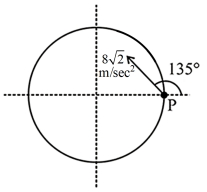
The acceleration of a particle performing non-uniform circular motion is shown in the diagram at point $P$. If the radius of the circular path is $2 \ m$,then what is the velocity at point $P$ in $m/s$?
A
$4$
B
$2$
C
$3$
D
$6$
Solution
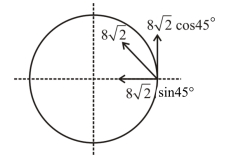
(A) The total acceleration vector makes an angle of $135^{\circ}$ with the positive $x$-axis (tangent direction). The centripetal acceleration $a_c$ is directed towards the center (negative $x$-direction).
The component of the total acceleration $a = 8\sqrt{2} \ m/s^2$ along the radial direction is $a_c = a \cos(180^{\circ} - 135^{\circ}) = 8\sqrt{2} \cos(45^{\circ}) = 8\sqrt{2} \times \frac{1}{\sqrt{2}} = 8 \ m/s^2$.
We know that the centripetal acceleration is given by $a_c = \frac{v^2}{r}$.
Substituting the values,$8 = \frac{v^2}{2}$.
$v^2 = 16$.
$v = 4 \ m/s$.
The component of the total acceleration $a = 8\sqrt{2} \ m/s^2$ along the radial direction is $a_c = a \cos(180^{\circ} - 135^{\circ}) = 8\sqrt{2} \cos(45^{\circ}) = 8\sqrt{2} \times \frac{1}{\sqrt{2}} = 8 \ m/s^2$.
We know that the centripetal acceleration is given by $a_c = \frac{v^2}{r}$.
Substituting the values,$8 = \frac{v^2}{2}$.
$v^2 = 16$.
$v = 4 \ m/s$.
0 likes
View Solution64
EasyMCQ
In non-uniform circular motion,the ratio of tangential to radial acceleration is ($r=$ radius,$\alpha=$ angular acceleration,$V=$ linear velocity).
A
$\frac{r \alpha}{V}$
B
$\frac{V^{2}}{r \alpha}$
C
$\frac{r^{2} \alpha}{V^{2}}$
D
$\frac{r \alpha^{2}}{V^{2}}$
Solution
(C) Tangential acceleration is given by $a_t = \alpha r$.
Radial (centripetal) acceleration is given by $a_r = \frac{V^2}{r}$.
The ratio of tangential acceleration to radial acceleration is $\frac{a_t}{a_r} = \frac{\alpha r}{V^2 / r}$.
Simplifying this expression,we get $\frac{a_t}{a_r} = \frac{\alpha r^2}{V^2}$.
Radial (centripetal) acceleration is given by $a_r = \frac{V^2}{r}$.
The ratio of tangential acceleration to radial acceleration is $\frac{a_t}{a_r} = \frac{\alpha r}{V^2 / r}$.
Simplifying this expression,we get $\frac{a_t}{a_r} = \frac{\alpha r^2}{V^2}$.
0 likes
View Solution65
DifficultMCQ
In non-uniform circular motion,the ratio of tangential to radial acceleration is ($r=$ radius of the circle,$u=$ speed of the particle,$\alpha=$ angular acceleration).
A
$\frac{\alpha^2 r^2}{u}$
B
$\frac{\alpha^2 r}{u^2}$
C
$\frac{\alpha r^2}{u^2}$
D
$\frac{u^2}{r^2 \alpha}$
Solution
(C) The tangential acceleration $(a_t)$ is given by the formula $a_t = \alpha r$.
The radial (centripetal) acceleration $(a_r)$ is given by the formula $a_r = \frac{u^2}{r}$.
The ratio of tangential acceleration to radial acceleration is $\frac{a_t}{a_r} = \frac{\alpha r}{u^2 / r}$.
Simplifying this expression,we get $\frac{\alpha r^2}{u^2}$.
The radial (centripetal) acceleration $(a_r)$ is given by the formula $a_r = \frac{u^2}{r}$.
The ratio of tangential acceleration to radial acceleration is $\frac{a_t}{a_r} = \frac{\alpha r}{u^2 / r}$.
Simplifying this expression,we get $\frac{\alpha r^2}{u^2}$.
0 likes
View Solution66
EasyMCQ
In non-uniform circular motion,the ratio of tangential to radial acceleration is ($r$ is the radius of the circle,$v$ is the speed of the particle,$\alpha$ is the angular acceleration).
A
$\frac{\alpha r^2}{v^2}$
B
$\frac{\alpha^2 r}{v^2}$
C
$\frac{\alpha^2 r^2}{v}$
D
$\frac{v^2}{r^2 \alpha}$
Solution
(A) In non-uniform circular motion,the tangential acceleration is given by $a_t = r \alpha$.
The radial (centripetal) acceleration is given by $a_r = \frac{v^2}{r}$.
The ratio of tangential to radial acceleration is $\frac{a_t}{a_r} = \frac{r \alpha}{v^2 / r}$.
Simplifying this expression,we get $\frac{a_t}{a_r} = \frac{r^2 \alpha}{v^2}$.
The radial (centripetal) acceleration is given by $a_r = \frac{v^2}{r}$.
The ratio of tangential to radial acceleration is $\frac{a_t}{a_r} = \frac{r \alpha}{v^2 / r}$.
Simplifying this expression,we get $\frac{a_t}{a_r} = \frac{r^2 \alpha}{v^2}$.
0 likes
View Solution67
EasyMCQ
$A$ particle at rest starts moving with a constant angular acceleration of $4 \ rad/s^2$ in a circular path. At what time will the magnitudes of its tangential acceleration and centrifugal acceleration be equal (in $s$)?
A
$0.4$
B
$0.5$
C
$0.8$
D
$1.0$
Solution
(B) Given: Angular acceleration $\alpha = 4 \ rad/s^2$. Initial angular velocity $\omega_0 = 0$.
$1$. The angular velocity at time $t$ is given by $\omega = \omega_0 + \alpha t = \alpha t$.
$2$. The centrifugal (radial) acceleration is $a_c = \omega^2 r = (\alpha t)^2 r = \alpha^2 t^2 r$.
$3$. The tangential acceleration is $a_t = \alpha r$.
$4$. We are given that the magnitudes are equal: $a_c = a_t$.
$5$. Substituting the expressions: $\alpha^2 t^2 r = \alpha r$.
$6$. Dividing both sides by $\alpha r$ (assuming $\alpha, r \neq 0$): $\alpha t^2 = 1$.
$7$. Solving for $t$: $t^2 = \frac{1}{\alpha} = \frac{1}{4}$.
$8$. Therefore,$t = \sqrt{\frac{1}{4}} = 0.5 \ s$.
$1$. The angular velocity at time $t$ is given by $\omega = \omega_0 + \alpha t = \alpha t$.
$2$. The centrifugal (radial) acceleration is $a_c = \omega^2 r = (\alpha t)^2 r = \alpha^2 t^2 r$.
$3$. The tangential acceleration is $a_t = \alpha r$.
$4$. We are given that the magnitudes are equal: $a_c = a_t$.
$5$. Substituting the expressions: $\alpha^2 t^2 r = \alpha r$.
$6$. Dividing both sides by $\alpha r$ (assuming $\alpha, r \neq 0$): $\alpha t^2 = 1$.
$7$. Solving for $t$: $t^2 = \frac{1}{\alpha} = \frac{1}{4}$.
$8$. Therefore,$t = \sqrt{\frac{1}{4}} = 0.5 \ s$.
0 likes
View Solution68
EasyMCQ
$A$ body is moving along a circular track of radius $100 \ m$ with velocity $20 \ m/s$. Its tangential acceleration is $3 \ m/s^{2}$,then its resultant acceleration will be (in $m/s^{2}$)
A
$3$
B
$5$
C
$4$
D
$2$
Solution
(B) Given: Radius $r = 100 \ m$,velocity $v = 20 \ m/s$,and tangential acceleration $a_{t} = 3 \ m/s^{2}$.
First,calculate the radial (centripetal) acceleration $a_{r}$ using the formula $a_{r} = \frac{v^{2}}{r}$.
$a_{r} = \frac{(20)^{2}}{100} = \frac{400}{100} = 4 \ m/s^{2}$.
The resultant acceleration $a$ is the vector sum of the tangential and radial accelerations,which are perpendicular to each other.
$a = \sqrt{a_{r}^{2} + a_{t}^{2}}$.
$a = \sqrt{(4)^{2} + (3)^{2}} = \sqrt{16 + 9} = \sqrt{25} = 5 \ m/s^{2}$.
Therefore,the resultant acceleration is $5 \ m/s^{2}$.
First,calculate the radial (centripetal) acceleration $a_{r}$ using the formula $a_{r} = \frac{v^{2}}{r}$.
$a_{r} = \frac{(20)^{2}}{100} = \frac{400}{100} = 4 \ m/s^{2}$.
The resultant acceleration $a$ is the vector sum of the tangential and radial accelerations,which are perpendicular to each other.
$a = \sqrt{a_{r}^{2} + a_{t}^{2}}$.
$a = \sqrt{(4)^{2} + (3)^{2}} = \sqrt{16 + 9} = \sqrt{25} = 5 \ m/s^{2}$.
Therefore,the resultant acceleration is $5 \ m/s^{2}$.
0 likes
View Solution69
EasyMCQ
$A$ car is moving with speed $30 \,m/s$ on a circular path of radius $500 \,m$. Its speed is increasing at a rate of $2 \,m/s^2$. What is the total acceleration of the car (in $\,m/s^2$)?
A
$2$
B
$2.7$
C
$1.82$
D
$9.82$
Solution
(B) In non-uniform circular motion, the car possesses two components of acceleration:
$1$. Tangential acceleration $(a_t)$: Given as $2 \,m/s^2$.
$2$. Centripetal (radial) acceleration $(a_c)$: Calculated as $a_c = \frac{v^2}{r} = \frac{(30)^2}{500} = \frac{900}{500} = 1.8 \,m/s^2$.
Since these two components are perpendicular to each other, the net acceleration $(a_{net})$ is given by:
$a_{net} = \sqrt{a_t^2 + a_c^2}$
$a_{net} = \sqrt{(2)^2 + (1.8)^2}$
$a_{net} = \sqrt{4 + 3.24} = \sqrt{7.24} \approx 2.69 \,m/s^2 \approx 2.7 \,m/s^2$.
$1$. Tangential acceleration $(a_t)$: Given as $2 \,m/s^2$.
$2$. Centripetal (radial) acceleration $(a_c)$: Calculated as $a_c = \frac{v^2}{r} = \frac{(30)^2}{500} = \frac{900}{500} = 1.8 \,m/s^2$.
Since these two components are perpendicular to each other, the net acceleration $(a_{net})$ is given by:
$a_{net} = \sqrt{a_t^2 + a_c^2}$
$a_{net} = \sqrt{(2)^2 + (1.8)^2}$
$a_{net} = \sqrt{4 + 3.24} = \sqrt{7.24} \approx 2.69 \,m/s^2 \approx 2.7 \,m/s^2$.
0 likes
View Solution70
MediumMCQ
$A$ particle is in uniform circular motion. The equation of its trajectory is given by $(x-2)^2+y^2=25$,where $x$ and $y$ are in meters. The speed of the particle is $2 \text{ m/s}$. When the particle attains the lowest $y$ coordinate,the acceleration of the particle is (in $\text{m/s}^2$):
A
$0.4 \hat{j}$
B
$0.8 \hat{i}$
C
$0.8 \hat{j}$
D
$0.4 \hat{i}$
Solution
(C) The equation of the trajectory is $(x-2)^2 + y^2 = 25$. This represents a circle with center at $(2, 0)$ and radius $R = 5 \text{ m}$.
In uniform circular motion,the acceleration is purely centripetal,directed towards the center of the circle.
The magnitude of centripetal acceleration is $a_c = \frac{v^2}{R}$.
Given $v = 2 \text{ m/s}$ and $R = 5 \text{ m}$,we have $a_c = \frac{2^2}{5} = \frac{4}{5} = 0.8 \text{ m/s}^2$.
The particle attains the lowest $y$ coordinate at the point $(2, -5)$.
At this point,the center of the circle $(2, 0)$ is directly above the particle (along the positive $y$-axis).
Therefore,the centripetal acceleration vector is directed along the positive $y$-axis,which is $0.8 \hat{j} \text{ m/s}^2$.
In uniform circular motion,the acceleration is purely centripetal,directed towards the center of the circle.
The magnitude of centripetal acceleration is $a_c = \frac{v^2}{R}$.
Given $v = 2 \text{ m/s}$ and $R = 5 \text{ m}$,we have $a_c = \frac{2^2}{5} = \frac{4}{5} = 0.8 \text{ m/s}^2$.
The particle attains the lowest $y$ coordinate at the point $(2, -5)$.
At this point,the center of the circle $(2, 0)$ is directly above the particle (along the positive $y$-axis).
Therefore,the centripetal acceleration vector is directed along the positive $y$-axis,which is $0.8 \hat{j} \text{ m/s}^2$.
0 likes
View Solution71
EasyMCQ
$A$ car is moving with a speed of $30 \,ms^{-1}$ on a circular path of radius $500 \,m$. If its speed is increasing at the rate of $2 \,ms^{-2}$, then find its acceleration. (in $\,ms^{-2}$)
A
$2.0$
B
$1.8$
C
$9.8$
D
$2.7$
Solution
(D) Given: Speed $v = 30 \,ms^{-1}$, Radius $r = 500 \,m$, Tangential acceleration $a_T = 2 \,ms^{-2}$.
The total acceleration $a$ of a particle in circular motion is the vector sum of tangential acceleration $a_T$ and centripetal (radial) acceleration $a_r$.
First, calculate the centripetal acceleration $a_r = \frac{v^2}{r} = \frac{30^2}{500} = \frac{900}{500} = 1.8 \,ms^{-2}$.
The total acceleration is given by $a = \sqrt{a_T^2 + a_r^2}$.
Substituting the values: $a = \sqrt{2^2 + 1.8^2} = \sqrt{4 + 3.24} = \sqrt{7.24}$.
Calculating the square root: $a \approx 2.69 \,ms^{-2}$, which is approximately $2.7 \,ms^{-2}$.
The total acceleration $a$ of a particle in circular motion is the vector sum of tangential acceleration $a_T$ and centripetal (radial) acceleration $a_r$.
First, calculate the centripetal acceleration $a_r = \frac{v^2}{r} = \frac{30^2}{500} = \frac{900}{500} = 1.8 \,ms^{-2}$.
The total acceleration is given by $a = \sqrt{a_T^2 + a_r^2}$.
Substituting the values: $a = \sqrt{2^2 + 1.8^2} = \sqrt{4 + 3.24} = \sqrt{7.24}$.
Calculating the square root: $a \approx 2.69 \,ms^{-2}$, which is approximately $2.7 \,ms^{-2}$.
0 likes
View Solution72
EasyMCQ
$A$ car is travelling at $30 \,ms^{-1}$ speed on a circular road of radius $300 \,m$. If its speed is increasing at the rate of $4 \,ms^{-2}$, then its acceleration is (in $\,ms^{-2}$)
A
$2.7$
B
$3$
C
$4$
D
$5$
Solution
(D) Given: Velocity of the car, $v = 30 \,ms^{-1}$. Radius of the circular road, $r = 300 \,m$. Tangential acceleration, $a_t = 4 \,ms^{-2}$.
First, calculate the centripetal acceleration $(a_c)$ using the formula $a_c = \frac{v^2}{r}$.
$a_c = \frac{30^2}{300} = \frac{900}{300} = 3 \,ms^{-2}$.
The net acceleration $(a)$ is the vector sum of the tangential acceleration and the centripetal acceleration, which are perpendicular to each other.
$a = \sqrt{a_t^2 + a_c^2}$.
$a = \sqrt{4^2 + 3^2} = \sqrt{16 + 9} = \sqrt{25} = 5 \,ms^{-2}$.
First, calculate the centripetal acceleration $(a_c)$ using the formula $a_c = \frac{v^2}{r}$.
$a_c = \frac{30^2}{300} = \frac{900}{300} = 3 \,ms^{-2}$.
The net acceleration $(a)$ is the vector sum of the tangential acceleration and the centripetal acceleration, which are perpendicular to each other.
$a = \sqrt{a_t^2 + a_c^2}$.
$a = \sqrt{4^2 + 3^2} = \sqrt{16 + 9} = \sqrt{25} = 5 \,ms^{-2}$.
0 likes
View Solution73
EasyMCQ
In a hypothetical ring-shaped satellite rotating in space, artificial gravity can be achieved using centripetal force. If the satellite has a radius of $10 \,m$, then to achieve a centripetal acceleration at a point on the circumference of $10 \,ms^{-2}$, its angular speed is:
A
$1 \,rad \,s^{-1}$
B
$10 \,rad \,s^{-1}$
C
$1 \,revolution \,s^{-1}$
D
$10 \,revolution \,s^{-1}$
Solution
(A) Given: Radius, $r = 10 \,m$.
Centripetal acceleration, $a_c = 10 \,ms^{-2}$.
We know that the formula for centripetal acceleration is $a_c = \omega^2 r$.
Rearranging the formula to solve for angular speed $\omega$:
$\omega = \sqrt{\frac{a_c}{r}}$
Substituting the given values:
$\omega = \sqrt{\frac{10 \,ms^{-2}}{10 \,m}} = \sqrt{1 \,s^{-2}} = 1 \,rad \,s^{-1}$.
Therefore, the angular speed is $1 \,rad \,s^{-1}$.
Centripetal acceleration, $a_c = 10 \,ms^{-2}$.
We know that the formula for centripetal acceleration is $a_c = \omega^2 r$.
Rearranging the formula to solve for angular speed $\omega$:
$\omega = \sqrt{\frac{a_c}{r}}$
Substituting the given values:
$\omega = \sqrt{\frac{10 \,ms^{-2}}{10 \,m}} = \sqrt{1 \,s^{-2}} = 1 \,rad \,s^{-1}$.
Therefore, the angular speed is $1 \,rad \,s^{-1}$.
0 likes
View Solution74
EasyMCQ
$A$ particle of mass $5 \ kg$ is moving on a circle of radius $1 \ m$ with an angular velocity of $2 \ rad \ s^{-1}$. The centripetal force is (in $N$)
A
$10$
B
$40$
C
$30$
D
$20$
Solution
(D) Given: Mass $m = 5 \ kg$,Radius $r = 1 \ m$,Angular velocity $\omega = 2 \ rad \ s^{-1}$.
Centripetal force $F_c$ is given by the formula $F_c = m \omega^2 r$.
Substituting the given values:
$F_c = 5 \times (2)^2 \times 1$
$F_c = 5 \times 4 \times 1$
$F_c = 20 \ N$.
Therefore,the centripetal force is $20 \ N$.
Centripetal force $F_c$ is given by the formula $F_c = m \omega^2 r$.
Substituting the given values:
$F_c = 5 \times (2)^2 \times 1$
$F_c = 5 \times 4 \times 1$
$F_c = 20 \ N$.
Therefore,the centripetal force is $20 \ N$.
0 likes
View Solution75
MediumMCQ
$A$ particle moves in the $xy$-plane with velocity $\vec{v} = x \hat{i} + yt \hat{j}$. At $t = \frac{x \sqrt{3}}{y}$,the tangential and normal accelerations are:
A
$\frac{\sqrt{3} y}{2}, \frac{y}{2}$
B
$\frac{\sqrt{2} y}{3}, \frac{\sqrt{3} y}{2}$
C
$\frac{\sqrt{3} y}{2}, \frac{5 y}{2}$
D
$2 \sqrt{3} y, \frac{11 y}{\sqrt{3}}$
Solution
(A) Given,velocity of particle is $\vec{v} = x \hat{i} + yt \hat{j}$.
The magnitude of velocity is $v = \sqrt{x^2 + y^2 t^2}$.
The tangential acceleration $a_t$ is the rate of change of speed:
$a_t = \frac{dv}{dt} = \frac{1}{2\sqrt{x^2 + y^2 t^2}} \cdot (2y^2 t) = \frac{y^2 t}{\sqrt{x^2 + y^2 t^2}}$.
Substituting $t = \frac{x \sqrt{3}}{y}$:
$a_t = \frac{y^2 (x \sqrt{3} / y)}{\sqrt{x^2 + y^2 (3x^2 / y^2)}} = \frac{xy \sqrt{3}}{\sqrt{x^2 + 3x^2}} = \frac{xy \sqrt{3}}{2x} = \frac{\sqrt{3} y}{2}$.
The total acceleration vector is $\vec{a} = \frac{d\vec{v}}{dt} = \frac{d}{dt}(x \hat{i} + yt \hat{j}) = y \hat{j}$.
The magnitude of total acceleration is $a = |\vec{a}| = y$.
The normal acceleration $a_n$ is given by $a_n = \sqrt{a^2 - a_t^2}$.
$a_n = \sqrt{y^2 - (\frac{\sqrt{3} y}{2})^2} = \sqrt{y^2 - \frac{3y^2}{4}} = \sqrt{\frac{y^2}{4}} = \frac{y}{2}$.
Thus,the tangential and normal accelerations are $\frac{\sqrt{3} y}{2}$ and $\frac{y}{2}$ respectively.
The magnitude of velocity is $v = \sqrt{x^2 + y^2 t^2}$.
The tangential acceleration $a_t$ is the rate of change of speed:
$a_t = \frac{dv}{dt} = \frac{1}{2\sqrt{x^2 + y^2 t^2}} \cdot (2y^2 t) = \frac{y^2 t}{\sqrt{x^2 + y^2 t^2}}$.
Substituting $t = \frac{x \sqrt{3}}{y}$:
$a_t = \frac{y^2 (x \sqrt{3} / y)}{\sqrt{x^2 + y^2 (3x^2 / y^2)}} = \frac{xy \sqrt{3}}{\sqrt{x^2 + 3x^2}} = \frac{xy \sqrt{3}}{2x} = \frac{\sqrt{3} y}{2}$.
The total acceleration vector is $\vec{a} = \frac{d\vec{v}}{dt} = \frac{d}{dt}(x \hat{i} + yt \hat{j}) = y \hat{j}$.
The magnitude of total acceleration is $a = |\vec{a}| = y$.
The normal acceleration $a_n$ is given by $a_n = \sqrt{a^2 - a_t^2}$.
$a_n = \sqrt{y^2 - (\frac{\sqrt{3} y}{2})^2} = \sqrt{y^2 - \frac{3y^2}{4}} = \sqrt{\frac{y^2}{4}} = \frac{y}{2}$.
Thus,the tangential and normal accelerations are $\frac{\sqrt{3} y}{2}$ and $\frac{y}{2}$ respectively.
0 likes
View Solution76
MediumMCQ
$A$ point object moves along an arc of a circle of radius $R$. Its velocity depends upon the distance covered $s$ as $v=K \sqrt{s}$,where $K$ is a constant. If $\theta$ is the angle between the total acceleration and tangential acceleration,then
A
$\tan \theta=\sqrt{\frac{s}{R}}$
B
$\tan \theta=\sqrt{\frac{s}{2R}}$
C
$\tan \theta=\frac{s}{2R}$
D
$\tan \theta=\frac{2s}{R}$
Solution
(D) The radial (centripetal) acceleration is given by $a_r = \frac{v^2}{R}$.
Given $v = K\sqrt{s}$,we have $a_r = \frac{(K\sqrt{s})^2}{R} = \frac{K^2 s}{R}$.
The tangential acceleration is $a_t = \frac{dv}{dt} = \frac{dv}{ds} \cdot \frac{ds}{dt} = v \frac{dv}{ds}$.
Since $v = K s^{1/2}$,then $\frac{dv}{ds} = K \cdot \frac{1}{2} s^{-1/2} = \frac{K}{2\sqrt{s}}$.
Thus,$a_t = (K\sqrt{s}) \cdot \left( \frac{K}{2\sqrt{s}} \right) = \frac{K^2}{2}$.
The angle $\theta$ between the total acceleration and the tangential acceleration is given by $\tan \theta = \frac{a_r}{a_t}$.
Substituting the values,$\tan \theta = \frac{K^2 s / R}{K^2 / 2} = \frac{2s}{R}$.
Given $v = K\sqrt{s}$,we have $a_r = \frac{(K\sqrt{s})^2}{R} = \frac{K^2 s}{R}$.
The tangential acceleration is $a_t = \frac{dv}{dt} = \frac{dv}{ds} \cdot \frac{ds}{dt} = v \frac{dv}{ds}$.
Since $v = K s^{1/2}$,then $\frac{dv}{ds} = K \cdot \frac{1}{2} s^{-1/2} = \frac{K}{2\sqrt{s}}$.
Thus,$a_t = (K\sqrt{s}) \cdot \left( \frac{K}{2\sqrt{s}} \right) = \frac{K^2}{2}$.
The angle $\theta$ between the total acceleration and the tangential acceleration is given by $\tan \theta = \frac{a_r}{a_t}$.
Substituting the values,$\tan \theta = \frac{K^2 s / R}{K^2 / 2} = \frac{2s}{R}$.
0 likes
View Solution77
EasyMCQ
The angular speed of a particle moving in a circular path is doubled. Then,the centripetal acceleration of the particle is
A
$4$ times the initial centripetal acceleration
B
halved
C
doubled
D
unchanged
Solution
(A) The centripetal acceleration $a_c$ of a particle moving in a circular path of radius $R$ with angular speed $\omega$ is given by $a_c = R \omega^2$.
Let the initial angular speed be $\omega_1 = \omega$ and the final angular speed be $\omega_2 = 2\omega$.
The initial centripetal acceleration is $a_1 = R \omega^2$.
The final centripetal acceleration is $a_2 = R \omega_2^2 = R (2\omega)^2 = 4 R \omega^2$.
Comparing the two,we get $a_2 = 4 a_1$.
Therefore,the centripetal acceleration becomes $4$ times the initial value.
Let the initial angular speed be $\omega_1 = \omega$ and the final angular speed be $\omega_2 = 2\omega$.
The initial centripetal acceleration is $a_1 = R \omega^2$.
The final centripetal acceleration is $a_2 = R \omega_2^2 = R (2\omega)^2 = 4 R \omega^2$.
Comparing the two,we get $a_2 = 4 a_1$.
Therefore,the centripetal acceleration becomes $4$ times the initial value.
0 likes
View Solution78
MediumMCQ
$A$ car is travelling with linear velocity '$V$' on a circular road of radius '$r$'. If its velocity is increasing at a rate of '$a$' $ms^{-2}$,then the resultant acceleration will be
A
$\sqrt{(\frac{V^2}{r^2}-a^2)}$
B
$\sqrt{(\frac{V^4}{r^2}+a^2)}$
C
$\sqrt{(\frac{V^4}{r^2}-a^2)}$
D
$\sqrt{(\frac{V^2}{r^2}+a^2)}$
Solution
(B) The car experiences two types of acceleration while moving on a circular path with increasing speed:
$1$. Radial (centripetal) acceleration: $a_r = \frac{V^2}{r}$,which is directed towards the center of the circular path.
$2$. Tangential acceleration: $a_t = a$,which is directed along the tangent to the path.
Since these two accelerations are perpendicular to each other,the resultant acceleration $a_R$ is given by the vector sum:
$a_R = \sqrt{a_r^2 + a_t^2}$
Substituting the values:
$a_R = \sqrt{(\frac{V^2}{r})^2 + a^2}$
$a_R = \sqrt{\frac{V^4}{r^2} + a^2}$
$1$. Radial (centripetal) acceleration: $a_r = \frac{V^2}{r}$,which is directed towards the center of the circular path.
$2$. Tangential acceleration: $a_t = a$,which is directed along the tangent to the path.
Since these two accelerations are perpendicular to each other,the resultant acceleration $a_R$ is given by the vector sum:
$a_R = \sqrt{a_r^2 + a_t^2}$
Substituting the values:
$a_R = \sqrt{(\frac{V^2}{r})^2 + a^2}$
$a_R = \sqrt{\frac{V^4}{r^2} + a^2}$
0 likes
View Solution79
MediumMCQ
Consider a wheel rotating around a fixed axis. If the rotation angle $\theta$ varies with time as $\theta=a t^2$,then the total acceleration of a point $A$ on the rim of the wheel is ($v$ being the tangential velocity).
A
$\frac{v}{t} \sqrt{1+4 a^2 t^4}$
B
$\frac{v}{t}$
C
$\frac{v}{t}\left(1+4 a^2 t^4\right)$
D
$\sqrt{\left(1+4 a^2 t^4\right)}$
Solution
(A) Given,$\theta = a t^2$.
The angular velocity is $\omega = \frac{d\theta}{dt} = 2at$.
The tangential velocity is $v = \omega r = 2atr$. Thus,$\frac{v}{t} = 2ar$.
The tangential acceleration is $a_t = \frac{dv}{dt} = 2ar$.
The radial (centripetal) acceleration is $a_n = \frac{v^2}{r} = \frac{(2atr)^2}{r} = 4a^2t^2r$.
The total acceleration is $a_{\text{total}} = \sqrt{a_t^2 + a_n^2} = \sqrt{(2ar)^2 + (4a^2t^2r)^2}$.
$a_{\text{total}} = \sqrt{4a^2r^2 + 16a^4t^4r^2} = 2ar \sqrt{1 + 4a^2t^4}$.
Since $2ar = \frac{v}{t}$,we have $a_{\text{total}} = \frac{v}{t} \sqrt{1 + 4a^2t^4}$.
The angular velocity is $\omega = \frac{d\theta}{dt} = 2at$.
The tangential velocity is $v = \omega r = 2atr$. Thus,$\frac{v}{t} = 2ar$.
The tangential acceleration is $a_t = \frac{dv}{dt} = 2ar$.
The radial (centripetal) acceleration is $a_n = \frac{v^2}{r} = \frac{(2atr)^2}{r} = 4a^2t^2r$.
The total acceleration is $a_{\text{total}} = \sqrt{a_t^2 + a_n^2} = \sqrt{(2ar)^2 + (4a^2t^2r)^2}$.
$a_{\text{total}} = \sqrt{4a^2r^2 + 16a^4t^4r^2} = 2ar \sqrt{1 + 4a^2t^4}$.
Since $2ar = \frac{v}{t}$,we have $a_{\text{total}} = \frac{v}{t} \sqrt{1 + 4a^2t^4}$.
0 likes
View Solution80
MediumMCQ
$A$ particle moves in a circle with speed $v$ varying with time as $v(t) = 2t$. The total acceleration of the particle after it completes $2$ rounds of the cycle is:
A
$16 \pi$
B
$2 \sqrt{1+64 \pi^2}$
C
$2 \sqrt{1+49 \pi^2}$
D
$14 \pi$
Solution
(B) Given speed $v(t) = at$,where $a = 2 \ m/s^2$.
In circular motion,$v = r \omega$,so $\omega = \frac{v}{r} = \frac{at}{r}$.
Since $\omega = \frac{d\theta}{dt}$,we have $d\theta = \frac{at}{r} dt$.
Integrating for $n$ rounds,$\theta = 2\pi n = \int_0^t \frac{at}{r} dt = \frac{at^2}{2r}$.
Thus,$t^2 = \frac{4\pi nr}{a}$.
Radial acceleration $a_r = \frac{v^2}{r} = \frac{(at)^2}{r} = \frac{a^2 t^2}{r} = \frac{a^2}{r} \cdot \frac{4\pi nr}{a} = 4\pi na$.
Tangential acceleration $a_t = \frac{dv}{dt} = a$.
Total acceleration $A = \sqrt{a_t^2 + a_r^2} = \sqrt{a^2 + (4\pi na)^2} = a \sqrt{1 + (4\pi n)^2}$.
Given $a = 2$ and $n = 2$,$A = 2 \sqrt{1 + (4 \cdot \pi \cdot 2)^2} = 2 \sqrt{1 + 64\pi^2}$.
In circular motion,$v = r \omega$,so $\omega = \frac{v}{r} = \frac{at}{r}$.
Since $\omega = \frac{d\theta}{dt}$,we have $d\theta = \frac{at}{r} dt$.
Integrating for $n$ rounds,$\theta = 2\pi n = \int_0^t \frac{at}{r} dt = \frac{at^2}{2r}$.
Thus,$t^2 = \frac{4\pi nr}{a}$.
Radial acceleration $a_r = \frac{v^2}{r} = \frac{(at)^2}{r} = \frac{a^2 t^2}{r} = \frac{a^2}{r} \cdot \frac{4\pi nr}{a} = 4\pi na$.
Tangential acceleration $a_t = \frac{dv}{dt} = a$.
Total acceleration $A = \sqrt{a_t^2 + a_r^2} = \sqrt{a^2 + (4\pi na)^2} = a \sqrt{1 + (4\pi n)^2}$.
Given $a = 2$ and $n = 2$,$A = 2 \sqrt{1 + (4 \cdot \pi \cdot 2)^2} = 2 \sqrt{1 + 64\pi^2}$.
0 likes
View Solution81
DifficultMCQ
$A$ cyclist is riding with a speed of $36 \,km/h$. As he approaches a circular turn on the road of radius $50 \,m$, he applies brakes and reduces his speed at the constant rate of $0.5 \,m/s^2$. The magnitude and direction of the net acceleration of the cyclist on the circular turn are respectively:
A
$\frac{\sqrt{3}}{2} \,m/s^2, \tan^{-1}(4)$
B
$\frac{\sqrt{3}}{2} \,m/s^2, \tan^{-1}\left(\frac{1}{4}\right)$
C
$\sqrt{17} \,m/s^2, \tan^{-1}\left(\frac{1}{4}\right)$
D
$\frac{\sqrt{17}}{2} \,m/s^2, \tan^{-1}(4)$
Solution
(D) Initial speed $V = 36 \,km/h = 36 \times \frac{5}{18} = 10 \,m/s$.
Radial acceleration $a_r = \frac{V^2}{R} = \frac{10^2}{50} = \frac{100}{50} = 2 \,m/s^2$.
Tangential acceleration $a_t = 0.5 \,m/s^2$.
Net acceleration $a_{net} = \sqrt{a_r^2 + a_t^2} = \sqrt{2^2 + 0.5^2} = \sqrt{4 + 0.25} = \sqrt{4.25} = \sqrt{\frac{17}{4}} = \frac{\sqrt{17}}{2} \,m/s^2$.
Direction $\theta$ with respect to the radial vector is given by $\tan \theta = \frac{a_t}{a_r} = \frac{0.5}{2} = \frac{1}{4}$.
However, the angle with respect to the tangential vector is $\tan \phi = \frac{a_r}{a_t} = \frac{2}{0.5} = 4$, so $\phi = \tan^{-1}(4)$.
Radial acceleration $a_r = \frac{V^2}{R} = \frac{10^2}{50} = \frac{100}{50} = 2 \,m/s^2$.
Tangential acceleration $a_t = 0.5 \,m/s^2$.
Net acceleration $a_{net} = \sqrt{a_r^2 + a_t^2} = \sqrt{2^2 + 0.5^2} = \sqrt{4 + 0.25} = \sqrt{4.25} = \sqrt{\frac{17}{4}} = \frac{\sqrt{17}}{2} \,m/s^2$.
Direction $\theta$ with respect to the radial vector is given by $\tan \theta = \frac{a_t}{a_r} = \frac{0.5}{2} = \frac{1}{4}$.
However, the angle with respect to the tangential vector is $\tan \phi = \frac{a_r}{a_t} = \frac{2}{0.5} = 4$, so $\phi = \tan^{-1}(4)$.
0 likes
View Solution82
EasyMCQ
$A$ body of mass $2 \,kg$ moves in a horizontal circular path of radius $5 \,m$. At an instant, its speed is $2 \sqrt{5} \,m/s$ and is increasing at the rate of $3 \,m/s^2$. The magnitude of the net force acting on the body at that instant is: (in $\,N$)
A
$6$
B
$8$
C
$14$
D
$10$
Solution
(D) The body experiences two components of acceleration: centripetal acceleration $(a_c)$ and tangential acceleration $(a_T)$.
Centripetal acceleration is given by $a_c = \frac{v^2}{r} = \frac{(2\sqrt{5})^2}{5} = \frac{20}{5} = 4 \,m/s^2$.
Tangential acceleration is given as $a_T = 3 \,m/s^2$.
The net acceleration is $a = \sqrt{a_c^2 + a_T^2} = \sqrt{4^2 + 3^2} = \sqrt{16 + 9} = \sqrt{25} = 5 \,m/s^2$.
The magnitude of the net force is $F = m \times a = 2 \,kg \times 5 \,m/s^2 = 10 \,N$.
Centripetal acceleration is given by $a_c = \frac{v^2}{r} = \frac{(2\sqrt{5})^2}{5} = \frac{20}{5} = 4 \,m/s^2$.
Tangential acceleration is given as $a_T = 3 \,m/s^2$.
The net acceleration is $a = \sqrt{a_c^2 + a_T^2} = \sqrt{4^2 + 3^2} = \sqrt{16 + 9} = \sqrt{25} = 5 \,m/s^2$.
The magnitude of the net force is $F = m \times a = 2 \,kg \times 5 \,m/s^2 = 10 \,N$.
0 likes
View Solution3-2.Motion in Plane — Non-uniform Circular Motion (Centrifugal/Centripetal and tangential Accelaration) · Frequently Asked Questions
1Are these 3-2.Motion in Plane questions useful for JEE and NEET?
Yes. All questions in this section are mapped to JEE Main and NEET exam patterns. Previous year questions from JEE Main, NEET, GUJCET and state-level exams are included with full solutions.
2Can I switch to Hindi or Gujarati for these questions?
Yes. Use the language tabs in the hero section or the sidebar to view the same questions and solutions in English, Hindi or Gujarati.
3How do I generate a question paper from this subtopic?
Use the Vedclass Exam Paper Generator — select the chapter and subtopic, set difficulty, and generate Sets A, B, C, D automatically. First 3 chapters of every subject are free.
Vedclass Products
For Students
Vedclass Test Series
Mock tests in real JEE/NEET style with performance analysis. 5-day free trial.
Start Free TrialFor Teachers
Exam Paper Generator
Generate Set A/B/C/D papers from this chapter in 2 minutes. 3 chapters free.
Try FreeFor Institutes
Online Exam Module
Live online exams with unlimited students, 360° analytics & white-label branding.
See DemoFor Teachers & Institutes
Generate a 3-2.Motion in Plane Exam Paper in 2 Minutes
Select subtopic & difficulty — Sets A, B, C, D auto-generated with No Repeat logic.
First 3 chapters of every subject are free — no payment required.