
A English
Mix Examples-Motion in Plane Questions in English
Class 11 Physics · 3-2.Motion in Plane · Mix Examples-Motion in Plane
396+
Questions
English
Language
100%
With Solutions
Showing 50 of 396 questions in English
301
MediumMCQ
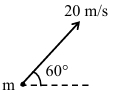
$A$ ball of mass $100 \ g$ is projected with velocity $20 \ m/s$ at $60^{\circ}$ with the horizontal. The decrease in kinetic energy of the ball during the motion from the point of projection to the highest point is:
A
$20 \ \text{J}$
B
$15 \ \text{J}$
C
zero
D
$5 \ \text{J}$
Solution
(B) Given: mass $m = 100 \ \text{g} = 0.1 \ \text{kg}$,initial velocity $u = 20 \ \text{m/s}$,angle of projection $\theta = 60^{\circ}$.
Initial kinetic energy $K_i = \frac{1}{2} m u^2 = \frac{1}{2} \times 0.1 \times (20)^2 = 0.05 \times 400 = 20 \ \text{J}$.
At the highest point,the vertical component of velocity becomes zero,and only the horizontal component $v_x = u \cos \theta$ remains.
Final kinetic energy $K_f = \frac{1}{2} m (u \cos 60^{\circ})^2 = \frac{1}{2} \times 0.1 \times (20 \times 0.5)^2 = 0.05 \times (10)^2 = 0.05 \times 100 = 5 \ \text{J}$.
Decrease in kinetic energy $\Delta K = K_i - K_f = 20 \ \text{J} - 5 \ \text{J} = 15 \ \text{J}$.
Initial kinetic energy $K_i = \frac{1}{2} m u^2 = \frac{1}{2} \times 0.1 \times (20)^2 = 0.05 \times 400 = 20 \ \text{J}$.
At the highest point,the vertical component of velocity becomes zero,and only the horizontal component $v_x = u \cos \theta$ remains.
Final kinetic energy $K_f = \frac{1}{2} m (u \cos 60^{\circ})^2 = \frac{1}{2} \times 0.1 \times (20 \times 0.5)^2 = 0.05 \times (10)^2 = 0.05 \times 100 = 5 \ \text{J}$.
Decrease in kinetic energy $\Delta K = K_i - K_f = 20 \ \text{J} - 5 \ \text{J} = 15 \ \text{J}$.
0 likes
View Solution302
MediumMCQ
$A$ sportsman runs around a circular track of radius $r$ such that he traverses the path $ABAB$. The distance travelled and displacement,respectively,are

A
$2 r, 3 \pi r$
B
$3 \pi r, \pi r$
C
$\pi r, 3 r$
D
$3 \pi r, 2 r$
Solution
(D) The sportsman starts at point $A$,completes one full circle to return to $A$,and then moves along the semi-circular arc to point $B$.
Distance is the total path length covered. One full circle is $2 \pi r$ and the semi-circular arc from $A$ to $B$ is $\pi r$. Thus,total distance $= 2 \pi r + \pi r = 3 \pi r$.
Displacement is the shortest straight-line distance between the initial position $A$ and the final position $B$. Since $A$ and $B$ are diametrically opposite points on the circle,the displacement is equal to the diameter of the circle,which is $2 r$.
Distance is the total path length covered. One full circle is $2 \pi r$ and the semi-circular arc from $A$ to $B$ is $\pi r$. Thus,total distance $= 2 \pi r + \pi r = 3 \pi r$.
Displacement is the shortest straight-line distance between the initial position $A$ and the final position $B$. Since $A$ and $B$ are diametrically opposite points on the circle,the displacement is equal to the diameter of the circle,which is $2 r$.
0 likes
View Solution303
DifficultMCQ
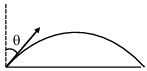
The angle of projection of a particle is measured from the vertical axis as $\phi$ and the maximum height reached by the particle is $h_m$. Here $h_m$ as a function of $\phi$ can be represented as:
A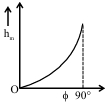
B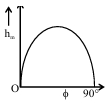
C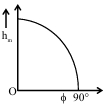
D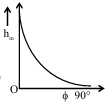
Solution
(D) The standard formula for the maximum height $h_m$ of a projectile is given by $h_m = \frac{u^2 \sin^2 \theta}{2g}$,where $\theta$ is the angle of projection measured from the horizontal axis.
Given that the angle of projection $\phi$ is measured from the vertical axis,the angle with the horizontal axis is $\theta = 90^\circ - \phi$.
Substituting this into the formula,we get:
$h_m = \frac{u^2 \sin^2(90^\circ - \phi)}{2g} = \frac{u^2 \cos^2 \phi}{2g}$.
As $\phi$ increases from $0^\circ$ to $90^\circ$,$\cos \phi$ decreases from $1$ to $0$. Therefore,$h_m$ decreases from $\frac{u^2}{2g}$ to $0$ as $\phi$ goes from $0^\circ$ to $90^\circ$. This behavior is represented by the graph in option $D$.
Given that the angle of projection $\phi$ is measured from the vertical axis,the angle with the horizontal axis is $\theta = 90^\circ - \phi$.
Substituting this into the formula,we get:
$h_m = \frac{u^2 \sin^2(90^\circ - \phi)}{2g} = \frac{u^2 \cos^2 \phi}{2g}$.
As $\phi$ increases from $0^\circ$ to $90^\circ$,$\cos \phi$ decreases from $1$ to $0$. Therefore,$h_m$ decreases from $\frac{u^2}{2g}$ to $0$ as $\phi$ goes from $0^\circ$ to $90^\circ$. This behavior is represented by the graph in option $D$.
0 likes
View Solution304
MediumMCQ
$A$ particle is projected with velocity $u$ so that its horizontal range is three times the maximum height attained by it. The horizontal range of the projectile is given as $\frac{n u^2}{25 g}$,where the value of $n$ is (Given $g$ is the acceleration due to gravity).
A
$6$
B
$18$
C
$12$
D
$24$
Solution
(D) The horizontal range $R$ is given by $R = \frac{u^2 \sin 2\theta}{g} = \frac{2u^2 \sin \theta \cos \theta}{g}$.
The maximum height $H$ is given by $H = \frac{u^2 \sin^2 \theta}{2g}$.
According to the problem,$R = 3H$.
Substituting the expressions,we get $\frac{2u^2 \sin \theta \cos \theta}{g} = 3 \left( \frac{u^2 \sin^2 \theta}{2g} \right)$.
Simplifying this,$2 \sin \theta \cos \theta = \frac{3}{2} \sin^2 \theta$,which implies $\tan \theta = \frac{4}{3}$.
Using $\tan \theta = \frac{4}{3}$,we find $\sin \theta = \frac{4}{5}$ and $\cos \theta = \frac{3}{5}$.
Now,substitute these into the range formula: $R = \frac{u^2 (2 \sin \theta \cos \theta)}{g} = \frac{u^2 (2 \times \frac{4}{5} \times \frac{3}{5})}{g} = \frac{24 u^2}{25 g}$.
Comparing this with $\frac{n u^2}{25 g}$,we get $n = 24$.
The maximum height $H$ is given by $H = \frac{u^2 \sin^2 \theta}{2g}$.
According to the problem,$R = 3H$.
Substituting the expressions,we get $\frac{2u^2 \sin \theta \cos \theta}{g} = 3 \left( \frac{u^2 \sin^2 \theta}{2g} \right)$.
Simplifying this,$2 \sin \theta \cos \theta = \frac{3}{2} \sin^2 \theta$,which implies $\tan \theta = \frac{4}{3}$.
Using $\tan \theta = \frac{4}{3}$,we find $\sin \theta = \frac{4}{5}$ and $\cos \theta = \frac{3}{5}$.
Now,substitute these into the range formula: $R = \frac{u^2 (2 \sin \theta \cos \theta)}{g} = \frac{u^2 (2 \times \frac{4}{5} \times \frac{3}{5})}{g} = \frac{24 u^2}{25 g}$.
Comparing this with $\frac{n u^2}{25 g}$,we get $n = 24$.
0 likes
View Solution305
DifficultMCQ
Two projectiles are fired from the ground with the same initial speeds from the same point at angles $(45^{\circ}+\alpha)$ and $(45^{\circ}-\alpha)$ with the horizontal direction. The ratio of their times of flight is
A
$1$
B
$\frac{1-\tan \alpha}{1+\tan \alpha}$
C
$\frac{1+\sin 2 \alpha}{1-\sin 2 \alpha}$
D
$\frac{1+\tan \alpha}{1-\tan \alpha}$
Solution
(D) Let the initial speed be $v$. The angles of projection are $\theta_1 = 45^{\circ} + \alpha$ and $\theta_2 = 45^{\circ} - \alpha$.
The formula for the time of flight is $T = \frac{2v \sin \theta}{g}$.
Taking the ratio of the times of flight $T_1$ and $T_2$:
$\frac{T_1}{T_2} = \frac{\sin(45^{\circ} + \alpha)}{\sin(45^{\circ} - \alpha)}$.
Using the trigonometric expansion $\sin(A \pm B) = \sin A \cos B \pm \cos A \sin B$:
$\frac{T_1}{T_2} = \frac{\sin 45^{\circ} \cos \alpha + \cos 45^{\circ} \sin \alpha}{\sin 45^{\circ} \cos \alpha - \cos 45^{\circ} \sin \alpha}$.
Since $\sin 45^{\circ} = \cos 45^{\circ} = \frac{1}{\sqrt{2}}$,we have:
$\frac{T_1}{T_2} = \frac{\frac{1}{\sqrt{2}}(\cos \alpha + \sin \alpha)}{\frac{1}{\sqrt{2}}(\cos \alpha - \sin \alpha)} = \frac{\cos \alpha + \sin \alpha}{\cos \alpha - \sin \alpha}$.
Dividing the numerator and denominator by $\cos \alpha$:
$\frac{T_1}{T_2} = \frac{1 + \tan \alpha}{1 - \tan \alpha}$.
The formula for the time of flight is $T = \frac{2v \sin \theta}{g}$.
Taking the ratio of the times of flight $T_1$ and $T_2$:
$\frac{T_1}{T_2} = \frac{\sin(45^{\circ} + \alpha)}{\sin(45^{\circ} - \alpha)}$.
Using the trigonometric expansion $\sin(A \pm B) = \sin A \cos B \pm \cos A \sin B$:
$\frac{T_1}{T_2} = \frac{\sin 45^{\circ} \cos \alpha + \cos 45^{\circ} \sin \alpha}{\sin 45^{\circ} \cos \alpha - \cos 45^{\circ} \sin \alpha}$.
Since $\sin 45^{\circ} = \cos 45^{\circ} = \frac{1}{\sqrt{2}}$,we have:
$\frac{T_1}{T_2} = \frac{\frac{1}{\sqrt{2}}(\cos \alpha + \sin \alpha)}{\frac{1}{\sqrt{2}}(\cos \alpha - \sin \alpha)} = \frac{\cos \alpha + \sin \alpha}{\cos \alpha - \sin \alpha}$.
Dividing the numerator and denominator by $\cos \alpha$:
$\frac{T_1}{T_2} = \frac{1 + \tan \alpha}{1 - \tan \alpha}$.
0 likes
View Solution306
MediumMCQ
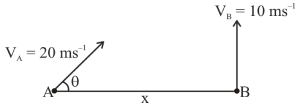
Two particles $A$ and $B$ are projected simultaneously in the directions shown in the figure with velocities $V_A = 20 \ ms^{-1}$ and $V_B = 10 \ ms^{-1}$ respectively. They collide in the air after $0.5 \ s$. Find $(a)$ the angle $\theta$ and $(b)$ the distance $x$.
A
$60^{\circ}, 10 \sqrt{3} \ m$
B
$45^{\circ}, 3 \sqrt{3} \ m$
C
$15^{\circ}, 6 \sqrt{3} \ m$
D
$30^{\circ}, 5 \sqrt{3} \ m$
Solution
(D) For the particles to collide,their vertical components of velocity must be equal,and their horizontal relative displacement must be covered in the given time.
$(a)$ Vertical motion:
The vertical component of velocity for particle $A$ is $V_{Ay} = V_A \sin \theta = 20 \sin \theta$.
The vertical component of velocity for particle $B$ is $V_{By} = 10 \ ms^{-1}$ (upwards).
Since they collide,their vertical positions must be the same at time $t = 0.5 \ s$. Assuming they start from the same horizontal level,$V_{Ay} = V_{By}$ is required for them to meet at the same height.
$20 \sin \theta = 10$
$\sin \theta = \frac{10}{20} = \frac{1}{2}$
$\theta = 30^{\circ}$.
$(b)$ Horizontal motion:
The horizontal component of velocity for particle $A$ is $V_{Ax} = V_A \cos \theta = 20 \cos 30^{\circ} = 20 \times \frac{\sqrt{3}}{2} = 10\sqrt{3} \ ms^{-1}$.
Particle $B$ has no horizontal velocity component $(V_{Bx} = 0)$.
To collide,particle $A$ must cover the horizontal distance $x$ in time $t = 0.5 \ s$.
$x = V_{Ax} \times t = (10\sqrt{3}) \times 0.5 = 5\sqrt{3} \ m$.
$(a)$ Vertical motion:
The vertical component of velocity for particle $A$ is $V_{Ay} = V_A \sin \theta = 20 \sin \theta$.
The vertical component of velocity for particle $B$ is $V_{By} = 10 \ ms^{-1}$ (upwards).
Since they collide,their vertical positions must be the same at time $t = 0.5 \ s$. Assuming they start from the same horizontal level,$V_{Ay} = V_{By}$ is required for them to meet at the same height.
$20 \sin \theta = 10$
$\sin \theta = \frac{10}{20} = \frac{1}{2}$
$\theta = 30^{\circ}$.
$(b)$ Horizontal motion:
The horizontal component of velocity for particle $A$ is $V_{Ax} = V_A \cos \theta = 20 \cos 30^{\circ} = 20 \times \frac{\sqrt{3}}{2} = 10\sqrt{3} \ ms^{-1}$.
Particle $B$ has no horizontal velocity component $(V_{Bx} = 0)$.
To collide,particle $A$ must cover the horizontal distance $x$ in time $t = 0.5 \ s$.
$x = V_{Ax} \times t = (10\sqrt{3}) \times 0.5 = 5\sqrt{3} \ m$.
0 likes
View Solution307
DifficultMCQ
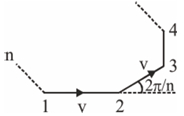
Twelve persons are initially at $12$ corners of a regular polygon of $12$ sides of side length $a$. Each person moves with a uniform speed $v$ in such a manner that person $1$ is always directed towards person $2$,person $2$ towards person $3$,person $3$ towards person $4$,and so on. The time after which they meet is
A
$\frac{a}{v}$
B
$\frac{2 a}{v}$
C
$\frac{2 a}{v(2+\sqrt{3})}$
D
$\frac{2 a}{v(2-\sqrt{3})}$
Solution
(D) For a regular polygon with $n$ sides of length $a$,where each person moves with speed $v$ towards the next person,the rate of approach between two adjacent persons is given by $v_{rel} = v - v \cos \theta$,where $\theta$ is the exterior angle of the polygon.
For a regular polygon with $n$ sides,the exterior angle is $\theta = \frac{2 \pi}{n}$.
The time taken to meet is $t = \frac{a}{v_{rel}} = \frac{a}{v(1 - \cos \frac{2 \pi}{n})}$.
Given $n = 12$,we have:
$t = \frac{a}{v(1 - \cos \frac{2 \pi}{12})} = \frac{a}{v(1 - \cos \frac{\pi}{6})}$.
Since $\cos \frac{\pi}{6} = \frac{\sqrt{3}}{2}$,we get:
$t = \frac{a}{v(1 - \frac{\sqrt{3}}{2})} = \frac{a}{v(\frac{2 - \sqrt{3}}{2})} = \frac{2 a}{v(2 - \sqrt{3})}$.
For a regular polygon with $n$ sides,the exterior angle is $\theta = \frac{2 \pi}{n}$.
The time taken to meet is $t = \frac{a}{v_{rel}} = \frac{a}{v(1 - \cos \frac{2 \pi}{n})}$.
Given $n = 12$,we have:
$t = \frac{a}{v(1 - \cos \frac{2 \pi}{12})} = \frac{a}{v(1 - \cos \frac{\pi}{6})}$.
Since $\cos \frac{\pi}{6} = \frac{\sqrt{3}}{2}$,we get:
$t = \frac{a}{v(1 - \frac{\sqrt{3}}{2})} = \frac{a}{v(\frac{2 - \sqrt{3}}{2})} = \frac{2 a}{v(2 - \sqrt{3})}$.
0 likes
View Solution308
EasyMCQ
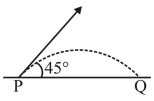
$A$ projectile of mass $m$ is fired with velocity $v$ from the point $P$ at an angle $45^{\circ}$ with the horizontal. The magnitude of change in momentum,when it passes through the point $Q$ on the same horizontal line on which $P$ lies,is :
A
$mv \sqrt{2}$
B
$\frac{1}{2}\ mv$
C
Zero
D
$2\ mv$
Solution
(A) At point $P$,the velocity components are $v_x = v \cos 45^{\circ}$ and $v_y = v \sin 45^{\circ}$. The momentum is $\vec{P}_i = m(v \cos 45^{\circ} \hat{i} + v \sin 45^{\circ} \hat{j})$.
At point $Q$,which is at the same horizontal level as $P$,the horizontal velocity remains $v_x = v \cos 45^{\circ}$ and the vertical velocity is $v_y' = -v \sin 45^{\circ}$. The momentum is $\vec{P}_f = m(v \cos 45^{\circ} \hat{i} - v \sin 45^{\circ} \hat{j})$.
The change in momentum is $\Delta \vec{P} = \vec{P}_f - \vec{P}_i = -2mv \sin 45^{\circ} \hat{j}$.
The magnitude of change in momentum is $|\Delta \vec{P}| = 2mv \sin 45^{\circ} = 2mv \times \frac{1}{\sqrt{2}} = \sqrt{2} mv$.
At point $Q$,which is at the same horizontal level as $P$,the horizontal velocity remains $v_x = v \cos 45^{\circ}$ and the vertical velocity is $v_y' = -v \sin 45^{\circ}$. The momentum is $\vec{P}_f = m(v \cos 45^{\circ} \hat{i} - v \sin 45^{\circ} \hat{j})$.
The change in momentum is $\Delta \vec{P} = \vec{P}_f - \vec{P}_i = -2mv \sin 45^{\circ} \hat{j}$.
The magnitude of change in momentum is $|\Delta \vec{P}| = 2mv \sin 45^{\circ} = 2mv \times \frac{1}{\sqrt{2}} = \sqrt{2} mv$.
0 likes
View Solution309
MediumMCQ
Assertion: In a circular motion,work done by centripetal force is not always zero.
Reason: If the speed of the particle increases or decreases in circular motion,then the net force acting on the particle does not remain towards the centre.
Reason: If the speed of the particle increases or decreases in circular motion,then the net force acting on the particle does not remain towards the centre.
A
Both Assertion and Reason are true and Reason is the correct explanation of Assertion.
B
Both Assertion and Reason are true but Reason is $\text{NOT}$ the correct explanation of Assertion.
C
Assertion is true and Reason is false.
D
Assertion is false and Reason is true.
Solution
(D) In uniform circular motion,the centripetal force is always perpendicular to the velocity vector,so the work done by it is zero. However,the assertion states 'In a circular motion,work done by centripetal force is not always zero'. This is false because the centripetal force is defined as the component of the net force directed towards the centre,which is always perpendicular to the instantaneous displacement. Thus,the work done by centripetal force is always zero in any circular motion.
The reason states that if the speed changes,the net force is not towards the centre. This is true because,in non-uniform circular motion,there is a tangential acceleration component,meaning the net force has both radial (centripetal) and tangential components. Therefore,the net force is not directed towards the centre. Since the Assertion is false and the Reason is true,the correct option is $D$.
The reason states that if the speed changes,the net force is not towards the centre. This is true because,in non-uniform circular motion,there is a tangential acceleration component,meaning the net force has both radial (centripetal) and tangential components. Therefore,the net force is not directed towards the centre. Since the Assertion is false and the Reason is true,the correct option is $D$.
0 likes
View Solution310
DifficultMCQ
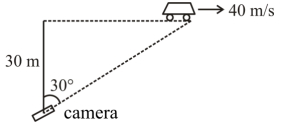
$A$ racing car is moving with velocity $v = 40\ m/s$ on a straight track as shown. We are recording it with a camera placed at a distance of $30\ m$ from the road. Find the angular velocity (in $rad/s$) with which we should rotate the camera to record the race at the instant shown in the diagram.
A
$1$
B
$2$
C
$\frac{4}{3}$
D
$\frac{3}{2}$
Solution
(A) Let $d = 30\ m$ be the perpendicular distance from the camera to the track.
Let $r$ be the distance from the camera to the car at the given instant.
From the geometry of the triangle,$\cos 30^{\circ} = \frac{d}{r}$,so $r = \frac{d}{\cos 30^{\circ}} = \frac{30}{\sqrt{3}/2} = \frac{60}{\sqrt{3}} = 20\sqrt{3}\ m$.
The component of the car's velocity perpendicular to the line of sight (the line connecting the camera and the car) is $v_{\perp} = v \cos 30^{\circ}$.
$v_{\perp} = 40 \times \frac{\sqrt{3}}{2} = 20\sqrt{3}\ m/s$.
The angular velocity $\omega$ is given by $\omega = \frac{v_{\perp}}{r}$.
$\omega = \frac{20\sqrt{3}}{20\sqrt{3}} = 1\ rad/s$.
Let $r$ be the distance from the camera to the car at the given instant.
From the geometry of the triangle,$\cos 30^{\circ} = \frac{d}{r}$,so $r = \frac{d}{\cos 30^{\circ}} = \frac{30}{\sqrt{3}/2} = \frac{60}{\sqrt{3}} = 20\sqrt{3}\ m$.
The component of the car's velocity perpendicular to the line of sight (the line connecting the camera and the car) is $v_{\perp} = v \cos 30^{\circ}$.
$v_{\perp} = 40 \times \frac{\sqrt{3}}{2} = 20\sqrt{3}\ m/s$.
The angular velocity $\omega$ is given by $\omega = \frac{v_{\perp}}{r}$.
$\omega = \frac{20\sqrt{3}}{20\sqrt{3}} = 1\ rad/s$.
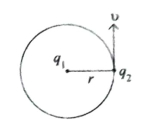
0 likes
View Solution311
AdvancedMCQ
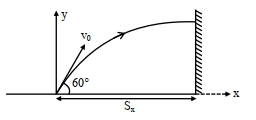
$A$ projectile of mass $200 \ g$ is launched in a viscous medium at an angle $60^{\circ}$ with the horizontal,with an initial velocity of $270 \ m/s$. It experiences a viscous drag force $\vec{F} = -c \vec{v}$,where the drag coefficient $c = 0.1 \ kg/s$ and $\vec{v}$ is the instantaneous velocity of the projectile. The projectile hits a vertical wall after $2 \ s$. Taking $e = 2.7$,the horizontal distance of the wall from the point of projection (in $m$) is
A
$150$
B
$160$
C
$170$
D
$180$
Solution
(C) The net force on the projectile is given by $\vec{F}_{net} = m \frac{d\vec{v}}{dt}$.
In the horizontal direction,the only force acting is the viscous drag force $F_x = -c v_x$.
Thus,$m \frac{dv_x}{dt} = -c v_x$.
Rearranging the terms,we get $\frac{dv_x}{v_x} = -\frac{c}{m} dt$.
Integrating both sides from $t = 0$ to $t$ and $v_x = v_{0x}$ to $v_x$,we get $\ln \left( \frac{v_x}{v_{0x}} \right) = -\frac{c}{m} t$.
So,$v_x = v_{0x} e^{-(c/m)t}$.
Given $m = 200 \ g = 0.2 \ kg$ and $c = 0.1 \ kg/s$,the ratio $c/m = 0.1 / 0.2 = 0.5 \ s^{-1}$.
Thus,$v_x = v_{0x} e^{-0.5t}$.
Since $v_x = \frac{dx}{dt}$,we have $x = \int_0^t v_{0x} e^{-0.5t} dt = v_{0x} \left[ \frac{e^{-0.5t}}{-0.5} \right]_0^t = 2 v_{0x} (1 - e^{-0.5t})$.
Given $v_0 = 270 \ m/s$ and angle $\theta = 60^{\circ}$,$v_{0x} = v_0 \cos 60^{\circ} = 270 \times 0.5 = 135 \ m/s$.
At $t = 2 \ s$,$x = 2 \times 135 \times (1 - e^{-0.5 \times 2}) = 270 \times (1 - e^{-1}) = 270 \times (1 - 1/2.7) = 270 \times (1.7 / 2.7) = 100 \times 1.7 = 170 \ m$.
In the horizontal direction,the only force acting is the viscous drag force $F_x = -c v_x$.
Thus,$m \frac{dv_x}{dt} = -c v_x$.
Rearranging the terms,we get $\frac{dv_x}{v_x} = -\frac{c}{m} dt$.
Integrating both sides from $t = 0$ to $t$ and $v_x = v_{0x}$ to $v_x$,we get $\ln \left( \frac{v_x}{v_{0x}} \right) = -\frac{c}{m} t$.
So,$v_x = v_{0x} e^{-(c/m)t}$.
Given $m = 200 \ g = 0.2 \ kg$ and $c = 0.1 \ kg/s$,the ratio $c/m = 0.1 / 0.2 = 0.5 \ s^{-1}$.
Thus,$v_x = v_{0x} e^{-0.5t}$.
Since $v_x = \frac{dx}{dt}$,we have $x = \int_0^t v_{0x} e^{-0.5t} dt = v_{0x} \left[ \frac{e^{-0.5t}}{-0.5} \right]_0^t = 2 v_{0x} (1 - e^{-0.5t})$.
Given $v_0 = 270 \ m/s$ and angle $\theta = 60^{\circ}$,$v_{0x} = v_0 \cos 60^{\circ} = 270 \times 0.5 = 135 \ m/s$.
At $t = 2 \ s$,$x = 2 \times 135 \times (1 - e^{-0.5 \times 2}) = 270 \times (1 - e^{-1}) = 270 \times (1 - 1/2.7) = 270 \times (1.7 / 2.7) = 100 \times 1.7 = 170 \ m$.
0 likes
View Solution312
DifficultMCQ
If the radius of the circular path and the frequency of revolution of a particle of mass $m$ are doubled,then the change in its kinetic energy will be ($E_i$ and $E_f$ are the initial and final kinetic energies of the particle respectively). (in $E_i$)
A
$12$
B
$16$
C
$8$
D
$15$
Solution
(D) The initial kinetic energy of the particle is given by $E_i = \frac{1}{2} m v^2$. Since $v = \omega r = 2 \pi f r$,we have $E_i = \frac{1}{2} m (2 \pi f_1 r_1)^2 = 2 \pi^2 m r_1^2 f_1^2$.
When the radius is doubled $(r_2 = 2 r_1)$ and the frequency is doubled $(f_2 = 2 f_1)$,the final kinetic energy $E_f$ becomes:
$E_f = 2 \pi^2 m (r_2)^2 (f_2)^2 = 2 \pi^2 m (2 r_1)^2 (2 f_1)^2$.
$E_f = 2 \pi^2 m (4 r_1^2) (4 f_1^2) = 32 \pi^2 m r_1^2 f_1^2$.
Since $E_i = 2 \pi^2 m r_1^2 f_1^2$,we can write $E_f = 16 E_i$.
The change in kinetic energy is $\Delta E = E_f - E_i = 16 E_i - E_i = 15 E_i$.
When the radius is doubled $(r_2 = 2 r_1)$ and the frequency is doubled $(f_2 = 2 f_1)$,the final kinetic energy $E_f$ becomes:
$E_f = 2 \pi^2 m (r_2)^2 (f_2)^2 = 2 \pi^2 m (2 r_1)^2 (2 f_1)^2$.
$E_f = 2 \pi^2 m (4 r_1^2) (4 f_1^2) = 32 \pi^2 m r_1^2 f_1^2$.
Since $E_i = 2 \pi^2 m r_1^2 f_1^2$,we can write $E_f = 16 E_i$.
The change in kinetic energy is $\Delta E = E_f - E_i = 16 E_i - E_i = 15 E_i$.
0 likes
View Solution313
MediumMCQ
Two bodies of mass $10 \ kg$ and $5 \ kg$ are moving in concentric circular orbits of radii $R$ and $r$ respectively such that their periods are same. The ratio between their centripetal acceleration is
A
$R / r$
B
$r / R$
C
$R^2 / r^2$
D
$r^2 / R^2$
Solution
(A) The centripetal acceleration $a_c$ of a body moving in a circular orbit of radius $r$ with period $T$ is given by the formula: $a_c = \omega^2 r$,where $\omega = 2\pi / T$ is the angular velocity.
Since the periods $T$ are the same for both bodies,their angular velocities $\omega$ are also the same.
For the first body of mass $10 \ kg$ and radius $R$,the centripetal acceleration is $a_1 = \omega^2 R$.
For the second body of mass $5 \ kg$ and radius $r$,the centripetal acceleration is $a_2 = \omega^2 r$.
The ratio of their centripetal accelerations is $a_1 / a_2 = (\omega^2 R) / (\omega^2 r) = R / r$.
Therefore,the correct option is $A$.
Since the periods $T$ are the same for both bodies,their angular velocities $\omega$ are also the same.
For the first body of mass $10 \ kg$ and radius $R$,the centripetal acceleration is $a_1 = \omega^2 R$.
For the second body of mass $5 \ kg$ and radius $r$,the centripetal acceleration is $a_2 = \omega^2 r$.
The ratio of their centripetal accelerations is $a_1 / a_2 = (\omega^2 R) / (\omega^2 r) = R / r$.
Therefore,the correct option is $A$.
0 likes
View Solution314
MediumMCQ
At any time $t$,the coordinates of a moving particle are $x = at^2$ and $y = bt^2$. The speed of the particle is
A
$2t \sqrt{a^2 + b^2}$
B
$2t \sqrt{a^2 - b^2}$
C
$2t(a + b)$
D
$\frac{2t}{\sqrt{a^2 + b^2}}$
Solution
(A) The velocity components are given by the time derivative of the position coordinates:
$v_x = \frac{dx}{dt} = \frac{d}{dt}(at^2) = 2at$
$v_y = \frac{dy}{dt} = \frac{d}{dt}(bt^2) = 2bt$
The speed $v$ is the magnitude of the velocity vector:
$v = \sqrt{v_x^2 + v_y^2}$
$v = \sqrt{(2at)^2 + (2bt)^2}$
$v = \sqrt{4a^2t^2 + 4b^2t^2}$
$v = \sqrt{4t^2(a^2 + b^2)}$
$v = 2t \sqrt{a^2 + b^2}$
$v_x = \frac{dx}{dt} = \frac{d}{dt}(at^2) = 2at$
$v_y = \frac{dy}{dt} = \frac{d}{dt}(bt^2) = 2bt$
The speed $v$ is the magnitude of the velocity vector:
$v = \sqrt{v_x^2 + v_y^2}$
$v = \sqrt{(2at)^2 + (2bt)^2}$
$v = \sqrt{4a^2t^2 + 4b^2t^2}$
$v = \sqrt{4t^2(a^2 + b^2)}$
$v = 2t \sqrt{a^2 + b^2}$
0 likes
View Solution315
EasyMCQ
The coordinates of a moving particle at any time $t$ are given by $x = \alpha t^3$ and $y = \beta t^3$,where $\alpha$ and $\beta$ are constants. The speed of the particle at time $t$ is given by:
A
$t \sqrt{\alpha^2+\beta^2}$
B
$3 t \sqrt{\alpha^2+\beta^2}$
C
$t^2 \sqrt{\alpha^2+\beta^2}$
D
$3 t^2 \sqrt{\alpha^2+\beta^2}$
Solution
(D) The position vector of the particle is given by $\vec{r} = x \hat{i} + y \hat{j} = \alpha t^3 \hat{i} + \beta t^3 \hat{j}$.
To find the velocity vector $\vec{v}$,we differentiate the position vector with respect to time $t$:
$\vec{v} = \frac{d\vec{r}}{dt} = \frac{d}{dt}(\alpha t^3 \hat{i} + \beta t^3 \hat{j}) = 3\alpha t^2 \hat{i} + 3\beta t^2 \hat{j}$.
The speed is the magnitude of the velocity vector:
$v = |\vec{v}| = \sqrt{(3\alpha t^2)^2 + (3\beta t^2)^2}$.
$v = \sqrt{9\alpha^2 t^4 + 9\beta^2 t^4}$.
$v = \sqrt{9 t^4 (\alpha^2 + \beta^2)}$.
$v = 3 t^2 \sqrt{\alpha^2 + \beta^2}$.
To find the velocity vector $\vec{v}$,we differentiate the position vector with respect to time $t$:
$\vec{v} = \frac{d\vec{r}}{dt} = \frac{d}{dt}(\alpha t^3 \hat{i} + \beta t^3 \hat{j}) = 3\alpha t^2 \hat{i} + 3\beta t^2 \hat{j}$.
The speed is the magnitude of the velocity vector:
$v = |\vec{v}| = \sqrt{(3\alpha t^2)^2 + (3\beta t^2)^2}$.
$v = \sqrt{9\alpha^2 t^4 + 9\beta^2 t^4}$.
$v = \sqrt{9 t^4 (\alpha^2 + \beta^2)}$.
$v = 3 t^2 \sqrt{\alpha^2 + \beta^2}$.
0 likes
View Solution316
MediumMCQ
$A$ stone is projected vertically upwards with velocity $V$. Another stone of the same mass is projected at an angle of $60^{\circ}$ with the vertical with the same speed $V$. The ratio of their potential energies at the highest points of their journey is:
A
$1$:$1$
B
$4$:$1$
C
$3$:$2$
D
$2$:$1$
Solution
(B) The potential energy at the highest point is given by $U = mgh$,where $h$ is the maximum height.
For the first stone projected vertically,the angle with the horizontal is $\theta_1 = 90^{\circ}$.
The maximum height is $h_1 = \frac{V^2 \sin^2 90^{\circ}}{2g} = \frac{V^2}{2g}$.
For the second stone,the angle with the vertical is $60^{\circ}$,so the angle with the horizontal is $\theta_2 = 90^{\circ} - 60^{\circ} = 30^{\circ}$.
The maximum height is $h_2 = \frac{V^2 \sin^2 30^{\circ}}{2g} = \frac{V^2 (1/2)^2}{2g} = \frac{V^2}{8g}$.
The ratio of potential energies is $\frac{U_1}{U_2} = \frac{mgh_1}{mgh_2} = \frac{h_1}{h_2} = \frac{V^2/2g}{V^2/8g} = \frac{8}{2} = 4:1$.
For the first stone projected vertically,the angle with the horizontal is $\theta_1 = 90^{\circ}$.
The maximum height is $h_1 = \frac{V^2 \sin^2 90^{\circ}}{2g} = \frac{V^2}{2g}$.
For the second stone,the angle with the vertical is $60^{\circ}$,so the angle with the horizontal is $\theta_2 = 90^{\circ} - 60^{\circ} = 30^{\circ}$.
The maximum height is $h_2 = \frac{V^2 \sin^2 30^{\circ}}{2g} = \frac{V^2 (1/2)^2}{2g} = \frac{V^2}{8g}$.
The ratio of potential energies is $\frac{U_1}{U_2} = \frac{mgh_1}{mgh_2} = \frac{h_1}{h_2} = \frac{V^2/2g}{V^2/8g} = \frac{8}{2} = 4:1$.
0 likes
View Solution317
MediumMCQ
$A$ particle of mass $m$ performs uniform circular motion of radius $r$ with linear speed $v$ under the application of force $F$. If $m$,$v$,and $r$ are all increased by $20 \%$,the necessary change in force required to maintain the particle in uniform circular motion is: (in $\%$)
A
$12$
B
$14$
C
$44$
D
$144$
Solution
(C) The initial centripetal force is given by $F_1 = \frac{mv^2}{r}$.
After a $20 \%$ increase,the new values are $m' = 1.2m$,$v' = 1.2v$,and $r' = 1.2r$.
The new force $F_2$ required is:
$F_2 = \frac{m' (v')^2}{r'} = \frac{(1.2m)(1.2v)^2}{1.2r}$
$F_2 = \frac{1.2m \times 1.44v^2}{1.2r} = 1.44 \frac{mv^2}{r} = 1.44 F_1$.
The change in force is $\Delta F = F_2 - F_1 = 1.44 F_1 - F_1 = 0.44 F_1$.
The percentage change is $\frac{\Delta F}{F_1} \times 100 = 0.44 \times 100 = 44 \%$.
Therefore,the force must be increased by $44 \%$.
After a $20 \%$ increase,the new values are $m' = 1.2m$,$v' = 1.2v$,and $r' = 1.2r$.
The new force $F_2$ required is:
$F_2 = \frac{m' (v')^2}{r'} = \frac{(1.2m)(1.2v)^2}{1.2r}$
$F_2 = \frac{1.2m \times 1.44v^2}{1.2r} = 1.44 \frac{mv^2}{r} = 1.44 F_1$.
The change in force is $\Delta F = F_2 - F_1 = 1.44 F_1 - F_1 = 0.44 F_1$.
The percentage change is $\frac{\Delta F}{F_1} \times 100 = 0.44 \times 100 = 44 \%$.
Therefore,the force must be increased by $44 \%$.
0 likes
View Solution318
MediumMCQ
$A$ body performing uniform circular motion of radius '$R$' has frequency '$n$'. Its centripetal acceleration per unit radius is proportional to $(n)^x$. The value of $x$ is
A
$1$
B
$2$
C
-$1$
D
-$2$
Solution
(B) The centripetal acceleration $a_c$ of a body in uniform circular motion is given by the formula $a_c = \omega^2 R$,where $\omega$ is the angular velocity and $R$ is the radius.
We know that angular velocity $\omega = 2 \pi n$,where $n$ is the frequency.
Substituting this into the formula for centripetal acceleration:
$a_c = (2 \pi n)^2 R$
$a_c = 4 \pi^2 n^2 R$
We are asked to find the centripetal acceleration per unit radius,which is $\frac{a_c}{R}$.
$\frac{a_c}{R} = 4 \pi^2 n^2$
Comparing this expression with $(n)^x$,we can see that the term is proportional to $n^2$.
Therefore,the value of $x$ is $2$.
We know that angular velocity $\omega = 2 \pi n$,where $n$ is the frequency.
Substituting this into the formula for centripetal acceleration:
$a_c = (2 \pi n)^2 R$
$a_c = 4 \pi^2 n^2 R$
We are asked to find the centripetal acceleration per unit radius,which is $\frac{a_c}{R}$.
$\frac{a_c}{R} = 4 \pi^2 n^2$
Comparing this expression with $(n)^x$,we can see that the term is proportional to $n^2$.
Therefore,the value of $x$ is $2$.
0 likes
View Solution319
EasyMCQ
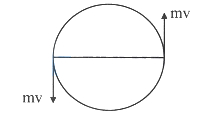
$A$ particle is moving in a circle with uniform speed '$v$'. In moving from a point to another diametrically opposite point:
A
the momentum changes by $mv$
B
the momentum changes by $2mv$
C
the kinetic energy changes by $\frac{1}{2}mv^2$
D
the kinetic energy changes by $mv^2$
Solution
(B) Let the mass of the particle be '$m$'. Since the speed '$v$' is uniform,the magnitude of momentum at any point is $p = mv$.
When the particle moves from one point to the diametrically opposite point,its velocity vector reverses its direction.
Let the initial momentum be $\vec{p}_i = m\vec{v}$ and the final momentum be $\vec{p}_f = -m\vec{v}$.
The change in momentum is given by:
$\Delta \vec{p} = \vec{p}_f - \vec{p}_i = -m\vec{v} - (m\vec{v}) = -2m\vec{v}$.
The magnitude of the change in momentum is $|\Delta \vec{p}| = 2mv$.
Since the speed is uniform,the kinetic energy $K = \frac{1}{2}mv^2$ remains constant,so the change in kinetic energy is $0$.
When the particle moves from one point to the diametrically opposite point,its velocity vector reverses its direction.
Let the initial momentum be $\vec{p}_i = m\vec{v}$ and the final momentum be $\vec{p}_f = -m\vec{v}$.
The change in momentum is given by:
$\Delta \vec{p} = \vec{p}_f - \vec{p}_i = -m\vec{v} - (m\vec{v}) = -2m\vec{v}$.
The magnitude of the change in momentum is $|\Delta \vec{p}| = 2mv$.
Since the speed is uniform,the kinetic energy $K = \frac{1}{2}mv^2$ remains constant,so the change in kinetic energy is $0$.
0 likes
View Solution320
MediumMCQ
$A$ particle moves around a circular path of radius $r$ with uniform speed $V$. After moving half the circle,the average acceleration of the particle is
A
$\frac{V^2}{r}$
B
$\frac{2 V^2}{r}$
C
$\frac{2 V^2}{\pi r}$
D
$\frac{V^2}{\pi r}$
Solution
(C) Let the initial velocity be $\vec{V}_i = V \hat{i}$ and the final velocity after half a revolution be $\vec{V}_f = -V \hat{i}$.
The change in velocity is $\Delta \vec{V} = \vec{V}_f - \vec{V}_i = -V \hat{i} - V \hat{i} = -2V \hat{i}$.
The magnitude of the change in velocity is $|\Delta \vec{V}| = 2V$.
The distance traveled in half a circle is $d = \pi r$.
The time taken to complete half a revolution is $t = \frac{d}{V} = \frac{\pi r}{V}$.
The average acceleration is defined as $\vec{a}_{avg} = \frac{\Delta \vec{V}}{t}$.
Substituting the values,$a_{avg} = \frac{2V}{\frac{\pi r}{V}} = \frac{2V^2}{\pi r}$.
The change in velocity is $\Delta \vec{V} = \vec{V}_f - \vec{V}_i = -V \hat{i} - V \hat{i} = -2V \hat{i}$.
The magnitude of the change in velocity is $|\Delta \vec{V}| = 2V$.
The distance traveled in half a circle is $d = \pi r$.
The time taken to complete half a revolution is $t = \frac{d}{V} = \frac{\pi r}{V}$.
The average acceleration is defined as $\vec{a}_{avg} = \frac{\Delta \vec{V}}{t}$.
Substituting the values,$a_{avg} = \frac{2V}{\frac{\pi r}{V}} = \frac{2V^2}{\pi r}$.
0 likes
View Solution321
EasyMCQ
$A$ particle of mass $m$ performs uniform circular motion of radius $r$ with linear speed $v$ under the application of force $F$. If $m, v$ and $r$ are all increased by $50 \%$,the necessary change in force required to maintain the particle in uniform circular motion is (in $\%$)
A
$125$
B
$150$
C
$100$
D
$225$
Solution
(A) The centripetal force $F$ required for uniform circular motion is given by $F = \frac{mv^2}{r}$.
Let the initial values be $m, v, r$. The initial force is $F = \frac{mv^2}{r}$.
Given that $m, v,$ and $r$ are all increased by $50 \%$,the new values are:
$m' = m + 0.5m = 1.5m = \frac{3}{2}m$
$v' = v + 0.5v = 1.5v = \frac{3}{2}v$
$r' = r + 0.5r = 1.5r = \frac{3}{2}r$
The new force $F'$ is given by:
$F' = \frac{m' (v')^2}{r'} = \frac{(\frac{3}{2}m) (\frac{3}{2}v)^2}{\frac{3}{2}r} = \frac{(\frac{3}{2}m) (\frac{9}{4}v^2)}{\frac{3}{2}r} = \frac{9}{4} \frac{mv^2}{r} = 2.25 F$.
The change in force is $\Delta F = F' - F = 2.25F - F = 1.25F$.
The percentage change in force is $\frac{\Delta F}{F} \times 100 = \frac{1.25F}{F} \times 100 = 125 \%$.
Let the initial values be $m, v, r$. The initial force is $F = \frac{mv^2}{r}$.
Given that $m, v,$ and $r$ are all increased by $50 \%$,the new values are:
$m' = m + 0.5m = 1.5m = \frac{3}{2}m$
$v' = v + 0.5v = 1.5v = \frac{3}{2}v$
$r' = r + 0.5r = 1.5r = \frac{3}{2}r$
The new force $F'$ is given by:
$F' = \frac{m' (v')^2}{r'} = \frac{(\frac{3}{2}m) (\frac{3}{2}v)^2}{\frac{3}{2}r} = \frac{(\frac{3}{2}m) (\frac{9}{4}v^2)}{\frac{3}{2}r} = \frac{9}{4} \frac{mv^2}{r} = 2.25 F$.
The change in force is $\Delta F = F' - F = 2.25F - F = 1.25F$.
The percentage change in force is $\frac{\Delta F}{F} \times 100 = \frac{1.25F}{F} \times 100 = 125 \%$.
0 likes
View Solution322
EasyMCQ
Two bodies of masses $m$ and $3m$ are rotating in horizontal circles of radii $r$ and $\frac{r}{3}$ respectively. The tangential speed of the body of mass $m$ is $n$ times that of the heavier body. If the centripetal force is the same for both,the value of $n$ is:
A
$3$
B
$9$
C
$1$
D
$6$
Solution
(A) Let the tangential speed of the heavier body (mass $3m$) be $v$.
Then the tangential speed of the lighter body (mass $m$) is $nv$.
The centripetal force $F$ is given by $F = \frac{mv^2}{r}$.
For the first body: $F_1 = \frac{m(nv)^2}{r} = \frac{mn^2v^2}{r}$.
For the second body: $F_2 = \frac{(3m)v^2}{(r/3)} = \frac{9mv^2}{r}$.
Since the centripetal forces are equal $(F_1 = F_2)$:
$\frac{mn^2v^2}{r} = \frac{9mv^2}{r}$.
Canceling common terms $m, v^2,$ and $r$ from both sides:
$n^2 = 9$.
Therefore,$n = 3$.
Then the tangential speed of the lighter body (mass $m$) is $nv$.
The centripetal force $F$ is given by $F = \frac{mv^2}{r}$.
For the first body: $F_1 = \frac{m(nv)^2}{r} = \frac{mn^2v^2}{r}$.
For the second body: $F_2 = \frac{(3m)v^2}{(r/3)} = \frac{9mv^2}{r}$.
Since the centripetal forces are equal $(F_1 = F_2)$:
$\frac{mn^2v^2}{r} = \frac{9mv^2}{r}$.
Canceling common terms $m, v^2,$ and $r$ from both sides:
$n^2 = 9$.
Therefore,$n = 3$.
0 likes
View Solution323
DifficultMCQ
$A$ particle is performing a uniform circular motion along a circle of radius $R$. In half the period of revolution,its displacement and distance covered are respectively:
A
$2 R, \pi R$
B
$R, \pi R$
C
$2 R, 2 \pi R$
D
$\sqrt{2} R, 2 \pi R$
Solution
(A) In half the period of revolution,the particle moves from its initial position to a point diametrically opposite to it.
Displacement is the shortest distance between the initial and final positions,which is the diameter of the circle: $2 R$.
Distance covered is the length of the path traveled,which is half the circumference of the circle: $\frac{1}{2} \times (2 \pi R) = \pi R$.
Therefore,the displacement is $2 R$ and the distance covered is $\pi R$.
Displacement is the shortest distance between the initial and final positions,which is the diameter of the circle: $2 R$.
Distance covered is the length of the path traveled,which is half the circumference of the circle: $\frac{1}{2} \times (2 \pi R) = \pi R$.
Therefore,the displacement is $2 R$ and the distance covered is $\pi R$.
0 likes
View Solution324
MediumMCQ
$A$ particle is performing uniform circular motion. If $\theta$,$\omega$,$\alpha$,and $a$ are its angular displacement,angular velocity,angular acceleration,and centripetal acceleration respectively,then which of the following is '$WRONG$'? ($v$ is its linear velocity)
A
$\vec{v} \perp \vec{a}$
B
$\vec{\omega} \perp \vec{v}$
C
$\vec{\omega} \perp \vec{\alpha}$
D
$\vec{\omega} \perp \vec{a}$
Solution
(C) In uniform circular motion,the speed of the particle is constant,so the angular acceleration $\vec{\alpha} = 0$.
Since $\vec{\alpha} = 0$,the vector $\vec{\alpha}$ is a null vector.
By definition,the angular velocity $\vec{\omega}$ is perpendicular to the plane of motion,and the linear velocity $\vec{v}$ lies in the plane of motion,so $\vec{\omega} \perp \vec{v}$ is true.
The centripetal acceleration $\vec{a}$ is directed towards the center of the circle,which lies in the plane of motion,so $\vec{\omega} \perp \vec{a}$ is true.
The linear velocity $\vec{v}$ is tangential to the circle,and the centripetal acceleration $\vec{a}$ is radial,so $\vec{v} \perp \vec{a}$ is true.
However,since $\vec{\alpha} = 0$ (a null vector),it does not have a defined direction to be perpendicular to $\vec{\omega}$. Thus,the statement $\vec{\omega} \perp \vec{\alpha}$ is considered incorrect or physically meaningless in the context of uniform circular motion.
Since $\vec{\alpha} = 0$,the vector $\vec{\alpha}$ is a null vector.
By definition,the angular velocity $\vec{\omega}$ is perpendicular to the plane of motion,and the linear velocity $\vec{v}$ lies in the plane of motion,so $\vec{\omega} \perp \vec{v}$ is true.
The centripetal acceleration $\vec{a}$ is directed towards the center of the circle,which lies in the plane of motion,so $\vec{\omega} \perp \vec{a}$ is true.
The linear velocity $\vec{v}$ is tangential to the circle,and the centripetal acceleration $\vec{a}$ is radial,so $\vec{v} \perp \vec{a}$ is true.
However,since $\vec{\alpha} = 0$ (a null vector),it does not have a defined direction to be perpendicular to $\vec{\omega}$. Thus,the statement $\vec{\omega} \perp \vec{\alpha}$ is considered incorrect or physically meaningless in the context of uniform circular motion.
0 likes
View Solution325
EasyMCQ
Two cars of masses $m_{1}$ and $m_{2}$ are moving in circles of radii $r_{1}$ and $r_{2}$ respectively. Their speeds are such that they make complete circles in the same time $t$. The ratio of their centripetal force is
A
$m_{1}: m_{2}$
B
$r_{1}: r_{2}$
C
$1: 1$
D
$m_{1} r_{1}: m_{2} r_{2}$
Solution
(D) The centripetal force $F$ acting on a body of mass $m$ moving in a circle of radius $r$ with angular velocity $\omega$ is given by $F = m r \omega^2$.
Since both cars complete their circles in the same time $t$,their angular velocities are equal: $\omega = \frac{2\pi}{t}$.
Therefore,the ratio of the centripetal forces $F_{1}$ and $F_{2}$ is:
$\frac{F_{1}}{F_{2}} = \frac{m_{1} r_{1} \omega^2}{m_{2} r_{2} \omega^2} = \frac{m_{1} r_{1}}{m_{2} r_{2}}$.
Thus,the ratio is $m_{1} r_{1} : m_{2} r_{2}$.
Since both cars complete their circles in the same time $t$,their angular velocities are equal: $\omega = \frac{2\pi}{t}$.
Therefore,the ratio of the centripetal forces $F_{1}$ and $F_{2}$ is:
$\frac{F_{1}}{F_{2}} = \frac{m_{1} r_{1} \omega^2}{m_{2} r_{2} \omega^2} = \frac{m_{1} r_{1}}{m_{2} r_{2}}$.
Thus,the ratio is $m_{1} r_{1} : m_{2} r_{2}$.
0 likes
View Solution326
DifficultMCQ
$A$ particle is moving in a circle of radius $R$ with constant speed $V$. The magnitude of average acceleration after half revolution is
A
$\frac{2 V^{2}}{\pi R}$
B
$\frac{2 \pi}{R V^{2}}$
C
$\frac{2 V}{\pi R^{2}}$
D
$\frac{2 R}{\pi V}$
Solution
(A) The particle moves in a circle of radius $R$ with constant speed $V$. After half a revolution,the velocity vector changes from $\vec{v}_i = V \hat{i}$ to $\vec{v}_f = -V \hat{i}$.
Change in velocity $\Delta \vec{v} = \vec{v}_f - \vec{v}_i = -V \hat{i} - V \hat{i} = -2V \hat{i}$.
The magnitude of change in velocity is $|\Delta \vec{v}| = 2V$.
The distance covered in half a revolution is $\pi R$.
The time taken $t = \frac{\text{distance}}{\text{speed}} = \frac{\pi R}{V}$.
Average acceleration $a_{avg} = \frac{|\Delta \vec{v}|}{t} = \frac{2V}{\frac{\pi R}{V}} = \frac{2V^2}{\pi R}$.
Change in velocity $\Delta \vec{v} = \vec{v}_f - \vec{v}_i = -V \hat{i} - V \hat{i} = -2V \hat{i}$.
The magnitude of change in velocity is $|\Delta \vec{v}| = 2V$.
The distance covered in half a revolution is $\pi R$.
The time taken $t = \frac{\text{distance}}{\text{speed}} = \frac{\pi R}{V}$.
Average acceleration $a_{avg} = \frac{|\Delta \vec{v}|}{t} = \frac{2V}{\frac{\pi R}{V}} = \frac{2V^2}{\pi R}$.
0 likes
View Solution327
EasyMCQ
$A$ particle of mass $m$ is performing $U.C.M.$ along a circle of radius $r$. The relation between centripetal acceleration $a$ and kinetic energy $E$ is given by
A
$a=\frac{2 E}{m r}$
B
$a=\left(\frac{2 E}{m r}\right)^{2}$
C
$a=\frac{E}{m r}$
D
$a=2 E m$
Solution
(A) The kinetic energy $E$ of a particle of mass $m$ moving with velocity $v$ is given by $E = \frac{1}{2} m v^2$.
Since the particle is performing $U.C.M.$,the centripetal acceleration is $a = \frac{v^2}{r}$,which implies $v^2 = a r$.
Substituting $v^2 = a r$ into the kinetic energy equation:
$E = \frac{1}{2} m (a r)$
$E = \frac{m a r}{2}$
Rearranging for $a$:
$a = \frac{2 E}{m r}$
Therefore,the correct option is $A$.
Since the particle is performing $U.C.M.$,the centripetal acceleration is $a = \frac{v^2}{r}$,which implies $v^2 = a r$.
Substituting $v^2 = a r$ into the kinetic energy equation:
$E = \frac{1}{2} m (a r)$
$E = \frac{m a r}{2}$
Rearranging for $a$:
$a = \frac{2 E}{m r}$
Therefore,the correct option is $A$.
0 likes
View Solution328
MediumMCQ
The real force $F$ acting on a particle of mass $m$ performing circular motion acts along the radius of a circle of radius $r$ and is directed towards the center of the circle. If the square root of the magnitude of such force is given by $\sqrt{F} = \frac{2 \pi}{T} \sqrt{m r}$,where $T$ is the periodic time,find the expression for the force $F$.
A
$\frac{4 \pi^2 m r}{T^2}$
B
$\frac{T m r}{4 \pi}$
C
$\frac{2 \pi T}{\sqrt{m r}}$
D
$\frac{T^2 m r}{4 \pi}$
Solution
(A) The centripetal force $F$ acting on a particle of mass $m$ moving in a circle of radius $r$ with angular velocity $\omega$ is given by $F = m \omega^2 r$.
Since the periodic time is $T = \frac{2 \pi}{\omega}$,we have $\omega = \frac{2 \pi}{T}$.
Substituting this into the force equation: $F = m \left( \frac{2 \pi}{T} \right)^2 r = \frac{4 \pi^2 m r}{T^2}$.
Taking the square root of the magnitude of the force: $\sqrt{F} = \sqrt{\frac{4 \pi^2 m r}{T^2}} = \frac{2 \pi}{T} \sqrt{m r}$.
Since the periodic time is $T = \frac{2 \pi}{\omega}$,we have $\omega = \frac{2 \pi}{T}$.
Substituting this into the force equation: $F = m \left( \frac{2 \pi}{T} \right)^2 r = \frac{4 \pi^2 m r}{T^2}$.
Taking the square root of the magnitude of the force: $\sqrt{F} = \sqrt{\frac{4 \pi^2 m r}{T^2}} = \frac{2 \pi}{T} \sqrt{m r}$.
0 likes
View Solution329
EasyMCQ
If $\alpha$ is angular acceleration,$\omega$ is angular velocity,and $a$ is the centripetal acceleration,then which of the following is true?
A
$\alpha = \frac{\omega a}{v}$
B
$\alpha = \frac{v}{\omega a}$
C
$\alpha = \frac{a v}{\omega}$
D
$\alpha = \frac{a}{\omega v}$
Solution
(A) The centripetal acceleration is given by $a = \omega v$,where $\omega$ is angular velocity and $v$ is linear velocity.
From this,we can express $v$ as $v = \frac{a}{\omega}$.
Angular acceleration is defined as $\alpha = \frac{d\omega}{dt}$.
Using the relation $v = r\omega$,we know that for circular motion,the tangential acceleration is $a_t = r\alpha$.
However,considering the relationship between the given variables:
Since $a = \omega v$,we have $\omega = \frac{a}{v}$.
Differentiating with respect to time $t$:
$\alpha = \frac{d\omega}{dt} = \frac{d}{dt} (\frac{a}{v}) = \frac{v \frac{da}{dt} - a \frac{dv}{dt}}{v^2}$.
For uniform circular motion,$a$ is constant,so $\frac{da}{dt} = 0$.
Thus,$\alpha = -\frac{a}{v^2} \frac{dv}{dt}$.
Given the standard options provided in the context of this specific problem type,the relation is derived as:
$\alpha = \frac{\omega a}{v}$ is the dimensionally consistent relation often used in simplified kinematics problems where $\omega = \frac{v}{r}$ and $a = \frac{v^2}{r} = v\omega$.
From this,we can express $v$ as $v = \frac{a}{\omega}$.
Angular acceleration is defined as $\alpha = \frac{d\omega}{dt}$.
Using the relation $v = r\omega$,we know that for circular motion,the tangential acceleration is $a_t = r\alpha$.
However,considering the relationship between the given variables:
Since $a = \omega v$,we have $\omega = \frac{a}{v}$.
Differentiating with respect to time $t$:
$\alpha = \frac{d\omega}{dt} = \frac{d}{dt} (\frac{a}{v}) = \frac{v \frac{da}{dt} - a \frac{dv}{dt}}{v^2}$.
For uniform circular motion,$a$ is constant,so $\frac{da}{dt} = 0$.
Thus,$\alpha = -\frac{a}{v^2} \frac{dv}{dt}$.
Given the standard options provided in the context of this specific problem type,the relation is derived as:
$\alpha = \frac{\omega a}{v}$ is the dimensionally consistent relation often used in simplified kinematics problems where $\omega = \frac{v}{r}$ and $a = \frac{v^2}{r} = v\omega$.
0 likes
View Solution330
EasyMCQ
$A$ body of mass $m$ is performing a $UCM$ in a circle of radius $r$ with speed $v$. The work done by the centripetal force in moving it through $\left(\frac{2}{3}\right)$ rd of the circular path is
A
Zero
B
$m v^2 \pi r$
C
$\frac{2 \pi m v^2 r}{3}$
D
$\frac{2 m v^2 \pi}{3}$
Solution
(A) In uniform circular motion $(UCM)$,the centripetal force acting on the body is always directed towards the center of the circle.
The velocity of the body is always directed along the tangent to the circular path at any given point.
Since the radius (position vector) is perpendicular to the tangent,the centripetal force is always perpendicular to the instantaneous velocity vector of the body.
The work done $W$ is given by the dot product of force $\vec{F}$ and displacement $d\vec{s}$,which is $W = \int \vec{F} \cdot d\vec{s}$.
Since $\vec{F} \perp d\vec{s}$ at every point in $UCM$,the angle between them is $90^{\circ}$.
Therefore,the work done $W = \int F \cdot ds \cdot \cos(90^{\circ}) = 0$.
Thus,the work done by the centripetal force in moving the body through any fraction of the circular path,including $\left(\frac{2}{3}\right)$ rd,is always zero.
The velocity of the body is always directed along the tangent to the circular path at any given point.
Since the radius (position vector) is perpendicular to the tangent,the centripetal force is always perpendicular to the instantaneous velocity vector of the body.
The work done $W$ is given by the dot product of force $\vec{F}$ and displacement $d\vec{s}$,which is $W = \int \vec{F} \cdot d\vec{s}$.
Since $\vec{F} \perp d\vec{s}$ at every point in $UCM$,the angle between them is $90^{\circ}$.
Therefore,the work done $W = \int F \cdot ds \cdot \cos(90^{\circ}) = 0$.
Thus,the work done by the centripetal force in moving the body through any fraction of the circular path,including $\left(\frac{2}{3}\right)$ rd,is always zero.
0 likes
View Solution331
EasyMCQ
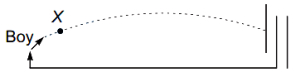
$A$ boy throws a cricket ball from the boundary to the wicket-keeper. If the frictional force due to air cannot be ignored,the forces acting on the ball at the position $X$ are represented by
A
B
C
D
Solution
(D) When a ball is thrown in the air,two main forces act on it:
$1$. The gravitational force (weight),which always acts vertically downwards,given by $mg$.
$2$. The air resistance (frictional force),which always acts in the direction opposite to the instantaneous velocity of the ball.
At position $X$,the ball is moving along a parabolic path. Its velocity vector is tangent to the path at that point,directed upwards and forwards. Therefore,the air resistance acts downwards and backwards (opposite to the velocity vector).
Combining these,the weight acts vertically downwards,and the air resistance acts at an angle downwards and backwards. This corresponds to the vector diagram in option $D$.
$1$. The gravitational force (weight),which always acts vertically downwards,given by $mg$.
$2$. The air resistance (frictional force),which always acts in the direction opposite to the instantaneous velocity of the ball.
At position $X$,the ball is moving along a parabolic path. Its velocity vector is tangent to the path at that point,directed upwards and forwards. Therefore,the air resistance acts downwards and backwards (opposite to the velocity vector).
Combining these,the weight acts vertically downwards,and the air resistance acts at an angle downwards and backwards. This corresponds to the vector diagram in option $D$.
0 likes
View Solution332
MediumMCQ
Two objects are projected at an angle $\theta^{\circ}$ and $(90-\theta)^{\circ}$ to the horizontal with the same speed. The ratio of their maximum vertical heights is
A
$\tan \theta : 1$
B
$1 : \tan \theta$
C
$\tan^2 \theta : 1$
D
$1 : 1$
Solution
(C) The maximum vertical height $H$ attained by a projectile is given by the formula:
$H = \frac{u^2 \sin^2 \phi}{2g}$
where $u$ is the initial speed and $\phi$ is the angle of projection.
Since $u$ and $g$ are constant,we have $H \propto \sin^2 \phi$.
For the two objects,the angles are $\phi_1 = \theta$ and $\phi_2 = 90^{\circ} - \theta$.
The ratio of their maximum heights is:
$\frac{H_1}{H_2} = \frac{\sin^2 \theta}{\sin^2(90^{\circ} - \theta)}$
Using the trigonometric identity $\sin(90^{\circ} - \theta) = \cos \theta$,we get:
$\frac{H_1}{H_2} = \frac{\sin^2 \theta}{\cos^2 \theta} = \tan^2 \theta$
Therefore,the ratio of their maximum vertical heights is $\tan^2 \theta : 1$.
$H = \frac{u^2 \sin^2 \phi}{2g}$
where $u$ is the initial speed and $\phi$ is the angle of projection.
Since $u$ and $g$ are constant,we have $H \propto \sin^2 \phi$.
For the two objects,the angles are $\phi_1 = \theta$ and $\phi_2 = 90^{\circ} - \theta$.
The ratio of their maximum heights is:
$\frac{H_1}{H_2} = \frac{\sin^2 \theta}{\sin^2(90^{\circ} - \theta)}$
Using the trigonometric identity $\sin(90^{\circ} - \theta) = \cos \theta$,we get:
$\frac{H_1}{H_2} = \frac{\sin^2 \theta}{\cos^2 \theta} = \tan^2 \theta$
Therefore,the ratio of their maximum vertical heights is $\tan^2 \theta : 1$.
0 likes
View Solution333
EasyMCQ
$A$ particle is in uniform circular motion. Related to one complete revolution of the particle, which among the statements is incorrect?
A
Average acceleration of the particle is zero.
B
Displacement of the particle is zero.
C
Average speed of the particle is zero.
D
Average velocity of the particle is zero.
Solution
(C) In one complete revolution, the total distance covered is $2\pi r$, where $r$ is the radius of the circular path. Since distance is not zero, the average speed (total distance / total time) is not zero. Thus, statement $C$ is incorrect.
In a circular motion, if a particle completes one revolution, it returns to its starting position, so the displacement is zero. Thus, statement $B$ is correct.
Average velocity is defined as the ratio of total displacement to total time taken. Since displacement is zero, the average velocity is also zero. Thus, statement $D$ is correct.
For uniform circular motion, the acceleration is centripetal acceleration, which is directed towards the center and is non-zero at every point. Therefore, the average acceleration over a complete revolution is also zero. Thus, statement $A$ is correct.
In a circular motion, if a particle completes one revolution, it returns to its starting position, so the displacement is zero. Thus, statement $B$ is correct.
Average velocity is defined as the ratio of total displacement to total time taken. Since displacement is zero, the average velocity is also zero. Thus, statement $D$ is correct.
For uniform circular motion, the acceleration is centripetal acceleration, which is directed towards the center and is non-zero at every point. Therefore, the average acceleration over a complete revolution is also zero. Thus, statement $A$ is correct.
0 likes
View Solution334
EasyMCQ
An aeroplane executes a horizontal loop at a speed of $720 \text{ km/h}$ with its wings banked at $45^{\circ}$. What is the radius of the loop (in $\text{ km}$)? Take $g = 10 \text{ m/s}^2$.
A
$4$
B
$4.5$
C
$7.2$
D
$2$
Solution
(A) Given, speed of aeroplane $v = 720 \text{ km/h} = 720 \times \frac{5}{18} \text{ m/s} = 200 \text{ m/s}$.
Angle of banking $\theta = 45^{\circ}$.
Acceleration due to gravity $g = 10 \text{ m/s}^2$.
The formula for the radius of a horizontal loop is given by $\tan \theta = \frac{v^2}{rg}$.
Rearranging for $r$, we get $r = \frac{v^2}{g \tan \theta}$.
Substituting the values: $r = \frac{(200)^2}{10 \times \tan 45^{\circ}}$.
Since $\tan 45^{\circ} = 1$, we have $r = \frac{40000}{10 \times 1} = 4000 \text{ m}$.
Converting to kilometers, $r = 4 \text{ km}$.
Angle of banking $\theta = 45^{\circ}$.
Acceleration due to gravity $g = 10 \text{ m/s}^2$.
The formula for the radius of a horizontal loop is given by $\tan \theta = \frac{v^2}{rg}$.
Rearranging for $r$, we get $r = \frac{v^2}{g \tan \theta}$.
Substituting the values: $r = \frac{(200)^2}{10 \times \tan 45^{\circ}}$.
Since $\tan 45^{\circ} = 1$, we have $r = \frac{40000}{10 \times 1} = 4000 \text{ m}$.
Converting to kilometers, $r = 4 \text{ km}$.
0 likes
View Solution335
MediumMCQ
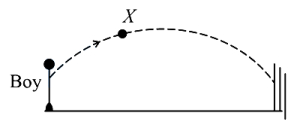
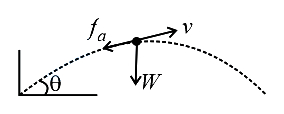
$A$ boy throws a cricket ball from the boundary to the wicket keeper. If the frictional force due to air $f_a$ cannot be ignored,the forces acting on the ball at the position $X$ are represented by
A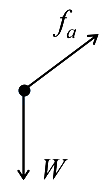
B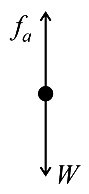
C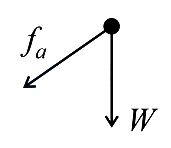
D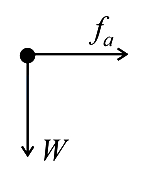
Solution
(D) The frictional force due to air $f_a$ on the ball always acts in the direction opposite to the velocity of the ball. The velocity of the ball at any point on the path is always along the tangent to the trajectory at that point.
The weight of the body $W$ always acts vertically downward,perpendicular to the surface of the Earth and towards the center of the Earth.
At position $X$,the ball is on the upward part of its trajectory,so its velocity vector is directed upwards and forwards. Therefore,the air resistance $f_a$ must act downwards and backwards (opposite to the velocity). The weight $W$ acts vertically downwards. This configuration corresponds to option $D$.
The weight of the body $W$ always acts vertically downward,perpendicular to the surface of the Earth and towards the center of the Earth.
At position $X$,the ball is on the upward part of its trajectory,so its velocity vector is directed upwards and forwards. Therefore,the air resistance $f_a$ must act downwards and backwards (opposite to the velocity). The weight $W$ acts vertically downwards. This configuration corresponds to option $D$.
0 likes
View Solution336
MediumMCQ
If a body of mass $2 \,kg$ moving with an initial velocity of $4 \,m \,s^{-1}$ is subjected to a force of $3 \,N$ for a time of $2 \,s$ normal to the direction of its initial velocity, then the resultant velocity of the body is
A
$7 \,m \,s^{-1}$
B
$5 \,m \,s^{-1}$
C
$2 \,m \,s^{-1}$
D
$7.5 \,m \,s^{-1}$
Solution
(B) Given: Mass $m = 2 \,kg$, initial velocity $u = 4 \,m \,s^{-1}$, force $F = 3 \,N$, time $t = 2 \,s$.
Since the force is applied normal to the initial velocity, the initial velocity is along the $x$-axis ($u_x = 4 \,m \,s^{-1}$, $u_y = 0$).
The acceleration produced by the force is $a = F/m = 3/2 = 1.5 \,m \,s^{-2}$.
This acceleration acts in the $y$-direction, so $a_y = 1.5 \,m \,s^{-2}$ and $a_x = 0$.
The final velocity components after $t = 2 \,s$ are:
$v_x = u_x + a_x t = 4 + 0 = 4 \,m \,s^{-1}$.
$v_y = u_y + a_y t = 0 + (1.5)(2) = 3 \,m \,s^{-1}$.
The resultant velocity $v$ is given by $v = \sqrt{v_x^2 + v_y^2} = \sqrt{4^2 + 3^2} = \sqrt{16 + 9} = \sqrt{25} = 5 \,m \,s^{-1}$.
Since the force is applied normal to the initial velocity, the initial velocity is along the $x$-axis ($u_x = 4 \,m \,s^{-1}$, $u_y = 0$).
The acceleration produced by the force is $a = F/m = 3/2 = 1.5 \,m \,s^{-2}$.
This acceleration acts in the $y$-direction, so $a_y = 1.5 \,m \,s^{-2}$ and $a_x = 0$.
The final velocity components after $t = 2 \,s$ are:
$v_x = u_x + a_x t = 4 + 0 = 4 \,m \,s^{-1}$.
$v_y = u_y + a_y t = 0 + (1.5)(2) = 3 \,m \,s^{-1}$.
The resultant velocity $v$ is given by $v = \sqrt{v_x^2 + v_y^2} = \sqrt{4^2 + 3^2} = \sqrt{16 + 9} = \sqrt{25} = 5 \,m \,s^{-1}$.
0 likes
View Solution337
EasyMCQ
$A$ body of mass $0.6 \, kg$ is moving along a circular path of radius $1 \, m$. If the body moves with $\frac{900}{\pi}$ revolutions per minute, its kinetic energy is: (in $ \, J$)
A
$120$
B
$270$
C
$360$
D
$240$
Solution
(B) Given: Mass $m = 0.6 \, kg$, Radius $r = 1 \, m$, Frequency $f = \frac{900}{\pi} \, \text{rpm}$.
First, convert the frequency to revolutions per second (Hz):
$f = \frac{900}{\pi} \times \frac{1}{60} = \frac{15}{\pi} \, \text{Hz}$.
The angular velocity $\omega = 2 \pi f = 2 \pi \times \frac{15}{\pi} = 30 \, \text{rad/s}$.
The linear velocity $v = \omega r = 30 \times 1 = 30 \, \text{m/s}$.
Kinetic energy $K = \frac{1}{2} m v^2$.
$K = \frac{1}{2} \times 0.6 \times (30)^2$.
$K = 0.3 \times 900 = 270 \, \text{J}$.
First, convert the frequency to revolutions per second (Hz):
$f = \frac{900}{\pi} \times \frac{1}{60} = \frac{15}{\pi} \, \text{Hz}$.
The angular velocity $\omega = 2 \pi f = 2 \pi \times \frac{15}{\pi} = 30 \, \text{rad/s}$.
The linear velocity $v = \omega r = 30 \times 1 = 30 \, \text{m/s}$.
Kinetic energy $K = \frac{1}{2} m v^2$.
$K = \frac{1}{2} \times 0.6 \times (30)^2$.
$K = 0.3 \times 900 = 270 \, \text{J}$.
0 likes
View Solution338
EasyMCQ
Assertion $(A)$: When a vehicle takes a turn on the road,it travels along a curved path. Reason $(R)$: In a curved path,the velocity of the vehicle remains the same.
A
Both $(A)$ and $(R)$ are true and $(R)$ is the correct explanation of $(A)$
B
Both $(A)$ and $(R)$ are true and $(R)$ is not the correct explanation of $(A)$
C
$(A)$ is true,but $(R)$ is not true
D
$(A)$ is not true,but $(R)$ is true
Solution
(C) Assertion $(A)$ is true because when a vehicle turns,it follows a circular or curved trajectory.
Reason $(R)$ is false because velocity is a vector quantity,which includes both magnitude (speed) and direction.
Even if the speed of the vehicle remains constant during a turn,the direction of motion changes continuously at every point on the curved path.
Since the direction changes,the velocity vector changes.
Therefore,the velocity of the vehicle does not remain the same.
Reason $(R)$ is false because velocity is a vector quantity,which includes both magnitude (speed) and direction.
Even if the speed of the vehicle remains constant during a turn,the direction of motion changes continuously at every point on the curved path.
Since the direction changes,the velocity vector changes.
Therefore,the velocity of the vehicle does not remain the same.
0 likes
View Solution339
DifficultMCQ
$A$ particle moving in $x-y$ plane starts from the origin at $t=0$ with an initial velocity $(-\hat{i}+\hat{j}) \,ms^{-1}$ and undergoes an acceleration of $(6 \hat{i}+4 \hat{j}) \,ms^{-2}$. Its displacement after $2 \,s$ is (in $\,m$)
A
$17.32$
B
$14.14$
C
$12.42$
D
$10$
Solution
(B) Given: Initial velocity $\vec{u} = -\hat{i} + \hat{j} \,ms^{-1}$, acceleration $\vec{a} = 6\hat{i} + 4\hat{j} \,ms^{-2}$, and time $t = 2 \,s$.
Using the kinematic equation for displacement: $\vec{s} = \vec{u}t + \frac{1}{2}\vec{a}t^2$.
Substituting the values:
$\vec{s} = (-\hat{i} + \hat{j})(2) + \frac{1}{2}(6\hat{i} + 4\hat{j})(2)^2$
$\vec{s} = -2\hat{i} + 2\hat{j} + \frac{1}{2}(6\hat{i} + 4\hat{j})(4)$
$\vec{s} = -2\hat{i} + 2\hat{j} + 2(6\hat{i} + 4\hat{j})$
$\vec{s} = -2\hat{i} + 2\hat{j} + 12\hat{i} + 8\hat{j}$
$\vec{s} = 10\hat{i} + 10\hat{j} \,m$.
The magnitude of displacement is $|\vec{s}| = \sqrt{10^2 + 10^2} = \sqrt{100 + 100} = \sqrt{200} = 10\sqrt{2} \,m$.
Since $\sqrt{2} \approx 1.414$, the magnitude is $10 \times 1.414 = 14.14 \,m$.
Using the kinematic equation for displacement: $\vec{s} = \vec{u}t + \frac{1}{2}\vec{a}t^2$.
Substituting the values:
$\vec{s} = (-\hat{i} + \hat{j})(2) + \frac{1}{2}(6\hat{i} + 4\hat{j})(2)^2$
$\vec{s} = -2\hat{i} + 2\hat{j} + \frac{1}{2}(6\hat{i} + 4\hat{j})(4)$
$\vec{s} = -2\hat{i} + 2\hat{j} + 2(6\hat{i} + 4\hat{j})$
$\vec{s} = -2\hat{i} + 2\hat{j} + 12\hat{i} + 8\hat{j}$
$\vec{s} = 10\hat{i} + 10\hat{j} \,m$.
The magnitude of displacement is $|\vec{s}| = \sqrt{10^2 + 10^2} = \sqrt{100 + 100} = \sqrt{200} = 10\sqrt{2} \,m$.
Since $\sqrt{2} \approx 1.414$, the magnitude is $10 \times 1.414 = 14.14 \,m$.
0 likes
View Solution340
MediumMCQ
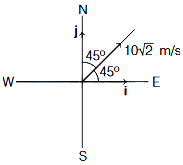
$A$ body is moving with an initial velocity of $10 \sqrt{2} \ m/s$ in the north-east direction. If it is subjected to an acceleration of $2 \ m/s^2$ directed towards the south, then the velocity of the body after $5 \ s$ is:
A
$10 \ m/s$, towards east
B
$10 \ m/s$, towards north
C
$10 \ m/s$, towards south
D
$10 \ m/s$, towards north-east
Solution
(A) The initial velocity of the body is $u = 10\sqrt{2} \ m/s$ in the north-east direction. Resolving this into components along the east $(\hat{i})$ and north $(\hat{j})$ directions:
$u = (10\sqrt{2} \cos 45^{\circ}) \hat{i} + (10\sqrt{2} \sin 45^{\circ}) \hat{j} = 10 \hat{i} + 10 \hat{j} \ m/s$.
The acceleration is directed towards the south, so $a = -2 \hat{j} \ m/s^2$.
Using the first equation of motion, $v = u + at$, for $t = 5 \ s$:
$v = (10 \hat{i} + 10 \hat{j}) + (-2 \hat{j}) \times 5$
$v = 10 \hat{i} + 10 \hat{j} - 10 \hat{j}$
$v = 10 \hat{i} \ m/s$.
Thus, the final velocity is $10 \ m/s$ towards the east.
$u = (10\sqrt{2} \cos 45^{\circ}) \hat{i} + (10\sqrt{2} \sin 45^{\circ}) \hat{j} = 10 \hat{i} + 10 \hat{j} \ m/s$.
The acceleration is directed towards the south, so $a = -2 \hat{j} \ m/s^2$.
Using the first equation of motion, $v = u + at$, for $t = 5 \ s$:
$v = (10 \hat{i} + 10 \hat{j}) + (-2 \hat{j}) \times 5$
$v = 10 \hat{i} + 10 \hat{j} - 10 \hat{j}$
$v = 10 \hat{i} \ m/s$.
Thus, the final velocity is $10 \ m/s$ towards the east.
0 likes
View Solution341
MediumMCQ
$A$ particle crossing the origin at time $t=0$,moves in the $xy$-plane with a constant acceleration $a$ in the $y$-direction. If the equation of motion of the particle is $y = bx^2$ (where $b$ is a constant),then its velocity component in the $x$-direction is
A
$\sqrt{\frac{2b}{a}}$
B
$\sqrt{\frac{a}{2b}}$
C
$\sqrt{\frac{a}{b}}$
D
$\sqrt{\frac{b}{a}}$
Solution
(B) Given the equation of motion: $y = bx^2$.
Differentiating with respect to time $t$: $\frac{dy}{dt} = 2bx \frac{dx}{dt}$.
This implies $v_y = 2bx v_x$.
Differentiating again with respect to $t$: $\frac{dv_y}{dt} = 2b \left( \frac{dx}{dt} \cdot v_x + x \cdot \frac{dv_x}{dt} \right)$.
Since the acceleration in the $x$-direction is zero $(a_x = 0)$,we have $\frac{dv_x}{dt} = 0$.
Thus,$a_y = 2b(v_x^2)$.
Given $a_y = a$,we have $a = 2bv_x^2$.
Solving for $v_x$: $v_x^2 = \frac{a}{2b}$,which gives $v_x = \sqrt{\frac{a}{2b}}$.
Differentiating with respect to time $t$: $\frac{dy}{dt} = 2bx \frac{dx}{dt}$.
This implies $v_y = 2bx v_x$.
Differentiating again with respect to $t$: $\frac{dv_y}{dt} = 2b \left( \frac{dx}{dt} \cdot v_x + x \cdot \frac{dv_x}{dt} \right)$.
Since the acceleration in the $x$-direction is zero $(a_x = 0)$,we have $\frac{dv_x}{dt} = 0$.
Thus,$a_y = 2b(v_x^2)$.
Given $a_y = a$,we have $a = 2bv_x^2$.
Solving for $v_x$: $v_x^2 = \frac{a}{2b}$,which gives $v_x = \sqrt{\frac{a}{2b}}$.
0 likes
View Solution342
MediumMCQ
If two bodies $A$ and $B$ are projected with the same velocity $u$ but with different angles $\theta_1$ and $\theta_2$ respectively with the horizontal such that both have the same range,then the ratio of the times of flight of the bodies $A$ and $B$ is:
A
$\sin \theta_2 / \sin \theta_1$
B
$\sin \theta_1 / \sin \theta_2$
C
$\tan \theta_2 / \tan \theta_1$
D
$\tan \theta_1 / \tan \theta_2$
Solution
(D) The range of a projectile is given by $R = \frac{u^2 \sin(2\theta)}{g}$.
Since the ranges are equal,$\sin(2\theta_1) = \sin(2\theta_2)$.
This implies $2\theta_1 = 180^\circ - 2\theta_2$,which simplifies to $\theta_1 + \theta_2 = 90^\circ$,or $\theta_2 = 90^\circ - \theta_1$.
The time of flight is given by $T = \frac{2u \sin \theta}{g}$.
The ratio of the times of flight is $\frac{T_1}{T_2} = \frac{\frac{2u \sin \theta_1}{g}}{\frac{2u \sin \theta_2}{g}} = \frac{\sin \theta_1}{\sin \theta_2}$.
Since $\theta_2 = 90^\circ - \theta_1$,we have $\sin \theta_2 = \sin(90^\circ - \theta_1) = \cos \theta_1$.
Thus,$\frac{T_1}{T_2} = \frac{\sin \theta_1}{\cos \theta_1} = \tan \theta_1$.
Since the ranges are equal,$\sin(2\theta_1) = \sin(2\theta_2)$.
This implies $2\theta_1 = 180^\circ - 2\theta_2$,which simplifies to $\theta_1 + \theta_2 = 90^\circ$,or $\theta_2 = 90^\circ - \theta_1$.
The time of flight is given by $T = \frac{2u \sin \theta}{g}$.
The ratio of the times of flight is $\frac{T_1}{T_2} = \frac{\frac{2u \sin \theta_1}{g}}{\frac{2u \sin \theta_2}{g}} = \frac{\sin \theta_1}{\sin \theta_2}$.
Since $\theta_2 = 90^\circ - \theta_1$,we have $\sin \theta_2 = \sin(90^\circ - \theta_1) = \cos \theta_1$.
Thus,$\frac{T_1}{T_2} = \frac{\sin \theta_1}{\cos \theta_1} = \tan \theta_1$.
0 likes
View Solution343
MediumMCQ
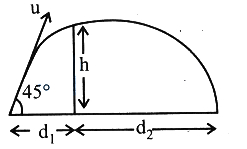
$A$ ball is projected at an angle of $45^{\circ}$ with the horizontal. It passes through a wall of height $h$ at a horizontal distance $d_1$ from the point of projection and strikes the ground at a distance $d_1+d_2$ from the point of projection. Then $h$ is:
A
$h=\frac{2 d_1 d_2}{d_1+d_2}$
B
$h=\frac{d_1 d_2}{d_1+d_2}$
C
$h=\frac{\sqrt{2} d_1 d_2}{d_1+d_2}$
D
$h=\frac{d_1 d_2}{2(d_1+d_2)}$
Solution
(B) The range of the projectile is given by $R = d_1 + d_2 = \frac{u^2 \sin(2\theta)}{g}$.
Since $\theta = 45^{\circ}$,$\sin(2 \times 45^{\circ}) = \sin(90^{\circ}) = 1$.
Thus,$R = d_1 + d_2 = \frac{u^2}{g}$,which implies $\frac{u^2}{g} = d_1 + d_2$.
The equation of the trajectory is $y = x \tan \theta - \frac{gx^2}{2u^2 \cos^2 \theta}$.
Substituting $y = h$,$x = d_1$,and $\theta = 45^{\circ}$:
$h = d_1 \tan 45^{\circ} - \frac{g d_1^2}{2u^2 \cos^2 45^{\circ}}$.
Since $\tan 45^{\circ} = 1$ and $\cos^2 45^{\circ} = \frac{1}{2}$,we have:
$h = d_1 - \frac{g d_1^2}{2u^2 (1/2)} = d_1 - \frac{g d_1^2}{u^2}$.
Substituting $\frac{u^2}{g} = d_1 + d_2$:
$h = d_1 - \frac{d_1^2}{d_1 + d_2} = \frac{d_1(d_1 + d_2) - d_1^2}{d_1 + d_2} = \frac{d_1^2 + d_1 d_2 - d_1^2}{d_1 + d_2} = \frac{d_1 d_2}{d_1 + d_2}$.
Since $\theta = 45^{\circ}$,$\sin(2 \times 45^{\circ}) = \sin(90^{\circ}) = 1$.
Thus,$R = d_1 + d_2 = \frac{u^2}{g}$,which implies $\frac{u^2}{g} = d_1 + d_2$.
The equation of the trajectory is $y = x \tan \theta - \frac{gx^2}{2u^2 \cos^2 \theta}$.
Substituting $y = h$,$x = d_1$,and $\theta = 45^{\circ}$:
$h = d_1 \tan 45^{\circ} - \frac{g d_1^2}{2u^2 \cos^2 45^{\circ}}$.
Since $\tan 45^{\circ} = 1$ and $\cos^2 45^{\circ} = \frac{1}{2}$,we have:
$h = d_1 - \frac{g d_1^2}{2u^2 (1/2)} = d_1 - \frac{g d_1^2}{u^2}$.
Substituting $\frac{u^2}{g} = d_1 + d_2$:
$h = d_1 - \frac{d_1^2}{d_1 + d_2} = \frac{d_1(d_1 + d_2) - d_1^2}{d_1 + d_2} = \frac{d_1^2 + d_1 d_2 - d_1^2}{d_1 + d_2} = \frac{d_1 d_2}{d_1 + d_2}$.
0 likes
View Solution344
MediumMCQ
$A$ $2 \ kg$ ball is thrown vertically upward and another $3 \ kg$ ball is projected with a certain angle $(\theta \neq 90^{\circ})$. Both have the same time of flight. The ratio of their maximum heights is:
A
$2: 3$
B
$3: 2$
C
$\sqrt{3}: 2$
D
$1: 1$
Solution
(D) For vertical upward projection,the time of flight is $T_1 = \frac{2 u_1}{g}$.
For projectile motion,the time of flight is $T_2 = \frac{2 u_2 \sin \theta}{g}$.
Given $T_1 = T_2$,we have $\frac{2 u_1}{g} = \frac{2 u_2 \sin \theta}{g}$,which implies $u_1 = u_2 \sin \theta$.
The maximum height for vertical motion is $H_1 = \frac{u_1^2}{2g}$.
The maximum height for projectile motion is $H_2 = \frac{u_2^2 \sin^2 \theta}{2g}$.
Taking the ratio,$\frac{H_1}{H_2} = \frac{u_1^2 / 2g}{(u_2 \sin \theta)^2 / 2g} = \left( \frac{u_1}{u_2 \sin \theta} \right)^2$.
Since $u_1 = u_2 \sin \theta$,the ratio is $1^2 : 1^2 = 1:1$.
For projectile motion,the time of flight is $T_2 = \frac{2 u_2 \sin \theta}{g}$.
Given $T_1 = T_2$,we have $\frac{2 u_1}{g} = \frac{2 u_2 \sin \theta}{g}$,which implies $u_1 = u_2 \sin \theta$.
The maximum height for vertical motion is $H_1 = \frac{u_1^2}{2g}$.
The maximum height for projectile motion is $H_2 = \frac{u_2^2 \sin^2 \theta}{2g}$.
Taking the ratio,$\frac{H_1}{H_2} = \frac{u_1^2 / 2g}{(u_2 \sin \theta)^2 / 2g} = \left( \frac{u_1}{u_2 \sin \theta} \right)^2$.
Since $u_1 = u_2 \sin \theta$,the ratio is $1^2 : 1^2 = 1:1$.
0 likes
View Solution345
EasyMCQ
$A$ projectile can have the same range $(R)$ for two angles of projection. Their initial velocities are same. If $T_1$ and $T_2$ are times of flight in two cases,then the product of two times of flight is directly proportional to
A
$\frac{1}{R}$
B
$R^3$
C
$R^2$
D
$R$
Solution
(D) For the same range,$R_1 = R_2 = R$.
Let the two angles of projection be $\theta$ and $(90^{\circ} - \theta)$.
The time of flight for a projectile is given by $T = \frac{2u \sin \theta}{g}$.
For the first angle $\theta_1 = \theta$,the time of flight is $T_1 = \frac{2u \sin \theta}{g}$.
For the second angle $\theta_2 = (90^{\circ} - \theta)$,the time of flight is $T_2 = \frac{2u \sin(90^{\circ} - \theta)}{g} = \frac{2u \cos \theta}{g}$.
The product of the times of flight is $T_1 T_2 = \left(\frac{2u \sin \theta}{g}\right) \left(\frac{2u \cos \theta}{g}\right)$.
$T_1 T_2 = \frac{2}{g} \left(\frac{u^2 (2 \sin \theta \cos \theta)}{g}\right)$.
Since the range $R = \frac{u^2 \sin 2\theta}{g}$,we have $T_1 T_2 = \frac{2R}{g}$.
Since $g$ is constant,$T_1 T_2 \propto R$.
Let the two angles of projection be $\theta$ and $(90^{\circ} - \theta)$.
The time of flight for a projectile is given by $T = \frac{2u \sin \theta}{g}$.
For the first angle $\theta_1 = \theta$,the time of flight is $T_1 = \frac{2u \sin \theta}{g}$.
For the second angle $\theta_2 = (90^{\circ} - \theta)$,the time of flight is $T_2 = \frac{2u \sin(90^{\circ} - \theta)}{g} = \frac{2u \cos \theta}{g}$.
The product of the times of flight is $T_1 T_2 = \left(\frac{2u \sin \theta}{g}\right) \left(\frac{2u \cos \theta}{g}\right)$.
$T_1 T_2 = \frac{2}{g} \left(\frac{u^2 (2 \sin \theta \cos \theta)}{g}\right)$.
Since the range $R = \frac{u^2 \sin 2\theta}{g}$,we have $T_1 T_2 = \frac{2R}{g}$.
Since $g$ is constant,$T_1 T_2 \propto R$.
0 likes
View Solution346
MediumMCQ
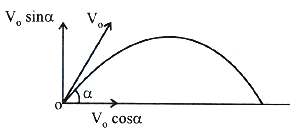
$A$ boy throws a ball with a velocity $V_0$ at an angle $\alpha$ to the ground. At the same time,he starts running with a uniform velocity to catch the ball before it hits the ground. To achieve this,he should run with a velocity of
A
$V_0 \cos \alpha$
B
$V_0 \sin \alpha$
C
$V_0 \tan \alpha$
D
$\sqrt{V_0^2 \tan \alpha}$
Solution
(A) The horizontal component of the velocity of the ball is $V_x = V_0 \cos \alpha$.
Since there is no acceleration in the horizontal direction,the ball travels with this constant horizontal velocity throughout its flight.
The time of flight $T$ is given by $T = \frac{2 V_0 \sin \alpha}{g}$.
The horizontal range $R$ covered by the ball is $R = V_x \times T = (V_0 \cos \alpha) \times \left( \frac{2 V_0 \sin \alpha}{g} \right)$.
To catch the ball,the boy must cover the same horizontal distance $R$ in the same time $T$.
Let the velocity of the boy be $v_b$. Then,$R = v_b \times T$.
Equating the two expressions for $R$,we get $v_b \times T = (V_0 \cos \alpha) \times T$.
Therefore,the velocity of the boy must be $v_b = V_0 \cos \alpha$.
Since there is no acceleration in the horizontal direction,the ball travels with this constant horizontal velocity throughout its flight.
The time of flight $T$ is given by $T = \frac{2 V_0 \sin \alpha}{g}$.
The horizontal range $R$ covered by the ball is $R = V_x \times T = (V_0 \cos \alpha) \times \left( \frac{2 V_0 \sin \alpha}{g} \right)$.
To catch the ball,the boy must cover the same horizontal distance $R$ in the same time $T$.
Let the velocity of the boy be $v_b$. Then,$R = v_b \times T$.
Equating the two expressions for $R$,we get $v_b \times T = (V_0 \cos \alpha) \times T$.
Therefore,the velocity of the boy must be $v_b = V_0 \cos \alpha$.
0 likes
View Solution347
MediumMCQ
$A$ stone thrown with velocity $u$ at angles $\theta$ and $(90^{\circ}-\theta)$ with the horizontal reaches maximum heights $H_1$ and $H_2$ respectively. Its horizontal range is
A
$4 \sqrt{H_1 H_2}$
B
$2 H_1 H_2$
C
$2 \sqrt{H_1 H_2}$
D
$\sqrt[4]{\frac{H_1}{H_2}}$
Solution
(A) The formula for maximum height is $H = \frac{u^2 \sin^2 \theta}{2g}$.
For angle $\theta$,$H_1 = \frac{u^2 \sin^2 \theta}{2g}$.
For angle $(90^{\circ}-\theta)$,$H_2 = \frac{u^2 \sin^2(90^{\circ}-\theta)}{2g} = \frac{u^2 \cos^2 \theta}{2g}$.
The horizontal range is $R = \frac{u^2 \sin 2\theta}{g} = \frac{2u^2 \sin \theta \cos \theta}{g}$.
Multiplying $H_1$ and $H_2$:
$H_1 H_2 = \left(\frac{u^2 \sin^2 \theta}{2g}\right) \left(\frac{u^2 \cos^2 \theta}{2g}\right) = \frac{u^4 \sin^2 \theta \cos^2 \theta}{4g^2}$.
We can rewrite this as $H_1 H_2 = \frac{(2u^2 \sin \theta \cos \theta)^2}{16g^2} = \frac{R^2}{16}$.
Therefore,$R^2 = 16 H_1 H_2$,which gives $R = 4 \sqrt{H_1 H_2}$.
For angle $\theta$,$H_1 = \frac{u^2 \sin^2 \theta}{2g}$.
For angle $(90^{\circ}-\theta)$,$H_2 = \frac{u^2 \sin^2(90^{\circ}-\theta)}{2g} = \frac{u^2 \cos^2 \theta}{2g}$.
The horizontal range is $R = \frac{u^2 \sin 2\theta}{g} = \frac{2u^2 \sin \theta \cos \theta}{g}$.
Multiplying $H_1$ and $H_2$:
$H_1 H_2 = \left(\frac{u^2 \sin^2 \theta}{2g}\right) \left(\frac{u^2 \cos^2 \theta}{2g}\right) = \frac{u^4 \sin^2 \theta \cos^2 \theta}{4g^2}$.
We can rewrite this as $H_1 H_2 = \frac{(2u^2 \sin \theta \cos \theta)^2}{16g^2} = \frac{R^2}{16}$.
Therefore,$R^2 = 16 H_1 H_2$,which gives $R = 4 \sqrt{H_1 H_2}$.
0 likes
View Solution348
DifficultMCQ
$A$ player kicks a football at an angle of $30^{\circ}$ with the horizontal with an initial speed of $30 \,ms^{-1}$. $A$ second player, standing at a distance of $21 \sqrt{3} \,m$ from the first player in the direction of the kick, starts running to catch the ball at the same instant it is kicked. What is the minimum speed of the second player to catch the ball before it hits the ground? (Take acceleration due to gravity $g = 10 \,ms^{-2}$)
A
$10 \,ms^{-1}$
B
$8 \,ms^{-1}$
C
$8 \sqrt{3} \,ms^{-1}$
D
$15 \sqrt{3} \,ms^{-1}$
Solution
(C) The total range $R$ of the projectile is given by:
$R = \frac{u^2 \sin 2\theta}{g} = \frac{30^2 \sin(2 \times 30^{\circ})}{10} = \frac{900 \times \sin 60^{\circ}}{10} = 90 \times \frac{\sqrt{3}}{2} = 45 \sqrt{3} \,m$.
The time of flight $T$ is given by:
$T = \frac{2u \sin \theta}{g} = \frac{2 \times 30 \times \sin 30^{\circ}}{10} = \frac{60 \times 0.5}{10} = 3 \,s$.
The second player is standing at a distance $d = 21 \sqrt{3} \,m$ from the first player. To catch the ball before it hits the ground, the player must reach the point where the ball lands (or any point along its trajectory). The minimum speed is required to reach the landing point $R$ within the time of flight $T$.
The distance the second player needs to cover is $S = R - d = 45 \sqrt{3} - 21 \sqrt{3} = 24 \sqrt{3} \,m$.
Since the player starts at the same instant as the kick, the time available to cover this distance is the time of flight $T = 3 \,s$.
Therefore, the minimum speed $v$ is:
$v = \frac{S}{T} = \frac{24 \sqrt{3}}{3} = 8 \sqrt{3} \,ms^{-1}$.
Thus, the correct option is $C$.
$R = \frac{u^2 \sin 2\theta}{g} = \frac{30^2 \sin(2 \times 30^{\circ})}{10} = \frac{900 \times \sin 60^{\circ}}{10} = 90 \times \frac{\sqrt{3}}{2} = 45 \sqrt{3} \,m$.
The time of flight $T$ is given by:
$T = \frac{2u \sin \theta}{g} = \frac{2 \times 30 \times \sin 30^{\circ}}{10} = \frac{60 \times 0.5}{10} = 3 \,s$.
The second player is standing at a distance $d = 21 \sqrt{3} \,m$ from the first player. To catch the ball before it hits the ground, the player must reach the point where the ball lands (or any point along its trajectory). The minimum speed is required to reach the landing point $R$ within the time of flight $T$.
The distance the second player needs to cover is $S = R - d = 45 \sqrt{3} - 21 \sqrt{3} = 24 \sqrt{3} \,m$.
Since the player starts at the same instant as the kick, the time available to cover this distance is the time of flight $T = 3 \,s$.
Therefore, the minimum speed $v$ is:
$v = \frac{S}{T} = \frac{24 \sqrt{3}}{3} = 8 \sqrt{3} \,ms^{-1}$.
Thus, the correct option is $C$.
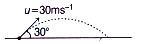
0 likes
View Solution349
EasyMCQ
In the projectile motion of an object,the object reaches its maximum height where its speed is half of its initial speed. Then the ratio between the range and the maximum height of the projectile is
A
$4 \sqrt{3}$
B
$\frac{\sqrt{3}}{4}$
C
$\frac{4}{\sqrt{3}}$
D
$\frac{2}{\sqrt{3}}$
Solution
(C) At the maximum height,the vertical component of velocity is zero,so the speed of the projectile is $v = u \cos \theta$.
Given that the speed at maximum height is half of the initial speed $u$,we have $u \cos \theta = \frac{1}{2} u$,which implies $\cos \theta = \frac{1}{2}$,so $\theta = 60^{\circ}$.
The range $R$ of a projectile is given by $R = \frac{u^2 \sin 2 \theta}{g}$ and the maximum height $H$ is given by $H = \frac{u^2 \sin^2 \theta}{2g}$.
The ratio of range to maximum height is $\frac{R}{H} = \frac{u^2 \sin 2 \theta / g}{u^2 \sin^2 \theta / 2g} = \frac{2 \sin 2 \theta}{\sin^2 \theta}$.
Using the identity $\sin 2 \theta = 2 \sin \theta \cos \theta$,we get $\frac{R}{H} = \frac{2(2 \sin \theta \cos \theta)}{\sin^2 \theta} = 4 \cot \theta$.
Substituting $\theta = 60^{\circ}$,we get $\frac{R}{H} = 4 \cot 60^{\circ} = 4 \times \frac{1}{\sqrt{3}} = \frac{4}{\sqrt{3}}$.
Given that the speed at maximum height is half of the initial speed $u$,we have $u \cos \theta = \frac{1}{2} u$,which implies $\cos \theta = \frac{1}{2}$,so $\theta = 60^{\circ}$.
The range $R$ of a projectile is given by $R = \frac{u^2 \sin 2 \theta}{g}$ and the maximum height $H$ is given by $H = \frac{u^2 \sin^2 \theta}{2g}$.
The ratio of range to maximum height is $\frac{R}{H} = \frac{u^2 \sin 2 \theta / g}{u^2 \sin^2 \theta / 2g} = \frac{2 \sin 2 \theta}{\sin^2 \theta}$.
Using the identity $\sin 2 \theta = 2 \sin \theta \cos \theta$,we get $\frac{R}{H} = \frac{2(2 \sin \theta \cos \theta)}{\sin^2 \theta} = 4 \cot \theta$.
Substituting $\theta = 60^{\circ}$,we get $\frac{R}{H} = 4 \cot 60^{\circ} = 4 \times \frac{1}{\sqrt{3}} = \frac{4}{\sqrt{3}}$.
0 likes
View Solution350
MediumMCQ
The range of a projectile is $100 \ m$. Its kinetic energy will be maximum after covering a horizontal distance of: (in $m$)
A
$25$
B
$50$
C
$75$
D
$100$
Solution
(D) The kinetic energy of a projectile is given by $KE = \frac{1}{2}mv^2$,where $v$ is the instantaneous velocity of the particle.
Since the horizontal component of velocity $(v_x = u \cos \theta)$ remains constant throughout the flight,the net velocity $v = \sqrt{v_x^2 + v_y^2}$ depends on the vertical component $v_y$.
The vertical component $v_y = u \sin \theta - gt$ is maximum in magnitude at the point of projection $(t=0)$ and at the point of landing ($t=T$,where $T$ is the total time of flight).
At the point of projection,the horizontal distance covered is $0 \ m$. At the point of landing,the horizontal distance covered is equal to the range $R = 100 \ m$.
Comparing the options,the kinetic energy is maximum at the start and at the end of the trajectory. Since $0 \ m$ is not an option,the correct answer is $100 \ m$.
Since the horizontal component of velocity $(v_x = u \cos \theta)$ remains constant throughout the flight,the net velocity $v = \sqrt{v_x^2 + v_y^2}$ depends on the vertical component $v_y$.
The vertical component $v_y = u \sin \theta - gt$ is maximum in magnitude at the point of projection $(t=0)$ and at the point of landing ($t=T$,where $T$ is the total time of flight).
At the point of projection,the horizontal distance covered is $0 \ m$. At the point of landing,the horizontal distance covered is equal to the range $R = 100 \ m$.
Comparing the options,the kinetic energy is maximum at the start and at the end of the trajectory. Since $0 \ m$ is not an option,the correct answer is $100 \ m$.
0 likes
View Solution3-2.Motion in Plane — Mix Examples-Motion in Plane · Frequently Asked Questions
1Are these 3-2.Motion in Plane questions useful for JEE and NEET?
Yes. All questions in this section are mapped to JEE Main and NEET exam patterns. Previous year questions from JEE Main, NEET, GUJCET and state-level exams are included with full solutions.
2Can I switch to Hindi or Gujarati for these questions?
Yes. Use the language tabs in the hero section or the sidebar to view the same questions and solutions in English, Hindi or Gujarati.
3How do I generate a question paper from this subtopic?
Use the Vedclass Exam Paper Generator — select the chapter and subtopic, set difficulty, and generate Sets A, B, C, D automatically. First 3 chapters of every subject are free.
Vedclass Products
For Students
Vedclass Test Series
Mock tests in real JEE/NEET style with performance analysis. 5-day free trial.
Start Free TrialFor Teachers
Exam Paper Generator
Generate Set A/B/C/D papers from this chapter in 2 minutes. 3 chapters free.
Try FreeFor Institutes
Online Exam Module
Live online exams with unlimited students, 360° analytics & white-label branding.
See DemoFor Teachers & Institutes
Generate a 3-2.Motion in Plane Exam Paper in 2 Minutes
Select subtopic & difficulty — Sets A, B, C, D auto-generated with No Repeat logic.
First 3 chapters of every subject are free — no payment required.