
The angle of projection of a particle is measured from the vertical axis as $\phi$ and the maximum height reached by the particle is $h_m$. Here $h_m$ as a function of $\phi$ can be represented as:
- A
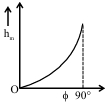
- B
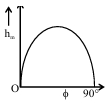
- C
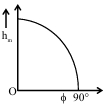
- D
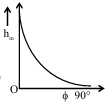
Explore More
Similar Questions
$A$ body of mass $1 \, kg$ starts moving from rest at $t = 0$ in a circular path of radius $8 \, m$. Its kinetic energy varies as a function of time as: $K.E. = 2t^2 \, J$,where $t$ is in seconds. Then:
Difficult
View Solution$A$ particle moves from the point $(2.0\hat i + 4.0\hat j) \, m$ at $t = 0$ with an initial velocity $(5.0\hat i + 4.0\hat j) \, m/s$. It is acted upon by a constant force which produces a constant acceleration $(4.0\hat i + 4.0\hat j) \, m/s^2$. What is the distance of the particle from the origin at time $t = 2 \, s$?
$A$ projectile has the same range $R$ for two angles of projection. If $T_1$ and $T_2$ are the times of flight in the two cases,then $R$ is
Medium
View SolutionThe speed of a projectile at its maximum height is half of its initial speed. The angle of projection is ......... $^o$
MediumAIPMT 2010
View SolutionTwo projectiles are fired from the ground with the same initial speeds from the same point at angles $(45^{\circ}+\alpha)$ and $(45^{\circ}-\alpha)$ with the horizontal direction. The ratio of their times of flight is
DifficultJEE MAIN 2025
View SolutionVedclass Products
For Students
Vedclass Test Series
Mock tests in real JEE/NEET style with performance analysis. 5-day free trial.
Start Free TrialFor Teachers
Exam Paper Generator
Generate Set A/B/C/D exam papers from 7.5L+ questions in 2 minutes. 3 chapters free.
Try FreeFor Institutes
Online Exam Module
Live online exams with unlimited students, 360° analytics & white-label branding.
See Demo