
A English
Horizontal Projectile Motion Questions in English
Class 11 Physics · 3-2.Motion in Plane · Horizontal Projectile Motion
492+
Questions
English
Language
100%
With Solutions
Showing 48 of 492 questions in English
401
MediumMCQ
$A$ body is projected at an angle of $60^{\circ}$ with the horizontal such that the vertical component of its initial velocity is $40 \ m \ s^{-1}$. The magnitude of velocity of the projectile at one quarter of its time of flight is nearly (Acceleration due to gravity $= 10 \ m \ s^{-2}$) (in $m \ s^{-1}$)
A
$3.54$
B
$35.40$
C
$30.54$
D
$34.5$
Solution
(C) Let the initial velocity be $v$ and the angle of projection be $\theta = 60^{\circ}$.
Given,the vertical component of initial velocity $v_y = v \sin \theta = 40 \ m \ s^{-1}$.
The time of flight $T = \frac{2 v \sin \theta}{g} = \frac{2 \times 40}{10} = 8 \ s$.
The time at which we need to find the velocity is $t = \frac{T}{4} = \frac{8}{4} = 2 \ s$.
The horizontal component of velocity remains constant throughout the motion: $v_x = v \cos \theta$.
Since $v \sin \theta = 40$,we have $v = \frac{40}{\sin 60^{\circ}} = \frac{40}{\sqrt{3}/2} = \frac{80}{\sqrt{3}} \approx 46.19 \ m \ s^{-1}$.
Thus,$v_x = \frac{80}{\sqrt{3}} \times \cos 60^{\circ} = \frac{80}{\sqrt{3}} \times \frac{1}{2} = \frac{40}{\sqrt{3}} \approx 23.09 \ m \ s^{-1}$.
The vertical component of velocity at time $t$ is $v_y(t) = v \sin \theta - g t = 40 - (10 \times 2) = 20 \ m \ s^{-1}$.
The magnitude of velocity at time $t$ is $v_t = \sqrt{v_x^2 + v_y(t)^2} = \sqrt{(23.09)^2 + (20)^2} = \sqrt{533.15 + 400} = \sqrt{933.15} \approx 30.54 \ m \ s^{-1}$.
Given,the vertical component of initial velocity $v_y = v \sin \theta = 40 \ m \ s^{-1}$.
The time of flight $T = \frac{2 v \sin \theta}{g} = \frac{2 \times 40}{10} = 8 \ s$.
The time at which we need to find the velocity is $t = \frac{T}{4} = \frac{8}{4} = 2 \ s$.
The horizontal component of velocity remains constant throughout the motion: $v_x = v \cos \theta$.
Since $v \sin \theta = 40$,we have $v = \frac{40}{\sin 60^{\circ}} = \frac{40}{\sqrt{3}/2} = \frac{80}{\sqrt{3}} \approx 46.19 \ m \ s^{-1}$.
Thus,$v_x = \frac{80}{\sqrt{3}} \times \cos 60^{\circ} = \frac{80}{\sqrt{3}} \times \frac{1}{2} = \frac{40}{\sqrt{3}} \approx 23.09 \ m \ s^{-1}$.
The vertical component of velocity at time $t$ is $v_y(t) = v \sin \theta - g t = 40 - (10 \times 2) = 20 \ m \ s^{-1}$.
The magnitude of velocity at time $t$ is $v_t = \sqrt{v_x^2 + v_y(t)^2} = \sqrt{(23.09)^2 + (20)^2} = \sqrt{533.15 + 400} = \sqrt{933.15} \approx 30.54 \ m \ s^{-1}$.
0 likes
View Solution402
EasyMCQ
Assertion $(A)$: The range of a projectile is maximum when the angle of projection is $45^{\circ}$.
Reason $(R)$: The range of a projectile depends only on the angle of projection.
Reason $(R)$: The range of a projectile depends only on the angle of projection.
A
Both $(A)$ and $(R)$ are true and $(R)$ is the correct explanation of $(A)$.
B
Both $(A)$ and $(R)$ are true but $(R)$ is not the correct explanation of $(A)$.
C
$(A)$ is true but $(R)$ is false.
D
$(A)$ is false but $(R)$ is true.
Solution
(C) The assertion $(A)$ is true. The horizontal range $R$ of a projectile is given by the formula $R = \frac{u^2 \sin(2\theta)}{g}$. For a given initial velocity $u$,the range is maximum when $\sin(2\theta)$ is maximum,i.e.,$\sin(2\theta) = 1$,which implies $2\theta = 90^{\circ}$ or $\theta = 45^{\circ}$.
The reason $(R)$ is false. The range $R$ of a projectile depends not only on the angle of projection $\theta$ but also on the initial velocity $u$ and the acceleration due to gravity $g$ $(R = \frac{u^2 \sin(2\theta)}{g})$. Therefore,it does not depend 'only' on the angle of projection.
Thus,$(A)$ is true but $(R)$ is false.
The reason $(R)$ is false. The range $R$ of a projectile depends not only on the angle of projection $\theta$ but also on the initial velocity $u$ and the acceleration due to gravity $g$ $(R = \frac{u^2 \sin(2\theta)}{g})$. Therefore,it does not depend 'only' on the angle of projection.
Thus,$(A)$ is true but $(R)$ is false.
0 likes
View Solution403
DifficultMCQ
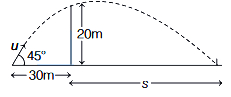
$A$ body is projected at an angle of $45^{\circ}$ from a point on the ground at a distance of $30 \,m$ from the foot of a vertical pole of height $20 \,m$. The body just crosses the top of the pole and strikes the ground at a distance $s$ from the foot of the pole on the other side. Then, $s$ is: (in $\,m$)
A
$20$
B
$30$
C
$50$
D
$60$
Solution
(D) Let the initial velocity be $u$ and the angle of projection be $\theta = 45^{\circ}$.
The equation of the trajectory of a projectile is given by:
$y = x \tan \theta - \frac{g x^2}{2 u^2 \cos^2 \theta}$
Given $x = 30 \,m$, $y = 20 \,m$, $\theta = 45^{\circ}$, and $g = 10 \,m/s^2$:
$20 = 30 \tan 45^{\circ} - \frac{10 \times (30)^2}{2 u^2 \cos^2 45^{\circ}}$
$20 = 30(1) - \frac{10 \times 900}{2 u^2 \times (1/2)}$
$20 = 30 - \frac{9000}{u^2}$
$\frac{9000}{u^2} = 10$
$u^2 = 900 \implies u = 30 \,m/s$
The horizontal range $R$ is given by:
$R = \frac{u^2 \sin 2 \theta}{g} = \frac{900 \times \sin 90^{\circ}}{10} = 90 \,m$
The distance $s$ from the foot of the pole is the total range minus the initial distance from the pole:
$s = R - 30 = 90 - 30 = 60 \,m$
Thus, the correct option is $D$.
The equation of the trajectory of a projectile is given by:
$y = x \tan \theta - \frac{g x^2}{2 u^2 \cos^2 \theta}$
Given $x = 30 \,m$, $y = 20 \,m$, $\theta = 45^{\circ}$, and $g = 10 \,m/s^2$:
$20 = 30 \tan 45^{\circ} - \frac{10 \times (30)^2}{2 u^2 \cos^2 45^{\circ}}$
$20 = 30(1) - \frac{10 \times 900}{2 u^2 \times (1/2)}$
$20 = 30 - \frac{9000}{u^2}$
$\frac{9000}{u^2} = 10$
$u^2 = 900 \implies u = 30 \,m/s$
The horizontal range $R$ is given by:
$R = \frac{u^2 \sin 2 \theta}{g} = \frac{900 \times \sin 90^{\circ}}{10} = 90 \,m$
The distance $s$ from the foot of the pole is the total range minus the initial distance from the pole:
$s = R - 30 = 90 - 30 = 60 \,m$
Thus, the correct option is $D$.
0 likes
View Solution404
EasyMCQ
$A$ bullet fired from a gun falls at a distance half of its maximum range. The angle of projection of the bullet is (in $^{\circ}$)
A
$45$
B
$60$
C
$30$
D
$15$
Solution
(D) The maximum range of a projectile is given by $R_{\max} = \frac{u^2}{g}$.
Given that the range $R$ is half of the maximum range,we have $R = \frac{R_{\max}}{2} = \frac{u^2}{2g}$.
The formula for the range of a projectile is $R = \frac{u^2 \sin 2\theta}{g}$.
Equating the two expressions for $R$,we get $\frac{u^2 \sin 2\theta}{g} = \frac{u^2}{2g}$.
This simplifies to $\sin 2\theta = \frac{1}{2}$.
Since $\sin 30^{\circ} = \frac{1}{2}$,we have $2\theta = 30^{\circ}$,which gives $\theta = 15^{\circ}$.
Therefore,the correct option is $D$.
Given that the range $R$ is half of the maximum range,we have $R = \frac{R_{\max}}{2} = \frac{u^2}{2g}$.
The formula for the range of a projectile is $R = \frac{u^2 \sin 2\theta}{g}$.
Equating the two expressions for $R$,we get $\frac{u^2 \sin 2\theta}{g} = \frac{u^2}{2g}$.
This simplifies to $\sin 2\theta = \frac{1}{2}$.
Since $\sin 30^{\circ} = \frac{1}{2}$,we have $2\theta = 30^{\circ}$,which gives $\theta = 15^{\circ}$.
Therefore,the correct option is $D$.
0 likes
View Solution405
MediumMCQ
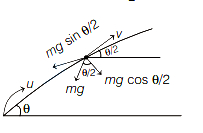
$A$ body is projected with a speed $u$ at an angle $\theta$ with the horizontal. The radius of curvature of the trajectory,when it makes an angle $\left(\frac{\theta}{2}\right)$ with the horizontal is ($g$ = acceleration due to gravity).
A
$\frac{u^2 \cos ^2 \theta \sec ^3\left(\frac{\theta}{2}\right)}{\sqrt{3} g}$
B
$\frac{u^2 \cos ^2 \theta \sec ^3\left(\frac{\theta}{2}\right)}{2 g}$
C
$\frac{2 u^2 \cos ^3 \theta \sec ^2\left(\frac{\theta}{2}\right)}{g}$
D
$\frac{u^2 \cos ^2 \theta \sec ^3\left(\frac{\theta}{2}\right)}{g}$
Solution
(D) Let the velocity of the projectile be $v$ at an angle $\frac{\theta}{2}$ with the horizontal.
Since the horizontal component of velocity remains constant throughout the motion:
$v \cos \left(\frac{\theta}{2}\right) = u \cos \theta$
$v = \frac{u \cos \theta}{\cos \left(\frac{\theta}{2}\right)}$
The centripetal force required for the curved path is provided by the component of gravity perpendicular to the velocity vector,which is $mg \cos \left(\frac{\theta}{2}\right)$.
Using the formula for centripetal force $\frac{mv^2}{r} = F_c$:
$\frac{mv^2}{r} = mg \cos \left(\frac{\theta}{2}\right)$
$r = \frac{v^2}{g \cos \left(\frac{\theta}{2}\right)}$
Substituting the value of $v$:
$r = \frac{\left(\frac{u \cos \theta}{\cos \left(\frac{\theta}{2}\right)}\right)^2}{g \cos \left(\frac{\theta}{2}\right)}$
$r = \frac{u^2 \cos^2 \theta}{g \cos^2 \left(\frac{\theta}{2}\right) \cdot \cos \left(\frac{\theta}{2}\right)}$
$r = \frac{u^2 \cos^2 \theta \sec^3 \left(\frac{\theta}{2}\right)}{g}$
Since the horizontal component of velocity remains constant throughout the motion:
$v \cos \left(\frac{\theta}{2}\right) = u \cos \theta$
$v = \frac{u \cos \theta}{\cos \left(\frac{\theta}{2}\right)}$
The centripetal force required for the curved path is provided by the component of gravity perpendicular to the velocity vector,which is $mg \cos \left(\frac{\theta}{2}\right)$.
Using the formula for centripetal force $\frac{mv^2}{r} = F_c$:
$\frac{mv^2}{r} = mg \cos \left(\frac{\theta}{2}\right)$
$r = \frac{v^2}{g \cos \left(\frac{\theta}{2}\right)}$
Substituting the value of $v$:
$r = \frac{\left(\frac{u \cos \theta}{\cos \left(\frac{\theta}{2}\right)}\right)^2}{g \cos \left(\frac{\theta}{2}\right)}$
$r = \frac{u^2 \cos^2 \theta}{g \cos^2 \left(\frac{\theta}{2}\right) \cdot \cos \left(\frac{\theta}{2}\right)}$
$r = \frac{u^2 \cos^2 \theta \sec^3 \left(\frac{\theta}{2}\right)}{g}$
0 likes
View Solution406
EasyMCQ
$A$ body is projected from the ground at an angle of $\tan^{-1}(\frac{8}{7})$ with the horizontal. The ratio of the maximum height attained by it to its range is (in $: 7$)
A
$8$
B
$4$
C
$2$
D
$1$
Solution
(C) For a projectile projected at an angle $\theta$ with the horizontal:
Maximum height,$H_{\max} = \frac{u^2 \sin^2 \theta}{2g}$
Range,$R = \frac{u^2 \sin 2\theta}{g} = \frac{2u^2 \sin \theta \cos \theta}{g}$
The ratio of maximum height to range is given by:
$\frac{H_{\max}}{R} = \frac{u^2 \sin^2 \theta / 2g}{2u^2 \sin \theta \cos \theta / g} = \frac{\sin^2 \theta}{4 \sin \theta \cos \theta} = \frac{\tan \theta}{4}$
Given $\theta = \tan^{-1}(\frac{8}{7})$,so $\tan \theta = \frac{8}{7}$.
Substituting the value of $\tan \theta$:
$\frac{H_{\max}}{R} = \frac{8/7}{4} = \frac{8}{28} = \frac{2}{7}$.
Thus,the ratio is $2:7$.
Maximum height,$H_{\max} = \frac{u^2 \sin^2 \theta}{2g}$
Range,$R = \frac{u^2 \sin 2\theta}{g} = \frac{2u^2 \sin \theta \cos \theta}{g}$
The ratio of maximum height to range is given by:
$\frac{H_{\max}}{R} = \frac{u^2 \sin^2 \theta / 2g}{2u^2 \sin \theta \cos \theta / g} = \frac{\sin^2 \theta}{4 \sin \theta \cos \theta} = \frac{\tan \theta}{4}$
Given $\theta = \tan^{-1}(\frac{8}{7})$,so $\tan \theta = \frac{8}{7}$.
Substituting the value of $\tan \theta$:
$\frac{H_{\max}}{R} = \frac{8/7}{4} = \frac{8}{28} = \frac{2}{7}$.
Thus,the ratio is $2:7$.
0 likes
View Solution407
EasyMCQ
Assertion $(A)$: The velocity of a projectile at a point on its trajectory is equal to the slope at that point.
Reason $(R)$: The velocity vector at a point is always along the tangent to the trajectory at that point.
Reason $(R)$: The velocity vector at a point is always along the tangent to the trajectory at that point.
A
Both $A$ and $R$ are true and $R$ is the correct explanation of $A$
B
Both $A$ and $R$ are true but $R$ is not the correct explanation of $A$
C
$A$ is true but $R$ is false
D
$A$ is false but $R$ is true
Solution
(D) The trajectory of a projectile is given by the equation:
$y = f(x) = x \tan \theta - \frac{g x^2}{2 u^2 \cos^2 \theta}$
The slope of the trajectory at any point $(x, y)$ is given by the derivative $\frac{dy}{dx}$:
$\frac{dy}{dx} = \tan \theta - \frac{gx}{u^2 \cos^2 \theta} = \frac{v_y}{v_x}$
This slope represents the ratio of the vertical component of velocity to the horizontal component of velocity,not the magnitude of the velocity itself. Therefore,Assertion $(A)$ is incorrect.
Reason $(R)$ states that the velocity vector at any point is always along the tangent to the trajectory at that point. This is a fundamental property of motion in a plane,as the instantaneous velocity is defined as the rate of change of position,which is directed along the tangent to the path. Thus,Reason $(R)$ is correct.
$y = f(x) = x \tan \theta - \frac{g x^2}{2 u^2 \cos^2 \theta}$
The slope of the trajectory at any point $(x, y)$ is given by the derivative $\frac{dy}{dx}$:
$\frac{dy}{dx} = \tan \theta - \frac{gx}{u^2 \cos^2 \theta} = \frac{v_y}{v_x}$
This slope represents the ratio of the vertical component of velocity to the horizontal component of velocity,not the magnitude of the velocity itself. Therefore,Assertion $(A)$ is incorrect.
Reason $(R)$ states that the velocity vector at any point is always along the tangent to the trajectory at that point. This is a fundamental property of motion in a plane,as the instantaneous velocity is defined as the rate of change of position,which is directed along the tangent to the path. Thus,Reason $(R)$ is correct.
0 likes
View Solution408
EasyMCQ
$A$ body projected with some velocity at an angle $45^{\circ}$ with the horizontal from the origin in $XY$-plane passes through a point at $(4, 3) \ m$. Its horizontal range is (in $m$)
A
$10$
B
$14$
C
$18$
D
$16$
Solution
(D) The equation of the trajectory of a projectile is given by:
$y = x \tan \theta - \frac{g x^2}{2 u^2 \cos^2 \theta}$
Given $\theta = 45^{\circ}$,$\tan 45^{\circ} = 1$ and $\cos 45^{\circ} = \frac{1}{\sqrt{2}}$,so $\cos^2 45^{\circ} = \frac{1}{2}$.
The equation becomes:
$y = x - \frac{g x^2}{2 u^2 (1/2)} = x - \frac{g x^2}{u^2} \quad ... (i)$
Since the projectile passes through the point $(4, 3) \ m$,we substitute $x = 4$ and $y = 3$ into equation $(i)$:
$3 = 4 - \frac{g(4^2)}{u^2}$
$3 = 4 - \frac{16g}{u^2}$
$\frac{16g}{u^2} = 1 \Rightarrow u^2 = 16g$
Substituting $u^2 = 16g$ back into equation $(i)$:
$y = x - \frac{g x^2}{16g} = x - \frac{x^2}{16}$
The horizontal range $R$ is the value of $x$ when $y = 0$ (at the landing point):
$0 = x - \frac{x^2}{16}$
$x(1 - \frac{x}{16}) = 0$
Since $x \neq 0$ at the landing point,$1 - \frac{x}{16} = 0$,which gives $x = 16 \ m$.
Thus,the horizontal range is $16 \ m$.
$y = x \tan \theta - \frac{g x^2}{2 u^2 \cos^2 \theta}$
Given $\theta = 45^{\circ}$,$\tan 45^{\circ} = 1$ and $\cos 45^{\circ} = \frac{1}{\sqrt{2}}$,so $\cos^2 45^{\circ} = \frac{1}{2}$.
The equation becomes:
$y = x - \frac{g x^2}{2 u^2 (1/2)} = x - \frac{g x^2}{u^2} \quad ... (i)$
Since the projectile passes through the point $(4, 3) \ m$,we substitute $x = 4$ and $y = 3$ into equation $(i)$:
$3 = 4 - \frac{g(4^2)}{u^2}$
$3 = 4 - \frac{16g}{u^2}$
$\frac{16g}{u^2} = 1 \Rightarrow u^2 = 16g$
Substituting $u^2 = 16g$ back into equation $(i)$:
$y = x - \frac{g x^2}{16g} = x - \frac{x^2}{16}$
The horizontal range $R$ is the value of $x$ when $y = 0$ (at the landing point):
$0 = x - \frac{x^2}{16}$
$x(1 - \frac{x}{16}) = 0$
Since $x \neq 0$ at the landing point,$1 - \frac{x}{16} = 0$,which gives $x = 16 \ m$.
Thus,the horizontal range is $16 \ m$.
0 likes
View Solution409
EasyMCQ
$A$ projectile is given an initial velocity of $(\hat{i}+2 \hat{j}) \text{ ms}^{-1}$. The equation of its path is $(g=10 \text{ ms}^{-2})$
A
$y=2x-5x^2$
B
$y=x-5x^2$
C
$4y=2x-5x^2$
D
$y=2x-25x^2$
Solution
(A) The initial velocity of the projectile is $\vec{u} = (1\hat{i} + 2\hat{j}) \text{ ms}^{-1}$.
Thus,the initial horizontal component is $u_x = 1 \text{ ms}^{-1}$ and the initial vertical component is $u_y = 2 \text{ ms}^{-1}$.
The acceleration components are $a_x = 0$ and $a_y = -g = -10 \text{ ms}^{-2}$.
At any time $t$,the horizontal distance covered is:
$x = u_x t = 1 \cdot t \implies t = x \quad \dots (i)$
The vertical distance covered is:
$y = u_y t + \frac{1}{2} a_y t^2$
$y = 2t + \frac{1}{2}(-10)t^2$
$y = 2t - 5t^2 \quad \dots (ii)$
Substituting the value of $t$ from equation $(i)$ into equation $(ii)$,we get:
$y = 2(x) - 5(x)^2$
$y = 2x - 5x^2$
Therefore,the correct option is $A$.
Thus,the initial horizontal component is $u_x = 1 \text{ ms}^{-1}$ and the initial vertical component is $u_y = 2 \text{ ms}^{-1}$.
The acceleration components are $a_x = 0$ and $a_y = -g = -10 \text{ ms}^{-2}$.
At any time $t$,the horizontal distance covered is:
$x = u_x t = 1 \cdot t \implies t = x \quad \dots (i)$
The vertical distance covered is:
$y = u_y t + \frac{1}{2} a_y t^2$
$y = 2t + \frac{1}{2}(-10)t^2$
$y = 2t - 5t^2 \quad \dots (ii)$
Substituting the value of $t$ from equation $(i)$ into equation $(ii)$,we get:
$y = 2(x) - 5(x)^2$
$y = 2x - 5x^2$
Therefore,the correct option is $A$.
0 likes
View Solution410
DifficultMCQ
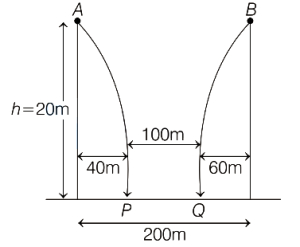
Two towers $A$ and $B$,each of height $20 \ m$,are situated a distance $200 \ m$ apart. $A$ body thrown horizontally from the top of the tower $A$ with a velocity $20 \ ms^{-1}$ towards the tower $B$ hits the ground at point $P$,and another body thrown horizontally from the top of tower $B$ with a velocity $30 \ ms^{-1}$ towards the tower $A$ hits the ground at point $Q$. If a car starting from rest from $P$ reaches $Q$ in $10 \ s$,then the acceleration of the car is (acceleration due to gravity $g = 10 \ ms^{-2}$): (in $ms^{-2}$)
A
$1$
B
$2$
C
$3$
D
$4$
Solution
(B) Given,the height of both towers is the same,$h_1 = h_2 = h = 20 \ m$.
The time of flight $t$ for a body thrown horizontally is given by $t = \sqrt{\frac{2h}{g}}$.
$t = \sqrt{\frac{2 \times 20}{10}} = \sqrt{4} = 2 \ s$.
The horizontal displacement of the body from tower $A$ to point $P$ is $x_A = u_A t = 20 \ ms^{-1} \times 2 \ s = 40 \ m$.
The horizontal displacement of the body from tower $B$ to point $Q$ is $x_B = u_B t = 30 \ ms^{-1} \times 2 \ s = 60 \ m$.
The distance between points $P$ and $Q$ is $d = 200 \ m - (x_A + x_B) = 200 \ m - (40 \ m + 60 \ m) = 100 \ m$.
For the car starting from rest $(u = 0)$ at $P$ and reaching $Q$ in $t' = 10 \ s$,we use the equation of motion $s = ut + \frac{1}{2}at^2$:
$100 = 0 \times 10 + \frac{1}{2} \times a \times (10)^2$.
$100 = 50a$.
$a = 2 \ ms^{-2}$.
The time of flight $t$ for a body thrown horizontally is given by $t = \sqrt{\frac{2h}{g}}$.
$t = \sqrt{\frac{2 \times 20}{10}} = \sqrt{4} = 2 \ s$.
The horizontal displacement of the body from tower $A$ to point $P$ is $x_A = u_A t = 20 \ ms^{-1} \times 2 \ s = 40 \ m$.
The horizontal displacement of the body from tower $B$ to point $Q$ is $x_B = u_B t = 30 \ ms^{-1} \times 2 \ s = 60 \ m$.
The distance between points $P$ and $Q$ is $d = 200 \ m - (x_A + x_B) = 200 \ m - (40 \ m + 60 \ m) = 100 \ m$.
For the car starting from rest $(u = 0)$ at $P$ and reaching $Q$ in $t' = 10 \ s$,we use the equation of motion $s = ut + \frac{1}{2}at^2$:
$100 = 0 \times 10 + \frac{1}{2} \times a \times (10)^2$.
$100 = 50a$.
$a = 2 \ ms^{-2}$.
0 likes
View Solution411
MediumMCQ
$A$ body is projected horizontally from the top of a tower of height $180 \,m$ with a velocity of $20 \,ms^{-1}$. If acceleration due to gravity is $10 \,ms^{-2}$, then match the following:
| $A$. Velocity of the body after $1 \,s$ (in $ms^{-1}$) | $I$. $5$ |
| $B$. Horizontal displacement of the body after $1 \,s$ (in $m$) | $II$. $20$ |
| $C$. Vertical displacement of the body after $1 \,s$ (in $m$) | $III$. $10$ |
| $D$. Vertical velocity of the body after $1 \,s$ (in $ms^{-1}$) | $IV$. $22.4$ |
A
$IV, II, III, I$
B
$I, II, III, IV$
C
$IV, II, I, III$
D
$II, IV, I, III$
Solution
(C) Given:
Initial horizontal velocity, $u_x = 20 \,ms^{-1}$.
Initial vertical velocity, $u_y = 0$.
Acceleration due to gravity, $g = a_y = 10 \,ms^{-2}$.
Horizontal acceleration, $a_x = 0$.
For $t = 1 \,s$:
$A$. Resultant velocity $v = \sqrt{v_x^2 + v_y^2}$.
$v_x = u_x + a_x t = 20 + 0 = 20 \,ms^{-1}$.
$v_y = u_y + a_y t = 0 + 10 \times 1 = 10 \,ms^{-1}$.
$v = \sqrt{20^2 + 10^2} = \sqrt{400 + 100} = \sqrt{500} \approx 22.4 \,ms^{-1}$. (Matches $IV$)
$B$. Horizontal displacement $s_x = u_x t + \frac{1}{2} a_x t^2 = 20 \times 1 + 0 = 20 \,m$. (Matches $II$)
$C$. Vertical displacement $s_y = u_y t + \frac{1}{2} a_y t^2 = 0 + \frac{1}{2} \times 10 \times 1^2 = 5 \,m$. (Matches $I$)
$D$. Vertical velocity $v_y = 10 \,ms^{-1}$. (Matches $III$)
Thus, the correct matching is $A-IV, B-II, C-I, D-III$.
Initial horizontal velocity, $u_x = 20 \,ms^{-1}$.
Initial vertical velocity, $u_y = 0$.
Acceleration due to gravity, $g = a_y = 10 \,ms^{-2}$.
Horizontal acceleration, $a_x = 0$.
For $t = 1 \,s$:
$A$. Resultant velocity $v = \sqrt{v_x^2 + v_y^2}$.
$v_x = u_x + a_x t = 20 + 0 = 20 \,ms^{-1}$.
$v_y = u_y + a_y t = 0 + 10 \times 1 = 10 \,ms^{-1}$.
$v = \sqrt{20^2 + 10^2} = \sqrt{400 + 100} = \sqrt{500} \approx 22.4 \,ms^{-1}$. (Matches $IV$)
$B$. Horizontal displacement $s_x = u_x t + \frac{1}{2} a_x t^2 = 20 \times 1 + 0 = 20 \,m$. (Matches $II$)
$C$. Vertical displacement $s_y = u_y t + \frac{1}{2} a_y t^2 = 0 + \frac{1}{2} \times 10 \times 1^2 = 5 \,m$. (Matches $I$)
$D$. Vertical velocity $v_y = 10 \,ms^{-1}$. (Matches $III$)
Thus, the correct matching is $A-IV, B-II, C-I, D-III$.
0 likes
View Solution412
EasyMCQ
$A$ particle is projected at an angle of $60^{\circ}$ with the horizontal from the ground with a velocity $10 \sqrt{3} \ m/s$. The angle between the velocity vector after $2 \ s$ and the initial velocity vector is $(g = 10 \ m/s^2)$. (in $^{\circ}$)
A
$0$
B
$30$
C
$60$
D
$90$
Solution
(D) Initial velocity $u = 10 \sqrt{3} \ m/s$ at $\theta = 60^{\circ}$.
Horizontal component: $u_x = u \cos 60^{\circ} = 10 \sqrt{3} \times (1/2) = 5 \sqrt{3} \ m/s$.
Vertical component: $u_y = u \sin 60^{\circ} = 10 \sqrt{3} \times (\sqrt{3}/2) = 15 \ m/s$.
Initial velocity vector: $\vec{v}_i = 5 \sqrt{3} \hat{i} + 15 \hat{j}$.
After $t = 2 \ s$,horizontal velocity $v_x = u_x = 5 \sqrt{3} \ m/s$.
Vertical velocity $v_y = u_y - gt = 15 - (10 \times 2) = 15 - 20 = -5 \ m/s$.
Final velocity vector: $\vec{v}_f = 5 \sqrt{3} \hat{i} - 5 \hat{j}$.
Calculate the dot product: $\vec{v}_i \cdot \vec{v}_f = (5 \sqrt{3})(5 \sqrt{3}) + (15)(-5) = 75 - 75 = 0$.
Since the dot product is $0$,the angle between the vectors is $90^{\circ}$.
Horizontal component: $u_x = u \cos 60^{\circ} = 10 \sqrt{3} \times (1/2) = 5 \sqrt{3} \ m/s$.
Vertical component: $u_y = u \sin 60^{\circ} = 10 \sqrt{3} \times (\sqrt{3}/2) = 15 \ m/s$.
Initial velocity vector: $\vec{v}_i = 5 \sqrt{3} \hat{i} + 15 \hat{j}$.
After $t = 2 \ s$,horizontal velocity $v_x = u_x = 5 \sqrt{3} \ m/s$.
Vertical velocity $v_y = u_y - gt = 15 - (10 \times 2) = 15 - 20 = -5 \ m/s$.
Final velocity vector: $\vec{v}_f = 5 \sqrt{3} \hat{i} - 5 \hat{j}$.
Calculate the dot product: $\vec{v}_i \cdot \vec{v}_f = (5 \sqrt{3})(5 \sqrt{3}) + (15)(-5) = 75 - 75 = 0$.
Since the dot product is $0$,the angle between the vectors is $90^{\circ}$.
0 likes
View Solution413
MediumMCQ
$A$ body is projected horizontally from the top of a tall tower with a velocity of $30 \,ms^{-1}$. At time $t_1$, its horizontal and vertical components of the velocity are equal and at time $t_2$, its horizontal and vertical displacements are equal. Then $t_2-t_1$ is (take, $g=10 \,ms^{-2}$ ) (in $\,s$)
A
$1$
B
$1.5$
C
$2$
D
$3$
Solution
(D) For horizontal projectile motion, the horizontal velocity $v_x = u = 30 \,ms^{-1}$ remains constant.
The vertical velocity at time $t$ is $v_y = gt = 10t$.
At time $t_1$, $v_x = v_y$, so $30 = 10t_1$, which gives $t_1 = 3 \,s$.
The horizontal displacement at time $t$ is $x = ut = 30t$.
The vertical displacement at time $t$ is $y = \frac{1}{2}gt^2 = \frac{1}{2} \times 10 \times t^2 = 5t^2$.
At time $t_2$, $x = y$, so $30t_2 = 5t_2^2$. Since $t_2 \neq 0$, we have $t_2 = \frac{30}{5} = 6 \,s$.
Therefore, $t_2 - t_1 = 6 \,s - 3 \,s = 3 \,s$.
The vertical velocity at time $t$ is $v_y = gt = 10t$.
At time $t_1$, $v_x = v_y$, so $30 = 10t_1$, which gives $t_1 = 3 \,s$.
The horizontal displacement at time $t$ is $x = ut = 30t$.
The vertical displacement at time $t$ is $y = \frac{1}{2}gt^2 = \frac{1}{2} \times 10 \times t^2 = 5t^2$.
At time $t_2$, $x = y$, so $30t_2 = 5t_2^2$. Since $t_2 \neq 0$, we have $t_2 = \frac{30}{5} = 6 \,s$.
Therefore, $t_2 - t_1 = 6 \,s - 3 \,s = 3 \,s$.
0 likes
View Solution414
EasyMCQ
$A$ large number of bullets are fired in all directions with the same speed $u$. The maximum area of the ground on which these bullets spread is ($g$ - acceleration due to gravity).
A
$\frac{\pi u^2}{g}$
B
$\frac{\pi u^4}{g^2}$
C
$\frac{\pi u^2}{g^4}$
D
$\frac{\pi u}{g}$
Solution
(B) The horizontal range $R$ of a projectile fired with speed $u$ at an angle $\theta$ is given by $R = \frac{u^2 \sin(2\theta)}{g}$.
The maximum horizontal range $R_{max}$ occurs when $\theta = 45^\circ$,which is $R_{max} = \frac{u^2}{g}$.
Since the bullets are fired in all directions,they will cover a circular area on the ground with the radius equal to the maximum range $R_{max}$.
The area $A$ of this circle is $A = \pi R_{max}^2$.
Substituting the value of $R_{max}$,we get $A = \pi \left(\frac{u^2}{g}\right)^2 = \frac{\pi u^4}{g^2}$.
The maximum horizontal range $R_{max}$ occurs when $\theta = 45^\circ$,which is $R_{max} = \frac{u^2}{g}$.
Since the bullets are fired in all directions,they will cover a circular area on the ground with the radius equal to the maximum range $R_{max}$.
The area $A$ of this circle is $A = \pi R_{max}^2$.
Substituting the value of $R_{max}$,we get $A = \pi \left(\frac{u^2}{g}\right)^2 = \frac{\pi u^4}{g^2}$.
0 likes
View Solution415
EasyMCQ
$A$ body is projected at an angle of $45^{\circ}$ with the horizontal with a velocity of $60 \sqrt{2} \ m/s$. Then the angle made by its velocity with the horizontal after $6 \ s$ is (in $^{\circ}$)
A
$45$
B
$0$
C
$30$
D
$60$
Solution
(B) Initial velocity $u = 60 \sqrt{2} \ m/s$ at angle $\theta = 45^{\circ}$.
Horizontal component of velocity: $u_x = u \cos(45^{\circ}) = 60 \sqrt{2} \times \frac{1}{\sqrt{2}} = 60 \ m/s$.
Vertical component of velocity: $u_y = u \sin(45^{\circ}) = 60 \sqrt{2} \times \frac{1}{\sqrt{2}} = 60 \ m/s$.
After time $t = 6 \ s$,the horizontal velocity remains constant: $v_x = u_x = 60 \ m/s$.
The vertical velocity changes due to gravity $(g = 10 \ m/s^2)$: $v_y = u_y - gt = 60 - (10 \times 6) = 0 \ m/s$.
The angle $\alpha$ made by the velocity with the horizontal is given by $\tan(\alpha) = \frac{v_y}{v_x} = \frac{0}{60} = 0$.
Therefore,$\alpha = 0^{\circ}$.
Horizontal component of velocity: $u_x = u \cos(45^{\circ}) = 60 \sqrt{2} \times \frac{1}{\sqrt{2}} = 60 \ m/s$.
Vertical component of velocity: $u_y = u \sin(45^{\circ}) = 60 \sqrt{2} \times \frac{1}{\sqrt{2}} = 60 \ m/s$.
After time $t = 6 \ s$,the horizontal velocity remains constant: $v_x = u_x = 60 \ m/s$.
The vertical velocity changes due to gravity $(g = 10 \ m/s^2)$: $v_y = u_y - gt = 60 - (10 \times 6) = 0 \ m/s$.
The angle $\alpha$ made by the velocity with the horizontal is given by $\tan(\alpha) = \frac{v_y}{v_x} = \frac{0}{60} = 0$.
Therefore,$\alpha = 0^{\circ}$.
0 likes
View Solution416
EasyMCQ
The angle of projection of a projectile for which its initial kinetic energy becomes half at its maximum height is (in $^{\circ}$)
A
$90$
B
$60$
C
$45$
D
$30$
Solution
(C) Let the initial velocity of the projectile be $u$ and the angle of projection be $\theta$. The initial kinetic energy is $K_i = \frac{1}{2}mu^2$.
At the maximum height, the vertical component of velocity becomes zero, and the velocity of the projectile is only the horizontal component, $v_x = u \cos \theta$.
The kinetic energy at the maximum height is $K_f = \frac{1}{2}m(u \cos \theta)^2 = \frac{1}{2}mu^2 \cos^2 \theta$.
According to the problem, $K_f = \frac{1}{2}K_i$.
Substituting the expressions, we get $\frac{1}{2}mu^2 \cos^2 \theta = \frac{1}{2} (\frac{1}{2}mu^2)$.
This simplifies to $\cos^2 \theta = \frac{1}{2}$, which means $\cos \theta = \frac{1}{\sqrt{2}}$.
Therefore, $\theta = 45^{\circ}$.
At the maximum height, the vertical component of velocity becomes zero, and the velocity of the projectile is only the horizontal component, $v_x = u \cos \theta$.
The kinetic energy at the maximum height is $K_f = \frac{1}{2}m(u \cos \theta)^2 = \frac{1}{2}mu^2 \cos^2 \theta$.
According to the problem, $K_f = \frac{1}{2}K_i$.
Substituting the expressions, we get $\frac{1}{2}mu^2 \cos^2 \theta = \frac{1}{2} (\frac{1}{2}mu^2)$.
This simplifies to $\cos^2 \theta = \frac{1}{2}$, which means $\cos \theta = \frac{1}{\sqrt{2}}$.
Therefore, $\theta = 45^{\circ}$.
0 likes
View Solution417
MediumMCQ
The equation of motion of a projectile is $y = ax - bx^2$,where $a$ and $b$ are constants. Match the Column-$I$ with Column-$II$:
| Column-$I$ | Column-$II$ |
| $i)$ The initial velocity of projection | $a)$ $\sqrt{\frac{g(1+a^2)}{2b}}$ |
| $ii)$ The horizontal range of projectile | $b)$ $\frac{a}{b}$ |
| $iii)$ The maximum height attained by projectile | $c)$ $\frac{a^2}{4b}$ |
| $iv)$ The time of flight of projectile | $d)$ $a\sqrt{\frac{2}{bg}}$ |
A
$i-a, ii-b, iii-c, iv-d$
B
$i-d, ii-a, iii-b, iv-c$
C
$i-d, ii-a, iii-c, iv-b$
D
$i-a, ii-d, iii-c, iv-b$
Solution
(C) The standard equation of a projectile is $y = x \tan \theta - \frac{gx^2}{2u^2 \cos^2 \theta}$.
Comparing this with $y = ax - bx^2$,we get $\tan \theta = a$ and $b = \frac{g}{2u^2 \cos^2 \theta}$.
$i)$ Initial velocity $u$: Since $\tan \theta = a$,$\sec^2 \theta = 1 + a^2$,so $\cos^2 \theta = \frac{1}{1+a^2}$. Substituting into $b$,$b = \frac{g(1+a^2)}{2u^2} \implies u = \sqrt{\frac{g(1+a^2)}{2b}}$. Thus,$i-d$.
$ii)$ Range $R$: $y=0 \implies x(a-bx)=0 \implies R = \frac{a}{b}$. Thus,$ii-a$.
$iii)$ Max height $H$: $H = \frac{u^2 \sin^2 \theta}{2g} = \frac{u^2 \tan^2 \theta \cos^2 \theta}{2g} = \frac{a^2}{4b}$. Thus,$iii-c$.
$iv)$ Time of flight $T$: $T = \frac{2u \sin \theta}{g} = \frac{2u \tan \theta \cos \theta}{g} = a \sqrt{\frac{2}{bg}}$. Thus,$iv-b$.
Therefore,the correct match is $i-d, ii-a, iii-c, iv-b$.
Comparing this with $y = ax - bx^2$,we get $\tan \theta = a$ and $b = \frac{g}{2u^2 \cos^2 \theta}$.
$i)$ Initial velocity $u$: Since $\tan \theta = a$,$\sec^2 \theta = 1 + a^2$,so $\cos^2 \theta = \frac{1}{1+a^2}$. Substituting into $b$,$b = \frac{g(1+a^2)}{2u^2} \implies u = \sqrt{\frac{g(1+a^2)}{2b}}$. Thus,$i-d$.
$ii)$ Range $R$: $y=0 \implies x(a-bx)=0 \implies R = \frac{a}{b}$. Thus,$ii-a$.
$iii)$ Max height $H$: $H = \frac{u^2 \sin^2 \theta}{2g} = \frac{u^2 \tan^2 \theta \cos^2 \theta}{2g} = \frac{a^2}{4b}$. Thus,$iii-c$.
$iv)$ Time of flight $T$: $T = \frac{2u \sin \theta}{g} = \frac{2u \tan \theta \cos \theta}{g} = a \sqrt{\frac{2}{bg}}$. Thus,$iv-b$.
Therefore,the correct match is $i-d, ii-a, iii-c, iv-b$.
0 likes
View Solution418
EasyMCQ
$A$ projectile is thrown with a velocity of $10 \sqrt{2} \ m/s$ at an angle of $45^{\circ}$ with the horizontal. The time interval between the moments when the speed is $\sqrt{125} \ m/s$ is $(g = 10 \ m/s^2)$. (in $s$)
A
$0.5$
B
$1.5$
C
$2$
D
$1.0$
Solution
(D) The initial velocity is $u = 10\sqrt{2} \ m/s$ at $\theta = 45^{\circ}$.
The horizontal component is $u_x = u \cos 45^{\circ} = 10\sqrt{2} \times \frac{1}{\sqrt{2}} = 10 \ m/s$.
The vertical component is $u_y = u \sin 45^{\circ} = 10\sqrt{2} \times \frac{1}{\sqrt{2}} = 10 \ m/s$.
At any time $t$,the velocity components are $v_x = 10 \ m/s$ and $v_y = 10 - 10t$.
The speed $v$ is given by $v^2 = v_x^2 + v_y^2$.
Given $v = \sqrt{125} \ m/s$,so $v^2 = 125$.
$125 = 10^2 + (10 - 10t)^2$.
$125 = 100 + (10 - 10t)^2$.
$(10 - 10t)^2 = 25$.
Taking the square root,$10 - 10t = \pm 5$.
Case $1$: $10 - 10t = 5 \implies 10t = 5 \implies t_1 = 0.5 \ s$.
Case $2$: $10 - 10t = -5 \implies 10t = 15 \implies t_2 = 1.5 \ s$.
The time interval is $\Delta t = t_2 - t_1 = 1.5 - 0.5 = 1.0 \ s$.
The horizontal component is $u_x = u \cos 45^{\circ} = 10\sqrt{2} \times \frac{1}{\sqrt{2}} = 10 \ m/s$.
The vertical component is $u_y = u \sin 45^{\circ} = 10\sqrt{2} \times \frac{1}{\sqrt{2}} = 10 \ m/s$.
At any time $t$,the velocity components are $v_x = 10 \ m/s$ and $v_y = 10 - 10t$.
The speed $v$ is given by $v^2 = v_x^2 + v_y^2$.
Given $v = \sqrt{125} \ m/s$,so $v^2 = 125$.
$125 = 10^2 + (10 - 10t)^2$.
$125 = 100 + (10 - 10t)^2$.
$(10 - 10t)^2 = 25$.
Taking the square root,$10 - 10t = \pm 5$.
Case $1$: $10 - 10t = 5 \implies 10t = 5 \implies t_1 = 0.5 \ s$.
Case $2$: $10 - 10t = -5 \implies 10t = 15 \implies t_2 = 1.5 \ s$.
The time interval is $\Delta t = t_2 - t_1 = 1.5 - 0.5 = 1.0 \ s$.
0 likes
View Solution419
EasyMCQ
$A$ body is projected with a velocity $(\hat{i} + 2\hat{j}) \text{ ms}^{-1}$,where $\hat{i}$ is along the horizontal and $\hat{j}$ is vertically upward. Then the equation of its trajectory is $(g = 10 \text{ ms}^{-2})$.
A
$y = x - 5x^2$
B
$y = 2x - 5x^2$
C
$y = 2x + 5x^2$
D
$y = x + 5x^2$
Solution
(B) The initial velocity is given by $\vec{u} = u_x \hat{i} + u_y \hat{j} = (1\hat{i} + 2\hat{j}) \text{ ms}^{-1}$.
Thus,the horizontal component is $u_x = 1 \text{ ms}^{-1}$ and the vertical component is $u_y = 2 \text{ ms}^{-1}$.
At any time $t$,the horizontal position is $x = u_x t = 1 \cdot t$,which implies $t = x$.
The vertical position is $y = u_y t - \frac{1}{2}gt^2$.
Substituting $g = 10 \text{ ms}^{-2}$,$u_y = 2 \text{ ms}^{-1}$,and $t = x$ into the equation:
$y = 2x - \frac{1}{2}(10)x^2$.
$y = 2x - 5x^2$.
Therefore,the equation of the trajectory is $y = 2x - 5x^2$.
Thus,the horizontal component is $u_x = 1 \text{ ms}^{-1}$ and the vertical component is $u_y = 2 \text{ ms}^{-1}$.
At any time $t$,the horizontal position is $x = u_x t = 1 \cdot t$,which implies $t = x$.
The vertical position is $y = u_y t - \frac{1}{2}gt^2$.
Substituting $g = 10 \text{ ms}^{-2}$,$u_y = 2 \text{ ms}^{-1}$,and $t = x$ into the equation:
$y = 2x - \frac{1}{2}(10)x^2$.
$y = 2x - 5x^2$.
Therefore,the equation of the trajectory is $y = 2x - 5x^2$.
0 likes
View Solution420
EasyMCQ
The equation of a projectile is given by $y = Px - Qx^2$,where $P$ and $Q$ are constants. The ratio of the maximum height to the range of the projectile is
A
$\frac{Q^2}{2P}$
B
$\frac{P^2}{Q}$
C
$4P$
D
$\frac{P}{4}$
Solution
(D) The equation of the trajectory of a projectile is given by:
$y = x \tan \theta \left(1 - \frac{x}{R}\right) = x \tan \theta - \frac{x^2 \tan \theta}{R}$
Comparing this with the given equation $y = Px - Qx^2$,we get:
$P = \tan \theta$
$Q = \frac{\tan \theta}{R} \implies R = \frac{\tan \theta}{Q} = \frac{P}{Q}$
We know that the maximum height $H$ is given by:
$H = \frac{R \tan \theta}{4}$
Substituting the values of $R$ and $\tan \theta$:
$H = \frac{(P/Q) \cdot P}{4} = \frac{P^2}{4Q}$
Therefore,the ratio of maximum height to range is:
$\frac{H}{R} = \frac{P^2 / 4Q}{P / Q} = \frac{P}{4}$
$y = x \tan \theta \left(1 - \frac{x}{R}\right) = x \tan \theta - \frac{x^2 \tan \theta}{R}$
Comparing this with the given equation $y = Px - Qx^2$,we get:
$P = \tan \theta$
$Q = \frac{\tan \theta}{R} \implies R = \frac{\tan \theta}{Q} = \frac{P}{Q}$
We know that the maximum height $H$ is given by:
$H = \frac{R \tan \theta}{4}$
Substituting the values of $R$ and $\tan \theta$:
$H = \frac{(P/Q) \cdot P}{4} = \frac{P^2}{4Q}$
Therefore,the ratio of maximum height to range is:
$\frac{H}{R} = \frac{P^2 / 4Q}{P / Q} = \frac{P}{4}$
0 likes
View Solution421
MediumMCQ
$A$ body is projected into a vertical $X-Y$ plane with the $X$-axis along the horizontal and the $Y$-axis along the vertical with an initial velocity $(10 \hat{i} + p \hat{j}) \ m/s$. If the maximum height reached by the body is $50 \%$ of its range,then the value of $p$ is:
A
$20$
B
$10$
C
$5$
D
$2$
Solution
(A) The initial velocity is given by $\vec{u} = 10 \hat{i} + p \hat{j}$. Thus,$u_x = 10 \ m/s$ and $u_y = p \ m/s$.
The maximum height $H$ is given by $H = \frac{u_y^2}{2g} = \frac{p^2}{2g}$.
The range $R$ is given by $R = \frac{2 u_x u_y}{g} = \frac{2(10)(p)}{g} = \frac{20p}{g}$.
According to the problem,$H = 0.5 R$.
Substituting the expressions: $\frac{p^2}{2g} = 0.5 \times \frac{20p}{g}$.
$\frac{p^2}{2g} = \frac{10p}{g}$.
Since $p \neq 0$,we can divide both sides by $p/g$: $\frac{p}{2} = 10$.
Therefore,$p = 20$.
The maximum height $H$ is given by $H = \frac{u_y^2}{2g} = \frac{p^2}{2g}$.
The range $R$ is given by $R = \frac{2 u_x u_y}{g} = \frac{2(10)(p)}{g} = \frac{20p}{g}$.
According to the problem,$H = 0.5 R$.
Substituting the expressions: $\frac{p^2}{2g} = 0.5 \times \frac{20p}{g}$.
$\frac{p^2}{2g} = \frac{10p}{g}$.
Since $p \neq 0$,we can divide both sides by $p/g$: $\frac{p}{2} = 10$.
Therefore,$p = 20$.
0 likes
View Solution422
DifficultMCQ
$A$ particle aimed at a target,projected with an angle $15^{\circ}$ with the horizontal,is short of the target by $10 \ m$. If projected with an angle of $45^{\circ}$,it is away from the target by $15 \ m$. Then the angle of projection to hit the target is:
A
$\frac{1}{2} \sin ^{-1}\left(\frac{1}{10}\right)$
B
$\frac{1}{2} \sin ^{-1}\left(\frac{3}{10}\right)$
C
$\frac{1}{2} \sin ^{-1}\left(\frac{9}{10}\right)$
D
$\frac{1}{2} \sin ^{-1}\left(\frac{7}{10}\right)$
Solution
(D) The horizontal range $R$ of a projectile is given by $R = \frac{u^2 \sin 2\theta}{g}$.
Let $R$ be the distance to the target.
For $\theta_1 = 15^{\circ}$,the range is $R_1 = R - 10$. So,$R - 10 = \frac{u^2 \sin 30^{\circ}}{g} = \frac{u^2}{2g}$.
For $\theta_2 = 45^{\circ}$,the range is $R_2 = R + 15$. So,$R + 15 = \frac{u^2 \sin 90^{\circ}}{g} = \frac{u^2}{g}$.
Dividing the two equations: $\frac{R - 10}{R + 15} = \frac{u^2/2g}{u^2/g} = \frac{1}{2}$.
$2R - 20 = R + 15 \Rightarrow R = 35 \ m$.
Now,$R + 15 = \frac{u^2}{g} \Rightarrow 35 + 15 = \frac{u^2}{g} \Rightarrow \frac{u^2}{g} = 50 \ m$.
To hit the target,the range must be $R = 35 \ m$. Thus,$35 = 50 \sin 2\theta$.
$\sin 2\theta = \frac{35}{50} = \frac{7}{10}$.
$\theta = \frac{1}{2} \sin^{-1}\left(\frac{7}{10}\right)$.
Let $R$ be the distance to the target.
For $\theta_1 = 15^{\circ}$,the range is $R_1 = R - 10$. So,$R - 10 = \frac{u^2 \sin 30^{\circ}}{g} = \frac{u^2}{2g}$.
For $\theta_2 = 45^{\circ}$,the range is $R_2 = R + 15$. So,$R + 15 = \frac{u^2 \sin 90^{\circ}}{g} = \frac{u^2}{g}$.
Dividing the two equations: $\frac{R - 10}{R + 15} = \frac{u^2/2g}{u^2/g} = \frac{1}{2}$.
$2R - 20 = R + 15 \Rightarrow R = 35 \ m$.
Now,$R + 15 = \frac{u^2}{g} \Rightarrow 35 + 15 = \frac{u^2}{g} \Rightarrow \frac{u^2}{g} = 50 \ m$.
To hit the target,the range must be $R = 35 \ m$. Thus,$35 = 50 \sin 2\theta$.
$\sin 2\theta = \frac{35}{50} = \frac{7}{10}$.
$\theta = \frac{1}{2} \sin^{-1}\left(\frac{7}{10}\right)$.
0 likes
View Solution423
DifficultMCQ
It is possible to project a particle with a given velocity in two possible ways so as to make them pass through a point $P$ at a horizontal distance $r$ from the point of projection. If $t_1$ and $t_2$ are times taken to reach this point in two possible ways,then the product $t_1 t_2$ is proportional to
A
$\frac{1}{r}$
B
$r$
C
$r^2$
D
$\frac{1}{r^2}$
Solution
(B) The equation of the trajectory of a projectile is given by $y = x \tan \theta - \frac{g x^2}{2 u^2 \cos^2 \theta}$.
Since the particle passes through point $(r, y)$,we have $y = r \tan \theta - \frac{g r^2}{2 u^2} (1 + \tan^2 \theta)$.
Rearranging this as a quadratic equation in $\tan \theta$: $\frac{g r^2}{2 u^2} \tan^2 \theta - r \tan \theta + (y + \frac{g r^2}{2 u^2}) = 0$.
Let the two roots be $\tan \theta_1$ and $\tan \theta_2$. Then $\tan \theta_1 \tan \theta_2 = \frac{y + g r^2 / 2 u^2}{g r^2 / 2 u^2} = 1 + \frac{2 u^2 y}{g r^2}$.
The time taken to reach horizontal distance $r$ is $t = \frac{r}{u \cos \theta}$.
Thus,$t_1 t_2 = \frac{r^2}{u^2 \cos \theta_1 \cos \theta_2}$.
Using the relation for projectile motion,it is a standard result that $t_1 t_2 = \frac{2 r}{g \tan \alpha}$ where $\alpha$ is the angle of elevation of the point. For a fixed point $(r, y)$,$t_1 t_2 = \frac{2 r}{g \tan \theta_{elevation}}$.
Since $g$ is constant,$t_1 t_2 \propto r$.
Since the particle passes through point $(r, y)$,we have $y = r \tan \theta - \frac{g r^2}{2 u^2} (1 + \tan^2 \theta)$.
Rearranging this as a quadratic equation in $\tan \theta$: $\frac{g r^2}{2 u^2} \tan^2 \theta - r \tan \theta + (y + \frac{g r^2}{2 u^2}) = 0$.
Let the two roots be $\tan \theta_1$ and $\tan \theta_2$. Then $\tan \theta_1 \tan \theta_2 = \frac{y + g r^2 / 2 u^2}{g r^2 / 2 u^2} = 1 + \frac{2 u^2 y}{g r^2}$.
The time taken to reach horizontal distance $r$ is $t = \frac{r}{u \cos \theta}$.
Thus,$t_1 t_2 = \frac{r^2}{u^2 \cos \theta_1 \cos \theta_2}$.
Using the relation for projectile motion,it is a standard result that $t_1 t_2 = \frac{2 r}{g \tan \alpha}$ where $\alpha$ is the angle of elevation of the point. For a fixed point $(r, y)$,$t_1 t_2 = \frac{2 r}{g \tan \theta_{elevation}}$.
Since $g$ is constant,$t_1 t_2 \propto r$.
0 likes
View Solution424
DifficultMCQ
The maximum height attained by a projectile is increased by $10 \%$ by keeping the angle of projection constant. What is the percentage increase in the time of flight (in $\%$)?
A
$5$
B
$10$
C
$20$
D
$40$
Solution
(A) The maximum height $H$ and time of flight $T$ of a projectile are given by:
$H = \frac{u^2 \sin^2 \theta}{2g}$ and $T = \frac{2u \sin \theta}{g}$.
From these equations,we can see that $H \propto u^2$ and $T \propto u$ (since $\theta$ is constant).
Therefore,$H \propto T^2$.
If the height increases by $10 \%$,the new height $H_2 = 1.10 H_1$.
Since $H \propto T^2$,we have $\frac{H_2}{H_1} = \left(\frac{T_2}{T_1}\right)^2$.
$1.10 = \left(\frac{T_2}{T_1}\right)^2 \implies \frac{T_2}{T_1} = \sqrt{1.10} \approx 1.0488$.
This corresponds to an increase of approximately $4.88 \%$,which is closest to $5 \%$.
$H = \frac{u^2 \sin^2 \theta}{2g}$ and $T = \frac{2u \sin \theta}{g}$.
From these equations,we can see that $H \propto u^2$ and $T \propto u$ (since $\theta$ is constant).
Therefore,$H \propto T^2$.
If the height increases by $10 \%$,the new height $H_2 = 1.10 H_1$.
Since $H \propto T^2$,we have $\frac{H_2}{H_1} = \left(\frac{T_2}{T_1}\right)^2$.
$1.10 = \left(\frac{T_2}{T_1}\right)^2 \implies \frac{T_2}{T_1} = \sqrt{1.10} \approx 1.0488$.
This corresponds to an increase of approximately $4.88 \%$,which is closest to $5 \%$.
0 likes
View Solution425
MediumMCQ
$A$ boy weighing $50 \ kg$ finished a long jump at a distance of $8 \ m$. Considering that he moved along a parabolic path and his angle of jump is $45^{\circ}$,his initial $K.E.$ is (in $J$)
A
$960$
B
$1560$
C
$2460$
D
$1960$
Solution
(D) Given: Mass $m = 50 \ kg$,Range $R = 8 \ m$,Angle $\theta = 45^{\circ}$,Acceleration due to gravity $g = 9.8 \ m/s^2$.
The formula for the horizontal range of a projectile is $R = \frac{u^2 \sin(2\theta)}{g}$.
Substituting the given values:
$8 = \frac{u^2 \sin(2 \times 45^{\circ})}{9.8} = \frac{u^2 \sin(90^{\circ})}{9.8} = \frac{u^2}{9.8}$.
Therefore,$u^2 = 8 \times 9.8 = 78.4 \ m^2/s^2$.
The initial kinetic energy $(K.E.)$ is given by $\frac{1}{2} m u^2$.
$(K.E.) = \frac{1}{2} \times 50 \times 78.4 = 25 \times 78.4 = 1960 \ J$.
The formula for the horizontal range of a projectile is $R = \frac{u^2 \sin(2\theta)}{g}$.
Substituting the given values:
$8 = \frac{u^2 \sin(2 \times 45^{\circ})}{9.8} = \frac{u^2 \sin(90^{\circ})}{9.8} = \frac{u^2}{9.8}$.
Therefore,$u^2 = 8 \times 9.8 = 78.4 \ m^2/s^2$.
The initial kinetic energy $(K.E.)$ is given by $\frac{1}{2} m u^2$.
$(K.E.) = \frac{1}{2} \times 50 \times 78.4 = 25 \times 78.4 = 1960 \ J$.
0 likes
View Solution426
MediumMCQ
$A$ helicopter flying horizontally with a velocity of $288 \ km/h$ drops a bomb. If the line joining the point of dropping the bomb and the point where the bomb hits the ground makes an angle $45^{\circ}$ with the horizontal,then the height at which the bomb was dropped is (Acceleration due to gravity $= 10 \ m/s^2$) (in $m$)
A
$1320$
B
$1280$
C
$320$
D
$640$
Solution
(B) Given: Velocity of helicopter $u = 288 \ km/h = 288 \times \frac{5}{18} \ m/s = 80 \ m/s$. Acceleration due to gravity $g = 10 \ m/s^2$. Let $h$ be the height of the helicopter and $R$ be the horizontal range of the bomb. The time taken to hit the ground is $t = \sqrt{\frac{2h}{g}}$. The horizontal range is $R = u \times t = u \sqrt{\frac{2h}{g}}$. The angle $\theta$ made by the line joining the dropping point and the impact point with the horizontal is given by $\tan \theta = \frac{h}{R}$. Given $\theta = 45^{\circ}$,so $\tan 45^{\circ} = 1$,which implies $h = R$. Substituting $R = u \sqrt{\frac{2h}{g}}$,we get $h = u \sqrt{\frac{2h}{g}}$. Squaring both sides: $h^2 = u^2 \frac{2h}{g} \implies h = \frac{2u^2}{g}$. Substituting the values: $h = \frac{2 \times (80)^2}{10} = \frac{2 \times 6400}{10} = 1280 \ m$.
0 likes
View Solution427
MediumMCQ
If a body projected with a velocity of $19.6 \ m/s$ reaches a maximum height of $9.8 \ m$,then the range of the projectile is (Neglect air resistance). (in $m$)
A
$19.6$
B
$39.2$
C
$78.4$
D
$9.8$
Solution
(B) Given: Initial velocity $u = 19.6 \ m/s$,Maximum height $H = 9.8 \ m$.
We know the formula for maximum height is $H = \frac{u^2 \sin^2 \theta}{2g}$.
Assuming $g = 9.8 \ m/s^2$,we have $9.8 = \frac{(19.6)^2 \sin^2 \theta}{2 \times 9.8}$.
$9.8 = \frac{384.16 \sin^2 \theta}{19.6} \implies 9.8 = 19.6 \sin^2 \theta$.
$\sin^2 \theta = \frac{9.8}{19.6} = 0.5$,so $\sin \theta = \frac{1}{\sqrt{2}}$,which means $\theta = 45^\circ$.
The range $R$ is given by $R = \frac{u^2 \sin(2\theta)}{g}$.
Since $\theta = 45^\circ$,$\sin(2\theta) = \sin(90^\circ) = 1$.
$R = \frac{(19.6)^2}{9.8} = \frac{384.16}{9.8} = 39.2 \ m$.
We know the formula for maximum height is $H = \frac{u^2 \sin^2 \theta}{2g}$.
Assuming $g = 9.8 \ m/s^2$,we have $9.8 = \frac{(19.6)^2 \sin^2 \theta}{2 \times 9.8}$.
$9.8 = \frac{384.16 \sin^2 \theta}{19.6} \implies 9.8 = 19.6 \sin^2 \theta$.
$\sin^2 \theta = \frac{9.8}{19.6} = 0.5$,so $\sin \theta = \frac{1}{\sqrt{2}}$,which means $\theta = 45^\circ$.
The range $R$ is given by $R = \frac{u^2 \sin(2\theta)}{g}$.
Since $\theta = 45^\circ$,$\sin(2\theta) = \sin(90^\circ) = 1$.
$R = \frac{(19.6)^2}{9.8} = \frac{384.16}{9.8} = 39.2 \ m$.
0 likes
View Solution428
MediumMCQ
$A$ ball projected at an angle of $45^{\circ}$ with the horizontal crosses two points at equal heights separated by a distance at times $2 \ s$ and $8 \ s$ respectively. The horizontal distance between the two points is (Acceleration due to gravity $= 10 \ m/s^2$) (in $m$)
A
$300$
B
$400$
C
$500$
D
$600$
Solution
(A) Let the ball be projected with an initial velocity $u$ at an angle $\theta = 45^{\circ}$.
The vertical displacement $y$ at time $t$ is given by $y = (u \sin \theta)t - \frac{1}{2}gt^2$.
Since the ball is at the same height $y$ at $t_1 = 2 \ s$ and $t_2 = 8 \ s$,we have:
$(u \sin \theta)t_1 - \frac{1}{2}gt_1^2 = (u \sin \theta)t_2 - \frac{1}{2}gt_2^2$
$u \sin \theta (t_2 - t_1) = \frac{1}{2}g(t_2^2 - t_1^2)$
$u \sin \theta = \frac{g(t_1 + t_2)}{2} = \frac{10(2 + 8)}{2} = 50 \ m/s$.
Since $\theta = 45^{\circ}$,$u \sin 45^{\circ} = u \cos 45^{\circ} = 50 \ m/s$,so $u_x = 50 \ m/s$.
The horizontal distance $d$ between the two points is the horizontal displacement between $t_1$ and $t_2$:
$d = u_x(t_2 - t_1) = 50 \times (8 - 2) = 50 \times 6 = 300 \ m$.
The vertical displacement $y$ at time $t$ is given by $y = (u \sin \theta)t - \frac{1}{2}gt^2$.
Since the ball is at the same height $y$ at $t_1 = 2 \ s$ and $t_2 = 8 \ s$,we have:
$(u \sin \theta)t_1 - \frac{1}{2}gt_1^2 = (u \sin \theta)t_2 - \frac{1}{2}gt_2^2$
$u \sin \theta (t_2 - t_1) = \frac{1}{2}g(t_2^2 - t_1^2)$
$u \sin \theta = \frac{g(t_1 + t_2)}{2} = \frac{10(2 + 8)}{2} = 50 \ m/s$.
Since $\theta = 45^{\circ}$,$u \sin 45^{\circ} = u \cos 45^{\circ} = 50 \ m/s$,so $u_x = 50 \ m/s$.
The horizontal distance $d$ between the two points is the horizontal displacement between $t_1$ and $t_2$:
$d = u_x(t_2 - t_1) = 50 \times (8 - 2) = 50 \times 6 = 300 \ m$.
0 likes
View Solution429
MediumMCQ
$A$ body projected at a certain angle $(\neq 90^{\circ})$ from the ground crosses a point in its path at a time $t_1 = 2.3 \ s$ and from there it reaches the ground after a further time $t_2 = 5.7 \ s$. The maximum height reached by the body is (Take $g = 10 \ ms^{-2}$) (in $m$)
A
$80$
B
$120$
C
$40$
D
$160$
Solution
(A) For a projectile motion,if a body passes through a point at time $t_1$ and reaches the ground after a further time $t_2$,the total time of flight is $T = t_1 + t_2 = 2.3 \ s + 5.7 \ s = 8.0 \ s$.
The time taken to reach the maximum height is $t_{max} = \frac{T}{2} = \frac{8.0 \ s}{2} = 4.0 \ s$.
The maximum height $H$ is given by the formula $H = \frac{1}{2} g t_{max}^2$.
Substituting the values: $H = \frac{1}{2} \times 10 \ ms^{-2} \times (4.0 \ s)^2$.
$H = 5 \times 16 = 80 \ m$.
Thus,the maximum height reached by the body is $80 \ m$.
The time taken to reach the maximum height is $t_{max} = \frac{T}{2} = \frac{8.0 \ s}{2} = 4.0 \ s$.
The maximum height $H$ is given by the formula $H = \frac{1}{2} g t_{max}^2$.
Substituting the values: $H = \frac{1}{2} \times 10 \ ms^{-2} \times (4.0 \ s)^2$.
$H = 5 \times 16 = 80 \ m$.
Thus,the maximum height reached by the body is $80 \ m$.
0 likes
View Solution430
MediumMCQ
The vertical displacement ($y$ in metre) of a projectile in terms of its horizontal displacement ($x$ in metre) is given by $y = (\sqrt{3}x - 0.2x^2)$. The time of flight of the projectile is (Acceleration due to gravity $g = 10 \ ms^{-2}$)
A
$5 \sqrt{3} \ s$
B
$\sqrt{3} \ s$
C
$0.2 \ s$
D
$0.2 \sqrt{3} \ s$
Solution
(B) The equation of the trajectory of a projectile is given by $y = x \tan \theta - \frac{gx^2}{2u^2 \cos^2 \theta}$.
Comparing this with the given equation $y = \sqrt{3}x - 0.2x^2$:
$1$. $\tan \theta = \sqrt{3} \implies \theta = 60^\circ$.
$2$. $\frac{g}{2u^2 \cos^2 \theta} = 0.2$.
Given $g = 10 \ ms^{-2}$ and $\cos 60^\circ = 0.5$,we have $\frac{10}{2u^2 (0.5)^2} = 0.2$.
$\frac{10}{2u^2 (0.25)} = 0.2 \implies \frac{10}{0.5u^2} = 0.2 \implies \frac{20}{u^2} = 0.2 \implies u^2 = 100 \implies u = 10 \ ms^{-1}$.
The time of flight $T$ is given by $T = \frac{2u \sin \theta}{g}$.
$T = \frac{2 \times 10 \times \sin 60^\circ}{10} = 2 \times \frac{\sqrt{3}}{2} = \sqrt{3} \ s$.
Comparing this with the given equation $y = \sqrt{3}x - 0.2x^2$:
$1$. $\tan \theta = \sqrt{3} \implies \theta = 60^\circ$.
$2$. $\frac{g}{2u^2 \cos^2 \theta} = 0.2$.
Given $g = 10 \ ms^{-2}$ and $\cos 60^\circ = 0.5$,we have $\frac{10}{2u^2 (0.5)^2} = 0.2$.
$\frac{10}{2u^2 (0.25)} = 0.2 \implies \frac{10}{0.5u^2} = 0.2 \implies \frac{20}{u^2} = 0.2 \implies u^2 = 100 \implies u = 10 \ ms^{-1}$.
The time of flight $T$ is given by $T = \frac{2u \sin \theta}{g}$.
$T = \frac{2 \times 10 \times \sin 60^\circ}{10} = 2 \times \frac{\sqrt{3}}{2} = \sqrt{3} \ s$.
0 likes
View Solution431
MediumMCQ
$A$ body is projected from the ground at an angle of $\tan^{-1}(\sqrt{7})$ with the horizontal. At half of the maximum height, the speed of the body is '$n$' times the speed of projection. The value of '$n$' is
A
$2$
B
$\frac{1}{2}$
C
$\frac{4}{3}$
D
$\frac{3}{4}$
Solution
(D) For projectile motion, the angle of projection is $\theta = \tan^{-1}(\sqrt{7})$, so $\tan \theta = \sqrt{7}$.
At half of the maximum height $(y = H/2)$, the vertical component of velocity is given by $v_y^2 = u_y^2 - 2g(H/2) = u^2 \sin^2 \theta - gH$.
The horizontal component of velocity remains constant: $v_x = u_x = u \cos \theta$.
The speed $v$ at this height is $v = \sqrt{v_x^2 + v_y^2} = \sqrt{u^2 \cos^2 \theta + u^2 \sin^2 \theta - gH} = \sqrt{u^2 - gH}$.
Since $H = \frac{u^2 \sin^2 \theta}{2g}$, we have $gH = \frac{u^2 \sin^2 \theta}{2}$.
Substituting this into the expression for $v^2$:
$v^2 = u^2 - \frac{u^2 \sin^2 \theta}{2} = u^2 (1 - \frac{\sin^2 \theta}{2})$.
Given $\tan \theta = \sqrt{7}$, we have $\sin^2 \theta = \frac{\tan^2 \theta}{1 + \tan^2 \theta} = \frac{7}{1 + 7} = \frac{7}{8}$.
Thus, $v^2 = u^2 (1 - \frac{7/8}{2}) = u^2 (1 - \frac{7}{16}) = u^2 (\frac{9}{16})$.
Since $v = nu$, we have $n^2 = \frac{9}{16}$, which gives $n = \frac{3}{4}$.
At half of the maximum height $(y = H/2)$, the vertical component of velocity is given by $v_y^2 = u_y^2 - 2g(H/2) = u^2 \sin^2 \theta - gH$.
The horizontal component of velocity remains constant: $v_x = u_x = u \cos \theta$.
The speed $v$ at this height is $v = \sqrt{v_x^2 + v_y^2} = \sqrt{u^2 \cos^2 \theta + u^2 \sin^2 \theta - gH} = \sqrt{u^2 - gH}$.
Since $H = \frac{u^2 \sin^2 \theta}{2g}$, we have $gH = \frac{u^2 \sin^2 \theta}{2}$.
Substituting this into the expression for $v^2$:
$v^2 = u^2 - \frac{u^2 \sin^2 \theta}{2} = u^2 (1 - \frac{\sin^2 \theta}{2})$.
Given $\tan \theta = \sqrt{7}$, we have $\sin^2 \theta = \frac{\tan^2 \theta}{1 + \tan^2 \theta} = \frac{7}{1 + 7} = \frac{7}{8}$.
Thus, $v^2 = u^2 (1 - \frac{7/8}{2}) = u^2 (1 - \frac{7}{16}) = u^2 (\frac{9}{16})$.
Since $v = nu$, we have $n^2 = \frac{9}{16}$, which gives $n = \frac{3}{4}$.
0 likes
View Solution432
MediumMCQ
$A$ bomb is dropped on an enemy post on the ground by an aeroplane flying horizontally with a velocity of $60 \ km/h$ at a height of $490 \ m$. At the time of dropping the bomb,the horizontal distance of the aeroplane from the enemy post so that the bomb hits the target is
A
$\left(\frac{400}{3}\right) \ m$
B
$\left(\frac{500}{3}\right) \ m$
C
$\left(\frac{1700}{3}\right) \ m$
D
$498 \ m$
Solution
(B) Given: Velocity of the aeroplane,$u = 60 \ km/h = 60 \times \frac{5}{18} \ m/s = \frac{50}{3} \ m/s$.
Height of the aeroplane,$h = 490 \ m$.
Acceleration due to gravity,$g = 9.8 \ m/s^2$.
The time taken by the bomb to reach the ground is given by $h = \frac{1}{2}gt^2$,so $t = \sqrt{\frac{2h}{g}}$.
$t = \sqrt{\frac{2 \times 490}{9.8}} = \sqrt{\frac{980}{9.8}} = \sqrt{100} = 10 \ s$.
The horizontal distance covered by the bomb in this time is $R = u \times t$.
$R = \left(\frac{50}{3}\right) \times 10 = \frac{500}{3} \ m$.
Height of the aeroplane,$h = 490 \ m$.
Acceleration due to gravity,$g = 9.8 \ m/s^2$.
The time taken by the bomb to reach the ground is given by $h = \frac{1}{2}gt^2$,so $t = \sqrt{\frac{2h}{g}}$.
$t = \sqrt{\frac{2 \times 490}{9.8}} = \sqrt{\frac{980}{9.8}} = \sqrt{100} = 10 \ s$.
The horizontal distance covered by the bomb in this time is $R = u \times t$.
$R = \left(\frac{50}{3}\right) \times 10 = \frac{500}{3} \ m$.
0 likes
View Solution433
EasyMCQ
$A$ stone projected from the ground with a velocity $50 \ m/s$ at an angle of $30^{\circ}$ with the horizontal crosses a wall after a time of $3 \ s$. Then the horizontal distance beyond the wall that the stone strikes the ground is (acceleration due to gravity $g = 10 \ m/s^2$) (in $m$)
A
$90.2$
B
$89.6$
C
$86.6$
D
$70.2$
Solution
(C) Initial velocity $u = 50 \ m/s$,angle $\theta = 30^{\circ}$,$g = 10 \ m/s^2$.
Horizontal component of velocity $u_x = u \cos \theta = 50 \cos 30^{\circ} = 50 \times \frac{\sqrt{3}}{2} = 25\sqrt{3} \ m/s$.
Vertical component of velocity $u_y = u \sin \theta = 50 \sin 30^{\circ} = 50 \times 0.5 = 25 \ m/s$.
Total range $R = \frac{u^2 \sin 2\theta}{g} = \frac{50^2 \sin 60^{\circ}}{10} = \frac{2500 \times \sqrt{3}}{20} = 125\sqrt{3} \ m \approx 216.5 \ m$.
Horizontal distance covered in $t = 3 \ s$ is $x = u_x \times t = 25\sqrt{3} \times 3 = 75\sqrt{3} \ m \approx 129.9 \ m$.
The distance beyond the wall where the stone strikes the ground is $R - x = 125\sqrt{3} - 75\sqrt{3} = 50\sqrt{3} \ m$.
$50 \times 1.732 = 86.6 \ m$.
Horizontal component of velocity $u_x = u \cos \theta = 50 \cos 30^{\circ} = 50 \times \frac{\sqrt{3}}{2} = 25\sqrt{3} \ m/s$.
Vertical component of velocity $u_y = u \sin \theta = 50 \sin 30^{\circ} = 50 \times 0.5 = 25 \ m/s$.
Total range $R = \frac{u^2 \sin 2\theta}{g} = \frac{50^2 \sin 60^{\circ}}{10} = \frac{2500 \times \sqrt{3}}{20} = 125\sqrt{3} \ m \approx 216.5 \ m$.
Horizontal distance covered in $t = 3 \ s$ is $x = u_x \times t = 25\sqrt{3} \times 3 = 75\sqrt{3} \ m \approx 129.9 \ m$.
The distance beyond the wall where the stone strikes the ground is $R - x = 125\sqrt{3} - 75\sqrt{3} = 50\sqrt{3} \ m$.
$50 \times 1.732 = 86.6 \ m$.
0 likes
View Solution434
EasyMCQ
$A$ player can throw a ball to a maximum horizontal distance of $80 \,m$. If he throws the ball vertically with the same velocity, then the maximum height reached by the ball is (in $\,m$)
A
$160$
B
$60$
C
$20$
D
$40$
Solution
(D) The maximum horizontal range $R_{\max}$ for a projectile is given by $R_{\max} = \frac{u^2}{g}$.
Given $R_{\max} = 80 \,m$, we have $80 = \frac{u^2}{g}$, which implies $u^2 = 80g$.
When the ball is thrown vertically upward with the same velocity $u$, the maximum height $H$ reached is given by the kinematic equation $v^2 = u^2 - 2gH$.
At maximum height, the final velocity $v = 0$.
Substituting the values: $0 = u^2 - 2gH$.
$2gH = u^2$.
Since $u^2 = 80g$, we get $2gH = 80g$.
$H = \frac{80g}{2g} = 40 \,m$.
Given $R_{\max} = 80 \,m$, we have $80 = \frac{u^2}{g}$, which implies $u^2 = 80g$.
When the ball is thrown vertically upward with the same velocity $u$, the maximum height $H$ reached is given by the kinematic equation $v^2 = u^2 - 2gH$.
At maximum height, the final velocity $v = 0$.
Substituting the values: $0 = u^2 - 2gH$.
$2gH = u^2$.
Since $u^2 = 80g$, we get $2gH = 80g$.
$H = \frac{80g}{2g} = 40 \,m$.
0 likes
View Solution435
MediumMCQ
$A$ projectile is given an initial velocity of $\hat{i}+2 \hat{j} \,ms^{-1}$. The Cartesian equation of its path is ($x$ and $y$ are in metres and $g=10 \,ms^{-2}$)
A
$y=x-5 x^2$
B
$y=2 x-5 x^2$
C
$y=2 x-15 x^2$
D
$y=2 x-25 x^2$
Solution
(B) The Cartesian equation of the path of a projectile is given by $y = x \tan \theta - \frac{g x^2}{2 u^2 \cos^2 \theta}$.
Given the initial velocity vector $\vec{u} = \hat{i} + 2 \hat{j} \,ms^{-1}$.
Here, the horizontal component $u_x = 1 \,ms^{-1}$ and the vertical component $u_y = 2 \,ms^{-1}$.
The horizontal displacement is $x = u_x t = 1 \cdot t$, so $t = x$.
The vertical displacement is $y = u_y t - \frac{1}{2} g t^2$.
Substituting $t = x$ into the equation for $y$:
$y = 2(x) - \frac{1}{2} (10) (x)^2$.
$y = 2x - 5x^2$.
Given the initial velocity vector $\vec{u} = \hat{i} + 2 \hat{j} \,ms^{-1}$.
Here, the horizontal component $u_x = 1 \,ms^{-1}$ and the vertical component $u_y = 2 \,ms^{-1}$.
The horizontal displacement is $x = u_x t = 1 \cdot t$, so $t = x$.
The vertical displacement is $y = u_y t - \frac{1}{2} g t^2$.
Substituting $t = x$ into the equation for $y$:
$y = 2(x) - \frac{1}{2} (10) (x)^2$.
$y = 2x - 5x^2$.
0 likes
View Solution436
EasyMCQ
$A$ projectile is given an initial velocity of $(3 \hat{i} + 4 \hat{j}) \text{ m s}^{-1}$,where $\hat{i}$ is along the ground and $\hat{j}$ is along the vertical. Assuming $g = 10 \text{ m s}^{-2}$,if the equation of its trajectory can be written as $\frac{1}{9} [\beta x + \gamma x^2]$,then the value of $\gamma$ is
A
$-8$
B
$-5$
C
$-6$
D
$-12$
Solution
(B) The initial velocity components are $u_x = 3 \text{ m s}^{-1}$ and $u_y = 4 \text{ m s}^{-1}$.
Using the equations of motion: $x = u_x t = 3t \Rightarrow t = \frac{x}{3}$.
$y = u_y t - \frac{1}{2} g t^2 = 4t - \frac{1}{2} (10) t^2 = 4t - 5t^2$.
Substituting $t = \frac{x}{3}$ into the equation for $y$:
$y = 4 \left( \frac{x}{3} \right) - 5 \left( \frac{x}{3} \right)^2 = \frac{4x}{3} - \frac{5x^2}{9}$.
To match the form $\frac{1}{9} [\beta x + \gamma x^2]$,we multiply and divide by $9$:
$y = \frac{1}{9} [12x - 5x^2]$.
Comparing this with the given form $\frac{1}{9} [\beta x + \gamma x^2]$,we get $\beta = 12$ and $\gamma = -5$.
Using the equations of motion: $x = u_x t = 3t \Rightarrow t = \frac{x}{3}$.
$y = u_y t - \frac{1}{2} g t^2 = 4t - \frac{1}{2} (10) t^2 = 4t - 5t^2$.
Substituting $t = \frac{x}{3}$ into the equation for $y$:
$y = 4 \left( \frac{x}{3} \right) - 5 \left( \frac{x}{3} \right)^2 = \frac{4x}{3} - \frac{5x^2}{9}$.
To match the form $\frac{1}{9} [\beta x + \gamma x^2]$,we multiply and divide by $9$:
$y = \frac{1}{9} [12x - 5x^2]$.
Comparing this with the given form $\frac{1}{9} [\beta x + \gamma x^2]$,we get $\beta = 12$ and $\gamma = -5$.
0 likes
View Solution437
MediumMCQ
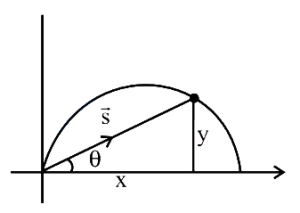
$A$ bullet is fired at time $t=0$ with velocity $20 \ m/s$ and at an initial angle of $30^{\circ}$ with the horizontal. The angle between the displacement vector and the horizontal after time $0.1 \ s$ is (Assume $g=10 \ m/s^2$)
A
$\frac{38}{20 \sqrt{3}}$
B
$\frac{19}{20 \sqrt{3}}$
C
$\frac{19}{20}$
D
$\frac{19 \sqrt{3}}{20}$
Solution
(B) The horizontal component of velocity is $u_x = u \cos \theta = 20 \cos 30^{\circ} = 20 \times \frac{\sqrt{3}}{2} = 10\sqrt{3} \ m/s$.
The vertical component of velocity is $u_y = u \sin \theta = 20 \sin 30^{\circ} = 20 \times \frac{1}{2} = 10 \ m/s$.
After time $t = 0.1 \ s$,the horizontal displacement is $x = u_x t = 10\sqrt{3} \times 0.1 = \sqrt{3} \ m$.
The vertical displacement is $y = u_y t - \frac{1}{2}gt^2 = 10 \times 0.1 - \frac{1}{2} \times 10 \times (0.1)^2 = 1 - 0.05 = 0.95 \ m = \frac{19}{20} \ m$.
The angle $\theta$ between the displacement vector and the horizontal is given by $\tan \theta = \frac{y}{x}$.
Substituting the values,$\tan \theta = \frac{19/20}{\sqrt{3}} = \frac{19}{20\sqrt{3}}$.
Thus,$\theta = \tan^{-1}\left(\frac{19}{20\sqrt{3}}\right)$. The question asks for the value of $\tan \theta$ (implied by options). Therefore,the correct value is $\frac{19}{20\sqrt{3}}$.
The vertical component of velocity is $u_y = u \sin \theta = 20 \sin 30^{\circ} = 20 \times \frac{1}{2} = 10 \ m/s$.
After time $t = 0.1 \ s$,the horizontal displacement is $x = u_x t = 10\sqrt{3} \times 0.1 = \sqrt{3} \ m$.
The vertical displacement is $y = u_y t - \frac{1}{2}gt^2 = 10 \times 0.1 - \frac{1}{2} \times 10 \times (0.1)^2 = 1 - 0.05 = 0.95 \ m = \frac{19}{20} \ m$.
The angle $\theta$ between the displacement vector and the horizontal is given by $\tan \theta = \frac{y}{x}$.
Substituting the values,$\tan \theta = \frac{19/20}{\sqrt{3}} = \frac{19}{20\sqrt{3}}$.
Thus,$\theta = \tan^{-1}\left(\frac{19}{20\sqrt{3}}\right)$. The question asks for the value of $\tan \theta$ (implied by options). Therefore,the correct value is $\frac{19}{20\sqrt{3}}$.
0 likes
View Solution438
MediumMCQ
For a projectile,if $\alpha$ is the angle of projection,$R$ is the range,$h$ is the maximum height,and $T$ is the time of flight,then:
A
$\tan \alpha=\frac{R}{2 h}, h=\frac{g T^2}{8}$
B
$\tan \alpha=\frac{R}{4 h}, h=\frac{g T^2}{8}$
C
$\tan \alpha=\frac{4 h}{R}, h=\frac{g T^2}{8}$
D
$\tan \alpha=\frac{4 h}{R}, h=\frac{g T^2}{4}$
Solution
(C) The maximum height $h$ is given by $h = \frac{u^2 \sin^2 \alpha}{2g}$.
The range $R$ is given by $R = \frac{u^2 \sin 2\alpha}{g} = \frac{2 u^2 \sin \alpha \cos \alpha}{g}$.
Dividing $h$ by $R$:
$\frac{h}{R} = \frac{u^2 \sin^2 \alpha}{2g} \cdot \frac{g}{2 u^2 \sin \alpha \cos \alpha} = \frac{\tan \alpha}{4}$.
Therefore,$\tan \alpha = \frac{4h}{R}$.
The time of flight $T$ is given by $T = \frac{2u \sin \alpha}{g}$.
Squaring both sides,$T^2 = \frac{4u^2 \sin^2 \alpha}{g^2}$.
Thus,$\frac{g T^2}{8} = \frac{g}{8} \cdot \frac{4u^2 \sin^2 \alpha}{g^2} = \frac{u^2 \sin^2 \alpha}{2g} = h$.
So,$h = \frac{g T^2}{8}$.
The range $R$ is given by $R = \frac{u^2 \sin 2\alpha}{g} = \frac{2 u^2 \sin \alpha \cos \alpha}{g}$.
Dividing $h$ by $R$:
$\frac{h}{R} = \frac{u^2 \sin^2 \alpha}{2g} \cdot \frac{g}{2 u^2 \sin \alpha \cos \alpha} = \frac{\tan \alpha}{4}$.
Therefore,$\tan \alpha = \frac{4h}{R}$.
The time of flight $T$ is given by $T = \frac{2u \sin \alpha}{g}$.
Squaring both sides,$T^2 = \frac{4u^2 \sin^2 \alpha}{g^2}$.
Thus,$\frac{g T^2}{8} = \frac{g}{8} \cdot \frac{4u^2 \sin^2 \alpha}{g^2} = \frac{u^2 \sin^2 \alpha}{2g} = h$.
So,$h = \frac{g T^2}{8}$.
0 likes
View Solution439
EasyMCQ
$A$ projectile is thrown at a speed which is twice its speed at its maximum height. If $R$ and $H$ are its range and maximum height respectively,then the ratio $\frac{R}{H}$ is
A
$\frac{4}{\sqrt{3}}$
B
$\frac{\sqrt{3}}{8}$
C
$2$
D
$2 \sqrt{3}$
Solution
(A) Let the initial speed be $u$ and the angle of projection be $\theta$. The speed at the maximum height is $u \cos \theta$.
According to the problem,the initial speed is twice the speed at the maximum height:
$u = 2(u \cos \theta)$
$\Rightarrow \cos \theta = \frac{1}{2}$
$\Rightarrow \theta = 60^{\circ}$.
The range $R$ is given by $R = \frac{u^2 \sin(2\theta)}{g}$ and the maximum height $H$ is given by $H = \frac{u^2 \sin^2 \theta}{2g}$.
The ratio $\frac{R}{H}$ is:
$\frac{R}{H} = \frac{u^2 \sin(2\theta) / g}{u^2 \sin^2 \theta / (2g)} = \frac{2 \sin(2\theta)}{\sin^2 \theta} = \frac{4 \sin \theta \cos \theta}{\sin^2 \theta} = 4 \cot \theta$.
Substituting $\theta = 60^{\circ}$:
$\frac{R}{H} = 4 \cot(60^{\circ}) = 4 \times \frac{1}{\sqrt{3}} = \frac{4}{\sqrt{3}}$.
According to the problem,the initial speed is twice the speed at the maximum height:
$u = 2(u \cos \theta)$
$\Rightarrow \cos \theta = \frac{1}{2}$
$\Rightarrow \theta = 60^{\circ}$.
The range $R$ is given by $R = \frac{u^2 \sin(2\theta)}{g}$ and the maximum height $H$ is given by $H = \frac{u^2 \sin^2 \theta}{2g}$.
The ratio $\frac{R}{H}$ is:
$\frac{R}{H} = \frac{u^2 \sin(2\theta) / g}{u^2 \sin^2 \theta / (2g)} = \frac{2 \sin(2\theta)}{\sin^2 \theta} = \frac{4 \sin \theta \cos \theta}{\sin^2 \theta} = 4 \cot \theta$.
Substituting $\theta = 60^{\circ}$:
$\frac{R}{H} = 4 \cot(60^{\circ}) = 4 \times \frac{1}{\sqrt{3}} = \frac{4}{\sqrt{3}}$.
0 likes
View Solution440
MediumMCQ
$A$ projectile object is thrown in the upward direction making an angle of $60^{\circ}$ with the horizontal with velocity of $140 \ m/s$. Then,the time after which its velocity makes an angle $30^{\circ}$ with the horizontal is (Take,$g=10 \ m/s^2$)
A
$\frac{14}{\sqrt{3}} \ s$
B
$7 \sqrt{3} \ s$
C
$14 \sqrt{3} \ s$
D
$\frac{7}{\sqrt{3}} \ s$
Solution
(A) The horizontal component of velocity remains constant throughout the projectile motion. Let the initial velocity be $v_0 = 140 \ m/s$ at angle $\theta_0 = 60^{\circ}$. Let the velocity at time $t$ be $v$ at angle $\theta = 30^{\circ}$.
Horizontal component: $v_x = v_0 \cos 60^{\circ} = v \cos 30^{\circ}$.
$140 \times \frac{1}{2} = v \times \frac{\sqrt{3}}{2} \implies v = \frac{140}{\sqrt{3}} \ m/s$.
Vertical component at time $t$: $v_y = v_0 \sin 60^{\circ} - gt = v \sin 30^{\circ}$.
$140 \times \frac{\sqrt{3}}{2} - 10t = \frac{140}{\sqrt{3}} \times \frac{1}{2}$.
$70\sqrt{3} - 10t = \frac{70}{\sqrt{3}}$.
$10t = 70\sqrt{3} - \frac{70}{\sqrt{3}} = 70 \left( \frac{3-1}{\sqrt{3}} \right) = \frac{140}{\sqrt{3}}$.
$t = \frac{14}{\sqrt{3}} \ s$.
Horizontal component: $v_x = v_0 \cos 60^{\circ} = v \cos 30^{\circ}$.
$140 \times \frac{1}{2} = v \times \frac{\sqrt{3}}{2} \implies v = \frac{140}{\sqrt{3}} \ m/s$.
Vertical component at time $t$: $v_y = v_0 \sin 60^{\circ} - gt = v \sin 30^{\circ}$.
$140 \times \frac{\sqrt{3}}{2} - 10t = \frac{140}{\sqrt{3}} \times \frac{1}{2}$.
$70\sqrt{3} - 10t = \frac{70}{\sqrt{3}}$.
$10t = 70\sqrt{3} - \frac{70}{\sqrt{3}} = 70 \left( \frac{3-1}{\sqrt{3}} \right) = \frac{140}{\sqrt{3}}$.
$t = \frac{14}{\sqrt{3}} \ s$.
0 likes
View Solution441
EasyMCQ
$A$ projectile is fired at an angle of $45^{\circ}$ with the horizontal. The elevation angle of the projectile at its highest point as seen from the point of projection is:
A
$60^{\circ}$
B
$\tan ^{-1}\left(\frac{1}{2}\right)$
C
$\tan ^{-1}\left(\frac{\sqrt{3}}{2}\right)$
D
$45^{\circ}$
Solution
(B) Let the angle of projection be $\theta = 45^{\circ}$.
At the highest point $P$,the height is $H = \frac{u^2 \sin^2 \theta}{2g}$ and the horizontal distance from the point of projection $O$ is $R/2 = \frac{u^2 \sin \theta \cos \theta}{g}$.
The elevation angle $\alpha$ is the angle subtended by the highest point $P$ at the point of projection $O$ with the horizontal.
In the right-angled triangle $\triangle POM$,we have:
$\tan \alpha = \frac{H}{R/2} = \frac{\frac{u^2 \sin^2 \theta}{2g}}{\frac{u^2 \sin \theta \cos \theta}{g}} = \frac{\sin \theta}{2 \cos \theta} = \frac{1}{2} \tan \theta$.
Substituting $\theta = 45^{\circ}$:
$\tan \alpha = \frac{1}{2} \tan 45^{\circ} = \frac{1}{2} (1) = \frac{1}{2}$.
Therefore,$\alpha = \tan^{-1}\left(\frac{1}{2}\right)$.
At the highest point $P$,the height is $H = \frac{u^2 \sin^2 \theta}{2g}$ and the horizontal distance from the point of projection $O$ is $R/2 = \frac{u^2 \sin \theta \cos \theta}{g}$.
The elevation angle $\alpha$ is the angle subtended by the highest point $P$ at the point of projection $O$ with the horizontal.
In the right-angled triangle $\triangle POM$,we have:
$\tan \alpha = \frac{H}{R/2} = \frac{\frac{u^2 \sin^2 \theta}{2g}}{\frac{u^2 \sin \theta \cos \theta}{g}} = \frac{\sin \theta}{2 \cos \theta} = \frac{1}{2} \tan \theta$.
Substituting $\theta = 45^{\circ}$:
$\tan \alpha = \frac{1}{2} \tan 45^{\circ} = \frac{1}{2} (1) = \frac{1}{2}$.
Therefore,$\alpha = \tan^{-1}\left(\frac{1}{2}\right)$.
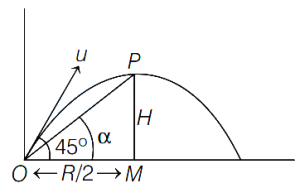
0 likes
View Solution442
DifficultMCQ
$A$ particle aimed at a target,projected with an angle $15^{\circ}$ with the horizontal is short of the target by $10 \ m$. If projected with an angle of $45^{\circ}$ it is away from the target by $10 \ m$,then the angle of projection to hit the target is
A
$\frac{1}{2} \sin ^{-1}\left(\frac{1}{4}\right)$
B
$\frac{1}{2} \sin ^{-1}\left(\frac{3}{4}\right)$
C
$\frac{1}{2} \sin ^{-1}\left(\frac{10}{4}\right)$
D
$\frac{1}{2} \sin ^{-1}\left(\frac{20}{4}\right)$
Solution
(B) Let $d$ be the distance of the target.
The horizontal range of a projectile is given by $R = \frac{u^2 \sin 2\theta}{g}$.
For $\theta = 15^{\circ}$,the range is $R_1 = \frac{u^2 \sin(30^{\circ})}{g} = \frac{u^2}{2g}$.
Given that it falls short by $10 \ m$,we have $R_1 = d - 10$,so $\frac{u^2}{2g} = d - 10$ (Equation $i$).
For $\theta = 45^{\circ}$,the range is $R_2 = \frac{u^2 \sin(90^{\circ})}{g} = \frac{u^2}{g}$.
Given that it is away (beyond) by $10 \ m$,we have $R_2 = d + 10$,so $\frac{u^2}{g} = d + 10$ (Equation $ii$).
Dividing Equation $i$ by Equation $ii$,we get $\frac{1}{2} = \frac{d - 10}{d + 10}$.
Solving for $d$,$d + 10 = 2d - 20$,which gives $d = 30 \ m$.
Substituting $d = 30$ into Equation $ii$,we get $\frac{u^2}{g} = 30 + 10 = 40$.
To hit the target at $d = 30 \ m$,we set $R = 30 = \frac{u^2 \sin 2\theta}{g} = 40 \sin 2\theta$.
Thus,$\sin 2\theta = \frac{30}{40} = \frac{3}{4}$,which implies $\theta = \frac{1}{2} \sin^{-1}\left(\frac{3}{4}\right)$.
The horizontal range of a projectile is given by $R = \frac{u^2 \sin 2\theta}{g}$.
For $\theta = 15^{\circ}$,the range is $R_1 = \frac{u^2 \sin(30^{\circ})}{g} = \frac{u^2}{2g}$.
Given that it falls short by $10 \ m$,we have $R_1 = d - 10$,so $\frac{u^2}{2g} = d - 10$ (Equation $i$).
For $\theta = 45^{\circ}$,the range is $R_2 = \frac{u^2 \sin(90^{\circ})}{g} = \frac{u^2}{g}$.
Given that it is away (beyond) by $10 \ m$,we have $R_2 = d + 10$,so $\frac{u^2}{g} = d + 10$ (Equation $ii$).
Dividing Equation $i$ by Equation $ii$,we get $\frac{1}{2} = \frac{d - 10}{d + 10}$.
Solving for $d$,$d + 10 = 2d - 20$,which gives $d = 30 \ m$.
Substituting $d = 30$ into Equation $ii$,we get $\frac{u^2}{g} = 30 + 10 = 40$.
To hit the target at $d = 30 \ m$,we set $R = 30 = \frac{u^2 \sin 2\theta}{g} = 40 \sin 2\theta$.
Thus,$\sin 2\theta = \frac{30}{40} = \frac{3}{4}$,which implies $\theta = \frac{1}{2} \sin^{-1}\left(\frac{3}{4}\right)$.
0 likes
View Solution443
DifficultMCQ
$A$ ball is projected with a velocity $5 \text{ m/s}$, such that its horizontal range is twice the greatest height attained. The value of the range is (in $\text{ m}$)
A
$10$
B
$2$
C
$4$
D
$5$
Solution
(B) Given, initial velocity $u = 5 \text{ m/s}$.
Horizontal range $R$ is twice the maximum height $H$, i.e., $R = 2H$.
We know that $R = \frac{u^2 \sin 2\theta}{g}$ and $H = \frac{u^2 \sin^2 \theta}{2g}$.
Substituting these into the given condition:
$\frac{u^2 \sin 2\theta}{g} = 2 \left( \frac{u^2 \sin^2 \theta}{2g} \right)$
$\frac{u^2 (2 \sin \theta \cos \theta)}{g} = \frac{u^2 \sin^2 \theta}{g}$
$2 \sin \theta \cos \theta = \sin^2 \theta$
$2 \cos \theta = \sin \theta \Rightarrow \tan \theta = 2$.
For $\tan \theta = 2$, we have a right-angled triangle with perpendicular $= 2$ and base $= 1$. The hypotenuse is $\sqrt{2^2 + 1^2} = \sqrt{5}$.
Thus, $\sin \theta = \frac{2}{\sqrt{5}}$ and $\cos \theta = \frac{1}{\sqrt{5}}$.
Now, calculate the range $R$:
$R = \frac{u^2 (2 \sin \theta \cos \theta)}{g} = \frac{5^2 \times 2 \times (\frac{2}{\sqrt{5}}) \times (\frac{1}{\sqrt{5}})}{10}$
$R = \frac{25 \times 2 \times 2}{10 \times 5} = \frac{100}{50} = 2 \text{ m}$.
Therefore, the correct option is $B$.
Horizontal range $R$ is twice the maximum height $H$, i.e., $R = 2H$.
We know that $R = \frac{u^2 \sin 2\theta}{g}$ and $H = \frac{u^2 \sin^2 \theta}{2g}$.
Substituting these into the given condition:
$\frac{u^2 \sin 2\theta}{g} = 2 \left( \frac{u^2 \sin^2 \theta}{2g} \right)$
$\frac{u^2 (2 \sin \theta \cos \theta)}{g} = \frac{u^2 \sin^2 \theta}{g}$
$2 \sin \theta \cos \theta = \sin^2 \theta$
$2 \cos \theta = \sin \theta \Rightarrow \tan \theta = 2$.
For $\tan \theta = 2$, we have a right-angled triangle with perpendicular $= 2$ and base $= 1$. The hypotenuse is $\sqrt{2^2 + 1^2} = \sqrt{5}$.
Thus, $\sin \theta = \frac{2}{\sqrt{5}}$ and $\cos \theta = \frac{1}{\sqrt{5}}$.
Now, calculate the range $R$:
$R = \frac{u^2 (2 \sin \theta \cos \theta)}{g} = \frac{5^2 \times 2 \times (\frac{2}{\sqrt{5}}) \times (\frac{1}{\sqrt{5}})}{10}$
$R = \frac{25 \times 2 \times 2}{10 \times 5} = \frac{100}{50} = 2 \text{ m}$.
Therefore, the correct option is $B$.
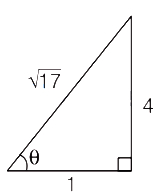
0 likes
View Solution444
MediumMCQ
$A$ boy standing on a moving truck throws a projectile such that he is able to catch it back after the truck has moved $100 \,m$. If the truck is moving horizontally along a straight line with a constant speed $30 \,m/s$, at what speed (relative to the truck) must the projectile be thrown? (Assume $g = 10 \,m/s^2$)
A
$\frac{55}{3} \,m/s$
B
$\frac{43}{2} \,m/s$
C
$\frac{50}{3} \,m/s$
D
$\frac{23}{2} \,m/s$
Solution
(C) The velocity of the truck is $v = 30 \,m/s$. The time taken by the truck to travel a distance of $100 \,m$ is given by $t = \frac{d}{v} = \frac{100}{30} = \frac{10}{3} \,s$.
Since the boy catches the projectile after this time, the total time of flight of the projectile is $T = \frac{10}{3} \,s$.
For a projectile thrown vertically relative to the truck, the time of flight is given by $T = \frac{2u_y}{g}$, where $u_y$ is the vertical component of the velocity.
Substituting the values: $\frac{10}{3} = \frac{2u_y}{10}$.
Solving for $u_y$: $u_y = \frac{10 \times 10}{3 \times 2} = \frac{100}{6} = \frac{50}{3} \,m/s$.
Since the projectile is thrown relative to the truck, the horizontal component of velocity relative to the truck is $0$. Thus, the speed relative to the truck is simply $u_y = \frac{50}{3} \,m/s$.
Since the boy catches the projectile after this time, the total time of flight of the projectile is $T = \frac{10}{3} \,s$.
For a projectile thrown vertically relative to the truck, the time of flight is given by $T = \frac{2u_y}{g}$, where $u_y$ is the vertical component of the velocity.
Substituting the values: $\frac{10}{3} = \frac{2u_y}{10}$.
Solving for $u_y$: $u_y = \frac{10 \times 10}{3 \times 2} = \frac{100}{6} = \frac{50}{3} \,m/s$.
Since the projectile is thrown relative to the truck, the horizontal component of velocity relative to the truck is $0$. Thus, the speed relative to the truck is simply $u_y = \frac{50}{3} \,m/s$.
0 likes
View Solution445
MediumMCQ
$A$ small object is thrown at an angle $45^{\circ}$ to the horizontal with an initial velocity $v_0$. The velocity is averaged for the first $\sqrt{2} \,s$ and the magnitude of the average velocity comes out to be the same as that of the initial velocity,i.e.,$|v_0|$. The magnitude $|v_0|$ will be (take $g=10 \,m/s^2$):
A
$3 \,m/s$
B
$3\sqrt{2} \,m/s$
C
$4 \,m/s$
D
$5 \,m/s$
Solution
(D) Let the object be at point $B(x, y)$ after time $t = \sqrt{2} \,s$.
The horizontal displacement is $x = u_x \times t = (v_0 \cos 45^{\circ}) \times \sqrt{2} = v_0 \times \frac{1}{\sqrt{2}} \times \sqrt{2} = v_0$.
The vertical displacement is $y = u_y t - \frac{1}{2} g t^2 = (v_0 \sin 45^{\circ}) \sqrt{2} - \frac{1}{2} (10) (\sqrt{2})^2 = v_0 - 10$.
The displacement vector $\vec{OB}$ has magnitude $OB = \sqrt{x^2 + y^2} = \sqrt{v_0^2 + (v_0 - 10)^2}$.
The average velocity magnitude is given by $v_{\text{avg}} = \frac{OB}{t} = |v_0|$.
Thus,$OB = |v_0| t = v_0 \sqrt{2}$.
Squaring both sides: $v_0^2 + (v_0 - 10)^2 = (v_0 \sqrt{2})^2$.
$v_0^2 + v_0^2 - 20v_0 + 100 = 2v_0^2$.
$2v_0^2 - 20v_0 + 100 = 2v_0^2$.
$20v_0 = 100$,which gives $v_0 = 5 \,m/s$.
The horizontal displacement is $x = u_x \times t = (v_0 \cos 45^{\circ}) \times \sqrt{2} = v_0 \times \frac{1}{\sqrt{2}} \times \sqrt{2} = v_0$.
The vertical displacement is $y = u_y t - \frac{1}{2} g t^2 = (v_0 \sin 45^{\circ}) \sqrt{2} - \frac{1}{2} (10) (\sqrt{2})^2 = v_0 - 10$.
The displacement vector $\vec{OB}$ has magnitude $OB = \sqrt{x^2 + y^2} = \sqrt{v_0^2 + (v_0 - 10)^2}$.
The average velocity magnitude is given by $v_{\text{avg}} = \frac{OB}{t} = |v_0|$.
Thus,$OB = |v_0| t = v_0 \sqrt{2}$.
Squaring both sides: $v_0^2 + (v_0 - 10)^2 = (v_0 \sqrt{2})^2$.
$v_0^2 + v_0^2 - 20v_0 + 100 = 2v_0^2$.
$2v_0^2 - 20v_0 + 100 = 2v_0^2$.
$20v_0 = 100$,which gives $v_0 = 5 \,m/s$.
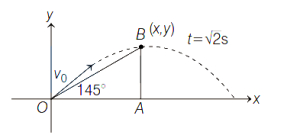
0 likes
View Solution446
EasyMCQ
$A$ cricket player can throw a ball with an initial speed of $30 \,m/s$. What is the maximum range the player can throw the ball? Neglect air resistance. [Take $g = 10 \,m/s^2$]
A
$100 \,m$
B
$90 \,m$
C
$80 \,m$
D
$90\sqrt{2} \,m$
Solution
(B) The maximum range of a projectile is achieved when the angle of projection is $\theta = 45^{\circ}$.
The formula for the range $R$ is given by $R = \frac{u^2 \sin(2\theta)}{g}$.
For maximum range, $\sin(2\theta) = \sin(90^{\circ}) = 1$.
Thus, $R_{max} = \frac{u^2}{g}$.
Given $u = 30 \,m/s$ and $g = 10 \,m/s^2$, we have:
$R_{max} = \frac{(30)^2}{10} = \frac{900}{10} = 90 \,m$.
The formula for the range $R$ is given by $R = \frac{u^2 \sin(2\theta)}{g}$.
For maximum range, $\sin(2\theta) = \sin(90^{\circ}) = 1$.
Thus, $R_{max} = \frac{u^2}{g}$.
Given $u = 30 \,m/s$ and $g = 10 \,m/s^2$, we have:
$R_{max} = \frac{(30)^2}{10} = \frac{900}{10} = 90 \,m$.
0 likes
View Solution447
EasyMCQ
$A$ $1.5 \,kg$ ball is shot upward at an angle of $34^{\circ}$ to the horizontal with an initial speed of $20 \,m/s$. The maximum height reached by the ball is (use $\cos 34^{\circ} = 0.83$ and $\sin 34^{\circ} = 0.56$): (in $\,m$)
A
$6.3$
B
$9.4$
C
$13.8$
D
$11.2$
Solution
(A) Given: Initial speed $u = 20 \,m/s$, angle of projection $\theta = 34^{\circ}$, and acceleration due to gravity $g = 9.8 \,m/s^2$.
The formula for the maximum height $H$ of a projectile is given by $H = \frac{u^2 \sin^2 \theta}{2g}$.
Substituting the given values:
$H = \frac{(20)^2 \times (\sin 34^{\circ})^2}{2 \times 9.8}$
$H = \frac{400 \times (0.56)^2}{19.6}$
$H = \frac{400 \times 0.3136}{19.6}$
$H = \frac{125.44}{19.6} = 6.4 \,m$.
Rounding to the nearest provided option, the correct answer is $6.3 \,m$.
The formula for the maximum height $H$ of a projectile is given by $H = \frac{u^2 \sin^2 \theta}{2g}$.
Substituting the given values:
$H = \frac{(20)^2 \times (\sin 34^{\circ})^2}{2 \times 9.8}$
$H = \frac{400 \times (0.56)^2}{19.6}$
$H = \frac{400 \times 0.3136}{19.6}$
$H = \frac{125.44}{19.6} = 6.4 \,m$.
Rounding to the nearest provided option, the correct answer is $6.3 \,m$.
0 likes
View Solution448
EasyMCQ
$A$ small ball is thrown at an angle $45^{\circ}$ to the horizontal with an initial velocity of $2 \sqrt{2} \ m/s$. The magnitude of the mean velocity averaged over the first $2 \ s$ is (take acceleration due to gravity $g = 10 \ m/s^2$). (in $m/s$)
A
$7.0$
B
$8.2$
C
$7.8$
D
$9.0$
Solution
(B) Initial velocity $u = 2\sqrt{2} \ m/s$ at angle $\theta = 45^{\circ}$.
Horizontal component $u_x = u \cos 45^{\circ} = 2\sqrt{2} \times \frac{1}{\sqrt{2}} = 2 \ m/s$.
Vertical component $u_y = u \sin 45^{\circ} = 2\sqrt{2} \times \frac{1}{\sqrt{2}} = 2 \ m/s$.
Horizontal displacement in $t = 2 \ s$ is $x = u_x \times t = 2 \times 2 = 4 \ m$.
Vertical displacement in $t = 2 \ s$ is $y = u_y t - \frac{1}{2}gt^2 = 2(2) - \frac{1}{2}(10)(2^2) = 4 - 20 = -16 \ m$.
Total displacement $S = \sqrt{x^2 + y^2} = \sqrt{4^2 + (-16)^2} = \sqrt{16 + 256} = \sqrt{272} \approx 16.49 \ m$.
Mean velocity $v_{avg} = \frac{S}{t} = \frac{16.49}{2} = 8.245 \ m/s \approx 8.2 \ m/s$.
Horizontal component $u_x = u \cos 45^{\circ} = 2\sqrt{2} \times \frac{1}{\sqrt{2}} = 2 \ m/s$.
Vertical component $u_y = u \sin 45^{\circ} = 2\sqrt{2} \times \frac{1}{\sqrt{2}} = 2 \ m/s$.
Horizontal displacement in $t = 2 \ s$ is $x = u_x \times t = 2 \times 2 = 4 \ m$.
Vertical displacement in $t = 2 \ s$ is $y = u_y t - \frac{1}{2}gt^2 = 2(2) - \frac{1}{2}(10)(2^2) = 4 - 20 = -16 \ m$.
Total displacement $S = \sqrt{x^2 + y^2} = \sqrt{4^2 + (-16)^2} = \sqrt{16 + 256} = \sqrt{272} \approx 16.49 \ m$.
Mean velocity $v_{avg} = \frac{S}{t} = \frac{16.49}{2} = 8.245 \ m/s \approx 8.2 \ m/s$.
0 likes
View Solution3-2.Motion in Plane — Horizontal Projectile Motion · Frequently Asked Questions
1Are these 3-2.Motion in Plane questions useful for JEE and NEET?
Yes. All questions in this section are mapped to JEE Main and NEET exam patterns. Previous year questions from JEE Main, NEET, GUJCET and state-level exams are included with full solutions.
2Can I switch to Hindi or Gujarati for these questions?
Yes. Use the language tabs in the hero section or the sidebar to view the same questions and solutions in English, Hindi or Gujarati.
3How do I generate a question paper from this subtopic?
Use the Vedclass Exam Paper Generator — select the chapter and subtopic, set difficulty, and generate Sets A, B, C, D automatically. First 3 chapters of every subject are free.
Vedclass Products
For Students
Vedclass Test Series
Mock tests in real JEE/NEET style with performance analysis. 5-day free trial.
Start Free TrialFor Teachers
Exam Paper Generator
Generate Set A/B/C/D papers from this chapter in 2 minutes. 3 chapters free.
Try FreeFor Institutes
Online Exam Module
Live online exams with unlimited students, 360° analytics & white-label branding.
See DemoFor Teachers & Institutes
Generate a 3-2.Motion in Plane Exam Paper in 2 Minutes
Select subtopic & difficulty — Sets A, B, C, D auto-generated with No Repeat logic.
First 3 chapters of every subject are free — no payment required.