
A English
Horizontal Projectile Motion Questions in English
Class 11 Physics · 3-2.Motion in Plane · Horizontal Projectile Motion
492+
Questions
English
Language
100%
With Solutions
Showing 31 of 492 questions in English
451
EasyMCQ
$A$ ball is thrown at a speed of $20 \,m/s$ at an angle of $30^{\circ}$ with the horizontal. The maximum height reached by the ball is (Use $g=10 \,m/s^2$) (in $\,m$)
A
$2$
B
$3$
C
$4$
D
$5$
Solution
(D) Given,
Initial speed of the ball $(u) = 20 \,m/s$
Angle of projection $(\theta) = 30^{\circ}$
Acceleration due to gravity $(g) = 10 \,m/s^2$
The formula for the maximum height $(H)$ reached by a projectile is given by:
$H = \frac{u^2 \sin^2 \theta}{2g}$
Substituting the given values into the formula:
$H = \frac{(20)^2 \times (\sin 30^{\circ})^2}{2 \times 10}$
$H = \frac{400 \times (1/2)^2}{20}$
$H = \frac{400 \times (1/4)}{20}$
$H = \frac{100}{20}$
$H = 5 \,m$
Therefore,the maximum height reached by the ball is $5 \,m$.
Initial speed of the ball $(u) = 20 \,m/s$
Angle of projection $(\theta) = 30^{\circ}$
Acceleration due to gravity $(g) = 10 \,m/s^2$
The formula for the maximum height $(H)$ reached by a projectile is given by:
$H = \frac{u^2 \sin^2 \theta}{2g}$
Substituting the given values into the formula:
$H = \frac{(20)^2 \times (\sin 30^{\circ})^2}{2 \times 10}$
$H = \frac{400 \times (1/2)^2}{20}$
$H = \frac{400 \times (1/4)}{20}$
$H = \frac{100}{20}$
$H = 5 \,m$
Therefore,the maximum height reached by the ball is $5 \,m$.
0 likes
View Solution452
MediumMCQ
$A$ particle is projected with velocity $2 \sqrt{gh}$ at an angle $60^{\circ}$ to the horizontal so that it just clears two walls of equal height $h$ which are at a distance $2h$ from each other. The time taken by the particle to travel between these two walls is
A
$2 \sqrt{\frac{2h}{g}}$
B
$\sqrt{\frac{h}{2g}}$
C
$2 \sqrt{\frac{h}{g}}$
D
$\sqrt{\frac{h}{g}}$
Solution
(C) The horizontal component of the velocity is $v_x = v \cos \theta = 2 \sqrt{gh} \cos 60^{\circ}$.
Since $\cos 60^{\circ} = \frac{1}{2}$,we have $v_x = 2 \sqrt{gh} \times \frac{1}{2} = \sqrt{gh}$.
The particle travels a horizontal distance $d = 2h$ between the two walls.
Since the horizontal component of velocity remains constant in projectile motion,the time $t$ taken to travel between the walls is given by $t = \frac{d}{v_x}$.
Substituting the values,$t = \frac{2h}{\sqrt{gh}} = 2 \sqrt{\frac{h}{g}}$.
Since $\cos 60^{\circ} = \frac{1}{2}$,we have $v_x = 2 \sqrt{gh} \times \frac{1}{2} = \sqrt{gh}$.
The particle travels a horizontal distance $d = 2h$ between the two walls.
Since the horizontal component of velocity remains constant in projectile motion,the time $t$ taken to travel between the walls is given by $t = \frac{d}{v_x}$.
Substituting the values,$t = \frac{2h}{\sqrt{gh}} = 2 \sqrt{\frac{h}{g}}$.
0 likes
View Solution453
EasyMCQ
$A$ body of mass $m$ thrown up vertically with velocity $v_1$ reaches a maximum height $h_1$ in $t_1$ seconds. Another body of mass $2m$ is projected with a velocity $v_2$ at an angle $\theta$. The second body reaches a maximum height $h_2$ in time $t_2$ seconds. If $t_1 = 2t_2$,then the ratio $\left(\frac{h_1}{h_2}\right)$ is
A
$1: 2$
B
$4: 1$
C
$1: 1$
D
$3: 2$
Solution
(B) For the first body thrown vertically upwards with velocity $v_1$,the time taken to reach maximum height is $t_1 = \frac{v_1}{g}$ and the maximum height is $h_1 = \frac{v_1^2}{2g}$.
For the second body projected with velocity $v_2$ at an angle $\theta$,the time taken to reach maximum height is $t_2 = \frac{v_2 \sin \theta}{g}$ and the maximum height is $h_2 = \frac{v_2^2 \sin^2 \theta}{2g}$.
Given $t_1 = 2t_2$,we have $\frac{v_1}{g} = 2 \left( \frac{v_2 \sin \theta}{g} \right)$,which simplifies to $v_1 = 2 v_2 \sin \theta$.
Now,the ratio of heights is $\frac{h_1}{h_2} = \frac{v_1^2 / 2g}{v_2^2 \sin^2 \theta / 2g} = \frac{v_1^2}{v_2^2 \sin^2 \theta}$.
Substituting $v_1 = 2 v_2 \sin \theta$,we get $\frac{h_1}{h_2} = \frac{(2 v_2 \sin \theta)^2}{v_2^2 \sin^2 \theta} = \frac{4 v_2^2 \sin^2 \theta}{v_2^2 \sin^2 \theta} = 4$.
Thus,the ratio is $4:1$.
For the second body projected with velocity $v_2$ at an angle $\theta$,the time taken to reach maximum height is $t_2 = \frac{v_2 \sin \theta}{g}$ and the maximum height is $h_2 = \frac{v_2^2 \sin^2 \theta}{2g}$.
Given $t_1 = 2t_2$,we have $\frac{v_1}{g} = 2 \left( \frac{v_2 \sin \theta}{g} \right)$,which simplifies to $v_1 = 2 v_2 \sin \theta$.
Now,the ratio of heights is $\frac{h_1}{h_2} = \frac{v_1^2 / 2g}{v_2^2 \sin^2 \theta / 2g} = \frac{v_1^2}{v_2^2 \sin^2 \theta}$.
Substituting $v_1 = 2 v_2 \sin \theta$,we get $\frac{h_1}{h_2} = \frac{(2 v_2 \sin \theta)^2}{v_2^2 \sin^2 \theta} = \frac{4 v_2^2 \sin^2 \theta}{v_2^2 \sin^2 \theta} = 4$.
Thus,the ratio is $4:1$.
0 likes
View Solution454
DifficultMCQ
The path of a projectile is given by the equation $y = ax - bx^2$,where $a$ and $b$ are constants,and $x$ and $y$ are the horizontal and vertical distances of the projectile from the point of projection,respectively. The maximum height attained by the projectile and the angle of projection are respectively:
A
$\frac{2a^2}{b}, \tan^{-1}(a)$
B
$\frac{b^2}{2a}, \tan^{-1}(b)$
C
$\frac{a^2}{b}, \tan^{-1}(2b)$
D
$\frac{a^2}{4b}, \tan^{-1}(a)$
Solution
(D) The given equation of the trajectory is $y = ax - bx^2$.
The standard equation of a projectile trajectory is $y = x \tan \theta - \frac{gx^2}{2u^2 \cos^2 \theta}$.
Comparing the coefficients of $x$ and $x^2$ in both equations:
$\tan \theta = a \implies \theta = \tan^{-1}(a)$.
Also,$b = \frac{g}{2u^2 \cos^2 \theta}$.
The maximum height $H$ is given by $H = \frac{u^2 \sin^2 \theta}{2g}$.
From $\tan \theta = a$,we have $\sin \theta = \frac{a}{\sqrt{1+a^2}}$ and $\cos \theta = \frac{1}{\sqrt{1+a^2}}$.
Substituting $u^2 = \frac{g}{2b \cos^2 \theta}$ into the height formula:
$H = \frac{g}{2b \cos^2 \theta} \cdot \frac{\sin^2 \theta}{2g} = \frac{\tan^2 \theta}{4b} = \frac{a^2}{4b}$.
Thus,the maximum height is $\frac{a^2}{4b}$ and the angle of projection is $\tan^{-1}(a)$.
The standard equation of a projectile trajectory is $y = x \tan \theta - \frac{gx^2}{2u^2 \cos^2 \theta}$.
Comparing the coefficients of $x$ and $x^2$ in both equations:
$\tan \theta = a \implies \theta = \tan^{-1}(a)$.
Also,$b = \frac{g}{2u^2 \cos^2 \theta}$.
The maximum height $H$ is given by $H = \frac{u^2 \sin^2 \theta}{2g}$.
From $\tan \theta = a$,we have $\sin \theta = \frac{a}{\sqrt{1+a^2}}$ and $\cos \theta = \frac{1}{\sqrt{1+a^2}}$.
Substituting $u^2 = \frac{g}{2b \cos^2 \theta}$ into the height formula:
$H = \frac{g}{2b \cos^2 \theta} \cdot \frac{\sin^2 \theta}{2g} = \frac{\tan^2 \theta}{4b} = \frac{a^2}{4b}$.
Thus,the maximum height is $\frac{a^2}{4b}$ and the angle of projection is $\tan^{-1}(a)$.
0 likes
View Solution455
MediumMCQ
$A$ body is projected at an angle $\theta$ so that its range is maximum. If $T$ is the time of flight,then the value of maximum range is (acceleration due to gravity $= g$)
A
$\frac{g^2 T}{2}$
B
$\frac{g T}{2}$
C
$\frac{g T^2}{2}$
D
$\frac{g^2 T^2}{2}$
Solution
(C) The range of a projectile is given by $R = \frac{u^2 \sin 2\theta}{g}$.
For maximum range,the angle of projection must be $\theta = 45^{\circ}$.
Thus,$R_{\max} = \frac{u^2 \sin(90^{\circ})}{g} = \frac{u^2}{g} \quad \dots (i)$.
The time of flight $T$ is given by $T = \frac{2u \sin \theta}{g}$.
Substituting $\theta = 45^{\circ}$,we get $T = \frac{2u \sin 45^{\circ}}{g} = \frac{2u}{g \sqrt{2}} = \frac{u \sqrt{2}}{g}$.
From this,we find $u = \frac{Tg}{\sqrt{2}}$.
Substituting the value of $u$ into equation $(i)$:
$R_{\max} = \frac{1}{g} \left( \frac{Tg}{\sqrt{2}} \right)^2 = \frac{1}{g} \cdot \frac{T^2 g^2}{2} = \frac{g T^2}{2}$.
For maximum range,the angle of projection must be $\theta = 45^{\circ}$.
Thus,$R_{\max} = \frac{u^2 \sin(90^{\circ})}{g} = \frac{u^2}{g} \quad \dots (i)$.
The time of flight $T$ is given by $T = \frac{2u \sin \theta}{g}$.
Substituting $\theta = 45^{\circ}$,we get $T = \frac{2u \sin 45^{\circ}}{g} = \frac{2u}{g \sqrt{2}} = \frac{u \sqrt{2}}{g}$.
From this,we find $u = \frac{Tg}{\sqrt{2}}$.
Substituting the value of $u$ into equation $(i)$:
$R_{\max} = \frac{1}{g} \left( \frac{Tg}{\sqrt{2}} \right)^2 = \frac{1}{g} \cdot \frac{T^2 g^2}{2} = \frac{g T^2}{2}$.
0 likes
View Solution456
DifficultMCQ
$A$ particle is projected from the ground with an initial speed of $v$ at an angle of projection $\theta$. The average velocity of the particle between its time of projection and the time it reaches the highest point of its trajectory is
A
$\frac{v}{2} \sqrt{1+2 \cos ^2 \theta}$
B
$\frac{v}{2} \sqrt{1+2 \sin ^2 \theta}$
C
$\frac{v}{2} \sqrt{1+3 \cos ^2 \theta}$
D
$v \cos \theta$
Solution
(C) The average velocity is defined as the total displacement divided by the total time taken.
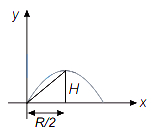
Let the particle be projected from the origin $(0,0)$. At the highest point,the coordinates are $(R/2, H)$,where $R$ is the horizontal range and $H$ is the maximum height.
Displacement vector $\vec{s} = \frac{R}{2} \hat{i} + H \hat{j}$.
The magnitude of displacement is $|\vec{s}| = \sqrt{(R/2)^2 + H^2}$.
The time taken to reach the highest point is $t = \frac{T}{2} = \frac{v \sin \theta}{g}$.
We know $R = \frac{v^2 \sin 2\theta}{g} = \frac{2v^2 \sin \theta \cos \theta}{g}$ and $H = \frac{v^2 \sin^2 \theta}{2g}$.
Thus,$R/2 = \frac{v^2 \sin \theta \cos \theta}{g}$.
$|\vec{s}| = \sqrt{\left(\frac{v^2 \sin \theta \cos \theta}{g}\right)^2 + \left(\frac{v^2 \sin^2 \theta}{2g}\right)^2} = \frac{v^2 \sin \theta}{g} \sqrt{\cos^2 \theta + \frac{\sin^2 \theta}{4}} = \frac{v^2 \sin \theta}{2g} \sqrt{4 \cos^2 \theta + \sin^2 \theta} = \frac{v^2 \sin \theta}{2g} \sqrt{3 \cos^2 \theta + 1}$.
Average velocity $v_{av} = \frac{|\vec{s}|}{t} = \frac{\frac{v^2 \sin \theta}{2g} \sqrt{3 \cos^2 \theta + 1}}{\frac{v \sin \theta}{g}} = \frac{v}{2} \sqrt{1+3 \cos^2 \theta}$.
Let the particle be projected from the origin $(0,0)$. At the highest point,the coordinates are $(R/2, H)$,where $R$ is the horizontal range and $H$ is the maximum height.
Displacement vector $\vec{s} = \frac{R}{2} \hat{i} + H \hat{j}$.
The magnitude of displacement is $|\vec{s}| = \sqrt{(R/2)^2 + H^2}$.
The time taken to reach the highest point is $t = \frac{T}{2} = \frac{v \sin \theta}{g}$.
We know $R = \frac{v^2 \sin 2\theta}{g} = \frac{2v^2 \sin \theta \cos \theta}{g}$ and $H = \frac{v^2 \sin^2 \theta}{2g}$.
Thus,$R/2 = \frac{v^2 \sin \theta \cos \theta}{g}$.
$|\vec{s}| = \sqrt{\left(\frac{v^2 \sin \theta \cos \theta}{g}\right)^2 + \left(\frac{v^2 \sin^2 \theta}{2g}\right)^2} = \frac{v^2 \sin \theta}{g} \sqrt{\cos^2 \theta + \frac{\sin^2 \theta}{4}} = \frac{v^2 \sin \theta}{2g} \sqrt{4 \cos^2 \theta + \sin^2 \theta} = \frac{v^2 \sin \theta}{2g} \sqrt{3 \cos^2 \theta + 1}$.
Average velocity $v_{av} = \frac{|\vec{s}|}{t} = \frac{\frac{v^2 \sin \theta}{2g} \sqrt{3 \cos^2 \theta + 1}}{\frac{v \sin \theta}{g}} = \frac{v}{2} \sqrt{1+3 \cos^2 \theta}$.
0 likes
View Solution457
EasyMCQ
It is possible to project a particle with a given velocity in two possible ways so as to make them pass through a point $P$ at a horizontal distance $r$ from the point of projection. If $t_1$ and $t_2$ are times taken to reach this point in two possible ways,then the product $t_1 t_2$ is proportional to
A
$1/r$
B
$r$
C
$r^2$
D
$1/r^2$
Solution
(B) The equation of trajectory for a projectile is given by $y = x \tan \theta - \frac{g x^2}{2 u^2 \cos^2 \theta}$.
Since the particle passes through point $(r, y)$,we have $y = r \tan \theta - \frac{g r^2}{2 u^2} (1 + \tan^2 \theta)$.
Rearranging this as a quadratic in $\tan \theta$: $\frac{g r^2}{2 u^2} \tan^2 \theta - r \tan \theta + (y + \frac{g r^2}{2 u^2}) = 0$.
Let the two angles of projection be $\theta_1$ and $\theta_2$. Then $\tan \theta_1 \tan \theta_2 = \frac{y + \frac{g r^2}{2 u^2}}{\frac{g r^2}{2 u^2}} = 1 + \frac{2 u^2 y}{g r^2}$.
The time taken to reach horizontal distance $r$ is $t = \frac{r}{u \cos \theta}$.
Thus,$t_1 t_2 = \frac{r^2}{u^2 \cos \theta_1 \cos \theta_2}$.
Using the property of projectile motion,$t_1 t_2 = \frac{2 r}{g \tan \alpha}$ where $\alpha$ is the angle of elevation of point $P$. For a fixed point $(r, y)$,$t_1 t_2 = \frac{2 r}{g \tan \theta_{elevation}} = \frac{2 r}{g (y/r)} = \frac{2 r^2}{g y}$.
However,in standard problems of this type where the point is at the same level $(y=0)$,$t_1 t_2 = \frac{2 r \tan \theta}{g} \dots$ actually,for a fixed point $(r, y)$,$t_1 t_2 = \frac{2 r}{g \tan \theta_{elevation}}$. If we consider the specific case where the point is at the same horizontal level as the projection point $(y=0)$,then $t_1 t_2 = \frac{2 r}{g \tan \theta}$. Given the options provided,the product $t_1 t_2$ is proportional to $r$.
Since the particle passes through point $(r, y)$,we have $y = r \tan \theta - \frac{g r^2}{2 u^2} (1 + \tan^2 \theta)$.
Rearranging this as a quadratic in $\tan \theta$: $\frac{g r^2}{2 u^2} \tan^2 \theta - r \tan \theta + (y + \frac{g r^2}{2 u^2}) = 0$.
Let the two angles of projection be $\theta_1$ and $\theta_2$. Then $\tan \theta_1 \tan \theta_2 = \frac{y + \frac{g r^2}{2 u^2}}{\frac{g r^2}{2 u^2}} = 1 + \frac{2 u^2 y}{g r^2}$.
The time taken to reach horizontal distance $r$ is $t = \frac{r}{u \cos \theta}$.
Thus,$t_1 t_2 = \frac{r^2}{u^2 \cos \theta_1 \cos \theta_2}$.
Using the property of projectile motion,$t_1 t_2 = \frac{2 r}{g \tan \alpha}$ where $\alpha$ is the angle of elevation of point $P$. For a fixed point $(r, y)$,$t_1 t_2 = \frac{2 r}{g \tan \theta_{elevation}} = \frac{2 r}{g (y/r)} = \frac{2 r^2}{g y}$.
However,in standard problems of this type where the point is at the same level $(y=0)$,$t_1 t_2 = \frac{2 r \tan \theta}{g} \dots$ actually,for a fixed point $(r, y)$,$t_1 t_2 = \frac{2 r}{g \tan \theta_{elevation}}$. If we consider the specific case where the point is at the same horizontal level as the projection point $(y=0)$,then $t_1 t_2 = \frac{2 r}{g \tan \theta}$. Given the options provided,the product $t_1 t_2$ is proportional to $r$.
0 likes
View Solution458
MediumMCQ
If a body is projected with an angle $\theta$ to the horizontal,then
A
its velocity is always perpendicular to its acceleration
B
its velocity becomes zero at its maximum height
C
its velocity makes zero angle with the horizontal at its maximum height
D
the body just before hitting the ground,the direction of velocity coincides with the acceleration
Solution
(C) The velocity of a projectile is always tangent to its path. At the maximum height,the vertical component of velocity becomes zero,while the horizontal component remains constant. Therefore,the velocity vector is purely horizontal at the maximum height,making an angle of $0^{\circ}$ with the horizontal.
0 likes
View Solution459
DifficultMCQ
$A$ body is projected from the earth at an angle of $30^{\circ}$ with the horizontal with some initial velocity. If its range is $20 \ m$,the maximum height reached by it is: (in meters)
A
$5 \sqrt{3}$
B
$\frac{5}{\sqrt{3}}$
C
$\frac{10}{\sqrt{3}}$
D
$10 \sqrt{3}$
Solution
(B) The formula for the range of a projectile is $R = \frac{u^2 \sin 2\theta}{g}$.
Given $R = 20 \ m$ and $\theta = 30^{\circ}$,we have $20 = \frac{u^2 \sin(2 \times 30^{\circ})}{g}$.
$\Rightarrow 20 = \frac{u^2 \sin 60^{\circ}}{g} = \frac{u^2}{g} \times \frac{\sqrt{3}}{2}$.
Therefore,$\frac{u^2}{g} = \frac{20 \times 2}{\sqrt{3}} = \frac{40}{\sqrt{3}}$.
The formula for maximum height is $H = \frac{u^2 \sin^2 \theta}{2g} = \frac{1}{2} \left(\frac{u^2}{g}\right) \sin^2 \theta$.
Substituting the values,$H = \frac{1}{2} \times \left(\frac{40}{\sqrt{3}}\right) \times \sin^2 30^{\circ}$.
$H = \frac{20}{\sqrt{3}} \times \left(\frac{1}{2}\right)^2 = \frac{20}{\sqrt{3}} \times \frac{1}{4} = \frac{5}{\sqrt{3}} \ m$.
Given $R = 20 \ m$ and $\theta = 30^{\circ}$,we have $20 = \frac{u^2 \sin(2 \times 30^{\circ})}{g}$.
$\Rightarrow 20 = \frac{u^2 \sin 60^{\circ}}{g} = \frac{u^2}{g} \times \frac{\sqrt{3}}{2}$.
Therefore,$\frac{u^2}{g} = \frac{20 \times 2}{\sqrt{3}} = \frac{40}{\sqrt{3}}$.
The formula for maximum height is $H = \frac{u^2 \sin^2 \theta}{2g} = \frac{1}{2} \left(\frac{u^2}{g}\right) \sin^2 \theta$.
Substituting the values,$H = \frac{1}{2} \times \left(\frac{40}{\sqrt{3}}\right) \times \sin^2 30^{\circ}$.
$H = \frac{20}{\sqrt{3}} \times \left(\frac{1}{2}\right)^2 = \frac{20}{\sqrt{3}} \times \frac{1}{4} = \frac{5}{\sqrt{3}} \ m$.
0 likes
View Solution460
DifficultMCQ
The equation of trajectory of a projectile is $y = 10x - (5/9)x^2$. If we assume $g = 10 \ m/s^2$,the range of the projectile (in meters) is:
A
$36$
B
$24$
C
$18$
D
$9$
Solution
(C) The standard equation of trajectory for a projectile is given by $y = x \tan \theta - \frac{g}{2u^2 \cos^2 \theta} x^2$.
Comparing this with the given equation $y = 10x - \frac{5}{9}x^2$,we get:
$\tan \theta = 10$
and
$\frac{g}{2u^2 \cos^2 \theta} = \frac{5}{9}$.
Given $g = 10 \ m/s^2$,we substitute it into the second equation:
$\frac{10}{2u^2 \cos^2 \theta} = \frac{5}{9} \implies \frac{5}{u^2 \cos^2 \theta} = \frac{5}{9} \implies u^2 \cos^2 \theta = 9$.
The range $R$ of a projectile is given by $R = \frac{2u^2 \sin \theta \cos \theta}{g}$.
We can rewrite this as $R = \frac{2(u^2 \cos^2 \theta) \tan \theta}{g}$.
Substituting the values $u^2 \cos^2 \theta = 9$,$\tan \theta = 10$,and $g = 10 \ m/s^2$:
$R = \frac{2 \times 9 \times 10}{10} = 18 \ m$.
Comparing this with the given equation $y = 10x - \frac{5}{9}x^2$,we get:
$\tan \theta = 10$
and
$\frac{g}{2u^2 \cos^2 \theta} = \frac{5}{9}$.
Given $g = 10 \ m/s^2$,we substitute it into the second equation:
$\frac{10}{2u^2 \cos^2 \theta} = \frac{5}{9} \implies \frac{5}{u^2 \cos^2 \theta} = \frac{5}{9} \implies u^2 \cos^2 \theta = 9$.
The range $R$ of a projectile is given by $R = \frac{2u^2 \sin \theta \cos \theta}{g}$.
We can rewrite this as $R = \frac{2(u^2 \cos^2 \theta) \tan \theta}{g}$.
Substituting the values $u^2 \cos^2 \theta = 9$,$\tan \theta = 10$,and $g = 10 \ m/s^2$:
$R = \frac{2 \times 9 \times 10}{10} = 18 \ m$.
0 likes
View Solution461
DifficultMCQ
The horizontal and vertical displacements $x$ and $y$ of a projectile at a given time $t$ are given by $x = 6t \text{ m}$ and $y = 8t - 5t^2 \text{ m}$. The range of the projectile in metres is:
A
$9.6$
B
$10.6$
C
$19.2$
D
$38.4$
Solution
(A) The horizontal displacement is given by $x = (u \cos \theta) t = 6t$,which implies $u \cos \theta = 6 \text{ m/s}$.
The vertical displacement is given by $y = (u \sin \theta) t - \frac{1}{2} g t^2 = 8t - 5t^2$. Comparing this with the standard equation,we get $u \sin \theta = 8 \text{ m/s}$ and $\frac{1}{2} g = 5$,so $g = 10 \text{ m/s}^2$.
The range $R$ of a projectile is given by the formula $R = \frac{u^2 \sin 2\theta}{g} = \frac{2(u \sin \theta)(u \cos \theta)}{g}$.
Substituting the values: $R = \frac{2 \times 8 \times 6}{10} = \frac{96}{10} = 9.6 \text{ m}$.
The vertical displacement is given by $y = (u \sin \theta) t - \frac{1}{2} g t^2 = 8t - 5t^2$. Comparing this with the standard equation,we get $u \sin \theta = 8 \text{ m/s}$ and $\frac{1}{2} g = 5$,so $g = 10 \text{ m/s}^2$.
The range $R$ of a projectile is given by the formula $R = \frac{u^2 \sin 2\theta}{g} = \frac{2(u \sin \theta)(u \cos \theta)}{g}$.
Substituting the values: $R = \frac{2 \times 8 \times 6}{10} = \frac{96}{10} = 9.6 \text{ m}$.
0 likes
View Solution462
MediumMCQ
The equations of motion of a projectile are given by $x = 36t$ metre and $2y = 96t - 9.8t^2$ metre. The angle of projection is:
A
$\sin^{-1}(\frac{4}{5})$
B
$\sin^{-1}(\frac{3}{5})$
C
$\sin^{-1}(\frac{4}{3})$
D
$\sin^{-1}(\frac{3}{4})$
Solution
(A) The given equations are $x = 36t$ and $2y = 96t - 9.8t^2$.
Dividing the second equation by $2$,we get $y = 48t - 4.9t^2$.
Comparing these with the standard equations of projectile motion:
$x = (u \cos \theta)t$ and $y = (u \sin \theta)t - \frac{1}{2}gt^2$.
We identify the horizontal component of velocity as $u \cos \theta = 36$ and the vertical component as $u \sin \theta = 48$.
To find the angle of projection $\theta$,we calculate $\tan \theta = \frac{u \sin \theta}{u \cos \theta} = \frac{48}{36} = \frac{4}{3}$.
Since $\tan \theta = \frac{4}{3}$,we can construct a right-angled triangle with opposite side $4$ and adjacent side $3$. The hypotenuse is $\sqrt{4^2 + 3^2} = 5$.
Therefore,$\sin \theta = \frac{\text{opposite}}{\text{hypotenuse}} = \frac{4}{5}$.
Thus,$\theta = \sin^{-1}(\frac{4}{5})$.
Dividing the second equation by $2$,we get $y = 48t - 4.9t^2$.
Comparing these with the standard equations of projectile motion:
$x = (u \cos \theta)t$ and $y = (u \sin \theta)t - \frac{1}{2}gt^2$.
We identify the horizontal component of velocity as $u \cos \theta = 36$ and the vertical component as $u \sin \theta = 48$.
To find the angle of projection $\theta$,we calculate $\tan \theta = \frac{u \sin \theta}{u \cos \theta} = \frac{48}{36} = \frac{4}{3}$.
Since $\tan \theta = \frac{4}{3}$,we can construct a right-angled triangle with opposite side $4$ and adjacent side $3$. The hypotenuse is $\sqrt{4^2 + 3^2} = 5$.
Therefore,$\sin \theta = \frac{\text{opposite}}{\text{hypotenuse}} = \frac{4}{5}$.
Thus,$\theta = \sin^{-1}(\frac{4}{5})$.
0 likes
View Solution463
DifficultMCQ
The horizontal and vertical displacements of a projectile at time $t$ are $x=36 t$ and $y=48 t-4.9 t^2$,respectively. Initial velocity of the projectile in $m/s$ is
A
$15$
B
$30$
C
$45$
D
$60$
Solution
(D) The horizontal displacement is given by $x = 36t$. Comparing this with the standard equation $x = u_x t$,we get the horizontal component of initial velocity $u_x = 36 \ m/s$.
The vertical displacement is given by $y = 48t - 4.9t^2$. Comparing this with the standard equation $y = u_y t - \frac{1}{2}gt^2$ (where $g \approx 9.8 \ m/s^2$),we get the vertical component of initial velocity $u_y = 48 \ m/s$.
The initial velocity $u$ is the magnitude of the resultant vector of its components:
$u = \sqrt{u_x^2 + u_y^2}$
$u = \sqrt{36^2 + 48^2}$
$u = \sqrt{1296 + 2304}$
$u = \sqrt{3600}$
$u = 60 \ m/s$.
The vertical displacement is given by $y = 48t - 4.9t^2$. Comparing this with the standard equation $y = u_y t - \frac{1}{2}gt^2$ (where $g \approx 9.8 \ m/s^2$),we get the vertical component of initial velocity $u_y = 48 \ m/s$.
The initial velocity $u$ is the magnitude of the resultant vector of its components:
$u = \sqrt{u_x^2 + u_y^2}$
$u = \sqrt{36^2 + 48^2}$
$u = \sqrt{1296 + 2304}$
$u = \sqrt{3600}$
$u = 60 \ m/s$.
0 likes
View Solution464
DifficultMCQ
An object is projected with a velocity of $20 \ m/s$ making an angle of $45^{\circ}$ with the horizontal. The equation for the trajectory is $h = Ax - Bx^2$,where $h$ is the height,$x$ is the horizontal distance,and $A$ and $B$ are constants. The ratio $A:B$ is $(g = 10 \ m/s^2)$.
A
$1:5$
B
$5:1$
C
$1:40$
D
$40:1$
Solution
(D) Given: Initial velocity $u = 20 \ m/s$,angle of projection $\theta = 45^{\circ}$,and $g = 10 \ m/s^2$.
The standard equation of the trajectory of a projectile is given by $h = x \tan \theta - \frac{gx^2}{2u^2 \cos^2 \theta}$.
Comparing this with the given equation $h = Ax - Bx^2$,we get:
$A = \tan \theta = \tan 45^{\circ} = 1$.
$B = \frac{g}{2u^2 \cos^2 \theta} = \frac{10}{2 \times (20)^2 \times (\cos 45^{\circ})^2} = \frac{10}{2 \times 400 \times (1/\sqrt{2})^2} = \frac{10}{800 \times 1/2} = \frac{10}{400} = \frac{1}{40}$.
Now,the ratio $A:B$ is calculated as:
$\frac{A}{B} = \frac{1}{1/40} = 40$.
Therefore,the ratio $A:B$ is $40:1$.
The standard equation of the trajectory of a projectile is given by $h = x \tan \theta - \frac{gx^2}{2u^2 \cos^2 \theta}$.
Comparing this with the given equation $h = Ax - Bx^2$,we get:
$A = \tan \theta = \tan 45^{\circ} = 1$.
$B = \frac{g}{2u^2 \cos^2 \theta} = \frac{10}{2 \times (20)^2 \times (\cos 45^{\circ})^2} = \frac{10}{2 \times 400 \times (1/\sqrt{2})^2} = \frac{10}{800 \times 1/2} = \frac{10}{400} = \frac{1}{40}$.
Now,the ratio $A:B$ is calculated as:
$\frac{A}{B} = \frac{1}{1/40} = 40$.
Therefore,the ratio $A:B$ is $40:1$.
0 likes
View Solution465
MediumMCQ
$A$ particle having kinetic energy $K$ is projected at $60^{\circ}$ with the horizontal. The kinetic energy at the highest point is
A
$K$
B
zero
C
$K / 4$
D
$K / 2$
Solution
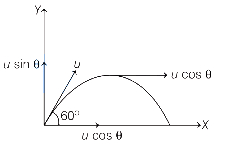
(C) Let the initial velocity of projection be $u$. The initial kinetic energy is given by $KE_1 = \frac{1}{2} m u^2 = K$.
At the highest point of the trajectory,the vertical component of the velocity becomes zero,while the horizontal component remains $u \cos \theta$.
Therefore,the kinetic energy at the highest point $KE_2$ is:
$KE_2 = \frac{1}{2} m (u \cos \theta)^2$
$KE_2 = (\frac{1}{2} m u^2) \cos^2 \theta$
Substituting $KE_1 = K$ and $\theta = 60^{\circ}$:
$KE_2 = K \cos^2 60^{\circ}$
Since $\cos 60^{\circ} = \frac{1}{2}$,we have:
$KE_2 = K (\frac{1}{2})^2 = \frac{K}{4}$
At the highest point of the trajectory,the vertical component of the velocity becomes zero,while the horizontal component remains $u \cos \theta$.
Therefore,the kinetic energy at the highest point $KE_2$ is:
$KE_2 = \frac{1}{2} m (u \cos \theta)^2$
$KE_2 = (\frac{1}{2} m u^2) \cos^2 \theta$
Substituting $KE_1 = K$ and $\theta = 60^{\circ}$:
$KE_2 = K \cos^2 60^{\circ}$
Since $\cos 60^{\circ} = \frac{1}{2}$,we have:
$KE_2 = K (\frac{1}{2})^2 = \frac{K}{4}$
0 likes
View Solution466
EasyMCQ
In the case of projectile motion,which one of the following figures represents the variation of the horizontal component of velocity $(u_{x})$ with time $t$? (Assume that air resistance is negligible.)
A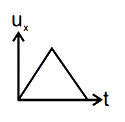
B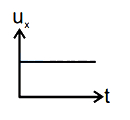
C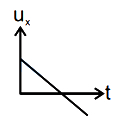
D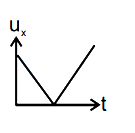
Solution
(B) In projectile motion,when air resistance is neglected,there is no horizontal force acting on the projectile.
According to Newton's first law of motion,the horizontal acceleration $(a_{x})$ is zero.
Since $a_{x} = 0$,the horizontal component of velocity $(u_{x})$ remains constant throughout the motion.
Therefore,the graph of $u_{x}$ versus $t$ must be a horizontal straight line parallel to the time axis.
This corresponds to the figure shown in option $B$.
According to Newton's first law of motion,the horizontal acceleration $(a_{x})$ is zero.
Since $a_{x} = 0$,the horizontal component of velocity $(u_{x})$ remains constant throughout the motion.
Therefore,the graph of $u_{x}$ versus $t$ must be a horizontal straight line parallel to the time axis.
This corresponds to the figure shown in option $B$.
0 likes
View Solution467
MediumMCQ
$A$ fighter plane,flying horizontally with a speed of $360 \text{ km/h}$ at an altitude of $500 \text{ m}$,drops a bomb for a target straight ahead of it on the ground. At what approximate distance ahead of the target should the bomb be dropped? Assume that acceleration due to gravity $g = 10 \text{ m/s}^2$. Neglect air drag.
A
$1000 \text{ m}$
B
$50 \sqrt{5} \text{ m}$
C
$500 \sqrt{5} \text{ m}$
D
$866 \text{ m}$
Solution
(A) Given:
Horizontal velocity of the plane,$u = 360 \text{ km/h} = 360 \times \frac{5}{18} \text{ m/s} = 100 \text{ m/s}$.
Altitude (vertical height),$h = 500 \text{ m}$.
Acceleration due to gravity,$g = 10 \text{ m/s}^2$.
When the bomb is dropped,it follows a projectile path. The time taken to reach the ground is given by $t = \sqrt{\frac{2h}{g}}$.
$t = \sqrt{\frac{2 \times 500}{10}} = \sqrt{100} = 10 \text{ s}$.
The horizontal distance covered by the bomb during this time is $R = u \times t$.
$R = 100 \text{ m/s} \times 10 \text{ s} = 1000 \text{ m}$.
Therefore,the bomb should be dropped at a distance of $1000 \text{ m}$ ahead of the target.
Horizontal velocity of the plane,$u = 360 \text{ km/h} = 360 \times \frac{5}{18} \text{ m/s} = 100 \text{ m/s}$.
Altitude (vertical height),$h = 500 \text{ m}$.
Acceleration due to gravity,$g = 10 \text{ m/s}^2$.
When the bomb is dropped,it follows a projectile path. The time taken to reach the ground is given by $t = \sqrt{\frac{2h}{g}}$.
$t = \sqrt{\frac{2 \times 500}{10}} = \sqrt{100} = 10 \text{ s}$.
The horizontal distance covered by the bomb during this time is $R = u \times t$.
$R = 100 \text{ m/s} \times 10 \text{ s} = 1000 \text{ m}$.
Therefore,the bomb should be dropped at a distance of $1000 \text{ m}$ ahead of the target.
0 likes
View Solution468
EasyMCQ
$A$ projectile is thrown with an initial velocity of $10 \ m/s$ at an angle $\alpha$ with the horizontal. It has a range of $5 \ m$. Taking $g = 10 \ m/s^2$ and neglecting air resistance,what will be the estimated value of $\alpha$ (in $^{\circ}$)?
A
$15$
B
$30$
C
$45$
D
$75$
Solution
(A) Given,initial velocity $u = 10 \ m/s$.
Range $R = 5 \ m$.
Acceleration due to gravity $g = 10 \ m/s^2$.
The formula for the range of a projectile is $R = \frac{u^2 \sin(2\alpha)}{g}$.
Substituting the given values:
$5 = \frac{(10)^2 \sin(2\alpha)}{10}$
$5 = \frac{100 \sin(2\alpha)}{10}$
$5 = 10 \sin(2\alpha)$
$\sin(2\alpha) = \frac{5}{10} = 0.5$.
Since $\sin(30^{\circ}) = 0.5$,we have $2\alpha = 30^{\circ}$ or $2\alpha = 150^{\circ}$.
Therefore,$\alpha = 15^{\circ}$ or $\alpha = 75^{\circ}$.
Comparing with the given options,the correct value is $15^{\circ}$.
Range $R = 5 \ m$.
Acceleration due to gravity $g = 10 \ m/s^2$.
The formula for the range of a projectile is $R = \frac{u^2 \sin(2\alpha)}{g}$.
Substituting the given values:
$5 = \frac{(10)^2 \sin(2\alpha)}{10}$
$5 = \frac{100 \sin(2\alpha)}{10}$
$5 = 10 \sin(2\alpha)$
$\sin(2\alpha) = \frac{5}{10} = 0.5$.
Since $\sin(30^{\circ}) = 0.5$,we have $2\alpha = 30^{\circ}$ or $2\alpha = 150^{\circ}$.
Therefore,$\alpha = 15^{\circ}$ or $\alpha = 75^{\circ}$.
Comparing with the given options,the correct value is $15^{\circ}$.
0 likes
View Solution469
DifficultMCQ
$A$ cricket ball thrown across a field is at heights $h_{1}$ and $h_{2}$ from the point of projection at times $t_{1}$ and $t_{2}$ respectively after the throw. The ball is caught by a fielder at the same height as that of projection. The time of flight of the ball in this journey is
A
$\frac{h_{1} t_{2}^{2}-h_{2} t_{1}^{2}}{h_{1} t_{2}-h_{2} t_{1}}$
B
$\frac{h_{1} t_{1}^{2}+h_{2} t_{2}^{2}}{h_{2} t_{1}+h_{1} t_{2}}$
C
$\frac{h_{1} t_{2}^{2}+h_{2} t_{1}^{2}}{h_{1} t_{2}+h_{2} t_{1}}$
D
$\frac{h_{1} t_{1}^{2}-h_{2} t_{2}^{2}}{h_{1} t_{2}-h_{2} t_{1}}$
Solution
(A) The vertical displacement $y$ of a projectile at time $t$ is given by $y = (u \sin \theta)t - \frac{1}{2}gt^2$.
For heights $h_1$ and $h_2$ at times $t_1$ and $t_2$:
$h_1 = (u \sin \theta)t_1 - \frac{1}{2}gt_1^2 \implies \frac{h_1}{t_1} = u \sin \theta - \frac{1}{2}gt_1 \quad (1)$
$h_2 = (u \sin \theta)t_2 - \frac{1}{2}gt_2^2 \implies \frac{h_2}{t_2} = u \sin \theta - \frac{1}{2}gt_2 \quad (2)$
Subtracting $(2)$ from $(1)$:
$\frac{h_1}{t_1} - \frac{h_2}{t_2} = \frac{1}{2}g(t_2 - t_1) \implies \frac{h_1 t_2 - h_2 t_1}{t_1 t_2} = \frac{1}{2}g(t_2 - t_1)$
$\frac{g}{2} = \frac{h_1 t_2 - h_2 t_1}{t_1 t_2 (t_2 - t_1)} \quad (3)$
The time of flight $T$ is given by $T = \frac{2u \sin \theta}{g}$. From $(1)$,$u \sin \theta = \frac{h_1}{t_1} + \frac{1}{2}gt_1$.
$T = \frac{2}{g} \left( \frac{h_1}{t_1} + \frac{1}{2}gt_1 \right) = \frac{2h_1}{gt_1} + t_1$.
Substituting $\frac{g}{2}$ from $(3)$ into the expression for $T$:
$T = \frac{h_1}{t_1} \left( \frac{t_1 t_2 (t_2 - t_1)}{h_1 t_2 - h_2 t_1} \right) + t_1 = \frac{h_1 t_2 (t_2 - t_1) + t_1 (h_1 t_2 - h_2 t_1)}{h_1 t_2 - h_2 t_1}$
$T = \frac{h_1 t_2^2 - h_1 t_1 t_2 + h_1 t_1 t_2 - h_2 t_1^2}{h_1 t_2 - h_2 t_1} = \frac{h_1 t_2^2 - h_2 t_1^2}{h_1 t_2 - h_2 t_1}$.
For heights $h_1$ and $h_2$ at times $t_1$ and $t_2$:
$h_1 = (u \sin \theta)t_1 - \frac{1}{2}gt_1^2 \implies \frac{h_1}{t_1} = u \sin \theta - \frac{1}{2}gt_1 \quad (1)$
$h_2 = (u \sin \theta)t_2 - \frac{1}{2}gt_2^2 \implies \frac{h_2}{t_2} = u \sin \theta - \frac{1}{2}gt_2 \quad (2)$
Subtracting $(2)$ from $(1)$:
$\frac{h_1}{t_1} - \frac{h_2}{t_2} = \frac{1}{2}g(t_2 - t_1) \implies \frac{h_1 t_2 - h_2 t_1}{t_1 t_2} = \frac{1}{2}g(t_2 - t_1)$
$\frac{g}{2} = \frac{h_1 t_2 - h_2 t_1}{t_1 t_2 (t_2 - t_1)} \quad (3)$
The time of flight $T$ is given by $T = \frac{2u \sin \theta}{g}$. From $(1)$,$u \sin \theta = \frac{h_1}{t_1} + \frac{1}{2}gt_1$.
$T = \frac{2}{g} \left( \frac{h_1}{t_1} + \frac{1}{2}gt_1 \right) = \frac{2h_1}{gt_1} + t_1$.
Substituting $\frac{g}{2}$ from $(3)$ into the expression for $T$:
$T = \frac{h_1}{t_1} \left( \frac{t_1 t_2 (t_2 - t_1)}{h_1 t_2 - h_2 t_1} \right) + t_1 = \frac{h_1 t_2 (t_2 - t_1) + t_1 (h_1 t_2 - h_2 t_1)}{h_1 t_2 - h_2 t_1}$
$T = \frac{h_1 t_2^2 - h_1 t_1 t_2 + h_1 t_1 t_2 - h_2 t_1^2}{h_1 t_2 - h_2 t_1} = \frac{h_1 t_2^2 - h_2 t_1^2}{h_1 t_2 - h_2 t_1}$.
0 likes
View Solution470
EasyMCQ
$A$ body is projected from the ground with a velocity $v = (3 \hat{i} + 10 \hat{j}) \text{ m/s}$. The maximum height attained and the range of the body respectively are (given $g = 10 \text{ m/s}^2$):
A
$5 \text{ m}$ and $6 \text{ m}$
B
$3 \text{ m}$ and $10 \text{ m}$
C
$6 \text{ m}$ and $5 \text{ m}$
D
$3 \text{ m}$ and $5 \text{ m}$
Solution
(A) Given,initial velocity vector $v = (3 \hat{i} + 10 \hat{j}) \text{ m/s}$.
Comparing with $v = v_x \hat{i} + v_y \hat{j}$,we get $v_x = 3 \text{ m/s}$ and $v_y = 10 \text{ m/s}$.
The maximum height $H$ attained by a projectile is given by the formula $H = \frac{v_y^2}{2g}$.
Substituting the values: $H = \frac{10^2}{2 \times 10} = \frac{100}{20} = 5 \text{ m}$.
The horizontal range $R$ is given by the formula $R = v_x \times T$,where $T = \frac{2v_y}{g}$ is the time of flight.
Calculating time of flight: $T = \frac{2 \times 10}{10} = 2 \text{ s}$.
Calculating range: $R = 3 \times 2 = 6 \text{ m}$.
Thus,the maximum height is $5 \text{ m}$ and the range is $6 \text{ m}$.
Comparing with $v = v_x \hat{i} + v_y \hat{j}$,we get $v_x = 3 \text{ m/s}$ and $v_y = 10 \text{ m/s}$.
The maximum height $H$ attained by a projectile is given by the formula $H = \frac{v_y^2}{2g}$.
Substituting the values: $H = \frac{10^2}{2 \times 10} = \frac{100}{20} = 5 \text{ m}$.
The horizontal range $R$ is given by the formula $R = v_x \times T$,where $T = \frac{2v_y}{g}$ is the time of flight.
Calculating time of flight: $T = \frac{2 \times 10}{10} = 2 \text{ s}$.
Calculating range: $R = 3 \times 2 = 6 \text{ m}$.
Thus,the maximum height is $5 \text{ m}$ and the range is $6 \text{ m}$.
0 likes
View Solution471
MediumMCQ
$A$ particle is projected from the ground with a kinetic energy $E$ at an angle of $60^{\circ}$ with the horizontal. Its kinetic energy at the highest point of its motion will be
A
$E / \sqrt{2}$
B
$E / 2$
C
$E / 4$
D
$E / 8$
Solution
(C) At the ground,the initial kinetic energy is given by $E = \frac{1}{2} m u^{2}$,where $u$ is the initial velocity.
At the highest point of the trajectory,the vertical component of the velocity becomes zero,and the velocity of the particle is only the horizontal component,which is $v_x = u \cos \theta$.
Given the angle of projection $\theta = 60^{\circ}$,the horizontal velocity at the highest point is $v_x = u \cos 60^{\circ} = u \times \frac{1}{2} = \frac{u}{2}$.
The kinetic energy at the highest point $E^{\prime}$ is given by $E^{\prime} = \frac{1}{2} m v_x^{2}$.
Substituting the value of $v_x$,we get $E^{\prime} = \frac{1}{2} m \left( \frac{u}{2} \right)^{2} = \frac{1}{2} m \left( \frac{u^{2}}{4} \right) = \frac{1}{4} \left( \frac{1}{2} m u^{2} \right)$.
Since $E = \frac{1}{2} m u^{2}$,we have $E^{\prime} = \frac{E}{4}$.
At the highest point of the trajectory,the vertical component of the velocity becomes zero,and the velocity of the particle is only the horizontal component,which is $v_x = u \cos \theta$.
Given the angle of projection $\theta = 60^{\circ}$,the horizontal velocity at the highest point is $v_x = u \cos 60^{\circ} = u \times \frac{1}{2} = \frac{u}{2}$.
The kinetic energy at the highest point $E^{\prime}$ is given by $E^{\prime} = \frac{1}{2} m v_x^{2}$.
Substituting the value of $v_x$,we get $E^{\prime} = \frac{1}{2} m \left( \frac{u}{2} \right)^{2} = \frac{1}{2} m \left( \frac{u^{2}}{4} \right) = \frac{1}{4} \left( \frac{1}{2} m u^{2} \right)$.
Since $E = \frac{1}{2} m u^{2}$,we have $E^{\prime} = \frac{E}{4}$.
0 likes
View Solution472
MediumMCQ
From the top of a tower,$80 \ m$ high from the ground,a stone is thrown in the horizontal direction with a velocity of $8 \ ms^{-1}$. The stone reaches the ground after a time $t$ and falls at a distance of $d$ from the foot of the tower. Assuming $g=10 \ ms^{-2}$,the time $t$ and distance $d$ are given respectively by
A
$6 \ s, 64 \ m$
B
$6 \ s, 48 \ m$
C
$4 \ s, 32 \ m$
D
$4 \ s, 16 \ m$
Solution
(C) Given: Height $h = 80 \ m$,initial horizontal velocity $v = 8 \ ms^{-1}$,and acceleration due to gravity $g = 10 \ ms^{-2}$.
For vertical motion,the time taken to reach the ground is given by the equation $h = \frac{1}{2}gt^2$.
Substituting the values: $80 = \frac{1}{2} \times 10 \times t^2$.
$80 = 5t^2 \implies t^2 = 16 \implies t = 4 \ s$.
For horizontal motion,the distance $d$ covered is given by $d = v \times t$.
Substituting the values: $d = 8 \times 4 = 32 \ m$.
Thus,the time $t$ is $4 \ s$ and the distance $d$ is $32 \ m$.
For vertical motion,the time taken to reach the ground is given by the equation $h = \frac{1}{2}gt^2$.
Substituting the values: $80 = \frac{1}{2} \times 10 \times t^2$.
$80 = 5t^2 \implies t^2 = 16 \implies t = 4 \ s$.
For horizontal motion,the distance $d$ covered is given by $d = v \times t$.
Substituting the values: $d = 8 \times 4 = 32 \ m$.
Thus,the time $t$ is $4 \ s$ and the distance $d$ is $32 \ m$.
0 likes
View Solution473
EasyMCQ
$A$ body is projected with a speed $u \ m/s$ at an angle $\beta$ with the horizontal. The kinetic energy at the highest point is $3/4$ of the initial kinetic energy. The value of $\beta$ is: (in $^{\circ}$)
A
$30$
B
$45$
C
$60$
D
$120$
Solution
(A) The initial kinetic energy of the body is $K = \frac{1}{2} m u^2$.
At the highest point of the trajectory,the vertical component of velocity is zero,and the horizontal component remains $u \cos \beta$.
Thus,the kinetic energy at the highest point is $K' = \frac{1}{2} m (u \cos \beta)^2 = K \cos^2 \beta$.
Given that $K' = \frac{3}{4} K$,we have $K \cos^2 \beta = \frac{3}{4} K$.
This simplifies to $\cos^2 \beta = \frac{3}{4}$,which means $\cos \beta = \frac{\sqrt{3}}{2}$.
Therefore,$\beta = 30^{\circ}$.
At the highest point of the trajectory,the vertical component of velocity is zero,and the horizontal component remains $u \cos \beta$.
Thus,the kinetic energy at the highest point is $K' = \frac{1}{2} m (u \cos \beta)^2 = K \cos^2 \beta$.
Given that $K' = \frac{3}{4} K$,we have $K \cos^2 \beta = \frac{3}{4} K$.
This simplifies to $\cos^2 \beta = \frac{3}{4}$,which means $\cos \beta = \frac{\sqrt{3}}{2}$.
Therefore,$\beta = 30^{\circ}$.
0 likes
View Solution474
EasyMCQ
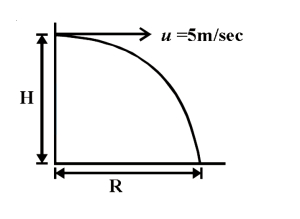
$A$ ball is projected horizontally with a velocity of $5 \text{ m/s}$ from the top of a building $19.6 \text{ m}$ high. How long will the ball take to hit the ground?
A
$\sqrt{2} \text{ s}$
B
$2 \text{ s}$
C
$\sqrt{3} \text{ s}$
D
$3 \text{ s}$
Solution
(B) The motion of the ball is a horizontal projectile motion.
For vertical motion, the initial vertical velocity $u_y = 0 \text{ m/s}$.
The vertical displacement is $H = 19.6 \text{ m}$.
The acceleration due to gravity is $g = 9.8 \text{ m/s}^2$.
Using the equation of motion $H = u_y t + \frac{1}{2} g t^2$, we get:
$19.6 = 0 \times t + \frac{1}{2} \times 9.8 \times t^2$
$19.6 = 4.9 \times t^2$
$t^2 = \frac{19.6}{4.9} = 4$
$t = \sqrt{4} = 2 \text{ s}$.
Thus, the ball will take $2 \text{ s}$ to hit the ground.
For vertical motion, the initial vertical velocity $u_y = 0 \text{ m/s}$.
The vertical displacement is $H = 19.6 \text{ m}$.
The acceleration due to gravity is $g = 9.8 \text{ m/s}^2$.
Using the equation of motion $H = u_y t + \frac{1}{2} g t^2$, we get:
$19.6 = 0 \times t + \frac{1}{2} \times 9.8 \times t^2$
$19.6 = 4.9 \times t^2$
$t^2 = \frac{19.6}{4.9} = 4$
$t = \sqrt{4} = 2 \text{ s}$.
Thus, the ball will take $2 \text{ s}$ to hit the ground.
0 likes
View Solution475
MediumMCQ
$A$ bullet is fired with a velocity $u$ making an angle of $60^{\circ}$ with the horizontal plane. The horizontal component of the velocity of the bullet when it reaches the maximum height is
A
$u$
B
$0$
C
$\frac{\sqrt{3}u}{2}$
D
$\frac{u}{2}$
Solution
(D) In projectile motion,the horizontal component of velocity remains constant throughout the flight because there is no acceleration acting in the horizontal direction.
Given the initial velocity is $u$ and the angle of projection is $\theta = 60^{\circ}$.
The horizontal component of the initial velocity is given by $u_x = u \cos(\theta)$.
Substituting the values,we get $u_x = u \cos(60^{\circ})$.
Since $\cos(60^{\circ}) = 1/2$,the horizontal component is $u_x = u \times (1/2) = u/2$.
At the maximum height,the vertical component of velocity becomes zero,but the horizontal component remains unchanged.
Therefore,the horizontal component of the velocity at the maximum height is $u/2$.
Given the initial velocity is $u$ and the angle of projection is $\theta = 60^{\circ}$.
The horizontal component of the initial velocity is given by $u_x = u \cos(\theta)$.
Substituting the values,we get $u_x = u \cos(60^{\circ})$.
Since $\cos(60^{\circ}) = 1/2$,the horizontal component is $u_x = u \times (1/2) = u/2$.
At the maximum height,the vertical component of velocity becomes zero,but the horizontal component remains unchanged.
Therefore,the horizontal component of the velocity at the maximum height is $u/2$.
0 likes
View Solution476
DifficultMCQ
$A$ particle is projected at $60^{\circ}$ to the horizontal with a kinetic energy $K$. The kinetic energy at the highest point is
A
$K$
B
zero
C
$\frac{K}{4}$
D
$\frac{K}{2}$
Solution
(C) The initial kinetic energy of the particle is given by $K = \frac{1}{2} m v^2$,where $v$ is the initial velocity.
At the highest point of the trajectory,the vertical component of the velocity becomes zero,and the velocity of the particle is equal to the horizontal component,which is $v_x = v \cos \theta$.
Given $\theta = 60^{\circ}$,the velocity at the highest point is $v_x = v \cos 60^{\circ} = \frac{v}{2}$.
The kinetic energy at the highest point $K'$ is given by $K' = \frac{1}{2} m (v_x)^2$.
Substituting the value of $v_x$,we get $K' = \frac{1}{2} m (\frac{v}{2})^2 = \frac{1}{2} m (\frac{v^2}{4}) = \frac{1}{4} (\frac{1}{2} m v^2)$.
Since $K = \frac{1}{2} m v^2$,we have $K' = \frac{K}{4}$.
At the highest point of the trajectory,the vertical component of the velocity becomes zero,and the velocity of the particle is equal to the horizontal component,which is $v_x = v \cos \theta$.
Given $\theta = 60^{\circ}$,the velocity at the highest point is $v_x = v \cos 60^{\circ} = \frac{v}{2}$.
The kinetic energy at the highest point $K'$ is given by $K' = \frac{1}{2} m (v_x)^2$.
Substituting the value of $v_x$,we get $K' = \frac{1}{2} m (\frac{v}{2})^2 = \frac{1}{2} m (\frac{v^2}{4}) = \frac{1}{4} (\frac{1}{2} m v^2)$.
Since $K = \frac{1}{2} m v^2$,we have $K' = \frac{K}{4}$.
0 likes
View Solution477
MediumMCQ
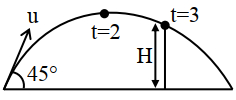
$A$ boy throws a ball into the air at $45^{\circ}$ from the horizontal to land it on the roof of a building of height $H$. If the ball attains maximum height in $2 \text{ s}$ and lands on the building in $3 \text{ s}$ after launch,then the value of $H$ is . . . . . . $\text{m}$. $(g = 10 \text{ m/s}^2)$
A
$20$
B
$10$
C
$25$
D
$15$
Solution
(D) The time taken to reach the maximum height is given by $t_m = \frac{u_y}{g} = 2 \text{ s}$.
Given $g = 10 \text{ m/s}^2$,we have $u_y = 2 \times 10 = 20 \text{ m/s}$.
The vertical displacement $y$ at any time $t$ is given by the equation $y = u_y t - \frac{1}{2} g t^2$.
At $t = 3 \text{ s}$,the ball is at height $H$,so:
$H = (20 \text{ m/s}) \times (3 \text{ s}) - \frac{1}{2} \times (10 \text{ m/s}^2) \times (3 \text{ s})^2$
$H = 60 \text{ m} - 5 \times 9 \text{ m}$
$H = 60 \text{ m} - 45 \text{ m} = 15 \text{ m}$.
Given $g = 10 \text{ m/s}^2$,we have $u_y = 2 \times 10 = 20 \text{ m/s}$.
The vertical displacement $y$ at any time $t$ is given by the equation $y = u_y t - \frac{1}{2} g t^2$.
At $t = 3 \text{ s}$,the ball is at height $H$,so:
$H = (20 \text{ m/s}) \times (3 \text{ s}) - \frac{1}{2} \times (10 \text{ m/s}^2) \times (3 \text{ s})^2$
$H = 60 \text{ m} - 5 \times 9 \text{ m}$
$H = 60 \text{ m} - 45 \text{ m} = 15 \text{ m}$.
0 likes
View Solution478
DifficultMCQ
Two identical bodies,projected with the same speed at two different angles cover the same horizontal range $R$. If the time of flight of these bodies are $5 \text{ s}$ and $10 \text{ s}$,respectively,then the value of $R$ is . . . . . . $\text{m}$. (Take $g = 10 \text{ m/s}^2$)
A
$250$
B
$25$
C
$500$
D
$125$
Solution
(A) The time of flight for a projectile is given by $T = \frac{2v \sin \theta}{g}$.
For two complementary angles $\theta$ and $(90^\circ - \theta)$,the horizontal range $R$ is the same.
The times of flight are $T_1 = \frac{2v \sin \theta}{g} = 5 \text{ s}$ and $T_2 = \frac{2v \sin(90^\circ - \theta)}{g} = \frac{2v \cos \theta}{g} = 10 \text{ s}$.
The horizontal range is $R = \frac{v^2 \sin(2\theta)}{g} = \frac{2v^2 \sin \theta \cos \theta}{g}$.
Multiplying $T_1$ and $T_2$,we get $T_1 T_2 = \frac{4v^2 \sin \theta \cos \theta}{g^2} = \frac{2}{g} \left( \frac{2v^2 \sin \theta \cos \theta}{g} \right) = \frac{2R}{g}$.
Therefore,$R = \frac{1}{2} g T_1 T_2 = \frac{1}{2} \times 10 \times 5 \times 10 = 250 \text{ m}$.
For two complementary angles $\theta$ and $(90^\circ - \theta)$,the horizontal range $R$ is the same.
The times of flight are $T_1 = \frac{2v \sin \theta}{g} = 5 \text{ s}$ and $T_2 = \frac{2v \sin(90^\circ - \theta)}{g} = \frac{2v \cos \theta}{g} = 10 \text{ s}$.
The horizontal range is $R = \frac{v^2 \sin(2\theta)}{g} = \frac{2v^2 \sin \theta \cos \theta}{g}$.
Multiplying $T_1$ and $T_2$,we get $T_1 T_2 = \frac{4v^2 \sin \theta \cos \theta}{g^2} = \frac{2}{g} \left( \frac{2v^2 \sin \theta \cos \theta}{g} \right) = \frac{2R}{g}$.
Therefore,$R = \frac{1}{2} g T_1 T_2 = \frac{1}{2} \times 10 \times 5 \times 10 = 250 \text{ m}$.
0 likes
View Solution479
MediumMCQ
Two projectiles are projected with the same initial velocities at $15^{\circ}$ and $30^{\circ}$ with respect to the horizontal. The ratio of their ranges is $1 : x$. The value of $x$ is:
A
$\sqrt{2}$
B
$\sqrt{3}$
C
$2\sqrt{3}$
D
$1/\sqrt{3}$
Solution
(B) The horizontal range $R$ of a projectile is given by the formula $R = \frac{u^2 \sin(2\theta)}{g}$,where $u$ is the initial velocity and $\theta$ is the angle of projection.
Since both projectiles have the same initial velocity $u$,the range is directly proportional to $\sin(2\theta)$,i.e.,$R \propto \sin(2\theta)$.
For the first projectile,$\theta_1 = 15^{\circ}$,so $R_1 \propto \sin(2 \times 15^{\circ}) = \sin(30^{\circ}) = 1/2$.
For the second projectile,$\theta_2 = 30^{\circ}$,so $R_2 \propto \sin(2 \times 30^{\circ}) = \sin(60^{\circ}) = \sqrt{3}/2$.
The ratio of their ranges is $\frac{R_1}{R_2} = \frac{1/2}{\sqrt{3}/2} = \frac{1}{\sqrt{3}}$.
Given the ratio is $1:x$,we have $1:x = 1:\sqrt{3}$.
Therefore,$x = \sqrt{3}$.
Since both projectiles have the same initial velocity $u$,the range is directly proportional to $\sin(2\theta)$,i.e.,$R \propto \sin(2\theta)$.
For the first projectile,$\theta_1 = 15^{\circ}$,so $R_1 \propto \sin(2 \times 15^{\circ}) = \sin(30^{\circ}) = 1/2$.
For the second projectile,$\theta_2 = 30^{\circ}$,so $R_2 \propto \sin(2 \times 30^{\circ}) = \sin(60^{\circ}) = \sqrt{3}/2$.
The ratio of their ranges is $\frac{R_1}{R_2} = \frac{1/2}{\sqrt{3}/2} = \frac{1}{\sqrt{3}}$.
Given the ratio is $1:x$,we have $1:x = 1:\sqrt{3}$.
Therefore,$x = \sqrt{3}$.
0 likes
View Solution480
DifficultMCQ
If $x$ and $y$ coordinates of a projectile as a function of time are given as $24t$ and $43.6t - 4.9t^2$,respectively,then the angle (in degrees) made by the projectile with horizontal when $t = 2 \text{ s}$ is . . . . . . .
A
$60$
B
$45$
C
$30$
D
$75$
Solution
(B) The horizontal position is given by $x = 24t$. The horizontal velocity component is $v_x = \frac{dx}{dt} = 24 \text{ m/s}$.
The vertical position is given by $y = 43.6t - 4.9t^2$. The vertical velocity component is $v_y = \frac{dy}{dt} = 43.6 - 9.8t$.
At time $t = 2 \text{ s}$,the vertical velocity is $v_y = 43.6 - 9.8(2) = 43.6 - 19.6 = 24 \text{ m/s}$.
The angle $\theta$ made by the projectile with the horizontal is given by $\tan \theta = \frac{v_y}{v_x}$.
Substituting the values,$\tan \theta = \frac{24}{24} = 1$.
Therefore,$\theta = \tan^{-1}(1) = 45^{\circ}$.
The vertical position is given by $y = 43.6t - 4.9t^2$. The vertical velocity component is $v_y = \frac{dy}{dt} = 43.6 - 9.8t$.
At time $t = 2 \text{ s}$,the vertical velocity is $v_y = 43.6 - 9.8(2) = 43.6 - 19.6 = 24 \text{ m/s}$.
The angle $\theta$ made by the projectile with the horizontal is given by $\tan \theta = \frac{v_y}{v_x}$.
Substituting the values,$\tan \theta = \frac{24}{24} = 1$.
Therefore,$\theta = \tan^{-1}(1) = 45^{\circ}$.
0 likes
View Solution481
MediumMCQ
$A$ gun mounted on the ground fires bullets in all directions with same speed. The farthest distance the bullets could reach is $6.4 \text{ m}$. The speed of the bullets from the gun is . . . . . . m/s. (take $g = 10 \text{ m/s}^2$)
A
$8$
B
$10$
C
$12$
D
$16$
Solution
(A) The farthest distance reached by the bullets is the maximum horizontal range,denoted by $R_{max}$.
The formula for the maximum horizontal range is $R_{max} = \frac{u^2}{g}$,where $u$ is the initial speed and $g$ is the acceleration due to gravity.
Given values are $R_{max} = 6.4 \text{ m}$ and $g = 10 \text{ m/s}^2$.
Substituting these values into the formula: $6.4 = \frac{u^2}{10}$.
Multiplying both sides by $10$,we get $u^2 = 64$.
Taking the square root of both sides,we find $u = 8 \text{ m/s}$.
The formula for the maximum horizontal range is $R_{max} = \frac{u^2}{g}$,where $u$ is the initial speed and $g$ is the acceleration due to gravity.
Given values are $R_{max} = 6.4 \text{ m}$ and $g = 10 \text{ m/s}^2$.
Substituting these values into the formula: $6.4 = \frac{u^2}{10}$.
Multiplying both sides by $10$,we get $u^2 = 64$.
Taking the square root of both sides,we find $u = 8 \text{ m/s}$.
0 likes
View Solution3-2.Motion in Plane — Horizontal Projectile Motion · Frequently Asked Questions
1Are these 3-2.Motion in Plane questions useful for JEE and NEET?
Yes. All questions in this section are mapped to JEE Main and NEET exam patterns. Previous year questions from JEE Main, NEET, GUJCET and state-level exams are included with full solutions.
2Can I switch to Hindi or Gujarati for these questions?
Yes. Use the language tabs in the hero section or the sidebar to view the same questions and solutions in English, Hindi or Gujarati.
3How do I generate a question paper from this subtopic?
Use the Vedclass Exam Paper Generator — select the chapter and subtopic, set difficulty, and generate Sets A, B, C, D automatically. First 3 chapters of every subject are free.
Vedclass Products
For Students
Vedclass Test Series
Mock tests in real JEE/NEET style with performance analysis. 5-day free trial.
Start Free TrialFor Teachers
Exam Paper Generator
Generate Set A/B/C/D papers from this chapter in 2 minutes. 3 chapters free.
Try FreeFor Institutes
Online Exam Module
Live online exams with unlimited students, 360° analytics & white-label branding.
See DemoFor Teachers & Institutes
Generate a 3-2.Motion in Plane Exam Paper in 2 Minutes
Select subtopic & difficulty — Sets A, B, C, D auto-generated with No Repeat logic.
First 3 chapters of every subject are free — no payment required.