
A English
Dynamics of circular Motion (Centrifugal force) and Pendulum and Motion on Curved path Questions in English
Class 11 Physics · 3-2.Motion in Plane · Dynamics of circular Motion (Centrifugal force) and Pendulum and Motion on Curved path
142+
Questions
English
Language
100%
With Solutions
Showing 49 of 142 questions in English
51
DifficultMCQ
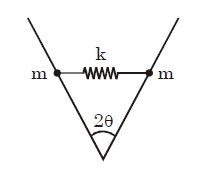
Two particles of mass $m$ are constrained to move along two horizontal frictionless rails that make an angle $2\theta$ with respect to each other. They are connected by a spring with spring constant $k$. The angular frequency of small oscillations for the motion where the two masses always stay at the same distance from the meeting point of the rails is:
A
$\sqrt{\frac{2k}{m}}$
B
$\sqrt{\frac{2k}{m}} \sin \theta$
C
$\sqrt{\frac{2k}{m}} \cos \theta$
D
$\sqrt{\frac{k}{2m}} \sin \theta$
Solution
(B) Let $x$ be the distance of each particle from the vertex (meeting point) of the rails. The distance between the two particles is $d = 2x \sin \theta$.
If the particles are displaced by a small amount $\Delta x$ from their equilibrium position $x_0$,the change in the length of the spring is $\Delta d = 2 \Delta x \sin \theta$.
The potential energy of the spring is $U = \frac{1}{2} k (\Delta d)^2 = \frac{1}{2} k (2 \Delta x \sin \theta)^2 = 2 k \sin^2 \theta (\Delta x)^2$.
The kinetic energy of the two particles is $K = \frac{1}{2} m v^2 + \frac{1}{2} m v^2 = m v^2 = m (\Delta \dot{x})^2$.
Comparing this with the standard form of energy for a simple harmonic oscillator,$E = \frac{1}{2} k_{eff} x^2 + \frac{1}{2} m_{eff} \dot{x}^2$,we identify $k_{eff} = 4 k \sin^2 \theta$ and $m_{eff} = 2m$.
The angular frequency $\omega$ is given by $\omega = \sqrt{\frac{k_{eff}}{m_{eff}}} = \sqrt{\frac{4 k \sin^2 \theta}{2m}} = \sqrt{\frac{2k}{m}} \sin \theta$.
If the particles are displaced by a small amount $\Delta x$ from their equilibrium position $x_0$,the change in the length of the spring is $\Delta d = 2 \Delta x \sin \theta$.
The potential energy of the spring is $U = \frac{1}{2} k (\Delta d)^2 = \frac{1}{2} k (2 \Delta x \sin \theta)^2 = 2 k \sin^2 \theta (\Delta x)^2$.
The kinetic energy of the two particles is $K = \frac{1}{2} m v^2 + \frac{1}{2} m v^2 = m v^2 = m (\Delta \dot{x})^2$.
Comparing this with the standard form of energy for a simple harmonic oscillator,$E = \frac{1}{2} k_{eff} x^2 + \frac{1}{2} m_{eff} \dot{x}^2$,we identify $k_{eff} = 4 k \sin^2 \theta$ and $m_{eff} = 2m$.
The angular frequency $\omega$ is given by $\omega = \sqrt{\frac{k_{eff}}{m_{eff}}} = \sqrt{\frac{4 k \sin^2 \theta}{2m}} = \sqrt{\frac{2k}{m}} \sin \theta$.
0 likes
View Solution52
DifficultMCQ
$A$ stick has its bottom end attached to a wall by a pivot and is held up by a massless string attached to its other end. Which of the following scenarios has the smallest tension in the string? (Length of stick is same in all scenarios)
A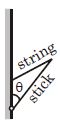
B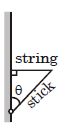
C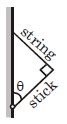
D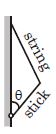
Solution
(C) Let $L$ be the length of the stick and $m$ be its mass. The weight $mg$ acts at the center of mass,which is at a distance $L/2$ from the pivot.
Taking torque about the pivot point:
$\tau_{\text{pivot}} = 0$
$mg \left( \frac{L}{2} \sin \theta \right) = T \cdot L \sin \phi$
where $\phi$ is the angle between the stick and the string.
$T = \frac{mg \sin \theta}{2 \sin \phi}$
To minimize $T$,we need to maximize $\sin \phi$. The maximum value of $\sin \phi$ is $1$,which occurs when $\phi = 90^\circ$.
In scenario $B$,the string is horizontal and the stick makes an angle $\theta$ with the wall,so the angle between the stick and the string is $\phi = 90^\circ - \theta$. This is not necessarily $90^\circ$.
In scenario $C$,the string is perpendicular to the stick,so $\phi = 90^\circ$. This gives the minimum tension $T = \frac{mg \sin \theta}{2}$.
Taking torque about the pivot point:
$\tau_{\text{pivot}} = 0$
$mg \left( \frac{L}{2} \sin \theta \right) = T \cdot L \sin \phi$
where $\phi$ is the angle between the stick and the string.
$T = \frac{mg \sin \theta}{2 \sin \phi}$
To minimize $T$,we need to maximize $\sin \phi$. The maximum value of $\sin \phi$ is $1$,which occurs when $\phi = 90^\circ$.
In scenario $B$,the string is horizontal and the stick makes an angle $\theta$ with the wall,so the angle between the stick and the string is $\phi = 90^\circ - \theta$. This is not necessarily $90^\circ$.
In scenario $C$,the string is perpendicular to the stick,so $\phi = 90^\circ$. This gives the minimum tension $T = \frac{mg \sin \theta}{2}$.
0 likes
View Solution53
DifficultMCQ
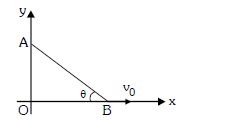
The end $B$ of the rod $AB$ which makes an angle $\theta$ with the floor is being pulled with a constant velocity $v_0$ as shown. The length of the rod is $l$. At the instant when $\theta = 37^o$,then:
A
velocity of end $A$ is $\frac{4}{3} v_0$ downwards
B
angular velocity of rod is $\frac{3}{4} \frac{v_0}{l}$
C
angular velocity of rod is constant
D
velocity of end $A$ is constant
Solution
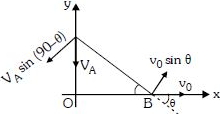
(A) Let the coordinates of $A$ be $(0, y)$ and $B$ be $(x, 0)$. The length of the rod is $l = \sqrt{x^2 + y^2}$.
Since $x = l \cos \theta$ and $y = l \sin \theta$,we have $v_0 = \frac{dx}{dt} = -l \sin \theta \frac{d\theta}{dt}$.
Thus,the angular velocity $\omega = |\frac{d\theta}{dt}| = \frac{v_0}{l \sin \theta}$.
For end $A$,$v_A = |\frac{dy}{dt}| = |l \cos \theta \frac{d\theta}{dt}| = l \cos \theta (\frac{v_0}{l \sin \theta}) = v_0 \cot \theta$.
At $\theta = 37^o$,$\cot 37^o = \frac{4}{3}$,so $v_A = \frac{4}{3} v_0$.
Also,$\omega = \frac{v_0}{l \sin 37^o} = \frac{v_0}{l (3/5)} = \frac{5}{3} \frac{v_0}{l}$.
Since $v_A$ and $\omega$ depend on $\theta$,they are not constant. Thus,option $A$ is correct.
Since $x = l \cos \theta$ and $y = l \sin \theta$,we have $v_0 = \frac{dx}{dt} = -l \sin \theta \frac{d\theta}{dt}$.
Thus,the angular velocity $\omega = |\frac{d\theta}{dt}| = \frac{v_0}{l \sin \theta}$.
For end $A$,$v_A = |\frac{dy}{dt}| = |l \cos \theta \frac{d\theta}{dt}| = l \cos \theta (\frac{v_0}{l \sin \theta}) = v_0 \cot \theta$.
At $\theta = 37^o$,$\cot 37^o = \frac{4}{3}$,so $v_A = \frac{4}{3} v_0$.
Also,$\omega = \frac{v_0}{l \sin 37^o} = \frac{v_0}{l (3/5)} = \frac{5}{3} \frac{v_0}{l}$.
Since $v_A$ and $\omega$ depend on $\theta$,they are not constant. Thus,option $A$ is correct.
0 likes
View Solution54
DifficultMCQ
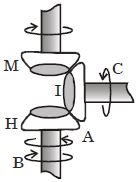
When helical gear $M$ turns as shown,gears $I$ & $H$ turn in the following manner. Which of the following is correct? (Assuming no slipping anywhere)
A
$I$ turns clockwise,$H$ turns clockwise
B
$I$ turns counter-clockwise,$H$ turns counter-clockwise
C
$I$ turns clockwise,$H$ turns counter-clockwise
D
None of these
Solution
(D) $1$. Analyze the rotation of gear $M$: Gear $M$ is rotating in a clockwise direction when viewed from the top.
$2$. Analyze the interaction between $M$ and $I$: As gear $M$ rotates clockwise,it drives gear $I$. Looking at the contact point,gear $I$ will rotate in a counter-clockwise direction when viewed from the right side.
$3$. Analyze the interaction between $I$ and $H$: Gear $I$ is now rotating counter-clockwise. As it meshes with gear $H$ at the bottom,it will drive gear $H$ in a clockwise direction when viewed from the top.
$4$. Conclusion: Gear $I$ rotates counter-clockwise and gear $H$ rotates clockwise. Comparing this with the given options,none of the specific directional combinations match correctly.
$2$. Analyze the interaction between $M$ and $I$: As gear $M$ rotates clockwise,it drives gear $I$. Looking at the contact point,gear $I$ will rotate in a counter-clockwise direction when viewed from the right side.
$3$. Analyze the interaction between $I$ and $H$: Gear $I$ is now rotating counter-clockwise. As it meshes with gear $H$ at the bottom,it will drive gear $H$ in a clockwise direction when viewed from the top.
$4$. Conclusion: Gear $I$ rotates counter-clockwise and gear $H$ rotates clockwise. Comparing this with the given options,none of the specific directional combinations match correctly.
0 likes
View Solution55
DifficultMCQ
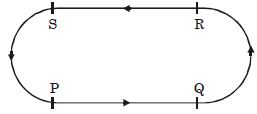
$A$ dancer moves counterclockwise at a constant speed around the path shown below. The path is such that the lengths of its segments,$PQ, QR, RS$,and $SP$,are equal. Arcs $QR$ and $SP$ are semicircles. Which of the following best represents the magnitude of the dancer's acceleration as a function of time $t$ during one trip around the path,beginning at point $P$?
A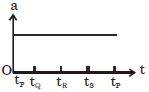
B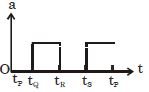
C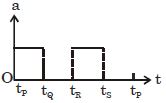
D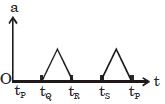
Solution
(B) The dancer moves at a constant speed $v$ along the path.
In the straight-line segments $PQ$ and $RS$,the direction of motion does not change,so the velocity vector remains constant. Therefore,the acceleration $a = \frac{dv}{dt} = 0$ in these segments.
In the semicircular segments $QR$ and $SP$,the dancer is moving along a curved path with a constant speed $v$. This results in a centripetal acceleration with a magnitude $a = \frac{v^2}{r}$,where $r$ is the radius of the semicircle. Since $v$ and $r$ are constant,the magnitude of the acceleration is constant and non-zero during these segments.
Thus,the acceleration is zero during $PQ$ and $RS$,and constant non-zero during $QR$ and $SP$. This corresponds to the graph in option $B$.
In the straight-line segments $PQ$ and $RS$,the direction of motion does not change,so the velocity vector remains constant. Therefore,the acceleration $a = \frac{dv}{dt} = 0$ in these segments.
In the semicircular segments $QR$ and $SP$,the dancer is moving along a curved path with a constant speed $v$. This results in a centripetal acceleration with a magnitude $a = \frac{v^2}{r}$,where $r$ is the radius of the semicircle. Since $v$ and $r$ are constant,the magnitude of the acceleration is constant and non-zero during these segments.
Thus,the acceleration is zero during $PQ$ and $RS$,and constant non-zero during $QR$ and $SP$. This corresponds to the graph in option $B$.
0 likes
View Solution56
DifficultMCQ
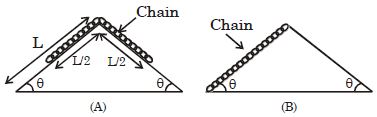
$A$ uniform chain of mass $m$ and length $L$ is originally placed mid-way on the top of a fixed smooth double-sided wedge. The length of each side of the wedge is $L$. It is then given a slight push. The kinetic energy of the chain when the whole chain has just slid to the left side of the wedge is:
A
$mgL \sin \theta$
B
$\frac{mgL \sin \theta}{2}$
C
$\frac{mgL \sin \theta}{4}$
D
$\frac{mgL \sin \theta}{8}$
Solution
(C) Let the top of the wedge be the reference level for potential energy $(U = 0)$.
In the initial state (Figure-$A$),the chain is divided into two halves,each of length $L/2$ and mass $m/2$,hanging on either side. The center of mass of each half is at a distance $L/4$ from the top along the incline.
The initial potential energy is $U_i = 2 \times [-(m/2)g(L/4) \sin \theta] = -\frac{mgL}{4} \sin \theta$.
In the final state (Figure-$B$),the entire chain of mass $m$ is on the left side. The center of mass of the chain is at a distance $L/2$ from the top along the incline.
The final potential energy is $U_f = -mg(L/2) \sin \theta = -\frac{mgL}{2} \sin \theta$.
By the law of conservation of mechanical energy,the change in potential energy equals the change in kinetic energy: $K_f - K_i = U_i - U_f$.
Since the chain starts from rest,$K_i = 0$.
$K_f = U_i - U_f = -\frac{mgL}{4} \sin \theta - (-\frac{mgL}{2} \sin \theta) = \frac{mgL}{4} \sin \theta$.
In the initial state (Figure-$A$),the chain is divided into two halves,each of length $L/2$ and mass $m/2$,hanging on either side. The center of mass of each half is at a distance $L/4$ from the top along the incline.
The initial potential energy is $U_i = 2 \times [-(m/2)g(L/4) \sin \theta] = -\frac{mgL}{4} \sin \theta$.
In the final state (Figure-$B$),the entire chain of mass $m$ is on the left side. The center of mass of the chain is at a distance $L/2$ from the top along the incline.
The final potential energy is $U_f = -mg(L/2) \sin \theta = -\frac{mgL}{2} \sin \theta$.
By the law of conservation of mechanical energy,the change in potential energy equals the change in kinetic energy: $K_f - K_i = U_i - U_f$.
Since the chain starts from rest,$K_i = 0$.
$K_f = U_i - U_f = -\frac{mgL}{4} \sin \theta - (-\frac{mgL}{2} \sin \theta) = \frac{mgL}{4} \sin \theta$.
0 likes
View Solution57
MediumMCQ
$A$ rod $(AB)$ is attached to a fixed point $(C)$ using a light rope $(AC)$. The other end of the rod $(B)$ is resting on ice with negligible friction,and the system is in a stationary position. Which of the following can be the equilibrium configuration of this system?
A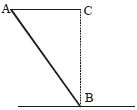
B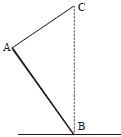
C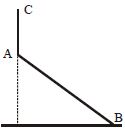
D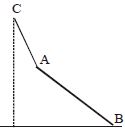
Solution
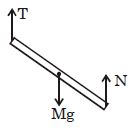
(A) For the rod $(AB)$ to be in equilibrium,the net torque about any point must be zero. The forces acting on the rod are:
$1$. The tension $(T)$ in the rope $(AC)$ acting at point $(A)$.
$2$. The weight $(Mg)$ of the rod acting at its center of mass.
$3$. The normal force $(N)$ from the ice at point $(B)$.
Since the ice is frictionless,the normal force $(N)$ must be vertical.
For the rod to be in equilibrium,the lines of action of all three forces must intersect at a single point or be parallel. Since the weight $(Mg)$ acts vertically downwards and the normal force $(N)$ acts vertically upwards,these two forces are parallel. For the system to be in equilibrium,the tension $(T)$ must also be parallel to these forces. Therefore,the rope $(AC)$ must be vertical. This configuration is shown in option $(A)$.
$1$. The tension $(T)$ in the rope $(AC)$ acting at point $(A)$.
$2$. The weight $(Mg)$ of the rod acting at its center of mass.
$3$. The normal force $(N)$ from the ice at point $(B)$.
Since the ice is frictionless,the normal force $(N)$ must be vertical.
For the rod to be in equilibrium,the lines of action of all three forces must intersect at a single point or be parallel. Since the weight $(Mg)$ acts vertically downwards and the normal force $(N)$ acts vertically upwards,these two forces are parallel. For the system to be in equilibrium,the tension $(T)$ must also be parallel to these forces. Therefore,the rope $(AC)$ must be vertical. This configuration is shown in option $(A)$.
0 likes
View Solution58
DifficultMCQ
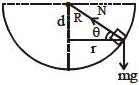
$A$ particle moves in a horizontal circle on the smooth inner surface of a hemispherical bowl of radius $R$. The plane of motion is at a depth $d$ below the centre of the hemisphere. The speed of the particle is:
A
$\sqrt {\frac{{g({R^2} - {d^2})}}{R}} $
B
$\sqrt {\frac{{g({R^2} - {d^2})}}{d}} $
C
$\sqrt {\frac{{gR}}{{{R^2} - {d^2}}}} $
D
$\sqrt {\frac{{g d^2}}{{{R^2} - {d^2}}}} $
Solution
(B) Let $m$ be the mass of the particle and $V$ be its speed. The particle moves in a horizontal circle of radius $r = \sqrt{R^2 - d^2}$.
The forces acting on the particle are the normal reaction $N$ (directed towards the centre of the sphere) and the weight $mg$ (acting downwards).
Resolving the normal reaction $N$ into horizontal and vertical components:
Horizontal component: $N \sin \theta = \frac{mV^2}{r}$ (providing the centripetal force)
Vertical component: $N \cos \theta = mg$ (balancing the weight)
Dividing the two equations: $\tan \theta = \frac{V^2}{rg}$.
From the geometry of the bowl,$\tan \theta = \frac{r}{d}$.
Equating the two expressions for $\tan \theta$: $\frac{V^2}{rg} = \frac{r}{d} \Rightarrow V^2 = \frac{r^2 g}{d}$.
Substituting $r^2 = R^2 - d^2$,we get $V = \sqrt{\frac{g(R^2 - d^2)}{d}}$.
The forces acting on the particle are the normal reaction $N$ (directed towards the centre of the sphere) and the weight $mg$ (acting downwards).
Resolving the normal reaction $N$ into horizontal and vertical components:
Horizontal component: $N \sin \theta = \frac{mV^2}{r}$ (providing the centripetal force)
Vertical component: $N \cos \theta = mg$ (balancing the weight)
Dividing the two equations: $\tan \theta = \frac{V^2}{rg}$.
From the geometry of the bowl,$\tan \theta = \frac{r}{d}$.
Equating the two expressions for $\tan \theta$: $\frac{V^2}{rg} = \frac{r}{d} \Rightarrow V^2 = \frac{r^2 g}{d}$.
Substituting $r^2 = R^2 - d^2$,we get $V = \sqrt{\frac{g(R^2 - d^2)}{d}}$.
0 likes
View Solution59
DifficultMCQ
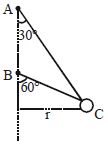
$A$ single wire $ACB$ passes through a smooth ring at $C$ which revolves at a constant speed in a horizontal circle of radius $r$ as shown in the figure. The speed of revolution is
A
$\sqrt{rg}$
B
$\sqrt{2rg}$
C
$2\sqrt{2rg}$
D
$2\sqrt{rg}$
Solution
(A) Let $T$ be the tension in the wire. Since the ring is smooth,the tension is the same throughout the wire.
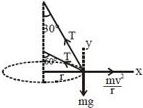
Resolving the forces acting on the ring $C$ along the vertical ($y$-axis) and horizontal ($x$-axis) directions:
Along the vertical direction,the sum of the vertical components of tension balances the weight of the ring:
$T \cos 30^{\circ} + T \cos 60^{\circ} = mg$
$T \left( \frac{\sqrt{3}}{2} + \frac{1}{2} \right) = mg$
$T \left( \frac{\sqrt{3} + 1}{2} \right) = mg$ $...(i)$
Along the horizontal direction,the sum of the horizontal components of tension provides the necessary centripetal force:
$T \sin 30^{\circ} + T \sin 60^{\circ} = \frac{mv^2}{r}$
$T \left( \frac{1}{2} + \frac{\sqrt{3}}{2} \right) = \frac{mv^2}{r}$
$T \left( \frac{\sqrt{3} + 1}{2} \right) = \frac{mv^2}{r}$ $...(ii)$
Dividing equation $(ii)$ by equation $(i)$:
$\frac{T \left( \frac{\sqrt{3} + 1}{2} \right)}{T \left( \frac{\sqrt{3} + 1}{2} \right)} = \frac{mv^2/r}{mg}$
$1 = \frac{v^2}{rg}$
$v^2 = rg$
$v = \sqrt{rg}$
Resolving the forces acting on the ring $C$ along the vertical ($y$-axis) and horizontal ($x$-axis) directions:
Along the vertical direction,the sum of the vertical components of tension balances the weight of the ring:
$T \cos 30^{\circ} + T \cos 60^{\circ} = mg$
$T \left( \frac{\sqrt{3}}{2} + \frac{1}{2} \right) = mg$
$T \left( \frac{\sqrt{3} + 1}{2} \right) = mg$ $...(i)$
Along the horizontal direction,the sum of the horizontal components of tension provides the necessary centripetal force:
$T \sin 30^{\circ} + T \sin 60^{\circ} = \frac{mv^2}{r}$
$T \left( \frac{1}{2} + \frac{\sqrt{3}}{2} \right) = \frac{mv^2}{r}$
$T \left( \frac{\sqrt{3} + 1}{2} \right) = \frac{mv^2}{r}$ $...(ii)$
Dividing equation $(ii)$ by equation $(i)$:
$\frac{T \left( \frac{\sqrt{3} + 1}{2} \right)}{T \left( \frac{\sqrt{3} + 1}{2} \right)} = \frac{mv^2/r}{mg}$
$1 = \frac{v^2}{rg}$
$v^2 = rg$
$v = \sqrt{rg}$
0 likes
View Solution60
DifficultMCQ
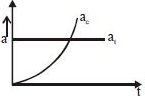
$A$ particle starts from rest and performs circular motion of constant radius with speed given by $v = \alpha \sqrt{x}$,where $\alpha$ is a constant and $x$ is the distance covered. The correct graph of the magnitude of its tangential acceleration $(a_t)$ and centripetal acceleration $(a_c)$ versus $t$ will be:
A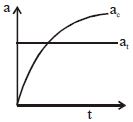
B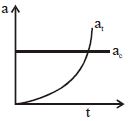
C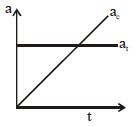
D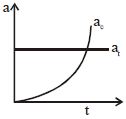
Solution
(D) Given the speed $v = \alpha \sqrt{x}$.
Since $v = \frac{dx}{dt}$,we have $\frac{dx}{dt} = \alpha \sqrt{x}$,which implies $\int x^{-1/2} dx = \int \alpha dt$.
Integrating both sides,we get $2\sqrt{x} = \alpha t$,so $x = \frac{\alpha^2 t^2}{4}$.
The tangential acceleration is $a_t = \frac{dv}{dt} = \frac{d}{dt}(\alpha \sqrt{x}) = \alpha \cdot \frac{1}{2\sqrt{x}} \cdot \frac{dx}{dt} = \alpha \cdot \frac{1}{2\sqrt{x}} \cdot (\alpha \sqrt{x}) = \frac{\alpha^2}{2}$.
Since $\alpha$ is a constant,$a_t$ is constant.
The centripetal acceleration is $a_c = \frac{v^2}{r} = \frac{(\alpha \sqrt{x})^2}{r} = \frac{\alpha^2 x}{r}$.
Substituting $x = \frac{\alpha^2 t^2}{4}$,we get $a_c = \frac{\alpha^2}{r} \cdot \frac{\alpha^2 t^2}{4} = \frac{\alpha^4}{4r} t^2$.
Thus,$a_t$ is constant and $a_c$ is proportional to $t^2$ (a parabolic curve starting from the origin).
Comparing this with the given options,the graph where $a_t$ is a horizontal line and $a_c$ is a parabola starting from the origin is the correct one.
Since $v = \frac{dx}{dt}$,we have $\frac{dx}{dt} = \alpha \sqrt{x}$,which implies $\int x^{-1/2} dx = \int \alpha dt$.
Integrating both sides,we get $2\sqrt{x} = \alpha t$,so $x = \frac{\alpha^2 t^2}{4}$.
The tangential acceleration is $a_t = \frac{dv}{dt} = \frac{d}{dt}(\alpha \sqrt{x}) = \alpha \cdot \frac{1}{2\sqrt{x}} \cdot \frac{dx}{dt} = \alpha \cdot \frac{1}{2\sqrt{x}} \cdot (\alpha \sqrt{x}) = \frac{\alpha^2}{2}$.
Since $\alpha$ is a constant,$a_t$ is constant.
The centripetal acceleration is $a_c = \frac{v^2}{r} = \frac{(\alpha \sqrt{x})^2}{r} = \frac{\alpha^2 x}{r}$.
Substituting $x = \frac{\alpha^2 t^2}{4}$,we get $a_c = \frac{\alpha^2}{r} \cdot \frac{\alpha^2 t^2}{4} = \frac{\alpha^4}{4r} t^2$.
Thus,$a_t$ is constant and $a_c$ is proportional to $t^2$ (a parabolic curve starting from the origin).
Comparing this with the given options,the graph where $a_t$ is a horizontal line and $a_c$ is a parabola starting from the origin is the correct one.
0 likes
View Solution61
MediumMCQ
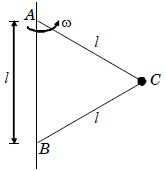
As shown in the figure,two strings of length $l$ each are attached to a vertical axis $AB$ of length $l$. The strings are $AC$ and $BC$. At point $C$,a point mass $m$ is attached. The mass rotates about the axis with angular velocity $\omega$. The tensions in strings $AC$ and $BC$ are $T_1$ and $T_2$ respectively. Choose the $CORRECT$ alternative:
A
$T_1 = T_2$
B
String $AC$ will remain taut only if $\omega \geq \sqrt{g/l}$
C
String $BC$ will remain taut for any value of $\omega$.
D
$T_1 - T_2 = 2mg$
Solution
(D) Let $\theta$ be the angle that each string makes with the vertical axis. Since the triangle $ABC$ is equilateral (all sides are $l$),$\theta = 60^\circ$.
Resolving forces on mass $m$:
Vertical direction: $(T_1 - T_2) \cos \theta = mg \implies T_1 - T_2 = \frac{mg}{\cos 60^\circ} = 2mg$.
Horizontal direction: $(T_1 + T_2) \sin \theta = m \omega^2 r$,where $r = l \sin 60^\circ = l \frac{\sqrt{3}}{2}$.
$(T_1 + T_2) \frac{\sqrt{3}}{2} = m \omega^2 l \frac{\sqrt{3}}{2} \implies T_1 + T_2 = m \omega^2 l$.
Solving these equations: $T_1 = \frac{m \omega^2 l}{2} + mg$ and $T_2 = \frac{m \omega^2 l}{2} - mg$.
For string $BC$ to remain taut,$T_2 \geq 0 \implies \frac{m \omega^2 l}{2} \geq mg \implies \omega \geq \sqrt{2g/l}$.
Thus,option $D$ is correct.
Resolving forces on mass $m$:
Vertical direction: $(T_1 - T_2) \cos \theta = mg \implies T_1 - T_2 = \frac{mg}{\cos 60^\circ} = 2mg$.
Horizontal direction: $(T_1 + T_2) \sin \theta = m \omega^2 r$,where $r = l \sin 60^\circ = l \frac{\sqrt{3}}{2}$.
$(T_1 + T_2) \frac{\sqrt{3}}{2} = m \omega^2 l \frac{\sqrt{3}}{2} \implies T_1 + T_2 = m \omega^2 l$.
Solving these equations: $T_1 = \frac{m \omega^2 l}{2} + mg$ and $T_2 = \frac{m \omega^2 l}{2} - mg$.
For string $BC$ to remain taut,$T_2 \geq 0 \implies \frac{m \omega^2 l}{2} \geq mg \implies \omega \geq \sqrt{2g/l}$.
Thus,option $D$ is correct.
0 likes
View Solution62
MediumMCQ
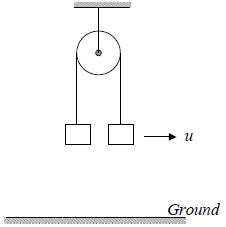
As shown in the figure, two equal masses hang on either side of a pulley at the same height from the ground. The mass on the right is given a horizontal speed $u$. After some time :-
A
the mass on the left will be nearer to the ground
B
the mass on the right will be nearer to the ground
C
both the masses will be at equal distance from the ground
D
nothing can be said regarding their positions.
Solution
(B) When the mass on the right is given a horizontal velocity $u$, it starts moving in a circular arc (pendulum motion) because it is constrained by the string connected to the pulley.
As it moves in a circular arc, it gains a centripetal acceleration directed towards the center of the pulley.
For the mass on the right, the equation of motion along the radial direction is $T - mg \cos \theta = \frac{mu^2}{R}$, where $T$ is the tension, $m$ is the mass, $g$ is acceleration due to gravity, $\theta$ is the angle with the vertical, and $R$ is the length of the string.
This implies $T = mg \cos \theta + \frac{mu^2}{R}$.
Since the tension $T$ in the string is greater than the weight $mg$ of the mass on the left (because $T > mg \cos \theta$ and the mass on the right is moving), the mass on the left will be pulled upwards.
Therefore, the mass on the left will rise, making it farther from the ground, while the mass on the right will be nearer to the ground.
As it moves in a circular arc, it gains a centripetal acceleration directed towards the center of the pulley.
For the mass on the right, the equation of motion along the radial direction is $T - mg \cos \theta = \frac{mu^2}{R}$, where $T$ is the tension, $m$ is the mass, $g$ is acceleration due to gravity, $\theta$ is the angle with the vertical, and $R$ is the length of the string.
This implies $T = mg \cos \theta + \frac{mu^2}{R}$.
Since the tension $T$ in the string is greater than the weight $mg$ of the mass on the left (because $T > mg \cos \theta$ and the mass on the right is moving), the mass on the left will be pulled upwards.
Therefore, the mass on the left will rise, making it farther from the ground, while the mass on the right will be nearer to the ground.
0 likes
View Solution63
DifficultMCQ
$A$ tube of length $L$ is filled completely with an incompressible liquid of mass $M$ and closed at both ends. The tube is then rotated in a horizontal plane about one of its ends with a uniform angular velocity $\omega$. Then the force exerted by the liquid at the other end is
A
$M{\omega ^2}L$
B
$\frac{1}{2}M{\omega ^2}L$
C
$\frac{1}{4}M{\omega ^2}L$
D
$2M{\omega ^2}L$
Solution
(B) Consider a small element of the liquid of mass $dm$ at a distance $r$ from the axis of rotation. The length of this element is $dr$. Since the tube has length $L$ and mass $M$,the linear mass density is $\lambda = M/L$.
Thus,$dm = \lambda dr = (M/L) dr$.
The centripetal force $dF$ required for this element to rotate is $dF = (dm) \omega^2 r = (M/L) \omega^2 r dr$.
To find the total force exerted by the liquid at the axis of rotation,we integrate from $r = 0$ to $r = L$:
$F = \int_0^L \frac{M}{L} \omega^2 r dr = \frac{M \omega^2}{L} \left[ \frac{r^2}{2} \right]_0^L = \frac{M \omega^2}{L} \cdot \frac{L^2}{2} = \frac{1}{2} M \omega^2 L$.
This force represents the total centripetal force required to keep the liquid in circular motion,which is effectively the force exerted by the liquid at the pivot point.
Thus,$dm = \lambda dr = (M/L) dr$.
The centripetal force $dF$ required for this element to rotate is $dF = (dm) \omega^2 r = (M/L) \omega^2 r dr$.
To find the total force exerted by the liquid at the axis of rotation,we integrate from $r = 0$ to $r = L$:
$F = \int_0^L \frac{M}{L} \omega^2 r dr = \frac{M \omega^2}{L} \left[ \frac{r^2}{2} \right]_0^L = \frac{M \omega^2}{L} \cdot \frac{L^2}{2} = \frac{1}{2} M \omega^2 L$.
This force represents the total centripetal force required to keep the liquid in circular motion,which is effectively the force exerted by the liquid at the pivot point.
0 likes
View Solution64
MediumMCQ
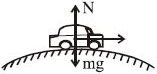
$A$ car of mass $m$ passes over the top of a convex bridge of radius of curvature $r$ with a velocity $v$. What is the normal force exerted by the bridge on the car?
A
Zero
B
$mg$
C
$mg + \frac{mv^2}{r}$
D
$mg - \frac{mv^2}{r}$
Solution
(D) When the car is at the top of the convex bridge,it moves in a circular path of radius $r$. The forces acting on the car are the gravitational force $mg$ acting downwards and the normal force $N$ exerted by the bridge acting upwards.
The net centripetal force required for circular motion is directed towards the center of the circle (downwards in this case). Thus,the equation of motion is:
$mg - N = \frac{mv^2}{r}$
Rearranging the equation to solve for the normal force $N$:
$N = mg - \frac{mv^2}{r}$
The net centripetal force required for circular motion is directed towards the center of the circle (downwards in this case). Thus,the equation of motion is:
$mg - N = \frac{mv^2}{r}$
Rearranging the equation to solve for the normal force $N$:
$N = mg - \frac{mv^2}{r}$
0 likes
View Solution65
MediumMCQ
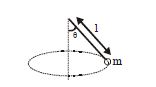
$A$ conical pendulum is moving in a circle with angular velocity $\omega$ as shown. If the tension in the string is $T$,which of the following equations is correct?
A
$T = m{\omega ^2}l$
B
$T\sin \theta = m{\omega ^2}l$
C
$T = mg\cos \theta$
D
$T = m{\omega ^2}l\sin \theta$
Solution
(A) The radius of the circular path is $r = l \sin \theta$.
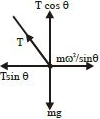
The horizontal component of the tension provides the necessary centripetal force: $T \sin \theta = m \omega^2 r$.
Substituting $r = l \sin \theta$ into the equation,we get: $T \sin \theta = m \omega^2 (l \sin \theta)$.
Dividing both sides by $\sin \theta$ (assuming $\theta \neq 0$),we obtain: $T = m \omega^2 l$.
The vertical component of the tension balances the weight: $T \cos \theta = mg$.
The horizontal component of the tension provides the necessary centripetal force: $T \sin \theta = m \omega^2 r$.
Substituting $r = l \sin \theta$ into the equation,we get: $T \sin \theta = m \omega^2 (l \sin \theta)$.
Dividing both sides by $\sin \theta$ (assuming $\theta \neq 0$),we obtain: $T = m \omega^2 l$.
The vertical component of the tension balances the weight: $T \cos \theta = mg$.
0 likes
View Solution66
DifficultMCQ
Two particles of the same mass are moving in circular orbits because of a force given by $F(r) = -\frac{16}{r} - r^3$. The first particle is at a distance $r = 1$,and the second is at $r = 4$. The best estimate for the ratio of kinetic energies of the first and the second particle is closest to:
A
$10^{-1}$
B
$6 \times 10^{-2}$
C
$6 \times 10^{2}$
D
$3 \times 10^{-3}$
Solution
(B) Since the particles are moving in circular orbits,the centripetal force is provided by the given force $F(r)$.
$\frac{mv^2}{r} = |F(r)| = \frac{16}{r} + r^3$
Multiplying both sides by $\frac{r}{2}$,we get the kinetic energy $K = \frac{1}{2}mv^2 = \frac{1}{2}(16 + r^4)$.
For the first particle at $r = 1$:
$K_1 = \frac{1}{2}(16 + 1^4) = \frac{17}{2} = 8.5$.
For the second particle at $r = 4$:
$K_2 = \frac{1}{2}(16 + 4^4) = \frac{1}{2}(16 + 256) = \frac{272}{2} = 136$.
The ratio of kinetic energies is:
$\frac{K_1}{K_2} = \frac{17/2}{272/2} = \frac{17}{272} = \frac{1}{16} = 0.0625$.
Thus,the ratio is approximately $6 \times 10^{-2}$.
$\frac{mv^2}{r} = |F(r)| = \frac{16}{r} + r^3$
Multiplying both sides by $\frac{r}{2}$,we get the kinetic energy $K = \frac{1}{2}mv^2 = \frac{1}{2}(16 + r^4)$.
For the first particle at $r = 1$:
$K_1 = \frac{1}{2}(16 + 1^4) = \frac{17}{2} = 8.5$.
For the second particle at $r = 4$:
$K_2 = \frac{1}{2}(16 + 4^4) = \frac{1}{2}(16 + 256) = \frac{272}{2} = 136$.
The ratio of kinetic energies is:
$\frac{K_1}{K_2} = \frac{17/2}{272/2} = \frac{17}{272} = \frac{1}{16} = 0.0625$.
Thus,the ratio is approximately $6 \times 10^{-2}$.
0 likes
View Solution67
DifficultMCQ
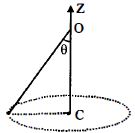
$A$ conical pendulum of length $1\,m$ makes an angle $\theta = 45^\circ$ with respect to the $Z$-axis and moves in a circle in the $XY$ plane. The radius of the circle is $0.4\,m$ and its centre is vertically below $O$. The speed of the pendulum,in its circular path,will be ..... $m/s$ (Take $g = 10\,ms^{-2}$)
A
$0.4$
B
$4$
C
$0.2$
D
$2$
Solution
(D) Given: $\theta = 45^\circ$,$r = 0.4\,m$,$g = 10\,m/s^2$.
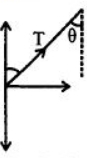
For a conical pendulum,the forces acting on the bob are tension $T$ and weight $mg$.
The horizontal component of tension provides the necessary centripetal force:
$T \sin \theta = \frac{mv^2}{r} \quad \dots(i)$
The vertical component of tension balances the weight:
$T \cos \theta = mg \quad \dots(ii)$
Dividing equation $(i)$ by $(ii)$:
$\tan \theta = \frac{v^2}{rg}$
$v^2 = rg \tan \theta$
Substituting the given values:
$v^2 = 0.4 \times 10 \times \tan(45^\circ)$
$v^2 = 4 \times 1 = 4$
$v = \sqrt{4} = 2\,m/s$.
For a conical pendulum,the forces acting on the bob are tension $T$ and weight $mg$.
The horizontal component of tension provides the necessary centripetal force:
$T \sin \theta = \frac{mv^2}{r} \quad \dots(i)$
The vertical component of tension balances the weight:
$T \cos \theta = mg \quad \dots(ii)$
Dividing equation $(i)$ by $(ii)$:
$\tan \theta = \frac{v^2}{rg}$
$v^2 = rg \tan \theta$
Substituting the given values:
$v^2 = 0.4 \times 10 \times \tan(45^\circ)$
$v^2 = 4 \times 1 = 4$
$v = \sqrt{4} = 2\,m/s$.
0 likes
View Solution68
DifficultMCQ
The $x$ and $y$ displacements of a particle are given as $x(t) = a \sin \omega t$ and $y(t) = a \sin 2 \omega t$. Its trajectory will look like:
A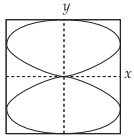
B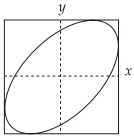
C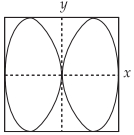
D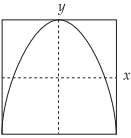
Solution
(A) Given the equations of motion for the particle:
$x = a \sin \omega t \Rightarrow \sin \omega t = \frac{x}{a}$
$y = a \sin 2 \omega t$
Using the trigonometric identity $\sin 2 \theta = 2 \sin \theta \cos \theta$,we can write:
$y = a (2 \sin \omega t \cos \omega t)$
Since $\cos \omega t = \sqrt{1 - \sin^2 \omega t} = \sqrt{1 - (\frac{x}{a})^2} = \frac{\sqrt{a^2 - x^2}}{a}$,we substitute this into the equation for $y$:
$y = 2a (\frac{x}{a}) (\frac{\sqrt{a^2 - x^2}}{a})$
$y = \frac{2x}{a} \sqrt{a^2 - x^2}$
Squaring both sides gives $y^2 = \frac{4x^2}{a^2} (a^2 - x^2)$,which represents a figure-eight curve (Lissajous figure) symmetric about the $x$ and $y$ axes. This corresponds to the shape shown in option $A$.
$x = a \sin \omega t \Rightarrow \sin \omega t = \frac{x}{a}$
$y = a \sin 2 \omega t$
Using the trigonometric identity $\sin 2 \theta = 2 \sin \theta \cos \theta$,we can write:
$y = a (2 \sin \omega t \cos \omega t)$
Since $\cos \omega t = \sqrt{1 - \sin^2 \omega t} = \sqrt{1 - (\frac{x}{a})^2} = \frac{\sqrt{a^2 - x^2}}{a}$,we substitute this into the equation for $y$:
$y = 2a (\frac{x}{a}) (\frac{\sqrt{a^2 - x^2}}{a})$
$y = \frac{2x}{a} \sqrt{a^2 - x^2}$
Squaring both sides gives $y^2 = \frac{4x^2}{a^2} (a^2 - x^2)$,which represents a figure-eight curve (Lissajous figure) symmetric about the $x$ and $y$ axes. This corresponds to the shape shown in option $A$.
0 likes
View Solution69
DifficultMCQ
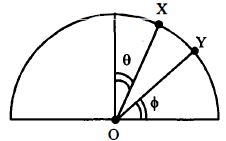
$A$ particle is released on a vertical smooth semicircular track from point $X$ so that $OX$ makes an angle $\theta$ from the vertical (see figure). The normal reaction of the track on the particle vanishes at point $Y$ where $OY$ makes an angle $\phi$ with the horizontal. Then
A
$\sin \phi = \cos \theta$
B
$\sin \phi = \frac{1}{2} \cos \theta$
C
$\sin \phi = \frac{2}{3} \cos \theta$
D
$\sin \phi = \frac{3}{4} \cos \theta$
Solution
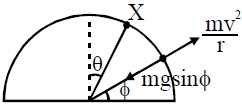
(C) At point $Y$,the normal reaction $N = 0$. The radial component of the gravitational force provides the necessary centripetal force:
$mg \sin \phi = \frac{mv^2}{r} \implies v^2 = rg \sin \phi$ $...(i)$
Using the principle of conservation of mechanical energy between point $X$ and point $Y$:
$mg(r \cos \theta) = mg(r \sin \phi) + \frac{1}{2} mv^2$
$g r \cos \theta = g r \sin \phi + \frac{1}{2} (rg \sin \phi)$
$g r \cos \theta = \frac{3}{2} rg \sin \phi$
$\cos \theta = \frac{3}{2} \sin \phi$
$\sin \phi = \frac{2}{3} \cos \theta$
$mg \sin \phi = \frac{mv^2}{r} \implies v^2 = rg \sin \phi$ $...(i)$
Using the principle of conservation of mechanical energy between point $X$ and point $Y$:
$mg(r \cos \theta) = mg(r \sin \phi) + \frac{1}{2} mv^2$
$g r \cos \theta = g r \sin \phi + \frac{1}{2} (rg \sin \phi)$
$g r \cos \theta = \frac{3}{2} rg \sin \phi$
$\cos \theta = \frac{3}{2} \sin \phi$
$\sin \phi = \frac{2}{3} \cos \theta$
0 likes
View Solution70
DifficultMCQ
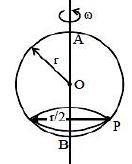
$A$ smooth wire of length $2\pi r$ is bent into a circle and kept in a vertical plane. $A$ bead can slide smoothly on the wire. When the circle is rotating with angular speed $\omega$ about the vertical diameter $AB$,as shown in the figure,the bead is at rest with respect to the circular ring at position $P$ as shown. Then the value of $\omega^2$ is equal to
A
$\frac{\sqrt{3}g}{2r}$
B
$\frac{g\sqrt{3}}{r}$
C
$\frac{2g}{r}$
D
$\frac{2g}{r\sqrt{3}}$
Solution
(D) Let $m$ be the mass of the bead and $N$ be the normal reaction force exerted by the wire on the bead.
The radius of the circular path of the bead is $R_{path} = r/2$.
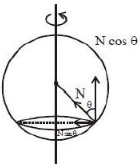
The forces acting on the bead are the gravitational force $mg$ (downwards) and the normal reaction $N$ (perpendicular to the wire).
Resolving the forces into horizontal and vertical components:
$N \sin \theta = m R_{path} \omega^2 = m (r/2) \omega^2$ ... $(i)$
$N \cos \theta = mg$ ... (ii)
Dividing $(i)$ by (ii),we get:
$\tan \theta = \frac{(r/2) \omega^2}{g} = \frac{r \omega^2}{2g}$
From the geometry of the circle,the distance from the center $O$ to the vertical axis is $r/2$. The angle $\theta$ that the radius vector $OP$ makes with the vertical is given by $\sin \theta = \frac{r/2}{r} = 1/2$,so $\theta = 30^\circ$.
Thus,$\tan 30^\circ = \frac{1}{\sqrt{3}}$.
Equating the two expressions for $\tan \theta$:
$\frac{1}{\sqrt{3}} = \frac{r \omega^2}{2g}$
$\omega^2 = \frac{2g}{r\sqrt{3}}$
The radius of the circular path of the bead is $R_{path} = r/2$.
The forces acting on the bead are the gravitational force $mg$ (downwards) and the normal reaction $N$ (perpendicular to the wire).
Resolving the forces into horizontal and vertical components:
$N \sin \theta = m R_{path} \omega^2 = m (r/2) \omega^2$ ... $(i)$
$N \cos \theta = mg$ ... (ii)
Dividing $(i)$ by (ii),we get:
$\tan \theta = \frac{(r/2) \omega^2}{g} = \frac{r \omega^2}{2g}$
From the geometry of the circle,the distance from the center $O$ to the vertical axis is $r/2$. The angle $\theta$ that the radius vector $OP$ makes with the vertical is given by $\sin \theta = \frac{r/2}{r} = 1/2$,so $\theta = 30^\circ$.
Thus,$\tan 30^\circ = \frac{1}{\sqrt{3}}$.
Equating the two expressions for $\tan \theta$:
$\frac{1}{\sqrt{3}} = \frac{r \omega^2}{2g}$
$\omega^2 = \frac{2g}{r\sqrt{3}}$
0 likes
View Solution71
MediumMCQ
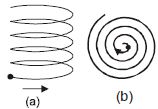
$A$ particle is moving with constant speed along a uniform helical path $(a)$ and a spiral path $(b)$ separately,as shown in the figure.
A
The velocity of the particle is constant in both cases.
B
The magnitude of acceleration of the particle is constant in both cases.
C
The magnitude of acceleration is constant in $(a)$ and decreasing in $(b)$.
D
The magnitude of acceleration is decreasing continuously in both cases.
Solution
(C) For a particle moving in a circular or curved path with constant speed $v$,the centripetal acceleration is given by $a_c = \frac{v^2}{r}$,where $r$ is the radius of curvature.
In case $(a)$,the path is a uniform helix,meaning the radius of curvature $r$ is constant. Since $v$ and $r$ are constant,the magnitude of acceleration $a_c$ is constant.
In case $(b)$,the path is a spiral where the radius $r$ increases as the particle moves outward. Since $v$ is constant and $r$ increases,the magnitude of acceleration $a_c = \frac{v^2}{r}$ decreases as the particle moves along the spiral path.
Therefore,the magnitude of acceleration is constant in $(a)$ and decreasing in $(b)$.
In case $(a)$,the path is a uniform helix,meaning the radius of curvature $r$ is constant. Since $v$ and $r$ are constant,the magnitude of acceleration $a_c$ is constant.
In case $(b)$,the path is a spiral where the radius $r$ increases as the particle moves outward. Since $v$ is constant and $r$ increases,the magnitude of acceleration $a_c = \frac{v^2}{r}$ decreases as the particle moves along the spiral path.
Therefore,the magnitude of acceleration is constant in $(a)$ and decreasing in $(b)$.
0 likes
View Solution72
MediumMCQ
$A$ string of length $0.1\,m$ cannot bear a tension more than $100\,N$. It is tied to a body of mass $100\,g$ and rotated in a horizontal circle. The maximum angular velocity can be .......... $rad/s$.
A
$100$
B
$1000$
C
$10000$
D
$0.1$
Solution
(A) Given:
Length of the string,$r = 0.1\,m$
Maximum tension,$T = 100\,N$
Mass of the body,$m = 100\,g = 0.1\,kg$
For a body rotating in a horizontal circle,the tension in the string provides the necessary centripetal force.
The formula for centripetal force is $T = m\omega^2r$.
Substituting the given values:
$100 = 0.1 \times \omega^2 \times 0.1$
$100 = 0.01 \times \omega^2$
$\omega^2 = \frac{100}{0.01}$
$\omega^2 = 10000$
$\omega = \sqrt{10000}$
$\omega = 100\,rad/s$.
Length of the string,$r = 0.1\,m$
Maximum tension,$T = 100\,N$
Mass of the body,$m = 100\,g = 0.1\,kg$
For a body rotating in a horizontal circle,the tension in the string provides the necessary centripetal force.
The formula for centripetal force is $T = m\omega^2r$.
Substituting the given values:
$100 = 0.1 \times \omega^2 \times 0.1$
$100 = 0.01 \times \omega^2$
$\omega^2 = \frac{100}{0.01}$
$\omega^2 = 10000$
$\omega = \sqrt{10000}$
$\omega = 100\,rad/s$.
0 likes
View Solution73
MediumMCQ
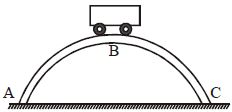
$A$ car is moving on an overbridge of radius $R$ with a constant speed $v$. As the car is descending on the overbridge from point $B$ to $C$,the normal reaction on it due to the bridge:
A
increases
B
decreases
C
remains constant
D
first increases and then decreases
Solution
(B) Let $\theta$ be the angle that the radius vector to the car makes with the vertical at any point on the overbridge.
The forces acting on the car are its weight $mg$ (downwards) and the normal reaction $N$ (upwards).
The net centripetal force required for circular motion is provided by the component of weight towards the center and the normal reaction.
The equation of motion is: $mg \cos \theta - N = \frac{mv^2}{R}$.
Rearranging for the normal reaction: $N = mg \cos \theta - \frac{mv^2}{R}$.
As the car descends from point $B$ (the highest point) to point $C$,the angle $\theta$ increases from $0^\circ$ to $90^\circ$.
As $\theta$ increases,$\cos \theta$ decreases.
Since $N = mg \cos \theta - \frac{mv^2}{R}$,as $\cos \theta$ decreases,the normal reaction $N$ also decreases.
The forces acting on the car are its weight $mg$ (downwards) and the normal reaction $N$ (upwards).
The net centripetal force required for circular motion is provided by the component of weight towards the center and the normal reaction.
The equation of motion is: $mg \cos \theta - N = \frac{mv^2}{R}$.
Rearranging for the normal reaction: $N = mg \cos \theta - \frac{mv^2}{R}$.
As the car descends from point $B$ (the highest point) to point $C$,the angle $\theta$ increases from $0^\circ$ to $90^\circ$.
As $\theta$ increases,$\cos \theta$ decreases.
Since $N = mg \cos \theta - \frac{mv^2}{R}$,as $\cos \theta$ decreases,the normal reaction $N$ also decreases.
0 likes
View Solution74
MediumMCQ
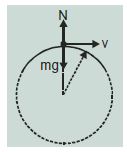
$A$ circular overbridge has a radius of $20\,m$. What is the maximum speed with which a car can cross the bridge without leaving contact with the overbridge at the highest point (in $,m/s$)? $(g = 9.8\,m/s^2)$
A
$14$
B
$20$
C
$22.3$
D
$28$
Solution
(A) At the highest point of a circular overbridge,the forces acting on the car are the gravitational force $(mg)$ acting downwards and the normal reaction force $(N)$ acting upwards.
The net centripetal force required for circular motion is provided by the difference between these forces:
$mg - N = \frac{mv^2}{r}$
To find the maximum speed at which the car can cross without losing contact,we set the normal reaction force $N$ to zero (the point where the car is just about to leave the surface).
$mg - 0 = \frac{mv^2}{r}$
$g = \frac{v^2}{r}$
$v^2 = rg$
$v = \sqrt{rg}$
Given $r = 20\,m$ and $g = 9.8\,m/s^2$:
$v = \sqrt{20 \times 9.8}$
$v = \sqrt{196}$
$v = 14\,m/s$
The net centripetal force required for circular motion is provided by the difference between these forces:
$mg - N = \frac{mv^2}{r}$
To find the maximum speed at which the car can cross without losing contact,we set the normal reaction force $N$ to zero (the point where the car is just about to leave the surface).
$mg - 0 = \frac{mv^2}{r}$
$g = \frac{v^2}{r}$
$v^2 = rg$
$v = \sqrt{rg}$
Given $r = 20\,m$ and $g = 9.8\,m/s^2$:
$v = \sqrt{20 \times 9.8}$
$v = \sqrt{196}$
$v = 14\,m/s$
0 likes
View Solution75
EasyMCQ
$A$ motorcycle is moving on an overbridge of radius $R$. The driver maintains a constant speed $v$. As the motorcycle is ascending on the overbridge,the normal force on it is
A
Increasing
B
Decreasing
C
Remaining the same
D
Fluctuating
Solution
(B) The motorcycle moves in a circular path of radius $R$ on the overbridge. The forces acting on the motorcycle are the normal force $N$ (upwards) and the weight $mg$ (downwards).
At any angle $\theta$ with the vertical,the component of weight acting towards the center is $mg \cos \theta$.
The net centripetal force is given by $mg \cos \theta - N = \frac{mv^2}{R}$.
Rearranging for the normal force,we get $N = mg \cos \theta - \frac{mv^2}{R}$.
As the motorcycle ascends the overbridge,the angle $\theta$ with the vertical increases from $0^\circ$ to $90^\circ$.
As $\theta$ increases,$\cos \theta$ decreases.
Since $N = mg \cos \theta - \frac{mv^2}{R}$,as $\cos \theta$ decreases,the normal force $N$ decreases.
At any angle $\theta$ with the vertical,the component of weight acting towards the center is $mg \cos \theta$.
The net centripetal force is given by $mg \cos \theta - N = \frac{mv^2}{R}$.
Rearranging for the normal force,we get $N = mg \cos \theta - \frac{mv^2}{R}$.
As the motorcycle ascends the overbridge,the angle $\theta$ with the vertical increases from $0^\circ$ to $90^\circ$.
As $\theta$ increases,$\cos \theta$ decreases.
Since $N = mg \cos \theta - \frac{mv^2}{R}$,as $\cos \theta$ decreases,the normal force $N$ decreases.
0 likes
View Solution76
MediumMCQ
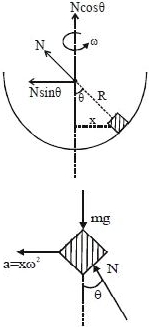
$A$ hemispherical bowl of radius $R$ is rotated about its axis of symmetry,which is kept vertical,with angular velocity $\omega$. $A$ small block is kept in the bowl. It remains stationary relative to the bowl surface at a position where the radius makes an angle $\theta$ with the vertical. The friction is absent. The value of $\theta$ is
A
$\cos^{-1}\left(\frac{g}{R\omega^2}\right)$
B
$\sin^{-1}\left(\frac{g}{R\omega^2}\right)$
C
$\tan^{-1}\left(\frac{g}{R\omega^2}\right)$
D
none of these
Solution
(A) The forces acting on the block are the normal force $N$ and the gravitational force $mg$. The block moves in a horizontal circle of radius $x = R \sin \theta$.
For the vertical direction,the forces are balanced:
$N \cos \theta = mg$ ......$(i)$
For the horizontal direction,the normal force provides the necessary centripetal force:
$N \sin \theta = m x \omega^2 = m (R \sin \theta) \omega^2$ ......(ii)
Dividing equation (ii) by equation $(i)$:
$\frac{N \sin \theta}{N \cos \theta} = \frac{m R \sin \theta \omega^2}{mg}$
$\tan \theta = \frac{R \sin \theta \omega^2}{g}$
Since $\tan \theta = \frac{\sin \theta}{\cos \theta}$,we have:
$\frac{\sin \theta}{\cos \theta} = \frac{R \sin \theta \omega^2}{g}$
$\frac{1}{\cos \theta} = \frac{R \omega^2}{g}$
$\cos \theta = \frac{g}{R \omega^2}$
$\theta = \cos^{-1}\left(\frac{g}{R \omega^2}\right)$
For the vertical direction,the forces are balanced:
$N \cos \theta = mg$ ......$(i)$
For the horizontal direction,the normal force provides the necessary centripetal force:
$N \sin \theta = m x \omega^2 = m (R \sin \theta) \omega^2$ ......(ii)
Dividing equation (ii) by equation $(i)$:
$\frac{N \sin \theta}{N \cos \theta} = \frac{m R \sin \theta \omega^2}{mg}$
$\tan \theta = \frac{R \sin \theta \omega^2}{g}$
Since $\tan \theta = \frac{\sin \theta}{\cos \theta}$,we have:
$\frac{\sin \theta}{\cos \theta} = \frac{R \sin \theta \omega^2}{g}$
$\frac{1}{\cos \theta} = \frac{R \omega^2}{g}$
$\cos \theta = \frac{g}{R \omega^2}$
$\theta = \cos^{-1}\left(\frac{g}{R \omega^2}\right)$
0 likes
View Solution77
EasyMCQ
$Assertion$ : Centripetal and centrifugal forces cancel each other.
$Reason$ : Centrifugal force is a reaction of centripetal force.
$Reason$ : Centrifugal force is a reaction of centripetal force.
A
If both $Assertion$ and $Reason$ are correct and the $Reason$ is a correct explanation of the $Assertion$.
B
If both $Assertion$ and $Reason$ are correct but $Reason$ is not a correct explanation of the $Assertion$.
C
If the $Assertion$ is correct but $Reason$ is incorrect.
D
If both the $Assertion$ and $Reason$ are incorrect.
Solution
(D) $1$. Centripetal force is a real force acting on a body moving in a circular path,directed towards the center of the circle. It is required to change the direction of velocity.
$2$. Centrifugal force is a pseudo force (fictitious force) that appears to act on a body in a non-inertial (rotating) frame of reference. It is directed away from the center.
$3$. Since these forces act on different frames of reference,they cannot cancel each other out. Therefore,the $Assertion$ is incorrect.
$4$. Centrifugal force is not a reaction to centripetal force in the context of $Newton's$ third law. $Newton's$ third law applies to forces of the same nature acting on different bodies. Centripetal force is a real force,while centrifugal force is a pseudo force. Therefore,the $Reason$ is also incorrect.
$5$. Thus,both $Assertion$ and $Reason$ are incorrect.
$2$. Centrifugal force is a pseudo force (fictitious force) that appears to act on a body in a non-inertial (rotating) frame of reference. It is directed away from the center.
$3$. Since these forces act on different frames of reference,they cannot cancel each other out. Therefore,the $Assertion$ is incorrect.
$4$. Centrifugal force is not a reaction to centripetal force in the context of $Newton's$ third law. $Newton's$ third law applies to forces of the same nature acting on different bodies. Centripetal force is a real force,while centrifugal force is a pseudo force. Therefore,the $Reason$ is also incorrect.
$5$. Thus,both $Assertion$ and $Reason$ are incorrect.
0 likes
View Solution78
DifficultMCQ
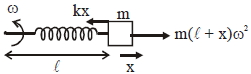
$A$ particle of mass $m$ is fixed to one end of a light spring having force constant $k$ and unstretched length $\ell$. The other end is fixed. The system is given an angular speed $\omega$ about the fixed end of the spring such that it rotates in a circle in gravity-free space. Then the stretch in the spring is
A
$\frac{m \ell \omega^{2}}{k+m \omega^{2}}$
B
$\frac{m \ell \omega^{2}}{k-m \omega^{2}}$
C
$\frac{m \ell \omega^{2}}{k-m \omega}$
D
$\frac{m \ell \omega^{2}}{k+m \omega}$
Solution
(B) Let the stretch in the spring be $x$. The total length of the spring becomes $r = \ell + x$.
The centripetal force required for the circular motion of the particle is provided by the spring force.
$F_{c} = F_{s}$
$m \omega^{2} r = k x$
$m \omega^{2} (\ell + x) = k x$
$m \omega^{2} \ell + m \omega^{2} x = k x$
$m \omega^{2} \ell = k x - m \omega^{2} x$
$m \omega^{2} \ell = x (k - m \omega^{2})$
$x = \frac{m \ell \omega^{2}}{k - m \omega^{2}}$
The centripetal force required for the circular motion of the particle is provided by the spring force.
$F_{c} = F_{s}$
$m \omega^{2} r = k x$
$m \omega^{2} (\ell + x) = k x$
$m \omega^{2} \ell + m \omega^{2} x = k x$
$m \omega^{2} \ell = k x - m \omega^{2} x$
$m \omega^{2} \ell = x (k - m \omega^{2})$
$x = \frac{m \ell \omega^{2}}{k - m \omega^{2}}$
0 likes
View Solution79
Medium
One end of a string of length $l$ is connected to a particle of mass $m$ and the other to a small peg on a smooth horizontal table. If the particle moves in a circle with speed $v$,the net force on the particle (directed towards the centre) is :
$(i) \; T$
$(ii) \; T - \frac{m v^{2}}{l}$
$(iii) \; T + \frac{m v^{2}}{l}$
$(iv) \; 0$
$T$ is the tension in the string. [Choose the correct alternative].
$(i) \; T$
$(ii) \; T - \frac{m v^{2}}{l}$
$(iii) \; T + \frac{m v^{2}}{l}$
$(iv) \; 0$
$T$ is the tension in the string. [Choose the correct alternative].
Solution
(A) The correct answer is $(i) \; T$.
When a particle connected to a string revolves in a circular path on a smooth horizontal table,the centripetal force required for circular motion is provided solely by the tension $T$ in the string.
Since the table is smooth,there is no friction,and the only horizontal force acting on the particle directed towards the centre is the tension $T$.
Therefore,the net force on the particle is $F_{\text{net}} = T = \frac{m v^{2}}{l}$.
When a particle connected to a string revolves in a circular path on a smooth horizontal table,the centripetal force required for circular motion is provided solely by the tension $T$ in the string.
Since the table is smooth,there is no friction,and the only horizontal force acting on the particle directed towards the centre is the tension $T$.
Therefore,the net force on the particle is $F_{\text{net}} = T = \frac{m v^{2}}{l}$.
0 likes
View Solution80
MediumMCQ
An aircraft executes a horizontal loop at a speed of $720 \; km/h$ with its wings banked at $15^{\circ}$. What is the radius of the loop in $km$?
A
$7.45$
B
$14.92$
C
$18.46$
D
$26.54$
Solution
(B) Speed of the aircraft,$v = 720 \; km/h = 720 \times \frac{5}{18} = 200 \; m/s$.
Acceleration due to gravity,$g = 10 \; m/s^2$.
Angle of banking,$\theta = 15^{\circ}$.
For the radius $r$ of the horizontal loop,the relation is given by:
$\tan \theta = \frac{v^2}{rg}$.
Rearranging for $r$:
$r = \frac{v^2}{g \tan \theta}$.
Substituting the values:
$r = \frac{200 \times 200}{10 \times \tan 15^{\circ}} = \frac{40000}{10 \times 0.2679} = \frac{4000}{0.2679} \approx 14930 \; m$.
Converting to $km$:
$r \approx 14.93 \; km$.
Rounding to the nearest provided option,the radius is $14.92 \; km$.
Acceleration due to gravity,$g = 10 \; m/s^2$.
Angle of banking,$\theta = 15^{\circ}$.
For the radius $r$ of the horizontal loop,the relation is given by:
$\tan \theta = \frac{v^2}{rg}$.
Rearranging for $r$:
$r = \frac{v^2}{g \tan \theta}$.
Substituting the values:
$r = \frac{200 \times 200}{10 \times \tan 15^{\circ}} = \frac{40000}{10 \times 0.2679} = \frac{4000}{0.2679} \approx 14930 \; m$.
Converting to $km$:
$r \approx 14.93 \; km$.
Rounding to the nearest provided option,the radius is $14.92 \; km$.
0 likes
View Solution81
Medium
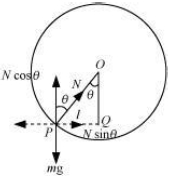
$A$ thin circular loop of radius $R$ rotates about its vertical diameter with an angular frequency $\omega$. Show that a small bead on the wire loop remains at its lowermost point for $\omega \leq \sqrt{g / R}$. What is the angle made by the radius vector joining the centre to the bead with the vertical downward direction for $\omega = \sqrt{2g / R}$? Neglect friction.
Solution
(D) Let the radius vector joining the bead $P$ with the centre $O$ make an angle $\theta$ with the vertical downward direction.
Let $m$ be the mass of the bead.
The forces acting on the bead are:
$1$. Weight $mg$ acting vertically downwards.
$2$. Normal reaction $N$ from the wire,acting perpendicular to the tangent at $P$.
Resolving the forces:
The vertical component of the normal reaction $N \cos \theta$ balances the weight $mg$,so $N \cos \theta = mg$.
The horizontal component of the normal reaction $N \sin \theta$ provides the necessary centripetal force $m \omega^2 r$,where $r = R \sin \theta$ is the radius of the circular path of the bead.
Thus,$N \sin \theta = m \omega^2 (R \sin \theta)$.
Since $\sin \theta \neq 0$ for $\theta \neq 0$,we get $N = m R \omega^2$.
Substituting $N$ in the vertical equation: $(m R \omega^2) \cos \theta = mg$.
Therefore,$\cos \theta = \frac{g}{R \omega^2}$.
Since $\cos \theta \leq 1$,the bead remains at the lowermost point $(\theta = 0)$ if $\frac{g}{R \omega^2} \geq 1$,which implies $\omega \leq \sqrt{\frac{g}{R}}$.
For $\omega = \sqrt{\frac{2g}{R}}$,we have $\omega^2 = \frac{2g}{R}$.
Substituting this into the expression for $\cos \theta$:
$\cos \theta = \frac{g}{R (2g/R)} = \frac{1}{2}$.
Thus,$\theta = \cos^{-1}(0.5) = 60^{\circ}$.
Let $m$ be the mass of the bead.
The forces acting on the bead are:
$1$. Weight $mg$ acting vertically downwards.
$2$. Normal reaction $N$ from the wire,acting perpendicular to the tangent at $P$.
Resolving the forces:
The vertical component of the normal reaction $N \cos \theta$ balances the weight $mg$,so $N \cos \theta = mg$.
The horizontal component of the normal reaction $N \sin \theta$ provides the necessary centripetal force $m \omega^2 r$,where $r = R \sin \theta$ is the radius of the circular path of the bead.
Thus,$N \sin \theta = m \omega^2 (R \sin \theta)$.
Since $\sin \theta \neq 0$ for $\theta \neq 0$,we get $N = m R \omega^2$.
Substituting $N$ in the vertical equation: $(m R \omega^2) \cos \theta = mg$.
Therefore,$\cos \theta = \frac{g}{R \omega^2}$.
Since $\cos \theta \leq 1$,the bead remains at the lowermost point $(\theta = 0)$ if $\frac{g}{R \omega^2} \geq 1$,which implies $\omega \leq \sqrt{\frac{g}{R}}$.
For $\omega = \sqrt{\frac{2g}{R}}$,we have $\omega^2 = \frac{2g}{R}$.
Substituting this into the expression for $\cos \theta$:
$\cos \theta = \frac{g}{R (2g/R)} = \frac{1}{2}$.
Thus,$\theta = \cos^{-1}(0.5) = 60^{\circ}$.
0 likes
View Solution82
Medium
"Momentum and changes in momentum are not always in the same direction." Explain with a suitable example.
Solution
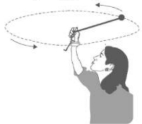
(N/A) Consider a stone tied to a string being whirled in a horizontal circular path at a constant speed.
$1$. The momentum of the stone is given by $\vec{p} = m\vec{v}$. Since the speed is constant, the magnitude of momentum remains constant, but its direction is always tangential to the circular path and changes continuously.
$2$. The change in momentum $\Delta \vec{p}$ over a small time interval $\Delta t$ is given by $\Delta \vec{p} = \vec{p}_{final} - \vec{p}_{initial}$. For a circular motion, this change in momentum vector points towards the center of the circle.
$3$. According to Newton's second law, $\vec{F} = \frac{d\vec{p}}{dt}$. The force (tension in the string) is directed towards the center, which is the same direction as the change in momentum.
$4$. Since the momentum vector is tangential and the change in momentum vector is radial (towards the center), they are clearly not in the same direction.
$1$. The momentum of the stone is given by $\vec{p} = m\vec{v}$. Since the speed is constant, the magnitude of momentum remains constant, but its direction is always tangential to the circular path and changes continuously.
$2$. The change in momentum $\Delta \vec{p}$ over a small time interval $\Delta t$ is given by $\Delta \vec{p} = \vec{p}_{final} - \vec{p}_{initial}$. For a circular motion, this change in momentum vector points towards the center of the circle.
$3$. According to Newton's second law, $\vec{F} = \frac{d\vec{p}}{dt}$. The force (tension in the string) is directed towards the center, which is the same direction as the change in momentum.
$4$. Since the momentum vector is tangential and the change in momentum vector is radial (towards the center), they are clearly not in the same direction.
0 likes
View Solution83
DifficultMCQ
$A$ block of $200\, g$ mass moves with a uniform speed in a horizontal circular groove,with vertical side walls of radius $20\, cm$. If the block takes $40\, s$ to complete one round,the normal force by the side walls of the groove is
A
$0.0314\, N$
B
$9.859 \times 10^{-2}\, N$
C
$6.28 \times 10^{-3}\, N$
D
$9.859 \times 10^{-4}\, N$
Solution
(D) The normal force $N$ provides the necessary centripetal force for circular motion.
$N = F_c = m \omega^2 R$
Since $\omega = \frac{2\pi}{T}$,we have $N = m \left( \frac{2\pi}{T} \right)^2 R = m \frac{4\pi^2}{T^2} R$.
Given values: $m = 200\, g = 0.2\, kg$,$R = 20\, cm = 0.2\, m$,and $T = 40\, s$.
Substituting these values into the formula:
$N = 0.2 \times \frac{4 \times (3.14159)^2}{(40)^2} \times 0.2$
$N = 0.2 \times \frac{4 \times 9.8696}{1600} \times 0.2$
$N = 0.04 \times \frac{39.4784}{1600}$
$N = 0.04 \times 0.024674 = 9.8696 \times 10^{-4}\, N$.
Rounding to the nearest option,we get $N \approx 9.859 \times 10^{-4}\, N$.
$N = F_c = m \omega^2 R$
Since $\omega = \frac{2\pi}{T}$,we have $N = m \left( \frac{2\pi}{T} \right)^2 R = m \frac{4\pi^2}{T^2} R$.
Given values: $m = 200\, g = 0.2\, kg$,$R = 20\, cm = 0.2\, m$,and $T = 40\, s$.
Substituting these values into the formula:
$N = 0.2 \times \frac{4 \times (3.14159)^2}{(40)^2} \times 0.2$
$N = 0.2 \times \frac{4 \times 9.8696}{1600} \times 0.2$
$N = 0.04 \times \frac{39.4784}{1600}$
$N = 0.04 \times 0.024674 = 9.8696 \times 10^{-4}\, N$.
Rounding to the nearest option,we get $N \approx 9.859 \times 10^{-4}\, N$.
1 likes
View Solution84
DifficultMCQ
$A$ particle is moving with uniform speed along the circumference of a circle of radius $R$ under the action of a central fictitious force $F$ which is inversely proportional to $R^{3}$. Its time period of revolution will be given by
A
$T \propto R^{2}$
B
$T \propto R^{3/2}$
C
$T \propto R^{5/2}$
D
$T \propto R^{4/3}$
Solution
(A) The centripetal force required for circular motion is provided by the central force $F$. Given $F \propto \frac{1}{R^{3}}$,we can write $F = \frac{K}{R^{3}}$,where $K$ is a constant.
For a particle of mass $m$ moving with angular velocity $\omega$ in a circle of radius $R$,the centripetal force is $F = m \omega^{2} R$.
Equating the two expressions: $\frac{K}{R^{3}} = m \omega^{2} R$.
Rearranging for $\omega^{2}$: $\omega^{2} = \frac{K}{m R^{4}}$.
Since the time period $T = \frac{2 \pi}{\omega}$,we have $\omega = \frac{2 \pi}{T}$.
Substituting this into the equation: $(\frac{2 \pi}{T})^{2} = \frac{K}{m R^{4}}$.
This simplifies to $\frac{4 \pi^{2}}{T^{2}} = \frac{K}{m R^{4}}$,which implies $T^{2} \propto R^{4}$.
Taking the square root of both sides,we get $T \propto R^{2}$.
For a particle of mass $m$ moving with angular velocity $\omega$ in a circle of radius $R$,the centripetal force is $F = m \omega^{2} R$.
Equating the two expressions: $\frac{K}{R^{3}} = m \omega^{2} R$.
Rearranging for $\omega^{2}$: $\omega^{2} = \frac{K}{m R^{4}}$.
Since the time period $T = \frac{2 \pi}{\omega}$,we have $\omega = \frac{2 \pi}{T}$.
Substituting this into the equation: $(\frac{2 \pi}{T})^{2} = \frac{K}{m R^{4}}$.
This simplifies to $\frac{4 \pi^{2}}{T^{2}} = \frac{K}{m R^{4}}$,which implies $T^{2} \propto R^{4}$.
Taking the square root of both sides,we get $T \propto R^{2}$.
0 likes
View Solution85
DifficultMCQ
$A$ particle of mass $m$ is suspended from a ceiling through a string of length $L$. The particle moves in a horizontal circle of radius $r$ such that $r = \frac{L}{\sqrt{2}}$. The speed of the particle will be:
A
$\sqrt{rg}$
B
$\sqrt{2rg}$
C
$2\sqrt{rg}$
D
$\sqrt{\frac{rg}{2}}$
Solution
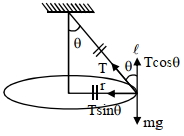
(A) This is a case of a conical pendulum.
Let $\theta$ be the angle the string makes with the vertical.
From the geometry of the setup,we have $\sin \theta = \frac{r}{L}$.
Given $r = \frac{L}{\sqrt{2}}$,we get $\sin \theta = \frac{L/\sqrt{2}}{L} = \frac{1}{\sqrt{2}}$.
This implies $\theta = 45^{\circ}$.
The forces acting on the particle are the tension $T$ in the string and the gravitational force $mg$.
Resolving the tension into horizontal and vertical components:
Horizontal component: $T \sin \theta = \frac{mv^2}{r}$ (providing the necessary centripetal force).
Vertical component: $T \cos \theta = mg$ (balancing the weight).
Dividing the two equations: $\frac{T \sin \theta}{T \cos \theta} = \frac{mv^2/r}{mg} \Rightarrow \tan \theta = \frac{v^2}{rg}$.
Since $\theta = 45^{\circ}$,$\tan 45^{\circ} = 1$.
Therefore,$1 = \frac{v^2}{rg} \Rightarrow v^2 = rg \Rightarrow v = \sqrt{rg}$.
Let $\theta$ be the angle the string makes with the vertical.
From the geometry of the setup,we have $\sin \theta = \frac{r}{L}$.
Given $r = \frac{L}{\sqrt{2}}$,we get $\sin \theta = \frac{L/\sqrt{2}}{L} = \frac{1}{\sqrt{2}}$.
This implies $\theta = 45^{\circ}$.
The forces acting on the particle are the tension $T$ in the string and the gravitational force $mg$.
Resolving the tension into horizontal and vertical components:
Horizontal component: $T \sin \theta = \frac{mv^2}{r}$ (providing the necessary centripetal force).
Vertical component: $T \cos \theta = mg$ (balancing the weight).
Dividing the two equations: $\frac{T \sin \theta}{T \cos \theta} = \frac{mv^2/r}{mg} \Rightarrow \tan \theta = \frac{v^2}{rg}$.
Since $\theta = 45^{\circ}$,$\tan 45^{\circ} = 1$.
Therefore,$1 = \frac{v^2}{rg} \Rightarrow v^2 = rg \Rightarrow v = \sqrt{rg}$.
0 likes
View Solution86
MediumMCQ
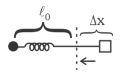
One end of a massless spring of spring constant $k$ and natural length $l_{0}$ is fixed,while the other end is connected to a small object of mass $m$ lying on a frictionless table. The spring remains horizontal on the table. If the object is made to rotate at an angular velocity $\omega$ about an axis passing through the fixed end,then the elongation of the spring will be
A
$\frac{k - m \omega^{2} l_{0}}{m \omega^{2}}$
B
$\frac{m \omega^{2} l_{0}}{k + m \omega^{2}}$
C
$\frac{m \omega^{2} l_{0}}{k - m \omega^{2}}$
D
$\frac{k + m \omega^{2} l_{0}}{m \omega^{2}}$
Solution
(C) Let the elongation of the spring be $\Delta x$. The total length of the spring becomes $l = l_{0} + \Delta x$.
The centripetal force required for the circular motion of the mass $m$ is provided by the spring force $F_{s} = k \Delta x$.
Equating the spring force to the centripetal force: $k \Delta x = m \omega^{2} (l_{0} + \Delta x)$.
Expanding the equation: $k \Delta x = m \omega^{2} l_{0} + m \omega^{2} \Delta x$.
Rearranging the terms to solve for $\Delta x$: $k \Delta x - m \omega^{2} \Delta x = m \omega^{2} l_{0}$.
$\Delta x (k - m \omega^{2}) = m \omega^{2} l_{0}$.
Therefore,the elongation is $\Delta x = \frac{m \omega^{2} l_{0}}{k - m \omega^{2}}$.
The centripetal force required for the circular motion of the mass $m$ is provided by the spring force $F_{s} = k \Delta x$.
Equating the spring force to the centripetal force: $k \Delta x = m \omega^{2} (l_{0} + \Delta x)$.
Expanding the equation: $k \Delta x = m \omega^{2} l_{0} + m \omega^{2} \Delta x$.
Rearranging the terms to solve for $\Delta x$: $k \Delta x - m \omega^{2} \Delta x = m \omega^{2} l_{0}$.
$\Delta x (k - m \omega^{2}) = m \omega^{2} l_{0}$.
Therefore,the elongation is $\Delta x = \frac{m \omega^{2} l_{0}}{k - m \omega^{2}}$.
0 likes
View Solution87
EasyMCQ
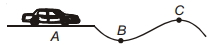
$A$ vehicle is moving on a track with constant speed as shown in the figure. The apparent weight of the vehicle is:
A
Maximum at $A$
B
Maximum at $B$
C
Maximum at $C$
D
Same at $A, B$ and $C$
Solution
(B) The apparent weight of the vehicle is equal to the normal reaction $N$ exerted by the track on the vehicle.
At point $A$,the track is horizontal,so the normal reaction is $N_A = mg$.
At point $B$,the vehicle is at the bottom of a concave curve. The net centripetal force is provided by the difference between the normal reaction and gravity: $N_B - mg = \frac{mv^2}{r}$. Thus,$N_B = mg + \frac{mv^2}{r}$.
At point $C$,the vehicle is at the top of a convex curve. The net centripetal force is provided by the difference between gravity and the normal reaction: $mg - N_C = \frac{mv^2}{r}$. Thus,$N_C = mg - \frac{mv^2}{r}$.
Comparing the values,$N_B > N_A > N_C$. Therefore,the apparent weight is maximum at $B$.
At point $A$,the track is horizontal,so the normal reaction is $N_A = mg$.
At point $B$,the vehicle is at the bottom of a concave curve. The net centripetal force is provided by the difference between the normal reaction and gravity: $N_B - mg = \frac{mv^2}{r}$. Thus,$N_B = mg + \frac{mv^2}{r}$.
At point $C$,the vehicle is at the top of a convex curve. The net centripetal force is provided by the difference between gravity and the normal reaction: $mg - N_C = \frac{mv^2}{r}$. Thus,$N_C = mg - \frac{mv^2}{r}$.
Comparing the values,$N_B > N_A > N_C$. Therefore,the apparent weight is maximum at $B$.
0 likes
View Solution88
MediumMCQ
$A$ train is running at $20 \, m/s$ on a railway line with a radius of curvature of $40,000 \, m$. The distance between the two rails is $1.5 \, m$. For safe running of the train,the elevation of the outer rail over the inner rail is ...... $mm$ $(g = 10 \, m/s^2)$.
A
$2.0$
B
$1.75$
C
$1.50$
D
$1.25$
Solution
(C) The banking of rails is given by the formula $\tan \theta = \frac{h}{d} = \frac{v^2}{rg}$,where $h$ is the elevation,$d$ is the distance between rails,$v$ is the velocity,$r$ is the radius of curvature,and $g$ is the acceleration due to gravity.
Given: $v = 20 \, m/s$,$r = 40,000 \, m$,$d = 1.5 \, m$,and $g = 10 \, m/s^2$.
Substituting the values: $\frac{h}{1.5} = \frac{(20)^2}{40,000 \times 10}$.
$\frac{h}{1.5} = \frac{400}{400,000} = \frac{1}{1000}$.
$h = \frac{1.5}{1000} \, m = 0.0015 \, m$.
Converting to $mm$: $h = 0.0015 \times 1000 \, mm = 1.5 \, mm$.
Given: $v = 20 \, m/s$,$r = 40,000 \, m$,$d = 1.5 \, m$,and $g = 10 \, m/s^2$.
Substituting the values: $\frac{h}{1.5} = \frac{(20)^2}{40,000 \times 10}$.
$\frac{h}{1.5} = \frac{400}{400,000} = \frac{1}{1000}$.
$h = \frac{1.5}{1000} \, m = 0.0015 \, m$.
Converting to $mm$: $h = 0.0015 \times 1000 \, mm = 1.5 \, mm$.
0 likes
View Solution89
MediumMCQ
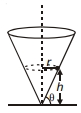
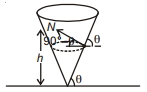
$A$ particle describes a horizontal circle of radius $r$ on the smooth surface of an inverted cone as shown. The height of the plane of the circle above the vertex is $h$. The speed of the particle should be
A
$\sqrt{r g}$
B
$\sqrt{2 r g}$
C
$\sqrt{g h}$
D
$\sqrt{2 g h}$
Solution
(C) Let the semi-vertical angle of the cone be $\theta$. From the geometry of the cone,we have $\tan \theta = \frac{r}{h}$.
The forces acting on the particle are its weight $mg$ acting downwards and the normal reaction $N$ from the surface of the cone acting perpendicular to the surface.
Resolving the normal reaction $N$ into horizontal and vertical components:
Vertical component: $N \cos \theta = mg$ --- $(i)$
Horizontal component (providing the centripetal force): $N \sin \theta = \frac{mv^2}{r}$ --- (ii)
Dividing equation (ii) by equation $(i)$:
$\frac{N \sin \theta}{N \cos \theta} = \frac{mv^2/r}{mg}$
$\tan \theta = \frac{v^2}{rg}$
Substituting $\tan \theta = \frac{r}{h}$ into the equation:
$\frac{r}{h} = \frac{v^2}{rg}$
$v^2 = \frac{r^2 g}{h}$
$v = r \sqrt{\frac{g}{h}}$
Wait,re-evaluating the geometry: If $\theta$ is the angle the slant surface makes with the horizontal,then $\tan \theta = \frac{h}{r}$.
Then $\frac{h}{r} = \frac{v^2}{rg} \implies v^2 = gh \implies v = \sqrt{gh}$.
The forces acting on the particle are its weight $mg$ acting downwards and the normal reaction $N$ from the surface of the cone acting perpendicular to the surface.
Resolving the normal reaction $N$ into horizontal and vertical components:
Vertical component: $N \cos \theta = mg$ --- $(i)$
Horizontal component (providing the centripetal force): $N \sin \theta = \frac{mv^2}{r}$ --- (ii)
Dividing equation (ii) by equation $(i)$:
$\frac{N \sin \theta}{N \cos \theta} = \frac{mv^2/r}{mg}$
$\tan \theta = \frac{v^2}{rg}$
Substituting $\tan \theta = \frac{r}{h}$ into the equation:
$\frac{r}{h} = \frac{v^2}{rg}$
$v^2 = \frac{r^2 g}{h}$
$v = r \sqrt{\frac{g}{h}}$
Wait,re-evaluating the geometry: If $\theta$ is the angle the slant surface makes with the horizontal,then $\tan \theta = \frac{h}{r}$.
Then $\frac{h}{r} = \frac{v^2}{rg} \implies v^2 = gh \implies v = \sqrt{gh}$.
0 likes
View Solution90
MediumMCQ
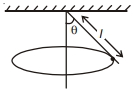
If the string of a conical pendulum makes an angle $\theta$ with the horizontal,then the square of its time period is proportional to
A
$\sin \theta$
B
$\cos \theta$
C
$\tan \theta$
D
$\cot \theta$
Solution
(A) For a conical pendulum,the time period $T$ is given by $T = 2\pi \sqrt{\frac{h}{g}}$,where $h$ is the vertical height of the pendulum bob from the point of suspension.
If the string of length $l$ makes an angle $\alpha$ with the vertical,then $h = l \cos \alpha$.
In this question,the angle $\theta$ is given with the horizontal. Therefore,the angle with the vertical is $\alpha = 90^\circ - \theta$.
Substituting this into the expression for height: $h = l \cos(90^\circ - \theta) = l \sin \theta$.
Thus,the time period is $T = 2\pi \sqrt{\frac{l \sin \theta}{g}}$.
Squaring both sides,we get $T^2 = 4\pi^2 \frac{l \sin \theta}{g}$.
Since $4\pi^2$,$l$,and $g$ are constants,we have $T^2 \propto \sin \theta$.
If the string of length $l$ makes an angle $\alpha$ with the vertical,then $h = l \cos \alpha$.
In this question,the angle $\theta$ is given with the horizontal. Therefore,the angle with the vertical is $\alpha = 90^\circ - \theta$.
Substituting this into the expression for height: $h = l \cos(90^\circ - \theta) = l \sin \theta$.
Thus,the time period is $T = 2\pi \sqrt{\frac{l \sin \theta}{g}}$.
Squaring both sides,we get $T^2 = 4\pi^2 \frac{l \sin \theta}{g}$.
Since $4\pi^2$,$l$,and $g$ are constants,we have $T^2 \propto \sin \theta$.
0 likes
View Solution91
MediumMCQ
An object of mass $m$ moves with constant speed in a circular path of radius $R$ under the action of a force of constant magnitude $F$. The kinetic energy of the object is ............
A
$\frac{1}{2} F R$
B
$F R$
C
$2 F R$
D
$\frac{1}{4} F R$
Solution
(A) For an object moving in a circular path with constant speed $v$ and radius $R$,the force $F$ acting on it is the centripetal force.
$F = \frac{m v^2}{R}$
From this,we can express the term $m v^2$ as:
$m v^2 = F R$
The kinetic energy $(KE)$ of the object is given by the formula:
$KE = \frac{1}{2} m v^2$
Substituting the value of $m v^2$ from the force equation into the kinetic energy formula:
$KE = \frac{1}{2} (F R)$
Therefore,the kinetic energy is $\frac{1}{2} F R$.
$F = \frac{m v^2}{R}$
From this,we can express the term $m v^2$ as:
$m v^2 = F R$
The kinetic energy $(KE)$ of the object is given by the formula:
$KE = \frac{1}{2} m v^2$
Substituting the value of $m v^2$ from the force equation into the kinetic energy formula:
$KE = \frac{1}{2} (F R)$
Therefore,the kinetic energy is $\frac{1}{2} F R$.
0 likes
View Solution92
EasyMCQ
$A$ person with his hand in his pocket is skating on ice at the rate of $10 \ m/s$ and describes a circle of radius $50 \ m$. What is his inclination to the vertical? (Take $g = 10 \ m/s^2$)
A
$\tan^{-1}(1/2)$
B
$\tan^{-1}(1/5)$
C
$\tan^{-1}(3/5)$
D
$\tan^{-1}(1/10)$
Solution
(B) The centripetal force required for circular motion on a frictionless surface is provided by the horizontal component of the normal reaction when the person leans at an angle $\theta$ with the vertical.
For a body moving in a circle of radius $r$ with speed $v$,the angle of inclination $\theta$ is given by the formula: $\tan \theta = \frac{v^2}{rg}$.
Given values are $v = 10 \ m/s$,$r = 50 \ m$,and $g = 10 \ m/s^2$.
Substituting these values into the formula:
$\tan \theta = \frac{(10)^2}{50 \times 10} = \frac{100}{500} = \frac{1}{5}$.
Therefore,the angle of inclination is $\theta = \tan^{-1}(1/5)$.
For a body moving in a circle of radius $r$ with speed $v$,the angle of inclination $\theta$ is given by the formula: $\tan \theta = \frac{v^2}{rg}$.
Given values are $v = 10 \ m/s$,$r = 50 \ m$,and $g = 10 \ m/s^2$.
Substituting these values into the formula:
$\tan \theta = \frac{(10)^2}{50 \times 10} = \frac{100}{500} = \frac{1}{5}$.
Therefore,the angle of inclination is $\theta = \tan^{-1}(1/5)$.
0 likes
View Solution93
EasyMCQ
$A$ stone of mass $0.3\,kg$ attached to a $1.5\,m$ long string is whirled around in a horizontal circle at a speed of $6\,m s^{-1}$. The tension in the string is $............\,N$.
A
$10$
B
$20$
C
$7.2$
D
$30$
Solution
(C) The tension in the string provides the necessary centripetal force required to keep the stone moving in a horizontal circular path.
Given mass $m = 0.3\,kg$,radius $R = 1.5\,m$,and velocity $v = 6\,m s^{-1}$.
The formula for centripetal force is $F_c = \frac{mv^2}{R}$.
Substituting the given values:
$T = \frac{0.3 \times (6)^2}{1.5}$
$T = \frac{0.3 \times 36}{1.5}$
$T = \frac{10.8}{1.5} = 7.2\,N$.
Therefore,the tension in the string is $7.2\,N$.
Given mass $m = 0.3\,kg$,radius $R = 1.5\,m$,and velocity $v = 6\,m s^{-1}$.
The formula for centripetal force is $F_c = \frac{mv^2}{R}$.
Substituting the given values:
$T = \frac{0.3 \times (6)^2}{1.5}$
$T = \frac{0.3 \times 36}{1.5}$
$T = \frac{10.8}{1.5} = 7.2\,N$.
Therefore,the tension in the string is $7.2\,N$.
0 likes
View Solution94
MediumMCQ
$A$ child of mass $5\,kg$ is going round a merry-go-round that makes $1$ rotation in $3.14\,s$. The radius of the merry-go-round is $2\,m$. The centrifugal force on the child will be $.......\,N$.
A
$80$
B
$50$
C
$100$
D
$40$
Solution
(D) The angular velocity $\omega$ is given by $\omega = \frac{2\pi}{T}$.
Given $T = 3.14\,s$ and $\pi \approx 3.14$,we have $\omega = \frac{2 \times 3.14}{3.14} = 2\,rad/s$.
The centrifugal force $F_c$ is given by the formula $F_c = m\omega^2R$.
Substituting the given values: $m = 5\,kg$,$\omega = 2\,rad/s$,and $R = 2\,m$.
$F_c = 5 \times (2)^2 \times 2 = 5 \times 4 \times 2 = 40\,N$.
Therefore,the centrifugal force on the child is $40\,N$.
Given $T = 3.14\,s$ and $\pi \approx 3.14$,we have $\omega = \frac{2 \times 3.14}{3.14} = 2\,rad/s$.
The centrifugal force $F_c$ is given by the formula $F_c = m\omega^2R$.
Substituting the given values: $m = 5\,kg$,$\omega = 2\,rad/s$,and $R = 2\,m$.
$F_c = 5 \times (2)^2 \times 2 = 5 \times 4 \times 2 = 40\,N$.
Therefore,the centrifugal force on the child is $40\,N$.
0 likes
View Solution95
MediumMCQ
$A$ vehicle of mass $200\,kg$ is moving along a levelled curved road of radius $70\,m$ with an angular velocity of $0.2\,rad/s$. The centripetal force acting on the vehicle is $.........\,N$.
A
$560$
B
$2800$
C
$14$
D
$2240$
Solution
(A) The formula for centripetal force is given by $F_c = m \omega^2 r$.
Given:
Mass $m = 200\,kg$
Angular velocity $\omega = 0.2\,rad/s$
Radius $r = 70\,m$
Substituting the values into the formula:
$F_c = 200 \times (0.2)^2 \times 70$
$F_c = 200 \times 0.04 \times 70$
$F_c = 8 \times 70 = 560\,N$.
Therefore,the centripetal force acting on the vehicle is $560\,N$.
Given:
Mass $m = 200\,kg$
Angular velocity $\omega = 0.2\,rad/s$
Radius $r = 70\,m$
Substituting the values into the formula:
$F_c = 200 \times (0.2)^2 \times 70$
$F_c = 200 \times 0.04 \times 70$
$F_c = 8 \times 70 = 560\,N$.
Therefore,the centripetal force acting on the vehicle is $560\,N$.
1 likes
View Solution96
DifficultMCQ
$A$ train is moving with a speed of $12 \,m/s$ on rails which are $1.5 \,m$ apart. To negotiate a curve of radius $400 \,m$, the height by which the outer rail should be raised with respect to the inner rail is (Given, $g = 10 \,m/s^2$): (in $\,cm$)
A
$6.0$
B
$5.4$
C
$4.8$
D
$4.2$
Solution
(B) For banking of rails, the angle of banking $\theta$ is given by $\tan \theta = \frac{v^2}{Rg}$.
Given: speed $v = 12 \,m/s$, radius $R = 400 \,m$, distance between rails $d = 1.5 \,m$, and $g = 10 \,m/s^2$.
Substituting the values: $\tan \theta = \frac{12^2}{400 \times 10} = \frac{144}{4000} = 0.036$.
From the geometry of the banked track, $\tan \theta = \frac{h}{d}$, where $h$ is the height of the outer rail.
Therefore, $h = d \times \tan \theta = 1.5 \,m \times 0.036 = 0.054 \,m$.
Converting to centimeters: $h = 0.054 \times 100 \,cm = 5.4 \,cm$.
Given: speed $v = 12 \,m/s$, radius $R = 400 \,m$, distance between rails $d = 1.5 \,m$, and $g = 10 \,m/s^2$.
Substituting the values: $\tan \theta = \frac{12^2}{400 \times 10} = \frac{144}{4000} = 0.036$.
From the geometry of the banked track, $\tan \theta = \frac{h}{d}$, where $h$ is the height of the outer rail.
Therefore, $h = d \times \tan \theta = 1.5 \,m \times 0.036 = 0.054 \,m$.
Converting to centimeters: $h = 0.054 \times 100 \,cm = 5.4 \,cm$.
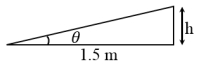
0 likes
View Solution97
DifficultMCQ
$A$ ball of mass $0.5 \ kg$ is attached to a string of length $50 \ cm$. The ball is rotated on a horizontal circular path about its vertical axis. The maximum tension that the string can bear is $400 \ N$. The maximum possible value of angular velocity of the ball in $rad/s$ is:
A
$1600$
B
$40$
C
$1000$
D
$20$
Solution
(B) The tension $T$ in the string provides the necessary centripetal force for the horizontal circular motion of the ball.
Given mass $m = 0.5 \ kg$,length $\ell = 50 \ cm = 0.5 \ m$,and maximum tension $T_{max} = 400 \ N$.
The formula for centripetal force in a horizontal circle is $T = m \omega^2 \ell$.
Substituting the given values:
$400 = 0.5 \times \omega^2 \times 0.5$
$400 = 0.25 \times \omega^2$
$\omega^2 = \frac{400}{0.25} = 1600$
$\omega = \sqrt{1600} = 40 \ rad/s$.
Thus,the maximum possible angular velocity is $40 \ rad/s$.
Given mass $m = 0.5 \ kg$,length $\ell = 50 \ cm = 0.5 \ m$,and maximum tension $T_{max} = 400 \ N$.
The formula for centripetal force in a horizontal circle is $T = m \omega^2 \ell$.
Substituting the given values:
$400 = 0.5 \times \omega^2 \times 0.5$
$400 = 0.25 \times \omega^2$
$\omega^2 = \frac{400}{0.25} = 1600$
$\omega = \sqrt{1600} = 40 \ rad/s$.
Thus,the maximum possible angular velocity is $40 \ rad/s$.
0 likes
View Solution98
DifficultMCQ
$A$ man carrying a monkey on his shoulder is cycling smoothly on a circular track of radius $9 \,m$ and completes $120$ revolutions in $3$ minutes. The magnitude of the centripetal acceleration of the monkey is (in $m/s^2$):
A
zero
B
$16 \pi^2 \,m/s^2$
C
$4 \pi^2 \,m/s^2$
D
$57600 \pi^2 \,m/s^2$
Solution
(B) Given: Radius $R = 9 \,m$.
The man completes $120$ revolutions in $3$ minutes.
First,calculate the angular velocity $\omega$:
$\omega = \frac{120 \text{ revolutions}}{3 \text{ minutes}} = \frac{120 \times 2\pi \text{ radians}}{3 \times 60 \text{ seconds}} = \frac{240\pi}{180} = \frac{4\pi}{3} \,rad/s$.
The formula for centripetal acceleration is $a_c = \omega^2 R$.
Substituting the values: $a_c = \left(\frac{4\pi}{3}\right)^2 \times 9 = \frac{16\pi^2}{9} \times 9 = 16\pi^2 \,m/s^2$.
The man completes $120$ revolutions in $3$ minutes.
First,calculate the angular velocity $\omega$:
$\omega = \frac{120 \text{ revolutions}}{3 \text{ minutes}} = \frac{120 \times 2\pi \text{ radians}}{3 \times 60 \text{ seconds}} = \frac{240\pi}{180} = \frac{4\pi}{3} \,rad/s$.
The formula for centripetal acceleration is $a_c = \omega^2 R$.
Substituting the values: $a_c = \left(\frac{4\pi}{3}\right)^2 \times 9 = \frac{16\pi^2}{9} \times 9 = 16\pi^2 \,m/s^2$.
0 likes
View Solution99
MediumMCQ
$A$ bob of mass $m$ is whirled in a horizontal plane by means of a string of length $\ell$ with an initial angular speed of $\omega$. The tension in the string is $T$. If the angular speed becomes $2\omega$ while keeping the same radius $\ell$,the tension in the string becomes:
A
$4T$
B
$\frac{T}{4}$
C
$\sqrt{2}T$
D
$T$
Solution
(A) For a bob of mass $m$ rotating in a horizontal circle of radius $\ell$ with angular speed $\omega$,the centripetal force is provided by the tension $T$ in the string.
$T = m\ell\omega^2$ --- $(1)$
When the angular speed is increased to $2\omega$ while keeping the radius $\ell$ constant,the new tension $T'$ is given by:
$T' = m\ell(2\omega)^2$
$T' = m\ell(4\omega^2)$
$T' = 4(m\ell\omega^2)$
Substituting equation $(1)$ into this expression,we get:
$T' = 4T$
$T = m\ell\omega^2$ --- $(1)$
When the angular speed is increased to $2\omega$ while keeping the radius $\ell$ constant,the new tension $T'$ is given by:
$T' = m\ell(2\omega)^2$
$T' = m\ell(4\omega^2)$
$T' = 4(m\ell\omega^2)$
Substituting equation $(1)$ into this expression,we get:
$T' = 4T$

0 likes
View Solution3-2.Motion in Plane — Dynamics of circular Motion (Centrifugal force) and Pendulum and Motion on Curved path · Frequently Asked Questions
1Are these 3-2.Motion in Plane questions useful for JEE and NEET?
Yes. All questions in this section are mapped to JEE Main and NEET exam patterns. Previous year questions from JEE Main, NEET, GUJCET and state-level exams are included with full solutions.
2Can I switch to Hindi or Gujarati for these questions?
Yes. Use the language tabs in the hero section or the sidebar to view the same questions and solutions in English, Hindi or Gujarati.
3How do I generate a question paper from this subtopic?
Use the Vedclass Exam Paper Generator — select the chapter and subtopic, set difficulty, and generate Sets A, B, C, D automatically. First 3 chapters of every subject are free.
Vedclass Products
For Students
Vedclass Test Series
Mock tests in real JEE/NEET style with performance analysis. 5-day free trial.
Start Free TrialFor Teachers
Exam Paper Generator
Generate Set A/B/C/D papers from this chapter in 2 minutes. 3 chapters free.
Try FreeFor Institutes
Online Exam Module
Live online exams with unlimited students, 360° analytics & white-label branding.
See DemoFor Teachers & Institutes
Generate a 3-2.Motion in Plane Exam Paper in 2 Minutes
Select subtopic & difficulty — Sets A, B, C, D auto-generated with No Repeat logic.
First 3 chapters of every subject are free — no payment required.