
A English
Newton's Law of Cooling Questions in English
Class 11 Physics · 10-2.Heat Transfer · Newton's Law of Cooling
184+
Questions
English
Language
100%
With Solutions
Showing 50 of 184 questions in English
51
MediumMCQ
Two hot bodies $A$ and $B$ have temperatures $100^{\circ}C$ and $80^{\circ}C$ respectively. The surrounding temperature is $40^{\circ}C$. The ratio of their rates of cooling $R_1 : R_2$ at $t = 0$ is:
A
$3:2$
B
$5:4$
C
$2:1$
D
$4:5$
Solution
(A) According to Newton's Law of Cooling,the rate of cooling $R$ is directly proportional to the temperature difference between the body and its surroundings: $R \propto (T - T_s)$.
Given:
Temperature of body $A$ $(T_1)$ = $100^{\circ}C$
Temperature of body $B$ $(T_2)$ = $80^{\circ}C$
Surrounding temperature $(T_s)$ = $40^{\circ}C$
The rate of cooling for body $A$ is $R_1 = k(T_1 - T_s) = k(100 - 40) = 60k$.
The rate of cooling for body $B$ is $R_2 = k(T_2 - T_s) = k(80 - 40) = 40k$.
Therefore,the ratio $R_1 : R_2 = \frac{60k}{40k} = \frac{60}{40} = \frac{3}{2}$.
Given:
Temperature of body $A$ $(T_1)$ = $100^{\circ}C$
Temperature of body $B$ $(T_2)$ = $80^{\circ}C$
Surrounding temperature $(T_s)$ = $40^{\circ}C$
The rate of cooling for body $A$ is $R_1 = k(T_1 - T_s) = k(100 - 40) = 60k$.
The rate of cooling for body $B$ is $R_2 = k(T_2 - T_s) = k(80 - 40) = 40k$.
Therefore,the ratio $R_1 : R_2 = \frac{60k}{40k} = \frac{60}{40} = \frac{3}{2}$.
0 likes
View Solution52
MediumMCQ
Two spheres of the same metal have radii $r$ and $2r$. They are heated to the same temperature and placed in the same environment. The ratio of their rates of cooling will be:
A
$1:1$
B
$4:1$
C
$1:4$
D
$2:1$
Solution
(D) According to Newton's Law of Cooling,the rate of cooling is given by $\frac{d\theta}{dt} = \frac{e \sigma A}{ms} (T^4 - T_0^4)$.
Since the spheres are of the same material,the emissivity $e$,specific heat $s$,and density $\rho$ are the same.
Mass $m = \rho \cdot V = \rho \cdot \frac{4}{3} \pi r^3$ and Surface Area $A = 4 \pi r^2$.
Substituting these into the formula: $\frac{d\theta}{dt} \propto \frac{A}{m} \propto \frac{r^2}{r^3} \propto \frac{1}{r}$.
Therefore,the ratio of the rates of cooling is $\frac{(d\theta/dt)_1}{(d\theta/dt)_2} = \frac{r_2}{r_1} = \frac{2r}{r} = 2:1$.
Since the spheres are of the same material,the emissivity $e$,specific heat $s$,and density $\rho$ are the same.
Mass $m = \rho \cdot V = \rho \cdot \frac{4}{3} \pi r^3$ and Surface Area $A = 4 \pi r^2$.
Substituting these into the formula: $\frac{d\theta}{dt} \propto \frac{A}{m} \propto \frac{r^2}{r^3} \propto \frac{1}{r}$.
Therefore,the ratio of the rates of cooling is $\frac{(d\theta/dt)_1}{(d\theta/dt)_2} = \frac{r_2}{r_1} = \frac{2r}{r} = 2:1$.
0 likes
View Solution53
MediumMCQ
$A$ liquid is filled in a container and placed in a room at a temperature of $20^{\circ}C$. When the temperature of the liquid is $80^{\circ}C$,it loses heat at a rate of $60 \, cal/sec$. Find the rate of heat loss when the temperature of the liquid is $40^{\circ}C$ in $cal/sec$.
A
$180$
B
$40$
C
$30$
D
$20$
Solution
(D) According to Newton's Law of Cooling,the rate of heat loss is proportional to the temperature difference between the body and its surroundings: $\frac{dQ}{dt} = k(\theta - \theta_0)$.
Given: $\theta_0 = 20^{\circ}C$.
For the first case: $\theta_1 = 80^{\circ}C$ and $\frac{dQ_1}{dt} = 60 \, cal/sec$.
Substituting these values: $60 = k(80 - 20) = 60k$,which implies $k = 1 \, cal/(sec \cdot ^{\circ}C)$.
For the second case: $\theta_2 = 40^{\circ}C$.
Calculating the rate of heat loss: $\frac{dQ_2}{dt} = k(40 - 20) = 1 \times 20 = 20 \, cal/sec$.
Given: $\theta_0 = 20^{\circ}C$.
For the first case: $\theta_1 = 80^{\circ}C$ and $\frac{dQ_1}{dt} = 60 \, cal/sec$.
Substituting these values: $60 = k(80 - 20) = 60k$,which implies $k = 1 \, cal/(sec \cdot ^{\circ}C)$.
For the second case: $\theta_2 = 40^{\circ}C$.
Calculating the rate of heat loss: $\frac{dQ_2}{dt} = k(40 - 20) = 1 \times 20 = 20 \, cal/sec$.
0 likes
View Solution54
MediumMCQ
Two liquids of equal volume are cooled under identical conditions from $60^{\circ}C$ to $50^{\circ}C$ in $324 \; sec$ and $810 \; sec$ respectively. If the ratio of their specific heats is $3:4$,find the ratio of their densities. (The water equivalent of the calorimeter is negligible.)
A
$3/4$
B
$4/9$
C
$8/15$
D
$9/20$
Solution
(C) According to Newton's law of cooling,the rate of heat loss is given by $\frac{dQ}{dt} = mc \frac{d\theta}{dt}$.
Since the conditions are identical,the rate of heat loss $\frac{dQ}{dt}$ is the same for both liquids.
Therefore,$m_1 s_1 \frac{d\theta}{t_1} = m_2 s_2 \frac{d\theta}{t_2}$.
Since the volumes are equal $(V_1 = V_2 = V)$,we can write $m = \rho V$.
Substituting this,we get $\rho_1 V s_1 / t_1 = \rho_2 V s_2 / t_2$.
This simplifies to $\frac{\rho_1}{\rho_2} = \frac{s_2}{s_1} \times \frac{t_1}{t_2}$.
Given $s_1 : s_2 = 3 : 4$,so $s_2 / s_1 = 4/3$.
Given $t_1 = 324 \; sec$ and $t_2 = 810 \; sec$.
Ratio $\frac{\rho_1}{\rho_2} = \frac{4}{3} \times \frac{324}{810} = \frac{4}{3} \times \frac{2}{5} = \frac{8}{15}$.
Since the conditions are identical,the rate of heat loss $\frac{dQ}{dt}$ is the same for both liquids.
Therefore,$m_1 s_1 \frac{d\theta}{t_1} = m_2 s_2 \frac{d\theta}{t_2}$.
Since the volumes are equal $(V_1 = V_2 = V)$,we can write $m = \rho V$.
Substituting this,we get $\rho_1 V s_1 / t_1 = \rho_2 V s_2 / t_2$.
This simplifies to $\frac{\rho_1}{\rho_2} = \frac{s_2}{s_1} \times \frac{t_1}{t_2}$.
Given $s_1 : s_2 = 3 : 4$,so $s_2 / s_1 = 4/3$.
Given $t_1 = 324 \; sec$ and $t_2 = 810 \; sec$.
Ratio $\frac{\rho_1}{\rho_2} = \frac{4}{3} \times \frac{324}{810} = \frac{4}{3} \times \frac{2}{5} = \frac{8}{15}$.
0 likes
View Solution55
MediumMCQ
$A$ bucket full of water cools from $75^{\circ}C$ to $70^{\circ}C$ in time $T_1$,from $70^{\circ}C$ to $65^{\circ}C$ in time $T_2$,and from $65^{\circ}C$ to $60^{\circ}C$ in time $T_3$. Which of the following is correct?
A
$T_1 = T_2 = T_3$
B
$T_1 > T_2 > T_3$
C
$T_1 < T_2 < T_3$
D
$T_1 > T_2 < T_3$
Solution
(C) According to Newton's Law of Cooling,the rate of cooling is proportional to the difference between the average temperature of the body and the surrounding temperature.
Mathematically,$\frac{d\theta}{dt} \propto \left( \frac{\theta_1 + \theta_2}{2} - \theta_0 \right)$.
Since the average temperature of the water decreases as it cools,the rate of cooling decreases over time.
For the given intervals:
Average temperature $1$: $\frac{75+70}{2} = 72.5^{\circ}C$
Average temperature $2$: $\frac{70+65}{2} = 67.5^{\circ}C$
Average temperature $3$: $\frac{65+60}{2} = 62.5^{\circ}C$
Since the average temperature is highest for the first interval,the rate of cooling is fastest,meaning $T_1$ is the smallest time.
Therefore,$T_1 < T_2 < T_3$.
Mathematically,$\frac{d\theta}{dt} \propto \left( \frac{\theta_1 + \theta_2}{2} - \theta_0 \right)$.
Since the average temperature of the water decreases as it cools,the rate of cooling decreases over time.
For the given intervals:
Average temperature $1$: $\frac{75+70}{2} = 72.5^{\circ}C$
Average temperature $2$: $\frac{70+65}{2} = 67.5^{\circ}C$
Average temperature $3$: $\frac{65+60}{2} = 62.5^{\circ}C$
Since the average temperature is highest for the first interval,the rate of cooling is fastest,meaning $T_1$ is the smallest time.
Therefore,$T_1 < T_2 < T_3$.
0 likes
View Solution56
DifficultMCQ
$A$ body takes $5 \ min$ to cool from $90^{\circ}C$ to $60^{\circ}C$. If the temperature of the surroundings is $20^{\circ}C$,how much time (in $min$) will it take to cool from $60^{\circ}C$ to $30^{\circ}C$?
A
$5$
B
$8$
C
$11$
D
$12$
Solution
(C) According to Newton's Law of Cooling,$\frac{dT}{dt} = K(T_{avg} - T_s)$.
For the first interval: $\frac{90 - 60}{5} = K\left( \frac{90 + 60}{2} - 20 \right) \Rightarrow 6 = K(75 - 20) \Rightarrow 6 = 55K \Rightarrow K = \frac{6}{55}$.
For the second interval: $\frac{60 - 30}{t} = K\left( \frac{60 + 30}{2} - 20 \right) \Rightarrow \frac{30}{t} = \frac{6}{55}(45 - 20) \Rightarrow \frac{30}{t} = \frac{6}{55} \times 25$.
$\frac{30}{t} = \frac{6 \times 5}{11} \Rightarrow \frac{30}{t} = \frac{30}{11} \Rightarrow t = 11 \ min$.
For the first interval: $\frac{90 - 60}{5} = K\left( \frac{90 + 60}{2} - 20 \right) \Rightarrow 6 = K(75 - 20) \Rightarrow 6 = 55K \Rightarrow K = \frac{6}{55}$.
For the second interval: $\frac{60 - 30}{t} = K\left( \frac{60 + 30}{2} - 20 \right) \Rightarrow \frac{30}{t} = \frac{6}{55}(45 - 20) \Rightarrow \frac{30}{t} = \frac{6}{55} \times 25$.
$\frac{30}{t} = \frac{6 \times 5}{11} \Rightarrow \frac{30}{t} = \frac{30}{11} \Rightarrow t = 11 \ min$.
0 likes
View Solution57
MediumMCQ
Two spheres have a radius ratio of $1:2$ and a density ratio of $2:1$. They have the same specific heat. If they are heated to the same temperature and placed in the same environment,what is the ratio of their rate of cooling?
A
$2:1$
B
$1:1$
C
$1:2$
D
$1:4$
Solution
(B) According to Stefan-Boltzmann Law,the rate of heat loss is given by $dQ/dt = \sigma A (T^4 - T_0^4)$.
For a small temperature difference,the rate of cooling $d\theta/dt$ is proportional to the rate of heat loss divided by the heat capacity $(ms)$:
$d\theta/dt = \frac{\sigma A (T^4 - T_0^4)}{ms}$.
Since $m = \rho V = \rho (\frac{4}{3}\pi r^3)$ and $A = 4\pi r^2$,we have:
$d\theta/dt \propto \frac{r^2}{\rho r^3 s} \propto \frac{1}{\rho r}$.
Given the ratios $r_1:r_2 = 1:2$ and $\rho_1:\rho_2 = 2:1$,the ratio of the rate of cooling is:
$\frac{(d\theta/dt)_1}{(d\theta/dt)_2} = \frac{\rho_2 r_2}{\rho_1 r_1} = \frac{1}{2} \times \frac{2}{1} = 1:1$.
For a small temperature difference,the rate of cooling $d\theta/dt$ is proportional to the rate of heat loss divided by the heat capacity $(ms)$:
$d\theta/dt = \frac{\sigma A (T^4 - T_0^4)}{ms}$.
Since $m = \rho V = \rho (\frac{4}{3}\pi r^3)$ and $A = 4\pi r^2$,we have:
$d\theta/dt \propto \frac{r^2}{\rho r^3 s} \propto \frac{1}{\rho r}$.
Given the ratios $r_1:r_2 = 1:2$ and $\rho_1:\rho_2 = 2:1$,the ratio of the rate of cooling is:
$\frac{(d\theta/dt)_1}{(d\theta/dt)_2} = \frac{\rho_2 r_2}{\rho_1 r_1} = \frac{1}{2} \times \frac{2}{1} = 1:1$.
0 likes
View Solution58
MediumMCQ
The temperature of an iron block falls from $100 \, ^\circ\text{C}$ to $90 \, ^\circ\text{C}$ in time $t_1$,from $90 \, ^\circ\text{C}$ to $80 \, ^\circ\text{C}$ in time $t_2$,and from $80 \, ^\circ\text{C}$ to $70 \, ^\circ\text{C}$ in time $t_3$. Then:
A
$t_1 < t_2 < t_3$
B
$t_1 > t_2 > t_3$
C
$t_1 = t_2 = t_3$
D
$t_3 = t_1 + t_2$
Solution
(A) According to Newton's Law of Cooling,the rate of cooling is proportional to the temperature difference between the body and its surroundings: $-dT/dt = k(T - T_S)$.
Here,$T$ is the average temperature of the body and $T_S$ is the temperature of the surroundings.
For a small temperature drop $\Delta T = 10 \, ^\circ\text{C}$,the time taken $t$ is given by $t \propto 1 / (T_{avg} - T_S)$.
$1$. For $100 \, ^\circ\text{C}$ to $90 \, ^\circ\text{C}$,$T_{avg} = 95 \, ^\circ\text{C}$,so $t_1 \propto 1 / (95 - T_S)$.
$2$. For $90 \, ^\circ\text{C}$ to $80 \, ^\circ\text{C}$,$T_{avg} = 85 \, ^\circ\text{C}$,so $t_2 \propto 1 / (85 - T_S)$.
$3$. For $80 \, ^\circ\text{C}$ to $70 \, ^\circ\text{C}$,$T_{avg} = 75 \, ^\circ\text{C}$,so $t_3 \propto 1 / (75 - T_S)$.
Since the average temperature $T_{avg}$ decreases in each step,the denominator $(T_{avg} - T_S)$ decreases,which means the time $t$ increases.
Therefore,$t_1 < t_2 < t_3$.
Here,$T$ is the average temperature of the body and $T_S$ is the temperature of the surroundings.
For a small temperature drop $\Delta T = 10 \, ^\circ\text{C}$,the time taken $t$ is given by $t \propto 1 / (T_{avg} - T_S)$.
$1$. For $100 \, ^\circ\text{C}$ to $90 \, ^\circ\text{C}$,$T_{avg} = 95 \, ^\circ\text{C}$,so $t_1 \propto 1 / (95 - T_S)$.
$2$. For $90 \, ^\circ\text{C}$ to $80 \, ^\circ\text{C}$,$T_{avg} = 85 \, ^\circ\text{C}$,so $t_2 \propto 1 / (85 - T_S)$.
$3$. For $80 \, ^\circ\text{C}$ to $70 \, ^\circ\text{C}$,$T_{avg} = 75 \, ^\circ\text{C}$,so $t_3 \propto 1 / (75 - T_S)$.
Since the average temperature $T_{avg}$ decreases in each step,the denominator $(T_{avg} - T_S)$ decreases,which means the time $t$ increases.
Therefore,$t_1 < t_2 < t_3$.
0 likes
View Solution59
DifficultMCQ
$A$ body cools from $60^{\circ}C$ to $50^{\circ}C$ in $10$ minutes. If the room temperature is $25^{\circ}C$ and Newton's law of cooling is applicable,what will be the temperature of the body after another $10$ minutes in $^{\circ}C$?
A
$38.5$
B
$40$
C
$42.85$
D
$45$
Solution
(C) According to Newton's law of cooling,$\frac{dT}{dt} = -K(T - T_{room})$.
For the first interval: $\frac{60 - 50}{10} = K\left( \frac{60 + 50}{2} - 25 \right) \implies 1 = K(55 - 25) \implies 1 = 30K \implies K = \frac{1}{30}$.
For the second interval,let the final temperature be $\theta$: $\frac{50 - \theta}{10} = K\left( \frac{50 + \theta}{2} - 25 \right)$.
Substituting $K = \frac{1}{30}$: $\frac{50 - \theta}{10} = \frac{1}{30} \left( \frac{50 + \theta - 50}{2} \right) = \frac{1}{30} \left( \frac{\theta}{2} \right) = \frac{\theta}{60}$.
$6(50 - \theta) = \theta \implies 300 - 6\theta = \theta \implies 7\theta = 300 \implies \theta = \frac{300}{7} \approx 42.85^{\circ}C$.
For the first interval: $\frac{60 - 50}{10} = K\left( \frac{60 + 50}{2} - 25 \right) \implies 1 = K(55 - 25) \implies 1 = 30K \implies K = \frac{1}{30}$.
For the second interval,let the final temperature be $\theta$: $\frac{50 - \theta}{10} = K\left( \frac{50 + \theta}{2} - 25 \right)$.
Substituting $K = \frac{1}{30}$: $\frac{50 - \theta}{10} = \frac{1}{30} \left( \frac{50 + \theta - 50}{2} \right) = \frac{1}{30} \left( \frac{\theta}{2} \right) = \frac{\theta}{60}$.
$6(50 - \theta) = \theta \implies 300 - 6\theta = \theta \implies 7\theta = 300 \implies \theta = \frac{300}{7} \approx 42.85^{\circ}C$.
0 likes
View Solution60
MediumMCQ
If a liquid takes $30 \; s$ in cooling from $80^{\circ} C$ to $70^{\circ} C$ and $70 \; s$ in cooling from $60^{\circ} C$ to $50^{\circ} C$,then find the room temperature. (in $^{\circ} C$)
A
$40$
B
$10$
C
$30$
D
$60$
Solution
(A) According to Newton's Law of Cooling,the rate of cooling is given by: $\frac{\theta_1 - \theta_2}{t} = K \left( \frac{\theta_1 + \theta_2}{2} - \theta_0 \right)$,where $\theta_0$ is the room temperature.
In the first case:
$\frac{80 - 70}{30} = K \left( \frac{80 + 70}{2} - \theta_0 \right) \Rightarrow \frac{10}{30} = K(75 - \theta_0) \Rightarrow \frac{1}{3} = K(75 - \theta_0)$ --- $(1)$
In the second case:
$\frac{60 - 50}{70} = K \left( \frac{60 + 50}{2} - \theta_0 \right) \Rightarrow \frac{10}{70} = K(55 - \theta_0) \Rightarrow \frac{1}{7} = K(55 - \theta_0)$ --- $(2)$
Dividing equation $(1)$ by equation $(2)$:
$\frac{1/3}{1/7} = \frac{K(75 - \theta_0)}{K(55 - \theta_0)} \Rightarrow \frac{7}{3} = \frac{75 - \theta_0}{55 - \theta_0}$
Cross-multiplying:
$7(55 - \theta_0) = 3(75 - \theta_0)$
$385 - 7\theta_0 = 225 - 3\theta_0$
$385 - 225 = 7\theta_0 - 3\theta_0$
$160 = 4\theta_0$
$\theta_0 = 40^{\circ} C$.
In the first case:
$\frac{80 - 70}{30} = K \left( \frac{80 + 70}{2} - \theta_0 \right) \Rightarrow \frac{10}{30} = K(75 - \theta_0) \Rightarrow \frac{1}{3} = K(75 - \theta_0)$ --- $(1)$
In the second case:
$\frac{60 - 50}{70} = K \left( \frac{60 + 50}{2} - \theta_0 \right) \Rightarrow \frac{10}{70} = K(55 - \theta_0) \Rightarrow \frac{1}{7} = K(55 - \theta_0)$ --- $(2)$
Dividing equation $(1)$ by equation $(2)$:
$\frac{1/3}{1/7} = \frac{K(75 - \theta_0)}{K(55 - \theta_0)} \Rightarrow \frac{7}{3} = \frac{75 - \theta_0}{55 - \theta_0}$
Cross-multiplying:
$7(55 - \theta_0) = 3(75 - \theta_0)$
$385 - 7\theta_0 = 225 - 3\theta_0$
$385 - 225 = 7\theta_0 - 3\theta_0$
$160 = 4\theta_0$
$\theta_0 = 40^{\circ} C$.
0 likes
View Solution61
DifficultMCQ
$A$ body cools from $50.0^{\circ}C$ to $49.9^{\circ}C$ in $5 \, s$. How long will it take to cool from $40.0^{\circ}C$ to $39.9^{\circ}C$ (in $, s$)? The temperature of the surroundings is $30^{\circ}C$. Assume Newton's Law of Cooling applies.
A
$2.5$
B
$10$
C
$20$
D
$5$
Solution
(B) According to Newton's Law of Cooling: $\frac{dT}{dt} = -K(T_{avg} - T_s)$.
For the first case: $\frac{50.0 - 49.9}{5} = K \left( \frac{50.0 + 49.9}{2} - 30 \right) \Rightarrow \frac{0.1}{5} = K(49.95 - 30) \Rightarrow 0.02 = K(19.95) \dots (i)$.
For the second case: $\frac{40.0 - 39.9}{t} = K \left( \frac{40.0 + 39.9}{2} - 30 \right) \Rightarrow \frac{0.1}{t} = K(39.95 - 30) \Rightarrow \frac{0.1}{t} = K(9.95) \dots (ii)$.
Dividing $(i)$ by $(ii)$: $\frac{0.02}{0.1/t} = \frac{19.95}{9.95} \Rightarrow 0.2t = 2.005 \Rightarrow t \approx 10 \, s$.
For the first case: $\frac{50.0 - 49.9}{5} = K \left( \frac{50.0 + 49.9}{2} - 30 \right) \Rightarrow \frac{0.1}{5} = K(49.95 - 30) \Rightarrow 0.02 = K(19.95) \dots (i)$.
For the second case: $\frac{40.0 - 39.9}{t} = K \left( \frac{40.0 + 39.9}{2} - 30 \right) \Rightarrow \frac{0.1}{t} = K(39.95 - 30) \Rightarrow \frac{0.1}{t} = K(9.95) \dots (ii)$.
Dividing $(i)$ by $(ii)$: $\frac{0.02}{0.1/t} = \frac{19.95}{9.95} \Rightarrow 0.2t = 2.005 \Rightarrow t \approx 10 \, s$.
0 likes
View Solution62
DifficultMCQ
$A$ body cools from $75 \, ^\circ \text{C}$ to $65 \, ^\circ \text{C}$ in $2 \, \text{min}$ in a room at $30 \, ^\circ \text{C}$. How long will it take to cool from $55 \, ^\circ \text{C}$ to $45 \, ^\circ \text{C}$ in the same room?
A
$4$
B
$5$
C
$6$
D
$7$
Solution
(A) According to Newton's law of cooling,the rate of cooling is given by $\frac{dT}{dt} = -k(T - T_s)$,where $T_s$ is the surrounding temperature.
For the first interval: $\frac{75 - 65}{2} = k \left( \frac{75 + 65}{2} - 30 \right) \implies 5 = k(70 - 30) \implies 5 = 40k \implies k = \frac{5}{40} = \frac{1}{8} \, \text{min}^{-1}$.
For the second interval: $\frac{55 - 45}{t} = k \left( \frac{55 + 45}{2} - 30 \right) \implies \frac{10}{t} = k(50 - 30) \implies \frac{10}{t} = 20k$.
Substituting $k = \frac{1}{8}$ into the second equation: $\frac{10}{t} = 20 \times \frac{1}{8} \implies \frac{10}{t} = 2.5 \implies t = \frac{10}{2.5} = 4 \, \text{min}$.
For the first interval: $\frac{75 - 65}{2} = k \left( \frac{75 + 65}{2} - 30 \right) \implies 5 = k(70 - 30) \implies 5 = 40k \implies k = \frac{5}{40} = \frac{1}{8} \, \text{min}^{-1}$.
For the second interval: $\frac{55 - 45}{t} = k \left( \frac{55 + 45}{2} - 30 \right) \implies \frac{10}{t} = k(50 - 30) \implies \frac{10}{t} = 20k$.
Substituting $k = \frac{1}{8}$ into the second equation: $\frac{10}{t} = 20 \times \frac{1}{8} \implies \frac{10}{t} = 2.5 \implies t = \frac{10}{2.5} = 4 \, \text{min}$.
0 likes
View Solution63
DifficultMCQ
If a liquid cools from $95^{\circ}C$ to $90^{\circ}C$ in $30 \, s$ and from $55^{\circ}C$ to $50^{\circ}C$ in $70 \, s$,then the temperature of the surroundings is ...... $^{\circ}C$. (in $.5$)
A
$16$
B
$22$
C
$28$
D
$32$
Solution
(B) According to Newton's Law of Cooling,the rate of cooling is proportional to the difference between the average temperature of the liquid and the surrounding temperature $T_0$.
For the first case:
$\frac{95 - 90}{30} = K \left( \frac{95 + 90}{2} - T_0 \right)$
$\frac{5}{30} = K (92.5 - T_0) \implies \frac{1}{6} = K (92.5 - T_0) \quad ---(1)$
For the second case:
$\frac{55 - 50}{70} = K \left( \frac{55 + 50}{2} - T_0 \right)$
$\frac{5}{70} = K (52.5 - T_0) \implies \frac{1}{14} = K (52.5 - T_0) \quad ---(2)$
Dividing equation $(1)$ by $(2)$:
$\frac{1/6}{1/14} = \frac{92.5 - T_0}{52.5 - T_0}$
$\frac{14}{6} = \frac{92.5 - T_0}{52.5 - T_0} \implies \frac{7}{3} = \frac{92.5 - T_0}{52.5 - T_0}$
$7(52.5 - T_0) = 3(92.5 - T_0)$
$367.5 - 7T_0 = 277.5 - 3T_0$
$367.5 - 277.5 = 4T_0$
$90 = 4T_0$
$T_0 = 22.5^{\circ}C$
For the first case:
$\frac{95 - 90}{30} = K \left( \frac{95 + 90}{2} - T_0 \right)$
$\frac{5}{30} = K (92.5 - T_0) \implies \frac{1}{6} = K (92.5 - T_0) \quad ---(1)$
For the second case:
$\frac{55 - 50}{70} = K \left( \frac{55 + 50}{2} - T_0 \right)$
$\frac{5}{70} = K (52.5 - T_0) \implies \frac{1}{14} = K (52.5 - T_0) \quad ---(2)$
Dividing equation $(1)$ by $(2)$:
$\frac{1/6}{1/14} = \frac{92.5 - T_0}{52.5 - T_0}$
$\frac{14}{6} = \frac{92.5 - T_0}{52.5 - T_0} \implies \frac{7}{3} = \frac{92.5 - T_0}{52.5 - T_0}$
$7(52.5 - T_0) = 3(92.5 - T_0)$
$367.5 - 7T_0 = 277.5 - 3T_0$
$367.5 - 277.5 = 4T_0$
$90 = 4T_0$
$T_0 = 22.5^{\circ}C$
0 likes
View Solution64
MediumMCQ
$A$ copper cube of side $a$ is heated and allowed to cool in a vacuum. It takes time $t$ to cool from temperature $\theta_1$ to $\theta_2$. Now,another copper cube of side $2a$ is allowed to cool in the same environment. How much time will it take to cool from $\theta_1$ to $\theta_2$?
A
$t$
B
$2t$
C
$3t$
D
$4t$
Solution
(B) According to Newton's law of cooling,the rate of cooling is given by $\frac{d\theta}{dt} = \frac{e \sigma A}{ms} (\theta - \theta_0)$.
Since $m = \rho V$,we have $\frac{d\theta}{dt} \propto \frac{A}{V}$.
For a cube of side $a$,$A = 6a^2$ and $V = a^3$,so $\frac{A}{V} = \frac{6}{a}$.
For a cube of side $2a$,$A' = 6(2a)^2 = 24a^2$ and $V' = (2a)^3 = 8a^3$,so $\frac{A'}{V'} = \frac{24}{8a} = \frac{3}{a}$.
Comparing the rates: $\frac{(d\theta/dt)'}{(d\theta/dt)} = \frac{A'/V'}{A/V} = \frac{3/a}{6/a} = \frac{1}{2}$.
Since the temperature range $(\theta_1 - \theta_2)$ is the same,the rate of cooling is inversely proportional to the time taken: $\frac{1/t'}{1/t} = \frac{1}{2}$.
Therefore,$t' = 2t$.
Since $m = \rho V$,we have $\frac{d\theta}{dt} \propto \frac{A}{V}$.
For a cube of side $a$,$A = 6a^2$ and $V = a^3$,so $\frac{A}{V} = \frac{6}{a}$.
For a cube of side $2a$,$A' = 6(2a)^2 = 24a^2$ and $V' = (2a)^3 = 8a^3$,so $\frac{A'}{V'} = \frac{24}{8a} = \frac{3}{a}$.
Comparing the rates: $\frac{(d\theta/dt)'}{(d\theta/dt)} = \frac{A'/V'}{A/V} = \frac{3/a}{6/a} = \frac{1}{2}$.
Since the temperature range $(\theta_1 - \theta_2)$ is the same,the rate of cooling is inversely proportional to the time taken: $\frac{1/t'}{1/t} = \frac{1}{2}$.
Therefore,$t' = 2t$.
0 likes
View Solution65
MediumMCQ
$A$ vessel contains hot water at $100^{\circ}C$. If it cools to $80^{\circ}C$ in time $T_1$ and from $80^{\circ}C$ to $60^{\circ}C$ in time $T_2$,then:
A
$T_1 = T_2$
B
$T_1 > T_2$
C
$T_1 < T_2$
D
None of these
Solution
(C) According to Newton's Law of Cooling,the rate of loss of heat is directly proportional to the temperature difference between the body and its surroundings: $\frac{dQ}{dt} \propto (T - T_s)$.
In the first interval,the temperature drops from $100^{\circ}C$ to $80^{\circ}C$. The average temperature difference between the water and the surroundings is higher during this interval.
In the second interval,the temperature drops from $80^{\circ}C$ to $60^{\circ}C$. The average temperature difference between the water and the surroundings is lower during this interval.
Since the rate of cooling is higher when the temperature difference is larger,the time taken to cool by the same amount $(20^{\circ}C)$ will be less for the first interval.
Therefore,$T_1 < T_2$.
In the first interval,the temperature drops from $100^{\circ}C$ to $80^{\circ}C$. The average temperature difference between the water and the surroundings is higher during this interval.
In the second interval,the temperature drops from $80^{\circ}C$ to $60^{\circ}C$. The average temperature difference between the water and the surroundings is lower during this interval.
Since the rate of cooling is higher when the temperature difference is larger,the time taken to cool by the same amount $(20^{\circ}C)$ will be less for the first interval.
Therefore,$T_1 < T_2$.
0 likes
View Solution66
MediumMCQ
Hot water is kept in a thermally insulated closed container. It takes $T_1 \, min$ for the temperature to drop from $75^{\circ}C$ to $70^{\circ}C$,$T_2 \, min$ to drop from $70^{\circ}C$ to $65^{\circ}C$,and $T_3 \, min$ to drop from $65^{\circ}C$ to $60^{\circ}C$. Then:
A
$T_1 = T_2 = T_3$
B
$T_1 < T_2 < T_3$
C
$T_1 > T_2 > T_3$
D
$T_1 < T_2 > T_3$
Solution
(B) According to Newton's Law of Cooling,the rate of cooling is directly proportional to the temperature difference between the body and its surroundings: $-\frac{dT}{dt} = k(T - T_s)$.
As the temperature of the water decreases,the temperature difference $(T - T_s)$ between the water and the surroundings decreases.
Since the rate of cooling $(-\frac{dT}{dt})$ is proportional to this difference,the rate of cooling decreases over time.
Therefore,to lose the same amount of heat (a $5^{\circ}C$ drop),more time is required as the temperature approaches the ambient temperature.
Thus,$T_1 < T_2 < T_3$.
As the temperature of the water decreases,the temperature difference $(T - T_s)$ between the water and the surroundings decreases.
Since the rate of cooling $(-\frac{dT}{dt})$ is proportional to this difference,the rate of cooling decreases over time.
Therefore,to lose the same amount of heat (a $5^{\circ}C$ drop),more time is required as the temperature approaches the ambient temperature.
Thus,$T_1 < T_2 < T_3$.
0 likes
View Solution67
MediumMCQ
$A$ solid sphere and a hollow sphere of the same material and same radius are heated to the same temperature. They are placed in an environment of the same temperature. If the temperature difference between both and the surroundings is $T$,then .......
A
The rate of cooling of the hollow sphere is higher at temperature $T$.
B
The rate of cooling of the solid sphere is higher at temperature $T$.
C
The rate of cooling of both is the same at temperature $T$.
D
The rate of cooling of both is the same only at low temperatures.
Solution
(A) According to Newton's law of cooling,the rate of heat loss $\frac{dQ}{dt}$ depends on the surface area and temperature difference. Since both spheres have the same radius and material,their surface areas are equal,so $\frac{dQ}{dt}$ is the same for both.
We know that $\frac{dQ}{dt} = mc \frac{dT}{dt}$,where $m$ is the mass,$c$ is the specific heat capacity,and $\frac{dT}{dt}$ is the rate of cooling.
Therefore,$\frac{dT}{dt} = \frac{1}{mc} \cdot \frac{dQ}{dt}$.
Since the material is the same,$c$ is constant. Because the hollow sphere has a smaller mass $(m)$ than the solid sphere,the rate of cooling $\frac{dT}{dt}$ will be higher for the hollow sphere.
We know that $\frac{dQ}{dt} = mc \frac{dT}{dt}$,where $m$ is the mass,$c$ is the specific heat capacity,and $\frac{dT}{dt}$ is the rate of cooling.
Therefore,$\frac{dT}{dt} = \frac{1}{mc} \cdot \frac{dQ}{dt}$.
Since the material is the same,$c$ is constant. Because the hollow sphere has a smaller mass $(m)$ than the solid sphere,the rate of cooling $\frac{dT}{dt}$ will be higher for the hollow sphere.
0 likes
View Solution68
DifficultMCQ
It takes $1 \, min$ for hot water to cool from $80^{\circ}C$ to $60^{\circ}C$. Find the time taken (in $sec$) to cool from $60^{\circ}C$ to $50^{\circ}C$. The temperature of the surroundings is $30^{\circ}C$.
A
$30$
B
$60$
C
$90$
D
$50$
Solution
(D) According to Newton's Law of Cooling,the rate of cooling is proportional to the difference between the average temperature of the body and the surrounding temperature: $\frac{d\theta}{dt} = k \left( \frac{\theta_1 + \theta_2}{2} - \theta_s \right)$.
For the first interval ($80^{\circ}C$ to $60^{\circ}C$ in $60 \, sec$):
$\frac{80 - 60}{60} = k \left( \frac{80 + 60}{2} - 30 \right) \implies \frac{20}{60} = k(70 - 30) \implies \frac{1}{3} = k(40) \implies k = \frac{1}{120} \, sec^{-1}$.
For the second interval ($60^{\circ}C$ to $50^{\circ}C$ in $t \, sec$):
$\frac{60 - 50}{t} = k \left( \frac{60 + 50}{2} - 30 \right) \implies \frac{10}{t} = k(55 - 30) \implies \frac{10}{t} = k(25)$.
Substituting $k = \frac{1}{120}$:
$\frac{10}{t} = \frac{1}{120} \times 25 \implies \frac{10}{t} = \frac{25}{120} \implies \frac{10}{t} = \frac{5}{24}$.
$5t = 240 \implies t = 48 \, sec$.
Rounding to the nearest option,the answer is $50 \, sec$.
For the first interval ($80^{\circ}C$ to $60^{\circ}C$ in $60 \, sec$):
$\frac{80 - 60}{60} = k \left( \frac{80 + 60}{2} - 30 \right) \implies \frac{20}{60} = k(70 - 30) \implies \frac{1}{3} = k(40) \implies k = \frac{1}{120} \, sec^{-1}$.
For the second interval ($60^{\circ}C$ to $50^{\circ}C$ in $t \, sec$):
$\frac{60 - 50}{t} = k \left( \frac{60 + 50}{2} - 30 \right) \implies \frac{10}{t} = k(55 - 30) \implies \frac{10}{t} = k(25)$.
Substituting $k = \frac{1}{120}$:
$\frac{10}{t} = \frac{1}{120} \times 25 \implies \frac{10}{t} = \frac{25}{120} \implies \frac{10}{t} = \frac{5}{24}$.
$5t = 240 \implies t = 48 \, sec$.
Rounding to the nearest option,the answer is $50 \, sec$.
0 likes
View Solution69
DifficultMCQ
The temperature of hot water falls from $60^oC$ to $50^oC$ in $10 \, min$. It takes another $10 \, min$ to fall from $50^oC$ to $42^oC$. Find the temperature of the surroundings in $^oC$.
A
$5$
B
$10$
C
$15$
D
$20$
Solution
(B) According to Newton's Law of Cooling,the rate of cooling is given by: $\frac{d\theta}{dt} = K \left( \frac{\theta_1 + \theta_2}{2} - \theta_s \right)$,where $\theta_s$ is the surrounding temperature.
For the first interval ($60^oC$ to $50^oC$ in $10 \, min$):
$\frac{60 - 50}{10} = K \left( \frac{60 + 50}{2} - \theta_s \right)$
$1 = K(55 - \theta_s) \quad \dots(i)$
For the second interval ($50^oC$ to $42^oC$ in $10 \, min$):
$\frac{50 - 42}{10} = K \left( \frac{50 + 42}{2} - \theta_s \right)$
$0.8 = K(46 - \theta_s) \quad \dots(ii)$
Dividing equation $(i)$ by $(ii)$:
$\frac{1}{0.8} = \frac{55 - \theta_s}{46 - \theta_s}$
$1.25 = \frac{55 - \theta_s}{46 - \theta_s}$
$1.25(46 - \theta_s) = 55 - \theta_s$
$57.5 - 1.25\theta_s = 55 - \theta_s$
$2.5 = 0.25\theta_s$
$\theta_s = 10^oC$.
For the first interval ($60^oC$ to $50^oC$ in $10 \, min$):
$\frac{60 - 50}{10} = K \left( \frac{60 + 50}{2} - \theta_s \right)$
$1 = K(55 - \theta_s) \quad \dots(i)$
For the second interval ($50^oC$ to $42^oC$ in $10 \, min$):
$\frac{50 - 42}{10} = K \left( \frac{50 + 42}{2} - \theta_s \right)$
$0.8 = K(46 - \theta_s) \quad \dots(ii)$
Dividing equation $(i)$ by $(ii)$:
$\frac{1}{0.8} = \frac{55 - \theta_s}{46 - \theta_s}$
$1.25 = \frac{55 - \theta_s}{46 - \theta_s}$
$1.25(46 - \theta_s) = 55 - \theta_s$
$57.5 - 1.25\theta_s = 55 - \theta_s$
$2.5 = 0.25\theta_s$
$\theta_s = 10^oC$.
0 likes
View Solution70
DifficultMCQ
$A$ certain quantity of water cools from $70^\circ C$ to $60^\circ C$ in the first $5$ minutes and to $54^\circ C$ in the next $5$ minutes. The temperature of the surroundings is ..... $^\circ C$
A
$45$
B
$20$
C
$42$
D
$10$
Solution
(A) Let $T_s$ be the temperature of the surroundings.
According to $Newton's$ law of cooling,the rate of cooling is given by:
$\frac{T_1 - T_2}{t} = K \left( \frac{T_1 + T_2}{2} - T_s \right)$
For the first $5$ minutes:
$T_1 = 70^\circ C, T_2 = 60^\circ C, t = 5$ minutes.
$\frac{70 - 60}{5} = K \left( \frac{70 + 60}{2} - T_s \right)$
$2 = K(65 - T_s)$ --- $(i)$
For the next $5$ minutes:
$T_1 = 60^\circ C, T_2 = 54^\circ C, t = 5$ minutes.
$\frac{60 - 54}{5} = K \left( \frac{60 + 54}{2} - T_s \right)$
$1.2 = K(57 - T_s)$ --- $(ii)$
Dividing equation $(i)$ by equation $(ii)$:
$\frac{2}{1.2} = \frac{65 - T_s}{57 - T_s}$
$\frac{5}{3} = \frac{65 - T_s}{57 - T_s}$
$5(57 - T_s) = 3(65 - T_s)$
$285 - 5T_s = 195 - 3T_s$
$2T_s = 90$
$T_s = 45^\circ C$
According to $Newton's$ law of cooling,the rate of cooling is given by:
$\frac{T_1 - T_2}{t} = K \left( \frac{T_1 + T_2}{2} - T_s \right)$
For the first $5$ minutes:
$T_1 = 70^\circ C, T_2 = 60^\circ C, t = 5$ minutes.
$\frac{70 - 60}{5} = K \left( \frac{70 + 60}{2} - T_s \right)$
$2 = K(65 - T_s)$ --- $(i)$
For the next $5$ minutes:
$T_1 = 60^\circ C, T_2 = 54^\circ C, t = 5$ minutes.
$\frac{60 - 54}{5} = K \left( \frac{60 + 54}{2} - T_s \right)$
$1.2 = K(57 - T_s)$ --- $(ii)$
Dividing equation $(i)$ by equation $(ii)$:
$\frac{2}{1.2} = \frac{65 - T_s}{57 - T_s}$
$\frac{5}{3} = \frac{65 - T_s}{57 - T_s}$
$5(57 - T_s) = 3(65 - T_s)$
$285 - 5T_s = 195 - 3T_s$
$2T_s = 90$
$T_s = 45^\circ C$
0 likes
View Solution71
DifficultMCQ
$A$ body cools from a temperature $3T$ to $2T$ in $10$ minutes. The room temperature is $T$. Assume that Newton's law of cooling is applicable. The temperature of the body at the end of the next $10$ minutes will be
A
$\frac{4}{3}T$
B
$T$
C
$\frac{7}{4}T$
D
$\frac{3}{2}T$
Solution
(D) According to Newton's law of cooling,the rate of cooling is proportional to the temperature difference between the body and the surroundings:
$\frac{T_1 - T_2}{t} = K \left( \frac{T_1 + T_2}{2} - T_s \right)$
For the first interval of $10$ minutes:
$T_1 = 3T, T_2 = 2T, T_s = T, t = 10$
$\frac{3T - 2T}{10} = K \left( \frac{3T + 2T}{2} - T \right)$
$\frac{T}{10} = K \left( 2.5T - T \right) = K(1.5T) \implies K = \frac{1}{15} \dots (i)$
For the next interval of $10$ minutes:
Let the final temperature be $T'$.
$T_1 = 2T, T_2 = T', T_s = T, t = 10$
$\frac{2T - T'}{10} = K \left( \frac{2T + T'}{2} - T \right)$
$\frac{2T - T'}{10} = K \left( \frac{T'}{2} \right) \dots (ii)$
Substituting $K = \frac{1}{15}$ into equation $(ii)$:
$\frac{2T - T'}{10} = \frac{1}{15} \left( \frac{T'}{2} \right)$
$\frac{2T - T'}{10} = \frac{T'}{30}$
$3(2T - T') = T'$
$6T - 3T' = T'$
$6T = 4T' \implies T' = \frac{6}{4}T = \frac{3}{2}T$
$\frac{T_1 - T_2}{t} = K \left( \frac{T_1 + T_2}{2} - T_s \right)$
For the first interval of $10$ minutes:
$T_1 = 3T, T_2 = 2T, T_s = T, t = 10$
$\frac{3T - 2T}{10} = K \left( \frac{3T + 2T}{2} - T \right)$
$\frac{T}{10} = K \left( 2.5T - T \right) = K(1.5T) \implies K = \frac{1}{15} \dots (i)$
For the next interval of $10$ minutes:
Let the final temperature be $T'$.
$T_1 = 2T, T_2 = T', T_s = T, t = 10$
$\frac{2T - T'}{10} = K \left( \frac{2T + T'}{2} - T \right)$
$\frac{2T - T'}{10} = K \left( \frac{T'}{2} \right) \dots (ii)$
Substituting $K = \frac{1}{15}$ into equation $(ii)$:
$\frac{2T - T'}{10} = \frac{1}{15} \left( \frac{T'}{2} \right)$
$\frac{2T - T'}{10} = \frac{T'}{30}$
$3(2T - T') = T'$
$6T - 3T' = T'$
$6T = 4T' \implies T' = \frac{6}{4}T = \frac{3}{2}T$
0 likes
View Solution72
MediumMCQ
Two friends $A$ and $B$ are waiting for another friend for tea. $A$ took the tea in a cup and mixed the cold milk and then waits. $B$ took the tea in the cup and then mixed the cold milk when the friend comes. Then the tea will be hotter in the cup of
A
$A$
B
$B$
C
Tea will be equally hot in both cups
D
Friend's cup
Solution
(A) According to Newton's Law of Cooling,the rate of heat loss is proportional to the temperature difference between the object and its surroundings,i.e.,$\frac{dQ}{dt} \propto (T - T_s)$.
In case of friend $A$,the cold milk is added immediately. This lowers the initial temperature of the tea mixture. Since the temperature difference between the mixture and the surroundings is smaller,the rate of heat loss is lower.
In case of friend $B$,the tea remains at a higher temperature for a longer duration before the cold milk is added. Because the temperature difference between the hot tea and the surroundings is larger,the rate of heat loss is higher.
Therefore,the tea in the cup of friend $A$ will remain hotter when the friend arrives.
In case of friend $A$,the cold milk is added immediately. This lowers the initial temperature of the tea mixture. Since the temperature difference between the mixture and the surroundings is smaller,the rate of heat loss is lower.
In case of friend $B$,the tea remains at a higher temperature for a longer duration before the cold milk is added. Because the temperature difference between the hot tea and the surroundings is larger,the rate of heat loss is higher.
Therefore,the tea in the cup of friend $A$ will remain hotter when the friend arrives.
0 likes
View Solution73
MediumMCQ
There are two spherical balls $A$ and $B$ of the same material with the same surface,but the diameter of $A$ is half that of $B$. If $A$ and $B$ are heated to the same temperature and then allowed to cool,then
A
Rate of cooling is same in both
B
Rate of cooling of $A$ is four times that of $B$
C
Rate of cooling of $A$ is twice that of $B$
D
Rate of cooling of $A$ is $\frac{1}{4}$ times that of $B$
Solution
(C) The rate of cooling $R_C$ is given by the formula: $R_C = \frac{dQ}{dt} \cdot \frac{1}{mc} = \frac{A \varepsilon \sigma (T^4 - T_0^4)}{mc}$.
Since $m = \rho V$,where $\rho$ is density and $V$ is volume,we have $R_C = \frac{A \varepsilon \sigma (T^4 - T_0^4)}{V \rho c}$.
For a sphere,$A = 4 \pi r^2$ and $V = \frac{4}{3} \pi r^3$,so $\frac{A}{V} = \frac{3}{r}$.
Thus,$R_C \propto \frac{1}{r} \propto \frac{1}{\text{Diameter}}$.
Given that the diameter of $A$ is half that of $B$ $(D_A = \frac{1}{2} D_B)$,the rate of cooling of $A$ will be twice that of $B$ $(R_{C,A} = 2 R_{C,B})$.
Since $m = \rho V$,where $\rho$ is density and $V$ is volume,we have $R_C = \frac{A \varepsilon \sigma (T^4 - T_0^4)}{V \rho c}$.
For a sphere,$A = 4 \pi r^2$ and $V = \frac{4}{3} \pi r^3$,so $\frac{A}{V} = \frac{3}{r}$.
Thus,$R_C \propto \frac{1}{r} \propto \frac{1}{\text{Diameter}}$.
Given that the diameter of $A$ is half that of $B$ $(D_A = \frac{1}{2} D_B)$,the rate of cooling of $A$ will be twice that of $B$ $(R_{C,A} = 2 R_{C,B})$.
0 likes
View Solution74
MediumMCQ
$A$ body takes $T$ minutes to cool from $62^{\circ}C$ to $61^{\circ}C$ when the surrounding temperature is $30^{\circ}C$. The time taken by the body to cool from $46^{\circ}C$ to $45^{\circ}C$ is:
A
Greater than $T$ minutes
B
Equal to $T$ minutes
C
Less than $T$ minutes
D
Equal to $T/2$ minutes
Solution
(A) According to Newton's Law of Cooling,the rate of cooling is given by $\frac{d\theta}{dt} = K(\theta_{avg} - \theta_s)$,where $\theta_{avg}$ is the average temperature of the body and $\theta_s$ is the surrounding temperature.
For the first case: $\frac{62 - 61}{T} = K \left( \frac{62 + 61}{2} - 30 \right) \implies \frac{1}{T} = K(61.5 - 30) = K(31.5)$ ...$(i)$
For the second case,cooling from $46^{\circ}C$ to $45^{\circ}C$ in time $T'$: $\frac{46 - 45}{T'} = K \left( \frac{46 + 45}{2} - 30 \right) \implies \frac{1}{T'} = K(45.5 - 30) = K(15.5)$ ...$(ii)$
Comparing $(i)$ and $(ii)$,since $31.5 > 15.5$,the rate of cooling is faster in the first case. Therefore,the time taken $T'$ for the second case must be greater than $T$.
For the first case: $\frac{62 - 61}{T} = K \left( \frac{62 + 61}{2} - 30 \right) \implies \frac{1}{T} = K(61.5 - 30) = K(31.5)$ ...$(i)$
For the second case,cooling from $46^{\circ}C$ to $45^{\circ}C$ in time $T'$: $\frac{46 - 45}{T'} = K \left( \frac{46 + 45}{2} - 30 \right) \implies \frac{1}{T'} = K(45.5 - 30) = K(15.5)$ ...$(ii)$
Comparing $(i)$ and $(ii)$,since $31.5 > 15.5$,the rate of cooling is faster in the first case. Therefore,the time taken $T'$ for the second case must be greater than $T$.
0 likes
View Solution75
MediumMCQ
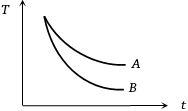
Water and turpentine oil (specific heat less than that of water) are both heated to the same temperature. Equal amounts of these,placed in identical calorimeters,are then left to cool in the air. Which of the following statements is correct regarding their cooling curves?
A
Their cooling curves will be identical.
B
$A$ and $B$ will represent the cooling curves of water and oil,respectively.
C
$B$ and $A$ will represent the cooling curves of water and oil,respectively.
D
None of the above.
Solution
(C) The rate of cooling is given by $\frac{dT}{dt} = \frac{kA(T - T_0)}{mc}$,where $m$ is the mass and $c$ is the specific heat capacity.
Since the mass $m$ and the surface area $A$ are the same for both,the rate of cooling is inversely proportional to the specific heat capacity $c$,i.e.,$\text{Rate of cooling} \propto \frac{1}{c}$.
Given that $c_{\text{oil}} < c_{\text{water}}$,it follows that $(\text{Rate of cooling})_{\text{oil}} > (\text{Rate of cooling})_{\text{water}}$.
This means that the oil cools down faster than the water.
Therefore,at any given time $t > 0$,the temperature of the oil will be lower than the temperature of the water.
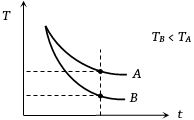
Looking at the graph,curve $B$ shows a faster drop in temperature compared to curve $A$.
Thus,curve $B$ represents the cooling curve of oil,and curve $A$ represents the cooling curve of water.
Since the mass $m$ and the surface area $A$ are the same for both,the rate of cooling is inversely proportional to the specific heat capacity $c$,i.e.,$\text{Rate of cooling} \propto \frac{1}{c}$.
Given that $c_{\text{oil}} < c_{\text{water}}$,it follows that $(\text{Rate of cooling})_{\text{oil}} > (\text{Rate of cooling})_{\text{water}}$.
This means that the oil cools down faster than the water.
Therefore,at any given time $t > 0$,the temperature of the oil will be lower than the temperature of the water.
Looking at the graph,curve $B$ shows a faster drop in temperature compared to curve $A$.
Thus,curve $B$ represents the cooling curve of oil,and curve $A$ represents the cooling curve of water.
0 likes
View Solution76
DifficultMCQ
$A$ system $S$ receives heat continuously from an electrical heater of power $10 \ W$. The temperature of $S$ becomes constant at $50^{\circ}C$ when the surrounding temperature is $20^{\circ}C$. After the heater is switched off, $S$ cools from $35.1^{\circ}C$ to $34.9^{\circ}C$ in $1 \ minute$. The heat capacity of $S$ is........ $J/^{\circ}C$.
A
$100$
B
$300$
C
$750$
D
$1500$
Solution
(D) According to Newton's law of cooling, the rate of heat loss is $\frac{dQ}{dt} = k(T - T_{surr})$.
When the temperature is constant at $50^{\circ}C$, the heat supplied equals the heat lost: $10 = k(50 - 20) = 30k$. Thus, $k = \frac{1}{3} \ W/^{\circ}C$.
When the heater is switched off, the system cools. The average temperature during the cooling interval is $T_{avg} = \frac{35.1 + 34.9}{2} = 35^{\circ}C$.
The rate of heat loss at this average temperature is $\frac{dQ}{dt} = k(T_{avg} - T_{surr}) = \frac{1}{3}(35 - 20) = \frac{15}{3} = 5 \ J/s$.
In $1 \ minute$ $(60 \ seconds)$, the total heat lost is $Q = 5 \ J/s \times 60 \ s = 300 \ J$.
The change in temperature is $\Delta T = 35.1^{\circ}C - 34.9^{\circ}C = 0.2^{\circ}C$.
The heat capacity $C$ is given by $C = \frac{Q}{\Delta T} = \frac{300 \ J}{0.2^{\circ}C} = 1500 \ J/^{\circ}C$.
When the temperature is constant at $50^{\circ}C$, the heat supplied equals the heat lost: $10 = k(50 - 20) = 30k$. Thus, $k = \frac{1}{3} \ W/^{\circ}C$.
When the heater is switched off, the system cools. The average temperature during the cooling interval is $T_{avg} = \frac{35.1 + 34.9}{2} = 35^{\circ}C$.
The rate of heat loss at this average temperature is $\frac{dQ}{dt} = k(T_{avg} - T_{surr}) = \frac{1}{3}(35 - 20) = \frac{15}{3} = 5 \ J/s$.
In $1 \ minute$ $(60 \ seconds)$, the total heat lost is $Q = 5 \ J/s \times 60 \ s = 300 \ J$.
The change in temperature is $\Delta T = 35.1^{\circ}C - 34.9^{\circ}C = 0.2^{\circ}C$.
The heat capacity $C$ is given by $C = \frac{Q}{\Delta T} = \frac{300 \ J}{0.2^{\circ}C} = 1500 \ J/^{\circ}C$.
0 likes
View Solution77
DifficultMCQ
$A$ black body calorimeter filled with hot water cools from $60^{\circ}C$ to $50^{\circ}C$ in $4 \text{ min}$ and from $40^{\circ}C$ to $30^{\circ}C$ in $8 \text{ min}$. The approximate temperature of the surrounding is ........ $^{\circ}C$.
A
$10$
B
$15$
C
$20$
D
$25$
Solution
(B) According to Newton's Law of Cooling,the rate of cooling is proportional to the difference in temperature between the body and its surroundings: $\frac{dT}{dt} = k(T - T_s)$,where $T_s$ is the surrounding temperature.
$CASE-1$: The body cools from $60^{\circ}C$ to $50^{\circ}C$ in $4 \text{ min}$. The average temperature is $\frac{60+50}{2} = 55^{\circ}C$.
$\frac{60-50}{4} = k(55 - T_s) \Rightarrow 2.5 = k(55 - T_s)$ $(1)$
$CASE-2$: The body cools from $40^{\circ}C$ to $30^{\circ}C$ in $8 \text{ min}$. The average temperature is $\frac{40+30}{2} = 35^{\circ}C$.
$\frac{40-30}{8} = k(35 - T_s) \Rightarrow 1.25 = k(35 - T_s)$ $(2)$
Dividing equation $(1)$ by $(2)$:
$\frac{2.5}{1.25} = \frac{55 - T_s}{35 - T_s}$
$2 = \frac{55 - T_s}{35 - T_s}$
$70 - 2T_s = 55 - T_s$
$T_s = 15^{\circ}C$
Therefore,the temperature of the surrounding is $15^{\circ}C$.
$CASE-1$: The body cools from $60^{\circ}C$ to $50^{\circ}C$ in $4 \text{ min}$. The average temperature is $\frac{60+50}{2} = 55^{\circ}C$.
$\frac{60-50}{4} = k(55 - T_s) \Rightarrow 2.5 = k(55 - T_s)$ $(1)$
$CASE-2$: The body cools from $40^{\circ}C$ to $30^{\circ}C$ in $8 \text{ min}$. The average temperature is $\frac{40+30}{2} = 35^{\circ}C$.
$\frac{40-30}{8} = k(35 - T_s) \Rightarrow 1.25 = k(35 - T_s)$ $(2)$
Dividing equation $(1)$ by $(2)$:
$\frac{2.5}{1.25} = \frac{55 - T_s}{35 - T_s}$
$2 = \frac{55 - T_s}{35 - T_s}$
$70 - 2T_s = 55 - T_s$
$T_s = 15^{\circ}C$
Therefore,the temperature of the surrounding is $15^{\circ}C$.
0 likes
View Solution78
MediumMCQ
$A$ liquid in a beaker has temperature $\theta(t)$ at time $t$ and $\theta_0$ is the temperature of the surroundings. According to Newton's law of cooling,the correct graph between $\log_e(\theta - \theta_0)$ and $t$ is:
A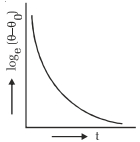
B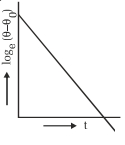
C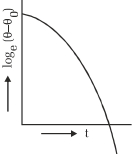
D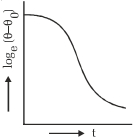
Solution
(B) According to Newton's law of cooling,the rate of change of temperature is proportional to the temperature difference between the body and its surroundings:
$\frac{d\theta}{dt} = -k(\theta - \theta_0)$
Rearranging the terms for integration:
$\frac{d\theta}{\theta - \theta_0} = -k dt$
Integrating both sides:
$\int \frac{d\theta}{\theta - \theta_0} = \int -k dt$
$\ln(\theta - \theta_0) = -kt + C$
This equation is of the form $y = mx + c$,where $y = \ln(\theta - \theta_0)$,$x = t$,$m = -k$ (a negative slope),and $c$ is the intercept. This represents a straight line with a negative slope. Therefore,the correct graph is a straight line sloping downwards.
$\frac{d\theta}{dt} = -k(\theta - \theta_0)$
Rearranging the terms for integration:
$\frac{d\theta}{\theta - \theta_0} = -k dt$
Integrating both sides:
$\int \frac{d\theta}{\theta - \theta_0} = \int -k dt$
$\ln(\theta - \theta_0) = -kt + C$
This equation is of the form $y = mx + c$,where $y = \ln(\theta - \theta_0)$,$x = t$,$m = -k$ (a negative slope),and $c$ is the intercept. This represents a straight line with a negative slope. Therefore,the correct graph is a straight line sloping downwards.
0 likes
View Solution79
MediumMCQ
If a piece of metal is heated to temperature $\theta$ and then allowed to cool in a room which is at temperature $\theta_0$,the graph between the temperature $T$ of the metal and time $t$ will be closest to:
A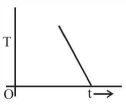
B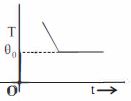
C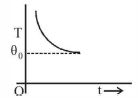
D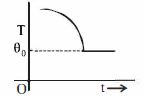
Solution
(C) According to Newton's law of cooling,the rate of loss of heat is proportional to the difference in temperature between the body and its surroundings,i.e.,$\frac{dT}{dt} = -k(T - \theta_0)$.
This differential equation leads to an exponential decay solution of the form $T(t) = \theta_0 + (\theta - \theta_0)e^{-kt}$.
As time $t$ increases,the temperature $T$ decreases exponentially and asymptotically approaches the ambient temperature $\theta_0$.
Graph $C$ correctly represents this exponential decay curve where the temperature starts at $\theta$ and approaches $\theta_0$ as $t \to \infty$.
This differential equation leads to an exponential decay solution of the form $T(t) = \theta_0 + (\theta - \theta_0)e^{-kt}$.
As time $t$ increases,the temperature $T$ decreases exponentially and asymptotically approaches the ambient temperature $\theta_0$.
Graph $C$ correctly represents this exponential decay curve where the temperature starts at $\theta$ and approaches $\theta_0$ as $t \to \infty$.
0 likes
View Solution80
MediumMCQ
$A$ body takes $10$ minutes to cool down from $62^{\circ}C$ to $50^{\circ}C$. If the temperature of the surrounding is $26^{\circ}C$,then in the next $10$ minutes,the temperature of the body will be ......... $^{\circ}C$.
A
$38$
B
$40$
C
$42$
D
$44$
Solution
(C) According to Newton's law of cooling,the rate of cooling is proportional to the difference in temperature between the body and its surroundings:
$\frac{\theta_{1}-\theta_{2}}{t} = K \left( \frac{\theta_{1}+\theta_{2}}{2} - \theta_{s} \right)$
$Case-I$: Cooling from $62^{\circ}C$ to $50^{\circ}C$ in $10$ minutes with surrounding temperature $\theta_{s} = 26^{\circ}C$.
$\frac{62-50}{10} = K \left( \frac{62+50}{2} - 26 \right)$
$\frac{12}{10} = K (56 - 26)$
$1.2 = K \times 30$
$K = \frac{1.2}{30} = 0.04$
$Case-II$: Cooling from $50^{\circ}C$ to $\theta_{2}$ in the next $10$ minutes.
$\frac{50-\theta_{2}}{10} = K \left( \frac{50+\theta_{2}}{2} - 26 \right)$
$\frac{50-\theta_{2}}{10} = 0.04 \left( \frac{50+\theta_{2}-52}{2} \right)$
$50 - \theta_{2} = 0.4 \left( \frac{\theta_{2}-2}{2} \right)$
$50 - \theta_{2} = 0.2 (\theta_{2} - 2)$
$50 - \theta_{2} = 0.2\theta_{2} - 0.4$
$1.2\theta_{2} = 50.4$
$\theta_{2} = \frac{50.4}{1.2} = 42^{\circ}C$.
$\frac{\theta_{1}-\theta_{2}}{t} = K \left( \frac{\theta_{1}+\theta_{2}}{2} - \theta_{s} \right)$
$Case-I$: Cooling from $62^{\circ}C$ to $50^{\circ}C$ in $10$ minutes with surrounding temperature $\theta_{s} = 26^{\circ}C$.
$\frac{62-50}{10} = K \left( \frac{62+50}{2} - 26 \right)$
$\frac{12}{10} = K (56 - 26)$
$1.2 = K \times 30$
$K = \frac{1.2}{30} = 0.04$
$Case-II$: Cooling from $50^{\circ}C$ to $\theta_{2}$ in the next $10$ minutes.
$\frac{50-\theta_{2}}{10} = K \left( \frac{50+\theta_{2}}{2} - 26 \right)$
$\frac{50-\theta_{2}}{10} = 0.04 \left( \frac{50+\theta_{2}-52}{2} \right)$
$50 - \theta_{2} = 0.4 \left( \frac{\theta_{2}-2}{2} \right)$
$50 - \theta_{2} = 0.2 (\theta_{2} - 2)$
$50 - \theta_{2} = 0.2\theta_{2} - 0.4$
$1.2\theta_{2} = 50.4$
$\theta_{2} = \frac{50.4}{1.2} = 42^{\circ}C$.
0 likes
View Solution81
DifficultMCQ
Assuming Newton's law of cooling to be valid,a body at temperature $50^{\circ} C$ in a surrounding of temperature $20^{\circ} C$ achieves a steady state with the help of a $100 \ W$ heater. If the same body has a temperature of $35^{\circ} C$ in the same surrounding,then the power of the heater required to maintain a steady state is ........ $W$.
A
$70$
B
$50$
C
$100$
D
$35$
Solution
(B) According to Newton's law of cooling,the rate of heat loss is proportional to the temperature difference between the body and its surroundings: $P = K(T - T_s)$,where $K$ is a constant,$T$ is the temperature of the body,and $T_s$ is the temperature of the surroundings.
In the first case,the body is at $T_1 = 50^{\circ} C$ and the surroundings are at $T_s = 20^{\circ} C$. The heater provides $P_1 = 100 \ W$ to maintain the steady state.
$100 = K(50 - 20)$
$100 = K \times 30$
$K = \frac{100}{30} = \frac{10}{3} \ W/^{\circ} C$
In the second case,the body is at $T_2 = 35^{\circ} C$ and the surroundings are at $T_s = 20^{\circ} C$. Let the required power be $P_2$.
$P_2 = K(35 - 20)$
$P_2 = K \times 15$
Substituting the value of $K$:
$P_2 = \left(\frac{100}{30}\right) \times 15$
$P_2 = \frac{100}{2} = 50 \ W$.
In the first case,the body is at $T_1 = 50^{\circ} C$ and the surroundings are at $T_s = 20^{\circ} C$. The heater provides $P_1 = 100 \ W$ to maintain the steady state.
$100 = K(50 - 20)$
$100 = K \times 30$
$K = \frac{100}{30} = \frac{10}{3} \ W/^{\circ} C$
In the second case,the body is at $T_2 = 35^{\circ} C$ and the surroundings are at $T_s = 20^{\circ} C$. Let the required power be $P_2$.
$P_2 = K(35 - 20)$
$P_2 = K \times 15$
Substituting the value of $K$:
$P_2 = \left(\frac{100}{30}\right) \times 15$
$P_2 = \frac{100}{2} = 50 \ W$.
0 likes
View Solution82
DifficultMCQ
$A$ liquid cools from $50^{\circ}C$ to $45^{\circ}C$ in $5$ minutes and from $45^{\circ}C$ to $41.5^{\circ}C$ in the next $5$ minutes. The temperature of the surrounding is......... $^{\circ}C$.
A
$27$
B
$40.3$
C
$23.3$
D
$33.3$
Solution
(D) According to Newton's law of cooling,the rate of cooling is proportional to the difference between the average temperature of the liquid and the surrounding temperature:
$\frac{\theta_1 - \theta_2}{t} = K \left( \frac{\theta_1 + \theta_2}{2} - \theta_0 \right)$
For the first interval ($50^{\circ}C$ to $45^{\circ}C$ in $5$ minutes):
$\frac{50 - 45}{5} = K \left( \frac{50 + 45}{2} - \theta_0 \right) \implies 1 = K (47.5 - \theta_0) \quad ...(i)$
For the second interval ($45^{\circ}C$ to $41.5^{\circ}C$ in $5$ minutes):
$\frac{45 - 41.5}{5} = K \left( \frac{45 + 41.5}{2} - \theta_0 \right) \implies 0.7 = K (43.25 - \theta_0) \quad ...(ii)$
Dividing equation $(i)$ by $(ii)$:
$\frac{1}{0.7} = \frac{47.5 - \theta_0}{43.25 - \theta_0}$
$43.25 - \theta_0 = 0.7(47.5 - \theta_0)$
$43.25 - \theta_0 = 33.25 - 0.7\theta_0$
$0.3\theta_0 = 10$
$\theta_0 = \frac{10}{0.3} = 33.3^{\circ}C$
$\frac{\theta_1 - \theta_2}{t} = K \left( \frac{\theta_1 + \theta_2}{2} - \theta_0 \right)$
For the first interval ($50^{\circ}C$ to $45^{\circ}C$ in $5$ minutes):
$\frac{50 - 45}{5} = K \left( \frac{50 + 45}{2} - \theta_0 \right) \implies 1 = K (47.5 - \theta_0) \quad ...(i)$
For the second interval ($45^{\circ}C$ to $41.5^{\circ}C$ in $5$ minutes):
$\frac{45 - 41.5}{5} = K \left( \frac{45 + 41.5}{2} - \theta_0 \right) \implies 0.7 = K (43.25 - \theta_0) \quad ...(ii)$
Dividing equation $(i)$ by $(ii)$:
$\frac{1}{0.7} = \frac{47.5 - \theta_0}{43.25 - \theta_0}$
$43.25 - \theta_0 = 0.7(47.5 - \theta_0)$
$43.25 - \theta_0 = 33.25 - 0.7\theta_0$
$0.3\theta_0 = 10$
$\theta_0 = \frac{10}{0.3} = 33.3^{\circ}C$
0 likes
View Solution83
DifficultMCQ
For a system where Newton's law of cooling is applicable,the initial rate of cooling is $R \ ^\circ C/sec$. Find the time when the temperature difference $\Delta T_0$ (initial temperature difference) is reduced to half.
A
$\frac{\Delta T_0}{2R}$
B
$\frac{2\Delta T_0}{R}$
C
$\frac{\ln(2) \cdot \Delta T_0}{R}$
D
$\frac{\Delta T_0}{\ln(2)R}$
Solution
(C) According to Newton's law of cooling,the rate of cooling is given by $\frac{dT}{dt} = -k(T - T_s)$,where $(T - T_s) = \Delta T$ is the temperature difference.
Given the initial rate of cooling is $R = k \Delta T_0$,we can find the rate constant $k = \frac{R}{\Delta T_0}$.
The temperature difference at any time $t$ is given by $\Delta T(t) = \Delta T_0 e^{-kt}$.
We want to find the time $t$ when $\Delta T(t) = \frac{\Delta T_0}{2}$.
Substituting this into the equation: $\frac{\Delta T_0}{2} = \Delta T_0 e^{-kt}$.
This simplifies to $\frac{1}{2} = e^{-kt}$,or $2 = e^{kt}$.
Taking the natural logarithm on both sides: $\ln(2) = kt$.
Therefore,$t = \frac{\ln(2)}{k}$.
Substituting $k = \frac{R}{\Delta T_0}$,we get $t = \frac{\ln(2) \Delta T_0}{R}$.
Given the initial rate of cooling is $R = k \Delta T_0$,we can find the rate constant $k = \frac{R}{\Delta T_0}$.
The temperature difference at any time $t$ is given by $\Delta T(t) = \Delta T_0 e^{-kt}$.
We want to find the time $t$ when $\Delta T(t) = \frac{\Delta T_0}{2}$.
Substituting this into the equation: $\frac{\Delta T_0}{2} = \Delta T_0 e^{-kt}$.
This simplifies to $\frac{1}{2} = e^{-kt}$,or $2 = e^{kt}$.
Taking the natural logarithm on both sides: $\ln(2) = kt$.
Therefore,$t = \frac{\ln(2)}{k}$.
Substituting $k = \frac{R}{\Delta T_0}$,we get $t = \frac{\ln(2) \Delta T_0}{R}$.
0 likes
View Solution84
MediumMCQ
$A$ sphere of density $\rho$,specific heat capacity $c$,and radius $r$ is hung by a thermally insulating thread in an enclosure which is kept at a lower temperature than the sphere. The temperature of the sphere starts to drop at a rate which depends upon the temperature difference between the sphere and the enclosure and the nature of the surface of the sphere and is proportional to
A
$\frac{c}{r^3 \rho}$
B
$\frac{1}{r^3 \rho c}$
C
$3r^3 \rho c$
D
$\frac{1}{r \rho c}$
Solution
(D) According to Newton's Law of Cooling,the rate of heat loss is given by $\frac{dQ}{dt} = \sigma A (T - T_0)$,where $\sigma$ is a constant related to the surface nature,$A$ is the surface area,and $(T - T_0)$ is the temperature difference.
Since $dQ = mc \cdot dT$,we have $mc \frac{dT}{dt} = -\sigma A (T - T_0)$.
The rate of cooling is $\frac{-dT}{dt} = \frac{\sigma A}{mc} (T - T_0)$.
Substituting the values for a sphere: $A = 4 \pi r^2$ and $m = \rho \cdot V = \rho \cdot \frac{4}{3} \pi r^3$.
Thus,$\frac{-dT}{dt} = \frac{\sigma (4 \pi r^2)}{\rho (\frac{4}{3} \pi r^3) c} (T - T_0)$.
Simplifying this,we get $\frac{-dT}{dt} \propto \frac{1}{\rho r c}$.
Since $dQ = mc \cdot dT$,we have $mc \frac{dT}{dt} = -\sigma A (T - T_0)$.
The rate of cooling is $\frac{-dT}{dt} = \frac{\sigma A}{mc} (T - T_0)$.
Substituting the values for a sphere: $A = 4 \pi r^2$ and $m = \rho \cdot V = \rho \cdot \frac{4}{3} \pi r^3$.
Thus,$\frac{-dT}{dt} = \frac{\sigma (4 \pi r^2)}{\rho (\frac{4}{3} \pi r^3) c} (T - T_0)$.
Simplifying this,we get $\frac{-dT}{dt} \propto \frac{1}{\rho r c}$.
0 likes
View Solution85
EasyMCQ
$A$ sphere,a cube,and a disc,all of the same material,quality,and volume,are heated to $600\,^{\circ}C$ and left in air. Which of these will have the lowest rate of cooling?
A
Sphere
B
Cube
C
Disc
D
All will have the same rate
Solution
(A) According to Newton's law of cooling,the rate of cooling is given by $\frac{dQ}{dt} = e \sigma A (T^4 - T_0^4)$.
Since the rate of cooling $\frac{dT}{dt} = \frac{dQ/dt}{mc} = \frac{e \sigma A (T^4 - T_0^4)}{\rho V c}$,the rate of cooling is directly proportional to the surface area $A$ for a fixed volume $V$.
Among a sphere,a cube,and a disc of the same volume,the sphere has the minimum surface area.
Therefore,the sphere will have the lowest rate of cooling.
Since the rate of cooling $\frac{dT}{dt} = \frac{dQ/dt}{mc} = \frac{e \sigma A (T^4 - T_0^4)}{\rho V c}$,the rate of cooling is directly proportional to the surface area $A$ for a fixed volume $V$.
Among a sphere,a cube,and a disc of the same volume,the sphere has the minimum surface area.
Therefore,the sphere will have the lowest rate of cooling.
0 likes
View Solution86
MediumMCQ
Two spheres of radii $R_1$ and $R_2$ have densities $\rho_1$ and $\rho_2$ and specific heats $S_1$ and $S_2$. If they are heated to the same temperature,what is the ratio of their rates of cooling?
A
$\frac{R_2}{R_1}$
B
$\frac{R_1 \rho_2 S_2}{R_2 \rho_1 S_1}$
C
$\frac{R_2 \rho_2 S_2}{R_1 \rho_1 S_1}$
D
$\left( \frac{R_1}{R_2} \right)^2$
Solution
(C) According to Stefan's Law,the rate of cooling (rate of fall of temperature) is given by $\frac{d\theta}{dt} = \frac{\sigma A (T^4 - T_0^4)}{MS}$.
Since $M = V \rho = \frac{4}{3} \pi R^3 \rho$ and $A = 4 \pi R^2$,we have $\frac{d\theta}{dt} \propto \frac{A}{MS} = \frac{4 \pi R^2}{(\frac{4}{3} \pi R^3 \rho) S} = \frac{3}{R \rho S}$.
Therefore,the ratio of the rates of cooling is $\frac{(d\theta/dt)_1}{(d\theta/dt)_2} = \frac{R_2 \rho_2 S_2}{R_1 \rho_1 S_1}$.
Since $M = V \rho = \frac{4}{3} \pi R^3 \rho$ and $A = 4 \pi R^2$,we have $\frac{d\theta}{dt} \propto \frac{A}{MS} = \frac{4 \pi R^2}{(\frac{4}{3} \pi R^3 \rho) S} = \frac{3}{R \rho S}$.
Therefore,the ratio of the rates of cooling is $\frac{(d\theta/dt)_1}{(d\theta/dt)_2} = \frac{R_2 \rho_2 S_2}{R_1 \rho_1 S_1}$.
0 likes
View Solution87
DifficultMCQ
$A$ cup of tea cools from $80\,^{\circ}C$ to $60\,^{\circ}C$ in $1$ minute. The ambient temperature is $30\,^{\circ}C$. How long will it take to cool from $60\,^{\circ}C$ to $50\,^{\circ}C$?
A
$50$
B
$90$
C
$60$
D
$48$
Solution
(D) According to Newton's law of cooling,the rate of cooling is given by $\frac{d\theta}{dt} = K(\theta_{avg} - \theta_0)$.
For the first interval: $\frac{80 - 60}{1} = K \left( \frac{80 + 60}{2} - 30 \right)$.
$20 = K(70 - 30) = 40K \implies K = \frac{20}{40} = 0.5 \text{ min}^{-1}$.
For the second interval: $\frac{60 - 50}{t} = K \left( \frac{60 + 50}{2} - 30 \right)$.
$\frac{10}{t} = 0.5 (55 - 30) = 0.5 \times 25 = 12.5$.
$t = \frac{10}{12.5} = 0.8 \text{ minutes}$.
Since $1 \text{ minute} = 60 \text{ seconds}$,$t = 0.8 \times 60 = 48 \text{ seconds}$.
For the first interval: $\frac{80 - 60}{1} = K \left( \frac{80 + 60}{2} - 30 \right)$.
$20 = K(70 - 30) = 40K \implies K = \frac{20}{40} = 0.5 \text{ min}^{-1}$.
For the second interval: $\frac{60 - 50}{t} = K \left( \frac{60 + 50}{2} - 30 \right)$.
$\frac{10}{t} = 0.5 (55 - 30) = 0.5 \times 25 = 12.5$.
$t = \frac{10}{12.5} = 0.8 \text{ minutes}$.
Since $1 \text{ minute} = 60 \text{ seconds}$,$t = 0.8 \times 60 = 48 \text{ seconds}$.
0 likes
View Solution88
DifficultMCQ
$A$ sphere and a cube made of the same material and having the same surface area are heated to the same temperature and kept in the same surroundings. The ratio of their initial rates of cooling will be
A
$\sqrt{\frac{\pi}{6}} : 1$
B
$\sqrt{\frac{\pi}{2}} : 1$
C
$\sqrt{\frac{\pi}{3}} : 1$
D
$\frac{\pi}{\sqrt{3}} : 1$
Solution
(A) The rate of cooling $R = \frac{dT}{dt} = \frac{e \sigma A (T^4 - T_0^4)}{ms}$.
Since $m = \rho V$,we have $R = \frac{e \sigma A (T^4 - T_0^4)}{\rho V s}$.
For the same material,$e, \sigma, \rho, s$ are constant. Given the same surface area $A$ and temperature $T$,$R \propto \frac{1}{V}$.
For a sphere of radius $r$,$A = 4\pi r^2 \Rightarrow r = \sqrt{\frac{A}{4\pi}}$. Volume $V_s = \frac{4}{3}\pi r^3 = \frac{4}{3}\pi (\frac{A}{4\pi})^{3/2} = \frac{A^{3/2}}{6\sqrt{\pi}}$.
For a cube of side $a$,$A = 6a^2 \Rightarrow a = \sqrt{\frac{A}{6}}$. Volume $V_c = a^3 = (\frac{A}{6})^{3/2} = \frac{A^{3/2}}{6\sqrt{6}}$.
Ratio $\frac{R_s}{R_c} = \frac{V_c}{V_s} = \frac{A^{3/2} / 6\sqrt{6}}{A^{3/2} / 6\sqrt{\pi}} = \frac{\sqrt{\pi}}{\sqrt{6}} = \sqrt{\frac{\pi}{6}}$.
Thus,the ratio is $\sqrt{\frac{\pi}{6}} : 1$.
Since $m = \rho V$,we have $R = \frac{e \sigma A (T^4 - T_0^4)}{\rho V s}$.
For the same material,$e, \sigma, \rho, s$ are constant. Given the same surface area $A$ and temperature $T$,$R \propto \frac{1}{V}$.
For a sphere of radius $r$,$A = 4\pi r^2 \Rightarrow r = \sqrt{\frac{A}{4\pi}}$. Volume $V_s = \frac{4}{3}\pi r^3 = \frac{4}{3}\pi (\frac{A}{4\pi})^{3/2} = \frac{A^{3/2}}{6\sqrt{\pi}}$.
For a cube of side $a$,$A = 6a^2 \Rightarrow a = \sqrt{\frac{A}{6}}$. Volume $V_c = a^3 = (\frac{A}{6})^{3/2} = \frac{A^{3/2}}{6\sqrt{6}}$.
Ratio $\frac{R_s}{R_c} = \frac{V_c}{V_s} = \frac{A^{3/2} / 6\sqrt{6}}{A^{3/2} / 6\sqrt{\pi}} = \frac{\sqrt{\pi}}{\sqrt{6}} = \sqrt{\frac{\pi}{6}}$.
Thus,the ratio is $\sqrt{\frac{\pi}{6}} : 1$.
0 likes
View Solution89
DifficultMCQ
$A$ body cools from a temperature $60\,^{\circ}\text{C}$ to $40\,^{\circ}\text{C}$ in $10$ minutes. The room temperature is $20\,^{\circ}\text{C}$. Assume that Newton's law of cooling is applicable. The temperature of the body at the end of the next $10$ minutes will be......... $^{\circ}\text{C}$.
A
$35$
B
$30$
C
$25$
D
$20$
Solution
(B) According to Newton's law of cooling,the rate of cooling is given by $\frac{dT}{dt} = -k(T - T_s)$,where $T$ is the temperature of the body,$T_s$ is the surrounding temperature,and $k$ is a constant.
For the first interval: $\frac{60 - 40}{10} = k \left( \frac{60 + 40}{2} - 20 \right)$.
$2 = k(50 - 20) = 30k$,so $k = \frac{2}{30} = \frac{1}{15}$.
For the next interval of $10$ minutes,let the final temperature be $T_f$.
$\frac{40 - T_f}{10} = k \left( \frac{40 + T_f}{2} - 20 \right)$.
Substituting $k = \frac{1}{15}$: $\frac{40 - T_f}{10} = \frac{1}{15} \left( \frac{40 + T_f - 40}{2} \right) = \frac{1}{15} \left( \frac{T_f}{2} \right) = \frac{T_f}{30}$.
Multiplying by $30$: $3(40 - T_f) = T_f$.
$120 - 3T_f = T_f \implies 4T_f = 120 \implies T_f = 30\,^{\circ}\text{C}$.
For the first interval: $\frac{60 - 40}{10} = k \left( \frac{60 + 40}{2} - 20 \right)$.
$2 = k(50 - 20) = 30k$,so $k = \frac{2}{30} = \frac{1}{15}$.
For the next interval of $10$ minutes,let the final temperature be $T_f$.
$\frac{40 - T_f}{10} = k \left( \frac{40 + T_f}{2} - 20 \right)$.
Substituting $k = \frac{1}{15}$: $\frac{40 - T_f}{10} = \frac{1}{15} \left( \frac{40 + T_f - 40}{2} \right) = \frac{1}{15} \left( \frac{T_f}{2} \right) = \frac{T_f}{30}$.
Multiplying by $30$: $3(40 - T_f) = T_f$.
$120 - 3T_f = T_f \implies 4T_f = 120 \implies T_f = 30\,^{\circ}\text{C}$.
0 likes
View Solution90
DifficultMCQ
$A$ solid cube and a solid sphere of the same material have equal surface area. Both are at the same temperature $120\ ^oC$,then:
A
Both the cube and the sphere cool down at the same rate
B
The cube cools down faster than the sphere
C
The sphere cools down faster than the cube
D
Whichever is having more mass will cool down faster
Solution
(B) The rate of cooling of a body is given by the formula:
$R = \frac{d\theta}{dt} = \frac{A \epsilon \sigma (T^4 - T_0^4)}{mc}$
Since the material is the same,the emissivity $\epsilon$,specific heat $c$,and density $\rho$ are constant.
$R \propto \frac{A}{m} = \frac{A}{\rho V} \propto \frac{A}{V}$
Given that the surface areas $A$ are equal,the rate of cooling $R$ is inversely proportional to the volume $V$ $(R \propto \frac{1}{V})$.
For a given surface area,the sphere has the maximum volume among all geometric shapes.
Therefore,$V_{\text{sphere}} > V_{\text{cube}}$.
Since $R \propto \frac{1}{V}$,it follows that $R_{\text{cube}} > R_{\text{sphere}}$.
Thus,the cube cools down faster than the sphere.
$R = \frac{d\theta}{dt} = \frac{A \epsilon \sigma (T^4 - T_0^4)}{mc}$
Since the material is the same,the emissivity $\epsilon$,specific heat $c$,and density $\rho$ are constant.
$R \propto \frac{A}{m} = \frac{A}{\rho V} \propto \frac{A}{V}$
Given that the surface areas $A$ are equal,the rate of cooling $R$ is inversely proportional to the volume $V$ $(R \propto \frac{1}{V})$.
For a given surface area,the sphere has the maximum volume among all geometric shapes.
Therefore,$V_{\text{sphere}} > V_{\text{cube}}$.
Since $R \propto \frac{1}{V}$,it follows that $R_{\text{cube}} > R_{\text{sphere}}$.
Thus,the cube cools down faster than the sphere.
0 likes
View Solution91
MediumMCQ
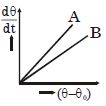
Two circular discs $A$ and $B$ with equal radii and equal mass are blackened. They are heated to the same temperature and are cooled under identical conditions. What inference do you draw from their cooling curves?
A
$A$ and $B$ have the same specific heats.
B
Specific heat of $A$ is less.
C
Specific heat of $B$ is less.
D
Nothing can be said.
Solution
(B) According to Newton's law of cooling,the rate of cooling is given by $\frac{d\theta}{dt} = \frac{e \sigma A_{surf}}{ms} (\theta^4 - \theta_0^4)$.
For small temperature differences,this simplifies to $\frac{d\theta}{dt} \propto \frac{1}{ms}(\theta - \theta_0)$.
Since the discs have equal mass $m$,equal surface area $A_{surf}$,and are under identical conditions,the rate of cooling $\frac{d\theta}{dt}$ is inversely proportional to the specific heat $s$ for a given temperature difference $(\theta - \theta_0)$.
From the graph,the slope of the line represents $\frac{d\theta/dt}{\theta - \theta_0} \propto \frac{1}{s}$.
Since the slope of line $A$ is greater than the slope of line $B$,the specific heat of $A$ must be less than the specific heat of $B$.
For small temperature differences,this simplifies to $\frac{d\theta}{dt} \propto \frac{1}{ms}(\theta - \theta_0)$.
Since the discs have equal mass $m$,equal surface area $A_{surf}$,and are under identical conditions,the rate of cooling $\frac{d\theta}{dt}$ is inversely proportional to the specific heat $s$ for a given temperature difference $(\theta - \theta_0)$.
From the graph,the slope of the line represents $\frac{d\theta/dt}{\theta - \theta_0} \propto \frac{1}{s}$.
Since the slope of line $A$ is greater than the slope of line $B$,the specific heat of $A$ must be less than the specific heat of $B$.
0 likes
View Solution92
MediumMCQ
$A$ liquid in a beaker has temperature $\theta(t)$ at time $t$ and $\theta_0$ is the temperature of the surroundings. According to Newton's law of cooling,which of the following is the correct graph between $\log_e(\theta - \theta_0)$ and $t$?
A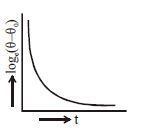
B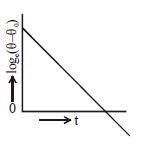
C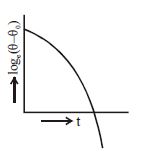
D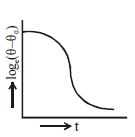
Solution
(B) According to Newton's law of cooling,the rate of change of temperature is proportional to the temperature difference between the body and its surroundings:
$\frac{-d\theta}{dt} = k(\theta - \theta_0)$
Rearranging the terms,we get:
$\frac{d\theta}{\theta - \theta_0} = -k dt$
Integrating both sides:
$\int \frac{d\theta}{\theta - \theta_0} = \int -k dt$
$\log_e(\theta - \theta_0) = -kt + C$
This equation is of the form $y = mx + c$,where $y = \log_e(\theta - \theta_0)$,$x = t$,$m = -k$ (a negative slope),and $c$ is the intercept.
Since the slope is negative,the graph is a straight line sloping downwards. This corresponds to Graph $B$.
$\frac{-d\theta}{dt} = k(\theta - \theta_0)$
Rearranging the terms,we get:
$\frac{d\theta}{\theta - \theta_0} = -k dt$
Integrating both sides:
$\int \frac{d\theta}{\theta - \theta_0} = \int -k dt$
$\log_e(\theta - \theta_0) = -kt + C$
This equation is of the form $y = mx + c$,where $y = \log_e(\theta - \theta_0)$,$x = t$,$m = -k$ (a negative slope),and $c$ is the intercept.
Since the slope is negative,the graph is a straight line sloping downwards. This corresponds to Graph $B$.
0 likes
View Solution93
MediumMCQ
Four spheres $A, B, C$ and $D$ are of the same radius but made of different metals. Their densities are in the ratio $6 : 3 : 4 : 5$ and specific heats are in the ratio $2 : 5 : 4 : 6$. These are initially kept at the same temperature and placed in the same surroundings. The sphere which has the slowest rate of cooling is
A
$C$
B
$B$
C
$D$
D
$A$
Solution
(C) The rate of cooling $R_F = \frac{d\theta}{dt}$ is given by Newton's Law of Cooling as $R_F \propto \frac{1}{ms}$,where $m$ is the mass and $s$ is the specific heat capacity.
Since the spheres have the same radius,their volumes $V$ are equal. Mass $m = \rho V$,where $\rho$ is the density.
Thus,$R_F \propto \frac{1}{(\rho V)s} \propto \frac{1}{\rho s}$.
We need to calculate the product $\rho s$ for each sphere:
For $A$: $\rho s = 6 \times 2 = 12$
For $B$: $\rho s = 3 \times 5 = 15$
For $C$: $\rho s = 4 \times 4 = 16$
For $D$: $\rho s = 5 \times 6 = 30$
The rate of cooling is slowest when the product $\rho s$ is maximum.
Comparing the values $12, 15, 16, 30$,the maximum value is $30$,which corresponds to sphere $D$.
Since the spheres have the same radius,their volumes $V$ are equal. Mass $m = \rho V$,where $\rho$ is the density.
Thus,$R_F \propto \frac{1}{(\rho V)s} \propto \frac{1}{\rho s}$.
We need to calculate the product $\rho s$ for each sphere:
For $A$: $\rho s = 6 \times 2 = 12$
For $B$: $\rho s = 3 \times 5 = 15$
For $C$: $\rho s = 4 \times 4 = 16$
For $D$: $\rho s = 5 \times 6 = 30$
The rate of cooling is slowest when the product $\rho s$ is maximum.
Comparing the values $12, 15, 16, 30$,the maximum value is $30$,which corresponds to sphere $D$.
0 likes
View Solution94
MediumMCQ
$A$ cup of tea cools from $80\,^{\circ}C$ to $60\,^{\circ}C$ in $1\,min$. The ambient temperature is $30\,^{\circ}C$. In cooling from $60\,^{\circ}C$ to $50\,^{\circ}C$,it will take ....... $sec$.
A
$50$
B
$90$
C
$60$
D
$48$
Solution
(D) According to Newton's Law of Cooling,$\frac{dT}{dt} = -K(T - T_s)$,where $T_s$ is the surrounding temperature.
For the first interval: $\frac{80 - 60}{1} = K \left( \frac{80 + 60}{2} - 30 \right) \implies 20 = K(70 - 30) \implies 20 = 40K \implies K = 0.5\,min^{-1}$.
For the second interval: $\frac{60 - 50}{t} = K \left( \frac{60 + 50}{2} - 30 \right) \implies \frac{10}{t} = 0.5(55 - 30) \implies \frac{10}{t} = 0.5 \times 25 \implies \frac{10}{t} = 12.5$.
Solving for $t$: $t = \frac{10}{12.5} = 0.8\,min$.
Converting to seconds: $t = 0.8 \times 60 = 48\,sec$.
For the first interval: $\frac{80 - 60}{1} = K \left( \frac{80 + 60}{2} - 30 \right) \implies 20 = K(70 - 30) \implies 20 = 40K \implies K = 0.5\,min^{-1}$.
For the second interval: $\frac{60 - 50}{t} = K \left( \frac{60 + 50}{2} - 30 \right) \implies \frac{10}{t} = 0.5(55 - 30) \implies \frac{10}{t} = 0.5 \times 25 \implies \frac{10}{t} = 12.5$.
Solving for $t$: $t = \frac{10}{12.5} = 0.8\,min$.
Converting to seconds: $t = 0.8 \times 60 = 48\,sec$.
0 likes
View Solution95
MediumMCQ
$A$ block of metal is heated to a temperature much higher than the room temperature and allowed to cool in a room free from air currents. Which of the following curves correctly represents the rate of cooling?
A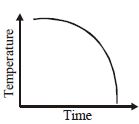
B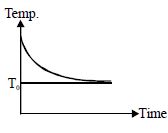
C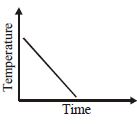
D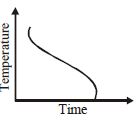
Solution
(B) According to Newton's law of cooling,the rate of loss of heat $(dQ/dt)$ of a body is directly proportional to the difference in temperature between the body and its surroundings,provided the temperature difference is small.
Mathematically,$-dT/dt = k(T - T_0)$,where $T$ is the temperature of the body,$T_0$ is the temperature of the surroundings,and $k$ is a constant.
Integrating this differential equation gives $T(t) = T_0 + (T_{initial} - T_0)e^{-kt}$.
This equation represents an exponential decay curve where the temperature $T$ asymptotically approaches the ambient temperature $T_0$ as time $t$ increases.
Therefore,the curve in option $B$ correctly represents this cooling process.
Mathematically,$-dT/dt = k(T - T_0)$,where $T$ is the temperature of the body,$T_0$ is the temperature of the surroundings,and $k$ is a constant.
Integrating this differential equation gives $T(t) = T_0 + (T_{initial} - T_0)e^{-kt}$.
This equation represents an exponential decay curve where the temperature $T$ asymptotically approaches the ambient temperature $T_0$ as time $t$ increases.
Therefore,the curve in option $B$ correctly represents this cooling process.
0 likes
View Solution96
DifficultMCQ
$A$ hot liquid kept in a beaker cools from $80\,^{\circ}C$ to $70\,^{\circ}C$ in $2\, \text{min}$. If the surrounding temperature is $30\,^{\circ}C$,then the time taken for the same liquid to cool from $60\,^{\circ}C$ to $50\,^{\circ}C$ is ........ $\text{sec}$.
A
$240$
B
$360$
C
$480$
D
$216$
Solution
(D) According to Newton's law of cooling: $\frac{\theta_{1}-\theta_{2}}{t} = K \left( \frac{\theta_{1}+\theta_{2}}{2} - \theta_{0} \right)$.
For the first case: $\theta_{1} = 80\,^{\circ}C$,$\theta_{2} = 70\,^{\circ}C$,$t = 2\, \text{min} = 120\, \text{s}$,and $\theta_{0} = 30\,^{\circ}C$.
$\frac{80-70}{120} = K \left( \frac{80+70}{2} - 30 \right) \Rightarrow \frac{10}{120} = K(75 - 30) \Rightarrow \frac{1}{12} = 45K \Rightarrow K = \frac{1}{540}$.
For the second case: $\theta_{1} = 60\,^{\circ}C$,$\theta_{2} = 50\,^{\circ}C$,and $\theta_{0} = 30\,^{\circ}C$.
$\frac{60-50}{t} = K \left( \frac{60+50}{2} - 30 \right) \Rightarrow \frac{10}{t} = \frac{1}{540} (55 - 30) \Rightarrow \frac{10}{t} = \frac{25}{540}$.
$t = \frac{10 \times 540}{25} = \frac{5400}{25} = 216\, \text{s}$.
For the first case: $\theta_{1} = 80\,^{\circ}C$,$\theta_{2} = 70\,^{\circ}C$,$t = 2\, \text{min} = 120\, \text{s}$,and $\theta_{0} = 30\,^{\circ}C$.
$\frac{80-70}{120} = K \left( \frac{80+70}{2} - 30 \right) \Rightarrow \frac{10}{120} = K(75 - 30) \Rightarrow \frac{1}{12} = 45K \Rightarrow K = \frac{1}{540}$.
For the second case: $\theta_{1} = 60\,^{\circ}C$,$\theta_{2} = 50\,^{\circ}C$,and $\theta_{0} = 30\,^{\circ}C$.
$\frac{60-50}{t} = K \left( \frac{60+50}{2} - 30 \right) \Rightarrow \frac{10}{t} = \frac{1}{540} (55 - 30) \Rightarrow \frac{10}{t} = \frac{25}{540}$.
$t = \frac{10 \times 540}{25} = \frac{5400}{25} = 216\, \text{s}$.
0 likes
View Solution97
MediumMCQ
$A$ body takes $10 \, \text{minutes}$ to cool from $60 \, ^\circ\text{C}$ to $50 \, ^\circ\text{C}$. The temperature of the surroundings is constant at $25 \, ^\circ\text{C}$. Then, the temperature of the body after the next $10 \, \text{minutes}$ will be approximately ....... $^\circ\text{C}$
A
$43$
B
$47$
C
$41$
D
$45$
Solution
(A) According to $Newton's$ law of cooling, the rate of cooling is given by: $\frac{\theta_1 - \theta_2}{t} = K \left( \frac{\theta_1 + \theta_2}{2} - \theta_0 \right)$.
For the first interval: $\frac{60 - 50}{10} = K \left( \frac{60 + 50}{2} - 25 \right) \implies 1 = K(55 - 25) \implies 1 = 30K \implies K = \frac{1}{30} \dots (i)$.
For the second interval, let the final temperature be $\theta$: $\frac{50 - \theta}{10} = K \left( \frac{50 + \theta}{2} - 25 \right)$.
Substituting $K = \frac{1}{30}$: $\frac{50 - \theta}{10} = \frac{1}{30} \left( \frac{50 + \theta - 50}{2} \right) = \frac{1}{30} \left( \frac{\theta}{2} \right) = \frac{\theta}{60}$.
$6(50 - \theta) = \theta \implies 300 - 6\theta = \theta \implies 7\theta = 300 \implies \theta \approx 42.85 \, ^\circ\text{C} \approx 43 \, ^\circ\text{C}$.
For the first interval: $\frac{60 - 50}{10} = K \left( \frac{60 + 50}{2} - 25 \right) \implies 1 = K(55 - 25) \implies 1 = 30K \implies K = \frac{1}{30} \dots (i)$.
For the second interval, let the final temperature be $\theta$: $\frac{50 - \theta}{10} = K \left( \frac{50 + \theta}{2} - 25 \right)$.
Substituting $K = \frac{1}{30}$: $\frac{50 - \theta}{10} = \frac{1}{30} \left( \frac{50 + \theta - 50}{2} \right) = \frac{1}{30} \left( \frac{\theta}{2} \right) = \frac{\theta}{60}$.
$6(50 - \theta) = \theta \implies 300 - 6\theta = \theta \implies 7\theta = 300 \implies \theta \approx 42.85 \, ^\circ\text{C} \approx 43 \, ^\circ\text{C}$.
0 likes
View Solution98
DifficultMCQ
$A$ hot body,obeying Newton's law of cooling,is cooling down from its peak value $80\,^oC$ to an ambient temperature of $30\,^oC$. It takes $5\,minutes$ to cool down from $80\,^oC$ to $40\,^oC$. How many minutes will it take to cool down from $62\,^oC$ to $32\,^oC$? (Given $\ln 2 = 0.693, \ln 5 = 1.609$)
A
$3.75$
B
$8.6$
C
$9.6$
D
$6.5$
Solution
(B) According to Newton's law of cooling,the time $t$ taken for a body to cool from temperature $\theta_1$ to $\theta_2$ in an environment with ambient temperature $\theta_0$ is given by $t = \frac{1}{k} \ln \left( \frac{\theta_1 - \theta_0}{\theta_2 - \theta_0} \right)$.
For the first interval ($80\,^oC$ to $40\,^oC$):
$5 = \frac{1}{k} \ln \left( \frac{80 - 30}{40 - 30} \right) = \frac{1}{k} \ln \left( \frac{50}{10} \right) = \frac{1}{k} \ln 5$.
So,$k = \frac{\ln 5}{5} = \frac{1.609}{5} = 0.3218\,min^{-1}$.
For the second interval ($62\,^oC$ to $32\,^oC$):
$t = \frac{1}{k} \ln \left( \frac{62 - 30}{32 - 30} \right) = \frac{1}{k} \ln \left( \frac{32}{2} \right) = \frac{1}{k} \ln 16 = \frac{1}{k} \ln(2^4) = \frac{4 \ln 2}{k}$.
Substituting the values:
$t = \frac{4 \times 0.693}{0.3218} \approx \frac{2.772}{0.3218} \approx 8.61\,minutes$.
Thus,the time taken is $8.6\,minutes$.
For the first interval ($80\,^oC$ to $40\,^oC$):
$5 = \frac{1}{k} \ln \left( \frac{80 - 30}{40 - 30} \right) = \frac{1}{k} \ln \left( \frac{50}{10} \right) = \frac{1}{k} \ln 5$.
So,$k = \frac{\ln 5}{5} = \frac{1.609}{5} = 0.3218\,min^{-1}$.
For the second interval ($62\,^oC$ to $32\,^oC$):
$t = \frac{1}{k} \ln \left( \frac{62 - 30}{32 - 30} \right) = \frac{1}{k} \ln \left( \frac{32}{2} \right) = \frac{1}{k} \ln 16 = \frac{1}{k} \ln(2^4) = \frac{4 \ln 2}{k}$.
Substituting the values:
$t = \frac{4 \times 0.693}{0.3218} \approx \frac{2.772}{0.3218} \approx 8.61\,minutes$.
Thus,the time taken is $8.6\,minutes$.
0 likes
View Solution99
DifficultMCQ
Hot water cools from $60\,^oC$ to $50\,^oC$ in the first $10\,minutes$ and to $42\,^oC$ in the next $10\,minutes.$ The temperature of the surroundings is ...... $^oC$
A
$25$
B
$10$
C
$15$
D
$20$
Solution
(B) According to $Newton's$ law of cooling,the rate of cooling is given by: $\frac{\theta_1 - \theta_2}{t} = K \left[ \frac{\theta_1 + \theta_2}{2} - \theta_0 \right]$,where $\theta_0$ is the surrounding temperature.
For the first $10$ minutes: $\frac{60 - 50}{10} = K \left[ \frac{60 + 50}{2} - \theta_0 \right] \implies 1 = K(55 - \theta_0) \dots (i)$
For the next $10$ minutes: $\frac{50 - 42}{10} = K \left[ \frac{50 + 42}{2} - \theta_0 \right] \implies 0.8 = K(46 - \theta_0) \dots (ii)$
Dividing equation $(i)$ by $(ii)$:
$\frac{1}{0.8} = \frac{55 - \theta_0}{46 - \theta_0}$
$1.25 = \frac{55 - \theta_0}{46 - \theta_0}$
$1.25(46 - \theta_0) = 55 - \theta_0$
$57.5 - 1.25\theta_0 = 55 - \theta_0$
$2.5 = 0.25\theta_0$
$\theta_0 = 10\,^oC$.
For the first $10$ minutes: $\frac{60 - 50}{10} = K \left[ \frac{60 + 50}{2} - \theta_0 \right] \implies 1 = K(55 - \theta_0) \dots (i)$
For the next $10$ minutes: $\frac{50 - 42}{10} = K \left[ \frac{50 + 42}{2} - \theta_0 \right] \implies 0.8 = K(46 - \theta_0) \dots (ii)$
Dividing equation $(i)$ by $(ii)$:
$\frac{1}{0.8} = \frac{55 - \theta_0}{46 - \theta_0}$
$1.25 = \frac{55 - \theta_0}{46 - \theta_0}$
$1.25(46 - \theta_0) = 55 - \theta_0$
$57.5 - 1.25\theta_0 = 55 - \theta_0$
$2.5 = 0.25\theta_0$
$\theta_0 = 10\,^oC$.
0 likes
View Solution100
DifficultMCQ
$A$ mass of $50\,g$ of water in a closed vessel,with surroundings at a constant temperature,takes $2\,minutes$ to cool from $30\,^oC$ to $25\,^oC$. $A$ mass of $100\,g$ of another liquid in an identical vessel with identical surroundings takes the same time to cool from $30\,^oC$ to $25\,^oC$. The specific heat of the liquid is .......... $kcal/(kg \cdot ^oC)$ (The water equivalent of the vessel is $30\,g$).
A
$2.0$
B
$7$
C
$3$
D
$0.5$
Solution
(D) According to Newton's law of cooling,the rate of heat loss $\frac{dQ}{dt}$ depends on the temperature difference between the body and the surroundings. Since the vessel,surroundings,and temperature range are identical,the rate of heat loss is the same for both cases.
Let $m_w = 50\,g$ be the mass of water,$C_w = 1\,cal/(g \cdot ^oC)$ be the specific heat of water,$m_l = 100\,g$ be the mass of the liquid,$C_l$ be the specific heat of the liquid,and $W = 30\,g$ be the water equivalent of the vessel.
The total heat lost is given by $Q = (mC + W) \Delta T$.
Since the time $t$ is the same,the rate of heat loss is:
$\frac{(m_w C_w + W) \Delta T}{t} = \frac{(m_l C_l + W) \Delta T}{t}$
Canceling $\frac{\Delta T}{t}$ from both sides:
$m_w C_w + W = m_l C_l + W$
$m_w C_w = m_l C_l$
Substituting the values:
$50 \times 1 = 100 \times C_l$
$C_l = \frac{50}{100} = 0.5\,cal/(g \cdot ^oC) = 0.5\,kcal/(kg \cdot ^oC)$.
Let $m_w = 50\,g$ be the mass of water,$C_w = 1\,cal/(g \cdot ^oC)$ be the specific heat of water,$m_l = 100\,g$ be the mass of the liquid,$C_l$ be the specific heat of the liquid,and $W = 30\,g$ be the water equivalent of the vessel.
The total heat lost is given by $Q = (mC + W) \Delta T$.
Since the time $t$ is the same,the rate of heat loss is:
$\frac{(m_w C_w + W) \Delta T}{t} = \frac{(m_l C_l + W) \Delta T}{t}$
Canceling $\frac{\Delta T}{t}$ from both sides:
$m_w C_w + W = m_l C_l + W$
$m_w C_w = m_l C_l$
Substituting the values:
$50 \times 1 = 100 \times C_l$
$C_l = \frac{50}{100} = 0.5\,cal/(g \cdot ^oC) = 0.5\,kcal/(kg \cdot ^oC)$.
0 likes
View Solution10-2.Heat Transfer — Newton's Law of Cooling · Frequently Asked Questions
1Are these 10-2.Heat Transfer questions useful for JEE and NEET?
Yes. All questions in this section are mapped to JEE Main and NEET exam patterns. Previous year questions from JEE Main, NEET, GUJCET and state-level exams are included with full solutions.
2Can I switch to Hindi or Gujarati for these questions?
Yes. Use the language tabs in the hero section or the sidebar to view the same questions and solutions in English, Hindi or Gujarati.
3How do I generate a question paper from this subtopic?
Use the Vedclass Exam Paper Generator — select the chapter and subtopic, set difficulty, and generate Sets A, B, C, D automatically. First 3 chapters of every subject are free.
Vedclass Products
For Students
Vedclass Test Series
Mock tests in real JEE/NEET style with performance analysis. 5-day free trial.
Start Free TrialFor Teachers
Exam Paper Generator
Generate Set A/B/C/D papers from this chapter in 2 minutes. 3 chapters free.
Try FreeFor Institutes
Online Exam Module
Live online exams with unlimited students, 360° analytics & white-label branding.
See DemoFor Teachers & Institutes
Generate a 10-2.Heat Transfer Exam Paper in 2 Minutes
Select subtopic & difficulty — Sets A, B, C, D auto-generated with No Repeat logic.
First 3 chapters of every subject are free — no payment required.