
A English
Word problem -Statistics Questions in English
Class 11 Mathematics · Statistics · Word problem -Statistics
209+
Questions
English
Language
100%
With Solutions
Showing 50 of 209 questions in English
1
DifficultMCQ
The sum of two positive integers is $100$. The probability that their product is greater than $1000$ is
A
$\frac{7}{9}$
B
$\frac{7}{10}$
C
$\frac{2}{5}$
D
None of these
Solution
(A) Let the two positive integers be $x$ and $y$. Given $x + y = 100$,where $x, y \in \{1, 2, \dots, 99\}$.
Total number of possible pairs $(x, y)$ is $99$.
We want the product $xy > 1000$.
Substituting $y = 100 - x$,we get $x(100 - x) > 1000$,which simplifies to $100x - x^2 > 1000$,or $x^2 - 100x + 1000 < 0$.
Solving the quadratic equation $x^2 - 100x + 1000 = 0$ using the quadratic formula $x = \frac{-b \pm \sqrt{b^2 - 4ac}}{2a}$:
$x = \frac{100 \pm \sqrt{10000 - 4000}}{2} = \frac{100 \pm \sqrt{6000}}{2} = 50 \pm 10\sqrt{15}$.
Since $\sqrt{15} \approx 3.87$,$x \approx 50 \pm 38.7$.
So,$x$ must be in the range $(11.3, 88.7)$.
The possible integer values for $x$ are $12, 13, \dots, 88$.
The number of such integers is $88 - 12 + 1 = 77$.
Therefore,the probability is $\frac{77}{99} = \frac{7}{9}$.
Total number of possible pairs $(x, y)$ is $99$.
We want the product $xy > 1000$.
Substituting $y = 100 - x$,we get $x(100 - x) > 1000$,which simplifies to $100x - x^2 > 1000$,or $x^2 - 100x + 1000 < 0$.
Solving the quadratic equation $x^2 - 100x + 1000 = 0$ using the quadratic formula $x = \frac{-b \pm \sqrt{b^2 - 4ac}}{2a}$:
$x = \frac{100 \pm \sqrt{10000 - 4000}}{2} = \frac{100 \pm \sqrt{6000}}{2} = 50 \pm 10\sqrt{15}$.
Since $\sqrt{15} \approx 3.87$,$x \approx 50 \pm 38.7$.
So,$x$ must be in the range $(11.3, 88.7)$.
The possible integer values for $x$ are $12, 13, \dots, 88$.
The number of such integers is $88 - 12 + 1 = 77$.
Therefore,the probability is $\frac{77}{99} = \frac{7}{9}$.
0 likes
View Solution2
DifficultMCQ
An anti-aircraft gun takes a maximum of four shots at an enemy plane moving away from it. The probabilities of hitting the plane at the first,second,third,and fourth shot are $0.4, 0.3, 0.2$,and $0.1$ respectively. The probability that the gun hits the plane is
A
$0.25$
B
$0.21$
C
$0.16$
D
$0.6976$
Solution
(D) Let the probabilities of hitting the plane in the four shots be $p_1 = 0.4$,$p_2 = 0.3$,$p_3 = 0.2$,and $p_4 = 0.1$.
The probability that the gun hits the plane is equal to $1$ minus the probability that the gun misses the plane in all four shots.
Let $q_i = 1 - p_i$ be the probability of missing the shot $i$.
$q_1 = 1 - 0.4 = 0.6$
$q_2 = 1 - 0.3 = 0.7$
$q_3 = 1 - 0.2 = 0.8$
$q_4 = 1 - 0.1 = 0.9$
The probability of missing all four shots is $P(\text{miss}) = q_1 \times q_2 \times q_3 \times q_4 = 0.6 \times 0.7 \times 0.8 \times 0.9 = 0.3024$.
Therefore,the probability that the gun hits the plane is $P(\text{hit}) = 1 - P(\text{miss}) = 1 - 0.3024 = 0.6976$.
The probability that the gun hits the plane is equal to $1$ minus the probability that the gun misses the plane in all four shots.
Let $q_i = 1 - p_i$ be the probability of missing the shot $i$.
$q_1 = 1 - 0.4 = 0.6$
$q_2 = 1 - 0.3 = 0.7$
$q_3 = 1 - 0.2 = 0.8$
$q_4 = 1 - 0.1 = 0.9$
The probability of missing all four shots is $P(\text{miss}) = q_1 \times q_2 \times q_3 \times q_4 = 0.6 \times 0.7 \times 0.8 \times 0.9 = 0.3024$.
Therefore,the probability that the gun hits the plane is $P(\text{hit}) = 1 - P(\text{miss}) = 1 - 0.3024 = 0.6976$.
0 likes
View Solution3
MediumMCQ
Consider the frequency distribution of the given numbers. If the mean is known to be $3$,then the value of $f$ is:
| Value | $1$ | $2$ | $3$ | $4$ |
| Frequency | $5$ | $4$ | $6$ | $f$ |
A
$3$
B
$7$
C
$10$
D
$14$
Solution
(D) The formula for the mean is $\text{Mean} = \frac{\sum (x_i \times f_i)}{\sum f_i}$.
Given values: $x = \{1, 2, 3, 4\}$ and $f = \{5, 4, 6, f\}$.
Mean = $\frac{(1 \times 5) + (2 \times 4) + (3 \times 6) + (4 \times f)}{5 + 4 + 6 + f} = 3$.
$\frac{5 + 8 + 18 + 4f}{15 + f} = 3$.
$\frac{31 + 4f}{15 + f} = 3$.
$31 + 4f = 3(15 + f)$.
$31 + 4f = 45 + 3f$.
$4f - 3f = 45 - 31$.
$f = 14$.
Given values: $x = \{1, 2, 3, 4\}$ and $f = \{5, 4, 6, f\}$.
Mean = $\frac{(1 \times 5) + (2 \times 4) + (3 \times 6) + (4 \times f)}{5 + 4 + 6 + f} = 3$.
$\frac{5 + 8 + 18 + 4f}{15 + f} = 3$.
$\frac{31 + 4f}{15 + f} = 3$.
$31 + 4f = 3(15 + f)$.
$31 + 4f = 45 + 3f$.
$4f - 3f = 45 - 31$.
$f = 14$.
0 likes
View Solution4
MediumMCQ
If the algebraic sum of deviations of $20$ observations from $30$ is $20$,then the mean of the observations is:
A
$30$
B
$30.1$
C
$29$
D
$31$
Solution
(D) Given that the sum of deviations of $20$ observations from $30$ is $20$.
Let the observations be $x_1, x_2, ..., x_{20}$.
Then,$\sum_{i=1}^{20} (x_i - 30) = 20$.
Expanding the summation,we get $\sum_{i=1}^{20} x_i - \sum_{i=1}^{20} 30 = 20$.
$\sum_{i=1}^{20} x_i - (20 \times 30) = 20$.
$\sum_{i=1}^{20} x_i - 600 = 20$.
$\sum_{i=1}^{20} x_i = 620$.
The mean is given by $\bar{x} = \frac{\sum_{i=1}^{20} x_i}{20}$.
$\bar{x} = \frac{620}{20} = 31$.
Let the observations be $x_1, x_2, ..., x_{20}$.
Then,$\sum_{i=1}^{20} (x_i - 30) = 20$.
Expanding the summation,we get $\sum_{i=1}^{20} x_i - \sum_{i=1}^{20} 30 = 20$.
$\sum_{i=1}^{20} x_i - (20 \times 30) = 20$.
$\sum_{i=1}^{20} x_i - 600 = 20$.
$\sum_{i=1}^{20} x_i = 620$.
The mean is given by $\bar{x} = \frac{\sum_{i=1}^{20} x_i}{20}$.
$\bar{x} = \frac{620}{20} = 31$.
0 likes
View Solution5
DifficultMCQ
The weighted mean of the first $n$ natural numbers,where the weights are equal to the squares of the corresponding numbers,is:
A
$\frac{n + 1}{2}$
B
$\frac{3n(n + 1)}{2(2n + 1)}$
C
$\frac{(n + 1)(2n + 1)}{6}$
D
$\frac{n(n + 1)}{2}$
Solution
(B) The weighted mean is given by the formula: $\frac{\sum_{i=1}^{n} (i \cdot i^2)}{\sum_{i=1}^{n} i^2} = \frac{\sum_{i=1}^{n} i^3}{\sum_{i=1}^{n} i^2}$.
We know that $\sum_{i=1}^{n} i^3 = \left[ \frac{n(n + 1)}{2} \right]^2$ and $\sum_{i=1}^{n} i^2 = \frac{n(n + 1)(2n + 1)}{6}$.
Substituting these values,we get:
Weighted mean = $\frac{\left[ \frac{n(n + 1)}{2} \right]^2}{\frac{n(n + 1)(2n + 1)}{6}}$
$= \frac{n^2(n + 1)^2}{4} \cdot \frac{6}{n(n + 1)(2n + 1)}$
$= \frac{6n(n + 1)}{4(2n + 1)} = \frac{3n(n + 1)}{2(2n + 1)}$.
We know that $\sum_{i=1}^{n} i^3 = \left[ \frac{n(n + 1)}{2} \right]^2$ and $\sum_{i=1}^{n} i^2 = \frac{n(n + 1)(2n + 1)}{6}$.
Substituting these values,we get:
Weighted mean = $\frac{\left[ \frac{n(n + 1)}{2} \right]^2}{\frac{n(n + 1)(2n + 1)}{6}}$
$= \frac{n^2(n + 1)^2}{4} \cdot \frac{6}{n(n + 1)(2n + 1)}$
$= \frac{6n(n + 1)}{4(2n + 1)} = \frac{3n(n + 1)}{2(2n + 1)}$.
0 likes
View Solution6
MediumMCQ
The mean age of a combined group of men and women is $30$ years. If the means of the age of men and women are respectively $32$ and $27$,then the percentage of women in the group is
A
$30$
B
$40$
C
$50$
D
$60$
Solution
(B) The formula for combined mean is $\bar{x} = \frac{n_1\bar{x}_1 + n_2\bar{x}_2}{n_1 + n_2}$.
Given,$\bar{x} = 30$,$\bar{x}_1 = 32$ (mean age of men),and $\bar{x}_2 = 27$ (mean age of women).
Let the total number of people be $100$. Let $n_1$ be the number of men and $n_2$ be the number of women.
Then $n_2 = 100 - n_1$.
Substituting the values in the formula:
$30 = \frac{32n_1 + 27(100 - n_1)}{100}$
$3000 = 32n_1 + 2700 - 27n_1$
$3000 - 2700 = 5n_1$
$300 = 5n_1$
$n_1 = 60$.
Since $n_1$ is the number of men,the number of women is $n_2 = 100 - 60 = 40$.
Thus,the percentage of women in the group is $40\%$.
Given,$\bar{x} = 30$,$\bar{x}_1 = 32$ (mean age of men),and $\bar{x}_2 = 27$ (mean age of women).
Let the total number of people be $100$. Let $n_1$ be the number of men and $n_2$ be the number of women.
Then $n_2 = 100 - n_1$.
Substituting the values in the formula:
$30 = \frac{32n_1 + 27(100 - n_1)}{100}$
$3000 = 32n_1 + 2700 - 27n_1$
$3000 - 2700 = 5n_1$
$300 = 5n_1$
$n_1 = 60$.
Since $n_1$ is the number of men,the number of women is $n_2 = 100 - 60 = 40$.
Thus,the percentage of women in the group is $40\%$.
0 likes
View Solution7
MediumMCQ
The average weight of students in a class of $35$ students is $40 \ kg$. If the weight of the teacher is included,the average weight increases by $0.5 \ kg$. The weight of the teacher is.....$kg$.
A
$40.5$
B
$50$
C
$41$
D
$58$
Solution
(D) Let the weight of the teacher be $w \ kg$.
Total weight of $35$ students = $35 \times 40 = 1400 \ kg$.
When the teacher is included,the total number of people becomes $35 + 1 = 36$.
The new average weight = $40 + 0.5 = 40.5 \ kg$.
Total weight of $36$ people = $36 \times 40.5 = 1458 \ kg$.
The weight of the teacher $w = \text{Total weight of } 36 \text{ people} - \text{Total weight of } 35 \text{ students}$.
$w = 1458 - 1400 = 58 \ kg$.
Total weight of $35$ students = $35 \times 40 = 1400 \ kg$.
When the teacher is included,the total number of people becomes $35 + 1 = 36$.
The new average weight = $40 + 0.5 = 40.5 \ kg$.
Total weight of $36$ people = $36 \times 40.5 = 1458 \ kg$.
The weight of the teacher $w = \text{Total weight of } 36 \text{ people} - \text{Total weight of } 35 \text{ students}$.
$w = 1458 - 1400 = 58 \ kg$.
0 likes
View Solution8
MediumMCQ
If $\bar{x}_1$ and $\bar{x}_2$ are the means of two distributions such that $\bar{x}_1 < \bar{x}_2$ and $\bar{x}$ is the mean of the combined distribution,then
A
$\bar{x} < \bar{x}_1$
B
$\bar{x} > \bar{x}_2$
C
$\bar{x} = \frac{\bar{x}_1 + \bar{x}_2}{2}$
D
$\bar{x}_1 < \bar{x} < \bar{x}_2$
Solution
(D) Let $n_1$ and $n_2$ be the number of observations in two groups having means $\bar{x}_1$ and $\bar{x}_2$ respectively.
Then,the combined mean is given by $\bar{x} = \frac{n_1\bar{x}_1 + n_2\bar{x}_2}{n_1 + n_2}$.
Now,consider $\bar{x} - \bar{x}_1 = \frac{n_1\bar{x}_1 + n_2\bar{x}_2}{n_1 + n_2} - \bar{x}_1 = \frac{n_2(\bar{x}_2 - \bar{x}_1)}{n_1 + n_2}$.
Since $\bar{x}_2 > \bar{x}_1$ and $n_1, n_2 > 0$,we have $\bar{x} - \bar{x}_1 > 0$,which implies $\bar{x} > \bar{x}_1$ $(i)$.
Similarly,$\bar{x} - \bar{x}_2 = \frac{n_1\bar{x}_1 + n_2\bar{x}_2}{n_1 + n_2} - \bar{x}_2 = \frac{n_1(\bar{x}_1 - \bar{x}_2)}{n_1 + n_2}$.
Since $\bar{x}_1 < \bar{x}_2$,we have $\bar{x} - \bar{x}_2 < 0$,which implies $\bar{x} < \bar{x}_2$ (ii).
Combining $(i)$ and (ii),we get $\bar{x}_1 < \bar{x} < \bar{x}_2$.
Then,the combined mean is given by $\bar{x} = \frac{n_1\bar{x}_1 + n_2\bar{x}_2}{n_1 + n_2}$.
Now,consider $\bar{x} - \bar{x}_1 = \frac{n_1\bar{x}_1 + n_2\bar{x}_2}{n_1 + n_2} - \bar{x}_1 = \frac{n_2(\bar{x}_2 - \bar{x}_1)}{n_1 + n_2}$.
Since $\bar{x}_2 > \bar{x}_1$ and $n_1, n_2 > 0$,we have $\bar{x} - \bar{x}_1 > 0$,which implies $\bar{x} > \bar{x}_1$ $(i)$.
Similarly,$\bar{x} - \bar{x}_2 = \frac{n_1\bar{x}_1 + n_2\bar{x}_2}{n_1 + n_2} - \bar{x}_2 = \frac{n_1(\bar{x}_1 - \bar{x}_2)}{n_1 + n_2}$.
Since $\bar{x}_1 < \bar{x}_2$,we have $\bar{x} - \bar{x}_2 < 0$,which implies $\bar{x} < \bar{x}_2$ (ii).
Combining $(i)$ and (ii),we get $\bar{x}_1 < \bar{x} < \bar{x}_2$.
0 likes
View Solution9
EasyMCQ
The $A.M.$ of $n$ observations is $M$. If the sum of $n - 4$ observations is $a$,then the mean of the remaining $4$ observations is:
A
$\frac{nM - a}{4}$
B
$\frac{nM + a}{2}$
C
$\frac{nM - A}{2}$
D
$nM + a$
Solution
(A) Let the sum of all $n$ observations be $S$. Given that the $A.M.$ of $n$ observations is $M$,we have $S = nM$.
Let the sum of the remaining $4$ observations be $S_4$. We are given that the sum of $n - 4$ observations is $a$.
Therefore,$S = a + S_4$,which implies $S_4 = S - a = nM - a$.
The mean of the remaining $4$ observations is $\frac{S_4}{4} = \frac{nM - a}{4}$.
Let the sum of the remaining $4$ observations be $S_4$. We are given that the sum of $n - 4$ observations is $a$.
Therefore,$S = a + S_4$,which implies $S_4 = S - a = nM - a$.
The mean of the remaining $4$ observations is $\frac{S_4}{4} = \frac{nM - a}{4}$.
0 likes
View Solution10
MediumMCQ
If the mean of the distribution is $2.6$,then the value of $y$ is:
| Variate $x$ | $1$ | $2$ | $3$ | $4$ | $5$ |
| Freq $f$ of $x$ | $4$ | $5$ | $y$ | $1$ | $2$ |
A
$24$
B
$13$
C
$8$
D
$3$
Solution
(C) The formula for the mean is given by $\text{Mean} = \frac{\sum f_i x_i}{\sum f_i}$.
Given the distribution:
$\sum f_i x_i = (1 \times 4) + (2 \times 5) + (3 \times y) + (4 \times 1) + (5 \times 2) = 4 + 10 + 3y + 4 + 10 = 28 + 3y$.
$\sum f_i = 4 + 5 + y + 1 + 2 = 12 + y$.
Given $\text{Mean} = 2.6$,we have:
$2.6 = \frac{28 + 3y}{12 + y}$.
Multiplying both sides by $(12 + y)$:
$2.6(12 + y) = 28 + 3y$.
$31.2 + 2.6y = 28 + 3y$.
$31.2 - 28 = 3y - 2.6y$.
$3.2 = 0.4y$.
$y = \frac{3.2}{0.4} = 8$.
Given the distribution:
$\sum f_i x_i = (1 \times 4) + (2 \times 5) + (3 \times y) + (4 \times 1) + (5 \times 2) = 4 + 10 + 3y + 4 + 10 = 28 + 3y$.
$\sum f_i = 4 + 5 + y + 1 + 2 = 12 + y$.
Given $\text{Mean} = 2.6$,we have:
$2.6 = \frac{28 + 3y}{12 + y}$.
Multiplying both sides by $(12 + y)$:
$2.6(12 + y) = 28 + 3y$.
$31.2 + 2.6y = 28 + 3y$.
$31.2 - 28 = 3y - 2.6y$.
$3.2 = 0.4y$.
$y = \frac{3.2}{0.4} = 8$.
0 likes
View Solution11
MediumMCQ
The mean of $100$ items is $49$. It was discovered that three items which should have been $60, 70, 80$ were wrongly read as $40, 20, 50$ respectively. The correct mean is
A
$48$
B
$82\frac{1}{2}$
C
$50$
D
$80$
Solution
(C) Given,the number of items $n = 100$ and the initial mean $\bar{x} = 49$.
The initial sum of the items is $S_{initial} = 100 \times 49 = 4900$.
The sum of the correct items is $S_{correct} = 60 + 70 + 80 = 210$.
The sum of the wrongly read items is $S_{wrong} = 40 + 20 + 50 = 110$.
The correct sum of the items is $S_{new} = S_{initial} + S_{correct} - S_{wrong} = 4900 + 210 - 110 = 5000$.
The correct mean is $\bar{x}_{new} = \frac{S_{new}}{n} = \frac{5000}{100} = 50$.
The initial sum of the items is $S_{initial} = 100 \times 49 = 4900$.
The sum of the correct items is $S_{correct} = 60 + 70 + 80 = 210$.
The sum of the wrongly read items is $S_{wrong} = 40 + 20 + 50 = 110$.
The correct sum of the items is $S_{new} = S_{initial} + S_{correct} - S_{wrong} = 4900 + 210 - 110 = 5000$.
The correct mean is $\bar{x}_{new} = \frac{S_{new}}{n} = \frac{5000}{100} = 50$.
0 likes
View Solution12
MediumMCQ
The mean of $5$ numbers is $18$. If one number is excluded,their mean becomes $16$. Then the excluded number is
A
$18$
B
$25$
C
$26$
D
$30$
Solution
(C) The sum of $5$ numbers is $18 \times 5 = 90$.
After one number is excluded,the sum of the remaining $4$ numbers is $16 \times 4 = 64$.
Therefore,the excluded number is $90 - 64 = 26$.
After one number is excluded,the sum of the remaining $4$ numbers is $16 \times 4 = 64$.
Therefore,the excluded number is $90 - 64 = 26$.
0 likes
View Solution13
MediumMCQ
The class marks of a distribution are $6, 10, 14, 18, 22, 26, 30$. The class size is:
A
$4$
B
$2$
C
$5$
D
$8$
Solution
(A) The class size is defined as the difference between two consecutive class marks.
Class size $= 10 - 6 = 4$.
Alternatively,Class size $= 14 - 10 = 4$.
Thus,the class size is $4$.
Class size $= 10 - 6 = 4$.
Alternatively,Class size $= 14 - 10 = 4$.
Thus,the class size is $4$.
0 likes
View Solution14
DifficultMCQ
Let ${x_1}, {x_2}, ..., {x_n}$ be $n$ observations such that $\sum x_i^2 = 400$ and $\sum x_i = 80$. Then a possible value of $n$ among the following is:
A
$9$
B
$12$
C
$15$
D
$18$
Solution
(D) We know that for any set of observations,the root mean square is greater than or equal to the arithmetic mean,i.e.,$RMS \ge AM$.
$\sqrt{\frac{\sum x_i^2}{n}} \ge \frac{\sum x_i}{n}$
Substituting the given values $\sum x_i^2 = 400$ and $\sum x_i = 80$:
$\sqrt{\frac{400}{n}} \ge \frac{80}{n}$
$\frac{20}{\sqrt{n}} \ge \frac{80}{n}$
$\frac{1}{\sqrt{n}} \ge \frac{4}{n}$
$\sqrt{n} \ge 4$
$n \ge 16$
Among the given options,the only value greater than or equal to $16$ is $18$. Therefore,the correct option is $D$.
$\sqrt{\frac{\sum x_i^2}{n}} \ge \frac{\sum x_i}{n}$
Substituting the given values $\sum x_i^2 = 400$ and $\sum x_i = 80$:
$\sqrt{\frac{400}{n}} \ge \frac{80}{n}$
$\frac{20}{\sqrt{n}} \ge \frac{80}{n}$
$\frac{1}{\sqrt{n}} \ge \frac{4}{n}$
$\sqrt{n} \ge 4$
$n \ge 16$
Among the given options,the only value greater than or equal to $16$ is $18$. Therefore,the correct option is $D$.
0 likes
View Solution15
EasyMCQ
For a frequency distribution,the $7^{th}$ decile is computed by the formula:
A
$D_7 = l + \frac{(\frac{N}{7} - C)}{f} \times i$
B
$D_7 = l + \frac{(\frac{N}{10} - C)}{f} \times i$
C
$D_7 = l + \frac{(\frac{7N}{10} - C)}{f} \times i$
D
$D_7 = l + \frac{(\frac{10N}{7} - C)}{f} \times i$
Solution
(C) The formula for calculating the $k^{th}$ decile $(D_k)$ in a continuous frequency distribution is given by:
$D_k = l + \frac{(\frac{kN}{10} - C)}{f} \times i$
where:
$l$ is the lower limit of the decile class,
$N$ is the total frequency,
$C$ is the cumulative frequency of the class preceding the decile class,
$f$ is the frequency of the decile class,
$i$ is the class interval size.
For the $7^{th}$ decile $(k=7)$,the formula becomes:
$D_7 = l + \frac{(\frac{7N}{10} - C)}{f} \times i$.
Therefore,the correct option is $C$.
$D_k = l + \frac{(\frac{kN}{10} - C)}{f} \times i$
where:
$l$ is the lower limit of the decile class,
$N$ is the total frequency,
$C$ is the cumulative frequency of the class preceding the decile class,
$f$ is the frequency of the decile class,
$i$ is the class interval size.
For the $7^{th}$ decile $(k=7)$,the formula becomes:
$D_7 = l + \frac{(\frac{7N}{10} - C)}{f} \times i$.
Therefore,the correct option is $C$.
0 likes
View Solution16
MediumMCQ
Consider the following statements:
$(1)$ Mode can be computed from a histogram.
$(2)$ Median is not independent of change of scale.
$(3)$ Variance is independent of change of origin and scale.
Which of these is/are correct?
$(1)$ Mode can be computed from a histogram.
$(2)$ Median is not independent of change of scale.
$(3)$ Variance is independent of change of origin and scale.
Which of these is/are correct?
A
$(1), (2)$ and $(3)$
B
Only $(2)$
C
Only $(1)$ and $(2)$
D
Only $(1)$
Solution
(D) Statement $(1)$ is correct: The mode of a grouped frequency distribution can be determined graphically using a histogram.
Statement $(2)$ is incorrect: Median is independent of the change of origin,but it is $NOT$ independent of the change of scale. If $y = a + bx$,then $Median(y) = a + b \times Median(x)$. Since it depends on $b$,it is not independent of the change of scale.
Statement $(3)$ is incorrect: Variance is independent of the change of origin,but it is $NOT$ independent of the change of scale. If $y = a + bx$,then $Var(y) = b^2 \times Var(x)$. Since it depends on $b^2$,it is not independent of the change of scale.
Therefore,only statement $(1)$ is correct.
Statement $(2)$ is incorrect: Median is independent of the change of origin,but it is $NOT$ independent of the change of scale. If $y = a + bx$,then $Median(y) = a + b \times Median(x)$. Since it depends on $b$,it is not independent of the change of scale.
Statement $(3)$ is incorrect: Variance is independent of the change of origin,but it is $NOT$ independent of the change of scale. If $y = a + bx$,then $Var(y) = b^2 \times Var(x)$. Since it depends on $b^2$,it is not independent of the change of scale.
Therefore,only statement $(1)$ is correct.
0 likes
View Solution17
EasyMCQ
Which of the following is not a measure of central tendency?
A
Mean
B
Median
C
Mode
D
Range
Solution
(D) The measures of central tendency are statistical values that represent the center or typical value of a dataset.
Common measures of central tendency include the $Mean$,$Median$,and $Mode$.
$Range$ is a measure of dispersion (or variability),not central tendency,as it describes the spread of the data by calculating the difference between the maximum and minimum values.
Therefore,the correct option is $D$.
Common measures of central tendency include the $Mean$,$Median$,and $Mode$.
$Range$ is a measure of dispersion (or variability),not central tendency,as it describes the spread of the data by calculating the difference between the maximum and minimum values.
Therefore,the correct option is $D$.
0 likes
View Solution18
DifficultMCQ
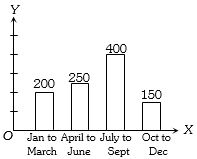
The mortality in a town during $4$ quarters of a year due to various causes is given in the bar graph below. Based on this data,calculate the percentage increase in mortality in the third quarter compared to the second quarter.
A
$40$
B
$50$
C
$60$
D
$75$
Solution
(C) From the given bar graph:
Mortality in the second quarter (April to June) = $250$.
Mortality in the third quarter (July to September) = $400$.
Increase in mortality = $400 - 250 = 150$.
Percentage increase = $\frac{\text{Increase}}{\text{Original Value}} \times 100$
Percentage increase = $\frac{150}{250} \times 100 = 0.6 \times 100 = 60\%$.
Mortality in the second quarter (April to June) = $250$.
Mortality in the third quarter (July to September) = $400$.
Increase in mortality = $400 - 250 = 150$.
Percentage increase = $\frac{\text{Increase}}{\text{Original Value}} \times 100$
Percentage increase = $\frac{150}{250} \times 100 = 0.6 \times 100 = 60\%$.
0 likes
View Solution19
MediumMCQ
$A$ market with $3900$ operating firms has the following distribution for firms arranged according to various income groups of workers. If a histogram for the above distribution is constructed,the highest bar in the histogram would correspond to the class:
| Income group | No. of firms |
| $150-300$ | $300$ |
| $300-500$ | $500$ |
| $500-800$ | $900$ |
| $800-1200$ | $1000$ |
| $1200-1800$ | $1200$ |
A
$500-800$
B
$1200-1800$
C
$800-1200$
D
$150-300$
Solution
(B) In a histogram,the height of each bar corresponds to the frequency of the class interval.
Looking at the given data,the frequencies are:
- $150-300$: $300$
- $300-500$: $500$
- $500-800$: $900$
- $800-1200$: $1000$
- $1200-1800$: $1200$
The maximum frequency is $1200$,which corresponds to the income group $1200-1800$.
Therefore,the highest bar in the histogram will correspond to the class $1200-1800$.
Looking at the given data,the frequencies are:
- $150-300$: $300$
- $300-500$: $500$
- $500-800$: $900$
- $800-1200$: $1000$
- $1200-1800$: $1200$
The maximum frequency is $1200$,which corresponds to the income group $1200-1800$.
Therefore,the highest bar in the histogram will correspond to the class $1200-1800$.
0 likes
View Solution20
MediumMCQ
The total expenditure incurred by an industry under different heads is best presented as a
A
Bar diagram
B
Pie diagram
C
Histogram
D
Frequency polygon
Solution
(B) $Pie \ diagram$ (or pie chart) is the most effective way to represent the total expenditure of an industry distributed across different heads because it shows the proportion of each part to the whole.
0 likes
View Solution21
DifficultMCQ
The expenditure of a family for a certain month were as follows:
Food - Rs. $560$,Rent - Rs. $420$,Clothes - Rs. $180$,Education - Rs. $160$,Other items - Rs. $120$
$A$ pie graph representing this data would show the expenditure for clothes by a sector whose angle equals......$^o$
Food - Rs. $560$,Rent - Rs. $420$,Clothes - Rs. $180$,Education - Rs. $160$,Other items - Rs. $120$
$A$ pie graph representing this data would show the expenditure for clothes by a sector whose angle equals......$^o$
A
$180$
B
$90$
C
$45$
D
$64$
Solution
(C) Total expenditure $= 560 + 420 + 180 + 160 + 120 = 1440$.
The angle of the sector for clothes is calculated as:
$\text{Angle} = \left( \frac{\text{Expenditure on clothes}}{\text{Total expenditure}} \right) \times 360^o$
$\text{Angle} = \left( \frac{180}{1440} \right) \times 360^o$
$\text{Angle} = \frac{1}{8} \times 360^o = 45^o$.
The angle of the sector for clothes is calculated as:
$\text{Angle} = \left( \frac{\text{Expenditure on clothes}}{\text{Total expenditure}} \right) \times 360^o$
$\text{Angle} = \left( \frac{180}{1440} \right) \times 360^o$
$\text{Angle} = \frac{1}{8} \times 360^o = 45^o$.
0 likes
View Solution22
EasyMCQ
The range of the following set of observations $2, 3, 5, 9, 8, 7, 6, 5, 7, 4, 3$ is:
A
$11$
B
$7$
C
$5.5$
D
$6$
Solution
(B) The range of a set of observations is defined as the difference between the maximum value and the minimum value in the set.
Range $= X_{\max} - X_{\min}$
Given observations: $2, 3, 5, 9, 8, 7, 6, 5, 7, 4, 3$
Maximum value $(X_{\max}) = 9$
Minimum value $(X_{\min}) = 2$
Range $= 9 - 2 = 7$.
Range $= X_{\max} - X_{\min}$
Given observations: $2, 3, 5, 9, 8, 7, 6, 5, 7, 4, 3$
Maximum value $(X_{\max}) = 9$
Minimum value $(X_{\min}) = 2$
Range $= 9 - 2 = 7$.
0 likes
View Solution23
EasyMCQ
For $(2n+1)$ observations ${x_1}, -{x_1}, {x_2}, -{x_2}, ....., {x_n}, -{x_n}$ and $0$,where all $x_i$ are distinct,let $S.D.$ and $M.D.$ denote the standard deviation and median respectively. Which of the following is always true?
A
$S.D. < M.D.$
B
$S.D. > M.D.$
C
$S.D. = M.D.$
D
Nothing can be said in general about the relationship of $S.D.$ and $M.D.$
Solution
(B) The given observations are ${x_1}, -{x_1}, {x_2}, -{x_2}, \dots, {x_n}, -{x_n}, 0$. There are $(2n+1)$ observations.
$1$. Median $(M.D.)$: Arranging the observations in ascending order,the middle term is $0$. Thus,$M.D. = 0$.
$2$. Standard Deviation $(S.D.)$: The formula for $S.D.$ is $\sqrt{\frac{1}{N} \sum (x_i - \bar{x})^2}$.
Here,the mean $\bar{x} = \frac{x_1 - x_1 + x_2 - x_2 + \dots + x_n - x_n + 0}{2n+1} = 0$.
So,$S.D. = \sqrt{\frac{1}{2n+1} \sum_{i=1}^n (x_i^2 + (-x_i)^2 + 0^2)} = \sqrt{\frac{2 \sum x_i^2}{2n+1}}$.
Since all $x_i$ are distinct and non-zero,$\sum x_i^2 > 0$,which implies $S.D. > 0$.
Comparing the two,$S.D. > 0$ and $M.D. = 0$,therefore $S.D. > M.D.$
$1$. Median $(M.D.)$: Arranging the observations in ascending order,the middle term is $0$. Thus,$M.D. = 0$.
$2$. Standard Deviation $(S.D.)$: The formula for $S.D.$ is $\sqrt{\frac{1}{N} \sum (x_i - \bar{x})^2}$.
Here,the mean $\bar{x} = \frac{x_1 - x_1 + x_2 - x_2 + \dots + x_n - x_n + 0}{2n+1} = 0$.
So,$S.D. = \sqrt{\frac{1}{2n+1} \sum_{i=1}^n (x_i^2 + (-x_i)^2 + 0^2)} = \sqrt{\frac{2 \sum x_i^2}{2n+1}}$.
Since all $x_i$ are distinct and non-zero,$\sum x_i^2 > 0$,which implies $S.D. > 0$.
Comparing the two,$S.D. > 0$ and $M.D. = 0$,therefore $S.D. > M.D.$
0 likes
View Solution24
DifficultMCQ
The mean of $n$ items is $\bar x$. If the first term is increased by $1$,the second by $2$,and so on,then the new mean is:
A
$\bar x + n$
B
$\bar x + \frac{n}{2}$
C
$\bar x + \frac{n + 1}{2}$
D
None of these
Solution
(C) Let the $n$ items be ${x_1}, {x_2}, \dots, {x_n}$. Then,the original mean is $\bar x = \frac{1}{n} \sum_{i=1}^{n} {x_i}$.
Let the new items be ${y_i} = {x_i} + i$ for $i = 1, 2, \dots, n$.
The new mean is $\bar y = \frac{1}{n} \sum_{i=1}^{n} {y_i} = \frac{1}{n} \sum_{i=1}^{n} ({x_i} + i)$.
This can be written as $\bar y = \frac{1}{n} \sum_{i=1}^{n} {x_i} + \frac{1}{n} \sum_{i=1}^{n} i$.
Since $\sum_{i=1}^{n} i = \frac{n(n+1)}{2}$,we have $\bar y = \bar x + \frac{1}{n} \cdot \frac{n(n+1)}{2}$.
Therefore,the new mean is $\bar x + \frac{n+1}{2}$.
Let the new items be ${y_i} = {x_i} + i$ for $i = 1, 2, \dots, n$.
The new mean is $\bar y = \frac{1}{n} \sum_{i=1}^{n} {y_i} = \frac{1}{n} \sum_{i=1}^{n} ({x_i} + i)$.
This can be written as $\bar y = \frac{1}{n} \sum_{i=1}^{n} {x_i} + \frac{1}{n} \sum_{i=1}^{n} i$.
Since $\sum_{i=1}^{n} i = \frac{n(n+1)}{2}$,we have $\bar y = \bar x + \frac{1}{n} \cdot \frac{n(n+1)}{2}$.
Therefore,the new mean is $\bar x + \frac{n+1}{2}$.
0 likes
View Solution25
MediumMCQ
The mean of $100$ observations is $45$. It was later found that two observations $19$ and $31$ were incorrectly recorded as $91$ and $13$. The correct mean is...
A
$44$
B
$44.46$
C
$45$
D
$45.54$
Solution
(B) Given,number of observations $n = 100$ and mean $\bar{x} = 45$.
Sum of $100$ observations $= 100 \times 45 = 4500$.
Incorrect sum of observations $= 91 + 13 = 104$.
Correct sum of observations $= 19 + 31 = 50$.
Correct sum $= 4500 - 104 + 50 = 4446$.
Correct mean $= \frac{4446}{100} = 44.46$.
Sum of $100$ observations $= 100 \times 45 = 4500$.
Incorrect sum of observations $= 91 + 13 = 104$.
Correct sum of observations $= 19 + 31 = 50$.
Correct sum $= 4500 - 104 + 50 = 4446$.
Correct mean $= \frac{4446}{100} = 44.46$.
0 likes
View Solution26
DifficultMCQ
$A$ pie chart is to be drawn for representing the following data. The value of the central angle for food and clothing would be...$^o$
| Items of expenditure | Number of families |
| $Education$ | $150$ |
| $Food and clothing$ | $400$ |
| $House rent$ | $40$ |
| $Electricity$ | $250$ |
| $Miscellaneous$ | $160$ |
A
$90$
B
$2.8$
C
$150$
D
$144$
Solution
(D) First,calculate the total number of families:
$Total = 150 + 400 + 40 + 250 + 160 = 1000$.
The central angle for a category is calculated as:
$\text{Central Angle} = \left( \frac{\text{Value of category}}{\text{Total value}} \right) \times 360^\circ$.
For food and clothing,the value is $400$:
$\text{Central Angle} = \left( \frac{400}{1000} \right) \times 360^\circ = 0.4 \times 360^\circ = 144^\circ$.
Thus,the correct option is $D$.
$Total = 150 + 400 + 40 + 250 + 160 = 1000$.
The central angle for a category is calculated as:
$\text{Central Angle} = \left( \frac{\text{Value of category}}{\text{Total value}} \right) \times 360^\circ$.
For food and clothing,the value is $400$:
$\text{Central Angle} = \left( \frac{400}{1000} \right) \times 360^\circ = 0.4 \times 360^\circ = 144^\circ$.
Thus,the correct option is $D$.
0 likes
View Solution27
MediumMCQ
The mean and $S.D.$ of the marks of $200$ candidates were found to be $40$ and $15$ respectively. Later,it was discovered that a score of $40$ was wrongly read as $50$. The correct mean and $S.D.$ respectively are...
A
$14.98, 39.95$
B
$39.95, 14.98$
C
$39.95, 224.5$
D
None of these
Solution
(B) Given $n = 200$,incorrect mean $\bar{x} = 40$,incorrect $S.D. \sigma = 15$.
Incorrect $\Sigma x = n \times \bar{x} = 200 \times 40 = 8000$.
Corrected $\Sigma x = 8000 - 50 + 40 = 7990$.
Corrected mean $\bar{x}_{new} = \frac{7990}{200} = 39.95$.
Incorrect $\Sigma x^2 = n(\sigma^2 + \bar{x}^2) = 200(15^2 + 40^2) = 200(225 + 1600) = 200(1825) = 365000$.
Corrected $\Sigma x^2 = 365000 - 50^2 + 40^2 = 365000 - 2500 + 1600 = 364100$.
Corrected $\sigma_{new} = \sqrt{\frac{\Sigma x^2}{n} - (\bar{x}_{new})^2} = \sqrt{\frac{364100}{200} - (39.95)^2}$.
$\sigma_{new} = \sqrt{1820.5 - 1596.0025} = \sqrt{224.4975} \approx 14.98$.
Incorrect $\Sigma x = n \times \bar{x} = 200 \times 40 = 8000$.
Corrected $\Sigma x = 8000 - 50 + 40 = 7990$.
Corrected mean $\bar{x}_{new} = \frac{7990}{200} = 39.95$.
Incorrect $\Sigma x^2 = n(\sigma^2 + \bar{x}^2) = 200(15^2 + 40^2) = 200(225 + 1600) = 200(1825) = 365000$.
Corrected $\Sigma x^2 = 365000 - 50^2 + 40^2 = 365000 - 2500 + 1600 = 364100$.
Corrected $\sigma_{new} = \sqrt{\frac{\Sigma x^2}{n} - (\bar{x}_{new})^2} = \sqrt{\frac{364100}{200} - (39.95)^2}$.
$\sigma_{new} = \sqrt{1820.5 - 1596.0025} = \sqrt{224.4975} \approx 14.98$.
0 likes
View Solution28
DifficultMCQ
Let $r$ be the range and $S^2 = \frac{1}{n - 1} \sum_{i = 1}^n (x_i - \bar{x})^2$ be the variance of a set of observations $x_1, x_2, \dots, x_n$. Then:
A
$S \le r \sqrt{\frac{n}{n - 1}}$
B
$S = r \sqrt{\frac{n}{n - 1}}$
C
$S \ge r \sqrt{\frac{n}{n - 1}}$
D
None of these
Solution
(A) The range $r$ is defined as $r = \max |x_i - x_j|$ for $i \neq j$.
Given the variance $S^2 = \frac{1}{n - 1} \sum_{i = 1}^n (x_i - \bar{x})^2$.
It is a known statistical inequality that for any set of $n$ observations,the standard deviation $S$ and the range $r$ satisfy the relation $S \le r \sqrt{\frac{n}{n - 1}}$.
This is derived from the fact that $\sum (x_i - \bar{x})^2 \le n \frac{(n-1)}{n} r^2$ is not the correct bound,but rather $\sum (x_i - \bar{x})^2 \le \frac{n}{4} r^2$ for specific cases,however,the standard inequality for the sample standard deviation $S$ in terms of range $r$ is $S \le r \sqrt{\frac{n}{n-1}}$.
Given the variance $S^2 = \frac{1}{n - 1} \sum_{i = 1}^n (x_i - \bar{x})^2$.
It is a known statistical inequality that for any set of $n$ observations,the standard deviation $S$ and the range $r$ satisfy the relation $S \le r \sqrt{\frac{n}{n - 1}}$.
This is derived from the fact that $\sum (x_i - \bar{x})^2 \le n \frac{(n-1)}{n} r^2$ is not the correct bound,but rather $\sum (x_i - \bar{x})^2 \le \frac{n}{4} r^2$ for specific cases,however,the standard inequality for the sample standard deviation $S$ in terms of range $r$ is $S \le r \sqrt{\frac{n}{n-1}}$.
0 likes
View Solution29
MediumMCQ
If the mean of the following frequency distribution is $2.6$,find the value of $f$.
| $x_i$ | $1$ | $2$ | $3$ | $4$ | $5$ |
| $f_i$ | $5$ | $4$ | $f$ | $2$ | $3$ |
A
$1$
B
$3$
C
$8$
D
None of these
Solution
(A) The mean is given by the formula: $\bar{x} = \frac{\Sigma f_i x_i}{\Sigma f_i}$.
First,calculate $\Sigma f_i x_i = (1 \times 5) + (2 \times 4) + (3 \times f) + (4 \times 2) + (5 \times 3) = 5 + 8 + 3f + 8 + 15 = 3f + 36$.
Next,calculate $\Sigma f_i = 5 + 4 + f + 2 + 3 = f + 14$.
Given the mean is $2.6$,we have:
$2.6 = \frac{3f + 36}{f + 14}$
Multiply both sides by $(f + 14)$:
$2.6(f + 14) = 3f + 36$
$2.6f + 36.4 = 3f + 36$
Rearrange the terms to solve for $f$:
$36.4 - 36 = 3f - 2.6f$
$0.4 = 0.4f$
$f = 1$.
First,calculate $\Sigma f_i x_i = (1 \times 5) + (2 \times 4) + (3 \times f) + (4 \times 2) + (5 \times 3) = 5 + 8 + 3f + 8 + 15 = 3f + 36$.
Next,calculate $\Sigma f_i = 5 + 4 + f + 2 + 3 = f + 14$.
Given the mean is $2.6$,we have:
$2.6 = \frac{3f + 36}{f + 14}$
Multiply both sides by $(f + 14)$:
$2.6(f + 14) = 3f + 36$
$2.6f + 36.4 = 3f + 36$
Rearrange the terms to solve for $f$:
$36.4 - 36 = 3f - 2.6f$
$0.4 = 0.4f$
$f = 1$.
0 likes
View Solution30
MediumMCQ
The mean of the following frequency distribution is $50$ and $\Sigma f = 120$. Find the missing frequencies $f_1$ and $f_2$.
| Class | $0-20$ | $20-40$ | $40-60$ | $60-80$ | $80-100$ |
| $f$ | $17$ | $f_1$ | $32$ | $f_2$ | $19$ |
A
$28, 24$
B
$24, 36$
C
$36, 28$
D
None of these
Solution
(A) Given $\Sigma f = 17 + f_1 + 32 + f_2 + 19 = 120$.
$\Rightarrow f_1 + f_2 + 68 = 120$ $\Rightarrow f_1 + f_2 = 52$ $(1)$
The class marks $(x)$ are $10, 30, 50, 70, 90$.
$\Sigma fx = (10 \times 17) + (30 \times f_1) + (50 \times 32) + (70 \times f_2) + (90 \times 19)$
$\Sigma fx = 170 + 30f_1 + 1600 + 70f_2 + 1710 = 30f_1 + 70f_2 + 3480$.
Mean $\bar{x} = \frac{\Sigma fx}{\Sigma f} = 50$.
$\frac{30f_1 + 70f_2 + 3480}{120} = 50$
$30f_1 + 70f_2 + 3480 = 6000$
$30f_1 + 70f_2 = 2520 \Rightarrow 3f_1 + 7f_2 = 252$ $(2)$
From $(1)$,$f_1 = 52 - f_2$. Substituting in $(2)$:
$3(52 - f_2) + 7f_2 = 252$
$156 - 3f_2 + 7f_2 = 252$
$4f_2 = 96 \Rightarrow f_2 = 24$.
Then $f_1 = 52 - 24 = 28$.
Thus,the missing frequencies are $28$ and $24$.
$\Rightarrow f_1 + f_2 + 68 = 120$ $\Rightarrow f_1 + f_2 = 52$ $(1)$
The class marks $(x)$ are $10, 30, 50, 70, 90$.
$\Sigma fx = (10 \times 17) + (30 \times f_1) + (50 \times 32) + (70 \times f_2) + (90 \times 19)$
$\Sigma fx = 170 + 30f_1 + 1600 + 70f_2 + 1710 = 30f_1 + 70f_2 + 3480$.
Mean $\bar{x} = \frac{\Sigma fx}{\Sigma f} = 50$.
$\frac{30f_1 + 70f_2 + 3480}{120} = 50$
$30f_1 + 70f_2 + 3480 = 6000$
$30f_1 + 70f_2 = 2520 \Rightarrow 3f_1 + 7f_2 = 252$ $(2)$
From $(1)$,$f_1 = 52 - f_2$. Substituting in $(2)$:
$3(52 - f_2) + 7f_2 = 252$
$156 - 3f_2 + 7f_2 = 252$
$4f_2 = 96 \Rightarrow f_2 = 24$.
Then $f_1 = 52 - 24 = 28$.
Thus,the missing frequencies are $28$ and $24$.
0 likes
View Solution31
MediumMCQ
The average marks of boys in a class is $52$ and that of girls is $42$. If the combined average of boys and girls is $50$,find the percentage of boys in the class.
A
$20$
B
$80$
C
$60$
D
$40$
Solution
(B) Let the number of boys and girls be $n_1$ and $n_2$ respectively.
The combined mean is given by the formula:
$\bar{x} = \frac{n_1\bar{x}_1 + n_2\bar{x}_2}{n_1 + n_2}$
Substituting the given values:
$50 = \frac{52n_1 + 42n_2}{n_1 + n_2}$
$50(n_1 + n_2) = 52n_1 + 42n_2$
$50n_1 + 50n_2 = 52n_1 + 42n_2$
$8n_2 = 2n_1$
$n_1 = 4n_2$
The percentage of boys is given by:
$\text{Percentage} = \frac{n_1}{n_1 + n_2} \times 100$
Substituting $n_1 = 4n_2$:
$\text{Percentage} = \frac{4n_2}{4n_2 + n_2} \times 100 = \frac{4n_2}{5n_2} \times 100 = \frac{4}{5} \times 100 = 80\%$
The combined mean is given by the formula:
$\bar{x} = \frac{n_1\bar{x}_1 + n_2\bar{x}_2}{n_1 + n_2}$
Substituting the given values:
$50 = \frac{52n_1 + 42n_2}{n_1 + n_2}$
$50(n_1 + n_2) = 52n_1 + 42n_2$
$50n_1 + 50n_2 = 52n_1 + 42n_2$
$8n_2 = 2n_1$
$n_1 = 4n_2$
The percentage of boys is given by:
$\text{Percentage} = \frac{n_1}{n_1 + n_2} \times 100$
Substituting $n_1 = 4n_2$:
$\text{Percentage} = \frac{4n_2}{4n_2 + n_2} \times 100 = \frac{4n_2}{5n_2} \times 100 = \frac{4}{5} \times 100 = 80\%$
0 likes
View Solution32
MediumMCQ
The mean of $n$ values of a distribution is $\bar{x}$. If the first value is increased by $1$,the second value by $2$,and so on,what will be the mean of the new values?
A
$\bar{x} + n$
B
$\bar{x} + n/2$
C
$\bar{x} + \left( \frac{n + 1}{2} \right)$
D
None of these
Solution
(C) Let the original mean be $\bar{x} = \frac{x_1 + x_2 + \dots + x_n}{n}$.
The new values are $(x_1 + 1), (x_2 + 2), \dots, (x_n + n)$.
The new mean is $\bar{x}_{new} = \frac{(x_1 + 1) + (x_2 + 2) + \dots + (x_n + n)}{n}$.
$\bar{x}_{new} = \frac{(x_1 + x_2 + \dots + x_n) + (1 + 2 + \dots + n)}{n}$.
$\bar{x}_{new} = \frac{\sum x_i}{n} + \frac{\sum_{i=1}^{n} i}{n}$.
Since $\sum_{i=1}^{n} i = \frac{n(n+1)}{2}$,we have $\bar{x}_{new} = \bar{x} + \frac{n(n+1)}{2n}$.
$\bar{x}_{new} = \bar{x} + \frac{n+1}{2}$.
The new values are $(x_1 + 1), (x_2 + 2), \dots, (x_n + n)$.
The new mean is $\bar{x}_{new} = \frac{(x_1 + 1) + (x_2 + 2) + \dots + (x_n + n)}{n}$.
$\bar{x}_{new} = \frac{(x_1 + x_2 + \dots + x_n) + (1 + 2 + \dots + n)}{n}$.
$\bar{x}_{new} = \frac{\sum x_i}{n} + \frac{\sum_{i=1}^{n} i}{n}$.
Since $\sum_{i=1}^{n} i = \frac{n(n+1)}{2}$,we have $\bar{x}_{new} = \bar{x} + \frac{n(n+1)}{2n}$.
$\bar{x}_{new} = \bar{x} + \frac{n+1}{2}$.
0 likes
View Solution33
EasyMCQ
The mean of $9$ observations is $15$. If a new observation is added,the new mean becomes $16$. What is the value of the new observation?
A
$23$
B
$25$
C
$27$
D
$30$
Solution
(B) Let the new observation be $x$.
The sum of $9$ observations is $9 \times 15 = 135$.
After adding the new observation $x$,the total number of observations becomes $10$ and the new mean is $16$.
So,the new sum is $10 \times 16 = 160$.
Therefore,$135 + x = 160$.
$x = 160 - 135 = 25$.
The sum of $9$ observations is $9 \times 15 = 135$.
After adding the new observation $x$,the total number of observations becomes $10$ and the new mean is $16$.
So,the new sum is $10 \times 16 = 160$.
Therefore,$135 + x = 160$.
$x = 160 - 135 = 25$.
0 likes
View Solution34
EasyMCQ
The Harmonic Mean of $3, 7, 8, 10, 14$ is = .........
A
$\frac{3 + 7 + 8 + 10 + 14}{5}$
B
$\frac{5}{3 + 7 + 8 + 10 + 14}$
C
$\frac{\frac{1}{3} + \frac{1}{7} + \frac{1}{8} + \frac{1}{10} + \frac{1}{14}}{5}$
D
$\frac{5}{\frac{1}{3} + \frac{1}{7} + \frac{1}{8} + \frac{1}{10} + \frac{1}{14}}$
Solution
(D) The Harmonic Mean $(H.M.)$ of a set of $n$ observations $x_1, x_2, \dots, x_n$ is defined as:
$H.M. = \frac{n}{\sum_{i=1}^{n} \frac{1}{x_i}}$
Here,the number of terms $n = 5$.
The terms are $3, 7, 8, 10, 14$.
Therefore,the Harmonic Mean is:
$H.M. = \frac{5}{\frac{1}{3} + \frac{1}{7} + \frac{1}{8} + \frac{1}{10} + \frac{1}{14}}$
$H.M. = \frac{n}{\sum_{i=1}^{n} \frac{1}{x_i}}$
Here,the number of terms $n = 5$.
The terms are $3, 7, 8, 10, 14$.
Therefore,the Harmonic Mean is:
$H.M. = \frac{5}{\frac{1}{3} + \frac{1}{7} + \frac{1}{8} + \frac{1}{10} + \frac{1}{14}}$
0 likes
View Solution35
DifficultMCQ
Two data sets each of size $5$ are given. If the variances are $4$ and $5$ and their corresponding means are $2$ and $4$ respectively,then what is the variance of the combined data set?
A
$\frac{5}{2}$
B
$\frac{11}{2}$
C
$6$
D
$\frac{13}{2}$
Solution
(B) Let the two data sets be $X$ and $Y$ with sizes $n_1 = 5$ and $n_2 = 5$.
Given: $\sigma_1^2 = 4$,$\sigma_2^2 = 5$,$\bar{x}_1 = 2$,$\bar{x}_2 = 4$.
For set $X$: $\sigma_1^2 = \frac{\Sigma x_i^2}{n_1} - \bar{x}_1^2 \implies 4 = \frac{\Sigma x_i^2}{5} - 4 \implies \Sigma x_i^2 = 40$.
For set $Y$: $\sigma_2^2 = \frac{\Sigma y_i^2}{n_2} - \bar{x}_2^2 \implies 5 = \frac{\Sigma y_i^2}{5} - 16 \implies \Sigma y_i^2 = 105$.
The combined mean $\bar{x}_{comb} = \frac{n_1\bar{x}_1 + n_2\bar{x}_2}{n_1 + n_2} = \frac{5(2) + 5(4)}{10} = 3$.
The combined variance $\sigma^2 = \frac{\Sigma x_i^2 + \Sigma y_i^2}{n_1 + n_2} - (\bar{x}_{comb})^2$.
$\sigma^2 = \frac{40 + 105}{10} - (3)^2 = \frac{145}{10} - 9 = 14.5 - 9 = 5.5 = \frac{11}{2}$.
Given: $\sigma_1^2 = 4$,$\sigma_2^2 = 5$,$\bar{x}_1 = 2$,$\bar{x}_2 = 4$.
For set $X$: $\sigma_1^2 = \frac{\Sigma x_i^2}{n_1} - \bar{x}_1^2 \implies 4 = \frac{\Sigma x_i^2}{5} - 4 \implies \Sigma x_i^2 = 40$.
For set $Y$: $\sigma_2^2 = \frac{\Sigma y_i^2}{n_2} - \bar{x}_2^2 \implies 5 = \frac{\Sigma y_i^2}{5} - 16 \implies \Sigma y_i^2 = 105$.
The combined mean $\bar{x}_{comb} = \frac{n_1\bar{x}_1 + n_2\bar{x}_2}{n_1 + n_2} = \frac{5(2) + 5(4)}{10} = 3$.
The combined variance $\sigma^2 = \frac{\Sigma x_i^2 + \Sigma y_i^2}{n_1 + n_2} - (\bar{x}_{comb})^2$.
$\sigma^2 = \frac{40 + 105}{10} - (3)^2 = \frac{145}{10} - 9 = 14.5 - 9 = 5.5 = \frac{11}{2}$.
0 likes
View Solution36
MediumMCQ
In a frequency distribution,if $d_i$ is the deviation of observations from $a$,and the mean is given by $\text{Mean} = a + \frac{\Sigma f_i d_i}{\Sigma f_i}$,then what is $a$?
A
Lower limit
B
Assumed mean
C
Number of observations
D
Class width
Solution
(B) The formula for the mean using the assumed mean method is given by:
$\text{Mean} = a + \frac{\Sigma f_i d_i}{\Sigma f_i}$
Where:
$a$ is the assumed mean.
$f_i$ is the frequency of the $i$-th class.
$d_i = x_i - a$ is the deviation of the $i$-th observation from the assumed mean $a$.
Therefore,$a$ represents the assumed mean.
$\text{Mean} = a + \frac{\Sigma f_i d_i}{\Sigma f_i}$
Where:
$a$ is the assumed mean.
$f_i$ is the frequency of the $i$-th class.
$d_i = x_i - a$ is the deviation of the $i$-th observation from the assumed mean $a$.
Therefore,$a$ represents the assumed mean.
0 likes
View Solution37
EasyMCQ
Find the range of the given numbers: $10, 8, 12, 11, 14, 9, 6$.
A
$4$
B
$12$
C
$8$
D
$6$
Solution
(C) The maximum value of the given data is $14$ and the minimum value is $6$.
The range is defined as the difference between the maximum and minimum values.
Range $= 14 - 6 = 8$.
The range is defined as the difference between the maximum and minimum values.
Range $= 14 - 6 = 8$.
0 likes
View Solution38
EasyMCQ
The mean of a series $x_1, x_2, \dots, x_n$ is $\bar{X}$. If $x_2$ is replaced by $\lambda$,what will be the new mean?
A
$\frac{\bar{X} - x_2 + \lambda}{n}$
B
$\frac{n\bar{X} + x_2 - \lambda}{n}$
C
$\frac{(n - 1)\bar{X} + \lambda}{n}$
D
$\frac{n\bar{X} - x_2 + \lambda}{n}$
Solution
(D) Given that the mean of the series is $\bar{X} = \frac{x_1 + x_2 + \dots + x_n}{n}$.
This implies the sum of the observations is $\sum_{i=1}^{n} x_i = n\bar{X}$.
When $x_2$ is replaced by $\lambda$,the new sum of observations becomes $S_{new} = (n\bar{X} - x_2 + \lambda)$.
The new mean is $\bar{X}_{new} = \frac{S_{new}}{n} = \frac{n\bar{X} - x_2 + \lambda}{n}$.
This implies the sum of the observations is $\sum_{i=1}^{n} x_i = n\bar{X}$.
When $x_2$ is replaced by $\lambda$,the new sum of observations becomes $S_{new} = (n\bar{X} - x_2 + \lambda)$.
The new mean is $\bar{X}_{new} = \frac{S_{new}}{n} = \frac{n\bar{X} - x_2 + \lambda}{n}$.
0 likes
View Solution39
DifficultMCQ
What is the weighted mean of the first $n$ natural numbers when the weights are equal to the corresponding natural numbers?
A
$\frac{n + 1}{2}$
B
$\frac{2n + 1}{3}$
C
$\frac{(n + 1)(2n + 1)}{6}$
D
None of these
Solution
(B) The weighted mean is given by the formula: $\text{Weighted Mean} = \frac{\sum x_i w_i}{\sum w_i}$.
Here,$x_i = i$ and $w_i = i$ for $i = 1, 2, \ldots, n$.
So,$\text{Weighted Mean} = \frac{\sum_{i=1}^n i \cdot i}{\sum_{i=1}^n i} = \frac{\sum_{i=1}^n i^2}{\sum_{i=1}^n i}$.
Using the standard summation formulas $\sum_{i=1}^n i^2 = \frac{n(n+1)(2n+1)}{6}$ and $\sum_{i=1}^n i = \frac{n(n+1)}{2}$,we get:
$\text{Weighted Mean} = \frac{\frac{n(n+1)(2n+1)}{6}}{\frac{n(n+1)}{2}} = \frac{2n+1}{3}$.
Here,$x_i = i$ and $w_i = i$ for $i = 1, 2, \ldots, n$.
So,$\text{Weighted Mean} = \frac{\sum_{i=1}^n i \cdot i}{\sum_{i=1}^n i} = \frac{\sum_{i=1}^n i^2}{\sum_{i=1}^n i}$.
Using the standard summation formulas $\sum_{i=1}^n i^2 = \frac{n(n+1)(2n+1)}{6}$ and $\sum_{i=1}^n i = \frac{n(n+1)}{2}$,we get:
$\text{Weighted Mean} = \frac{\frac{n(n+1)(2n+1)}{6}}{\frac{n(n+1)}{2}} = \frac{2n+1}{3}$.
0 likes
View Solution40
DifficultMCQ
The mean and variance of $5$ observations are $4$ and $5.2$ respectively. If three of these observations are $1, 2,$ and $6,$ find the other two observations.
A
$2, 9$
B
$5, 6$
C
$4, 7$
D
$3, 8$
Solution
(C) Given $n = 5$,mean $\bar{x} = 4$,and variance $\sigma^2 = 5.2$. Let the other two observations be $x_1$ and $x_2$.
The mean is given by $\frac{x_1 + x_2 + 1 + 2 + 6}{5} = 4$.
$x_1 + x_2 + 9 = 20 \implies x_1 + x_2 = 11$.
The variance is given by $\sigma^2 = \frac{\sum x_i^2}{n} - (\bar{x})^2$.
$5.2 = \frac{x_1^2 + x_2^2 + 1^2 + 2^2 + 6^2}{5} - 4^2$.
$5.2 = \frac{x_1^2 + x_2^2 + 1 + 4 + 36}{5} - 16$.
$21.2 = \frac{x_1^2 + x_2^2 + 41}{5}$.
$106 = x_1^2 + x_2^2 + 41 \implies x_1^2 + x_2^2 = 65$.
We have $x_1 + x_2 = 11$ and $x_1^2 + x_2^2 = 65$.
Using $(x_1 + x_2)^2 = x_1^2 + x_2^2 + 2x_1x_2$,we get $121 = 65 + 2x_1x_2 \implies 2x_1x_2 = 56 \implies x_1x_2 = 28$.
The quadratic equation $t^2 - (x_1+x_2)t + x_1x_2 = 0$ becomes $t^2 - 11t + 28 = 0$.
$(t - 4)(t - 7) = 0$.
Thus,the observations are $4$ and $7$.
The mean is given by $\frac{x_1 + x_2 + 1 + 2 + 6}{5} = 4$.
$x_1 + x_2 + 9 = 20 \implies x_1 + x_2 = 11$.
The variance is given by $\sigma^2 = \frac{\sum x_i^2}{n} - (\bar{x})^2$.
$5.2 = \frac{x_1^2 + x_2^2 + 1^2 + 2^2 + 6^2}{5} - 4^2$.
$5.2 = \frac{x_1^2 + x_2^2 + 1 + 4 + 36}{5} - 16$.
$21.2 = \frac{x_1^2 + x_2^2 + 41}{5}$.
$106 = x_1^2 + x_2^2 + 41 \implies x_1^2 + x_2^2 = 65$.
We have $x_1 + x_2 = 11$ and $x_1^2 + x_2^2 = 65$.
Using $(x_1 + x_2)^2 = x_1^2 + x_2^2 + 2x_1x_2$,we get $121 = 65 + 2x_1x_2 \implies 2x_1x_2 = 56 \implies x_1x_2 = 28$.
The quadratic equation $t^2 - (x_1+x_2)t + x_1x_2 = 0$ becomes $t^2 - 11t + 28 = 0$.
$(t - 4)(t - 7) = 0$.
Thus,the observations are $4$ and $7$.
0 likes
View Solution41
MediumMCQ
The average age of a group of men and women is $30$ years. If the average age of men is $32$ years and that of women is $27$ years,what is the percentage of women in the group?
A
$60$
B
$50$
C
$40$
D
$30$
Solution
(C) Let the total number of people in the group be $100$. Let $n_w$ be the number of women and $n_m$ be the number of men,such that $n_w + n_m = 100$.
The average age of the group is given by the formula:
$\frac{32n_m + 27n_w}{100} = 30$
Substituting $n_m = 100 - n_w$ into the equation:
$32(100 - n_w) + 27n_w = 3000$
$3200 - 32n_w + 27n_w = 3000$
$3200 - 5n_w = 3000$
$5n_w = 200$
$n_w = 40$
Therefore,the percentage of women in the group is $40\%$.
The average age of the group is given by the formula:
$\frac{32n_m + 27n_w}{100} = 30$
Substituting $n_m = 100 - n_w$ into the equation:
$32(100 - n_w) + 27n_w = 3000$
$3200 - 32n_w + 27n_w = 3000$
$3200 - 5n_w = 3000$
$5n_w = 200$
$n_w = 40$
Therefore,the percentage of women in the group is $40\%$.
0 likes
View Solution42
MediumMCQ
For a distribution with equal class widths,the median of $100$ observations is $25$. If the median class is $20-30$ and the number of observations less than $20$ is $45$,what is the frequency of the median class?
A
$12$
B
$20$
C
$10$
D
$15$
Solution
(C) Given: Total observations $N = 100$,so $\frac{N}{2} = 50$.
Cumulative frequency of the class preceding the median class $F = 45$.
Lower limit of the median class $l = 20$.
Class width $h = 30 - 20 = 10$.
Median $= 25$.
Let $f$ be the frequency of the median class.
The formula for median is: $\text{Median} = l + \left( \frac{\frac{N}{2} - F}{f} \right) \times h$.
Substituting the values: $25 = 20 + \left( \frac{50 - 45}{f} \right) \times 10$.
$25 - 20 = \left( \frac{5}{f} \right) \times 10$.
$5 = \frac{50}{f}$.
$f = \frac{50}{5} = 10$.
Cumulative frequency of the class preceding the median class $F = 45$.
Lower limit of the median class $l = 20$.
Class width $h = 30 - 20 = 10$.
Median $= 25$.
Let $f$ be the frequency of the median class.
The formula for median is: $\text{Median} = l + \left( \frac{\frac{N}{2} - F}{f} \right) \times h$.
Substituting the values: $25 = 20 + \left( \frac{50 - 45}{f} \right) \times 10$.
$25 - 20 = \left( \frac{5}{f} \right) \times 10$.
$5 = \frac{50}{f}$.
$f = \frac{50}{5} = 10$.
0 likes
View Solution43
EasyMCQ
The range of the observations $2, 3, 5, 9, 8, 7, 6, 5, 7, 4, 3$ is . . . . . . .
A
$6$
B
$7$
C
$5.5$
D
$11$
Solution
(B) Given observations are: $2, 3, 5, 9, 8, 7, 6, 5, 7, 4, 3$.
The largest value $(x_{max})$ in the given data is $9$.
The smallest value $(x_{min})$ in the given data is $2$.
The range of a data set is defined as the difference between the largest and the smallest observation.
$\text{Range} = x_{max} - x_{min} = 9 - 2 = 7$.
The largest value $(x_{max})$ in the given data is $9$.
The smallest value $(x_{min})$ in the given data is $2$.
The range of a data set is defined as the difference between the largest and the smallest observation.
$\text{Range} = x_{max} - x_{min} = 9 - 2 = 7$.
0 likes
View Solution44
DifficultMCQ
The frequency distribution of the daily household expenditure of some families in a residential area is given below. If the mode of the distribution is $140$,what is the value of $b$?
| Daily Expenditure ( | $0-50$ | $50-100$ | $100-150$ | $150-200$ | $200-250$ |
| Number of Families $(f)$ | $24$ | $33$ | $37$ | $b$ | $25$ |
A
$34$
B
$31$
C
$26$
D
$36$
Solution
(D) The mode of the distribution is given as $140$. Since $140$ lies in the class interval $100-150$,the modal class is $100-150$.
The formula for mode is $Z = l + \left( \frac{f_1 - f_0}{2f_1 - f_0 - f_2} \right) \times h$.
Here,$l = 100$ (lower limit of modal class),$f_1 = 37$ (frequency of modal class),$f_0 = 33$ (frequency of preceding class),$f_2 = b$ (frequency of succeeding class),and $h = 50$ (class size).
Substituting the values:
$140 = 100 + \left( \frac{37 - 33}{2(37) - 33 - b} \right) \times 50$
$40 = \left( \frac{4}{74 - 33 - b} \right) \times 50$
$40 = \frac{200}{41 - b}$
$40(41 - b) = 200$
$41 - b = 5$
$b = 41 - 5 = 36$.
Thus,the value of $b$ is $36$.
The formula for mode is $Z = l + \left( \frac{f_1 - f_0}{2f_1 - f_0 - f_2} \right) \times h$.
Here,$l = 100$ (lower limit of modal class),$f_1 = 37$ (frequency of modal class),$f_0 = 33$ (frequency of preceding class),$f_2 = b$ (frequency of succeeding class),and $h = 50$ (class size).
Substituting the values:
$140 = 100 + \left( \frac{37 - 33}{2(37) - 33 - b} \right) \times 50$
$40 = \left( \frac{4}{74 - 33 - b} \right) \times 50$
$40 = \frac{200}{41 - b}$
$40(41 - b) = 200$
$41 - b = 5$
$b = 41 - 5 = 36$.
Thus,the value of $b$ is $36$.
0 likes
View Solution45
DifficultMCQ
If $G_1$ and $G_2$ are the geometric means of two series of sizes $n_1$ and $n_2$ respectively,and $G$ is the geometric mean of their combined series,then what is $\log G$ equal to?
A
$\log G_1 + \log G_2$
B
$n_1 \log G_1 + n_2 \log G_2$
C
$\frac{\log G_1 + \log G_2}{n_1 + n_2}$
D
$\frac{n_1 \log G_1 + n_2 \log G_2}{n_1 + n_2}$
Solution
(D) Let the two series be $x_1, x_2, \dots, x_{n_1}$ and $y_1, y_2, \dots, y_{n_2}$ with sizes $n_1$ and $n_2$ respectively.
$G_1 = (x_1 \times x_2 \times \dots \times x_{n_1})^{1/n_1} \implies G_1^{n_1} = x_1 \times x_2 \times \dots \times x_{n_1} \dots (1)$
$G_2 = (y_1 \times y_2 \times \dots \times y_{n_2})^{1/n_2} \implies G_2^{n_2} = y_1 \times y_2 \times \dots \times y_{n_2} \dots (2)$
The combined geometric mean $G$ is given by:
$G = [(x_1 \times x_2 \times \dots \times x_{n_1}) \times (y_1 \times y_2 \times \dots \times y_{n_2})]^{\frac{1}{n_1 + n_2}}$
Substituting $(1)$ and $(2)$ into the expression for $G$:
$G = (G_1^{n_1} \times G_2^{n_2})^{\frac{1}{n_1 + n_2}}$
Taking the logarithm on both sides:
$\log G = \log [(G_1^{n_1} \times G_2^{n_2})^{\frac{1}{n_1 + n_2}}]$
Using the property $\log(a^b) = b \log a$ and $\log(ab) = \log a + \log b$:
$\log G = \frac{1}{n_1 + n_2} \log (G_1^{n_1} \times G_2^{n_2})$
$\log G = \frac{n_1 \log G_1 + n_2 \log G_2}{n_1 + n_2}$
$G_1 = (x_1 \times x_2 \times \dots \times x_{n_1})^{1/n_1} \implies G_1^{n_1} = x_1 \times x_2 \times \dots \times x_{n_1} \dots (1)$
$G_2 = (y_1 \times y_2 \times \dots \times y_{n_2})^{1/n_2} \implies G_2^{n_2} = y_1 \times y_2 \times \dots \times y_{n_2} \dots (2)$
The combined geometric mean $G$ is given by:
$G = [(x_1 \times x_2 \times \dots \times x_{n_1}) \times (y_1 \times y_2 \times \dots \times y_{n_2})]^{\frac{1}{n_1 + n_2}}$
Substituting $(1)$ and $(2)$ into the expression for $G$:
$G = (G_1^{n_1} \times G_2^{n_2})^{\frac{1}{n_1 + n_2}}$
Taking the logarithm on both sides:
$\log G = \log [(G_1^{n_1} \times G_2^{n_2})^{\frac{1}{n_1 + n_2}}]$
Using the property $\log(a^b) = b \log a$ and $\log(ab) = \log a + \log b$:
$\log G = \frac{1}{n_1 + n_2} \log (G_1^{n_1} \times G_2^{n_2})$
$\log G = \frac{n_1 \log G_1 + n_2 \log G_2}{n_1 + n_2}$
0 likes
View Solution46
MediumMCQ
In a group of students,the mean weight of boys is $65 \ kg$ and the mean weight of girls is $55 \ kg$. If the mean weight of all students is $61 \ kg$,what is the ratio of the number of boys to the number of girls in the group?
A
$2 : 3$
B
$3 : 1$
C
$3 : 2$
D
$4 : 3$
Solution
(C) Let the number of boys be $n_1$ and the number of girls be $n_2$.
The combined mean weight is given by the formula:
$\frac{65n_1 + 55n_2}{n_1 + n_2} = 61$
Multiplying both sides by $(n_1 + n_2)$:
$65n_1 + 55n_2 = 61n_1 + 61n_2$
Rearranging the terms to group $n_1$ and $n_2$:
$65n_1 - 61n_1 = 61n_2 - 55n_2$
$4n_1 = 6n_2$
Therefore,the ratio is:
$\frac{n_1}{n_2} = \frac{6}{4} = \frac{3}{2}$
Thus,the ratio of the number of boys to girls is $3 : 2$.
The combined mean weight is given by the formula:
$\frac{65n_1 + 55n_2}{n_1 + n_2} = 61$
Multiplying both sides by $(n_1 + n_2)$:
$65n_1 + 55n_2 = 61n_1 + 61n_2$
Rearranging the terms to group $n_1$ and $n_2$:
$65n_1 - 61n_1 = 61n_2 - 55n_2$
$4n_1 = 6n_2$
Therefore,the ratio is:
$\frac{n_1}{n_2} = \frac{6}{4} = \frac{3}{2}$
Thus,the ratio of the number of boys to girls is $3 : 2$.
0 likes
View Solution47
MediumMCQ
The mean income of a group of individuals is $400$ and the mean income of another group of individuals is $480$. If the mean income of all the individuals in both groups combined is $430$,find the ratio of the number of individuals in the two groups.
A
$5/3$
B
$2/3$
C
$1/2$
D
$5/4$
Solution
(A) Let the number of individuals in the two groups be $n_1$ and $n_2$ respectively.
Given: $\bar{x}_1 = 400$,$\bar{x}_2 = 480$,and the combined mean $\bar{x} = 430$.
The formula for the combined mean is $\bar{x} = \frac{n_1\bar{x}_1 + n_2\bar{x}_2}{n_1 + n_2}$.
Substituting the values: $430 = \frac{400n_1 + 480n_2}{n_1 + n_2}$.
$430(n_1 + n_2) = 400n_1 + 480n_2$.
$430n_1 + 430n_2 = 400n_1 + 480n_2$.
$430n_1 - 400n_1 = 480n_2 - 430n_2$.
$30n_1 = 50n_2$.
$\frac{n_1}{n_2} = \frac{50}{30} = \frac{5}{3}$.
Given: $\bar{x}_1 = 400$,$\bar{x}_2 = 480$,and the combined mean $\bar{x} = 430$.
The formula for the combined mean is $\bar{x} = \frac{n_1\bar{x}_1 + n_2\bar{x}_2}{n_1 + n_2}$.
Substituting the values: $430 = \frac{400n_1 + 480n_2}{n_1 + n_2}$.
$430(n_1 + n_2) = 400n_1 + 480n_2$.
$430n_1 + 430n_2 = 400n_1 + 480n_2$.
$430n_1 - 400n_1 = 480n_2 - 430n_2$.
$30n_1 = 50n_2$.
$\frac{n_1}{n_2} = \frac{50}{30} = \frac{5}{3}$.
0 likes
View Solution48
MediumMCQ
The average income of individuals in one group is $\bar{x}$ and the average income of another group is $\bar{y}$. If the ratio of the number of individuals in both groups is $4:3$,what is the average income of the combined group?
A
$\frac{\bar{x} + \bar{y}}{7}$
B
$\frac{3\bar{x} + 4\bar{y}}{7}$
C
$\frac{4\bar{x} + 3\bar{y}}{7}$
D
None of these
Solution
(C) Let the number of individuals in the first group be $n_1 = 4k$ and in the second group be $n_2 = 3k$,where $k$ is a constant.
The combined average income is given by the formula:
$\text{Combined Average} = \frac{n_1\bar{x} + n_2\bar{y}}{n_1 + n_2}$
Substituting the values:
$\text{Combined Average} = \frac{(4k)\bar{x} + (3k)\bar{y}}{4k + 3k}$
$\text{Combined Average} = \frac{k(4\bar{x} + 3\bar{y})}{7k}$
$\text{Combined Average} = \frac{4\bar{x} + 3\bar{y}}{7}$
The combined average income is given by the formula:
$\text{Combined Average} = \frac{n_1\bar{x} + n_2\bar{y}}{n_1 + n_2}$
Substituting the values:
$\text{Combined Average} = \frac{(4k)\bar{x} + (3k)\bar{y}}{4k + 3k}$
$\text{Combined Average} = \frac{k(4\bar{x} + 3\bar{y})}{7k}$
$\text{Combined Average} = \frac{4\bar{x} + 3\bar{y}}{7}$
0 likes
View Solution49
DifficultMCQ
If the coefficient of variation and standard deviation of a distribution are $50\%$ and $20$ respectively,what is its mean?
A
$40$
B
$30$
C
$20$
D
None of these
Solution
(A) The coefficient of variation $(CV)$ is given by the formula:
$CV = \left( \frac{\sigma}{\bar{x}} \right) \times 100$
where $\sigma$ is the standard deviation and $\bar{x}$ is the mean.
Given: $CV = 50\%$ and $\sigma = 20$.
Substituting the values into the formula:
$50 = \left( \frac{20}{\bar{x}} \right) \times 100$
$50 = \frac{2000}{\bar{x}}$
$\bar{x} = \frac{2000}{50}$
$\bar{x} = 40$.
Therefore,the mean is $40$.
$CV = \left( \frac{\sigma}{\bar{x}} \right) \times 100$
where $\sigma$ is the standard deviation and $\bar{x}$ is the mean.
Given: $CV = 50\%$ and $\sigma = 20$.
Substituting the values into the formula:
$50 = \left( \frac{20}{\bar{x}} \right) \times 100$
$50 = \frac{2000}{\bar{x}}$
$\bar{x} = \frac{2000}{50}$
$\bar{x} = 40$.
Therefore,the mean is $40$.
0 likes
View Solution50
MediumMCQ
The average marks of boys in a class is $52$ and that of girls is $42$. The average marks of boys and girls combined is $50$. The percentage of boys in the class is:
A
$80$
B
$60$
C
$40$
D
$20$
Solution
(A) Let the number of boys be $x$ and the number of girls be $y$.
The total marks of boys is $52x$ and the total marks of girls is $42y$.
The combined average marks is given by $\frac{52x + 42y}{x + y} = 50$.
Multiplying both sides by $(x + y)$,we get $52x + 42y = 50(x + y)$.
Expanding the equation: $52x + 42y = 50x + 50y$.
Rearranging the terms: $52x - 50x = 50y - 42y$.
$2x = 8y$,which simplifies to $x = 4y$.
The total number of students is $x + y = 4y + y = 5y$.
The percentage of boys is $\frac{x}{x + y} \times 100 = \frac{4y}{5y} \times 100 = 80\%$.
The total marks of boys is $52x$ and the total marks of girls is $42y$.
The combined average marks is given by $\frac{52x + 42y}{x + y} = 50$.
Multiplying both sides by $(x + y)$,we get $52x + 42y = 50(x + y)$.
Expanding the equation: $52x + 42y = 50x + 50y$.
Rearranging the terms: $52x - 50x = 50y - 42y$.
$2x = 8y$,which simplifies to $x = 4y$.
The total number of students is $x + y = 4y + y = 5y$.
The percentage of boys is $\frac{x}{x + y} \times 100 = \frac{4y}{5y} \times 100 = 80\%$.
0 likes
View SolutionStatistics — Word problem -Statistics · Frequently Asked Questions
1Are these Statistics questions useful for JEE and NEET?
Yes. All questions in this section are mapped to JEE Main and NEET exam patterns. Previous year questions from JEE Main, NEET, GUJCET and state-level exams are included with full solutions.
2Can I switch to Hindi or Gujarati for these questions?
Yes. Use the language tabs in the hero section or the sidebar to view the same questions and solutions in English, Hindi or Gujarati.
3How do I generate a question paper from this subtopic?
Use the Vedclass Exam Paper Generator — select the chapter and subtopic, set difficulty, and generate Sets A, B, C, D automatically. First 3 chapters of every subject are free.
Vedclass Products
For Students
Vedclass Test Series
Mock tests in real JEE/NEET style with performance analysis. 5-day free trial.
Start Free TrialFor Teachers
Exam Paper Generator
Generate Set A/B/C/D papers from this chapter in 2 minutes. 3 chapters free.
Try FreeFor Institutes
Online Exam Module
Live online exams with unlimited students, 360° analytics & white-label branding.
See DemoFor Teachers & Institutes
Generate a Statistics Exam Paper in 2 Minutes
Select subtopic & difficulty — Sets A, B, C, D auto-generated with No Repeat logic.
First 3 chapters of every subject are free — no payment required.