
A English
Set Based probability Questions in English
Class 11 Mathematics · Probability · Set Based probability
510+
Questions
English
Language
100%
With Solutions
Showing 49 of 510 questions in English
301
MediumMCQ
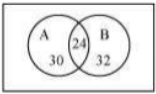
In a class of $60$ students,$30$ opted for $NCC$,$32$ opted for $NSS$,and $24$ opted for both $NCC$ and $NSS$. If one of these students is selected at random,find the probability that the student has opted for $NSS$ but not $NCC$.
A
$\frac{2}{15}$
B
$\frac{1}{15}$
C
$\frac{4}{15}$
D
$\frac{8}{15}$
Solution
(A) Let $A$ be the event that the selected student has opted for $NCC$ and $B$ be the event that the selected student has opted for $NSS$.
Total number of students $= 60$.
Number of students who have opted for $NCC$,$n(A) = 30$.
Number of students who have opted for $NSS$,$n(B) = 32$.
Number of students who have opted for both $NCC$ and $NSS$,$n(A \cap B) = 24$.
We need to find the probability that the student has opted for $NSS$ but not $NCC$,which is $P(B - A)$.
The number of students who have opted for $NSS$ but not $NCC$ is given by $n(B - A) = n(B) - n(A \cap B)$.
$n(B - A) = 32 - 24 = 8$.
The probability is $P(B - A) = \frac{n(B - A)}{\text{Total students}} = \frac{8}{60}$.
Simplifying the fraction,we get $\frac{8}{60} = \frac{2}{15}$.
Total number of students $= 60$.
Number of students who have opted for $NCC$,$n(A) = 30$.
Number of students who have opted for $NSS$,$n(B) = 32$.
Number of students who have opted for both $NCC$ and $NSS$,$n(A \cap B) = 24$.
We need to find the probability that the student has opted for $NSS$ but not $NCC$,which is $P(B - A)$.
The number of students who have opted for $NSS$ but not $NCC$ is given by $n(B - A) = n(B) - n(A \cap B)$.
$n(B - A) = 32 - 24 = 8$.
The probability is $P(B - A) = \frac{n(B - A)}{\text{Total students}} = \frac{8}{60}$.
Simplifying the fraction,we get $\frac{8}{60} = \frac{2}{15}$.
0 likes
View Solution302
EasyMCQ
$A$ die has two faces each with number $1$,three faces each with number $2$,and one face with number $3$. If the die is rolled once,determine $P(2)$.
A
$1/6$
B
$1/3$
C
$1/2$
D
$2/3$
Solution
(C) Total number of faces on the die $= 6$.
Number of faces with the number $2 = 3$.
Probability $P(2) = \frac{\text{Number of favorable outcomes}}{\text{Total number of outcomes}} = \frac{3}{6} = \frac{1}{2}$.
Number of faces with the number $2 = 3$.
Probability $P(2) = \frac{\text{Number of favorable outcomes}}{\text{Total number of outcomes}} = \frac{3}{6} = \frac{1}{2}$.
0 likes
View Solution303
EasyMCQ
$A$ die has two faces each with number $1$,three faces each with number $2$,and one face with number $3$. If the die is rolled once,determine $P(1 \text{ or } 3)$.
A
$\frac{1}{2}$
B
$\frac{1}{3}$
C
$\frac{2}{3}$
D
$\frac{1}{6}$
Solution
(A) The total number of faces on the die is $6$.
The number of faces with $1$ is $2$.
The number of faces with $3$ is $1$.
The probability of getting $1$ or $3$ is given by:
$P(1 \text{ or } 3) = P(1) + P(3) = \frac{2}{6} + \frac{1}{6} = \frac{3}{6} = \frac{1}{2}$.
The number of faces with $1$ is $2$.
The number of faces with $3$ is $1$.
The probability of getting $1$ or $3$ is given by:
$P(1 \text{ or } 3) = P(1) + P(3) = \frac{2}{6} + \frac{1}{6} = \frac{3}{6} = \frac{1}{2}$.
0 likes
View Solution304
EasyMCQ
$A$ die has two faces each with number $1$,three faces each with number $2$,and one face with number $3$. If the die is rolled once,determine $P(\text{not } 3)$.
A
$1/6$
B
$2/6$
C
$5/6$
D
$1/3$
Solution
(C) Total number of faces on the die $= 6$.
Number of faces with number $3 = 1$.
Therefore,the probability of getting $3$ is $P(3) = \frac{1}{6}$.
Thus,the probability of not getting $3$ is $P(\text{not } 3) = 1 - P(3) = 1 - \frac{1}{6} = \frac{5}{6}$.
Number of faces with number $3 = 1$.
Therefore,the probability of getting $3$ is $P(3) = \frac{1}{6}$.
Thus,the probability of not getting $3$ is $P(\text{not } 3) = 1 - P(3) = 1 - \frac{1}{6} = \frac{5}{6}$.
0 likes
View Solution305
EasyMCQ
In a certain lottery $10,000$ tickets are sold and $10$ equal prizes are awarded. What is the probability of not getting a prize if you buy one ticket?
A
$\frac{99}{100}$
B
$\frac{999}{1000}$
C
$\frac{9}{1000}$
D
$\frac{1}{1000}$
Solution
(B) Total number of tickets sold $= 10,000$.
Number of prizes awarded $= 10$.
If you buy one ticket,the probability of winning a prize is $P(\text{winning}) = \frac{10}{10000} = \frac{1}{1000}$.
The probability of not getting a prize is $P(\text{not winning}) = 1 - P(\text{winning})$.
$P(\text{not winning}) = 1 - \frac{1}{1000} = \frac{999}{1000}$.
Number of prizes awarded $= 10$.
If you buy one ticket,the probability of winning a prize is $P(\text{winning}) = \frac{10}{10000} = \frac{1}{1000}$.
The probability of not getting a prize is $P(\text{not winning}) = 1 - P(\text{winning})$.
$P(\text{not winning}) = 1 - \frac{1}{1000} = \frac{999}{1000}$.
0 likes
View Solution306
EasyMCQ
Out of $100$ students,two sections of $40$ and $60$ are formed. If you and your friend are among the $100$ students,what is the probability that you both enter different sections?
A
$\frac{16}{33}$
B
$\frac{24}{33}$
C
$\frac{48}{99}$
D
$\frac{8}{33}$
Solution
(A) Let the two sections be $S_1$ (size $40$) and $S_2$ (size $60$).
Total ways to place $2$ specific students into these sections is the total number of ways to choose $2$ spots out of $100$ for them,which is $100 \times 99$.
Alternatively,consider the probability that both are in the same section.
Probability both are in $S_1 = \frac{40}{100} \times \frac{39}{99} = \frac{2}{5} \times \frac{13}{33} = \frac{26}{165}$.
Probability both are in $S_2 = \frac{60}{100} \times \frac{59}{99} = \frac{3}{5} \times \frac{59}{99} = \frac{59}{165}$.
Probability both are in the same section $= \frac{26}{165} + \frac{59}{165} = \frac{85}{165} = \frac{17}{33}$.
Probability both are in different sections $= 1 - \frac{17}{33} = \frac{16}{33}$.
Total ways to place $2$ specific students into these sections is the total number of ways to choose $2$ spots out of $100$ for them,which is $100 \times 99$.
Alternatively,consider the probability that both are in the same section.
Probability both are in $S_1 = \frac{40}{100} \times \frac{39}{99} = \frac{2}{5} \times \frac{13}{33} = \frac{26}{165}$.
Probability both are in $S_2 = \frac{60}{100} \times \frac{59}{99} = \frac{3}{5} \times \frac{59}{99} = \frac{59}{165}$.
Probability both are in the same section $= \frac{26}{165} + \frac{59}{165} = \frac{85}{165} = \frac{17}{33}$.
Probability both are in different sections $= 1 - \frac{17}{33} = \frac{16}{33}$.
0 likes
View Solution307
EasyMCQ
$A$ and $B$ are two events such that $P(A)=0.54$,$P(B)=0.69$ and $P(A \cap B)=0.35$. Find $P(A \cap B^{\prime})$.
A
$0.19$
B
$0.34$
C
$0.46$
D
$0.89$
Solution
(A) Given that $P(A)=0.54$,$P(B)=0.69$,and $P(A \cap B)=0.35$.
We know that the probability of $A$ occurring and $B$ not occurring is given by the formula:
$P(A \cap B^{\prime}) = P(A) - P(A \cap B)$.
Substituting the given values:
$P(A \cap B^{\prime}) = 0.54 - 0.35$.
$P(A \cap B^{\prime}) = 0.19$.
We know that the probability of $A$ occurring and $B$ not occurring is given by the formula:
$P(A \cap B^{\prime}) = P(A) - P(A \cap B)$.
Substituting the given values:
$P(A \cap B^{\prime}) = 0.54 - 0.35$.
$P(A \cap B^{\prime}) = 0.19$.
0 likes
View Solution308
MediumMCQ
$A$ and $B$ are two events such that $P(A)=0.54$,$P(B)=0.69$ and $P(A \cap B)=0.35$. Find $P(B \cap A^{\prime})$.
A
$0.34$
B
$0.35$
C
$0.45$
D
$0.19$
Solution
(A) Given that $P(A)=0.54$,$P(B)=0.69$,and $P(A \cap B)=0.35$.
We know that the probability of the event $B$ occurring but not $A$ is given by $P(B \cap A^{\prime}) = P(B) - P(A \cap B)$.
Substituting the given values:
$P(B \cap A^{\prime}) = 0.69 - 0.35$.
Therefore,$P(B \cap A^{\prime}) = 0.34$.
We know that the probability of the event $B$ occurring but not $A$ is given by $P(B \cap A^{\prime}) = P(B) - P(A \cap B)$.
Substituting the given values:
$P(B \cap A^{\prime}) = 0.69 - 0.35$.
Therefore,$P(B \cap A^{\prime}) = 0.34$.
0 likes
View Solution309
MediumMCQ
The probability that two randomly selected subsets of the set $\{1, 2, 3, 4, 5\}$ have exactly two elements in their intersection is:
A
$\frac{65}{2^{7}}$
B
$\frac{65}{2^{8}}$
C
$\frac{135}{2^{9}}$
D
$\frac{35}{2^{7}}$
Solution
(C) Let $S = \{1, 2, 3, 4, 5\}$. The total number of subsets of $S$ is $2^{5} = 32$.
Since two subsets $A$ and $B$ are selected randomly,the total number of pairs $(A, B)$ is $32 \times 32 = 2^{10}$.
For each element $x \in S$,there are $4$ possibilities for its membership in $A$ and $B$: $x \notin A, x \notin B$; $x \in A, x \notin B$; $x \notin A, x \in B$; or $x \in A, x \in B$.
We want the intersection $A \cap B$ to have exactly $2$ elements.
First,choose $2$ elements out of $5$ to be in the intersection: $\binom{5}{2} = 10$ ways.
For the remaining $3$ elements,each must not be in the intersection,meaning they can be in $(A \setminus B)$,$(B \setminus A)$,or in neither $A$ nor $B$. There are $3$ such choices for each of the $3$ remaining elements,giving $3^{3} = 27$ ways.
Thus,the number of favorable pairs is $10 \times 27 = 270$.
The probability is $\frac{270}{2^{10}} = \frac{270}{1024} = \frac{135}{512} = \frac{135}{2^{9}}$.
Since two subsets $A$ and $B$ are selected randomly,the total number of pairs $(A, B)$ is $32 \times 32 = 2^{10}$.
For each element $x \in S$,there are $4$ possibilities for its membership in $A$ and $B$: $x \notin A, x \notin B$; $x \in A, x \notin B$; $x \notin A, x \in B$; or $x \in A, x \in B$.
We want the intersection $A \cap B$ to have exactly $2$ elements.
First,choose $2$ elements out of $5$ to be in the intersection: $\binom{5}{2} = 10$ ways.
For the remaining $3$ elements,each must not be in the intersection,meaning they can be in $(A \setminus B)$,$(B \setminus A)$,or in neither $A$ nor $B$. There are $3$ such choices for each of the $3$ remaining elements,giving $3^{3} = 27$ ways.
Thus,the number of favorable pairs is $10 \times 27 = 270$.
The probability is $\frac{270}{2^{10}} = \frac{270}{1024} = \frac{135}{512} = \frac{135}{2^{9}}$.
0 likes
View Solution310
DifficultMCQ
When a certain biased die is rolled,a particular face occurs with probability $\frac{1}{6}-x$ and its opposite face occurs with probability $\frac{1}{6}+x$. All other faces occur with probability $\frac{1}{6}$. Note that opposite faces sum to $7$ in any die. If $0 < x < \frac{1}{6}$,and the probability of obtaining a total sum of $7$ when such a die is rolled twice is $\frac{13}{96}$,then the value of $x$ is:
A
$\frac{1}{16}$
B
$\frac{1}{8}$
C
$\frac{1}{9}$
D
$\frac{1}{12}$
Solution
(B) Let the pair of opposite faces be $(a, b)$ where $a+b=7$. The probability of getting $a$ is $P(a) = \frac{1}{6}-x$ and $P(b) = \frac{1}{6}+x$. For the other two pairs of opposite faces,the probability of each face is $\frac{1}{6}$.
The sum of two rolls is $7$ if the outcomes are $(1,6), (6,1), (2,5), (5,2), (3,4), (4,3)$.
Probability of sum $7 = 2[P(1)P(6) + P(2)P(5) + P(3)P(4)]$.
Assuming $(1,6)$ are the faces with probabilities $\frac{1}{6}-x$ and $\frac{1}{6}+x$,then $P(2)=P(5)=\frac{1}{6}$ and $P(3)=P(4)=\frac{1}{6}$.
Sum probability $= 2[(\frac{1}{6}-x)(\frac{1}{6}+x) + (\frac{1}{6})(\frac{1}{6}) + (\frac{1}{6})(\frac{1}{6})] = \frac{13}{96}$.
$2[(\frac{1}{36}-x^2) + \frac{1}{36} + \frac{1}{36}] = \frac{13}{96}$.
$2[\frac{3}{36}-x^2] = \frac{13}{96} \Rightarrow \frac{1}{6}-2x^2 = \frac{13}{96}$.
$2x^2 = \frac{1}{6}-\frac{13}{96} = \frac{16-13}{96} = \frac{3}{96} = \frac{1}{32}$.
$x^2 = \frac{1}{64} \Rightarrow x = \frac{1}{8}$.
The sum of two rolls is $7$ if the outcomes are $(1,6), (6,1), (2,5), (5,2), (3,4), (4,3)$.
Probability of sum $7 = 2[P(1)P(6) + P(2)P(5) + P(3)P(4)]$.
Assuming $(1,6)$ are the faces with probabilities $\frac{1}{6}-x$ and $\frac{1}{6}+x$,then $P(2)=P(5)=\frac{1}{6}$ and $P(3)=P(4)=\frac{1}{6}$.
Sum probability $= 2[(\frac{1}{6}-x)(\frac{1}{6}+x) + (\frac{1}{6})(\frac{1}{6}) + (\frac{1}{6})(\frac{1}{6})] = \frac{13}{96}$.
$2[(\frac{1}{36}-x^2) + \frac{1}{36} + \frac{1}{36}] = \frac{13}{96}$.
$2[\frac{3}{36}-x^2] = \frac{13}{96} \Rightarrow \frac{1}{6}-2x^2 = \frac{13}{96}$.
$2x^2 = \frac{1}{6}-\frac{13}{96} = \frac{16-13}{96} = \frac{3}{96} = \frac{1}{32}$.
$x^2 = \frac{1}{64} \Rightarrow x = \frac{1}{8}$.
0 likes
View Solution311
DifficultMCQ
The probability that a randomly selected $2$-digit number belongs to the set $\{n \in N : (2^{n}-2) \text{ is a multiple of } 3\}$ is equal to:
A
$\frac{1}{2}$
B
$\frac{1}{3}$
C
$\frac{2}{3}$
D
$\frac{1}{6}$
Solution
(A) The total number of $2$-digit numbers is $90$ (from $10$ to $99$).
We need to check when $(2^{n}-2)$ is a multiple of $3$.
Consider the expression modulo $3$:
$2 \equiv -1 \pmod{3}$
So,$2^{n}-2 \equiv (-1)^{n}-2 \pmod{3}$.
If $n$ is even,$(-1)^{n}-2 = 1-2 = -1 \equiv 2 \pmod{3}$.
If $n$ is odd,$(-1)^{n}-2 = -1-2 = -3 \equiv 0 \pmod{3}$.
Thus,$(2^{n}-2)$ is a multiple of $3$ if and only if $n$ is an odd number.
In the set of $2$-digit numbers ${10, 11, 12, \dots, 99}$,the odd numbers are ${11, 13, 15, \dots, 99}$.
The number of odd integers in this range is $\frac{99-11}{2} + 1 = 44 + 1 = 45$.
The probability is $\frac{\text{Number of favorable outcomes}}{\text{Total number of outcomes}} = \frac{45}{90} = \frac{1}{2}$.
We need to check when $(2^{n}-2)$ is a multiple of $3$.
Consider the expression modulo $3$:
$2 \equiv -1 \pmod{3}$
So,$2^{n}-2 \equiv (-1)^{n}-2 \pmod{3}$.
If $n$ is even,$(-1)^{n}-2 = 1-2 = -1 \equiv 2 \pmod{3}$.
If $n$ is odd,$(-1)^{n}-2 = -1-2 = -3 \equiv 0 \pmod{3}$.
Thus,$(2^{n}-2)$ is a multiple of $3$ if and only if $n$ is an odd number.
In the set of $2$-digit numbers ${10, 11, 12, \dots, 99}$,the odd numbers are ${11, 13, 15, \dots, 99}$.
The number of odd integers in this range is $\frac{99-11}{2} + 1 = 44 + 1 = 45$.
The probability is $\frac{\text{Number of favorable outcomes}}{\text{Total number of outcomes}} = \frac{45}{90} = \frac{1}{2}$.
0 likes
View Solution312
MediumMCQ
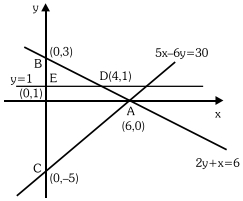
If a point $A(x, y)$ lies in the region bounded by the $y$-axis,straight lines $2y+x=6$ and $5x-6y=30$,then the probability that $y < 1$ is
A
$\frac{1}{6}$
B
$\frac{5}{6}$
C
$\frac{2}{3}$
D
$\frac{6}{7}$
Solution
(B) The region is bounded by the $y$-axis $(x=0)$,$2y+x=6$,and $5x-6y=30$. The vertices of the triangle are $B(0, 3)$,$C(0, -5)$,and $A(6, 0)$.
Area of $\triangle ABC = \frac{1}{2} \times \text{base} \times \text{height} = \frac{1}{2} \times 8 \times 6 = 24$.
The line $y=1$ intersects $2y+x=6$ at $D(4, 1)$ and the $y$-axis at $E(0, 1)$.
The region where $y < 1$ is the quadrilateral $ADEC$.
The area of $\triangle BDE$ (where $y \ge 1$) is $\frac{1}{2} \times \text{base} \times \text{height} = \frac{1}{2} \times 4 \times 2 = 4$.
Required probability $= 1 - \frac{\text{Area}(\triangle BDE)}{\text{Area}(\triangle ABC)} = 1 - \frac{4}{24} = 1 - \frac{1}{6} = \frac{5}{6}$.
Area of $\triangle ABC = \frac{1}{2} \times \text{base} \times \text{height} = \frac{1}{2} \times 8 \times 6 = 24$.
The line $y=1$ intersects $2y+x=6$ at $D(4, 1)$ and the $y$-axis at $E(0, 1)$.
The region where $y < 1$ is the quadrilateral $ADEC$.
The area of $\triangle BDE$ (where $y \ge 1$) is $\frac{1}{2} \times \text{base} \times \text{height} = \frac{1}{2} \times 4 \times 2 = 4$.
Required probability $= 1 - \frac{\text{Area}(\triangle BDE)}{\text{Area}(\triangle ABC)} = 1 - \frac{4}{24} = 1 - \frac{1}{6} = \frac{5}{6}$.
0 likes
View Solution313
DifficultMCQ
Let $E_{1}, E_{2}, E_{3}$ be three mutually exclusive events such that $P(E_{1}) = \frac{2+3p}{6}$,$P(E_{2}) = \frac{2-p}{8}$,and $P(E_{3}) = \frac{1-p}{2}$. If the maximum and minimum values of $p$ are $p_{1}$ and $p_{2}$,then $(p_{1} + p_{2})$ is equal to.
A
$\frac{2}{3}$
B
$\frac{5}{3}$
C
$\frac{5}{4}$
D
$1$
Solution
(B) For any event $E_{i}$,$0 \leq P(E_{i}) \leq 1$.
For $P(E_{1}) = \frac{2+3p}{6}$,$0 \leq 2+3p \leq 6 \implies -2 \leq 3p \leq 4 \implies -\frac{2}{3} \leq p \leq \frac{4}{3}$.
For $P(E_{2}) = \frac{2-p}{8}$,$0 \leq 2-p \leq 8 \implies -2 \leq -p \leq 6 \implies -6 \leq p \leq 2$.
For $P(E_{3}) = \frac{1-p}{2}$,$0 \leq 1-p \leq 2 \implies -1 \leq -p \leq 1 \implies -1 \leq p \leq 1$.
Since $E_{1}, E_{2}, E_{3}$ are mutually exclusive,$P(E_{1}) + P(E_{2}) + P(E_{3}) \leq 1$.
$\frac{2+3p}{6} + \frac{2-p}{8} + \frac{1-p}{2} \leq 1$.
Multiplying by $24$: $4(2+3p) + 3(2-p) + 12(1-p) \leq 24$.
$8 + 12p + 6 - 3p + 12 - 12p \leq 24$.
$26 - 3p \leq 24 \implies 2 \leq 3p \implies p \geq \frac{2}{3}$.
Combining all constraints: $p \in [\frac{2}{3}, 1]$.
Thus,$p_{1} = 1$ and $p_{2} = \frac{2}{3}$.
$p_{1} + p_{2} = 1 + \frac{2}{3} = \frac{5}{3}$.
For $P(E_{1}) = \frac{2+3p}{6}$,$0 \leq 2+3p \leq 6 \implies -2 \leq 3p \leq 4 \implies -\frac{2}{3} \leq p \leq \frac{4}{3}$.
For $P(E_{2}) = \frac{2-p}{8}$,$0 \leq 2-p \leq 8 \implies -2 \leq -p \leq 6 \implies -6 \leq p \leq 2$.
For $P(E_{3}) = \frac{1-p}{2}$,$0 \leq 1-p \leq 2 \implies -1 \leq -p \leq 1 \implies -1 \leq p \leq 1$.
Since $E_{1}, E_{2}, E_{3}$ are mutually exclusive,$P(E_{1}) + P(E_{2}) + P(E_{3}) \leq 1$.
$\frac{2+3p}{6} + \frac{2-p}{8} + \frac{1-p}{2} \leq 1$.
Multiplying by $24$: $4(2+3p) + 3(2-p) + 12(1-p) \leq 24$.
$8 + 12p + 6 - 3p + 12 - 12p \leq 24$.
$26 - 3p \leq 24 \implies 2 \leq 3p \implies p \geq \frac{2}{3}$.
Combining all constraints: $p \in [\frac{2}{3}, 1]$.
Thus,$p_{1} = 1$ and $p_{2} = \frac{2}{3}$.
$p_{1} + p_{2} = 1 + \frac{2}{3} = \frac{5}{3}$.
0 likes
View Solution314
DifficultMCQ
Let $S$ be the sample space of all five-digit numbers. If $p$ is the probability that a randomly selected number from $S$ is a multiple of $7$ but not divisible by $5$,then $9p$ is equal to.
A
$1.0146$
B
$1.2085$
C
$1.0285$
D
$1.1521$
Solution
(C) The total number of $5$-digit numbers is $n(S) = 9 \times 10^4 = 90000$.
Let $A$ be the set of numbers that are multiples of $7$ but not divisible by $5$.
Smallest $5$-digit number divisible by $7$ is $10003$.
Largest $5$-digit number divisible by $7$ is $99995$.
Using the formula $a_n = a + (n-1)d$,we have $99995 = 10003 + (n-1)7$,which gives $n = 12857$.
Now,find numbers divisible by both $7$ and $5$,i.e.,divisible by $35$.
Smallest $5$-digit number divisible by $35$ is $10010$.
Largest $5$-digit number divisible by $35$ is $99995$.
$99995 = 10010 + (P-1)35$,which gives $P = 2572$.
The number of elements in $A$ is $12857 - 2572 = 10285$.
The probability $p = \frac{10285}{90000}$.
Therefore,$9p = 9 \times \frac{10285}{90000} = \frac{10285}{10000} = 1.0285$.
Let $A$ be the set of numbers that are multiples of $7$ but not divisible by $5$.
Smallest $5$-digit number divisible by $7$ is $10003$.
Largest $5$-digit number divisible by $7$ is $99995$.
Using the formula $a_n = a + (n-1)d$,we have $99995 = 10003 + (n-1)7$,which gives $n = 12857$.
Now,find numbers divisible by both $7$ and $5$,i.e.,divisible by $35$.
Smallest $5$-digit number divisible by $35$ is $10010$.
Largest $5$-digit number divisible by $35$ is $99995$.
$99995 = 10010 + (P-1)35$,which gives $P = 2572$.
The number of elements in $A$ is $12857 - 2572 = 10285$.
The probability $p = \frac{10285}{90000}$.
Therefore,$9p = 9 \times \frac{10285}{90000} = \frac{10285}{10000} = 1.0285$.
0 likes
View Solution315
AdvancedMCQ
Thirty-two persons $X_1, X_2, \ldots, X_{32}$ are randomly seated around a circular table at equal intervals. Two persons $X_i$ and $X_j$ are said to be within earshot of each other if there are at most three persons between them on the minor arc joining $X_i$ and $X_j$. The probability that $X_1$ and $X_3$ are within earshot of each other is:
A
$\frac{\binom{32}{2} 30!}{8(32!)}$
B
$\frac{2^{30!}}{4(32!)}$
C
$\frac{8}{31}$
D
$\frac{4}{31}$
Solution
(C) There are $32$ persons seated around a circular table. Fix the position of $X_1$. There are $31$ remaining seats where $X_3$ can be placed,each with equal probability of $\frac{1}{31}$.
$X_1$ and $X_3$ are within earshot if there are at most $3$ persons between them on the minor arc. Let $k$ be the number of persons between $X_1$ and $X_3$ on the minor arc.
If $k=0$,$X_3$ is adjacent to $X_1$. There are $2$ such positions (left or right).
If $k=1$,there is $1$ person between $X_1$ and $X_3$. There are $2$ such positions.
If $k=2$,there are $2$ persons between $X_1$ and $X_3$. There are $2$ such positions.
If $k=3$,there are $3$ persons between $X_1$ and $X_3$. There are $2$ such positions.
Total favorable positions for $X_3 = 2 + 2 + 2 + 2 = 8$.
Total possible positions for $X_3 = 31$.
Therefore,the probability is $\frac{8}{31}$.
$X_1$ and $X_3$ are within earshot if there are at most $3$ persons between them on the minor arc. Let $k$ be the number of persons between $X_1$ and $X_3$ on the minor arc.
If $k=0$,$X_3$ is adjacent to $X_1$. There are $2$ such positions (left or right).
If $k=1$,there is $1$ person between $X_1$ and $X_3$. There are $2$ such positions.
If $k=2$,there are $2$ persons between $X_1$ and $X_3$. There are $2$ such positions.
If $k=3$,there are $3$ persons between $X_1$ and $X_3$. There are $2$ such positions.
Total favorable positions for $X_3 = 2 + 2 + 2 + 2 = 8$.
Total possible positions for $X_3 = 31$.
Therefore,the probability is $\frac{8}{31}$.
0 likes
View Solution316
AdvancedMCQ
Let $S_n = \sum_{k=1}^n k$ denote the sum of the first $n$ positive integers. The numbers $S_1, S_2, S_3, \ldots, S_{99}$ are written on $99$ cards. The probability of drawing a card with an even number written on it is
A
$\frac{1}{2}$
B
$\frac{49}{100}$
C
$\frac{49}{99}$
D
$\frac{48}{99}$
Solution
(C) We have $S_n = \frac{n(n+1)}{2}$.
The sequence of sums is $S_1=1, S_2=3, S_3=6, S_4=10, S_5=15, S_6=21, S_7=28, S_8=36, \ldots$.
Observing the parity of $S_n$:
$S_1$ (odd),$S_2$ (odd),$S_3$ (even),$S_4$ (even),$S_5$ (odd),$S_6$ (odd),$S_7$ (even),$S_8$ (even),...
The pattern of parity repeats every $4$ terms: (odd,odd,even,even).
In the set ${S_1, S_2, \ldots, S_{99}}$,there are $99$ terms.
Since $99 = 4 \times 24 + 3$,we have $24$ full cycles of (odd,odd,even,even) and the first $3$ terms of the next cycle (odd,odd,even).
Number of even terms = $24 \times 2 + 1 = 49$.
Total number of cards = $99$.
Probability of drawing an even number = $\frac{\text{Number of even terms}}{\text{Total number of terms}} = \frac{49}{99}$.
The sequence of sums is $S_1=1, S_2=3, S_3=6, S_4=10, S_5=15, S_6=21, S_7=28, S_8=36, \ldots$.
Observing the parity of $S_n$:
$S_1$ (odd),$S_2$ (odd),$S_3$ (even),$S_4$ (even),$S_5$ (odd),$S_6$ (odd),$S_7$ (even),$S_8$ (even),...
The pattern of parity repeats every $4$ terms: (odd,odd,even,even).
In the set ${S_1, S_2, \ldots, S_{99}}$,there are $99$ terms.
Since $99 = 4 \times 24 + 3$,we have $24$ full cycles of (odd,odd,even,even) and the first $3$ terms of the next cycle (odd,odd,even).
Number of even terms = $24 \times 2 + 1 = 49$.
Total number of cards = $99$.
Probability of drawing an even number = $\frac{\text{Number of even terms}}{\text{Total number of terms}} = \frac{49}{99}$.
0 likes
View Solution317
AdvancedMCQ
Two players play the following game: $A$ writes $3, 5, 6$ on three different cards; $B$ writes $8, 9, 10$ on three different cards. Both draw randomly two cards from their collections. Then,$A$ computes the product of the two numbers he/she has drawn,and $B$ computes the sum of the two numbers he/she has drawn. The player getting the larger number wins. What is the probability that $A$ wins?
A
$\frac{1}{3}$
B
$\frac{5}{9}$
C
$\frac{4}{9}$
D
$\frac{1}{9}$
Solution
(C) Player $A$ has cards $\{3, 5, 6\}$. The possible products of two cards are:
$(3 \times 5) = 15$,$(3 \times 6) = 18$,$(5 \times 6) = 30$.
Each product occurs with probability $\frac{1}{3}$.
Player $B$ has cards $\{8, 9, 10\}$. The possible sums of two cards are:
$(8 + 9) = 17$,$(8 + 10) = 18$,$(9 + 10) = 19$.
Each sum occurs with probability $\frac{1}{3}$.
$A$ wins if the product is greater than the sum.
Let $P_A$ be the product and $S_B$ be the sum.
If $P_A = 15$ (prob $\frac{1}{3}$): $A$ wins if $S_B < 15$. No outcomes satisfy this.
If $P_A = 18$ (prob $\frac{1}{3}$): $A$ wins if $S_B < 18$. Only $S_B = 17$ works (prob $\frac{1}{3}$). Probability = $\frac{1}{3} \times \frac{1}{3} = \frac{1}{9}$.
If $P_A = 30$ (prob $\frac{1}{3}$): $A$ wins if $S_B < 30$. All $S_B$ values $(17, 18, 19)$ satisfy this (prob $1$). Probability = $\frac{1}{3} \times 1 = \frac{1}{3}$.
Total probability = $\frac{1}{9} + \frac{1}{3} = \frac{1+3}{9} = \frac{4}{9}$.
$(3 \times 5) = 15$,$(3 \times 6) = 18$,$(5 \times 6) = 30$.
Each product occurs with probability $\frac{1}{3}$.
Player $B$ has cards $\{8, 9, 10\}$. The possible sums of two cards are:
$(8 + 9) = 17$,$(8 + 10) = 18$,$(9 + 10) = 19$.
Each sum occurs with probability $\frac{1}{3}$.
$A$ wins if the product is greater than the sum.
Let $P_A$ be the product and $S_B$ be the sum.
If $P_A = 15$ (prob $\frac{1}{3}$): $A$ wins if $S_B < 15$. No outcomes satisfy this.
If $P_A = 18$ (prob $\frac{1}{3}$): $A$ wins if $S_B < 18$. Only $S_B = 17$ works (prob $\frac{1}{3}$). Probability = $\frac{1}{3} \times \frac{1}{3} = \frac{1}{9}$.
If $P_A = 30$ (prob $\frac{1}{3}$): $A$ wins if $S_B < 30$. All $S_B$ values $(17, 18, 19)$ satisfy this (prob $1$). Probability = $\frac{1}{3} \times 1 = \frac{1}{3}$.
Total probability = $\frac{1}{9} + \frac{1}{3} = \frac{1+3}{9} = \frac{4}{9}$.
0 likes
View Solution318
DifficultMCQ
Let $\Omega$ be the sample space and $A \subseteq \Omega$ be an event. Given below are two statements:
$(S1) : \text{If } P(A) = 0, \text{ then } A = \phi$
$(S2) : \text{If } P(A) = 1, \text{ then } A = \Omega$
Then:
$(S1) : \text{If } P(A) = 0, \text{ then } A = \phi$
$(S2) : \text{If } P(A) = 1, \text{ then } A = \Omega$
Then:
A
only $(S1)$ is true
B
only $(S2)$ is true
C
both $(S1)$ and $(S2)$ are true
D
both $(S1)$ and $(S2)$ are false
Solution
(C) In probability theory,for a sample space $\Omega$ and an event $A \subseteq \Omega$:
$1$. If $P(A) = 0$,it implies that the event $A$ is an impossible event,which means $A = \phi$. Thus,$(S1)$ is true.
$2$. If $P(A) = 1$,it implies that the event $A$ is a sure event,which means $A = \Omega$. Thus,$(S2)$ is true.
Therefore,both statements $(S1)$ and $(S2)$ are true.
$1$. If $P(A) = 0$,it implies that the event $A$ is an impossible event,which means $A = \phi$. Thus,$(S1)$ is true.
$2$. If $P(A) = 1$,it implies that the event $A$ is a sure event,which means $A = \Omega$. Thus,$(S2)$ is true.
Therefore,both statements $(S1)$ and $(S2)$ are true.
0 likes
View Solution319
DifficultMCQ
Let $M$ be the maximum value of the product of two positive integers when their sum is $66$. Let the sample space $S = \{x \in \mathbb{Z} : x(66 - x) \geq \frac{5}{9} M\}$ and the event $A = \{x \in S : x \text{ is a multiple of } 3\}$. Then $P(A)$ is equal to
A
$\frac{15}{44}$
B
$\frac{1}{3}$
C
$\frac{1}{5}$
D
$\frac{7}{22}$
Solution
(B) The product of two integers $x$ and $66-x$ is $f(x) = x(66-x)$.
This is a downward parabola with maximum at $x = 33$.
Thus,$M = 33 \times 33 = 1089$.
We require $x(66-x) \geq \frac{5}{9} \times 1089 = 5 \times 121 = 605$.
$66x - x^2 \geq 605 \implies x^2 - 66x + 605 \leq 0$.
Solving $x^2 - 66x + 605 = 0$ using the quadratic formula: $x = \frac{66 \pm \sqrt{4356 - 2420}}{2} = \frac{66 \pm \sqrt{1936}}{2} = \frac{66 \pm 44}{2}$.
So,$x_1 = 11$ and $x_2 = 55$.
The set $S = \{11, 12, \ldots, 55\}$,so the number of elements $n(S) = 55 - 11 + 1 = 45$.
The event $A$ consists of multiples of $3$ in $S$: $A = \{12, 15, 18, \ldots, 54\}$.
This is an arithmetic progression with $a = 12$,$l = 54$,and $d = 3$.
$54 = 12 + (n-1)3 \implies 42 = (n-1)3 \implies n-1 = 14 \implies n = 15$.
Thus,$n(A) = 15$.
$P(A) = \frac{n(A)}{n(S)} = \frac{15}{45} = \frac{1}{3}$.
This is a downward parabola with maximum at $x = 33$.
Thus,$M = 33 \times 33 = 1089$.
We require $x(66-x) \geq \frac{5}{9} \times 1089 = 5 \times 121 = 605$.
$66x - x^2 \geq 605 \implies x^2 - 66x + 605 \leq 0$.
Solving $x^2 - 66x + 605 = 0$ using the quadratic formula: $x = \frac{66 \pm \sqrt{4356 - 2420}}{2} = \frac{66 \pm \sqrt{1936}}{2} = \frac{66 \pm 44}{2}$.
So,$x_1 = 11$ and $x_2 = 55$.
The set $S = \{11, 12, \ldots, 55\}$,so the number of elements $n(S) = 55 - 11 + 1 = 45$.
The event $A$ consists of multiples of $3$ in $S$: $A = \{12, 15, 18, \ldots, 54\}$.
This is an arithmetic progression with $a = 12$,$l = 54$,and $d = 3$.
$54 = 12 + (n-1)3 \implies 42 = (n-1)3 \implies n-1 = 14 \implies n = 15$.
Thus,$n(A) = 15$.
$P(A) = \frac{n(A)}{n(S)} = \frac{15}{45} = \frac{1}{3}$.
0 likes
View Solution320
DifficultMCQ
Let $N$ be the sum of the numbers appeared when two fair dice are rolled and let the probability that $N - 2, \sqrt{3N}, N + 2$ are in geometric progression be $\frac{k}{48}$. Then the value of $k$ is
A
$2$
B
$4$
C
$16$
D
$8$
Solution
(B) The total number of outcomes when two dice are rolled is $n(S) = 6 \times 6 = 36$.
Given that $N - 2, \sqrt{3N}, N + 2$ are in geometric progression ($G$.$P$.),the square of the middle term must equal the product of the extremes:
$(\sqrt{3N})^2 = (N - 2)(N + 2)$
$3N = N^2 - 4$
$N^2 - 3N - 4 = 0$
Factoring the quadratic equation:
$(N - 4)(N + 1) = 0$
Since $N$ is the sum of two dice,$N \geq 2$,so $N = 4$ is the only valid solution.
The outcomes for which the sum $N = 4$ are: $(1, 3), (3, 1), (2, 2)$.
Thus,the number of favorable outcomes is $n(A) = 3$.
The probability is $P(A) = \frac{3}{36} = \frac{1}{12}$.
We are given $P(A) = \frac{k}{48}$,so:
$\frac{k}{48} = \frac{1}{12}$
$k = \frac{48}{12} = 4$.
Given that $N - 2, \sqrt{3N}, N + 2$ are in geometric progression ($G$.$P$.),the square of the middle term must equal the product of the extremes:
$(\sqrt{3N})^2 = (N - 2)(N + 2)$
$3N = N^2 - 4$
$N^2 - 3N - 4 = 0$
Factoring the quadratic equation:
$(N - 4)(N + 1) = 0$
Since $N$ is the sum of two dice,$N \geq 2$,so $N = 4$ is the only valid solution.
The outcomes for which the sum $N = 4$ are: $(1, 3), (3, 1), (2, 2)$.
Thus,the number of favorable outcomes is $n(A) = 3$.
The probability is $P(A) = \frac{3}{36} = \frac{1}{12}$.
We are given $P(A) = \frac{k}{48}$,so:
$\frac{k}{48} = \frac{1}{12}$
$k = \frac{48}{12} = 4$.
0 likes
View Solution321
DifficultMCQ
Let $A$ be the event that the absolute difference between two randomly chosen real numbers in the sample space $[0, 60]$ is less than or equal to $a$. If $P(A) = \frac{11}{36}$,then $a$ is equal to $...............$.
A
$100$
B
$0.1$
C
$15$
D
$10$
Solution
(D) Let the two numbers be $x$ and $y$ where $0 \le x, y \le 60$. The total area of the sample space is $60 \times 60 = 3600$.
The condition is $|x - y| \le a$,which implies $-a \le x - y \le a$.
The area of the region where $|x - y| > a$ is the sum of the areas of two right-angled triangles with legs $(60 - a)$.
Area of region $|x - y| > a = \frac{1}{2}(60 - a)^2 + \frac{1}{2}(60 - a)^2 = (60 - a)^2$.
Thus,the area of the region where $|x - y| \le a$ is $3600 - (60 - a)^2$.
Given $P(A) = \frac{3600 - (60 - a)^2}{3600} = \frac{11}{36}$.
Multiplying by $3600$,we get $3600 - (60 - a)^2 = 1100$.
$(60 - a)^2 = 3600 - 1100 = 2500$.
$60 - a = 50 \Rightarrow a = 10$.
The condition is $|x - y| \le a$,which implies $-a \le x - y \le a$.
The area of the region where $|x - y| > a$ is the sum of the areas of two right-angled triangles with legs $(60 - a)$.
Area of region $|x - y| > a = \frac{1}{2}(60 - a)^2 + \frac{1}{2}(60 - a)^2 = (60 - a)^2$.
Thus,the area of the region where $|x - y| \le a$ is $3600 - (60 - a)^2$.
Given $P(A) = \frac{3600 - (60 - a)^2}{3600} = \frac{11}{36}$.
Multiplying by $3600$,we get $3600 - (60 - a)^2 = 1100$.
$(60 - a)^2 = 3600 - 1100 = 2500$.
$60 - a = 50 \Rightarrow a = 10$.
0 likes
View Solution322
DifficultMCQ
Two dice are thrown independently. Let $A$ be the event that the number appeared on the $1^{\text{st}}$ die is less than the number appeared on the $2^{\text{nd}}$ die,$B$ be the event that the number appeared on the $1^{\text{st}}$ die is even and that on the $2^{\text{nd}}$ die is odd,and $C$ be the event that the number appeared on the $1^{\text{st}}$ die is odd and that on the $2^{\text{nd}}$ die is even. Then
A
the number of favourable cases of the event $(A \cup B) \cap C$ is $6$
B
$A$ and $B$ are mutually exclusive
C
The number of favourable cases of the events $A, B$ and $C$ are $15, 9$ and $9$ respectively
D
$B$ and $C$ are independent
Solution
(A) Let the outcomes of the two dice be $(x, y)$ where $x, y \in \{1, 2, 3, 4, 5, 6\}$. The total number of outcomes is $6 \times 6 = 36$.
Event $A$: $x < y$. The number of outcomes is $5 + 4 + 3 + 2 + 1 = 15$.
Event $B$: $x \in \{2, 4, 6\}$ and $y \in \{1, 3, 5\}$. The number of outcomes is $3 \times 3 = 9$.
Event $C$: $x \in \{1, 3, 5\}$ and $y \in \{2, 4, 6\}$. The number of outcomes is $3 \times 3 = 9$.
Now,$(A \cup B) \cap C = (A \cap C) \cup (B \cap C)$.
$B \cap C$: $x$ is even and odd,which is impossible,so $B \cap C = \emptyset$.
$A \cap C$: $x < y$ and $x \in \{1, 3, 5\}, y \in \{2, 4, 6\}$.
If $x=1$,$y \in \{2, 4, 6\}$ ($3$ cases).
If $x=3$,$y \in \{4, 6\}$ ($2$ cases).
If $x=5$,$y \in \{6\}$ ($1$ case).
Total cases for $A \cap C = 3 + 2 + 1 = 6$.
Thus,the number of favourable cases for $(A \cup B) \cap C$ is $6 + 0 = 6$.
Event $A$: $x < y$. The number of outcomes is $5 + 4 + 3 + 2 + 1 = 15$.
Event $B$: $x \in \{2, 4, 6\}$ and $y \in \{1, 3, 5\}$. The number of outcomes is $3 \times 3 = 9$.
Event $C$: $x \in \{1, 3, 5\}$ and $y \in \{2, 4, 6\}$. The number of outcomes is $3 \times 3 = 9$.
Now,$(A \cup B) \cap C = (A \cap C) \cup (B \cap C)$.
$B \cap C$: $x$ is even and odd,which is impossible,so $B \cap C = \emptyset$.
$A \cap C$: $x < y$ and $x \in \{1, 3, 5\}, y \in \{2, 4, 6\}$.
If $x=1$,$y \in \{2, 4, 6\}$ ($3$ cases).
If $x=3$,$y \in \{4, 6\}$ ($2$ cases).
If $x=5$,$y \in \{6\}$ ($1$ case).
Total cases for $A \cap C = 3 + 2 + 1 = 6$.
Thus,the number of favourable cases for $(A \cup B) \cap C$ is $6 + 0 = 6$.
0 likes
View Solution323
AdvancedMCQ
Let $N$ denote the sum of the numbers obtained when two dice are rolled. If the probability that $2^{N} < N!$ is $\frac{m}{n}$,where $m$ and $n$ are coprime,then $4m - 3n$ is equal to $......$.
A
$8$
B
$16$
C
$10$
D
$12$
Solution
(A) Let $N$ be the sum of the numbers on two dice. The possible values for $N$ are $2, 3, 4, \dots, 12$.
We need to find the probability that $2^{N} < N!$.
Let us check the condition $2^{N} < N!$ for each $N$:
For $N=2: 2^2 = 4, 2! = 2$. $4 < 2$ is false.
For $N=3: 2^3 = 8, 3! = 6$. $8 < 6$ is false.
For $N=4: 2^4 = 16, 4! = 24$. $16 < 24$ is true.
For $N=5: 2^5 = 32, 5! = 120$. $32 < 120$ is true.
For $N \geq 4$,the condition $2^N < N!$ holds true.
Thus,we need to find the probability that $N \geq 4$.
$P(N \geq 4) = 1 - P(N < 4) = 1 - (P(N=2) + P(N=3))$.
The total number of outcomes is $6 \times 6 = 36$.
$P(N=2) = \frac{1}{36}$ (outcomes: $(1,1)$).
$P(N=3) = \frac{2}{36}$ (outcomes: $(1,2), (2,1)$).
$P(N < 4) = \frac{1}{36} + \frac{2}{36} = \frac{3}{36} = \frac{1}{12}$.
Therefore,$P(N \geq 4) = 1 - \frac{1}{12} = \frac{11}{12}$.
Here,$m = 11$ and $n = 12$. Since $11$ and $12$ are coprime,we calculate $4m - 3n = 4(11) - 3(12) = 44 - 36 = 8$.
We need to find the probability that $2^{N} < N!$.
Let us check the condition $2^{N} < N!$ for each $N$:
For $N=2: 2^2 = 4, 2! = 2$. $4 < 2$ is false.
For $N=3: 2^3 = 8, 3! = 6$. $8 < 6$ is false.
For $N=4: 2^4 = 16, 4! = 24$. $16 < 24$ is true.
For $N=5: 2^5 = 32, 5! = 120$. $32 < 120$ is true.
For $N \geq 4$,the condition $2^N < N!$ holds true.
Thus,we need to find the probability that $N \geq 4$.
$P(N \geq 4) = 1 - P(N < 4) = 1 - (P(N=2) + P(N=3))$.
The total number of outcomes is $6 \times 6 = 36$.
$P(N=2) = \frac{1}{36}$ (outcomes: $(1,1)$).
$P(N=3) = \frac{2}{36}$ (outcomes: $(1,2), (2,1)$).
$P(N < 4) = \frac{1}{36} + \frac{2}{36} = \frac{3}{36} = \frac{1}{12}$.
Therefore,$P(N \geq 4) = 1 - \frac{1}{12} = \frac{11}{12}$.
Here,$m = 11$ and $n = 12$. Since $11$ and $12$ are coprime,we calculate $4m - 3n = 4(11) - 3(12) = 44 - 36 = 8$.
0 likes
View Solution324
DifficultMCQ
Two integers $x$ and $y$ are chosen with replacement from the set $\{0, 1, 2, 3, \ldots, 10\}$. Then the probability that $|x-y| > 5$ is:
A
$\frac{30}{121}$
B
$\frac{62}{121}$
C
$\frac{60}{121}$
D
$\frac{31}{121}$
Solution
(A) The total number of ways to choose two integers $x$ and $y$ with replacement from the set $\{0, 1, 2, \ldots, 10\}$ is $11 \times 11 = 121$.
We want to find the number of pairs $(x, y)$ such that $|x-y| > 5$.
Case $1$: $x - y > 5 \implies x - y \in \{6, 7, 8, 9, 10\}$.
If $x=6, y=0$; if $x=7, y=0, 1$; if $x=8, y=0, 1, 2$; if $x=9, y=0, 1, 2, 3$; if $x=10, y=0, 1, 2, 3, 4$.
The number of such pairs is $1 + 2 + 3 + 4 + 5 = 15$.
Case $2$: $y - x > 5 \implies y - x \in \{6, 7, 8, 9, 10\}$.
By symmetry,the number of such pairs is also $15$.
Total favorable outcomes $= 15 + 15 = 30$.
Therefore,the required probability is $\frac{30}{121}$.
We want to find the number of pairs $(x, y)$ such that $|x-y| > 5$.
Case $1$: $x - y > 5 \implies x - y \in \{6, 7, 8, 9, 10\}$.
If $x=6, y=0$; if $x=7, y=0, 1$; if $x=8, y=0, 1, 2$; if $x=9, y=0, 1, 2, 3$; if $x=10, y=0, 1, 2, 3, 4$.
The number of such pairs is $1 + 2 + 3 + 4 + 5 = 15$.
Case $2$: $y - x > 5 \implies y - x \in \{6, 7, 8, 9, 10\}$.
By symmetry,the number of such pairs is also $15$.
Total favorable outcomes $= 15 + 15 = 30$.
Therefore,the required probability is $\frac{30}{121}$.
0 likes
View Solution325
EasyMCQ
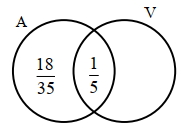
The probability that Ajay will not appear in the $JEE$ exam is $p = \frac{2}{7}$,while the probability that both Ajay and Vijay will appear in the exam is $q = \frac{1}{5}$. Then the probability that Ajay will appear in the exam and Vijay will not appear is:
A
$\frac{9}{35}$
B
$\frac{18}{35}$
C
$\frac{24}{35}$
D
$\frac{3}{35}$
Solution
(B) Let $A$ be the event that Ajay appears in the exam and $V$ be the event that Vijay appears in the exam.
Given: $P(\overline{A}) = \frac{2}{7}$,so $P(A) = 1 - P(\overline{A}) = 1 - \frac{2}{7} = \frac{5}{7}$.
Given: $P(A \cap V) = \frac{1}{5}$.
We need to find the probability that Ajay appears and Vijay does not appear,which is $P(A \cap \overline{V})$.
Using the property of sets,$P(A) = P(A \cap V) + P(A \cap \overline{V})$.
Substituting the values: $\frac{5}{7} = \frac{1}{5} + P(A \cap \overline{V})$.
$P(A \cap \overline{V}) = \frac{5}{7} - \frac{1}{5} = \frac{25 - 7}{35} = \frac{18}{35}$.
Given: $P(\overline{A}) = \frac{2}{7}$,so $P(A) = 1 - P(\overline{A}) = 1 - \frac{2}{7} = \frac{5}{7}$.
Given: $P(A \cap V) = \frac{1}{5}$.
We need to find the probability that Ajay appears and Vijay does not appear,which is $P(A \cap \overline{V})$.
Using the property of sets,$P(A) = P(A \cap V) + P(A \cap \overline{V})$.
Substituting the values: $\frac{5}{7} = \frac{1}{5} + P(A \cap \overline{V})$.
$P(A \cap \overline{V}) = \frac{5}{7} - \frac{1}{5} = \frac{25 - 7}{35} = \frac{18}{35}$.
0 likes
View Solution326
DifficultMCQ
Let the sum of two positive integers be $24$. If the probability,that their product is not less than $\frac{3}{4}$ times their greatest positive product,is $\frac{m}{n}$,where $\operatorname{gcd}(m, n)=1$,then $n-m$ equals :
A
$9$
B
$11$
C
$8$
D
$10$
Solution
(D) Let the two positive integers be $x$ and $y$. Given $x+y=24$,where $x, y \in \mathbb{N}$.
The product $P = xy$. By the $AM-GM$ inequality,$\frac{x+y}{2} \geq \sqrt{xy}$,so $\sqrt{xy} \leq 12$,which implies $xy \leq 144$. The greatest positive product is $144$ (when $x=12, y=12$).
We need the probability that $xy \geq \frac{3}{4} \times 144$,which means $xy \geq 108$.
Since $y = 24-x$,we have $x(24-x) \geq 108$,or $24x - x^2 \geq 108$,which simplifies to $x^2 - 24x + 108 \leq 0$.
Solving $x^2 - 24x + 108 = 0$ using the quadratic formula: $x = \frac{24 \pm \sqrt{576 - 432}}{2} = \frac{24 \pm \sqrt{144}}{2} = \frac{24 \pm 12}{2}$.
Thus,$x = 6$ or $x = 18$. The inequality holds for $6 \leq x \leq 18$.
The possible values for $x$ are ${6, 7, 8, 9, 10, 11, 12, 13, 14, 15, 16, 17, 18}$.
There are $18 - 6 + 1 = 13$ such values.
The total number of pairs $(x, y)$ such that $x+y=24$ for $x, y \in \mathbb{N}$ is $23$ (since $x$ can range from $1$ to $23$).
The probability is $\frac{13}{23} = \frac{m}{n}$.
Thus,$m=13$ and $n=23$. Then $n-m = 23-13 = 10$.
The product $P = xy$. By the $AM-GM$ inequality,$\frac{x+y}{2} \geq \sqrt{xy}$,so $\sqrt{xy} \leq 12$,which implies $xy \leq 144$. The greatest positive product is $144$ (when $x=12, y=12$).
We need the probability that $xy \geq \frac{3}{4} \times 144$,which means $xy \geq 108$.
Since $y = 24-x$,we have $x(24-x) \geq 108$,or $24x - x^2 \geq 108$,which simplifies to $x^2 - 24x + 108 \leq 0$.
Solving $x^2 - 24x + 108 = 0$ using the quadratic formula: $x = \frac{24 \pm \sqrt{576 - 432}}{2} = \frac{24 \pm \sqrt{144}}{2} = \frac{24 \pm 12}{2}$.
Thus,$x = 6$ or $x = 18$. The inequality holds for $6 \leq x \leq 18$.
The possible values for $x$ are ${6, 7, 8, 9, 10, 11, 12, 13, 14, 15, 16, 17, 18}$.
There are $18 - 6 + 1 = 13$ such values.
The total number of pairs $(x, y)$ such that $x+y=24$ for $x, y \in \mathbb{N}$ is $23$ (since $x$ can range from $1$ to $23$).
The probability is $\frac{13}{23} = \frac{m}{n}$.
Thus,$m=13$ and $n=23$. Then $n-m = 23-13 = 10$.
0 likes
View Solution327
AdvancedMCQ
Three randomly chosen non-negative integers $x, y$ and $z$ are found to satisfy the equation $x+y+z=10$. Then the probability that $z$ is even,is
A
$\frac{36}{55}$
B
$\frac{6}{11}$
C
$\frac{1}{2}$
D
$\frac{5}{11}$
Solution
(B) The total number of non-negative integer solutions to $x+y+z=n$ is given by the formula $\binom{n+k-1}{k-1}$,where $k=3$ and $n=10$.
Total solutions $= \binom{10+3-1}{3-1} = \binom{12}{2} = \frac{12 \times 11}{2} = 66$.
For $z$ to be even,let $z \in \{0, 2, 4, 6, 8, 10\}$.
If $z=k$,then $x+y=10-k$. The number of solutions for $x+y=m$ is $m+1$.
For $z=0$,$x+y=10$,solutions $= 11$.
For $z=2$,$x+y=8$,solutions $= 9$.
For $z=4$,$x+y=6$,solutions $= 7$.
For $z=6$,$x+y=4$,solutions $= 5$.
For $z=8$,$x+y=2$,solutions $= 3$.
For $z=10$,$x+y=0$,solutions $= 1$.
Total favourable solutions $= 11+9+7+5+3+1 = 36$.
Probability $P = \frac{36}{66} = \frac{6}{11}$.
Total solutions $= \binom{10+3-1}{3-1} = \binom{12}{2} = \frac{12 \times 11}{2} = 66$.
For $z$ to be even,let $z \in \{0, 2, 4, 6, 8, 10\}$.
If $z=k$,then $x+y=10-k$. The number of solutions for $x+y=m$ is $m+1$.
For $z=0$,$x+y=10$,solutions $= 11$.
For $z=2$,$x+y=8$,solutions $= 9$.
For $z=4$,$x+y=6$,solutions $= 7$.
For $z=6$,$x+y=4$,solutions $= 5$.
For $z=8$,$x+y=2$,solutions $= 3$.
For $z=10$,$x+y=0$,solutions $= 1$.
Total favourable solutions $= 11+9+7+5+3+1 = 36$.
Probability $P = \frac{36}{66} = \frac{6}{11}$.
0 likes
View Solution328
MediumMCQ
Four persons independently solve a certain problem correctly with probabilities $\frac{1}{2}, \frac{3}{4}, \frac{1}{4}, \frac{1}{8}$. Then the probability that the problem is solved correctly by at least one of them is
A
$\frac{235}{256}$
B
$\frac{21}{256}$
C
$\frac{3}{256}$
D
$\frac{253}{256}$
Solution
(A) Let $P(A) = \frac{1}{2}, P(B) = \frac{3}{4}, P(C) = \frac{1}{4}, P(D) = \frac{1}{8}$ be the probabilities of solving the problem correctly.
The probability that the problem is not solved by any of them is $P(\overline{A}) \times P(\overline{B}) \times P(\overline{C}) \times P(\overline{D})$.
$P(\overline{A}) = 1 - \frac{1}{2} = \frac{1}{2}$
$P(\overline{B}) = 1 - \frac{3}{4} = \frac{1}{4}$
$P(\overline{C}) = 1 - \frac{1}{4} = \frac{3}{4}$
$P(\overline{D}) = 1 - \frac{1}{8} = \frac{7}{8}$
$P(\text{none solve}) = \frac{1}{2} \times \frac{1}{4} \times \frac{3}{4} \times \frac{7}{8} = \frac{21}{256}$
The probability that the problem is solved by at least one person is $1 - P(\text{none solve}) = 1 - \frac{21}{256} = \frac{235}{256}$.
The probability that the problem is not solved by any of them is $P(\overline{A}) \times P(\overline{B}) \times P(\overline{C}) \times P(\overline{D})$.
$P(\overline{A}) = 1 - \frac{1}{2} = \frac{1}{2}$
$P(\overline{B}) = 1 - \frac{3}{4} = \frac{1}{4}$
$P(\overline{C}) = 1 - \frac{1}{4} = \frac{3}{4}$
$P(\overline{D}) = 1 - \frac{1}{8} = \frac{7}{8}$
$P(\text{none solve}) = \frac{1}{2} \times \frac{1}{4} \times \frac{3}{4} \times \frac{7}{8} = \frac{21}{256}$
The probability that the problem is solved by at least one person is $1 - P(\text{none solve}) = 1 - \frac{21}{256} = \frac{235}{256}$.
0 likes
View Solution329
EasyMCQ
The probability that a non-leap year selected at random will contain $52$ Saturdays or $53$ Sundays is
A
$\frac{1}{7}$
B
$\frac{6}{7}$
C
$\frac{2}{7}$
D
$\frac{5}{7}$
Solution
(C) non-leap year has $365$ days,which is $52$ weeks and $1$ extra day.
The extra day can be any one of the $7$ days of the week: {Monday,Tuesday,Wednesday,Thursday,Friday,Saturday,Sunday}.
Let $A$ be the event that the year has $53$ Saturdays and $B$ be the event that the year has $53$ Sundays.
Since the year has $52$ weeks,it already contains $52$ Saturdays and $52$ Sundays.
For the year to have $53$ Saturdays,the extra day must be a Saturday. $P(A) = \frac{1}{7}$.
For the year to have $53$ Sundays,the extra day must be a Sunday. $P(B) = \frac{1}{7}$.
Since the extra day cannot be both a Saturday and a Sunday simultaneously,$A$ and $B$ are mutually exclusive events.
The probability that the year has $53$ Saturdays or $53$ Sundays is $P(A \cup B) = P(A) + P(B) = \frac{1}{7} + \frac{1}{7} = \frac{2}{7}$.
Note: The question asks for $52$ Saturdays $OR$ $53$ Sundays. Since every non-leap year has $52$ Saturdays,the event 'contains $52$ Saturdays' is a certain event with probability $1$.
However,interpreting the standard problem format for this specific question type,it asks for the probability of having $53$ Saturdays or $53$ Sundays. Given the options,the intended answer is $\frac{2}{7}$.
The extra day can be any one of the $7$ days of the week: {Monday,Tuesday,Wednesday,Thursday,Friday,Saturday,Sunday}.
Let $A$ be the event that the year has $53$ Saturdays and $B$ be the event that the year has $53$ Sundays.
Since the year has $52$ weeks,it already contains $52$ Saturdays and $52$ Sundays.
For the year to have $53$ Saturdays,the extra day must be a Saturday. $P(A) = \frac{1}{7}$.
For the year to have $53$ Sundays,the extra day must be a Sunday. $P(B) = \frac{1}{7}$.
Since the extra day cannot be both a Saturday and a Sunday simultaneously,$A$ and $B$ are mutually exclusive events.
The probability that the year has $53$ Saturdays or $53$ Sundays is $P(A \cup B) = P(A) + P(B) = \frac{1}{7} + \frac{1}{7} = \frac{2}{7}$.
Note: The question asks for $52$ Saturdays $OR$ $53$ Sundays. Since every non-leap year has $52$ Saturdays,the event 'contains $52$ Saturdays' is a certain event with probability $1$.
However,interpreting the standard problem format for this specific question type,it asks for the probability of having $53$ Saturdays or $53$ Sundays. Given the options,the intended answer is $\frac{2}{7}$.
0 likes
View Solution330
EasyMCQ
Three houses are available in a locality. Three persons apply for the houses. Each applies for one house without consulting others. The probability that all the three persons apply for the same house is
A
$\frac{1}{9}$
B
$\frac{2}{9}$
C
$\frac{7}{9}$
D
$\frac{8}{9}$
Solution
(A) Each of the $3$ persons can choose any of the $3$ houses independently.
Total number of ways for $3$ persons to choose houses $= 3 \times 3 \times 3 = 27$.
For all $3$ persons to apply for the same house,they must all choose house $1$,or all choose house $2$,or all choose house $3$.
Thus,the number of favourable cases $= 3$.
Therefore,the required probability $= \frac{3}{27} = \frac{1}{9}$.
Total number of ways for $3$ persons to choose houses $= 3 \times 3 \times 3 = 27$.
For all $3$ persons to apply for the same house,they must all choose house $1$,or all choose house $2$,or all choose house $3$.
Thus,the number of favourable cases $= 3$.
Therefore,the required probability $= \frac{3}{27} = \frac{1}{9}$.
0 likes
View Solution331
MediumMCQ
Let $A$ and $B$ be two events such that the probability that exactly one of them occurs is $\frac{2}{5}$ and the probability that $A$ or $B$ occurs is $\frac{1}{2}$,then the probability of both of them occurring together is
A
$0.1$
B
$0.2$
C
$0.01$
D
$0.02$
Solution
(A) Given that,the probability that exactly one of them occurs is $P(A \cup B) - P(A \cap B) = \frac{2}{5} \dots (i)$
The probability that $A$ or $B$ occurs is $P(A \cup B) = \frac{1}{2} \dots (ii)$
We know that the probability of exactly one event occurring is given by $P(A \cup B) - P(A \cap B)$.
Substituting the values from $(i)$ and $(ii)$:
$\frac{1}{2} - P(A \cap B) = \frac{2}{5}$
$P(A \cap B) = \frac{1}{2} - \frac{2}{5}$
$P(A \cap B) = \frac{5 - 4}{10} = \frac{1}{10} = 0.1$
The probability that $A$ or $B$ occurs is $P(A \cup B) = \frac{1}{2} \dots (ii)$
We know that the probability of exactly one event occurring is given by $P(A \cup B) - P(A \cap B)$.
Substituting the values from $(i)$ and $(ii)$:
$\frac{1}{2} - P(A \cap B) = \frac{2}{5}$
$P(A \cap B) = \frac{1}{2} - \frac{2}{5}$
$P(A \cap B) = \frac{5 - 4}{10} = \frac{1}{10} = 0.1$
0 likes
View Solution332
MediumMCQ
If two fair dice are rolled,then the probability that the sum of the numbers on the upper faces is at least $9$,is
A
$\frac{1}{3}$
B
$\frac{4}{11}$
C
$\frac{5}{18}$
D
$\frac{5}{36}$
Solution
(C) When two fair dice are rolled,the total number of possible outcomes is $6 \times 6 = 36$.
We want the sum of the numbers on the upper faces to be at least $9$,which means the sum can be $9, 10, 11,$ or $12$.
The favorable outcomes are:
Sum $= 9: (3, 6), (4, 5), (5, 4), (6, 3)$
Sum $= 10: (4, 6), (5, 5), (6, 4)$
Sum $= 11: (5, 6), (6, 5)$
Sum $= 12: (6, 6)$
The total number of favorable outcomes is $4 + 3 + 2 + 1 = 10$.
Therefore,the required probability is $\frac{10}{36} = \frac{5}{18}$.
We want the sum of the numbers on the upper faces to be at least $9$,which means the sum can be $9, 10, 11,$ or $12$.
The favorable outcomes are:
Sum $= 9: (3, 6), (4, 5), (5, 4), (6, 3)$
Sum $= 10: (4, 6), (5, 5), (6, 4)$
Sum $= 11: (5, 6), (6, 5)$
Sum $= 12: (6, 6)$
The total number of favorable outcomes is $4 + 3 + 2 + 1 = 10$.
Therefore,the required probability is $\frac{10}{36} = \frac{5}{18}$.
0 likes
View Solution333
MediumMCQ
$A$ box contains $100$ tickets numbered $1$ to $100$. $A$ ticket is drawn at random from the box. Then the probability that the number on the ticket is a perfect square is
A
$\frac{1}{10}$
B
$\frac{3}{10}$
C
$\frac{7}{100}$
D
$\frac{9}{100}$
Solution
(A) Let $X$ be the event that the number on the ticket is a perfect square.
$\therefore X = \{1, 4, 9, 16, 25, 36, 49, 64, 81, 100\}$
$\therefore n(X) = 10$
$\text{Also, } n(S) = 100$
$\therefore \text{Required probability} = \frac{n(X)}{n(S)} = \frac{10}{100} = \frac{1}{10}$
$\therefore X = \{1, 4, 9, 16, 25, 36, 49, 64, 81, 100\}$
$\therefore n(X) = 10$
$\text{Also, } n(S) = 100$
$\therefore \text{Required probability} = \frac{n(X)}{n(S)} = \frac{10}{100} = \frac{1}{10}$
0 likes
View Solution334
EasyMCQ
$A$ card is drawn at random from a well-shuffled pack of $52$ cards. The probability that it is a black card or a face card is
A
$\frac{3}{13}$
B
$\frac{5}{13}$
C
$\frac{6}{13}$
D
$\frac{8}{13}$
Solution
(D) Total number of cards $n(S) = 52$.
Let event $A$ be drawing a black card and event $B$ be drawing a face card.
Number of black cards $n(A) = 26$.
Number of face cards $n(B) = 12$.
Number of black face cards $n(A \cap B) = 6$ (since there are $3$ black face cards in each of the two black suits).
The probability of drawing a black card or a face card is given by $P(A \cup B) = P(A) + P(B) - P(A \cap B)$.
$P(A \cup B) = \frac{26}{52} + \frac{12}{52} - \frac{6}{52} = \frac{32}{52} = \frac{8}{13}$.
Let event $A$ be drawing a black card and event $B$ be drawing a face card.
Number of black cards $n(A) = 26$.
Number of face cards $n(B) = 12$.
Number of black face cards $n(A \cap B) = 6$ (since there are $3$ black face cards in each of the two black suits).
The probability of drawing a black card or a face card is given by $P(A \cup B) = P(A) + P(B) - P(A \cap B)$.
$P(A \cup B) = \frac{26}{52} + \frac{12}{52} - \frac{6}{52} = \frac{32}{52} = \frac{8}{13}$.
0 likes
View Solution335
MediumMCQ
Two dice are rolled. If both dice have six faces numbered $1, 2, 3, 5, 7, 11$,then the probability that the sum of the numbers on the uppermost faces is a prime number is:
A
$\frac{1}{4}$
B
$\frac{3}{4}$
C
$\frac{1}{9}$
D
$\frac{2}{7}$
Solution
(A) The sample space $S$ consists of all possible pairs $(x, y)$ where $x, y \in \{1, 2, 3, 5, 7, 11\}$.
Since there are $6$ faces on each die,the total number of outcomes is $n(S) = 6 \times 6 = 36$.
Let $A$ be the event that the sum of the numbers is a prime number.
The possible sums are:
$1+1=2$ (prime),$1+2=3$ (prime),$1+3=4$,$1+5=6$,$1+7=8$,$1+11=12$
$2+1=3$ (prime),$2+2=4$,$2+3=5$ (prime),$2+5=7$ (prime),$2+7=9$,$2+11=13$ (prime)
$3+1=4$,$3+2=5$ (prime),$3+3=6$,$3+5=8$,$3+7=10$,$3+11=14$
$5+1=6$,$5+2=7$ (prime),$5+3=8$,$5+5=10$,$5+7=12$,$5+11=16$
$7+1=8$,$7+2=9$,$7+3=10$,$7+5=12$,$7+7=14$,$7+11=18$
$11+1=12$,$11+2=13$ (prime),$11+3=14$,$11+5=16$,$11+7=18$,$11+11=22$
The favorable outcomes are: $(1,1), (1,2), (2,1), (2,3), (2,5), (2,11), (3,2), (5,2), (11,2)$.
Thus,$n(A) = 9$.
The probability $P(A) = \frac{n(A)}{n(S)} = \frac{9}{36} = \frac{1}{4}$.
Since there are $6$ faces on each die,the total number of outcomes is $n(S) = 6 \times 6 = 36$.
Let $A$ be the event that the sum of the numbers is a prime number.
The possible sums are:
$1+1=2$ (prime),$1+2=3$ (prime),$1+3=4$,$1+5=6$,$1+7=8$,$1+11=12$
$2+1=3$ (prime),$2+2=4$,$2+3=5$ (prime),$2+5=7$ (prime),$2+7=9$,$2+11=13$ (prime)
$3+1=4$,$3+2=5$ (prime),$3+3=6$,$3+5=8$,$3+7=10$,$3+11=14$
$5+1=6$,$5+2=7$ (prime),$5+3=8$,$5+5=10$,$5+7=12$,$5+11=16$
$7+1=8$,$7+2=9$,$7+3=10$,$7+5=12$,$7+7=14$,$7+11=18$
$11+1=12$,$11+2=13$ (prime),$11+3=14$,$11+5=16$,$11+7=18$,$11+11=22$
The favorable outcomes are: $(1,1), (1,2), (2,1), (2,3), (2,5), (2,11), (3,2), (5,2), (11,2)$.
Thus,$n(A) = 9$.
The probability $P(A) = \frac{n(A)}{n(S)} = \frac{9}{36} = \frac{1}{4}$.
0 likes
View Solution336
EasyMCQ
$A$ family with three children is chosen at random. The probability that the oldest and youngest children are of the same gender is
A
$\frac{3}{8}$
B
$\frac{1}{2}$
C
$\frac{1}{8}$
D
$\frac{2}{8}$
Solution
(B) Let $B$ represent a boy and $G$ represent a girl. The sample space $S$ for a family with $3$ children is:
$S = \{BBB, BBG, BGB, BGG, GBB, GBG, GGB, GGG\}$
The total number of outcomes is $n(S) = 8$.
Let $E$ be the event that the oldest and youngest children are of the same gender.
The favorable outcomes are:
$E = \{BBB, BGB, GBG, GGG\}$
The number of favorable outcomes is $n(E) = 4$.
The probability $P(E) = \frac{n(E)}{n(S)} = \frac{4}{8} = \frac{1}{2}$.
$S = \{BBB, BBG, BGB, BGG, GBB, GBG, GGB, GGG\}$
The total number of outcomes is $n(S) = 8$.
Let $E$ be the event that the oldest and youngest children are of the same gender.
The favorable outcomes are:
$E = \{BBB, BGB, GBG, GGG\}$
The number of favorable outcomes is $n(E) = 4$.
The probability $P(E) = \frac{n(E)}{n(S)} = \frac{4}{8} = \frac{1}{2}$.
0 likes
View Solution337
EasyMCQ
Two dice are rolled simultaneously. The probability that the sum of the two numbers on the dice is a prime number is:
A
$\frac{5}{11}$
B
$\frac{5}{12}$
C
$\frac{7}{12}$
D
$\frac{7}{11}$
Solution
(B) The total number of outcomes when two dice are rolled is $n(S) = 6 \times 6 = 36$.
The possible sums range from $2$ to $12$. The prime numbers in this range are $2, 3, 5, 7, 11$.
The favorable outcomes for each sum are:
Sum $= 2: (1, 1) \rightarrow 1 \text{ outcome}$
Sum $= 3: (1, 2), (2, 1) \rightarrow 2 \text{ outcomes}$
Sum $= 5: (1, 4), (2, 3), (3, 2), (4, 1) \rightarrow 4 \text{ outcomes}$
Sum $= 7: (1, 6), (2, 5), (3, 4), (4, 3), (5, 2), (6, 1) \rightarrow 6 \text{ outcomes}$
Sum $= 11: (5, 6), (6, 5) \rightarrow 2 \text{ outcomes}$
Total favorable outcomes $n(E) = 1 + 2 + 4 + 6 + 2 = 15$.
The probability is $P(E) = \frac{n(E)}{n(S)} = \frac{15}{36} = \frac{5}{12}$.
The possible sums range from $2$ to $12$. The prime numbers in this range are $2, 3, 5, 7, 11$.
The favorable outcomes for each sum are:
Sum $= 2: (1, 1) \rightarrow 1 \text{ outcome}$
Sum $= 3: (1, 2), (2, 1) \rightarrow 2 \text{ outcomes}$
Sum $= 5: (1, 4), (2, 3), (3, 2), (4, 1) \rightarrow 4 \text{ outcomes}$
Sum $= 7: (1, 6), (2, 5), (3, 4), (4, 3), (5, 2), (6, 1) \rightarrow 6 \text{ outcomes}$
Sum $= 11: (5, 6), (6, 5) \rightarrow 2 \text{ outcomes}$
Total favorable outcomes $n(E) = 1 + 2 + 4 + 6 + 2 = 15$.
The probability is $P(E) = \frac{n(E)}{n(S)} = \frac{15}{36} = \frac{5}{12}$.
0 likes
View Solution338
EasyMCQ
Two unbiased dice are thrown. Then the probability that neither a doublet nor a total of $10$ will appear is
A
$\frac{1}{12}$
B
$\frac{1}{36}$
C
$\frac{2}{9}$
D
$\frac{7}{9}$
Solution
(D) The total number of outcomes when two dice are thrown is $6 \times 6 = 36$.
Let $A$ be the event of getting a doublet. The outcomes are $(1,1), (2,2), (3,3), (4,4), (5,5), (6,6)$,so $n(A) = 6$.
Let $B$ be the event of getting a total of $10$. The outcomes are $(4,6), (5,5), (6,4)$,so $n(B) = 3$.
The intersection $A \cap B$ is the outcome $(5,5)$,so $n(A \cap B) = 1$.
The number of outcomes that are either a doublet or a total of $10$ is $n(A \cup B) = n(A) + n(B) - n(A \cap B) = 6 + 3 - 1 = 8$.
The number of outcomes that are neither a doublet nor a total of $10$ is $36 - 8 = 28$.
Therefore,the required probability is $\frac{28}{36} = \frac{7}{9}$.
Let $A$ be the event of getting a doublet. The outcomes are $(1,1), (2,2), (3,3), (4,4), (5,5), (6,6)$,so $n(A) = 6$.
Let $B$ be the event of getting a total of $10$. The outcomes are $(4,6), (5,5), (6,4)$,so $n(B) = 3$.
The intersection $A \cap B$ is the outcome $(5,5)$,so $n(A \cap B) = 1$.
The number of outcomes that are either a doublet or a total of $10$ is $n(A \cup B) = n(A) + n(B) - n(A \cap B) = 6 + 3 - 1 = 8$.
The number of outcomes that are neither a doublet nor a total of $10$ is $36 - 8 = 28$.
Therefore,the required probability is $\frac{28}{36} = \frac{7}{9}$.
0 likes
View Solution339
EasyMCQ
$A$ coin is tossed and a die is thrown. The probability that the outcome will be a head or a number greater than $4$ or both,is
A
$\frac{2}{3}$
B
$\frac{1}{6}$
C
$\frac{1}{2}$
D
$\frac{1}{3}$
Solution
(A) Let $H$ be the event of getting a head and $D$ be the event of getting a number greater than $4$ on a die.
$P(H) = \frac{1}{2}$.
The numbers greater than $4$ on a die are ${5, 6}$,so $P(D) = \frac{2}{6} = \frac{1}{3}$.
Since the events are independent,$P(H \cap D) = P(H) \times P(D) = \frac{1}{2} \times \frac{1}{3} = \frac{1}{6}$.
We need to find the probability of $H \cup D$,which is given by $P(H \cup D) = P(H) + P(D) - P(H \cap D)$.
$P(H \cup D) = \frac{1}{2} + \frac{1}{3} - \frac{1}{6} = \frac{3+2-1}{6} = \frac{4}{6} = \frac{2}{3}$.
$P(H) = \frac{1}{2}$.
The numbers greater than $4$ on a die are ${5, 6}$,so $P(D) = \frac{2}{6} = \frac{1}{3}$.
Since the events are independent,$P(H \cap D) = P(H) \times P(D) = \frac{1}{2} \times \frac{1}{3} = \frac{1}{6}$.
We need to find the probability of $H \cup D$,which is given by $P(H \cup D) = P(H) + P(D) - P(H \cap D)$.
$P(H \cup D) = \frac{1}{2} + \frac{1}{3} - \frac{1}{6} = \frac{3+2-1}{6} = \frac{4}{6} = \frac{2}{3}$.
0 likes
View Solution340
EasyMCQ
For two events $A$ and $B$,if $P(A \cup B) = \frac{5}{6}$,$P(A) = \frac{1}{6}$,and $P(B) = \frac{2}{3}$,then $A$ and $B$ are:
A
independent
B
mutually exhaustive
C
mutually exclusive
D
complementary
Solution
(C) We know that for any two events $A$ and $B$,the probability of their union is given by:
$P(A \cup B) = P(A) + P(B) - P(A \cap B)$
Substituting the given values:
$\frac{5}{6} = \frac{1}{6} + \frac{2}{3} - P(A \cap B)$
$\frac{5}{6} = \frac{1}{6} + \frac{4}{6} - P(A \cap B)$
$\frac{5}{6} = \frac{5}{6} - P(A \cap B)$
This implies $P(A \cap B) = 0$.
Since the probability of the intersection of events $A$ and $B$ is $0$,the events $A$ and $B$ are mutually exclusive.
$P(A \cup B) = P(A) + P(B) - P(A \cap B)$
Substituting the given values:
$\frac{5}{6} = \frac{1}{6} + \frac{2}{3} - P(A \cap B)$
$\frac{5}{6} = \frac{1}{6} + \frac{4}{6} - P(A \cap B)$
$\frac{5}{6} = \frac{5}{6} - P(A \cap B)$
This implies $P(A \cap B) = 0$.
Since the probability of the intersection of events $A$ and $B$ is $0$,the events $A$ and $B$ are mutually exclusive.
0 likes
View Solution341
MediumMCQ
One card is drawn at random from a pack of $52$ playing cards. The probability that it is an ace,a black king,or the queen of hearts is:
A
$\frac{3}{52}$
B
$\frac{7}{52}$
C
$\frac{6}{52}$
D
$\frac{1}{52}$
Solution
(B) Total number of cards $= 52$.
Number of aces $= 4$.
Number of black kings (spade king and club king) $= 2$.
Number of queen of hearts $= 1$.
Since these events are mutually exclusive,the total number of favorable outcomes $= 4 + 2 + 1 = 7$.
$\therefore$ Required probability $= \frac{7}{52}$.
Number of aces $= 4$.
Number of black kings (spade king and club king) $= 2$.
Number of queen of hearts $= 1$.
Since these events are mutually exclusive,the total number of favorable outcomes $= 4 + 2 + 1 = 7$.
$\therefore$ Required probability $= \frac{7}{52}$.
0 likes
View Solution342
MediumMCQ
If two dice are thrown together,then the probability that the sum of the numbers appearing on them is a prime number is:
A
$1/2$
B
$3/7$
C
$5/12$
D
$7/12$
Solution
(C) When two dice are thrown,the total number of outcomes is $6 \times 6 = 36$.
The possible sums range from $2$ to $12$.
The prime numbers in this range are $2, 3, 5, 7, 11$.
Favourable outcomes for each sum:
Sum $= 2$: $(1, 1)$ - $1$ case
Sum $= 3$: $(1, 2), (2, 1)$ - $2$ cases
Sum $= 5$: $(1, 4), (2, 3), (3, 2), (4, 1)$ - $4$ cases
Sum $= 7$: $(1, 6), (2, 5), (3, 4), (4, 3), (5, 2), (6, 1)$ - $6$ cases
Sum $= 11$: $(5, 6), (6, 5)$ - $2$ cases
Total favourable cases $= 1 + 2 + 4 + 6 + 2 = 15$.
Required probability $= \frac{15}{36} = \frac{5}{12}$.
The possible sums range from $2$ to $12$.
The prime numbers in this range are $2, 3, 5, 7, 11$.
Favourable outcomes for each sum:
Sum $= 2$: $(1, 1)$ - $1$ case
Sum $= 3$: $(1, 2), (2, 1)$ - $2$ cases
Sum $= 5$: $(1, 4), (2, 3), (3, 2), (4, 1)$ - $4$ cases
Sum $= 7$: $(1, 6), (2, 5), (3, 4), (4, 3), (5, 2), (6, 1)$ - $6$ cases
Sum $= 11$: $(5, 6), (6, 5)$ - $2$ cases
Total favourable cases $= 1 + 2 + 4 + 6 + 2 = 15$.
Required probability $= \frac{15}{36} = \frac{5}{12}$.
0 likes
View Solution343
MediumMCQ
Given $P(A \cup B)=0.6$ and $P(A \cap B)=0.2$,the probability that exactly one of the events occurs is:
A
$0.4$
B
$0.2$
C
$0.6$
D
$0.8$
Solution
(A) The probability that exactly one of the events $A$ or $B$ occurs is given by $P(A \Delta B) = P(A \cup B) - P(A \cap B)$.
Given $P(A \cup B) = 0.6$ and $P(A \cap B) = 0.2$.
Therefore,the probability of exactly one event occurring is $0.6 - 0.2 = 0.4$.
Given $P(A \cup B) = 0.6$ and $P(A \cap B) = 0.2$.
Therefore,the probability of exactly one event occurring is $0.6 - 0.2 = 0.4$.
0 likes
View Solution344
EasyMCQ
Two dice are rolled one after the other. The probability that the number on the first die is smaller than the number on the second die is:
A
$1/2$
B
$7/18$
C
$3/4$
D
$5/12$
Solution
(D) When two dice are rolled,the total number of possible outcomes is $6 \times 6 = 36$.
Let the outcome of the first die be $x$ and the second die be $y$. We want the probability that $x < y$.
The possible pairs $(x, y)$ such that $x < y$ are:
For $x=1$,$y \in \{2, 3, 4, 5, 6\}$ ($5$ outcomes).
For $x=2$,$y \in \{3, 4, 5, 6\}$ ($4$ outcomes).
For $x=3$,$y \in \{4, 5, 6\}$ ($3$ outcomes).
For $x=4$,$y \in \{5, 6\}$ ($2$ outcomes).
For $x=5$,$y \in \{6\}$ ($1$ outcome).
For $x=6$,there are no possible values for $y$.
Total favorable outcomes $= 5 + 4 + 3 + 2 + 1 = 15$.
The probability is $\frac{15}{36} = \frac{5}{12}$.
Let the outcome of the first die be $x$ and the second die be $y$. We want the probability that $x < y$.
The possible pairs $(x, y)$ such that $x < y$ are:
For $x=1$,$y \in \{2, 3, 4, 5, 6\}$ ($5$ outcomes).
For $x=2$,$y \in \{3, 4, 5, 6\}$ ($4$ outcomes).
For $x=3$,$y \in \{4, 5, 6\}$ ($3$ outcomes).
For $x=4$,$y \in \{5, 6\}$ ($2$ outcomes).
For $x=5$,$y \in \{6\}$ ($1$ outcome).
For $x=6$,there are no possible values for $y$.
Total favorable outcomes $= 5 + 4 + 3 + 2 + 1 = 15$.
The probability is $\frac{15}{36} = \frac{5}{12}$.
0 likes
View Solution345
EasyMCQ
If $A$,$B$,and $C$ are mutually exclusive and exhaustive events of a sample space $S$ such that $P(B) = \frac{3}{2} P(A)$ and $P(C) = \frac{1}{2} P(B)$,then $P(A) = $
A
$\frac{4}{13}$
B
$\frac{6}{13}$
C
$\frac{8}{13}$
D
$\frac{3}{13}$
Solution
(A) Since $A$,$B$,and $C$ are mutually exclusive and exhaustive events,their sum of probabilities is $1$:
$P(A) + P(B) + P(C) = 1$
Given $P(B) = \frac{3}{2} P(A)$ and $P(C) = \frac{1}{2} P(B) = \frac{1}{2} \times \frac{3}{2} P(A) = \frac{3}{4} P(A)$
Substituting these into the equation:
$P(A) + \frac{3}{2} P(A) + \frac{3}{4} P(A) = 1$
Taking the common denominator as $4$:
$\frac{4 P(A) + 6 P(A) + 3 P(A)}{4} = 1$
$\frac{13 P(A)}{4} = 1$
$P(A) = \frac{4}{13}$
$P(A) + P(B) + P(C) = 1$
Given $P(B) = \frac{3}{2} P(A)$ and $P(C) = \frac{1}{2} P(B) = \frac{1}{2} \times \frac{3}{2} P(A) = \frac{3}{4} P(A)$
Substituting these into the equation:
$P(A) + \frac{3}{2} P(A) + \frac{3}{4} P(A) = 1$
Taking the common denominator as $4$:
$\frac{4 P(A) + 6 P(A) + 3 P(A)}{4} = 1$
$\frac{13 P(A)}{4} = 1$
$P(A) = \frac{4}{13}$
0 likes
View Solution346
EasyMCQ
Two dice are thrown together. The probability that the sum of the numbers is divisible by $2$ or $3$ is
A
$\frac{1}{6}$
B
$\frac{3}{4}$
C
$\frac{1}{3}$
D
$\frac{2}{3}$
Solution
(D) When two dice are thrown,the total number of outcomes is $n(S) = 6 \times 6 = 36$.
Let $E$ be the event that the sum of the numbers is divisible by $2$ or $3$.
The possible sums range from $2$ to $12$.
Sums divisible by $2$ are: $2, 4, 6, 8, 10, 12$.
Sums divisible by $3$ are: $3, 6, 9, 12$.
Combining these,the sums divisible by $2$ or $3$ are: $2, 3, 4, 6, 8, 9, 10, 12$.
Counting the outcomes for each sum:
Sum $2: (1,1) - 1$ outcome
Sum $3: (1,2), (2,1) - 2$ outcomes
Sum $4: (1,3), (2,2), (3,1) - 3$ outcomes
Sum $6: (1,5), (2,4), (3,3), (4,2), (5,1) - 5$ outcomes
Sum $8: (2,6), (3,5), (4,4), (5,3), (6,2) - 5$ outcomes
Sum $9: (3,6), (4,5), (5,4), (6,3) - 4$ outcomes
Sum $10: (4,6), (5,5), (6,4) - 3$ outcomes
Sum $12: (6,6) - 1$ outcome
Total favorable outcomes $n(E) = 1 + 2 + 3 + 5 + 5 + 4 + 3 + 1 = 24$.
Therefore,the probability $P(E) = \frac{n(E)}{n(S)} = \frac{24}{36} = \frac{2}{3}$.
Let $E$ be the event that the sum of the numbers is divisible by $2$ or $3$.
The possible sums range from $2$ to $12$.
Sums divisible by $2$ are: $2, 4, 6, 8, 10, 12$.
Sums divisible by $3$ are: $3, 6, 9, 12$.
Combining these,the sums divisible by $2$ or $3$ are: $2, 3, 4, 6, 8, 9, 10, 12$.
Counting the outcomes for each sum:
Sum $2: (1,1) - 1$ outcome
Sum $3: (1,2), (2,1) - 2$ outcomes
Sum $4: (1,3), (2,2), (3,1) - 3$ outcomes
Sum $6: (1,5), (2,4), (3,3), (4,2), (5,1) - 5$ outcomes
Sum $8: (2,6), (3,5), (4,4), (5,3), (6,2) - 5$ outcomes
Sum $9: (3,6), (4,5), (5,4), (6,3) - 4$ outcomes
Sum $10: (4,6), (5,5), (6,4) - 3$ outcomes
Sum $12: (6,6) - 1$ outcome
Total favorable outcomes $n(E) = 1 + 2 + 3 + 5 + 5 + 4 + 3 + 1 = 24$.
Therefore,the probability $P(E) = \frac{n(E)}{n(S)} = \frac{24}{36} = \frac{2}{3}$.
0 likes
View Solution347
MediumMCQ
Three boxes contain respectively $3$ white and $1$ black,$2$ white and $2$ black,$1$ white and $3$ black balls. From each of the boxes,one ball is drawn at random. The probability that $2$ white and $1$ black balls will be drawn is:
A
$13/32$
B
$1/4$
C
$1/32$
D
$3/16$
Solution
(A) Let $W$ denote a white ball and $B$ denote a black ball. The contents of the boxes are:
Box $I$: $3W, 1B$ (Total $4$ balls)
Box $II$: $2W, 2B$ (Total $4$ balls)
Box $III$: $1W, 3B$ (Total $4$ balls)
We need to draw $2$ white and $1$ black ball. This can happen in three mutually exclusive ways:
$1$. Box $I$ gives $B$,Box $II$ gives $W$,Box $III$ gives $W$
$2$. Box $I$ gives $W$,Box $II$ gives $B$,Box $III$ gives $W$
$3$. Box $I$ gives $W$,Box $II$ gives $W$,Box $III$ gives $B$
The required probability is:
$P = P(B_I)P(W_{II})P(W_{III}) + P(W_I)P(B_{II})P(W_{III}) + P(W_I)P(W_{II})P(B_{III})$
$P = (\frac{1}{4} \times \frac{2}{4} \times \frac{1}{4}) + (\frac{3}{4} \times \frac{2}{4} \times \frac{1}{4}) + (\frac{3}{4} \times \frac{2}{4} \times \frac{3}{4})$
$P = \frac{2}{64} + \frac{6}{64} + \frac{18}{64} = \frac{26}{64} = \frac{13}{32}$
Box $I$: $3W, 1B$ (Total $4$ balls)
Box $II$: $2W, 2B$ (Total $4$ balls)
Box $III$: $1W, 3B$ (Total $4$ balls)
We need to draw $2$ white and $1$ black ball. This can happen in three mutually exclusive ways:
$1$. Box $I$ gives $B$,Box $II$ gives $W$,Box $III$ gives $W$
$2$. Box $I$ gives $W$,Box $II$ gives $B$,Box $III$ gives $W$
$3$. Box $I$ gives $W$,Box $II$ gives $W$,Box $III$ gives $B$
The required probability is:
$P = P(B_I)P(W_{II})P(W_{III}) + P(W_I)P(B_{II})P(W_{III}) + P(W_I)P(W_{II})P(B_{III})$
$P = (\frac{1}{4} \times \frac{2}{4} \times \frac{1}{4}) + (\frac{3}{4} \times \frac{2}{4} \times \frac{1}{4}) + (\frac{3}{4} \times \frac{2}{4} \times \frac{3}{4})$
$P = \frac{2}{64} + \frac{6}{64} + \frac{18}{64} = \frac{26}{64} = \frac{13}{32}$
0 likes
View Solution348
EasyMCQ
$A$ man and his wife appear for an interview for two posts. The probability of the husband's selection is $\frac{1}{7}$ and that of the wife's selection is $\frac{1}{5}$. If they appear for the interview independently,then the probability that only one of them is selected is:
A
$\frac{1}{7}$
B
$\frac{2}{7}$
C
$\frac{6}{7}$
D
$\frac{4}{7}$
Solution
(B) Let $H$ be the event that the husband is selected and $W$ be the event that the wife is selected.
Given $P(H) = \frac{1}{7}$ and $P(W) = \frac{1}{5}$.
The probability that the husband is not selected is $P(H') = 1 - \frac{1}{7} = \frac{6}{7}$.
The probability that the wife is not selected is $P(W') = 1 - \frac{1}{5} = \frac{4}{5}$.
The probability that only one of them is selected is given by $P(\text{only } H) + P(\text{only } W)$.
$P(\text{only } H) = P(H) \times P(W') = \frac{1}{7} \times \frac{4}{5} = \frac{4}{35}$.
$P(\text{only } W) = P(W) \times P(H') = \frac{1}{5} \times \frac{6}{7} = \frac{6}{35}$.
Therefore,the required probability is $\frac{4}{35} + \frac{6}{35} = \frac{10}{35} = \frac{2}{7}$.
Given $P(H) = \frac{1}{7}$ and $P(W) = \frac{1}{5}$.
The probability that the husband is not selected is $P(H') = 1 - \frac{1}{7} = \frac{6}{7}$.
The probability that the wife is not selected is $P(W') = 1 - \frac{1}{5} = \frac{4}{5}$.
The probability that only one of them is selected is given by $P(\text{only } H) + P(\text{only } W)$.
$P(\text{only } H) = P(H) \times P(W') = \frac{1}{7} \times \frac{4}{5} = \frac{4}{35}$.
$P(\text{only } W) = P(W) \times P(H') = \frac{1}{5} \times \frac{6}{7} = \frac{6}{35}$.
Therefore,the required probability is $\frac{4}{35} + \frac{6}{35} = \frac{10}{35} = \frac{2}{7}$.
0 likes
View Solution349
EasyMCQ
Four persons can hit a target correctly with probabilities $\frac{1}{2}, \frac{1}{3}, \frac{1}{4}$ and $\frac{1}{5}$ respectively. If all hit at the target independently,then the probability that the target would be hit,is
A
$\frac{1}{5}$
B
$\frac{3}{5}$
C
$\frac{2}{5}$
D
$\frac{4}{5}$
Solution
(D) Let $A, B, C,$ and $D$ be the events that the four persons hit the target respectively.
Given probabilities are $P(A) = \frac{1}{2}, P(B) = \frac{1}{3}, P(C) = \frac{1}{4}, P(D) = \frac{1}{5}$.
The probability that the target is not hit by any of them is the probability that all four miss the target.
$P(A') = 1 - \frac{1}{2} = \frac{1}{2}$
$P(B') = 1 - \frac{1}{3} = \frac{2}{3}$
$P(C') = 1 - \frac{1}{4} = \frac{3}{4}$
$P(D') = 1 - \frac{1}{5} = \frac{4}{5}$
Since the events are independent,the probability that none hit the target is:
$P(\text{None hit}) = P(A') \times P(B') \times P(C') \times P(D') = \frac{1}{2} \times \frac{2}{3} \times \frac{3}{4} \times \frac{4}{5} = \frac{1}{5}$.
The probability that the target is hit at least once is:
$P(\text{Target is hit}) = 1 - P(\text{None hit}) = 1 - \frac{1}{5} = \frac{4}{5}$.
Given probabilities are $P(A) = \frac{1}{2}, P(B) = \frac{1}{3}, P(C) = \frac{1}{4}, P(D) = \frac{1}{5}$.
The probability that the target is not hit by any of them is the probability that all four miss the target.
$P(A') = 1 - \frac{1}{2} = \frac{1}{2}$
$P(B') = 1 - \frac{1}{3} = \frac{2}{3}$
$P(C') = 1 - \frac{1}{4} = \frac{3}{4}$
$P(D') = 1 - \frac{1}{5} = \frac{4}{5}$
Since the events are independent,the probability that none hit the target is:
$P(\text{None hit}) = P(A') \times P(B') \times P(C') \times P(D') = \frac{1}{2} \times \frac{2}{3} \times \frac{3}{4} \times \frac{4}{5} = \frac{1}{5}$.
The probability that the target is hit at least once is:
$P(\text{Target is hit}) = 1 - P(\text{None hit}) = 1 - \frac{1}{5} = \frac{4}{5}$.
0 likes
View SolutionProbability — Set Based probability · Frequently Asked Questions
1Are these Probability questions useful for JEE and NEET?
Yes. All questions in this section are mapped to JEE Main and NEET exam patterns. Previous year questions from JEE Main, NEET, GUJCET and state-level exams are included with full solutions.
2Can I switch to Hindi or Gujarati for these questions?
Yes. Use the language tabs in the hero section or the sidebar to view the same questions and solutions in English, Hindi or Gujarati.
3How do I generate a question paper from this subtopic?
Use the Vedclass Exam Paper Generator — select the chapter and subtopic, set difficulty, and generate Sets A, B, C, D automatically. First 3 chapters of every subject are free.
Vedclass Products
For Students
Vedclass Test Series
Mock tests in real JEE/NEET style with performance analysis. 5-day free trial.
Start Free TrialFor Teachers
Exam Paper Generator
Generate Set A/B/C/D papers from this chapter in 2 minutes. 3 chapters free.
Try FreeFor Institutes
Online Exam Module
Live online exams with unlimited students, 360° analytics & white-label branding.
See DemoFor Teachers & Institutes
Generate a Probability Exam Paper in 2 Minutes
Select subtopic & difficulty — Sets A, B, C, D auto-generated with No Repeat logic.
First 3 chapters of every subject are free — no payment required.