
A English
Set Based probability Questions in English
Class 11 Mathematics · Probability · Set Based probability
510+
Questions
English
Language
100%
With Solutions
Showing 44 of 510 questions in English
401
MediumMCQ
Let $A$ and $B$ be events in a sample space $S$ such that $P(A)=0.5, P(B)=0.4$ and $P(A \cup B)=0.6$. Observe the following lists. The correct match of List $I$ from List $II$ is:
| List $I$ | List $II$ |
| $(i) \ P(A \cap B)$ | $(1) \ 0.4$ |
| $(ii) \ P(A \cap \bar{B})$ | $(2) \ 0.2$ |
| $(iii) \ P(\bar{A} \cap B)$ | $(3) \ 0.3$ |
| $(iv) \ P(\bar{A} \cap \bar{B})$ | $(4) \ 0.1$ |
A
$(i)-(3), (ii)-(2), (iii)-(4), (iv)-(1)$
B
$(i)-(3), (ii)-(2), (iii)-(1), (iv)-(4)$
C
$(i)-(1), (ii)-(2), (iii)-(3), (iv)-(4)$
D
$(i)-(3), (ii)-(1), (iii)-(2), (iv)-(4)$
Solution
(A) Given,$P(A)=0.5, P(B)=0.4$ and $P(A \cup B)=0.6$.
$(i) \ P(A \cap B) = P(A) + P(B) - P(A \cup B) = 0.5 + 0.4 - 0.6 = 0.3$. Thus,$(i)-(3)$.
$(ii) \ P(A \cap \bar{B}) = P(A) - P(A \cap B) = 0.5 - 0.3 = 0.2$. Thus,$(ii)-(2)$.
$(iii) \ P(\bar{A} \cap B) = P(B) - P(A \cap B) = 0.4 - 0.3 = 0.1$. Thus,$(iii)-(4)$.
$(iv) \ P(\bar{A} \cap \bar{B}) = P(\overline{A \cup B}) = 1 - P(A \cup B) = 1 - 0.6 = 0.4$. Thus,$(iv)-(1)$.
Therefore,the correct match is $(i)-(3), (ii)-(2), (iii)-(4), (iv)-(1)$.
$(i) \ P(A \cap B) = P(A) + P(B) - P(A \cup B) = 0.5 + 0.4 - 0.6 = 0.3$. Thus,$(i)-(3)$.
$(ii) \ P(A \cap \bar{B}) = P(A) - P(A \cap B) = 0.5 - 0.3 = 0.2$. Thus,$(ii)-(2)$.
$(iii) \ P(\bar{A} \cap B) = P(B) - P(A \cap B) = 0.4 - 0.3 = 0.1$. Thus,$(iii)-(4)$.
$(iv) \ P(\bar{A} \cap \bar{B}) = P(\overline{A \cup B}) = 1 - P(A \cup B) = 1 - 0.6 = 0.4$. Thus,$(iv)-(1)$.
Therefore,the correct match is $(i)-(3), (ii)-(2), (iii)-(4), (iv)-(1)$.
0 likes
View Solution402
MediumMCQ
Two students appeared simultaneously for an entrance exam. If the probability that the first student gets qualified in the exam is $\frac{1}{4}$ and the probability that the second student gets qualified in the same exam is $\frac{2}{5}$,then the probability that at least one of them gets qualified in that exam is
A
$\frac{1}{10}$
B
$\frac{7}{20}$
C
$\frac{6}{10}$
D
$\frac{11}{20}$
Solution
(D) Let $A$ be the event that the first student qualifies and $B$ be the event that the second student qualifies.
Given $P(A) = \frac{1}{4}$ and $P(B) = \frac{2}{5}$.
Since the events are independent,the probability that neither qualifies is $P(A^c \cap B^c) = P(A^c) \times P(B^c)$.
$P(A^c) = 1 - P(A) = 1 - \frac{1}{4} = \frac{3}{4}$.
$P(B^c) = 1 - P(B) = 1 - \frac{2}{5} = \frac{3}{5}$.
Probability that neither qualifies = $\frac{3}{4} \times \frac{3}{5} = \frac{9}{20}$.
Probability that at least one qualifies = $1 - P(\text{neither qualifies}) = 1 - \frac{9}{20} = \frac{11}{20}$.
Given $P(A) = \frac{1}{4}$ and $P(B) = \frac{2}{5}$.
Since the events are independent,the probability that neither qualifies is $P(A^c \cap B^c) = P(A^c) \times P(B^c)$.
$P(A^c) = 1 - P(A) = 1 - \frac{1}{4} = \frac{3}{4}$.
$P(B^c) = 1 - P(B) = 1 - \frac{2}{5} = \frac{3}{5}$.
Probability that neither qualifies = $\frac{3}{4} \times \frac{3}{5} = \frac{9}{20}$.
Probability that at least one qualifies = $1 - P(\text{neither qualifies}) = 1 - \frac{9}{20} = \frac{11}{20}$.
0 likes
View Solution403
EasyMCQ
If $A, B$ and $C$ are three events of a random experiment with $P(A)=0.4, P(B)=0.3$ and $P(A \cap B)=0.2$,then the probability that neither $A$ nor $B$ occurs is
A
$0.5$
B
$0.15$
C
$0.13$
D
$0.12$
Solution
(A) Given,$P(A)=0.4, P(B)=0.3$ and $P(A \cap B)=0.2$.
We need to find the probability that neither $A$ nor $B$ occurs,which is $P(\overline{A} \cap \overline{B})$.
By De Morgan's Law,$P(\overline{A} \cap \overline{B}) = P(\overline{A \cup B}) = 1 - P(A \cup B)$.
First,calculate $P(A \cup B)$ using the formula:
$P(A \cup B) = P(A) + P(B) - P(A \cap B) = 0.4 + 0.3 - 0.2 = 0.5$.
Therefore,$P(\overline{A} \cap \overline{B}) = 1 - 0.5 = 0.5$.
We need to find the probability that neither $A$ nor $B$ occurs,which is $P(\overline{A} \cap \overline{B})$.
By De Morgan's Law,$P(\overline{A} \cap \overline{B}) = P(\overline{A \cup B}) = 1 - P(A \cup B)$.
First,calculate $P(A \cup B)$ using the formula:
$P(A \cup B) = P(A) + P(B) - P(A \cap B) = 0.4 + 0.3 - 0.2 = 0.5$.
Therefore,$P(\overline{A} \cap \overline{B}) = 1 - 0.5 = 0.5$.
0 likes
View Solution404
EasyMCQ
The probability that $A$ speaks truth is $4/5$,while the probability that $B$ speaks truth is $3/4$. The probability that $A$ and $B$ contradict each other when asked to reveal the fact is
A
$3/20$
B
$1/5$
C
$7/20$
D
$4/5$
Solution
(C) $A =$ Event that $A$ speaks the truth.
$B =$ Event that $B$ speaks the truth.
$P(A) = 4/5 \implies P(A^c) = 1/5$.
$P(B) = 3/4 \implies P(B^c) = 1/4$.
$A$ and $B$ contradict each other if one speaks the truth and the other lies.
Required probability $= P(A) \cdot P(B^c) + P(A^c) \cdot P(B)$.
$= (4/5 \times 1/4) + (1/5 \times 3/4)$.
$= 4/20 + 3/20 = 7/20$.
$B =$ Event that $B$ speaks the truth.
$P(A) = 4/5 \implies P(A^c) = 1/5$.
$P(B) = 3/4 \implies P(B^c) = 1/4$.
$A$ and $B$ contradict each other if one speaks the truth and the other lies.
Required probability $= P(A) \cdot P(B^c) + P(A^c) \cdot P(B)$.
$= (4/5 \times 1/4) + (1/5 \times 3/4)$.
$= 4/20 + 3/20 = 7/20$.
0 likes
View Solution405
EasyMCQ
If $A$ and $B$ are mutually exclusive events with $P(A)=\frac{1}{4}$ and $P(B)=\frac{3}{7}$,then what is the value of $P(A / A \cup B)$?
A
$\frac{7}{19}$
B
$\frac{12}{19}$
C
$\frac{6}{19}$
D
$\frac{13}{19}$
Solution
(A) Since $A$ and $B$ are mutually exclusive events,$A \cap B = \phi$,which implies $P(A \cap B) = 0$.
Given $P(A) = \frac{1}{4}$ and $P(B) = \frac{3}{7}$.
We need to find $P(A / A \cup B) = \frac{P(A \cap (A \cup B))}{P(A \cup B)}$.
Since $A \subset (A \cup B)$,we have $A \cap (A \cup B) = A$,so $P(A \cap (A \cup B)) = P(A) = \frac{1}{4}$.
Also,$P(A \cup B) = P(A) + P(B) - P(A \cap B) = \frac{1}{4} + \frac{3}{7} - 0 = \frac{7 + 12}{28} = \frac{19}{28}$.
Therefore,$P(A / A \cup B) = \frac{1/4}{19/28} = \frac{1}{4} \times \frac{28}{19} = \frac{7}{19}$.
Given $P(A) = \frac{1}{4}$ and $P(B) = \frac{3}{7}$.
We need to find $P(A / A \cup B) = \frac{P(A \cap (A \cup B))}{P(A \cup B)}$.
Since $A \subset (A \cup B)$,we have $A \cap (A \cup B) = A$,so $P(A \cap (A \cup B)) = P(A) = \frac{1}{4}$.
Also,$P(A \cup B) = P(A) + P(B) - P(A \cap B) = \frac{1}{4} + \frac{3}{7} - 0 = \frac{7 + 12}{28} = \frac{19}{28}$.
Therefore,$P(A / A \cup B) = \frac{1/4}{19/28} = \frac{1}{4} \times \frac{28}{19} = \frac{7}{19}$.
0 likes
View Solution406
DifficultMCQ
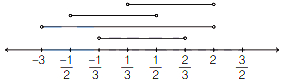
Events $A, B$ and $C$ are mutually exclusive events such that $P(A)=\frac{3x+1}{3}$,$P(B)=\frac{1-x}{4}$ and $P(C)=\frac{1-2x}{2}$. The set of possible values of $x$ is in the interval
A
$[\frac{1}{3}, \frac{1}{2}]$
B
$[\frac{1}{3}, \frac{2}{3}]$
C
$[\frac{1}{3}, \frac{13}{3}]$
D
$[0, 1]$
Solution
(A) Since $A, B, C$ are mutually exclusive,we have $P(A \cap B) = P(B \cap C) = P(C \cap A) = P(A \cap B \cap C) = 0$.
For any event $E$,$0 \leq P(E) \leq 1$.
$1$. For $P(A) = \frac{3x+1}{3}$: $0 \leq \frac{3x+1}{3} \leq 1 \implies 0 \leq 3x+1 \leq 3 \implies -1 \leq 3x \leq 2 \implies -\frac{1}{3} \leq x \leq \frac{2}{3}$.
$2$. For $P(B) = \frac{1-x}{4}$: $0 \leq \frac{1-x}{4} \leq 1 \implies 0 \leq 1-x \leq 4 \implies -1 \leq -x \leq 3 \implies -3 \leq x \leq 1$.
$3$. For $P(C) = \frac{1-2x}{2}$: $0 \leq \frac{1-2x}{2} \leq 1 \implies 0 \leq 1-2x \leq 2 \implies -1 \leq -2x \leq 1 \implies -\frac{1}{2} \leq x \leq \frac{1}{2}$.
Intersection of these intervals: $[-\frac{1}{3}, \frac{2}{3}] \cap [-3, 1] \cap [-\frac{1}{2}, \frac{1}{2}] = [-\frac{1}{3}, \frac{1}{2}]$.
Also,for mutually exclusive events,$P(A \cup B \cup C) = P(A) + P(B) + P(C) \leq 1$.
$\frac{3x+1}{3} + \frac{1-x}{4} + \frac{1-2x}{2} \leq 1$
$\frac{4(3x+1) + 3(1-x) + 6(1-2x)}{12} \leq 1$
$\frac{12x+4+3-3x+6-12x}{12} \leq 1 \implies \frac{13-3x}{12} \leq 1 \implies 13-3x \leq 12 \implies -3x \leq -1 \implies x \geq \frac{1}{3}$.
Combining $x \geq \frac{1}{3}$ with the intersection $[-\frac{1}{3}, \frac{1}{2}]$,we get $x \in [\frac{1}{3}, \frac{1}{2}]$.
For any event $E$,$0 \leq P(E) \leq 1$.
$1$. For $P(A) = \frac{3x+1}{3}$: $0 \leq \frac{3x+1}{3} \leq 1 \implies 0 \leq 3x+1 \leq 3 \implies -1 \leq 3x \leq 2 \implies -\frac{1}{3} \leq x \leq \frac{2}{3}$.
$2$. For $P(B) = \frac{1-x}{4}$: $0 \leq \frac{1-x}{4} \leq 1 \implies 0 \leq 1-x \leq 4 \implies -1 \leq -x \leq 3 \implies -3 \leq x \leq 1$.
$3$. For $P(C) = \frac{1-2x}{2}$: $0 \leq \frac{1-2x}{2} \leq 1 \implies 0 \leq 1-2x \leq 2 \implies -1 \leq -2x \leq 1 \implies -\frac{1}{2} \leq x \leq \frac{1}{2}$.
Intersection of these intervals: $[-\frac{1}{3}, \frac{2}{3}] \cap [-3, 1] \cap [-\frac{1}{2}, \frac{1}{2}] = [-\frac{1}{3}, \frac{1}{2}]$.
Also,for mutually exclusive events,$P(A \cup B \cup C) = P(A) + P(B) + P(C) \leq 1$.
$\frac{3x+1}{3} + \frac{1-x}{4} + \frac{1-2x}{2} \leq 1$
$\frac{4(3x+1) + 3(1-x) + 6(1-2x)}{12} \leq 1$
$\frac{12x+4+3-3x+6-12x}{12} \leq 1 \implies \frac{13-3x}{12} \leq 1 \implies 13-3x \leq 12 \implies -3x \leq -1 \implies x \geq \frac{1}{3}$.
Combining $x \geq \frac{1}{3}$ with the intersection $[-\frac{1}{3}, \frac{1}{2}]$,we get $x \in [\frac{1}{3}, \frac{1}{2}]$.
0 likes
View Solution407
MediumMCQ
Three students $A$,$B$ and $C$ are running a race. $A$ and $B$ have the same probability of winning and each is twice as likely to win as $C$. Then,the probability that $B$ or $C$ wins is equal to (assuming there are no ties)
A
$\frac{2}{5}$
B
$\frac{3}{5}$
C
$\frac{3}{7}$
D
$\frac{2}{7}$
Solution
(B) Let the winning probability of $C$ be $P(C) = p$.
Since $A$ and $B$ are twice as likely to win as $C$,we have $P(A) = 2p$ and $P(B) = 2p$.
Since the sum of probabilities of all possible outcomes is $1$,we have $P(A) + P(B) + P(C) = 1$.
Substituting the values,we get $2p + 2p + p = 1$,which implies $5p = 1$,so $p = \frac{1}{5}$.
The probability that $B$ or $C$ wins is $P(B \cup C) = P(B) + P(C)$ (since the events are mutually exclusive).
$P(B \cup C) = 2p + p = 3p = 3 \times \frac{1}{5} = \frac{3}{5}$.
Since $A$ and $B$ are twice as likely to win as $C$,we have $P(A) = 2p$ and $P(B) = 2p$.
Since the sum of probabilities of all possible outcomes is $1$,we have $P(A) + P(B) + P(C) = 1$.
Substituting the values,we get $2p + 2p + p = 1$,which implies $5p = 1$,so $p = \frac{1}{5}$.
The probability that $B$ or $C$ wins is $P(B \cup C) = P(B) + P(C)$ (since the events are mutually exclusive).
$P(B \cup C) = 2p + p = 3p = 3 \times \frac{1}{5} = \frac{3}{5}$.
0 likes
View Solution408
EasyMCQ
$A$ and $B$ are two events such that $P(A)=0.58$,$P(B)=0.32$ and $P(A \cap B)=0.28$. Then the probability that neither $A$ nor $B$ occurs is
A
$0.38$
B
$0.62$
C
$0.72$
D
$0.9$
Solution
(A) We need to find the probability that neither $A$ nor $B$ occurs,which is $P(\bar{A} \cap \bar{B})$.
By De Morgan's Law,$P(\bar{A} \cap \bar{B}) = P(\overline{A \cup B}) = 1 - P(A \cup B)$.
Using the addition rule of probability,$P(A \cup B) = P(A) + P(B) - P(A \cap B)$.
Substituting the given values:
$P(A \cup B) = 0.58 + 0.32 - 0.28 = 0.62$.
Therefore,$P(\bar{A} \cap \bar{B}) = 1 - 0.62 = 0.38$.
By De Morgan's Law,$P(\bar{A} \cap \bar{B}) = P(\overline{A \cup B}) = 1 - P(A \cup B)$.
Using the addition rule of probability,$P(A \cup B) = P(A) + P(B) - P(A \cap B)$.
Substituting the given values:
$P(A \cup B) = 0.58 + 0.32 - 0.28 = 0.62$.
Therefore,$P(\bar{A} \cap \bar{B}) = 1 - 0.62 = 0.38$.
0 likes
View Solution409
MediumMCQ
$A$ die is formed so that the probability of getting a number $i$ when it is rolled is proportional to $i$ $(i=1, 2, 3, 4, 5, 6)$. The probability of getting an odd number on the die when it is rolled is
A
$\frac{1}{2}$
B
$\frac{4}{7}$
C
$\frac{2}{7}$
D
$\frac{3}{7}$
Solution
(D) Let the probability of getting a number $i$ be $P(i)$.
Since $P(i) \propto i$,we have $P(i) = Ki$ for some constant $K$.
The sum of all probabilities must be $1$:
$\sum_{i=1}^{6} P(i) = K(1+2+3+4+5+6) = 21K = 1$.
Thus,$K = \frac{1}{21}$.
The probability of getting an odd number is $P(1) + P(3) + P(5)$.
$= K(1 + 3 + 5) = 9K$.
$= 9 \times \frac{1}{21} = \frac{9}{21} = \frac{3}{7}$.
Since $P(i) \propto i$,we have $P(i) = Ki$ for some constant $K$.
The sum of all probabilities must be $1$:
$\sum_{i=1}^{6} P(i) = K(1+2+3+4+5+6) = 21K = 1$.
Thus,$K = \frac{1}{21}$.
The probability of getting an odd number is $P(1) + P(3) + P(5)$.
$= K(1 + 3 + 5) = 9K$.
$= 9 \times \frac{1}{21} = \frac{9}{21} = \frac{3}{7}$.
0 likes
View Solution410
EasyMCQ
If $A$ and $B$ are any two events such that $P(\overline{A \cup B}) = \frac{1}{6}$,$P(A \cap B) = \frac{1}{4}$,and $P(\bar{A}) = \frac{1}{4}$,then the events $A$ and $B$ are
A
Equally likely but not independent
B
Equally likely and mutually exclusive
C
Mutually exclusive and independent
D
Independent but not equally likely
Solution
(D) Given $P(\bar{A}) = \frac{1}{4}$,so $P(A) = 1 - \frac{1}{4} = \frac{3}{4}$.
Given $P(\overline{A \cup B}) = \frac{1}{6}$,so $P(A \cup B) = 1 - \frac{1}{6} = \frac{5}{6}$.
Using the formula $P(A \cup B) = P(A) + P(B) - P(A \cap B)$,we have $\frac{5}{6} = \frac{3}{4} + P(B) - \frac{1}{4}$.
$\frac{5}{6} = \frac{2}{4} + P(B) = \frac{1}{2} + P(B)$.
$P(B) = \frac{5}{6} - \frac{1}{2} = \frac{5-3}{6} = \frac{2}{6} = \frac{1}{3}$.
Since $P(A) = \frac{3}{4}$ and $P(B) = \frac{1}{3}$,$P(A) \neq P(B)$,so they are not equally likely.
Check for independence: $P(A) \times P(B) = \frac{3}{4} \times \frac{1}{3} = \frac{1}{4}$.
Since $P(A \cap B) = \frac{1}{4}$,we have $P(A \cap B) = P(A) \times P(B)$,which means $A$ and $B$ are independent.
Thus,the events are independent but not equally likely.
Given $P(\overline{A \cup B}) = \frac{1}{6}$,so $P(A \cup B) = 1 - \frac{1}{6} = \frac{5}{6}$.
Using the formula $P(A \cup B) = P(A) + P(B) - P(A \cap B)$,we have $\frac{5}{6} = \frac{3}{4} + P(B) - \frac{1}{4}$.
$\frac{5}{6} = \frac{2}{4} + P(B) = \frac{1}{2} + P(B)$.
$P(B) = \frac{5}{6} - \frac{1}{2} = \frac{5-3}{6} = \frac{2}{6} = \frac{1}{3}$.
Since $P(A) = \frac{3}{4}$ and $P(B) = \frac{1}{3}$,$P(A) \neq P(B)$,so they are not equally likely.
Check for independence: $P(A) \times P(B) = \frac{3}{4} \times \frac{1}{3} = \frac{1}{4}$.
Since $P(A \cap B) = \frac{1}{4}$,we have $P(A \cap B) = P(A) \times P(B)$,which means $A$ and $B$ are independent.
Thus,the events are independent but not equally likely.
0 likes
View Solution411
MediumMCQ
If $A, B$ and $C$ are mutually exclusive and exhaustive events of a random experiment such that $P(A) = \frac{2}{3} P(B)$ and $P(B) = 2 P(C)$,then $P(A \cup C) =$
A
$\frac{3}{13}$
B
$\frac{5}{13}$
C
$\frac{7}{13}$
D
$\frac{9}{13}$
Solution
(C) Since $A, B, C$ are mutually exclusive and exhaustive events,$P(A) + P(B) + P(C) = 1$.
Given $P(B) = 2 P(C)$,we can write $P(C) = \frac{1}{2} P(B)$.
Also given $P(A) = \frac{2}{3} P(B)$.
Substituting these into the sum: $\frac{2}{3} P(B) + P(B) + \frac{1}{2} P(B) = 1$.
Finding a common denominator $(6)$: $\frac{4}{6} P(B) + \frac{6}{6} P(B) + \frac{3}{6} P(B) = 1$.
$\frac{13}{6} P(B) = 1 \implies P(B) = \frac{6}{13}$.
Then $P(A) = \frac{2}{3} \times \frac{6}{13} = \frac{4}{13}$ and $P(C) = \frac{1}{2} \times \frac{6}{13} = \frac{3}{13}$.
Since $A$ and $C$ are mutually exclusive,$P(A \cup C) = P(A) + P(C) = \frac{4}{13} + \frac{3}{13} = \frac{7}{13}$.
Given $P(B) = 2 P(C)$,we can write $P(C) = \frac{1}{2} P(B)$.
Also given $P(A) = \frac{2}{3} P(B)$.
Substituting these into the sum: $\frac{2}{3} P(B) + P(B) + \frac{1}{2} P(B) = 1$.
Finding a common denominator $(6)$: $\frac{4}{6} P(B) + \frac{6}{6} P(B) + \frac{3}{6} P(B) = 1$.
$\frac{13}{6} P(B) = 1 \implies P(B) = \frac{6}{13}$.
Then $P(A) = \frac{2}{3} \times \frac{6}{13} = \frac{4}{13}$ and $P(C) = \frac{1}{2} \times \frac{6}{13} = \frac{3}{13}$.
Since $A$ and $C$ are mutually exclusive,$P(A \cup C) = P(A) + P(C) = \frac{4}{13} + \frac{3}{13} = \frac{7}{13}$.
0 likes
View Solution412
EasyMCQ
$P, Q$ and $R$ try to hit the same target one after the other. If their probabilities of hitting the target are $\frac{2}{3}, \frac{3}{5}, \frac{5}{7}$ respectively,then the probability that the target is hit by $P$ or $Q$ but not by $R$ is
A
$\frac{26}{105}$
B
$\frac{79}{105}$
C
$0$
D
$\frac{75}{105}$
Solution
(A) Let $P, Q, R$ be the events that $P, Q, R$ hit the target respectively.
Given probabilities are $P(P) = \frac{2}{3}, P(Q) = \frac{3}{5}, P(R) = \frac{5}{7}$.
The probabilities of not hitting the target are $P(P') = 1 - \frac{2}{3} = \frac{1}{3}$,$P(Q') = 1 - \frac{3}{5} = \frac{2}{5}$,and $P(R') = 1 - \frac{5}{7} = \frac{2}{7}$.
We need the probability that the target is hit by $P$ or $Q$ but not by $R$. This can happen in three mutually exclusive ways:
$1$. $P$ hits,$Q$ misses,$R$ misses: $P(P) \times P(Q') \times P(R') = \frac{2}{3} \times \frac{2}{5} \times \frac{2}{7} = \frac{8}{105}$.
$2$. $P$ misses,$Q$ hits,$R$ misses: $P(P') \times P(Q) \times P(R') = \frac{1}{3} \times \frac{3}{5} \times \frac{2}{7} = \frac{6}{105}$.
$3$. $P$ hits,$Q$ hits,$R$ misses: $P(P) \times P(Q) \times P(R') = \frac{2}{3} \times \frac{3}{5} \times \frac{2}{7} = \frac{12}{105}$.
Summing these probabilities: $\frac{8}{105} + \frac{6}{105} + \frac{12}{105} = \frac{26}{105}$.
Given probabilities are $P(P) = \frac{2}{3}, P(Q) = \frac{3}{5}, P(R) = \frac{5}{7}$.
The probabilities of not hitting the target are $P(P') = 1 - \frac{2}{3} = \frac{1}{3}$,$P(Q') = 1 - \frac{3}{5} = \frac{2}{5}$,and $P(R') = 1 - \frac{5}{7} = \frac{2}{7}$.
We need the probability that the target is hit by $P$ or $Q$ but not by $R$. This can happen in three mutually exclusive ways:
$1$. $P$ hits,$Q$ misses,$R$ misses: $P(P) \times P(Q') \times P(R') = \frac{2}{3} \times \frac{2}{5} \times \frac{2}{7} = \frac{8}{105}$.
$2$. $P$ misses,$Q$ hits,$R$ misses: $P(P') \times P(Q) \times P(R') = \frac{1}{3} \times \frac{3}{5} \times \frac{2}{7} = \frac{6}{105}$.
$3$. $P$ hits,$Q$ hits,$R$ misses: $P(P) \times P(Q) \times P(R') = \frac{2}{3} \times \frac{3}{5} \times \frac{2}{7} = \frac{12}{105}$.
Summing these probabilities: $\frac{8}{105} + \frac{6}{105} + \frac{12}{105} = \frac{26}{105}$.
0 likes
View Solution413
MediumMCQ
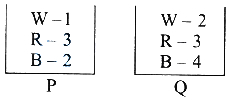
$A$ box $P$ contains one white ball,three red balls and two black balls. Another box $Q$ contains two white balls,three red balls and four black balls. If one ball is drawn at random from each one of the two boxes,then the probability that the balls drawn are of different colour is
A
$\frac{29}{54}$
B
$\frac{25}{42}$
C
$\frac{35}{54}$
D
$\frac{39}{52}$
Solution
(C) Total balls in box $P = 1 + 3 + 2 = 6$.
Total balls in box $Q = 2 + 3 + 4 = 9$.
Let $W_P, R_P, B_P$ be the events of drawing a white,red,and black ball from box $P$ respectively,and $W_Q, R_Q, B_Q$ be the corresponding events for box $Q$.
The probabilities are:
$P(W_P) = \frac{1}{6}, P(R_P) = \frac{3}{6}, P(B_P) = \frac{2}{6}$
$P(W_Q) = \frac{2}{9}, P(R_Q) = \frac{3}{9}, P(B_Q) = \frac{4}{9}$
The probability that the balls are of the same colour is:
$P(\text{same}) = P(W_P)P(W_Q) + P(R_P)P(R_Q) + P(B_P)P(B_Q)$
$P(\text{same}) = (\frac{1}{6} \times \frac{2}{9}) + (\frac{3}{6} \times \frac{3}{9}) + (\frac{2}{6} \times \frac{4}{9}) = \frac{2 + 9 + 8}{54} = \frac{19}{54}$
The probability that the balls are of different colours is:
$P(\text{different}) = 1 - P(\text{same}) = 1 - \frac{19}{54} = \frac{35}{54}$
Total balls in box $Q = 2 + 3 + 4 = 9$.
Let $W_P, R_P, B_P$ be the events of drawing a white,red,and black ball from box $P$ respectively,and $W_Q, R_Q, B_Q$ be the corresponding events for box $Q$.
The probabilities are:
$P(W_P) = \frac{1}{6}, P(R_P) = \frac{3}{6}, P(B_P) = \frac{2}{6}$
$P(W_Q) = \frac{2}{9}, P(R_Q) = \frac{3}{9}, P(B_Q) = \frac{4}{9}$
The probability that the balls are of the same colour is:
$P(\text{same}) = P(W_P)P(W_Q) + P(R_P)P(R_Q) + P(B_P)P(B_Q)$
$P(\text{same}) = (\frac{1}{6} \times \frac{2}{9}) + (\frac{3}{6} \times \frac{3}{9}) + (\frac{2}{6} \times \frac{4}{9}) = \frac{2 + 9 + 8}{54} = \frac{19}{54}$
The probability that the balls are of different colours is:
$P(\text{different}) = 1 - P(\text{same}) = 1 - \frac{19}{54} = \frac{35}{54}$
0 likes
View Solution414
MediumMCQ
If two numbers $x$ and $y$ are chosen one after the other at random with replacement from the set of numbers $\{1, 2, 3, \ldots, 10\}$,then the probability that $|x^2 - y^2|$ is divisible by $6$ is
A
$\frac{8}{25}$
B
$\frac{6}{25}$
C
$\frac{3}{10}$
D
$\frac{13}{50}$
Solution
(C) The total number of ways to select two numbers $x$ and $y$ from the set $\{1, 2, 3, \ldots, 10\}$ with replacement is $10 \times 10 = 100$.
We want to find the number of pairs $(x, y)$ such that $|x^2 - y^2|$ is divisible by $6$.
This condition is equivalent to $|(x - y)(x + y)|$ being divisible by $6$.
We analyze the pairs $(x, y)$ by iterating through $x$ from $1$ to $10$ and finding $y$ such that $x^2 \equiv y^2 \pmod{6}$.
The squares modulo $6$ are: $1^2 \equiv 1, 2^2 \equiv 4, 3^2 \equiv 3, 4^2 \equiv 4, 5^2 \equiv 1, 6^2 \equiv 0, 7^2 \equiv 1, 8^2 \equiv 4, 9^2 \equiv 3, 10^2 \equiv 4$.
Grouping by values: $0: \{6\}$,$1: \{1, 5, 7\}$,$3: \{3, 9\}$,$4: \{2, 4, 8, 10\}$.
Number of pairs $(x, y)$ such that $x^2 \equiv y^2 \pmod{6}$ is:
For $x^2 \equiv 0$: $1^2 = 1$ pair $(6, 6)$.
For $x^2 \equiv 1$: $3^2 = 9$ pairs (from $\{1, 5, 7\} \times \{1, 5, 7\}$).
For $x^2 \equiv 3$: $2^2 = 4$ pairs (from $\{3, 9\} \times \{3, 9\}$).
For $x^2 \equiv 4$: $4^2 = 16$ pairs (from $\{2, 4, 8, 10\} \times \{2, 4, 8, 10\}$).
Total favorable outcomes $= 1 + 9 + 4 + 16 = 30$.
Probability $= \frac{30}{100} = \frac{3}{10}$.
We want to find the number of pairs $(x, y)$ such that $|x^2 - y^2|$ is divisible by $6$.
This condition is equivalent to $|(x - y)(x + y)|$ being divisible by $6$.
We analyze the pairs $(x, y)$ by iterating through $x$ from $1$ to $10$ and finding $y$ such that $x^2 \equiv y^2 \pmod{6}$.
The squares modulo $6$ are: $1^2 \equiv 1, 2^2 \equiv 4, 3^2 \equiv 3, 4^2 \equiv 4, 5^2 \equiv 1, 6^2 \equiv 0, 7^2 \equiv 1, 8^2 \equiv 4, 9^2 \equiv 3, 10^2 \equiv 4$.
Grouping by values: $0: \{6\}$,$1: \{1, 5, 7\}$,$3: \{3, 9\}$,$4: \{2, 4, 8, 10\}$.
Number of pairs $(x, y)$ such that $x^2 \equiv y^2 \pmod{6}$ is:
For $x^2 \equiv 0$: $1^2 = 1$ pair $(6, 6)$.
For $x^2 \equiv 1$: $3^2 = 9$ pairs (from $\{1, 5, 7\} \times \{1, 5, 7\}$).
For $x^2 \equiv 3$: $2^2 = 4$ pairs (from $\{3, 9\} \times \{3, 9\}$).
For $x^2 \equiv 4$: $4^2 = 16$ pairs (from $\{2, 4, 8, 10\} \times \{2, 4, 8, 10\}$).
Total favorable outcomes $= 1 + 9 + 4 + 16 = 30$.
Probability $= \frac{30}{100} = \frac{3}{10}$.
0 likes
View Solution415
MediumMCQ
Two brothers $X$ and $Y$ appeared for an exam. Let $A$ be the event that $X$ has passed the exam and $B$ is the event that $Y$ has passed. The probability of $A$ is $\frac{1}{7}$ and of $B$ is $\frac{2}{9}$. Then,the probability that both of them pass the exam is
A
$\frac{1}{63}$
B
$\frac{2}{35}$
C
$\frac{2}{63}$
D
$\frac{9}{14}$
Solution
(C) Given that $A$ is the event that $X$ passes the exam and $B$ is the event that $Y$ passes the exam.
$P(A) = \frac{1}{7}$ and $P(B) = \frac{2}{9}$.
Since the events $A$ and $B$ are independent,the probability that both pass the exam is given by $P(A \cap B) = P(A) \times P(B)$.
Substituting the values,we get $P(A \cap B) = \frac{1}{7} \times \frac{2}{9} = \frac{2}{63}$.
$P(A) = \frac{1}{7}$ and $P(B) = \frac{2}{9}$.
Since the events $A$ and $B$ are independent,the probability that both pass the exam is given by $P(A \cap B) = P(A) \times P(B)$.
Substituting the values,we get $P(A \cap B) = \frac{1}{7} \times \frac{2}{9} = \frac{2}{63}$.
0 likes
View Solution416
EasyMCQ
Three unbiased coins are tossed. Then,the probability of getting at most two heads is
A
$3 / 4$
B
$1 / 4$
C
$3 / 8$
D
$7 / 8$
Solution
(D) When three unbiased coins are tossed,the sample space $S$ is given by:
$S = \{HHH, HHT, HTH, HTT, THH, THT, TTH, TTT\}$
The total number of outcomes is $n(S) = 8$.
Let $E$ be the event of getting at most two heads.
It is easier to calculate the complement event $E'$,which is the event of getting three heads.
$E' = \{HHH\}$
The number of outcomes in $E'$ is $n(E') = 1$.
The probability of getting three heads is $P(E') = \frac{n(E')}{n(S)} = \frac{1}{8}$.
The probability of getting at most two heads is $P(E) = 1 - P(E') = 1 - \frac{1}{8} = \frac{7}{8}$.
$S = \{HHH, HHT, HTH, HTT, THH, THT, TTH, TTT\}$
The total number of outcomes is $n(S) = 8$.
Let $E$ be the event of getting at most two heads.
It is easier to calculate the complement event $E'$,which is the event of getting three heads.
$E' = \{HHH\}$
The number of outcomes in $E'$ is $n(E') = 1$.
The probability of getting three heads is $P(E') = \frac{n(E')}{n(S)} = \frac{1}{8}$.
The probability of getting at most two heads is $P(E) = 1 - P(E') = 1 - \frac{1}{8} = \frac{7}{8}$.
0 likes
View Solution417
EasyMCQ
Two dice are thrown simultaneously. The probability of getting a multiple of $2$ on one die and a multiple of $3$ on the other die is
A
$\frac{5}{12}$
B
$\frac{11}{36}$
C
$\frac{13}{36}$
D
$\frac{5}{36}$
Solution
(B) When two dice are thrown simultaneously,the total number of outcomes is $n(S) = 6 \times 6 = 36$.
Let $A$ be the event of getting a multiple of $2$ on the first die,i.e.,$A \in \{2, 4, 6\}$.
Let $B$ be the event of getting a multiple of $3$ on the second die,i.e.,$B \in \{3, 6\}$.
We want to find the probability of getting a multiple of $2$ on one die and a multiple of $3$ on the other.
Let $E$ be the set of favorable outcomes:
$E = \{(2,3), (4,3), (6,3), (2,6), (4,6), (6,6), (3,2), (3,4), (3,6), (6,2), (6,4)\}$.
Note that $(6,6)$ is included because it satisfies the condition of having a multiple of $2$ on one die and a multiple of $3$ on the other.
Counting the elements in $E$,we get $n(E) = 11$.
Therefore,the probability $P(E) = \frac{n(E)}{n(S)} = \frac{11}{36}$.
Let $A$ be the event of getting a multiple of $2$ on the first die,i.e.,$A \in \{2, 4, 6\}$.
Let $B$ be the event of getting a multiple of $3$ on the second die,i.e.,$B \in \{3, 6\}$.
We want to find the probability of getting a multiple of $2$ on one die and a multiple of $3$ on the other.
Let $E$ be the set of favorable outcomes:
$E = \{(2,3), (4,3), (6,3), (2,6), (4,6), (6,6), (3,2), (3,4), (3,6), (6,2), (6,4)\}$.
Note that $(6,6)$ is included because it satisfies the condition of having a multiple of $2$ on one die and a multiple of $3$ on the other.
Counting the elements in $E$,we get $n(E) = 11$.
Therefore,the probability $P(E) = \frac{n(E)}{n(S)} = \frac{11}{36}$.
0 likes
View Solution418
EasyMCQ
One card is selected at random from $27$ cards numbered from $1$ to $27$. What is the probability that the number on the card is even or divisible by $5$?
A
$\frac{15}{27}$
B
$\frac{16}{27}$
C
$\frac{17}{27}$
D
$\frac{18}{27}$
Solution
(B) Total number of cards $n(S) = 27$.
Let $E$ be the event that the number is even. The even numbers between $1$ and $27$ are $\{2, 4, 6, 8, 10, 12, 14, 16, 18, 20, 22, 24, 26\}$.
Thus,$n(E) = 13$.
Let $F$ be the event that the number is divisible by $5$. The numbers divisible by $5$ are $\{5, 10, 15, 20, 25\}$.
Thus,$n(F) = 5$.
The intersection $E \cap F$ contains numbers that are both even and divisible by $5$,which are multiples of $10$. These are $\{10, 20\}$.
Thus,$n(E \cap F) = 2$.
Using the addition rule for probability,$n(E \cup F) = n(E) + n(F) - n(E \cap F) = 13 + 5 - 2 = 16$.
The probability is $P(E \cup F) = \frac{n(E \cup F)}{n(S)} = \frac{16}{27}$.
Let $E$ be the event that the number is even. The even numbers between $1$ and $27$ are $\{2, 4, 6, 8, 10, 12, 14, 16, 18, 20, 22, 24, 26\}$.
Thus,$n(E) = 13$.
Let $F$ be the event that the number is divisible by $5$. The numbers divisible by $5$ are $\{5, 10, 15, 20, 25\}$.
Thus,$n(F) = 5$.
The intersection $E \cap F$ contains numbers that are both even and divisible by $5$,which are multiples of $10$. These are $\{10, 20\}$.
Thus,$n(E \cap F) = 2$.
Using the addition rule for probability,$n(E \cup F) = n(E) + n(F) - n(E \cap F) = 13 + 5 - 2 = 16$.
The probability is $P(E \cup F) = \frac{n(E \cup F)}{n(S)} = \frac{16}{27}$.
0 likes
View Solution419
EasyMCQ
$A$ problem is given to $3$ students $A, B$ and $C$ whose chances of solving it are $\frac{1}{2}, \frac{1}{3}$ and $\frac{1}{4}$ respectively. Then,the probability of the problem being solved by exactly one of them,if all the three try independently,is
A
$\frac{3}{4}$
B
$\frac{11}{24}$
C
$\frac{23}{24}$
D
$\frac{1}{4}$
Solution
(B) Let $P(A) = \frac{1}{2}$,$P(B) = \frac{1}{3}$,and $P(C) = \frac{1}{4}$ be the probabilities of students $A, B$,and $C$ solving the problem respectively.
Then,the probabilities of them not solving the problem are $P(\bar{A}) = 1 - \frac{1}{2} = \frac{1}{2}$,$P(\bar{B}) = 1 - \frac{1}{3} = \frac{2}{3}$,and $P(\bar{C}) = 1 - \frac{1}{4} = \frac{3}{4}$.
The probability that exactly one of them solves the problem is given by:
$P(\text{Exactly one}) = P(A)P(\bar{B})P(\bar{C}) + P(\bar{A})P(B)P(\bar{C}) + P(\bar{A})P(\bar{B})P(C)$
$= (\frac{1}{2} \times \frac{2}{3} \times \frac{3}{4}) + (\frac{1}{2} \times \frac{1}{3} \times \frac{3}{4}) + (\frac{1}{2} \times \frac{2}{3} \times \frac{1}{4})$
$= \frac{6}{24} + \frac{3}{24} + \frac{2}{24} = \frac{11}{24}$.
Then,the probabilities of them not solving the problem are $P(\bar{A}) = 1 - \frac{1}{2} = \frac{1}{2}$,$P(\bar{B}) = 1 - \frac{1}{3} = \frac{2}{3}$,and $P(\bar{C}) = 1 - \frac{1}{4} = \frac{3}{4}$.
The probability that exactly one of them solves the problem is given by:
$P(\text{Exactly one}) = P(A)P(\bar{B})P(\bar{C}) + P(\bar{A})P(B)P(\bar{C}) + P(\bar{A})P(\bar{B})P(C)$
$= (\frac{1}{2} \times \frac{2}{3} \times \frac{3}{4}) + (\frac{1}{2} \times \frac{1}{3} \times \frac{3}{4}) + (\frac{1}{2} \times \frac{2}{3} \times \frac{1}{4})$
$= \frac{6}{24} + \frac{3}{24} + \frac{2}{24} = \frac{11}{24}$.
0 likes
View Solution420
MediumMCQ
Boxes $B_1, B_2$,and $B_3$ contain balls as given below:
One ball is drawn at random from each box. Then,among the balls drawn,the probability that two are black and one is white,is
| Box | White | Black |
| $B_1$ | $1$ | $2$ |
| $B_2$ | $3$ | $1$ |
| $B_3$ | $2$ | $3$ |
One ball is drawn at random from each box. Then,among the balls drawn,the probability that two are black and one is white,is
A
$\frac{5}{12}$
B
$\frac{7}{12}$
C
$\frac{9}{12}$
D
$\frac{11}{12}$
Solution
(A) Let $W_i$ and $B_i$ denote the events of drawing a white ball and a black ball from box $B_i$ respectively. The probabilities are:
For $B_1$: $P(W_1) = \frac{1}{3}, P(B_1) = \frac{2}{3}$
For $B_2$: $P(W_2) = \frac{3}{4}, P(B_2) = \frac{1}{4}$
For $B_3$: $P(W_3) = \frac{2}{5}, P(B_3) = \frac{3}{5}$
We want the probability of drawing two black balls and one white ball. This can happen in three mutually exclusive ways:
$1$. $(W_1, B_2, B_3)$: $P(W_1) \times P(B_2) \times P(B_3) = \frac{1}{3} \times \frac{1}{4} \times \frac{3}{5} = \frac{3}{60}$
$2$. $(B_1, W_2, B_3)$: $P(B_1) \times P(W_2) \times P(B_3) = \frac{2}{3} \times \frac{3}{4} \times \frac{3}{5} = \frac{18}{60}$
$3$. $(B_1, B_2, W_3)$: $P(B_1) \times P(B_2) \times P(W_3) = \frac{2}{3} \times \frac{1}{4} \times \frac{2}{5} = \frac{4}{60}$
The total probability is the sum of these probabilities:
$P = \frac{3}{60} + \frac{18}{60} + \frac{4}{60} = \frac{25}{60} = \frac{5}{12}$
For $B_1$: $P(W_1) = \frac{1}{3}, P(B_1) = \frac{2}{3}$
For $B_2$: $P(W_2) = \frac{3}{4}, P(B_2) = \frac{1}{4}$
For $B_3$: $P(W_3) = \frac{2}{5}, P(B_3) = \frac{3}{5}$
We want the probability of drawing two black balls and one white ball. This can happen in three mutually exclusive ways:
$1$. $(W_1, B_2, B_3)$: $P(W_1) \times P(B_2) \times P(B_3) = \frac{1}{3} \times \frac{1}{4} \times \frac{3}{5} = \frac{3}{60}$
$2$. $(B_1, W_2, B_3)$: $P(B_1) \times P(W_2) \times P(B_3) = \frac{2}{3} \times \frac{3}{4} \times \frac{3}{5} = \frac{18}{60}$
$3$. $(B_1, B_2, W_3)$: $P(B_1) \times P(B_2) \times P(W_3) = \frac{2}{3} \times \frac{1}{4} \times \frac{2}{5} = \frac{4}{60}$
The total probability is the sum of these probabilities:
$P = \frac{3}{60} + \frac{18}{60} + \frac{4}{60} = \frac{25}{60} = \frac{5}{12}$
0 likes
View Solution421
MediumMCQ
$A$ coin and a six-faced die,both unbiased,are thrown simultaneously. The probability of getting a head on the coin and an odd number on the die is:
A
$\frac{1}{2}$
B
$\frac{3}{4}$
C
$\frac{1}{4}$
D
$\frac{2}{3}$
Solution
(C) Let $E$ be the event of getting a head from a coin.
Let $F$ be the event of getting an odd number $(1, 3, 5)$ from a die.
The probability of getting a head is $P(E) = \frac{1}{2}$.
The probability of getting an odd number on a six-faced die is $P(F) = \frac{3}{6} = \frac{1}{2}$.
Since the coin and the die are independent,the events $E$ and $F$ are independent.
Therefore,the probability of both events occurring is $P(E \cap F) = P(E) \times P(F)$.
$P(E \cap F) = \frac{1}{2} \times \frac{1}{2} = \frac{1}{4}$.
Let $F$ be the event of getting an odd number $(1, 3, 5)$ from a die.
The probability of getting a head is $P(E) = \frac{1}{2}$.
The probability of getting an odd number on a six-faced die is $P(F) = \frac{3}{6} = \frac{1}{2}$.
Since the coin and the die are independent,the events $E$ and $F$ are independent.
Therefore,the probability of both events occurring is $P(E \cap F) = P(E) \times P(F)$.
$P(E \cap F) = \frac{1}{2} \times \frac{1}{2} = \frac{1}{4}$.
0 likes
View Solution422
MediumMCQ
In a competition,$A, B$,and $C$ are participating. The probability that $A$ wins is twice that of $B$,and the probability that $B$ wins is twice that of $C$. Then,the probability that $A$ loses is:
A
$\frac{1}{7}$
B
$\frac{2}{7}$
C
$\frac{4}{7}$
D
$\frac{3}{7}$
Solution
(D) Let $P(C) = p$. Then $P(B) = 2p$ and $P(A) = 2(2p) = 4p$.
Since one of them must win,the sum of their probabilities is $1$:
$P(A) + P(B) + P(C) = 1$
$4p + 2p + p = 1$
$7p = 1$
$p = \frac{1}{7}$
Therefore,$P(A) = 4p = 4 \times \frac{1}{7} = \frac{4}{7}$.
The probability that $A$ loses is $P(\bar{A}) = 1 - P(A) = 1 - \frac{4}{7} = \frac{3}{7}$.
Since one of them must win,the sum of their probabilities is $1$:
$P(A) + P(B) + P(C) = 1$
$4p + 2p + p = 1$
$7p = 1$
$p = \frac{1}{7}$
Therefore,$P(A) = 4p = 4 \times \frac{1}{7} = \frac{4}{7}$.
The probability that $A$ loses is $P(\bar{A}) = 1 - P(A) = 1 - \frac{4}{7} = \frac{3}{7}$.
0 likes
View Solution423
MediumMCQ
$A$ problem in Algebra is given to two students $A$ and $B$ whose chances of solving it are $\frac{2}{5}$ and $\frac{3}{4}$ respectively. The probability that the problem is solved if both of them try independently is
A
$\frac{17}{20}$
B
$\frac{3}{20}$
C
$\frac{1}{2}$
D
$\frac{13}{20}$
Solution
(A) Let $P(A)$ be the probability that student $A$ solves the problem,so $P(A) = \frac{2}{5}$.
Let $P(B)$ be the probability that student $B$ solves the problem,so $P(B) = \frac{3}{4}$.
The probability that student $A$ does not solve the problem is $P(A') = 1 - P(A) = 1 - \frac{2}{5} = \frac{3}{5}$.
The probability that student $B$ does not solve the problem is $P(B') = 1 - P(B) = 1 - \frac{3}{4} = \frac{1}{4}$.
The problem is solved if at least one of them solves it. This is the complement of the event that neither of them solves the problem.
Probability that neither solves the problem = $P(A') \times P(B') = \frac{3}{5} \times \frac{1}{4} = \frac{3}{20}$.
Probability that the problem is solved = $1 - P(\text{neither solves}) = 1 - \frac{3}{20} = \frac{17}{20}$.
Let $P(B)$ be the probability that student $B$ solves the problem,so $P(B) = \frac{3}{4}$.
The probability that student $A$ does not solve the problem is $P(A') = 1 - P(A) = 1 - \frac{2}{5} = \frac{3}{5}$.
The probability that student $B$ does not solve the problem is $P(B') = 1 - P(B) = 1 - \frac{3}{4} = \frac{1}{4}$.
The problem is solved if at least one of them solves it. This is the complement of the event that neither of them solves the problem.
Probability that neither solves the problem = $P(A') \times P(B') = \frac{3}{5} \times \frac{1}{4} = \frac{3}{20}$.
Probability that the problem is solved = $1 - P(\text{neither solves}) = 1 - \frac{3}{20} = \frac{17}{20}$.
0 likes
View Solution424
MediumMCQ
The probability that a person $A$ completes a work in a given time is $\frac{2}{3}$ and the probability that another person $B$ completes the same work in the same time is $\frac{3}{4}$. If both $A$ and $B$ start doing this work at the same time,then the probability that the work is completed in the given time is
A
$\frac{11}{12}$
B
$\frac{1}{2}$
C
$\frac{5}{12}$
D
$\frac{8}{9}$
Solution
(A) Let $P(A)$ be the probability that person $A$ completes the work,$P(A) = \frac{2}{3}$.
Let $P(B)$ be the probability that person $B$ completes the work,$P(B) = \frac{3}{4}$.
The work is completed if at least one of them completes the work.
This is given by $P(A \cup B) = P(A) + P(B) - P(A \cap B)$.
Since the events are independent,$P(A \cap B) = P(A) \times P(B) = \frac{2}{3} \times \frac{3}{4} = \frac{6}{12} = \frac{1}{2}$.
Therefore,$P(A \cup B) = \frac{2}{3} + \frac{3}{4} - \frac{1}{2}$.
Finding a common denominator of $12$:
$P(A \cup B) = \frac{8}{12} + \frac{9}{12} - \frac{6}{12} = \frac{11}{12}$.
Thus,the probability that the work is completed is $\frac{11}{12}$.
Let $P(B)$ be the probability that person $B$ completes the work,$P(B) = \frac{3}{4}$.
The work is completed if at least one of them completes the work.
This is given by $P(A \cup B) = P(A) + P(B) - P(A \cap B)$.
Since the events are independent,$P(A \cap B) = P(A) \times P(B) = \frac{2}{3} \times \frac{3}{4} = \frac{6}{12} = \frac{1}{2}$.
Therefore,$P(A \cup B) = \frac{2}{3} + \frac{3}{4} - \frac{1}{2}$.
Finding a common denominator of $12$:
$P(A \cup B) = \frac{8}{12} + \frac{9}{12} - \frac{6}{12} = \frac{11}{12}$.
Thus,the probability that the work is completed is $\frac{11}{12}$.
0 likes
View Solution425
DifficultMCQ
Let $A$ and $B$ be two independent events of a random experiment. If the probability that both $A$ and $B$ occur is $\frac{1}{6}$ and the probability that neither of them occur is $\frac{1}{3}$,then the probability of occurrence of $A$ is
A
$0$ or $1$
B
$\frac{1}{2}$ or $\frac{1}{4}$
C
$\frac{1}{2}$ or $\frac{1}{3}$
D
$\frac{1}{2}$ or $\frac{1}{7}$
Solution
(C) Since $A$ and $B$ are independent events,we have $P(A \cap B) = P(A) \cdot P(B)$.
Given $P(A \cap B) = \frac{1}{6}$,let $P(A) = x$ and $P(B) = y$. Thus,$xy = \frac{1}{6}$.
The probability that neither occurs is $P(A' \cap B') = P((A \cup B)') = 1 - P(A \cup B) = \frac{1}{3}$.
Therefore,$P(A \cup B) = 1 - \frac{1}{3} = \frac{2}{3}$.
Using the formula $P(A \cup B) = P(A) + P(B) - P(A \cap B)$,we get $x + y - \frac{1}{6} = \frac{2}{3}$,which implies $x + y = \frac{5}{6}$.
Substituting $y = \frac{5}{6} - x$ into $xy = \frac{1}{6}$,we get $x(\frac{5}{6} - x) = \frac{1}{6}$.
This simplifies to $6x^2 - 5x + 1 = 0$.
Factoring the quadratic equation,we get $(2x - 1)(3x - 1) = 0$.
Thus,$x = \frac{1}{2}$ or $x = \frac{1}{3}$.
Hence,the probability of occurrence of $A$ is $\frac{1}{2}$ or $\frac{1}{3}$.
Given $P(A \cap B) = \frac{1}{6}$,let $P(A) = x$ and $P(B) = y$. Thus,$xy = \frac{1}{6}$.
The probability that neither occurs is $P(A' \cap B') = P((A \cup B)') = 1 - P(A \cup B) = \frac{1}{3}$.
Therefore,$P(A \cup B) = 1 - \frac{1}{3} = \frac{2}{3}$.
Using the formula $P(A \cup B) = P(A) + P(B) - P(A \cap B)$,we get $x + y - \frac{1}{6} = \frac{2}{3}$,which implies $x + y = \frac{5}{6}$.
Substituting $y = \frac{5}{6} - x$ into $xy = \frac{1}{6}$,we get $x(\frac{5}{6} - x) = \frac{1}{6}$.
This simplifies to $6x^2 - 5x + 1 = 0$.
Factoring the quadratic equation,we get $(2x - 1)(3x - 1) = 0$.
Thus,$x = \frac{1}{2}$ or $x = \frac{1}{3}$.
Hence,the probability of occurrence of $A$ is $\frac{1}{2}$ or $\frac{1}{3}$.
0 likes
View Solution426
EasyMCQ
If $X_1, X_2, \ldots, X_n$ are $n$ independent events such that $P(X_r) = \frac{1}{r+1}$ for $r = 1, 2, \ldots, n$,then the probability that none of the $n$ events occur is
A
$\frac{1}{n}$
B
$\frac{1}{n+1}$
C
$\frac{n}{n+1}$
D
$\frac{n+1}{n+2}$
Solution
(B) The probability that none of the $n$ independent events $X_1, X_2, \ldots, X_n$ occur is given by $P(X_1' \cap X_2' \cap \ldots \cap X_n')$.
Since the events are independent,this is equal to $P(X_1') P(X_2') \ldots P(X_n')$.
Given $P(X_r) = \frac{1}{r+1}$,the probability of the complement event is $P(X_r') = 1 - P(X_r) = 1 - \frac{1}{r+1} = \frac{r}{r+1}$.
Thus,the required probability is:
$P(X_1') P(X_2') \ldots P(X_n') = \left(1 - \frac{1}{2}\right) \left(1 - \frac{1}{3}\right) \ldots \left(1 - \frac{1}{n+1}\right)$
$= \frac{1}{2} \times \frac{2}{3} \times \frac{3}{4} \times \ldots \times \frac{n}{n+1}$
$= \frac{1}{n+1}$.
Since the events are independent,this is equal to $P(X_1') P(X_2') \ldots P(X_n')$.
Given $P(X_r) = \frac{1}{r+1}$,the probability of the complement event is $P(X_r') = 1 - P(X_r) = 1 - \frac{1}{r+1} = \frac{r}{r+1}$.
Thus,the required probability is:
$P(X_1') P(X_2') \ldots P(X_n') = \left(1 - \frac{1}{2}\right) \left(1 - \frac{1}{3}\right) \ldots \left(1 - \frac{1}{n+1}\right)$
$= \frac{1}{2} \times \frac{2}{3} \times \frac{3}{4} \times \ldots \times \frac{n}{n+1}$
$= \frac{1}{n+1}$.
0 likes
View Solution427
MediumMCQ
Three students $X, Y$ and $Z$ appear for an examination. The probability of $X$ passing the examination is $\frac{1}{5}$,the probability of $Y$ passing the examination is $\frac{1}{4}$ and the probability of $Z$ failing the examination is $\frac{2}{3}$. The probability that at least two of them pass the exam is
A
$\frac{1}{6}$
B
$\frac{2}{5}$
C
$\frac{3}{4}$
D
$\frac{3}{5}$
Solution
(A) Let $P(X), P(Y), P(Z)$ be the probabilities of students $X, Y, Z$ passing the exam respectively.
Given:
$P(X) = \frac{1}{5} \implies P(X') = 1 - \frac{1}{5} = \frac{4}{5}$
$P(Y) = \frac{1}{4} \implies P(Y') = 1 - \frac{1}{4} = \frac{3}{4}$
$P(Z') = \frac{2}{3} \implies P(Z) = 1 - \frac{2}{3} = \frac{1}{3}$
We need the probability that at least two of them pass,which is the sum of probabilities of exactly two passing and all three passing.
$P(\text{at least 2 pass}) = P(X)P(Y)P(Z') + P(X)P(Y')P(Z) + P(X')P(Y)P(Z) + P(X)P(Y)P(Z)$
$= (\frac{1}{5} \times \frac{1}{4} \times \frac{2}{3}) + (\frac{1}{5} \times \frac{3}{4} \times \frac{1}{3}) + (\frac{4}{5} \times \frac{1}{4} \times \frac{1}{3}) + (\frac{1}{5} \times \frac{1}{4} \times \frac{1}{3})$
$= \frac{2}{60} + \frac{3}{60} + \frac{4}{60} + \frac{1}{60} = \frac{10}{60} = \frac{1}{6}$
Given:
$P(X) = \frac{1}{5} \implies P(X') = 1 - \frac{1}{5} = \frac{4}{5}$
$P(Y) = \frac{1}{4} \implies P(Y') = 1 - \frac{1}{4} = \frac{3}{4}$
$P(Z') = \frac{2}{3} \implies P(Z) = 1 - \frac{2}{3} = \frac{1}{3}$
We need the probability that at least two of them pass,which is the sum of probabilities of exactly two passing and all three passing.
$P(\text{at least 2 pass}) = P(X)P(Y)P(Z') + P(X)P(Y')P(Z) + P(X')P(Y)P(Z) + P(X)P(Y)P(Z)$
$= (\frac{1}{5} \times \frac{1}{4} \times \frac{2}{3}) + (\frac{1}{5} \times \frac{3}{4} \times \frac{1}{3}) + (\frac{4}{5} \times \frac{1}{4} \times \frac{1}{3}) + (\frac{1}{5} \times \frac{1}{4} \times \frac{1}{3})$
$= \frac{2}{60} + \frac{3}{60} + \frac{4}{60} + \frac{1}{60} = \frac{10}{60} = \frac{1}{6}$
0 likes
View Solution428
EasyMCQ
Two dice are thrown simultaneously. The probability of getting two numbers whose product is even is
A
$1 / 2$
B
$3 / 4$
C
$3 / 8$
D
$5 / 16$
Solution
(B) The total number of outcomes when two dice are thrown is $6 \times 6 = 36$.
The product of two numbers is odd only if both numbers are odd.
The odd numbers on a die are $\{1, 3, 5\}$.
The number of outcomes where both dice show an odd number is $3 \times 3 = 9$.
The product is even if it is not odd.
Therefore,the number of favorable outcomes where the product is even is $36 - 9 = 27$.
The probability of getting an even product is $\frac{27}{36} = \frac{3}{4}$.
The product of two numbers is odd only if both numbers are odd.
The odd numbers on a die are $\{1, 3, 5\}$.
The number of outcomes where both dice show an odd number is $3 \times 3 = 9$.
The product is even if it is not odd.
Therefore,the number of favorable outcomes where the product is even is $36 - 9 = 27$.
The probability of getting an even product is $\frac{27}{36} = \frac{3}{4}$.
0 likes
View Solution429
MediumMCQ
Let $A, B$ and $C$ be three events associated with sample space $S$. $A, B$ and $C$ are pairwise independent and $P(A)=P(B)=P(C)=P$. If all of them cannot occur simultaneously,then $P(A \cup B \cup C)$ is equal to
A
$1-(1-P)^3$
B
$3P(1-P)$
C
$P^3$
D
$3P$
Solution
(B) $A, B, C$ are pairwise independent events.
$\Rightarrow P(A \cap B) = P(A) \cdot P(B) = P^2$
$P(B \cap C) = P(B) \cdot P(C) = P^2$
$P(C \cap A) = P(C) \cdot P(A) = P^2$
Given that all of them cannot occur simultaneously,$P(A \cap B \cap C) = 0$.
Using the inclusion-exclusion principle:
$P(A \cup B \cup C) = P(A) + P(B) + P(C) - [P(A \cap B) + P(B \cap C) + P(C \cap A)] + P(A \cap B \cap C)$
$P(A \cup B \cup C) = P + P + P - [P^2 + P^2 + P^2] + 0$
$P(A \cup B \cup C) = 3P - 3P^2 = 3P(1-P)$.
$\Rightarrow P(A \cap B) = P(A) \cdot P(B) = P^2$
$P(B \cap C) = P(B) \cdot P(C) = P^2$
$P(C \cap A) = P(C) \cdot P(A) = P^2$
Given that all of them cannot occur simultaneously,$P(A \cap B \cap C) = 0$.
Using the inclusion-exclusion principle:
$P(A \cup B \cup C) = P(A) + P(B) + P(C) - [P(A \cap B) + P(B \cap C) + P(C \cap A)] + P(A \cap B \cap C)$
$P(A \cup B \cup C) = P + P + P - [P^2 + P^2 + P^2] + 0$
$P(A \cup B \cup C) = 3P - 3P^2 = 3P(1-P)$.
0 likes
View Solution430
DifficultMCQ
Let $S$ be the sample space of the random experiment of throwing simultaneously two unbiased dice with six faces (numbered $1$ to $6$) and let $E_k = \{(a, b) \in S : ab = k\}$ for $k \geq 1$. If $p_k = P(E_k)$ for $k \geq 1$,then which of the following is correct?
A
$p_1 < p_{30} < p_4 < p_6$
B
$p_{36} < p_6 < p_2 < p_4$
C
$p_1 < p_{11} < p_4 < p_6$
D
$p_{36} < p_{11} < p_6 < p_4$
Solution
(A) Given that $E_k = \{(a, b) \in S : ab = k\}$ for $k \geq 1$ and $p_k = P(E_k)$.
Since there are $6 \times 6 = 36$ total outcomes in the sample space $S$,the probability $p_k$ is given by $\frac{|E_k|}{36}$.
For $k=1$: $E_1 = \{(1, 1)\}$,so $|E_1| = 1$ and $p_1 = \frac{1}{36}$.
For $k=2$: $E_2 = \{(1, 2), (2, 1)\}$,so $|E_2| = 2$ and $p_2 = \frac{2}{36}$.
For $k=4$: $E_4 = \{(1, 4), (4, 1), (2, 2)\}$,so $|E_4| = 3$ and $p_4 = \frac{3}{36}$.
For $k=6$: $E_6 = \{(1, 6), (6, 1), (2, 3), (3, 2)\}$,so $|E_6| = 4$ and $p_6 = \frac{4}{36}$.
For $k=30$: $E_{30} = \{(5, 6), (6, 5)\}$,so $|E_{30}| = 2$ and $p_{30} = \frac{2}{36}$.
Comparing the values: $p_1 = \frac{1}{36}$,$p_{30} = \frac{2}{36}$,$p_4 = \frac{3}{36}$,$p_6 = \frac{4}{36}$.
Thus,$p_1 < p_{30} < p_4 < p_6$.
Therefore,the correct option is $A$.
Since there are $6 \times 6 = 36$ total outcomes in the sample space $S$,the probability $p_k$ is given by $\frac{|E_k|}{36}$.
For $k=1$: $E_1 = \{(1, 1)\}$,so $|E_1| = 1$ and $p_1 = \frac{1}{36}$.
For $k=2$: $E_2 = \{(1, 2), (2, 1)\}$,so $|E_2| = 2$ and $p_2 = \frac{2}{36}$.
For $k=4$: $E_4 = \{(1, 4), (4, 1), (2, 2)\}$,so $|E_4| = 3$ and $p_4 = \frac{3}{36}$.
For $k=6$: $E_6 = \{(1, 6), (6, 1), (2, 3), (3, 2)\}$,so $|E_6| = 4$ and $p_6 = \frac{4}{36}$.
For $k=30$: $E_{30} = \{(5, 6), (6, 5)\}$,so $|E_{30}| = 2$ and $p_{30} = \frac{2}{36}$.
Comparing the values: $p_1 = \frac{1}{36}$,$p_{30} = \frac{2}{36}$,$p_4 = \frac{3}{36}$,$p_6 = \frac{4}{36}$.
Thus,$p_1 < p_{30} < p_4 < p_6$.
Therefore,the correct option is $A$.
0 likes
View Solution431
MediumMCQ
The probability that a number selected at random from the set of numbers $(1, 2, 3, \ldots, 100)$ is a cube,is
A
$\frac{1}{25}$
B
$\frac{2}{25}$
C
$\frac{3}{25}$
D
$\frac{4}{25}$
Solution
(A) The total number of elements in the set $S = \{1, 2, 3, \ldots, 100\}$ is $n(S) = 100$.
$A$ number is a perfect cube if it can be expressed as $k^3$ for some integer $k$.
The perfect cubes in the given set are $1^3 = 1$,$2^3 = 8$,$3^3 = 27$,and $4^3 = 64$. Note that $5^3 = 125$,which is greater than $100$.
Thus,the set of favorable outcomes is $A = \{1, 8, 27, 64\}$.
The number of favorable outcomes is $n(A) = 4$.
The required probability is $P(A) = \frac{n(A)}{n(S)} = \frac{4}{100} = \frac{1}{25}$.
$A$ number is a perfect cube if it can be expressed as $k^3$ for some integer $k$.
The perfect cubes in the given set are $1^3 = 1$,$2^3 = 8$,$3^3 = 27$,and $4^3 = 64$. Note that $5^3 = 125$,which is greater than $100$.
Thus,the set of favorable outcomes is $A = \{1, 8, 27, 64\}$.
The number of favorable outcomes is $n(A) = 4$.
The required probability is $P(A) = \frac{n(A)}{n(S)} = \frac{4}{100} = \frac{1}{25}$.
0 likes
View Solution432
DifficultMCQ
Two dice are rolled simultaneously. The probability that the sum of the two numbers on the dice is a prime number is:
A
$\frac{5}{12}$
B
$\frac{7}{12}$
C
$\frac{9}{14}$
D
None of these
Solution
(A) When two dice are rolled,the total number of possible outcomes is $6 \times 6 = 36$.
Let $S$ be the sum of the numbers on the two dice. The possible values for $S$ range from $2$ to $12$.
The prime numbers between $2$ and $12$ are $2, 3, 5, 7, 11$.
We list the outcomes for each prime sum:
- Sum $= 2$: $(1, 1)$ $\rightarrow 1$ outcome
- Sum $= 3$: $(1, 2), (2, 1)$ $\rightarrow 2$ outcomes
- Sum $= 5$: $(1, 4), (2, 3), (3, 2), (4, 1)$ $\rightarrow 4$ outcomes
- Sum $= 7$: $(1, 6), (2, 5), (3, 4), (4, 3), (5, 2), (6, 1)$ $\rightarrow 6$ outcomes
- Sum $= 11$: $(5, 6), (6, 5)$ $\rightarrow 2$ outcomes
Total favorable outcomes $= 1 + 2 + 4 + 6 + 2 = 15$.
Probability $= \frac{\text{Favorable outcomes}}{\text{Total outcomes}} = \frac{15}{36} = \frac{5}{12}$.
Let $S$ be the sum of the numbers on the two dice. The possible values for $S$ range from $2$ to $12$.
The prime numbers between $2$ and $12$ are $2, 3, 5, 7, 11$.
We list the outcomes for each prime sum:
- Sum $= 2$: $(1, 1)$ $\rightarrow 1$ outcome
- Sum $= 3$: $(1, 2), (2, 1)$ $\rightarrow 2$ outcomes
- Sum $= 5$: $(1, 4), (2, 3), (3, 2), (4, 1)$ $\rightarrow 4$ outcomes
- Sum $= 7$: $(1, 6), (2, 5), (3, 4), (4, 3), (5, 2), (6, 1)$ $\rightarrow 6$ outcomes
- Sum $= 11$: $(5, 6), (6, 5)$ $\rightarrow 2$ outcomes
Total favorable outcomes $= 1 + 2 + 4 + 6 + 2 = 15$.
Probability $= \frac{\text{Favorable outcomes}}{\text{Total outcomes}} = \frac{15}{36} = \frac{5}{12}$.
0 likes
View Solution433
MediumMCQ
$A$,$B$,$C$ are three horses participating in a race. The probability of horse $A$ to win the race is twice that of horse $B$ and the probability of horse $B$ to win is twice that of horse $C$. Then the probabilities of horses $A$,$B$,and $C$ to win the race are respectively:
A
$\frac{4}{7}, \frac{2}{7}, \frac{1}{7}$
B
$\frac{1}{6}, \frac{2}{6}, \frac{3}{6}$
C
$\frac{1}{4}, \frac{1}{2}, \frac{1}{4}$
D
$\frac{4}{7}, \frac{3}{7}, \frac{1}{7}$
Solution
(A) Let the probabilities of horses $A$,$B$,and $C$ winning be $a$,$b$,and $c$ respectively.
Since one of them must win,the sum of their probabilities is $a + b + c = 1$ ... $(i)$
Given that $a = 2b$ and $b = 2c$.
Substituting $b = 2c$ into the expression for $a$,we get $a = 2(2c) = 4c$.
Now,substitute $a = 4c$ and $b = 2c$ into equation $(i)$:
$4c + 2c + c = 1$
$7c = 1$
$c = \frac{1}{7}$
Now,find $b$ and $a$:
$b = 2c = 2 \times \frac{1}{7} = \frac{2}{7}$
$a = 2b = 2 \times \frac{2}{7} = \frac{4}{7}$
Therefore,the probabilities of horses $A$,$B$,and $C$ winning are $\frac{4}{7}, \frac{2}{7}, \frac{1}{7}$ respectively.
Since one of them must win,the sum of their probabilities is $a + b + c = 1$ ... $(i)$
Given that $a = 2b$ and $b = 2c$.
Substituting $b = 2c$ into the expression for $a$,we get $a = 2(2c) = 4c$.
Now,substitute $a = 4c$ and $b = 2c$ into equation $(i)$:
$4c + 2c + c = 1$
$7c = 1$
$c = \frac{1}{7}$
Now,find $b$ and $a$:
$b = 2c = 2 \times \frac{1}{7} = \frac{2}{7}$
$a = 2b = 2 \times \frac{2}{7} = \frac{4}{7}$
Therefore,the probabilities of horses $A$,$B$,and $C$ winning are $\frac{4}{7}, \frac{2}{7}, \frac{1}{7}$ respectively.
0 likes
View Solution434
EasyMCQ
Person $A$ can solve $90 \%$ of the problems given in the book and Person $B$ can solve $70 \%$. Then,the probability that at least one of them will solve the problem selected at random from the book is
A
$0.16$
B
$0.69$
C
$0.97$
D
$0.20$
Solution
(C) Let $A$ be the event that person $A$ solves the problem and $B$ be the event that person $B$ solves the problem.
Given,$P(A) = 0.90$ and $P(B) = 0.70$.
The probability that person $A$ fails to solve the problem is $P(\bar{A}) = 1 - 0.90 = 0.10$.
The probability that person $B$ fails to solve the problem is $P(\bar{B}) = 1 - 0.70 = 0.30$.
The probability that at least one of them solves the problem is given by $1 - P(\text{none solves the problem})$.
Since the events are independent,$P(\text{none solves}) = P(\bar{A}) \times P(\bar{B}) = 0.10 \times 0.30 = 0.03$.
Therefore,the probability that at least one of them solves the problem is $1 - 0.03 = 0.97$.
Given,$P(A) = 0.90$ and $P(B) = 0.70$.
The probability that person $A$ fails to solve the problem is $P(\bar{A}) = 1 - 0.90 = 0.10$.
The probability that person $B$ fails to solve the problem is $P(\bar{B}) = 1 - 0.70 = 0.30$.
The probability that at least one of them solves the problem is given by $1 - P(\text{none solves the problem})$.
Since the events are independent,$P(\text{none solves}) = P(\bar{A}) \times P(\bar{B}) = 0.10 \times 0.30 = 0.03$.
Therefore,the probability that at least one of them solves the problem is $1 - 0.03 = 0.97$.
0 likes
View Solution435
EasyMCQ
$A$ speaks truth in $20 \%$ of the cases and $B$ in $80 \%$ of the cases. Find the probability that their statements about an incident do not match.
A
$\frac{3}{25}$
B
$\frac{17}{25}$
C
$\frac{4}{25}$
D
$\frac{8}{25}$
Solution
(B) Let $E_1$ be the event that $A$ speaks the truth.
$P(E_1) = \frac{20}{100} = \frac{1}{5}$.
Then,$P(\overline{E_1}) = 1 - \frac{1}{5} = \frac{4}{5}$.
Let $E_2$ be the event that $B$ speaks the truth.
$P(E_2) = \frac{80}{100} = \frac{4}{5}$.
Then,$P(\overline{E_2}) = 1 - \frac{4}{5} = \frac{1}{5}$.
Their statements do not match if ($A$ speaks the truth and $B$ lies) $OR$ ($A$ lies and $B$ speaks the truth).
Required Probability $= P(E_1) \cdot P(\overline{E_2}) + P(\overline{E_1}) \cdot P(E_2)$.
$= (\frac{1}{5} \times \frac{1}{5}) + (\frac{4}{5} \times \frac{4}{5})$.
$= \frac{1}{25} + \frac{16}{25} = \frac{17}{25}$.
$P(E_1) = \frac{20}{100} = \frac{1}{5}$.
Then,$P(\overline{E_1}) = 1 - \frac{1}{5} = \frac{4}{5}$.
Let $E_2$ be the event that $B$ speaks the truth.
$P(E_2) = \frac{80}{100} = \frac{4}{5}$.
Then,$P(\overline{E_2}) = 1 - \frac{4}{5} = \frac{1}{5}$.
Their statements do not match if ($A$ speaks the truth and $B$ lies) $OR$ ($A$ lies and $B$ speaks the truth).
Required Probability $= P(E_1) \cdot P(\overline{E_2}) + P(\overline{E_1}) \cdot P(E_2)$.
$= (\frac{1}{5} \times \frac{1}{5}) + (\frac{4}{5} \times \frac{4}{5})$.
$= \frac{1}{25} + \frac{16}{25} = \frac{17}{25}$.
0 likes
View Solution436
EasyMCQ
Each of the two boxes $A$ and $B$ contain $10$ chits numbered $1$ to $10$. If one chit is drawn at random from each of $A$ and $B$,then the probability that the number on the chit drawn from $A$ is smaller than the number on the chit drawn from $B$,is
A
$\frac{9}{10}$
B
$\frac{9}{20}$
C
$\frac{19}{20}$
D
$\frac{17}{20}$
Solution
(B) Let $X$ be the number drawn from box $A$ and $Y$ be the number drawn from box $B$. The total number of possible outcomes is $10 \times 10 = 100$.
We want to find the probability $P(X < Y)$.
The total outcomes can be divided into three cases: $X < Y$,$X > Y$,and $X = Y$.
The number of cases where $X = Y$ is $10$ (i.e.,$(1,1), (2,2), \ldots, (10,10)$).
Since the situation is symmetric,the number of cases where $X < Y$ is equal to the number of cases where $X > Y$.
Let $N$ be the number of cases where $X < Y$. Then $N + N + 10 = 100$.
$2N = 90 \implies N = 45$.
The required probability is $\frac{N}{100} = \frac{45}{100} = \frac{9}{20}$.
Hence,option $B$ is correct.
We want to find the probability $P(X < Y)$.
The total outcomes can be divided into three cases: $X < Y$,$X > Y$,and $X = Y$.
The number of cases where $X = Y$ is $10$ (i.e.,$(1,1), (2,2), \ldots, (10,10)$).
Since the situation is symmetric,the number of cases where $X < Y$ is equal to the number of cases where $X > Y$.
Let $N$ be the number of cases where $X < Y$. Then $N + N + 10 = 100$.
$2N = 90 \implies N = 45$.
The required probability is $\frac{N}{100} = \frac{45}{100} = \frac{9}{20}$.
Hence,option $B$ is correct.
0 likes
View Solution437
MediumMCQ
$A$ special lottery is to be held to select a student who will live in the only deluxe room available in a hostel. $100$ $III$ year,$150$ $II$ year,and $200$ $I$ year students have applied for the room. Each $III$ year student's name is placed in the lottery $3$ times,each $II$ year student's name $2$ times,and each $I$ year student's name $1$ time. The probability that a $III$ year student gets the room is:
A
$\frac{1}{8}$
B
$\frac{2}{9}$
C
$\frac{2}{7}$
D
$\frac{3}{8}$
Solution
(D) Total number of slips for $III$ year students $= 3 \times 100 = 300$.
Total number of slips for $II$ year students $= 2 \times 150 = 300$.
Total number of slips for $I$ year students $= 1 \times 200 = 200$.
Total number of slips in the lottery $= 300 + 300 + 200 = 800$.
The probability that a $III$ year student gets the room is the ratio of the number of $III$ year student slips to the total number of slips.
Required probability $= \frac{300}{800} = \frac{3}{8}$.
Total number of slips for $II$ year students $= 2 \times 150 = 300$.
Total number of slips for $I$ year students $= 1 \times 200 = 200$.
Total number of slips in the lottery $= 300 + 300 + 200 = 800$.
The probability that a $III$ year student gets the room is the ratio of the number of $III$ year student slips to the total number of slips.
Required probability $= \frac{300}{800} = \frac{3}{8}$.
0 likes
View Solution438
EasyMCQ
An integer is chosen from the set $\{2k \mid -9 \leq k \leq 10\}$. The probability that the chosen integer is divisible by both $4$ and $6$ is
A
$\frac{1}{10}$
B
$\frac{1}{20}$
C
$\frac{1}{4}$
D
$\frac{3}{20}$
Solution
(D) The set is given by $S = \{2k \mid -9 \leq k \leq 10\}$.
Since $k$ ranges from $-9$ to $10$,the number of values for $k$ is $10 - (-9) + 1 = 20$.
Thus,the total number of elements in set $S$ is $20$.
The elements are $\{-18, -16, -14, -12, -10, -8, -6, -4, -2, 0, 2, 4, 6, 8, 10, 12, 14, 16, 18, 20\}$.
An integer is divisible by both $4$ and $6$ if it is divisible by $\text{lcm}(4, 6) = 12$.
We look for elements in $S$ that are multiples of $12$.
These are $\{-12, 0, 12\}$.
There are $3$ such favourable outcomes.
Therefore,the required probability is $\frac{3}{20}$.
Since $k$ ranges from $-9$ to $10$,the number of values for $k$ is $10 - (-9) + 1 = 20$.
Thus,the total number of elements in set $S$ is $20$.
The elements are $\{-18, -16, -14, -12, -10, -8, -6, -4, -2, 0, 2, 4, 6, 8, 10, 12, 14, 16, 18, 20\}$.
An integer is divisible by both $4$ and $6$ if it is divisible by $\text{lcm}(4, 6) = 12$.
We look for elements in $S$ that are multiples of $12$.
These are $\{-12, 0, 12\}$.
There are $3$ such favourable outcomes.
Therefore,the required probability is $\frac{3}{20}$.
0 likes
View Solution439
EasyMCQ
If $A$ and $B$ are events of a sample space such that $P(A \cup B) = \frac{3}{4}$,$P(A \cap B) = \frac{1}{4}$,and $P(\bar{A}) = \frac{2}{3}$,then $P(\bar{A} \cap B)$ is
A
$\frac{5}{12}$
B
$\frac{3}{8}$
C
$\frac{4}{5}$
D
$\frac{5}{4}$
Solution
(A) Given: $P(A \cup B) = \frac{3}{4}$,$P(A \cap B) = \frac{1}{4}$,and $P(\bar{A}) = \frac{2}{3}$.
First,find $P(A)$:
$P(A) = 1 - P(\bar{A}) = 1 - \frac{2}{3} = \frac{1}{3}$.
We know that $P(A \cup B) = P(A) + P(B) - P(A \cap B)$.
Substituting the values: $\frac{3}{4} = \frac{1}{3} + P(B) - \frac{1}{4}$.
$P(B) = \frac{3}{4} - \frac{1}{3} + \frac{1}{4} = 1 - \frac{1}{3} = \frac{2}{3}$.
We need to find $P(\bar{A} \cap B)$.
Using the property $P(\bar{A} \cap B) = P(B) - P(A \cap B)$:
$P(\bar{A} \cap B) = \frac{2}{3} - \frac{1}{4} = \frac{8 - 3}{12} = \frac{5}{12}$.
First,find $P(A)$:
$P(A) = 1 - P(\bar{A}) = 1 - \frac{2}{3} = \frac{1}{3}$.
We know that $P(A \cup B) = P(A) + P(B) - P(A \cap B)$.
Substituting the values: $\frac{3}{4} = \frac{1}{3} + P(B) - \frac{1}{4}$.
$P(B) = \frac{3}{4} - \frac{1}{3} + \frac{1}{4} = 1 - \frac{1}{3} = \frac{2}{3}$.
We need to find $P(\bar{A} \cap B)$.
Using the property $P(\bar{A} \cap B) = P(B) - P(A \cap B)$:
$P(\bar{A} \cap B) = \frac{2}{3} - \frac{1}{4} = \frac{8 - 3}{12} = \frac{5}{12}$.
0 likes
View Solution440
MediumMCQ
If a number $x$ is drawn randomly from the set of numbers $\{1, 2, 3, \ldots, 50\}$,then the probability that the number $x$ satisfies the inequation $x + \frac{10}{x} \leq 11$ is
A
$\frac{4}{5}$
B
$\frac{9}{50}$
C
$\frac{4}{25}$
D
$\frac{1}{5}$
Solution
(D) The given inequation is $x + \frac{10}{x} \leq 11$.
Since $x \in \{1, 2, 3, \ldots, 50\}$,$x$ is always positive.
Multiplying by $x$,we get $x^2 + 10 \leq 11x$,which simplifies to $x^2 - 11x + 10 \leq 0$.
Factoring the quadratic,we get $(x - 1)(x - 10) \leq 0$.
This inequality holds for $1 \leq x \leq 10$.
The integers satisfying this condition are $\{1, 2, 3, 4, 5, 6, 7, 8, 9, 10\}$.
There are $10$ such integers.
The total number of possible outcomes is $50$.
The probability is $\frac{10}{50} = \frac{1}{5}$.
Since $x \in \{1, 2, 3, \ldots, 50\}$,$x$ is always positive.
Multiplying by $x$,we get $x^2 + 10 \leq 11x$,which simplifies to $x^2 - 11x + 10 \leq 0$.
Factoring the quadratic,we get $(x - 1)(x - 10) \leq 0$.
This inequality holds for $1 \leq x \leq 10$.
The integers satisfying this condition are $\{1, 2, 3, 4, 5, 6, 7, 8, 9, 10\}$.
There are $10$ such integers.
The total number of possible outcomes is $50$.
The probability is $\frac{10}{50} = \frac{1}{5}$.
0 likes
View Solution441
MediumMCQ
Out of the given $25$ consecutive positive integers,three integers are drawn. If the least integer among the given $25$ integers is an odd number,then the probability that the sum of the three integers drawn is an even number is
A
$\frac{289}{575}$
B
$\frac{286}{575}$
C
$\frac{288}{575}$
D
$\frac{287}{575}$
Solution
(A) Let the $25$ consecutive integers be $n, n+1, n+2, \dots, n+24$. Since $n$ is odd,the sequence contains $13$ odd numbers and $12$ even numbers.
Total ways to choose $3$ integers from $25$ is $\binom{25}{3} = \frac{25 \times 24 \times 23}{3 \times 2 \times 1} = 2300$.
The sum of three integers is even if:
$1)$ All three are even: $\binom{12}{3} = \frac{12 \times 11 \times 10}{6} = 220$.
$2)$ One is even and two are odd: $\binom{12}{1} \times \binom{13}{2} = 12 \times \frac{13 \times 12}{2} = 12 \times 78 = 936$.
Total favorable outcomes = $220 + 936 = 1156$.
Probability = $\frac{1156}{2300} = \frac{289}{575}$.
Total ways to choose $3$ integers from $25$ is $\binom{25}{3} = \frac{25 \times 24 \times 23}{3 \times 2 \times 1} = 2300$.
The sum of three integers is even if:
$1)$ All three are even: $\binom{12}{3} = \frac{12 \times 11 \times 10}{6} = 220$.
$2)$ One is even and two are odd: $\binom{12}{1} \times \binom{13}{2} = 12 \times \frac{13 \times 12}{2} = 12 \times 78 = 936$.
Total favorable outcomes = $220 + 936 = 1156$.
Probability = $\frac{1156}{2300} = \frac{289}{575}$.
0 likes
View Solution442
EasyMCQ
If two dice are thrown,then the probability of getting coprime numbers on the dice is
A
$\frac{23}{36}$
B
$\frac{13}{36}$
C
$\frac{5}{6}$
D
$\frac{1}{6}$
Solution
(A) When two dice are thrown,the total number of possible outcomes is $6^2 = 36$.
Two numbers are coprime if their greatest common divisor $(GCD)$ is $1$.
It is easier to find the outcomes where the numbers are $NOT$ coprime (i.e.,$\text{GCD} > 1$).
The pairs $(x, y)$ where $\text{GCD}(x, y) > 1$ are:
$\{(2,2), (2,4), (2,6), (3,3), (3,6), (4,2), (4,4), (4,6), (5,5), (6,2), (6,3), (6,4), (6,6)\}$.
The number of such outcomes is $13$.
The number of favourable outcomes (where numbers are coprime) is $36 - 13 = 23$.
Therefore,the required probability is $\frac{23}{36}$.
Two numbers are coprime if their greatest common divisor $(GCD)$ is $1$.
It is easier to find the outcomes where the numbers are $NOT$ coprime (i.e.,$\text{GCD} > 1$).
The pairs $(x, y)$ where $\text{GCD}(x, y) > 1$ are:
$\{(2,2), (2,4), (2,6), (3,3), (3,6), (4,2), (4,4), (4,6), (5,5), (6,2), (6,3), (6,4), (6,6)\}$.
The number of such outcomes is $13$.
The number of favourable outcomes (where numbers are coprime) is $36 - 13 = 23$.
Therefore,the required probability is $\frac{23}{36}$.
0 likes
View Solution443
DifficultMCQ
$A, B, C, D$ cut a pack of $52$ well-shuffled playing cards successively in the same order. If the person who cuts a spade first wins the game and the game continues until this happens,then the probability that $A$ wins the game is
A
$\frac{74}{175}$
B
$\frac{44}{175}$
C
$\frac{54}{175}$
D
$\frac{64}{175}$
Solution
(D) Let $p$ be the probability of drawing a spade,$p = \frac{13}{52} = \frac{1}{4}$.
Let $q$ be the probability of not drawing a spade,$q = 1 - p = \frac{3}{4}$.
$A$ wins if $A$ draws a spade on the $1^{st}, 5^{th}, 9^{th}, \dots$ turn.
The probability that $A$ wins is:
$P(A) = p + q^4 p + q^8 p + \dots$
This is an infinite geometric series with first term $a = p$ and common ratio $r = q^4$.
The sum is $S = \frac{a}{1-r} = \frac{p}{1-q^4}$.
Substituting the values:
$P(A) = \frac{1/4}{1 - (3/4)^4} = \frac{1/4}{1 - 81/256} = \frac{1/4}{175/256} = \frac{1}{4} \times \frac{256}{175} = \frac{64}{175}$.
Let $q$ be the probability of not drawing a spade,$q = 1 - p = \frac{3}{4}$.
$A$ wins if $A$ draws a spade on the $1^{st}, 5^{th}, 9^{th}, \dots$ turn.
The probability that $A$ wins is:
$P(A) = p + q^4 p + q^8 p + \dots$
This is an infinite geometric series with first term $a = p$ and common ratio $r = q^4$.
The sum is $S = \frac{a}{1-r} = \frac{p}{1-q^4}$.
Substituting the values:
$P(A) = \frac{1/4}{1 - (3/4)^4} = \frac{1/4}{1 - 81/256} = \frac{1/4}{175/256} = \frac{1}{4} \times \frac{256}{175} = \frac{64}{175}$.
0 likes
View Solution444
MediumMCQ
$A$ pair of dice is thrown twice in succession. The probability of getting prime numbers on both the dice in the first throw and composite numbers on both the dice in the second throw is
A
$\frac{1}{216}$
B
$\frac{1}{16}$
C
$\frac{1}{36}$
D
$\frac{1}{9}$
Solution
(C) When a pair of dice is thrown,the total number of outcomes is $n(S) = 6 \times 6 = 36$.
Prime numbers on a die are $\{2, 3, 5\}$. The outcomes where both dice show prime numbers are $\{(2,2), (2,3), (2,5), (3,2), (3,3), (3,5), (5,2), (5,3), (5,5)\}$. There are $9$ such outcomes.
Probability of getting prime numbers on both dice in the first throw is $P(A) = \frac{9}{36} = \frac{1}{4}$.
Composite numbers on a die are $\{4, 6\}$ (Note: $1$ is neither prime nor composite). The outcomes where both dice show composite numbers are $\{(4,4), (4,6), (6,4), (6,6)\}$. There are $4$ such outcomes.
Probability of getting composite numbers on both dice in the second throw is $P(B) = \frac{4}{36} = \frac{1}{9}$.
Since the two throws are independent,the required probability is $P(A) \times P(B) = \frac{1}{4} \times \frac{1}{9} = \frac{1}{36}$.
Prime numbers on a die are $\{2, 3, 5\}$. The outcomes where both dice show prime numbers are $\{(2,2), (2,3), (2,5), (3,2), (3,3), (3,5), (5,2), (5,3), (5,5)\}$. There are $9$ such outcomes.
Probability of getting prime numbers on both dice in the first throw is $P(A) = \frac{9}{36} = \frac{1}{4}$.
Composite numbers on a die are $\{4, 6\}$ (Note: $1$ is neither prime nor composite). The outcomes where both dice show composite numbers are $\{(4,4), (4,6), (6,4), (6,6)\}$. There are $4$ such outcomes.
Probability of getting composite numbers on both dice in the second throw is $P(B) = \frac{4}{36} = \frac{1}{9}$.
Since the two throws are independent,the required probability is $P(A) \times P(B) = \frac{1}{4} \times \frac{1}{9} = \frac{1}{36}$.
0 likes
View SolutionProbability — Set Based probability · Frequently Asked Questions
1Are these Probability questions useful for JEE and NEET?
Yes. All questions in this section are mapped to JEE Main and NEET exam patterns. Previous year questions from JEE Main, NEET, GUJCET and state-level exams are included with full solutions.
2Can I switch to Hindi or Gujarati for these questions?
Yes. Use the language tabs in the hero section or the sidebar to view the same questions and solutions in English, Hindi or Gujarati.
3How do I generate a question paper from this subtopic?
Use the Vedclass Exam Paper Generator — select the chapter and subtopic, set difficulty, and generate Sets A, B, C, D automatically. First 3 chapters of every subject are free.
Vedclass Products
For Students
Vedclass Test Series
Mock tests in real JEE/NEET style with performance analysis. 5-day free trial.
Start Free TrialFor Teachers
Exam Paper Generator
Generate Set A/B/C/D papers from this chapter in 2 minutes. 3 chapters free.
Try FreeFor Institutes
Online Exam Module
Live online exams with unlimited students, 360° analytics & white-label branding.
See DemoFor Teachers & Institutes
Generate a Probability Exam Paper in 2 Minutes
Select subtopic & difficulty — Sets A, B, C, D auto-generated with No Repeat logic.
First 3 chapters of every subject are free — no payment required.