
A English
Mathematical logic Questions in English
Class 11 Mathematics · Mathematical Reasoning · Mathematical logic
584+
Questions
English
Language
100%
With Solutions
Showing 33 of 584 questions in English
551
EasyMCQ
If $p$: Every square is a rectangle and $q$: Every rhombus is a kite,then the truth values of $p \rightarrow q$ and $p \leftrightarrow q$ are $ . . . . . . $ and $ . . . . . . $ respectively.
A
$F, F$
B
$T, F$
C
$F, T$
D
$T, T$
Solution
(D) Step $1$: Determine the truth value of statement $p$. Every square is a rectangle is a true statement,so $p = T$.
Step $2$: Determine the truth value of statement $q$. Every rhombus is a kite is a true statement,so $q = T$.
Step $3$: Evaluate $p \rightarrow q$. Since $T \rightarrow T$ is $T$,the truth value is $T$.
Step $4$: Evaluate $p \leftrightarrow q$. Since $T \leftrightarrow T$ is $T$,the truth value is $T$.
Therefore,the truth values are $T, T$.
Step $2$: Determine the truth value of statement $q$. Every rhombus is a kite is a true statement,so $q = T$.
Step $3$: Evaluate $p \rightarrow q$. Since $T \rightarrow T$ is $T$,the truth value is $T$.
Step $4$: Evaluate $p \leftrightarrow q$. Since $T \leftrightarrow T$ is $T$,the truth value is $T$.
Therefore,the truth values are $T, T$.
0 likes
View Solution552
DifficultMCQ
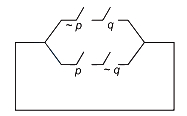
For the circuit shown below,the Boolean polynomial is
A
$(\sim p \vee q) \vee (p \vee \sim q)$
B
$(\sim p \wedge q) \wedge (p \wedge q)$
C
$(\sim p \wedge \sim q) \wedge (q \wedge p)$
D
$(\sim p \wedge q) \vee (p \wedge \sim q)$
Solution
(D) In the given circuit,the top branch consists of switches $\sim p$ and $q$ connected in series. The Boolean expression for this branch is $(\sim p \wedge q)$.
The bottom branch consists of switches $p$ and $\sim q$ connected in series. The Boolean expression for this branch is $(p \wedge \sim q)$.
Since these two branches are connected in parallel,the total Boolean polynomial for the circuit is the disjunction of the two expressions:
$(\sim p \wedge q) \vee (p \wedge \sim q)$.
The bottom branch consists of switches $p$ and $\sim q$ connected in series. The Boolean expression for this branch is $(p \wedge \sim q)$.
Since these two branches are connected in parallel,the total Boolean polynomial for the circuit is the disjunction of the two expressions:
$(\sim p \wedge q) \vee (p \wedge \sim q)$.
0 likes
View Solution553
EasyMCQ
In a Boolean Algebra $B$,for all $x, y \in B$,$x \wedge (x \vee y)$ is equal to
A
$y$
B
$x$
C
$1$
D
$0$
Solution
(B) Using the distributive law,we have: $x \wedge (x \vee y) = (x \wedge x) \vee (x \wedge y)$.
By the idempotent law,$x \wedge x = x$,so the expression becomes $x \vee (x \wedge y)$.
By the absorption law,$x \vee (x \wedge y) = x$.
By the idempotent law,$x \wedge x = x$,so the expression becomes $x \vee (x \wedge y)$.
By the absorption law,$x \vee (x \wedge y) = x$.
0 likes
View Solution554
EasyMCQ
The inverse of the proposition $(p \wedge \sim q) \Rightarrow r$ is
A
$\sim r \Rightarrow \sim p \vee q$
B
$\sim p \vee q \Rightarrow \sim r$
C
$r \Rightarrow p \wedge \sim q$
D
None of these
Solution
(B) The inverse of a conditional statement $P \Rightarrow Q$ is defined as $\sim P \Rightarrow \sim Q$.
Given the proposition $(p \wedge \sim q) \Rightarrow r$,we identify $P = (p \wedge \sim q)$ and $Q = r$.
Therefore,the inverse is $\sim(p \wedge \sim q) \Rightarrow \sim r$.
Using De Morgan's Law,$\sim(p \wedge \sim q)$ is equivalent to $(\sim p \vee \sim(\sim q))$,which simplifies to $(\sim p \vee q)$.
Thus,the inverse is $(\sim p \vee q) \Rightarrow \sim r$.
Given the proposition $(p \wedge \sim q) \Rightarrow r$,we identify $P = (p \wedge \sim q)$ and $Q = r$.
Therefore,the inverse is $\sim(p \wedge \sim q) \Rightarrow \sim r$.
Using De Morgan's Law,$\sim(p \wedge \sim q)$ is equivalent to $(\sim p \vee \sim(\sim q))$,which simplifies to $(\sim p \vee q)$.
Thus,the inverse is $(\sim p \vee q) \Rightarrow \sim r$.
0 likes
View Solution555
EasyMCQ
The proposition $(p$ $\Rightarrow \sim p) \wedge (\sim p$ $\Rightarrow p)$ is a
A
tautology and contradiction
B
neither tautology nor contradiction
C
contradiction
D
tautology
Solution
(C) To determine the nature of the proposition $(p$ $\Rightarrow \sim p) \wedge (\sim p$ $\Rightarrow p)$,we construct a truth table:
Since the final column contains only $F$ (False) for all possible truth values of $p$,the proposition is a contradiction.
| $p$ | $\sim p$ | $p \Rightarrow \sim p$ | $\sim p \Rightarrow p$ | $(p$ $\Rightarrow \sim p) \wedge (\sim p$ $\Rightarrow p)$ |
| $T$ | $F$ | $F$ | $T$ | $F$ |
| $F$ | $T$ | $T$ | $F$ | $F$ |
Since the final column contains only $F$ (False) for all possible truth values of $p$,the proposition is a contradiction.
0 likes
View Solution556
EasyMCQ
$(p \wedge q) \vee \sim p$ is equivalent to
A
$\sim p \wedge q$
B
$\sim p \vee q$
C
$p \wedge q$
D
$p \vee q$
Solution
(B) $(p \wedge q) \vee \sim p = \sim p \vee (p \wedge q)$ (By commutative law)
$= (\sim p \vee p) \wedge (\sim p \vee q)$ (By distributive law)
$= (p \vee \sim p) \wedge (\sim p \vee q)$ (By commutative law)
$= t \wedge (\sim p \vee q)$ (By complement law,where $t$ is a tautology)
$= \sim p \vee q$ (By identity law)
$= (\sim p \vee p) \wedge (\sim p \vee q)$ (By distributive law)
$= (p \vee \sim p) \wedge (\sim p \vee q)$ (By commutative law)
$= t \wedge (\sim p \vee q)$ (By complement law,where $t$ is a tautology)
$= \sim p \vee q$ (By identity law)
0 likes
View Solution557
EasyMCQ
If $p, q, r$ are single propositions with truth values $T, F, F$ respectively,then the truth value of $(p \wedge \sim q) \rightarrow (\sim p \vee r)$ is
A
$T$
B
$F$
C
Cannot find
D
None of these
Solution
(B) Given truth values are $p = T, q = F, r = F$.
First,evaluate the components:
$\sim q = \sim F = T$
$\sim p = \sim T = F$
Now,evaluate the expressions in the brackets:
$p \wedge \sim q = T \wedge T = T$
$\sim p \vee r = F \vee F = F$
Finally,evaluate the implication:
$(p \wedge \sim q)$ $\rightarrow (\sim p \vee r) = T$ $\rightarrow F = F$.
Thus,the truth value is $F$.
First,evaluate the components:
$\sim q = \sim F = T$
$\sim p = \sim T = F$
Now,evaluate the expressions in the brackets:
$p \wedge \sim q = T \wedge T = T$
$\sim p \vee r = F \vee F = F$
Finally,evaluate the implication:
$(p \wedge \sim q)$ $\rightarrow (\sim p \vee r) = T$ $\rightarrow F = F$.
Thus,the truth value is $F$.
0 likes
View Solution558
DifficultMCQ
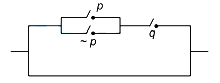
The output of the following circuit is
A
$p$
B
$q$
C
$\sim p$
D
$p+q$
Solution
(B) The circuit consists of two switches $p$ and $\sim p$ connected in parallel,which are then connected in series with a switch $q$.
The logical expression for the parallel combination of $p$ and $\sim p$ is $(p \lor \sim p)$.
Since $(p \lor \sim p) = T$ (a tautology,represented as $1$ in switching circuits),the expression becomes $1 \land q$.
Thus,the output is $1 \cdot q = q$.
The logical expression for the parallel combination of $p$ and $\sim p$ is $(p \lor \sim p)$.
Since $(p \lor \sim p) = T$ (a tautology,represented as $1$ in switching circuits),the expression becomes $1 \land q$.
Thus,the output is $1 \cdot q = q$.
0 likes
View Solution559
EasyMCQ
Simplify $(p \vee q) \wedge (p \vee \sim q)$
A
$p$
B
$T$
C
$F$
D
$q$
Solution
(A) Using the distributive law,we have:
$(p \vee q) \wedge (p \vee \sim q) = p \vee (q \wedge \sim q)$
By the complement law,$q \wedge \sim q = F$ (where $F$ denotes a contradiction or false statement).
So,the expression becomes $p \vee F$.
Since $F$ is the identity element for the disjunction operator $\vee$,$p \vee F = p$.
Thus,the simplified form is $p$.
$(p \vee q) \wedge (p \vee \sim q) = p \vee (q \wedge \sim q)$
By the complement law,$q \wedge \sim q = F$ (where $F$ denotes a contradiction or false statement).
So,the expression becomes $p \vee F$.
Since $F$ is the identity element for the disjunction operator $\vee$,$p \vee F = p$.
Thus,the simplified form is $p$.
0 likes
View Solution560
DifficultMCQ
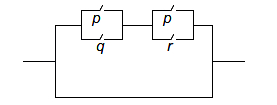
Simplify the following switching circuit and find the corresponding Boolean expression.
A
$p \vee (q \wedge r)$
B
$p \wedge (q \vee r)$
C
$p \vee (q \vee r)$
D
$p \wedge (q \wedge r)$
Solution
(A) The given circuit consists of two parallel blocks connected in series,which are then connected in parallel with a wire (which acts as an open circuit or is not present in the simplified logic).
Looking at the circuit:
$1$. The first block has switches $p$ and $q$ in parallel,represented by $(p \vee q)$.
$2$. The second block has switches $p$ and $r$ in parallel,represented by $(p \vee r)$.
$3$. These two blocks are connected in series,so the expression is $(p \vee q) \wedge (p \vee r)$.
Using the distributive law of Boolean algebra:
$(p \vee q) \wedge (p \vee r) = p \vee (q \wedge r)$.
Looking at the circuit:
$1$. The first block has switches $p$ and $q$ in parallel,represented by $(p \vee q)$.
$2$. The second block has switches $p$ and $r$ in parallel,represented by $(p \vee r)$.
$3$. These two blocks are connected in series,so the expression is $(p \vee q) \wedge (p \vee r)$.
Using the distributive law of Boolean algebra:
$(p \vee q) \wedge (p \vee r) = p \vee (q \wedge r)$.
0 likes
View Solution561
EasyMCQ
$\sim(\sim p \rightarrow q) \equiv$
A
$p \wedge \sim q$
B
$\sim p \wedge q$
C
$\sim p \wedge \sim q$
D
$\sim p \vee \sim q$
Solution
(C) We know that the implication $A \rightarrow B$ is equivalent to $\sim A \vee B$.
Therefore,$\sim p \rightarrow q \equiv \sim(\sim p) \vee q \equiv p \vee q$.
Now,applying the negation: $\sim(\sim p \rightarrow q) \equiv \sim(p \vee q)$.
By De Morgan's Law,$\sim(p \vee q) \equiv \sim p \wedge \sim q$.
Therefore,$\sim p \rightarrow q \equiv \sim(\sim p) \vee q \equiv p \vee q$.
Now,applying the negation: $\sim(\sim p \rightarrow q) \equiv \sim(p \vee q)$.
By De Morgan's Law,$\sim(p \vee q) \equiv \sim p \wedge \sim q$.
0 likes
View Solution562
EasyMCQ
The negation of the conditional statement,"If it rains,$I$ shall go to school" is:
A
It rains and $I$ shall go to school
B
It rains and $I$ shall not go to school
C
It does not rain and $I$ shall go to school
D
None of the above
Solution
(B) Let $p$ be the statement: "It rains".
Let $q$ be the statement: "$I$ shall go to school".
The given conditional statement is $p \Rightarrow q$.
The negation of a conditional statement $p \Rightarrow q$ is given by $\sim(p \Rightarrow q) \equiv p \wedge \sim q$.
Here,$p \wedge \sim q$ translates to: "It rains and $I$ shall not go to school".
Therefore,the correct option is $B$.
Let $q$ be the statement: "$I$ shall go to school".
The given conditional statement is $p \Rightarrow q$.
The negation of a conditional statement $p \Rightarrow q$ is given by $\sim(p \Rightarrow q) \equiv p \wedge \sim q$.
Here,$p \wedge \sim q$ translates to: "It rains and $I$ shall not go to school".
Therefore,the correct option is $B$.
0 likes
View Solution563
MediumMCQ
The dual of $\left(x^{\prime} \vee y^{\prime}\right) = x \wedge y$ is
A
$\left(x^{\prime} \wedge y^{\prime}\right) = x \vee y$
B
$\left(x^{\prime} \vee y^{\prime}\right) = x \wedge y$
C
$\left(x^{\prime} \wedge y^{\prime}\right) = x \wedge y$
D
None of the above
Solution
(A) To find the dual of a Boolean expression,we replace $\vee$ with $\wedge$,$\wedge$ with $\vee$,$0$ with $1$,and $1$ with $0$.
Given the expression $\left(x^{\prime} \vee y^{\prime}\right) = x \wedge y$,we replace the operators:
$\vee$ becomes $\wedge$
$\wedge$ becomes $\vee$
Thus,the dual is $\left(x^{\prime} \wedge y^{\prime}\right) = x \vee y$.
Given the expression $\left(x^{\prime} \vee y^{\prime}\right) = x \wedge y$,we replace the operators:
$\vee$ becomes $\wedge$
$\wedge$ becomes $\vee$
Thus,the dual is $\left(x^{\prime} \wedge y^{\prime}\right) = x \vee y$.
0 likes
View Solution564
EasyMCQ
The dual of the statement $[p \vee (\sim q)] \wedge (\sim p)$ is
A
$p \vee (\sim q) \vee \sim p$
B
$(p \wedge \sim q) \vee \sim p$
C
$p \wedge \sim (q \vee \sim p)$
D
None of these
Solution
(B) To find the dual of a logical statement,we replace $\vee$ with $\wedge$,$\wedge$ with $\vee$,$T$ with $F$,and $F$ with $T$.
Given statement: $[p \vee (\sim q)] \wedge (\sim p)$.
Replacing $\vee$ with $\wedge$ and $\wedge$ with $\vee$,we get:
$[p \wedge (\sim q)] \vee (\sim p)$.
Given statement: $[p \vee (\sim q)] \wedge (\sim p)$.
Replacing $\vee$ with $\wedge$ and $\wedge$ with $\vee$,we get:
$[p \wedge (\sim q)] \vee (\sim p)$.
0 likes
View Solution565
EasyMCQ
Which of the following statements has the truth value '$F$'?
A
$A$ quadratic equation always has a real root.
B
The number of ways of seating $2$ persons in two chairs out of $n$ persons is $P(n, 2)$.
C
The cube roots of unity are in $GP$.
D
None of the above.
Solution
(A) quadratic equation $ax^2 + bx + c = 0$ can have imaginary roots if the discriminant $D = b^2 - 4ac < 0$.
Therefore,the statement '$A$ quadratic equation always has a real root' is false,meaning its truth value is '$F$'.
Option $B$ is true as it represents the permutation formula.
Option $C$ is true because the cube roots of unity are $1, \omega, \omega^2$,which form a $GP$ with common ratio $\omega$.
Therefore,the statement '$A$ quadratic equation always has a real root' is false,meaning its truth value is '$F$'.
Option $B$ is true as it represents the permutation formula.
Option $C$ is true because the cube roots of unity are $1, \omega, \omega^2$,which form a $GP$ with common ratio $\omega$.
0 likes
View Solution566
DifficultMCQ
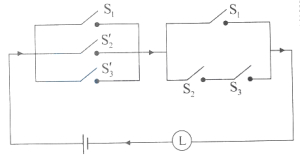
The given circuit is equivalent to
A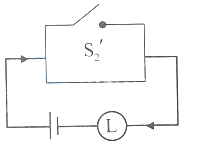
B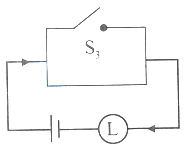
C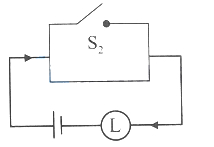
D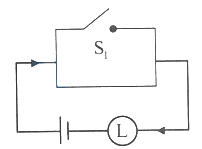
Solution
(D) The symbolic form of the given circuit is $(p \vee \sim q \vee \sim r) \wedge (p \vee (q \wedge r))$.
Applying the distributive law,we get $p \vee [(\sim q \vee \sim r) \wedge (q \wedge r)]$.
Using De Morgan's law,this becomes $p \vee [\sim (q \wedge r) \wedge (q \wedge r)]$.
Applying the complement law,we get $p \vee F$.
Finally,by the identity law,this simplifies to $p$.
Thus,the circuit is equivalent to a circuit with only switch $S_1$.
Applying the distributive law,we get $p \vee [(\sim q \vee \sim r) \wedge (q \wedge r)]$.
Using De Morgan's law,this becomes $p \vee [\sim (q \wedge r) \wedge (q \wedge r)]$.
Applying the complement law,we get $p \vee F$.
Finally,by the identity law,this simplifies to $p$.
Thus,the circuit is equivalent to a circuit with only switch $S_1$.
0 likes
View Solution567
MediumMCQ
Let $S$ be a non-empty subset of $\mathbb{R}$. Consider the following statement:
$p$ : There is a rational number $x \in S$ such that $x > 0$.
Which of the following statements is the negation of the statement $p$?
$p$ : There is a rational number $x \in S$ such that $x > 0$.
Which of the following statements is the negation of the statement $p$?
A
There is a rational number $x \in S$ such that $x \leq 0$.
B
There is no rational number $x \in S$ such that $x \leq 0$.
C
Every rational number $x \in S$ satisfies $x \leq 0$.
D
$x \in S$ and $x \leq 0 \Rightarrow x$ is not a rational number.
Solution
(C) The given statement $p$ is: $\exists x \in S$ such that $x > 0$.
To find the negation $\sim p$,we apply the rule $\sim(\exists x, P(x)) \equiv \forall x, \sim P(x)$.
$\sim p : \forall x \in S, x \leq 0$.
This means that every rational number $x \in S$ satisfies $x \leq 0$.
To find the negation $\sim p$,we apply the rule $\sim(\exists x, P(x)) \equiv \forall x, \sim P(x)$.
$\sim p : \forall x \in S, x \leq 0$.
This means that every rational number $x \in S$ satisfies $x \leq 0$.
0 likes
View Solution568
EasyMCQ
Which of the following is not a correct statement?
A
$ \sqrt{3} $ is a prime number.
B
The sun is a star.
C
Mathematics is interesting.
D
$ \sqrt{2} $ is an irrational number.
Solution
(A) statement is a declarative sentence that is either true or false,but not both.
$(A)$ $ \sqrt{3} $ is a prime number: This is a false statement because $ \sqrt{3} \approx 1.732 $,which is not an integer,and prime numbers must be integers.
$(B)$ The sun is a star: This is a true statement.
$(C)$ Mathematics is interesting: This is an opinion,not a mathematical statement,but in the context of logic,it is often treated as subjective.
$(D)$ $ \sqrt{2} $ is an irrational number: This is a true statement.
Since we are looking for a statement that is not correct (i.e.,false),option $A$ is the correct answer.
$(A)$ $ \sqrt{3} $ is a prime number: This is a false statement because $ \sqrt{3} \approx 1.732 $,which is not an integer,and prime numbers must be integers.
$(B)$ The sun is a star: This is a true statement.
$(C)$ Mathematics is interesting: This is an opinion,not a mathematical statement,but in the context of logic,it is often treated as subjective.
$(D)$ $ \sqrt{2} $ is an irrational number: This is a true statement.
Since we are looking for a statement that is not correct (i.e.,false),option $A$ is the correct answer.
0 likes
View Solution569
EasyMCQ
The negation of the statement "For every real number $x$,$x^2+5$ is positive" is
A
For every real number $x$,$x^2+5$ is not positive.
B
For every real number $x$,$x^2+5$ is negative.
C
There exists at least one real number $x$,such that $x^2+5$ is not positive.
D
There exists at least one real number $x$,such that $x^2+5$ is positive.
Solution
(C) The negation of a statement involving the universal quantifier "For every" is formed by replacing it with the existential quantifier "There exists at least one" and negating the predicate.
Given the statement: "For every real number $x$,$x^2+5$ is positive".
The negation is: "There exists at least one real number $x$ such that $x^2+5$ is not positive".
Given the statement: "For every real number $x$,$x^2+5$ is positive".
The negation is: "There exists at least one real number $x$ such that $x^2+5$ is not positive".
0 likes
View Solution570
EasyMCQ
The contrapositive of the statement,"If two lines do not intersect in the same plane,then they are parallel," is:
A
If two lines are parallel,then they intersect in the same plane.
B
If two lines are not parallel,then they do not intersect in the same plane.
C
If two lines are parallel,then they do not intersect in the same plane.
D
If two lines are not parallel,then they intersect in the same plane.
Solution
(D) The given statement is of the form $P \implies Q$,where $P$ is "two lines do not intersect in the same plane" and $Q$ is "they are parallel".
The contrapositive of a statement $P \implies Q$ is defined as $\neg Q \implies \neg P$.
Here,$\neg Q$ is "two lines are not parallel" and $\neg P$ is "two lines intersect in the same plane".
Therefore,the contrapositive is: "If two lines are not parallel,then they intersect in the same plane."
This corresponds to option $D$.
The contrapositive of a statement $P \implies Q$ is defined as $\neg Q \implies \neg P$.
Here,$\neg Q$ is "two lines are not parallel" and $\neg P$ is "two lines intersect in the same plane".
Therefore,the contrapositive is: "If two lines are not parallel,then they intersect in the same plane."
This corresponds to option $D$.
0 likes
View Solution571
EasyMCQ
The negation of the statement "All continuous functions are differentiable" is:
A
Some continuous functions are differentiable
B
All differentiable functions are continuous
C
All continuous functions are not differentiable
D
Some continuous functions are not differentiable
Solution
(D) The given statement is of the form "For all $x$,$P(x)$",where $P(x)$ is the property that a function is differentiable.
The negation of the statement "All $P$ are $Q$" is "Some $P$ are not $Q$".
Therefore,the negation of "All continuous functions are differentiable" is "Some continuous functions are not differentiable".
Thus,the correct option is $D$.
The negation of the statement "All $P$ are $Q$" is "Some $P$ are not $Q$".
Therefore,the negation of "All continuous functions are differentiable" is "Some continuous functions are not differentiable".
Thus,the correct option is $D$.
0 likes
View Solution572
MediumMCQ
The negation of the statement " $72$ is divisible by $2$ and $3$ " is
A
$72$ is not divisible by $2$ or $72$ is not divisible by $3$
B
$72$ is divisible by $2$ or $72$ is divisible by $3$
C
$72$ is divisible by $2$ and $72$ is divisible by $3$
D
$72$ is not divisible by $2$ and $3$
Solution
(A) Let $p$ be the statement: "$72$ is divisible by $2$ and $3$".
This can be written as $p = q \wedge r$,where $q$ is "$72$ is divisible by $2$" and $r$ is "$72$ is divisible by $3$".
The negation of a conjunction is given by De Morgan's Law: $\sim(q \wedge r) \equiv \sim q \vee \sim r$.
Here,$\sim q$ is "$72$ is not divisible by $2$" and $\sim r$ is "$72$ is not divisible by $3$".
Therefore,the negation is "$72$ is not divisible by $2$ or $72$ is not divisible by $3$".
This can be written as $p = q \wedge r$,where $q$ is "$72$ is divisible by $2$" and $r$ is "$72$ is divisible by $3$".
The negation of a conjunction is given by De Morgan's Law: $\sim(q \wedge r) \equiv \sim q \vee \sim r$.
Here,$\sim q$ is "$72$ is not divisible by $2$" and $\sim r$ is "$72$ is not divisible by $3$".
Therefore,the negation is "$72$ is not divisible by $2$ or $72$ is not divisible by $3$".
0 likes
View Solution573
MediumMCQ
The contrapositive of the converse of the statement "If $x$ is a prime number,then $x$ is odd" is
A
If $x$ is not a prime number,then $x$ is odd.
B
If $x$ is not an odd number,then $x$ is not a prime number.
C
If $x$ is a prime number,then it is not odd.
D
If $x$ is not a prime number,then $x$ is not odd.
Solution
(D) Let $p: x$ is a prime number and $q: x$ is an odd number.
The given statement is $p \rightarrow q$.
The converse of the statement is $q \rightarrow p$.
The contrapositive of the converse $(q \rightarrow p)$ is $\sim p \rightarrow \sim q$.
Thus,the contrapositive of the converse is: "If $x$ is not a prime number,then $x$ is not odd."
The given statement is $p \rightarrow q$.
The converse of the statement is $q \rightarrow p$.
The contrapositive of the converse $(q \rightarrow p)$ is $\sim p \rightarrow \sim q$.
Thus,the contrapositive of the converse is: "If $x$ is not a prime number,then $x$ is not odd."
0 likes
View Solution574
EasyMCQ
The inverse of the proposition $(p \wedge \sim q) \rightarrow r$ is:
A
$(\sim r) \rightarrow (\sim p) \vee q$
B
$(\sim p) \vee q \rightarrow (\sim r)$
C
$r \rightarrow p \wedge (\sim q)$
D
$(\sim p) \vee (\sim q) \rightarrow r$
Solution
(B) The given proposition is $(p \wedge \sim q) \rightarrow r$.
The inverse of a conditional statement $A \rightarrow B$ is defined as $\sim A \rightarrow \sim B$.
Here,$A = (p \wedge \sim q)$ and $B = r$.
Therefore,the inverse is $\sim (p \wedge \sim q) \rightarrow \sim r$.
Using De Morgan's Law,$\sim (p \wedge \sim q) \equiv \sim p \vee \sim (\sim q) \equiv \sim p \vee q$.
Thus,the inverse is $(\sim p) \vee q \rightarrow (\sim r)$.
The inverse of a conditional statement $A \rightarrow B$ is defined as $\sim A \rightarrow \sim B$.
Here,$A = (p \wedge \sim q)$ and $B = r$.
Therefore,the inverse is $\sim (p \wedge \sim q) \rightarrow \sim r$.
Using De Morgan's Law,$\sim (p \wedge \sim q) \equiv \sim p \vee \sim (\sim q) \equiv \sim p \vee q$.
Thus,the inverse is $(\sim p) \vee q \rightarrow (\sim r)$.
0 likes
View Solution575
EasyMCQ
$p \rightarrow \sim q$ can also be written as
A
$p \rightarrow q$
B
$\sim p \vee \sim q$
C
$q \rightarrow p$
D
$\sim q \rightarrow \sim p$
Solution
(B) We know that the implication $A \rightarrow B$ is logically equivalent to $\sim A \vee B$.
Applying this rule to $p \rightarrow \sim q$,we get:
$p \rightarrow \sim q \equiv \sim p \vee \sim q$.
This can also be verified using the truth table:
| $p$ | $q$ | $\sim p$ | $\sim q$ | $p \rightarrow \sim q$ | $\sim p \vee \sim q$ |
|---|---|---|---|---|---|
| $T$ | $T$ | $F$ | $F$ | $F$ | $F$ |
| $T$ | $F$ | $F$ | $T$ | $T$ | $T$ |
| $F$ | $T$ | $T$ | $F$ | $T$ | $T$ |
| $F$ | $F$ | $T$ | $T$ | $T$ | $T$ |
Since the truth values of $p \rightarrow \sim q$ and $\sim p \vee \sim q$ are identical for all possible truth values of $p$ and $q$,they are logically equivalent.
Applying this rule to $p \rightarrow \sim q$,we get:
$p \rightarrow \sim q \equiv \sim p \vee \sim q$.
This can also be verified using the truth table:
| $p$ | $q$ | $\sim p$ | $\sim q$ | $p \rightarrow \sim q$ | $\sim p \vee \sim q$ |
|---|---|---|---|---|---|
| $T$ | $T$ | $F$ | $F$ | $F$ | $F$ |
| $T$ | $F$ | $F$ | $T$ | $T$ | $T$ |
| $F$ | $T$ | $T$ | $F$ | $T$ | $T$ |
| $F$ | $F$ | $T$ | $T$ | $T$ | $T$ |
Since the truth values of $p \rightarrow \sim q$ and $\sim p \vee \sim q$ are identical for all possible truth values of $p$ and $q$,they are logically equivalent.
0 likes
View Solution576
DifficultMCQ
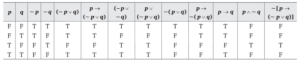
The negation of $p \rightarrow (\sim p \vee q)$ is
A
$p \vee (p \vee \sim q)$
B
$p \rightarrow \sim (p \vee q)$
C
$p \rightarrow q$
D
$p \wedge \sim q$
Solution
(D) To find the negation of $p \rightarrow (\sim p \vee q)$,we use the logical equivalence $\sim(A \rightarrow B) \equiv A \wedge \sim B$.
Here,$A = p$ and $B = (\sim p \vee q)$.
Therefore,$\sim[p \rightarrow (\sim p \vee q)] \equiv p \wedge \sim(\sim p \vee q)$.
Using De Morgan's Law,$\sim(\sim p \vee q) \equiv \sim(\sim p) \wedge \sim q \equiv p \wedge \sim q$.
Substituting this back,we get $p \wedge (p \wedge \sim q)$.
Since $p \wedge p \equiv p$,the expression simplifies to $p \wedge \sim q$.
Thus,the negation is $p \wedge \sim q$.
Here,$A = p$ and $B = (\sim p \vee q)$.
Therefore,$\sim[p \rightarrow (\sim p \vee q)] \equiv p \wedge \sim(\sim p \vee q)$.
Using De Morgan's Law,$\sim(\sim p \vee q) \equiv \sim(\sim p) \wedge \sim q \equiv p \wedge \sim q$.
Substituting this back,we get $p \wedge (p \wedge \sim q)$.
Since $p \wedge p \equiv p$,the expression simplifies to $p \wedge \sim q$.
Thus,the negation is $p \wedge \sim q$.
0 likes
View Solution577
DifficultMCQ
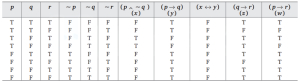
Which of the following is not true?
A
$(p \wedge \sim q) \leftrightarrow (p \rightarrow q)$ is a tautology
B
$((p \rightarrow q) \wedge (q \rightarrow r)) \rightarrow (p \rightarrow r)$ is a tautology
C
$p \rightarrow (q \wedge r) \equiv (p \rightarrow q) \wedge (p \rightarrow r)$
D
$\sim(p \leftrightarrow q) \equiv (p \wedge \sim q) \vee (\sim p \wedge q)$
Solution
(A) We evaluate each option using truth tables:
$(a)$ Let $x = (p \wedge \sim q)$ and $y = (p \rightarrow q)$. The truth table shows that $(x \leftrightarrow y)$ is not a tautology (it is a contingency).
$(b)$ This is a standard tautology known as the Law of Hypothetical Syllogism.
$(c)$ This is a standard logical equivalence (Distributive Law of implication over conjunction).
$(d)$ This is a standard logical equivalence for the negation of a biconditional statement.
Therefore,option $(a)$ is not true.
$(a)$ Let $x = (p \wedge \sim q)$ and $y = (p \rightarrow q)$. The truth table shows that $(x \leftrightarrow y)$ is not a tautology (it is a contingency).
$(b)$ This is a standard tautology known as the Law of Hypothetical Syllogism.
$(c)$ This is a standard logical equivalence (Distributive Law of implication over conjunction).
$(d)$ This is a standard logical equivalence for the negation of a biconditional statement.
Therefore,option $(a)$ is not true.
0 likes
View Solution578
EasyMCQ
The negation of $p \wedge (q \rightarrow \sim r)$ is
A
$\sim p \wedge (q \wedge r)$
B
$p \vee (q \vee r)$
C
$p \vee (q \wedge r)$
D
$\sim p \vee (q \wedge r)$
Solution
(D) We need to find the negation of the statement $p \wedge (q \rightarrow \sim r)$.
Using De Morgan's Law,$\sim(A \wedge B) = \sim A \vee \sim B$:
$\sim(p \wedge (q$ $\rightarrow \sim r)) = \sim p \vee \sim(q$ $\rightarrow \sim r)$
Using the implication rule $\sim(A \rightarrow B) = A \wedge \sim B$:
$\sim p \vee (q \wedge \sim(\sim r))$
Using the double negation law $\sim(\sim r) = r$:
$\sim p \vee (q \wedge r)$
Thus,the correct option is $D$.
Using De Morgan's Law,$\sim(A \wedge B) = \sim A \vee \sim B$:
$\sim(p \wedge (q$ $\rightarrow \sim r)) = \sim p \vee \sim(q$ $\rightarrow \sim r)$
Using the implication rule $\sim(A \rightarrow B) = A \wedge \sim B$:
$\sim p \vee (q \wedge \sim(\sim r))$
Using the double negation law $\sim(\sim r) = r$:
$\sim p \vee (q \wedge r)$
Thus,the correct option is $D$.
0 likes
View Solution579
EasyMCQ
The converse of the contrapositive of the conditional $p \rightarrow \sim q$ is
A
$p \rightarrow q$
B
$\sim p \rightarrow \sim q$
C
$\sim q \rightarrow p$
D
$\sim p \rightarrow q$
Solution
(D) The given conditional statement is $p \rightarrow \sim q$.
The contrapositive of a conditional statement $A \rightarrow B$ is $\sim B \rightarrow \sim A$.
Applying this to $p \rightarrow \sim q$,the contrapositive is $\sim(\sim q) \rightarrow \sim p$,which simplifies to $q \rightarrow \sim p$.
The converse of a conditional statement $A \rightarrow B$ is $B \rightarrow A$.
Applying this to the contrapositive $q \rightarrow \sim p$,the converse is $\sim p \rightarrow q$.
The contrapositive of a conditional statement $A \rightarrow B$ is $\sim B \rightarrow \sim A$.
Applying this to $p \rightarrow \sim q$,the contrapositive is $\sim(\sim q) \rightarrow \sim p$,which simplifies to $q \rightarrow \sim p$.
The converse of a conditional statement $A \rightarrow B$ is $B \rightarrow A$.
Applying this to the contrapositive $q \rightarrow \sim p$,the converse is $\sim p \rightarrow q$.
0 likes
View Solution580
EasyMCQ
The negation of the proposition "If $2$ is prime,then $3$ is odd" is:
A
$2$ is not prime,then $3$ is not odd
B
$2$ is prime and $3$ is not odd
C
$2$ is not prime and $3$ is odd
D
$2$ is not prime,then $3$ is odd
Solution
(B) Let $p$ be the statement "$2$ is prime".
Let $q$ be the statement "$3$ is odd".
The given proposition is $p \rightarrow q$.
The negation of an implication $p \rightarrow q$ is given by $\sim(p \rightarrow q) \equiv p \wedge \sim q$.
Here,$p$ is "$2$ is prime" and $\sim q$ is "$3$ is not odd".
Therefore,the negation is "$2$ is prime and $3$ is not odd".
Let $q$ be the statement "$3$ is odd".
The given proposition is $p \rightarrow q$.
The negation of an implication $p \rightarrow q$ is given by $\sim(p \rightarrow q) \equiv p \wedge \sim q$.
Here,$p$ is "$2$ is prime" and $\sim q$ is "$3$ is not odd".
Therefore,the negation is "$2$ is prime and $3$ is not odd".
0 likes
View Solution581
EasyMCQ
The negation of the statement "For all real numbers $x$ and $y, x+y=y+x$" is
A
For all real numbers $x$ and $y, x+y \neq y+x$
B
For some real numbers $x$ and $y, x+y=y+x$
C
For some real numbers $x$ and $y, x+y \neq y+x$
D
For some real numbers $x$ and $y, x-y=y-x$
Solution
(C) The given statement is a universal quantification: "For all $x, y \in \mathbb{R}, x+y=y+x$."
To find the negation of a statement involving the universal quantifier "For all" $(\forall)$,we replace it with the existential quantifier "There exists" (or "For some") and negate the predicate.
The negation of "For all $x$ and $y, P(x, y)$" is "There exist $x$ and $y$ such that $\neg P(x, y)$."
Here,the predicate $P(x, y)$ is $x+y=y+x$.
The negation of $x+y=y+x$ is $x+y \neq y+x$.
Therefore,the negation of the statement is "For some real numbers $x$ and $y, x+y \neq y+x$."
To find the negation of a statement involving the universal quantifier "For all" $(\forall)$,we replace it with the existential quantifier "There exists" (or "For some") and negate the predicate.
The negation of "For all $x$ and $y, P(x, y)$" is "There exist $x$ and $y$ such that $\neg P(x, y)$."
Here,the predicate $P(x, y)$ is $x+y=y+x$.
The negation of $x+y=y+x$ is $x+y \neq y+x$.
Therefore,the negation of the statement is "For some real numbers $x$ and $y, x+y \neq y+x$."
0 likes
View Solution582
EasyMCQ
$ \sim[(\sim p) \wedge q] $ is logically equivalent to
A
$ p \vee(\sim q) $
B
$ p \wedge(\sim q) $
C
$ \sim[p \wedge(\sim q)] $
D
$ \sim(p \vee q) $
Solution
(A) Given the expression: $ \sim[(\sim p) \wedge q] $.
By applying De Morgan's Law,which states that $ \sim(A \wedge B) = (\sim A) \vee (\sim B) $:
$ \sim[(\sim p) \wedge q] = \sim(\sim p) \vee (\sim q) $.
Since $ \sim(\sim p) = p $,the expression simplifies to:
$ p \vee (\sim q) $.
Therefore,the correct option is $ A $.
By applying De Morgan's Law,which states that $ \sim(A \wedge B) = (\sim A) \vee (\sim B) $:
$ \sim[(\sim p) \wedge q] = \sim(\sim p) \vee (\sim q) $.
Since $ \sim(\sim p) = p $,the expression simplifies to:
$ p \vee (\sim q) $.
Therefore,the correct option is $ A $.
0 likes
View Solution583
EasyMCQ
The contrapositive statement of the statement "If $x$ is a prime number,then $x$ is odd" is
A
If $x$ is not a prime number,then $x$ is not odd
B
If $x$ is a prime number,then $x$ is not odd
C
If $x$ is not a prime number,then $x$ is odd
D
If $x$ is not odd,then $x$ is not a prime number.
Solution
(D) The given statement is of the form "If $P$,then $Q$",where $P$ is "$x$ is a prime number" and $Q$ is "$x$ is odd".
The contrapositive of the statement "If $P$,then $Q$" is defined as "If $\neg Q$,then $\neg P$".
Here,$\neg Q$ is "$x$ is not odd" and $\neg P$ is "$x$ is not a prime number".
Therefore,the contrapositive statement is "If $x$ is not odd,then $x$ is not a prime number".
The contrapositive of the statement "If $P$,then $Q$" is defined as "If $\neg Q$,then $\neg P$".
Here,$\neg Q$ is "$x$ is not odd" and $\neg P$ is "$x$ is not a prime number".
Therefore,the contrapositive statement is "If $x$ is not odd,then $x$ is not a prime number".
0 likes
View SolutionMathematical Reasoning — Mathematical logic · Frequently Asked Questions
1Are these Mathematical Reasoning questions useful for JEE and NEET?
Yes. All questions in this section are mapped to JEE Main and NEET exam patterns. Previous year questions from JEE Main, NEET, GUJCET and state-level exams are included with full solutions.
2Can I switch to Hindi or Gujarati for these questions?
Yes. Use the language tabs in the hero section or the sidebar to view the same questions and solutions in English, Hindi or Gujarati.
3How do I generate a question paper from this subtopic?
Use the Vedclass Exam Paper Generator — select the chapter and subtopic, set difficulty, and generate Sets A, B, C, D automatically. First 3 chapters of every subject are free.
Vedclass Products
For Students
Vedclass Test Series
Mock tests in real JEE/NEET style with performance analysis. 5-day free trial.
Start Free TrialFor Teachers
Exam Paper Generator
Generate Set A/B/C/D papers from this chapter in 2 minutes. 3 chapters free.
Try FreeFor Institutes
Online Exam Module
Live online exams with unlimited students, 360° analytics & white-label branding.
See DemoFor Teachers & Institutes
Generate a Mathematical Reasoning Exam Paper in 2 Minutes
Select subtopic & difficulty — Sets A, B, C, D auto-generated with No Repeat logic.
First 3 chapters of every subject are free — no payment required.