
A English
Mix Examples-Thermodynamics and Thermochemistry Questions in English
Class 11 Chemistry · Thermodynamics · Mix Examples-Thermodynamics and Thermochemistry
367+
Questions
English
Language
100%
With Solutions
Showing 50 of 367 questions in English
201
DifficultMCQ
Enthalpy of combustion of $CH_4, C_2H_6$ and $C_3H_8$ are $-210.8, -368.4$ and $-526.2 \ k \ cal \ mol^{-1}$ respectively. Enthalpy of combustion of hexane can be predicted as........$k \ cal \ mol^{-1}$
A
$-840$
B
$-684$
C
$-1000$
D
none of these
Solution
(C) The difference in enthalpy of combustion for each successive $CH_2$ group is calculated as follows:
$\Delta H_c(C_2H_6) - \Delta H_c(CH_4) = -368.4 - (-210.8) = -157.6 \ k \ cal \ mol^{-1}$
$\Delta H_c(C_3H_8) - \Delta H_c(C_2H_6) = -526.2 - (-368.4) = -157.8 \ k \ cal \ mol^{-1}$
Average value for $\Delta H_c(-CH_2-) = \frac{-157.6 + (-157.8)}{2} = -157.7 \ k \ cal \ mol^{-1}$
For hexane $(C_6H_{14})$,we add three $-CH_2-$ groups to propane $(C_3H_8)$:
$\Delta H_c(C_6H_{14}) = \Delta H_c(C_3H_8) + 3 \times \Delta H_c(-CH_2-)$
$\Delta H_c(C_6H_{14}) = -526.2 + 3(-157.7) = -526.2 - 473.1 = -999.3 \ k \ cal \ mol^{-1}$
Rounding to the nearest integer,the value is $-1000 \ k \ cal \ mol^{-1}$.
$\Delta H_c(C_2H_6) - \Delta H_c(CH_4) = -368.4 - (-210.8) = -157.6 \ k \ cal \ mol^{-1}$
$\Delta H_c(C_3H_8) - \Delta H_c(C_2H_6) = -526.2 - (-368.4) = -157.8 \ k \ cal \ mol^{-1}$
Average value for $\Delta H_c(-CH_2-) = \frac{-157.6 + (-157.8)}{2} = -157.7 \ k \ cal \ mol^{-1}$
For hexane $(C_6H_{14})$,we add three $-CH_2-$ groups to propane $(C_3H_8)$:
$\Delta H_c(C_6H_{14}) = \Delta H_c(C_3H_8) + 3 \times \Delta H_c(-CH_2-)$
$\Delta H_c(C_6H_{14}) = -526.2 + 3(-157.7) = -526.2 - 473.1 = -999.3 \ k \ cal \ mol^{-1}$
Rounding to the nearest integer,the value is $-1000 \ k \ cal \ mol^{-1}$.
0 likes
View Solution202
MediumMCQ
The following reaction occurs in an automobile: $2C_8H_{18(g)} + 25O_{2(g)} \to 16CO_{2(g)} + 18H_2O_{(g)}$. The signs of $\Delta H$,$\Delta S$,and $\Delta G$ would be:
A
$+, -, +$
B
$-, +, -$
C
$-, +, +$
D
$+, +, -$
Solution
(B) For a combustion reaction,the enthalpy change $\Delta H$ is negative (exothermic).
The change in the number of moles of gas is $\Delta n_g = (16 + 18) - (2 + 25) = 34 - 27 = +7$.
Since $\Delta n_g > 0$,the entropy change $\Delta S$ is positive $(+ve)$.
As the reaction is spontaneous in an automobile engine,the Gibbs free energy change $\Delta G$ is negative $(-ve)$.
The change in the number of moles of gas is $\Delta n_g = (16 + 18) - (2 + 25) = 34 - 27 = +7$.
Since $\Delta n_g > 0$,the entropy change $\Delta S$ is positive $(+ve)$.
As the reaction is spontaneous in an automobile engine,the Gibbs free energy change $\Delta G$ is negative $(-ve)$.
0 likes
View Solution203
EasyMCQ
Assertion : The increase in internal energy $(\Delta E)$ for the vaporization of one mole of water at $1 \ atm$ and $373 \ K$ is zero.
Reason : For all isothermal processes,$\Delta E = 0$.
Reason : For all isothermal processes,$\Delta E = 0$.
A
If both Assertion and Reason are correct and the Reason is a correct explanation of the Assertion.
B
If both Assertion and Reason are correct but Reason is not a correct explanation of the Assertion.
C
If the Assertion is correct but Reason is incorrect.
D
If both the Assertion and Reason are incorrect.
Solution
(D) The vaporization of water is a phase change process occurring at constant temperature $(373 \ K)$.
For an ideal gas,internal energy $(E)$ is a function of temperature only,so $\Delta E = 0$ for isothermal processes.
However,for real substances like water undergoing a phase change,the internal energy changes because the intermolecular forces are overcome during vaporization.
Therefore,the Assertion is incorrect because $\Delta E \neq 0$ for the vaporization of water.
The Reason is also incorrect because $\Delta E = 0$ only strictly applies to ideal gases in isothermal processes,and even then,it does not account for phase changes where potential energy changes.
For an ideal gas,internal energy $(E)$ is a function of temperature only,so $\Delta E = 0$ for isothermal processes.
However,for real substances like water undergoing a phase change,the internal energy changes because the intermolecular forces are overcome during vaporization.
Therefore,the Assertion is incorrect because $\Delta E \neq 0$ for the vaporization of water.
The Reason is also incorrect because $\Delta E = 0$ only strictly applies to ideal gases in isothermal processes,and even then,it does not account for phase changes where potential energy changes.
0 likes
View Solution204
EasyMCQ
Assertion : $\Delta H$ and $\Delta E$ are almost same for the reaction $N_{2(g)} + O_{2(g)} \rightleftharpoons 2NO_{(g)}$.
Reason : All reactants and products are gases.
Reason : All reactants and products are gases.
A
If both Assertion and Reason are correct and the Reason is a correct explanation of the Assertion.
B
If both Assertion and Reason are correct but Reason is not a correct explanation of the Assertion.
C
If the Assertion is correct but Reason is incorrect.
D
If both the Assertion and Reason are incorrect.
Solution
(B) The relationship between enthalpy change and internal energy change is given by $\Delta H = \Delta E + \Delta n_g RT$.
For the reaction $N_{2(g)} + O_{2(g)} \rightleftharpoons 2NO_{(g)}$,the change in the number of moles of gaseous species is $\Delta n_g = 2 - (1 + 1) = 0$.
Since $\Delta n_g = 0$,we have $\Delta H = \Delta E$.
Thus,the Assertion is correct.
The Reason states that all reactants and products are gases,which is true,but this alone does not guarantee $\Delta H = \Delta E$. The equality holds only because $\Delta n_g = 0$. Therefore,the Reason is not the correct explanation for the Assertion.
For the reaction $N_{2(g)} + O_{2(g)} \rightleftharpoons 2NO_{(g)}$,the change in the number of moles of gaseous species is $\Delta n_g = 2 - (1 + 1) = 0$.
Since $\Delta n_g = 0$,we have $\Delta H = \Delta E$.
Thus,the Assertion is correct.
The Reason states that all reactants and products are gases,which is true,but this alone does not guarantee $\Delta H = \Delta E$. The equality holds only because $\Delta n_g = 0$. Therefore,the Reason is not the correct explanation for the Assertion.
0 likes
View Solution205
DifficultMCQ
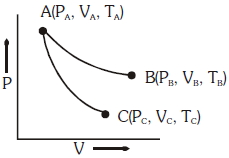
Reversible expansion of an ideal gas under isothermal and adiabatic conditions are as shown in the figure.
$AB \to$ Isothermal expansion
$AC \to$ Adiabatic expansion
Which of the following options is not correct?
$AB \to$ Isothermal expansion
$AC \to$ Adiabatic expansion
Which of the following options is not correct?
A
$\Delta S_{\text{isothermal}} > \Delta S_{\text{adiabatic}}$
B
$T_{A} = T_{B}$
C
$W_{\text{isothermal}} > W_{\text{adiabatic}}$
D
$T_{C} > T_{A}$
Solution
(D) In an adiabatic expansion,the system does work at the expense of its internal energy,leading to a decrease in temperature. Thus,$T_C < T_A$.
For an adiabatic process:
$q = 0$,$\Delta U = W$
Since it is an expansion,$W < 0$,therefore $\Delta U < 0$.
Since $\Delta U = nC_{vm} \Delta T$,we have $nC_{vm} \Delta T < 0$,which implies $\Delta T < 0$.
Therefore,$T_C - T_A < 0$,or $T_C < T_A$.
Option $D$ states $T_C > T_A$,which is incorrect.
For an adiabatic process:
$q = 0$,$\Delta U = W$
Since it is an expansion,$W < 0$,therefore $\Delta U < 0$.
Since $\Delta U = nC_{vm} \Delta T$,we have $nC_{vm} \Delta T < 0$,which implies $\Delta T < 0$.
Therefore,$T_C - T_A < 0$,or $T_C < T_A$.
Option $D$ states $T_C > T_A$,which is incorrect.
0 likes
View Solution206
DifficultMCQ
For the reaction
$A_{(\ell)} \rightarrow 2 B_{(g)}$
$\Delta U = 2.1 \; kcal, \Delta S = 20 \; cal \; K^{-1} \; mol^{-1}$ at $300 \; K$
Hence $\Delta G$ in $kcal \; mol^{-1}$ is
$A_{(\ell)} \rightarrow 2 B_{(g)}$
$\Delta U = 2.1 \; kcal, \Delta S = 20 \; cal \; K^{-1} \; mol^{-1}$ at $300 \; K$
Hence $\Delta G$ in $kcal \; mol^{-1}$ is
A
$-1.3$
B
$-2.7$
C
$-3.7$
D
$-4.2$
Solution
(B) The reaction is $A_{(\ell)} \longrightarrow 2 B_{(g)}$.
Given: $\Delta U = 2.1 \; kcal \; mol^{-1}$,$\Delta S = 20 \; cal \; K^{-1} \; mol^{-1} = 0.02 \; kcal \; K^{-1} \; mol^{-1}$,$T = 300 \; K$,$R = 2 \; cal \; K^{-1} \; mol^{-1} = 0.002 \; kcal \; K^{-1} \; mol^{-1}$.
Change in number of moles of gas,$\Delta n_g = 2 - 0 = 2$.
Using the relation $\Delta H = \Delta U + \Delta n_g RT$:
$\Delta H = 2.1 + (2 \times 0.002 \times 300) = 2.1 + 1.2 = 3.3 \; kcal \; mol^{-1}$.
Now,using the Gibbs free energy equation $\Delta G = \Delta H - T \Delta S$:
$\Delta G = 3.3 - (300 \times 0.02) = 3.3 - 6.0 = -2.7 \; kcal \; mol^{-1}$.
Given: $\Delta U = 2.1 \; kcal \; mol^{-1}$,$\Delta S = 20 \; cal \; K^{-1} \; mol^{-1} = 0.02 \; kcal \; K^{-1} \; mol^{-1}$,$T = 300 \; K$,$R = 2 \; cal \; K^{-1} \; mol^{-1} = 0.002 \; kcal \; K^{-1} \; mol^{-1}$.
Change in number of moles of gas,$\Delta n_g = 2 - 0 = 2$.
Using the relation $\Delta H = \Delta U + \Delta n_g RT$:
$\Delta H = 2.1 + (2 \times 0.002 \times 300) = 2.1 + 1.2 = 3.3 \; kcal \; mol^{-1}$.
Now,using the Gibbs free energy equation $\Delta G = \Delta H - T \Delta S$:
$\Delta G = 3.3 - (300 \times 0.02) = 3.3 - 6.0 = -2.7 \; kcal \; mol^{-1}$.
0 likes
View Solution207
Medium
If water vapour is assumed to be a perfect gas,the molar enthalpy change for the vaporisation of $1 \ mol$ of water at $1 \ bar$ and $100^{\circ} C$ is $41 \ kJ \ mol^{-1}$. Calculate the internal energy change when $1 \ mol$ of water is vaporised at $1 \ bar$ pressure and $100^{\circ} C$.
Solution
(N/A) The process is $H_2O_{(l)} \rightarrow H_2O_{(g)}$.
The relationship between enthalpy change and internal energy change is given by $\Delta H = \Delta U + \Delta n_g RT$.
Rearranging for internal energy change: $\Delta U = \Delta H - \Delta n_g RT$.
Here,$\Delta H = 41 \ kJ \ mol^{-1}$,$R = 8.314 \times 10^{-3} \ kJ \ mol^{-1} \ K^{-1}$,$T = 373 \ K$,and $\Delta n_g = 1 - 0 = 1$.
Substituting the values:
$\Delta U = 41 \ kJ \ mol^{-1} - (1 \times 8.314 \times 10^{-3} \ kJ \ mol^{-1} \ K^{-1} \times 373 \ K)$
$\Delta U = 41 \ kJ \ mol^{-1} - 3.101 \ kJ \ mol^{-1}$
$\Delta U = 37.899 \ kJ \ mol^{-1} \approx 37.9 \ kJ \ mol^{-1}$.
The relationship between enthalpy change and internal energy change is given by $\Delta H = \Delta U + \Delta n_g RT$.
Rearranging for internal energy change: $\Delta U = \Delta H - \Delta n_g RT$.
Here,$\Delta H = 41 \ kJ \ mol^{-1}$,$R = 8.314 \times 10^{-3} \ kJ \ mol^{-1} \ K^{-1}$,$T = 373 \ K$,and $\Delta n_g = 1 - 0 = 1$.
Substituting the values:
$\Delta U = 41 \ kJ \ mol^{-1} - (1 \times 8.314 \times 10^{-3} \ kJ \ mol^{-1} \ K^{-1} \times 373 \ K)$
$\Delta U = 41 \ kJ \ mol^{-1} - 3.101 \ kJ \ mol^{-1}$
$\Delta U = 37.899 \ kJ \ mol^{-1} \approx 37.9 \ kJ \ mol^{-1}$.
0 likes
View Solution208
MediumMCQ
$1 \ g$ of graphite is burnt in a bomb calorimeter in excess of oxygen at $298 \ K$ and $1 \ atm$ atmospheric pressure according to the equation:
$C \ (graphite) + O_{2(g)} \rightarrow CO_{2(g)}$
During the reaction,the temperature rises from $298 \ K$ to $299 \ K$. If the heat capacity of the bomb calorimeter is $20.7 \ kJ \ K^{-1}$,what is the enthalpy change for the above reaction at $298 \ K$ and $1 \ atm$?
$C \ (graphite) + O_{2(g)} \rightarrow CO_{2(g)}$
During the reaction,the temperature rises from $298 \ K$ to $299 \ K$. If the heat capacity of the bomb calorimeter is $20.7 \ kJ \ K^{-1}$,what is the enthalpy change for the above reaction at $298 \ K$ and $1 \ atm$?
A
$-20.7 \ kJ \ mol^{-1}$
B
$-248.4 \ kJ \ mol^{-1}$
C
$-207 \ kJ \ mol^{-1}$
D
$-24.84 \ kJ \ mol^{-1}$
Solution
(B) The heat absorbed by the calorimeter is given by $q = C_v \times \Delta T$.
Given $C_v = 20.7 \ kJ \ K^{-1}$ and $\Delta T = (299 - 298) \ K = 1 \ K$.
Heat released by the reaction $(q_{rxn})$ is equal to $-q_{calorimeter} = -20.7 \ kJ \ K^{-1} \times 1 \ K = -20.7 \ kJ$.
This is the internal energy change $(\Delta U)$ for the combustion of $1 \ g$ of graphite.
For $1 \ mol$ of graphite $(12 \ g)$,the internal energy change $(\Delta U)$ is:
$\Delta U = \frac{-20.7 \ kJ}{1 \ g} \times 12 \ g \ mol^{-1} = -248.4 \ kJ \ mol^{-1}$.
Since the reaction is $C \ (graphite) + O_{2(g)} \rightarrow CO_{2(g)}$,the change in moles of gaseous species is $\Delta n_g = 1 - 1 = 0$.
Using the relation $\Delta H = \Delta U + \Delta n_g RT$,since $\Delta n_g = 0$,we have $\Delta H = \Delta U$.
Therefore,$\Delta H = -248.4 \ kJ \ mol^{-1}$.
Given $C_v = 20.7 \ kJ \ K^{-1}$ and $\Delta T = (299 - 298) \ K = 1 \ K$.
Heat released by the reaction $(q_{rxn})$ is equal to $-q_{calorimeter} = -20.7 \ kJ \ K^{-1} \times 1 \ K = -20.7 \ kJ$.
This is the internal energy change $(\Delta U)$ for the combustion of $1 \ g$ of graphite.
For $1 \ mol$ of graphite $(12 \ g)$,the internal energy change $(\Delta U)$ is:
$\Delta U = \frac{-20.7 \ kJ}{1 \ g} \times 12 \ g \ mol^{-1} = -248.4 \ kJ \ mol^{-1}$.
Since the reaction is $C \ (graphite) + O_{2(g)} \rightarrow CO_{2(g)}$,the change in moles of gaseous species is $\Delta n_g = 1 - 1 = 0$.
Using the relation $\Delta H = \Delta U + \Delta n_g RT$,since $\Delta n_g = 0$,we have $\Delta H = \Delta U$.
Therefore,$\Delta H = -248.4 \ kJ \ mol^{-1}$.
0 likes
View Solution209
Medium
$A$ swimmer coming out from a pool is covered with a film of water weighing about $18 \ g$. How much heat must be supplied to evaporate this water at $298 \ K$? Calculate the internal energy of vaporisation at $298 \ K$. Given: $\Delta_{vap} H^{\ominus}$ for water at $298 \ K = 44.01 \ kJ \ mol^{-1}$.
Solution
(N/A) The process of evaporation is represented as: $H_2O_{(l)} \rightarrow H_2O_{(g)}$.
Number of moles in $18 \ g$ of $H_2O$ is $n = \frac{18 \ g}{18 \ g \ mol^{-1}} = 1 \ mol$.
Heat supplied to evaporate $18 \ g$ of water at $298 \ K$ is $q = n \times \Delta_{vap} H^{\ominus} = 1 \ mol \times 44.01 \ kJ \ mol^{-1} = 44.01 \ kJ$.
To calculate the internal energy of vaporisation $(\Delta_{vap} U)$,we use the relation: $\Delta_{vap} U = \Delta_{vap} H^{\ominus} - \Delta n_g RT$.
Here,$\Delta n_g = 1$ (since $1 \ mol$ of gas is produced from $1 \ mol$ of liquid).
$\Delta_{vap} U = 44.01 \ kJ - (1 \ mol) \times (8.314 \times 10^{-3} \ kJ \ K^{-1} \ mol^{-1}) \times (298 \ K)$.
$\Delta_{vap} U = 44.01 \ kJ - 2.48 \ kJ = 41.53 \ kJ$.
Number of moles in $18 \ g$ of $H_2O$ is $n = \frac{18 \ g}{18 \ g \ mol^{-1}} = 1 \ mol$.
Heat supplied to evaporate $18 \ g$ of water at $298 \ K$ is $q = n \times \Delta_{vap} H^{\ominus} = 1 \ mol \times 44.01 \ kJ \ mol^{-1} = 44.01 \ kJ$.
To calculate the internal energy of vaporisation $(\Delta_{vap} U)$,we use the relation: $\Delta_{vap} U = \Delta_{vap} H^{\ominus} - \Delta n_g RT$.
Here,$\Delta n_g = 1$ (since $1 \ mol$ of gas is produced from $1 \ mol$ of liquid).
$\Delta_{vap} U = 44.01 \ kJ - (1 \ mol) \times (8.314 \times 10^{-3} \ kJ \ K^{-1} \ mol^{-1}) \times (298 \ K)$.
$\Delta_{vap} U = 44.01 \ kJ - 2.48 \ kJ = 41.53 \ kJ$.
0 likes
View Solution210
Difficult
Assuming the water vapour to be a perfect gas,calculate the internal energy change when $1 \ mol$ of water at $100^{\circ} C$ and $1 \ bar$ pressure is converted to ice at $0^{\circ} C$. Given the enthalpy of fusion of ice is $6.00 \ kJ \ mol^{-1}$ and heat capacity of water is $4.2 \ J \ g^{-1} {\circ} C^{-1}$.
Solution
The change takes place as follows:
Step-$1$: $1 \ mol \ H_2O(l, 100^{\circ} C) \rightarrow 1 \ mol \ H_2O(l, 0^{\circ} C)$,Enthalpy change $\Delta H_1 = n \times C_p \times \Delta T = 1 \ mol \times 18 \ g \ mol^{-1} \times 4.2 \ J \ g^{-1} {\circ} C^{-1} \times (0^{\circ} C - 100^{\circ} C) = -7560 \ J \ mol^{-1} = -7.56 \ kJ \ mol^{-1}$.
Step-$2$: $1 \ mol \ H_2O(l, 0^{\circ} C) \rightarrow 1 \ mol \ H_2O(s, 0^{\circ} C)$,Enthalpy change $\Delta H_2 = -6.00 \ kJ \ mol^{-1}$ (freezing is the reverse of fusion).
Total enthalpy change: $\Delta H = \Delta H_1 + \Delta H_2 = -7.56 \ kJ \ mol^{-1} - 6.00 \ kJ \ mol^{-1} = -13.56 \ kJ \ mol^{-1}$.
Since the change in volume during the phase transition from liquid to solid is negligible,$P\Delta V \approx 0$.
Using the relation $\Delta H = \Delta U + P\Delta V$,we get $\Delta U = \Delta H = -13.56 \ kJ \ mol^{-1}$.
Step-$1$: $1 \ mol \ H_2O(l, 100^{\circ} C) \rightarrow 1 \ mol \ H_2O(l, 0^{\circ} C)$,Enthalpy change $\Delta H_1 = n \times C_p \times \Delta T = 1 \ mol \times 18 \ g \ mol^{-1} \times 4.2 \ J \ g^{-1} {\circ} C^{-1} \times (0^{\circ} C - 100^{\circ} C) = -7560 \ J \ mol^{-1} = -7.56 \ kJ \ mol^{-1}$.
Step-$2$: $1 \ mol \ H_2O(l, 0^{\circ} C) \rightarrow 1 \ mol \ H_2O(s, 0^{\circ} C)$,Enthalpy change $\Delta H_2 = -6.00 \ kJ \ mol^{-1}$ (freezing is the reverse of fusion).
Total enthalpy change: $\Delta H = \Delta H_1 + \Delta H_2 = -7.56 \ kJ \ mol^{-1} - 6.00 \ kJ \ mol^{-1} = -13.56 \ kJ \ mol^{-1}$.
Since the change in volume during the phase transition from liquid to solid is negligible,$P\Delta V \approx 0$.
Using the relation $\Delta H = \Delta U + P\Delta V$,we get $\Delta U = \Delta H = -13.56 \ kJ \ mol^{-1}$.
0 likes
View Solution211
Difficult
The combustion of one mole of benzene takes place at $298 \, K$ and $1 \, atm$. After combustion,$CO_{2(g)}$ and $H_2O_{(l)}$ are produced and $3267.0 \, kJ$ of heat is liberated. Calculate the standard enthalpy of formation,$\Delta_f H^{\ominus}$ of benzene. Standard enthalpies of formation of $CO_{2(g)}$ and $H_2O_{(l)}$ are $-393.5 \, kJ \, mol^{-1}$ and $-285.83 \, kJ \, mol^{-1}$ respectively.
Solution
(N/A) The formation reaction of benzene is given by:
$6 \, C(graphite) + 3 \, H_{2(g)} \rightarrow C_6H_{6(l)}; \Delta_f H^{\ominus} = ? \dots (i)$
The enthalpy of combustion of $1 \, mol$ of benzene is:
$C_6H_{6(l)} + \frac{15}{2} O_{2(g)}$ $\rightarrow 6 \, CO_{2(g)} + 3 \, H_2O_{(l)}; \Delta_c H^{\ominus} = -3267.0 \, kJ \, mol^{-1} \dots (ii)$
The enthalpy of formation of $1 \, mol$ of $CO_{2(g)}$ is:
$C(graphite) + O_{2(g)} \rightarrow CO_{2(g)}; \Delta_f H^{\ominus} = -393.5 \, kJ \, mol^{-1} \dots (iii)$
The enthalpy of formation of $1 \, mol$ of $H_2O_{(l)}$ is:
$H_{2(g)} + \frac{1}{2} O_{2(g)} \rightarrow H_2O_{(l)}; \Delta_f H^{\ominus} = -285.83 \, kJ \, mol^{-1} \dots (iv)$
Using Hess's Law,the enthalpy of combustion is given by:
$\Delta_c H^{\ominus} = [6 \times \Delta_f H^{\ominus}(CO_{2(g)}) + 3 \times \Delta_f H^{\ominus}(H_2O_{(l)})] - [\Delta_f H^{\ominus}(C_6H_{6(l)}) + \frac{15}{2} \Delta_f H^{\ominus}(O_{2(g)})]$
Since $\Delta_f H^{\ominus}(O_{2(g)}) = 0$,we have:
$-3267.0 = [6 \times (-393.5) + 3 \times (-285.83)] - \Delta_f H^{\ominus}(C_6H_{6(l)})$
$-3267.0 = [-2361.0 - 857.49] - \Delta_f H^{\ominus}(C_6H_{6(l)})$
$-3267.0 = -3218.49 - \Delta_f H^{\ominus}(C_6H_{6(l)})$
$\Delta_f H^{\ominus}(C_6H_{6(l)}) = -3218.49 + 3267.0 = 48.51 \, kJ \, mol^{-1}$
$6 \, C(graphite) + 3 \, H_{2(g)} \rightarrow C_6H_{6(l)}; \Delta_f H^{\ominus} = ? \dots (i)$
The enthalpy of combustion of $1 \, mol$ of benzene is:
$C_6H_{6(l)} + \frac{15}{2} O_{2(g)}$ $\rightarrow 6 \, CO_{2(g)} + 3 \, H_2O_{(l)}; \Delta_c H^{\ominus} = -3267.0 \, kJ \, mol^{-1} \dots (ii)$
The enthalpy of formation of $1 \, mol$ of $CO_{2(g)}$ is:
$C(graphite) + O_{2(g)} \rightarrow CO_{2(g)}; \Delta_f H^{\ominus} = -393.5 \, kJ \, mol^{-1} \dots (iii)$
The enthalpy of formation of $1 \, mol$ of $H_2O_{(l)}$ is:
$H_{2(g)} + \frac{1}{2} O_{2(g)} \rightarrow H_2O_{(l)}; \Delta_f H^{\ominus} = -285.83 \, kJ \, mol^{-1} \dots (iv)$
Using Hess's Law,the enthalpy of combustion is given by:
$\Delta_c H^{\ominus} = [6 \times \Delta_f H^{\ominus}(CO_{2(g)}) + 3 \times \Delta_f H^{\ominus}(H_2O_{(l)})] - [\Delta_f H^{\ominus}(C_6H_{6(l)}) + \frac{15}{2} \Delta_f H^{\ominus}(O_{2(g)})]$
Since $\Delta_f H^{\ominus}(O_{2(g)}) = 0$,we have:
$-3267.0 = [6 \times (-393.5) + 3 \times (-285.83)] - \Delta_f H^{\ominus}(C_6H_{6(l)})$
$-3267.0 = [-2361.0 - 857.49] - \Delta_f H^{\ominus}(C_6H_{6(l)})$
$-3267.0 = -3218.49 - \Delta_f H^{\ominus}(C_6H_{6(l)})$
$\Delta_f H^{\ominus}(C_6H_{6(l)}) = -3218.49 + 3267.0 = 48.51 \, kJ \, mol^{-1}$
0 likes
View Solution212
Medium
The reaction of cyanamide,$NH_2CN_{(s)}$,with dioxygen was carried out in a bomb calorimeter,and $\Delta U$ was found to be $-742.7 \ kJ \ mol^{-1}$ at $298 \ K$. Calculate the enthalpy change for the reaction at $298 \ K$.
$NH_2CN_{(s)} + \frac{3}{2}O_{2_{(g)}} \to N_{2_{(g)}} + CO_{2_{(g)}} + H_2O_{(l)}$
$NH_2CN_{(s)} + \frac{3}{2}O_{2_{(g)}} \to N_{2_{(g)}} + CO_{2_{(g)}} + H_2O_{(l)}$
Solution
The enthalpy change for a reaction $(\Delta H)$ is given by the expression:
$\Delta H = \Delta U + \Delta n_g RT$
Where:
$\Delta U = -742.7 \ kJ \ mol^{-1}$ (change in internal energy)
$\Delta n_g = \Sigma n_g(\text{products}) - \Sigma n_g(\text{reactants})$
For the reaction: $NH_2CN_{(s)} + 1.5 \ O_{2_{(g)}} \to N_{2_{(g)}} + CO_{2_{(g)}} + H_2O_{(l)}$
$\Delta n_g = (1 + 1) - 1.5 = 0.5 \ mol$
$T = 298 \ K$
$R = 8.314 \times 10^{-3} \ kJ \ mol^{-1} \ K^{-1}$
Substituting the values:
$\Delta H = -742.7 + (0.5 \times 8.314 \times 10^{-3} \times 298)$
$\Delta H = -742.7 + 1.239$
$\Delta H = -741.46 \ kJ \ mol^{-1}$
$\Delta H = \Delta U + \Delta n_g RT$
Where:
$\Delta U = -742.7 \ kJ \ mol^{-1}$ (change in internal energy)
$\Delta n_g = \Sigma n_g(\text{products}) - \Sigma n_g(\text{reactants})$
For the reaction: $NH_2CN_{(s)} + 1.5 \ O_{2_{(g)}} \to N_{2_{(g)}} + CO_{2_{(g)}} + H_2O_{(l)}$
$\Delta n_g = (1 + 1) - 1.5 = 0.5 \ mol$
$T = 298 \ K$
$R = 8.314 \times 10^{-3} \ kJ \ mol^{-1} \ K^{-1}$
Substituting the values:
$\Delta H = -742.7 + (0.5 \times 8.314 \times 10^{-3} \times 298)$
$\Delta H = -742.7 + 1.239$
$\Delta H = -741.46 \ kJ \ mol^{-1}$
0 likes
View Solution213
Medium
Calculate the enthalpy change on freezing of $1.0 \ mol$ of water at $10.0^{\circ} C$ to ice at $-10.0^{\circ} C$. Given: $\Delta_{fus} H = 6.03 \ kJ \ mol^{-1}$ at $0^{\circ} C$,$C_p [H_2 O_{(l)}] = 75.3 \ J \ mol^{-1} \ K^{-1}$,$C_p [H_2 O_{(s)}] = 36.8 \ J \ mol^{-1} \ K^{-1}$.
Solution
The total enthalpy change is the sum of the following three steps:
$(a)$ Cooling $1 \ mol$ of water from $10^{\circ} C$ to $0^{\circ} C$: $\Delta H_1 = n C_p [H_2 O_{(l)}] \Delta T = 1 \ mol \times 75.3 \ J \ mol^{-1} \ K^{-1} \times (0 - 10) \ K = -753 \ J$.
$(b)$ Freezing $1 \ mol$ of water at $0^{\circ} C$ to ice at $0^{\circ} C$: $\Delta H_2 = -\Delta_{fus} H = -6.03 \ kJ \ mol^{-1} = -6030 \ J$.
$(c)$ Cooling $1 \ mol$ of ice from $0^{\circ} C$ to $-10^{\circ} C$: $\Delta H_3 = n C_p [H_2 O_{(s)}] \Delta T = 1 \ mol \times 36.8 \ J \ mol^{-1} \ K^{-1} \times (-10 - 0) \ K = -368 \ J$.
Total $\Delta H = \Delta H_1 + \Delta H_2 + \Delta H_3 = -753 \ J - 6030 \ J - 368 \ J = -7151 \ J = -7.151 \ kJ \ mol^{-1}$.
$(a)$ Cooling $1 \ mol$ of water from $10^{\circ} C$ to $0^{\circ} C$: $\Delta H_1 = n C_p [H_2 O_{(l)}] \Delta T = 1 \ mol \times 75.3 \ J \ mol^{-1} \ K^{-1} \times (0 - 10) \ K = -753 \ J$.
$(b)$ Freezing $1 \ mol$ of water at $0^{\circ} C$ to ice at $0^{\circ} C$: $\Delta H_2 = -\Delta_{fus} H = -6.03 \ kJ \ mol^{-1} = -6030 \ J$.
$(c)$ Cooling $1 \ mol$ of ice from $0^{\circ} C$ to $-10^{\circ} C$: $\Delta H_3 = n C_p [H_2 O_{(s)}] \Delta T = 1 \ mol \times 36.8 \ J \ mol^{-1} \ K^{-1} \times (-10 - 0) \ K = -368 \ J$.
Total $\Delta H = \Delta H_1 + \Delta H_2 + \Delta H_3 = -753 \ J - 6030 \ J - 368 \ J = -7151 \ J = -7.151 \ kJ \ mol^{-1}$.
0 likes
View Solution214
Medium
For the reaction $2A_{(g)} + B_{(g)} \to 2D_{(g)}$,given $\Delta U^{\theta} = -10.5 \ kJ$ and $\Delta S^{\theta} = -44.1 \ J \ K^{-1}$. Calculate $\Delta G^{\theta}$ for the reaction at $298 \ K$ and predict whether the reaction may occur spontaneously.
Solution
(N/A) For the reaction $2A_{(g)} + B_{(g)} \to 2D_{(g)}$,the change in the number of gaseous moles is $\Delta n_{g} = 2 - (2 + 1) = -1 \ mol$.
First,calculate $\Delta H^{\theta}$ using the relation $\Delta H^{\theta} = \Delta U^{\theta} + \Delta n_{g} R T$:
$\Delta H^{\theta} = -10.5 \ kJ + (-1 \ mol)(8.314 \times 10^{-3} \ kJ \ K^{-1} \ mol^{-1})(298 \ K)$
$\Delta H^{\theta} = -10.5 \ kJ - 2.477 \ kJ = -12.977 \ kJ$.
Now,calculate $\Delta G^{\theta}$ using $\Delta G^{\theta} = \Delta H^{\theta} - T \Delta S^{\theta}$:
$\Delta G^{\theta} = -12.977 \ kJ - (298 \ K)(-44.1 \times 10^{-3} \ kJ \ K^{-1})$
$\Delta G^{\theta} = -12.977 \ kJ + 13.142 \ kJ = +0.165 \ kJ$.
Since $\Delta G^{\theta} > 0$,the reaction is non-spontaneous at $298 \ K$.
First,calculate $\Delta H^{\theta}$ using the relation $\Delta H^{\theta} = \Delta U^{\theta} + \Delta n_{g} R T$:
$\Delta H^{\theta} = -10.5 \ kJ + (-1 \ mol)(8.314 \times 10^{-3} \ kJ \ K^{-1} \ mol^{-1})(298 \ K)$
$\Delta H^{\theta} = -10.5 \ kJ - 2.477 \ kJ = -12.977 \ kJ$.
Now,calculate $\Delta G^{\theta}$ using $\Delta G^{\theta} = \Delta H^{\theta} - T \Delta S^{\theta}$:
$\Delta G^{\theta} = -12.977 \ kJ - (298 \ K)(-44.1 \times 10^{-3} \ kJ \ K^{-1})$
$\Delta G^{\theta} = -12.977 \ kJ + 13.142 \ kJ = +0.165 \ kJ$.
Since $\Delta G^{\theta} > 0$,the reaction is non-spontaneous at $298 \ K$.
0 likes
View Solution215
MediumMCQ
The heat associated with the combustion of liquid benzene at constant volume is $-3268 \ kJ \ mol^{-1}$. Calculate the change in enthalpy when this reaction occurs at $300 \ K$ $(R = 8.314 \ J \ K^{-1} \ mol^{-1})$.
A
$-3271.74 \ kJ \ mol^{-1}$
B
$-3264.26 \ kJ \ mol^{-1}$
C
$-3268.00 \ kJ \ mol^{-1}$
D
$-3275.48 \ kJ \ mol^{-1}$
Solution
(A) The combustion reaction for liquid benzene $(C_6H_6)$ is: $C_6H_6(l) + \frac{15}{2}O_2(g) \rightarrow 6CO_2(g) + 3H_2O(l)$.
The change in the number of moles of gas is $\Delta n_g = n_p(g) - n_r(g) = 6 - 7.5 = -1.5$.
The relationship between enthalpy change $(\Delta H)$ and internal energy change $(\Delta U)$ is $\Delta H = \Delta U + \Delta n_g RT$.
Given $\Delta U = -3268 \ kJ \ mol^{-1} = -3268000 \ J \ mol^{-1}$,$T = 300 \ K$,and $R = 8.314 \ J \ K^{-1} \ mol^{-1}$.
$\Delta H = -3268000 + (-1.5 \times 8.314 \times 300)$.
$\Delta H = -3268000 - 3741.3 \ J \ mol^{-1} = -3271741.3 \ J \ mol^{-1}$.
Therefore,$\Delta H = -3271.74 \ kJ \ mol^{-1}$.
The change in the number of moles of gas is $\Delta n_g = n_p(g) - n_r(g) = 6 - 7.5 = -1.5$.
The relationship between enthalpy change $(\Delta H)$ and internal energy change $(\Delta U)$ is $\Delta H = \Delta U + \Delta n_g RT$.
Given $\Delta U = -3268 \ kJ \ mol^{-1} = -3268000 \ J \ mol^{-1}$,$T = 300 \ K$,and $R = 8.314 \ J \ K^{-1} \ mol^{-1}$.
$\Delta H = -3268000 + (-1.5 \times 8.314 \times 300)$.
$\Delta H = -3268000 - 3741.3 \ J \ mol^{-1} = -3271741.3 \ J \ mol^{-1}$.
Therefore,$\Delta H = -3271.74 \ kJ \ mol^{-1}$.
0 likes
View Solution216
MediumMCQ
The enthalpy of formation of $H_2O$ is $-68 \ k.cal/mol$. Calculate the enthalpy of formation of $OH^-$. Given that the enthalpy of neutralization of $H^+$ and $OH^-$ is $-13.7 \ k.cal/mol$.
A
$-54.3 \ k.cal/mol$
B
$-81.7 \ k.cal/mol$
C
$54.3 \ k.cal/mol$
D
$-13.7 \ k.cal/mol$
Solution
(A) The neutralization reaction is: $H^+_{(aq)} + OH^-_{(aq)} \rightleftharpoons H_2O_{(l)}$
The enthalpy change for this reaction is $\Delta H = -13.7 \ k.cal/mol$.
Using the formula: $\Delta H = \Delta_f H^{\ominus}(H_2O) - [\Delta_f H^{\ominus}(H^+) + \Delta_f H^{\ominus}(OH^-)]$
Given $\Delta_f H^{\ominus}(H^+) = 0 \ k.cal/mol$ (by convention) and $\Delta_f H^{\ominus}(H_2O) = -68 \ k.cal/mol$.
Substituting the values: $-13.7 = -68 - [0 + \Delta_f H^{\ominus}(OH^-)]$
$\Delta_f H^{\ominus}(OH^-) = -68 + 13.7 = -54.3 \ k.cal/mol$.
The enthalpy change for this reaction is $\Delta H = -13.7 \ k.cal/mol$.
Using the formula: $\Delta H = \Delta_f H^{\ominus}(H_2O) - [\Delta_f H^{\ominus}(H^+) + \Delta_f H^{\ominus}(OH^-)]$
Given $\Delta_f H^{\ominus}(H^+) = 0 \ k.cal/mol$ (by convention) and $\Delta_f H^{\ominus}(H_2O) = -68 \ k.cal/mol$.
Substituting the values: $-13.7 = -68 - [0 + \Delta_f H^{\ominus}(OH^-)]$
$\Delta_f H^{\ominus}(OH^-) = -68 + 13.7 = -54.3 \ k.cal/mol$.
0 likes
View Solution217
DifficultMCQ
For the reaction $2X_{(g)} + Y_{(g)} \to 2Z_{(g)}$ at $298 \ K$,$\Delta U = -10.5 \ kJ$ and $\Delta S^o = -10.5 \ J/K$. Calculate $\Delta G^o$ for the reaction. Will the reaction be spontaneous or not? Explain.
A
$\Delta G^o = +0.193 \ kJ$,Non-spontaneous
B
$\Delta G^o = -0.193 \ kJ$,Spontaneous
C
$\Delta G^o = +10.5 \ kJ$,Non-spontaneous
D
$\Delta G^o = -10.5 \ kJ$,Spontaneous
Solution
(B) $1$. Calculate $\Delta n_g$: $\Delta n_g = \text{moles of gaseous products} - \text{moles of gaseous reactants} = 2 - (2 + 1) = -1 \ mol$.
$2$. Calculate $\Delta H^o$: $\Delta H^o = \Delta U + \Delta n_g RT = -10.5 \ kJ + (-1 \ mol \times 8.314 \times 10^{-3} \ kJ/K \cdot mol \times 298 \ K) = -10.5 - 2.477 = -12.977 \ kJ$.
$3$. Calculate $\Delta G^o$: $\Delta G^o = \Delta H^o - T\Delta S^o = -12.977 \ kJ - (298 \ K \times -10.5 \times 10^{-3} \ kJ/K) = -12.977 + 3.129 = -9.848 \ kJ$.
$4$. Since $\Delta G^o < 0$,the reaction is spontaneous.
$2$. Calculate $\Delta H^o$: $\Delta H^o = \Delta U + \Delta n_g RT = -10.5 \ kJ + (-1 \ mol \times 8.314 \times 10^{-3} \ kJ/K \cdot mol \times 298 \ K) = -10.5 - 2.477 = -12.977 \ kJ$.
$3$. Calculate $\Delta G^o$: $\Delta G^o = \Delta H^o - T\Delta S^o = -12.977 \ kJ - (298 \ K \times -10.5 \times 10^{-3} \ kJ/K) = -12.977 + 3.129 = -9.848 \ kJ$.
$4$. Since $\Delta G^o < 0$,the reaction is spontaneous.
0 likes
View Solution218
Medium
Match the following terms in Column-$I$ with their corresponding descriptions in Column-$II$:
| Column-$I$ | Column-$II$ |
| $(a)$ Adiabatic process | $(1)$ Heat |
| $(b)$ Isolated system | $(2)$ At constant volume |
| $(c)$ Isothermal change | $(3)$ First law of thermodynamics |
| $(d)$ Path function | $(4)$ No exchange of matter and energy |
| $(e)$ State function | $(5)$ No heat exchange |
| $(f)$ $\Delta U = q$ | $(6)$ Constant temperature |
| $(g)$ Law of conservation of energy | $(7)$ Internal energy |
| $(h)$ Reversible process | $(8)$ $p_{ext} = 0$ |
| $(i)$ Free expansion | $(9)$ At constant pressure |
| $(j)$ $\Delta H = q$ | $(10)$ Infinitely slow process involving multiple equilibrium states |
| $(k)$ Intensive property | $(11)$ Entropy |
| $(l)$ Extensive property | $(12)$ Pressure,$(13)$ Specific heat |
Solution
(A) The correct matches are:
$(a-5)$ Adiabatic process involves no heat exchange.
$(b-4)$ Isolated system allows no exchange of matter or energy.
$(c-6)$ Isothermal change occurs at constant temperature.
$(d-1)$ Heat is a path function.
$(e-7, 11)$ Internal energy and entropy are state functions.
$(f-2)$ $\Delta U = q$ at constant volume.
$(g-3)$ Law of conservation of energy is the first law of thermodynamics.
$(h-10)$ Reversible process is infinitely slow and involves multiple equilibrium states.
$(i-8)$ Free expansion occurs when $p_{ext} = 0$.
$(j-9)$ $\Delta H = q$ at constant pressure.
$(k-12)$ Pressure is an intensive property.
$(l-7, 11)$ Internal energy and entropy are extensive properties (Note: Specific heat is intensive).
$(a-5)$ Adiabatic process involves no heat exchange.
$(b-4)$ Isolated system allows no exchange of matter or energy.
$(c-6)$ Isothermal change occurs at constant temperature.
$(d-1)$ Heat is a path function.
$(e-7, 11)$ Internal energy and entropy are state functions.
$(f-2)$ $\Delta U = q$ at constant volume.
$(g-3)$ Law of conservation of energy is the first law of thermodynamics.
$(h-10)$ Reversible process is infinitely slow and involves multiple equilibrium states.
$(i-8)$ Free expansion occurs when $p_{ext} = 0$.
$(j-9)$ $\Delta H = q$ at constant pressure.
$(k-12)$ Pressure is an intensive property.
$(l-7, 11)$ Internal energy and entropy are extensive properties (Note: Specific heat is intensive).
0 likes
View Solution219
Difficult
Fill in the blanks given below:
$(i)$ The law of thermodynamics is actually the law of ......... .
$(ii)$ $A$ thermometer measures temperature according to the ......... law of thermodynamics.
$(iii)$ The foundation of thermochemistry is based on the ......... law of thermodynamics.
$(iv)$ The amount of heat required to raise the temperature of a substance by $1^{\circ}C$ is called the ......... of that substance.
$(i)$ The law of thermodynamics is actually the law of ......... .
$(ii)$ $A$ thermometer measures temperature according to the ......... law of thermodynamics.
$(iii)$ The foundation of thermochemistry is based on the ......... law of thermodynamics.
$(iv)$ The amount of heat required to raise the temperature of a substance by $1^{\circ}C$ is called the ......... of that substance.
Solution
(N/A) $(i)$ Conservation of energy
$(ii)$ Zeroth
$(iii)$ First
$(iv)$ Heat capacity
$(ii)$ Zeroth
$(iii)$ First
$(iv)$ Heat capacity
0 likes
View Solution220
Medium
Match the following columns:
| Column $I$ | Column $II$ |
| $(a)$ Adiabatic process | $(1)$ Heat |
| $(b)$ Isolated system | $(2)$ Constant volume |
| $(c)$ Isothermal change | $(3)$ First law of thermodynamics |
| $(d)$ Path function | $(4)$ No exchange of matter and energy |
| $(e)$ State function | $(5)$ No heat exchange |
| $(f)$ $\Delta U = q$ | $(6)$ Constant temperature |
| $(g)$ Law of conservation of energy | $(7)$ Internal energy |
| $(h)$ Reversible process | $(8)$ $p_{ext} = 0$ |
| $(i)$ Free expansion | $(9)$ Constant pressure |
| $(j)$ $\Delta H = q$ | $(10)$ Infinitely slow process involving equilibrium states |
| $(k)$ Intensive property | $(11)$ Entropy |
| $(l)$ Extensive property | $(12)$ Pressure |
| $(13)$ Specific heat |
Solution
(A) The correct matches are:
$(a-5)$ (Adiabatic process: No heat exchange)
$(b-4)$ (Isolated system: No exchange of matter and energy)
$(c-6)$ (Isothermal change: Constant temperature)
$(d-1)$ (Path function: Heat)
$(e-7, 11)$ (State function: Internal energy,Entropy)
$(f-2)$ ($\Delta U = q$ at constant volume)
$(g-3)$ (Law of conservation of energy: First law of thermodynamics)
$(h-10)$ (Reversible process: Infinitely slow process)
$(i-8)$ (Free expansion: $p_{ext} = 0$)
$(j-9)$ ($\Delta H = q$ at constant pressure)
$(k-12, 13)$ (Intensive property: Pressure,Specific heat)
$(l-7, 11)$ (Extensive property: Internal energy,Entropy)
$(a-5)$ (Adiabatic process: No heat exchange)
$(b-4)$ (Isolated system: No exchange of matter and energy)
$(c-6)$ (Isothermal change: Constant temperature)
$(d-1)$ (Path function: Heat)
$(e-7, 11)$ (State function: Internal energy,Entropy)
$(f-2)$ ($\Delta U = q$ at constant volume)
$(g-3)$ (Law of conservation of energy: First law of thermodynamics)
$(h-10)$ (Reversible process: Infinitely slow process)
$(i-8)$ (Free expansion: $p_{ext} = 0$)
$(j-9)$ ($\Delta H = q$ at constant pressure)
$(k-12, 13)$ (Intensive property: Pressure,Specific heat)
$(l-7, 11)$ (Extensive property: Internal energy,Entropy)
0 likes
View Solution221
Medium
Match the following processes with their corresponding entropy changes:
| Process | Entropy Change |
| $(a)$ Liquid to vapor conversion | $(1)$ $\Delta S = 0$ |
| $(b)$ Process not spontaneous at any temperature | $(2)$ $\Delta S = (+)$ |
| $(c)$ Reversible expansion of an ideal gas | $(3)$ $\Delta S = (-)$ |
Solution
(A) The correct matches are:
$(a)$ Liquid to vapor conversion involves an increase in disorder,so $\Delta S = (+)$.
$(b)$ $A$ process that is not spontaneous at any temperature typically involves a decrease in entropy and an increase in enthalpy,so $\Delta S = (-)$.
$(c)$ For a reversible process in an isolated system or specific reversible expansions,the entropy change of the universe is zero,so $\Delta S = 0$.
Therefore,the correct sequence is $(a-2, b-3, c-1)$.
$(a)$ Liquid to vapor conversion involves an increase in disorder,so $\Delta S = (+)$.
$(b)$ $A$ process that is not spontaneous at any temperature typically involves a decrease in entropy and an increase in enthalpy,so $\Delta S = (-)$.
$(c)$ For a reversible process in an isolated system or specific reversible expansions,the entropy change of the universe is zero,so $\Delta S = 0$.
Therefore,the correct sequence is $(a-2, b-3, c-1)$.
0 likes
View Solution222
MediumMCQ
Match the following:
| $(a)$ Entropy of vaporization | $(1)$ Decreases |
| $(b)$ $K$ for spontaneous process | $(2)$ Always has a $(+)$ value |
| $(c)$ Crystalline solid state | $(3)$ Has minimum entropy |
| $(d)$ $\Delta U$ for adiabatic expansion of an ideal gas | $(4)$ $\frac{\Delta H_{vap}}{T_b}$ |
A
$a-4, b-2, c-3, d-1$
B
$a-4, b-1, c-3, d-2$
C
$a-2, b-4, c-1, d-3$
D
$a-1, b-3, c-2, d-4$
Solution
(A) The correct matches are:
$(a)$ Entropy of vaporization is defined as $\frac{\Delta H_{vap}}{T_b}$ (Option $4$).
$(b)$ For a spontaneous process,the equilibrium constant $K > 1$,which implies $\Delta G < 0$,and it is associated with a positive value of entropy change in the universe (Option $2$).
$(c)$ Crystalline solid state has the most ordered arrangement,thus it has minimum entropy (Option $3$).
$(d)$ For adiabatic expansion of an ideal gas,$\Delta U = q + w$. Since $q = 0$,$\Delta U = w$. As the gas expands,work is done by the system,so $\Delta U$ decreases (Option $1$).
Therefore,the correct sequence is $a-4, b-2, c-3, d-1$.
$(a)$ Entropy of vaporization is defined as $\frac{\Delta H_{vap}}{T_b}$ (Option $4$).
$(b)$ For a spontaneous process,the equilibrium constant $K > 1$,which implies $\Delta G < 0$,and it is associated with a positive value of entropy change in the universe (Option $2$).
$(c)$ Crystalline solid state has the most ordered arrangement,thus it has minimum entropy (Option $3$).
$(d)$ For adiabatic expansion of an ideal gas,$\Delta U = q + w$. Since $q = 0$,$\Delta U = w$. As the gas expands,work is done by the system,so $\Delta U$ decreases (Option $1$).
Therefore,the correct sequence is $a-4, b-2, c-3, d-1$.
0 likes
View Solution223
MediumMCQ
The internal energy change (in $J$) when $90 \ g$ of water undergoes complete evaporation at $100^{\circ} C$ is........
(Given: $\Delta H_{vap}$ for water at $373 \ K = 41 \ kJ/mol$,$R = 8.314 \ J \ K^{-1} mol^{-1}$)
(Given: $\Delta H_{vap}$ for water at $373 \ K = 41 \ kJ/mol$,$R = 8.314 \ J \ K^{-1} mol^{-1}$)
A
$189494$
B
$189480$
C
$189989$
D
$189950$
Solution
(A) The reaction for evaporation is: $H_2O(\ell) \rightleftharpoons H_2O(g)$.
Moles of water $(n)$ = $\frac{90 \ g}{18 \ g/mol} = 5 \ mol$.
The relationship between enthalpy change and internal energy change is: $\Delta H = \Delta U + \Delta n_g RT$.
Total enthalpy change $(\Delta H)$ = $n \times \Delta H_{vap} = 5 \ mol \times 41000 \ J/mol = 205000 \ J$.
Change in moles of gas $(\Delta n_g)$ = $5 \ mol$ (since $5 \ mol$ of liquid water produces $5 \ mol$ of water vapor).
Substituting the values: $205000 \ J = \Delta U + (5 \ mol \times 8.314 \ J \ K^{-1} mol^{-1} \times 373 \ K)$.
$205000 = \Delta U + 15505.59$.
$\Delta U = 205000 - 15505.59 = 189494.41 \ J$.
Moles of water $(n)$ = $\frac{90 \ g}{18 \ g/mol} = 5 \ mol$.
The relationship between enthalpy change and internal energy change is: $\Delta H = \Delta U + \Delta n_g RT$.
Total enthalpy change $(\Delta H)$ = $n \times \Delta H_{vap} = 5 \ mol \times 41000 \ J/mol = 205000 \ J$.
Change in moles of gas $(\Delta n_g)$ = $5 \ mol$ (since $5 \ mol$ of liquid water produces $5 \ mol$ of water vapor).
Substituting the values: $205000 \ J = \Delta U + (5 \ mol \times 8.314 \ J \ K^{-1} mol^{-1} \times 373 \ K)$.
$205000 = \Delta U + 15505.59$.
$\Delta U = 205000 - 15505.59 = 189494.41 \ J$.
0 likes
View Solution224
MediumMCQ
For a dimerization reaction,$2 A_{(g)} \rightarrow A_{2(g)}$ at $298 \ K$,$\Delta U^{\ominus} = -20 \ kJ \ mol^{-1}$,$\Delta S^{\ominus} = -30 \ J \ K^{-1} \ mol^{-1}$,then the $\Delta G^{\ominus}$ will be........ $J$
A
$13536.6$
B
$-13537.6$
C
$-13535.5$
D
$13530.2$
Solution
(B) The reaction is $2 A_{(g)} \rightarrow A_{2(g)}$.
The change in the number of gaseous moles is $\Delta n_g = 1 - 2 = -1$.
First,calculate $\Delta H^{\ominus}$ using the relation $\Delta H^{\ominus} = \Delta U^{\ominus} + \Delta n_g RT$.
$\Delta H^{\ominus} = -20 \ kJ \ mol^{-1} + (-1) \times (8.314 \times 10^{-3} \ kJ \ K^{-1} \ mol^{-1}) \times 298 \ K$.
$\Delta H^{\ominus} = -20 - 2.477572 = -22.477572 \ kJ \ mol^{-1}$.
Now,calculate $\Delta G^{\ominus}$ using $\Delta G^{\ominus} = \Delta H^{\ominus} - T \Delta S^{\ominus}$.
$\Delta G^{\ominus} = -22.477572 \ kJ \ mol^{-1} - (298 \ K \times -30 \times 10^{-3} \ kJ \ K^{-1} \ mol^{-1})$.
$\Delta G^{\ominus} = -22.477572 + 8.94 = -13.537572 \ kJ \ mol^{-1}$.
Converting to Joules: $\Delta G^{\ominus} = -13.537572 \times 1000 \ J \ mol^{-1} = -13537.57 \ J \ mol^{-1}$.
The change in the number of gaseous moles is $\Delta n_g = 1 - 2 = -1$.
First,calculate $\Delta H^{\ominus}$ using the relation $\Delta H^{\ominus} = \Delta U^{\ominus} + \Delta n_g RT$.
$\Delta H^{\ominus} = -20 \ kJ \ mol^{-1} + (-1) \times (8.314 \times 10^{-3} \ kJ \ K^{-1} \ mol^{-1}) \times 298 \ K$.
$\Delta H^{\ominus} = -20 - 2.477572 = -22.477572 \ kJ \ mol^{-1}$.
Now,calculate $\Delta G^{\ominus}$ using $\Delta G^{\ominus} = \Delta H^{\ominus} - T \Delta S^{\ominus}$.
$\Delta G^{\ominus} = -22.477572 \ kJ \ mol^{-1} - (298 \ K \times -30 \times 10^{-3} \ kJ \ K^{-1} \ mol^{-1})$.
$\Delta G^{\ominus} = -22.477572 + 8.94 = -13.537572 \ kJ \ mol^{-1}$.
Converting to Joules: $\Delta G^{\ominus} = -13.537572 \times 1000 \ J \ mol^{-1} = -13537.57 \ J \ mol^{-1}$.
0 likes
View Solution225
MediumMCQ
For the reaction $2 Cl ( g ) \rightarrow Cl _{2}( g )$,the correct option is
A
$\Delta_{ r } H < 0$ and $\Delta_{ r } S < 0$
B
$\Delta_{ r } H > 0$ and $\Delta_{ r } S > 0$
C
$\Delta_{ r } H > 0$ and $\Delta_{ r } S < 0$
D
$\Delta_{ r } H < 0$ and $\Delta_{ r } S > 0$
Solution
(A) In the reaction $2 Cl ( g ) \rightarrow Cl _{2}( g )$,two gaseous atoms combine to form one molecule of chlorine gas.
$1$. Enthalpy change $(\Delta_{ r } H)$: Bond formation is an exothermic process,therefore energy is released,making $\Delta_{ r } H < 0$.
$2$. Entropy change $(\Delta_{ r } S)$: The number of moles of gas decreases from $2$ to $1$ $(2 Cl ( g ) \rightarrow 1 Cl _{2}( g ))$. Since the randomness or disorder of the system decreases,$\Delta_{ r } S < 0$.
Thus,both $\Delta_{ r } H < 0$ and $\Delta_{ r } S < 0$.
$1$. Enthalpy change $(\Delta_{ r } H)$: Bond formation is an exothermic process,therefore energy is released,making $\Delta_{ r } H < 0$.
$2$. Entropy change $(\Delta_{ r } S)$: The number of moles of gas decreases from $2$ to $1$ $(2 Cl ( g ) \rightarrow 1 Cl _{2}( g ))$. Since the randomness or disorder of the system decreases,$\Delta_{ r } S < 0$.
Thus,both $\Delta_{ r } H < 0$ and $\Delta_{ r } S < 0$.
0 likes
View Solution226
MediumMCQ
$\Delta H$ and $\Delta E$ for the reaction,$Fe_{2}O_{3(s)} + 3H_{2(g)} \rightarrow 2Fe_{(s)} + 3H_{2}O_{(l)}$ at constant temperature are related as
A
$\Delta H = \Delta E$
B
$\Delta H = \Delta E + RT$
C
$\Delta H = \Delta E + 3RT$
D
$\Delta H = \Delta E - 3RT$
Solution
(D) For any chemical reaction,the relationship between enthalpy change $(\Delta H)$ and internal energy change $(\Delta E)$ is given by:
$\Delta H = \Delta E + \Delta n_{g}RT$
Where $\Delta n_{g}$ is the change in the number of moles of gaseous species.
$\Delta n_{g} = (\text{moles of gaseous products}) - (\text{moles of gaseous reactants})$
For the reaction: $Fe_{2}O_{3(s)} + 3H_{2(g)} \rightarrow 2Fe_{(s)} + 3H_{2}O_{(l)}$
Note that $Fe_{2}O_{3}$ and $Fe$ are solids,and $H_{2}O$ is a liquid. Only $H_{2}$ is in the gaseous state.
$\Delta n_{g} = 0 - 3 = -3$
Substituting this value into the equation:
$\Delta H = \Delta E + (-3)RT$
$\Delta H = \Delta E - 3RT$
$\Delta H = \Delta E + \Delta n_{g}RT$
Where $\Delta n_{g}$ is the change in the number of moles of gaseous species.
$\Delta n_{g} = (\text{moles of gaseous products}) - (\text{moles of gaseous reactants})$
For the reaction: $Fe_{2}O_{3(s)} + 3H_{2(g)} \rightarrow 2Fe_{(s)} + 3H_{2}O_{(l)}$
Note that $Fe_{2}O_{3}$ and $Fe$ are solids,and $H_{2}O$ is a liquid. Only $H_{2}$ is in the gaseous state.
$\Delta n_{g} = 0 - 3 = -3$
Substituting this value into the equation:
$\Delta H = \Delta E + (-3)RT$
$\Delta H = \Delta E - 3RT$
0 likes
View Solution227
MediumMCQ
At $25^{\circ} \text{C}$,$1 \text{ mole}$ of butane is combusted to form $CO_2$ and liquid $H_2O$. The work done is $...... \text{ L atm}$.
A
$75.6$
B
$85.6$
C
$50.3$
D
None of these
Solution
(B) The combustion reaction of butane is: $C_4H_{10(g)} + \frac{13}{2} O_{2(g)} \rightarrow 4 CO_{2(g)} + 5 H_2O_{(l)}$
The change in the number of moles of gaseous species is calculated as:
$\Delta n_g = n_{g(products)} - n_{g(reactants)} = 4 - (1 + 6.5) = 4 - 7.5 = -3.5$
The work done $(W)$ for a chemical reaction is given by the formula:
$W = -\Delta n_g RT$
Given:
$R = 0.0821 \text{ L atm K}^{-1} \text{ mol}^{-1}$
$T = 25 + 273 = 298 \text{ K}$
Substituting the values:
$W = -(-3.5 \times 0.0821 \times 298)$
$W = 3.5 \times 0.0821 \times 298$
$W = 85.63 \text{ L atm}$
Thus,the work done is approximately $85.6 \text{ L atm}$.
The change in the number of moles of gaseous species is calculated as:
$\Delta n_g = n_{g(products)} - n_{g(reactants)} = 4 - (1 + 6.5) = 4 - 7.5 = -3.5$
The work done $(W)$ for a chemical reaction is given by the formula:
$W = -\Delta n_g RT$
Given:
$R = 0.0821 \text{ L atm K}^{-1} \text{ mol}^{-1}$
$T = 25 + 273 = 298 \text{ K}$
Substituting the values:
$W = -(-3.5 \times 0.0821 \times 298)$
$W = 3.5 \times 0.0821 \times 298$
$W = 85.63 \text{ L atm}$
Thus,the work done is approximately $85.6 \text{ L atm}$.
0 likes
View Solution228
DifficultMCQ
At $25^{\circ} C$,$50 \ g$ of iron reacts with $HCl$ to form $FeCl_2$. The evolved hydrogen gas expands against a constant pressure of $1 \ bar$. The work done by the gas during this expansion is ....... $J$. (Round off to the Nearest Integer) [Given : $R = 8.314 \ J \ mol^{-1} \ K^{-1}$. Assume,hydrogen is an ideal gas] [Atomic mass of $Fe$ is $55.85 \ u$]
A
$2218$
B
$2222$
C
$2988$
D
$3418$
Solution
(A) The chemical reaction is: $Fe(s) + 2HCl(aq) \rightarrow FeCl_2(aq) + H_2(g)$.
Moles of $Fe = \frac{50 \ g}{55.85 \ g \ mol^{-1}} \approx 0.89526 \ mol$.
Since $1 \ mol$ of $Fe$ produces $1 \ mol$ of $H_2(g)$,moles of $H_2(g)$ produced $(n)$ $= 0.89526 \ mol$.
Work done $(w)$ $= -P_{ext} \Delta V = -\Delta n_g RT$.
Given $T = 25^{\circ} C = 298 \ K$,$R = 8.314 \ J \ mol^{-1} \ K^{-1}$,and $P_{ext} = 1 \ bar$.
$w = -nRT = -0.89526 \ mol \times 8.314 \ J \ mol^{-1} \ K^{-1} \times 298 \ K$.
$w = -2218.059 \ J$.
The magnitude of work done by the gas is $2218 \ J$.
Moles of $Fe = \frac{50 \ g}{55.85 \ g \ mol^{-1}} \approx 0.89526 \ mol$.
Since $1 \ mol$ of $Fe$ produces $1 \ mol$ of $H_2(g)$,moles of $H_2(g)$ produced $(n)$ $= 0.89526 \ mol$.
Work done $(w)$ $= -P_{ext} \Delta V = -\Delta n_g RT$.
Given $T = 25^{\circ} C = 298 \ K$,$R = 8.314 \ J \ mol^{-1} \ K^{-1}$,and $P_{ext} = 1 \ bar$.
$w = -nRT = -0.89526 \ mol \times 8.314 \ J \ mol^{-1} \ K^{-1} \times 298 \ K$.
$w = -2218.059 \ J$.
The magnitude of work done by the gas is $2218 \ J$.
0 likes
View Solution229
EasyMCQ
The reaction of cyanamide,$NH_{2}CN_{(s)}$ with oxygen was run in a bomb calorimeter and $\Delta U$ was found to be $-742.24 \ kJ \ mol^{-1}$. The magnitude of $\Delta H_{298}$ for the reaction
$NH_{2}CN_{(s)} + \frac{3}{2} O_{2(g)} \rightarrow N_{2(g)} + CO_{2(g)} + H_{2}O_{(l)}$
is $............ \ kJ$. (Rounded off to the nearest integer)
[Assume ideal gases and $R = 8.314 \ J \ mol^{-1} K^{-1}$]
$NH_{2}CN_{(s)} + \frac{3}{2} O_{2(g)} \rightarrow N_{2(g)} + CO_{2(g)} + H_{2}O_{(l)}$
is $............ \ kJ$. (Rounded off to the nearest integer)
[Assume ideal gases and $R = 8.314 \ J \ mol^{-1} K^{-1}$]
A
$743$
B
$741$
C
$783$
D
$561$
Solution
(B) The reaction is: $NH_{2}CN_{(s)} + \frac{3}{2} O_{2(g)} \rightarrow N_{2(g)} + CO_{2(g)} + H_{2}O_{(l)}$
The change in the number of moles of gaseous species is $\Delta n_{g} = (n_{products, g} - n_{reactants, g}) = (1 + 1) - \frac{3}{2} = 2 - 1.5 = 0.5 \ mol$.
Using the relation $\Delta H = \Delta U + \Delta n_{g} RT$:
$\Delta H = -742.24 \ kJ \ mol^{-1} + (0.5 \ mol) \times (8.314 \times 10^{-3} \ kJ \ mol^{-1} K^{-1}) \times (298 \ K)$
$\Delta H = -742.24 + 1.238786 \approx -741.001 \ kJ \ mol^{-1}$.
The magnitude of $\Delta H$ is $741 \ kJ \ mol^{-1}$.
The change in the number of moles of gaseous species is $\Delta n_{g} = (n_{products, g} - n_{reactants, g}) = (1 + 1) - \frac{3}{2} = 2 - 1.5 = 0.5 \ mol$.
Using the relation $\Delta H = \Delta U + \Delta n_{g} RT$:
$\Delta H = -742.24 \ kJ \ mol^{-1} + (0.5 \ mol) \times (8.314 \times 10^{-3} \ kJ \ mol^{-1} K^{-1}) \times (298 \ K)$
$\Delta H = -742.24 + 1.238786 \approx -741.001 \ kJ \ mol^{-1}$.
The magnitude of $\Delta H$ is $741 \ kJ \ mol^{-1}$.
0 likes
View Solution230
EasyMCQ
$200 \ mL$ of $0.2 \ M \ HCl$ is mixed with $300 \ mL$ of $0.1 \ M \ NaOH$. The molar heat of neutralization of this reaction is $-57.1 \ kJ \ mol^{-1}$. The increase in temperature in $^{\circ}C$ of the system on mixing is $x \times 10^{-2}$. The value of $x$ is ....... . (Nearest integer)
[Given : Specific heat of water $= 4.18 \ J \ g^{-1} \ K^{-1}$
Density of water $= 1.00 \ g \ cm^{-3}$]
(Assume no volume change on mixing)
[Given : Specific heat of water $= 4.18 \ J \ g^{-1} \ K^{-1}$
Density of water $= 1.00 \ g \ cm^{-3}$]
(Assume no volume change on mixing)
A
$12$
B
$125$
C
$82$
D
$74$
Solution
(C) $\text{Millimoles of } HCl = 200 \times 0.2 = 40 \ mmol$
$\text{Millimoles of } NaOH = 300 \times 0.1 = 30 \ mmol$
$\text{Since } NaOH \text{ is the limiting reagent, heat released } (q) = \frac{30}{1000} \times 57.1 \times 1000 = 1713 \ J$
$\text{Total mass of solution } (m) = (200 + 300) \ mL \times 1 \ g \ mL^{-1} = 500 \ g$
$\Delta T = \frac{q}{m \times C} = \frac{1713}{500 \times 4.18} = \frac{1713}{2090} \approx 0.8196 \ K$
$\Delta T = 81.96 \times 10^{-2} \ K$
$\text{Since } \Delta T \text{ in } K \text{ is equal to } \Delta T \text{ in } ^{\circ}C, \text{ we have } x = 81.96 \approx 82$.
$\text{Millimoles of } NaOH = 300 \times 0.1 = 30 \ mmol$
$\text{Since } NaOH \text{ is the limiting reagent, heat released } (q) = \frac{30}{1000} \times 57.1 \times 1000 = 1713 \ J$
$\text{Total mass of solution } (m) = (200 + 300) \ mL \times 1 \ g \ mL^{-1} = 500 \ g$
$\Delta T = \frac{q}{m \times C} = \frac{1713}{500 \times 4.18} = \frac{1713}{2090} \approx 0.8196 \ K$
$\Delta T = 81.96 \times 10^{-2} \ K$
$\text{Since } \Delta T \text{ in } K \text{ is equal to } \Delta T \text{ in } ^{\circ}C, \text{ we have } x = 81.96 \approx 82$.
0 likes
View Solution231
MediumMCQ
For irreversible expansion of an ideal gas under isothermal condition,the correct option is :
A
$ \Delta U = 0, \Delta S_{total} = 0 $
B
$ \Delta U \neq 0, \Delta S_{total} \neq 0 $
C
$ \Delta U = 0, \Delta S_{total} \neq 0 $
D
$ \Delta U \neq 0, \Delta S_{total} = 0 $
Solution
(C) For an ideal gas,the internal energy $ \Delta U $ depends only on temperature. Since the process is isothermal $( \Delta T = 0 )$,$ \Delta U = 0 $.
For any irreversible process,the total entropy change of the universe is always positive,i.e.,$ \Delta S_{total} > 0 $.
Therefore,$ \Delta S_{total} \neq 0 $.
Thus,the correct condition is $ \Delta U = 0 $ and $ \Delta S_{total} \neq 0 $.
For any irreversible process,the total entropy change of the universe is always positive,i.e.,$ \Delta S_{total} > 0 $.
Therefore,$ \Delta S_{total} \neq 0 $.
Thus,the correct condition is $ \Delta U = 0 $ and $ \Delta S_{total} \neq 0 $.
0 likes
View Solution232
EasyMCQ
Which of the following $p-V$ curves represents the maximum work done?
A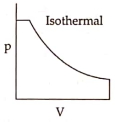
B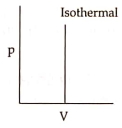
C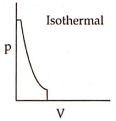
D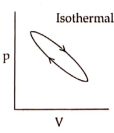
Solution
(A) In a $p-V$ graph,the area under the curve represents the magnitude of the work done.
Comparing the given graphs,the area enclosed under the curve in option $A$ is the largest among the choices provided.
Therefore,the curve in option $A$ represents the maximum work done.
Comparing the given graphs,the area enclosed under the curve in option $A$ is the largest among the choices provided.
Therefore,the curve in option $A$ represents the maximum work done.
0 likes
View Solution233
MediumMCQ
At $25^{\circ} C$ and $1 \, atm$ pressure,the enthalpy of combustion of benzene$_{(l)}$ and acetylene$_{(g)}$ are $-3268 \, kJ \, mol^{-1}$ and $-1300 \, kJ \, mol^{-1}$,respectively. The change in enthalpy for the reaction $3 C_2H_{2(g)} \rightarrow C_6H_{6(l)}$ is $..... \, kJ \, mol^{-1}$.
A
$+324$
B
$+632$
C
$-632$
D
$-324$
Solution
(C) The enthalpy of reaction is calculated using the enthalpies of combustion of reactants and products:
$\Delta H = \sum \Delta H_{\text{combustion}} \text{ (Reactants)} - \sum \Delta H_{\text{combustion}} \text{ (Products)}$
For the reaction $3 C_2H_{2(g)} \rightarrow C_6H_{6(l)}$:
$\Delta H = [3 \times \Delta H_{\text{combustion}}(C_2H_{2(g)})] - [1 \times \Delta H_{\text{combustion}}(C_6H_{6(l)})]$
Substituting the given values:
$\Delta H = [3 \times (-1300 \, kJ \, mol^{-1})] - [-3268 \, kJ \, mol^{-1}]$
$\Delta H = -3900 + 3268 = -632 \, kJ \, mol^{-1}$
$\Delta H = \sum \Delta H_{\text{combustion}} \text{ (Reactants)} - \sum \Delta H_{\text{combustion}} \text{ (Products)}$
For the reaction $3 C_2H_{2(g)} \rightarrow C_6H_{6(l)}$:
$\Delta H = [3 \times \Delta H_{\text{combustion}}(C_2H_{2(g)})] - [1 \times \Delta H_{\text{combustion}}(C_6H_{6(l)})]$
Substituting the given values:
$\Delta H = [3 \times (-1300 \, kJ \, mol^{-1})] - [-3268 \, kJ \, mol^{-1}]$
$\Delta H = -3900 + 3268 = -632 \, kJ \, mol^{-1}$
0 likes
View Solution234
EasyMCQ
$A$ fish swimming in a water body,when taken out,is covered with a film of water of weight $36 \ g$. When it is subjected to cooking at $100^{\circ} C$,the internal energy change for vaporization in $kJ \ mol^{-1}$ is $......$ [nearest integer].
[Assume steam to be an ideal gas. Given $\Delta_{vap} H^{\ominus}$ for water at $373 \ K$ and $1 \ bar$ is $41.1 \ kJ \ mol^{-1}$; $R = 8.31 \ J \ K^{-1} \ mol^{-1}$]
[Assume steam to be an ideal gas. Given $\Delta_{vap} H^{\ominus}$ for water at $373 \ K$ and $1 \ bar$ is $41.1 \ kJ \ mol^{-1}$; $R = 8.31 \ J \ K^{-1} \ mol^{-1}$]
A
$38$
B
$41$
C
$35$
D
$45$
Solution
(A) The vaporization process is represented as: $H_2O_{(l)} \rightarrow H_2O_{(g)}$.
The number of moles of water is $n = \frac{36 \ g}{18 \ g \ mol^{-1}} = 2 \ mol$.
The relationship between enthalpy change and internal energy change is given by: $\Delta U = \Delta H - \Delta n_g RT$.
For the vaporization of $1 \ mol$ of water,$\Delta n_g = 1$ (since $1 \ mol$ of gas is produced from $1 \ mol$ of liquid).
$\Delta U = \Delta_{vap} H^{\ominus} - RT = 41.1 \ kJ \ mol^{-1} - (8.31 \ J \ K^{-1} \ mol^{-1} \times 373 \ K) / 1000$.
$\Delta U = 41.1 - 3.09963 \approx 41.1 - 3.1 = 38.0 \ kJ \ mol^{-1}$.
Thus,the internal energy change for vaporization is $38 \ kJ \ mol^{-1}$.
The number of moles of water is $n = \frac{36 \ g}{18 \ g \ mol^{-1}} = 2 \ mol$.
The relationship between enthalpy change and internal energy change is given by: $\Delta U = \Delta H - \Delta n_g RT$.
For the vaporization of $1 \ mol$ of water,$\Delta n_g = 1$ (since $1 \ mol$ of gas is produced from $1 \ mol$ of liquid).
$\Delta U = \Delta_{vap} H^{\ominus} - RT = 41.1 \ kJ \ mol^{-1} - (8.31 \ J \ K^{-1} \ mol^{-1} \times 373 \ K) / 1000$.
$\Delta U = 41.1 - 3.09963 \approx 41.1 - 3.1 = 38.0 \ kJ \ mol^{-1}$.
Thus,the internal energy change for vaporization is $38 \ kJ \ mol^{-1}$.
1 likes
View Solution235
MediumMCQ
For the complete combustion of methanol
$CH_3OH_{(l)} + \frac{3}{2} O_{2(g)} \rightarrow CO_{2(g)} + 2H_2O_{(l)}$
the amount of heat produced as measured by a bomb calorimeter is $726 \ kJ \ mol^{-1}$ at $27^{\circ}C$. The enthalpy of combustion for the reaction is $-x \ kJ \ mol^{-1}$,where $x$ is $.....$ (Nearest integer).
(Given: $R = 8.3 \ J \ K^{-1} \ mol^{-1}$)
$CH_3OH_{(l)} + \frac{3}{2} O_{2(g)} \rightarrow CO_{2(g)} + 2H_2O_{(l)}$
the amount of heat produced as measured by a bomb calorimeter is $726 \ kJ \ mol^{-1}$ at $27^{\circ}C$. The enthalpy of combustion for the reaction is $-x \ kJ \ mol^{-1}$,where $x$ is $.....$ (Nearest integer).
(Given: $R = 8.3 \ J \ K^{-1} \ mol^{-1}$)
A
$314$
B
$632$
C
$552$
D
$727$
Solution
(D) The heat measured by a bomb calorimeter is the change in internal energy,$\Delta U = -726 \ kJ \ mol^{-1}$.
The reaction is $CH_3OH_{(l)} + \frac{3}{2} O_{2(g)} \rightarrow CO_{2(g)} + 2H_2O_{(l)}$.
The change in the number of gaseous moles is $\Delta n_g = n_{p(g)} - n_{r(g)} = 1 - \frac{3}{2} = -0.5 \ mol$.
The relationship between enthalpy change and internal energy change is $\Delta H = \Delta U + \Delta n_g RT$.
Given $T = 27 + 273 = 300 \ K$ and $R = 8.3 \ J \ K^{-1} \ mol^{-1} = 8.3 \times 10^{-3} \ kJ \ K^{-1} \ mol^{-1}$.
$\Delta H = -726 + (-0.5) \times (8.3 \times 10^{-3}) \times 300$.
$\Delta H = -726 - 1.245 = -727.245 \ kJ \ mol^{-1}$.
Rounding to the nearest integer,$x = 727$.
The reaction is $CH_3OH_{(l)} + \frac{3}{2} O_{2(g)} \rightarrow CO_{2(g)} + 2H_2O_{(l)}$.
The change in the number of gaseous moles is $\Delta n_g = n_{p(g)} - n_{r(g)} = 1 - \frac{3}{2} = -0.5 \ mol$.
The relationship between enthalpy change and internal energy change is $\Delta H = \Delta U + \Delta n_g RT$.
Given $T = 27 + 273 = 300 \ K$ and $R = 8.3 \ J \ K^{-1} \ mol^{-1} = 8.3 \times 10^{-3} \ kJ \ K^{-1} \ mol^{-1}$.
$\Delta H = -726 + (-0.5) \times (8.3 \times 10^{-3}) \times 300$.
$\Delta H = -726 - 1.245 = -727.245 \ kJ \ mol^{-1}$.
Rounding to the nearest integer,$x = 727$.
0 likes
View Solution236
MediumMCQ
Match List-$I$ with List-$II$
Choose the correct answer from the options given below:
| List-$I$ | List-$II$ |
| $A$. Spontaneous process | $I$. $\Delta H < 0$ |
| $B$. Process with $\Delta P = 0; \Delta T = 0$ | $II$. $\Delta G_{T, P} < 0$ |
| $C$. $\Delta H_{reaction}$ | $III$. Isothermal and isobaric process |
| $D$. Exothermic process | $IV$. [Bond energies of molecules in reactants] - [Bond energies of product molecules] |
Choose the correct answer from the options given below:
A
$A-III, B-II, C-IV, D-I$
B
$A-II, B-III, C-IV, D-I$
C
$A-II, B-III, C-I, D-IV$
D
$A-II, B-I, C-III, D-IV$
Solution
(B) . For a spontaneous process,$\Delta G_{T, P} < 0$. Thus,$A-II$.
$B$. $\Delta P = 0$ represents an isobaric process and $\Delta T = 0$ represents an isothermal process. Thus,$B-III$.
$C$. $\Delta H_{reaction} = (\Sigma \text{Bond energies of reactants}) - (\Sigma \text{Bond energies of products})$. Thus,$C-IV$.
$D$. An exothermic process is characterized by $\Delta H < 0$. Thus,$D-I$.
Therefore,the correct matching is $A-II, B-III, C-IV, D-I$.
$B$. $\Delta P = 0$ represents an isobaric process and $\Delta T = 0$ represents an isothermal process. Thus,$B-III$.
$C$. $\Delta H_{reaction} = (\Sigma \text{Bond energies of reactants}) - (\Sigma \text{Bond energies of products})$. Thus,$C-IV$.
$D$. An exothermic process is characterized by $\Delta H < 0$. Thus,$D-I$.
Therefore,the correct matching is $A-II, B-III, C-IV, D-I$.
0 likes
View Solution237
DifficultMCQ
$2.2 \, g$ of nitrous oxide $(N_{2}O)$ gas is cooled at a constant pressure of $1 \, atm$ from $310 \, K$ to $270 \, K$ causing the compression of the gas from $217.1 \, mL$ to $167.75 \, mL$. The change in internal energy of the process,$\Delta U$ is $-x \, J$. The value of $x$ is $....$ [nearest integer] (Given: atomic mass of $N = 14 \, g \, mol^{-1}$ and of $O = 16 \, g \, mol^{-1}$. Molar heat capacity of $N_{2}O$ is $100 \, J \, K^{-1} \, mol^{-1}$)
A
$455$
B
$45$
C
$95$
D
$195$
Solution
(D) $1$. Calculate the number of moles of $N_{2}O$: $n = \frac{2.2 \, g}{44 \, g \, mol^{-1}} = 0.05 \, mol$.
$2$. Calculate the change in enthalpy $(\Delta H)$ at constant pressure: $\Delta H = n C_{p} \Delta T = 0.05 \, mol \times 100 \, J \, K^{-1} \, mol^{-1} \times (270 - 310) \, K = 5 \times (-40) = -200 \, J$.
$3$. Calculate the work done $(w)$ during the process: $w = -P_{ext} \Delta V = -1 \, atm \times (167.75 - 217.1) \, mL = -1 \times (-49.35) \, mL \cdot atm = 49.35 \, mL \cdot atm$.
$4$. Convert $w$ to Joules: $1 \, L \cdot atm = 101.3 \, J$,so $w = 49.35 \times 10^{-3} \, L \times 101.3 \, J \, L^{-1} \approx 5 \, J$.
$5$. Use the relation $\Delta H = \Delta U + P \Delta V$,which implies $\Delta U = \Delta H - P \Delta V = \Delta H + w$.
$6$. $\Delta U = -200 \, J + 5 \, J = -195 \, J$.
$7$. Since $\Delta U = -x \, J$,we have $-195 = -x$,so $x = 195$.
$2$. Calculate the change in enthalpy $(\Delta H)$ at constant pressure: $\Delta H = n C_{p} \Delta T = 0.05 \, mol \times 100 \, J \, K^{-1} \, mol^{-1} \times (270 - 310) \, K = 5 \times (-40) = -200 \, J$.
$3$. Calculate the work done $(w)$ during the process: $w = -P_{ext} \Delta V = -1 \, atm \times (167.75 - 217.1) \, mL = -1 \times (-49.35) \, mL \cdot atm = 49.35 \, mL \cdot atm$.
$4$. Convert $w$ to Joules: $1 \, L \cdot atm = 101.3 \, J$,so $w = 49.35 \times 10^{-3} \, L \times 101.3 \, J \, L^{-1} \approx 5 \, J$.
$5$. Use the relation $\Delta H = \Delta U + P \Delta V$,which implies $\Delta U = \Delta H - P \Delta V = \Delta H + w$.
$6$. $\Delta U = -200 \, J + 5 \, J = -195 \, J$.
$7$. Since $\Delta U = -x \, J$,we have $-195 = -x$,so $x = 195$.
0 likes
View Solution238
DifficultMCQ
$2.4 \ g$ coal is burnt in a bomb calorimeter in excess of oxygen at $298 \ K$ and $1 \ atm$ pressure. The temperature of the calorimeter rises from $298 \ K$ to $300 \ K$. The enthalpy change during the combustion of coal is $-x \ kJ \ mol^{-1}$. The value of $x$ is. (Nearest Integer) (Given: Heat capacity of bomb calorimeter $20.0 \ kJ \ K^{-1}$. Assume coal to be pure carbon)
A
$201$
B
$202$
C
$203$
D
$200$
Solution
(D) The combustion reaction is: $C_{(s)} + O_{2(g)} \rightarrow CO_{2(g)}$; $\Delta H = -x \ kJ \ mol^{-1}$.
Heat released $(Q)$ is calculated as: $Q = C \times \Delta T = 20.0 \ kJ \ K^{-1} \times (300 \ K - 298 \ K) = 20.0 \ kJ \ K^{-1} \times 2 \ K = 40 \ kJ$.
This heat is released by $2.4 \ g$ of carbon $(C)$.
For $1 \ mole$ of $C$ $(12 \ g)$:
$Q = \frac{40 \ kJ}{2.4 \ g} \times 12 \ g = 200 \ kJ \ mol^{-1}$.
Since $\Delta n_g = 0$ for the reaction,$\Delta H = \Delta U = -200 \ kJ \ mol^{-1}$.
Therefore,$x = 200$.
Heat released $(Q)$ is calculated as: $Q = C \times \Delta T = 20.0 \ kJ \ K^{-1} \times (300 \ K - 298 \ K) = 20.0 \ kJ \ K^{-1} \times 2 \ K = 40 \ kJ$.
This heat is released by $2.4 \ g$ of carbon $(C)$.
For $1 \ mole$ of $C$ $(12 \ g)$:
$Q = \frac{40 \ kJ}{2.4 \ g} \times 12 \ g = 200 \ kJ \ mol^{-1}$.
Since $\Delta n_g = 0$ for the reaction,$\Delta H = \Delta U = -200 \ kJ \ mol^{-1}$.
Therefore,$x = 200$.
1 likes
View Solution239
MediumMCQ
$A$ gas (Molar mass $= 280 \ g \ mol^{-1}$) was burnt in excess $O_2$ in a constant volume calorimeter and during combustion the temperature of calorimeter increased from $298.0 \ K$ to $298.45 \ K$. If the heat capacity of calorimeter is $2.5 \ kJ \ K^{-1}$ and enthalpy of combustion of gas is $9 \ kJ \ mol^{-1}$,then the amount of gas burnt is $...... \ g$. (Nearest Integer)
A
$35$
B
$34$
C
$33$
D
$32$
Solution
(A) Let $x \ g$ be the mass of the gas burnt.
Moles of gas $= \frac{x}{280} \ mol$.
Heat released by the combustion $= \text{Heat capacity} \times \Delta T = 2.5 \ kJ \ K^{-1} \times (298.45 - 298.0) \ K = 2.5 \times 0.45 \ kJ = 1.125 \ kJ$.
Since the combustion occurs in a constant volume calorimeter,the heat released is equal to the internal energy change,$\Delta U$.
Given the enthalpy of combustion $\Delta H = 9 \ kJ \ mol^{-1}$,and assuming $\Delta H \approx \Delta U$ for this calculation,we have:
$\Delta U \text{ per mole} = 9 \ kJ \ mol^{-1}$.
Total heat released $= \text{moles} \times \Delta U \text{ per mole}$.
$1.125 \ kJ = (\frac{x}{280} \ mol) \times 9 \ kJ \ mol^{-1}$.
$x = \frac{1.125 \times 280}{9} = 35 \ g$.
Moles of gas $= \frac{x}{280} \ mol$.
Heat released by the combustion $= \text{Heat capacity} \times \Delta T = 2.5 \ kJ \ K^{-1} \times (298.45 - 298.0) \ K = 2.5 \times 0.45 \ kJ = 1.125 \ kJ$.
Since the combustion occurs in a constant volume calorimeter,the heat released is equal to the internal energy change,$\Delta U$.
Given the enthalpy of combustion $\Delta H = 9 \ kJ \ mol^{-1}$,and assuming $\Delta H \approx \Delta U$ for this calculation,we have:
$\Delta U \text{ per mole} = 9 \ kJ \ mol^{-1}$.
Total heat released $= \text{moles} \times \Delta U \text{ per mole}$.
$1.125 \ kJ = (\frac{x}{280} \ mol) \times 9 \ kJ \ mol^{-1}$.
$x = \frac{1.125 \times 280}{9} = 35 \ g$.
0 likes
View Solution240
MediumMCQ
The molar heat capacity for an ideal gas at constant pressure is $20.785 \ J \ K^{-1} \ mol^{-1}$. The change in internal energy is $5000 \ J$ upon heating it from $300 \ K$ to $500 \ K$. The number of moles of the gas is [Nearest integer] (Given: $R = 8.314 \ J \ K^{-1} \ mol^{-1}$)
A
$1$
B
$2$
C
$3$
D
$4$
Solution
(B) For an ideal gas,the relationship between molar heat capacities is $C_{p,m} - C_{v,m} = R$.
Given $C_{p,m} = 20.785 \ J \ K^{-1} \ mol^{-1}$ and $R = 8.314 \ J \ K^{-1} \ mol^{-1}$,we calculate $C_{v,m}$ as:
$C_{v,m} = 20.785 - 8.314 = 12.471 \ J \ K^{-1} \ mol^{-1}$.
The change in internal energy $\Delta U$ is given by the formula $\Delta U = n C_{v,m} \Delta T$.
Here,$\Delta U = 5000 \ J$ and $\Delta T = 500 \ K - 300 \ K = 200 \ K$.
Substituting the values: $5000 = n \times 12.471 \times 200$.
$n = \frac{5000}{12.471 \times 200} = \frac{25}{12.471} \approx 2.0046$.
The nearest integer is $2$.
Given $C_{p,m} = 20.785 \ J \ K^{-1} \ mol^{-1}$ and $R = 8.314 \ J \ K^{-1} \ mol^{-1}$,we calculate $C_{v,m}$ as:
$C_{v,m} = 20.785 - 8.314 = 12.471 \ J \ K^{-1} \ mol^{-1}$.
The change in internal energy $\Delta U$ is given by the formula $\Delta U = n C_{v,m} \Delta T$.
Here,$\Delta U = 5000 \ J$ and $\Delta T = 500 \ K - 300 \ K = 200 \ K$.
Substituting the values: $5000 = n \times 12.471 \times 200$.
$n = \frac{5000}{12.471 \times 200} = \frac{25}{12.471} \approx 2.0046$.
The nearest integer is $2$.
0 likes
View Solution241
MediumMCQ
Which of the following relations is not correct?
A
$\Delta H = \Delta U - P \Delta V$
B
$\Delta U = q + W$
C
$\Delta S_{sys} + \Delta S_{surr} \geq 0$
D
$\Delta G = \Delta H - T \Delta S$
Solution
(A) By definition,the enthalpy change is given by $\Delta H = \Delta U + \Delta(PV)$.
At constant pressure,this becomes $\Delta H = \Delta U + P \Delta V$.
Option $A$ is written as $\Delta H = \Delta U - P \Delta V$,which is incorrect because the correct sign is positive.
Option $B$ represents the first law of thermodynamics $(\Delta U = q + W)$.
Option $C$ represents the second law of thermodynamics for a spontaneous process.
Option $D$ is the Gibbs-Helmholtz equation.
At constant pressure,this becomes $\Delta H = \Delta U + P \Delta V$.
Option $A$ is written as $\Delta H = \Delta U - P \Delta V$,which is incorrect because the correct sign is positive.
Option $B$ represents the first law of thermodynamics $(\Delta U = q + W)$.
Option $C$ represents the second law of thermodynamics for a spontaneous process.
Option $D$ is the Gibbs-Helmholtz equation.
0 likes
View Solution242
AdvancedMCQ
$C_{(s)} + O_{2(g)} \rightarrow CO_{2(g)} + 400 \; kJ$
$C_{(s)} + \frac{1}{2} O_{2(g)} \rightarrow CO_{(g)} + 100 \; kJ$
When coal of purity $60 \%$ is allowed to burn in the presence of insufficient oxygen,$60 \%$ of carbon is converted into $CO$ and the remaining is converted into $CO_2$.
The heat generated when $0.6 \; kg$ of coal is burnt is (in $; kJ$)
$C_{(s)} + \frac{1}{2} O_{2(g)} \rightarrow CO_{(g)} + 100 \; kJ$
When coal of purity $60 \%$ is allowed to burn in the presence of insufficient oxygen,$60 \%$ of carbon is converted into $CO$ and the remaining is converted into $CO_2$.
The heat generated when $0.6 \; kg$ of coal is burnt is (in $; kJ$)
A
$1600$
B
$3200$
C
$4400$
D
$6600$
Solution
(D) Given equations:
$C_{(s)} + O_{2(g)} \rightarrow CO_{2(g)} + 400 \; kJ \; (I)$
$C_{(s)} + \frac{1}{2} O_{2(g)} \rightarrow CO_{(g)} + 100 \; kJ \; (II)$
Mass of coal $= 0.6 \; kg = 600 \; g$
Pure Carbon $= 600 \times \frac{60}{100} = 360 \; g$
Moles of pure Carbon $= \frac{360 \; g}{12 \; g/mol} = 30 \; mol$
Carbon converted into $CO = 30 \times 0.60 = 18 \; mol$
Carbon converted into $CO_2 = 30 - 18 = 12 \; mol$
Energy from $CO$ formation $= 18 \; mol \times 100 \; kJ/mol = 1800 \; kJ$
Energy from $CO_2$ formation $= 12 \; mol \times 400 \; kJ/mol = 4800 \; kJ$
Total heat generated $= 1800 \; kJ + 4800 \; kJ = 6600 \; kJ$
$C_{(s)} + O_{2(g)} \rightarrow CO_{2(g)} + 400 \; kJ \; (I)$
$C_{(s)} + \frac{1}{2} O_{2(g)} \rightarrow CO_{(g)} + 100 \; kJ \; (II)$
Mass of coal $= 0.6 \; kg = 600 \; g$
Pure Carbon $= 600 \times \frac{60}{100} = 360 \; g$
Moles of pure Carbon $= \frac{360 \; g}{12 \; g/mol} = 30 \; mol$
Carbon converted into $CO = 30 \times 0.60 = 18 \; mol$
Carbon converted into $CO_2 = 30 - 18 = 12 \; mol$
Energy from $CO$ formation $= 18 \; mol \times 100 \; kJ/mol = 1800 \; kJ$
Energy from $CO_2$ formation $= 12 \; mol \times 400 \; kJ/mol = 4800 \; kJ$
Total heat generated $= 1800 \; kJ + 4800 \; kJ = 6600 \; kJ$
0 likes
View Solution243
DifficultMCQ
Products are favoured in a chemical reaction taking place at a constant temperature and pressure. Consider the following statements: $(i)$ The change in Gibbs energy for the reaction is negative. $(ii)$ The total change in Gibbs energy for the reaction and the surroundings is negative. $(iii)$ The change in entropy for the reaction is positive. $(iv)$ The total change in entropy for the reaction and the surroundings is positive. The statements which are always true are:
A
only $(i)$ and $(iii)$
B
only $(i)$ and $(iv)$
C
only $(ii)$ and $(iv)$
D
only $(ii)$ and $(iii)$
Solution
(B) For a chemical reaction to be spontaneous at constant temperature and pressure,the change in Gibbs energy of the system must be negative,i.e.,$\Delta G_{\text{sys}} < 0$. This corresponds to statement $(i)$.
According to the second law of thermodynamics,for any spontaneous process,the total entropy change of the universe (system + surroundings) must be positive,i.e.,$\Delta S_{\text{total}} = \Delta S_{\text{sys}} + \Delta S_{\text{surr}} > 0$. This corresponds to statement $(iv)$.
Statement $(ii)$ is incorrect because the total Gibbs energy change for the universe is not a standard criterion for spontaneity.
Statement $(iii)$ is not necessarily true because a reaction can be spontaneous even if the entropy change of the system is negative,provided the enthalpy change is sufficiently negative to make $\Delta G$ negative.
Therefore,statements $(i)$ and $(iv)$ are always true.
According to the second law of thermodynamics,for any spontaneous process,the total entropy change of the universe (system + surroundings) must be positive,i.e.,$\Delta S_{\text{total}} = \Delta S_{\text{sys}} + \Delta S_{\text{surr}} > 0$. This corresponds to statement $(iv)$.
Statement $(ii)$ is incorrect because the total Gibbs energy change for the universe is not a standard criterion for spontaneity.
Statement $(iii)$ is not necessarily true because a reaction can be spontaneous even if the entropy change of the system is negative,provided the enthalpy change is sufficiently negative to make $\Delta G$ negative.
Therefore,statements $(i)$ and $(iv)$ are always true.
0 likes
View Solution244
DifficultMCQ
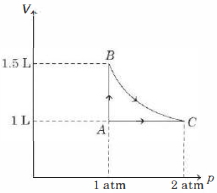
$A$ system consisting of $1 \, mole$ of an ideal gas undergoes a reversible process,$A$ $\rightarrow B$ $\rightarrow C$ $\rightarrow A$ (schematically indicated in the figure below). If the temperature at the starting point $A$ is $300 \, K$ and the work done in the process $B \rightarrow C$ is $1 \, L \, atm$,the heat exchanged in the entire process in $L \, atm$ is $....$
A
$1.0$
B
$0.0$
C
$1.5$
D
$0.5$
Solution
(D) For a cyclic process,the change in internal energy $\Delta U = 0$.
According to the first law of thermodynamics,$\Delta U = q + W = 0$,which implies $q = -W$.
Total work done $W_{total} = W_{AB} + W_{BC} + W_{CA}$.
Process $A \rightarrow B$: Isochoric (constant volume),so $W_{AB} = 0$.
Process $B \rightarrow C$: Given $W_{BC} = 1 \, L \, atm$.
Process $C \rightarrow A$: Isobaric (constant pressure at $2 \, atm$),so $W_{CA} = -p \Delta V = -2 \, atm \times (1 \, L - 1.5 \, L) = -2 \times (-0.5) = 1 \, L \, atm$.
Total work $W_{total} = 0 + 1 + 1 = 2 \, L \, atm$.
Since $q = -W_{total}$,the heat exchanged is $q = -2 \, L \, atm$.
Re-evaluating the provided options and the cyclic nature,the net heat exchanged in a cycle is equal to the negative of the total work done. Based on the graph,the area enclosed is the work. The area of the triangle $ABC$ is $\frac{1}{2} \times \text{base} \times \text{height} = \frac{1}{2} \times (2-1) \, atm \times (1.5-1) \, L = 0.25 \, L \, atm$.
Given the specific path $A$ $\rightarrow B$ $\rightarrow C$ $\rightarrow A$,the net work is $W_{AB} + W_{BC} + W_{CA} = 0 + 1 + 1 = 2 \, L \, atm$.
There appears to be a discrepancy in the provided options. Based on standard thermodynamic cycles,the correct magnitude is $2.0 \, L \, atm$.
According to the first law of thermodynamics,$\Delta U = q + W = 0$,which implies $q = -W$.
Total work done $W_{total} = W_{AB} + W_{BC} + W_{CA}$.
Process $A \rightarrow B$: Isochoric (constant volume),so $W_{AB} = 0$.
Process $B \rightarrow C$: Given $W_{BC} = 1 \, L \, atm$.
Process $C \rightarrow A$: Isobaric (constant pressure at $2 \, atm$),so $W_{CA} = -p \Delta V = -2 \, atm \times (1 \, L - 1.5 \, L) = -2 \times (-0.5) = 1 \, L \, atm$.
Total work $W_{total} = 0 + 1 + 1 = 2 \, L \, atm$.
Since $q = -W_{total}$,the heat exchanged is $q = -2 \, L \, atm$.
Re-evaluating the provided options and the cyclic nature,the net heat exchanged in a cycle is equal to the negative of the total work done. Based on the graph,the area enclosed is the work. The area of the triangle $ABC$ is $\frac{1}{2} \times \text{base} \times \text{height} = \frac{1}{2} \times (2-1) \, atm \times (1.5-1) \, L = 0.25 \, L \, atm$.
Given the specific path $A$ $\rightarrow B$ $\rightarrow C$ $\rightarrow A$,the net work is $W_{AB} + W_{BC} + W_{CA} = 0 + 1 + 1 = 2 \, L \, atm$.
There appears to be a discrepancy in the provided options. Based on standard thermodynamic cycles,the correct magnitude is $2.0 \, L \, atm$.
0 likes
View Solution245
DifficultMCQ
The molar enthalpy change for $H_2O_{(l)} \rightleftharpoons H_2O_{(g)}$ at $373 \ K$ and $1 \ atm$ is $41 \ kJ \ mol^{-1}$. Assuming ideal behavior,the internal energy change for vaporization of $1 \ mol$ of water at $373 \ K$ and $1 \ atm$ in $kJ \ mol^{-1}$ is:
A
$30.2$
B
$41.0$
C
$48.1$
D
$37.9$
Solution
(D) The vaporization reaction is: $H_2O_{(l)} \rightleftharpoons H_2O_{(g)}$.
Given: $\Delta H = 41 \ kJ \ mol^{-1}$,$T = 373 \ K$,$R = 8.314 \times 10^{-3} \ kJ \ K^{-1} \ mol^{-1}$.
The relationship between enthalpy change and internal energy change is $\Delta H = \Delta U + \Delta n_g RT$.
Here,$\Delta n_g = n_g(\text{products}) - n_g(\text{reactants}) = 1 - 0 = 1$.
Substituting the values: $41 = \Delta U + (1 \times 8.314 \times 10^{-3} \times 373)$.
$41 = \Delta U + 3.101$.
$\Delta U = 41 - 3.101 = 37.899 \approx 37.9 \ kJ \ mol^{-1}$.
Given: $\Delta H = 41 \ kJ \ mol^{-1}$,$T = 373 \ K$,$R = 8.314 \times 10^{-3} \ kJ \ K^{-1} \ mol^{-1}$.
The relationship between enthalpy change and internal energy change is $\Delta H = \Delta U + \Delta n_g RT$.
Here,$\Delta n_g = n_g(\text{products}) - n_g(\text{reactants}) = 1 - 0 = 1$.
Substituting the values: $41 = \Delta U + (1 \times 8.314 \times 10^{-3} \times 373)$.
$41 = \Delta U + 3.101$.
$\Delta U = 41 - 3.101 = 37.899 \approx 37.9 \ kJ \ mol^{-1}$.
0 likes
View Solution246
MediumMCQ
The $\Delta H$ for vaporisation of a liquid is $20 \, kJ/mol$. Assuming ideal behaviour,the change in internal energy for the vaporisation of $1 \, mole$ of the liquid at $60^{\circ} C$ and $1 \, bar$ is close to $.... \, kJ/mol$
A
$13.2$
B
$17.2$
C
$19.5$
D
$20.0$
Solution
(B)
Given,$\Delta H_{vap} = 20 \, kJ/mol$.
For the process of vaporisation,the change in the number of moles of gas is $\Delta n_g = n_{gas} - n_{liquid} \approx 1 - 0 = 1$.
Temperature $T = 60 + 273 = 333 \, K$.
The relationship between enthalpy change and internal energy change is $\Delta H = \Delta U + \Delta n_g RT$.
Rearranging for internal energy change: $\Delta U = \Delta H - \Delta n_g RT$.
Substituting the values: $\Delta U = 20 \, kJ/mol - (1 \, mol \times 8.314 \times 10^{-3} \, kJ \cdot K^{-1} \cdot mol^{-1} \times 333 \, K)$.
$\Delta U = 20 - 2.768 \approx 17.23 \, kJ/mol$.
Thus,the value is close to $17.2 \, kJ/mol$.
Given,$\Delta H_{vap} = 20 \, kJ/mol$.
For the process of vaporisation,the change in the number of moles of gas is $\Delta n_g = n_{gas} - n_{liquid} \approx 1 - 0 = 1$.
Temperature $T = 60 + 273 = 333 \, K$.
The relationship between enthalpy change and internal energy change is $\Delta H = \Delta U + \Delta n_g RT$.
Rearranging for internal energy change: $\Delta U = \Delta H - \Delta n_g RT$.
Substituting the values: $\Delta U = 20 \, kJ/mol - (1 \, mol \times 8.314 \times 10^{-3} \, kJ \cdot K^{-1} \cdot mol^{-1} \times 333 \, K)$.
$\Delta U = 20 - 2.768 \approx 17.23 \, kJ/mol$.
Thus,the value is close to $17.2 \, kJ/mol$.
0 likes
View Solution247
DifficultMCQ
$A$ thermodynamic cycle in the pressure $(p)-$ volume $(V)$ plane is given below. $A B$ and $C D$ are isothermal processes while $B C$ and $D A$ are adiabatic processes. The same cycle in the temperature $(T) -$ entropy $(S)$ plane is
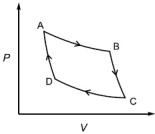
A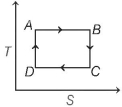
B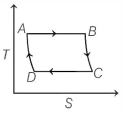
C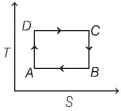
D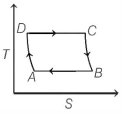
Solution
(A) The thermodynamic cycle in the $p-V$ plane consists of two isothermal and two adiabatic processes.
$1. A \rightarrow B$: Isothermal expansion $(T = \text{constant})$,entropy increases ($S$ increases).
$2. B \rightarrow C$: Adiabatic expansion $(S = \text{constant})$,temperature decreases ($T$ decreases).
$3. C \rightarrow D$: Isothermal compression $(T = \text{constant})$,entropy decreases ($S$ decreases).
$4. D \rightarrow A$: Adiabatic compression $(S = \text{constant})$,temperature increases ($T$ increases).
In the $T-S$ plane,isothermal processes appear as horizontal lines $(T = \text{constant})$ and adiabatic processes appear as vertical lines $(S = \text{constant})$. Based on the directions of the processes,the correct representation is a rectangle in the $T-S$ plane with $A \rightarrow B$ at a higher temperature than $C \rightarrow D$.
$1. A \rightarrow B$: Isothermal expansion $(T = \text{constant})$,entropy increases ($S$ increases).
$2. B \rightarrow C$: Adiabatic expansion $(S = \text{constant})$,temperature decreases ($T$ decreases).
$3. C \rightarrow D$: Isothermal compression $(T = \text{constant})$,entropy decreases ($S$ decreases).
$4. D \rightarrow A$: Adiabatic compression $(S = \text{constant})$,temperature increases ($T$ increases).
In the $T-S$ plane,isothermal processes appear as horizontal lines $(T = \text{constant})$ and adiabatic processes appear as vertical lines $(S = \text{constant})$. Based on the directions of the processes,the correct representation is a rectangle in the $T-S$ plane with $A \rightarrow B$ at a higher temperature than $C \rightarrow D$.
0 likes
View Solution248
MediumMCQ
The quantity of heat (in $J$) required to raise the temperature of $1.0 \, kg$ of ethanol from $293.45 \, K$ to the boiling point and then change the liquid to vapor at that temperature is closest to
[Given,boiling point of ethanol $351.45 \, K$. Specific heat capacity of liquid ethanol $2.44 \, J \, g^{-1} \, K^{-1}$. Latent heat of vaporisation of ethanol $855 \, J \, g^{-1}$ ]
[Given,boiling point of ethanol $351.45 \, K$. Specific heat capacity of liquid ethanol $2.44 \, J \, g^{-1} \, K^{-1}$. Latent heat of vaporisation of ethanol $855 \, J \, g^{-1}$ ]
A
$142 \times 10^2$
B
$9.97 \times 10^2$
C
$142 \times 10^5$
D
$9.97 \times 10^5$
Solution
(D) The total heat required $(q)$ is the sum of the heat required to raise the temperature of the liquid $(q_1)$ and the heat required for phase change $(q_2)$.
$q_1 = m \times c \times \Delta T$
$q_1 = 1000 \, g \times 2.44 \, J \, g^{-1} \, K^{-1} \times (351.45 \, K - 293.45 \, K)$
$q_1 = 1000 \times 2.44 \times 58 = 141520 \, J = 1.4152 \times 10^5 \, J$
$q_2 = m \times L_v$
$q_2 = 1000 \, g \times 855 \, J \, g^{-1} = 855000 \, J = 8.55 \times 10^5 \, J$
$q = q_1 + q_2 = 1.4152 \times 10^5 \, J + 8.55 \times 10^5 \, J = 9.9652 \times 10^5 \, J$
Rounding to the nearest value,we get $9.97 \times 10^5 \, J$.
$q_1 = m \times c \times \Delta T$
$q_1 = 1000 \, g \times 2.44 \, J \, g^{-1} \, K^{-1} \times (351.45 \, K - 293.45 \, K)$
$q_1 = 1000 \times 2.44 \times 58 = 141520 \, J = 1.4152 \times 10^5 \, J$
$q_2 = m \times L_v$
$q_2 = 1000 \, g \times 855 \, J \, g^{-1} = 855000 \, J = 8.55 \times 10^5 \, J$
$q = q_1 + q_2 = 1.4152 \times 10^5 \, J + 8.55 \times 10^5 \, J = 9.9652 \times 10^5 \, J$
Rounding to the nearest value,we get $9.97 \times 10^5 \, J$.
0 likes
View Solution249
MediumMCQ
$X \, g$ of ice at $0^{\circ} C$ is added to $340 \, g$ of water at $20^{\circ} C$. The final temperature of the resultant mixture is $5^{\circ} C$. The value of $X$ (in $g$) is closest to:
[Heat of fusion of ice $= 333 \, J / g$; specific heat of water $= 4.184 \, J / g \cdot K$]
[Heat of fusion of ice $= 333 \, J / g$; specific heat of water $= 4.184 \, J / g \cdot K$]
A
$80.4$
B
$52.8$
C
$120.6$
D
$60.3$
Solution
(D) The heat gained by the ice equals the heat lost by the water.
Heat gained by $X \, g$ of ice at $0^{\circ} C$ to become water at $5^{\circ} C$ is given by: $Q_{gain} = X \times L_f + X \times c \times \Delta T_{ice}$.
$Q_{gain} = X(333) + X(4.184)(5 - 0) = 333X + 20.92X = 353.92X$.
Heat lost by $340 \, g$ of water cooling from $20^{\circ} C$ to $5^{\circ} C$ is given by: $Q_{lost} = m \times c \times \Delta T_{water}$.
$Q_{lost} = 340 \times 4.184 \times (20 - 5) = 340 \times 4.184 \times 15 = 21338.4 \, J$.
Equating $Q_{gain} = Q_{lost}$:
$353.92X = 21338.4$.
$X = \frac{21338.4}{353.92} \approx 60.29 \, g$.
Thus,the value of $X$ is approximately $60.3 \, g$.
Heat gained by $X \, g$ of ice at $0^{\circ} C$ to become water at $5^{\circ} C$ is given by: $Q_{gain} = X \times L_f + X \times c \times \Delta T_{ice}$.
$Q_{gain} = X(333) + X(4.184)(5 - 0) = 333X + 20.92X = 353.92X$.
Heat lost by $340 \, g$ of water cooling from $20^{\circ} C$ to $5^{\circ} C$ is given by: $Q_{lost} = m \times c \times \Delta T_{water}$.
$Q_{lost} = 340 \times 4.184 \times (20 - 5) = 340 \times 4.184 \times 15 = 21338.4 \, J$.
Equating $Q_{gain} = Q_{lost}$:
$353.92X = 21338.4$.
$X = \frac{21338.4}{353.92} \approx 60.29 \, g$.
Thus,the value of $X$ is approximately $60.3 \, g$.
0 likes
View Solution250
MediumMCQ
An isolated box,equally partitioned,contains two ideal gases $A$ and $B$ as shown in the figure. When the partition is removed,the gases mix. The changes in enthalpy $(\Delta H)$ and entropy $(\Delta S)$ in the process,respectively,are
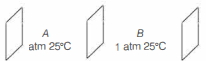
A
zero,positive
B
zero,negative
C
positive,zero
D
negative,zero
Solution
(A) For an ideal gas in an isolated system,the process of mixing is spontaneous and occurs at constant temperature (isothermal process).
Since the system is isolated,there is no exchange of heat with the surroundings $(q = 0)$ and no work is done $(w = 0)$,so $\Delta U = 0$.
For an ideal gas,enthalpy change is given by $\Delta H = \Delta U + \Delta(PV) = \Delta U + \Delta(nRT)$. Since $T$ is constant and $\Delta U = 0$,$\Delta H = 0$.
When the partition is removed,the gases mix,which increases the randomness of the system. Therefore,the entropy of the system increases,meaning $\Delta S > 0$ (positive).
Thus,the change in enthalpy is zero and the change in entropy is positive.
Since the system is isolated,there is no exchange of heat with the surroundings $(q = 0)$ and no work is done $(w = 0)$,so $\Delta U = 0$.
For an ideal gas,enthalpy change is given by $\Delta H = \Delta U + \Delta(PV) = \Delta U + \Delta(nRT)$. Since $T$ is constant and $\Delta U = 0$,$\Delta H = 0$.
When the partition is removed,the gases mix,which increases the randomness of the system. Therefore,the entropy of the system increases,meaning $\Delta S > 0$ (positive).
Thus,the change in enthalpy is zero and the change in entropy is positive.
0 likes
View SolutionThermodynamics — Mix Examples-Thermodynamics and Thermochemistry · Frequently Asked Questions
1Are these Thermodynamics questions useful for JEE and NEET?
Yes. All questions in this section are mapped to JEE Main and NEET exam patterns. Previous year questions from JEE Main, NEET, GUJCET and state-level exams are included with full solutions.
2Can I switch to Hindi or Gujarati for these questions?
Yes. Use the language tabs in the hero section or the sidebar to view the same questions and solutions in English, Hindi or Gujarati.
3How do I generate a question paper from this subtopic?
Use the Vedclass Exam Paper Generator — select the chapter and subtopic, set difficulty, and generate Sets A, B, C, D automatically. First 3 chapters of every subject are free.
Vedclass Products
For Students
Vedclass Test Series
Mock tests in real JEE/NEET style with performance analysis. 5-day free trial.
Start Free TrialFor Teachers
Exam Paper Generator
Generate Set A/B/C/D papers from this chapter in 2 minutes. 3 chapters free.
Try FreeFor Institutes
Online Exam Module
Live online exams with unlimited students, 360° analytics & white-label branding.
See DemoFor Teachers & Institutes
Generate a Thermodynamics Exam Paper in 2 Minutes
Select subtopic & difficulty — Sets A, B, C, D auto-generated with No Repeat logic.
First 3 chapters of every subject are free — no payment required.