
A English
Quantum number, Electronic configuration and Shape of orbitals Questions in English
Class 11 Chemistry · Structure of Atom · Quantum number, Electronic configuration and Shape of orbitals
1023+
Questions
English
Language
100%
With Solutions
Showing 48 of 1023 questions in English
51
EasyMCQ
For a given value of quantum number $l$,the number of allowed values of $m$ is given by
A
$l + 2$
B
$2l + 2$
C
$2l + 1$
D
$l + 1$
Solution
(C) The magnetic quantum number $m$ can take values ranging from $-l$ to $+l$,including zero.
Therefore,the total number of allowed values for $m$ is calculated as $(l - (-l) + 1) = 2l + 1$.
Therefore,the total number of allowed values for $m$ is calculated as $(l - (-l) + 1) = 2l + 1$.
0 likes
View Solution52
MediumMCQ
The number of radial nodes of $3s$ and $2p$ orbitals are respectively.
A
$2, 0$
B
$0, 2$
C
$1, 2$
D
$2, 1$
Solution
(A) The number of radial nodes is calculated using the formula: $\text{Radial nodes} = (n - l - 1)$.
For $3s$ orbital: $n = 3, l = 0$.
$\text{Radial nodes} = 3 - 0 - 1 = 2$.
For $2p$ orbital: $n = 2, l = 1$.
$\text{Radial nodes} = 2 - 1 - 1 = 0$.
Therefore,the number of radial nodes for $3s$ and $2p$ orbitals are $2$ and $0$ respectively.
For $3s$ orbital: $n = 3, l = 0$.
$\text{Radial nodes} = 3 - 0 - 1 = 2$.
For $2p$ orbital: $n = 2, l = 1$.
$\text{Radial nodes} = 2 - 1 - 1 = 0$.
Therefore,the number of radial nodes for $3s$ and $2p$ orbitals are $2$ and $0$ respectively.
0 likes
View Solution53
EasyMCQ
Which of the sub-shell is spherical in shape?
A
$4s$
B
$4f$
C
$4p$
D
$4d$
Solution
(A) The shape of an orbital is determined by the azimuthal quantum number $(l)$.
For $s$-orbitals,$l = 0$,which corresponds to a spherical shape.
For $p$-orbitals,$l = 1$ (dumbbell shape).
For $d$-orbitals,$l = 2$ (double dumbbell shape).
For $f$-orbitals,$l = 3$ (complex shape).
Therefore,the $4s$ sub-shell is spherical.
For $s$-orbitals,$l = 0$,which corresponds to a spherical shape.
For $p$-orbitals,$l = 1$ (dumbbell shape).
For $d$-orbitals,$l = 2$ (double dumbbell shape).
For $f$-orbitals,$l = 3$ (complex shape).
Therefore,the $4s$ sub-shell is spherical.
0 likes
View Solution54
EasyMCQ
Which electronic configuration for oxygen is correct according to Hund's rule of maximum multiplicity?
A
$1s^2 2s^2 2p_x^2 2p_y^1 2p_z^1$
B
$1s^2 2s^2 2p_x^2 2p_y^2 2p_z^0$
C
$1s^2 2s^2 2p_x^3 2p_y^1 2p_z^0$
D
None of these
Solution
(A) The atomic number of oxygen $(O)$ is $8$.
Its electronic configuration is $1s^2 2s^2 2p^4$.
Hund's rule of maximum multiplicity states that electron pairing in degenerate orbitals (orbitals of the same subshell) does not occur until each orbital is singly occupied.
For the $2p$ subshell containing $4$ electrons,the electrons will occupy the $2p_x, 2p_y,$ and $2p_z$ orbitals singly first,and then the fourth electron will pair up in one of the orbitals.
Thus,the configuration is $1s^2 2s^2 2p_x^2 2p_y^1 2p_z^1$ (or any equivalent arrangement like $2p_x^1 2p_y^2 2p_z^1$).
Therefore,option $A$ is correct.
Its electronic configuration is $1s^2 2s^2 2p^4$.
Hund's rule of maximum multiplicity states that electron pairing in degenerate orbitals (orbitals of the same subshell) does not occur until each orbital is singly occupied.
For the $2p$ subshell containing $4$ electrons,the electrons will occupy the $2p_x, 2p_y,$ and $2p_z$ orbitals singly first,and then the fourth electron will pair up in one of the orbitals.
Thus,the configuration is $1s^2 2s^2 2p_x^2 2p_y^1 2p_z^1$ (or any equivalent arrangement like $2p_x^1 2p_y^2 2p_z^1$).
Therefore,option $A$ is correct.
0 likes
View Solution55
EasyMCQ
If the value of the azimuthal quantum number $l$ is $2$,then the total possible values of the magnetic quantum number will be
A
$7$
B
$5$
C
$3$
D
$2$
Solution
(B) For a given azimuthal quantum number $l$,the magnetic quantum number $m$ can take values from $-l$ to $+l$,including zero.
The total number of values is given by the formula $(2l + 1)$.
Given $l = 2$,the possible values for $m$ are $-2, -1, 0, +1, +2$.
Thus,the total number of values is $2(2) + 1 = 5$.
The total number of values is given by the formula $(2l + 1)$.
Given $l = 2$,the possible values for $m$ are $-2, -1, 0, +1, +2$.
Thus,the total number of values is $2(2) + 1 = 5$.
0 likes
View Solution56
EasyMCQ
The shape of $d_{xy}$ orbital will be
A
Circular
B
Dumb-bell
C
Double dumb-bell
D
Trigonal
Solution
(C) The $d$-orbitals have a double dumb-bell shape,except for the $d_{z^2}$ orbital which has a donut-shaped electron cloud around the center.
Specifically,the $d_{xy}$,$d_{yz}$,and $d_{xz}$ orbitals consist of four lobes oriented between the respective axes,forming a double dumb-bell shape.
Specifically,the $d_{xy}$,$d_{yz}$,and $d_{xz}$ orbitals consist of four lobes oriented between the respective axes,forming a double dumb-bell shape.
0 likes
View Solution57
EasyMCQ
In any atom,which sub-shell will have the highest energy among the following?
A
$3p$
B
$3d$
C
$4s$
D
$3s$
Solution
(B) To determine the energy of a sub-shell,we use the $(n + l)$ rule.
For $3p$: $n = 3, l = 1$,so $(n + l) = 3 + 1 = 4$.
For $3d$: $n = 3, l = 2$,so $(n + l) = 3 + 2 = 5$.
For $4s$: $n = 4, l = 0$,so $(n + l) = 4 + 0 = 4$.
For $3s$: $n = 3, l = 0$,so $(n + l) = 3 + 0 = 3$.
Comparing the $(n + l)$ values,$3d$ has the highest value of $5$,therefore it has the highest energy.
For $3p$: $n = 3, l = 1$,so $(n + l) = 3 + 1 = 4$.
For $3d$: $n = 3, l = 2$,so $(n + l) = 3 + 2 = 5$.
For $4s$: $n = 4, l = 0$,so $(n + l) = 4 + 0 = 4$.
For $3s$: $n = 3, l = 0$,so $(n + l) = 3 + 0 = 3$.
Comparing the $(n + l)$ values,$3d$ has the highest value of $5$,therefore it has the highest energy.
0 likes
View Solution58
MediumMCQ
Which electronic configuration does not follow the $(n + l)$ rule?
A
$1s^2, 2s^2 2p^6, 3s^2 3p^6 3d^1, 4s^2$
B
$1s^2, 2s^2 2p^6, 3s^2 3p^6 3d^7, 4s^2$
C
$1s^2, 2s^2 2p^6, 3s^2 3p^6 3d^5, 4s^1$
D
$1s^2, 2s^2 2p^6, 3s^2 3p^6 3d^8, 4s^2$
Solution
(C) The $(n + l)$ rule states that orbitals are filled in increasing order of $(n + l)$ values.
For $4s$,$(n + l) = 4 + 0 = 4$.
For $3d$,$(n + l) = 3 + 2 = 5$.
According to the rule,$4s$ should be filled before $3d$.
In option $(C)$,the configuration $3d^5, 4s^1$ represents Chromium $(Z=24)$.
While this configuration is stable due to the half-filled $d$-subshell,it technically violates the Aufbau principle (which is based on the $(n+l)$ rule) because an electron is placed in $3d$ before $4s$ is completely filled with $2$ electrons.
For $4s$,$(n + l) = 4 + 0 = 4$.
For $3d$,$(n + l) = 3 + 2 = 5$.
According to the rule,$4s$ should be filled before $3d$.
In option $(C)$,the configuration $3d^5, 4s^1$ represents Chromium $(Z=24)$.
While this configuration is stable due to the half-filled $d$-subshell,it technically violates the Aufbau principle (which is based on the $(n+l)$ rule) because an electron is placed in $3d$ before $4s$ is completely filled with $2$ electrons.
0 likes
View Solution59
MediumMCQ
The four quantum numbers of the outermost orbital of $K$ (atomic number $= 19$) are:
A
$n = 2, l = 0, m = 0, s = + \frac{1}{2}$
B
$n = 4, l = 0, m = 0, s = + \frac{1}{2}$
C
$n = 3, l = 1, m = 1, s = + \frac{1}{2}$
D
$n = 4, l = 2, m = -1, s = + \frac{1}{2}$
Solution
(B) The electronic configuration of $K$ $(Z = 19)$ is $1s^2, 2s^2, 2p^6, 3s^2, 3p^6, 4s^1$.
The outermost electron is in the $4s$ orbital.
For the $4s$ orbital,the principal quantum number $n = 4$.
For an $s$-orbital,the azimuthal quantum number $l = 0$.
Since $l = 0$,the magnetic quantum number $m = 0$.
The spin quantum number $s$ for the single electron in the $4s$ orbital is $+ \frac{1}{2}$.
Thus,the set of quantum numbers is $n = 4, l = 0, m = 0, s = + \frac{1}{2}$.
The outermost electron is in the $4s$ orbital.
For the $4s$ orbital,the principal quantum number $n = 4$.
For an $s$-orbital,the azimuthal quantum number $l = 0$.
Since $l = 0$,the magnetic quantum number $m = 0$.
The spin quantum number $s$ for the single electron in the $4s$ orbital is $+ \frac{1}{2}$.
Thus,the set of quantum numbers is $n = 4, l = 0, m = 0, s = + \frac{1}{2}$.
0 likes
View Solution60
EasyMCQ
The number of orbitals in $2p$ sub-shell is
A
$6$
B
$2$
C
$3$
D
$4$
Solution
(C) The number of orbitals in a sub-shell is given by $(2l + 1)$.
For a $p$ sub-shell,the azimuthal quantum number $l = 1$.
Therefore,the number of orbitals = $(2 \times 1 + 1) = 3$.
These orbitals are designated as $p_x, p_y,$ and $p_z$.
For a $p$ sub-shell,the azimuthal quantum number $l = 1$.
Therefore,the number of orbitals = $(2 \times 1 + 1) = 3$.
These orbitals are designated as $p_x, p_y,$ and $p_z$.
0 likes
View Solution61
EasyMCQ
The number of orbitals in the $d$ sub-shell is
A
$1$
B
$3$
C
$5$
D
$7$
Solution
(C) The number of orbitals in a sub-shell is determined by the azimuthal quantum number,$\ell$.
For a $d$ sub-shell,the value of $\ell$ is $2$.
The number of orbitals in a sub-shell is given by the formula $(2\ell + 1)$.
Substituting $\ell = 2$ into the formula: $2(2) + 1 = 5$.
Thus,there are $5$ orbitals in the $d$ sub-shell.
For a $d$ sub-shell,the value of $\ell$ is $2$.
The number of orbitals in a sub-shell is given by the formula $(2\ell + 1)$.
Substituting $\ell = 2$ into the formula: $2(2) + 1 = 5$.
Thus,there are $5$ orbitals in the $d$ sub-shell.
0 likes
View Solution62
EasyMCQ
$A$ sub-shell with $l = 2$ can accommodate how many electrons?
A
$3$
B
$10$
C
$5$
D
$6$
Solution
(B) For a given azimuthal quantum number $l$,the number of orbitals is given by $(2l + 1)$.
For $l = 2$,the number of orbitals is $2(2) + 1 = 5$.
Each orbital can accommodate a maximum of $2$ electrons.
Therefore,the total number of electrons in the $d$-subshell $(l = 2)$ is $5 \times 2 = 10$ electrons.
For $l = 2$,the number of orbitals is $2(2) + 1 = 5$.
Each orbital can accommodate a maximum of $2$ electrons.
Therefore,the total number of electrons in the $d$-subshell $(l = 2)$ is $5 \times 2 = 10$ electrons.
0 likes
View Solution63
MediumMCQ
Pauli's exclusion principle states that
A
Two electrons in the same atom can have the same set of all four quantum numbers
B
Two electrons in the same atom cannot have the same set of all four quantum numbers
C
The electrons tend to occupy different orbitals as far as possible
D
None of the above
Solution
(B) Pauli's exclusion principle states that no two electrons in an atom can have the same set of all four quantum numbers $(n, l, m_l, m_s)$.
This implies that an orbital can hold a maximum of two electrons,and they must have opposite spins.
This implies that an orbital can hold a maximum of two electrons,and they must have opposite spins.
0 likes
View Solution64
EasyMCQ
For $d$ electrons,the azimuthal quantum number is
A
$0$
B
$1$
C
$2$
D
$3$
Solution
(C) The azimuthal quantum number $(l)$ determines the shape of the orbital.
For different subshells,the values are:
$s$-orbital: $l = 0$
$p$-orbital: $l = 1$
$d$-orbital: $l = 2$
$f$-orbital: $l = 3$
Therefore,for $d$ electrons,the azimuthal quantum number is $2$.
For different subshells,the values are:
$s$-orbital: $l = 0$
$p$-orbital: $l = 1$
$d$-orbital: $l = 2$
$f$-orbital: $l = 3$
Therefore,for $d$ electrons,the azimuthal quantum number is $2$.
0 likes
View Solution65
EasyMCQ
For $p$-orbital,the magnetic quantum number has value
A
$2$
B
$4, -4$
C
$-1, 0, +1$
D
$0$
Solution
(C) For $p$-orbital,the azimuthal quantum number $(l)$ is $1$.
The magnetic quantum number $(m_l)$ ranges from $-l$ to $+l$,including zero.
Therefore,for $l = 1$,the possible values of $m_l$ are $-1, 0, +1$.
The magnetic quantum number $(m_l)$ ranges from $-l$ to $+l$,including zero.
Therefore,for $l = 1$,the possible values of $m_l$ are $-1, 0, +1$.
0 likes
View Solution66
MediumMCQ
For $n = 3$ energy level,the number of possible orbitals (all kinds) are
A
$1$
B
$3$
C
$4$
D
$9$
Solution
(D) For a given principal quantum number $n$,the number of orbitals in a shell is given by the formula $n^2$.
For $n = 3$,the number of orbitals $= 3^2 = 9$.
These $9$ orbitals consist of one $3s$ orbital,three $3p$ orbitals,and five $3d$ orbitals $(1 + 3 + 5 = 9)$.
For $n = 3$,the number of orbitals $= 3^2 = 9$.
These $9$ orbitals consist of one $3s$ orbital,three $3p$ orbitals,and five $3d$ orbitals $(1 + 3 + 5 = 9)$.
0 likes
View Solution67
MediumMCQ
Which of the following ions does not have the electronic configuration of neon $(Ne)$?
A
$F^{-}$
B
$Mg^{2+}$
C
$Na^{+}$
D
$Cl^{-}$
Solution
(D) The atomic number of $Ne$ is $10$,and its electronic configuration is $1s^2 \ 2s^2 \ 2p^6$.
$F^{-}$ has $9 + 1 = 10$ electrons: $1s^2 \ 2s^2 \ 2p^6$.
$Na^{+}$ has $11 - 1 = 10$ electrons: $1s^2 \ 2s^2 \ 2p^6$.
$Mg^{2+}$ has $12 - 2 = 10$ electrons: $1s^2 \ 2s^2 \ 2p^6$.
$Cl^{-}$ has $17 + 1 = 18$ electrons: $1s^2 \ 2s^2 \ 2p^6 \ 3s^2 \ 3p^6$.
Therefore,$Cl^{-}$ does not have the configuration of $Ne$.
$F^{-}$ has $9 + 1 = 10$ electrons: $1s^2 \ 2s^2 \ 2p^6$.
$Na^{+}$ has $11 - 1 = 10$ electrons: $1s^2 \ 2s^2 \ 2p^6$.
$Mg^{2+}$ has $12 - 2 = 10$ electrons: $1s^2 \ 2s^2 \ 2p^6$.
$Cl^{-}$ has $17 + 1 = 18$ electrons: $1s^2 \ 2s^2 \ 2p^6 \ 3s^2 \ 3p^6$.
Therefore,$Cl^{-}$ does not have the configuration of $Ne$.
0 likes
View Solution68
MediumMCQ
Which of the following pairs of ions have the same electronic configuration?
A
$Li^{+}$ and $Na^{+}$
B
$Na^{+}$ and $K^{+}$
C
$K^{+}$ and $Ca^{2+}$
D
$O^{2-}$ and $Cl^{-}$
Solution
(C) The electronic configuration of $K^{+}$ $(Z=19)$ is $1s^2, 2s^2, 2p^6, 3s^2, 3p^6$ (total $18$ electrons).
The electronic configuration of $Ca^{2+}$ $(Z=20)$ is $1s^2, 2s^2, 2p^6, 3s^2, 3p^6$ (total $18$ electrons).
Since both $K^{+}$ and $Ca^{2+}$ have $18$ electrons,they are isoelectronic and possess the same electronic configuration.
The electronic configuration of $Ca^{2+}$ $(Z=20)$ is $1s^2, 2s^2, 2p^6, 3s^2, 3p^6$ (total $18$ electrons).
Since both $K^{+}$ and $Ca^{2+}$ have $18$ electrons,they are isoelectronic and possess the same electronic configuration.
0 likes
View Solution69
EasyMCQ
When the azimuthal quantum number has a value of $l = 0$,the shape of the orbital is
A
Rectangular
B
Spherical
C
Dumbbell
D
Unsymmetrical
Solution
(B) The azimuthal quantum number $l$ determines the shape of the orbital.
For $l = 0$,the orbital is an $s$-orbital,which has a spherical shape.
Therefore,the correct option is $(B)$.
For $l = 0$,the orbital is an $s$-orbital,which has a spherical shape.
Therefore,the correct option is $(B)$.
0 likes
View Solution70
EasyMCQ
The magnetic quantum number for the valence electron of sodium is
A
$3$
B
$2$
C
$1$
D
$0$
Solution
(D) The electronic configuration of sodium ($Na$,atomic number $11$) is $1s^2 2s^2 2p^6 3s^1$.
The valence electron is in the $3s$ orbital.
For the $3s$ orbital,the principal quantum number $n = 3$,the azimuthal quantum number $l = 0$,and the magnetic quantum number $m_l = 0$.
Thus,the magnetic quantum number for the valence electron is $0$.
The valence electron is in the $3s$ orbital.
For the $3s$ orbital,the principal quantum number $n = 3$,the azimuthal quantum number $l = 0$,and the magnetic quantum number $m_l = 0$.
Thus,the magnetic quantum number for the valence electron is $0$.
0 likes
View Solution71
EasyMCQ
The electronic configuration of an element with atomic number $7$ i.e. nitrogen atom is
A
$1s^2, 2s^1, 2p_x^3$
B
$1s^2, 2s^2 2p_x^2 2p_y^1$
C
$1s^2, 2s^2 2p_x^1 2p_y^1 2p_z^1$
D
$1s^2, 2s^2 2p_x^1 2p_y^2$
Solution
(C) The atomic number of nitrogen $(N)$ is $7$.
According to the Aufbau principle,the electrons fill the orbitals in increasing order of energy: $1s, 2s, 2p$.
The electronic configuration is $1s^2 2s^2 2p^3$.
According to Hund's rule of maximum multiplicity,for degenerate orbitals (like $2p_x, 2p_y, 2p_z$),electrons occupy each orbital singly before pairing begins.
Therefore,the configuration is $1s^2, 2s^2, 2p_x^1, 2p_y^1, 2p_z^1$.
According to the Aufbau principle,the electrons fill the orbitals in increasing order of energy: $1s, 2s, 2p$.
The electronic configuration is $1s^2 2s^2 2p^3$.
According to Hund's rule of maximum multiplicity,for degenerate orbitals (like $2p_x, 2p_y, 2p_z$),electrons occupy each orbital singly before pairing begins.
Therefore,the configuration is $1s^2, 2s^2, 2p_x^1, 2p_y^1, 2p_z^1$.
0 likes
View Solution72
MediumMCQ
In a multi-electron atom,which of the following orbitals described by the three quantum numbers will have the same energy in the absence of magnetic and electric fields?
$1. n = 1, l = 0, m = 0$
$2. n = 2, l = 0, m = 0$
$3. n = 2, l = 1, m = 1$
$4. n = 3, l = 2, m = 0$
$5. n = 3, l = 2, m = 0$
$1. n = 1, l = 0, m = 0$
$2. n = 2, l = 0, m = 0$
$3. n = 2, l = 1, m = 1$
$4. n = 3, l = 2, m = 0$
$5. n = 3, l = 2, m = 0$
A
$1$ and $2$
B
$2$ and $3$
C
$3$ and $4$
D
$4$ and $5$
Solution
(D) In a multi-electron atom,the energy of an orbital depends on both the principal quantum number $(n)$ and the azimuthal quantum number $(l)$.
Orbitals with the same $n$ and $l$ values are degenerate (have the same energy) in the absence of external fields.
Comparing the given sets:
$1. n=1, l=0$ $(1s)$
$2. n=2, l=0$ $(2s)$
$3. n=2, l=1$ $(2p)$
$4. n=3, l=2$ $(3d)$
$5. n=3, l=2$ $(3d)$
Since $4$ and $5$ have the same $n=3$ and $l=2$,they represent the same subshell $(3d)$ and thus have the same energy.
Orbitals with the same $n$ and $l$ values are degenerate (have the same energy) in the absence of external fields.
Comparing the given sets:
$1. n=1, l=0$ $(1s)$
$2. n=2, l=0$ $(2s)$
$3. n=2, l=1$ $(2p)$
$4. n=3, l=2$ $(3d)$
$5. n=3, l=2$ $(3d)$
Since $4$ and $5$ have the same $n=3$ and $l=2$,they represent the same subshell $(3d)$ and thus have the same energy.
0 likes
View Solution73
EasyMCQ
Which of the following represents the electronic configuration of an element with atomic number $17$?
A
$1s^2, 2s^2 2p^6, 3s^1 3p^6$
B
$1s^2, 2s^2 2p^6, 3s^2 3p^4, 4s^1$
C
$1s^2, 2s^2 2p^6, 3s^2 3p^5$
D
$1s^2, 2s^2 2p^6, 3s^1 3p^4, 4s^2$
Solution
(C) The atomic number of the element is $17$,which corresponds to Chlorine $(Cl)$.
According to the Aufbau principle,the electrons are filled in the order of increasing energy: $1s, 2s, 2p, 3s, 3p, 4s, \dots$
The electronic configuration for $17$ electrons is $1s^2, 2s^2, 2p^6, 3s^2, 3p^5$.
Therefore,the correct option is $(C)$.
According to the Aufbau principle,the electrons are filled in the order of increasing energy: $1s, 2s, 2p, 3s, 3p, 4s, \dots$
The electronic configuration for $17$ electrons is $1s^2, 2s^2, 2p^6, 3s^2, 3p^5$.
Therefore,the correct option is $(C)$.
0 likes
View Solution74
EasyMCQ
The shape of $s$-orbital is
A
Pyramidal
B
Spherical
C
Tetrahedral
D
Dumb-bell shaped
Solution
(B) The $s$-orbital has a spherical shape due to its non-directional nature.
0 likes
View Solution75
EasyMCQ
When the $3d$ orbital is complete,the next electron will enter the
A
$4p$-orbital
B
$4f$-orbital
C
$4s$-orbital
D
$4d$-orbital
Solution
(A) According to the $(n+l)$ rule,the energy of an orbital is determined by the sum of its principal quantum number $(n)$ and azimuthal quantum number $(l)$.
For $4p$,$n=4$ and $l=1$,so $(n+l) = 4+1 = 5$.
For $4d$,$n=4$ and $l=2$,so $(n+l) = 4+2 = 6$.
For $4f$,$n=4$ and $l=3$,so $(n+l) = 4+3 = 7$.
Since the $4p$ orbital has the lowest $(n+l)$ value among the given options,the next electron will enter the $4p$-orbital.
For $4p$,$n=4$ and $l=1$,so $(n+l) = 4+1 = 5$.
For $4d$,$n=4$ and $l=2$,so $(n+l) = 4+2 = 6$.
For $4f$,$n=4$ and $l=3$,so $(n+l) = 4+3 = 7$.
Since the $4p$ orbital has the lowest $(n+l)$ value among the given options,the next electron will enter the $4p$-orbital.
0 likes
View Solution76
EasyMCQ
$Fe$ (atomic number $= 26$) atom has the electronic arrangement:
A
$2, 8, 8, 8$
B
$2, 8, 16$
C
$2, 8, 14, 2$
D
$2, 8, 12, 4$
Solution
(C) The atomic number of $Fe$ is $26$.
The electronic configuration of $Fe$ is $1s^2 2s^2 2p^6 3s^2 3p^6 4s^2 3d^6$.
Grouping the electrons by principal quantum number $(n)$:
$n=1$: $2$ electrons $(1s^2)$
$n=2$: $8$ electrons $(2s^2 2p^6)$
$n=3$: $14$ electrons $(3s^2 3p^6 3d^6)$
$n=4$: $2$ electrons $(4s^2)$
Thus,the arrangement is $2, 8, 14, 2$.
The electronic configuration of $Fe$ is $1s^2 2s^2 2p^6 3s^2 3p^6 4s^2 3d^6$.
Grouping the electrons by principal quantum number $(n)$:
$n=1$: $2$ electrons $(1s^2)$
$n=2$: $8$ electrons $(2s^2 2p^6)$
$n=3$: $14$ electrons $(3s^2 3p^6 3d^6)$
$n=4$: $2$ electrons $(4s^2)$
Thus,the arrangement is $2, 8, 14, 2$.
0 likes
View Solution77
EasyMCQ
$Cu^{2+}$ will have the following electronic configuration:
A
$1s^2, 2s^2 2p^6, 3s^2 3p^6 3d^{10}$
B
$1s^2, 2s^2 2p^6, 3s^2 3p^6 3d^9, 4s^1$
C
$1s^2, 2s^2 2p^6, 3s^2 3p^6 3d^9$
D
$1s^2, 2s^2 2p^6, 3s^2 3p^6 3d^{10}, 4s^1$
Solution
(C) The atomic number of Copper $(Cu)$ is $29$.
The ground state electronic configuration of $Cu$ is $[Ar] 3d^{10} 4s^1$,which is $1s^2 2s^2 2p^6 3s^2 3p^6 3d^{10} 4s^1$.
To form the $Cu^{2+}$ ion,two electrons are removed from the neutral $Cu$ atom.
First,one electron is removed from the $4s$ orbital,and then one electron is removed from the $3d$ orbital.
Therefore,the electronic configuration of $Cu^{2+}$ is $1s^2 2s^2 2p^6 3s^2 3p^6 3d^9$.
The ground state electronic configuration of $Cu$ is $[Ar] 3d^{10} 4s^1$,which is $1s^2 2s^2 2p^6 3s^2 3p^6 3d^{10} 4s^1$.
To form the $Cu^{2+}$ ion,two electrons are removed from the neutral $Cu$ atom.
First,one electron is removed from the $4s$ orbital,and then one electron is removed from the $3d$ orbital.
Therefore,the electronic configuration of $Cu^{2+}$ is $1s^2 2s^2 2p^6 3s^2 3p^6 3d^9$.
0 likes
View Solution78
EasyMCQ
Which one is the electronic configuration of $Fe^{2+}$?
A
$1s^2, 2s^2 2p^6, 3s^2 3p^6 3d^6$
B
$1s^2, 2s^2 2p^6, 3s^2 3p^6 3d^4, 4s^2$
C
$1s^2, 2s^2 2p^6, 3s^2 3p^6 3d^5, 4s^1$
D
None of these
Solution
(A) The atomic number of iron $(Fe)$ is $26$.
The ground state electronic configuration of $Fe$ is $[Ar] 3d^6 4s^2$ or $1s^2, 2s^2 2p^6, 3s^2 3p^6 3d^6 4s^2$.
When $Fe$ forms the $Fe^{2+}$ ion,it loses two electrons from the outermost shell,which is the $4s$ orbital.
Therefore,the electronic configuration of $Fe^{2+}$ becomes $[Ar] 3d^6$ or $1s^2, 2s^2 2p^6, 3s^2 3p^6 3d^6$.
The ground state electronic configuration of $Fe$ is $[Ar] 3d^6 4s^2$ or $1s^2, 2s^2 2p^6, 3s^2 3p^6 3d^6 4s^2$.
When $Fe$ forms the $Fe^{2+}$ ion,it loses two electrons from the outermost shell,which is the $4s$ orbital.
Therefore,the electronic configuration of $Fe^{2+}$ becomes $[Ar] 3d^6$ or $1s^2, 2s^2 2p^6, 3s^2 3p^6 3d^6$.
0 likes
View Solution79
MediumMCQ
How many electrons can be fit into the orbitals that comprise the $3^{rd}$ quantum shell $(n = 3)$?
A
$2$
B
$8$
C
$18$
D
$32$
Solution
(C) The number of electrons in a shell is given by the formula $2n^2$.
For the $3^{rd}$ quantum shell,$n = 3$.
Number of electrons = $2 \times (3)^2 = 2 \times 9 = 18$.
Therefore,the correct option is $(C)$.
For the $3^{rd}$ quantum shell,$n = 3$.
Number of electrons = $2 \times (3)^2 = 2 \times 9 = 18$.
Therefore,the correct option is $(C)$.
0 likes
View Solution80
EasyMCQ
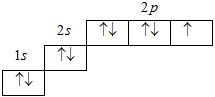
Which element is represented by the following electronic configuration?
A
Nitrogen
B
Oxygen
C
Fluorine
D
Neon
Solution
(C) The given orbital diagram shows the electronic configuration as $1s^2 2s^2 2p^5$.
Total number of electrons = $2 + 2 + 5 = 9$.
The element with atomic number $9$ is Fluorine $(F)$.
Total number of electrons = $2 + 2 + 5 = 9$.
The element with atomic number $9$ is Fluorine $(F)$.
0 likes
View Solution81
EasyMCQ
If the value of azimuthal quantum number is $3$,the possible values of magnetic quantum number would be
A
$0, 1, 2, 3$
B
$0, -1, -2, -3$
C
$0, \pm 1, \pm 2, \pm 3$
D
$\pm 1, \pm 2, \pm 3$
Solution
(C) The magnetic quantum number $(m_l)$ depends on the azimuthal quantum number $(l)$.
For a given value of $l$,the possible values of $m_l$ range from $-l$ to $+l$,including zero.
Given $l = 3$,the possible values of $m_l$ are $-3, -2, -1, 0, +1, +2, +3$,which can be written as $0, \pm 1, \pm 2, \pm 3$.
Therefore,the correct option is $(C)$.
For a given value of $l$,the possible values of $m_l$ range from $-l$ to $+l$,including zero.
Given $l = 3$,the possible values of $m_l$ are $-3, -2, -1, 0, +1, +2, +3$,which can be written as $0, \pm 1, \pm 2, \pm 3$.
Therefore,the correct option is $(C)$.
0 likes
View Solution82
MediumMCQ
Krypton $(_{36}Kr)$ has the electronic configuration $(_{18}Ar) \ 4s^2, 3d^{10}, 4p^6$. The $37^{th}$ electron will go into which one of the following sub-levels?
A
$4f$
B
$4d$
C
$3p$
D
$5s$
Solution
(D) The $37^{th}$ electron will enter the $5s$ sub-level.
According to the Aufbau principle,electrons fill orbitals in the order of increasing energy.
For the $4p$ orbital,$n=4$ and $l=1$,so $(n+l) = 4+1 = 5$.
For the $5s$ orbital,$n=5$ and $l=0$,so $(n+l) = 5+0 = 5$.
When $(n+l)$ values are equal,the orbital with the lower value of $n$ is filled first. Since $4p$ has $n=4$ and $5s$ has $n=5$,the $4p$ orbital is filled before the $5s$ orbital.
Therefore,after the $4p^6$ configuration is completed in Krypton,the next electron $(37^{th})$ enters the $5s$ orbital.
According to the Aufbau principle,electrons fill orbitals in the order of increasing energy.
For the $4p$ orbital,$n=4$ and $l=1$,so $(n+l) = 4+1 = 5$.
For the $5s$ orbital,$n=5$ and $l=0$,so $(n+l) = 5+0 = 5$.
When $(n+l)$ values are equal,the orbital with the lower value of $n$ is filled first. Since $4p$ has $n=4$ and $5s$ has $n=5$,the $4p$ orbital is filled before the $5s$ orbital.
Therefore,after the $4p^6$ configuration is completed in Krypton,the next electron $(37^{th})$ enters the $5s$ orbital.
0 likes
View Solution83
MediumMCQ
If an electron has a spin quantum number of $+ \frac{1}{2}$ and a magnetic quantum number of $- 1$,it cannot be present in an
A
$d$-orbital
B
$f$-orbital
C
$p$-orbital
D
$s$-orbital
Solution
(D) The magnetic quantum number $m$ depends on the azimuthal quantum number $l$ such that $m$ ranges from $-l$ to $+l$.
For an $s$-orbital,$l = 0$,which implies $m = 0$.
Since the given magnetic quantum number is $m = - 1$,it is impossible for an electron to be in an $s$-orbital.
For an $s$-orbital,$l = 0$,which implies $m = 0$.
Since the given magnetic quantum number is $m = - 1$,it is impossible for an electron to be in an $s$-orbital.
0 likes
View Solution84
EasyMCQ
The azimuthal quantum number is related to
A
Size
B
Shape
C
Orientation
D
Spin
Solution
(B) The azimuthal quantum number $(l)$ determines the subshell to which the electron belongs.
It also defines the shape of the orbitals and is associated with the angular momentum of the electron.
It also defines the shape of the orbitals and is associated with the angular momentum of the electron.
0 likes
View Solution85
EasyMCQ
The total number of electrons that can be accommodated in all the orbitals having principal quantum number $n = 2$ and azimuthal quantum number $l = 1$ is
A
$2$
B
$4$
C
$6$
D
$8$
Solution
(C) The principal quantum number $n = 2$ and azimuthal quantum number $l = 1$ corresponds to the $2p$ subshell.
For a given $l$,the number of orbitals is given by $(2l + 1)$.
For $l = 1$,the number of orbitals is $2(1) + 1 = 3$.
These $3$ orbitals are $p_x, p_y,$ and $p_z$.
Each orbital can accommodate a maximum of $2$ electrons.
Therefore,the total number of electrons = $3 \times 2 = 6$.
For a given $l$,the number of orbitals is given by $(2l + 1)$.
For $l = 1$,the number of orbitals is $2(1) + 1 = 3$.
These $3$ orbitals are $p_x, p_y,$ and $p_z$.
Each orbital can accommodate a maximum of $2$ electrons.
Therefore,the total number of electrons = $3 \times 2 = 6$.
0 likes
View Solution86
EasyMCQ
Electronic configuration of $C$ is
A
$1s^2, 2s^2 2p^2$
B
$1s^2, 2s^2 2p^3$
C
$1s^2, 2s^2$
D
$1s^2, 2s^2 2p^6$
Solution
(A) The atomic number of Carbon $(C)$ is $6$.
Following the Aufbau principle,the electrons are filled in the orbitals in increasing order of energy: $1s, 2s, 2p$.
Thus,the electronic configuration is $1s^2 2s^2 2p^2$.
Following the Aufbau principle,the electrons are filled in the orbitals in increasing order of energy: $1s, 2s, 2p$.
Thus,the electronic configuration is $1s^2 2s^2 2p^2$.
0 likes
View Solution87
EasyMCQ
There is no difference between a $2p$ and a $3p$ orbital regarding
A
Shape
B
Size
C
Energy
D
Value of $n$
Solution
(A) The shape of an orbital is determined by the azimuthal quantum number $(l)$. For both $2p$ and $3p$ orbitals,the value of $l$ is $1$,which corresponds to a dumb-bell shape. Therefore,they have the same shape. They differ in size,energy,and the value of the principal quantum number $(n)$.
0 likes
View Solution88
EasyMCQ
The electronic configuration of chromium ($Cr$,$Z=24$) is:
A
$[Ar] 3d^4 4s^2$
B
$[Ar] 3d^5 4s^1$
C
$[Ar] 3d^6 4s^0$
D
$[Ar] 3d^3 4s^2 4p^1$
Solution
(B) The atomic number of chromium $(Cr)$ is $24$.
According to the Aufbau principle,the expected configuration is $[Ar] 3d^4 4s^2$.
However,half-filled $d$-orbitals $(d^5)$ are more stable due to exchange energy and symmetry.
Therefore,one electron from the $4s$ orbital jumps to the $3d$ orbital to achieve the stable $[Ar] 3d^5 4s^1$ configuration.
According to the Aufbau principle,the expected configuration is $[Ar] 3d^4 4s^2$.
However,half-filled $d$-orbitals $(d^5)$ are more stable due to exchange energy and symmetry.
Therefore,one electron from the $4s$ orbital jumps to the $3d$ orbital to achieve the stable $[Ar] 3d^5 4s^1$ configuration.
0 likes
View Solution89
EasyMCQ
The shape of $p$-orbital is
A
Elliptical
B
Spherical
C
Dumb-bell
D
Complex geometrical
Solution
(C) The shape of the $p$-orbital is dumb-bell shaped.
This is due to the angular distribution of the electron density,which has two lobes separated by a nodal plane where the probability of finding an electron is zero.
This is due to the angular distribution of the electron density,which has two lobes separated by a nodal plane where the probability of finding an electron is zero.
0 likes
View Solution90
EasyMCQ
The electronic configuration (outermost) of $Mn^{2+}$ ion (atomic number of $Mn = 25$) in its ground state is
A
$3d^5, 4s^0$
B
$3d^4, 4s^1$
C
$3d^3, 4s^2$
D
$3d^2, 4s^2 4p^2$
Solution
(A) The atomic number of $Mn$ is $25$.
The ground state electronic configuration of neutral $Mn$ is $[Ar] \, 3d^5 4s^2$.
When $Mn$ forms a $Mn^{2+}$ ion,it loses two electrons from the outermost $4s$ orbital.
Therefore,the electronic configuration of $Mn^{2+}$ is $[Ar] \, 3d^5 4s^0$.
The ground state electronic configuration of neutral $Mn$ is $[Ar] \, 3d^5 4s^2$.
When $Mn$ forms a $Mn^{2+}$ ion,it loses two electrons from the outermost $4s$ orbital.
Therefore,the electronic configuration of $Mn^{2+}$ is $[Ar] \, 3d^5 4s^0$.
0 likes
View Solution91
EasyMCQ
The principal quantum number $(n)$ represents:
A
Shape of an orbital
B
Distance of electron from the nucleus
C
Number of electrons in an orbit
D
Number of orbitals in an orbit
Solution
(B) The principal quantum number $(n)$ determines the main energy level or shell in which the electron resides.
It provides information about the average distance of the electron from the nucleus and the size of the orbital.
As the value of $n$ increases,the distance of the electron from the nucleus increases.
It provides information about the average distance of the electron from the nucleus and the size of the orbital.
As the value of $n$ increases,the distance of the electron from the nucleus increases.
0 likes
View Solution92
EasyMCQ
When the azimuthal quantum number has a value of $l = 1$,the shape of the orbital is
A
Unsymmetrical
B
Spherically symmetrical
C
Dumb-bell
D
Complicated
Solution
(C) The azimuthal quantum number $l$ determines the shape of the orbital.
For $l = 0$,the orbital is $s$ (spherically symmetrical).
For $l = 1$,the orbital is $p$ (dumb-bell shape).
Therefore,the correct option is $C$.
For $l = 0$,the orbital is $s$ (spherically symmetrical).
For $l = 1$,the orbital is $p$ (dumb-bell shape).
Therefore,the correct option is $C$.
0 likes
View Solution93
EasyMCQ
How many electrons can be accommodated in a sub-shell for which $n = 3, l = 1$?
A
$8$
B
$6$
C
$18$
D
$32$
Solution
(B) The principal quantum number is $n = 3$.
The azimuthal quantum number is $l = 1$,which corresponds to the $p$ subshell.
The number of orbitals in a subshell is given by the formula $(2l + 1)$.
For $l = 1$,the number of orbitals $= 2(1) + 1 = 3$.
Each orbital can accommodate a maximum of $2$ electrons.
Therefore,the total number of electrons $= 3 \times 2 = 6$ electrons.
The azimuthal quantum number is $l = 1$,which corresponds to the $p$ subshell.
The number of orbitals in a subshell is given by the formula $(2l + 1)$.
For $l = 1$,the number of orbitals $= 2(1) + 1 = 3$.
Each orbital can accommodate a maximum of $2$ electrons.
Therefore,the total number of electrons $= 3 \times 2 = 6$ electrons.
0 likes
View Solution94
EasyMCQ
For azimuthal quantum number $l = 3$,the maximum number of electrons will be
A
$2$
B
$6$
C
$10$
D
$14$
Solution
(D) The maximum number of electrons in a subshell is given by the formula $2(2l + 1)$.
For the azimuthal quantum number $l = 3$,the subshell is the $f$-subshell.
Substituting $l = 3$ into the formula: $2(2 \times 3 + 1) = 2(6 + 1) = 2(7) = 14$.
Therefore,the maximum number of electrons is $14$.
For the azimuthal quantum number $l = 3$,the subshell is the $f$-subshell.
Substituting $l = 3$ into the formula: $2(2 \times 3 + 1) = 2(6 + 1) = 2(7) = 14$.
Therefore,the maximum number of electrons is $14$.
1 likes
View Solution95
EasyMCQ
An ion has $18$ electrons in the outermost shell,it is
A
$Cu^{+}$
B
$Th^{4+}$
C
$Cs^{+}$
D
$K^{+}$
Solution
(A) The atomic number of copper $(Cu)$ is $29$.
Electronic configuration of $Cu$ is $[Ar] 3d^{10} 4s^1$ or $2, 8, 18, 1$.
When $Cu$ loses one electron to form $Cu^{+}$,the configuration becomes $2, 8, 18$.
In $Cu^{+}$,the outermost shell is the third shell $(n=3)$,which contains $18$ electrons.
Thus,$Cu^{+}$ is the ion with $18$ electrons in its outermost shell.
Electronic configuration of $Cu$ is $[Ar] 3d^{10} 4s^1$ or $2, 8, 18, 1$.
When $Cu$ loses one electron to form $Cu^{+}$,the configuration becomes $2, 8, 18$.
In $Cu^{+}$,the outermost shell is the third shell $(n=3)$,which contains $18$ electrons.
Thus,$Cu^{+}$ is the ion with $18$ electrons in its outermost shell.
0 likes
View Solution96
EasyMCQ
The order of filling of electrons in the orbitals of an atom will be
A
$3d, 4s, 4p, 4d, 5s$
B
$4s, 3d, 4p, 5s, 4d$
C
$5s, 4p, 3d, 4d, 5s$
D
$3d, 4p, 4s, 4d, 5s$
Solution
(B) According to the Aufbau principle,electrons fill orbitals in the order of increasing energy,which is determined by the $(n + l)$ rule.
For the given orbitals:
$4s: n=4, l=0 \implies n+l = 4$
$3d: n=3, l=2 \implies n+l = 5$
$4p: n=4, l=1 \implies n+l = 5$
$5s: n=5, l=0 \implies n+l = 5$
$4d: n=4, l=2 \implies n+l = 6$
Comparing the $(n+l)$ values and the $n$ values for orbitals with the same $(n+l)$,the correct order is $4s < 3d < 4p < 5s < 4d$.
For the given orbitals:
$4s: n=4, l=0 \implies n+l = 4$
$3d: n=3, l=2 \implies n+l = 5$
$4p: n=4, l=1 \implies n+l = 5$
$5s: n=5, l=0 \implies n+l = 5$
$4d: n=4, l=2 \implies n+l = 6$
Comparing the $(n+l)$ values and the $n$ values for orbitals with the same $(n+l)$,the correct order is $4s < 3d < 4p < 5s < 4d$.
0 likes
View Solution97
EasyMCQ
The quantum number which may be designated by $s$,$p$,$d$ and $f$ instead of numbers is
A
$n$
B
$l$
C
$m_l$
D
$m_s$
Solution
(B) The azimuthal quantum number,denoted by $l$,determines the shape of the orbital.
For $l = 0$,the orbital is designated as $s$.
For $l = 1$,the orbital is designated as $p$.
For $l = 2$,the orbital is designated as $d$.
For $l = 3$,the orbital is designated as $f$.
Thus,the letters $s, p, d, f$ are used to represent the values of the azimuthal quantum number $l$.
For $l = 0$,the orbital is designated as $s$.
For $l = 1$,the orbital is designated as $p$.
For $l = 2$,the orbital is designated as $d$.
For $l = 3$,the orbital is designated as $f$.
Thus,the letters $s, p, d, f$ are used to represent the values of the azimuthal quantum number $l$.
0 likes
View Solution98
MediumMCQ
Which of the following represents the correct set of the four quantum numbers for a $4d$ electron?
A
$n=4, l=3, m_l=2, m_s=+\frac{1}{2}$
B
$n=4, l=2, m_l=1, m_s=0$
C
$n=4, l=3, m_l=-2, m_s=+\frac{1}{2}$
D
$n=4, l=2, m_l=1, m_s=-\frac{1}{2}$
Solution
(D) For a $4d$ electron:
$n = 4$ (principal quantum number).
For a $d$ orbital,the azimuthal quantum number $l = 2$.
The magnetic quantum number $m_l$ can take values from $-l$ to $+l$,i.e.,$-2, -1, 0, +1, +2$.
The spin quantum number $m_s$ can be $+\frac{1}{2}$ or $-\frac{1}{2}$.
Comparing this with the given options,option $D$ $(n=4, l=2, m_l=1, m_s=-\frac{1}{2})$ is a valid set of quantum numbers for a $4d$ electron.
$n = 4$ (principal quantum number).
For a $d$ orbital,the azimuthal quantum number $l = 2$.
The magnetic quantum number $m_l$ can take values from $-l$ to $+l$,i.e.,$-2, -1, 0, +1, +2$.
The spin quantum number $m_s$ can be $+\frac{1}{2}$ or $-\frac{1}{2}$.
Comparing this with the given options,option $D$ $(n=4, l=2, m_l=1, m_s=-\frac{1}{2})$ is a valid set of quantum numbers for a $4d$ electron.
0 likes
View SolutionStructure of Atom — Quantum number, Electronic configuration and Shape of orbitals · Frequently Asked Questions
1Are these Structure of Atom questions useful for JEE and NEET?
Yes. All questions in this section are mapped to JEE Main and NEET exam patterns. Previous year questions from JEE Main, NEET, GUJCET and state-level exams are included with full solutions.
2Can I switch to Hindi or Gujarati for these questions?
Yes. Use the language tabs in the hero section or the sidebar to view the same questions and solutions in English, Hindi or Gujarati.
3How do I generate a question paper from this subtopic?
Use the Vedclass Exam Paper Generator — select the chapter and subtopic, set difficulty, and generate Sets A, B, C, D automatically. First 3 chapters of every subject are free.
Vedclass Products
For Students
Vedclass Test Series
Mock tests in real JEE/NEET style with performance analysis. 5-day free trial.
Start Free TrialFor Teachers
Exam Paper Generator
Generate Set A/B/C/D papers from this chapter in 2 minutes. 3 chapters free.
Try FreeFor Institutes
Online Exam Module
Live online exams with unlimited students, 360° analytics & white-label branding.
See DemoFor Teachers & Institutes
Generate a Structure of Atom Exam Paper in 2 Minutes
Select subtopic & difficulty — Sets A, B, C, D auto-generated with No Repeat logic.
First 3 chapters of every subject are free — no payment required.