
A English
Quantum number, Electronic configuration and Shape of orbitals Questions in English
Class 11 Chemistry · Structure of Atom · Quantum number, Electronic configuration and Shape of orbitals
1023+
Questions
English
Language
100%
With Solutions
Showing 49 of 1023 questions in English
101
EasyMCQ
Which of the following statements is not correct for an electron that has the quantum numbers $n = 4$ and $m = 2$?
A
The electron may have the quantum number $s = + \frac{1}{2}$
B
The electron may have the quantum number $l = 2$
C
The electron may have the quantum number $l = 3$
D
The electron may have the quantum number $l = 0, 1, 2, 3$
Solution
(D) For an electron,the magnetic quantum number $m$ is constrained by the azimuthal quantum number $l$ such that $|m| \leq l$.
Given $m = 2$,the possible values for $l$ must satisfy $l \geq 2$.
Since the principal quantum number is $n = 4$,the possible values for $l$ are $0, 1, 2, 3$.
Combining these constraints,$l$ can only be $2$ or $3$.
Therefore,the statement that $l$ can be $0, 1, 2, 3$ is incorrect because $l$ cannot be $0$ or $1$ when $m = 2$.
Given $m = 2$,the possible values for $l$ must satisfy $l \geq 2$.
Since the principal quantum number is $n = 4$,the possible values for $l$ are $0, 1, 2, 3$.
Combining these constraints,$l$ can only be $2$ or $3$.
Therefore,the statement that $l$ can be $0, 1, 2, 3$ is incorrect because $l$ cannot be $0$ or $1$ when $m = 2$.
0 likes
View Solution102
MediumMCQ
The set of quantum numbers not applicable for an electron in an atom is
A
$n = 1, l = 1, m_l = 1, m_s = +1/2$
B
$n = 1, l = 0, m_l = 0, m_s = +1/2$
C
$n = 1, l = 0, m_l = 0, m_s = -1/2$
D
$n = 2, l = 0, m_l = 0, m_s = +1/2$
Solution
(A) For any principal quantum number $n$,the azimuthal quantum number $l$ can have values from $0$ to $n-1$.
For $n = 1$,the only possible value for $l$ is $0$.
Therefore,the set $n = 1, l = 1$ is not possible because $l$ cannot be equal to or greater than $n$.
Thus,option $A$ is the correct answer.
For $n = 1$,the only possible value for $l$ is $0$.
Therefore,the set $n = 1, l = 1$ is not possible because $l$ cannot be equal to or greater than $n$.
Thus,option $A$ is the correct answer.
0 likes
View Solution103
MediumMCQ
The correct electronic configuration of $Fe^{3+}$ $[Z=26]$ is:
A
$1s^2, 2s^2 2p^6, 3s^2 3p^6 3d^5$
B
$1s^2, 2s^2 2p^6, 3s^2 3p^6 3d^3, 4s^2$
C
$1s^2, 2s^2 2p^6, 3s^2 3p^6 3d^6, 4s^2$
D
$1s^2, 2s^2 2p^6, 3s^2 3p^6 3d^5, 4s^1$
Solution
(A) The atomic number of $Fe$ is $26$. The ground state electronic configuration of $Fe$ is $[Ar] 3d^6 4s^2$.
To form $Fe^{3+}$,we remove $3$ electrons: $2$ from the $4s$ orbital and $1$ from the $3d$ orbital.
Thus,the configuration becomes $[Ar] 3d^5$,which is $1s^2, 2s^2 2p^6, 3s^2 3p^6 3d^5$.
To form $Fe^{3+}$,we remove $3$ electrons: $2$ from the $4s$ orbital and $1$ from the $3d$ orbital.
Thus,the configuration becomes $[Ar] 3d^5$,which is $1s^2, 2s^2 2p^6, 3s^2 3p^6 3d^5$.
0 likes
View Solution104
EasyMCQ
The azimuthal quantum number for the last electron of the $Na$ atom is:
A
$1$
B
$2$
C
$3$
D
$0$
Solution
(D) The atomic number of $Na$ is $11$.
The electronic configuration of $Na$ is $1s^2 2s^2 2p^6 3s^1$.
The last electron enters the $3s$ orbital.
For an $s$-orbital,the azimuthal quantum number $(l)$ is $0$.
Therefore,the correct option is $(D)$.
The electronic configuration of $Na$ is $1s^2 2s^2 2p^6 3s^1$.
The last electron enters the $3s$ orbital.
For an $s$-orbital,the azimuthal quantum number $(l)$ is $0$.
Therefore,the correct option is $(D)$.
0 likes
View Solution105
EasyMCQ
$A$ $3p$ orbital has
A
Two spherical nodes
B
Two non-spherical nodes
C
One spherical and one non-spherical node
D
One spherical and two non-spherical nodes
Solution
(C) The total number of nodes is given by $n-1$.
The number of spherical (radial) nodes is given by $n-l-1$.
The number of non-spherical (angular) nodes is given by $l$.
For a $3p$ orbital,the principal quantum number $n = 3$ and the azimuthal quantum number $l = 1$.
Therefore,the number of spherical nodes $= n-l-1 = 3-1-1 = 1$.
The number of non-spherical nodes $= l = 1$.
Thus,a $3p$ orbital has one spherical and one non-spherical node.
The number of spherical (radial) nodes is given by $n-l-1$.
The number of non-spherical (angular) nodes is given by $l$.
For a $3p$ orbital,the principal quantum number $n = 3$ and the azimuthal quantum number $l = 1$.
Therefore,the number of spherical nodes $= n-l-1 = 3-1-1 = 1$.
The number of non-spherical nodes $= l = 1$.
Thus,a $3p$ orbital has one spherical and one non-spherical node.
0 likes
View Solution106
EasyMCQ
All electrons in the $4p$ sub-shell must be characterized by which of the following quantum numbers?
A
$n = 4, m = 0, s = \pm \frac{1}{2}$
B
$l = 1$
C
$l = 0, s = \pm \frac{1}{2}$
D
$s = \pm \frac{1}{2}$
Solution
(B) For the $4p$ sub-shell,the principal quantum number $n = 4$ and the azimuthal quantum number $l = 1$ (since $p$-orbital corresponds to $l = 1$).
All electrons in this sub-shell must have $n = 4$ and $l = 1$.
The magnetic quantum number $m$ can take values $-1, 0, +1$,and the spin quantum number $s$ can be $\pm \frac{1}{2}$.
Among the given options,$l = 1$ is the only quantum number that is common to all electrons in the $4p$ sub-shell.
All electrons in this sub-shell must have $n = 4$ and $l = 1$.
The magnetic quantum number $m$ can take values $-1, 0, +1$,and the spin quantum number $s$ can be $\pm \frac{1}{2}$.
Among the given options,$l = 1$ is the only quantum number that is common to all electrons in the $4p$ sub-shell.
0 likes
View Solution107
MediumMCQ
The electronic configuration of the element with atomic number $27$ is:
A
$1s^2, 2s^2 2p^6, 3s^2 3p^6, 4s^2 4p^5$
B
$1s^2, 2s^2 2p^6, 3s^2 3p^6 3d^6, 4s^2 4p^1$
C
$1s^2, 2s^2 2p^6, 3s^2 3p^6, 3d^8, 4s^1$
D
$1s^2, 2s^2 2p^6, 3s^2 3p^6, 3d^7, 4s^2$
Solution
(D) The atomic number of the element is $27$. The electronic configuration is determined using the Aufbau principle,which states that electrons fill orbitals in order of increasing energy.
For $Z = 27$,the configuration is $1s^2, 2s^2, 2p^6, 3s^2, 3p^6, 4s^2, 3d^7$.
In terms of orbital notation,the $3d$ subshell has $5$ orbitals,where $7$ electrons are filled as $(\uparrow\downarrow)(\uparrow\downarrow)(\uparrow)(\uparrow)(\uparrow)$,and the $4s$ orbital is filled as $(\uparrow\downarrow)$.
Thus,option $D$ is correct.
For $Z = 27$,the configuration is $1s^2, 2s^2, 2p^6, 3s^2, 3p^6, 4s^2, 3d^7$.
In terms of orbital notation,the $3d$ subshell has $5$ orbitals,where $7$ electrons are filled as $(\uparrow\downarrow)(\uparrow\downarrow)(\uparrow)(\uparrow)(\uparrow)$,and the $4s$ orbital is filled as $(\uparrow\downarrow)$.
Thus,option $D$ is correct.
0 likes
View Solution108
MediumMCQ
When the value of the principal quantum number $n$ is $3$,what are the permitted values of the azimuthal quantum numbers $l$ and the corresponding magnetic quantum numbers $m$?
A
| $l = 0$ | $m = 0$ |
| $l = 1$ | $m = +1, 0, -1$ |
| $l = 2$ | $m = +2, +1, 0, -1, -2$ |
B
| $l = 1$ | $m = 0$ |
| $l = 2$ | $m = +1, 0, -1$ |
| $l = 3$ | $m = +3, +2, 0, -1, -2$ |
C
| $l = 1$ | $m = 0$ |
| $l = 2$ | $m = 1, 2, 3$ |
| $l = 1$ | $m = +3, +2, +1, -2, -3$ |
D
| $l = 1$ | $m = 0$ |
| $l = 2$ | $m = 0, 1, 2$ |
| $l = 1$ | $m = 0, 1, 2, 3$ |
Solution
(A) For a given principal quantum number $n$,the azimuthal quantum number $l$ can take values from $0$ to $n-1$.
For $n = 3$,$l$ can be $0, 1, 2$.
For each value of $l$,the magnetic quantum number $m$ can take values from $-l$ to $+l$ including zero.
If $l = 0$,$m = 0$.
If $l = 1$,$m = -1, 0, +1$.
If $l = 2$,$m = -2, -1, 0, +1, +2$.
Therefore,option $A$ correctly represents these values.
For $n = 3$,$l$ can be $0, 1, 2$.
For each value of $l$,the magnetic quantum number $m$ can take values from $-l$ to $+l$ including zero.
If $l = 0$,$m = 0$.
If $l = 1$,$m = -1, 0, +1$.
If $l = 2$,$m = -2, -1, 0, +1, +2$.
Therefore,option $A$ correctly represents these values.
0 likes
View Solution109
EasyMCQ
The number of possible spatial orientations of an electron in an atom is given by its
A
Spin quantum number
B
Spin angular momentum
C
Magnetic quantum number
D
Orbital angular momentum
Solution
(C) The principal quantum number $(n)$ determines the size and energy of the shell.
The azimuthal quantum number $(l)$ determines the shape of the orbital.
The magnetic quantum number $(m_l)$ describes the spatial orientation of the orbital in space.
The spin quantum number $(m_s)$ describes the spin of the electron.
The azimuthal quantum number $(l)$ determines the shape of the orbital.
The magnetic quantum number $(m_l)$ describes the spatial orientation of the orbital in space.
The spin quantum number $(m_s)$ describes the spin of the electron.
0 likes
View Solution110
EasyMCQ
Which of the following sets of orbitals may degenerate?
A
$2s, 2p_x, 2p_y$
B
$3s, 3p_x, 3d_{xy}$
C
$1s, 2s, 3s$
D
$2p_x, 2p_y, 2p_z$
Solution
(D) Degenerate orbitals are those that have the same energy level.
In a hydrogen-like atom or in the absence of an external field,orbitals belonging to the same subshell (same $n$ and $l$ values) are degenerate.
For the set $2p_x, 2p_y, 2p_z$,all three orbitals have the same principal quantum number $(n = 2)$ and the same azimuthal quantum number $(l = 1)$,meaning they belong to the same $2p$ subshell.
Therefore,they have the same energy and are degenerate.
In a hydrogen-like atom or in the absence of an external field,orbitals belonging to the same subshell (same $n$ and $l$ values) are degenerate.
For the set $2p_x, 2p_y, 2p_z$,all three orbitals have the same principal quantum number $(n = 2)$ and the same azimuthal quantum number $(l = 1)$,meaning they belong to the same $2p$ subshell.
Therefore,they have the same energy and are degenerate.
0 likes
View Solution111
EasyMCQ
The set of quantum numbers $n = 3$,$l = 0$,$m = 0$,$s = -1/2$ belongs to the element
A
$Mg$
B
$Na$
C
$Ne$
D
$F$
Solution
(A) The given quantum numbers $n = 3$,$l = 0$,$m = 0$,$s = -1/2$ correspond to an electron in the $3s$ orbital.
For $Mg$ $(Z = 12)$,the electronic configuration is $1s^2 2s^2 2p^6 3s^2$.
The two electrons in the $3s$ orbital have quantum numbers $(3, 0, 0, +1/2)$ and $(3, 0, 0, -1/2)$.
Thus,the set belongs to $Mg$.
For $Mg$ $(Z = 12)$,the electronic configuration is $1s^2 2s^2 2p^6 3s^2$.
The two electrons in the $3s$ orbital have quantum numbers $(3, 0, 0, +1/2)$ and $(3, 0, 0, -1/2)$.
Thus,the set belongs to $Mg$.
0 likes
View Solution112
EasyMCQ
An electron has principal quantum number $n = 3$. The number of its $(i)$ sub-shells and $(ii)$ orbitals would be respectively:
A
$3$ and $5$
B
$3$ and $7$
C
$3$ and $9$
D
$2$ and $5$
Solution
(C) For a given principal quantum number $n$,the number of sub-shells is equal to $n$.
Given $n = 3$,the number of sub-shells is $3$ (which are $3s, 3p, 3d$).
The total number of orbitals in a shell is given by the formula $n^2$.
For $n = 3$,the number of orbitals $= 3^2 = 9$.
Therefore,the number of sub-shells is $3$ and the number of orbitals is $9$.
Given $n = 3$,the number of sub-shells is $3$ (which are $3s, 3p, 3d$).
The total number of orbitals in a shell is given by the formula $n^2$.
For $n = 3$,the number of orbitals $= 3^2 = 9$.
Therefore,the number of sub-shells is $3$ and the number of orbitals is $9$.
0 likes
View Solution113
EasyMCQ
What is the electronic configuration of $Cu^{2+} (Z = 29)$ in its ground state?
A
$[Ar] \ 4s^1 3d^8$
B
$[Ar] \ 4s^2 3d^{10} 4p^1$
C
$[Ar] \ 4s^1 3d^{10}$
D
$[Ar] \ 3d^9$
Solution
(D) The atomic number of $Cu$ is $29$. The electronic configuration of neutral $Cu$ is $[Ar] \ 3d^{10} 4s^1$.
To form $Cu^{2+}$,two electrons are removed,first from the $4s$ orbital and then from the $3d$ orbital.
Thus,$Cu^{2+} = [Ar] \ 3d^9 4s^0$ or simply $[Ar] \ 3d^9$.
To form $Cu^{2+}$,two electrons are removed,first from the $4s$ orbital and then from the $3d$ orbital.
Thus,$Cu^{2+} = [Ar] \ 3d^9 4s^0$ or simply $[Ar] \ 3d^9$.
0 likes
View Solution114
EasyMCQ
The correct electronic configuration of $Ti$ $(Z = 22)$ atom is:
A
$1s^2 2s^2 2p^6 3s^2 3p^6 4s^2 3d^2$
B
$1s^2 2s^2 2p^6 3s^2 3p^6 3d^4$
C
$1s^2 2s^2 2p^6 3s^2 3p^6 4s^2 3d^1$
D
$1s^2 2s^2 2p^6 3s^2 3p^6 4s^1 3d^3$
Solution
(A) The atomic number of Titanium $(Ti)$ is $Z = 22$.
According to the Aufbau principle,electrons are filled in orbitals in increasing order of energy: $1s, 2s, 2p, 3s, 3p, 4s, 3d$.
Filling $22$ electrons: $1s^2, 2s^2, 2p^6, 3s^2, 3p^6$ accounts for $18$ electrons.
The remaining $4$ electrons are filled as $4s^2$ and $3d^2$.
Thus,the configuration is $1s^2 2s^2 2p^6 3s^2 3p^6 4s^2 3d^2$.
According to the Aufbau principle,electrons are filled in orbitals in increasing order of energy: $1s, 2s, 2p, 3s, 3p, 4s, 3d$.
Filling $22$ electrons: $1s^2, 2s^2, 2p^6, 3s^2, 3p^6$ accounts for $18$ electrons.
The remaining $4$ electrons are filled as $4s^2$ and $3d^2$.
Thus,the configuration is $1s^2 2s^2 2p^6 3s^2 3p^6 4s^2 3d^2$.
0 likes
View Solution115
EasyMCQ
Which of the following configurations is correct for iron $(Fe)$?
A
$1s^2 2s^2 2p^6 3s^2 3p^6 3d^5$
B
$1s^2 2s^2 2p^6 3s^2 3p^6 4s^2 3d^5$
C
$1s^2 2s^2 2p^6 3s^2 3p^6 4s^2 3d^7$
D
$1s^2 2s^2 2p^6 3s^2 3p^6 4s^2 3d^6$
Solution
(D) The atomic number of iron $(Fe)$ is $26$.
Following the Aufbau principle,the electrons are filled in the order of increasing energy: $1s, 2s, 2p, 3s, 3p, 4s, 3d$.
Filling $26$ electrons: $1s^2 2s^2 2p^6 3s^2 3p^6 4s^2 3d^6$.
Therefore,the correct configuration is $1s^2 2s^2 2p^6 3s^2 3p^6 4s^2 3d^6$.
Following the Aufbau principle,the electrons are filled in the order of increasing energy: $1s, 2s, 2p, 3s, 3p, 4s, 3d$.
Filling $26$ electrons: $1s^2 2s^2 2p^6 3s^2 3p^6 4s^2 3d^6$.
Therefore,the correct configuration is $1s^2 2s^2 2p^6 3s^2 3p^6 4s^2 3d^6$.
0 likes
View Solution116
MediumMCQ
Which of the following sets of quantum numbers belongs to the highest energy?
A
$n = 4, l = 0, m = 0, s = +\frac{1}{2}$
B
$n = 3, l = 0, m = 0, s = +\frac{1}{2}$
C
$n = 3, l = 1, m = 1, s = +\frac{1}{2}$
D
$n = 3, l = 2, m = 1, s = +\frac{1}{2}$
Solution
(D) The energy of an orbital is determined by the $(n + l)$ rule.
For option $A$: $n = 4, l = 0$,so $(n + l) = 4 + 0 = 4$.
For option $B$: $n = 3, l = 0$,so $(n + l) = 3 + 0 = 3$.
For option $C$: $n = 3, l = 1$,so $(n + l) = 3 + 1 = 4$.
For option $D$: $n = 3, l = 2$,so $(n + l) = 3 + 2 = 5$.
Comparing the $(n + l)$ values,option $D$ has the highest value of $5$,which corresponds to the $3d$ orbital. Therefore,it has the highest energy.
For option $A$: $n = 4, l = 0$,so $(n + l) = 4 + 0 = 4$.
For option $B$: $n = 3, l = 0$,so $(n + l) = 3 + 0 = 3$.
For option $C$: $n = 3, l = 1$,so $(n + l) = 3 + 1 = 4$.
For option $D$: $n = 3, l = 2$,so $(n + l) = 3 + 2 = 5$.
Comparing the $(n + l)$ values,option $D$ has the highest value of $5$,which corresponds to the $3d$ orbital. Therefore,it has the highest energy.
0 likes
View Solution117
EasyMCQ
Which quantum number determines the shape of the subshell?
A
Principal quantum number
B
Azimuthal quantum number
C
Magnetic quantum number
D
Spin quantum number
Solution
(B) The $l$ (Azimuthal) quantum number determines the shape of the orbital or subshell.
$n$ (Principal) determines the size and energy of the orbital.
$m_l$ (Magnetic) determines the orientation of the orbital in space.
$m_s$ (Spin) determines the spin of the electron.
$n$ (Principal) determines the size and energy of the orbital.
$m_l$ (Magnetic) determines the orientation of the orbital in space.
$m_s$ (Spin) determines the spin of the electron.
0 likes
View Solution118
EasyMCQ
For the $n = 2$ energy level,how many orbitals of all kinds are possible?
A
$2$
B
$3$
C
$4$
D
$5$
Solution
(C) The number of orbitals in a given energy level $n$ is given by the formula $n^2$.
For the $n = 2$ energy level,the number of orbitals is $2^2 = 4$.
These orbitals are one $2s$ orbital and three $2p$ orbitals $(2p_x, 2p_y, 2p_z)$.
For the $n = 2$ energy level,the number of orbitals is $2^2 = 4$.
These orbitals are one $2s$ orbital and three $2p$ orbitals $(2p_x, 2p_y, 2p_z)$.
0 likes
View Solution119
MediumMCQ
Which of the following represents the ground state electronic configuration of an atom?
A
$1s^2 2s^2 2p^6 3s^2 3p^6 3d^{10} 4s^2 4p^6 5s^2 4d^1$
B
$1s^2 2s^2 2p^6 3s^2 3p^6 3d^{10} 4s^2 4p^6 5s^1$
C
$1s^2 2s^2 2p^6 3s^2 3p^6 3d^{10} 4s^2 4p^6 4d^1$
D
$1s^2 2s^2 2p^6 3s^2 3p^6 3d^{10} 4s^2 4p^6 5s^2 4d^2$
Solution
(B) The ground state electronic configuration follows the Aufbau principle,where electrons fill orbitals in increasing order of energy.
Option $B$ represents the configuration of Rubidium ($Rb$,$Z=37$),which is $1s^2 2s^2 2p^6 3s^2 3p^6 3d^{10} 4s^2 4p^6 5s^1$.
This configuration correctly follows the order of energy levels $(1s < 2s < 2p < 3s < 3p < 4s < 3d < 4p < 5s)$.
Other options represent either excited states or incorrect filling sequences.
Option $B$ represents the configuration of Rubidium ($Rb$,$Z=37$),which is $1s^2 2s^2 2p^6 3s^2 3p^6 3d^{10} 4s^2 4p^6 5s^1$.
This configuration correctly follows the order of energy levels $(1s < 2s < 2p < 3s < 3p < 4s < 3d < 4p < 5s)$.
Other options represent either excited states or incorrect filling sequences.
0 likes
View Solution120
EasyMCQ
When the principal quantum number is $n = 3$,the possible values of the azimuthal quantum number $(l)$ are:
A
$0, 1, 2, 3$
B
$0, 1, 2$
C
$-2, -1, 0, 1, 2$
D
$1, 2, 3$
Solution
(B) The azimuthal quantum number $(l)$ can take integer values ranging from $0$ to $(n - 1)$.
Given $n = 3$,the possible values for $l$ are $0, 1, \text{and } (3 - 1) = 2$.
Therefore,the possible values of $l$ are $0, 1, 2$.
Given $n = 3$,the possible values for $l$ are $0, 1, \text{and } (3 - 1) = 2$.
Therefore,the possible values of $l$ are $0, 1, 2$.
0 likes
View Solution121
MediumMCQ
Which statement is not correct for $n = 5$,$m = +3$?
A
$l = 4$
B
$l = 0, 1, 3; s = + \frac{1}{2}$
C
$l = 3$
D
All are correct
Solution
(B) For a given principal quantum number $n$,the azimuthal quantum number $l$ can take values from $0$ to $n-1$. For $n = 5$,$l$ can be $0, 1, 2, 3, 4$.
The magnetic quantum number $m$ ranges from $-l$ to $+l$.
If $m = +3$,then $l$ must be at least $3$ (i.e.,$l = 3$ or $l = 4$).
Option $A$ $(l = 4)$ is possible because $m = +3$ is allowed for $l = 4$.
Option $C$ $(l = 3)$ is possible because $m = +3$ is allowed for $l = 3$.
Option $B$ suggests $l = 0, 1, 3$. While $l = 3$ is valid for $m = +3$,$l = 0$ and $l = 1$ are not valid for $m = +3$ because for $l=0, m=0$ and for $l=1, m=-1, 0, +1$.
Therefore,the statement in option $B$ is incorrect.
The magnetic quantum number $m$ ranges from $-l$ to $+l$.
If $m = +3$,then $l$ must be at least $3$ (i.e.,$l = 3$ or $l = 4$).
Option $A$ $(l = 4)$ is possible because $m = +3$ is allowed for $l = 4$.
Option $C$ $(l = 3)$ is possible because $m = +3$ is allowed for $l = 3$.
Option $B$ suggests $l = 0, 1, 3$. While $l = 3$ is valid for $m = +3$,$l = 0$ and $l = 1$ are not valid for $m = +3$ because for $l=0, m=0$ and for $l=1, m=-1, 0, +1$.
Therefore,the statement in option $B$ is incorrect.
0 likes
View Solution122
EasyMCQ
The electronic configuration $1s^{2}2s^{2}2p^{6}3s^{1}$ corresponds to which of the following species?
A
$Al^{3+}$ in ground state
B
$Ne$ in excited state
C
$Mg^{+}$ in excited state
D
None of these
Solution
(D) The given electronic configuration is $1s^{2}2s^{2}2p^{6}3s^{1}$.
Counting the total number of electrons: $2 + 2 + 6 + 1 = 11$ electrons.
For $Al^{3+}$ (atomic number $13$),the number of electrons is $13 - 3 = 10$. Configuration: $1s^{2}2s^{2}2p^{6}$.
For $Ne$ (atomic number $10$),the ground state configuration is $1s^{2}2s^{2}2p^{6}$. An excited state would involve promotion of an electron to a higher orbital,such as $1s^{2}2s^{2}2p^{5}3s^{1}$.
For $Mg^{+}$ (atomic number $12$),the number of electrons is $12 - 1 = 11$. The ground state configuration is $1s^{2}2s^{2}2p^{6}3s^{1}$.
Since the configuration $1s^{2}2s^{2}2p^{6}3s^{1}$ represents the ground state of $Mg^{+}$,and none of the options correctly identify this as a ground state species,the correct choice is $D$.
Counting the total number of electrons: $2 + 2 + 6 + 1 = 11$ electrons.
For $Al^{3+}$ (atomic number $13$),the number of electrons is $13 - 3 = 10$. Configuration: $1s^{2}2s^{2}2p^{6}$.
For $Ne$ (atomic number $10$),the ground state configuration is $1s^{2}2s^{2}2p^{6}$. An excited state would involve promotion of an electron to a higher orbital,such as $1s^{2}2s^{2}2p^{5}3s^{1}$.
For $Mg^{+}$ (atomic number $12$),the number of electrons is $12 - 1 = 11$. The ground state configuration is $1s^{2}2s^{2}2p^{6}3s^{1}$.
Since the configuration $1s^{2}2s^{2}2p^{6}3s^{1}$ represents the ground state of $Mg^{+}$,and none of the options correctly identify this as a ground state species,the correct choice is $D$.
0 likes
View Solution123
EasyMCQ
The five valence electrons of $P^{15}$ are labeled as $A, B, X, Y, Z$ as shown in the figure. If the spin quantum number of $B$ and $Z$ is $+\frac{1}{2}$,identify the group of electrons that share three identical quantum numbers.

A
$AB, XYZ, BY$
B
$AB$
C
$XYZ, AZ$
D
$AB, XYZ$
Solution
(B) The electronic configuration of $P$ $(Z=15)$ is $1s^2 2s^2 2p^6 3s^2 3p^3$.
The valence electrons are in $3s$ and $3p$ orbitals.
For the $3s$ orbital,the electrons are $A$ and $B$. Since they are in the same orbital $(n=3, l=0, m=0)$,they share three quantum numbers $(n, l, m)$ and differ only in spin $(s)$. Given $s_B = +\frac{1}{2}$,then $s_A = -\frac{1}{2}$. Thus,$A$ and $B$ share three quantum numbers.
For the $3p$ orbital,the electrons are $X, Y, Z$. They are in different sub-orbitals $(m = -1, 0, +1)$,so they have different $m$ values. Thus,they do not share three quantum numbers.
Therefore,the group of electrons sharing three identical quantum numbers is $AB$.
The valence electrons are in $3s$ and $3p$ orbitals.
For the $3s$ orbital,the electrons are $A$ and $B$. Since they are in the same orbital $(n=3, l=0, m=0)$,they share three quantum numbers $(n, l, m)$ and differ only in spin $(s)$. Given $s_B = +\frac{1}{2}$,then $s_A = -\frac{1}{2}$. Thus,$A$ and $B$ share three quantum numbers.
For the $3p$ orbital,the electrons are $X, Y, Z$. They are in different sub-orbitals $(m = -1, 0, +1)$,so they have different $m$ values. Thus,they do not share three quantum numbers.
Therefore,the group of electrons sharing three identical quantum numbers is $AB$.
0 likes
View Solution124
EasyMCQ
The electronic configuration of $Sc$ $(Z = 21)$ is:
A
$1s^2 2s^2 2p^6 3s^2 3p^6 4s^2 3d^1$
B
$1s^2 2s^2 2p^6 3s^2 3p^6 4s^1 3d^2$
C
$1s^2 2s^2 2p^6 3s^2 3p^6 4s^0 3d^3$
D
$1s^2 2s^2 2p^6 3s^2 3p^2 4s^2 3d^2$
Solution
(A) The atomic number of Scandium $(Sc)$ is $21$.
According to the Aufbau principle,electrons are filled in orbitals in increasing order of their energy $(1s < 2s < 2p < 3s < 3p < 4s < 3d)$.
Filling $21$ electrons: $1s^2, 2s^2, 2p^6, 3s^2, 3p^6, 4s^2, 3d^1$.
Thus,the correct configuration is $1s^2 2s^2 2p^6 3s^2 3p^6 4s^2 3d^1$.
According to the Aufbau principle,electrons are filled in orbitals in increasing order of their energy $(1s < 2s < 2p < 3s < 3p < 4s < 3d)$.
Filling $21$ electrons: $1s^2, 2s^2, 2p^6, 3s^2, 3p^6, 4s^2, 3d^1$.
Thus,the correct configuration is $1s^2 2s^2 2p^6 3s^2 3p^6 4s^2 3d^1$.
0 likes
View Solution125
EasyMCQ
If $n + l = 6$,then the total possible number of subshells would be
A
$3$
B
$4$
C
$2$
D
$5$
Solution
(B) For a given value of $n + l = 6$,the possible values for $n$ and $l$ are determined by the condition $l < n$.
For $n = 6, l = 0$ ($6s$ subshell).
For $n = 5, l = 1$ ($5p$ subshell).
For $n = 4, l = 2$ ($4d$ subshell).
For $n = 3, l = 3$ ($3f$ subshell).
Since $l$ must be less than $n$,the possible subshells are $6s, 5p, 4d, 3f$. Thus,the total number of subshells is $4$.
For $n = 6, l = 0$ ($6s$ subshell).
For $n = 5, l = 1$ ($5p$ subshell).
For $n = 4, l = 2$ ($4d$ subshell).
For $n = 3, l = 3$ ($3f$ subshell).
Since $l$ must be less than $n$,the possible subshells are $6s, 5p, 4d, 3f$. Thus,the total number of subshells is $4$.
0 likes
View Solution126
EasyMCQ
An electron having the quantum numbers $n = 4, l = 3, m = 0, s = -\frac{1}{2}$ would be in the orbital
A
$3s$
B
$3p$
C
$4d$
D
$4f$
Solution
(D) The principal quantum number $n = 4$ indicates the shell is $4$.
For the azimuthal quantum number $l$,the values correspond to orbitals: $l = 0$ $(s)$,$l = 1$ $(p)$,$l = 2$ $(d)$,and $l = 3$ $(f)$.
Since $l = 3$,the electron is in an $f$ orbital.
Combining $n = 4$ and $l = 3$,the electron is in the $4f$ orbital.
For the azimuthal quantum number $l$,the values correspond to orbitals: $l = 0$ $(s)$,$l = 1$ $(p)$,$l = 2$ $(d)$,and $l = 3$ $(f)$.
Since $l = 3$,the electron is in an $f$ orbital.
Combining $n = 4$ and $l = 3$,the electron is in the $4f$ orbital.
0 likes
View Solution127
MediumMCQ
Which of the following sets of quantum numbers is not allowed?
A
$n = 1, l = 0, m = 0, s = +\frac{1}{2}$
B
$n = 1, l = 1, m = 0, s = -\frac{1}{2}$
C
$n = 2, l = 1, m = 1, s = +\frac{1}{2}$
D
$n = 2, l = 1, m = 0, s = -\frac{1}{2}$
Solution
(B) For any given principal quantum number $n$,the azimuthal quantum number $l$ can have values ranging from $0$ to $n-1$.
In option $B$,$n = 1$,so $l$ can only be $0$.
Since the value of $l$ is given as $1$,which is not less than $n$,this set of quantum numbers is not allowed.
In option $B$,$n = 1$,so $l$ can only be $0$.
Since the value of $l$ is given as $1$,which is not less than $n$,this set of quantum numbers is not allowed.
0 likes
View Solution128
EasyMCQ
For which of the following sets of four quantum numbers,an electron will have the highest energy?
$n$ $l$ $m$ $s$
$n$ $l$ $m$ $s$
A
$n=3, l=2, m=1, s=+1/2$
B
$n=5, l=0, m=0, s=-1/2$
C
$n=4, l=1, m=0, s=-1/2$
D
$n=4, l=2, m=-1, s=+1/2$
Solution
(D) The energy of an orbital is determined by the $(n+l)$ rule.
Calculating $(n+l)$ values for each set:
$A: 3+2=5$
$B: 5+0=5$
$C: 4+1=5$
$D: 4+2=6$
Since orbital $D$ has the highest $(n+l)$ value of $6$,it has the highest energy.
Calculating $(n+l)$ values for each set:
$A: 3+2=5$
$B: 5+0=5$
$C: 4+1=5$
$D: 4+2=6$
Since orbital $D$ has the highest $(n+l)$ value of $6$,it has the highest energy.
0 likes
View Solution129
EasyMCQ
An $e^-$ has a magnetic quantum number $(m_l)$ of $-3$. What is the minimum possible principal quantum number $(n)$ for this electron?
A
$1$
B
$2$
C
$3$
D
$4$
Solution
(D) The magnetic quantum number $m_l$ ranges from $-l$ to $+l$ for a given azimuthal quantum number $l$.
For $m_l = -3$,the minimum value of $l$ must be $3$ (since $l \geq |m_l|$).
The principal quantum number $n$ must be greater than $l$ $(n > l)$.
Therefore,the minimum value for $n$ is $l + 1 = 3 + 1 = 4$.
Thus,the correct option is $(D)$.
For $m_l = -3$,the minimum value of $l$ must be $3$ (since $l \geq |m_l|$).
The principal quantum number $n$ must be greater than $l$ $(n > l)$.
Therefore,the minimum value for $n$ is $l + 1 = 3 + 1 = 4$.
Thus,the correct option is $(D)$.
0 likes
View Solution130
EasyMCQ
The number of quantum numbers required to describe an electron in an atom completely is
A
$1$
B
$2$
C
$3$
D
$4$
Solution
(D) To completely describe an electron in an atom,we need $4$ quantum numbers: the principal quantum number $(n)$,the azimuthal quantum number $(l)$,the magnetic quantum number $(m_l)$,and the spin quantum number $(m_s)$.
These $4$ quantum numbers define the energy,size,shape,orientation,and spin of the electron,respectively.
According to Pauli's exclusion principle,no two electrons in an atom can have the same set of all $4$ quantum numbers.
These $4$ quantum numbers define the energy,size,shape,orientation,and spin of the electron,respectively.
According to Pauli's exclusion principle,no two electrons in an atom can have the same set of all $4$ quantum numbers.
0 likes
View Solution131
EasyMCQ
The electronic configuration $1s^2 2s^2 2p_x^1 2p_y^1 2p_z^1$ corresponds to which of the following elements?
A
Oxygen
B
Nitrogen
C
Hydrogen
D
Fluorine
Solution
(B) The total number of electrons in the given configuration is $2 + 2 + 1 + 1 + 1 = 7$.
An element with $7$ electrons is Nitrogen $(N)$.
The electronic configuration of Nitrogen $(Z = 7)$ is $1s^2 2s^2 2p_x^1 2p_y^1 2p_z^1$.
An element with $7$ electrons is Nitrogen $(N)$.
The electronic configuration of Nitrogen $(Z = 7)$ is $1s^2 2s^2 2p_x^1 2p_y^1 2p_z^1$.
0 likes
View Solution132
MediumMCQ
Which one of the following sets of quantum numbers is not possible for a $4p$ electron?
A
$n = 4, l = 1, m = -1, s = +\frac{1}{2}$
B
$n = 4, l = 1, m = 0, s = +\frac{1}{2}$
C
$n = 4, l = 1, m = 2, s = +\frac{1}{2}$
D
$n = 4, l = 1, m = 1, s = -\frac{1}{2}$
Solution
(C) For a $4p$ electron,the principal quantum number $n = 4$ and the azimuthal quantum number $l = 1$.
The magnetic quantum number $m$ can take values from $-l$ to $+l$,including zero.
Therefore,for $l = 1$,the possible values for $m$ are $-1, 0, +1$.
In option $(C)$,$m = 2$,which is not possible because $m$ cannot be greater than $l$ (i.e.,$|m| \leq l$).
The magnetic quantum number $m$ can take values from $-l$ to $+l$,including zero.
Therefore,for $l = 1$,the possible values for $m$ are $-1, 0, +1$.
In option $(C)$,$m = 2$,which is not possible because $m$ cannot be greater than $l$ (i.e.,$|m| \leq l$).
0 likes
View Solution133
EasyMCQ
Which of the following orbitals is not possible (in $f$)?
A
$3$
B
$4$
C
$5$
D
$6$
Solution
(A) For a given principal quantum number $n$,the possible values of the azimuthal quantum number $l$ range from $0$ to $n - 1$.
For the $f$-orbital,the value of $l$ is $3$.
In the $n = 3$ shell,the maximum value of $l$ is $n - 1 = 3 - 1 = 2$.
Since $l = 3$ is not possible for $n = 3$,the $3f$ orbital does not exist.
For the $f$-orbital,the value of $l$ is $3$.
In the $n = 3$ shell,the maximum value of $l$ is $n - 1 = 3 - 1 = 2$.
Since $l = 3$ is not possible for $n = 3$,the $3f$ orbital does not exist.
0 likes
View Solution134
MediumMCQ
Which set of quantum numbers for an electron of an atom is not possible?
A
$n = 1, l = 0, m = 0, s = +1/2$
B
$n = 1, l = 1, m = 1, s = +1/2$
C
$n = 1, l = 0, m = 0, s = -1/2$
D
$n = 2, l = 1, m = -1, s = +1/2$
Solution
(B) For any principal quantum number $n$,the azimuthal quantum number $l$ can have values from $0$ to $n-1$.
For $n = 1$,the only possible value for $l$ is $0$.
Therefore,the set $n = 1, l = 1$ is not possible because $l$ cannot be equal to $n$.
Thus,option $B$ is the incorrect set of quantum numbers.
For $n = 1$,the only possible value for $l$ is $0$.
Therefore,the set $n = 1, l = 1$ is not possible because $l$ cannot be equal to $n$.
Thus,option $B$ is the incorrect set of quantum numbers.
0 likes
View Solution135
EasyMCQ
The electronic configuration of the ferric ion $(Fe^{3+})$ is:
A
$[Ar] \, 3d^5$
B
$[Ar] \, 3d^7$
C
$[Ar] \, 3d^3$
D
$[Ar] \, 3d^8$
Solution
(A) The atomic number of iron $(Fe)$ is $26$.
The electronic configuration of neutral $Fe$ is $[Ar] \, 3d^6 4s^2$.
To form the ferric ion $(Fe^{3+})$,three electrons are removed: two from the $4s$ orbital and one from the $3d$ orbital.
Thus,the electronic configuration of $Fe^{3+}$ is $[Ar] \, 3d^5$.
The electronic configuration of neutral $Fe$ is $[Ar] \, 3d^6 4s^2$.
To form the ferric ion $(Fe^{3+})$,three electrons are removed: two from the $4s$ orbital and one from the $3d$ orbital.
Thus,the electronic configuration of $Fe^{3+}$ is $[Ar] \, 3d^5$.
0 likes
View Solution136
MediumMCQ
What is the maximum number of electrons which can be accommodated in an atom in which the highest principal quantum number value is $4$?
A
$10$
B
$18$
C
$32$
D
$54$
Solution
(C) The maximum number of electrons that can be accommodated in a shell with principal quantum number $n$ is given by the formula $2n^2$.
For the highest principal quantum number $n = 4$,the maximum number of electrons is $2 \times (4)^2 = 2 \times 16 = 32$.
For the highest principal quantum number $n = 4$,the maximum number of electrons is $2 \times (4)^2 = 2 \times 16 = 32$.
0 likes
View Solution137
EasyMCQ
The electronic configuration of an element is $1s^2 2s^2 2p^6 3s^2 3p^6 3d^5 4s^1$. This represents its
A
Excited state
B
Ground state
C
Cationic form
D
Anionic form
Solution
(B) The given electronic configuration is $1s^2 2s^2 2p^6 3s^2 3p^6 3d^5 4s^1$.
This configuration corresponds to the element Chromium $(Cr)$,which has an atomic number of $24$.
According to the Aufbau principle,the expected configuration is $3d^4 4s^2$,but due to the extra stability of half-filled $d$-orbitals,one electron from the $4s$ orbital shifts to the $3d$ orbital.
Therefore,$3d^5 4s^1$ is the stable ground state configuration of $Cr$.
This configuration corresponds to the element Chromium $(Cr)$,which has an atomic number of $24$.
According to the Aufbau principle,the expected configuration is $3d^4 4s^2$,but due to the extra stability of half-filled $d$-orbitals,one electron from the $4s$ orbital shifts to the $3d$ orbital.
Therefore,$3d^5 4s^1$ is the stable ground state configuration of $Cr$.
0 likes
View Solution138
MediumMCQ
Which of the following sets of quantum numbers is possible?
A
$n = 3, l = 2, m = 2, s = +\frac{1}{2}$
B
$n = 3, l = 4, m = 0, s = -\frac{1}{2}$
C
$n = 4, l = 0, m = 2, s = +\frac{1}{2}$
D
$n = 4, l = 4, m = 3, s = +\frac{1}{2}$
Solution
(A) For a set of quantum numbers to be valid,the following rules must be satisfied:
$1$. $n$ is a positive integer $(1, 2, 3, \dots)$.
$2$. $l$ can have values from $0$ to $n-1$.
$3$. $m$ can have values from $-l$ to $+l$ (including $0$).
$4$. $s$ can be $+1/2$ or $-1/2$.
Checking the options:
$(A)$ $n=3, l=2, m=2, s=+1/2$: Here $l < n$ $(2 < 3)$ and $|m| \le l$ $(2 \le 2)$. This set is valid.
$(B)$ $n=3, l=4$: Invalid because $l$ must be less than $n$.
$(C)$ $n=4, l=0, m=2$: Invalid because $|m|$ must be $\le l$ $(2 \not\le 0)$.
$(D)$ $n=4, l=4$: Invalid because $l$ must be less than $n$.
$1$. $n$ is a positive integer $(1, 2, 3, \dots)$.
$2$. $l$ can have values from $0$ to $n-1$.
$3$. $m$ can have values from $-l$ to $+l$ (including $0$).
$4$. $s$ can be $+1/2$ or $-1/2$.
Checking the options:
$(A)$ $n=3, l=2, m=2, s=+1/2$: Here $l < n$ $(2 < 3)$ and $|m| \le l$ $(2 \le 2)$. This set is valid.
$(B)$ $n=3, l=4$: Invalid because $l$ must be less than $n$.
$(C)$ $n=4, l=0, m=2$: Invalid because $|m|$ must be $\le l$ $(2 \not\le 0)$.
$(D)$ $n=4, l=4$: Invalid because $l$ must be less than $n$.
0 likes
View Solution139
MediumMCQ
Which of the following sets of quantum numbers is not valid?
A
$n = 1, l = 2$
B
$n = 2, l = 1, m = 1$
C
$n = 3, l = 0, m = 0$
D
$n = 4, l = 2, m = 1$
Solution
(A) For a valid set of quantum numbers,the following rules must be satisfied:
$1$. $n$ (principal quantum number) must be a positive integer $(1, 2, 3, ...)$.
$2$. $l$ (azimuthal quantum number) can have values from $0$ to $n-1$.
$3$. $m$ (magnetic quantum number) can have values from $-l$ to $+l$ including $0$.
In option $A$,$n = 1$. The allowed value for $l$ is only $0$ $(n-1 = 1-1 = 0)$. Since $l = 2$ is given,this set is invalid because $l$ cannot be greater than or equal to $n$.
$1$. $n$ (principal quantum number) must be a positive integer $(1, 2, 3, ...)$.
$2$. $l$ (azimuthal quantum number) can have values from $0$ to $n-1$.
$3$. $m$ (magnetic quantum number) can have values from $-l$ to $+l$ including $0$.
In option $A$,$n = 1$. The allowed value for $l$ is only $0$ $(n-1 = 1-1 = 0)$. Since $l = 2$ is given,this set is invalid because $l$ cannot be greater than or equal to $n$.
0 likes
View Solution140
MediumMCQ
Which pair of atoms or ions will have the same electronic configuration?
A
$F^{+}$ and $Ne$
B
$Li^{+}$ and $He^{-}$
C
$Cl^{-}$ and $Ar$
D
$Na$ and $K$
Solution
(C) The electronic configuration is determined by the number of electrons.
$Cl^{-}$ has $17 + 1 = 18$ electrons.
$Ar$ has $18$ electrons.
Since both have $18$ electrons,they have the same electronic configuration $(1s^2 2s^2 2p^6 3s^2 3p^6)$.
$Cl^{-}$ has $17 + 1 = 18$ electrons.
$Ar$ has $18$ electrons.
Since both have $18$ electrons,they have the same electronic configuration $(1s^2 2s^2 2p^6 3s^2 3p^6)$.
0 likes
View Solution141
MediumMCQ
Which of the following sets of quantum numbers is not possible?
A
$n = 3; l = 2; m = 0; s = + \frac{1}{2}$
B
$n = 3; l = 0; m = 0; s = - \frac{1}{2}$
C
$n = 3; l = 0; m = - 1; s = + \frac{1}{2}$
D
$n = 3; l = 1; m = 0; s = - \frac{1}{2}$
Solution
(C) For a given value of $l$,the magnetic quantum number $m$ can range from $-l$ to $+l$ including $0$.
In option $(C)$,$n = 3$ and $l = 0$ (which corresponds to the $3s$ orbital).
For $l = 0$,the only possible value for $m$ is $0$.
Therefore,$m = -1$ is not possible when $l = 0$.
Thus,the set of quantum numbers in option $(C)$ is invalid.
In option $(C)$,$n = 3$ and $l = 0$ (which corresponds to the $3s$ orbital).
For $l = 0$,the only possible value for $m$ is $0$.
Therefore,$m = -1$ is not possible when $l = 0$.
Thus,the set of quantum numbers in option $(C)$ is invalid.
0 likes
View Solution142
MediumMCQ
Which of the following set of quantum numbers is correct for the $19^{th}$ electron of chromium?
$n$ $l$ $m$ $s$
$n$ $l$ $m$ $s$
A
$n=3, l=0, m=0, s=1/2$
B
$n=3, l=2, m=-2, s=1/2$
C
$n=4, l=0, m=0, s=1/2$
D
$n=4, l=1, m=-1, s=1/2$
Solution
(C) The atomic number of chromium $(Cr)$ is $24$.
The electronic configuration of $Cr$ is $[Ar] 3d^5 4s^1$.
The $19^{th}$ electron is the first electron to enter the $4s$ orbital.
For the $4s^1$ electron: $n=4$,$l=0$ (for $s$-orbital),$m=0$,and $s=+1/2$.
Therefore,the correct set of quantum numbers is $n=4, l=0, m=0, s=1/2$.
The electronic configuration of $Cr$ is $[Ar] 3d^5 4s^1$.
The $19^{th}$ electron is the first electron to enter the $4s$ orbital.
For the $4s^1$ electron: $n=4$,$l=0$ (for $s$-orbital),$m=0$,and $s=+1/2$.
Therefore,the correct set of quantum numbers is $n=4, l=0, m=0, s=1/2$.
0 likes
View Solution143
EasyMCQ
When the value of azimuthal quantum number is $l = 3$,the magnetic quantum number $m_l$ can have values:
A
$+ 1, 0, - 1$
B
$+ 2, + 1, 0, - 1, - 2$
C
$- 3, - 2, - 1, 0, + 1, + 2, + 3$
D
$+ 1, - 1$
Solution
(C) The magnetic quantum number $m_l$ can take values from $-l$ to $+l$ including zero.
Given the azimuthal quantum number $l = 3$,the possible values for $m_l$ are calculated as follows:
$m_l = -3, -2, -1, 0, +1, +2, +3$.
Therefore,the correct option is $(C)$.
Given the azimuthal quantum number $l = 3$,the possible values for $m_l$ are calculated as follows:
$m_l = -3, -2, -1, 0, +1, +2, +3$.
Therefore,the correct option is $(C)$.
0 likes
View Solution144
EasyMCQ
The quantum numbers $n = 2, l = 1$ represent:
A
$1s$ orbital
B
$2s$ orbital
C
$2p$ orbital
D
$3d$ orbital
Solution
(C) The principal quantum number $n = 2$ indicates the second shell.
The azimuthal quantum number $l = 1$ corresponds to the $p$ subshell.
Therefore,the combination $n = 2, l = 1$ represents the $2p$ orbital.
The azimuthal quantum number $l = 1$ corresponds to the $p$ subshell.
Therefore,the combination $n = 2, l = 1$ represents the $2p$ orbital.
0 likes
View Solution145
EasyMCQ
The magnetic quantum number of the valence electron of sodium $(Na)$ is
A
$3$
B
$2$
C
$1$
D
$0$
Solution
(D) The atomic number of sodium $(Na)$ is $11$.
The electronic configuration of $Na$ is $1s^2 2s^2 2p^6 3s^1$.
The valence electron is in the $3s$ orbital.
For an $s$-orbital,the azimuthal quantum number $(l)$ is $0$.
The magnetic quantum number $(m_l)$ ranges from $-l$ to $+l$,so for $l = 0$,$m_l = 0$.
The electronic configuration of $Na$ is $1s^2 2s^2 2p^6 3s^1$.
The valence electron is in the $3s$ orbital.
For an $s$-orbital,the azimuthal quantum number $(l)$ is $0$.
The magnetic quantum number $(m_l)$ ranges from $-l$ to $+l$,so for $l = 0$,$m_l = 0$.
0 likes
View Solution146
EasyMCQ
The azimuthal quantum number defines:
A
$e/m$ ratio of electron
B
Spin of electron
C
Angular momentum of electron
D
Magnetic momentum of electron
Solution
(C) The azimuthal quantum number $(l)$ determines the shape of the orbital and the angular momentum of the electron in a given orbital. The magnitude of angular momentum is given by the formula $\sqrt{l(l+1)} \frac{h}{2\pi}$.
0 likes
View Solution147
MediumMCQ
Which of the following electronic configurations has the maximum energy?
A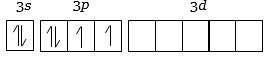
B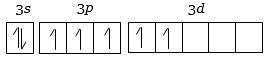
C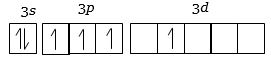
D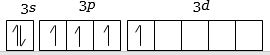
Solution
(B) The energy of an electronic configuration is determined by the sum of the energies of all the electrons present in the orbitals.
For a given principal quantum number $n=3$,the energy of the orbitals follows the order $3s < 3p < 3d$.
To find the configuration with the maximum energy,we compare the total number of electrons in the higher energy orbitals ($3p$ and $3d$).
Option $A$: $2$ electrons in $3s$,$2$ in $3p$,$0$ in $3d$. Total electrons in $3p+3d = 2$.
Option $B$: $2$ electrons in $3s$,$3$ in $3p$,$2$ in $3d$. Total electrons in $3p+3d = 5$.
Option $C$: $2$ electrons in $3s$,$3$ in $3p$,$1$ in $3d$. Total electrons in $3p+3d = 4$.
Option $D$: $2$ electrons in $3s$,$3$ in $3p$,$1$ in $3d$. Total electrons in $3p+3d = 4$.
Comparing the total number of electrons in the higher energy orbitals,Option $B$ has the highest number of electrons in the $3p$ and $3d$ orbitals,thus representing the state with the maximum energy.
For a given principal quantum number $n=3$,the energy of the orbitals follows the order $3s < 3p < 3d$.
To find the configuration with the maximum energy,we compare the total number of electrons in the higher energy orbitals ($3p$ and $3d$).
Option $A$: $2$ electrons in $3s$,$2$ in $3p$,$0$ in $3d$. Total electrons in $3p+3d = 2$.
Option $B$: $2$ electrons in $3s$,$3$ in $3p$,$2$ in $3d$. Total electrons in $3p+3d = 5$.
Option $C$: $2$ electrons in $3s$,$3$ in $3p$,$1$ in $3d$. Total electrons in $3p+3d = 4$.
Option $D$: $2$ electrons in $3s$,$3$ in $3p$,$1$ in $3d$. Total electrons in $3p+3d = 4$.
Comparing the total number of electrons in the higher energy orbitals,Option $B$ has the highest number of electrons in the $3p$ and $3d$ orbitals,thus representing the state with the maximum energy.
0 likes
View Solution148
EasyMCQ
The total number of magnetic quantum numbers for a $d$-orbital is given by
A
$2$
B
$0, \pm 1, \pm 2$
C
$0, 1, 2$
D
$5$
Solution
(D) For a $d$-orbital,the azimuthal quantum number $l = 2$.
The number of magnetic quantum numbers $(m_l)$ is given by the formula $(2l + 1)$.
Substituting $l = 2$ into the formula: $m_l = (2 \times 2 + 1) = 5$.
Thus,there are $5$ possible values for the magnetic quantum number for a $d$-orbital.
The number of magnetic quantum numbers $(m_l)$ is given by the formula $(2l + 1)$.
Substituting $l = 2$ into the formula: $m_l = (2 \times 2 + 1) = 5$.
Thus,there are $5$ possible values for the magnetic quantum number for a $d$-orbital.
0 likes
View Solution149
EasyMCQ
The outer electronic structure $3s^23p^5$ is possessed by
A
$Cl$
B
$O$
C
$Ar$
D
$Br$
Solution
(A) The atomic number of chlorine $(Cl)$ is $17$.
Its electronic configuration is $1s^2 2s^2 2p^6 3s^2 3p^5$.
Thus,the outer electronic structure is $3s^2 3p^5$.
Its electronic configuration is $1s^2 2s^2 2p^6 3s^2 3p^5$.
Thus,the outer electronic structure is $3s^2 3p^5$.
0 likes
View SolutionStructure of Atom — Quantum number, Electronic configuration and Shape of orbitals · Frequently Asked Questions
1Are these Structure of Atom questions useful for JEE and NEET?
Yes. All questions in this section are mapped to JEE Main and NEET exam patterns. Previous year questions from JEE Main, NEET, GUJCET and state-level exams are included with full solutions.
2Can I switch to Hindi or Gujarati for these questions?
Yes. Use the language tabs in the hero section or the sidebar to view the same questions and solutions in English, Hindi or Gujarati.
3How do I generate a question paper from this subtopic?
Use the Vedclass Exam Paper Generator — select the chapter and subtopic, set difficulty, and generate Sets A, B, C, D automatically. First 3 chapters of every subject are free.
Vedclass Products
For Students
Vedclass Test Series
Mock tests in real JEE/NEET style with performance analysis. 5-day free trial.
Start Free TrialFor Teachers
Exam Paper Generator
Generate Set A/B/C/D papers from this chapter in 2 minutes. 3 chapters free.
Try FreeFor Institutes
Online Exam Module
Live online exams with unlimited students, 360° analytics & white-label branding.
See DemoFor Teachers & Institutes
Generate a Structure of Atom Exam Paper in 2 Minutes
Select subtopic & difficulty — Sets A, B, C, D auto-generated with No Repeat logic.
First 3 chapters of every subject are free — no payment required.