
A English
Atomic models and Planck's quantum theory Questions in English
Class 11 Chemistry · Structure of Atom · Atomic models and Planck's quantum theory
851+
Questions
English
Language
100%
With Solutions
Showing 50 of 851 questions in English
101
MediumMCQ
The ratio of the minimum wavelengths of the Lyman and Balmer series is ...... .
A
$1.25$
B
$0.25$
C
$5$
D
$10$
Solution
(B) For the Lyman series,the minimum wavelength occurs when $n_1 = 1$ and $n_2 = \infty$. The formula is $\frac{1}{\lambda} = R Z^2 (\frac{1}{n_1^2} - \frac{1}{n_2^2})$.
For Lyman series: $\frac{1}{\lambda_{L}} = R (\frac{1}{1^2} - 0) = R$,so $\lambda_{L} = \frac{1}{R}$.
For Balmer series: $n_1 = 2$ and $n_2 = \infty$. So,$\frac{1}{\lambda_{B}} = R (\frac{1}{2^2} - 0) = \frac{R}{4}$,so $\lambda_{B} = \frac{4}{R}$.
The ratio $\frac{\lambda_{L}}{\lambda_{B}} = \frac{1/R}{4/R} = \frac{1}{4} = 0.25$.
For Lyman series: $\frac{1}{\lambda_{L}} = R (\frac{1}{1^2} - 0) = R$,so $\lambda_{L} = \frac{1}{R}$.
For Balmer series: $n_1 = 2$ and $n_2 = \infty$. So,$\frac{1}{\lambda_{B}} = R (\frac{1}{2^2} - 0) = \frac{R}{4}$,so $\lambda_{B} = \frac{4}{R}$.
The ratio $\frac{\lambda_{L}}{\lambda_{B}} = \frac{1/R}{4/R} = \frac{1}{4} = 0.25$.
0 likes
View Solution102
MediumMCQ
For a hydrogen $(H)$ atom,what will be the wavelength (in $nm$) associated with the transition of an electron from the infinite energy level to the first energy level? (Rydberg constant = $1.097 \times 10^{7} \ m^{-1}$)
A
$406$
B
$192$
C
$91$
D
$9.1 \times 10^{-8}$
Solution
(C) The Rydberg formula for the wavelength of emitted radiation is given by: $\frac{1}{\lambda} = R_H \left( \frac{1}{n_1^2} - \frac{1}{n_2^2} \right)$.
Given: $n_1 = 1$ (first energy level),$n_2 = \infty$ (infinite energy level),and $R_H = 1.097 \times 10^{7} \ m^{-1}$.
Substituting the values: $\frac{1}{\lambda} = 1.097 \times 10^{7} \left( \frac{1}{1^2} - \frac{1}{\infty^2} \right)$.
Since $\frac{1}{\infty} = 0$,we have $\frac{1}{\lambda} = 1.097 \times 10^{7} \ m^{-1}$.
Therefore,$\lambda = \frac{1}{1.097 \times 10^{7}} \ m = 0.9115 \times 10^{-7} \ m$.
Converting to nanometers $(nm)$: $\lambda = 0.9115 \times 10^{-7} \times 10^{9} \ nm = 91.15 \ nm \approx 91 \ nm$.
Given: $n_1 = 1$ (first energy level),$n_2 = \infty$ (infinite energy level),and $R_H = 1.097 \times 10^{7} \ m^{-1}$.
Substituting the values: $\frac{1}{\lambda} = 1.097 \times 10^{7} \left( \frac{1}{1^2} - \frac{1}{\infty^2} \right)$.
Since $\frac{1}{\infty} = 0$,we have $\frac{1}{\lambda} = 1.097 \times 10^{7} \ m^{-1}$.
Therefore,$\lambda = \frac{1}{1.097 \times 10^{7}} \ m = 0.9115 \times 10^{-7} \ m$.
Converting to nanometers $(nm)$: $\lambda = 0.9115 \times 10^{-7} \times 10^{9} \ nm = 91.15 \ nm \approx 91 \ nm$.
0 likes
View Solution103
DifficultMCQ
The ratio of the radius of the first excited state of $Li^{2+}$ to the radius of the second excited state of $H$ is ....
A
$9 : 25$
B
$4 : 3$
C
$27 : 4$
D
$25 : 9$
Solution
(C) The radius of an orbit in a hydrogen-like species is given by $r_n = 0.529 \times \frac{n^2}{Z} \ \mathring{A}$.
For the second excited state of $H$ $(Z=1)$,the electron is in the $n=3$ orbit:
$r_{H(n=3)} = 0.529 \times \frac{3^2}{1} = 0.529 \times 9 \ \mathring{A}$.
For the first excited state of $Li^{2+}$ $(Z=3)$,the electron is in the $n=2$ orbit:
$r_{Li^{2+}(n=2)} = 0.529 \times \frac{2^2}{3} = 0.529 \times \frac{4}{3} \ \mathring{A}$.
The ratio of the radius of the first excited state of $Li^{2+}$ to the radius of the second excited state of $H$ is:
$\frac{r_{Li^{2+}(n=2)}}{r_{H(n=3)}} = \frac{0.529 \times \frac{4}{3}}{0.529 \times 9} = \frac{4}{3 \times 9} = \frac{4}{27}$.
However,checking the provided options,the ratio is likely intended as the inverse,i.e.,the ratio of the radius of the second excited state of $H$ to the first excited state of $Li^{2+}$,which is $27:4$.
For the second excited state of $H$ $(Z=1)$,the electron is in the $n=3$ orbit:
$r_{H(n=3)} = 0.529 \times \frac{3^2}{1} = 0.529 \times 9 \ \mathring{A}$.
For the first excited state of $Li^{2+}$ $(Z=3)$,the electron is in the $n=2$ orbit:
$r_{Li^{2+}(n=2)} = 0.529 \times \frac{2^2}{3} = 0.529 \times \frac{4}{3} \ \mathring{A}$.
The ratio of the radius of the first excited state of $Li^{2+}$ to the radius of the second excited state of $H$ is:
$\frac{r_{Li^{2+}(n=2)}}{r_{H(n=3)}} = \frac{0.529 \times \frac{4}{3}}{0.529 \times 9} = \frac{4}{3 \times 9} = \frac{4}{27}$.
However,checking the provided options,the ratio is likely intended as the inverse,i.e.,the ratio of the radius of the second excited state of $H$ to the first excited state of $Li^{2+}$,which is $27:4$.
1 likes
View Solution104
MediumMCQ
When an electron transitions from $n = 4$ to $n = 2$,the emitted spectral line will be ........
A
First line of Lyman series
B
Second line of Balmer series
C
First line of Paschen series
D
Second line of Paschen series
Solution
(B) The Rydberg formula for the spectral lines of hydrogen is given by $\frac{1}{\lambda} = R_H \times Z^2 \times (\frac{1}{n_1^2} - \frac{1}{n_2^2})$.
For the Balmer series,the transition ends at $n_1 = 2$.
The lines in the Balmer series are defined by transitions from $n_2 = 3, 4, 5, \dots$ to $n_1 = 2$.
- The first line $(H_\alpha)$ corresponds to $n = 3 \to n = 2$.
- The second line $(H_\beta)$ corresponds to $n = 4 \to n = 2$.
Therefore,the transition from $n = 4$ to $n = 2$ represents the second line of the Balmer series.
For the Balmer series,the transition ends at $n_1 = 2$.
The lines in the Balmer series are defined by transitions from $n_2 = 3, 4, 5, \dots$ to $n_1 = 2$.
- The first line $(H_\alpha)$ corresponds to $n = 3 \to n = 2$.
- The second line $(H_\beta)$ corresponds to $n = 4 \to n = 2$.
Therefore,the transition from $n = 4$ to $n = 2$ represents the second line of the Balmer series.
0 likes
View Solution105
MediumMCQ
Which of the following species has the same radius as that of the hydrogen atom in the $n = 1$ state?
A
$He^{+}, n = 2$
B
$Be^{3+}, n = 2$
C
$Li^{2+}, n = 2$
D
$Li^{2+}, n = 3$
Solution
(B) The radius of a hydrogen-like species is given by the formula: $r_n = a_0 \times \frac{n^2}{Z}$,where $a_0$ is the Bohr radius,$n$ is the principal quantum number,and $Z$ is the atomic number.
For a hydrogen atom in the $n = 1$ state,$r = a_0 \times \frac{1^2}{1} = a_0$.
We need to find a species where $\frac{n^2}{Z} = 1$,which implies $n^2 = Z$.
For $Be^{3+}$ $(Z = 4)$,$n^2 = 4$,so $n = 2$.
Thus,for $Be^{3+}$ with $n = 2$,the radius is $a_0 \times \frac{2^2}{4} = a_0$.
For a hydrogen atom in the $n = 1$ state,$r = a_0 \times \frac{1^2}{1} = a_0$.
We need to find a species where $\frac{n^2}{Z} = 1$,which implies $n^2 = Z$.
For $Be^{3+}$ $(Z = 4)$,$n^2 = 4$,so $n = 2$.
Thus,for $Be^{3+}$ with $n = 2$,the radius is $a_0 \times \frac{2^2}{4} = a_0$.
0 likes
View Solution106
MediumMCQ
$A$: An electron revolving around the nucleus does not fall into the nucleus.
$R$: An electron revolving around the nucleus is an orbital electron.
$R$: An electron revolving around the nucleus is an orbital electron.
A
$A$ and $R$ are both true and $R$ is the correct explanation of $A$.
B
$A$ and $R$ are both true,but $R$ is not the correct explanation of $A$.
C
$A$ is true,but $R$ is false.
D
$A$ is false,but $R$ is true.
Solution
(B) is true because,according to Bohr's model,electrons revolve in stationary orbits with fixed energy,preventing them from falling into the nucleus.
$R$ is true because electrons in these stationary states are indeed referred to as orbital electrons.
However,the fact that it is an orbital electron is not the direct physical explanation for why it does not fall into the nucleus (the explanation lies in the quantization of angular momentum and stationary states).
Therefore,both are true,but $R$ is not the correct explanation of $A$.
$R$ is true because electrons in these stationary states are indeed referred to as orbital electrons.
However,the fact that it is an orbital electron is not the direct physical explanation for why it does not fall into the nucleus (the explanation lies in the quantization of angular momentum and stationary states).
Therefore,both are true,but $R$ is not the correct explanation of $A$.
0 likes
View Solution107
MediumMCQ
When an electron transitions from the $6^{th}$ orbit to the $2^{nd}$ orbit in a $H$ atom,what is the total number of spectral lines (excluding the Balmer series) produced?
A
$6$
B
$10$
C
$4$
D
$0$
Solution
(D) The total number of spectral lines emitted when an electron transitions from $n_2$ to $n_1$ is given by the formula: $N = \frac{(n_2 - n_1)(n_2 - n_1 + 1)}{2}$.
Given $n_2 = 6$ and $n_1 = 2$,the total number of lines is $N = \frac{(6 - 2)(6 - 2 + 1)}{2} = \frac{4 \times 5}{2} = 10$.
Since the transition ends at $n_1 = 2$,all these lines belong to the Balmer series.
The question asks for the number of spectral lines excluding the Balmer series.
Therefore,the number of lines excluding the Balmer series is $10 - 10 = 0$.
Given $n_2 = 6$ and $n_1 = 2$,the total number of lines is $N = \frac{(6 - 2)(6 - 2 + 1)}{2} = \frac{4 \times 5}{2} = 10$.
Since the transition ends at $n_1 = 2$,all these lines belong to the Balmer series.
The question asks for the number of spectral lines excluding the Balmer series.
Therefore,the number of lines excluding the Balmer series is $10 - 10 = 0$.
0 likes
View Solution108
MediumMCQ
How many photons are required to provide $1 \, J$ of energy with a wavelength of $5000 \, \mathring{A}$?
A
$2.5 \times 10^{-5}$
B
$2.5 \times 10^{5}$
C
$2.5 \times 10^{18}$
D
$2.5 \times 10^{15}$
Solution
(C) The energy of $n$ photons is given by the formula: $E = \frac{nhc}{\lambda}$.
Rearranging for $n$: $n = \frac{E \times \lambda}{hc}$.
Given: $E = 1 \, J$,$\lambda = 5000 \, \mathring{A} = 5000 \times 10^{-10} \, m$,$h = 6.626 \times 10^{-34} \, J \cdot s$,$c = 3 \times 10^8 \, m/s$.
Substituting the values: $n = \frac{1 \times 5000 \times 10^{-10}}{6.626 \times 10^{-34} \times 3 \times 10^8}$.
$n = \frac{5 \times 10^{-7}}{1.9878 \times 10^{-25}} \approx 2.515 \times 10^{18}$.
Thus,the correct option is $C$.
Rearranging for $n$: $n = \frac{E \times \lambda}{hc}$.
Given: $E = 1 \, J$,$\lambda = 5000 \, \mathring{A} = 5000 \times 10^{-10} \, m$,$h = 6.626 \times 10^{-34} \, J \cdot s$,$c = 3 \times 10^8 \, m/s$.
Substituting the values: $n = \frac{1 \times 5000 \times 10^{-10}}{6.626 \times 10^{-34} \times 3 \times 10^8}$.
$n = \frac{5 \times 10^{-7}}{1.9878 \times 10^{-25}} \approx 2.515 \times 10^{18}$.
Thus,the correct option is $C$.
0 likes
View Solution109
MediumMCQ
The energy of an electron in the first orbit of $He^+$ is $-871.6 \times 10^{-20} \ J$. The energy of an electron in the first orbit of hydrogen is ...... .
A
$-871.6 \times 10^{-20} \ J$
B
$-435.8 \times 10^{-20} \ J$
C
$-217.9 \times 10^{-20} \ J$
D
$-108.9 \times 10^{-20} \ J$
Solution
(C) The energy of an electron in the $n^{th}$ orbit of a hydrogen-like species is given by the formula: $E_n = -2.18 \times 10^{-18} \ J \times \frac{Z^2}{n^2}$.
For $He^+$,$Z = 2$ and $n = 1$,so $E_{1, He^+} = E_{1, H} \times Z^2$.
Given $E_{1, He^+} = -871.6 \times 10^{-20} \ J$.
Therefore,$-871.6 \times 10^{-20} = E_{1, H} \times (2)^2$.
$-871.6 \times 10^{-20} = E_{1, H} \times 4$.
$E_{1, H} = \frac{-871.6 \times 10^{-20}}{4} = -217.9 \times 10^{-20} \ J$.
For $He^+$,$Z = 2$ and $n = 1$,so $E_{1, He^+} = E_{1, H} \times Z^2$.
Given $E_{1, He^+} = -871.6 \times 10^{-20} \ J$.
Therefore,$-871.6 \times 10^{-20} = E_{1, H} \times (2)^2$.
$-871.6 \times 10^{-20} = E_{1, H} \times 4$.
$E_{1, H} = \frac{-871.6 \times 10^{-20}}{4} = -217.9 \times 10^{-20} \ J$.
0 likes
View Solution110
MediumMCQ
For a hydrogen-like species,the ratio of velocities of electrons in the $I, II,$ and $III$ orbits,i.e.,$V_1 : V_2 : V_3$,will be:
A
$1 : 2 : 3$
B
$1 : 1/2 : 1/3$
C
$3 : 2 : 1$
D
$1 : 1 : 1$
Solution
(B) The velocity of an electron in the $n^{th}$ orbit of a hydrogen-like species is given by the formula $V_n = V_0 \times \frac{Z}{n}$.
Since $V_0$ and $Z$ are constant for a given species,the velocity is inversely proportional to the principal quantum number $n$ $(V \propto \frac{1}{n})$.
Therefore,the ratio of velocities for the first,second,and third orbits is $V_1 : V_2 : V_3 = \frac{1}{1} : \frac{1}{2} : \frac{1}{3}$.
Since $V_0$ and $Z$ are constant for a given species,the velocity is inversely proportional to the principal quantum number $n$ $(V \propto \frac{1}{n})$.
Therefore,the ratio of velocities for the first,second,and third orbits is $V_1 : V_2 : V_3 = \frac{1}{1} : \frac{1}{2} : \frac{1}{3}$.
0 likes
View Solution111
MediumMCQ
The binding energy of an $e^-$ in the ground state of a hydrogen atom is $13.6 \ eV$. The energy required to remove an electron from the ground state of a $He^+$ ion is:
A
$13.6, 10.2, 3.4$
B
$13.6, 3.4, 1.5$
C
$13.6, 27.2, 40.8$
D
$54.4, 13.6, 6.0$
Solution
(D) The energy of an electron in the $n^{th}$ orbit of a hydrogen-like species is given by the formula: $E_n = -13.6 \times \frac{Z^2}{n^2} \ eV$.
For a hydrogen atom $(Z=1)$ in the ground state $(n=1)$,$E_1 = -13.6 \ eV$.
The binding energy is the energy required to remove the electron,which is $|E_1| = 13.6 \ eV$.
For a $He^+$ ion,the atomic number $Z=2$.
In the ground state $(n=1)$,the energy is $E_1 = -13.6 \times \frac{2^2}{1^2} = -13.6 \times 4 = -54.4 \ eV$.
The energy required to remove the electron (binding energy) is $|-54.4 \ eV| = 54.4 \ eV$.
Thus,the correct option is $D$.
For a hydrogen atom $(Z=1)$ in the ground state $(n=1)$,$E_1 = -13.6 \ eV$.
The binding energy is the energy required to remove the electron,which is $|E_1| = 13.6 \ eV$.
For a $He^+$ ion,the atomic number $Z=2$.
In the ground state $(n=1)$,the energy is $E_1 = -13.6 \times \frac{2^2}{1^2} = -13.6 \times 4 = -54.4 \ eV$.
The energy required to remove the electron (binding energy) is $|-54.4 \ eV| = 54.4 \ eV$.
Thus,the correct option is $D$.
0 likes
View Solution112
MediumMCQ
Which of the following orders is $NOT$ correct for the $1^{st}$,$2^{nd}$,and $3^{rd}$ orbits of a hydrogen-like atom?
A
$E_1 > E_2 > E_3$
B
$(PE)_1 < (PE)_2 < (PE)_3$
C
$(KE)_1 > (KE)_2 > (KE)_3$
D
$(KE)_1 > (KE)_2 > (KE)_3$ and $(PE)_1 < (PE)_2 < (PE)_3$
Solution
(A) For a hydrogen-like atom,the energy of the $n^{th}$ orbit is given by $E_n = -13.6 \times \frac{Z^2}{n^2} \text{ eV}$.
As $n$ increases,$E_n$ becomes less negative,meaning $E_1 < E_2 < E_3$.
Therefore,the statement $E_1 > E_2 > E_3$ is incorrect.
Potential energy $(PE)$ is given by $PE_n = -27.2 \times \frac{Z^2}{n^2} \text{ eV}$,so $PE_1 < PE_2 < PE_3$ is correct.
Kinetic energy $(KE)$ is given by $KE_n = 13.6 \times \frac{Z^2}{n^2} \text{ eV}$,so $KE_1 > KE_2 > KE_3$ is correct.
As $n$ increases,$E_n$ becomes less negative,meaning $E_1 < E_2 < E_3$.
Therefore,the statement $E_1 > E_2 > E_3$ is incorrect.
Potential energy $(PE)$ is given by $PE_n = -27.2 \times \frac{Z^2}{n^2} \text{ eV}$,so $PE_1 < PE_2 < PE_3$ is correct.
Kinetic energy $(KE)$ is given by $KE_n = 13.6 \times \frac{Z^2}{n^2} \text{ eV}$,so $KE_1 > KE_2 > KE_3$ is correct.
0 likes
View Solution113
MediumMCQ
Which of the following relations is correct for the energy of the ground state of hydrogen-like species?
A
$E_1(H) = \frac{1}{2} E_2(He^+) = \frac{1}{3} E_3(Li^{2+}) = \frac{1}{4} E_4(Be^{3+})$
B
$E_1(H) = E_2(He^+) = E_3(Li^{2+}) = E_4(Be^{3+})$
C
$E_1(H) = 2 E_2(He^+) = 3 E_3(Li^{2+}) = 4 E_4(Be^{3+})$
D
No relation exists
Solution
(B) The energy of an electron in a hydrogen-like species is given by the formula: $E_n = -13.6 \times \frac{Z^2}{n^2} \text{ eV}$.
For the ground state of $H$ $(Z=1, n=1)$: $E_1 = -13.6 \times \frac{1^2}{1^2} = -13.6 \text{ eV}$.
For the $n=2$ state of $He^+$ $(Z=2, n=2)$: $E_2 = -13.6 \times \frac{2^2}{2^2} = -13.6 \text{ eV}$.
For the $n=3$ state of $Li^{2+}$ $(Z=3, n=3)$: $E_3 = -13.6 \times \frac{3^2}{3^2} = -13.6 \text{ eV}$.
For the $n=4$ state of $Be^{3+}$ $(Z=4, n=4)$: $E_4 = -13.6 \times \frac{4^2}{4^2} = -13.6 \text{ eV}$.
Thus,$E_1(H) = E_2(He^+) = E_3(Li^{2+}) = E_4(Be^{3+})$.
For the ground state of $H$ $(Z=1, n=1)$: $E_1 = -13.6 \times \frac{1^2}{1^2} = -13.6 \text{ eV}$.
For the $n=2$ state of $He^+$ $(Z=2, n=2)$: $E_2 = -13.6 \times \frac{2^2}{2^2} = -13.6 \text{ eV}$.
For the $n=3$ state of $Li^{2+}$ $(Z=3, n=3)$: $E_3 = -13.6 \times \frac{3^2}{3^2} = -13.6 \text{ eV}$.
For the $n=4$ state of $Be^{3+}$ $(Z=4, n=4)$: $E_4 = -13.6 \times \frac{4^2}{4^2} = -13.6 \text{ eV}$.
Thus,$E_1(H) = E_2(He^+) = E_3(Li^{2+}) = E_4(Be^{3+})$.
0 likes
View Solution114
MediumMCQ
When a hydrogen atom in an excited state undergoes electronic transitions to the ground state,$5$ spectral lines are observed in the ultraviolet region. How many spectral lines will be observed in the infrared region due to transitions from the same excited state?
A
$0$
B
$6$
C
$5$
D
$11$
Solution
(B) The ultraviolet region corresponds to the Lyman series $(n_1 = 1)$.
For $n_2$ to $n_1 = 1$ transitions,the number of spectral lines is given by $n_2 - n_1 = 5$.
Therefore,$n_2 - 1 = 5$,which gives $n_2 = 6$.
Now,for transitions from $n_2 = 6$ to the infrared region (Paschen,Brackett,and Pfund series):
$1$. Paschen series $(n_1 = 3)$: Transitions are $6 \to 3, 5 \to 3, 4 \to 3$ ($3$ lines).
$2$. Brackett series $(n_1 = 4)$: Transitions are $6 \to 4, 5 \to 4$ ($2$ lines).
$3$. Pfund series $(n_1 = 5)$: Transition is $6 \to 5$ ($1$ line).
Total number of lines in the infrared region = $3 + 2 + 1 = 6$.
For $n_2$ to $n_1 = 1$ transitions,the number of spectral lines is given by $n_2 - n_1 = 5$.
Therefore,$n_2 - 1 = 5$,which gives $n_2 = 6$.
Now,for transitions from $n_2 = 6$ to the infrared region (Paschen,Brackett,and Pfund series):
$1$. Paschen series $(n_1 = 3)$: Transitions are $6 \to 3, 5 \to 3, 4 \to 3$ ($3$ lines).
$2$. Brackett series $(n_1 = 4)$: Transitions are $6 \to 4, 5 \to 4$ ($2$ lines).
$3$. Pfund series $(n_1 = 5)$: Transition is $6 \to 5$ ($1$ line).
Total number of lines in the infrared region = $3 + 2 + 1 = 6$.
0 likes
View Solution115
MediumMCQ
In a hydrogen atom,the energy of an $e^-$ in an orbital is given by $E = \frac{-constant}{n^2} \ (kJ \ mol^{-1})$. Which of the following properties is constant according to the given equation?
A
Attraction of electron
B
Ionization energy
C
Negatively charged electron
D
Binding energy
Solution
(B) The energy of an electron in a hydrogen atom is given by $E_n = \frac{-1312}{n^2} \ kJ \ mol^{-1}$.
Here,the constant value $1312 \ kJ \ mol^{-1}$ represents the energy required to remove an electron from the ground state $(n=1)$ to infinity,which is defined as the Ionization Energy of the hydrogen atom.
Since the constant in the equation is specific to the hydrogen atom,the Ionization Energy remains constant for the hydrogen atom.
Here,the constant value $1312 \ kJ \ mol^{-1}$ represents the energy required to remove an electron from the ground state $(n=1)$ to infinity,which is defined as the Ionization Energy of the hydrogen atom.
Since the constant in the equation is specific to the hydrogen atom,the Ionization Energy remains constant for the hydrogen atom.
0 likes
View Solution116
EasyMCQ
The radii of the first,second,third,and fourth Bohr orbits of hydrogen are respectively:
A
$0.529 \,\mathring{A}, 2.116 \,\mathring{A}, 4.761 \,\mathring{A}, 8.464 \,\mathring{A}$
B
$2.116 \,\mathring{A}, 0.529 \,\mathring{A}, 8.464 \,\mathring{A}, 4.761 \,\mathring{A}$
C
$4.761 \,\mathring{A}, 8.464 \,\mathring{A}, 0.529 \,\mathring{A}, 2.116 \,\mathring{A}$
D
$0.529 \,\mathring{A}, 4.761 \,\mathring{A}, 2.116 \,\mathring{A}, 8.464 \,\mathring{A}$
Solution
(A) The radius of the $n^{th}$ Bohr orbit for a hydrogen-like atom is given by the formula $r_n = 0.529 \times \frac{n^2}{Z} \,\ \mathring{A}$.
For hydrogen,the atomic number $Z = 1$,so the formula simplifies to $r_n = 0.529 \times n^2 \,\mathring{A}$.
For $n = 1$: $r_1 = 0.529 \times 1^2 = 0.529 \,\mathring{A}$.
For $n = 2$: $r_2 = 0.529 \times 2^2 = 0.529 \times 4 = 2.116 \,\mathring{A}$.
For $n = 3$: $r_3 = 0.529 \times 3^2 = 0.529 \times 9 = 4.761 \,\mathring{A}$.
For $n = 4$: $r_4 = 0.529 \times 4^2 = 0.529 \times 16 = 8.464 \,\mathring{A}$.
Thus,the radii are $0.529 \,\mathring{A}, 2.116 \,\mathring{A}, 4.761 \,\mathring{A}, 8.464 \,\mathring{A}$.
For hydrogen,the atomic number $Z = 1$,so the formula simplifies to $r_n = 0.529 \times n^2 \,\mathring{A}$.
For $n = 1$: $r_1 = 0.529 \times 1^2 = 0.529 \,\mathring{A}$.
For $n = 2$: $r_2 = 0.529 \times 2^2 = 0.529 \times 4 = 2.116 \,\mathring{A}$.
For $n = 3$: $r_3 = 0.529 \times 3^2 = 0.529 \times 9 = 4.761 \,\mathring{A}$.
For $n = 4$: $r_4 = 0.529 \times 4^2 = 0.529 \times 16 = 8.464 \,\mathring{A}$.
Thus,the radii are $0.529 \,\mathring{A}, 2.116 \,\mathring{A}, 4.761 \,\mathring{A}, 8.464 \,\mathring{A}$.
0 likes
View Solution117
DifficultMCQ
The frequency of the limiting line of the Lyman series in the hydrogen spectrum is ....
A
$3.29 \times 10^{15} \, \text{sec}^{-1}$
B
$2.19 \times 10^{15} \, \text{sec}^{-1}$
C
$3.92 \times 10^{15} \, \text{sec}^{-1}$
D
$3.29 \times 10^{10} \, \text{sec}^{-1}$
Solution
(A) For the limiting line of the Lyman series,$n_1 = 1$ and $n_2 = \infty$.
Using the Rydberg formula: $\frac{1}{\lambda} = R Z^2 \left( \frac{1}{n_1^2} - \frac{1}{n_2^2} \right)$.
For hydrogen $(Z=1)$,$\frac{1}{\lambda} = R \left( \frac{1}{1^2} - \frac{1}{\infty^2} \right) = R$.
The value of Rydberg constant $R \approx 1.097 \times 10^7 \, \text{m}^{-1} = 1.097 \times 10^5 \, \text{cm}^{-1}$.
Frequency $\nu = \frac{c}{\lambda} = c \times R$.
Using $c = 3 \times 10^8 \, \text{m/s} = 3 \times 10^{10} \, \text{cm/s}$:
$\nu = (3 \times 10^{10} \, \text{cm/s}) \times (1.097 \times 10^5 \, \text{cm}^{-1}) \approx 3.29 \times 10^{15} \, \text{sec}^{-1}$.
Using the Rydberg formula: $\frac{1}{\lambda} = R Z^2 \left( \frac{1}{n_1^2} - \frac{1}{n_2^2} \right)$.
For hydrogen $(Z=1)$,$\frac{1}{\lambda} = R \left( \frac{1}{1^2} - \frac{1}{\infty^2} \right) = R$.
The value of Rydberg constant $R \approx 1.097 \times 10^7 \, \text{m}^{-1} = 1.097 \times 10^5 \, \text{cm}^{-1}$.
Frequency $\nu = \frac{c}{\lambda} = c \times R$.
Using $c = 3 \times 10^8 \, \text{m/s} = 3 \times 10^{10} \, \text{cm/s}$:
$\nu = (3 \times 10^{10} \, \text{cm/s}) \times (1.097 \times 10^5 \, \text{cm}^{-1}) \approx 3.29 \times 10^{15} \, \text{sec}^{-1}$.
0 likes
View Solution118
MediumMCQ
The angular momentum of the $2^{nd}$ Bohr orbit of the $H$ atom is $x$. Find the angular momentum of the $1^{st}$ excited state of $Li^{+2}$.
A
$3x$
B
$9x$
C
$x/2$
D
$x$
Solution
(D) The angular momentum of an electron in a Bohr orbit is given by the formula $L = \frac{nh}{2\pi}$.
For the $2^{nd}$ Bohr orbit of the $H$ atom,$n = 2$,so $x = \frac{2h}{2\pi} = \frac{h}{\pi}$.
The $1^{st}$ excited state of $Li^{+2}$ corresponds to $n = 2$ (since the ground state is $n = 1$).
Therefore,the angular momentum for $n = 2$ is $L = \frac{2h}{2\pi} = \frac{h}{\pi} = x$.
Thus,the angular momentum remains $x$.
For the $2^{nd}$ Bohr orbit of the $H$ atom,$n = 2$,so $x = \frac{2h}{2\pi} = \frac{h}{\pi}$.
The $1^{st}$ excited state of $Li^{+2}$ corresponds to $n = 2$ (since the ground state is $n = 1$).
Therefore,the angular momentum for $n = 2$ is $L = \frac{2h}{2\pi} = \frac{h}{\pi} = x$.
Thus,the angular momentum remains $x$.
0 likes
View Solution119
DifficultMCQ
The ratio of the radii of two Bohr orbits of a hydrogen atom is $4:1$. What are their designations?
A
$K$ and $L$
B
$L$ and $K$
C
$N$ and $L$
D
$L$ and $K$ or $N$ and $L$
Solution
(B) The radius of the $n^{th}$ Bohr orbit is given by the formula $r_n = a_0 n^2$,where $a_0$ is the Bohr radius and $n$ is the principal quantum number.
Given the ratio of the radii $r_1 : r_2 = 4 : 1$,we have $\frac{n_1^2}{n_2^2} = \frac{4}{1}$,which implies $\frac{n_1}{n_2} = \frac{2}{1}$.
Thus,$n_1 = 2$ and $n_2 = 1$.
The orbit with $n=1$ is designated as $K$ and the orbit with $n=2$ is designated as $L$.
Therefore,the designations are $L$ and $K$.
Given the ratio of the radii $r_1 : r_2 = 4 : 1$,we have $\frac{n_1^2}{n_2^2} = \frac{4}{1}$,which implies $\frac{n_1}{n_2} = \frac{2}{1}$.
Thus,$n_1 = 2$ and $n_2 = 1$.
The orbit with $n=1$ is designated as $K$ and the orbit with $n=2$ is designated as $L$.
Therefore,the designations are $L$ and $K$.
0 likes
View Solution120
MediumMCQ
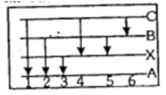
The figure shows six spectral lines in an emission spectrum arising from energy level transitions. Which of the following spectral lines does not appear in the absorption spectrum?
A
$1, 2, 3$
B
$3, 2$
C
$4, 5, 6$
D
$3, 2, 1$
Solution
(C) In an absorption spectrum,transitions occur from the ground state (lowest energy level) to higher energy levels.
Looking at the provided energy level diagram,the transitions $1, 2, 3$ originate from the lowest energy level $A$ to higher levels $X, B, C$ respectively.
Therefore,transitions $1, 2, 3$ can appear in the absorption spectrum.
Transitions $4, 5, 6$ originate from higher energy levels to lower energy levels,which corresponds to emission,not absorption.
Thus,lines $4, 5, 6$ do not appear in the absorption spectrum.
Looking at the provided energy level diagram,the transitions $1, 2, 3$ originate from the lowest energy level $A$ to higher levels $X, B, C$ respectively.
Therefore,transitions $1, 2, 3$ can appear in the absorption spectrum.
Transitions $4, 5, 6$ originate from higher energy levels to lower energy levels,which corresponds to emission,not absorption.
Thus,lines $4, 5, 6$ do not appear in the absorption spectrum.
0 likes
View Solution121
MediumMCQ
The first quantum mechanical model of the atom was proposed by ........
A
Bohr
B
Planck
C
Einstein
D
Heisenberg
Solution
(A) The first quantum mechanical model of the atom was proposed by $Niels \ Bohr$ in $1913$.
This model was based on the quantum theory of radiation,which suggests that electrons revolve in discrete orbits with quantized energy levels.
This model was based on the quantum theory of radiation,which suggests that electrons revolve in discrete orbits with quantized energy levels.
0 likes
View Solution122
MediumMCQ
Which transition in a $H$ atom emits the maximum energy?
A
$n=3 \rightarrow n=2$
B
$n=4 \rightarrow n=3$
C
$n=5 \rightarrow n=4$
D
All have equal energy
Solution
(A) The energy of an electron in the $n^{th}$ orbit of a hydrogen atom is given by $E_n = -13.6 / n^2 \, eV$.
For $n=3 \rightarrow n=2$: $\Delta E = E_3 - E_2 = -13.6(1/9 - 1/4) = -13.6(-5/36) \approx 1.89 \, eV$.
For $n=4 \rightarrow n=3$: $\Delta E = E_4 - E_3 = -13.6(1/16 - 1/9) = -13.6(-7/144) \approx 0.66 \, eV$.
For $n=5 \rightarrow n=4$: $\Delta E = E_5 - E_4 = -13.6(1/25 - 1/16) = -13.6(-9/400) \approx 0.31 \, eV$.
Comparing the values,the transition $n=3 \rightarrow n=2$ releases the maximum energy.
For $n=3 \rightarrow n=2$: $\Delta E = E_3 - E_2 = -13.6(1/9 - 1/4) = -13.6(-5/36) \approx 1.89 \, eV$.
For $n=4 \rightarrow n=3$: $\Delta E = E_4 - E_3 = -13.6(1/16 - 1/9) = -13.6(-7/144) \approx 0.66 \, eV$.
For $n=5 \rightarrow n=4$: $\Delta E = E_5 - E_4 = -13.6(1/25 - 1/16) = -13.6(-9/400) \approx 0.31 \, eV$.
Comparing the values,the transition $n=3 \rightarrow n=2$ releases the maximum energy.
0 likes
View Solution123
MediumMCQ
In which transition of the hydrogen atom will the emitted radiation have the lowest frequency?
A
$n = 1 \to n = 4$
B
$n = 2 \to n = 5$
C
$n = 3 \to n = 1$
D
$n = 5 \to n = 2$
Solution
(D) The frequency of emitted radiation is given by $\nu = \frac{\Delta E}{h}$.
Emission occurs when an electron jumps from a higher energy level to a lower energy level.
The energy difference $\Delta E$ is proportional to the frequency $\nu$.
For emission,we look for transitions from higher to lower levels ($n=3 \to n=1$ or $n=5 \to n=2$).
The energy difference for $n=5 \to n=2$ is $\Delta E = 13.6 \times Z^2 \times (\frac{1}{2^2} - \frac{1}{5^2}) = 13.6 \times (0.25 - 0.04) = 13.6 \times 0.21 = 2.856 \ eV$.
The energy difference for $n=3 \to n=1$ is $\Delta E = 13.6 \times (1 - \frac{1}{9}) = 13.6 \times 0.888 = 12.08 \ eV$.
Since $2.856 \ eV < 12.08 \ eV$,the transition $n=5 \to n=2$ has the lowest energy change and therefore the lowest frequency.
Emission occurs when an electron jumps from a higher energy level to a lower energy level.
The energy difference $\Delta E$ is proportional to the frequency $\nu$.
For emission,we look for transitions from higher to lower levels ($n=3 \to n=1$ or $n=5 \to n=2$).
The energy difference for $n=5 \to n=2$ is $\Delta E = 13.6 \times Z^2 \times (\frac{1}{2^2} - \frac{1}{5^2}) = 13.6 \times (0.25 - 0.04) = 13.6 \times 0.21 = 2.856 \ eV$.
The energy difference for $n=3 \to n=1$ is $\Delta E = 13.6 \times (1 - \frac{1}{9}) = 13.6 \times 0.888 = 12.08 \ eV$.
Since $2.856 \ eV < 12.08 \ eV$,the transition $n=5 \to n=2$ has the lowest energy change and therefore the lowest frequency.
0 likes
View Solution124
MediumMCQ
The ionization energy of a hydrogen atom is $13.6 \, eV$. What is the energy required (in $eV$) to excite the electron from the ground state to the first excited state?
A
$13.6$
B
$12.6$
C
$10.2$
D
$15.2$
Solution
(C) The energy of the $n^{th}$ orbit of a hydrogen atom is given by $E_n = -\frac{13.6}{n^2} \, eV$.
For the ground state $(n=1)$,$E_1 = -13.6 \, eV$.
For the first excited state $(n=2)$,$E_2 = -\frac{13.6}{2^2} = -\frac{13.6}{4} = -3.4 \, eV$.
The energy required for excitation is $\Delta E = E_2 - E_1$.
$\Delta E = -3.4 \, eV - (-13.6 \, eV) = 10.2 \, eV$.
For the ground state $(n=1)$,$E_1 = -13.6 \, eV$.
For the first excited state $(n=2)$,$E_2 = -\frac{13.6}{2^2} = -\frac{13.6}{4} = -3.4 \, eV$.
The energy required for excitation is $\Delta E = E_2 - E_1$.
$\Delta E = -3.4 \, eV - (-13.6 \, eV) = 10.2 \, eV$.
0 likes
View Solution125
DifficultMCQ
The values of Planck's constant and the speed of light are $6.63 \times 10^{-34} \ J \ s$ and $3.0 \times 10^8 \ m \ s^{-1}$ respectively. Find the approximate wavelength in nanometers $(nm)$ of a light ray with a frequency of $8 \times 10^{15} \ s^{-1}$.
A
$3 \times 10^7$
B
$2 \times 10^{-25}$
C
$5 \times 10^{-18}$
D
$4 \times 10^1$
Solution
(D) The relationship between wavelength $(\lambda)$,speed of light $(c)$,and frequency $(\nu)$ is given by $\lambda = \frac{c}{\nu}$.
Given: $c = 3.0 \times 10^8 \ m \ s^{-1}$ and $\nu = 8 \times 10^{15} \ s^{-1}$.
Substituting the values: $\lambda = \frac{3.0 \times 10^8}{8 \times 10^{15}} = 0.375 \times 10^{-7} \ m = 3.75 \times 10^{-8} \ m$.
To convert meters to nanometers $(nm)$,multiply by $10^9$: $\lambda = 3.75 \times 10^{-8} \times 10^9 \ nm = 37.5 \ nm$.
The approximate value is $4 \times 10^1 \ nm$.
Given: $c = 3.0 \times 10^8 \ m \ s^{-1}$ and $\nu = 8 \times 10^{15} \ s^{-1}$.
Substituting the values: $\lambda = \frac{3.0 \times 10^8}{8 \times 10^{15}} = 0.375 \times 10^{-7} \ m = 3.75 \times 10^{-8} \ m$.
To convert meters to nanometers $(nm)$,multiply by $10^9$: $\lambda = 3.75 \times 10^{-8} \times 10^9 \ nm = 37.5 \ nm$.
The approximate value is $4 \times 10^1 \ nm$.
0 likes
View Solution126
MediumMCQ
In the hydrogen spectrum,if an electron transitions from the $6^{th}$ orbit to the $3^{rd}$ orbit,what is the total number of spectral lines produced?
A
$0$
B
$6$
C
$11$
D
$21$
Solution
(B) The total number of spectral lines emitted when an electron transitions from an excited state $n_2$ to a lower state $n_1$ is given by the formula: $\frac{(n_2 - n_1)(n_2 - n_1 + 1)}{2}$.
Here,$n_2 = 6$ and $n_1 = 3$.
Substituting the values: $\frac{(6 - 3)(6 - 3 + 1)}{2} = \frac{3 \times 4}{2} = 6$.
Therefore,the total number of spectral lines is $6$.
Here,$n_2 = 6$ and $n_1 = 3$.
Substituting the values: $\frac{(6 - 3)(6 - 3 + 1)}{2} = \frac{3 \times 4}{2} = 6$.
Therefore,the total number of spectral lines is $6$.
0 likes
View Solution127
MediumMCQ
The ionization energy of $He^+$ is $19.6 \times 10^{-18} \ J \ atom^{-1}$. What is the energy of the first stationary state $(n = 1)$ of $Li^{2+}$?
A
$8.82 \times 10^{-17} \ J \ atom^{-1}$
B
$4.41 \times 10^{-16} \ J \ atom^{-1}$
C
$-4.41 \times 10^{-17} \ J \ atom^{-1}$
D
$-2.2 \times 10^{-15} \ J \ atom^{-1}$
Solution
(C) The energy of an electron in the $n^{th}$ orbit of a hydrogen-like species is given by the formula: $E_n = -2.18 \times 10^{-18} \times \frac{Z^2}{n^2} \ J \ atom^{-1}$.
For $He^+$ $(Z = 2)$,the ionization energy is the energy required to remove the electron from $n = 1$ to $n = \infty$,which is equal to $-E_1$. Given $IE = 19.6 \times 10^{-18} \ J \ atom^{-1}$,so $E_1(He^+) = -19.6 \times 10^{-18} \ J \ atom^{-1}$.
Using the formula $E_n = -R_H \times \frac{Z^2}{n^2}$,we can find the constant $R_H$ for this specific unit system: $19.6 \times 10^{-18} = R_H \times \frac{2^2}{1^2} \implies R_H = 4.9 \times 10^{-18} \ J \ atom^{-1}$.
Now,for $Li^{2+}$ $(Z = 3)$,the energy of the first stationary state $(n = 1)$ is: $E_1(Li^{2+}) = -R_H \times \frac{Z^2}{n^2} = -4.9 \times 10^{-18} \times \frac{3^2}{1^2} = -4.9 \times 10^{-18} \times 9 = -44.1 \times 10^{-18} \ J \ atom^{-1} = -4.41 \times 10^{-17} \ J \ atom^{-1}$.
For $He^+$ $(Z = 2)$,the ionization energy is the energy required to remove the electron from $n = 1$ to $n = \infty$,which is equal to $-E_1$. Given $IE = 19.6 \times 10^{-18} \ J \ atom^{-1}$,so $E_1(He^+) = -19.6 \times 10^{-18} \ J \ atom^{-1}$.
Using the formula $E_n = -R_H \times \frac{Z^2}{n^2}$,we can find the constant $R_H$ for this specific unit system: $19.6 \times 10^{-18} = R_H \times \frac{2^2}{1^2} \implies R_H = 4.9 \times 10^{-18} \ J \ atom^{-1}$.
Now,for $Li^{2+}$ $(Z = 3)$,the energy of the first stationary state $(n = 1)$ is: $E_1(Li^{2+}) = -R_H \times \frac{Z^2}{n^2} = -4.9 \times 10^{-18} \times \frac{3^2}{1^2} = -4.9 \times 10^{-18} \times 9 = -44.1 \times 10^{-18} \ J \ atom^{-1} = -4.41 \times 10^{-17} \ J \ atom^{-1}$.
0 likes
View Solution128
DifficultMCQ
$A$ bulb emits light of wavelength $4500 \ \mathring{A}$. The bulb is rated at $150 \ \text{W}$ and $8\%$ of the energy is emitted as light. How many photons are emitted by the bulb per second?
A
$1.72 \times 10^{18} \ \text{s}^{-1}$
B
$2.72 \times 10^{29} \ \text{s}^{-1}$
C
$2.72 \times 10^{19} \ \text{s}^{-1}$
D
$2.02 \times 10^{19} \ \text{s}^{-1}$
Solution
(C) According to Planck's quantum theory,the energy $E$ emitted per second is given by $E = \frac{nhc}{\lambda}$,where $n$ is the number of photons emitted per second.
The power of the bulb is $150 \ \text{W}$,and $8\%$ of this is emitted as light energy:
$E = \frac{150 \times 8}{100} = 12 \ \text{J s}^{-1}$ (since $1 \ \text{W} = 1 \ \text{J s}^{-1}$).
Given values:
$\lambda = 4500 \ \mathring{A} = 4500 \times 10^{-10} \ \text{m}$
$c = 3 \times 10^8 \ \text{m s}^{-1}$
$h = 6.626 \times 10^{-34} \ \text{J s}$
Substituting these into the equation:
$12 = \frac{n \times (6.626 \times 10^{-34}) \times (3 \times 10^8)}{4500 \times 10^{-10}}$
Solving for $n$:
$n = \frac{12 \times 4500 \times 10^{-10}}{6.626 \times 10^{-34} \times 3 \times 10^8}$
$n = \frac{54000 \times 10^{-10}}{19.878 \times 10^{-26}}$
$n \approx 2.716 \times 10^{19} \ \text{s}^{-1} \approx 2.72 \times 10^{19} \ \text{s}^{-1}$.
The power of the bulb is $150 \ \text{W}$,and $8\%$ of this is emitted as light energy:
$E = \frac{150 \times 8}{100} = 12 \ \text{J s}^{-1}$ (since $1 \ \text{W} = 1 \ \text{J s}^{-1}$).
Given values:
$\lambda = 4500 \ \mathring{A} = 4500 \times 10^{-10} \ \text{m}$
$c = 3 \times 10^8 \ \text{m s}^{-1}$
$h = 6.626 \times 10^{-34} \ \text{J s}$
Substituting these into the equation:
$12 = \frac{n \times (6.626 \times 10^{-34}) \times (3 \times 10^8)}{4500 \times 10^{-10}}$
Solving for $n$:
$n = \frac{12 \times 4500 \times 10^{-10}}{6.626 \times 10^{-34} \times 3 \times 10^8}$
$n = \frac{54000 \times 10^{-10}}{19.878 \times 10^{-26}}$
$n \approx 2.716 \times 10^{19} \ \text{s}^{-1} \approx 2.72 \times 10^{19} \ \text{s}^{-1}$.
0 likes
View Solution129
EasyMCQ
The ionization energy of a hydrogen atom is $13.6 \ eV$. The energy required to ionize a hydrogen atom in its second excited state is ........... $eV$.
A
$13.6$
B
$10.2$
C
$3.4$
D
$1.5$
Solution
(D) The energy of an electron in the $n^{th}$ orbit of a hydrogen atom is given by $E_n = -\frac{13.6}{n^2} \ eV$.
For the ground state,$n = 1$.
The second excited state corresponds to $n = 3$.
The energy of the electron in the second excited state is $E_3 = -\frac{13.6}{3^2} = -\frac{13.6}{9} \approx -1.51 \ eV$.
The energy required to ionize the atom from this state is the energy needed to bring the electron to $n = \infty$,which is $E_{\infty} - E_3 = 0 - (-1.51) = 1.51 \ eV$.
For the ground state,$n = 1$.
The second excited state corresponds to $n = 3$.
The energy of the electron in the second excited state is $E_3 = -\frac{13.6}{3^2} = -\frac{13.6}{9} \approx -1.51 \ eV$.
The energy required to ionize the atom from this state is the energy needed to bring the electron to $n = \infty$,which is $E_{\infty} - E_3 = 0 - (-1.51) = 1.51 \ eV$.
0 likes
View Solution130
MediumMCQ
For a $Bohr$ atom,the angular momentum of an electron is given by $M(n = 1, 2, 3, .....)$ :
A
$\frac{n h^2}{2 \pi}$
B
$\frac{n^2 h^2}{2 \pi}$
C
$\frac{\sqrt{n h^2}}{2 \pi}$
D
$\frac{n h}{2 \pi}$
Solution
(D) According to $Bohr's$ postulate,the angular momentum $(L)$ of an electron in a stationary orbit is quantized and is an integral multiple of $\frac{h}{2 \pi}$.
Mathematically,this is expressed as: $L = mvr = \frac{n h}{2 \pi}$,where $n = 1, 2, 3, .....$ is the principal quantum number,$h$ is $Planck's$ constant,and $m$ is the mass of the electron.
Mathematically,this is expressed as: $L = mvr = \frac{n h}{2 \pi}$,where $n = 1, 2, 3, .....$ is the principal quantum number,$h$ is $Planck's$ constant,and $m$ is the mass of the electron.
0 likes
View Solution131
MediumMCQ
Given the energy equation $E_n = -313.6/n^2$,if $E_n = -34.84$,which of the following could be the value of $n$?
A
$1$
B
$2$
C
$3$
D
$4$
Solution
(C) Given the formula: $E_n = -313.6/n^2$
Substituting the value of $E_n$: $-34.84 = -313.6/n^2$
Rearranging for $n^2$: $n^2 = -313.6 / -34.84$
$n^2 = 9$
Taking the square root: $n = 3$
Therefore,the correct option is $C$.
Substituting the value of $E_n$: $-34.84 = -313.6/n^2$
Rearranging for $n^2$: $n^2 = -313.6 / -34.84$
$n^2 = 9$
Taking the square root: $n = 3$
Therefore,the correct option is $C$.
0 likes
View Solution132
MediumMCQ
The velocity of an electron in the $3^{rd}$ excited state of $Be^{3+}$ is .......
A
$3/4(2.188 \times 10^8) \, m \cdot s^{-1}$
B
$3/4(2.188 \times 10^6) \, m \cdot s^{-1}$
C
$(2.188 \times 10^6) \, km \cdot s^{-1}$
D
$(2.188 \times 10^3) \, km \cdot s^{-1}$
Solution
(D) The velocity of an electron in a hydrogen-like species is given by $v = 2.188 \times 10^6 \times \frac{Z}{n} \, m \cdot s^{-1}$.
For $Be^{3+}$,the atomic number $Z = 4$.
The $3^{rd}$ excited state corresponds to $n = 4$ (since ground state is $n=1$,$1^{st}$ excited is $n=2$,$2^{nd}$ is $n=3$,and $3^{rd}$ is $n=4$).
Substituting the values: $v = 2.188 \times 10^6 \times \frac{4}{4} = 2.188 \times 10^6 \, m \cdot s^{-1}$.
Converting to $km \cdot s^{-1}$ by dividing by $1000$ $(10^3)$: $v = 2.188 \times 10^3 \, km \cdot s^{-1}$.
For $Be^{3+}$,the atomic number $Z = 4$.
The $3^{rd}$ excited state corresponds to $n = 4$ (since ground state is $n=1$,$1^{st}$ excited is $n=2$,$2^{nd}$ is $n=3$,and $3^{rd}$ is $n=4$).
Substituting the values: $v = 2.188 \times 10^6 \times \frac{4}{4} = 2.188 \times 10^6 \, m \cdot s^{-1}$.
Converting to $km \cdot s^{-1}$ by dividing by $1000$ $(10^3)$: $v = 2.188 \times 10^3 \, km \cdot s^{-1}$.
0 likes
View Solution133
DifficultMCQ
The wavelength and frequency of a photon with energy $2 \ eV$ are respectively:
A
$6.204 \times 10^{-5} \ m, 3.65 \times 10^{14} \ s^{-1}$
B
$5.204 \times 10^{-7} \ m, 8.22 \times 10^{-10} \ s^{-1}$
C
$4.504 \times 10^{-6} \ m, 3.38 \times 10^{-10} \ s^{-1}$
D
$6.204 \times 10^{-7} \ m, 4.8 \times 10^{14} \ s^{-1}$
Solution
(D) Given energy $E = 2 \ eV = 2 \times 1.602 \times 10^{-19} \ J = 3.204 \times 10^{-19} \ J$.
For wavelength $(\lambda)$: $E = \frac{hc}{\lambda} \implies \lambda = \frac{hc}{E}$.
$\lambda = \frac{6.626 \times 10^{-34} \ J \cdot s \times 3 \times 10^8 \ m \cdot s^{-1}}{3.204 \times 10^{-19} \ J} = 6.204 \times 10^{-7} \ m$.
For frequency $(\nu)$: $\nu = \frac{c}{\lambda} = \frac{3 \times 10^8 \ m \cdot s^{-1}}{6.204 \times 10^{-7} \ m} = 0.4835 \times 10^{15} \ s^{-1} \approx 4.8 \times 10^{14} \ s^{-1}$.
For wavelength $(\lambda)$: $E = \frac{hc}{\lambda} \implies \lambda = \frac{hc}{E}$.
$\lambda = \frac{6.626 \times 10^{-34} \ J \cdot s \times 3 \times 10^8 \ m \cdot s^{-1}}{3.204 \times 10^{-19} \ J} = 6.204 \times 10^{-7} \ m$.
For frequency $(\nu)$: $\nu = \frac{c}{\lambda} = \frac{3 \times 10^8 \ m \cdot s^{-1}}{6.204 \times 10^{-7} \ m} = 0.4835 \times 10^{15} \ s^{-1} \approx 4.8 \times 10^{14} \ s^{-1}$.
0 likes
View Solution134
DifficultMCQ
The energy required to excite an electron in a $H$ atom from the first orbit to the second orbit is ......
A
$3/4$ of its ionization energy
B
$1/2$ of its ionization energy
C
$1/4$ of its ionization energy
D
None of these
Solution
(A) The ionization energy $(I.P.)$ of a $H$ atom is given by $I.P. = E_{\infty} - E_1 = 0 - E_1 = -E_1$.
The energy required to excite an electron from the first orbit $(n=1)$ to the second orbit $(n=2)$ is $\Delta E = E_2 - E_1$.
Since $E_n = E_1 / n^2$,we have $E_2 = E_1 / 4$.
Therefore,$\Delta E = (E_1 / 4) - E_1 = -3/4 E_1$.
Substituting $E_1 = -I.P.$,we get $\Delta E = 3/4 I.P.$
The energy required to excite an electron from the first orbit $(n=1)$ to the second orbit $(n=2)$ is $\Delta E = E_2 - E_1$.
Since $E_n = E_1 / n^2$,we have $E_2 = E_1 / 4$.
Therefore,$\Delta E = (E_1 / 4) - E_1 = -3/4 E_1$.
Substituting $E_1 = -I.P.$,we get $\Delta E = 3/4 I.P.$
0 likes
View Solution135
DifficultMCQ
The ratio of the radius of the second orbit of hydrogen to the third orbit of $Li^{+2}$ is .... ($H$ atomic number = $1, Li$ atomic number = $3$)
A
$9 : 25$
B
$4 : 3$
C
$3 : 4$
D
$25 : 9$
Solution
(B) The radius of an orbit in a hydrogen-like species is given by the formula $r_n = 0.529 \times \frac{n^2}{Z} \ \mathring{A}$.
For the second orbit of hydrogen $(n=2, Z=1)$: $(r_2)_H = 0.529 \times \frac{2^2}{1} = 0.529 \times 4 \ \mathring{A}$.
For the third orbit of $Li^{+2}$ $(n=3, Z=3)$: $(r_3)_{Li^{+2}} = 0.529 \times \frac{3^2}{3} = 0.529 \times 3 \ \mathring{A}$.
The ratio is $\frac{(r_2)_H}{(r_3)_{Li^{+2}}} = \frac{0.529 \times 4}{0.529 \times 3} = \frac{4}{3}$.
Thus,the ratio is $4 : 3$.
For the second orbit of hydrogen $(n=2, Z=1)$: $(r_2)_H = 0.529 \times \frac{2^2}{1} = 0.529 \times 4 \ \mathring{A}$.
For the third orbit of $Li^{+2}$ $(n=3, Z=3)$: $(r_3)_{Li^{+2}} = 0.529 \times \frac{3^2}{3} = 0.529 \times 3 \ \mathring{A}$.
The ratio is $\frac{(r_2)_H}{(r_3)_{Li^{+2}}} = \frac{0.529 \times 4}{0.529 \times 3} = \frac{4}{3}$.
Thus,the ratio is $4 : 3$.
0 likes
View Solution136
MediumMCQ
Which of the following electronic transitions in a hydrogen atom results in the emission of a spectral line with the shortest wavelength?
A
$n = 2 \rightarrow n = 1$
B
$n = 3 \rightarrow n = 1$
C
$n = 4 \rightarrow n = 1$
D
$n = 4 \rightarrow n = 3$
Solution
(C) The wavelength $(\lambda)$ of an emitted photon is inversely proportional to the energy difference $(\Delta E)$ between the two energy levels,given by the relation $\Delta E = \frac{hc}{\lambda}$.
To obtain the shortest wavelength,the energy difference $(\Delta E)$ must be the maximum.
The energy of an electron in the $n^{th}$ orbit of a hydrogen atom is given by $E_n = -13.6 \ \text{eV} / n^2$.
The energy difference for a transition from $n_2$ to $n_1$ is $\Delta E = 13.6 \ \text{eV} \times (\frac{1}{n_1^2} - \frac{1}{n_2^2})$.
Comparing the given transitions:
$(A)$ $n = 2 \rightarrow n = 1$: $\Delta E \propto (1 - 0.25) = 0.75$
$(B)$ $n = 3 \rightarrow n = 1$: $\Delta E \propto (1 - 0.111) = 0.889$
$(C)$ $n = 4 \rightarrow n = 1$: $\Delta E \propto (1 - 0.0625) = 0.9375$
$(D)$ $n = 4 \rightarrow n = 3$: $\Delta E \propto (0.111 - 0.0625) = 0.0485$
The transition $n = 4 \rightarrow n = 1$ has the largest energy difference,and therefore,it corresponds to the shortest wavelength.
To obtain the shortest wavelength,the energy difference $(\Delta E)$ must be the maximum.
The energy of an electron in the $n^{th}$ orbit of a hydrogen atom is given by $E_n = -13.6 \ \text{eV} / n^2$.
The energy difference for a transition from $n_2$ to $n_1$ is $\Delta E = 13.6 \ \text{eV} \times (\frac{1}{n_1^2} - \frac{1}{n_2^2})$.
Comparing the given transitions:
$(A)$ $n = 2 \rightarrow n = 1$: $\Delta E \propto (1 - 0.25) = 0.75$
$(B)$ $n = 3 \rightarrow n = 1$: $\Delta E \propto (1 - 0.111) = 0.889$
$(C)$ $n = 4 \rightarrow n = 1$: $\Delta E \propto (1 - 0.0625) = 0.9375$
$(D)$ $n = 4 \rightarrow n = 3$: $\Delta E \propto (0.111 - 0.0625) = 0.0485$
The transition $n = 4 \rightarrow n = 1$ has the largest energy difference,and therefore,it corresponds to the shortest wavelength.
0 likes
View Solution137
MediumMCQ
The ionization energy of a hydrogen atom is $-13.6 \ eV$. The energy required to excite an electron from the ground state to the first excited state is ...... (Avogadro number = $6.022 \times 10^{23}$)
A
$1.69 \times 10^{-20} \ eV$
B
$1.69 \times 10^{-23} \ eV$
C
$1.69 \times 10^{23} \ eV$
D
$1.69 \times 10^{25} \ eV$
Solution
(B) The energy of an electron in the $n^{th}$ orbit is given by $E_n = -\frac{13.6}{n^2} \ eV$.
For the ground state $(n=1)$,$E_1 = -13.6 \ eV$.
For the first excited state $(n=2)$,$E_2 = -\frac{13.6}{2^2} = -3.4 \ eV$.
The energy difference required for excitation is $\Delta E = E_2 - E_1 = -3.4 - (-13.6) = 10.2 \ eV$.
To find the energy per atom (or per mole basis converted to per atom),we divide by the Avogadro number:
Energy required = $\frac{10.2 \ eV}{6.022 \times 10^{23}} \approx 1.69 \times 10^{-23} \ eV$.
For the ground state $(n=1)$,$E_1 = -13.6 \ eV$.
For the first excited state $(n=2)$,$E_2 = -\frac{13.6}{2^2} = -3.4 \ eV$.
The energy difference required for excitation is $\Delta E = E_2 - E_1 = -3.4 - (-13.6) = 10.2 \ eV$.
To find the energy per atom (or per mole basis converted to per atom),we divide by the Avogadro number:
Energy required = $\frac{10.2 \ eV}{6.022 \times 10^{23}} \approx 1.69 \times 10^{-23} \ eV$.
0 likes
View Solution138
MediumMCQ
The ionization energy of an electron in an excited state of a hydrogen atom is $+0.85 \, eV$. What will be the energy of the emitted photon in $eV$ when it returns to the ground state?
A
$-14.45$
B
$12.75$
C
$-12.75$
D
$14.45$
Solution
(B) The energy of an electron in the ground state of a hydrogen atom is $E_1 = -13.6 \, eV$.
The ionization energy of the excited state is given as $+0.85 \, eV$,which means the energy of the electron in that excited state is $E_n = -0.85 \, eV$.
When the electron returns from the excited state to the ground state,the energy of the emitted photon is given by the difference in energies:
$\Delta E = E_n - E_1 = -0.85 \, eV - (-13.6 \, eV) = 12.75 \, eV$.
The ionization energy of the excited state is given as $+0.85 \, eV$,which means the energy of the electron in that excited state is $E_n = -0.85 \, eV$.
When the electron returns from the excited state to the ground state,the energy of the emitted photon is given by the difference in energies:
$\Delta E = E_n - E_1 = -0.85 \, eV - (-13.6 \, eV) = 12.75 \, eV$.
0 likes
View Solution139
MediumMCQ
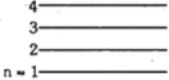
The four lowest energy levels of the $H$ atom are shown in the figure. The number of emission lines will be ...... .
A
$3$
B
$4$
C
$5$
D
$6$
Solution
(D) For an electron transitioning from an excited state $n$ to lower energy levels,the total number of possible emission lines is given by the formula: $\frac{n(n - 1)}{2}$.
Given that the highest energy level shown is $n = 4$,we substitute $n = 4$ into the formula:
$\text{Number of lines} = \frac{4(4 - 1)}{2} = \frac{4 \times 3}{2} = 6$.
Therefore,the total number of emission lines is $6$.
Given that the highest energy level shown is $n = 4$,we substitute $n = 4$ into the formula:
$\text{Number of lines} = \frac{4(4 - 1)}{2} = \frac{4 \times 3}{2} = 6$.
Therefore,the total number of emission lines is $6$.
0 likes
View Solution140
MediumMCQ
The quantum theory was first used to explain the structure of the atom,which was proposed by .......
A
Heisenberg
B
Bohr
C
Planck
D
Einstein
Solution
(B) The quantum theory was proposed by Max Planck. However,it was Niels Bohr who first applied the quantum theory to explain the structure of the atom and the stability of the hydrogen atom in his model. Therefore,the correct answer is $B$.
0 likes
View Solution141
MediumMCQ
Which of the following is $NOT$ observed in Rutherford's alpha-particle scattering experiment?
A
Most of the $\alpha$-particles pass through without deflection.
B
$A$ few $\alpha$-particles pass through the nucleus.
C
$A$ few $\alpha$-particles are deflected back.
D
$\alpha$-particles are partially deflected when passing close to the nucleus.
Solution
(B) In Rutherford's $\alpha$-particle scattering experiment,the nucleus is a very small,dense,and positively charged region at the center of the atom.
Because the nucleus is extremely small compared to the size of the atom,$\alpha$-particles do not pass through the nucleus.
Instead,they are either deflected by the electrostatic repulsion of the positive charge or pass through the empty space surrounding the nucleus.
Therefore,the observation that 'a few $\alpha$-particles pass through the nucleus' is incorrect.
Because the nucleus is extremely small compared to the size of the atom,$\alpha$-particles do not pass through the nucleus.
Instead,they are either deflected by the electrostatic repulsion of the positive charge or pass through the empty space surrounding the nucleus.
Therefore,the observation that 'a few $\alpha$-particles pass through the nucleus' is incorrect.
0 likes
View Solution142
EasyMCQ
Which of the following transitions will emit the shortest wavelength?
A
$n_4 \to n_1$
B
$n_2 \to n_1$
C
$n_4 \to n_2$
D
$n_3 \to n_1$
Solution
(A) The energy of a photon emitted during an electronic transition is given by $\Delta E = h \nu = \frac{hc}{\lambda}$.
Since $\lambda = \frac{hc}{\Delta E}$,the shortest wavelength corresponds to the transition with the largest energy difference $(\Delta E)$.
Comparing the transitions:
$(A)$ $n_4 \to n_1$: Largest energy gap.
$(B)$ $n_2 \to n_1$: Smaller energy gap.
$(C)$ $n_4 \to n_2$: Smaller energy gap.
$(D)$ $n_3 \to n_1$: Smaller energy gap than $n_4 \to n_1$.
Therefore,the transition $n_4 \to n_1$ involves the maximum energy change,resulting in the shortest wavelength.
Since $\lambda = \frac{hc}{\Delta E}$,the shortest wavelength corresponds to the transition with the largest energy difference $(\Delta E)$.
Comparing the transitions:
$(A)$ $n_4 \to n_1$: Largest energy gap.
$(B)$ $n_2 \to n_1$: Smaller energy gap.
$(C)$ $n_4 \to n_2$: Smaller energy gap.
$(D)$ $n_3 \to n_1$: Smaller energy gap than $n_4 \to n_1$.
Therefore,the transition $n_4 \to n_1$ involves the maximum energy change,resulting in the shortest wavelength.
0 likes
View Solution143
MediumMCQ
In a hydrogen atom,if an electron transitions from an $n$-th orbit to the ground state,and the total number of spectral lines observed is $10$,then the value of $n$ is:
A
$4$
B
$6$
C
$5$
D
$11$
Solution
(C) The total number of spectral lines emitted when an electron transitions from an excited state $n_2$ to a lower state $n_1$ is given by the formula: $N = \frac{(n_2 - n_1)(n_2 - n_1 + 1)}{2}$.
Given that the electron transitions to the ground state $(n_1 = 1)$ and the total number of lines $N = 10$,we have:
$10 = \frac{(n_2 - 1)(n_2 - 1 + 1)}{2}$
$10 = \frac{(n_2 - 1)(n_2)}{2}$
$20 = n_2^2 - n_2$
$n_2^2 - n_2 - 20 = 0$
Solving the quadratic equation: $(n_2 - 5)(n_2 + 4) = 0$.
Since $n_2$ must be positive,$n_2 = 5$.
Given that the electron transitions to the ground state $(n_1 = 1)$ and the total number of lines $N = 10$,we have:
$10 = \frac{(n_2 - 1)(n_2 - 1 + 1)}{2}$
$10 = \frac{(n_2 - 1)(n_2)}{2}$
$20 = n_2^2 - n_2$
$n_2^2 - n_2 - 20 = 0$
Solving the quadratic equation: $(n_2 - 5)(n_2 + 4) = 0$.
Since $n_2$ must be positive,$n_2 = 5$.
0 likes
View Solution144
EasyMCQ
The ratio of the radius of the first orbit in hydrogen to the radius of the first orbit in deuterium is .......
A
$1 : 1$
B
$1 : 2$
C
$2 : 1$
D
$4 : 1$
Solution
(A) The radius of the $n^{th}$ orbit of a hydrogen-like species is given by the formula $r_n = \frac{n^2 h^2}{4 \pi^2 m Z e^2 k}$,where $m$ is the mass of the electron.
Since both hydrogen and deuterium have the same atomic number $(Z = 1)$ and the same electron mass $(m)$,the radius of the first orbit is independent of the mass of the nucleus.
Therefore,the radius of the first orbit in hydrogen $(r_H)$ and deuterium $(r_D)$ are equal.
The ratio $r_H : r_D$ is $1 : 1$.
Since both hydrogen and deuterium have the same atomic number $(Z = 1)$ and the same electron mass $(m)$,the radius of the first orbit is independent of the mass of the nucleus.
Therefore,the radius of the first orbit in hydrogen $(r_H)$ and deuterium $(r_D)$ are equal.
The ratio $r_H : r_D$ is $1 : 1$.
0 likes
View Solution145
MediumMCQ
When an electron with energy $10.8 \,eV$ collides with a hydrogen $(H)$ atom,what will happen?
A
An electron with $10.8 \,eV$ energy will be emitted.
B
The electron will be completely absorbed.
C
The $H$ atom will absorb $10.2 \,eV$ of energy,and the electron will be emitted with $0.6 \,eV$ of energy.
D
None of these.
Solution
(C) The ground state energy of a hydrogen atom is $-13.6 \,eV$. The energy required to excite an electron from the $n=1$ to $n=2$ state is $\Delta E = E_2 - E_1 = -3.4 \,eV - (-13.6 \,eV) = 10.2 \,eV$.
Since the incident electron has $10.8 \,eV$ of energy,the $H$ atom absorbs $10.2 \,eV$ to undergo excitation,and the remaining energy $(10.8 \,eV - 10.2 \,eV = 0.6 \,eV)$ is retained by the electron as kinetic energy.
Since the incident electron has $10.8 \,eV$ of energy,the $H$ atom absorbs $10.2 \,eV$ to undergo excitation,and the remaining energy $(10.8 \,eV - 10.2 \,eV = 0.6 \,eV)$ is retained by the electron as kinetic energy.
0 likes
View Solution146
MediumMCQ
The radius of the second excited state of $Li^{2+}$ is ................ $\mathring{A}$.
A
$0.529$
B
$2.116$
C
$4.761$
D
$1.587$
Solution
(D) For a hydrogen-like species,the radius of the $n^{th}$ orbit is given by $r_n = 0.529 \times \frac{n^2}{Z} \mathring{A}$.
The second excited state corresponds to the $n = 3$ energy level.
For $Li^{2+}$,the atomic number $Z = 3$.
Substituting the values: $r_3 = 0.529 \times \frac{3^2}{3} \mathring{A} = 0.529 \times 3 \mathring{A} = 1.587 \mathring{A}$.
The second excited state corresponds to the $n = 3$ energy level.
For $Li^{2+}$,the atomic number $Z = 3$.
Substituting the values: $r_3 = 0.529 \times \frac{3^2}{3} \mathring{A} = 0.529 \times 3 \mathring{A} = 1.587 \mathring{A}$.
0 likes
View Solution147
MediumMCQ
In the hydrogen spectrum,if an electron transitions from the $6^{th}$ orbit to the $3^{rd}$ orbit,what is the total number of spectral lines in the visible region?
A
$0$
B
$6$
C
$4$
D
$2$
Solution
(A) The visible region in the hydrogen spectrum corresponds to the Balmer series,where transitions occur to the $n = 2$ energy level.
Since the electron is transitioning from the $6^{th}$ orbit to the $3^{rd}$ orbit,it does not reach the $n = 2$ level.
Therefore,the number of spectral lines in the visible region is $0$.
Since the electron is transitioning from the $6^{th}$ orbit to the $3^{rd}$ orbit,it does not reach the $n = 2$ level.
Therefore,the number of spectral lines in the visible region is $0$.
0 likes
View Solution148
MediumMCQ
For a $H$ atom,the energy transition from $n = 1$ to $n = 2$ is $10.2 \ eV$. What will be the energy for the same transition in $Be^{3+}$ ion?
A
$20.4$
B
$163.2$
C
$30.6$
D
$40.8$
Solution
(B) The energy of an electron in a hydrogen-like species is given by $E_n = -13.6 \times \frac{Z^2}{n^2} \ eV$.
For $H$ atom $(Z=1)$,the energy difference $\Delta E = 13.6 \times Z^2 \times (\frac{1}{n_1^2} - \frac{1}{n_2^2}) = 13.6 \times 1^2 \times (\frac{1}{1^2} - \frac{1}{2^2}) = 13.6 \times \frac{3}{4} = 10.2 \ eV$.
For $Be^{3+}$ ion,the atomic number $Z = 4$.
The energy difference for the same transition ($n=1$ to $n=2$) is $\Delta E' = 13.6 \times Z^2 \times (\frac{1}{n_1^2} - \frac{1}{n_2^2})$.
$\Delta E' = 13.6 \times 4^2 \times (\frac{1}{1^2} - \frac{1}{2^2}) = 13.6 \times 16 \times \frac{3}{4} = 13.6 \times 4 \times 3 = 163.2 \ eV$.
For $H$ atom $(Z=1)$,the energy difference $\Delta E = 13.6 \times Z^2 \times (\frac{1}{n_1^2} - \frac{1}{n_2^2}) = 13.6 \times 1^2 \times (\frac{1}{1^2} - \frac{1}{2^2}) = 13.6 \times \frac{3}{4} = 10.2 \ eV$.
For $Be^{3+}$ ion,the atomic number $Z = 4$.
The energy difference for the same transition ($n=1$ to $n=2$) is $\Delta E' = 13.6 \times Z^2 \times (\frac{1}{n_1^2} - \frac{1}{n_2^2})$.
$\Delta E' = 13.6 \times 4^2 \times (\frac{1}{1^2} - \frac{1}{2^2}) = 13.6 \times 16 \times \frac{3}{4} = 13.6 \times 4 \times 3 = 163.2 \ eV$.
0 likes
View Solution149
MediumMCQ
The ratio of the minimum frequencies of the Lyman and Balmer series will be $......$.
A
$1.25$
B
$0.25$
C
$5.4$
D
$10$
Solution
(C) The frequency $\nu$ is given by $\nu = \frac{c}{\lambda}$.
For the minimum frequency,the wavelength $\lambda$ must be maximum.
For the Lyman series $(n_1 = 1)$,the maximum wavelength corresponds to the transition from $n_2 = 2$ to $n_1 = 1$: $\frac{1}{\lambda_{L, \text{max}}} = R \left( \frac{1}{1^2} - \frac{1}{2^2} \right) = R \left( \frac{3}{4} \right) \implies \lambda_{L, \text{max}} = \frac{4}{3R}$.
For the Balmer series $(n_1 = 2)$,the maximum wavelength corresponds to the transition from $n_2 = 3$ to $n_1 = 2$: $\frac{1}{\lambda_{B, \text{max}}} = R \left( \frac{1}{2^2} - \frac{1}{3^2} \right) = R \left( \frac{1}{4} - \frac{1}{9} \right) = R \left( \frac{5}{36} \right) \implies \lambda_{B, \text{max}} = \frac{36}{5R}$.
The ratio of minimum frequencies is $\frac{\nu_{L, \text{min}}}{\nu_{B, \text{min}}} = \frac{c / \lambda_{L, \text{max}}}{c / \lambda_{B, \text{max}}} = \frac{\lambda_{B, \text{max}}}{\lambda_{L, \text{max}}} = \frac{36 / 5R}{4 / 3R} = \frac{36}{5} \times \frac{3}{4} = \frac{27}{5} = 5.4$.
For the minimum frequency,the wavelength $\lambda$ must be maximum.
For the Lyman series $(n_1 = 1)$,the maximum wavelength corresponds to the transition from $n_2 = 2$ to $n_1 = 1$: $\frac{1}{\lambda_{L, \text{max}}} = R \left( \frac{1}{1^2} - \frac{1}{2^2} \right) = R \left( \frac{3}{4} \right) \implies \lambda_{L, \text{max}} = \frac{4}{3R}$.
For the Balmer series $(n_1 = 2)$,the maximum wavelength corresponds to the transition from $n_2 = 3$ to $n_1 = 2$: $\frac{1}{\lambda_{B, \text{max}}} = R \left( \frac{1}{2^2} - \frac{1}{3^2} \right) = R \left( \frac{1}{4} - \frac{1}{9} \right) = R \left( \frac{5}{36} \right) \implies \lambda_{B, \text{max}} = \frac{36}{5R}$.
The ratio of minimum frequencies is $\frac{\nu_{L, \text{min}}}{\nu_{B, \text{min}}} = \frac{c / \lambda_{L, \text{max}}}{c / \lambda_{B, \text{max}}} = \frac{\lambda_{B, \text{max}}}{\lambda_{L, \text{max}}} = \frac{36 / 5R}{4 / 3R} = \frac{36}{5} \times \frac{3}{4} = \frac{27}{5} = 5.4$.
0 likes
View Solution150
MediumMCQ
The energy of an electron in the first Bohr orbit of the hydrogen atom is $-13.6 \ eV$. Calculate the energy of an electron in the first Bohr orbit of $He^{+}$ in $eV$.
A
$27.2$
B
$-27.2$
C
$54.4$
D
$-54.4$
Solution
(D) The energy of an electron in the $n^{th}$ Bohr orbit of a hydrogen-like species is given by the formula: $E_n = -13.6 \times \frac{Z^2}{n^2} \ eV$.
For the first Bohr orbit of $He^{+}$,we have $n = 1$ and the atomic number $Z = 2$.
Substituting these values into the formula: $E_1 = -13.6 \times \frac{2^2}{1^2} \ eV = -13.6 \times 4 \ eV = -54.4 \ eV$.
For the first Bohr orbit of $He^{+}$,we have $n = 1$ and the atomic number $Z = 2$.
Substituting these values into the formula: $E_1 = -13.6 \times \frac{2^2}{1^2} \ eV = -13.6 \times 4 \ eV = -54.4 \ eV$.
0 likes
View SolutionStructure of Atom — Atomic models and Planck's quantum theory · Frequently Asked Questions
1Are these Structure of Atom questions useful for JEE and NEET?
Yes. All questions in this section are mapped to JEE Main and NEET exam patterns. Previous year questions from JEE Main, NEET, GUJCET and state-level exams are included with full solutions.
2Can I switch to Hindi or Gujarati for these questions?
Yes. Use the language tabs in the hero section or the sidebar to view the same questions and solutions in English, Hindi or Gujarati.
3How do I generate a question paper from this subtopic?
Use the Vedclass Exam Paper Generator — select the chapter and subtopic, set difficulty, and generate Sets A, B, C, D automatically. First 3 chapters of every subject are free.
Vedclass Products
For Students
Vedclass Test Series
Mock tests in real JEE/NEET style with performance analysis. 5-day free trial.
Start Free TrialFor Teachers
Exam Paper Generator
Generate Set A/B/C/D papers from this chapter in 2 minutes. 3 chapters free.
Try FreeFor Institutes
Online Exam Module
Live online exams with unlimited students, 360° analytics & white-label branding.
See DemoFor Teachers & Institutes
Generate a Structure of Atom Exam Paper in 2 Minutes
Select subtopic & difficulty — Sets A, B, C, D auto-generated with No Repeat logic.
First 3 chapters of every subject are free — no payment required.