
A English
The mole concept Questions in English
Class 11 Chemistry · Some Basic Concepts of Chemistry · The mole concept
359+
Questions
English
Language
100%
With Solutions
Showing 48 of 359 questions in English
301
EasyMCQ
What is the number of moles present in $1 \ m^3$ of any gas at $STP$?
A
$32.4$
B
$54.6$
C
$44.6$
D
$28.2$
Solution
(C) At $STP$ (Standard Temperature and Pressure),the molar volume of an ideal gas is $22.7 \ L \ mol^{-1}$ (using the current $IUPAC$ standard of $1 \ bar$ pressure).
Given volume $V = 1 \ m^3 = 1000 \ L$.
The number of moles $n$ is calculated as:
$n = \frac{V}{V_m} = \frac{1000 \ L}{22.7 \ L \ mol^{-1}} \approx 44.05 \ mol$.
If using the older $STP$ definition ($1 \ atm$ pressure),the molar volume is $22.4 \ L \ mol^{-1}$.
$n = \frac{1000 \ L}{22.4 \ L \ mol^{-1}} \approx 44.64 \ mol$.
Rounding to the nearest value provided in the options,the correct answer is $44.6$.
Given volume $V = 1 \ m^3 = 1000 \ L$.
The number of moles $n$ is calculated as:
$n = \frac{V}{V_m} = \frac{1000 \ L}{22.7 \ L \ mol^{-1}} \approx 44.05 \ mol$.
If using the older $STP$ definition ($1 \ atm$ pressure),the molar volume is $22.4 \ L \ mol^{-1}$.
$n = \frac{1000 \ L}{22.4 \ L \ mol^{-1}} \approx 44.64 \ mol$.
Rounding to the nearest value provided in the options,the correct answer is $44.6$.
0 likes
View Solution302
EasyMCQ
Find the number of millimoles for $0.160 \ g$ sodium hydroxide.
A
$0.08$
B
$0.20$
C
$4.0$
D
$40.00$
Solution
(C) The molar mass of sodium hydroxide $(NaOH)$ is calculated as:
$M = 23.0 + 16.0 + 1.0 = 40.0 \ g/mol$.
Number of moles $(n)$ = $\frac{\text{mass}}{\text{molar mass}} = \frac{0.160 \ g}{40.0 \ g/mol} = 0.004 \ mol$.
Since $1 \ mol = 1000 \ mmol$,the number of millimoles is:
$0.004 \ mol \times 1000 \ mmol/mol = 4.0 \ mmol$.
$M = 23.0 + 16.0 + 1.0 = 40.0 \ g/mol$.
Number of moles $(n)$ = $\frac{\text{mass}}{\text{molar mass}} = \frac{0.160 \ g}{40.0 \ g/mol} = 0.004 \ mol$.
Since $1 \ mol = 1000 \ mmol$,the number of millimoles is:
$0.004 \ mol \times 1000 \ mmol/mol = 4.0 \ mmol$.
0 likes
View Solution303
MediumMCQ
Find out the total number of electrons present in $1.6 \ g$ of methane $(CH_4)$?
A
$6.022 \times 10^{23}$
B
$6.022 \times 10^{22}$
C
$6.022 \times 10^{21}$
D
$4.022 \times 10^{20}$
Solution
(A) $1$. Molar mass of methane $(CH_4)$ = $12 + (4 \times 1) = 16 \ g/mol$.
$2$. Number of moles of $CH_4$ = $\frac{\text{Given mass}}{\text{Molar mass}} = \frac{1.6 \ g}{16 \ g/mol} = 0.1 \ mol$.
$3$. Number of molecules of $CH_4$ = $0.1 \times 6.022 \times 10^{23} = 6.022 \times 10^{22}$ molecules.
$4$. Each molecule of $CH_4$ contains $6$ (from $C$) + $4 \times 1$ (from $H$) = $10$ electrons.
$5$. Total number of electrons = $6.022 \times 10^{22} \times 10 = 6.022 \times 10^{23}$ electrons.
$2$. Number of moles of $CH_4$ = $\frac{\text{Given mass}}{\text{Molar mass}} = \frac{1.6 \ g}{16 \ g/mol} = 0.1 \ mol$.
$3$. Number of molecules of $CH_4$ = $0.1 \times 6.022 \times 10^{23} = 6.022 \times 10^{22}$ molecules.
$4$. Each molecule of $CH_4$ contains $6$ (from $C$) + $4 \times 1$ (from $H$) = $10$ electrons.
$5$. Total number of electrons = $6.022 \times 10^{22} \times 10 = 6.022 \times 10^{23}$ electrons.
0 likes
View Solution304
MediumMCQ
Find out the total number of electrons present in $3.2 \ g$ of methane $(CH_4)$?
A
$6.022 \times 10^{23}$
B
$1.204 \times 10^{24}$
C
$3.201 \times 10^{23}$
D
$4.821 \times 10^{22}$
Solution
(B) $1$. Calculate the molar mass of methane $(CH_4)$: $12 + 4 \times 1 = 16 \ g/mol$.
$2$. Calculate the number of moles in $3.2 \ g$ of $CH_4$: $n = \frac{3.2 \ g}{16 \ g/mol} = 0.2 \ mol$.
$3$. Calculate the number of molecules: $0.2 \ mol \times 6.022 \times 10^{23} \text{ molecules/mol} = 1.2044 \times 10^{23} \text{ molecules}$.
$4$. Determine the number of electrons in one molecule of $CH_4$: Carbon has $6$ electrons and each Hydrogen has $1$ electron,so $6 + 4(1) = 10$ electrons per molecule.
$5$. Calculate the total number of electrons: $1.2044 \times 10^{23} \text{ molecules} \times 10 \text{ electrons/molecule} = 1.2044 \times 10^{24} \text{ electrons}$.
$2$. Calculate the number of moles in $3.2 \ g$ of $CH_4$: $n = \frac{3.2 \ g}{16 \ g/mol} = 0.2 \ mol$.
$3$. Calculate the number of molecules: $0.2 \ mol \times 6.022 \times 10^{23} \text{ molecules/mol} = 1.2044 \times 10^{23} \text{ molecules}$.
$4$. Determine the number of electrons in one molecule of $CH_4$: Carbon has $6$ electrons and each Hydrogen has $1$ electron,so $6 + 4(1) = 10$ electrons per molecule.
$5$. Calculate the total number of electrons: $1.2044 \times 10^{23} \text{ molecules} \times 10 \text{ electrons/molecule} = 1.2044 \times 10^{24} \text{ electrons}$.
0 likes
View Solution305
EasyMCQ
Calculate the number of molecules present in $5.4 \ g$ of urea (Molar mass of urea $= 60 \ g \ mol^{-1}$).
A
$5.42 \times 10^{22}$
B
$6.022 \times 10^{22}$
C
$4.312 \times 10^{22}$
D
$9.933 \times 10^{22}$
Solution
(A) Step $1$: Calculate the number of moles of urea.
$n = \frac{\text{mass}}{\text{molar mass}} = \frac{5.4 \ g}{60 \ g \ mol^{-1}} = 0.09 \ mol$.
Step $2$: Calculate the number of molecules.
$\text{Number of molecules} = n \times N_A = 0.09 \ mol \times 6.022 \times 10^{23} \ mol^{-1} = 5.4198 \times 10^{22} \approx 5.42 \times 10^{22}$ molecules.
$n = \frac{\text{mass}}{\text{molar mass}} = \frac{5.4 \ g}{60 \ g \ mol^{-1}} = 0.09 \ mol$.
Step $2$: Calculate the number of molecules.
$\text{Number of molecules} = n \times N_A = 0.09 \ mol \times 6.022 \times 10^{23} \ mol^{-1} = 5.4198 \times 10^{22} \approx 5.42 \times 10^{22}$ molecules.
0 likes
View Solution306
EasyMCQ
Calculate the mass of $0.25 \ mol$ of iron (molar mass $= 56 \ g \ mol^{-1}$).
A
$5.6 \times 10^{-2} \ kg$
B
$1.4 \times 10^{-2} \ kg$
C
$2.8 \times 10^{-2} \ kg$
D
$4.2 \times 10^{-2} \ kg$
Solution
(B) The formula to calculate mass is: $\text{Mass} = \text{Number of moles} \times \text{Molar mass}$.
Given: $\text{Number of moles} = 0.25 \ mol$,$\text{Molar mass} = 56 \ g \ mol^{-1}$.
$\text{Mass} = 0.25 \ mol \times 56 \ g \ mol^{-1} = 14 \ g$.
To convert the mass into kilograms: $14 \ g = 14 \times 10^{-3} \ kg = 1.4 \times 10^{-2} \ kg$.
Therefore,the correct option is $B$.
Given: $\text{Number of moles} = 0.25 \ mol$,$\text{Molar mass} = 56 \ g \ mol^{-1}$.
$\text{Mass} = 0.25 \ mol \times 56 \ g \ mol^{-1} = 14 \ g$.
To convert the mass into kilograms: $14 \ g = 14 \times 10^{-3} \ kg = 1.4 \times 10^{-2} \ kg$.
Therefore,the correct option is $B$.
0 likes
View Solution307
MediumMCQ
What is the number of hydrogen atoms present in $5.4 \ g$ of urea?
A
$9.011 \times 10^{23}$
B
$6.022 \times 10^{23}$
C
$2.168 \times 10^{23}$
D
$3.011 \times 10^{23}$
Solution
(C) The chemical formula of urea is $NH_2CONH_2$ or $CH_4N_2O$.
The molar mass of urea is $(12 + 4 \times 1 + 2 \times 14 + 16) = 60 \ g/mol$.
The number of moles of urea in $5.4 \ g$ is $n = \frac{5.4}{60} = 0.09 \ mol$.
Each molecule of urea contains $4$ hydrogen atoms.
Therefore,the number of hydrogen atoms = $n \times 4 \times N_A$,where $N_A = 6.022 \times 10^{23} \ mol^{-1}$.
Number of hydrogen atoms = $0.09 \times 4 \times 6.022 \times 10^{23} = 0.36 \times 6.022 \times 10^{23} = 2.16792 \times 10^{23} \approx 2.168 \times 10^{23}$.
The molar mass of urea is $(12 + 4 \times 1 + 2 \times 14 + 16) = 60 \ g/mol$.
The number of moles of urea in $5.4 \ g$ is $n = \frac{5.4}{60} = 0.09 \ mol$.
Each molecule of urea contains $4$ hydrogen atoms.
Therefore,the number of hydrogen atoms = $n \times 4 \times N_A$,where $N_A = 6.022 \times 10^{23} \ mol^{-1}$.
Number of hydrogen atoms = $0.09 \times 4 \times 6.022 \times 10^{23} = 0.36 \times 6.022 \times 10^{23} = 2.16792 \times 10^{23} \approx 2.168 \times 10^{23}$.
0 likes
View Solution308
EasyMCQ
What is the mass in $kg$ of $5$ mole of acetic acid $(mol. mass = 60 \ g \ mol^{-1})$ (in $kg$)?
A
$0.3$
B
$3.0$
C
$30$
D
$300$
Solution
(A) $\text{Number of moles} = 5 = \frac{\text{Given mass (g)}}{\text{Molar mass}}$
$\text{For acetic acid, } M = 60 \ g \ mol^{-1}$
$\text{Given mass (g)} = 5 \ mol \times 60 \ g \ mol^{-1} = 300 \ g$
$\text{Mass in } kg = \frac{300 \ g}{1000} = 0.3 \ kg$
$\text{For acetic acid, } M = 60 \ g \ mol^{-1}$
$\text{Given mass (g)} = 5 \ mol \times 60 \ g \ mol^{-1} = 300 \ g$
$\text{Mass in } kg = \frac{300 \ g}{1000} = 0.3 \ kg$
0 likes
View Solution309
EasyMCQ
How many moles of carbon atoms are present in $3.6 \ kg$ of carbon?
A
$3.0 \times 10^2 \ mole$
B
$1.8 \times 10^2 \ mole$
C
$2.4 \times 10^2 \ mole$
D
$4.8 \times 10^2 \ mole$
Solution
(A) Given mass of carbon $= 3.6 \ kg = 3600 \ g$.
Molar mass of carbon $= 12 \ g/mol$.
The number of moles is calculated as:
$n = \frac{\text{mass}}{\text{molar mass}} = \frac{3600 \ g}{12 \ g/mol} = 300 \ mol$.
This can be expressed as $3.0 \times 10^2 \ mol$.
Molar mass of carbon $= 12 \ g/mol$.
The number of moles is calculated as:
$n = \frac{\text{mass}}{\text{molar mass}} = \frac{3600 \ g}{12 \ g/mol} = 300 \ mol$.
This can be expressed as $3.0 \times 10^2 \ mol$.
0 likes
View Solution310
MediumMCQ
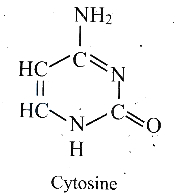
What is the number of moles of nitrogen atoms present in one mole of cytosine?
A
$5$
B
$4$
C
$3$
D
$2$
Solution
(C) The chemical formula of cytosine is $C_4H_5N_3O$.
From the chemical formula,it is evident that one molecule of cytosine contains $3$ nitrogen atoms.
Therefore,one mole of cytosine contains $3$ moles of nitrogen atoms.
From the chemical formula,it is evident that one molecule of cytosine contains $3$ nitrogen atoms.
Therefore,one mole of cytosine contains $3$ moles of nitrogen atoms.
0 likes
View Solution311
EasyMCQ
Calculate the number of moles present in $9.10 \times 10^{-2} \ kg$ of water.
A
$0.9$
B
$1.8$
C
$3.0$
D
$5.0$
Solution
(D) The molar mass of water $(H_2O)$ is $18 \times 10^{-3} \ kg \ mol^{-1}$.
Number of moles $(n) = \frac{\text{Given mass}}{\text{Molar mass}}$.
$n = \frac{9.10 \times 10^{-2} \ kg}{18 \times 10^{-3} \ kg \ mol^{-1}}$.
$n = \frac{91 \times 10^{-3}}{18 \times 10^{-3}} = 5.055 \approx 5.0 \ mol$.
Number of moles $(n) = \frac{\text{Given mass}}{\text{Molar mass}}$.
$n = \frac{9.10 \times 10^{-2} \ kg}{18 \times 10^{-3} \ kg \ mol^{-1}}$.
$n = \frac{91 \times 10^{-3}}{18 \times 10^{-3}} = 5.055 \approx 5.0 \ mol$.
0 likes
View Solution312
MediumMCQ
What is the volume occupied by $1$ molecule of water, if its density is $1 \,g \,cm^{-3}$?
A
$9.0 \times 10^{-23} \,cm^3$
B
$2.98 \times 10^{-23} \,cm^3$
C
$6.023 \times 10^{-23} \,cm^3$
D
$5.50 \times 10^{-23} \,cm^3$
Solution
(B) The molar mass of water $(H_2O)$ is $18 \,g/mol$.
$1 \,mol$ of water contains $6.022 \times 10^{23}$ molecules.
Mass of $6.022 \times 10^{23}$ molecules of water $= 18 \,g$.
Therefore, the mass of $1$ molecule of water $= \frac{18 \,g}{6.022 \times 10^{23}} = 2.988 \times 10^{-23} \,g$.
Given that $\text{density} = \frac{\text{mass}}{\text{volume}}$, the volume occupied by $1$ molecule is $\text{Volume} = \frac{\text{mass}}{\text{density}}$.
$\text{Volume} = \frac{2.988 \times 10^{-23} \,g}{1 \,g \,cm^{-3}} = 2.988 \times 10^{-23} \,cm^3 \approx 2.98 \times 10^{-23} \,cm^3$.
$1 \,mol$ of water contains $6.022 \times 10^{23}$ molecules.
Mass of $6.022 \times 10^{23}$ molecules of water $= 18 \,g$.
Therefore, the mass of $1$ molecule of water $= \frac{18 \,g}{6.022 \times 10^{23}} = 2.988 \times 10^{-23} \,g$.
Given that $\text{density} = \frac{\text{mass}}{\text{volume}}$, the volume occupied by $1$ molecule is $\text{Volume} = \frac{\text{mass}}{\text{density}}$.
$\text{Volume} = \frac{2.988 \times 10^{-23} \,g}{1 \,g \,cm^{-3}} = 2.988 \times 10^{-23} \,cm^3 \approx 2.98 \times 10^{-23} \,cm^3$.
0 likes
View Solution313
MediumMCQ
What is the number of moles of water molecules present in a mole of carnallite?
A
$6$
B
$4$
C
$5$
D
$1$
Solution
(A) The chemical formula of carnallite is $KCl \cdot MgCl_2 \cdot 6 H_2O$.
From the formula,it is evident that $1$ mole of carnallite contains $6$ moles of water molecules.
From the formula,it is evident that $1$ mole of carnallite contains $6$ moles of water molecules.
0 likes
View Solution314
EasyMCQ
Find the number of moles of sodium atoms in $6.9 \times 10^{-2} \ kg$ (Atomic mass $= 23 \ g \ mol^{-1}$)
A
$1.5$
B
$0.3$
C
$3$
D
$2.3$
Solution
(C) The number of moles is calculated using the formula: $\text{Moles} = \frac{\text{Mass in grams}}{\text{Molar mass}}$
Given mass $= 6.9 \times 10^{-2} \ kg = 6.9 \times 10^{-2} \times 10^3 \ g = 69 \ g$
Molar mass of sodium $= 23 \ g \ mol^{-1}$
Number of moles $= \frac{69 \ g}{23 \ g \ mol^{-1}} = 3 \ mol$
Given mass $= 6.9 \times 10^{-2} \ kg = 6.9 \times 10^{-2} \times 10^3 \ g = 69 \ g$
Molar mass of sodium $= 23 \ g \ mol^{-1}$
Number of moles $= \frac{69 \ g}{23 \ g \ mol^{-1}} = 3 \ mol$
0 likes
View Solution315
EasyMCQ
Calculate the mass in $kg$ of $2.5 \ mol$ of ammonia.
A
$5.10 \times 10^{-2} \ kg$
B
$4.25 \times 10^{-2} \ kg$
C
$1.72 \times 10^{-2} \ kg$
D
$3.44 \times 10^{-2} \ kg$
Solution
(B) The chemical formula of ammonia is $NH_3$.
The molar mass of $NH_3 = 14 + (3 \times 1) = 17 \ g \ mol^{-1}$.
Mass in grams $= \text{moles} \times \text{molar mass} = 2.5 \ mol \times 17 \ g \ mol^{-1} = 42.5 \ g$.
To convert the mass into $kg$,divide by $1000$:
Mass in $kg = \frac{42.5 \ g}{1000} = 0.0425 \ kg = 4.25 \times 10^{-2} \ kg$.
The molar mass of $NH_3 = 14 + (3 \times 1) = 17 \ g \ mol^{-1}$.
Mass in grams $= \text{moles} \times \text{molar mass} = 2.5 \ mol \times 17 \ g \ mol^{-1} = 42.5 \ g$.
To convert the mass into $kg$,divide by $1000$:
Mass in $kg = \frac{42.5 \ g}{1000} = 0.0425 \ kg = 4.25 \times 10^{-2} \ kg$.
0 likes
View Solution316
MediumMCQ
How many moles of nitrogen atoms are present in $8 \ g$ of ammonium nitrate (in $mol$)?
A
$0.1$
B
$0.2$
C
$0.4$
D
$0.8$
Solution
(B) The chemical formula of ammonium nitrate is $NH_4NO_3$.
The molar mass of $NH_4NO_3 = (14 + 4 \times 1 + 14 + 3 \times 16) \ g/mol = 80 \ g/mol$.
Number of moles of $NH_4NO_3 = \frac{8 \ g}{80 \ g/mol} = 0.1 \ mol$.
Since $1 \ mol$ of $NH_4NO_3$ contains $2 \ mol$ of nitrogen atoms,
$0.1 \ mol$ of $NH_4NO_3$ contains $0.1 \times 2 = 0.2 \ mol$ of nitrogen atoms.
The molar mass of $NH_4NO_3 = (14 + 4 \times 1 + 14 + 3 \times 16) \ g/mol = 80 \ g/mol$.
Number of moles of $NH_4NO_3 = \frac{8 \ g}{80 \ g/mol} = 0.1 \ mol$.
Since $1 \ mol$ of $NH_4NO_3$ contains $2 \ mol$ of nitrogen atoms,
$0.1 \ mol$ of $NH_4NO_3$ contains $0.1 \times 2 = 0.2 \ mol$ of nitrogen atoms.
0 likes
View Solution317
MediumMCQ
Which of the following substances consists of a total of $1 \ mol$ of atoms? (Molar mass of $NH_3 = 17 \ g/mol, H_2O = 18 \ g/mol, N_2 = 28 \ g/mol, CO_2 = 44 \ g/mol$)
A
$4.25 \ g$ of $NH_3$
B
$1.8 \ g$ of $H_2O$
C
$2.8 \ g$ of $N_2$
D
$4.4 \ g$ of $CO_2$
Solution
(A) For $4.25 \ g$ of $NH_3$: Moles of $NH_3 = \frac{4.25 \ g}{17 \ g/mol} = 0.25 \ mol$. Total atoms $= 0.25 \ mol \times (1 + 3) \ atoms/molecule = 1 \ mol$ of atoms.
For $1.8 \ g$ of $H_2O$: Moles of $H_2O = \frac{1.8 \ g}{18 \ g/mol} = 0.1 \ mol$. Total atoms $= 0.1 \ mol \times (2 + 1) = 0.3 \ mol$ of atoms.
For $2.8 \ g$ of $N_2$: Moles of $N_2 = \frac{2.8 \ g}{28 \ g/mol} = 0.1 \ mol$. Total atoms $= 0.1 \ mol \times 2 = 0.2 \ mol$ of atoms.
For $4.4 \ g$ of $CO_2$: Moles of $CO_2 = \frac{4.4 \ g}{44 \ g/mol} = 0.1 \ mol$. Total atoms $= 0.1 \ mol \times (1 + 2) = 0.3 \ mol$ of atoms.
Thus,$4.25 \ g$ of $NH_3$ contains $1 \ mol$ of atoms.
For $1.8 \ g$ of $H_2O$: Moles of $H_2O = \frac{1.8 \ g}{18 \ g/mol} = 0.1 \ mol$. Total atoms $= 0.1 \ mol \times (2 + 1) = 0.3 \ mol$ of atoms.
For $2.8 \ g$ of $N_2$: Moles of $N_2 = \frac{2.8 \ g}{28 \ g/mol} = 0.1 \ mol$. Total atoms $= 0.1 \ mol \times 2 = 0.2 \ mol$ of atoms.
For $4.4 \ g$ of $CO_2$: Moles of $CO_2 = \frac{4.4 \ g}{44 \ g/mol} = 0.1 \ mol$. Total atoms $= 0.1 \ mol \times (1 + 2) = 0.3 \ mol$ of atoms.
Thus,$4.25 \ g$ of $NH_3$ contains $1 \ mol$ of atoms.
0 likes
View Solution318
MediumMCQ
How many moles of oxygen gas at $STP$ are equivalent to $5.6 \ L$?
A
$\frac{1}{8} \text{ mole}$
B
$1 \text{ mole}$
C
$\frac{1}{2} \text{ mole}$
D
$\frac{1}{4} \text{ mole}$
Solution
(D) At $STP$,$1 \text{ mole}$ of any gas occupies $22.4 \ L$ volume.
Number of moles $= \frac{\text{Given volume}}{\text{Molar volume at } STP} = \frac{5.6 \ L}{22.4 \ L/mol} = 0.25 \text{ mole} = \frac{1}{4} \text{ mole}$.
Number of moles $= \frac{\text{Given volume}}{\text{Molar volume at } STP} = \frac{5.6 \ L}{22.4 \ L/mol} = 0.25 \text{ mole} = \frac{1}{4} \text{ mole}$.
0 likes
View Solution319
EasyMCQ
What is the number of $CO_2$ molecules in $45.42 \ L$ at $\text{STP}$? (Consider molar volume of gas at $\text{STP} = 22.71 \ L \ mol^{-1}$)
A
$0.913 \times 10^{24}$
B
$1.806 \times 10^{24}$
C
$1.501 \times 10^{24}$
D
$1.204 \times 10^{24}$
Solution
(D) Step $1$: Calculate the number of moles of $CO_2$ using the given molar volume at $\text{STP}$.
Number of moles $= \frac{\text{Given Volume}}{\text{Molar Volume}} = \frac{45.42 \ L}{22.71 \ L \ mol^{-1}} = 2 \ mol$.
Step $2$: Calculate the number of molecules using Avogadro's number $(N_A = 6.022 \times 10^{23} \ mol^{-1})$.
Number of molecules $= \text{moles} \times N_A = 2 \ mol \times 6.022 \times 10^{23} \ mol^{-1} = 1.2044 \times 10^{24}$ molecules.
Number of moles $= \frac{\text{Given Volume}}{\text{Molar Volume}} = \frac{45.42 \ L}{22.71 \ L \ mol^{-1}} = 2 \ mol$.
Step $2$: Calculate the number of molecules using Avogadro's number $(N_A = 6.022 \times 10^{23} \ mol^{-1})$.
Number of molecules $= \text{moles} \times N_A = 2 \ mol \times 6.022 \times 10^{23} \ mol^{-1} = 1.2044 \times 10^{24}$ molecules.
0 likes
View Solution320
EasyMCQ
Find the number of hydrogen atoms present in $6.0 \ g$ of urea $(NH_2CONH_2)$:
A
$2.4 \times 10^{23}$
B
$4.06 \times 10^{23}$
C
$2.16 \times 10^{23}$
D
$3.01 \times 10^{23}$
Solution
(A) The molar mass of urea $(NH_2CONH_2)$ is $14 + 2(1) + 12 + 16 + 14 + 2(1) = 60 \ g/mol$.
Moles of urea $= \frac{\text{Given mass}}{\text{Molar mass}} = \frac{6.0 \ g}{60 \ g/mol} = 0.1 \ mol$.
Each molecule of urea contains $4$ hydrogen atoms.
Therefore,moles of $H$-atoms $= 0.1 \ mol \times 4 = 0.4 \ mol$.
Number of hydrogen atoms $= \text{moles} \times N_A = 0.4 \times 6.022 \times 10^{23} = 2.4088 \times 10^{23} \approx 2.4 \times 10^{23}$.
Moles of urea $= \frac{\text{Given mass}}{\text{Molar mass}} = \frac{6.0 \ g}{60 \ g/mol} = 0.1 \ mol$.
Each molecule of urea contains $4$ hydrogen atoms.
Therefore,moles of $H$-atoms $= 0.1 \ mol \times 4 = 0.4 \ mol$.
Number of hydrogen atoms $= \text{moles} \times N_A = 0.4 \times 6.022 \times 10^{23} = 2.4088 \times 10^{23} \approx 2.4 \times 10^{23}$.
0 likes
View Solution321
MediumMCQ
What is the volume occupied by $16 \ g$ methane gas at $STP$ (in $cm^3$)?
A
$1140$
B
$22400$
C
$214$
D
$12.4$
Solution
(B) The molar mass of methane $(CH_4)$ is $12 + (4 \times 1) = 16 \ g/mol$.
Number of moles of methane $(CH_4) = \frac{\text{Given mass}}{\text{Molar mass}} = \frac{16 \ g}{16 \ g/mol} = 1 \ mol$.
At $STP$,the volume occupied by $1 \ mol$ of any ideal gas is $22.4 \ L$.
Since $1 \ L = 1000 \ cm^3$,the volume is $22.4 \times 1000 \ cm^3 = 22400 \ cm^3$.
Number of moles of methane $(CH_4) = \frac{\text{Given mass}}{\text{Molar mass}} = \frac{16 \ g}{16 \ g/mol} = 1 \ mol$.
At $STP$,the volume occupied by $1 \ mol$ of any ideal gas is $22.4 \ L$.
Since $1 \ L = 1000 \ cm^3$,the volume is $22.4 \times 1000 \ cm^3 = 22400 \ cm^3$.
0 likes
View Solution322
EasyMCQ
How many moles of urea are present in $5.4 \ g$? (Molar mass $= 60 \ g/mol$)
A
$2.9$
B
$0.09$
C
$1.2$
D
$2.4$
Solution
(B) The number of moles is calculated using the formula:
$n = \frac{\text{Given mass}}{\text{Molar mass}}$
Given mass $= 5.4 \ g$
Molar mass $= 60 \ g/mol$
$n = \frac{5.4}{60} = 0.09 \ mol$
$n = \frac{\text{Given mass}}{\text{Molar mass}}$
Given mass $= 5.4 \ g$
Molar mass $= 60 \ g/mol$
$n = \frac{5.4}{60} = 0.09 \ mol$
0 likes
View Solution323
MediumMCQ
How many molecules are present in $22400 \ cm^3$ of a gas at $STP$?
A
$22.4 \times 10^{20}$
B
$6.022 \times 10^{23}$
C
$6.022 \times 10^{20}$
D
$22.4 \times 10^{23}$
Solution
(B) At $STP$,the molar volume of an ideal gas is $22.4 \ L$ or $22400 \ cm^3$.
Number of moles of gas $= \frac{\text{Volume at STP}}{22400 \ cm^3/mol} = \frac{22400 \ cm^3}{22400 \ cm^3/mol} = 1 \ mol$.
Number of molecules $= \text{moles} \times N_A = 1 \times 6.022 \times 10^{23} = 6.022 \times 10^{23}$ molecules.
Number of moles of gas $= \frac{\text{Volume at STP}}{22400 \ cm^3/mol} = \frac{22400 \ cm^3}{22400 \ cm^3/mol} = 1 \ mol$.
Number of molecules $= \text{moles} \times N_A = 1 \times 6.022 \times 10^{23} = 6.022 \times 10^{23}$ molecules.
0 likes
View Solution324
MediumMCQ
How many molecules of ammonia gas are present in $67.2 \ dm^3$,measured at $S.T.P.$?
A
$2.0 \times 10^{24}$
B
$1.0 \times 10^{23}$
C
$1.8 \times 10^{24}$
D
$5.0 \times 10^{24}$
Solution
(C) $\text{Number of moles of gas} = \frac{\text{Given volume}}{22.4 \ dm^3/mol}$
$\text{Number of moles} = \frac{67.2}{22.4} = 3 \ mol$
$\text{Number of molecules} = \text{moles} \times N_A$
$\text{Number of molecules} = 3 \times 6.022 \times 10^{23} \approx 3 \times 6 \times 10^{23}$
$\text{Number of molecules} = 18 \times 10^{23} = 1.8 \times 10^{24}$
$\text{Number of moles} = \frac{67.2}{22.4} = 3 \ mol$
$\text{Number of molecules} = \text{moles} \times N_A$
$\text{Number of molecules} = 3 \times 6.022 \times 10^{23} \approx 3 \times 6 \times 10^{23}$
$\text{Number of molecules} = 18 \times 10^{23} = 1.8 \times 10^{24}$
0 likes
View Solution325
EasyMCQ
How many grams of $H_2O$ are present in $0.25 \ mol$ of it (in $g$)?
A
$0.25$
B
$5.4$
C
$4.5$
D
$6.1$
Solution
(C) The formula for calculating mass from moles is: $\text{Mass} = \text{moles} \times \text{Molar mass}$.
The molar mass of $H_2O$ is $(2 \times 1.008) + 16.00 = 18.016 \ g/mol \approx 18 \ g/mol$.
Given moles $= 0.25 \ mol$.
Therefore,$\text{Mass} = 0.25 \ mol \times 18 \ g/mol = 4.5 \ g$.
The molar mass of $H_2O$ is $(2 \times 1.008) + 16.00 = 18.016 \ g/mol \approx 18 \ g/mol$.
Given moles $= 0.25 \ mol$.
Therefore,$\text{Mass} = 0.25 \ mol \times 18 \ g/mol = 4.5 \ g$.
0 likes
View Solution326
EasyMCQ
Which gas among the following contains the maximum number of molecules at $STP$? (Molar masses in $g \ mol^{-1}$: $CO_{2}=44, Ar=39.9, CH_{4}=16, O_{2}=32$)
A
$24.0 \ g$ of $O_{2}$
B
$16.0 \ g$ of $CH_{4}$
C
$13.3 \ g$ of $Ar$
D
$11 \ g$ of $CO_{2}$
Solution
(B) The number of molecules is directly proportional to the number of moles $(n = \frac{\text{mass}}{\text{molar mass}})$.
$I. \ n_{Ar} = \frac{13.3 \ g}{39.9 \ g \ mol^{-1}} = 0.33 \ mol$
$II. \ n_{O_{2}} = \frac{24.0 \ g}{32 \ g \ mol^{-1}} = 0.75 \ mol$
$III. \ n_{CO_{2}} = \frac{11 \ g}{44 \ g \ mol^{-1}} = 0.25 \ mol$
$IV. \ n_{CH_{4}} = \frac{16.0 \ g}{16 \ g \ mol^{-1}} = 1.0 \ mol$
Since $CH_{4}$ has the maximum number of moles $(1.0 \ mol)$,it contains the maximum number of molecules.
$I. \ n_{Ar} = \frac{13.3 \ g}{39.9 \ g \ mol^{-1}} = 0.33 \ mol$
$II. \ n_{O_{2}} = \frac{24.0 \ g}{32 \ g \ mol^{-1}} = 0.75 \ mol$
$III. \ n_{CO_{2}} = \frac{11 \ g}{44 \ g \ mol^{-1}} = 0.25 \ mol$
$IV. \ n_{CH_{4}} = \frac{16.0 \ g}{16 \ g \ mol^{-1}} = 1.0 \ mol$
Since $CH_{4}$ has the maximum number of moles $(1.0 \ mol)$,it contains the maximum number of molecules.
0 likes
View Solution327
EasyMCQ
What is the number of moles and total number of atoms respectively present in $5.6 \ cm^{3}$ of ammonia gas at $STP$?
A
$2.50 \times 10^{-3} \ mol$ and $1.5 \times 10^{20}$ atoms
B
$1.505 \ mol$ and $6.022 \times 10^{20}$ atoms
C
$2.05 \ mol$ and $1.50 \times 10^{20}$ atoms
D
$2.50 \times 10^{-4} \ mol$ and $6.022 \times 10^{20}$ atoms
Solution
(D) Volume of $NH_{3}$ gas at $STP = 5.6 \ cm^{3} = 5.6 \times 10^{-3} \ L$ (or $dm^{3}$).
Since $22.4 \ L$ of any gas at $STP$ contains $1 \ mole$.
Number of moles of $NH_{3} = \frac{5.6 \times 10^{-3} \ L}{22.4 \ L/mol} = 2.5 \times 10^{-4} \ mol$.
One molecule of $NH_{3}$ contains $4$ atoms ($1$ Nitrogen and $3$ Hydrogen).
Total number of atoms = (Number of moles) $\times$ (Avogadro's number) $\times$ (Atomicity).
Total number of atoms = $2.5 \times 10^{-4} \times 6.022 \times 10^{23} \times 4 = 6.022 \times 10^{20}$ atoms.
Since $22.4 \ L$ of any gas at $STP$ contains $1 \ mole$.
Number of moles of $NH_{3} = \frac{5.6 \times 10^{-3} \ L}{22.4 \ L/mol} = 2.5 \times 10^{-4} \ mol$.
One molecule of $NH_{3}$ contains $4$ atoms ($1$ Nitrogen and $3$ Hydrogen).
Total number of atoms = (Number of moles) $\times$ (Avogadro's number) $\times$ (Atomicity).
Total number of atoms = $2.5 \times 10^{-4} \times 6.022 \times 10^{23} \times 4 = 6.022 \times 10^{20}$ atoms.
0 likes
View Solution328
MediumMCQ
Which among the following elements has the highest number of atoms in $1 \ g$ each? (Atomic masses: $Au=197, Na=23, Cu=63.5, Fe=56$)
A
$Cu_{(s)}$
B
$Na_{(s)}$
C
$Au_{(s)}$
D
$Fe_{(s)}$
Solution
(B) The number of atoms is calculated by the formula: $\text{Number of atoms} = \frac{\text{Given mass}}{\text{Molar mass}} \times N_A$.
Since the mass is $1 \ g$ for all,the number of atoms is inversely proportional to the molar mass.
$I$. $1 \ g \ Fe = \frac{1}{56} \times N_A \approx 0.0178 \times N_A$ atoms.
$II$. $1 \ g \ Au = \frac{1}{197} \times N_A \approx 0.0051 \times N_A$ atoms.
$III$. $1 \ g \ Na = \frac{1}{23} \times N_A \approx 0.0435 \times N_A$ atoms.
$IV$. $1 \ g \ Cu = \frac{1}{63.5} \times N_A \approx 0.0157 \times N_A$ atoms.
Comparing the values,$Na$ has the smallest molar mass,therefore it has the highest number of atoms.
Since the mass is $1 \ g$ for all,the number of atoms is inversely proportional to the molar mass.
$I$. $1 \ g \ Fe = \frac{1}{56} \times N_A \approx 0.0178 \times N_A$ atoms.
$II$. $1 \ g \ Au = \frac{1}{197} \times N_A \approx 0.0051 \times N_A$ atoms.
$III$. $1 \ g \ Na = \frac{1}{23} \times N_A \approx 0.0435 \times N_A$ atoms.
$IV$. $1 \ g \ Cu = \frac{1}{63.5} \times N_A \approx 0.0157 \times N_A$ atoms.
Comparing the values,$Na$ has the smallest molar mass,therefore it has the highest number of atoms.
0 likes
View Solution329
MediumMCQ
If $3.01 \times 10^{20}$ molecules are removed from $98 \ mg$ of $H_2SO_4$,then the number of moles of $H_2SO_4$ left are:
A
$0.1 \times 10^{-3} \ mol$
B
$0.5 \times 10^{-3} \ mol$
C
$1.66 \times 10^{-3} \ mol$
D
$9.95 \times 10^{-2} \ mol$
Solution
(B) The molar mass of $H_2SO_4$ is $98 \ g/mol$.
Initial amount of $H_2SO_4 = 98 \ mg = 98 \times 10^{-3} \ g = 0.1 \times 10^{-2} \ mol = 1 \times 10^{-3} \ mol$.
Number of molecules in $1 \times 10^{-3} \ mol = 1 \times 10^{-3} \times 6.022 \times 10^{23} = 6.022 \times 10^{20}$ molecules.
Number of molecules removed $= 3.01 \times 10^{20}$.
Number of molecules left $= 6.022 \times 10^{20} - 3.01 \times 10^{20} = 3.012 \times 10^{20}$ molecules.
Number of moles left $= \frac{3.012 \times 10^{20}}{6.022 \times 10^{23}} \approx 0.5 \times 10^{-3} \ mol$.
Initial amount of $H_2SO_4 = 98 \ mg = 98 \times 10^{-3} \ g = 0.1 \times 10^{-2} \ mol = 1 \times 10^{-3} \ mol$.
Number of molecules in $1 \times 10^{-3} \ mol = 1 \times 10^{-3} \times 6.022 \times 10^{23} = 6.022 \times 10^{20}$ molecules.
Number of molecules removed $= 3.01 \times 10^{20}$.
Number of molecules left $= 6.022 \times 10^{20} - 3.01 \times 10^{20} = 3.012 \times 10^{20}$ molecules.
Number of moles left $= \frac{3.012 \times 10^{20}}{6.022 \times 10^{23}} \approx 0.5 \times 10^{-3} \ mol$.
0 likes
View Solution330
MediumMCQ
The number of oxygen atoms in $4.4 \ g$ of $CO_2$ is,
A
$1.2 \times 10^{23}$
B
$6 \times 10^{22}$
C
$6 \times 10^{23}$
D
$12 \times 10^{23}$
Solution
(A) Molar mass of $CO_2 = 12 + (2 \times 16) = 44 \ g/mol$.
Number of moles of $CO_2 = \frac{\text{Given mass}}{\text{Molar mass}} = \frac{4.4 \ g}{44 \ g/mol} = 0.1 \ mol$.
$1$ molecule of $CO_2$ contains $2$ oxygen atoms.
Therefore,$1$ mole of $CO_2$ contains $2 \times 6.022 \times 10^{23}$ oxygen atoms.
Number of oxygen atoms in $0.1 \ mol$ of $CO_2 = 0.1 \times 2 \times 6.022 \times 10^{23} = 1.2044 \times 10^{23}$ oxygen atoms.
Thus,the number of oxygen atoms is approximately $1.2 \times 10^{23}$.
Number of moles of $CO_2 = \frac{\text{Given mass}}{\text{Molar mass}} = \frac{4.4 \ g}{44 \ g/mol} = 0.1 \ mol$.
$1$ molecule of $CO_2$ contains $2$ oxygen atoms.
Therefore,$1$ mole of $CO_2$ contains $2 \times 6.022 \times 10^{23}$ oxygen atoms.
Number of oxygen atoms in $0.1 \ mol$ of $CO_2 = 0.1 \times 2 \times 6.022 \times 10^{23} = 1.2044 \times 10^{23}$ oxygen atoms.
Thus,the number of oxygen atoms is approximately $1.2 \times 10^{23}$.
0 likes
View Solution331
EasyMCQ
What amount of dioxygen (in gram) contains $1.8 \times 10^{22}$ molecules?
A
$0.0960$
B
$0.960$
C
$9.60$
D
$96.0$
Solution
(B) $1$ mole of $O_2 = 6.022 \times 10^{23}$ molecules $= 32 \ g$ of $O_2$.
$1$ molecule of $O_2 = \frac{32}{6.022 \times 10^{23}} \ g$ of $O_2$.
Therefore,$1.8 \times 10^{22}$ molecules of $O_2 = \frac{32}{6.022 \times 10^{23}} \times 1.8 \times 10^{22} \ g$.
$= 0.960 \ g$ of $O_2$.
$1$ molecule of $O_2 = \frac{32}{6.022 \times 10^{23}} \ g$ of $O_2$.
Therefore,$1.8 \times 10^{22}$ molecules of $O_2 = \frac{32}{6.022 \times 10^{23}} \times 1.8 \times 10^{22} \ g$.
$= 0.960 \ g$ of $O_2$.
0 likes
View Solution332
DifficultMCQ
The number of water molecules present in a drop of water weighing $0.018 \ g$ is
A
$6.022 \times 10^{26}$
B
$6.022 \times 10^{23}$
C
$6.022 \times 10^{19}$
D
$6.022 \times 10^{20}$
Solution
(D) The molar mass of $H_{2}O$ is $18 \ g/mol$.
$18 \ g$ of $H_{2}O$ contains $6.022 \times 10^{23}$ molecules.
Therefore,$0.018 \ g$ of $H_{2}O$ contains:
$\text{Number of molecules} = \frac{\text{Given mass}}{\text{Molar mass}} \times N_{A}$
$= \frac{0.018 \ g}{18 \ g/mol} \times 6.022 \times 10^{23} \text{ molecules/mol}$
$= 0.001 \times 6.022 \times 10^{23}$
$= 6.022 \times 10^{20} \text{ molecules}$.
$18 \ g$ of $H_{2}O$ contains $6.022 \times 10^{23}$ molecules.
Therefore,$0.018 \ g$ of $H_{2}O$ contains:
$\text{Number of molecules} = \frac{\text{Given mass}}{\text{Molar mass}} \times N_{A}$
$= \frac{0.018 \ g}{18 \ g/mol} \times 6.022 \times 10^{23} \text{ molecules/mol}$
$= 0.001 \times 6.022 \times 10^{23}$
$= 6.022 \times 10^{20} \text{ molecules}$.
0 likes
View Solution333
MediumMCQ
The mass of $112 \ cm^3$ of $NH_3$ gas at $STP$ is (in $g$)
A
$0.085$
B
$0.850$
C
$8.500$
D
$80.500$
Solution
(A) $1 \ mol$ of $NH_3 = 17 \ g = 22400 \ cm^3$ at $STP$.
Since $22400 \ cm^3$ of $NH_3$ at $STP$ has a mass of $17 \ g$.
Therefore,the mass of $112 \ cm^3$ of $NH_3$ at $STP$ is calculated as:
$\text{Mass} = \frac{17 \ g}{22400 \ cm^3} \times 112 \ cm^3 = 0.085 \ g$.
Since $22400 \ cm^3$ of $NH_3$ at $STP$ has a mass of $17 \ g$.
Therefore,the mass of $112 \ cm^3$ of $NH_3$ at $STP$ is calculated as:
$\text{Mass} = \frac{17 \ g}{22400 \ cm^3} \times 112 \ cm^3 = 0.085 \ g$.
0 likes
View Solution334
MediumMCQ
The total number of electrons in $18 \ mL$ of water (density $= 1 \ g \ mL^{-1}$) is
A
$6.02 \times 10^{25}$
B
$6.02 \times 10^{24}$
C
$6.02 \times 18 \times 10^{23}$
D
$6.02 \times 10^{23}$
Solution
(B) Given volume of water $= 18 \ mL$ and density $= 1 \ g \ mL^{-1}$.
Mass of water $= \text{density} \times \text{volume} = 1 \ g \ mL^{-1} \times 18 \ mL = 18 \ g$.
Molar mass of $H_2O = (2 \times 1) + 16 = 18 \ g \ mol^{-1}$.
Number of moles of $H_2O = \frac{18 \ g}{18 \ g \ mol^{-1}} = 1 \ mol$.
One molecule of $H_2O$ contains $2 \times 1 (\text{from } H) + 8 (\text{from } O) = 10$ electrons.
Total number of electrons in $1 \ mol$ of $H_2O = 1 \ mol \times 6.022 \times 10^{23} \text{ molecules/mol} \times 10 \text{ electrons/molecule}$.
Total number of electrons $= 6.022 \times 10^{24}$.
Mass of water $= \text{density} \times \text{volume} = 1 \ g \ mL^{-1} \times 18 \ mL = 18 \ g$.
Molar mass of $H_2O = (2 \times 1) + 16 = 18 \ g \ mol^{-1}$.
Number of moles of $H_2O = \frac{18 \ g}{18 \ g \ mol^{-1}} = 1 \ mol$.
One molecule of $H_2O$ contains $2 \times 1 (\text{from } H) + 8 (\text{from } O) = 10$ electrons.
Total number of electrons in $1 \ mol$ of $H_2O = 1 \ mol \times 6.022 \times 10^{23} \text{ molecules/mol} \times 10 \text{ electrons/molecule}$.
Total number of electrons $= 6.022 \times 10^{24}$.
0 likes
View Solution335
EasyMCQ
Mass of $0.1 \ mol$ of methane is (in $g$)
A
$1$
B
$16$
C
$1.6$
D
$0.1$
Solution
(C) The molar mass of methane $(CH_{4})$ is calculated as: $12 + (4 \times 1) = 16 \ g/mol$.
Mass of $0.1 \ mol$ of methane $= \text{Number of moles} \times \text{Molar mass}$.
Mass $= 0.1 \ mol \times 16 \ g/mol = 1.6 \ g$.
Mass of $0.1 \ mol$ of methane $= \text{Number of moles} \times \text{Molar mass}$.
Mass $= 0.1 \ mol \times 16 \ g/mol = 1.6 \ g$.
0 likes
View Solution336
EasyMCQ
$80 \ g$ of oxygen contains as many atoms as in
A
$80 \ g$ of hydrogen
B
$1 \ g$ of hydrogen
C
$10 \ g$ of hydrogen
D
$5 \ g$ of hydrogen
Solution
(D) The molar mass of oxygen atoms $(O)$ is $16 \ g/mol$. However,oxygen gas exists as $O_2$.
Number of moles of $O_2 = \frac{80 \ g}{32 \ g/mol} = 2.5 \ mol$.
Number of oxygen atoms $= 2.5 \ mol \times 2 \times N_A = 5 \times N_A$.
For hydrogen gas $(H_2)$,the molar mass is $2 \ g/mol$.
Number of atoms in $5 \ g$ of $H_2$:
Moles of $H_2 = \frac{5 \ g}{2 \ g/mol} = 2.5 \ mol$.
Number of hydrogen atoms $= 2.5 \ mol \times 2 \times N_A = 5 \times N_A$.
Thus,$80 \ g$ of oxygen contains the same number of atoms as $5 \ g$ of hydrogen.
Number of moles of $O_2 = \frac{80 \ g}{32 \ g/mol} = 2.5 \ mol$.
Number of oxygen atoms $= 2.5 \ mol \times 2 \times N_A = 5 \times N_A$.
For hydrogen gas $(H_2)$,the molar mass is $2 \ g/mol$.
Number of atoms in $5 \ g$ of $H_2$:
Moles of $H_2 = \frac{5 \ g}{2 \ g/mol} = 2.5 \ mol$.
Number of hydrogen atoms $= 2.5 \ mol \times 2 \times N_A = 5 \times N_A$.
Thus,$80 \ g$ of oxygen contains the same number of atoms as $5 \ g$ of hydrogen.
0 likes
View Solution337
DifficultMCQ
The number of gram molecules of chlorine in $6.02 \times 10^{25}$ hydrogen chloride molecules is
A
$10$
B
$100$
C
$50$
D
$5$
Solution
(B) The chemical formula for hydrogen chloride is $HCl$.
One molecule of $HCl$ contains one atom of chlorine.
Therefore,$6.02 \times 10^{25}$ molecules of $HCl$ contain $6.02 \times 10^{25}$ atoms of chlorine.
The number of moles (gram molecules) of chlorine atoms is calculated as:
$\text{Number of moles} = \frac{\text{Total number of atoms}}{\text{Avogadro's number}} = \frac{6.02 \times 10^{25}}{6.02 \times 10^{23}} = 100$.
One molecule of $HCl$ contains one atom of chlorine.
Therefore,$6.02 \times 10^{25}$ molecules of $HCl$ contain $6.02 \times 10^{25}$ atoms of chlorine.
The number of moles (gram molecules) of chlorine atoms is calculated as:
$\text{Number of moles} = \frac{\text{Total number of atoms}}{\text{Avogadro's number}} = \frac{6.02 \times 10^{25}}{6.02 \times 10^{23}} = 100$.
0 likes
View Solution338
EasyMCQ
Which one of the following has the maximum number of atoms of oxygen?
A
$2 \ g$ of carbon monoxide
B
$2 \ g$ of carbon dioxide
C
$2 \ g$ of sulphur dioxide
D
$2 \ g$ of water
Solution
(D) The number of oxygen atoms is calculated as: $\text{Number of atoms} = \frac{\text{mass}}{\text{molar mass}} \times N_A \times \text{number of oxygen atoms in one molecule}$.
For $2 \ g$ of $CO$ $(M = 28 \ g/mol)$: $\frac{2}{28} \times 1 = 0.071 \ N_A$.
For $2 \ g$ of $CO_2$ $(M = 44 \ g/mol)$: $\frac{2}{44} \times 2 = 0.091 \ N_A$.
For $2 \ g$ of $SO_2$ $(M = 64 \ g/mol)$: $\frac{2}{64} \times 2 = 0.0625 \ N_A$.
For $2 \ g$ of $H_2O$ $(M = 18 \ g/mol)$: $\frac{2}{18} \times 1 = 0.111 \ N_A$.
Comparing the values,$2 \ g$ of $H_2O$ contains the maximum number of oxygen atoms.
For $2 \ g$ of $CO$ $(M = 28 \ g/mol)$: $\frac{2}{28} \times 1 = 0.071 \ N_A$.
For $2 \ g$ of $CO_2$ $(M = 44 \ g/mol)$: $\frac{2}{44} \times 2 = 0.091 \ N_A$.
For $2 \ g$ of $SO_2$ $(M = 64 \ g/mol)$: $\frac{2}{64} \times 2 = 0.0625 \ N_A$.
For $2 \ g$ of $H_2O$ $(M = 18 \ g/mol)$: $\frac{2}{18} \times 1 = 0.111 \ N_A$.
Comparing the values,$2 \ g$ of $H_2O$ contains the maximum number of oxygen atoms.
0 likes
View Solution339
MediumMCQ
$A$ flask contains $98 \ mg$ of $H_2SO_4$. If $3.01 \times 10^{20}$ molecules of $H_2SO_4$ are removed from the flask,the number of moles of $H_2SO_4$ remaining in the flask is $\left(N_A = 6.02 \times 10^{23}\right)$
A
$1 \times 10^{-4}$
B
$5 \times 10^{-4}$
C
$1.66 \times 10^{-4}$
D
$9.95 \times 10^{-3}$
Solution
(B) Initial weight of $H_2SO_4$ $(W)$ = $98 \ mg = 98 \times 10^{-3} \ g$.
Initial number of moles $(n_1)$ = $\frac{98 \times 10^{-3} \ g}{98 \ g/mol} = 10^{-3} \ mol$.
Number of moles removed $(n_2)$ = $\frac{\text{Number of molecules}}{N_A} = \frac{3.01 \times 10^{20}}{6.02 \times 10^{23}} = 0.5 \times 10^{-3} \ mol$.
Remaining moles = $n_1 - n_2 = 10^{-3} - 0.5 \times 10^{-3} = 0.5 \times 10^{-3} \ mol = 5 \times 10^{-4} \ mol$.
Initial number of moles $(n_1)$ = $\frac{98 \times 10^{-3} \ g}{98 \ g/mol} = 10^{-3} \ mol$.
Number of moles removed $(n_2)$ = $\frac{\text{Number of molecules}}{N_A} = \frac{3.01 \times 10^{20}}{6.02 \times 10^{23}} = 0.5 \times 10^{-3} \ mol$.
Remaining moles = $n_1 - n_2 = 10^{-3} - 0.5 \times 10^{-3} = 0.5 \times 10^{-3} \ mol = 5 \times 10^{-4} \ mol$.
0 likes
View Solution340
EasyMCQ
The mass of hydrogen (in grams) present in $1.0 \text{ L}$ of pure water of density $1.0 \text{ g cm}^{-3}$ is
A
$1.11 \times 10^2$
B
$5.55 \times 10^2$
C
$2.22 \times 10^2$
D
$3.33 \times 10^2$
Solution
(A) Density of water = $1.0 \text{ g cm}^{-3}$.
Volume of water = $1.0 \text{ L} = 1000 \text{ mL}$.
Mass of $1.0 \text{ L}$ of water = $1000 \text{ mL} \times 1.0 \text{ g mL}^{-1} = 1000 \text{ g}$.
Molar mass of $H_2O = (2 \times 1.008) + 16.00 = 18.016 \text{ g mol}^{-1} \approx 18 \text{ g mol}^{-1}$.
In $18 \text{ g}$ of $H_2O$,the mass of hydrogen is $2 \text{ g}$.
Therefore,the mass of hydrogen in $1000 \text{ g}$ of $H_2O = (2 \text{ g} / 18 \text{ g}) \times 1000 \text{ g} = 111.11 \text{ g}$.
This is equal to $1.11 \times 10^2 \text{ g}$.
Volume of water = $1.0 \text{ L} = 1000 \text{ mL}$.
Mass of $1.0 \text{ L}$ of water = $1000 \text{ mL} \times 1.0 \text{ g mL}^{-1} = 1000 \text{ g}$.
Molar mass of $H_2O = (2 \times 1.008) + 16.00 = 18.016 \text{ g mol}^{-1} \approx 18 \text{ g mol}^{-1}$.
In $18 \text{ g}$ of $H_2O$,the mass of hydrogen is $2 \text{ g}$.
Therefore,the mass of hydrogen in $1000 \text{ g}$ of $H_2O = (2 \text{ g} / 18 \text{ g}) \times 1000 \text{ g} = 111.11 \text{ g}$.
This is equal to $1.11 \times 10^2 \text{ g}$.
0 likes
View Solution341
EasyMCQ
If one atom of an element $X$ weighs $6.643 \times 10^{-23} \ g$,then find the number of moles of atoms in $50 \ kg$ of element $X$. (in $moles$)
A
$500$
B
$125$
C
$1250$
D
$50$
Solution
(C) Step $1$: Calculate the mass of one mole of element $X$ (molar mass).
Mass of one atom = $6.643 \times 10^{-23} \ g$.
Molar mass = Mass of one atom $\times$ Avogadro's number $(N_A)$.
Molar mass = $(6.643 \times 10^{-23} \ g) \times (6.022 \times 10^{23} \ mol^{-1}) \approx 40 \ g/mol$.
Step $2$: Calculate the number of moles in $50 \ kg$ $(50,000 \ g)$.
Number of moles = $\frac{\text{Given mass}}{\text{Molar mass}} = \frac{50,000 \ g}{40 \ g/mol} = 1250 \ moles$.
Mass of one atom = $6.643 \times 10^{-23} \ g$.
Molar mass = Mass of one atom $\times$ Avogadro's number $(N_A)$.
Molar mass = $(6.643 \times 10^{-23} \ g) \times (6.022 \times 10^{23} \ mol^{-1}) \approx 40 \ g/mol$.
Step $2$: Calculate the number of moles in $50 \ kg$ $(50,000 \ g)$.
Number of moles = $\frac{\text{Given mass}}{\text{Molar mass}} = \frac{50,000 \ g}{40 \ g/mol} = 1250 \ moles$.
0 likes
View Solution342
EasyMCQ
One mole of oxygen gas at $STP$ is equal to
A
$6.022 \times 10^{23}$ molecules of oxygen
B
$6.022 \times 10^{23}$ atoms of oxygen
C
$16 \ g$ of oxygen
D
$3.2 \ g$ of oxygen
Solution
(A) $1$ mole of $O_{2(g)}$ at $STP$ contains Avogadro number $(N_A = 6.022 \times 10^{23} \ mol^{-1})$ of $O_2$ molecules.
Since $1$ mole of $O_2$ has a molar mass of $32 \ g/mol$,it corresponds to $32 \ g$ of oxygen gas.
Therefore,the correct statement is that it contains $6.022 \times 10^{23}$ molecules of oxygen.
Since $1$ mole of $O_2$ has a molar mass of $32 \ g/mol$,it corresponds to $32 \ g$ of oxygen gas.
Therefore,the correct statement is that it contains $6.022 \times 10^{23}$ molecules of oxygen.
0 likes
View Solution343
MediumMCQ
Which one of the following has the same number of atoms as are in $6 \,g$ of $H_2O$?
A
$0.4 \,g$ $He$
B
$22 \,g$ $CO_2$
C
$1 \,g$ $H_2$
D
$12 \,g$ $CO$
Solution
(C) $1$. Calculate the number of atoms in $6 \,g$ of $H_2O$:
$n(H_2O) = \frac{6 \,g}{18 \,g/mol} = \frac{1}{3} \,mol$.
Since each $H_2O$ molecule has $3$ atoms ($2$ $H$ and $1$ $O$),total atoms $= 3 \times \frac{1}{3} \,N_A = N_A$.
$2$. Evaluate options:
$A$: $n(He) = \frac{0.4}{4} = 0.1 \,mol$. Atoms $= 0.1 \,N_A$.
$B$: $n(CO_2) = \frac{22}{44} = 0.5 \,mol$. Atoms $= 3 \times 0.5 \,N_A = 1.5 \,N_A$.
$C$: $n(H_2) = \frac{1}{2} = 0.5 \,mol$. Atoms $= 2 \times 0.5 \,N_A = N_A$.
$D$: $n(CO) = \frac{12}{28} \approx 0.43 \,mol$. Atoms $= 2 \times 0.43 \,N_A = 0.86 \,N_A$.
Thus,$1 \,g$ of $H_2$ has the same number of atoms.
$n(H_2O) = \frac{6 \,g}{18 \,g/mol} = \frac{1}{3} \,mol$.
Since each $H_2O$ molecule has $3$ atoms ($2$ $H$ and $1$ $O$),total atoms $= 3 \times \frac{1}{3} \,N_A = N_A$.
$2$. Evaluate options:
$A$: $n(He) = \frac{0.4}{4} = 0.1 \,mol$. Atoms $= 0.1 \,N_A$.
$B$: $n(CO_2) = \frac{22}{44} = 0.5 \,mol$. Atoms $= 3 \times 0.5 \,N_A = 1.5 \,N_A$.
$C$: $n(H_2) = \frac{1}{2} = 0.5 \,mol$. Atoms $= 2 \times 0.5 \,N_A = N_A$.
$D$: $n(CO) = \frac{12}{28} \approx 0.43 \,mol$. Atoms $= 2 \times 0.43 \,N_A = 0.86 \,N_A$.
Thus,$1 \,g$ of $H_2$ has the same number of atoms.
0 likes
View Solution344
MediumMCQ
The number of sodium ions present in $0.5 \ mol$ of sodium ferrocyanide is?
A
$2 \times 10^{23}$
B
$0.5 \times 10^{23}$
C
$12 \times 10^{23}$
D
$4 \times 10^{23}$
Solution
(C) The chemical formula for sodium ferrocyanide is $Na_4[Fe(CN)_6]$.
Each molecule of $Na_4[Fe(CN)_6]$ contains $4$ sodium ions $(Na^+)$.
Therefore,$1 \ mol$ of $Na_4[Fe(CN)_6]$ contains $4 \ mol$ of $Na^+$ ions.
For $0.5 \ mol$ of $Na_4[Fe(CN)_6]$,the number of moles of $Na^+$ ions is $0.5 \times 4 = 2 \ mol$.
The number of $Na^+$ ions is calculated as $2 \times N_A$,where $N_A \approx 6.022 \times 10^{23} \ mol^{-1}$.
Number of ions $= 2 \times 6.022 \times 10^{23} = 12.044 \times 10^{23} \approx 12 \times 10^{23}$.
Each molecule of $Na_4[Fe(CN)_6]$ contains $4$ sodium ions $(Na^+)$.
Therefore,$1 \ mol$ of $Na_4[Fe(CN)_6]$ contains $4 \ mol$ of $Na^+$ ions.
For $0.5 \ mol$ of $Na_4[Fe(CN)_6]$,the number of moles of $Na^+$ ions is $0.5 \times 4 = 2 \ mol$.
The number of $Na^+$ ions is calculated as $2 \times N_A$,where $N_A \approx 6.022 \times 10^{23} \ mol^{-1}$.
Number of ions $= 2 \times 6.022 \times 10^{23} = 12.044 \times 10^{23} \approx 12 \times 10^{23}$.
0 likes
View Solution345
EasyMCQ
What is the total number of electrons present in one mole of ethane?
A
$6.022 \times 10^{23}$
B
$10.022 \times 10^{25}$
C
$108.4 \times 10^{23}$
D
$1.084 \times 10^{23}$
Solution
(C) The chemical formula of ethane is $C_2H_6$ $(CH_3-CH_3)$.
Each carbon atom has $6$ electrons and each hydrogen atom has $1$ electron.
Total electrons in one molecule of ethane $= (2 \times 6) + (6 \times 1) = 12 + 6 = 18$ electrons.
One mole of ethane contains $N_A$ molecules,where $N_A = 6.022 \times 10^{23} \ mol^{-1}$.
Total electrons in one mole of ethane $= 18 \times 6.022 \times 10^{23} = 108.396 \times 10^{23} \approx 108.4 \times 10^{23}$.
Therefore,the correct option is $(C)$.
Each carbon atom has $6$ electrons and each hydrogen atom has $1$ electron.
Total electrons in one molecule of ethane $= (2 \times 6) + (6 \times 1) = 12 + 6 = 18$ electrons.
One mole of ethane contains $N_A$ molecules,where $N_A = 6.022 \times 10^{23} \ mol^{-1}$.
Total electrons in one mole of ethane $= 18 \times 6.022 \times 10^{23} = 108.396 \times 10^{23} \approx 108.4 \times 10^{23}$.
Therefore,the correct option is $(C)$.
0 likes
View Solution346
MediumMCQ
Assertion $(A)$: Equal moles of different substances contain the same number of constituent particles.
Reason $(R)$: Equal weights of different substances contain the same number of constituent particles.
The correct answer is
Reason $(R)$: Equal weights of different substances contain the same number of constituent particles.
The correct answer is
A
Both $(A)$ and $(R)$ are true and $(R)$ is the correct explanation of $(A)$
B
Both $(A)$ and $(R)$ are true but $(R)$ is not the correct explanation of $(A)$
C
$(A)$ is true,but $(R)$ is false
D
$(A)$ is false but $(R)$ is true
Solution
(C) The number of particles in a substance is given by $N = n \times N_A$,where $n$ is the number of moles and $N_A$ is Avogadro's constant $(6.022 \times 10^{23} \ mol^{-1})$.
Since $N_A$ is constant,equal moles $(n)$ of different substances contain the same number of constituent particles. Thus,Assertion $(A)$ is true.
However,the number of moles is given by $n = \frac{w}{M}$,where $w$ is the weight and $M$ is the molar mass.
Since different substances have different molar masses $(M)$,equal weights $(w)$ of different substances will result in different number of moles $(n)$,and consequently,a different number of constituent particles.
Therefore,Reason $(R)$ is false.
Since $N_A$ is constant,equal moles $(n)$ of different substances contain the same number of constituent particles. Thus,Assertion $(A)$ is true.
However,the number of moles is given by $n = \frac{w}{M}$,where $w$ is the weight and $M$ is the molar mass.
Since different substances have different molar masses $(M)$,equal weights $(w)$ of different substances will result in different number of moles $(n)$,and consequently,a different number of constituent particles.
Therefore,Reason $(R)$ is false.
0 likes
View Solution347
DifficultMCQ
$138 \ g$ of ethyl alcohol is mixed with $72 \ g$ of water. The ratio of mole fraction of alcohol to water is
A
$3: 4$
B
$1: 2$
C
$1: 4$
D
$1: 1$
Solution
(A) Number of moles of ethyl alcohol $(C_2H_5OH)$ = $\frac{138}{46} = 3 \ mol$.
Number of moles of water $(H_2O)$ = $\frac{72}{18} = 4 \ mol$.
Mole fraction of alcohol $(X_{C_2H_5OH})$ = $\frac{3}{3+4} = \frac{3}{7}$.
Mole fraction of water $(X_{H_2O})$ = $\frac{4}{3+4} = \frac{4}{7}$.
The ratio of mole fraction of alcohol to water is $\frac{X_{C_2H_5OH}}{X_{H_2O}} = \frac{3/7}{4/7} = \frac{3}{4}$.
Number of moles of water $(H_2O)$ = $\frac{72}{18} = 4 \ mol$.
Mole fraction of alcohol $(X_{C_2H_5OH})$ = $\frac{3}{3+4} = \frac{3}{7}$.
Mole fraction of water $(X_{H_2O})$ = $\frac{4}{3+4} = \frac{4}{7}$.
The ratio of mole fraction of alcohol to water is $\frac{X_{C_2H_5OH}}{X_{H_2O}} = \frac{3/7}{4/7} = \frac{3}{4}$.
0 likes
View Solution348
MediumMCQ
How many oxygen atoms are present in $0.36 \ g$ of a drop of water?
A
$6.023 \times 10^{22}$
B
$1.205 \times 10^{22}$
C
$6.023 \times 10^{23}$
D
$1.205 \times 10^{23}$
Solution
(B) The molar mass of water $(H_2O)$ is $18 \ g/mol$.
Number of moles of water $= \frac{0.36 \ g}{18 \ g/mol} = 0.02 \ mol$.
Number of water molecules $= 0.02 \times 6.023 \times 10^{23} = 1.205 \times 10^{22}$ molecules.
Since each molecule of water $(H_2O)$ contains $1$ oxygen atom,the number of oxygen atoms is equal to the number of water molecules.
Therefore,the number of oxygen atoms $= 1.205 \times 10^{22}$.
Number of moles of water $= \frac{0.36 \ g}{18 \ g/mol} = 0.02 \ mol$.
Number of water molecules $= 0.02 \times 6.023 \times 10^{23} = 1.205 \times 10^{22}$ molecules.
Since each molecule of water $(H_2O)$ contains $1$ oxygen atom,the number of oxygen atoms is equal to the number of water molecules.
Therefore,the number of oxygen atoms $= 1.205 \times 10^{22}$.
0 likes
View SolutionSome Basic Concepts of Chemistry — The mole concept · Frequently Asked Questions
1Are these Some Basic Concepts of Chemistry questions useful for JEE and NEET?
Yes. All questions in this section are mapped to JEE Main and NEET exam patterns. Previous year questions from JEE Main, NEET, GUJCET and state-level exams are included with full solutions.
2Can I switch to Hindi or Gujarati for these questions?
Yes. Use the language tabs in the hero section or the sidebar to view the same questions and solutions in English, Hindi or Gujarati.
3How do I generate a question paper from this subtopic?
Use the Vedclass Exam Paper Generator — select the chapter and subtopic, set difficulty, and generate Sets A, B, C, D automatically. First 3 chapters of every subject are free.
Vedclass Products
For Students
Vedclass Test Series
Mock tests in real JEE/NEET style with performance analysis. 5-day free trial.
Start Free TrialFor Teachers
Exam Paper Generator
Generate Set A/B/C/D papers from this chapter in 2 minutes. 3 chapters free.
Try FreeFor Institutes
Online Exam Module
Live online exams with unlimited students, 360° analytics & white-label branding.
See DemoFor Teachers & Institutes
Generate a Some Basic Concepts of Chemistry Exam Paper in 2 Minutes
Select subtopic & difficulty — Sets A, B, C, D auto-generated with No Repeat logic.
First 3 chapters of every subject are free — no payment required.