
A English
The mole concept Questions in English
Class 11 Chemistry · Some Basic Concepts of Chemistry · The mole concept
359+
Questions
English
Language
100%
With Solutions
Showing 50 of 359 questions in English
251
Medium
Explain the terms: Avogadro constant,molar volume of $1$ mole of gas,and $STP$.
Solution
(N/A) Avogadro constant: The number of particles (atoms,molecules,or ions) present in $1$ mole of a substance is known as the Avogadro constant,which is $6.022 \times 10^{23} \ mol^{-1}$.
Molar volume: According to Avogadro's law,the volume of a gas $(V)$ is directly proportional to the number of moles $(n)$ at constant temperature and pressure. At $STP$,$1$ mole of an ideal gas occupies a volume of $22.71098 \ L \ mol^{-1}$.
$STP$ (Standard Temperature and Pressure): According to current $IUPAC$ recommendations,$STP$ is defined as a temperature of $273.15 \ K$ $(0^{\circ} C)$ and a pressure of $1 \ bar$ $(10^{5} \ Pa)$.
Molar volume: According to Avogadro's law,the volume of a gas $(V)$ is directly proportional to the number of moles $(n)$ at constant temperature and pressure. At $STP$,$1$ mole of an ideal gas occupies a volume of $22.71098 \ L \ mol^{-1}$.
$STP$ (Standard Temperature and Pressure): According to current $IUPAC$ recommendations,$STP$ is defined as a temperature of $273.15 \ K$ $(0^{\circ} C)$ and a pressure of $1 \ bar$ $(10^{5} \ Pa)$.
0 likes
View Solution252
Difficult
Find the number of molecules,number of carbon atoms,number of hydrogen atoms,and total number of atoms in $5.6 \ L$ of $CH_4$ at $STP$.
Solution
(N/A) At $STP$,$22.4 \ L$ of any gas contains $6.022 \times 10^{23}$ molecules (Avogadro's number).
Number of moles of $CH_4 = \frac{5.6 \ L}{22.4 \ L/mol} = 0.25 \ mol$.
Number of molecules of $CH_4 = 0.25 \times 6.022 \times 10^{23} = 1.5055 \times 10^{23}$ molecules.
Number of $C$ atoms $= 1 \times 1.5055 \times 10^{23} = 1.5055 \times 10^{23}$ atoms.
Number of $H$ atoms $= 4 \times 1.5055 \times 10^{23} = 6.022 \times 10^{23}$ atoms.
Total number of atoms $= 1.5055 \times 10^{23} + 6.022 \times 10^{23} = 7.5275 \times 10^{23}$ atoms.
Number of moles of $CH_4 = \frac{5.6 \ L}{22.4 \ L/mol} = 0.25 \ mol$.
Number of molecules of $CH_4 = 0.25 \times 6.022 \times 10^{23} = 1.5055 \times 10^{23}$ molecules.
Number of $C$ atoms $= 1 \times 1.5055 \times 10^{23} = 1.5055 \times 10^{23}$ atoms.
Number of $H$ atoms $= 4 \times 1.5055 \times 10^{23} = 6.022 \times 10^{23}$ atoms.
Total number of atoms $= 1.5055 \times 10^{23} + 6.022 \times 10^{23} = 7.5275 \times 10^{23}$ atoms.
0 likes
View Solution253
MediumMCQ
Find the volume at $STP$ and mass of $6.022 \times 10^{23}$ molecules of $O_2$. (Molar volume $= 22.4 \ L$)
A
$22.4 \ L, 32 \ g$
B
$11.2 \ L, 16 \ g$
C
$44.8 \ L, 64 \ g$
D
$22.4 \ L, 16 \ g$
Solution
(A) The number of molecules given is $6.022 \times 10^{23}$,which is equal to $1 \ \text{mole}$ of $O_2$ molecules.
Since $1 \ \text{mole}$ of any gas at $STP$ occupies $22.4 \ L$,the volume is $22.4 \ L$.
The molar mass of $O_2$ is $2 \times 16 = 32 \ g/mol$.
Therefore,the mass of $1 \ \text{mole}$ of $O_2$ is $32 \ g$.
Since $1 \ \text{mole}$ of any gas at $STP$ occupies $22.4 \ L$,the volume is $22.4 \ L$.
The molar mass of $O_2$ is $2 \times 16 = 32 \ g/mol$.
Therefore,the mass of $1 \ \text{mole}$ of $O_2$ is $32 \ g$.
0 likes
View Solution254
EasyMCQ
What is a mole?
A
$A$ unit of mass
B
$A$ unit of volume
C
$A$ unit of amount of substance
D
$A$ unit of temperature
Solution
(C) mole is defined as the amount of a substance that contains exactly $6.022 \times 10^{23}$ elementary entities of the given substance.
This number is known as the Avogadro constant $(N_A)$.
It is the $SI$ unit for the amount of substance.
This number is known as the Avogadro constant $(N_A)$.
It is the $SI$ unit for the amount of substance.
0 likes
View Solution255
MediumMCQ
Calculate the mass of oxygen present in $0.1 \ mol$ of $Na_2CO_3 \cdot 10H_2O$. (in $g$)
A
$20.8$
B
$16.0$
C
$1.6$
D
$2.08$
Solution
(A) The chemical formula is $Na_2CO_3 \cdot 10H_2O$.
In $1 \ mol$ of $Na_2CO_3 \cdot 10H_2O$,there are $3$ oxygen atoms in $Na_2CO_3$ and $10$ oxygen atoms in $10H_2O$,totaling $13$ moles of oxygen atoms.
For $0.1 \ mol$ of the compound,the moles of oxygen atoms = $0.1 \times 13 = 1.3 \ mol$.
The molar mass of oxygen is $16 \ g/mol$.
Mass of oxygen = $1.3 \ mol \times 16 \ g/mol = 20.8 \ g$.
In $1 \ mol$ of $Na_2CO_3 \cdot 10H_2O$,there are $3$ oxygen atoms in $Na_2CO_3$ and $10$ oxygen atoms in $10H_2O$,totaling $13$ moles of oxygen atoms.
For $0.1 \ mol$ of the compound,the moles of oxygen atoms = $0.1 \times 13 = 1.3 \ mol$.
The molar mass of oxygen is $16 \ g/mol$.
Mass of oxygen = $1.3 \ mol \times 16 \ g/mol = 20.8 \ g$.
0 likes
View Solution256
EasyMCQ
What is the approximate weight of one molecule of methane $(CH_4)$?
A
$2.657 \times 10^{-23} \ g$
B
$1.66 \times 10^{-24} \ g$
C
$6.022 \times 10^{-23} \ g$
D
$16 \ g$
Solution
(A) The molar mass of methane $(CH_4)$ is calculated as: $12 + (4 \times 1) = 16 \ g/mol$.
According to the mole concept,$1 \ mol$ of $CH_4$ contains $6.022 \times 10^{23}$ molecules,which weighs $16 \ g$.
Therefore,the weight of one molecule of $CH_4$ is: $\frac{16}{6.022 \times 10^{23}} \ g$.
Calculation: $16 \div 6.022 \approx 2.657$.
Thus,the weight is $2.657 \times 10^{-23} \ g$.
According to the mole concept,$1 \ mol$ of $CH_4$ contains $6.022 \times 10^{23}$ molecules,which weighs $16 \ g$.
Therefore,the weight of one molecule of $CH_4$ is: $\frac{16}{6.022 \times 10^{23}} \ g$.
Calculation: $16 \div 6.022 \approx 2.657$.
Thus,the weight is $2.657 \times 10^{-23} \ g$.
0 likes
View Solution257
EasyMCQ
What is the value of Avogadro's number?
A
$6.022 \times 10^{23} \ mol^{-1}$
B
$6.626 \times 10^{-34} \ J \ s$
C
$1.602 \times 10^{-19} \ C$
D
$9.109 \times 10^{-31} \ kg$
Solution
(A) The Avogadro's number,denoted by $N_A$,represents the number of particles (atoms,molecules,or ions) in one mole of a substance. Its value is $6.022 \times 10^{23} \ mol^{-1}$.
0 likes
View Solution258
EasyMCQ
How many moles are present in $0.224 \ L$ of an ideal $H_2$ gas at $STP$ (in $mol$)? (Assume molar volume $= 22.4 \ L \ mol^{-1}$)
A
$0.01$
B
$0.1$
C
$0.001$
D
$1.0$
Solution
(A) The number of moles $(n)$ is calculated using the formula: $n = \frac{\text{Given Volume}}{\text{Molar Volume at STP}}$.
Given volume $= 0.224 \ L$.
Molar volume at $STP = 22.4 \ L \ mol^{-1}$.
$n = \frac{0.224 \ L}{22.4 \ L \ mol^{-1}} = 0.01 \ mol$.
Given volume $= 0.224 \ L$.
Molar volume at $STP = 22.4 \ L \ mol^{-1}$.
$n = \frac{0.224 \ L}{22.4 \ L \ mol^{-1}} = 0.01 \ mol$.
0 likes
View Solution259
MediumMCQ
If a gaseous mixture contains $20\%$ $H_2$ by weight,what is the number of moles of $H_2$ in $100 \ g$ of the mixture (in $mol$)?
A
$10$
B
$20$
C
$5$
D
$100$
Solution
(A) The mass of $H_2$ in $100 \ g$ of the mixture is $20 \ g$.
The molar mass of $H_2$ is $2 \ g/mol$.
The number of moles of $H_2$ is calculated as: $n = \frac{\text{mass}}{\text{molar mass}} = \frac{20 \ g}{2 \ g/mol} = 10 \ mol$.
The molar mass of $H_2$ is $2 \ g/mol$.
The number of moles of $H_2$ is calculated as: $n = \frac{\text{mass}}{\text{molar mass}} = \frac{20 \ g}{2 \ g/mol} = 10 \ mol$.
0 likes
View Solution260
EasyMCQ
What is the concentration of water?
A
$55.55 \ mol \ L^{-1}$
B
$18 \ mol \ L^{-1}$
C
$1 \ mol \ L^{-1}$
D
$100 \ mol \ L^{-1}$
Solution
(A) The molar mass of water $(H_2O)$ is $18 \ g \ mol^{-1}$.
Assuming the density of water is $1 \ g \ mL^{-1}$,then $1 \ L$ of water has a mass of $1000 \ g$.
The number of moles of $H_2O$ in $1 \ L$ is calculated as:
$n = \frac{1000 \ g}{18 \ g \ mol^{-1}} = 55.55 \ mol$.
Since molarity $(M)$ is defined as moles per liter of solution:
$M = \frac{55.55 \ mol}{1 \ L} = 55.55 \ mol \ L^{-1}$.
Assuming the density of water is $1 \ g \ mL^{-1}$,then $1 \ L$ of water has a mass of $1000 \ g$.
The number of moles of $H_2O$ in $1 \ L$ is calculated as:
$n = \frac{1000 \ g}{18 \ g \ mol^{-1}} = 55.55 \ mol$.
Since molarity $(M)$ is defined as moles per liter of solution:
$M = \frac{55.55 \ mol}{1 \ L} = 55.55 \ mol \ L^{-1}$.
0 likes
View Solution261
MediumMCQ
Which one of the following has the maximum number of atoms?
A
$1 \ g$ of $Li(s)$ [Atomic mass of $Li = 7$]
B
$1 \ g$ of $Ag(s)$ [Atomic mass of $Ag = 108$]
C
$1 \ g$ of $Mg(s)$ [Atomic mass of $Mg = 24$]
D
$1 \ g$ of $O_2(g)$ [Atomic mass of $O = 16$]
Solution
(A) The number of atoms is calculated using the formula: $\text{Number of atoms} = \frac{\text{mass}}{\text{molar mass}} \times N_A \times \text{atomicity}$.
$(A)$ For $1 \ g$ of $Li$: $\frac{1}{7} \times N_A \times 1 \approx 0.143 \times N_A$.
$(B)$ For $1 \ g$ of $Ag$: $\frac{1}{108} \times N_A \times 1 \approx 0.009 \times N_A$.
$(C)$ For $1 \ g$ of $Mg$: $\frac{1}{24} \times N_A \times 1 \approx 0.042 \times N_A$.
$(D)$ For $1 \ g$ of $O_2$: $\frac{1}{32} \times N_A \times 2 = \frac{1}{16} \times N_A \approx 0.0625 \times N_A$.
Comparing the values,$1 \ g$ of $Li$ has the maximum number of atoms.
$(A)$ For $1 \ g$ of $Li$: $\frac{1}{7} \times N_A \times 1 \approx 0.143 \times N_A$.
$(B)$ For $1 \ g$ of $Ag$: $\frac{1}{108} \times N_A \times 1 \approx 0.009 \times N_A$.
$(C)$ For $1 \ g$ of $Mg$: $\frac{1}{24} \times N_A \times 1 \approx 0.042 \times N_A$.
$(D)$ For $1 \ g$ of $O_2$: $\frac{1}{32} \times N_A \times 2 = \frac{1}{16} \times N_A \approx 0.0625 \times N_A$.
Comparing the values,$1 \ g$ of $Li$ has the maximum number of atoms.
0 likes
View Solution262
EasyMCQ
One mole of carbon atom weighs $12 \; g$. The number of atoms in it is equal to: (Mass of one carbon-$12$ atom is $1.9926 \times 10^{-23} \; g$)
A
$6.022 \times 10^{23}$
B
$1.2 \times 10^{23}$
C
$6.022 \times 10^{22}$
D
$12 \times 10^{22}$
Solution
(A) The number of atoms in one mole of a substance is defined by Avogadro's number $(N_A)$.
Given that the mass of one mole of carbon is $12 \; g$ and the mass of a single carbon-$12$ atom is $1.9926 \times 10^{-23} \; g$.
The number of atoms $= \frac{\text{Total mass}}{\text{Mass of one atom}} = \frac{12 \; g}{1.9926 \times 10^{-23} \; g} \approx 6.022 \times 10^{23}$ atoms.
Thus,the number of atoms in one mole of carbon is $6.022 \times 10^{23}$.
Given that the mass of one mole of carbon is $12 \; g$ and the mass of a single carbon-$12$ atom is $1.9926 \times 10^{-23} \; g$.
The number of atoms $= \frac{\text{Total mass}}{\text{Mass of one atom}} = \frac{12 \; g}{1.9926 \times 10^{-23} \; g} \approx 6.022 \times 10^{23}$ atoms.
Thus,the number of atoms in one mole of carbon is $6.022 \times 10^{23}$.
0 likes
View Solution263
DifficultMCQ
The number of atoms in $8 \ g$ of sodium is $x \times 10^{23}$. The value of $x$ is ...... (Nearest integer).
$[ \text{Given}: N_{A} = 6.02 \times 10^{23} \ mol^{-1}, \text{Atomic mass of } Na = 23.0 \ u ]$
$[ \text{Given}: N_{A} = 6.02 \times 10^{23} \ mol^{-1}, \text{Atomic mass of } Na = 23.0 \ u ]$
A
$6$
B
$8$
C
$2$
D
$34$
Solution
(C) The number of moles of sodium is calculated as: $n = \frac{\text{mass}}{\text{molar mass}} = \frac{8 \ g}{23 \ g/mol} \approx 0.3478 \ mol$.
The number of atoms is given by: $N = n \times N_{A} = 0.3478 \times 6.02 \times 10^{23} \approx 2.09 \times 10^{23}$.
Given the expression $x \times 10^{23}$,we have $x \approx 2.09$.
Rounding to the nearest integer,$x = 2$.
The number of atoms is given by: $N = n \times N_{A} = 0.3478 \times 6.02 \times 10^{23} \approx 2.09 \times 10^{23}$.
Given the expression $x \times 10^{23}$,we have $x \approx 2.09$.
Rounding to the nearest integer,$x = 2$.
0 likes
View Solution264
DifficultMCQ
The number of $N$ atoms in $681 \ g$ of $C_{7}H_{5}N_{3}O_{6}$ is $x \times 10^{21}$. The value of $x$ is $.....$ $(N_{A} = 6.02 \times 10^{23} \ mol^{-1})$ (Nearest Integer)
A
$6418$
B
$5418$
C
$5118$
D
$5948$
Solution
(B) The molar mass of $C_{7}H_{5}N_{3}O_{6}$ is $(7 \times 12) + (5 \times 1) + (3 \times 14) + (6 \times 16) = 84 + 5 + 42 + 96 = 227 \ g/mol$.
The number of moles of $C_{7}H_{5}N_{3}O_{6}$ is $n = \frac{681 \ g}{227 \ g/mol} = 3 \ mol$.
Since each molecule of $C_{7}H_{5}N_{3}O_{6}$ contains $3$ atoms of $N$,the total moles of $N$ atoms is $n_{N} = 3 \times 3 = 9 \ mol$.
The number of $N$ atoms is $9 \times N_{A} = 9 \times 6.02 \times 10^{23} = 54.18 \times 10^{23} = 5418 \times 10^{21}$.
Therefore,the value of $x$ is $5418$.
The number of moles of $C_{7}H_{5}N_{3}O_{6}$ is $n = \frac{681 \ g}{227 \ g/mol} = 3 \ mol$.
Since each molecule of $C_{7}H_{5}N_{3}O_{6}$ contains $3$ atoms of $N$,the total moles of $N$ atoms is $n_{N} = 3 \times 3 = 9 \ mol$.
The number of $N$ atoms is $9 \times N_{A} = 9 \times 6.02 \times 10^{23} = 54.18 \times 10^{23} = 5418 \times 10^{21}$.
Therefore,the value of $x$ is $5418$.
0 likes
View Solution265
MediumMCQ
The number of moles of water present in a spherical water droplet of radius $1.0 \ cm$ is,(Given: Density of water in the droplet $= 1.0 \ g \ cm^{-3}$)
A
$\frac{\pi}{18}$
B
$\frac{2 \pi}{27}$
C
$24 \pi$
D
$\frac{2 \pi}{9}$
Solution
(B) The volume of the spherical droplet is given by $V = \frac{4}{3} \pi r^3$.
Given $r = 1.0 \ cm$,so $V = \frac{4}{3} \pi (1.0)^3 = \frac{4 \pi}{3} \ cm^3$.
The mass of the water droplet is $m = \text{density} \times \text{volume} = 1.0 \ g \ cm^{-3} \times \frac{4 \pi}{3} \ cm^3 = \frac{4 \pi}{3} \ g$.
The molar mass of water $(H_2O)$ is $M = 18 \ g \ mol^{-1}$.
The number of moles $n$ is calculated as $n = \frac{m}{M} = \frac{4 \pi / 3}{18} = \frac{4 \pi}{54} = \frac{2 \pi}{27} \ mol$.
Given $r = 1.0 \ cm$,so $V = \frac{4}{3} \pi (1.0)^3 = \frac{4 \pi}{3} \ cm^3$.
The mass of the water droplet is $m = \text{density} \times \text{volume} = 1.0 \ g \ cm^{-3} \times \frac{4 \pi}{3} \ cm^3 = \frac{4 \pi}{3} \ g$.
The molar mass of water $(H_2O)$ is $M = 18 \ g \ mol^{-1}$.
The number of moles $n$ is calculated as $n = \frac{m}{M} = \frac{4 \pi / 3}{18} = \frac{4 \pi}{54} = \frac{2 \pi}{27} \ mol$.
0 likes
View Solution266
MediumMCQ
The number of water molecules in $250\, mL$ of water is closest to $.....\, \times 10^{23}$.
[Given: density of water is $1.0\, g\, mL^{-1}$; Avogadro's number $= 6.023 \times 10^{23}$]
[Given: density of water is $1.0\, g\, mL^{-1}$; Avogadro's number $= 6.023 \times 10^{23}$]
A
$83.6$
B
$13.9$
C
$1.5$
D
$33.6$
Solution
(A) Given: density of water $= 1.0\, g\, mL^{-1}$.
Volume of water $= 250\, mL$.
Mass of water $= \text{density} \times \text{volume} = 1.0\, g\, mL^{-1} \times 250\, mL = 250\, g$.
Molar mass of water $(H_2O) = (2 \times 1) + 16 = 18\, g\, mol^{-1}$.
Number of moles of water $= \frac{\text{Mass}}{\text{Molar mass}} = \frac{250}{18} \approx 13.889\, mol$.
Number of molecules $= \text{moles} \times \text{Avogadro's number} = 13.889 \times 6.023 \times 10^{23} \approx 83.65 \times 10^{23}$.
Thus,the number of water molecules is closest to $83.6 \times 10^{23}$.
Volume of water $= 250\, mL$.
Mass of water $= \text{density} \times \text{volume} = 1.0\, g\, mL^{-1} \times 250\, mL = 250\, g$.
Molar mass of water $(H_2O) = (2 \times 1) + 16 = 18\, g\, mol^{-1}$.
Number of moles of water $= \frac{\text{Mass}}{\text{Molar mass}} = \frac{250}{18} \approx 13.889\, mol$.
Number of molecules $= \text{moles} \times \text{Avogadro's number} = 13.889 \times 6.023 \times 10^{23} \approx 83.65 \times 10^{23}$.
Thus,the number of water molecules is closest to $83.6 \times 10^{23}$.
0 likes
View Solution267
MediumMCQ
Natural abundances of $^{12}C$ and $^{13}C$ isotopes of carbon are $99\,\%$ and $1\,\%$,respectively. Assuming they only contribute to the molecular weight of $C_2F_4$,the percentage of $C_2F_4$ having a molecular mass of $101$ is $.....$
A
$1.98$
B
$98$
C
$0.198$
D
$99$
Solution
(A) In the molecular formula $C_2F_4$,there are $4$ fluorine atoms. The atomic mass of $F$ is $19$,so $4$ fluorine atoms contribute $76$ to the molar mass.
Possible molar masses of $C_2F_4$ depend on the carbon isotopes:
$100$ $(76 + 12 + 12)$,$101$ $(76 + 12 + 13)$,and $102$ $(76 + 13 + 13)$.
Given the abundances: $^{12}C = 99\%$ $(0.99)$ and $^{13}C = 1\%$ $(0.01)$.
The probability of having a molar mass of $101$ corresponds to the combination of one $^{12}C$ and one $^{13}C$ atom.
Since there are two carbon positions,the combinations are $(^{12}C, ^{13}C)$ or $(^{13}C, ^{12}C)$.
Percentage of $C_2F_4$ with molar mass $101 = 2 \times (0.99 \times 0.01) \times 100 = 1.98\%$.
Possible molar masses of $C_2F_4$ depend on the carbon isotopes:
$100$ $(76 + 12 + 12)$,$101$ $(76 + 12 + 13)$,and $102$ $(76 + 13 + 13)$.
Given the abundances: $^{12}C = 99\%$ $(0.99)$ and $^{13}C = 1\%$ $(0.01)$.
The probability of having a molar mass of $101$ corresponds to the combination of one $^{12}C$ and one $^{13}C$ atom.
Since there are two carbon positions,the combinations are $(^{12}C, ^{13}C)$ or $(^{13}C, ^{12}C)$.
Percentage of $C_2F_4$ with molar mass $101 = 2 \times (0.99 \times 0.01) \times 100 = 1.98\%$.
0 likes
View Solution268
MediumMCQ
Consider two sealed jars of equal volume. One contains $2 \ g$ of hydrogen at $200 \ K$ and the other contains $28 \ g$ of nitrogen at $400 \ K$. The gases in the two jars will have
A
the same pressure
B
the same average kinetic energy
C
the same number of molecules
D
the same average molecular speed
Solution
(C) For the $1^{st}$ jar:
Number of moles of $H_2 = \frac{2 \ g}{2 \ g/mol} = 1 \ mol$.
Number of molecules of $H_2 = 1 \times N_A = 6.022 \times 10^{23}$ molecules.
For the $2^{nd}$ jar:
Number of moles of $N_2 = \frac{28 \ g}{28 \ g/mol} = 1 \ mol$.
Number of molecules of $N_2 = 1 \times N_A = 6.022 \times 10^{23}$ molecules.
Since both jars contain $1 \ mol$ of gas,they contain the same number of molecules.
Number of moles of $H_2 = \frac{2 \ g}{2 \ g/mol} = 1 \ mol$.
Number of molecules of $H_2 = 1 \times N_A = 6.022 \times 10^{23}$ molecules.
For the $2^{nd}$ jar:
Number of moles of $N_2 = \frac{28 \ g}{28 \ g/mol} = 1 \ mol$.
Number of molecules of $N_2 = 1 \times N_A = 6.022 \times 10^{23}$ molecules.
Since both jars contain $1 \ mol$ of gas,they contain the same number of molecules.
0 likes
View Solution269
DifficultMCQ
The number of molecules and moles in $2.8375 \ L$ of $O_2$ at $STP$ are respectively
A
$7.527 \times 10^{22}$ and $0.250 \ mol$
B
$1.505 \times 10^{23}$ and $0.250 \ mol$
C
$7.527 \times 10^{23}$ and $0.125 \ mol$
D
$7.527 \times 10^{22}$ and $0.125 \ mol$
Solution
(D) At $STP$,the molar volume of an ideal gas is $22.7 \ L \ mol^{-1}$.
Number of moles of $O_2 = \frac{\text{Volume at } STP}{22.7 \ L \ mol^{-1}} = \frac{2.8375 \ L}{22.7 \ L \ mol^{-1}} = 0.125 \ mol$.
Number of molecules $= \text{Number of moles} \times N_A = 0.125 \times 6.022 \times 10^{23} \ mol^{-1} = 7.5275 \times 10^{22}$ molecules.
Therefore,the values are $7.527 \times 10^{22}$ molecules and $0.125 \ mol$.
Number of moles of $O_2 = \frac{\text{Volume at } STP}{22.7 \ L \ mol^{-1}} = \frac{2.8375 \ L}{22.7 \ L \ mol^{-1}} = 0.125 \ mol$.
Number of molecules $= \text{Number of moles} \times N_A = 0.125 \times 6.022 \times 10^{23} \ mol^{-1} = 7.5275 \times 10^{22}$ molecules.
Therefore,the values are $7.527 \times 10^{22}$ molecules and $0.125 \ mol$.
0 likes
View Solution270
MediumMCQ
The highest number of helium atoms is in
A
$4 \ u$ of helium
B
$4 \ g$ of helium
C
$2.271098 \ L$ of helium at $STP$
D
$4 \ mol$ of helium
Solution
(D) $(1)$ $4 \ u$ of $He = \frac{4 \ u}{4 \ u} = 1 \ He$ atom
$(2)$ $4 \ g$ of helium $= \frac{4 \ g}{4 \ g \ mol^{-1}} = 1 \ mole = N_A \ He$ atoms
$(3)$ $2.271098 \ L$ of $He$ at $STP = \frac{2.271098}{22.71098} \ mol = 0.1 \ mol = 0.1 \ N_A \ He$ atoms
$(4)$ $4 \ mol$ of $He = 4 \ N_A \ He$ atoms
Comparing the values,$4 \ mol$ contains the highest number of atoms.
$(2)$ $4 \ g$ of helium $= \frac{4 \ g}{4 \ g \ mol^{-1}} = 1 \ mole = N_A \ He$ atoms
$(3)$ $2.271098 \ L$ of $He$ at $STP = \frac{2.271098}{22.71098} \ mol = 0.1 \ mol = 0.1 \ N_A \ He$ atoms
$(4)$ $4 \ mol$ of $He = 4 \ N_A \ He$ atoms
Comparing the values,$4 \ mol$ contains the highest number of atoms.
0 likes
View Solution271
MediumMCQ
$2.8 \times 10^{-3} \ mol$ of $CO_2$ is left after removing $10^{21}$ molecules from its '$x$' $mg$ sample. The mass of $CO_2$ taken initially is. Given: $N_A = 6.02 \times 10^{23} \ mol^{-1}$. (in $mg$)
A
$196.2$
B
$98.3$
C
$150.4$
D
$48.2$
Solution
(A) The molar mass of $CO_2$ is $44 \ g/mol$.
Initial moles of $CO_2$ = $\frac{x \times 10^{-3} \ g}{44 \ g/mol} = \frac{x \times 10^{-3}}{44} \ mol$.
Moles of $CO_2$ removed = $\frac{10^{21}}{6.02 \times 10^{23}} \approx 1.66 \times 10^{-3} \ mol$.
Moles left = $\text{Initial moles} - \text{Removed moles}$.
$2.8 \times 10^{-3} = \frac{x \times 10^{-3}}{44} - 1.66 \times 10^{-3}$.
$2.8 \times 10^{-3} + 1.66 \times 10^{-3} = \frac{x \times 10^{-3}}{44}$.
$4.46 \times 10^{-3} = \frac{x \times 10^{-3}}{44}$.
$x = 4.46 \times 44 = 196.24 \ mg$.
Initial moles of $CO_2$ = $\frac{x \times 10^{-3} \ g}{44 \ g/mol} = \frac{x \times 10^{-3}}{44} \ mol$.
Moles of $CO_2$ removed = $\frac{10^{21}}{6.02 \times 10^{23}} \approx 1.66 \times 10^{-3} \ mol$.
Moles left = $\text{Initial moles} - \text{Removed moles}$.
$2.8 \times 10^{-3} = \frac{x \times 10^{-3}}{44} - 1.66 \times 10^{-3}$.
$2.8 \times 10^{-3} + 1.66 \times 10^{-3} = \frac{x \times 10^{-3}}{44}$.
$4.46 \times 10^{-3} = \frac{x \times 10^{-3}}{44}$.
$x = 4.46 \times 44 = 196.24 \ mg$.
0 likes
View Solution272
DifficultMCQ
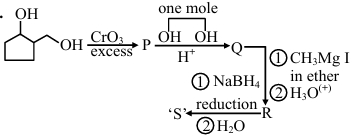
$0.1$ mole of compound $'S'$ will weigh $.......... \ g$.
(Given molar mass in $g \ mol^{-1} \ C: 12, H: 1, O: 16$)
(Given molar mass in $g \ mol^{-1} \ C: 12, H: 1, O: 16$)
A
$13$
B
$23$
C
$33$
D
$43$
Solution
(A) $1$. The starting material is $2$-(hydroxymethyl)cyclopentanol. Oxidation with excess $CrO_3$ gives $2$-oxocyclopentanecarboxylic acid $(P)$.
$2$. Protection of the ketone with ethylene glycol gives $(Q)$.
$3$. Reaction with $CH_3MgBr$ followed by acid workup removes the protecting group and gives $2$-oxocyclopentanecarboxylic acid $(R)$ (as the Grignard reagent reacts with the acid group,but the overall sequence regenerates the keto-acid).
$4$. Reduction of $(R)$ with $NaBH_4$ reduces the ketone to an alcohol,yielding $2$-hydroxycyclopentanecarboxylic acid $(S)$.
$5$. The molecular formula of $(S)$ is $C_6H_{10}O_3$.
$6$. Molar mass of $(S) = (6 \times 12) + (10 \times 1) + (3 \times 16) = 72 + 10 + 48 = 130 \ g \ mol^{-1}$.
$7$. Weight of $0.1$ mole of $(S) = 0.1 \ mol \times 130 \ g \ mol^{-1} = 13 \ g$.
$2$. Protection of the ketone with ethylene glycol gives $(Q)$.
$3$. Reaction with $CH_3MgBr$ followed by acid workup removes the protecting group and gives $2$-oxocyclopentanecarboxylic acid $(R)$ (as the Grignard reagent reacts with the acid group,but the overall sequence regenerates the keto-acid).
$4$. Reduction of $(R)$ with $NaBH_4$ reduces the ketone to an alcohol,yielding $2$-hydroxycyclopentanecarboxylic acid $(S)$.
$5$. The molecular formula of $(S)$ is $C_6H_{10}O_3$.
$6$. Molar mass of $(S) = (6 \times 12) + (10 \times 1) + (3 \times 16) = 72 + 10 + 48 = 130 \ g \ mol^{-1}$.
$7$. Weight of $0.1$ mole of $(S) = 0.1 \ mol \times 130 \ g \ mol^{-1} = 13 \ g$.
0 likes
View Solution273
DifficultMCQ
Among the following,choose the ones with an equal number of atoms.
$A$. $212 \ g$ of $Na_2CO_3(s)$ [molar mass $= 106 \ g/mol$]
$B$. $248 \ g$ of $Na_2O(s)$ [molar mass $= 62 \ g/mol$]
$C$. $240 \ g$ of $NaOH(s)$ [molar mass $= 40 \ g/mol$]
$D$. $12 \ g$ of $H_2(g)$ [molar mass $= 2 \ g/mol$]
$E$. $220 \ g$ of $CO_2(g)$ [molar mass $= 44 \ g/mol$]
Choose the correct answer from the options given below.
$A$. $212 \ g$ of $Na_2CO_3(s)$ [molar mass $= 106 \ g/mol$]
$B$. $248 \ g$ of $Na_2O(s)$ [molar mass $= 62 \ g/mol$]
$C$. $240 \ g$ of $NaOH(s)$ [molar mass $= 40 \ g/mol$]
$D$. $12 \ g$ of $H_2(g)$ [molar mass $= 2 \ g/mol$]
$E$. $220 \ g$ of $CO_2(g)$ [molar mass $= 44 \ g/mol$]
Choose the correct answer from the options given below.
A
$A, B$ and $C$ only
B
$A, B$ and $D$ only
C
$B, C$ and $D$ only
D
$B, D$ and $E$ only
Solution
(B) The number of atoms is calculated as: $\text{Number of atoms} = \text{Atomicity} \times \text{moles} \times N_A$.
$(A)$ $Na_2CO_3$: $\text{Atomicity} = 6$,$\text{moles} = \frac{212}{106} = 2$. $\text{Atoms} = 6 \times 2 \times N_A = 12 N_A$.
$(B)$ $Na_2O$: $\text{Atomicity} = 3$,$\text{moles} = \frac{248}{62} = 4$. $\text{Atoms} = 3 \times 4 \times N_A = 12 N_A$.
$(C)$ $NaOH$: $\text{Atomicity} = 3$,$\text{moles} = \frac{240}{40} = 6$. $\text{Atoms} = 3 \times 6 \times N_A = 18 N_A$.
$(D)$ $H_2$: $\text{Atomicity} = 2$,$\text{moles} = \frac{12}{2} = 6$. $\text{Atoms} = 2 \times 6 \times N_A = 12 N_A$.
$(E)$ $CO_2$: $\text{Atomicity} = 3$,$\text{moles} = \frac{220}{44} = 5$. $\text{Atoms} = 3 \times 5 \times N_A = 15 N_A$.
Thus,$A, B$ and $D$ have an equal number of atoms $(12 N_A)$.
$(A)$ $Na_2CO_3$: $\text{Atomicity} = 6$,$\text{moles} = \frac{212}{106} = 2$. $\text{Atoms} = 6 \times 2 \times N_A = 12 N_A$.
$(B)$ $Na_2O$: $\text{Atomicity} = 3$,$\text{moles} = \frac{248}{62} = 4$. $\text{Atoms} = 3 \times 4 \times N_A = 12 N_A$.
$(C)$ $NaOH$: $\text{Atomicity} = 3$,$\text{moles} = \frac{240}{40} = 6$. $\text{Atoms} = 3 \times 6 \times N_A = 18 N_A$.
$(D)$ $H_2$: $\text{Atomicity} = 2$,$\text{moles} = \frac{12}{2} = 6$. $\text{Atoms} = 2 \times 6 \times N_A = 12 N_A$.
$(E)$ $CO_2$: $\text{Atomicity} = 3$,$\text{moles} = \frac{220}{44} = 5$. $\text{Atoms} = 3 \times 5 \times N_A = 15 N_A$.
Thus,$A, B$ and $D$ have an equal number of atoms $(12 N_A)$.
0 likes
View Solution274
MediumMCQ
$4.4 \ g$ of $CO_2$ and $2.24 \ L$ of $H_2$ at $\text{STP}$ are mixed in a container. The total number of molecules present in the container will be :
A
$6.022 \times 10^{23}$
B
$1.2044 \times 10^{23}$
C
$6.022 \times 10^{22}$
D
$6.023 \times 10^{24}$
Solution
(B) $1$. Calculate moles of $CO_2$: Molar mass of $CO_2 = 12 + 2 \times 16 = 44 \ g/mol$. Moles of $CO_2 = \frac{4.4 \ g}{44 \ g/mol} = 0.1 \ mol$.
$2$. Calculate moles of $H_2$: At $\text{STP}$,$1 \ mol$ of gas occupies $22.4 \ L$. Moles of $H_2 = \frac{2.24 \ L}{22.4 \ L/mol} = 0.1 \ mol$.
$3$. Total moles of molecules = $0.1 \ mol (CO_2) + 0.1 \ mol (H_2) = 0.2 \ mol$.
$4$. Total number of molecules = $\text{Total moles} \times N_A = 0.2 \times 6.022 \times 10^{23} = 1.2044 \times 10^{23}$.
$2$. Calculate moles of $H_2$: At $\text{STP}$,$1 \ mol$ of gas occupies $22.4 \ L$. Moles of $H_2 = \frac{2.24 \ L}{22.4 \ L/mol} = 0.1 \ mol$.
$3$. Total moles of molecules = $0.1 \ mol (CO_2) + 0.1 \ mol (H_2) = 0.2 \ mol$.
$4$. Total number of molecules = $\text{Total moles} \times N_A = 0.2 \times 6.022 \times 10^{23} = 1.2044 \times 10^{23}$.
0 likes
View Solution275
MediumMCQ
Which has the maximum number of molecules?
A
$7 \ g$ $N_2$
B
$2 \ g$ $H_2$
C
$16 \ g$ $NO_2$
D
$16 \ g$ $O_2$
Solution
(B) The number of molecules is directly proportional to the number of moles $(n = \frac{\text{mass}}{\text{molar mass}})$.
$7 \ g$ $N_2 = \frac{7}{28} = 0.25 \ mol$
$2 \ g$ $H_2 = \frac{2}{2} = 1 \ mol$
$16 \ g$ $NO_2 = \frac{16}{46} \approx 0.348 \ mol$
$16 \ g$ $O_2 = \frac{16}{32} = 0.5 \ mol$
Since $2 \ g$ $H_2$ has the highest number of moles $(1 \ mol)$,it contains the maximum number of molecules.
$7 \ g$ $N_2 = \frac{7}{28} = 0.25 \ mol$
$2 \ g$ $H_2 = \frac{2}{2} = 1 \ mol$
$16 \ g$ $NO_2 = \frac{16}{46} \approx 0.348 \ mol$
$16 \ g$ $O_2 = \frac{16}{32} = 0.5 \ mol$
Since $2 \ g$ $H_2$ has the highest number of moles $(1 \ mol)$,it contains the maximum number of molecules.
0 likes
View Solution276
MediumMCQ
Which of the following contains the maximum number of atoms?
A
$1 \ g$ of $C_4H_{10}$
B
$1 \ g$ of $N_2$
C
$1 \ g$ of $Ag$
D
$1 \ g$ of $H_2O$
Solution
(A) To find the number of atoms,we use the formula: $\text{Number of atoms} = \frac{\text{mass}}{\text{molar mass}} \times N_A \times \text{atomicity}$.
$A$) For $C_4H_{10}$ (Molar mass = $58 \ g/mol$): $\text{Atoms} = \frac{1}{58} \times N_A \times 14 \approx 0.241 \ N_A$.
$B$) For $N_2$ (Molar mass = $28 \ g/mol$): $\text{Atoms} = \frac{1}{28} \times N_A \times 2 \approx 0.071 \ N_A$.
$C$) For $Ag$ (Molar mass = $108 \ g/mol$): $\text{Atoms} = \frac{1}{108} \times N_A \times 1 \approx 0.009 \ N_A$.
$D$) For $H_2O$ (Molar mass = $18 \ g/mol$): $\text{Atoms} = \frac{1}{18} \times N_A \times 3 \approx 0.166 \ N_A$.
Comparing the values,$1 \ g$ of $C_4H_{10}$ contains the maximum number of atoms.
$A$) For $C_4H_{10}$ (Molar mass = $58 \ g/mol$): $\text{Atoms} = \frac{1}{58} \times N_A \times 14 \approx 0.241 \ N_A$.
$B$) For $N_2$ (Molar mass = $28 \ g/mol$): $\text{Atoms} = \frac{1}{28} \times N_A \times 2 \approx 0.071 \ N_A$.
$C$) For $Ag$ (Molar mass = $108 \ g/mol$): $\text{Atoms} = \frac{1}{108} \times N_A \times 1 \approx 0.009 \ N_A$.
$D$) For $H_2O$ (Molar mass = $18 \ g/mol$): $\text{Atoms} = \frac{1}{18} \times N_A \times 3 \approx 0.166 \ N_A$.
Comparing the values,$1 \ g$ of $C_4H_{10}$ contains the maximum number of atoms.
0 likes
View Solution277
MediumMCQ
Maximum number of molecules will be in $:-$
A
$44 \ g$ $CO_2$
B
$48 \ g$ $O_2$
C
$8 \ g$ $H_2$
D
$64 \ g$ $SO_2$
Solution
(C) The number of molecules is calculated as: $\text{Number of molecules} = \text{moles} \times N_A = \frac{\text{mass}}{\text{molar mass}} \times N_A$.
For $A$: $44 \ g$ $CO_2$ (molar mass $= 44 \ g/mol$): $\text{moles} = 44/44 = 1 \ mol$.
For $B$: $48 \ g$ $O_2$ (molar mass $= 32 \ g/mol$): $\text{moles} = 48/32 = 1.5 \ mol$.
For $C$: $8 \ g$ $H_2$ (molar mass $= 2 \ g/mol$): $\text{moles} = 8/2 = 4 \ mol$.
For $D$: $64 \ g$ $SO_2$ (molar mass $= 64 \ g/mol$): $\text{moles} = 64/64 = 1 \ mol$.
Since $C$ has the highest number of moles $(4 \ mol)$,it contains the maximum number of molecules.
For $A$: $44 \ g$ $CO_2$ (molar mass $= 44 \ g/mol$): $\text{moles} = 44/44 = 1 \ mol$.
For $B$: $48 \ g$ $O_2$ (molar mass $= 32 \ g/mol$): $\text{moles} = 48/32 = 1.5 \ mol$.
For $C$: $8 \ g$ $H_2$ (molar mass $= 2 \ g/mol$): $\text{moles} = 8/2 = 4 \ mol$.
For $D$: $64 \ g$ $SO_2$ (molar mass $= 64 \ g/mol$): $\text{moles} = 64/64 = 1 \ mol$.
Since $C$ has the highest number of moles $(4 \ mol)$,it contains the maximum number of molecules.
0 likes
View Solution278
EasyMCQ
How many protons are present in $1.8 \ g$ of $NH_{4}^{+}$?
A
$N_{A}$
B
$1.2 N_{A}$
C
$1.1 N_{A}$
D
$11 N_{A}$
Solution
(C) The number of protons in one $NH_{4}^{+}$ ion is calculated as: $7 (N) + 4 (H) = 11$ protons.
The molar mass of $NH_{4}^{+}$ is $14 + 4 \times 1 = 18 \ g/mol$.
The number of moles of $NH_{4}^{+}$ in $1.8 \ g$ is $\frac{1.8 \ g}{18 \ g/mol} = 0.1 \ mol$.
The number of $NH_{4}^{+}$ ions is $0.1 \times N_{A}$.
Therefore,the total number of protons is $11 \times 0.1 \times N_{A} = 1.1 N_{A}$.
The molar mass of $NH_{4}^{+}$ is $14 + 4 \times 1 = 18 \ g/mol$.
The number of moles of $NH_{4}^{+}$ in $1.8 \ g$ is $\frac{1.8 \ g}{18 \ g/mol} = 0.1 \ mol$.
The number of $NH_{4}^{+}$ ions is $0.1 \times N_{A}$.
Therefore,the total number of protons is $11 \times 0.1 \times N_{A} = 1.1 N_{A}$.
0 likes
View Solution279
MediumMCQ
Sucrose has molecular formula $C_{12}H_{22}O_{11}$. How many moles of carbon atoms are present in its $34.2 \ g$ sample?
A
$12 \ N_{A}$
B
$0.1 \times 12 \ N_{A}$
C
$1.2$
D
$0.1$
Solution
(C) The molar mass of sucrose $(C_{12}H_{22}O_{11})$ is $(12 \times 12) + (22 \times 1) + (11 \times 16) = 144 + 22 + 176 = 342 \ g/mol$.
Number of moles of sucrose = $\frac{\text{Given mass}}{\text{Molar mass}} = \frac{34.2 \ g}{342 \ g/mol} = 0.1 \ mol$.
Since $1 \ mol$ of $C_{12}H_{22}O_{11}$ contains $12 \ mol$ of carbon atoms,
Number of moles of carbon atoms = $12 \times 0.1 \ mol = 1.2 \ mol$.
Number of moles of sucrose = $\frac{\text{Given mass}}{\text{Molar mass}} = \frac{34.2 \ g}{342 \ g/mol} = 0.1 \ mol$.
Since $1 \ mol$ of $C_{12}H_{22}O_{11}$ contains $12 \ mol$ of carbon atoms,
Number of moles of carbon atoms = $12 \times 0.1 \ mol = 1.2 \ mol$.
0 likes
View Solution280
EasyMCQ
From $44 \ mg$ of $CO_2$,$2 \times 10^{20}$ molecules of $CO_2$ are removed. The number of molecules of $CO_2$ left are (Given $N_A = 6 \times 10^{23}$):-
A
$4 \times 10^{-23}$
B
$4 \times 10^{23}$
C
$4 \times 10^{20}$
D
$4 \times 10^{21}$
Solution
(C) Step $1$: Calculate the total number of molecules in $44 \ mg$ of $CO_2$.
Molar mass of $CO_2 = 12 + 2 \times 16 = 44 \ g/mol$.
Mass of $CO_2 = 44 \ mg = 44 \times 10^{-3} \ g$.
Number of moles $= \frac{44 \times 10^{-3} \ g}{44 \ g/mol} = 10^{-3} \ mol$.
Total molecules $= 10^{-3} \times 6 \times 10^{23} = 6 \times 10^{20}$ molecules.
Step $2$: Subtract the removed molecules from the total.
Molecules left $= (6 \times 10^{20}) - (2 \times 10^{20}) = 4 \times 10^{20}$ molecules.
Molar mass of $CO_2 = 12 + 2 \times 16 = 44 \ g/mol$.
Mass of $CO_2 = 44 \ mg = 44 \times 10^{-3} \ g$.
Number of moles $= \frac{44 \times 10^{-3} \ g}{44 \ g/mol} = 10^{-3} \ mol$.
Total molecules $= 10^{-3} \times 6 \times 10^{23} = 6 \times 10^{20}$ molecules.
Step $2$: Subtract the removed molecules from the total.
Molecules left $= (6 \times 10^{20}) - (2 \times 10^{20}) = 4 \times 10^{20}$ molecules.
0 likes
View Solution281
MediumMCQ
Which of the following statements is incorrect?
A
The amount of substance of a system which contains as many elementary entities as there are atoms in $0.012 \ kg$ of carbon-$12$ is known as one mole.
B
According to Avogadro's law,equal volumes of gases at the same temperature and same pressure should contain equal number of molecules.
C
According to Dalton's atomic theory,chemical reactions involve the reorganization of atoms. These are neither created nor destroyed in a chemical reaction.
D
The mass of one mole of a substance in milligrams is called its molar mass.
Solution
(D) The definition of molar mass is the mass of one mole of a substance in grams,not milligrams.
Therefore,the statement in option $D$ is incorrect.
Therefore,the statement in option $D$ is incorrect.
0 likes
View Solution282
EasyMCQ
How many water molecules are there in one drop of water $($Volume $= 0.0018 \ mL)$ at room temperature?
A
$4.86 \times 10^{17}$
B
$6.023 \times 10^{24}$
C
$2.584 \times 10^{19}$
D
$6.023 \times 10^{19}$
Solution
(D) Density of water $(d)$ $= 1 \ g/mL$.
Mass of $0.0018 \ mL$ of water $= 0.0018 \ mL \times 1 \ g/mL = 0.0018 \ g$.
Molar mass of $H_2O = 18 \ g/mol$.
Number of moles $= \frac{0.0018 \ g}{18 \ g/mol} = 10^{-4} \ mol$.
Number of molecules $= \text{moles} \times N_A = 10^{-4} \times 6.023 \times 10^{23} = 6.023 \times 10^{19}$ molecules.
Mass of $0.0018 \ mL$ of water $= 0.0018 \ mL \times 1 \ g/mL = 0.0018 \ g$.
Molar mass of $H_2O = 18 \ g/mol$.
Number of moles $= \frac{0.0018 \ g}{18 \ g/mol} = 10^{-4} \ mol$.
Number of molecules $= \text{moles} \times N_A = 10^{-4} \times 6.023 \times 10^{23} = 6.023 \times 10^{19}$ molecules.
0 likes
View Solution283
EasyMCQ
Assertion : The number of $O$ atoms in $16 \ g$ of oxygen and $16 \ g$ of ozone is same.
Reason : Each of the species represents $1 \ g$ molecule of oxygen.
Reason : Each of the species represents $1 \ g$ molecule of oxygen.
A
Both Assertion and Reason are true and Reason is the correct explanation of Assertion.
B
Both Assertion and Reason are true but Reason is not the correct explanation of Assertion.
C
Assertion is true but Reason is false.
D
Both Assertion and Reason are false.
Solution
(C) For $16 \ g$ of oxygen $(O_2)$: $\text{Number of atoms} = \frac{16 \ g}{32 \ g/mol} \times 2 \times N_A = N_A$.
For $16 \ g$ of ozone $(O_3)$: $\text{Number of atoms} = \frac{16 \ g}{48 \ g/mol} \times 3 \times N_A = N_A$.
Since both contain $N_A$ atoms,the Assertion is true.
Reason states that each represents $1 \ g$ molecule of oxygen,which is false because $16 \ g$ of $O_2$ is $0.5 \ mol$ and $16 \ g$ of $O_3$ is $0.33 \ mol$.
For $16 \ g$ of ozone $(O_3)$: $\text{Number of atoms} = \frac{16 \ g}{48 \ g/mol} \times 3 \times N_A = N_A$.
Since both contain $N_A$ atoms,the Assertion is true.
Reason states that each represents $1 \ g$ molecule of oxygen,which is false because $16 \ g$ of $O_2$ is $0.5 \ mol$ and $16 \ g$ of $O_3$ is $0.33 \ mol$.
0 likes
View Solution284
MediumMCQ
Which of the following has the smallest number of molecules $:-$
A
$11.2 \ L$ of $O_2$ at $\text{NTP}$
B
$8 \ g$ of $O_2$
C
$0.1 \ mole$ of $O_2$
D
$2.24 \times 10^4 \ mL$ of $O_2$ at $\text{STP}$
Solution
(C) To find the number of molecules,we calculate the number of moles for each option:
$(A)$ $11.2 \ L$ of $O_2$ at $\text{NTP}$ is $11.2 / 22.4 = 0.5 \ mol = 0.5 \ N_A$ molecules.
$(B)$ $8 \ g$ of $O_2$ is $8 / 32 = 0.25 \ mol = 0.25 \ N_A$ molecules.
$(C)$ $0.1 \ mol$ of $O_2 = 0.1 \ N_A$ molecules.
$(D)$ $2.24 \times 10^4 \ mL = 22.4 \ L$ of $O_2$ at $\text{STP}$ is $22.4 / 22.4 = 1 \ mol = 1 \ N_A$ molecules.
Comparing the values,$0.1 \ N_A$ is the smallest number of molecules. Thus,option $C$ is correct.
$(A)$ $11.2 \ L$ of $O_2$ at $\text{NTP}$ is $11.2 / 22.4 = 0.5 \ mol = 0.5 \ N_A$ molecules.
$(B)$ $8 \ g$ of $O_2$ is $8 / 32 = 0.25 \ mol = 0.25 \ N_A$ molecules.
$(C)$ $0.1 \ mol$ of $O_2 = 0.1 \ N_A$ molecules.
$(D)$ $2.24 \times 10^4 \ mL = 22.4 \ L$ of $O_2$ at $\text{STP}$ is $22.4 / 22.4 = 1 \ mol = 1 \ N_A$ molecules.
Comparing the values,$0.1 \ N_A$ is the smallest number of molecules. Thus,option $C$ is correct.
0 likes
View Solution285
MediumMCQ
Find out the number of carbon atoms present in $0.35 \ mol$ of glucose.
A
$3.011 \times 10^{24}$
B
$6.022 \times 10^{24}$
C
$1.264 \times 10^{24}$
D
$2.044 \times 10^{24}$
Solution
(C) The chemical formula of glucose is $C_6H_{12}O_6$.
One mole of glucose contains $6 \ mol$ of carbon atoms.
Therefore,$0.35 \ mol$ of glucose contains $0.35 \times 6 = 2.1 \ mol$ of carbon atoms.
The number of carbon atoms is calculated as $2.1 \times N_A$,where $N_A = 6.022 \times 10^{23} \ mol^{-1}$.
Number of carbon atoms $= 2.1 \times 6.022 \times 10^{23} = 12.6462 \times 10^{23} = 1.26462 \times 10^{24}$.
Thus,the correct option is $C$.
One mole of glucose contains $6 \ mol$ of carbon atoms.
Therefore,$0.35 \ mol$ of glucose contains $0.35 \times 6 = 2.1 \ mol$ of carbon atoms.
The number of carbon atoms is calculated as $2.1 \times N_A$,where $N_A = 6.022 \times 10^{23} \ mol^{-1}$.
Number of carbon atoms $= 2.1 \times 6.022 \times 10^{23} = 12.6462 \times 10^{23} = 1.26462 \times 10^{24}$.
Thus,the correct option is $C$.
0 likes
View Solution286
DifficultMCQ
What is the number of moles of $N$ atoms and number of moles of $O$ atoms respectively present in one mole of uracil?
A
$1$ and $5$
B
$1$ and $3$
C
$2$ and $3$
D
$2$ and $2$
Solution
(D) The molecular formula of uracil is $C_4H_4N_2O_2$.
From the formula,one molecule of uracil contains $2$ nitrogen $(N)$ atoms and $2$ oxygen $(O)$ atoms.
Therefore,one mole of uracil contains $2$ moles of $N$ atoms and $2$ moles of $O$ atoms.
Thus,the correct option is $D$.
From the formula,one molecule of uracil contains $2$ nitrogen $(N)$ atoms and $2$ oxygen $(O)$ atoms.
Therefore,one mole of uracil contains $2$ moles of $N$ atoms and $2$ moles of $O$ atoms.
Thus,the correct option is $D$.
0 likes
View Solution287
MediumMCQ
What is the number of moles of oxygen atoms and the number of moles of $N$ atoms respectively present in one mole of thymine?
A
$2$ and $2$
B
$1$ and $3$
C
$1$ and $5$
D
$2$ and $3$
Solution
(A) The molecular formula of thymine is $C_5H_6N_2O_2$.
In one molecule of thymine,there are $2$ oxygen atoms and $2$ nitrogen atoms.
Therefore,in one mole of thymine,there are $2$ moles of oxygen atoms and $2$ moles of nitrogen atoms.
In one molecule of thymine,there are $2$ oxygen atoms and $2$ nitrogen atoms.
Therefore,in one mole of thymine,there are $2$ moles of oxygen atoms and $2$ moles of nitrogen atoms.
0 likes
View Solution288
MediumMCQ
What is the total number of carbon atoms present in $n$ mole of citric acid (in $n$)?
A
$2$
B
$3$
C
$6$
D
$4$
Solution
(C) The molecular formula of citric acid is $C_6H_8O_7$.
From the structure of citric acid,we can count the number of carbon atoms per molecule.
There are $3$ carboxylic acid groups $(-COOH)$,each containing $1$ carbon atom,and a central carbon chain containing $3$ carbon atoms.
Total number of carbon atoms per molecule $= 3 + 3 = 6$.
Therefore,in $1$ mole of citric acid,there are $6$ moles of carbon atoms.
In $n$ moles of citric acid,the total number of moles of carbon atoms is $6n$.
From the structure of citric acid,we can count the number of carbon atoms per molecule.
There are $3$ carboxylic acid groups $(-COOH)$,each containing $1$ carbon atom,and a central carbon chain containing $3$ carbon atoms.
Total number of carbon atoms per molecule $= 3 + 3 = 6$.
Therefore,in $1$ mole of citric acid,there are $6$ moles of carbon atoms.
In $n$ moles of citric acid,the total number of moles of carbon atoms is $6n$.
0 likes
View Solution289
EasyMCQ
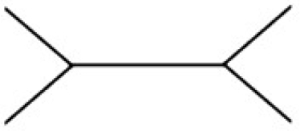
What is the total number of moles of $C$ atoms and $H$ atoms respectively present in $n$ moles of the following molecule?
A
$4 n$ and $2 n$
B
$4 n$ and $4 n$
C
$6 n$ and $14 n$
D
$6 n$ and $6 n$
Solution
(C) The given structure is $2,3$-dimethylbutane.
Its molecular formula is $C_6H_{14}$.
In one molecule,there are $6$ carbon atoms and $14$ hydrogen atoms.
Therefore,in $n$ moles of the molecule,the number of moles of $C$ atoms is $6 n$ and the number of moles of $H$ atoms is $14 n$.
Its molecular formula is $C_6H_{14}$.
In one molecule,there are $6$ carbon atoms and $14$ hydrogen atoms.
Therefore,in $n$ moles of the molecule,the number of moles of $C$ atoms is $6 n$ and the number of moles of $H$ atoms is $14 n$.
0 likes
View Solution290
EasyMCQ
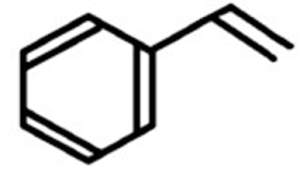
What is the number of moles of '$C$' and '$H$' atoms respectively present in $n$ mole of the molecule represented by the following structure?
A
$8n$ and $8n$
B
$6n$ and $8n$
C
$8n$ and $6n$
D
$7n$ and $9n$
Solution
(A) The given structure is styrene $(C_6H_5-CH=CH_2)$.
Counting the atoms in one molecule:
Carbon $(C)$ atoms: $6$ (in benzene ring) $+ 2$ (in vinyl group) $= 8$ atoms.
Hydrogen $(H)$ atoms: $5$ (in benzene ring) $+ 3$ (in vinyl group) $= 8$ atoms.
Therefore,the molecular formula is $C_8H_8$.
For $n$ moles of the molecule,the number of moles of $C$ atoms $= 8 \times n = 8n$.
The number of moles of $H$ atoms $= 8 \times n = 8n$.
Thus,the correct option is $A$.
Counting the atoms in one molecule:
Carbon $(C)$ atoms: $6$ (in benzene ring) $+ 2$ (in vinyl group) $= 8$ atoms.
Hydrogen $(H)$ atoms: $5$ (in benzene ring) $+ 3$ (in vinyl group) $= 8$ atoms.
Therefore,the molecular formula is $C_8H_8$.
For $n$ moles of the molecule,the number of moles of $C$ atoms $= 8 \times n = 8n$.
The number of moles of $H$ atoms $= 8 \times n = 8n$.
Thus,the correct option is $A$.
0 likes
View Solution291
EasyMCQ
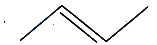
Identify the number of moles of $H$ atoms present in $n$ moles of the organic compound represented as: (in $n$)
A
$4$
B
$6$
C
$8$
D
$2$
Solution
(C) The given structure is $but-2-ene$ $(CH_3-CH=CH-CH_3)$.
Counting the number of hydrogen atoms in one molecule of $but-2-ene$:
$CH_3$ $(3)$ + $CH$ $(1)$ + $CH$ $(1)$ + $CH_3$ $(3)$ = $8$ hydrogen atoms.
Therefore,$1$ mole of the compound contains $8$ moles of $H$ atoms.
Thus,$n$ moles of the organic compound will contain $8 \ n$ moles of $H$ atoms.
Counting the number of hydrogen atoms in one molecule of $but-2-ene$:
$CH_3$ $(3)$ + $CH$ $(1)$ + $CH$ $(1)$ + $CH_3$ $(3)$ = $8$ hydrogen atoms.
Therefore,$1$ mole of the compound contains $8$ moles of $H$ atoms.
Thus,$n$ moles of the organic compound will contain $8 \ n$ moles of $H$ atoms.
0 likes
View Solution292
EasyMCQ
What is the number of moles of $Cl$ atoms and $N$ atoms respectively present in $n$ moles of tear gas?
A
$3n$ $Cl$ and $n$ $N$
B
$2n$ $Cl$ and $2n$ $N$
C
$n$ $Cl$ and $n$ $N$
D
$n$ $Cl$ and $2n$ $N$
Solution
(A) The molecular formula of tear gas $(CCl_3NO_2)$ contains $3$ atoms of $Cl$ and $1$ atom of $N$ per molecule.
Therefore,in $n$ moles of tear gas,the number of moles of $Cl$ atoms is $3n$ and the number of moles of $N$ atoms is $n$.
Therefore,in $n$ moles of tear gas,the number of moles of $Cl$ atoms is $3n$ and the number of moles of $N$ atoms is $n$.
0 likes
View Solution293
MediumMCQ
What is the number of moles of sulfur atoms present in $n$ mole molecules of mustard gas?
A
$n$
B
$3 \ n$
C
$2 \ n$
D
$4 \ n$
Solution
(A) The chemical formula of mustard gas is $(ClCH_2CH_2)_2S$.
Each molecule of mustard gas contains $1$ sulfur atom.
Therefore,$n$ moles of mustard gas molecules contain $n \times 1 = n$ moles of sulfur atoms.
Each molecule of mustard gas contains $1$ sulfur atom.
Therefore,$n$ moles of mustard gas molecules contain $n \times 1 = n$ moles of sulfur atoms.
0 likes
View Solution294
EasyMCQ
What is the number of atoms present in $2.24 \ dm^3$ of $NH_3$ $(g)$ at $STP$?
A
$6.022 \times 10^{22}$
B
$2.4088 \times 10^{23}$
C
$1.8066 \times 10^{22}$
D
$6.022 \times 10^{23}$
Solution
(B) At $STP$,$22.4 \ dm^3$ of any gas contains $1 \ mol$ of molecules.
$1 \ mol$ of $NH_3$ contains $6.022 \times 10^{23}$ molecules.
Each $NH_3$ molecule contains $4$ atoms $(1 \ N + 3 \ H)$.
Therefore,$1 \ mol$ of $NH_3$ contains $4 \times 6.022 \times 10^{23} = 2.4088 \times 10^{24}$ atoms.
Given volume $= 2.24 \ dm^3$,which is $0.1 \ mol$ of $NH_3$.
Number of atoms $= 0.1 \times 2.4088 \times 10^{24} = 2.4088 \times 10^{23}$ atoms.
$1 \ mol$ of $NH_3$ contains $6.022 \times 10^{23}$ molecules.
Each $NH_3$ molecule contains $4$ atoms $(1 \ N + 3 \ H)$.
Therefore,$1 \ mol$ of $NH_3$ contains $4 \times 6.022 \times 10^{23} = 2.4088 \times 10^{24}$ atoms.
Given volume $= 2.24 \ dm^3$,which is $0.1 \ mol$ of $NH_3$.
Number of atoms $= 0.1 \times 2.4088 \times 10^{24} = 2.4088 \times 10^{23}$ atoms.
0 likes
View Solution295
MediumMCQ
What is the mass in grams of $0.25 \ mol$ water (in $g$)?
A
$1.5$
B
$2.5$
C
$4.5$
D
$3.5$
Solution
(C) The molar mass of water $(H_2O)$ is calculated as:
$M = (2 \times 1.008 \ g/mol) + (1 \times 16.00 \ g/mol) = 18.016 \ g/mol \approx 18 \ g/mol$.
To find the mass,we use the formula:
$\text{Mass} = \text{moles} \times \text{molar mass}$.
$\text{Mass} = 0.25 \ mol \times 18 \ g/mol = 4.5 \ g$.
Therefore,the correct option is $C$.
$M = (2 \times 1.008 \ g/mol) + (1 \times 16.00 \ g/mol) = 18.016 \ g/mol \approx 18 \ g/mol$.
To find the mass,we use the formula:
$\text{Mass} = \text{moles} \times \text{molar mass}$.
$\text{Mass} = 0.25 \ mol \times 18 \ g/mol = 4.5 \ g$.
Therefore,the correct option is $C$.
0 likes
View Solution296
EasyMCQ
Find the number of moles present in $0.448 \ L$ of dihydrogen at $STP$. (in $mol$)
A
$0.08$
B
$0.06$
C
$0.04$
D
$0.02$
Solution
(D) At $STP$ (Standard Temperature and Pressure),the molar volume of an ideal gas is $22.4 \ L \ mol^{-1}$.
Number of moles $(n)$ is calculated using the formula: $n = \frac{\text{Given Volume}}{\text{Molar Volume at STP}}$.
Substituting the given values: $n = \frac{0.448 \ L}{22.4 \ L \ mol^{-1}}$.
$n = 0.02 \ mol$.
Number of moles $(n)$ is calculated using the formula: $n = \frac{\text{Given Volume}}{\text{Molar Volume at STP}}$.
Substituting the given values: $n = \frac{0.448 \ L}{22.4 \ L \ mol^{-1}}$.
$n = 0.02 \ mol$.
0 likes
View Solution297
MediumMCQ
Calculate the number of $Ca^{2+}$ ions in $222 \ g$ of anhydrous calcium chloride $(CaCl_2)$? (Atomic mass: $Ca = 40 \ u$,$Cl = 35.5 \ u$)
A
$N_{A}$
B
$2 \ N_{A}$
C
$3 \ N_{A}$
D
$4 \ N_{A}$
Solution
(B) $1$. Calculate the molar mass of $CaCl_2$: $M = 40 + 2 \times 35.5 = 111 \ g/mol$.
$2$. Calculate the number of moles of $CaCl_2$: $n = \frac{222 \ g}{111 \ g/mol} = 2 \ mol$.
$3$. Since $1 \ mol$ of $CaCl_2$ contains $1 \ mol$ of $Ca^{2+}$ ions,$2 \ mol$ of $CaCl_2$ contains $2 \ mol$ of $Ca^{2+}$ ions.
$4$. The number of $Ca^{2+}$ ions is $2 \times N_A$.
$2$. Calculate the number of moles of $CaCl_2$: $n = \frac{222 \ g}{111 \ g/mol} = 2 \ mol$.
$3$. Since $1 \ mol$ of $CaCl_2$ contains $1 \ mol$ of $Ca^{2+}$ ions,$2 \ mol$ of $CaCl_2$ contains $2 \ mol$ of $Ca^{2+}$ ions.
$4$. The number of $Ca^{2+}$ ions is $2 \times N_A$.
0 likes
View Solution298
MediumMCQ
The mass of $4.48 \ dm^3$ of a certain gas is $5.6 \ g$ at $STP$. Assuming ideal behaviour,identify the probable gas from the following.
A
$Cl_2$
B
$O_2$
C
$N_2$
D
$CH_4$
Solution
(C) At $STP$,$1 \ mole$ of an ideal gas occupies $22.4 \ dm^3$ volume.
Given volume of gas = $4.48 \ dm^3$.
Number of moles $(n)$ = $\frac{\text{Given Volume}}{\text{Molar Volume at STP}} = \frac{4.48 \ dm^3}{22.4 \ dm^3/mol} = 0.2 \ mol$.
We know that $n = \frac{\text{Mass}}{\text{Molar Mass (M)}}$.
$0.2 \ mol = \frac{5.6 \ g}{M}$.
$M = \frac{5.6 \ g}{0.2 \ mol} = 28 \ g/mol$.
The molar mass of $N_2$ is $2 \times 14 = 28 \ g/mol$.
Therefore,the gas is $N_2$.
Given volume of gas = $4.48 \ dm^3$.
Number of moles $(n)$ = $\frac{\text{Given Volume}}{\text{Molar Volume at STP}} = \frac{4.48 \ dm^3}{22.4 \ dm^3/mol} = 0.2 \ mol$.
We know that $n = \frac{\text{Mass}}{\text{Molar Mass (M)}}$.
$0.2 \ mol = \frac{5.6 \ g}{M}$.
$M = \frac{5.6 \ g}{0.2 \ mol} = 28 \ g/mol$.
The molar mass of $N_2$ is $2 \times 14 = 28 \ g/mol$.
Therefore,the gas is $N_2$.
0 likes
View Solution299
MediumMCQ
Find the number of water molecules in $1 \ mL$ of water vapours at $STP$?
A
$1.69 \times 10^{19}$
B
$2.00 \times 10^{21}$
C
$1.05 \times 10^{21}$
D
$2.69 \times 10^{19}$
Solution
(D) At $STP$,the molar volume of an ideal gas is $22400 \ mL \ mol^{-1}$.
Number of moles of water vapour in $1 \ mL$ is $n = \frac{1 \ mL}{22400 \ mL \ mol^{-1}} = 4.464 \times 10^{-5} \ mol$.
The number of molecules is given by $N = n \times N_A$,where $N_A = 6.022 \times 10^{23} \ mol^{-1}$.
$N = 4.464 \times 10^{-5} \times 6.022 \times 10^{23} \approx 2.69 \times 10^{19}$ molecules.
Thus,the correct option is $D$.
Number of moles of water vapour in $1 \ mL$ is $n = \frac{1 \ mL}{22400 \ mL \ mol^{-1}} = 4.464 \times 10^{-5} \ mol$.
The number of molecules is given by $N = n \times N_A$,where $N_A = 6.022 \times 10^{23} \ mol^{-1}$.
$N = 4.464 \times 10^{-5} \times 6.022 \times 10^{23} \approx 2.69 \times 10^{19}$ molecules.
Thus,the correct option is $D$.
0 likes
View Solution300
EasyMCQ
$A$ gaseous mixture of $O_2$ and $CH_4$ are in the ratio $1: 4$ by mass. Find the ratio of their molecules.
A
$1: 4$
B
$2: 3$
C
$1: 8$
D
$3: 2$
Solution
(C) Let the mass of $O_2$ be $1x$ and the mass of $CH_4$ be $4x$.
Number of moles of $O_2$ $(n_{O_2})$ = $\frac{\text{mass}}{\text{molar mass}} = \frac{1x}{32}$.
Number of moles of $CH_4$ $(n_{CH_4})$ = $\frac{\text{mass}}{\text{molar mass}} = \frac{4x}{16} = \frac{x}{4}$.
The ratio of molecules is equal to the ratio of moles.
Ratio = $n_{O_2} : n_{CH_4} = \frac{x}{32} : \frac{x}{4} = \frac{1}{32} : \frac{1}{4} = 1 : 8$.
Number of moles of $O_2$ $(n_{O_2})$ = $\frac{\text{mass}}{\text{molar mass}} = \frac{1x}{32}$.
Number of moles of $CH_4$ $(n_{CH_4})$ = $\frac{\text{mass}}{\text{molar mass}} = \frac{4x}{16} = \frac{x}{4}$.
The ratio of molecules is equal to the ratio of moles.
Ratio = $n_{O_2} : n_{CH_4} = \frac{x}{32} : \frac{x}{4} = \frac{1}{32} : \frac{1}{4} = 1 : 8$.
0 likes
View SolutionSome Basic Concepts of Chemistry — The mole concept · Frequently Asked Questions
1Are these Some Basic Concepts of Chemistry questions useful for JEE and NEET?
Yes. All questions in this section are mapped to JEE Main and NEET exam patterns. Previous year questions from JEE Main, NEET, GUJCET and state-level exams are included with full solutions.
2Can I switch to Hindi or Gujarati for these questions?
Yes. Use the language tabs in the hero section or the sidebar to view the same questions and solutions in English, Hindi or Gujarati.
3How do I generate a question paper from this subtopic?
Use the Vedclass Exam Paper Generator — select the chapter and subtopic, set difficulty, and generate Sets A, B, C, D automatically. First 3 chapters of every subject are free.
Vedclass Products
For Students
Vedclass Test Series
Mock tests in real JEE/NEET style with performance analysis. 5-day free trial.
Start Free TrialFor Teachers
Exam Paper Generator
Generate Set A/B/C/D papers from this chapter in 2 minutes. 3 chapters free.
Try FreeFor Institutes
Online Exam Module
Live online exams with unlimited students, 360° analytics & white-label branding.
See DemoFor Teachers & Institutes
Generate a Some Basic Concepts of Chemistry Exam Paper in 2 Minutes
Select subtopic & difficulty — Sets A, B, C, D auto-generated with No Repeat logic.
First 3 chapters of every subject are free — no payment required.