
A English
Matter and Separation of mixture Questions in English
Class 11 Chemistry · Some Basic Concepts of Chemistry · Matter and Separation of mixture
75+
Questions
English
Language
100%
With Solutions
Showing 25 of 75 questions in English
51
MediumMCQ
Which type of mixture can be separated by methods like filtration,crystallization,and distillation? Explain.
A
Homogeneous mixture
B
Heterogeneous mixture
C
Pure substance
D
Compound
Solution
(B) $Heterogeneous$ mixture can be separated into its constituents by physical methods such as filtration,crystallization,and distillation.
In a $Heterogeneous$ mixture,the composition is not uniform throughout,and the components can often be physically distinguished,allowing for separation based on differences in physical properties like particle size,solubility,or boiling point.
In a $Heterogeneous$ mixture,the composition is not uniform throughout,and the components can often be physically distinguished,allowing for separation based on differences in physical properties like particle size,solubility,or boiling point.
0 likes
View Solution52
EasyMCQ
Who first proposed the atomic theory of matter? What does it suggest?
A
John Dalton,atoms are indivisible particles of matter.
B
$J$.$J$. Thomson,atoms contain electrons.
C
Ernest Rutherford,atoms have a nucleus.
D
Niels Bohr,electrons revolve in orbits.
Solution
(A) The atomic theory of matter was first proposed by the school teacher $John \ Dalton$ in $1808$ based on scientific evidence.
It suggests that atoms are the ultimate,indivisible particles of matter.
It suggests that atoms are the ultimate,indivisible particles of matter.
0 likes
View Solution53
MediumMCQ
Physical properties of ice,water and steam are very different. What is the chemical composition of water in all the three states?
A
Different
B
Same
C
Depends on temperature
D
Depends on pressure
Solution
(B) Physical properties of ice,water and steam differ because they exist in different physical states.
Ice is the solid state,water is the liquid state,and steam is the gaseous (vapour) state.
However,the chemical composition of water in all three states remains the same,which is $H_2O$.
Ice is the solid state,water is the liquid state,and steam is the gaseous (vapour) state.
However,the chemical composition of water in all three states remains the same,which is $H_2O$.
0 likes
View Solution54
Medium
What are the macroscopic properties of matter?
Solution
(N/A) Definition: Macroscopic properties of matter are those properties that are associated with a large number of atoms,ions,or molecules.
Examples: $(i)$ An individual molecule of a liquid does not boil,but a bulk of it does. $(ii)$ An individual molecule of water does not wet a surface,but a bulk of it does.
Examples: $(i)$ An individual molecule of a liquid does not boil,but a bulk of it does. $(ii)$ An individual molecule of water does not wet a surface,but a bulk of it does.
0 likes
View Solution55
EasyMCQ
How is the pure liquid separated from a mixture obtained by vapour distillation?
A
By using a separating funnel
B
By using a fractional distillation column
C
By using a centrifuge
D
By using a filter paper
Solution
(A) In vapour distillation (specifically steam distillation),the mixture obtained consists of two immiscible layers: water and the organic liquid. Since they are immiscible,they can be easily separated using a $separating \text{ } funnel$.
0 likes
View Solution56
EasyMCQ
What is the principle of distillation?
A
Difference in boiling points of liquids
B
Difference in solubility of components
C
Difference in melting points of solids
D
Difference in density of liquids
Solution
(A) The principle of distillation is based on the difference in the boiling points of the components of a liquid mixture.
Every pure liquid has a definite boiling point at a given pressure.
When a mixture is heated,the component with the lower boiling point vaporizes first,and these vapors are then condensed back into a liquid to be collected separately.
Every pure liquid has a definite boiling point at a given pressure.
When a mixture is heated,the component with the lower boiling point vaporizes first,and these vapors are then condensed back into a liquid to be collected separately.
0 likes
View Solution57
Easy
Give the technique for the separation of the following:
$(i)$ Mixture of sugar and sand
$(ii)$ Mixture of kerosene and water
$(iii)$ Mixture of benzene and common salt
$(iv)$ Mixture of liquids with boiling points $356 \, K$ and $365 \, K$
$(v)$ Mixture of aniline and camphor
$(i)$ Mixture of sugar and sand
$(ii)$ Mixture of kerosene and water
$(iii)$ Mixture of benzene and common salt
$(iv)$ Mixture of liquids with boiling points $356 \, K$ and $365 \, K$
$(v)$ Mixture of aniline and camphor
Solution
(N/A) $(i)$ Dissolve the mixture in water,filter to remove sand,and then concentrate the filtrate to obtain sugar crystals through crystallization.
$(ii)$ Use a separating funnel to separate the immiscible layers of kerosene and water.
$(iii)$ Benzene can be separated from common salt by distillation.
$(iv)$ Fractional distillation is used for liquids with close boiling points.
$(v)$ Sublimation is the preferred technique as camphor sublimes while aniline does not.
$(ii)$ Use a separating funnel to separate the immiscible layers of kerosene and water.
$(iii)$ Benzene can be separated from common salt by distillation.
$(iv)$ Fractional distillation is used for liquids with close boiling points.
$(v)$ Sublimation is the preferred technique as camphor sublimes while aniline does not.
0 likes
View Solution58
Medium
Two liquids $(A)$ and $(B)$ can be separated by the method of fractional distillation. The boiling point of liquid $(A)$ is less than the boiling point of liquid $(B)$. Which of the liquids do you expect to come out first in the distillate? Explain.
Solution
(A) The liquid $(A)$ with the lower boiling point comes out first in the distillate.
Fractional distillation is used to separate the components of a mixture if their boiling points differ by $20^{\circ}C$ or less. In this method,a fractionating column is used between the flask and the condenser. The purpose of the fractionating column is to provide hurdles for the ascending vapours and to provide a large surface area for condensing the high-boiling liquid.
As a result,the vapours of the low-boiling liquid $(A)$ will move up,while those of the high-boiling liquid $(B)$ will condense and flow back into the flask.
Therefore,in this method,liquid $(A)$ with the lower boiling point will distil first,and liquid $(B)$ with the higher boiling point will distil afterwards.
Fractional distillation is used to separate the components of a mixture if their boiling points differ by $20^{\circ}C$ or less. In this method,a fractionating column is used between the flask and the condenser. The purpose of the fractionating column is to provide hurdles for the ascending vapours and to provide a large surface area for condensing the high-boiling liquid.
As a result,the vapours of the low-boiling liquid $(A)$ will move up,while those of the high-boiling liquid $(B)$ will condense and flow back into the flask.
Therefore,in this method,liquid $(A)$ with the lower boiling point will distil first,and liquid $(B)$ with the higher boiling point will distil afterwards.
0 likes
View Solution59
Difficult
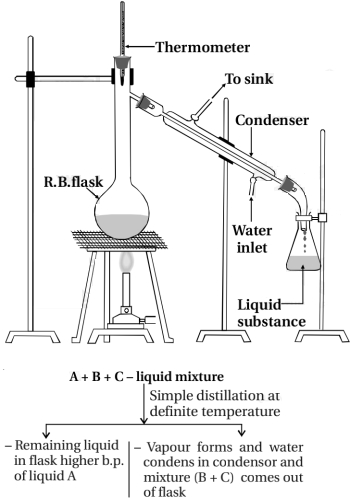
You have a mixture of three liquids $A$,$B$,and $C$. There is a large difference in the boiling points of $A$ and the rest of the two liquids,i.e.,$B$ and $C$. The boiling points of liquids $B$ and $C$ are quite close. Liquid $A$ boils at a higher temperature than $B$ and $C$,and the boiling point of $B$ is lower than that of $C$. How will you separate the components of the mixture?
Solution
(N/A) The order of boiling points is $A \gg C > B$.
The boiling point of liquid $A$ is much higher than those of liquids $B$ and $C$,whose boiling points are quite close. Therefore,we can separate the mixture of $B$ and $C$ from $A$ by simple distillation.
During distillation,the mixture of $B$ and $C$ will distill together at a lower temperature,leaving behind liquid $A$ in the flask. On further heating,liquid $A$ will distill separately. The components $B$ and $C$ can then be separated from each other using fractional distillation,as their boiling points are close.
The boiling point of liquid $A$ is much higher than those of liquids $B$ and $C$,whose boiling points are quite close. Therefore,we can separate the mixture of $B$ and $C$ from $A$ by simple distillation.
During distillation,the mixture of $B$ and $C$ will distill together at a lower temperature,leaving behind liquid $A$ in the flask. On further heating,liquid $A$ will distill separately. The components $B$ and $C$ can then be separated from each other using fractional distillation,as their boiling points are close.
0 likes
View Solution60
Advanced
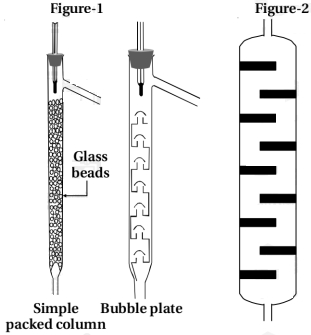
Draw a diagram showing the setup of the apparatus for the process. Draw a diagram of a bubble plate type fractionating column. When do we require such a type of column for separating two liquids? Explain the principle involved in the separation of components of a mixture of liquids by using a fractionating column. What industrial applications does this process have?
Solution
(N/A) If the difference in boiling points of two liquids is small,the fractional distillation method is used.
The vapour of the liquid mixture condenses before it passes through the column. This distillation column is arranged with a round-bottom flask as shown in the figure.
If the difference in boiling point is very small,a bubble plate type fractionating column is used as shown in the figure.
In a bubble plate column,the tower is divided into a number of compartments by means of shelves having openings. The openings are covered with caps called bubble caps.
Each shelf is provided with an overflow pipe which keeps the liquid at a certain level and allows the rest to trickle down to the lower shelf.
Such a type of column is used for continuous separation of bulk quantities of liquids. For example,distillation of fermented liquid for the manufacture of rectified spirit.
Industrial applications:
$(i)$ Separation of crude oil in the petroleum industry into various useful fractions such as gasoline,kerosene oil,diesel oil,lubricating oil,etc.
$(ii)$ Separation of water and methanol from pyroligneous acid obtained by destructive distillation of wood.
The vapour of the liquid mixture condenses before it passes through the column. This distillation column is arranged with a round-bottom flask as shown in the figure.
If the difference in boiling point is very small,a bubble plate type fractionating column is used as shown in the figure.
In a bubble plate column,the tower is divided into a number of compartments by means of shelves having openings. The openings are covered with caps called bubble caps.
Each shelf is provided with an overflow pipe which keeps the liquid at a certain level and allows the rest to trickle down to the lower shelf.
Such a type of column is used for continuous separation of bulk quantities of liquids. For example,distillation of fermented liquid for the manufacture of rectified spirit.
Industrial applications:
$(i)$ Separation of crude oil in the petroleum industry into various useful fractions such as gasoline,kerosene oil,diesel oil,lubricating oil,etc.
$(ii)$ Separation of water and methanol from pyroligneous acid obtained by destructive distillation of wood.
0 likes
View Solution61
EasyMCQ
Given below are two statements:
Statement $I :$ $A$ mixture of chloroform and aniline can be separated by simple distillation.
Statement $II :$ When separating aniline from a mixture of aniline and water by steam distillation,aniline boils below its boiling point.
In the light of the above statements,choose the most appropriate answer from the options given below.
Statement $I :$ $A$ mixture of chloroform and aniline can be separated by simple distillation.
Statement $II :$ When separating aniline from a mixture of aniline and water by steam distillation,aniline boils below its boiling point.
In the light of the above statements,choose the most appropriate answer from the options given below.
A
Statement $-I$ is false but Statement $-II$ is true.
B
Both Statement $-I$ and Statement $-II$ are false.
C
Statement $-I$ is true but Statement $-II$ is false.
D
Both Statement $-I$ and Statement $-II$ are true.
Solution
(D) Statement $I :$ The boiling point $(B.P.)$ of chloroform is $334 \ K$ and the $B.P.$ of aniline is $457 \ K$. Since there is a large difference in their boiling points,they can be separated by simple distillation. Thus,Statement $I$ is true.
Statement $II :$ In steam distillation,the mixture boils at a temperature lower than the boiling point of either component. Aniline is steam volatile and is separated from water by this method,where it boils at a temperature lower than its normal $B.P.$ of $457 \ K$. Thus,Statement $II$ is true.
Statement $II :$ In steam distillation,the mixture boils at a temperature lower than the boiling point of either component. Aniline is steam volatile and is separated from water by this method,where it boils at a temperature lower than its normal $B.P.$ of $457 \ K$. Thus,Statement $II$ is true.
0 likes
View Solution62
MediumMCQ
Given below are two statements: one is labelled as Assertion $A$ and the other is labelled as Reason $R$.
Assertion $A:$ $A$ mixture contains benzoic acid and naphthalene. The pure benzoic acid can be separated out by the use of benzene.
Reason $R:$ Benzoic acid is soluble in hot water.
In the light of the above statements,choose the most appropriate answer from the options given below.
Assertion $A:$ $A$ mixture contains benzoic acid and naphthalene. The pure benzoic acid can be separated out by the use of benzene.
Reason $R:$ Benzoic acid is soluble in hot water.
In the light of the above statements,choose the most appropriate answer from the options given below.
A
Both $A$ and $R$ are true and $R$ is the correct explanation of $A$.
B
Both $A$ and $R$ are true but $R$ is $NOT$ the correct explanation of $A$.
C
$A$ is true but $R$ is false.
D
$A$ is false but $R$ is true.
Solution
(D) Benzoic acid is soluble in hot water,while naphthalene is insoluble in water. Therefore,they can be separated by crystallization using hot water,not benzene.
Assertion $A$ is false because benzene would dissolve both benzoic acid and naphthalene,making separation difficult.
Reason $R$ is true as benzoic acid is indeed soluble in hot water.
Thus,$A$ is false but $R$ is true.
Assertion $A$ is false because benzene would dissolve both benzoic acid and naphthalene,making separation difficult.
Reason $R$ is true as benzoic acid is indeed soluble in hot water.
Thus,$A$ is false but $R$ is true.
0 likes
View Solution63
MediumMCQ
The separation of two coloured substances was done by paper chromatography. The distances travelled by solvent front,substance $A$ and substance $B$ from the base line are $3.25 \ cm$,$2.08 \ cm$ and $1.05 \ cm$ respectively. The ratio of $R_{f}$ values of $A$ to $B$ is $.........$
A
$5$
B
$3$
C
$8$
D
$2$
Solution
(D) The $R_{f}$ value is defined as the ratio of the distance travelled by the substance to the distance travelled by the solvent front.
$R_{f(A)} = \frac{2.08}{3.25}$
$R_{f(B)} = \frac{1.05}{3.25}$
The ratio of $R_{f}$ values of $A$ to $B$ is $\frac{R_{f(A)}}{R_{f(B)}} = \frac{2.08 / 3.25}{1.05 / 3.25} = \frac{2.08}{1.05} \approx 1.98 \approx 2$.
$R_{f(A)} = \frac{2.08}{3.25}$
$R_{f(B)} = \frac{1.05}{3.25}$
The ratio of $R_{f}$ values of $A$ to $B$ is $\frac{R_{f(A)}}{R_{f(B)}} = \frac{2.08 / 3.25}{1.05 / 3.25} = \frac{2.08}{1.05} \approx 1.98 \approx 2$.
0 likes
View Solution64
MediumMCQ
$A$ mixture of $NH_4Cl$ and $NaCl$ can be separated by
A
filtration
B
distillation
C
sublimation
D
decantation
Solution
(C)
$A$ mixture of $NH_4Cl$ and $NaCl$ can be separated by the process of sublimation.
In this process,a solid directly changes to a gaseous state without passing into the liquid state.
$NH_4Cl$ sublimes upon heating,whereas $NaCl$ does not sublime.
The reaction can be written as:
$NH_4Cl_{(s)} \longrightarrow NH_{3(g)} + HCl_{(g)}$
$A$ mixture of $NH_4Cl$ and $NaCl$ can be separated by the process of sublimation.
In this process,a solid directly changes to a gaseous state without passing into the liquid state.
$NH_4Cl$ sublimes upon heating,whereas $NaCl$ does not sublime.
The reaction can be written as:
$NH_4Cl_{(s)} \longrightarrow NH_{3(g)} + HCl_{(g)}$
0 likes
View Solution65
EasyMCQ
Separation of $Acetone$ and $Benzene$ from their mixture is carried out by
A
Fractional distillation
B
Simple distillation
C
Fractional distillation using fractionating column
D
Distillation under reduced pressure
Solution
(C) The separation of $Acetone$ and $Benzene$ from their mixture is effectively carried out by $Fractional \ distillation$ using a $fractionating \ column$.
This method is employed because the boiling points of $Acetone$ $(56 \ ^\circ C)$ and $Benzene$ $(80 \ ^\circ C)$ are relatively close,necessitating the use of a fractionating column to achieve efficient separation through repeated vaporization and condensation cycles.
This method is employed because the boiling points of $Acetone$ $(56 \ ^\circ C)$ and $Benzene$ $(80 \ ^\circ C)$ are relatively close,necessitating the use of a fractionating column to achieve efficient separation through repeated vaporization and condensation cycles.
0 likes
View Solution66
EasyMCQ
$A$ mixture of sodium chloride and ammonium chloride is separated by:
A
sublimation
B
distillation
C
chromatography
D
differential extraction
Solution
(A) The correct method is $sublimation$.
$Ammonium \ chloride$ $(NH_4Cl)$ is a sublime substance,meaning it changes directly from a solid to a gas upon heating.
$Sodium \ chloride$ $(NaCl)$ does not sublime.
Therefore,when the mixture is heated,$NH_4Cl$ vaporizes and can be collected,leaving $NaCl$ behind.
$Ammonium \ chloride$ $(NH_4Cl)$ is a sublime substance,meaning it changes directly from a solid to a gas upon heating.
$Sodium \ chloride$ $(NaCl)$ does not sublime.
Therefore,when the mixture is heated,$NH_4Cl$ vaporizes and can be collected,leaving $NaCl$ behind.
0 likes
View Solution67
EasyMCQ
$A$ mixture of iodine and sodium sulphate is separated by:
A
Sublimation
B
Chromatography
C
Differential extraction
D
Distillation
Solution
(A) mixture of iodine $(I_2)$ and sodium sulphate $(Na_2SO_4)$ is separated by the process of sublimation.
Sublimation is the transition of a substance directly from the solid phase to the gas phase without passing through the liquid state.
In this mixture,iodine acts as a sublimate (a volatile component),while sodium sulphate is a non-sublimable impurity.
Upon heating,iodine vaporizes,leaving behind the solid sodium sulphate,allowing for their effective separation.
Sublimation is the transition of a substance directly from the solid phase to the gas phase without passing through the liquid state.
In this mixture,iodine acts as a sublimate (a volatile component),while sodium sulphate is a non-sublimable impurity.
Upon heating,iodine vaporizes,leaving behind the solid sodium sulphate,allowing for their effective separation.
0 likes
View Solution68
EasyMCQ
Which of the following sets of components form a homogeneous mixture?
A
$Phenol + Water$
B
$Sugar + Benzene$
C
$Silver \ chloride + Water$
D
$Ethyl \ alcohol + Water$
Solution
(D) homogeneous mixture is a mixture in which the composition is uniform throughout the mixture.
$Ethyl \ alcohol$ and $water$ are polar in nature and can form hydrogen bonds with each other,making them miscible in all proportions.
Therefore,the $(Ethyl \ alcohol + Water)$ system forms a homogeneous mixture.
$Ethyl \ alcohol$ and $water$ are polar in nature and can form hydrogen bonds with each other,making them miscible in all proportions.
Therefore,the $(Ethyl \ alcohol + Water)$ system forms a homogeneous mixture.
0 likes
View Solution69
EasyMCQ
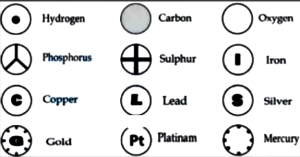
The symbol used for hydrogen in Dalton's atomic theory is
A
$\oplus$
B
$O$
C
$\odot$
D
$\text{A circle with a vertical line through the center}$
Solution
(C) According to John Dalton's atomic theory,he proposed specific symbols for various elements. The symbol for hydrogen was represented as a circle with a dot in the center $(\odot)$. However,looking at the provided options and the standard historical representation,the symbol $\odot$ is the correct representation for hydrogen in Dalton's notation.
0 likes
View Solution70
EasyMCQ
Which of the following processes occurs in the reaction given below $C_{(graphite)} \longrightarrow C_{(g)}$?
A
Vaporisation
B
Fusion
C
Sublimation
D
Ionisation
Solution
(C) The reaction $C_{(graphite)} \longrightarrow C_{(g)}$ represents the conversion of a solid substance (graphite) directly into its gaseous state.
This process of phase transition from solid to gas is known as sublimation.
Therefore,the correct process is sublimation.
This process of phase transition from solid to gas is known as sublimation.
Therefore,the correct process is sublimation.
0 likes
View Solution71
EasyMCQ
$A$ miscible mixture of $C_6H_6 + CHCl_3$ can be separated by
A
Sublimation
B
Distillation
C
Filtration
D
Crystallisation
Solution
(B) miscible mixture of $C_6H_6 + CHCl_3$ can be separated by distillation.
The boiling point of benzene $(C_6H_6)$ is $80^{\circ} C$ and that of chloroform $(CHCl_3)$ is $61.2^{\circ} C$.
Since there is a significant difference in their boiling points,the mixture can be separated by distillation,where the component with the lower boiling point $(CHCl_3)$ evaporates first and is collected separately.
The boiling point of benzene $(C_6H_6)$ is $80^{\circ} C$ and that of chloroform $(CHCl_3)$ is $61.2^{\circ} C$.
Since there is a significant difference in their boiling points,the mixture can be separated by distillation,where the component with the lower boiling point $(CHCl_3)$ evaporates first and is collected separately.
0 likes
View Solution72
EasyMCQ
For which one of the following mixtures is composition uniform throughout?
A
Sand and water.
B
Grains and pulses with stone.
C
Mixture of oil and water.
D
Dilute aqueous solution of sugar.
Solution
(D) Homogeneous mixtures have uniform composition throughout. Thus,among the given options,a dilute aqueous solution of sugar is a homogeneous mixture and has a uniform composition.
0 likes
View Solution73
MediumMCQ
On the basis of which physical property does the separation of different fractions in the fractional distillation technique take place?
A
Solubility
B
Freezing point
C
Boiling point
D
Melting point
Solution
(C) The separation of liquids into their pure form from a liquid mixture is achieved by the fractional distillation technique.
This technique is employed when the components of the mixture have a difference in their boiling points,typically in the range of $10-40 \ K$.
This technique is employed when the components of the mixture have a difference in their boiling points,typically in the range of $10-40 \ K$.
0 likes
View Solution74
EasyMCQ
Which of the following methods is adopted to obtain gasoline from crude oil?
A
Vacuum distillation
B
Steam distillation
C
Adsorption on animal charcoal
D
Fractional distillation
Solution
(D) Gasoline is a mixture of hydrocarbons,primarily $C_8H_{18}$,present in crude oil along with many other components.
Since these components have different boiling points,they are separated by the process of fractional distillation.
Hence,option $(D)$ is the correct answer.
Since these components have different boiling points,they are separated by the process of fractional distillation.
Hence,option $(D)$ is the correct answer.
0 likes
View Solution75
DifficultMCQ
Given below are two statements :
Statement-$I$: Sublimation is used for the separation and purification of compounds with low melting point.
Statement-$II$: The boiling point of a liquid increases as the external pressure is reduced.
In the light of the above statements,choose the correct answer from the options given below :
Statement-$I$: Sublimation is used for the separation and purification of compounds with low melting point.
Statement-$II$: The boiling point of a liquid increases as the external pressure is reduced.
In the light of the above statements,choose the correct answer from the options given below :
A
Statement-$I$ is false but Statement-$II$ is true
B
Statement-$I$ is true but Statement-$II$ is false
C
Both Statement-$I$ and Statement-$II$ are true
D
Both Statement-$I$ and Statement-$II$ are false
Solution
(D) Statement-$I$ is false because sublimation is used for the separation and purification of compounds that sublime upon heating,not specifically those with low melting points.
Statement-$II$ is false because the boiling point of a liquid decreases as the external pressure is reduced,not increases.
Statement-$II$ is false because the boiling point of a liquid decreases as the external pressure is reduced,not increases.
0 likes
View SolutionSome Basic Concepts of Chemistry — Matter and Separation of mixture · Frequently Asked Questions
1Are these Some Basic Concepts of Chemistry questions useful for JEE and NEET?
Yes. All questions in this section are mapped to JEE Main and NEET exam patterns. Previous year questions from JEE Main, NEET, GUJCET and state-level exams are included with full solutions.
2Can I switch to Hindi or Gujarati for these questions?
Yes. Use the language tabs in the hero section or the sidebar to view the same questions and solutions in English, Hindi or Gujarati.
3How do I generate a question paper from this subtopic?
Use the Vedclass Exam Paper Generator — select the chapter and subtopic, set difficulty, and generate Sets A, B, C, D automatically. First 3 chapters of every subject are free.
Vedclass Products
For Students
Vedclass Test Series
Mock tests in real JEE/NEET style with performance analysis. 5-day free trial.
Start Free TrialFor Teachers
Exam Paper Generator
Generate Set A/B/C/D papers from this chapter in 2 minutes. 3 chapters free.
Try FreeFor Institutes
Online Exam Module
Live online exams with unlimited students, 360° analytics & white-label branding.
See DemoFor Teachers & Institutes
Generate a Some Basic Concepts of Chemistry Exam Paper in 2 Minutes
Select subtopic & difficulty — Sets A, B, C, D auto-generated with No Repeat logic.
First 3 chapters of every subject are free — no payment required.