
A English
Oxidation number and Oxidation state Questions in English
Class 11 Chemistry · Redox Reactions · Oxidation number and Oxidation state
416+
Questions
English
Language
100%
With Solutions
Showing 50 of 416 questions in English
301
Medium
Match the Column-$I$ with Column-$II$ for the oxidation states of the central atoms.
| Column-$I$ | Column-$II$ |
| $A$. $Cr_2O_7^{2-}$ | $1$. $+3$ |
| $B$. $MnO_4^{-}$ | $2$. $+4$ |
| $C$. $VO_3^{-}$ | $3$. $+5$ |
| $D$. $FeF_6^{3-}$ | $4$. $+6$ |
| $5$. $+7$ |
Solution
(A-4, B-5, C-3, D-1) The correct matching is $A-4, B-5, C-3, D-1$.
$(A)$ For $Cr_2O_7^{2-}$: $2(Cr) + 7(-2) = -2 \implies 2(Cr) = +12 \implies Cr = +6$.
$(B)$ For $MnO_4^{-}$: $Mn + 4(-2) = -1 \implies Mn = +7$.
$(C)$ For $VO_3^{-}$: $V + 3(-2) = -1 \implies V = +5$.
$(D)$ For $FeF_6^{3-}$: $Fe + 6(-1) = -3 \implies Fe = +3$.
$(A)$ For $Cr_2O_7^{2-}$: $2(Cr) + 7(-2) = -2 \implies 2(Cr) = +12 \implies Cr = +6$.
$(B)$ For $MnO_4^{-}$: $Mn + 4(-2) = -1 \implies Mn = +7$.
$(C)$ For $VO_3^{-}$: $V + 3(-2) = -1 \implies V = +5$.
$(D)$ For $FeF_6^{3-}$: $Fe + 6(-1) = -3 \implies Fe = +3$.
0 likes
View Solution302
Medium
Match the items in Column-$I$ with relevant items in Column-$II$.
| Column-$I$ | Column-$II$ |
|---|---|
| $A$. Positively charged ion | $1$. $+7$ |
| $B$. Oxidation number of all neutral atoms | $2$. $-1$ |
| $C$. Oxidation number of hydrogen $(H^+)$ | $3$. $+1$ |
| $D$. Oxidation number of fluorine in $NaF$ | $4$. $0$ |
| $E$. Negatively charged ion | $5$. Cation |
| $6$. Anion |
Solution
(A-5, B-4, C-3, D-2, E-6) The correct matches are:
$A-5$ (Positively charged ion is a Cation)
$B-4$ (Oxidation number of all neutral atoms is $0$)
$C-3$ (Oxidation number of $H^+$ is $+1$)
$D-2$ (Oxidation number of $F$ in $NaF$ is $-1$)
$E-6$ (Negatively charged ion is an Anion)
Thus,the correct sequence is: $A-5, B-4, C-3, D-2, E-6$.
$A-5$ (Positively charged ion is a Cation)
$B-4$ (Oxidation number of all neutral atoms is $0$)
$C-3$ (Oxidation number of $H^+$ is $+1$)
$D-2$ (Oxidation number of $F$ in $NaF$ is $-1$)
$E-6$ (Negatively charged ion is an Anion)
Thus,the correct sequence is: $A-5, B-4, C-3, D-2, E-6$.
0 likes
View Solution303
Difficult
Find out the oxidation number of chlorine in the following compounds and arrange them in increasing order of oxidation number of chlorine.
$NaClO_4, NaClO_3, NaClO, KClO_2, Cl_2O_7, ClO_3, Cl_2O, NaCl, Cl_2, ClO_2$.
Which oxidation state is not present in any of the above compounds?
$NaClO_4, NaClO_3, NaClO, KClO_2, Cl_2O_7, ClO_3, Cl_2O, NaCl, Cl_2, ClO_2$.
Which oxidation state is not present in any of the above compounds?
Solution
(N/A) The oxidation numbers are calculated as follows:
$NaCl: Cl = -1$
$Cl_2: Cl = 0$
$NaClO: +1 + Cl - 2 = 0 \implies Cl = +1$
$Cl_2O: 2Cl - 2 = 0 \implies Cl = +1$
$KClO_2: +1 + Cl + 2(-2) = 0 \implies Cl = +3$
$ClO_2: Cl + 2(-2) = 0 \implies Cl = +4$
$NaClO_3: +1 + Cl + 3(-2) = 0 \implies Cl = +5$
$ClO_3: Cl + 3(-2) = 0 \implies Cl = +6$
$NaClO_4: +1 + Cl + 4(-2) = 0 \implies Cl = +7$
$Cl_2O_7: 2Cl + 7(-2) = 0 \implies Cl = +7$
Increasing order of oxidation number of $Cl$:
$NaCl (-1) < Cl_2 (0) < NaClO/Cl_2O (+1) < KClO_2 (+3) < ClO_2 (+4) < NaClO_3 (+5) < ClO_3 (+6) < NaClO_4/Cl_2O_7 (+7)$
The oxidation state $+2$ is not present in any of the above compounds.
$NaCl: Cl = -1$
$Cl_2: Cl = 0$
$NaClO: +1 + Cl - 2 = 0 \implies Cl = +1$
$Cl_2O: 2Cl - 2 = 0 \implies Cl = +1$
$KClO_2: +1 + Cl + 2(-2) = 0 \implies Cl = +3$
$ClO_2: Cl + 2(-2) = 0 \implies Cl = +4$
$NaClO_3: +1 + Cl + 3(-2) = 0 \implies Cl = +5$
$ClO_3: Cl + 3(-2) = 0 \implies Cl = +6$
$NaClO_4: +1 + Cl + 4(-2) = 0 \implies Cl = +7$
$Cl_2O_7: 2Cl + 7(-2) = 0 \implies Cl = +7$
Increasing order of oxidation number of $Cl$:
$NaCl (-1) < Cl_2 (0) < NaClO/Cl_2O (+1) < KClO_2 (+3) < ClO_2 (+4) < NaClO_3 (+5) < ClO_3 (+6) < NaClO_4/Cl_2O_7 (+7)$
The oxidation state $+2$ is not present in any of the above compounds.
0 likes
View Solution304
EasyMCQ
What is the change in oxidation number of carbon in the following reaction?
$CH_{4(g)} + 4Cl_{2(g)} \rightarrow CCl_{4(l)} + 4HCl_{(g)}$
$CH_{4(g)} + 4Cl_{2(g)} \rightarrow CCl_{4(l)} + 4HCl_{(g)}$
A
$0$ to $-4$
B
$+4$ to $+4$
C
$0$ to $+4$
D
$-4$ to $+4$
Solution
(D) In $CH_4$,the oxidation number of $H$ is $+1$. Let the oxidation number of $C$ be $x$. So,$x + 4(+1) = 0$,which gives $x = -4$.
In $CCl_4$,the oxidation number of $Cl$ is $-1$. Let the oxidation number of $C$ be $y$. So,$y + 4(-1) = 0$,which gives $y = +4$.
Therefore,the oxidation number of carbon changes from $-4$ to $+4$.
In $CCl_4$,the oxidation number of $Cl$ is $-1$. Let the oxidation number of $C$ be $y$. So,$y + 4(-1) = 0$,which gives $y = +4$.
Therefore,the oxidation number of carbon changes from $-4$ to $+4$.
0 likes
View Solution305
MediumMCQ
The oxidation number of the underlined atom in the following species is given. Identify the incorrect option.
A
$HAuCl_4$ is $+3$
B
$Cu_2\underline{O}$ is $-1$
C
$\underline{Cl}O_3^{-}$ is $+5$
D
$K_2\underline{Cr_2O_7}$ is $+6$
Solution
(B) $(1) \ HAuCl_4 \Rightarrow (+1) + x + 4(-1) = 0, x = +3$
$(2) \ Cu_2\underline{O} \Rightarrow 2(+1) + x = 0, x = -2$
$(3) \ \underline{Cl}O_3^{-} \Rightarrow x + 3(-2) = -1, x = +5$
$(4) \ K_2\underline{Cr_2O_7} \Rightarrow 2(+1) + 2x + 7(-2) = 0, x = +6$
The oxidation number of oxygen in $Cu_2O$ is $-2$,not $-1$. Therefore,option $B$ is incorrect.
$(2) \ Cu_2\underline{O} \Rightarrow 2(+1) + x = 0, x = -2$
$(3) \ \underline{Cl}O_3^{-} \Rightarrow x + 3(-2) = -1, x = +5$
$(4) \ K_2\underline{Cr_2O_7} \Rightarrow 2(+1) + 2x + 7(-2) = 0, x = +6$
The oxidation number of oxygen in $Cu_2O$ is $-2$,not $-1$. Therefore,option $B$ is incorrect.
0 likes
View Solution306
MediumMCQ
The oxidation states of nitrogen in $NO$,$NO_{2}$,$N_{2}O$ and $NO_{3}^{-}$ are in the order of :
A
$NO_{3}^{-} > NO_{2} > NO > N_{2}O$
B
$NO_{2} > NO_{3}^{-} > NO > N_{2}O$
C
$N_{2}O > NO_{2} > NO > NO_{3}^{-}$
D
$NO > NO_{2} > N_{2}O > NO_{3}^{-}$
Solution
(A) To find the oxidation state of nitrogen $(N)$ in each species,we use the rule that the oxidation state of oxygen $(O)$ is $-2$.
$1$. In $NO_{3}^{-}$: $x + 3(-2) = -1 \implies x - 6 = -1 \implies x = +5$.
$2$. In $NO_{2}$: $x + 2(-2) = 0 \implies x - 4 = 0 \implies x = +4$.
$3$. In $NO$: $x + (-2) = 0 \implies x = +2$.
$4$. In $N_{2}O$: $2x + (-2) = 0 \implies 2x = 2 \implies x = +1$.
Comparing the values: $+5 (NO_{3}^{-}) > +4 (NO_{2}) > +2 (NO) > +1 (N_{2}O)$.
Thus,the correct order is $NO_{3}^{-} > NO_{2} > NO > N_{2}O$.
$1$. In $NO_{3}^{-}$: $x + 3(-2) = -1 \implies x - 6 = -1 \implies x = +5$.
$2$. In $NO_{2}$: $x + 2(-2) = 0 \implies x - 4 = 0 \implies x = +4$.
$3$. In $NO$: $x + (-2) = 0 \implies x = +2$.
$4$. In $N_{2}O$: $2x + (-2) = 0 \implies 2x = 2 \implies x = +1$.
Comparing the values: $+5 (NO_{3}^{-}) > +4 (NO_{2}) > +2 (NO) > +1 (N_{2}O)$.
Thus,the correct order is $NO_{3}^{-} > NO_{2} > NO > N_{2}O$.
0 likes
View Solution307
EasyMCQ
Dichromate ion is treated with base,the oxidation number of $Cr$ in the product formed is .... .
A
$3$
B
$4$
C
$5$
D
$6$
Solution
(D) The reaction of dichromate ion with a base is given by: $Cr_{2}O_{7}^{2-} + 2OH^{-} \longrightarrow 2CrO_{4}^{2-} + H_{2}O$.
In the product chromate ion $(CrO_{4}^{2-})$,let the oxidation state of $Cr$ be $x$.
$x + 4(-2) = -2$
$x - 8 = -2$
$x = +6$.
Thus,the oxidation number of $Cr$ in the product is $6$.
In the product chromate ion $(CrO_{4}^{2-})$,let the oxidation state of $Cr$ be $x$.
$x + 4(-2) = -2$
$x - 8 = -2$
$x = +6$.
Thus,the oxidation number of $Cr$ in the product is $6$.
0 likes
View Solution308
EasyMCQ
In polythionic acid,$H_{2}S_{x}O_{6}$ ($x=3$ to $5$),the oxidation state$(s)$ of sulfur is/are:
A
$+5$ only
B
$+6$ only
C
$+3$ and $+5$ only
D
$0$ and $+5$ only
Solution
(D) The structure of polythionic acid $H_{2}S_{x}O_{6}$ consists of two terminal sulfur atoms bonded to three oxygen atoms each (one double-bonded,one double-bonded,and one hydroxyl group),and a chain of $(x-2)$ sulfur atoms in the middle.
In the terminal sulfur atoms,the oxidation state is $+5$ due to bonding with three oxygen atoms and one sulfur atom.
The central sulfur atoms are bonded only to other sulfur atoms,so their oxidation state is $0$.
Therefore,the oxidation states present are $0$ and $+5$.
In the terminal sulfur atoms,the oxidation state is $+5$ due to bonding with three oxygen atoms and one sulfur atom.
The central sulfur atoms are bonded only to other sulfur atoms,so their oxidation state is $0$.
Therefore,the oxidation states present are $0$ and $+5$.
0 likes
View Solution309
EasyMCQ
Identify the process in which the change in the oxidation state is $5$:
A
$C_{2}O_{4}^{2-} \rightarrow 2CO_{2}$
B
$CrO_{4}^{2-} \rightarrow Cr^{3+}$
C
$Cr_{2}O_{7}^{2-} \rightarrow 2Cr^{3+}$
D
$MnO_{4}^{-} \rightarrow Mn^{2+}$
Solution
(D) To find the change in oxidation state,we calculate the oxidation number of the central atom in both the reactant and the product.
$A$: In $C_{2}O_{4}^{2-}$,$2x + 4(-2) = -2$ $\Rightarrow 2x = 6$ $\Rightarrow x = +3$. In $CO_{2}$,$x + 2(-2) = 0 \Rightarrow x = +4$. Change = $|4 - 3| = 1$.
$B$: In $CrO_{4}^{2-}$,$x + 4(-2) = -2 \Rightarrow x = +6$. In $Cr^{3+}$,$x = +3$. Change = $|3 - 6| = 3$.
$C$: In $Cr_{2}O_{7}^{2-}$,$2x + 7(-2) = -2$ $\Rightarrow 2x = 12$ $\Rightarrow x = +6$. In $Cr^{3+}$,$x = +3$. Change per $Cr$ atom = $|3 - 6| = 3$.
$D$: In $MnO_{4}^{-}$,$x + 4(-2) = -1 \Rightarrow x = +7$. In $Mn^{2+}$,$x = +2$. Change = $|2 - 7| = 5$.
Thus,the process with a change of $5$ is $MnO_{4}^{-} \rightarrow Mn^{2+}$.
$A$: In $C_{2}O_{4}^{2-}$,$2x + 4(-2) = -2$ $\Rightarrow 2x = 6$ $\Rightarrow x = +3$. In $CO_{2}$,$x + 2(-2) = 0 \Rightarrow x = +4$. Change = $|4 - 3| = 1$.
$B$: In $CrO_{4}^{2-}$,$x + 4(-2) = -2 \Rightarrow x = +6$. In $Cr^{3+}$,$x = +3$. Change = $|3 - 6| = 3$.
$C$: In $Cr_{2}O_{7}^{2-}$,$2x + 7(-2) = -2$ $\Rightarrow 2x = 12$ $\Rightarrow x = +6$. In $Cr^{3+}$,$x = +3$. Change per $Cr$ atom = $|3 - 6| = 3$.
$D$: In $MnO_{4}^{-}$,$x + 4(-2) = -1 \Rightarrow x = +7$. In $Mn^{2+}$,$x = +2$. Change = $|2 - 7| = 5$.
Thus,the process with a change of $5$ is $MnO_{4}^{-} \rightarrow Mn^{2+}$.
0 likes
View Solution310
DifficultMCQ
The oxidation states of $P$ in $H_{4}P_{2}O_{7}$,$H_{4}P_{2}O_{5}$ and $H_{4}P_{2}O_{6}$,respectively,are:
A
$5, 3$ and $4$
B
$6, 4$ and $5$
C
$5, 4$ and $3$
D
$7, 5$ and $6$
Solution
(A) To find the oxidation state of $P$ (let it be $x$):
For $H_{4}P_{2}O_{7}$: $4(+1) + 2x + 7(-2) = 0 \implies 4 + 2x - 14 = 0 \implies 2x = 10 \implies x = +5$.
For $H_{4}P_{2}O_{5}$: $4(+1) + 2x + 5(-2) = 0 \implies 4 + 2x - 10 = 0 \implies 2x = 6 \implies x = +3$.
For $H_{4}P_{2}O_{6}$: $4(+1) + 2x + 6(-2) = 0 \implies 4 + 2x - 12 = 0 \implies 2x = 8 \implies x = +4$.
Thus,the oxidation states are $5, 3$ and $4$ respectively.
For $H_{4}P_{2}O_{7}$: $4(+1) + 2x + 7(-2) = 0 \implies 4 + 2x - 14 = 0 \implies 2x = 10 \implies x = +5$.
For $H_{4}P_{2}O_{5}$: $4(+1) + 2x + 5(-2) = 0 \implies 4 + 2x - 10 = 0 \implies 2x = 6 \implies x = +3$.
For $H_{4}P_{2}O_{6}$: $4(+1) + 2x + 6(-2) = 0 \implies 4 + 2x - 12 = 0 \implies 2x = 8 \implies x = +4$.
Thus,the oxidation states are $5, 3$ and $4$ respectively.
0 likes
View Solution311
EasyMCQ
The difference in oxidation state of chromium in chromate and dichromate salts is $....$ .
A
$1$
B
$0$
C
$2$
D
$3$
Solution
(B) In chromate ion $(CrO_4^{2-})$,let the oxidation state of $Cr$ be $x$.
$x + 4(-2) = -2 \implies x - 8 = -2 \implies x = +6$.
In dichromate ion $(Cr_2O_7^{2-})$,let the oxidation state of $Cr$ be $y$.
$2y + 7(-2) = -2 \implies 2y - 14 = -2 \implies 2y = +12 \implies y = +6$.
The difference in oxidation state is $|+6 - (+6)| = 0$.
$x + 4(-2) = -2 \implies x - 8 = -2 \implies x = +6$.
In dichromate ion $(Cr_2O_7^{2-})$,let the oxidation state of $Cr$ be $y$.
$2y + 7(-2) = -2 \implies 2y - 14 = -2 \implies 2y = +12 \implies y = +6$.
The difference in oxidation state is $|+6 - (+6)| = 0$.
1 likes
View Solution312
MediumMCQ
Which of the following oxoacids of sulphur contains $S$ in two different oxidation states?
A
$H_{2}S_{2}O_{3}$
B
$H_{2}S_{2}O_{6}$
C
$H_{2}S_{2}O_{7}$
D
$H_{2}S_{2}O_{8}$
Solution
(A) To determine the oxidation states of sulphur in the given oxoacids,we examine their structures:
$1$. $H_{2}S_{2}O_{3}$ (Thiosulphuric acid): The structure contains one central $S$ atom bonded to another $S$ atom. The central $S$ atom is in the $+6$ oxidation state,while the terminal $S$ atom is in the $-2$ oxidation state.
$2$. $H_{2}S_{2}O_{6}$ (Dithionic acid): Both $S$ atoms are in the $+5$ oxidation state.
$3$. $H_{2}S_{2}O_{7}$ (Pyrosulphuric acid): Both $S$ atoms are in the $+6$ oxidation state.
$4$. $H_{2}S_{2}O_{8}$ (Peroxodisulphuric acid): Both $S$ atoms are in the $+6$ oxidation state.
Thus,$H_{2}S_{2}O_{3}$ is the only acid among the options that contains sulphur in two different oxidation states ($-2$ and $+6$).
$1$. $H_{2}S_{2}O_{3}$ (Thiosulphuric acid): The structure contains one central $S$ atom bonded to another $S$ atom. The central $S$ atom is in the $+6$ oxidation state,while the terminal $S$ atom is in the $-2$ oxidation state.
$2$. $H_{2}S_{2}O_{6}$ (Dithionic acid): Both $S$ atoms are in the $+5$ oxidation state.
$3$. $H_{2}S_{2}O_{7}$ (Pyrosulphuric acid): Both $S$ atoms are in the $+6$ oxidation state.
$4$. $H_{2}S_{2}O_{8}$ (Peroxodisulphuric acid): Both $S$ atoms are in the $+6$ oxidation state.
Thus,$H_{2}S_{2}O_{3}$ is the only acid among the options that contains sulphur in two different oxidation states ($-2$ and $+6$).
0 likes
View Solution313
MediumMCQ
The formal oxidation numbers of $Cr$ and $Cl$ in the ions $Cr_2O_7^{2-}$ and $ClO_3^{-}$ respectively are
A
$+6$ and $+5$
B
$+7$ and $+5$
C
$+6$ and $+7$
D
$+8$ and $+7$
Solution
(A) For $Cr_2O_7^{2-}$: Let the oxidation state of $Cr$ be $x$.
$2(x) + 7(-2) = -2$
$2x - 14 = -2$
$2x = 12$
$x = +6$.
For $ClO_3^{-}$: Let the oxidation state of $Cl$ be $x$.
$1(x) + 3(-2) = -1$
$x - 6 = -1$
$x = +5$.
Thus,the oxidation numbers are $+6$ and $+5$ respectively. The correct option is $A$.
$2(x) + 7(-2) = -2$
$2x - 14 = -2$
$2x = 12$
$x = +6$.
For $ClO_3^{-}$: Let the oxidation state of $Cl$ be $x$.
$1(x) + 3(-2) = -1$
$x - 6 = -1$
$x = +5$.
Thus,the oxidation numbers are $+6$ and $+5$ respectively. The correct option is $A$.
0 likes
View Solution314
MediumMCQ
The oxidation states of $P$ atom in $POCl_3$,$H_3PO_3$ and $H_4P_2O_6$,respectively are
A
$+5, +3, +4$
B
$+5, +5, +4$
C
$+4, +4, +5$
D
$+3, +4, +5$
Solution
(A) The correct option is $A$.
Let the oxidation state of $P$ atom be $x$.
$(I)$ For $POCl_3$: $x + 1(-2) + 3(-1) = 0 \implies x - 2 - 3 = 0 \implies x = +5$.
$(II)$ For $H_3PO_3$: $3(1) + x + 3(-2) = 0 \implies 3 + x - 6 = 0 \implies x = +3$.
$(III)$ For $H_4P_2O_6$: $4(1) + 2x + 6(-2) = 0 \implies 4 + 2x - 12 = 0 \implies 2x = 8 \implies x = +4$.
Thus,the oxidation states are $+5, +3, +4$.
Let the oxidation state of $P$ atom be $x$.
$(I)$ For $POCl_3$: $x + 1(-2) + 3(-1) = 0 \implies x - 2 - 3 = 0 \implies x = +5$.
$(II)$ For $H_3PO_3$: $3(1) + x + 3(-2) = 0 \implies 3 + x - 6 = 0 \implies x = +3$.
$(III)$ For $H_4P_2O_6$: $4(1) + 2x + 6(-2) = 0 \implies 4 + 2x - 12 = 0 \implies 2x = 8 \implies x = +4$.
Thus,the oxidation states are $+5, +3, +4$.
0 likes
View Solution315
MediumMCQ
The oxidation number of sulphur is $-4$ in
A
$H_2S$
B
$CS_2$
C
$Na_2SO_4$
D
None of the above
Solution
(D) The correct option is $D$.
Let us calculate the oxidation number of $S$ in the given compounds:
$(i)$ In $H_2S$:
Let the oxidation state of $S$ be $x$.
$2(+1) + x = 0$
$x = -2$
$(ii)$ In $CS_2$:
Let the oxidation state of $S$ be $x$.
$C$ is $+4$ (as $C$ is more electronegative than $S$ is not true,but $C$ is $+4$ in $CS_2$ based on standard rules).
$+4 + 2(x) = 0$
$2x = -4$
$x = -2$
$(iii)$ In $Na_2SO_4$:
$2(+1) + x + 4(-2) = 0$
$2 + x - 8 = 0$
$x = +6$
Since none of the compounds have an oxidation state of $-4$ for sulphur,the correct option is $D$.
Let us calculate the oxidation number of $S$ in the given compounds:
$(i)$ In $H_2S$:
Let the oxidation state of $S$ be $x$.
$2(+1) + x = 0$
$x = -2$
$(ii)$ In $CS_2$:
Let the oxidation state of $S$ be $x$.
$C$ is $+4$ (as $C$ is more electronegative than $S$ is not true,but $C$ is $+4$ in $CS_2$ based on standard rules).
$+4 + 2(x) = 0$
$2x = -4$
$x = -2$
$(iii)$ In $Na_2SO_4$:
$2(+1) + x + 4(-2) = 0$
$2 + x - 8 = 0$
$x = +6$
Since none of the compounds have an oxidation state of $-4$ for sulphur,the correct option is $D$.
0 likes
View Solution316
MediumMCQ
The oxidation state of phosphorus in hypophosphoric acid is $+......$
A
$2$
B
$8$
C
$6$
D
$4$
Solution
(D) The chemical formula for hypophosphoric acid is $H_4P_2O_6$.
To calculate the oxidation state of phosphorus $(P)$,let its oxidation state be $x$.
The oxidation state of hydrogen $(H)$ is $+1$ and oxygen $(O)$ is $-2$.
Applying the rule: $4(+1) + 2(x) + 6(-2) = 0$
$4 + 2x - 12 = 0$
$2x - 8 = 0$
$2x = 8$
$x = +4$
Therefore,the oxidation state of phosphorus in hypophosphoric acid is $+4$.
To calculate the oxidation state of phosphorus $(P)$,let its oxidation state be $x$.
The oxidation state of hydrogen $(H)$ is $+1$ and oxygen $(O)$ is $-2$.
Applying the rule: $4(+1) + 2(x) + 6(-2) = 0$
$4 + 2x - 12 = 0$
$2x - 8 = 0$
$2x = 8$
$x = +4$
Therefore,the oxidation state of phosphorus in hypophosphoric acid is $+4$.
0 likes
View Solution317
MediumMCQ
Sum of oxidation states of bromine in bromic acid and perbromic acid is $..........$
A
$12$
B
$13$
C
$14$
D
$15$
Solution
(A) In $HBrO_3$ (bromic acid),let the oxidation state of $Br$ be $x$.
$1 + x + 3(-2) = 0 \implies x - 5 = 0 \implies x = +5$.
In $HBrO_4$ (perbromic acid),let the oxidation state of $Br$ be $y$.
$1 + y + 4(-2) = 0 \implies y - 7 = 0 \implies y = +7$.
The sum of the oxidation states is $5 + 7 = 12$.
$1 + x + 3(-2) = 0 \implies x - 5 = 0 \implies x = +5$.
In $HBrO_4$ (perbromic acid),let the oxidation state of $Br$ be $y$.
$1 + y + 4(-2) = 0 \implies y - 7 = 0 \implies y = +7$.
The sum of the oxidation states is $5 + 7 = 12$.
0 likes
View Solution318
MediumMCQ
In Chromyl chloride,the oxidation state of chromium is $+6$.
A
$6$
B
$5$
C
$4$
D
$3$
Solution
(A) The chemical formula for Chromyl chloride is $CrO_2Cl_2$.
Let the oxidation state of $Cr$ be $x$.
$x + 2(-2) + 2(-1) = 0$
$x - 4 - 2 = 0$
$x = +6$
Therefore,the oxidation state of chromium in $CrO_2Cl_2$ is $+6$.
Let the oxidation state of $Cr$ be $x$.
$x + 2(-2) + 2(-1) = 0$
$x - 4 - 2 = 0$
$x = +6$
Therefore,the oxidation state of chromium in $CrO_2Cl_2$ is $+6$.
0 likes
View Solution319
DifficultMCQ
From the given list,the number of compounds with $+4$ oxidation state of Sulphur is $ . . . . . . $.
$SO_3, H_2SO_3, SOCl_2, SF_4, BaSO_4, H_2S_2O_7$
$SO_3, H_2SO_3, SOCl_2, SF_4, BaSO_4, H_2S_2O_7$
A
$2$
B
$3$
C
$4$
D
$1$
Solution
(B) To find the oxidation state of Sulphur $(S)$ in each compound:
$1$. $SO_3$: $x + 3(-2) = 0 \implies x = +6$
$2$. $H_2SO_3$: $2(+1) + x + 3(-2) = 0 \implies x = +4$
$3$. $SOCl_2$: $x + (-2) + 2(-1) = 0 \implies x = +4$
$4$. $SF_4$: $x + 4(-1) = 0 \implies x = +4$
$5$. $BaSO_4$: $(+2) + x + 4(-2) = 0 \implies x = +6$
$6$. $H_2S_2O_7$: $2(+1) + 2x + 7(-2) = 0 \implies 2x = +12 \implies x = +6$
The compounds with $+4$ oxidation state are $H_2SO_3, SOCl_2$,and $SF_4$.
Therefore,the total number of such compounds is $3$.
$1$. $SO_3$: $x + 3(-2) = 0 \implies x = +6$
$2$. $H_2SO_3$: $2(+1) + x + 3(-2) = 0 \implies x = +4$
$3$. $SOCl_2$: $x + (-2) + 2(-1) = 0 \implies x = +4$
$4$. $SF_4$: $x + 4(-1) = 0 \implies x = +4$
$5$. $BaSO_4$: $(+2) + x + 4(-2) = 0 \implies x = +6$
$6$. $H_2S_2O_7$: $2(+1) + 2x + 7(-2) = 0 \implies 2x = +12 \implies x = +6$
The compounds with $+4$ oxidation state are $H_2SO_3, SOCl_2$,and $SF_4$.
Therefore,the total number of such compounds is $3$.
0 likes
View Solution320
DifficultMCQ
In the chromyl chloride test for the confirmation of $Cl^{-}$ ion,a yellow solution is obtained. Acidification of the solution and the addition of amyl alcohol and $10\% H_2O_2$ turns the organic layer blue,indicating the formation of chromium pentoxide. The oxidation state of chromium in that compound is:
A
$+6$
B
$+5$
C
$+10$
D
$+3$
Solution
(A) In the chromyl chloride test,$Cl^{-}$ reacts to form chromyl chloride $(CrO_2Cl_2)$,which dissolves in a basic medium to form a yellow solution containing chromate ions $(CrO_4^{2-})$.
When this yellow solution is acidified and treated with $10\% H_2O_2$ in the presence of amyl alcohol,it forms a blue-colored peroxo compound,chromium pentoxide $(CrO_5)$.
The structure of $CrO_5$ (butterfly structure) contains one double-bonded oxygen atom (oxidation state $-2$) and four peroxo oxygen atoms (each with oxidation state $-1$).
Let the oxidation state of $Cr$ be $x$.
$x + 1(-2) + 4(-1) = 0$
$x - 2 - 4 = 0$
$x = +6$
Thus,the oxidation state of chromium in $CrO_5$ is $+6$.
When this yellow solution is acidified and treated with $10\% H_2O_2$ in the presence of amyl alcohol,it forms a blue-colored peroxo compound,chromium pentoxide $(CrO_5)$.
The structure of $CrO_5$ (butterfly structure) contains one double-bonded oxygen atom (oxidation state $-2$) and four peroxo oxygen atoms (each with oxidation state $-1$).
Let the oxidation state of $Cr$ be $x$.
$x + 1(-2) + 4(-1) = 0$
$x - 2 - 4 = 0$
$x = +6$
Thus,the oxidation state of chromium in $CrO_5$ is $+6$.
0 likes
View Solution321
DifficultMCQ
In the reaction of potassium dichromate,potassium chloride and sulfuric acid (conc.),the oxidation state of the chromium in the product is $(+)$ . . . . . . .
A
$4$
B
$6$
C
$8$
D
$10$
Solution
(B) The reaction is: $K_2Cr_2O_7 + 4KCl + 6H_2SO_4 \rightarrow 2CrO_2Cl_2 + 6KHSO_4 + 3H_2O$.
This reaction is known as the chromyl chloride test.
In the product chromyl chloride $(CrO_2Cl_2)$,let the oxidation state of $Cr$ be $x$.
$x + 2(-2) + 2(-1) = 0$
$x - 4 - 2 = 0$
$x = +6$.
Thus,the oxidation state of chromium in the product is $+6$.
This reaction is known as the chromyl chloride test.
In the product chromyl chloride $(CrO_2Cl_2)$,let the oxidation state of $Cr$ be $x$.
$x + 2(-2) + 2(-1) = 0$
$x - 4 - 2 = 0$
$x = +6$.
Thus,the oxidation state of chromium in the product is $+6$.
0 likes
View Solution322
MediumMCQ
Consider the following molecules: $Br_3O_8$,$F_2O$,$H_2S_4O_6$,$H_2S_5O_6$,and $C_3O_2$. Count the number of atoms existing in their zero oxidation state in each molecule. Their sum is . . . . .
A
$4$
B
$3$
C
$2$
D
$6$
Solution
(D) $1$. For $Br_3O_8$: The structure shows bromine atoms in $+6$ and $+4$ oxidation states. Number of atoms with zero oxidation state = $0$.
$2$. For $F_2O$: The oxygen atom is in $+2$ oxidation state. Number of atoms with zero oxidation state = $0$.
$3$. For $H_2S_4O_6$: The structure contains two central sulfur atoms in $0$ oxidation state. Number of atoms with zero oxidation state = $2$.
$4$. For $H_2S_5O_6$: The structure contains three central sulfur atoms in $0$ oxidation state. Number of atoms with zero oxidation state = $3$.
$5$. For $C_3O_2$: The central carbon atom is in $0$ oxidation state. Number of atoms with zero oxidation state = $1$.
$6$. Total sum = $0 + 0 + 2 + 3 + 1 = 6$.
$2$. For $F_2O$: The oxygen atom is in $+2$ oxidation state. Number of atoms with zero oxidation state = $0$.
$3$. For $H_2S_4O_6$: The structure contains two central sulfur atoms in $0$ oxidation state. Number of atoms with zero oxidation state = $2$.
$4$. For $H_2S_5O_6$: The structure contains three central sulfur atoms in $0$ oxidation state. Number of atoms with zero oxidation state = $3$.
$5$. For $C_3O_2$: The central carbon atom is in $0$ oxidation state. Number of atoms with zero oxidation state = $1$.
$6$. Total sum = $0 + 0 + 2 + 3 + 1 = 6$.
0 likes
View Solution323
MediumMCQ
The order of the oxidation state of the phosphorus atom in $H_3PO_2$,$H_3PO_4$,$H_3PO_3$,and $H_4P_2O_6$ is:
A
$H_3PO_3 > H_3PO_2 > H_3PO_4 > H_4P_2O_6$
B
$H_3PO_4 > H_3PO_2 > H_3PO_3 > H_4P_2O_6$
C
$H_3PO_4 > H_4P_2O_6 > H_3PO_3 > H_3PO_2$
D
$H_3PO_2 > H_3PO_3 > H_4P_2O_6 > H_3PO_4$
Solution
(C) To find the oxidation state of $P$ in each species,let the oxidation state be $x$:
$1$. In $H_3PO_4$: $3(+1) + x + 4(-2) = 0 \implies 3 + x - 8 = 0 \implies x = +5$.
$2$. In $H_4P_2O_6$: $4(+1) + 2x + 6(-2) = 0 \implies 4 + 2x - 12 = 0 \implies 2x = 8 \implies x = +4$.
$3$. In $H_3PO_3$: $3(+1) + x + 3(-2) = 0 \implies 3 + x - 6 = 0 \implies x = +3$.
$4$. In $H_3PO_2$: $3(+1) + x + 2(-2) = 0 \implies 3 + x - 4 = 0 \implies x = +1$.
Comparing the oxidation states: $+5 (H_3PO_4) > +4 (H_4P_2O_6) > +3 (H_3PO_3) > +1 (H_3PO_2)$.
$1$. In $H_3PO_4$: $3(+1) + x + 4(-2) = 0 \implies 3 + x - 8 = 0 \implies x = +5$.
$2$. In $H_4P_2O_6$: $4(+1) + 2x + 6(-2) = 0 \implies 4 + 2x - 12 = 0 \implies 2x = 8 \implies x = +4$.
$3$. In $H_3PO_3$: $3(+1) + x + 3(-2) = 0 \implies 3 + x - 6 = 0 \implies x = +3$.
$4$. In $H_3PO_2$: $3(+1) + x + 2(-2) = 0 \implies 3 + x - 4 = 0 \implies x = +1$.
Comparing the oxidation states: $+5 (H_3PO_4) > +4 (H_4P_2O_6) > +3 (H_3PO_3) > +1 (H_3PO_2)$.
0 likes
View Solution324
DifficultMCQ
The difference in the oxidation numbers of the two types of sulphur atoms in $Na_2S_4O_6$ is
A
$5$
B
$6$
C
$7$
D
$9$
Solution
(A) The structure of $Na_2S_4O_6$ is shown below:
$Na^+O^--S(=O)_2-S-S-S(=O)_2-O^-Na^+$
In $Na_2S_4O_6$ (sodium tetrathionate),there are two types of sulphur atoms:
$1$. The two terminal sulphur atoms are bonded to three oxygen atoms (two via double bonds and one via a single bond) and one sulphur atom. Their oxidation number is calculated as $+5$.
$2$. The two central sulphur atoms are bonded only to two other sulphur atoms. Since the electronegativity of identical atoms is the same,their oxidation number is $0$.
The difference in the oxidation numbers of the two types of sulphur atoms is $|5 - 0| = 5$.
$Na^+O^--S(=O)_2-S-S-S(=O)_2-O^-Na^+$
In $Na_2S_4O_6$ (sodium tetrathionate),there are two types of sulphur atoms:
$1$. The two terminal sulphur atoms are bonded to three oxygen atoms (two via double bonds and one via a single bond) and one sulphur atom. Their oxidation number is calculated as $+5$.
$2$. The two central sulphur atoms are bonded only to two other sulphur atoms. Since the electronegativity of identical atoms is the same,their oxidation number is $0$.
The difference in the oxidation numbers of the two types of sulphur atoms is $|5 - 0| = 5$.
0 likes
View Solution325
DifficultMCQ
Which ordering of compounds is according to the decreasing order of the oxidation state of nitrogen?
A
$HNO_3, NO, NH_4Cl, N_2$
B
$HNO_3, NO, N_2, NH_4Cl$
C
$HNO_3, NH_4Cl, NO, N_2$
D
$NO, HNO_3, NH_4Cl, N_2$
Solution
(B) To determine the order,we calculate the oxidation state of nitrogen $(N)$ in each compound:
$HNO_3$: $1 + x + 3(-2) = 0 \implies x = +5$
$NO$: $x + (-2) = 0 \implies x = +2$
$N_2$: The oxidation state of an element in its standard state is $0$.
$NH_4Cl$: $x + 4(1) + (-1) = 0 \implies x = -3$
Comparing the values: $+5 > +2 > 0 > -3$.
Thus,the decreasing order is $HNO_3, NO, N_2, NH_4Cl$.
$HNO_3$: $1 + x + 3(-2) = 0 \implies x = +5$
$NO$: $x + (-2) = 0 \implies x = +2$
$N_2$: The oxidation state of an element in its standard state is $0$.
$NH_4Cl$: $x + 4(1) + (-1) = 0 \implies x = -3$
Comparing the values: $+5 > +2 > 0 > -3$.
Thus,the decreasing order is $HNO_3, NO, N_2, NH_4Cl$.
0 likes
View Solution326
MediumMCQ
Ozonolysis of $ClO_2$ produces an oxide of chlorine. The average oxidation state of chlorine in this oxide is . . . . .
A
$5$
B
$6$
C
$8$
D
$9$
Solution
(B) The reaction for the ozonolysis of $ClO_2$ is:
$2 ClO_2 + 2 O_3 \longrightarrow Cl_2O_6 + 2 O_2$
In the resulting oxide $Cl_2O_6$,let the oxidation state of $Cl$ be $x$.
For $Cl_2O_6$:
$2x + 6(-2) = 0$
$2x - 12 = 0$
$2x = 12$
$x = +6$
Therefore,the average oxidation state of $Cl$ in $Cl_2O_6$ is $6$.
$2 ClO_2 + 2 O_3 \longrightarrow Cl_2O_6 + 2 O_2$
In the resulting oxide $Cl_2O_6$,let the oxidation state of $Cl$ be $x$.
For $Cl_2O_6$:
$2x + 6(-2) = 0$
$2x - 12 = 0$
$2x = 12$
$x = +6$
Therefore,the average oxidation state of $Cl$ in $Cl_2O_6$ is $6$.
0 likes
View Solution327
MediumMCQ
Consider the following compounds:
$\underline{K}O_2$,$H_2\underline{O}_2$ and $H_2\underline{S}O_4$.
The oxidation states of the underlined elements in them are,respectively,
$\underline{K}O_2$,$H_2\underline{O}_2$ and $H_2\underline{S}O_4$.
The oxidation states of the underlined elements in them are,respectively,
A
$+1, -1$ and $+6$
B
$+2, -2$ and $+6$
C
$+1, -2$ and $+4$
D
$+4, -4$ and $+6$
Solution
(A) $1$. For $\underline{K}O_2$: Potassium $(K)$ is an alkali metal and always exhibits an oxidation state of $+1$ in its compounds.
$2$. For $H_2\underline{O}_2$: Let the oxidation state of oxygen be $x$. Since hydrogen is $+1$,we have $2(+1) + 2x = 0$,which gives $2x = -2$,so $x = -1$.
$3$. For $H_2\underline{S}O_4$: Let the oxidation state of sulfur be $x$. Hydrogen is $+1$ and oxygen is $-2$. Thus,$2(+1) + x + 4(-2) = 0$,which simplifies to $2 + x - 8 = 0$,so $x = +6$.
Therefore,the oxidation states are $+1, -1$ and $+6$.
$2$. For $H_2\underline{O}_2$: Let the oxidation state of oxygen be $x$. Since hydrogen is $+1$,we have $2(+1) + 2x = 0$,which gives $2x = -2$,so $x = -1$.
$3$. For $H_2\underline{S}O_4$: Let the oxidation state of sulfur be $x$. Hydrogen is $+1$ and oxygen is $-2$. Thus,$2(+1) + x + 4(-2) = 0$,which simplifies to $2 + x - 8 = 0$,so $x = +6$.
Therefore,the oxidation states are $+1, -1$ and $+6$.
0 likes
View Solution328
EasyMCQ
Match the following Column-$I$ to Column-$II$ based on the oxidation state of the underlined nitrogen atom:
| Column-$I$ | Column-$II$ |
|---|---|
| $A$. $\underline{N}H_4 Cl$ | $P$. $+1$ |
| $B$. $H\underline{N}O_3$ | $Q$. $+5$ |
| $C$. $\underline{N}_2 O$ | $R$. $-3$ |
| $D$. $\underline{N}H_2 OH$ | $S$. $-1$ |
A
$A-R, B-Q, C-P, D-S$
B
$A-P, B-R, C-S, D-Q$
C
$A-R, B-P, C-S, D-Q$
D
$A-P, B-S, C-R, D-Q$
Solution
(A) To find the oxidation state of nitrogen $(N)$:
$1$. In $\underline{N}H_4 Cl$: $x + 4(+1) = +1$ (since $Cl$ is $-1$),so $x + 4 = 1$,$x = -3$ $(A-R)$.
$2$. In $H\underline{N}O_3$: $1 + x + 3(-2) = 0$,so $1 + x - 6 = 0$,$x = +5$ $(B-Q)$.
$3$. In $\underline{N}_2 O$: $2x + (-2) = 0$,so $2x = 2$,$x = +1$ $(C-P)$.
$4$. In $\underline{N}H_2 OH$: $x + 2(+1) + (-2) + 1 = 0$,so $x + 2 - 2 + 1 = 0$,$x = -1$ $(D-S)$.
Thus,the correct match is $A-R, B-Q, C-P, D-S$.
$1$. In $\underline{N}H_4 Cl$: $x + 4(+1) = +1$ (since $Cl$ is $-1$),so $x + 4 = 1$,$x = -3$ $(A-R)$.
$2$. In $H\underline{N}O_3$: $1 + x + 3(-2) = 0$,so $1 + x - 6 = 0$,$x = +5$ $(B-Q)$.
$3$. In $\underline{N}_2 O$: $2x + (-2) = 0$,so $2x = 2$,$x = +1$ $(C-P)$.
$4$. In $\underline{N}H_2 OH$: $x + 2(+1) + (-2) + 1 = 0$,so $x + 2 - 2 + 1 = 0$,$x = -1$ $(D-S)$.
Thus,the correct match is $A-R, B-Q, C-P, D-S$.
0 likes
View Solution329
MediumMCQ
The oxidation number of phosphorus in $Ba(H_2PO_2)_2$ is $:-$
A
$+3$
B
$+2$
C
$+1$
D
$-1$
Solution
(C) Let the oxidation number of phosphorus be $x$.
In $Ba(H_2PO_2)_2$,the oxidation state of $Ba$ is $+2$,$H$ is $+1$,and $O$ is $-2$.
The sum of oxidation numbers in a neutral compound is $0$.
$1(+2) + 2[2(+1) + x + 2(-2)] = 0$
$2 + 2[2 + x - 4] = 0$
$2 + 2[x - 2] = 0$
$2 + 2x - 4 = 0$
$2x - 2 = 0$
$2x = 2$
$x = +1$
In $Ba(H_2PO_2)_2$,the oxidation state of $Ba$ is $+2$,$H$ is $+1$,and $O$ is $-2$.
The sum of oxidation numbers in a neutral compound is $0$.
$1(+2) + 2[2(+1) + x + 2(-2)] = 0$
$2 + 2[2 + x - 4] = 0$
$2 + 2[x - 2] = 0$
$2 + 2x - 4 = 0$
$2x - 2 = 0$
$2x = 2$
$x = +1$
0 likes
View Solution330
EasyMCQ
What is the oxidation number of carbon in glucose?
A
$-6$
B
$+6$
C
$+3$
D
Zero
Solution
(D) The molecular formula of glucose is $C_6H_{12}O_6$. Let the oxidation number of carbon be $x$.
$6(x) + 12(+1) + 6(-2) = 0$
$6x + 12 - 12 = 0$
$6x = 0$
$x = 0$. Thus,the oxidation number of carbon in glucose is zero.
$6(x) + 12(+1) + 6(-2) = 0$
$6x + 12 - 12 = 0$
$6x = 0$
$x = 0$. Thus,the oxidation number of carbon in glucose is zero.
0 likes
View Solution331
MediumMCQ
What is the oxidation number of underlined species in $\underline{P}F_6^{-}$ and $\underline{V}_2 O_7^{4-}$ ions respectively?
A
$+5$ and $-5$
B
$+5$ and $+5$
C
$-5$ and $+5$
D
$+3$ and $+3$
Solution
(B) For $PF_6^{-}$: Let the oxidation number of $P$ be $x$.
$x + (6 \times -1) = -1$
$x - 6 = -1$
$x = +5$
For $V_2 O_7^{4-}$: Let the oxidation number of $V$ be $y$.
$2y + (7 \times -2) = -4$
$2y - 14 = -4$
$2y = +10$
$y = +5$
Thus,the oxidation numbers are $+5$ and $+5$ respectively.
$x + (6 \times -1) = -1$
$x - 6 = -1$
$x = +5$
For $V_2 O_7^{4-}$: Let the oxidation number of $V$ be $y$.
$2y + (7 \times -2) = -4$
$2y - 14 = -4$
$2y = +10$
$y = +5$
Thus,the oxidation numbers are $+5$ and $+5$ respectively.
0 likes
View Solution332
MediumMCQ
What is the oxidation number of $Mn$ in $MnO_4^{-}$?
A
$ -5 $
B
$ 6 $
C
$ 5 $
D
$ 7 $
Solution
(D) Let the oxidation number of $Mn$ be $x$.
In $MnO_4^{-}$,the sum of oxidation numbers of all atoms equals the charge on the ion.
$x + (4 \times -2) = -1$
$x - 8 = -1$
$x = +7$
Therefore,the oxidation number of $Mn$ is $+7$.
In $MnO_4^{-}$,the sum of oxidation numbers of all atoms equals the charge on the ion.
$x + (4 \times -2) = -1$
$x - 8 = -1$
$x = +7$
Therefore,the oxidation number of $Mn$ is $+7$.
0 likes
View Solution333
MediumMCQ
Calculate the oxidation number of $Cr$ in $CrO_4^{2-}$ ion and $K_2Cr_2O_7$ respectively.
A
$+4$ and $+6$
B
$+3$ and $+2$
C
$+6$ and $+6$
D
$+8$ and $+2$
Solution
(C) In $CrO_4^{2-}$,let the oxidation state of $Cr$ be $x$.
$x + 4(-2) = -2$ $\Rightarrow x - 8 = -2$ $\Rightarrow x = +6$.
In $K_2Cr_2O_7$,let the oxidation state of $Cr$ be $x$.
$2(+1) + 2x + 7(-2) = 0$ $\Rightarrow 2 + 2x - 14 = 0$ $\Rightarrow 2x = 12$ $\Rightarrow x = +6$.
$x + 4(-2) = -2$ $\Rightarrow x - 8 = -2$ $\Rightarrow x = +6$.
In $K_2Cr_2O_7$,let the oxidation state of $Cr$ be $x$.
$2(+1) + 2x + 7(-2) = 0$ $\Rightarrow 2 + 2x - 14 = 0$ $\Rightarrow 2x = 12$ $\Rightarrow x = +6$.
0 likes
View Solution334
MediumMCQ
The ionic charges of manganite and permanganate ion are respectively
A
$-2, -2$
B
$-1, -2$
C
$-2, -1$
D
$-1, -1$
Solution
(C) The chemical formula for the manganite ion is $MnO_4^{2-}$ and for the permanganate ion is $MnO_4^-$.
Thus,the ionic charge of the manganite ion is $-2$ and the ionic charge of the permanganate ion is $-1$.
Thus,the ionic charge of the manganite ion is $-2$ and the ionic charge of the permanganate ion is $-1$.
0 likes
View Solution335
EasyMCQ
The oxidation state of $Cr$ in $K_{2}Cr_{2}O_{7}$ is
A
$+4$
B
$+3$
C
$+6$
D
$+5$
Solution
(C) For $K_{2}Cr_{2}O_{7}$,let the oxidation state of $Cr$ be $x$.
The sum of oxidation states of all atoms in a neutral molecule is $0$.
$2(+1) + 2x + 7(-2) = 0$
$2 + 2x - 14 = 0$
$2x - 12 = 0$
$2x = 12$
$x = +6$
Therefore,the oxidation state of $Cr$ in $K_{2}Cr_{2}O_{7}$ is $+6$.
The sum of oxidation states of all atoms in a neutral molecule is $0$.
$2(+1) + 2x + 7(-2) = 0$
$2 + 2x - 14 = 0$
$2x - 12 = 0$
$2x = 12$
$x = +6$
Therefore,the oxidation state of $Cr$ in $K_{2}Cr_{2}O_{7}$ is $+6$.
0 likes
View Solution336
EasyMCQ
In which among the following compounds,the oxidation number of nitrogen is $ +5 $?
A
$N_2O$
B
$N_2O_3$
C
$NO_2$
D
$HNO_3$
Solution
(D) The oxidation number of nitrogen in $HNO_3$ is calculated as follows:
Let the oxidation number of $N$ be $x$.
For $HNO_3$: $1 + x + 3(-2) = 0$
$1 + x - 6 = 0$
$x - 5 = 0$
$x = +5$
Therefore,the oxidation number of nitrogen is $ +5 $ in $HNO_3$.
Let the oxidation number of $N$ be $x$.
For $HNO_3$: $1 + x + 3(-2) = 0$
$1 + x - 6 = 0$
$x - 5 = 0$
$x = +5$
Therefore,the oxidation number of nitrogen is $ +5 $ in $HNO_3$.
0 likes
View Solution337
EasyMCQ
Oxidation state of nitrogen in nitric oxide is
A
$+2$
B
$+3$
C
$+4$
D
$-2$
Solution
(A) The chemical formula for nitric oxide is $NO$.
Let the oxidation state of nitrogen be $x$.
The oxidation state of oxygen in oxides is generally $-2$.
For the neutral molecule $NO$,the sum of oxidation states must be zero:
$x + (-2) = 0$
$x = +2$.
Therefore,the oxidation state of nitrogen in nitric oxide is $+2$.
Let the oxidation state of nitrogen be $x$.
The oxidation state of oxygen in oxides is generally $-2$.
For the neutral molecule $NO$,the sum of oxidation states must be zero:
$x + (-2) = 0$
$x = +2$.
Therefore,the oxidation state of nitrogen in nitric oxide is $+2$.
0 likes
View Solution338
EasyMCQ
In which substance does nitrogen exhibit the lowest oxidation state?
A
Nitrogen gas $(N_2)$
B
Ammonia $(NH_3)$
C
Nitrous oxide $(N_2O)$
D
Nitric oxide $(NO)$
Solution
(B) The oxidation states of nitrogen in the given substances are calculated as follows:
$N_2$: $2x = 0 \Rightarrow x = 0$
$NH_3$: $x + 3(+1) = 0 \Rightarrow x = -3$
$N_2O$: $2x + (-2) = 0$ $\Rightarrow 2x = 2$ $\Rightarrow x = +1$
$NO$: $x + (-2) = 0 \Rightarrow x = +2$
Comparing these values $(0, -3, +1, +2)$,the lowest oxidation state is $-3$,which corresponds to ammonia $(NH_3)$.
$N_2$: $2x = 0 \Rightarrow x = 0$
$NH_3$: $x + 3(+1) = 0 \Rightarrow x = -3$
$N_2O$: $2x + (-2) = 0$ $\Rightarrow 2x = 2$ $\Rightarrow x = +1$
$NO$: $x + (-2) = 0 \Rightarrow x = +2$
Comparing these values $(0, -3, +1, +2)$,the lowest oxidation state is $-3$,which corresponds to ammonia $(NH_3)$.
0 likes
View Solution339
EasyMCQ
The oxidation state of sulphur in $H_2S_2O_7$ is
A
$4$
B
$6$
C
$5$
D
$7$
Solution
(B) Let the oxidation state of sulphur be $x$. The oxidation state of hydrogen is $+1$ and oxygen is $-2$. In $H_2S_2O_7$,the sum of oxidation states is $2(+1) + 2(x) + 7(-2) = 0$. Solving for $x$: $2 + 2x - 14 = 0$,$2x = 12$,$x = +6$. Thus,the oxidation state of sulphur in $H_2S_2O_7$ is $+6$.
0 likes
View Solution340
EasyMCQ
The oxidation number of sulphur in $S_8$ molecule is
A
$6$
B
$0$
C
$2$
D
$3$
Solution
(B) The oxidation number of an element in its elemental form or in a homoatomic molecule is always $0$.
Since $S_8$ is a homoatomic molecule consisting only of sulphur atoms,the oxidation number of sulphur in $S_8$ is $0$.
Since $S_8$ is a homoatomic molecule consisting only of sulphur atoms,the oxidation number of sulphur in $S_8$ is $0$.
0 likes
View Solution341
EasyMCQ
Which of the following compounds contains chlorine in $+5$ oxidation state?
A
$HClO_4$
B
$HClO_2$
C
$HClO_3$
D
$HCl$
Solution
(C) To find the oxidation state of chlorine $(Cl)$ in the given compounds,we use the rule that the sum of oxidation states of all atoms in a neutral molecule is $0$. Let the oxidation state of $Cl$ be $x$. The oxidation state of hydrogen $(H)$ is $+1$ and oxygen $(O)$ is $-2$.
$1.$ For $HClO_4$: $1 + x + 4(-2) = 0 \implies x - 7 = 0 \implies x = +7$.
$2.$ For $HClO_2$: $1 + x + 2(-2) = 0 \implies x - 3 = 0 \implies x = +3$.
$3.$ For $HClO_3$: $1 + x + 3(-2) = 0 \implies x - 5 = 0 \implies x = +5$.
$4.$ For $HCl$: $1 + x = 0 \implies x = -1$.
Thus,$HClO_3$ contains chlorine in the $+5$ oxidation state.
$1.$ For $HClO_4$: $1 + x + 4(-2) = 0 \implies x - 7 = 0 \implies x = +7$.
$2.$ For $HClO_2$: $1 + x + 2(-2) = 0 \implies x - 3 = 0 \implies x = +3$.
$3.$ For $HClO_3$: $1 + x + 3(-2) = 0 \implies x - 5 = 0 \implies x = +5$.
$4.$ For $HCl$: $1 + x = 0 \implies x = -1$.
Thus,$HClO_3$ contains chlorine in the $+5$ oxidation state.
0 likes
View Solution342
MediumMCQ
What is the oxidation state of chlorine atom in hypochlorous acid?
A
$+2$
B
$+3$
C
$-1$
D
$+1$
Solution
(D) The chemical formula for hypochlorous acid is $HOCl$.
Let the oxidation state of $Cl$ be $x$.
The oxidation state of $H$ is $+1$ and $O$ is $-2$.
Sum of oxidation states in a neutral molecule is $0$:
$(+1) + (-2) + x = 0$
$-1 + x = 0$
$x = +1$.
Therefore,the oxidation state of chlorine in $HOCl$ is $+1$.
Let the oxidation state of $Cl$ be $x$.
The oxidation state of $H$ is $+1$ and $O$ is $-2$.
Sum of oxidation states in a neutral molecule is $0$:
$(+1) + (-2) + x = 0$
$-1 + x = 0$
$x = +1$.
Therefore,the oxidation state of chlorine in $HOCl$ is $+1$.
0 likes
View Solution343
MediumMCQ
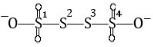
What are the respective oxidation states of sulphur atoms numbered $1$ to $4$ in the tetrathionate ion $(S_4O_6^{2-})$ shown below?
A
$0, +5, +5, 0$
B
$+5, 0, 0, +5$
C
$+2, 0, 0, +2$
D
$+2, -1, -1, +2$
Solution
(B) In the tetrathionate ion $(S_4O_6^{2-})$,the structure consists of a chain of four sulfur atoms.
For the terminal sulfur atoms (numbered $1$ and $4$): Each is bonded to three oxygen atoms (two double-bonded and one single-bonded) and one sulfur atom. The oxidation state is calculated as: $x + 2(-2) + 1(-2) + 1(-1) = -1$ (considering the charge contribution). More simply,using electronegativity: $S$ bonded to $O$ gains $+2$ for each double bond and $+1$ for the single bond,totaling $+5$.
For the central sulfur atoms (numbered $2$ and $3$): Each is bonded to two other sulfur atoms. Since the atoms are identical,the bond between them contributes $0$ to the oxidation state. Thus,the oxidation state of the central sulfur atoms is $0$.
Therefore,the oxidation states for sulfur atoms $1, 2, 3, 4$ are $+5, 0, 0, +5$ respectively.
For the terminal sulfur atoms (numbered $1$ and $4$): Each is bonded to three oxygen atoms (two double-bonded and one single-bonded) and one sulfur atom. The oxidation state is calculated as: $x + 2(-2) + 1(-2) + 1(-1) = -1$ (considering the charge contribution). More simply,using electronegativity: $S$ bonded to $O$ gains $+2$ for each double bond and $+1$ for the single bond,totaling $+5$.
For the central sulfur atoms (numbered $2$ and $3$): Each is bonded to two other sulfur atoms. Since the atoms are identical,the bond between them contributes $0$ to the oxidation state. Thus,the oxidation state of the central sulfur atoms is $0$.
Therefore,the oxidation states for sulfur atoms $1, 2, 3, 4$ are $+5, 0, 0, +5$ respectively.
0 likes
View Solution344
MediumMCQ
Which metal in the following compounds is not present in a fractional oxidation state?
A
$Fe_3O_4$
B
$Mn_3O_4$
C
$Pb_3O_4$
D
$Na_2S_4O_6$
Solution
(D) The oxidation state of a metal in a compound is considered fractional if it represents the average oxidation state of multiple atoms of the same element in different oxidation environments within the same molecule.
$Fe_3O_4$ is a mixed oxide of $FeO$ and $Fe_2O_3$,where $Fe$ exists in $+2$ and $+3$ states. The average oxidation state is $+8/3$.
$Mn_3O_4$ is a mixed oxide of $MnO$ and $Mn_2O_3$,where $Mn$ exists in $+2$ and $+3$ states. The average oxidation state is $+8/3$.
$Pb_3O_4$ is a mixed oxide of $2PbO$ and $PbO_2$,where $Pb$ exists in $+2$ and $+4$ states. The average oxidation state is $+8/3$.
In $Na_2S_4O_6$ (sodium tetrathionate),the sulfur atoms are not metals. The question asks for a metal. However,if we evaluate the oxidation states of the metals provided in the options,all $Fe$,$Mn$,and $Pb$ in these specific mixed oxides show fractional average oxidation states. Given the options,$Na_2S_4O_6$ is the only compound where the central element $(S)$ is a non-metal,and the metal $(Na)$ is in a fixed $+1$ oxidation state.
$Fe_3O_4$ is a mixed oxide of $FeO$ and $Fe_2O_3$,where $Fe$ exists in $+2$ and $+3$ states. The average oxidation state is $+8/3$.
$Mn_3O_4$ is a mixed oxide of $MnO$ and $Mn_2O_3$,where $Mn$ exists in $+2$ and $+3$ states. The average oxidation state is $+8/3$.
$Pb_3O_4$ is a mixed oxide of $2PbO$ and $PbO_2$,where $Pb$ exists in $+2$ and $+4$ states. The average oxidation state is $+8/3$.
In $Na_2S_4O_6$ (sodium tetrathionate),the sulfur atoms are not metals. The question asks for a metal. However,if we evaluate the oxidation states of the metals provided in the options,all $Fe$,$Mn$,and $Pb$ in these specific mixed oxides show fractional average oxidation states. Given the options,$Na_2S_4O_6$ is the only compound where the central element $(S)$ is a non-metal,and the metal $(Na)$ is in a fixed $+1$ oxidation state.
0 likes
View Solution345
EasyMCQ
$A$ compound contains atoms of $x, y$ and $z$ elements. Oxidation numbers of $x, y$ and $z$ are $+3, +5$ and $-2$ respectively. Identify the possible formula of this compound?
A
$XYZ_2$
B
$Y_2(XZ_3)_2$
C
$X_3(YZ_4)_3$
D
$X_3(Y_4Z)_2$
Solution
(C) For a compound to be electrically neutral,the sum of the oxidation numbers of all atoms must be zero.
Let the formula be $X_a(Y_bZ_c)_d$.
Checking option $C$: $X_3(YZ_4)_3$.
Oxidation state of $X = +3$,$Y = +5$,$Z = -2$.
Total charge $= 3(+3) + 3(+5 + 4(-2)) = 9 + 3(5 - 8) = 9 + 3(-3) = 9 - 9 = 0$.
Since the sum of oxidation numbers is zero,$X_3(YZ_4)_3$ is a possible formula.
Let the formula be $X_a(Y_bZ_c)_d$.
Checking option $C$: $X_3(YZ_4)_3$.
Oxidation state of $X = +3$,$Y = +5$,$Z = -2$.
Total charge $= 3(+3) + 3(+5 + 4(-2)) = 9 + 3(5 - 8) = 9 + 3(-3) = 9 - 9 = 0$.
Since the sum of oxidation numbers is zero,$X_3(YZ_4)_3$ is a possible formula.
0 likes
View Solution346
MediumMCQ
Which is $NOT$ correct regarding stock notation?
A
$Hg_2Cl_2$ is the reduced form of $HgCl_2$
B
$HgCl_2$ is the oxidised form of $Hg_2Cl_2$
C
It helps to identify whether a species is present in an oxidised or reduced form
D
Aurous chloride is written as $Au(III)Cl_3$
Solution
(D) Stock notation represents the oxidation state of a metal in a compound using Roman numerals in parentheses.
In $Hg_2Cl_2$,the oxidation state of $Hg$ is $+1$,so it is $Hg(I)Cl$. In $HgCl_2$,the oxidation state of $Hg$ is $+2$,so it is $Hg(II)Cl_2$.
Option $A$ and $B$ are correct because $Hg(I)$ is the reduced form of $Hg(II)$.
Option $C$ is correct as stock notation explicitly states the oxidation state.
Option $D$ is incorrect because 'Aurous' refers to $Au(I)$,whereas $Au(III)Cl_3$ is 'Auric chloride'. Therefore,$Au(III)Cl_3$ is not Aurous chloride.
In $Hg_2Cl_2$,the oxidation state of $Hg$ is $+1$,so it is $Hg(I)Cl$. In $HgCl_2$,the oxidation state of $Hg$ is $+2$,so it is $Hg(II)Cl_2$.
Option $A$ and $B$ are correct because $Hg(I)$ is the reduced form of $Hg(II)$.
Option $C$ is correct as stock notation explicitly states the oxidation state.
Option $D$ is incorrect because 'Aurous' refers to $Au(I)$,whereas $Au(III)Cl_3$ is 'Auric chloride'. Therefore,$Au(III)Cl_3$ is not Aurous chloride.
0 likes
View Solution347
EasyMCQ
What is the difference in oxidation number of $Mn$ in $KMnO_4$ and $MnO_2$?
A
$1$
B
$3$
C
$4$
D
$5$
Solution
(B) In $KMnO_4$,let the oxidation number of $Mn$ be $x$. The sum of oxidation numbers is $1 + x + 4(-2) = 0$,so $x - 7 = 0$,which gives $x = +7$.
In $MnO_2$,let the oxidation number of $Mn$ be $y$. The sum of oxidation numbers is $y + 2(-2) = 0$,so $y - 4 = 0$,which gives $y = +4$.
The difference in oxidation number is $|7 - 4| = 3$.
In $MnO_2$,let the oxidation number of $Mn$ be $y$. The sum of oxidation numbers is $y + 2(-2) = 0$,so $y - 4 = 0$,which gives $y = +4$.
The difference in oxidation number is $|7 - 4| = 3$.
0 likes
View Solution348
MediumMCQ
$A$ compound of $Xe$ and $F$ is found to have an atomic ratio $Xe : F$ as $0.4 : 2.4$. Find the oxidation number of $Xe$.
A
$-4$
B
Zero
C
$+4$
D
$+6$
Solution
(D) The atomic ratio of $Xe : F$ is given as $0.4 : 2.4$.
Dividing both by $0.4$,we get the molar ratio as $1 : 6$.
Thus,the empirical formula of the compound is $XeF_6$.
In $XeF_6$,let the oxidation number of $Xe$ be $x$.
Since the oxidation number of $F$ is $-1$,we have:
$x + 6(-1) = 0$
$x - 6 = 0$
$x = +6$.
Therefore,the oxidation number of $Xe$ is $+6$.
Dividing both by $0.4$,we get the molar ratio as $1 : 6$.
Thus,the empirical formula of the compound is $XeF_6$.
In $XeF_6$,let the oxidation number of $Xe$ be $x$.
Since the oxidation number of $F$ is $-1$,we have:
$x + 6(-1) = 0$
$x - 6 = 0$
$x = +6$.
Therefore,the oxidation number of $Xe$ is $+6$.
0 likes
View Solution349
EasyMCQ
What is the oxidation number of phosphorus in calcium phosphate?
A
$3$
B
$4$
C
$5$
D
$6$
Solution
(C) The chemical formula for calcium phosphate is $Ca_3(PO_4)_2$.
Let the oxidation number of phosphorus be $x$.
The oxidation number of calcium $(Ca)$ is $+2$ and oxygen $(O)$ is $-2$.
For the neutral compound $Ca_3(PO_4)_2$,the sum of oxidation numbers must be zero:
$3(+2) + 2[x + 4(-2)] = 0$
$6 + 2[x - 8] = 0$
$6 + 2x - 16 = 0$
$2x - 10 = 0$
$2x = 10$
$x = +5$
Therefore,the oxidation number of phosphorus is $+5$.
Let the oxidation number of phosphorus be $x$.
The oxidation number of calcium $(Ca)$ is $+2$ and oxygen $(O)$ is $-2$.
For the neutral compound $Ca_3(PO_4)_2$,the sum of oxidation numbers must be zero:
$3(+2) + 2[x + 4(-2)] = 0$
$6 + 2[x - 8] = 0$
$6 + 2x - 16 = 0$
$2x - 10 = 0$
$2x = 10$
$x = +5$
Therefore,the oxidation number of phosphorus is $+5$.
0 likes
View Solution350
EasyMCQ
What is the oxidation number of sulphur in $SO_3$?
A
$+3$
B
$+4$
C
$+6$
D
$-3$
Solution
(C) Let the oxidation number of sulphur $(S)$ be $x$.
In $SO_3$,the oxidation number of oxygen $(O)$ is $-2$.
The sum of oxidation numbers of all atoms in a neutral molecule is $0$.
Therefore,$x + 3(-2) = 0$.
$x - 6 = 0$.
$x = +6$.
Thus,the oxidation number of sulphur in $SO_3$ is $+6$.
In $SO_3$,the oxidation number of oxygen $(O)$ is $-2$.
The sum of oxidation numbers of all atoms in a neutral molecule is $0$.
Therefore,$x + 3(-2) = 0$.
$x - 6 = 0$.
$x = +6$.
Thus,the oxidation number of sulphur in $SO_3$ is $+6$.
0 likes
View SolutionRedox Reactions — Oxidation number and Oxidation state · Frequently Asked Questions
1Are these Redox Reactions questions useful for JEE and NEET?
Yes. All questions in this section are mapped to JEE Main and NEET exam patterns. Previous year questions from JEE Main, NEET, GUJCET and state-level exams are included with full solutions.
2Can I switch to Hindi or Gujarati for these questions?
Yes. Use the language tabs in the hero section or the sidebar to view the same questions and solutions in English, Hindi or Gujarati.
3How do I generate a question paper from this subtopic?
Use the Vedclass Exam Paper Generator — select the chapter and subtopic, set difficulty, and generate Sets A, B, C, D automatically. First 3 chapters of every subject are free.
Vedclass Products
For Students
Vedclass Test Series
Mock tests in real JEE/NEET style with performance analysis. 5-day free trial.
Start Free TrialFor Teachers
Exam Paper Generator
Generate Set A/B/C/D papers from this chapter in 2 minutes. 3 chapters free.
Try FreeFor Institutes
Online Exam Module
Live online exams with unlimited students, 360° analytics & white-label branding.
See DemoFor Teachers & Institutes
Generate a Redox Reactions Exam Paper in 2 Minutes
Select subtopic & difficulty — Sets A, B, C, D auto-generated with No Repeat logic.
First 3 chapters of every subject are free — no payment required.