
A English
Hydrogen peroxide Questions in English
Class 11 Chemistry · Hydrogen · Hydrogen peroxide
342+
Questions
English
Language
100%
With Solutions
Showing 49 of 342 questions in English
1
EasyMCQ
The molecular weight of hydrogen peroxide is $34$. What is the unit of molecular weight?
A
$g$
B
$mol$
C
$g \ mol^{-1}$
D
$mol \ g^{-1}$
Solution
(C) The molecular weight (molar mass) of a substance is defined as the mass of one mole of that substance.
Therefore,the unit of molecular weight is expressed in grams per mole,which is $g \ mol^{-1}$.
Therefore,the unit of molecular weight is expressed in grams per mole,which is $g \ mol^{-1}$.
0 likes
View Solution2
EasyMCQ
In $H_2O_2$,the two oxygen atoms are connected by:
A
Electrovalent bond
B
Covalent bond
C
Coordinate bond
D
No bond
Solution
(B) The structure of $H_2O_2$ is $H-O-O-H$.
In this molecule,the two oxygen atoms are linked to each other by a single covalent bond ($O-O$ bond).
Therefore,the correct option is $(B)$.
In this molecule,the two oxygen atoms are linked to each other by a single covalent bond ($O-O$ bond).
Therefore,the correct option is $(B)$.
0 likes
View Solution3
MediumMCQ
The structural formula of $H_2O_2$ is:
A
The structure is planar with $H-O-O$ bond angles of $101.5^{\circ}$.
B
$H-O-O-H$ (linear structure)
C
The structure is planar with $H-O-O$ bond angles of $101.5^{\circ}$ and all four atoms in the same plane.
D
The structure is non-planar where the $H-O-O$ bond angle is $97^{\circ}$ and the dihedral angle between the two $H-O-O$ planes is $101^{\circ}$.
Solution
(D) Hydrogen peroxide $(H_2O_2)$ has a non-planar,open-book structure.
In the gas phase,the $O-O$ bond length is $147.5 \text{ pm}$ and the $O-H$ bond length is $95 \text{ pm}$.
The $H-O-O$ bond angle is approximately $94.8^{\circ}$ (often approximated as $97^{\circ}$ in textbooks).
The dihedral angle between the two $H-O-O$ planes is $111.5^{\circ}$ (often approximated as $101^{\circ}$ in some contexts).
Therefore,option $D$ correctly describes the non-planar geometry of $H_2O_2$.
In the gas phase,the $O-O$ bond length is $147.5 \text{ pm}$ and the $O-H$ bond length is $95 \text{ pm}$.
The $H-O-O$ bond angle is approximately $94.8^{\circ}$ (often approximated as $97^{\circ}$ in textbooks).
The dihedral angle between the two $H-O-O$ planes is $111.5^{\circ}$ (often approximated as $101^{\circ}$ in some contexts).
Therefore,option $D$ correctly describes the non-planar geometry of $H_2O_2$.
0 likes
View Solution4
EasyMCQ
The structure of $H_2O_2$ is
A
Planar
B
Non-planar
C
Spherical
D
Linear
Solution
(B) $H_2O_2$ has a non-planar structure.
It adopts an open-book configuration to minimize repulsion between the lone pairs of electrons on the oxygen atoms.
It adopts an open-book configuration to minimize repulsion between the lone pairs of electrons on the oxygen atoms.
0 likes
View Solution5
MediumMCQ
In $H_2O_2$ molecule,the dihedral angle between the two $O-H$ planes is ............. $^o$.
A
$90$
B
$101$
C
$103$
D
$105$
Solution
(A) The $H_2O_2$ molecule has a non-planar 'open book' structure in the gas phase.
In this structure,the dihedral angle between the two $O-H$ planes is approximately $111.5^o$.
However,in the solid state,this angle is approximately $90.2^o$.
Given the standard options provided,the closest value representing the dihedral angle in the solid state is $90^o$.
In this structure,the dihedral angle between the two $O-H$ planes is approximately $111.5^o$.
However,in the solid state,this angle is approximately $90.2^o$.
Given the standard options provided,the closest value representing the dihedral angle in the solid state is $90^o$.
0 likes
View Solution6
MediumMCQ
$H_2O_2$ reduces $K_4[Fe(CN)_6]$ in which of the following conditions?
A
In neutral solution
B
In acidic solution
C
In non-polar solvent
D
In alkaline solution
Solution
(B) $H_2O_2$ acts as an oxidizing agent and oxidizes $K_4[Fe(CN)_6]$ (potassium ferrocyanide) to $K_3[Fe(CN)_6]$ (potassium ferricyanide) in an acidic medium.
The balanced chemical equation is:
$2K_4[Fe(CN)_6] + H_2SO_4 + H_2O_2 \to 2K_3[Fe(CN)_6] + K_2SO_4 + 2H_2O$
Thus,the correct condition is an acidic solution.
The balanced chemical equation is:
$2K_4[Fe(CN)_6] + H_2SO_4 + H_2O_2 \to 2K_3[Fe(CN)_6] + K_2SO_4 + 2H_2O$
Thus,the correct condition is an acidic solution.
0 likes
View Solution7
MediumMCQ
The equation $H_2S + H_2O_2 \to S + 2H_2O$ represents:
A
Acidic nature of $H_2O_2$
B
Basic nature of $H_2O_2$
C
Oxidising nature of $H_2O_2$
D
Reducing nature of $H_2O_2$
Solution
(C) In the given reaction,the oxidation state of sulfur $(S)$ increases from $-2$ in $H_2S$ to $0$ in $S$.
Since $H_2S$ is being oxidized,$H_2O_2$ acts as an oxidizing agent.
Therefore,this reaction represents the oxidizing nature of $H_2O_2$.
Since $H_2S$ is being oxidized,$H_2O_2$ acts as an oxidizing agent.
Therefore,this reaction represents the oxidizing nature of $H_2O_2$.
0 likes
View Solution8
MediumMCQ
Identify the correct statement about $H_2O_2$.
A
It acts as reducing agent only.
B
It acts as both oxidising and reducing agent.
C
It is neither an oxidiser nor reducer.
D
It acts as oxidising agent only.
Solution
(B) $H_2O_2$ can act as an oxidizing agent by gaining electrons (reducing to $H_2O$) and as a reducing agent by losing electrons (oxidizing to $O_2$).
Therefore,it acts as both an oxidizing and a reducing agent.
Therefore,it acts as both an oxidizing and a reducing agent.
0 likes
View Solution9
MediumMCQ
$H_2O_2$ is used as:
A
An oxidant only
B
$A$ reductant only
C
An acid only
D
An oxidant,a reductant and an acid
Solution
(D) $H_2O_2$ acts as an oxidant in both acidic and basic media,for example: $2Fe^{2+} + H_2O_2 + 2H^+ \rightarrow 2Fe^{3+} + 2H_2O$.
It acts as a reductant with strong oxidizing agents,for example: $2MnO_4^- + 6H^+ + 5H_2O_2 \rightarrow 2Mn^{2+} + 8H_2O + 5O_2$.
It also acts as a very weak acid in aqueous solution,dissociating to give $H^+$ ions: $H_2O_2 \rightleftharpoons H^+ + HO_2^-$.
Therefore,it exhibits all three properties.
It acts as a reductant with strong oxidizing agents,for example: $2MnO_4^- + 6H^+ + 5H_2O_2 \rightarrow 2Mn^{2+} + 8H_2O + 5O_2$.
It also acts as a very weak acid in aqueous solution,dissociating to give $H^+$ ions: $H_2O_2 \rightleftharpoons H^+ + HO_2^-$.
Therefore,it exhibits all three properties.
0 likes
View Solution10
MediumMCQ
In which of the following reactions is $H_2O_2$ acting as a reducing agent?
A
$2FeCl_2 + 2HCl + H_2O_2 \to 2FeCl_3 + 2H_2O$
B
$Cl_2 + H_2O_2 \to 2HCl + O_2$
C
$2HI + H_2O_2 \to 2H_2O + I_2$
D
$H_2SO_3 + H_2O_2 \to H_2SO_4 + H_2O$
Solution
(B) reducing agent is a substance that undergoes oxidation itself while reducing another substance.
In the reaction $Cl_2 + H_2O_2 \to 2HCl + O_2$,the oxidation state of oxygen in $H_2O_2$ increases from $-1$ to $0$ (oxidation),while the oxidation state of chlorine in $Cl_2$ decreases from $0$ to $-1$ (reduction).
Therefore,$H_2O_2$ acts as a reducing agent in this reaction.
In the reaction $Cl_2 + H_2O_2 \to 2HCl + O_2$,the oxidation state of oxygen in $H_2O_2$ increases from $-1$ to $0$ (oxidation),while the oxidation state of chlorine in $Cl_2$ decreases from $0$ to $-1$ (reduction).
Therefore,$H_2O_2$ acts as a reducing agent in this reaction.
0 likes
View Solution11
EasyMCQ
The compound that can work both as an oxidising and reducing agent is
A
$KMnO_4$
B
$H_2O_2$
C
$BaO_2$
D
$K_2Cr_2O_7$
Solution
(B) The compound $H_2O_2$ (hydrogen peroxide) can act as both an oxidising agent and a reducing agent.
In $H_2O_2$,the oxidation state of oxygen is $-1$.
It can be reduced to $H_2O$ (oxidation state of $O$ is $-2$) or oxidized to $O_2$ (oxidation state of $O$ is $0$).
In $H_2O_2$,the oxidation state of oxygen is $-1$.
It can be reduced to $H_2O$ (oxidation state of $O$ is $-2$) or oxidized to $O_2$ (oxidation state of $O$ is $0$).
0 likes
View Solution12
MediumMCQ
The oxidation states of the most electronegative element in the products of the reaction of $BaO_2$ with dilute $H_2SO_4$ are
A
$0$ and $-1$
B
$-1$ and $-2$
C
$-2$ and $0$
D
$-2$ and $+1$
Solution
(B) The reaction of $BaO_2$ with dilute $H_2SO_4$ is given by:
$BaO_2 + H_2SO_4 \rightarrow BaSO_4 + H_2O_2$
In the products,the most electronegative element is oxygen.
In $H_2O_2$,oxygen is in the peroxide state,so its oxidation state is $-1$.
In $BaSO_4$,oxygen is in the oxide state,so its oxidation state is $-2$.
Therefore,the oxidation states are $-1$ and $-2$.
$BaO_2 + H_2SO_4 \rightarrow BaSO_4 + H_2O_2$
In the products,the most electronegative element is oxygen.
In $H_2O_2$,oxygen is in the peroxide state,so its oxidation state is $-1$.
In $BaSO_4$,oxygen is in the oxide state,so its oxidation state is $-2$.
Therefore,the oxidation states are $-1$ and $-2$.
0 likes
View Solution13
EasyMCQ
The oxidation state of oxygen in hydrogen peroxide $(H_2O_2)$ is:
A
$-1$
B
$+1$
C
$0$
D
$-2$
Solution
(A) In hydrogen peroxide $(H_2O_2)$,the oxygen atoms are bonded to each other in a peroxide linkage $(-O-O-)$.
According to the rules for assigning oxidation states,the oxidation state of oxygen in peroxides is always $-1$.
According to the rules for assigning oxidation states,the oxidation state of oxygen in peroxides is always $-1$.
0 likes
View Solution14
MediumMCQ
In which of the following reactions is hydrogen peroxide $(H_2O_2)$ a reducing agent?
A
$2FeCl_2 + 2HCl + H_2O_2 \to 2FeCl_3 + 2H_2O$
B
$Cl_2 + H_2O_2 \to 2HCl + O_2$
C
$2HI + H_2O_2 \to 2H_2O + I_2$
D
$H_2SO_3 + H_2O_2 \to H_2SO_4 + H_2O$
Solution
(B) reducing agent is a substance that gets oxidized itself while reducing another substance.
In the reaction $Cl_2 + H_2O_2 \to 2HCl + O_2$,the oxidation state of oxygen in $H_2O_2$ changes from $-1$ to $0$ (oxidation).
Since $H_2O_2$ undergoes oxidation,it acts as a reducing agent for $Cl_2$ (which is reduced from $0$ to $-1$).
In all other options ($A$,$C$,and $D$),$H_2O_2$ acts as an oxidizing agent.
In the reaction $Cl_2 + H_2O_2 \to 2HCl + O_2$,the oxidation state of oxygen in $H_2O_2$ changes from $-1$ to $0$ (oxidation).
Since $H_2O_2$ undergoes oxidation,it acts as a reducing agent for $Cl_2$ (which is reduced from $0$ to $-1$).
In all other options ($A$,$C$,and $D$),$H_2O_2$ acts as an oxidizing agent.
0 likes
View Solution15
MediumMCQ
There is a sample of $10$ volume of hydrogen peroxide solution. Calculate its strength in percentage (%).
A
$3.00$
B
$4.045$
C
$2.509$
D
$3.035$
Solution
(D) The decomposition of hydrogen peroxide is represented as: $2H_2O_2 \to 2H_2O + O_2$.
From the stoichiometry,$22.4 \ L$ of $O_2$ at $N.T.P.$ is produced by $68 \ g$ of $H_2O_2$.
For a $10$ volume solution,$10 \ L$ of $O_2$ is produced by $1 \ L$ of $H_2O_2$ solution.
Mass of $H_2O_2$ in $1 \ L$ of solution $= \frac{68}{22.4} \times 10 = 30.35 \ g/L$.
Strength in percentage $(\% w/v) = \frac{\text{mass of solute in } g}{\text{volume of solution in } mL} \times 100$.
Strength $= \frac{30.35 \ g}{1000 \ mL} \times 100 = 3.035\%$.
From the stoichiometry,$22.4 \ L$ of $O_2$ at $N.T.P.$ is produced by $68 \ g$ of $H_2O_2$.
For a $10$ volume solution,$10 \ L$ of $O_2$ is produced by $1 \ L$ of $H_2O_2$ solution.
Mass of $H_2O_2$ in $1 \ L$ of solution $= \frac{68}{22.4} \times 10 = 30.35 \ g/L$.
Strength in percentage $(\% w/v) = \frac{\text{mass of solute in } g}{\text{volume of solution in } mL} \times 100$.
Strength $= \frac{30.35 \ g}{1000 \ mL} \times 100 = 3.035\%$.
0 likes
View Solution16
EasyMCQ
In the laboratory, $H_2O_2$ is prepared by:
A
Cold $H_2SO_4 + BaO_2$
B
$HCl + BaO_2$
C
Conc. $H_2SO_4 + Na_2O_2$
D
$H_2 + O_2$
Solution
(A) In the laboratory, $H_2O_2$ is prepared by the action of cold dilute $H_2SO_4$ on barium peroxide $(BaO_2)$.
The chemical reaction is:
$BaO_2 \cdot 8H_2O(s) + H_2SO_4(dil.) \to BaSO_4(s) + H_2O_2(aq) + 8H_2O(l)$
The chemical reaction is:
$BaO_2 \cdot 8H_2O(s) + H_2SO_4(dil.) \to BaSO_4(s) + H_2O_2(aq) + 8H_2O(l)$
0 likes
View Solution17
EasyMCQ
The structure of $H_2O_2$ is
A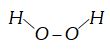
B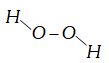
C
$H-O-O-H$
D
Solution
(B) The structure of $H_2O_2$ is non-planar and has an open book-like structure.
In the gas phase,the dihedral angle is $111.5^{\circ}$,and in the solid phase,it is $90.2^{\circ}$.
In the gas phase,the dihedral angle is $111.5^{\circ}$,and in the solid phase,it is $90.2^{\circ}$.
0 likes
View Solution18
EasyMCQ
The oxide that gives hydrogen peroxide $H_2O_2$ on treatment with a dilute acid $H_2SO_4$ is:
A
$MnO_2$
B
$PbO_2$
C
$Na_2O_2$
D
$TiO_2$
Solution
(C) The reaction of sodium peroxide $(Na_2O_2)$ with dilute sulfuric acid $(H_2SO_4)$ produces hydrogen peroxide $(H_2O_2)$ and sodium sulfate $(Na_2SO_4)$.
The chemical equation is:
$Na_2O_2 + H_2SO_4 \to Na_2SO_4 + H_2O_2$
Therefore,the correct option is $C$.
The chemical equation is:
$Na_2O_2 + H_2SO_4 \to Na_2SO_4 + H_2O_2$
Therefore,the correct option is $C$.
0 likes
View Solution19
MediumMCQ
$Hydrogen$ $peroxide$ is reduced by:
A
$Ozone$
B
$Barium$ $peroxide$
C
$Acidic$ $solution$ of $KMnO_4$
D
$Lead$ $sulphide$ suspension
Solution
(D) $Hydrogen$ $peroxide$ $(H_2O_2)$ acts as a reducing agent when it reacts with strong oxidizing agents like $O_3$ or $KMnO_4$ in acidic medium.
However,$H_2O_2$ acts as an oxidizing agent when it reacts with $PbS$ (lead sulphide).
The reaction is:
$PbS(s) + 4H_2O_2(aq) \to PbSO_4(s) + 4H_2O(l)$
In this reaction,$PbS$ is oxidized to $PbSO_4$ and $H_2O_2$ is reduced to $H_2O$.
However,$H_2O_2$ acts as an oxidizing agent when it reacts with $PbS$ (lead sulphide).
The reaction is:
$PbS(s) + 4H_2O_2(aq) \to PbSO_4(s) + 4H_2O(l)$
In this reaction,$PbS$ is oxidized to $PbSO_4$ and $H_2O_2$ is reduced to $H_2O$.
0 likes
View Solution20
MediumMCQ
The reaction $H_2S + H_2O_2 \to S + 2H_2O$ manifests:
A
Acidic nature of $H_2O_2$
B
Alkaline nature of $H_2O_2$
C
Oxidising nature of $H_2O_2$
D
Reducing action of $H_2O_2$
Solution
(C) In the given reaction: $H_2S + H_2O_2 \to S + 2H_2O$.
The oxidation state of sulfur in $H_2S$ changes from $-2$ to $0$ in $S$.
Since the oxidation state of sulfur increases,$H_2S$ is oxidized.
$H_2O_2$ acts as an oxidizing agent because it facilitates the oxidation of $H_2S$ and itself gets reduced to $H_2O$.
Therefore,this reaction manifests the oxidising nature of $H_2O_2$.
The oxidation state of sulfur in $H_2S$ changes from $-2$ to $0$ in $S$.
Since the oxidation state of sulfur increases,$H_2S$ is oxidized.
$H_2O_2$ acts as an oxidizing agent because it facilitates the oxidation of $H_2S$ and itself gets reduced to $H_2O$.
Therefore,this reaction manifests the oxidising nature of $H_2O_2$.
0 likes
View Solution21
EasyMCQ
What is the product of the reaction of $H_2O_2$ with $Cl_2$?
A
$O_2 + HOCl$
B
$HCl + O_2$
C
$H_2O + HCl$
D
$HCl + H_2$
Solution
(B) The reaction between hydrogen peroxide $(H_2O_2)$ and chlorine $(Cl_2)$ is an oxidation-reduction reaction where $H_2O_2$ acts as a reducing agent.
The balanced chemical equation is:
$H_2O_2 + Cl_2 \to 2HCl + O_2$
Therefore,the products are hydrochloric acid $(HCl)$ and oxygen gas $(O_2)$.
The balanced chemical equation is:
$H_2O_2 + Cl_2 \to 2HCl + O_2$
Therefore,the products are hydrochloric acid $(HCl)$ and oxygen gas $(O_2)$.
0 likes
View Solution22
EasyMCQ
$H_2O_2$ will oxidise:
A
$KMnO_4$
B
$PbS$
C
$MnO_2$
D
$H_2S$
Solution
(B) $H_2O_2$ acts as both an oxidising and a reducing agent. In the presence of $PbS$ (lead sulfide),$H_2O_2$ acts as an oxidising agent and oxidises $PbS$ to $PbSO_4$ (lead sulfate).
The chemical equation is: $PbS + 4H_2O_2 \rightarrow PbSO_4 + 4H_2O$.
The chemical equation is: $PbS + 4H_2O_2 \rightarrow PbSO_4 + 4H_2O$.
0 likes
View Solution23
EasyMCQ
Fenton’s reagent is
A
$FeSO_4 + H_2O_2$
B
$Zn + HCl$
C
$Sn + HCl$
D
None of these
Solution
(A) Fenton’s reagent is a solution of hydrogen peroxide $(H_2O_2)$ with ferrous iron (typically iron$(II)$ sulfate,$FeSO_4$) as a catalyst.
It is widely used to oxidize contaminants or waste waters.
It is widely used to oxidize contaminants or waste waters.
0 likes
View Solution24
MediumMCQ
The volume strength of $1.5 \, N$ $H_2O_2$ solution is .............. $liters$.
A
$8.4$
B
$4.2$
C
$16.8$
D
$5.2$
Solution
(A) The relationship between volume strength and normality of $H_2O_2$ is given by the formula:
Volume strength $= 5.6 \times \text{Normality}$
Given,Normality $= 1.5 \, N$
Therefore,Volume strength $= 5.6 \times 1.5 = 8.4 \, \text{liters}$.
Volume strength $= 5.6 \times \text{Normality}$
Given,Normality $= 1.5 \, N$
Therefore,Volume strength $= 5.6 \times 1.5 = 8.4 \, \text{liters}$.
0 likes
View Solution25
DifficultMCQ
The volume of oxygen liberated from $15 \, mL$ of $20$ volume $H_2O_2$ is ................ $mL$.
A
$250$
B
$300$
C
$150$
D
$200$
Solution
(B) $20$ volume $H_2O_2$ means that $1 \, mL$ of $H_2O_2$ solution produces $20 \, mL$ of $O_2$ gas at $N.T.P$.
Given volume of $H_2O_2$ solution = $15 \, mL$.
Volume of $O_2$ liberated = $(\text{Volume of solution}) \times (\text{Volume strength of } H_2O_2)$.
Volume of $O_2$ liberated = $15 \, mL \times 20 = 300 \, mL$.
Given volume of $H_2O_2$ solution = $15 \, mL$.
Volume of $O_2$ liberated = $(\text{Volume of solution}) \times (\text{Volume strength of } H_2O_2)$.
Volume of $O_2$ liberated = $15 \, mL \times 20 = 300 \, mL$.
0 likes
View Solution26
MediumMCQ
The strength in volumes of a solution containing $30.36 \ g/L$ of $H_2O_2$ is
A
$10$ volume
B
$20$ volume
C
$5$ volume
D
None of these
Solution
(A) The molar mass of $H_2O_2$ is $34 \ g/mol$.
The molarity $(M)$ of the solution is given by $M = \frac{\text{mass in } g/L}{\text{molar mass}} = \frac{30.36}{34} = 0.893 \ M$.
The relation between volume strength and molarity is: $\text{Volume strength} = 11.2 \times M$.
$\text{Volume strength} = 11.2 \times 0.893 \approx 10 \text{ volumes}$.
The molarity $(M)$ of the solution is given by $M = \frac{\text{mass in } g/L}{\text{molar mass}} = \frac{30.36}{34} = 0.893 \ M$.
The relation between volume strength and molarity is: $\text{Volume strength} = 11.2 \times M$.
$\text{Volume strength} = 11.2 \times 0.893 \approx 10 \text{ volumes}$.
0 likes
View Solution27
EasyMCQ
Hydrogen peroxide is used as
A
Oxidising agent
B
Reducing agent
C
Both as oxidising and reducing agent
D
Drying agent
Solution
(C) $H_2O_2$ acts as an oxidising as well as a reducing agent in both acidic and alkaline media.
0 likes
View Solution28
EasyMCQ
The equivalent weight of $H_2O_2$ is:
A
$17$
B
$34$
C
$68$
D
$18$
Solution
(A) The equivalent weight of a substance is calculated as the molar mass divided by the $n$-factor.
For $H_2O_2$,the molar mass is $2 \times 1 + 2 \times 16 = 34 \ g/mol$.
In redox reactions,$H_2O_2$ acts as an oxidizing or reducing agent,typically involving a change in oxidation state of oxygen from $-1$ to $-2$ or $0$,resulting in an $n$-factor of $2$.
Therefore,the equivalent weight = $\frac{\text{Molar mass}}{n\text{-factor}} = \frac{34}{2} = 17$.
For $H_2O_2$,the molar mass is $2 \times 1 + 2 \times 16 = 34 \ g/mol$.
In redox reactions,$H_2O_2$ acts as an oxidizing or reducing agent,typically involving a change in oxidation state of oxygen from $-1$ to $-2$ or $0$,resulting in an $n$-factor of $2$.
Therefore,the equivalent weight = $\frac{\text{Molar mass}}{n\text{-factor}} = \frac{34}{2} = 17$.
0 likes
View Solution29
MediumMCQ
$20$ volume $H_2O_2$ solution has a strength of about $........... \%$
A
$30$
B
$6$
C
$3$
D
$10$
Solution
(B) The decomposition of $H_2O_2$ is given by: $2H_2O_2 \rightarrow 2H_2O + O_2$.
$68 \, g$ of $H_2O_2$ produces $22.4 \, L$ of $O_2$ at $N.T.P$.
Therefore,$1 \, L$ of $O_2$ is produced by $\frac{68}{22.4} \, g$ of $H_2O_2$.
For a $20$ volume solution,$1 \, L$ of $H_2O_2$ solution produces $20 \, L$ of $O_2$.
Mass of $H_2O_2$ in $1 \, L$ of solution $= \frac{68}{22.4} \times 20 \approx 60.71 \, g$.
Strength in percentage $(\% \, w/v) = \frac{\text{mass of solute in } g}{\text{volume of solution in } mL} \times 100$.
Strength $= \frac{60.71 \, g}{1000 \, mL} \times 100 \approx 6.07 \%$.
Thus,the strength is approximately $6 \%$.
$68 \, g$ of $H_2O_2$ produces $22.4 \, L$ of $O_2$ at $N.T.P$.
Therefore,$1 \, L$ of $O_2$ is produced by $\frac{68}{22.4} \, g$ of $H_2O_2$.
For a $20$ volume solution,$1 \, L$ of $H_2O_2$ solution produces $20 \, L$ of $O_2$.
Mass of $H_2O_2$ in $1 \, L$ of solution $= \frac{68}{22.4} \times 20 \approx 60.71 \, g$.
Strength in percentage $(\% \, w/v) = \frac{\text{mass of solute in } g}{\text{volume of solution in } mL} \times 100$.
Strength $= \frac{60.71 \, g}{1000 \, mL} \times 100 \approx 6.07 \%$.
Thus,the strength is approximately $6 \%$.
0 likes
View Solution30
EasyMCQ
$H_2O_2$ is manufactured these days by:
A
By the action of $H_2SO_4$ on $BaO_2$
B
By the action of $H_2SO_4$ on $Na_2O_2$
C
By electrolysis of $50\%$ $H_2SO_4$
D
By burning hydrogen in excess of oxygen
Solution
(C) The correct answer is $(C)$.
Electrolysis of $50\%$ $H_2SO_4$ (sulphuric acid) yields peroxodisulphuric acid $(H_2S_2O_8)$.
This product,upon hydrolysis and subsequent distillation,produces a $30\%$ solution of hydrogen peroxide $(H_2O_2)$.
Electrolysis of $50\%$ $H_2SO_4$ (sulphuric acid) yields peroxodisulphuric acid $(H_2S_2O_8)$.
This product,upon hydrolysis and subsequent distillation,produces a $30\%$ solution of hydrogen peroxide $(H_2O_2)$.
0 likes
View Solution31
DifficultMCQ
$1 \ mL$ of $H_2O_2$ solution gives $10 \ mL$ of $O_2$ at $NTP$. It is ................ vol. $H_2O_2$.
A
$10$
B
$20$
C
$30$
D
$40$
Solution
(A) The volume strength of $H_2O_2$ is defined as the volume of $O_2$ gas (in $mL$) produced at $NTP$ by the decomposition of $1 \ mL$ of $H_2O_2$ solution.
Given that $1 \ mL$ of $H_2O_2$ solution produces $10 \ mL$ of $O_2$ at $NTP$.
Therefore,the solution is $10$ volume $H_2O_2$.
Given that $1 \ mL$ of $H_2O_2$ solution produces $10 \ mL$ of $O_2$ at $NTP$.
Therefore,the solution is $10$ volume $H_2O_2$.
0 likes
View Solution32
EasyMCQ
Which substance does not speed up the decomposition of $H_2O_2$?
A
Glycerol
B
$Pt$
C
Gold
D
$MnO_2$
Solution
(A) $H_2O_2$ is unstable and decomposes into $H_2O$ and $O_2$.
Substances like $Pt$,$Au$ (Gold),and $MnO_2$ act as catalysts and speed up this decomposition.
Glycerol,phosphoric acid,or acetanilide are added to $H_2O_2$ as stabilizers to prevent or check its decomposition.
Therefore,glycerol does not speed up the decomposition.
Substances like $Pt$,$Au$ (Gold),and $MnO_2$ act as catalysts and speed up this decomposition.
Glycerol,phosphoric acid,or acetanilide are added to $H_2O_2$ as stabilizers to prevent or check its decomposition.
Therefore,glycerol does not speed up the decomposition.
0 likes
View Solution33
MediumMCQ
Which of the following cannot be oxidised by $H_2O_2$?
A
$O_3$
B
$KI / HCl$
C
$PbS$
D
$Na_2SO_3$
Solution
(A) $H_2O_2$ acts as both an oxidizing and a reducing agent.
In the reaction with $O_3$,$H_2O_2$ acts as a reducing agent and reduces $O_3$ to $O_2$.
The reaction is: $O_3 + H_2O_2 \to H_2O + 2O_2$.
Since $O_3$ is reduced by $H_2O_2$,it is not oxidized by it.
Conversely,$KI$ is oxidized to $I_2$,$PbS$ is oxidized to $PbSO_4$,and $Na_2SO_3$ is oxidized to $Na_2SO_4$ by $H_2O_2$.
In the reaction with $O_3$,$H_2O_2$ acts as a reducing agent and reduces $O_3$ to $O_2$.
The reaction is: $O_3 + H_2O_2 \to H_2O + 2O_2$.
Since $O_3$ is reduced by $H_2O_2$,it is not oxidized by it.
Conversely,$KI$ is oxidized to $I_2$,$PbS$ is oxidized to $PbSO_4$,and $Na_2SO_3$ is oxidized to $Na_2SO_4$ by $H_2O_2$.
0 likes
View Solution34
MediumMCQ
Which substance cannot be reduced by ${H_2O_2}$?
A
$KMnO_4/H_2SO_4$
B
$K_2Cr_2O_7/H_2SO_4$
C
$Ag_2O$
D
$Fe^{3+}$
Solution
(D) $H_2O_2$ acts as both an oxidizing and a reducing agent.
In the presence of strong oxidizing agents,it acts as a reducing agent.
$KMnO_4/H_2SO_4$,$K_2Cr_2O_7/H_2SO_4$,and $Ag_2O$ are strong oxidizing agents and are reduced by $H_2O_2$.
$Fe^{3+}$ is the highest oxidation state of iron and cannot be further reduced by $H_2O_2$ to $Fe^{2+}$ under standard conditions; instead,$H_2O_2$ can reduce $Fe^{3+}$ only in specific complex environments,but in general redox chemistry,$Fe^{3+}$ is not reduced by $H_2O_2$.
In the presence of strong oxidizing agents,it acts as a reducing agent.
$KMnO_4/H_2SO_4$,$K_2Cr_2O_7/H_2SO_4$,and $Ag_2O$ are strong oxidizing agents and are reduced by $H_2O_2$.
$Fe^{3+}$ is the highest oxidation state of iron and cannot be further reduced by $H_2O_2$ to $Fe^{2+}$ under standard conditions; instead,$H_2O_2$ can reduce $Fe^{3+}$ only in specific complex environments,but in general redox chemistry,$Fe^{3+}$ is not reduced by $H_2O_2$.
0 likes
View Solution35
MediumMCQ
$H_2O_2$ is
A
Poor polar solvent than water
B
Better polar solvent than $H_2O$
C
Both have equal polarity
D
Better polar solvent but its strong auto-oxidising ability limits its use as such
Solution
(D) $H_2O_2$ has a higher dielectric constant than $H_2O$,making it a better polar solvent.
However,it is not commonly used as a solvent because of its strong auto-oxidizing ability,which can lead to the decomposition of the solute or the solvent itself.
However,it is not commonly used as a solvent because of its strong auto-oxidizing ability,which can lead to the decomposition of the solute or the solvent itself.
0 likes
View Solution36
EasyMCQ
$H_2O_2$ is a
A
Weak acid
B
Weak base
C
Neutral
D
None of these
Solution
(A) $H_2O_2$ acts as a very weak acid in aqueous solution.
It dissociates slightly to give $H^+$ and $HO_2^-$ ions.
Therefore,the correct option is $(A)$.
It dissociates slightly to give $H^+$ and $HO_2^-$ ions.
Therefore,the correct option is $(A)$.
0 likes
View Solution37
EasyMCQ
Decomposition of $H_2O_2$ is prevented by
A
$NaOH$
B
$MnO_2$
C
Acetanilide
D
Oxalic acid
Solution
(C) The decomposition of $H_2O_2$ is prevented by adding stabilizers such as acetanilide.
Acetanilide acts as a negative catalyst or stabilizer that retards the rate of decomposition of $H_2O_2$.
Acetanilide acts as a negative catalyst or stabilizer that retards the rate of decomposition of $H_2O_2$.
0 likes
View Solution38
MediumMCQ
$H_2O_2$ is always stored in black bottles because
A
It is highly unstable
B
Its enthalpy of decomposition is high
C
It undergoes decomposition in the presence of light
D
None of these
Solution
(C) $H_2O_2$ is an unstable liquid that decomposes into water and oxygen $(2H_2O_2 \rightarrow 2H_2O + O_2)$ when exposed to light.
To prevent this photochemical decomposition,it is stored in dark-colored (black) bottles.
To prevent this photochemical decomposition,it is stored in dark-colored (black) bottles.
0 likes
View Solution39
MediumMCQ
Which of the following is wrong about $H_2O_2$? It is used
A
As an aerating agent in the production of sponge rubber
B
As an antichlor
C
For restoring the white colour of blackened lead paintings
D
None of these
Solution
(D) $H_2O_2$ is used as an aerating agent in the production of sponge rubber,as an antichlor to remove excess chlorine from fabrics,and for restoring the white colour of old lead paintings by converting black $PbS$ to white $PbSO_4$. Therefore,none of the given statements are wrong.
0 likes
View Solution40
EasyMCQ
$H_2O_2 \to 2H^{+} + O_2 + 2e^-$; $E^\circ = -0.68 \ V$. This equation represents which of the following behavior of $H_2O_2$?
A
Reducing
B
Oxidizing
C
Acidic
D
Catalytic
Solution
(A) In the given reaction,$H_2O_2$ undergoes oxidation by losing electrons $(2e^-)$ to form $O_2$ and $H^{+}$ ions.
Since $H_2O_2$ is undergoing oxidation,it acts as a reducing agent.
Therefore,the correct option is $A$.
Since $H_2O_2$ is undergoing oxidation,it acts as a reducing agent.
Therefore,the correct option is $A$.
0 likes
View Solution41
EasyMCQ
The structure of $H_2O_2$ is
A
Open book like
B
Linear
C
Closed book
D
Pyramidal
Solution
(A) The structure of hydrogen peroxide $(H_2O_2)$ is non-planar.
It possesses an open book structure where the two $O-H$ bonds are in different planes,resulting in a dihedral angle of $111.5^{\circ}$ in the gas phase.
It possesses an open book structure where the two $O-H$ bonds are in different planes,resulting in a dihedral angle of $111.5^{\circ}$ in the gas phase.
0 likes
View Solution42
MediumMCQ
On shaking $H_2O_2$ with acidified potassium dichromate and ether,the ethereal layer becomes:
A
Green
B
Red
C
Blue
D
Black
Solution
(C) When $H_2O_2$ is added to an acidified solution of potassium dichromate $(K_2Cr_2O_7)$ in the presence of ether,a deep blue color is observed in the ethereal layer.
This is due to the formation of chromium pentoxide $(CrO_5)$,which is soluble in ether.
The chemical reaction is:
$K_2Cr_2O_7 + H_2SO_4 + 4H_2O_2 \to K_2SO_4 + 2CrO_5 (\text{Blue}) + 5H_2O$
This is due to the formation of chromium pentoxide $(CrO_5)$,which is soluble in ether.
The chemical reaction is:
$K_2Cr_2O_7 + H_2SO_4 + 4H_2O_2 \to K_2SO_4 + 2CrO_5 (\text{Blue}) + 5H_2O$
0 likes
View Solution43
MediumMCQ
The $K_a$ of $H_2O_2$ is of the order of:
A
$10^{-12}$
B
$10^{-14}$
C
$10^{-16}$
D
$10^{-10}$
Solution
(A) The acid dissociation constant $(K_a)$ for hydrogen peroxide $(H_2O_2)$ is approximately $1.55 \times 10^{-12}$.
Therefore,the order of magnitude is $10^{-12}$.
Therefore,the order of magnitude is $10^{-12}$.
0 likes
View Solution44
EasyMCQ
$H_2O_2$ acts as an oxidising agent in
A
Neutral medium
B
Acidic medium
C
Alkaline medium
D
Acidic and alkaline medium
Solution
(D) $H_2O_2$ acts as an oxidising agent in both acidic and alkaline media.
In acidic medium: $H_2O_2 + 2H^+ + 2e^- \rightarrow 2H_2O$.
In alkaline medium: $H_2O_2 + 2e^- \rightarrow 2OH^-$.
In acidic medium: $H_2O_2 + 2H^+ + 2e^- \rightarrow 2H_2O$.
In alkaline medium: $H_2O_2 + 2e^- \rightarrow 2OH^-$.
0 likes
View Solution45
EasyMCQ
The $H-O-O$ bond angle in $H_2O_2$ is ............. $^o$
A
$107.28$
B
$109.28$
C
$104.5$
D
$97$
Solution
(D) In the gaseous phase,the $H_2O_2$ molecule has a non-planar structure.
The $H-O-O$ bond angle is $97^o$ in the gaseous phase.
Therefore,the correct option is $(D)$.
The $H-O-O$ bond angle is $97^o$ in the gaseous phase.
Therefore,the correct option is $(D)$.
0 likes
View Solution46
DifficultMCQ
The volume of oxygen liberated from $0.68 \ g$ of $H_2O_2$ is ............. $mL$ at $STP$.
A
$112$
B
$224$
C
$56$
D
$336$
Solution
(B) The balanced chemical equation for the decomposition of $H_2O_2$ is:
$2H_2O_2 \rightarrow 2H_2O + O_2$
From the stoichiometry:
$2 \times 34 \ g$ of $H_2O_2$ produces $22400 \ mL$ of $O_2$ at $STP$.
$68 \ g$ of $H_2O_2$ produces $22400 \ mL$ of $O_2$.
Therefore,the volume of $O_2$ produced from $0.68 \ g$ of $H_2O_2$ is:
$\text{Volume} = \frac{22400 \ mL \times 0.68 \ g}{68 \ g} = 224 \ mL$.
$2H_2O_2 \rightarrow 2H_2O + O_2$
From the stoichiometry:
$2 \times 34 \ g$ of $H_2O_2$ produces $22400 \ mL$ of $O_2$ at $STP$.
$68 \ g$ of $H_2O_2$ produces $22400 \ mL$ of $O_2$.
Therefore,the volume of $O_2$ produced from $0.68 \ g$ of $H_2O_2$ is:
$\text{Volume} = \frac{22400 \ mL \times 0.68 \ g}{68 \ g} = 224 \ mL$.
0 likes
View Solution47
MediumMCQ
Hydrogen peroxide $(H_2O_2)$ is:
A
$A$ stronger acid than water
B
$A$ reducing agent
C
An oxidising agent
D
All of the above
Solution
(D) Hydrogen peroxide $(H_2O_2)$ acts as a weak acid,stronger than water $(H_2O)$.
It acts as an oxidising agent in both acidic and basic media (e.g.,$2Fe^{2+} + H_2O_2 + 2H^+ \rightarrow 2Fe^{3+} + 2H_2O$).
It also acts as a reducing agent towards strong oxidising agents (e.g.,$2MnO_4^- + 6H^+ + 5H_2O_2 \rightarrow 2Mn^{2+} + 8H_2O + 5O_2$).
Therefore,all the given statements are correct.
It acts as an oxidising agent in both acidic and basic media (e.g.,$2Fe^{2+} + H_2O_2 + 2H^+ \rightarrow 2Fe^{3+} + 2H_2O$).
It also acts as a reducing agent towards strong oxidising agents (e.g.,$2MnO_4^- + 6H^+ + 5H_2O_2 \rightarrow 2Mn^{2+} + 8H_2O + 5O_2$).
Therefore,all the given statements are correct.
0 likes
View Solution48
MediumMCQ
$HCl$ is added to the following oxides. Which one would give $H_2O_2$?
A
$MnO_2$
B
$PbO_2$
C
$BaO$
D
None of these
Solution
(D) $MnO_2$,$PbO_2$,and $BaO$ do not produce $H_2O_2$ when reacted with $HCl$.
$MnO_2$ reacts with $HCl$ to produce $MnCl_2$,$Cl_2$,and $H_2O$.
$PbO_2$ reacts with $HCl$ to produce $PbCl_2$,$Cl_2$,and $H_2O$.
$BaO$ reacts with $HCl$ to produce $BaCl_2$ and $H_2O$.
$H_2O_2$ is typically prepared by the action of acids on hydrated barium peroxide $(BaO_2 \cdot 8H_2O)$,not on $BaO$ or other oxides listed.
$MnO_2$ reacts with $HCl$ to produce $MnCl_2$,$Cl_2$,and $H_2O$.
$PbO_2$ reacts with $HCl$ to produce $PbCl_2$,$Cl_2$,and $H_2O$.
$BaO$ reacts with $HCl$ to produce $BaCl_2$ and $H_2O$.
$H_2O_2$ is typically prepared by the action of acids on hydrated barium peroxide $(BaO_2 \cdot 8H_2O)$,not on $BaO$ or other oxides listed.
0 likes
View Solution49
EasyMCQ
The amount of $H_2O_2$ present in $1 \ L$ of $1.5 \ N$ $H_2O_2$ solution is ........... $g$.
A
$2.5$
B
$25.5$
C
$3$
D
$8$
Solution
(B) Strength of the solution is given by the formula: $\text{Strength} = \text{Normality} \times \text{Equivalent mass}$.
The equivalent mass of $H_2O_2$ is $\frac{\text{Molar mass}}{n\text{-factor}} = \frac{34}{2} = 17 \ g \ eq^{-1}$.
Given,$\text{Normality} = 1.5 \ N$ and $\text{Volume} = 1 \ L$.
$\text{Strength} = 1.5 \times 17 = 25.5 \ g \ L^{-1}$.
Since the volume is $1 \ L$,the amount of $H_2O_2$ present is $25.5 \ g$.
The equivalent mass of $H_2O_2$ is $\frac{\text{Molar mass}}{n\text{-factor}} = \frac{34}{2} = 17 \ g \ eq^{-1}$.
Given,$\text{Normality} = 1.5 \ N$ and $\text{Volume} = 1 \ L$.
$\text{Strength} = 1.5 \times 17 = 25.5 \ g \ L^{-1}$.
Since the volume is $1 \ L$,the amount of $H_2O_2$ present is $25.5 \ g$.
0 likes
View SolutionHydrogen — Hydrogen peroxide · Frequently Asked Questions
1Are these Hydrogen questions useful for JEE and NEET?
Yes. All questions in this section are mapped to JEE Main and NEET exam patterns. Previous year questions from JEE Main, NEET, GUJCET and state-level exams are included with full solutions.
2Can I switch to Hindi or Gujarati for these questions?
Yes. Use the language tabs in the hero section or the sidebar to view the same questions and solutions in English, Hindi or Gujarati.
3How do I generate a question paper from this subtopic?
Use the Vedclass Exam Paper Generator — select the chapter and subtopic, set difficulty, and generate Sets A, B, C, D automatically. First 3 chapters of every subject are free.
Vedclass Products
For Students
Vedclass Test Series
Mock tests in real JEE/NEET style with performance analysis. 5-day free trial.
Start Free TrialFor Teachers
Exam Paper Generator
Generate Set A/B/C/D papers from this chapter in 2 minutes. 3 chapters free.
Try FreeFor Institutes
Online Exam Module
Live online exams with unlimited students, 360° analytics & white-label branding.
See DemoFor Teachers & Institutes
Generate a Hydrogen Exam Paper in 2 Minutes
Select subtopic & difficulty — Sets A, B, C, D auto-generated with No Repeat logic.
First 3 chapters of every subject are free — no payment required.