
A English
Hydrogen peroxide Questions in English
Class 11 Chemistry · Hydrogen · Hydrogen peroxide
342+
Questions
English
Language
100%
With Solutions
Showing 50 of 342 questions in English
101
MediumMCQ
$KO_2 + H_2O \to KOH + O_2 +$ product $(X)$. Choose the correct statement about product $(X)$.
A
It has open book like structure
B
It is stabilized by urea
C
It decomposes in the presence of light
D
All of these
Solution
(D) The reaction of potassium superoxide $(KO_2)$ with water is given by: $2KO_2 + 2H_2O \to 2KOH + H_2O_2 + O_2$.
Thus,the product $(X)$ is hydrogen peroxide $(H_2O_2)$.
$H_2O_2$ has an open book-like structure in the gas phase.
$H_2O_2$ is stabilized by the addition of urea to prevent its decomposition.
$H_2O_2$ is sensitive to light and decomposes into water and oxygen in the presence of light,hence it is stored in wax-lined colored bottles.
Therefore,all the given statements are correct.
Thus,the product $(X)$ is hydrogen peroxide $(H_2O_2)$.
$H_2O_2$ has an open book-like structure in the gas phase.
$H_2O_2$ is stabilized by the addition of urea to prevent its decomposition.
$H_2O_2$ is sensitive to light and decomposes into water and oxygen in the presence of light,hence it is stored in wax-lined colored bottles.
Therefore,all the given statements are correct.
0 likes
View Solution102
DifficultMCQ
Based on the given reaction scheme,identify which of the following statements is $CORRECT$?
$C + A \rightarrow B_2H_6 + B + H_2$
$B_2H_6 + NaH \rightarrow C$
$A + Na_2S_2O_3 \rightarrow B + Na_2S_4O_6$
$C + A \rightarrow B_2H_6 + B + H_2$
$B_2H_6 + NaH \rightarrow C$
$A + Na_2S_2O_3 \rightarrow B + Na_2S_4O_6$
A
$B$ is soluble and the colour of the solution is brown.
B
Compound $C$ contains only ionic and coordinate bonds.
C
The aqueous solution of compound $B$ gives a brown layer in the layer test.
D
Compound $B$ gives a blue colour solution with starch.
Solution
(D) From the reaction $A + Na_2S_2O_3 \rightarrow B + Na_2S_4O_6$,$A$ is $I_2$ and $B$ is $NaI$.
From the reaction $C + A \rightarrow B_2H_6 + B + H_2$,where $A = I_2$ and $B = NaI$,$C$ is $NaBH_4$.
$NaBH_4 + I_2 \rightarrow B_2H_6 + NaI + H_2$.
$B_2H_6 + NaH \rightarrow NaBH_4$ $(C)$.
Now evaluating the options:
$A$. $B$ $(NaI)$ is soluble in water and the solution is colourless,not brown.
$B$. Compound $C$ $(NaBH_4)$ contains ionic ($Na^+$ and $[BH_4]^-$) and covalent bonds (within $[BH_4]^-$),not coordinate bonds.
$C$. Aqueous solution of $B$ $(NaI)$ does not give a brown layer in the layer test.
$D$. Compound $B$ $(NaI)$ does not react with starch to give a blue colour. However,if $A$ $(I_2)$ is present,it gives a blue colour with starch. Re-evaluating the reaction: $I_2$ reacts with starch to give a blue colour. Given the options,there might be a typo in the question's premise regarding $B$. Based on standard chemistry,$I_2$ is the species that gives a blue colour with starch.
From the reaction $C + A \rightarrow B_2H_6 + B + H_2$,where $A = I_2$ and $B = NaI$,$C$ is $NaBH_4$.
$NaBH_4 + I_2 \rightarrow B_2H_6 + NaI + H_2$.
$B_2H_6 + NaH \rightarrow NaBH_4$ $(C)$.
Now evaluating the options:
$A$. $B$ $(NaI)$ is soluble in water and the solution is colourless,not brown.
$B$. Compound $C$ $(NaBH_4)$ contains ionic ($Na^+$ and $[BH_4]^-$) and covalent bonds (within $[BH_4]^-$),not coordinate bonds.
$C$. Aqueous solution of $B$ $(NaI)$ does not give a brown layer in the layer test.
$D$. Compound $B$ $(NaI)$ does not react with starch to give a blue colour. However,if $A$ $(I_2)$ is present,it gives a blue colour with starch. Re-evaluating the reaction: $I_2$ reacts with starch to give a blue colour. Given the options,there might be a typo in the question's premise regarding $B$. Based on standard chemistry,$I_2$ is the species that gives a blue colour with starch.
0 likes
View Solution103
MediumMCQ
Which of the following statements is correct?
A
Black phosphorus is not polymeric.
B
$H_2O_2$ is polar but not planar.
C
Chloral has intramolecular hydrogen bonding.
D
Isohypophosphoric acid has $P-P$ linkage and it is a tribasic oxyacid.
Solution
(B) $1$. Black phosphorus is a highly polymeric form of phosphorus with a layered structure.
$2$. $H_2O_2$ has an open book structure,which is non-planar and polar.
$3$. Chloral $(CCl_3CHO)$ does not have an $-OH$ group,so it cannot form intramolecular hydrogen bonds.
$4$. Isohypophosphoric acid $(H_4P_2O_6)$ has a $P-P$ linkage,but it is a tetrabasic acid,not tribasic.
Therefore,the correct statement is that $H_2O_2$ is polar but not planar.
$2$. $H_2O_2$ has an open book structure,which is non-planar and polar.
$3$. Chloral $(CCl_3CHO)$ does not have an $-OH$ group,so it cannot form intramolecular hydrogen bonds.
$4$. Isohypophosphoric acid $(H_4P_2O_6)$ has a $P-P$ linkage,but it is a tetrabasic acid,not tribasic.
Therefore,the correct statement is that $H_2O_2$ is polar but not planar.
0 likes
View Solution104
MediumMCQ
Which of the following statements is incorrect?
A
$H_2O_2$ can act as an oxidising agent
B
$H_2O_2$ can act as a reducing agent
C
$H_2O_2$ has acidic properties
D
$H_2O_2$ has basic properties
Solution
(D) $H_2O_2$ (Hydrogen peroxide) is a versatile chemical compound.
$1$. It acts as an oxidising agent in both acidic and basic media (e.g.,$2Fe^{2+} + H_2O_2 \rightarrow 2Fe^{3+} + 2OH^-$).
$2$. It acts as a reducing agent in the presence of stronger oxidising agents (e.g.,$2MnO_4^- + 6H^+ + 5H_2O_2 \rightarrow 2Mn^{2+} + 8H_2O + 5O_2$).
$3$. $H_2O_2$ is a very weak acid,even weaker than water $(K_a \approx 1.5 \times 10^{-12})$,and it forms hydroperoxides with bases.
$4$. It does not exhibit basic properties.
Therefore,the statement that $H_2O_2$ has basic properties is incorrect.
$1$. It acts as an oxidising agent in both acidic and basic media (e.g.,$2Fe^{2+} + H_2O_2 \rightarrow 2Fe^{3+} + 2OH^-$).
$2$. It acts as a reducing agent in the presence of stronger oxidising agents (e.g.,$2MnO_4^- + 6H^+ + 5H_2O_2 \rightarrow 2Mn^{2+} + 8H_2O + 5O_2$).
$3$. $H_2O_2$ is a very weak acid,even weaker than water $(K_a \approx 1.5 \times 10^{-12})$,and it forms hydroperoxides with bases.
$4$. It does not exhibit basic properties.
Therefore,the statement that $H_2O_2$ has basic properties is incorrect.
0 likes
View Solution105
DifficultMCQ
Which of the following properties is/are $TRUE$ for hydrogen peroxide?
$(i)$ Mild disinfectant $(ii)$ Rocket propellant
$(iii)$ Bleaching agent $(iv)$ Oxidising agent
$(i)$ Mild disinfectant $(ii)$ Rocket propellant
$(iii)$ Bleaching agent $(iv)$ Oxidising agent
A
only $(iii), (iv)$
B
only $(i), (iii), (iv)$
C
only $(i), (iv)$
D
All $(i), (ii), (iii)$ & $(iv)$
Solution
(D) Hydrogen peroxide $(H_2O_2)$ exhibits all the mentioned properties:
$(i)$ It acts as a mild disinfectant due to its ability to release nascent oxygen.
$(ii)$ It is used as a rocket propellant in high concentrations because its decomposition releases a large amount of energy and oxygen.
$(iii)$ It acts as a bleaching agent for textiles,paper,and hair by oxidizing the pigments.
$(iv)$ It acts as a strong oxidizing agent in both acidic and basic media.
$(i)$ It acts as a mild disinfectant due to its ability to release nascent oxygen.
$(ii)$ It is used as a rocket propellant in high concentrations because its decomposition releases a large amount of energy and oxygen.
$(iii)$ It acts as a bleaching agent for textiles,paper,and hair by oxidizing the pigments.
$(iv)$ It acts as a strong oxidizing agent in both acidic and basic media.
0 likes
View Solution106
MediumMCQ
In which of the following reactions does $H_2O_2$ act as a reductant?
A
$2FeCl_2 + 2HCl + H_2O_2 \to 2FeCl_3 + 2H_2O$
B
$2HI + H_2O_2 \to 2H_2O + I_2$
C
$H_2SO_3 + H_2O_2 \to H_2SO_4 + H_2O$
D
$Cl_2 + H_2O_2 \to 2HCl + O_2$
Solution
(D) reductant (reducing agent) is a substance that undergoes oxidation itself,meaning the oxidation state of the element (in this case,oxygen in $H_2O_2$) increases.
In the reaction $Cl_2 + H_2O_2 \to 2HCl + O_2$,the oxidation state of oxygen in $H_2O_2$ is $-1$,and it increases to $0$ in $O_2$.
Therefore,$H_2O_2$ acts as a reducing agent in this reaction.
In the other options ($A$,$B$,and $C$),$H_2O_2$ acts as an oxidizing agent because the oxidation state of oxygen decreases from $-1$ to $-2$ (forming $H_2O$).
In the reaction $Cl_2 + H_2O_2 \to 2HCl + O_2$,the oxidation state of oxygen in $H_2O_2$ is $-1$,and it increases to $0$ in $O_2$.
Therefore,$H_2O_2$ acts as a reducing agent in this reaction.
In the other options ($A$,$B$,and $C$),$H_2O_2$ acts as an oxidizing agent because the oxidation state of oxygen decreases from $-1$ to $-2$ (forming $H_2O$).
0 likes
View Solution107
MediumMCQ
The last drop of water can be removed from $H_2O_2$ by :-
A
boiling
B
evaporation
C
fractional distillation
D
crystallization
Solution
(D) $90 \%$ solution of $H_2O_2$ is cooled with a solid $CO_2 +$ ether bath.
Cooling is continued until crystallization sets in.
The crystals of $H_2O_2$ are separated,melted,and refrozen to achieve higher concentration and remove the last traces of water.
Cooling is continued until crystallization sets in.
The crystals of $H_2O_2$ are separated,melted,and refrozen to achieve higher concentration and remove the last traces of water.
0 likes
View Solution108
EasyMCQ
$H_2O_2$ has a:
A
linear structure
B
pyramidal structure
C
closed book type structure
D
half open book type structure
Solution
(D) $H_2O_2$ has a non-planar structure.
The $O-O$ bond is at an angle,and the two $O-H$ bonds are in different planes.
This structure is often described as a 'half-open book' structure,where the two pages of the book represent the two $O-H$ planes.
The $O-O$ bond is at an angle,and the two $O-H$ bonds are in different planes.
This structure is often described as a 'half-open book' structure,where the two pages of the book represent the two $O-H$ planes.
0 likes
View Solution109
MediumMCQ
Which statement is false about $H_2O_2$?
A
Acts as both an oxidising and reducing agent
B
Two $OH$ bonds lie in the same plane
C
It is a very pale blue liquid
D
It can be oxidised by ozone
Solution
(B) $H_2O_2$ is a pale blue liquid and it can be oxidised by ozone $(O_3 + H_2O_2 \rightarrow H_2O + 2O_2)$.
$H_2O_2$ acts as both an oxidising and a reducing agent.
$H_2O_2$ has a non-planar,open-book structure where the two $OH$ bonds do not lie in the same plane due to the dihedral angle of $111.5^{\circ}$ in the gas phase and $90.2^{\circ}$ in the solid phase.
Therefore,the statement that two $OH$ bonds lie in the same plane is false.
$H_2O_2$ acts as both an oxidising and a reducing agent.
$H_2O_2$ has a non-planar,open-book structure where the two $OH$ bonds do not lie in the same plane due to the dihedral angle of $111.5^{\circ}$ in the gas phase and $90.2^{\circ}$ in the solid phase.
Therefore,the statement that two $OH$ bonds lie in the same plane is false.
0 likes
View Solution110
MediumMCQ
The species that do not contain peroxide linkage are :-
A
$PbO_2$
B
$H_2O_2$
C
$SrO_2$
D
$BaO_2$
Solution
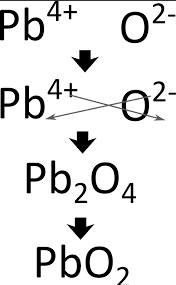
(A) Metallic oxides which on treatment with dilute acids produce hydrogen peroxide are called peroxides. All peroxides contain a peroxide ion $(O_2)^{2-}$ having the structure $-O-O-$.
$PbO_2$ does not contain a peroxide ion $(O_2)^{2-}$ and it cannot be classified as a peroxide.
$PbO_2$ contains $O^{2-}$ ions and the oxidation state of $Pb$ is $+4$,whereas $H_2O_2$,$SrO_2$,and $BaO_2$ contain $[O-O]^{2-}$ ions (peroxide ions).
Thus,option $A$ is correct.
$PbO_2$ does not contain a peroxide ion $(O_2)^{2-}$ and it cannot be classified as a peroxide.
$PbO_2$ contains $O^{2-}$ ions and the oxidation state of $Pb$ is $+4$,whereas $H_2O_2$,$SrO_2$,and $BaO_2$ contain $[O-O]^{2-}$ ions (peroxide ions).
Thus,option $A$ is correct.
0 likes
View Solution111
MediumMCQ
$H_2O_2$ can be used as:
A
an oxidant
B
a reductant
C
an acid
D
All of these
Solution
(D) $H_2O_2$ acts as an oxidizing agent in both acidic and basic media,for example,$2Fe^{2+} + H_2O_2 + 2H^+ \rightarrow 2Fe^{3+} + 2H_2O$.
It acts as a reducing agent in the presence of strong oxidizing agents,for example,$2MnO_4^- + 6H^+ + 5H_2O_2 \rightarrow 2Mn^{2+} + 8H_2O + 5O_2$.
It also acts as a very weak acid in aqueous solution,dissociating as $H_2O_2 \rightleftharpoons H^+ + HO_2^-$. Therefore,it exhibits all these properties.
It acts as a reducing agent in the presence of strong oxidizing agents,for example,$2MnO_4^- + 6H^+ + 5H_2O_2 \rightarrow 2Mn^{2+} + 8H_2O + 5O_2$.
It also acts as a very weak acid in aqueous solution,dissociating as $H_2O_2 \rightleftharpoons H^+ + HO_2^-$. Therefore,it exhibits all these properties.
0 likes
View Solution112
DifficultMCQ
Which is not a method to prepare $H_2O_2$?
A
Oxidation of $2-$ethyl Anthraquinol
B
$H_2S_2O_7 \xrightarrow[Hydrolysis]{Complete}$
C
$BaO_2 \cdot 8H_2O \xrightarrow{H^{+} / H_2O}$
D
$K_2S_2O_8 \xrightarrow[Hydrolysis]{Complete}$
Solution
(B) The preparation of $H_2O_2$ involves several industrial and laboratory methods:
$1$. The oxidation of $2-$ethyl Anthraquinol is the standard industrial process for producing $H_2O_2$.
$2$. The reaction of $BaO_2 \cdot 8H_2O$ with dilute acid ($H_2SO_4$ or $H_3PO_4$) is a standard laboratory method.
$3$. The complete hydrolysis of peroxodisulphates like $K_2S_2O_8$ yields $H_2O_2$.
$4$. $H_2S_2O_7$ (Oleum) on hydrolysis produces $H_2SO_4$,not $H_2O_2$. Therefore,option $B$ is not a method to prepare $H_2O_2$.
$1$. The oxidation of $2-$ethyl Anthraquinol is the standard industrial process for producing $H_2O_2$.
$2$. The reaction of $BaO_2 \cdot 8H_2O$ with dilute acid ($H_2SO_4$ or $H_3PO_4$) is a standard laboratory method.
$3$. The complete hydrolysis of peroxodisulphates like $K_2S_2O_8$ yields $H_2O_2$.
$4$. $H_2S_2O_7$ (Oleum) on hydrolysis produces $H_2SO_4$,not $H_2O_2$. Therefore,option $B$ is not a method to prepare $H_2O_2$.
0 likes
View Solution113
MediumMCQ
Hydrolysis of peroxo-disulphuric acid $(H_2S_2O_8)$ gives
A
$O_2$
B
$H_2O$
C
$H_2O_2$
D
$H_2$
Solution
(C) The hydrolysis of peroxo-disulphuric acid $(H_2S_2O_8)$,commonly known as Marshall's acid,produces hydrogen peroxide $(H_2O_2)$ and sulphuric acid $(H_2SO_4)$.
The reaction proceeds in two steps:
$1. H_2S_2O_8 + H_2O \rightarrow H_2SO_4 + H_2SO_5$ (Peroxomonosulphuric acid or Caro's acid)
$2. H_2SO_5 + H_2O \rightarrow H_2SO_4 + H_2O_2$
Overall reaction: $H_2S_2O_8 + 2H_2O \rightarrow 2H_2SO_4 + H_2O_2$
The reaction proceeds in two steps:
$1. H_2S_2O_8 + H_2O \rightarrow H_2SO_4 + H_2SO_5$ (Peroxomonosulphuric acid or Caro's acid)
$2. H_2SO_5 + H_2O \rightarrow H_2SO_4 + H_2O_2$
Overall reaction: $H_2S_2O_8 + 2H_2O \rightarrow 2H_2SO_4 + H_2O_2$
0 likes
View Solution114
DifficultMCQ
Which is the correct order of stability for the given oxygen species?
A
$Peroxide > Oxide > Superoxide$
B
$Oxide > Peroxide > Superoxide$
C
$Superoxide > Peroxide > Oxide$
D
$Superoxide = Peroxide = Oxide$
Solution
(B) The stability of oxygen species depends on the bond order and the charge density. The oxide ion $(O^{2-})$ is the most stable due to its closed-shell configuration. The peroxide ion $(O_2^{2-})$ has a bond order of $1$,and the superoxide ion $(O_2^-)$ has a bond order of $1.5$. However,in terms of thermodynamic stability in the presence of alkali metals,the order is $Oxide > Peroxide > Superoxide$.
0 likes
View Solution115
MediumMCQ
Which statement is false about $H_2O_2$?
A
Acts as both oxidizing and reducing agents
B
Two $OH$ bonds lie in the same plane
C
Very pale blue liquid
D
It can be oxidized by ozone
Solution
(B) $H_2O_2$ is a pale blue liquid and it can be oxidized by ozone to $O_2$.
$H_2O_2$ acts as both an oxidizing and a reducing agent in different chemical reactions.
Due to its non-planar,open-book structure,the two $OH$ bonds do not lie in the same plane.
Therefore,the statement that the two $OH$ bonds lie in the same plane is false.
$H_2O_2$ acts as both an oxidizing and a reducing agent in different chemical reactions.
Due to its non-planar,open-book structure,the two $OH$ bonds do not lie in the same plane.
Therefore,the statement that the two $OH$ bonds lie in the same plane is false.
0 likes
View Solution116
DifficultMCQ
$6.8 \, g$ of $H_2O_2$ is dissolved in $0.2 \, L$ of solution. Then the solution will be labelled as ............. $V$ volume strength.
A
$22.4$
B
$5.6$
C
$10$
D
$3$
Solution
(B) $1$. Calculate the molarity $(M)$ of the $H_2O_2$ solution:
$M = \frac{\text{mass of } H_2O_2}{\text{molar mass of } H_2O_2 \times \text{volume of solution in } L}$
$M = \frac{6.8 \, g}{34 \, g/mol \times 0.2 \, L} = \frac{6.8}{6.8} = 1 \, M$
$2$. Use the relation between volume strength and molarity:
$\text{Volume strength} = M \times 11.2$
$\text{Volume strength} = 1 \times 11.2 = 11.2 \, V$
$3$. Re-evaluating the options provided,there seems to be a discrepancy. However,if we consider the calculation $11.2 \, V$,none of the options match exactly. Given the standard context of such problems,if the volume was $0.4 \, L$,the answer would be $5.6 \, V$. Based on the provided values,the calculated result is $11.2 \, V$.
$M = \frac{\text{mass of } H_2O_2}{\text{molar mass of } H_2O_2 \times \text{volume of solution in } L}$
$M = \frac{6.8 \, g}{34 \, g/mol \times 0.2 \, L} = \frac{6.8}{6.8} = 1 \, M$
$2$. Use the relation between volume strength and molarity:
$\text{Volume strength} = M \times 11.2$
$\text{Volume strength} = 1 \times 11.2 = 11.2 \, V$
$3$. Re-evaluating the options provided,there seems to be a discrepancy. However,if we consider the calculation $11.2 \, V$,none of the options match exactly. Given the standard context of such problems,if the volume was $0.4 \, L$,the answer would be $5.6 \, V$. Based on the provided values,the calculated result is $11.2 \, V$.
0 likes
View Solution117
EasyMCQ
Which of the following is not used as a bleaching agent in the presence of moisture?
A
$H_2O_2$
B
$SO_2$
C
$O_3$
D
$Cl_2 + H_2O$
Solution
(B) Bleaching agents work by releasing nascent oxygen or by reduction.
$H_2O_2$ acts as a bleaching agent by releasing nascent oxygen: $H_2O_2 \rightarrow H_2O + [O]$.
$O_3$ acts as a bleaching agent by releasing nascent oxygen: $O_3 \rightarrow O_2 + [O]$.
$Cl_2$ in the presence of moisture produces nascent oxygen: $Cl_2 + H_2O \rightarrow 2HCl + [O]$.
$SO_2$ acts as a bleaching agent by reduction,but it is typically used for bleaching delicate materials like wool and silk.
However,in the context of standard chemistry questions regarding common bleaching agents,all the listed options are actually used as bleaching agents.
Given the standard curriculum,if one must be chosen as 'not used' in a specific context,it is often a trick question; however,all four are technically bleaching agents.
Assuming the question implies which one is not a permanent bleaching agent or acts differently,$SO_2$ is a reducing agent,while the others are oxidizing agents.
Since all are bleaching agents,this question is technically flawed,but $SO_2$ is the most distinct due to its reducing nature.
$H_2O_2$ acts as a bleaching agent by releasing nascent oxygen: $H_2O_2 \rightarrow H_2O + [O]$.
$O_3$ acts as a bleaching agent by releasing nascent oxygen: $O_3 \rightarrow O_2 + [O]$.
$Cl_2$ in the presence of moisture produces nascent oxygen: $Cl_2 + H_2O \rightarrow 2HCl + [O]$.
$SO_2$ acts as a bleaching agent by reduction,but it is typically used for bleaching delicate materials like wool and silk.
However,in the context of standard chemistry questions regarding common bleaching agents,all the listed options are actually used as bleaching agents.
Given the standard curriculum,if one must be chosen as 'not used' in a specific context,it is often a trick question; however,all four are technically bleaching agents.
Assuming the question implies which one is not a permanent bleaching agent or acts differently,$SO_2$ is a reducing agent,while the others are oxidizing agents.
Since all are bleaching agents,this question is technically flawed,but $SO_2$ is the most distinct due to its reducing nature.
0 likes
View Solution118
DifficultMCQ
Which of the following can produce $H_2O_2$?
A
Hydrolysis of $H_2S_2O_8$
B
Electrolysis of concentrated $H_2SO_4$
C
Merck's process
D
All of these
Solution
(D) The production of $H_2O_2$ can be achieved through several methods:
$1$. Hydrolysis of $H_2S_2O_8$ (peroxodisulfuric acid): $H_2S_2O_8 + 2H_2O \rightarrow 2H_2SO_4 + H_2O_2$.
$2$. Electrolysis of concentrated $H_2SO_4$: This process yields peroxodisulfuric acid,which upon hydrolysis gives $H_2O_2$.
$3$. Merck's process: This involves the reaction of barium peroxide $(BaO_2)$ with dilute sulfuric acid $(H_2SO_4)$ to produce $H_2O_2$ and barium sulfate $(BaSO_4)$: $BaO_2 + H_2SO_4 \rightarrow BaSO_4 + H_2O_2$.
Since all the given options are valid methods for the preparation of $H_2O_2$,the correct answer is $D$.
$1$. Hydrolysis of $H_2S_2O_8$ (peroxodisulfuric acid): $H_2S_2O_8 + 2H_2O \rightarrow 2H_2SO_4 + H_2O_2$.
$2$. Electrolysis of concentrated $H_2SO_4$: This process yields peroxodisulfuric acid,which upon hydrolysis gives $H_2O_2$.
$3$. Merck's process: This involves the reaction of barium peroxide $(BaO_2)$ with dilute sulfuric acid $(H_2SO_4)$ to produce $H_2O_2$ and barium sulfate $(BaSO_4)$: $BaO_2 + H_2SO_4 \rightarrow BaSO_4 + H_2O_2$.
Since all the given options are valid methods for the preparation of $H_2O_2$,the correct answer is $D$.
0 likes
View Solution119
MediumMCQ
The last drop of water can be removed from $H_2O_2$ by
A
boiling
B
evaporation
C
fractional distillation
D
fractional crystallization
Solution
(D) $H_2O_2$ is highly unstable and decomposes upon heating. Therefore,it cannot be purified by boiling or simple distillation. The last traces of water are removed by fractional crystallization,where the mixture is cooled to allow $H_2O_2$ to crystallize out,leaving the impurities behind.
0 likes
View Solution120
EasyMCQ
$H_2O_2$ in basic medium reduces $I_2$ to form:
A
$I^{-}$
B
$IO_3^-$
C
$I_3^-$
D
$IO_4^-$
Solution
(A) In a basic medium,$H_2O_2$ acts as a reducing agent and reduces $I_2$ to iodide ions $(I^{-})$.
The balanced chemical equation for the reaction is:
$I_{2(s)} + H_2O_{2(aq)} + 2OH^{-}_{(aq)} \rightarrow 2I^{-}_{(aq)} + 2H_2O_{(l)} + O_{2(g)}$
Thus,the correct product is $I^{-}$.
The balanced chemical equation for the reaction is:
$I_{2(s)} + H_2O_{2(aq)} + 2OH^{-}_{(aq)} \rightarrow 2I^{-}_{(aq)} + 2H_2O_{(l)} + O_{2(g)}$
Thus,the correct product is $I^{-}$.
0 likes
View Solution121
MediumMCQ
$H_2O_2$ reacts as a reducing agent with:
$(I)$ $KMnO_4$
$(II)$ $K_2Cr_2O_7$
$(III)$ $Ag_2O$
$(IV)$ $HNO_3$
$(I)$ $KMnO_4$
$(II)$ $K_2Cr_2O_7$
$(III)$ $Ag_2O$
$(IV)$ $HNO_3$
A
$I, II$
B
$I, II, IV$
C
$I, II, III$
D
$I, II, III, IV$
Solution
(C) $H_2O_2$ acts as a reducing agent when it reacts with strong oxidizing agents,where it gets oxidized to $O_2$.
$1$. With $KMnO_4$ in acidic medium: $2KMnO_4 + 3H_2SO_4 + 5H_2O_2 \rightarrow K_2SO_4 + 2MnSO_4 + 8H_2O + 5O_2$.
$2$. With $K_2Cr_2O_7$ in acidic medium: $K_2Cr_2O_7 + 4H_2SO_4 + 3H_2O_2 \rightarrow K_2SO_4 + Cr_2(SO_4)_3 + 7H_2O + 3O_2$.
$3$. With $Ag_2O$: $Ag_2O + H_2O_2 \rightarrow 2Ag + H_2O + O_2$.
$HNO_3$ is an oxidizing agent,but $H_2O_2$ does not typically act as a reducing agent against it in standard conditions; rather,it is often used to reduce higher oxidation states. However,in the context of common textbook examples for $H_2O_2$ as a reducing agent,$I, II,$ and $III$ are the standard reactions.
$1$. With $KMnO_4$ in acidic medium: $2KMnO_4 + 3H_2SO_4 + 5H_2O_2 \rightarrow K_2SO_4 + 2MnSO_4 + 8H_2O + 5O_2$.
$2$. With $K_2Cr_2O_7$ in acidic medium: $K_2Cr_2O_7 + 4H_2SO_4 + 3H_2O_2 \rightarrow K_2SO_4 + Cr_2(SO_4)_3 + 7H_2O + 3O_2$.
$3$. With $Ag_2O$: $Ag_2O + H_2O_2 \rightarrow 2Ag + H_2O + O_2$.
$HNO_3$ is an oxidizing agent,but $H_2O_2$ does not typically act as a reducing agent against it in standard conditions; rather,it is often used to reduce higher oxidation states. However,in the context of common textbook examples for $H_2O_2$ as a reducing agent,$I, II,$ and $III$ are the standard reactions.
0 likes
View Solution122
MediumMCQ
Which of the following reactions is incorrect?
A
$Ag_2O + H_2O_2 \to 2Ag + H_2O + O_2$
B
$PbS + 4H_2O_2 \to PbSO_4 + 4H_2O$
C
$Fe^{2+} + H_2O_2 \xrightarrow{\text{basic}} Fe^{3+} + 2OH^-$
D
$Mn^{2+} + H_2O_2 \xrightarrow{\text{basic}} Mn^{4+} + 2OH^-$
Solution
(C) $1$. The reaction $Ag_2O + H_2O_2 \to 2Ag + H_2O + O_2$ is a correct redox reaction where $H_2O_2$ acts as a reducing agent.
$2$. The reaction $PbS + 4H_2O_2 \to PbSO_4 + 4H_2O$ is a correct redox reaction where $H_2O_2$ acts as an oxidizing agent.
$3$. The reaction $Fe^{2+} + H_2O_2 \xrightarrow{\text{basic}} Fe^{3+} + 2OH^-$ is incorrect because in a basic medium,$Fe^{2+}$ is oxidized to $Fe^{3+}$ by $H_2O_2$,but the stoichiometry and charge balance are not represented correctly as $2Fe^{2+} + H_2O_2 \to 2Fe^{3+} + 2OH^-$.
$4$. The reaction $Mn^{2+} + H_2O_2 \xrightarrow{\text{basic}} Mn^{4+} + 2OH^-$ is a correct representation of the oxidation of $Mn^{2+}$ to $MnO_2$ $(Mn^{4+})$ in basic medium.
$2$. The reaction $PbS + 4H_2O_2 \to PbSO_4 + 4H_2O$ is a correct redox reaction where $H_2O_2$ acts as an oxidizing agent.
$3$. The reaction $Fe^{2+} + H_2O_2 \xrightarrow{\text{basic}} Fe^{3+} + 2OH^-$ is incorrect because in a basic medium,$Fe^{2+}$ is oxidized to $Fe^{3+}$ by $H_2O_2$,but the stoichiometry and charge balance are not represented correctly as $2Fe^{2+} + H_2O_2 \to 2Fe^{3+} + 2OH^-$.
$4$. The reaction $Mn^{2+} + H_2O_2 \xrightarrow{\text{basic}} Mn^{4+} + 2OH^-$ is a correct representation of the oxidation of $Mn^{2+}$ to $MnO_2$ $(Mn^{4+})$ in basic medium.
0 likes
View Solution123
DifficultMCQ
In which of the following reactions,hydrogen peroxide acts as an oxidizing agent?
A
$HOCl + H_2O_2 \to H_3O^{+} + Cl^{-} + O_2$
B
$I_2 + H_2O_2 + 2OH^{-} \to 2I^{-} + 2H_2O + O_2$
C
$2MnO_4^- + 3H_2O_2 \to 2MnO_2 + 3O_2 + 2H_2O + 2OH^{-}$
D
$PbS + 4H_2O_2 \to PbSO_4 + 4H_2O$
Solution
(D) An oxidizing agent is a substance that gains electrons and gets reduced in a chemical reaction.
In the reaction $PbS + 4H_2O_2 \to PbSO_4 + 4H_2O$:
$1$. The oxidation state of sulfur $(S)$ in $PbS$ changes from $-2$ to $+6$ in $PbSO_4$. This is an oxidation process.
$2$. The oxidation state of oxygen in $H_2O_2$ changes from $-1$ to $-2$ in $H_2O$. This is a reduction process.
Since $H_2O_2$ is reduced,it acts as an oxidizing agent.
In options $A$,$B$,and $C$,$H_2O_2$ acts as a reducing agent because the oxygen in $H_2O_2$ is oxidized from $-1$ to $0$ (in $O_2$).
In the reaction $PbS + 4H_2O_2 \to PbSO_4 + 4H_2O$:
$1$. The oxidation state of sulfur $(S)$ in $PbS$ changes from $-2$ to $+6$ in $PbSO_4$. This is an oxidation process.
$2$. The oxidation state of oxygen in $H_2O_2$ changes from $-1$ to $-2$ in $H_2O$. This is a reduction process.
Since $H_2O_2$ is reduced,it acts as an oxidizing agent.
In options $A$,$B$,and $C$,$H_2O_2$ acts as a reducing agent because the oxygen in $H_2O_2$ is oxidized from $-1$ to $0$ (in $O_2$).
0 likes
View Solution124
DifficultMCQ
Hydrogen peroxide acts both as an oxidising and as a reducing agent depending upon the nature of the reacting species. In which of the following cases $H_2O_2$ acts as a reducing agent in acidic medium?
A
$MnO_4^-$
B
$Cr_2O_7^{2-}$
C
$SO_3^{2-}$
D
$KI$
Solution
(A) $H_2O_2$ acts as a reducing agent when it reacts with strong oxidising agents. In an acidic medium,$H_2O_2$ reduces $MnO_4^-$ to $Mn^{2+}$.
The balanced chemical equation is:
$2KMnO_4 + 3H_2SO_4 + 5H_2O_2 \to K_2SO_4 + 2MnSO_4 + 8H_2O + 5O_2$
In this reaction,the oxidation state of $Mn$ changes from $+7$ to $+2$,and $H_2O_2$ is oxidized to $O_2$.
The balanced chemical equation is:
$2KMnO_4 + 3H_2SO_4 + 5H_2O_2 \to K_2SO_4 + 2MnSO_4 + 8H_2O + 5O_2$
In this reaction,the oxidation state of $Mn$ changes from $+7$ to $+2$,and $H_2O_2$ is oxidized to $O_2$.
0 likes
View Solution125
MediumMCQ
The chemical nature of hydrogen peroxide is
A
oxidising agent in acidic medium,but not in basic medium
B
reducing agent in basic medium but not in acidic medium
C
oxidising and reducing agent in acidic medium but not in basic medium
D
oxidising and reducing agent in both acidic and basic medium
Solution
(D) Correct option: $D$. Hydrogen peroxide $(H_{2}O_{2})$ acts as both an oxidising and a reducing agent in both acidic and basic media.
$H_{2}O_{2}$ as an oxidant:
In acidic medium: $H_{2}O_{2} + 2H^{+} + 2e^{-} \longrightarrow 2H_{2}O$
In basic medium: $H_{2}O_{2} + 2e^{-} \longrightarrow 2OH^{-}$
$H_{2}O_{2}$ as a reductant:
In acidic medium: $H_{2}O_{2} \longrightarrow O_{2} + 2H^{+} + 2e^{-}$
In basic medium: $H_{2}O_{2} + 2OH^{-} \longrightarrow 2H_{2}O + O_{2} + 2e^{-}$
$H_{2}O_{2}$ as an oxidant:
In acidic medium: $H_{2}O_{2} + 2H^{+} + 2e^{-} \longrightarrow 2H_{2}O$
In basic medium: $H_{2}O_{2} + 2e^{-} \longrightarrow 2OH^{-}$
$H_{2}O_{2}$ as a reductant:
In acidic medium: $H_{2}O_{2} \longrightarrow O_{2} + 2H^{+} + 2e^{-}$
In basic medium: $H_{2}O_{2} + 2OH^{-} \longrightarrow 2H_{2}O + O_{2} + 2e^{-}$
0 likes
View Solution126
MediumMCQ
The volume strength of $1 \, M \, H_2O_2$ is : (Molar mass of $H_2O_2 = 34 \, g \, mol^{-1}$)
A
$5.6$
B
$16.8$
C
$11.35$
D
$22.4$
Solution
(C) The relationship between volume strength and molarity $(M)$ of $H_2O_2$ is given by the formula: $\text{Volume strength} = 11.35 \times M$.
Given $M = 1 \, M$.
Therefore,$\text{Volume strength} = 11.35 \times 1 = 11.35$.
Given $M = 1 \, M$.
Therefore,$\text{Volume strength} = 11.35 \times 1 = 11.35$.
0 likes
View Solution127
DifficultMCQ
The strength of $11.2$ volume solution of $H_2O_2$ is: [Given that molar mass of $H = 1 \ g \ mol^{-1}$ and $O = 16 \ g \ mol^{-1}$]
A
$3.4$
B
$1.7$
C
$13.6$
D
$34$
Solution
(A) The decomposition reaction of $H_2O_2$ is: $2H_2O_2 \to 2H_2O + O_2 \uparrow$
From the stoichiometry,$2 \times 34 \ g = 68 \ g$ of $H_2O_2$ produces $22.4 \ L$ of $O_2$ at $STP$.
Therefore,$11.2 \ L$ of $O_2$ is produced by $\frac{68 \ g}{22.4 \ L} \times 11.2 \ L = 34 \ g$ of $H_2O_2$.
This means $34 \ g$ of $H_2O_2$ is present in $1 \ L$ $(1000 \ mL)$ of the solution.
Strength in $g/L = 34 \ g/L$.
Percentage strength = $\frac{\text{Strength in } g/L}{10} = \frac{34}{10} = 3.4\%$.
From the stoichiometry,$2 \times 34 \ g = 68 \ g$ of $H_2O_2$ produces $22.4 \ L$ of $O_2$ at $STP$.
Therefore,$11.2 \ L$ of $O_2$ is produced by $\frac{68 \ g}{22.4 \ L} \times 11.2 \ L = 34 \ g$ of $H_2O_2$.
This means $34 \ g$ of $H_2O_2$ is present in $1 \ L$ $(1000 \ mL)$ of the solution.
Strength in $g/L = 34 \ g/L$.
Percentage strength = $\frac{\text{Strength in } g/L}{10} = \frac{34}{10} = 3.4\%$.
0 likes
View Solution128
MediumMCQ
Perhydrol is an aqueous solution of
A
Bleaching powder
B
Ozone
C
$KMnO_4$
D
$H_2O_2$
Solution
(D) Perhydrol is the commercial name for a $30\%$ (by weight) aqueous solution of hydrogen peroxide $(H_2O_2)$. It is used as a laboratory reagent and in various industrial applications.
0 likes
View Solution129
MediumMCQ
$3.4 \ g$ of $H_2O_2$ is present in its $112 \ mL$ solution. The volume strength of this solution is ....... $V$.
A
$0.224$
B
$20$
C
$5$
D
$10$
Solution
(D) First,calculate the number of moles of $H_2O_2$: $n = \frac{\text{mass}}{\text{molar mass}} = \frac{3.4 \ g}{34 \ g/mol} = 0.1 \ mol$.
Next,calculate the molarity $(M)$ of the solution: $M = \frac{n}{V(L)} = \frac{0.1 \ mol}{112 \times 10^{-3} \ L} = \frac{0.1}{0.112} \approx 0.8928 \ M$.
The relationship between volume strength and molarity is: $\text{Volume strength} = M \times 11.2$.
Therefore,$\text{Volume strength} = \frac{0.1}{0.112} \times 11.2 = \frac{0.1 \times 11.2}{0.112} = \frac{1.12}{0.112} = 10 \ V$.
Next,calculate the molarity $(M)$ of the solution: $M = \frac{n}{V(L)} = \frac{0.1 \ mol}{112 \times 10^{-3} \ L} = \frac{0.1}{0.112} \approx 0.8928 \ M$.
The relationship between volume strength and molarity is: $\text{Volume strength} = M \times 11.2$.
Therefore,$\text{Volume strength} = \frac{0.1}{0.112} \times 11.2 = \frac{0.1 \times 11.2}{0.112} = \frac{1.12}{0.112} = 10 \ V$.
0 likes
View Solution130
AdvancedMCQ
$O_2F_2$ is an unstable yellow-orange solid and $H_2O_2$ is a colourless liquid. Both have an $O-O$ bond. The $O-O$ bond length in $H_2O_2$ and $O_2F_2$ respectively is:
A
$1.22 \, \mathring{A}, \, 1.48 \, \mathring{A}$
B
$1.48 \, \mathring{A}, \, 1.22 \, \mathring{A}$
C
$1.22 \, \mathring{A}, \, 1.22 \, \mathring{A}$
D
$1.48 \, \mathring{A}, \, 1.48 \, \mathring{A}$
Solution
(B) In $H_2O_2$,the $O-O$ bond length is $1.48 \, \mathring{A}$.
In $O_2F_2$,due to the high electronegativity of fluorine,the $O-F$ bond has more $p$-character,which according to Bent's Rule,increases the $s$-character in the $O-O$ bond.
Greater $s$-character leads to a shorter bond length.
Thus,the $O-O$ bond length in $O_2F_2$ is $1.22 \, \mathring{A}$.
Therefore,the bond lengths for $H_2O_2$ and $O_2F_2$ are $1.48 \, \mathring{A}$ and $1.22 \, \mathring{A}$ respectively.
In $O_2F_2$,due to the high electronegativity of fluorine,the $O-F$ bond has more $p$-character,which according to Bent's Rule,increases the $s$-character in the $O-O$ bond.
Greater $s$-character leads to a shorter bond length.
Thus,the $O-O$ bond length in $O_2F_2$ is $1.22 \, \mathring{A}$.
Therefore,the bond lengths for $H_2O_2$ and $O_2F_2$ are $1.48 \, \mathring{A}$ and $1.22 \, \mathring{A}$ respectively.
0 likes
View Solution131
AdvancedMCQ
Hydrolysis of one mole of peroxodi-sulphuric acid produces
A
two moles of sulphuric acid
B
two moles of peroxomono-sulphuric acid
C
one mole of sulphuric acid,one mole of peroxomono-sulphuric acid
D
one mole of sulphuric acid,one mole of peroxomono-sulphuric acid and one mole of hydrogen peroxide
Solution
(C) $H_2S_2O_8 + H_2O \to H_2SO_4 + H_2SO_5$
The hydrolysis of $H_2S_2O_8$ (peroxodi-sulphuric acid) yields one mole of $H_2SO_4$ (sulphuric acid) and one mole of $H_2SO_5$ (peroxomono-sulphuric acid).
The hydrolysis of $H_2S_2O_8$ (peroxodi-sulphuric acid) yields one mole of $H_2SO_4$ (sulphuric acid) and one mole of $H_2SO_5$ (peroxomono-sulphuric acid).
0 likes
View Solution132
AdvancedMCQ
The dipole moment of $H_2O_2$ is more than that of $H_2O$,but $H_2O_2$ is not a good solvent because:
A
It has a very high dielectric constant so that ionic compounds cannot be dissolved in it.
B
It does not act as an oxidising agent.
C
It acts as a reducing agent.
D
It dissociates easily and acts as an oxidising agent in chemical reactions.
Solution
(D) $H_2O_2$ is thermally unstable and it decomposes easily according to the reaction: $H_2O_{2(l)} \to H_2O_{(l)} + \frac{1}{2}O_{2(g)}$.
Its decomposition is catalysed by trace amounts of impurities,such as alkali metals present in the glass of the vessel,which makes it unsuitable as a stable solvent.
Its decomposition is catalysed by trace amounts of impurities,such as alkali metals present in the glass of the vessel,which makes it unsuitable as a stable solvent.
0 likes
View Solution133
AdvancedMCQ
The correct increasing order of acidity is
A
$CO_2 > H_2O_2 > H_2O$
B
$H_2O < H_2O_2 < CO_2$
C
$H_2O < H_2O_2 > CO_2$
D
$H_2O_2 > CO_2 > H_2O$
Solution
(B) To determine the acidity,we compare the dissociation constants or the stability of the conjugate bases.
$H_2O$ is a very weak acid with a $pK_a$ of approximately $15.7$.
$H_2O_2$ is a stronger acid than $H_2O$ due to the inductive effect of the oxygen atom,with a $pK_a$ of approximately $11.6$.
$CO_2$ in water forms carbonic acid $(H_2CO_3)$,which is a stronger acid than $H_2O_2$,with a $pK_a$ of approximately $6.35$.
Therefore,the increasing order of acidity is $H_2O < H_2O_2 < CO_2$.
$H_2O$ is a very weak acid with a $pK_a$ of approximately $15.7$.
$H_2O_2$ is a stronger acid than $H_2O$ due to the inductive effect of the oxygen atom,with a $pK_a$ of approximately $11.6$.
$CO_2$ in water forms carbonic acid $(H_2CO_3)$,which is a stronger acid than $H_2O_2$,with a $pK_a$ of approximately $6.35$.
Therefore,the increasing order of acidity is $H_2O < H_2O_2 < CO_2$.
0 likes
View Solution134
AdvancedMCQ
In which of the following reactions does the product $NOT$ contain a 'Peroxy' linkage?
A
$2OF \xrightarrow{\text{Dimerisation}}$
B
$H_4P_2O_8 \xrightarrow{+ H_2O}$
C
$2Na \xrightarrow[\Delta]{\text{excess } O_2}$
D
None of these
Solution
(D) $A: 2OF \xrightarrow{\text{Dimerisation}} F-O-O-F$ (contains peroxy linkage).
$B: H_4P_2O_8 + H_2O \rightarrow 2H_3PO_4 + H_2O_2$ (contains peroxy linkage in $H_2O_2$).
$C: 2Na + \text{excess } O_2 \xrightarrow{\Delta} Na_2O_2$ ($Na^+ O^--O^- Na^+$,contains peroxy linkage).
Since all the given reactions produce compounds containing a peroxy linkage,the correct answer is $D$.
$B: H_4P_2O_8 + H_2O \rightarrow 2H_3PO_4 + H_2O_2$ (contains peroxy linkage in $H_2O_2$).
$C: 2Na + \text{excess } O_2 \xrightarrow{\Delta} Na_2O_2$ ($Na^+ O^--O^- Na^+$,contains peroxy linkage).
Since all the given reactions produce compounds containing a peroxy linkage,the correct answer is $D$.
0 likes
View Solution135
AdvancedMCQ
By which of the following methods,$H_2O_2$ cannot be synthesized?
A
Addition of ice cold $H_2SO_4$ on $BaO_2$
B
Addition of ice cold $H_2SO_4$ on $PbO_2$
C
Aerial oxidation of $2$-ethyl anthraquinol
D
Electrolysis of $(NH_4)_2SO_4$ at a high current density
Solution
(B) $H_2O_2$ is a peroxide. For its preparation,we require a peroxide source.
$1$. $BaO_2 + H_2SO_4 \rightarrow BaSO_4 + H_2O_2$ (This is a standard method).
$2$. $PbO_2$ is a dioxide,not a peroxide. The reaction $PbO_2 + H_2SO_4 \rightarrow PbSO_4 + H_2O + \frac{1}{2}O_2$ does not produce $H_2O_2$.
$3$. Aerial oxidation of $2$-ethyl anthraquinol is the industrial process for $H_2O_2$ production.
$4$. Electrolysis of $(NH_4)_2SO_4$ produces ammonium peroxodisulphate,which on hydrolysis yields $H_2O_2$.
$1$. $BaO_2 + H_2SO_4 \rightarrow BaSO_4 + H_2O_2$ (This is a standard method).
$2$. $PbO_2$ is a dioxide,not a peroxide. The reaction $PbO_2 + H_2SO_4 \rightarrow PbSO_4 + H_2O + \frac{1}{2}O_2$ does not produce $H_2O_2$.
$3$. Aerial oxidation of $2$-ethyl anthraquinol is the industrial process for $H_2O_2$ production.
$4$. Electrolysis of $(NH_4)_2SO_4$ produces ammonium peroxodisulphate,which on hydrolysis yields $H_2O_2$.
0 likes
View Solution136
AdvancedMCQ
Predict the correct product when $Cl_2$ is passed through a $H^{18}O-^{18}OH$ solution.
A
$H^{+} + Cl^{-} + ^{18}O_2$ (both oxygen atoms are $^{18}O$)
B
$HO^{18}Cl$ and $HCl^{18}O_2$ (all oxygen atoms are $^{18}O$)
C
$HCl^{18}O_4$ and $HCl$ (all oxygen atoms are $^{18}O$)
D
$Cl_2^{18}O$ and $H_2^{18}O$ (all oxygen atoms are $^{18}O$)
Solution
(A) The reaction of chlorine with hydrogen peroxide $(H_2O_2)$ is an oxidation-reduction reaction where $Cl_2$ acts as an oxidizing agent.
The chemical equation is: $H_2^{18}O_2 + Cl_2 \rightarrow 2HCl + ^{18}O_2$.
In this reaction,the oxygen atoms in $H_2^{18}O_2$ are released as molecular oxygen $(^{18}O_2)$,while chlorine is reduced to chloride ions $(Cl^-)$ in the form of $HCl$.
The chemical equation is: $H_2^{18}O_2 + Cl_2 \rightarrow 2HCl + ^{18}O_2$.
In this reaction,the oxygen atoms in $H_2^{18}O_2$ are released as molecular oxygen $(^{18}O_2)$,while chlorine is reduced to chloride ions $(Cl^-)$ in the form of $HCl$.
0 likes
View Solution137
EasyMCQ
Which of the following is the common name for peroxymonosulfuric acid?
A
Marshall's acid
B
Caro's acid
C
Sulfuric acid
D
None of these
Solution
(B) Peroxymonosulfuric acid,with the chemical formula $H_2SO_5$,is commonly known as $Caro's$ acid.
0 likes
View Solution138
EasyMCQ
What is formed by the reaction of water with sodium peroxide?
A
$H_2$
B
$N_2$
C
$O_2$
D
$CO_2$
Solution
(C) The reaction of sodium peroxide $(Na_2O_2)$ with water $(H_2O)$ produces sodium hydroxide $(NaOH)$ and oxygen gas $(O_2)$.
The balanced chemical equation is: $2Na_2O_2 + 2H_2O \to 4NaOH + O_2$.
The balanced chemical equation is: $2Na_2O_2 + 2H_2O \to 4NaOH + O_2$.
0 likes
View Solution139
EasyMCQ
Which of the following is not a peroxo acid?
A
$CF_3CO_3H$
B
$H_2S_2O_8$
C
$H_2S_2O_7$
D
$H_2SO_5$
Solution
(C) $H_2S_2O_7$ (Oleum) contains an $S-O-S$ linkage and does not contain a peroxo $(O-O)$ linkage.
$CF_3CO_3H$ (Peroxytrifluoroacetic acid),$H_2S_2O_8$ (Peroxydisulfuric acid),and $H_2SO_5$ (Peroxymonosulfuric acid) all contain peroxo linkages.
$CF_3CO_3H$ (Peroxytrifluoroacetic acid),$H_2S_2O_8$ (Peroxydisulfuric acid),and $H_2SO_5$ (Peroxymonosulfuric acid) all contain peroxo linkages.
0 likes
View Solution140
EasyMCQ
Which one of the following does $NOT$ readily give oxygen upon heating?
A
Lead nitrate
B
Potassium chlorate
C
Mercury oxide
D
Manganese dioxide
Solution
(D) Heating $Pb(NO_3)_2$ gives $PbO$,$NO_2$,and $O_2$.
Heating $KClO_3$ gives $KCl$ and $O_2$.
Heating $HgO$ gives $Hg$ and $O_2$.
$MnO_2$ is a stable oxide and does not decompose to give $O_2$ upon simple heating; it is often used as a catalyst for the decomposition of $KClO_3$.
Heating $KClO_3$ gives $KCl$ and $O_2$.
Heating $HgO$ gives $Hg$ and $O_2$.
$MnO_2$ is a stable oxide and does not decompose to give $O_2$ upon simple heating; it is often used as a catalyst for the decomposition of $KClO_3$.
0 likes
View Solution141
EasyMCQ
In the reaction of $BaO_2$ with dilute $H_2SO_4$,what are the oxidation states of the most electronegative element in the products?
A
$0$ and $-1$
B
$-1$ and $-2$
C
$-2$ and $0$
D
$-2$ and $-1$
Solution
(D) The chemical reaction is: $BaO_2 + H_2SO_4 \to BaSO_4 + H_2O_2$.
The most electronegative element in the products is oxygen $(O)$.
In $BaSO_4$,the oxidation state of oxygen is $-2$.
In $H_2O_2$,the oxidation state of oxygen is $-1$.
The most electronegative element in the products is oxygen $(O)$.
In $BaSO_4$,the oxidation state of oxygen is $-2$.
In $H_2O_2$,the oxidation state of oxygen is $-1$.
0 likes
View Solution142
MediumMCQ
Which of the following compounds is a peroxide?
A
$KO_2$
B
$BaO_2$
C
$MnO_2$
D
$NO_2$
Solution
(B) peroxide contains the peroxide ion,$O_2^{2-}$,which features an $O-O$ single bond.
In $BaO_2$,the oxidation state of $Ba$ is $+2$,so the $O_2$ unit must have a charge of $-2$,which corresponds to the peroxide ion $(O_2^{2-})$.
$KO_2$ is a superoxide $(O_2^-)$.
$MnO_2$ and $NO_2$ are dioxides where oxygen is in the $-2$ oxidation state.
In $BaO_2$,the oxidation state of $Ba$ is $+2$,so the $O_2$ unit must have a charge of $-2$,which corresponds to the peroxide ion $(O_2^{2-})$.
$KO_2$ is a superoxide $(O_2^-)$.
$MnO_2$ and $NO_2$ are dioxides where oxygen is in the $-2$ oxidation state.
0 likes
View Solution143
MediumMCQ
$H_2O_2$ is always stored in black bottles because
A
It is highly stable
B
Its enthalpy of decomposition is high
C
It undergoes auto-oxidation on prolonged standing
D
None of these
Solution
(C) On prolonged standing,hydrogen peroxide undergoes auto-oxidation or disproportionation as follows:
$2H_2O_2 \rightarrow 2H_2O + O_2$
Light acts as a catalyst for this decomposition reaction.
Hence,hydrogen peroxide is always stored in black bottles,which cuts off the light and suppresses the auto-oxidation process.
$2H_2O_2 \rightarrow 2H_2O + O_2$
Light acts as a catalyst for this decomposition reaction.
Hence,hydrogen peroxide is always stored in black bottles,which cuts off the light and suppresses the auto-oxidation process.
0 likes
View Solution144
MediumMCQ
Select the correct statement.
A
Calcium bicarbonate is responsible for permanent hardness of water.
B
$H_2O_2$ is diamagnetic.
C
Anion exchange is used in calgon method for removal of hardness of water.
D
All of them.
Solution
(B) $1$. Calcium bicarbonate $(Ca(HCO_3)_2)$ is responsible for temporary hardness,not permanent hardness. So,option $A$ is incorrect.
$2$. Hydrogen peroxide $(H_2O_2)$ has a non-planar structure and all its electrons are paired,making it diamagnetic. So,option $B$ is correct.
$3$. The Calgon method uses sodium hexametaphosphate $(Na_6P_6O_{18})$ to sequester $Ca^{2+}$ and $Mg^{2+}$ ions,not anion exchange. So,option $C$ is incorrect.
$4$. Since only option $B$ is correct,option $D$ is incorrect.
$2$. Hydrogen peroxide $(H_2O_2)$ has a non-planar structure and all its electrons are paired,making it diamagnetic. So,option $B$ is correct.
$3$. The Calgon method uses sodium hexametaphosphate $(Na_6P_6O_{18})$ to sequester $Ca^{2+}$ and $Mg^{2+}$ ions,not anion exchange. So,option $C$ is incorrect.
$4$. Since only option $B$ is correct,option $D$ is incorrect.
0 likes
View Solution145
MediumMCQ
Which of the following is a true structure of $H_2O_2$?
A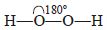
B
C
D
Solution
(B) The structure of $H_2O_2$ is not planar; it adopts an open book structure to minimize repulsion between the lone pairs on the oxygen atoms.
In the gas phase,the $O-O-H$ bond angle is $101.5^{\circ}$,and the $O-O$ single bond distance is $1.48 \mathring{A}$.
This non-planar geometry is essential for the stability of the molecule.
In the gas phase,the $O-O-H$ bond angle is $101.5^{\circ}$,and the $O-O$ single bond distance is $1.48 \mathring{A}$.
This non-planar geometry is essential for the stability of the molecule.
0 likes
View Solution146
MediumMCQ
$H_2O_2$ is always stored in wax-lined black bottles because:
A
It is highly unstable
B
Its enthalpy of decomposition is high
C
It undergoes decomposition in the presence of light
D
None of these
Solution
(C) $H_2O_2$ (Hydrogen peroxide) is a light-sensitive compound. It undergoes decomposition into water and oxygen in the presence of light: $2H_2O_2(aq) \rightarrow 2H_2O(l) + O_2(g)$. To prevent this photochemical decomposition,it is stored in dark-colored (black) bottles. Additionally,it is often stored in wax-lined glass bottles to prevent the catalytic decomposition caused by rough glass surfaces.
0 likes
View Solution147
DifficultMCQ
$H_2O_2$ restores the color of old lead paintings,blackened by the action of $H_2S$ gas by:
A
Converting $PbO_2$ to $Pb$
B
By oxidising $PbS$ to $PbSO_4$
C
Converting $PbCO_3$ to $Pb$
D
Oxidising $PbSO_3$ to $PbSO_4$
Solution
(B) Old lead paintings often contain lead pigments that react with atmospheric $H_2S$ to form black lead sulfide $(PbS)$.
$H_2O_2$ acts as an oxidizing agent and converts the black $PbS$ into white lead sulfate $(PbSO_4)$.
The chemical reaction is: $PbS(s) + 4H_2O_2(aq) \rightarrow PbSO_4(s) + 4H_2O(l)$.
$H_2O_2$ acts as an oxidizing agent and converts the black $PbS$ into white lead sulfate $(PbSO_4)$.
The chemical reaction is: $PbS(s) + 4H_2O_2(aq) \rightarrow PbSO_4(s) + 4H_2O(l)$.
0 likes
View Solution148
MediumMCQ
The reaction $H_2S + H_2O_2 \to S + 2H_2O$ manifests
A
Acidic nature of $H_2O_2$
B
Alkaline nature of $H_2O_2$
C
Oxidising nature of $H_2O_2$
D
Reducing nature of $H_2O_2$
Solution
(C) In the reaction $H_2S + H_2O_2 \to S + 2H_2O$,the oxidation state of sulfur in $H_2S$ changes from $-2$ to $0$ (oxidation).
Simultaneously,the oxidation state of oxygen in $H_2O_2$ changes from $-1$ to $-2$ (reduction).
Since $H_2O_2$ undergoes reduction,it acts as an oxidizing agent.
Therefore,the reaction manifests the oxidizing nature of $H_2O_2$.
Hence,option $C$ is correct.
Simultaneously,the oxidation state of oxygen in $H_2O_2$ changes from $-1$ to $-2$ (reduction).
Since $H_2O_2$ undergoes reduction,it acts as an oxidizing agent.
Therefore,the reaction manifests the oxidizing nature of $H_2O_2$.
Hence,option $C$ is correct.
0 likes
View Solution149
MediumMCQ
Which of the following yields $H_2O_2$ upon hydrolysis?
A
$Na_2O_2$
B
$PbO_2$
C
$BaO_2$
D
Both $A$ and $C$
0 likes
View Solution150
DifficultMCQ
In which of the following reactions does $H_2O_2$ act as a reducing agent?
$(I)$ $H_2O_2 + 2H^{+} + 2e^- \to 2H_2O$
$(II)$ $H_2O_2 \to O_2 + 2H^{+} + 2e^-$
$(III)$ $H_2O_2 + 2e^- \to 2OH^{-}$
$(IV)$ $H_2O_2 + 2OH^{-} \to O_2 + 2H_2O + 2e^-$
$(I)$ $H_2O_2 + 2H^{+} + 2e^- \to 2H_2O$
$(II)$ $H_2O_2 \to O_2 + 2H^{+} + 2e^-$
$(III)$ $H_2O_2 + 2e^- \to 2OH^{-}$
$(IV)$ $H_2O_2 + 2OH^{-} \to O_2 + 2H_2O + 2e^-$
A
$I$ and $II$
B
$III$ and $IV$
C
$I$ and $III$
D
$II$ and $IV$
Solution
(D) reducing agent is a substance that loses electrons and undergoes oxidation.
In reaction $(II)$,$H_2O_2 \to O_2 + 2H^{+} + 2e^-$,$H_2O_2$ loses electrons and is oxidized,thus acting as a reducing agent.
In reaction $(IV)$,$H_2O_2 + 2OH^{-} \to O_2 + 2H_2O + 2e^-$,$H_2O_2$ loses electrons and is oxidized,thus acting as a reducing agent.
In reactions $(I)$ and $(III)$,$H_2O_2$ gains electrons and is reduced,acting as an oxidizing agent.
Therefore,$H_2O_2$ acts as a reducing agent in reactions $(II)$ and $(IV)$.
In reaction $(II)$,$H_2O_2 \to O_2 + 2H^{+} + 2e^-$,$H_2O_2$ loses electrons and is oxidized,thus acting as a reducing agent.
In reaction $(IV)$,$H_2O_2 + 2OH^{-} \to O_2 + 2H_2O + 2e^-$,$H_2O_2$ loses electrons and is oxidized,thus acting as a reducing agent.
In reactions $(I)$ and $(III)$,$H_2O_2$ gains electrons and is reduced,acting as an oxidizing agent.
Therefore,$H_2O_2$ acts as a reducing agent in reactions $(II)$ and $(IV)$.
0 likes
View SolutionHydrogen — Hydrogen peroxide · Frequently Asked Questions
1Are these Hydrogen questions useful for JEE and NEET?
Yes. All questions in this section are mapped to JEE Main and NEET exam patterns. Previous year questions from JEE Main, NEET, GUJCET and state-level exams are included with full solutions.
2Can I switch to Hindi or Gujarati for these questions?
Yes. Use the language tabs in the hero section or the sidebar to view the same questions and solutions in English, Hindi or Gujarati.
3How do I generate a question paper from this subtopic?
Use the Vedclass Exam Paper Generator — select the chapter and subtopic, set difficulty, and generate Sets A, B, C, D automatically. First 3 chapters of every subject are free.
Vedclass Products
For Students
Vedclass Test Series
Mock tests in real JEE/NEET style with performance analysis. 5-day free trial.
Start Free TrialFor Teachers
Exam Paper Generator
Generate Set A/B/C/D papers from this chapter in 2 minutes. 3 chapters free.
Try FreeFor Institutes
Online Exam Module
Live online exams with unlimited students, 360° analytics & white-label branding.
See DemoFor Teachers & Institutes
Generate a Hydrogen Exam Paper in 2 Minutes
Select subtopic & difficulty — Sets A, B, C, D auto-generated with No Repeat logic.
First 3 chapters of every subject are free — no payment required.