
A English
Ionisation energy Questions in English
Class 11 Chemistry · Classification of Elements and Periodicity in Properties · Ionisation energy
402+
Questions
English
Language
100%
With Solutions
Showing 44 of 402 questions in English
351
MediumMCQ
The first ionization enthalpies of $Na, Mg$ and $Si$ are respectively $496, 737$ and $786 \ kJ \ mol^{-1}$. What would be the first ionization enthalpy of $Al$ in $kJ \ mol^{-1}$?
A
$450$
B
$750$
C
$575$
D
$800$
Solution
(C) $Na, Mg, Al$ and $Si$ belong to the $3^{rd}$ period of the periodic table.
Generally,the first ionization enthalpy increases across a period due to an increase in effective nuclear charge.
However,$Mg$ $(3s^2)$ has a fully-filled $s$-orbital,making it more stable than $Al$ $(3s^2 3p^1)$.
Therefore,the first ionization enthalpy of $Al$ is lower than that of $Mg$ but higher than that of $Na$.
Given values: $Na = 496 \ kJ \ mol^{-1}$,$Mg = 737 \ kJ \ mol^{-1}$,$Si = 786 \ kJ \ mol^{-1}$.
The value for $Al$ must be between $496$ and $737 \ kJ \ mol^{-1}$.
Thus,the correct value is $575 \ kJ \ mol^{-1}$.
Generally,the first ionization enthalpy increases across a period due to an increase in effective nuclear charge.
However,$Mg$ $(3s^2)$ has a fully-filled $s$-orbital,making it more stable than $Al$ $(3s^2 3p^1)$.
Therefore,the first ionization enthalpy of $Al$ is lower than that of $Mg$ but higher than that of $Na$.
Given values: $Na = 496 \ kJ \ mol^{-1}$,$Mg = 737 \ kJ \ mol^{-1}$,$Si = 786 \ kJ \ mol^{-1}$.
The value for $Al$ must be between $496$ and $737 \ kJ \ mol^{-1}$.
Thus,the correct value is $575 \ kJ \ mol^{-1}$.
0 likes
View Solution352
MediumMCQ
In the second period of the long form of the periodic table,an element $X$ has the second lowest first ionization enthalpy and element $Y$ has the second highest first ionization enthalpy values. What are $X$ and $Y$?
A
$B, F$
B
$Be, Ne$
C
$Be, O$
D
$C, O$
Solution
(A) The order of first ionization enthalpy for elements of the $2nd$ period is: $Li < B < Be < C < O < N < F < Ne$.
Generally,ionization enthalpy increases from left to right across a period.
However,there are exceptions due to electronic configuration:
$Be$ $(1s^2 2s^2)$ has a higher ionization enthalpy than $B$ $(1s^2 2s^2 2p^1)$ due to a fully-filled $s$-orbital.
$N$ $(1s^2 2s^2 2p^3)$ has a higher ionization enthalpy than $O$ $(1s^2 2s^2 2p^4)$ due to a half-filled $p$-subshell.
Based on the order $Li < B < Be < C < O < N < F < Ne$:
The second lowest first ionization enthalpy is $B$.
The second highest first ionization enthalpy is $F$.
Therefore,$X = B$ and $Y = F$.
Generally,ionization enthalpy increases from left to right across a period.
However,there are exceptions due to electronic configuration:
$Be$ $(1s^2 2s^2)$ has a higher ionization enthalpy than $B$ $(1s^2 2s^2 2p^1)$ due to a fully-filled $s$-orbital.
$N$ $(1s^2 2s^2 2p^3)$ has a higher ionization enthalpy than $O$ $(1s^2 2s^2 2p^4)$ due to a half-filled $p$-subshell.
Based on the order $Li < B < Be < C < O < N < F < Ne$:
The second lowest first ionization enthalpy is $B$.
The second highest first ionization enthalpy is $F$.
Therefore,$X = B$ and $Y = F$.
0 likes
View Solution353
MediumMCQ
Assertion $(A)$: $16$th group elements have higher ionisation enthalpy values than $15$th group elements in the corresponding periods.
Reason $(R)$: $15$th group elements have half-filled stable electronic configurations.
Reason $(R)$: $15$th group elements have half-filled stable electronic configurations.
A
Both $A$ and $R$ are correct and $R$ is the correct explanation of $A$.
B
Both $A$ and $R$ are correct but $R$ is not the correct explanation of $A$.
C
$A$ is correct but $R$ is incorrect.
D
$A$ is incorrect but $R$ is correct.
Solution
(D) is incorrect because $15$th group elements have higher ionisation enthalpy values than $16$th group elements in the corresponding periods.
This is due to the extra stability associated with the half-filled $ns^2 np^3$ electronic configuration of group $15$ elements.
Therefore,$R$ is correct and $A$ is incorrect.
This is due to the extra stability associated with the half-filled $ns^2 np^3$ electronic configuration of group $15$ elements.
Therefore,$R$ is correct and $A$ is incorrect.
0 likes
View Solution354
EasyMCQ
The successive ionisation enthalpies of an element $X$ in $(kJ \ mol^{-1})$ are $1012$,$1907$,$2955$,$4955$,$6275$ and $21,260$ respectively. The element $X$ is:
A
$C$
B
$P$
C
$S$
D
$Cl$
Solution
(B)
The jump in ionisation enthalpy occurs between the $5^{th}$ and $6^{th}$ ionisation energy,indicating that the element has $5$ valence electrons. Phosphorus $(P)$ has the electronic configuration $[Ne] 3s^2 3p^3$,which contains $5$ valence electrons. Therefore,the removal of the $6^{th}$ electron requires significantly more energy as it is removed from a stable noble gas core.
| $1^{st}$ Ionisation Enthalpy | $1012 \ kJ \ mol^{-1}$ |
| $2^{nd}$ Ionisation Enthalpy | $1907 \ kJ \ mol^{-1}$ |
| $3^{rd}$ Ionisation Enthalpy | $2955 \ kJ \ mol^{-1}$ |
| $4^{th}$ Ionisation Enthalpy | $4955 \ kJ \ mol^{-1}$ |
| $5^{th}$ Ionisation Enthalpy | $6275 \ kJ \ mol^{-1}$ |
| $6^{th}$ Ionisation Enthalpy | $21,260 \ kJ \ mol^{-1}$ |
The jump in ionisation enthalpy occurs between the $5^{th}$ and $6^{th}$ ionisation energy,indicating that the element has $5$ valence electrons. Phosphorus $(P)$ has the electronic configuration $[Ne] 3s^2 3p^3$,which contains $5$ valence electrons. Therefore,the removal of the $6^{th}$ electron requires significantly more energy as it is removed from a stable noble gas core.
0 likes
View Solution355
EasyMCQ
Observe the following statements.
Statement $(A)$: In general,the ionisation potential value decreases on moving down in the group.
Statement $(B)$: The $1$st ionisation potential of sodium is greater than that of potassium.
Correct answer is:
Statement $(A)$: In general,the ionisation potential value decreases on moving down in the group.
Statement $(B)$: The $1$st ionisation potential of sodium is greater than that of potassium.
Correct answer is:
A
Both $A$ and $B$ are incorrect.
B
Both $A$ and $B$ are correct.
C
$A$ is correct but $B$ is incorrect.
D
$A$ is incorrect but $B$ is correct.
Solution
(B) Ionisation energy is the energy required to remove an electron from an isolated gaseous atom.
Ionisation potential decreases as we move down in a group.
As the atomic number increases down a group,the number of shells increases.
Thus,the outermost electrons are further away from the nucleus and can be removed more easily.
Hence,statement $(A)$ is correct.
The outer electron in potassium $(K)$ is in the $4s$-orbital,which is further away from the nucleus than the $3s$-orbital of sodium $(Na)$.
This means that less energy is needed to remove the outermost electron of potassium compared to sodium.
Therefore,the first ionisation potential of sodium is greater than that of potassium.
Hence,statement $(B)$ is also correct.
Ionisation potential decreases as we move down in a group.
As the atomic number increases down a group,the number of shells increases.
Thus,the outermost electrons are further away from the nucleus and can be removed more easily.
Hence,statement $(A)$ is correct.
The outer electron in potassium $(K)$ is in the $4s$-orbital,which is further away from the nucleus than the $3s$-orbital of sodium $(Na)$.
This means that less energy is needed to remove the outermost electron of potassium compared to sodium.
Therefore,the first ionisation potential of sodium is greater than that of potassium.
Hence,statement $(B)$ is also correct.
0 likes
View Solution356
EasyMCQ
Identify the element which has the highest second ionisation enthalpy.
A
Carbon
B
Phosphorus
C
Nitrogen
D
Oxygen
Solution
(D) The second ionisation enthalpy involves the removal of an electron from a unipositive ion $(M^+)$. The electronic configurations of the elements after the first ionisation are as follows:
$O^+: 1s^2 2s^2 2p^3$ (Half-filled stable configuration)
$N^+: 1s^2 2s^2 2p^2$
$P^+: 1s^2 2s^2 2p^6 3s^2 3p^2$
$C^+: 1s^2 2s^2 2p^1$
Among these,$O^+$ has a stable half-filled $2p^3$ configuration. Removing an electron from this stable configuration requires a significantly higher amount of energy compared to the others. Therefore,oxygen has the highest second ionisation enthalpy.
$O^+: 1s^2 2s^2 2p^3$ (Half-filled stable configuration)
$N^+: 1s^2 2s^2 2p^2$
$P^+: 1s^2 2s^2 2p^6 3s^2 3p^2$
$C^+: 1s^2 2s^2 2p^1$
Among these,$O^+$ has a stable half-filled $2p^3$ configuration. Removing an electron from this stable configuration requires a significantly higher amount of energy compared to the others. Therefore,oxygen has the highest second ionisation enthalpy.
0 likes
View Solution357
EasyMCQ
In which of the following,elements are correctly arranged in the decreasing order of their second ionisation enthalpies?
A
$O > F > N > C$
B
$N > O > F > C$
C
$F > O > N > C$
D
$C > N > O > F$
Solution
(A) The second ionisation enthalpy involves the removal of an electron from the $M^+$ ion. The electronic configurations of the ions after the first ionisation are:
$F^+: 1s^2 2s^2 2p^4$
$O^+: 1s^2 2s^2 2p^3$
$N^+: 1s^2 2s^2 2p^2$
$C^+: 1s^2 2s^2 2p^1$
$O^+$ has a stable half-filled $2p^3$ configuration,which makes the removal of the second electron more difficult compared to $F^+$. Thus,the second ionisation enthalpy of $O$ is higher than that of $F$. The overall decreasing order is $O > F > N > C$.
$F^+: 1s^2 2s^2 2p^4$
$O^+: 1s^2 2s^2 2p^3$
$N^+: 1s^2 2s^2 2p^2$
$C^+: 1s^2 2s^2 2p^1$
$O^+$ has a stable half-filled $2p^3$ configuration,which makes the removal of the second electron more difficult compared to $F^+$. Thus,the second ionisation enthalpy of $O$ is higher than that of $F$. The overall decreasing order is $O > F > N > C$.
0 likes
View Solution358
EasyMCQ
The electronic configuration which is associated with the highest first ionisation enthalpy is:
A
$[Ne] 3s^2 3p^2$
B
$[Ne] 3s^2 3p^3$
C
$[Ne] 3s^2 3p^4$
D
$[Ne] 3s^2 3p^1$
Solution
(B) Ionisation enthalpy increases across a period from left to right.
However,electronic configuration plays a crucial role in stability.
$p^3$ configuration represents a half-filled subshell,which provides extra stability due to symmetrical distribution of electrons and high exchange energy.
Therefore,the element with the $[Ne] 3s^2 3p^3$ configuration has a higher first ionisation enthalpy than the elements with $p^2$ or $p^4$ configurations.
However,electronic configuration plays a crucial role in stability.
$p^3$ configuration represents a half-filled subshell,which provides extra stability due to symmetrical distribution of electrons and high exchange energy.
Therefore,the element with the $[Ne] 3s^2 3p^3$ configuration has a higher first ionisation enthalpy than the elements with $p^2$ or $p^4$ configurations.
0 likes
View Solution359
EasyMCQ
The first ionization enthalpies of $Mg$ and $Al$ can be expected to be
A
$IE_1(Mg) = 577.5 \ kJ \cdot mol^{-1}, IE_1(Al) = 577.5 \ kJ \cdot mol^{-1}$
B
$IE_1(Mg) = 577.5 \ kJ \cdot mol^{-1}, IE_1(Al) = 737.7 \ kJ \cdot mol^{-1}$
C
$IE_1(Mg) = 737.7 \ kJ \cdot mol^{-1}, IE_1(Al) = 737.7 \ kJ \cdot mol^{-1}$
D
$IE_1(Mg) = 737.7 \ kJ \cdot mol^{-1}, IE_1(Al) = 577.5 \ kJ \cdot mol^{-1}$
Solution
(D) Magnesium $(Mg)$ has the atomic number $12$ and electronic configuration $[Ne] 3s^2$. Since the $3s$ orbital is fully filled,it is more stable and requires more energy to remove an electron.
Aluminium $(Al)$ has the atomic number $13$ and electronic configuration $[Ne] 3s^2 3p^1$. The electron is removed from the $3p$ orbital,which is easier to remove than an electron from a fully filled $3s$ orbital.
Therefore,the first ionization enthalpy of $Mg$ $(737.7 \ kJ \cdot mol^{-1})$ is higher than that of $Al$ $(577.5 \ kJ \cdot mol^{-1})$.
Aluminium $(Al)$ has the atomic number $13$ and electronic configuration $[Ne] 3s^2 3p^1$. The electron is removed from the $3p$ orbital,which is easier to remove than an electron from a fully filled $3s$ orbital.
Therefore,the first ionization enthalpy of $Mg$ $(737.7 \ kJ \cdot mol^{-1})$ is higher than that of $Al$ $(577.5 \ kJ \cdot mol^{-1})$.
0 likes
View Solution360
EasyMCQ
Assertion $(A)$: The first ionisation energy of $Be$ is greater than that of $B$.
Reason $(R)$: $2p$ orbital has lower energy than $2s$ orbital.
Reason $(R)$: $2p$ orbital has lower energy than $2s$ orbital.
A
Both $A$ and $R$ are true and $R$ is a correct explanation for $A$.
B
Both $A$ and $R$ are true but $R$ is not a correct explanation for $A$.
C
$A$ is true but $R$ is false.
D
$A$ is false but $R$ is true.
Solution
(C) The first $IE$ of $Be$ $(1s^2 2s^2)$ is greater than that of $B$ $(1s^2 2s^2 2p^1)$ because $Be$ has a stable,completely filled $2s$ subshell,which requires more energy to remove an electron.
In multi-electron atoms,the $2s$ orbital is lower in energy than the $2p$ orbital due to better penetration of the nucleus.
Therefore,Assertion $(A)$ is true,but Reason $(R)$ is false.
In multi-electron atoms,the $2s$ orbital is lower in energy than the $2p$ orbital due to better penetration of the nucleus.
Therefore,Assertion $(A)$ is true,but Reason $(R)$ is false.
0 likes
View Solution361
EasyMCQ
If the successive ionisation energies of an element $A$ are $165$,$190$,$550$ and $595 \ kcal$,respectively,then the ground state electronic configuration of element $A$ is
A
$[Ne] 3s^2 3p^2$
B
$[He] 2s^1$
C
$[He] 2s^2 2p^2$
D
$[Ne] 3s^2$
Solution
(D) The successive ionisation energies are given as: $IE_1 = 165 \ kcal$,$IE_2 = 190 \ kcal$,$IE_3 = 550 \ kcal$,and $IE_4 = 595 \ kcal$.
There is a large jump in ionisation energy between the second $(IE_2)$ and third $(IE_3)$ ionisation energies ($190 \ kcal$ to $550 \ kcal$).
This significant increase indicates that the first two electrons are removed from the valence shell,and the third electron is removed from a more stable,inner shell.
Therefore,the element $A$ has $2$ valence electrons.
Among the given options,the configuration $[Ne] 3s^2$ corresponds to an element with $2$ valence electrons.
There is a large jump in ionisation energy between the second $(IE_2)$ and third $(IE_3)$ ionisation energies ($190 \ kcal$ to $550 \ kcal$).
This significant increase indicates that the first two electrons are removed from the valence shell,and the third electron is removed from a more stable,inner shell.
Therefore,the element $A$ has $2$ valence electrons.
Among the given options,the configuration $[Ne] 3s^2$ corresponds to an element with $2$ valence electrons.
0 likes
View Solution362
EasyMCQ
Assertion $(A)$: Boron has a smaller first ionisation enthalpy than beryllium.
Reason $(R)$: The penetration of a $2s$-electron to the nucleus is more than the $2p$-electron; hence,the $2p$-electron is more shielded by the inner core of electrons than $2s$-electrons.
Reason $(R)$: The penetration of a $2s$-electron to the nucleus is more than the $2p$-electron; hence,the $2p$-electron is more shielded by the inner core of electrons than $2s$-electrons.
A
Assertion and Reason both are correct statements but Reason is not correct explanation for Assertion.
B
Assertion is correct statement but Reason is wrong statement.
C
Assertion and Reason both are correct statements and Reason is correct explanation for Assertion.
D
Assertion and Reason both are wrong statements.
Solution
(C) Assertion $(A)$: Electronic configuration of Boron $(Z=5)$ is $[He] 2s^2 2p^1$. In the first ionisation ($IE_1$ or $\Delta_i H_1$),the electron is removed from the $2p^1$ orbital.
Electronic configuration of Beryllium $(Z=4)$ is $[He] 2s^2$. The electron is removed from the fully filled $2s^2$ orbital,which is more stable and requires more energy.
Thus,the Assertion is correct.
Reason $(R)$: The $s$-orbital is spherical and closer to the nucleus,providing better shielding for the $2p$ electron from the nuclear charge. Consequently,the $2p$ electron in Boron experiences a lower effective nuclear charge compared to the $2s$ electrons in Beryllium,making it easier to remove.
Therefore,the Reason is the correct explanation for the Assertion.
Electronic configuration of Beryllium $(Z=4)$ is $[He] 2s^2$. The electron is removed from the fully filled $2s^2$ orbital,which is more stable and requires more energy.
Thus,the Assertion is correct.
Reason $(R)$: The $s$-orbital is spherical and closer to the nucleus,providing better shielding for the $2p$ electron from the nuclear charge. Consequently,the $2p$ electron in Boron experiences a lower effective nuclear charge compared to the $2s$ electrons in Beryllium,making it easier to remove.
Therefore,the Reason is the correct explanation for the Assertion.
0 likes
View Solution363
MediumMCQ
The second ionisation energies of $Li, Be, B$ and $C$ are in the order
A
$Li > C > B > Be$
B
$Li > B > C > Be$
C
$Be > C > B > Li$
D
$B > C > Be > Li$
Solution
(B) The second ionisation energy is the energy required to remove an electron from a $M^{+}$ cation in the gaseous state: $X^{+}_{(g)} \rightarrow X^{2+}_{(g)} + e^{-}$.
For the given elements,the electronic configurations of the $M^{+}$ ions are:
$Li^{+} (1s^2)$ - Stable noble gas configuration.
$Be^{+} (1s^2 2s^1)$
$B^{+} (1s^2 2s^2)$
$C^{+} (1s^2 2s^2 2p^1)$
$Li$ has the highest second ionisation energy because the electron is removed from a stable $1s^2$ noble gas core.
Comparing $Be^{+}, B^{+},$ and $C^{+}$,the removal of the second electron from $B^{+}$ involves breaking a stable $2s^2$ configuration,making its $IE_2$ higher than $C^{+}$.
Thus,the order is $Li > B > C > Be$.
Therefore,the correct option is $B$.
For the given elements,the electronic configurations of the $M^{+}$ ions are:
$Li^{+} (1s^2)$ - Stable noble gas configuration.
$Be^{+} (1s^2 2s^1)$
$B^{+} (1s^2 2s^2)$
$C^{+} (1s^2 2s^2 2p^1)$
$Li$ has the highest second ionisation energy because the electron is removed from a stable $1s^2$ noble gas core.
Comparing $Be^{+}, B^{+},$ and $C^{+}$,the removal of the second electron from $B^{+}$ involves breaking a stable $2s^2$ configuration,making its $IE_2$ higher than $C^{+}$.
Thus,the order is $Li > B > C > Be$.
Therefore,the correct option is $B$.
0 likes
View Solution364
EasyMCQ
Calculate the energy required to convert all atoms in $4.8 \ g$ of $Mg$ to $Mg^{2+}$ in the vapour state. $IE_1$ and $IE_2$ of $Mg$ are $740 \ kJ / mol$ and $1450 \ kJ / mol$ respectively.
A
$+740 \ kJ / mol$
B
$-740 \ kJ / mol$
C
$-1450 \ kJ / mol$
D
$+438 \ kJ$
Solution
(D) The total ionization energy required to convert $1 \ mol$ of $Mg$ atoms to $Mg^{2+}$ ions is the sum of the first and second ionization energies: $IE_{total} = IE_1 + IE_2 = 740 \ kJ/mol + 1450 \ kJ/mol = 2190 \ kJ/mol$.
The number of moles in $4.8 \ g$ of $Mg$ (atomic mass $= 24 \ g/mol$) is calculated as: $n = \frac{4.8 \ g}{24 \ g/mol} = 0.2 \ mol$.
The total energy required for $0.2 \ mol$ of $Mg$ is: $E = n \times IE_{total} = 0.2 \ mol \times 2190 \ kJ/mol = 438 \ kJ$.
Thus,the energy required is $438 \ kJ$.
Hence,the correct option is $(D)$.
The number of moles in $4.8 \ g$ of $Mg$ (atomic mass $= 24 \ g/mol$) is calculated as: $n = \frac{4.8 \ g}{24 \ g/mol} = 0.2 \ mol$.
The total energy required for $0.2 \ mol$ of $Mg$ is: $E = n \times IE_{total} = 0.2 \ mol \times 2190 \ kJ/mol = 438 \ kJ$.
Thus,the energy required is $438 \ kJ$.
Hence,the correct option is $(D)$.
0 likes
View Solution365
EasyMCQ
Arrange $Li, Be, B$ and $C$ in decreasing order of their first ionisation enthalpies.
A
$Li > B > Be > C$
B
$C > Li > Be > B$
C
$C > Be > B > Li$
D
$C > B > Be > Li$
Solution
(C) Across a period,the first ionisation enthalpy generally increases from left to right due to an increase in effective nuclear charge.
However,there are exceptions due to stable electronic configurations.
$Li$ $(1s^2, 2s^1)$ has the lowest ionisation enthalpy.
$Be$ $(1s^2, 2s^2)$ has a fully filled $2s$ subshell,which is more stable than the $2p^1$ configuration of $B$ $(1s^2, 2s^2, 2p^1)$.
Therefore,the ionisation enthalpy of $Be$ is higher than that of $B$.
$C$ $(1s^2, 2s^2, 2p^2)$ has the highest ionisation enthalpy among these elements.
The correct decreasing order is $C > Be > B > Li$.
Thus,option $(C)$ is correct.
However,there are exceptions due to stable electronic configurations.
$Li$ $(1s^2, 2s^1)$ has the lowest ionisation enthalpy.
$Be$ $(1s^2, 2s^2)$ has a fully filled $2s$ subshell,which is more stable than the $2p^1$ configuration of $B$ $(1s^2, 2s^2, 2p^1)$.
Therefore,the ionisation enthalpy of $Be$ is higher than that of $B$.
$C$ $(1s^2, 2s^2, 2p^2)$ has the highest ionisation enthalpy among these elements.
The correct decreasing order is $C > Be > B > Li$.
Thus,option $(C)$ is correct.
0 likes
View Solution366
EasyMCQ
Which among the following is the possible electronic configuration of an element '$X$' having first and second ionization enthalpy values as $520 \ kJ \ mol^{-1}$ and $7300 \ kJ \ mol^{-1}$ respectively?
A
$1 s^2 2 s^2 2 p^1$
B
$1 s^2 2 s^2 2 p^3$
C
$1 s^2 2 s^2 2 p^6 3 s^1$
D
$1 s^2 2 s^2 2 p^6 3 s^2 3 p^2$
Solution
(C) The first ionization enthalpy $(IE_1)$ is $520 \ kJ \ mol^{-1}$,which is relatively low,indicating that the first electron is easily removed from the valence shell.
The second ionization enthalpy $(IE_2)$ is $7300 \ kJ \ mol^{-1}$,which is significantly higher than $IE_1$.
This large jump in ionization energy indicates that after the removal of the first electron,the second electron is being removed from a stable,noble gas core configuration.
Therefore,the element must have only one electron in its outermost shell.
Among the given options,$1 s^2 2 s^2 2 p^6 3 s^1$ (which is Sodium,$Na$) has one valence electron in the $3s$ orbital.
Removing this electron leads to a stable $2p^6$ configuration,explaining the high $IE_2$ value.
The second ionization enthalpy $(IE_2)$ is $7300 \ kJ \ mol^{-1}$,which is significantly higher than $IE_1$.
This large jump in ionization energy indicates that after the removal of the first electron,the second electron is being removed from a stable,noble gas core configuration.
Therefore,the element must have only one electron in its outermost shell.
Among the given options,$1 s^2 2 s^2 2 p^6 3 s^1$ (which is Sodium,$Na$) has one valence electron in the $3s$ orbital.
Removing this electron leads to a stable $2p^6$ configuration,explaining the high $IE_2$ value.
0 likes
View Solution367
EasyMCQ
The correct order of first ionisation enthalpy of group-$13$ elements is
A
$B > Tl > Ga > Al > In$
B
$B > Al > Ga > In > Tl$
C
$B > Ga > Al > In > Tl$
D
$B > Tl > Al > Ga > In$
Solution
(A) The first ionisation enthalpy of group-$13$ elements does not decrease regularly down the group due to the poor shielding effect of $d$ and $f$ orbitals.
The observed order is $B > Tl > Ga > Al > In$.
Boron $(B)$ has the highest value due to its small size.
Thallium $(Tl)$ has a higher ionisation enthalpy than Indium $(In)$ and Aluminium $(Al)$ due to the lanthanoid contraction,which increases the effective nuclear charge.
The observed order is $B > Tl > Ga > Al > In$.
Boron $(B)$ has the highest value due to its small size.
Thallium $(Tl)$ has a higher ionisation enthalpy than Indium $(In)$ and Aluminium $(Al)$ due to the lanthanoid contraction,which increases the effective nuclear charge.
0 likes
View Solution368
EasyMCQ
The electronic configuration of elements $A, B$ and $C$ are $[He] 2s^1, [Ne] 3s^1$ and $[Ar] 4s^1$ respectively. Which one of the following orders is correct for the first ionization potentials (in $kJ \ mol^{-1}$) of $A, B$ and $C$?
A
$A > B > C$
B
$C > B > A$
C
$B > C > A$
D
$C > A > B$
Solution
(A) The elements $A, B$ and $C$ belong to Group $1$ (alkali metals) with configurations $[He] 2s^1$ $(Li)$,$[Ne] 3s^1$ $(Na)$ and $[Ar] 4s^1$ $(K)$.
As we move down the group,the atomic size increases due to the addition of new shells.
An increase in atomic size leads to a decrease in the effective nuclear attraction on the valence electron.
Therefore,the energy required to remove the valence electron (first ionization potential) decreases as we move down the group.
The order of ionization potential is $A > B > C$.
As we move down the group,the atomic size increases due to the addition of new shells.
An increase in atomic size leads to a decrease in the effective nuclear attraction on the valence electron.
Therefore,the energy required to remove the valence electron (first ionization potential) decreases as we move down the group.
The order of ionization potential is $A > B > C$.
0 likes
View Solution369
EasyMCQ
Consider the elements $Ne$,$Na$,and $Mg$. The element with the highest first ionization enthalpy and the element with the lowest second ionization enthalpy,respectively,are:
A
$Na$,$Ne$
B
$Ne$,$Mg$
C
$Na$,$Na$
D
$Mg$,$Na$
Solution
(B) The electronic configurations are:
$_{10}Ne = 1s^2 2s^2 2p^6$
$_{11}Na = 1s^2 2s^2 2p^6 3s^1$
$_{12}Mg = 1s^2 2s^2 2p^6 3s^2$
$1$. Highest first ionization enthalpy: $Ne$ has the highest first ionization enthalpy because it is a noble gas with a stable,fully-filled valence shell $(2s^2 2p^6)$.
$2$. Lowest second ionization enthalpy: The second ionization enthalpy involves removing an electron from a unipositive ion.
For $Na^+$,the configuration becomes $1s^2 2s^2 2p^6$ (stable noble gas configuration),making the second ionization enthalpy very high.
For $Mg^+$,the configuration is $1s^2 2s^2 2p^6 3s^1$. Removing the second electron from $Mg^+$ leads to the stable $Mg^{2+}$ ion $(1s^2 2s^2 2p^6)$,which is energetically favorable. Thus,$Mg$ has the lowest second ionization enthalpy among the given elements.
$_{10}Ne = 1s^2 2s^2 2p^6$
$_{11}Na = 1s^2 2s^2 2p^6 3s^1$
$_{12}Mg = 1s^2 2s^2 2p^6 3s^2$
$1$. Highest first ionization enthalpy: $Ne$ has the highest first ionization enthalpy because it is a noble gas with a stable,fully-filled valence shell $(2s^2 2p^6)$.
$2$. Lowest second ionization enthalpy: The second ionization enthalpy involves removing an electron from a unipositive ion.
For $Na^+$,the configuration becomes $1s^2 2s^2 2p^6$ (stable noble gas configuration),making the second ionization enthalpy very high.
For $Mg^+$,the configuration is $1s^2 2s^2 2p^6 3s^1$. Removing the second electron from $Mg^+$ leads to the stable $Mg^{2+}$ ion $(1s^2 2s^2 2p^6)$,which is energetically favorable. Thus,$Mg$ has the lowest second ionization enthalpy among the given elements.
0 likes
View Solution370
MediumMCQ
The correct increasing order of ionisation enthalpy of $He, Li^{+}, Be^{2+}$ is
A
$He < Li^{+} < Be^{2+}$
B
$Be^{2+} < Li^{+} < He$
C
$Li^{+} < Be^{2+} < He$
D
$Be^{2+} < He < Li^{+}$
Solution
(A) $He, Li^{+}$,and $Be^{2+}$ are isoelectronic species,each containing $2$ electrons.
For isoelectronic species,the ionisation enthalpy increases as the nuclear charge $(Z)$ increases.
The atomic numbers are: $He = 2$,$Li = 3$,$Be = 4$.
Since the number of electrons $(e)$ is the same $(2)$ for all,the effective nuclear charge increases in the order $He < Li^{+} < Be^{2+}$.
Therefore,the ionisation enthalpy follows the order: $He < Li^{+} < Be^{2+}$.
For isoelectronic species,the ionisation enthalpy increases as the nuclear charge $(Z)$ increases.
The atomic numbers are: $He = 2$,$Li = 3$,$Be = 4$.
Since the number of electrons $(e)$ is the same $(2)$ for all,the effective nuclear charge increases in the order $He < Li^{+} < Be^{2+}$.
Therefore,the ionisation enthalpy follows the order: $He < Li^{+} < Be^{2+}$.
0 likes
View Solution371
MediumMCQ
Which of the following is a favourable factor for cation formation?
A
High electronegativity
B
High electron affinity
C
Low ionisation potential
D
Smaller atomic size
Solution
(C) Cation formation involves the loss of an electron from a neutral atom. $M \rightarrow M^+ + e^-$.
This process requires energy,known as ionisation energy.
Therefore,a lower ionisation potential (or ionisation energy) makes it easier for an atom to lose an electron and form a cation.
This process requires energy,known as ionisation energy.
Therefore,a lower ionisation potential (or ionisation energy) makes it easier for an atom to lose an electron and form a cation.
0 likes
View Solution372
MediumMCQ
In the second period of the modern periodic table,two elements $X$ and $Y$ have higher first ionization enthalpy values than the preceding and succeeding elements. $X$ and $Y$ are respectively
A
$B, C$
B
$Al, S$
C
$Be, N$
D
$Na, S$
Solution
(C) The first ionization enthalpy generally increases across a period from left to right due to an increase in effective nuclear charge.
However,there are exceptions due to stable electronic configurations.
In the second period $(Li, Be, B, C, N, O, F, Ne)$:
$1$. $Be$ $(1s^2 2s^2)$ has a higher ionization enthalpy than $B$ $(1s^2 2s^2 2p^1)$ because of the fully filled $2s$ orbital.
$2$. $N$ $(1s^2 2s^2 2p^3)$ has a higher ionization enthalpy than $O$ $(1s^2 2s^2 2p^4)$ because of the half-filled $2p$ subshell.
Thus,$Be$ and $N$ have higher ionization enthalpies than their immediate neighbors.
Therefore,the correct option is $C$.
However,there are exceptions due to stable electronic configurations.
In the second period $(Li, Be, B, C, N, O, F, Ne)$:
$1$. $Be$ $(1s^2 2s^2)$ has a higher ionization enthalpy than $B$ $(1s^2 2s^2 2p^1)$ because of the fully filled $2s$ orbital.
$2$. $N$ $(1s^2 2s^2 2p^3)$ has a higher ionization enthalpy than $O$ $(1s^2 2s^2 2p^4)$ because of the half-filled $2p$ subshell.
Thus,$Be$ and $N$ have higher ionization enthalpies than their immediate neighbors.
Therefore,the correct option is $C$.
0 likes
View Solution373
EasyMCQ
If first ionization enthalpy $(\Delta_i H)$ values of $Na$,$Mg$ and $Si$ are respectively $496$,$737$ and $786 \ kJ \ mol^{-1}$,the first ionization enthalpy value of $Al$ (in $kJ \ mol^{-1}$) will be
A
$575$
B
$760$
C
$400$
D
$790$
Solution
(A) Ionization enthalpy generally increases across a period due to an increase in effective nuclear charge. However,there are exceptions due to stable electronic configurations.
The electronic configuration of $Mg$ $([Ne] 3s^2)$ is more stable than that of $Al$ $([Ne] 3s^2 3p^1)$ because $Mg$ has a completely filled $s$-orbital.
Consequently,the first ionization enthalpy of $Al$ is lower than that of $Mg$.
The values are: $Na (496) < Al (575) < Mg (737) < Si (786)$.
Therefore,the value for $Al$ is $575 \ kJ \ mol^{-1}$.
The electronic configuration of $Mg$ $([Ne] 3s^2)$ is more stable than that of $Al$ $([Ne] 3s^2 3p^1)$ because $Mg$ has a completely filled $s$-orbital.
Consequently,the first ionization enthalpy of $Al$ is lower than that of $Mg$.
The values are: $Na (496) < Al (575) < Mg (737) < Si (786)$.
Therefore,the value for $Al$ is $575 \ kJ \ mol^{-1}$.
0 likes
View Solution374
MediumMCQ
Choose the correct order of second ionisation enthalpies of Carbon,Nitrogen,Oxygen and Fluorine.
A
$C > N > O > F$
B
$O > C > N > F$
C
$F > N > C > O$
D
$O > F > N > C$
Solution
(D) The electronic configurations of the ions formed after the first ionization (removal of one electron) are:
$C^+: 1s^2 2s^2 2p^1$
$N^+: 1s^2 2s^2 2p^2$
$O^+: 1s^2 2s^2 2p^3$
$F^+: 1s^2 2s^2 2p^4$
The second ionization enthalpy involves the removal of an electron from these species.
$O^+$ has a stable half-filled $2p^3$ configuration,making the removal of the second electron most difficult.
$C^+$ has a $2p^1$ configuration; removing this electron leads to a stable $2s^2$ configuration,making it relatively easier.
Comparing the effective nuclear charge and stability,the order of second ionization enthalpy is $O > F > N > C$.
$C^+: 1s^2 2s^2 2p^1$
$N^+: 1s^2 2s^2 2p^2$
$O^+: 1s^2 2s^2 2p^3$
$F^+: 1s^2 2s^2 2p^4$
The second ionization enthalpy involves the removal of an electron from these species.
$O^+$ has a stable half-filled $2p^3$ configuration,making the removal of the second electron most difficult.
$C^+$ has a $2p^1$ configuration; removing this electron leads to a stable $2s^2$ configuration,making it relatively easier.
Comparing the effective nuclear charge and stability,the order of second ionization enthalpy is $O > F > N > C$.
0 likes
View Solution375
EasyMCQ
The correct order of the first ionization enthalpies of the following elements is:
A
$Li < B < Be < N$
B
$Li < Be < B < N$
C
$N < Be < B < Li$
D
$N < B < Be < Li$
Solution
(A) The ionization enthalpy generally increases across a period from left to right due to an increase in effective nuclear charge.
For the elements $Li$,$Be$,$B$,and $N$ in the second period,the expected order is $Li < Be < B < N$.
However,$Be$ $(1s^2 2s^2)$ has a fully filled $2s$ orbital,and $N$ $(1s^2 2s^2 2p^3)$ has a half-filled $2p$ subshell,both of which are exceptionally stable.
Due to this,$Be$ has a higher ionization enthalpy than $B$.
Therefore,the correct order is $Li < B < Be < N$.
For the elements $Li$,$Be$,$B$,and $N$ in the second period,the expected order is $Li < Be < B < N$.
However,$Be$ $(1s^2 2s^2)$ has a fully filled $2s$ orbital,and $N$ $(1s^2 2s^2 2p^3)$ has a half-filled $2p$ subshell,both of which are exceptionally stable.
Due to this,$Be$ has a higher ionization enthalpy than $B$.
Therefore,the correct order is $Li < B < Be < N$.
0 likes
View Solution376
EasyMCQ
The successive ionisation energies (starting from the $1^{st}$) of an element are $801$,$2430$,$3660$,$25000$,and $32800 \ kJ \ mol^{-1}$,respectively. The element is:
A
$B$
B
$C$
C
$O$
D
$N$
Solution
(A) The successive ionisation energies are $801$,$2430$,$3660$,$25000$,and $32800 \ kJ \ mol^{-1}$.
There is a very large jump in energy between the $3^{rd}$ and $4^{th}$ ionisation energy (from $3660$ to $25000 \ kJ \ mol^{-1}$).
This indicates that the $4^{th}$ electron is being removed from a stable noble gas core,meaning the element has $3$ valence electrons.
Elements with $3$ valence electrons belong to Group $13$,which is Boron $(B)$.
There is a very large jump in energy between the $3^{rd}$ and $4^{th}$ ionisation energy (from $3660$ to $25000 \ kJ \ mol^{-1}$).
This indicates that the $4^{th}$ electron is being removed from a stable noble gas core,meaning the element has $3$ valence electrons.
Elements with $3$ valence electrons belong to Group $13$,which is Boron $(B)$.
0 likes
View Solution377
MediumMCQ
Starting from the $1^{st}$,the successive ionization potentials of an element are respectively $5.98, 18.8, 28.4, 120.1, 154 \ eV$. The element is
A
$B$
B
$Al$
C
$P$
D
$Mg$
Solution
(B) The successive ionization potentials are $5.98, 18.8, 28.4, 120.1, 154 \ eV$.
There is a large jump in energy between the $3^{rd}$ ionization potential $(28.4 \ eV)$ and the $4^{th}$ ionization potential $(120.1 \ eV)$.
This indicates that the element has $3$ valence electrons in its outermost shell.
Among the given options,both Boron $(B)$ and Aluminium $(Al)$ belong to Group $13$ and have $3$ valence electrons.
However,the ionization energy values provided are characteristic of Aluminium,as Boron has significantly higher ionization potentials due to its smaller atomic size.
There is a large jump in energy between the $3^{rd}$ ionization potential $(28.4 \ eV)$ and the $4^{th}$ ionization potential $(120.1 \ eV)$.
This indicates that the element has $3$ valence electrons in its outermost shell.
Among the given options,both Boron $(B)$ and Aluminium $(Al)$ belong to Group $13$ and have $3$ valence electrons.
However,the ionization energy values provided are characteristic of Aluminium,as Boron has significantly higher ionization potentials due to its smaller atomic size.
0 likes
View Solution378
EasyMCQ
The successive ionization energy values for an element $X$ are given below:
$(i)$ $1^{st}$ ionization energy $= 410 \ kJ \ mol^{-1}$
$(ii)$ $2^{nd}$ ionization energy $= 820 \ kJ \ mol^{-1}$
$(iii)$ $3^{rd}$ ionization energy $= 1100 \ kJ \ mol^{-1}$
$(iv)$ $4^{th}$ ionization energy $= 1500 \ kJ \ mol^{-1}$
$(v)$ $5^{th}$ ionization energy $= 3200 \ kJ \ mol^{-1}$
Find the number of valence electrons in the atom $X$.
$(i)$ $1^{st}$ ionization energy $= 410 \ kJ \ mol^{-1}$
$(ii)$ $2^{nd}$ ionization energy $= 820 \ kJ \ mol^{-1}$
$(iii)$ $3^{rd}$ ionization energy $= 1100 \ kJ \ mol^{-1}$
$(iv)$ $4^{th}$ ionization energy $= 1500 \ kJ \ mol^{-1}$
$(v)$ $5^{th}$ ionization energy $= 3200 \ kJ \ mol^{-1}$
Find the number of valence electrons in the atom $X$.
A
$5$
B
$4$
C
$2$
D
$3$
Solution
(B) The number of valence electrons is determined by identifying the largest jump in successive ionization energies.
Comparing the values:
$1^{st} \to 2^{nd}$: $820 - 410 = 410 \ kJ \ mol^{-1}$
$2^{nd} \to 3^{rd}$: $1100 - 820 = 280 \ kJ \ mol^{-1}$
$3^{rd} \to 4^{th}$: $1500 - 1100 = 400 \ kJ \ mol^{-1}$
$4^{th} \to 5^{th}$: $3200 - 1500 = 1700 \ kJ \ mol^{-1}$
The largest jump occurs between the $4^{th}$ and $5^{th}$ ionization energies.
This indicates that the $5^{th}$ electron is being removed from a stable inner shell (noble gas configuration).
Therefore,the atom $X$ has $4$ valence electrons.
Comparing the values:
$1^{st} \to 2^{nd}$: $820 - 410 = 410 \ kJ \ mol^{-1}$
$2^{nd} \to 3^{rd}$: $1100 - 820 = 280 \ kJ \ mol^{-1}$
$3^{rd} \to 4^{th}$: $1500 - 1100 = 400 \ kJ \ mol^{-1}$
$4^{th} \to 5^{th}$: $3200 - 1500 = 1700 \ kJ \ mol^{-1}$
The largest jump occurs between the $4^{th}$ and $5^{th}$ ionization energies.
This indicates that the $5^{th}$ electron is being removed from a stable inner shell (noble gas configuration).
Therefore,the atom $X$ has $4$ valence electrons.
0 likes
View Solution379
EasyMCQ
The correct option for the first ionisation enthalpy (in $kJ \ mol^{-1}$) of $Li$,$Na$,$K$ and $Cs$ respectively is
A
$496, 520, 419, 374$
B
$374, 419, 496, 520$
C
$520, 496, 419, 374$
D
$374, 419, 520, 496$
Solution
(C) The first ionisation enthalpy decreases down the group as the atomic size increases.
The order of atomic size is $Li < Na < K < Cs$.
Therefore,the order of first ionisation enthalpy is $Li > Na > K > Cs$.
The values are: $Li = 520 \ kJ \ mol^{-1}$,$Na = 496 \ kJ \ mol^{-1}$,$K = 419 \ kJ \ mol^{-1}$,and $Cs = 374 \ kJ \ mol^{-1}$.
Thus,the correct sequence is $520, 496, 419, 374$.
The order of atomic size is $Li < Na < K < Cs$.
Therefore,the order of first ionisation enthalpy is $Li > Na > K > Cs$.
The values are: $Li = 520 \ kJ \ mol^{-1}$,$Na = 496 \ kJ \ mol^{-1}$,$K = 419 \ kJ \ mol^{-1}$,and $Cs = 374 \ kJ \ mol^{-1}$.
Thus,the correct sequence is $520, 496, 419, 374$.
0 likes
View Solution380
EasyMCQ
In the photoelectric effect,if the work functions of $Li$,$Na$,and $Rb$ are $2.41 \ eV$,$2.30 \ eV$,and $2.09 \ eV$ respectively,the work function of $K$ could approximately be in $eV$?
A
$2.52$
B
$2.20$
C
$2.35$
D
$2.01$
Solution
(B) The work function is the minimum energy required to remove an electron from the surface of a metal. As the atomic size increases down a group,the ionization energy decreases,meaning the work function also decreases.
$Li$,$Na$,$K$,and $Rb$ belong to Group $1$ of the periodic table.
The order of their atomic sizes is $Li < Na < K < Rb$.
Therefore,the order of their work functions is $Li > Na > K > Rb$.
Given values: $Li = 2.41 \ eV$,$Na = 2.30 \ eV$,and $Rb = 2.09 \ eV$.
The work function of $K$ must lie between $Na$ $(2.30 \ eV)$ and $Rb$ $(2.09 \ eV)$.
Among the given options,$2.20 \ eV$ is the only value that falls within the range $2.09 \ eV < K < 2.30 \ eV$.
$Li$,$Na$,$K$,and $Rb$ belong to Group $1$ of the periodic table.
The order of their atomic sizes is $Li < Na < K < Rb$.
Therefore,the order of their work functions is $Li > Na > K > Rb$.
Given values: $Li = 2.41 \ eV$,$Na = 2.30 \ eV$,and $Rb = 2.09 \ eV$.
The work function of $K$ must lie between $Na$ $(2.30 \ eV)$ and $Rb$ $(2.09 \ eV)$.
Among the given options,$2.20 \ eV$ is the only value that falls within the range $2.09 \ eV < K < 2.30 \ eV$.
0 likes
View Solution381
DifficultMCQ
Which one of the following is the correct order of the second ionisation potential of $Na$,$Ne$,$Mg$,and $Al$?
A
$Al < Na < Mg < Ne$
B
$Ne < Al < Na < Mg$
C
$Mg < Al < Ne < Na$
D
$Na < Mg < Ne < Al$
Solution
(C) The electronic configurations of $Na^+$,$Ne^+$,$Mg^+$,and $Al^+$ (after the removal of the first electron) are as follows:
$Na^+: 1s^2, 2s^2, 2p^6$ (Stable noble gas configuration)
$Ne^+: 1s^2, 2s^2, 2p^5$
$Mg^+: 1s^2, 2s^2, 2p^6, 3s^1$
$Al^+: 1s^2, 2s^2, 2p^6, 3s^2$
Ionisation energy depends on the stability of the electronic configuration,effective nuclear charge,and atomic size.
$Na^+$ has a stable noble gas configuration $(2p^6)$,making the removal of a second electron extremely difficult,resulting in the highest $IE_2$.
$Mg^+$ has a $3s^1$ configuration,which is relatively easy to remove compared to the others.
$Al^+$ has a $3s^2$ configuration,which is more stable than $Mg^+$.
$Ne^+$ has a $2p^5$ configuration,which is more stable than $Al^+$.
Thus,the correct order of $IE_2$ is $Mg < Al < Ne < Na$.
$Na^+: 1s^2, 2s^2, 2p^6$ (Stable noble gas configuration)
$Ne^+: 1s^2, 2s^2, 2p^5$
$Mg^+: 1s^2, 2s^2, 2p^6, 3s^1$
$Al^+: 1s^2, 2s^2, 2p^6, 3s^2$
Ionisation energy depends on the stability of the electronic configuration,effective nuclear charge,and atomic size.
$Na^+$ has a stable noble gas configuration $(2p^6)$,making the removal of a second electron extremely difficult,resulting in the highest $IE_2$.
$Mg^+$ has a $3s^1$ configuration,which is relatively easy to remove compared to the others.
$Al^+$ has a $3s^2$ configuration,which is more stable than $Mg^+$.
$Ne^+$ has a $2p^5$ configuration,which is more stable than $Al^+$.
Thus,the correct order of $IE_2$ is $Mg < Al < Ne < Na$.
0 likes
View Solution382
MediumMCQ
Which one of the following orders is correct for the first ionisation energies of the elements?
A
$B < Be < N < O$
B
$Be < B < N < O$
C
$B < Be < O < N$
D
$B < O < Be < N$
Solution
(C) The first ionisation energy $(IE)$ generally increases across a period from left to right. For the second period elements,the expected order is $Li < Be < B < C < N < O < F < Ne$.
However,due to the stability of fully-filled and half-filled orbitals,the actual order for $B, Be, N,$ and $O$ is $B < Be < O < N$.
The lower $IE$ of $B$ $(1s^2, 2s^2 2p^1)$ compared to $Be$ $(1s^2, 2s^2)$ is because the electron is removed from a $2p$ orbital in $B$,which is easier than removing an electron from the stable,fully-filled $2s$ orbital in $Be$.
The lower $IE$ of $O$ $(1s^2, 2s^2 2p^4)$ compared to $N$ $(1s^2, 2s^2 2p^3)$ is because $N$ has a stable,half-filled $2p$ subshell,making it harder to remove an electron compared to $O$.
However,due to the stability of fully-filled and half-filled orbitals,the actual order for $B, Be, N,$ and $O$ is $B < Be < O < N$.
The lower $IE$ of $B$ $(1s^2, 2s^2 2p^1)$ compared to $Be$ $(1s^2, 2s^2)$ is because the electron is removed from a $2p$ orbital in $B$,which is easier than removing an electron from the stable,fully-filled $2s$ orbital in $Be$.
The lower $IE$ of $O$ $(1s^2, 2s^2 2p^4)$ compared to $N$ $(1s^2, 2s^2 2p^3)$ is because $N$ has a stable,half-filled $2p$ subshell,making it harder to remove an electron compared to $O$.
0 likes
View Solution383
MediumMCQ
The electronic configurations of elements $A, B$ and $C$ are $[He] 2s^1$,$[Ne] 3s^1$ and $[Ar] 4s^1$ respectively. Which one of the following orders is correct for the first ionization potentials (in $kJ \ mol^{-1}$) of $A, B$ and $C$?
A
$A > B > C$
B
$C > B > A$
C
$B > C > A$
D
$C > A > B$
Solution
(A) The elements $A, B$ and $C$ are Lithium $(Li)$,Sodium $(Na)$ and Potassium $(K)$ respectively,which belong to Group $1$ of the periodic table.
As we move down the group,the atomic size increases due to the addition of new shells.
Ionization potential is inversely proportional to the atomic size.
Therefore,as the atomic size increases from $A$ to $C$,the energy required to remove the valence electron decreases.
The correct order of first ionization potential is $A > B > C$.
As we move down the group,the atomic size increases due to the addition of new shells.
Ionization potential is inversely proportional to the atomic size.
Therefore,as the atomic size increases from $A$ to $C$,the energy required to remove the valence electron decreases.
The correct order of first ionization potential is $A > B > C$.
0 likes
View Solution384
DifficultMCQ
The first ionisation energies (in $kJ \ mol^{-1}$) of four consecutive elements of the second period are given in the options. The first ionisation energy of nitrogen is
A
$1086$
B
$1402$
C
$1681$
D
$1314$
Solution
(B) The first ionisation energy is the energy required to remove the most loosely bound electron from an isolated gaseous atom.
Nitrogen $(Z = 7)$ has the electronic configuration $1s^2 2s^2 2p^3$.
Due to the exactly half-filled $2p$-subshell,nitrogen exhibits extra stability,resulting in a higher first ionisation energy compared to its immediate neighbors,carbon $(1086 \ kJ \ mol^{-1})$ and oxygen $(1314 \ kJ \ mol^{-1})$.
Among the given values,$1402 \ kJ \ mol^{-1}$ corresponds to nitrogen,while $1681 \ kJ \ mol^{-1}$ corresponds to fluorine,which has a higher effective nuclear charge.
Thus,the correct value for nitrogen is $1402 \ kJ \ mol^{-1}$.
Nitrogen $(Z = 7)$ has the electronic configuration $1s^2 2s^2 2p^3$.
Due to the exactly half-filled $2p$-subshell,nitrogen exhibits extra stability,resulting in a higher first ionisation energy compared to its immediate neighbors,carbon $(1086 \ kJ \ mol^{-1})$ and oxygen $(1314 \ kJ \ mol^{-1})$.
Among the given values,$1402 \ kJ \ mol^{-1}$ corresponds to nitrogen,while $1681 \ kJ \ mol^{-1}$ corresponds to fluorine,which has a higher effective nuclear charge.
Thus,the correct value for nitrogen is $1402 \ kJ \ mol^{-1}$.
0 likes
View Solution385
MediumMCQ
Assertion $(A)$: First ionisation enthalpy of oxygen is less than that of nitrogen.
Reason $(R)$: Atoms with half-filled or completely filled orbitals are less stable.
The correct option among the following is:
Reason $(R)$: Atoms with half-filled or completely filled orbitals are less stable.
The correct option among the following is:
A
$(A)$ and $(R)$ are true. $(R)$ is the correct explanation of $(A)$
B
$(A)$ and $(R)$ are true,but $(R)$ is not the correct explanation of $(A)$
C
$(A)$ is true but $(R)$ is false
D
$(A)$ is false but $(R)$ is true
Solution
(C) The first ionisation enthalpy of oxygen is less than that of nitrogen.
This is due to the extra stability of half-filled electronic configurations.
Nitrogen $(1s^2 2s^2 2p^3)$ has a half-filled $p$-orbital,which is more stable,and hence its ionisation energy is greater than that of oxygen $(1s^2 2s^2 2p^4)$.
Therefore,the assertion $(A)$ is true,but the reason $(R)$ is false because half-filled or completely filled orbitals are more stable,not less stable.
This is due to the extra stability of half-filled electronic configurations.
Nitrogen $(1s^2 2s^2 2p^3)$ has a half-filled $p$-orbital,which is more stable,and hence its ionisation energy is greater than that of oxygen $(1s^2 2s^2 2p^4)$.
Therefore,the assertion $(A)$ is true,but the reason $(R)$ is false because half-filled or completely filled orbitals are more stable,not less stable.
0 likes
View Solution386
EasyMCQ
Suppose a gaseous mixture of $He$,$Ne$,$Ar$ and $Kr$ is treated with photons of the frequency appropriate to ionize $Ar$. What ion$(s)$ will be present in the mixture?
A
$Ar^{+}$
B
$Ar^{+}, Kr^{+}$
C
$Ar^{+}, He^{+}, Ne^{+}$
D
$He^{+}, Ar^{+}, Kr^{+}$
Solution
(B) The ionization energy order for the given noble gases is $He > Ne > Ar > Kr$.
Since the energy of the photon is sufficient to ionize $Ar$,it will also be sufficient to ionize $Kr$ because the ionization energy of $Kr$ is lower than that of $Ar$.
However,the energy is not sufficient to ionize $He$ or $Ne$ as they have higher ionization energies than $Ar$.
Therefore,the ions present in the mixture will be $Ar^{+}$ and $Kr^{+}$.
Since the energy of the photon is sufficient to ionize $Ar$,it will also be sufficient to ionize $Kr$ because the ionization energy of $Kr$ is lower than that of $Ar$.
However,the energy is not sufficient to ionize $He$ or $Ne$ as they have higher ionization energies than $Ar$.
Therefore,the ions present in the mixture will be $Ar^{+}$ and $Kr^{+}$.
0 likes
View Solution387
EasyMCQ
Among $Be$,$B$,$Mg$ and $Al$,the second ionisation potential is maximum for
A
$B$
B
$Be$
C
$Mg$
D
$Al$
Solution
(A) The electronic configurations of the given elements are:
$Be (Z=4): 1s^2 2s^2$
$B (Z=5): 1s^2 2s^2 2p^1$
$Mg (Z=12): [Ne] 3s^2$
$Al (Z=13): [Ne] 3s^2 3p^1$
To find the second ionisation potential,we look at the configuration of the $+1$ ions:
$Be^+: 1s^2 2s^1$
$B^+: 1s^2 2s^2$
$Mg^+: [Ne] 3s^1$
$Al^+: [Ne] 3s^2$
Removing the second electron from $B^+$ $(2s^2)$ is the most difficult because it involves removing an electron from a completely filled $2s$ subshell,which is highly stable. Therefore,$B$ has the maximum second ionisation potential.
$Be (Z=4): 1s^2 2s^2$
$B (Z=5): 1s^2 2s^2 2p^1$
$Mg (Z=12): [Ne] 3s^2$
$Al (Z=13): [Ne] 3s^2 3p^1$
To find the second ionisation potential,we look at the configuration of the $+1$ ions:
$Be^+: 1s^2 2s^1$
$B^+: 1s^2 2s^2$
$Mg^+: [Ne] 3s^1$
$Al^+: [Ne] 3s^2$
Removing the second electron from $B^+$ $(2s^2)$ is the most difficult because it involves removing an electron from a completely filled $2s$ subshell,which is highly stable. Therefore,$B$ has the maximum second ionisation potential.
0 likes
View Solution388
EasyMCQ
Which one of the following has the lowest ionization energy?
A
$1s^2 2s^2 2p^6$
B
$1s^2 2s^2 2p^6 3s^1$
C
$1s^2 2s^2 2p^5$
D
$1s^2 2s^2 2p^3$
Solution
(B) The ionization energy is the energy required to remove the most loosely bound electron from an isolated gaseous atom.
Among the given electronic configurations,$1s^2 2s^2 2p^6 3s^1$ represents an alkali metal (Sodium,$Na$).
Alkali metals have the largest atomic size in their respective periods and a single electron in their outermost $s$-orbital,making it easiest to remove that electron.
Therefore,the configuration $1s^2 2s^2 2p^6 3s^1$ has the lowest ionization energy.
Among the given electronic configurations,$1s^2 2s^2 2p^6 3s^1$ represents an alkali metal (Sodium,$Na$).
Alkali metals have the largest atomic size in their respective periods and a single electron in their outermost $s$-orbital,making it easiest to remove that electron.
Therefore,the configuration $1s^2 2s^2 2p^6 3s^1$ has the lowest ionization energy.
0 likes
View Solution389
EasyMCQ
Which of the following orders regarding ionization energy is correct?
A
$N > O > F$
B
$N < O < F$
C
$N > O < F$
D
$N < O > F$
Solution
(C) The first ionization energy $(IE_1)$ generally increases across a period due to increasing effective nuclear charge. However,nitrogen $(N)$ has a stable half-filled $2p^3$ electronic configuration,which makes it harder to remove an electron compared to oxygen $(O)$.
Thus,$IE_1$ of $N > O$.
Since fluorine $(F)$ has a smaller atomic size and higher effective nuclear charge than oxygen,$IE_1$ of $F > O$.
Combining these,the correct order is $N > O < F$.
Thus,$IE_1$ of $N > O$.
Since fluorine $(F)$ has a smaller atomic size and higher effective nuclear charge than oxygen,$IE_1$ of $F > O$.
Combining these,the correct order is $N > O < F$.
0 likes
View Solution390
DifficultMCQ
The correct order of $C$,$N$,$O$ and $F$ in terms of second ionisation potential is
A
$F < N < C < O$
B
$C < O < N < F$
C
$C < N < F < O$
D
$C < F < N < O$
Solution
(C) To compare the second ionization potential,the electronic configuration of the mono-cation $(M^+)$ is observed.
The second ionization energy $(IE_2)$ depends on the stability of the cation. $O^+$ has a stable half-filled $2p^3$ configuration,making it harder to remove the second electron compared to $F^+$.
The correct order of $IE_2$ is: $C < N < F < O$.
| $C^{+}$ | $[He]2s^2 2p^1$ |
| $N^{+}$ | $[He]2s^2 2p^2$ |
| $O^{+}$ | $[He]2s^2 2p^3$ (Half-filled stable) |
| $F^{+}$ | $[He]2s^2 2p^4$ |
The second ionization energy $(IE_2)$ depends on the stability of the cation. $O^+$ has a stable half-filled $2p^3$ configuration,making it harder to remove the second electron compared to $F^+$.
The correct order of $IE_2$ is: $C < N < F < O$.
0 likes
View Solution391
DifficultMCQ
The correct trend in the first ionization enthalpies of the elements in the $3^{rd}$ period of periodic table is:
A
$Al < Si < S < P < Cl$
B
$Al < S < P < Si < Cl$
C
$Si < S < Al < P < Cl$
D
$S < Si < Al < P < Cl$
Solution
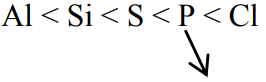
In general on moving from left to right in a period ionization energy increases as $Z_{eff}$ increases.
(Ionisation energy of phosphorus is more because of half filled stable configuration)
(Ionisation energy of phosphorus is more because of half filled stable configuration)
0 likes
View Solution392
MediumMCQ
Given below are two statements:
Statement $(I)$: The first ionisation enthalpy of the elements $Na$,$Mg$,$Cl$ and $Ar$ follows the order $Na > Mg > Cl > Ar$.
Statement $(II)$: Among $Ca$,$Al$,$Fe$ and $B$,the third ionisation enthalpy is very high for $Ca$.
Statement $(I)$: The first ionisation enthalpy of the elements $Na$,$Mg$,$Cl$ and $Ar$ follows the order $Na > Mg > Cl > Ar$.
Statement $(II)$: Among $Ca$,$Al$,$Fe$ and $B$,the third ionisation enthalpy is very high for $Ca$.
A
Both Statement $I$ and Statement $II$ are true
B
Both Statement $I$ and Statement $II$ are false
C
Statement $I$ is true but Statement $II$ is false
D
Statement $I$ is false but Statement $II$ is true
Solution
(D) Statement $(I)$: The first ionisation enthalpy generally increases across a period from left to right. The correct order for these elements is $Ar > Cl > Mg > Na$. Therefore,the given order $Na > Mg > Cl > Ar$ is incorrect. Thus,Statement $(I)$ is false.
Statement $(II)$: The electronic configuration of $Ca$ $(Z=20)$ is $[Ar] 4s^2$. The first two electrons are removed from the $4s$ orbital. The third electron must be removed from the $3p^6$ orbital,which is a stable noble gas configuration (Argon core). Removing an electron from a stable,fully-filled shell requires a very high amount of energy. Thus,Statement $(II)$ is true.
Statement $(II)$: The electronic configuration of $Ca$ $(Z=20)$ is $[Ar] 4s^2$. The first two electrons are removed from the $4s$ orbital. The third electron must be removed from the $3p^6$ orbital,which is a stable noble gas configuration (Argon core). Removing an electron from a stable,fully-filled shell requires a very high amount of energy. Thus,Statement $(II)$ is true.
0 likes
View Solution393
MediumMCQ
The $1^{st}$ ionization enthalpy for $Mg$ is $+737 \text{ kJ/mol}$. The most probable estimated value of the $2^{nd}$ ionization enthalpy of $Mg$ is . . . . . . .
A
-$906$ kJ/mol
B
-$856$ kJ/mol
C
+$1450$ kJ/mol
D
+$590$ kJ/mol
Solution
(C) The electronic configuration of $Mg$ is $[Ne]3s^2$.
Removing the first electron requires $737 \text{ kJ/mol}$ to form the $Mg^+$ ion with configuration $[Ne]3s^1$.
The second ionization enthalpy involves removing the second electron from the $Mg^+$ ion.
Since the electron is being removed from a positively charged species,the electrostatic attraction is stronger,requiring significantly more energy than the first ionization.
Therefore,the $2^{nd}$ ionization enthalpy must be greater than the $1^{st}$ ionization enthalpy $(737 \text{ kJ/mol})$ and must be positive.
Among the given options,$+1450 \text{ kJ/mol}$ is the only value that is greater than $737 \text{ kJ/mol}$ and positive,making it the most probable experimental value.
Removing the first electron requires $737 \text{ kJ/mol}$ to form the $Mg^+$ ion with configuration $[Ne]3s^1$.
The second ionization enthalpy involves removing the second electron from the $Mg^+$ ion.
Since the electron is being removed from a positively charged species,the electrostatic attraction is stronger,requiring significantly more energy than the first ionization.
Therefore,the $2^{nd}$ ionization enthalpy must be greater than the $1^{st}$ ionization enthalpy $(737 \text{ kJ/mol})$ and must be positive.
Among the given options,$+1450 \text{ kJ/mol}$ is the only value that is greater than $737 \text{ kJ/mol}$ and positive,making it the most probable experimental value.
0 likes
View Solution394
MediumMCQ
Match List-$I$ with List-$II$:
| List-$I$ (Electronic configuration of neutral atom where $n=2$) | List-$II$ ($1^{st}$ Ionization Energy in $\text{kJ mol}^{-1}$) |
| $A. ns^2$ | $I. 2080$ |
| $B. ns^2np^1$ | $II. 899$ |
| $C. ns^2np^3$ | $III. 800$ |
| $D. ns^2np^6$ | $IV. 1402$ |
A
$A-II, B-III, C-IV, D-I$
B
$A-IV, B-III, C-II, D-I$
C
$A-III, B-II, C-IV, D-I$
D
$A-III, B-II, C-I, D-IV$
Solution
(A) The electronic configuration $ns^2$ corresponds to alkaline earth metals (e.g.,$Be$,$Mg$),which have relatively high ionization energy due to the stable fully filled $s$-orbital.
$ns^2np^1$ corresponds to Group $13$ elements (e.g.,$B$,$Al$),which have lower ionization energy than Group $2$ due to the removal of a $p$-electron.
$ns^2np^3$ corresponds to Group $15$ elements (e.g.,$N$,$P$),which have high ionization energy due to the stable half-filled $p$-orbital.
$ns^2np^6$ corresponds to Group $18$ elements (Noble gases,e.g.,$Ne$,$Ar$),which have the highest ionization energy due to their stable octet configuration.
Comparing the given values:
$A (ns^2) = II (899 \text{ kJ/mol})$
$B (ns^2np^1) = III (800 \text{ kJ/mol})$
$C (ns^2np^3) = IV (1402 \text{ kJ/mol})$
$D (ns^2np^6) = I (2080 \text{ kJ/mol})$
Therefore,the correct matching is $A-II, B-III, C-IV, D-I$.
$ns^2np^1$ corresponds to Group $13$ elements (e.g.,$B$,$Al$),which have lower ionization energy than Group $2$ due to the removal of a $p$-electron.
$ns^2np^3$ corresponds to Group $15$ elements (e.g.,$N$,$P$),which have high ionization energy due to the stable half-filled $p$-orbital.
$ns^2np^6$ corresponds to Group $18$ elements (Noble gases,e.g.,$Ne$,$Ar$),which have the highest ionization energy due to their stable octet configuration.
Comparing the given values:
$A (ns^2) = II (899 \text{ kJ/mol})$
$B (ns^2np^1) = III (800 \text{ kJ/mol})$
$C (ns^2np^3) = IV (1402 \text{ kJ/mol})$
$D (ns^2np^6) = I (2080 \text{ kJ/mol})$
Therefore,the correct matching is $A-II, B-III, C-IV, D-I$.
0 likes
View SolutionClassification of Elements and Periodicity in Properties — Ionisation energy · Frequently Asked Questions
1Are these Classification of Elements and Periodicity in Properties questions useful for JEE and NEET?
Yes. All questions in this section are mapped to JEE Main and NEET exam patterns. Previous year questions from JEE Main, NEET, GUJCET and state-level exams are included with full solutions.
2Can I switch to Hindi or Gujarati for these questions?
Yes. Use the language tabs in the hero section or the sidebar to view the same questions and solutions in English, Hindi or Gujarati.
3How do I generate a question paper from this subtopic?
Use the Vedclass Exam Paper Generator — select the chapter and subtopic, set difficulty, and generate Sets A, B, C, D automatically. First 3 chapters of every subject are free.
Vedclass Products
For Students
Vedclass Test Series
Mock tests in real JEE/NEET style with performance analysis. 5-day free trial.
Start Free TrialFor Teachers
Exam Paper Generator
Generate Set A/B/C/D papers from this chapter in 2 minutes. 3 chapters free.
Try FreeFor Institutes
Online Exam Module
Live online exams with unlimited students, 360° analytics & white-label branding.
See DemoFor Teachers & Institutes
Generate a Classification of Elements and Periodicity in Properties Exam Paper in 2 Minutes
Select subtopic & difficulty — Sets A, B, C, D auto-generated with No Repeat logic.
First 3 chapters of every subject are free — no payment required.