
A English
VSEPR Theory Questions in English
Class 11 Chemistry · Chemical Bonding and Molecular Structure · VSEPR Theory
702+
Questions
English
Language
100%
With Solutions
Showing 50 of 702 questions in English
301
MediumMCQ
Which of the following molecules is linear?
A
$SO_2$
B
$NO_2^+$
C
$NO_2^-$
D
$SCl_2$
Solution
(B) The structure of $NO_2^+$ is linear.
In $NO_2^+$,the nitrogen atom is $sp$ hybridized,resulting in a bond angle of $180^{\circ}$ and a linear geometry: $[O=N=O]^+$.
$SO_2$,$NO_2^-$,and $SCl_2$ are bent due to the presence of lone pairs on the central atom.
In $NO_2^+$,the nitrogen atom is $sp$ hybridized,resulting in a bond angle of $180^{\circ}$ and a linear geometry: $[O=N=O]^+$.
$SO_2$,$NO_2^-$,and $SCl_2$ are bent due to the presence of lone pairs on the central atom.
0 likes
View Solution302
MediumMCQ
In which of the following species is the bond angle maximum?
A
$NH_3$
B
$NH_4^+$
C
$PCl_3$
D
$SCl_2$
Solution
(B) In $NH_4^+$,the nitrogen atom undergoes $sp^3$ hybridization and has no lone pair of electrons,resulting in a tetrahedral bond angle of $109^\circ 28'$.
In $NH_3$,the presence of one lone pair reduces the bond angle to $107^\circ$.
In $PCl_3$,the bond angle is approximately $100^\circ$ due to the larger size of the central atom and lone pair repulsion.
In $SCl_2$,the bond angle is approximately $103^\circ$.
Therefore,$NH_4^+$ has the maximum bond angle.
In $NH_3$,the presence of one lone pair reduces the bond angle to $107^\circ$.
In $PCl_3$,the bond angle is approximately $100^\circ$ due to the larger size of the central atom and lone pair repulsion.
In $SCl_2$,the bond angle is approximately $103^\circ$.
Therefore,$NH_4^+$ has the maximum bond angle.
0 likes
View Solution303
EasyMCQ
In the $NO_3^-$ ion,what are the number of bond pairs and lone pairs of electrons on the $N$ atom,respectively?
A
$2, 2$
B
$3, 1$
C
$1, 3$
D
$4, 0$
Solution
(D) The $N$ atom in the $NO_3^-$ ion is bonded to three oxygen atoms.
One double bond and two single bonds are formed to satisfy the octet rule and formal charges,resulting in $4$ bond pairs around the nitrogen atom.
The valence shell of nitrogen has $5$ electrons. In $NO_3^-$,nitrogen forms $4$ bonds (one double and two single),utilizing all $5$ valence electrons (one electron is used for the negative charge).
Therefore,the number of lone pairs on the $N$ atom is $0$.
One double bond and two single bonds are formed to satisfy the octet rule and formal charges,resulting in $4$ bond pairs around the nitrogen atom.
The valence shell of nitrogen has $5$ electrons. In $NO_3^-$,nitrogen forms $4$ bonds (one double and two single),utilizing all $5$ valence electrons (one electron is used for the negative charge).
Therefore,the number of lone pairs on the $N$ atom is $0$.
0 likes
View Solution304
EasyMCQ
Which of the following molecules has unequal bond lengths?
A
$NF_3$
B
$BF_3$
C
$PF_5$
D
$SF_6$
Solution
(C) In $PF_5$,the central atom $P$ undergoes $sp^3d$ hybridization,resulting in a trigonal bipyramidal geometry.
It contains three equatorial $P-F$ bonds and two axial $P-F$ bonds.
The axial bonds are longer than the equatorial bonds due to greater repulsion from the equatorial bond pairs,leading to unequal bond lengths.
It contains three equatorial $P-F$ bonds and two axial $P-F$ bonds.
The axial bonds are longer than the equatorial bonds due to greater repulsion from the equatorial bond pairs,leading to unequal bond lengths.
0 likes
View Solution305
EasyMCQ
The shape of the $NH_3$ molecule is .......
A
Tetrahedral
B
Pyramidal
C
Trigonal planar
D
Octahedral
Solution
(B) In the $NH_3$ molecule,the nitrogen atom is $sp^3$ hybridized. Due to the presence of one lone pair of electrons on the nitrogen atom,the geometry is distorted from tetrahedral to pyramidal.
0 likes
View Solution306
DifficultMCQ
Identify the isostructural pairs from the following species: $NF_3, NO_3^-, BF_3, H_3O^+, HN_3$
A
$[NF_3, NO_3^-]; [BF_3, H_3O^+]$
B
$NF_3, HN_3; [NO_3^-, BF_3]$
C
$[NF_3, H_3O^+]; [NO_3^-, BF_3]$
D
$[NF_3, H_3O^+]; HN_3, BF_3$
Solution
(C) $NF_3$ and $H_3O^+$ both have $sp^3$ hybridization and a pyramidal geometry.
$BF_3$ and $NO_3^-$ both have $sp^2$ hybridization and a trigonal planar geometry.
$BF_3$ and $NO_3^-$ both have $sp^2$ hybridization and a trigonal planar geometry.
0 likes
View Solution307
EasyMCQ
Which of the following substances has the minimum bond angle?
A
$H_2O$
B
$H_2S$
C
$H_2Se$
D
$H_2Te$
Solution
(D) In the hydrides of Group $16$ elements,the bond angle decreases as we move down the group.
This is because the electronegativity of the central atom decreases down the group,which leads to an increase in the bond length and a decrease in the bond angle.
This is because the electronegativity of the central atom decreases down the group,which leads to an increase in the bond length and a decrease in the bond angle.
0 likes
View Solution308
EasyMCQ
In the $OF_2$ molecule,what are the number of bonding electron pairs and lone pairs of electrons present,respectively?
A
$2, 6$
B
$2, 8$
C
$2, 10$
D
$2, 9$
Solution
(B) The Lewis structure of $OF_2$ is represented as $F-O-F$ with lone pairs on each atom.
Each $F-O$ bond represents one bonding electron pair,so there are $2$ bonding pairs.
The oxygen atom has $2$ lone pairs,and each fluorine atom has $3$ lone pairs.
Total number of lone pairs $= 2 + 3 + 3 = 8$.
Each $F-O$ bond represents one bonding electron pair,so there are $2$ bonding pairs.
The oxygen atom has $2$ lone pairs,and each fluorine atom has $3$ lone pairs.
Total number of lone pairs $= 2 + 3 + 3 = 8$.
0 likes
View Solution309
EasyMCQ
Which of the following is not tetrahedral?
A
$SCl_4$
B
$SO_4^{2-}$
C
$Ni(CO)_4$
D
$NiCl_4^{2-}$
Solution
(A) The hybridization of $S$ in $SCl_4$ is $sp^3d$,which results in a see-saw geometry due to the presence of one lone pair on the sulfur atom.
$SO_4^{2-}$ has $sp^3$ hybridization and a tetrahedral geometry.
$Ni(CO)_4$ has $sp^3$ hybridization and a tetrahedral geometry.
$NiCl_4^{2-}$ has $sp^3$ hybridization and a tetrahedral geometry.
Therefore,$SCl_4$ is the only species that is not tetrahedral.
$SO_4^{2-}$ has $sp^3$ hybridization and a tetrahedral geometry.
$Ni(CO)_4$ has $sp^3$ hybridization and a tetrahedral geometry.
$NiCl_4^{2-}$ has $sp^3$ hybridization and a tetrahedral geometry.
Therefore,$SCl_4$ is the only species that is not tetrahedral.
0 likes
View Solution310
EasyMCQ
Which of the following substances is not linear?
A
$BeCl_2$
B
$SO_2$
C
$CO_2$
D
$CH \equiv CH$
Solution
(B) In $BeCl_2$,the central atom $Be$ is $sp$ hybridized,resulting in a linear geometry.
In $CO_2$,the central atom $C$ is $sp$ hybridized,resulting in a linear geometry.
In $CH \equiv CH$,both carbon atoms are $sp$ hybridized,resulting in a linear geometry.
In $SO_2$,the central atom $S$ is $sp^2$ hybridized and has one lone pair of electrons,which gives it a bent or angular shape.
In $CO_2$,the central atom $C$ is $sp$ hybridized,resulting in a linear geometry.
In $CH \equiv CH$,both carbon atoms are $sp$ hybridized,resulting in a linear geometry.
In $SO_2$,the central atom $S$ is $sp^2$ hybridized and has one lone pair of electrons,which gives it a bent or angular shape.
0 likes
View Solution311
DifficultMCQ
Which of the following sequences represents the correct increasing order of bond angles in the given molecules?
A
$OF_2 < H_2O < OCl_2 < ClO_2$
B
$H_2O < OF_2 < OCl_2 < ClO_2$
C
$OCl_2 < ClO_2 < H_2O < OF_2$
D
$ClO_2 < OF_2 < OCl_2 < H_2O$
Solution
(A) The bond angles for the given molecules are as follows:
$OF_2$: $103^o$
$H_2O$: $104.5^o$
$OCl_2$: $111^o$
$ClO_2$: $118^o$
Thus,the correct increasing order of bond angles is $OF_2 < H_2O < OCl_2 < ClO_2$.
$OF_2$: $103^o$
$H_2O$: $104.5^o$
$OCl_2$: $111^o$
$ClO_2$: $118^o$
Thus,the correct increasing order of bond angles is $OF_2 < H_2O < OCl_2 < ClO_2$.
0 likes
View Solution312
MediumMCQ
The structure of $Cl_2O_7$ is:
A
Tetrahedral
B
Square pyramidal
C
Pentagonal bipyramidal
D
Trigonal bipyramidal
Solution
(A) In $Cl_2O_7$,each chlorine atom is bonded to four oxygen atoms in a tetrahedral arrangement. Two such $ClO_4$ tetrahedra share a common oxygen atom at the vertex,resulting in a structure where each $Cl$ atom is at the center of a tetrahedron.
0 likes
View Solution313
EasyMCQ
Which of the following is not linear?
A
$IBrF^-$
B
$ICl_2^-$
C
$I_3^+$
D
$I_3^-$
Solution
(C) The trihalide cation $I_3^+$ has a bent geometry due to the presence of two lone pairs on the central iodine atom,whereas $IBrF^-$,$ICl_2^-$,and $I_3^-$ are linear due to $sp^3d$ hybridization with three lone pairs on the central atom.
0 likes
View Solution314
MediumMCQ
According to the Valence Shell Electron Pair Repulsion $(VSEPR)$ theory,what is the shape of $ClO_3^-$?
A
Trigonal planar
B
Pyramidal
C
Tetrahedral
D
Square planar
Solution
(B) The central chlorine atom in $ClO_3^-$ has $7$ valence electrons.
It forms $3$ double bonds with oxygen atoms and has $1$ lone pair of electrons.
The total number of electron pairs around the central atom is $3 + 1 = 4$,which corresponds to $sp^3$ hybridization.
Due to the presence of one lone pair,the geometry is distorted from tetrahedral to pyramidal.
It forms $3$ double bonds with oxygen atoms and has $1$ lone pair of electrons.
The total number of electron pairs around the central atom is $3 + 1 = 4$,which corresponds to $sp^3$ hybridization.
Due to the presence of one lone pair,the geometry is distorted from tetrahedral to pyramidal.
0 likes
View Solution315
EasyMCQ
What is the shape of $ClO_3^-$?
A
Trigonal pyramidal
B
Tetrahedral
C
Trigonal planar
D
Trigonal bipyramidal
Solution
(A) The central atom $Cl$ in $ClO_3^-$ has $7$ valence electrons.
It forms $3$ single bonds with $O$ atoms and has $1$ lone pair.
According to $VSEPR$ theory,the steric number is $3 + 1 = 4$,which corresponds to $sp^3$ hybridization.
Due to the presence of one lone pair,the geometry is distorted from tetrahedral to trigonal pyramidal.
It forms $3$ single bonds with $O$ atoms and has $1$ lone pair.
According to $VSEPR$ theory,the steric number is $3 + 1 = 4$,which corresponds to $sp^3$ hybridization.
Due to the presence of one lone pair,the geometry is distorted from tetrahedral to trigonal pyramidal.
0 likes
View Solution316
MediumMCQ
Which of the following compounds has the maximum number of lone pairs on the central atom?
A
$[ClO_3]^-$
B
$XeF_4$
C
$SF_4$
D
$[I_3]^-$
Solution
(D) To determine the number of lone pairs on the central atom,we use the formula: $\text{Lone pairs} = \text{Steric number} - \text{Number of bonded atoms}$.
In $[I_3]^-$,the central iodine atom has $3$ lone pairs. Therefore,it has the maximum number of lone pairs.
| Compound | Lone pairs on central atom |
|---|---|
| $A$. $[ClO_3]^-$ | $1$ |
| $B$. $XeF_4$ | $2$ |
| $C$. $SF_4$ | $1$ |
| $D$. $[I_3]^-$ | $3$ |
In $[I_3]^-$,the central iodine atom has $3$ lone pairs. Therefore,it has the maximum number of lone pairs.
0 likes
View Solution317
EasyMCQ
Which of the following pairs are isostructural?
A
$XeF_2, IF_2^-$
B
$NH_3, BF_3$
C
$CO_3^{2-}, SO_3^{2-}$
D
$PCl_5, ICl_5$
Solution
(A) Both $XeF_2$ and $IF_2^-$ have $sp^3d$ hybridization with $3$ lone pairs on the central atom,resulting in a linear geometry. Therefore,they are isostructural.
0 likes
View Solution318
EasyMCQ
The $XeF_2$ molecule is:
A
Linear.
B
Trigonal planar.
C
Pyramidal.
D
Square planar.
Solution
(A) In $XeF_2$,the central atom $Xe$ has $8$ valence electrons. It forms $2$ bond pairs with $F$ atoms and has $3$ lone pairs of electrons. According to $VSEPR$ theory,the arrangement of $3$ lone pairs and $2$ bond pairs results in a trigonal bipyramidal electron geometry with a linear molecular shape ($sp^3d$ hybridization).
0 likes
View Solution319
MediumMCQ
What is the number of lone pairs of electrons on $Xe$ in $XeF_2$?
A
$3$
B
$4$
C
$2$
D
$1$
Solution
(A) The central atom $Xe$ in $XeF_2$ undergoes $sp^3d$ hybridization.
According to $VSEPR$ theory,the molecule has a linear geometry.
$Xe$ has $8$ valence electrons,$2$ are used in bonding with $F$ atoms,leaving $6$ electrons which form $3$ lone pairs.
Therefore,the number of lone pairs on $Xe$ is $3$.
According to $VSEPR$ theory,the molecule has a linear geometry.
$Xe$ has $8$ valence electrons,$2$ are used in bonding with $F$ atoms,leaving $6$ electrons which form $3$ lone pairs.
Therefore,the number of lone pairs on $Xe$ is $3$.
0 likes
View Solution320
EasyMCQ
Which of the following is a planar molecule?
A
$XeO_4$
B
$XeF_4$
C
$XeOF_4$
D
$XeO_3$
Solution
(B) $(B)$ In $XeF_4$, the Xenon atom undergoes $sp^3d^2$ hybridisation.
It has $4$ bonding pairs and $2$ lone pairs.
The lone pairs occupy the axial positions to minimize repulsion, resulting in a square planar geometry.
Thus, it is a planar molecule.
It has $4$ bonding pairs and $2$ lone pairs.
The lone pairs occupy the axial positions to minimize repulsion, resulting in a square planar geometry.
Thus, it is a planar molecule.
0 likes
View Solution321
EasyMCQ
What is the shape of $XeF_4$?
A
Square planar
B
Tetrahedral
C
Octahedral
D
Trigonal pyramidal
Solution
(A) The central atom $Xe$ in $XeF_4$ undergoes $sp^3d^2$ hybridization.
It has $4$ bond pairs and $2$ lone pairs of electrons.
According to $VSEPR$ theory,the presence of $2$ lone pairs results in a square planar geometry.
It has $4$ bond pairs and $2$ lone pairs of electrons.
According to $VSEPR$ theory,the presence of $2$ lone pairs results in a square planar geometry.
0 likes
View Solution322
MediumMCQ
What is the number of lone pairs of electrons on the central atom in $XeF_2, XeF_4$,and $XeF_6$ molecules,respectively?
A
$3, 2$ and $1$
B
$4, 3$ and $2$
C
$2, 3$ and $1$
D
$3, 2$ and $0$
Solution
(A) The number of lone pairs on the central atom $Xe$ can be determined using the formula: $\text{Lone pairs} = \frac{1}{2} (V - B)$,where $V$ is the number of valence electrons of the central atom ($8$ for $Xe$) and $B$ is the number of bonding pairs (number of $F$ atoms attached).
Thus,the number of lone pairs are $3, 2$,and $1$ respectively.
| $\text{Compound}$ | $\text{Lone pairs on } Xe$ |
| $XeF_2$ | $\frac{1}{2}(8-2) = 3$ |
| $XeF_4$ | $\frac{1}{2}(8-4) = 2$ |
| $XeF_6$ | $\frac{1}{2}(8-6) = 1$ |
Thus,the number of lone pairs are $3, 2$,and $1$ respectively.
0 likes
View Solution323
MediumMCQ
The molecular shapes of $SF_4$,$CF_4$,and $XeF_4$ are:
A
The same,with $2, 0$,and $1$ lone pair of electrons on the central atom,respectively.
B
The same,with $1, 1$,and $1$ lone pair of electrons on the central atom,respectively.
C
The same,with $0, 1$,and $2$ lone pair of electrons on the central atom,respectively.
D
The same,with $1, 0$,and $2$ lone pair of electrons on the central atom,respectively.
Solution
(D) To determine the number of lone pairs on the central atom,we use the formula: $\text{Lone pairs} = \frac{1}{2} (V - N)$,where $V$ is the number of valence electrons of the central atom and $N$ is the number of bonding electrons (monovalent atoms).
$1$. For $SF_4$: Central atom $S$ has $6$ valence electrons. It forms $4$ bonds with $F$ atoms. Lone pairs = $\frac{1}{2} (6 - 4) = 1$.
$2$. For $CF_4$: Central atom $C$ has $4$ valence electrons. It forms $4$ bonds with $F$ atoms. Lone pairs = $\frac{1}{2} (4 - 4) = 0$.
$3$. For $XeF_4$: Central atom $Xe$ has $8$ valence electrons. It forms $4$ bonds with $F$ atoms. Lone pairs = $\frac{1}{2} (8 - 4) = 2$.
Thus,the number of lone pairs on the central atoms of $SF_4$,$CF_4$,and $XeF_4$ are $1, 0$,and $2$ respectively.
$1$. For $SF_4$: Central atom $S$ has $6$ valence electrons. It forms $4$ bonds with $F$ atoms. Lone pairs = $\frac{1}{2} (6 - 4) = 1$.
$2$. For $CF_4$: Central atom $C$ has $4$ valence electrons. It forms $4$ bonds with $F$ atoms. Lone pairs = $\frac{1}{2} (4 - 4) = 0$.
$3$. For $XeF_4$: Central atom $Xe$ has $8$ valence electrons. It forms $4$ bonds with $F$ atoms. Lone pairs = $\frac{1}{2} (8 - 4) = 2$.
Thus,the number of lone pairs on the central atoms of $SF_4$,$CF_4$,and $XeF_4$ are $1, 0$,and $2$ respectively.
0 likes
View Solution324
MediumMCQ
In which of the following molecules/ions are all bond lengths not equal?
A
$SiF_4$
B
$XeF_4$
C
$BF_4^-$
D
$SF_4$
Solution
(D) $1$. $SiF_4$ has a tetrahedral geometry ($sp^3$ hybridization) where all $Si-F$ bond lengths are equal.
$2$. $XeF_4$ has a square planar geometry ($sp^3d^2$ hybridization) with two lone pairs at axial positions,making all $Xe-F$ bond lengths equal.
$3$. $BF_4^-$ has a tetrahedral geometry ($sp^3$ hybridization) where all $B-F$ bond lengths are equal.
$4$. $SF_4$ has a see-saw geometry ($sp^3d$ hybridization) with one lone pair at an equatorial position. Due to the presence of the lone pair,the axial $S-F$ bonds and equatorial $S-F$ bonds have different bond lengths.
$2$. $XeF_4$ has a square planar geometry ($sp^3d^2$ hybridization) with two lone pairs at axial positions,making all $Xe-F$ bond lengths equal.
$3$. $BF_4^-$ has a tetrahedral geometry ($sp^3$ hybridization) where all $B-F$ bond lengths are equal.
$4$. $SF_4$ has a see-saw geometry ($sp^3d$ hybridization) with one lone pair at an equatorial position. Due to the presence of the lone pair,the axial $S-F$ bonds and equatorial $S-F$ bonds have different bond lengths.
0 likes
View Solution325
EasyMCQ
What is the structure of $IF_7$?
A
Square pyramidal
B
Trigonal bipyramidal
C
Octahedral
D
Pentagonal bipyramidal
Solution
(D) The central atom in $IF_7$ is Iodine $(I)$,which has $7$ valence electrons. All $7$ electrons are involved in bonding with $7$ Fluorine atoms. The steric number is $7 + 0 = 7$. $A$ steric number of $7$ corresponds to $sp^3d^3$ hybridization,which results in a pentagonal bipyramidal geometry.
0 likes
View Solution326
MediumMCQ
Which of the following represents the correct increasing order of bond angles for the given species?
A
$ClO_2^- < Cl_2O < ClO_2$
B
$Cl_2O < ClO_2^- < ClO_2$
C
$ClO_2 < ClO_2^- < Cl_2O$
D
$Cl_2O < ClO_2 < ClO_2^-$
Solution
(A) The bond angles for the given species are as follows:
$Cl_2O$: $111^\circ$
$ClO_2^-$: $110^\circ$ (approximate,due to two lone pairs on $Cl$)
$ClO_2$: $118^\circ$
Comparing these values,the increasing order of bond angles is $ClO_2^- < Cl_2O < ClO_2$.
$Cl_2O$: $111^\circ$
$ClO_2^-$: $110^\circ$ (approximate,due to two lone pairs on $Cl$)
$ClO_2$: $118^\circ$
Comparing these values,the increasing order of bond angles is $ClO_2^- < Cl_2O < ClO_2$.
0 likes
View Solution327
MediumMCQ
Which of the following structures is the most preferred and has the lowest energy for $SO_3$?
A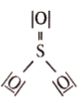
B
C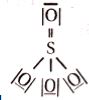
D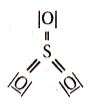
Solution
(D) The most preferred Lewis structure for a molecule is the one that minimizes formal charges on all atoms.
For $SO_3$,the structure where the sulfur atom is bonded to three oxygen atoms with double bonds $(S=O)$ results in a formal charge of $0$ on all atoms (Sulfur has $6$ valence electrons and forms $6$ bonds; Oxygen has $6$ valence electrons and forms $2$ bonds).
This structure minimizes the formal charge to $0$ for every atom,making it the most stable and lowest energy structure.
For $SO_3$,the structure where the sulfur atom is bonded to three oxygen atoms with double bonds $(S=O)$ results in a formal charge of $0$ on all atoms (Sulfur has $6$ valence electrons and forms $6$ bonds; Oxygen has $6$ valence electrons and forms $2$ bonds).
This structure minimizes the formal charge to $0$ for every atom,making it the most stable and lowest energy structure.
0 likes
View Solution328
DifficultMCQ
Shape of $(SiH_3)_3N$ and $(SiH_3)_3P$ respectively are
A
Trigonal planar,Trigonal planar
B
Trigonal planar,Tetrahedral
C
Tetrahedral,Tetrahedral
D
Tetrahedral,Trigonal planar
Solution
(B) In $(SiH_3)_3N$,the lone pair on $N$ is involved in $p\pi-d\pi$ back-bonding with the empty $d$-orbitals of $Si$. This makes the $N$ atom $sp^2$ hybridized,resulting in a trigonal planar geometry.
In $(SiH_3)_3P$,the $P$ atom has a lone pair,but the energy gap between the $P$ $3p$ orbital and $Si$ $3d$ orbital is large,making $p\pi-d\pi$ back-bonding ineffective. Thus,$P$ remains $sp^3$ hybridized with a lone pair,resulting in a pyramidal (tetrahedral arrangement of electron pairs) geometry.
In $(SiH_3)_3P$,the $P$ atom has a lone pair,but the energy gap between the $P$ $3p$ orbital and $Si$ $3d$ orbital is large,making $p\pi-d\pi$ back-bonding ineffective. Thus,$P$ remains $sp^3$ hybridized with a lone pair,resulting in a pyramidal (tetrahedral arrangement of electron pairs) geometry.
0 likes
View Solution329
DifficultMCQ
Which of the following compounds has the smallest bond angle $(X-A-X)$ in each series respectively?
| $A$. $OSF_2, OSCl_2, OSBr_2$ |
| $B$. $SbCl_3, SbBr_3, SbI_3$ |
| $C$. $PI_3, AsI_3, SbI_3$ |
A
$OSF_2, SbCl_3$ and $PI_3$
B
$OSBr_2, SbI_3$ and $PI_3$
C
$OSF_2, SbI_3$ and $PI_3$
D
$OSF_2, SbCl_3$ and $SbI_3$
Solution
(C) $1$. For $OSX_2$ series: As the electronegativity of the halogen $X$ decreases $(F > Cl > Br)$,the bond pair electrons move closer to the central atom $S$. This increases the repulsion between bond pairs,but the bond angle is primarily determined by the electronegativity of the substituent. Lower electronegativity of $X$ leads to a smaller bond angle. Thus,$OSF_2$ has the smallest bond angle.
$2$. For $SbX_3$ series: As the size of the halogen increases $(Cl < Br < I)$,the bond length increases and the repulsion between the bonding pairs decreases,leading to a decrease in the bond angle. Thus,$SbI_3$ has the smallest bond angle.
$3$. For $AI_3$ series: As the electronegativity of the central atom $A$ decreases $(P > As > Sb)$,the bond pair electrons move further away from the central atom,reducing the repulsion between them. Thus,$SbI_3$ has the smallest bond angle.
Correct option is $C$.
$2$. For $SbX_3$ series: As the size of the halogen increases $(Cl < Br < I)$,the bond length increases and the repulsion between the bonding pairs decreases,leading to a decrease in the bond angle. Thus,$SbI_3$ has the smallest bond angle.
$3$. For $AI_3$ series: As the electronegativity of the central atom $A$ decreases $(P > As > Sb)$,the bond pair electrons move further away from the central atom,reducing the repulsion between them. Thus,$SbI_3$ has the smallest bond angle.
Correct option is $C$.
0 likes
View Solution330
DifficultMCQ
In which of the following molecules are all bond lengths the same?
A
$SF_4$
B
$C_2H_6$
C
$PCl_5$
D
$SiF_4$
Solution
(D) To determine if all bond lengths are the same,we examine the geometry and hybridization of each molecule:
$1$. $SF_4$: It has $sp^3d$ hybridization with a see-saw shape. Due to the presence of a lone pair,the axial and equatorial $S-F$ bonds have different lengths.
$2$. $C_2H_6$: It is ethane. The $C-C$ bond is single,but the $C-H$ bonds are not equivalent to the $C-C$ bond length.
$3$. $PCl_5$: It has $sp^3d$ hybridization with a trigonal bipyramidal geometry. It has two types of $P-Cl$ bonds: axial and equatorial,which have different lengths.
$4$. $SiF_4$: It has $sp^3$ hybridization with a perfectly tetrahedral geometry. All four $Si-F$ bonds are equivalent and have the same bond length.
$1$. $SF_4$: It has $sp^3d$ hybridization with a see-saw shape. Due to the presence of a lone pair,the axial and equatorial $S-F$ bonds have different lengths.
$2$. $C_2H_6$: It is ethane. The $C-C$ bond is single,but the $C-H$ bonds are not equivalent to the $C-C$ bond length.
$3$. $PCl_5$: It has $sp^3d$ hybridization with a trigonal bipyramidal geometry. It has two types of $P-Cl$ bonds: axial and equatorial,which have different lengths.
$4$. $SiF_4$: It has $sp^3$ hybridization with a perfectly tetrahedral geometry. All four $Si-F$ bonds are equivalent and have the same bond length.
0 likes
View Solution331
MediumMCQ
If lone pairs of electrons occupy axial positions,then which of the following statements about $ClF_3$ is incorrect?
A
It is a planar molecule
B
It has $T$-shape
C
All bond lengths are equal
D
$lp-lp$ repulsion will be minimum
Solution
(C) The central atom $Cl$ in $ClF_3$ has $7$ valence electrons. It forms $3$ $Cl-F$ bonds and has $2$ lone pairs,resulting in $sp^3d$ hybridization.
According to $VSEPR$ theory,lone pairs occupy equatorial positions to minimize $lp-lp$ and $lp-bp$ repulsions.
If the lone pairs were to occupy axial positions,the $lp-lp$ repulsion would be higher,and the molecule would not be stable in that configuration.
In the actual $T$-shaped structure,the two axial $Cl-F$ bonds are longer than the equatorial $Cl-F$ bond due to the repulsion from the lone pairs.
Therefore,the statement that 'All bond lengths are equal' is incorrect.
According to $VSEPR$ theory,lone pairs occupy equatorial positions to minimize $lp-lp$ and $lp-bp$ repulsions.
If the lone pairs were to occupy axial positions,the $lp-lp$ repulsion would be higher,and the molecule would not be stable in that configuration.
In the actual $T$-shaped structure,the two axial $Cl-F$ bonds are longer than the equatorial $Cl-F$ bond due to the repulsion from the lone pairs.
Therefore,the statement that 'All bond lengths are equal' is incorrect.
0 likes
View Solution332
MediumMCQ
Which of the following molecules has the maximum number of lone pairs on the central atom?
A
$SiF_4$
B
$BrF_3$
C
$XeF_2$
D
$SF_4$
Solution
(C) To determine the number of lone pairs on the central atom,we use the formula: $\text{Lone pairs} = \frac{1}{2} (V - N)$,where $V$ is the number of valence electrons of the central atom and $N$ is the number of bonding electrons (or atoms attached).
$1$. In $SiF_4$: $Si$ has $4$ valence electrons and forms $4$ bonds. Lone pairs = $\frac{1}{2} (4 - 4) = 0$.
$2$. In $BrF_3$: $Br$ has $7$ valence electrons and forms $3$ bonds. Lone pairs = $\frac{1}{2} (7 - 3) = 2$.
$3$. In $XeF_2$: $Xe$ has $8$ valence electrons and forms $2$ bonds. Lone pairs = $\frac{1}{2} (8 - 2) = 3$.
$4$. In $SF_4$: $S$ has $6$ valence electrons and forms $4$ bonds. Lone pairs = $\frac{1}{2} (6 - 4) = 1$.
Comparing these,$XeF_2$ has the maximum number of lone pairs $(3)$.
$1$. In $SiF_4$: $Si$ has $4$ valence electrons and forms $4$ bonds. Lone pairs = $\frac{1}{2} (4 - 4) = 0$.
$2$. In $BrF_3$: $Br$ has $7$ valence electrons and forms $3$ bonds. Lone pairs = $\frac{1}{2} (7 - 3) = 2$.
$3$. In $XeF_2$: $Xe$ has $8$ valence electrons and forms $2$ bonds. Lone pairs = $\frac{1}{2} (8 - 2) = 3$.
$4$. In $SF_4$: $S$ has $6$ valence electrons and forms $4$ bonds. Lone pairs = $\frac{1}{2} (6 - 4) = 1$.
Comparing these,$XeF_2$ has the maximum number of lone pairs $(3)$.
0 likes
View Solution333
MediumMCQ
The shape of $O_2F_2$ is similar to that of:
A
$C_2H_2$
B
$H_2F_2$
C
$H_2O_2$
D
Both $(B)$ and $(C)$
Solution
(C) The molecule $O_2F_2$ has a non-planar,open-book structure similar to $H_2O_2$. In both molecules,the dihedral angle is approximately $90^{\circ}$ to $100^{\circ}$ due to the repulsion between lone pairs on the oxygen atoms.
0 likes
View Solution334
DifficultMCQ
Select the correct matching:
| List-$I$ | List-$II$ |
|---|---|
| $A$. $XeF_4$ | $1$. Pyramidal |
| $B$. $XeF_6$ | $2$. $T$-shape |
| $C$. $XeO_3$ | $3$. Distorted octahedral |
| $D$. $XeOF_2$ | $4$. Square planar |
A
$A-4, B-3, C-1, D-2$
B
$A-1, B-2, C-3, D-4$
C
$A-2, B-1, C-3, D-4$
D
$A-4, B-1, C-3, D-2$
Solution
(A) The geometries of the given xenon compounds are as follows:
$A$. $XeF_4$: It has $4$ bond pairs and $2$ lone pairs,resulting in a square planar geometry $(4)$.
$B$. $XeF_6$: It has $6$ bond pairs and $1$ lone pair,resulting in a distorted octahedral geometry $(3)$.
$C$. $XeO_3$: It has $3$ bond pairs and $1$ lone pair,resulting in a pyramidal geometry $(1)$.
$D$. $XeOF_2$: It has $3$ bond pairs and $2$ lone pairs,resulting in a $T$-shape geometry $(2)$.
Therefore,the correct matching is $A-4, B-3, C-1, D-2$.
$A$. $XeF_4$: It has $4$ bond pairs and $2$ lone pairs,resulting in a square planar geometry $(4)$.
$B$. $XeF_6$: It has $6$ bond pairs and $1$ lone pair,resulting in a distorted octahedral geometry $(3)$.
$C$. $XeO_3$: It has $3$ bond pairs and $1$ lone pair,resulting in a pyramidal geometry $(1)$.
$D$. $XeOF_2$: It has $3$ bond pairs and $2$ lone pairs,resulting in a $T$-shape geometry $(2)$.
Therefore,the correct matching is $A-4, B-3, C-1, D-2$.
0 likes
View Solution335
AdvancedMCQ
How many types of $F-S-F$ bond angles are present in $SF_4$?
A
$2$
B
$4$
C
$3$
D
$5$
Solution
(C) The molecule $SF_4$ has a see-saw geometry due to $sp^3d$ hybridization with one lone pair on the sulfur atom.
In this structure,there are two types of $F$ atoms: equatorial and axial.
Due to the presence of the lone pair,the bond angles deviate from the ideal trigonal bipyramidal angles ($90^{\circ}$ and $120^{\circ}$).
The different types of $F-S-F$ bond angles present are:
$1$. The angle between the two equatorial $F$ atoms is approximately $102^{\circ}$.
$2$. The angle between the two axial $F$ atoms is approximately $173^{\circ}$.
$3$. The angle between an axial $F$ atom and an equatorial $F$ atom is approximately $87^{\circ}$.
Thus,there are $3$ distinct types of $F-S-F$ bond angles in $SF_4$.
In this structure,there are two types of $F$ atoms: equatorial and axial.
Due to the presence of the lone pair,the bond angles deviate from the ideal trigonal bipyramidal angles ($90^{\circ}$ and $120^{\circ}$).
The different types of $F-S-F$ bond angles present are:
$1$. The angle between the two equatorial $F$ atoms is approximately $102^{\circ}$.
$2$. The angle between the two axial $F$ atoms is approximately $173^{\circ}$.
$3$. The angle between an axial $F$ atom and an equatorial $F$ atom is approximately $87^{\circ}$.
Thus,there are $3$ distinct types of $F-S-F$ bond angles in $SF_4$.
0 likes
View Solution336
MediumMCQ
In which of the following molecules/ions are all the bond angles not equal?
A
$SiF_4$
B
$ICl_4^-$
C
$SF_4$
D
$PCl_4^+$
Solution
(C) $SF_4$ does not have equal bond angles because of its structure,which is see-saw (derived from trigonal bipyramidal).
Sulfur in $SF_4$ has a total of six valence electrons,four of which form bonds with fluorine atoms and two form a lone pair.
Due to the presence of a lone pair,the bond angles deviate from the ideal trigonal bipyramidal angles of $90^\circ$ and $120^\circ$.
The equatorial $F-S-F$ bond angle is approximately $102^\circ$ and the axial $F-S-F$ bond angle is approximately $173^\circ$ due to lone pair-bond pair repulsion.
In contrast,$SiF_4$ ($sp^3$,tetrahedral),$ICl_4^-$ ($sp^3d^2$,square planar),and $PCl_4^+$ ($sp^3$,tetrahedral) have equivalent bond angles due to their symmetric geometries.
Sulfur in $SF_4$ has a total of six valence electrons,four of which form bonds with fluorine atoms and two form a lone pair.
Due to the presence of a lone pair,the bond angles deviate from the ideal trigonal bipyramidal angles of $90^\circ$ and $120^\circ$.
The equatorial $F-S-F$ bond angle is approximately $102^\circ$ and the axial $F-S-F$ bond angle is approximately $173^\circ$ due to lone pair-bond pair repulsion.
In contrast,$SiF_4$ ($sp^3$,tetrahedral),$ICl_4^-$ ($sp^3d^2$,square planar),and $PCl_4^+$ ($sp^3$,tetrahedral) have equivalent bond angles due to their symmetric geometries.
0 likes
View Solution337
MediumMCQ
Which of the following represents the correct Lewis structure for the cyanate ion $(OCN^-)$?
A
$[\ddot{O}=C=\ddot{N}:]^{-}$
B
$[C\equiv C:]^{2-}$
C
$[\ddot{Cl}-\ddot{O}:]^{-}$
D
$:\ddot{N}\equiv\ddot{O}:$
Solution
(A) The cyanate ion $(OCN^-)$ consists of one oxygen atom,one carbon atom,and one nitrogen atom with a total of $6 + 4 + 5 + 1 = 16$ valence electrons.
In the correct Lewis structure,the oxygen atom is double-bonded to the carbon atom,which is in turn double-bonded to the nitrogen atom.
This arrangement satisfies the octet rule for all atoms: $[\ddot{O}=C=\ddot{N}:]^{-}$.
In the correct Lewis structure,the oxygen atom is double-bonded to the carbon atom,which is in turn double-bonded to the nitrogen atom.
This arrangement satisfies the octet rule for all atoms: $[\ddot{O}=C=\ddot{N}:]^{-}$.
0 likes
View Solution338
MediumMCQ
Which of the following is the correct order of bond angles?
A
$NH_3 > H_2O > PH_3 > H_2S$
B
$NH_3 > PH_3 > H_2O > H_2S$
C
$NH_3 > H_2S > PH_3 > H_2O$
D
$PH_3 > H_2S > NH_3 > H_2O$
Solution
(A) The bond angle depends on the electronegativity of the central atom and the presence of lone pairs.
$1$. For $NH_3$ $(107^\circ)$ and $H_2O$ $(104.5^\circ)$,the central atoms are $N$ and $O$ (period $2$).
$2$. For $PH_3$ $(93.5^\circ)$ and $H_2S$ $(92^\circ)$,the central atoms are $P$ and $S$ (period $3$).
$3$. Elements in period $2$ have higher electronegativity and smaller size,leading to greater repulsion between bond pairs compared to period $3$ elements.
$4$. Thus,the bond angles of $NH_3$ and $H_2O$ are significantly larger than those of $PH_3$ and $H_2S$.
$5$. Comparing $NH_3$ and $H_2O$: $NH_3$ has one lone pair,while $H_2O$ has two lone pairs,resulting in more repulsion in $H_2O$ and a smaller bond angle.
$6$. Comparing $PH_3$ and $H_2S$: $PH_3$ has one lone pair and $H_2S$ has two,leading to a similar trend.
$7$. The correct order is $NH_3 > H_2O > PH_3 > H_2S$.
$1$. For $NH_3$ $(107^\circ)$ and $H_2O$ $(104.5^\circ)$,the central atoms are $N$ and $O$ (period $2$).
$2$. For $PH_3$ $(93.5^\circ)$ and $H_2S$ $(92^\circ)$,the central atoms are $P$ and $S$ (period $3$).
$3$. Elements in period $2$ have higher electronegativity and smaller size,leading to greater repulsion between bond pairs compared to period $3$ elements.
$4$. Thus,the bond angles of $NH_3$ and $H_2O$ are significantly larger than those of $PH_3$ and $H_2S$.
$5$. Comparing $NH_3$ and $H_2O$: $NH_3$ has one lone pair,while $H_2O$ has two lone pairs,resulting in more repulsion in $H_2O$ and a smaller bond angle.
$6$. Comparing $PH_3$ and $H_2S$: $PH_3$ has one lone pair and $H_2S$ has two,leading to a similar trend.
$7$. The correct order is $NH_3 > H_2O > PH_3 > H_2S$.
0 likes
View Solution339
MediumMCQ
Which of the following has the smallest bond angle?
A
$NH_3$
B
$BeF_2$
C
$H_2O$
D
$CH_4$
Solution
(C) To determine the bond angle,we look at the hybridization and the number of lone pairs on the central atom:
$1$. $BeF_2$: $sp$ hybridization,linear geometry,bond angle = $180^{\circ}$.
$2$. $CH_4$: $sp^3$ hybridization,tetrahedral geometry,bond angle = $109.5^{\circ}$.
$3$. $NH_3$: $sp^3$ hybridization,trigonal pyramidal geometry,one lone pair,bond angle = $107^{\circ}$.
$4$. $H_2O$: $sp^3$ hybridization,bent geometry,two lone pairs. The lone pair-lone pair repulsion is greater than lone pair-bond pair repulsion,which compresses the bond angle to $104.5^{\circ}$.
Comparing these,$H_2O$ has the smallest bond angle.
$1$. $BeF_2$: $sp$ hybridization,linear geometry,bond angle = $180^{\circ}$.
$2$. $CH_4$: $sp^3$ hybridization,tetrahedral geometry,bond angle = $109.5^{\circ}$.
$3$. $NH_3$: $sp^3$ hybridization,trigonal pyramidal geometry,one lone pair,bond angle = $107^{\circ}$.
$4$. $H_2O$: $sp^3$ hybridization,bent geometry,two lone pairs. The lone pair-lone pair repulsion is greater than lone pair-bond pair repulsion,which compresses the bond angle to $104.5^{\circ}$.
Comparing these,$H_2O$ has the smallest bond angle.
0 likes
View Solution340
MediumMCQ
Which of the following has the smallest bond angle?
A
$NH_3$
B
$PH_3$
C
$H_2O$
D
$H_2S$
Solution
(D) The bond angle depends on the electronegativity of the central atom and the size of the atoms attached.
In $NH_3$ and $PH_3$,the central atoms are $N$ and $P$ respectively. $PH_3$ has a bond angle of approximately $93.5^\circ$ due to the lower electronegativity of $P$ compared to $N$ $(NH_3 \approx 107^\circ)$.
In $H_2O$ and $H_2S$,the central atoms are $O$ and $S$ respectively. $H_2S$ has a bond angle of approximately $92^\circ$ because $S$ is less electronegative than $O$ and has a larger atomic size,leading to less repulsion between bond pairs.
Comparing $PH_3$ and $H_2S$,$H_2S$ has the smallest bond angle among the given options.
In $NH_3$ and $PH_3$,the central atoms are $N$ and $P$ respectively. $PH_3$ has a bond angle of approximately $93.5^\circ$ due to the lower electronegativity of $P$ compared to $N$ $(NH_3 \approx 107^\circ)$.
In $H_2O$ and $H_2S$,the central atoms are $O$ and $S$ respectively. $H_2S$ has a bond angle of approximately $92^\circ$ because $S$ is less electronegative than $O$ and has a larger atomic size,leading to less repulsion between bond pairs.
Comparing $PH_3$ and $H_2S$,$H_2S$ has the smallest bond angle among the given options.
0 likes
View Solution341
MediumMCQ
In which of the following is the $O-N-O$ bond angle maximum?
A
$NO^{-}_3$
B
$NO^{-}_2$
C
$NO_2$
D
$NO^{+}_2$
Solution
(D) To determine the $O-N-O$ bond angle,we look at the hybridization and geometry of the central nitrogen atom in each species:
$1$. $NO^{-}_3$: Nitrogen is $sp^2$ hybridized with a trigonal planar geometry. The bond angle is approximately $120^{\circ}$.
$2$. $NO^{-}_2$: Nitrogen is $sp^2$ hybridized with one lone pair. Due to lone pair-bond pair repulsion,the bond angle is slightly less than $120^{\circ}$ (approx. $115^{\circ}$).
$3$. $NO_2$: Nitrogen is $sp^2$ hybridized with one unpaired electron. The bond angle is approximately $134^{\circ}$.
$4$. $NO^{+}_2$: Nitrogen is $sp$ hybridized with a linear geometry. The bond angle is $180^{\circ}$.
Comparing these,$NO^{+}_2$ has the maximum bond angle of $180^{\circ}$.
$1$. $NO^{-}_3$: Nitrogen is $sp^2$ hybridized with a trigonal planar geometry. The bond angle is approximately $120^{\circ}$.
$2$. $NO^{-}_2$: Nitrogen is $sp^2$ hybridized with one lone pair. Due to lone pair-bond pair repulsion,the bond angle is slightly less than $120^{\circ}$ (approx. $115^{\circ}$).
$3$. $NO_2$: Nitrogen is $sp^2$ hybridized with one unpaired electron. The bond angle is approximately $134^{\circ}$.
$4$. $NO^{+}_2$: Nitrogen is $sp$ hybridized with a linear geometry. The bond angle is $180^{\circ}$.
Comparing these,$NO^{+}_2$ has the maximum bond angle of $180^{\circ}$.
0 likes
View Solution342
MediumMCQ
Which of the following is the correct decreasing order of bond angles?
A
$NO_2 > NO^{+}_2 > NO^{-}_2$
B
$NO^{-}_2 > NO_2 > NO^{+}_2$
C
$NO^{+}_2 > NO_2 > NO^{-}_2$
D
$NO^{+}_2 > NO^{-}_2 > NO_2$
Solution
(C) To determine the bond angle,we look at the hybridization and the number of lone pairs on the central nitrogen atom:
$1$. $NO^{+}_2$: The nitrogen atom is $sp$ hybridized with $0$ lone pairs. The geometry is linear,so the bond angle is $180^{\circ}$.
$2$. $NO_2$: The nitrogen atom is $sp^2$ hybridized with $1$ unpaired electron. The geometry is bent,and the bond angle is approximately $134^{\circ}$.
$3$. $NO^{-}_2$: The nitrogen atom is $sp^2$ hybridized with $1$ lone pair. The geometry is bent,and the bond angle is approximately $115^{\circ}$.
Therefore,the correct decreasing order of bond angles is $NO^{+}_2 > NO_2 > NO^{-}_2$.
$1$. $NO^{+}_2$: The nitrogen atom is $sp$ hybridized with $0$ lone pairs. The geometry is linear,so the bond angle is $180^{\circ}$.
$2$. $NO_2$: The nitrogen atom is $sp^2$ hybridized with $1$ unpaired electron. The geometry is bent,and the bond angle is approximately $134^{\circ}$.
$3$. $NO^{-}_2$: The nitrogen atom is $sp^2$ hybridized with $1$ lone pair. The geometry is bent,and the bond angle is approximately $115^{\circ}$.
Therefore,the correct decreasing order of bond angles is $NO^{+}_2 > NO_2 > NO^{-}_2$.
0 likes
View Solution343
MediumMCQ
Which of the following is isostructural with $CO_2$?
A
$HgCl_2$
B
$H_2O$
C
$SnCl_2$
D
$NO_2^-$
Solution
(A) The structure of $CO_2$ is linear with $sp$ hybridization at the central carbon atom.
$HgCl_2$ also has a linear structure with $sp$ hybridization at the central mercury atom.
$H_2O$ has a bent shape ($sp^3$ hybridization).
$SnCl_2$ has a bent shape ($sp^2$ hybridization).
$NO_2^-$ has a bent shape ($sp^2$ hybridization).
Therefore,$HgCl_2$ is isostructural with $CO_2$.
$HgCl_2$ also has a linear structure with $sp$ hybridization at the central mercury atom.
$H_2O$ has a bent shape ($sp^3$ hybridization).
$SnCl_2$ has a bent shape ($sp^2$ hybridization).
$NO_2^-$ has a bent shape ($sp^2$ hybridization).
Therefore,$HgCl_2$ is isostructural with $CO_2$.
0 likes
View Solution344
DifficultMCQ
Which of the following species are isostructural: $NO^{-}_3, CO^{2-}_3, ClO^{-}_3,$ and $SO_3$?
A
$NO^{-}_3, ClO^{-}_3$
B
$SO_3, NO^{-}_3$
C
$CO^{2-}_3, NO^{-}_3$
D
Both $b$ and $c$
Solution
(D) To determine if species are isostructural,we calculate the hybridization and the number of lone pairs on the central atom.
$1$. $NO^{-}_3$: Central atom $N$ has $5$ valence electrons. Hybridization = $\frac{1}{2}(5 + 1 + 0) = 3$ $(sp^2)$. It has $0$ lone pairs. Geometry: Trigonal planar.
$2$. $CO^{2-}_3$: Central atom $C$ has $4$ valence electrons. Hybridization = $\frac{1}{2}(4 + 2 + 0) = 3$ $(sp^2)$. It has $0$ lone pairs. Geometry: Trigonal planar.
$3$. $SO_3$: Central atom $S$ has $6$ valence electrons. Hybridization = $\frac{1}{2}(6 + 0 + 0) = 3$ $(sp^2)$. It has $0$ lone pairs. Geometry: Trigonal planar.
$4$. $ClO^{-}_3$: Central atom $Cl$ has $7$ valence electrons. Hybridization = $\frac{1}{2}(7 + 1 + 0) = 4$ $(sp^3)$. It has $1$ lone pair. Geometry: Pyramidal.
Since $NO^{-}_3, CO^{2-}_3,$ and $SO_3$ all have $sp^2$ hybridization and $0$ lone pairs,they are isostructural (trigonal planar). Therefore,both $b$ and $c$ are correct pairs.
$1$. $NO^{-}_3$: Central atom $N$ has $5$ valence electrons. Hybridization = $\frac{1}{2}(5 + 1 + 0) = 3$ $(sp^2)$. It has $0$ lone pairs. Geometry: Trigonal planar.
$2$. $CO^{2-}_3$: Central atom $C$ has $4$ valence electrons. Hybridization = $\frac{1}{2}(4 + 2 + 0) = 3$ $(sp^2)$. It has $0$ lone pairs. Geometry: Trigonal planar.
$3$. $SO_3$: Central atom $S$ has $6$ valence electrons. Hybridization = $\frac{1}{2}(6 + 0 + 0) = 3$ $(sp^2)$. It has $0$ lone pairs. Geometry: Trigonal planar.
$4$. $ClO^{-}_3$: Central atom $Cl$ has $7$ valence electrons. Hybridization = $\frac{1}{2}(7 + 1 + 0) = 4$ $(sp^3)$. It has $1$ lone pair. Geometry: Pyramidal.
Since $NO^{-}_3, CO^{2-}_3,$ and $SO_3$ all have $sp^2$ hybridization and $0$ lone pairs,they are isostructural (trigonal planar). Therefore,both $b$ and $c$ are correct pairs.
0 likes
View Solution345
MediumMCQ
The $I_3^-$ ion possesses:
A
Three equatorial lone pairs and two axial bond pairs on the central $I$ atom in a trigonal bipyramidal geometry.
B
Five equatorial lone pairs and two axial bond pairs on the central $I$ atom in a pentagonal bipyramidal geometry.
C
Three equatorial lone pairs and two axial bond pairs on the central $I$ atom in a trigonal bipyramidal geometry.
D
Two equatorial lone pairs and three axial bond pairs on the central $I$ atom in a trigonal bipyramidal geometry.
Solution
(A) The central iodine atom in $I_3^-$ has $7$ valence electrons.
It forms one bond with each of the other two iodine atoms,using $2$ electrons.
This leaves $5$ electrons,plus the $1$ negative charge,totaling $6$ electrons,which form $3$ lone pairs.
Thus,the steric number is $2$ (bond pairs) $+ 3$ (lone pairs) $= 5$.
$A$ steric number of $5$ corresponds to trigonal bipyramidal geometry.
According to $VSEPR$ theory,to minimize repulsion,the $3$ lone pairs occupy the equatorial positions,and the $2$ bonding iodine atoms occupy the axial positions,resulting in a linear molecular shape.
It forms one bond with each of the other two iodine atoms,using $2$ electrons.
This leaves $5$ electrons,plus the $1$ negative charge,totaling $6$ electrons,which form $3$ lone pairs.
Thus,the steric number is $2$ (bond pairs) $+ 3$ (lone pairs) $= 5$.
$A$ steric number of $5$ corresponds to trigonal bipyramidal geometry.
According to $VSEPR$ theory,to minimize repulsion,the $3$ lone pairs occupy the equatorial positions,and the $2$ bonding iodine atoms occupy the axial positions,resulting in a linear molecular shape.
0 likes
View Solution346
MediumMCQ
$CO_2$ is not isostructural with which of the following?
A
$HgCl_2$
B
$SnCl_2$
C
$C_2H_2$
D
$ZnCl_2$
Solution
(B) The structure of $CO_2$ is linear $(O=C=O)$ with $sp$ hybridization.
$HgCl_2$ is linear $(Cl-Hg-Cl)$ with $sp$ hybridization.
$C_2H_2$ is linear $(H-C \equiv C-H)$ with $sp$ hybridization.
$ZnCl_2$ is linear $(Cl-Zn-Cl)$ with $sp$ hybridization.
$SnCl_2$ has a bent (angular) structure due to the presence of one lone pair on the $Sn$ atom ($sp^2$ hybridization).
Therefore,$CO_2$ is not isostructural with $SnCl_2$.
$HgCl_2$ is linear $(Cl-Hg-Cl)$ with $sp$ hybridization.
$C_2H_2$ is linear $(H-C \equiv C-H)$ with $sp$ hybridization.
$ZnCl_2$ is linear $(Cl-Zn-Cl)$ with $sp$ hybridization.
$SnCl_2$ has a bent (angular) structure due to the presence of one lone pair on the $Sn$ atom ($sp^2$ hybridization).
Therefore,$CO_2$ is not isostructural with $SnCl_2$.
0 likes
View Solution347
MediumMCQ
Which of the following species has a pyramidal shape?
A
$PCl_3$
B
$SO_3$
C
$CO_3^{2-}$
D
$NO_3^-$
Solution
(A) To determine the shape,we calculate the number of electron pairs around the central atom using the formula: $\text{Number of electron pairs} = \frac{1}{2} [V + M - C + A]$,where $V$ is the number of valence electrons,$M$ is the number of monovalent atoms,$C$ is the cationic charge,and $A$ is the anionic charge.
For $PCl_3$: $V=5$ (for $P$),$M=3$ (for $Cl$). $\text{Electron pairs} = \frac{1}{2} [5 + 3] = 4$. This corresponds to $sp^3$ hybridization with one lone pair and three bond pairs,resulting in a pyramidal shape.
For $SO_3$: $V=6$ (for $S$),$M=0$. $\text{Electron pairs} = \frac{1}{2} [6] = 3$. This corresponds to $sp^2$ hybridization with zero lone pairs,resulting in a trigonal planar shape.
For $CO_3^{2-}$: $V=4$ (for $C$),$M=0$,$A=2$. $\text{Electron pairs} = \frac{1}{2} [4 + 2] = 3$. This corresponds to $sp^2$ hybridization,resulting in a trigonal planar shape.
For $NO_3^-$: $V=5$ (for $N$),$M=0$,$A=1$. $\text{Electron pairs} = \frac{1}{2} [5 + 1] = 3$. This corresponds to $sp^2$ hybridization,resulting in a trigonal planar shape.
Therefore,only $PCl_3$ has a pyramidal shape.
For $PCl_3$: $V=5$ (for $P$),$M=3$ (for $Cl$). $\text{Electron pairs} = \frac{1}{2} [5 + 3] = 4$. This corresponds to $sp^3$ hybridization with one lone pair and three bond pairs,resulting in a pyramidal shape.
For $SO_3$: $V=6$ (for $S$),$M=0$. $\text{Electron pairs} = \frac{1}{2} [6] = 3$. This corresponds to $sp^2$ hybridization with zero lone pairs,resulting in a trigonal planar shape.
For $CO_3^{2-}$: $V=4$ (for $C$),$M=0$,$A=2$. $\text{Electron pairs} = \frac{1}{2} [4 + 2] = 3$. This corresponds to $sp^2$ hybridization,resulting in a trigonal planar shape.
For $NO_3^-$: $V=5$ (for $N$),$M=0$,$A=1$. $\text{Electron pairs} = \frac{1}{2} [5 + 1] = 3$. This corresponds to $sp^2$ hybridization,resulting in a trigonal planar shape.
Therefore,only $PCl_3$ has a pyramidal shape.
0 likes
View Solution348
EasyMCQ
The shape of the $XeF_2$ molecule is ..........
A
Angular
B
Linear
C
Bent
D
None of these
Solution
(B) In $XeF_2$,the central atom $Xe$ has $8$ valence electrons.
It forms $2$ single bonds with $F$ atoms and has $3$ lone pairs of electrons.
According to $VSEPR$ theory,the total number of electron pairs is $2 + 3 = 5$,which corresponds to $sp^3d$ hybridization and trigonal bipyramidal electron geometry.
Due to the presence of $3$ lone pairs in the equatorial positions to minimize repulsion,the $F-Xe-F$ bond angle is $180^{\circ}$,resulting in a linear molecular shape.
It forms $2$ single bonds with $F$ atoms and has $3$ lone pairs of electrons.
According to $VSEPR$ theory,the total number of electron pairs is $2 + 3 = 5$,which corresponds to $sp^3d$ hybridization and trigonal bipyramidal electron geometry.
Due to the presence of $3$ lone pairs in the equatorial positions to minimize repulsion,the $F-Xe-F$ bond angle is $180^{\circ}$,resulting in a linear molecular shape.
0 likes
View Solution349
DifficultMCQ
Which of the following structures of $ClF_3$ is the most stable?
A
B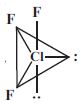
C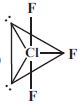
D
All of the above have equal stability.
Solution
(C) The molecule $ClF_3$ has a central $Cl$ atom with $7$ valence electrons. It forms $3$ $Cl-F$ bonds and has $2$ lone pairs,resulting in a total of $5$ electron pairs ($sp^3d$ hybridization). According to $VSEPR$ theory,to minimize repulsion,the lone pairs prefer the equatorial positions in a trigonal bipyramidal geometry. This arrangement minimizes the $90^{\circ}$ lone pair-bond pair repulsions. Therefore,the structure with both lone pairs in the equatorial positions is the most stable.
0 likes
View Solution350
MediumMCQ
The shape of the $SF_2Cl_2$ molecule is $...$.
A
Trigonal bipyramidal
B
Seesaw
C
Octahedral
D
Tetrahedral
Solution
(B) To determine the shape of $SF_2Cl_2$,we calculate the steric number using the formula: $Steric \ Number = \frac{1}{2} [V + M - C + A]$,where $V$ is the number of valence electrons of the central atom $(S = 6)$,$M$ is the number of monovalent atoms ($F = 2, Cl = 2$,so $M = 4$),$C$ is the cationic charge $(0)$,and $A$ is the anionic charge $(0)$.
$Steric \ Number = \frac{1}{2} [6 + 4] = 5$.
$A$ steric number of $5$ corresponds to $sp^3d$ hybridization with a trigonal bipyramidal electron geometry.
In $SF_2Cl_2$,the central sulfur atom has $5$ electron pairs ($4$ bonding pairs and $1$ lone pair).
According to $VSEPR$ theory,the lone pair occupies an equatorial position to minimize repulsion.
This arrangement results in a seesaw shape.
$Steric \ Number = \frac{1}{2} [6 + 4] = 5$.
$A$ steric number of $5$ corresponds to $sp^3d$ hybridization with a trigonal bipyramidal electron geometry.
In $SF_2Cl_2$,the central sulfur atom has $5$ electron pairs ($4$ bonding pairs and $1$ lone pair).
According to $VSEPR$ theory,the lone pair occupies an equatorial position to minimize repulsion.
This arrangement results in a seesaw shape.
0 likes
View SolutionChemical Bonding and Molecular Structure — VSEPR Theory · Frequently Asked Questions
1Are these Chemical Bonding and Molecular Structure questions useful for JEE and NEET?
Yes. All questions in this section are mapped to JEE Main and NEET exam patterns. Previous year questions from JEE Main, NEET, GUJCET and state-level exams are included with full solutions.
2Can I switch to Hindi or Gujarati for these questions?
Yes. Use the language tabs in the hero section or the sidebar to view the same questions and solutions in English, Hindi or Gujarati.
3How do I generate a question paper from this subtopic?
Use the Vedclass Exam Paper Generator — select the chapter and subtopic, set difficulty, and generate Sets A, B, C, D automatically. First 3 chapters of every subject are free.
Vedclass Products
For Students
Vedclass Test Series
Mock tests in real JEE/NEET style with performance analysis. 5-day free trial.
Start Free TrialFor Teachers
Exam Paper Generator
Generate Set A/B/C/D papers from this chapter in 2 minutes. 3 chapters free.
Try FreeFor Institutes
Online Exam Module
Live online exams with unlimited students, 360° analytics & white-label branding.
See DemoFor Teachers & Institutes
Generate a Chemical Bonding and Molecular Structure Exam Paper in 2 Minutes
Select subtopic & difficulty — Sets A, B, C, D auto-generated with No Repeat logic.
First 3 chapters of every subject are free — no payment required.