
A English
VSEPR Theory Questions in English
Class 11 Chemistry · Chemical Bonding and Molecular Structure · VSEPR Theory
702+
Questions
English
Language
100%
With Solutions
Showing 50 of 702 questions in English
351
MediumMCQ
The shape of the $O_2F_2$ molecule is similar to which of the following?
A
$C_2F_2$
B
$H_2O_2$
C
$H_2F_2$
D
$C_2H_2$
Solution
(B) The $O_2F_2$ molecule has an open-book structure similar to $H_2O_2$ (hydrogen peroxide).
In both molecules,the central atoms (oxygen in $O_2F_2$ and oxygen in $H_2O_2$) are $sp^3$ hybridized.
Due to the presence of lone pairs on the oxygen atoms,both molecules exhibit a non-planar,dihedral angle structure often described as an 'open-book' geometry.
In both molecules,the central atoms (oxygen in $O_2F_2$ and oxygen in $H_2O_2$) are $sp^3$ hybridized.
Due to the presence of lone pairs on the oxygen atoms,both molecules exhibit a non-planar,dihedral angle structure often described as an 'open-book' geometry.
0 likes
View Solution352
DifficultMCQ
In the $BrF_3$ molecule,the lone pairs are arranged at equatorial positions to minimize ........................
A
only $lp - lp$ repulsion
B
only $lp - bp$ repulsion
C
only $bp - bp$ repulsion
D
$lp - lp$ repulsion and $lp - bp$ repulsion
0 likes
View Solution353
DifficultMCQ
Which of the following pairs of species are not isostructural?
A
$PF^{-}_6$ and $SF_6$
B
$SiF_4$ and $SF_4$
C
$IO^{-}_3$ and $XeO_3$
D
$BH^{-}_4$ and $NH^{+}_4$
Solution
(B) To determine if species are isostructural,we check their hybridization and geometry:
$1$. $PF^{-}_6$ ($sp^3d^2$,octahedral) and $SF_6$ ($sp^3d^2$,octahedral) are isostructural.
$2$. $SiF_4$ ($sp^3$,tetrahedral) and $SF_4$ ($sp^3d$,see-saw shape) are not isostructural.
$3$. $IO^{-}_3$ ($sp^3$,pyramidal) and $XeO_3$ ($sp^3$,pyramidal) are isostructural.
$4$. $BH^{-}_4$ ($sp^3$,tetrahedral) and $NH^{+}_4$ ($sp^3$,tetrahedral) are isostructural.
Thus,the pair $SiF_4$ and $SF_4$ is not isostructural.
$1$. $PF^{-}_6$ ($sp^3d^2$,octahedral) and $SF_6$ ($sp^3d^2$,octahedral) are isostructural.
$2$. $SiF_4$ ($sp^3$,tetrahedral) and $SF_4$ ($sp^3d$,see-saw shape) are not isostructural.
$3$. $IO^{-}_3$ ($sp^3$,pyramidal) and $XeO_3$ ($sp^3$,pyramidal) are isostructural.
$4$. $BH^{-}_4$ ($sp^3$,tetrahedral) and $NH^{+}_4$ ($sp^3$,tetrahedral) are isostructural.
Thus,the pair $SiF_4$ and $SF_4$ is not isostructural.
0 likes
View Solution354
MediumMCQ
Which of the following molecules is linear?
A
$BeCl_2$
B
$H_2O$
C
$SO_2$
D
$CH_4$
Solution
(A) To determine the shape of the molecules,we look at their hybridization and $VSEPR$ theory:
$1$. $BeCl_2$: Beryllium has $2$ valence electrons. It forms two bonds with Chlorine atoms. The hybridization is $sp$,resulting in a linear geometry with a bond angle of $180^{\circ}$.
$2$. $H_2O$: Oxygen has $6$ valence electrons. It forms two bonds with Hydrogen and has two lone pairs. The hybridization is $sp^3$,resulting in a bent or $V$-shape.
$3$. $SO_2$: Sulfur has $6$ valence electrons. It forms two double bonds with Oxygen and has one lone pair. The hybridization is $sp^2$,resulting in a bent shape.
$4$. $CH_4$: Carbon has $4$ valence electrons. It forms four bonds with Hydrogen. The hybridization is $sp^3$,resulting in a tetrahedral geometry.
Therefore,$BeCl_2$ is the linear molecule.
$1$. $BeCl_2$: Beryllium has $2$ valence electrons. It forms two bonds with Chlorine atoms. The hybridization is $sp$,resulting in a linear geometry with a bond angle of $180^{\circ}$.
$2$. $H_2O$: Oxygen has $6$ valence electrons. It forms two bonds with Hydrogen and has two lone pairs. The hybridization is $sp^3$,resulting in a bent or $V$-shape.
$3$. $SO_2$: Sulfur has $6$ valence electrons. It forms two double bonds with Oxygen and has one lone pair. The hybridization is $sp^2$,resulting in a bent shape.
$4$. $CH_4$: Carbon has $4$ valence electrons. It forms four bonds with Hydrogen. The hybridization is $sp^3$,resulting in a tetrahedral geometry.
Therefore,$BeCl_2$ is the linear molecule.
0 likes
View Solution355
MediumMCQ
Which of the following pairs is isostructural?
A
$XeF_2, IF_2^-$
B
$NH_3, BF_3$
C
$CO_3^{2-}, SO_3^{2-}$
D
$PCl_5, ICl_5$
Solution
(A) To be isostructural,molecules must have the same hybridization and the same geometry.
$1$. $XeF_2$: $Xe$ has $8$ valence electrons. Steric number $= 2 + (8-2)/2 = 5$ ($sp^3d$ hybridization). It has $3$ lone pairs and $2$ bond pairs,resulting in a linear shape.
$IF_2^-$: $I$ has $7$ valence electrons $+ 1$ (negative charge) $= 8$. Steric number $= 2 + (8-2)/2 = 5$ ($sp^3d$ hybridization). It has $3$ lone pairs and $2$ bond pairs,resulting in a linear shape.
Since both have the same hybridization $(sp^3d)$ and geometry (linear),they are isostructural.
$2$. $NH_3$ is pyramidal $(sp^3)$,while $BF_3$ is trigonal planar $(sp^2)$.
$3$. $CO_3^{2-}$ is trigonal planar $(sp^2)$,while $SO_3^{2-}$ is pyramidal $(sp^3)$.
$4$. $PCl_5$ is trigonal bipyramidal $(sp^3d)$,while $ICl_5$ is square pyramidal $(sp^3d^2)$.
$1$. $XeF_2$: $Xe$ has $8$ valence electrons. Steric number $= 2 + (8-2)/2 = 5$ ($sp^3d$ hybridization). It has $3$ lone pairs and $2$ bond pairs,resulting in a linear shape.
$IF_2^-$: $I$ has $7$ valence electrons $+ 1$ (negative charge) $= 8$. Steric number $= 2 + (8-2)/2 = 5$ ($sp^3d$ hybridization). It has $3$ lone pairs and $2$ bond pairs,resulting in a linear shape.
Since both have the same hybridization $(sp^3d)$ and geometry (linear),they are isostructural.
$2$. $NH_3$ is pyramidal $(sp^3)$,while $BF_3$ is trigonal planar $(sp^2)$.
$3$. $CO_3^{2-}$ is trigonal planar $(sp^2)$,while $SO_3^{2-}$ is pyramidal $(sp^3)$.
$4$. $PCl_5$ is trigonal bipyramidal $(sp^3d)$,while $ICl_5$ is square pyramidal $(sp^3d^2)$.
0 likes
View Solution356
MediumMCQ
Which of the following is not linear?
A
$I^{-}_3$
B
$CO_2$
C
$ClO^{-}_2$
D
None of these
Solution
(C) To determine the geometry,we use the $VSEPR$ theory:
$1$. $I^{-}_3$: The central $I$ atom has $3$ lone pairs and $2$ bond pairs,resulting in $sp^3d$ hybridization and a linear geometry.
$2$. $CO_2$: The central $C$ atom has $0$ lone pairs and $2$ bond pairs,resulting in $sp$ hybridization and a linear geometry.
$3$. $ClO^{-}_2$: The central $Cl$ atom has $2$ lone pairs and $2$ bond pairs,resulting in $sp^3$ hybridization and a bent (angular) geometry.
Therefore,$ClO^{-}_2$ is not linear.
$1$. $I^{-}_3$: The central $I$ atom has $3$ lone pairs and $2$ bond pairs,resulting in $sp^3d$ hybridization and a linear geometry.
$2$. $CO_2$: The central $C$ atom has $0$ lone pairs and $2$ bond pairs,resulting in $sp$ hybridization and a linear geometry.
$3$. $ClO^{-}_2$: The central $Cl$ atom has $2$ lone pairs and $2$ bond pairs,resulting in $sp^3$ hybridization and a bent (angular) geometry.
Therefore,$ClO^{-}_2$ is not linear.
0 likes
View Solution357
MediumMCQ
Which of the following molecules is non-linear?
A
$BeCl_2$
B
$CS_2$
C
$CO_2$
D
$SO_2$
Solution
(D) To determine the shape of a molecule,we use the $VSEPR$ theory based on the number of bonding pairs and lone pairs of electrons around the central atom.
$1$. $BeCl_2$: The central $Be$ atom has $2$ bonding pairs and $0$ lone pairs. It has a linear geometry $(180^\circ)$.
$2$. $CS_2$: The central $C$ atom has $2$ double bonds (bonding pairs) and $0$ lone pairs. It has a linear geometry $(180^\circ)$.
$3$. $CO_2$: The central $C$ atom has $2$ double bonds (bonding pairs) and $0$ lone pairs. It has a linear geometry $(180^\circ)$.
$4$. $SO_2$: The central $S$ atom has $2$ bonding pairs and $1$ lone pair. Due to the presence of the lone pair,the molecule adopts a bent or non-linear shape.
$1$. $BeCl_2$: The central $Be$ atom has $2$ bonding pairs and $0$ lone pairs. It has a linear geometry $(180^\circ)$.
$2$. $CS_2$: The central $C$ atom has $2$ double bonds (bonding pairs) and $0$ lone pairs. It has a linear geometry $(180^\circ)$.
$3$. $CO_2$: The central $C$ atom has $2$ double bonds (bonding pairs) and $0$ lone pairs. It has a linear geometry $(180^\circ)$.
$4$. $SO_2$: The central $S$ atom has $2$ bonding pairs and $1$ lone pair. Due to the presence of the lone pair,the molecule adopts a bent or non-linear shape.
0 likes
View Solution358
DifficultMCQ
Which of the following represents pairs of isostructural species?
A
$[NF_3, NO_3^-]$ and $[BF_3, H_3O^+]$
B
$[NF_3, NH_3]$ and $[NO_3^-, BF_3]$
C
$[NF_3, BF_3]$ and $[NO_3^-, H_3O^+]$
D
$[NF_3, H_3O^+]$ and $[NF_3, BF_3]$
Solution
(B) Isostructural species are those that have the same shape and hybridization of the central atom.
$NF_3$ and $NH_3$ both have $sp^3$ hybridization with one lone pair,resulting in a pyramidal shape.
$NO_3^-$ and $BF_3$ both have $sp^2$ hybridization with no lone pairs,resulting in a trigonal planar shape.
Therefore,the pair $[NF_3, NH_3]$ and $[NO_3^-, BF_3]$ represents isostructural species.
$NF_3$ and $NH_3$ both have $sp^3$ hybridization with one lone pair,resulting in a pyramidal shape.
$NO_3^-$ and $BF_3$ both have $sp^2$ hybridization with no lone pairs,resulting in a trigonal planar shape.
Therefore,the pair $[NF_3, NH_3]$ and $[NO_3^-, BF_3]$ represents isostructural species.
0 likes
View Solution359
MediumMCQ
Which of the following species are planar?
A
$I_3^{-}, XeF_2, ClF_3$
B
$H_2O, OCl^{-}, ICl_2^{+}$
C
$XeF_3^{+}, XeF_4, BF_3$
D
All are correct
Solution
(D) To determine if a species is planar,we look at its molecular geometry based on the $VSEPR$ theory:
$1$. $I_3^{-}$: $sp^3d$ hybridization,linear geometry (planar).
$2$. $XeF_2$: $sp^3d$ hybridization,linear geometry (planar).
$3$. $ClF_3$: $sp^3d$ hybridization,$T$-shaped geometry (planar).
$4$. $H_2O$: $sp^3$ hybridization,bent geometry (planar).
$5$. $OCl^{-}$: $sp^3$ hybridization,bent geometry (planar).
$6$. $ICl_2^{+}$: $sp^3$ hybridization,bent geometry (planar).
$7$. $XeF_3^{+}$: $sp^3d^2$ hybridization,$T$-shaped geometry (planar).
$8$. $XeF_4$: $sp^3d^2$ hybridization,square planar geometry (planar).
$9$. $BF_3$: $sp^2$ hybridization,trigonal planar geometry (planar).
Since all the listed species have planar geometries,the correct option is $D$.
$1$. $I_3^{-}$: $sp^3d$ hybridization,linear geometry (planar).
$2$. $XeF_2$: $sp^3d$ hybridization,linear geometry (planar).
$3$. $ClF_3$: $sp^3d$ hybridization,$T$-shaped geometry (planar).
$4$. $H_2O$: $sp^3$ hybridization,bent geometry (planar).
$5$. $OCl^{-}$: $sp^3$ hybridization,bent geometry (planar).
$6$. $ICl_2^{+}$: $sp^3$ hybridization,bent geometry (planar).
$7$. $XeF_3^{+}$: $sp^3d^2$ hybridization,$T$-shaped geometry (planar).
$8$. $XeF_4$: $sp^3d^2$ hybridization,square planar geometry (planar).
$9$. $BF_3$: $sp^2$ hybridization,trigonal planar geometry (planar).
Since all the listed species have planar geometries,the correct option is $D$.
0 likes
View Solution360
MediumMCQ
Which molecule has trigonal bipyramidal geometry?
A
$PF_5$
B
$PCl_3$
C
$NCl_3$
D
$BCl_3$
Solution
(A) $PF_5$ has a central phosphorus atom bonded to $5$ fluorine atoms with no lone pairs on the central atom.
This results in an $sp^3d$ hybridization,which corresponds to a trigonal bipyramidal geometry.
This results in an $sp^3d$ hybridization,which corresponds to a trigonal bipyramidal geometry.
0 likes
View Solution361
MediumMCQ
Match List-$I$ with List-$II$ and select the correct answer:
| List-$I$ (species) | List-$II$ ($O-N-O$ angle) |
| $A$. $NO_2^+$ | $1$. $180^{\circ}$ |
| $B$. $NO_2$ | $2$. $132^{\circ}$ |
| $C$. $NO_2^-$ | $3$. $115^{\circ}$ |
| $D$. $NO_3^-$ | $4$. $120^{\circ}$ |
A
$A-1, B-2, C-3, D-4$
B
$A-1, B-2, C-4, D-3$
C
$A-2, B-1, C-3, D-4$
D
$A-1, B-3, C-2, D-4$
Solution
(A) $NO_2^+$: $sp$ hybridized,linear geometry,bond angle = $180^{\circ}$.
$NO_2$: Bent geometry,bond angle = $132^{\circ}$.
$NO_2^-$: $sp^2$ hybridized,bent geometry,bond angle $\approx 115^{\circ}$ due to lone pair-bond pair repulsion.
$NO_3^-$: $sp^2$ hybridized,trigonal planar geometry,bond angle = $120^{\circ}$.
Therefore,the correct matching is $A-1, B-2, C-3, D-4$.
$NO_2$: Bent geometry,bond angle = $132^{\circ}$.
$NO_2^-$: $sp^2$ hybridized,bent geometry,bond angle $\approx 115^{\circ}$ due to lone pair-bond pair repulsion.
$NO_3^-$: $sp^2$ hybridized,trigonal planar geometry,bond angle = $120^{\circ}$.
Therefore,the correct matching is $A-1, B-2, C-3, D-4$.
0 likes
View Solution362
MediumMCQ
Which of the following have the same shape?
$(i)$ $ICl_2^-$
$(ii)$ $SO_2$
$(iii)$ $SnCl_2$
$(iv)$ $XeF_2$
$(i)$ $ICl_2^-$
$(ii)$ $SO_2$
$(iii)$ $SnCl_2$
$(iv)$ $XeF_2$
A
$(i)$ and $(ii)$
B
$(ii)$ and $(iv)$
C
$(i)$ and $(iv)$
D
$(i)$ and $(iii)$
Solution
(C) To determine the shape,we calculate the hybridization and number of lone pairs for each species:
$(i)$ $ICl_2^-$: Central atom $I$ has $7$ valence electrons + $2$ (from $Cl$) + $1$ (negative charge) = $10$ electrons. Hybridization is $sp^3d$ with $3$ lone pairs on the equatorial position. Shape is linear.
$(ii)$ $SO_2$: Central atom $S$ has $6$ valence electrons. Hybridization is $sp^2$ with $1$ lone pair. Shape is bent ($V$-shaped).
$(iii)$ $SnCl_2$: Central atom $Sn$ has $4$ valence electrons. Hybridization is $sp^2$ with $1$ lone pair. Shape is bent ($V$-shaped).
$(iv)$ $XeF_2$: Central atom $Xe$ has $8$ valence electrons + $2$ (from $F$) = $10$ electrons. Hybridization is $sp^3d$ with $3$ lone pairs on the equatorial position. Shape is linear.
Both $ICl_2^-$ and $XeF_2$ have a linear shape,while $SO_2$ and $SnCl_2$ have a bent shape. Therefore,$(i)$ and $(iv)$ have the same shape.
$(i)$ $ICl_2^-$: Central atom $I$ has $7$ valence electrons + $2$ (from $Cl$) + $1$ (negative charge) = $10$ electrons. Hybridization is $sp^3d$ with $3$ lone pairs on the equatorial position. Shape is linear.
$(ii)$ $SO_2$: Central atom $S$ has $6$ valence electrons. Hybridization is $sp^2$ with $1$ lone pair. Shape is bent ($V$-shaped).
$(iii)$ $SnCl_2$: Central atom $Sn$ has $4$ valence electrons. Hybridization is $sp^2$ with $1$ lone pair. Shape is bent ($V$-shaped).
$(iv)$ $XeF_2$: Central atom $Xe$ has $8$ valence electrons + $2$ (from $F$) = $10$ electrons. Hybridization is $sp^3d$ with $3$ lone pairs on the equatorial position. Shape is linear.
Both $ICl_2^-$ and $XeF_2$ have a linear shape,while $SO_2$ and $SnCl_2$ have a bent shape. Therefore,$(i)$ and $(iv)$ have the same shape.
0 likes
View Solution363
MediumMCQ
Which of the following pairs of compounds are isostructural?
A
$CO_2$ and $SO_2$
B
$SiF_4$ and $SF_4$
C
$XeF_2$ and $I_3^-$
D
$SF_6$ and $XeF_6$
Solution
(C) To be isostructural,molecules must have the same hybridization and geometry.
$XeF_2$ has $sp^3d$ hybridization with $2$ bond pairs and $3$ lone pairs,resulting in a linear geometry.
$I_3^-$ also has $sp^3d$ hybridization with $2$ bond pairs and $3$ lone pairs,resulting in a linear geometry.
Therefore,$XeF_2$ and $I_3^-$ are isostructural.
$XeF_2$ has $sp^3d$ hybridization with $2$ bond pairs and $3$ lone pairs,resulting in a linear geometry.
$I_3^-$ also has $sp^3d$ hybridization with $2$ bond pairs and $3$ lone pairs,resulting in a linear geometry.
Therefore,$XeF_2$ and $I_3^-$ are isostructural.
0 likes
View Solution364
DifficultMCQ
Which of the following molecules have a distorted geometry?
A
$XeF_2, XeF_4, XeO_3$
B
$XeOF_2, XeO_3, XeF_2$
C
$NH_3, SO_2, H_2O$
D
All of these
Solution
(D) molecule possesses a distorted geometry if the central atom has one or more lone pairs $(L.P.)$ of electrons,which cause repulsion and deviate the bond angles from the ideal geometry.
$1$. $XeF_2$ has $3$ $L.P.$ on $Xe$ (linear,but often considered distorted from trigonal bipyramidal).
$2$. $XeF_4$ has $2$ $L.P.$ on $Xe$ (square planar).
$3$. $XeO_3$ has $1$ $L.P.$ on $Xe$ (pyramidal).
$4$. $XeOF_2$ has $1$ $L.P.$ on $Xe$ ($T$-shaped).
$5$. $NH_3$ has $1$ $L.P.$ on $N$ (pyramidal).
$6$. $SO_2$ has $1$ $L.P.$ on $S$ (bent).
$7$. $H_2O$ has $2$ $L.P.$ on $O$ (bent).
Since all the listed molecules contain lone pairs on their central atoms,they all exhibit distorted geometries.
$1$. $XeF_2$ has $3$ $L.P.$ on $Xe$ (linear,but often considered distorted from trigonal bipyramidal).
$2$. $XeF_4$ has $2$ $L.P.$ on $Xe$ (square planar).
$3$. $XeO_3$ has $1$ $L.P.$ on $Xe$ (pyramidal).
$4$. $XeOF_2$ has $1$ $L.P.$ on $Xe$ ($T$-shaped).
$5$. $NH_3$ has $1$ $L.P.$ on $N$ (pyramidal).
$6$. $SO_2$ has $1$ $L.P.$ on $S$ (bent).
$7$. $H_2O$ has $2$ $L.P.$ on $O$ (bent).
Since all the listed molecules contain lone pairs on their central atoms,they all exhibit distorted geometries.
0 likes
View Solution365
DifficultMCQ
In the following reaction,how do the $Cl-P-Cl$ bond angles change?
$PCl_5 \longrightarrow PCl_4^+ + Cl^-$
$PCl_5 \longrightarrow PCl_4^+ + Cl^-$
A
All increase
B
All stay the same
C
All decrease
D
Some increase and some decrease
Solution
(D) In $PCl_5$,the geometry is trigonal bipyramidal with bond angles of $120^\circ$ (equatorial) and $90^\circ$ (axial).
In the product $PCl_4^+$,the phosphorus atom undergoes $sp^3$ hybridization,resulting in a tetrahedral geometry with bond angles of $109.5^\circ$.
Comparing the angles: The $120^\circ$ angles decrease to $109.5^\circ$,while the $90^\circ$ angles increase to $109.5^\circ$.
Therefore,some angles increase and some decrease.
In the product $PCl_4^+$,the phosphorus atom undergoes $sp^3$ hybridization,resulting in a tetrahedral geometry with bond angles of $109.5^\circ$.
Comparing the angles: The $120^\circ$ angles decrease to $109.5^\circ$,while the $90^\circ$ angles increase to $109.5^\circ$.
Therefore,some angles increase and some decrease.
0 likes
View Solution366
MediumMCQ
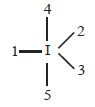
In order that the diagram below correctly depicts the structure of $ICl_2^-$,at what positions should the $Cl$ atoms be drawn? The central atom is $I$.
A
$1, 2$
B
$1, 4$
C
$2, 3$
D
$4, 5$
Solution
(D) The central atom $I$ in $ICl_2^-$ has $7$ valence electrons.
It forms $2$ bonds with $Cl$ atoms and has $3$ lone pairs of electrons.
According to $VSEPR$ theory,for a trigonal bipyramidal geometry ($sp^3d$ hybridization),the lone pairs occupy the equatorial positions to minimize repulsion.
Therefore,the $Cl$ atoms must occupy the axial positions,which correspond to positions $4$ and $5$ in the given diagram.
It forms $2$ bonds with $Cl$ atoms and has $3$ lone pairs of electrons.
According to $VSEPR$ theory,for a trigonal bipyramidal geometry ($sp^3d$ hybridization),the lone pairs occupy the equatorial positions to minimize repulsion.
Therefore,the $Cl$ atoms must occupy the axial positions,which correspond to positions $4$ and $5$ in the given diagram.
0 likes
View Solution367
MediumMCQ
In which of the following molecules are all bonds not equal?
A
$SiF_4$
B
$BF_4^-$
C
$XeF_4$
D
$SF_4$
Solution
(D) $SF_4$ has four bonded atoms and one lone pair on the central sulphur atom. The five electron pairs around sulphur adopt a trigonal bipyramidal geometry,where one equatorial position is occupied by a lone pair to minimize $90^{\circ}$ repulsions. The remaining four fluorine atoms occupy two axial and two equatorial positions. Due to the presence of the lone pair,the axial $S-F$ bonds are bent slightly away from the lone pair,resulting in different bond lengths and angles. Therefore,all bonds in $SF_4$ are not equivalent. In contrast,$SiF_4$,$BF_4^-$,and $XeF_4$ have highly symmetric structures where all bonds are equivalent.
0 likes
View Solution368
MediumMCQ
$A$ molecule of the type $AX_5$ has square pyramidal geometry. Hence,the number of lone pairs on '$A$' is:
A
$1$
B
$2$
C
$3$
D
$4$
Solution
(A) The square pyramidal geometry corresponds to the $AX_5E_1$ type,where $A$ is the central atom,$X$ represents the $5$ bonded atoms,and $E$ represents the $1$ lone pair.
This geometry arises from $sp^3d^2$ hybridization,which involves $5$ bond pairs and $1$ lone pair.
This geometry arises from $sp^3d^2$ hybridization,which involves $5$ bond pairs and $1$ lone pair.
0 likes
View Solution369
MediumMCQ
Which among the following species does not have an angular shape?
$I.$ $ICl_2^+$
$II.$ $NH_2^-$
$III.$ $CS_2$
$IV.$ $H_2Se$
$I.$ $ICl_2^+$
$II.$ $NH_2^-$
$III.$ $CS_2$
$IV.$ $H_2Se$
A
$I, III$
B
only $III$
C
$I, IV$
D
only $I$
Solution
(B) To determine the shape,we calculate the hybridization and lone pairs:
$1$. $ICl_2^+$: Central atom $I$ has $7$ valence electrons. It forms $2$ bonds and has $2$ lone pairs. Hybridization is $sp^3$,shape is angular (bent).
$2$. $NH_2^-$: Central atom $N$ has $5$ valence electrons. It forms $2$ bonds and has $2$ lone pairs. Hybridization is $sp^3$,shape is angular (bent).
$3$. $CS_2$: Central atom $C$ has $4$ valence electrons. It forms $2$ double bonds with $S$ and has $0$ lone pairs. Hybridization is $sp$,shape is linear.
$4$. $H_2Se$: Central atom $Se$ has $6$ valence electrons. It forms $2$ bonds and has $2$ lone pairs. Hybridization is $sp^3$,shape is angular (bent).
Therefore,only $CS_2$ $(III)$ is linear and does not have an angular shape.
$1$. $ICl_2^+$: Central atom $I$ has $7$ valence electrons. It forms $2$ bonds and has $2$ lone pairs. Hybridization is $sp^3$,shape is angular (bent).
$2$. $NH_2^-$: Central atom $N$ has $5$ valence electrons. It forms $2$ bonds and has $2$ lone pairs. Hybridization is $sp^3$,shape is angular (bent).
$3$. $CS_2$: Central atom $C$ has $4$ valence electrons. It forms $2$ double bonds with $S$ and has $0$ lone pairs. Hybridization is $sp$,shape is linear.
$4$. $H_2Se$: Central atom $Se$ has $6$ valence electrons. It forms $2$ bonds and has $2$ lone pairs. Hybridization is $sp^3$,shape is angular (bent).
Therefore,only $CS_2$ $(III)$ is linear and does not have an angular shape.
0 likes
View Solution370
MediumMCQ
Which of the following species is non-linear?
A
$ICl_2^-$
B
$I_3^-$
C
$N_3^-$
D
$ClO_2^-$
Solution
(D) To determine the geometry of the given species,we use the $VSEPR$ theory:
$1$. $ICl_2^-$: The central $I$ atom has $7$ valence electrons,plus $2$ from $Cl$ atoms and $1$ from the negative charge,totaling $10$ electrons ($5$ pairs). It has $2$ bond pairs and $3$ lone pairs,resulting in a linear geometry.
$2$. $I_3^-$: The central $I$ atom has $7$ valence electrons,plus $2$ from surrounding $I$ atoms and $1$ from the negative charge,totaling $10$ electrons ($5$ pairs). It has $2$ bond pairs and $3$ lone pairs,resulting in a linear geometry.
$3$. $N_3^-$: The central $N$ atom is $sp$ hybridized with $2$ bond pairs and $0$ lone pairs,resulting in a linear geometry.
$4$. $ClO_2^-$: The central $Cl$ atom has $7$ valence electrons,plus $2$ from $O$ atoms and $1$ from the negative charge,totaling $10$ electrons ($5$ pairs). It has $2$ bond pairs and $2$ lone pairs (steric number $4$),resulting in a bent or non-linear geometry.
$1$. $ICl_2^-$: The central $I$ atom has $7$ valence electrons,plus $2$ from $Cl$ atoms and $1$ from the negative charge,totaling $10$ electrons ($5$ pairs). It has $2$ bond pairs and $3$ lone pairs,resulting in a linear geometry.
$2$. $I_3^-$: The central $I$ atom has $7$ valence electrons,plus $2$ from surrounding $I$ atoms and $1$ from the negative charge,totaling $10$ electrons ($5$ pairs). It has $2$ bond pairs and $3$ lone pairs,resulting in a linear geometry.
$3$. $N_3^-$: The central $N$ atom is $sp$ hybridized with $2$ bond pairs and $0$ lone pairs,resulting in a linear geometry.
$4$. $ClO_2^-$: The central $Cl$ atom has $7$ valence electrons,plus $2$ from $O$ atoms and $1$ from the negative charge,totaling $10$ electrons ($5$ pairs). It has $2$ bond pairs and $2$ lone pairs (steric number $4$),resulting in a bent or non-linear geometry.
0 likes
View Solution371
MediumMCQ
$BCl_3$ is planar,while $NCl_3$ is pyramidal,because...
A
$BCl_3$ has no lone pair of electrons,whereas $NCl_3$ has one lone pair of electrons.
B
$B-Cl$ bond is more planar than $N-Cl$ bond.
C
Nitrogen atom is smaller than boron atom.
D
$N-Cl$ bond is more covalent than $B-Cl$ bond.
Solution
(A) The geometry of a molecule is determined by the number of bonding pairs and lone pairs of electrons around the central atom according to $VSEPR$ theory.
In $BCl_3$,the central boron atom has $3$ valence electrons,all of which are involved in bonding with $3$ chlorine atoms. It has $0$ lone pairs,resulting in $sp^2$ hybridization and a trigonal planar geometry.
In $NCl_3$,the central nitrogen atom has $5$ valence electrons. It forms $3$ bonds with chlorine atoms and retains $1$ lone pair. This results in $sp^3$ hybridization with one lone pair,leading to a pyramidal geometry.
In $BCl_3$,the central boron atom has $3$ valence electrons,all of which are involved in bonding with $3$ chlorine atoms. It has $0$ lone pairs,resulting in $sp^2$ hybridization and a trigonal planar geometry.
In $NCl_3$,the central nitrogen atom has $5$ valence electrons. It forms $3$ bonds with chlorine atoms and retains $1$ lone pair. This results in $sp^3$ hybridization with one lone pair,leading to a pyramidal geometry.
0 likes
View Solution372
EasyMCQ
Which of the following has the maximum bond angle?
A
$NH_3$
B
$NH_4^+$
C
$PCl_3$
D
$SCl_2$
Solution
(B) $1$. In $NH_3$,the nitrogen atom is $sp^3$ hybridized with one lone pair,resulting in a bond angle of approximately $107^{\circ}$.
$2$. In $NH_4^+$,the nitrogen atom is $sp^3$ hybridized with no lone pairs,resulting in a perfect tetrahedral geometry with a bond angle of $109.5^{\circ}$.
$3$. In $PCl_3$,the phosphorus atom is $sp^3$ hybridized with one lone pair,and due to the larger size of the $P$ atom and $Cl$ atoms,the bond angle is approximately $100^{\circ}$.
$4$. In $SCl_2$,the sulfur atom is $sp^3$ hybridized with two lone pairs,resulting in a bent geometry with a bond angle of approximately $103^{\circ}$.
$5$. Comparing these,$NH_4^+$ has the largest bond angle of $109.5^{\circ}$.
$2$. In $NH_4^+$,the nitrogen atom is $sp^3$ hybridized with no lone pairs,resulting in a perfect tetrahedral geometry with a bond angle of $109.5^{\circ}$.
$3$. In $PCl_3$,the phosphorus atom is $sp^3$ hybridized with one lone pair,and due to the larger size of the $P$ atom and $Cl$ atoms,the bond angle is approximately $100^{\circ}$.
$4$. In $SCl_2$,the sulfur atom is $sp^3$ hybridized with two lone pairs,resulting in a bent geometry with a bond angle of approximately $103^{\circ}$.
$5$. Comparing these,$NH_4^+$ has the largest bond angle of $109.5^{\circ}$.
0 likes
View Solution373
MediumMCQ
The number of bonding and non-bonding electron pairs on the $N$ atom in $NO_3^-$ are respectively ..........
A
$2, 2$
B
$3, 1$
C
$4, 0$
D
$0, 4$
Solution
(C) The nitrate ion $(NO_3^-)$ has a central nitrogen atom bonded to three oxygen atoms.
In the Lewis structure of $NO_3^-$,the nitrogen atom forms one double bond with one oxygen atom and two single bonds with the other two oxygen atoms.
This results in a total of $4$ bonding electron pairs (one double bond counts as $2$ bonding pairs,and two single bonds count as $2$ bonding pairs).
The nitrogen atom has $5$ valence electrons. In $NO_3^-$,it uses all $5$ electrons for bonding (one lone pair is donated to form a coordinate bond or shared in resonance structures,resulting in $0$ lone pairs on $N$).
Thus,the number of bonding electron pairs is $4$ and non-bonding electron pairs is $0$.
In the Lewis structure of $NO_3^-$,the nitrogen atom forms one double bond with one oxygen atom and two single bonds with the other two oxygen atoms.
This results in a total of $4$ bonding electron pairs (one double bond counts as $2$ bonding pairs,and two single bonds count as $2$ bonding pairs).
The nitrogen atom has $5$ valence electrons. In $NO_3^-$,it uses all $5$ electrons for bonding (one lone pair is donated to form a coordinate bond or shared in resonance structures,resulting in $0$ lone pairs on $N$).
Thus,the number of bonding electron pairs is $4$ and non-bonding electron pairs is $0$.
0 likes
View Solution374
EasyMCQ
In which of the following molecules are the bond lengths not equal?
A
$NF_3$
B
$BF_3$
C
$PF_5$
D
$SF_6$
Solution
(C) In $NF_3$,all $N-F$ bonds are identical due to the trigonal pyramidal geometry.
In $BF_3$,all $B-F$ bonds are identical due to the trigonal planar geometry.
In $PF_5$,the molecule has a trigonal bipyramidal geometry. It contains three equatorial bonds and two axial bonds. The axial bonds are longer than the equatorial bonds due to greater repulsion.
In $SF_6$,all $S-F$ bonds are identical due to the octahedral geometry.
In $BF_3$,all $B-F$ bonds are identical due to the trigonal planar geometry.
In $PF_5$,the molecule has a trigonal bipyramidal geometry. It contains three equatorial bonds and two axial bonds. The axial bonds are longer than the equatorial bonds due to greater repulsion.
In $SF_6$,all $S-F$ bonds are identical due to the octahedral geometry.
0 likes
View Solution375
EasyMCQ
In which of the following is the bond angle maximum?
A
$H_2O$
B
$H_2S$
C
$H_2Se$
D
$H_2Te$
Solution
(A) The bond angle in hydrides of group $16$ elements depends on the electronegativity of the central atom.
As the electronegativity of the central atom decreases down the group $(O > S > Se > Te)$,the bond pair-bond pair repulsion decreases.
Also,the size of the central atom increases,which leads to a decrease in the bond angle.
Therefore,the bond angle follows the order: $H_2O (104.5^{\circ}) > H_2S (92.1^{\circ}) > H_2Se (91^{\circ}) > H_2Te (90^{\circ})$.
Thus,$H_2O$ has the maximum bond angle.
As the electronegativity of the central atom decreases down the group $(O > S > Se > Te)$,the bond pair-bond pair repulsion decreases.
Also,the size of the central atom increases,which leads to a decrease in the bond angle.
Therefore,the bond angle follows the order: $H_2O (104.5^{\circ}) > H_2S (92.1^{\circ}) > H_2Se (91^{\circ}) > H_2Te (90^{\circ})$.
Thus,$H_2O$ has the maximum bond angle.
0 likes
View Solution376
EasyMCQ
What is the shape of the $SF_3Cl_3$ molecule?
A
Trigonal bipyramidal
B
Simple cubic
C
Octahedral
D
Tetrahedral
Solution
(C) The central sulfur atom in $SF_3Cl_3$ has $6$ valence electrons and forms $6$ bonds with $3$ fluorine and $3$ chlorine atoms.
This corresponds to a steric number of $6$,which implies $sp^3d^2$ hybridization.
According to $VSEPR$ theory,a molecule with $6$ bonding pairs and $0$ lone pairs adopts an octahedral geometry.
This corresponds to a steric number of $6$,which implies $sp^3d^2$ hybridization.
According to $VSEPR$ theory,a molecule with $6$ bonding pairs and $0$ lone pairs adopts an octahedral geometry.
0 likes
View Solution377
EasyMCQ
Which of the following has the smallest bond angle?
A
$BeF_2$
B
$H_2O$
C
$NH_3$
D
$CH_4$
Solution
(B) To determine the bond angle,we look at the hybridization and the number of lone pairs on the central atom:
$1$. $BeF_2$: $sp$ hybridization,linear geometry,bond angle = $180^{\circ}$.
$2$. $CH_4$: $sp^3$ hybridization,tetrahedral geometry,bond angle = $109.5^{\circ}$.
$3$. $NH_3$: $sp^3$ hybridization,one lone pair,bond angle = $107^{\circ}$.
$4$. $H_2O$: $sp^3$ hybridization,two lone pairs,bond angle = $104.5^{\circ}$.
Due to the presence of two lone pairs on the oxygen atom in $H_2O$,the lone pair-lone pair repulsion is greater than the lone pair-bond pair repulsion,which compresses the bond angle to $104.5^{\circ}$,the smallest among the given options.
$1$. $BeF_2$: $sp$ hybridization,linear geometry,bond angle = $180^{\circ}$.
$2$. $CH_4$: $sp^3$ hybridization,tetrahedral geometry,bond angle = $109.5^{\circ}$.
$3$. $NH_3$: $sp^3$ hybridization,one lone pair,bond angle = $107^{\circ}$.
$4$. $H_2O$: $sp^3$ hybridization,two lone pairs,bond angle = $104.5^{\circ}$.
Due to the presence of two lone pairs on the oxygen atom in $H_2O$,the lone pair-lone pair repulsion is greater than the lone pair-bond pair repulsion,which compresses the bond angle to $104.5^{\circ}$,the smallest among the given options.
0 likes
View Solution378
MediumMCQ
What is the correct order of bond angles in the given molecules?
A
$H_2O < OF_2 < OCl_2 < ClO_2$
B
$OCl_2 < ClO_2 < H_2O < OF_2$
C
$OF_2 < H_2O < OCl_2 < ClO_2$
D
$ClO_2 < OF_2 < OCl_2 < H_2O$
Solution
(C) To determine the bond angle,we consider the electronegativity of the central atom and the surrounding atoms,as well as steric repulsion.
$1$. In $OF_2$,the central $O$ atom is bonded to highly electronegative $F$ atoms,which pull the bonding electron pairs away,reducing the repulsion between them and resulting in a small bond angle of $\approx 103^\circ$.
$2$. In $H_2O$,the bond angle is $\approx 104.5^\circ$.
$3$. In $OCl_2$,the bulky $Cl$ atoms cause steric repulsion,increasing the bond angle to $\approx 111^\circ$.
$4$. In $ClO_2$,the molecule has an unpaired electron on the central $Cl$ atom,and the bond angle is $\approx 117^\circ$.
Thus,the correct order is $OF_2 < H_2O < OCl_2 < ClO_2$.
$1$. In $OF_2$,the central $O$ atom is bonded to highly electronegative $F$ atoms,which pull the bonding electron pairs away,reducing the repulsion between them and resulting in a small bond angle of $\approx 103^\circ$.
$2$. In $H_2O$,the bond angle is $\approx 104.5^\circ$.
$3$. In $OCl_2$,the bulky $Cl$ atoms cause steric repulsion,increasing the bond angle to $\approx 111^\circ$.
$4$. In $ClO_2$,the molecule has an unpaired electron on the central $Cl$ atom,and the bond angle is $\approx 117^\circ$.
Thus,the correct order is $OF_2 < H_2O < OCl_2 < ClO_2$.
0 likes
View Solution379
EasyMCQ
The structure of $XeF_6$ is ...... .
A
Distorted octahedral
B
Trigonal bipyramidal
C
Tetrahedral
D
Square planar
Solution
(A) In $XeF_6$,the central atom $Xe$ has $8$ valence electrons.
It forms $6$ bonds with $F$ atoms and has $1$ lone pair of electrons.
According to $VSEPR$ theory,the steric number is $6 + 1 = 7$,which corresponds to a pentagonal bipyramidal electron geometry.
Due to the presence of the lone pair,the structure is distorted from a regular octahedral geometry,resulting in a $Distorted \text{ } octahedral$ structure.
It forms $6$ bonds with $F$ atoms and has $1$ lone pair of electrons.
According to $VSEPR$ theory,the steric number is $6 + 1 = 7$,which corresponds to a pentagonal bipyramidal electron geometry.
Due to the presence of the lone pair,the structure is distorted from a regular octahedral geometry,resulting in a $Distorted \text{ } octahedral$ structure.
0 likes
View Solution380
MediumMCQ
The geometry of $ClO_3^-$ according to valence shell electron pair repulsion $(VSEPR)$ theory will be
A
Planar triangle
B
Pyramidal
C
Tetrahedral
D
Square planar
Solution
(B) To determine the geometry of $ClO_3^-$,we calculate the number of electron pairs around the central atom,$Cl$.
Number of valence electrons of $Cl = 7$.
Number of monovalent atoms attached = $0$ (Oxygen is divalent).
Charge on the ion = $-1$.
Total number of electron pairs = $\frac{1}{2} \times (7 + 0 + 1) = 4$.
Since there are $4$ electron pairs,the hybridization is $sp^3$.
Out of these $4$ electron pairs,$3$ are bond pairs (with $O$ atoms) and $1$ is a lone pair on the $Cl$ atom.
According to $VSEPR$ theory,the presence of one lone pair causes a distortion in the tetrahedral geometry,resulting in a pyramidal shape.
Number of valence electrons of $Cl = 7$.
Number of monovalent atoms attached = $0$ (Oxygen is divalent).
Charge on the ion = $-1$.
Total number of electron pairs = $\frac{1}{2} \times (7 + 0 + 1) = 4$.
Since there are $4$ electron pairs,the hybridization is $sp^3$.
Out of these $4$ electron pairs,$3$ are bond pairs (with $O$ atoms) and $1$ is a lone pair on the $Cl$ atom.
According to $VSEPR$ theory,the presence of one lone pair causes a distortion in the tetrahedral geometry,resulting in a pyramidal shape.
0 likes
View Solution381
DifficultMCQ
Match List-$I$ and List-$II$ and pick out the correct matching codes from the given choices:
| List-$I$ (Compound) | List-$II$ (Structure) |
| $A$. $ClF_3$ | $1$. Square planar |
| $B$. $PCl_5$ | $2$. Tetrahedral |
| $C$. $IF_5$ | $3$. Trigonal bipyramidal |
| $D$. $CCl_4$ | $4$. Square pyramidal |
| $E$. $XeF_4$ | $5$. $T$-shaped |
A
$A-5, B-3, C-4, D-2, E-1$
B
$A-5, B-3, C-4, D-1, E-2$
C
$A-4, B-3, C-5, D-2, E-1$
D
$A-5, B-4, C-3, D-2, E-1$
Solution
(A) The structures of the given compounds are determined by $VSEPR$ theory:
$A$. $ClF_3$: $sp^3d$ hybridization with $2$ lone pairs,resulting in a $T$-shaped geometry $(5)$.
$B$. $PCl_5$: $sp^3d$ hybridization with $0$ lone pairs,resulting in a trigonal bipyramidal geometry $(3)$.
$C$. $IF_5$: $sp^3d^2$ hybridization with $1$ lone pair,resulting in a square pyramidal geometry $(4)$.
$D$. $CCl_4$: $sp^3$ hybridization with $0$ lone pairs,resulting in a tetrahedral geometry $(2)$.
$E$. $XeF_4$: $sp^3d^2$ hybridization with $2$ lone pairs,resulting in a square planar geometry $(1)$.
Therefore,the correct matching is $A-5, B-3, C-4, D-2, E-1$.
$A$. $ClF_3$: $sp^3d$ hybridization with $2$ lone pairs,resulting in a $T$-shaped geometry $(5)$.
$B$. $PCl_5$: $sp^3d$ hybridization with $0$ lone pairs,resulting in a trigonal bipyramidal geometry $(3)$.
$C$. $IF_5$: $sp^3d^2$ hybridization with $1$ lone pair,resulting in a square pyramidal geometry $(4)$.
$D$. $CCl_4$: $sp^3$ hybridization with $0$ lone pairs,resulting in a tetrahedral geometry $(2)$.
$E$. $XeF_4$: $sp^3d^2$ hybridization with $2$ lone pairs,resulting in a square planar geometry $(1)$.
Therefore,the correct matching is $A-5, B-3, C-4, D-2, E-1$.
0 likes
View Solution382
DifficultMCQ
Assertion : All $F-S-F$ angles in $SF_4$ are greater than $90^\circ$ but less than $180^\circ$.
Reason : The lone pair-bond pair repulsion is weaker than bond pair-bond pair repulsion.
Reason : The lone pair-bond pair repulsion is weaker than bond pair-bond pair repulsion.
A
If both Assertion and Reason are correct and the Reason is a correct explanation of the Assertion.
B
If both Assertion and Reason are correct but Reason is not a correct explanation of the Assertion.
C
If the Assertion is correct but Reason is incorrect.
D
If both the Assertion and Reason are incorrect.
Solution
(D) $SF_4$ has a see-saw molecular geometry with $sp^3d$ hybridization. It contains one lone pair on the sulfur atom.
According to $VSEPR$ theory,the repulsion order is $lp-lp > lp-bp > bp-bp$.
The lone pair occupies an equatorial position to minimize repulsion. This lone pair exerts a strong repulsion on the adjacent bond pairs,causing the equatorial $F-S-F$ bond angle to decrease from $120^\circ$ to approximately $101^\circ$ and the axial $F-S-F$ bond angle to decrease from $180^\circ$ to approximately $173^\circ$.
The other $F-S-F$ bond angle is approximately $89^\circ$.
Since one of the bond angles $(89^\circ)$ is less than $90^\circ$,the Assertion is incorrect.
The Reason is also incorrect because $lp-bp$ repulsion is actually stronger than $bp-bp$ repulsion.
According to $VSEPR$ theory,the repulsion order is $lp-lp > lp-bp > bp-bp$.
The lone pair occupies an equatorial position to minimize repulsion. This lone pair exerts a strong repulsion on the adjacent bond pairs,causing the equatorial $F-S-F$ bond angle to decrease from $120^\circ$ to approximately $101^\circ$ and the axial $F-S-F$ bond angle to decrease from $180^\circ$ to approximately $173^\circ$.
The other $F-S-F$ bond angle is approximately $89^\circ$.
Since one of the bond angles $(89^\circ)$ is less than $90^\circ$,the Assertion is incorrect.
The Reason is also incorrect because $lp-bp$ repulsion is actually stronger than $bp-bp$ repulsion.
0 likes
View Solution383
DifficultMCQ
Assertion : $SeCl_4$ does not have a tetrahedral structure.
Reason : $Se$ in $SeCl_4$ has two lone pairs.
Reason : $Se$ in $SeCl_4$ has two lone pairs.
A
If both Assertion and Reason are correct and the Reason is a correct explanation of the Assertion.
B
If both Assertion and Reason are correct but Reason is not a correct explanation of the Assertion.
C
If the Assertion is correct but Reason is incorrect.
D
If both the Assertion and Reason are incorrect.
Solution
(C) In $SeCl_4$,the central atom $Se$ has $6$ valence electrons. It forms $4$ bonds with $Cl$ atoms and has $1$ lone pair of electrons.
Thus,the total number of electron pairs is $4 + 1 = 5$,which corresponds to $sp^3d$ hybridization.
Due to the presence of one lone pair,the geometry is a see-saw shape,not tetrahedral.
Therefore,the Assertion is correct,but the Reason is incorrect because $Se$ has only one lone pair,not two.
Thus,the total number of electron pairs is $4 + 1 = 5$,which corresponds to $sp^3d$ hybridization.
Due to the presence of one lone pair,the geometry is a see-saw shape,not tetrahedral.
Therefore,the Assertion is correct,but the Reason is incorrect because $Se$ has only one lone pair,not two.
0 likes
View Solution384
MediumMCQ
Assertion : Lone pair-lone pair repulsive interactions are greater than lone pair-bond pair and bond pair-bond pair interactions.
Reason : The space occupied by lone pair electrons is more as compared to bond pair electrons.
Reason : The space occupied by lone pair electrons is more as compared to bond pair electrons.
A
If both Assertion and Reason are correct and the Reason is a correct explanation of the Assertion.
B
If both Assertion and Reason are correct but Reason is not a correct explanation of the Assertion.
C
If the Assertion is correct but Reason is incorrect.
D
If both the Assertion and Reason are incorrect.
Solution
(A) According to the $VSEPR$ theory,lone pairs are localized on the central atom,whereas bond pairs are shared between two atoms.
Because lone pairs are attracted by only one nucleus,they occupy more space around the central atom compared to bond pairs,which are attracted by two nuclei.
This increased spatial requirement leads to greater repulsive interactions between lone pairs than between lone pair-bond pair or bond pair-bond pair interactions.
Thus,the Reason correctly explains the Assertion. Therefore,the correct option is $A$.
Because lone pairs are attracted by only one nucleus,they occupy more space around the central atom compared to bond pairs,which are attracted by two nuclei.
This increased spatial requirement leads to greater repulsive interactions between lone pairs than between lone pair-bond pair or bond pair-bond pair interactions.
Thus,the Reason correctly explains the Assertion. Therefore,the correct option is $A$.
0 likes
View Solution385
DifficultMCQ
Assertion: The $HOF$ bond angle in $HFO$ is higher than the $HOCl$ bond angle in $HClO$.
Reason: Oxygen is more electronegative than halogens.
Reason: Oxygen is more electronegative than halogens.
A
If both Assertion and Reason are correct and the Reason is a correct explanation of the Assertion.
B
If both Assertion and Reason are correct but Reason is not a correct explanation of the Assertion.
C
If the Assertion is correct but Reason is incorrect.
D
If both the Assertion and Reason are incorrect.
Solution
(D) The Assertion is incorrect because the $HOF$ bond angle $(101^\circ)$ is smaller than the $HOCl$ bond angle $(103^\circ)$.
This occurs because fluorine is more electronegative than oxygen,pulling the bonding electron pair away from the oxygen atom,which reduces the repulsion between the bonding pairs.
In $HClO$,oxygen is more electronegative than chlorine,so the bonding electron pair is closer to the oxygen atom,leading to greater repulsion and a larger bond angle.
The Reason is also incorrect because while oxygen is more electronegative than most halogens,it is less electronegative than fluorine $(O = 3.44, F = 3.98)$.
This occurs because fluorine is more electronegative than oxygen,pulling the bonding electron pair away from the oxygen atom,which reduces the repulsion between the bonding pairs.
In $HClO$,oxygen is more electronegative than chlorine,so the bonding electron pair is closer to the oxygen atom,leading to greater repulsion and a larger bond angle.
The Reason is also incorrect because while oxygen is more electronegative than most halogens,it is less electronegative than fluorine $(O = 3.44, F = 3.98)$.
0 likes
View Solution386
AdvancedMCQ
Identify the incorrect statement related to $PCl_{5}$ from the following:
A
Three equatorial $P-Cl$ bonds make an angle of $120^{\circ}$ with each other.
B
Two axial $P-Cl$ bonds make an angle of $180^{\circ}$ with each other.
C
Axial $P-Cl$ bonds are longer than equatorial bonds.
D
$PCl_{5}$ molecule is non-reactive.
Solution
(D) The $PCl_{5}$ molecule has a trigonal bipyramidal geometry.
In this structure,the three equatorial $P-Cl$ bonds are at $120^{\circ}$ to each other.
The two axial $P-Cl$ bonds are at $180^{\circ}$ to each other.
Due to greater repulsion from equatorial bond pairs,the axial $P-Cl$ bonds are longer than the equatorial bonds.
$PCl_{5}$ is a highly reactive molecule because it easily undergoes hydrolysis and acts as a chlorinating agent. Therefore,the statement that it is non-reactive is incorrect.
In this structure,the three equatorial $P-Cl$ bonds are at $120^{\circ}$ to each other.
The two axial $P-Cl$ bonds are at $180^{\circ}$ to each other.
Due to greater repulsion from equatorial bond pairs,the axial $P-Cl$ bonds are longer than the equatorial bonds.
$PCl_{5}$ is a highly reactive molecule because it easily undergoes hydrolysis and acts as a chlorinating agent. Therefore,the statement that it is non-reactive is incorrect.
0 likes
View Solution387
MediumMCQ
In the structure of $ClF_3$,the number of lone pairs of electrons on the central atom $Cl$ is
A
$1$
B
$2$
C
$4$
D
$3$
Solution
(B) The central atom $Cl$ has $7$ valence electrons.
In $ClF_3$,$Cl$ forms $3$ single bonds with $3$ $F$ atoms.
This leaves $7 - 3 = 4$ electrons,which form $2$ lone pairs.
According to $VSEPR$ theory,these $2$ lone pairs occupy the equatorial positions in the trigonal bipyramidal geometry to minimize repulsion,resulting in a $T$-shaped molecular geometry.
In $ClF_3$,$Cl$ forms $3$ single bonds with $3$ $F$ atoms.
This leaves $7 - 3 = 4$ electrons,which form $2$ lone pairs.
According to $VSEPR$ theory,these $2$ lone pairs occupy the equatorial positions in the trigonal bipyramidal geometry to minimize repulsion,resulting in a $T$-shaped molecular geometry.
0 likes
View Solution388
Medium
Discuss the shape of the following molecules using the $VSEPR$ model: $BeCl_2, BCl_3, SiCl_4, AsF_5, H_2S, PH_3$.
Solution
(N/A) $BeCl_2$: The central atom has no lone pair and two bond pairs ($AB_2$ type). Hence,it has a linear shape.
$BCl_3$: The central atom has no lone pair and three bond pairs ($AB_3$ type). Hence,it is trigonal planar.
$SiCl_4$: The central atom has no lone pair and four bond pairs ($AB_4$ type). Hence,it is tetrahedral.
$AsF_5$: The central atom has no lone pair and five bond pairs ($AB_5$ type). Hence,it is trigonal bipyramidal.
$H_2S$: The central atom has two lone pairs and two bond pairs ($AB_2E_2$ type). Hence,it is bent or $V$-shaped.
$PH_3$: The central atom has one lone pair and three bond pairs ($AB_3E$ type). Hence,it is trigonal pyramidal.
$BCl_3$: The central atom has no lone pair and three bond pairs ($AB_3$ type). Hence,it is trigonal planar.
$SiCl_4$: The central atom has no lone pair and four bond pairs ($AB_4$ type). Hence,it is tetrahedral.
$AsF_5$: The central atom has no lone pair and five bond pairs ($AB_5$ type). Hence,it is trigonal bipyramidal.
$H_2S$: The central atom has two lone pairs and two bond pairs ($AB_2E_2$ type). Hence,it is bent or $V$-shaped.
$PH_3$: The central atom has one lone pair and three bond pairs ($AB_3E$ type). Hence,it is trigonal pyramidal.
0 likes
View Solution389
Medium
Although geometries of $NH_3$ and $H_2O$ molecules are distorted tetrahedral,bond angle in water is less than that of ammonia. Discuss.
Solution
(N/A) The central atom $N$ in $NH_3$ has $1$ lone pair and $3$ bond pairs,resulting in a bond angle of $107^{\circ}$.
The central atom $O$ in $H_2O$ has $2$ lone pairs and $2$ bond pairs.
According to $VSEPR$ theory,the repulsion between lone pairs is greater than the repulsion between lone pair and bond pair,which is greater than the repulsion between bond pairs $(lp-lp > lp-bp > bp-bp)$.
In $H_2O$,there are $2$ lone pairs on the oxygen atom,which exert strong repulsion on the $2$ bond pairs,pushing them closer together.
In $NH_3$,there is only $1$ lone pair on the nitrogen atom,which exerts less repulsion on the $3$ bond pairs compared to the $2$ lone pairs in $H_2O$.
Therefore,the bond angle in $H_2O$ $(104.5^{\circ})$ is smaller than the bond angle in $NH_3$ $(107^{\circ})$.
The central atom $O$ in $H_2O$ has $2$ lone pairs and $2$ bond pairs.
According to $VSEPR$ theory,the repulsion between lone pairs is greater than the repulsion between lone pair and bond pair,which is greater than the repulsion between bond pairs $(lp-lp > lp-bp > bp-bp)$.
In $H_2O$,there are $2$ lone pairs on the oxygen atom,which exert strong repulsion on the $2$ bond pairs,pushing them closer together.
In $NH_3$,there is only $1$ lone pair on the nitrogen atom,which exerts less repulsion on the $3$ bond pairs compared to the $2$ lone pairs in $H_2O$.
Therefore,the bond angle in $H_2O$ $(104.5^{\circ})$ is smaller than the bond angle in $NH_3$ $(107^{\circ})$.
0 likes
View Solution390
Medium
What do you understand by bond pairs and lone pairs of electrons? Illustrate by giving one example of each type.
Solution
(N/A) Bonding electron pair: In a molecule,the electron pair which forms a bond between two atoms is called a bonding electron pair.
Nonbonding electron pair (lone pair): The electron pair which does not take part in bond formation in a molecule is called a nonbonding electron pair.
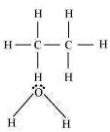
Example: In the Lewis structure of $H_2O$,the two electron pairs on the $O$ atom are lone pairs,while the two $O-H$ bonds are bond pairs.
Nonbonding electron pair (lone pair): The electron pair which does not take part in bond formation in a molecule is called a nonbonding electron pair.
Example: In the Lewis structure of $H_2O$,the two electron pairs on the $O$ atom are lone pairs,while the two $O-H$ bonds are bond pairs.
0 likes
View Solution391
Easy
Are all the five bonds in $PCl_{5}$ molecule equivalent? Justify your answer.
Solution
(N/A) $PCl_{5}$ has a trigonal bipyramidal geometry. In this structure,the three equatorial $P-Cl$ bonds are at $120^{\circ}$ to each other,while the two axial $P-Cl$ bonds are at $90^{\circ}$ to the equatorial plane. Due to greater repulsion from the equatorial bond pairs,the axial bonds are longer and weaker than the equatorial bonds. Therefore,all five bonds in $PCl_{5}$ are not equivalent.
0 likes
View Solution392
Medium
Discuss the molecular structure of $BrF_3$ based on the $VSEPR$ theory.
Solution
(N/A) The central atom $Br$ has seven valence electrons. Three of these electrons form bond pairs with three fluorine atoms,leaving four electrons behind.
Thus,it contains three bond pairs and two lone pairs.
According to the $VSEPR$ theory,these are arranged at the corners of a trigonal bipyramid.
The two lone pairs occupy equatorial positions to minimize lone pair-lone pair and bond pair-lone pair repulsions,which are greater than bond pair-bond pair repulsions.
Additionally,the axial fluorine atoms bend towards the equatorial fluorine atom to minimize lone pair-lone pair repulsions.
Therefore,its shape is slightly bent,resembling a $'T'$ shape.
Thus,it contains three bond pairs and two lone pairs.
According to the $VSEPR$ theory,these are arranged at the corners of a trigonal bipyramid.
The two lone pairs occupy equatorial positions to minimize lone pair-lone pair and bond pair-lone pair repulsions,which are greater than bond pair-bond pair repulsions.
Additionally,the axial fluorine atoms bend towards the equatorial fluorine atom to minimize lone pair-lone pair repulsions.
Therefore,its shape is slightly bent,resembling a $'T'$ shape.
0 likes
View Solution393
Medium
$(a)$ Bond angle in $PH_{4}^{+}$ is higher than that in $PH_{3}$. Why?
$(b)$ What is formed when $PH_{3}$ reacts with an acid?
$(b)$ What is formed when $PH_{3}$ reacts with an acid?
Solution
(N/A) In $PH_{3}$,$P$ is $sp^{3}$ hybridized. Three orbitals are involved in bonding with three hydrogen atoms and the fourth one contains a lone pair.
As lone pair-bond pair repulsion is stronger than bond pair-bond pair repulsion,the tetrahedral shape associated with $sp^{3}$ bonding is changed to pyramidal.
$PH_{3}$ combines with a proton $(H^+)$ to form $PH_{4}^{+}$ in which the lone pair is absent.
Due to the absence of a lone pair in $PH_{4}^{+}$,there is no lone pair-bond pair repulsion.
Hence,the bond angle in $PH_{4}^{+}$ is higher than the bond angle in $PH_{3}$.
$(b)$ When $PH_{3}$ reacts with an acid,it acts as a Lewis base due to the presence of a lone pair on the $P$ atom and forms phosphonium salts (e.g.,$PH_{3} + HCl \rightarrow PH_{4}Cl$).
As lone pair-bond pair repulsion is stronger than bond pair-bond pair repulsion,the tetrahedral shape associated with $sp^{3}$ bonding is changed to pyramidal.
$PH_{3}$ combines with a proton $(H^+)$ to form $PH_{4}^{+}$ in which the lone pair is absent.
Due to the absence of a lone pair in $PH_{4}^{+}$,there is no lone pair-bond pair repulsion.
Hence,the bond angle in $PH_{4}^{+}$ is higher than the bond angle in $PH_{3}$.
$(b)$ When $PH_{3}$ reacts with an acid,it acts as a Lewis base due to the presence of a lone pair on the $P$ atom and forms phosphonium salts (e.g.,$PH_{3} + HCl \rightarrow PH_{4}Cl$).
0 likes
View Solution394
Medium
The $HNH$ angle value is higher than $HPH, HAsH$ and $HSbH$ angles. Why?
[Hint: Can be explained on the basis of $sp^{3}$ hybridisation in $NH_{3}$ and only $s-p$ bonding between hydrogen and other elements of the group].
[Hint: Can be explained on the basis of $sp^{3}$ hybridisation in $NH_{3}$ and only $s-p$ bonding between hydrogen and other elements of the group].
Solution
(A) The hydrides of Group $15$ elements are $NH_{3}, PH_{3}, AsH_{3}$ and $SbH_{3}$.
The bond angles are: $NH_{3} (107^{\circ}), PH_{3} (92^{\circ}), AsH_{3} (91^{\circ}), SbH_{3} (90^{\circ})$.
In $NH_{3}$,the central atom $N$ undergoes $sp^{3}$ hybridization,leading to a tetrahedral geometry with a bond angle of $107^{\circ}$ due to the lone pair-bond pair repulsion.
For the heavier elements $(P, As, Sb)$,the electronegativity decreases down the group. As a result,the bond pairs are further away from the central atom,and the bond angles approach $90^{\circ}$ because the bonding involves almost pure $p$-orbitals of the central atom with little to no hybridization.
The bond angles are: $NH_{3} (107^{\circ}), PH_{3} (92^{\circ}), AsH_{3} (91^{\circ}), SbH_{3} (90^{\circ})$.
In $NH_{3}$,the central atom $N$ undergoes $sp^{3}$ hybridization,leading to a tetrahedral geometry with a bond angle of $107^{\circ}$ due to the lone pair-bond pair repulsion.
For the heavier elements $(P, As, Sb)$,the electronegativity decreases down the group. As a result,the bond pairs are further away from the central atom,and the bond angles approach $90^{\circ}$ because the bonding involves almost pure $p$-orbitals of the central atom with little to no hybridization.
0 likes
View Solution395
Medium
What is bond angle? Explain.
Solution
(N/A) Bond angle is defined as the angle between the orbitals containing bonding electron pairs around the central atom in a molecule or complex ion.
Bond angle is expressed in degrees $(^{\circ})$ and can be determined experimentally by spectroscopic methods.
Uses: It provides information regarding the spatial distribution of orbitals around the central atom in a molecule or complex ion,which helps in determining its molecular geometry or shape.
For example,the $H-O-H$ bond angle in a water $(H_2O)$ molecule is $104.5^{\circ}$,as shown below:
$H-O-H$ bond angle = $104.5^{\circ}$
Bond angle is expressed in degrees $(^{\circ})$ and can be determined experimentally by spectroscopic methods.
Uses: It provides information regarding the spatial distribution of orbitals around the central atom in a molecule or complex ion,which helps in determining its molecular geometry or shape.
For example,the $H-O-H$ bond angle in a water $(H_2O)$ molecule is $104.5^{\circ}$,as shown below:
$H-O-H$ bond angle = $104.5^{\circ}$
0 likes
View Solution396
Advanced
Apart from tetrahedral geometry,another possible geometry for $CH_4$ is square planar with the four $H$ atoms at the corners of the square and the $C$ atom at its centre. Explain why $CH_4$ is not square planar?
Solution
(N/A) According to the $VSEPR$ theory,the geometry of a molecule is determined by the minimization of repulsion between electron pairs in the valence shell of the central atom.
In a square planar geometry,the bond angle would be $90^{\circ}$,which leads to greater repulsion between the bonding electron pairs compared to the tetrahedral geometry where the bond angle is $109^{\circ}28'$.
Therefore,the tetrahedral geometry is more stable as it minimizes the repulsion between the four bonding electron pairs around the central carbon atom.
In a square planar geometry,the bond angle would be $90^{\circ}$,which leads to greater repulsion between the bonding electron pairs compared to the tetrahedral geometry where the bond angle is $109^{\circ}28'$.
Therefore,the tetrahedral geometry is more stable as it minimizes the repulsion between the four bonding electron pairs around the central carbon atom.
0 likes
View Solution397
Advanced
Write the limitations of the Lewis concept and the main postulates of $VSEPR$ theory.
Solution
Limitations of Lewis concept: The Lewis concept is unable to explain the shapes of molecules.
Valence Shell Electron Pair Repulsion $(VSEPR)$ theory: This theory provides a simple procedure to predict the shape of covalent molecules. Sidgwick and Powell in $1940$ proposed a simple theory based on the repulsive interactions of the electron pairs in the valence shell of the atoms.
Postulates of $VSEPR$ Theory:
- The shape of a molecule depends upon the number of valence shell electron pairs (bonded or non-bonded) around the central atom.
- Pairs of electrons in the valence shell repel one another since their electron clouds are negatively charged.
- These pairs of electrons tend to occupy such positions in space that minimize repulsion and thus maximize the distance between them.
- The valence shell is taken as a sphere with the electron pairs localizing on the spherical surface at maximum distance from one another.
- $A$ multiple bond is treated as if it is a single electron pair,and the two or three electron pairs of a multiple bond are treated as a single super pair.
- Where two or more resonance structures can represent a molecule,the $VSEPR$ model is applicable to any such structure.
- The repulsive interaction of electron pairs decreases in the order: $[Lone \ pair \ (lp) - Lone \ pair \ (lp)] > [Lone \ pair \ (lp) - Bond \ pair \ (bp)] > [Bond \ pair \ (bp) - Bond \ pair \ (bp)]$
Valence Shell Electron Pair Repulsion $(VSEPR)$ theory: This theory provides a simple procedure to predict the shape of covalent molecules. Sidgwick and Powell in $1940$ proposed a simple theory based on the repulsive interactions of the electron pairs in the valence shell of the atoms.
Postulates of $VSEPR$ Theory:
- The shape of a molecule depends upon the number of valence shell electron pairs (bonded or non-bonded) around the central atom.
- Pairs of electrons in the valence shell repel one another since their electron clouds are negatively charged.
- These pairs of electrons tend to occupy such positions in space that minimize repulsion and thus maximize the distance between them.
- The valence shell is taken as a sphere with the electron pairs localizing on the spherical surface at maximum distance from one another.
- $A$ multiple bond is treated as if it is a single electron pair,and the two or three electron pairs of a multiple bond are treated as a single super pair.
- Where two or more resonance structures can represent a molecule,the $VSEPR$ model is applicable to any such structure.
- The repulsive interaction of electron pairs decreases in the order: $[Lone \ pair \ (lp) - Lone \ pair \ (lp)] > [Lone \ pair \ (lp) - Bond \ pair \ (bp)] > [Bond \ pair \ (bp) - Bond \ pair \ (bp)]$
0 likes
View Solution398
Medium
State the contribution of Nyholm and Gillespie in $VSEPR$ theory.
Solution
(N/A) Nyholm and Gillespie $(1957)$ refined the $VSEPR$ model by explaining the important difference between the lone pair and bonding pairs of electrons.
While the lone pairs are localised on the central atom,each bonded pair is shared between two atoms.
As a result,the lone pair electrons in a molecule occupy more space compared to the bonding pairs of electrons.
This results in greater repulsion between lone pairs of electrons compared to the lone pair-bond pair and bond pair-bond pair repulsions.
These repulsion effects result in deviations from idealised shapes and alterations in bond angles in molecules.
While the lone pairs are localised on the central atom,each bonded pair is shared between two atoms.
As a result,the lone pair electrons in a molecule occupy more space compared to the bonding pairs of electrons.
This results in greater repulsion between lone pairs of electrons compared to the lone pair-bond pair and bond pair-bond pair repulsions.
These repulsion effects result in deviations from idealised shapes and alterations in bond angles in molecules.
0 likes
View Solution399
Difficult
State the shapes of molecules that contain only bonding electron pairs around the central atom.
Solution
(N/A) The shapes of molecules can be predicted using the $VSEPR$ theory. According to this theory,molecules are classified based on the presence of lone pairs on the central atom. For molecules where the central atom $A$ is surrounded only by bonding electron pairs (with no lone pairs),the shapes are determined by the arrangement of these pairs to minimize repulsion. The following table summarizes these shapes:
| Number of electron pairs | Arrangement of electron pairs | Molecular Geometry | Hybridization | Examples |
| :--- | :--- | :--- | :--- | :--- |
| $2$ | Linear | Linear $(AB_2)$ | $sp$ | $BeCl_2, HgCl_2$ |
| $3$ | Trigonal planar | Trigonal planar $(AB_3)$ | $sp^2$ | $BF_3$ |
| $4$ | Tetrahedral | Tetrahedral $(AB_4)$ | $sp^3$ | $CH_4, NH_4^+$ |
| Number of electron pairs | Arrangement of electron pairs | Molecular Geometry | Hybridization | Examples |
| :--- | :--- | :--- | :--- | :--- |
| $2$ | Linear | Linear $(AB_2)$ | $sp$ | $BeCl_2, HgCl_2$ |
| $3$ | Trigonal planar | Trigonal planar $(AB_3)$ | $sp^2$ | $BF_3$ |
| $4$ | Tetrahedral | Tetrahedral $(AB_4)$ | $sp^3$ | $CH_4, NH_4^+$ |
0 likes
View Solution400
Advanced
Describe the geometry (shape) of some simple molecules or ions with central atoms having one or more lone pairs of electrons $(E)$.
Solution
(N/A) The geometry of molecules with central atom $A$,bonded atoms $B$,and lone pairs $E$ is summarized in the table below:
| Molecule type | No. of bonding pairs | No. of lone pairs | Arrangement of electron pairs | Shape | Example |
|---|---|---|---|---|---|
| $AB_2E$ | $2$ | $1$ | Trigonal planar | Bent | $SO_2, O_3$ |
| $AB_3E$ | $3$ | $1$ | Tetrahedral | Trigonal pyramidal | $NH_3$ |
| $AB_2E_2$ | $2$ | $2$ | Tetrahedral | Bent | $H_2O$ |
| $AB_4E$ | $4$ | $1$ | Trigonal bipyramidal | See-saw | $SF_4$ |
0 likes
View SolutionChemical Bonding and Molecular Structure — VSEPR Theory · Frequently Asked Questions
1Are these Chemical Bonding and Molecular Structure questions useful for JEE and NEET?
Yes. All questions in this section are mapped to JEE Main and NEET exam patterns. Previous year questions from JEE Main, NEET, GUJCET and state-level exams are included with full solutions.
2Can I switch to Hindi or Gujarati for these questions?
Yes. Use the language tabs in the hero section or the sidebar to view the same questions and solutions in English, Hindi or Gujarati.
3How do I generate a question paper from this subtopic?
Use the Vedclass Exam Paper Generator — select the chapter and subtopic, set difficulty, and generate Sets A, B, C, D automatically. First 3 chapters of every subject are free.
Vedclass Products
For Students
Vedclass Test Series
Mock tests in real JEE/NEET style with performance analysis. 5-day free trial.
Start Free TrialFor Teachers
Exam Paper Generator
Generate Set A/B/C/D papers from this chapter in 2 minutes. 3 chapters free.
Try FreeFor Institutes
Online Exam Module
Live online exams with unlimited students, 360° analytics & white-label branding.
See DemoFor Teachers & Institutes
Generate a Chemical Bonding and Molecular Structure Exam Paper in 2 Minutes
Select subtopic & difficulty — Sets A, B, C, D auto-generated with No Repeat logic.
First 3 chapters of every subject are free — no payment required.