
A English
Hybridisation Questions in English
Class 11 Chemistry · Chemical Bonding and Molecular Structure · Hybridisation
538+
Questions
English
Language
100%
With Solutions
Showing 50 of 538 questions in English
101
MediumMCQ
Carbon atoms in the compound $(CN)_4C_2$ are
A
$sp$ hybridized
B
$sp^2$ hybridized
C
$sp$ and $sp^2$ hybridized
D
$sp$,$sp^2$ and $sp^3$ hybridized
Solution
(C) The structure of the compound $(CN)_4C_2$ is tetracyanoethylene,which can be represented as $(NC)_2C=C(CN)_2$.
In this molecule,the two central carbon atoms are bonded to two other carbon atoms via a double bond and two single bonds,making them $sp^2$ hybridized.
The four carbon atoms in the cyano $(-CN)$ groups are each bonded to one carbon atom and one nitrogen atom via a triple bond,making them $sp$ hybridized.
Therefore,the carbon atoms in the compound are both $sp$ and $sp^2$ hybridized.
In this molecule,the two central carbon atoms are bonded to two other carbon atoms via a double bond and two single bonds,making them $sp^2$ hybridized.
The four carbon atoms in the cyano $(-CN)$ groups are each bonded to one carbon atom and one nitrogen atom via a triple bond,making them $sp$ hybridized.
Therefore,the carbon atoms in the compound are both $sp$ and $sp^2$ hybridized.
0 likes
View Solution102
MediumMCQ
Number of unhybridised orbitals in vinyl acetylene is
A
$2$
B
$3$
C
$4$
D
$6$
Solution
(D) The structure of vinyl acetylene is $CH_2=CH-C \equiv CH$.
In this molecule:
- The two $sp^2$ hybridized carbon atoms each have $1$ unhybridised $p$-orbital.
- The two $sp$ hybridized carbon atoms each have $2$ unhybridised $p$-orbitals.
Total unhybridised $p$-orbitals $= (2 \times 1) + (2 \times 2) = 2 + 4 = 6$.
In this molecule:
- The two $sp^2$ hybridized carbon atoms each have $1$ unhybridised $p$-orbital.
- The two $sp$ hybridized carbon atoms each have $2$ unhybridised $p$-orbitals.
Total unhybridised $p$-orbitals $= (2 \times 1) + (2 \times 2) = 2 + 4 = 6$.
0 likes
View Solution103
EasyMCQ
Which of the following hybridization is known as trigonal hybridization?
A
$sp^3$
B
$sp$
C
$sp^2$
D
$dsp^2$
Solution
(C) $sp^2$ hybridization involves the mixing of one $s$ and two $p$ orbitals to form three equivalent hybrid orbitals.
These orbitals are oriented at an angle of $120^{\circ}$ to each other,resulting in a trigonal planar geometry.
Therefore,$sp^2$ hybridization is known as trigonal hybridization.
These orbitals are oriented at an angle of $120^{\circ}$ to each other,resulting in a trigonal planar geometry.
Therefore,$sp^2$ hybridization is known as trigonal hybridization.
0 likes
View Solution104
MediumMCQ
The $H-C-H$ bond angle in $CH_4$ is
A
$109^{\circ} 28^{\prime}$
B
$107^{\circ} 28^{\prime}$
C
$90^{\circ}$
D
$180^{\circ}$
Solution
(A) In $CH_4$,the carbon atom undergoes $sp^3$ hybridization.
This results in a tetrahedral geometry for the molecule.
In a perfect tetrahedral geometry,the bond angle between any two $H-C-H$ bonds is $109^{\circ} 28^{\prime}$.
This results in a tetrahedral geometry for the molecule.
In a perfect tetrahedral geometry,the bond angle between any two $H-C-H$ bonds is $109^{\circ} 28^{\prime}$.
0 likes
View Solution105
MediumMCQ
The shape of the ethylene molecule is
A
Square planar
B
Furan
C
Trigonal planar
D
Tetrahedral
Solution
(C) In ethylene $(CH_2=CH_2)$,each carbon atom is $sp^2$ hybridized.
The geometry around each carbon atom is trigonal planar with bond angles of approximately $120^\circ$.
The geometry around each carbon atom is trigonal planar with bond angles of approximately $120^\circ$.
0 likes
View Solution106
EasyMCQ
The carbon atoms in an acetylene molecule are in which state of hybridisation?
A
$sp$-hybridisation
B
$sp^2$-hybridisation
C
$sp^3$-hybridisation
D
$sp^3d$-hybridisation
Solution
(A) The structure of acetylene is $HC \equiv CH$.
In this molecule,each carbon atom is bonded to one hydrogen atom by a single bond and to the other carbon atom by a triple bond.
Since each carbon atom is involved in one triple bond (one $\sigma$ and two $\pi$ bonds) and one single $\sigma$ bond,it has two $\sigma$ bonds and zero lone pairs.
Therefore,the steric number is $2$,which corresponds to $sp$-hybridisation.
In this molecule,each carbon atom is bonded to one hydrogen atom by a single bond and to the other carbon atom by a triple bond.
Since each carbon atom is involved in one triple bond (one $\sigma$ and two $\pi$ bonds) and one single $\sigma$ bond,it has two $\sigma$ bonds and zero lone pairs.
Therefore,the steric number is $2$,which corresponds to $sp$-hybridisation.
0 likes
View Solution107
EasyMCQ
In the formation of the $CH_4$ molecule,carbon makes use of:
A
$sp$-hybridised orbitals
B
$sp^2$-hybridised orbitals
C
$sp^3$-hybridised orbitals
D
Unhybridised orbitals
Solution
(C) In a $CH_4$ molecule,the carbon atom is bonded to four hydrogen atoms through single covalent bonds.
According to the valence bond theory,the carbon atom undergoes $sp^3$ hybridisation in its excited state to form four equivalent $sp^3$ hybrid orbitals.
These four $sp^3$ hybrid orbitals overlap with the $1s$ orbitals of four hydrogen atoms to form four $C-H$ sigma bonds.
Therefore,carbon makes use of $sp^3$-hybridised orbitals.
According to the valence bond theory,the carbon atom undergoes $sp^3$ hybridisation in its excited state to form four equivalent $sp^3$ hybrid orbitals.
These four $sp^3$ hybrid orbitals overlap with the $1s$ orbitals of four hydrogen atoms to form four $C-H$ sigma bonds.
Therefore,carbon makes use of $sp^3$-hybridised orbitals.
0 likes
View Solution108
EasyMCQ
In graphite,the $C$-atom is in which state of hybridisation?
A
$sp^3$
B
$sp$
C
$sp^2$
D
None of these
Solution
(C) In graphite,each carbon atom is $sp^2$ hybridised.
Each carbon atom is covalently bonded to three other carbon atoms in a hexagonal planar arrangement.
Each carbon atom is covalently bonded to three other carbon atoms in a hexagonal planar arrangement.
0 likes
View Solution109
EasyMCQ
Hybridisation state of $C$ in diamond is
A
$sp$
B
$sp^2$
C
$sp^3$
D
$sp^3d$
Solution
(C) In diamond,each carbon atom is bonded to four other carbon atoms via $sp^3$ hybridised orbitals.
This results in a tetrahedral geometry around each carbon atom.
This results in a tetrahedral geometry around each carbon atom.
0 likes
View Solution110
MediumMCQ
The $C-C$ bond length of the following molecules is in the order:
A
$C_2H_6 > C_2H_4 > C_6H_6 > C_2H_2$
B
$C_2H_2 < C_2H_4 < C_6H_6 < C_2H_6$
C
$C_2H_6 > C_2H_2 > C_6H_6 > C_2H_4$
D
$C_2H_4 > C_2H_6 > C_2H_2 > C_6H_6$
Solution
(B) The bond length depends on the hybridization of the carbon atoms involved.
As the $s$-character increases,the bond length decreases.
$C_2H_2$ ($sp$ hybridization,$1.20 \ \mathring{A}$) < $C_2H_4$ ($sp^2$ hybridization,$1.34 \ \mathring{A}$) < $C_6H_6$ (delocalized $sp^2$ hybridization,$1.39 \ \mathring{A}$) < $C_2H_6$ ($sp^3$ hybridization,$1.54 \ \mathring{A}$).
Thus,the correct order is $C_2H_2 < C_2H_4 < C_6H_6 < C_2H_6$.
As the $s$-character increases,the bond length decreases.
$C_2H_2$ ($sp$ hybridization,$1.20 \ \mathring{A}$) < $C_2H_4$ ($sp^2$ hybridization,$1.34 \ \mathring{A}$) < $C_6H_6$ (delocalized $sp^2$ hybridization,$1.39 \ \mathring{A}$) < $C_2H_6$ ($sp^3$ hybridization,$1.54 \ \mathring{A}$).
Thus,the correct order is $C_2H_2 < C_2H_4 < C_6H_6 < C_2H_6$.
0 likes
View Solution111
EasyMCQ
The shape of methane molecule is
A
Linear
B
Trigonal planar
C
Square planar
D
Tetrahedral
Solution
(D) In $CH_4$,the carbon atom undergoes $sp^3$ hybridization.
It forms four equivalent $C-H$ sigma bonds directed towards the corners of a regular tetrahedron.
Therefore,the shape of the methane molecule is tetrahedral with a bond angle of $109.5^\circ$.
It forms four equivalent $C-H$ sigma bonds directed towards the corners of a regular tetrahedron.
Therefore,the shape of the methane molecule is tetrahedral with a bond angle of $109.5^\circ$.
0 likes
View Solution112
MediumMCQ
$C-H$ bond length is greatest in
A
$C_2H_2$
B
$C_2H_4$
C
$C_2H_6$
D
$C_2H_2Br_2$
Solution
(C) Bond length is inversely proportional to the $s$-character of the hybrid orbital of the carbon atom.
$1.$ In $C_2H_2$ (Ethyne),the hybridization of carbon is $sp$,which has $50 \% \ s$-character.
$2.$ In $C_2H_4$ (Ethene),the hybridization of carbon is $sp^2$,which has $33.33 \% \ s$-character.
$3.$ In $C_2H_6$ (Ethane),the hybridization of carbon is $sp^3$,which has $25 \% \ s$-character.
Since $C_2H_6$ has the lowest $s$-character $(25 \%)$,the $C-H$ bond length is the greatest in $C_2H_6$.
$1.$ In $C_2H_2$ (Ethyne),the hybridization of carbon is $sp$,which has $50 \% \ s$-character.
$2.$ In $C_2H_4$ (Ethene),the hybridization of carbon is $sp^2$,which has $33.33 \% \ s$-character.
$3.$ In $C_2H_6$ (Ethane),the hybridization of carbon is $sp^3$,which has $25 \% \ s$-character.
Since $C_2H_6$ has the lowest $s$-character $(25 \%)$,the $C-H$ bond length is the greatest in $C_2H_6$.
0 likes
View Solution113
EasyMCQ
Which type of hybridisation occurs in ethylene?
A
$sp$
B
$sp^2$
C
$sp^3$
D
$sp^3d$
Solution
(B) In ethylene $(CH_2=CH_2)$,each carbon atom is bonded to two hydrogen atoms and one other carbon atom via a double bond.
Each carbon atom is surrounded by three electron domains (two single bonds and one double bond),which corresponds to $sp^2$ hybridisation.
The geometry around each carbon atom is trigonal planar.
Each carbon atom is surrounded by three electron domains (two single bonds and one double bond),which corresponds to $sp^2$ hybridisation.
The geometry around each carbon atom is trigonal planar.
0 likes
View Solution114
EasyMCQ
The shape of ethane is
A
Triangular
B
Tetrahedral
C
Linear
D
None of these
Solution
(B) In ethane $(CH_3-CH_3)$,each carbon atom is bonded to four other atoms (three hydrogen atoms and one carbon atom) by single bonds.
Therefore,each carbon atom undergoes $sp^3$ hybridization.
According to $VSEPR$ theory,$sp^3$ hybridized carbon atoms exhibit a tetrahedral geometry around the central atom.
Therefore,each carbon atom undergoes $sp^3$ hybridization.
According to $VSEPR$ theory,$sp^3$ hybridized carbon atoms exhibit a tetrahedral geometry around the central atom.
0 likes
View Solution115
MediumMCQ
The shape of the ethylene molecule is:
A
Tetrahedral
B
Pyramidal
C
Planar
D
Linear
Solution
(C) In the ethylene molecule $(C_2H_4)$,each carbon atom is bonded to two hydrogen atoms and one other carbon atom via a double bond.
Each carbon atom undergoes $sp^2$ hybridization.
Due to $sp^2$ hybridization,the bond angles are approximately $120^{\circ}$,and all atoms lie in the same plane.
Therefore,the shape of the ethylene molecule is planar.
Each carbon atom undergoes $sp^2$ hybridization.
Due to $sp^2$ hybridization,the bond angles are approximately $120^{\circ}$,and all atoms lie in the same plane.
Therefore,the shape of the ethylene molecule is planar.
0 likes
View Solution116
MediumMCQ
The shapes of methane,ethene and ethyne molecules are,respectively
A
Tetrahedral,planar and linear
B
Tetrahedral,linear and planar
C
Pyramidal,planar and linear
D
Tetrahedral,pyramidal and planar
Solution
(A) The shapes of methane $(CH_4)$,ethene $(C_2H_4)$ and ethyne $(C_2H_2)$ are tetrahedral,planar and linear respectively.
In methane,the $C$ atom is $sp^3$ hybridized,resulting in a tetrahedral geometry.
In ethene,the $C$ atoms are $sp^2$ hybridized,resulting in a planar geometry.
In ethyne,the $C$ atoms are $sp$ hybridized,resulting in a linear geometry.
In methane,the $C$ atom is $sp^3$ hybridized,resulting in a tetrahedral geometry.
In ethene,the $C$ atoms are $sp^2$ hybridized,resulting in a planar geometry.
In ethyne,the $C$ atoms are $sp$ hybridized,resulting in a linear geometry.
0 likes
View Solution117
MediumMCQ
The bond length between an $sp^{3}$ hybridized carbon atom and another carbon atom is minimum in:
A
Propane
B
Butane
C
Propene
D
Propyne
Solution
(D) The bond length depends on the hybridization of the carbon atoms involved in the bond.
$sp^{3}-sp^{3}$ single bond length is $1.54 \, \mathring{A}$.
$sp^{2}-sp^{2}$ double bond length is $1.34 \, \mathring{A}$.
$sp-sp$ triple bond length is $1.20 \, \mathring{A}$.
In propyne $(CH_{3}-C \equiv CH)$,there is a $C \equiv C$ bond,which has the shortest bond length among the given options.
$sp^{3}-sp^{3}$ single bond length is $1.54 \, \mathring{A}$.
$sp^{2}-sp^{2}$ double bond length is $1.34 \, \mathring{A}$.
$sp-sp$ triple bond length is $1.20 \, \mathring{A}$.
In propyne $(CH_{3}-C \equiv CH)$,there is a $C \equiv C$ bond,which has the shortest bond length among the given options.
0 likes
View Solution118
MediumMCQ
Which of the $C - C$ bond is strongest?
A
Formed by $sp^3 - sp^3$ hybridised carbon atoms (as in alkanes)
B
Formed by $sp^2 - sp^2$ hybridised carbon atoms (as in alkenes)
C
Formed by $sp - sp$ hybridised carbon atoms (as in alkynes)
D
All are equal
Solution
(C) The strength of a $C - C$ bond depends on the percentage of $s$-character in the hybrid orbitals.
Greater $s$-character leads to shorter and stronger bonds.
For $sp$ hybridization,$s$-character is $50\%$.
For $sp^2$ hybridization,$s$-character is $33.3\%$.
For $sp^3$ hybridization,$s$-character is $25\%$.
Therefore,the order of bond strength is $sp - sp > sp^2 - sp^2 > sp^3 - sp^3$.
Greater $s$-character leads to shorter and stronger bonds.
For $sp$ hybridization,$s$-character is $50\%$.
For $sp^2$ hybridization,$s$-character is $33.3\%$.
For $sp^3$ hybridization,$s$-character is $25\%$.
Therefore,the order of bond strength is $sp - sp > sp^2 - sp^2 > sp^3 - sp^3$.
0 likes
View Solution119
MediumMCQ
Which of the following pairs has the same bond angle?
A
Ethane and ethylene
B
Ethylene and acetylene
C
Ethylene and benzene
D
Acetylene and benzene
Solution
(C) The correct answer is $C$.
In ethylene $(CH_2=CH_2)$,the carbon atoms are $sp^2$ hybridized,resulting in a bond angle of $120^{\circ}$.
In benzene $(C_6H_6)$,each carbon atom is also $sp^2$ hybridized,resulting in a bond angle of $120^{\circ}$.
Therefore,both ethylene and benzene have the same bond angle of $120^{\circ}$.
In ethylene $(CH_2=CH_2)$,the carbon atoms are $sp^2$ hybridized,resulting in a bond angle of $120^{\circ}$.
In benzene $(C_6H_6)$,each carbon atom is also $sp^2$ hybridized,resulting in a bond angle of $120^{\circ}$.
Therefore,both ethylene and benzene have the same bond angle of $120^{\circ}$.
0 likes
View Solution120
MediumMCQ
The hybridization in methane,ethene and ethyne respectively is
A
$sp^3$,$sp^2$ and $sp$
B
$sp^3$,$sp$ and $sp^2$
C
$sp^2$,$sp^3$ and $sp$
D
$sp^2$,$sp$ and $sp^3$
Solution
(A) In methane $(CH_4)$,the carbon atom forms four single bonds,resulting in $sp^3$ hybridization.
In ethene $(C_2H_4)$,each carbon atom is bonded to two hydrogen atoms and one other carbon atom via a double bond,resulting in $sp^2$ hybridization.
In ethyne $(C_2H_2)$,each carbon atom is bonded to one hydrogen atom and one other carbon atom via a triple bond,resulting in $sp$ hybridization.
Therefore,the correct sequence is $sp^3$,$sp^2$,and $sp$.
In ethene $(C_2H_4)$,each carbon atom is bonded to two hydrogen atoms and one other carbon atom via a double bond,resulting in $sp^2$ hybridization.
In ethyne $(C_2H_2)$,each carbon atom is bonded to one hydrogen atom and one other carbon atom via a triple bond,resulting in $sp$ hybridization.
Therefore,the correct sequence is $sp^3$,$sp^2$,and $sp$.
0 likes
View Solution121
MediumMCQ
Which of the following shows a linear structure?
A
Ethane
B
Ethene
C
Acetylene
D
$CCl_4$
Solution
(C) In acetylene $(HC \equiv CH)$,both carbon atoms are $sp$-hybridized.
Due to $sp$-hybridization,the bond angle is $180^{\circ}$,which results in a linear structure.
Due to $sp$-hybridization,the bond angle is $180^{\circ}$,which results in a linear structure.
0 likes
View Solution122
MediumMCQ
Among the following compounds,which one is planar in shape?
A
Methane
B
Acetylene
C
Benzene
D
Isobutane
Solution
(C) The correct answer is $C$.
In $C_6H_6$ (Benzene),all $6$ carbon atoms are $sp^2$-hybridized,which results in a trigonal planar geometry for each carbon atom.
Consequently,the entire molecule of Benzene is planar.
In $C_6H_6$ (Benzene),all $6$ carbon atoms are $sp^2$-hybridized,which results in a trigonal planar geometry for each carbon atom.
Consequently,the entire molecule of Benzene is planar.
0 likes
View Solution123
MediumMCQ
The correct order of hybridisations of the central atom in $NH_3$,$[PtCl_4]^{2-}$,$PCl_5$,and $BCl_3$ is:
A
$dsp^2, dsp^3, sp^2, sp^3$
B
$sp^3, dsp^2, sp^3d, sp^2$
C
$dsp^2, sp^2, sp^3, dsp^3$
D
$dsp^2, sp^3, sp^2, dsp^3$
Solution
(B) $1$. For $NH_3$: The central atom $N$ has $3$ bond pairs and $1$ lone pair,so the hybridisation is $sp^3$.
$2$. For $[PtCl_4]^{2-}$: $Pt^{2+}$ is a $d^8$ metal ion. With strong field ligands like $Cl^-$ (in square planar geometry),it undergoes $dsp^2$ hybridisation.
$3$. For $PCl_5$: The central atom $P$ has $5$ bond pairs and $0$ lone pairs,resulting in $sp^3d$ hybridisation.
$4$. For $BCl_3$: The central atom $B$ has $3$ bond pairs and $0$ lone pairs,resulting in $sp^2$ hybridisation.
Therefore,the order is $sp^3, dsp^2, sp^3d, sp^2$.
$2$. For $[PtCl_4]^{2-}$: $Pt^{2+}$ is a $d^8$ metal ion. With strong field ligands like $Cl^-$ (in square planar geometry),it undergoes $dsp^2$ hybridisation.
$3$. For $PCl_5$: The central atom $P$ has $5$ bond pairs and $0$ lone pairs,resulting in $sp^3d$ hybridisation.
$4$. For $BCl_3$: The central atom $B$ has $3$ bond pairs and $0$ lone pairs,resulting in $sp^2$ hybridisation.
Therefore,the order is $sp^3, dsp^2, sp^3d, sp^2$.
0 likes
View Solution124
EasyMCQ
Which of the following statements is incorrect?
A
Carbon dioxide acts as a non-polar molecule despite having two resonance structures.
B
Carbon dioxide is the anhydride of a dibasic acid.
C
The carbon dioxide molecule is linear because the carbon atom uses its $sp$ orbitals to form $\sigma$ bonds.
D
The carbon atom in the $CO_2$ molecule and its dihydrate molecule $H_2CO_3$ are in the same hybridization state.
Solution
(D) In the $CO_2$ molecule,the carbon atom undergoes $sp$ hybridization,resulting in a linear geometry.
In the $H_2CO_3$ molecule (carbonic acid),the carbon atom undergoes $sp^2$ hybridization.
Therefore,the statement that they have the same hybridization is incorrect.
In the $H_2CO_3$ molecule (carbonic acid),the carbon atom undergoes $sp^2$ hybridization.
Therefore,the statement that they have the same hybridization is incorrect.
0 likes
View Solution125
EasyMCQ
In $C_{60}$,all carbon atoms are:
A
$sp^2$-hybridized and have a truncated icosahedral shape.
B
$sp^3$-hybridized and have a truncated icosahedral shape.
C
$sp^2$-hybridized with a diamond shape.
D
$sp^2$-hybridized with a graphite-like shape.
Solution
(A) In $C_{60}$ (Buckminsterfullerene),each carbon atom is $sp^2$-hybridized.
It consists of $20$ hexagonal and $12$ pentagonal rings,which results in a truncated icosahedral structure,often referred to as a soccer ball shape.
It consists of $20$ hexagonal and $12$ pentagonal rings,which results in a truncated icosahedral structure,often referred to as a soccer ball shape.
0 likes
View Solution126
EasyMCQ
What is the hybridization of carbon in graphite and diamond,respectively?
A
$sp, sp^2$
B
$sp^2, sp^3$
C
$sp^3, sp^2$
D
$sp^3, sp^3$
Solution
(B) In graphite,each carbon atom is $sp^2$ hybridized,forming a layered structure with delocalized electrons.
In diamond,each carbon atom is $sp^3$ hybridized,forming a rigid three-dimensional tetrahedral network.
In diamond,each carbon atom is $sp^3$ hybridized,forming a rigid three-dimensional tetrahedral network.
0 likes
View Solution127
EasyMCQ
What is the $s$-character content in an $sp^3$ hybrid orbital?
A
$\frac{1}{4} \ s$-character
B
$\frac{1}{2} \ s$-character
C
$\frac{2}{3} \ s$-character
D
$\frac{3}{2} \ s$-character
Solution
(A) In an $sp^3$ hybrid orbital,one $s$-orbital and three $p$-orbitals are mixed to form four equivalent hybrid orbitals.
Therefore,the $s$-character is $\frac{1}{1+3} = \frac{1}{4}$,which is equal to $25\%$.
Therefore,the $s$-character is $\frac{1}{1+3} = \frac{1}{4}$,which is equal to $25\%$.
0 likes
View Solution128
EasyMCQ
In $CCl_4$,the four valencies of carbon are directed towards the four corners of which of the following?
A
Cube
B
Octagon
C
Prism
D
Tetrahedron
Solution
(D) In $CCl_4$,the carbon atom undergoes $sp^3$ hybridization.
Therefore,it adopts a tetrahedral geometry where the four valencies are directed towards the four corners of a regular tetrahedron.
Therefore,it adopts a tetrahedral geometry where the four valencies are directed towards the four corners of a regular tetrahedron.
0 likes
View Solution129
MediumMCQ
Which of the following statements is $NOT$ correct?
A
Hybridization is the mixing of atomic orbitals and also their combination into molecular orbitals.
B
$sp^2$ hybridization involves the mixing of two $p$-atomic orbitals and one $s$-atomic orbital.
C
In $dsp^2$ hybridization,all hybrid orbitals are at $90^o$ to each other.
D
In $d^2sp^3$ hybridization,the hybrid orbitals are directed towards the corners of a regular octahedron.
Solution
(C) Hybridization is the concept of mixing atomic orbitals of the same atom to form new hybrid orbitals of equivalent energy. It is not the same as the formation of molecular orbitals,which involves the overlap of atomic orbitals from different atoms.
In $dsp^2$ hybridization,the geometry is square planar. While adjacent hybrid orbitals are at $90^o$ to each other,the orbitals opposite to each other are at $180^o$. Therefore,the statement that all hybrid orbitals are at $90^o$ to each other is incorrect.
In $dsp^2$ hybridization,the geometry is square planar. While adjacent hybrid orbitals are at $90^o$ to each other,the orbitals opposite to each other are at $180^o$. Therefore,the statement that all hybrid orbitals are at $90^o$ to each other is incorrect.
0 likes
View Solution130
EasyMCQ
In which of the following compounds will the angle between two covalent bonds be the largest?
A
$H_2O$
B
$NH_3$
C
$CO_2$
D
$CH_4$
Solution
(C) In $CO_2$,the bond angle is $180^\circ$ due to $sp$ hybridization.
The structure is linear: $O=C=O$.
The structure is linear: $O=C=O$.
0 likes
View Solution131
MediumMCQ
Which of the following geometries corresponds to $sp^3d$ hybridization of the central atom?
A
Planar
B
Pyramidal
C
Angular
D
Trigonal bipyramidal
Solution
(D) For a central atom with $sp^3d$ hybridization,the electron pairs are arranged in a trigonal bipyramidal geometry to minimize repulsion.
Therefore,the correct geometry is $Trigonal \text{ } bipyramidal$.
Therefore,the correct geometry is $Trigonal \text{ } bipyramidal$.
0 likes
View Solution132
MediumMCQ
$A$ molecule is square planar and has no lone pairs. What type of hybridization is it associated with?
A
$sp^3d$
B
$sp^3d^2$
C
$dsp^3$
D
$dsp^2$
Solution
(D) In $dsp^2$ hybridization,the molecular geometry is square planar.
0 likes
View Solution133
EasyMCQ
Which of the following molecules is linear?
A
$C_2H_2$
B
$CH_4$
C
$H_2O$
D
$NH_3$
Solution
(A) In $C_2H_2$ (acetylene),the structure is $HC \equiv CH$.
Each carbon atom is $sp$ hybridized,resulting in a linear geometry with a bond angle of $180^{\circ}$.
Each carbon atom is $sp$ hybridized,resulting in a linear geometry with a bond angle of $180^{\circ}$.
0 likes
View Solution134
EasyMCQ
The $BCl_3$ molecule is planar. What type of hybridization does the boron atom undergo in this molecule?
A
$sp^3$
B
$sp^2$
C
$sp$
D
$dsp^2$
Solution
(B) In $BCl_3$,the boron atom undergoes $sp^2$ hybridization.
This results in a trigonal planar geometry for the molecule.
This results in a trigonal planar geometry for the molecule.
0 likes
View Solution135
MediumMCQ
In which of the following molecules does the central atom use $sp^2$ hybrid orbitals to form covalent bonds?
A
$He_2$
B
$SO_2$
C
$PCl_5$
D
$N_2$
Solution
(B) The central atom in $SO_2$ is $S$. The number of hybrid orbitals is calculated as $1/2(V + M - C + A)$,where $V$ is the number of valence electrons,$M$ is the number of monovalent atoms,$C$ is the cationic charge,and $A$ is the anionic charge.
For $SO_2$: $V = 6$ (for $S$),$M = 0$ (since $O$ is divalent).
Number of hybrid orbitals = $1/2(6 + 0) = 3$.
$3$ hybrid orbitals correspond to $sp^2$ hybridization.
For $SO_2$: $V = 6$ (for $S$),$M = 0$ (since $O$ is divalent).
Number of hybrid orbitals = $1/2(6 + 0) = 3$.
$3$ hybrid orbitals correspond to $sp^2$ hybridization.
0 likes
View Solution136
MediumMCQ
Which of the following molecules has an octahedral shape?
A
$PF_5$
B
$SF_4$
C
$TeF_6$
D
$ClF_3$
Solution
(C) The octahedral shape is associated with $sp^3d^2$ hybridization.
In $TeF_6$,the central atom $Te$ has $6$ valence electrons and forms $6$ bonds with $F$ atoms,resulting in $6$ bond pairs and $0$ lone pairs.
This corresponds to $sp^3d^2$ hybridization,which gives an octahedral geometry.
In $TeF_6$,the central atom $Te$ has $6$ valence electrons and forms $6$ bonds with $F$ atoms,resulting in $6$ bond pairs and $0$ lone pairs.
This corresponds to $sp^3d^2$ hybridization,which gives an octahedral geometry.
0 likes
View Solution137
MediumMCQ
What are the hybridization states of carbon in diamond,graphite,and acetylene,respectively?
A
$sp^2, sp, sp^3$
B
$sp, sp^2, sp^3$
C
$sp^3, sp^2, sp$
D
$sp^2, sp^3, sp$
Solution
(C) In diamond,each carbon atom is bonded to four other carbon atoms in a tetrahedral geometry,resulting in $sp^3$ hybridization.
In graphite,each carbon atom is bonded to three other carbon atoms in a planar hexagonal arrangement,resulting in $sp^2$ hybridization.
In acetylene $(C_2H_2)$,each carbon atom is bonded to one hydrogen atom and one other carbon atom via a triple bond,resulting in $sp$ hybridization.
Therefore,the hybridization states are $sp^3, sp^2, sp$ respectively.
In graphite,each carbon atom is bonded to three other carbon atoms in a planar hexagonal arrangement,resulting in $sp^2$ hybridization.
In acetylene $(C_2H_2)$,each carbon atom is bonded to one hydrogen atom and one other carbon atom via a triple bond,resulting in $sp$ hybridization.
Therefore,the hybridization states are $sp^3, sp^2, sp$ respectively.
0 likes
View Solution138
EasyMCQ
The $AsF_5$ molecule is trigonal bipyramidal. Which of the following orbitals of $As$ are involved in the hybridization?
A
$d_{z^2}, s, p_x, p_y, p_z$
B
$d_{x^2-y^2}, s, p_x, p_y, p_{z^2}$
C
$s, p_x, p_y, p_z, d_{xz}$
D
None of these
Solution
(A) In $AsF_5$,the hybridization of $As$ is $sp^3d$.
Therefore,the orbitals involved are one $s$,three $p$ $(p_x, p_y, p_z)$,and one $d$ $(d_{z^2})$ orbital.
Therefore,the orbitals involved are one $s$,three $p$ $(p_x, p_y, p_z)$,and one $d$ $(d_{z^2})$ orbital.
0 likes
View Solution139
EasyMCQ
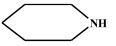
What is the expected hybridization of $N$ in the given molecule?
A
$sp$
B
$sp^2$
C
$sp^3$
D
$dsp^2$
Solution
(C) The given molecule is piperidine.
In piperidine,the nitrogen atom is bonded to two carbon atoms and one hydrogen atom,and it also possesses one lone pair of electrons.
Number of electron domains around $N = 2 \text{ (bonds to } C) + 1 \text{ (bond to } H) + 1 \text{ (lone pair)} = 4$.
Since the steric number is $4$,the hybridization of the nitrogen atom is $sp^3$.
In piperidine,the nitrogen atom is bonded to two carbon atoms and one hydrogen atom,and it also possesses one lone pair of electrons.
Number of electron domains around $N = 2 \text{ (bonds to } C) + 1 \text{ (bond to } H) + 1 \text{ (lone pair)} = 4$.
Since the steric number is $4$,the hybridization of the nitrogen atom is $sp^3$.
0 likes
View Solution140
MediumMCQ
Which of the following pairs of species have the same structure?
A
$CH_3^-, CH_3^+$
B
$NH_4^+, NH_3$
C
$SO_4^{2-}, BF_4^-$
D
$NH_2^-, BeF_2$
Solution
(C) In $SO_4^{2-}$ and $BF_4^-$,the central atoms ($S$ and $B$) undergo $sp^3$ hybridization.
Both species have a tetrahedral geometry due to the absence of lone pairs on the central atom in the tetrahedral arrangement.
Both species have a tetrahedral geometry due to the absence of lone pairs on the central atom in the tetrahedral arrangement.
0 likes
View Solution141
EasyMCQ
What is the bond angle around an atom that undergoes $sp^2$ hybridization?
A
$120^o$
B
$180^o$
C
$105^o$
D
$109^o 28'$
Solution
(A) In $sp^2$ hybridization,the three hybrid orbitals are oriented at an angle of $120^o$ to each other to minimize electron repulsion.
Therefore,the bond angle is $120^o$.
Therefore,the bond angle is $120^o$.
0 likes
View Solution142
EasyMCQ
What is the $C - C$ bond length in molecules with $sp^2$ hybridization (in $\mathring{A}$)?
A
$1.2$
B
$1.32$
C
$1.54$
D
$1.4$
Solution
(D) In molecules with $sp^2$ hybridization,the $C - C$ bond length is $1.4 \ \mathring{A}$.
0 likes
View Solution143
MediumMCQ
What is the type of hybridization of $Xe$ in $XeF_2$?
A
$sp^3$
B
$sp^2$
C
$sp^3d$
D
$sp^3d^2$
Solution
(C) The total number of valence electrons in $XeF_2$ is $8 + (2 \times 7) = 22$.
To find the hybridization,we calculate the steric number $(X)$:
$X = \frac{1}{2} [V + M - C + A]$,where $V$ is the number of valence electrons of the central atom,$M$ is the number of monovalent atoms,$C$ is the cationic charge,and $A$ is the anionic charge.
For $XeF_2$: $V = 8$,$M = 2$,$C = 0$,$A = 0$.
$X = \frac{1}{2} [8 + 2] = 5$.
$A$ steric number of $5$ corresponds to $sp^3d$ hybridization.
To find the hybridization,we calculate the steric number $(X)$:
$X = \frac{1}{2} [V + M - C + A]$,where $V$ is the number of valence electrons of the central atom,$M$ is the number of monovalent atoms,$C$ is the cationic charge,and $A$ is the anionic charge.
For $XeF_2$: $V = 8$,$M = 2$,$C = 0$,$A = 0$.
$X = \frac{1}{2} [8 + 2] = 5$.
$A$ steric number of $5$ corresponds to $sp^3d$ hybridization.
0 likes
View Solution144
MediumMCQ
Which of the following species/ions has an octahedral geometry?
A
$SF_6$
B
$BF_4^-$
C
$PCl_5$
D
$BO_3^{3-}$
Solution
(A) In $SF_6$,the central sulfur atom is bonded to $6$ fluorine atoms with no lone pairs,resulting in $sp^3d^2$ hybridization.
This hybridization corresponds to an octahedral geometry.
This hybridization corresponds to an octahedral geometry.
0 likes
View Solution145
MediumMCQ
What is the structure of $CH_2 = C = CH_2$?
A
Linear
B
Planar
C
Non-planar
D
Many resonance structures
Solution
(C) The molecule $CH_2 = C = CH_2$ (allene) is non-planar.
In this molecule,the central carbon atom is $sp$ hybridized,while the two terminal carbon atoms are $sp^2$ hybridized.
The two $CH_2$ groups lie in mutually perpendicular planes to minimize electronic repulsion,making the overall structure non-planar.
In this molecule,the central carbon atom is $sp$ hybridized,while the two terminal carbon atoms are $sp^2$ hybridized.
The two $CH_2$ groups lie in mutually perpendicular planes to minimize electronic repulsion,making the overall structure non-planar.
0 likes
View Solution146
EasyMCQ
The type of hybridization of sulfur in $SO_2$ is ......
A
$sp^2$
B
$sp^3$
C
$sp$
D
$sp^3d^2$
Solution
(A) To determine the hybridization of sulfur in $SO_2$,we calculate the steric number $(SN)$:
$SN = \frac{1}{2} [V + M - C + A]$
Where $V$ is the number of valence electrons of the central atom $(S = 6)$,$M$ is the number of monovalent atoms attached $(0)$,$C$ is the cationic charge $(0)$,and $A$ is the anionic charge $(0)$.
$SN = \frac{1}{2} [6 + 0 - 0 + 0] = 3$.
Since the steric number is $3$,the hybridization is $sp^2$.
$SN = \frac{1}{2} [V + M - C + A]$
Where $V$ is the number of valence electrons of the central atom $(S = 6)$,$M$ is the number of monovalent atoms attached $(0)$,$C$ is the cationic charge $(0)$,and $A$ is the anionic charge $(0)$.
$SN = \frac{1}{2} [6 + 0 - 0 + 0] = 3$.
Since the steric number is $3$,the hybridization is $sp^2$.
0 likes
View Solution147
DifficultMCQ
Which of the following molecules has unequal bond lengths?
A
$NF_3$
B
$BF_3$
C
$PF_5$
D
$SF_6$
Solution
(C) $PF_5$ undergoes $sp^3d$ hybridization and has a trigonal bipyramidal geometry.
In this structure,two fluorine atoms are at axial positions,while the other three are at equatorial positions.
The axial $P-F$ bonds are longer than the equatorial $P-F$ bonds due to greater repulsion experienced by the axial bonds from the equatorial bond pairs.
In this structure,two fluorine atoms are at axial positions,while the other three are at equatorial positions.
The axial $P-F$ bonds are longer than the equatorial $P-F$ bonds due to greater repulsion experienced by the axial bonds from the equatorial bond pairs.
0 likes
View Solution148
MediumMCQ
What is the type of hybridization in $IF_5$?
A
$sp^3d^2$
B
$sp^3d^3$
C
$sp^3d$
D
None of these
Solution
(A) In $IF_5$,the total number of valence electrons is $7 + (5 \times 7) = 42$.
Using the formula for steric number $(X)$:
$X = \frac{42}{8} = 5$ (quotient) and $2$ (remainder).
Then,$\frac{2}{2} = 1$ (quotient) and $0$ (remainder).
$X = 5 + 1 = 6$.
Since the steric number is $6$,the hybridization is $sp^3d^2$.
Using the formula for steric number $(X)$:
$X = \frac{42}{8} = 5$ (quotient) and $2$ (remainder).
Then,$\frac{2}{2} = 1$ (quotient) and $0$ (remainder).
$X = 5 + 1 = 6$.
Since the steric number is $6$,the hybridization is $sp^3d^2$.
0 likes
View Solution149
EasyMCQ
What is the hybridization of the beryllium atom in beryllium fluoride $(BeF_2)$?
A
$sp^3$
B
$sp^2$
C
$sp$
D
None of these
Solution
(C) The total number of valence electrons in $BeF_2$ is $2 + (2 \times 7) = 16$.
Using the formula for hybridization,$X = \frac{16}{8} = 2$.
$A$ steric number of $2$ corresponds to $sp$ hybridization.
Therefore,the beryllium atom in $BeF_2$ undergoes $sp$ hybridization.
Using the formula for hybridization,$X = \frac{16}{8} = 2$.
$A$ steric number of $2$ corresponds to $sp$ hybridization.
Therefore,the beryllium atom in $BeF_2$ undergoes $sp$ hybridization.
0 likes
View Solution150
MediumMCQ
What do we get from the hybridization of one $s$ and one $p$ orbital?
A
Two mutually perpendicular orbitals
B
Two orbitals at an angle of $180^o$
C
Four tetrahedrally arranged orbitals
D
Three orbitals in a plane
Solution
(B) When one $s$ orbital and one $p$ orbital undergo hybridization,they form two equivalent $sp$ hybrid orbitals.
These two $sp$ hybrid orbitals are oriented in space at an angle of $180^o$ to each other,resulting in a linear geometry.
These two $sp$ hybrid orbitals are oriented in space at an angle of $180^o$ to each other,resulting in a linear geometry.
0 likes
View SolutionChemical Bonding and Molecular Structure — Hybridisation · Frequently Asked Questions
1Are these Chemical Bonding and Molecular Structure questions useful for JEE and NEET?
Yes. All questions in this section are mapped to JEE Main and NEET exam patterns. Previous year questions from JEE Main, NEET, GUJCET and state-level exams are included with full solutions.
2Can I switch to Hindi or Gujarati for these questions?
Yes. Use the language tabs in the hero section or the sidebar to view the same questions and solutions in English, Hindi or Gujarati.
3How do I generate a question paper from this subtopic?
Use the Vedclass Exam Paper Generator — select the chapter and subtopic, set difficulty, and generate Sets A, B, C, D automatically. First 3 chapters of every subject are free.
Vedclass Products
For Students
Vedclass Test Series
Mock tests in real JEE/NEET style with performance analysis. 5-day free trial.
Start Free TrialFor Teachers
Exam Paper Generator
Generate Set A/B/C/D papers from this chapter in 2 minutes. 3 chapters free.
Try FreeFor Institutes
Online Exam Module
Live online exams with unlimited students, 360° analytics & white-label branding.
See DemoFor Teachers & Institutes
Generate a Chemical Bonding and Molecular Structure Exam Paper in 2 Minutes
Select subtopic & difficulty — Sets A, B, C, D auto-generated with No Repeat logic.
First 3 chapters of every subject are free — no payment required.