
A English
Geometrical isomerism Questions in English
Class 11 Chemistry · 8-2.Organic Chemistry : Isomerism · Geometrical isomerism
148+
Questions
English
Language
100%
With Solutions
Showing 46 of 148 questions in English
101
MediumMCQ
Which of the following compounds will show geometrical isomerism?
A
$2-$Butene
B
Propene
C
Ethylene
D
$2-$Methyl$-2-$butene
Solution
(A) For a compound to show geometrical isomerism,each of the $sp^2$ hybridized carbon atoms must be attached to two different groups.
In $CH_3-CH=CH-CH_3$ ($2-$Butene),each double-bonded carbon is attached to a hydrogen atom and a methyl group,which are different.
Therefore,$2-$Butene exhibits geometrical isomerism (cis and trans forms).
In $CH_3-CH=CH-CH_3$ ($2-$Butene),each double-bonded carbon is attached to a hydrogen atom and a methyl group,which are different.
Therefore,$2-$Butene exhibits geometrical isomerism (cis and trans forms).
0 likes
View Solution102
MediumMCQ
The total number of geometrical isomers for the compound $hexa-1, 3, 5-triene$ is:
A
$2$
B
$3$
C
$4$
D
$8$
Solution
(A) The structure of $hexa-1, 3, 5-triene$ is $CH_2=CH-CH=CH-CH=CH_2$.
Geometrical isomerism occurs due to restricted rotation around double bonds.
In this molecule,there are $3$ double bonds.
However,the terminal double bonds ($C_1=C_2$ and $C_5=C_6$) cannot exhibit geometrical isomerism because they are attached to two identical hydrogen atoms.
Only the central double bond $(C_3=C_4)$ can exhibit geometrical isomerism ($cis$ and $trans$).
Therefore,the total number of geometrical isomers is $2$ ($cis$ and $trans$).
Geometrical isomerism occurs due to restricted rotation around double bonds.
In this molecule,there are $3$ double bonds.
However,the terminal double bonds ($C_1=C_2$ and $C_5=C_6$) cannot exhibit geometrical isomerism because they are attached to two identical hydrogen atoms.
Only the central double bond $(C_3=C_4)$ can exhibit geometrical isomerism ($cis$ and $trans$).
Therefore,the total number of geometrical isomers is $2$ ($cis$ and $trans$).
0 likes
View Solution103
DifficultMCQ
Which of the following compounds can show geometrical isomerism:
$I$. $CH_3-CH=CH-CH_2-CH_3$
$II$. $1,2$-dimethylcyclohexane
$III$. $CH_3-N=CH_2$
$IV$. $C_2H_5-CH=N-OH$
$I$. $CH_3-CH=CH-CH_2-CH_3$
$II$. $1,2$-dimethylcyclohexane
$III$. $CH_3-N=CH_2$
$IV$. $C_2H_5-CH=N-OH$
A
$I$ and $II$
B
$II$ and $III$
C
$I$,$III$ and $IV$
D
$I$,$II$ and $IV$
Solution
(D) Geometrical isomerism requires restricted rotation (like a double bond or ring) and different groups on each carbon atom of the double bond or ring.
$I$. $CH_3-CH=CH-CH_2-CH_3$: This is pent-$2$-ene. Both carbons of the double bond have different groups attached ($H$ and $CH_3$ on one; $H$ and $C_2H_5$ on the other). It shows geometrical isomerism.
$II$. $1,2$-dimethylcyclohexane: The ring structure restricts rotation. The two methyl groups can be on the same side $(cis)$ or opposite sides $(trans)$ of the ring plane. It shows geometrical isomerism.
$III$. $CH_3-N=CH_2$: The nitrogen atom has a lone pair and a methyl group,but the terminal carbon has two identical hydrogen atoms. It does not show geometrical isomerism.
$IV$. $C_2H_5-CH=N-OH$: This is an oxime. The nitrogen atom has a lone pair and an $-OH$ group,and the carbon atom has a hydrogen and an ethyl group. It shows geometrical isomerism ($syn/anti$ isomers).
Therefore,$I$,$II$,and $IV$ show geometrical isomerism.
$I$. $CH_3-CH=CH-CH_2-CH_3$: This is pent-$2$-ene. Both carbons of the double bond have different groups attached ($H$ and $CH_3$ on one; $H$ and $C_2H_5$ on the other). It shows geometrical isomerism.
$II$. $1,2$-dimethylcyclohexane: The ring structure restricts rotation. The two methyl groups can be on the same side $(cis)$ or opposite sides $(trans)$ of the ring plane. It shows geometrical isomerism.
$III$. $CH_3-N=CH_2$: The nitrogen atom has a lone pair and a methyl group,but the terminal carbon has two identical hydrogen atoms. It does not show geometrical isomerism.
$IV$. $C_2H_5-CH=N-OH$: This is an oxime. The nitrogen atom has a lone pair and an $-OH$ group,and the carbon atom has a hydrogen and an ethyl group. It shows geometrical isomerism ($syn/anti$ isomers).
Therefore,$I$,$II$,and $IV$ show geometrical isomerism.
0 likes
View Solution104
MediumMCQ
How many configurational isomers are possible for $CH_3CH=CH_2$?
A
$5$
B
$2$
C
$3$
D
None
0 likes
View Solution105
MediumMCQ
Which of the following compounds will exhibit geometrical isomerism?
A
$CH_2=CH-CH_2CH_3$
B
$CH_3-CH=CH-CH_3$
C
$CH_3-C \equiv C-CH_3$
D
$(CH_3)_2C=CH-CH_2CH_3$
Solution
(B) For a compound to exhibit geometrical isomerism,each carbon atom of the double bond must be attached to two different groups.
In $CH_3-CH=CH-CH_3$ (but$-2-$ene),the first carbon of the double bond is attached to a $-H$ and a $-CH_3$ group,and the second carbon is also attached to a $-H$ and a $-CH_3$ group.
Since both carbons have different groups attached,it exhibits geometrical isomerism (cis and trans forms).
In the other options,at least one carbon of the double bond is attached to two identical groups (e.g.,two $-H$ atoms or two $-CH_3$ groups),so they do not show geometrical isomerism.
In $CH_3-CH=CH-CH_3$ (but$-2-$ene),the first carbon of the double bond is attached to a $-H$ and a $-CH_3$ group,and the second carbon is also attached to a $-H$ and a $-CH_3$ group.
Since both carbons have different groups attached,it exhibits geometrical isomerism (cis and trans forms).
In the other options,at least one carbon of the double bond is attached to two identical groups (e.g.,two $-H$ atoms or two $-CH_3$ groups),so they do not show geometrical isomerism.
0 likes
View Solution106
MediumMCQ
Which of the following exists in two geometrical isomeric forms?
A
$CH_3-C \equiv C-CH_3$
B
$CH_3CH_2-CH=CH_2$
C
$CH_3-C(OH)=C(CH_3)_2$
D
$CH_3CH_2-CH=CH-CH_3$
Solution
(D) For a compound to exhibit geometrical isomerism,the carbon atoms involved in the double bond must be attached to two different groups.
In option $D$,$CH_3CH_2-CH=CH-CH_3$ (pent$-2-$ene),the carbon atoms of the double bond are attached to different groups ($H$ and $CH_3$ on one side,$H$ and $CH_2CH_3$ on the other).
This allows for the existence of $cis$ and $trans$ isomers.
Option $A$ is an alkyne,which does not show geometrical isomerism.
Option $B$ has two identical $H$ atoms on the terminal carbon.
Option $C$ has two identical $CH_3$ groups on one of the double-bonded carbons.
In option $D$,$CH_3CH_2-CH=CH-CH_3$ (pent$-2-$ene),the carbon atoms of the double bond are attached to different groups ($H$ and $CH_3$ on one side,$H$ and $CH_2CH_3$ on the other).
This allows for the existence of $cis$ and $trans$ isomers.
Option $A$ is an alkyne,which does not show geometrical isomerism.
Option $B$ has two identical $H$ atoms on the terminal carbon.
Option $C$ has two identical $CH_3$ groups on one of the double-bonded carbons.
0 likes
View Solution107
MediumMCQ
Which of the following exhibits geometrical isomerism?
A
$1, 1-$ dichloroethene
B
$But-2-ene$
C
$But-1-ene$
D
$2-$ Methylbut$-2-$ene
Solution
(B) Geometrical isomerism is shown by alkenes where each carbon atom of the double bond is attached to two different groups.
In $But-2-ene$ $(CH_3-CH=CH-CH_3)$,each carbon of the double bond is attached to a hydrogen atom and a methyl group.
Since the groups attached to each carbon are different,$But-2-ene$ exhibits geometrical isomerism (cis and trans isomers).
In $1, 1-$ dichloroethene,both chlorine atoms are on the same carbon,so it does not show geometrical isomerism.
In $But-1-ene$ and $2-$ methylbut$-2-$ene,one of the carbons of the double bond is attached to two identical groups (two hydrogen atoms in $But-1-ene$ and two methyl groups in $2-$ methylbut$-2-$ene),so they do not show geometrical isomerism.
In $But-2-ene$ $(CH_3-CH=CH-CH_3)$,each carbon of the double bond is attached to a hydrogen atom and a methyl group.
Since the groups attached to each carbon are different,$But-2-ene$ exhibits geometrical isomerism (cis and trans isomers).
In $1, 1-$ dichloroethene,both chlorine atoms are on the same carbon,so it does not show geometrical isomerism.
In $But-1-ene$ and $2-$ methylbut$-2-$ene,one of the carbons of the double bond is attached to two identical groups (two hydrogen atoms in $But-1-ene$ and two methyl groups in $2-$ methylbut$-2-$ene),so they do not show geometrical isomerism.
0 likes
View Solution108
MediumMCQ
Maleic acid and fumaric acid are forms of ...
A
Chain isomers
B
Geometrical isomers
C
Optical isomers
D
Metamers
Solution
(B) Maleic acid and fumaric acid are both isomers of butenedioic acid with the molecular formula $C_4H_4O_4$.
Maleic acid is the $cis$-isomer,where the two carboxylic acid groups are on the same side of the double bond.
Fumaric acid is the $trans$-isomer,where the two carboxylic acid groups are on opposite sides of the double bond.
Since they differ in the spatial arrangement of groups around the double bond,they are classified as geometrical isomers.
Maleic acid is the $cis$-isomer,where the two carboxylic acid groups are on the same side of the double bond.
Fumaric acid is the $trans$-isomer,where the two carboxylic acid groups are on opposite sides of the double bond.
Since they differ in the spatial arrangement of groups around the double bond,they are classified as geometrical isomers.
0 likes
View Solution109
MediumMCQ
Which of the following compounds exhibits geometrical isomerism?
A
$CH_2=CIBr$
B
$CH_3CH=CIBr$
C
$(CH_3)_2C=ClBr$
D
$CH_3CH=CCl_2$
Solution
(B) For a compound to exhibit geometrical isomerism,each carbon atom of the double bond must be attached to two different groups.
In option $A$ $(CH_2=CIBr)$,the first carbon is attached to two identical $H$ atoms.
In option $C$ $((CH_3)_2C=ClBr)$,the first carbon is attached to two identical $CH_3$ groups.
In option $D$ $(CH_3CH=CCl_2)$,the second carbon is attached to two identical $Cl$ atoms.
In option $B$ $(CH_3CH=CIBr)$,the first carbon is attached to $H$ and $CH_3$ (different),and the second carbon is attached to $I$ and $Br$ (different). Therefore,this compound exhibits geometrical isomerism.
In option $A$ $(CH_2=CIBr)$,the first carbon is attached to two identical $H$ atoms.
In option $C$ $((CH_3)_2C=ClBr)$,the first carbon is attached to two identical $CH_3$ groups.
In option $D$ $(CH_3CH=CCl_2)$,the second carbon is attached to two identical $Cl$ atoms.
In option $B$ $(CH_3CH=CIBr)$,the first carbon is attached to $H$ and $CH_3$ (different),and the second carbon is attached to $I$ and $Br$ (different). Therefore,this compound exhibits geometrical isomerism.
0 likes
View Solution110
DifficultMCQ
Which of the following compounds will exhibit geometrical isomerism?
A
But$-1-$ene
B
Propene
C
$1$-Phenylpropene
D
$2$-Methylbut$-2-$ene
Solution
(C) For a compound to exhibit geometrical isomerism,each carbon atom of the double bond must be attached to two different groups.
In $1$-Phenylpropene $(C_6H_5-CH=CH-CH_3)$,the first carbon of the double bond is attached to a phenyl group and a hydrogen atom,while the second carbon is attached to a methyl group and a hydrogen atom.
Since both carbons have two different groups attached,it exhibits geometrical isomerism (cis and trans forms).
In But$-1-$ene,Propene,and $2$-Methylbut$-2-$ene,at least one carbon of the double bond is attached to two identical groups (e.g.,two hydrogen atoms or two methyl groups),so they do not show geometrical isomerism.
In $1$-Phenylpropene $(C_6H_5-CH=CH-CH_3)$,the first carbon of the double bond is attached to a phenyl group and a hydrogen atom,while the second carbon is attached to a methyl group and a hydrogen atom.
Since both carbons have two different groups attached,it exhibits geometrical isomerism (cis and trans forms).
In But$-1-$ene,Propene,and $2$-Methylbut$-2-$ene,at least one carbon of the double bond is attached to two identical groups (e.g.,two hydrogen atoms or two methyl groups),so they do not show geometrical isomerism.
0 likes
View Solution111
DifficultMCQ
According to the $E$ and $Z$ nomenclature,which isomer is $E$?
A
$1-$chloro$-1-$propen$-1-$ol
B
$2-$pentene
C
$1-$bromo$-1-$chloro$-1-$butene
D
$2-$hexene
Solution
(A) In the $E-Z$ system,the priority of groups attached to each carbon of the double bond is determined by the Cahn-Ingold-Prelog $(CIP)$ rules based on atomic number.
If the groups of higher priority are on opposite sides of the double bond,the isomer is designated as $E$ (from the German word 'entgegen',meaning opposite).
If the groups of higher priority are on the same side,the isomer is designated as $Z$ (from the German word 'zusammen',meaning together).
In option $A$,the structure is $1$-chloro-$1$-propen-$1$-ol. On the left carbon,$Cl$ (atomic number $17$) has higher priority than $H$ (atomic number $1$). On the right carbon,$OH$ (oxygen,atomic number $8$) has higher priority than $CH_3$ (carbon,atomic number $6$). Since the higher priority groups ($Cl$ and $OH$) are on opposite sides,this is the $E$ isomer.
If the groups of higher priority are on opposite sides of the double bond,the isomer is designated as $E$ (from the German word 'entgegen',meaning opposite).
If the groups of higher priority are on the same side,the isomer is designated as $Z$ (from the German word 'zusammen',meaning together).
In option $A$,the structure is $1$-chloro-$1$-propen-$1$-ol. On the left carbon,$Cl$ (atomic number $17$) has higher priority than $H$ (atomic number $1$). On the right carbon,$OH$ (oxygen,atomic number $8$) has higher priority than $CH_3$ (carbon,atomic number $6$). Since the higher priority groups ($Cl$ and $OH$) are on opposite sides,this is the $E$ isomer.
0 likes
View Solution112
MediumMCQ
Geometrical isomerism is caused by ........
A
Restricted rotation around $C = C$ double bond
B
Presence of an asymmetric carbon
C
Attachment of different groups to the same functional group
D
Proton transfer between two polyvalent atoms
Solution
(A) Geometrical isomerism arises due to the restricted rotation around a $C = C$ double bond or a ring structure.
Because the rotation is restricted,the groups attached to the carbon atoms cannot change their relative positions in space,leading to different spatial arrangements known as $cis$ and $trans$ isomers.
Because the rotation is restricted,the groups attached to the carbon atoms cannot change their relative positions in space,leading to different spatial arrangements known as $cis$ and $trans$ isomers.
0 likes
View Solution113
MediumMCQ
The number of geometrical isomers for $CH_3CH=CH-CH=CH-C_2H_5$ is .......
A
$4$
B
$3$
C
$2$
D
$5$
Solution
(A) The given compound is $CH_3-CH=CH-CH=CH-CH_2CH_3$.
This is an unsymmetrical polyene with $n = 2$ double bonds capable of showing geometrical isomerism.
The formula for the number of geometrical isomers for an unsymmetrical alkene is $2^n$,where $n$ is the number of double bonds that can show geometrical isomerism.
Here,$n = 2$.
Therefore,the number of geometrical isomers = $2^2 = 4$.
The four isomers are: $(cis, cis)$,$(cis, trans)$,$(trans, cis)$,and $(trans, trans)$.
This is an unsymmetrical polyene with $n = 2$ double bonds capable of showing geometrical isomerism.
The formula for the number of geometrical isomers for an unsymmetrical alkene is $2^n$,where $n$ is the number of double bonds that can show geometrical isomerism.
Here,$n = 2$.
Therefore,the number of geometrical isomers = $2^2 = 4$.
The four isomers are: $(cis, cis)$,$(cis, trans)$,$(trans, cis)$,and $(trans, trans)$.
0 likes
View Solution114
EasyMCQ
The prefixes $syn$ and $anti$ are used to denote $.....$.
A
Constitutional isomers
B
Conformational isomers
C
Geometrical isomers
D
Optical isomers
Solution
(C) The prefixes $syn$ and $anti$ are specific descriptors used in stereochemistry to describe the configuration of geometrical isomers,particularly in compounds containing $C=N$ bonds (like oximes).
For example,in oximes $(R_2C=N-OH)$,if the $OH$ group is on the same side as the substituent,it is $syn$,and if it is on the opposite side,it is $anti$.
For example,in oximes $(R_2C=N-OH)$,if the $OH$ group is on the same side as the substituent,it is $syn$,and if it is on the opposite side,it is $anti$.
0 likes
View Solution115
MediumMCQ
How many forms of benzaldoxime exist?
A
$1$
B
$2$
C
$3$
D
$4$
Solution
(B) Benzaldoxime $(C_6H_5CH=NOH)$ exhibits geometrical isomerism due to the restricted rotation around the $C=N$ double bond.
It exists in two isomeric forms: $syn$-benzaldoxime and $anti$-benzaldoxime.
Therefore,it exists in $2$ forms.
It exists in two isomeric forms: $syn$-benzaldoxime and $anti$-benzaldoxime.
Therefore,it exists in $2$ forms.
0 likes
View Solution116
DifficultMCQ
The number of geometrical isomers for $CH_3CH=CH-CH=CH-CH=CHCl$ is .............
A
$4$
B
$6$
C
$8$
D
$10$
Solution
(C) The given compound is a polyene with $n = 3$ double bonds that can exhibit geometrical isomerism.
For a polyene with $n$ double bonds where the ends are different,the number of geometrical isomers is given by the formula $2^n$.
Here,the double bonds are at positions $2, 4,$ and $6$.
Since the molecule is $CH_3-CH=CH-CH=CH-CH=CH-Cl$,the terminal groups are different ($-CH_3$ and $-Cl$).
Therefore,the number of geometrical isomers $= 2^3 = 8$.
For a polyene with $n$ double bonds where the ends are different,the number of geometrical isomers is given by the formula $2^n$.
Here,the double bonds are at positions $2, 4,$ and $6$.
Since the molecule is $CH_3-CH=CH-CH=CH-CH=CH-Cl$,the terminal groups are different ($-CH_3$ and $-Cl$).
Therefore,the number of geometrical isomers $= 2^3 = 8$.
0 likes
View Solution117
DifficultMCQ
Identify the $E$ and $Z$ configurations for the following structures.
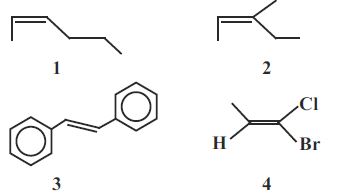
A
$1-E, 2-Z, 3-E, 4-Z$
B
$1-Z, 2-E, 3-Z, 4-E$
C
$1-Z, 2-Z, 3-E, 4-E$
D
$1-Z, 2-Z, 3-E, 4-Z$
Solution
(C) To assign $E$ and $Z$ configurations,we use the Cahn-Ingold-Prelog $(CIP)$ priority rules based on atomic number.
$1$. In structure $1$ (pent$-2-$ene),the higher priority groups ($-CH_3$ and $-CH_2CH_3$) are on the same side of the double bond,so it is $Z$.
$2$. In structure $2$ ($2$-methylpent$-2-$ene),the higher priority groups ($-CH_3$ and $-CH_2CH_3$) are on the same side of the double bond,so it is $Z$.
$3$. In structure $3$ (stilbene),the higher priority groups (phenyl rings) are on opposite sides of the double bond,so it is $E$.
$4$. In structure $4$ ($1$-bromo$-1-$chloroprop$-1-$ene),the higher priority groups ($-Cl$ and $-CH_3$) are on opposite sides of the double bond,so it is $E$.
Therefore,the configuration is $1-Z, 2-Z, 3-E, 4-E$.
$1$. In structure $1$ (pent$-2-$ene),the higher priority groups ($-CH_3$ and $-CH_2CH_3$) are on the same side of the double bond,so it is $Z$.
$2$. In structure $2$ ($2$-methylpent$-2-$ene),the higher priority groups ($-CH_3$ and $-CH_2CH_3$) are on the same side of the double bond,so it is $Z$.
$3$. In structure $3$ (stilbene),the higher priority groups (phenyl rings) are on opposite sides of the double bond,so it is $E$.
$4$. In structure $4$ ($1$-bromo$-1-$chloroprop$-1-$ene),the higher priority groups ($-Cl$ and $-CH_3$) are on opposite sides of the double bond,so it is $E$.
Therefore,the configuration is $1-Z, 2-Z, 3-E, 4-E$.
0 likes
View Solution118
AdvancedMCQ
The correct order of heat of combustion for the following alkadienes is:
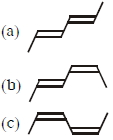
A
$a < b < c$
B
$b < c < a$
C
$c < b < a$
D
$a < c < b$
Solution
(C) The heat of combustion $(HOC)$ is inversely proportional to the stability of the isomer.
For the given alkadienes:
$(a)$ is the (trans,trans) isomer,which is the most stable due to minimum steric hindrance.
$(b)$ is the (trans,cis) isomer,which has intermediate stability.
$(c)$ is the (cis,cis) isomer,which is the least stable due to maximum steric hindrance.
Stability order: $a > b > c$.
Since $HOC$ $\propto \frac{1}{\text{Stability}}$,the order of heat of combustion is: $c > b > a$.
For the given alkadienes:
$(a)$ is the (trans,trans) isomer,which is the most stable due to minimum steric hindrance.
$(b)$ is the (trans,cis) isomer,which has intermediate stability.
$(c)$ is the (cis,cis) isomer,which is the least stable due to maximum steric hindrance.
Stability order: $a > b > c$.
Since $HOC$ $\propto \frac{1}{\text{Stability}}$,the order of heat of combustion is: $c > b > a$.
0 likes
View Solution119
Medium
Draw $cis$ and $trans$ isomers of the following compounds. Also write their $IUPAC$ names:
$(i)$ $CHCl=CHCl$
$(ii)$ $C_{2}H_{5}C(CH_{3})=C(CH_{3})C_{2}H_{5}$
$(i)$ $CHCl=CHCl$
$(ii)$ $C_{2}H_{5}C(CH_{3})=C(CH_{3})C_{2}H_{5}$
Solution
(N/A) $(i)$ $CHCl=CHCl$:
$cis-1,2-Dichloroethene$: Both $Cl$ atoms are on the same side of the double bond.
$trans-1,2-Dichloroethene$: Both $Cl$ atoms are on opposite sides of the double bond.
$(ii)$ $C_{2}H_{5}C(CH_{3})=C(CH_{3})C_{2}H_{5}$:
$cis-3,4-Dimethylhex-3-ene$: Both $C_{2}H_{5}$ groups are on the same side of the double bond.
$trans-3,4-Dimethylhex-3-ene$: Both $C_{2}H_{5}$ groups are on opposite sides of the double bond.
$cis-1,2-Dichloroethene$: Both $Cl$ atoms are on the same side of the double bond.
$trans-1,2-Dichloroethene$: Both $Cl$ atoms are on opposite sides of the double bond.
$(ii)$ $C_{2}H_{5}C(CH_{3})=C(CH_{3})C_{2}H_{5}$:
$cis-3,4-Dimethylhex-3-ene$: Both $C_{2}H_{5}$ groups are on the same side of the double bond.
$trans-3,4-Dimethylhex-3-ene$: Both $C_{2}H_{5}$ groups are on opposite sides of the double bond.
0 likes
View Solution120
Medium
Which of the following compounds will show $cis-trans$ isomerism?
$(i)$ $(CH_3)_2C=CH-C_2H_5$
$(ii)$ $CH_2=CBr_2$
$(iii)$ $C_6H_5CH=CH-CH_3$
$(iv)$ $CH_3CH=CClCH_3$
$(i)$ $(CH_3)_2C=CH-C_2H_5$
$(ii)$ $CH_2=CBr_2$
$(iii)$ $C_6H_5CH=CH-CH_3$
$(iv)$ $CH_3CH=CClCH_3$
Solution
(C) For a compound to show $cis-trans$ isomerism,each carbon atom of the double bond must be attached to two different groups.
$(i)$ $(CH_3)_2C=CH-C_2H_5$: The first carbon has two identical $CH_3$ groups. No $cis-trans$ isomerism.
$(ii)$ $CH_2=CBr_2$: The first carbon has two identical $H$ atoms. No $cis-trans$ isomerism.
$(iii)$ $C_6H_5CH=CH-CH_3$: The first carbon is attached to $H$ and $C_6H_5$; the second carbon is attached to $H$ and $CH_3$. Both carbons have different groups. Shows $cis-trans$ isomerism.
$(iv)$ $CH_3CH=CClCH_3$: The first carbon is attached to $H$ and $CH_3$; the second carbon is attached to $Cl$ and $CH_3$. Both carbons have different groups. Shows $cis-trans$ isomerism.
Therefore,$(iii)$ and $(iv)$ show $cis-trans$ isomerism.
$(i)$ $(CH_3)_2C=CH-C_2H_5$: The first carbon has two identical $CH_3$ groups. No $cis-trans$ isomerism.
$(ii)$ $CH_2=CBr_2$: The first carbon has two identical $H$ atoms. No $cis-trans$ isomerism.
$(iii)$ $C_6H_5CH=CH-CH_3$: The first carbon is attached to $H$ and $C_6H_5$; the second carbon is attached to $H$ and $CH_3$. Both carbons have different groups. Shows $cis-trans$ isomerism.
$(iv)$ $CH_3CH=CClCH_3$: The first carbon is attached to $H$ and $CH_3$; the second carbon is attached to $Cl$ and $CH_3$. Both carbons have different groups. Shows $cis-trans$ isomerism.
Therefore,$(iii)$ and $(iv)$ show $cis-trans$ isomerism.
0 likes
View Solution121
Medium
Explain geometric isomerism with an example.
Solution
(N/A) Geometric isomerism arises due to the restricted rotation around the carbon-carbon double bond $(C=C)$. Because the $\pi$ bond prevents free rotation,atoms or groups attached to the doubly bonded carbons are fixed in space,leading to different spatial arrangements.
$1$. $Cis$-isomer: When identical atoms or groups are on the same side of the double bond,it is called a $cis$-isomer.
$2$. $Trans$-isomer: When identical atoms or groups are on opposite sides of the double bond,it is called a $trans$-isomer.
Example: $But-2-ene$ $(CH_3-CH=CH-CH_3)$
In $cis-but-2-ene$,both $CH_3$ groups are on the same side of the $C=C$ bond.
In $trans-but-2-ene$,the $CH_3$ groups are on opposite sides of the $C=C$ bond.
These isomers cannot be interconverted without breaking the $\pi$ bond,making them distinct chemical species.
$1$. $Cis$-isomer: When identical atoms or groups are on the same side of the double bond,it is called a $cis$-isomer.
$2$. $Trans$-isomer: When identical atoms or groups are on opposite sides of the double bond,it is called a $trans$-isomer.
Example: $But-2-ene$ $(CH_3-CH=CH-CH_3)$
In $cis-but-2-ene$,both $CH_3$ groups are on the same side of the $C=C$ bond.
In $trans-but-2-ene$,the $CH_3$ groups are on opposite sides of the $C=C$ bond.
These isomers cannot be interconverted without breaking the $\pi$ bond,making them distinct chemical species.
0 likes
View Solution122
Medium
Which isomer,$cis$ or $trans$,has a lower boiling point? Explain with an example.
Solution
(B) $Trans$ isomers generally have a lower boiling point than their corresponding $cis$ isomers.
For example,$cis$-but-$2$-ene $(277 \ K)$ has a higher boiling point than $trans$-but-$2$-ene $(274 \ K)$.
In the $cis$ isomer,the molecule is polar due to the same groups being on the same side,leading to a net dipole moment and stronger dipole-dipole interactions. In the $trans$ isomer,the groups are on opposite sides,which often leads to a non-polar or less polar molecule with weaker intermolecular forces,resulting in a lower boiling point.
For example,$cis$-but-$2$-ene $(277 \ K)$ has a higher boiling point than $trans$-but-$2$-ene $(274 \ K)$.
In the $cis$ isomer,the molecule is polar due to the same groups being on the same side,leading to a net dipole moment and stronger dipole-dipole interactions. In the $trans$ isomer,the groups are on opposite sides,which often leads to a non-polar or less polar molecule with weaker intermolecular forces,resulting in a lower boiling point.
0 likes
View Solution123
Medium
Between $cis$ and $trans$ isomers,which has a higher dipole moment? Explain with an example.
Solution
(N/A) $CH_3-CH=CH-CH_3$ (but-$2$-ene) exhibits geometrical isomerism with two isomers:
$(i)$ $cis$-but-$2$-ene
$(ii)$ $trans$-but-$2$-ene
Generally,the dipole moment $(\mu)$ of the $cis$-isomer is greater than that of the $trans$-isomer.
In $trans$-but-$2$-ene,the two $-CH_3$ groups are on opposite sides of the double bond. Consequently,the bond dipoles of the $C-CH_3$ bonds are equal and opposite,cancelling each other out,which makes the $trans$-isomer non-polar $(\mu = 0)$.
In $cis$-but-$2$-ene,the two $-CH_3$ groups are on the same side of the double bond. The bond dipoles of the $C-CH_3$ bonds reinforce each other,resulting in a net dipole moment $(\mu \approx 0.33 \ D)$. Therefore,the $cis$-isomer is polar while the $trans$-isomer is non-polar.
$(i)$ $cis$-but-$2$-ene
$(ii)$ $trans$-but-$2$-ene
Generally,the dipole moment $(\mu)$ of the $cis$-isomer is greater than that of the $trans$-isomer.
In $trans$-but-$2$-ene,the two $-CH_3$ groups are on opposite sides of the double bond. Consequently,the bond dipoles of the $C-CH_3$ bonds are equal and opposite,cancelling each other out,which makes the $trans$-isomer non-polar $(\mu = 0)$.
In $cis$-but-$2$-ene,the two $-CH_3$ groups are on the same side of the double bond. The bond dipoles of the $C-CH_3$ bonds reinforce each other,resulting in a net dipole moment $(\mu \approx 0.33 \ D)$. Therefore,the $cis$-isomer is polar while the $trans$-isomer is non-polar.
0 likes
View Solution124
Medium
Which of the following shows geometrical isomers?
$(a)$ $CH_2=CHCl$
$(b)$ $CH_3CH=CH_2$
$(c)$ $CHCl=CHCl$
$(d)$ $(CH_3)_2C=CHC_2H_5$
$(a)$ $CH_2=CHCl$
$(b)$ $CH_3CH=CH_2$
$(c)$ $CHCl=CHCl$
$(d)$ $(CH_3)_2C=CHC_2H_5$
Solution
(C) For a molecule to exhibit geometrical isomerism,each carbon atom of the double bond must be attached to two different groups.
In $(a)$ $CH_2=CHCl$,the first carbon is attached to two identical $H$ atoms.
In $(b)$ $CH_3CH=CH_2$,the first carbon is attached to two identical $H$ atoms.
In $(c)$ $CHCl=CHCl$,each carbon atom is attached to one $H$ atom and one $Cl$ atom,which are different. Thus,it shows geometrical isomerism (cis and trans forms).
In $(d)$ $(CH_3)_2C=CHC_2H_5$,the first carbon is attached to two identical $CH_3$ groups.
Therefore,only $(c)$ shows geometrical isomers.
In $(a)$ $CH_2=CHCl$,the first carbon is attached to two identical $H$ atoms.
In $(b)$ $CH_3CH=CH_2$,the first carbon is attached to two identical $H$ atoms.
In $(c)$ $CHCl=CHCl$,each carbon atom is attached to one $H$ atom and one $Cl$ atom,which are different. Thus,it shows geometrical isomerism (cis and trans forms).
In $(d)$ $(CH_3)_2C=CHC_2H_5$,the first carbon is attached to two identical $CH_3$ groups.
Therefore,only $(c)$ shows geometrical isomers.
0 likes
View Solution125
DifficultMCQ
Among the following compounds,geometrical isomerism is exhibited by
A
$4-$chloromethylenecyclohexane
B
$3-$methyl$-1-$chloromethylenecyclohexane
C
$1-$chloromethylenecyclohexane
D
$3,5-$dimethyl$-1-$chloromethylenecyclohexane
Solution
(B) For a compound to exhibit geometrical isomerism,the groups attached to each carbon of the double bond must be different.
In the given options,we analyze the exocyclic double bond:
$(A)$ $4$-chloromethylenecyclohexane: The exocyclic carbon is attached to two $H$ atoms,so it does not show geometrical isomerism.
$(B)$ $3$-methyl-$1$-chloromethylenecyclohexane: The exocyclic carbon is attached to one $H$ and one $Cl$ atom. The ring carbon is attached to the rest of the ring and a $CH_3$ group. Since the groups on both sides of the double bond are different,it exhibits geometrical isomerism.
$(C)$ $1$-chloromethylenecyclohexane: The exocyclic carbon is attached to $H$ and $Cl$,but the ring carbon is attached to two identical sides of the cyclohexane ring,so it does not show geometrical isomerism.
$(D)$ $3,5$-dimethyl-$1$-chloromethylenecyclohexane: Due to the symmetry of the $3,5$-dimethyl substitution,the ring carbon is attached to two identical paths,thus it does not show geometrical isomerism.
In the given options,we analyze the exocyclic double bond:
$(A)$ $4$-chloromethylenecyclohexane: The exocyclic carbon is attached to two $H$ atoms,so it does not show geometrical isomerism.
$(B)$ $3$-methyl-$1$-chloromethylenecyclohexane: The exocyclic carbon is attached to one $H$ and one $Cl$ atom. The ring carbon is attached to the rest of the ring and a $CH_3$ group. Since the groups on both sides of the double bond are different,it exhibits geometrical isomerism.
$(C)$ $1$-chloromethylenecyclohexane: The exocyclic carbon is attached to $H$ and $Cl$,but the ring carbon is attached to two identical sides of the cyclohexane ring,so it does not show geometrical isomerism.
$(D)$ $3,5$-dimethyl-$1$-chloromethylenecyclohexane: Due to the symmetry of the $3,5$-dimethyl substitution,the ring carbon is attached to two identical paths,thus it does not show geometrical isomerism.
0 likes
View Solution126
EasyMCQ
Which of the following compounds shows geometrical isomerism?
A
$2-$methylpent$-2-$ene
B
$4-$methylpent$-1-$ene
C
$4-$methylpent$-2-$ene
D
$2-$methylpent$-1-$ene
Solution
(C) For a compound to show geometrical isomerism,the carbon atoms involved in the double bond must be attached to two different groups.
$(A)$ $2-$methylpent$-2-$ene: $(CH_3)_2C=CH-CH_2-CH_3$. The carbon at position $2$ is attached to two identical methyl groups,so it does not show geometrical isomerism.
$(B)$ $4-$methylpent$-1-$ene: $CH_2=CH-CH_2-CH(CH_3)_2$. The terminal carbon $(C_1)$ is attached to two identical hydrogen atoms,so it does not show geometrical isomerism.
$(C)$ $4-$methylpent$-2-$ene: $CH_3-CH=CH-CH_2-CH(CH_3)_2$. The carbons at positions $2$ and $3$ are each attached to two different groups ($-H$ and $-CH_3$ on $C_2$; $-H$ and $-CH_2CH(CH_3)_2$ on $C_3$). Thus,it shows geometrical isomerism.
$(D)$ $2-$methylpent$-1-$ene: $CH_2=C(CH_3)-CH_2-CH_2-CH_3$. The terminal carbon $(C_1)$ is attached to two identical hydrogen atoms,so it does not show geometrical isomerism.
$(A)$ $2-$methylpent$-2-$ene: $(CH_3)_2C=CH-CH_2-CH_3$. The carbon at position $2$ is attached to two identical methyl groups,so it does not show geometrical isomerism.
$(B)$ $4-$methylpent$-1-$ene: $CH_2=CH-CH_2-CH(CH_3)_2$. The terminal carbon $(C_1)$ is attached to two identical hydrogen atoms,so it does not show geometrical isomerism.
$(C)$ $4-$methylpent$-2-$ene: $CH_3-CH=CH-CH_2-CH(CH_3)_2$. The carbons at positions $2$ and $3$ are each attached to two different groups ($-H$ and $-CH_3$ on $C_2$; $-H$ and $-CH_2CH(CH_3)_2$ on $C_3$). Thus,it shows geometrical isomerism.
$(D)$ $2-$methylpent$-1-$ene: $CH_2=C(CH_3)-CH_2-CH_2-CH_3$. The terminal carbon $(C_1)$ is attached to two identical hydrogen atoms,so it does not show geometrical isomerism.
0 likes
View Solution127
MediumMCQ
In the following structure,the double bonds are marked as $I$,$II$,$III$ and $IV$. Geometrical isomerism is not possible at site$(s)$:

A
$III$
B
$I$
C
$I$ and $III$
D
$III$ and $IV$
Solution
(C) For geometrical isomerism to occur at a double bond,each carbon atom of the double bond must be attached to two different groups.
$I$: The carbon atom is attached to two identical methyl groups $(a, a)$,so geometrical isomerism is not possible.
$II$: Both carbons are attached to different groups,so it shows geometrical isomerism.
$III$: The carbon atom is attached to two identical methyl groups,so geometrical isomerism is not possible.
$IV$: Both carbons are attached to different groups,so it shows geometrical isomerism.
Therefore,geometrical isomerism is not possible at sites $I$ and $III$.
$I$: The carbon atom is attached to two identical methyl groups $(a, a)$,so geometrical isomerism is not possible.
$II$: Both carbons are attached to different groups,so it shows geometrical isomerism.
$III$: The carbon atom is attached to two identical methyl groups,so geometrical isomerism is not possible.
$IV$: Both carbons are attached to different groups,so it shows geometrical isomerism.
Therefore,geometrical isomerism is not possible at sites $I$ and $III$.
0 likes
View Solution128
DifficultMCQ
Among the following compounds,$E/Z$ isomerism is possible for
A
$2$-methylbut$-2$-ene
B
$2$-methylbut$-1$-ene
C
$3$-methylpent$-1$-ene
D
$3$-methylpent$-2$-ene
Solution
(D) The correct answer is $(d)$.
For an alkene to exhibit $E/Z$ isomerism,each carbon atom of the $C=C$ double bond must be attached to two different groups. If either carbon atom has two identical groups,$E/Z$ isomerism is not possible.
$(a)$ $2$-methylbut$-2$-ene: The $C2$ carbon is attached to two methyl groups. Since these are identical,it does not show $E/Z$ isomerism.
$(b)$ $2$-methylbut$-1$-ene: The $C1$ carbon is attached to two hydrogen atoms. Since these are identical,it does not show $E/Z$ isomerism.
$(c)$ $3$-methylpent$-1$-ene: The $C1$ carbon is attached to two hydrogen atoms. Since these are identical,it does not show $E/Z$ isomerism.
$(d)$ $3$-methylpent$-2$-ene: The $C2$ carbon is attached to a hydrogen and a methyl group,and the $C3$ carbon is attached to a hydrogen and a sec-butyl group. Since all groups on each carbon are different,this compound exhibits $E/Z$ isomerism.
For an alkene to exhibit $E/Z$ isomerism,each carbon atom of the $C=C$ double bond must be attached to two different groups. If either carbon atom has two identical groups,$E/Z$ isomerism is not possible.
$(a)$ $2$-methylbut$-2$-ene: The $C2$ carbon is attached to two methyl groups. Since these are identical,it does not show $E/Z$ isomerism.
$(b)$ $2$-methylbut$-1$-ene: The $C1$ carbon is attached to two hydrogen atoms. Since these are identical,it does not show $E/Z$ isomerism.
$(c)$ $3$-methylpent$-1$-ene: The $C1$ carbon is attached to two hydrogen atoms. Since these are identical,it does not show $E/Z$ isomerism.
$(d)$ $3$-methylpent$-2$-ene: The $C2$ carbon is attached to a hydrogen and a methyl group,and the $C3$ carbon is attached to a hydrogen and a sec-butyl group. Since all groups on each carbon are different,this compound exhibits $E/Z$ isomerism.
0 likes
View Solution129
MediumMCQ
The structure of $cis-3-hexene$ is
A
B
C
D
Solution
(C) In $cis-3-hexene$,the two ethyl groups $(-CH_2CH_3)$ attached to the double-bonded carbons ($C_3$ and $C_4$) are on the same side of the double bond.
Looking at the options:
Option $A$ shows $1-hexene$.
Option $B$ shows $trans-3-hexene$ (the ethyl groups are on opposite sides).
Option $C$ shows $cis-3-hexene$ (the ethyl groups are on the same side).
Option $D$ shows $trans-3-hexene$ (the ethyl groups are on opposite sides).
Therefore,the correct structure is represented by option $C$.
Looking at the options:
Option $A$ shows $1-hexene$.
Option $B$ shows $trans-3-hexene$ (the ethyl groups are on opposite sides).
Option $C$ shows $cis-3-hexene$ (the ethyl groups are on the same side).
Option $D$ shows $trans-3-hexene$ (the ethyl groups are on opposite sides).
Therefore,the correct structure is represented by option $C$.
0 likes
View Solution130
MediumMCQ
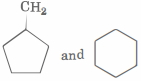
Identify the stereoisomeric pair from the following choices.
A
$CH_3CH_2CH_2OH$ and $CH_3CH_2OCH_3$
B
$CH_3CH_2CH_2Cl$ and $CH_3CHClCH_3$
C
$CH_3-CH=CH-CH_3$ (cis) and $CH_3-CH=CH-CH_3$ (trans)
D
Methylcyclopentane and cyclohexane
Solution
(C) . The types of isomers in the given options are as follows:
$(a)$ $CH_3CH_2CH_2OH$ and $CH_3CH_2OCH_3$: These are functional isomers.
$(b)$ $CH_3CH_2CH_2Cl$ and $CH_3CHClCH_3$: These are positional isomers.
$(c)$ The given structures represent $cis$ and $trans$ forms of but$-2-$ene. They are geometrical isomers,which are a type of stereoisomers.
$(d)$ Methylcyclopentane and cyclohexane: These are ring-chain isomers.
Thus,the correct option is $(c)$.
$(a)$ $CH_3CH_2CH_2OH$ and $CH_3CH_2OCH_3$: These are functional isomers.
$(b)$ $CH_3CH_2CH_2Cl$ and $CH_3CHClCH_3$: These are positional isomers.
$(c)$ The given structures represent $cis$ and $trans$ forms of but$-2-$ene. They are geometrical isomers,which are a type of stereoisomers.
$(d)$ Methylcyclopentane and cyclohexane: These are ring-chain isomers.
Thus,the correct option is $(c)$.
0 likes
View Solution131
DifficultMCQ
Which one of the following will show geometrical isomerism?
A
$1-$bromo$-4-$methylenecyclohexane
B
$3-$bromomethylenecyclohexane
C
$3-$bromo$-1-$methylenecyclohexane
D
$4-$bromo$-1-$methylenecyclohexane
Solution
(C) For a molecule to exhibit geometrical isomerism,the groups attached to the double-bonded carbons must be different.
In the case of cyclic compounds with an exocyclic double bond,the ring itself acts as a substituent.
In option $C$,the structure is $3$-bromo-$1$-methylenecyclohexane.
Here,the carbon at position $3$ of the cyclohexane ring is chiral,and the exocyclic double bond at position $1$ is attached to the ring.
Because the ring is substituted at the $3$-position,the two paths around the ring from the double bond to the $3$-position are different.
Thus,the groups on the double-bonded carbon are effectively different,allowing for cis-trans (geometrical) isomerism.
In the case of cyclic compounds with an exocyclic double bond,the ring itself acts as a substituent.
In option $C$,the structure is $3$-bromo-$1$-methylenecyclohexane.
Here,the carbon at position $3$ of the cyclohexane ring is chiral,and the exocyclic double bond at position $1$ is attached to the ring.
Because the ring is substituted at the $3$-position,the two paths around the ring from the double bond to the $3$-position are different.
Thus,the groups on the double-bonded carbon are effectively different,allowing for cis-trans (geometrical) isomerism.
0 likes
View Solution132
DifficultMCQ
The number of geometrical isomers possible for the given structure is . . . . . . .
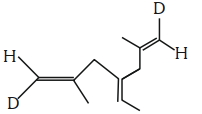
A
$3$
B
$4$
C
$5$
D
$8$
Solution
(D) The given structure contains $3$ double bonds capable of showing geometrical isomerism (marked with asterisks in the image).
Each double bond can exist in either $E$ or $Z$ configuration.
Since the molecule is unsymmetrical (the groups attached to the terminal double bonds are different),the total number of geometrical isomers is given by the formula $2^n$,where $n$ is the number of stereocenters.
Here,$n = 3$.
Therefore,the total number of geometrical isomers = $2^3 = 8$.
Each double bond can exist in either $E$ or $Z$ configuration.
Since the molecule is unsymmetrical (the groups attached to the terminal double bonds are different),the total number of geometrical isomers is given by the formula $2^n$,where $n$ is the number of stereocenters.
Here,$n = 3$.
Therefore,the total number of geometrical isomers = $2^3 = 8$.
0 likes
View Solution133
MediumMCQ
The incorrect statement regarding the geometrical isomers of $2$-butene is:
A
$cis-2$-butene and $trans-2$-butene are not interconvertible at room temperature.
B
$cis-2$-butene has less dipole moment than $trans-2$-butene.
C
$trans-2$-butene is more stable than $cis-2$-butene.
D
$cis-2$-butene and $trans-2$-butene are stereoisomers.
Solution
(B) $cis-2$-butene has a higher dipole moment than $trans-2$-butene because the bond dipoles of the two $C-CH_3$ bonds reinforce each other in the $cis$ isomer,whereas they cancel each other out in the $trans$ isomer. Therefore,the statement in option $B$ is incorrect.
0 likes
View Solution134
DifficultMCQ
The incorrect statements regarding geometrical isomerism are :
$(A)$ Propene shows geometrical isomerism.
$(B)$ Trans isomer has identical atoms/groups on the opposite sides of the double bond.
$(C)$ Cis$-$but$-2-$ene has higher dipole moment than trans$-$but$-2-$ene.
$(D)$ $2-$methylbut$-2-$ene shows two geometrical isomers.
$(E)$ Trans$-$isomer has lower melting point than cis isomer.
Choose the $CORRECT$ answer from the options given below :
$(A)$ Propene shows geometrical isomerism.
$(B)$ Trans isomer has identical atoms/groups on the opposite sides of the double bond.
$(C)$ Cis$-$but$-2-$ene has higher dipole moment than trans$-$but$-2-$ene.
$(D)$ $2-$methylbut$-2-$ene shows two geometrical isomers.
$(E)$ Trans$-$isomer has lower melting point than cis isomer.
Choose the $CORRECT$ answer from the options given below :
A
$(A)$,$(D)$ and $(E)$ only
B
$(C)$,$(D)$ and $(E)$ only
C
$(B)$ and $(C)$ only
D
$(A)$ and $(E)$ only
Solution
(A) Analysis of the given statements:
$(A)$ Propene $(CH_3-CH=CH_2)$ does not show geometrical isomerism because one of the doubly bonded carbons is attached to two identical hydrogen atoms.
$(B)$ This is a correct statement. In a trans isomer,identical groups are on opposite sides of the double bond.
$(C)$ This is a correct statement. Cis$-$but$-2-$ene has a non-zero dipole moment due to the same side orientation of methyl groups,whereas trans$-$but$-2-$ene has a zero dipole moment due to symmetry.
$(D)$ $2-$methylbut$-2-$ene $(CH_3-C(CH_3)=CH-CH_3)$ does not show geometrical isomerism because one of the doubly bonded carbons is attached to two identical methyl groups.
$(E)$ This is an incorrect statement. Generally,the trans isomer has a higher melting point than the cis isomer due to better packing in the crystal lattice.
Thus,the incorrect statements are $(A)$,$(D)$,and $(E)$.
$(A)$ Propene $(CH_3-CH=CH_2)$ does not show geometrical isomerism because one of the doubly bonded carbons is attached to two identical hydrogen atoms.
$(B)$ This is a correct statement. In a trans isomer,identical groups are on opposite sides of the double bond.
$(C)$ This is a correct statement. Cis$-$but$-2-$ene has a non-zero dipole moment due to the same side orientation of methyl groups,whereas trans$-$but$-2-$ene has a zero dipole moment due to symmetry.
$(D)$ $2-$methylbut$-2-$ene $(CH_3-C(CH_3)=CH-CH_3)$ does not show geometrical isomerism because one of the doubly bonded carbons is attached to two identical methyl groups.
$(E)$ This is an incorrect statement. Generally,the trans isomer has a higher melting point than the cis isomer due to better packing in the crystal lattice.
Thus,the incorrect statements are $(A)$,$(D)$,and $(E)$.
0 likes
View Solution135
DifficultMCQ
Which one of the following compounds can exist as $cis-trans$ isomers?
A
$Pent-1-ene$
B
$2-Methylhex-2-ene$
C
$1, 1-Dimethylcyclopropane$
D
$1, 2-Dimethylcyclohexane$
Solution
(D) For geometrical isomerism $(GI)$ in alkenes,each carbon of the double bond must be attached to two different groups.
For $GI$ in cycloalkanes,at least two $sp^3$ carbons of the ring must each be attached to two different groups.
$1.$ $Pent-1-ene$ $(CH_2=CH-CH_2-CH_2-CH_3)$: The terminal $CH_2$ group has two identical $H$ atoms,so it does not show $GI$.
$2.$ $2-Methylhex-2-ene$ $((CH_3)_2C=CH-CH_2-CH_2-CH_3)$: The $C-2$ carbon has two identical $CH_3$ groups,so it does not show $GI$.
$3.$ $1, 1-Dimethylcyclopropane$: The $C-1$ carbon has two identical $CH_3$ groups,so it does not show $GI$.
$4.$ $1, 2-Dimethylcyclohexane$: Each of the two $sp^3$ carbons at positions $1$ and $2$ is attached to a $CH_3$ group and an $H$ atom (different groups),allowing for $cis$ and $trans$ configurations.
Thus,$1, 2-Dimethylcyclohexane$ exhibits $cis-trans$ isomerism.
For $GI$ in cycloalkanes,at least two $sp^3$ carbons of the ring must each be attached to two different groups.
$1.$ $Pent-1-ene$ $(CH_2=CH-CH_2-CH_2-CH_3)$: The terminal $CH_2$ group has two identical $H$ atoms,so it does not show $GI$.
$2.$ $2-Methylhex-2-ene$ $((CH_3)_2C=CH-CH_2-CH_2-CH_3)$: The $C-2$ carbon has two identical $CH_3$ groups,so it does not show $GI$.
$3.$ $1, 1-Dimethylcyclopropane$: The $C-1$ carbon has two identical $CH_3$ groups,so it does not show $GI$.
$4.$ $1, 2-Dimethylcyclohexane$: Each of the two $sp^3$ carbons at positions $1$ and $2$ is attached to a $CH_3$ group and an $H$ atom (different groups),allowing for $cis$ and $trans$ configurations.
Thus,$1, 2-Dimethylcyclohexane$ exhibits $cis-trans$ isomerism.
0 likes
View Solution136
MediumMCQ
Which among the following compounds does not exhibit cis-trans isomerism?
A
$H_2C=C(R)_2$
B
$R_1R_2C=CR_1R_2$
C
$RCH=CHR$
D
$R_1CH=CR_1R_2$
Solution
(A) For a compound to exhibit cis-trans isomerism,each carbon atom involved in the double bond must be attached to two different groups.
In the compound $H_2C=C(R)_2$,the first carbon atom is attached to two identical hydrogen atoms.
Since at least one carbon atom of the double bond does not have two different groups attached to it,this compound cannot exhibit cis-trans isomerism.
In the compound $H_2C=C(R)_2$,the first carbon atom is attached to two identical hydrogen atoms.
Since at least one carbon atom of the double bond does not have two different groups attached to it,this compound cannot exhibit cis-trans isomerism.
0 likes
View Solution137
MediumMCQ
Identify the compound which exhibits geometrical isomerism:
A
$But-2-ene$
B
$But-1-ene$
C
$Butane$
D
$Isobutane$
Solution
(A) $But-2-ene$ $(CH_3-CH=CH-CH_3)$ exhibits geometrical isomerism because each carbon atom of the double bond is attached to two different groups (a hydrogen atom and a methyl group).
It exists in two forms:
$1$. $cis-but-2-ene$: The two methyl groups are on the same side of the double bond.
$2$. $trans-but-2-ene$: The two methyl groups are on opposite sides of the double bond.
It exists in two forms:
$1$. $cis-but-2-ene$: The two methyl groups are on the same side of the double bond.
$2$. $trans-but-2-ene$: The two methyl groups are on opposite sides of the double bond.
0 likes
View Solution138
DifficultMCQ
Geometrical isomerism is shown by
A
$abC=Cab$
B
$ > C=C < $
C
$-C\equiv C^{-}$
D
None of these
Solution
(A) Geometrical isomerism is shown by compounds containing a $C=C$ double bond,provided that each carbon atom of the double bond is attached to two different groups.
The general condition for geometrical isomerism is $abC=Cab$,where $a \neq b$.
The general condition for geometrical isomerism is $abC=Cab$,where $a \neq b$.
0 likes
View Solution139
MediumMCQ
Which of the following compounds does not exhibit geometrical isomerism?
A
$2-$Butene
B
$3-$Hexene
C
But$-2-$enal
D
Styrene
Solution
(D) Geometrical isomerism is exhibited by alkenes where each carbon atom of the double bond is attached to two different groups.
In $2-$Butene $(CH_3-CH=CH-CH_3)$,$3-$Hexene $(CH_3-CH_2-CH=CH-CH_2-CH_3)$,and But$-2-$enal $(CH_3-CH=CH-CHO)$,the carbon atoms of the double bond are attached to different groups.
Styrene $(C_6H_5-CH=CH_2)$ does not exhibit geometrical isomerism because one of the doubly-bonded carbon atoms is attached to two identical hydrogen atoms.
In $2-$Butene $(CH_3-CH=CH-CH_3)$,$3-$Hexene $(CH_3-CH_2-CH=CH-CH_2-CH_3)$,and But$-2-$enal $(CH_3-CH=CH-CHO)$,the carbon atoms of the double bond are attached to different groups.
Styrene $(C_6H_5-CH=CH_2)$ does not exhibit geometrical isomerism because one of the doubly-bonded carbon atoms is attached to two identical hydrogen atoms.
0 likes
View Solution140
DifficultMCQ
Geometrical isomerism can be found in which of the following?
A
Butyric acid
B
Aspartic acid
C
Palmitic acid
D
Cinnamic acid
Solution
(D) Geometrical isomerism requires a restricted rotation,such as a $C=C$ double bond,where each carbon atom of the double bond is attached to two different groups.
Butyric acid $(CH_3CH_2CH_2COOH)$,aspartic acid,and palmitic acid $(CH_3(CH_2)_{14}COOH)$ are saturated compounds and do not contain a $C=C$ double bond.
Cinnamic acid $(C_6H_5-CH=CH-COOH)$ contains a $C=C$ double bond with different groups attached to each carbon atom,allowing it to exhibit geometrical isomerism (cis-trans isomerism).
Butyric acid $(CH_3CH_2CH_2COOH)$,aspartic acid,and palmitic acid $(CH_3(CH_2)_{14}COOH)$ are saturated compounds and do not contain a $C=C$ double bond.
Cinnamic acid $(C_6H_5-CH=CH-COOH)$ contains a $C=C$ double bond with different groups attached to each carbon atom,allowing it to exhibit geometrical isomerism (cis-trans isomerism).
0 likes
View Solution141
EasyMCQ
Which of the following compounds will exhibit cis-trans isomerism?
A
$2-$butene
B
$2-$butyne
C
$2-$butanol
D
butanal
Solution
(A) Cis-trans isomerism (geometrical isomerism) is exhibited by compounds containing a carbon-carbon double bond where each carbon atom of the double bond is attached to two different groups.
In $2-$butene $(CH_3-CH=CH-CH_3)$,each carbon of the double bond is attached to a hydrogen atom and a methyl group. Thus,it exists as cis and trans isomers.
$2-$butyne contains a triple bond,$2-$butanol is an alcohol,and butanal is an aldehyde; none of these satisfy the condition for geometrical isomerism.
In $2-$butene $(CH_3-CH=CH-CH_3)$,each carbon of the double bond is attached to a hydrogen atom and a methyl group. Thus,it exists as cis and trans isomers.
$2-$butyne contains a triple bond,$2-$butanol is an alcohol,and butanal is an aldehyde; none of these satisfy the condition for geometrical isomerism.
0 likes
View Solution142
MediumMCQ
Which of the following can show geometrical isomerism?
A
$CHCl=CHCl$
B
$CH_2=CCl_2$
C
$CCl_2=CHCl$
D
$CH_2=CH_2$
Solution
(A) For a molecule to show geometrical isomerism,each carbon atom of the double bond must be attached to two different groups.
In $CHCl=CHCl$ $(1,2-dichloroethene)$,each carbon is attached to one $H$ atom and one $Cl$ atom.
This allows for two geometrical isomers: $cis-1,2-dichloroethene$ and $trans-1,2-dichloroethene$.
In the other options ($CH_2=CCl_2$,$CCl_2=CHCl$,and $CH_2=CH_2$),at least one carbon atom is attached to two identical groups,so they cannot show geometrical isomerism.
Hence,the correct option is $(A)$.
In $CHCl=CHCl$ $(1,2-dichloroethene)$,each carbon is attached to one $H$ atom and one $Cl$ atom.
This allows for two geometrical isomers: $cis-1,2-dichloroethene$ and $trans-1,2-dichloroethene$.
In the other options ($CH_2=CCl_2$,$CCl_2=CHCl$,and $CH_2=CH_2$),at least one carbon atom is attached to two identical groups,so they cannot show geometrical isomerism.
Hence,the correct option is $(A)$.
0 likes
View Solution143
MediumMCQ
Which one of the following compounds will not show geometrical isomerism?
A
$Prop-2-$enoic acid
B
$2-$butene
C
$2-$methyl$-2-$butenoic acid
D
$3-$methyl$-2-$pentenoic acid
Solution
(A) Geometrical isomerism requires restricted rotation about a double bond where each carbon atom of the double bond is attached to two different groups.
$Prop-2-$enoic acid is $CH_2=CH-COOH$. The terminal carbon $(C_1)$ is attached to two identical hydrogen atoms,so it cannot show geometrical isomerism.
$2-$butene $(CH_3-CH=CH-CH_3)$ shows geometrical isomerism ($cis$ and $trans$ forms).
$2-$methyl$-2-$butenoic acid $(CH_3-CH=C(CH_3)-COOH)$ shows geometrical isomerism because the $C_3$ carbon is attached to $H$ and $CH_3$,and the $C_2$ carbon is attached to $CH_3$ and $COOH$.
$3-$methyl$-2-$pentenoic acid $(CH_3-CH_2-C(CH_3)=CH-COOH)$ shows geometrical isomerism because the $C_2$ carbon is attached to $H$ and $COOH$,and the $C_3$ carbon is attached to $CH_3$ and $CH_2CH_3$.
$Prop-2-$enoic acid is $CH_2=CH-COOH$. The terminal carbon $(C_1)$ is attached to two identical hydrogen atoms,so it cannot show geometrical isomerism.
$2-$butene $(CH_3-CH=CH-CH_3)$ shows geometrical isomerism ($cis$ and $trans$ forms).
$2-$methyl$-2-$butenoic acid $(CH_3-CH=C(CH_3)-COOH)$ shows geometrical isomerism because the $C_3$ carbon is attached to $H$ and $CH_3$,and the $C_2$ carbon is attached to $CH_3$ and $COOH$.
$3-$methyl$-2-$pentenoic acid $(CH_3-CH_2-C(CH_3)=CH-COOH)$ shows geometrical isomerism because the $C_2$ carbon is attached to $H$ and $COOH$,and the $C_3$ carbon is attached to $CH_3$ and $CH_2CH_3$.
0 likes
View Solution144
MediumMCQ
The alkenes which exhibit $cis, trans$ isomerism from the following are:
a) $YXC=CXZ$
b) $X_2C=CX_2$
c) $YXC=CXY$
d) $YXC=CWZ$
e) $X_2C=CXY$
a) $YXC=CXZ$
b) $X_2C=CX_2$
c) $YXC=CXY$
d) $YXC=CWZ$
e) $X_2C=CXY$
A
$b, d, e$
B
$a, b$
C
$a, c, d$
D
$c, d, e$
Solution
(C) For an alkene to exhibit $cis, trans$ isomerism,each carbon atom of the double bond must be attached to two different groups. That is,the structure must be of the form $abC=Ccd$ where $a \neq b$ and $c \neq d$.
Analyzing the given options:
a) $YXC=CXZ$: Carbon $1$ has $Y \neq X$,Carbon $2$ has $X \neq Z$. This exhibits isomerism.
b) $X_2C=CX_2$: Carbon $1$ has $X = X$,Carbon $2$ has $X = X$. No isomerism.
c) $YXC=CXY$: Carbon $1$ has $Y \neq X$,Carbon $2$ has $X \neq Y$. This exhibits isomerism.
d) $YXC=CWZ$: Carbon $1$ has $Y \neq X$,Carbon $2$ has $W \neq Z$. This exhibits isomerism.
e) $X_2C=CXY$: Carbon $1$ has $X = X$. No isomerism.
Therefore,the alkenes that exhibit $cis, trans$ isomerism are $a, c, d$.
Analyzing the given options:
a) $YXC=CXZ$: Carbon $1$ has $Y \neq X$,Carbon $2$ has $X \neq Z$. This exhibits isomerism.
b) $X_2C=CX_2$: Carbon $1$ has $X = X$,Carbon $2$ has $X = X$. No isomerism.
c) $YXC=CXY$: Carbon $1$ has $Y \neq X$,Carbon $2$ has $X \neq Y$. This exhibits isomerism.
d) $YXC=CWZ$: Carbon $1$ has $Y \neq X$,Carbon $2$ has $W \neq Z$. This exhibits isomerism.
e) $X_2C=CXY$: Carbon $1$ has $X = X$. No isomerism.
Therefore,the alkenes that exhibit $cis, trans$ isomerism are $a, c, d$.
0 likes
View Solution145
DifficultMCQ
How many geometrical isomers are possible for the compound with molecular formula $C_2FClBrI$?
A
Four
B
Five
C
Six
D
Eight
Solution
(C) The compound $C_2FClBrI$ corresponds to a substituted ethene where each carbon atom is bonded to two different halogen atoms.
For an alkene of the type $abcC=Cde$,the number of geometrical isomers is determined by the arrangement of groups around the double bond.
Since all four substituents $(F, Cl, Br, I)$ are different,we can fix the position of one atom (e.g.,$F$) on the first carbon and permute the others.
Specifically,for $C_2FClBrI$,the number of geometrical isomers is $3! = 6$.
The six possible isomers are shown in the provided image.
Thus,there are $6$ geometrical isomers possible.
Therefore,option $(c)$ is the correct answer.
For an alkene of the type $abcC=Cde$,the number of geometrical isomers is determined by the arrangement of groups around the double bond.
Since all four substituents $(F, Cl, Br, I)$ are different,we can fix the position of one atom (e.g.,$F$) on the first carbon and permute the others.
Specifically,for $C_2FClBrI$,the number of geometrical isomers is $3! = 6$.
The six possible isomers are shown in the provided image.
Thus,there are $6$ geometrical isomers possible.
Therefore,option $(c)$ is the correct answer.
0 likes
View Solution146
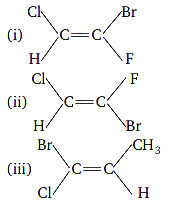
MediumMCQ
Which of the following compound$(s)$ has '$Z$' configuration?
A
$(i)$ only
B
$(ii)$ only
C
$(iii)$ only
D
$(i)$ and $(iii)$
Solution
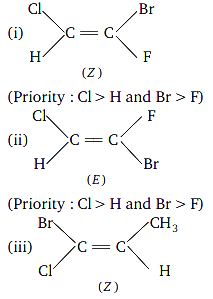
(D) According to the Cahn-Ingold-Prelog $(CIP)$ priority rules,the configuration is '$Z$' (zusammen) if the groups with higher priority are on the same side of the double bond,and '$E$' (entgegen) if they are on opposite sides.
For compound $(i)$:
Left carbon: $Cl > H$ (priority).
Right carbon: $Br > F$ (priority).
Since the higher priority groups ($Cl$ and $Br$) are on the same side,it has '$Z$' configuration.
For compound $(ii)$:
Left carbon: $Cl > H$ (priority).
Right carbon: $Br > F$ (priority).
Since the higher priority groups ($Cl$ and $Br$) are on opposite sides,it has '$E$' configuration.
For compound $(iii)$:
Left carbon: $Br > Cl$ (priority).
Right carbon: $CH_3 > H$ (priority).
Since the higher priority groups ($Br$ and $CH_3$) are on the same side,it has '$Z$' configuration.
Thus,compounds $(i)$ and $(iii)$ have '$Z$' configuration.
For compound $(i)$:
Left carbon: $Cl > H$ (priority).
Right carbon: $Br > F$ (priority).
Since the higher priority groups ($Cl$ and $Br$) are on the same side,it has '$Z$' configuration.
For compound $(ii)$:
Left carbon: $Cl > H$ (priority).
Right carbon: $Br > F$ (priority).
Since the higher priority groups ($Cl$ and $Br$) are on opposite sides,it has '$E$' configuration.
For compound $(iii)$:
Left carbon: $Br > Cl$ (priority).
Right carbon: $CH_3 > H$ (priority).
Since the higher priority groups ($Br$ and $CH_3$) are on the same side,it has '$Z$' configuration.
Thus,compounds $(i)$ and $(iii)$ have '$Z$' configuration.
0 likes
View Solution8-2.Organic Chemistry : Isomerism — Geometrical isomerism · Frequently Asked Questions
1Are these 8-2.Organic Chemistry : Isomerism questions useful for JEE and NEET?
Yes. All questions in this section are mapped to JEE Main and NEET exam patterns. Previous year questions from JEE Main, NEET, GUJCET and state-level exams are included with full solutions.
2Can I switch to Hindi or Gujarati for these questions?
Yes. Use the language tabs in the hero section or the sidebar to view the same questions and solutions in English, Hindi or Gujarati.
3How do I generate a question paper from this subtopic?
Use the Vedclass Exam Paper Generator — select the chapter and subtopic, set difficulty, and generate Sets A, B, C, D automatically. First 3 chapters of every subject are free.
Vedclass Products
For Students
Vedclass Test Series
Mock tests in real JEE/NEET style with performance analysis. 5-day free trial.
Start Free TrialFor Teachers
Exam Paper Generator
Generate Set A/B/C/D papers from this chapter in 2 minutes. 3 chapters free.
Try FreeFor Institutes
Online Exam Module
Live online exams with unlimited students, 360° analytics & white-label branding.
See DemoFor Teachers & Institutes
Generate a 8-2.Organic Chemistry : Isomerism Exam Paper in 2 Minutes
Select subtopic & difficulty — Sets A, B, C, D auto-generated with No Repeat logic.
First 3 chapters of every subject are free — no payment required.