
A English
Le-Chaterlier principle and It’s application Questions in English
Class 11 Chemistry · 6-1.Equilibrium (Chemical Equilibrium) · Le-Chaterlier principle and It’s application
300+
Questions
English
Language
100%
With Solutions
Showing 49 of 300 questions in English
251
Medium
Explain: Effect of inert gas addition on equilibrium.
Solution
(N/A) If the volume is kept constant and an inert gas such as argon is added,which does not take part in the reaction,the equilibrium remains undisturbed.
This is because the addition of an inert gas at constant volume does not change the partial pressure or the molar concentrations of the substances involved in the reaction.
The reaction quotient $(Q_c)$ changes only if the added gas is a reactant or product involved in the reaction.
This is because the addition of an inert gas at constant volume does not change the partial pressure or the molar concentrations of the substances involved in the reaction.
The reaction quotient $(Q_c)$ changes only if the added gas is a reactant or product involved in the reaction.
0 likes
View Solution252
Medium
Explain the effect of temperature change on chemical equilibrium with an example.
Solution
When a change in temperature of an equilibrium reaction occurs,the value of the equilibrium constant $K_{c}$ changes. In general,the temperature dependence of the equilibrium constant depends on the sign of $\Delta H$ for the reaction.
$1$. Exothermic reaction: The equilibrium constant for an exothermic reaction (negative $\Delta H$) decreases as the temperature increases. According to Le-Chatelier's principle,raising the temperature shifts the equilibrium to the left. For example,the production of ammonia is an exothermic reaction:
$N_{2(g)} + 3H_{2(g)} \rightleftharpoons 2NH_{3(g)} ; \Delta H = -92.38 \ kJ \ mol^{-1}$
Raising the temperature decreases the yield of ammonia. Thus,low temperature is favorable for a high yield,but a catalyst is used to maintain a practical reaction rate.
$2$. Endothermic reaction: The equilibrium constant for an endothermic reaction (positive $\Delta H$) increases as the temperature increases. The forward reaction is favored. For example:
$[Co(H_{2}O)_{6}]^{2+}_{(aq)} + 4Cl^{-}_{(aq)} \rightleftharpoons [CoCl_{4}]^{2-}_{(aq)} + 6H_{2}O_{(l)}$
(Pink) (Blue)
At room temperature,the mixture is blue. When cooled,the equilibrium shifts to the left,and the color turns pink due to the formation of $[Co(H_{2}O)_{6}]^{2+}$.
$1$. Exothermic reaction: The equilibrium constant for an exothermic reaction (negative $\Delta H$) decreases as the temperature increases. According to Le-Chatelier's principle,raising the temperature shifts the equilibrium to the left. For example,the production of ammonia is an exothermic reaction:
$N_{2(g)} + 3H_{2(g)} \rightleftharpoons 2NH_{3(g)} ; \Delta H = -92.38 \ kJ \ mol^{-1}$
Raising the temperature decreases the yield of ammonia. Thus,low temperature is favorable for a high yield,but a catalyst is used to maintain a practical reaction rate.
$2$. Endothermic reaction: The equilibrium constant for an endothermic reaction (positive $\Delta H$) increases as the temperature increases. The forward reaction is favored. For example:
$[Co(H_{2}O)_{6}]^{2+}_{(aq)} + 4Cl^{-}_{(aq)} \rightleftharpoons [CoCl_{4}]^{2-}_{(aq)} + 6H_{2}O_{(l)}$
(Pink) (Blue)
At room temperature,the mixture is blue. When cooled,the equilibrium shifts to the left,and the color turns pink due to the formation of $[Co(H_{2}O)_{6}]^{2+}$.
0 likes
View Solution253
Difficult
Explain the effect of temperature on equilibrium using a suitable experiment.
Solution
(N/A) The effect of temperature on equilibrium can be demonstrated by taking $NO_{2}$ gas (brown in colour) which dimerises into $N_{2}O_{4}$ gas (colourless).
$2NO_{2(g)} \rightleftharpoons N_{2}O_{4(g)}$; $\Delta H = -57.2 \ kJ \ mol^{-1}$
(Brown colour gas) $\quad$ (Colourless gas)
Method of experiment: $NO_{2}$ gas,prepared by the addition of $Cu$ turnings to concentrated $HNO_{3}$,is collected in two $5 \ mL$ test tubes (ensuring the same intensity of colour of gas in each tube) and the stoppers are sealed with araldite. Take three $250 \ mL$ beakers labeled $1$,$2$,and $3$.
Beaker $1$ contains a freezing mixture $(270 \ K)$,beaker $2$ contains water at room temperature $(298 \ K)$,and beaker $3$ contains hot water $(363 \ K)$.
Both test tubes are placed in beaker $2$ for $8-10$ minutes to reach equilibrium. After this,one tube is placed in beaker $1$ and the other in beaker $3$. The effect of temperature on the direction of the reaction is observed.
Observation:
$(i)$ At low temperature in beaker $1$ $(270 \ K)$,the forward reaction (formation of $N_{2}O_{4}$) is favoured because the reaction is exothermic. Thus,the intensity of the brown colour due to $NO_{2}$ decreases.
$(ii)$ In beaker $3$ $(363 \ K)$,the high temperature favours the reverse reaction (formation of $NO_{2}$),and thus,the brown colour intensifies.
Deduction: In an exothermic reaction,a decrease in temperature shifts the equilibrium in the forward direction,while an increase in temperature shifts it in the reverse direction.
$2NO_{2(g)} \rightleftharpoons N_{2}O_{4(g)}$; $\Delta H = -57.2 \ kJ \ mol^{-1}$
(Brown colour gas) $\quad$ (Colourless gas)
Method of experiment: $NO_{2}$ gas,prepared by the addition of $Cu$ turnings to concentrated $HNO_{3}$,is collected in two $5 \ mL$ test tubes (ensuring the same intensity of colour of gas in each tube) and the stoppers are sealed with araldite. Take three $250 \ mL$ beakers labeled $1$,$2$,and $3$.
Beaker $1$ contains a freezing mixture $(270 \ K)$,beaker $2$ contains water at room temperature $(298 \ K)$,and beaker $3$ contains hot water $(363 \ K)$.
Both test tubes are placed in beaker $2$ for $8-10$ minutes to reach equilibrium. After this,one tube is placed in beaker $1$ and the other in beaker $3$. The effect of temperature on the direction of the reaction is observed.
Observation:
$(i)$ At low temperature in beaker $1$ $(270 \ K)$,the forward reaction (formation of $N_{2}O_{4}$) is favoured because the reaction is exothermic. Thus,the intensity of the brown colour due to $NO_{2}$ decreases.
$(ii)$ In beaker $3$ $(363 \ K)$,the high temperature favours the reverse reaction (formation of $NO_{2}$),and thus,the brown colour intensifies.
Deduction: In an exothermic reaction,a decrease in temperature shifts the equilibrium in the forward direction,while an increase in temperature shifts it in the reverse direction.
0 likes
View Solution254
Difficult
Explain the effect of a catalyst on chemical equilibrium with examples.
Solution
(N/A) catalyst is used to increase or decrease the rate of a chemical reaction. It does not affect the equilibrium position or the value of the equilibrium constant $K$. The catalyst does not appear in the balanced chemical equation or the expression for the equilibrium constant.
Effect of catalyst:
$(i)$ $A$ catalyst increases the rate of the chemical reaction by providing a new,lower-energy pathway for the conversion of reactants to products.
$(ii)$ It increases the rates of both forward and reverse reactions equally,thus not shifting the equilibrium.
$(iii)$ $A$ catalyst lowers the activation energy for both forward and reverse reactions by the same amount.
Example $1$: The Haber process for the synthesis of $NH_{3}$ from $N_{2}$ and $H_{2}$:
$N_{2(g)} + 3H_{2(g)} \rightleftharpoons 2NH_{3(g)}$
This reaction is exothermic. At low temperatures,the reaction rate is very slow. Fritz Haber discovered that an iron catalyst allows the reaction to occur at a satisfactory rate at $500 \ ^\circ C$,where the equilibrium concentration of $NH_{3}$ is favorable.
Example $2$: The contact process for the manufacture of sulphuric acid:
$2SO_{2(g)} + O_{2(g)} \rightleftharpoons 2SO_{3(g)}$,$K_{c} = 1.7 \times 10^{26}$
Although the large $K_{c}$ value suggests the reaction goes to completion,the oxidation of $SO_{2}$ to $SO_{3}$ is very slow. Therefore,platinum or vanadium$(V)$ oxide $(V_{2}O_{5})$ is used as a catalyst to increase the reaction rate.
Effect of catalyst:
$(i)$ $A$ catalyst increases the rate of the chemical reaction by providing a new,lower-energy pathway for the conversion of reactants to products.
$(ii)$ It increases the rates of both forward and reverse reactions equally,thus not shifting the equilibrium.
$(iii)$ $A$ catalyst lowers the activation energy for both forward and reverse reactions by the same amount.
Example $1$: The Haber process for the synthesis of $NH_{3}$ from $N_{2}$ and $H_{2}$:
$N_{2(g)} + 3H_{2(g)} \rightleftharpoons 2NH_{3(g)}$
This reaction is exothermic. At low temperatures,the reaction rate is very slow. Fritz Haber discovered that an iron catalyst allows the reaction to occur at a satisfactory rate at $500 \ ^\circ C$,where the equilibrium concentration of $NH_{3}$ is favorable.
Example $2$: The contact process for the manufacture of sulphuric acid:
$2SO_{2(g)} + O_{2(g)} \rightleftharpoons 2SO_{3(g)}$,$K_{c} = 1.7 \times 10^{26}$
Although the large $K_{c}$ value suggests the reaction goes to completion,the oxidation of $SO_{2}$ to $SO_{3}$ is very slow. Therefore,platinum or vanadium$(V)$ oxide $(V_{2}O_{5})$ is used as a catalyst to increase the reaction rate.
0 likes
View Solution255
Difficult
Does the number of moles of reaction products increase,decrease,or remain the same when each of the following equilibria is subjected to a decrease in pressure by increasing the volume?
$(a)$ $PCl_{5(g)} \rightleftharpoons PCl_{3(g)} + Cl_{2(g)}$
$(b)$ $CaO_{(s)} + CO_{2(g)} \rightleftharpoons CaCO_{3(s)}$
$(c)$ $3Fe_{(s)} + 4H_{2}O_{(g)} \rightleftharpoons Fe_{3}O_{4(s)} + 4H_{2(g)}$
$(a)$ $PCl_{5(g)} \rightleftharpoons PCl_{3(g)} + Cl_{2(g)}$
$(b)$ $CaO_{(s)} + CO_{2(g)} \rightleftharpoons CaCO_{3(s)}$
$(c)$ $3Fe_{(s)} + 4H_{2}O_{(g)} \rightleftharpoons Fe_{3}O_{4(s)} + 4H_{2(g)}$
Solution
(N/A) According to Le Chatelier's principle,when the pressure of a system at equilibrium is decreased (by increasing the volume),the equilibrium shifts in the direction that increases the total number of moles of gaseous species.
$(a)$ $PCl_{5(g)} \rightleftharpoons PCl_{3(g)} + Cl_{2(g)}$: The number of gaseous moles increases from $1$ (reactant) to $2$ (products). Thus,the equilibrium shifts forward,and the number of moles of products increases.
$(b)$ $CaO_{(s)} + CO_{2(g)} \rightleftharpoons CaCO_{3(s)}$: The number of gaseous moles is $1$ on the reactant side and $0$ on the product side. To increase gaseous moles,the equilibrium shifts in the reverse direction,so the number of moles of products decreases.
$(c)$ $3Fe_{(s)} + 4H_{2}O_{(g)} \rightleftharpoons Fe_{3}O_{4(s)} + 4H_{2(g)}$: The number of gaseous moles is $4$ on both sides. Therefore,a change in pressure has no effect on the equilibrium position,and the number of moles of products remains the same.
$(a)$ $PCl_{5(g)} \rightleftharpoons PCl_{3(g)} + Cl_{2(g)}$: The number of gaseous moles increases from $1$ (reactant) to $2$ (products). Thus,the equilibrium shifts forward,and the number of moles of products increases.
$(b)$ $CaO_{(s)} + CO_{2(g)} \rightleftharpoons CaCO_{3(s)}$: The number of gaseous moles is $1$ on the reactant side and $0$ on the product side. To increase gaseous moles,the equilibrium shifts in the reverse direction,so the number of moles of products decreases.
$(c)$ $3Fe_{(s)} + 4H_{2}O_{(g)} \rightleftharpoons Fe_{3}O_{4(s)} + 4H_{2(g)}$: The number of gaseous moles is $4$ on both sides. Therefore,a change in pressure has no effect on the equilibrium position,and the number of moles of products remains the same.
| Reaction | Change in Moles of Gas (Products vs Reactants) |
| $(a)$ | Products: $2$,Reactants: $1$. Equilibrium shifts forward. |
| $(b)$ | Products: $0$,Reactants: $1$. Equilibrium shifts reverse. |
| $(c)$ | Products: $4$,Reactants: $4$. No change in equilibrium. |
0 likes
View Solution256
Difficult
Which of the following reactions will be affected by increasing the pressure? Also,mention whether the change will cause the reaction to proceed in the forward or backward direction.
$(i)$ $CaCl_{2(s)} \rightleftharpoons CO_{(g)} + Cl_{2(g)}$
$(ii)$ $CH_{4(g)} + 2S_{2(g)} \rightleftharpoons CS_{2(g)} + 2H_{2}S_{(g)}$
$(iii)$ $CO_{2(g)} \rightleftharpoons C_{(s)} + 2CO_{(g)}$
$(iv)$ $2H_{2(g)} + CO_{(g)} \rightleftharpoons CH_{3}OH_{(g)}$
$(v)$ $CaCO_{3(s)} \rightleftharpoons CaO_{(s)} + CO_{2(g)}$
$(vi)$ $4NH_{3(g)} + 5O_{2(g)} \rightleftharpoons 4NO_{(g)} + 6H_{2}O_{(g)}$
$(i)$ $CaCl_{2(s)} \rightleftharpoons CO_{(g)} + Cl_{2(g)}$
$(ii)$ $CH_{4(g)} + 2S_{2(g)} \rightleftharpoons CS_{2(g)} + 2H_{2}S_{(g)}$
$(iii)$ $CO_{2(g)} \rightleftharpoons C_{(s)} + 2CO_{(g)}$
$(iv)$ $2H_{2(g)} + CO_{(g)} \rightleftharpoons CH_{3}OH_{(g)}$
$(v)$ $CaCO_{3(s)} \rightleftharpoons CaO_{(s)} + CO_{2(g)}$
$(vi)$ $4NH_{3(g)} + 5O_{2(g)} \rightleftharpoons 4NO_{(g)} + 6H_{2}O_{(g)}$
Solution
(A) In chemical equilibrium,the effect of pressure is observed only if the change in the number of gaseous moles,$\Delta n_g \neq 0$.
According to Le Chatelier's principle,increasing the pressure shifts the equilibrium in the direction where the number of gaseous moles decreases.
According to Le Chatelier's principle,increasing the pressure shifts the equilibrium in the direction where the number of gaseous moles decreases.
| $Reaction$ | $Effect$ $of$ $increasing$ $pressure$ |
| $(i).$ $\Delta n_g = +1$ | Backward $direction$ |
| $(ii).$ $\Delta n_g = 0$ | No $effect$ |
| $(iii).$ $\Delta n_g = +1$ | Backward $direction$ |
| $(iv).$ $\Delta n_g = -2$ | Forward $direction$ |
| $(v).$ $\Delta n_g = +1$ | Backward $direction$ |
| $(vi).$ $\Delta n_g = +1$ | Backward $direction$ |
0 likes
View Solution257
Advanced
Dihydrogen gas is obtained from natural gas by partial oxidation with steam as per the following endothermic reaction:
$CH_{4(g)} + H_2O_{(g)} \rightleftharpoons CO_{(g)} + 3H_{2(g)}$
$(a)$ Write an expression for $K_p$ for the above reaction.
$(b)$ How will the values of $K_p$ and the composition of the equilibrium mixture be affected by:
$(i)$ increasing the pressure
$(ii)$ increasing the temperature
$(iii)$ using a catalyst?
$CH_{4(g)} + H_2O_{(g)} \rightleftharpoons CO_{(g)} + 3H_{2(g)}$
$(a)$ Write an expression for $K_p$ for the above reaction.
$(b)$ How will the values of $K_p$ and the composition of the equilibrium mixture be affected by:
$(i)$ increasing the pressure
$(ii)$ increasing the temperature
$(iii)$ using a catalyst?
Solution
(N/A) The expression for $K_p$ is: $K_p = \frac{(p_{CO})(p_{H_2})^3}{(p_{CH_4})(p_{H_2O})}$
$(b)$ $(i)$ Increasing the pressure: According to Le Chatelier's principle,the equilibrium will shift in the direction that produces fewer moles of gas (the left side),so the amount of $H_2$ will decrease. $K_p$ remains constant.
$(ii)$ Increasing the temperature: Since the reaction is endothermic,increasing the temperature will shift the equilibrium in the forward direction,increasing the yield of $H_2$ and increasing the value of $K_p$.
$(iii)$ Using a catalyst: $A$ catalyst does not affect the value of $K_p$ or the equilibrium composition; it only helps the system attain equilibrium more quickly.
$(b)$ $(i)$ Increasing the pressure: According to Le Chatelier's principle,the equilibrium will shift in the direction that produces fewer moles of gas (the left side),so the amount of $H_2$ will decrease. $K_p$ remains constant.
$(ii)$ Increasing the temperature: Since the reaction is endothermic,increasing the temperature will shift the equilibrium in the forward direction,increasing the yield of $H_2$ and increasing the value of $K_p$.
$(iii)$ Using a catalyst: $A$ catalyst does not affect the value of $K_p$ or the equilibrium composition; it only helps the system attain equilibrium more quickly.
0 likes
View Solution258
Advanced
Describe the effect of the following on the equilibrium of the reaction: $2H_{2(g)} + CO_{(g)} \rightleftharpoons CH_3OH_{(g)}$
$(a)$ Addition of $H_2$
$(b)$ Addition of $CH_3OH$
$(c)$ Removal of $CO$
$(d)$ Removal of $CH_3OH$
$(a)$ Addition of $H_2$
$(b)$ Addition of $CH_3OH$
$(c)$ Removal of $CO$
$(d)$ Removal of $CH_3OH$
Solution
(N/A) The given reaction is: $2H_{2(g)} + CO_{(g)} \rightleftharpoons CH_3OH_{(g)}$
$(a)$ Addition of $H_2$: $H_2$ is a reactant. According to Le Chatelier's principle,adding a reactant shifts the equilibrium in the forward direction to consume the added $H_2$,resulting in an increase in the yield of $CH_3OH$.
$(b)$ Addition of $CH_3OH$: $CH_3OH$ is a product. Adding a product shifts the equilibrium in the reverse direction to consume the added $CH_3OH$.
$(c)$ Removal of $CO$: $CO$ is a reactant. Removing a reactant shifts the equilibrium in the reverse direction to produce more $CO$,resulting in a decrease in the amount of $CH_3OH$.
$(d)$ Removal of $CH_3OH$: $CH_3OH$ is a product. Removing a product shifts the equilibrium in the forward direction to produce more $CH_3OH$.
$(a)$ Addition of $H_2$: $H_2$ is a reactant. According to Le Chatelier's principle,adding a reactant shifts the equilibrium in the forward direction to consume the added $H_2$,resulting in an increase in the yield of $CH_3OH$.
$(b)$ Addition of $CH_3OH$: $CH_3OH$ is a product. Adding a product shifts the equilibrium in the reverse direction to consume the added $CH_3OH$.
$(c)$ Removal of $CO$: $CO$ is a reactant. Removing a reactant shifts the equilibrium in the reverse direction to produce more $CO$,resulting in a decrease in the amount of $CH_3OH$.
$(d)$ Removal of $CH_3OH$: $CH_3OH$ is a product. Removing a product shifts the equilibrium in the forward direction to produce more $CH_3OH$.
0 likes
View Solution259
MediumMCQ
For the exothermic reaction $Cl_{2(g)} + 3F_{2(g)} \rightleftharpoons 2ClF_{3(g)}$,$\Delta_r H = -329 \ kJ$,which of the following will increase the quantity of $ClF_3$ in the equilibrium mixture?
A
Adding $Cl_2$
B
Adding $F_2$
C
Increasing the temperature
D
Decreasing the pressure
Solution
(B) According to Le Chatelier's Principle,for an exothermic reaction,increasing the concentration of reactants will shift the equilibrium in the forward direction.
Since the reaction is $Cl_{2(g)} + 3F_{2(g)} \rightleftharpoons 2ClF_{3(g)}$,adding $F_2$ (a reactant) will increase the yield of the product $ClF_3$.
Since the reaction is $Cl_{2(g)} + 3F_{2(g)} \rightleftharpoons 2ClF_{3(g)}$,adding $F_2$ (a reactant) will increase the yield of the product $ClF_3$.
0 likes
View Solution260
Medium
When an orange solution containing $Cr_{2}O_{7}^{2-}$ ions is treated with an alkali,a yellow solution is formed,and when $H^{+}$ ions are added to the yellow solution,an orange solution is obtained. Explain why this happens.
Solution
(N/A) The orange-colored $Cr_{2}O_{7}^{2-}$ ion and the yellow-colored $CrO_{4}^{2-}$ ion are interconvertible depending on the $pH$ of the medium.
In an alkaline medium,the equilibrium shifts towards the formation of chromate ions:
$Cr_{2}O_{7}^{2-} + 2OH^{-} \rightleftharpoons 2CrO_{4}^{2-} + H_{2}O$
(Orange) $\quad$ (Yellow)
In an acidic medium,the equilibrium shifts towards the formation of dichromate ions:
$2CrO_{4}^{2-} + 2H^{+} \rightleftharpoons Cr_{2}O_{7}^{2-} + H_{2}O$
(Yellow) $\quad$ (Orange)
In an alkaline medium,the equilibrium shifts towards the formation of chromate ions:
$Cr_{2}O_{7}^{2-} + 2OH^{-} \rightleftharpoons 2CrO_{4}^{2-} + H_{2}O$
(Orange) $\quad$ (Yellow)
In an acidic medium,the equilibrium shifts towards the formation of dichromate ions:
$2CrO_{4}^{2-} + 2H^{+} \rightleftharpoons Cr_{2}O_{7}^{2-} + H_{2}O$
(Yellow) $\quad$ (Orange)
0 likes
View Solution261
MediumMCQ
Consider the following reaction where the enthalpy change is positive: $2A_{(g)} \rightleftharpoons C_{(g)} + D_{(g)}$. Which of the following will not affect the equilibrium?
A
Addition of catalyst
B
Increase in temperature
C
Increase in pressure
D
Addition of reactant $A$
Solution
(A) According to Le Chatelier's principle,a catalyst provides an alternative pathway for the reaction by lowering the activation energy.
It increases the rate of both the forward and backward reactions equally.
Therefore,the addition of a catalyst does not change the position of the equilibrium or the equilibrium constant.
It increases the rate of both the forward and backward reactions equally.
Therefore,the addition of a catalyst does not change the position of the equilibrium or the equilibrium constant.
0 likes
View Solution262
Medium
On the basis of the $Le \ Chatelier$ principle,explain how temperature and pressure can be adjusted to increase the yield of ammonia in the following reaction: $N_{2(g)} + 3H_{2(g)} \rightleftharpoons 2NH_{3(g)}$; $\Delta H = -92.38 \ kJ \ mol^{-1}$. What will be the effect of the addition of argon to the above reaction mixture at constant volume?
Solution
(N/A) $1$. Effect of temperature: Since the reaction is exothermic $(\Delta H < 0)$,according to the $Le \ Chatelier$ principle,a low temperature favors the forward reaction to increase the yield of $NH_3$. However,very low temperatures make the reaction rate too slow. Thus,an optimum temperature of approximately $700 \ K$ is maintained.
$2$. Effect of pressure: The forward reaction involves a decrease in the number of moles ($4 \ mol$ of reactants to $2 \ mol$ of products). According to the $Le \ Chatelier$ principle,high pressure favors the forward reaction. Therefore,a high pressure of about $200 \ atm$ is used to increase the yield.
$3$. Effect of addition of argon: At constant volume,the addition of an inert gas like argon does not change the partial pressures or concentrations of the reacting species. Consequently,the equilibrium remains unaffected.
$2$. Effect of pressure: The forward reaction involves a decrease in the number of moles ($4 \ mol$ of reactants to $2 \ mol$ of products). According to the $Le \ Chatelier$ principle,high pressure favors the forward reaction. Therefore,a high pressure of about $200 \ atm$ is used to increase the yield.
$3$. Effect of addition of argon: At constant volume,the addition of an inert gas like argon does not change the partial pressures or concentrations of the reacting species. Consequently,the equilibrium remains unaffected.
0 likes
View Solution263
EasyMCQ
For the following balanced reaction occurring at a constant temperature,what will be the change in the concentration of $CO$ if the volume of the system is decreased?
$2CO_{(g)} \rightleftharpoons O_{2(g)} + 2CO_{2(g)}$
$2CO_{(g)} \rightleftharpoons O_{2(g)} + 2CO_{2(g)}$
A
It will increase.
B
It will decrease.
C
It will remain constant.
D
It will become zero.
Solution
(A) The given reaction is $2CO_{(g)} \rightleftharpoons O_{2(g)} + 2CO_{2(g)}$.
According to Le Chatelier's principle,if the volume of the system is decreased,the pressure increases.
The system will shift in the direction that reduces the number of moles of gas.
On the reactant side,there are $2$ moles of gas,and on the product side,there are $1 + 2 = 3$ moles of gas.
Since the reactant side has fewer moles of gas $(2 < 3)$,the equilibrium will shift towards the left (reactant side) to decrease the pressure.
Therefore,the concentration of $CO$ will increase.
According to Le Chatelier's principle,if the volume of the system is decreased,the pressure increases.
The system will shift in the direction that reduces the number of moles of gas.
On the reactant side,there are $2$ moles of gas,and on the product side,there are $1 + 2 = 3$ moles of gas.
Since the reactant side has fewer moles of gas $(2 < 3)$,the equilibrium will shift towards the left (reactant side) to decrease the pressure.
Therefore,the concentration of $CO$ will increase.
0 likes
View Solution264
Difficult
Explain the effect of adding $(i)$ Oxalic acid $(H_2C_2O_4)$,$(ii)$ $HgCl_2$,and $(iii)$ Potassium thiocyanate $(KSCN)$ on the equilibrium reaction: $Fe^{3+}(aq) + SCN^-(aq) \rightleftharpoons [Fe(SCN)]^{2+}(aq)$ (deep red color).
Solution
(N/A) The given equilibrium is: $Fe^{3+}(aq) + SCN^-(aq) \rightleftharpoons [Fe(SCN)]^{2+}(aq)$.
$(i)$ Addition of $H_2C_2O_4$: Oxalic acid provides $C_2O_4^{2-}$ ions which react with $Fe^{3+}$ to form a stable complex $[Fe(C_2O_4)_3]^{3-}$. This decreases the concentration of free $Fe^{3+}$ ions. According to Le Chatelier's principle,the equilibrium shifts to the left,causing the deep red color to fade.
$(ii)$ Addition of $HgCl_2$: $Hg^{2+}$ ions react with $SCN^-$ to form a very stable complex $[Hg(SCN)_4]^{2-}$. This decreases the concentration of $SCN^-$ ions. The equilibrium shifts to the left,and the deep red color fades.
$(iii)$ Addition of $KSCN$: This increases the concentration of $SCN^-$ ions. According to Le Chatelier's principle,the equilibrium shifts to the right to consume the excess $SCN^-$,resulting in an increase in the intensity of the deep red color.
$(i)$ Addition of $H_2C_2O_4$: Oxalic acid provides $C_2O_4^{2-}$ ions which react with $Fe^{3+}$ to form a stable complex $[Fe(C_2O_4)_3]^{3-}$. This decreases the concentration of free $Fe^{3+}$ ions. According to Le Chatelier's principle,the equilibrium shifts to the left,causing the deep red color to fade.
$(ii)$ Addition of $HgCl_2$: $Hg^{2+}$ ions react with $SCN^-$ to form a very stable complex $[Hg(SCN)_4]^{2-}$. This decreases the concentration of $SCN^-$ ions. The equilibrium shifts to the left,and the deep red color fades.
$(iii)$ Addition of $KSCN$: This increases the concentration of $SCN^-$ ions. According to Le Chatelier's principle,the equilibrium shifts to the right to consume the excess $SCN^-$,resulting in an increase in the intensity of the deep red color.
0 likes
View Solution265
MediumMCQ
Consider the following reaction:
$N_{2}O_{4(g)} \rightleftharpoons 2NO_{2(g)} ; \Delta H^{0} = +58 \ kJ$
For each of the following cases $(a, b)$,determine the direction in which the equilibrium shifts:
$(a)$ Temperature is decreased
$(b)$ Pressure is increased by adding $N_{2}$ at constant $T$ and constant $V$
$N_{2}O_{4(g)} \rightleftharpoons 2NO_{2(g)} ; \Delta H^{0} = +58 \ kJ$
For each of the following cases $(a, b)$,determine the direction in which the equilibrium shifts:
$(a)$ Temperature is decreased
$(b)$ Pressure is increased by adding $N_{2}$ at constant $T$ and constant $V$
A
$a$. Towards reactant,$b$. No change
B
$a$. Towards product,$b$. Towards reactant
C
$a$. Towards product,$b$. No change
D
$a$. Towards reactant,$b$. Towards product
Solution
(A) The given reaction is endothermic $(\Delta H^{\circ} > 0)$.
$(a)$ According to Le Chatelier's principle,decreasing the temperature favors the exothermic direction to release heat. Since the forward reaction is endothermic,the reverse reaction is exothermic. Therefore,the equilibrium shifts towards the reactant side.
$(b)$ Adding an inert gas like $N_{2}$ at constant temperature and constant volume does not change the partial pressures of the reacting species. Therefore,there is no effect on the equilibrium position.
$(a)$ According to Le Chatelier's principle,decreasing the temperature favors the exothermic direction to release heat. Since the forward reaction is endothermic,the reverse reaction is exothermic. Therefore,the equilibrium shifts towards the reactant side.
$(b)$ Adding an inert gas like $N_{2}$ at constant temperature and constant volume does not change the partial pressures of the reacting species. Therefore,there is no effect on the equilibrium position.
0 likes
View Solution266
MediumMCQ
For the endothermic reaction $A_{2} \rightarrow 2A$,which of the following will increase the yield of the monomer $A$?
A
Increase in both temperature and concentration of reactant.
B
Increase in temperature and decrease in concentration of reactant.
C
Decrease in temperature and increase in concentration of reactant.
D
Decrease in both temperature and concentration of reactant.
Solution
(A) The given reaction is $A_{2} \rightleftharpoons 2A$ with $\Delta H > 0$ (endothermic).
According to Le Chatelier's principle,for an endothermic reaction,an increase in temperature shifts the equilibrium in the forward direction,thereby increasing the yield of the product $A$.
Additionally,increasing the concentration of the reactant $A_{2}$ shifts the equilibrium in the forward direction to counteract the change,further increasing the yield of $A$.
Therefore,an increase in both temperature and concentration of the reactant will increase the yield of the monomer $A$.
According to Le Chatelier's principle,for an endothermic reaction,an increase in temperature shifts the equilibrium in the forward direction,thereby increasing the yield of the product $A$.
Additionally,increasing the concentration of the reactant $A_{2}$ shifts the equilibrium in the forward direction to counteract the change,further increasing the yield of $A$.
Therefore,an increase in both temperature and concentration of the reactant will increase the yield of the monomer $A$.
0 likes
View Solution267
EasyMCQ
Consider the following reaction for which the change in enthalpy is positive:
$2 A_{(g)} + B_{(g)} \rightleftharpoons C_{(g)} + D_{(g)}$
Which of the following will not affect the equilibrium?
$2 A_{(g)} + B_{(g)} \rightleftharpoons C_{(g)} + D_{(g)}$
Which of the following will not affect the equilibrium?
A
Change in concentration of reactants
B
Change in pressure
C
Change in temperature
D
Presence of catalyst
Solution
(D) According to the $Le \ Chatelier$ principle,a catalyst provides an alternative pathway with lower activation energy for both the forward and backward reactions. It increases the rate of both reactions equally,thus reaching the equilibrium state faster without changing the position of the equilibrium or the equilibrium constant. Therefore,the presence of a catalyst does not affect the equilibrium.
0 likes
View Solution268
MediumMCQ
The reaction $C_2H_{6(g)} \rightleftharpoons C_2H_{4(g)} + H_{2(g)}$ is at equilibrium in a closed vessel at $1000 \ K$. The enthalpy change $(\Delta H)$ for the reaction is $137.0 \ kJ \ mol^{-1}$. Which one of the following actions would shift the equilibrium to the right?
A
Decreasing the volume of the closed reaction vessel
B
Decreasing the temperature at which the reaction is performed
C
Adding an inert gas to the closed reaction vessel
D
Increasing the volume of the closed reaction vessel
Solution
(D)
$C_2H_{6(g)} \rightleftharpoons C_2H_{4(g)} + H_{2(g)}$,$\Delta H = 137.0 \ kJ \ mol^{-1}$
Increasing the volume of the closed reaction vessel would shift the equilibrium to the right.
As the volume increases,pressure decreases,so the system shifts to increase the number of gaseous molecules.
In the given reaction,the number of moles of gaseous products $(2 \ mol)$ is greater than the number of moles of gaseous reactants $(1 \ mol)$.
Thus,according to Le Chatelier's principle,the equilibrium will shift in the forward direction to increase the number of gaseous molecules.
$C_2H_{6(g)} \rightleftharpoons C_2H_{4(g)} + H_{2(g)}$,$\Delta H = 137.0 \ kJ \ mol^{-1}$
Increasing the volume of the closed reaction vessel would shift the equilibrium to the right.
As the volume increases,pressure decreases,so the system shifts to increase the number of gaseous molecules.
In the given reaction,the number of moles of gaseous products $(2 \ mol)$ is greater than the number of moles of gaseous reactants $(1 \ mol)$.
Thus,according to Le Chatelier's principle,the equilibrium will shift in the forward direction to increase the number of gaseous molecules.
0 likes
View Solution269
MediumMCQ
Consider the following equation:
$2 SO_{2(g)} + O_{2(g)} \rightleftharpoons 2 SO_{3(g)}, \Delta H = -190 \ kJ$
The number of factors which will increase the yield of $SO_3$ at equilibrium from the following is $.............$.
$A.$ Increasing temperature
$B.$ Increasing pressure
$C.$ Adding more $SO_2$
$D.$ Adding more $O_2$
$E.$ Addition of catalyst
$2 SO_{2(g)} + O_{2(g)} \rightleftharpoons 2 SO_{3(g)}, \Delta H = -190 \ kJ$
The number of factors which will increase the yield of $SO_3$ at equilibrium from the following is $.............$.
$A.$ Increasing temperature
$B.$ Increasing pressure
$C.$ Adding more $SO_2$
$D.$ Adding more $O_2$
$E.$ Addition of catalyst
A
$2$
B
$6$
C
$5$
D
$3$
Solution
(D) The given reaction is $2 SO_{2(g)} + O_{2(g)} \rightleftharpoons 2 SO_{3(g)}$ with $\Delta H = -190 \ kJ$.
$1$. Increasing temperature: Since the reaction is exothermic $(\Delta H < 0)$,increasing the temperature shifts the equilibrium to the left,decreasing the yield of $SO_3$.
$2$. Increasing pressure: The reaction involves a decrease in the number of moles of gas $(3 \text{ moles of reactants} \rightarrow 2 \text{ moles of products})$. According to Le Chatelier's principle,increasing pressure shifts the equilibrium to the right,increasing the yield of $SO_3$.
$3$. Adding more $SO_2$ or $O_2$: Increasing the concentration of reactants shifts the equilibrium to the right,increasing the yield of $SO_3$.
$4$. Addition of catalyst: $A$ catalyst only increases the rate of reaction and does not change the position of equilibrium or the yield of products.
Therefore,the factors that increase the yield are $B, C,$ and $D$. The total number of such factors is $3$.
$1$. Increasing temperature: Since the reaction is exothermic $(\Delta H < 0)$,increasing the temperature shifts the equilibrium to the left,decreasing the yield of $SO_3$.
$2$. Increasing pressure: The reaction involves a decrease in the number of moles of gas $(3 \text{ moles of reactants} \rightarrow 2 \text{ moles of products})$. According to Le Chatelier's principle,increasing pressure shifts the equilibrium to the right,increasing the yield of $SO_3$.
$3$. Adding more $SO_2$ or $O_2$: Increasing the concentration of reactants shifts the equilibrium to the right,increasing the yield of $SO_3$.
$4$. Addition of catalyst: $A$ catalyst only increases the rate of reaction and does not change the position of equilibrium or the yield of products.
Therefore,the factors that increase the yield are $B, C,$ and $D$. The total number of such factors is $3$.
0 likes
View Solution270
MediumMCQ
The effect of the addition of helium gas to the following reaction in an equilibrium state is:
$PCl_{5(g)} \rightleftharpoons PCl_{3(g)} + Cl_{2(g)}$
$PCl_{5(g)} \rightleftharpoons PCl_{3(g)} + Cl_{2(g)}$
A
The equilibrium will shift in the forward direction and more of $Cl_2$ and $PCl_3$ gases will be produced.
B
The equilibrium will go backward due to suppression of dissociation of $PCl_5$.
C
Helium will deactivate $PCl_5$ and the reaction will stop.
D
Addition of helium will not affect the equilibrium.
Solution
(D) For the reaction: $PCl_{5(g)} \rightleftharpoons PCl_{3(g)} + Cl_{2(g)}$
$1$. At constant pressure: The addition of an inert gas like helium increases the volume of the system. According to Le Chatelier's principle,the equilibrium shifts towards the side with a greater number of moles of gas,which is the forward direction. Thus,more $PCl_3$ and $Cl_2$ are produced.
$2$. At constant volume: The addition of an inert gas does not change the partial pressures or concentrations of the reacting species. Therefore,the equilibrium remains unaffected.
Since the condition (constant pressure or constant volume) is not specified,in standard textbook problems,if not mentioned,it is often assumed to be at constant volume,or the question is considered ambiguous. However,based on the options provided,if the pressure is constant,$A$ is correct; if the volume is constant,$D$ is correct. In many competitive contexts,if the condition is not specified,the addition of an inert gas at constant volume is the standard assumption,leading to $D$.
$1$. At constant pressure: The addition of an inert gas like helium increases the volume of the system. According to Le Chatelier's principle,the equilibrium shifts towards the side with a greater number of moles of gas,which is the forward direction. Thus,more $PCl_3$ and $Cl_2$ are produced.
$2$. At constant volume: The addition of an inert gas does not change the partial pressures or concentrations of the reacting species. Therefore,the equilibrium remains unaffected.
Since the condition (constant pressure or constant volume) is not specified,in standard textbook problems,if not mentioned,it is often assumed to be at constant volume,or the question is considered ambiguous. However,based on the options provided,if the pressure is constant,$A$ is correct; if the volume is constant,$D$ is correct. In many competitive contexts,if the condition is not specified,the addition of an inert gas at constant volume is the standard assumption,leading to $D$.
0 likes
View Solution271
MediumMCQ
The following reaction occurs in the blast furnace where iron ore is reduced to iron metal:
$Fe_2O_{3(s)} + 3CO_{(g)} \rightleftharpoons 2Fe_{(l)} + 3CO_{2(g)}$
Using Le Chatelier's principle,predict which one of the following will not disturb the equilibrium.
$Fe_2O_{3(s)} + 3CO_{(g)} \rightleftharpoons 2Fe_{(l)} + 3CO_{2(g)}$
Using Le Chatelier's principle,predict which one of the following will not disturb the equilibrium.
A
Addition of $Fe_2O_3$
B
Addition of $CO_2$
C
Removal of $CO$
D
Removal of $CO_2$
Solution
(A) According to Le Chatelier's principle,the equilibrium position is affected by changes in the concentration of gaseous or aqueous species.
In the given reaction,$Fe_2O_{3(s)}$ is a solid.
The active mass of a pure solid or pure liquid is taken as unity $(1)$ and remains constant regardless of the amount present.
Therefore,the addition or removal of $Fe_2O_{3(s)}$ does not change the concentration of the reactants or products involved in the equilibrium expression,and thus it will not disturb the equilibrium.
In the given reaction,$Fe_2O_{3(s)}$ is a solid.
The active mass of a pure solid or pure liquid is taken as unity $(1)$ and remains constant regardless of the amount present.
Therefore,the addition or removal of $Fe_2O_{3(s)}$ does not change the concentration of the reactants or products involved in the equilibrium expression,and thus it will not disturb the equilibrium.
0 likes
View Solution272
MediumMCQ
The equilibrium $Cr_2O_7^{2-} + H_2O \rightleftharpoons 2CrO_4^{2-} + 2H^{+}$ is shifted to the right in:
A
an acidic medium
B
a basic medium
C
a weakly acidic medium
D
a neutral medium
Solution
(B) The given equilibrium is $Cr_2O_7^{2-} + H_2O \rightleftharpoons 2CrO_4^{2-} + 2H^{+}$.
According to Le Chatelier's principle,if we add a base ($OH^-$ ions) to the system,the $OH^-$ ions will react with the $H^+$ ions produced in the reaction to form water $(H^+ + OH^- \rightarrow H_2O)$.
This removal of $H^+$ ions from the product side decreases the concentration of $H^+$,which causes the equilibrium to shift to the right to produce more $H^+$ ions.
Therefore,the equilibrium shifts to the right in a basic medium.
According to Le Chatelier's principle,if we add a base ($OH^-$ ions) to the system,the $OH^-$ ions will react with the $H^+$ ions produced in the reaction to form water $(H^+ + OH^- \rightarrow H_2O)$.
This removal of $H^+$ ions from the product side decreases the concentration of $H^+$,which causes the equilibrium to shift to the right to produce more $H^+$ ions.
Therefore,the equilibrium shifts to the right in a basic medium.
0 likes
View Solution273
AdvancedMCQ
$N_2 + 3 H_2 \rightleftharpoons 2 NH_3$
Which statement is correct if $N_2$ is added at equilibrium condition?
Which statement is correct if $N_2$ is added at equilibrium condition?
A
The equilibrium will shift to the forward direction because according to the $II^{nd}$ law of thermodynamics,the entropy must increase in the direction of a spontaneous reaction.
B
The condition for equilibrium is $G_{N_2} + 3 G_{H_2} = 2 G_{NH_3}$,where $G$ is the Gibbs free energy per mole of the gaseous species measured at that partial pressure. The condition of equilibrium is unaffected by the use of a catalyst,which increases the rate of both the forward and backward reactions to the same extent.
C
The catalyst will increase the rate of the forward reaction by $\alpha$ and that of the backward reaction by $\beta$.
D
$A$ catalyst will not alter the rate of either reaction.
0 likes
View Solution274
DifficultMCQ
The equilibrium $2 Cu^{+} \rightleftharpoons Cu + Cu^{2+}$ in aqueous medium at $25^{\circ} C$ shifts towards the left in the presence of
$(A)$ $NO_3^{-}$ $(B)$ $Cl^{-}$ $(C)$ $SCN^{-}$ $(D)$ $CN^{-}$
$(A)$ $NO_3^{-}$ $(B)$ $Cl^{-}$ $(C)$ $SCN^{-}$ $(D)$ $CN^{-}$
A
$(B, C, D)$
B
$(A, B, C)$
C
$(A, B, D)$
D
$(A, C, D)$
Solution
(A) The equilibrium $2 Cu^{+} \rightleftharpoons Cu + Cu^{2+}$ shifts to the left if the concentration of $Cu^{+}$ is increased or the concentration of $Cu^{2+}$ is decreased,or if $Cu^{+}$ is removed from the solution by precipitation or complexation.
$Cu(I)$ forms insoluble compounds such as $CuCl$,$CuCN$,and $CuSCN$.
When $Cl^{-}$,$CN^{-}$,or $SCN^{-}$ are added,they react with $Cu^{+}$ to form these insoluble precipitates,effectively removing $Cu^{+}$ from the equilibrium mixture.
According to Le Chatelier's principle,removing a product (or in this case,a reactant $Cu^{+}$) shifts the equilibrium to the left (backward direction) to counteract the change.
Therefore,the presence of $Cl^{-}$,$SCN^{-}$,and $CN^{-}$ shifts the equilibrium to the left.
$Cu(I)$ forms insoluble compounds such as $CuCl$,$CuCN$,and $CuSCN$.
When $Cl^{-}$,$CN^{-}$,or $SCN^{-}$ are added,they react with $Cu^{+}$ to form these insoluble precipitates,effectively removing $Cu^{+}$ from the equilibrium mixture.
According to Le Chatelier's principle,removing a product (or in this case,a reactant $Cu^{+}$) shifts the equilibrium to the left (backward direction) to counteract the change.
Therefore,the presence of $Cl^{-}$,$SCN^{-}$,and $CN^{-}$ shifts the equilibrium to the left.
0 likes
View Solution275
AdvancedMCQ
The $\%$ yield of ammonia as a function of time in the reaction $N_{2(g)} + 3H_{2(g)} \rightleftharpoons 2NH_{3(g)}$,$\Delta H < 0$ at $(P, T_1)$ is given below. If this reaction is conducted at $(P, T_2)$,with $T_2 > T_1$,the $\%$ yield of ammonia as a function of time is represented by:
A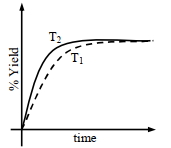
B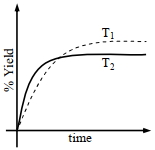
C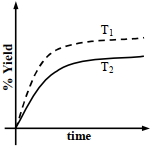
D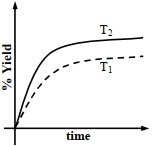
Solution
(C) The reaction $N_{2(g)} + 3H_{2(g)} \rightleftharpoons 2NH_{3(g)}$ is exothermic $(\Delta H < 0)$.
According to Le Chatelier's principle,increasing the temperature $(T_2 > T_1)$ will shift the equilibrium in the backward direction,resulting in a lower equilibrium yield of ammonia at $T_2$ compared to $T_1$.
However,increasing the temperature increases the rate of reaction,so the system reaches equilibrium faster at $T_2$ than at $T_1$.
Therefore,the curve for $T_2$ will rise more steeply initially but will level off at a lower equilibrium yield value than the curve for $T_1$.
According to Le Chatelier's principle,increasing the temperature $(T_2 > T_1)$ will shift the equilibrium in the backward direction,resulting in a lower equilibrium yield of ammonia at $T_2$ compared to $T_1$.
However,increasing the temperature increases the rate of reaction,so the system reaches equilibrium faster at $T_2$ than at $T_1$.
Therefore,the curve for $T_2$ will rise more steeply initially but will level off at a lower equilibrium yield value than the curve for $T_1$.
0 likes
View Solution276
MediumMCQ
Consider the equilibrium $CO_{(g)} + 3H_{2(g)} \rightleftharpoons CH_{4(g)} + H_2O_{(g)}$. If the pressure applied over the system increases by two-fold at constant temperature,then which of the following statements are correct?
$(A)$ Concentration of reactants and products increases.
$(B)$ Equilibrium will shift in the forward direction.
$(C)$ Equilibrium constant increases since the concentration of products increases.
$(D)$ Equilibrium constant remains unchanged as the concentration of reactants and products remain the same.
Choose the correct answer from the options given below:
$(A)$ Concentration of reactants and products increases.
$(B)$ Equilibrium will shift in the forward direction.
$(C)$ Equilibrium constant increases since the concentration of products increases.
$(D)$ Equilibrium constant remains unchanged as the concentration of reactants and products remain the same.
Choose the correct answer from the options given below:
A
$(A)$ and $(B)$ only
B
$(A)$,$(B)$ and $(D)$ only
C
$(B)$ and $(C)$ only
D
$(A)$,$(B)$ and $(C)$ only
Solution
(A) $1$. According to Le Chatelier's Principle,when pressure is increased,the equilibrium shifts towards the side with fewer moles of gaseous species.
$2$. In the given reaction,the number of moles of gaseous reactants is $1 + 3 = 4$,and the number of moles of gaseous products is $1 + 1 = 2$.
$3$. Since the product side has fewer moles $(2 < 4)$,increasing the pressure shifts the equilibrium in the forward direction ($B$ is correct).
$4$. Increasing the pressure increases the concentration of all gaseous species present in the system ($A$ is correct).
$5$. The equilibrium constant ($K_c$ or $K_p$) depends only on temperature. Since the temperature is constant,the equilibrium constant remains unchanged ($C$ is incorrect,$D$ is incorrect because the concentrations do not remain the same).
$6$. Therefore,statements $(A)$ and $(B)$ are correct.
$2$. In the given reaction,the number of moles of gaseous reactants is $1 + 3 = 4$,and the number of moles of gaseous products is $1 + 1 = 2$.
$3$. Since the product side has fewer moles $(2 < 4)$,increasing the pressure shifts the equilibrium in the forward direction ($B$ is correct).
$4$. Increasing the pressure increases the concentration of all gaseous species present in the system ($A$ is correct).
$5$. The equilibrium constant ($K_c$ or $K_p$) depends only on temperature. Since the temperature is constant,the equilibrium constant remains unchanged ($C$ is incorrect,$D$ is incorrect because the concentrations do not remain the same).
$6$. Therefore,statements $(A)$ and $(B)$ are correct.
0 likes
View Solution277
MediumMCQ
In the following system,$PCl_{5(g)} \rightleftharpoons PCl_{3(g)} + Cl_{2(g)}$ at equilibrium,upon addition of xenon gas at constant $T$ & $p$,the concentration of
A
$PCl_5$ will increase
B
$Cl_2$ will decrease
C
$PCl_5, PCl_3$ & $Cl_2$ remain constant
D
$PCl_3$ will increase
Solution
(D) When an inert gas like xenon is added to a gaseous equilibrium system at constant $T$ and $P$,the total volume of the system increases.
This leads to a decrease in the partial pressure of each reacting species.
According to Le Chatelier's principle,the system shifts in the direction that increases the total number of moles of gas.
In the reaction $PCl_{5(g)} \rightleftharpoons PCl_{3(g)} + Cl_{2(g)}$,the number of moles of products $(2)$ is greater than the number of moles of reactants $(1)$.
Therefore,the equilibrium shifts in the forward direction.
As a result,the concentration of $PCl_5$ decreases,while the concentrations of $PCl_3$ and $Cl_2$ increase.
This leads to a decrease in the partial pressure of each reacting species.
According to Le Chatelier's principle,the system shifts in the direction that increases the total number of moles of gas.
In the reaction $PCl_{5(g)} \rightleftharpoons PCl_{3(g)} + Cl_{2(g)}$,the number of moles of products $(2)$ is greater than the number of moles of reactants $(1)$.
Therefore,the equilibrium shifts in the forward direction.
As a result,the concentration of $PCl_5$ decreases,while the concentrations of $PCl_3$ and $Cl_2$ increase.
0 likes
View Solution278
MediumMCQ
Higher yield of $NO$ in $N_{2(g)} + O_{2(g)} \rightleftharpoons 2 NO_{(g)}$ can be obtained at [ $\Delta H$ of the reaction $= +180.7 \ kJ \ mol^{-1}$ ]
$A.$ Higher temperature
$B.$ Lower temperature
$C.$ Higher concentration of $N_2$
$D.$ Higher concentration of $O_2$
Choose the correct answer from the options given below:
$A.$ Higher temperature
$B.$ Lower temperature
$C.$ Higher concentration of $N_2$
$D.$ Higher concentration of $O_2$
Choose the correct answer from the options given below:
A
$A, C, D$ only
B
$B, C$ only
C
$B, C, D$ only
D
$A, C, D$ only
Solution
(A) The given reaction is $N_{2(g)} + O_{2(g)} \rightleftharpoons 2 NO_{(g)}$ with $\Delta H = +180.7 \ kJ \ mol^{-1}$.
Since the reaction is endothermic $(\Delta H > 0)$,according to Le Chatelier's principle,an increase in temperature favors the forward reaction,leading to a higher yield of $NO$.
Increasing the concentration of reactants ($N_2$ or $O_2$) also shifts the equilibrium in the forward direction to consume the added reactants,thereby increasing the yield of $NO$.
Therefore,higher temperature $(A)$,higher concentration of $N_2$ $(C)$,and higher concentration of $O_2$ $(D)$ all favor the formation of $NO$.
Since the reaction is endothermic $(\Delta H > 0)$,according to Le Chatelier's principle,an increase in temperature favors the forward reaction,leading to a higher yield of $NO$.
Increasing the concentration of reactants ($N_2$ or $O_2$) also shifts the equilibrium in the forward direction to consume the added reactants,thereby increasing the yield of $NO$.
Therefore,higher temperature $(A)$,higher concentration of $N_2$ $(C)$,and higher concentration of $O_2$ $(D)$ all favor the formation of $NO$.
0 likes
View Solution279
MediumMCQ
$H_2O_{(s)} \rightleftharpoons H_2O_{(\ell)}$
Which of the following statements are correct for the above reaction?
$(A)$ At $273 \ K$ and $1 \ atm$, $\Delta G = 0$ and $\Delta S > 0$.
$(B)$ On increasing pressure, more ice will melt.
$(C)$ On increasing pressure, the melting point of ice will decrease.
$(D)$ The melting point of ice increases on increasing pressure.
Which of the following statements are correct for the above reaction?
$(A)$ At $273 \ K$ and $1 \ atm$, $\Delta G = 0$ and $\Delta S > 0$.
$(B)$ On increasing pressure, more ice will melt.
$(C)$ On increasing pressure, the melting point of ice will decrease.
$(D)$ The melting point of ice increases on increasing pressure.
A
$A, B, D$ only
B
$B, D$ only
C
$A, B, C$ only
D
$A, C$ only
Solution
(C) $1$. At $273 \ K$ and $1 \ atm$, the system $H_2O_{(s)} \rightleftharpoons H_2O_{(\ell)}$ is in equilibrium, so $\Delta G = 0$. Since melting is an endothermic process involving an increase in disorder, $\Delta S > 0$. Thus, statement $(A)$ is correct.
$2$. According to Le Chatelier's principle, for the process $H_2O_{(s)} \rightleftharpoons H_2O_{(\ell)}$, the density of liquid water is greater than that of ice. Increasing pressure favors the side with higher density (liquid phase). Therefore, more ice will melt. Statement $(B)$ is correct.
$3$. Since increasing pressure shifts the equilibrium towards the liquid phase, the melting point of ice decreases. Statement $(C)$ is correct and $(D)$ is incorrect.
$2$. According to Le Chatelier's principle, for the process $H_2O_{(s)} \rightleftharpoons H_2O_{(\ell)}$, the density of liquid water is greater than that of ice. Increasing pressure favors the side with higher density (liquid phase). Therefore, more ice will melt. Statement $(B)$ is correct.
$3$. Since increasing pressure shifts the equilibrium towards the liquid phase, the melting point of ice decreases. Statement $(C)$ is correct and $(D)$ is incorrect.
0 likes
View Solution280
MediumMCQ
What is the effect of the reduction of the volume of the system for the equilibrium $2 C_{(s)} + O_{2(g)} \rightleftharpoons 2 CO_{(g)}$?
A
The equilibrium will be shifted to the left by the increased pressure caused by the reduction in volume.
B
The equilibrium will be shifted to the right by the decreased pressure caused by the reduction in volume.
C
The equilibrium will be shifted to the left by the increased pressure caused by the increase in volume.
D
The equilibrium will be shifted to the right by the increased pressure caused by the reduction in volume.
Solution
(A) According to $Le \ Chatelier's \ Principle$,when the volume of a system at equilibrium is reduced,the pressure increases.
To counteract this increase in pressure,the system shifts in the direction that produces fewer moles of gas.
In the reaction $2 C_{(s)} + O_{2(g)} \rightleftharpoons 2 CO_{(g)}$,the number of moles of gaseous reactants is $1$ $(O_{2})$ and the number of moles of gaseous products is $2$ $(CO)$.
Since the number of moles of gaseous products $(2)$ is greater than the number of moles of gaseous reactants $(1)$,an increase in pressure (due to volume reduction) will shift the equilibrium to the left (towards the reactants) to decrease the total number of gas moles.
To counteract this increase in pressure,the system shifts in the direction that produces fewer moles of gas.
In the reaction $2 C_{(s)} + O_{2(g)} \rightleftharpoons 2 CO_{(g)}$,the number of moles of gaseous reactants is $1$ $(O_{2})$ and the number of moles of gaseous products is $2$ $(CO)$.
Since the number of moles of gaseous products $(2)$ is greater than the number of moles of gaseous reactants $(1)$,an increase in pressure (due to volume reduction) will shift the equilibrium to the left (towards the reactants) to decrease the total number of gas moles.
0 likes
View Solution281
MediumMCQ
For which of the following reactions is product formation favoured at low pressure and low temperature?
A
$CO_{2(g)} + C_{(s)} \rightleftharpoons 2CO_{(g)}; \quad \Delta H^{\circ} = 172.5 \ kJ$
B
$CO_{(g)} + 2H_{2(g)} \rightleftharpoons CH_3OH_{(g)}; \quad \Delta H^{\circ} = -21.7 \ kJ$
C
$2O_{3(g)} \rightleftharpoons 3O_{2(g)}; \quad \Delta H^{\circ} = -285 \ kJ$
D
$H_{2(g)} + I_{2(g)} \rightleftharpoons 2HI_{(g)}; \quad \Delta H^{\circ} = -9.4 \ kJ$
Solution
(C) According to Le Chatelier's Principle:
$1$. For an exothermic reaction $(\Delta H < 0)$,low temperature favours the formation of products.
$2$. For a reaction where the number of gaseous moles increases $(\Delta n_g > 0)$,low pressure favours the formation of products.
$3$. In option $C$,$2O_{3(g)} \rightleftharpoons 3O_{2(g)}$,$\Delta H^{\circ} = -285 \ kJ$ (exothermic) and $\Delta n_g = 3 - 2 = 1$ (increase in gaseous moles).
$4$. Therefore,low temperature and low pressure favour the forward reaction.
$1$. For an exothermic reaction $(\Delta H < 0)$,low temperature favours the formation of products.
$2$. For a reaction where the number of gaseous moles increases $(\Delta n_g > 0)$,low pressure favours the formation of products.
$3$. In option $C$,$2O_{3(g)} \rightleftharpoons 3O_{2(g)}$,$\Delta H^{\circ} = -285 \ kJ$ (exothermic) and $\Delta n_g = 3 - 2 = 1$ (increase in gaseous moles).
$4$. Therefore,low temperature and low pressure favour the forward reaction.
0 likes
View Solution282
EasyMCQ
According to Le Chatelier's principle,in the reaction $CO_{(g)} + 3H_{2(g)} \rightleftharpoons CH_{4(g)} + H_2O_{(g)}$,the formation of methane is favoured by:
A
$a$ and $c$
B
$b$ and $d$
C
$a$ and $d$
D
$a$ and $b$
Solution
(A) According to Le Chatelier's principle,the equilibrium shifts in the direction that counteracts the change applied to the system.
For the reaction $CO_{(g)} + 3H_{2(g)} \rightleftharpoons CH_{4(g)} + H_2O_{(g)}$,the formation of methane $(CH_4)$ is favoured by:
$1$. Increasing the concentration of reactants ($CO$ or $H_2$): This shifts the equilibrium to the right.
$2$. Decreasing the concentration of products ($CH_4$ or $H_2O$): This also shifts the equilibrium to the right to produce more product.
Evaluating the options:
$(a)$ Increasing the concentration of $CO$ favours the forward reaction.
$(b)$ Increasing the concentration of $H_2O$ favours the backward reaction.
$(c)$ Decreasing the concentration of $CH_4$ favours the forward reaction.
$(d)$ Decreasing the concentration of $H_2$ favours the backward reaction.
Therefore,the formation of methane is favoured by $a$ and $c$.
For the reaction $CO_{(g)} + 3H_{2(g)} \rightleftharpoons CH_{4(g)} + H_2O_{(g)}$,the formation of methane $(CH_4)$ is favoured by:
$1$. Increasing the concentration of reactants ($CO$ or $H_2$): This shifts the equilibrium to the right.
$2$. Decreasing the concentration of products ($CH_4$ or $H_2O$): This also shifts the equilibrium to the right to produce more product.
Evaluating the options:
$(a)$ Increasing the concentration of $CO$ favours the forward reaction.
$(b)$ Increasing the concentration of $H_2O$ favours the backward reaction.
$(c)$ Decreasing the concentration of $CH_4$ favours the forward reaction.
$(d)$ Decreasing the concentration of $H_2$ favours the backward reaction.
Therefore,the formation of methane is favoured by $a$ and $c$.
0 likes
View Solution283
EasyMCQ
For the reaction,$A_{(g)} + B_{(g)} \rightleftharpoons C_{(g)} + D_{(g)}$; $\Delta H = Q \ kJ$,the equilibrium constant cannot be disturbed by
A
addition of $A$
B
addition of $D$
C
increasing of pressure
D
increasing of temperature
Solution
(C) For the given reaction,$A_{(g)} + B_{(g)} \rightleftharpoons C_{(g)} + D_{(g)}$,the change in the number of moles of gaseous species is $\Delta n_g = (1 + 1) - (1 + 1) = 0$.
Since $\Delta n_g = 0$,the pressure change does not affect the equilibrium position or the equilibrium constant.
The equilibrium constant $K_c$ is a function of temperature only.
Therefore,increasing the pressure will not disturb the equilibrium constant.
Since $\Delta n_g = 0$,the pressure change does not affect the equilibrium position or the equilibrium constant.
The equilibrium constant $K_c$ is a function of temperature only.
Therefore,increasing the pressure will not disturb the equilibrium constant.
0 likes
View Solution284
MediumMCQ
The yield of the products in the reaction,$A_{2(g)} + 2B_{(g)} \rightleftharpoons C_{(g)} + Q \ kJ$ would be higher at
A
high temperature and high pressure
B
high temperature and low pressure
C
low temperature and high pressure
D
low temperature and low pressure
Solution
(C) The given reaction is $A_{2(g)} + 2B_{(g)} \rightleftharpoons C_{(g)} + Q \ kJ$.
Since the reaction releases heat $(+Q \ kJ)$,it is an exothermic reaction.
According to Le Chatelier's principle,for an exothermic reaction,a decrease in temperature favors the forward reaction,thereby increasing the yield of the products.
Furthermore,the number of moles of gaseous reactants is $1 + 2 = 3$,while the number of moles of gaseous products is $1$.
Since the forward reaction proceeds with a decrease in the number of gaseous molecules,an increase in pressure will shift the equilibrium toward the product side.
Therefore,low temperature and high pressure favor the formation of products.
Since the reaction releases heat $(+Q \ kJ)$,it is an exothermic reaction.
According to Le Chatelier's principle,for an exothermic reaction,a decrease in temperature favors the forward reaction,thereby increasing the yield of the products.
Furthermore,the number of moles of gaseous reactants is $1 + 2 = 3$,while the number of moles of gaseous products is $1$.
Since the forward reaction proceeds with a decrease in the number of gaseous molecules,an increase in pressure will shift the equilibrium toward the product side.
Therefore,low temperature and high pressure favor the formation of products.
0 likes
View Solution285
EasyMCQ
$N_{2} + 3H_{2} \rightleftharpoons 2NH_{3} + \text{heat}$. What is the effect of the increase of temperature on the equilibrium of the reaction?
A
Equilibrium is shifted to the left
B
Equilibrium is shifted to the right
C
Equilibrium is unaltered
D
Reaction rate does not change
Solution
(A) $N_{2} + 3H_{2} \rightleftharpoons 2NH_{3} + \text{heat}$
According to Le Chatelier's principle,for an exothermic reaction,an increase in temperature shifts the equilibrium in the direction that absorbs heat.
Since the forward reaction is exothermic,increasing the temperature will favour the backward reaction.
Therefore,the equilibrium shifts to the left.
According to Le Chatelier's principle,for an exothermic reaction,an increase in temperature shifts the equilibrium in the direction that absorbs heat.
Since the forward reaction is exothermic,increasing the temperature will favour the backward reaction.
Therefore,the equilibrium shifts to the left.
0 likes
View Solution286
EasyMCQ
Observe the following equilibrium at $T(K)$:
$H_{2(g)} + I_{2(g)} \rightleftharpoons 2HI_{(g)}$
Which one of the following does not disturb the above equilibrium?
$H_{2(g)} + I_{2(g)} \rightleftharpoons 2HI_{(g)}$
Which one of the following does not disturb the above equilibrium?
A
Addition of $H_{2(g)}$
B
Removal of $HI_{(g)}$
C
Addition of $I_{2(g)}$
D
Addition of $He_{(g)}$
Solution
(D) According to Le Chatelier's principle,adding an inert gas like $He$ at constant volume does not change the partial pressures of the reacting species,and thus the equilibrium position remains unaffected.
Furthermore,for this reaction,the number of moles of gaseous reactants $(1 + 1 = 2)$ is equal to the number of moles of gaseous products $(2)$.
Therefore,even if the total pressure is changed,the equilibrium will not shift because the reaction quotient $Q_c$ remains equal to the equilibrium constant $K_c$.
Furthermore,for this reaction,the number of moles of gaseous reactants $(1 + 1 = 2)$ is equal to the number of moles of gaseous products $(2)$.
Therefore,even if the total pressure is changed,the equilibrium will not shift because the reaction quotient $Q_c$ remains equal to the equilibrium constant $K_c$.
0 likes
View Solution287
EasyMCQ
Observe the following equilibrium:
$Fe^{3+}_{(aq)} + SCN^{-}_{(aq)} \rightleftharpoons [Fe(SCN)]^{2+}_{(aq)}$
(yellow) (colorless) (deep red)
Addition of aqueous oxalic acid solution to the above equilibrium:
$Fe^{3+}_{(aq)} + SCN^{-}_{(aq)} \rightleftharpoons [Fe(SCN)]^{2+}_{(aq)}$
(yellow) (colorless) (deep red)
Addition of aqueous oxalic acid solution to the above equilibrium:
A
Shifts the equilibrium towards the formation of $[Fe(SCN)]^{2+}$
B
Deep red color increases
C
Intensity of deep red color decreases
D
No change in equilibrium
Solution
(C) Addition of oxalic acid $(H_2C_2O_4)$ provides oxalate ions $(C_2O_4^{2-})$,which react with $Fe^{3+}$ ions to form a stable complex $[Fe(C_2O_4)_3]^{3-}$.
This reaction significantly decreases the concentration of free $Fe^{3+}$ ions in the solution.
According to Le Chatelier's principle,the equilibrium will shift to the left to compensate for the loss of $Fe^{3+}$ ions.
As the equilibrium shifts to the left,the concentration of the deep red complex $[Fe(SCN)]^{2+}$ decreases,leading to a decrease in the intensity of the deep red color.
This reaction significantly decreases the concentration of free $Fe^{3+}$ ions in the solution.
According to Le Chatelier's principle,the equilibrium will shift to the left to compensate for the loss of $Fe^{3+}$ ions.
As the equilibrium shifts to the left,the concentration of the deep red complex $[Fe(SCN)]^{2+}$ decreases,leading to a decrease in the intensity of the deep red color.
0 likes
View Solution288
EasyMCQ
The formation of ammonia from its constituent elements is an exothermic reaction. The effect of increasing temperature on the reaction equilibrium is
A
The rate of the forward reaction becomes zero
B
No effect of temperature
C
Forward reaction is favored
D
Backward reaction is favored
Solution
(D) Consider the reaction for the formation of ammonia from nitrogen and hydrogen by Haber's process:
$N_{2(g)} + 3H_{2(g)} \rightleftharpoons 2NH_{3(g)}; \Delta H = -92.4 \ kJ$
The forward reaction is exothermic $(\Delta H < 0)$,while the reverse reaction is endothermic $(\Delta H > 0)$.
According to Le Chatelier's principle,if the temperature of a system at equilibrium is increased,the system will shift in the direction that absorbs heat to counteract the change.
Therefore,an increase in temperature favors the endothermic (backward) reaction.
As a result,the backward reaction is favored,leading to a decrease in the yield of ammonia.
$N_{2(g)} + 3H_{2(g)} \rightleftharpoons 2NH_{3(g)}; \Delta H = -92.4 \ kJ$
The forward reaction is exothermic $(\Delta H < 0)$,while the reverse reaction is endothermic $(\Delta H > 0)$.
According to Le Chatelier's principle,if the temperature of a system at equilibrium is increased,the system will shift in the direction that absorbs heat to counteract the change.
Therefore,an increase in temperature favors the endothermic (backward) reaction.
As a result,the backward reaction is favored,leading to a decrease in the yield of ammonia.
0 likes
View Solution289
MediumMCQ
For a reaction $A_{(g)} + \frac{1}{2} B_{(g)} \rightleftharpoons C_{(g)} + \text{heat}$,favorable conditions for the reaction to occur in the forward direction are:
A
Low $T$ and Low $P$
B
Low $T$ and high $P$
C
High $T$ and Low $P$
D
High $T$ and high $P$
Solution
(B) The reaction is $A_{(g)} + \frac{1}{2} B_{(g)} \rightleftharpoons C_{(g)} + \text{heat}$.
Since the reaction releases heat,it is an exothermic reaction.
According to Le Chatelier's principle,low temperature favors the forward direction for exothermic reactions.
Calculate the change in the number of gaseous moles: $\Delta n_g = 1 - (1 + 0.5) = -0.5$.
Since $\Delta n_g < 0$,the number of gas molecules decreases in the forward reaction.
Therefore,high pressure is favorable for the forward reaction.
Since the reaction releases heat,it is an exothermic reaction.
According to Le Chatelier's principle,low temperature favors the forward direction for exothermic reactions.
Calculate the change in the number of gaseous moles: $\Delta n_g = 1 - (1 + 0.5) = -0.5$.
Since $\Delta n_g < 0$,the number of gas molecules decreases in the forward reaction.
Therefore,high pressure is favorable for the forward reaction.
0 likes
View Solution290
EasyMCQ
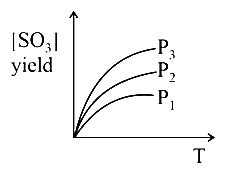
For the reaction $SO_{2(g)} + 1/2 O_{2(g)} \rightleftharpoons SO_{3(g)}$,the percentage yield of product at different pressures is shown in the figure. Then,which among the following is true?
A
Pressure has no effect
B
$P_1 < P_2 < P_3$
C
$P_1 > P_2 > P_3$
D
$P_1 = P_2 = P_3 \neq 0$
Solution
(B) The given reaction is $SO_{2(g)} + 1/2 O_{2(g)} \rightleftharpoons SO_{3(g)}$.
In this reaction,the number of moles of gaseous products is $1$ and the number of moles of gaseous reactants is $1 + 0.5 = 1.5$.
According to Le Chatelier's principle,an increase in pressure shifts the equilibrium towards the side with fewer moles of gas.
Since the product side has fewer moles $(1 < 1.5)$,increasing the pressure will increase the yield of $SO_3$.
From the graph,for a given temperature,the yield follows the order $P_3 > P_2 > P_1$.
Therefore,the correct relationship is $P_3 > P_2 > P_1$,which is equivalent to $P_1 < P_2 < P_3$.
In this reaction,the number of moles of gaseous products is $1$ and the number of moles of gaseous reactants is $1 + 0.5 = 1.5$.
According to Le Chatelier's principle,an increase in pressure shifts the equilibrium towards the side with fewer moles of gas.
Since the product side has fewer moles $(1 < 1.5)$,increasing the pressure will increase the yield of $SO_3$.
From the graph,for a given temperature,the yield follows the order $P_3 > P_2 > P_1$.
Therefore,the correct relationship is $P_3 > P_2 > P_1$,which is equivalent to $P_1 < P_2 < P_3$.
0 likes
View Solution291
EasyMCQ
$Le-Chatelier$'s principle is not applicable to:
A
$H_{2(g)} + I_{2(g)} \rightleftharpoons 2HI_{(g)}$
B
$Fe_{(s)} + S_{(s)} \rightleftharpoons FeS_{(s)}$
C
$N_{2(g)} + 3H_{2(g)} \rightleftharpoons 2NH_{3(g)}$
D
$N_{2(g)} + O_{2(g)} \rightleftharpoons 2NO_{(g)}$
Solution
(B) $Le-Chatelier$'s principle is not applicable to solid-solid equilibrium because the activities of pure solids and liquids are taken as $1$.
Pure solids and liquids are excluded from the equilibrium constant expression.
This is because they do not affect the concentration of reactants or products in the equilibrium state.
Therefore,adding or removing a pure solid from a system at equilibrium has no effect on the position of equilibrium.
Among the given options,the reaction $Fe_{(s)} + S_{(s)} \rightleftharpoons FeS_{(s)}$ involves only solid phases,making the principle inapplicable.
Pure solids and liquids are excluded from the equilibrium constant expression.
This is because they do not affect the concentration of reactants or products in the equilibrium state.
Therefore,adding or removing a pure solid from a system at equilibrium has no effect on the position of equilibrium.
Among the given options,the reaction $Fe_{(s)} + S_{(s)} \rightleftharpoons FeS_{(s)}$ involves only solid phases,making the principle inapplicable.
0 likes
View Solution292
MediumMCQ
The reaction,$N_{2(g)} + 3H_{2(g)} \rightleftharpoons 2NH_{3(g)}$ is exothermic and reversible. $A$ mixture of $N_{2(g)}$,$H_{2(g)}$,and $NH_{3(g)}$ is at equilibrium in a closed container. When a certain quantity of extra $H_{2(g)}$ is introduced into the container,while keeping the volume constant,then which statement among the following is true?
A
The pressure inside the container will not change.
B
Equilibrium condition will not change.
C
The temperature will increase.
D
The temperature will decrease.
Solution
(C) According to Le Chatelier's principle,adding $H_{2(g)}$ (a reactant) shifts the equilibrium in the forward direction to consume the added $H_{2(g)}$.
Since the forward reaction $N_{2(g)} + 3H_{2(g)} \rightleftharpoons 2NH_{3(g)}$ is exothermic (releases heat),the forward shift results in the release of additional heat.
Because the container is closed and the volume is constant,this released heat causes the temperature of the system to increase.
Since the forward reaction $N_{2(g)} + 3H_{2(g)} \rightleftharpoons 2NH_{3(g)}$ is exothermic (releases heat),the forward shift results in the release of additional heat.
Because the container is closed and the volume is constant,this released heat causes the temperature of the system to increase.
0 likes
View Solution293
DifficultMCQ
The supply of oxygen to tissues by blood can be explained by:
A
$Le \ Chatelier's$ principle
B
$Boyle's$ law
C
$Charles'$ law
D
$Dalton's$ law
Solution
(A) $Le \ Chatelier's$ principle explains the transport of gases in the blood. As blood reaches the tissues,the partial pressure of $O_2$ is low,causing $O_2$ to dissociate from hemoglobin. Conversely,in the lungs,the high partial pressure of $O_2$ drives the formation of oxyhemoglobin. The equilibrium $Hb + 4O_2 \rightleftharpoons Hb(O_2)_4$ shifts according to the concentration of reactants and products,which is a direct application of $Le \ Chatelier's$ principle. Thus,the correct answer is option $(A)$.
0 likes
View Solution294
MediumMCQ
On increasing temperature,the equilibrium constant of exothermic and endothermic reactions,respectively
A
increases and decreases
B
decreases and increases
C
increases and increases
D
decreases and decreases
Solution
(B) According to the van't Hoff equation,the effect of temperature on the equilibrium constant $K_{eq}$ depends on the enthalpy change $\Delta H$ of the reaction.
For an exothermic reaction,$\Delta H < 0$,so increasing the temperature decreases the equilibrium constant $K_{eq}$.
For an endothermic reaction,$\Delta H > 0$,so increasing the temperature increases the equilibrium constant $K_{eq}$.
For an exothermic reaction,$\Delta H < 0$,so increasing the temperature decreases the equilibrium constant $K_{eq}$.
For an endothermic reaction,$\Delta H > 0$,so increasing the temperature increases the equilibrium constant $K_{eq}$.
0 likes
View Solution295
EasyMCQ
In which of the following reactions at equilibrium,the position of the equilibrium shifts towards the products,if the total pressure is increased?
$(I)$ $X_{2(g)} + 3Y_{2(g)} \rightleftharpoons 2XY_{3(g)}$
$(II)$ $X_{2(g)} + Y_{2(g)} \rightleftharpoons 2XY_{(g)}$
$(III)$ $X_{2(g)} + Z_{2(g)} \rightleftharpoons 2XZ_{(g)}$
$(IV)$ $X_{2(g)} + Y_{4(g)} \rightleftharpoons 2XY_{2(g)}$
$(I)$ $X_{2(g)} + 3Y_{2(g)} \rightleftharpoons 2XY_{3(g)}$
$(II)$ $X_{2(g)} + Y_{2(g)} \rightleftharpoons 2XY_{(g)}$
$(III)$ $X_{2(g)} + Z_{2(g)} \rightleftharpoons 2XZ_{(g)}$
$(IV)$ $X_{2(g)} + Y_{4(g)} \rightleftharpoons 2XY_{2(g)}$
A
$(II)$
B
$(III)$
C
$(I)$
D
$(IV)$
Solution
(C) According to Le Chatelier's principle,when the total pressure of a system at equilibrium is increased,the equilibrium shifts in the direction that results in a decrease in the total number of gaseous moles.
For reaction $(I)$: $X_{2(g)} + 3Y_{2(g)} \rightleftharpoons 2XY_{3(g)}$. The number of gaseous moles on the reactant side is $1 + 3 = 4$,and on the product side is $2$. Since $2 < 4$,increasing the pressure shifts the equilibrium towards the products.
For reactions $(II)$,$(III)$,and $(IV)$: The number of gaseous moles on the reactant side is $1 + 1 = 2$,and on the product side is $2$. Since the number of moles is equal on both sides,a change in pressure does not affect the position of the equilibrium.
For reaction $(I)$: $X_{2(g)} + 3Y_{2(g)} \rightleftharpoons 2XY_{3(g)}$. The number of gaseous moles on the reactant side is $1 + 3 = 4$,and on the product side is $2$. Since $2 < 4$,increasing the pressure shifts the equilibrium towards the products.
For reactions $(II)$,$(III)$,and $(IV)$: The number of gaseous moles on the reactant side is $1 + 1 = 2$,and on the product side is $2$. Since the number of moles is equal on both sides,a change in pressure does not affect the position of the equilibrium.
0 likes
View Solution296
EasyMCQ
For the formation of $NH_{3(g)}$ from its constituent elements,the favourable conditions for its formation are
A
high pressure and low temperature
B
high pressure and high temperature
C
low pressure and high temperature
D
low pressure and low temperature
Solution
(A) The formation of $NH_3$ follows Le Chatelier's principle for the reaction: $N_{2(g)} + 3H_{2(g)} \rightleftharpoons 2NH_{3(g)} + \text{Heat}$.
Number of moles of reactants $= 1 + 3 = 4$.
Number of moles of products $= 2$.
Since the number of moles of products is less than the number of moles of reactants,an increase in pressure will shift the equilibrium in the forward direction.
As the reaction is exothermic (heat is released),a decrease in temperature will shift the equilibrium in the forward direction.
Therefore,high pressure and low temperature are the favourable conditions for the formation of $NH_3$.
Number of moles of reactants $= 1 + 3 = 4$.
Number of moles of products $= 2$.
Since the number of moles of products is less than the number of moles of reactants,an increase in pressure will shift the equilibrium in the forward direction.
As the reaction is exothermic (heat is released),a decrease in temperature will shift the equilibrium in the forward direction.
Therefore,high pressure and low temperature are the favourable conditions for the formation of $NH_3$.
0 likes
View Solution297
EasyMCQ
For the formation of $NH_{3(g)}$ from $H_{2(g)}$ and $N_{2(g)}$,which one of the following graphs represents the yield of ammonia at equilibrium? (Assume $T_1 < T_2$,unless mentioned)
A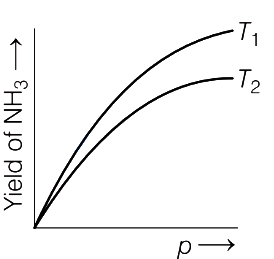
B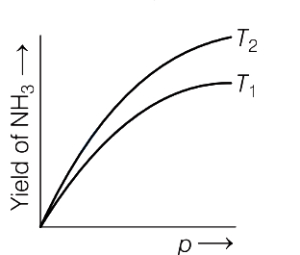
C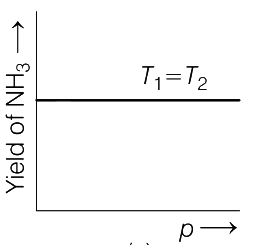
D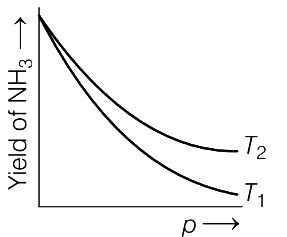
Solution
(A) The formation of $NH_{3(g)}$ is given by the reaction: $N_{2(g)} + 3H_{2(g)} \rightleftharpoons 2NH_{3(g)}$; $\Delta H < 0$ (exothermic reaction).
According to Le Chatelier's principle,for an exothermic reaction,a decrease in temperature favors the forward reaction,leading to a higher yield of the product.
Given $T_1 < T_2$,the yield of $NH_{3(g)}$ will be higher at $T_1$ than at $T_2$ for any given pressure.
Therefore,the curve for $T_1$ must lie above the curve for $T_2$.
This corresponds to the graph where the $T_1$ curve is higher than the $T_2$ curve.
According to Le Chatelier's principle,for an exothermic reaction,a decrease in temperature favors the forward reaction,leading to a higher yield of the product.
Given $T_1 < T_2$,the yield of $NH_{3(g)}$ will be higher at $T_1$ than at $T_2$ for any given pressure.
Therefore,the curve for $T_1$ must lie above the curve for $T_2$.
This corresponds to the graph where the $T_1$ curve is higher than the $T_2$ curve.
0 likes
View Solution298
EasyMCQ
Aqueous solution of ferric nitrate when mixed with aqueous solution of potassium thiocyanate gives a red coloured solution. The intensity of the red colour becomes constant upon attaining equilibrium. Choose the correct statement when the following chemicals are added to the above solution at equilibrium:
$I$. Oxalic acid
$II$. Mercuric chloride
$I$. Oxalic acid
$II$. Mercuric chloride
A
Both $(I)$ and $(II)$ will decrease the intensity of the red colour.
B
Both $(I)$ and $(II)$ will increase the intensity of the red colour.
C
$(I)$ will increase but $(II)$ will decrease the intensity of the red colour.
D
$(I)$ will decrease but $(II)$ will increase the intensity of the red colour.
Solution
(A) The reaction between ferric ions and thiocyanate ions is given by: $Fe^{3+} (aq) + SCN^- (aq) \rightleftharpoons [Fe(SCN)]^{2+} (aq)$ (red colour).
When oxalic acid $(C_2H_2O_4)$ is added,it reacts with $Fe^{3+}$ ions to form a stable complex $[Fe(C_2O_4)_3]^{3-}$,which decreases the concentration of $Fe^{3+}$,shifting the equilibrium to the left and decreasing the red colour intensity.
When mercuric chloride $(HgCl_2)$ is added,it reacts with $SCN^-$ ions to form a stable complex $[Hg(SCN)_4]^{2-}$,which decreases the concentration of $SCN^-$,shifting the equilibrium to the left and decreasing the red colour intensity.
Therefore,both $(I)$ and $(II)$ will decrease the intensity of the red colour.
When oxalic acid $(C_2H_2O_4)$ is added,it reacts with $Fe^{3+}$ ions to form a stable complex $[Fe(C_2O_4)_3]^{3-}$,which decreases the concentration of $Fe^{3+}$,shifting the equilibrium to the left and decreasing the red colour intensity.
When mercuric chloride $(HgCl_2)$ is added,it reacts with $SCN^-$ ions to form a stable complex $[Hg(SCN)_4]^{2-}$,which decreases the concentration of $SCN^-$,shifting the equilibrium to the left and decreasing the red colour intensity.
Therefore,both $(I)$ and $(II)$ will decrease the intensity of the red colour.
0 likes
View Solution299
EasyMCQ
For a given equilibrium reaction,addition of inert argon gas at constant volume can shift the equilibrium in $N_{2(g)} + 3H_{2(g)} \rightleftharpoons 2NH_{3(g)}$
A
forward direction
B
backward direction
C
remain unaffected
D
initially forward and then backward direction
Solution
(C) For a chemical equilibrium,the addition of an inert gas at constant volume does not change the partial pressures of the reacting species.
Since the total volume of the container remains constant,the concentration of each reactant and product remains unchanged.
According to Le Chatelier's principle,if the concentrations of the reacting species do not change,the position of the equilibrium remains unaffected.
Therefore,the addition of inert $Ar$ gas at constant volume will not shift the equilibrium for the reaction $N_{2(g)} + 3H_{2(g)} \rightleftharpoons 2NH_{3(g)}$.
Since the total volume of the container remains constant,the concentration of each reactant and product remains unchanged.
According to Le Chatelier's principle,if the concentrations of the reacting species do not change,the position of the equilibrium remains unaffected.
Therefore,the addition of inert $Ar$ gas at constant volume will not shift the equilibrium for the reaction $N_{2(g)} + 3H_{2(g)} \rightleftharpoons 2NH_{3(g)}$.
0 likes
View Solution6-1.Equilibrium (Chemical Equilibrium) — Le-Chaterlier principle and It’s application · Frequently Asked Questions
1Are these 6-1.Equilibrium (Chemical Equilibrium) questions useful for JEE and NEET?
Yes. All questions in this section are mapped to JEE Main and NEET exam patterns. Previous year questions from JEE Main, NEET, GUJCET and state-level exams are included with full solutions.
2Can I switch to Hindi or Gujarati for these questions?
Yes. Use the language tabs in the hero section or the sidebar to view the same questions and solutions in English, Hindi or Gujarati.
3How do I generate a question paper from this subtopic?
Use the Vedclass Exam Paper Generator — select the chapter and subtopic, set difficulty, and generate Sets A, B, C, D automatically. First 3 chapters of every subject are free.
Vedclass Products
For Students
Vedclass Test Series
Mock tests in real JEE/NEET style with performance analysis. 5-day free trial.
Start Free TrialFor Teachers
Exam Paper Generator
Generate Set A/B/C/D papers from this chapter in 2 minutes. 3 chapters free.
Try FreeFor Institutes
Online Exam Module
Live online exams with unlimited students, 360° analytics & white-label branding.
See DemoFor Teachers & Institutes
Generate a 6-1.Equilibrium (Chemical Equilibrium) Exam Paper in 2 Minutes
Select subtopic & difficulty — Sets A, B, C, D auto-generated with No Repeat logic.
First 3 chapters of every subject are free — no payment required.