
A English
Le-Chaterlier principle and It’s application Questions in English
Class 11 Chemistry · 6-1.Equilibrium (Chemical Equilibrium) · Le-Chaterlier principle and It’s application
300+
Questions
English
Language
100%
With Solutions
Showing 50 of 300 questions in English
151
AdvancedMCQ
For the reversible reaction,
$N_{2(g)} + 3H_{2(g)} \rightleftharpoons 2NH_{3(g)} + \text{heat}$
The equilibrium shifts in the forward direction:
$N_{2(g)} + 3H_{2(g)} \rightleftharpoons 2NH_{3(g)} + \text{heat}$
The equilibrium shifts in the forward direction:
A
by increasing the concentration of $NH_{3(g)}$
B
by decreasing the pressure
C
by decreasing the concentrations of $N_{2(g)}$ and $H_{2(g)}$
D
by increasing pressure and decreasing temperature.
Solution
(D) According to Le Chatelier's principle,if a change is applied to a system at equilibrium,the system will shift in a direction that counteracts the change.
$N_{2(g)} + 3H_{2(g)} \rightleftharpoons 2NH_{3(g)} + \text{Heat}$
$(a)$ Increasing the concentration of $NH_{3(g)}$ shifts the equilibrium in the backward direction to consume the added product.
$(b)$ Decreasing the pressure shifts the equilibrium toward the side with more moles of gas (the reactant side,$4 \text{ moles}$ vs $2 \text{ moles}$),which is the backward direction.
$(c)$ Decreasing the concentration of $N_{2(g)}$ and $H_{2(g)}$ shifts the equilibrium in the backward direction to produce more reactants.
$(d)$ Increasing pressure shifts the equilibrium toward the side with fewer moles of gas (the product side,$2 \text{ moles}$ vs $4 \text{ moles}$),which is the forward direction. Since the reaction is exothermic,decreasing the temperature also favors the forward direction.
$N_{2(g)} + 3H_{2(g)} \rightleftharpoons 2NH_{3(g)} + \text{Heat}$
$(a)$ Increasing the concentration of $NH_{3(g)}$ shifts the equilibrium in the backward direction to consume the added product.
$(b)$ Decreasing the pressure shifts the equilibrium toward the side with more moles of gas (the reactant side,$4 \text{ moles}$ vs $2 \text{ moles}$),which is the backward direction.
$(c)$ Decreasing the concentration of $N_{2(g)}$ and $H_{2(g)}$ shifts the equilibrium in the backward direction to produce more reactants.
$(d)$ Increasing pressure shifts the equilibrium toward the side with fewer moles of gas (the product side,$2 \text{ moles}$ vs $4 \text{ moles}$),which is the forward direction. Since the reaction is exothermic,decreasing the temperature also favors the forward direction.
0 likes
View Solution152
MediumMCQ
$KMnO_4$ can be prepared from $K_2MnO_4$ as per the reaction:
$3MnO_4^{2-} + 2H_2O \rightleftharpoons 2MnO_4^- + MnO_2 + 4OH^-$
The reaction can go to completion by removing $OH^-$ ions by adding:
$3MnO_4^{2-} + 2H_2O \rightleftharpoons 2MnO_4^- + MnO_2 + 4OH^-$
The reaction can go to completion by removing $OH^-$ ions by adding:
A
$CO_2$
B
$SO_2$
C
$HCl$
D
$KOH$
Solution
(A) According to Le Chatelier's principle,the reaction can be driven to the right by removing the product $OH^-$ ions.
$MnO_4^-$ is a strong oxidizing agent and will oxidize $HCl$ to $Cl_2$ and $SO_2$ to $SO_3$ (or $SO_4^{2-}$).
$CO_2$ reacts with $OH^-$ to form $HCO_3^-$ or $CO_3^{2-}$ $(CO_2 + 2OH^- \rightarrow CO_3^{2-} + H_2O)$,effectively removing $OH^-$ ions without reducing the $MnO_4^-$ product.
Therefore,$CO_2$ is the correct choice.
$MnO_4^-$ is a strong oxidizing agent and will oxidize $HCl$ to $Cl_2$ and $SO_2$ to $SO_3$ (or $SO_4^{2-}$).
$CO_2$ reacts with $OH^-$ to form $HCO_3^-$ or $CO_3^{2-}$ $(CO_2 + 2OH^- \rightarrow CO_3^{2-} + H_2O)$,effectively removing $OH^-$ ions without reducing the $MnO_4^-$ product.
Therefore,$CO_2$ is the correct choice.
0 likes
View Solution153
EasyMCQ
The value of $\Delta H$ for the reaction $X_{2(g)} + 4Y_{2(g)} \rightleftharpoons 2XY_{4(g)}$ is less than zero. Formation of $XY_{4(g)}$ will be favoured at
A
high temperature and high pressure
B
low pressure and low temperature
C
high temperature and low pressure
D
high pressure and low temperature
Solution
(D) The given reaction is $X_{2(g)} + 4Y_{2(g)} \rightleftharpoons 2XY_{4(g)}$.
Given that $\Delta H < 0$,the reaction is exothermic.
Calculate the change in the number of moles of gaseous species: $\Delta n_g = n_{products} - n_{reactants} = 2 - (1 + 4) = 2 - 5 = -3$.
Since $\Delta n_g < 0$,the forward reaction is favoured at high pressure according to Le Chatelier's principle.
Since the reaction is exothermic $(\Delta H < 0)$,the forward reaction is favoured at low temperature.
Therefore,the formation of $XY_{4(g)}$ is favoured at high pressure and low temperature.
Given that $\Delta H < 0$,the reaction is exothermic.
Calculate the change in the number of moles of gaseous species: $\Delta n_g = n_{products} - n_{reactants} = 2 - (1 + 4) = 2 - 5 = -3$.
Since $\Delta n_g < 0$,the forward reaction is favoured at high pressure according to Le Chatelier's principle.
Since the reaction is exothermic $(\Delta H < 0)$,the forward reaction is favoured at low temperature.
Therefore,the formation of $XY_{4(g)}$ is favoured at high pressure and low temperature.
0 likes
View Solution154
EasyMCQ
In the equilibrium reaction
$AgCl_{(s)} + 2NH_3(aq.) \rightleftharpoons [Ag(NH_3)_2]^+ (aq.) + Cl^{-} (aq.)$
Increase in the concentration of $Cl^{-} (aq.)$ causes
$AgCl_{(s)} + 2NH_3(aq.) \rightleftharpoons [Ag(NH_3)_2]^+ (aq.) + Cl^{-} (aq.)$
Increase in the concentration of $Cl^{-} (aq.)$ causes
A
$AgCl_{(s)}$ to decompose
B
$AgCl_{(s)}$ to precipitate
C
$[Ag(NH_3)_2]^+ (aq.)$ to form
D
The $NH_3(aq.)$ concentration to decrease
Solution
(B) According to Le Chatelier's principle,if the concentration of a product in an equilibrium reaction is increased,the equilibrium shifts in the direction that consumes the added substance.
In the reaction $AgCl_{(s)} + 2NH_3(aq.) \rightleftharpoons [Ag(NH_3)_2]^+ (aq.) + Cl^{-} (aq.)$,increasing the concentration of $Cl^{-} (aq.)$ (a product) will cause the reaction to shift to the left.
This shift to the left results in the formation of more reactants,specifically causing $AgCl_{(s)}$ to precipitate.
In the reaction $AgCl_{(s)} + 2NH_3(aq.) \rightleftharpoons [Ag(NH_3)_2]^+ (aq.) + Cl^{-} (aq.)$,increasing the concentration of $Cl^{-} (aq.)$ (a product) will cause the reaction to shift to the left.
This shift to the left results in the formation of more reactants,specifically causing $AgCl_{(s)}$ to precipitate.
0 likes
View Solution155
EasyMCQ
Consider the heterogeneous equilibrium in a closed container:
$NH_4HS_{(s)} \rightleftharpoons NH_{3(g)} + H_2S_{(g)}$
If more $NH_4HS_{(s)}$ is added to the equilibrium,what will be the effect on the system?
$NH_4HS_{(s)} \rightleftharpoons NH_{3(g)} + H_2S_{(g)}$
If more $NH_4HS_{(s)}$ is added to the equilibrium,what will be the effect on the system?
A
Partial pressure of $NH_3$ increases
B
Partial pressure of $H_2S$ increases
C
Total pressure in the container increases
D
No effect on partial pressure of $NH_3$ and $H_2S$
Solution
(D) The given reaction is a heterogeneous equilibrium: $NH_4HS_{(s)} \rightleftharpoons NH_{3(g)} + H_2S_{(g)}$.
According to the law of mass action,the equilibrium constant $K_p$ is given by $K_p = P_{NH_3} \times P_{H_2S}$.
Since $NH_4HS$ is a solid,its active mass is considered constant and it does not appear in the equilibrium constant expression.
Adding more solid $NH_4HS$ to the system does not change the concentration or partial pressure of the gaseous products as long as some solid remains to maintain equilibrium.
Therefore,the partial pressures of $NH_3$ and $H_2S$ remain unchanged,and the total pressure remains constant.
According to the law of mass action,the equilibrium constant $K_p$ is given by $K_p = P_{NH_3} \times P_{H_2S}$.
Since $NH_4HS$ is a solid,its active mass is considered constant and it does not appear in the equilibrium constant expression.
Adding more solid $NH_4HS$ to the system does not change the concentration or partial pressure of the gaseous products as long as some solid remains to maintain equilibrium.
Therefore,the partial pressures of $NH_3$ and $H_2S$ remain unchanged,and the total pressure remains constant.
0 likes
View Solution156
MediumMCQ
The dissociation of phosgene,which occurs according to the reaction $COCl_{2(g)} \rightleftharpoons CO_{(g)} + Cl_{2(g)}$,is an endothermic process. Which of the following will increase the degree of dissociation of $COCl_2$?
A
Adding $Cl_2$ to the system
B
Adding $He$ to the system at constant pressure
C
Decreasing the temperature of the system
D
Increasing the total pressure of the system
Solution
(B) The given reaction is $COCl_{2(g)} \rightleftharpoons CO_{(g)} + Cl_{2(g)}$.
Since the reaction is endothermic,increasing the temperature will shift the equilibrium to the right,increasing the degree of dissociation.
According to Le Chatelier's principle,adding an inert gas like $He$ at constant pressure increases the volume of the system.
This decrease in partial pressure of the reactants and products shifts the equilibrium toward the side with more moles of gas.
In this reaction,the product side has $2$ moles of gas ($CO$ and $Cl_2$) while the reactant side has $1$ mole of gas $(COCl_2)$.
Therefore,adding $He$ at constant pressure shifts the equilibrium to the right,increasing the degree of dissociation of $COCl_2$.
Since the reaction is endothermic,increasing the temperature will shift the equilibrium to the right,increasing the degree of dissociation.
According to Le Chatelier's principle,adding an inert gas like $He$ at constant pressure increases the volume of the system.
This decrease in partial pressure of the reactants and products shifts the equilibrium toward the side with more moles of gas.
In this reaction,the product side has $2$ moles of gas ($CO$ and $Cl_2$) while the reactant side has $1$ mole of gas $(COCl_2)$.
Therefore,adding $He$ at constant pressure shifts the equilibrium to the right,increasing the degree of dissociation of $COCl_2$.
0 likes
View Solution157
MediumMCQ
In which reaction will an increase in the volume of the container favour the formation of products?
A
$C_{(s)} + H_2O_{(g)} \rightleftharpoons CO_{(g)} + H_{2(g)}$
B
$H_{2(g)} + I_{2(g)} \rightleftharpoons 2HI_{(g)}$
C
$4NH_{3(g)} + 5O_{2(g)} \rightleftharpoons 4NO_{(g)} + 6H_2O_{(l)}$
D
$3O_{2(g)} \rightleftharpoons 2O_{3(g)}$
Solution
(A) According to Le Chatelier's principle,an increase in the volume of the container decreases the pressure of the system.
This shift favours the direction that produces a greater number of moles of gaseous species $(\Delta n_g > 0)$.
For option $A$: $\Delta n_g = (1 1) - 1 = 1$.
For option $B$: $\Delta n_g = 2 - (1 1) = 0$.
For option $C$: $\Delta n_g = 4 - (4 5) = -5$.
For option $D$: $\Delta n_g = 2 - 3 = -1$.
Since only option $A$ has a positive value for $\Delta n_g$,increasing the volume will favour the formation of products.
This shift favours the direction that produces a greater number of moles of gaseous species $(\Delta n_g > 0)$.
For option $A$: $\Delta n_g = (1 1) - 1 = 1$.
For option $B$: $\Delta n_g = 2 - (1 1) = 0$.
For option $C$: $\Delta n_g = 4 - (4 5) = -5$.
For option $D$: $\Delta n_g = 2 - 3 = -1$.
Since only option $A$ has a positive value for $\Delta n_g$,increasing the volume will favour the formation of products.
0 likes
View Solution158
MediumMCQ
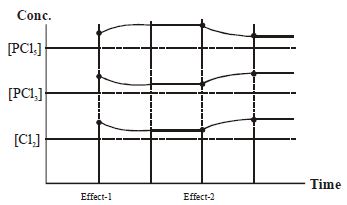
Consider the given endothermic reaction at equilibrium,$PCl_{5(g)} \rightleftharpoons PCl_{3(g)} + Cl_{2(g)}$. $A$ graph is plotted between concentration and time as shown. Effect-$1$ and Effect-$2$ are due to respectively:
A
$P$ increase,$T$ increase
B
$P$ increase,$T$ decrease
C
Inert gas added at constant pressure,$T$ increase
D
$P$ decrease,$T$ decrease
Solution
(A) For the reaction $PCl_{5(g)} \rightleftharpoons PCl_{3(g)} + Cl_{2(g)}$,$\Delta n_g = 2 - 1 = 1 > 0$.
Effect-$1$: The graph shows an instantaneous increase in the concentration of all species $(PCl_5, PCl_3, Cl_2)$. This corresponds to a decrease in volume,which is equivalent to an increase in pressure ($P$ increase). According to Le Chatelier's principle,increasing pressure shifts the equilibrium towards the side with fewer moles of gas (left side),so $[PCl_5]$ increases while $[PCl_3]$ and $[Cl_2]$ decrease.
Effect-$2$: The graph shows a gradual change in concentrations without an instantaneous jump. This indicates a change in temperature. Since the reaction is endothermic,increasing the temperature ($T$ increase) shifts the equilibrium to the right (forward direction). Consequently,$[PCl_3]$ and $[Cl_2]$ increase,while $[PCl_5]$ decreases. This matches the observed trends in the graph.
Effect-$1$: The graph shows an instantaneous increase in the concentration of all species $(PCl_5, PCl_3, Cl_2)$. This corresponds to a decrease in volume,which is equivalent to an increase in pressure ($P$ increase). According to Le Chatelier's principle,increasing pressure shifts the equilibrium towards the side with fewer moles of gas (left side),so $[PCl_5]$ increases while $[PCl_3]$ and $[Cl_2]$ decrease.
Effect-$2$: The graph shows a gradual change in concentrations without an instantaneous jump. This indicates a change in temperature. Since the reaction is endothermic,increasing the temperature ($T$ increase) shifts the equilibrium to the right (forward direction). Consequently,$[PCl_3]$ and $[Cl_2]$ increase,while $[PCl_5]$ decreases. This matches the observed trends in the graph.
0 likes
View Solution159
EasyMCQ
For the reaction at equilibrium
$N_{2(g)} + 3H_{2(g)} \rightleftharpoons 2NH_{3(g)}$
On addition of an inert gas at constant pressure and constant temperature,which of the following changes is $NOT$ observed?
$N_{2(g)} + 3H_{2(g)} \rightleftharpoons 2NH_{3(g)}$
On addition of an inert gas at constant pressure and constant temperature,which of the following changes is $NOT$ observed?
A
Concentration of $N_2$ increases
B
Concentration of $NH_3$ decreases
C
The rate of backward reaction becomes more than the rate of forward reaction just after the addition of the inert gas.
D
The equilibrium constant does not change
Solution
(A) When an inert gas is added to a gaseous reaction at constant pressure,the total volume of the system increases.
According to the ideal gas law,$PV = nRT$,if $P$ and $T$ are constant,an increase in the total number of moles $(n)$ due to the addition of an inert gas leads to an increase in volume $(V)$.
Since concentration is defined as $C = n/V$,an increase in $V$ results in a decrease in the concentration of all gaseous reactants and products.
For the reaction $N_{2(g)} + 3H_{2(g)} \rightleftharpoons 2NH_{3(g)}$,the reaction quotient $Q_c$ is given by $Q_c = [NH_3]^2 / ([N_2][H_2]^3)$.
As the volume increases,the concentration of each species decreases. Since the denominator has a higher power $(1+3=4)$ than the numerator $(2)$,the value of $Q_c$ increases,making $Q_c > K_c$.
This shift causes the equilibrium to move in the direction of fewer moles of gas (the backward direction in this case) to counteract the change.
Therefore,the concentration of $N_2$ and $H_2$ will increase relative to their values immediately after the volume expansion,and the concentration of $NH_3$ will decrease.
Option $A$ is incorrect because the concentration of $N_2$ decreases due to volume expansion,and it does not increase back to its original value.
According to the ideal gas law,$PV = nRT$,if $P$ and $T$ are constant,an increase in the total number of moles $(n)$ due to the addition of an inert gas leads to an increase in volume $(V)$.
Since concentration is defined as $C = n/V$,an increase in $V$ results in a decrease in the concentration of all gaseous reactants and products.
For the reaction $N_{2(g)} + 3H_{2(g)} \rightleftharpoons 2NH_{3(g)}$,the reaction quotient $Q_c$ is given by $Q_c = [NH_3]^2 / ([N_2][H_2]^3)$.
As the volume increases,the concentration of each species decreases. Since the denominator has a higher power $(1+3=4)$ than the numerator $(2)$,the value of $Q_c$ increases,making $Q_c > K_c$.
This shift causes the equilibrium to move in the direction of fewer moles of gas (the backward direction in this case) to counteract the change.
Therefore,the concentration of $N_2$ and $H_2$ will increase relative to their values immediately after the volume expansion,and the concentration of $NH_3$ will decrease.
Option $A$ is incorrect because the concentration of $N_2$ decreases due to volume expansion,and it does not increase back to its original value.
0 likes
View Solution160
MediumMCQ
On heating a mixture of $SO_2Cl_2$ and $CO$,two equilibria are simultaneously established: $SO_2Cl_{2(g)} \rightleftharpoons SO_{2(g)} + Cl_{2(g)}$ and $CO_{(g)} + Cl_{2(g)} \rightleftharpoons COCl_{2(g)}$. On adding more $SO_2$ at equilibrium,what will happen?
A
Amount of $CO$ will decrease
B
Amount of $SO_2Cl_2$ and $COCl_2$ will increase
C
Amount of $CO$ will remain unaffected
D
Amount of $SO_2Cl_2$ and $CO$ will increase
Solution
(D) According to Le Chatelier's principle,adding $SO_2$ (a product of the first equilibrium) will shift the first equilibrium $SO_2Cl_{2(g)} \rightleftharpoons SO_{2(g)} + Cl_{2(g)}$ to the left.
This results in a decrease in the concentration of $Cl_2$.
The second equilibrium is $CO_{(g)} + Cl_{2(g)} \rightleftharpoons COCl_{2(g)}$.
Since the concentration of $Cl_2$ decreases,the second equilibrium will shift to the left to compensate for the loss of $Cl_2$.
As a result,$COCl_2$ will decompose,leading to an increase in the amount of $CO$ and $Cl_2$.
Therefore,the amount of $CO$ will increase.
This results in a decrease in the concentration of $Cl_2$.
The second equilibrium is $CO_{(g)} + Cl_{2(g)} \rightleftharpoons COCl_{2(g)}$.
Since the concentration of $Cl_2$ decreases,the second equilibrium will shift to the left to compensate for the loss of $Cl_2$.
As a result,$COCl_2$ will decompose,leading to an increase in the amount of $CO$ and $Cl_2$.
Therefore,the amount of $CO$ will increase.
0 likes
View Solution161
MediumMCQ
The equilibrium constant $K$ and reaction quotient $Q$ are in the ratio $K : Q = 0.33 : 1$. This means that:
A
The reaction mixture will equilibrate to form more reactant species.
B
The reaction mixture will equilibrate to form more product species.
C
The equilibrium ratio of reactant to product concentrations will be $3$.
D
The equilibrium ratio of reactant to product concentrations will be $0.33$.
Solution
(A) Given the ratio $K : Q = 0.33 : 1$,we can write $\frac{K}{Q} = 0.33$,which implies $K = 0.33Q$ or $Q = \frac{K}{0.33} \approx 3K$.
Since $Q > K$,the reaction quotient is greater than the equilibrium constant.
According to Le Chatelier's principle,when $Q > K$,the reaction proceeds in the reverse direction to decrease the concentration of products and increase the concentration of reactants until equilibrium is re-established.
Therefore,the reaction mixture will shift backwards to form more reactant species.
Since $Q > K$,the reaction quotient is greater than the equilibrium constant.
According to Le Chatelier's principle,when $Q > K$,the reaction proceeds in the reverse direction to decrease the concentration of products and increase the concentration of reactants until equilibrium is re-established.
Therefore,the reaction mixture will shift backwards to form more reactant species.
0 likes
View Solution162
EasyMCQ
In the reaction ${A_2}_{(g)} + 4{B_2}_{(g)} \rightleftharpoons 2A{B_4}_{(g)}$ where $\Delta H < 0$,the formation of $AB_{4(g)}$ will be favoured by:
A
low temperature and high pressure
B
high temperature and low pressure
C
low temperature and low pressure
D
high temperature and high pressure
Solution
(A) According to Le Chatelier's principle:
$1$. For an exothermic reaction $(\Delta H < 0)$,a decrease in temperature favors the forward reaction.
$2$. The change in the number of moles of gaseous species is $\Delta n_g = n_p - n_r = 2 - (1 + 4) = 2 - 5 = -3$.
$3$. Since $\Delta n_g < 0$,an increase in pressure favors the side with fewer moles,which is the product side.
$4$. Therefore,the formation of $AB_{4(g)}$ is favored by low temperature and high pressure.
$1$. For an exothermic reaction $(\Delta H < 0)$,a decrease in temperature favors the forward reaction.
$2$. The change in the number of moles of gaseous species is $\Delta n_g = n_p - n_r = 2 - (1 + 4) = 2 - 5 = -3$.
$3$. Since $\Delta n_g < 0$,an increase in pressure favors the side with fewer moles,which is the product side.
$4$. Therefore,the formation of $AB_{4(g)}$ is favored by low temperature and high pressure.
0 likes
View Solution163
MediumMCQ
The yellow solution of $Na_2CrO_4$ changes to orange red on passing $CO_2$ gas due to the formation of:
A
$CrO_5$
B
$Na_2Cr_2O_7$
C
$CrO_3$
D
$Cr_2O_3$
Solution
(B) The yellow coloured solution of $Na_2CrO_4$ changes to orange red on passing $CO_2$ due to the formation of sodium dichromate,$Na_2Cr_2O_7$.
The reaction is as follows:
$2Na_2CrO_4 + 2CO_2 + H_2O \rightarrow Na_2Cr_2O_7 + 2NaHCO_3$
In this reaction,the chromate ion $(CrO_4^{2-})$ is converted into the dichromate ion $(Cr_2O_7^{2-})$,which is orange-red in colour.
The reaction is as follows:
$2Na_2CrO_4 + 2CO_2 + H_2O \rightarrow Na_2Cr_2O_7 + 2NaHCO_3$
In this reaction,the chromate ion $(CrO_4^{2-})$ is converted into the dichromate ion $(Cr_2O_7^{2-})$,which is orange-red in colour.
0 likes
View Solution164
MediumMCQ
For which of the following reactions is product formation favoured at low pressure and low temperature?
A
$CO_{2(g)} + C_{(s)} \rightleftharpoons 2CO_{(g)}; \Delta H^o = 172.5 \ kJ$
B
$CO_{(g)} + 2H_{2(g)} \rightleftharpoons CH_3OH_{(g)}; \Delta H^o = -21.7 \ kJ$
C
$2O_{3(g)} \rightleftharpoons 3O_{2(g)}; \Delta H^o = -285 \ kJ$
D
$H_{2(g)} + F_{2(g)} \rightleftharpoons 2HF_{(g)}; \Delta H^o = -541 \ kJ$
Solution
(C) According to Le Chatelier's Principle:
$1$. Low pressure favours the direction with an increase in the number of moles of gas $(\Delta n_g > 0)$.
$2$. Low temperature favours the exothermic direction $(\Delta H < 0)$.
Evaluating the options:
- Option $A$: $\Delta n_g = 2 - 1 = 1$ (Endothermic). Favoured at high $P$ and high $T$.
- Option $B$: $\Delta n_g = 1 - 3 = -2$ (Exothermic). Favoured at high $P$ and low $T$.
- Option $C$: $\Delta n_g = 3 - 2 = 1$ (Exothermic). Favoured at low $P$ and low $T$.
- Option $D$: $\Delta n_g = 2 - 2 = 0$ (Exothermic). Pressure has no effect; favoured at low $T$.
Thus,option $C$ is the correct answer.
$1$. Low pressure favours the direction with an increase in the number of moles of gas $(\Delta n_g > 0)$.
$2$. Low temperature favours the exothermic direction $(\Delta H < 0)$.
Evaluating the options:
- Option $A$: $\Delta n_g = 2 - 1 = 1$ (Endothermic). Favoured at high $P$ and high $T$.
- Option $B$: $\Delta n_g = 1 - 3 = -2$ (Exothermic). Favoured at high $P$ and low $T$.
- Option $C$: $\Delta n_g = 3 - 2 = 1$ (Exothermic). Favoured at low $P$ and low $T$.
- Option $D$: $\Delta n_g = 2 - 2 = 0$ (Exothermic). Pressure has no effect; favoured at low $T$.
Thus,option $C$ is the correct answer.
0 likes
View Solution165
MediumMCQ
The equilibrium $SO_2Cl_{2(g)} \rightleftharpoons SO_{2(g)} + Cl_{2(g)}$ is attained at $25 \ ^oC$ in a closed container and inert gas helium is introduced at constant volume. Which of the following statements are not correct?
$(a)$ Concentrations of $SO_2, Cl_2$ and $SO_2Cl_2$ change
$(b)$ More chlorine is formed
$(c)$ Concentration of $SO_2$ is reduced
$(d)$ More $SO_2Cl_2$ is formed
$(a)$ Concentrations of $SO_2, Cl_2$ and $SO_2Cl_2$ change
$(b)$ More chlorine is formed
$(c)$ Concentration of $SO_2$ is reduced
$(d)$ More $SO_2Cl_2$ is formed
A
$a, b, c, d$
B
$b, c, d$
C
$c, d$
D
None
Solution
(A) When an inert gas is added to an equilibrium mixture at constant volume,the total pressure of the system increases,but the partial pressures of the reacting species remain unchanged.
Since the partial pressures (and thus concentrations) of the reactants and products do not change,the reaction quotient $Q_c$ remains equal to the equilibrium constant $K_c$.
Therefore,the equilibrium position does not shift.
Consequently,the concentrations of $SO_2, Cl_2,$ and $SO_2Cl_2$ do not change,no additional chlorine is formed,the concentration of $SO_2$ is not reduced,and no additional $SO_2Cl_2$ is formed.
All the given statements $(a), (b), (c),$ and $(d)$ are incorrect.
Since the partial pressures (and thus concentrations) of the reactants and products do not change,the reaction quotient $Q_c$ remains equal to the equilibrium constant $K_c$.
Therefore,the equilibrium position does not shift.
Consequently,the concentrations of $SO_2, Cl_2,$ and $SO_2Cl_2$ do not change,no additional chlorine is formed,the concentration of $SO_2$ is not reduced,and no additional $SO_2Cl_2$ is formed.
All the given statements $(a), (b), (c),$ and $(d)$ are incorrect.
0 likes
View Solution166
MediumMCQ
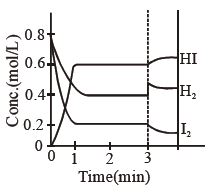
The equation for the reaction in the figure below is: $H_{2(g)} + I_{2(g)} + \text{heat} \rightleftharpoons 2HI_{(g)}$
At the instant $3 \text{ min}$,what change was imposed on the equilibrium?
At the instant $3 \text{ min}$,what change was imposed on the equilibrium?
A
Pressure was increased
B
Temperature was decreased
C
Temperature was increased
D
Hydrogen was added
Solution
(D) At the instant $3 \text{ min}$,the concentration of $H_2$ shows a sudden vertical spike,indicating that $H_2$ was added to the system.
According to Le Chatelier's principle,adding a reactant shifts the equilibrium in the forward direction to consume the excess reactant.
Consequently,the concentration of $H_2$ decreases from its peak,the concentration of $I_2$ decreases,and the concentration of $HI$ increases until a new equilibrium is established.
Therefore,the correct change is that hydrogen was added.
According to Le Chatelier's principle,adding a reactant shifts the equilibrium in the forward direction to consume the excess reactant.
Consequently,the concentration of $H_2$ decreases from its peak,the concentration of $I_2$ decreases,and the concentration of $HI$ increases until a new equilibrium is established.
Therefore,the correct change is that hydrogen was added.
0 likes
View Solution167
MediumMCQ
Which of the following equilibrium is not affected by pressure?
A
$CaCO_{3(s)} \rightleftharpoons CaO_{(s)} + CO_{2(g)}$
B
$N_{2(g)} + 3H_{2(g)} \rightleftharpoons 2NH_{3(g)}$
C
$N_{2(g)} + O_{2(g)} \rightleftharpoons 2NO_{(g)}$
D
$2SO_{2(g)} + O_{2(g)} \rightleftharpoons 2SO_{3(g)}$
Solution
(C) According to Le Chatelier's principle,the effect of pressure on an equilibrium reaction depends on the change in the number of moles of gaseous species,denoted as $\Delta n_g$.
If $\Delta n_g = 0$,the equilibrium is not affected by pressure.
For option $A$: $\Delta n_g = 1 - 0 = 1$.
For option $B$: $\Delta n_g = 2 - (1 + 3) = -2$.
For option $C$: $\Delta n_g = 2 - (1 + 1) = 0$.
For option $D$: $\Delta n_g = 2 - (2 + 1) = -1$.
Since $\Delta n_g = 0$ for option $C$,it is not affected by pressure.
If $\Delta n_g = 0$,the equilibrium is not affected by pressure.
For option $A$: $\Delta n_g = 1 - 0 = 1$.
For option $B$: $\Delta n_g = 2 - (1 + 3) = -2$.
For option $C$: $\Delta n_g = 2 - (1 + 1) = 0$.
For option $D$: $\Delta n_g = 2 - (2 + 1) = -1$.
Since $\Delta n_g = 0$ for option $C$,it is not affected by pressure.
0 likes
View Solution168
MediumMCQ
$2x_{(g)} + y_{(g)} \rightleftarrows 2z_{(g)} + 80 \ kcal$
Which combination gives the highest yield of $z$ at equilibrium?
Which combination gives the highest yield of $z$ at equilibrium?
A
$1000 \ atm$ and $500 \ ^oC$
B
$500 \ atm$ and $500 \ ^oC$
C
$1000 \ atm$ and $100 \ ^oC$
D
$500 \ atm$ and $100 \ ^oC$
Solution
(C) The given reaction is $2x_{(g)} y_{(g)} \rightleftarrows 2z_{(g)} 80 \ kcal$.
Since the reaction is exothermic $(\Delta H < 0)$,according to Le Chatelier's principle,a low temperature favors the forward reaction to increase the yield of $z$.
For the pressure effect,the number of moles of gaseous reactants is $2 1 = 3$,and the number of moles of gaseous products is $2$.
Since the number of moles decreases in the forward direction,high pressure favors the forward reaction.
Therefore,the combination of high pressure $(1000 \ atm)$ and low temperature $(100 \ ^oC)$ gives the highest yield of $z$.
Since the reaction is exothermic $(\Delta H < 0)$,according to Le Chatelier's principle,a low temperature favors the forward reaction to increase the yield of $z$.
For the pressure effect,the number of moles of gaseous reactants is $2 1 = 3$,and the number of moles of gaseous products is $2$.
Since the number of moles decreases in the forward direction,high pressure favors the forward reaction.
Therefore,the combination of high pressure $(1000 \ atm)$ and low temperature $(100 \ ^oC)$ gives the highest yield of $z$.
0 likes
View Solution169
EasyMCQ
If pressure is applied to the equilibrium of liquid $\rightleftharpoons$ vapour,the boiling point of liquid:-
A
will decrease
B
will increase
C
may increase or decrease
D
will not change
Solution
(B) According to the Le Chatelier principle,for the equilibrium $\text{Liquid} \rightleftharpoons \text{Vapour}$,the system opposes the change in pressure.
When pressure is applied (increased),the equilibrium shifts in the direction where the number of moles of gas decreases,which is towards the liquid phase.
To maintain the equilibrium at a higher pressure,more thermal energy is required to convert the liquid into vapour.
Therefore,the boiling point of the liquid increases with an increase in external pressure.
When pressure is applied (increased),the equilibrium shifts in the direction where the number of moles of gas decreases,which is towards the liquid phase.
To maintain the equilibrium at a higher pressure,more thermal energy is required to convert the liquid into vapour.
Therefore,the boiling point of the liquid increases with an increase in external pressure.
0 likes
View Solution170
EasyMCQ
When $I_2$ dissociates to its atomic form the following reaction occurs:
$I_{2(g)} \rightleftharpoons 2I_{(g)} ; \Delta_r H^o = +150 \ kJ \ mol^{-1}$
The forward reaction is favoured at:
$I_{2(g)} \rightleftharpoons 2I_{(g)} ; \Delta_r H^o = +150 \ kJ \ mol^{-1}$
The forward reaction is favoured at:
A
low temperature
B
high temperature
C
no change with temperature
D
high pressure
Solution
(B) The given reaction is $I_{2(g)} \rightleftharpoons 2I_{(g)}$ with $\Delta_r H^o = +150 \ kJ \ mol^{-1}$.
Since the value of $\Delta_r H^o$ is positive,the reaction is endothermic.
According to Le Chatelier's principle,for an endothermic reaction,an increase in temperature shifts the equilibrium in the forward direction to absorb the excess heat.
Therefore,the forward reaction is favoured at high temperature.
Since the value of $\Delta_r H^o$ is positive,the reaction is endothermic.
According to Le Chatelier's principle,for an endothermic reaction,an increase in temperature shifts the equilibrium in the forward direction to absorb the excess heat.
Therefore,the forward reaction is favoured at high temperature.
0 likes
View Solution171
MediumMCQ
In a reversible reaction at $300 \ K$,$K_c > K_p$ and $\Delta H = +40 \ kcal$. The product will be obtained in a higher amount on:
A
Decreasing pressure and temperature
B
Increasing pressure and temperature
C
Decreasing pressure and increasing temperature
D
Decreasing temperature and increasing pressure
Solution
(B) Given $K_c > K_p$.
Using the relation $K_p = K_c(RT)^{\Delta n}$,we have $(RT)^{\Delta n} < 1$,which implies $\Delta n < 0$.
Since $\Delta n < 0$,the number of moles of gaseous products is less than the number of moles of gaseous reactants. According to Le Chatelier's principle,decreasing the pressure will shift the equilibrium towards the side with more moles,i.e.,the reactant side,while increasing the pressure will shift it towards the product side.
Given $\Delta H = +40 \ kcal$,the reaction is endothermic. According to Le Chatelier's principle,increasing the temperature favors the forward (endothermic) reaction.
Therefore,the product yield increases on increasing temperature and increasing pressure.
Using the relation $K_p = K_c(RT)^{\Delta n}$,we have $(RT)^{\Delta n} < 1$,which implies $\Delta n < 0$.
Since $\Delta n < 0$,the number of moles of gaseous products is less than the number of moles of gaseous reactants. According to Le Chatelier's principle,decreasing the pressure will shift the equilibrium towards the side with more moles,i.e.,the reactant side,while increasing the pressure will shift it towards the product side.
Given $\Delta H = +40 \ kcal$,the reaction is endothermic. According to Le Chatelier's principle,increasing the temperature favors the forward (endothermic) reaction.
Therefore,the product yield increases on increasing temperature and increasing pressure.
0 likes
View Solution172
MediumMCQ
Which of the following equilibria will shift to the right side by an increase in pressure?
A
$H_2O(l) \rightleftharpoons H_2O(g)$
B
$Fe(l) \rightleftharpoons Fe(s)$
C
$H_2O(l) \rightleftharpoons H_2O(s)$
D
$Au(s) \rightleftharpoons Au(l)$
Solution
(B) According to Le Chatelier's principle,an increase in pressure shifts the equilibrium towards the side with a smaller volume (or higher density).
In the case of $H_2O(l) \rightleftharpoons H_2O(s)$,the density of ice $(H_2O(s))$ is lower than that of liquid water $(H_2O(l))$,meaning ice occupies a larger volume. However,for most substances,the solid phase is denser than the liquid phase.
For the equilibrium $H_2O(l) \rightleftharpoons H_2O(s)$,increasing the pressure favors the formation of the denser phase. Since liquid water is denser than ice,increasing pressure shifts the equilibrium towards the liquid side.
For $Fe(l) \rightleftharpoons Fe(s)$,the solid phase is denser than the liquid phase. Therefore,an increase in pressure will shift the equilibrium to the right (towards the solid phase).
In the case of $H_2O(l) \rightleftharpoons H_2O(s)$,the density of ice $(H_2O(s))$ is lower than that of liquid water $(H_2O(l))$,meaning ice occupies a larger volume. However,for most substances,the solid phase is denser than the liquid phase.
For the equilibrium $H_2O(l) \rightleftharpoons H_2O(s)$,increasing the pressure favors the formation of the denser phase. Since liquid water is denser than ice,increasing pressure shifts the equilibrium towards the liquid side.
For $Fe(l) \rightleftharpoons Fe(s)$,the solid phase is denser than the liquid phase. Therefore,an increase in pressure will shift the equilibrium to the right (towards the solid phase).
0 likes
View Solution173
EasyMCQ
The role of a catalyst in a reversible reaction is to
A
Increase the rate of the forward reaction
B
Increase the rate of the backward reaction
C
Alter the equilibrium constant
D
Ensure equilibrium is achieved quickly
Solution
(D) catalyst provides an alternative pathway with a lower activation energy for both the forward and backward reactions. As a result,it increases the rate of both reactions equally,allowing the system to reach equilibrium more rapidly without changing the equilibrium constant.
0 likes
View Solution174
EasyMCQ
On cooling the following system at equilibrium:
$CO_{2(s)} \rightleftharpoons CO_{2(g)}$
$CO_{2(s)} \rightleftharpoons CO_{2(g)}$
A
There is no effect on the equilibrium state
B
More gas is formed
C
More gas solidifies
D
None of the above
Solution
(C) The given equilibrium is $CO_{2(s)} \rightleftharpoons CO_{2(g)}$.
According to Le Chatelier's principle,cooling the system (decreasing the temperature) favors the exothermic direction.
Since the sublimation of $CO_{2(s)}$ to $CO_{2(g)}$ is an endothermic process,the reverse process (deposition) is exothermic.
Therefore,cooling the system shifts the equilibrium to the left,causing more gas to solidify.
According to Le Chatelier's principle,cooling the system (decreasing the temperature) favors the exothermic direction.
Since the sublimation of $CO_{2(s)}$ to $CO_{2(g)}$ is an endothermic process,the reverse process (deposition) is exothermic.
Therefore,cooling the system shifts the equilibrium to the left,causing more gas to solidify.
0 likes
View Solution175
EasyMCQ
Consider the following reaction and determine which of the conditions will shift the equilibrium position to the right?
$4NH_{3(g)} + 5O_{2(g)} \rightleftharpoons 4NO_{(g)} + 6H_2O_{(g)} + \text{Heat}$
$4NH_{3(g)} + 5O_{2(g)} \rightleftharpoons 4NO_{(g)} + 6H_2O_{(g)} + \text{Heat}$
A
Increasing the temperature
B
Increasing the pressure
C
Adding a catalyst
D
Decreasing the temperature
Solution
(D) The given reaction is: $4NH_{3(g)} + 5O_{2(g)} \rightleftharpoons 4NO_{(g)} + 6H_2O_{(g)} + \text{Heat}$.
This is an exothermic reaction because heat is released (product side).
According to Le Chatelier's principle,for an exothermic reaction,decreasing the temperature will shift the equilibrium to the right to produce more heat.
Regarding pressure,the change in moles of gas is $\Delta n_g = (4 + 6) - (4 + 5) = 10 - 9 = 1$.
Since $\Delta n_g > 0$,increasing the pressure will shift the equilibrium to the left (towards fewer moles).
Adding a catalyst only increases the rate of both forward and backward reactions equally and does not shift the equilibrium position.
Therefore,decreasing the temperature is the correct condition to shift the equilibrium to the right.
This is an exothermic reaction because heat is released (product side).
According to Le Chatelier's principle,for an exothermic reaction,decreasing the temperature will shift the equilibrium to the right to produce more heat.
Regarding pressure,the change in moles of gas is $\Delta n_g = (4 + 6) - (4 + 5) = 10 - 9 = 1$.
Since $\Delta n_g > 0$,increasing the pressure will shift the equilibrium to the left (towards fewer moles).
Adding a catalyst only increases the rate of both forward and backward reactions equally and does not shift the equilibrium position.
Therefore,decreasing the temperature is the correct condition to shift the equilibrium to the right.
0 likes
View Solution176
MediumMCQ
Consider the following reactions. In which cases is product formation favoured by decreased temperature?
$(a) \ N_{2(g)} + O_{2(g)} \rightleftharpoons 2NO_{(g)}; \ \Delta H^o = 181 \ kJ$
$(b) \ 2CO_{2(g)} \rightleftharpoons 2CO_{(g)} + O_{2(g)}; \ \Delta H^o = 566 \ kJ$
$(c) \ H_{2(g)} + I_{2(g)} \rightleftharpoons 2HI_{(g)}; \ \Delta H^o = -9.4 \ kJ$
$(d) \ H_{2(g)} + F_{2(g)} \rightleftharpoons 2HF_{(g)}; \ \Delta H^o = -541 \ kJ$
$(a) \ N_{2(g)} + O_{2(g)} \rightleftharpoons 2NO_{(g)}; \ \Delta H^o = 181 \ kJ$
$(b) \ 2CO_{2(g)} \rightleftharpoons 2CO_{(g)} + O_{2(g)}; \ \Delta H^o = 566 \ kJ$
$(c) \ H_{2(g)} + I_{2(g)} \rightleftharpoons 2HI_{(g)}; \ \Delta H^o = -9.4 \ kJ$
$(d) \ H_{2(g)} + F_{2(g)} \rightleftharpoons 2HF_{(g)}; \ \Delta H^o = -541 \ kJ$
A
$a, b$
B
$b$ only
C
$a, b, c$
D
$c, d$
Solution
(D) According to Le Chatelier's Principle,for an equilibrium reaction,decreasing the temperature favours the direction that releases heat (exothermic reaction).
An exothermic reaction is characterized by a negative enthalpy change,i.e.,$\Delta H^o < 0$.
Let us analyze the given reactions:
$(a) \ \Delta H^o = 181 \ kJ$ (Endothermic)
$(b) \ \Delta H^o = 566 \ kJ$ (Endothermic)
$(c) \ \Delta H^o = -9.4 \ kJ$ (Exothermic)
$(d) \ \Delta H^o = -541 \ kJ$ (Exothermic)
Since reactions $(c)$ and $(d)$ are exothermic,decreasing the temperature will shift the equilibrium towards the products,thereby favouring product formation.
An exothermic reaction is characterized by a negative enthalpy change,i.e.,$\Delta H^o < 0$.
Let us analyze the given reactions:
$(a) \ \Delta H^o = 181 \ kJ$ (Endothermic)
$(b) \ \Delta H^o = 566 \ kJ$ (Endothermic)
$(c) \ \Delta H^o = -9.4 \ kJ$ (Exothermic)
$(d) \ \Delta H^o = -541 \ kJ$ (Exothermic)
Since reactions $(c)$ and $(d)$ are exothermic,decreasing the temperature will shift the equilibrium towards the products,thereby favouring product formation.
0 likes
View Solution177
DifficultMCQ
The binding of oxygen by haemoglobin $(Hb)$ forming $(HbO_2)$ is partially regulated by the concentration of $H_3O^{+}$ and dissolved $CO_2$ in blood.
$HbO_2 + H_3O^{+} + CO_2 \rightleftharpoons (H^{+} - Hb - CO_2) + O_2 + H_2O$
Release of $O_2$ is favoured when there is:
$HbO_2 + H_3O^{+} + CO_2 \rightleftharpoons (H^{+} - Hb - CO_2) + O_2 + H_2O$
Release of $O_2$ is favoured when there is:
A
Production of $CO_2$ during exertion
B
Production of lactic acid during exertion
C
Both $(A)$ and $(B)$ take place
D
Releasing of haemoglobin during exertion
Solution
(C) According to Le Chatelier's principle,the reaction $HbO_2 + H_3O^{+} + CO_2 \rightleftharpoons (H^{+} - Hb - CO_2) + O_2 + H_2O$ shifts to the right (favouring $O_2$ release) when the concentration of reactants ($H_3O^{+}$ and $CO_2$) increases.
$1$. During physical exertion,cellular respiration increases,leading to higher production of $CO_2$.
$2$. Intense physical activity also leads to anaerobic respiration in muscles,producing lactic acid,which increases the concentration of $H_3O^{+}$ ions in the blood.
Since both $CO_2$ and $H_3O^{+}$ increase,both factors promote the release of $O_2$ from $HbO_2$.
$1$. During physical exertion,cellular respiration increases,leading to higher production of $CO_2$.
$2$. Intense physical activity also leads to anaerobic respiration in muscles,producing lactic acid,which increases the concentration of $H_3O^{+}$ ions in the blood.
Since both $CO_2$ and $H_3O^{+}$ increase,both factors promote the release of $O_2$ from $HbO_2$.
0 likes
View Solution178
MediumMCQ
Some inert gas is added at constant volume to the following reaction at equilibrium:
$NH_4HS_{(s)} \rightleftharpoons NH_{3(g)} + H_2S_{(g)}$
Predict the effect of adding the inert gas.
$NH_4HS_{(s)} \rightleftharpoons NH_{3(g)} + H_2S_{(g)}$
Predict the effect of adding the inert gas.
A
The equilibrium shifts in the forward direction
B
The equilibrium shifts in the backward direction
C
The equilibrium remains unaffected
D
The value of $K_p$ is increased
Solution
(C) When an inert gas is added to a system at equilibrium at constant volume,the total pressure of the system increases.
However,the partial pressures or concentrations of the reacting species ($NH_3$ and $H_2S$) remain unchanged because the volume of the container and the number of moles of the reactants and products do not change.
Since the reaction quotient $Q_c$ remains equal to the equilibrium constant $K_c$,there is no shift in the equilibrium position.
Therefore,the equilibrium remains unaffected.
However,the partial pressures or concentrations of the reacting species ($NH_3$ and $H_2S$) remain unchanged because the volume of the container and the number of moles of the reactants and products do not change.
Since the reaction quotient $Q_c$ remains equal to the equilibrium constant $K_c$,there is no shift in the equilibrium position.
Therefore,the equilibrium remains unaffected.
0 likes
View Solution179
MediumMCQ
What is true for the equilibrium reaction? $CH_3COOH + CH_3OH \rightleftharpoons[cat.]{} CH_3COOCH_3 + H_2O$
A
The use of equimolar quantities of $CH_3OH$ and $CH_3COOH$ will give the greatest yield of the ester at equilibrium.
B
Removal of water will increase the amount of ester at equilibrium.
C
Addition of $CH_3COOCH_3$ will cause the formation of an equal number of moles of water.
D
Application of pressure increases the amount of ester at equilibrium.
Solution
(B) According to Le Chatelier's principle,since water $(H_2O)$ is a product in this esterification reaction,its continuous removal shifts the equilibrium in the forward direction.
This results in an increased yield of the ester $(CH_3COOCH_3)$.
Therefore,option $B$ is correct.
This results in an increased yield of the ester $(CH_3COOCH_3)$.
Therefore,option $B$ is correct.
0 likes
View Solution180
MediumMCQ
In which of the following reactions,an increase in the volume of the container will favour the formation of products?
A
$4NH_{3(g)} + 5O_{2(g)} \rightleftharpoons 4NO_{(g)} + 6H_2O_{(l)}$
B
$2NO_{2(g)} \rightleftharpoons 2NO_{(g)} + O_{2(g)}$
C
$3O_{2(g)} \rightleftharpoons 2O_{3(g)}$
D
$H_{2(g)} + I_{2(g)} \rightleftharpoons 2HI_{(g)}$
Solution
(B) According to Le Chatelier's principle,an increase in the volume of the container leads to a decrease in pressure.
To counteract this,the equilibrium shifts towards the side with a greater number of moles of gaseous species.
For option $B$: $2NO_{2(g)} \rightleftharpoons 2NO_{(g)} + O_{2(g)}$,the number of moles of gaseous products is $3$ $(2+1)$ and gaseous reactants is $2$.
Since $3 > 2$,an increase in volume will favour the formation of products.
To counteract this,the equilibrium shifts towards the side with a greater number of moles of gaseous species.
For option $B$: $2NO_{2(g)} \rightleftharpoons 2NO_{(g)} + O_{2(g)}$,the number of moles of gaseous products is $3$ $(2+1)$ and gaseous reactants is $2$.
Since $3 > 2$,an increase in volume will favour the formation of products.
0 likes
View Solution181
MediumMCQ
The gas phase reaction $2NO_{2(g)} \rightleftharpoons N_2O_{4(g)}$ is an exothermic reaction. The decomposition of $N_2O_4$ in an equilibrium mixture of $NO_{2(g)}$ and $N_2O_{4(g)}$ can be increased by:
A
addition of an inert gas at constant pressure
B
lowering the temperature
C
increasing the pressure
D
addition of an inert gas at constant volume
Solution
(A) The decomposition reaction is $N_2O_{4(g)} \rightleftharpoons 2NO_{2(g)}$.
Since the forward reaction $2NO_{2(g)} \rightleftharpoons N_2O_{4(g)}$ is exothermic,the reverse reaction (decomposition) is endothermic.
According to Le Chatelier's principle:
$(a)$ Addition of an inert gas at constant pressure increases the total volume of the system,which shifts the equilibrium towards the side with a greater number of moles of gas. Here,the product side $(2NO_2)$ has more moles than the reactant side $(N_2O_4)$,so the decomposition of $N_2O_4$ increases.
$(b)$ Lowering the temperature favors the exothermic direction,which is the formation of $N_2O_4$,not its decomposition.
$(c)$ Increasing the pressure shifts the equilibrium towards the side with fewer moles of gas,favoring the formation of $N_2O_4$.
$(d)$ Addition of an inert gas at constant volume does not change the partial pressures of the reacting species,so it has no effect on the equilibrium.
Since the forward reaction $2NO_{2(g)} \rightleftharpoons N_2O_{4(g)}$ is exothermic,the reverse reaction (decomposition) is endothermic.
According to Le Chatelier's principle:
$(a)$ Addition of an inert gas at constant pressure increases the total volume of the system,which shifts the equilibrium towards the side with a greater number of moles of gas. Here,the product side $(2NO_2)$ has more moles than the reactant side $(N_2O_4)$,so the decomposition of $N_2O_4$ increases.
$(b)$ Lowering the temperature favors the exothermic direction,which is the formation of $N_2O_4$,not its decomposition.
$(c)$ Increasing the pressure shifts the equilibrium towards the side with fewer moles of gas,favoring the formation of $N_2O_4$.
$(d)$ Addition of an inert gas at constant volume does not change the partial pressures of the reacting species,so it has no effect on the equilibrium.
0 likes
View Solution182
MediumMCQ
The increase of pressure on the ice $\rightleftharpoons$ water system at constant temperature will lead to:
A
a decrease in the entropy of the system
B
an increase in the Gibb's energy of the system
C
no effect on the equilibrium
D
a shift of the equilibrium in the forward direction
Solution
(D) The density of liquid water is higher than that of ice,which means the volume of ice is greater than the volume of an equivalent mass of liquid water $(V_{\text{ice}} > V_{\text{water}})$.
According to Le Chatelier's principle,an increase in pressure favors the direction that results in a decrease in volume.
Since the forward reaction (ice $\rightarrow$ water) involves a decrease in volume,the equilibrium will shift in the forward direction.
According to Le Chatelier's principle,an increase in pressure favors the direction that results in a decrease in volume.
Since the forward reaction (ice $\rightarrow$ water) involves a decrease in volume,the equilibrium will shift in the forward direction.
0 likes
View Solution183
MediumMCQ
What happens when an inert gas is added to an equilibrium system while keeping the volume unchanged?
A
More product will form
B
Less product will form
C
More reactant will form
D
Equilibrium will remain unchanged
Solution
(D) When an inert gas is added to a system at equilibrium at constant volume,the total pressure of the system increases.
However,the partial pressure of each reactant and product remains the same because the concentration (moles/volume) of each species does not change.
According to Le Chatelier's principle,since the concentrations of the reacting species remain unchanged,there is no effect on the state of equilibrium.
However,the partial pressure of each reactant and product remains the same because the concentration (moles/volume) of each species does not change.
According to Le Chatelier's principle,since the concentrations of the reacting species remain unchanged,there is no effect on the state of equilibrium.
0 likes
View Solution184
MediumMCQ
Which among the following reactions is favoured in the forward direction by an increase in temperature?
A
$N_{2(g)} + 3H_{2(g)} \rightleftharpoons 2NH_{3(g)} + 22.9 \ kcal$
B
$N_{2(g)} + O_{2(g)} \rightleftharpoons 2NO_{(g)} - 42.8 \ kcal$
C
$2SO_{2(g)} + O_{2(g)} \rightleftharpoons 2SO_{3(g)} + 45.3 \ kcal$
D
$H_{2(g)} + Cl_{2(g)} - 44 \ kcal \rightleftharpoons 2HCl_{(g)}$
Solution
(B) According to Le Chatelier's principle,an increase in temperature favours the endothermic direction of a reaction.
An endothermic reaction is one where heat is absorbed,represented by a negative enthalpy change or a negative heat term on the product side (or positive on the reactant side).
In option $B$,the reaction $N_{2(g)} + O_{2(g)} \rightleftharpoons 2NO_{(g)} - 42.8 \ kcal$ can be rewritten as $N_{2(g)} + O_{2(g)} + 42.8 \ kcal \rightleftharpoons 2NO_{(g)}$.
Since heat is absorbed in the forward direction,an increase in temperature will shift the equilibrium towards the forward direction.
An endothermic reaction is one where heat is absorbed,represented by a negative enthalpy change or a negative heat term on the product side (or positive on the reactant side).
In option $B$,the reaction $N_{2(g)} + O_{2(g)} \rightleftharpoons 2NO_{(g)} - 42.8 \ kcal$ can be rewritten as $N_{2(g)} + O_{2(g)} + 42.8 \ kcal \rightleftharpoons 2NO_{(g)}$.
Since heat is absorbed in the forward direction,an increase in temperature will shift the equilibrium towards the forward direction.
0 likes
View Solution185
EasyMCQ
Which of the following conditions help the melting of ice?
A
High pressure,temperature below $0 \ ^\circ C$
B
High pressure,temperature above $0 \ ^\circ C$
C
Low pressure,temperature above $0 \ ^\circ C$
D
Low pressure,temperature below $0 \ ^\circ C$
Solution
(B) The melting of ice is an endothermic process accompanied by a decrease in volume.
According to Le Chatelier's principle,an increase in pressure favors the process that results in a decrease in volume,which is the melting of ice.
Additionally,increasing the temperature above $0 \ ^\circ C$ provides the necessary heat for the phase transition from solid to liquid.
Therefore,high pressure and temperatures above $0 \ ^\circ C$ facilitate the melting of ice.
According to Le Chatelier's principle,an increase in pressure favors the process that results in a decrease in volume,which is the melting of ice.
Additionally,increasing the temperature above $0 \ ^\circ C$ provides the necessary heat for the phase transition from solid to liquid.
Therefore,high pressure and temperatures above $0 \ ^\circ C$ facilitate the melting of ice.
0 likes
View Solution186
EasyMCQ
The exothermic formation of $ClF_3$ is represented by the equation
$Cl_{2(g)} + 3F_{2(g)} \rightleftharpoons 2ClF_{3(g)}$; $\Delta H_r = -329 \ kJ$
Which of the following will increase the quantity of $ClF_3$ in an equilibrium mixture of $Cl_2, F_2$ and $ClF_3$?
$Cl_{2(g)} + 3F_{2(g)} \rightleftharpoons 2ClF_{3(g)}$; $\Delta H_r = -329 \ kJ$
Which of the following will increase the quantity of $ClF_3$ in an equilibrium mixture of $Cl_2, F_2$ and $ClF_3$?
A
Removing $Cl_2$
B
Increasing the temperature
C
Adding inert gas at constant volume
D
Decreasing the volume of the container
Solution
(D) The reaction is exothermic $(\Delta H_r < 0)$. According to Le Chatelier's principle:
$1$. Increasing the temperature shifts the equilibrium to the left (reactant side).
$2$. Adding an inert gas at constant volume has no effect on the equilibrium position.
$3$. Removing $Cl_2$ shifts the equilibrium to the left.
$4$. Decreasing the volume of the container increases the pressure,shifting the equilibrium toward the side with fewer moles of gas. In this reaction,there are $4$ moles of gas on the reactant side and $2$ moles on the product side. Thus,decreasing the volume shifts the equilibrium to the right,increasing the yield of $ClF_3$.
$1$. Increasing the temperature shifts the equilibrium to the left (reactant side).
$2$. Adding an inert gas at constant volume has no effect on the equilibrium position.
$3$. Removing $Cl_2$ shifts the equilibrium to the left.
$4$. Decreasing the volume of the container increases the pressure,shifting the equilibrium toward the side with fewer moles of gas. In this reaction,there are $4$ moles of gas on the reactant side and $2$ moles on the product side. Thus,decreasing the volume shifts the equilibrium to the right,increasing the yield of $ClF_3$.
0 likes
View Solution187
EasyMCQ
Which of the following changes will shift the reaction towards the product?
$I_{2(g)} \rightleftharpoons 2I_{(g)}$ $\Delta H_r^o(298 \ K) = +150 \ kJ$
$I_{2(g)} \rightleftharpoons 2I_{(g)}$ $\Delta H_r^o(298 \ K) = +150 \ kJ$
A
Increase in concentration of $I$
B
Decrease in concentration of $I_2$
C
Increase in temperature
D
Increase in total pressure
Solution
(C) The given reaction is $I_{2(g)} \rightleftharpoons 2I_{(g)}$ with $\Delta H_r^o = +150 \ kJ$.
Since $\Delta H_r^o > 0$,the reaction is endothermic.
According to Le Chatelier's principle,for an endothermic reaction,an increase in temperature shifts the equilibrium towards the product side (forward direction) to absorb the excess heat.
Since $\Delta H_r^o > 0$,the reaction is endothermic.
According to Le Chatelier's principle,for an endothermic reaction,an increase in temperature shifts the equilibrium towards the product side (forward direction) to absorb the excess heat.
0 likes
View Solution188
MediumMCQ
In which of the following equilibria does a change in the volume of the system not alter the number of moles?
A
$N_{2(g)} + O_{2(g)} \rightleftharpoons 2NO_{(g)}$
B
$PCl_{5(g)} \rightleftharpoons PCl_{3(g)} + Cl_{2(g)}$
C
$N_{2(g)} + 3H_{2(g)} \rightleftharpoons 2NH_{3(g)}$
D
$SO_{2}Cl_{2(g)} \rightleftharpoons SO_{2(g)} + Cl_{2(g)}$
Solution
(A) For a gaseous reaction,the effect of volume change on the equilibrium position depends on the change in the total number of moles of gaseous species,denoted as $\Delta n_g$.
If $\Delta n_g = 0$,the equilibrium is not affected by a change in volume or pressure.
In the reaction $N_{2(g)} + O_{2(g)} \rightleftharpoons 2NO_{(g)}$,the number of moles of gaseous reactants is $1 + 1 = 2$ and the number of moles of gaseous products is $2$.
Since $\Delta n_g = 2 - 2 = 0$,a change in the volume of the system does not alter the number of moles at equilibrium.
If $\Delta n_g = 0$,the equilibrium is not affected by a change in volume or pressure.
In the reaction $N_{2(g)} + O_{2(g)} \rightleftharpoons 2NO_{(g)}$,the number of moles of gaseous reactants is $1 + 1 = 2$ and the number of moles of gaseous products is $2$.
Since $\Delta n_g = 2 - 2 = 0$,a change in the volume of the system does not alter the number of moles at equilibrium.
0 likes
View Solution189
EasyMCQ
For the reaction; $3X_{(g)} + Y_{(g)} \rightleftharpoons X_3Y_{(g)}$,the amount of $X_3Y$ at equilibrium is affected by
A
Temperature and pressure
B
Pressure only
C
Temperature only
D
Temperature,pressure and catalyst
Solution
(A) According to Le Chatelier's principle,the position of equilibrium is affected by changes in temperature and pressure.
$1$. Pressure: Since the number of moles of gaseous reactants $(3+1=4)$ is different from the number of moles of gaseous products $(1)$,a change in pressure will shift the equilibrium.
$2$. Temperature: The reaction involves a change in enthalpy,so temperature changes will shift the equilibrium position.
$3$. Catalyst: $A$ catalyst only increases the rate of both forward and backward reactions equally and does not affect the equilibrium position or the amount of products formed.
$1$. Pressure: Since the number of moles of gaseous reactants $(3+1=4)$ is different from the number of moles of gaseous products $(1)$,a change in pressure will shift the equilibrium.
$2$. Temperature: The reaction involves a change in enthalpy,so temperature changes will shift the equilibrium position.
$3$. Catalyst: $A$ catalyst only increases the rate of both forward and backward reactions equally and does not affect the equilibrium position or the amount of products formed.
0 likes
View Solution190
MediumMCQ
For the reaction; $PCl_{5(g)} \rightleftharpoons PCl_{3(g)} + Cl_{2(g)}$,the forward reaction at constant temperature is not favoured by:
A
Introducing chlorine gas at constant volume
B
Introducing an inert gas at constant pressure
C
Introducing $PCl_5$ at constant volume
D
Increasing the volume of the container
Solution
(A) According to Le Chatelier's principle,the forward reaction is favoured by decreasing the concentration of products or increasing the concentration of reactants.
$(A)$ Introducing $Cl_2$ gas at constant volume increases the concentration of products,which favours the backward reaction.
$(B)$ Introducing an inert gas at constant pressure increases the volume,which favours the side with more moles of gas (forward reaction).
$(C)$ Introducing $PCl_5$ at constant volume increases the concentration of reactants,which favours the forward reaction.
$(D)$ Increasing the volume of the container decreases the total pressure,which favours the side with more moles of gas (forward reaction).
Therefore,the forward reaction is not favoured by option $(A)$.
$(A)$ Introducing $Cl_2$ gas at constant volume increases the concentration of products,which favours the backward reaction.
$(B)$ Introducing an inert gas at constant pressure increases the volume,which favours the side with more moles of gas (forward reaction).
$(C)$ Introducing $PCl_5$ at constant volume increases the concentration of reactants,which favours the forward reaction.
$(D)$ Increasing the volume of the container decreases the total pressure,which favours the side with more moles of gas (forward reaction).
Therefore,the forward reaction is not favoured by option $(A)$.
0 likes
View Solution191
EasyMCQ
$aA \rightleftharpoons mB + nC$,$\Delta H = + x \ kcal$. If $m + n < a$,then conditions favouring forward reaction will be
A
Low pressure,low temperature
B
Low pressure,High temperature
C
High pressure,low temperature
D
High pressure,High temperature
Solution
(D) The given reaction is $aA \rightleftharpoons mB + nC$ with $\Delta H = +x \ kcal$. Since $\Delta H > 0$,the reaction is endothermic. According to Le Chatelier's principle,for an endothermic reaction,a high temperature favors the forward reaction.
Given $m + n < a$,the total number of moles of gaseous products is less than the total number of moles of gaseous reactants. According to Le Chatelier's principle,an increase in pressure shifts the equilibrium towards the side with fewer moles of gas. Therefore,high pressure favors the forward reaction.
Thus,high pressure and high temperature are the conditions that favor the forward reaction.
Given $m + n < a$,the total number of moles of gaseous products is less than the total number of moles of gaseous reactants. According to Le Chatelier's principle,an increase in pressure shifts the equilibrium towards the side with fewer moles of gas. Therefore,high pressure favors the forward reaction.
Thus,high pressure and high temperature are the conditions that favor the forward reaction.
0 likes
View Solution192
AdvancedMCQ
When a sample of $NO_2$ is placed in a container,this equilibrium is rapidly established: $2NO_{2(g)} \rightleftharpoons N_2O_{4(g)}$. If this equilibrium mixture is a darker colour at high temperatures and at low pressure,which of these statements about the reaction is true?
A
The reaction is exothermic and $NO_2$ is darker in colour than $N_2O_4$
B
The reaction is exothermic and $N_2O_4$ is darker in colour than $NO_2$
C
The reaction is endothermic and $NO_2$ is darker in colour than $N_2O_4$
D
The reaction is endothermic and $N_2O_4$ is darker in colour than $NO_2$
Solution
(A) The reaction $2NO_{2(g)} \rightleftharpoons N_2O_{4(g)}$ is exothermic in the forward direction (formation of $N_2O_4$).
According to Le Chatelier's principle,increasing the temperature shifts the equilibrium towards the endothermic direction (reverse),which produces more $NO_2$.
Since the mixture is darker at high temperatures,$NO_2$ must be the darker-coloured gas compared to $N_2O_4$.
Similarly,at low pressure,the equilibrium shifts towards the side with more moles of gas (the reactant side,$NO_2$),which also results in a darker colour.
Therefore,the reaction is exothermic and $NO_2$ is darker in colour than $N_2O_4$.
According to Le Chatelier's principle,increasing the temperature shifts the equilibrium towards the endothermic direction (reverse),which produces more $NO_2$.
Since the mixture is darker at high temperatures,$NO_2$ must be the darker-coloured gas compared to $N_2O_4$.
Similarly,at low pressure,the equilibrium shifts towards the side with more moles of gas (the reactant side,$NO_2$),which also results in a darker colour.
Therefore,the reaction is exothermic and $NO_2$ is darker in colour than $N_2O_4$.
0 likes
View Solution193
DifficultMCQ
When a vapor is heated slowly from $25\,^oC$ at atmospheric pressure,its color initially deepens. When the temperature is increased above $160\,^oC$,the color fades. At $600\,^oC$,the vapor becomes almost colorless,but when the pressure is increased at this temperature,the color deepens again. What is this vapor?
A
Bromine
B
Nitrogen dioxide and dinitrogen tetroxide
C
Pure nitrogen dioxide
D
Pure dinitrogen tetroxide
Solution
(D) The equilibrium involved is: $N_2O_4(g) \rightleftharpoons 2NO_2(g) \rightleftharpoons 2NO(g) + O_2(g)$.
At $25\,^oC$,$N_2O_4$ is colorless. As it is heated,it dissociates into $NO_2$,which is brown,causing the color to deepen.
Above $160\,^oC$,$NO_2$ further dissociates into $NO$ and $O_2$,both of which are colorless,causing the color to fade.
At $600\,^oC$,the mixture is almost colorless. According to Le Chatelier's principle,increasing the pressure shifts the equilibrium towards the side with fewer moles of gas (the formation of $NO_2$),which is brown. Thus,the color deepens again. The initial vapor was pure $N_2O_4$.
At $25\,^oC$,$N_2O_4$ is colorless. As it is heated,it dissociates into $NO_2$,which is brown,causing the color to deepen.
Above $160\,^oC$,$NO_2$ further dissociates into $NO$ and $O_2$,both of which are colorless,causing the color to fade.
At $600\,^oC$,the mixture is almost colorless. According to Le Chatelier's principle,increasing the pressure shifts the equilibrium towards the side with fewer moles of gas (the formation of $NO_2$),which is brown. Thus,the color deepens again. The initial vapor was pure $N_2O_4$.
0 likes
View Solution194
EasyMCQ
For the chemical reaction $3X_{(g)} + Y_{(g)} \to X_3Y_{(g)}$,the amount of $X_3Y$ at equilibrium is affected by
A
temperature and pressure
B
only temperature
C
only pressure
D
temperature,pressure and catalyst
Solution
(A) The given reaction is $3X_{(g)} + Y_{(g)} \rightleftharpoons X_3Y_{(g)}$.
The change in the number of gaseous moles is $\Delta n_g = 1 - (3 + 1) = -3$.
Since $\Delta n_g \neq 0$,the position of equilibrium is affected by a change in pressure according to Le Chatelier's principle.
The equilibrium constant $K_p$ is a function of temperature,so a change in temperature will shift the equilibrium position.
$A$ catalyst only increases the rate of both forward and backward reactions equally and does not affect the equilibrium position or the amount of product formed.
Therefore,the amount of $X_3Y$ at equilibrium is affected by both temperature and pressure.
The change in the number of gaseous moles is $\Delta n_g = 1 - (3 + 1) = -3$.
Since $\Delta n_g \neq 0$,the position of equilibrium is affected by a change in pressure according to Le Chatelier's principle.
The equilibrium constant $K_p$ is a function of temperature,so a change in temperature will shift the equilibrium position.
$A$ catalyst only increases the rate of both forward and backward reactions equally and does not affect the equilibrium position or the amount of product formed.
Therefore,the amount of $X_3Y$ at equilibrium is affected by both temperature and pressure.
0 likes
View Solution195
MediumMCQ
The colour of $CrO_4^{2-}(aq.)$ is not changed by:
A
dil. $HCl$
B
$NH_3$ solution
C
$CH_3COOH$
D
$NO_2$ gas
Solution
(B) The equilibrium between chromate and dichromate ions is given by: $2CrO_4^{2-}(aq.) + 2H^+(aq.) \rightleftharpoons Cr_2O_7^{2-}(aq.) + H_2O(l)$.
In acidic medium $(pH < 7)$,the equilibrium shifts to the right,turning the yellow $CrO_4^{2-}$ into orange $Cr_2O_7^{2-}$.
$HCl$,$CH_3COOH$,and $NO_2$ (which forms $HNO_3/HNO_2$ in water) provide an acidic medium.
$NH_3$ solution is basic $(pH > 7)$,so it does not shift the equilibrium towards the formation of $Cr_2O_7^{2-}$,thus the yellow colour remains unchanged.
In acidic medium $(pH < 7)$,the equilibrium shifts to the right,turning the yellow $CrO_4^{2-}$ into orange $Cr_2O_7^{2-}$.
$HCl$,$CH_3COOH$,and $NO_2$ (which forms $HNO_3/HNO_2$ in water) provide an acidic medium.
$NH_3$ solution is basic $(pH > 7)$,so it does not shift the equilibrium towards the formation of $Cr_2O_7^{2-}$,thus the yellow colour remains unchanged.
0 likes
View Solution196
EasyMCQ
For a reaction,the value of $K_p$ increases with an increase in temperature. The $\Delta H$ for the reaction would be
A
positive
B
negative
C
zero
D
cannot be predicted
Solution
(A) According to the van 't Hoff equation,the relationship between the equilibrium constant $K_p$ and temperature $T$ is given by $\ln(K_p) = -\frac{\Delta H}{RT} + C$.
For an endothermic reaction,$\Delta H > 0$.
As temperature $T$ increases,the term $-\frac{\Delta H}{RT}$ becomes less negative (i.e.,it increases),which leads to an increase in the value of $K_p$.
Therefore,if $K_p$ increases with an increase in temperature,the reaction must be endothermic,meaning $\Delta H$ is positive.
For an endothermic reaction,$\Delta H > 0$.
As temperature $T$ increases,the term $-\frac{\Delta H}{RT}$ becomes less negative (i.e.,it increases),which leads to an increase in the value of $K_p$.
Therefore,if $K_p$ increases with an increase in temperature,the reaction must be endothermic,meaning $\Delta H$ is positive.
0 likes
View Solution197
EasyMCQ
The yield of product in the reaction,$A_{2(g)} + 2B_{(g)} \rightleftharpoons C_{(g)} + Q \ kJ$ would be higher at
A
low temperature and high pressure
B
high temperature and high pressure
C
low temperature and low pressure
D
high temperature and low pressure
Solution
(A) The given reaction is $A_{2(g)} + 2B_{(g)} \rightleftharpoons C_{(g)} + Q \ kJ$. Since heat is released $(+Q \ kJ)$,the reaction is exothermic.
According to Le Chatelier's principle,for an exothermic reaction,a low temperature favors the forward reaction,increasing the yield of the product.
For the effect of pressure,we calculate the change in the number of gaseous moles: $\Delta n_g = n_{product} - n_{reactant} = 1 - (1 + 2) = -2$.
Since $\Delta n_g < 0$,an increase in pressure shifts the equilibrium toward the side with fewer moles (the product side) to counteract the pressure increase.
Therefore,the yield of the product is higher at low temperature and high pressure.
According to Le Chatelier's principle,for an exothermic reaction,a low temperature favors the forward reaction,increasing the yield of the product.
For the effect of pressure,we calculate the change in the number of gaseous moles: $\Delta n_g = n_{product} - n_{reactant} = 1 - (1 + 2) = -2$.
Since $\Delta n_g < 0$,an increase in pressure shifts the equilibrium toward the side with fewer moles (the product side) to counteract the pressure increase.
Therefore,the yield of the product is higher at low temperature and high pressure.
0 likes
View Solution198
EasyMCQ
When $KOH$ is dissolved in water,heat is evolved. If the temperature is raised,the solubility of $KOH$
A
increases
B
decreases
C
remains the same
D
cannot be predicted
Solution
(B) The dissolution of $KOH$ in water is an exothermic process,which can be represented as: $KOH(s) + aq \rightleftharpoons KOH(aq) + \text{Heat}$.
According to Le Chatelier's principle,if the temperature of an exothermic system at equilibrium is increased,the equilibrium will shift in the direction that absorbs the added heat,which is the backward direction.
Therefore,increasing the temperature decreases the solubility of $KOH$.
According to Le Chatelier's principle,if the temperature of an exothermic system at equilibrium is increased,the equilibrium will shift in the direction that absorbs the added heat,which is the backward direction.
Therefore,increasing the temperature decreases the solubility of $KOH$.
0 likes
View Solution199
EasyMCQ
In the melting of ice,which one of the conditions will be more favourable?
A
high temperature and high pressure
B
low temperature and low pressure
C
low temperature and high pressure
D
high temperature and low pressure
Solution
(A) The melting of ice is represented by the equilibrium: $H_2O(s) \rightleftharpoons H_2O(l)$.
Since the process is endothermic (absorbs heat),according to Le Chatelier's principle,an increase in temperature favors the forward reaction (melting).
Also,the density of liquid water is higher than that of ice,meaning the volume decreases upon melting $(V_{liquid} < V_{solid})$.
According to Le Chatelier's principle,an increase in pressure favors the direction of lower volume,which is the formation of liquid water.
Therefore,both high temperature and high pressure favor the melting of ice.
Since the process is endothermic (absorbs heat),according to Le Chatelier's principle,an increase in temperature favors the forward reaction (melting).
Also,the density of liquid water is higher than that of ice,meaning the volume decreases upon melting $(V_{liquid} < V_{solid})$.
According to Le Chatelier's principle,an increase in pressure favors the direction of lower volume,which is the formation of liquid water.
Therefore,both high temperature and high pressure favor the melting of ice.
0 likes
View Solution200
EasyMCQ
The equilibrium constant for a reaction,$A + B \rightleftharpoons C + D$ is $1 \times 10^{-2}$ at $298 \ K$ and is $2$ at $273 \ K$. The chemical process resulting in the formation of $C$ and $D$ is
A
exothermic
B
endothermic
C
unpredictable
D
there is no relationship between $\Delta H$ and $K$
Solution
(A) With an increase in temperature from $273 \ K$ to $298 \ K$,the value of the equilibrium constant $(K)$ decreases from $2$ to $1 \times 10^{-2}$.
According to Le Chatelier's principle,for an exothermic reaction,the equilibrium constant decreases with an increase in temperature.
Since the equilibrium constant decreases as the temperature increases,the forward reaction is exothermic.
Thus,the process resulting in the formation of $C$ and $D$ is an exothermic reaction.
According to Le Chatelier's principle,for an exothermic reaction,the equilibrium constant decreases with an increase in temperature.
Since the equilibrium constant decreases as the temperature increases,the forward reaction is exothermic.
Thus,the process resulting in the formation of $C$ and $D$ is an exothermic reaction.
0 likes
View Solution6-1.Equilibrium (Chemical Equilibrium) — Le-Chaterlier principle and It’s application · Frequently Asked Questions
1Are these 6-1.Equilibrium (Chemical Equilibrium) questions useful for JEE and NEET?
Yes. All questions in this section are mapped to JEE Main and NEET exam patterns. Previous year questions from JEE Main, NEET, GUJCET and state-level exams are included with full solutions.
2Can I switch to Hindi or Gujarati for these questions?
Yes. Use the language tabs in the hero section or the sidebar to view the same questions and solutions in English, Hindi or Gujarati.
3How do I generate a question paper from this subtopic?
Use the Vedclass Exam Paper Generator — select the chapter and subtopic, set difficulty, and generate Sets A, B, C, D automatically. First 3 chapters of every subject are free.
Vedclass Products
For Students
Vedclass Test Series
Mock tests in real JEE/NEET style with performance analysis. 5-day free trial.
Start Free TrialFor Teachers
Exam Paper Generator
Generate Set A/B/C/D papers from this chapter in 2 minutes. 3 chapters free.
Try FreeFor Institutes
Online Exam Module
Live online exams with unlimited students, 360° analytics & white-label branding.
See DemoFor Teachers & Institutes
Generate a 6-1.Equilibrium (Chemical Equilibrium) Exam Paper in 2 Minutes
Select subtopic & difficulty — Sets A, B, C, D auto-generated with No Repeat logic.
First 3 chapters of every subject are free — no payment required.