
A English
Le-Chaterlier principle and It’s application Questions in English
Class 11 Chemistry · 6-1.Equilibrium (Chemical Equilibrium) · Le-Chaterlier principle and It’s application
300+
Questions
English
Language
100%
With Solutions
Showing 50 of 300 questions in English
201
EasyMCQ
If ice and water are at equilibrium,then which condition is correct to obtain a high amount of water?
$Ice \rightleftharpoons Water$
$Ice \rightleftharpoons Water$
A
Increase of pressure and temperature
B
Decrease of pressure and temperature
C
Increase of pressure but decrease of temperature
D
Decrease of pressure but increase of temperature
Solution
(A) The given equilibrium is $Ice \rightleftharpoons Water$.
According to Le Chatelier's principle,for an endothermic process (melting of ice),an increase in temperature favors the forward reaction,producing more water.
Since the density of water is greater than that of ice,the volume decreases during melting $(V_{water} < V_{ice})$.
According to Le Chatelier's principle,an increase in pressure favors the direction in which volume decreases.
Therefore,both an increase in temperature and an increase in pressure will shift the equilibrium to the right,resulting in a higher amount of water.
According to Le Chatelier's principle,for an endothermic process (melting of ice),an increase in temperature favors the forward reaction,producing more water.
Since the density of water is greater than that of ice,the volume decreases during melting $(V_{water} < V_{ice})$.
According to Le Chatelier's principle,an increase in pressure favors the direction in which volume decreases.
Therefore,both an increase in temperature and an increase in pressure will shift the equilibrium to the right,resulting in a higher amount of water.
0 likes
View Solution202
MediumMCQ
The equilibrium constant for a reaction $A + B \rightleftharpoons C + D$ is $1 \times 10^{-3}$ at $298 \ K$ and is $2$ at $273 \ K$. The chemical reaction resulting in the formation of $C$ and $D$ is
A
exothermic
B
endothermic
C
can't be determined
D
there is no relationship between $\Delta H$ and $K$
Solution
(A) The equilibrium constant $K$ decreases from $2$ to $1 \times 10^{-3}$ as the temperature increases from $273 \ K$ to $298 \ K$.
According to Le Chatelier's principle,for an exothermic reaction,the equilibrium constant decreases with an increase in temperature.
Since the value of $K$ decreases as the temperature increases,the forward reaction (formation of $C$ and $D$) is exothermic.
According to Le Chatelier's principle,for an exothermic reaction,the equilibrium constant decreases with an increase in temperature.
Since the value of $K$ decreases as the temperature increases,the forward reaction (formation of $C$ and $D$) is exothermic.
0 likes
View Solution203
EasyMCQ
Adding an inert gas to the system $N_{2(g)} + 3H_{2(g)} \rightleftharpoons 2NH_{3(g)}$ at equilibrium at constant volume will lead to:
A
$N_2$ and $H_2$ are formed in abundance
B
$N_2, H_2$ and $NH_3$ will have the same molar concentration
C
The production of ammonia increases
D
No change in the equilibrium
Solution
(D) According to Le Chatelier's principle,the addition of an inert gas at constant volume does not change the partial pressures of the reacting species.
Since the partial pressures remain constant,the reaction quotient $Q_c$ remains equal to the equilibrium constant $K_c$.
Therefore,the addition of an inert gas at constant volume has no effect on the equilibrium position.
Since the partial pressures remain constant,the reaction quotient $Q_c$ remains equal to the equilibrium constant $K_c$.
Therefore,the addition of an inert gas at constant volume has no effect on the equilibrium position.
0 likes
View Solution204
EasyMCQ
At equilibrium,what happens to the boiling point of $H_2O$ when pressure is increased?
A
Boiling point of water increases
B
Boiling point of water decreases
C
Boiling point of water remains unchanged
D
Nothing can be assumed
Solution
(A) The equilibrium reaction is $H_2O_{(l)} \rightleftharpoons H_2O_{(g)}$.
According to Le Chatelier's principle,when pressure is increased,the equilibrium shifts in the direction that reduces the number of moles of gas.
Since the gaseous phase occupies a larger volume than the liquid phase,increasing the pressure favors the liquid phase.
Therefore,a higher temperature is required to overcome the increased pressure and convert the liquid into vapor,which results in an increase in the boiling point of $H_2O$.
According to Le Chatelier's principle,when pressure is increased,the equilibrium shifts in the direction that reduces the number of moles of gas.
Since the gaseous phase occupies a larger volume than the liquid phase,increasing the pressure favors the liquid phase.
Therefore,a higher temperature is required to overcome the increased pressure and convert the liquid into vapor,which results in an increase in the boiling point of $H_2O$.
0 likes
View Solution205
EasyMCQ
In what manner will an increase of pressure affect the following equilibrium equation?
$C_{(s)} + H_2O_{(g)} \rightleftharpoons CO_{(g)} + H_{2(g)}$
$C_{(s)} + H_2O_{(g)} \rightleftharpoons CO_{(g)} + H_{2(g)}$
A
Shift in the forward direction
B
Shift in the backward direction
C
Increase in the yield of $H_2$
D
No effect
Solution
(B) According to Le Chatelier's principle,an increase in pressure shifts the equilibrium towards the side with fewer moles of gaseous species.
For the given reaction: $C_{(s)} + H_2O_{(g)} \rightleftharpoons CO_{(g)} + H_{2(g)}$
Moles of gaseous reactants = $1$ $(H_2O)$
Moles of gaseous products = $2$ $(CO + H_2)$
Since the number of moles of gaseous products $(2)$ is greater than the number of moles of gaseous reactants $(1)$,an increase in pressure will shift the equilibrium in the backward direction to reduce the pressure.
For the given reaction: $C_{(s)} + H_2O_{(g)} \rightleftharpoons CO_{(g)} + H_{2(g)}$
Moles of gaseous reactants = $1$ $(H_2O)$
Moles of gaseous products = $2$ $(CO + H_2)$
Since the number of moles of gaseous products $(2)$ is greater than the number of moles of gaseous reactants $(1)$,an increase in pressure will shift the equilibrium in the backward direction to reduce the pressure.
0 likes
View Solution206
EasyMCQ
$2B_{(g)} + 2C_{(g)} \rightleftharpoons 3A_{(g)} + \text{heat}$; necessary conditions to obtain high amount of $A$ are
A
High temperature,low pressure
B
High temperature,high pressure
C
Low temperature,high pressure
D
Low temperature,low pressure
Solution
(C) The reaction is $2B_{(g)} + 2C_{(g)} \rightleftharpoons 3A_{(g)} + \text{heat}$.
$1$. Effect of Temperature: The reaction is exothermic (heat is released). According to Le Chatelier's principle,for an exothermic reaction,a low temperature favors the forward direction to produce more product $A$.
$2$. Effect of Pressure: The change in the number of gaseous moles is $\Delta n_g = 3 - (2 + 2) = -1$. Since $\Delta n_g < 0$,an increase in pressure shifts the equilibrium toward the side with fewer moles,which is the product side. Thus,high pressure favors the formation of $A$.
Therefore,the necessary conditions are low temperature and high pressure.
$1$. Effect of Temperature: The reaction is exothermic (heat is released). According to Le Chatelier's principle,for an exothermic reaction,a low temperature favors the forward direction to produce more product $A$.
$2$. Effect of Pressure: The change in the number of gaseous moles is $\Delta n_g = 3 - (2 + 2) = -1$. Since $\Delta n_g < 0$,an increase in pressure shifts the equilibrium toward the side with fewer moles,which is the product side. Thus,high pressure favors the formation of $A$.
Therefore,the necessary conditions are low temperature and high pressure.
0 likes
View Solution207
MediumMCQ
The reaction $CaCO_3 \rightleftharpoons CaO + CO_2$ goes to completion in a lime kiln because:
A
$CaO$ does not react with $CO_2$ to give $CaCO_3$
B
The backward reaction is very slow
C
The $CO_2$ produced is continuously removed
D
None of these
Solution
(C) According to $Le \ Chatelier's \ principle$,if a product is continuously removed from the reaction mixture,the equilibrium shifts in the forward direction to compensate for the loss,eventually driving the reaction to completion.
0 likes
View Solution208
EasyMCQ
Which of the following changes will not alter the equilibrium concentration of ammonia in the reaction: $N_{2(g)} + 3H_{2(g)} \rightleftharpoons 2NH_{3(g)} \quad \Delta H = -x \text{ kJ}$?
A
Increase in pressure
B
Increase in temperature
C
Decrease in volume
D
Addition of a catalyst
Solution
(D) The correct answer is $D$.
According to Le Chatelier's principle,the equilibrium position and the equilibrium concentrations of reactants and products are affected by changes in temperature,pressure,or concentration.
However,a catalyst provides an alternative pathway with a lower activation energy,increasing the rate of both the forward and backward reactions equally.
Therefore,a catalyst helps the system reach equilibrium faster but does not change the position of the equilibrium or the equilibrium concentrations of the reactants and products.
According to Le Chatelier's principle,the equilibrium position and the equilibrium concentrations of reactants and products are affected by changes in temperature,pressure,or concentration.
However,a catalyst provides an alternative pathway with a lower activation energy,increasing the rate of both the forward and backward reactions equally.
Therefore,a catalyst helps the system reach equilibrium faster but does not change the position of the equilibrium or the equilibrium concentrations of the reactants and products.
0 likes
View Solution209
EasyMCQ
In the equilibrium $N_{2(g)} + 3H_{2(g)} \rightleftharpoons 2NH_{3(g)} + 22 \ kcal$,the formation of ammonia is favored by:
A
Increase in pressure
B
Increase in temperature
C
Decrease in pressure
D
Addition of ammonia
Solution
(A) According to Le Chatelier's principle:
$1$. For the reaction $N_{2(g)} + 3H_{2(g)} \rightleftharpoons 2NH_{3(g)} + 22 \ kcal$,the forward reaction is exothermic. Therefore,a decrease in temperature would favor the forward reaction.
$2$. The number of moles of gaseous products is $2$,while the number of moles of gaseous reactants is $1 + 3 = 4$.
$3$. According to Le Chatelier's principle,an increase in pressure shifts the equilibrium towards the side with fewer moles of gas.
$4$. Thus,an increase in pressure favors the formation of $NH_3$.
$1$. For the reaction $N_{2(g)} + 3H_{2(g)} \rightleftharpoons 2NH_{3(g)} + 22 \ kcal$,the forward reaction is exothermic. Therefore,a decrease in temperature would favor the forward reaction.
$2$. The number of moles of gaseous products is $2$,while the number of moles of gaseous reactants is $1 + 3 = 4$.
$3$. According to Le Chatelier's principle,an increase in pressure shifts the equilibrium towards the side with fewer moles of gas.
$4$. Thus,an increase in pressure favors the formation of $NH_3$.
0 likes
View Solution210
EasyMCQ
In the equilibrium $2A_{(g)} + 3B_{(g)} \rightleftharpoons 3C_{(g)} + 2D_{(g)}$,an increase in pressure will:
A
Favor the forward reaction
B
Favor the backward reaction
C
Have no effect on the equilibrium
D
None of the above
Solution
(C) According to Le Chatelier's principle,an increase in pressure favors the direction that has a smaller number of moles of gaseous species.
For the given reaction: $2A_{(g)} + 3B_{(g)} \rightleftharpoons 3C_{(g)} + 2D_{(g)}$
Total moles of gaseous reactants = $2 + 3 = 5$
Total moles of gaseous products = $3 + 2 = 5$
Since the number of moles of gaseous reactants is equal to the number of moles of gaseous products $(\Delta n_g = 0)$,a change in pressure will have no effect on the equilibrium position.
For the given reaction: $2A_{(g)} + 3B_{(g)} \rightleftharpoons 3C_{(g)} + 2D_{(g)}$
Total moles of gaseous reactants = $2 + 3 = 5$
Total moles of gaseous products = $3 + 2 = 5$
Since the number of moles of gaseous reactants is equal to the number of moles of gaseous products $(\Delta n_g = 0)$,a change in pressure will have no effect on the equilibrium position.
0 likes
View Solution211
EasyMCQ
For the equilibrium $2NO_{2(g)} \rightleftharpoons N_2O_{4(g)} + 21.9 \ kcal$,an increase in temperature will:
A
Favor the formation of $N_2O_4$
B
Favor the decomposition of $N_2O_4$
C
Not change the equilibrium state
D
Stop the reaction
Solution
(B) The given reaction is $2NO_{2(g)} \rightleftharpoons N_2O_{4(g)} + 21.9 \ kcal$.
Since the heat is released on the product side,the reaction is exothermic $(\Delta H < 0)$.
According to Le Chatelier's principle,for an exothermic reaction,an increase in temperature shifts the equilibrium in the backward direction to absorb the excess heat.
Therefore,the backward reaction is favored,which means $N_2O_4$ will decompose into $NO_2$.
Thus,an increase in temperature favors the decomposition of $N_2O_4$.
Since the heat is released on the product side,the reaction is exothermic $(\Delta H < 0)$.
According to Le Chatelier's principle,for an exothermic reaction,an increase in temperature shifts the equilibrium in the backward direction to absorb the excess heat.
Therefore,the backward reaction is favored,which means $N_2O_4$ will decompose into $NO_2$.
Thus,an increase in temperature favors the decomposition of $N_2O_4$.
0 likes
View Solution212
MediumMCQ
Which of the following gaseous reactions is favoured by low pressure?
A
$H_2 + I_2 \rightleftharpoons 2HI$
B
$PCl_5 \rightleftharpoons PCl_3 + Cl_2$
C
$N_2 + 3H_2 \rightleftharpoons 2NH_3$
D
$N_2 + O_2 \rightleftharpoons 2NO$
Solution
(B) According to Le Chatelier's principle,for a gaseous reaction,a decrease in pressure favours the direction in which the number of moles of gaseous products is greater than the number of moles of gaseous reactants (i.e.,$\Delta n_g > 0$).
Let us analyze the change in the number of moles $(\Delta n_g)$ for each reaction:
$(A)$ $H_2(g) + I_2(g) \rightleftharpoons 2HI(g) \implies \Delta n_g = 2 - (1 + 1) = 0$
$(B)$ $PCl_5(g) \rightleftharpoons PCl_3(g) + Cl_2(g) \implies \Delta n_g = (1 + 1) - 1 = +1$
$(C)$ $N_2(g) + 3H_2(g) \rightleftharpoons 2NH_3(g) \implies \Delta n_g = 2 - (1 + 3) = -2$
$(D)$ $N_2(g) + O_2(g) \rightleftharpoons 2NO(g) \implies \Delta n_g = 2 - (1 + 1) = 0$
Since reaction $(B)$ has $\Delta n_g > 0$,it is favoured by low pressure.
Let us analyze the change in the number of moles $(\Delta n_g)$ for each reaction:
$(A)$ $H_2(g) + I_2(g) \rightleftharpoons 2HI(g) \implies \Delta n_g = 2 - (1 + 1) = 0$
$(B)$ $PCl_5(g) \rightleftharpoons PCl_3(g) + Cl_2(g) \implies \Delta n_g = (1 + 1) - 1 = +1$
$(C)$ $N_2(g) + 3H_2(g) \rightleftharpoons 2NH_3(g) \implies \Delta n_g = 2 - (1 + 3) = -2$
$(D)$ $N_2(g) + O_2(g) \rightleftharpoons 2NO(g) \implies \Delta n_g = 2 - (1 + 1) = 0$
Since reaction $(B)$ has $\Delta n_g > 0$,it is favoured by low pressure.
0 likes
View Solution213
EasyMCQ
The reaction $2SO_{2(g)} + O_{2(g)} \rightleftharpoons 2SO_{3(g)} + q$ is favored by:
A
High temperature and low pressure
B
Low temperature and high pressure
C
Low temperature and low pressure
D
High temperature and high pressure
Solution
(B) The given reaction is $2SO_{2(g)} + O_{2(g)} \rightleftharpoons 2SO_{3(g)} + q$.
Here,$q$ represents the heat released,meaning the reaction is exothermic $(\Delta H < 0)$.
According to Le Chatelier's principle,for an exothermic reaction,a low temperature favors the forward reaction.
Regarding pressure,the number of moles of gaseous products is $2$,while the number of moles of gaseous reactants is $2 + 1 = 3$.
Since the number of moles decreases in the forward direction $(3 \rightarrow 2)$,high pressure favors the forward reaction.
Therefore,low temperature and high pressure favor the formation of $SO_3$.
Here,$q$ represents the heat released,meaning the reaction is exothermic $(\Delta H < 0)$.
According to Le Chatelier's principle,for an exothermic reaction,a low temperature favors the forward reaction.
Regarding pressure,the number of moles of gaseous products is $2$,while the number of moles of gaseous reactants is $2 + 1 = 3$.
Since the number of moles decreases in the forward direction $(3 \rightarrow 2)$,high pressure favors the forward reaction.
Therefore,low temperature and high pressure favor the formation of $SO_3$.
0 likes
View Solution214
MediumMCQ
In which of the following reactions will the amount of products not increase upon increasing the pressure?
A
$N_{2(g)} + O_{2(g)} \rightleftharpoons 2NO_{(g)}$
B
$2SO_{2(g)} + O_{2(g)} \rightleftharpoons 2SO_{3(g)}$
C
$N_{2(g)} + 3H_{2(g)} \rightleftharpoons 2NH_{3(g)}$
D
$PCl_{3(g)} + Cl_{2(g)} \rightleftharpoons PCl_{5(g)}$
Solution
(A) According to Le Chatelier's principle,for a gaseous reaction,increasing the pressure shifts the equilibrium towards the side with a smaller number of moles of gaseous species.
If the number of moles of gaseous reactants equals the number of moles of gaseous products (i.e.,$\Delta n_g = 0$),then the pressure change has no effect on the equilibrium position.
In reaction $(A)$: $N_{2(g)} + O_{2(g)} \rightleftharpoons 2NO_{(g)}$,the number of moles of gaseous reactants is $1 + 1 = 2$ and the number of moles of gaseous products is $2$. Thus,$\Delta n_g = 2 - 2 = 0$.
Therefore,increasing the pressure will not shift the equilibrium and the amount of products will not increase.
If the number of moles of gaseous reactants equals the number of moles of gaseous products (i.e.,$\Delta n_g = 0$),then the pressure change has no effect on the equilibrium position.
In reaction $(A)$: $N_{2(g)} + O_{2(g)} \rightleftharpoons 2NO_{(g)}$,the number of moles of gaseous reactants is $1 + 1 = 2$ and the number of moles of gaseous products is $2$. Thus,$\Delta n_g = 2 - 2 = 0$.
Therefore,increasing the pressure will not shift the equilibrium and the amount of products will not increase.
0 likes
View Solution215
EasyMCQ
In the equilibrium $Ice \rightleftharpoons Water$,what happens when pressure is increased?
A
More ice is formed
B
Water evaporates
C
More water is formed
D
Equilibrium is not achieved
Solution
(C) According to $Le \ Chatelier's$ principle,when pressure is increased on a system at equilibrium,the system shifts in the direction that reduces the volume.
Since the density of water is greater than that of ice,the melting of ice $(Ice \rightarrow Water)$ is accompanied by a decrease in volume.
Therefore,increasing the pressure favors the forward reaction,resulting in the formation of more water.
Since the density of water is greater than that of ice,the melting of ice $(Ice \rightarrow Water)$ is accompanied by a decrease in volume.
Therefore,increasing the pressure favors the forward reaction,resulting in the formation of more water.
0 likes
View Solution216
EasyMCQ
For the reaction $N_{2(g)} + 3H_{2(g)} \rightleftharpoons 2NH_{3(g)} + 21.9 \ kcal$,which conditions favor the production of ammonia?
A
Low temperature,low pressure,and catalyst
B
Low temperature,high pressure,and catalyst
C
High temperature,low pressure,and catalyst
D
High temperature,high pressure,and catalyst
Solution
(B) $1$. The given reaction is $N_{2(g)} + 3H_{2(g)} \rightleftharpoons 2NH_{3(g)} + 21.9 \ kcal$.
$2$. Since the reaction is exothermic $(\Delta H < 0)$,according to Le Chatelier's principle,low temperature favors the forward reaction.
$3$. The number of moles of gaseous products $(2)$ is less than the number of moles of gaseous reactants $(1+3=4)$. Therefore,high pressure favors the forward reaction (shift towards fewer moles).
$4$. $A$ catalyst is used to increase the rate of the reaction to reach equilibrium faster.
Thus,the favorable conditions are low temperature,high pressure,and the presence of a catalyst.
$2$. Since the reaction is exothermic $(\Delta H < 0)$,according to Le Chatelier's principle,low temperature favors the forward reaction.
$3$. The number of moles of gaseous products $(2)$ is less than the number of moles of gaseous reactants $(1+3=4)$. Therefore,high pressure favors the forward reaction (shift towards fewer moles).
$4$. $A$ catalyst is used to increase the rate of the reaction to reach equilibrium faster.
Thus,the favorable conditions are low temperature,high pressure,and the presence of a catalyst.
0 likes
View Solution217
MediumMCQ
In which of the following reactions will the equilibrium shift to the right if the volume of the container is doubled?
A
$2CO_{(g)} + O_{2(g)} \rightleftharpoons 2CO_{2(g)}$
B
$H_{2(g)} + Cl_{2(g)} \rightleftharpoons 2HCl_{(g)}$
C
$N_{2(g)} + 3H_{2(g)} \rightleftharpoons 2NH_{3(g)}$
D
$PCl_{5(g)} \rightleftharpoons PCl_{3(g)} + Cl_{2(g)}$
Solution
(D) According to Le Chatelier's principle,if the volume of the container is increased (doubled),the pressure decreases. The system will shift in the direction that increases the number of moles of gas to counteract this change.
For a reaction to shift to the right (forward direction) upon increasing the volume,the number of moles of gaseous products must be greater than the number of moles of gaseous reactants $(\Delta n_g > 0)$.
Checking the options:
$A$: $\Delta n_g = 2 - (2 + 1) = -1$
$B$: $\Delta n_g = 2 - (1 + 1) = 0$
$C$: $\Delta n_g = 2 - (1 + 3) = -2$
$D$: $\Delta n_g = (1 + 1) - 1 = +1$
Since $\Delta n_g > 0$ only for option $D$,the equilibrium will shift to the right.
For a reaction to shift to the right (forward direction) upon increasing the volume,the number of moles of gaseous products must be greater than the number of moles of gaseous reactants $(\Delta n_g > 0)$.
Checking the options:
$A$: $\Delta n_g = 2 - (2 + 1) = -1$
$B$: $\Delta n_g = 2 - (1 + 1) = 0$
$C$: $\Delta n_g = 2 - (1 + 3) = -2$
$D$: $\Delta n_g = (1 + 1) - 1 = +1$
Since $\Delta n_g > 0$ only for option $D$,the equilibrium will shift to the right.
0 likes
View Solution218
EasyMCQ
$N_2$ and $O_2$ combine to form nitric oxide as follows: ${N_2}_{(g)} + {O_2}_{(g)} \rightleftharpoons 2NO - \text{heat}$. Which of the following conditions will favor the production of $NO$?
A
Low temperature
B
High temperature
C
Freezing point
D
All of the above
Solution
(B) The given reaction is: ${N_2}_{(g)} + {O_2}_{(g)} \rightleftharpoons 2NO - \text{heat}$.
This can be rewritten as: ${N_2}_{(g)} + {O_2}_{(g)} + \text{heat} \rightleftharpoons 2NO$.
Since the reaction involves the absorption of heat,it is an endothermic reaction $(\Delta H > 0)$.
According to Le Chatelier's principle,for an endothermic reaction,an increase in temperature shifts the equilibrium in the forward direction to absorb the extra heat.
Therefore,high temperature favors the production of $NO$.
This can be rewritten as: ${N_2}_{(g)} + {O_2}_{(g)} + \text{heat} \rightleftharpoons 2NO$.
Since the reaction involves the absorption of heat,it is an endothermic reaction $(\Delta H > 0)$.
According to Le Chatelier's principle,for an endothermic reaction,an increase in temperature shifts the equilibrium in the forward direction to absorb the extra heat.
Therefore,high temperature favors the production of $NO$.
0 likes
View Solution219
MediumMCQ
For the isomerization reaction $cis-2-pentene \rightleftharpoons trans-2-pentene$,the standard free energy change at $400 \ K$ is $-3.67 \ kJ/mol$. If more $trans-2-pentene$ is added to the reaction vessel,then ...........
A
More $cis-2-pentene$ will be produced
B
The equilibrium will shift in the forward direction
C
The equilibrium will not be affected
D
None of these
Solution
(A) According to Le Chatelier's principle,if the concentration of a product $(trans-2-pentene)$ is increased in a system at equilibrium,the system will shift in the direction that consumes the added substance to counteract the change.
Therefore,the equilibrium will shift in the backward direction (towards the reactants) to produce more $cis-2-pentene$.
Therefore,the equilibrium will shift in the backward direction (towards the reactants) to produce more $cis-2-pentene$.
0 likes
View Solution220
EasyMCQ
Under which conditions of temperature and pressure is the dissociation of molecular hydrogen into atomic hydrogen favored?
A
High temperature and high pressure
B
Low temperature and low pressure
C
High temperature and low pressure
D
Low temperature and high pressure
Solution
(C) The dissociation of molecular hydrogen is represented by the equation: $H_{2(g)} \rightleftharpoons 2H_{(g)}$.
This reaction is endothermic $(\Delta H > 0)$ because energy is required to break the $H-H$ bond.
According to Le Chatelier's principle,for an endothermic reaction,an increase in temperature favors the forward reaction.
Regarding pressure,the number of moles of gas increases from $1$ mole on the reactant side to $2$ moles on the product side.
According to Le Chatelier's principle,a decrease in pressure favors the side with more moles of gas,which is the product side.
Therefore,high temperature and low pressure favor the dissociation of molecular hydrogen.
This reaction is endothermic $(\Delta H > 0)$ because energy is required to break the $H-H$ bond.
According to Le Chatelier's principle,for an endothermic reaction,an increase in temperature favors the forward reaction.
Regarding pressure,the number of moles of gas increases from $1$ mole on the reactant side to $2$ moles on the product side.
According to Le Chatelier's principle,a decrease in pressure favors the side with more moles of gas,which is the product side.
Therefore,high temperature and low pressure favor the dissociation of molecular hydrogen.
0 likes
View Solution221
MediumMCQ
For the reaction $2X_{(g)} + Y_{(g)} \rightleftharpoons 2Z_{(g)} + 80 \ kcal$,which conditions of temperature and pressure will yield more $Z$ at equilibrium?
A
$1000 \ atm$ and $200 \ ^\circ C$
B
$1000 \ atm$ and $100 \ ^\circ C$
C
$500 \ atm$ and $100 \ ^\circ C$
D
$1000 \ atm$ and $500 \ ^\circ C$
Solution
(B) The given reaction is $2X_{(g)} + Y_{(g)} \rightleftharpoons 2Z_{(g)} + 80 \ kcal$.
Since the reaction is exothermic $(\Delta H < 0)$,according to Le Chatelier's principle,a lower temperature will shift the equilibrium in the forward direction to produce more $Z$.
For pressure,the number of moles of gaseous reactants is $2 + 1 = 3$,and the number of moles of gaseous products is $2$.
Since the number of moles decreases in the forward direction,increasing the pressure will shift the equilibrium in the forward direction to produce more $Z$.
Therefore,high pressure and low temperature are the ideal conditions.
Comparing the given options,$1000 \ atm$ (high pressure) and $100 \ ^\circ C$ (lowest temperature among options) will yield the maximum amount of $Z$.
Since the reaction is exothermic $(\Delta H < 0)$,according to Le Chatelier's principle,a lower temperature will shift the equilibrium in the forward direction to produce more $Z$.
For pressure,the number of moles of gaseous reactants is $2 + 1 = 3$,and the number of moles of gaseous products is $2$.
Since the number of moles decreases in the forward direction,increasing the pressure will shift the equilibrium in the forward direction to produce more $Z$.
Therefore,high pressure and low temperature are the ideal conditions.
Comparing the given options,$1000 \ atm$ (high pressure) and $100 \ ^\circ C$ (lowest temperature among options) will yield the maximum amount of $Z$.
0 likes
View Solution222
MediumMCQ
The equilibrium $SO_2Cl_{2(g)} \rightleftharpoons SO_{2(g)} + Cl_{2(g)}$ is attained in a closed vessel at $25 \, ^\circ C$. If an inert gas,$He$,is added at constant volume,which of the following statement$(s)$ is/are correct?
A
The concentrations of $SO_2Cl_2$,$SO_2$,and $Cl_2$ will change.
B
More $Cl_2$ will be produced.
C
The concentration of $SO_2$ will decrease.
D
The equilibrium constant will not be affected.
0 likes
View Solution223
EasyMCQ
For a reaction,if $K_p > K_c$,then the forward reaction is favored by ..... $(T > 15 \ K)$
A
High temperature
B
Low temperature
C
Low pressure
D
High pressure
Solution
(C) The relationship between $K_p$ and $K_c$ is given by the equation: $K_p = K_c(RT)^{\Delta n_g}$.
Given $K_p > K_c$,it implies that $(RT)^{\Delta n_g} > 1$.
Since $T > 15 \ K$ and $R$ is a positive constant,this condition is satisfied when $\Delta n_g > 0$.
$\Delta n_g$ is the change in the number of moles of gaseous products and reactants,defined as $\Delta n_g = n_p - n_r$.
When $\Delta n_g > 0$,the number of moles of gaseous products is greater than the number of moles of gaseous reactants.
According to Le Chatelier's principle,for a reaction with $\Delta n_g > 0$,decreasing the pressure favors the forward reaction (the side with more moles of gas).
Therefore,the forward reaction is favored by low pressure.
Given $K_p > K_c$,it implies that $(RT)^{\Delta n_g} > 1$.
Since $T > 15 \ K$ and $R$ is a positive constant,this condition is satisfied when $\Delta n_g > 0$.
$\Delta n_g$ is the change in the number of moles of gaseous products and reactants,defined as $\Delta n_g = n_p - n_r$.
When $\Delta n_g > 0$,the number of moles of gaseous products is greater than the number of moles of gaseous reactants.
According to Le Chatelier's principle,for a reaction with $\Delta n_g > 0$,decreasing the pressure favors the forward reaction (the side with more moles of gas).
Therefore,the forward reaction is favored by low pressure.
0 likes
View Solution224
MediumMCQ
How will an increase in pressure affect the following equilibrium? $C_{(s)} + H_2O_{(g)} \rightleftharpoons CO_{(g)} + H_{2(g)}$
A
The equilibrium will shift in the forward direction.
B
The yield of hydrogen will increase.
C
The equilibrium will shift in the backward direction.
D
No effect.
Solution
(C) According to Le Chatelier's principle,an increase in pressure shifts the equilibrium towards the side with a smaller number of gaseous moles.
For the given reaction: $C_{(s)} + H_2O_{(g)} \rightleftharpoons CO_{(g)} + H_{2(g)}$.
Number of gaseous moles on the reactant side = $1$ $(H_2O)$.
Number of gaseous moles on the product side = $1 + 1 = 2$ ($CO$ and $H_2$).
Since the product side has more gaseous moles,an increase in pressure will shift the equilibrium to the side with fewer gaseous moles,which is the reactant side (backward direction).
For the given reaction: $C_{(s)} + H_2O_{(g)} \rightleftharpoons CO_{(g)} + H_{2(g)}$.
Number of gaseous moles on the reactant side = $1$ $(H_2O)$.
Number of gaseous moles on the product side = $1 + 1 = 2$ ($CO$ and $H_2$).
Since the product side has more gaseous moles,an increase in pressure will shift the equilibrium to the side with fewer gaseous moles,which is the reactant side (backward direction).
0 likes
View Solution225
EasyMCQ
The reaction $SO_2 + Cl_2 \rightleftharpoons SO_2Cl_2$ is exothermic. If some $SO_2$ is added to the equilibrium mixture at constant volume,then ...........
A
The temperature will decrease
B
The temperature will increase
C
The temperature will not change
D
The pressure in the vessel will not change
Solution
(B) The given reaction is $SO_2(g) + Cl_2(g) \rightleftharpoons SO_2Cl_2(g) + \text{Heat}$.
According to Le Chatelier's principle,adding $SO_2$ (a reactant) will shift the equilibrium in the forward direction to consume the added $SO_2$.
Since the forward reaction is exothermic,it releases heat into the system.
Therefore,the temperature of the system will increase.
According to Le Chatelier's principle,adding $SO_2$ (a reactant) will shift the equilibrium in the forward direction to consume the added $SO_2$.
Since the forward reaction is exothermic,it releases heat into the system.
Therefore,the temperature of the system will increase.
0 likes
View Solution226
MediumMCQ
In which of the following reactions are high temperature and high pressure favorable for obtaining a higher yield of products?
A
$NF_{3(g)} \rightleftharpoons N_{2(g)} + 3F_{2(g)} \quad \Delta H = +54.40 \ kcal$
B
$N_{2(g)} + 3H_{2(g)} \rightleftharpoons 2NH_{3(g)} \quad \Delta H = -22.08 \ kcal$
C
$Cl_{2(g)} + 2O_{2(g)} \rightleftharpoons 2ClO_{2(g)} \quad \Delta H = +49.40 \ kcal$
D
$2Cl_{2}O_{7(g)} \rightleftharpoons 2Cl_{2(g)} + 7O_{2(g)} \quad \Delta H = -126.8 \ kcal$
Solution
(C) According to Le Chatelier's principle:
$1$. For an endothermic reaction $(\Delta H > 0)$,high temperature favors the forward reaction (higher yield).
$2$. For a reaction where the number of moles of gaseous products is less than the number of moles of gaseous reactants $(\Delta n_g < 0)$,high pressure favors the forward reaction.
Analyzing the options:
- Option $A$: Endothermic $(\Delta H > 0)$,$\Delta n_g = (1+3) - 1 = +3$. High temperature helps,but high pressure does not.
- Option $B$: Exothermic $(\Delta H < 0)$,$\Delta n_g = 2 - (1+3) = -2$. High pressure helps,but high temperature does not.
- Option $C$: Endothermic $(\Delta H > 0)$,$\Delta n_g = 2 - (1+2) = -1$. High temperature helps,and high pressure helps.
- Option $D$: Exothermic $(\Delta H < 0)$,$\Delta n_g = (2+7) - 2 = +7$. Neither high temperature nor high pressure helps.
Therefore,option $C$ is the correct answer.
$1$. For an endothermic reaction $(\Delta H > 0)$,high temperature favors the forward reaction (higher yield).
$2$. For a reaction where the number of moles of gaseous products is less than the number of moles of gaseous reactants $(\Delta n_g < 0)$,high pressure favors the forward reaction.
Analyzing the options:
- Option $A$: Endothermic $(\Delta H > 0)$,$\Delta n_g = (1+3) - 1 = +3$. High temperature helps,but high pressure does not.
- Option $B$: Exothermic $(\Delta H < 0)$,$\Delta n_g = 2 - (1+3) = -2$. High pressure helps,but high temperature does not.
- Option $C$: Endothermic $(\Delta H > 0)$,$\Delta n_g = 2 - (1+2) = -1$. High temperature helps,and high pressure helps.
- Option $D$: Exothermic $(\Delta H < 0)$,$\Delta n_g = (2+7) - 2 = +7$. Neither high temperature nor high pressure helps.
Therefore,option $C$ is the correct answer.
0 likes
View Solution227
MediumMCQ
Which of the following can be explained by Le Chatelier's principle?
A
Transport of oxygen by hemoglobin in blood
B
Removal of $CO_2$ from tissues by blood
C
Tooth decay due to the use of sugary substances
D
All of the above
0 likes
View Solution228
MediumMCQ
In a vessel,the following two systems are in simultaneous equilibrium: $PCl_{5(g)} \rightleftharpoons PCl_{3(g)} + Cl_{2(g)}$ and $COCl_{2(g)} \rightleftharpoons CO_{(g)} + Cl_{2(g)}$. If some $CO$ is added to the vessel at constant volume,then at the new equilibrium:
A
$PCl_5$ concentration increases
B
$PCl_3$ concentration remains unchanged
C
$PCl_5$ concentration decreases
D
$Cl_2$ concentration increases
Solution
(C) $1$. According to Le Chatelier's principle,adding $CO$ to the second equilibrium $COCl_{2(g)} \rightleftharpoons CO_{(g)} + Cl_{2(g)}$ will shift the equilibrium to the left to consume the added $CO$.
$2$. This shift causes the concentration of $Cl_2$ to decrease.
$3$. Now,consider the first equilibrium $PCl_{5(g)} \rightleftharpoons PCl_{3(g)} + Cl_{2(g)}$. Since the concentration of $Cl_2$ has decreased,the system will shift to the right to produce more $Cl_2$ to restore equilibrium.
$4$. As the first equilibrium shifts to the right,$PCl_5$ dissociates to form more $PCl_3$ and $Cl_2$.
$5$. Consequently,the concentration of $PCl_5$ decreases.
$2$. This shift causes the concentration of $Cl_2$ to decrease.
$3$. Now,consider the first equilibrium $PCl_{5(g)} \rightleftharpoons PCl_{3(g)} + Cl_{2(g)}$. Since the concentration of $Cl_2$ has decreased,the system will shift to the right to produce more $Cl_2$ to restore equilibrium.
$4$. As the first equilibrium shifts to the right,$PCl_5$ dissociates to form more $PCl_3$ and $Cl_2$.
$5$. Consequently,the concentration of $PCl_5$ decreases.
0 likes
View Solution229
EasyMCQ
The reaction $3O_2 \rightleftharpoons 2O_3; \Delta H = 69 \ kcal$ is favoured by..........
A
High temperature and low pressure
B
High temperature and high pressure
C
Low temperature and high pressure
D
Low temperature and low pressure
Solution
(B) $1$. According to Le Chatelier's principle,since the reaction is endothermic $(\Delta H = +69 \ kcal)$,an increase in temperature will shift the equilibrium in the forward direction.
$2$. The number of moles of gas on the reactant side is $3$,and on the product side is $2$. According to the principle,an increase in pressure will shift the equilibrium towards the side with fewer moles of gas,which is the forward direction.
$3$. Therefore,the reaction is favoured by high temperature and high pressure.
$2$. The number of moles of gas on the reactant side is $3$,and on the product side is $2$. According to the principle,an increase in pressure will shift the equilibrium towards the side with fewer moles of gas,which is the forward direction.
$3$. Therefore,the reaction is favoured by high temperature and high pressure.
0 likes
View Solution230
EasyMCQ
Which condition is more favorable for the melting of ice?
A
High temperature and high pressure
B
Low temperature and low pressure
C
Low temperature and high pressure
D
High temperature and low pressure
Solution
(A) The melting of ice is represented by the equilibrium: $H_2O(s) \rightleftharpoons H_2O(l)$.
According to Le Chatelier's principle,since the density of liquid water is higher than that of ice,increasing the pressure favors the formation of the denser phase (liquid water).
Additionally,melting is an endothermic process,so increasing the temperature favors the forward reaction.
Therefore,high temperature and high pressure are favorable for the melting of ice.
According to Le Chatelier's principle,since the density of liquid water is higher than that of ice,increasing the pressure favors the formation of the denser phase (liquid water).
Additionally,melting is an endothermic process,so increasing the temperature favors the forward reaction.
Therefore,high temperature and high pressure are favorable for the melting of ice.
0 likes
View Solution231
EasyMCQ
What happens when an inert gas is added at constant pressure to a reversible decomposition reaction that is in equilibrium?
A
More reactants will be produced
B
More products will be produced
C
Less products will be produced
D
The equilibrium will not be affected
Solution
(B) According to Le Chatelier's principle,when an inert gas is added to a system at constant pressure,the volume of the system increases to maintain the pressure.
This results in a decrease in the partial pressure of the reacting species.
For a decomposition reaction (e.g.,$A_{(g)} \rightleftharpoons B_{(g)} + C_{(g)}$),the total number of moles of gaseous products is greater than the number of moles of gaseous reactants $(\Delta n_g > 0)$.
Increasing the volume shifts the equilibrium in the direction of the greater number of moles,which is the product side.
Therefore,more products will be produced.
This results in a decrease in the partial pressure of the reacting species.
For a decomposition reaction (e.g.,$A_{(g)} \rightleftharpoons B_{(g)} + C_{(g)}$),the total number of moles of gaseous products is greater than the number of moles of gaseous reactants $(\Delta n_g > 0)$.
Increasing the volume shifts the equilibrium in the direction of the greater number of moles,which is the product side.
Therefore,more products will be produced.
0 likes
View Solution232
DifficultMCQ
$A$ vapor at atmospheric pressure is gradually heated from $25\,^oC$. Initially,its color deepens,but above $160\,^oC$,the color fades. At $600\,^oC$,the vapor becomes almost colorless. However,increasing the pressure at this temperature makes the color deep again. What is this vapor?
A
Bromine
B
$A$ mixture of $NO_2$ and $N_2O_4$
C
Pure $NO_2$
D
Pure $N_2O_4$
0 likes
View Solution233
MediumMCQ
In the manufacture of $NH_3$ in Haber's continuous flow process involving the reaction $N_{2(g)} + 3H_{2(g)} \longleftrightarrow 2NH_{3(g)}$,$\Delta H = -22.08 \ kcal$. The favourable conditions are:
A
High pressure and low temperature due to low activation energy $(E_a).$
B
Low pressure and low temperature due to low $E_a$.
C
High pressure and elevated optimum temperature due to high $E_a$.
D
None of these.
Solution
(C) The reaction $N_{2(g)} + 3H_{2(g)} \longleftrightarrow 2NH_{3(g)}$ is exothermic $(\Delta H < 0)$ and involves a decrease in the number of moles of gaseous species (from $4$ moles to $2$ moles).
According to Le Chatelier's principle,high pressure favors the forward reaction.
Although low temperature favors the forward reaction for an exothermic process,the reaction has a high activation energy $(E_a)$.
Therefore,in a continuous flow process,an elevated optimum temperature is required to ensure a sufficient rate of reaction to produce $NH_3$ efficiently.
According to Le Chatelier's principle,high pressure favors the forward reaction.
Although low temperature favors the forward reaction for an exothermic process,the reaction has a high activation energy $(E_a)$.
Therefore,in a continuous flow process,an elevated optimum temperature is required to ensure a sufficient rate of reaction to produce $NH_3$ efficiently.
0 likes
View Solution234
MediumMCQ
Which of the following equilibria will shift to the right side on increasing the temperature?
A
$CO_{(g)} + H_2O_{(g)} \rightleftharpoons CO_{2_{(g)}} + H_{2_{(g)}}$
B
$2SO_{2_{(g)}} + O_{2_{(g)}} \rightleftharpoons 2SO_{3_{(g)}}$
C
$H_2O_{(g)} \rightleftharpoons H_{2_{(g)}} + \frac{1}{2}O_{2_{(g)}}$
D
$4HCl_{(g)} + O_{2_{(g)}} \rightleftharpoons 2H_2O_{(g)} + 2Cl_{2_{(g)}}$
Solution
(C) According to Le Chatelier's principle,an increase in temperature favors the endothermic direction of a reaction.
Reaction $(a)$ is the water-gas shift reaction,which is exothermic $(\Delta H < 0)$.
Reaction $(b)$ is the contact process step,which is exothermic $(\Delta H < 0)$.
Reaction $(c)$ represents the thermal decomposition of water,which is highly endothermic $(\Delta H > 0)$.
Reaction $(d)$ is the Deacon process,which is exothermic $(\Delta H < 0)$.
Therefore,only reaction $(c)$ will shift to the right side upon increasing the temperature.
Reaction $(a)$ is the water-gas shift reaction,which is exothermic $(\Delta H < 0)$.
Reaction $(b)$ is the contact process step,which is exothermic $(\Delta H < 0)$.
Reaction $(c)$ represents the thermal decomposition of water,which is highly endothermic $(\Delta H > 0)$.
Reaction $(d)$ is the Deacon process,which is exothermic $(\Delta H < 0)$.
Therefore,only reaction $(c)$ will shift to the right side upon increasing the temperature.
0 likes
View Solution235
MediumMCQ
Assertion : $A$ catalyst does not alter the equilibrium constant of a reaction.
Reason : The catalyst forms a complex with the reactants and provides an alternate path with lower energy of activation for the reaction; the forward and the backward reactions are affected to the same extent.
Reason : The catalyst forms a complex with the reactants and provides an alternate path with lower energy of activation for the reaction; the forward and the backward reactions are affected to the same extent.
A
If both Assertion and Reason are correct and the Reason is a correct explanation of the Assertion.
B
If both Assertion and Reason are correct but Reason is not a correct explanation of the Assertion.
C
If the Assertion is correct but Reason is incorrect.
D
If both the Assertion and Reason are incorrect.
Solution
(A) catalyst provides an alternate reaction pathway with a lower activation energy $(E_a)$.
It speeds up both the forward and backward reactions to the same extent.
Since the rate of both reactions increases equally,the equilibrium position remains unchanged,and the equilibrium constant $(K_{eq})$ is not altered.
It speeds up both the forward and backward reactions to the same extent.
Since the rate of both reactions increases equally,the equilibrium position remains unchanged,and the equilibrium constant $(K_{eq})$ is not altered.
0 likes
View Solution236
MediumMCQ
Which one of the following conditions will favour maximum formation of the product in the reaction
$A_{2(g)} + B_{2(g)} \rightleftharpoons X_{2(g)}; \Delta_{r} H = -X \ kJ$
$A_{2(g)} + B_{2(g)} \rightleftharpoons X_{2(g)}; \Delta_{r} H = -X \ kJ$
A
Low temperature and high pressure
B
Low temperature and low pressure
C
High temperature and high pressure
D
High temperature and low pressure
Solution
(A) The given reaction is $A_{2(g)} + B_{2(g)} \rightleftharpoons X_{2(g)}$.
$1$. The enthalpy change $\Delta_{r} H = -X \ kJ$ indicates that the reaction is exothermic $(\Delta H < 0)$. According to Le Chatelier's principle,for an exothermic reaction,a low temperature favours the formation of the product.
$2$. The change in the number of gaseous moles is $\Delta n_{g} = n_{p} - n_{r} = 1 - (1 + 1) = -1$. Since $\Delta n_{g} < 0$,an increase in pressure will shift the equilibrium towards the side with fewer moles,which is the product side.
Therefore,low temperature and high pressure favour the maximum formation of the product.
$1$. The enthalpy change $\Delta_{r} H = -X \ kJ$ indicates that the reaction is exothermic $(\Delta H < 0)$. According to Le Chatelier's principle,for an exothermic reaction,a low temperature favours the formation of the product.
$2$. The change in the number of gaseous moles is $\Delta n_{g} = n_{p} - n_{r} = 1 - (1 + 1) = -1$. Since $\Delta n_{g} < 0$,an increase in pressure will shift the equilibrium towards the side with fewer moles,which is the product side.
Therefore,low temperature and high pressure favour the maximum formation of the product.
0 likes
View Solution237
Medium
Mention the conditions required to maximize the yield of ammonia.
Solution
(N/A) Ammonia is prepared using the Haber's process. The reaction is given by: $N_{2}(g) + 3H_{2}(g) \rightleftharpoons 2NH_{3}(g); \Delta H = -92.4 \, kJ \, mol^{-1}$.
The yield of ammonia can be maximized under the following conditions:
$(i)$ High pressure: $A$ pressure of $\sim 200 \, atm$ is used to shift the equilibrium towards the product side as there is a decrease in the number of moles.
$(ii)$ Optimum temperature: $A$ temperature of $\sim 700 \, K$ is used. Although the reaction is exothermic,this temperature is a compromise to ensure a reasonable rate of reaction.
$(iii)$ Catalyst: Use of a catalyst such as iron oxide mixed with small amounts of $K_{2}O$ and $Al_{2}O_{3}$ to increase the rate of attainment of equilibrium.
The yield of ammonia can be maximized under the following conditions:
$(i)$ High pressure: $A$ pressure of $\sim 200 \, atm$ is used to shift the equilibrium towards the product side as there is a decrease in the number of moles.
$(ii)$ Optimum temperature: $A$ temperature of $\sim 700 \, K$ is used. Although the reaction is exothermic,this temperature is a compromise to ensure a reasonable rate of reaction.
$(iii)$ Catalyst: Use of a catalyst such as iron oxide mixed with small amounts of $K_{2}O$ and $Al_{2}O_{3}$ to increase the rate of attainment of equilibrium.
0 likes
View Solution238
Medium
State Le Chatelier's Principle.
Solution
(N/A) Le Chatelier's Principle states that if a system at equilibrium is subjected to a change in concentration,temperature,or pressure,the system will adjust itself to counteract the effect of the change and establish a new equilibrium state.
0 likes
View Solution239
Medium
Does the number of moles of reaction products increase,decrease,or remain the same when each of the following equilibria is subjected to a decrease in pressure by increasing the volume?
$(a) \quad PCl_{5(g)} \longleftrightarrow PCl_{3(g)} + Cl_{2(g)}$
$(b) \quad CaO_{(s)} + CO_{2(g)} \longleftrightarrow CaCO_{3(s)}$
$(c) \quad 3Fe_{(s)} + 4H_2O_{(g)} \longleftrightarrow Fe_3O_{4(s)} + 4H_{2(g)}$
$(a) \quad PCl_{5(g)} \longleftrightarrow PCl_{3(g)} + Cl_{2(g)}$
$(b) \quad CaO_{(s)} + CO_{2(g)} \longleftrightarrow CaCO_{3(s)}$
$(c) \quad 3Fe_{(s)} + 4H_2O_{(g)} \longleftrightarrow Fe_3O_{4(s)} + 4H_{2(g)}$
Solution
(N/A) According to Le Chatelier's principle,decreasing the pressure (by increasing the volume) shifts the equilibrium toward the side with a greater number of moles of gaseous species.
$(a)$ $PCl_{5(g)} \longleftrightarrow PCl_{3(g)} + Cl_{2(g)}$: There are $1$ mole of gas on the reactant side and $2$ moles of gas on the product side. Since the product side has more moles,the equilibrium shifts forward,and the number of moles of products increases.
$(b)$ $CaO_{(s)} + CO_{2(g)} \longleftrightarrow CaCO_{3(s)}$: There is $1$ mole of gas on the reactant side and $0$ moles of gas on the product side. Since the reactant side has more moles,the equilibrium shifts backward,and the number of moles of products decreases.
$(c)$ $3Fe_{(s)} + 4H_2O_{(g)} \longleftrightarrow Fe_3O_{4(s)} + 4H_{2(g)}$: There are $4$ moles of gas on the reactant side and $4$ moles of gas on the product side. Since the number of moles of gas is equal on both sides,the equilibrium position remains unchanged,and the number of moles of products remains the same.
$(a)$ $PCl_{5(g)} \longleftrightarrow PCl_{3(g)} + Cl_{2(g)}$: There are $1$ mole of gas on the reactant side and $2$ moles of gas on the product side. Since the product side has more moles,the equilibrium shifts forward,and the number of moles of products increases.
$(b)$ $CaO_{(s)} + CO_{2(g)} \longleftrightarrow CaCO_{3(s)}$: There is $1$ mole of gas on the reactant side and $0$ moles of gas on the product side. Since the reactant side has more moles,the equilibrium shifts backward,and the number of moles of products decreases.
$(c)$ $3Fe_{(s)} + 4H_2O_{(g)} \longleftrightarrow Fe_3O_{4(s)} + 4H_{2(g)}$: There are $4$ moles of gas on the reactant side and $4$ moles of gas on the product side. Since the number of moles of gas is equal on both sides,the equilibrium position remains unchanged,and the number of moles of products remains the same.
0 likes
View Solution240
Medium
Which of the following reactions will be affected by increasing the pressure? Also,mention whether the change will cause the reaction to proceed in the forward or backward direction.
$(i)$ $COCl_{2(g)} \longleftrightarrow CO_{(g)} + Cl_{2(g)}$
$(ii)$ $CH_{4(g)} + 2S_{2(g)} \longleftrightarrow CS_{2(g)} + 2H_2S_{(g)}$
$(iii)$ $CO_{2(g)} + C_{(s)} \longleftrightarrow 2CO_{(g)}$
$(iv)$ $2H_{2(g)} + CO_{(g)} \longleftrightarrow CH_3OH_{(g)}$
$(v)$ $CaCO_{3(s)} \longleftrightarrow CaO_{(s)} + CO_{2(g)}$
$(vi)$ $4NH_{3(g)} + 5O_{2(g)} \longleftrightarrow 4NO_{(g)} + 6H_2O_{(g)}$
$(i)$ $COCl_{2(g)} \longleftrightarrow CO_{(g)} + Cl_{2(g)}$
$(ii)$ $CH_{4(g)} + 2S_{2(g)} \longleftrightarrow CS_{2(g)} + 2H_2S_{(g)}$
$(iii)$ $CO_{2(g)} + C_{(s)} \longleftrightarrow 2CO_{(g)}$
$(iv)$ $2H_{2(g)} + CO_{(g)} \longleftrightarrow CH_3OH_{(g)}$
$(v)$ $CaCO_{3(s)} \longleftrightarrow CaO_{(s)} + CO_{2(g)}$
$(vi)$ $4NH_{3(g)} + 5O_{2(g)} \longleftrightarrow 4NO_{(g)} + 6H_2O_{(g)}$
Solution
(A) According to Le Chatelier's principle,increasing the pressure shifts the equilibrium toward the side with fewer moles of gaseous species.
$(i)$ $\Delta n_g = (1+1) - 1 = 1$. Pressure increase shifts it backward.
$(ii)$ $\Delta n_g = (1+2) - (1+2) = 0$. No effect.
$(iii)$ $\Delta n_g = 2 - 1 = 1$. Pressure increase shifts it backward.
$(iv)$ $\Delta n_g = 1 - (2+1) = -2$. Pressure increase shifts it forward.
$(v)$ $\Delta n_g = 1 - 0 = 1$. Pressure increase shifts it backward.
$(vi)$ $\Delta n_g = (4+6) - (4+5) = 1$. Pressure increase shifts it backward.
$(i)$ $\Delta n_g = (1+1) - 1 = 1$. Pressure increase shifts it backward.
$(ii)$ $\Delta n_g = (1+2) - (1+2) = 0$. No effect.
$(iii)$ $\Delta n_g = 2 - 1 = 1$. Pressure increase shifts it backward.
$(iv)$ $\Delta n_g = 1 - (2+1) = -2$. Pressure increase shifts it forward.
$(v)$ $\Delta n_g = 1 - 0 = 1$. Pressure increase shifts it backward.
$(vi)$ $\Delta n_g = (4+6) - (4+5) = 1$. Pressure increase shifts it backward.
0 likes
View Solution241
Medium
Describe the effect of:
$(a)$ Addition of $H_2$
$(b)$ Addition of $CH_3OH$
$(c)$ Removal of $CO$
$(d)$ Removal of $CH_3OH$ on the equilibrium of the reaction:
$2H_{2(g)} + CO_{(g)} \longleftrightarrow CH_3OH_{(g)}$
$(a)$ Addition of $H_2$
$(b)$ Addition of $CH_3OH$
$(c)$ Removal of $CO$
$(d)$ Removal of $CH_3OH$ on the equilibrium of the reaction:
$2H_{2(g)} + CO_{(g)} \longleftrightarrow CH_3OH_{(g)}$
Solution
(N/A) According to Le Chatelier's principle,on addition of $H_2$,the concentration of reactants increases,so the equilibrium will shift in the forward direction to consume the added $H_2$.
$(b)$ On addition of $CH_3OH$,the concentration of the product increases,so the equilibrium will shift in the backward direction to counteract the increase.
$(c)$ On removing $CO$,the concentration of a reactant decreases,so the equilibrium will shift in the backward direction to produce more $CO$.
$(d)$ On removing $CH_3OH$,the concentration of the product decreases,so the equilibrium will shift in the forward direction to produce more $CH_3OH$.
$(b)$ On addition of $CH_3OH$,the concentration of the product increases,so the equilibrium will shift in the backward direction to counteract the increase.
$(c)$ On removing $CO$,the concentration of a reactant decreases,so the equilibrium will shift in the backward direction to produce more $CO$.
$(d)$ On removing $CH_3OH$,the concentration of the product decreases,so the equilibrium will shift in the forward direction to produce more $CH_3OH$.
0 likes
View Solution242
MediumMCQ
What happens when a saturated solution of $CO_2$ is heated?
A
$CO_2$ gas is evolved.
B
$CO_2$ gas is absorbed.
C
The solution becomes more concentrated.
D
No change occurs.
Solution
(A) The dissolution of $CO_2$ in water is an exothermic process,represented by the equilibrium: $CO_2(g) + H_2O(l) \rightleftharpoons H_2CO_3(aq) + \text{heat}$.
According to Le Chatelier's Principle,increasing the temperature of an exothermic reaction shifts the equilibrium in the backward direction to absorb the excess heat.
Therefore,heating a saturated solution of $CO_2$ causes the equilibrium to shift to the left,resulting in the evolution of $CO_2$ gas from the solution.
According to Le Chatelier's Principle,increasing the temperature of an exothermic reaction shifts the equilibrium in the backward direction to absorb the excess heat.
Therefore,heating a saturated solution of $CO_2$ causes the equilibrium to shift to the left,resulting in the evolution of $CO_2$ gas from the solution.
0 likes
View Solution243
EasyMCQ
What is the optimum temperature maintained in the Haber process for the production of ammonia (in $K$)?
A
$400$
B
$700$
C
$900$
D
$1100$
Solution
(B) The Haber process for the industrial production of ammonia $(NH_3)$ is an exothermic reaction represented by: $N_2(g) + 3H_2(g) \rightleftharpoons 2NH_3(g)$; $\Delta H = -92.4 \ kJ \ mol^{-1}$.
According to Le Chatelier's principle,low temperature favors the formation of ammonia,but a very low temperature makes the reaction rate extremely slow.
Therefore,an optimum temperature of approximately $700 \ K$ is maintained to balance the rate of reaction and the yield of ammonia.
According to Le Chatelier's principle,low temperature favors the formation of ammonia,but a very low temperature makes the reaction rate extremely slow.
Therefore,an optimum temperature of approximately $700 \ K$ is maintained to balance the rate of reaction and the yield of ammonia.
0 likes
View Solution244
MediumMCQ
State the optimum pressure and temperature for the production of ammonia by the Haber process.
A
$200 \ atm$ and $700 \ K$
B
$500 \ atm$ and $500 \ K$
C
$200 \ atm$ and $500 \ K$
D
$100 \ atm$ and $700 \ K$
Solution
(A) The industrial production of ammonia $(NH_3)$ is carried out by the Haber process according to the reaction: $N_2(g) + 3H_2(g) \rightleftharpoons 2NH_3(g)$; $\Delta H = -92.4 \ kJ \ mol^{-1}$.
According to Le Chatelier's principle,since the reaction is exothermic and involves a decrease in the number of moles,high pressure and low temperature favor the formation of ammonia.
However,at very low temperatures,the rate of reaction is very slow.
Therefore,an optimum temperature of about $700 \ K$ and a high pressure of about $200 \ atm$ are maintained to achieve a balance between yield and rate of reaction.
According to Le Chatelier's principle,since the reaction is exothermic and involves a decrease in the number of moles,high pressure and low temperature favor the formation of ammonia.
However,at very low temperatures,the rate of reaction is very slow.
Therefore,an optimum temperature of about $700 \ K$ and a high pressure of about $200 \ atm$ are maintained to achieve a balance between yield and rate of reaction.
0 likes
View Solution245
Medium
$(a)$ What is required in chemical synthesis? What will be done for that?
$(b)$ Write Le Chatelier's principle.
$(b)$ Write Le Chatelier's principle.
Solution
(N/A) One of the principal goals of chemical synthesis is $(i)$ to maximize the products and $(ii)$ to minimize the expenditure of energy.
This implies achieving the maximum yield of products under mild temperature and pressure conditions. If this is not achieved,the experimental conditions must be adjusted. For example,in the Haber process for the synthesis of ammonia from $N_2$ and $H_2$,the choice of experimental conditions is of significant economic importance.
The equilibrium constant,$K_c$,is independent of initial concentrations. However,if a system at equilibrium is subjected to a change in the concentration of one or more of the reacting substances,the system is no longer at equilibrium,and a net reaction occurs in a direction that allows the system to return to equilibrium.
Changes in temperature or pressure of the system may also alter the equilibrium state.
To determine the direction of the reaction and make a qualitative prediction about the effect of changing conditions on equilibrium,Le Chatelier's principle is used.
Le Chatelier's principle: "$A$ change in any of the factors that determine the equilibrium conditions of a system will cause the system to change in such a manner as to reduce or counteract the effect of the change." This principle is applicable to all physical and chemical equilibria.
This implies achieving the maximum yield of products under mild temperature and pressure conditions. If this is not achieved,the experimental conditions must be adjusted. For example,in the Haber process for the synthesis of ammonia from $N_2$ and $H_2$,the choice of experimental conditions is of significant economic importance.
The equilibrium constant,$K_c$,is independent of initial concentrations. However,if a system at equilibrium is subjected to a change in the concentration of one or more of the reacting substances,the system is no longer at equilibrium,and a net reaction occurs in a direction that allows the system to return to equilibrium.
Changes in temperature or pressure of the system may also alter the equilibrium state.
To determine the direction of the reaction and make a qualitative prediction about the effect of changing conditions on equilibrium,Le Chatelier's principle is used.
Le Chatelier's principle: "$A$ change in any of the factors that determine the equilibrium conditions of a system will cause the system to change in such a manner as to reduce or counteract the effect of the change." This principle is applicable to all physical and chemical equilibria.
0 likes
View Solution246
Medium
What are the requirements for chemical synthesis,and how do changes in conditions affect equilibrium and the laws governing it?
Solution
(N/A) The principal goals of chemical synthesis are $(i)$ to maximize the yield of products and $(ii)$ to minimize the expenditure of energy.
This implies achieving maximum yield under mild temperature and pressure conditions. If this is not achieved,experimental conditions must be adjusted. For example,in the Haber process for the synthesis of ammonia from $N_2$ and $H_2$,the choice of experimental conditions is of significant economic importance.
The equilibrium constant,$K_c$,is independent of initial concentrations. However,if a system at equilibrium is subjected to a change in the concentration of one or more reacting substances,the system is no longer at equilibrium. $A$ net reaction occurs in a direction that allows the system to return to equilibrium.
Changes in temperature or pressure can also alter the equilibrium state.
To predict the effect of changing conditions on equilibrium,$Le \ Chatelier's$ principle is used.
$Le \ Chatelier's$ principle states: "$A$ change in any of the factors that determine the equilibrium conditions of a system will cause the system to change in such a manner as to reduce or counteract the effect of the change." This principle is applicable to all physical and chemical equilibria.
This implies achieving maximum yield under mild temperature and pressure conditions. If this is not achieved,experimental conditions must be adjusted. For example,in the Haber process for the synthesis of ammonia from $N_2$ and $H_2$,the choice of experimental conditions is of significant economic importance.
The equilibrium constant,$K_c$,is independent of initial concentrations. However,if a system at equilibrium is subjected to a change in the concentration of one or more reacting substances,the system is no longer at equilibrium. $A$ net reaction occurs in a direction that allows the system to return to equilibrium.
Changes in temperature or pressure can also alter the equilibrium state.
To predict the effect of changing conditions on equilibrium,$Le \ Chatelier's$ principle is used.
$Le \ Chatelier's$ principle states: "$A$ change in any of the factors that determine the equilibrium conditions of a system will cause the system to change in such a manner as to reduce or counteract the effect of the change." This principle is applicable to all physical and chemical equilibria.
0 likes
View Solution247
Difficult
Write the effect of concentration change on equilibrium and explain it with a suitable example.
Solution
(N/A) According to Le Chatelier's principle,when the concentration of any of the reactants or products in a reaction at equilibrium is changed,the composition of the equilibrium mixture changes so as to minimize the effect of the concentration change.
$(i)$ If the concentration of a reactant is increased,the equilibrium shifts in the forward direction to consume the added reactant.
$(ii)$ If the concentration of a product is increased,the equilibrium shifts in the backward direction to consume the added product.
Example: Consider the synthesis of $HI$ at a constant temperature:
$H_{2(g)} + I_{2(g)} \rightleftharpoons 2HI_{(g)}$
If $H_{2(g)}$ is added to the reaction mixture at equilibrium,the system is disturbed. To restore equilibrium,the reaction proceeds in the forward direction,consuming $H_{2}$ and $I_{2}$ to form more $HI$. Consequently,the concentration of $HI$ increases,and the concentration of $I_{2}$ decreases until a new equilibrium state is reached.
$(i)$ If the concentration of a reactant is increased,the equilibrium shifts in the forward direction to consume the added reactant.
$(ii)$ If the concentration of a product is increased,the equilibrium shifts in the backward direction to consume the added product.
Example: Consider the synthesis of $HI$ at a constant temperature:
$H_{2(g)} + I_{2(g)} \rightleftharpoons 2HI_{(g)}$
If $H_{2(g)}$ is added to the reaction mixture at equilibrium,the system is disturbed. To restore equilibrium,the reaction proceeds in the forward direction,consuming $H_{2}$ and $I_{2}$ to form more $HI$. Consequently,the concentration of $HI$ increases,and the concentration of $I_{2}$ decreases until a new equilibrium state is reached.
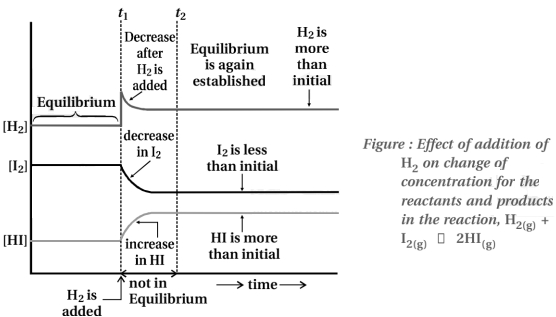
0 likes
View Solution248
DifficultMCQ
Explain the effect of concentration on equilibrium when two drops of $0.2 \ M$ potassium thiocyanate $(KSCN)$ are added to $1 \ mL$ of $0.2 \ M$ iron $(III)$ nitrate solution.
A
$a.$ Equilibrium shifts to the left and the red color intensity decreases.
B
$b.$ Equilibrium shifts to the right and the red color intensity increases.
C
$c.$ Equilibrium remains unchanged.
D
$d.$ Equilibrium shifts to the right and the red color intensity decreases.
Solution
(B) The equilibrium reaction is: $Fe^{3+}_{(aq)} + SCN^{-}_{(aq)} \rightleftharpoons [Fe(SCN)]^{2+}_{(aq)}$.
Adding $KSCN$ increases the concentration of $SCN^{-}$ ions.
According to Le Chatelier's principle,the equilibrium shifts in the direction that consumes the added reactant,which is the forward direction (right).
This results in an increase in the concentration of the blood-red complex $[Fe(SCN)]^{2+}$,thereby increasing the intensity of the red color.
Adding $KSCN$ increases the concentration of $SCN^{-}$ ions.
According to Le Chatelier's principle,the equilibrium shifts in the direction that consumes the added reactant,which is the forward direction (right).
This results in an increase in the concentration of the blood-red complex $[Fe(SCN)]^{2+}$,thereby increasing the intensity of the red color.
0 likes
View Solution249
DifficultMCQ
Explain the effect of concentration on equilibrium using the following experiment:
$Fe^{3+}_{(aq)} + SCN^{-}_{(aq)} \rightleftharpoons [Fe(SCN)]^{2+}_{(aq)}$
(Yellow) (Colourless) (Deep red)
$Fe^{3+}_{(aq)} + SCN^{-}_{(aq)} \rightleftharpoons [Fe(SCN)]^{2+}_{(aq)}$
(Yellow) (Colourless) (Deep red)
A
Addition of $Fe^{3+}$ shifts the equilibrium to the right,increasing red color intensity.
B
Addition of $SCN^{-}$ shifts the equilibrium to the right,increasing red color intensity.
C
Both $(A)$ and $(B)$ are correct.
D
Addition of $HgCl_2$ shifts the equilibrium to the right.
Solution
(C) According to Le Chatelier's principle,an increase in the concentration of any of the reactants ($Fe^{3+}$ or $SCN^{-}$) will shift the equilibrium in the forward direction to consume the added species,thereby increasing the concentration of $[Fe(SCN)]^{2+}$ and the intensity of the deep red color.
Conversely,adding reagents like $HgCl_2$ that react with $SCN^{-}$ will decrease its concentration,shifting the equilibrium to the left.
Therefore,both statements $(A)$ and $(B)$ are correct.
Conversely,adding reagents like $HgCl_2$ that react with $SCN^{-}$ will decrease its concentration,shifting the equilibrium to the left.
Therefore,both statements $(A)$ and $(B)$ are correct.
0 likes
View Solution250
Difficult
Explain the effect of pressure change on an equilibrium system with suitable examples.
Solution
(N/A) The effect of pressure change on equilibrium is only observed in reactions involving gaseous components.
$1$. If the total number of moles of gaseous products and reactants are the same,pressure change has no effect on the equilibrium position.
$2$. If the total number of moles of gaseous products and reactants are different,a change in pressure will shift the equilibrium to establish a new state.
$3$. According to Le Chatelier's principle,if the pressure is increased (volume decreased),the equilibrium shifts in the direction that produces fewer moles of gas to counteract the pressure increase.
Example: $CO_{(g)} + 3H_{2(g)} \rightleftharpoons CH_{4(g)} + H_{2}O_{(g)}$
In this reaction,the reactant side has $1 + 3 = 4$ moles of gas,while the product side has $1 + 1 = 2$ moles of gas.
If the pressure is increased (volume decreased),the system shifts towards the side with fewer moles,which is the forward direction (towards products).
Using the reaction quotient $Q_c$:
$Q_c = \frac{[CH_{4}][H_{2}O]}{[CO][H_{2}]^3}$
If the volume is halved,the concentration of each species doubles. The new $Q_c$ becomes smaller than $K_c$ $(Q_c < K_c)$,causing the reaction to proceed in the forward direction until a new equilibrium is established.
$1$. If the total number of moles of gaseous products and reactants are the same,pressure change has no effect on the equilibrium position.
$2$. If the total number of moles of gaseous products and reactants are different,a change in pressure will shift the equilibrium to establish a new state.
$3$. According to Le Chatelier's principle,if the pressure is increased (volume decreased),the equilibrium shifts in the direction that produces fewer moles of gas to counteract the pressure increase.
Example: $CO_{(g)} + 3H_{2(g)} \rightleftharpoons CH_{4(g)} + H_{2}O_{(g)}$
In this reaction,the reactant side has $1 + 3 = 4$ moles of gas,while the product side has $1 + 1 = 2$ moles of gas.
If the pressure is increased (volume decreased),the system shifts towards the side with fewer moles,which is the forward direction (towards products).
Using the reaction quotient $Q_c$:
$Q_c = \frac{[CH_{4}][H_{2}O]}{[CO][H_{2}]^3}$
If the volume is halved,the concentration of each species doubles. The new $Q_c$ becomes smaller than $K_c$ $(Q_c < K_c)$,causing the reaction to proceed in the forward direction until a new equilibrium is established.
0 likes
View Solution6-1.Equilibrium (Chemical Equilibrium) — Le-Chaterlier principle and It’s application · Frequently Asked Questions
1Are these 6-1.Equilibrium (Chemical Equilibrium) questions useful for JEE and NEET?
Yes. All questions in this section are mapped to JEE Main and NEET exam patterns. Previous year questions from JEE Main, NEET, GUJCET and state-level exams are included with full solutions.
2Can I switch to Hindi or Gujarati for these questions?
Yes. Use the language tabs in the hero section or the sidebar to view the same questions and solutions in English, Hindi or Gujarati.
3How do I generate a question paper from this subtopic?
Use the Vedclass Exam Paper Generator — select the chapter and subtopic, set difficulty, and generate Sets A, B, C, D automatically. First 3 chapters of every subject are free.
Vedclass Products
For Students
Vedclass Test Series
Mock tests in real JEE/NEET style with performance analysis. 5-day free trial.
Start Free TrialFor Teachers
Exam Paper Generator
Generate Set A/B/C/D papers from this chapter in 2 minutes. 3 chapters free.
Try FreeFor Institutes
Online Exam Module
Live online exams with unlimited students, 360° analytics & white-label branding.
See DemoFor Teachers & Institutes
Generate a 6-1.Equilibrium (Chemical Equilibrium) Exam Paper in 2 Minutes
Select subtopic & difficulty — Sets A, B, C, D auto-generated with No Repeat logic.
First 3 chapters of every subject are free — no payment required.