
Easy
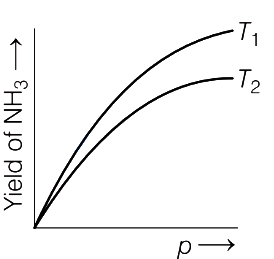
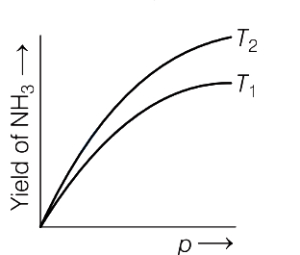
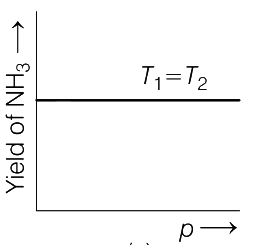
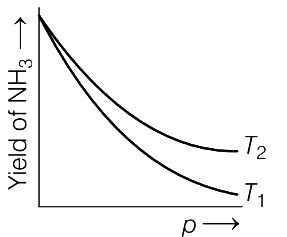
For the formation of $NH_{3(g)}$ from $H_{2(g)}$ and $N_{2(g)}$,which one of the following graphs represents the yield of ammonia at equilibrium? (Assume $T_1 < T_2$,unless mentioned)
- A
- B
- C
- D
Explore More
Similar Questions
Le Chatelier's principle is applicable only to a
Easy
View SolutionThe exothermic formation of $ClF_3$ is represented by the equation
$Cl_{2(g)} + 3F_{2(g)} \rightleftharpoons 2ClF_{3(g)}$; $\Delta H_r = -329 \ kJ$
Which of the following will increase the quantity of $ClF_3$ in an equilibrium mixture of $Cl_2, F_2$ and $ClF_3$?
$Cl_{2(g)} + 3F_{2(g)} \rightleftharpoons 2ClF_{3(g)}$; $\Delta H_r = -329 \ kJ$
Which of the following will increase the quantity of $ClF_3$ in an equilibrium mixture of $Cl_2, F_2$ and $ClF_3$?
Easy
View SolutionConsider the given endothermic reaction at equilibrium,$PCl_{5(g)} \rightleftharpoons PCl_{3(g)} + Cl_{2(g)}$. $A$ graph is plotted between concentration and time as shown. Effect-$1$ and Effect-$2$ are due to respectively:
Medium
View SolutionThe reaction $CaCO_3 \rightleftharpoons CaO + CO_{2(g)}$ goes to completion in a lime kiln because:
Medium
View SolutionWrite the effect of concentration change on equilibrium and explain it with a suitable example.
Difficult
View SolutionVedclass Products
For Students
Vedclass Test Series
Mock tests in real JEE/NEET style with performance analysis. 5-day free trial.
Start Free TrialFor Teachers
Exam Paper Generator
Generate Set A/B/C/D exam papers from 7.5L+ questions in 2 minutes. 3 chapters free.
Try FreeFor Institutes
Online Exam Module
Live online exams with unlimited students, 360° analytics & white-label branding.
See Demo