
A English
Water Potential Questions in English
Class 11 Biology · Transport in Plants · Water Potential
92+
Questions
English
Language
100%
With Solutions
Showing 42 of 92 questions in English
51
Medium
What is the characteristic feature of an internal water system?
Solution
(N/A) If two internal water systems are in contact,due to the random movement of water molecules,the net movement of water occurs from the region of higher energy to the region of lower energy.
Thus,water moves from a region of higher water potential to a region of lower water potential (towards the system).
Thus,water moves from a region of higher water potential to a region of lower water potential (towards the system).
0 likes
View Solution52
Medium
What is the relationship between pure water and water potential?
Solution
(N/A) $1$. Pure water has the highest water potential,which is defined as zero at standard temperature and pressure.
$2$. When a solute is dissolved in pure water,the concentration of free water molecules decreases.
$3$. This reduction in the concentration of free water molecules leads to a decrease in the water potential of the solution.
$4$. Therefore,all solutions have a lower water potential than pure water.
$5$. The magnitude of this lowering due to the addition of solute is known as solute potential $(\Psi_{S})$,which is always negative.
$2$. When a solute is dissolved in pure water,the concentration of free water molecules decreases.
$3$. This reduction in the concentration of free water molecules leads to a decrease in the water potential of the solution.
$4$. Therefore,all solutions have a lower water potential than pure water.
$5$. The magnitude of this lowering due to the addition of solute is known as solute potential $(\Psi_{S})$,which is always negative.
0 likes
View Solution53
MediumMCQ
What is the effect of water potential in a plant cell?
A
It causes the cell to shrink.
B
It makes the cell turgid by increasing pressure potential.
C
It has no effect on the cell.
D
It decreases the solute potential.
Solution
(B) $\Rightarrow$ When water enters a plant cell via osmosis,it exerts pressure against the rigid cell wall,which is known as turgor pressure.
$\Rightarrow$ This process makes the cell turgid and increases the pressure potential $(\Psi_p)$ of the cell.
$\Rightarrow$ Pressure potential is typically positive in living plant cells.
$\Rightarrow$ Conversely,negative pressure potential (tension) in the xylem water column is crucial for the upward transport of water in plants.
$\Rightarrow$ This process makes the cell turgid and increases the pressure potential $(\Psi_p)$ of the cell.
$\Rightarrow$ Pressure potential is typically positive in living plant cells.
$\Rightarrow$ Conversely,negative pressure potential (tension) in the xylem water column is crucial for the upward transport of water in plants.
0 likes
View Solution54
Medium
Provide definitions/explanations for the following terms:
$(1)$ Water potential
$(2)$ Translocation of substances
$(1)$ Water potential
$(2)$ Translocation of substances
Solution
(N/A) $(1)$ Water potential is the potential energy of water per unit volume relative to pure water in reference conditions. It is a measure of the tendency of water to move from one area to another due to osmosis,gravity,mechanical pressure,or matrix effects.
$(2)$ Translocation of substances refers to the long-distance transport of organic nutrients (like sucrose) and minerals through the vascular system (xylem and phloem) of plants.
$(2)$ Translocation of substances refers to the long-distance transport of organic nutrients (like sucrose) and minerals through the vascular system (xylem and phloem) of plants.
0 likes
View Solution55
Medium
Sugar crystals do not dissolve easily in ice-cold water. Explain.
Solution
(N/A) The solubility of a solute like sugar depends on the kinetic energy of the solvent molecules.
At lower temperatures,such as in ice-cold water,the kinetic energy of water molecules is significantly reduced.
This reduction in kinetic energy decreases the frequency and force of collisions between water molecules and sugar crystals,thereby slowing down the rate of dissolution.
Additionally,the free energy of water,often referred to as water potential,is lower at reduced temperatures,which limits the ability of the solvent to break down the crystal lattice of the solute.
At lower temperatures,such as in ice-cold water,the kinetic energy of water molecules is significantly reduced.
This reduction in kinetic energy decreases the frequency and force of collisions between water molecules and sugar crystals,thereby slowing down the rate of dissolution.
Additionally,the free energy of water,often referred to as water potential,is lower at reduced temperatures,which limits the ability of the solvent to break down the crystal lattice of the solute.
0 likes
View Solution56
Easy
Choose the correct option:
$(1)$ The value of ${\psi _S}$ is always negative / positive.
$(2)$ Porins are a type of carbohydrates / proteins.
$(1)$ The value of ${\psi _S}$ is always negative / positive.
$(2)$ Porins are a type of carbohydrates / proteins.
Solution
(A) $(1)$ The solute potential $({\psi _S})$ is always negative because the addition of solute particles to a solution decreases the free energy of water,thereby lowering the water potential.
$(2)$ Porins are transport proteins that form large pores in the outer membranes of plastids,mitochondria,and some bacteria,allowing molecules up to the size of small proteins to pass through.
$(2)$ Porins are transport proteins that form large pores in the outer membranes of plastids,mitochondria,and some bacteria,allowing molecules up to the size of small proteins to pass through.
0 likes
View Solution57
MediumMCQ
Why is the water potential of pure water zero?
A
Because it has maximum kinetic energy.
B
Because it is a universal solvent.
C
Because it is defined by convention at standard temperature and pressure.
D
Because it contains no solutes.
Solution
(C) $\Rightarrow$ Water potential is denoted by the Greek symbol Psi or $\Psi$ and is expressed in pressure units such as pascals $(Pa)$.
$\Rightarrow$ By convention,the water potential of pure water at standard temperatures,which is not under any pressure,is taken to be zero.
$\Rightarrow$ This serves as a reference point to measure the potential of water in other systems,where the addition of solutes lowers the water potential,making it negative.
$\Rightarrow$ By convention,the water potential of pure water at standard temperatures,which is not under any pressure,is taken to be zero.
$\Rightarrow$ This serves as a reference point to measure the potential of water in other systems,where the addition of solutes lowers the water potential,making it negative.
0 likes
View Solution58
MediumMCQ
Cell $A$ has an osmotic pressure of $-20$ bars and a pressure potential of $5$ bars, whereas cell $B$ has an osmotic pressure of $-18$ bars and a pressure potential of $2$ bars. The direction of the flow of water will be:
A
From cell $A$ to cell $B$
B
From cell $B$ to cell $A$
C
No flow of water
D
In both the directions
Solution
(A) Water potential $\Psi_w$ is the sum of solute potential $\Psi_s$ and pressure potential $\Psi_p$, given by the formula: $\Psi_w = \Psi_s + \Psi_p$.
For cell $A$:
$\Psi_A = -20 + 5 = -15$ bars.
For cell $B$:
$\Psi_B = -18 + 2 = -16$ bars.
Water always moves from a region of higher water potential to a region of lower water potential. Since $-15$ bars is greater than $-16$ bars, the water will flow from cell $A$ to cell $B$.
For cell $A$:
$\Psi_A = -20 + 5 = -15$ bars.
For cell $B$:
$\Psi_B = -18 + 2 = -16$ bars.
Water always moves from a region of higher water potential to a region of lower water potential. Since $-15$ bars is greater than $-16$ bars, the water will flow from cell $A$ to cell $B$.
0 likes
View Solution59
EasyMCQ
Which of the following is the unit of measurement of water potential?
A
Watt
B
Joule
C
Pascal
D
Litre
Solution
(C) Water potential is the potential energy of water per unit volume relative to pure water in reference conditions. It represents the chemical potential of water in a system.
It is denoted by the Greek letter $\Psi$ (psi).
Since water potential is a form of pressure,it is measured in units of pressure such as $\text{Pascals}$ $(Pa)$,$\text{bars}$,or $\text{atmospheres}$ $(atm)$.
It is denoted by the Greek letter $\Psi$ (psi).
Since water potential is a form of pressure,it is measured in units of pressure such as $\text{Pascals}$ $(Pa)$,$\text{bars}$,or $\text{atmospheres}$ $(atm)$.
0 likes
View Solution60
MediumMCQ
What happens when the concentration of solutes decreases in guard cells?
A
Water potential increases
B
Osmotic pressure increases
C
Water potential decreases
D
None of the above
Solution
(A) The water potential $(\Psi_w)$ of a cell is determined by the solute potential $(\Psi_s)$ and pressure potential $(\Psi_p)$.
As the concentration of solutes decreases, the solute potential $(\Psi_s)$ becomes less negative (i.e., it increases).
Since $\Psi_w = \Psi_s + \Psi_p$, an increase in solute potential leads to an increase in the overall water potential of the guard cells.
As the concentration of solutes decreases, the solute potential $(\Psi_s)$ becomes less negative (i.e., it increases).
Since $\Psi_w = \Psi_s + \Psi_p$, an increase in solute potential leads to an increase in the overall water potential of the guard cells.
0 likes
View Solution61
MediumMCQ
Which one of the following statements is wrong?
A
Water potential is the chemical potential of the water
B
Solute potential is always negative
C
Pressure potential is zero in a flaccid cell
D
Water potential equals solute potential in a fully turgid cell
Solution
(D) The water potential $(\Psi_{w})$ is the difference in the free energy or chemical potential per unit molal volume of water in a system compared to pure water at the same temperature and pressure.
It is represented by the Greek letter $\Psi$ (psi).
The water potential equation is given by: $\Psi_{w} = \Psi_{s} + \Psi_{p}$.
In a fully turgid cell,the pressure potential $(\Psi_{p})$ is positive and equal in magnitude to the solute potential $(\Psi_{s})$,which makes the water potential $(\Psi_{w})$ zero. Therefore,the statement that water potential equals solute potential in a fully turgid cell is incorrect,as $\Psi_{w} = 0$ in this state.
It is represented by the Greek letter $\Psi$ (psi).
The water potential equation is given by: $\Psi_{w} = \Psi_{s} + \Psi_{p}$.
In a fully turgid cell,the pressure potential $(\Psi_{p})$ is positive and equal in magnitude to the solute potential $(\Psi_{s})$,which makes the water potential $(\Psi_{w})$ zero. Therefore,the statement that water potential equals solute potential in a fully turgid cell is incorrect,as $\Psi_{w} = 0$ in this state.
0 likes
View Solution62
MediumMCQ
Identify the correct relationship with reference to water potential of a plant cell.
A
$\Psi_{w} = \Psi_{m} + \Psi_{s} + \Psi_{p}$
B
$\Psi_{w} = \Psi_{m} + \Psi_{s} - \Psi_{p}$
C
$\Psi_{w} = \Psi_{m} - \Psi_{s} + \Psi_{p}$
D
$\Psi_{w} = \Psi_{m} - \Psi_{s} - \Psi_{p}$
Solution
(A) Water potential $(\Psi_{w})$ is the measure of the potential energy of water in a system compared to pure water. It determines the direction of water movement.
The total water potential of a plant cell is the sum of its components: solute potential $(\Psi_{s})$,pressure potential $(\Psi_{p})$,and matric potential $(\Psi_{m})$.
The standard equation is given by: $\Psi_{w} = \Psi_{s} + \Psi_{p} + \Psi_{m}$.
Since $\Psi_{s}$ is always negative,the equation is often written as $\Psi_{w} = \Psi_{m} + \Psi_{s} + \Psi_{p}$.
The total water potential of a plant cell is the sum of its components: solute potential $(\Psi_{s})$,pressure potential $(\Psi_{p})$,and matric potential $(\Psi_{m})$.
The standard equation is given by: $\Psi_{w} = \Psi_{s} + \Psi_{p} + \Psi_{m}$.
Since $\Psi_{s}$ is always negative,the equation is often written as $\Psi_{w} = \Psi_{m} + \Psi_{s} + \Psi_{p}$.
0 likes
View Solution63
MediumMCQ
Whose water potential is less than the water potential of root hair during water absorption by root hair?
A
Gravitational water
B
Soil solution
C
Pure water
D
Vacuolar sap
Solution
(D) Water always moves from an area of higher water potential to an area of lower water potential,i.e.,from less negative to more negative values.
During water absorption,the root hair cells must have a lower water potential than the soil solution to allow water to enter.
However,within the cell,the water moves from the cytoplasm into the vacuole because the vacuolar sap has a lower water potential compared to the rest of the cell content,facilitating the uptake and storage of water.
During water absorption,the root hair cells must have a lower water potential than the soil solution to allow water to enter.
However,within the cell,the water moves from the cytoplasm into the vacuole because the vacuolar sap has a lower water potential compared to the rest of the cell content,facilitating the uptake and storage of water.
0 likes
View Solution64
MediumMCQ
Which one of the following statements is incorrect?
A
Movement of water is expressed in terms of free energy.
B
Free energy determines the direction in which physical and chemical changes should occur.
C
Water potential is the sum of free energy of water molecules in pure water and in any other system.
D
Water potential of pure water is zero.
Solution
(C) Water potential $\left(\Psi_{w}\right)$ is a concept based on the free energy of water molecules.
Water molecules possess kinetic energy and in liquid and gaseous form,they are in random motion.
Greater the concentration of water in a system,the greater is its kinetic energy or its water potential.
Pure water has the highest water potential,which is defined as $0$ at standard temperature and pressure.
Statement $C$ is incorrect because water potential is not the sum of free energy in pure water and another system; rather,it is a measure of the difference in free energy of water in a system compared to pure water.
Water molecules possess kinetic energy and in liquid and gaseous form,they are in random motion.
Greater the concentration of water in a system,the greater is its kinetic energy or its water potential.
Pure water has the highest water potential,which is defined as $0$ at standard temperature and pressure.
Statement $C$ is incorrect because water potential is not the sum of free energy in pure water and another system; rather,it is a measure of the difference in free energy of water in a system compared to pure water.
0 likes
View Solution65
DifficultMCQ
Study the following table showing the components of water potential in closely arranged mesophyll cells namely $A, B$ and $C$.
Identify two of the following,which show correct direction of water movement between two cells.
$I. A \rightarrow B$ $II. B \rightarrow C$ $III. C \rightarrow A$ $IV. C \rightarrow B$
| Cell | Osmotic Potential (MPa) | Pressure Potential (MPa) |
| $A$ | $-0.21$ | $0.05$ |
| $B$ | $-0.22$ | $0.02$ |
| $C$ | $-0.23$ | $0.05$ |
Identify two of the following,which show correct direction of water movement between two cells.
$I. A \rightarrow B$ $II. B \rightarrow C$ $III. C \rightarrow A$ $IV. C \rightarrow B$
A
$I, II$
B
$II, III$
C
$I, IV$
D
$II, IV$
Solution
(C) Water potential $(Psi_w)$ in a cell is the sum of solute potential $(Psi_s)$ and pressure potential $(Psi_p)$: $Psi_w = Psi_s + Psi_p$.
Water moves from a region of higher water potential to a region of lower water potential.
Comparing the values: $Psi_w(A) = -0.16$,$Psi_w(B) = -0.20$,$Psi_w(C) = -0.18$.
Since $-0.16 > -0.18 > -0.20$,the water potential order is $A > C > B$.
Therefore,water will move from $A \rightarrow C$,$A \rightarrow B$,and $C \rightarrow B$.
Looking at the options provided:
$I. A \rightarrow B$ (Correct)
$II. B \rightarrow C$ (Incorrect,water moves $C \rightarrow B$)
$III. C \rightarrow A$ (Incorrect,water moves $A \rightarrow C$)
$IV. C \rightarrow B$ (Correct)
Thus,$I$ and $IV$ are correct.
| Cell | Water Potential $(Psi_w)$ (MPa) |
| $A$ | $-0.21 + 0.05 = -0.16$ |
| $B$ | $-0.22 + 0.02 = -0.20$ |
| $C$ | $-0.23 + 0.05 = -0.18$ |
Water moves from a region of higher water potential to a region of lower water potential.
Comparing the values: $Psi_w(A) = -0.16$,$Psi_w(B) = -0.20$,$Psi_w(C) = -0.18$.
Since $-0.16 > -0.18 > -0.20$,the water potential order is $A > C > B$.
Therefore,water will move from $A \rightarrow C$,$A \rightarrow B$,and $C \rightarrow B$.
Looking at the options provided:
$I. A \rightarrow B$ (Correct)
$II. B \rightarrow C$ (Incorrect,water moves $C \rightarrow B$)
$III. C \rightarrow A$ (Incorrect,water moves $A \rightarrow C$)
$IV. C \rightarrow B$ (Correct)
Thus,$I$ and $IV$ are correct.
0 likes
View Solution66
MediumMCQ
Concentration of water molecules in a system determines
A
Uphill transport rate
B
Number of carrier proteins
C
Water potential of the system
D
Membrane permeability
Solution
(C) Water potential $(\Psi_w)$ is a measure of the potential energy of water in a system compared to pure water. It is directly related to the concentration of water molecules. Higher concentration of water molecules results in higher water potential. Therefore, the concentration of water molecules in a system determines the water potential of that system.
0 likes
View Solution67
EasyMCQ
Osmotic potential is
A
Positive
B
Negative
C
Always zero
D
Greater than one
Solution
(B) The osmotic potential,denoted as $\psi_{s}$,represents the effect of dissolved solutes on water potential.
Pure water has an osmotic potential of $0$.
When solutes are added to pure water,the concentration of free water molecules decreases,which lowers the water potential.
Therefore,the osmotic potential of a solution is always negative.
Pure water has an osmotic potential of $0$.
When solutes are added to pure water,the concentration of free water molecules decreases,which lowers the water potential.
Therefore,the osmotic potential of a solution is always negative.
0 likes
View Solution68
MediumMCQ
When solute potential increases,then water potential would:
A
Increase
B
Decrease
C
Remain same
D
First increase then decrease
Solution
(A) The relationship between water potential $(\psi_{w})$,solute potential $(\psi_{s})$,and pressure potential $(\psi_{p})$ is given by the equation: $\psi_{w} = \psi_{s} + \psi_{p}$.
At atmospheric pressure,the pressure potential $(\psi_{p})$ is $0$.
Therefore,the equation becomes: $\psi_{w} = \psi_{s}$.
Since water potential is directly proportional to solute potential,an increase in solute potential leads to an increase in water potential.
At atmospheric pressure,the pressure potential $(\psi_{p})$ is $0$.
Therefore,the equation becomes: $\psi_{w} = \psi_{s}$.
Since water potential is directly proportional to solute potential,an increase in solute potential leads to an increase in water potential.
0 likes
View Solution69
MediumMCQ
For a solution at atmospheric pressure,$\psi_{w}$ is equivalent to
A
$\psi_{p}$
B
$\psi_{s}$
C
Zero
D
$TP$
Solution
(B) The water potential $(\psi_{w})$ of a solution is given by the equation: $\psi_{w} = \psi_{s} + \psi_{p}$.
At atmospheric pressure,the pressure potential $(\psi_{p})$ is equal to $0$.
Substituting this value into the equation: $\psi_{w} = \psi_{s} + 0$.
Therefore,at atmospheric pressure,the water potential $(\psi_{w})$ is equivalent to the solute potential $(\psi_{s})$.
At atmospheric pressure,the pressure potential $(\psi_{p})$ is equal to $0$.
Substituting this value into the equation: $\psi_{w} = \psi_{s} + 0$.
Therefore,at atmospheric pressure,the water potential $(\psi_{w})$ is equivalent to the solute potential $(\psi_{s})$.
0 likes
View Solution70
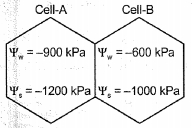
EasyMCQ
What would be the solute potential $(\Psi_s)$ of the cell sap in cell-$A$ and cell-$B$ respectively?
A
$300, 400 \text{ kPa}$
B
$-300, -400 \text{ kPa}$
C
$-1200, -1000 \text{ kPa}$
D
$900, 600 \text{ kPa}$
Solution
(C) The solute potential $(\Psi_s)$ of the cell sap is given directly in the provided diagram for both cells.
For cell-$A$,the value of $\Psi_s$ is $-1200 \text{ kPa}$.
For cell-$B$,the value of $\Psi_s$ is $-1000 \text{ kPa}$.
Therefore,the solute potential of the cell sap in cell-$A$ and cell-$B$ is $-1200 \text{ kPa}$ and $-1000 \text{ kPa}$ respectively.
For cell-$A$,the value of $\Psi_s$ is $-1200 \text{ kPa}$.
For cell-$B$,the value of $\Psi_s$ is $-1000 \text{ kPa}$.
Therefore,the solute potential of the cell sap in cell-$A$ and cell-$B$ is $-1200 \text{ kPa}$ and $-1000 \text{ kPa}$ respectively.
0 likes
View Solution71
MediumMCQ
As a result of endosmosis,$\psi_{w}$ of a cell:
A
Increases
B
Decreases
C
Remains same
D
Becomes zero
Solution
(A) Endosmosis is the process of the inward movement of water into a cell.
When water enters the cell,the concentration of water molecules inside the cell increases.
Water potential $(\psi_{w})$ is defined as the kinetic energy of water molecules.
Since the concentration of water molecules increases due to endosmosis,the kinetic energy of the water molecules also increases.
Therefore,the water potential $(\psi_{w})$ of the cell increases.
When water enters the cell,the concentration of water molecules inside the cell increases.
Water potential $(\psi_{w})$ is defined as the kinetic energy of water molecules.
Since the concentration of water molecules increases due to endosmosis,the kinetic energy of the water molecules also increases.
Therefore,the water potential $(\psi_{w})$ of the cell increases.
0 likes
View Solution72
MediumMCQ
The correct expression for the water potential of a plasmolysed cell is:
A
$\psi_{w} = \psi_{s}$
B
$\psi_{s} = \psi_{p}$
C
$\psi_{w} = 0$
D
$\psi_{w} = \psi_{s} + (\psi_{p})$ where $\psi_{p}$ is negative
Solution
(D) The water potential of a cell is given by the equation $\psi_{w} = \psi_{s} + \psi_{p}$.
In a fully turgid cell,the pressure potential $(\psi_{p})$ is positive.
However,in a plasmolysed cell,the protoplast shrinks away from the cell wall,resulting in a negative pressure potential $(\psi_{p} < 0)$.
Therefore,the expression for the water potential of a plasmolysed cell is $\psi_{w} = \psi_{s} + \psi_{p}$,where $\psi_{p}$ is negative.
In a fully turgid cell,the pressure potential $(\psi_{p})$ is positive.
However,in a plasmolysed cell,the protoplast shrinks away from the cell wall,resulting in a negative pressure potential $(\psi_{p} < 0)$.
Therefore,the expression for the water potential of a plasmolysed cell is $\psi_{w} = \psi_{s} + \psi_{p}$,where $\psi_{p}$ is negative.
0 likes
View Solution73
MediumMCQ
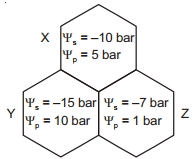
Find the correct pathway of water movement in the given presentation of cells.
A
B
C
D
Solution
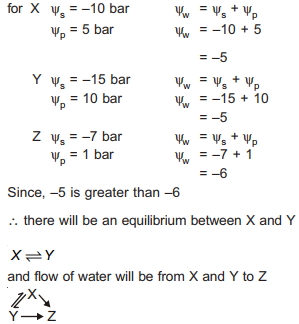
(C) The water potential $(\Psi_w)$ of a cell is calculated using the formula: $\Psi_w = \Psi_s + \Psi_p$.
For cell $X$: $\Psi_s = -10 \text{ bar}$, $\Psi_p = 5 \text{ bar}$, so $\Psi_w = -10 + 5 = -5 \text{ bar}$.
For cell $Y$: $\Psi_s = -15 \text{ bar}$, $\Psi_p = 10 \text{ bar}$, so $\Psi_w = -15 + 10 = -5 \text{ bar}$.
For cell $Z$: $\Psi_s = -7 \text{ bar}$, $\Psi_p = 1 \text{ bar}$, so $\Psi_w = -7 + 1 = -6 \text{ bar}$.
Since the water potential of $X$ and $Y$ is equal $(-5 \text{ bar})$, there is an equilibrium between $X$ and $Y$ $(X \leftrightarrow Y)$.
Water moves from a region of higher water potential to a region of lower water potential. Since $-5 \text{ bar} > -6 \text{ bar}$, water will flow from both $X$ and $Y$ towards $Z$ ($X \to Z$ and $Y \to Z$).
Thus, the correct pathway is $X \leftrightarrow Y \to Z$.
For cell $X$: $\Psi_s = -10 \text{ bar}$, $\Psi_p = 5 \text{ bar}$, so $\Psi_w = -10 + 5 = -5 \text{ bar}$.
For cell $Y$: $\Psi_s = -15 \text{ bar}$, $\Psi_p = 10 \text{ bar}$, so $\Psi_w = -15 + 10 = -5 \text{ bar}$.
For cell $Z$: $\Psi_s = -7 \text{ bar}$, $\Psi_p = 1 \text{ bar}$, so $\Psi_w = -7 + 1 = -6 \text{ bar}$.
Since the water potential of $X$ and $Y$ is equal $(-5 \text{ bar})$, there is an equilibrium between $X$ and $Y$ $(X \leftrightarrow Y)$.
Water moves from a region of higher water potential to a region of lower water potential. Since $-5 \text{ bar} > -6 \text{ bar}$, water will flow from both $X$ and $Y$ towards $Z$ ($X \to Z$ and $Y \to Z$).
Thus, the correct pathway is $X \leftrightarrow Y \to Z$.
0 likes
View Solution74
Medium
Why is solute potential always negative? Explain $\Psi_{w} = \Psi_{s} + \Psi_{p}$.
Solution
(N/A) $\Rightarrow$ When any solute is dissolved in pure water,the number of free water molecules decreases,and the concentration of water decreases,which lowers its water potential.
$\Rightarrow$ Therefore,the water potential of any solution is always less than that of pure water (which is $0$).
$\Rightarrow$ The magnitude of this lowering in water potential due to the dissolution of a solute is known as solute potential or $\Psi_{s}$. Since the addition of solute reduces the free energy of water,$\Psi_{s}$ is always negative.
$\Rightarrow$ The relationship is given by the equation: $\Psi_{w} = \Psi_{s} + \Psi_{p}$,where:
$\Psi_{w} = \text{Water potential}$
$\Psi_{s} = \text{Solute potential}$
$\Psi_{p} = \text{Pressure potential}$
$\Rightarrow$ Therefore,the water potential of any solution is always less than that of pure water (which is $0$).
$\Rightarrow$ The magnitude of this lowering in water potential due to the dissolution of a solute is known as solute potential or $\Psi_{s}$. Since the addition of solute reduces the free energy of water,$\Psi_{s}$ is always negative.
$\Rightarrow$ The relationship is given by the equation: $\Psi_{w} = \Psi_{s} + \Psi_{p}$,where:
$\Psi_{w} = \text{Water potential}$
$\Psi_{s} = \text{Solute potential}$
$\Psi_{p} = \text{Pressure potential}$
0 likes
View Solution75
Medium
Define water potential and solute potential.
Solution
(N/A) $\Rightarrow$ Water potential: Water potential is the potential energy of water per unit volume. It represents the free energy of water molecules. The water potential $(\Psi_{w})$ of pure water at atmospheric pressure is defined as zero. The unit of water potential is Pascal $(Pa)$ or Bar $(1 \text{ MPa} = 10 \text{ bars})$.
$\Rightarrow$ Solute potential: When solutes are added to pure water,the free energy of water decreases,making the water potential negative. This reduction in water potential due to the presence of solute particles is known as solute potential or $(\Psi_{s})$. It is always negative in a solution.
$\Rightarrow$ Solute potential: When solutes are added to pure water,the free energy of water decreases,making the water potential negative. This reduction in water potential due to the presence of solute particles is known as solute potential or $(\Psi_{s})$. It is always negative in a solution.
0 likes
View Solution76
MediumMCQ
Addition of more solutes in a given solution will:
A
lower its water potential
B
make its water potential zero
C
not affect the water potential at all
D
raise its water potential
Solution
(A) Water potential $(\Psi_w)$ is a measure of the potential energy of water in a system compared to pure water.
Pure water has the highest water potential, which is defined as $0$.
When solutes are added to water, the water molecules become associated with the solute particles, which reduces the free energy of the water.
As the concentration of solutes increases, the solute potential $(\Psi_s)$ becomes more negative.
Since $\Psi_w = \Psi_s + \Psi_p$ (where $\Psi_p$ is pressure potential), an increase in solute concentration decreases the solute potential, thereby lowering the overall water potential of the solution.
Pure water has the highest water potential, which is defined as $0$.
When solutes are added to water, the water molecules become associated with the solute particles, which reduces the free energy of the water.
As the concentration of solutes increases, the solute potential $(\Psi_s)$ becomes more negative.
Since $\Psi_w = \Psi_s + \Psi_p$ (where $\Psi_p$ is pressure potential), an increase in solute concentration decreases the solute potential, thereby lowering the overall water potential of the solution.
0 likes
View Solution77
EasyMCQ
Which of the following formulas is correct?
A
Water potential $(\psi_{W}) = \text{Solute potential } (\psi_{S}) + \text{Pressure potential } (\psi_{P})$
B
Solute potential $(\psi_{S}) = \text{Water potential } (\psi_{W}) + \text{Pressure potential } (\psi_{P})$
C
Pressure potential $(\psi_{P}) = \text{Water potential } (\psi_{W}) + \text{Solute potential } (\psi_{S})$
D
Solute potential $(\psi_{S}) = \text{Water potential } (\psi_{W}) - \text{Pressure potential } (\psi_{P})$
Solution
(A) The water potential of a cell is determined by the sum of solute potential and pressure potential.
According to the standard equation for water potential in plant cells: $\psi_{W} = \psi_{S} + \psi_{P}$.
Here,$\psi_{W}$ represents water potential,$\psi_{S}$ represents solute potential (which is always negative),and $\psi_{P}$ represents pressure potential (which is usually positive in turgid cells).
Therefore,option $A$ is the correct formula.
According to the standard equation for water potential in plant cells: $\psi_{W} = \psi_{S} + \psi_{P}$.
Here,$\psi_{W}$ represents water potential,$\psi_{S}$ represents solute potential (which is always negative),and $\psi_{P}$ represents pressure potential (which is usually positive in turgid cells).
Therefore,option $A$ is the correct formula.
0 likes
View Solution78
EasyMCQ
The unit of water potential is $...............$.
A
Pascal
B
Gram
C
Meter
D
Gram$^{2}$
Solution
(A) Water potential $(\Psi_w)$ is a measure of the potential energy of water in a system compared to pure water.
It is expressed in units of pressure because it represents the chemical potential of water.
The standard $SI$ unit for pressure is the Pascal $(Pa)$.
Therefore, water potential is commonly measured in units such as $Pa$, $kPa$, or $MPa$.
It is expressed in units of pressure because it represents the chemical potential of water.
The standard $SI$ unit for pressure is the Pascal $(Pa)$.
Therefore, water potential is commonly measured in units such as $Pa$, $kPa$, or $MPa$.
0 likes
View Solution79
MediumMCQ
How many of the following statements are correct?
$I -$ Water molecules possess kinetic energy.
$II -$ In liquid and gaseous forms,water molecules are in random motion.
$III -$ In liquid and gaseous forms,the motion of water molecules is slow and constant.
$IV -$ If a system has a higher quantity of water,its water potential is higher.
$V -$ Pure water has the lowest water potential.
$VI -$ Water always moves from a region of higher water potential to a region of lower water potential.
$I -$ Water molecules possess kinetic energy.
$II -$ In liquid and gaseous forms,water molecules are in random motion.
$III -$ In liquid and gaseous forms,the motion of water molecules is slow and constant.
$IV -$ If a system has a higher quantity of water,its water potential is higher.
$V -$ Pure water has the lowest water potential.
$VI -$ Water always moves from a region of higher water potential to a region of lower water potential.
A
$3$
B
$4$
C
$5$
D
$6$
Solution
(B) Statement $I$ is correct: Water molecules are in constant motion and possess kinetic energy.
Statement $II$ is correct: In liquid and gaseous states,water molecules move randomly.
Statement $III$ is incorrect: The motion of water molecules is rapid and constant,not slow.
Statement $IV$ is correct: Greater concentration of water molecules leads to higher kinetic energy and thus higher water potential.
Statement $V$ is incorrect: Pure water has the highest water potential (defined as $0$ at standard temperature and pressure).
Statement $VI$ is correct: Water moves from a region of higher water potential to a region of lower water potential.
Therefore,statements $I, II, IV,$ and $VI$ are correct. The total number of correct statements is $4$.
Statement $II$ is correct: In liquid and gaseous states,water molecules move randomly.
Statement $III$ is incorrect: The motion of water molecules is rapid and constant,not slow.
Statement $IV$ is correct: Greater concentration of water molecules leads to higher kinetic energy and thus higher water potential.
Statement $V$ is incorrect: Pure water has the highest water potential (defined as $0$ at standard temperature and pressure).
Statement $VI$ is correct: Water moves from a region of higher water potential to a region of lower water potential.
Therefore,statements $I, II, IV,$ and $VI$ are correct. The total number of correct statements is $4$.
0 likes
View Solution80
EasyMCQ
Water potential is denoted by $..........$.
A
Latin symbol psi or $\psi$
B
Greek symbol psi or $\psi$
C
Latin symbol alpha or $\alpha$
D
Greek symbol alpha or $\alpha$
Solution
(B) Water potential is a concept used to describe the tendency of water to move from one area to another.
It is represented by the Greek letter psi,denoted as $\psi$.
Water potential is measured in pressure units such as Pascals $(Pa)$.
It is represented by the Greek letter psi,denoted as $\psi$.
Water potential is measured in pressure units such as Pascals $(Pa)$.
0 likes
View Solution81
EasyMCQ
The water potential of pure water at standard atmospheric pressure is $.............$.
A
Less than $0$
B
More than $0$
C
$0$
D
More than $1$
Solution
(C) By convention,the water potential of pure water at standard atmospheric pressure is taken as $0$. When solutes are dissolved in pure water,the solution has fewer free water molecules and the concentration of water decreases,reducing its water potential. Hence,all solutions have a lower water potential than pure water,i.e.,a negative value.
0 likes
View Solution82
MediumMCQ
The water potential of seawater is $...........$.
A
Less than $0$
B
More than $0$
C
$0$
D
More than $1$
Solution
(A) Water potential $(\Psi_w)$ is defined as the potential energy of water per unit volume relative to pure water in reference conditions.
Pure water has the highest water potential, which is defined as $0$.
Any solute added to pure water decreases its free energy and thus lowers the water potential, making it negative.
Since seawater contains a high concentration of dissolved salts (solutes), its water potential is significantly lower than that of pure water.
Therefore, the water potential of seawater is less than $0$.
Pure water has the highest water potential, which is defined as $0$.
Any solute added to pure water decreases its free energy and thus lowers the water potential, making it negative.
Since seawater contains a high concentration of dissolved salts (solutes), its water potential is significantly lower than that of pure water.
Therefore, the water potential of seawater is less than $0$.
0 likes
View Solution83
MediumMCQ
When sugar is added to water, $.......$
A
The amount of free water in the solution decreases.
B
The water potential decreases as the water concentration decreases.
C
The water potential of the solution becomes lower than that of pure water.
D
All of the above.
Solution
(D) When a solute like sugar is added to pure water, it dissolves and interacts with water molecules.
This reduces the number of free water molecules available to move, thereby decreasing the concentration of water.
Water potential $(\Psi_w)$ is directly proportional to the concentration of free water molecules.
Since the concentration of free water decreases, the water potential also decreases.
Pure water has the highest water potential (defined as $0$), and the addition of any solute makes the water potential negative.
Therefore, the water potential of the solution becomes lower than that of pure water.
Thus, all the given statements are correct.
This reduces the number of free water molecules available to move, thereby decreasing the concentration of water.
Water potential $(\Psi_w)$ is directly proportional to the concentration of free water molecules.
Since the concentration of free water decreases, the water potential also decreases.
Pure water has the highest water potential (defined as $0$), and the addition of any solute makes the water potential negative.
Therefore, the water potential of the solution becomes lower than that of pure water.
Thus, all the given statements are correct.
0 likes
View Solution84
MediumMCQ
Select the correct option regarding water potential components.
A
$\Psi_{S}$ is always negative.
B
As solutes are added to a solution,the value of $\Psi_{S}$ becomes more negative.
C
At atmospheric pressure,$\Psi_{S} = \Psi_{W}$.
D
All of the above.
Solution
(D) $1$. $\Psi_{S}$ (solute potential) is always negative because the addition of solutes reduces the free energy of water.
$2$. When solutes are added,the concentration of free water molecules decreases,making $\Psi_{S}$ more negative.
$3$. The water potential equation is $\Psi_{W} = \Psi_{S} + \Psi_{P}$. At atmospheric pressure,the pressure potential $\Psi_{P}$ is $0$,therefore $\Psi_{W} = \Psi_{S}$.
$4$. Since all statements are correct,the correct option is $D$.
$2$. When solutes are added,the concentration of free water molecules decreases,making $\Psi_{S}$ more negative.
$3$. The water potential equation is $\Psi_{W} = \Psi_{S} + \Psi_{P}$. At atmospheric pressure,the pressure potential $\Psi_{P}$ is $0$,therefore $\Psi_{W} = \Psi_{S}$.
$4$. Since all statements are correct,the correct option is $D$.
0 likes
View Solution85
MediumMCQ
What is the water potential of a solution in an open container?
A
Less than $0$
B
More than $0$
C
$0$
D
None of these
Solution
(A) The water potential of pure water at standard temperature and pressure is defined as $0$.
When a solute is dissolved in pure water,the solution becomes more stable,and the free energy of water molecules decreases,resulting in a negative water potential.
In an open container,the pressure potential is equal to atmospheric pressure,which is considered $0$.
Therefore,the water potential of a solution in an open container is equal to the solute potential,which is always less than $0$.
When a solute is dissolved in pure water,the solution becomes more stable,and the free energy of water molecules decreases,resulting in a negative water potential.
In an open container,the pressure potential is equal to atmospheric pressure,which is considered $0$.
Therefore,the water potential of a solution in an open container is equal to the solute potential,which is always less than $0$.
0 likes
View Solution86
MediumMCQ
Determine the direction of water movement in the given diagram (assuming $P$ has a water potential of $-10 \text{ bars}$ and $Q$ has a water potential of $-5 \text{ bars}$).
A
$P \rightarrow Q$
B
$Q \rightarrow P$
C
No osmosis occurs.
D
None of these.
Solution
(B) Water always moves from a region of higher water potential (less negative) to a region of lower water potential (more negative).
In this case, the water potential of $Q$ is $-5 \text{ bars}$ and the water potential of $P$ is $-10 \text{ bars}$.
Since $-5 > -10$, the water potential at $Q$ is higher than at $P$.
Therefore, water will move from $Q$ to $P$ $(Q \rightarrow P)$.
In this case, the water potential of $Q$ is $-5 \text{ bars}$ and the water potential of $P$ is $-10 \text{ bars}$.
Since $-5 > -10$, the water potential at $Q$ is higher than at $P$.
Therefore, water will move from $Q$ to $P$ $(Q \rightarrow P)$.
0 likes
View Solution87
MediumMCQ
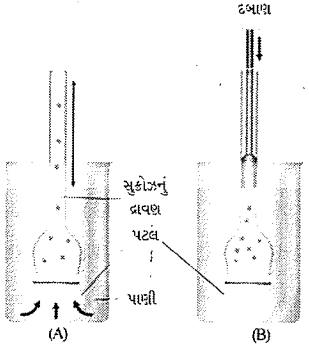
Select the correct option based on the experiment shown below.
A
Numerically, osmotic pressure is equivalent to osmotic potential, but its sign is opposite.
B
Numerically, turgor pressure, osmotic pressure, and osmotic potential are positive.
C
Numerically, turgor pressure is equivalent to osmotic potential, but its sign is opposite.
D
Both $A$ and $B$.
Solution
(A) The experiment demonstrates the concept of osmotic pressure and osmotic potential.
Osmotic pressure is the pressure required to prevent the movement of water into a solution through a semi-permeable membrane.
Osmotic potential $(\Psi_s)$ is always negative, while osmotic pressure is the positive value of osmotic potential.
Therefore, osmotic pressure is numerically equal to osmotic potential but with an opposite sign.
Thus, option $A$ is correct.
Osmotic pressure is the pressure required to prevent the movement of water into a solution through a semi-permeable membrane.
Osmotic potential $(\Psi_s)$ is always negative, while osmotic pressure is the positive value of osmotic potential.
Therefore, osmotic pressure is numerically equal to osmotic potential but with an opposite sign.
Thus, option $A$ is correct.
0 likes
View Solution88
MediumMCQ
The water potential of a fully turgid cell is ...... .
A
Less than $0$
B
$0$
C
More than $0$
D
Varies from cell to cell
Solution
(B) The water potential $(\Psi_w)$ of a cell is defined by the equation: $\Psi_w = \Psi_s + \Psi_p$.
In a fully turgid cell, the solute potential $(\Psi_s)$ is balanced by an equal and opposite pressure potential $(\Psi_p)$.
Since the pressure potential $(\Psi_p)$ in a fully turgid cell is equal to the solute potential $(\Psi_s)$ but positive, the sum of $\Psi_s$ and $\Psi_p$ becomes $0$.
Therefore, the water potential of a fully turgid cell is $0$.
In a fully turgid cell, the solute potential $(\Psi_s)$ is balanced by an equal and opposite pressure potential $(\Psi_p)$.
Since the pressure potential $(\Psi_p)$ in a fully turgid cell is equal to the solute potential $(\Psi_s)$ but positive, the sum of $\Psi_s$ and $\Psi_p$ becomes $0$.
Therefore, the water potential of a fully turgid cell is $0$.
0 likes
View Solution89
EasyMCQ
Water potential is same as . . . . . . .
A
turgor pressure
B
osmotic pressure
C
wall pressure
D
diffusion pressure deficit
Solution
(D) Water potential $(\Psi_w)$ is the potential energy of water in a system compared to pure water.
Historically, the term $DPD$ (Diffusion Pressure Deficit) was used to describe the water-absorbing capacity of a cell.
$DPD$ is defined as the difference between the diffusion pressure of a solution and that of its pure solvent.
Since water potential is the negative value of $DPD$ $(\Psi_w = -DPD)$, they represent the same physical phenomenon regarding the movement of water in plant cells.
Historically, the term $DPD$ (Diffusion Pressure Deficit) was used to describe the water-absorbing capacity of a cell.
$DPD$ is defined as the difference between the diffusion pressure of a solution and that of its pure solvent.
Since water potential is the negative value of $DPD$ $(\Psi_w = -DPD)$, they represent the same physical phenomenon regarding the movement of water in plant cells.
0 likes
View Solution90
EasyMCQ
Water potential in plants is same as . . . . . . .
A
turgor pressure
B
osmotic pressure
C
wall pressure
D
diffusion pressure deficit
Solution
(D) The water potential $(\Psi_w)$ of a solution is defined as the difference between the chemical potential of water in a system and that of pure water at the same temperature and pressure.
Historically, the term $DPD$ (Diffusion Pressure Deficit) was used to describe the water-absorbing capacity of a cell.
According to the relationship: $\Psi_w = -\text{DPD}$.
Therefore, in terms of magnitude, the water potential of a cell is equivalent to the negative value of its $DPD$ (also known as Suction Pressure).
Among the given options, $DPD$ is the concept most directly related to the historical definition of water potential in plant physiology.
Historically, the term $DPD$ (Diffusion Pressure Deficit) was used to describe the water-absorbing capacity of a cell.
According to the relationship: $\Psi_w = -\text{DPD}$.
Therefore, in terms of magnitude, the water potential of a cell is equivalent to the negative value of its $DPD$ (also known as Suction Pressure).
Among the given options, $DPD$ is the concept most directly related to the historical definition of water potential in plant physiology.
0 likes
View Solution91
EasyMCQ
Identify the correct statement:
Water flows between two cells . . . . . . .
Water flows between two cells . . . . . . .
A
From less negative water potential to more negative water potential.
B
From more negative water potential to less negative water potential.
C
When wall pressure is equal to turgor pressure.
D
When $DPD$ is equal to zero.
Solution
(A) Water potential $(\Psi_w)$ is a measure of the potential energy of water in a system compared to pure water.
Water always moves from a region of higher water potential (less negative) to a region of lower water potential (more negative).
For example, a solution with a water potential of $-0.2 \text{ MPa}$ has a higher water potential than a solution with $-0.5 \text{ MPa}$.
Therefore, water will flow from the cell with $-0.2 \text{ MPa}$ to the cell with $-0.5 \text{ MPa}$.
Water always moves from a region of higher water potential (less negative) to a region of lower water potential (more negative).
For example, a solution with a water potential of $-0.2 \text{ MPa}$ has a higher water potential than a solution with $-0.5 \text{ MPa}$.
Therefore, water will flow from the cell with $-0.2 \text{ MPa}$ to the cell with $-0.5 \text{ MPa}$.
0 likes
View Solution92
EasyMCQ
Which one of the following will have minimum water potential?
A
Hypotonic solution
B
Pure water
C
Dilute solution
D
Saturated solution
Solution
(D) Water potential $(\Psi_w)$ is the measure of the potential energy of water molecules in a system.
Pure water has the maximum water potential, which is defined as zero.
When solutes are added to water, the water potential decreases because the solute particles bind to water molecules, reducing their free energy.
Therefore, a saturated solution, having the highest concentration of solute, will have the lowest (minimum) water potential.
Pure water has the maximum water potential, which is defined as zero.
When solutes are added to water, the water potential decreases because the solute particles bind to water molecules, reducing their free energy.
Therefore, a saturated solution, having the highest concentration of solute, will have the lowest (minimum) water potential.
0 likes
View SolutionTransport in Plants — Water Potential · Frequently Asked Questions
1Are these Transport in Plants questions useful for JEE and NEET?
Yes. All questions in this section are mapped to JEE Main and NEET exam patterns. Previous year questions from JEE Main, NEET, GUJCET and state-level exams are included with full solutions.
2Can I switch to Hindi or Gujarati for these questions?
Yes. Use the language tabs in the hero section or the sidebar to view the same questions and solutions in English, Hindi or Gujarati.
3How do I generate a question paper from this subtopic?
Use the Vedclass Exam Paper Generator — select the chapter and subtopic, set difficulty, and generate Sets A, B, C, D automatically. First 3 chapters of every subject are free.
Vedclass Products
For Students
Vedclass Test Series
Mock tests in real JEE/NEET style with performance analysis. 5-day free trial.
Start Free TrialFor Teachers
Exam Paper Generator
Generate Set A/B/C/D papers from this chapter in 2 minutes. 3 chapters free.
Try FreeFor Institutes
Online Exam Module
Live online exams with unlimited students, 360° analytics & white-label branding.
See DemoFor Teachers & Institutes
Generate a Transport in Plants Exam Paper in 2 Minutes
Select subtopic & difficulty — Sets A, B, C, D auto-generated with No Repeat logic.
First 3 chapters of every subject are free — no payment required.