
A English
Transpiration (General) and Stomata Questions in English
Class 11 Biology · Transport in Plants · Transpiration (General) and Stomata
275+
Questions
English
Language
100%
With Solutions
Showing 50 of 275 questions in English
201
MediumMCQ
What are the factors affecting transpiration?
A
Temperature and light
B
Humidity and wind speed
C
Number and distribution of stomata
D
All of the above
Solution
(D) Transpiration is affected by several external and plant factors:
External factors include:
$(1)$ Temperature: Higher temperatures increase the rate of transpiration.
$(2)$ Light: Stomata open in light,increasing transpiration.
$(3)$ Humidity: High humidity decreases the rate of transpiration.
$(4)$ Wind speed: Higher wind speed increases the rate of transpiration.
Plant factors include:
- Number and distribution of stomata.
- Percentage of open stomata.
- Water status of the plant.
- Canopy structure.
External factors include:
$(1)$ Temperature: Higher temperatures increase the rate of transpiration.
$(2)$ Light: Stomata open in light,increasing transpiration.
$(3)$ Humidity: High humidity decreases the rate of transpiration.
$(4)$ Wind speed: Higher wind speed increases the rate of transpiration.
Plant factors include:
- Number and distribution of stomata.
- Percentage of open stomata.
- Water status of the plant.
- Canopy structure.
0 likes
View Solution202
Medium
Explain: transpiration is an 'avoidable' event.
Solution
(N/A) Transpiration is often described as a 'necessary evil' because it is an inevitable consequence of the physiological processes required for plant survival.
$1$. It creates a transpiration pull,which is essential for the absorption and upward transport of water and minerals from roots to leaves.
$2$. It provides the necessary water for photosynthesis.
$3$. It cools the leaf surfaces,sometimes by $10$ to $15$ $^{\circ}C$,through evaporative cooling.
$4$. It maintains the shape and structure of plants by keeping the cells turgid.
Therefore,while plants lose a significant amount of water through transpiration,it is an unavoidable process that supports vital functions.
$1$. It creates a transpiration pull,which is essential for the absorption and upward transport of water and minerals from roots to leaves.
$2$. It provides the necessary water for photosynthesis.
$3$. It cools the leaf surfaces,sometimes by $10$ to $15$ $^{\circ}C$,through evaporative cooling.
$4$. It maintains the shape and structure of plants by keeping the cells turgid.
Therefore,while plants lose a significant amount of water through transpiration,it is an unavoidable process that supports vital functions.
0 likes
View Solution203
Medium
Give differences between the stomata of monocot and dicot plants.
Solution
(N/A)
| Stomata of Monocot | Stomata of Dicot |
| $(1)$ Guard cells are dumbbell-shaped. | $(1)$ Guard cells are bean-shaped or kidney-shaped. |
| $(2)$ Subsidiary cells are present and often triangular. | $(2)$ Subsidiary cells may be present or absent; if present,they are not typically triangular. |
| $(3)$ Epidermal cells are generally rectangular and elongated. | $(3)$ Epidermal cells are irregular in shape. |
| $(4)$ Stomata are arranged in parallel vertical rows. | $(4)$ Stomata are scattered irregularly. |
| $(5)$ Stomata are distributed almost equally on both surfaces (isobilateral). | $(5)$ Stomata are more numerous on the lower epidermis than the upper epidermis (dorsiventral). |
0 likes
View Solution204
Medium
Give scientific reasons:
$(1)$ Transpiration is a necessary evil.
$(2)$ Water is life for plants.
$(1)$ Transpiration is a necessary evil.
$(2)$ Water is life for plants.
Solution
(N/A) $(1)$ Transpiration serves multiple essential functions for the plant:
$\Rightarrow$ It plays a crucial role in the ascent of sap by creating a transpiration pull.
$\Rightarrow$ It maintains the turgidity of cells,which is essential for structural support.
$\Rightarrow$ It provides the necessary water for photosynthesis in leaves.
$\Rightarrow$ It provides a cooling effect,thereby maintaining the leaf temperature.
$\Rightarrow$ It facilitates the absorption of mineral salts from the soil and their transport to various parts of the plant.
Because it is essential for these vital processes despite causing significant water loss,it is termed a 'necessary evil'.
$(2)$ Water is fundamental for plant life because:
$\Rightarrow$ It is the primary medium for all physiological processes.
$\Rightarrow$ It is a major component of the protoplasm.
$\Rightarrow$ It directly influences the growth and productivity of plants.
$\Rightarrow$ It acts as a solvent for various hormones,enzymes,mineral salts,and nutrients,facilitating their transport throughout the plant body.
$\Rightarrow$ It plays a crucial role in the ascent of sap by creating a transpiration pull.
$\Rightarrow$ It maintains the turgidity of cells,which is essential for structural support.
$\Rightarrow$ It provides the necessary water for photosynthesis in leaves.
$\Rightarrow$ It provides a cooling effect,thereby maintaining the leaf temperature.
$\Rightarrow$ It facilitates the absorption of mineral salts from the soil and their transport to various parts of the plant.
Because it is essential for these vital processes despite causing significant water loss,it is termed a 'necessary evil'.
$(2)$ Water is fundamental for plant life because:
$\Rightarrow$ It is the primary medium for all physiological processes.
$\Rightarrow$ It is a major component of the protoplasm.
$\Rightarrow$ It directly influences the growth and productivity of plants.
$\Rightarrow$ It acts as a solvent for various hormones,enzymes,mineral salts,and nutrients,facilitating their transport throughout the plant body.
0 likes
View Solution205
Medium
Define the following terms:
$(1)$ Guttation
$(2)$ Transpiration
$(1)$ Guttation
$(2)$ Transpiration
Solution
(N/A) $(1)$ Guttation: When evaporation is low and excess water collects in the form of droplets around special openings of veins near the tip of grass blades,such water loss in its liquid phase is known as guttation.
$(2)$ Transpiration: Transpiration is the evaporative loss of water by the aerial organs of the plant.
$(2)$ Transpiration: Transpiration is the evaporative loss of water by the aerial organs of the plant.
0 likes
View Solution206
MediumMCQ
Define the location and function of the following:
$(1)$ Stomata
$(2)$ Matrix
$(1)$ Stomata
$(2)$ Matrix
A
Stomata: Leaf surface; Gas exchange. Matrix: Mitochondria; Krebs' cycle.
B
Stomata: Stem; Photosynthesis. Matrix: Cytoplasm; Glycolysis.
C
Stomata: Root; Absorption. Matrix: Nucleus; Replication.
D
Stomata: Flower; Pollination. Matrix: Ribosome; Translation.
Solution
(A) $(1)$ Location: Found on the epidermis of leaves.
Function: Facilitates the exchange of gases ($CO_2$ and $O_2$) and the process of transpiration.
$(2)$ Location: The inner space of the mitochondria,known as the mitochondrial matrix.
Function: It is the site where the enzymes for the Krebs' cycle ($TCA$ cycle) are located,and thus,the Krebs' cycle occurs here.
Function: Facilitates the exchange of gases ($CO_2$ and $O_2$) and the process of transpiration.
$(2)$ Location: The inner space of the mitochondria,known as the mitochondrial matrix.
Function: It is the site where the enzymes for the Krebs' cycle ($TCA$ cycle) are located,and thus,the Krebs' cycle occurs here.
0 likes
View Solution207
Medium
Do different species of plants growing in the same area show the same rate of transpiration at a particular time? Justify your answer.
Solution
(N/A) No,different species of plants growing in the same area do not show the same rate of transpiration at a particular time.
Justification:
$1$. Transpiration is influenced by both external (environmental) and internal (plant-specific) factors.
$2$. Internal factors include the number and distribution of stomata,the percentage of open stomata,water status of the plant,and canopy structure.
$3$. Different species have different morphological and anatomical adaptations,such as the thickness of the cuticle,the presence of trichomes,or the depth of stomatal pits (e.g.,xerophytes vs. mesophytes).
$4$. Even if external factors like light intensity,temperature,humidity,and wind speed are identical for both plants,their physiological responses and structural traits lead to different rates of water loss.
Justification:
$1$. Transpiration is influenced by both external (environmental) and internal (plant-specific) factors.
$2$. Internal factors include the number and distribution of stomata,the percentage of open stomata,water status of the plant,and canopy structure.
$3$. Different species have different morphological and anatomical adaptations,such as the thickness of the cuticle,the presence of trichomes,or the depth of stomatal pits (e.g.,xerophytes vs. mesophytes).
$4$. Even if external factors like light intensity,temperature,humidity,and wind speed are identical for both plants,their physiological responses and structural traits lead to different rates of water loss.
0 likes
View Solution208
Medium
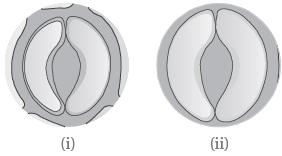
Observe the diagram and answer the following:
$(a)$ Identify the types of guard cells shown in $(i)$ and $(ii)$.
$(b)$ Which of these types is found in monocots and which in dicots?
$(a)$ Identify the types of guard cells shown in $(i)$ and $(ii)$.
$(b)$ Which of these types is found in monocots and which in dicots?
Solution
(N/A) In the diagram,$(i)$ shows dumbbell-shaped guard cells,while $(ii)$ shows bean-shaped (or kidney-shaped) guard cells.
$(b)$ Dumbbell-shaped guard cells $(i)$ are characteristic of monocot plants (e.g.,grasses). Bean-shaped guard cells $(ii)$ are characteristic of dicot plants.
$(b)$ Dumbbell-shaped guard cells $(i)$ are characteristic of monocot plants (e.g.,grasses). Bean-shaped guard cells $(ii)$ are characteristic of dicot plants.
0 likes
View Solution209
MediumMCQ
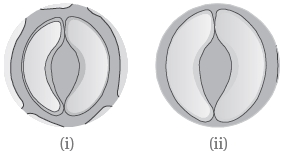
Observe the diagram and answer the following.
$(a)$ Which of these shows a higher water content $(i)$ or $(ii)$?
$(a)$ Which of these shows a higher water content $(i)$ or $(ii)$?
A
$(i)$
B
$(ii)$
C
Both $(i)$ and $(ii)$ are equal
D
None of these
Solution
(A) In $(i)$,the guard cells are turgid. Their outer walls are extended outward,indicating a high water content.
In $(ii)$,the cell is flaccid (shrunken) because it has lost water,which causes the stomatal pore to close.
In $(ii)$,the cell is flaccid (shrunken) because it has lost water,which causes the stomatal pore to close.
0 likes
View Solution210
Medium
Observe the diagram and answer the following.
$(a)$ Which element plays an important role in the opening and closing of stomata?
$(a)$ Which element plays an important role in the opening and closing of stomata?
Solution
(C) The element that plays an important role in the opening and closing of stomata is Potassium $(K^+)$.
$1$. During the opening of stomata,$K^+$ ions are actively transported from the surrounding subsidiary cells into the guard cells.
$2$. This accumulation of $K^+$ ions lowers the water potential inside the guard cells.
$3$. Due to the lower water potential,water moves from the surrounding cells into the guard cells via osmosis.
$4$. As water enters,the guard cells become turgid and expand,causing the stomatal pore to open.
$5$. Conversely,the exit of $K^+$ ions leads to the loss of water from the guard cells,making them flaccid and causing the stomata to close.
$1$. During the opening of stomata,$K^+$ ions are actively transported from the surrounding subsidiary cells into the guard cells.
$2$. This accumulation of $K^+$ ions lowers the water potential inside the guard cells.
$3$. Due to the lower water potential,water moves from the surrounding cells into the guard cells via osmosis.
$4$. As water enters,the guard cells become turgid and expand,causing the stomatal pore to open.
$5$. Conversely,the exit of $K^+$ ions leads to the loss of water from the guard cells,making them flaccid and causing the stomata to close.
0 likes
View Solution211
MediumMCQ
Water moves up against gravity and even for a tree of $20 \,m$ height, the tip receives water within two hours. The most important physiological phenomenon which is responsible for the upward movement of water is $...........$
A
Transpiration pull
B
Root pressure
C
Imbibition
D
Guttation
Solution
(A) $\Rightarrow$ The transpiration pull (or suction force) is the primary physiological phenomenon responsible for the upward movement of water in plants, allowing it to reach heights of up to $130 \,m$ through the xylem.
$\Rightarrow$ As water molecules evaporate from the stomata of the leaves, a negative pressure or tension is created in the xylem vessels.
$\Rightarrow$ This tension pulls the continuous column of water upwards from the roots to the leaves due to the cohesive and adhesive properties of water molecules.
$\Rightarrow$ This process effectively overcomes the force of gravity, enabling water to reach the tips of tall trees within a short period.
$\Rightarrow$ As water molecules evaporate from the stomata of the leaves, a negative pressure or tension is created in the xylem vessels.
$\Rightarrow$ This tension pulls the continuous column of water upwards from the roots to the leaves due to the cohesive and adhesive properties of water molecules.
$\Rightarrow$ This process effectively overcomes the force of gravity, enabling water to reach the tips of tall trees within a short period.
0 likes
View Solution212
EasyMCQ
The process by which water is lost in liquid form from the tips of grass leaves at night and early morning is known as:
A
Transpiration
B
Guttation
C
Imbibition
D
Plasmolysis
Solution
(B) The process of loss of water in liquid form from the tips of grass leaves or margins of leaves in some herbaceous plants is known as $Guttation$.
This phenomenon usually occurs at night or early morning when the rate of transpiration is very low and root pressure is high.
$Transpiration$ is the loss of water in the form of water vapor.
$Imbibition$ is the absorption of water by solid particles (colloids) causing them to increase in volume.
$Plasmolysis$ is the shrinkage of the protoplast from the cell wall due to water loss in a hypertonic solution.
This phenomenon usually occurs at night or early morning when the rate of transpiration is very low and root pressure is high.
$Transpiration$ is the loss of water in the form of water vapor.
$Imbibition$ is the absorption of water by solid particles (colloids) causing them to increase in volume.
$Plasmolysis$ is the shrinkage of the protoplast from the cell wall due to water loss in a hypertonic solution.
0 likes
View Solution213
EasyMCQ
The stomatal apparatus consists of:
A
Stomatal aperture
B
Guard cells
C
Subsidiary cells
D
All of these
Solution
(D) The stomatal apparatus is a complex structure that includes the stomatal aperture,the two guard cells that regulate its opening and closing,and the surrounding specialized epidermal cells known as subsidiary cells. Together,these components facilitate gas exchange and transpiration in plants.
0 likes
View Solution214
MediumMCQ
$A$ are structures present in the epidermis of leaves. They regulate the process of transpiration and $B$ exchange. It is composed of two bean-shaped cells known as $C$ cells.
Choose the correct combination of $A, B$ and $C$ from the following options:
Choose the correct combination of $A, B$ and $C$ from the following options:
A
$A-$ Stomata,$B-$ gaseous,$C-$ guard
B
$A-$ Stomata,$B-$ gaseous,$C-$ subsidiary
C
$A-$ Stomata,$B-$ water,$C-$ subsidiary
D
$A-$ Stomata,$B-$ water,$C-$ guard
Solution
(A) Stomata $(A)$ are specialized structures present in the epidermis of leaves.
They regulate the process of transpiration (loss of water) and gaseous $(B)$ exchange (oxygen and carbon dioxide).
Each stoma is composed of two bean-shaped cells known as guard $(C)$ cells,which control the opening and closing of the stomatal pore.
Therefore,the correct combination is $A-$ Stomata,$B-$ gaseous,$C-$ guard.
They regulate the process of transpiration (loss of water) and gaseous $(B)$ exchange (oxygen and carbon dioxide).
Each stoma is composed of two bean-shaped cells known as guard $(C)$ cells,which control the opening and closing of the stomatal pore.
Therefore,the correct combination is $A-$ Stomata,$B-$ gaseous,$C-$ guard.
0 likes
View Solution215
MediumMCQ
Which one is true about guttation?
A
It occurs through specialized pores called hydathodes.
B
It occurs in herbaceous plants when root pressure is low and transpiration is high.
C
It only occurs during the day time.
D
It occurs in plants growing under conditions of low soil moisture and high humidity.
Solution
(A) Guttation refers to the exudation of water droplets (in the form of a dilute salt solution) from the margins and tips of leaves.
Guttation water is exuded from a group of leaf cells through specialized openings or pores called hydathodes.
It occurs in some angiosperms like garden nasturtium $(Tropaeolum)$,$Colocasia$,tomato,etc.
It is most noticeable when transpiration is suppressed and relative humidity is high,such as during the night or early morning when root pressure is high.
Guttation water is exuded from a group of leaf cells through specialized openings or pores called hydathodes.
It occurs in some angiosperms like garden nasturtium $(Tropaeolum)$,$Colocasia$,tomato,etc.
It is most noticeable when transpiration is suppressed and relative humidity is high,such as during the night or early morning when root pressure is high.
0 likes
View Solution216
MediumMCQ
The factor, most important in regulating transpiration, is
A
Temperature
B
Light
C
Wind
D
Relative humidity
Solution
(D) Transpiration is the process of water loss from the aerial parts of plants in the form of water vapor.
While several environmental factors such as $Temperature$, $Light$, and $Wind$ influence the rate of transpiration, $Relative \text{ } humidity$ is considered the most critical factor.
$Relative \text{ } humidity$ determines the water vapor pressure gradient between the leaf interior (sub-stomatal cavity) and the external atmosphere.
When the $Relative \text{ } humidity$ is low, the air is dry, creating a steep diffusion gradient that facilitates rapid water loss.
Conversely, high $Relative \text{ } humidity$ reduces this gradient, thereby significantly slowing down the rate of transpiration.
While several environmental factors such as $Temperature$, $Light$, and $Wind$ influence the rate of transpiration, $Relative \text{ } humidity$ is considered the most critical factor.
$Relative \text{ } humidity$ determines the water vapor pressure gradient between the leaf interior (sub-stomatal cavity) and the external atmosphere.
When the $Relative \text{ } humidity$ is low, the air is dry, creating a steep diffusion gradient that facilitates rapid water loss.
Conversely, high $Relative \text{ } humidity$ reduces this gradient, thereby significantly slowing down the rate of transpiration.
0 likes
View Solution217
EasyMCQ
Hydathodes are also called
A
Water stomata
B
Sunken stomata
C
Guard cells
D
Subsidiary cells
Solution
(A) Guttation is the process of exudation of liquid droplets from the margins of leaves. This process takes place through specialized pores known as hydathodes. Since these pores remain permanently open and are involved in the release of water,they are also referred to as water stomata.
0 likes
View Solution218
EasyMCQ
How much of the absorbed water is lost during transpiration in a plant?
A
$99 \%$
B
$98-99 \%$
C
$99.9 \%$
D
$90-95 \%$
Solution
(B) The processes of water absorption and transpiration occur continuously in plants.
However,approximately $98-99 \%$ of the water absorbed by the plant is lost through the process of transpiration.
However,approximately $98-99 \%$ of the water absorbed by the plant is lost through the process of transpiration.
0 likes
View Solution219
MediumMCQ
Opening of stomata is not affected by
A
$N_{2}$
B
$K^{+}$ ions
C
Starch
D
None of these
Solution
(A) The opening and closing of stomata are primarily regulated by the concentration of $K^{+}$ ions in guard cells,the conversion of starch to sugar (and vice versa),and environmental factors like light and $CO_{2}$ concentration.
$N_{2}$ (nitrogen) is an inert gas present in the atmosphere. While it is essential for biological nitrogen fixation by specific bacteria,it does not play a direct role in the physiological mechanism of stomatal movement.
Therefore,the opening of stomata is not affected by $N_{2}$.
$N_{2}$ (nitrogen) is an inert gas present in the atmosphere. While it is essential for biological nitrogen fixation by specific bacteria,it does not play a direct role in the physiological mechanism of stomatal movement.
Therefore,the opening of stomata is not affected by $N_{2}$.
0 likes
View Solution220
MediumMCQ
Which ion helps in opening and closing of stomata?
A
$Mn^{+}$
B
$Mg^{2+}$
C
$Ca^{2+}$
D
$K^{+}$
Solution
(D) According to the active $K^{+}$ transport theory proposed by Levitt,the opening of stomata is primarily driven by the influx of $K^{+}$ ions into the guard cells.
These $K^{+}$ ions are sourced from the adjacent subsidiary and epidermal cells.
Conversely,the closure of stomata is facilitated by the efflux (exertion) of $K^{+}$ and $Cl^{-}$ ions from the guard cells back into the surrounding epidermal tissue,which leads to a decrease in turgor pressure within the guard cells.
These $K^{+}$ ions are sourced from the adjacent subsidiary and epidermal cells.
Conversely,the closure of stomata is facilitated by the efflux (exertion) of $K^{+}$ and $Cl^{-}$ ions from the guard cells back into the surrounding epidermal tissue,which leads to a decrease in turgor pressure within the guard cells.
0 likes
View Solution221
EasyMCQ
Which type of transpiration continues throughout day and night?
A
Cuticular transpiration
B
Lenticular transpiration
C
Bark transpiration
D
All of these
Solution
(D) Transpiration is categorized based on the plant surface into stomatal,cuticular,lenticular,and bark transpiration.
Stomatal transpiration depends on the opening of stomata,which typically occurs during the day.
In contrast,cuticular transpiration (through the waxy cuticle),lenticular transpiration (through lenticels),and bark transpiration (through the bark) are passive processes that continue throughout both day and night.
Therefore,all the options provided represent types of transpiration that occur continuously.
Stomatal transpiration depends on the opening of stomata,which typically occurs during the day.
In contrast,cuticular transpiration (through the waxy cuticle),lenticular transpiration (through lenticels),and bark transpiration (through the bark) are passive processes that continue throughout both day and night.
Therefore,all the options provided represent types of transpiration that occur continuously.
0 likes
View Solution222
MediumMCQ
In which of the following plants,there will be no transpiration?
A
Aquatic,submerged plants
B
Plants living in deserts
C
Aquatic plants with floating leaves
D
Plants growing in hilly regions
Solution
(A) The loss of water from aerial parts of living plants is known as transpiration.
Transpiration may be stomatal $(80-90\%)$,cuticular $(3-9\%)$,and lenticular $(0.1\%)$.
Transpiration is absent in submerged hydrophytic plants because stomata are completely absent in the leaves of these plants.
Examples of such plants include $Anacharis$ and $Potamogeton$.
Transpiration may be stomatal $(80-90\%)$,cuticular $(3-9\%)$,and lenticular $(0.1\%)$.
Transpiration is absent in submerged hydrophytic plants because stomata are completely absent in the leaves of these plants.
Examples of such plants include $Anacharis$ and $Potamogeton$.
0 likes
View Solution223
MediumMCQ
Wilting occurs when
A
Rate of transpiration is higher than absorption
B
Rate of absorption is higher than transpiration
C
Excess root pressure
D
High relative humidity in air
Solution
(A) Wilting occurs when the rate of transpiration is higher than the rate of water absorption by the roots.
This imbalance leads to a net loss of water from the plant tissues,causing a decrease in turgor pressure within the cells.
As turgor pressure drops,the plant cells lose their rigidity,resulting in the drooping or wilting of leaves and stems.
Transpiration is the evaporative loss of water from the aerial parts of the plant,which can occur through stomata,the cuticle,or lenticels.
This imbalance leads to a net loss of water from the plant tissues,causing a decrease in turgor pressure within the cells.
As turgor pressure drops,the plant cells lose their rigidity,resulting in the drooping or wilting of leaves and stems.
Transpiration is the evaporative loss of water from the aerial parts of the plant,which can occur through stomata,the cuticle,or lenticels.
0 likes
View Solution224
MediumMCQ
What will be the effect of accumulation of potassium ions in guard cells?
A
Decrease in turgor pressure
B
Exosmosis
C
Increase in water potential
D
Decrease in water potential
Solution
(D) The proton $(H^{+}-K^{+})$ transport theory was proposed by Levitt $(1974)$. According to this theory,there is an accumulation of $K^{+}$ ions in the guard cells during the daytime. This accumulation leads to a decrease in the water potential of the guard cells. Consequently,water enters the guard cells via endosmosis,causing them to become turgid,which results in the opening of the stomata.
0 likes
View Solution225
MediumMCQ
Which of the following theories provides the latest explanation for the closure of stomata?
A
$ABA$ theory
B
Munch theory
C
Starch-glucose theory
D
Active $K^+$ transport theory
Solution
(A) The $ABA$ (Abscisic Acid) theory is considered the most recent explanation for the mechanism of stomatal closure,proposed by Cowan et al. in $1982$.
According to this theory,the synthesis of abscisic acid during water stress (drought) or mid-day conditions promotes the reversal of the $H^+ \rightleftharpoons K^+$ pump.
This leads to an increase in the concentration of $H^+$ ions within the guard cell cytoplasm,causing the efflux of $K^+$ ions and water,which results in the closure of the stomata.
The active $K^+$ transport theory,which explains the opening and closing of stomata,was initially proposed by Imamura $(1943)$ and Fujino $(1967)$,while the Proton $(H^+-K^+)$ transport theory was proposed by Levitt $(1974)$.
According to this theory,the synthesis of abscisic acid during water stress (drought) or mid-day conditions promotes the reversal of the $H^+ \rightleftharpoons K^+$ pump.
This leads to an increase in the concentration of $H^+$ ions within the guard cell cytoplasm,causing the efflux of $K^+$ ions and water,which results in the closure of the stomata.
The active $K^+$ transport theory,which explains the opening and closing of stomata,was initially proposed by Imamura $(1943)$ and Fujino $(1967)$,while the Proton $(H^+-K^+)$ transport theory was proposed by Levitt $(1974)$.
0 likes
View Solution226
EasyMCQ
What is depicted by the given diagram?
A
Measuring the rate of transpiration
B
Demonstration of ascent of sap
C
Demonstration of transpiration
D
Both $(a)$ and $(c)$
Solution
(C) The diagram depicts the demonstration of transpiration using a bell jar experiment.
In this experiment,a potted plant is placed on a slab,and a dry bell jar is inverted over it.
After sealing the edges of the jar with wax or petroleum jelly,the apparatus is left undisturbed.
After some time,the inner surface of the bell jar becomes misty due to the water vapor released by the plant through the process of transpiration.
In this experiment,a potted plant is placed on a slab,and a dry bell jar is inverted over it.
After sealing the edges of the jar with wax or petroleum jelly,the apparatus is left undisturbed.
After some time,the inner surface of the bell jar becomes misty due to the water vapor released by the plant through the process of transpiration.
0 likes
View Solution227
MediumMCQ
$A$ twig kept in water having some salt remains fresh for a longer period due to
A
Decrease in bacterial degradation
B
Exosmosis
C
Decrease in transpiration rate
D
Absorption of more water
Solution
(C) When a twig is placed in water containing salt,the surrounding solution becomes hypertonic relative to the plant cells.
This hypertonic environment reduces the rate of water loss from the twig through transpiration because the water potential gradient is minimized.
Additionally,the presence of salt creates an environment that inhibits the growth of bacteria,which would otherwise cause the twig to decay or wilt prematurely.
Therefore,the twig remains fresh for a longer period primarily due to the decrease in the rate of transpiration and the inhibition of bacterial activity.
This hypertonic environment reduces the rate of water loss from the twig through transpiration because the water potential gradient is minimized.
Additionally,the presence of salt creates an environment that inhibits the growth of bacteria,which would otherwise cause the twig to decay or wilt prematurely.
Therefore,the twig remains fresh for a longer period primarily due to the decrease in the rate of transpiration and the inhibition of bacterial activity.
0 likes
View Solution228
EasyMCQ
Stomatal opening is regulated by
A
Light
B
Temperature
C
Atmospheric humidity
D
Wind
Solution
(A) The most significant physiological feature of stomata is their response to light.
Generally,stomata open in the daytime (i.e.,in the presence of light) and close at night or in darkness. These are called photoactive stomata.
However,in succulent plants like $Kalanchoe$ of the family $Crassulaceae$,the stomata open at night and close during the daytime.
Such stomata are called scotoactive stomata.
Since light is the primary environmental factor influencing the opening and closing mechanism in most plants,it is the main regulator.
Generally,stomata open in the daytime (i.e.,in the presence of light) and close at night or in darkness. These are called photoactive stomata.
However,in succulent plants like $Kalanchoe$ of the family $Crassulaceae$,the stomata open at night and close during the daytime.
Such stomata are called scotoactive stomata.
Since light is the primary environmental factor influencing the opening and closing mechanism in most plants,it is the main regulator.
0 likes
View Solution229
MediumMCQ
Transpiration is the manifestation of
A
Root pressure
B
Turgor pressure
C
Wall pressure
D
Suction pressure
Solution
(B) Transpiration is the manifestation of turgor pressure.
More than $95 \%$ of the total water loss occurs through the stomata of leaves.
The mechanism of opening and closing of stomata is regulated by the turgidity of the guard cells,which is a direct result of changes in turgor pressure.
More than $95 \%$ of the total water loss occurs through the stomata of leaves.
The mechanism of opening and closing of stomata is regulated by the turgidity of the guard cells,which is a direct result of changes in turgor pressure.
0 likes
View Solution230
MediumMCQ
Which of the following get accumulated in the vacuoles of guard cells during stomatal opening?
A
Water,calcium and magnesium
B
Starch,potassium and chloride ions
C
Malate,sodium and potassium ions
D
Malate,potassium and chloride ions
Solution
(D) According to the proton transport theory proposed by Levitt $(1974)$,the opening of stomata is driven by the active uptake of potassium ions $(K^+)$ into the guard cells.
To maintain electrical neutrality,the uptake of $K^+$ ions is balanced by the uptake of chloride ions $(Cl^-)$.
Additionally,starch is converted into malic acid,which dissociates into hydrogen ions $(H^+)$ and malate ions.
The accumulation of these solutes (malate,$K^+$,and $Cl^-$) in the vacuoles decreases the water potential of the guard cells,leading to the influx of water via osmosis,which causes the stomata to open.
To maintain electrical neutrality,the uptake of $K^+$ ions is balanced by the uptake of chloride ions $(Cl^-)$.
Additionally,starch is converted into malic acid,which dissociates into hydrogen ions $(H^+)$ and malate ions.
The accumulation of these solutes (malate,$K^+$,and $Cl^-$) in the vacuoles decreases the water potential of the guard cells,leading to the influx of water via osmosis,which causes the stomata to open.
0 likes
View Solution231
MediumMCQ
Arrange the events of opening stomata in correct sequence and choose the correct option accordingly.
$I.$ Lowering of osmotic potential of guard cells
$II.$ Decline in guard cell solute
$III.$ Rise of potassium ion level in guard cells
$IV.$ Guard cells absorb water from neighbouring epidermal cells
$V.$ Guard cells become flaccid
$VI.$ Guard cells swell and create a pore between them
$I.$ Lowering of osmotic potential of guard cells
$II.$ Decline in guard cell solute
$III.$ Rise of potassium ion level in guard cells
$IV.$ Guard cells absorb water from neighbouring epidermal cells
$V.$ Guard cells become flaccid
$VI.$ Guard cells swell and create a pore between them
A
$III, I, IV, V$
B
$I, II, III, IV, V, VI$
C
$III, I, IV, VI$
D
$III, I, IV, VI, II, V$
Solution
(C) The opening of stomata is primarily explained by the active $K^+$ transport theory. The sequence of events for stomatal opening is as follows:
$1$. $III.$ Rise of potassium ion $(K^+)$ level in guard cells: During the day,$K^+$ ions are actively transported into the guard cells.
$2$. $I.$ Lowering of osmotic potential of guard cells: The accumulation of $K^+$ ions increases the solute concentration,thereby lowering the osmotic potential of the guard cells.
$3$. $IV.$ Guard cells absorb water from neighbouring epidermal cells: Due to the lower osmotic potential,water enters the guard cells via endosmosis.
$4$. $VI.$ Guard cells swell and create a pore between them: The influx of water increases the turgor pressure,causing the guard cells to swell and open the stomatal pore.
Therefore,the correct sequence is $III, I, IV, VI$.
$1$. $III.$ Rise of potassium ion $(K^+)$ level in guard cells: During the day,$K^+$ ions are actively transported into the guard cells.
$2$. $I.$ Lowering of osmotic potential of guard cells: The accumulation of $K^+$ ions increases the solute concentration,thereby lowering the osmotic potential of the guard cells.
$3$. $IV.$ Guard cells absorb water from neighbouring epidermal cells: Due to the lower osmotic potential,water enters the guard cells via endosmosis.
$4$. $VI.$ Guard cells swell and create a pore between them: The influx of water increases the turgor pressure,causing the guard cells to swell and open the stomatal pore.
Therefore,the correct sequence is $III, I, IV, VI$.
0 likes
View Solution232
MediumMCQ
Read the following statements carefully and choose the right answer from the codes given below:
$I$. $PMA$ and silicon oil of low viscosity are considered as antitranspirants.
$II$. $BAP$,$NAA$,and cobalt chloride are also used as antitranspirants.
$III$. Abscisic acid $(ABA)$ affects the mechanism of opening and closing of stomata.
$IV$. Starch of guard cells is converted into $PEP$ (phosphoenolpyruvate) ions by the process of hydrolysis.
$V$. Potometer works on the principle of potential difference between the tip of the tube and that of the plant.
$VI$. Transpiration rate is directly proportional to the relative humidity.
$I$. $PMA$ and silicon oil of low viscosity are considered as antitranspirants.
$II$. $BAP$,$NAA$,and cobalt chloride are also used as antitranspirants.
$III$. Abscisic acid $(ABA)$ affects the mechanism of opening and closing of stomata.
$IV$. Starch of guard cells is converted into $PEP$ (phosphoenolpyruvate) ions by the process of hydrolysis.
$V$. Potometer works on the principle of potential difference between the tip of the tube and that of the plant.
$VI$. Transpiration rate is directly proportional to the relative humidity.
A
$I, II, III, IV, V$ and $VI$ are correct.
B
$I, II, III$ and $IV$ are correct,while $V$ and $VI$ are incorrect.
C
$V$ and $VI$ are correct,while $I, II, III$ and $IV$ are incorrect.
D
$I, III$ are correct,while $II, IV, V$ and $VI$ are incorrect.
Solution
(B) Statement $I$ is correct: $PMA$ (Phenylmercuric acetate) and low-viscosity silicon oils act as antitranspirants.
Statement $II$ is correct: $BAP$ (Benzylaminopurine),$NAA$ (Naphthalene acetic acid),and cobalt chloride are known to act as antitranspirants.
Statement $III$ is correct: Abscisic acid $(ABA)$ induces stomatal closure.
Statement $IV$ is incorrect: Starch in guard cells is converted into sugar (glucose) or organic acids,not directly into $PEP$ ions via simple hydrolysis.
Statement $V$ is incorrect: $A$ potometer works on the principle that the amount of water absorbed by the plant is approximately equal to the amount of water transpired.
Statement $VI$ is incorrect: Transpiration rate is inversely proportional to relative humidity. High humidity reduces the water potential gradient,thereby decreasing the rate of transpiration.
Statement $II$ is correct: $BAP$ (Benzylaminopurine),$NAA$ (Naphthalene acetic acid),and cobalt chloride are known to act as antitranspirants.
Statement $III$ is correct: Abscisic acid $(ABA)$ induces stomatal closure.
Statement $IV$ is incorrect: Starch in guard cells is converted into sugar (glucose) or organic acids,not directly into $PEP$ ions via simple hydrolysis.
Statement $V$ is incorrect: $A$ potometer works on the principle that the amount of water absorbed by the plant is approximately equal to the amount of water transpired.
Statement $VI$ is incorrect: Transpiration rate is inversely proportional to relative humidity. High humidity reduces the water potential gradient,thereby decreasing the rate of transpiration.
0 likes
View Solution233
EasyMCQ
Hydathodes help in
A
Bleeding
B
Guttation
C
Protection against grazing
D
More than one option is correct
Solution
(B) Hydathodes are specialized pores or openings found at the vein endings of leaves. They facilitate the exudation of water in the form of liquid droplets from the interior of the plant to its surface,a process known as $Guttation$.
0 likes
View Solution234
EasyMCQ
Stomata when open lead to:
A
Exchange of gases
B
Evaporation of water
C
Uptake of carbon dioxide
D
All of these
Solution
(D) When stomata are open,they facilitate several physiological processes:
$1$. Exchange of gases: $O_2$ is released and $CO_2$ is taken in during photosynthesis.
$2$. Evaporation of water: This process,known as transpiration,allows water vapor to escape from the leaf surface.
$3$. Uptake of carbon dioxide: $CO_2$ enters the leaf through the stomata to be used in the Calvin cycle.
Therefore,all the listed options are correct.
$1$. Exchange of gases: $O_2$ is released and $CO_2$ is taken in during photosynthesis.
$2$. Evaporation of water: This process,known as transpiration,allows water vapor to escape from the leaf surface.
$3$. Uptake of carbon dioxide: $CO_2$ enters the leaf through the stomata to be used in the Calvin cycle.
Therefore,all the listed options are correct.
0 likes
View Solution235
MediumMCQ
Rate of transpiration is increased by
A
Sunlight
B
Darkness
C
High humidity
D
High speed winds
Solution
(A) Transpiration is the process of water loss from the aerial parts of plants.
$A$. Sunlight: Increases temperature and triggers stomatal opening,which increases transpiration.
$B$. Darkness: Causes stomata to close,which decreases transpiration.
$C$. High humidity: Reduces the water potential gradient between the leaf interior and the atmosphere,decreasing transpiration.
$D$. High speed winds: While wind can increase transpiration by removing the boundary layer,sunlight is the primary factor that directly influences the physiological opening of stomata. However,in the context of standard biology questions,sunlight is the most significant factor that promotes transpiration by opening stomata.
$A$. Sunlight: Increases temperature and triggers stomatal opening,which increases transpiration.
$B$. Darkness: Causes stomata to close,which decreases transpiration.
$C$. High humidity: Reduces the water potential gradient between the leaf interior and the atmosphere,decreasing transpiration.
$D$. High speed winds: While wind can increase transpiration by removing the boundary layer,sunlight is the primary factor that directly influences the physiological opening of stomata. However,in the context of standard biology questions,sunlight is the most significant factor that promotes transpiration by opening stomata.
0 likes
View Solution236
MediumMCQ
In a stomatal apparatus,cellulosic microfibrils are oriented:
A
Longitudinally on subsidiary cells
B
Radially in the cell walls of guard cells
C
Radially and longitudinally in wall of guard cells
D
Longitudinally on both guard cells
Solution
(B) The guard cells of stomata possess cellulose microfibrils that are oriented radially rather than longitudinally. This specific radial orientation is crucial because it allows the guard cells to expand more in length than in width when they become turgid,which pulls the inner walls apart and opens the stomatal pore.
0 likes
View Solution237
MediumMCQ
According to the potassium pump theory of Levitt,which of the following statements is correct?
A
Starch is incompletely oxidized to $PEP$ during night.
B
Malic acid dissociates into malate ion and protons in the subsidiary cells.
C
Movement of $H^+$ ions from guard cell to subsidiary cell is active.
D
Potassium malate decreases the $OP$ of guard cells during day.
Solution
(C) According to Levitt's potassium pump theory:
- During the day,starch is incompletely oxidized to $PEP$ (Phosphoenolpyruvate) in the guard cells.
- $PEP$ is then converted into malic acid,which dissociates into malate ions and protons $(H^+)$ within the guard cells.
- Protons $(H^+)$ are actively pumped out of the guard cells into the subsidiary cells,while $K^+$ ions are taken up into the guard cells.
- The accumulation of potassium malate increases the osmotic pressure $(OP)$ of the guard cells,leading to water influx and stomatal opening.
- During the day,starch is incompletely oxidized to $PEP$ (Phosphoenolpyruvate) in the guard cells.
- $PEP$ is then converted into malic acid,which dissociates into malate ions and protons $(H^+)$ within the guard cells.
- Protons $(H^+)$ are actively pumped out of the guard cells into the subsidiary cells,while $K^+$ ions are taken up into the guard cells.
- The accumulation of potassium malate increases the osmotic pressure $(OP)$ of the guard cells,leading to water influx and stomatal opening.
0 likes
View Solution238
MediumMCQ
$A.$ In dry atmosphere,the relative humidity is low,so the rate of transpiration increases.
$B.$ Slow breeze promotes the rate of transpiration.
$C.$ $ABA$ promotes transpiration.
$D.$ $A$ high salt concentration in soil water increases transpiration.
$B.$ Slow breeze promotes the rate of transpiration.
$C.$ $ABA$ promotes transpiration.
$D.$ $A$ high salt concentration in soil water increases transpiration.
A
$C$ and $D$ are correct.
B
$B$ and $C$ are correct.
C
$A$ and $C$ are correct.
D
$A$ and $B$ are correct.
Solution
(D) - In a dry atmosphere,the relative humidity is low,which increases the water potential gradient between the leaf interior and the atmosphere,thereby increasing the rate of transpiration.
- $A$ slow breeze removes the humid air surrounding the leaf surface,replacing it with drier air,which promotes the rate of transpiration.
- $ABA$ (Abscisic acid) inhibits transpiration by inducing stomatal closure; therefore,it is known as a stress hormone.
- $A$ high salt concentration in soil water lowers the water potential of the soil,making it difficult for plants to absorb water,which decreases the rate of transpiration.
- $A$ slow breeze removes the humid air surrounding the leaf surface,replacing it with drier air,which promotes the rate of transpiration.
- $ABA$ (Abscisic acid) inhibits transpiration by inducing stomatal closure; therefore,it is known as a stress hormone.
- $A$ high salt concentration in soil water lowers the water potential of the soil,making it difficult for plants to absorb water,which decreases the rate of transpiration.
0 likes
View Solution239
MediumMCQ
The conditions under which transpiration would be most rapid are:
A
Excess of water in soil
B
Low humidity,high temperature,turgid guard cells and moist soil
C
Low velocity of wind
D
High humidity
Solution
(B) Transpiration is the process of water loss from plants in the form of water vapor.
It is most rapid under conditions that favor evaporation.
High temperature increases the kinetic energy of water molecules,facilitating their escape into the atmosphere.
Low humidity creates a steep water potential gradient between the leaf interior and the surrounding air,promoting faster diffusion.
Turgid guard cells ensure that the stomata remain open,allowing for the exit of water vapor.
Moist soil ensures that the plant has an adequate supply of water to maintain this process without wilting.
It is most rapid under conditions that favor evaporation.
High temperature increases the kinetic energy of water molecules,facilitating their escape into the atmosphere.
Low humidity creates a steep water potential gradient between the leaf interior and the surrounding air,promoting faster diffusion.
Turgid guard cells ensure that the stomata remain open,allowing for the exit of water vapor.
Moist soil ensures that the plant has an adequate supply of water to maintain this process without wilting.
0 likes
View Solution240
MediumMCQ
During stomatal opening (photoactive),which of the following does not occur?
A
Increase in $pH$ of guard cells
B
Hydrolysis of starch in guard cells
C
Increased $TP$ of subsidiary cells
D
Dissociation of malic acid in guard cells
Solution
(C) The correct answer is $C$. During the process of stomatal opening (photoactive),the following events occur:
$1$. The $pH$ of guard cells increases due to the dissociation of malic acid into malate ions and $H^+$ ions.
$2$. Starch in the guard cells undergoes hydrolysis to form phosphoenolpyruvate $(PEP)$.
$3$. Malic acid dissociates into malate ions and $H^+$ ions.
$4$. As a result of these processes,the osmotic potential of the guard cells decreases,causing water to enter the guard cells from the subsidiary cells via osmosis. This increases the turgor pressure $(TP)$ of the guard cells,not the subsidiary cells,leading to the opening of the stomata.
Therefore,an increase in the $TP$ of subsidiary cells does not occur; instead,their $TP$ decreases as they lose water to the guard cells.
$1$. The $pH$ of guard cells increases due to the dissociation of malic acid into malate ions and $H^+$ ions.
$2$. Starch in the guard cells undergoes hydrolysis to form phosphoenolpyruvate $(PEP)$.
$3$. Malic acid dissociates into malate ions and $H^+$ ions.
$4$. As a result of these processes,the osmotic potential of the guard cells decreases,causing water to enter the guard cells from the subsidiary cells via osmosis. This increases the turgor pressure $(TP)$ of the guard cells,not the subsidiary cells,leading to the opening of the stomata.
Therefore,an increase in the $TP$ of subsidiary cells does not occur; instead,their $TP$ decreases as they lose water to the guard cells.
0 likes
View Solution241
MediumMCQ
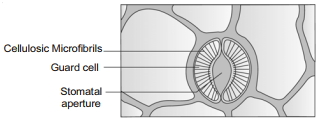
Which of the following statements is incorrect in relation to the stomatal apparatus?
A
Cellulose microfibrils are arranged longitudinally to the axis of the stomata.
B
Subsidiary cells are located as modified epidermal cells.
C
Guard cells may be ellipsoidal in monocots.
D
Inner walls of guard cells are thick and elastic.
Solution
(A) In the guard cells of the stomata,the cellulose microfibrils are arranged radially rather than longitudinally. This radial arrangement is crucial for the opening and closing mechanism of the stomata. Therefore,the statement that they are arranged longitudinally is incorrect.
0 likes
View Solution242
MediumMCQ
$A$ : During stomatal opening there is relative change in $TP$ of guard cell and subsidiary cell.
$R$ : $TP$ of subsidiary cell decreases during opening and that of guard cells increase.
$R$ : $TP$ of subsidiary cell decreases during opening and that of guard cells increase.
A
Assertion and Reason both are correct and Reason is the correct explanation of Assertion.
B
Assertion and Reason both are correct but Reason is not the correct explanation of Assertion.
C
Assertion is correct,but Reason is incorrect.
D
Both Assertion and Reason are incorrect.
Solution
(A) During stomatal opening,potassium ions $(K^+)$ accumulate in the guard cells,which lowers their water potential. As a result,water enters the guard cells from the surrounding subsidiary cells via osmosis. This influx of water increases the Turgor Pressure $(TP)$ of the guard cells,causing them to swell and open the stoma. Conversely,the loss of water from the subsidiary cells leads to a decrease in their $TP$. Therefore,both the Assertion and the Reason are correct,and the Reason provides the correct explanation for the change in $TP$ leading to stomatal opening.
0 likes
View Solution243
MediumMCQ
$A$: Water is transient in plants.
$R$: More than $1\%$ of the water reaching the leaves is used in photosynthesis and plant growth.
$R$: More than $1\%$ of the water reaching the leaves is used in photosynthesis and plant growth.
A
Assertion and Reason both are correct and Reason is the correct explanation of Assertion.
B
Assertion and Reason both are correct but Reason is not the correct explanation of Assertion.
C
Assertion is correct,but Reason is incorrect.
D
Both Assertion and Reason are incorrect.
Solution
(C) The Assertion is correct because water is constantly absorbed by roots and lost through transpiration,making its presence in the plant transient.
The Reason is incorrect because less than $1\%$ of the water reaching the leaves is used in photosynthesis and plant growth,not more than $1\%$.
Therefore,the correct option is $C$.
The Reason is incorrect because less than $1\%$ of the water reaching the leaves is used in photosynthesis and plant growth,not more than $1\%$.
Therefore,the correct option is $C$.
0 likes
View Solution244
MediumMCQ
$A$ metal ion involved in stomatal regulation is
A
Iron
B
Potassium
C
Zinc
D
Magnesium
Solution
(B) According to the proton transport theory,proposed by Levitt $(1974)$,the regulation of stomata (i.e.,opening and closing) depends upon the active entry and exit of potassium ions $(K^+)$ in the guard cells.
During the day,starch is converted into malic acid in the guard cells,which dissociates into malate ions and protons $(H^+)$.
The protons are pumped out of the guard cells,and in exchange,potassium ions $(K^+)$ are taken up from the surrounding subsidiary cells.
This accumulation of $K^+$ ions decreases the water potential of the guard cells,leading to the influx of water,which causes the stomata to open.
During the day,starch is converted into malic acid in the guard cells,which dissociates into malate ions and protons $(H^+)$.
The protons are pumped out of the guard cells,and in exchange,potassium ions $(K^+)$ are taken up from the surrounding subsidiary cells.
This accumulation of $K^+$ ions decreases the water potential of the guard cells,leading to the influx of water,which causes the stomata to open.
0 likes
View Solution245
Medium
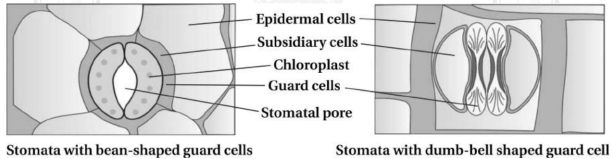
Draw a labelled diagram of the stomata of a dicot and a monocot.
Solution
(N/A) The stomata are structures present in the epidermis of leaves. They consist of a stomatal pore,guard cells,and surrounding subsidiary cells.
$1$. Dicot Stomata: These possess bean-shaped or kidney-shaped guard cells. The guard cells contain chloroplasts and regulate the opening and closing of the stomatal pore.
$2$. Monocot Stomata: These possess dumb-bell shaped guard cells. The outer walls of these guard cells are thin,while the inner walls are thick.
Refer to the provided image for the detailed labelling of both types of stomata.
$1$. Dicot Stomata: These possess bean-shaped or kidney-shaped guard cells. The guard cells contain chloroplasts and regulate the opening and closing of the stomatal pore.
$2$. Monocot Stomata: These possess dumb-bell shaped guard cells. The outer walls of these guard cells are thin,while the inner walls are thick.
Refer to the provided image for the detailed labelling of both types of stomata.
0 likes
View Solution246
MediumMCQ
Differentiate between guttation and transpiration.
A
Guttation occurs through hydathodes; Transpiration occurs through stomata.
B
Guttation involves liquid water loss; Transpiration involves water vapor loss.
C
Guttation happens at night or early morning; Transpiration happens during the day.
D
All of the above.
Solution
(D) The differences between guttation and transpiration are as follows:
$1$. Definition: Guttation is the loss of water in the form of liquid droplets from the margins of leaves through specialized pores called hydathodes. Transpiration is the evaporative loss of water from the aerial parts of the plant,primarily through stomata.
$2$. State of Water: In guttation,water is lost in liquid form. In transpiration,water is lost in the form of water vapor.
$3$. Site of Loss: Guttation occurs through hydathodes (water pores). Transpiration occurs mainly through stomata,and to a lesser extent through cuticles and lenticels.
$4$. Timing: Guttation typically occurs during the night or early morning when root pressure is high and transpiration is low. Transpiration occurs primarily during the day when stomata are open.
$5$. Solutes: The liquid lost during guttation contains various dissolved salts and organic substances. The water vapor lost during transpiration is pure water.
$1$. Definition: Guttation is the loss of water in the form of liquid droplets from the margins of leaves through specialized pores called hydathodes. Transpiration is the evaporative loss of water from the aerial parts of the plant,primarily through stomata.
$2$. State of Water: In guttation,water is lost in liquid form. In transpiration,water is lost in the form of water vapor.
$3$. Site of Loss: Guttation occurs through hydathodes (water pores). Transpiration occurs mainly through stomata,and to a lesser extent through cuticles and lenticels.
$4$. Timing: Guttation typically occurs during the night or early morning when root pressure is high and transpiration is low. Transpiration occurs primarily during the day when stomata are open.
$5$. Solutes: The liquid lost during guttation contains various dissolved salts and organic substances. The water vapor lost during transpiration is pure water.
0 likes
View Solution247
Medium
Transpiration is a necessary evil in plants. Explain.
Solution
(N/A) Transpiration is considered a 'necessary evil' because it is an inevitable process that has both advantages and disadvantages for the plant.
$1$. Necessity: It is essential for the absorption and upward movement of water and minerals from the soil to the leaves (transpiration pull). It also helps in cooling the leaf surface and maintaining the turgidity of plant cells.
$2$. Evil: It leads to a significant loss of water. If the rate of transpiration exceeds the rate of water absorption by the roots,it causes water stress,leading to wilting,physiological damage,and potentially the death of the plant.
$1$. Necessity: It is essential for the absorption and upward movement of water and minerals from the soil to the leaves (transpiration pull). It also helps in cooling the leaf surface and maintaining the turgidity of plant cells.
$2$. Evil: It leads to a significant loss of water. If the rate of transpiration exceeds the rate of water absorption by the roots,it causes water stress,leading to wilting,physiological damage,and potentially the death of the plant.
0 likes
View Solution248
EasyMCQ
What is guttation?
A
The loss of water in the form of vapor from the aerial parts of plants.
B
The loss of water in its liquid phase from the tips of leaves.
C
The process of water absorption by roots.
D
The movement of water through the xylem vessels.
Solution
(B) $\Rightarrow$ When evaporation is low and excess water collects in the form of droplets around special openings of veins near the tip of grass blades and leaves of many herbaceous plants,this water loss in its liquid phase is known as guttation.
$\Rightarrow$ Guttation occurs due to high root pressure,which pushes water out through specialized pores called hydathodes.
$\Rightarrow$ Root pressure can at best,only provide a modest push in the overall process of water transport.
$\Rightarrow$ Guttation occurs due to high root pressure,which pushes water out through specialized pores called hydathodes.
$\Rightarrow$ Root pressure can at best,only provide a modest push in the overall process of water transport.
0 likes
View Solution249
MediumMCQ
The stomatal apparatus consists of:
A
Stomatal aperture + Guard cells
B
Stomatal aperture + Guard cells + Subsidiary cells
C
Stomatal aperture + Guard cells + Companion cells
D
Stomatal aperture + Subsidiary cells
Solution
(B) The stomatal apparatus is a specialized structure found in the epidermis of leaves.
It is composed of three main parts:
$1$. The stomatal aperture (the central pore).
$2$. The guard cells (two specialized kidney-shaped or dumbbell-shaped cells surrounding the pore).
$3$. The subsidiary cells (specialized epidermal cells surrounding the guard cells).
Therefore,the correct composition is Stomatal aperture + Guard cells + Subsidiary cells.
It is composed of three main parts:
$1$. The stomatal aperture (the central pore).
$2$. The guard cells (two specialized kidney-shaped or dumbbell-shaped cells surrounding the pore).
$3$. The subsidiary cells (specialized epidermal cells surrounding the guard cells).
Therefore,the correct composition is Stomatal aperture + Guard cells + Subsidiary cells.
0 likes
View Solution250
MediumMCQ
Identify the cells in the given figure.
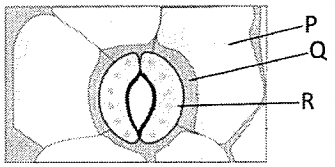
A
$P=$ Subsidiary cell,$Q=$ Guard cell,$R=$ Epidermal cell
B
$P=$ Guard cell,$Q=$ Subsidiary cell,$R=$ Epidermal cell
C
$P=$ Epidermal cell,$Q=$ Guard cell,$R=$ Subsidiary cell
D
$P=$ Epidermal cell,$Q=$ Subsidiary cell,$R=$ Guard cell
Solution
(D) In the provided diagram of a stoma:
$1$. $R$ represents the bean-shaped cells that regulate the opening and closing of the stoma,known as Guard cells.
$2$. $Q$ represents the specialized cells surrounding the guard cells,known as Subsidiary cells.
$3$. $P$ represents the ordinary cells of the epidermis,known as Epidermal cells.
Therefore,the correct identification is $P=$ Epidermal cell,$Q=$ Subsidiary cell,$R=$ Guard cell.
$1$. $R$ represents the bean-shaped cells that regulate the opening and closing of the stoma,known as Guard cells.
$2$. $Q$ represents the specialized cells surrounding the guard cells,known as Subsidiary cells.
$3$. $P$ represents the ordinary cells of the epidermis,known as Epidermal cells.
Therefore,the correct identification is $P=$ Epidermal cell,$Q=$ Subsidiary cell,$R=$ Guard cell.
0 likes
View SolutionTransport in Plants — Transpiration (General) and Stomata · Frequently Asked Questions
1Are these Transport in Plants questions useful for JEE and NEET?
Yes. All questions in this section are mapped to JEE Main and NEET exam patterns. Previous year questions from JEE Main, NEET, GUJCET and state-level exams are included with full solutions.
2Can I switch to Hindi or Gujarati for these questions?
Yes. Use the language tabs in the hero section or the sidebar to view the same questions and solutions in English, Hindi or Gujarati.
3How do I generate a question paper from this subtopic?
Use the Vedclass Exam Paper Generator — select the chapter and subtopic, set difficulty, and generate Sets A, B, C, D automatically. First 3 chapters of every subject are free.
Vedclass Products
For Students
Vedclass Test Series
Mock tests in real JEE/NEET style with performance analysis. 5-day free trial.
Start Free TrialFor Teachers
Exam Paper Generator
Generate Set A/B/C/D papers from this chapter in 2 minutes. 3 chapters free.
Try FreeFor Institutes
Online Exam Module
Live online exams with unlimited students, 360° analytics & white-label branding.
See DemoFor Teachers & Institutes
Generate a Transport in Plants Exam Paper in 2 Minutes
Select subtopic & difficulty — Sets A, B, C, D auto-generated with No Repeat logic.
First 3 chapters of every subject are free — no payment required.