
A English
Transpiration (General) and Stomata Questions in English
Class 11 Biology · Transport in Plants · Transpiration (General) and Stomata
275+
Questions
English
Language
100%
With Solutions
Showing 25 of 275 questions in English
251
EasyMCQ
The majority of the water absorbed by plants is $...............$
A
Stored in the xylem
B
Lost through transpiration
C
Used to form protoplasm
D
Stored in the shoot and root tips
Solution
(B) Plants absorb a large amount of water from the soil through their roots. However,only a very small fraction (less than $1\%$) of this absorbed water is actually utilized in photosynthesis and other metabolic activities. The vast majority of the water absorbed by plants is lost into the atmosphere in the form of water vapor through the process of transpiration,which occurs primarily through the stomata in the leaves.
0 likes
View Solution252
EasyMCQ
The process by which plants lose water in liquid form is called $P$,while the process by which plants lose water in the form of vapor is called $Q$.
A
Guttation,Transpiration
B
Transpiration,Guttation
C
Guttation,Guttation
D
Transpiration,Transpiration
Solution
(A) $1$. Guttation is the exudation of water droplets from the margins or tips of leaves through specialized structures called hydathodes. This occurs in liquid form.
$2$. Transpiration is the evaporative loss of water by plants,which occurs primarily through the stomata in the form of water vapor.
$3$. Therefore,$P$ is Guttation and $Q$ is Transpiration.
$2$. Transpiration is the evaporative loss of water by plants,which occurs primarily through the stomata in the form of water vapor.
$3$. Therefore,$P$ is Guttation and $Q$ is Transpiration.
0 likes
View Solution253
EasyMCQ
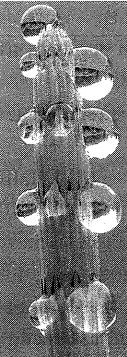
Which process is shown in the figure below?
A
Osmotic pressure
B
Diffusion
C
Transpiration
D
Guttation
Solution
(D) The figure shows water droplets on the edges of leaves. This phenomenon is known as Guttation.
Guttation is the exudation of water droplets from the margins of leaves through specialized pores called hydathodes.
It typically occurs in small herbaceous plants under conditions of high soil moisture and low transpiration (e.g.,at night or early morning).
Guttation is the exudation of water droplets from the margins of leaves through specialized pores called hydathodes.
It typically occurs in small herbaceous plants under conditions of high soil moisture and low transpiration (e.g.,at night or early morning).
0 likes
View Solution254
MediumMCQ
In tall plants,the transport of water occurs through . . . . . . .
A
Root pressure
B
Transpiration
C
Both
D
None of these
Solution
(B) In tall plants,the transport of water is primarily driven by the transpiration pull,which is generated by the evaporation of water from the stomata of leaves.
This creates a negative pressure (tension) in the xylem vessels,which pulls the water column upwards from the roots to the top of the plant.
While root pressure contributes to the movement of water in small herbaceous plants or during the night,it is insufficient to transport water to the heights of tall trees.
Therefore,transpiration is the main mechanism for water transport in tall plants.
This creates a negative pressure (tension) in the xylem vessels,which pulls the water column upwards from the roots to the top of the plant.
While root pressure contributes to the movement of water in small herbaceous plants or during the night,it is insufficient to transport water to the heights of tall trees.
Therefore,transpiration is the main mechanism for water transport in tall plants.
0 likes
View Solution255
MediumMCQ
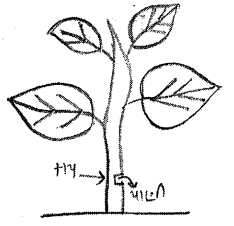
Which process is shown in the figure below?
A
Osmotic pressure
B
Diffusion pressure
C
Transpiration pull
D
Root pressure
Solution
(C) The figure illustrates a plant where water is being lost from the stem/leaves,which represents the process of transpiration.
Transpiration is the evaporative loss of water by plants.
This process creates a negative pressure or tension in the xylem vessels,known as transpiration pull,which helps in the upward movement of water from roots to the top of the plant.
Transpiration is the evaporative loss of water by plants.
This process creates a negative pressure or tension in the xylem vessels,known as transpiration pull,which helps in the upward movement of water from roots to the top of the plant.
0 likes
View Solution256
MediumMCQ
Select the incorrect statement from the following.
A
Water is transient in plants.
B
The process of loss of water in the form of vapor is called transpiration.
C
The amount of water lost through transpiration is less than the water used in photosynthesis.
D
Cobalt chloride paper turns pink in the presence of water.
Solution
(C) $1$. Water is transient in plants because most of the water absorbed by roots is lost through transpiration and only a small fraction is used in metabolic activities.
$2$. Transpiration is defined as the loss of water in the form of water vapor from the aerial parts of the plant.
$3$. In photosynthesis,plants use a very small amount of water (less than $1\%$ of the total water absorbed). In contrast,a large amount of water is lost through transpiration. Therefore,the statement that the amount of water lost through transpiration is less than the water used in photosynthesis is incorrect.
$4$. Cobalt chloride paper is a standard test for water; it is blue when dry and turns pink when it absorbs water.
$2$. Transpiration is defined as the loss of water in the form of water vapor from the aerial parts of the plant.
$3$. In photosynthesis,plants use a very small amount of water (less than $1\%$ of the total water absorbed). In contrast,a large amount of water is lost through transpiration. Therefore,the statement that the amount of water lost through transpiration is less than the water used in photosynthesis is incorrect.
$4$. Cobalt chloride paper is a standard test for water; it is blue when dry and turns pink when it absorbs water.
0 likes
View Solution257
EasyMCQ
Which process are the guard cells associated with?
A
Transpiration
B
Guttation
C
Root pressure
D
Ascent of sap
Solution
(A) Guard cells are specialized plant cells that surround the stomata.
They control the opening and closing of stomata,which regulates the rate of transpiration (the loss of water vapor from the plant surface).
Therefore,guard cells are directly associated with the process of transpiration.
They control the opening and closing of stomata,which regulates the rate of transpiration (the loss of water vapor from the plant surface).
Therefore,guard cells are directly associated with the process of transpiration.
0 likes
View Solution258
MediumMCQ
Identify the incorrect statement from the following.
A
Transpiration is the process of loss of water in the form of vapour by plants.
B
Stomata are involved in the exchange of oxygen as well as carbon dioxide.
C
Stomata open when guard cells become flaccid.
D
The inner wall of each guard cell towards the pore is thick and inelastic.
Solution
(C) The opening and closing of stomata are regulated by the turgidity of guard cells.
When guard cells become turgid (swollen due to water intake),the thin outer walls bulge out and force the inner walls into a crescent shape,which opens the stomatal pore.
Conversely,when guard cells lose water and become flaccid,they lose their turgor pressure,causing the stomatal pore to close.
Therefore,the statement that 'Stomata open when guard cells become flaccid' is incorrect.
When guard cells become turgid (swollen due to water intake),the thin outer walls bulge out and force the inner walls into a crescent shape,which opens the stomatal pore.
Conversely,when guard cells lose water and become flaccid,they lose their turgor pressure,causing the stomatal pore to close.
Therefore,the statement that 'Stomata open when guard cells become flaccid' is incorrect.
0 likes
View Solution259
MediumMCQ
Select the correct option regarding the factors affecting transpiration.
$I -$ Temperature
$II -$ Light
$III -$ Structure of stomata
$IV -$ Humidity
$V -$ Number and distribution of stomata
$VI -$ Percentage of open stomata
$VII -$ Water status of the plant
$VIII -$ Wind speed
Identify the external factors and internal factors respectively.
$I -$ Temperature
$II -$ Light
$III -$ Structure of stomata
$IV -$ Humidity
$V -$ Number and distribution of stomata
$VI -$ Percentage of open stomata
$VII -$ Water status of the plant
$VIII -$ Wind speed
Identify the external factors and internal factors respectively.
A
$III, V, VI, VII \quad I, II, IV, VIII$
B
$I, II, VIII \quad III, IV, V, VI, VII$
C
$I, II, IV, VIII \quad III, V, VI, VII$
D
$III, IV, V, VI, VII \quad I, II, VIII$
Solution
(C) Transpiration is influenced by both external (environmental) and internal (plant-based) factors.
External factors include:
$I -$ Temperature
$II -$ Light
$IV -$ Humidity
$VIII -$ Wind speed
Internal factors include:
$III -$ Structure of stomata
$V -$ Number and distribution of stomata
$VI -$ Percentage of open stomata
$VII -$ Water status of the plant
Therefore,the correct sequence for external and internal factors is $(I, II, IV, VIII)$ and $(III, V, VI, VII)$ respectively. The correct option is $C$.
External factors include:
$I -$ Temperature
$II -$ Light
$IV -$ Humidity
$VIII -$ Wind speed
Internal factors include:
$III -$ Structure of stomata
$V -$ Number and distribution of stomata
$VI -$ Percentage of open stomata
$VII -$ Water status of the plant
Therefore,the correct sequence for external and internal factors is $(I, II, IV, VIII)$ and $(III, V, VI, VII)$ respectively. The correct option is $C$.
0 likes
View Solution260
MediumMCQ
Identify the purposes of transpiration.
$I -$ Transpiration creates a transpiration pull for absorption and transport in plants.
$II -$ It supplies water for photosynthesis.
$III -$ It transports minerals from the soil to all parts of the plant.
$IV -$ It cools leaf surfaces by $10-15^{\circ} C$ through evaporation.
$V -$ It maintains the shape and structure of plants by keeping cells turgid.
$I -$ Transpiration creates a transpiration pull for absorption and transport in plants.
$II -$ It supplies water for photosynthesis.
$III -$ It transports minerals from the soil to all parts of the plant.
$IV -$ It cools leaf surfaces by $10-15^{\circ} C$ through evaporation.
$V -$ It maintains the shape and structure of plants by keeping cells turgid.
A
$I, II, III, IV, V$
B
$I, III, IV, V$
C
$I, II, III$
D
$I, II, III, IV$
Solution
(A) Transpiration serves several critical functions in plants:
$1$. It creates a transpiration pull for the absorption and transport of water from roots to the top of the plant ($I$ is correct).
$2$. It supplies water for photosynthesis ($II$ is correct).
$3$. It transports minerals from the soil to all parts of the plant ($III$ is correct).
$4$. It cools leaf surfaces,sometimes by $10-15^{\circ} C$,by evaporative cooling ($IV$ is correct).
$5$. It maintains the shape and structure of plants by keeping cells turgid ($V$ is correct).
Therefore,all the listed statements $(I, II, III, IV, V)$ are correct purposes of transpiration.
$1$. It creates a transpiration pull for the absorption and transport of water from roots to the top of the plant ($I$ is correct).
$2$. It supplies water for photosynthesis ($II$ is correct).
$3$. It transports minerals from the soil to all parts of the plant ($III$ is correct).
$4$. It cools leaf surfaces,sometimes by $10-15^{\circ} C$,by evaporative cooling ($IV$ is correct).
$5$. It maintains the shape and structure of plants by keeping cells turgid ($V$ is correct).
Therefore,all the listed statements $(I, II, III, IV, V)$ are correct purposes of transpiration.
0 likes
View Solution261
EasyMCQ
Which element regulates the opening and closing of stomata?
A
Magnesium
B
Potassium
C
Chlorine
D
Zinc
Solution
(B) The opening and closing of stomata are primarily regulated by the movement of $K^+$ (potassium) ions into and out of the guard cells.
When $K^+$ ions enter the guard cells,the osmotic pressure increases,causing water to enter the cells via osmosis.
This increases the turgor pressure of the guard cells,leading to the opening of the stomata.
Conversely,the efflux of $K^+$ ions leads to the loss of water and the closing of the stomata.
When $K^+$ ions enter the guard cells,the osmotic pressure increases,causing water to enter the cells via osmosis.
This increases the turgor pressure of the guard cells,leading to the opening of the stomata.
Conversely,the efflux of $K^+$ ions leads to the loss of water and the closing of the stomata.
0 likes
View Solution262
MediumMCQ
Given below are two statements:
Statement $I$: The forces generated by transpiration can lift a xylem-sized column of water over $130 \text{ meters}$ in height.
Statement $II$: Transpiration cools leaf surfaces,sometimes by $10$ to $15$ degrees,through evaporative cooling.
In the light of the above statements,choose the most appropriate answer from the options given below:
Statement $I$: The forces generated by transpiration can lift a xylem-sized column of water over $130 \text{ meters}$ in height.
Statement $II$: Transpiration cools leaf surfaces,sometimes by $10$ to $15$ degrees,through evaporative cooling.
In the light of the above statements,choose the most appropriate answer from the options given below:
A
Statement $I$ is incorrect but Statement $II$ is correct.
B
Both Statement $I$ and Statement $II$ are correct.
C
Both Statement $I$ and Statement $II$ are incorrect.
D
Statement $I$ is correct but Statement $II$ is incorrect.
Solution
(B) Statement $I$ is correct. Measurements reveal that the transpiration pull generated in the leaves can create pressures sufficient to lift a xylem-sized column of water up to $130 \text{ meters}$ high.
Statement $II$ is also correct. Transpiration provides a cooling effect on leaf surfaces,often reducing the temperature by $10$ to $15$ degrees Celsius through the process of evaporative cooling.
Statement $II$ is also correct. Transpiration provides a cooling effect on leaf surfaces,often reducing the temperature by $10$ to $15$ degrees Celsius through the process of evaporative cooling.
0 likes
View Solution263
MediumMCQ
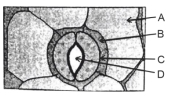
In the given figure,which component has thin outer walls and highly thickened inner walls?
A
$D$
B
$A$
C
$B$
D
$C$
Solution
(C) In the provided diagram of a stoma,the components are labeled as follows:
$A$ represents the epidermal cell.
$B$ represents the guard cell.
$C$ represents the inner wall of the guard cell.
$D$ represents the stomatal pore.
Guard cells are specialized cells that regulate the opening and closing of the stomatal pore. $A$ characteristic feature of guard cells is that they possess thin outer walls (away from the pore) and highly thickened inner walls (towards the pore). Therefore,the component $B$ represents the guard cells.
$A$ represents the epidermal cell.
$B$ represents the guard cell.
$C$ represents the inner wall of the guard cell.
$D$ represents the stomatal pore.
Guard cells are specialized cells that regulate the opening and closing of the stomatal pore. $A$ characteristic feature of guard cells is that they possess thin outer walls (away from the pore) and highly thickened inner walls (towards the pore). Therefore,the component $B$ represents the guard cells.
0 likes
View Solution264
MediumMCQ
The stomatal apparatus consists of :-
A
Stomatal aperture only
B
Stomatal aperture and guard cells
C
Subsidiary cells
D
Stomatal aperture,guard cells,and subsidiary cells
Solution
(D) The stomatal apparatus is a complex structure that regulates gas exchange in plants.
It consists of three main components:
$1$. Stomatal aperture: The central pore through which gases diffuse.
$2$. Guard cells: Two specialized kidney-shaped (in dicots) or dumbbell-shaped (in monocots) cells that surround the aperture and control its opening and closing.
$3$. Subsidiary cells: Specialized epidermal cells that surround the guard cells and provide support.
Therefore,the complete apparatus includes all three components.
It consists of three main components:
$1$. Stomatal aperture: The central pore through which gases diffuse.
$2$. Guard cells: Two specialized kidney-shaped (in dicots) or dumbbell-shaped (in monocots) cells that surround the aperture and control its opening and closing.
$3$. Subsidiary cells: Specialized epidermal cells that surround the guard cells and provide support.
Therefore,the complete apparatus includes all three components.
0 likes
View Solution265
EasyMCQ
Transpiration in plants occurs through the following $EXCEPT$ . . . . . . .
A
stomata
B
hydathode
C
cuticle
D
lenticels
Solution
(B) Transpiration is the process of loss of water in the form of water vapor from the aerial parts of the plant.
It primarily occurs through $3$ pathways: $1.$ Stomata (Stomatal transpiration),$2.$ Cuticle (Cuticular transpiration),and $3.$ Lenticels (Lenticular transpiration).
Hydathodes are specialized structures involved in the process of guttation,which is the loss of water in liquid form,not as water vapor.
Therefore,guttation through hydathodes is not considered a form of transpiration.
It primarily occurs through $3$ pathways: $1.$ Stomata (Stomatal transpiration),$2.$ Cuticle (Cuticular transpiration),and $3.$ Lenticels (Lenticular transpiration).
Hydathodes are specialized structures involved in the process of guttation,which is the loss of water in liquid form,not as water vapor.
Therefore,guttation through hydathodes is not considered a form of transpiration.
0 likes
View Solution266
EasyMCQ
Accessory cells of stomata are reservoirs of . . . . . . .
A
$Zn^{++}$ ions
B
$H^{+}$ ions
C
$K^{+}$ ions
D
$H^{+}$ ions and $Cl^{-}$ ions
Solution
(C) Accessory cells,also known as subsidiary cells,are specialized epidermal cells that surround the guard cells of the stomata.
These cells play a crucial role in the opening and closing mechanism of stomata by acting as reservoirs for $K^{+}$ ions.
During stomatal opening,$K^{+}$ ions move from the subsidiary cells into the guard cells,which decreases the water potential of the guard cells,leading to water influx and subsequent turgor pressure increase.
These cells play a crucial role in the opening and closing mechanism of stomata by acting as reservoirs for $K^{+}$ ions.
During stomatal opening,$K^{+}$ ions move from the subsidiary cells into the guard cells,which decreases the water potential of the guard cells,leading to water influx and subsequent turgor pressure increase.
0 likes
View Solution267
EasyMCQ
Cuticular transpiration occurs by . . . . . . .
A
imbibition
B
diffusion
C
endo-osmosis
D
exo-osmosis
Solution
(B) Cuticular transpiration is the loss of water in the form of water vapor through the cuticle.
The cuticle is a waxy,waterproof layer of cutin present on the outer surface of the epidermal cells of leaves and stems.
Water molecules move from the internal tissues to the atmosphere through this layer primarily by the process of diffusion.
Therefore,the correct mechanism for cuticular transpiration is diffusion.
The cuticle is a waxy,waterproof layer of cutin present on the outer surface of the epidermal cells of leaves and stems.
Water molecules move from the internal tissues to the atmosphere through this layer primarily by the process of diffusion.
Therefore,the correct mechanism for cuticular transpiration is diffusion.
0 likes
View Solution268
EasyMCQ
The loss of water in the form of liquid occurs through . . . . . . .
A
root
B
trichome
C
stomata
D
hydathode
Solution
(D) The loss of water in the form of liquid droplets from the margins or tips of leaves is known as guttation.
This process occurs through specialized pores called hydathodes.
Hydathodes are permanently open pores usually found at the vein endings of leaves.
Unlike stomata,which regulate transpiration (loss of water as vapor),hydathodes are responsible for the exudation of xylem sap.
This process occurs through specialized pores called hydathodes.
Hydathodes are permanently open pores usually found at the vein endings of leaves.
Unlike stomata,which regulate transpiration (loss of water as vapor),hydathodes are responsible for the exudation of xylem sap.
0 likes
View Solution269
EasyMCQ
How much percentage of water is utilized for cell expansion and plant growth (in $\%$)?
A
$1$
B
$2$
C
$4$
D
$5$
Solution
(D) $5\%$ of water is utilized for cell expansion and plant growth.
Remaining $95\%$ of water becomes surplus,which is then lost into the atmosphere through transpiration.
Remaining $95\%$ of water becomes surplus,which is then lost into the atmosphere through transpiration.
0 likes
View Solution270
EasyMCQ
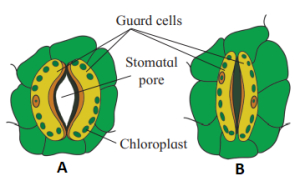
Identify the $INCORRECT$ statement for '$A$' and '$B$' respectively.
A
The guard cells of '$A$' would show less osmotic potential than that of '$B$'.
B
The guard cells of '$A$' are turgid and of '$B$' are flaccid.
C
The guard cells of '$A$' are flaccid and of '$B$' are turgid.
D
'$A$' is an open stomata,'$B$' is a closed stoma.
Solution
(C) In the provided image,'$A$' represents an open stomatal pore,and '$B$' represents a closed stomatal pore.
Stomatal opening occurs when guard cells become turgid due to water influx,which decreases their osmotic potential (making it more negative).
Conversely,stomatal closure occurs when guard cells lose water and become flaccid,which increases their osmotic potential.
Therefore,for '$A$' (open),the guard cells are turgid with lower osmotic potential,and for '$B$' (closed),the guard cells are flaccid with higher osmotic potential.
Statement '$A$' is correct because '$A$' has lower osmotic potential.
Statement '$B$' is correct because '$A$' is turgid and '$B$' is flaccid.
Statement '$C$' is incorrect because it claims '$A$' is flaccid and '$B$' is turgid,which is the opposite of the actual physiological state.
Statement '$D$' is correct as it identifies the structures correctly.
Stomatal opening occurs when guard cells become turgid due to water influx,which decreases their osmotic potential (making it more negative).
Conversely,stomatal closure occurs when guard cells lose water and become flaccid,which increases their osmotic potential.
Therefore,for '$A$' (open),the guard cells are turgid with lower osmotic potential,and for '$B$' (closed),the guard cells are flaccid with higher osmotic potential.
Statement '$A$' is correct because '$A$' has lower osmotic potential.
Statement '$B$' is correct because '$A$' is turgid and '$B$' is flaccid.
Statement '$C$' is incorrect because it claims '$A$' is flaccid and '$B$' is turgid,which is the opposite of the actual physiological state.
Statement '$D$' is correct as it identifies the structures correctly.
0 likes
View Solution271
EasyMCQ
The opening and closing of stomata takes place as a result of active transport of . . . . . . ions in guard cells.
A
Potassium
B
Sodium
C
Chloride
D
Hydrogen
Solution
(A) The opening and closing of stomata are regulated by the turgor pressure of guard cells.
According to the $K^+$ ion pump theory (active potassium transport theory),the accumulation of $K^+$ ions in the guard cells leads to a decrease in water potential.
This causes water to enter the guard cells from adjacent subsidiary cells via osmosis,making the guard cells turgid and causing the stomata to open.
Conversely,the efflux of $K^+$ ions leads to the loss of water,resulting in flaccid guard cells and the closing of stomata.
According to the $K^+$ ion pump theory (active potassium transport theory),the accumulation of $K^+$ ions in the guard cells leads to a decrease in water potential.
This causes water to enter the guard cells from adjacent subsidiary cells via osmosis,making the guard cells turgid and causing the stomata to open.
Conversely,the efflux of $K^+$ ions leads to the loss of water,resulting in flaccid guard cells and the closing of stomata.
0 likes
View Solution272
EasyMCQ
Early in the morning,excess of water collects in the form of droplets near the tip of leaves of herbaceous plants,this is due to
A
Guttation
B
Evaporation
C
Turgor pressure
D
Transpiration
Solution
(A) The process described is known as $Guttation$.
$Guttation$ is the exudation of water droplets from the margins or tips of leaves in herbaceous plants.
It occurs due to high root pressure when the rate of transpiration is very low,typically at night or early in the morning.
The water is released through specialized pores called $Hydathodes$.
$Guttation$ is the exudation of water droplets from the margins or tips of leaves in herbaceous plants.
It occurs due to high root pressure when the rate of transpiration is very low,typically at night or early in the morning.
The water is released through specialized pores called $Hydathodes$.
0 likes
View Solution273
EasyMCQ
Guttation occurs through . . . . . . .
A
roots
B
hydathode
C
trichome
D
stomata
Solution
(B) Guttation is the process of exudation of liquid droplets from the margins or tips of leaves.
This process occurs through specialized pores called hydathodes.
Hydathodes are permanently open pores usually found at the leaf margins.
Unlike stomata,which regulate gas exchange and transpiration,hydathodes are specifically involved in the release of xylem sap under conditions of high root pressure and low transpiration.
This process occurs through specialized pores called hydathodes.
Hydathodes are permanently open pores usually found at the leaf margins.
Unlike stomata,which regulate gas exchange and transpiration,hydathodes are specifically involved in the release of xylem sap under conditions of high root pressure and low transpiration.
0 likes
View Solution274
EasyMCQ
The opening and closing of stomata is controlled by the activity of
A
guard cells
B
epidermal cells
C
mesophyll cells
D
lenticels
Solution
(A) The correct answer is $A$.
Stomata are small pores present on the surface of leaves.
The opening and closing of these stomata are regulated by the turgor pressure changes within the $guard cells$.
When $guard cells$ become turgid, the stoma opens, and when they become flaccid, the stoma closes.
These cells are specialized epidermal cells that surround the stomatal pore.
Stomata are small pores present on the surface of leaves.
The opening and closing of these stomata are regulated by the turgor pressure changes within the $guard cells$.
When $guard cells$ become turgid, the stoma opens, and when they become flaccid, the stoma closes.
These cells are specialized epidermal cells that surround the stomatal pore.
0 likes
View Solution275
EasyMCQ
The following figure shows the stomatal apparatus. Identify the parts labelled as $A, B, C$ and $D$. Choose the correct answer from the following.
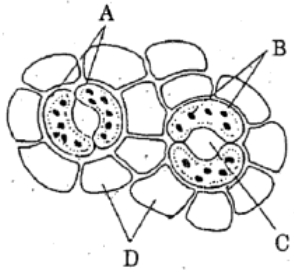
A
$A = \text{Subsidiary cells}, B = \text{Chloroplasts}, C = \text{Stoma}, D = \text{Guard cells}$
B
$A = \text{Guard cells}, B = \text{Stoma}, C = \text{Chloroplasts}, D = \text{Subsidiary cells}$
C
$A = \text{Subsidiary cells}, B = \text{Stoma}, C = \text{Chloroplasts}, D = \text{Guard cells}$
D
$A = \text{Guard cells}, B = \text{Chloroplasts}, C = \text{Stoma}, D = \text{Subsidiary cells}$
Solution
(A) Based on the structure of the stomatal apparatus:
$A$ points to the specialized epidermal cells surrounding the guard cells,known as subsidiary cells.
$B$ points to the small,dark,dot-like structures inside the guard cells,which are chloroplasts.
$C$ points to the central pore or opening,known as the stoma.
$D$ points to the kidney-shaped cells that regulate the opening and closing of the stoma,known as guard cells.
Therefore,the correct identification is $A = \text{Subsidiary cells}, B = \text{Chloroplasts}, C = \text{Stoma}, D = \text{Guard cells}$.
$A$ points to the specialized epidermal cells surrounding the guard cells,known as subsidiary cells.
$B$ points to the small,dark,dot-like structures inside the guard cells,which are chloroplasts.
$C$ points to the central pore or opening,known as the stoma.
$D$ points to the kidney-shaped cells that regulate the opening and closing of the stoma,known as guard cells.
Therefore,the correct identification is $A = \text{Subsidiary cells}, B = \text{Chloroplasts}, C = \text{Stoma}, D = \text{Guard cells}$.
0 likes
View SolutionTransport in Plants — Transpiration (General) and Stomata · Frequently Asked Questions
1Are these Transport in Plants questions useful for JEE and NEET?
Yes. All questions in this section are mapped to JEE Main and NEET exam patterns. Previous year questions from JEE Main, NEET, GUJCET and state-level exams are included with full solutions.
2Can I switch to Hindi or Gujarati for these questions?
Yes. Use the language tabs in the hero section or the sidebar to view the same questions and solutions in English, Hindi or Gujarati.
3How do I generate a question paper from this subtopic?
Use the Vedclass Exam Paper Generator — select the chapter and subtopic, set difficulty, and generate Sets A, B, C, D automatically. First 3 chapters of every subject are free.
Vedclass Products
For Students
Vedclass Test Series
Mock tests in real JEE/NEET style with performance analysis. 5-day free trial.
Start Free TrialFor Teachers
Exam Paper Generator
Generate Set A/B/C/D papers from this chapter in 2 minutes. 3 chapters free.
Try FreeFor Institutes
Online Exam Module
Live online exams with unlimited students, 360° analytics & white-label branding.
See DemoFor Teachers & Institutes
Generate a Transport in Plants Exam Paper in 2 Minutes
Select subtopic & difficulty — Sets A, B, C, D auto-generated with No Repeat logic.
First 3 chapters of every subject are free — no payment required.