
A English
Transpiration (General) and Stomata Questions in English
Class 11 Biology · Transport in Plants · Transpiration (General) and Stomata
275+
Questions
English
Language
100%
With Solutions
Showing 48 of 275 questions in English
151
EasyMCQ
Through which process is liquid exuded from the uninjured part of a leaf tip?
A
Guttation
B
Transpiration
C
Evaporation
D
Evapo-transpiration
Solution
(A) Guttation is the process of exudation of liquid droplets from the uninjured margins or tips of leaves of plants.
It occurs due to high root pressure when the rate of transpiration is low,typically at night or early morning.
This liquid is not pure water but contains various dissolved organic and inorganic substances.
It occurs due to high root pressure when the rate of transpiration is low,typically at night or early morning.
This liquid is not pure water but contains various dissolved organic and inorganic substances.
0 likes
View Solution152
MediumMCQ
Which of the following is $NOT$ included in the stomatal apparatus?
A
Stomatal aperture
B
Guard cells
C
Subsidiary cells
D
Sclerenchymatous cells
Solution
(D) The stomatal apparatus consists of three main components:
$1$. The stomatal aperture (the central pore).
$2$. $A$ pair of guard cells (which regulate the opening and closing of the pore).
$3$. Subsidiary cells (specialized epidermal cells surrounding the guard cells).
Sclerenchymatous cells are structural support cells found in various plant tissues but are not part of the stomatal apparatus.
$1$. The stomatal aperture (the central pore).
$2$. $A$ pair of guard cells (which regulate the opening and closing of the pore).
$3$. Subsidiary cells (specialized epidermal cells surrounding the guard cells).
Sclerenchymatous cells are structural support cells found in various plant tissues but are not part of the stomatal apparatus.
0 likes
View Solution153
MediumMCQ
In terrestrial plants,guard cells differ from other epidermal cells in possessing ..........
A
Cytoskeleton
B
Mitochondria
C
Endoplasmic reticulum
D
Chloroplasts
Solution
(D) Guard cells are specialized epidermal cells that surround the stomatal pore.
Unlike other epidermal cells,which are generally transparent and lack chlorophyll,guard cells contain chloroplasts.
These chloroplasts allow the guard cells to perform photosynthesis and regulate the opening and closing of stomata by changing their turgor pressure.
Therefore,the presence of chloroplasts is the distinguishing feature of guard cells compared to other epidermal cells.
Unlike other epidermal cells,which are generally transparent and lack chlorophyll,guard cells contain chloroplasts.
These chloroplasts allow the guard cells to perform photosynthesis and regulate the opening and closing of stomata by changing their turgor pressure.
Therefore,the presence of chloroplasts is the distinguishing feature of guard cells compared to other epidermal cells.
0 likes
View Solution154
EasyMCQ
Stomata help in ...........
A
Photosynthesis
B
Transpiration
C
Vegetative propagation
D
Gaseous exchange
Solution
(D) Stomata are small pores present on the surface of leaves and young stems.
They perform two primary functions:
$1$. $Gaseous$ $exchange$: They allow the entry of $CO_2$ and the exit of $O_2$ during photosynthesis and respiration.
$2$. $Transpiration$: They facilitate the loss of water in the form of water vapor from the plant body.
While both $B$ and $D$ are functions of stomata, in the context of general biological questions regarding the primary role of stomatal pores in plant physiology, 'Gaseous exchange' is the most fundamental process for survival. However, if the question implies a single best answer, 'Gaseous exchange' is the most comprehensive answer.
They perform two primary functions:
$1$. $Gaseous$ $exchange$: They allow the entry of $CO_2$ and the exit of $O_2$ during photosynthesis and respiration.
$2$. $Transpiration$: They facilitate the loss of water in the form of water vapor from the plant body.
While both $B$ and $D$ are functions of stomata, in the context of general biological questions regarding the primary role of stomatal pores in plant physiology, 'Gaseous exchange' is the most fundamental process for survival. However, if the question implies a single best answer, 'Gaseous exchange' is the most comprehensive answer.
0 likes
View Solution155
EasyMCQ
The primary function of stomata is .....
A
Transpiration
B
Guttation
C
Gaseous exchange
D
Exudation
Solution
(C) Stomata are specialized pores found primarily on the epidermis of leaves. Their primary functions are:
$1$. Gaseous exchange: They allow the entry of $CO_2$ for photosynthesis and the release of $O_2$ as a byproduct.
$2$. Transpiration: They facilitate the loss of water vapor from the plant body,which helps in the upward movement of water and minerals.
While both transpiration and gaseous exchange occur through stomata,the term 'stomata' is most fundamentally associated with the regulation of gas exchange for metabolic processes. However,in many standard biological contexts,gaseous exchange is considered the primary physiological function.
$1$. Gaseous exchange: They allow the entry of $CO_2$ for photosynthesis and the release of $O_2$ as a byproduct.
$2$. Transpiration: They facilitate the loss of water vapor from the plant body,which helps in the upward movement of water and minerals.
While both transpiration and gaseous exchange occur through stomata,the term 'stomata' is most fundamentally associated with the regulation of gas exchange for metabolic processes. However,in many standard biological contexts,gaseous exchange is considered the primary physiological function.
0 likes
View Solution156
EasyMCQ
In which of the following are stomata absent?
A
Stem
B
Fruit
C
Root
D
Leaf
Solution
(C) Stomata are specialized structures found in the epidermis of leaves and young stems that facilitate gas exchange and transpiration.
Stomata are typically absent in the roots of plants because roots are primarily underground organs involved in water and mineral absorption,not gas exchange with the atmosphere.
Therefore,the correct answer is $C$ (Root).
Stomata are typically absent in the roots of plants because roots are primarily underground organs involved in water and mineral absorption,not gas exchange with the atmosphere.
Therefore,the correct answer is $C$ (Root).
0 likes
View Solution157
MediumMCQ
What is a common feature between stomata and hydathodes?
A
Both allow the exchange of gases.
B
They always remain closed.
C
There is no regulation in their opening and closing.
D
They are located on the same parts of the plant.
Solution
(A) Stomata are specialized pores found in the epidermis of leaves and young stems that regulate gas exchange and transpiration. Hydathodes are specialized structures,often found at the tips or margins of leaves,that facilitate the process of guttation (the exudation of water droplets). The common feature between them is that both are pores or openings that allow for the passage of substances (gases in stomata and water/solutes in hydathodes) from the interior of the plant to the external environment.
0 likes
View Solution158
EasyMCQ
Leaves having an equal number of stomata on both surfaces are called ........
A
Amphistomatic
B
Hypostomatic
C
Epistomatic
D
Astomatic
Solution
(A) Leaves are classified based on the distribution of stomata on their surfaces:
$1$. $Amphistomatic$: Stomata are present on both the upper and lower surfaces of the leaf.
$2$. $Hypostomatic$: Stomata are present only on the lower surface (common in dicot leaves).
$3$. $Epistomatic$: Stomata are present only on the upper surface (common in floating aquatic plants).
$4$. $Astomatic$: Stomata are absent (e.g.,submerged aquatic plants).
Therefore,leaves with an equal number of stomata on both surfaces are termed $Amphistomatic$.
$1$. $Amphistomatic$: Stomata are present on both the upper and lower surfaces of the leaf.
$2$. $Hypostomatic$: Stomata are present only on the lower surface (common in dicot leaves).
$3$. $Epistomatic$: Stomata are present only on the upper surface (common in floating aquatic plants).
$4$. $Astomatic$: Stomata are absent (e.g.,submerged aquatic plants).
Therefore,leaves with an equal number of stomata on both surfaces are termed $Amphistomatic$.
0 likes
View Solution159
MediumMCQ
Which of the following statements is not true for stomatal apparatus?
A
Guard cells invariably possess chloroplasts and mitochondria.
B
Guard cells are always surrounded by subsidiary cells.
C
Stomata are involved in gaseous exchange.
D
Inner wall of guard cells are thick.
Solution
(B) The correct answer is $B$. The epidermal surface of the leaf exhibits $1,000$ to $60,000$ minute openings called stomata.
Stomata are bordered by two specialized epidermal cells,known as guard cells.
In many plants,these guard cells are accompanied by specialized cells called subsidiary cells,but this is not a universal rule.
Guard cells possess chloroplasts and mitochondria.
The walls of guard cells are unevenly thickened; specifically,the inner walls (facing the stomatal aperture) are thick and inelastic,while the outer walls are thin and elastic.
Therefore,the statement that guard cells are always surrounded by subsidiary cells is incorrect.
Stomata are bordered by two specialized epidermal cells,known as guard cells.
In many plants,these guard cells are accompanied by specialized cells called subsidiary cells,but this is not a universal rule.
Guard cells possess chloroplasts and mitochondria.
The walls of guard cells are unevenly thickened; specifically,the inner walls (facing the stomatal aperture) are thick and inelastic,while the outer walls are thin and elastic.
Therefore,the statement that guard cells are always surrounded by subsidiary cells is incorrect.
0 likes
View Solution160
MediumMCQ
Which of the following facilitates opening of stomatal aperture?
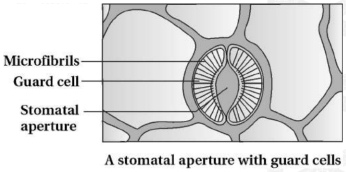
A
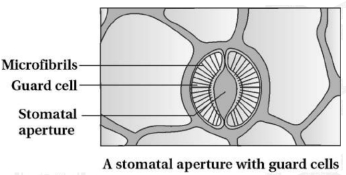
Decrease in turgidity of guard cells
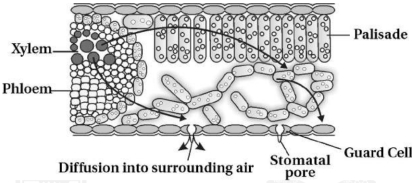
B
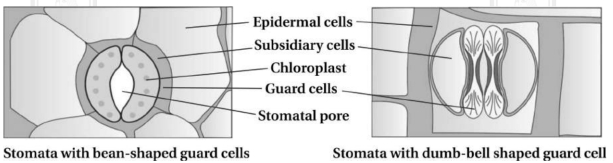
Radial orientation of cellulose microfibrils in the cell wall of guard cells
C
Longitudinal orientation of cellulose microfibrils in the cell wall of guard cells
D
Contraction of outer wall of guard cells
Solution
(B) The correct answer is $B$.
When the turgidity of the two guard cells flanking each stomatal aperture increases,the thin outer walls bulge out,forcing the thick inner walls into a crescent shape.
This mechanical change results in the opening of the stomata.
The opening process is specifically facilitated by the radial orientation of cellulose microfibrils in the cell walls of the guard cells.
This radial arrangement prevents the cells from expanding in diameter,forcing them to expand in length and curve outward,which opens the pore.
When the turgidity of the two guard cells flanking each stomatal aperture increases,the thin outer walls bulge out,forcing the thick inner walls into a crescent shape.
This mechanical change results in the opening of the stomata.
The opening process is specifically facilitated by the radial orientation of cellulose microfibrils in the cell walls of the guard cells.
This radial arrangement prevents the cells from expanding in diameter,forcing them to expand in length and curve outward,which opens the pore.
0 likes
View Solution161
MediumMCQ
Which one gives the most valid and recent explanation for stomatal movement?
A
Starch hydrolysis
B
Guard cell photosynthesis
C
Transpiration
D
Potassium influx and efflux
Solution
(D) The most widely accepted and recent explanation for stomatal movement is the $K^+$ ion transport theory (Potassium pump theory).
According to this theory,during the daytime,$K^+$ ions enter the guard cells from the surrounding subsidiary cells,which decreases the water potential of the guard cells.
This leads to the endosmosis of water into the guard cells,making them turgid and causing the stomata to open.
Conversely,during the night,$K^+$ ions move out of the guard cells,leading to the exosmosis of water,which makes the guard cells flaccid and causes the stomata to close.
According to this theory,during the daytime,$K^+$ ions enter the guard cells from the surrounding subsidiary cells,which decreases the water potential of the guard cells.
This leads to the endosmosis of water into the guard cells,making them turgid and causing the stomata to open.
Conversely,during the night,$K^+$ ions move out of the guard cells,leading to the exosmosis of water,which makes the guard cells flaccid and causes the stomata to close.
0 likes
View Solution162
EasyMCQ
Given below is the diagram of a stomatal apparatus. In which of the following are all the four parts labelled as $A, B, C$ and $D$ correctly identified?
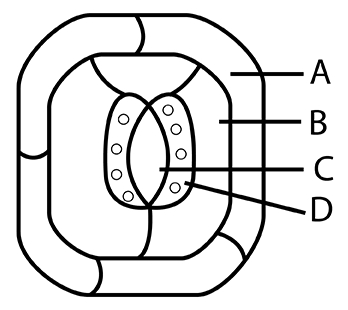
A
$A$-Subsidiary cell,$B$-Epidermal cell,$C$-Guard cell,$D$-Stomatal aperture
B
$A$-Guard cell,$B$-Stomatal aperture,$C$-Subsidiary cell,$D$-Epidermal cell
C
$A$-Epidermal cell,$B$-Guard cell,$C$-Stomatal aperture,$D$-Subsidiary cell
D
$A$-Epidermal cell,$B$-Subsidiary cell,$C$-Stomatal aperture,$D$-Guard cell
Solution
(D) The correct identification of the parts in the stomatal apparatus diagram is as follows:
$A$ - Epidermal cell: The outer cells surrounding the stomatal complex.
$B$ - Subsidiary cell: Specialized cells that surround the guard cells.
$C$ - Stomatal aperture: The central pore through which gas exchange occurs.
$D$ - Guard cell: The specialized kidney-shaped cells that regulate the opening and closing of the stomatal aperture.
Therefore,option $D$ is the correct answer.
$A$ - Epidermal cell: The outer cells surrounding the stomatal complex.
$B$ - Subsidiary cell: Specialized cells that surround the guard cells.
$C$ - Stomatal aperture: The central pore through which gas exchange occurs.
$D$ - Guard cell: The specialized kidney-shaped cells that regulate the opening and closing of the stomatal aperture.
Therefore,option $D$ is the correct answer.
0 likes
View Solution163
EasyMCQ
Guard cells help in
A
transpiration
B
guttation
C
fighting against infection
D
protection against grazing
Solution
(A) : Stomata are the primary organs for transpiration. The epidermis of stems and leaves contains numerous stomata. The diffusion of water vapour through stomatal pores is known as stomatal transpiration. Transpiration occurs while stomata are open for the passage of $CO_2$ and $O_2$ during photosynthesis. The opening and closing of stomata are regulated by the movement of guard cells.
0 likes
View Solution164
MediumMCQ
Water vapour comes out from the plant leaf through the stomatal opening. Through the same stomatal opening,carbon dioxide diffuses into the plant during photosynthesis. Reason out the above statements using one of the following options.
A
The above processes happen only during night time.
B
One process occurs during day time and the other at night.
C
Both processes cannot happen simultaneously.
D
Both processes can happen together because the diffusion coefficient of water and $CO_2$ is different.
Solution
(D) The correct answer is $D$. Transpiration (loss of water vapour) and photosynthesis (uptake of $CO_2$) occur through the stomata. These two processes can occur simultaneously because the diffusion of gases is independent of each other. The rate of diffusion depends on the diffusion coefficient of the specific gas and the concentration gradient. Since water vapour and $CO_2$ have different diffusion coefficients,they can diffuse in opposite directions through the same stomatal pore at the same time.
0 likes
View Solution165
EasyMCQ
By which process is water lost from the plants in the form of water droplets?
A
Guttation
B
Imbibition
C
Transpiration
D
Evaporation
Solution
(A) Guttation is the process of loss of water in the form of liquid droplets from the margins or tips of leaves through specialized structures called hydathodes.
This usually occurs in herbaceous plants under conditions of high soil moisture and low evaporation,typically at night or early morning.
Transpiration involves the loss of water in the form of water vapor,not droplets.
Imbibition is the process of absorption of water by solid particles (colloids) causing an increase in volume.
Evaporation is a physical process where liquid turns into vapor.
This usually occurs in herbaceous plants under conditions of high soil moisture and low evaporation,typically at night or early morning.
Transpiration involves the loss of water in the form of water vapor,not droplets.
Imbibition is the process of absorption of water by solid particles (colloids) causing an increase in volume.
Evaporation is a physical process where liquid turns into vapor.
0 likes
View Solution166
EasyMCQ
Which of the following is not related to the structure of stomata?
A
Accessory cells
B
Epidermal cell
C
Sclerenchyma cell
D
Guard cell
Solution
(C) The structure of a stoma consists of two bean-shaped or dumbbell-shaped cells called $Guard$ cells, which regulate the opening and closing of the stomatal pore.
These $Guard$ cells are surrounded by specialized epidermal cells known as $Subsidiary$ cells or $Accessory$ cells.
$Epidermal$ cells form the outer layer of the leaf surface where stomata are embedded.
$Sclerenchyma$ cells are structural support cells characterized by thick, lignified walls and are not a component of the stomatal apparatus.
These $Guard$ cells are surrounded by specialized epidermal cells known as $Subsidiary$ cells or $Accessory$ cells.
$Epidermal$ cells form the outer layer of the leaf surface where stomata are embedded.
$Sclerenchyma$ cells are structural support cells characterized by thick, lignified walls and are not a component of the stomatal apparatus.
0 likes
View Solution167
EasyMCQ
Identify $X$ and $Y$ from the figure.
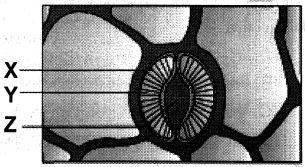
A
$X=$ Guard cell,$Y=$ Stomatal aperture
B
$X=$ Microfilaments,$Y=$ Guard cell
C
$X=$ Subsidiary cell,$Y=$ Microfilaments
D
$X=$ Guard cell,$Y=$ Microfilaments
Solution
(A) In the provided figure,$X$ points to the specialized kidney-shaped cells known as guard cells,which regulate the opening and closing of the stomata. $Y$ points to the central pore or opening,known as the stomatal aperture. The radial orientation of cellulose microfibrils (often labeled as $Z$ in similar diagrams) helps in the opening of the stomata. Therefore,$X$ is the guard cell and $Y$ is the stomatal aperture.
0 likes
View Solution168
EasyMCQ
Water loss by vapour through stomata is known as:
A
Root pressure
B
Water stress
C
Transpiration
D
Imbibition
Solution
(C) The process of water loss in the form of water vapour from the aerial parts of a plant, primarily through the stomata of the leaves, is called $Transpiration$.
$Root pressure$ is the positive pressure that develops in the roots of plants by the active absorption of nutrients.
$Water stress$ refers to the condition where the demand for water exceeds the available amount.
$Imbibition$ is the process of absorption of water by solid particles of a substance without forming a solution.
$Root pressure$ is the positive pressure that develops in the roots of plants by the active absorption of nutrients.
$Water stress$ refers to the condition where the demand for water exceeds the available amount.
$Imbibition$ is the process of absorption of water by solid particles of a substance without forming a solution.
0 likes
View Solution169
EasyMCQ
By which process is water lost from the plants in the form of water droplets?
A
Guttation
B
Imbibition
C
Respiration
D
Osmosis
Solution
(A) Guttation is the process of loss of water in the form of liquid droplets from the margins or tips of leaves through specialized pores called hydathodes.
This usually occurs in herbaceous plants when root pressure is high and transpiration is low,typically during the night or early morning.
Imbibition is the absorption of water by solid particles.
Respiration is the metabolic process of breaking down glucose to release energy.
Osmosis is the movement of water molecules across a semi-permeable membrane from a region of higher water potential to a region of lower water potential.
This usually occurs in herbaceous plants when root pressure is high and transpiration is low,typically during the night or early morning.
Imbibition is the absorption of water by solid particles.
Respiration is the metabolic process of breaking down glucose to release energy.
Osmosis is the movement of water molecules across a semi-permeable membrane from a region of higher water potential to a region of lower water potential.
0 likes
View Solution170
MediumMCQ
$A-$ The inner wall of each guard cell,towards the pore or stomatal aperture,is thick and elastic.
$R -$ Cellulose microfibrils are oriented longitudinally in the cell walls of the guard cells.
$R -$ Cellulose microfibrils are oriented longitudinally in the cell walls of the guard cells.
A
$A$ and $R$ are correct
B
$A$ and $R$ are incorrect
C
$A$ is correct,$R$ is incorrect
D
$A$ is incorrect,$R$ is correct
Solution
(C) Assertion $(A)$ is correct: The inner walls of guard cells,which face the stomatal pore,are thick and elastic,which helps in the opening and closing of the stoma.
Reason $(R)$ is incorrect: The cellulose microfibrils in the guard cells are oriented radially (not longitudinally) in the cell walls. This radial orientation is crucial for the mechanism of stomatal opening,as it allows the guard cells to bulge outwards when they become turgid.
Reason $(R)$ is incorrect: The cellulose microfibrils in the guard cells are oriented radially (not longitudinally) in the cell walls. This radial orientation is crucial for the mechanism of stomatal opening,as it allows the guard cells to bulge outwards when they become turgid.
0 likes
View Solution171
MediumMCQ
Which of the following is $NOT$ an aim or function of transpiration?
A
Maintain the shape and structure of the plants by keeping cells turgid
B
It produces root pressure and supplies water for photosynthesis
C
Cools leaf surfaces
D
Transports minerals from the soil to all parts of the plant
Solution
(B) Transpiration is the evaporative loss of water by plants,which occurs mainly through the stomata in the leaves.
Its primary functions include:
$1$. Creating transpiration pull for the absorption and transport of water and minerals from the soil to all parts of the plant.
$2$. Cooling leaf surfaces,sometimes by $10-15^{\circ}C$,by evaporative cooling.
$3$. Maintaining the shape and structure of plants by keeping cells turgid.
Option $B$ is incorrect because transpiration does not produce root pressure. Root pressure is a positive pressure that develops in the roots due to the active absorption of mineral ions,which is independent of transpiration. In fact,root pressure is most observable when transpiration is low (e.g.,at night).
Its primary functions include:
$1$. Creating transpiration pull for the absorption and transport of water and minerals from the soil to all parts of the plant.
$2$. Cooling leaf surfaces,sometimes by $10-15^{\circ}C$,by evaporative cooling.
$3$. Maintaining the shape and structure of plants by keeping cells turgid.
Option $B$ is incorrect because transpiration does not produce root pressure. Root pressure is a positive pressure that develops in the roots due to the active absorption of mineral ions,which is independent of transpiration. In fact,root pressure is most observable when transpiration is low (e.g.,at night).
0 likes
View Solution172
EasyMCQ
...... percent of the water reaching the leaves is used in photosynthesis and plant growth.
A
Less than $1$
B
Less than $2$
C
Less than $1.5$
D
None of the above
Solution
(A) Plants absorb a large amount of water through their roots.
Most of this water is lost to the atmosphere through transpiration from the leaves.
Only a very small fraction of the water reaching the leaves,specifically less than $1\%$,is actually utilized by the plant for metabolic processes such as photosynthesis and maintaining plant growth.
Most of this water is lost to the atmosphere through transpiration from the leaves.
Only a very small fraction of the water reaching the leaves,specifically less than $1\%$,is actually utilized by the plant for metabolic processes such as photosynthesis and maintaining plant growth.
0 likes
View Solution173
MediumMCQ
Choose the incorrect sentence.
A
Transpiration is the evaporative loss of water by plants.
B
Normally,stomata are closed in the daytime and open during the night.
C
The inner wall of each guard cell towards the pore or stomatal aperture is thick and elastic.
D
When the guard cells lose turgidity due to water loss,the elastic inner walls regain their original shape,the guard cells become flaccid,and the stomata close.
Solution
(B) The correct answer is $B$.
Normally,in most plants,stomata are open during the daytime to facilitate gas exchange for photosynthesis and close during the night to prevent unnecessary water loss.
Option $A$ is correct as transpiration is indeed the evaporative loss of water from aerial parts of plants.
Option $C$ is correct because the inner walls of guard cells are thick and elastic,which helps in the opening and closing mechanism.
Option $D$ is correct as the loss of turgor pressure leads to the flaccidity of guard cells,causing the stomatal pore to close.
Normally,in most plants,stomata are open during the daytime to facilitate gas exchange for photosynthesis and close during the night to prevent unnecessary water loss.
Option $A$ is correct as transpiration is indeed the evaporative loss of water from aerial parts of plants.
Option $C$ is correct because the inner walls of guard cells are thick and elastic,which helps in the opening and closing mechanism.
Option $D$ is correct as the loss of turgor pressure leads to the flaccidity of guard cells,causing the stomatal pore to close.
0 likes
View Solution174
MediumMCQ
Choose the incorrect sentence regarding the compromise between transpiration and photosynthesis.
A
Creates transpiration pull for the absorption and transport of water in plants.
B
Supplies water for respiration.
C
Transports minerals from the soil to all parts of the plants.
D
Maintains the shape and structure of the plants by keeping cells turgid.
Solution
(B) Transpiration is a necessary evil in plants. It serves several vital functions:
$1$. It creates a transpiration pull for the absorption and transport of water from roots to leaves.
$2$. It transports minerals from the soil to all parts of the plant.
$3$. It cools leaf surfaces,sometimes by $10-15$ degrees,through evaporative cooling.
$4$. It maintains the shape and structure of plants by keeping cells turgid.
However,transpiration does not supply water for respiration; in fact,respiration produces water as a byproduct. Therefore,option $B$ is the incorrect statement.
$1$. It creates a transpiration pull for the absorption and transport of water from roots to leaves.
$2$. It transports minerals from the soil to all parts of the plant.
$3$. It cools leaf surfaces,sometimes by $10-15$ degrees,through evaporative cooling.
$4$. It maintains the shape and structure of plants by keeping cells turgid.
However,transpiration does not supply water for respiration; in fact,respiration produces water as a byproduct. Therefore,option $B$ is the incorrect statement.
0 likes
View Solution175
MediumMCQ
$Potassium$ ions play an important role in the opening and closing of stomata.
A
Sodium
B
Magnesium
C
Potassium
D
Chlorine
Solution
(C) The opening and closing of stomata are primarily regulated by the movement of $Potassium$ $(K^+)$ ions in and out of the guard cells.
When $K^+$ ions accumulate in the guard cells,the osmotic pressure increases,causing water to enter the cells via osmosis.
This increases the turgor pressure of the guard cells,leading to the opening of the stomatal pore.
Conversely,the efflux of $K^+$ ions leads to a decrease in turgor pressure,resulting in the closing of the stomata.
When $K^+$ ions accumulate in the guard cells,the osmotic pressure increases,causing water to enter the cells via osmosis.
This increases the turgor pressure of the guard cells,leading to the opening of the stomatal pore.
Conversely,the efflux of $K^+$ ions leads to a decrease in turgor pressure,resulting in the closing of the stomata.
0 likes
View Solution176
MediumMCQ
Which element takes part in the opening and closing of stomata?
A
Sodium
B
Magnesium
C
Potassium
D
Chlorine
Solution
(C) The opening and closing of stomata are primarily regulated by the movement of $K^+$ (potassium) ions in and out of the guard cells.
When $K^+$ ions enter the guard cells,the osmotic pressure increases,causing water to flow into the cells,which leads to the swelling of guard cells and the opening of the stomata.
Conversely,when $K^+$ ions exit the guard cells,water follows,causing the guard cells to become flaccid and the stomata to close.
Therefore,potassium is the essential element involved in this process.
When $K^+$ ions enter the guard cells,the osmotic pressure increases,causing water to flow into the cells,which leads to the swelling of guard cells and the opening of the stomata.
Conversely,when $K^+$ ions exit the guard cells,water follows,causing the guard cells to become flaccid and the stomata to close.
Therefore,potassium is the essential element involved in this process.
0 likes
View Solution177
MediumMCQ
$(i)$ The ...$a$... help in maintaining the pressure gradient in the sieve tubes.
$(ii)$ Stomata regulate the process of ....$b$..... and gaseous exchange.
$(ii)$ Stomata regulate the process of ....$b$..... and gaseous exchange.
A
$a$ - Tracheids,$b$ - Transpiration
B
$a$ - Companion cells,$b$ - Transpiration
C
$a$ - Companion cells,$b$ - $CO_2$ concentration
D
$a$ - Vessels,$b$ - Transpiration
Solution
(B) $(i)$ Companion cells are specialized parenchyma cells associated with sieve tube elements in the phloem. They maintain the pressure gradient in the sieve tubes by loading and unloading sugars,which creates osmotic potential differences.
$(ii)$ Stomata are small pores present on the epidermis of leaves. They regulate the process of transpiration (loss of water vapor) and the exchange of gases like $O_2$ and $CO_2$ between the plant and the atmosphere.
$(ii)$ Stomata are small pores present on the epidermis of leaves. They regulate the process of transpiration (loss of water vapor) and the exchange of gases like $O_2$ and $CO_2$ between the plant and the atmosphere.
0 likes
View Solution178
MediumMCQ
Phenylmercuric acetate $(PMA)$ results in which of the following effects?
A
Decreased photosynthesis
B
Decreased transpiration
C
Decreased respiration
D
Destruction of plants
Solution
(B) Phenylmercuric acetate $(PMA)$ is a well-known anti-transpirant chemical.
It acts by inducing the partial closure of stomata in plants.
By reducing the size of the stomatal aperture,it significantly decreases the rate of transpiration without affecting photosynthesis to the same extent.
Therefore,the application of $PMA$ leads to a reduction in water loss through transpiration.
It acts by inducing the partial closure of stomata in plants.
By reducing the size of the stomatal aperture,it significantly decreases the rate of transpiration without affecting photosynthesis to the same extent.
Therefore,the application of $PMA$ leads to a reduction in water loss through transpiration.
0 likes
View Solution179
MediumMCQ
The opening and closing of stomata are caused by:
A
Circadian rhythm
B
Genetic clock
C
Pressure of gases inside the leaves
D
Turgor pressure in guard cells
Solution
(D) The opening and closing of stomata are primarily regulated by the turgor pressure within the guard cells.
When the guard cells take up water through osmosis,they become turgid and bulge outward,causing the stomatal pore to open.
Conversely,when water leaves the guard cells,they become flaccid,causing the stomatal pore to close.
This process is influenced by factors like light,$CO_2$ concentration,and potassium ion $(K^+)$ flux.
When the guard cells take up water through osmosis,they become turgid and bulge outward,causing the stomatal pore to open.
Conversely,when water leaves the guard cells,they become flaccid,causing the stomatal pore to close.
This process is influenced by factors like light,$CO_2$ concentration,and potassium ion $(K^+)$ flux.
0 likes
View Solution180
MediumMCQ
The primary mechanism for the opening of stomata is:
A
Exosmosis
B
Endosmosis
C
Decrease in the concentration of cytoplasm
D
Plasmolysis of guard cells
Solution
(B) The opening and closing of stomata are regulated by the turgor pressure of the guard cells.
When guard cells take up water through the process of endosmosis,they become turgid.
This increase in turgor pressure causes the outer thin walls of the guard cells to bulge outwards,which in turn pulls the inner thick walls apart,leading to the opening of the stomatal pore.
Therefore,endosmosis is the fundamental process responsible for the opening of stomata.
When guard cells take up water through the process of endosmosis,they become turgid.
This increase in turgor pressure causes the outer thin walls of the guard cells to bulge outwards,which in turn pulls the inner thick walls apart,leading to the opening of the stomatal pore.
Therefore,endosmosis is the fundamental process responsible for the opening of stomata.
0 likes
View Solution181
MediumMCQ
When sugar in guard cells is converted into starch,the stomatal pore $..........$
A
closes completely
B
opens partially
C
opens completely
D
remains unchanged
Solution
(A) According to the starch-sugar interconversion theory,the opening and closing of stomata depend on the osmotic pressure of guard cells.
When sugar is converted into starch,the osmotic pressure of the guard cells decreases.
This leads to the movement of water out of the guard cells (exosmosis),causing them to become flaccid.
As a result,the stomatal pore closes completely.
When sugar is converted into starch,the osmotic pressure of the guard cells decreases.
This leads to the movement of water out of the guard cells (exosmosis),causing them to become flaccid.
As a result,the stomatal pore closes completely.
0 likes
View Solution182
MediumMCQ
The conversion of starch into organic acids is essential for:
A
Stomatal closure
B
Stomatal opening
C
Stomatal initiation
D
Stomatal growth
Solution
(B) According to the starch-sugar interconversion theory (proposed by Steward),the opening and closing of stomata are regulated by the concentration of sugar and starch in the guard cells.
During the day,the $pH$ of the guard cells increases due to photosynthesis (consumption of $CO_2$).
This high $pH$ triggers the enzyme phosphorylase to convert starch into glucose$-1-$phosphate (an organic acid/sugar derivative).
This increases the osmotic pressure of the guard cells,causing water to enter from adjacent cells via endosmosis.
The resulting turgor pressure causes the stomata to open.
Conversely,at night,the $pH$ decreases,and glucose$-1-$phosphate is converted back into starch,leading to stomatal closure.
During the day,the $pH$ of the guard cells increases due to photosynthesis (consumption of $CO_2$).
This high $pH$ triggers the enzyme phosphorylase to convert starch into glucose$-1-$phosphate (an organic acid/sugar derivative).
This increases the osmotic pressure of the guard cells,causing water to enter from adjacent cells via endosmosis.
The resulting turgor pressure causes the stomata to open.
Conversely,at night,the $pH$ decreases,and glucose$-1-$phosphate is converted back into starch,leading to stomatal closure.
0 likes
View Solution183
MediumMCQ
Stomata in plants open due to the ............ .
A
influx of $H^+$ ions
B
influx of $Ca^{2+}$ ions
C
influx of $K^+$ ions
D
efflux of $K^+$ ions
Solution
(C) According to the $K^+$ ion pump theory (Levitt,$1974$),the opening and closing of stomata are regulated by the movement of potassium ions $(K^+)$ in and out of the guard cells.
When stomata open,$K^+$ ions move from the surrounding subsidiary cells into the guard cells (influx).
This influx of $K^+$ ions increases the solute concentration inside the guard cells,leading to a decrease in water potential.
Consequently,water enters the guard cells from the surrounding cells via osmosis,causing them to become turgid and resulting in the opening of the stomatal pore.
When stomata open,$K^+$ ions move from the surrounding subsidiary cells into the guard cells (influx).
This influx of $K^+$ ions increases the solute concentration inside the guard cells,leading to a decrease in water potential.
Consequently,water enters the guard cells from the surrounding cells via osmosis,causing them to become turgid and resulting in the opening of the stomatal pore.
0 likes
View Solution184
MediumMCQ
Stomatal movement is not affected by
A
$CO_2$ concentration
B
$O_2$ concentration
C
Temperature
D
Light
Solution
(B) Stomatal movement is primarily regulated by environmental factors such as light,temperature,and the concentration of $CO_2$ inside the leaf.
Light triggers the opening of stomata by promoting the accumulation of potassium ions $(K^+)$ in guard cells,which lowers the water potential and causes water to enter the cells via osmosis.
$CO_2$ concentration acts as a feedback mechanism; high internal $CO_2$ levels typically induce stomatal closure to prevent excessive water loss while maintaining gas exchange efficiency.
Temperature influences the rate of transpiration and the metabolic activity of guard cells.
However,the concentration of $O_2$ does not have a direct regulatory effect on the opening or closing of stomata.
Light triggers the opening of stomata by promoting the accumulation of potassium ions $(K^+)$ in guard cells,which lowers the water potential and causes water to enter the cells via osmosis.
$CO_2$ concentration acts as a feedback mechanism; high internal $CO_2$ levels typically induce stomatal closure to prevent excessive water loss while maintaining gas exchange efficiency.
Temperature influences the rate of transpiration and the metabolic activity of guard cells.
However,the concentration of $O_2$ does not have a direct regulatory effect on the opening or closing of stomata.
0 likes
View Solution185
MediumMCQ
Excessive loss of water causes wilting of leaves; it can be prevented by:
A
Keeping the plant in bright light
B
Spraying the plant with alcohol
C
Applying vaseline on the leaf surface
D
Adding high amounts of fertilizers to the soil
Solution
(C) Excessive loss of water from the leaves occurs due to transpiration.
Applying vaseline on the leaf surface creates a physical barrier that blocks the stomata.
By closing the stomata,the exit of water vapor is restricted,thereby preventing excessive water loss and subsequent wilting of the leaves.
Applying vaseline on the leaf surface creates a physical barrier that blocks the stomata.
By closing the stomata,the exit of water vapor is restricted,thereby preventing excessive water loss and subsequent wilting of the leaves.
0 likes
View Solution186
MediumMCQ
Assertion: Waxy and cutin coating on plant parts reduce the transpiration.
Reason: These adaptations are found in xerophytes.
Reason: These adaptations are found in xerophytes.
A
If both Assertion and Reason are correct and the Reason is a correct explanation of the Assertion.
B
If both Assertion and Reason are correct but Reason is not a correct explanation of the Assertion.
C
If the Assertion is correct but Reason is incorrect.
D
If both the Assertion and Reason are incorrect.
Solution
(A) Waxy and cutin coatings on the surface of leaves and stems act as a barrier to water loss,thereby significantly reducing the rate of transpiration.
This structural adaptation is a characteristic feature of xerophytes,which are plants adapted to survive in environments with limited water availability.
Since the presence of these coatings is a direct evolutionary adaptation to minimize water loss in dry habitats,the Reason correctly explains the Assertion.
This structural adaptation is a characteristic feature of xerophytes,which are plants adapted to survive in environments with limited water availability.
Since the presence of these coatings is a direct evolutionary adaptation to minimize water loss in dry habitats,the Reason correctly explains the Assertion.
0 likes
View Solution187
MediumMCQ
Assertion : Light is a very important factor in transpiration.
Reason : Light induces stomatal opening and darkness closing of stomata. Therefore,transpiration increases in light and decreases in dark.
Reason : Light induces stomatal opening and darkness closing of stomata. Therefore,transpiration increases in light and decreases in dark.
A
If both Assertion and Reason are correct and the Reason is a correct explanation of the Assertion.
B
If both Assertion and Reason are correct but Reason is not a correct explanation of the Assertion.
C
If the Assertion is correct but Reason is incorrect.
D
If both the Assertion and Reason are incorrect.
Solution
(A) Light is a critical environmental factor affecting the rate of transpiration.
Most plants have stomata that open in response to light to facilitate $CO_2$ intake for photosynthesis.
When stomata open,the pathway for water vapor loss increases,thereby increasing the rate of transpiration.
Conversely,in the dark,stomata close to conserve water,which significantly reduces transpiration.
Since the reason directly explains the mechanism by which light influences transpiration,the Reason is the correct explanation of the Assertion.
Most plants have stomata that open in response to light to facilitate $CO_2$ intake for photosynthesis.
When stomata open,the pathway for water vapor loss increases,thereby increasing the rate of transpiration.
Conversely,in the dark,stomata close to conserve water,which significantly reduces transpiration.
Since the reason directly explains the mechanism by which light influences transpiration,the Reason is the correct explanation of the Assertion.
0 likes
View Solution188
Difficult
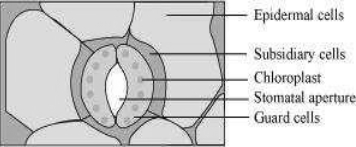
What is the stomatal apparatus? Explain the structure of stomata with a labelled diagram.
Solution
(N/A) The stomatal apparatus consists of the stomatal aperture,guard cells,and surrounding subsidiary cells.
Stomata are small pores present in the epidermis of leaves that regulate the process of transpiration and gaseous exchange.
Each stomatal pore is enclosed between two bean-shaped guard cells.
In grasses,the guard cells are dumbbell-shaped.
The inner walls of guard cells (towards the pore) are thick,while the outer walls are thin.
The guard cells contain chloroplasts and regulate the opening and closing of the stomata.
The guard cells are surrounded by subsidiary cells,which are specialized epidermal cells that provide support to the guard cells.
Together,the stomatal aperture,guard cells,and the surrounding subsidiary cells constitute the stomatal apparatus.
Stomata are small pores present in the epidermis of leaves that regulate the process of transpiration and gaseous exchange.
Each stomatal pore is enclosed between two bean-shaped guard cells.
In grasses,the guard cells are dumbbell-shaped.
The inner walls of guard cells (towards the pore) are thick,while the outer walls are thin.
The guard cells contain chloroplasts and regulate the opening and closing of the stomata.
The guard cells are surrounded by subsidiary cells,which are specialized epidermal cells that provide support to the guard cells.
Together,the stomatal aperture,guard cells,and the surrounding subsidiary cells constitute the stomatal apparatus.
1 likes
View Solution189
Easy
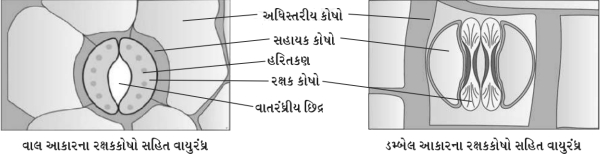
Draw a labeled diagram of a dicot and a monocot stoma.
Solution
(N/A) The stomata are structures present in the epidermis of leaves. They regulate the process of transpiration and gaseous exchange.
$1$. Dicot Stoma: In dicotyledonous plants,the guard cells are bean-shaped or kidney-shaped. They contain chloroplasts and regulate the opening and closing of the stomatal pore.
$2$. Monocot Stoma: In monocotyledonous plants (like grasses),the guard cells are dumbbell-shaped. The outer walls of these guard cells are thin,while the inner walls are thick.
Both types are surrounded by subsidiary cells and epidermal cells.
$1$. Dicot Stoma: In dicotyledonous plants,the guard cells are bean-shaped or kidney-shaped. They contain chloroplasts and regulate the opening and closing of the stomatal pore.
$2$. Monocot Stoma: In monocotyledonous plants (like grasses),the guard cells are dumbbell-shaped. The outer walls of these guard cells are thin,while the inner walls are thick.
Both types are surrounded by subsidiary cells and epidermal cells.
0 likes
View Solution190
Medium
Describe the transpiration pull model of water transport in plants. What are the factors influencing transpiration? How is it useful to plants?
Solution
(N/A) In tall trees,water rises with the help of the transpirational pull generated by transpiration or loss of water from the stomatal pores of leaves. This is called the cohesion-tension model of water transport.
During daytime,the water lost through transpiration (by the leaves to the surroundings) causes the guard cells and other epidermal cells to become flaccid. They in turn take water from the xylem. This creates a negative pressure or tension in the xylem vessels,from the surfaces of the leaves to the tips of the roots,through the stem.
As a result,the water present in the xylem is pulled as a single column from the stem. The cohesion and adhesion forces of the water molecules and the cell walls of the xylem vessels prevent the water column from splitting.
Factors influencing transpiration:
$1$. External factors: Wind speed,light,humidity,and temperature.
$2$. Plant factors: Canopy structure,number and distribution of stomata,water status of plants,and number of open stomata.
Utility to plants:
$1$. It helps in the absorption and transport of minerals from the soil to the various plant parts.
$2$. Transpiration has a cooling effect on plants.
$3$. It helps maintain plant shape and structure by keeping the cells turgid.
$4$. It provides water for photosynthesis.
During daytime,the water lost through transpiration (by the leaves to the surroundings) causes the guard cells and other epidermal cells to become flaccid. They in turn take water from the xylem. This creates a negative pressure or tension in the xylem vessels,from the surfaces of the leaves to the tips of the roots,through the stem.
As a result,the water present in the xylem is pulled as a single column from the stem. The cohesion and adhesion forces of the water molecules and the cell walls of the xylem vessels prevent the water column from splitting.
Factors influencing transpiration:
$1$. External factors: Wind speed,light,humidity,and temperature.
$2$. Plant factors: Canopy structure,number and distribution of stomata,water status of plants,and number of open stomata.
Utility to plants:
$1$. It helps in the absorption and transport of minerals from the soil to the various plant parts.
$2$. Transpiration has a cooling effect on plants.
$3$. It helps maintain plant shape and structure by keeping the cells turgid.
$4$. It provides water for photosynthesis.
0 likes
View Solution191
MediumMCQ
What causes the opening and closing of guard cells of stomata during transpiration?
A
Change in the turgidity of guard cells
B
Change in the size of subsidiary cells
C
Movement of water from the mesophyll cells
D
Presence of chloroplasts in guard cells
Solution
(A) The tiny pores present on the surfaces of leaves,called stomata,help in the exchange of gases. Each stoma consists of bean-shaped or dumbbell-shaped guard cells. The epidermal cells surrounding the guard cells are modified to form subsidiary cells. The opening and closing of the guard cells is caused by a change in their turgidity.
The inner walls of the guard cells are thick and elastic,while the outer walls are thin. The numerous microfibrils present in the guard cells facilitate the opening and closing of the guard cells.
At the time of the opening of the stomata,the turgidity of the guard cells increases. As a result,the outer walls bulge and the inner walls become crescent-shaped. The stomatal opening is facilitated by the radial arrangement of the microfibrils.
At the time of the closing of the stomata,the guard cells lose their turgidity,the outer and inner walls retain their original shapes,and the microfibrils get arranged longitudinally.
The inner walls of the guard cells are thick and elastic,while the outer walls are thin. The numerous microfibrils present in the guard cells facilitate the opening and closing of the guard cells.
At the time of the opening of the stomata,the turgidity of the guard cells increases. As a result,the outer walls bulge and the inner walls become crescent-shaped. The stomatal opening is facilitated by the radial arrangement of the microfibrils.
At the time of the closing of the stomata,the guard cells lose their turgidity,the outer and inner walls retain their original shapes,and the microfibrils get arranged longitudinally.
0 likes
View Solution192
Medium
Differentiate between the following: Transpiration and Evaporation.
Solution
(N/A) Transpiration and Evaporation
| Feature | Transpiration | Evaporation |
| $(1)$ Occurrence | It occurs only in living plants. | It occurs from any free surface,involving both living and non-living surfaces. |
| $(2)$ Nature | It is a physiological process. | It is a physical process. |
| $(3)$ Site | It occurs mainly through stomatal pores on leaves. | It occurs through any free surface exposed to the atmosphere. |
| $(4)$ Control | It is controlled by environmental factors and physiological factors like root-shoot ratio and stomatal density. | It is entirely driven by environmental factors like temperature and humidity. |
0 likes
View Solution193
Medium
Differentiate between the following: Guttation and Transpiration.
Solution
(N/A) Guttation and Transpiration are two distinct processes of water loss in plants.
| Guttation | Transpiration |
| $(1)$ It occurs usually at night or early morning. | $(1)$ It occurs usually during the day. |
| $(2)$ Water is lost in the form of liquid droplets. | $(2)$ Water is lost in the form of water vapour. |
| $(3)$ It occurs through specialized pores called hydathodes. | $(3)$ It occurs mainly through the stomata. |
| $(4)$ It is an uncontrolled process. | $(4)$ It is a controlled process regulated by guard cells. |
0 likes
View Solution194
Medium
Describe: Transpiration Pull.
Solution
(N/A) $\Rightarrow$ In higher plants,the flow of water upward through the $xylem$ can achieve fairly high rates,up to $15 \ m/h$.
$\Rightarrow$ Water is either pushed or pulled through the plant. Most researchers agree that water is mainly pulled through the plant,and the driving force for this process is transpiration from the leaves.
$\Rightarrow$ This is referred to as the $cohesion-tension-transpiration$ pull model of water transport.
$\Rightarrow$ Water is transient in plants. Less than $1\%$ of the water reaching the leaves is used in photosynthesis and plant growth. Most of it is lost through the stomata in the leaves. This water loss is known as transpiration.
$\Rightarrow$ This pull is generated because the evaporation of water from the leaf surface creates a negative pressure (tension) in the xylem vessels,which pulls the water column upward due to the cohesive and adhesive properties of water molecules.
$\Rightarrow$ Water is either pushed or pulled through the plant. Most researchers agree that water is mainly pulled through the plant,and the driving force for this process is transpiration from the leaves.
$\Rightarrow$ This is referred to as the $cohesion-tension-transpiration$ pull model of water transport.
$\Rightarrow$ Water is transient in plants. Less than $1\%$ of the water reaching the leaves is used in photosynthesis and plant growth. Most of it is lost through the stomata in the leaves. This water loss is known as transpiration.
$\Rightarrow$ This pull is generated because the evaporation of water from the leaf surface creates a negative pressure (tension) in the xylem vessels,which pulls the water column upward due to the cohesive and adhesive properties of water molecules.
0 likes
View Solution195
Medium
Describe: Transpiration.
Solution
(N/A) $ \Rightarrow $ Transpiration is the evaporative loss of water by plants.
$ \Rightarrow $ It occurs mainly through the stomata in the leaves.
$ \Rightarrow $ Besides the loss of water vapour in transpiration, exchange of oxygen and carbon dioxide in the leaf also occurs through pores called stomata.
$ \Rightarrow $ Normally, stomata are open in the daytime and close during the night.
$ \Rightarrow $ The immediate cause of the opening or closing of the stomata is a change in the turgidity of the guard cells.
$ \Rightarrow $ Opening and closing of stomata: The inner wall of each guard cell, towards the pore or stomatal aperture, is thick and elastic.
$ \Rightarrow $ When turgidity increases within the two guard cells flanking each stomatal aperture or pore, the thin outer walls bulge out and force the inner walls into a crescent shape, and stomata open.
$ \Rightarrow $ The opening of the stoma is also aided due to the orientation of the microfibrils in the cell walls of the guard cells.
$ \Rightarrow $ Cellulose microfibrils are oriented radially rather than longitudinally, making it easier for the stoma to open.
$ \Rightarrow $ When the guard cells lose turgor due to water loss, the elastic inner walls regain their original shape, and the stoma closes.
$ \Rightarrow $ Usually, the lower surface of a dorsiventral (often dicotyledonous) leaf has a greater number of stomata, while in an isobilateral (often monocotyledonous) leaf, they are about equal on both surfaces.
$ \Rightarrow $ Transpiration is affected by several external factors: $ (1) $ Temperature, $ (2) $ Light, $ (3) $ Humidity, $ (4) $ Wind speed.
$ \Rightarrow $ Plant factors affecting transpiration:
$ \Rightarrow $ Number and distribution of stomata.
$ \Rightarrow $ Percent of open stomata.
$ \Rightarrow $ Water status of the plant.
$ \Rightarrow $ Canopy structure.
$ \Rightarrow $ It occurs mainly through the stomata in the leaves.
$ \Rightarrow $ Besides the loss of water vapour in transpiration, exchange of oxygen and carbon dioxide in the leaf also occurs through pores called stomata.
$ \Rightarrow $ Normally, stomata are open in the daytime and close during the night.
$ \Rightarrow $ The immediate cause of the opening or closing of the stomata is a change in the turgidity of the guard cells.
$ \Rightarrow $ Opening and closing of stomata: The inner wall of each guard cell, towards the pore or stomatal aperture, is thick and elastic.
$ \Rightarrow $ When turgidity increases within the two guard cells flanking each stomatal aperture or pore, the thin outer walls bulge out and force the inner walls into a crescent shape, and stomata open.
$ \Rightarrow $ The opening of the stoma is also aided due to the orientation of the microfibrils in the cell walls of the guard cells.
$ \Rightarrow $ Cellulose microfibrils are oriented radially rather than longitudinally, making it easier for the stoma to open.
$ \Rightarrow $ When the guard cells lose turgor due to water loss, the elastic inner walls regain their original shape, and the stoma closes.
$ \Rightarrow $ Usually, the lower surface of a dorsiventral (often dicotyledonous) leaf has a greater number of stomata, while in an isobilateral (often monocotyledonous) leaf, they are about equal on both surfaces.
$ \Rightarrow $ Transpiration is affected by several external factors: $ (1) $ Temperature, $ (2) $ Light, $ (3) $ Humidity, $ (4) $ Wind speed.
$ \Rightarrow $ Plant factors affecting transpiration:
$ \Rightarrow $ Number and distribution of stomata.
$ \Rightarrow $ Percent of open stomata.
$ \Rightarrow $ Water status of the plant.
$ \Rightarrow $ Canopy structure.
0 likes
View Solution196
Medium
What causes the opening and closing of guard cells of stomata during transpiration? Describe point-wise.
Solution
(N/A) - The immediate cause of the opening or closing of the stomata is a change in the turgidity of the guard cells.
- The inner wall of each guard cell,towards the stomatal aperture,is thick and elastic.
- When turgidity increases within the two guard cells flanking each stomatal aperture,the thin outer walls bulge out and force the inner walls into a crescent shape,causing the stomata to open.
- The opening of the stoma is also aided by the orientation of the cellulose microfibrils in the cell walls of the guard cells.
- These microfibrils are oriented radially rather than longitudinally,which makes it easier for the stoma to open.
- When the guard cells lose turgor due to water loss,the elastic inner walls regain their original shape,causing the stomata to close.
- The inner wall of each guard cell,towards the stomatal aperture,is thick and elastic.
- When turgidity increases within the two guard cells flanking each stomatal aperture,the thin outer walls bulge out and force the inner walls into a crescent shape,causing the stomata to open.
- The opening of the stoma is also aided by the orientation of the cellulose microfibrils in the cell walls of the guard cells.
- These microfibrils are oriented radially rather than longitudinally,which makes it easier for the stoma to open.
- When the guard cells lose turgor due to water loss,the elastic inner walls regain their original shape,causing the stomata to close.
0 likes
View Solution197
Medium
The process of photosynthesis requires water. The system of xylem vessels from the root to the leaf vein can supply the needed water. But what force does a plant use to move water molecules into the leaf parenchyma cells where they are needed?
Solution
$ \Rightarrow $ As water evaporates through the stomata, since the thin film of water over the cells is continuous, it results in the pulling of water, molecule by molecule, into the leaf from the xylem.
$ \Rightarrow $ Because of the lower concentration of water vapour in the atmosphere as compared to the substomatal cavity and intercellular spaces, water diffuses into the surrounding air. This creates a 'transpiration pull'.
$ \Rightarrow $ The forces generated by transpiration can create pressure sufficient to lift a xylem-sized column of water over $130 \ m$ high.
$ \Rightarrow $ Because of the lower concentration of water vapour in the atmosphere as compared to the substomatal cavity and intercellular spaces, water diffuses into the surrounding air. This creates a 'transpiration pull'.
$ \Rightarrow $ The forces generated by transpiration can create pressure sufficient to lift a xylem-sized column of water over $130 \ m$ high.
0 likes
View Solution198
Easy
The stomatal pore is guarded by two kidney-shaped guard cells. Name the epidermal cells surrounding the guard cells. How does a guard cell differ from an epidermal cell? Use a diagram to illustrate your answer.
Solution
(N/A) The epidermal cells surrounding the guard cells are called subsidiary cells.
The differences between guard cells and epidermal cells are as follows:
The differences between guard cells and epidermal cells are as follows:
| Guard cells | Epidermal cells |
|---|---|
| $(1)$ They are bean-shaped or kidney-shaped (in dicots) or dumb-bell shaped (in monocots). | $(1)$ They are generally barrel-shaped or irregular. |
| $(2)$ They contain chloroplasts. | $(2)$ They generally lack chloroplasts. |
| $(3)$ They are specialized for regulating the opening and closing of stomata. | $(3)$ They provide protection and structural support to the plant surface. |
| $(4)$ Their inner walls are thick and elastic. | $(4)$ Their cell walls are uniformly thin. |
0 likes
View SolutionTransport in Plants — Transpiration (General) and Stomata · Frequently Asked Questions
1Are these Transport in Plants questions useful for JEE and NEET?
Yes. All questions in this section are mapped to JEE Main and NEET exam patterns. Previous year questions from JEE Main, NEET, GUJCET and state-level exams are included with full solutions.
2Can I switch to Hindi or Gujarati for these questions?
Yes. Use the language tabs in the hero section or the sidebar to view the same questions and solutions in English, Hindi or Gujarati.
3How do I generate a question paper from this subtopic?
Use the Vedclass Exam Paper Generator — select the chapter and subtopic, set difficulty, and generate Sets A, B, C, D automatically. First 3 chapters of every subject are free.
Vedclass Products
For Students
Vedclass Test Series
Mock tests in real JEE/NEET style with performance analysis. 5-day free trial.
Start Free TrialFor Teachers
Exam Paper Generator
Generate Set A/B/C/D papers from this chapter in 2 minutes. 3 chapters free.
Try FreeFor Institutes
Online Exam Module
Live online exams with unlimited students, 360° analytics & white-label branding.
See DemoFor Teachers & Institutes
Generate a Transport in Plants Exam Paper in 2 Minutes
Select subtopic & difficulty — Sets A, B, C, D auto-generated with No Repeat logic.
First 3 chapters of every subject are free — no payment required.