
A English
Osmosis and Plasmolysis Questions in English
Class 11 Biology · Transport in Plants · Osmosis and Plasmolysis
135+
Questions
English
Language
100%
With Solutions
Showing 50 of 135 questions in English
51
MediumMCQ
If a potted plant is surrounded by an overdose of urea around it,what will happen?
A
It will grow fast
B
It will remain unaffected
C
It will wilt due to plasmolysis
D
The reproductive growth will be checked
Solution
(C) When an overdose of urea is added to the soil of a potted plant,it dissolves in the soil water,creating a highly concentrated (hypertonic) solution around the roots.
According to the principle of osmosis,water moves from a region of lower solute concentration (inside the root cells) to a region of higher solute concentration (the soil solution).
As a result,the plant roots lose water to the soil,a process known as exosmosis or plasmolysis.
This loss of water leads to the wilting and eventual drying of the plant.
According to the principle of osmosis,water moves from a region of lower solute concentration (inside the root cells) to a region of higher solute concentration (the soil solution).
As a result,the plant roots lose water to the soil,a process known as exosmosis or plasmolysis.
This loss of water leads to the wilting and eventual drying of the plant.
0 likes
View Solution52
MediumMCQ
When a plant cell is placed in a solution which is hypotonic to the cell sap,which of the following conditions will not apply?
A
The water potential of the cell sap will rise
B
The suction pressure of the cell sap will fail
C
The cell will become turgid
D
The wall pressure of the cell will fail
Solution
(D) When a plant cell is placed in a hypotonic solution,water enters the cell through endosmosis.
As water enters,the cell sap becomes more dilute,causing its water potential to increase.
The cell expands and exerts turgor pressure against the cell wall,making the cell turgid.
Consequently,the suction pressure (or diffusion pressure deficit) decreases as the cell becomes fully turgid.
However,the wall pressure is the pressure exerted by the cell wall against the expanding protoplast,which increases as the cell becomes turgid.
Therefore,the statement that 'the wall pressure of the cell will fail' is incorrect.
As water enters,the cell sap becomes more dilute,causing its water potential to increase.
The cell expands and exerts turgor pressure against the cell wall,making the cell turgid.
Consequently,the suction pressure (or diffusion pressure deficit) decreases as the cell becomes fully turgid.
However,the wall pressure is the pressure exerted by the cell wall against the expanding protoplast,which increases as the cell becomes turgid.
Therefore,the statement that 'the wall pressure of the cell will fail' is incorrect.
0 likes
View Solution53
MediumMCQ
The overutilization of fertilizers causes death in plants as the fertilizer
A
Damages wall of delicate root hairs
B
Blocks absorption of nitrogenous ions
C
Upsets soil environment by poisoning soil bacteria
D
Causes dehydration of water
Solution
(D) The overutilization of fertilizers increases the concentration of dissolved salts in the soil solution.
This creates a hypertonic environment outside the root cells compared to the cell sap inside.
As a result,water moves out of the root hair cells into the soil through the process of exosmosis.
This leads to the dehydration of the plant cells,causing the plant to wilt and eventually die.
This creates a hypertonic environment outside the root cells compared to the cell sap inside.
As a result,water moves out of the root hair cells into the soil through the process of exosmosis.
This leads to the dehydration of the plant cells,causing the plant to wilt and eventually die.
0 likes
View Solution54
DifficultMCQ
$A$ cell when dipped in $0.5 \ M$ sucrose solution has no effect,but when the same cell is dipped in $0.5 \ M$ $NaCl$ solution,the cell will:
A
Increase in size
B
Decrease in size
C
Will be turgid
D
Will get plasmolysed
Solution
(D) Sucrose is a non-electrolyte,so $0.5 \ M$ sucrose solution has an osmotic concentration of $0.5 \ Osm$. Since it has no effect on the cell,the cell's internal osmotic concentration is also $0.5 \ Osm$ (isotonic condition).
$NaCl$ is an electrolyte that dissociates into $Na^+$ and $Cl^-$ ions. Therefore,a $0.5 \ M$ $NaCl$ solution has an osmotic concentration of approximately $1.0 \ Osm$ $(0.5 \times 2)$.
Because the $NaCl$ solution $(1.0 \ Osm)$ is hypertonic compared to the cell's internal environment $(0.5 \ Osm)$,water will move out of the cell via osmosis.
As water leaves the cell,the protoplast shrinks away from the cell wall,a process known as plasmolysis.
$NaCl$ is an electrolyte that dissociates into $Na^+$ and $Cl^-$ ions. Therefore,a $0.5 \ M$ $NaCl$ solution has an osmotic concentration of approximately $1.0 \ Osm$ $(0.5 \times 2)$.
Because the $NaCl$ solution $(1.0 \ Osm)$ is hypertonic compared to the cell's internal environment $(0.5 \ Osm)$,water will move out of the cell via osmosis.
As water leaves the cell,the protoplast shrinks away from the cell wall,a process known as plasmolysis.
0 likes
View Solution55
MediumMCQ
When certain marine organisms are placed in distilled water,they ultimately die. Which could be the most likely explanation?
A
Loss of water from the tissue
B
Excess of water in the tissues
C
Loss of salts
D
Loss of permeability of some membranes
Solution
(B) When a marine organism is placed in distilled water (a hypotonic solution),the concentration of solutes inside the body of the organism is significantly higher than that of the distilled water.
Due to the difference in osmotic pressure,endosmosis occurs,causing water molecules to move into the cells of the organism.
This influx of water leads to the swelling of cells,and eventually,the cells burst due to excessive internal pressure,leading to the death of the organism.
Due to the difference in osmotic pressure,endosmosis occurs,causing water molecules to move into the cells of the organism.
This influx of water leads to the swelling of cells,and eventually,the cells burst due to excessive internal pressure,leading to the death of the organism.
0 likes
View Solution56
MediumMCQ
When does water move out of a cell through exosmosis?
A
The concentration of the cell sap is lower than the surrounding solution.
B
The concentration of the cell sap is higher than the surrounding solution.
C
The concentration of the surrounding solution and cell sap is approximately equal.
D
The amount of water in the cell is high.
Solution
(A) Exosmosis is the process where water moves out of the cell when it is placed in a hypertonic solution.
In a hypertonic solution,the concentration of the external solution is higher than the concentration of the cell sap (cytoplasm/vacuole).
Due to the osmotic gradient,water molecules move from a region of higher water potential (inside the cell) to a region of lower water potential (outside the cell) through a semi-permeable membrane.
Therefore,exosmosis occurs when the concentration of the external solution is higher than that of the cell sap,or conversely,when the concentration of the cell sap is lower than the surrounding solution.
In a hypertonic solution,the concentration of the external solution is higher than the concentration of the cell sap (cytoplasm/vacuole).
Due to the osmotic gradient,water molecules move from a region of higher water potential (inside the cell) to a region of lower water potential (outside the cell) through a semi-permeable membrane.
Therefore,exosmosis occurs when the concentration of the external solution is higher than that of the cell sap,or conversely,when the concentration of the cell sap is lower than the surrounding solution.
0 likes
View Solution57
MediumMCQ
When a cell is placed in a hypertonic solution,it undergoes plasmolysis. What is found between the cell wall and the plasma membrane at that time?
A
Hypertonic solution
B
Air
C
Hypotonic solution
D
Isotonic solution
Solution
(A) When a plant cell is placed in a hypertonic solution (a solution with a higher solute concentration than the cell sap),water moves out of the cell due to osmosis.
This loss of water causes the protoplast to shrink away from the cell wall,a process known as plasmolysis.
As the plasma membrane pulls away from the cell wall,the space between them gets filled with the external hypertonic solution that has entered the cell's vicinity.
Therefore,the correct answer is the hypertonic solution.
This loss of water causes the protoplast to shrink away from the cell wall,a process known as plasmolysis.
As the plasma membrane pulls away from the cell wall,the space between them gets filled with the external hypertonic solution that has entered the cell's vicinity.
Therefore,the correct answer is the hypertonic solution.
0 likes
View Solution58
MediumMCQ
If we apply pressure from the top on the solution in the stem of a thistle funnel, we can prevent the entry of water through osmosis. The pressure at which the entry of water through a semi-permeable membrane is stopped is called ........
A
Exosmosis
B
Endosmosis
C
Osmotic pressure
D
Turgor pressure
Solution
(C) Osmotic pressure is defined as the external pressure applied to a solution to prevent the net movement of solvent (water) into it through a semi-permeable membrane.
When a thistle funnel containing a concentrated solution is placed in water, water enters the funnel due to osmosis.
By applying sufficient pressure on the solution in the stem, we can counteract the osmotic potential and stop the influx of water.
This specific pressure required to stop the osmotic flow is known as the $Osmotic \ pressure$.
When a thistle funnel containing a concentrated solution is placed in water, water enters the funnel due to osmosis.
By applying sufficient pressure on the solution in the stem, we can counteract the osmotic potential and stop the influx of water.
This specific pressure required to stop the osmotic flow is known as the $Osmotic \ pressure$.
0 likes
View Solution59
MediumMCQ
Identify the error in the following statement: "Osmosis is the diffusion of water across a semi-permeable membrane between two solutions of different concentrations."
A
The direction of water movement is not specified.
B
The term 'diffusion' is used instead of 'net movement'.
C
The concentration gradient is not defined correctly.
D
The role of the semi-permeable membrane is misrepresented.
Solution
(A) The statement "Osmosis is the diffusion of water across a semi-permeable membrane between two solutions of different concentrations" is technically imprecise because it fails to specify the direction of movement. Osmosis is specifically defined as the net movement of water molecules from a region of higher water potential (or lower solute concentration) to a region of lower water potential (or higher solute concentration) through a semi-permeable membrane. Simply stating "different concentrations" does not indicate the direction of the net flow, which is a critical component of the definition.
0 likes
View Solution60
MediumMCQ
Osmosis refers to the movement of which of the following?
A
Movement of solute particles from higher concentration to lower concentration.
B
Movement of solvent molecules from higher water potential to lower water potential.
C
Movement of solute particles through a semi-permeable membrane from higher concentration to lower concentration.
D
Movement of solvent molecules from lower water potential to higher water potential.
Solution
(B) Osmosis is a special type of diffusion where water (solvent) molecules move across a semi-permeable membrane.
According to the thermodynamic definition,water moves from a region of higher water potential (higher concentration of free water molecules) to a region of lower water potential (lower concentration of free water molecules).
This process continues until equilibrium is reached.
Therefore,the correct description is the movement of solvent molecules from higher water potential to lower water potential.
According to the thermodynamic definition,water moves from a region of higher water potential (higher concentration of free water molecules) to a region of lower water potential (lower concentration of free water molecules).
This process continues until equilibrium is reached.
Therefore,the correct description is the movement of solvent molecules from higher water potential to lower water potential.
0 likes
View Solution61
MediumMCQ
When a plant dies due to the application of excessive fertilizer,the reason is that the fertilizer causes:
A
Damage to the delicate root hair cell walls.
B
Inhibition of absorption due to the accumulation of nitrogen ions.
C
Exosmosis,leading to dehydration of the plant.
D
$A$ decrease in the population of bacteria in the soil environment.
Solution
(C) When excessive fertilizer is added to the soil,the concentration of solutes in the soil solution becomes significantly higher than the concentration of solutes inside the root cells. This creates a hypertonic environment outside the roots. As a result,water moves out of the root cells into the soil through the process of exosmosis. This loss of water leads to the plasmolysis of root cells,causing the plant to wilt and eventually die due to severe dehydration.
0 likes
View Solution62
MediumMCQ
By which process does water move from the adjacent xylem into the phloem?
A
Osmosis
B
Turgor pressure
C
Both osmosis and turgor pressure
D
Neither $(A)$ nor $(B)$
Solution
(A) The movement of food in the phloem is explained by the Pressure Flow Hypothesis or Mass Flow Hypothesis.
$1$. At the source,glucose is prepared by photosynthesis and converted into sucrose.
$2$. Sucrose is actively transported into the companion cells and then into the living phloem sieve tube cells.
$3$. This process creates a hypertonic condition in the phloem.
$4$. Water from the adjacent xylem moves into the phloem by the process of osmosis due to the osmotic gradient.
$5$. As osmotic pressure builds up,the phloem sap moves to areas of lower pressure (the sink).
$1$. At the source,glucose is prepared by photosynthesis and converted into sucrose.
$2$. Sucrose is actively transported into the companion cells and then into the living phloem sieve tube cells.
$3$. This process creates a hypertonic condition in the phloem.
$4$. Water from the adjacent xylem moves into the phloem by the process of osmosis due to the osmotic gradient.
$5$. As osmotic pressure builds up,the phloem sap moves to areas of lower pressure (the sink).
0 likes
View Solution63
EasyMCQ
When a cell shrinks, what is this process known as?
A
Hypotonic solution
B
Osmosis
C
Endosmosis
D
Plasmolysis
Solution
(D) When a plant cell is placed in a hypertonic solution, water moves out of the cell due to osmosis. This causes the protoplast to shrink away from the cell wall, a process known as $Plasmolysis$. $Plasmolysis$ occurs when water leaves the cell, causing the cell membrane to pull away from the cell wall.
0 likes
View Solution64
MediumMCQ
When does the absorption of soil water occur through root hairs?
A
The concentration of solutes is higher in the soil.
B
The concentration of solutes is higher in the root hairs.
C
The concentration of soil water and solutes is equal.
D
Active absorption is taking place.
Solution
(B) Water absorption by root hairs occurs primarily through osmosis. Osmosis is the movement of water from a region of higher water potential (lower solute concentration) to a region of lower water potential (higher solute concentration) across a semi-permeable membrane. For water to move from the soil into the root hairs,the water potential inside the root hairs must be lower than that of the soil water. This is achieved when the concentration of solutes (salts/minerals) is higher inside the root hairs compared to the soil,creating a gradient that draws water in.
0 likes
View Solution65
EasyMCQ
$A$ $hypotonic$ solution is defined as . . .
A
$A$ solution whose concentration is lower than that of another solution.
B
$A$ solution whose concentration is equal to that of another solution.
C
$A$ solution whose concentration is higher than that of another solution.
D
$A$ solution that can pass through a semi-permeable membrane.
Solution
(A) $hypotonic$ solution is a solution that has a lower solute concentration compared to another solution (usually the cytoplasm of a cell).
When a cell is placed in a $hypotonic$ solution,water moves into the cell due to osmosis,causing the cell to swell.
Therefore,option $A$ is the correct definition.
When a cell is placed in a $hypotonic$ solution,water moves into the cell due to osmosis,causing the cell to swell.
Therefore,option $A$ is the correct definition.
0 likes
View Solution66
MediumMCQ
Water absorption by root hairs from the external medium occurs through which of the following?
A
Hypertonic solutions
B
Isotonic solutions
C
Viscous solutions
D
Hypotonic solutions
Solution
(D) Water absorption by root hairs occurs via the process of osmosis.
For water to move from the soil (external medium) into the root hair cells,the water potential inside the root hair cells must be lower than that of the soil.
This means the soil solution must be a $Hypotonic$ solution relative to the cell sap of the root hair.
In a $Hypotonic$ solution,the concentration of solutes is lower,and the water potential is higher,allowing water to move into the cell through the semi-permeable membrane.
For water to move from the soil (external medium) into the root hair cells,the water potential inside the root hair cells must be lower than that of the soil.
This means the soil solution must be a $Hypotonic$ solution relative to the cell sap of the root hair.
In a $Hypotonic$ solution,the concentration of solutes is lower,and the water potential is higher,allowing water to move into the cell through the semi-permeable membrane.
0 likes
View Solution67
MediumMCQ
When does the absorption of water by root hairs occur?
A
When the concentration of solutes in the cell sap increases.
B
When they perform continuous respiration.
C
When they become independent of soil particles through a permeable membrane.
D
When the concentration of salts in the soil particles increases.
Solution
(A) Water absorption by root hairs occurs primarily through the process of osmosis.
Osmosis is the movement of water from a region of higher water potential (dilute solution) to a region of lower water potential (concentrated solution) across a semi-permeable membrane.
When the concentration of solutes (minerals/salts) in the cell sap of the root hair increases,the water potential inside the cell decreases.
This creates a gradient that allows water to move from the soil into the root hair cells.
Osmosis is the movement of water from a region of higher water potential (dilute solution) to a region of lower water potential (concentrated solution) across a semi-permeable membrane.
When the concentration of solutes (minerals/salts) in the cell sap of the root hair increases,the water potential inside the cell decreases.
This creates a gradient that allows water to move from the soil into the root hair cells.
0 likes
View Solution68
MediumMCQ
When a parchment paper is placed between two solutions of unequal concentration,then.....
A
The dilute solution diffuses towards the concentrated solution.
B
The concentrated solution diffuses towards the dilute solution.
C
The solvent from the dilute solution diffuses towards the concentrated solution.
D
The solvent from the concentrated solution diffuses towards the dilute solution.
Solution
(C) Parchment paper acts as a semi-permeable membrane.
In the process of osmosis,the solvent molecules (usually water) move from a region of higher solvent concentration (dilute solution) to a region of lower solvent concentration (concentrated solution) through a semi-permeable membrane.
Therefore,the solvent moves from the dilute solution to the concentrated solution.
In the process of osmosis,the solvent molecules (usually water) move from a region of higher solvent concentration (dilute solution) to a region of lower solvent concentration (concentrated solution) through a semi-permeable membrane.
Therefore,the solvent moves from the dilute solution to the concentrated solution.
0 likes
View Solution69
MediumMCQ
In the thistle funnel experiment,what happens due to endosmosis?
A
The solution level in the stem will fall below the mark.
B
The solution level in the stem will rise above the mark.
C
The amount of water in the beaker will increase.
D
The level of the solution in the beaker will remain constant.
Solution
(B) In a thistle funnel experiment,a semi-permeable membrane is tied to the mouth of the funnel,which is filled with a concentrated sugar solution and placed in a beaker containing pure water. Due to endosmosis,water molecules move from the beaker (hypotonic solution) into the funnel (hypertonic solution) through the semi-permeable membrane. As water enters the funnel,the volume of the solution inside the funnel increases,causing the level of the solution in the stem to rise above the initial mark.
0 likes
View Solution70
MediumMCQ
The intake of water into cells is known as:
A
Pinocytosis
B
Phagocytosis
C
Exocytosis
D
Osmosis
Solution
(D) The movement of water molecules from a region of higher water potential to a region of lower water potential through a semi-permeable membrane is known as $Osmosis$.
$Pinocytosis$ refers to the intake of extracellular fluid (cell drinking).
$Phagocytosis$ refers to the intake of solid particles (cell eating).
$Exocytosis$ is the process of moving materials out of the cell.
$Pinocytosis$ refers to the intake of extracellular fluid (cell drinking).
$Phagocytosis$ refers to the intake of solid particles (cell eating).
$Exocytosis$ is the process of moving materials out of the cell.
0 likes
View Solution71
EasyMCQ
What is the movement of water by diffusion called?
A
Osmosis
B
Translocation
C
Ascent of sap
D
Facilitated diffusion
Solution
(A) The movement of water molecules from a region of higher water potential to a region of lower water potential through a semi-permeable membrane is known as $Osmosis$. Since $Osmosis$ is a special type of diffusion involving water,it is the correct answer.
0 likes
View Solution72
MediumMCQ
What is the movement of water by diffusion called?
A
Simple diffusion
B
Facilitated diffusion
C
Osmosis
D
Active transport
Solution
(C) The movement of water molecules from a region of higher water potential to a region of lower water potential through a semi-permeable membrane is specifically known as $Osmosis$. While diffusion is the general movement of particles from higher to lower concentration,the specific diffusion of water across a membrane is termed $Osmosis$.
0 likes
View Solution73
MediumMCQ
What is correct for osmosis?
A
Solute particles move from high concentration to low concentration.
B
Solvent moves from high water potential to low water potential.
C
Solute particles move through a semi-permeable membrane from high concentration to low concentration.
D
Solvent particles move from low water potential to high water potential.
Solution
(B) Osmosis is the spontaneous net movement of solvent molecules (usually water) through a selectively permeable membrane into a region of higher solute concentration (or lower water potential) from a region of lower solute concentration (or higher water potential).
Therefore,the correct statement is that solvent molecules move from a region of high water potential to a region of low water potential through a semi-permeable membrane.
Therefore,the correct statement is that solvent molecules move from a region of high water potential to a region of low water potential through a semi-permeable membrane.
0 likes
View Solution74
MediumMCQ
What is correct for osmosis?
A
Flow of solute from less concentration to high concentration.
B
Flow of solvent from high water potential to low water potential.
C
Movement of solute through semipermeable membrane from high concentration to low concentration.
D
Movement of solvent from low water potential to high water potential.
Solution
(B) Osmosis is the spontaneous net movement of solvent molecules (usually water) through a selectively permeable membrane into a region of higher solute concentration.
In terms of water potential,water always moves from a region of higher water potential (less negative or zero) to a region of lower water potential (more negative) across a semipermeable membrane.
Therefore,the correct statement is that osmosis involves the flow of solvent from high water potential to low water potential.
In terms of water potential,water always moves from a region of higher water potential (less negative or zero) to a region of lower water potential (more negative) across a semipermeable membrane.
Therefore,the correct statement is that osmosis involves the flow of solvent from high water potential to low water potential.
0 likes
View Solution75
EasyMCQ
When the cell (or tissue) is placed in ......... solution, there is no net flow of water towards the inside or outside.
A
Hypotonic
B
Hypertonic
C
Isotonic
D
None of the above
Solution
(C) An $Isotonic$ solution is one where the concentration of solutes is equal to that of the cell cytoplasm.
In an $Isotonic$ environment, the water potential inside and outside the cell is equal.
Therefore, there is no net movement of water across the cell membrane, meaning the amount of water entering the cell equals the amount of water leaving the cell.
This results in no change in the volume or shape of the cell.
In an $Isotonic$ environment, the water potential inside and outside the cell is equal.
Therefore, there is no net movement of water across the cell membrane, meaning the amount of water entering the cell equals the amount of water leaving the cell.
This results in no change in the volume or shape of the cell.
0 likes
View Solution76
EasyMCQ
Movement of water by diffusion is called
A
Osmosis
B
Active transport
C
Facilitated transport
D
None
Solution
(A) The movement of water molecules across a semi-permeable membrane from a region of higher water potential to a region of lower water potential by the process of diffusion is specifically known as $Osmosis$.
$1$. $Osmosis$ is a special type of diffusion where only solvent molecules (water) move.
$2$. $Active$ $transport$ requires energy $(ATP)$ to move molecules against the concentration gradient.
$3$. $Facilitated$ $transport$ involves the movement of molecules across a membrane with the help of special membrane proteins without the expenditure of energy.
$1$. $Osmosis$ is a special type of diffusion where only solvent molecules (water) move.
$2$. $Active$ $transport$ requires energy $(ATP)$ to move molecules against the concentration gradient.
$3$. $Facilitated$ $transport$ involves the movement of molecules across a membrane with the help of special membrane proteins without the expenditure of energy.
0 likes
View Solution77
MediumMCQ
What will be the direction of flow of water when a plant cell is placed in a hypotonic solution?
A
Water will flow in both directions
B
Water will flow out of the cell
C
Water will flow into the cell
D
No flow of water in any direction
Solution
(C) hypotonic solution is one that has a lower solute concentration compared to the cytoplasm of the cell.
According to the principle of osmosis,water moves from a region of higher water potential (lower solute concentration) to a region of lower water potential (higher solute concentration) through a semi-permeable membrane.
Since the surrounding solution is hypotonic,the water potential outside the cell is higher than inside the cell.
Therefore,water will move from the outside into the cell,causing the cell to swell and become turgid.
According to the principle of osmosis,water moves from a region of higher water potential (lower solute concentration) to a region of lower water potential (higher solute concentration) through a semi-permeable membrane.
Since the surrounding solution is hypotonic,the water potential outside the cell is higher than inside the cell.
Therefore,water will move from the outside into the cell,causing the cell to swell and become turgid.
0 likes
View Solution78
Medium
Differentiate between the following: Diffusion and Osmosis.
Solution
Diffusion and Osmosis
| Diffusion | Osmosis |
| $(1)$ Diffusion is the passive movement of particles, ions, and molecules along the concentration gradient. | $(1)$ Osmosis is the process in which the diffusion of a solvent (water) occurs across a semi-permeable membrane. |
| $(2)$ It can occur in solids, liquids, and gases. | $(2)$ It occurs in the liquid medium. |
| $(3)$ It does not require a semi-permeable membrane. | $(3)$ It requires a semi-permeable membrane. |
0 likes
View Solution79
Medium
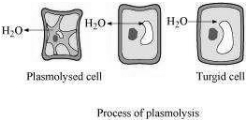
With the help of well-labelled diagrams,describe the process of plasmolysis in plants,giving appropriate examples.
Solution
(N/A) Plasmolysis is defined as the shrinkage of the protoplast of a plant cell away from its cell wall,occurring when the cell is placed in a hypertonic solution.
$1$. Mechanism: When a plant cell is placed in a hypertonic solution (a solution with a higher solute concentration than the cell sap),water moves out of the cell due to osmosis.
$2$. Process: As water leaves the cell,the protoplast shrinks and pulls away from the rigid cell wall. This space between the cell wall and the plasma membrane gets filled with the external hypertonic solution.
$3$. Example: This process can be clearly observed by placing an onion peel in a highly concentrated salt or sugar solution under a microscope.
$1$. Mechanism: When a plant cell is placed in a hypertonic solution (a solution with a higher solute concentration than the cell sap),water moves out of the cell due to osmosis.
$2$. Process: As water leaves the cell,the protoplast shrinks and pulls away from the rigid cell wall. This space between the cell wall and the plasma membrane gets filled with the external hypertonic solution.
$3$. Example: This process can be clearly observed by placing an onion peel in a highly concentrated salt or sugar solution under a microscope.
0 likes
View Solution80
Medium
Explain what will happen to a plant cell if it is kept in a solution having higher water potential.
Solution
(N/A) When a plant cell is placed in a solution with a higher water potential (a hypotonic solution),water molecules move from the surrounding solution into the cell through the process of osmosis.
This occurs because water moves from a region of higher water potential to a region of lower water potential.
As water enters the cell,the protoplast expands and exerts pressure against the rigid cell wall,which is known as turgor pressure.
Due to the presence of the rigid cell wall,the plant cell does not burst; instead,it becomes turgid.
This occurs because water moves from a region of higher water potential to a region of lower water potential.
As water enters the cell,the protoplast expands and exerts pressure against the rigid cell wall,which is known as turgor pressure.
Due to the presence of the rigid cell wall,the plant cell does not burst; instead,it becomes turgid.
0 likes
View Solution81
Medium
Describe: Osmosis.
Solution
(N/A) $ \Rightarrow $ Definition: Osmosis is the spontaneous net movement of solvent molecules (usually water) through a selectively permeable membrane into a region of higher solute concentration, in the direction that tends to equalize the solute concentrations on the two sides.
$ \Rightarrow $ Direction of movement: Water moves from a region of higher water potential (dilute solution) to a region of lower water potential (concentrated solution) across a semi-permeable membrane.
$ \Rightarrow $ Plant cell characteristics:
- Plant cells are surrounded by a cell membrane and a cell wall.
- The cell wall is freely permeable to water and substances in solution and is not a barrier to movement.
- In plant cells, the vacuole and its membrane, the tonoplast, along with the plasma membrane, are important determinants of the movement of molecules in or out of the cell.
$ \Rightarrow $ Key Principles:
- Osmosis occurs spontaneously in response to a driving force.
- The net direction and rate of osmosis depend on both the pressure gradient and the concentration gradient.
- Water moves from its region of higher chemical potential (higher concentration) to its region of lower chemical potential until equilibrium is reached.
- At equilibrium, the two chambers have the same water potential.
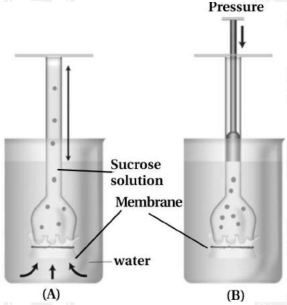
$ \Rightarrow $ Thistle Funnel Experiment:
- $ A $ thistle funnel is filled with a concentrated sucrose solution and its mouth is covered with a semi-permeable membrane (e.g., egg membrane).
- It is placed in a beaker containing pure water.
- Water enters the funnel due to osmosis, causing the level of the solution in the funnel to rise.
- This continues until equilibrium is reached.
$ \Rightarrow $ Osmotic Pressure:
- External pressure can be applied to the solution to prevent the entry of water through the semi-permeable membrane.
- The pressure required to completely stop the entry of water is called osmotic pressure.
- Numerically, osmotic pressure is equivalent to the osmotic potential, but with an opposite sign (osmotic pressure is positive, while osmotic potential is negative).
$ \Rightarrow $ Direction of movement: Water moves from a region of higher water potential (dilute solution) to a region of lower water potential (concentrated solution) across a semi-permeable membrane.
$ \Rightarrow $ Plant cell characteristics:
- Plant cells are surrounded by a cell membrane and a cell wall.
- The cell wall is freely permeable to water and substances in solution and is not a barrier to movement.
- In plant cells, the vacuole and its membrane, the tonoplast, along with the plasma membrane, are important determinants of the movement of molecules in or out of the cell.
$ \Rightarrow $ Key Principles:
- Osmosis occurs spontaneously in response to a driving force.
- The net direction and rate of osmosis depend on both the pressure gradient and the concentration gradient.
- Water moves from its region of higher chemical potential (higher concentration) to its region of lower chemical potential until equilibrium is reached.
- At equilibrium, the two chambers have the same water potential.
$ \Rightarrow $ Thistle Funnel Experiment:
- $ A $ thistle funnel is filled with a concentrated sucrose solution and its mouth is covered with a semi-permeable membrane (e.g., egg membrane).
- It is placed in a beaker containing pure water.
- Water enters the funnel due to osmosis, causing the level of the solution in the funnel to rise.
- This continues until equilibrium is reached.
$ \Rightarrow $ Osmotic Pressure:
- External pressure can be applied to the solution to prevent the entry of water through the semi-permeable membrane.
- The pressure required to completely stop the entry of water is called osmotic pressure.
- Numerically, osmotic pressure is equivalent to the osmotic potential, but with an opposite sign (osmotic pressure is positive, while osmotic potential is negative).
0 likes
View Solution82
Medium
Explain: Plasmolysis.
Solution
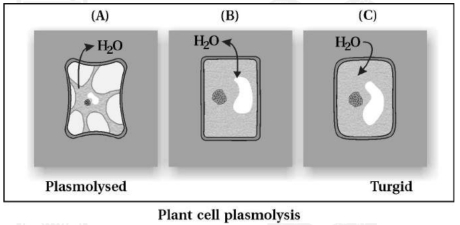
(N/A) Plasmolysis is the process in which the cell membrane of a plant cell shrinks away from its cell wall due to the movement of water out of the cell.
This phenomenon occurs when a living plant cell is placed in a hypertonic solution (a solution with a higher solute concentration than the cytoplasm).
To understand this,we must consider the three types of solutions based on their osmotic pressure relative to the cytoplasm:
$1$. Isotonic solution: The external solution has the same osmotic pressure as the cytoplasm. There is no net movement of water.
$2$. Hypotonic solution: The external solution is more dilute than the cytoplasm. Water moves into the cell,causing it to swell.
$3$. Hypertonic solution: The external solution is more concentrated than the cytoplasm. Water moves out of the cell,causing it to shrink.
When a cell is placed in a hypertonic solution,water first moves out of the cytoplasm and then from the vacuole,leading to the shrinkage of the protoplast away from the cell wall,a state known as plasmolysis.
This phenomenon occurs when a living plant cell is placed in a hypertonic solution (a solution with a higher solute concentration than the cytoplasm).
To understand this,we must consider the three types of solutions based on their osmotic pressure relative to the cytoplasm:
$1$. Isotonic solution: The external solution has the same osmotic pressure as the cytoplasm. There is no net movement of water.
$2$. Hypotonic solution: The external solution is more dilute than the cytoplasm. Water moves into the cell,causing it to swell.
$3$. Hypertonic solution: The external solution is more concentrated than the cytoplasm. Water moves out of the cell,causing it to shrink.
When a cell is placed in a hypertonic solution,water first moves out of the cytoplasm and then from the vacuole,leading to the shrinkage of the protoplast away from the cell wall,a state known as plasmolysis.
0 likes
View Solution83
Medium
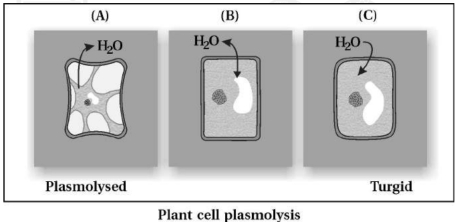
Describe the process/mechanism of plant cell plasmolysis with an example and a labelled diagram.
Solution
(N/A) Plasmolysis is the process in which plant cells lose water in a hypertonic solution,causing the protoplast to shrink away from the cell wall.
$1$. Types of Solutions:
- Isotonic Solution: An external solution that balances the osmotic pressure of the cytoplasm.
- Hypotonic Solution: An external solution that is more dilute than the cytoplasm,causing water to enter the cell.
- Hypertonic Solution: An external solution that is more concentrated than the cytoplasm,causing water to move out of the cell.
$2$. Mechanism of Plasmolysis:
- When a living plant cell is placed in a hypertonic solution,water moves out of the cell due to osmosis.
- Water is first lost from the cytoplasm and then from the vacuole.
- As water leaves,the cell membrane shrinks away from the cell wall,a state known as plasmolysis.
- The cell is said to be plasmolysed when the space between the cell wall and the shrunken protoplast is filled with the external hypertonic solution.
$3$. Diagram:
$(A)$ Plasmolysed cell (water moving out)
$(B)$ Flaccid cell (no net movement)
$(C)$ Turgid cell (water moving in)
$1$. Types of Solutions:
- Isotonic Solution: An external solution that balances the osmotic pressure of the cytoplasm.
- Hypotonic Solution: An external solution that is more dilute than the cytoplasm,causing water to enter the cell.
- Hypertonic Solution: An external solution that is more concentrated than the cytoplasm,causing water to move out of the cell.
$2$. Mechanism of Plasmolysis:
- When a living plant cell is placed in a hypertonic solution,water moves out of the cell due to osmosis.
- Water is first lost from the cytoplasm and then from the vacuole.
- As water leaves,the cell membrane shrinks away from the cell wall,a state known as plasmolysis.
- The cell is said to be plasmolysed when the space between the cell wall and the shrunken protoplast is filled with the external hypertonic solution.
$3$. Diagram:
$(A)$ Plasmolysed cell (water moving out)
$(B)$ Flaccid cell (no net movement)
$(C)$ Turgid cell (water moving in)
0 likes
View Solution84
MediumMCQ
What occupies the space between the cell wall and the shrunken protoplast in the plasmolysed cell?
A
Isotonic solution
B
Hypertonic solution
C
Hypotonic solution
D
Pure water
Solution
(B) $\Rightarrow$ Plasmolysis occurs when a plant cell is placed in a hypertonic solution (a solution with a higher solute concentration than the cytoplasm).
$\Rightarrow$ Due to exosmosis,water moves out of the cell,causing the protoplast to shrink away from the cell wall.
$\Rightarrow$ The space between the cell wall and the shrunken protoplast is occupied by the external hypertonic solution that has entered the cell through the permeable cell wall.
$\Rightarrow$ Due to exosmosis,water moves out of the cell,causing the protoplast to shrink away from the cell wall.
$\Rightarrow$ The space between the cell wall and the shrunken protoplast is occupied by the external hypertonic solution that has entered the cell through the permeable cell wall.
0 likes
View Solution85
MediumMCQ
How can a semi-permeable membrane be obtained from an egg?
A
By boiling the egg
B
By dissolving the shell in dilute $HCl$
C
By removing the shell manually
D
By soaking the egg in salt water
Solution
(B) To obtain a semi-permeable membrane from an egg,first make a small hole at one end of the egg and remove all the yolk and albumen (the white and yellow parts of the egg).
Then,place the eggshell in a solution of dilute $HCl$ (hydrochloric acid) for a few hours.
The $HCl$ dissolves the calcium carbonate shell,leaving behind the thin,intact semi-permeable membrane that was lining the inside of the shell.
Then,place the eggshell in a solution of dilute $HCl$ (hydrochloric acid) for a few hours.
The $HCl$ dissolves the calcium carbonate shell,leaving behind the thin,intact semi-permeable membrane that was lining the inside of the shell.
0 likes
View Solution86
MediumMCQ
Explain the types of solutions based on their solute concentration relative to the cell.
A
Isotonic solution
B
Hypotonic solution
C
Hypertonic solution
D
All of the above
Solution
(D) Solutions are classified into three types based on the concentration of solutes relative to the cell cytoplasm:
$1$. $Isotonic$ $solution$: $A$ solution where the external solute concentration is equal to the concentration inside the cell. There is no net movement of water.
$2$. $Hypotonic$ $solution$: $A$ solution where the external solute concentration is lower than that inside the cell. Water moves into the cell,causing it to swell.
$3$. $Hypertonic$ $solution$: $A$ solution where the external solute concentration is higher than that inside the cell. Water moves out of the cell,causing it to shrink or undergo plasmolysis.
$1$. $Isotonic$ $solution$: $A$ solution where the external solute concentration is equal to the concentration inside the cell. There is no net movement of water.
$2$. $Hypotonic$ $solution$: $A$ solution where the external solute concentration is lower than that inside the cell. Water moves into the cell,causing it to swell.
$3$. $Hypertonic$ $solution$: $A$ solution where the external solute concentration is higher than that inside the cell. Water moves out of the cell,causing it to shrink or undergo plasmolysis.
0 likes
View Solution87
Medium
Give differences:
$(1)$ Simple diffusion and Facilitated diffusion
$(2)$ Plasmolysis and Deplasmolysis
$(1)$ Simple diffusion and Facilitated diffusion
$(2)$ Plasmolysis and Deplasmolysis
Solution
(N/A) $(1)$ Comparison between Simple diffusion and Facilitated diffusion:
$(2)$ Comparison between Plasmolysis and Deplasmolysis:
| Simple diffusion | Facilitated diffusion |
| $(1)$ Protein is not required for this movement. | $(1)$ Special membrane proteins are required. |
| $(2)$ It is not sensitive to inhibitors. | $(2)$ It is sensitive to inhibitors. |
| $(3)$ It is not selective. | $(3)$ It is highly selective. |
| $(4)$ No specific transport mechanisms like symport or antiport are involved. | $(4)$ Specific mechanisms like Symport,Uniport,or Antiport are seen. |
$(2)$ Comparison between Plasmolysis and Deplasmolysis:
| Plasmolysis | Deplasmolysis |
| $(1)$ Living plant cells are placed in a hypertonic solution. | $(1)$ Plasmolysed cells are placed in a hypotonic solution. |
| $(2)$ This involves exosmosis. | $(2)$ This involves endoosmosis. |
| $(3)$ The cytoplasm shrinks and separates from the cell wall. | $(3)$ The cytoplasm expands and returns to the cell wall. |
| $(4)$ The cell loses its turgidity. | $(4)$ The cell regains its turgidity. |
0 likes
View Solution88
Medium
Provide definitions/explanations for the following terms:
$(1)$ Osmosis
$(2)$ Osmotic pressure
$(1)$ Osmosis
$(2)$ Osmotic pressure
Solution
(N/A) $(1)$ Osmosis is the spontaneous net movement or diffusion of solvent molecules (usually water) through a selectively permeable membrane from a region of higher water potential (lower solute concentration) to a region of lower water potential (higher solute concentration).
$(2)$ Osmotic pressure is the minimum pressure that must be applied to a solution to prevent the inward flow of its pure solvent across a semipermeable membrane. It is a measure of the tendency of a solution to take in pure solvent by osmosis.
$(2)$ Osmotic pressure is the minimum pressure that must be applied to a solution to prevent the inward flow of its pure solvent across a semipermeable membrane. It is a measure of the tendency of a solution to take in pure solvent by osmosis.
0 likes
View Solution89
Medium
Definitions / Explanation:
$(1)$ Plasmolysis
$(2)$ Deplasmolysis
$(1)$ Plasmolysis
$(2)$ Deplasmolysis
Solution
(N/A) $(1)$ Plasmolysis is the shrinkage of the protoplast away from the cell wall when a plant cell is placed in a hypertonic solution due to the loss of water via exosmosis.
$(2)$ Deplasmolysis is the process in which water enters a plasmolysed cell when placed in a hypotonic solution,causing the cell membrane and organelles to return to their normal state.
$(2)$ Deplasmolysis is the process in which water enters a plasmolysed cell when placed in a hypotonic solution,causing the cell membrane and organelles to return to their normal state.
0 likes
View Solution90
Medium
When a freshly collected $Spirogyra$ filament is kept in a $10\%$ potassium nitrate solution,it is observed that the protoplasm shrinks in size.
$(a)$ What is this phenomenon called?
$(b)$ What will happen if the filament is replaced in distilled water?
$(a)$ What is this phenomenon called?
$(b)$ What will happen if the filament is replaced in distilled water?
Solution
(N/A) The phenomenon is called plasmolysis. When the $Spirogyra$ filament is placed in a $10\%$ potassium nitrate solution (a hypertonic solution),water moves out of the cell due to osmosis,causing the protoplasm to shrink away from the cell wall.
$(b)$ If the filament is replaced in distilled water (a hypotonic solution),the water will move back into the cell through osmosis. This causes the cell to regain its turgidity and return to its original state,a process known as deplasmolysis.
$(b)$ If the filament is replaced in distilled water (a hypotonic solution),the water will move back into the cell through osmosis. This causes the cell to regain its turgidity and return to its original state,a process known as deplasmolysis.
0 likes
View Solution91
MediumMCQ
When a freshly collected $Spirogyra$ filament is kept in a $10\%$ potassium nitrate solution,it is observed that the protoplasm shrinks in size. What will happen if the filament is replaced in distilled water?
A
The protoplasm will remain shrunken.
B
The protoplasm will swell and return to its original size due to deplasmolysis.
C
The filament will burst immediately.
D
The filament will dissolve completely.
Solution
(B) When a $Spirogyra$ filament is placed in a $10\%$ potassium nitrate solution (a hypertonic solution),water moves out of the cell due to exosmosis,causing the protoplasm to shrink away from the cell wall,a process known as plasmolysis.
When this plasmolyzed filament is transferred to distilled water (a hypotonic solution),water enters the cell due to endosmosis.
This causes the protoplasm to swell and return to its original size,a process known as deplasmolysis.
When this plasmolyzed filament is transferred to distilled water (a hypotonic solution),water enters the cell due to endosmosis.
This causes the protoplasm to swell and return to its original size,a process known as deplasmolysis.
0 likes
View Solution92
MediumMCQ
Salt is applied to tennis lawns to kill weeds. How does salting tennis lawns help in killing weeds without affecting the grass?
A
It increases the water potential of the soil.
B
It causes exosmosis in weeds,leading to plasmolysis.
C
It provides essential nutrients to the grass only.
D
It acts as a herbicide that is specific only to weeds.
Solution
(B) Applying salt to the soil creates a hypertonic environment around the roots of the plants.
Due to the high concentration of salt in the soil,the water potential of the soil becomes lower than that of the plant cells.
This causes water to move out of the plant cells into the soil through the process of exosmosis.
As a result,the plant cells undergo plasmolysis,leading to the wilting and eventual death of the weeds.
Grass is often more tolerant to specific salt concentrations or is managed such that the salt application is localized to the weeds,preventing significant damage to the lawn grass.
Due to the high concentration of salt in the soil,the water potential of the soil becomes lower than that of the plant cells.
This causes water to move out of the plant cells into the soil through the process of exosmosis.
As a result,the plant cells undergo plasmolysis,leading to the wilting and eventual death of the weeds.
Grass is often more tolerant to specific salt concentrations or is managed such that the salt application is localized to the weeds,preventing significant damage to the lawn grass.
0 likes
View Solution93
Medium
What are 'aquaporins'? How does the presence of aquaporins affect osmosis?
Solution
(N/A) $\Rightarrow$ Aquaporins are integral membrane proteins that act as channels in the cell membrane. They facilitate the rapid transport of water molecules across the membrane.
$\Rightarrow$ The presence of aquaporins significantly increases the rate of osmosis. While water can move slowly through the lipid bilayer by simple diffusion,aquaporins provide a specialized pathway that allows water to move much faster,effectively acting as a 'plumbing system' for the cell to regulate water movement selectively.
$\Rightarrow$ The presence of aquaporins significantly increases the rate of osmosis. While water can move slowly through the lipid bilayer by simple diffusion,aquaporins provide a specialized pathway that allows water to move much faster,effectively acting as a 'plumbing system' for the cell to regulate water movement selectively.
0 likes
View Solution94
EasyMCQ
Which of these is a Semipermeable Membrane $(SP)$ and which is Selectively Permeable $(SL)$? : Animal bladder
A
Semipermeable Membrane $(SP)$
B
Selectively Permeable $(SL)$
C
Both $(SP)$ and $(SL)$
D
None of these
Solution
(A) An animal bladder is a classic example of a semipermeable membrane.
$\Rightarrow$ $A$ semipermeable membrane allows the passage of solvent molecules (like water) while restricting the passage of solute molecules.
$\Rightarrow$ In contrast,a selectively permeable membrane (like the plasma membrane) actively regulates the passage of specific solutes in addition to solvent molecules.
$\Rightarrow$ Therefore,the animal bladder is classified as a semipermeable membrane.
$\Rightarrow$ $A$ semipermeable membrane allows the passage of solvent molecules (like water) while restricting the passage of solute molecules.
$\Rightarrow$ In contrast,a selectively permeable membrane (like the plasma membrane) actively regulates the passage of specific solutes in addition to solvent molecules.
$\Rightarrow$ Therefore,the animal bladder is classified as a semipermeable membrane.
0 likes
View Solution95
EasyMCQ
Which of these is a Semipermeable Membrane $(SP)$ and which is Selectively Permeable $(SL)$? : Parchment membrane.
A
Parchment membrane is Semipermeable $(SP)$
B
Parchment membrane is Selectively Permeable $(SL)$
C
Parchment membrane is Impermeable
D
Parchment membrane is Permeable
Solution
(A) Semipermeable membrane $(SP)$ allows only solvent molecules (like water) to pass through it while blocking solute particles.
Parchment membrane is a classic example of a Semipermeable membrane $(SP)$ because it allows the passage of water molecules but restricts the movement of larger solute molecules.
In contrast,a Selectively Permeable $(SL)$ membrane,such as the plasma membrane,allows specific solutes to pass through in addition to the solvent.
Parchment membrane is a classic example of a Semipermeable membrane $(SP)$ because it allows the passage of water molecules but restricts the movement of larger solute molecules.
In contrast,a Selectively Permeable $(SL)$ membrane,such as the plasma membrane,allows specific solutes to pass through in addition to the solvent.
0 likes
View Solution96
EasyMCQ
Which of these is a Semipermeable Membrane $(SP)$ and which is Selectively Permeable $(SL)$? : Egg membrane
A
Semipermeable Membrane $(SP)$
B
Selectively Permeable $(SL)$
C
Both $(SP)$ and $(SL)$
D
None of these
Solution
(A) An egg membrane is considered a semipermeable membrane.
It allows the passage of solvent molecules (like water) through it but restricts the passage of solute molecules.
Therefore,the egg membrane is classified as a semipermeable membrane $(SP)$.
It allows the passage of solvent molecules (like water) through it but restricts the passage of solute molecules.
Therefore,the egg membrane is classified as a semipermeable membrane $(SP)$.
0 likes
View Solution97
MediumMCQ
Select the correct option:
$(1)$ In the movement of water through the $Apoplast$ / $Symplast$ pathway,there is no barrier.
$(2)$ If the external solution is less concentrated than the cytoplasm,it is called $Hypotonic$ / $Hypertonic$.
$(1)$ In the movement of water through the $Apoplast$ / $Symplast$ pathway,there is no barrier.
$(2)$ If the external solution is less concentrated than the cytoplasm,it is called $Hypotonic$ / $Hypertonic$.
A
$Apoplast$,$Hypotonic$
B
$Symplast$,$Hypertonic$
C
$Apoplast$,$Hypertonic$
D
$Symplast$,$Hypotonic$
Solution
(A) $(1)$ The $Apoplast$ pathway consists of non-living parts of the plant,such as cell walls and intercellular spaces. Water movement through the $Apoplast$ occurs through mass flow and does not face any membrane barriers,unlike the $Symplast$ pathway which must cross the plasma membrane.
$(2)$ $A$ solution is termed $Hypotonic$ when its solute concentration is lower than that of the cell cytoplasm,causing water to move into the cell via osmosis.
$(2)$ $A$ solution is termed $Hypotonic$ when its solute concentration is lower than that of the cell cytoplasm,causing water to move into the cell via osmosis.
0 likes
View Solution98
MediumMCQ
Osmosis is a special kind of diffusion,in which water diffuses across the cell membrane. The rate and direction of osmosis depends upon both $....$
A
Pressure gradient and concentration gradient
B
Temperature and pressure gradient
C
Concentration gradient and temperature
D
Only pressure gradient
Solution
(A) Osmosis is the movement of solvent molecules (water) from a region of higher water potential to a region of lower water potential through a semi-permeable membrane.
$\Rightarrow$ The net direction and rate of osmosis depend on both the pressure gradient and the concentration gradient (solute potential).
$\Rightarrow$ The net direction and rate of osmosis depend on both the pressure gradient and the concentration gradient (solute potential).
0 likes
View Solution99
MediumMCQ
$A$ flowering plant is planted in an earthen pot and irrigated. Urea is added to make the plant grow faster,but after some time the plant dies. This may be due to $..........$
A
Excessive water
B
Exosmosis
C
Endosmosis
D
Geotropism
Solution
(B) The addition of urea to the soil creates a hypertonic environment around the roots.
Due to the high concentration of solutes (urea) in the soil solution compared to the cell sap of the root hairs,water moves out of the root cells into the soil.
This process is known as exosmosis.
As a result,the plant cells lose water,become plasmolysed,and the plant eventually dies.
Due to the high concentration of solutes (urea) in the soil solution compared to the cell sap of the root hairs,water moves out of the root cells into the soil.
This process is known as exosmosis.
As a result,the plant cells lose water,become plasmolysed,and the plant eventually dies.
0 likes
View Solution100
MediumMCQ
Food can be kept for a longer time in a cold house than in normal conditions because:
A
insects cannot enter.
B
bacterial multiplication stops.
C
bacterial multiplication is reduced.
D
there is plasmolysis at low temperature.
Solution
(C) Food can be kept for a longer time in a cold house than in normal conditions because low temperatures significantly slow down the metabolic activities of microorganisms,which means bacterial multiplication is reduced. This prevents the rapid spoilage of food.
0 likes
View SolutionTransport in Plants — Osmosis and Plasmolysis · Frequently Asked Questions
1Are these Transport in Plants questions useful for JEE and NEET?
Yes. All questions in this section are mapped to JEE Main and NEET exam patterns. Previous year questions from JEE Main, NEET, GUJCET and state-level exams are included with full solutions.
2Can I switch to Hindi or Gujarati for these questions?
Yes. Use the language tabs in the hero section or the sidebar to view the same questions and solutions in English, Hindi or Gujarati.
3How do I generate a question paper from this subtopic?
Use the Vedclass Exam Paper Generator — select the chapter and subtopic, set difficulty, and generate Sets A, B, C, D automatically. First 3 chapters of every subject are free.
Vedclass Products
For Students
Vedclass Test Series
Mock tests in real JEE/NEET style with performance analysis. 5-day free trial.
Start Free TrialFor Teachers
Exam Paper Generator
Generate Set A/B/C/D papers from this chapter in 2 minutes. 3 chapters free.
Try FreeFor Institutes
Online Exam Module
Live online exams with unlimited students, 360° analytics & white-label branding.
See DemoFor Teachers & Institutes
Generate a Transport in Plants Exam Paper in 2 Minutes
Select subtopic & difficulty — Sets A, B, C, D auto-generated with No Repeat logic.
First 3 chapters of every subject are free — no payment required.