
A English
Osmosis and Plasmolysis Questions in English
Class 11 Biology · Transport in Plants · Osmosis and Plasmolysis
135+
Questions
English
Language
100%
With Solutions
Showing 35 of 135 questions in English
101
MediumMCQ
When a plant cell is placed in pure water, it
A
Expands until the osmotic pressure reaches that of water
B
Becomes less turgid until the osmotic potential reaches that of pure water
C
Becomes more turgid until the pressure potential of cell reaches its osmotic potential
D
Becomes more turgid until the osmotic potential reaches that of pure water
Solution
(C) When a plant cell is placed in pure water, water enters the cell due to endosmosis because the water potential of pure water is higher than that of the cell sap. As water enters, the cell becomes turgid and the pressure potential $(\Psi_p)$ increases. The process continues until the water potential $(\Psi_w)$ of the cell becomes equal to the water potential of the surrounding pure water (which is $0$). At this equilibrium, the pressure potential $(\Psi_p)$ of the cell becomes equal to its osmotic potential $(\Psi_s)$ in magnitude, resulting in a net water potential of $0$.
0 likes
View Solution102
EasyMCQ
$A$ plant cell becomes turgid due to
A
Plasmolysis
B
Exosmosis
C
Endosmosis
D
Electrolysis
Solution
(C) Osmosis is the diffusion of water molecules through a differentially permeable membrane.
Endosmosis is the process where water enters the cell when it is placed in a hypotonic solution.
As water enters the cell,it exerts pressure against the cell wall,causing the cell to become turgid.
Endosmosis is the process where water enters the cell when it is placed in a hypotonic solution.
As water enters the cell,it exerts pressure against the cell wall,causing the cell to become turgid.
0 likes
View Solution103
EasyMCQ
If the osmotic pressure of the cytoplasm in a cell is balanced by an external solution,the solution must be
A
Hypotonic
B
Hypertonic
C
Atonic
D
Isotonic
Solution
(D) If an external solution has the same osmotic pressure as the cytoplasm of a cell,it is known as an isotonic solution.
When cells are placed in an isotonic solution,the water potential inside and outside the cell is equal.
Therefore,there is no net movement of water across the cell membrane,and the cell maintains its shape.
When cells are placed in an isotonic solution,the water potential inside and outside the cell is equal.
Therefore,there is no net movement of water across the cell membrane,and the cell maintains its shape.
0 likes
View Solution104
MediumMCQ
When a plant cell is kept in a saline solution,the cell:
A
Decreases in size
B
Bursts out
C
Increases in size
D
Remains unchanged
Solution
(A) When a plant cell is placed in a saline solution (hypertonic solution),water moves out of the cell due to exosmosis.
As a result,the protoplast shrinks away from the cell wall,causing the cell to decrease in size (plasmolysis).
As a result,the protoplast shrinks away from the cell wall,causing the cell to decrease in size (plasmolysis).
0 likes
View Solution105
EasyMCQ
$A$ cell swells up when kept in
A
Hypotonic solution
B
Hypertonic solution
C
Isotonic solution
D
All of the above
Solution
(A) cell swells up when kept in a hypotonic solution due to the process of endosmosis.
In a hypotonic solution,the concentration of solutes outside the cell is lower than inside the cell,causing water to move into the cell through the semi-permeable membrane.
In a hypotonic solution,the concentration of solutes outside the cell is lower than inside the cell,causing water to move into the cell through the semi-permeable membrane.
0 likes
View Solution106
EasyMCQ
In osmosis,there is movement of
A
Solute only
B
Solvent only
C
Both $(A)$ and $(B)$
D
Neither $(A)$ nor $(B)$
Solution
(B) Osmosis is a special type of diffusion that occurs when water (solvent) molecules move across a semi-permeable membrane.
In this process,the solvent molecules move from a region of higher solvent concentration (or lower solute concentration) to a region of lower solvent concentration (or higher solute concentration).
Therefore,osmosis specifically refers to the movement of the solvent,not the solute.
In this process,the solvent molecules move from a region of higher solvent concentration (or lower solute concentration) to a region of lower solvent concentration (or higher solute concentration).
Therefore,osmosis specifically refers to the movement of the solvent,not the solute.
0 likes
View Solution107
MediumMCQ
$A$ leaf peeling of Tradescantia is kept in a medium having $10 \% \;NaCl$. After a few minutes,if we observe the leaf peel under the microscope,we are likely to see
A
Entry of water into the cell
B
The cells bursting out
C
Diffusion of $NaCl$ into the cell
D
Exit of water from the cell
Solution
(D) When a leaf peeling of Tradescantia is kept in a medium having $10 \% \;NaCl$ solution,the external medium becomes hypertonic compared to the cell sap.
Due to this,water moves out of the cell through the process of exosmosis.
As water leaves the cell,the protoplast shrinks and separates from the cell wall,a phenomenon known as plasmolysis.
Therefore,the observation under the microscope will show the exit of water from the cell.
Due to this,water moves out of the cell through the process of exosmosis.
As water leaves the cell,the protoplast shrinks and separates from the cell wall,a phenomenon known as plasmolysis.
Therefore,the observation under the microscope will show the exit of water from the cell.
0 likes
View Solution108
EasyMCQ
Plasmolysis is the result of
A
Exosmosis
B
Endosmosis
C
Reverse osmosis
D
Diffusion
Solution
(A) Plasmolysis is the phenomenon of the shrinkage of the protoplasm away from the cell wall.
This occurs due to exosmosis,which is the movement of water out of the cell.
Exosmosis happens when a cell is placed in a hypertonic solution,which has a lower water potential than the cell's internal environment.
This occurs due to exosmosis,which is the movement of water out of the cell.
Exosmosis happens when a cell is placed in a hypertonic solution,which has a lower water potential than the cell's internal environment.
0 likes
View Solution109
MediumMCQ
When a cell is plasmolysed,it becomes
A
Flaccid and its $TP$ becomes zero
B
Turgid and its $TP$ becomes zero
C
Turgid and $TP$ becomes equal to $OP$
D
Flaccid and $DPD$ becomes zero
Solution
(A) The shrinkage of the protoplast of a living cell away from its cell wall due to exosmosis under the influence of a hypertonic solution is called Plasmolysis.
When a cell is plasmolysed,it loses water and becomes flaccid.
In a flaccid cell,the turgor pressure $(TP)$ becomes zero.
Since the diffusion pressure deficit $(DPD)$ is calculated as $DPD = OP - TP$,when $TP = 0$,the $DPD$ becomes equal to the osmotic pressure $(OP)$.
When a cell is plasmolysed,it loses water and becomes flaccid.
In a flaccid cell,the turgor pressure $(TP)$ becomes zero.
Since the diffusion pressure deficit $(DPD)$ is calculated as $DPD = OP - TP$,when $TP = 0$,the $DPD$ becomes equal to the osmotic pressure $(OP)$.
0 likes
View Solution110
MediumMCQ
In the thistle funnel experiment,what will occur if a sugar solution is added to the beaker after the process of osmosis stops?
A
The level of solution in the thistle funnel rises up.
B
The level of solution in the thistle funnel lowers.
C
The level of solution in the beaker lowers.
D
The level of solution remains unaffected in the beaker.
Solution
(B) Osmosis is defined as the diffusion of water from its pure state or a dilute solution into a stronger solution when the two are separated by a semi-permeable membrane.
In the thistle funnel experiment,the process of osmosis stops when the hydrostatic pressure equals the osmotic pressure.
When a sugar solution is added to the beaker,the concentration of the solution in the beaker increases,making it hypertonic compared to the solution inside the thistle funnel.
As a result,water moves out of the thistle funnel into the beaker through the semi-permeable membrane,a process known as exosmosis.
Consequently,the level of the solution in the thistle funnel lowers.
In the thistle funnel experiment,the process of osmosis stops when the hydrostatic pressure equals the osmotic pressure.
When a sugar solution is added to the beaker,the concentration of the solution in the beaker increases,making it hypertonic compared to the solution inside the thistle funnel.
As a result,water moves out of the thistle funnel into the beaker through the semi-permeable membrane,a process known as exosmosis.
Consequently,the level of the solution in the thistle funnel lowers.
0 likes
View Solution111
MediumMCQ
Which one of the following denotes the water potential of the mesophyll cell in a wilted condition?
A
Equal to the value of osmotic potential
B
Equal to the value of pressure potential
C
Greater than the value of its osmotic potential
D
Equal to zero
Solution
(A) The water potential $(\Psi_w)$ of a cell is given by the equation $\Psi_w = \Psi_s + \Psi_p$, where $\Psi_s$ is the osmotic potential and $\Psi_p$ is the pressure potential.
In a wilted cell, the cell membrane pulls away from the cell wall (plasmolysis), resulting in a turgor pressure of zero $(\Psi_p = 0)$.
Therefore, the water potential becomes equal to the osmotic potential $(\Psi_w = \Psi_s)$.
In a wilted cell, the cell membrane pulls away from the cell wall (plasmolysis), resulting in a turgor pressure of zero $(\Psi_p = 0)$.
Therefore, the water potential becomes equal to the osmotic potential $(\Psi_w = \Psi_s)$.
0 likes
View Solution112
MediumMCQ
Which among the following represents the correct relationship for a plasmolysed cell?
A
$\Psi_{w} = \Psi_{s} + \Psi_{p}$
B
$\Psi_{s} = \Psi_{w} + \Psi_{p}$
C
$\Psi_{w} = \Psi_{s}$
D
$\Psi_{w} = \Psi_{p}$
Solution
(C) The water potential of a cell is given by the equation $\Psi_{w} = \Psi_{s} + \Psi_{p}$.
In a plasmolysed cell,the protoplast has shrunk away from the cell wall,meaning there is no turgor pressure exerted against the cell wall.
Therefore,the pressure potential $\Psi_{p}$ becomes $0$.
Substituting this into the equation,we get $\Psi_{w} = \Psi_{s} + 0$,which simplifies to $\Psi_{w} = \Psi_{s}$.
In a plasmolysed cell,the protoplast has shrunk away from the cell wall,meaning there is no turgor pressure exerted against the cell wall.
Therefore,the pressure potential $\Psi_{p}$ becomes $0$.
Substituting this into the equation,we get $\Psi_{w} = \Psi_{s} + 0$,which simplifies to $\Psi_{w} = \Psi_{s}$.
0 likes
View Solution113
MediumMCQ
Read the given statements regarding the different stages of plasmolysis and choose the correct option.
$I.$ First stage of plasmolysis,when osmotic concentration of cell sap is just equivalent to that of external solution.
$II.$ Protoplast withdraws itself from the corners of the cell wall.
$III.$ Protoplast gets detached from the cell wall and attains a spherical shape.
$I.$ First stage of plasmolysis,when osmotic concentration of cell sap is just equivalent to that of external solution.
$II.$ Protoplast withdraws itself from the corners of the cell wall.
$III.$ Protoplast gets detached from the cell wall and attains a spherical shape.
A
| $I$. Limiting plasmolysis | $II$. Incipient plasmolysis | $III$. Evident plasmolysis |
B
| $I$. Incipient plasmolysis | $II$. Limiting plasmolysis | $III$. Evident plasmolysis |
C
| $I$. Limiting plasmolysis | $II$. Evident plasmolysis | $III$. Incipient plasmolysis |
D
| $I$. Evident plasmolysis | $II$. Incipient plasmolysis | $III$. Limiting plasmolysis |
Solution
(A) $I$. Limiting plasmolysis: This is the initial stage where the osmotic concentration of the cell sap is equivalent to the external solution,and the cell wall pressure is zero.
$II$. Incipient plasmolysis: This is the stage where the protoplast begins to withdraw from the corners of the cell wall due to the initial loss of water.
$III$. Evident plasmolysis: This is the final stage where the protoplast detaches completely from the cell wall and assumes a spherical shape due to significant exosmosis.
$II$. Incipient plasmolysis: This is the stage where the protoplast begins to withdraw from the corners of the cell wall due to the initial loss of water.
$III$. Evident plasmolysis: This is the final stage where the protoplast detaches completely from the cell wall and assumes a spherical shape due to significant exosmosis.
0 likes
View Solution114
MediumMCQ
In a plasmolysed cell,the space between the cell wall and the shrunken protoplast is occupied by
A
Hypotonic solution
B
Hypertonic solution
C
Isotonic solution
D
Air
Solution
(B) Plasmolysis occurs when a plant cell is placed in a hypertonic solution,causing water to move out of the cell via osmosis. As water leaves,the protoplast shrinks away from the cell wall. The space between the cell wall and the shrunken protoplast is filled with the external hypertonic solution that caused the plasmolysis.
0 likes
View Solution115
MediumMCQ
$A$ cell when immersed in a solution,increases in volume,so the external solution is
A
Hypertonic
B
Isotonic
C
Hypotonic
D
Either hypertonic or hypotonic
Solution
(C) When a cell is placed in a solution,if the volume of the cell increases,it indicates that water has entered the cell.
This process is known as endo-osmosis.
Endo-osmosis occurs when the external solution has a higher water potential (lower solute concentration) compared to the cell cytoplasm.
Such a solution is called a $Hypotonic$ solution.
This process is known as endo-osmosis.
Endo-osmosis occurs when the external solution has a higher water potential (lower solute concentration) compared to the cell cytoplasm.
Such a solution is called a $Hypotonic$ solution.
0 likes
View Solution116
MediumMCQ
$A$ cell is placed in $0.4 \; M$ solution of sugar and no change in volume of cell is found. What is the concentration of the cell sap (in $; M$)?
A
$40$
B
$4$
C
$0.4$
D
$0.20$
Solution
(C) When a cell is placed in a solution and there is no change in its volume,it indicates that there is no net movement of water into or out of the cell.
This condition occurs when the external solution is isotonic to the cell sap.
An isotonic solution has the same osmotic concentration as the cell sap.
Since the external sugar solution has a concentration of $0.4 \; M$,the concentration of the cell sap must also be $0.4 \; M$.
This condition occurs when the external solution is isotonic to the cell sap.
An isotonic solution has the same osmotic concentration as the cell sap.
Since the external sugar solution has a concentration of $0.4 \; M$,the concentration of the cell sap must also be $0.4 \; M$.
0 likes
View Solution117
MediumMCQ
$A$ plant cell,if placed in distilled water,will:
A
Shrink
B
Swell up
C
Not change its shape or size
D
Burst immediately
Solution
(B) When a plant cell is placed in distilled water,the water potential of the surrounding medium is higher than that of the cell sap.
As a result,water enters the cell through the process of endosmosis.
This influx of water increases the turgor pressure within the cell,causing it to swell up.
However,unlike animal cells,plant cells do not burst because the rigid cell wall provides structural support.
As a result,water enters the cell through the process of endosmosis.
This influx of water increases the turgor pressure within the cell,causing it to swell up.
However,unlike animal cells,plant cells do not burst because the rigid cell wall provides structural support.
0 likes
View Solution118
MediumMCQ
When a cell is placed in a solution whose osmotic concentration is equal to cell sap,then:
A
Water moves inside the cell
B
Water moves outside the cell
C
No net movement of water occurs
D
Cell will be plasmolysed
Solution
(C) solution whose osmotic concentration is equal to the cell sap is called an $isotonic$ solution.
In an $isotonic$ solution,the water potential of the external solution is equal to the water potential inside the cell.
Therefore,there is no net movement of water across the cell membrane,and the cell remains in its normal state.
In an $isotonic$ solution,the water potential of the external solution is equal to the water potential inside the cell.
Therefore,there is no net movement of water across the cell membrane,and the cell remains in its normal state.
0 likes
View Solution119
EasyMCQ
$A$ perfect partition between an osmotically active system and pure water in physical conditions can be formed by a
A
Semipermeable membrane
B
Selectively permeable membrane
C
Impermeable membrane
D
Freely permeable membrane
Solution
(A) membrane that allows the passage of solvent molecules (like water) but prevents the passage of solute molecules is known as a semipermeable membrane.
It acts as a perfect partition in osmotic systems because it maintains the concentration gradient by allowing only water to move across it.
It acts as a perfect partition in osmotic systems because it maintains the concentration gradient by allowing only water to move across it.
0 likes
View Solution120
Easy
Define: Osmosis.
Solution
(N/A) $\Rightarrow$ Neutral solutes may move across the membrane by the process of simple diffusion along the concentration gradient,i.e.,from higher concentration to the lower. Water may also move across this membrane from higher to lower concentration. Movement of water by diffusion is called osmosis.
0 likes
View Solution121
Medium
An onion peel was taken and
$(a)$ placed in salt solution for five minutes.
$(b)$ after that it was placed in distilled water.
When seen under the microscope,what would be observed in $(a)$ and $(b)$?
$(a)$ placed in salt solution for five minutes.
$(b)$ after that it was placed in distilled water.
When seen under the microscope,what would be observed in $(a)$ and $(b)$?
Solution
(N/A) When placed in a salt solution (hypertonic),water moves out of the cell due to exosmosis. As a result,the protoplasm shrinks away from the cell wall,a phenomenon known as plasmolysis.
$(b)$ When the plasmolysed cell is placed in distilled water (hypotonic),water enters the cell due to endosmosis. The protoplasm regains its original position,and the cell becomes turgid.
$(b)$ When the plasmolysed cell is placed in distilled water (hypotonic),water enters the cell due to endosmosis. The protoplasm regains its original position,and the cell becomes turgid.
0 likes
View Solution122
Medium
$A$ gardener forgot to water a potted plant for a day during summer. What will happen to the plant? Do you think it is reversible? If yes,how?
Solution
(N/A) $1$. During summer,the rate of transpiration is very high. If a plant is not watered for a day,the water loss through transpiration exceeds the water uptake by roots,leading to a decrease in turgor pressure.
$2$. This causes the leaves and stems to wilt (droop).
$3$. Yes,this process is reversible. If the plant is watered promptly,the cells will regain their turgor pressure,and the plant will recover its normal upright position.
$4$. However,if the water deficit persists for too long,the plant may reach a permanent wilting point,leading to leaf abscission and eventually the death of the plant.
$2$. This causes the leaves and stems to wilt (droop).
$3$. Yes,this process is reversible. If the plant is watered promptly,the cells will regain their turgor pressure,and the plant will recover its normal upright position.
$4$. However,if the water deficit persists for too long,the plant may reach a permanent wilting point,leading to leaf abscission and eventually the death of the plant.
0 likes
View Solution123
MediumMCQ
Explain three types of solutions based on their effect on plant cells.
A
Isotonic solution
B
Hypotonic solution
C
Hypertonic solution
D
All of the above
Solution
(D) $\Rightarrow$ There are three types of solutions based on their osmotic concentration relative to the cytoplasm: Isotonic,Hypotonic,and Hypertonic solutions.
$\Rightarrow$ $1.$ Isotonic solution: When the external solution balances the osmotic pressure of the cytoplasm,it is called an isotonic solution. In this state,there is no net movement of water across the cell membrane.
$\Rightarrow$ $2.$ Hypotonic solution: If the external solution is more dilute than the cytoplasm (lower solute concentration),it is called a hypotonic solution. In this case,water moves into the cell,causing it to swell.
$\Rightarrow$ $3.$ Hypertonic solution: If the external solution is more concentrated than the cytoplasm (higher solute concentration),it is called a hypertonic solution. In this case,water moves out of the cell,causing it to shrink or undergo plasmolysis.
$\Rightarrow$ $1.$ Isotonic solution: When the external solution balances the osmotic pressure of the cytoplasm,it is called an isotonic solution. In this state,there is no net movement of water across the cell membrane.
$\Rightarrow$ $2.$ Hypotonic solution: If the external solution is more dilute than the cytoplasm (lower solute concentration),it is called a hypotonic solution. In this case,water moves into the cell,causing it to swell.
$\Rightarrow$ $3.$ Hypertonic solution: If the external solution is more concentrated than the cytoplasm (higher solute concentration),it is called a hypertonic solution. In this case,water moves out of the cell,causing it to shrink or undergo plasmolysis.
0 likes
View Solution124
Medium
What is meant by the flaccid state of a cell?
Solution
(N/A) $\Rightarrow$ When a cell or tissue is placed in an isotonic solution,there is no net movement of water into or out of the cell.
$\Rightarrow$ If the external solution balances the osmotic pressure of the cytoplasm,it is said to be isotonic.
$\Rightarrow$ When the flow of water into the cell and out of the cell is in equilibrium,the cells are said to be in a flaccid state.
$\Rightarrow$ If the external solution balances the osmotic pressure of the cytoplasm,it is said to be isotonic.
$\Rightarrow$ When the flow of water into the cell and out of the cell is in equilibrium,the cells are said to be in a flaccid state.
0 likes
View Solution125
EasyMCQ
The movement of water by diffusion is called:
A
Osmosis
B
Facilitated diffusion
C
Active transport
D
Imbibition
Solution
(A) The movement of water molecules across a semi-permeable membrane from a region of higher water potential to a region of lower water potential is specifically known as $Osmosis$. While diffusion is the general movement of particles from higher to lower concentration, the specific term for water diffusion across a membrane is $Osmosis$.
0 likes
View Solution126
MediumMCQ
After the completion of the thistle funnel experiment,if sugar is added to the beaker,the liquid level in the thistle funnel will $.............$
A
Increase
B
Decrease
C
Remain constant
D
None of these
Solution
(B) The thistle funnel experiment demonstrates osmosis,where water moves from a region of lower solute concentration to a region of higher solute concentration through a semi-permeable membrane.
Initially,water moves from the beaker into the thistle funnel,causing the liquid level in the funnel to rise.
If sugar is added to the beaker,the solute concentration in the beaker increases,making the solution in the beaker hypertonic compared to the solution inside the thistle funnel.
As a result,water will move out of the thistle funnel and into the beaker due to osmosis.
Therefore,the liquid level in the thistle funnel will decrease.
Initially,water moves from the beaker into the thistle funnel,causing the liquid level in the funnel to rise.
If sugar is added to the beaker,the solute concentration in the beaker increases,making the solution in the beaker hypertonic compared to the solution inside the thistle funnel.
As a result,water will move out of the thistle funnel and into the beaker due to osmosis.
Therefore,the liquid level in the thistle funnel will decrease.
0 likes
View Solution127
EasyMCQ
Which of the following acts as a semi-permeable membrane?
A
Urinary bladder of a frog
B
Parchment paper
C
Egg membrane of a hen
D
All of the above
Solution
(D) semi-permeable membrane is a type of biological or synthetic membrane that allows certain molecules or ions to pass through it by diffusion.
$1$. The urinary bladder of a frog acts as a natural semi-permeable membrane.
$2$. Parchment paper is a classic laboratory example of a semi-permeable membrane used in osmosis experiments.
$3$. The egg membrane (the thin membrane found just inside the shell) of a hen is also a well-known biological semi-permeable membrane.
Therefore,all the given options act as semi-permeable membranes.
$1$. The urinary bladder of a frog acts as a natural semi-permeable membrane.
$2$. Parchment paper is a classic laboratory example of a semi-permeable membrane used in osmosis experiments.
$3$. The egg membrane (the thin membrane found just inside the shell) of a hen is also a well-known biological semi-permeable membrane.
Therefore,all the given options act as semi-permeable membranes.
0 likes
View Solution128
MediumMCQ
After plasmolysis,which solution occupies the space between the cell wall and the plasma membrane?
A
Hypertonic solution
B
Hypotonic solution
C
Isotonic solution
D
None of these
Solution
(A) Plasmolysis occurs when a plant cell is placed in a hypertonic solution.
Water moves out of the cell due to osmosis,causing the protoplast to shrink away from the cell wall.
The space between the rigid cell wall and the shrunken plasma membrane is filled with the external hypertonic solution that caused the water loss.
Water moves out of the cell due to osmosis,causing the protoplast to shrink away from the cell wall.
The space between the rigid cell wall and the shrunken plasma membrane is filled with the external hypertonic solution that caused the water loss.
0 likes
View Solution129
MediumMCQ
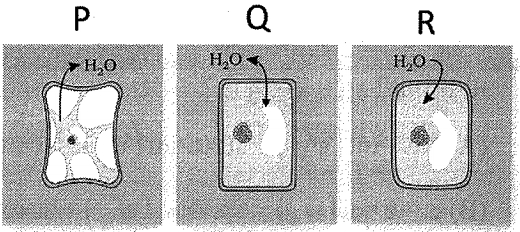
Identify the given cells $P$,$Q$,and $R$.
A
Flaccid cell,Plasmolysed cell,Turgid cell
B
Turgid cell,Flaccid cell,Plasmolysed cell
C
Plasmolysed cell,Flaccid cell,Turgid cell
D
Turgid cell,Plasmolysed cell,Flaccid cell
Solution
(C) In the given figure:
$P$ represents a Plasmolysed cell,where water has moved out of the cell,causing the protoplast to shrink away from the cell wall.
$Q$ represents a Flaccid cell,where the water potential inside and outside the cell is equal,resulting in no net movement of water.
$R$ represents a Turgid cell,where water has moved into the cell,causing the protoplast to press against the cell wall.
Therefore,the correct sequence is Plasmolysed cell,Flaccid cell,Turgid cell.
$P$ represents a Plasmolysed cell,where water has moved out of the cell,causing the protoplast to shrink away from the cell wall.
$Q$ represents a Flaccid cell,where the water potential inside and outside the cell is equal,resulting in no net movement of water.
$R$ represents a Turgid cell,where water has moved into the cell,causing the protoplast to press against the cell wall.
Therefore,the correct sequence is Plasmolysed cell,Flaccid cell,Turgid cell.
0 likes
View Solution130
EasyMCQ
If the external solution is less concentrated than the cytoplasm,it is called $P$. If the external solution is more concentrated than the cytoplasm,it is called $Q$. If the external solution balances the osmotic pressure of the cytoplasm,it is called $R$.
A
$P$: Isotonic,$Q$: Hypertonic,$R$: Hypotonic
B
$P$: Hypotonic,$Q$: Hypertonic,$R$: Isotonic
C
$P$: Hypertonic,$Q$: Hypotonic,$R$: Isotonic
D
$P$: Isotonic,$Q$: Hypotonic,$R$: Hypertonic
Solution
(B) $1$. $A$ solution that is less concentrated than the cytoplasm is known as a Hypotonic solution $(P)$.
$2$. $A$ solution that is more concentrated than the cytoplasm is known as a Hypertonic solution $(Q)$.
$3$. $A$ solution that has the same osmotic pressure as the cytoplasm is known as an Isotonic solution $(R)$.
Therefore,the correct sequence is $P$: Hypotonic,$Q$: Hypertonic,$R$: Isotonic.
$2$. $A$ solution that is more concentrated than the cytoplasm is known as a Hypertonic solution $(Q)$.
$3$. $A$ solution that has the same osmotic pressure as the cytoplasm is known as an Isotonic solution $(R)$.
Therefore,the correct sequence is $P$: Hypotonic,$Q$: Hypertonic,$R$: Isotonic.
0 likes
View Solution131
EasyMCQ
In which type of solution should a cell be placed to induce plasmolysis?
A
Hypertonic solution
B
Isotonic solution
C
Hypotonic solution
D
Any solution
Solution
(A) Plasmolysis is the process in which the protoplast of a plant cell shrinks away from the cell wall due to the loss of water.
This occurs when the cell is placed in a hypertonic solution,which has a higher solute concentration than the cytoplasm of the cell.
Due to the osmotic gradient,water moves out of the cell,causing the protoplast to shrink.
Therefore,the correct option is $A$.
This occurs when the cell is placed in a hypertonic solution,which has a higher solute concentration than the cytoplasm of the cell.
Due to the osmotic gradient,water moves out of the cell,causing the protoplast to shrink.
Therefore,the correct option is $A$.
0 likes
View Solution132
EasyMCQ
Osmosis is $..................$
A
Diffusion of water
B
Passive process
C
Requires a semi-permeable membrane
D
All of the above
Solution
(D) Osmosis is a special type of diffusion of water across a semi-permeable membrane.
It is a passive process,meaning it does not require the expenditure of metabolic energy $(ATP)$.
It occurs from a region of higher water potential to a region of lower water potential.
Therefore,all the given statements are correct characteristics of osmosis.
It is a passive process,meaning it does not require the expenditure of metabolic energy $(ATP)$.
It occurs from a region of higher water potential to a region of lower water potential.
Therefore,all the given statements are correct characteristics of osmosis.
0 likes
View Solution133
MediumMCQ
How is water absorbed by the roots?
A
Active transport
B
Facilitated diffusion
C
Diffusion
D
All of the above
Solution
(C) Water is absorbed by the root hairs primarily through the process of $Diffusion$ (specifically $Osmosis$).
$Osmosis$ is the movement of water molecules from a region of higher water potential to a region of lower water potential through a semi-permeable membrane.
While minerals may be absorbed via $Active$ $transport$, the bulk movement of water into the roots occurs passively along a water potential gradient.
$Osmosis$ is the movement of water molecules from a region of higher water potential to a region of lower water potential through a semi-permeable membrane.
While minerals may be absorbed via $Active$ $transport$, the bulk movement of water into the roots occurs passively along a water potential gradient.
0 likes
View Solution134
MediumMCQ
Plants cannot grow in areas with high salt concentrations because of $.......$
A
Endosmosis
B
Exosmosis
C
Inhibition of respiration
D
All of the above
Solution
(B) In areas with high salt concentrations,the soil solution becomes hypertonic relative to the plant cell sap.
Due to the hypertonic nature of the soil,water moves out of the plant root cells into the soil through the process of exosmosis.
This loss of water leads to plasmolysis and dehydration of the root cells,which prevents the plant from absorbing water and nutrients,ultimately inhibiting growth.
Due to the hypertonic nature of the soil,water moves out of the plant root cells into the soil through the process of exosmosis.
This loss of water leads to plasmolysis and dehydration of the root cells,which prevents the plant from absorbing water and nutrients,ultimately inhibiting growth.
0 likes
View Solution135
EasyMCQ
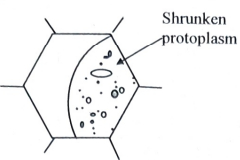
The cell given in the diagram below shows a shrunken protoplasm. Which one of the following is an $INCORRECT$ statement regarding this cell?
A
The cell has decreased turgor pressure and increased osmotic pressure.
B
The cell was placed in a hypotonic solution.
C
The cell is plasmolyzed.
D
The cell was placed in a hypertonic solution.
Solution
(B) The diagram shows a plasmolyzed cell,which occurs when a plant cell is placed in a hypertonic solution (a solution with a higher solute concentration than the cell sap).
In a hypertonic solution,water moves out of the cell due to exosmosis,causing the protoplasm to shrink away from the cell wall.
As the cell loses water,its turgor pressure decreases and its osmotic pressure increases.
Therefore,statement $B$ is incorrect because the cell was placed in a hypertonic solution,not a hypotonic one.
In a hypertonic solution,water moves out of the cell due to exosmosis,causing the protoplasm to shrink away from the cell wall.
As the cell loses water,its turgor pressure decreases and its osmotic pressure increases.
Therefore,statement $B$ is incorrect because the cell was placed in a hypertonic solution,not a hypotonic one.
0 likes
View SolutionTransport in Plants — Osmosis and Plasmolysis · Frequently Asked Questions
1Are these Transport in Plants questions useful for JEE and NEET?
Yes. All questions in this section are mapped to JEE Main and NEET exam patterns. Previous year questions from JEE Main, NEET, GUJCET and state-level exams are included with full solutions.
2Can I switch to Hindi or Gujarati for these questions?
Yes. Use the language tabs in the hero section or the sidebar to view the same questions and solutions in English, Hindi or Gujarati.
3How do I generate a question paper from this subtopic?
Use the Vedclass Exam Paper Generator — select the chapter and subtopic, set difficulty, and generate Sets A, B, C, D automatically. First 3 chapters of every subject are free.
Vedclass Products
For Students
Vedclass Test Series
Mock tests in real JEE/NEET style with performance analysis. 5-day free trial.
Start Free TrialFor Teachers
Exam Paper Generator
Generate Set A/B/C/D papers from this chapter in 2 minutes. 3 chapters free.
Try FreeFor Institutes
Online Exam Module
Live online exams with unlimited students, 360° analytics & white-label branding.
See DemoFor Teachers & Institutes
Generate a Transport in Plants Exam Paper in 2 Minutes
Select subtopic & difficulty — Sets A, B, C, D auto-generated with No Repeat logic.
First 3 chapters of every subject are free — no payment required.