
A English
Connective tissue Questions in English
Class 11 Biology · Structural Organisation In Animals · Connective tissue
301+
Questions
English
Language
100%
With Solutions
Showing 50 of 301 questions in English
151
MediumMCQ
$A$ ligament is a -
A
Modified white fibrous tissue
B
Inelastic white fibrous tissue
C
Modified elastic connective tissue
D
None of these
Solution
(C) ligament is a specialized type of dense connective tissue that connects bone to bone. It is primarily composed of yellow elastic fibers,which provide the necessary flexibility and elasticity to allow movement at joints while maintaining structural integrity. Therefore,it is classified as a modified elastic connective tissue.
0 likes
View Solution152
MediumMCQ
What do mast cells secrete?
A
Heparin
B
Myoglobin
C
Histamine
D
Hemoglobin
Solution
(C) Mast cells are a type of white blood cell that plays a crucial role in the immune system,particularly in allergic reactions.
They contain granules filled with chemical mediators such as $Histamine$,$Serotonin$,and $Heparin$.
When an allergen enters the body,it triggers mast cells to release these substances,which leads to the symptoms of an allergic response,such as inflammation,itching,and swelling.
Therefore,among the given options,$Histamine$ is the primary chemical mediator secreted by mast cells during an allergic reaction.
They contain granules filled with chemical mediators such as $Histamine$,$Serotonin$,and $Heparin$.
When an allergen enters the body,it triggers mast cells to release these substances,which leads to the symptoms of an allergic response,such as inflammation,itching,and swelling.
Therefore,among the given options,$Histamine$ is the primary chemical mediator secreted by mast cells during an allergic reaction.
0 likes
View Solution153
EasyMCQ
Connective tissue is derived from which germ layer?
A
Ectoderm
B
Mesoderm
C
Endoderm
D
Any of the above
Solution
(B) Connective tissues are the most abundant and widely distributed tissues in the body of complex animals.
They are derived from the $Mesoderm$ during embryonic development.
$Ectoderm$ primarily gives rise to nervous tissue and the epidermis of the skin,while $Endoderm$ gives rise to the lining of the digestive and respiratory tracts.
They are derived from the $Mesoderm$ during embryonic development.
$Ectoderm$ primarily gives rise to nervous tissue and the epidermis of the skin,while $Endoderm$ gives rise to the lining of the digestive and respiratory tracts.
0 likes
View Solution154
MediumMCQ
Which of the following is a loose connective tissue?
A
Areolar tissue
B
Bone
C
Blood
D
Cartilage
Solution
(A) Loose connective tissue contains cells and fibers loosely arranged in a semi-fluid ground substance.
Areolar tissue is a type of loose connective tissue present beneath the skin.
Bone and cartilage are types of specialized connective tissue.
Blood is a fluid connective tissue.
Therefore,the correct option is $A$.
Areolar tissue is a type of loose connective tissue present beneath the skin.
Bone and cartilage are types of specialized connective tissue.
Blood is a fluid connective tissue.
Therefore,the correct option is $A$.
0 likes
View Solution155
EasyMCQ
The pinna of a mammal is supported by which type of cartilage?
A
Hyaline cartilage
B
Calcified cartilage
C
Elastic cartilage
D
White fibrous connective tissue
Solution
(C) The pinna (external ear) of a mammal needs to be flexible to maintain its shape while being able to bend without breaking.
This flexibility is provided by elastic cartilage,which contains a network of yellow elastic fibers in its matrix.
Therefore,the correct option is $C$.
This flexibility is provided by elastic cartilage,which contains a network of yellow elastic fibers in its matrix.
Therefore,the correct option is $C$.
0 likes
View Solution156
MediumMCQ
Cartilage is a .....
A
Non-conductor
B
Poor conductor
C
Very good conductor
D
Irregular conductor
Solution
(A) Cartilage is a specialized connective tissue. It is a non-vascular tissue and lacks blood vessels and nerves. Due to its dense,fibrous matrix and lack of blood supply,it does not conduct electricity or heat efficiently,making it a non-conductor.
0 likes
View Solution157
MediumMCQ
Which of the following is present in bone but absent in cartilage?
A
Haversian canal
B
Blood vessel
C
Lymph vessel
D
None of these
Solution
(A) Bones are highly vascularized connective tissues that contain a unique system of canals known as $Haversian$ $canals$. These canals house blood vessels and nerves,which are essential for the nourishment and maintenance of bone tissue. In contrast,cartilage is an avascular tissue,meaning it lacks blood vessels and $Haversian$ $canals$,relying on diffusion for nutrient supply. Therefore,the $Haversian$ $canal$ is a characteristic feature of bone that is absent in cartilage.
0 likes
View Solution158
EasyMCQ
Yellow and white fibers are found in the form of ....
A
Singular or bundles respectively
B
Only singular
C
Only bundles
D
Network
Solution
(A) In connective tissue,white fibers (collagen fibers) are typically found in bundles,providing strength and flexibility. Yellow fibers (elastin fibers) are typically found as singular,branched fibers,providing elasticity to the tissue. Therefore,yellow and white fibers are found in the form of singular and bundles respectively.
0 likes
View Solution159
EasyMCQ
Where is hyaline cartilage found?
A
Santorini of larynx
B
Tracheal rings
C
Epiglottis
D
Eustachian tube
Solution
(B) Hyaline cartilage is the most abundant type of cartilage in the body.
It is found in the tracheal rings,which provide structural support to the trachea and keep the airway open.
Santorini cartilages are elastic cartilages found in the larynx.
The epiglottis is also composed of elastic cartilage.
The Eustachian tube is supported by elastic cartilage.
Therefore,the correct option is $B$.
It is found in the tracheal rings,which provide structural support to the trachea and keep the airway open.
Santorini cartilages are elastic cartilages found in the larynx.
The epiglottis is also composed of elastic cartilage.
The Eustachian tube is supported by elastic cartilage.
Therefore,the correct option is $B$.
0 likes
View Solution160
EasyMCQ
The cells of connective tissue are produced by . . . . . . .
A
Fibroblasts
B
Mast cells
C
Plasma cells
D
Mesodermal cells
Solution
(A) Connective tissues are derived from the mesoderm during embryonic development. However,the specific cells responsible for producing the fibers and the ground substance (matrix) of the connective tissue are known as fibroblasts. Fibroblasts are the most abundant cells in connective tissue and are responsible for synthesizing collagen,elastin,and glycosaminoglycans.
0 likes
View Solution161
EasyMCQ
Vitamin $C$ is helpful in which of the following processes?
A
Formation of visual pigments
B
Formation of bones
C
Treatment of pernicious anemia
D
Wound healing
Solution
(D) Vitamin $C$ (ascorbic acid) plays a crucial role in the synthesis of collagen,which is a structural protein essential for the formation of connective tissues,skin,tendons,and blood vessels.
Because of its role in collagen synthesis,Vitamin $C$ is vital for the repair of tissues and the process of wound healing.
Deficiency of Vitamin $C$ leads to scurvy,characterized by delayed wound healing and bleeding gums.
Because of its role in collagen synthesis,Vitamin $C$ is vital for the repair of tissues and the process of wound healing.
Deficiency of Vitamin $C$ leads to scurvy,characterized by delayed wound healing and bleeding gums.
0 likes
View Solution162
MediumMCQ
Vitamin-$C$ is primarily helpful in which of the following?
A
Growth of bones
B
Formation of connective tissue
C
Treatment of anemia
D
Formation of visual pigments
Solution
(B) Vitamin-$C$,also known as ascorbic acid,is essential for the synthesis of collagen,which is the most abundant protein in the human body. Collagen is a key structural component of connective tissues,including skin,tendons,ligaments,and blood vessels. Therefore,Vitamin-$C$ is primarily helpful in the formation and maintenance of connective tissues. Deficiency of Vitamin-$C$ leads to scurvy,characterized by weak connective tissues and bleeding gums.
0 likes
View Solution163
MediumMCQ
In vertebrates,where is sulfate found?
A
Ligaments
B
Bone matrix
C
Hyaline cartilage
D
All of the above
Solution
(D) In vertebrate tissues,sulfate is a key component of glycosaminoglycans (GAGs) such as chondroitin sulfate and keratan sulfate.
These molecules are essential components of the extracellular matrix in various connective tissues.
Specifically,sulfate is found in the bone matrix (providing structural integrity),ligaments,and hyaline cartilage (where it is a major component of the ground substance).
Therefore,all the listed options contain sulfate as part of their structural composition.
These molecules are essential components of the extracellular matrix in various connective tissues.
Specifically,sulfate is found in the bone matrix (providing structural integrity),ligaments,and hyaline cartilage (where it is a major component of the ground substance).
Therefore,all the listed options contain sulfate as part of their structural composition.
0 likes
View Solution164
MediumMCQ
Which mineral element is present in the composition of hyaline cartilage,ligaments,and bone matrix?
A
$P$
B
$S$
C
$Ca$
D
$N$
Solution
(C) Hyaline cartilage,ligaments,and bone matrix are connective tissues that contain specific structural proteins and minerals.
Calcium $(Ca)$ is a primary mineral component found in the matrix of bones and is essential for the structural integrity of various skeletal tissues.
While phosphorus $(P)$ is also present in bones as calcium phosphate,calcium is the fundamental mineral element characterizing the calcified matrix of these tissues.
Calcium $(Ca)$ is a primary mineral component found in the matrix of bones and is essential for the structural integrity of various skeletal tissues.
While phosphorus $(P)$ is also present in bones as calcium phosphate,calcium is the fundamental mineral element characterizing the calcified matrix of these tissues.
0 likes
View Solution165
MediumMCQ
Which structure is helpful in maintaining body temperature?
A
Subcutaneous fat layer
B
Subcutaneous marrow layer
C
Protective skin
D
Intercellular fluid
Solution
(A) The subcutaneous fat layer (also known as the hypodermis or adipose tissue layer) acts as an insulator for the body. It helps in preventing heat loss from the body to the external environment,thereby playing a crucial role in thermoregulation and maintaining a constant body temperature.
0 likes
View Solution166
EasyMCQ
Which layer is present under the skin?
A
Cuticle
B
Chitin
C
Suberin
D
Subcutaneous
Solution
(D) The skin is composed of two main layers: the epidermis and the dermis. Beneath the dermis lies the subcutaneous layer,also known as the hypodermis. This layer consists of adipose tissue and connective tissue,which helps in insulating the body and storing energy.
0 likes
View Solution167
MediumMCQ
What is the function of the subcutaneous adipose tissue layer?
A
It increases body temperature.
B
It decreases body temperature.
C
It helps in maintaining body temperature.
D
It does not play a role in maintaining body temperature.
Solution
(C) The subcutaneous adipose tissue layer acts as an insulator for the body.
It prevents the loss of heat from the body to the external environment.
Therefore,it plays a crucial role in thermoregulation by maintaining the body temperature.
It prevents the loss of heat from the body to the external environment.
Therefore,it plays a crucial role in thermoregulation by maintaining the body temperature.
0 likes
View Solution168
MediumMCQ
In organisms, where are sulfates primarily found?
A
Hyaline cartilage
B
Ligaments
C
Bone matrix
D
All of the above
Solution
(D) Sulfates are essential components of the extracellular matrix in various connective tissues.
In $Hyaline \text{ } cartilage$, the ground substance contains chondroitin sulfate.
In $Ligaments$, which are dense regular connective tissues, proteoglycans containing sulfate groups are present.
In $Bone \text{ } matrix$, the organic component (osteoid) also contains sulfated glycosaminoglycans.
Therefore, sulfates are found in all these structures.
In $Hyaline \text{ } cartilage$, the ground substance contains chondroitin sulfate.
In $Ligaments$, which are dense regular connective tissues, proteoglycans containing sulfate groups are present.
In $Bone \text{ } matrix$, the organic component (osteoid) also contains sulfated glycosaminoglycans.
Therefore, sulfates are found in all these structures.
0 likes
View Solution169
MediumMCQ
Choose the correctly matched pair.
A
Tendon $\to$ Specialized connective tissue
B
Adipose tissue $\to$ Dense connective tissue
C
Areolar tissue $\to$ Loose connective tissue
D
Cartilage $\to$ Loose connective tissue
Solution
(C) : Areolar tissue is the most widely distributed loose connective tissue in the body.
Tendon is a type of dense regular connective tissue.
Adipose tissue is a type of loose connective tissue that stores fat.
Cartilage is a type of specialized connective tissue.
Tendon is a type of dense regular connective tissue.
Adipose tissue is a type of loose connective tissue that stores fat.
Cartilage is a type of specialized connective tissue.
0 likes
View Solution170
MediumMCQ
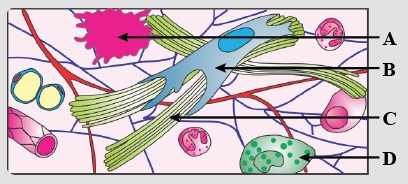
Given below is the diagrammatic sketch of a certain type of connective tissue. Identify the parts labelled $A, B, C$ and $D$ and select the right option about them.
A
$A$-Macrophage,$B$-Fibroblast,$C$-Collagen fibres,$D$-Mast cell
B
$A$-Mast cell,$B$-Macrophage,$C$-Fibroblast,$D$-Collagen fibres
C
$A$-Macrophage,$B$-Collagen fibres,$C$-Fibroblast,$D$-Mast cell
D
$A$-Mast cell,$B$-Collagen fibres,$C$-Fibroblast,$D$-Macrophage
Solution
(A) Based on the standard diagram of areolar connective tissue provided in the $NCERT$ textbook:
$A$ represents a Macrophage,which is a large phagocytic cell.
$B$ represents a Fibroblast,which is responsible for producing and secreting fibres.
$C$ represents Collagen fibres,which provide structural strength.
$D$ represents a Mast cell,which contains granules and is involved in inflammatory responses.
Therefore,the correct sequence is $A$-Macrophage,$B$-Fibroblast,$C$-Collagen fibres,$D$-Mast cell.
$A$ represents a Macrophage,which is a large phagocytic cell.
$B$ represents a Fibroblast,which is responsible for producing and secreting fibres.
$C$ represents Collagen fibres,which provide structural strength.
$D$ represents a Mast cell,which contains granules and is involved in inflammatory responses.
Therefore,the correct sequence is $A$-Macrophage,$B$-Fibroblast,$C$-Collagen fibres,$D$-Mast cell.
0 likes
View Solution171
MediumMCQ
The supportive skeletal structures in the human external ears and in the nose tip are examples of
A
ligament
B
areolar tissue
C
bone
D
cartilage
Solution
(D) : Cartilage is a semi-rigid supportive or skeletal connective tissue in which the matrix is solid and made of mucoprotein or proteoglycan called chondrin.
It is of four types: hyaline,fibrous,calcified,and elastic.
Yellow elastic fibrocartilage is found in the pinna and external auditory canal of the ear,Eustachian tubes,epiglottis,and the tip of the nose.
Its matrix contains numerous yellow fibers which form a network by uniting with one another.
Due to the presence of yellow fibers,the cartilage becomes more flexible.
Hence,it provides flexibility to these organs.
It is of four types: hyaline,fibrous,calcified,and elastic.
Yellow elastic fibrocartilage is found in the pinna and external auditory canal of the ear,Eustachian tubes,epiglottis,and the tip of the nose.
Its matrix contains numerous yellow fibers which form a network by uniting with one another.
Due to the presence of yellow fibers,the cartilage becomes more flexible.
Hence,it provides flexibility to these organs.
0 likes
View Solution172
EasyMCQ
The kind of tissue that forms the supportive structure in our pinna (external ears) is also found in
A
nails
B
ear ossicles
C
tip of the nose
D
vertebrae
Solution
(C) The tissue that forms the supportive structure in the pinna (external ear) is yellow elastic cartilage. This type of cartilage provides both support and flexibility. It is also found in the tip of the nose,the epiglottis,and the Eustachian tubes. Therefore,the correct option is $(c)$.
0 likes
View Solution173
EasyMCQ
Areolar connective tissue joins
A
bones with bones
B
fat body with muscles
C
integument with muscles
D
bones with muscles
Solution
(C) : Areolar tissue is a loose connective tissue comprised of a semifluid ground substance containing several kinds of loosely arranged fibres. Its function is to attach the skin (integument) to the underlying tissues,to fill the spaces between various organs and thus hold them in place,and to surround and support the blood vessels. Tendons connect muscles with bone,while ligaments connect bone with bone.
0 likes
View Solution174
EasyMCQ
Mast cells secrete
A
haemoglobin
B
hippurin
C
myoglobin
D
histamine
Solution
(D) : Mast cells are granulated wandering cells found in connective tissue.
Their granules contain histamine,which acts as a vasodilator.
It is responsible for symptoms like a running nose,sneezing,and itching,and it can also cause the narrowing of airways in the lungs.
Haemoglobin and myoglobin are respiratory pigments present in the blood and muscles,respectively.
Their granules contain histamine,which acts as a vasodilator.
It is responsible for symptoms like a running nose,sneezing,and itching,and it can also cause the narrowing of airways in the lungs.
Haemoglobin and myoglobin are respiratory pigments present in the blood and muscles,respectively.
0 likes
View Solution175
MediumMCQ
The excess of nutrients which are not used immediately are converted into fats and are stored in
A
Adipose tissues
B
Regular dense connective tissue
C
Irregular dense connective tissue
D
None of them
Solution
(A) Adipose tissue is a type of loose connective tissue located mainly beneath the skin.
These cells are specialized to store fats.
The excess nutrients which are not used immediately are converted into fats and are stored in this tissue.
Therefore,the correct option is $A$.
These cells are specialized to store fats.
The excess nutrients which are not used immediately are converted into fats and are stored in this tissue.
Therefore,the correct option is $A$.
0 likes
View Solution176
MediumMCQ
Which of the following statements is not correct about bones?
A
Ground substance is hard and non-pliable.
B
It is a type of connective tissue.
C
Bones support and protect softer tissues and organs.
D
Bone marrow is not a site for the production of blood cells.
Solution
(D) Bones are a specialized type of connective tissue characterized by a hard and non-pliable ground substance rich in calcium salts and collagen fibers,which give bone its strength.
They provide structural framework,support,and protection to softer tissues and organs.
Bone marrow,located in the marrow cavity of bones,is the primary site for hematopoiesis,which is the production of blood cells.
Therefore,the statement that bone marrow is not a site for the production of blood cells is incorrect.
They provide structural framework,support,and protection to softer tissues and organs.
Bone marrow,located in the marrow cavity of bones,is the primary site for hematopoiesis,which is the production of blood cells.
Therefore,the statement that bone marrow is not a site for the production of blood cells is incorrect.
0 likes
View Solution177
MediumMCQ
In all connective tissue except ......$X$..... the cells secrete fibers of structural proteins called ....$Y$....
A
$X$-blood,$Y$- elastin
B
$X$-blood,$Y$- chitin
C
$X$-epithelial,$Y$- collagen
D
$X$-epithelial,$Y$- elastin
Solution
(A) In most connective tissues,cells secrete fibers of structural proteins called collagen or elastin to provide strength,elasticity,and flexibility to the tissue.
However,blood is a specialized connective tissue that lacks these fibers in its matrix (plasma) under normal conditions.
Therefore,$X$ is blood and $Y$ is collagen or elastin (as these are the primary structural proteins in connective tissues).
However,blood is a specialized connective tissue that lacks these fibers in its matrix (plasma) under normal conditions.
Therefore,$X$ is blood and $Y$ is collagen or elastin (as these are the primary structural proteins in connective tissues).
0 likes
View Solution178
MediumMCQ
Which of the following is not a cell of areolar tissue?
A
Chondroblasts
B
Fibroblasts
C
Mast cells
D
Macrophages
Solution
(A) Areolar tissue is a type of loose connective tissue that contains various cells such as fibroblasts,macrophages,and mast cells.
Fibroblasts are responsible for producing and secreting fibers.
Macrophages are phagocytic cells that engulf pathogens.
Mast cells are involved in inflammatory responses.
Chondroblasts are specialized cells found in cartilage tissue,not in areolar tissue. Therefore,$A$ is the correct answer.
Fibroblasts are responsible for producing and secreting fibers.
Macrophages are phagocytic cells that engulf pathogens.
Mast cells are involved in inflammatory responses.
Chondroblasts are specialized cells found in cartilage tissue,not in areolar tissue. Therefore,$A$ is the correct answer.
0 likes
View Solution179
MediumMCQ
What are the functions of connective tissue from the following?
$(i)$ Provides immunity
$(ii)$ Helpful in blood coagulation
$(iii)$ Stops coagulation of blood in blood vessels
$(iv)$ Connects tissues
$(i)$ Provides immunity
$(ii)$ Helpful in blood coagulation
$(iii)$ Stops coagulation of blood in blood vessels
$(iv)$ Connects tissues
A
$(i)$ and $(ii)$
B
$(iii)$ and $(iv)$
C
$(i), (ii)$ and $(iv)$
D
$(i), (ii), (iii)$ and $(iv)$
Solution
(D) Connective tissues perform various vital functions in the body:
$(i)$ Provides immunity: Specialized connective tissues like blood (white blood cells) and lymphatic tissue play a crucial role in the immune response.
$(ii)$ Helpful in blood coagulation: Platelets (thrombocytes), which are components of blood (a fluid connective tissue), are essential for the clotting process.
$(iii)$ Stops coagulation of blood in blood vessels: Heparin, produced by mast cells found in areolar connective tissue, acts as an anticoagulant to prevent unnecessary clotting within blood vessels.
$(iv)$ Connects tissues: As the name implies, connective tissues bind, support, and anchor various organs and tissues together.
Therefore, all the listed functions $(i, ii, iii, \text{ and } iv)$ are performed by different types of connective tissues.
$(i)$ Provides immunity: Specialized connective tissues like blood (white blood cells) and lymphatic tissue play a crucial role in the immune response.
$(ii)$ Helpful in blood coagulation: Platelets (thrombocytes), which are components of blood (a fluid connective tissue), are essential for the clotting process.
$(iii)$ Stops coagulation of blood in blood vessels: Heparin, produced by mast cells found in areolar connective tissue, acts as an anticoagulant to prevent unnecessary clotting within blood vessels.
$(iv)$ Connects tissues: As the name implies, connective tissues bind, support, and anchor various organs and tissues together.
Therefore, all the listed functions $(i, ii, iii, \text{ and } iv)$ are performed by different types of connective tissues.
0 likes
View Solution180
MediumMCQ
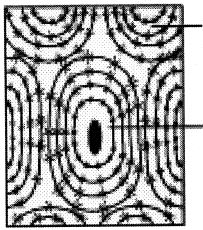
Identify the given figure.
A
Cartilage
B
Bone
C
Areolar tissue
D
None
Solution
(B) The figure shows a cross-section of bone tissue,specifically depicting the Haversian system or osteon.
Key features visible include the central Haversian canal and concentric rings of matrix called lamellae,with osteocytes located in lacunae between the lamellae.
This structure is characteristic of compact bone tissue.
Key features visible include the central Haversian canal and concentric rings of matrix called lamellae,with osteocytes located in lacunae between the lamellae.
This structure is characteristic of compact bone tissue.
0 likes
View Solution181
MediumMCQ
Where is cartilage located in the human body?
A
Limbs and hands in adults
B
Outer ear joints
C
Tip of nose
D
All of the above
Solution
(D) Cartilage is a type of specialized connective tissue that is flexible and provides structural support.
$1$. In adults,cartilage is found in the joints of limbs and hands (articular cartilage).
$2$. The outer ear (pinna) is composed of elastic cartilage.
$3$. The tip of the nose is also supported by hyaline cartilage.
Therefore,all the given options are correct locations for cartilage.
$1$. In adults,cartilage is found in the joints of limbs and hands (articular cartilage).
$2$. The outer ear (pinna) is composed of elastic cartilage.
$3$. The tip of the nose is also supported by hyaline cartilage.
Therefore,all the given options are correct locations for cartilage.
0 likes
View Solution182
MediumMCQ
The major constituent of connective tissue is
A
Vitamin
B
carbohydrate
C
Lipid
D
collagen
Solution
(D) Connective tissues are the most abundant and widely distributed tissues in the body of complex animals.
They are named connective tissues because of their special function of linking and supporting other tissues/organs of the body.
These tissues contain cells and a matrix consisting of fibers and ground substance.
Collagen is the most abundant protein in the animal kingdom and is the major structural protein present in the extracellular matrix of connective tissues,providing strength and elasticity.
They are named connective tissues because of their special function of linking and supporting other tissues/organs of the body.
These tissues contain cells and a matrix consisting of fibers and ground substance.
Collagen is the most abundant protein in the animal kingdom and is the major structural protein present in the extracellular matrix of connective tissues,providing strength and elasticity.
0 likes
View Solution183
MediumMCQ
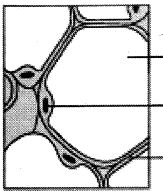
Identify the given figure.
A
Areolar
B
Adipose tissue
C
Dense regular
D
Dense irregular
Solution
(B) The provided figure shows large,spherical cells with a peripheral nucleus and a large central fat droplet.
This structure is characteristic of adipose tissue.
Adipose tissue is a type of loose connective tissue located mainly beneath the skin,which stores fats.
The cells of this tissue are specialized to store fats.
This structure is characteristic of adipose tissue.
Adipose tissue is a type of loose connective tissue located mainly beneath the skin,which stores fats.
The cells of this tissue are specialized to store fats.
0 likes
View Solution184
MediumMCQ
What is the main function of fibroblasts?
A
Produce and secrete fibers and matrix proteins.
B
Produce blood cells.
C
Produce chondroblasts.
D
Transmission of mucus.
Solution
(A) Fibroblasts are the most common cells found in connective tissue proper. Their primary function is to synthesize and secrete the extracellular matrix,which includes structural proteins like collagen and elastin fibers,as well as ground substance. Therefore,they are essential for the structural integrity and repair of connective tissues.
0 likes
View Solution185
MediumMCQ
Which of the following is not a function of bone?
A
Provides a structural frame for the body
B
Supports and protects softer organs and tissues
C
Removes particles and mucus in a specific direction
D
Site of production of blood cells
Solution
(C) Bones are specialized connective tissues that provide a structural frame for the body $(A)$. They support and protect softer organs and tissues $(B)$. The bone marrow,found within bones,is the site of production of blood cells $(D)$. The function of removing particles and mucus in a specific direction is performed by ciliated epithelium,not by bone $(C)$.
0 likes
View Solution186
MediumMCQ
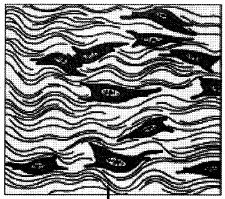
Identify the tissue shown in the figure.
A
Dense regular connective tissue
B
Cartilage
C
Bone
D
Dense irregular connective tissue
Solution
(A) The provided figure shows collagen fibers arranged in a regular,parallel pattern with fibroblasts interspersed between them. This is a characteristic feature of dense regular connective tissue,which is found in tendons and ligaments. Therefore,the correct option is $A$.
0 likes
View Solution187
MediumMCQ
$A$ - Adipose tissue is a type of connective tissue.
$R$ - It serves as a support framework for the epithelium.
$R$ - It serves as a support framework for the epithelium.
A
$A$ and $R$ are both correct.
B
$A$ and $R$ are both incorrect.
C
$A$ is correct and $R$ is incorrect.
D
$A$ is incorrect and $R$ is correct.
Solution
(C) is correct because adipose tissue is a specialized loose connective tissue that stores fats.
$R$ is incorrect because the support framework for the epithelium is typically provided by the basement membrane or underlying areolar connective tissue,not adipose tissue. Adipose tissue primarily functions in fat storage,insulation,and cushioning of organs.
$R$ is incorrect because the support framework for the epithelium is typically provided by the basement membrane or underlying areolar connective tissue,not adipose tissue. Adipose tissue primarily functions in fat storage,insulation,and cushioning of organs.
0 likes
View Solution188
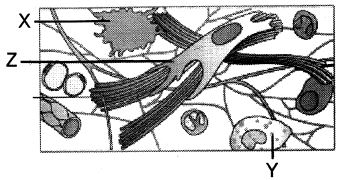
MediumMCQ
Identify the given $X, Y$ and $Z$ from the following figure:
A
Macrophage - Mast cell - Fibroblast
B
Fibroblast - Collagen fibre - Mast cells
C
Collagen fibre - Fibroblast - Macrophage
D
Mast cells - Collagen fibre - Macrophage
Solution
(A) Based on the standard diagram of areolar connective tissue provided in the $NCERT$ textbook:
$X$ represents a Macrophage,which is a large phagocytic cell.
$Y$ represents a Mast cell,which contains granules and is involved in inflammatory responses.
$Z$ represents a Fibroblast,which is the cell responsible for producing and secreting fibers (like collagen) in the matrix.
Therefore,the correct identification is $X$ = Macrophage,$Y$ = Mast cell,$Z$ = Fibroblast.
$X$ represents a Macrophage,which is a large phagocytic cell.
$Y$ represents a Mast cell,which contains granules and is involved in inflammatory responses.
$Z$ represents a Fibroblast,which is the cell responsible for producing and secreting fibers (like collagen) in the matrix.
Therefore,the correct identification is $X$ = Macrophage,$Y$ = Mast cell,$Z$ = Fibroblast.
0 likes
View Solution189
EasyMCQ
Histamine-secreting cells are found in:
A
Connective tissue
B
Lungs
C
Muscular tissue
D
Nervous tissue
Solution
(A) Histamine is a chemical mediator involved in inflammatory responses and allergic reactions.
It is primarily secreted by mast cells,which are a type of white blood cell found in connective tissues throughout the body.
These cells are particularly abundant in the skin,respiratory tract,and digestive tract,where they play a crucial role in the immune system's defense mechanism.
Therefore,the correct option is $A$.
It is primarily secreted by mast cells,which are a type of white blood cell found in connective tissues throughout the body.
These cells are particularly abundant in the skin,respiratory tract,and digestive tract,where they play a crucial role in the immune system's defense mechanism.
Therefore,the correct option is $A$.
0 likes
View Solution190
EasyMCQ
The polysaccharide found in the matrix of cartilage is known as ..........
A
Cartilagin
B
Ossein
C
Chondroitin
D
Casein
Solution
(C) The matrix of cartilage is composed of a firm but flexible material. It contains a protein called chondrin and a polysaccharide known as chondroitin sulfate. Chondroitin sulfate is a glycosaminoglycan that provides structural support and resilience to the cartilage tissue. Ossein is found in bone matrix,while casein is a protein found in milk.
0 likes
View Solution191
MediumMCQ
Which type of cartilage is present in the nasal septum and is involved in its repair after injury?
A
Hyaline cartilage
B
Elastic cartilage
C
Calcified cartilage
D
Fibrous cartilage
Solution
(A) The nasal septum is primarily composed of $Hyaline$ cartilage.
$Hyaline$ cartilage is the most abundant type of cartilage in the body and provides structural support while maintaining flexibility.
It is found in the nose,trachea,larynx,and at the ends of long bones.
Due to its composition,it plays a critical role in the structural integrity and repair of the nasal septum following an injury.
$Hyaline$ cartilage is the most abundant type of cartilage in the body and provides structural support while maintaining flexibility.
It is found in the nose,trachea,larynx,and at the ends of long bones.
Due to its composition,it plays a critical role in the structural integrity and repair of the nasal septum following an injury.
0 likes
View Solution192
EasyMCQ
Which type of cartilage is found at the ends of long bones?
A
Calcified cartilage
B
Hyaline cartilage
C
Elastic cartilage
D
Fibrous cartilage
Solution
(B) Hyaline cartilage is the most abundant type of cartilage in the body. It is found at the articular surfaces of long bones,where it provides a smooth,low-friction surface for joint movement. It is also present in the nose,larynx,trachea,and bronchi.
0 likes
View Solution193
MediumMCQ
Which of the following contains an abundant amount of extracellular matrix?
A
Striated muscle
B
Areolar connective tissue
C
Epithelial tissue
D
Nervous tissue
Solution
(B) Connective tissues are characterized by the presence of a significant amount of extracellular matrix (ground substance and fibers) in which the cells are embedded.
Among the given options,areolar connective tissue is a type of loose connective tissue that contains a large amount of intercellular ground substance and fibers,making it rich in extracellular matrix.
Striated muscle,epithelial tissue,and nervous tissue are primarily composed of cells with very little extracellular matrix.
Among the given options,areolar connective tissue is a type of loose connective tissue that contains a large amount of intercellular ground substance and fibers,making it rich in extracellular matrix.
Striated muscle,epithelial tissue,and nervous tissue are primarily composed of cells with very little extracellular matrix.
0 likes
View Solution194
EasyMCQ
Mast cells of connective tissue contain ...........
A
Vasopressin and relaxin
B
Heparin and histamine
C
Heparin and calcitonin
D
Serotonin and melanin
Solution
(B) Mast cells are specialized cells found in the connective tissue that play a crucial role in the immune response.
They contain secretory granules filled with chemical mediators.
The primary substances released by mast cells include heparin (an anticoagulant),histamine (a vasodilator involved in inflammatory responses),and serotonin.
Therefore,the correct combination is heparin and histamine.
They contain secretory granules filled with chemical mediators.
The primary substances released by mast cells include heparin (an anticoagulant),histamine (a vasodilator involved in inflammatory responses),and serotonin.
Therefore,the correct combination is heparin and histamine.
0 likes
View Solution195
MediumMCQ
Areolar tissue,a type of loose connective tissue,serves to attach:
A
Epithelium to underlying tissues
B
Muscle to bone
C
Bone to bone
D
Muscle to fat body
Solution
(A) Areolar tissue is a type of loose connective tissue that is present beneath the skin. It serves as a support framework for epithelium and attaches the epithelium to the underlying structures (such as muscles or other connective tissues). Therefore,it acts as a packing material in the body.
0 likes
View Solution196
EasyMCQ
The tissue that forms the supporting structure in the pinna of our external ear is also found in:
A
Vertebrae
B
Nails
C
Ear ossicles
D
Tip of the nose
Solution
(D) The supporting structure of the pinna of the external ear is composed of elastic cartilage.
Elastic cartilage is a type of connective tissue that provides both flexibility and support.
Apart from the pinna,elastic cartilage is also found in the tip of the nose,the epiglottis,and parts of the larynx.
Elastic cartilage is a type of connective tissue that provides both flexibility and support.
Apart from the pinna,elastic cartilage is also found in the tip of the nose,the epiglottis,and parts of the larynx.
0 likes
View Solution197
MediumMCQ
Select the correct pair.
A
Tendon $-$ Specialized connective tissue
B
Adipose tissue $-$ Dense connective tissue
C
Areolar tissue $-$ Loose connective tissue
D
Cartilage $-$ Loose connective tissue
Solution
(C) Connective tissues are classified into three types: Loose,Dense,and Specialized.
$1$. Areolar tissue is a type of loose connective tissue that joins the skin to underlying muscles.
$2$. Tendons are dense regular connective tissues that attach skeletal muscles to bones.
$3$. Adipose tissue is a type of loose connective tissue (not dense) specialized for fat storage.
$4$. Cartilage is a specialized connective tissue,not loose.
Therefore,the correct pair is $C$.
$1$. Areolar tissue is a type of loose connective tissue that joins the skin to underlying muscles.
$2$. Tendons are dense regular connective tissues that attach skeletal muscles to bones.
$3$. Adipose tissue is a type of loose connective tissue (not dense) specialized for fat storage.
$4$. Cartilage is a specialized connective tissue,not loose.
Therefore,the correct pair is $C$.
0 likes
View Solution198
EasyMCQ
The ends of long bones are covered with .......... cartilage.
A
Calcified
B
Fibrous
C
Elastic
D
Hyaline
Solution
(D) The ends of long bones at joints are covered with hyaline cartilage,which is also known as articular cartilage.
This type of cartilage provides a smooth,low-friction surface that facilitates the movement of joints.
Hyaline cartilage is the most abundant type of cartilage in the body and is characterized by a glassy,translucent appearance.
This type of cartilage provides a smooth,low-friction surface that facilitates the movement of joints.
Hyaline cartilage is the most abundant type of cartilage in the body and is characterized by a glassy,translucent appearance.
0 likes
View Solution199
MediumMCQ
Tendons are made up of .......
A
Adipose tissue
B
Modified white fibrous tissue
C
Areolar connective tissue
D
Yellow fibrous connective tissue
Solution
(B) Tendons are specialized dense regular connective tissues that connect skeletal muscles to bones.
They are primarily composed of collagen fibers arranged in parallel bundles.
These fibers are derived from white fibrous connective tissue,which provides high tensile strength and minimal flexibility,making them ideal for transmitting the force generated by muscle contraction to the bones.
They are primarily composed of collagen fibers arranged in parallel bundles.
These fibers are derived from white fibrous connective tissue,which provides high tensile strength and minimal flexibility,making them ideal for transmitting the force generated by muscle contraction to the bones.
0 likes
View Solution200
MediumMCQ
$A$ ligament is ............... .
A
Modified yellow elastic fibrous tissue
B
Inelastic white fibrous tissue
C
Loose connective tissue
D
None of the above
Solution
(A) ligament is a specialized type of dense connective tissue. It is primarily composed of yellow elastic fibers,which provide the necessary elasticity and strength to connect bones to other bones. Therefore,it is classified as a modified yellow elastic fibrous tissue.
0 likes
View SolutionStructural Organisation In Animals — Connective tissue · Frequently Asked Questions
1Are these Structural Organisation In Animals questions useful for JEE and NEET?
Yes. All questions in this section are mapped to JEE Main and NEET exam patterns. Previous year questions from JEE Main, NEET, GUJCET and state-level exams are included with full solutions.
2Can I switch to Hindi or Gujarati for these questions?
Yes. Use the language tabs in the hero section or the sidebar to view the same questions and solutions in English, Hindi or Gujarati.
3How do I generate a question paper from this subtopic?
Use the Vedclass Exam Paper Generator — select the chapter and subtopic, set difficulty, and generate Sets A, B, C, D automatically. First 3 chapters of every subject are free.
Vedclass Products
For Students
Vedclass Test Series
Mock tests in real JEE/NEET style with performance analysis. 5-day free trial.
Start Free TrialFor Teachers
Exam Paper Generator
Generate Set A/B/C/D papers from this chapter in 2 minutes. 3 chapters free.
Try FreeFor Institutes
Online Exam Module
Live online exams with unlimited students, 360° analytics & white-label branding.
See DemoFor Teachers & Institutes
Generate a Structural Organisation In Animals Exam Paper in 2 Minutes
Select subtopic & difficulty — Sets A, B, C, D auto-generated with No Repeat logic.
First 3 chapters of every subject are free — no payment required.