
A English
Connective tissue Questions in English
Class 11 Biology · Structural Organisation In Animals · Connective tissue
301+
Questions
English
Language
100%
With Solutions
Showing 50 of 301 questions in English
201
EasyMCQ
Identify the figure with its correct function.
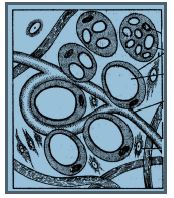
A
Areolar connective tissue - Serves as a support framework for epithelium.
B
Adipose tissue - Store fats and act as heat insulators.
C
Dense regular tissue - Provide flexibility.
D
Dense irregular tissue - Provide strength and elasticity.
Solution
(B) The provided figure shows Adipose tissue,which is a type of loose connective tissue located mainly beneath the skin.
The cells of this tissue,called adipocytes,are specialised to store fats.
Excess nutrients that are not used immediately are converted into fats and stored in this tissue.
Additionally,it acts as a heat insulator for the body.
The cells of this tissue,called adipocytes,are specialised to store fats.
Excess nutrients that are not used immediately are converted into fats and stored in this tissue.
Additionally,it acts as a heat insulator for the body.
0 likes
View Solution202
MediumMCQ
Assertion: Cartilage and bone are rigid connective tissues.
Reason: Blood is a connective tissue.
Reason: Blood is a connective tissue.
A
If both Assertion and Reason are correct and the Reason is a correct explanation of the Assertion.
B
If both Assertion and Reason are correct but Reason is not a correct explanation of the Assertion.
C
If the Assertion is correct but Reason is incorrect.
D
If the Assertion is incorrect but the Reason is correct.
Solution
(D) The Assertion is incorrect because while bone is a rigid connective tissue,cartilage is a semi-rigid or flexible connective tissue,not a rigid one. The Reason is correct because blood is indeed a specialized fluid connective tissue that transports nutrients,gases,and waste products throughout the body. Since the Assertion is false and the Reason is true,the correct option is $D$.
0 likes
View Solution203
EasyMCQ
What are chondriocytes and where are they found in the animal body?
A
Cells of bone found in lacunae
B
Cells of cartilage found in lacunae
C
Cells of blood found in plasma
D
Cells of muscle found in fibers
Solution
(B) Chondriocytes are the specialized cells of cartilage.
They are found in small cavities known as lacunae,which are present within the matrix secreted by the cells themselves.
These cells are responsible for the production and maintenance of the cartilaginous matrix.
They are found in small cavities known as lacunae,which are present within the matrix secreted by the cells themselves.
These cells are responsible for the production and maintenance of the cartilaginous matrix.
0 likes
View Solution204
Medium
Distinguish between dense regular and dense irregular connective tissues.
Solution
(N/A)
| Dense regular connective tissues | Dense irregular connective tissues |
|---|---|
| $(1)$ Collagen fibres are present in rows between many parallel bundles of fibres. | $(1)$ Collagen fibres and fibroblasts are arranged irregularly. |
| $(2)$ They provide great tensile strength in one direction. | $(2)$ They provide structural strength in multiple directions. |
| $(3)$ Examples include tendons and ligaments. | $(3)$ Examples include the dermis of the skin. |
0 likes
View Solution205
Medium
Distinguish between Adipose and Blood tissue.
Solution
(N/A)
| Adipose tissue | Blood tissue |
| $(1)$ It is composed of collagen fibers,elastin fibers,fibroblasts,macrophages,and adipocytes. | $(1)$ It is composed of $RBCs$,$WBCs$,platelets,and plasma. |
| $(2)$ It helps in the synthesis,storage,and metabolism of fats. | $(2)$ It helps in the transportation of nutrients,wastes,gases,and hormones. |
| $(3)$ It is primarily found beneath the skin and around internal organs. | $(3)$ It is found circulating within the blood vessels. |
0 likes
View Solution206
EasyMCQ
Mark the odd one in each series:
$RBC$; $WBC$; platelets; cartilage
$RBC$; $WBC$; platelets; cartilage
A
$RBC$
B
$WBC$
C
platelets
D
cartilage
Solution
(D) $RBCs$,$WBCs$,and platelets are the three primary cellular components of blood,which is a fluid connective tissue.
Cartilage is a specialized skeletal connective tissue.
Therefore,cartilage is the odd one out as it is not a component of blood.
Cartilage is a specialized skeletal connective tissue.
Therefore,cartilage is the odd one out as it is not a component of blood.
0 likes
View Solution207
Easy
Mark the odd one in the following series:
Exocrine, endocrine, salivary gland, ligament
Exocrine, endocrine, salivary gland, ligament
Solution
(D) The terms $Exocrine$, $endocrine$, and $salivary \text{ gland}$ refer to types of glandular epithelium, which is a specialized form of epithelial tissue.
$Ligament$ is a type of dense regular connective tissue that connects bone to bone.
Therefore, $ligament$ is the odd one out.
$Ligament$ is a type of dense regular connective tissue that connects bone to bone.
Therefore, $ligament$ is the odd one out.
0 likes
View Solution208
Easy
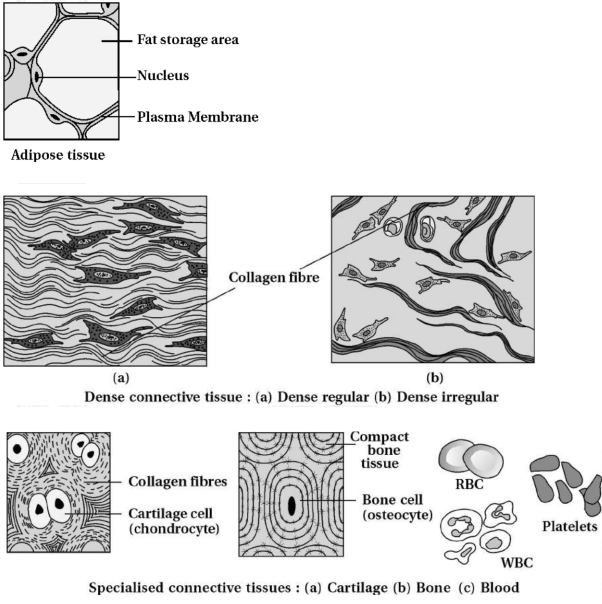
Describe the characteristics and types of connective tissue.
Solution
(N/A) Connective tissues are the most abundant and widely distributed in the body of complex animals. They are named connective tissues because of their special function of linking and supporting other tissues/organs of the body.
Characteristics:
$1$. They consist of a few cells and a large amount of intercellular ground substance.
$2$. The cells secrete structural protein fibres called collagen or elastin,which provide strength,elasticity,and flexibility.
$3$. The cells also secrete modified polysaccharides,which accumulate between cells and fibres and act as a matrix.
Types of Connective Tissue:
Connective tissue is classified into three types:
$(i)$ Loose connective tissue
(ii) Dense connective tissue
(iii) Specialised connective tissue
$(i)$ Loose Connective Tissue: Cells and fibres are loosely arranged in a semi-fluid ground substance. Examples include:
$(a)$ Areolar tissue: Present beneath the skin. It serves as a support framework for epithelium.
$(b)$ Adipose tissue: Located mainly beneath the skin. The cells are specialised to store fats.
(ii) Dense Connective Tissue: Fibres and fibroblasts are compactly packed. It is of two types:
$(a)$ Dense regular: Collagen fibres are present in rows between many parallel bundles of fibres (e.g.,tendons and ligaments).
$(b)$ Dense irregular: Fibroblasts and many fibres (mostly collagen) are oriented differently.
(iii) Specialised Connective Tissue:
$(a)$ Cartilage: The intercellular material is solid and pliable and resists compression. Cells are called chondrocytes.
$(b)$ Bone: It has a hard and non-pliable ground substance rich in calcium salts and collagen fibres which give bone its strength. Cells are called osteocytes.
$(c)$ Blood: $A$ fluid connective tissue containing plasma,red blood cells (RBCs),white blood cells (WBCs),and platelets.
Characteristics:
$1$. They consist of a few cells and a large amount of intercellular ground substance.
$2$. The cells secrete structural protein fibres called collagen or elastin,which provide strength,elasticity,and flexibility.
$3$. The cells also secrete modified polysaccharides,which accumulate between cells and fibres and act as a matrix.
Types of Connective Tissue:
Connective tissue is classified into three types:
$(i)$ Loose connective tissue
(ii) Dense connective tissue
(iii) Specialised connective tissue
$(i)$ Loose Connective Tissue: Cells and fibres are loosely arranged in a semi-fluid ground substance. Examples include:
$(a)$ Areolar tissue: Present beneath the skin. It serves as a support framework for epithelium.
$(b)$ Adipose tissue: Located mainly beneath the skin. The cells are specialised to store fats.
(ii) Dense Connective Tissue: Fibres and fibroblasts are compactly packed. It is of two types:
$(a)$ Dense regular: Collagen fibres are present in rows between many parallel bundles of fibres (e.g.,tendons and ligaments).
$(b)$ Dense irregular: Fibroblasts and many fibres (mostly collagen) are oriented differently.
(iii) Specialised Connective Tissue:
$(a)$ Cartilage: The intercellular material is solid and pliable and resists compression. Cells are called chondrocytes.
$(b)$ Bone: It has a hard and non-pliable ground substance rich in calcium salts and collagen fibres which give bone its strength. Cells are called osteocytes.
$(c)$ Blood: $A$ fluid connective tissue containing plasma,red blood cells (RBCs),white blood cells (WBCs),and platelets.
0 likes
View Solution209
Easy
What is the difference between the matrix of bones and cartilage?
Solution
(N/A) The matrix of bones contains a protein called ossein,which provides structural support. Additionally,the matrix is heavily mineralized with calcium ions $(Ca^{++})$,making it hard and rigid.
In contrast,the matrix of cartilage contains a protein called chondrin,which gives it flexibility. The presence of calcium ions $(Ca^{++})$ in the cartilage matrix is either absent or present in very small amounts,making cartilage pliable and less rigid than bone.
In contrast,the matrix of cartilage contains a protein called chondrin,which gives it flexibility. The presence of calcium ions $(Ca^{++})$ in the cartilage matrix is either absent or present in very small amounts,making cartilage pliable and less rigid than bone.
0 likes
View Solution210
MediumMCQ
Describe the structure and function of fibrous connective tissue.
A
Dense regular connective tissue
B
Dense irregular connective tissue
C
Loose connective tissue
D
Specialized connective tissue
Solution
(A) Fibrous connective tissue is a type of dense connective tissue characterized by an abundance of fibers,primarily collagen,which provide strength and support.
$1$. Structure: It consists of fibroblasts (cells that produce fibers) and a matrix containing densely packed fibers. Based on the orientation of these fibers,it is classified into two types:
- Dense Regular: Fibers are arranged in a regular,parallel pattern (e.g.,tendons and ligaments).
- Dense Irregular: Fibers are oriented in various directions,providing resistance to stress from multiple angles (e.g.,dermis of the skin).
$2$. Function: Its primary function is to provide structural integrity,mechanical strength,and attachment points for muscles and bones. It connects different tissues and organs,maintaining the body's structural framework.
$1$. Structure: It consists of fibroblasts (cells that produce fibers) and a matrix containing densely packed fibers. Based on the orientation of these fibers,it is classified into two types:
- Dense Regular: Fibers are arranged in a regular,parallel pattern (e.g.,tendons and ligaments).
- Dense Irregular: Fibers are oriented in various directions,providing resistance to stress from multiple angles (e.g.,dermis of the skin).
$2$. Function: Its primary function is to provide structural integrity,mechanical strength,and attachment points for muscles and bones. It connects different tissues and organs,maintaining the body's structural framework.
0 likes
View Solution211
Easy
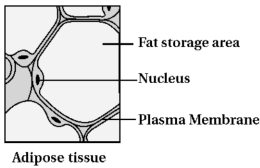
Explain adipose tissue.
Solution
(N/A) Adipose tissue is a type of loose connective tissue primarily located beneath the skin.
Its cells,known as adipocytes,are specialized to store fats.
Excess nutrients that are not utilized immediately by the body are converted into fats and stored within these cells.
This tissue also acts as an insulator and provides cushioning to internal organs.
Its cells,known as adipocytes,are specialized to store fats.
Excess nutrients that are not utilized immediately by the body are converted into fats and stored within these cells.
This tissue also acts as an insulator and provides cushioning to internal organs.
0 likes
View Solution212
Easy
Give differences: Cartilaginous tissue and Bone tissue.
Solution
(N/A)
| Cartilaginous tissue | Bone tissue |
| $(1)$ It is pliable and flexible. | $(1)$ It is hard and non-pliable. |
| $(2)$ The cells,chondrocytes,are enclosed in small spaces within the matrix. | $(2)$ The bone cells,osteocytes,are present in spaces called lacunae. |
| $(3)$ Its matrix is solid,pliable,and resists compression. | $(3)$ Its matrix is very hard and non-pliable due to the presence of calcium salts. |
| $(4)$ It provides support and flexibility to body parts. | $(4)$ It provides structural frame and support to the body. |
0 likes
View Solution213
Medium
Define the following terms:
$(i)$ Ligaments
(ii) Tendon
$(i)$ Ligaments
(ii) Tendon
Solution
(N/A) $(i)$ Ligaments: These are specialized connective tissues that connect one bone to another bone. They are highly elastic and provide stability to joints.
(ii) Tendon: These are dense regular connective tissues that attach skeletal muscles to bones. They are characterized by great strength and limited flexibility.
(ii) Tendon: These are dense regular connective tissues that attach skeletal muscles to bones. They are characterized by great strength and limited flexibility.
0 likes
View Solution214
Medium
Provide definitions/explanations for the following terms:
$(i)$ Perichondrium
$(ii)$ Serum
$(i)$ Perichondrium
$(ii)$ Serum
Solution
(N/A) $(i)$ Perichondrium: It is a layer of dense irregular connective tissue that surrounds the cartilage of developing bone.
$(ii)$ Serum: It is the clear,yellowish fluid part of blood that remains after the coagulation factors (like fibrinogen) have been removed from the blood plasma.
$(ii)$ Serum: It is the clear,yellowish fluid part of blood that remains after the coagulation factors (like fibrinogen) have been removed from the blood plasma.
0 likes
View Solution215
Medium
Describe the location and function of the following:
$(i)$ Mast cells
$(ii)$ Hyaline cartilage
$(i)$ Mast cells
$(ii)$ Hyaline cartilage
Solution
(N/A) $(i)$ Mast cells:
Location: Found in the matrix of areolar connective tissue.
Function: They secrete substances like Heparin (anticoagulant),Histamine (vasodilator),and Serotonin (vasoconstrictor) involved in inflammatory responses.
$(ii)$ Hyaline cartilage:
Location: Found in the embryonic skeleton,trachea,larynx,and at the ends of long bones.
Function: It provides structural support,flexibility,and a smooth surface for joint movement.
Location: Found in the matrix of areolar connective tissue.
Function: They secrete substances like Heparin (anticoagulant),Histamine (vasodilator),and Serotonin (vasoconstrictor) involved in inflammatory responses.
$(ii)$ Hyaline cartilage:
Location: Found in the embryonic skeleton,trachea,larynx,and at the ends of long bones.
Function: It provides structural support,flexibility,and a smooth surface for joint movement.
0 likes
View Solution216
Medium
Why are blood,bone and cartilage called connective tissue?
Solution
(N/A) $\Rightarrow$ Connective tissue provides a structural framework,forms tissues,and offers support to other organs.
$\Rightarrow$ Blood is a fluid or vascular connective tissue that connects various organs and transports materials from one place to another.
$\Rightarrow$ Bone is a dense,hard,and strong skeletal connective tissue that provides structural support to the body and aids in locomotion.
$\Rightarrow$ Cartilage is also a skeletal connective tissue. However,it is not as rigid as bone; it is flexible and can withstand pressure. It functions in support and protection and is found in areas such as the joints,nose,and outer ear.
$\Rightarrow$ Blood is a fluid or vascular connective tissue that connects various organs and transports materials from one place to another.
$\Rightarrow$ Bone is a dense,hard,and strong skeletal connective tissue that provides structural support to the body and aids in locomotion.
$\Rightarrow$ Cartilage is also a skeletal connective tissue. However,it is not as rigid as bone; it is flexible and can withstand pressure. It functions in support and protection and is found in areas such as the joints,nose,and outer ear.
0 likes
View Solution217
Medium
Write down the common features of connective tissue based on structure and function. Differentiate between bones and cartilages.
Solution
(N/A) $ \Rightarrow $ General characteristics of connective tissue:
$(i)$ Connective tissues are the most abundant and widely distributed in the body of complex animals.
$(ii)$ They link and support other tissues or organs of the body.
$(iii)$ Connective tissue arises from the mesoderm.
$(iv)$ Mainly three components are present: matrix, cells, and fibres.
$(v)$ The matrix is an extracellular material composed of glycoproteins and polysaccharides, which can be fluid, gel-like, or solid.
$(vi)$ These tissues have a good capacity for regeneration.
$(vii)$ Functions include structural support, protection of organs, and maintenance of body integrity.
$ \Rightarrow $ Difference between Bone and Cartilage:
$(i)$ Connective tissues are the most abundant and widely distributed in the body of complex animals.
$(ii)$ They link and support other tissues or organs of the body.
$(iii)$ Connective tissue arises from the mesoderm.
$(iv)$ Mainly three components are present: matrix, cells, and fibres.
$(v)$ The matrix is an extracellular material composed of glycoproteins and polysaccharides, which can be fluid, gel-like, or solid.
$(vi)$ These tissues have a good capacity for regeneration.
$(vii)$ Functions include structural support, protection of organs, and maintenance of body integrity.
$ \Rightarrow $ Difference between Bone and Cartilage:
| Bone | Cartilage |
|---|---|
| Type: Dense or spongy. Can be long, short, flat, or irregular. | Type: Hyaline, fibrous, and elastic cartilage. |
| Function: Provides structural framework, locomotion, protection, and mineral storage; site of blood cell formation. | Function: Prevents wear and tear in joints, supports trachea, absorbs shocks, and provides flexibility. |
| Structure: Contains osteocytes in a hard, calcified matrix. Highly vascularized. | Structure: Contains chondrocytes in a semi-solid, flexible matrix. Generally avascular. |
| Location: Forms the main axial and appendicular skeleton. | Location: Found in joints, tip of the nose, outer ear, and trachea. |
| Fibrous coating: Surrounded by periosteum, which is rich in sensory nerve fibers. | Fibrous coating: Surrounded by a fibrous membrane known as perichondrium. |
0 likes
View Solution218
MediumMCQ
Choose the correct option for the following statements:
$(i)$ Bone shows unidirectional / bidirectional growth.
$(ii)$ Ligaments are made up of white fibers / yellow fibers.
$(i)$ Bone shows unidirectional / bidirectional growth.
$(ii)$ Ligaments are made up of white fibers / yellow fibers.
A
$(i)$ Unidirectional,$(ii)$ White fibers
B
$(i)$ Bidirectional,$(ii)$ Yellow fibers
C
$(i)$ Unidirectional,$(ii)$ Yellow fibers
D
$(i)$ Bidirectional,$(ii)$ White fibers
Solution
(B) $(i)$ Bone growth is bidirectional because it occurs through the activity of osteoblasts and osteoclasts,allowing for remodeling and growth in multiple directions.
$(ii)$ Ligaments are dense regular connective tissues primarily composed of yellow elastic fibers,which provide the necessary elasticity for joint movement.
$(ii)$ Ligaments are dense regular connective tissues primarily composed of yellow elastic fibers,which provide the necessary elasticity for joint movement.
0 likes
View Solution219
Medium
Describe the structure and function of areolar connective tissue.
Solution
(N/A) Structure: The matrix of this tissue is relatively fluid and contains a network of fibers.
$\Rightarrow$ Fibers are of two types: White fibers and Yellow fibers.
$\Rightarrow$ White fibers: These are made up of collagen protein. They are wavy,unbranched,and arranged in bundles. They provide tensile strength and can tolerate stretch and pressure.
$\Rightarrow$ Yellow fibers: These are made up of elastin protein. They are single,branched,and provide elasticity to the tissue.
$\Rightarrow$ Cells: It contains three main types of cells: fibroblasts (which produce fibers),macrophages (which act as phagocytes),and mast cells (which secrete histamine,heparin,and serotonin).
Function: It acts as a supporting framework for epithelium and serves as a packing material between organs,filling the space inside the organs and attaching skin to underlying muscles.
$\Rightarrow$ Fibers are of two types: White fibers and Yellow fibers.
$\Rightarrow$ White fibers: These are made up of collagen protein. They are wavy,unbranched,and arranged in bundles. They provide tensile strength and can tolerate stretch and pressure.
$\Rightarrow$ Yellow fibers: These are made up of elastin protein. They are single,branched,and provide elasticity to the tissue.
$\Rightarrow$ Cells: It contains three main types of cells: fibroblasts (which produce fibers),macrophages (which act as phagocytes),and mast cells (which secrete histamine,heparin,and serotonin).
Function: It acts as a supporting framework for epithelium and serves as a packing material between organs,filling the space inside the organs and attaching skin to underlying muscles.
0 likes
View Solution220
MediumMCQ
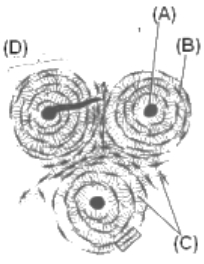
Choose the correct option for the labelling in the given diagram $(A, B, C, D)$.
A
Haversian canal,lacuna,Lamellae,Haversian system
B
Haversian canal,Volkmann's canal,Endosteum,Lamellae
C
Volkmann's canal,Lamellae,Osteocytes,Haversian canal
D
Haversian canal,Osteocytes,Lamellae,Endosteum
Solution
(A) The given diagram represents the structure of compact bone tissue.
$(A)$ points to the central Haversian canal,which contains blood vessels and nerves.
$(B)$ points to the lacuna,which is a small space containing an osteocyte.
$(C)$ points to the concentric layers of bone matrix called Lamellae.
$(D)$ represents the entire structural unit known as the Haversian system or Osteon.
$(A)$ points to the central Haversian canal,which contains blood vessels and nerves.
$(B)$ points to the lacuna,which is a small space containing an osteocyte.
$(C)$ points to the concentric layers of bone matrix called Lamellae.
$(D)$ represents the entire structural unit known as the Haversian system or Osteon.
0 likes
View Solution221
MediumMCQ
Cartilage tissues are likely to be slow in healing following an injury because
A
cartilage cells cannot reproduce.
B
they lack direct blood supplies.
C
the intercellular material is missing.
D
cartilage cells are surrounded by fluids.
Solution
(B) Cartilage is an avascular tissue,meaning it lacks a direct blood supply. Nutrients and oxygen must diffuse through the matrix to reach the chondrocytes. Because of this limited access to the circulatory system,cartilage grows and repairs much more slowly than other tissues following an injury.
0 likes
View Solution222
MediumMCQ
Which of the following vertebrate tissues would be an excellent source of collagen?
A
Liver
B
Nerve
C
Muscle
D
Tendon
Solution
(D) Collagen is the most abundant protein in the animal kingdom. In dense regular connective tissues,collagen fibers are present in rows between many parallel bundles of fibers. Tendons,which attach skeletal muscles to bones,are a prime example of this tissue and are composed primarily of collagen.
0 likes
View Solution223
MediumMCQ
The major functions of loose connective tissue include:
A
occupying spaces between organs and supporting epithelia.
B
supporting and surrounding blood vessels and nerves.
C
cushioning organs,storing lipids and facilitating diffusion.
D
All of the above.
Solution
(D) Loose connective tissue is a category of connective tissue that includes areolar tissue,reticular tissue,and adipose tissue.
It serves several critical functions in the body:
$1$. It occupies the spaces between organs and provides support to epithelial tissues.
$2$. It supports and surrounds blood vessels and nerves,providing structural integrity.
$3$. It helps in cushioning organs,storing lipids (in adipose tissue),and facilitating the diffusion of nutrients and waste products between blood and tissues.
Therefore,all the listed functions are correct.
It serves several critical functions in the body:
$1$. It occupies the spaces between organs and provides support to epithelial tissues.
$2$. It supports and surrounds blood vessels and nerves,providing structural integrity.
$3$. It helps in cushioning organs,storing lipids (in adipose tissue),and facilitating the diffusion of nutrients and waste products between blood and tissues.
Therefore,all the listed functions are correct.
0 likes
View Solution224
MediumMCQ
What are the three basic components of connective tissues?
A
Ground substance,cells and basement membrane
B
Cartilage,intercellular matrix and serum
C
Cells,protein fibers and ground substance
D
Collagen,elastin and reticular fibers
Solution
(C) Connective tissue fills the spaces between organs and tissues and provides structural and metabolic support for other tissues and organs.
The three basic components of connective tissue are:
$1$. Cells (such as fibroblasts,mast cells,and macrophages).
$2$. Protein fibers (such as collagen,elastin,and reticular fibers).
$3$. Ground substance (a gel-like material that fills the space between cells and fibers).
The three basic components of connective tissue are:
$1$. Cells (such as fibroblasts,mast cells,and macrophages).
$2$. Protein fibers (such as collagen,elastin,and reticular fibers).
$3$. Ground substance (a gel-like material that fills the space between cells and fibers).
0 likes
View Solution225
MediumMCQ
In the given diagram of areolar connective tissue,the different cells and parts have been marked by alphabets $(A, B, C, D)$. Choose the answer in which these alphabets correctly match with the parts and cells they indicate.
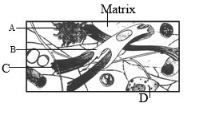
A
$A$-Adipocyte,$B$-Collagen fibres,$C$-Microfilament,$D$-Mast cells
B
$A$-Macrophage,$B$-Collagen fibres,$C$-Microfilament,$D$-Mast cells
C
$A$-Macrophage,$B$-Collagen fibres,$C$-Microtubule,$D$-$RBC$
D
$A$-Macrophage,$B$-Fibroblast,$C$-Collagen fibres,$D$-Mast cells
Solution
(D) The given figure represents loose connective tissue (areolar tissue).
Loose connective tissue has cells and fibres loosely arranged in a semi-fluid ground substance,for example,areolar tissue present beneath the skin.
It serves as a support framework for epithelium.
Based on the standard $NCERT$ diagram of areolar tissue:
$A$ represents a Macrophage (phagocytic cell).
$B$ represents a Fibroblast (cell that produces and secretes fibres).
$C$ represents Collagen fibres (structural protein fibres).
$D$ represents a Mast cell (involved in inflammatory responses).
Therefore,the correct matching is $A$-Macrophage,$B$-Fibroblast,$C$-Collagen fibres,$D$-Mast cells.
Loose connective tissue has cells and fibres loosely arranged in a semi-fluid ground substance,for example,areolar tissue present beneath the skin.
It serves as a support framework for epithelium.
Based on the standard $NCERT$ diagram of areolar tissue:
$A$ represents a Macrophage (phagocytic cell).
$B$ represents a Fibroblast (cell that produces and secretes fibres).
$C$ represents Collagen fibres (structural protein fibres).
$D$ represents a Mast cell (involved in inflammatory responses).
Therefore,the correct matching is $A$-Macrophage,$B$-Fibroblast,$C$-Collagen fibres,$D$-Mast cells.
0 likes
View Solution226
MediumMCQ
Identify figures-$I$ and $II$.
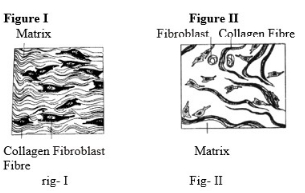
A
Dense regular connective tissue,Dense irregular connective tissue
B
Loose irregular connective tissue,Loose regular connective tissue
C
Adipose tissue,Specialized connective tissue
D
Connective tissue proper,Areolar tissue
Solution
(A) Figure $I$ represents dense regular connective tissue,where collagen fibres are present in rows between many parallel bundles of fibres. Tendons and ligaments are examples of this tissue.
Figure $II$ represents dense irregular connective tissue,which has fibroblasts and many fibres (mostly collagen) that are oriented differently. This tissue is present in the skin.
Figure $II$ represents dense irregular connective tissue,which has fibroblasts and many fibres (mostly collagen) that are oriented differently. This tissue is present in the skin.
0 likes
View Solution227
MediumMCQ
The intercellular material of the given figure is solid and resists compression. Identify the figure and the labels marked as $A$ and $B$.
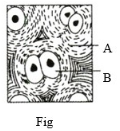
A
Cartilage,Collagen,Chondrocyte
B
Cartilage,Collagen,Chondroclast
C
Bone,Microtubule,Chondroclast
D
Bone,Collagen fibres,Osteoblast
Solution
(A) The given figure represents the image of cartilage.
Cartilage is an important structural component of the body.
It is a firm tissue but is softer and much more flexible than bone.
It is a connective tissue found in joints between bones (e.g.,the elbows,knees,and ankles),ends of the ribs,between the vertebrae in the spine,ears,nose,and bronchial tubes.
Cartilage is made up of specialized cells called chondrocytes $(B)$.
These chondrocytes produce large amounts of extracellular matrix composed of collagen $(A)$ fibres,proteoglycan,and elastin fibres.
There are no blood vessels in cartilage to supply the chondrocytes with nutrients.
Cartilage is an important structural component of the body.
It is a firm tissue but is softer and much more flexible than bone.
It is a connective tissue found in joints between bones (e.g.,the elbows,knees,and ankles),ends of the ribs,between the vertebrae in the spine,ears,nose,and bronchial tubes.
Cartilage is made up of specialized cells called chondrocytes $(B)$.
These chondrocytes produce large amounts of extracellular matrix composed of collagen $(A)$ fibres,proteoglycan,and elastin fibres.
There are no blood vessels in cartilage to supply the chondrocytes with nutrients.
0 likes
View Solution228
MediumMCQ
Refer to the given figure and identify the correct characteristic features.
$(i)$ It is a type of loose connective tissue.
$(ii)$ It contains fibroblasts,macrophages,collagen fibres,and mast cells.
$(iii)$ The cells of this tissue are specialized to store fats.
$(iv)$ It forms the inner lining of blood vessels,stomach,and intestine.
$(i)$ It is a type of loose connective tissue.
$(ii)$ It contains fibroblasts,macrophages,collagen fibres,and mast cells.
$(iii)$ The cells of this tissue are specialized to store fats.
$(iv)$ It forms the inner lining of blood vessels,stomach,and intestine.
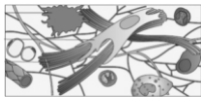
A
$(i)$ and $(ii)$
B
$(i)$ and $(iii)$
C
$(ii)$ and $(iii)$
D
$(iii)$ and $(iv)$
Solution
(A) The given figure represents areolar tissue,which is a type of loose connective tissue.
Statement $(i)$ is correct: Areolar tissue is a type of loose connective tissue.
Statement $(ii)$ is correct: It contains cells like fibroblasts,macrophages,and mast cells,along with collagen fibres.
Statement $(iii)$ is incorrect: Adipose tissue is the specialized connective tissue responsible for the storage of fats,not areolar tissue.
Statement $(iv)$ is incorrect: Epithelial tissue forms the inner lining of blood vessels,stomach,and intestine,whereas areolar tissue acts as a support framework for epithelium and attaches it to underlying tissues.
Therefore,the correct features are $(i)$ and $(ii)$.
Statement $(i)$ is correct: Areolar tissue is a type of loose connective tissue.
Statement $(ii)$ is correct: It contains cells like fibroblasts,macrophages,and mast cells,along with collagen fibres.
Statement $(iii)$ is incorrect: Adipose tissue is the specialized connective tissue responsible for the storage of fats,not areolar tissue.
Statement $(iv)$ is incorrect: Epithelial tissue forms the inner lining of blood vessels,stomach,and intestine,whereas areolar tissue acts as a support framework for epithelium and attaches it to underlying tissues.
Therefore,the correct features are $(i)$ and $(ii)$.
0 likes
View Solution229
MediumMCQ
Mast cells are associated with
A
exocrine glands
B
endocrine glands
C
areolar connective tissue
D
neural tissue
Solution
(C) Mast cells are specialized cells found in the connective tissue,particularly in the areolar connective tissue.
These cells contain numerous basophilic granules.
They play a crucial role in the immune response by releasing substances such as heparin,histamine,and serotonin in response to injury,infection,or inflammation of tissues.
These cells contain numerous basophilic granules.
They play a crucial role in the immune response by releasing substances such as heparin,histamine,and serotonin in response to injury,infection,or inflammation of tissues.
0 likes
View Solution230
MediumMCQ
The type of cell seen in a tendon is
A
muscle fibres
B
fibroblasts
C
collagenous cells
D
both $b$ and $c$
Solution
(D) tendon is a dense regular connective tissue primarily composed of collagen fibres arranged in rows. The cells present in this tissue are known as fibroblasts,which are responsible for the synthesis and secretion of the collagen fibres. Since these cells produce the collagenous matrix,they are often referred to as collagenous cells in the context of their function. Therefore,both $b$ and $c$ are correct descriptions of the cells found in a tendon.
0 likes
View Solution231
MediumMCQ
The chondrocytes of connective tissue are
A
fibre secreting cells
B
bone forming cells
C
cartilage cells
D
bone eating cells
Solution
(C) Chondrocytes are the specialized cells found in cartilage.
They are responsible for the production and maintenance of the cartilaginous matrix,which is composed primarily of collagen and proteoglycans.
These cells are located within small spaces called lacunae inside the matrix.
Cartilage is a type of specialized connective tissue found in areas such as the epiglottis,the pinnae (external ear),and at the ends of long bones.
They are responsible for the production and maintenance of the cartilaginous matrix,which is composed primarily of collagen and proteoglycans.
These cells are located within small spaces called lacunae inside the matrix.
Cartilage is a type of specialized connective tissue found in areas such as the epiglottis,the pinnae (external ear),and at the ends of long bones.
0 likes
View Solution232
EasyMCQ
The shape of a person's ear is mainly due to
A
dense regular connective tissue
B
dense irregular connective tissue
C
elastic cartilage
D
fibrocartilage
Solution
(C) Elastic cartilage,also known as yellow cartilage,is a specialized type of cartilage found in the pinna (outer ear),Eustachian tube,and epiglottis.
It is characterized by the presence of a dense network of elastic fibers and collagen fibers within the matrix.
The primary protein responsible for its flexibility and shape-retaining property is elastin.
Therefore,the shape of the human ear is maintained by elastic cartilage.
It is characterized by the presence of a dense network of elastic fibers and collagen fibers within the matrix.
The primary protein responsible for its flexibility and shape-retaining property is elastin.
Therefore,the shape of the human ear is maintained by elastic cartilage.
0 likes
View Solution233
EasyMCQ
Tendons and ligaments are examples of
A
areolar connective tissue
B
adipose tissue
C
dense regular connective tissue
D
loose connective tissue
Solution
(C) Tendons,which attach skeletal muscles to bones,and ligaments,which attach one bone to another,are examples of dense regular connective tissues.
In these tissues,collagen fibers are present in rows between many parallel bundles of fibers.
In these tissues,collagen fibers are present in rows between many parallel bundles of fibers.
0 likes
View Solution234
MediumMCQ
In all connective tissues,except which of the following,the cells secrete fibres of collagen or elastin protein?
A
Bone
B
Cartilage
C
Areolar connective tissue
D
Fluid connective tissue
Solution
(D) In all connective tissues,except for blood (which is a fluid connective tissue),the cells secrete fibres of structural proteins known as collagen or elastin. These fibres provide strength,elasticity,and flexibility to the tissue matrix.
0 likes
View Solution235
MediumMCQ
| Column-$I$ (Types of connective tissue) | Column-$II$ (Examples) |
| $A.$ Loose connective tissue | $I.$ Tendons and ligaments |
| $B.$ Dense regular tissue | $II.$ Skin |
| $C.$ Dense irregular tissue | $III.$ Cartilage,bones,blood |
| $D.$ Specialized connective tissue | $IV.$ Fibroblasts,macrophages and mast cells |
A
$A-IV, B-I, C-II, D-III$
B
$A-I, B-IV, C-III, D-II$
C
$A-IV, B-I, C-III, D-II$
D
$A-II, B-I, C-IV, D-III$
Solution
(A) The correct matching is as follows:
$A.$ Loose connective tissue contains cells like fibroblasts,macrophages,and mast cells $(A-IV)$.
$B.$ Dense regular connective tissue includes tendons and ligaments $(B-I)$.
$C.$ Dense irregular connective tissue is found in the skin $(C-II)$.
$D.$ Specialized connective tissue includes cartilage,bones,and blood $(D-III)$.
Therefore,the correct sequence is $A-IV, B-I, C-II, D-III$.
$A.$ Loose connective tissue contains cells like fibroblasts,macrophages,and mast cells $(A-IV)$.
$B.$ Dense regular connective tissue includes tendons and ligaments $(B-I)$.
$C.$ Dense irregular connective tissue is found in the skin $(C-II)$.
$D.$ Specialized connective tissue includes cartilage,bones,and blood $(D-III)$.
Therefore,the correct sequence is $A-IV, B-I, C-II, D-III$.
0 likes
View Solution236
MediumMCQ
Find the incorrectly matched pair.
A
Unicellular glandular cells - Goblet cell
B
Saliva - Exocrine secretion
C
Fusiform fibres - Smooth muscle
D
Cartilage - Areolar tissue
Solution
(D) Cartilage is a specialized connective tissue,not an areolar tissue. Areolar tissue is a type of loose connective tissue found beneath the skin. Therefore,the pair 'Cartilage - Areolar tissue' is incorrectly matched.
- Goblet cells are unicellular glandular cells.
- Saliva is secreted by salivary glands,which are exocrine glands.
- Smooth muscle cells are fusiform (spindle-shaped) in structure.
- Goblet cells are unicellular glandular cells.
- Saliva is secreted by salivary glands,which are exocrine glands.
- Smooth muscle cells are fusiform (spindle-shaped) in structure.
0 likes
View Solution237
MediumMCQ
Which of the following types of connective tissue is mismatched with its matrix?
A
Areolar - Loosely packed matrix of protein fibres
B
Bone - Mineralized matrix
C
Cartilage - Highly vascular matrix
D
Blood - Liquid matrix
Solution
(C) The correct answer is $C$.
Cartilage is a specialized connective tissue that has a solid and pliable matrix,which resists compression.
Crucially,cartilage is avascular,meaning it lacks blood vessels.
In contrast,Areolar tissue has a loosely organized matrix with protein fibers,Bone has a hard,non-pliable,mineralized matrix rich in calcium salts,and Blood is a fluid connective tissue with a liquid matrix called plasma.
Cartilage is a specialized connective tissue that has a solid and pliable matrix,which resists compression.
Crucially,cartilage is avascular,meaning it lacks blood vessels.
In contrast,Areolar tissue has a loosely organized matrix with protein fibers,Bone has a hard,non-pliable,mineralized matrix rich in calcium salts,and Blood is a fluid connective tissue with a liquid matrix called plasma.
0 likes
View Solution238
MediumMCQ
Which of the following type of tissue is being described by the given statements?
$(i)$ They are named because of their special function of linking and supporting other tissues/organs of the body.
$(ii)$ They include cartilage,bone,adipose and blood.
$(iii)$ They provide strength,elasticity and flexibility to the tissue.
$(iv)$ They also secrete modified polysaccharides,which accumulate between cells and fibres and act as matrix.
$(i)$ They are named because of their special function of linking and supporting other tissues/organs of the body.
$(ii)$ They include cartilage,bone,adipose and blood.
$(iii)$ They provide strength,elasticity and flexibility to the tissue.
$(iv)$ They also secrete modified polysaccharides,which accumulate between cells and fibres and act as matrix.
A
Epithelial tissue
B
Connective tissue
C
Muscle tissue
D
Neural tissue
Solution
(B) Connective tissue is the most abundant and widely distributed tissue in the body of complex animals.
They are named connective tissues because of their special function of linking and supporting other tissues/organs of the body.
They range from soft connective tissues to specialized types,which include cartilage,bone,adipose,and blood.
These tissues provide strength,elasticity,and flexibility to the body.
In all connective tissues,except blood,the cells secrete fibres of structural proteins called collagen or elastin.
The cells also secrete modified polysaccharides,which accumulate between cells and fibres and act as matrix (ground substance).
They are named connective tissues because of their special function of linking and supporting other tissues/organs of the body.
They range from soft connective tissues to specialized types,which include cartilage,bone,adipose,and blood.
These tissues provide strength,elasticity,and flexibility to the body.
In all connective tissues,except blood,the cells secrete fibres of structural proteins called collagen or elastin.
The cells also secrete modified polysaccharides,which accumulate between cells and fibres and act as matrix (ground substance).
0 likes
View Solution239
MediumMCQ
Which of the following statement$(s)$ is/are correct?
$(i)$ Loose connective tissue contains fibroblasts,macrophages and mast cells.
$(ii)$ Adipose tissue is a type of dense connective tissue located mainly beneath the skin.
$(iii)$ Tendons and ligaments are examples of dense connective tissue.
$(iv)$ Cartilage and bones are types of specialized hard connective tissue.
$(i)$ Loose connective tissue contains fibroblasts,macrophages and mast cells.
$(ii)$ Adipose tissue is a type of dense connective tissue located mainly beneath the skin.
$(iii)$ Tendons and ligaments are examples of dense connective tissue.
$(iv)$ Cartilage and bones are types of specialized hard connective tissue.
A
Only $(i)$
B
Both $(ii)$ and $(iv)$
C
Both $(i)$ and $(iii)$
D
$(i)$,$(iii)$ and $(iv)$
Solution
(D) Statement $(i)$ is correct: Loose connective tissue contains cells like fibroblasts,macrophages,and mast cells.
Statement $(ii)$ is incorrect: Adipose tissue is a type of loose connective tissue,not dense connective tissue.
Statement $(iii)$ is correct: Tendons and ligaments are examples of dense connective tissue (dense regular connective tissue).
Statement $(iv)$ is correct: Cartilage and bones are types of specialized connective tissue,often referred to as skeletal or hard connective tissue.
Therefore,statements $(i)$,$(iii)$,and $(iv)$ are correct.
Statement $(ii)$ is incorrect: Adipose tissue is a type of loose connective tissue,not dense connective tissue.
Statement $(iii)$ is correct: Tendons and ligaments are examples of dense connective tissue (dense regular connective tissue).
Statement $(iv)$ is correct: Cartilage and bones are types of specialized connective tissue,often referred to as skeletal or hard connective tissue.
Therefore,statements $(i)$,$(iii)$,and $(iv)$ are correct.
0 likes
View Solution240
MediumMCQ
Read the following statements and answer the question.
$(i)$ They have a hard and non-pliable ground substance rich in calcium salts and collagen fibres.
$(ii)$ They support and protect softer tissues and organs.
$(iii)$ Osteocytes are present in the spaces called lacunae.
$(iv)$ They also interact with skeletal muscles attached to them to bring about movements.
Which of the following type of tissue is being described by above statements?
$(i)$ They have a hard and non-pliable ground substance rich in calcium salts and collagen fibres.
$(ii)$ They support and protect softer tissues and organs.
$(iii)$ Osteocytes are present in the spaces called lacunae.
$(iv)$ They also interact with skeletal muscles attached to them to bring about movements.
Which of the following type of tissue is being described by above statements?
A
Cartilage
B
Bone
C
Blood
D
Neurons
Solution
(B) All the given statements are associated with bone tissue.
$(i)$ Bone has a hard and non-pliable ground substance (matrix) rich in calcium salts and collagen fibres,which provides strength.
$(ii)$ Bones provide a structural framework that supports and protects softer tissues and organs of the body.
$(iii)$ Bone cells,known as osteocytes,are located in small spaces within the matrix called lacunae.
$(iv)$ Bones interact with skeletal muscles attached to them via tendons to facilitate body movements.
Therefore,the correct answer is Bone.
$(i)$ Bone has a hard and non-pliable ground substance (matrix) rich in calcium salts and collagen fibres,which provides strength.
$(ii)$ Bones provide a structural framework that supports and protects softer tissues and organs of the body.
$(iii)$ Bone cells,known as osteocytes,are located in small spaces within the matrix called lacunae.
$(iv)$ Bones interact with skeletal muscles attached to them via tendons to facilitate body movements.
Therefore,the correct answer is Bone.
0 likes
View Solution241
EasyMCQ
Which of the following cells of connective tissue secrete antibodies?
A
Mast cells
B
Plasma cells
C
Macrophages
D
Fibroblasts
Solution
(B) Connective tissue contains various cell types such as mast cells,plasma cells,macrophages,and fibroblasts.
$1$. Mast cells are involved in inflammatory responses and release histamine,heparin,and serotonin.
$2$. Plasma cells are specialized $B$-lymphocytes that are responsible for the synthesis and secretion of antibodies (immunoglobulins).
$3$. Macrophages are phagocytic cells that engulf cell debris and pathogens.
$4$. Fibroblasts are responsible for the production of fibers and the ground substance of the matrix.
Therefore,the correct answer is plasma cells.
$1$. Mast cells are involved in inflammatory responses and release histamine,heparin,and serotonin.
$2$. Plasma cells are specialized $B$-lymphocytes that are responsible for the synthesis and secretion of antibodies (immunoglobulins).
$3$. Macrophages are phagocytic cells that engulf cell debris and pathogens.
$4$. Fibroblasts are responsible for the production of fibers and the ground substance of the matrix.
Therefore,the correct answer is plasma cells.
0 likes
View Solution242
MediumMCQ
Dense irregular connective tissue is found in
A
Skin
B
Tendon
C
Ligament
D
All of these
Solution
(A) Dense irregular connective tissue contains fibroblasts and many fibers (mostly collagen) that are oriented in different directions.
This tissue is primarily found in the skin.
In contrast,tendons and ligaments are examples of dense regular connective tissue,where fibers are oriented in a regular pattern.
This tissue is primarily found in the skin.
In contrast,tendons and ligaments are examples of dense regular connective tissue,where fibers are oriented in a regular pattern.
0 likes
View Solution243
EasyMCQ
The cells of connective tissue which produce histamine are
A
Fibroblasts
B
Macrophages
C
Mast cells
D
Plasma cells
Solution
(C) The cytoplasm of mast cells contains granules of Heparin and Histamine.
Histamine is a chemical mediator that induces inflammation and increases the permeability of blood vessels.
Histamine is a chemical mediator that induces inflammation and increases the permeability of blood vessels.
0 likes
View Solution244
EasyMCQ
Blubber of whale is an example of
A
Areolar tissue
B
Adipose tissue
C
Tendon
D
Muscular tissue
Solution
(B) Adipose tissue is an aggregation of fat cells or adipocytes.
Each adipocyte is rounded or oval,containing a large droplet of fat that almost fills the entire cell.
Adipose tissue is found in the blubber of whales and elephants,which serves as an insulating layer to regulate body temperature and store energy.
Each adipocyte is rounded or oval,containing a large droplet of fat that almost fills the entire cell.
Adipose tissue is found in the blubber of whales and elephants,which serves as an insulating layer to regulate body temperature and store energy.
0 likes
View Solution245
EasyMCQ
Haversian canals are found in
A
Matrix of mammalian bone
B
Matrix of amphibian bone
C
Matrix of reptilian bone
D
All of these
Solution
(A) The Haversian canal is a characteristic feature of mammalian bones,found within the bone matrix.
Each Haversian canal contains an artery,a vein,a lymph vessel,a nerve,and bone cells,all embedded within connective tissue.
These canals are essential for the transport of nutrients and waste products to and from the osteocytes.
Each Haversian canal contains an artery,a vein,a lymph vessel,a nerve,and bone cells,all embedded within connective tissue.
These canals are essential for the transport of nutrients and waste products to and from the osteocytes.
0 likes
View Solution246
EasyMCQ
The protein which occurs in the matrix of bone is
A
Ossein
B
Chondrin
C
Keratin
D
Globulin
Solution
(A) The matrix of bone is composed of an organic substance called ossein protein,which provides flexibility and tensile strength to the bone tissue.
Chondrin is found in cartilage,keratin is found in skin,hair,and nails,and globulin is a type of blood protein.
Chondrin is found in cartilage,keratin is found in skin,hair,and nails,and globulin is a type of blood protein.
0 likes
View Solution247
EasyMCQ
Select the incorrect statement with respect to the structure of a bone.
A
The matrix of bone is present in the form of layers called lamellae.
B
Lamellae consist of fluid-filled spaces called lacunae.
C
Lacunae contain bone cells called chondrocytes.
D
The matrix is solid because of the presence of salts such as calcium phosphate.
Solution
(C) The correct statement is that lacunae contain bone cells called $osteocytes$. $Chondrocytes$ are the cells found in cartilage,not bone. Therefore,the statement in option $C$ is incorrect. Bone cells $(osteocytes)$ lie in lacunae singly.
0 likes
View Solution248
MediumMCQ
The most widely distributed connective tissue in the body of animals is
A
Areolar
B
Adipose
C
Cartilage
D
Dense irregular
Solution
(A) Areolar tissue is the most widely distributed connective tissue in the animal body.
It serves as a support framework for the epithelium.
It is present beneath the skin.
Areolar tissue joins the skin to muscles and fills the space inside organs.
It serves as a support framework for the epithelium.
It is present beneath the skin.
Areolar tissue joins the skin to muscles and fills the space inside organs.
0 likes
View Solution249
MediumMCQ
The connective tissue which acts as an insulator and prevents loss of heat from the body is
A
Areolar
B
Adipose
C
Blood
D
Cartilage
Solution
(B) Adipose tissue is a specialised loose connective tissue which possesses abundant fat-storing cells called adipocytes.
Adipose tissue acts as a fat reservoir and functions as an insulator.
Because it is a poor conductor of heat,it effectively reduces heat loss from the body.
Adipose tissue acts as a fat reservoir and functions as an insulator.
Because it is a poor conductor of heat,it effectively reduces heat loss from the body.
0 likes
View Solution250
EasyMCQ
Which of the following cells in areolar tissue are phagocytic?
A
Histiocytes
B
Fibroblasts
C
Macrophages
D
Both $(A)$ and $(C)$
Solution
(D) Macrophages are also known as Histiocytes,which occur in connective tissue.
Macrophages engulf and digest microbes,foreign particles,and degenerating cells.
Therefore,both Macrophages and Histiocytes are phagocytic in nature.
Macrophages engulf and digest microbes,foreign particles,and degenerating cells.
Therefore,both Macrophages and Histiocytes are phagocytic in nature.
0 likes
View SolutionStructural Organisation In Animals — Connective tissue · Frequently Asked Questions
1Are these Structural Organisation In Animals questions useful for JEE and NEET?
Yes. All questions in this section are mapped to JEE Main and NEET exam patterns. Previous year questions from JEE Main, NEET, GUJCET and state-level exams are included with full solutions.
2Can I switch to Hindi or Gujarati for these questions?
Yes. Use the language tabs in the hero section or the sidebar to view the same questions and solutions in English, Hindi or Gujarati.
3How do I generate a question paper from this subtopic?
Use the Vedclass Exam Paper Generator — select the chapter and subtopic, set difficulty, and generate Sets A, B, C, D automatically. First 3 chapters of every subject are free.
Vedclass Products
For Students
Vedclass Test Series
Mock tests in real JEE/NEET style with performance analysis. 5-day free trial.
Start Free TrialFor Teachers
Exam Paper Generator
Generate Set A/B/C/D papers from this chapter in 2 minutes. 3 chapters free.
Try FreeFor Institutes
Online Exam Module
Live online exams with unlimited students, 360° analytics & white-label branding.
See DemoFor Teachers & Institutes
Generate a Structural Organisation In Animals Exam Paper in 2 Minutes
Select subtopic & difficulty — Sets A, B, C, D auto-generated with No Repeat logic.
First 3 chapters of every subject are free — no payment required.